WO2025046684A1 - 電力変換装置 - Google Patents
電力変換装置 Download PDFInfo
- Publication number
- WO2025046684A1 WO2025046684A1 PCT/JP2023/030908 JP2023030908W WO2025046684A1 WO 2025046684 A1 WO2025046684 A1 WO 2025046684A1 JP 2023030908 W JP2023030908 W JP 2023030908W WO 2025046684 A1 WO2025046684 A1 WO 2025046684A1
- Authority
- WO
- WIPO (PCT)
- Prior art keywords
- power
- current
- limit value
- value
- command value
- Prior art date
- Legal status (The legal status is an assumption and is not a legal conclusion. Google has not performed a legal analysis and makes no representation as to the accuracy of the status listed.)
- Pending
Links
Images






Classifications
-
- H—ELECTRICITY
- H02—GENERATION; CONVERSION OR DISTRIBUTION OF ELECTRIC POWER
- H02J—ELECTRIC POWER NETWORKS; CIRCUIT ARRANGEMENTS OR SYSTEMS FOR SUPPLYING OR DISTRIBUTING ELECTRIC POWER; SYSTEMS FOR STORING ELECTRIC ENERGY
- H02J3/00—Circuit arrangements for AC mains or AC distribution networks
- H02J3/001—Arrangements for handling faults or abnormalities, e.g. emergencies or contingencies
- H02J3/0014—Arrangements for handling faults or abnormalities, e.g. emergencies or contingencies for preventing or reducing power oscillations in networks
-
- H—ELECTRICITY
- H02—GENERATION; CONVERSION OR DISTRIBUTION OF ELECTRIC POWER
- H02J—ELECTRIC POWER NETWORKS; CIRCUIT ARRANGEMENTS OR SYSTEMS FOR SUPPLYING OR DISTRIBUTING ELECTRIC POWER; SYSTEMS FOR STORING ELECTRIC ENERGY
- H02J3/00—Circuit arrangements for AC mains or AC distribution networks
- H02J3/38—Arrangements for feeding a single network from two or more generators or sources in parallel; Arrangements for feeding already energised networks from additional generators or sources in parallel
-
- H—ELECTRICITY
- H02—GENERATION; CONVERSION OR DISTRIBUTION OF ELECTRIC POWER
- H02J—ELECTRIC POWER NETWORKS; CIRCUIT ARRANGEMENTS OR SYSTEMS FOR SUPPLYING OR DISTRIBUTING ELECTRIC POWER; SYSTEMS FOR STORING ELECTRIC ENERGY
- H02J3/00—Circuit arrangements for AC mains or AC distribution networks
- H02J3/38—Arrangements for feeding a single network from two or more generators or sources in parallel; Arrangements for feeding already energised networks from additional generators or sources in parallel
- H02J3/46—Controlling the sharing of generated power between the generators, sources or networks
Definitions
- This disclosure relates to a power conversion device.
- a frequency stabilization device uses a power converter to control the active power output from power sources such as solar panels and storage batteries, and stabilizes the power grid by applying a pseudo-inertial force to the power grid.
- JP 2019-176584 A discloses a control device for a distributed power source.
- This control device sets a virtual inertia for a power conversion device that connects a distributed power source to a power grid, calculates a virtual inertia value based on the specifications and operating state of the distributed power source, and sets the virtual inertia for the power conversion device based on either the calculated virtual inertia value or a required inertia value requested by the grid operator.
- the power conversion device during normal operation, it is operated so that it can output active power up to the upper limit.
- the power conversion device tries to increase the active power output to the power system in the event of a system accident (e.g., when a generator trips), there is no spare capacity to do so. Therefore, the power conversion device cannot apply inertial force to the power system and cannot stabilize the system frequency.
- the objective of one aspect of the present disclosure is to provide a power conversion device that can provide inertial force in the event of an accident in the power system while supplying active power to the power system under normal circumstances.
- a power conversion device includes a power converter that performs power conversion between a DC circuit and a power system, and a control device that controls the power converter.
- the control device includes a generator simulation unit that generates a first voltage command value for the power converter by simulating the characteristics of a synchronous generator based on the AC voltage and AC current in the power system, a current command generation unit that generates a first current command value for the power converter based on the first voltage command value generated by the generator simulation unit, a setting unit that sets a limit value so that a second current range according to the limit value is smaller than a first current range according to the current capacity of the power converter when no fault is detected in the power system, a limiter that limits the first current command value within the second current range to generate a second current command value, a voltage command generation unit that generates a second voltage command value based on the second current command value, and a signal generation unit that generates a control signal for the power converter based on the second voltage command value.
- a power conversion device includes a power converter that performs power conversion between a DC circuit and a power system, and a control device that controls the power converter.
- the control device includes a generator simulation unit that generates a first voltage command value for the power converter by simulating the characteristics of a synchronous generator based on the AC voltage and AC current in the power system, a current command generation unit that generates a first current command value for the power converter based on the first voltage command value generated by the generator simulation unit, a limiter that generates a second current command value by limiting the first current command value within a current range according to the current capacity of the power converter, a voltage command generation unit that generates a second voltage command value based on the second current command value, and a signal generation unit that generates a control signal for the power converter based on the second voltage command value.
- the generator simulation unit When no fault is detected in the power system, the generator simulation unit generates the phase of the first voltage command value based on the second active power that is smaller than the first active power calculated based
- the power conversion device disclosed herein makes it possible to provide active power to the power grid during normal operation while providing inertial force in the event of a power grid accident.
- FIG. 1 is a diagram for explaining an example of an overall configuration of a power conversion system.
- FIG. 2 is a diagram showing an example of a time change in active power output from a power converter.
- FIG. 2 is a diagram illustrating an example of a hardware configuration of a control device.
- 4 is a block diagram showing an example of a functional configuration of a command generating unit according to the first embodiment.
- FIG. 4 is a block diagram showing an example of the configuration of a voltage amplitude generating unit; 13 is a flowchart illustrating an example of processing by an accident detection unit and a setting unit.
- FIG. 4 is a diagram showing an example of a time change in active power output from the power converter according to the first embodiment.
- FIG. 13 is a diagram for illustrating an example of a configuration of a setting unit according to a modification of the first embodiment.
- FIG. 13 is a diagram for illustrating another example of the configuration of the setting unit according to the modification of the first embodiment.
- FIG. 13 is a diagram showing an example of a time change in active power output from a power converter according to a modification of the first embodiment.
- FIG. 11 is a diagram showing another example of a time change in active power output from the power converter according to the modification of the first embodiment.
- FIG. 11 is a block diagram showing an example of a configuration of a command generating unit according to a second embodiment.
- FIG. 13 is a block diagram showing an example of a configuration of a command generating unit according to a modification of the second embodiment.
- 10 is a diagram for explaining the relationship between an active power command value and a power margin; FIG.
- Embodiment 1 is a diagram for explaining an example of the overall configuration of a power conversion system.
- the power conversion system 1000 includes a power grid 30, a transformer 34, a DC circuit 40, a power conversion device 50, a current detector 91, and a voltage detector 93.
- the power conversion device 50 includes a control device 10 and a power converter 20.
- the power converter 20 is a power converter that performs power conversion between the DC circuit 40 and the power system 30. Specifically, the power converter 20 is connected to the power system 30 via a transformer 34, converts the DC power from the DC circuit 40 into AC power, and outputs the AC power to the power system 30.
- the power converter 20 is, for example, a self-excited converter such as a two-level converter, a three-level converter, or a modular multilevel converter.
- a self-excited converter is a converter that uses self-extinguishing elements, and can freely control the magnitude and phase of the output voltage. Furthermore, a self-excited converter can exchange AC and DC power even without a power source from a power system.
- the power system 30 is, for example, a three-phase AC system.
- the DC circuit 40 is, for example, a renewable energy power source such as a solar cell or a wind power generator, a power storage element, a DC transmission system, a DC terminal of another power converter, etc.
- the current detector 91 detects three-phase AC current at the interconnection point 32 between the power system 30 and the power converter 20. Specifically, the current detector 91 detects the U-phase AC current Isysu, the V-phase AC current Isysv, and the W-phase AC current Isysw that flow between the interconnection point 32 and the transformer 34.
- the AC currents Isysu, Isysv, and Isysw (hereinafter collectively referred to as "AC current Isys") are input to the control device 10.
- the voltage detector 93 detects the three-phase AC voltage at the interconnection point 32 of the power system 30. Specifically, the voltage detector 93 detects the U-phase AC voltage Vsysu, the V-phase AC voltage Vsysv, and the W-phase AC voltage Vsysw at the interconnection point 32.
- the AC voltages Vsysu, Vsysv, and Vsysw (hereinafter collectively referred to as "AC voltage Vsys") are input to the control device 10.
- the control device 10 is a device that controls the operation of the power converter 20.
- the control device 10 includes, as its main functional components, a command generating unit 100 and a signal generating unit 200.
- Each function of the command generating unit 100 and the signal generating unit 200 is realized by a processing circuit.
- the processing circuit may be dedicated hardware, or may be a CPU (Central Processing Unit) that executes a program stored in the internal memory of the control device 10.
- the processing circuit is dedicated hardware, the processing circuit is configured, for example, by an FPGA (Field Programmable Gate Array), an ASIC (Application Specific Integrated Circuit), or a combination of these.
- the command generating unit 100 mainly has the function of simulating the characteristics of a synchronous generator, and generates the phase ⁇ of the voltage output from the power converter 20 (i.e., the phase of the voltage command value) and the amplitude V of the voltage (i.e., the amplitude of the voltage command value).
- the phase ⁇ is the reference phase used to control the power converter 20.
- the command generating unit 100 will be described in detail later.
- the signal generating unit 200 generates a control signal for the power converter 20 based on the voltage command value (i.e., the amplitude V and the phase ⁇ ) generated by the command generating unit 100, and outputs the control signal to the power converter 20.
- the signal generating unit 200 includes a three-phase voltage generating unit 202 and a PWM control unit 204.
- the three-phase voltage generator 202 generates three-phase sinusoidal voltages Vu*, Vv*, and Vw* by two-phase/three-phase conversion based on the phase ⁇ and the amplitude V.
- the PWM control unit 204 performs pulse width modulation on each of the three-phase sinusoidal voltages Vu*, Vv*, and Vw* to generate a control signal as a PWM signal.
- the PWM control unit 204 outputs the control signal to the power converter 20.
- the control signal is a gate control signal for controlling the on and off of each switching element included in the power converter 20.
- the power conversion device 50 as described above has a function of simulating the characteristics of a synchronous generator, and adjusts the active power output to the power system 30 in order to stabilize the system frequency.
- the power conversion device 50 is configured to be able to output active power up to an upper limit determined by the hardware performance during normal operation when no accidents have occurred in the power system 30, a problem such as that shown in Figure 2 will occur.
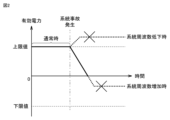
- FIG. 2 is a diagram showing an example of the change over time in the active power output from the power converter.
- the horizontal axis of FIG. 2 represents time, and the vertical axis represents the output active power of the power converter 20.
- the direction in which active power is output from the power converter 20 to the power system 30 is defined as the positive direction, and the direction in which active power is input (i.e., absorbed) from the power system 30 to the power converter 20 is defined as the negative direction.
- the DC circuit 40 is configured from a renewable energy power source that supplies power to the power converter 20.
- the “upper limit” in FIG. 2 indicates the upper limit of the active power defined by the upper limit of the positive polarity of the current capacity (i.e., the allowable current) determined by the hardware performance of the power converter 20.
- the “lower limit” in FIG. 2 indicates the lower limit of the active power defined by the upper limit of the negative polarity of the current capacity of the power converter 20 (i.e., the lower limit of the current capacity).
- the power converter 20 continues to output active power at an upper limit value under normal circumstances.
- a system accident occurs (e.g., a generator in the power system 30 trips) and the system frequency drops
- the power converter 20 attempts to increase the active power output to the power system 30 in order to increase the system frequency, but is unable to increase the active power due to limitations in the hardware performance. In other words, it is unable to impart a pseudo-inertial force to the power system 30, and is unable to maintain the system frequency at a specified value. Therefore, it is preferable that the power conversion device 50 is configured so that it can increase the active power output when the system frequency drops.
- the power converter 20 reduces the active power output to the power system 30 in order to lower the system frequency.
- the renewable energy power source serving as the DC circuit 40 cannot absorb active power. Therefore, it is necessary to appropriately set the lower limit of the active power output by the power conversion device 50.
- the power conversion device 50 is configured to increase the effective power output to the power grid 30 and apply inertial force when the grid frequency drops.
- the specific configuration will be described later.
- Fig. 3 is a diagram showing an example of a hardware configuration of the control device 10.
- Fig. 3 shows an example of the control device 10 configured by a computer.
- the control device 10 includes one or more input converters 70, one or more sample-and-hold circuits 71, a multiplexer 72, an A/D converter 73, one or more CPUs (Central Processing Units) 74, a RAM (Random Access Memory) 75, a ROM (Read Only Memory) 76, one or more input/output interfaces 77, and an auxiliary storage device 78.
- the control device 10 includes a bus 79 that interconnects the components.
- the input converter 70 has an auxiliary transformer for each input channel.
- Each auxiliary transformer converts the detection signals from the current detector 91 and voltage detector 93 in FIG. 1 into signals of a voltage level suitable for subsequent signal processing.
- a sample-and-hold circuit 71 is provided for each input converter 70.
- the sample-and-hold circuit 71 samples and holds the signal representing the electrical quantity received from the corresponding input converter 70 at a specified sampling frequency.
- the multiplexer 72 sequentially selects the signals held in the multiple sample-and-hold circuits 71.
- the A/D converter 73 converts the signal selected by the multiplexer 72 into a digital value. Note that by providing multiple A/D converters 73, A/D conversion may be performed in parallel on the detection signals of multiple input channels.
- the CPU 74 controls the entire control device 10 and executes arithmetic processing according to a program.
- the RAM 75 as a volatile memory
- the ROM 76 as a non-volatile memory are used as the main memory of the CPU 74.
- the ROM 76 stores programs and setting values for signal processing.
- the auxiliary storage device 78 is a non-volatile memory with a larger capacity than the ROM 76, and stores programs, data on detected electrical quantity values, etc.
- the input/output interface 77 is an interface circuit for communication between the CPU 74 and external devices.
- control device 10 unlike the example in Figure 3, it is also possible to configure at least a portion of the control device 10 using circuits such as an FPGA and an ASIC.
- Fig. 4 is a block diagram showing an example of a functional configuration of a command generating unit according to the first embodiment.
- the command generating unit 100 includes a generator simulator 110, a fault detector 120, a setting unit 130, a current command generating unit 140, a current limiter 142, a voltage command generating unit 144, a coordinate converter 150, an AC power calculator 152, and a voltage amplitude generator 160.
- the DC circuit 40 is composed of a renewable energy power source.
- the coordinate conversion unit 150 performs a three-phase/two-phase conversion of the AC currents Isysu, Isysv, and Isysw using the phase ⁇ to calculate the d-axis current Id and the q-axis current Iq.
- the coordinate conversion unit 150 also performs a three-phase/two-phase conversion of the AC voltages Vsysu, Vsysv, and Vsysw using the phase ⁇ to calculate the d-axis voltage Vd and the q-axis voltage Vq.
- the AC power calculation unit 152 calculates the active power P and reactive power Q at the interconnection point 32 based on the AC current Isys detected by the current detector 91 and the AC voltage Vsys detected by the voltage detector 93.
- the voltage amplitude generating unit 160 generates the amplitude Vref of the voltage command value based on the d-axis voltage Vd, the q-axis voltage Vq, the reactive power Q, and the reactive power command value Qref.
- the amplitude Vref corresponds to the amplitude command value of the output voltage of the power converter 20.
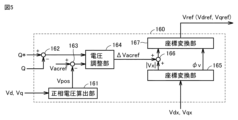
- FIG. 5 is a block diagram showing an example of the configuration of the voltage amplitude generation unit.
- the voltage amplitude generation unit 160 includes a positive-phase voltage calculation unit 161, subtractors 162 and 163, a voltage adjustment unit 164, coordinate conversion units 165 and 167, and an adder 166.
- the positive-sequence voltage calculation unit 161 calculates the positive-sequence voltage Vpos based on the d-axis voltage Vd and the q-axis voltage Vq.
- the voltage adjustment unit 164 selects either the automatic reactive power adjustment mode or the automatic voltage adjustment mode, and generates a voltage amplitude adjustment amount ⁇ Vacref based on the selected mode. Specifically, when the automatic reactive power adjustment mode is selected, the voltage adjustment unit 164 generates a voltage amplitude adjustment amount ⁇ Vacref by feedback control for making the deviation ⁇ Q equal to or less than a specified value (e.g., 0). When the automatic voltage adjustment mode is selected, the voltage adjustment unit 164 generates a voltage amplitude adjustment amount ⁇ Vacref by feedback control for making the deviation ⁇ Vpos equal to or less than a specified value (e.g., 0).
- the voltage adjustment unit 164 is composed of a PI controller, a first-order lag element, etc.
- the coordinate conversion unit 165 converts the d-axis component (i.e., the specified d-axis voltage command value Vdx) and the q-axis component (i.e., the specified q-axis voltage command value Vqx) of the specified voltage command value into amplitude
- the specified d-axis voltage command value Vdx and the specified q-axis voltage command value Vqx are values that are set in advance by a system operator or the like.
- the adder 166 adds the amplitude
- the coordinate conversion unit 167 performs dq-axis conversion on the sum of the amplitude
- the generator simulation unit 110 generates a voltage command value V1* for the power converter 20 by simulating the characteristics of a synchronous generator based on the AC voltage Vsys and AC current Isys in the power system 30.
- the generator simulation unit 110 includes a subtractor 111, an integrator 112, an adder 113, an integrator 114, and a voltage command generation unit 115.
- the active power command value Pref is the target value of the active power P and is determined by the system operator.
- the integrator 112 outputs the angular frequency deviation ⁇ by integrating the difference ⁇ P, which is the output value of the subtractor 111, over time. This simulates the braking force of the synchronous generator in the control of the power converter 20. "M" in the integrator 112 is the inertia constant of the synchronous generator.
- the angular frequency deviation ⁇ corresponds to the difference between the angular frequency of the rotor in the virtual synchronous generator and the reference angular frequency ⁇ 0.
- the reference angular frequency ⁇ 0 is the angular frequency of the reference frequency of power in the power system 30 (for example, 50 Hz or 60 Hz).
- the integrator 114 calculates the phase ⁇ by integrating the angular frequency ⁇ over time.
- the voltage command generator 115 generates a voltage command value V1* based on the amplitude Vref and the phase ⁇ .
- the accident detection unit 120 detects an accident in the power system 30 based on the angular frequency deviation ⁇ . For example, the accident detection unit 120 determines that an accident has occurred in the power system 30 (i.e., detects a system accident) when the angular frequency deviation ⁇ is equal to or greater than the set value, and determines that no accident has occurred in the power system 30 when the angular frequency deviation ⁇ is less than the set value.
- the accident detection unit 120 outputs a signal Tr according to the detection result. For example, the value of the signal Tr indicates "1" when a system accident is detected, and indicates "0" when no system accident is detected.
- the accident detection unit 120 may detect an accident in the power system 30 based on the difference between the active power command value Pref and the active power P, or other signals in the generator simulation unit 110.
- the accident detection unit 120 may also detect an accident in the power system 30 based on the frequency fluctuation results of the AC voltage Vsys at the interconnection point 32.
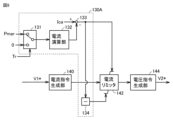
- the setting unit 130 sets the limit value of the current limiter 142.
- the setting unit 130 includes a selector 131, a current calculation unit 132, and a subtractor 133.
- Selector 131 outputs "Pmar" to current calculation unit 132 when no system fault is detected (i.e., when the value of signal Tr is “0"), and outputs "0" to current calculation unit 132 when a system fault is detected (i.e., when the value of signal Tr is “1").
- Pmar indicates the margin of active power output from power converter 20 to power system 30 (hereinafter also referred to as "power margin”).
- Power margin Pmar is a value that is determined in advance by the system operator.
- the current calculation unit 132 calculates the current margin Imar required for the active power output of the power margin Pmar.
- the upper limit value of the current capacity of the power converter 20 i.e., the upper limit value of the positive polarity
- the subtractor 133 sets the subtracted value (i.e., Ica-Imar) obtained by subtracting the current margin Imar from the current capacity Ica (where Ica>0) of the power converter 20 as the upper limit value Imax indicating the upper limit value of the limit value of the current limiter 142.
- the current calculation unit 132 outputs "0" to the subtractor 133.
- the subtractor 133 sets the current capacity Ica of the power converter 20 to the upper limit value Imax of the current limiter 142.
- the setting unit 130 sets the lower limit value Imin, which indicates the lower limit of the limit value of the current limiter 142, to zero.
- the setting unit 130 sets the upper limit value Imax to the value obtained by subtracting the current margin Imar from the upper limit value of the current capacity (i.e., Ica), and sets the lower limit value Imin to "0."
- the upper limit value Imax is smaller than the current capacity Ica
- the current range R2 according to the limit value is smaller than the current range R1 according to the current capacity.
- the setting unit 130 sets the upper limit value Imax to "Ica” and the lower limit value Imin to "0.” In this case, the current capacity Ica and the upper limit value max are the same.
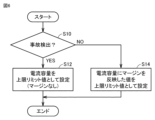
- FIG. 6 is a flowchart showing an example of the processing of the accident detection unit and the setting unit.
- the accident detection unit 120 judges whether an accident has been detected in the power system 30 (step S10). If an accident has been detected (YES in step S10), the setting unit 130 sets the current capacity Ica of the power converter 20 as the upper limit value Imax (step S12). In this case, the power margin Pmar is not taken into consideration. On the other hand, if no accident has been detected (NO in step S10), the setting unit 130 sets a value that reflects the power margin Pmar in the current capacity Ica (i.e., Ica-Imar) as the upper limit value Imax (step S14).
- the current command generating unit 140 generates a current command value I1* for the power converter 20 based on the voltage command value V1* generated by the generator simulation unit 110.
- the relationship between the AC voltage Vsys at the interconnection point 32, the output voltage Vi of the power converter 20, the output current I of the power converter 20, and the leakage reactance X of the transformer 34 is expressed by the following equation (1).
- the current limiter 142 limits the current command value I1* to within the current range R2 to generate the current command value I2*. Specifically, the current limiter 142 outputs a value obtained by limiting the current command value I1* to a value equal to or greater than the lower limit value Imin and equal to or less than the upper limit value Imax as the current command value I2*. For example, when no system fault is detected (i.e., when the lower limit value Imin is set to "0" and the upper limit value Imax is set to "Ica-Imar"), the current command value I2* is limited to a value equal to or greater than 0 and equal to or less than "Ica-Imar".
- the voltage command value V2* corresponds to the voltage command value having the phase ⁇ and the amplitude V output from the command generating unit 100 in FIG. 1. Therefore, the signal generating unit 200 in FIG. 1 generates a control signal for the power converter 20 based on the voltage command value V2* generated by the command generating unit 100, and outputs it to the power converter 20.
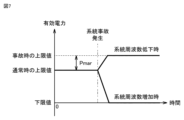
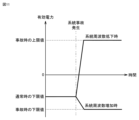
- FIG. 7 is a diagram showing an example of the change over time in the active power output from the power converter according to the first embodiment.
- the horizontal axis of FIG. 7 is time, and the vertical axis is the output active power of the power converter 20.
- the direction in which active power is output from the power converter 20 to the power system 30 is defined as the positive direction, and the direction in which active power is absorbed from the power system 30 to the power converter 20 is defined as the negative direction.
- the power converter 20 outputs active power corresponding to the upper limit value under normal conditions (i.e., active power corresponding to the current "Ica-Imar").
- the power converter 20 increases the active power output to the power system 30 by Pmar in order to increase the system frequency, and outputs the active power corresponding to the upper limit at the time of the accident (i.e., the active power corresponding to the current "Ica"). This makes it possible to impart a pseudo-inertial force to the power system 30, thereby achieving stabilization of the system frequency.
- the power converter 20 reduces the active power to the power system 30 in order to lower the system frequency, and outputs a lower limit value of active power (i.e., active power corresponding to a current of "0"). In other words, the power converter 20 sets the active power output to zero. This also appropriately controls the lower limit value of the active power output of the power converter 20.
- the DC circuit 40 is configured with a renewable energy power source
- a power source e.g., a power storage element
- the power storage element differs from the renewable energy power source in that it is capable of supplying and absorbing active power.
- the power storage element is a power storage device including, for example, an electric double layer capacitor or a storage battery such as a lithium ion battery.
- the DC circuit 40 is described as a power storage element, but the DC circuit 40 may be, for example, a DC power system including a DC transmission network, or a DC terminal of another power conversion device. In the latter case, a BTB (Back To Back) system is configured to connect AC power systems with different rated frequencies, etc., by linking two power converters.
- a BTB Back To Back
- FIG. 8 is a diagram for explaining an example of the configuration of a setting unit according to a modified example of the first embodiment.
- setting unit 130A has a configuration in which polarity reversal unit 134 is added to setting unit 130 of FIG. 4.
- the subtractor 133 subtracts the current margin Imar from the current capacity Ica (where Ica>0) of the power converter 20, and sets the result (i.e., Ica-Imar) as the upper limit value Imax of the current limiter 142.
- the subtractor 133 also outputs the subtraction value to the polarity reversal unit 134.
- the polarity reversal unit 134 sets the value with the polarity of the subtraction value reversed (i.e., -Ica+Imar) as the lower limit value Imin of the current limiter 142.
- the subtractor 133 sets the current capacity Ica of the power converter 20 to the upper limit value Imax of the current limiter 142.
- the subtractor 133 also outputs the current capacity Ica to the polarity inversion unit 134.
- the polarity inversion unit 134 sets the value obtained by inverting the polarity of the current capacity Ica (i.e., -Ica) to the lower limit value Imin of the current limiter 142.
- the setting unit 130A sets the upper limit value Imax to the value obtained by subtracting the current margin Imar from the upper limit value of the current capacity (i.e., Ica), and sets the lower limit value Imin to the value obtained by adding the current margin Imar to the lower limit value of the current capacity (i.e., -Ica).
- the setting unit 130A sets the upper limit value of the current capacity (i.e., Ica) as the upper limit value Imax, and sets the lower limit value of the current capacity (i.e., -Ica) as the lower limit value Imin.
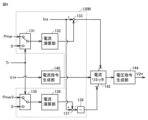
- FIG. 9 is a diagram for explaining another example of the configuration of the setting unit according to the modified example of the first embodiment.
- the setting unit 130B has a configuration in which a selector 135, a current calculation unit 136, a subtractor 137, and a polarity inversion unit 138 are added to the setting unit 130 in FIG. 4.
- the method for setting the upper limit value Imax of the current limiter 142 is the same as that described in FIG. 4 or FIG. 8.
- the selector 135 outputs "Pmar2" to the current calculation unit 132 when a system fault is not detected (i.e., when the value of the signal Tr is "0"), and outputs "0" to the current calculation unit 132 when a system fault is detected (i.e., when the value of the signal Tr is "1").
- Pmar2 indicates the margin of the active power output from the power converter 20 to the DC circuit 40 (e.g., absorbed by the storage element).
- the power margin Pmar2 is a value that is determined in advance by the system operator. Typically, the power margin Pmar2 is a different value from the power margin Pmar of the active power output from the power converter 20 to the power system 30.
- the current calculation unit 136 calculates the current margin Imar2 required for the active power output of the power margin Pmar2.
- the subtractor 137 subtracts the current margin Imar2 from the current capacity Ica of the power converter 20, and outputs the result (i.e., Ica-Imar2) to the polarity reversal unit 138.
- the polarity reversal unit 138 sets the value obtained by reversing the polarity of the subtraction value (i.e., -Ica+Imar2) as the lower limit value Imin of the current limiter 142.
- the current calculation unit 136 outputs "0" to the subtractor 137.
- the subtractor 137 outputs the current capacity Ica to the polarity inversion unit 138.
- the polarity inversion unit 138 sets the value obtained by inverting the polarity of the current capacity Ica (i.e., -Ica) as the lower limit value Imin of the current limiter 142.
- the setting unit 130B sets the upper limit value Imax to the value obtained by subtracting the current margin Imar from the upper limit value of the current capacity (i.e., Ica), and sets the lower limit value Imin to the value obtained by adding the current margin Imar2 to the lower limit value of the current capacity (i.e., -Ica).
- the setting unit 130B sets the upper limit value of the current capacity (i.e., Ica) as the upper limit value Imax, and sets the lower limit value of the current capacity (i.e., -Ica) as the lower limit value Imin.
- the setting method of setting units 130A and 130B causes the upper limit value Imax to be smaller than the upper limit value of the current capacity (i.e., Ica) and the lower limit value Imin to be larger than the lower limit value of the current capacity (i.e., -Ica). Therefore, the current range R2 according to the limit values (i.e., the upper limit value Imax and the lower limit value Imin) is smaller than the current range R1 according to the current capacity of the power converter 20.
- FIG. 10 is a diagram showing an example of the change over time in the active power output from a power converter according to a modified example of embodiment 1.
- the horizontal axis of FIG. 10 is time, and the vertical axis is the output active power of the power converter 20.
- the direction in which active power is output from the power converter 20 to the power system 30 is the positive direction, and the direction in which active power is absorbed from the power system 30 to the power converter 20 is the negative direction. This is also true in FIG. 11 below.
- the power converter 20 transmits active power to the power system 30 during normal operation.
- the power converter 20 before the occurrence of a fault in the power grid 30, the power converter 20 outputs active power corresponding to the upper limit value under normal conditions (i.e., active power corresponding to the current "Ica-Imar").
- the power converter 20 increases the active power output to the power system 30 in order to increase the system frequency, and outputs the active power corresponding to the upper limit value at the time of the accident (i.e., the active power corresponding to the current "Ica").
- the power converter 20 reduces the active power to the power system 30 in order to lower the system frequency, and causes the storage element to absorb the active power corresponding to the lower limit value at the time of the accident (i.e., the active power corresponding to the current "-Ica").
- FIG. 11 is a diagram showing another example of the change over time in the active power output from the power converter according to the modified example of the first embodiment.
- the power converter 20 receives active power from the power grid 30 during normal operation.
- the power converter 20 absorbs active power corresponding to the lower limit value under normal conditions (i.e., active power corresponding to the current "-Ica+Imar").
- the power converter 20 increases the active power output to the power system 30 in order to increase the system frequency, and outputs active power corresponding to the upper limit at the time of the accident (i.e., active power corresponding to the current "Ica").
- the power converter 20 causes the storage element to absorb the active power from the power system 30 (i.e., active power corresponding to the current "-Ica") in order to lower the system frequency.
- the power converter 20 outputs active power to the power grid 30 when the grid frequency drops, and absorbs active power from the power grid 30 when the grid frequency increases, thereby achieving stabilization of the grid frequency.
- the DC circuit 40 when the DC circuit 40 is configured with a power source that can only output active power but cannot absorb it (e.g., a renewable energy power source), during normal operation of the power conversion device 50, active power is supplied to the power system 30, and when an inertial force is required due to an accident or the like in the power system 30, an appropriate active power can be output to impart a pseudo inertial force.
- a power source that can only output active power but cannot absorb it
- the DC circuit 40 is configured from a power source capable of both outputting and absorbing active power (e.g., a power storage element, a DC transmission system, the DC terminal of another power converter, etc.), it is possible to ensure an active power margin for imparting inertial force in both cases of transmitting active power to the power system 30 during normal operation and receiving active power from the power system 30.
- active power can be supplied to the power system 30, and when an inertial force is required due to an accident or the like in the power system 30, a pseudo inertial force can be imparted by outputting or absorbing an appropriate active power.
- Embodiment 2 In the first embodiment, a configuration has been described in which an active power margin is ensured by appropriately setting the limit value of the current limiter 142. In the second embodiment, a configuration will be described in which a generator simulation unit outputs a voltage command value V1* that reflects the active power margin.
- FIG. 12 is a block diagram showing an example of the configuration of a command generating unit according to the second embodiment.
- command generating unit 100A includes a generator simulation unit 110A, an accident detection unit 120, a current command generating unit 140, a current limiter 142, a voltage command generating unit 144, a coordinate conversion unit 150, an AC power calculation unit 152, and a voltage amplitude generating unit 160.
- DC circuit 40 is configured from a renewable energy power source.
- the generator simulation unit 110A includes a subtractor 111, an integrator 112, an adder 113, an integrator 114A, a voltage command generation unit 115, a phase calculation unit 116, and a limit setting unit 117.
- the functional configurations of the subtractor 111, the integrator 112, and the adder 113 are the same as those in FIG. 4.
- the phase calculation unit 116 generates the phase ⁇ marS based on the active power PmarS taking into account the active power margin (e.g., Pmar).
- the active power PmarS is a value obtained by subtracting the power margin Pmar from the active power upper limit value (e.g., Pref).
- the relationship between the active power PmarS, the AC voltage Vsys, the output voltage Vi of the power converter 20, the phase ⁇ marS, and the leakage reactance X of the transformer 34 is expressed by the following equation (2).
- limit setting unit 117 sets the upper limit value of integrator 114A to + ⁇ and the lower limit value to - ⁇ . In other words, limit setting unit 117 does not limit the output value of integrator 114A.
- the limit setting unit 117 sets both the upper limit value and the lower limit value to the phase ⁇ marS. In other words, the limit setting unit 117 limits the output value of the integrator 114A to " ⁇ marS".
- the integrator 114A When the upper limit value and the lower limit value are not limited by the limit setting unit 117 (i.e., when a system fault is detected), the integrator 114A outputs the time-integrated value of the angular frequency ⁇ as the phase ⁇ . On the other hand, when the upper limit value and the lower limit value are limited to " ⁇ marS" by the limit setting unit 117 (i.e., when a system fault is not detected), the integrator 114A outputs " ⁇ marS" as the phase ⁇ regardless of the result of the time integration.
- the voltage command generating unit 115 generates a voltage command value V1* based on the amplitude Vref and the phase ⁇ . Specifically, if no grid fault is detected, the voltage command generating unit 115 sets the phase ⁇ mar calculated based on the active power PmarS as the phase ⁇ of the voltage command value V1*. If a grid fault is detected, the voltage command generating unit 115 sets the time-integrated value of the angular frequency ⁇ as the phase ⁇ of the voltage command value V1*.
- the functional configurations of the current command generating unit 140, the current limiter 142, and the voltage command generating unit 144 are the same as those described in FIG. 4. However, the upper limit value Imax of the current limiter 142 is fixed to the current capacity Ica, and the lower limit value Imin is fixed to zero.
- FIG. 13 is a block diagram showing an example of the configuration of a command generating unit according to a modified example of the second embodiment.
- command generating unit 100B corresponds to a configuration in which generator simulation unit 110A of command generating unit 100A is replaced with generator simulation unit 110B.
- DC circuit 40 is configured from a renewable energy power source.
- the generator simulation unit 110B includes subtractors 111A and 111B, an integrator 112, an adder 113, an integrator 114, a voltage command generation unit 115, and a selector 118.
- the functional configurations of the integrator 112, the adder 113, the integrator 114, and the voltage command generation unit 115 are the same as those described in FIG. 4.
- Selector 118 outputs "Pmar” to subtractor 111A when no system fault is detected (i.e., when the value of signal Tr is “0"), and outputs "0" to subtractor 111A when a fault is detected in power system 30 (i.e., when the value of signal Tr is "1").
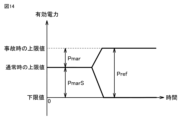
- FIG. 14 is a diagram for explaining the relationship between the active power command value and the power margin.
- the active power command value Pref corresponds to the active power upper limit value defined by the upper limit value of the positive polarity of the current capacity determined by the hardware performance of the power converter 20.
- the active power PmarS corresponds to the upper limit of the active power under normal conditions.
- the active power PmarS is equivalent to the active power corresponding to the current "Ica-Imar" described in the first embodiment. From this, it can be understood that the difference ⁇ P1 corresponds to the active power PmarS.
- Integrator 112 outputs the angular frequency deviation ⁇ by integrating the difference ⁇ P2 over time.
- Integrator 114 calculates the phase ⁇ by integrating the angular frequency ⁇ , which is the sum of the angular frequency deviation ⁇ and the reference angular frequency ⁇ 0 over time.
- Voltage command generation unit 115 generates a voltage command value V1* based on the amplitude Vref and the phase ⁇ . In this way, voltage command generation unit 115 sets the phase calculated based on the difference between active power PmarS and active power P as the phase ⁇ of voltage command value V1*.
- the generator simulation unit 110A when no grid fault is detected, the generator simulation unit 110A generates the phase of the voltage command value V1* based on an active power (e.g., PmarS) that is smaller than the active power (e.g., active power command value Pref) calculated based on the current capacity of the power converter 20. This makes it possible to output a voltage command value V1* that takes into account the active power margin.
- an active power e.g., PmarS
- the active power e.g., active power command value Pref
- the second embodiment has the same advantages as the first embodiment.
Landscapes
- Engineering & Computer Science (AREA)
- Power Engineering (AREA)
- Supply And Distribution Of Alternating Current (AREA)
- Inverter Devices (AREA)
Priority Applications (2)
| Application Number | Priority Date | Filing Date | Title |
|---|---|---|---|
| PCT/JP2023/030908 WO2025046684A1 (ja) | 2023-08-28 | 2023-08-28 | 電力変換装置 |
| JP2023576359A JP7459405B1 (ja) | 2023-08-28 | 2023-08-28 | 電力変換装置 |
Applications Claiming Priority (1)
| Application Number | Priority Date | Filing Date | Title |
|---|---|---|---|
| PCT/JP2023/030908 WO2025046684A1 (ja) | 2023-08-28 | 2023-08-28 | 電力変換装置 |
Publications (1)
| Publication Number | Publication Date |
|---|---|
| WO2025046684A1 true WO2025046684A1 (ja) | 2025-03-06 |
Family
ID=90474227
Family Applications (1)
| Application Number | Title | Priority Date | Filing Date |
|---|---|---|---|
| PCT/JP2023/030908 Pending WO2025046684A1 (ja) | 2023-08-28 | 2023-08-28 | 電力変換装置 |
Country Status (2)
| Country | Link |
|---|---|
| JP (1) | JP7459405B1 (https=) |
| WO (1) | WO2025046684A1 (https=) |
Citations (3)
| Publication number | Priority date | Publication date | Assignee | Title |
|---|---|---|---|---|
| JP2019176584A (ja) * | 2018-03-28 | 2019-10-10 | 株式会社日立製作所 | 分散電源の制御装置 |
| JP2020188595A (ja) * | 2019-05-15 | 2020-11-19 | 株式会社日立製作所 | 系統管理装置および系統管理方法 |
| JP2023063791A (ja) * | 2021-10-25 | 2023-05-10 | 株式会社日立製作所 | 電力系統の慣性把握装置および方法 |
-
2023
- 2023-08-28 JP JP2023576359A patent/JP7459405B1/ja active Active
- 2023-08-28 WO PCT/JP2023/030908 patent/WO2025046684A1/ja active Pending
Patent Citations (3)
| Publication number | Priority date | Publication date | Assignee | Title |
|---|---|---|---|---|
| JP2019176584A (ja) * | 2018-03-28 | 2019-10-10 | 株式会社日立製作所 | 分散電源の制御装置 |
| JP2020188595A (ja) * | 2019-05-15 | 2020-11-19 | 株式会社日立製作所 | 系統管理装置および系統管理方法 |
| JP2023063791A (ja) * | 2021-10-25 | 2023-05-10 | 株式会社日立製作所 | 電力系統の慣性把握装置および方法 |
Also Published As
| Publication number | Publication date |
|---|---|
| JPWO2025046684A1 (https=) | 2025-03-06 |
| JP7459405B1 (ja) | 2024-04-01 |
Similar Documents
| Publication | Publication Date | Title |
|---|---|---|
| EP4362306B1 (en) | Control device and power conversion device | |
| US20250357761A1 (en) | Power conversion device | |
| JP7209908B1 (ja) | 電力変換装置、および制御装置 | |
| JP2001190077A (ja) | 電力変換システム及び電力変換器の制御方法 | |
| JP7224565B1 (ja) | 電力変換装置、および制御装置 | |
| JP7051028B1 (ja) | 電力変換装置、および電力変換システム | |
| CN117318163B (zh) | 一种基于对称锁相环结构的并网变流器运行控制方法 | |
| Sigrist et al. | A fundamental study on the impact of HVDC lines on transient stability of power systems | |
| JP7126631B1 (ja) | 電力変換装置及び制御装置 | |
| JP7023430B1 (ja) | 電力変換装置 | |
| JP6949286B1 (ja) | 制御装置、および電力変換装置 | |
| JP7550985B2 (ja) | 電力変換装置 | |
| JP7459405B1 (ja) | 電力変換装置 | |
| JP7051033B1 (ja) | 電力変換装置及び制御装置 | |
| WO2021124577A1 (ja) | 電力変換装置 | |
| CN118117610A (zh) | 风力发电系统的控制方法及风力发电系统 | |
| JP7630756B1 (ja) | 制御装置、および電力変換装置 | |
| Freire et al. | Model Predictive Control of a five-level Neutral-Point-Clamped STATCOM | |
| US12476469B2 (en) | Electric power control system simulating a synchronous generator | |
| JP7776040B1 (ja) | 制御装置、電力変換装置、制御方法 | |
| WO2024189892A1 (ja) | 電力変換装置 | |
| JP2026014458A (ja) | 電力変換装置 | |
| WO2026009465A1 (ja) | 電力変換装置 |
Legal Events
| Date | Code | Title | Description |
|---|---|---|---|
| ENP | Entry into the national phase |
Ref document number: 2023576359 Country of ref document: JP Kind code of ref document: A |
|
| WWE | Wipo information: entry into national phase |
Ref document number: 2023576359 Country of ref document: JP |
|
| 121 | Ep: the epo has been informed by wipo that ep was designated in this application |
Ref document number: 23950636 Country of ref document: EP Kind code of ref document: A1 |