WO2025041296A1 - Système de contrôle de communication, dispositif de contrôle de communication, procédé de contrôle de communication, et programme - Google Patents
Système de contrôle de communication, dispositif de contrôle de communication, procédé de contrôle de communication, et programme Download PDFInfo
- Publication number
- WO2025041296A1 WO2025041296A1 PCT/JP2023/030299 JP2023030299W WO2025041296A1 WO 2025041296 A1 WO2025041296 A1 WO 2025041296A1 JP 2023030299 W JP2023030299 W JP 2023030299W WO 2025041296 A1 WO2025041296 A1 WO 2025041296A1
- Authority
- WO
- WIPO (PCT)
- Prior art keywords
- communication
- control system
- communication control
- network
- communication terminal
- Prior art date
- Legal status (The legal status is an assumption and is not a legal conclusion. Google has not performed a legal analysis and makes no representation as to the accuracy of the status listed.)
- Pending
Links
Images


Classifications
-
- H—ELECTRICITY
- H04—ELECTRIC COMMUNICATION TECHNIQUE
- H04W—WIRELESS COMMUNICATION NETWORKS
- H04W24/00—Supervisory, monitoring or testing arrangements
- H04W24/02—Arrangements for optimising operational condition
-
- H—ELECTRICITY
- H04—ELECTRIC COMMUNICATION TECHNIQUE
- H04W—WIRELESS COMMUNICATION NETWORKS
- H04W28/00—Network traffic management; Network resource management
- H04W28/16—Central resource management; Negotiation of resources or communication parameters, e.g. negotiating bandwidth or QoS [Quality of Service]
- H04W28/24—Negotiating SLA [Service Level Agreement]; Negotiating QoS [Quality of Service]
-
- H—ELECTRICITY
- H04—ELECTRIC COMMUNICATION TECHNIQUE
- H04W—WIRELESS COMMUNICATION NETWORKS
- H04W48/00—Access restriction; Network selection; Access point selection
- H04W48/02—Access restriction performed under specific conditions
- H04W48/06—Access restriction performed under specific conditions based on traffic conditions
-
- H—ELECTRICITY
- H04—ELECTRIC COMMUNICATION TECHNIQUE
- H04W—WIRELESS COMMUNICATION NETWORKS
- H04W48/00—Access restriction; Network selection; Access point selection
- H04W48/16—Discovering, processing access restriction or access information
Definitions
- the present invention relates to a communication control system, a communication control device, a communication control method, and a program.
- a communication control method for solving the problem of communication terminals connecting to the communication network due to an increase in the amount of signals.
- a technology is known that sets priority/non-priority for signal transmission from an M2M (Machine to Machine) terminal during congestion, and probabilistically sets the timing of signal transmission depending on whether it is priority or non-priority (for example, see Non-Patent Document 1).
- Non-Patent Document 1 assumes that services have priorities, and implements control to uniformly delay the timing of calls made to low-priority services and connection requests from terminals.
- this method does not allow for flexible control when, for example, mission-critical services with extremely high requirements for communication quality arise in addition to the use of general applications such as web browsing. Conversely, this method also has the problem of being unable to provide flexible control when a situation arises in which devices with low requirements for communication quality are mixed, such as with the Internet of Things (IoT).
- IoT Internet of Things
- One embodiment of the present invention has been made in consideration of the above problems, and enables flexible control of the connection of communication terminals to the communication network even when communication terminals with different requirements for communication quality are mixed in a mobile network.
- a communication control system is a communication control system that controls the connection of a communication terminal to a communication network in a mobile network, and includes a discrimination unit that discriminates the type of the communication terminal and/or service in response to a connection request from the communication terminal to the communication network, a determination unit that collects metrics of the communication control system and determines an abnormality in the communication control system based on the collected metrics, and a message queue that controls the amount of signals in communication by the communication terminal based on the determination result by the discrimination unit and the determination result by the determination unit.
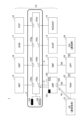
- FIG. 1 is a diagram for explaining a configuration example of a communication control system according to an embodiment of the present invention
- FIG. 4 is a sequence diagram showing an example of processing of the communication control system according to the embodiment.
- 5 is a flowchart illustrating an example of processing of the communication control system according to the present embodiment.
- FIG. 2 is a diagram illustrating an example of a hardware configuration of a computer according to the present embodiment.
- ⁇ Communication control system configuration> 1 is a diagram for explaining a configuration example of a communication control system according to the present embodiment.
- This diagram shows a configuration example in the case where the communication control system 1 is a core network of a 5G (5th Generation) mobile network (hereinafter referred to as a 5G core network).
- the 5G core network is an example of a communication control system 1 that controls connection of a UE (communication terminal) 21 to a DN (communication network) 24 in a 5G mobile network.
- the communication control system 1 includes a control plane (C-Plane) 10, a UE 21, a RAN 22, a UPF 23, and a DB 24, which perform a series of control processes exchanged to establish communication and perform authentication, etc.
- C-Plane control plane
- UE 21 a UE 21, a RAN 22, a UPF 23, and a DB 24, which perform a series of control processes exchanged to establish communication and perform authentication, etc.
- the control plane 10 includes multiple network functions (NFs), such as, for example, AMF 11, SMF 12, AUSF 13, NSSAAF 14, NEF 15, NRF 16, UDM 17, and PCF.
- NFs network functions
- AMF Access and Mobility Management Function 11 is a network function that is accessed first by UE 21, and performs, for example, access authentication, authorization, and mobility management.
- SMF Session Management Function
- SMF Session Management Function
- AUSF Authentication Server Function
- NSSAAF Network Slice Specific Authentication and Authorization Function
- NEF Network Exposure Function 15 is a network function that exposes the services of each network function.
- the NRF (Network Repository Function) 16 is a network function that registers the services of each network function.
- the UDM (Unified Data Management) 17 is a network function that performs integrated data management.
- the PCF (Policy Control Function) 18 is a network function that performs policy control.
- NFs network functions
- SBI Service Based Interface
- Each of the above network functions is realized, for example, by a server that executes a specific program, or a container.
- a container is a program execution environment in which a part of a running OS (Operating System) is separated and isolated from the rest in container-type virtualization, which is one method of computer virtualization.
- OS Operating System
- a program can be executed as if it were an individual, independent server.
- each of the network functions shown in Figure 1 may be realized by a server, or by a container on one or more communication control devices.
- the communication control system 1 also includes a discrimination unit 101, a determination unit 102, and a message queue 103.
- the discrimination unit 101 is realized, for example, by a program executed by a server or a container, and executes discrimination processing to discriminate the type of UE 21 and/or service in response to a connection request from UE (communication terminal) 21 to DN (communication network) 24, etc.
- the discrimination unit 101 prestores information such as the IP address, MAC address, or SUPI (Subscription Permanent Identifier) of the UE 21 in order to discriminate the UE 21 or the service type. In addition, the discrimination unit 101 discriminates the type of the UE 21, the type of the service, or the type of the UE 21 and the service type for an arriving signal, for example, when the UE 21 is connected.
- information such as the IP address, MAC address, or SUPI (Subscription Permanent Identifier) of the UE 21 in order to discriminate the UE 21 or the service type.
- the discrimination unit 101 discriminates the type of the UE 21, the type of the service, or the type of the UE 21 and the service type for an arriving signal, for example, when the UE 21 is connected.
- the discrimination unit 101 can also look at, for example, the N1 signal element (non-encrypted parts such as Message Type and Registration Type) to identify whether the call is a general call or a priority call, and prioritize the processing of priority calls.
- the N1 signal element non-encrypted parts such as Message Type and Registration Type
- the determination unit 102 is realized, for example, by a program executed by a server or a container, and collects metrics (indicators) of the communication control system 1 and determines abnormalities, etc., of the communication control system 1 based on the collected metrics.
- the metrics collected by the determination unit 102 include service metrics such as the number of mobile terminals in the control plane 10, the number of PDU sessions, and the number of authentication registration requests.
- the metrics collected by the determination unit 102 also include metrics for the server or container, such as CPU usage, memory usage, or disk I/O count.
- the determination unit 102 also aggregates the collected metrics and compares them with a predetermined threshold to determine whether an abnormality has occurred, such as an abnormal state of the control plane 10, a failure of a server or container, or congestion in the communication control system 1.
- the determination unit 102 uses numerical values collected for each message queue of each network function.
- the determination unit 102 uses server or container metrics corresponding to each network function.
- the determination unit 102 aggregates the service metrics and the server or container metrics corresponding to the service metrics as a set, and determines an abnormality in the communication control system 1.
- the determination unit 102 may also use these metrics to determine the occurrence of a failure that requires isolation of the cause of the failure, thereby detecting the failure location as well.
- Message queue 103 is realized, for example, by a program executed by a server or a container, and controls the amount of communication signals by UE 21 based on the determination results by determination unit 101 and determination unit 102.
- Message queue 103 has a signal control function, and has, for example, a FIFO (First In First Out) or LIFO (Last In First Out) function, and also performs prioritization processing. For example, in the prioritization processing, message queue 103 processes signals according to the priority of communication. For example, when signals become congested, message queue 103 can lower the priority of signal processing for low-priority UE 21 or services, and raise the priority of signal processing for high-priority UE 21 or services. This allows message queue 103 to, for example, postpone processing of low-priority signals and perform processing when high-priority signals are free, thereby enabling signal processing to be leveled out.
- FIFO First In First Out
- LIFO Layer In First Out
- message queue 103 may delete the signal itself. This makes it possible to avoid messages piling up in message queue 103, or unintended loss of messages due to message queue 103 overflowing, thereby alleviating the congestion state or maintaining the normality of the sequence.
- the amount of signals piling up in the queue, or the ratio of the amount of piling up signals to the queue length (buffer size), etc. are used.
- Message queue 103 may be set independently for each network function, or may be set commonly.
- a discrimination unit 101, a judgment unit 102, and a message queue 103 are provided within one network function, as in AMF 11 in FIG. 1.
- message queue 104 is set commonly, for example, as shown in FIG. 1, a discrimination unit 101, a judgment unit 102, and message queues 103a to 103h corresponding to each network function are provided on control bus 3.
- the discrimination unit 101, judgment unit 102, message queues 103a to 103h, etc. do not need to be provided on the control bus 3. Also, if the message queue 104 is set in common, the discrimination unit 101, judgment unit 102, and message queue 103 do not need to be provided in each network function.
- message queue 103 When message queue 103 is set independently for each network function, message queue 103 can easily control signals for each network function. Furthermore, message queue 103 can set a priority for each network function, so it is possible to control signals taking into account differences in processing load trends for different network functions.
- the message queue 103 can grasp the signal arrival status, so by grasping the state of each queue, it becomes easier to detect the problem area when a failure or malfunction occurs. For example, when a problem occurs with a specific function, the message queue 103 can speed up recovery from the failure by taking action limited to that specific function.
- the message queue 103 determines the priority of the communication by the UE 21 based on the result of the determination by the determination unit 101, and if an abnormality occurs in the communication control system 1, restricts the connection of the UE 21 to the DN 24 according to the priority of the communication by the UE 21.
- the message queue 103 delays the connection of the UE 21 to the DN 24. Also, when an abnormality occurs in the communication control system 1, if the priority of the communication by the UE 21 is low, the message queue 103 restricts the connection of the UE 21 to the DN 24.
- Non-Patent Document 1 on the assumption that services have priority, control is performed to uniformly delay the timing of transmission for low-priority services or connection requests from terminals.
- this method cannot flexibly control when a mission-critical service with extremely high communication quality requirements occurs in addition to the use of general applications such as web browsing.
- this method has the problem of not being able to flexibly control when a situation occurs in which terminals with low communication quality requirements are mixed, such as in the case of IoT.
- devices to be controlled such as sensor devices, simply controlling the timing of transmission is not sufficient. Control according to the type of terminal or service is required.
- the communication control system 1 has the discrimination unit 101, the determination unit 102, and the message queue 103 described above. As a result, the communication control system 1 can perform more flexible control than conventional systems, even in a situation where communication terminals or services with various requirements are mixed, and can alleviate degradation of user quality and congestion.
- the communication control system 1 collects metrics related to mobile services and metrics of servers or containers, and determines abnormalities in the communication control system 1. This enables the communication control system 1 to respond not only to simple physical failures such as server failures, but also to abnormal conditions resulting from the mechanisms of the mobile control plane.
- FIG. 2 is a sequence diagram showing an example of processing in the communication control system according to this embodiment. This processing shows an example of processing in the communication control system 1 when the AMF 11 has a discrimination unit 101, a determination unit 102, and a message queue 103.
- the AMF 11 is a network function that is always passed through when accessing from the UE 21, congestion due to concentrated access from the UE 21 is likely to occur. Therefore, it is desirable for the communication control system 1 to have a discrimination unit 101, a judgment unit 102, and a message queue 103 in the AMF 11.
- step S201 the UE 21 transmits a connection request to the AMF 11 to request a connection to the DN 24.
- This connection request includes information such as the SUPI.
- step S202 when the message queue 103 of the AMF 11 accepts a connection request from the UE 21, it requests, for example, the discrimination unit 101 to discriminate the terminal type and/or service type of the UE 21.
- the discrimination unit 101 discriminates the terminal type, service type, or the terminal type and service type of the UE 21 based on, for example, the SUPI included in the connection request.
- step S203 the discrimination unit 101 requests, for example, the determination unit 102 to make a metrics determination.
- this process may also be such that the message queue 103 requests the determination unit 102 to make a metrics determination.
- the determination unit 102 collects metrics of the communication control system 1 and determines whether there is an abnormality in the communication control system 1.
- the determination result by the determination unit 102 is, for example, "no abnormality.”
- step S204 the determination unit 102 notifies the message queue 103 of, for example, the determination result by the discrimination unit 101 and the determination result by the determination unit 102. Note that the determination result by the discrimination unit 101 may be notified to the message queue 103 by the discrimination unit 101.
- step S205 if the determination result by the determination unit 102 is "no abnormality", the message queue 103 sends a session establishment request to the SMF 12 to request the establishment of a session without restricting the connection of the UE 21 to the DN 24.
- the communication control system 1 restricts the connection of the UE 21 to the DN 24 according to the priority of the communication by the UE 21.
- the communication control system 1 executes the process of steps S211 to S215.
- step S211 UE21 sends a connection request to AMF11 to request connection to DN24.
- step S212 when the message queue 103 of the AMF 11 accepts a connection request from the UE 21, it requests, for example, the discrimination unit 101 to discriminate the terminal type and/or service type of the UE 21.
- the discrimination unit 101 discriminates the terminal type, service type, or the terminal type and service type of the UE 21 based on, for example, the SUPI included in the connection request.
- the discrimination unit 101 requests the determination unit 102 to make a metrics determination.
- this process may also be such that the message queue 103 requests the determination unit 102 to make a metrics determination.
- the determination unit 102 collects metrics of the communication control system 1 and determines whether there is an abnormality in the communication control system 1. In this case, as described above, an abnormality has occurred in the communication control system 1, and therefore the determination result by the determination unit 102 is "abnormality exists.”
- step S214 the determination unit 102 notifies the message queue 103 of, for example, the determination result by the discrimination unit 101 and the determination result by the determination unit 102. Note that the determination result by the discrimination unit 101 may be notified to the message queue 103 by the discrimination unit 101.
- step S215 if the determination result by determination unit 102 is "abnormal", message queue 103 determines the priority of communication by UE 21 based on the determination result by discrimination unit 101.
- the priority of communication by UE 21 is medium, so message queue 103 waits a specified outgoing waiting time and then transmits a session establishment request to SMF 12 to request the establishment of a session.
- communication control system 1 performs timing control to delay outgoing to SMF 12.
- step S215 if the priority of the communication by UE21 is higher than the predetermined priority, the message queue 103 sends a session establishment request to the SMF 12 without waiting for the predetermined call waiting time.
- the communication control system 1 executes the process of steps S221 to S225.
- step S221 UE21 sends a connection request to AMF11 to request connection to DN24.
- step S222 when the message queue 103 of the AMF 11 accepts a connection request from the UE 21, it requests, for example, the discrimination unit 101 to discriminate the terminal type and/or service type of the UE 21.
- the discrimination unit 101 discriminates the terminal type, service type, or the terminal type and service type of the UE 21 based on, for example, the SUPI included in the connection request.
- step S223 the discrimination unit 101, for example, requests the determination unit 102 to make a metrics determination.
- this process may also be such that the message queue 103 requests the determination unit 102 to make a metrics determination.
- the determination unit 102 collects metrics of the communication control system 1 and determines whether there is an abnormality in the communication control system 1. In this case, as described above, an abnormality has occurred in the communication control system 1, and therefore the determination result by the determination unit 102 is "abnormality present.”
- step S224 the determination unit 102 notifies the message queue 103 of, for example, the determination result by the discrimination unit 101 and the determination result by the determination unit 102. Note that the determination result by the discrimination unit 101 may be notified to the message queue 103 by the discrimination unit 101.
- step S225 if the determination result by the determination unit 102 is "abnormal", the message queue 103 determines the priority of communication by UE 21 based on the determination result by the determination unit 101.
- the message queue 103 restricts outgoing calls from UE 21. In this way, when an abnormality occurs in the communication control system 1, if the priority of communication by UE 21 is low, the communication control system 1 restricts outgoing calls on the UE 21 side without making a call to SMF 12.
- (Communication control system processing) 3 is a flowchart showing an example of processing of the communication control system according to the present embodiment.
- This processing shows an example of processing in which, when the communication control system 1 receives a connection request from a communication terminal to a communication network, the communication control system 1 controls the amount of communication signals of the communication terminal based on the determination result by the determination unit 101 and the determination result by the determination unit 102.
- the AMF 11 may have the discrimination unit 101, the judgment unit 102, and the message queue 103
- the control bus 3 may have the discrimination unit 101, the judgment unit 102, and the message queue 103. Also, detailed description of the process similar to the process described in FIG. 2 will be omitted here.
- step S301 the discrimination unit 101 discriminates the type of communication terminal and/or service in response to a connection request from the communication terminal (UE21) to the communication network (DN24).
- step S302 the determination unit 102 collects metrics for the communication control system 1, including metrics for network function services and metrics for servers or containers.
- step S303 the determination unit 102 determines whether or not there is an abnormality in the communication control system 1 based on the collected metrics. For example, if any of the collected metrics (indicators) exceeds a predetermined threshold, the determination unit 102 determines that there is an abnormality in the communication control system 1. If there is an abnormality in the communication control system 1, the communication control system 1 transitions the process to step S304. On the other hand, if there is no abnormality in the communication control system 1, the communication control system 1 ends the process of FIG. 3.
- the message queue 103 determines the priority of communication by the communication terminal based on the type of communication terminal and/or service determined by the determination unit 101.
- step S305 the message queue 103 determines whether the priority of the communication by the communication terminal is equal to or higher than a predetermined priority (first priority).
- the predetermined priority is, for example, a priority that corresponds to a communication that is more urgent than other communications or a communication that is more important, and is set in advance. If the priority of the communication by the communication terminal is not equal to or higher than the predetermined priority, the message queue 103 transitions the process to step S306. On the other hand, if the priority of the communication by the communication terminal is equal to or higher than the predetermined priority, the message queue 103 terminates the process of FIG. 3.
- the message queue 103 restricts communication by the communication terminal according to the priority of the communication by the communication terminal. For example, the message queue 103 delays the connection of the communication terminal to the communication network when the priority of the communication by the communication terminal is a second priority lower than the first priority, and restricts the connection of the communication terminal to the communication network when the priority of the communication by the communication terminal is a third priority lower than the second priority.
- the third priority is, for example, a priority that is set in advance to correspond to communication that is less urgent or less important than other communications.
- the communication control system 1 can flexibly control the connection of communication terminals to the communication network even when communication terminals with different requirements for communication quality are mixed in the mobile network.
- the communication control system 1 is described as a core network of a 5G mobile network, but this embodiment can also be applied to mobile networks of other generations.
- the communication control system 1 is configured by, for example, a communication control device having a hardware configuration of a computer 1000 as shown in FIG. 4, or by a plurality of communication control devices.
- FIG. 4 is a diagram showing an example of the hardware configuration of a computer according to this embodiment.
- a computer 1000 has a processor 1001, a memory 1002, a storage device 1003, a communication device 1004, an input device 1005, an output device 1006, and a bus B, etc.
- the processor 1001 is, for example, an arithmetic device such as a CPU (Central Processing Unit) that realizes various functions by executing a specific program.
- the memory 1002 is a storage medium readable by the computer 1000, and includes, for example, RAM (Random Access Memory) and ROM (Read Only Memory).
- the storage device 1003 is a computer-readable storage medium, and may include, for example, an HDD (Hard Disk Drive), an SSD (Solid State Drive), various optical disks, and magneto-optical disks.
- the communication device 1004 includes one or more pieces of hardware (communication devices) for communicating with other devices via a wireless or wired network.
- the input device 1005 is an input device (e.g., a keyboard, a mouse, a microphone, a switch, a button, a sensor, etc.) that accepts input from the outside.
- the output device 1006 is an output device (e.g., a display, a speaker, an LED lamp, etc.) that outputs to the outside. Note that the input device 1005 and the output device 1006 may be integrated into one configuration (e.g., an input/output device such as a touch panel display).
- the bus B is commonly connected to each of the above components and transmits, for example, address signals, data signals, and various control signals.
- the processor 1001 is not limited to a CPU, and may be, for example, a DSP (Digital Signal Processor), a PLD (Programmable Logic Device), or an FPGA (Field Programmable Gate Array).
- the communication control system 1 and the communication control device in this embodiment may be realized not only by a dedicated device but also by a general-purpose computer.
- a program for realizing the functions may be recorded on a computer-readable recording medium, and the program recorded on the recording medium may be read into a computer system and executed.
- the "computer system” here includes hardware such as an OS and peripheral devices.
- Computer-readable recording media also includes various storage devices such as portable media such as flexible disks, optical magnetic disks, ROMs, and CD-ROMs, as well as storage devices 1003 built into computer systems.
- “computer-readable recording media” may also include devices that dynamically hold a program for a short period of time, such as a communication line when transmitting a program via a network such as the Internet or a communication line such as a telephone line, and devices that hold a program for a certain period of time, such as volatile memory within a computer system that serves as a server or client in such cases.
- the above program may be for realizing some of the functions described above, or may be capable of realizing the functions described above in combination with a program already recorded in the computer system, or may be realized using hardware such as a PLD (Programmable Logic Device) or FPGA (Field Programmable Gate Array).
- PLD Programmable Logic Device
- FPGA Field Programmable Gate Array
- this technology makes it possible to control the amount of signals in each network function, making it possible to avoid degradation of user quality due to delays in signal processing. Furthermore, when signal congestion occurs, the communication control system 1 can alleviate the congestion, making it possible to ensure important communications.
- the type of communication terminal and/or the type of service are determined and controlled for the arriving signal, thereby making it possible to mitigate the effects of degradation of connection quality, etc., depending on the type of communication terminal and/or the type of service.
- the communication control system 1 collects metrics related to mobile services and metrics of servers or containers, and determines failures or abnormal conditions associated with failures based on the collected metrics. This enables the communication control system 1 to respond not only to simple physical failures of servers, etc., but also to failures caused by the mechanisms of the control plane of the mobile network.
- a communication control system for controlling connection of a communication terminal to a communication network in a mobile network comprising: a discrimination unit that discriminates a type of the communication terminal and/or a type of service in response to a connection request from the communication terminal to the communication network; a determination unit that collects metrics of the communication control system and determines an abnormality in the communication control system based on the collected metrics; a message queue that controls a signal amount of communication by the communication terminal based on a determination result by the determination unit and a determination result by the determination unit;
- a communication control system having the above configuration.
- the communication control system of claim 1 wherein the metrics of the communication control system include metrics of services in a control plane of the communication control system and metrics of servers or containers corresponding to the service metrics.
- the message queue includes: determining a priority of the communication by the communication terminal based on the determination result; when the abnormality occurs in the communication control system, restricting the connection of the communication terminal to the communication network according to a priority of the communication by the communication terminal. 3. The communication control system according to claim 1 or 2.
- the message queue includes: When the abnormality occurs in the communication control system, delaying a connection of the communication terminal to the communication network when the priority of the communication is a second priority lower than a first priority; restricting the connection of the communication terminal to the communication network when the priority of the communication is a third priority lower than the second priority. 4.
- a communication control system as recited in claim 3. (Section 5) The communication control system according to any one of claims 1 to 4, wherein the abnormality in the communication control system includes an abnormal state of a control plane of the communication control system, a failure of a server or container constituting the communication control system, or congestion in the communication control system.
- a communication control device that controls connection of a communication terminal to a communication network in a mobile network, comprising: a discrimination unit that discriminates a type of the communication terminal and/or a type of service in response to a connection request from the communication terminal to the communication network; A determination unit that collects and determines metrics of the communication control device; a message queue that controls a signal amount of communication by the communication terminal based on a determination result by the determination unit and a determination result by the determination unit; A communication control device having (Section 7) A communication control method for controlling connection of a communication terminal to a communication network in a mobile network, comprising: The communication control system a determination process of determining a type of the communication terminal and/or a type of service in response to a connection request from the communication terminal to the communication network; A determination process for collecting and determining metrics of the communication control system; a process of controlling a signal amount of communication by the communication terminal based on a determination result of the determination process and a determination result of the determination process; A
Landscapes
- Engineering & Computer Science (AREA)
- Computer Networks & Wireless Communication (AREA)
- Signal Processing (AREA)
- Computer Security & Cryptography (AREA)
- Quality & Reliability (AREA)
- Mobile Radio Communication Systems (AREA)
Abstract
Afin de permettre un contrôle flexible de connexion à un réseau de communication d'un terminal de communication même lorsque des terminaux de communication présentant des exigences de demande différentes en termes de qualité de communication sont mélangés dans un réseau mobile, l'invention concerne un système de contrôle de communication qui contrôle la connexion d'un terminal de communication à un réseau de communication dans un réseau mobile, le système de contrôle de communication comprenant : une unité d'identification qui identifie le type du terminal de communication ou un service sur la base d'une demande de connexion du terminal de communication au réseau de communication; une unité de détermination qui collecte des métriques concernant le système de contrôle de communication et détermine une anomalie du système de contrôle de communication sur la base des métriques collectées; et une file d'attente de messages qui, sur la base du résultat d'identification produit par l'unité d'identification et du résultat de détermination produit par l'unité de détermination, contrôle la quantité de signal de communication mise en œuvre par le terminal de communication.
Priority Applications (2)
| Application Number | Priority Date | Filing Date | Title |
|---|---|---|---|
| PCT/JP2023/030299 WO2025041296A1 (fr) | 2023-08-23 | 2023-08-23 | Système de contrôle de communication, dispositif de contrôle de communication, procédé de contrôle de communication, et programme |
| JP2025541242A JPWO2025041296A1 (fr) | 2023-08-23 | 2023-08-23 |
Applications Claiming Priority (1)
| Application Number | Priority Date | Filing Date | Title |
|---|---|---|---|
| PCT/JP2023/030299 WO2025041296A1 (fr) | 2023-08-23 | 2023-08-23 | Système de contrôle de communication, dispositif de contrôle de communication, procédé de contrôle de communication, et programme |
Publications (1)
| Publication Number | Publication Date |
|---|---|
| WO2025041296A1 true WO2025041296A1 (fr) | 2025-02-27 |
Family
ID=94731717
Family Applications (1)
| Application Number | Title | Priority Date | Filing Date |
|---|---|---|---|
| PCT/JP2023/030299 Pending WO2025041296A1 (fr) | 2023-08-23 | 2023-08-23 | Système de contrôle de communication, dispositif de contrôle de communication, procédé de contrôle de communication, et programme |
Country Status (2)
| Country | Link |
|---|---|
| JP (1) | JPWO2025041296A1 (fr) |
| WO (1) | WO2025041296A1 (fr) |
Citations (4)
| Publication number | Priority date | Publication date | Assignee | Title |
|---|---|---|---|---|
| JP2001078260A (ja) * | 1999-09-06 | 2001-03-23 | Yrp Kokino Idotai Tsushin Kenkyusho:Kk | 移動通信システムにおける輻輳制御方法、移動端末および基地局 |
| WO2013021757A1 (fr) * | 2011-08-11 | 2013-02-14 | 株式会社 エヌ・ティ・ティ・ドコモ | Station de base et procédé de notification d'informations système |
| WO2019208673A1 (fr) * | 2018-04-26 | 2019-10-31 | 日本電気株式会社 | Dispositif de réseau, dispositif de station de base et procédé de commande de communication |
| WO2021241500A1 (fr) * | 2020-05-26 | 2021-12-02 | 株式会社Nttドコモ | Dispositif de communication et procédé de communication |
-
2023
- 2023-08-23 WO PCT/JP2023/030299 patent/WO2025041296A1/fr active Pending
- 2023-08-23 JP JP2025541242A patent/JPWO2025041296A1/ja active Pending
Patent Citations (4)
| Publication number | Priority date | Publication date | Assignee | Title |
|---|---|---|---|---|
| JP2001078260A (ja) * | 1999-09-06 | 2001-03-23 | Yrp Kokino Idotai Tsushin Kenkyusho:Kk | 移動通信システムにおける輻輳制御方法、移動端末および基地局 |
| WO2013021757A1 (fr) * | 2011-08-11 | 2013-02-14 | 株式会社 エヌ・ティ・ティ・ドコモ | Station de base et procédé de notification d'informations système |
| WO2019208673A1 (fr) * | 2018-04-26 | 2019-10-31 | 日本電気株式会社 | Dispositif de réseau, dispositif de station de base et procédé de commande de communication |
| WO2021241500A1 (fr) * | 2020-05-26 | 2021-12-02 | 株式会社Nttドコモ | Dispositif de communication et procédé de communication |
Also Published As
| Publication number | Publication date |
|---|---|
| JPWO2025041296A1 (fr) | 2025-02-27 |
Similar Documents
| Publication | Publication Date | Title |
|---|---|---|
| JP2022506176A5 (fr) | ||
| EP2466824B1 (fr) | Dispositif et procédé de programmation de services | |
| CN109542659A (zh) | 应用多活方法、设备、数据中心集群及可读存储介质 | |
| US11671881B2 (en) | Procedures for interaction between the radio controller and the subordinated base station | |
| CN109271259B (zh) | 企业服务总线系统、数据处理方法、终端及存储介质 | |
| CN114064362A (zh) | 用于分布式存储中的数据恢复方法、系统及计算机可读存储介质 | |
| KR20140014285A (ko) | 트래픽 제어 방법과 트래픽 제어 장치 | |
| US9749825B2 (en) | Connection-oriented messaging and signaling in mobile heath networks | |
| CN109089281B (zh) | 一种集群通信方法、终端设备及存储介质 | |
| CN118101568A (zh) | Cpu软转发拥塞处理方法、系统、设备及可读存储介质 | |
| CN101951571A (zh) | 短消息重试方法及短消息网关 | |
| CN109327402B (zh) | 拥塞管理方法及装置 | |
| CN101442439A (zh) | 一种上报中断的方法和pci总线系统 | |
| CN102882805A (zh) | 避免链路聚合组状态震荡的方法及装置 | |
| CN101841554B (zh) | 终端请求下载资源的方法和一种终端 | |
| CN116962216A (zh) | 基于流程引擎的请求处理方法、装置、设备及存储介质 | |
| EP3806411A1 (fr) | Procédé de commande de message et dispositif de noeud | |
| CN104956614B (zh) | 对端网元的过载控制方法及装置 | |
| CN111756650A (zh) | 一种数据处理方法、装置、运算芯片及存储介质 | |
| CN116827884A (zh) | 报文数据处理方法、装置、存储介质及设备 | |
| CN111338792B (zh) | 一种集群的资源释放方法、设备以及介质 | |
| CN118524063B (zh) | 一种租户多网络接入方法及系统 | |
| CN116048826A (zh) | 微服务消息调度的方法、装置、电子设备及存储介质 | |
| US12381979B2 (en) | Method and apparatus for processing requests from voice bots | |
| CN106612240B (zh) | 一种存储高效网络连接系统及方法 |
Legal Events
| Date | Code | Title | Description |
|---|---|---|---|
| 121 | Ep: the epo has been informed by wipo that ep was designated in this application |
Ref document number: 23949754 Country of ref document: EP Kind code of ref document: A1 |
|
| ENP | Entry into the national phase |
Ref document number: 2025541242 Country of ref document: JP Kind code of ref document: A |
|
| WWE | Wipo information: entry into national phase |
Ref document number: 2025541242 Country of ref document: JP |
|
| NENP | Non-entry into the national phase |
Ref country code: DE |