WO2025033496A1 - 殺菌システム、及び殺菌方法 - Google Patents
殺菌システム、及び殺菌方法 Download PDFInfo
- Publication number
- WO2025033496A1 WO2025033496A1 PCT/JP2024/028432 JP2024028432W WO2025033496A1 WO 2025033496 A1 WO2025033496 A1 WO 2025033496A1 JP 2024028432 W JP2024028432 W JP 2024028432W WO 2025033496 A1 WO2025033496 A1 WO 2025033496A1
- Authority
- WO
- WIPO (PCT)
- Prior art keywords
- electrode
- sterilization
- composition
- nozzle
- sterilization system
- Prior art date
- Legal status (The legal status is an assumption and is not a legal conclusion. Google has not performed a legal analysis and makes no representation as to the accuracy of the status listed.)
- Pending
Links
Images

Classifications
-
- A—HUMAN NECESSITIES
- A61—MEDICAL OR VETERINARY SCIENCE; HYGIENE
- A61L—METHODS OR APPARATUS FOR STERILISING MATERIALS OR OBJECTS IN GENERAL; DISINFECTION, STERILISATION OR DEODORISATION OF AIR; CHEMICAL ASPECTS OF BANDAGES, DRESSINGS, ABSORBENT PADS OR SURGICAL ARTICLES; MATERIALS FOR BANDAGES, DRESSINGS, ABSORBENT PADS OR SURGICAL ARTICLES
- A61L2/00—Disinfection or sterilisation of materials or objects, in general; Accessories therefor
- A61L2/02—Disinfection or sterilisation of materials or objects, in general; Accessories therefor using physical processes
- A61L2/03—Electric current
-
- A—HUMAN NECESSITIES
- A61—MEDICAL OR VETERINARY SCIENCE; HYGIENE
- A61L—METHODS OR APPARATUS FOR STERILISING MATERIALS OR OBJECTS IN GENERAL; DISINFECTION, STERILISATION OR DEODORISATION OF AIR; CHEMICAL ASPECTS OF BANDAGES, DRESSINGS, ABSORBENT PADS OR SURGICAL ARTICLES; MATERIALS FOR BANDAGES, DRESSINGS, ABSORBENT PADS OR SURGICAL ARTICLES
- A61L2/00—Disinfection or sterilisation of materials or objects, in general; Accessories therefor
- A61L2/16—Disinfection or sterilisation of materials or objects, in general; Accessories therefor using chemical substances
- A61L2/18—Liquid substances
-
- C—CHEMISTRY; METALLURGY
- C02—TREATMENT OF WATER, WASTE WATER, SEWAGE, OR SLUDGE
- C02F—TREATMENT OF WATER, WASTE WATER, SEWAGE, OR SLUDGE
- C02F1/00—Treatment of water, waste water, or sewage
- C02F1/50—Treatment of water, waste water, or sewage by addition or application of a germicide or by oligodynamic treatment
Definitions
- the present invention relates to a sterilization system and a sterilization method.
- Non-Patent Documents 1 to 4 report a method of removing biofilms formed on the surface of a conductor by applying a high potential (e.g., about 7 V) to a conductor (electrical conductor) such as stainless steel or titanium, generating H2 and negative-negative surface repulsion.
- a high potential e.g., about 7 V
- a conductor electrical conductor
- Non-Patent Documents 1 to 4 do not cause the problem of drug-resistant bacteria, they must be carried out under harsh conditions that cause electrolysis of solvents, etc. Sterilization under such harsh conditions requires a lot of energy consumption, making it expensive, and there is also a risk of side reactions producing active chemical species that are harmful to the human body.
- the present invention aims to provide a sterilization system and method for sterilizing biofilms that can be performed more efficiently under milder conditions.
- the inventors have discovered that the above object can be achieved by the following configuration.
- a sterilization system for sterilizing a biofilm formed on an object comprising: A sterilizing composition comprising an organic compound having a standard oxidation-reduction potential (pH 7) of ⁇ 0.7 V to ⁇ 0.2 V and water; A sterilizing composition supply unit that holds the sterilizing composition; A nozzle that supplies the bactericidal composition held by the bactericidal composition supply unit to the biofilm; an electrode provided on the nozzle so as to contact the germicidal composition; A control unit connected to the electrode and applying a potential of -0.4 V or less based on a silver/silver chloride electrode to the electrode, the potential exceeding a lower limit of a potential window.
- a sterilizing composition comprising an organic compound having a standard oxidation-reduction potential (pH 7) of ⁇ 0.7 V to ⁇ 0.2 V and water
- a sterilizing composition supply unit that holds the sterilizing composition
- a nozzle that supplies the bactericidal composition held by the bactericidal composition supply unit to the biofilm
- an electrode provided on the
- the present invention provides a sterilization system and method for sterilizing biofilms that can be performed efficiently under mild conditions.
- FIG. 1 is a schematic diagram of a sterilization system according to an embodiment of the present invention.
- FIG. 2 is a schematic diagram illustrating a presumed sterilization mechanism in the sterilization system of the present embodiment.
- FIG. 2 is a schematic diagram for explaining a presumed sterilization mechanism in the sterilization system of the present embodiment, and is an enlarged view of the vicinity of bacteria.
- 2 is a flowchart illustrating the sterilization method of the present embodiment.
- FIG. 2 is a diagram illustrating a PTFE tube (subject on which a biofilm is formed) used in the examples.
- FIG. 1 is a diagram showing the evaluation results (number of colonies) of the bactericidal effect in an example.
- FIG. 1 is a diagram showing the evaluation results of the bactericidal effect (reduction in bacteria) in an example.
- FIG. 1 is a diagram showing the evaluation results (number of colonies) of the bactericidal effect in an example.
- FIG. 1 is a diagram showing the evaluation results of the bactericidal effect (reduction in bacteria) in an example.
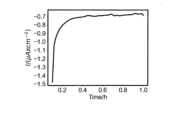
- FIG. 4 is a diagram showing the current density of an electrode in an example.
- a numerical range expressed using "to” means a range that includes the numerical values before and after "to” as the lower and upper limits.
- FIG. 1 is a schematic diagram of a sterilization system 100 of the present embodiment.
- the sterilization system 100 of the present embodiment is a system for sterilizing a biofilm formed on an object (sterilization object) 6.
- the sterilization system 100 of the present embodiment includes, for example, a sterilizing composition 10 for sterilizing a biofilm, a nozzle 20 for supplying the sterilizing composition 10 to the biofilm, a sterilizing composition supply unit 30 for holding the sterilizing composition 10, an electrode 40 provided on the nozzle 20, and a control unit 70 that is connected to the electrode 40 and applies a potential of -0.4 V or less based on a silver/silver chloride electrode to the electrode 40, exceeding the lower limit of the potential window.
- the bactericidal composition 10 is a composition for sterilizing biofilms.
- the bactericidal composition 10 contains an organic compound (hereinafter, appropriately referred to as a "specific organic compound”) with a standard oxidation-reduction potential (pH 7) of -0.7 V to -0.2 V, and water. Details of the bactericidal composition 10 are described below.
- the bactericidal composition supply unit 30 includes a container 31 that holds the bactericidal composition 10.
- the bactericidal composition 10 is held (stored) in the container 31.
- the bactericidal composition 10 is supplied from the container 31 to the biofilm formed on the target object 6 via the nozzle 20.
- FIG. 1 illustrates an example of a configuration in which the target object 6 is connected to the nozzle 20.
- FIG. 2 is a cross-sectional view focusing on the portion where the nozzle 20 according to this embodiment is connected to the target object 6.
- the nozzle 20 is a tubular structure for supplying the bactericidal composition 10 to the biofilm 2, and the bactericidal composition 10 passes through the inside of the nozzle 20.
- the bactericidal composition 10 that has passed through the inside of the nozzle 20 is then ejected from the nozzle 20 and comes into contact with the biofilm 2.
- the nozzle 20 is an element for bringing the bactericidal composition 10 into contact with the biofilm 2.
- the object 6 is a tubular body, and a biofilm 2 is formed on the inner surface of the object 6.
- An example of the object 6 that is a tubular body is the insertion tube of an endoscope.
- Figures 1 and 2 show an example of a configuration in which the nozzle 20 also functions as the electrode 40.
- Fig. 3 is a schematic diagram for explaining the mechanism presumed to be involved in the sterilization method using the sterilization system 100.
- NADH reduced nicotinamide adenine dinucleotide
- NAD + oxidized nicotinamide adenine dinucleotide
- FIG. 2 the potential applied to the electrode 40 and the movement of electrons are shown diagrammatically.
- the specific organic compound 5 receives electrons from the electrode 40 (nozzle 20) (arrow 9), passes through the nozzle 20 in a state of increased reductivity, and comes into contact with or approaches the biofilm 2. Then, as shown in FIG. 3, the approach or contact of the specific organic compound 5 with increased reductivity limits the release of electrons from the bacteria 1 (arrow 3).
- sterilization does not only mean completely destroying the bacteria in a biofilm, but also includes killing a portion of the bacteria in the biofilm (i.e., reducing the number of bacteria in the biofilm).
- the sterilizing composition 10 contains a specific organic compound 5 having a standard redox potential (pH 7) of -0.7 V to -0.2 V, and water.
- the standard redox potential (pH7) of specific organic compound 5 is not particularly limited as long as it is in the range of -0.7V to -0.2V, but from the viewpoint of obtaining a higher bactericidal effect, -0.6V to -0.3V or -0.6V to -0.4V is preferable.
- the specific organic compound 5 is not particularly limited as long as it is an organic compound having a standard redox potential within the above range, but for example, a compound containing an aromatic heterocycle containing nitrogen, among which a compound having a dipyridine structure is preferred.
- Specific compounds include the compounds shown in the table below and their derivatives, among which, from the viewpoint of obtaining a higher bactericidal effect, methyl viologen and its derivatives are preferred, and methyl viologen is more preferred.
- the specific organic compound 5 may be composed of a single compound or may be composed of two or more compounds.
- the water contained in the sterilizing composition 10 is not particularly limited and may be pure water, distilled water, ion-exchanged water, etc.
- the bactericidal composition 10 may further contain a positive ion (cation).
- a positive ion (cation) By using the specific organic compound 5 in combination with a cation, a synergistic effect occurs, and the bactericidal effect can be further enhanced. The mechanism is not clear, but is speculated as follows. In the bactericidal composition 10 containing the specific organic compound 5, applying a negative potential to the electrode 40 promotes the transfer of electrons to the bacterium 1 (arrow 4 in FIG. 3). At this time, if the bactericidal composition 10 contains a cation, the cation flows into the inside of the bacterium (bacterial cell) 1.
- the cation is not particularly limited, and examples thereof include metal ions, cations containing metals such as complex ions, and organic cations generated from drugs.
- metals contained in metal ions and cations containing metals include silver (Ag), copper (Cu), cobalt (Co), aluminum (Al), nickel (Ni), zinc (Zn), molybdenum (Mo), vanadium (V), zirconium (Zr), tungsten (W), palladium (Pd), and platinum (Pt). From the viewpoint of further enhancing the bactericidal effect, silver ions (Ag + ) and copper ions (Cu + , Cu 2+ ) are preferred, and silver (Ag + ) is more preferred.
- the cation may be a so-called physiological electrolyte-derived cation, such as sodium ion (Na + ), potassium ion (K + ), calcium ion (Ca 2+ ), and magnesium ion (Mg 2+ ).
- Na + sodium ion
- K + potassium ion
- Ca 2+ calcium ion
- Mg 2+ magnesium ion
- the positive ion (cation) one type of cation may be used, or two or more types of cations may be used.
- the germicidal composition 10 may further contain an anion that serves as a counter ion of the cation.
- the anion is not particularly limited, and examples thereof include halide ions such as fluorine, chlorine, bromine, and iodine.
- the cation may be an ion derived from a salt consisting of a cation and an anion. Examples of preferred salts include metal halides such as silver chloride and copper chloride.
- the cation can be introduced into the germicidal composition 10 by dispersing or dissolving (including partially dissolving) these salts in the germicidal composition 10.
- the concentration of the cation in the bactericidal composition 10 is not particularly limited and can be adjusted as appropriate within the range in which the effects of this embodiment are achieved. From the viewpoint of obtaining a higher bactericidal effect, for example, the concentration of the cation in the bactericidal composition may be 1 ⁇ M to 1000 ⁇ M or 10 ⁇ M to 200 ⁇ M.
- the bactericidal composition 10 may be composed of only the specific organic compound 5 and water, or may contain other components other than the specific organic compound 5 and water within the scope of the effect of this embodiment.
- Other components include, in addition to the above-mentioned cations, for example, an electron mediator other than the specific organic compound 5, an electron source compound, a buffering agent, and a coagulant.
- the electron source compound (electron donor) is a compound used in bacterial metabolism, and includes, but is not limited to, organic compounds (amino acids, sugars, organic acids, etc.).
- the buffering agent includes, but is not limited to, borates, bicarbonates, Tris-HCl, citrates, phosphates, succinates, phosphates, and acetates.
- the coagulants include agar, gelatin, agar, etc., with agar being preferred.
- the sterilizing composition 10 of this embodiment may be a mixture of the specific organic compound 5 and a general-purpose medium, etc.
- the bactericidal composition 10 can be prepared by uniformly mixing the specific organic compound 5, water, and, if necessary, other components, by a general-purpose method.
- the bactericidal composition 10 may also be prepared by adding a predetermined amount of the specific organic compound 5 to a general-purpose medium, buffer solution, physiological saline, etc.
- the medium, buffer solution, physiological saline, etc. may be commercially available.
- the nozzle 20 and the object (tubular body) 6 may be connected using a joint 21 (e.g., a silicone tube), and the bactericidal composition 10 may be poured into the inside of the object (tubular body) 6 from the nozzle 20.
- the nozzle 20 and the object 6 are connected to each other using a joint 21 so that the inside (flow path) of the nozzle 20 and the inside (flow path) of the object 6 are connected.
- the shape of the object 6 is not limited to a tubular body.
- the nozzle 20 may be inserted into the pore and the bactericidal composition 10 may be poured into the pore.
- the material of the nozzle 20 is not particularly limited, and metal materials and various plastic materials can be used.
- the metal materials can be the same as those used for the electrode 40 described later, and the preferred form is also the same. If the nozzle 20 is made of a metal material, it is preferable because the entirety or part of the nozzle 20 can function as the electrode 40.
- plastics examples include polyvinyl chloride, polycarbonate, ABS resin, polypropylene, polyethylene, polystyrene, fluororesin, polyethylene terephthalate, methyl methacrylate, polyamide, polyethersulfone, polysulfone, polyurethane, ethylene-vinyl acetate copolymer resin, silicone resin, thermoplastic elastomer, liquid silicone rubber (LSR), etc.
- the nozzle 20 may be made of a single material or a composite made of multiple materials.
- the size (thickness) of the nozzle 20 is not particularly limited and can be designed appropriately depending on the object 6 to be sterilized.
- the diameter (outer diameter) of the nozzle 20 does not differ significantly from the diameter of the insertion tube, and may be, for example, about 1 mm to 100 mm.
- the electrode 40 is provided on the nozzle 20 so as to come into contact with the bactericidal composition 10 passing through the nozzle 20.
- the electrode 40 can be brought closer to the biofilm 2, which is the target of sterilization. This allows more of the specific organic compound 5, which has received electrons from the electrode 40 and has become more reducible, to be sent toward the biofilm 2, further enhancing the sterilization effect.
- the electrode 40 may be configured as a part or all of the nozzle 20. If a part or all of the nozzle 20 is configured as the electrode 40, it becomes easier to increase the size of the electrode 40, and the contact area between the electrode 40 and the bactericidal composition 10 can be increased. As a result, the amount (concentration) of the specific organic compound 5 with increased reducibility can be increased, and the bactericidal effect can be improved.
- the electrode 40 may be provided on the nozzle 20 as a separate member from the nozzle 20.
- the electrode 40 is provided as a separate member from the nozzle 20, for example, a configuration in which a tubular electrode 40 is provided at the tip of the nozzle 20, a configuration in which the electrode 40 is provided inside the nozzle 20, or a configuration in which a wire-shaped electrode 40 extends from the inside of the tubular nozzle 20 may be adopted.
- the electrode 40 may be ring-shaped so that the bactericidal composition 10 flows inside.
- the size (thickness, diameter) and length (length along the flow direction of the bactericidal composition 10) of the electrode 40 are not particularly limited and can be designed appropriately depending on the object 6 to be sterilized, etc.
- the size (thickness, diameter) of the electrode 40 may be approximately the same as that of the nozzle 20 described above.
- the length of the electrode 40 may be, for example, 0.1 cm to 30 cm, 0.5 cm to 10 cm, etc.
- the material that constitutes the electrode 40 is not particularly limited as long as it is a conductor to which an electric potential can be applied.
- materials include metal materials such as silver, copper, aluminum, nickel, iron, and alloys containing these metals (e.g., stainless steel (SUS)), and carbon materials such as amorphous carbon, graphite, and carbon nanotubes.
- the electrode 40 is a working electrode used in the three-electrode method, and two more electrodes (a counter electrode 50 and a reference electrode 60) may be provided.
- a counter electrode 50 and a reference electrode 60 may be provided.
- the counter electrode 50 and the reference electrode 60 may be provided in any location as long as they are in contact with the bactericidal composition 10, but it is preferable to provide them in the bactericidal composition supply unit 30.
- the nozzle 20 can be made smaller than a configuration in which the counter electrode 50 and the reference electrode 60 are provided in addition to the electrode 40 in the nozzle 20.
- a configuration in which the counter electrode 50 and the reference electrode 60 are provided in addition to the electrode 40 in the nozzle 20 may also be adopted.
- the reference electrode 60 is preferably a silver/silver chloride electrode.
- the current density of the current involved in the sterilization reaction that flows through the electrode 40 during sterilization is preferably ⁇ 10 ⁇ A/cm 2 to ⁇ 0.01 ⁇ A/cm 2 , and more preferably ⁇ 10 ⁇ A/cm 2 to ⁇ 0.1 ⁇ A/cm 2. Setting the current density at the electrode 40 within the above range enables sterilization with a small current value, which has the advantages of suppressing side reactions on the electrode, causing less damage to the object 6 when it is washed, and having less effect on tissue even when used in a living body.
- the current that flows through the electrode 40 during sterilization includes not only the current involved in the sterilization reaction, but also a background current specific to the system that is unrelated to the sterilization reaction.
- the "current density of the current involved in the sterilization reaction” is the current measured for the electrode 40 minus the background current specific to the system, divided by the contact area of the electrode 40 with the sterilizing composition 10. There are no particular limitations on the method for calculating the "current density of the current involved in the sterilization reaction," but it can be calculated, for example, by the method described in the Examples.
- the container 31 of the sterilizing composition supply unit 30 is connected to the nozzle 20 via, for example, a tube 32 and a joint 33, and is configured to supply the sterilizing composition 10 to the nozzle 20.
- the container 31 and the nozzle 20 may be directly connected.
- the sterilizing composition supply unit 30 may include a counter electrode 50 and a reference electrode 60, if necessary.
- the supply of the sterilizing composition 10 from the sterilizing composition supply unit 30 to the nozzle 20 can be performed, for example, by a liquid transfer mechanism (not shown).
- the sterilization system 100 of this embodiment may or may not include a liquid transfer mechanism as one of its components. If it does not include a liquid transfer mechanism, a liquid transfer mechanism (liquid transfer device) that is separate from the sterilization system may be used.
- a liquid transfer mechanism liquid transfer device
- a general-purpose liquid transfer pump such as a tube-type roller pump or a syringe pump can be used.
- the bactericidal composition 10 supplied from the bactericidal composition supply unit 30 to the nozzle 20 further passes through the nozzle 20 and flows to the object 6, where it comes into contact with and sterilizes the biofilm 2.
- the bactericidal composition 10 that has come into contact with the object 6 may then be discarded (discharged) as is, or may be returned to the bactericidal composition supply unit 30.
- the object 6 is a tubular body such as an insertion tube of an endoscope
- the outlet (opening on the opposite side to the nozzle 20) of the object 6 (tubular body) may be connected directly to the bactericidal composition supply unit 30 or by using a tube or the like. This allows the bactericidal composition 10 to circulate between the bactericidal composition supply unit 30, the nozzle 20 (electrode 40), and the object 6 (tubular body), making it possible to sterilize the biofilm more efficiently.
- the control unit 70 is connected to the electrode 40 by, for example, wiring 71, and applies a predetermined potential to the electrode 40. Specifically, the control unit 70 applies a potential to the electrode 40 that exceeds the lower limit of the potential window and is equal to or less than -0.4 V based on a silver/silver chloride electrode. Any known device capable of applying a potential is used for the control unit 70.
- the control unit 70 is connected to the three electrodes (electrode 40, counter electrode 50, and reference electrode 60) by wiring 71, and may be a potentiostat that controls them.
- the inventors have found that, regardless of the type of bacteria, by using the bactericidal composition of this embodiment, applying a weak potential of -0.4 V or less promotes electron transfer (arrow 4 in Figures 2 and 3) from the electrode 40 to the bacteria 1 via the specific organic compound 5, inhibiting the cell's energy acquisition and ultimately sterilizing the bacteria. From the viewpoint of obtaining a higher sterilizing effect, it is preferable to apply a potential of -0.6 V or less, -0.8 V or less, or -0.9 V or less to the electrode 40. In addition, the lower limit of the negative potential applied to the electrode 40 is not particularly limited as long as it exceeds the lower limit of the potential window.
- the lower limit of the potential window is a value determined by the components of the bactericidal composition 10, the pH, and the material of the electrode 40, and is clear to those skilled in the art.
- a potential that exceeds the lower limit of the potential window sterilization can be performed under mild conditions that do not cause electrolysis of the solvent (water).
- the sterilization method of this embodiment is low cost because it reduces energy consumption, and can also suppress side reactions that may generate active chemical species that are harmful to the human body. Furthermore, if a high potential is applied to cause water electrolysis, reactions such as hydrogen generation may take precedence, and there is a risk that electron transfer from the sterilizing composition 10 to the bacteria 1 (arrow 4 in Figures 2 and 3) may be suppressed.
- the potential applied is weak, hydrogen generation does not occur, and the metabolism of the bacteria 1 can be efficiently suppressed and sterilized.
- the lower limit of the potential is preferably, for example, -1.4 V or more, -1.2 V or more, or -1.1 V or more based on a silver/silver chloride electrode.
- the object 6 to be sterilized is not particularly limited, and examples thereof include medical instruments.
- medical instruments include medical instruments (e.g., forceps and endoscopes) that are used beyond or in direct contact with the mucous membrane of a living body, or medical instruments (e.g., various implants such as dental implants) that are used by being embedded in a living body, and biofilms may occur in the details of these medical instruments that cannot be mechanically washed.
- the bacteria in such biofilms can also be killed (sterilized) by the sterilization method of this embodiment, and a preventive effect against bacterial infection can be expected.
- the sterilization system 100 of this embodiment can pour the sterilizing composition 10 into the tubular body, which is the object 6, from the tip of the nozzle 20, and can efficiently sterilize the biofilm formed on the inner surface (inner wall surface) of the tubular body (e.g., the insertion tube of an endoscope).
- the object 6 may be, for example, the teeth of a human or other organisms.
- the object 6 is not a tubular body (e.g., forceps or an implant), it can be sterilized, for example, by spraying the sterilizing composition 10 onto the object 6 with a nozzle 20.
- the sterilization system 100 is provided with an exhaust section for sucking in and exhausting the used sterilizing composition 10 after it has been sprayed onto the object 6.
- the biofilm 2 is a higher-order structure formed by bacteria 1 attached to the surface of a solid phase (target object 6), and is covered, for example, by polysaccharides produced by the bacteria 1.
- the bacteria 1 contained in the biofilm 2, i.e., the bacteria 1 to be sterilized in this embodiment, are not particularly limited and may be either gram-positive or gram-negative bacteria.
- the sterilization method of this embodiment is also effective against Klebsiella pneumoniae (gram-negative bacteria), Pseudomonas aeruginosa (gram-negative bacteria), and Staphylococcus epidermidis (gram-positive bacteria), which are designated by the U.S. Food and Drug Administration (FDA) as bacteria that have a significant impact on endoscope contamination.
- FDA U.S. Food and Drug Administration
- the electron transfer becomes more efficient, and a more excellent sterilization effect can be obtained.
- bacteria belonging to the family Enterobacteriaceae include the above-mentioned Klebsiella pneumoniae (Klebsiella spp.), Enterobacter spp., Escherichia spp., Salmonella spp., Serratia spp., Shigella spp., and Yersinia spp.
- the sterilization method of the present embodiment includes, for example, the following steps (Fig. 4).
- Step S1 Passing the sterilizing composition 10 through the nozzle 20 (electrode 40).
- Step S2 Contacting the germicidal composition 10 with an electrode 40 to which a potential of ⁇ 0.4 V or less is applied, exceeding the lower limit of the potential window, versus a silver/silver chloride electrode.
- Step S3 Contacting the bactericidal composition 10 that has passed through the nozzle 20 (i.e., contacted the electrode 40) with the biofilm 2.
- Step S1 Passing the germicidal composition 10 through the nozzle 20
- the germicidal composition 10 is passed through the nozzle 20, for example, using a fluid transfer mechanism (not shown).
- the speed (fluid transfer speed) of the germicidal composition 10 passing through the nozzle 20 is not particularly limited, and may be, for example, 0.1 mL/min to 10 mL/min.
- Step S2 Contacting the sterilizing composition 10 with the electrode 40 to which a potential has been applied
- the application of the potential to the electrode 40 is performed by the control unit 70.
- the control unit 70 is preferably a potentiostat.
- the magnitude of the potential to be applied is as described above.
- the potential may be applied continuously or intermittently, but from the viewpoint of efficient sterilization, it is preferable to apply it continuously.
- the specific organic compound 5 in the sterilizing composition 10 receives electrons from the electrode 40 when passing through the nozzle 20, and the reduction property is increased.
- step S1 and S2 are carried out in parallel on the time axis.
- step S2 is carried out after step S1.
- Step S3 Contact of the bactericidal composition 10 with the biofilm 2
- the method of contacting the bactericidal composition 10 i.e., the bactericidal composition 10 containing the specific organic compound 5 with enhanced reducibility
- the nozzle 20 and the object (tubular body) 6 may be connected, and the bactericidal composition 10 may be poured into the object (tubular body) 6 from the nozzle 20.
- the nozzle 20 when sterilizing a biofilm formed in a fine hole, the nozzle 20 may be inserted into the fine hole and the bactericidal composition 10 may be poured into the fine hole.
- the bactericidal composition 10 may also be sprayed from the nozzle 20 toward the biofilm.
- the bactericidal composition 10 that has passed through the nozzle 20 contains the specific organic compound 5 with enhanced reducibility. By contacting or bringing this into contact with the biofilm 2, the bacteria 1 in the biofilm 2 can be sterilized.
- the time (sterilization time) for which the sterilizing composition 10 is in contact with the biofilm 2 is not particularly limited, and may be adjusted as appropriate depending on the type of specific organic compound, the type of bacteria, the liquid transfer speed, etc. For example, the sterilization time may be 30 minutes to 24 hours.
- the temperature (sterilization temperature) of the sterilizing composition 10 that is in contact with the biofilm 2 is not particularly limited. For example, the sterilization temperature may be 0°C to 100°C, or room temperature.
- the contact of the sterilizing composition 10 with the biofilm 2 may be carried out under anaerobic conditions that do not contain oxygen (e.g., a nitrogen atmosphere) or under aerobic conditions that contain oxygen (e.g., in the air). Because the atmosphere is not limited to anaerobic conditions, the sterilization method of this embodiment can be carried out with simpler equipment.
- the sterilization system 100 of this embodiment and the sterilization method using the sterilization system 100 described above it is possible to reduce the activity of the bacteria 1 in the biofilm 2 and eventually kill (sterilize) all or part of the bacteria in the biofilm 2 simply by applying a weak potential to the electrode 40. This can be expected to have a continuous effect on drug-resistant bacteria lurking in the biofilm 2.
- the sterilization system 100 by providing the electrode 40 to the nozzle 20, it becomes easier to deliver the specific organic compound 5 with increased reducing properties to the biofilm 2, and the sterilization effect can be further improved.
- an antibacterial agent is not required or the amount of antibacterial agent used can be reduced, so the occurrence of new drug-resistant bacteria can be suppressed.
- Example 1 the sterilization system 100 shown in Fig. 1 was used to sterilize Pseudomonas aeruginosa (PA) in a biofilm formed in a PTFE tube (subject 6).
- a three-electrode method was used in which an electrode (working electrode) 40, a counter electrode 50, and a reference electrode 60 were controlled by a potentiostat (control unit 70).
- the nozzle 20 was entirely composed of the electrode 40 (SUS tube, diameter: 0.41 cm, length: 1 cm).
- Methyl viologen (MV) was used as the specific organic compound.
- Methyl viologen (MV) was added to DM (defined medium, liquid medium) to a concentration of 500 ⁇ M and mixed uniformly.
- the DM medium used an electrolyte solution containing the following electrolytes: CaCl 2 ⁇ 2H 2 O: 0.08 g/L, NH 4 Cl: 1.0 g/L, NaHCO 3 : 2.5 g/L, NaCl: 10.0 g/L, MgCl 2 ⁇ 6H 2 O: 0.2 g/L, and HEPES: 7.2 g/L.
- a drain pipe (not shown) was connected to the other end of the PTFE tube (target 6).
- a syringe pump (not shown, inlet pump) was connected to the sterilizing composition supply section 30, and a tube-type roller pump (not shown, outlet pump) was connected to the drain pipe (not shown).
- the liquid delivery device (syringe pump and tube pump) was driven to flow the bactericidal composition 10 from the bactericidal composition supply unit 30 through the nozzle 20, the PTFE tube (object 6), and the drain pipe (not shown) in that order.
- the liquid delivery speed was 2 mL/min.
- a potential of -1.0 V (vs Ag/AgCl) was applied to the working electrode 40. With the potential applied, the bactericidal composition was allowed to flow for 1 hour. This experiment was conducted under aerobic conditions (in the atmosphere).
- part A is the part 2.5 cm to 3.5 cm from the upstream end (one end) of the PTFE tube
- part C is the part 2.5 cm to 3.5 cm from the downstream end (the other end) of the PTFE tube
- part B is approximately the center part of the PTFE tube.
- Fig. 7 shows the bacterial reduction (log 10 bacterial reduction) in each of parts A, B, and C.
- the bacterial reduction is the difference obtained by subtracting the colony count (log 10 ) of each part from the colony count (log 10 ) of the control (before sterilization treatment) of each part shown in Fig. 6.
- the number of bacterial colonies was reduced in all parts, A, B, and C, after the sterilization treatment compared to the control (before the sterilization treatment), confirming the effectiveness of the sterilization method using the sterilization system 100.
- Example 2 A sterilization experiment was conducted under the same conditions as in Experiment 1, except that the length of the electrode 40 (nozzle 20, SUS tube) was set to 5 cm, and the sterilization effect was evaluated in the same manner. The results are shown in Figures 8 and 9. As shown in Figures 8 and 9, in Experiment 2, a sterilization effect was obtained similarly to Experiment 1.
- the current value flowing through the 5 cm SUS tube was measured using a potentiostat (control unit 70).
- a sterilization experiment was conducted under the same conditions as in Experiment 2, except that the length of the electrode 40 (nozzle 20, SUS tube) was set to 10 cm, and the current value was similarly measured for the 10 cm SUS tube.
- the magnitude of the system-specific background current does not depend on the size of the electrode, so it is approximately the same value for the 5 cm SUS tube and the 10 cm SUS tube.
- the magnitude of the current value involved in the sterilization reaction depends on the size of the electrode (i.e., the length of the SUS tube). Therefore, the current value flowing through the 5 cm SUS tube and involved in the sterilization reaction was obtained by subtracting the current value of the 5 cm SUS tube from the current value of the 10 cm SUS tube (difference in length: 5 cm). This was divided by the inner area of the 5 cm SUS tube (contact area of the electrode with the sterilization composition) to obtain the current density. The results are shown in FIG. 10. As shown in FIG. 10, the current density was about -0.7 ⁇ A/cm 2 .
- the sterilization method of the present invention can be used for washing and cleaning medical instruments and medical implants to prevent infections caused by them.
Landscapes
- Health & Medical Sciences (AREA)
- Life Sciences & Earth Sciences (AREA)
- Epidemiology (AREA)
- Animal Behavior & Ethology (AREA)
- General Health & Medical Sciences (AREA)
- Public Health (AREA)
- Veterinary Medicine (AREA)
- Chemical & Material Sciences (AREA)
- Chemical Kinetics & Catalysis (AREA)
- General Chemical & Material Sciences (AREA)
- Hydrology & Water Resources (AREA)
- Engineering & Computer Science (AREA)
- Environmental & Geological Engineering (AREA)
- Water Supply & Treatment (AREA)
- Organic Chemistry (AREA)
- Apparatus For Disinfection Or Sterilisation (AREA)
Priority Applications (2)
| Application Number | Priority Date | Filing Date | Title |
|---|---|---|---|
| CN202480051419.1A CN121693352A (zh) | 2023-08-10 | 2024-08-08 | 杀菌系统和杀菌方法 |
| JP2025539576A JPWO2025033496A1 (https=) | 2023-08-10 | 2024-08-08 |
Applications Claiming Priority (2)
| Application Number | Priority Date | Filing Date | Title |
|---|---|---|---|
| JP2023130784 | 2023-08-10 | ||
| JP2023-130784 | 2023-08-10 |
Publications (1)
| Publication Number | Publication Date |
|---|---|
| WO2025033496A1 true WO2025033496A1 (ja) | 2025-02-13 |
Family
ID=94534481
Family Applications (1)
| Application Number | Title | Priority Date | Filing Date |
|---|---|---|---|
| PCT/JP2024/028432 Pending WO2025033496A1 (ja) | 2023-08-10 | 2024-08-08 | 殺菌システム、及び殺菌方法 |
Country Status (3)
| Country | Link |
|---|---|
| JP (1) | JPWO2025033496A1 (https=) |
| CN (1) | CN121693352A (https=) |
| WO (1) | WO2025033496A1 (https=) |
Citations (6)
| Publication number | Priority date | Publication date | Assignee | Title |
|---|---|---|---|---|
| US5312813A (en) * | 1991-05-03 | 1994-05-17 | University Technologies International | Biofilm reduction method |
| JPH06285138A (ja) * | 1993-03-31 | 1994-10-11 | Tadashi Matsunaga | 微生物の電気化学的制御方法及びそれに用いる電子メディエータ |
| JP2001342008A (ja) * | 2000-05-26 | 2001-12-11 | Toin Gakuen | 活性酸素発生システムおよびそれを用いた活性酸素発生剤ならびに活性酸素発生装置。 |
| JP2012034576A (ja) * | 2010-08-03 | 2012-02-23 | Kajima Corp | 亜酸化窒素分解装置 |
| JP2018177055A (ja) * | 2017-04-17 | 2018-11-15 | 株式会社トクヤマ | エバポレータの殺菌方法及びエバポレータ殺菌機能付き自動車用空気調和装置 |
| JP2021516559A (ja) * | 2018-03-16 | 2021-07-08 | クレオ・メディカル・リミテッドCreo Medical Limited | 滅菌機器 |
-
2024
- 2024-08-08 JP JP2025539576A patent/JPWO2025033496A1/ja active Pending
- 2024-08-08 CN CN202480051419.1A patent/CN121693352A/zh active Pending
- 2024-08-08 WO PCT/JP2024/028432 patent/WO2025033496A1/ja active Pending
Patent Citations (6)
| Publication number | Priority date | Publication date | Assignee | Title |
|---|---|---|---|---|
| US5312813A (en) * | 1991-05-03 | 1994-05-17 | University Technologies International | Biofilm reduction method |
| JPH06285138A (ja) * | 1993-03-31 | 1994-10-11 | Tadashi Matsunaga | 微生物の電気化学的制御方法及びそれに用いる電子メディエータ |
| JP2001342008A (ja) * | 2000-05-26 | 2001-12-11 | Toin Gakuen | 活性酸素発生システムおよびそれを用いた活性酸素発生剤ならびに活性酸素発生装置。 |
| JP2012034576A (ja) * | 2010-08-03 | 2012-02-23 | Kajima Corp | 亜酸化窒素分解装置 |
| JP2018177055A (ja) * | 2017-04-17 | 2018-11-15 | 株式会社トクヤマ | エバポレータの殺菌方法及びエバポレータ殺菌機能付き自動車用空気調和装置 |
| JP2021516559A (ja) * | 2018-03-16 | 2021-07-08 | クレオ・メディカル・リミテッドCreo Medical Limited | 滅菌機器 |
Non-Patent Citations (4)
| Title |
|---|
| APPLIED SCIENCES, vol. 12, 2022, pages 6320 |
| BIOELECTROCHEMISTRY, vol. 121, 2018, pages 84 - 94 |
| COLLOIDS AND SURFACES B: BIOINTERFACES, vol. 117, 1 May 2014 (2014-05-01), pages 152 - 157 |
| CURRENT OPINION IN SOLID STATE AND MATERIALS SCIENCE, vol. 25, August 2021 (2021-08-01), pages 100926 |
Also Published As
| Publication number | Publication date |
|---|---|
| CN121693352A (zh) | 2026-03-17 |
| JPWO2025033496A1 (https=) | 2025-02-13 |
Similar Documents
| Publication | Publication Date | Title |
|---|---|---|
| Kiamco et al. | Hypochlorous-acid-generating electrochemical scaffold for treatment of wound biofilms | |
| AU2012272993B2 (en) | Electrochemical disinfection of implanted catheters | |
| JP4464027B2 (ja) | 歯科用装置および該装置の操作方法 | |
| Del Pozo et al. | Bioelectric effect and bacterial biofilms. A systematic review | |
| US10568979B2 (en) | Treatment system for cleaning a component, in particular an implant part, contaminated with a biofilm | |
| US20090148540A1 (en) | Antibacterial composition and method of production | |
| JP6803896B2 (ja) | 次亜塩素酸を含む抗微生物剤 | |
| Dusane et al. | Electroceutical treatment of Pseudomonas aeruginosa biofilms | |
| US6258249B1 (en) | Sterilization of surgical sites | |
| JP6783481B2 (ja) | 銅または銅合金の表面処理方法、銅または銅合金の殺菌用表面処理液、および該方法によって処理された銅または銅合金を用いる殺菌方法 | |
| CA2923652C (en) | Ceramic body, in particular for use in a bone implant, in particular as a dental implant | |
| TW200803931A (en) | System and method for the prevention of bacterial and fungal infections including urinary tract infections (UTI) using N-halogenated amino acids | |
| US6482309B1 (en) | Electrolytic generation of nascent iodine as a method of treatment and for the prevention of infections associated with medical implant devices | |
| JP6506924B2 (ja) | 電極形成用導電性ダイヤモンド粉末含有塗料、電極及び歯科治療器具 | |
| WO2025033496A1 (ja) | 殺菌システム、及び殺菌方法 | |
| JP2002500055A (ja) | 根管用潅注媒体 | |
| WO2023019027A1 (en) | Methods of synthesizing multi-metal salts composition | |
| WO2024122522A1 (ja) | 殺菌方法、及び殺菌方法に用いる組成物 | |
| WO2008038744A1 (en) | Bactericidal composition | |
| JPH0966064A (ja) | 医療器具の殺菌洗浄方法 | |
| Liu et al. | Effects of Hydrogen-rich Water on Cariogenic Bacteria | |
| JP2001261513A (ja) | 微生物の生育抑制方法 | |
| Gasper | Low Current Electrical Enhancement of a Dental Unit Waterline Cleaner-Effect on Planktonic Bacteria and Bacterial Biofilm in Simulated Dental Unit Waterline |
Legal Events
| Date | Code | Title | Description |
|---|---|---|---|
| 121 | Ep: the epo has been informed by wipo that ep was designated in this application |
Ref document number: 24851913 Country of ref document: EP Kind code of ref document: A1 |
|
| ENP | Entry into the national phase |
Ref document number: 2025539576 Country of ref document: JP Kind code of ref document: A |
|
| WWE | Wipo information: entry into national phase |
Ref document number: 2025539576 Country of ref document: JP |
|
| WWE | Wipo information: entry into national phase |
Ref document number: 2024851913 Country of ref document: EP |
|
| NENP | Non-entry into the national phase |
Ref country code: DE |