WO2025033338A1 - 細胞培養装置および細胞培養方法 - Google Patents
細胞培養装置および細胞培養方法 Download PDFInfo
- Publication number
- WO2025033338A1 WO2025033338A1 PCT/JP2024/027666 JP2024027666W WO2025033338A1 WO 2025033338 A1 WO2025033338 A1 WO 2025033338A1 JP 2024027666 W JP2024027666 W JP 2024027666W WO 2025033338 A1 WO2025033338 A1 WO 2025033338A1
- Authority
- WO
- WIPO (PCT)
- Prior art keywords
- substrate
- mesh member
- droplets
- cell culture
- culture
- Prior art date
- Legal status (The legal status is an assumption and is not a legal conclusion. Google has not performed a legal analysis and makes no representation as to the accuracy of the status listed.)
- Pending
Links
Images




Classifications
-
- C—CHEMISTRY; METALLURGY
- C12—BIOCHEMISTRY; BEER; SPIRITS; WINE; VINEGAR; MICROBIOLOGY; ENZYMOLOGY; MUTATION OR GENETIC ENGINEERING
- C12M—APPARATUS FOR ENZYMOLOGY OR MICROBIOLOGY; APPARATUS FOR CULTURING MICROORGANISMS FOR PRODUCING BIOMASS, FOR GROWING CELLS OR FOR OBTAINING FERMENTATION OR METABOLIC PRODUCTS, i.e. BIOREACTORS OR FERMENTERS
- C12M1/00—Apparatus for enzymology or microbiology
- C12M1/02—Apparatus for enzymology or microbiology with agitation means; with heat exchange means
-
- C—CHEMISTRY; METALLURGY
- C12—BIOCHEMISTRY; BEER; SPIRITS; WINE; VINEGAR; MICROBIOLOGY; ENZYMOLOGY; MUTATION OR GENETIC ENGINEERING
- C12M—APPARATUS FOR ENZYMOLOGY OR MICROBIOLOGY; APPARATUS FOR CULTURING MICROORGANISMS FOR PRODUCING BIOMASS, FOR GROWING CELLS OR FOR OBTAINING FERMENTATION OR METABOLIC PRODUCTS, i.e. BIOREACTORS OR FERMENTERS
- C12M1/00—Apparatus for enzymology or microbiology
- C12M1/26—Inoculator or sampler
-
- C—CHEMISTRY; METALLURGY
- C12—BIOCHEMISTRY; BEER; SPIRITS; WINE; VINEGAR; MICROBIOLOGY; ENZYMOLOGY; MUTATION OR GENETIC ENGINEERING
- C12M—APPARATUS FOR ENZYMOLOGY OR MICROBIOLOGY; APPARATUS FOR CULTURING MICROORGANISMS FOR PRODUCING BIOMASS, FOR GROWING CELLS OR FOR OBTAINING FERMENTATION OR METABOLIC PRODUCTS, i.e. BIOREACTORS OR FERMENTERS
- C12M3/00—Tissue, human, animal or plant cell, or virus culture apparatus
-
- C—CHEMISTRY; METALLURGY
- C12—BIOCHEMISTRY; BEER; SPIRITS; WINE; VINEGAR; MICROBIOLOGY; ENZYMOLOGY; MUTATION OR GENETIC ENGINEERING
- C12N—MICROORGANISMS OR ENZYMES; COMPOSITIONS THEREOF; PROPAGATING, PRESERVING, OR MAINTAINING MICROORGANISMS; MUTATION OR GENETIC ENGINEERING; CULTURE MEDIA
- C12N1/00—Microorganisms; Compositions thereof; Processes of propagating, maintaining or preserving microorganisms or compositions thereof; Processes of preparing or isolating a composition containing a microorganism; Culture media therefor
Definitions
- the present disclosure relates to a cell culture device and a cell culture method, and more specifically to a technique for culturing cells in droplets.
- a technique that has been gaining attention as a cell culture method is one in which cells are cultured in droplets of water containing cells and encapsulated in a culture medium dispersed in an oil phase.
- the droplets are used as independent culture vessels separated by an oil phase.
- Non-Patent Document 1 and Non-Patent Document 2 disclose techniques for separating multiple droplets in mineral oil, which has a smaller specific gravity than culture medium.
- Non-Patent Document 1 discloses a technique for introducing mineral oil containing droplets onto a microwell chip and sinking the droplets one by one into the holes of the microwell chip.
- Non-Patent Document 2 discloses a technique for sinking droplets in mineral oil one by one into the spaces between the pillars of a microcage array chip. By capturing (trapping) droplets individually in this way, it becomes possible to collect the desired droplets and perform further cultivation or analysis.
- fluorinated oil rather than mineral oil because it is easier to supply oxygen into the droplets.
- a cell culture device includes a generation unit, a substrate, and a mesh member.
- the generation unit generates a dispersion liquid in which droplets containing cells and culture liquid are dispersed in a specific solution having a higher specific gravity than the culture liquid.
- the substrate has a main surface and holds the dispersion liquid on the main surface.
- the mesh member is disposed at a distance from the main surface of the substrate.
- the mesh member has a plurality of through holes formed therein for trapping droplets that are introduced to the substrate and float up when the mesh member is positioned vertically above the substrate.
- a cell culture method includes the steps of: generating a dispersion liquid in which droplets containing cells and encapsulated in culture liquid are dispersed in a specific solution having a higher specific gravity than the culture liquid; holding the dispersion liquid on a main surface of a substrate having a main surface; and arranging a mesh member at a distance from the main surface of the substrate.
- the mesh member has a plurality of through holes formed therein for trapping droplets that are introduced to the substrate and float up, with the mesh member positioned vertically above the substrate.
- the culture device disclosed herein can individually trap droplets suspended in a specific solution that has a higher specific gravity than the culture medium.
- FIG. 2 is a schematic configuration diagram of a culture unit according to an embodiment.
- FIG. 2 is a cross-sectional view of a culture section according to an embodiment.
- FIG. 1 is a diagram showing an example of an outline of an observed image of a droplet in a culture section. 1 is a flowchart showing an example of a culture method according to an embodiment.
- FIG. 1 is a diagram for explaining a droplet trap.
- FIG. 13 is a perspective view showing a culture system according to another embodiment. 13 is a view showing the structure around the culture section and the linear guide as viewed obliquely from above.
- FIG. FIG. 2 is a cross-sectional view showing the structure of a culture section.
- FIG. 4 is a cross-sectional view showing the structure around the culture section.
- FIG. 1 is a schematic diagram of a culture unit 100 according to the present embodiment.
- the culture unit 100 includes a microscope 7, a capillary 8, a control device 9, and a culture device 15.
- the culture device 15 corresponds to one example of a "cell culture device”.
- the culture device 15 includes a generation unit 5 and a culture unit 10.
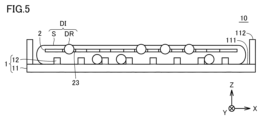
- FIG. 2 is a cross-sectional view of the culture unit 10 according to the embodiment.
- the culture unit 10 includes a substrate 11 and a mesh member 2.
- FIGS. 1 and 2 are diagrams of the culture unit 100 and the culture unit 10 in a state in which a droplet DR is trapped in the mesh member 2. In FIGS.
- the direction perpendicular to the substrate 11 is the Z axis
- the plane parallel to the substrate 11 is the XY plane.
- the culture unit 10 is used in a state in which the Z axis is approximately parallel to the direction of gravity (vertical direction).
- the generating unit 5 generates a dispersion liquid DI in a state in which droplets DR containing culture fluid containing cells are dispersed in a specific solution S having a specific gravity greater than that of the culture fluid.
- the generating unit 5 includes a microchannel device 50 in which microchannels 51A and 51B are formed.
- the microchannel 51A and the microchannel 51B intersect at an intersection position 52.
- a predetermined amount of culture fluid containing cells is intermittently flowed in from the end 511A of the microchannel 51A.
- the specific solution S flows in from the microchannel 51B. More specifically, the specific solution S is supplied from the microchannel 51B so as to sandwich the microchannel 51A from both sides.
- Dispersion liquid DI is introduced into culture section 10, for example, manually by a user.
- culture unit 100 may also include a device (not shown) for transporting dispersion liquid DI from generation section 5 to culture section 10, and the device may be controlled by control device 9.
- the dispersion liquid DI is introduced and then held on the main surface 111 of the substrate 11.
- the main surface 111 is the surface of the substrate 11 on the positive Z-axis side (vertically upward).
- the specific solution S has a larger specific gravity than the culture liquid.
- the mesh member 2 is disposed at a distance from the main surface 111 of the substrate 11.
- the mesh member 2 has a plurality of through holes 23 formed therein for trapping the droplets DR introduced to the substrate 11 and floating up, with the mesh member 2 positioned vertically above the substrate 11. More specifically, the mesh member 2 has a plurality of through holes 23 formed therein, each of which has a size capable of trapping the droplets DR individually.
- each of the droplets DR floating in the specific solution S floats up into the through holes 23.
- the droplets DR can be individually trapped in the through holes 23. Therefore, it is possible to culture and observe cells in a state in which each droplet DR is isolated.
- the cells are microorganisms. Some microorganisms in the environment are closely related to humans, and some are used in industry and manufacturing as well as in daily life. However, most of the microorganisms in the environment have not been successfully cultured, and have not been effectively used as biological resources. In addition, the physiological characteristics of many microorganisms in a given environment have not been clarified. Therefore, by culturing microorganisms and clarifying their properties, there is a possibility that they can be applied to the development of medicine, industry, etc.
- the cells are animal cells. In this case, too, by culturing animal cells and clarifying their properties, there is a possibility that they can be applied to the development of medicine, industry, etc.
- the cells are plant cells.
- the culture medium includes cells and a liquid medium.
- the culture medium may include a marker for visually indicating the characteristics or amount of the cells or a metabolite produced by the cells.
- the marker is, for example, a substance that indicates the presence of a specific metabolite by color or fluorescence.
- the droplets DR are, for example, water droplets with a diameter of about 30 to 130 ⁇ m, but are not limited to this. Droplets DR in the specific solution S can be created in the hundreds of thousands at a time using a dedicated device.
- the specific solution S is fluorine oil.
- fluorine oil examples include FC40, Novec (trademark, the same applies below) 7500, and combinations thereof. Fluorine oil has a higher oxygen permeability than mineral oil.
- surfactants suitable for creating droplets DR in fluorine oil there are surfactants suitable for creating droplets DR in fluorine oil.
- the user adds the surfactant to at least one of the aqueous phase (in the culture solution) and the oil phase (in the fluorine oil) for use.
- the user uses Span (trademark) 80, Tween (trademark) 20, etc. as a surfactant for the aqueous phase.
- the user uses 008-FluoroSurfactant, Pico-surf (trademark) 1, Kryto x (trademark), etc. as a surfactant for the oil phase.
- fluorine oil as the specific solution S
- the above surfactant can be used to maintain the droplets DR as independent compartments stably for a long period of time without combining them. This makes it easy to culture and observe the cells for a long period of time in a state where the droplets DR are isolated from each other.
- the specific solution S is not limited to the above example, and may be any liquid having a higher specific gravity than the culture solution.
- the liquid having a higher specific gravity than the culture solution for example, an ionic liquid or liquid mercury can be used.
- the specific solution S is a liquid that has the property of being immiscible with the culture solution.
- the amount of the dispersion liquid DI introduced onto the substrate 11 is a necessary and sufficient amount for the droplets DR to be trapped in the through-holes 23. Specifically, for example, the amount is such that the height of the liquid surface of the dispersion liquid DI from the substrate 11 is approximately the same as the height of the mesh member 2.
- a micropillar from Yodaka Giken Co., Ltd. can be used as the micropillar device 1.
- the micropillar device 1 may be produced by a casting method using polydimethylsiloxane, for example.
- the culture unit 10 is disposed on the substrate 11 and further includes a protrusion 12 protruding upward from the substrate 11.
- the mesh member 2 is disposed above the protrusion 12. With this configuration, it is easy to dispose the mesh member 2 at a distance above the substrate 11. More specifically, it is easy to maintain the distance between the mesh member 2 and the substrate 11 at a certain value or more.
- the upper end of the protrusion 12 is in contact with the mesh member 2, and the protrusion 12 directly supports the mesh member 2.
- the dispersion liquid DI may enter between the mesh member 2 and the protrusion 12, and the mesh member 2 may be in a state of being separated from the protrusion 12 (a state of being floating on the dispersion liquid DI).
- the substrate 11 and the protrusion 12 are formed integrally. With this configuration, it is easy to stably hold the mesh member 2 at a distance above the substrate 11, and the entire culture unit 10 is also easy to handle.
- a micropillar device 1 including a substrate 11 and a protruding portion 12 is used.
- the configuration for disposing the mesh member 2 above the substrate 11 in the culture unit 10 is not limited to the above example, and the mesh member 2 and the protruding portion 12 may be integrally formed, or the substrate 11, the protruding portion 12, and the mesh member 2 may all be integrally formed.
- the culture unit 10 may have a configuration in which the mesh member 2 is clamped from the side and held at a predetermined height from the substrate 11.
- the substrate 11 is a container having a wall 112 that rises vertically upward on its periphery.
- the mesh member 2 is typically a plate-like member in which a plurality of through holes 23 of a size capable of trapping the droplets DR individually are formed.
- One example of the mesh member 2 is a mesh member having a lattice-like mesh, in which case the mesh corresponds to the through holes 23.
- the mesh member 2 and droplets DR are used such that the ratio of the diameter of the droplets DR to the mesh is 80% or more and 120% or less, preferably 90% or more and 110% or less.
- Another example of the mesh member 2 is a member in which circular through holes 23 are formed.
- the through holes 23 of the mesh member 2 are regularly arranged on the substrate 11. This makes it easy to identify each of the droplets DR trapped in the mesh member 2 and to observe them continuously.
- the microscope 7 is a device for observing the droplets DR in the culture section 10.
- the microscope 7 is, for example, an optical microscope, and the culture section 10 is placed on a stage (not shown), and the droplets DR in the culture section 10 are observed through a lens (not shown).
- Figure 3 is a diagram showing an example of an outline of an observation image of the droplets DR in the culture section 10.
- a white circle 600 is marked on the portion corresponding to the droplet DR.
- the user can observe the droplets DR trapped in the through-holes 23 of the mesh member 2 from above in a magnified view.
- the culture unit 10 may be stored in an incubator (not shown) when observation with the microscope 7 is not being performed.
- the culture unit 10 may be stored in an incubator set at a predetermined temperature of 25°C to 40°C for a predetermined time period of several hours to several tens of hours before observation with the microscope 7 is performed.
- the treatment to prevent it from drying can be performed by covering the top surface of the culture unit 10 with a cover.
- the capillary 8 is moved under the control of the control device 9 to individually collect (pick) the desired droplet DR.
- This configuration allows for easy and accurate control of the position of the capillary 8 compared to when the user manually moves the capillary 8.
- the control device 9 may be configured to move the tip of the capillary 8 to the position of the droplet DR at a predetermined position in the field of view of the microscope 7 in conjunction with the microscope 7.
- the capillary 8 corresponds to one embodiment of the "collection device".
- the capillary 8 is not limited to this, but may be one whose tip end has an inner diameter approximately equal to the diameter of the droplet DR.
- the capillary 8 can also suck in droplets DR having a diameter that is approximately a predetermined percentage larger than the through-hole 23 of the mesh member 2 (for example, a diameter that is 110% to 120% of the size of the through-hole 23).
- the capillary 8 may be configured to suck in the droplet DR using capillary action, or may suck in a predetermined amount of droplet DR using a suction unit (not shown) that supplies suction force.
- the user can transfer the cells contained in the droplet DR collected by the capillary 8 to another container for further cultivation, observation and/or analysis.
- Non-Patent Documents 1 and 2 disclose a technology for separating droplets in mineral oil, which has a smaller specific gravity than the culture solution.
- Non-Patent Document 1 discloses a technique that uses a microwell chip and a mesh to isolate and align microdroplets generated in mineral oil. Specifically, a mesh is placed on a microwell plate with a spacer on the top surface. The mesh helps to fill the microwells with the microdroplets.
- Non-Patent Document 2 discloses a technique that uses a microcage array chip to isolate and align droplets generated in mineral oil. Specifically, mineral oil containing droplets is spread on a microcage array chip with a pillar structure, causing the droplets to sink between the pillars.
- Non-Patent Documents 1 and 2 are techniques for trapping droplets that sink in mineral oil, which has a lower specific gravity than the culture solution, and have the problem that they cannot be applied to droplets floating in fluorinated oil. For these reasons, there has been a demand for a technique for isolating droplets floating in liquids such as fluorinated oil, which have a higher specific gravity than the culture solution.
- a mesh member 2 is placed on a substrate 11, and a dispersion liquid DI in which droplets DR are dispersed in a specific solution S such as fluorine oil is introduced onto the substrate 11.
- a specific solution S such as fluorine oil
- FIG. 4 is a flowchart showing an example of a cell culture method according to an embodiment.
- step (hereinafter referred to as "ST") 1 the user generates a dispersion liquid DI in which droplets DR containing culture fluid containing cells are dispersed in a specific solution S.
- the specific solution S has a higher specific gravity than the culture fluid.
- the user introduces the dispersion liquid DI onto the main surface 111 of the substrate 11 having the main surface 111, and then holds it there.
- the user places the mesh member 2 at a distance from the main surface 111 of the substrate 11.
- the mesh member 2 has a plurality of through holes 23 formed therein for trapping the droplets DR introduced to the substrate 11 and floating up, with the mesh member 2 positioned vertically above the substrate 11.
- the user places the mesh member 2 above the protrusion 12 that is placed on the substrate 11 and protrudes upward from the substrate (FIG. 5).
- the specific solution S or dispersion liquid DI may be added to the culture unit 10 or appropriate vibration may be applied to the culture unit 10 in order to promote dispersion and/or floating of the droplets DR in the specific solution S and to facilitate individual trapping in the through holes 23.
- the liquid level of the dispersion liquid DI introduced into the culture unit 10 is adjusted to be located between the lower surface of the mesh member 2 and a position that is higher than the upper surface of the mesh member 2 by the radius of the droplets DR.
- an amount of dispersion liquid DI between the lower limit value and the upper limit value below be introduced into the culture unit 10.
- the lower limit value is the minimum amount at which the dispersion liquid DI comes into contact with the mesh member 2
- the upper limit value is the amount at which the liquid level of the dispersion liquid DI is located at a position higher than the upper surface of the mesh member 2 by the radius of the droplet DR.
- the user cultures the cells in the droplet DR under predetermined conditions.
- the user places the culture unit 10 in an incubator set to a predetermined temperature for a predetermined period of time.
- the user observes the droplets DR in the culture unit 10. In one embodiment, the user observes the droplets DR trapped in the through-holes 23 in ST3 using the microscope 7. In one embodiment, the user selects the droplets DR to be collected in ST6 based on the observation results.
- the user collects droplets DR individually.
- the user brings capillary 8 into contact with any droplet DR selected through the observation in ST5 and aspirates it.
- the aspirated droplet DR is then transferred to a designated container for further culturing and/or analysis.
- the order of ST2 and ST3 may be reversed.
- the mesh member 2 may be placed above the substrate 11 at a distance, and then the dispersion liquid DI may be introduced and held between the mesh member 2 and the substrate 11.
- the mesh member 2 is placed above the substrate 11 at the time of ST2, and therefore the process of ST3 is omitted.
- the droplets DR remaining in the culture unit 10 may be cultured and/or observed.
- At least a part of the process of FIG. 4 may be automated by an experimental device, and the device may be controlled by a control device 9.
- the position of the droplet DR can be fixed while the droplet DR is dispersed in the specific solution S.
- any droplet DR can be sucked up by the capillary 8.
- the difference in state in the droplet DR due to the type of encapsulated cells can be observed, and the droplet DR containing a desired type of cell can be collected.
- the user can observe the turbidity, color, etc. of the droplet DR, and isolate cells with a high proliferation rate, cells that produce a large amount of a specified metabolite, etc.
- the cell culture method according to the present embodiment can be said to be an efficient screening method for easily selecting and culturing a desired type of cell from a large number of types of cells cultured in a small space.
- the culture system 200 is used as a culture unit together with a microscope 7, a capillary 8, a control device 9, and a generation unit 5.
- FIG. 6 is a perspective view showing a culture system 200 according to another embodiment.
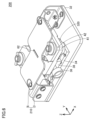
- FIG. 7 is a view of the culture system 200 of FIG. 6, excluding the lid 6, the first connecting member 41, and the second connecting member 42, showing the structure around the culture unit 10A and the linear guide 34, viewed obliquely from above.
- FIG. 8 is a cross-sectional view showing the structure of the culture unit 10A.
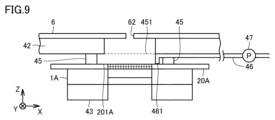
- FIG. 9 is a cross-sectional view showing the structure around the culture unit 10A.
- the culture system 200 includes a culture unit 10A and a main body 210 that houses the culture unit 10A.
- the main body 210 includes a lid 6 and a base unit 3.
- the base unit 3 includes a base 32, a linear guide 34, a handle 36, a carriage 38, a first connecting member 41, a second connecting member 42, a third connecting member 43, a spacer 45, an introduction pipe 46, and a pump 47.
- the extension direction of the linear guide 34 is the X-axis
- the direction perpendicular to the base 32 is the Z-axis
- the plane parallel to the base 32 is the XY plane.
- the culture system 200 is used in a state where it is installed so that the Z-axis is roughly parallel to the vertical direction.
- the culture system 200 is placed in an incubator or the like for culture, or placed on the observation stage of the microscope 7 for observation, with the Z-axis roughly parallel to the vertical direction.
- the culture section 10A includes a mesh device 20A and a substrate device 1A.
- the substrate device 1A includes a substrate 11A and a substrate holding portion 12A.
- the substrate 11A has a main surface 111A and holds the dispersion liquid DI on the main surface 111A.
- the substrate 11A is a plate-like member made of transparent glass.
- the substrate holding portion 12A holds the substrate 11A.
- the substrate holding portion 12A is a plate-like member having a through hole 121A formed therein, and the substrate 11A is fitted into the through hole 121A.
- the thickness (length in the Z-axis direction) of the substrate holding part 12A is greater than the thickness (length in the Z-axis direction) of the substrate 11A.
- the mesh device 20A includes a mesh member 2A and a mesh holding portion 21A.
- the mesh device 20A is placed on the substrate device 1A such that the mesh holding portion 21A is located above the substrate 11A. This positions the mesh member 2A at a distance from the main surface 111A of the substrate 11A.
- the substrate holding portion 12A of the substrate device 1A also corresponds to one embodiment of a "protrusion.”
- the mesh member 2A has multiple through holes formed therein that trap the droplets DR that are introduced to and floated up onto the substrate 11A when the mesh member 2A is positioned vertically above the substrate 11A.
- the mesh device 20A is a plate-like member in which a mesh member 2A is formed at a position corresponding to the substrate 11A when the mesh device 20A is placed above the substrate device 1A.
- each droplet DR suspended in the specific solution S floats up into the through-holes of the mesh member 2A.
- the droplets DR can be individually trapped in the through-holes. Therefore, it is possible to culture and observe cells in an isolated state for each droplet DR.
- a spacer 45 is provided on the upper surface of the mesh holding portion 21A so as to surround the upper surface of the mesh member 2A.
- the spacer 45 is a plate-shaped member having a through hole that is slightly larger than the mesh member 2A, and is disposed on the mesh device 20A so that the through hole is located above the mesh member 2A.
- the introduction pipe 46 is an introduction flow path of the specific solution S, which is made of, for example, silicon and is fluidly connected to the main body 210.
- the tip 461 of the introduction pipe 46 is arranged in contact with the vicinity of the upper surface 201A inside the spacer 45 of the mesh device 20A.
- the tip 461 is provided with multiple notches in the circumferential direction.
- the tip 461 is cut to have a tapered shape.
- the tip 461 is arranged at a distance from the upper surface 201A such that when droplets are generated on the tip 461, the droplets do not separate from the upper surface 201A. In this case, it is not necessarily necessary to make multiple notches in the circumferential direction or cut into a tapered shape on the tip 461. With this configuration, even if the specific solution S is introduced at a low flow rate, droplets of the specific solution S can be prevented from remaining on the tip 461, and the specific solution S can be quickly diffused within the pool.
- the pump 47 is connected to the end of the inlet tube 46 opposite the tip 461, and delivers the specific solution S to the inlet tube 46.
- the pump 47 is, for example, a syringe pump.
- the position of the tip 461 of the inlet tube 46 is fixed relative to the upper surface 201A of the mesh device 20A. This maintains the position of the tip 461 relative to the position of the upper surface 201A even when the culture section 10A including the mesh device 20A is translated as described below.
- the second connection member 42 is joined to the top of the spacer 45.
- the second connection member 42 is a plate-shaped member having a through hole that is slightly larger than the mesh member 2A, and is arranged on the spacer 45 so that the through hole is located above the mesh member 2A.
- the top surface of the second connection member 42 is arranged so as to be in contact with the bottom surface of the lid 6.
- the spacer 45 and the second connecting member 42 seal the gap between the culture section 10A and the lid 6, preventing the specific solution from evaporating from the gap.
- the lid 6 has an opening 62.
- the lid 6 is a plate-like member having an opening 62 and a size that allows the lid 6 to always cover the top of the culture unit 10A even when the culture unit 10A is moved horizontally.
- the opening 62 is a slit having a width smaller than that of the mesh member 2A.
- width refers to the length in the X direction.
- the width of the opening 62 is configured to be such that a capillary 8 can be inserted through the opening 62 to collect samples, or that the opening 62 can be observed using a microscope 7. In this way, by providing a lid 6 in which an opening 62 having a width smaller than that of the mesh member 2A is formed, it is possible to both prevent the dispersion liquid DI from drying and allow suitable observation and collection of cells.
- the opening 62 is configured to have the smallest width (e.g., a few mm) that allows the capillary 8 to be inserted through it to sample the cells or for observation using a microscope 7, thereby minimizing drying of the dispersion liquid DI while still allowing optimal observation and collection of the cells.
- the smallest width e.g., a few mm
- the relative positional relationship between the mesh member 2A and the opening 62 of the lid 6 is changed in the horizontal direction perpendicular to the vertical direction by the linear guide 34, the handle 36, and the carriage 38.
- the linear guide 34, the handle 36, and the carriage 38 correspond to one embodiment of a "translational movement mechanism.”
- “translational movement” refers to parallel movement in the X-axis direction along the linear guide.
- the linear guide 34 is fixed on the base 32.
- the carriage 38 moves translationally on the linear guide.
- the handle 36 controls the position of the carriage 38 on the linear guide 34.
- connection members 41 to 43 are configured as follows.
- the first connection member 41 is a plate-like member having a through hole formed therein in which the third connection member 43 is embedded.
- the first connection member 41 is fixed to the upper surface of the carriage 38.
- the second connection member 42 is fixed to a part of the upper surface of the first connection member 41.
- the third connection member 43 is a plate-like member fitted into the first connection member 41.
- the substrate device 1A of the culture unit 10A is fixed to the upper surface of the third connection member 43.
- the position of the mesh member 2A relative to the opening 62 of the lid 6 can be changed horizontally using the linear guide 34, the handle 36, and the carriage 38. Therefore, it is possible to observe and collect cells at a desired position on the mesh member 2A.
- the substrate 11A is made of a material with a light transmittance of a predetermined value or more, and the member vertically below the substrate 11A is also configured to transmit light.
- the substrate 11A is made of a transparent glass material
- the third connection member 43 also has a through hole 430 formed at a position corresponding to the substrate 11A (a position having the same XY coordinates)
- the base 32 also has a through hole 320 formed at a position corresponding to the substrate 11A.
- a through hole is also formed at a position corresponding to the substrate 11A of the first connection member 41, or a recess for passing light is formed at a position corresponding to the substrate 11A (not shown).
- a plurality of through holes are formed in the mesh member 2A of the mesh device 20A and is configured to transmit light.
- light incident from the bottom surface of the main body 210 can be irradiated to the culture unit 10A. This makes it easier to observe the culture unit 10A with a microscope from above the opening 62.
- the user places the dispersion liquid DI on the substrate device 1A, then places the mesh member 2A on it and closes the lid 6 to perform culture and observation.
- the user places the dispersion liquid DI on the substrate device 1A connected to the carriage 38, and then fixes the mesh member 2A, spacer 45, and second connection member 42 to the substrate device 1A. Furthermore, the lid 6 is fixed to the base 32. With this configuration, it becomes possible to culture cells and observe and collect cells at each position on the mesh member 2A while minimizing drying of the dispersion liquid DI.
- each part of the culture system 200 may be modified as appropriate within the scope of the above-mentioned effects.
- the outer shape of at least one of the lid 6 and the connecting members 41 to 43 may be rectangular. At least two of the substrate device 1A, the third connecting member 43, the first connecting member 41, and the carriage 38 may be formed as a single unit. At least two of the mesh member 2A, the spacer 45, and the second connecting member 42 may be formed as a single unit.
- Movement of the carriage 38 relative to the linear guide 34 may be achieved by manually turning the handle 36, or by driving an actuator. Also, without providing the handle 36, the carriage 38 on the linear guide 34 may be moved in translation by pushing it in the X-axis direction.
- An additional drain pipe (not shown) may also be provided to drain oil from the pool.
- a cell culture device includes a generation unit, a substrate, and a mesh member.
- the generation unit generates a dispersion liquid in which droplets containing cells and culture liquid are dispersed in a specific solution having a higher specific gravity than the culture liquid.
- the substrate has a main surface and holds the dispersion liquid on the main surface.
- the mesh member is disposed at a distance from the main surface of the substrate.
- the mesh member has a plurality of through holes formed therein for trapping droplets that are introduced to the substrate and float up when the mesh member is positioned vertically above the substrate.
- each droplet suspended in the specific solution having a higher specific gravity than the culture medium rises up into the through-holes. This allows the droplets to be individually trapped in the through-holes of the mesh member.
- the cell culture device according to 1 is disposed on the substrate and further includes a protrusion protruding upward from the substrate.
- the mesh member is disposed above the protrusion.
- the cell culture device described in paragraph 2 makes it easy to position the mesh member at a distance above the substrate. More specifically, it is easy to stably maintain the distance between the mesh member and the substrate.
- the specific solution contains fluorine oil.
- the cell culture device described in paragraph 3 makes it easy to culture and observe cells for long periods of time in an isolated droplet state.
- the substrate and the protrusion are integrally formed.
- the cell culture device described in paragraph 4 makes it easy to stably hold the mesh member at a distance above the substrate, and also makes it easy to handle the entire cell culture device.
- the cells include microorganisms or animal cells.
- the cell culture device according to any one of items 1 to 5, further comprising a main body that holds the substrate and the mesh member and contains a dispersion liquid, and an introduction flow path for a specific solution that is fluidly connected to the main body.
- the cell culture device described in paragraph 8 makes it possible to observe and collect cells in a desired position by changing the relative positional relationship between the mesh member and the opening of the lid.
- a culture unit comprising a cell culture device according to any one of items 1 to 8, a microscope for observing droplets in the cell culture device, and a collection device for collecting droplets individually.
- the culture unit described in paragraph 9 allows the user to observe the droplets trapped in the through-holes of the mesh member from above in a magnified view.
- the user can then use the capillary to individually collect desired droplets.
- the user can transfer the cells contained in the droplets collected by the capillary to another container for further culture, observation and/or analysis.
- Another aspect of the cell culture method includes the steps of: generating a dispersion liquid in which droplets containing cells and encapsulated in culture liquid are dispersed in a specific solution having a higher specific gravity than the culture liquid; holding the dispersion liquid on a main surface of a substrate having a main surface; and arranging a mesh member at a distance from the main surface of the substrate.
- the mesh member has a plurality of through holes formed therein for trapping droplets that are introduced to the substrate and float up, with the mesh member positioned vertically above the substrate.
- each droplet suspended in the specific solution having a higher specific gravity than the culture medium rises up into the through-holes. This allows the droplets to be individually trapped in the through-holes of the mesh member.
- the placing step includes a step of placing a mesh member above a protrusion that is placed on the substrate and protrudes upward from the substrate.
- the cell culture method described in paragraph 11 makes it easy to position the mesh member at a distance above the substrate. More specifically, it makes it easy to stably maintain the distance between the mesh member and the substrate.
- the cell culture method according to items 10 or 11 further includes a step of observing the droplets trapped in the mesh member and a step of collecting the droplets individually.
- the user can observe the droplets trapped in the through-holes of the mesh member from above using a microscope or the like.
- the user can then individually collect the desired droplets using a capillary or the like.
- the user can transfer the cells contained in the droplets collected using the capillary or the like to another container for further culturing, observation and/or analysis.
Landscapes
- Life Sciences & Earth Sciences (AREA)
- Engineering & Computer Science (AREA)
- Health & Medical Sciences (AREA)
- Chemical & Material Sciences (AREA)
- Bioinformatics & Cheminformatics (AREA)
- Zoology (AREA)
- Organic Chemistry (AREA)
- Wood Science & Technology (AREA)
- Biotechnology (AREA)
- Biomedical Technology (AREA)
- Genetics & Genomics (AREA)
- General Health & Medical Sciences (AREA)
- Biochemistry (AREA)
- General Engineering & Computer Science (AREA)
- Microbiology (AREA)
- Sustainable Development (AREA)
- Medicinal Chemistry (AREA)
- Virology (AREA)
- Cell Biology (AREA)
- Tropical Medicine & Parasitology (AREA)
- Apparatus Associated With Microorganisms And Enzymes (AREA)
Priority Applications (2)
| Application Number | Priority Date | Filing Date | Title |
|---|---|---|---|
| CN202480048924.0A CN121569021A (zh) | 2023-08-04 | 2024-08-02 | 细胞培养装置及细胞培养方法 |
| JP2025539364A JPWO2025033338A1 (https=) | 2023-08-04 | 2024-08-02 |
Applications Claiming Priority (2)
| Application Number | Priority Date | Filing Date | Title |
|---|---|---|---|
| JP2023-127460 | 2023-08-04 | ||
| JP2023127460 | 2023-08-04 |
Publications (1)
| Publication Number | Publication Date |
|---|---|
| WO2025033338A1 true WO2025033338A1 (ja) | 2025-02-13 |
Family
ID=94533874
Family Applications (1)
| Application Number | Title | Priority Date | Filing Date |
|---|---|---|---|
| PCT/JP2024/027666 Pending WO2025033338A1 (ja) | 2023-08-04 | 2024-08-02 | 細胞培養装置および細胞培養方法 |
Country Status (3)
| Country | Link |
|---|---|
| JP (1) | JPWO2025033338A1 (https=) |
| CN (1) | CN121569021A (https=) |
| WO (1) | WO2025033338A1 (https=) |
Citations (4)
| Publication number | Priority date | Publication date | Assignee | Title |
|---|---|---|---|---|
| KR20140106933A (ko) * | 2013-02-27 | 2014-09-04 | 한국생명공학연구원 | 메쉬-그리드 미세액적 어레이를 이용한 단일 세포 기반 목적 유용효소 활성 탐색 방법 |
| WO2016182034A1 (ja) * | 2015-05-12 | 2016-11-17 | 株式会社オンチップ・バイオテクノロジーズ | 単一粒子解析方法およびその解析のためのシステム |
| US20200276579A1 (en) * | 2018-12-03 | 2020-09-03 | Duke University | Acoustofluidic systems including acoustic wave generators for manipulating fluids, droplets, and micro/nano objects within a fluid suspension and related methods |
| JP2022037655A (ja) * | 2020-08-25 | 2022-03-09 | 株式会社オンチップ・バイオテクノロジーズ | 粒子の純化方法、単一粒子分注方法、及び細胞クラスター解析方法、並びそれに用いる装置 |
-
2024
- 2024-08-02 CN CN202480048924.0A patent/CN121569021A/zh active Pending
- 2024-08-02 JP JP2025539364A patent/JPWO2025033338A1/ja active Pending
- 2024-08-02 WO PCT/JP2024/027666 patent/WO2025033338A1/ja active Pending
Patent Citations (4)
| Publication number | Priority date | Publication date | Assignee | Title |
|---|---|---|---|---|
| KR20140106933A (ko) * | 2013-02-27 | 2014-09-04 | 한국생명공학연구원 | 메쉬-그리드 미세액적 어레이를 이용한 단일 세포 기반 목적 유용효소 활성 탐색 방법 |
| WO2016182034A1 (ja) * | 2015-05-12 | 2016-11-17 | 株式会社オンチップ・バイオテクノロジーズ | 単一粒子解析方法およびその解析のためのシステム |
| US20200276579A1 (en) * | 2018-12-03 | 2020-09-03 | Duke University | Acoustofluidic systems including acoustic wave generators for manipulating fluids, droplets, and micro/nano objects within a fluid suspension and related methods |
| JP2022037655A (ja) * | 2020-08-25 | 2022-03-09 | 株式会社オンチップ・バイオテクノロジーズ | 粒子の純化方法、単一粒子分注方法、及び細胞クラスター解析方法、並びそれに用いる装置 |
Non-Patent Citations (2)
| Title |
|---|
| EUJIN UM ET AL.: "Mesh-integrated microdroplet array for simultaneous merging and storage of single-cell droplets", LAB ON A CHIP, vol. 12, 2012, pages 1594 - 1597 |
| JIN-GANG XU ET AL.: "Forming a Large-Scale Droplet Array in a Microcage Array Chip for High-Throughput Screening", ANALYTICAL CHEMISTRY, vol. 91, no. 16, 2019, pages 10757 - 10763 |
Also Published As
| Publication number | Publication date |
|---|---|
| CN121569021A (zh) | 2026-02-24 |
| JPWO2025033338A1 (https=) | 2025-02-13 |
Similar Documents
| Publication | Publication Date | Title |
|---|---|---|
| JP4987885B2 (ja) | 小滴中で反応を行うための装置及びその使用方法 | |
| JP5731704B1 (ja) | 培養容器 | |
| CN108026499B (zh) | 用于繁殖微组织的装置 | |
| CN1109747C (zh) | 致密细胞培养盘 | |
| ES2401640T3 (es) | Placa para gotas en suspensión | |
| JP4002720B2 (ja) | 一細胞長期培養顕微観察装置 | |
| EP3649230B1 (en) | Microtissue compartment device | |
| US20090311717A1 (en) | Microfluidic chip design comprising capillaries | |
| CN1398295A (zh) | 微量试样处理装置 | |
| US20100159590A1 (en) | Systems and methods for active microfluidic cell handling | |
| CN104774747B (zh) | 用于细胞迁移分析实验的微流控液滴芯片装置及方法 | |
| US20140099658A1 (en) | Particle processing | |
| CN106256436B (zh) | 气体间隔式防液滴蒸发的微流控芯片装置及方法 | |
| CN102796659B (zh) | 一种多孔单细胞观测板及其应用 | |
| WO2025033338A1 (ja) | 細胞培養装置および細胞培養方法 | |
| AU2022269308B2 (en) | Device and method for cell cultivation | |
| CN101218337A (zh) | 装置 | |
| TW201718846A (zh) | 單細胞擷取與培養之裝置與方法,及從該裝置轉移並釋放細胞群落之方法 | |
| CN117844636A (zh) | 基于标准多孔板的微流控细胞灌注培养装置及系统 | |
| WO2010105845A2 (en) | A cell cultivation receptacle and related apparatuses | |
| US20260008985A1 (en) | Cell operation device for cell spheroids culture and analysis | |
| US20060263269A1 (en) | Flow chamber | |
| KR102955384B1 (ko) | 세포 배양을 위한 장치 및 방법 |
Legal Events
| Date | Code | Title | Description |
|---|---|---|---|
| 121 | Ep: the epo has been informed by wipo that ep was designated in this application |
Ref document number: 24851763 Country of ref document: EP Kind code of ref document: A1 |
|
| ENP | Entry into the national phase |
Ref document number: 2025539364 Country of ref document: JP Kind code of ref document: A |
|
| WWE | Wipo information: entry into national phase |
Ref document number: 2025539364 Country of ref document: JP |
|
| WWE | Wipo information: entry into national phase |
Ref document number: 2024851763 Country of ref document: EP |
|
| NENP | Non-entry into the national phase |
Ref country code: DE |