WO2025033015A1 - 故障個所推定方法、及び液体クロマトグラフ - Google Patents
故障個所推定方法、及び液体クロマトグラフ Download PDFInfo
- Publication number
- WO2025033015A1 WO2025033015A1 PCT/JP2024/023450 JP2024023450W WO2025033015A1 WO 2025033015 A1 WO2025033015 A1 WO 2025033015A1 JP 2024023450 W JP2024023450 W JP 2024023450W WO 2025033015 A1 WO2025033015 A1 WO 2025033015A1
- Authority
- WO
- WIPO (PCT)
- Prior art keywords
- plunger pump
- pressure
- retention time
- solvent
- faulty
- Prior art date
- Legal status (The legal status is an assumption and is not a legal conclusion. Google has not performed a legal analysis and makes no representation as to the accuracy of the status listed.)
- Pending
Links
Images





Classifications
-
- G—PHYSICS
- G01—MEASURING; TESTING
- G01N—INVESTIGATING OR ANALYSING MATERIALS BY DETERMINING THEIR CHEMICAL OR PHYSICAL PROPERTIES
- G01N30/00—Investigating or analysing materials by separation into components using adsorption, absorption or similar phenomena or using ion-exchange, e.g. chromatography or field flow fractionation
- G01N30/02—Column chromatography
-
- G—PHYSICS
- G01—MEASURING; TESTING
- G01N—INVESTIGATING OR ANALYSING MATERIALS BY DETERMINING THEIR CHEMICAL OR PHYSICAL PROPERTIES
- G01N30/00—Investigating or analysing materials by separation into components using adsorption, absorption or similar phenomena or using ion-exchange, e.g. chromatography or field flow fractionation
- G01N30/02—Column chromatography
- G01N30/26—Conditioning of the fluid carrier; Flow patterns
-
- G—PHYSICS
- G01—MEASURING; TESTING
- G01N—INVESTIGATING OR ANALYSING MATERIALS BY DETERMINING THEIR CHEMICAL OR PHYSICAL PROPERTIES
- G01N30/00—Investigating or analysing materials by separation into components using adsorption, absorption or similar phenomena or using ion-exchange, e.g. chromatography or field flow fractionation
- G01N30/02—Column chromatography
- G01N30/86—Signal analysis
Definitions
- This disclosure relates to a fault location estimation method and a liquid chromatograph.
- the device used in liquid chromatography analysis is called a liquid chromatograph.
- a liquid chromatograph is equipped with a liquid delivery pump, a dispensing unit for introducing samples into the liquid chromatograph, a separation column, a detector, a waste liquid container, and a system control unit that controls them.
- the liquid delivery pump used in a liquid chromatograph is configured with two plunger pumps connected in series. This is called a double plunger pump.
- the upstream plunger pump (first plunger pump) draws in, compresses, and discharges the solvent. Since the first plunger pump alone cannot deliver a constant flow rate, another plunger pump (second plunger pump) is connected downstream.
- the second plunger pump operates to cancel the pulsating flow of the first plunger pump (discharges the solvent when the first plunger pump draws in and compresses the solvent), allowing the liquid delivery pump as a whole to deliver a constant flow rate.
- high-pressure gradient delivery In addition, to perform more sophisticated liquid chromatography, a method known as high-pressure gradient delivery is commonly used. This involves connecting two sets of the above-mentioned double plunger pumps in parallel, and delivering different solvents (for example, water and an organic solvent) from each, allowing the mixing ratio of the solvents to be freely manipulated. Therefore, a total of four plunger pumps are required to perform high-pressure gradient delivery.
- solvents for example, water and an organic solvent
- each plunger pump is equipped with a plunger seal to prevent liquid leakage from the plunger.
- check valves are installed on the inlet and outlet sides of the plunger pump upstream of the double plunger pump to prevent backflow. Plunger seals and check valves are consumable parts and will deteriorate due to wear, etc.
- a known internal standard substance may be mixed into the sample in advance, separate from the substance to be analyzed. This is generally known as the internal standard method. By checking the detection intensity and detection time of the internal standard substance, it is possible to confirm that the equipment is functioning properly.
- Patent Document 1 discloses a method of detecting abnormalities in each unit using a flow meter installed in the liquid delivery pump and a photometer installed in the detection unit.
- Patent Document 2 discloses a method of detecting pressure pulsations based on a pressure gauge attached to the liquid delivery pump and stopping the device.
- the present disclosure therefore aims to estimate which consumable item is faulty among multiple consumable items in a plunger pump, or to estimate which plunger pump is faulty among multiple plunger pumps.
- the fault location estimation method disclosed herein is a fault location estimation method for estimating the fault location of a liquid chromatograph, and includes discharging a solvent into a flow path by a double plunger pump having a first plunger pump, a second plunger pump arranged downstream of the first plunger pump, and a plurality of consumables related to discharging the solvent, introducing a sample into the flow path, detecting the pressure of the solvent discharged by the double plunger pump, separating the sample into its components by a separation column, detecting each component separated by the separation column, and estimating a faulty consumable among the plurality of consumables based on a first pressure detected in a first section in which the first plunger pump discharges the solvent into the flow path and a second pressure detected in a second section in which the second plunger pump discharges the solvent into the flow path.
- the liquid chromatograph of the present disclosure also includes a double plunger pump having a first plunger pump, a second plunger pump disposed downstream of the first plunger pump, and a plurality of consumables related to the discharge of the solvent; a pressure sensor that detects the pressure of the solvent discharged by the double plunger pump; a dispensing unit that introduces the sample into the flow path; a separation column that is connected downstream of the dispensing unit and separates the sample into its components; a detection unit that detects each component separated by the separation column; and a control unit that estimates a faulty consumable among the plurality of consumables based on a first pressure detected by the pressure sensor in a first section in which the first plunger pump discharges the solvent into the flow path, and a second pressure detected by the pressure sensor in a second section in which the second plunger pump discharges the solvent into the flow path.
- the fault location estimation method disclosed herein is a fault location estimation method for estimating the fault location of a liquid chromatograph, and includes the steps of: mixing multiple types of solvents using multiple plunger pumps and discharging the mixture into a flow path; introducing a sample into the flow path; separating the sample into its components using a separation column; detecting each component separated by the separation column; acquiring the retention time of an internal standard substance supplied to the flow path when detecting the sample components, and comparing the retention time with a predetermined value to determine whether the retention time is ahead or behind; and estimating which of the multiple plunger pumps is faulty based on the retention time determination result.
- the liquid chromatograph disclosed herein also includes a plurality of plunger pumps that mix a plurality of types of solvents and discharge the mixture into a flow path, a dispensing unit that introduces a sample into the flow path, a separation column that is connected downstream of the dispensing unit and separates the sample into its components, a detection unit that detects each component separated by the separation column, and a control unit that, when detecting the components of the sample, acquires the retention time of an internal standard substance supplied to the flow path, compares the retention time with a predetermined value to determine whether the retention time is ahead or behind, and estimates which of the plurality of plunger pumps is faulty based on the retention time determination result.
- FIG. 1 is a schematic diagram showing the configuration of a liquid chromatograph according to a first embodiment.
- 11 is a graph showing the displacement of each plunger when a solvent is normally pumped by a first double plunger pump.
- 11 is a diagram showing transitions between sections during normal liquid delivery by a first double plunger pump and a second double plunger pump.
- FIG. 4 is an example of a measurement result when a sample is measured by the liquid chromatograph of Example 1.
- FIG. 4 is a diagram showing a reference table held by the liquid chromatograph of Example 1.
- 4 is a flowchart for estimating a fault location of a liquid delivery pump in the liquid chromatograph of Example 1.
- 4 is an example of measurement results when an abnormality occurs when a sample is measured by the liquid chromatograph of Example 1.
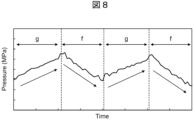
- FIG. 13 is actual data from a pressure sensor of the first double plunger pump.
- FIG. 13 is a schematic diagram showing the configuration of a liquid chromatograph according to a second embodiment. 13 is a flowchart for estimating a fault location of a liquid delivery pump in the liquid chromatograph of Example 2.
- FIG. 1 is a schematic diagram showing the configuration of a liquid chromatograph of Example 1.
- the liquid chromatograph 100 includes a first double plunger pump 6, a second double plunger pump 7, a dispensing unit 2, a separation column 3, a detection unit 4, a waste liquid container 5, and a control unit 16 for controlling them.
- the dispensing unit 2 introduces a sample 1 into the liquid chromatograph 100 (flow path 101).
- the separation column 3 is connected downstream of the dispensing unit 2 and separates the sample 1 into each component.
- the detection unit 4 detects each component separated by the separation column 3 and creates a chromatogram.
- the waste liquid container 5 is a container for discarding the measured solvent and sample.
- the dispensing unit 2, the separation column 3, the detection unit 4, and the waste liquid container 5 can be those generally used in liquid chromatographs, so their detailed configurations will not be described in detail.
- the liquid chromatograph 100 of the first embodiment performs liquid chromatography using a liquid delivery method called high-pressure gradient liquid delivery. Therefore, in the liquid chromatograph 100, multiple types of solvents are mixed and discharged into the flow path by multiple plunger pumps (first double plunger pump 6 and second double plunger pump 7) connected in parallel.
- first double plunger pump 6 discharges water contained in the solvent bottle 15a
- second double plunger pump 7 discharges an organic solvent (e.g., methanol) contained in the solvent bottle 15b.
- the first double plunger pump 6 includes a pressure sensor 8a, a first plunger pump 9a, a second plunger pump 10a, and a number of consumables related to discharging the solvent.
- the first plunger pump 9a and the second plunger pump 10a are connected in series, with the first plunger pump 9a disposed upstream and the second plunger pump 10a disposed downstream.
- the pressure sensor 8a is installed downstream of the second plunger pump 10a.
- the pressure sensor 8a measures the pressure (discharge pressure) of the solvent (liquid) discharged from the second plunger pump 10a and outputs the pressure value to the control unit 16.
- the control unit 16 controls the operation of the first plunger pump 9a and the second plunger pump 10a by issuing command values to these pumps based on the discharge pressure measured by the pressure sensor 8a and a predetermined operation sequence.
- the first plunger pump 9a has a first check valve 13a, a second check valve 14a, and a first seal 11a.
- the first check valve 13a is disposed in the flow path of the suction port of the first plunger pump 9a
- the second check valve 14a is disposed in the flow path of the discharge port of the first plunger pump 9a.
- the first check valve 13a and the second check valve 14a restrict the flow of the solvent.
- the first seal 11a prevents liquid leakage from the first plunger pump 9a.
- the second plunger pump 10a has a second seal 12a.
- the second seal 12a prevents liquid from leaking from the second plunger pump 10a.
- the solvent (e.g., water) contained in the solvent bottle 15a is pushed out by the first plunger pump 9a and the second plunger pump 10a and supplied to the downstream dispensing section 2 and separation column 3.
- the second double plunger pump 7 has the same configuration as the first double plunger pump 6, and includes a pressure sensor 8b, a first plunger pump 9b, a second plunger pump 10b, a first seal 11b, a second seal 12b, a first check valve 13b, and a second check valve 14b.
- a solvent e.g., methanol contained in a solvent bottle 15b is pushed out by the first plunger pump 9b and the second plunger pump 10b, and is supplied to the downstream dispensing section 2 and separation column 3.
- a detailed description of the second double plunger pump 7 is omitted because it is similar to that of the first double plunger pump 6.
- the components in the sample 1 can be separated and eluted while continuously changing the concentration ratio of the eluent (water, methanol).
- the “lower limit” refers to the lowest position within the range in which the plunger pump (9a, 9b, 10a, 10b) can move within the pressurized chamber.
- the “upper limit” refers to the highest position within the range in which the plunger pump (9a, 9b, 10a, 10b) can move within the pressurized chamber.
- the “ascension” of the plunger pump (9a, 9b, 10a, 10b) refers to the movement in the direction in which the solvent in the pressurized chamber is compressed or ejected
- the “descent” of the plunger refers to the movement in the direction in which the solvent is sucked into the pressurized chamber.
- the solvent contained in the solvent bottle 15a is pushed out by the first plunger pump 9a and the second plunger pump 10a of the first double plunger pump 6 and supplied to the dispensing section 2.
- the solvent contained in the solvent bottle 15b is pushed out by the first plunger pump 9b and the second plunger pump 10b of the second double plunger pump 7 and supplied to the dispensing section 2.
- the sample 1 to be analyzed is injected into the solvent supplied to the dispensing section 2.
- the solvent into which the sample 1 has been injected is introduced into the separation column 3 and separated into individual components.
- the detection section 4 detects the absorbance, fluorescence intensity, refractive index, etc., according to the sample components.
- the separation column 3 is a reverse phase column.
- the separation column 3 may also be a normal phase column.
- This separation column 3 is filled with microparticles, and the double plunger pump (6, 7) generates a load pressure of several tens of megapascals to more than a hundred megapascals due to the fluid resistance when the solvent flows through the gaps between the microparticles.
- the magnitude of this load pressure varies depending on the diameter of the separation column 3 and the flow rate.
- the control unit 16 has a processor 17, a main memory unit 18, an auxiliary memory unit 19, and an interface 20.
- the processor 17 is a central processing unit (CPU), a graphics processing unit (GPU), a digital signal processor (DSP), an ASIC, or the like.
- the main memory unit 18 is a dynamic random access memory (DRAM) or the like, and is used as a working area for the processor 17.
- the auxiliary memory unit 19 is a hard disk drive (HDD), a solid state drive (SSD), or a combination thereof, or the like, and stores various programs and various data.
- the interface 20 is a device controller that controls the operation of the first double plunger pump 6, the second double plunger pump 7, etc. connected to the control unit 16, a monitor interface that outputs a video signal to the display unit 21, and a network controller that performs communication control.
- the auxiliary memory unit 19 stores a program that estimates which double plunger pump is faulty from among multiple double plunger pumps (6, 7) and estimates which consumable item is faulty from among multiple consumable items in the estimated faulty double plunger pump.
- the auxiliary memory unit 19 also stores a reference table 500 (see FIG. 5) that is referenced when the above-mentioned program is executed.
- the reference table 500 may be stored in the auxiliary memory unit 19 inside the control unit 16, or in a memory unit external to the control unit 16.
- a liquid delivery method for normally delivering a solvent using the first double plunger pump 6 of the first embodiment will be outlined below.
- "normal liquid delivery” refers to a liquid delivery method in which the solvent discharged from the first double plunger pump 6 is fed to the dispensing section 2, the separation column 3, and the detection section 4 to analyze the sample 1.
- the first double plunger pump 6 and the second double plunger pump 7 shown in FIG. 1 have the same device configuration, a description of the liquid delivery method using the second double plunger pump 7 will be omitted. Note that the second double plunger pump 7 performs the same operation as the first double plunger pump 6, but with a delay of half a cycle.
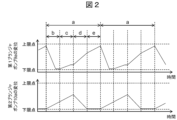
- FIG. 2 is a graph showing the displacement of each plunger when the first double plunger pump 6 normally delivers solvent.
- the horizontal axis indicates time
- the vertical axis indicates, from top to bottom, the displacement of the first plunger pump 9a and the displacement of the second plunger pump 10a.
- the upward direction of the displacement of the first plunger pump 9a and the displacement of the second plunger pump 10a is considered to be the positive direction, and the downward direction is considered to be the negative direction.
- both the first plunger pump 9a and the second plunger pump 10a operate based on the lower limit point.
- the drive cycle a is made up of four sections b, c, d, and e, and these are repeated in this order.
- the length of the drive cycle a is, for example, 2 seconds, 4 seconds, 6 seconds, etc. Each section will be explained below.
- Section b is called the section where only the second plunger pump 10a delivers the amount of liquid delivered specified by the device user.
- the first plunger pump 9a moves to the lower limit and then stops until section b ends.
- the first plunger pump 9a is displaced in the negative direction, but because the second check valve 14a closes the flow path, the movement of the first plunger pump 9a does not affect the delivery flow rate.
- Section c is called the compression section.
- the second plunger pump 10a discharges the amount of liquid specified by the device user.
- the control unit 16 calls up the stored compression rate parameters and calculates the amount of solvent compression (plunger displacement) required for compression by the first plunger pump 9a, together with the pressure value received from the pressure sensor 8a. Thereafter, under the control of the control unit 16, the first plunger pump 9a moves in the forward direction by the calculated compression amount. Until the pressure in the compression chamber of the first plunger pump 9a exceeds the discharge pressure, the second check valve 14a is closed, so the movement of the first plunger pump 9a does not affect the discharge flow rate.
- solvent compression plunger displacement
- Section d is called the cross liquid delivery section.
- the second plunger pump 10a moves to the lower limit.
- the first plunger pump 9a moves in the positive direction and discharges a flow rate value that is the sum of the suction flow rate generated by the second plunger pump 10a moving in the negative direction and the flow rate specified by the device user.
- the first double plunger pump 6 as a whole discharges the amount of liquid delivery specified by the device user.
- Section e is called the section where the first plunger pump 9a pumps the liquid alone.
- the first plunger pump 9a pumps the amount of liquid specified by the device user.
- the second plunger pump 10a stops until section e ends.
- the first seal 11a of the first plunger pump 9a breaks down, liquid leakage will occur from the first plunger pump 9a, and the first plunger pump 9a will be unable to deliver liquid.
- the amount of liquid delivered by the double plunger pump will decrease in sections d and e, and the liquid delivery pressure will decrease.
- the second check valve 14a closes the flow path and the second plunger pump 10a takes over delivery of liquid, so the amount of liquid delivered by the double plunger pump 6 will recover to the flow rate specified by the device user, and the liquid delivery pressure will also return to its normal value.
- the first check valve 13a of the first plunger pump 9a breaks down, backflow occurs from the first plunger pump 9a to the upstream, and the first plunger pump 9a cannot pump liquid.
- the amount of liquid pumped by the double plunger pump 6 decreases in sections d and e, and the liquid pumping pressure decreases.
- the second check valve 14a closes the flow path and the second plunger pump 10a takes over the liquid pumping, so the amount of liquid pumped by the double plunger pump 6 recovers to the flow rate specified by the device user, and the liquid pumping pressure also returns to its normal value.
- the second check valve 14a of the first plunger pump 9a breaks down, a backflow occurs from the downstream second plunger pump 10a to the upstream first plunger pump 9a, and the second plunger pump 10a cannot pump liquid. Therefore, in sections b and c, the amount of liquid pumped by the double plunger pump 6 decreases, and the liquid pumping pressure decreases. After that, when the section moves to section d, the plunger pump that pumps liquid shifts from the second plunger pump 10a to the first plunger pump 9a.
- the second check valve 14a is conventionally in an open state, so even if the second check valve 14a breaks down and loses its valve function, it is possible to pump liquid in the same way as usual. Therefore, the amount of liquid pumped by the double plunger pump 6 is restored to the flow rate specified by the device user, and the liquid pumping pressure also returns to its normal value.
- the liquid delivery flow rate and liquid delivery pressure will decrease in all sections b to e. This is because the inside of the cylinder of the second plunger pump 10a is also passed through when the first plunger pump 9a is delivering liquid, so liquid leakage will occur regardless of the timing when either pump is delivering liquid.
- FIG. 3 shows the transition of sections during normal liquid delivery by the first double plunger pump 6 and the second double plunger pump 7.
- the two double plunger pumps 6 and 7 operate with a drive period a shifted by half a period.
- the first double plunger pump 6 is in sections b and c
- the second double plunger pump 7 is in sections d and e.
- section f first section
- section g second section
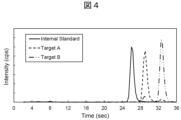
- ⁇ Internal standard method> 4 is an example of the measurement results when a sample is measured by the liquid chromatograph of Example 1.
- the horizontal axis indicates the elapsed time from the start of the measurement, and the vertical axis indicates the detection value in the detection unit 4.
- a device user uses the liquid chromatograph 100 for the purpose of measuring target materials A and B.
- the device user mixes a known internal standard substance at a known concentration with the sample to be measured and measures the sample. Then, as shown in Figure 4, a detection peak resulting from the internal standard substance appears.
- the retention time and peak height of this detection peak resulting from the internal standard substance are stored in advance in the control unit 16, and by checking against these values, it is confirmed whether the liquid chromatograph 100 is operating normally.
- the retention time of the internal standard substance is approximately 26 seconds, and it is confirmed whether this value falls within a preset range of time stored in the control unit 16, for example, a range of 25 to 27 seconds, to ensure the normality of the device. If it does not fall within the preset range of time, the device user is notified of an device abnormality.
- the retention time of the internal standard substance varies depending on the composition of the separation column 3 and the solvent ratio of the high-pressure gradient solution delivered by the double plunger pumps 6 and 7, and these specified range times are determined by prior experiments.
- a reversed-phase column may be used for the separation column 3, with water pumped from the first double plunger pump 6 and methanol pumped from the second double plunger pump 7.
- the internal standard and the ratio of water to methanol pumped will vary depending on the target substance to be measured. These are determined by the user of the device through prior consideration and experimentation.
- a characteristic of reversed-phase columns is that the retention time becomes faster as the ratio of organic solvents such as methanol increases, and the retention time becomes slower as the ratio of water increases. For example, if an internal standard substance is measured with a mixture ratio of 50% water and 50% methanol and the retention time is 26 seconds, then if the mixture is 40% water and 60% methanol, the retention time will be 20 seconds. In this way, the retention time of the internal standard substance changes depending on the characteristics of the separation column 3 and the ratio of the solvents being pumped.
- the internal standard which previously had a retention time of around 26 seconds, is advanced by around 20 seconds, the amount of liquid delivered by the double plunger pump delivering water is expected to decrease, and the proportion of methanol delivered is expected to increase relatively. Conversely, if the retention time of the internal standard is delayed to around 30 seconds, the amount of liquid delivered by the double plunger pump delivering methanol is expected to decrease, and the proportion of water delivered is expected to increase relatively.
- ⁇ Reference table> 5 is a diagram showing a reference table held by the liquid chromatograph of Example 1.
- a reference table 500 stored in the auxiliary storage unit 19 of the control unit 16 will be described.
- the reference table 500 includes information on the section in which the pressure abnormality occurred, information on whether the retention time of the internal standard substance is ahead of or behind a specified range time, and information on the faulty consumable.
- the control unit 16 refers to the reference table 500 to estimate which consumable is faulty.
- Reference table 500 is a data table that assumes that separation column 3 is a reversed-phase column, double plunger pump 6 discharges water, and double plunger pump 7 discharges methanol. According to reference table 500, if the retention time of the internal standard substance precedes a specified range of time, it is determined that double plunger pump 6 has failed. Also, if the retention time of the internal standard substance lags behind the specified range of time, it is determined that double plunger pump 7 has failed.
- the retention time of the internal standard substance precedes the specified range time and the section in which the pressure abnormality occurs is section f only, it is determined that the second check valve 14a of the double plunger pump 6 has failed. Also, if the retention time of the internal standard substance precedes the specified range time and the section in which the pressure abnormality occurs is section g only, it is determined that the first seal 11a or the first check valve 13a of the double plunger pump 6 has failed. Also, if the retention time of the internal standard substance precedes the specified range time and the section in which the pressure abnormality occurs is section f and section g, it is determined that the second seal 12a of the double plunger pump 6 has failed.
- the retention time of the internal standard substance is delayed beyond the specified range time and the only section in which a pressure abnormality occurs is section f, it is determined that the first seal 11b or the first check valve 13b of the double plunger pump 7 is faulty. Also, if the retention time of the internal standard substance is delayed beyond the specified range time and the only section in which a pressure abnormality occurs is section g, it is determined that the second check valve 14b of the double plunger pump 7 is faulty. Also, if the retention time of the internal standard substance is delayed beyond the specified range time and the only section in which a pressure abnormality occurs is section f and section g, it is determined that the second seal 12b of the double plunger pump 7 is faulty.
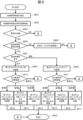
- Fig. 6 is a flowchart for estimating a fault location of a liquid delivery pump (the first double plunger pump 6 and the second double plunger pump 7 are collectively referred to as a liquid delivery pump) in the liquid chromatograph of Example 1.
- a liquid delivery pump the first double plunger pump 6 and the second double plunger pump 7 are collectively referred to as a liquid delivery pump
- each step of the flowchart in Fig. 6 is executed by the processor 17 of the control unit 16 executing a program for estimating a faulty consumable item.
- a reverse phase column is used for the separation column 3
- water is pumped from the first double plunger pump 6
- methanol is pumped from the second double plunger pump 7.
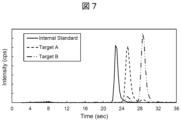
- FIG. 7 shows an example of the measurement results when an abnormality occurs when measuring a sample with the liquid chromatograph of Example 1.
- the horizontal axis shows the elapsed time from the start of measurement, and the vertical axis shows the detection value at the detection unit 4.
- the sample measured is the same as that shown in FIG. 4.
- the control unit 16 measures the internal standard substance (step S601). Specifically, the first double plunger pump 6 and the second double plunger pump 7 discharge the solvent into the flow path 101, and introduce the sample 1 and the internal standard substance into the flow path 101. Then, the pressure sensors 8a and 8b detect the pressure of the solvent discharged by the first double plunger pump 6 and the second double plunger pump 7. Then, the separation column 3 separates the sample 1 into its components, and the detection unit 4 detects each component separated by the separation column 3. At this time, each component of the sample 1 and the components of the internal standard substance are measured.
- the control unit 16 checks the measurement result of the internal standard substance (step S602).
- the measurement result of the internal standard substance is checked to see if the retention time, peak height, peak area, half-width, or a combination thereof falls within a specified range stored in the control unit 16.
- the retention time, peak height, peak area, half-width, or a combination thereof of the internal standard substance are called the characteristic quantities of the internal standard substance.
- step S603 If there is no abnormality in the characteristic amount of the internal standard (step S603: NO), the control unit 16 ends this flowchart (step S604). On the other hand, if there is an abnormality in the characteristic amount of the internal standard (step S603: YES), the control unit 16 determines whether there is an abnormality in the retention time (step S605).
- the control unit 16 determines that the measurement result of the internal standard (peak time (approximately 23 seconds)) is abnormal (step S605: YES) and executes the processing of step S607.
- step S605 determines that the measurement result of the internal standard is not abnormal (step S605: NO)
- step S606 it suspects a malfunction other than the liquid delivery pump (step S606) and ends this flowchart (step S604).
- the control unit 16 checks for a change in the retention time that is not within the normal range (step S607).
- the control unit 16 since the retention time is ahead of the predetermined value (step S607: ahead), the control unit 16 refers to the reference table 500 and determines that the first double plunger pump 6 is broken (step S608).
- the control unit 16 if the retention time is behind the predetermined value (step S607: behind), the control unit 16 refers to the reference table 500 and determines that the second double plunger pump 7 is broken (step S609).
- a reversed-phase column is used for the separation column 3 and the retention time is ahead, it is considered that the amount of water delivered is reduced and the ratio of methanol delivered is increased.
- the first double plunger pump 6, which delivers water is most likely to be broken. Also, when the retention time is delayed, it is considered that the amount of methanol delivered is reduced and the ratio of water delivered is increased. Therefore, the second double plunger pump 7, which delivers methanol, is most likely to be broken.
- step S608 the control unit 16 checks the value of the pressure sensor 8a of the first double plunger pump 6 and checks the section of the pressure abnormality (step S610).
- Figure 8 shows the actual data of the pressure sensor 8a of the first double plunger pump 6. The horizontal axis represents time, and the vertical axis represents the pressure value.
- step S613 if it is confirmed that the pressure (second pressure) rises in section f and the pressure (first pressure) drops in section g, it can be determined that the amount of liquid delivered by the first plunger pump 9a has decreased and that the amount of liquid delivered by the second plunger pump 10a is normal. Therefore, since the control unit 16 has confirmed the pressure drop in section g, it concludes that a failure of the first seal 11a or the first check valve 13a of the first double plunger pump 6 is suspected (step S613).
- step S614 if it is confirmed that the pressure is dropping in all sections, it can be determined that the amount of liquid delivered is decreasing in the first double plunger pump 6 as a whole. Therefore, since the control unit 16 has confirmed that the pressure is dropping in all sections, it concludes that a failure in the second seal 12a of the first double plunger pump 6 is suspected (step S614).
- control unit 16 checks the value of the pressure sensor 8b of the second double plunger pump 7 and confirms the section of pressure abnormality (step S611).
- step S615 If it is confirmed that the pressure drops in section f and rises in section g, it can be determined that the amount of liquid delivered by the first plunger pump 9b has decreased and that the amount of liquid delivered by the second plunger pump 10b is normal. Therefore, since the control unit 16 has confirmed the pressure drop in section f, it concludes that a failure of the first seal 11b or the first check valve 13b of the second double plunger pump 7 is suspected (step S615).
- step S616 if it is confirmed that the pressure rises in section f and drops in section g, it can be determined that the amount of liquid delivered by the second plunger pump 10b has decreased and that the amount of liquid delivered by the first plunger pump 9b is normal. Therefore, since the control unit 16 has confirmed the pressure drop in section g, it concludes that a malfunction of the second check valve 14a of the second double plunger pump 7 is suspected (step S616).
- step S617 if it is confirmed that the pressure is dropping in all sections, it can be determined that the amount of liquid delivered by the second double plunger pump 7 as a whole is decreasing. Therefore, since the control unit 16 has confirmed that the pressure is dropping in all sections, it concludes that a failure of the second seal 12b of the second double plunger pump 7 is suspected (step S617).
- step S604 If no section of abnormal pressure is identified in steps S610 and S611, it is determined that there is no fault, and this flowchart ends (step S604).
- Example 1 it is possible to determine whether the first double plunger pump 6 or the second double plunger pump 7 is malfunctioning based on the change in the retention time of the internal standard substance.
- the method for estimating a faulty consumable among a plurality of consumables in the plunger pump in the liquid chromatograph of the first embodiment is as follows: Discharging the solvent into the flow path 101 by the first double plunger pump 6 and the second double plunger pump 7; Introducing the sample 1 into the flow channel 101 via the dispensing unit 2 (step S601); Detecting the pressure of the solvent discharged by the first double plunger pump 6 and the second double plunger pump 7 (step S601); Separating the sample 1 into its components using a separation column 3 (step S601); The method includes detecting each component separated in the separation column 3 by the detection unit 4 (step S601); and estimating a faulty consumable among the plurality of consumables based on a first pressure detected in a first section (section g) in which the first plunger pump 9a (or 9
- the fault location estimation method is as follows: When detecting components of sample 1, the method further includes acquiring a retention time of the internal standard substance supplied to flow path 101, and comparing the retention time with a predetermined value to determine whether the retention time is ahead or behind (step S607); and estimating a faulty double plunger pump among the multiple double plunger pumps (first double plunger pump 6 and second double plunger pump 7) based on the retention time determination result, the type of separation column 3 (reverse phase column, normal phase column), and the type of solvent (water, methanol) (steps S607 to S609).
- step S612 and S616 If the first pressure is not abnormal and the second pressure is abnormal, it is assumed that the second check valve is broken (steps S612 and S616). If the first pressure is abnormal and the second pressure is not abnormal, it is assumed that the first seal or the first check valve is faulty (step S613, step S615). The method includes inferring that the second seal is faulty if the first pressure and the second pressure are abnormal (steps S614 and S617).
- the method for estimating a faulty plunger pump from among a plurality of plunger pumps in the liquid chromatograph of the first embodiment is as follows: Mixing multiple types of solvents using multiple double plunger pumps (6, 7) and discharging the mixed solvent into the flow path 101 (step S601); Introducing the sample 1 into the flow channel 101 via the dispensing unit 2 (step S601); Separating the sample 1 into its components using a separation column 3 (step S601); Detecting each component separated in the separation column 3 by the detection unit 4 (step S601); When detecting components of sample 1, the retention time of the internal standard substance supplied to the flow path 101 is acquired, and the retention time is compared with a predetermined value to determine whether it is ahead or behind (step S607); and based on the retention time determination result, a faulty plunger pump among the multiple double plunger pumps (6, 7) is estimated
- the above-mentioned faulty plunger pump can be estimated as follows: The method includes estimating which of the multiple double plunger pumps (6, 7) has a malfunction, based on the retention time determination result, the type of separation column 3 (reverse phase column, normal phase column), and the type of solvent (water, methanol).
- the above-mentioned information on the type of separation column 3 is not necessary. Also, if the type of solvent to be used is already determined, the above-mentioned information on the type of solvent is not necessary.
- Example 2 In the first embodiment, a liquid chromatograph having a high-pressure gradient liquid delivery function as shown in Fig. 1 is taken as an example. However, the present invention is also applicable to liquid chromatographs that do not have a high-pressure gradient liquid delivery function.
- a liquid chromatograph 900 configured with one double plunger pump 906 as shown in FIG. 9 will be described.
- This configuration has only one double plunger pump 906, and delivers only solvent that has been prepared in advance.
- the liquid chromatograph 900 of Example 2 includes a dispensing unit 902 for introducing a sample 901 into the liquid chromatograph 900, a separation column 903, a detection unit 904, a waste liquid container 905, a double plunger pump 906, and a control unit 916.
- the double plunger pump 906 also has a pressure sensor 908, a first plunger pump 909, a second plunger pump 910, a first seal 911, a second seal 912, a first check valve 913, a second check valve 914, and a solvent bottle 915.
- the details of each part of the double plunger pump 906 are the same as those in the first embodiment, so the description thereof will be omitted.
- FIG. 10 is a flow chart for estimating the location of a fault in a liquid delivery pump in the liquid chromatograph of Example 2.
- the processing from step S1001 to step S1004 in FIG. 10 is similar to the processing from step S601 to step S604 in FIG. 6 of Example 1, and therefore a description thereof will be omitted.
- control unit 916 checks for abnormalities in the liquid delivery pressure (step S1005). If the liquid delivery pressure is pulsating or lower than before (step S1005: YES), it is determined that there is a pressure abnormality and the process of step S1007 is executed.
- control unit 916 determines that the measurement result of the internal standard is not abnormal (step S1005: NO), it suspects a malfunction other than the liquid delivery pump (step S1006) and ends this flowchart (step S1004).
- the control unit 16 checks the value of the pressure sensor 908 of the double plunger pump 906 and identifies the area where the pressure is abnormal (step S1007).
- step S1008 If it is confirmed that the pressure drops in sections b and c and that the pressure rises in sections d and e, it can be determined that the amount of liquid delivered by the second plunger pump 910 has decreased and that the amount of liquid delivered by the first plunger pump 909 is normal. Therefore, since the control unit 16 has confirmed the pressure drop in sections b and c, it concludes that a malfunction of the second check valve 914 is suspected (step S1008).
- step S1010 a failure of the second seal 912 of the double plunger pump 906 is suspected.
- the present invention is not limited to the above-mentioned embodiment, and includes various modified examples.
- the above-mentioned embodiment has been described in detail to clearly explain the present invention, and is not necessarily limited to those having all of the configurations described. It is also possible to replace a part of the configuration of one embodiment with the configuration of another embodiment, and it is also possible to add the configuration of another embodiment to the configuration of one embodiment. It is also possible to add, delete, or replace a part of the configuration of each embodiment with another configuration.
- the retention time is used as a characteristic quantity of the measurement result of the internal standard substance to judge whether or not there is an abnormality in the multiple double plunger pumps (6, 7).
- the half-width, peak height, peak symmetry, etc. of the internal standard substance may be used to judge whether or not there is an abnormality in the double plunger pumps (6, 7).
- the specified range to be compared with the characteristic quantities (half-width, peak height, peak symmetry, etc.) of the internal standard substance described above is actually determined according to the purpose of the device user.
- a standard substance for the sole purpose of testing the normality of a liquid chromatograph, even if there is no measurement purpose.
- a known standard substance from which normal data has been obtained in advance can be measured for the purpose of testing the equipment, and the measurement results can be used to determine the normality of the equipment and the location of any malfunctions in the event of an abnormality.
- a state in which periodic (predetermined period) pressure fluctuations occur that are equal to or greater than a predetermined pressure fluctuation value may be considered a pressure abnormality (pressure pulsation abnormality)
- a state in which the average pressure value over a predetermined period (e.g., several seconds) falls below a predetermined average pressure value e.g., 10 MPa
- a predetermined pressure value e.g. 10 MPa
- the above-mentioned predetermined fluctuation value is a pressure fluctuation value at which analysis of the substance to be measured becomes difficult.
- the analysis of the substance to be measured includes calculation of the retention time, half-width, peak height, peak area, or peak symmetry in the chromatogram obtained by the detection result by the detection unit.
- the pressure fluctuation value at which the analysis of the measured substance becomes difficult is a pressure fluctuation value at which the retention time, half-width, peak height, peak area, or peak symmetry of the internal standard measured together with the measured substance exceeds the statistical distribution range of the liquid chromatograph when the liquid chromatograph is in normal operation.
- This statistical distribution range under normal operation is a range calculated from the average value and standard deviation of the retention time, half-width, peak height, peak area, and peak symmetry of the internal standard obtained when the liquid chromatograph is operating normally.
- the statistical distribution range under normal operation by obtaining statistical data on the retention time, half-width, peak height, and peak symmetry of the measurement results of the internal standard in advance when the device is in normal operation, and calculating the average value and standard deviation of each. For example, it is possible to determine that an apparatus abnormality exists when the respective average values deviate more than three times the standard deviation.
- a normal range for the measurement results of the internal standard substance based on statistical data when the device is operating normally, and define a pressure abnormality as a pressure fluctuation that deviates from the normal range. For example, if a periodic pressure fluctuation of 5 megapascals or more occurs and deviates from the normal range of the internal standard substance, the pressure abnormality can be defined as a periodic pressure fluctuation of 5 megapascals or more.
- the present invention also includes a case where, when the location of the failure is identified, the device is immediately stopped and the device user is notified of the location of the failure.
- the liquid chromatograph has a display monitor (display unit 21) for the device user, and the display monitor can display the estimated location of the failure and notify the device user.
Landscapes
- Physics & Mathematics (AREA)
- Health & Medical Sciences (AREA)
- Life Sciences & Earth Sciences (AREA)
- Chemical & Material Sciences (AREA)
- Analytical Chemistry (AREA)
- Biochemistry (AREA)
- General Health & Medical Sciences (AREA)
- General Physics & Mathematics (AREA)
- Immunology (AREA)
- Pathology (AREA)
- Control Of Positive-Displacement Pumps (AREA)
- Treatment Of Liquids With Adsorbents In General (AREA)
Priority Applications (1)
| Application Number | Priority Date | Filing Date | Title |
|---|---|---|---|
| CN202480014277.1A CN120752528A (zh) | 2023-08-07 | 2024-06-28 | 故障部位推定方法以及液相色谱仪 |
Applications Claiming Priority (2)
| Application Number | Priority Date | Filing Date | Title |
|---|---|---|---|
| JP2023128278A JP2025024282A (ja) | 2023-08-07 | 2023-08-07 | 故障個所推定方法、及び液体クロマトグラフ |
| JP2023-128278 | 2023-08-07 |
Publications (1)
| Publication Number | Publication Date |
|---|---|
| WO2025033015A1 true WO2025033015A1 (ja) | 2025-02-13 |
Family
ID=94534498
Family Applications (1)
| Application Number | Title | Priority Date | Filing Date |
|---|---|---|---|
| PCT/JP2024/023450 Pending WO2025033015A1 (ja) | 2023-08-07 | 2024-06-28 | 故障個所推定方法、及び液体クロマトグラフ |
Country Status (3)
| Country | Link |
|---|---|
| JP (1) | JP2025024282A (https=) |
| CN (1) | CN120752528A (https=) |
| WO (1) | WO2025033015A1 (https=) |
Citations (5)
| Publication number | Priority date | Publication date | Assignee | Title |
|---|---|---|---|---|
| JPS63106382A (ja) * | 1986-06-19 | 1988-05-11 | Shimadzu Corp | 送液ポンプ |
| JPH03168377A (ja) * | 1989-11-27 | 1991-07-22 | Kawasaki Steel Corp | ポンプの異常診断方法及び装置 |
| JP2006098226A (ja) * | 2004-09-29 | 2006-04-13 | Fuji Photo Film Co Ltd | シリンジポンプの異常検出方法及び液体吸引吐出器並びに生化学分析装置 |
| WO2017090184A1 (ja) * | 2015-11-27 | 2017-06-01 | 株式会社島津製作所 | 送液装置 |
| WO2022230282A1 (ja) * | 2021-04-27 | 2022-11-03 | 株式会社日立ハイテク | 自動分析装置 |
-
2023
- 2023-08-07 JP JP2023128278A patent/JP2025024282A/ja active Pending
-
2024
- 2024-06-28 WO PCT/JP2024/023450 patent/WO2025033015A1/ja active Pending
- 2024-06-28 CN CN202480014277.1A patent/CN120752528A/zh active Pending
Patent Citations (5)
| Publication number | Priority date | Publication date | Assignee | Title |
|---|---|---|---|---|
| JPS63106382A (ja) * | 1986-06-19 | 1988-05-11 | Shimadzu Corp | 送液ポンプ |
| JPH03168377A (ja) * | 1989-11-27 | 1991-07-22 | Kawasaki Steel Corp | ポンプの異常診断方法及び装置 |
| JP2006098226A (ja) * | 2004-09-29 | 2006-04-13 | Fuji Photo Film Co Ltd | シリンジポンプの異常検出方法及び液体吸引吐出器並びに生化学分析装置 |
| WO2017090184A1 (ja) * | 2015-11-27 | 2017-06-01 | 株式会社島津製作所 | 送液装置 |
| WO2022230282A1 (ja) * | 2021-04-27 | 2022-11-03 | 株式会社日立ハイテク | 自動分析装置 |
Also Published As
| Publication number | Publication date |
|---|---|
| CN120752528A (zh) | 2025-10-03 |
| JP2025024282A (ja) | 2025-02-20 |
Similar Documents
| Publication | Publication Date | Title |
|---|---|---|
| US7578173B2 (en) | Chromatography system with flow sensing | |
| US5823747A (en) | Bubble detection and recovery in a liquid pumping system | |
| US10364808B2 (en) | Pumping system for chromatography applications | |
| CN111433600A (zh) | 二元泵以及具备该二元泵的液相色谱仪 | |
| US20150285239A1 (en) | Determination of a fluid loss of a piston pump based on evacuation time variation | |
| CN104121177A (zh) | 高压恒流泵和高压恒流送液方法 | |
| CN111801495A (zh) | 用于液相色谱法的、由具有管线专用流体泵的流体供应管线所进行的流体混合 | |
| US12210003B2 (en) | Liquid chromatographic apparatus and air bubble removal method of liquid chromatographic apparatus | |
| JP4077674B2 (ja) | ナノ/ミクロ液体クロマトグラフのグラジエント送液装置および送液方法 | |
| WO2025033015A1 (ja) | 故障個所推定方法、及び液体クロマトグラフ | |
| WO2002016770A1 (en) | Bubble detection and recovery in a liquid pumping system | |
| EP2430309B1 (en) | Determining fluid compressibility while delivering fluid | |
| WO2017090184A1 (ja) | 送液装置 | |
| JP7556135B2 (ja) | Hplcを有する自動分析装置及びその自動分析装置の制御方法 | |
| JP7645401B2 (ja) | 液体クロマトグラフの制御方法 | |
| JP7569389B2 (ja) | 液体クロマトグラフの制御方法および液体クロマトグラフ | |
| US6106238A (en) | Bubble detection and recovery in a liquid pumping system | |
| US20240230455A1 (en) | Determining a restriction in a liquid network | |
| US20250123177A1 (en) | Liquid delivery abnormality diagnosis method and liquid chromatograph | |
| JP7756594B2 (ja) | 送液ポンプ及び送液方法 | |
| JP2025024282A5 (https=) | ||
| WO2025009299A1 (ja) | 液体クロマトグラフ装置、及び、その異常検知方法 |
Legal Events
| Date | Code | Title | Description |
|---|---|---|---|
| 121 | Ep: the epo has been informed by wipo that ep was designated in this application |
Ref document number: 24850352 Country of ref document: EP Kind code of ref document: A1 |
|
| WWE | Wipo information: entry into national phase |
Ref document number: 202480014277.1 Country of ref document: CN |
|
| WWP | Wipo information: published in national office |
Ref document number: 202480014277.1 Country of ref document: CN |
|
| NENP | Non-entry into the national phase |
Ref country code: DE |