WO2025032898A1 - 鋼板及び合金化溶融亜鉛めっき鋼板 - Google Patents
鋼板及び合金化溶融亜鉛めっき鋼板 Download PDFInfo
- Publication number
- WO2025032898A1 WO2025032898A1 PCT/JP2024/016968 JP2024016968W WO2025032898A1 WO 2025032898 A1 WO2025032898 A1 WO 2025032898A1 JP 2024016968 W JP2024016968 W JP 2024016968W WO 2025032898 A1 WO2025032898 A1 WO 2025032898A1
- Authority
- WO
- WIPO (PCT)
- Prior art keywords
- steel sheet
- less
- steel
- content
- layer
- Prior art date
- Legal status (The legal status is an assumption and is not a legal conclusion. Google has not performed a legal analysis and makes no representation as to the accuracy of the status listed.)
- Pending
Links
Images
Classifications
-
- C—CHEMISTRY; METALLURGY
- C21—METALLURGY OF IRON
- C21D—MODIFYING THE PHYSICAL STRUCTURE OF FERROUS METALS; GENERAL DEVICES FOR HEAT TREATMENT OF FERROUS OR NON-FERROUS METALS OR ALLOYS; MAKING METAL MALLEABLE, e.g. BY DECARBURISATION OR TEMPERING
- C21D9/00—Heat treatment, e.g. annealing, hardening, quenching or tempering, adapted for particular articles; Furnaces therefor
- C21D9/46—Heat treatment, e.g. annealing, hardening, quenching or tempering, adapted for particular articles; Furnaces therefor for sheet metals
-
- C—CHEMISTRY; METALLURGY
- C22—METALLURGY; FERROUS OR NON-FERROUS ALLOYS; TREATMENT OF ALLOYS OR NON-FERROUS METALS
- C22C—ALLOYS
- C22C18/00—Alloys based on zinc
-
- C—CHEMISTRY; METALLURGY
- C22—METALLURGY; FERROUS OR NON-FERROUS ALLOYS; TREATMENT OF ALLOYS OR NON-FERROUS METALS
- C22C—ALLOYS
- C22C18/00—Alloys based on zinc
- C22C18/04—Alloys based on zinc with aluminium as the next major constituent
-
- C—CHEMISTRY; METALLURGY
- C22—METALLURGY; FERROUS OR NON-FERROUS ALLOYS; TREATMENT OF ALLOYS OR NON-FERROUS METALS
- C22C—ALLOYS
- C22C38/00—Ferrous alloys, e.g. steel alloys
-
- C—CHEMISTRY; METALLURGY
- C22—METALLURGY; FERROUS OR NON-FERROUS ALLOYS; TREATMENT OF ALLOYS OR NON-FERROUS METALS
- C22C—ALLOYS
- C22C38/00—Ferrous alloys, e.g. steel alloys
- C22C38/18—Ferrous alloys, e.g. steel alloys containing chromium
- C22C38/40—Ferrous alloys, e.g. steel alloys containing chromium with nickel
- C22C38/58—Ferrous alloys, e.g. steel alloys containing chromium with nickel with more than 1.5% by weight of manganese
-
- C—CHEMISTRY; METALLURGY
- C23—COATING METALLIC MATERIAL; COATING MATERIAL WITH METALLIC MATERIAL; CHEMICAL SURFACE TREATMENT; DIFFUSION TREATMENT OF METALLIC MATERIAL; COATING BY VACUUM EVAPORATION, BY SPUTTERING, BY ION IMPLANTATION OR BY CHEMICAL VAPOUR DEPOSITION, IN GENERAL; INHIBITING CORROSION OF METALLIC MATERIAL OR INCRUSTATION IN GENERAL
- C23C—COATING METALLIC MATERIAL; COATING MATERIAL WITH METALLIC MATERIAL; SURFACE TREATMENT OF METALLIC MATERIAL BY DIFFUSION INTO THE SURFACE, BY CHEMICAL CONVERSION OR SUBSTITUTION; COATING BY VACUUM EVAPORATION, BY SPUTTERING, BY ION IMPLANTATION OR BY CHEMICAL VAPOUR DEPOSITION, IN GENERAL
- C23C2/00—Hot-dipping or immersion processes for applying the coating material in the molten state without affecting the shape; Apparatus therefor
- C23C2/02—Pretreatment of the material to be coated, e.g. for coating on selected surface areas
-
- C—CHEMISTRY; METALLURGY
- C23—COATING METALLIC MATERIAL; COATING MATERIAL WITH METALLIC MATERIAL; CHEMICAL SURFACE TREATMENT; DIFFUSION TREATMENT OF METALLIC MATERIAL; COATING BY VACUUM EVAPORATION, BY SPUTTERING, BY ION IMPLANTATION OR BY CHEMICAL VAPOUR DEPOSITION, IN GENERAL; INHIBITING CORROSION OF METALLIC MATERIAL OR INCRUSTATION IN GENERAL
- C23C—COATING METALLIC MATERIAL; COATING MATERIAL WITH METALLIC MATERIAL; SURFACE TREATMENT OF METALLIC MATERIAL BY DIFFUSION INTO THE SURFACE, BY CHEMICAL CONVERSION OR SUBSTITUTION; COATING BY VACUUM EVAPORATION, BY SPUTTERING, BY ION IMPLANTATION OR BY CHEMICAL VAPOUR DEPOSITION, IN GENERAL
- C23C2/00—Hot-dipping or immersion processes for applying the coating material in the molten state without affecting the shape; Apparatus therefor
- C23C2/04—Hot-dipping or immersion processes for applying the coating material in the molten state without affecting the shape; Apparatus therefor characterised by the coating material
- C23C2/06—Zinc or cadmium or alloys based thereon
-
- C—CHEMISTRY; METALLURGY
- C23—COATING METALLIC MATERIAL; COATING MATERIAL WITH METALLIC MATERIAL; CHEMICAL SURFACE TREATMENT; DIFFUSION TREATMENT OF METALLIC MATERIAL; COATING BY VACUUM EVAPORATION, BY SPUTTERING, BY ION IMPLANTATION OR BY CHEMICAL VAPOUR DEPOSITION, IN GENERAL; INHIBITING CORROSION OF METALLIC MATERIAL OR INCRUSTATION IN GENERAL
- C23C—COATING METALLIC MATERIAL; COATING MATERIAL WITH METALLIC MATERIAL; SURFACE TREATMENT OF METALLIC MATERIAL BY DIFFUSION INTO THE SURFACE, BY CHEMICAL CONVERSION OR SUBSTITUTION; COATING BY VACUUM EVAPORATION, BY SPUTTERING, BY ION IMPLANTATION OR BY CHEMICAL VAPOUR DEPOSITION, IN GENERAL
- C23C2/00—Hot-dipping or immersion processes for applying the coating material in the molten state without affecting the shape; Apparatus therefor
- C23C2/34—Hot-dipping or immersion processes for applying the coating material in the molten state without affecting the shape; Apparatus therefor characterised by the shape of the material to be treated
- C23C2/36—Elongated material
- C23C2/40—Plates; Strips
-
- B—PERFORMING OPERATIONS; TRANSPORTING
- B23—MACHINE TOOLS; METAL-WORKING NOT OTHERWISE PROVIDED FOR
- B23K—SOLDERING OR UNSOLDERING; WELDING; CLADDING OR PLATING BY SOLDERING OR WELDING; CUTTING BY APPLYING HEAT LOCALLY, e.g. FLAME CUTTING; WORKING BY LASER BEAM
- B23K11/00—Resistance welding; Severing by resistance heating
- B23K11/16—Resistance welding; Severing by resistance heating taking account of the properties of the material to be welded
Definitions
- the present invention relates to steel sheets and galvannealed steel sheets.
- LME cracking is thought to occur when the surface layer of the steel sheet transforms into austenite during welding, and molten zinc penetrates the grain boundaries, embrittling the steel sheet, and further when tensile stress is applied to the steel sheet during welding.
- Patent Document 2 discloses a steel sheet having an improved weldability by suppressing LME cracking, in which Si oxide particles having a particle size of 20 nm or more are present in a surface layer of the steel sheet at a number density of 3,000 to 6,000 particles/ mm2 with an appropriate particle size distribution.
- the present invention aims to provide steel sheets and plated steel sheets that have high LME resistance and hydrogen desorption properties.
- the present invention has found that it is preferable to concentrate B in the surface layer of the steel sheet. Furthermore, it has been found that concentrating B in the surface layer of the steel sheet improves hydrogen desorption. This is thought to be because the surface diffusion rate of hydrogen atoms increases in the surface layer of the steel sheet where B is concentrated, promoting the hydrogen gasification reaction. It has been found that in order to concentrate B in the surface layer of the steel sheet, it is effective to promote internal oxidation in annealing, in which oxidation progresses toward the inside of the steel sheet in the surface layer of the steel sheet, without allowing external oxidation to progress on the surface of the steel sheet.
- the gist of the present invention is as follows.
- FIG. 2 is a diagram showing an example of the distribution of B in a surface layer portion of a steel sheet according to the present invention.
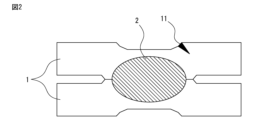
- FIG. 2 is a diagram for explaining the positions of cracks targeted in the LME resistance evaluation in the examples.
- the surface layer refers to the range from the outermost surface of the steel sheet to about 100 ⁇ m in the sheet thickness direction.
- the deboronization phenomenon in which the amount of B near the surface decreases when heated to the austenite temperature range, in particular.
- the concentration of B in the steel surface layer is lower than that in the center of the steel sheet.
- internal oxidation which tends to progress to the grain boundaries in the surface layer of the steel sheet, is caused toward the inside of the steel sheet.
- an internal oxidation layer is formed in the surface layer of the steel sheet, making it possible to fix Si, which particularly deteriorates LME resistance, as an oxide.
- the oxide formed by internal oxidation captures B that has diffused from the steel sheet to the surface layer due to heating, thereby suppressing the deboronization phenomenon.
- the oxide formed by internal oxidation captures B that has diffused from the steel sheet to the surface layer due to heating, thereby suppressing the deboronization phenomenon.
- the combined effect of these improves LME resistance.
- the steel plate of this embodiment has a tensile strength of 780 MPa or more. Since this embodiment suppresses LME occurring in high-strength steel plates, the steel plate of this embodiment has high strength. Specifically, it has a tensile strength of 780 MPa or more.
- the upper limit of the tensile strength is not particularly limited, but may be, for example, 2000 MPa or less from the viewpoint of ensuring toughness.
- the tensile strength is measured by taking a JIS No. 5 tensile test piece with the longitudinal direction perpendicular to the rolling direction, in accordance with JIS Z 2241:2011.
- the tensile strength may be 980 MPa or more, 1180 MPa or more.
- C 0.05-0.40%
- C (carbon) is an element that ensures the strength of steel.
- the C content is set to 0.05% or more.
- the C content is set to 0.40% or less.
- the C content may be 0.08% or more, 0.10% or more, or 0.15% or more.
- the C content may be 0.37% or less, 0.35% or less, or 0.30% or less.
- Si (Si: 0.7-3.0%) Si (silicon) is an element that suppresses the deboronization phenomenon by internal oxidation. It is also an element that improves the corrosion resistance of steel. As a result, a B distribution, which will be described later, is formed in the surface layer of the steel sheet. In order to obtain this effect, the Si content is set to 0.7% or more. If the Si content is too high, since Si is generally an element that reduces LME resistance, the effect of the B distribution, which will be described later, is hindered, and the effect of improving LME resistance is reduced. In consideration of this point, the Si content is set to 3.0% or less. The Si content may be 0.8% or more, 0.9% or more, or 1.0% or more. The Si content may be 2.8% or less, 2.5% or less, or 2.0% or less.
- Mn manganese
- Mn manganese
- Si silicon
- the lower limit of the Mn content is set to 0.1%.
- the Mn content is set to 5.0% or less.
- the Mn content may be 0.5% or more, 1.0% or more, or 1.5% or more.
- the Mn content may be 4.5% or less, 4.0% or less, or 3.5% or less.
- Al (aluminum) is an element that dissolves in steel and promotes ferrite stabilization and decarburization, which can improve LME resistance, so it may be contained as necessary.
- Sol. Al means acid-soluble Al that is not in the form of oxides such as Al 2 O 3 and is soluble in acid, and is determined as Al measured by subtracting the insoluble residue on the filter paper generated during the analysis of Al.
- the inclusion of sol. Al is not essential, and the lower limit of the content of sol. Al is 0. In order to obtain the effect of inclusion, the content of sol. Al may be 0.1% or more, 0.2% or more, or 0.3% or more. If the content of sol.
- the content of sol. Al is 2.0% or less.
- the content of sol. Al may be 1.5% or less, 1.2% or less, or 1.0% or less.
- P 0.0300% or less
- P (phosphorus) is an impurity generally contained in steel. If the P content exceeds 0.0300%, there is a risk of reduced weldability. Therefore, the P content is set to 0.0300% or less.
- the P content may be 0.0200% or less, 0.0100% or less, or 0.0050% or less. It is preferable that no P is contained, and the lower limit of the P content is 0. From the viewpoint of dephosphorization cost, the P content may be more than 0% or 0.0001% or more.
- S sulfur
- S sulfur
- the content of S may be 0.0100% or less, 0.0050% or less, or 0.0020% or less. It is preferable that no S is contained, and the lower limit of the content of S is 0. From the viewpoint of desulfurization costs, the content of S may be more than 0% or 0.0001% or more.
- N nitrogen
- nitrogen is an impurity generally contained in steel. If the content of N exceeds 0.0100%, there is a risk of reduced weldability. Therefore, the content of N is set to 0.0100% or less.
- the content of N may be 0.0080% or less, 0.0050% or less, or 0.0030% or less. It is preferable that N is not contained, and the lower limit of the content of N is 0. From the viewpoint of manufacturing costs, the content of N may be more than 0% or 0.0010% or more.
- B (B: 0.0005-0.0050%)
- B (boron) is an element that improves hardenability, contributes to improving strength, and segregates at grain boundaries to strengthen the grain boundaries and improve toughness. Furthermore, in the steel plate of this embodiment, boron is concentrated in the surface layer of the steel plate and segregates at Fe grain boundaries. In order to obtain this effect, the content of B is set to 0.0005% or more. From the viewpoint of toughness and weldability, the content of B is set to 0.0050% or less. The content of B may be 0.0006% or more, 0.0008% or more, or 0.0010% or more. The content of B may be 0.0040% or less, 0.0030% or less, or 0.0020% or less.
- the boron concentration in the steel surface layer is lower than that in the center of the steel sheet due to the deboronization phenomenon.
- the manufacturing method described below advances internal oxidation toward the inside of the steel sheet during the annealing process, which captures boron in the oxide, suppressing the deboronization phenomenon and forming the concentration distribution described below in the steel surface layer. It is believed that the boron that segregates at the Fe grain boundaries suppresses LME.
- Ti titanium
- Ti titanium
- the Ti content may be 0.0020% or more, 0.0030% or more, 0.0040% or more, 0.0080% or more, 0.0110% or more, or 0.0130% or more.
- the Ti content may be 0.0900% or less, 0.0800% or less, 0.0600% or less, 0.0500% or less, or 0.0400% or less.
- Nb 0-0.2000% Since Nb (niobium) is an element that contributes to improving strength through improving hardenability, it may be contained as necessary. Since it is not an essential element, the lower limit of the Nb content is 0. This effect can be obtained even with a small amount of Nb, but the Nb content when contained may be 0.0001% or more, 0.0002% or more, 0.0003% or more, 0.0004% or more, or 0.0010% or more. From the viewpoint of ensuring toughness, the Nb content is 0.2000% or less.
- the Nb content may be 0.1500% or less, 0.1000% or less, 0.0600% or less, 0.0400% or less, 0.0200% or less, 0.0100% or less, 0.0050% or less, 0.0030% or less, or 0.0020% or less.
- V vanadium
- vanadium is an element that contributes to improving strength through improving hardenability, so it may be contained as necessary. Since it is not an essential element, the lower limit of the V content is 0. This effect can be obtained even with a small amount of vanadium, but the V content when contained may be 0.001% or more, 0.01% or more, 0.03% or more, 0.05% or more, or 0.06% or more. From the viewpoint of ensuring toughness, the V content is 0.15% or less. The V content may be 0.14% or less, 0.13% or less, 0.12% or less, 0.11% or less, or 0.10% or less.
- Cr 0-2.00% Cr (chromium) is effective in increasing the hardenability of steel and increasing the strength of steel, so it may be contained as necessary. Since it is not an essential element, the lower limit of the Cr content is 0. This effect can be obtained even with a small amount of Cr, but the Cr content when contained may be 0.001% or more, 0.01% or more, 0.05% or more, 0.07% or more, or 0.10% or more. If Cr is contained excessively, a large amount of Cr carbide is formed, which may conversely impair the hardenability, so the Cr content is set to 2.00% or less.
- the Cr content may be 1.80% or less, 1.50% or less, 1.20% or less, 0.80% or less, 0.60% or less, 0.50% or less, 0.30% or less, or 0.20% or less.
- Ni nickel
- Ni nickel
- the lower limit of the Ni content is 0. This effect can be obtained even with a small amount of Ni, but the Ni content when contained may be 0.001% or more, 0.01% or more, 0.02% or more, 0.03% or more, 0.04% or more, or 0.05% or more. Since excessive addition of Ni increases the cost, the Ni content is set to 2.00% or less.
- the Ni content may be 1.80% or less, 1.50% or less, 1.20% or less, 0.80% or less, 0.60% or less, 0.50% or less, 0.40% or less, 0.20% or less, or 0.15% or less.
- Cu (Cu: 0-2.00%) Cu (copper) is effective in increasing the hardenability of steel and increasing the strength of steel, so it may be contained as necessary. Since it is not an essential element, the lower limit of the Cu content is 0. This effect can be obtained even with a small amount of Cu, but the Cu content when contained may be 0.001% or more, 0.01% or more, 0.02% or more, 0.03% or more, 0.05% or more, or 0.07% or more. From the viewpoint of suppressing a decrease in toughness, cracking of the slab after casting, and a decrease in weldability, the Cu content is set to 2.00% or less. The Cu content may be 1.80% or less, 1.50% or less, 1.20% or less, 1.00% or less, 0.80% or less, 0.60% or less, 0.50% or less, 0.30% or less, or 0.20% or less.
- Mo mobdenum
- Mo mobdenum
- the Mo content is 1.00% or less.
- the Mo content may be 0.80% or less, 0.60% or less, 0.40% or less, 0.30% or less, 0.20% or less, or 0.15% or less.
- W 0-1.00%
- W tungsten
- the lower limit of the content of W is 0. This effect can be obtained even with a small amount of content, but the content of W when contained may be 0.001% or more, 0.01% or more, 0.02% or more, or 0.03% or more.
- the content of W is 1.00% or less.
- the content of W may be 0.80% or less, 0.60% or less, 0.40% or less, 0.30% or less, 0.20% or less, 0.15% or less, or 0.10% or less.
- Ca (Ca: 0-0.1000%)
- Ca (calcium) is an element that contributes to inclusion control, particularly to finely dispersing inclusions, and has the effect of increasing toughness, so it may be contained as necessary. Since it is not an essential element, the lower limit of the Ca content is 0. This effect can be obtained even with a small amount of Ca content, but the Ca content when contained may be 0.0001% or more, 0.0005% or more, 0.0010% or more, 0.0020% or more, 0.0040% or more, 0.0060% or more, or 0.0070% or more. If Ca is contained excessively, deterioration of the surface properties may become apparent, so the Ca content is set to 0.1000% or less.
- the Ca content may be 0.0800% or less, 0.0600% or less, 0.0500% or less, 0.0400% or less, 0.0300% or less, or 0.0200% or less.
- Mg manganesium
- Mg is an element that contributes to inclusion control, particularly to finely dispersing inclusions, and has the effect of increasing toughness, so it may be contained as necessary. Since it is not an essential element, the lower limit of the Mg content is 0. This effect can be obtained even with a small amount of Mg, but the Mg content when contained may be 0.0001% or more, 0.0005% or more, or 0.001% or more.
- the Mg content may be 0.100% or less, 0.090% or less, 0.080% or less, 0.060% or less, 0.040% or less, 0.030% or less, 0.020% or less, 0.010% or less, 0.005% or less, 0.003% or less, or 0.002% or less.
- Zr zirconium
- Zr zirconium
- Zr zirconium
- Zr zirconium
- the content of Zr may be 0.090% or less, 0.080% or less, 0.060% or less, 0.050% or less, 0.040% or less, or 0.030% or less.
- Hf (hafnium) is an element that contributes to inclusion control, particularly to finely dispersing inclusions, and has the effect of increasing toughness, so it may be contained as necessary. Since it is not an essential element, the lower limit of the Hf content is 0. This effect can be obtained even with a small amount of Hf, but the Hf content when contained may be 0.001% or more, 0.002% or more, or 0.005% or more. If Hf is contained excessively, deterioration of the surface property may become apparent, so the Hf content may be 0.10% or less, 0.08% or less, 0.06% or less, 0.05% or less, 0.04% or less, 0.03% or less, or 0.02% or less.
- REM 0-0.100%
- REM rare earth elements
- REM are elements that contribute to inclusion control, particularly to finely dispersing inclusions, and have the effect of increasing toughness, so they may be contained as necessary. Since they are not essential elements, the lower limit of the REM content is 0. This effect can be obtained even with a small amount of REM, but the REM content when contained may be 0.001% or more, 0.002% or more, 0.003% or more, or 0.005% or more. If REM is contained excessively, deterioration of the surface properties may become apparent, so the REM content is set to 0.100% or less.
- the REM content may be 0.090% or less, 0.080% or less, 0.060% or less, 0.050% or less, 0.040% or less, 0.030% or less, 0.020% or less, 0.015% or less, or 0.010% or less.
- REM is an abbreviation for Rare Earth Metal, and refers to elements belonging to the lanthanide series. REM is usually added as misch metal.
- the balance other than the above chemical components is Fe and impurities.
- the impurities refer to components that are mixed in due to various factors in the manufacturing process, including raw materials such as ores and scraps, when the steel plate is industrially manufactured, and do not adversely affect the LME resistance and hydrogen desorption of the steel plate according to this embodiment, that is, those that are contained in a range in which the LME resistance and hydrogen desorption required for the steel plate of this embodiment can be obtained.
- Specific elements include, for example, O (oxygen).
- the content of O contained as an impurity may be, for example, 0.0500% or less, 0.0300% or less, 0.0200% or less, or 0.0100% or less. However, from the viewpoint of manufacturing costs, the content of O may be 0.00001% or more, 0.00005% or more, or 0.0001% or more.
- the chemical components of the steel sheet may be analyzed by an elemental analysis method known to those skilled in the art, for example, inductively coupled plasma mass spectrometry (ICP-MS).
- ICP-MS inductively coupled plasma mass spectrometry
- C and S may be measured by a combustion-infrared absorption method
- N may be measured by an inert gas fusion-thermal conductivity method
- O may be measured by an inert gas fusion-infrared absorption method.
- the depth that satisfies the following formula (1) is 0.5 ⁇ m or more from the surface of the steel sheet.
- Bx represents the luminescence intensity at a point that is a depth x ( ⁇ m) away from the interface between the steel sheet and the plating layer in the thickness direction of the steel sheet.
- B150 represents the luminescence intensity at a depth of 150 ⁇ m away from the interface between the steel sheet and the plating layer in the thickness direction of the steel sheet.
- the "thickness direction” refers to the direction perpendicular to the interface between the steel sheet and the plating layer.
- a point that is away from the interface between the steel sheet and the plating layer in the thickness direction of the steel sheet refers to a point that is away toward the center of the thickness of the steel sheet.
- the left side of the above formula (1) indicates the ratio of the B concentration at depth x to the B concentration at a depth of 150 ⁇ m.
- Bx/B150 ⁇ 5.0 means that the B concentration at depth x is 5.0 times or more the B concentration at a depth of 150 ⁇ m.
- the B concentration at a depth of 150 ⁇ m may be considered to be the B concentration at the center of the steel plate thickness, and Bx/B150 ⁇ 5.0 means that B is concentrated at depth x.
- the depth that satisfies formula (1) is 0.5 ⁇ m or more from the surface of the steel plate means that formula (1) is satisfied in a range from the surface of the steel plate to a depth of 0.5 ⁇ m or more in the thickness direction of the steel plate, and B is concentrated in a range to a depth of 0.5 ⁇ m or more in the thickness direction of the steel plate.
- the surface of the steel sheet is defined as the point where the Fe content determined by GDS measurement is 5% of the Fe content at a depth of 150 ⁇ m.
- a galvannealed layer which will be described later, is formed on the surface of the steel sheet
- the interface between the steel sheet and the galvannealed layer is regarded as the surface of the steel sheet and is used as the starting point of the depth for the GDS measurement.
- the interface between the steel sheet and the galvannealed layer is defined as follows. First, the Fe content in the thickness direction of the plated steel sheet is measured by GDS measurement. The value with the highest Fe content is defined as the Fe content of the steel sheet. The point where the Fe content is 93% of the Fe content of the steel sheet is defined as the "interface between the steel sheet and the galvannealed layer".
- B is concentrated in the surface layer of the steel sheet, causing B to segregate at the Fe grain boundaries in the surface structure. This prevents molten zinc from penetrating the Fe grain boundaries during spot welding, and inhibits the occurrence of LME. It also improves the hydrogen desorption properties of the steel sheet.
- Method of measuring GDS use a method in which the surface of the steel sheet to be measured is placed in an Ar atmosphere by GDS, a voltage is applied to generate glow plasma, and the steel sheet surface is sputtered while being analyzed in the depth direction. Then, elements contained in the material are identified from the element-specific emission spectrum wavelengths emitted by excited atoms in the glow plasma, and the emission intensity of the identified elements is estimated.
- the data in the depth direction can be estimated from the sputtering time. Specifically, by determining the relationship between sputtering time and sputtering depth in advance using a standard sample, the sputtering time can be converted to sputtering depth. Therefore, the sputtering depth converted from the sputtering time can be defined as the depth from the surface of the material.
- the sputtering time is set so that the sputtering depth is at least 150 ⁇ m or more.
- the GDS measurements are performed five times in the plate thickness direction, and the average value is taken as the B concentration.
- the measurement conditions are as follows.
- the B concentrations corresponding to a depth of x ( ⁇ m) and a depth of 150 ⁇ m are Bx and B150, respectively.
- the depth at which Bx/B150 ⁇ 5.0 is satisfied is 0.5 ⁇ m or more.
- Bx/B150 is large, and it may be 1.0 ⁇ m or more, 1.2 ⁇ m or more, 1.4 ⁇ m or more, 1.6 ⁇ m or more, 1.8 ⁇ m or more, or 2.0 ⁇ m or more. Since Bx/B150 is the ratio of the B concentration at depth x to the B concentration at a depth of 150 ⁇ m, the depth at which Bx/B150 ⁇ 5.0 is satisfied is less than 150 ⁇ m.
- the depth at which Bx/B150 ⁇ 5.0 is deep may be 100.0 ⁇ m or less, 50.0 ⁇ m or less, 30.0 ⁇ m or less, 20.0 ⁇ m or less, or 10.0 ⁇ m or less.
- the B concentrated in the surface layer of the steel segregates to the Fe grain boundaries and inhibits the penetration of Zn, thereby suppressing LME.
- Such a surface B distribution can be obtained by manufacturing the steel plate from molten steel having the above-mentioned chemical composition using the manufacturing method described below.
- Figure 1 shows an example of the distribution of B obtained by GDS measurement in the surface layer of the steel sheet of this embodiment. Referring to Figure 1, it can be seen that the B concentration increases rapidly from a position approximately 2 ⁇ m deep from the surface to the surface (position at a depth of 0 ⁇ m).
- the thickness of the oxide formed on the surface of the steel sheet, or on the surface of the galvannealed layer when a galvannealed layer described later is provided is 0.5 ⁇ m or less. If a thick oxide of more than 0.5 ⁇ m is formed on the surface of the coating layer, the diffusion rate of hydrogen in the oxide decreases, and therefore hydrogen desorption properties decrease. In order to make the oxide thickness on the surface of the coating layer 0.5 ⁇ m or less, it is necessary to avoid heat treatment in an atmospheric furnace or the like after manufacturing the steel sheet or the galvannealed steel sheet.
- the oxide thickness on the surface of the plating layer is measured by cross-sectional SEM observation. Specifically, the oxide is defined as a location containing 20% or more O by EDS, and the oxide thickness is measured. The measurement field is 80 ⁇ m wide x 50 ⁇ m long, and the oxide thickness is measured at the thickest part in the field. Similar measurements are performed on 5 fields, and the average of the maximum oxide thicknesses in each field is taken as the surface oxide thickness. The thinner the oxide thickness on the surface of the plating layer, the better, and it may be 0.4 ⁇ m or less, 0.3 ⁇ m or less, 0.2 ⁇ m or less, or 0.1 ⁇ m or less.
- Internal oxide layer thickness In the plated steel sheet of this embodiment, when the steel sheet has a galvannealed layer described later, an internal oxide layer having a thickness of 1.0 ⁇ m or more is present from the surface of the steel sheet to the interface between the steel sheet and the galvannealed layer in the thickness direction of the steel sheet.
- the precipitation of Si and Mn as internal oxides reduces the concentration of Si and Mn dissolved in the steel sheet surface layer.
- Si is an element that promotes LME and reduces LME resistance
- the concentration of dissolved Si in the steel sheet surface layer is reduced by internal oxidation, the LME resistance is improved.
- the thickness of the internal oxide layer may be 2.0 ⁇ m or more, 3.0 ⁇ m or more, 4.0 ⁇ m or more, 5.0 ⁇ m or more, 6.0 ⁇ m or more, or 7.0 ⁇ m or more.
- the thickness of the internal oxide layer may be 100.0 ⁇ m or less, 50.0 ⁇ m or less, 40.0 ⁇ m or less, 30.0 ⁇ m or less, or 25.0 ⁇ m or less.
- the thickness of the internal oxide layer is measured by cross-sectional SEM observation. Specifically, in the steel sheet surface layer, or in the case where a galvannealed galvanized layer (described below) is provided, in the steel sheet surface layer directly below the galvannealed galvanized layer, the thickness of the oxide layer is measured, with the internal oxide being defined as a precipitate containing 20% or more O by EDS.
- the measurement field size is 80 ⁇ m horizontal x 50 ⁇ m vertical, and the thickness of the thickest internal oxide layer in the field is measured. Similar measurements are performed for five fields, and the average of the maximum internal oxide layer thicknesses in each field is taken as the internal oxide layer thickness.
- Bmax represents the maximum emission intensity of B in the range from the surface of the steel plate to a depth of 5.0 ⁇ m.
- the left side of equation (2) represents the ratio of the maximum B emission intensity in the range from the surface of the steel plate to a depth of 5.0 ⁇ m to the B concentration at a depth of 150 ⁇ m.
- Bmax/B150 ⁇ 8 means that the B concentration at the position where B is most concentrated in the range from the surface of the steel plate to a depth of 5.0 ⁇ m is 8 times or more the B concentration at a depth of 150 ⁇ m.
- the B concentration at a depth of 150 ⁇ m can be regarded as the B concentration at the center of the steel plate thickness
- Bmax/B150 ⁇ 8 means that B is highly concentrated from the surface of the steel plate to a depth of 5.0 ⁇ m, i.e., in the vicinity of the surface.
- the larger Bmax/B150 is, the more preferable, with 10 or more being preferable, 12 or more, 14 or more, and 16 or more being even more preferable.
- Satisfying formula (2) is not essential for the steel plate of this embodiment, and even if formula (2) is not satisfied, good LME resistance can be obtained as long as formula (1) is satisfied.
- B that is more highly concentrated in the surface layer of the steel segregates to the Fe grain boundaries, preventing the penetration of molten zinc, and thus achieving a greater effect in suppressing LME.
- a galvannealed steel sheet can be obtained by forming a galvannealed layer on the surface of the steel sheet according to this embodiment.
- the galvannealed layer may be formed on one side or both sides of the steel sheet. It may also be formed on a part of the surface.
- the galvannealed steel sheet according to this embodiment is mainly used in the automotive field, and the galvannealed steel sheet is not particularly limited as long as it is a plating containing Zn.
- Elements other than Zn may contain elements generally contained in Zn plating, such as Fe, Al, Mg, Si, Ni, and Sn.
- elements contained in the steel sheet may be diffused and contained in the plating.
- the Zn content may be 50% or more, 55% or more, or 60% or more.
- Al is an element that improves the corrosion resistance of the plating layer by being contained together with Zn or alloyed with Zn, it may be contained as necessary.
- the content of Al may be 0%.
- the content of Al is preferably 0.01% or more.
- the content of Al may be 0.1% or more.
- the content of Al in the plating layer is preferably 0.3 to 1.5%.
- the content of Al may be 0.4% or more, 0.5% or more, or 0.6% or more.
- the content of Al may be 1.4% or more, 1.3% or more, or 1.2% or more.
- Fe 3-20%
- the Fe content is preferably 3% or more.
- the Fe content may be 4% or more, or 5% or more.
- the Fe content is preferably 20% or less.
- the Fe content may be 15% or less, 12% or less, 10% or less, or 8% or less.
- the remainder other than the above components consists of Zn and impurities.
- Impurities in the plating layer refer to components that are mixed in due to various factors in the manufacturing process, including raw materials, when the plating layer is manufactured, and are not components that are intentionally added to the plating layer.
- elements other than Zn, Fe, and Al contained in the steel sheet that are diffused and included in the plating layer are considered impurities.
- elements other than the basic components and optional added components described above may be included as impurities in trace amounts within a range that does not interfere with the effects of the present invention.
- the chemical composition of the plating layer can be determined by dissolving the plating layer in an acid solution containing an inhibitor that suppresses corrosion of the steel sheet, and measuring the resulting solution using ICP (inductively coupled plasma) optical emission spectroscopy.
- ICP inductively coupled plasma
- the thickness of the plating layer may be, for example, 3 to 50 ⁇ m.
- the coating weight of the plating layer is not particularly limited, but may be, for example, 10 to 170 g/ m2 per side.
- the coating weight of the plating layer is determined by dissolving the plating layer in an acid solution containing an inhibitor that suppresses corrosion of the steel sheet, and measuring the weight change before and after the plating layer is peeled off by pickling.
- the acid solution containing the inhibitor for example, a 10% hydrochloric acid solution containing 0.06 mass % inhibitor (Ibit 710K, manufactured by Asahi Chemical Industry Co., Ltd.) may be used. After removing the plating layer, the base steel sheet is washed with water and dried.
- the thickness of the plating layer may be 5 ⁇ m or more, 7 ⁇ m or more, or 10 ⁇ m or more.
- the thickness of the plating layer may be 45 ⁇ m or less, 40 ⁇ m or less, 35 ⁇ m or less , or 30 ⁇ m or less.
- the coating weight of the plating layer may be 15 g/m2 or more , 20 g/m2 or more, 25 g/m2 or more, or 30 g/m2 or more per side.
- the coating weight of the plating layer may be 160 g/m2 or less , 140 g/m2 or less , 120 g/m2 or less, or 100 g/ m2 or less per side.
- the steel sheet of the present invention has the effect of improving LME resistance even when it is a steel sheet that does not have alloyed hot-dip galvanizing.
- LME cracking does not occur.
- molten galvanization occurs on the overlapping surface of the steel sheets during welding. Therefore, the molten galvanization may come into contact with the surface of the non-galvanized steel sheet, causing LME cracking.
- the galvanization attached to the welding electrode may melt and come into contact with the steel sheet surface, causing LME cracking. If the steel sheet of the present invention is used as a non-galvanized steel sheet, even in such a case, the B concentrated on the surface layer can prevent the molten zinc from penetrating the Fe grain boundaries, so that LME cracking can be suppressed.
- the thickness of the steel sheet and the galvannealed steel sheet of the present embodiment is not particularly limited. For example, it can be 0.6 to 3.2 mm.
- the thickness may be 0.8 mm or more, or 1.0 mm or more.
- the thickness may be 3.0 mm or less, 2.8 mm or less, 2.6 mm or less, 2.4 mm or less, 2.2 mm or less, or 2.0 mm or less.
- the steel sheet according to this embodiment can be obtained by a manufacturing method including a casting process in which molten steel with adjusted chemical composition is cast to form a steel slab, a hot rolling process in which the steel slab is hot rolled to obtain a hot rolled steel sheet, a coiling process in which the hot rolled steel sheet is coiled, a pickling process in which the coiled hot rolled steel sheet is pickled, a cold rolling process in which the pickled hot rolled steel sheet is cold rolled to obtain a cold rolled steel sheet, and an annealing process in which the cold rolled steel sheet is annealed.
- the hot rolled steel sheet may be pickled and then cold rolled directly without being coiled after the hot rolling process.
- the conditions for the casting process are not particularly limited. For example, after melting in a blast furnace or an electric furnace, various secondary smelting processes may be carried out, and then casting may be carried out by a method such as ordinary continuous casting or casting by an ingot method.
- the steel slab obtained by casting can be hot-rolled to obtain a hot-rolled steel sheet.
- the hot rolling step is performed by reheating the cast steel slab directly or after cooling once, and then hot rolling it.
- the heating temperature of the steel slab may be, for example, 1100 to 1250°C.
- rough rolling and finish rolling are usually performed.
- the temperature and reduction rate of each rolling may be appropriately changed depending on the desired metal structure and plate thickness.
- the finishing temperature of the finish rolling may be 900 to 1050°C, and the reduction rate of the finish rolling may be 10 to 50%.
- the hot-rolled steel sheet can be coiled at a predetermined temperature.
- the coiling temperature may be appropriately changed depending on the desired metal structure, etc., and may be, for example, 500 to 800°C.
- the hot-rolled steel sheet may be subjected to a predetermined heat treatment by recoiling before or after coiling. Alternatively, the hot-rolled steel sheet may be pickled after the hot rolling process without coiling, and then cold-rolled as described below.
- the unevenness of the steel sheet surface after pickling is controlled for the purpose of concentrating B in the surface layer of the steel sheet in the subsequent annealing process.
- the unevenness is set to 1.5 ⁇ m or more in terms of Ra, which is the arithmetic mean height defined in JIS B0601:2013. This condition means that a certain degree of unevenness exists on the steel sheet surface. If the unevenness is small, the strain applied to the surface layer of the steel sheet becomes small, so that the concentration of B in the surface layer of the steel sheet does not progress even by annealing at a high dew point as described later.
- the unevenness of the steel sheet surface after pickling is determined in accordance with JIS B 0601:2013 by randomly selecting 10 locations on the surface of the outermost layer, measuring the surface profile at each location with a contact surface roughness meter, and calculating the arithmetic average of the surface roughness at those locations to obtain the arithmetic average roughness Ra. It is not necessary to constantly measure the unevenness of the steel sheet surface after pickling, and once the pickling conditions that produce the desired unevenness have been determined, the measurement of the unevenness may be omitted.
- the surface roughness of the steel sheet varies depending on the pickling conditions, so these can be adjusted appropriately to obtain the above unevenness.
- pickling can be performed using a 1-10% by mass hydrochloric acid solution at a temperature of 20-95°C for a pickling time of 30-200 seconds.
- the surface of the steel sheet after pickling has these irregularities, and by rolling these irregularities out in the subsequent cold rolling process, strain is imparted to the surface layer of the steel, which promotes the concentration of B in the surface layer of the steel sheet in the subsequent annealing process.
- the hot-rolled steel sheet After pickling or the like is performed on the hot-rolled steel sheet, the hot-rolled steel sheet can be cold-rolled to obtain a cold-rolled steel sheet.
- the unevenness imparted in the above-mentioned pickling process is rolled and crushed to impart strain to the surface layer of the steel sheet.
- the roll used in the cold rolling is preferably one having a small surface roughness, and the surface roughness of the roll is preferably 1.0 ⁇ m or less in Ra.
- the surface roughness of the roll may be 0.8 ⁇ m or less, 0.6 ⁇ m or less, or 0.5 ⁇ m or less in Ra.
- the rolling reduction of the cold rolling may be appropriately changed according to the desired metal structure and sheet thickness, and may be, for example, 20 to 80%.
- the steel sheet After the cold-rolling process, the steel sheet may be cooled to room temperature, for example, by air cooling.
- the uneven surface of the hot-rolled steel sheet is rolled out, imparting strain to the surface layer of the steel sheet, which promotes the concentration of B in the surface layer of the steel sheet in the subsequent annealing process.
- the obtained cold-rolled steel sheet is subjected to the following high dew point annealing.
- the annealing step external oxidation is not allowed to proceed on the surface of the steel sheet, but internal oxidation is allowed to proceed in which oxidation proceeds toward the inside of the steel sheet in the surface layer of the steel sheet.
- the steel sheet with the surface layer strained by the above process is held at a high dew point.
- the dew point of the atmosphere is changed in the first and second halves of the temperature rise to the holding temperature.
- the dew point from room temperature to the control temperature is different from the dew point from the control temperature to the holding time.
- the "control temperature” means the temperature at which the dew point is changed.
- the rate of temperature rise to the holding temperature is not particularly limited. The rate of temperature rise may be, for example, 1 to 10°C/sec.
- the heating rate may be 2°C/sec or more, 3°C/sec or more, 4°C/sec or more. The heating rate may be 9°C/sec or less, 8°C/sec or less, 7°C/sec or less.
- the control temperature is 450 to 550°C.
- the dew point of the annealing atmosphere is -40°C or higher and -20°C or lower.
- the dew point of the annealing atmosphere is -20°C or higher and 20°C or lower.
- control temperature is below 450°C, the dew point rises at low temperatures, so internal oxidation progresses at low temperatures, the strain applied to the steel sheet surface is released, and the concentration of B is no longer promoted between the control temperature and the holding temperature. If the control temperature is above 550°C, the strain applied to the steel sheet surface is released before internal oxidation progresses at high temperatures, and the concentration of B is no longer promoted.
- the dew point during the temperature rise from room temperature to the control temperature is less than -40°C, Si and Mn may oxidize externally, and internal oxidation may not progress between the control temperature and the holding temperature. If the dew point during the temperature rise from room temperature to the control temperature is more than -20°C, internal oxidation may progress at a low temperature, releasing the strain applied to the surface layer of the steel plate, and as a result, the concentration of B may not be promoted between the control temperature and the holding temperature.
- the dew point between the control temperature and the holding temperature is set to be at least 10°C higher than the dew point between the temperature rise from room temperature to the control temperature. This allows internal oxidation to proceed, and promotes the concentration of B.
- the control temperature may be 460°C or more, 470°C or more, or 480°C or more.
- the control temperature may be 540°C or less, 530°C or less, or 520°C or less.
- the dew point during the period from room temperature to the control temperature may be -38°C or more, -37°C or more, or -35°C or more.
- the dew point during the period from room temperature to the control temperature may be 18°C or less, 17°C or less, or 15°C or less.
- the dew point from the control temperature to the holding temperature may be -18°C or more, -17°C or more, or -15°C or more.
- the dew point from the control temperature to the holding temperature may be 18°C or less, 17°C or less, or 15°C or less.
- the holding temperature is set to 760-900°C to promote internal oxidation and the concentration of B.
- the holding time at the holding temperature is set to 0-360 seconds.
- the holding temperature may be 770°C or higher, 780°C or higher, or 790°C or higher.
- the holding temperature may be 890°C or lower, 880°C or lower, or 870°C or lower.
- the holding time may be 10 seconds or more, 30 seconds or more, 50 seconds or more, or 60 seconds or more.
- the holding time may be 330 seconds or less, 300 seconds or less, 270 seconds or less, 240 seconds or less, or 200 seconds or less.
- the atmosphere in the annealing is preferably a non-oxidizing atmosphere, and may be, for example, N2-1 to 10 vol% H2 , or N2-2 to 4 vol% H2 .
- the oxygen concentration in the atmosphere is preferably 50 ppm or less, and may be 30 ppm or less, 20 ppm or less, or 10 ppm or less. By setting such conditions, it is possible to promote internal oxidation while suppressing oxidation of the plating surface.
- the dew point When strain is applied to the surface layer of the steel sheet by the above-mentioned method, the dew point is raised above the controlled temperature during the annealing process, causing rapid internal oxidation in the surface layer of the steel sheet, and B is absorbed into the oxides formed inside the steel sheet, concentrating B in the surface layer of the steel sheet and segregating B at the Fe grain boundaries, resulting in the B concentration distribution in the surface layer as described above.
- Annealing is performed under tension of 1 to 20 MPa. Applying tension during annealing allows for greater strain to be introduced into the steel sheet, promoting the enrichment of B in the surface layer.
- a galvannealed steel sheet can be produced by a production method including a plating treatment step and an alloying treatment step.
- the plating process may be carried out according to a method known to those skilled in the art.
- the plating process may be carried out by hot-dip plating, electroplating, vapor deposition plating, thermal spraying, or cold spraying.
- the plating process is carried out by hot-dip plating.
- the conditions for the plating process and alloying process can be set appropriately taking into consideration the chemical composition, thickness, and coating amount of the desired plating layer.
- the steel sheet and galvannealed steel sheet according to this embodiment have high strength and high LME resistance and hydrogen desorption properties, and therefore can be suitably used in a wide range of fields, such as automobiles, home appliances, and building materials. It is particularly preferable for them to be used in the automobile field. Plated steel sheets used for automobiles are often spot welded, in which case LME cracking can be a significant problem. Therefore, when the steel sheet and galvannealed steel sheet according to this embodiment are used as automotive steel sheets, the effect of this embodiment of having high LME resistance is suitably exhibited.
- the steel sheet and galvannealed steel sheet of this embodiment have excellent hydrogen desorption properties due to the formation of a layer with a high concentration of B on the surface, making them suitable for the automotive field in this respect as well.
- Example No. 1 Molten steel was produced in a blast furnace and cast by continuous casting to obtain a steel slab having the chemical composition shown in No. 1 of Table 1.
- the obtained steel slab was heated to 1200°C and hot-rolled at a finish rolling end temperature of 950°C and a finish rolling reduction of 30% to obtain a hot-rolled steel sheet.
- the obtained hot-rolled steel sheet was coiled at a coiling temperature of 650°C.
- the coiled steel sheet was pickled for 40 seconds using a 5% by mass hydrochloric acid solution at 40°C. After pickling, the steel sheet was cold rolled at a reduction ratio of 50% to obtain a cold-rolled steel sheet. The thickness of the cold-rolled steel sheet was 1.6 mm.
- the steel sheet samples were prepared by annealing in a furnace with an oxygen concentration of 20 ppm or less in a N 2 -4 vol% H 2 gas atmosphere at a holding temperature of 800°C and a holding time of 0 seconds.
- the temperature rise rate during annealing was 5.0°C/second.
- the dew point of the annealing atmosphere was set to a controlled temperature of 500°C, -20°C from room temperature to the controlled temperature, and -10°C from the controlled temperature to the holding temperature.
- the annealing was performed under a tension of 15 MPa.
- the holding time of 0 seconds means that the temperature was raised to 800°C and then immediately started to drop.
- Examples No. 2 to 22, Comparative Examples No. 23 to 33> The steel sheets were prepared under the same conditions as in Example 1, except that the chemical components were those shown in Table 1 and the annealing conditions were those shown in Table 2. It means.
- the annealed steel sheet was immersed in a 450°C hot-dip galvanizing bath (Zn-0.2%Al) for 3 seconds, and then pulled out at 100 mm/second, and the coating weight was controlled to 50 g/ m2 by N2 wiping gas, and then alloyed at 520°C for 30 seconds to obtain a galvannealed steel sheet having galvannealed layers on both sides.
- a heat treatment was performed at 800°C for 10 seconds in an atmospheric furnace.
- the surface unevenness of the hot-rolled steel sheet after pickling was measured.
- the surface unevenness was measured in accordance with JIS B 0601:2013 by randomly selecting 10 points on the surface of the surface layer side, measuring the surface profile at each point with a contact surface roughness meter, and calculating the arithmetic average of the surface roughness at those points to obtain the arithmetic average roughness Ra.
- the surface unevenness of the hot-rolled steel sheet is shown in Table 2.
- GDS was performed using samples cut to a size of 50 mm x 50 mm from each steel plate and galvannealed steel plate. GDS measurements were performed five times in the plate thickness direction, and the average value was taken as the B concentration. The measurement conditions were as follows. The B concentrations corresponding to a depth of x ( ⁇ m) and a depth of 150 ⁇ m are Bx and B150, respectively.
- the thickness of the oxide on the steel sheet surface or the galvannealed layer surface was measured by cross-sectional SEM observation, with the location containing 20% or more O by EDS defined as an oxide.
- the measurement field was 80 ⁇ m wide ⁇ 50 ⁇ m long, and the oxide thickness was measured at the thickest part in the field. Similar measurements were performed on five fields, and the average of the maximum oxide thicknesses in each field was taken as the surface oxide thickness, which is shown in Table 3. " ⁇ 0.5" in Table 3 indicates that the oxide thickness was thinner than 0.5 ⁇ m.
- Grade AAA 1180 MPa or more Grade AA: 980 MPa or more, less than 1180 MPa Grade A: 780 MPa or more, less than 980 MPa Grade B: Less than 780 MPa
- LME resistance was evaluated based on the length of an LME crack (shoulder crack 11) that occurred in the shoulder of a weld 2 formed by overlapping two steel plates 1 and spot welding them together.
- the shoulder refers to the sloping part of the edge of a depression created by spot welding.
- the evaluation was performed as follows. In this example, a rating of A or higher was determined to have excellent LME resistance.
- Grade AAA 5% or less of the initial hydrogen amount Grade AA: 15% or less of the initial hydrogen amount Grade A: Less than 40% of the initial hydrogen amount Grade B: 40% or more of the initial hydrogen amount
- Nos. 1 to 22 are examples of the invention, and it was confirmed that they have excellent LME resistance and hydrogen desorption properties.
- No. 23 had a low Si content, and internal oxidation could not be sufficiently generated during the annealing process, so the boron removal phenomenon could not be prevented.
- the internal oxidation layer was thin, B was not concentrated in the surface layer of the steel sheet, and Bx/B150 ⁇ 5.0 was not satisfied. As a result, both LME resistance and hydrogen desorption properties were poor.
- No. 24 has a high Si content. Therefore, although B was concentrated in the surface layer, the effect of Si in reducing LME resistance was large. As a result, both LME resistance and hydrogen desorption properties were poor.
- No. 26 had a high dew point in the first half of the temperature rise in the annealing process, and internal oxidation progressed at a low temperature, releasing the strain applied to the steel sheet surface, and the concentration of B was not promoted in the second half of the temperature rise. As a result, B did not concentrate in the steel sheet surface, and Bx/B150 ⁇ 5.0 was not satisfied. As a result, both LME resistance and hydrogen desorption properties were poor.
- No. 27 had a low dew point in the latter half of the temperature rise in the annealing process, and sufficient internal oxidation did not occur to suppress the deboronization phenomenon.
- the internal oxidation layer was thin, B did not concentrate on the surface layer of the steel sheet, and Bx/B150 ⁇ 5.0 was not satisfied.
- both LME resistance and hydrogen desorption properties were poor.
- No. 32 had small unevenness on the steel sheet surface after pickling. As a result, sufficient strain was not imparted to the surface layer, and B did not concentrate in the surface layer of the steel sheet even after high dew point annealing, so Bx/B150 ⁇ 5.0 was not satisfied. As a result, although the hydrogen desorption property was excellent, the LME resistance was poor.
- No. 33 was subjected to heat treatment at 800°C for 10 seconds in an atmospheric furnace after the formation of the alloyed hot-dip galvanized layer. As a result, a thick oxide formed on the surface of the alloyed hot-dip galvanized layer, resulting in poor hydrogen desorption properties.
- the present invention makes it possible to provide steel sheets and galvannealed steel sheets that have high LME resistance and hydrogen desorption properties, and these steel sheets and galvannealed steel sheets can be suitably used in automobiles, home appliances, building materials, and the like, particularly for automobiles. Therefore, the present invention has extremely high industrial applicability.
Landscapes
- Chemical & Material Sciences (AREA)
- Engineering & Computer Science (AREA)
- Materials Engineering (AREA)
- Mechanical Engineering (AREA)
- Metallurgy (AREA)
- Organic Chemistry (AREA)
- Chemical Kinetics & Catalysis (AREA)
- Physics & Mathematics (AREA)
- Thermal Sciences (AREA)
- Crystallography & Structural Chemistry (AREA)
- Heat Treatment Of Sheet Steel (AREA)
- Coating With Molten Metal (AREA)
Priority Applications (4)
| Application Number | Priority Date | Filing Date | Title |
|---|---|---|---|
| JP2025525138A JP7741464B2 (ja) | 2023-08-10 | 2024-05-07 | 鋼板及び合金化溶融亜鉛めっき鋼板 |
| CN202480051833.2A CN121666461A (zh) | 2023-08-10 | 2024-05-07 | 钢板及合金化热浸镀锌钢板 |
| KR1020267003342A KR20260030903A (ko) | 2023-08-10 | 2024-05-07 | 강판 및 합금화 용융 아연 도금 강판 |
| MX2026001117A MX2026001117A (es) | 2023-08-10 | 2026-01-28 | Lamina de acero y lamina de acero recocida y galvanizada por inmersion en caliente |
Applications Claiming Priority (2)
| Application Number | Priority Date | Filing Date | Title |
|---|---|---|---|
| JP2023-131192 | 2023-08-10 | ||
| JP2023131192 | 2023-08-10 |
Publications (1)
| Publication Number | Publication Date |
|---|---|
| WO2025032898A1 true WO2025032898A1 (ja) | 2025-02-13 |
Family
ID=94533891
Family Applications (1)
| Application Number | Title | Priority Date | Filing Date |
|---|---|---|---|
| PCT/JP2024/016968 Pending WO2025032898A1 (ja) | 2023-08-10 | 2024-05-07 | 鋼板及び合金化溶融亜鉛めっき鋼板 |
Country Status (5)
| Country | Link |
|---|---|
| JP (1) | JP7741464B2 (https=) |
| KR (1) | KR20260030903A (https=) |
| CN (1) | CN121666461A (https=) |
| MX (1) | MX2026001117A (https=) |
| WO (1) | WO2025032898A1 (https=) |
Citations (7)
| Publication number | Priority date | Publication date | Assignee | Title |
|---|---|---|---|---|
| JP2011231346A (ja) * | 2010-04-23 | 2011-11-17 | Nisshin Steel Co Ltd | 溶融亜鉛系めっき高張力鋼板の製造法 |
| WO2014157155A1 (ja) * | 2013-03-27 | 2014-10-02 | 日新製鋼株式会社 | めっき密着性に優れた溶融亜鉛系めっき鋼板およびその製造方法 |
| JP2019504196A (ja) * | 2015-12-15 | 2019-02-14 | ポスコPosco | 表面品質及びスポット溶接性に優れた高強度溶融亜鉛めっき鋼板及びその製造方法 |
| WO2019116531A1 (ja) | 2017-12-15 | 2019-06-20 | 日本製鉄株式会社 | 鋼板、溶融亜鉛めっき鋼板および合金化溶融亜鉛めっき鋼板 |
| WO2020218575A1 (ja) | 2019-04-24 | 2020-10-29 | 日本製鉄株式会社 | 鋼板 |
| WO2023132350A1 (ja) * | 2022-01-06 | 2023-07-13 | 日本製鉄株式会社 | ホットスタンプ用鋼板、ホットスタンプ用鋼板の製造方法、及びホットスタンプ成形体 |
| WO2024053669A1 (ja) * | 2022-09-06 | 2024-03-14 | 日本製鉄株式会社 | 溶接継手 |
-
2024
- 2024-05-07 JP JP2025525138A patent/JP7741464B2/ja active Active
- 2024-05-07 WO PCT/JP2024/016968 patent/WO2025032898A1/ja active Pending
- 2024-05-07 KR KR1020267003342A patent/KR20260030903A/ko active Pending
- 2024-05-07 CN CN202480051833.2A patent/CN121666461A/zh active Pending
-
2026
- 2026-01-28 MX MX2026001117A patent/MX2026001117A/es unknown
Patent Citations (7)
| Publication number | Priority date | Publication date | Assignee | Title |
|---|---|---|---|---|
| JP2011231346A (ja) * | 2010-04-23 | 2011-11-17 | Nisshin Steel Co Ltd | 溶融亜鉛系めっき高張力鋼板の製造法 |
| WO2014157155A1 (ja) * | 2013-03-27 | 2014-10-02 | 日新製鋼株式会社 | めっき密着性に優れた溶融亜鉛系めっき鋼板およびその製造方法 |
| JP2019504196A (ja) * | 2015-12-15 | 2019-02-14 | ポスコPosco | 表面品質及びスポット溶接性に優れた高強度溶融亜鉛めっき鋼板及びその製造方法 |
| WO2019116531A1 (ja) | 2017-12-15 | 2019-06-20 | 日本製鉄株式会社 | 鋼板、溶融亜鉛めっき鋼板および合金化溶融亜鉛めっき鋼板 |
| WO2020218575A1 (ja) | 2019-04-24 | 2020-10-29 | 日本製鉄株式会社 | 鋼板 |
| WO2023132350A1 (ja) * | 2022-01-06 | 2023-07-13 | 日本製鉄株式会社 | ホットスタンプ用鋼板、ホットスタンプ用鋼板の製造方法、及びホットスタンプ成形体 |
| WO2024053669A1 (ja) * | 2022-09-06 | 2024-03-14 | 日本製鉄株式会社 | 溶接継手 |
Also Published As
| Publication number | Publication date |
|---|---|
| KR20260030903A (ko) | 2026-03-06 |
| MX2026001117A (es) | 2026-03-02 |
| CN121666461A (zh) | 2026-03-13 |
| JP7741464B2 (ja) | 2025-09-18 |
| JPWO2025032898A1 (https=) | 2025-02-13 |
Similar Documents
| Publication | Publication Date | Title |
|---|---|---|
| WO2024053669A1 (ja) | 溶接継手 | |
| WO2024150824A1 (ja) | 溶接継手 | |
| WO2024053663A1 (ja) | めっき鋼板 | |
| WO2024150817A1 (ja) | 鋼板及びめっき鋼板 | |
| WO2024150822A1 (ja) | 鋼板及びめっき鋼板 | |
| WO2024150820A1 (ja) | 溶接継手 | |
| JP7741464B2 (ja) | 鋼板及び合金化溶融亜鉛めっき鋼板 | |
| JP7741465B2 (ja) | めっき鋼板 | |
| JP7741466B2 (ja) | 溶接継手 | |
| JP7741469B2 (ja) | 鋼板及びめっき鋼板 | |
| JP7773121B2 (ja) | 鋼板、めっき鋼板及び自動車部材 | |
| JP7773119B2 (ja) | 鋼板、めっき鋼板及び自動車部材 | |
| JP7832577B2 (ja) | 溶接継手及び自動車部材の接合構造 | |
| JP7741468B2 (ja) | めっき鋼板 | |
| WO2024053667A1 (ja) | 鋼板及びめっき鋼板 | |
| WO2025018308A1 (ja) | 溶接継手及び自動車部材の接合構造 | |
| WO2023054705A1 (ja) | めっき鋼板 |
Legal Events
| Date | Code | Title | Description |
|---|---|---|---|
| 121 | Ep: the epo has been informed by wipo that ep was designated in this application |
Ref document number: 24851332 Country of ref document: EP Kind code of ref document: A1 |
|
| ENP | Entry into the national phase |
Ref document number: 2025525138 Country of ref document: JP Kind code of ref document: A |
|
| WWE | Wipo information: entry into national phase |
Ref document number: 2025525138 Country of ref document: JP |
|
| WWE | Wipo information: entry into national phase |
Ref document number: 202617003144 Country of ref document: IN |
|
| WWE | Wipo information: entry into national phase |
Ref document number: MX/A/2026/001117 Country of ref document: MX |
|
| ENP | Entry into the national phase |
Ref document number: 1020267003342 Country of ref document: KR Free format text: ST27 STATUS EVENT CODE: A-0-1-A10-A15-NAP-PA0105 (AS PROVIDED BY THE NATIONAL OFFICE) |
|
| WWE | Wipo information: entry into national phase |
Ref document number: 1020267003342 Country of ref document: KR |
|
| WWE | Wipo information: entry into national phase |
Ref document number: 2601000836 Country of ref document: TH |
|
| WWP | Wipo information: published in national office |
Ref document number: MX/A/2026/001117 Country of ref document: MX |
|
| WWP | Wipo information: published in national office |
Ref document number: 1020267003342 Country of ref document: KR |
|
| WWE | Wipo information: entry into national phase |
Ref document number: 2024851332 Country of ref document: EP |
|
| NENP | Non-entry into the national phase |
Ref country code: DE |