WO2025032724A1 - 冷凍装置及び冷却システム - Google Patents
冷凍装置及び冷却システム Download PDFInfo
- Publication number
- WO2025032724A1 WO2025032724A1 PCT/JP2023/028941 JP2023028941W WO2025032724A1 WO 2025032724 A1 WO2025032724 A1 WO 2025032724A1 JP 2023028941 W JP2023028941 W JP 2023028941W WO 2025032724 A1 WO2025032724 A1 WO 2025032724A1
- Authority
- WO
- WIPO (PCT)
- Prior art keywords
- heat exchanger
- expander
- compressor
- downstream
- internal
- Prior art date
- Legal status (The legal status is an assumption and is not a legal conclusion. Google has not performed a legal analysis and makes no representation as to the accuracy of the status listed.)
- Pending
Links
Images






Classifications
-
- F—MECHANICAL ENGINEERING; LIGHTING; HEATING; WEAPONS; BLASTING
- F25—REFRIGERATION OR COOLING; COMBINED HEATING AND REFRIGERATION SYSTEMS; HEAT PUMP SYSTEMS; MANUFACTURE OR STORAGE OF ICE; LIQUEFACTION SOLIDIFICATION OF GASES
- F25B—REFRIGERATION MACHINES, PLANTS OR SYSTEMS; COMBINED HEATING AND REFRIGERATION SYSTEMS; HEAT PUMP SYSTEMS
- F25B11/00—Compression machines, plants or systems, using turbines, e.g. gas turbines
- F25B11/02—Compression machines, plants or systems, using turbines, e.g. gas turbines as expanders
Definitions
- the embodiment of the present invention relates to a refrigeration device and a cooling system.
- Refrigeration equipment that circulates fluorocarbon refrigerants is widely used in a variety of fields.
- fluorocarbon refrigerants currently used in such refrigeration equipment have a high GWP (global warming potential), and there is a demand to replace them with refrigerants that have a lower environmental impact.
- GWP global warming potential
- R1234yf has a GWP of less than 1.
- R1234yf is flammable, and its use is sometimes restricted from a safety standpoint.
- the use of flammable refrigerants is generally restricted in semiconductor manufacturing plants.
- high-output refrigeration equipment that uses natural refrigerants is generally large. As a result, its size is sometimes the reason for its postponement.
- semiconductor manufacturing plants often impose strict constraints on the footprint of manufacturing equipment. In the field of semiconductor manufacturing, it cannot be said that there are many cases of introduction of high-output refrigeration equipment that uses natural refrigerants. One of the reasons for this is thought to be its size.
- This disclosure has been made in consideration of the above-mentioned circumstances, and aims to provide a refrigeration device and cooling system that can reduce size while minimizing the environmental impact and ensuring safety.
- One embodiment of the present invention relates to the following aspects "1" to "11".
- a refrigerant coolant circulation system including a compressor, a heat exchanger downstream of the compressor, an expander, and a heat exchanger downstream of the expander,
- the natural refrigerant flowing out from the compressor passes through the compressor downstream heat exchanger, the expander, and the expander downstream heat exchanger in this order, and then circulates to the compressor,
- the compressor and the expander are connected by a common drive shaft
- the compressor downstream heat exchanger cools the natural refrigerant flowing out of the compressor
- the expander downstream heat exchanger exchanges heat between the natural refrigerant flowing out from the expander and a temperature control target
- a refrigeration apparatus wherein the compressor downstream heat exchanger and the expander downstream heat exchanger are arranged in a direction parallel to an axial direction of the drive shaft or aligned along the axial direction.
- the compressor downstream heat exchanger includes an external heat exchanger that cools the natural refrigerant flowing out of the compressor with a heat medium different from the natural refrigerant, and an internal heat exchanger that receives the natural refrigerant flowing out of the compressor from the expander downstream heat exchanger and cools it with the natural refrigerant, and at least one of the external heat exchanger and the internal heat exchanger and the expander downstream heat exchanger are aligned in a direction parallel to the axial direction of the drive shaft or on the axial direction.
- a refrigeration system according to either [2] or [3], in which at least a portion of the area occupied by the compressor, the drive shaft, and the expander overlaps with at least a portion of the area occupied by the expander downstream heat exchanger and the internal heat exchanger in the radial direction of the drive shaft perpendicular to the axial direction.
- a refrigeration device according to any one of [2] to [4], in which the expander, the drive shaft and the expander are disposed between both ends of the range occupied by the expander downstream heat exchanger and the internal heat exchanger in a direction parallel to the axial direction.
- a refrigeration device according to any one of [2] to [5], in which the expander downstream heat exchanger, the internal heat exchanger, and the external heat exchanger are arranged in this order along the axial direction from the expander to the compressor.
- the internal heat exchanger and the expander downstream heat exchanger are integrated so as to be adjacent to each other,
- a cooling system comprising a first external heat exchanger, an internal heat exchanger, and a second external heat exchanger,
- the first external heat exchanger, the internal heat exchanger, and the second external heat exchanger each have a heat exchange unit that enables heat exchange between fluids flowing through separate flow paths, and a housing that accommodates the heat exchange unit, the housing of the first external heat exchanger, the housing of the internal heat exchanger, and the housing of the second external heat exchanger are integrated to form a common housing; one of two fluid outlets of the heat exchange unit of the first external heat exchanger is connected to one of two fluid inlets of the heat exchange unit of the internal heat exchanger inside the common housing; A heat exchanger unit, wherein one of two fluid outlets of the heat exchange section of the second external heat exchanger is connected to the other of two fluid inlets of the heat exchange section of the internal heat exchanger inside the common housing.
- a refrigeration device according to any one of [1] to [8], a fluid flow device connected to the expander downstream heat exchanger and configured to flow a fluid as a temperature control target that is heat exchanged with the natural refrigerant flowing out of the expander.
- the present invention provides a refrigeration device and cooling system that can reduce size while minimizing environmental impact and ensuring safety.
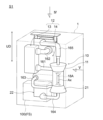
- FIG. 1 is a perspective view of a cooling system according to a first embodiment
- FIG. 2 is a diagram showing a case provided in the cooling system according to the first embodiment.
- FIG. 2 is a diagram showing a piping configuration of the cooling system according to the first embodiment.
- 4 is a view of the cooling system according to the first embodiment as seen in the direction of the arrow IV shown in FIGS. 1 and 2 .
- FIG. 3 is a view of the cooling system according to the first embodiment as seen in the direction of the arrow V shown in FIGS. 1 and 2 .
- FIG. FIG. 11 is a perspective view of a cooling system according to a second embodiment.
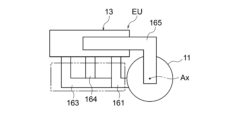
- 7 is a view of a cooling system according to a second embodiment as viewed in the direction of an arrow VII shown in FIG. 6 .
- FIG. 8 is a view of the cooling system according to the second embodiment as seen in the direction of the arrow VIII shown in FIG. 6 .
- FIG. 13 is a perspective view of a cooling system according to a third embodiment.
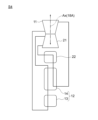
- FIG. 13 is a diagram illustrating a cooling system according to a fourth embodiment.
- FIG. 13 is a diagram illustrating a cooling system according to a fifth embodiment.
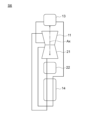
- FIG. 13 is a diagram illustrating a cooling system according to a sixth embodiment.
- First Embodiment 1 is a perspective view of a cooling system S1 according to a first embodiment.
- the configuration of the cooling system S1 according to the first embodiment will be described below.
- the cooling system S1 includes a refrigeration device 10 and a fluid flow device 100.
- the refrigeration device 10 and the fluid flow device 100 are connected to each other.
- the refrigeration device 10 cools the fluid as a temperature control target that is passed through the fluid flow device 100.
- the fluid flow device 100 passes the fluid cooled by the refrigeration device 10 to the secondary temperature control target Tr. This allows the temperature of the secondary temperature control target Tr to be controlled by the fluid passed through the fluid flow device 100.
- the fluid that has been temperature-controlled for the secondary temperature-controlled object Tr returns to the fluid flow device 100 and is cooled again by the refrigeration device 10.
- the secondary temperature-controlled object Tr is not particularly limited, and may be, for example, a wafer that is an intermediate part of a semiconductor, or a stage that holds the wafer.
- the secondary temperature-controlled object Tr may also be a mold, the space of a refrigerator/freezer, etc.
- FIG. 2 shows the case 1 provided in the cooling system S1 by a two-dot chain line.
- the components of the refrigeration device 10 and the fluid flow device 100 can be compactly housed within the rectangular parallelepiped case 1. It should be noted that the case 1 does not necessarily have to be provided.
- the refrigeration device 10 and the fluid flow device 100 will be described in detail below.
- the refrigeration device 10 is a reverse Brayton refrigeration cycle device that circulates a natural refrigerant.
- the refrigeration device 10 circulates nitrogen as a natural refrigerant, for example.
- the refrigeration device 10 may be configured to circulate air, helium, or the like.
- FIG. 3 is a diagram showing the piping configuration of the cooling system S1.
- the refrigeration device 10 includes a compressor 11, a compressor downstream heat exchanger 12, an expander 21, and an expander downstream heat exchanger 22.
- the natural refrigerant flowing out of the compressor 11 passes through the compressor downstream heat exchanger 12, the expander 21, and the expander downstream heat exchanger 22 in that order, and then circulates to the compressor 11.
- the compressor 11, the compressor downstream heat exchanger 12, the expander 21, and the expander downstream heat exchanger 22 are connected by a refrigerant circulation path 16 (see FIG. 3).
- the compressor downstream heat exchanger 12 is a heat exchanger for cooling the natural refrigerant flowing out from the compressor 11.
- the expander downstream heat exchanger 22 is a heat exchanger for exchanging heat between the natural refrigerant flowing out from the expander 21 and the fluid passed by the fluid flow device 100, which is the object of temperature control.
- the compressor downstream heat exchanger 12 includes an external heat exchanger 13 that cools the natural refrigerant flowing out of the compressor 11 with a heat medium different from the natural refrigerant, and an internal heat exchanger 14 that cools the natural refrigerant flowing out of the compressor 11 with the natural refrigerant received from the expander downstream heat exchanger 22.
- the natural refrigerant flowing out of the compressor 11 passes through the external heat exchanger 13 and the internal heat exchanger 14 in that order. Therefore, in detail, the internal heat exchanger 14 cools the natural refrigerant that flows in from the external heat exchanger 13 after passing from the compressor 11 through the external heat exchanger 13 with the natural refrigerant received from the expander downstream heat exchanger 22.
- the compressor 11 compresses the natural refrigerant flowing in from the expander downstream heat exchanger 22 and then sends it to the external heat exchanger 13.
- the natural refrigerant is then cooled stepwise in the external heat exchanger 13 and the internal heat exchanger 14, and then flows into the expander 21, which sends the natural refrigerant to the expander downstream heat exchanger 22.
- the external heat exchanger 13 is connected to the cooling heat medium flow path 30 and receives the cooling heat medium from the cooling heat medium flow path 30.
- the external heat exchanger 13 then exchanges heat between the high-temperature natural refrigerant flowing out from the compressor 11 and the cooling heat medium, cooling the natural refrigerant.
- the cooling heat medium is not particularly limited and may be water or brine.
- the external heat exchanger 13 may also be an air-cooled heat exchanger.
- the internal heat exchanger 14 cools the natural refrigerant that flows in from the external heat exchanger 13 after passing from the compressor 11 with the natural refrigerant received from the expander downstream heat exchanger 22, and then sends it to the expander 21.
- the expander 21 expands the natural refrigerant from the internal heat exchanger 14, and then sends it to the expander downstream heat exchanger 22.
- the expander downstream heat exchanger 22 is connected to the fluid flow device 100 as shown in FIG. 3, and cools the fluid that the fluid flow device 100 passes through, and then causes it to flow out to the compressor 11.
- the natural refrigerant flowing from the expander downstream heat exchanger 22 to the compressor 11 passes through the internal heat exchanger 14 and then flows into the compressor 11.
- the internal heat exchanger 14 cools the natural refrigerant flowing in from the external heat exchanger 13 with the natural refrigerant received from the expander downstream heat exchanger 22.
- the natural refrigerant before flowing from the compressor 11 to the expander 21 is cooled in stages by the external heat exchanger 13 and the internal heat exchanger 14 as described above.
- the refrigeration system 10 is capable of lowering the temperature of the nitrogen expanded by the expander 21 to a range of, for example, -60°C to -180°C and flowing it into the expander downstream heat exchanger 22. Because the refrigeration system 10 can lower the temperature of the natural refrigerant to such an extremely low temperature range, the natural refrigerant can generally maintain a high refrigeration capacity even after heat exchange with a fluid in the expander downstream heat exchanger 22. Therefore, in this embodiment, the natural refrigerant flowing out of the expander downstream heat exchanger 22 is used to cool the natural refrigerant flowing out of the compressor 11 in the internal heat exchanger 14, thereby improving efficiency. However, the internal heat exchanger 14 does not necessarily have to be provided.
- the compressor 11 and the expander 21 are connected by the drive shaft 18A of a common motor 18 (see FIG. 3). This causes the compressor 11 and the expander 21 to rotate in unison with each other as the drive shaft 18A rotates.
- the compressor 11 is connected to the drive shaft 18A at one end of the drive shaft 18A
- the expander 21 is connected to the drive shaft 18A at the other end of the drive shaft 18A.
- the symbol UD in FIG. 1 indicates the up-down direction.
- the up-down direction UD means the vertical direction.
- the symbol Ax indicates the axial direction of the drive shaft 18A, which is the direction passing through the center of the drive shaft 18A.
- the axial direction Ax of the drive shaft 18A extends along the up-down direction UD.
- the compressor 11 and the expander 21 are aligned in the up-down direction UD.
- the compressor 11 is disposed above the expander 21, but the compressor 11 may be disposed below the expander 21.
- the axial direction Ax does not have to extend along the up-down direction UD, and for example, the compressor 11 and the expander 21 may be disposed so that the axial direction Ax is aligned along the horizontal direction.
- the compressor downstream heat exchanger 12 and the expander downstream heat exchanger 22 are arranged so as to be aligned in a direction parallel to the axial direction Ax. More specifically, in this embodiment, the internal heat exchanger 14 and the expander downstream heat exchanger 22 in the compressor downstream heat exchanger 12 are aligned in a direction parallel to the axial direction Ax, and aligned in the up-down direction UD.
- the internal heat exchanger 14 is then arranged above the expander downstream heat exchanger 22. That is, the expander downstream heat exchanger 22 and the internal heat exchanger 14 are aligned in this order along the direction from the expander 21 to the compressor 11 in the axial direction Ax (from bottom to top).
- the internal heat exchanger 14 has a heat exchange section 14A that enables heat exchange between fluids (natural refrigerants) flowing through separate flow paths, and a housing 14B that houses the heat exchange section 14A.
- the expander downstream heat exchanger 22 has a heat exchange section 22A that enables heat exchange between fluids (natural refrigerants, fluids of the fluid flow device 100) flowing through separate flow paths, and a housing 22B that houses the heat exchange section 22A.
- the housing 14B of the internal heat exchanger 14 and the housing 22B of the expander downstream heat exchanger 22 are integrated.
- the internal heat exchanger 14 and the expander downstream heat exchanger 22 are integrated, which improves handling and reduces the number and length of piping.
- the housing 14B of the internal heat exchanger 14 and the housing 22B of the expander downstream heat exchanger 22 may be formed by a common housing.
- the housing 14B of the internal heat exchanger 14 and the housing 22B of the expander downstream heat exchanger 22 may be integrated in a detachable manner using fastening members such as bolts, or may be integrated by welding or the like.
- the internal heat exchanger 14 and the expander downstream heat exchanger 22 may be separate.
- FIG. 4 is an arrow view of the cooling system S1 when viewed in the direction of the arrow IV shown in FIG. 1 and FIG. 2.
- FIG. 5 is an arrow view of the cooling system S1 when viewed in the direction of the arrow V shown in FIG. 1 and FIG. 2.
- at least a part of the range A1 occupied by the expander 21, the drive shaft 18A, and the compressor 11 in the axial direction Ax overlaps with at least a part of the range A2 occupied by the expander downstream heat exchanger 22 and the internal heat exchanger 14 in a direction parallel to the axial direction Ax in the radial direction DD1 of the drive shaft 18A perpendicular to the axial direction Ax.
- the entire range A1 overlaps with the range A2 in the radial direction DD1.
- the compressor 11, the drive shaft 18A, and the expander 21 are disposed between both ends of the range A2 in the axial direction Ax.
- the dimensions in the axial direction Ax can be effectively suppressed in the cooling system S1.
- the external heat exchanger 13 is arranged so as to overlap (in other words, be adjacent to) the internal heat exchanger 14 in a direction (see radial direction DD2 in FIG. 4) perpendicular to the direction in which the internal heat exchanger 14 and the expander downstream heat exchanger 22 are adjacent to each other (i.e., a direction parallel to the axial direction Ax).
- the external heat exchanger 13 is arranged between both ends in the axial direction Ax of the range A2 occupied by the expander downstream heat exchanger 22 and the internal heat exchanger 14 in the axial direction Ax, as shown in FIG. 5.
- the external heat exchanger 13 has a heat exchange section 13A that enables heat exchange between fluids (natural refrigerant and cooling heat medium) flowing through separate flow paths, and a housing 13B that houses the heat exchange section 13A.
- the housing 13B of the external heat exchanger 13 is rectangular parallelepiped-shaped.
- the housing 14B of the integrated internal heat exchanger 14 and the housing 22B of the expander downstream heat exchanger 22 are also rectangular parallelepiped-shaped as a whole.
- one face 51 of the six faces of the housing 13B of the external heat exchanger 13 and one face 52 of the six faces of the housing 14B of the integrated internal heat exchanger 14 and the housing 22B of the expander downstream heat exchanger 22 each extend parallel to the axial direction Ax and face each other horizontally.
- the reference character C1 indicates the midpoint of the horizontal cross section of the housing 13B of the external heat exchanger 13
- the reference character C2 indicates the midpoint of the horizontal cross section of the housing 14B of the integrated internal heat exchanger 14 and the housing 22B of the expander downstream heat exchanger 22.
- the radial direction DD1 in which the external heat exchanger 13 and the range A2 occupied by the expander downstream heat exchanger 22 and the internal heat exchanger 14 overlap corresponds to the radial direction passing through the center of the drive shaft 18A and the midpoint C1 of the housing 13B of the external heat exchanger 13 in the radial direction of the drive shaft 18A.
- the radial direction DD2 in which the external heat exchanger 13 and the internal heat exchanger 14 overlap corresponds to the radial direction passing through the center of the drive shaft 18A and the midpoint C2 of the housing 13B of the external heat exchanger 13 in the radial direction of the drive shaft 18A.
- the angle ⁇ between the radial direction DD1 and the radial direction DD2 is 45 degrees or less.
- the angle ⁇ may be 60 degrees or less, and is preferably 30 degrees or more and 45 degrees or less.
- the external heat exchanger 13 is disposed away from the integral body of the expander 21, drive shaft 18A, and compressor 11 in the radial direction DD2, leaving an installation space PS.
- piping that mainly connects the external heat exchanger 13 and the compressor 11 is disposed.
- the external heat exchanger 13 is disposed on the compressor 11 side, i.e., above, the midpoint in the axial direction Ax of the expander 21, drive shaft 18A, and compressor 11.
- a flow path arrangement space FS is formed below the external heat exchanger 13, where the fluid flow device 100 is planned to be installed (see FIG. 2).
- the control box 40 houses a controller and the like that controls the refrigeration device 10, such as adjusting the rotation speed of the drive shaft 18A, and the fluid flow device 100, such as controlling the flow rate of the fluid.
- the control box 40 when an imaginary line is drawn in the radial direction DD2 that passes through the center of the drive shaft 18A and the midpoint C2 of the housing 13B of the external heat exchanger 13 and the refrigeration device 10 is viewed from above, the control box 40 is located on one side of the line, and the external heat exchanger 13 is located on the other side. This allows the components of the cooling system S1 to be housed therein.
- the refrigerant circulation path 16 connects the compressor 11, the compressor downstream heat exchanger 12, the expander 21, and the expander downstream heat exchanger 22.
- the refrigerant circulation path 16 includes a first pipe 161 connecting the compressor 11 and the external heat exchanger 13, a second pipe 162 connecting the external heat exchanger 13 and the internal heat exchanger 14, a third pipe 163 connecting the internal heat exchanger 14 and the expander 21, a fourth pipe 164 connecting the expander 21 and the expander downstream heat exchanger 22, and a fifth pipe 165 connecting the internal heat exchanger 14 and the compressor 11.
- the first pipe 161 receives the high-temperature natural refrigerant flowing out of the compressor 11 and sends it to the external heat exchanger 13.
- the natural refrigerant outlet of the compressor 11 and the natural refrigerant inlet of the external heat exchanger 13 are at the same height in the vertical direction UD, as an example.
- the first pipe 161 can connect the compressor 11 and the external heat exchanger 13 while minimizing the pipe length and number of bends. This can suppress pressure loss in the first pipe 161.
- the second pipe 162 receives the cooled natural refrigerant flowing out of the external heat exchanger 13 and sends it to the internal heat exchanger 14.
- the natural refrigerant outlet of the external heat exchanger 13 and the compressed refrigerant inlet of the internal heat exchanger 14 are at the same height in the vertical direction UD.
- the second pipe 162 can connect the external heat exchanger 13 and the internal heat exchanger 14 while minimizing the pipe length and number of bends. This can suppress pressure loss in the second pipe 162.
- the natural refrigerant inlet and the natural refrigerant outlet of the external heat exchanger 13 described above are opened on the surface of the housing 13B facing the compressor 11.
- the first pipe 161 and the second pipe 162 are arranged in the installation space PS shown in FIG. 4. This allows the first pipe 161 and the second pipe 162 to be arranged compactly.
- the natural refrigerant that flows from the external heat exchanger 13 into the internal heat exchanger 14 flows from top to bottom within the internal heat exchanger 14 and is cooled as it flows.
- the natural refrigerant cooled in the internal heat exchanger 14 then flows out from a compressed refrigerant outlet located below the compressed refrigerant inlet described above.
- the third pipe 163 receives the natural refrigerant that flows out from the compressed refrigerant outlet of the internal heat exchanger 14 and sends it to the expander 21.
- the compressed refrigerant inlet and compressed refrigerant outlet of the natural refrigerant in the internal heat exchanger 14 are formed on the surface 52 of the housing 14B that faces the external heat exchanger 13.
- the fourth pipe 164 receives the natural refrigerant flowing out from the expander 21 and sends it to the expander downstream heat exchanger 22.
- the expander downstream heat exchanger 22 receives the natural refrigerant flowing out from the expander 21 at the expanded refrigerant inlet.
- the expanded refrigerant inlet is located lower than the compressed refrigerant outlet.
- the natural refrigerant that flows into the expander downstream heat exchanger 22 flows from the bottom to the top, and at that time, the natural refrigerant exchanges heat with the fluid passed by the fluid flow device 100.
- the natural refrigerant that flows out from the expander downstream heat exchanger 22 after heat exchange with the fluid flows into the internal heat exchanger 14 and flows from the bottom to the top. At this time, heat exchange is performed between the natural refrigerant that flows out from the expander downstream heat exchanger 22 and flows from the bottom to the top, and the natural refrigerant that flows out from the external heat exchanger 13 and flows from the top to the bottom.
- the natural refrigerant that flows from the expander downstream heat exchanger 22 into the internal heat exchanger 14 flows out from the expanded refrigerant outlet of the internal heat exchanger 14.
- the expanded refrigerant outlet is provided above the compressed refrigerant inlet described above.
- the fifth pipe 165 receives the natural refrigerant that flows out from the expanded refrigerant outlet and sends it to the compressor 11.
- the natural refrigerant that flows into the compressor 11 is compressed by the compressor 11, and then flows again into the external heat exchanger 13 via the first pipe 161.
- a flow path arrangement space FS is formed below the external heat exchanger 13.
- the fluid flow device 100 is arranged so that at least a portion of it is located in the flow path arrangement space FS, as shown in Fig. 1.
- the fluid flow device 100 is arranged so that at least a portion of it overlaps with the external heat exchanger 13 in the axial direction Ax.
- the fluid flow device 100 includes an upstream flow path 101U connected to the fluid inlet 22i of the expander downstream heat exchanger 22, a downstream flow path 101D connected to the fluid outlet 22e of the expander downstream heat exchanger 22, a heater 102, a pump 103, and a three-way valve 104 provided on the upstream flow path 101U, and a bypass flow path 105 connecting the upstream flow path 101U and the downstream flow path 101D.
- the fluid flow device 100 flows the fluid cooled by the refrigeration device 10 (expander downstream heat exchanger 22) to the secondary temperature control target Tr.
- the fluid that has controlled the temperature of the secondary temperature control target Tr returns to the fluid flow device 100 and is cooled again by the refrigeration device 10.
- the fluid that is flowed by the fluid flow device 100 is a liquid, specifically, brine.
- the fluid that is flowed by the fluid flow device 100 is not particularly limited and may be a gas.
- the pump 103 generates a driving force for flowing the fluid.
- the upstream flow path 101U receives the fluid returning from the secondary temperature control target Tr via its upstream end.
- the fluid is heated by the heater 102 as necessary, and then flows into the pump 103.
- the fluid flowing out of the pump 103 passes through two ports in a three-way valve 104 that forms part of the upstream flow path 101U, and flows into the expander downstream heat exchanger 22 from the fluid inlet 22i that is connected to the downstream end of the upstream flow path 101U.
- the fluid that flows into the expander downstream heat exchanger 22 is cooled by the natural refrigerant and then flows out from the fluid outlet 22e.
- the fluid that flows out from the fluid outlet 22e flows through the downstream flow path 101D, reaches the secondary temperature control object Tr, and controls the temperature of the secondary temperature control object Tr.
- the bypass flow path 105 extends to the downstream flow path 101D from another port different from the two ports of the three-way valve 104 that form part of the upstream flow path 101U.
- a portion of the fluid flow device 100 is disposed in the flow path arrangement space FS below the external heat exchanger 13. This prevents the space below the external heat exchanger 13 from being a dead space, and instead uses it as an arrangement space for the fluid flow device 100, thereby reducing the overall size.
- a piping section extending in a direction parallel to the axial direction Ax is formed, and such piping section extending in a direction parallel to the axial direction Ax is arranged close to the compressor 11 and the expander 21, thereby suppressing an increase in the radial occupation area of the fluid flow device 100.
- an inverted U-shaped piping section is formed with the bottom facing upward in the vertical direction UD, and a heater 102 is provided as a fluid processing component in the linear portion extending in the vertical direction UD of the inverted U-shape.
- the heater 102 has a cylindrical appearance, and is arranged so that its longitudinal direction is parallel to the axial direction Ax (vertical direction UD). In addition, by forming an inverted U-shaped piping section, the flow of fluid containing air bubbles is suppressed, and the stability of temperature control can be improved. In addition to or instead of the heater 102, fluid processing components such as a tank, a pump, and a filter having a longitudinal direction may be arranged, in which case a compact layout of the components can be realized.
- the compressor 11 and the expander 21 are driven.
- the compressor 11 compresses the natural refrigerant and then sends it to the external heat exchanger 13.
- the natural refrigerant that flows into the external heat exchanger 13 is cooled by a cooling heat medium, then flows into the internal heat exchanger 14, where it is further cooled.
- the natural refrigerant that flows out of the internal heat exchanger 14 then flows into the expander 21.
- the expander 21 expands the natural refrigerant to lower its temperature.
- the natural refrigerant that flows out of the expander 21 then flows into the expander downstream heat exchanger 22, where it exchanges heat with the fluid that is being passed by the fluid flow device 100, thereby cooling the fluid.
- the refrigeration system 10 circulates nitrogen as a natural refrigerant, and achieves low-temperature cooling in the heat exchanger 22 downstream of the expander through a reverse Brayton cycle.
- Nitrogen has a GWP of 0 and is non-flammable, so environmental impact can be reduced and safety can be ensured. Even when helium is used as a natural refrigerant, safety can be ensured by ensuring non-flammability. On the other hand, air, etc., supports combustion but is not flammable, so suitable safety can be ensured.
- the internal heat exchanger 14 and the expander downstream heat exchanger 22 in the compressor downstream heat exchanger 12 are arranged in a direction parallel to the axial direction Ax of the compressor 11 and the expander 21.
- the internal heat exchanger 14 and the expander downstream heat exchanger 22 close to the compressor 11 and the expander 21 in the radial direction of the common drive shaft 18A of the compressor 11 and the expander 21, it is possible to reduce the area occupied by the internal heat exchanger 14 and the expander downstream heat exchanger 22 in the radial direction of the drive shaft 18A.
- the drive shaft 18A is vertically disposed so as to extend in the vertical direction, and the horizontal dimension of the refrigeration device 10 is reduced, making it possible to reduce the footprint.
- the cooling system S1 according to the first embodiment can reduce its size while reducing the environmental impact and ensuring safety.
- the expander downstream heat exchanger 22 and the internal heat exchanger 14 are arranged in this order along the axial direction Ax of the drive shaft 18A in the direction from the expander 21 to the compressor 11. This makes it possible to reduce the piping length between the expander 21 and the expander downstream heat exchanger 22 (the piping length of the fourth piping 164).
- At least a part of the range A1 occupied by the compressor 11, the drive shaft 18A, and the expander 21 overlaps with at least a part of the range A2 occupied by the expander downstream heat exchanger 22 and the internal heat exchanger 14 in the radial direction of the drive shaft 18A.
- the compressor 11, the drive shaft 18A, and the expander 21 overlap with the expander downstream heat exchanger 22 and the internal heat exchanger 14 in the radial direction, thereby suppressing the dimension of the refrigeration device 10 in the axial direction Ax.
- the compressor 11, the drive shaft 18A, and the expander 21 are disposed between both ends of the range A2 occupied by the expander downstream heat exchanger 22 and the internal heat exchanger 14 in the direction parallel to the axial direction Ax.
- the compressor 11, the drive shaft 18A, and the expander 21 do not protrude in the axial direction Ax from the expander downstream heat exchanger 22 and the internal heat exchanger 14, thereby effectively suppressing the dimension of the refrigeration device 10 in the axial direction Ax.
- FIG. 6 is a perspective view of the cooling system S2 according to the second embodiment.
- FIG. 7 is a view of the cooling system S2 as viewed in the direction of the arrow VII shown in FIG. 6.
- FIG. 8 is a view of the cooling system S2 as viewed in the direction of the arrow VIII shown in FIG. 6.
- the expander downstream heat exchanger 22, the internal heat exchanger 14, and the external heat exchanger 13 are arranged in this order along the axial direction Ax of the drive shaft 18A from the expander 21 to the compressor 11 (from bottom to top). In other words, the position of the external heat exchanger 13 differs from that of the first embodiment.
- the expander downstream heat exchanger 22, the internal heat exchanger 14, and the external heat exchanger 13 are integrated together.
- the expander downstream heat exchanger 22, the internal heat exchanger 14, and the external heat exchanger 13 form a heat exchanger unit EU that integrates three heat exchangers.
- the housing 22B of the expander downstream heat exchanger 22, the housing 14B of the internal heat exchanger 14, and the housing 13B of the external heat exchanger 13 are integrated together to form a common housing CC.
- the three heat exchangers are integrated together.
- At least a part of the range A1 occupied by the expander 21, the drive shaft 18A, and the compressor 11 in the axial direction Ax overlaps with at least a part of the range A2' occupied by the expander downstream heat exchanger 22, the internal heat exchanger 14, and the external heat exchanger 13 in a direction parallel to the axial direction Ax, in the radial direction of the drive shaft 18A perpendicular to the axial direction Ax.
- the compressor 11, the drive shaft 18A, and the expander 21 are disposed between both ends of the range A2' in the direction parallel to the axial direction Ax.
- the first pipe 161 extends upward from the compressor 11 and is connected to the external heat exchanger 13.
- the first pipe 161 sends the high-temperature natural refrigerant compressed by the compressor 11 to the external heat exchanger 13, which cools the natural refrigerant with the cooling heat medium from the cooling heat medium flow path 30.
- the natural refrigerant flowing out of the external heat exchanger 13 flows downward and into the internal heat exchanger 14, and also flows downward in the internal heat exchanger 14 and flows into the third pipe 163.
- the subsequent flow of the natural refrigerant in the fourth pipe 164 and the fifth pipe 165 is the same as in the first embodiment.
- One of the two fluid outlets (natural refrigerant outlet) of the heat exchange section 13A of the external heat exchanger 13 is connected to one of the two fluid inlets (compressed natural refrigerant inlet) of the heat exchange section 14A of the internal heat exchanger 14 inside the common casing CC.
- one of the two fluid outlets (natural refrigerant outlet) of the heat exchange section 22A of the expander downstream heat exchanger 22 is connected to the other of the two fluid inlets (expanded natural refrigerant inlet) of the heat exchange section 14A of the internal heat exchanger 14 inside the common casing CC.
- the compressed natural refrigerant inlet and the expanded natural refrigerant inlet in the heat exchange section 14A of the internal heat exchanger 14 open in opposite directions to each other.
- the inlet for the compressed natural refrigerant and the inlet for the expanded natural refrigerant in the heat exchanger 14A do not have to face in opposite directions, but it is preferable that one of the inlet for the compressed natural refrigerant and the inlet for the expanded natural refrigerant opens at one end of the internal heat exchanger 14, and the other inlet opens at the other end opposite to the one end of the internal heat exchanger 14.
- This layout of the inlets can prevent the connection with other heat exchangers (external heat exchanger 13, expander downstream heat exchanger 22) from becoming complicated.
- the external heat exchanger 13 in this embodiment corresponds to the first external heat exchanger
- the expander downstream heat exchanger 22 corresponds to the second external heat exchanger
- the function of the internal heat exchanger 14, which enables the exhaust heat of the natural refrigerant flowing out of the expander downstream heat exchanger 22 to be used to control the temperature of the natural refrigerant flowing out of the external heat exchanger 13, can be realized in an easy-to-handle and compact manner.
- the area occupied by the pipes can be reduced, and further, heat loss and pressure loss can be reduced, thereby improving efficiency.
- a cooling system S3 according to a third embodiment will be described with reference to Fig. 9.
- the same components as those in the first and second embodiments are designated by the same reference numerals, and duplicated descriptions will be omitted.
- the expander downstream heat exchanger 22, the internal heat exchanger 14, and the external heat exchanger 13 are integrated.
- the expander downstream heat exchanger 22, the internal heat exchanger 14, and the external heat exchanger 13 form a heat exchanger unit EU that integrates three heat exchangers.
- the position of the external heat exchanger 13 differs from that of the second embodiment.
- the internal heat exchanger 14 and the expander downstream heat exchanger 22 are integrated so as to be adjacent to each other in a direction parallel to the axial direction Ax.
- the internal heat exchanger 14 and the external heat exchanger 13 are integrated so as to be adjacent to each other in a direction (horizontal direction) perpendicular to the direction in which the internal heat exchanger 14 and the expander downstream heat exchanger 22 are adjacent to each other.
- the state of integration of the housings and the internal flow path configuration are the same as in the second embodiment.
- the same effect as the second embodiment can be obtained.
- the internal heat exchanger 14 and the expander downstream heat exchanger 22 are integrated so as to be adjacent to each other in a direction parallel to the axial direction Ax, but the external heat exchanger 13 and the expander downstream heat exchanger 22 may be integrated so as to be adjacent to each other in a direction parallel to the axial direction Ax, and the internal heat exchanger 14 and the external heat exchanger 13 may be integrated so as to be adjacent to each other in a direction (horizontal direction) perpendicular to the direction in which the external heat exchanger 13 and the expander downstream heat exchanger 22 are adjacent to each other.
- a cooling system S4 according to a fourth embodiment will be described with reference to Fig. 10.
- the same components as those in the first to third embodiments are designated by the same reference numerals, and duplicated descriptions will be omitted.
- the expander downstream heat exchanger 22, the internal heat exchanger 14, and the external heat exchanger 13 are aligned in the axial direction Ax of the drive shaft 18A.
- the expander downstream heat exchanger 22, the internal heat exchanger 14, and the external heat exchanger 13 are aligned in this order, away from the expander 21. This type of embodiment is useful when it is important to suppress radial protrusion.
- a cooling system S5 according to a fifth embodiment will be described with reference to Fig. 11.
- the same components as those in the first to fourth embodiments are designated by the same reference numerals, and duplicated descriptions will be omitted.
- the expander downstream heat exchanger 22 and the internal heat exchanger 14 are aligned in the axial direction Ax of the drive shaft 18A. More specifically, the expander downstream heat exchanger 22 and the internal heat exchanger 14 are aligned in this order, away from the expander 21.
- the external heat exchanger 13 is arranged to face the internal heat exchanger 14 in the radial direction of the drive shaft 18A, which is perpendicular to the axial direction Ax. This embodiment also makes it possible to reduce the overall size.
- a cooling system S6 according to a sixth embodiment will be described with reference to Fig. 12.
- the same components as those in the first to fifth embodiments are designated by the same reference numerals, and duplicated descriptions will be omitted.
- the expander downstream heat exchanger 22, the internal heat exchanger 14, and the external heat exchanger 13 are aligned in the axial direction Ax of the drive shaft 18A.
- the expander downstream heat exchanger 22 and the internal heat exchanger 14 are aligned in this order, away from the expander 21.
- the external heat exchanger 13 is positioned adjacent to the compressor 11 in the axial direction Ax. This type of embodiment is also beneficial when it is important to suppress radial protrusion.
- the internal heat exchanger 14 and the expander downstream heat exchanger 22 are aligned in a direction parallel to the axial direction Ax, but the external heat exchanger 13 and the expander downstream heat exchanger 22 may be aligned in a direction parallel to the axial direction Ax, and the internal heat exchanger 14 may be positioned at a position shifted in a direction perpendicular to the direction in which the external heat exchanger 13 and the expander downstream heat exchanger 22 are aligned.
- the present invention may also be applied in a direct cooling configuration.
- the external heat exchanger 13 and the internal heat exchanger 14 may be aligned in a direction parallel to the axial direction Ax of the drive shaft 18A or on the axial direction Ax, and a refrigeration device may be configured in which the natural refrigerant flowing from the internal heat exchanger 14 into the expander 21 is expanded from the expander 21 and supplied to, for example, a chamber.
- a direct cooling type refrigeration device is also advantageous in terms of size reduction.
Landscapes
- Engineering & Computer Science (AREA)
- Physics & Mathematics (AREA)
- Mechanical Engineering (AREA)
- Thermal Sciences (AREA)
- General Engineering & Computer Science (AREA)
- Heat-Exchange Devices With Radiators And Conduit Assemblies (AREA)
Priority Applications (4)
| Application Number | Priority Date | Filing Date | Title |
|---|---|---|---|
| CN202380100320.1A CN121752856A (zh) | 2023-08-08 | 2023-08-08 | 制冷装置和冷却系统 |
| PCT/JP2023/028941 WO2025032724A1 (ja) | 2023-08-08 | 2023-08-08 | 冷凍装置及び冷却システム |
| JP2025538998A JPWO2025032724A1 (https=) | 2023-08-08 | 2023-08-08 | |
| KR1020267006948A KR20260043138A (ko) | 2023-08-08 | 2023-08-08 | 냉동 장치 및 냉각 시스템 |
Applications Claiming Priority (1)
| Application Number | Priority Date | Filing Date | Title |
|---|---|---|---|
| PCT/JP2023/028941 WO2025032724A1 (ja) | 2023-08-08 | 2023-08-08 | 冷凍装置及び冷却システム |
Publications (1)
| Publication Number | Publication Date |
|---|---|
| WO2025032724A1 true WO2025032724A1 (ja) | 2025-02-13 |
Family
ID=94534375
Family Applications (1)
| Application Number | Title | Priority Date | Filing Date |
|---|---|---|---|
| PCT/JP2023/028941 Pending WO2025032724A1 (ja) | 2023-08-08 | 2023-08-08 | 冷凍装置及び冷却システム |
Country Status (4)
| Country | Link |
|---|---|
| JP (1) | JPWO2025032724A1 (https=) |
| KR (1) | KR20260043138A (https=) |
| CN (1) | CN121752856A (https=) |
| WO (1) | WO2025032724A1 (https=) |
Citations (5)
| Publication number | Priority date | Publication date | Assignee | Title |
|---|---|---|---|---|
| JPS50128854A (https=) * | 1974-03-29 | 1975-10-11 | ||
| JP2004347180A (ja) * | 2003-05-20 | 2004-12-09 | Sharp Corp | スターリング冷凍機 |
| JP2008106987A (ja) * | 2006-10-25 | 2008-05-08 | Matsushita Electric Ind Co Ltd | 冷凍サイクル装置 |
| JP2010065986A (ja) * | 2008-09-12 | 2010-03-25 | Mitsubishi Electric Corp | 冷凍サイクル装置および空気調和装置 |
| JP2012137291A (ja) | 2012-04-18 | 2012-07-19 | Mitsubishi Heavy Ind Ltd | 冷凍機の運転方法及び製造方法 |
-
2023
- 2023-08-08 JP JP2025538998A patent/JPWO2025032724A1/ja active Pending
- 2023-08-08 CN CN202380100320.1A patent/CN121752856A/zh active Pending
- 2023-08-08 KR KR1020267006948A patent/KR20260043138A/ko active Pending
- 2023-08-08 WO PCT/JP2023/028941 patent/WO2025032724A1/ja active Pending
Patent Citations (5)
| Publication number | Priority date | Publication date | Assignee | Title |
|---|---|---|---|---|
| JPS50128854A (https=) * | 1974-03-29 | 1975-10-11 | ||
| JP2004347180A (ja) * | 2003-05-20 | 2004-12-09 | Sharp Corp | スターリング冷凍機 |
| JP2008106987A (ja) * | 2006-10-25 | 2008-05-08 | Matsushita Electric Ind Co Ltd | 冷凍サイクル装置 |
| JP2010065986A (ja) * | 2008-09-12 | 2010-03-25 | Mitsubishi Electric Corp | 冷凍サイクル装置および空気調和装置 |
| JP2012137291A (ja) | 2012-04-18 | 2012-07-19 | Mitsubishi Heavy Ind Ltd | 冷凍機の運転方法及び製造方法 |
Also Published As
| Publication number | Publication date |
|---|---|
| CN121752856A (zh) | 2026-03-27 |
| JPWO2025032724A1 (https=) | 2025-02-13 |
| KR20260043138A (ko) | 2026-03-31 |
Similar Documents
| Publication | Publication Date | Title |
|---|---|---|
| US9612062B2 (en) | Cooling system and cooling method | |
| US10401094B2 (en) | Brazed plate heat exchanger for water-cooled heat rejection in a refrigeration cycle | |
| WO2024024443A1 (ja) | マニホールド | |
| US20240093916A1 (en) | Dilution refrigeration device and method | |
| KR20080027174A (ko) | 복합 방열 장치, 냉각 유닛, 냉각 장치 및 그 조립체 | |
| WO2025032724A1 (ja) | 冷凍装置及び冷却システム | |
| WO2025185676A1 (zh) | 制冷水设备 | |
| CN116157636A (zh) | 冷却器 | |
| CN220871044U (zh) | 采暖热水系统 | |
| JP7141342B2 (ja) | 極低温流体循環式冷却システム及び極低温流体循環式冷却方法 | |
| CN219454079U (zh) | 一种分体式空气能装置及具有其的多联供系统 | |
| WO2022044168A1 (ja) | 冷凍装置 | |
| JP2017116122A (ja) | 熱交換装置 | |
| CN117570582A (zh) | 冷水机组 | |
| CN114599199B (zh) | 数据中心的制冷系统 | |
| FI4433762T3 (fi) | Laimennusjäähdytyslaite | |
| JP7065745B2 (ja) | 極低温流体循環式冷却システム | |
| JPH06272993A (ja) | エンジン駆動冷暖房装置 | |
| CN220981582U (zh) | 热泵热水系统 | |
| CN221429390U (zh) | 制冷系统及数据中心 | |
| EP4435346A1 (en) | Refrigeration system | |
| WO2019116525A1 (ja) | ヒートポンプ給湯機 | |
| JP2001165488A (ja) | 空調装置 | |
| WO2019244253A1 (ja) | 冷凍サイクル装置 | |
| WO2024185200A1 (ja) | マニホールド |
Legal Events
| Date | Code | Title | Description |
|---|---|---|---|
| 121 | Ep: the epo has been informed by wipo that ep was designated in this application |
Ref document number: 23948444 Country of ref document: EP Kind code of ref document: A1 |
|
| ENP | Entry into the national phase |
Ref document number: 2025538998 Country of ref document: JP Kind code of ref document: A |
|
| WWE | Wipo information: entry into national phase |
Ref document number: 2025538998 Country of ref document: JP |
|
| ENP | Entry into the national phase |
Ref document number: 1020267006948 Country of ref document: KR Free format text: ST27 STATUS EVENT CODE: A-0-1-A10-A15-NAP-PA0105 (AS PROVIDED BY THE NATIONAL OFFICE) |
|
| WWE | Wipo information: entry into national phase |
Ref document number: 1020267006948 Country of ref document: KR |
|
| WWE | Wipo information: entry into national phase |
Ref document number: 2023948444 Country of ref document: EP |
|
| NENP | Non-entry into the national phase |
Ref country code: DE |
|
| WWE | Wipo information: entry into national phase |
Ref document number: 11202600703T Country of ref document: SG |
|
| WWP | Wipo information: published in national office |
Ref document number: 11202600703T Country of ref document: SG Ref document number: 1020267006948 Country of ref document: KR |