WO2025027967A1 - 情報処理装置、情報処理システムおよび情報処理方法 - Google Patents
情報処理装置、情報処理システムおよび情報処理方法 Download PDFInfo
- Publication number
- WO2025027967A1 WO2025027967A1 PCT/JP2024/017189 JP2024017189W WO2025027967A1 WO 2025027967 A1 WO2025027967 A1 WO 2025027967A1 JP 2024017189 W JP2024017189 W JP 2024017189W WO 2025027967 A1 WO2025027967 A1 WO 2025027967A1
- Authority
- WO
- WIPO (PCT)
- Prior art keywords
- information
- key
- encryption
- encrypted
- item
- Prior art date
- Legal status (The legal status is an assumption and is not a legal conclusion. Google has not performed a legal analysis and makes no representation as to the accuracy of the status listed.)
- Pending
Links
Images







Classifications
-
- H—ELECTRICITY
- H04—ELECTRIC COMMUNICATION TECHNIQUE
- H04L—TRANSMISSION OF DIGITAL INFORMATION, e.g. TELEGRAPHIC COMMUNICATION
- H04L9/00—Cryptographic mechanisms or cryptographic arrangements for secret or secure communications; Network security protocols
- H04L9/14—Cryptographic mechanisms or cryptographic arrangements for secret or secure communications; Network security protocols using a plurality of keys or algorithms
-
- H—ELECTRICITY
- H04—ELECTRIC COMMUNICATION TECHNIQUE
- H04L—TRANSMISSION OF DIGITAL INFORMATION, e.g. TELEGRAPHIC COMMUNICATION
- H04L9/00—Cryptographic mechanisms or cryptographic arrangements for secret or secure communications; Network security protocols
- H04L9/30—Public key, i.e. encryption algorithm being computationally infeasible to invert or user's encryption keys not requiring secrecy
Definitions
- the disclosure of this specification relates to an information processing device.
- CFP CFP
- European battery regulations exemplified by European battery regulations.
- CFP may appear to be information only about carbon dioxide emissions, in many cases it is a trade secret, as knowing the CFP value allows other companies in the same industry to estimate the rough ingredients and processing methods used.
- the CFP value has a direct effect on purchasing behavior and may lead to price negotiations, companies are often reluctant to disclose it.
- Patent Document 1 discloses a supply chain management method for managing transaction records between multiple traders in a supply chain that includes multiple traders.
- Patent document 2 also discloses an encryption system that performs homomorphic operations on encrypted data encrypted with a user public key and can decrypt the results of the homomorphic operations using a master private key.
- Patent Document 2 simply using the normal encryption system disclosed in Patent Document 2 for supply chain information management requires the exchange of secret keys and decrypted values over a network between supervisory authorities, supply chain management organizations, and servers. Even if the security of the network itself is guaranteed, there is a possibility that malicious hackers may intercept and view decrypted values using illegally obtained secret keys, so it is necessary to further strengthen security.
- the purpose of this disclosure is to provide an information processing device, information processing system, and information processing method with enhanced security that does not involve any exchange of private keys or decrypted values over a network.
- one disclosed embodiment is an information processing device that manages item-related information regarding items handled by multiple traders that make up a supply chain, the information processing device having a database that stores multiple sets of private keys based on homomorphic encryption and public keys corresponding to the private keys, each of which is linked to a key name, an encryption information acquisition unit that acquires, from a trader terminal of a trader, encryption information obtained by encrypting the item-related information using a public key and the key name of the public key used to encrypt the item-related information, a key acquisition unit that acquires, from the database, a private key corresponding to the key name, a decryption information acquisition unit that acquires decrypted information by decrypting the encryption information using the private key, an encryption processing unit that encrypts the decrypted information to acquire re-encrypted information, and a provision unit that provides the re-encrypted information encrypted by the encryption processing unit to the trader terminal.
- Another disclosed aspect is an information processing system that includes the above-mentioned information processing device and a trader terminal of a trader.
- Another disclosed aspect is an information processing method for managing item-related information regarding items handled by multiple traders constituting a supply chain, the information processing method comprising the steps of: linking multiple sets of private keys based on homomorphic encryption and public keys corresponding to the private keys with key names and recording them in a database; acquiring, from the trader terminal of the trader, encrypted information obtained by encrypting the item-related information using a public key and the key name of the public key used to encrypt the item-related information; acquiring a private key corresponding to the key name from the database; acquiring decrypted information by decrypting the encrypted information using the private key; encrypting the decrypted information to acquire re-encrypted information; and providing the re-encrypted information to the trader terminal.
- the cryptographic information encrypted using the public key and the name of the key used for the encryption are obtained from the trader terminal, the private key is searched for from the obtained key name to decrypt the cryptographic information, and re-encrypted information based on the decrypted information is provided to the trader terminal.
- the private key within the information processing device, there is no need to distribute the private key. Therefore, even if the security of the network itself is guaranteed, it is possible to prevent a malicious hacker from intercepting the information and viewing the value decrypted with an illegally obtained private key, thereby improving security.
- the information sent from the information processing device to the trader terminal is encrypted, even if a hacker intercepts the information, the actual value will not be known, improving security.
- FIG. 1 is a diagram illustrating an example of a supply chain according to an embodiment of the present disclosure
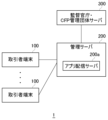
- FIG. 2 is a diagram showing an overall view of a supply chain management system.
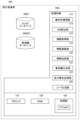
- FIG. 3 is a block diagram showing the configuration of a trader terminal;
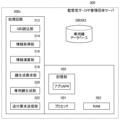
- FIG. 4 is a block diagram showing a configuration of a management server;
- FIG. 5 is a block diagram showing the configuration of the supervisory authority/CFP management organization server;
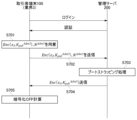
- FIG. 6 is a flowchart showing the details of four arithmetic operations on numbers encrypted with different public keys;
- FIG. 7 is a flowchart showing the details of the bootstrapping process.
- FIG. 1 is a diagram illustrating an example of a supply chain according to an embodiment of the present disclosure
- FIG. 2 is a diagram showing an overall view of a supply chain management system.
- FIG. 3 is a block diagram showing the configuration of a trader terminal
- FIG. 4 is a block diagram showing a configuration of a management server
- FIG. 5 is a
- FIG. 8 is a flowchart showing details of a data disclosure request.
- FIG. 9 is a flow chart showing the details of the generation of private and public keys;
- FIG. 10 is a flow chart showing the details of the distribution of key names;
- FIG. 11 is a flowchart showing details of a CFP calculation using homomorphic encryption in an addition/integration process when there is no pre-process;
- FIG. 12 is a flowchart showing details of a CFP calculation using homomorphic encryption in an addition/integration process when a pre-process is included;
- FIG. 13 is a flowchart showing details of a CFP calculation using homomorphic encryption during a branching step;
- FIG. 14 is a flowchart showing the details of a CFP calculation using homomorphic encryption when the public keys in the previous step are different.
- FIG. 15 is a flowchart showing details of a CFP calculation using homomorphic encryption when the number of multiplications and divisions reaches an upper limit
- FIG. 16 is a flowchart showing the details of a CFP calculation using homomorphic encryption when it is desired to clear the number of multiplication and division calculations.
- FIG. 17 is a flowchart showing the details of the process when a request for disclosure of the CFP value is received from a supervisory agency or a CFP management organization.
- FIG. 18 is a flowchart showing details of the process when a request for disclosure of a CFP value is made from an entity other than a supervisory authority or a CFP management entity.
- FIG. 1 is a diagram showing an example of a supply chain in an embodiment of the present disclosure.
- the supply chain SC shown in FIG. 1 is a connection between traders for delivering industrial products, agricultural products, marine products, etc. to end users.
- the supply chain SC is built by a large number of traders (see companies A to F in FIG. 1).
- the final products supplied by the supply chain SC may be various items such as automobiles, batteries, semiconductors, fresh food, marine products, food, flowers, pharmaceuticals, and chemicals.
- Company C purchases product A from Company A and product B from Company B, and manufactures final product C.
- Company C delivers product C to the consumer user, who sells product C to Company D as a recycled item.
- Company D repairs product C and manufactures product D, and delivers a portion of product D to Company E and Company F, which then manufacture products E and F, respectively.
- FIG. 2 is a diagram showing an overall view of the supply chain management system 1.
- the supply chain management system 1 manages transaction records of items traded between traders in the supply chain SC as information linked to each trader.
- the transaction records are historical information that realizes the traceability (hereinafter sometimes referred to as traceability) of items traded between traders, and contain a large amount of information indicating the time and place where the transaction occurred, etc.
- the supply chain management system 1 In addition to transaction records, the supply chain management system 1 also manages item-related information related to the items that are the subject of transactions. For example, information related to raw materials, information related to processing and assembly, and information related to distribution are managed as item-related information. Furthermore, the supply chain management system 1 collects and accumulates information related to the amount of greenhouse gas emissions (hereinafter referred to as carbon footprint) (CFP) emitted during each process of the manufacture and distribution of the item as part of the item-related information.
- CFP greenhouse gas emissions
- the supply chain management system 1 can obtain the CFP value of each trader and present it to users, supervisory authorities, CFP management organizations, etc.
- the CFP may include the amount of carbon released in processes such as mining and recycling the raw materials of the item, as well as the amount of carbon released in processes related to the disposal of the item, such as incineration and landfilling.
- the greenhouse gas emissions recorded may be carbon dioxide only, or may include greenhouse gases other than carbon dioxide, specifically methane, nitrous oxide, hydrofluorocarbons, perfluorocarbons, sulfur hexafluoride, etc., as appropriate. In this case, the emissions of greenhouse gases other than carbon dioxide are converted into carbon dioxide emissions and included in the presented carbon footprint value.
- the CFP value is often a trade secret for each trader TR. This is because the raw materials and processing method can be roughly inferred from the CFP value. For this reason, many companies do not want to disclose their CFP values to other traders and consumers. In light of this, the supply chain management system 1 performs secret calculations on the network without any exchange of private keys or numerical values obtained by decrypting each trader's CFP value. Details of the supply chain management system 1 are explained below with reference to Figures 2 to 5.
- the supply chain management system 1 is composed of a number of trader terminals 100, a management server 200, an application distribution server 200a, and a supervisory agency/CFP management organization server 300. Each element that composes the supply chain management system 1 is connected to a network as a node and can communicate with each other.
- FIG. 3 is a block diagram showing the configuration of the trader terminal 100.
- the trader terminal 100 is an information processing device operated by each trader. For example, a smartphone, a tablet terminal, a personal computer, etc. can be used as the trader terminal 100.
- the trader terminal 100 is linked to each of the companies A to F (see FIG. 1).
- the trader terminal 100 is used by each trader to collect and accumulate transaction records and item-related information.
- the trader terminal 100 records delivery information such as from which trader raw materials or parts are purchased and when they were acquired, and shipping information such as to which trader and when they were shipped. Furthermore, the trader terminal 100 records at least information related to costs and CFP values, etc. as item-related information.
- the trader terminal 100 is mainly composed of a processing circuit 100c.
- the processing circuit 100c includes a processor 101, a RAM (Random Access Memory) 102, a storage unit 103, an input/output interface, and a bus connecting these, and functions as a computer that performs arithmetic processing.
- the processor 101 is hardware for arithmetic processing that is combined with the RAM 102.
- the storage unit 103 stores an application program (information management application APT) for causing the processing circuit 100c to execute the information processing method according to the present disclosure.
- a display, a code reader (or a camera), a printer, etc. are electrically connected to the input/output interface.
- the display, code reader, and printer may be integral with the trader terminal 100, or may be electrically connected to the trader terminal 100 by wire or wirelessly.
- the trader terminal 100 has functional units such as a key name management unit 112, a UID reading unit 114, an information acquisition unit 116, an information calculation unit 118, an information transmission unit 120, a dedicated key generation unit 122, a delivery request transmission unit 124, and a code generation unit 126, by the processor 101 executing the information management application APT stored in the memory unit 103.
- the key name management unit 112 manages the key names of the set of private and public keys based on homomorphic encryption.
- the set of private and public keys is not managed, but only the key names are managed.
- the private and public keys are used to encrypt and decrypt item-related information equivalent to a trade secret.
- Homomorphic encryption is an encryption method that allows data to be processed in its encrypted form without decrypting the encrypted data.
- fully homomorphic encryption such as FHE (Fully Homomorphic Encryption) is used.
- Fully homomorphic encryption enables addition, subtraction, multiplication, and division while the data is encrypted.
- multiplicative homomorphic encryption such as RSA encryption and EIGamal encryption
- additive homomorphic encryption such as Goldwasser-Micali encryption and Paillier encryption can be used depending on the processing content of the secret calculation described later.
- the UID reading unit 114 is a code reader that reads one-dimensional or two-dimensional codes (e.g., QR Code (registered trademark)) attached to items.
- the code records a unique identification ID (hereinafter, UID) that is generated from the transaction record and item-related information.
- the information acquisition unit 116 uses the UID read by the UID reading unit 114 as an argument to request information including the item's transaction record, item-related information, and key name (hereinafter, traceability information) from the management server 200.
- the information acquisition unit 116 acquires the traceability information corresponding to the read UID from the management server 200.
- the item-related information includes information related to the treatment (e.g., processing, assembly, transportation, storage, etc.) performed by the trader on the item, as well as information related to the CFP value described above.
- the information acquisition unit 116 stores the traceability information in the traceability database DBT1, linked to each UID of the item.
- the information acquisition unit 116 uses the UID as a search key to extract the traceability information corresponding to the UID from the data stored in the traceability database DBT1.
- the traceability database DBT1 may be a local storage device installed at the trader's base, or may be storage on the cloud.
- the information calculation unit 118 performs various calculations related to the traceability information. The specific processing of the information calculation unit 118 will be described later.
- the information transmission unit 120 transmits the traceability information collected by the trader terminal 100 to the management server 200.
- the information transmission unit 120 transmits the traceability information to the management server 200, linking it to the UID generated by the code generation unit 126.
- the dedicated key generation unit 122 generates a set of private and public keys dedicated to the trader who handles the trader terminal 100.
- the set of private and public keys dedicated to the trader is not included in the key database DBK of the management server 200.
- the generated set of private and public keys dedicated to the trader is recorded in the dedicated key database DBSK1.
- the delivery request sending unit 124 sends various delivery requests to the management server 200.
- the code generation unit 126 is connected to a printer.
- the code generation unit 126 causes the printer to output a label on which a two-dimensional code or the like is printed.
- the label is attached to the shipped item and distributed to the trader in the next process together with the shipped item.
- the two-dimensional code may be laser engraved or printed directly on the item. In this case, a laser marker, inkjet printer, or the like can be used as an output device instead of a printer.
- ⁇ Management Server 200> 4 is a block diagram showing the configuration of the management server 200.
- the management server 200 and the application distribution server 200a are server devices operated by an administrator of the supply chain SC.
- the administrator is, for example, an agent entrusted with management work by a provider (finished product manufacturer) of the final product supplied by the supply chain SC.
- the administrator may be an agent entrusted with management and audit work by a supervisory agency having supervisory authority over the category to which the final product belongs.
- the management server 200 and the application distribution server 200a may be an on-premise configuration physically managed by an administrator or a system supplier, or may be a virtual server configuration provided on the cloud.
- the management server 200 is an information processing device mainly composed of a processing circuit 200c.
- the processing circuit 200c includes a processor 201, a RAM 202, a storage unit 203, an input/output interface, and a bus connecting these, and functions as a computer that performs arithmetic processing.
- the processor 201 is hardware for arithmetic processing that is combined with the RAM 202, and executes programs stored in the storage unit 203.
- the management server 200 is an information processing device on the administrator's side that manages item-related information on items handled by multiple traders constituting the supply chain SC.
- the storage unit 203 stores an application program (information management application APS) for causing the processing circuit 200c to execute the information processing method according to the present disclosure.
- the management server 200 has functional units such as an information transmission unit 212, an encryption information acquisition unit 214, a key acquisition unit 216, a decryption information acquisition unit 218, an encryption processing unit 229, a provision unit 222, a public key change unit 224, a key generation unit 226, and a key name disclosure unit 228, through the execution of the information management application APS by the processor 201.
- the management server 200 has a key database DBK that stores multiple sets of private keys based on homomorphic encryption and public keys corresponding to the private keys, each set associated with a key name.
- the information transmission unit 212 extracts the traceability information requested by the trader terminal 100 from the traceability database DBT2 and transmits it to the trader terminal 100.
- the encryption information acquisition unit 214 acquires, from the trader terminal 100, encryption information obtained by encrypting item-related information using a public key, and the key name of the public key used to encrypt the item-related information.
- the encryption information acquisition unit 214 also functions as an information acquisition unit that acquires traceability information from the trader terminal 100.
- the traceability information acquired by the encryption information acquisition unit 214 is recorded in the traceability database DBT2 in association with the UID.
- the key acquisition unit 216 acquires the private key corresponding to the key name from the key database DBK.
- the decryption information acquisition unit 218 uses a private key to decrypt the encrypted information that encrypts the item-related information to acquire the decryption information.
- the encryption processing unit 220 encrypts the decryption information to obtain the re-encryption information.
- the providing unit 222 provides the re-encrypted information encrypted by the encryption processing unit 220 to the trader terminal 100.
- the public key modification unit 224 modifies the cryptographic information encrypted with public key A to cryptographic information encrypted with public key B, which is different from public key A.
- the key generation unit 226 generates a set of private and public keys requested by the supervisory authority or CFP management organization.
- the key name disclosure unit 228 discloses the key name of the created set of private key and public key.
- the key name disclosure unit 228 discloses the key name of the created key to the supervisory agency or CFP management organization that requested the creation of the key.
- ⁇ Supervisory Agency/CFP Management Organization Server 300> 5 is a block diagram showing the configuration of the supervisory agency/CFP management organization server 300.
- the supervisory agency/CFP management organization server 300 is a server device operated by a supervisory agency or a CFP management organization.
- the supervisory agency/CFP management organization server 300 may be an on-premise configuration that is physically managed by the supervisory agency or the CFP management organization, or may be a virtual server configuration provided on the cloud.
- the supervisory agency/CFP management organization server 300 is an information processing device mainly composed of a processing circuit 300c.
- the processing circuit 300c is equipped with a processor 301, RAM 302, a storage unit 303, an input/output interface, and a bus connecting these, and functions as a computer that performs arithmetic processing.
- the processor 301 is hardware for arithmetic processing that is combined with the RAM 302, and executes programs stored in the storage unit 303.
- the supervisory agency/CFP management organization server 300 is an information processing device of the supervisory agency or CFP management organization.
- the memory unit 203 stores an application program (information management application APR) for causing the processing circuit 300c to execute the information processing method according to the present disclosure.
- the supervisory agency/CFP management organization server 300 has functional units such as a UID reading unit 312, an information acquisition unit 314, an information calculation unit 316, a key generation request unit 318, a dedicated key generation unit 320, and a delivery request transmission unit 322, through execution of the information management application APR by the processor 301.
- the UID reading unit 312 is a code reader that reads one-dimensional or two-dimensional codes (e.g., QR Code (registered trademark)) attached to items.
- the code records a unique UID generated from the transaction record and item-related information.
- the information acquisition unit 314 requests traceability information from the management server 200 using the UID read by the UID reading unit 312 as an argument, and acquires the traceability information corresponding to the read UID from the management server 200.
- the information calculation unit 316 performs various calculations related to the traceability information. The specific processing of the information calculation unit 316 will be described later.
- the key generation request unit 318 requests the management server 200 to generate a set of a private key and a public key.
- the dedicated key generation unit 320 generates a set of private and public keys dedicated to the supervisory agency or CFP management organization handled by the supervisory agency/CFP management organization server 300.
- the set of private and public keys dedicated to the supervisory agency or CFP management organization is not included in the key database DBK of the management server 200.
- the generated set of private and public keys dedicated to the supervisory agency or CFP management organization is recorded in the dedicated key database DBSK2.
- this embodiment utilizes the property of homomorphic encryption, which makes it possible to add numerical values of plaintext information as long as there are encrypted numerical values, even without the encryption key.
- Constraint 1 In order to add encrypted numbers together, they must be encrypted with the same encryption key.
- Constraint 2 There is a limit to the number of times that multiplication and division can be calculated, and a bootstrapping process (decrypting once and then encrypting again) is required to prevent calculation errors from accumulating, but a private key is required for the decryption required during the bootstrapping process.
- Constraint 3 A private key is required to know the actual value of an encrypted number.
- the private key K prv Adm is necessary, but the private key K prv Adm cannot be exchanged over a network. For this reason, processing using the private key K prv Adm can be performed on one management server (the management server 200 of this embodiment).
- the terminal requesting decryption creates its own set of private key K prv and public key K pub , encrypts the value 0 with the public key K pub (Enc(0, K pub )), and sends the encrypted data Enc(0, K pub ) of 0 and the encrypted data to be decrypted (Enc(x 1 , K pub Adm )) to the management server.
- the management server decrypts Enc(x 1 , K pub Adm ) to obtain x 1 , adds it to Enc(0, K pub ), and sends Enc(0+x 1 , K pub ) to the terminal requesting decryption.
- the terminal requesting decryption decrypts Enc(0+x 1 , K pub ) with its own private key K prv .
- Enc( x1 , KpubAdm ) is sent to the management server, which decrypts it using the private key KprvAdm , and the decrypted value is re-encrypted using the public key KpubAdm before returning it to the requester terminal of the bootstrapping process.
- K prv Adm1 Private key used in industry 1 as the basis for encryption K pub Adm1 : Public key used in industry 1 N Adm1 : Key name of the key used in industry 1 K prv Adm2 : Private key used in industry 2 as the basis for encryption K pub Adm2 : Public key used in industry 2 N Adm2 : Key name of the key used in industry 2 K prv Adm3 : Private key used in industry 3 as the basis for encryption K pub Adm3 : Public key used in industry 3 N Adm3 : Key name of the key used in industry 3 x 1 : Numeric value (e.g.
- x 2 Number (e.g., the CFP value required to produce a product in Industry 2)
- x 3 Number (e.g., the CFP value required to make a product in industry 3)
- Enc(x,K pub Adm1 ) Number x encrypted with the public key used in industry 1
- Enc(x,K pub Adm2 ) Number x encrypted with the public key used in industry 2
- Enc(x,K pub Adm3 ) Number x encrypted with the public key used in industry 3
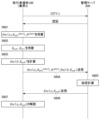
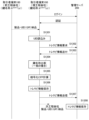
- FIG. 6 is a flowchart showing details of the four arithmetic operations on numbers encrypted with different public keys. Using FIG. 6, the four arithmetic operations on numbers encrypted with different public keys corresponding to constraint 1 will be explained.
- the trader terminal 100 of a trader in industry 3 logs in to the management server 200, and the management server 200 authenticates the login, thereby starting the process.
- the UID reading unit 114 reads the UIDs attached to the products delivered by the traders in industry 1 and industry 2. Note that in FIG. 6, deliveries from the trader terminal 100 of the trader in industry 1 and the trader terminal 100 of the trader in industry 2 to the trader terminal 100 of the trader in industry 3 are shown with dotted lines because the delivery of products does not represent an exchange of signals but rather represents the movement of the actual product.
- the sending request sending unit 124 sends a request to send traceability information using the UID read into the management server 200 as an argument.
- the information transmission unit 212 of the management server 200 transmits the traceability information corresponding to the read UID to the trader terminal 100.
- the information calculation unit 118 sends a request to add Enc( x1 , Kpub Adm1 ) and Enc( x2 , Kpub Adm2 ), along with Enc( x1 , Kpub Adm1 ), NAdm1 , Enc( x2 , Kpub Adm2 ), NAdm2 and NAdm3 in the acquired traceability information, to the encryption information acquisition unit 214 of the management server 200.
- the key acquisition unit 216 searches for sets of private keys and public keys (( KprvAdm1 , KpubAdm1 ), ( KprvAdm2 , KpubAdm2 ), ( KprvAdm3 , KpubAdm3 )) corresponding to the key names NAdm1 , NAdm2 , and NAdm3 acquired by the encryption information acquisition unit 214 , and acquires the sets of private keys and public keys (( KprvAdm1 , KpubAdm1 ), (KprvAdm2, KpubAdm2), (KprvAdm3 , KpubAdm3 ) ) from the key database DBK .
- the decryption information acquisition unit 218 decrypts Enc( x1 , KpubAdm1 ) and Enc( x2 , KpubAdm2 ) using the acquired private keys KprvAdm1 and KprvAdm2 to obtain x1 and x2 . Furthermore, the encryption processing unit 220 calculates encryption information Enc( x1 + x2 , KpubAdm3 ) using x1 , x2 , and KpubAdm3 .
- the providing unit 222 transmits the encryption information Enc(x 1 +x 2 ,K pub Adm3 ) to the trader terminal 100 of the trader in industry 3.
- the information calculation unit 118 performs a secret calculation to add x3 to the encryption information Enc( x1 + x2 + x3,KpubAdm3 ) to obtain the encryption information Enc( x1 + x2 + x3 , KpubAdm3 ).
- the information calculation unit 118 has a function as a secret calculation unit that generates encryption information by a secret calculation using the encryption information and the plaintext information of the item-related information.
- the above process makes it possible to perform arithmetic operations on numbers encrypted with different public keys on a single management server 200.
- the only information exchanged on the network is the key name and encrypted information; private keys and actual decrypted numbers are not exchanged on the network, improving security.
- the public key may be distributed, in this embodiment, there is no need to even distribute the public key, and the set of private and public keys is managed in the key database DBK of a single management server 200.
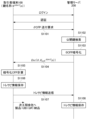
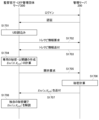
- FIG. 7 is a flowchart showing the details of the bootstrapping process. Using FIG. 7, the bootstrapping process corresponding to constraint 2 will be described.
- the trader terminal 100 of a trader in industry 3 logs in to the management server 200, and the management server 200 authenticates the login, thereby starting the process.
- the information calculation unit 118 prepares Enc(x 3 , K pub Adm3 ) and N Adm3 .
- the information transmitting unit 120 transmits to the management server 200 a request for bootstrapping processing of Enc( x3 , KpubAdm3 ) together with Enc( x3 , KpubAdm3 ) and NAdm3 .
- the key acquisition unit 216 searches for the set of private key and public key (K prv Adm3 , K pub Adm3 ) corresponding to the key name N Adm3 acquired by the encryption information acquisition unit 214, and acquires the set of private key and public key (K prv Adm3 , K pub Adm3 ) from the key database DBK. Furthermore, the decryption information acquisition unit 218 decrypts Enc(x 3 , K pub Adm3 ) with the acquired private key K prv Adm3 to obtain x 3. Furthermore, the encryption processing unit 220 calculates encryption information Enc(x 3 , K pub Adm3 ) using x 3 and K pub Adm3 (bootstrapping process).
- the providing unit 222 transmits the encryption information Enc(x 3 , K pub Adm3 ) to the trader terminal 100 of the trader in industry 3.
- the bootstrapping process can be performed on a single management server 200.
- the only information exchanged over the network is the key name and encrypted information; the private key and the actual decrypted numerical values are not exchanged over the network, improving security.
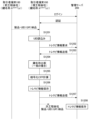
- FIG. 8 is a flowchart showing the details of a data disclosure request.
- a data disclosure request corresponding to constraint 3 will be described with reference to FIG. 8.
- the trader terminal 100 of a trader in industry 3 logs in to the management server 200, and the management server 200 authenticates the login, thereby starting the process.
- the information calculation unit 118 prepares encrypted information Enc(x 3 , K pub Adm3 ) and N Adm3 to be decrypted.
- the dedicated key generation unit 122 creates and prepares a set of a dedicated private key K prv and a public key K pub .
- the information calculation unit 118 encrypts the numerical value 0 using the public key K pub , and calculates the encryption information Enc(0, K pub ).
- the information transmitting unit 120 transmits a data disclosure request for Enc( x3 , KpubAdm3 ) to the management server 200 together with Enc( x3 , KpubAdm3 ) , NAdm3 and Enc(0, Kpub ).
- the key acquisition unit 216 searches for the set of private key and public key (K prv Adm3 , K pub Adm3 ) corresponding to the acquired key name N Adm3 , and acquires the set of private key and public key (K prv Adm3 , K pub Adm3 ) from the key database DBK. Furthermore, the decryption information acquisition unit 218 decrypts Enc(x 3 , K pub Adm3 ) with the acquired private key K prv Adm3 to obtain x 3. Furthermore, the encryption processing unit 220 calculates encryption information Enc(x 3 , K pub ) by secret calculation of adding Enc(0, K pub ) to x 3 .
- the providing unit 222 transmits the encryption information Enc(x 3 , K pub ) to the trader terminal 100 of the trader in industry 3.
- the information calculation unit 118 decrypts the encrypted information Enc(x 3 , K pub ) using the dedicated private key K prv to obtain x 3 .
- a data disclosure request can be made on one management server 200.
- the only information exchanged on the network is the key name and encrypted information, and the private key and the actual decrypted numerical value are not exchanged on the network, improving security.
- the trader terminal 100 transmits the encryption information Enc(0, K pub ) with a numerical value of 0 to the management server 200, but it may transmit encryption information with a predetermined value other than 0 to the management server 200. In this case, the trader should know the predetermined value and subtract the predetermined value from the value obtained by decrypting the encryption information transmitted from the management server 200 in S806.
- K prv AdmY (n) The private key (nth) that is the basis of encryption used in industry Y
- K pub AdmY (n) Public key (nth) used in industry Y N
- AdmY (n) Key name (nth key) of the key used in industry Y M
- AdmY (n) The current number of multiplications and divisions of the nth key used in industry Y.
- n The number of keys issued per industry (to indicate different numbers, use n1, n2, ).
- K prv Adm (n): The private key (nth) used for encryption (when there is no need to separate industries)
- K pubAdm (n) Public key ( nth) used for encryption (when there is no need to separate industries)
- K prv A private key (disposable) created by a company in a certain industry
- K pub Public key corresponding to K prv (disposable) x m : Number (e.g., CFP value for company m)
- x Numerical value (e.g., CFP value for a company when there is no need to discuss the company separately)
- Enc(x, K pub Adm Y (n) Number x encrypted with the nth public key used in industry Y
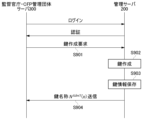
- FIG. 9 is a flowchart showing the details of private key and public key generation. The process flow for generating a set of private and public keys will be described using FIG. 9.
- the supervisory agency/CFP management organization server 300 logs in to the management server 200, and the management server 200 starts the process by authenticating the login.
- the key generation request unit 318 sends a key creation request to the key generation unit 226 of the management server 200 using the industry information Y as an argument.
- the key generation unit 226 sets the number of times n to request key creation for the industry information Y, and generates a private key and public key set (K prv AdmY (n), K pub AdmY (n)) and key names N AdmY (n) for these keys.
- the key generation unit 226 records the private key and public key set (K prv AdmY (n), K pub AdmY (n)) and the key names N AdmY (n) of these keys, including the industry information Y and the number of creation requests n, in the key database DBK.
- the key name disclosure unit 228 transmits the key name N AdmY (n) to the supervisory agency/CFP management organization server 300.
- K prv AdmY (n), K pub AdmY (n)) and their key names N AdmY (n) are recorded for each industry in the key database DBK in the management server 200.
- FIG. 10 is a flowchart showing the details of the distribution of key names. The flow of the process of distributing key names will be described with reference to FIG. 10.
- the supervisory agency/CFP management organization server 300 directly discloses the key name to the trader terminal 100.
- the supervisory agency/CFP management organization posts the key name on a homepage HP created by the supervisory agency/CFP management organization server 300, and the manager who uses the trader terminal 100 can search and obtain the key name of the industry to which he or she belongs from the HP.
- the trader terminal 100 directly obtains the key name from the management server 200. A specific description will be given below.
- the trader terminal 100 logs in to the management server 200, and the management server 200 authenticates the login.
- the sending request sending unit 124 of the trader terminal 100 sends a key name sending request to the management server 200 using the industry information Y and the number of issuances n as arguments.
- the key acquisition unit 216 searches for and acquires the key name N AdmY (n) from the key database DBK.
- the key name disclosure unit 228 transmits the acquired key name N AdmY (n) to the trader terminal 100. This allows the administrator using the trader terminal 100 to acquire the key name of the industry to which he or she belongs.
- Fig. 11 is a flowchart showing the details of the CFP calculation using homomorphic encryption during the addition/integration process when there is no previous process.
- the trader terminal 100 with key name N AdmY (n) logs in to the management server 200, and the management server 200 authenticates the login, thereby starting the process.
- the send request sending unit 124 of the trader terminal 100 sends a 0CFP send request to the management server 200 using the company's key name N AdmY (n) as an argument.
- the 0CFP send request is cryptographic information encrypted with the CFP value set to 0. Note that instead of the key name N AdmY (n), industry information Y and the number of issuances n may be specified as arguments.
- the key acquisition unit 216 searches for and acquires the public key K pub AdmY (n) from the key database DBK using the key name N AdmY (n).
- the encryption processing unit 220 calculates encryption information Enc(0, K pub AdmY (n)) by encrypting the numerical value 0 (0CFP encryption) using the acquired public key K pub AdmY (n).
- the providing unit 222 transmits the encryption information Enc(0, K pub AdmY (n)) to the trader terminal 100 .
- the information calculation unit 118 performs secure calculation to add the measured CFP value x1 for the company's product to the encryption information Enc(0, K pub AdmY (n)) to obtain the encryption information Enc(x 1 , K pub AdmY (n)).
- the information transmission unit 120 transmits the traceability information recorded in the traceability database DBT1 to the management server 200. After that, the product with the UID is delivered to the company for the next process.
- the management server 200 records the traceability information sent from the trader terminal 100 in the traceability database DBT2.
- Fig. 12 is a flowchart showing the details of the CFP calculation using homomorphic encryption during the addition/integration process when there is a previous process.
- the trader terminal 100 of the current process company of the key name N AdmY (n) logs in to the management server 200, and the management server 200 authenticates the login, thereby starting the process.
- the UID reading unit 114 of the trader terminal 100 at the current process company reads the UID attached to the product delivered from the previous process company.
- the information acquisition unit 116 sends a request to the management server 200 to send traceability information with the UID read as an argument.
- the information transmission unit 212 transmits the traceability information corresponding to the read UID to the information acquisition unit 116 of the trader terminal 100.
- the information calculation unit 118 compares the key name N AdmY (n) of the upstream process company in the acquired traceability information with its own key name N AdmY (n), and confirms that the key names of both companies match.
- the information calculation unit 118 performs a secret calculation to add the CFP value x2 for its own product to the encryption information Enc( x1 , KpubAdmY (n)) in the acquired traceability information, and acquires the encryption information Enc(x1+x2, KpubAdmY ( n ) ).
- the trader terminal 100 records traceability information including the UID, CFP value x2 , key name NAdmY (n), encrypted CFP (Enc( x2 , KpubAdmY (n)), Enc( x1 + x2 , KpubAdmY (n)), and number of multiplications and divisions MAdmY (n)) in the traceability database DBT1.
- the information transmission unit 120 transmits the traceability information recorded in the traceability database DBT1 to the management server 200. After that, the product with the UID is delivered to the company for the next process.
- the management server 200 records the traceability information sent from the trader terminal 100 in the traceability database DBT2.
- Fig. 13 is a flowchart showing the details of the CFP calculation using homomorphic encryption during the branching process.
- the CFP calculation using homomorphic encryption during the branching process will be described with reference to Fig. 13.
- the trader terminal 100 of the current process company with key name N AdmY (n) logs in to the management server 200, and the management server 200 authenticates the login, thereby starting the process.
- the information acquisition unit 116 sends a request to the management server 200 to send traceability information with the UID read as an argument.
- the information transmission unit 212 transmits the traceability information corresponding to the read UID to the information acquisition unit 116 of the trader terminal 100.
- the information calculation unit 118 compares the key name N AdmY (n) of the upstream process company in the acquired traceability information with its own key name N AdmY (n), and confirms that the key names of both companies match.
- the information calculation unit 118 performs secret calculation to add the CFP value x2 related to the company's product to the encryption information Enc( x1 , KpubAdmY (n)) in the acquired traceability information, and acquires the encryption information Enc( x1 + x2 , KpubAdmY (n)). Furthermore, the information calculation unit 118 multiplies the encryption information Enc( x1 + x2 , KpubAdmY (n)) by the branching ratio R, and adds 1 to the number of multiplications and divisions MAdmY (n ) . Note that multiplication by the branching ratio R is a calculation process when the branching ratio R of the product is delivered to the company for the next process.
- the management server 200 records the traceability information sent from the trader terminal 100 in the traceability database DBT2.
- Fig. 14 is a flowchart showing the details of the CFP calculation using homomorphic encryption when the public keys of the previous process are different. Using Fig. 14, the CFP calculation using homomorphic encryption when the public key of the previous process company and the public key of the current process company are different will be described.
- the trader terminal 100 of the current process company with key name N AdmY2 (n 2 ) logs in to the management server 200, and the management server 200 authenticates the login, thereby starting the process.
- the UID reading unit 114 of the trader terminal 100 at the current process company reads the UID attached to the product delivered from the previous process company.
- the information acquisition unit 116 sends a request to the management server 200 to send traceability information with the UID read as an argument.
- the information transmission unit 212 transmits the traceability information corresponding to the read UID to the information acquisition unit 116 of the trader server 100.
- the information calculation unit 118 compares the key name N AdmY1 (n 1 ) of the upstream process company in the acquired traceability information with its own key name N AdmY2 (n 2 ) and confirms that the key names of the two companies do not match.
- the information calculation unit 118 transmits a request to change the public key K pub AdmY1 (n 1 ) of the encryption information Enc(x 1 , K pub AdmY1 (n 1 )) of the upstream company, specifying N AdmY1 (n 1 ), Enc(x 1 , K pub AdmY1 (n 1 )), and N AdmY2 (n 2 ) as arguments.
- the key acquisition unit 216 searches and acquires the private key K prv AdmY1 (n 1 ) corresponding to the key name N AdmY1 (n 1 ) and the public key K pub AdmY2 (n 2 ) corresponding to the key name N AdmY2 (n 2 ) in the change request from the key database DBK. Furthermore, the decryption information acquisition unit 218 decrypts Enc(x 1 , K pub AdmY1 (n 1 )) with the acquired private key K prv AdmY1 (n 1 ) to obtain x 1. Furthermore, the encryption processing unit 220 calculates the encryption information Enc(x 1 , K pub AdmY2 (n 2 )) using x 1 and K pub AdmY2 (n 2 ).
- the providing unit 222 transmits the encryption information Enc(x 1 , K pub AdmY2 (n 2 )) to the trader terminal 100 .
- the information calculation unit 118 performs secret calculation to add the measured CFP value x2 for the company's product to the obtained encryption information Enc( x1 , KpubAdmY2 ( n2 )), obtains encryption information Enc( x1 + x2 , KpubAdmY2 ( n2 )), and updates the number of multiplications and divisions MAdmY2 ( n2 ) to 0 .
- the trader terminal 100 records traceability information including the UID, CFP value x2 , key name NAdmY2 ( n2 ), encrypted CFP (Enc( x2 , KpubAdmY2 ( n2 )), Enc( x1 + x2 , KpubAdmY2 ( n2 )), and number of multiplications and divisions MAdmY2 ( n2 ) in the traceability database DBT1.
- the information transmission unit 120 transmits the traceability information recorded in the traceability database DBT1 to the management server 200. After that, the product with the UID is delivered to the company for the next process.
- the management server 200 records the traceability information sent from the trader terminal 100 in the traceability database DBT2.
- FIG. 15 is a flowchart showing the details of the CFP calculation using homomorphic encryption when the number of multiplications and divisions reaches the upper limit.
- the CFP calculation using homomorphic encryption when the number of multiplications and divisions reaches the upper limit is explained. Note that the process in FIG. 15 can be used in conjunction with the processes described in FIG. 11 to FIG. 14.
- the trader terminal 100 of the current process company logs in to the management server 200, and the management server 200 authenticates the login, thereby starting the process.
- the UID reading unit 114 of the trader terminal 100 at the current process company reads the UID attached to the product delivered from the previous process company.
- the information acquisition unit 116 sends a request to the management server 200 to send traceability information with the UID read as an argument.
- the information transmission unit 212 transmits the traceability information corresponding to the read UID to the information acquisition unit 116 of the trader terminal 100.
- the information calculation unit 118 checks whether the number of multiplications and divisions M AdmY (n) in the acquired traceability information exceeds an upper limit value, which can be specified in advance from outside.
- the information calculation unit 118 of the trader terminal 100 transmits a bootstrapping request for the encryption information Enc(x 1 , K pub AdmY (n)) of the upstream company to the management server 200.
- N AdmY (n) and Enc(x 1 , K pub AdmY (n)) are specified as arguments.
- the providing unit 222 transmits the encryption information Enc(x 1 , K pub AdmY (n)) to the trader terminal 100 .
- the information calculation unit 118 performs secret calculation to add the measured CFP value x2 for the company 's own product to the obtained encryption information Enc( x1 , KpubAdmY (n)), obtains encryption information Enc( x1 + x2 , KpubAdmY (n)), and updates the number of multiplications and divisions MAdmY (n ) to 0.
- the trader terminal 100 records traceability information including the UID, CFP value x2 , key name NAdmY (n), encrypted CFP (Enc( x2 , KpubAdmY (n)), Enc( x1 + x2 , KpubAdmY (n)), and number of multiplications and divisions MAdmY (n)) in the traceability database DBT1.
- the information transmission unit 120 transmits the traceability information recorded in the traceability database DBT1 to the management server 200. After that, the product with the UID is delivered to the company for the next process.
- the management server 200 records the traceability information sent from the trader terminal 100 in the traceability database DBT2.
- FIG. 16 is a flowchart showing the details of the CFP calculation using homomorphic encryption when it is desired to clear the number of multiplication and division calculations.
- the CFP calculation using homomorphic encryption when it is desired to clear the number of multiplication and division calculations will be described. Note that the process in FIG. 16 can be used in conjunction with the processes described in FIG. 11 to FIG. 14.
- the trader terminal 100 of the current process company logs in to the management server 200, and the management server 200 starts the process by authenticating the login.
- the UID reading unit 114 of the trader terminal 100 at the current process company reads the UID attached to the product delivered from the previous process company.
- the information acquisition unit 116 sends a request to the management server 200 to send traceability information with the UID read as an argument.
- the information transmission unit 212 transmits the traceability information corresponding to the read UID to the information acquisition unit 116 of the trader terminal 100.
- the trader of the trader terminal 100 inputs to the trader terminal 100 a clear request to clear the number of multiplications and divisions M AdmY (n) in the acquired traceability information.
- the information calculation unit 118 of the trader terminal 100 transmits a bootstrapping request for the encryption information Enc(x1, KpubAdmY ( n )) of the upstream company to the management server 200.
- NAdmY (n) and Enc( x1 , KpubAdmY ( n)) are specified as arguments.
- the key acquisition unit 216 searches the key database DBK for a private key K prv AdmY (n) and a public key K pub AdmY (n) corresponding to the key name N AdmY (n) in the bootstrapping request. Furthermore, the decryption information acquisition unit 218 decrypts Enc(x 1 , K pub AdmY (n)) with the acquired private key K prv AdmY (n) to obtain x 1. Furthermore, the encryption processing unit 220 calculates encryption information Enc(x 1 , K pub AdmY (n)) using x 1 and K pub AdmY (n).
- the providing unit 222 transmits the encryption information Enc(x 1 , K pub AdmY (n)) to the trader terminal 100 .
- the information calculation unit 118 performs secret calculation to add the measured CFP value x2 for the company 's own product to the obtained encryption information Enc( x1 , KpubAdmY (n)), obtains encryption information Enc( x1 + x2 , KpubAdmY (n)), and updates the number of multiplications and divisions MAdmY (n ) to 0.
- the trader terminal 100 records traceability information including the ID, CFP value x2 , key name NAdmY (n), encrypted CFP (Enc( x2 , KpubAdmY (n)), Enc( x1 + x2 , KpubAdmY (n)), and number of multiplications and divisions MAdmY (n)) in the traceability database DBT1.
- the information transmission unit 120 transmits the traceability information recorded in the traceability database DBT1 to the management server 200. After that, the product with the UID is delivered to the company for the next process.
- the management server 200 records the traceability information sent from the trader terminal 100 in the traceability database DBT2.
- FIG. 17 is a flowchart showing the details of the process when a supervisory authority/CFP management organization requests disclosure of the CFP value. Using FIG. 17, the process when a supervisory authority/CFP management organization requests disclosure of the actual CFP value is described.
- the supervisory authority/CFP management organization server 300 logs in to the management server 200, and the management server 200 authenticates the login, thereby starting the process.
- the UID reading unit 312 of the supervisory agency/CFP management organization server 300 reads the UID attached to the product for which the CFP value is to be disclosed.
- the information acquisition unit 314 sends a request to the management server 200 to send traceability information with the UID read as an argument.
- the information transmission unit 212 transmits the traceability information corresponding to the read UID to the information acquisition unit 314 of the supervisory agency/CFP management organization server 300.
- the dedicated key generation unit 320 of the supervisory agency/CFP management organization server 300 creates and prepares a set of a dedicated private key K prv and a public key K pub . Furthermore, the information calculation unit 316 encrypts the number 0 using the dedicated public key K pub to calculate the encryption information Enc(0, K pub ).
- the delivery request sending unit 322 sends a request to disclose the actual value of the CFP to the management server 200.
- N Adm (n), Enc(x, K pub Adm (n)), and Enc(0, K pub ) are specified as arguments.
- Enc(x, K pub Adm (n)) is the encrypted CFP value to be disclosed in the acquired traceability information.
- the key acquisition unit 216 searches the key database DBK for and acquires the private key K prv Adm (n) corresponding to the key name N Adm (n) specified as an argument. Furthermore, the decryption information acquisition unit 218 decrypts Enc(x, K pub Adm (n)) with the acquired private key K prv Adm (n) to obtain x. Furthermore, the encryption processing unit 220 calculates encryption information Enc(x, K pub ) by secret calculation of adding Enc(0, K pub ) to x.
- the providing unit 222 transmits the encryption information Enc(x, K pub ) to the supervisory agency/CFP management organization server 300 .
- the information calculation unit 316 decrypts the encrypted information Enc(x, K pub ) using the dedicated private key K prv to obtain x.
- FIG. 18 is a flowchart showing details of the process when a request for disclosure of a CFP value is made from a party other than a supervisory authority or a CFP management organization.
- a CFP disclosure requester is, for example, a consumer or a company employee.
- the process begins when the CFP disclosure requester logs into the management server 200 on the terminal used by the party requesting disclosure, and the management server 200 authenticates the login.
- the terminal used by the CFP disclosure requester is, for example, an information processing device such as a smartphone, tablet terminal, or personal computer, and has the same configuration as the trader terminal 100. Therefore, in the following, the terminal used by the CFP disclosure requester is described as the trader server 100.
- the UID reading unit 114 of the trader terminal 100 reads the UID attached to the product for which the CFP value is to be disclosed.
- the information acquisition unit 116 sends a request to the management server 200 to send traceability information with the UID read as an argument.
- the information transmission unit 120 transmits the traceability information corresponding to the read UID to the information acquisition unit 116 of the trader terminal 100.
- the dedicated key generation unit 122 of the trader terminal 100 creates and prepares a set of a dedicated private key K prv and a public key K pub . Furthermore, the information calculation unit 118 encrypts the number 0 using the dedicated public key K pub to calculate the encryption information Enc(0, K pub ).
- the delivery request sending unit 124 sends a request to disclose the actual value of the CFP to the management server 200.
- N Adm (n), Enc(x, K pub Adm (n)), and Enc(0, K pub ) are specified as arguments.
- Enc(x, K pub Adm (n)) is the encrypted CFP value to be disclosed in the acquired traceability information.
- the management server 200 sends a message to the supervisory agency/CFP management organization server 300, notifying it that the CFP disclosure requester has requested disclosure of the CFP value, and confirms whether disclosure is permitted.
- the supervisory agency/CFP management organization server 300 approves or denies the disclosure request. If the disclosure request is denied, the supervisory agency/CFP management organization server 300 sends a denial message to the trader terminal 100. If the disclosure request is approved, the supervisory agency/CFP management organization server 300 sends an approval message to the management server 200, and the flow proceeds to S1808.
- the key acquisition unit 216 searches the key database DBK for and acquires the private key K prv Adm (n) corresponding to the key name N Adm (n) specified as an argument. Furthermore, the decryption information acquisition unit 218 decrypts Enc(x, K pub Adm (n)) with the acquired private key K prv Adm (n) to obtain x. Furthermore, the encryption processing unit 220 calculates encryption information Enc(x, K pub ) by secret calculation of adding Enc(0, K pub ) to x.
- the providing unit 222 transmits the encryption information Enc(x, K pub ) to the trader terminal 100.
- the information calculation unit 118 decrypts the encrypted information Enc(x, K pub ) using the dedicated private key K prv to obtain x.
- the CFP value of each process is used as the item-related information, but information on the amount of electricity or energy resources used in relation to the processing of the items in each process may also be used as the item-related information.
- the electricity usage information is linked to type information indicating the power generation method, such as hydroelectric, thermal, wind, geothermal, nuclear, and solar power.
- the energy resource usage information is linked to information indicating the type of fuel, such as crude oil, coal, natural gas, and hydrogen.
- the amount of rare metals used or the amount of specific hazardous substances generated that are subject to regulation may also be used as item-related information.
- each function provided by the trader terminal 100, the management server 200, and the supervisory agency/CFP management organization server 300 can also be provided by software and the hardware that executes it, software alone, hardware alone, or a combination of these.
- each function can also be provided by digital circuits including multiple logic circuits, or analog circuits.
Landscapes
- Engineering & Computer Science (AREA)
- Computer Security & Cryptography (AREA)
- Computer Networks & Wireless Communication (AREA)
- Signal Processing (AREA)
- Computing Systems (AREA)
- Theoretical Computer Science (AREA)
- Storage Device Security (AREA)
Priority Applications (2)
| Application Number | Priority Date | Filing Date | Title |
|---|---|---|---|
| JP2025537674A JPWO2025027967A1 (https=) | 2023-07-31 | 2024-05-09 | |
| CN202480049287.9A CN121794942A (zh) | 2023-07-31 | 2024-05-09 | 信息处理装置、信息处理系统以及信息处理方法 |
Applications Claiming Priority (2)
| Application Number | Priority Date | Filing Date | Title |
|---|---|---|---|
| JP2023-125000 | 2023-07-31 | ||
| JP2023125000 | 2023-07-31 |
Publications (1)
| Publication Number | Publication Date |
|---|---|
| WO2025027967A1 true WO2025027967A1 (ja) | 2025-02-06 |
Family
ID=94394369
Family Applications (1)
| Application Number | Title | Priority Date | Filing Date |
|---|---|---|---|
| PCT/JP2024/017189 Pending WO2025027967A1 (ja) | 2023-07-31 | 2024-05-09 | 情報処理装置、情報処理システムおよび情報処理方法 |
Country Status (3)
| Country | Link |
|---|---|
| JP (1) | JPWO2025027967A1 (https=) |
| CN (1) | CN121794942A (https=) |
| WO (1) | WO2025027967A1 (https=) |
Citations (5)
| Publication number | Priority date | Publication date | Assignee | Title |
|---|---|---|---|---|
| JP2011164907A (ja) * | 2010-02-09 | 2011-08-25 | Hitachi Solutions Ltd | 情報管理システム |
| JP2016189527A (ja) * | 2015-03-30 | 2016-11-04 | 三菱電機株式会社 | 情報処理装置及び情報処理システム及び情報処理方法及び情報処理プログラム |
| JP2021132323A (ja) * | 2020-02-20 | 2021-09-09 | Eaglys株式会社 | 情報処理システム、情報処理装置、情報処理方法、および、情報処理プログラム |
| US20220129847A1 (en) * | 2020-10-26 | 2022-04-28 | Sap Se | Privacy-preserving supply chain verification for multiple asset types in shared data storage scenarios |
| JP2023046341A (ja) * | 2021-09-23 | 2023-04-04 | Eaglys株式会社 | データ共有システム、データ共有方法およびデータ共有プログラム |
-
2024
- 2024-05-09 WO PCT/JP2024/017189 patent/WO2025027967A1/ja active Pending
- 2024-05-09 JP JP2025537674A patent/JPWO2025027967A1/ja active Pending
- 2024-05-09 CN CN202480049287.9A patent/CN121794942A/zh active Pending
Patent Citations (5)
| Publication number | Priority date | Publication date | Assignee | Title |
|---|---|---|---|---|
| JP2011164907A (ja) * | 2010-02-09 | 2011-08-25 | Hitachi Solutions Ltd | 情報管理システム |
| JP2016189527A (ja) * | 2015-03-30 | 2016-11-04 | 三菱電機株式会社 | 情報処理装置及び情報処理システム及び情報処理方法及び情報処理プログラム |
| JP2021132323A (ja) * | 2020-02-20 | 2021-09-09 | Eaglys株式会社 | 情報処理システム、情報処理装置、情報処理方法、および、情報処理プログラム |
| US20220129847A1 (en) * | 2020-10-26 | 2022-04-28 | Sap Se | Privacy-preserving supply chain verification for multiple asset types in shared data storage scenarios |
| JP2023046341A (ja) * | 2021-09-23 | 2023-04-04 | Eaglys株式会社 | データ共有システム、データ共有方法およびデータ共有プログラム |
Non-Patent Citations (1)
| Title |
|---|
| KOSLOWSKI THOMAS, STRÜKER JENS, KERSCHBAUM FLORIAN: "CONFIDENTIAL INFORMATION-SHARING FOR AUTOMATED SUSTAINABILITY BENCHMARKS Completed Research Paper", ERP SYSTEMS AS A SOLUTION TO THE MANUAL DATA GATHERING PROBLEM, 1 December 2011 (2011-12-01), XP093270958 * |
Also Published As
| Publication number | Publication date |
|---|---|
| CN121794942A (zh) | 2026-04-03 |
| JPWO2025027967A1 (https=) | 2025-02-06 |
Similar Documents
| Publication | Publication Date | Title |
|---|---|---|
| Zuo | Tokenizing renewable energy certificates (recs)—a blockchain approach for rec issuance and trading | |
| Sahoo et al. | A unified blockchain-based platform for global e-waste management | |
| CN110851496B (zh) | 在区块链网络中查询交易信息的方法、装置、记账节点和介质 | |
| JP2023153422A (ja) | 制御方法、電力システム及びプログラム | |
| CN101359350B (zh) | 用于安全地管理在数据项上的操作的方法 | |
| TW511023B (en) | Digital rights management within an embedded storage device | |
| CN111177253A (zh) | 基于身份数字认证的电力大数据保护方法及系统 | |
| CN111292041A (zh) | 一种电子合同生成方法、装置、设备及存储介质 | |
| CN114401268A (zh) | 一种跨链数据共享的方法、系统、设备和可读存储介质 | |
| JP7269194B2 (ja) | 情報共有管理方法及び情報共有管理装置 | |
| CN113706312A (zh) | 基于区块链的光伏电交易方法和装置 | |
| Pandey et al. | E-commerce transactions: An empirical study | |
| JP6726418B2 (ja) | 対話記録問合せの処理方法及びデバイス | |
| CN113222749A (zh) | 一种基于区块链技术的供应链管理平台 | |
| CN110310011B (zh) | 一种基于区块链的资产管理系统及其方法 | |
| CN112948488A (zh) | 一种基于区块链的产业链联盟业务整合平台系统 | |
| CN107506619A (zh) | Drm‑q数字版权保护方法及系统 | |
| US20250274269A1 (en) | Information management method and information management system | |
| Patel et al. | A review and future research directions of secure and trustworthy mobile agent‐based e‐marketplace systems | |
| Chen et al. | A novel cloud computing algorithm of security and privacy | |
| CN119624646B (zh) | 电子票处理方法、处理装置、设备、存储介质和程序产品 | |
| Yue et al. | Jcdta: the data trading archtecture design in jointcloud computing | |
| Al-Madani et al. | Implications of blockchain deployment in energy supply chain management: report integrity | |
| WO2025027967A1 (ja) | 情報処理装置、情報処理システムおよび情報処理方法 | |
| Liu et al. | Breaking iot data silos: Trustworthy data trading with consortium blockchain and zero-knowledge proof |
Legal Events
| Date | Code | Title | Description |
|---|---|---|---|
| 121 | Ep: the epo has been informed by wipo that ep was designated in this application |
Ref document number: 24848628 Country of ref document: EP Kind code of ref document: A1 |
|
| WWE | Wipo information: entry into national phase |
Ref document number: 2025537674 Country of ref document: JP |