WO2025027806A1 - 研削装置及び研削方法 - Google Patents
研削装置及び研削方法 Download PDFInfo
- Publication number
- WO2025027806A1 WO2025027806A1 PCT/JP2023/028170 JP2023028170W WO2025027806A1 WO 2025027806 A1 WO2025027806 A1 WO 2025027806A1 JP 2023028170 W JP2023028170 W JP 2023028170W WO 2025027806 A1 WO2025027806 A1 WO 2025027806A1
- Authority
- WO
- WIPO (PCT)
- Prior art keywords
- grinding
- grinding wheel
- grindstone
- replacement
- replaced
- Prior art date
- Legal status (The legal status is an assumption and is not a legal conclusion. Google has not performed a legal analysis and makes no representation as to the accuracy of the status listed.)
- Pending
Links
Images





Classifications
-
- B—PERFORMING OPERATIONS; TRANSPORTING
- B24—GRINDING; POLISHING
- B24B—MACHINES, DEVICES, OR PROCESSES FOR GRINDING OR POLISHING; DRESSING OR CONDITIONING OF ABRADING SURFACES; FEEDING OF GRINDING, POLISHING, OR LAPPING AGENTS
- B24B47/00—Drives or gearings; Equipment therefor
- B24B47/22—Equipment for exact control of the position of the grinding tool or work at the start of the grinding operation
-
- B—PERFORMING OPERATIONS; TRANSPORTING
- B24—GRINDING; POLISHING
- B24B—MACHINES, DEVICES, OR PROCESSES FOR GRINDING OR POLISHING; DRESSING OR CONDITIONING OF ABRADING SURFACES; FEEDING OF GRINDING, POLISHING, OR LAPPING AGENTS
- B24B49/00—Measuring or gauging equipment for controlling the feed movement of the grinding tool or work; Arrangements of indicating or measuring equipment, e.g. for indicating the start of the grinding operation
- B24B49/12—Measuring or gauging equipment for controlling the feed movement of the grinding tool or work; Arrangements of indicating or measuring equipment, e.g. for indicating the start of the grinding operation involving optical means
-
- B—PERFORMING OPERATIONS; TRANSPORTING
- B24—GRINDING; POLISHING
- B24B—MACHINES, DEVICES, OR PROCESSES FOR GRINDING OR POLISHING; DRESSING OR CONDITIONING OF ABRADING SURFACES; FEEDING OF GRINDING, POLISHING, OR LAPPING AGENTS
- B24B53/00—Devices or means for dressing or conditioning abrasive surfaces
-
- B—PERFORMING OPERATIONS; TRANSPORTING
- B24—GRINDING; POLISHING
- B24B—MACHINES, DEVICES, OR PROCESSES FOR GRINDING OR POLISHING; DRESSING OR CONDITIONING OF ABRADING SURFACES; FEEDING OF GRINDING, POLISHING, OR LAPPING AGENTS
- B24B7/00—Machines or devices designed for grinding plane surfaces on work, including polishing plane glass surfaces; Accessories therefor
- B24B7/04—Machines or devices designed for grinding plane surfaces on work, including polishing plane glass surfaces; Accessories therefor involving a rotary work-table
Definitions
- This disclosure relates to a grinding device and a grinding method.
- Patent Document 1 discloses a setup method for storing the position of a processing tool.
- a confirmation process is performed to confirm that a first block gauge can enter the gap between the holding surface of the chuck table and the tip of the processing tool, but a second block gauge cannot.
- the processing tool is moved closer to the holding surface by a distance that is half the difference in thickness between the two block gauges, forming a second gap between the holding surface and the tip of the processing tool. If the first block gauge can enter the second gap, the position of the processing tool at this time is stored in a memory unit, and if the first block gauge cannot enter the second gap, the position of the processing tool positioned in the confirmation process is stored in the memory unit.
- the technology disclosed herein appropriately controls the position of the grinding wheel after it has been replaced.
- One aspect of the present disclosure is an apparatus for grinding a substrate with a grinding tool equipped with a grinding wheel, comprising a grinding chamber formed inside a grinding chamber cover that houses the grinding tool, and an information processing unit that receives grinding wheel information of the grinding wheel detected by a grinding wheel detection unit provided above the top surface of the grinding chamber.
- the position of the grinding wheel can be appropriately controlled after the grinding wheel is replaced.
- FIG. 1 is a plan view showing an outline of the configuration of a wafer processing system according to an embodiment of the present invention
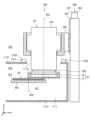
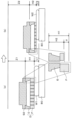
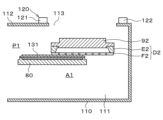
- 2 is a cross-sectional view showing an outline of the configuration of a grinding unit, a grinding chamber cover, and a grindstone detection unit.
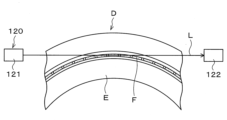
- FIG. FIG. 2 is a plan view showing an outline of the configuration of a grindstone detection unit.
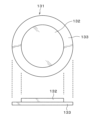
- 2A and 2B are a plan view and a side view showing an outline of the configuration of a dress board.
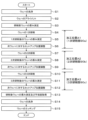
- FIG. 2 is a flow diagram showing an example of main steps of wafer processing in the wafer processing system.
- 5 is an explanatory diagram showing a state of grinding processing in a grinding unit.
- FIG. FIG. 4 is an explanatory diagram showing a method for calculating the wear amount of a grinding wheel.
- FIG. 11 is a flow chart showing an example of main steps of a maintenance method performed using a wafer processing system and a replacement device.
- FIG. 11 is an explanatory diagram showing how the grinding wheel is replaced and the setup position of the wheel is set after replacement.
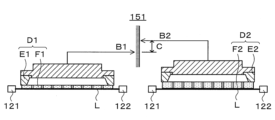
- FIG. 11 is an explanatory diagram showing a method for calculating a correction amount of a setup position.
- FIG. 11 is an explanatory diagram showing a state in which the grinding wheel is dressed after replacement.
- FIG. 11 is a side view of a replaced grinding wheel according to another embodiment.
- a semiconductor substrate hereafter referred to as a wafer
- a wafer having multiple electronic circuits or other devices formed on its surface is thinned by grinding the back surface of the wafer.
- Wafer grinding is performed, for example, by lowering a grinding wheel onto a wafer held in a chuck and contacting the backside of the wafer while rotating the grinding wheel. Repeated wafer grinding wears the grinding wheel and makes it thinner. Therefore, after a set number of wafers have been ground, the grinding wheel is replaced.
- the setup position is where the position of the bottom surface (grinding surface) of the grinding wheel coincides with the position of the top surface of the chuck or is a predetermined set distance away from the position of the top surface of the chuck.
- a first block gauge and a second block gauge are used to adjust the setup position of the processing tool (grinding wheel).
- the setup position will vary depending on the operator.
- dimples localized concave defects
- the moving mechanism and switch are installed in the grinding chamber where contamination such as foreign matter occurs during grinding, which may cause malfunctions.
- the cutting edge of the grinding wheel and the chuck come into direct contact with the switch, which may cause dimples on the wafer or contamination of the grinding chamber, and may even damage the cutting edge of the grinding wheel or the chuck.
- grinding of the wafer W includes so-called “polishing.” Therefore, although the following explanation uses a “grinding device” as an example, the technology disclosed herein may also be applied to a “polishing device.”
- a wafer W serving as a substrate is ground to thin it.
- the wafer W is a semiconductor wafer such as a silicon wafer or a compound semiconductor wafer.
- a device layer including electronic circuits may be formed on the front surface of the wafer W.
- the back surface of the wafer W opposite the front surface is the grinding surface that is ground in the wafer processing system 1.
- the wafer W may be a glass substrate.
- the wafer W may also be a composite substrate formed by bonding multiple substrates.
- the wafer processing system 1 has a configuration in which a loading/unloading station 2 and a processing station 3 are integrally connected.
- the loading/unloading station 2 loads/unloads a cassette C capable of housing multiple wafers W, for example, between the outside and the system.
- the processing station 3 is equipped with various processing devices that perform the desired processing on the wafers W.
- the loading/unloading station 2 is provided with a cassette loading table 10.
- the cassette loading table 10 can freely load multiple cassettes C, for example, two cassettes C, in a line in the Y-axis direction. Note that the number of cassettes C loaded on the cassette loading table 10 is not limited to this embodiment and can be determined arbitrarily.
- the processing station 3 is provided with, for example, three processing blocks G1 to G3.
- the first processing block G1, the second processing block G2, and the third processing block G3 are arranged in this order from the negative side of the X-axis (the loading/unloading station 2 side) to the positive side.
- the first processing block G1 is provided with, for example, an etching processing device 20 and a wafer transport device 30.
- the etching processing device 20 is provided, for example, stacked in two stages in the vertical direction.
- the wafer transport device 30 is disposed on the positive Y-axis side of the etching processing device 20. Note that the number and arrangement of the etching processing devices 20 and wafer transport devices 30 are not limited to this.
- the etching processing device 20 etches the back surface of the ground wafer W. At this time, grinding marks are removed, and cleaning processes such as particle removal and metal component removal are also performed. For example, an etching solution is supplied to the back surface of the wafer W, and the back surface is wet-etched. For example, FPM, HF, HNO 3 , H 3 PO 4 , TMAH, Choline, KOH, etc. are used as the etching solution.
- the wafer transport device 30 has, for example, two transport arms 31 that hold and transport the wafer W.
- Each transport arm 31 is configured to be movable horizontally, vertically, around a horizontal axis, and around a vertical axis.
- the wafer transport device 30 is configured to be able to transport the wafer W between the cassette C on the cassette mounting table 10, the etching processing device 20, a first cleaning device 40 (described later), a second cleaning device 41 (described later), and an alignment device 42 (described later).
- the second processing block G2 is provided with, for example, a first cleaning device 40, a second cleaning device 41, an alignment device 42, and a wafer transport device 50.
- the first cleaning device 40, the second cleaning device 41, and the alignment device 42 are stacked in this order from the top.
- the wafer transport device 50 is disposed on the negative Y-axis side of the first cleaning device 40, the second cleaning device 41, and the alignment device 42. Note that the number and arrangement of the first cleaning device 40, the second cleaning device 41, the alignment device 42, and the wafer transport device 50 are not limited to this.
- the first cleaning device 40 cleans the back surface of the wafer W before grinding in the grinding device 60 described below. In this case, it is possible to prevent foreign matter from getting caught between the chuck 80 of the grinding device 60 and the wafer W, and the wafer W can be ground flat. The thickness of the wafer W may also be measured in the first cleaning device 40.
- the second cleaning device 41 cleans the back surface of the wafer W after grinding in the grinding device 60 described below, and removes particles such as grinding debris and metal components.
- the thickness of the wafer W may also be measured in the second cleaning device 41.
- first cleaning device 40 that processes the wafer W before grinding
- second cleaning device 41 that processes the wafer W after grinding
- the alignment device 42 aligns the center of the wafer W before grinding in the grinding device 60 described below with the center of the chuck 80 of the grinding device 60.
- the alignment device 42 also adjusts the horizontal orientation and position of the wafer W before grinding. Specifically, it detects the notch portion of the wafer W and adjusts the horizontal orientation and position of the wafer W.
- the alignment device 42 may also measure the thickness of the wafer W.
- the wafer transport device 50 has, for example, two transport arms 51 that transport the wafer W by suction and holding it on an adsorption holding surface (not shown). Each transport arm 51 is configured to be movable horizontally, vertically, around a horizontal axis, and around a vertical axis.
- the wafer transport device 50 is configured to be capable of transporting the wafer W between the first cleaning device 40, the second cleaning device 41, the alignment device 42, and the grinding device 60 described below.
- the wafer transport device 50 is also configured to be capable of transporting the dress board 131 described below, and also functions as a transport device for the dress board 131.
- the third processing block G3 is provided with, for example, one grinding device 60. Note that the number and arrangement of the grinding devices 60 are not limited to this.
- the grinding device 60 has, for example, a rotating table 70, four chucks 80, three grinding sections 90 (first grinding section 90a, second grinding section 90b, third grinding section 90c), four thickness measuring sections 100, 101 (thickness measuring section 100, first thickness measuring section 101a, second thickness measuring section 101b, third thickness measuring section 101c), a grinding chamber cover 110, a grindstone detection section 120 (see Figure 2), a dress board storage section 130, a dress board thickness measuring section 134, and an exterior cover 140.
- a rotating table 70 four chucks 80, three grinding sections 90 (first grinding section 90a, second grinding section 90b, third grinding section 90c), four thickness measuring sections 100, 101 (thickness measuring section 100, first thickness measuring section 101a, second thickness measuring section 101b, third thickness measuring section 101c), a grinding chamber cover 110, a grindstone detection section 120 (see Figure 2), a dress board storage section 130, a dress board thickness measuring section 134, and an exterior cover 140.
- the rotating table 70 is configured to be freely rotatable around a vertical rotation center line R1 by a rotating mechanism (not shown).
- Four chucks 80 are provided on the rotating table 70 as substrate holders that suction-hold the wafer W.
- the four chucks 80 are provided at equal intervals around the circumference of the rotating table 70.
- a porous chuck for example, is used for the holding surface of the chucks 80 that holds the wafer W, and suction-holds the surface of the wafer W.
- the surface of the chuck 80 i.e., the holding surface of the wafer W, has a convex shape in which the center protrudes compared to the ends when viewed from the side. Note that because this protrusion from the center is very small, the convex shape of the chuck 80 has been omitted from the illustrations in the following description.
- the four chucks 80 can be moved to the transfer position A0 and processing positions A1 to A3 by the rotation of the rotary table 70.
- Each of the four chucks 80 is configured to be freely rotatable around the rotation center line R2 (see FIG. 2) by a rotation mechanism (not shown).
- the chucks 80 are configured to be freely tiltable by a tilt adjustment unit (not shown). This allows the relative tilt between the surface of the chuck 80 and the grinding wheel E (described below) provided in the grinding unit 90 to be adjusted.
- the wafer W is transferred by the wafer transport device 50.
- a first grinding unit 90a is disposed and performs a primary grinding of the wafer W.
- a second grinding unit 90b is disposed and performs a secondary grinding of the wafer W.
- a third grinding unit 90c is disposed and performs a tertiary grinding of the wafer W.
- the first grinding unit 90a, the second grinding unit 90b and the third grinding unit 90c have the same configuration except for the grinding wheel F described below, and may be collectively referred to as the grinding unit 90 in the following description.
- the grinding unit 90 has a movable part 91 to which a grinding tool D is attached.
- the grinding tool D comes into contact with the wafer W and grinds the wafer W.
- the grinding tool D has, for example, a disk-shaped grinding wheel E and a plurality of grinding stones F arranged in a ring shape and attached to the underside of the grinding wheel E.
- the grain size of the abrasive grains of the grinding stones F in the first grinding unit 90a is smaller than that of the grinding stones F in the second grinding unit 90b, and the grain size of the abrasive grains of the grinding stones F in the third grinding unit 90c in that order.
- the movable part 91 has a spindle shaft 92 on which the grinding tool D is attached, and a spindle motor 93 that rotates the spindle shaft 92.
- the grinding tool D is replaceably attached to the underside of the spindle shaft 92 by a fastener (not shown), such as a bolt.
- the spindle motor 93 supports the upper surface of the spindle shaft 92, and rotates the spindle shaft 92 and the grinding tool D attached to the spindle shaft 92 around the rotation center line R3.
- the grinding unit 90 further has a lifting unit 94 that raises and lowers the movable unit 91.
- the lifting unit 94 has, for example, a Z-axis guide 95 extending vertically, a Z-axis slider 96 that moves along the Z-axis guide 95, and a Z-axis motor 97 that moves the Z-axis slider 96.
- the movable unit 91 is fixed to the Z-axis slider 96, and the movable unit 91 and grinding tool D rise and fall together with the Z-axis slider 96.
- the lifting unit 94 raises and lowers the movable unit 91 between a grinding position P1 where the grinding tool D grinds the wafer W, and an exchange position P2 where the grinding tool D is exchanged.
- the lifting unit 94 further has a grinding tool detection unit 98 that detects the position of the grinding tool D.
- the grinding tool detection unit 98 detects the rotation of the Z-axis motor 97, for example, and detects the position of the grinding tool D.
- Information on the position of the grinding tool D acquired by the grinding tool detection unit 98 (hereinafter referred to as grinding tool information) is transmitted to the control device 150, which will be described later.
- a thickness measuring unit 100 that measures the thickness of the wafer W is provided at the transfer position A0.
- the configuration of the thickness measuring unit 100 is arbitrary, but for example, it includes a non-contact sensor (not shown) and a calculation unit (not shown).
- three thickness measuring units 101 (first thickness measuring unit 101a, second thickness measuring unit 101b, third thickness measuring unit 101c) that measure the thickness of the wafer W are provided at each of the processing positions A1 to A3.
- the configuration of the thickness measuring unit 101 is also arbitrary, but for example, it includes a non-contact sensor (not shown) and a calculation unit (not shown).
- the grinding chamber cover 110 forms a grinding chamber 111 inside.
- the grinding chamber cover 110 prevents particles such as grinding chips generated in the grinding chamber 111 from flowing out to the outside.
- a rotating table 70, four chucks 80, parts of three grinding units 90, and four thickness measuring units 100, 101 are arranged in the grinding chamber 111.
- the above-mentioned grinding position P1 is a position inside the grinding chamber cover 110 where the wafer W is ground, and the grinding tool D, the spindle shaft 92, and part of the spindle motor 93 are arranged inside the grinding chamber cover 110.
- the replacement position P2 is a position outside the grinding chamber cover 110 where the grinding tool D is replaced, and the grinding tool D and the movable part 91 are arranged outside the grinding chamber cover 110.
- An opening 113 through which the grinding tool D passes is formed in the top plate 112 of the grinding chamber cover 110.
- the diameter of the opening 113 is larger than the diameters of the grinding tool D and the spindle shaft 92.
- a cylindrical cover may be provided around the opening 113 on the top plate 112.
- a loading/unloading port (not shown) for loading and unloading the wafer W is formed on the side of the grinding chamber cover 110 on the transfer position A0 side.
- the loading/unloading port is provided with a shutter (not shown) for opening and closing the loading/unloading port.
- the grindstone detector 120 is provided on the upper surface of the top plate 112 of the grinding chamber cover 110.
- the grindstone detector 120 detects the bottom surface position (cutting edge position) of the grindstone F of the grinding tool D when the grindstone F passes through the opening 113.
- the grinding wheel detection unit 120 has, for example, a laser sensor 121 as a light projecting unit that projects laser light, and a light receiving sensor 122 as a light receiving unit that receives the laser light from the laser sensor 121.
- the laser sensor 121 and the light receiving sensor 122 are arranged in opposing positions across the opening 113.
- the grinding wheel detection unit 120 detects the bottom surface position of the grinding wheel F by the laser light projected from the laser sensor 121 toward the light receiving sensor 122. Specifically, the grinding wheel detection unit 120 detects the bottom surface position of the grinding wheel F as the boundary between the position where the laser light is blocked by the grinding wheel F and the position where the laser light passes under the grinding wheel F.
- Information on the bottom surface position of the grinding wheel F acquired by the light receiving sensor 122 (hereinafter referred to as grinding wheel information) is transmitted to the control device 150 described later.
- the grinding wheel detection unit 120 cannot detect the position of the bottom surface of the grinding wheel F. Therefore, as shown in FIG. 3, the laser sensor 121 and the light receiving sensor 122 are positioned so that the axis of the laser light L (laser optical axis) from the laser sensor 121 is positioned horizontally and tangentially to the grinding wheel F. In this case, if a grinding wheel F is present in the opening 113, the laser light L is blocked by the grinding wheel F, so the grinding wheel detection unit 120 can reliably detect the position of the bottom surface of the grinding wheel F.
- the dress board storage unit 130 is disposed outside the grinding chamber cover 110, between the transfer position A0 and the wafer transport device 50 of the second processing block G2.
- the dress board storage unit 130 stores a dress board 131 for dressing the grinding wheel F.
- the dress board 131 is transported between the dress board storage unit 130 and the transfer position A0 by the wafer transport device 50.
- the dress board 131 has a disk-shaped dress wheel 132 and a disk-shaped pedestal 133 that is provided on the underside of the dress wheel 132 and supports the dress wheel 132.
- the grinding wheel F comes into contact with the dress board 131 and is ground, thereby adjusting the surface condition of the grinding wheel F.
- the dress board thickness measuring section 134 is stacked in the dress board storage section 130.
- the dress board thickness measuring section 134 measures the thickness of the dress board 131.
- the thickness measurement of the dress board 131 may be performed inside the dress board storage section 130 or on the chuck 80.
- the exterior cover 140 prevents particles such as grinding chips generated inside from flowing out to the outside.
- a rotating table 70 Inside the exterior cover 140, a rotating table 70, four chucks 80, three grinding units 90, four thickness measuring units 100, 101, a grinding chamber cover 110, a grinding wheel detection unit 120, a dress board storage unit 130, and a dress board thickness measuring unit 134 are arranged.
- three passage openings 141 are formed through which the exchange device 200 described later passes when entering or exiting the interior of the exterior cover 140.
- the three passage openings 141 are formed at positions corresponding to the three grinding units 90 (first grinding unit 90a, second grinding unit 90b, third grinding unit 90c).
- Each passage opening 141 is provided with a shutter 142 that opens and closes the passage opening 141 by a moving mechanism (not shown).
- the shutter 142 normally closes the passage opening 141 and opens the passage opening 141 when the exchange device 200 passes through.
- the above-described wafer processing system 1 is provided with a control device 150.
- the control device 150 is a computer equipped with, for example, a CPU, a storage medium such as a memory, and the like.
- the storage medium stores programs that control the various processes executed in the wafer processing system 1.
- the storage medium may be temporary or non-temporary.
- the control device 150 has an information processing unit 151 that processes information received from each device in the wafer processing system 1 and transmits the processed information.
- the control device 150 (information processing unit 151) is provided for the entire wafer processing system 1, but for example, a control unit including an information processing unit may be provided individually for each device (e.g., grinding device 60) in the wafer processing system 1.
- a cassette C containing multiple wafers W is placed on the cassette placement table 10 of the loading/unloading station 2.
- the wafers W in the cassette C are removed by the wafer transfer device 30 and transferred to the first cleaning device 40.
- the first cleaning device 40 cleans the back surface of the wafer W before grinding (S1 in Figure 5).
- the wafer W is transported by the wafer transport device 30 to the alignment device 42.
- the alignment device 42 detects the center of the wafer W before grinding and adjusts the center position of the wafer W.
- the alignment device 42 also detects the notch portion of the wafer W before grinding and adjusts the horizontal orientation and position of the wafer W (S2 in FIG. 5).
- the wafer W is transported by the wafer transport device 50 to the transport chamber 81 of the grinding device 60 and transferred to the chuck 80 at the transfer position A0.
- the thickness of the wafer W before grinding is measured at multiple points by the thickness measuring unit 100 (S3 in FIG. 5).
- the measured thickness information is transmitted to, for example, the control device 150.
- the wafer W held by the chuck 80 is moved to the processing position A1.
- the back surface of the wafer W is primarily ground by the first grinding unit 90a (S4 in FIG. 5).
- the grinding tool D grinding wheel F and grinding wheel E
- the waiting position P0 is a position higher than the grinding position P1 in the space of the grinding chamber 111 (inside the grinding chamber cover 110), and is the position where the grinding tool D waits. At this time, it is lowered at high speed from the viewpoint of improving throughput.
- the high-speed grinding wheel F is brought into contact with the wafer W in this state, there is a concern that the grinding wheel F may be broken or the wafer W may be damaged. For this reason, the descent speed of the grinding wheel F is decelerated at the air cut start position P11, and the grinding wheel F is lowered at a low speed to the contact position P12 with the wafer W (Q1 to Q2 in FIG. 6: air cut).
- the height position (air cut start position P11) of the lower surface (cutting edge) Fa of the grinding wheel F when starting the air cut shown in FIG. 6 is set by adding the thickness of the wafer W before grinding and the air cut amount to the setup position described later.
- the air cut amount is set in advance by a recipe, and is the distance the grinding wheel F descends from the air cut start position P11 to the contact position P12 shown in FIG. 6. At this time, the air cut start position P11 is set so that the grinding wheel F does not collide with the wafer W but the air cut amount is as small as possible in order to shorten the series of processing times.
- the thickness of the wafer W before grinding used to adjust the air cut start position P11 may be measured by the thickness measurement unit 100 at the transfer position A0 described above, for example, or may be obtained by measuring the thickness of the wafer W before grinding by the first thickness measurement unit 101a at the processing position A1.
- the measured thickness information is transmitted to the control device 150, for example.
- the grinding wheel F is further lowered to grind the wafer W to the grinding end position P13 (the target thickness of the wafer W in S4) in the first grinding section 90a (Q2 to Q5 in FIG. 6: grinding step).
- the descent speed of the grinding wheel F may be changed stepwise between Q2 and Q5 (e.g., Q3 and Q4 in FIG. 6), or the descent speed may be controlled to be constant.
- the height position of the grinding wheel F is kept waiting at the grinding end position P13 for a certain period of time (Q5 to Q6 in FIG. 6: spark out).
- spark out the grinding wheel F continues to rotate.
- the position of the grinding tool D measured by the grinding tool detection unit 98 specifically the boundary position (Z position) between the bottom surface of the spindle shaft 92 and the top surface of the grinding wheel E, is measured.
- Information on the measured position of the grinding tool D (hereinafter referred to as grinding tool information) is sent to, for example, the control device 150.
- the grinding wheel F starts to rise while continuing to rotate (Q6 to Q7 in FIG. 6: escape cut).
- escape cut the grinding wheel F is raised at a low speed to prevent wheel marks from remaining on the back surface of the wafer W when the wafer W and the grinding wheel F are separated from each other.
- the air cutting start position P11, contact position P12 and grinding end position P13 described above are collectively referred to as the grinding position P1.
- the first thickness measuring unit 101a measures the thickness of the wafer W after the primary grinding (S5 in FIG. 5).
- the measured thickness information is sent to, for example, the control device 150. Note that the thickness measurement of the wafer W by the first thickness measuring unit 101a is also performed during the grinding process by the first grinding unit 90a.
- the setup position is adjusted (S6 in FIG. 5).
- This setup position adjustment involves adjusting the setup position for the grinding process of the next wafer W in the first grinding unit 90a.
- the setup position is a position where the position of the lower surface (grinding surface) Fa of the grinding wheel F coincides with the position of the upper surface (holding surface) of the chuck 80, or is a predetermined distance away from the position of the upper surface (holding surface) of the chuck 80. This predetermined distance from the upper surface of the chuck 80 can be set arbitrarily. The method of adjusting the setup position will be described in detail later.
- the adjustment of the setup position (S6) is performed immediately after the thickness measurement of the wafer W (S5), but the timing of the adjustment of the setup position is not limited to this. Specifically, the adjustment of the setup position should be performed at least before the grinding process of the next wafer W in the first grinding section 90a.
- the wafer W held by the chuck 80 is moved to processing position A2.
- the back surface of the wafer W is subjected to secondary grinding by the second grinding unit 90b (S7 in FIG. 5).
- the thickness of the wafer W after secondary grinding is measured by the second thickness measuring unit 101b (S8 in FIG. 5), and the setup position of the grinding wheel F relative to the chuck 80 is adjusted (S9 in FIG. 5). Note that S7 to S9 at processing position A2 are the same as S4 to S6 at processing position A1 described above.
- the wafer W held by the chuck 80 is moved to processing position A3.
- the back surface of the wafer W is tertiary ground by the third grinding unit 90c (S10 in FIG. 5).
- the thickness of the wafer W after the tertiary grinding is measured by the third thickness measuring unit 101c (S11 in FIG. 5), and the setup position of the grinding wheel F relative to the chuck 80 is adjusted (S12 in FIG. 5). Note that S10 to S12 at processing position A3 are the same as S4 to S6 at processing position A1 described above.
- the wafer W held by the chuck 80 is moved to the transfer position A0.
- the thickness of the wafer W after the tertiary grinding is measured at multiple points by the thickness measuring unit 100, the in-plane distribution of the thickness of the wafer W is obtained, and the flatness of the wafer W is obtained (S13 in FIG. 3).
- the obtained information on the thickness distribution and flatness is transmitted to, for example, the control device 150.
- the wafer W is transported by the wafer transport device 50 to the second cleaning device 41.
- the back surface of the wafer W after grinding is cleaned to remove particles such as grinding debris (S14 in FIG. 5).
- the wafer W is transported by the wafer transport device 30 to the etching processing device 20.
- a wet etching process (cleaning process) is performed on the back surface of the wafer W to remove, for example, grinding marks (S15 in FIG. 3).
- the wafer W that has been subjected to all the processes is transferred by the wafer transfer device 30 to the cassette C on the cassette mounting table 10. This completes the series of wafer processing steps in the wafer processing system 1.
- FIG. 7 is an explanatory diagram showing a method for calculating the amount of wear of the grinding wheel F.
- the setup position is adjusted based on this amount of wear, as described below.
- FIG. 7(a) shows the state of spark out during the primary grinding of the back surface of the first wafer W1
- FIG. 7(b) shows the state of spark out during the primary grinding of the back surface of the second wafer W2.
- Z1 and Z2 are the positions of the grinding tool D (the position of the grinding wheel F detected by the grinding tool detection unit 98, more specifically, the boundary position between the bottom surface of the spindle shaft 92 and the top surface of the grinding wheel E).
- H1 and H2 are the lengths of the grinding wheel F including the grinding wheel E.
- L1 and L2 are the thicknesses of the wafer W1 and wafer W2 after the primary grinding, respectively.
- the first grinding unit 90a adjusts the setup position for the grinding process of the next wafer W. That is, in order to control the position of the grinding surface of the grinding wheel F relative to the holding surface of the chuck 80 to be constant during the grinding process of the wafer W, the grinding wheel F is moved closer to the chuck 80 by the amount of wear amount ⁇ of the grinding wheel F, and this position is set as the setup position for the grinding process of the next wafer W. In other words, the amount of movement of the grinding wheel F for updating the setup position corresponds to the wear amount ⁇ of the grinding wheel F.
- the setup positions of the first grinding unit 90a, the second grinding unit 90b, and the third grinding unit 90c are adjusted.
- the grinding wheel F can be appropriately positioned before grinding even if the grinding wheel F is worn. This allows the backside of the wafer W to be appropriately ground (primary grinding, secondary grinding, and tertiary grinding).
- the air cut start position P11 becomes higher, and it takes time for the grinding wheel F to reach the wafer W.
- the time required for air cut can be shortened and throughput can be improved by appropriately adjusting the setup position and appropriately adjusting the air cut start position P11.
- the grinding wheel F wears down and becomes thinner. Therefore, after a predetermined number of wafers W have been ground, the grinding wheel F is replaced. In this embodiment, the grinding wheel F is replaced using the replacement device 200, which will be described later.
- an exchange device 200 for exchanging the grinding tool D of the grinding device 60 is provided outside the wafer processing system 1.
- the exchange device 200 removes a used grinding tool D from the spindle shaft 92 of the grinding section 90, and attaches an unused grinding tool D to the spindle shaft 92.
- the exchange device 200 is, for example, a self-propelled robot, and is configured to be able to access the three passage openings 141 in the exterior cover 140 of the grinding device 60.
- the exchange device 200 enters the interior of the exterior cover 140 from the outside, and exchanges the grinding tool D inside the exterior cover 140.
- a storage facility for storing the replacement device 200 and a storage section (not shown) for storing the grinding tool D may be provided outside the wafer processing system 1.
- the replacement device 200 waits in the storage facility except when replacing the grinding tool D.
- the storage section stores both used and unused grinding tools D.
- the replacement device 200 has, for example, a replacement unit 201, a moving mechanism 202, and a running mechanism 203.
- the replacement unit 201 attaches the grinding tool D to the spindle shaft 92 of the grinding unit 90, or removes the grinding tool D from the spindle shaft 92.
- the replacement unit 201 is configured to be movable horizontally, vertically, around the horizontal axis, and around the vertical axis.
- the replacement unit 201 may hold the grinding tool D, or may hold a container (not shown) that contains the grinding tool D.
- the replacement unit 201 also has an operating mechanism (not shown) that tightens or loosens a fastener (not shown) that fastens the grinding tool D to the spindle shaft 92.
- the moving mechanism 202 moves the replacement part 201 into and out of the interior of the exterior cover 140 through the passage opening 141 of the exterior cover 140.
- the moving mechanism 202 is, for example, a multi-joint arm, and holds the replacement part 201 at one end and is connected to the running mechanism 203 at the other end.
- the running mechanism 203 supports the moving mechanism 202 and causes the moving mechanism 202 to run.
- the exchange device 200 is equipped with a control device (not shown).
- the control device is, for example, a computer equipped with a CPU, a storage medium such as a memory, etc.
- the storage medium stores a program that controls the processing executed in the exchange device 200.
- the storage medium may be temporary or non-temporary.
- a maintenance method performed using the wafer processing system 1 and replacement device 200 configured as described above, specifically, a method for replacing the grinding tool D will be described.
- a method for replacing the grinding tool D in the first grinding unit 90a will be described, but the method for replacing the grinding tool D in the second grinding unit 90b and the third grinding unit 90c is similar.
- the grinding tool D, grinding wheel E, and grinding wheel F before replacement (after use) are respectively referred to as the pre-replacement grinding tool D1, pre-replacement wheel E1, and pre-replacement grinding wheel F1.
- the grinding tool D, grinding wheel E, and grinding wheel F after replacement (unused) are respectively referred to as the post-replacement grinding tool D2, post-replacement wheel E2, and post-replacement grinding wheel F2.
- the information processing unit 151 of the control device 150 sends a replacement command for the pre-replacement grinding tool D1 to the first grinding unit 90a (T1 in FIG. 8).
- the information processing unit 151 has acquired information on the setup position of the pre-replacement grinding wheel F1.
- the information processing unit 151 may also send a replacement command for the pre-replacement grinding tool D1 to the replacement device 200 at the same time as T1. In other words, T1 and T4, which will be described later, may be performed at the same time.
- the lifting section 94 lifts the pre-replacement grinding tool D1 from the standby position P0 to the replacement position P2, for example, as shown in FIG. 9(a) (T2 in FIG. 8).
- the laser sensor 121 in the grinding wheel detection section 120 projects laser light L toward the light receiving sensor 122.
- the light receiving sensor 122 detects the bottom surface position of the pre-replacement grinding wheel F1 (T3 in FIG. 8).
- pre-replacement grinding wheel information Information on the bottom surface position of the pre-replacement grinding wheel F1 acquired by the light receiving sensor 122 (hereinafter referred to as pre-replacement grinding wheel information) is transmitted from the light receiving sensor 122 to the control device 150 (information processing section 151). After passing through the opening 113, the pre-replacement grinding tool D1 rises to the replacement position P2.
- the information processing unit 151 When the information processing unit 151 receives the pre-replacement grinding wheel information from the light receiving sensor 122, it sends a replacement command for the pre-replacement grinding tool D1 to the replacement device 200 (T4 in FIG. 8). As described above, T4 may be performed simultaneously with T1. Also, when it is determined that the grinding wheel length of the pre-replacement grinding wheel F1 has reached the time to be replaced during the grinding process of the wafer W, a replacement command for the pre-replacement grinding tool D1 may be sent to the replacement device 200 during the grinding process of the wafer W.
- the replacement device 200 waiting in the storehouse receives a replacement command for the pre-replacement grinding tool D1, it acquires an unused post-replacement grinding tool D2 from the storage section and travels to the first grinding section 90a while holding the post-replacement grinding tool D2.
- the replacement device 200 then removes the used pre-replacement grinding tool D1 from the spindle shaft 92 as shown in FIG. 9(b), and then attaches the post-replacement grinding tool D2 to the spindle shaft 92 as shown in FIG. 9(c). In this way, the replacement device 200 replaces the pre-replacement grinding tool D1 with the post-replacement grinding tool D2 (T5 in FIG. 8).
- Information that the replacement of the grinding tool D has been completed (hereinafter referred to as replacement completion information) is transmitted from the replacement device 200 to the information processing section 151.
- the passage opening 141 is opened by the shutter 142.
- the lifting section 94 lowers the replaced grinding tool D2 from the replacement position P2 toward the grinding position P1 as shown in FIG. 9(d) (T6 in FIG. 8).
- the laser sensor 121 projects laser light L toward the light receiving sensor 122.
- the light receiving sensor 122 detects the bottom surface position of the replaced grinding wheel F2 (T7 in FIG. 8).
- Information on the bottom surface position of the replaced grinding wheel F2 acquired by the light receiving sensor 122 (hereinafter referred to as replaced grinding wheel information) is transmitted from the light receiving sensor 122 to the control device 150 (information processing section 151).
- the information processing unit 151 After setting the setup position of the replaced grinding wheel F2, the information processing unit 151 sends a transport command for the dress board 131 to the wafer transport device 50 (T9 in FIG. 8).
- the dress board 131 stored in the dress board storage section 130 is taken out by the wafer transport device 50 and transferred to the chuck 80 at the transfer position A0.
- the thickness of the dress board 131 is measured by the dress board thickness measuring section 134.
- the height of the transport arm 51 of the wafer transport device 50 when the transport arm 51 suctions and holds the dress board 131 is controlled according to the measured thickness of the dress board 131.
- the air cut position when dressing the replaced grinding wheel F2 at T10 described later is set.
- the dress board 131 held by the chuck 80 is moved to the processing position A1.
- the replaced grinding wheel F2 is dressed using the dressing board 131 (T10 in FIG. 8). Specifically, the replaced grinding wheel F2 is moved vertically downward relative to the dressing board 131, and the replaced grinding wheel F2 is brought into contact with the dressing board 131. Then, the replaced grinding wheel F2 and the dressing board 131 are each rotated, and the replaced grinding wheel F2 is further moved vertically downward. This causes the surface of the replaced grinding wheel F2 to be ground and dressed. In other words, the surface condition of the replaced grinding wheel F2 is appropriately adjusted.
- the pre-replacement grinding tool D1 pre-replacement grinding wheel F1
- the post-replacement grinding tool D2 post-replacement grinding wheel F2
- the post-replacement grinding wheel F2 is placed at the setup position set at T8 from the spark-out position after dressing, and in S4 described above, the first grinding of the back surface of the wafer W is started by the first grinding unit 90a.
- the setup position of the grinding wheel F2 is automatically set after replacement. Conventionally, when the operator manually sets the setup position, there is a risk that the operator may become dirty. However, according to this embodiment, such operator dirt can be prevented.
- the replacement of the pre-replacement grinding tool D1 and the post-replacement grinding tool D2, the setting of the setup position of the post-replacement grinding wheel F2, and the dressing of the post-replacement grinding wheel F2 are all performed automatically. This simplifies the maintenance work of the grinding device 60 and shortens downtime. It also prevents the operator from getting dirty, which is a problem with conventional manual work.
- the setup of the grinding wheel was performed manually by the operator, and so there was a risk of the setup position varying depending on the operator.
- the setup position of the grinding wheel F2 is automatically set after replacement, so the setup position can always be set appropriately.
- dimples on the wafer W during conventional grinding can be suppressed, and contamination of the grinding chamber 111 can be suppressed.
- the laser sensor 121 and the light receiving sensor 122 of the grinding wheel detection unit 120 are provided on the upper surface of the top plate 112 of the grinding chamber cover 110, i.e., outside the grinding chamber cover 110. Therefore, compared to when the grinding wheel detection unit 120 is provided inside the grinding chamber cover 110, the detection accuracy of the grinding wheel F is higher and the maintenance of the grinding wheel detection unit 120 is excellent.
- the grinding chamber 111 would be contaminated with particles such as grinding debris, and there would be a risk of the laser sensor 121 and the light receiving sensor 122 malfunctioning. In this regard, in this embodiment, it is possible to avoid such malfunctions.
- the grinding wheel detection unit 120 were provided inside the grinding chamber cover 110, it would be possible to move the laser sensor 121 and the light receiving sensor 122 using a moving mechanism (not shown) to avoid the above-mentioned malfunction, but there is a risk that the moving mechanism may also malfunction.
- the setup position of the replaced grinding wheel F2 is set in a non-contact manner using the laser sensor 121 and light receiving sensor 122 of the grinding wheel detection unit 120, so there is no effect on the replaced grinding wheel F2 or the chuck 80.
- the laser sensor 121 and the light receiving sensor 122 can be installed in a simple manner.
- the replacement of the pre-replacement grinding tool D1 and the post-replacement grinding tool D2, the setting of the setup position of the post-replacement grinding wheel F2, and the dressing of the post-replacement grinding wheel F2 were all performed automatically, but the replacement of the pre-replacement grinding tool D1 and the post-replacement grinding tool D2 and the dressing of the post-replacement grinding wheel F2 may also be performed manually by an operator.
- the difference (B2-B1) between the bottom surface position B2 of the replaced grinding wheel F2 and the bottom surface position B1 of the previous grinding wheel F1 is set as the correction amount C of the setup position.
- the length of the multiple replaced grinding wheels F2 attached to the replaced wheel E2 may vary, that is, there may be a variation V in the bottom surface positions of the multiple replaced grinding wheels F2.
- This variation V is, for example, about ⁇ 0.1 mm. Therefore, this variation V may also be taken into consideration in the correction amount C.
- the correction amount C may be calculated by adding the variation V to the difference between the bottom surface position B2 of the replaced grinding wheel F2, which is the replaced grinding wheel information, and the bottom surface position B1 of the previous grinding wheel F1, which is the previous grinding wheel information.
- C B2-B1+V...(5)
- the variation V may be absorbed by the accuracy (margin) of the laser sensor 121 of the grindstone detection unit 120.
- the configuration of the grindstone detection unit 120 is arbitrary, and other sensors may be used instead of the laser sensor 121. However, as described above, it is preferable to use a sensor with a detection accuracy that can absorb the variation V.
- the replaced grinding tool D2 may be rotated by the spindle motor 93 when the replaced grinding tool D2 is lowered to pass through the opening 113 of the grinding chamber cover 110.
- the grinding wheel detection unit 120 detects the lowest bottom surface position B2 of the multiple replaced grinding wheels F2. This makes it possible to eliminate the effects of the variation V.
- the grinding wheel detection unit 120 can detect the lower surface positions B2 of multiple replaced grinding wheels F2.
- the replaced grinding tool D2 may be raised and lowered to pass through the opening 113 multiple times. Then, by changing the horizontal orientation of the replaced grinding tool D2 each time, the grindstone detection unit 120 can detect the bottom surface position B2 of the replaced grindstone F2 multiple times. For example, by repeatedly passing the replaced grindstone F2 through the opening 113 and rotating the replaced grindstone F2 90 degrees, the bottom surface position B2 of the replaced grindstone F2 can be detected four times.
- multiple grinding wheel detectors 120 may be provided on the upper surface of the grinding chamber cover 110. In such a case, the multiple grinding wheel detectors 120 can detect the lower surface positions B2 of multiple replaced grinding wheels F2, thereby eliminating the effect of the above-mentioned variation V.
- the upper surface of the chuck 80 may be ground by the grinding unit 90 to improve the parallelism between the grinding unit 90 (grinding wheel F) and the upper surface of the chuck 80, that is, so-called chuck ground (self-grind) may be performed.
- the height of the upper surface of the chuck 80 changes. Therefore, when calculating the correction amount C of the setup position at T8, the difference in height of the upper surface of the chuck 80 before and after chuck ground may be added.
- the thickness measuring unit 100 measures the height of the upper surface of the chuck 80 before and after chuck ground, and the information processing unit 151 calculates the difference X of the height of the upper surface of the chuck 80.
- the grindstone detection unit 120 is provided on the upper surface of the grinding chamber cover 110, but the installation position of the grindstone detection unit 120 is not limited to this.
- the grindstone detection unit 120 may be provided in the replacement device 200.
- the configuration of the grindstone detection unit 120 is arbitrary, but for example, it detects the bottom surface position of the grinding wheel F by laser light.
- the information processing unit 151 sets the setup position of the replaced grindstone F2 based on the pre-replacement grindstone information and post-replacement grindstone information detected by the grindstone detection unit 120.
- the setup position of the replaced grindstone F2 is set for each chuck 80.
- An apparatus for grinding a substrate comprising: a grinding tool including a grinding wheel and a grinding stone attached to a lower surface of the grinding wheel; and an information processing unit that receives grinding wheel information detected by a grinding wheel detection unit provided in a replacement device that replaces the grinding tool.
- a so-called three-axis grinding device 60 is used in which three grinding units 90 (first grinding unit 90a, second grinding unit 90b, and third grinding unit 90c) are arranged in the grinding device 60, but the configuration of the grinding device 60 is not limited to this.
- the grinding device 60 may have a one-axis configuration in which only one grinding unit 90 is arranged, or a two-axis configuration with two grinding units 90.
- the dress board storage unit 130 is provided inside the grinding device 60, but the dress board storage unit 130 may be omitted and the dress board 131 may be transported from outside the grinding device 60.
- the dress board 131 may be stored in a dress board storage unit provided in the first processing block G1 or the second processing block G2, or may be transported from outside the wafer processing system 1.
- the dress board thickness measurement unit 134 is also provided outside the grinding device 60.
Landscapes
- Engineering & Computer Science (AREA)
- Mechanical Engineering (AREA)
- Mechanical Treatment Of Semiconductor (AREA)
Priority Applications (2)
| Application Number | Priority Date | Filing Date | Title |
|---|---|---|---|
| JP2025538125A JPWO2025027806A1 (https=) | 2023-08-01 | 2023-08-01 | |
| PCT/JP2023/028170 WO2025027806A1 (ja) | 2023-08-01 | 2023-08-01 | 研削装置及び研削方法 |
Applications Claiming Priority (1)
| Application Number | Priority Date | Filing Date | Title |
|---|---|---|---|
| PCT/JP2023/028170 WO2025027806A1 (ja) | 2023-08-01 | 2023-08-01 | 研削装置及び研削方法 |
Publications (1)
| Publication Number | Publication Date |
|---|---|
| WO2025027806A1 true WO2025027806A1 (ja) | 2025-02-06 |
Family
ID=94394861
Family Applications (1)
| Application Number | Title | Priority Date | Filing Date |
|---|---|---|---|
| PCT/JP2023/028170 Pending WO2025027806A1 (ja) | 2023-08-01 | 2023-08-01 | 研削装置及び研削方法 |
Country Status (2)
| Country | Link |
|---|---|
| JP (1) | JPWO2025027806A1 (https=) |
| WO (1) | WO2025027806A1 (https=) |
Citations (3)
| Publication number | Priority date | Publication date | Assignee | Title |
|---|---|---|---|---|
| JP2018149621A (ja) * | 2017-03-13 | 2018-09-27 | 光洋機械工業株式会社 | 平面研削方法及び平面研削装置 |
| JP2018176349A (ja) * | 2017-04-12 | 2018-11-15 | 株式会社ディスコ | 加工装置 |
| JP2021137906A (ja) * | 2020-03-04 | 2021-09-16 | 株式会社ディスコ | 研削装置 |
-
2023
- 2023-08-01 JP JP2025538125A patent/JPWO2025027806A1/ja active Pending
- 2023-08-01 WO PCT/JP2023/028170 patent/WO2025027806A1/ja active Pending
Patent Citations (3)
| Publication number | Priority date | Publication date | Assignee | Title |
|---|---|---|---|---|
| JP2018149621A (ja) * | 2017-03-13 | 2018-09-27 | 光洋機械工業株式会社 | 平面研削方法及び平面研削装置 |
| JP2018176349A (ja) * | 2017-04-12 | 2018-11-15 | 株式会社ディスコ | 加工装置 |
| JP2021137906A (ja) * | 2020-03-04 | 2021-09-16 | 株式会社ディスコ | 研削装置 |
Also Published As
| Publication number | Publication date |
|---|---|
| JPWO2025027806A1 (https=) | 2025-02-06 |
Similar Documents
| Publication | Publication Date | Title |
|---|---|---|
| TWI790319B (zh) | 基板處理系統及基板處理方法 | |
| TWI726218B (zh) | 基板處理系統、基板處理方法及電腦記錄媒體 | |
| JP5006053B2 (ja) | 基板処理装置 | |
| JP6937370B2 (ja) | 研削装置、研削方法及びコンピュータ記憶媒体 | |
| JP5461104B2 (ja) | 保持テーブルおよび研削装置 | |
| JP7516528B2 (ja) | 厚み測定装置及び厚み測定方法 | |
| JPWO2020153219A1 (ja) | 加工装置及び加工方法 | |
| JPWO2019013042A1 (ja) | 基板処理システム、基板処理方法及びコンピュータ記憶媒体 | |
| JP4259048B2 (ja) | コンディショナの寿命判定方法及びこれを用いたコンディショナの判定方法、研磨装置、並びに半導体デバイス製造方法 | |
| JP2009038267A (ja) | 基板の裏面研削装置および裏面研削方法 | |
| TWI861358B (zh) | 加工裝置 | |
| JP2019093474A (ja) | 基板処理システム | |
| CN111386598A (zh) | 基板输送装置、基板处理系统、基板处理方法以及计算机存储介质 | |
| CN112352303A (zh) | 加工装置、加工方法以及计算机存储介质 | |
| WO2025027806A1 (ja) | 研削装置及び研削方法 | |
| CN116529026B (zh) | 基板处理系统和基板处理方法 | |
| JP2025121042A (ja) | 加工装置 | |
| WO2024171883A1 (ja) | 研削方法及び研削装置 | |
| JP7335097B2 (ja) | ドレッシングボード及び研削砥石のドレッシング方法 | |
| JP2022085344A (ja) | 基板処理システム及び基板処理方法 | |
| KR100573035B1 (ko) | 웨이퍼 성형장치와 이 장치를 이용한 성형 방법 | |
| JP2022046137A (ja) | 基板処理方法及び基板処理システム | |
| JP3240007U (ja) | 加工装置 | |
| JP4850666B2 (ja) | ウエーハの加工装置 | |
| JP2024130233A (ja) | 加工装置 |
Legal Events
| Date | Code | Title | Description |
|---|---|---|---|
| 121 | Ep: the epo has been informed by wipo that ep was designated in this application |
Ref document number: 23947603 Country of ref document: EP Kind code of ref document: A1 |
|
| ENP | Entry into the national phase |
Ref document number: 2025538125 Country of ref document: JP Kind code of ref document: A |
|
| WWE | Wipo information: entry into national phase |
Ref document number: 2025538125 Country of ref document: JP |
|
| NENP | Non-entry into the national phase |
Ref country code: DE |