WO2025027717A1 - 検査装置 - Google Patents
検査装置 Download PDFInfo
- Publication number
- WO2025027717A1 WO2025027717A1 PCT/JP2023/027866 JP2023027866W WO2025027717A1 WO 2025027717 A1 WO2025027717 A1 WO 2025027717A1 JP 2023027866 W JP2023027866 W JP 2023027866W WO 2025027717 A1 WO2025027717 A1 WO 2025027717A1
- Authority
- WO
- WIPO (PCT)
- Prior art keywords
- inspection
- liquid surface
- image
- container
- foreign object
- Prior art date
- Legal status (The legal status is an assumption and is not a legal conclusion. Google has not performed a legal analysis and makes no representation as to the accuracy of the status listed.)
- Pending
Links
Images





Classifications
-
- G—PHYSICS
- G01—MEASURING; TESTING
- G01N—INVESTIGATING OR ANALYSING MATERIALS BY DETERMINING THEIR CHEMICAL OR PHYSICAL PROPERTIES
- G01N21/00—Investigating or analysing materials by the use of optical means, i.e. using sub-millimetre waves, infrared, visible or ultraviolet light
- G01N21/84—Systems specially adapted for particular applications
- G01N21/88—Investigating the presence of flaws or contamination
- G01N21/90—Investigating the presence of flaws or contamination in a container or its contents
Definitions
- This disclosure relates to an inspection device, an inspection method, and a recording medium.
- Patent Document 1 An example of a device for inspecting for foreign objects that have become mixed into a container filled with liquid is described in Patent Document 1.
- the container In the technology described in Patent Document 1 (hereinafter referred to as the technology related to this disclosure), the container is placed in a nearly sideways position, rotated a predetermined angle around the central axis of the container, and then stopped.
- the foreign object moves upward along the inner wall of the container in the area below the liquid surface due to the rotation, and then falls downward after the container stops.
- the foreign object is detected by extracting its movement trajectory from images captured continuously from below the container.
- Foreign matter that has become mixed into a container may exist not only in the area below the liquid surface, but also in the area above the liquid surface.
- images are taken from below the container, as in the technology related to this disclosure, it may be difficult to observe foreign matter that exists in the area below the liquid surface and in the area above the liquid surface in the same captured image.
- the purpose of this disclosure is to provide an inspection device that solves the above problems.
- the inspection device comprises: a rotation unit that places a container filled with a liquid in a sideways position and rotates the container about its upright central axis during a predetermined inspection period; an acquisition unit that acquires a plurality of images obtained by continuously photographing an area below the liquid surface and an area above the liquid surface of the container during the inspection period from a viewpoint in a direction substantially perpendicular to the upright central axis and substantially parallel to the liquid surface;
- the device is configured to include:
- the inspection method includes: placing a container filled with liquid in a sideways position and rotating the container about its upright central axis during a predetermined inspection period; acquiring a plurality of images obtained by successively photographing an area below the liquid surface and an area above the liquid surface of the container during the inspection period from a viewpoint in a direction substantially perpendicular to the upright central axis and substantially parallel to the liquid surface; It is structured as follows.
- a computer-readable recording medium includes: On the computer, placing a container filled with liquid in an inverted position and rotating the container about its upright central axis for a predetermined inspection period; acquiring a plurality of images obtained by successively photographing an area below the liquid surface and an area above the liquid surface of the container during the inspection period from a viewpoint in a direction substantially perpendicular to the upright central axis and substantially parallel to the liquid surface;
- the recording medium is configured to record a program for causing the recording medium to perform the above steps.
- the present disclosure makes it possible to observe foreign objects present in the area below the liquid surface in a container filled with liquid and foreign objects present in the area above the liquid surface in the same captured image.
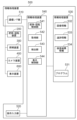
- FIG. 1 is a block diagram illustrating an example of an inspection device according to the present disclosure.
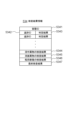
- FIG. 2 is a block diagram showing an example of an information processing device constituting an inspection device according to the present disclosure.
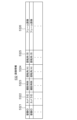
- FIG. 1 is a diagram showing an example of image information acquired by an inspection device according to the present disclosure.
- FIG. 13 is a diagram showing an example of tracking information generated by an inspection device according to the present disclosure.
- 1 is a diagram showing an example of inspection result information generated by an inspection device according to the present disclosure.
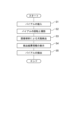
- FIG. 5 is a flowchart illustrating an example of an inspection method performed by the inspection device according to the present disclosure.
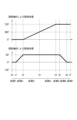
- FIG. 13 is a diagram illustrating an example of a rotation angle timeline of an inspection apparatus according to the present disclosure.
- FIG. 1 is a schematic diagram showing how a vial in a sideways position is photographed by a camera device in an inspection device according to the present disclosure
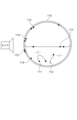
- FIG. This is a schematic diagram showing how the positions of foreign objects in the liquid, foreign objects on the liquid surface, and scratches on the bottle body change in a vial rotating in a sideways position in an inspection device according to the present disclosure, viewed from a direction parallel to the axis of rotation.
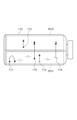
- This is a schematic diagram showing how the positions of foreign objects in the liquid, foreign objects on the liquid surface, and scratches on the bottle body change in a vial rotating in a sideways position in an inspection device according to the present disclosure, viewed from a direction perpendicular to the rotation axis.
- FIG. 1 is a flowchart showing an example of a method in which a detection unit of an inspection device according to the present disclosure detects foreign matter in liquid, foreign matter on the liquid surface, and scratches on a bottle body.
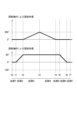
- FIG. 13 illustrates another example of a rotation angle timeline of an inspection apparatus according to the present disclosure.
- 1 is a block diagram showing an example of a basic configuration of an inspection device according to the present disclosure.
- a filled vial (hereafter simply referred to as a vial) 110 is, for example, a bottle that has been filled with a medicinal liquid to store it in a sterile condition, then the opening is sealed with a rubber stopper and then covered with an aluminum cap.
- a plastic cap is placed over the aluminum cap. The rubber stopper and the aluminum and plastic caps form the lid of the vial 110.
- the vial 110 In an upright position, the vial 110 consists, from top to bottom, of a seam, a bottle head (container head), a truncated cone-shaped bottle shoulder (container shoulder), a cylindrical bottle body (container body), and a bottle bottom that closes the bottle body.
- the amount of liquid filled in the vial 110 in this example is approximately half the capacity of the vial. That is, the liquid level height R of the vial 110 in this example is approximately the center of the bottle body.
- the vials to which the present disclosure is applicable are not limited to the above.
- the amount of liquid filled in the vial 110 does not need to be approximately half the capacity of the vial, and may be more than half or less than half.
- the vial 110 may have various defects. For example, there is a possibility that foreign matter has been mixed into the vial 110. Examples of foreign matter include glass fragments, metal fragments, rubber fragments, hair, fiber fragments, soot, etc.
- the vial 110 may have cracks, scratches, dirt, poor seaming, insufficient medicine, etc.
- the inspection device 100 may be a device that inspects the presence or absence of various defects that may occur in the vial 110.
- the inspection device 100 according to this embodiment mainly inspects the following items.
- Submerged foreign matter is foreign matter that exists in the area below the liquid surface of the liquid filled in the vial 110.
- Typical examples of submerged foreign matter are metal pieces, glass pieces, and rubber pieces. Submerged foreign matter may settle to the bottom surface or float in the liquid.
- liquid surface foreign matter is foreign matter that exists in the area above the liquid surface of the liquid filled in the vial 110. Typical examples of liquid surface foreign matter are hair, fiber pieces, and soot. Liquid surface foreign matter may float on the liquid surface or stick to the inner wall of the vial 110.
- Bottle body scratches are scratches and dirt that exist on the outer and inner walls of the bottle body of the vial 110.
- the items inspected by the inspection device 100 are not limited to the above. Items other than the above inspection items, such as adhesions on the back of the lid, scratches on the bottom surface, poor seaming, scratches on the top of the bottle, etc. may also be inspected.
- the gripping and rotating device 200 is a device that can rotate the vial 110 while gripping it.
- the gripping and rotating device 200 has two mutually perpendicular rotation axes (rotation axis A and rotation axis B), and is capable of rotating the gripped vial 110 around rotation axis A as an axis, as well as around rotation axis B as an axis.
- the gripping and rotating device 200 comprises a flat plate-like member 201, an upper arm 202 connected to the upper end of the flat plate-like member 201, and a lower arm 203 connected to the lower end of the flat plate-like member 201.
- a lower gripping part 204 is connected to the end of the lower arm 203 opposite to the end to which the flat plate-like member 201 is connected.
- the lower gripping portion 204 functions as a base on which the vial 110 is placed.
- a rotatable plate 205 is attached to the upper surface of the lower gripping portion 204.
- a chuck mechanism 206 having a chuck finger 211 for chucking the vial 110 is provided at the end of the upper arm 202 opposite to the end to which the flat plate member 201 is connected.
- the chuck mechanism 206 can be configured as a parallel opening and closing type air chuck, but is not limited to this.
- the chuck finger 211 is freely rotatable around the rotation axis A and can be raised and lowered along the rotation axis A.
- the chuck mechanism 206 closes, opens, rotates, and raises and lowers the chuck finger 211 according to commands sent from the information processing device 500.
- the vial 110 When the vial 110 is placed on the plate 205 in an upright position and the chuck finger 211 is lowered to chuck the bottle head of the vial 110, the vial 110 is gripped by the gripping and rotating device 200 so that the central axis of the vial 110 (the axis passing through the center of the head and bottom, also called the upright central axis) coincides with the rotation axis A.
- the central axis of the vial 110 the axis passing through the center of the head and bottom, also called the upright central axis
- the vial 110 rotates around the rotation axis A.
- a rotation angle detector 209 such as an encoder provided on the upper arm 202 is configured to detect the rotation angle of the chuck finger 211, and therefore the rotation angle of the vial 110 chucked by the chuck finger 211 about the rotation axis A, and output it to the information processing device 500.
- the lighting device 300 is a surface light source that illuminates the bottle body of the vial 110 chucked by the chuck mechanism 206 of the gripping and rotating device 200 from a direction perpendicular to the rotation axis A, and is attached to the flat plate-shaped member 201.
- the lighting device 300 is installed on the opposite side of the vial 110 from the camera device 400-1.
- the flat member 201 is supported by a rotating shaft 208 that is rotated by a motor 207.
- the motor 207 is fixed by a support member (not shown).
- the rotating shaft 208 is rotated by the motor 207, the flat member 201 rotates.
- all elements directly or indirectly connected or attached to the flat member 201 namely, the upper arm 202, the lower arm 203, the lower gripping portion 204, the chuck finger 211, the chuck mechanism 206, the plate 205, and the lighting device 300, rotate. Therefore, the vial 110 placed on the plate 205 and chucked by the chuck mechanism 206 also rotates around the rotation axis B.
- a rotation angle detector 210 such as an encoder, provided on the flat plate member 201 is configured to detect the rotation angle of the rotating shaft 208, and therefore the rotation angle of the vial 110 chucked by the chuck finger 211 about the rotation axis B, and output it to the information processing device 500.
- the camera device 400 has a wide-angle lens and is a high-speed imaging device that continuously captures images of the vial body of the vial 110 at a predetermined frame rate (100 fps or more) from a predetermined position on the opposite side of the vial 110 from the side on which the lighting device 300 is installed.
- the camera device 400 may have a telecentric lens instead of a wide-angle lens.
- the optical axis of the camera device 400 is parallel to the rotation axis B.
- the size of the field of view (angle of view) of the camera device 400 is adjusted so that at least the entire vial body of the vial 110 is included in the imaging range.
- the focus value of the camera device 400 is adjusted so that, for example, at least scratches on the outer wall of the bottle body close to the camera device 400, foreign objects stuck to the inner wall, and foreign objects in the liquid can be clearly captured.
- the camera device 400 may be configured to include, for example, a color camera or a black-and-white camera equipped with a CCD (Charge-Coupled Device) image sensor or a CMOS (Complementary MOS) image sensor having a pixel capacity of several million pixels.
- the camera device 400 is connected to the information processing device 500 by wire or wirelessly.
- the camera device 400 is configured to transmit the time-series images obtained by shooting to the information processing device 500 together with information indicating the shooting time, etc.
- the display device 600 is a display device such as an LCD (Liquid Crystal Display).
- the display device 600 is connected to the information processing device 500 by wire or wirelessly.
- the display device 600 is configured to display the results of an inspection of the vial 110 performed by the information processing device 500.
- the information processing device 500 is a device that performs image processing on the time series images captured by the camera device 400 and inspects the vial 110 for defects.
- the information processing device 500 is connected to the gripping and rotating device 200, the camera device 400, and the display device 600 by wire or wirelessly.
- an example of an information processing device 500 includes a communication I/F unit 510, an operation input unit 520, a memory unit 530, and an arithmetic processing unit 540.
- the communication I/F unit 510 is composed of a data communication circuit, and is configured to perform data communication via wire or wirelessly between the gripping and rotating device 200, the lighting device 300, the camera device 400, the display device 600, and other external devices (not shown).
- the operation input unit 520 is composed of operation input devices such as a keyboard and a mouse, and is configured to detect the operation of the operator and output it to the calculation processing unit 540.
- the storage unit 530 is composed of one or more storage devices of one or more types, such as a hard disk or memory, and is configured to store processing information and programs 531 required for various processes in the arithmetic processing unit 540.
- the programs 531 are programs that are loaded into the arithmetic processing unit 540 and executed to realize various processing units, and are loaded in advance from an external device or recording medium (not shown) via a data input/output function such as the communication I/F unit 510 and stored in the storage unit 530.
- the main processing information stored in the storage unit 530 includes image information 532, tracking information 533, and test result information 534.
- the image information 532 includes a time series of images obtained by continuously photographing the vial 110 using the camera device 400.
- an example of image information 532 is composed of entries including container ID 5321, camera ID 5322, shooting time 5323, rotation angle 5324, rotation angle 5325, and frame image 5326.
- container ID 5321 field an ID that uniquely identifies vial 110 held by gripping/rotating device 200 is set.
- container ID 5321 a serial number assigned to vial 110, a barcode attached to vial 110, object fingerprint information collected from the cap of vial 110, etc. are conceivable.
- the camera ID 5322 field an ID that uniquely identifies camera device 400 that captured the frame image is set.
- shooting time 2323 field a shooting time with an accuracy (for example, milliseconds) that allows the frame image to be distinguished from other adjacent frame images is set.
- the rotation angle 5324 field a rotation angle around rotation axis A of vial 110 when the frame image was captured is set.
- the rotation angle 5325 field is set to the rotation angle of the vial 110 about the rotation axis B when the frame image was captured.
- the frame image 5326 field is set to the acquired frame image.
- the entries in the image information 532 are arranged in order of the camera ID 5322. Multiple entries with the same camera ID 5322 are arranged in order of the capture time 5323.
- a pair of a container ID and a camera ID is associated with each frame image 5326, but a pair of a container ID and a camera ID may also be associated with each group of multiple frame images 5326.
- the camera ID may also be omitted.
- the tracking information 533 includes time series data representing the movement trajectory of the detected image of a potential foreign object present in the vial 110 and tracked.
- an example of tracking information 533 is composed of the entries of container ID 5331 and a pair of tracking ID 5332 and pointer 5333.
- An ID that uniquely identifies the vial 110 is set in the container ID 5331 entry, and an entry consisting of a pair of tracking ID 5332 and pointer 5333 is provided for each foreign object candidate to be tracked.
- An ID for distinguishing the foreign object candidate to be tracked from other foreign object candidates of the same vial 110 is set in the tracking ID 5332 item.
- a pointer to movement trajectory information 5334 of the foreign object candidate to be tracked is set in the pointer 5333 item.
- the movement trajectory information 5334 is composed of entries each consisting of a set of a time 53341, a position information 53342, a size 53343, a luminance distribution 53344, and a shape 53345.
- the items of the time 53341, the position information 53342, the size 53343, the luminance distribution 53344, and the shape 53345 are set with the shooting time, the coordinate value indicating the position of the foreign object candidate to be tracked at that shooting time, the size of the foreign object candidate, the luminance distribution of the foreign object candidate, and the shape of the foreign object candidate.
- the shooting time set in the time 53341 uses the shooting time 5323 of the frame image.
- the coordinate value may be a coordinate value in a predetermined coordinate system.
- the predetermined coordinate system may be a camera coordinate system centered on the camera, or a world coordinate system centered on a certain position in real space.
- the entries of the movement trajectory information 5334 are arranged in the order of the time 53341.
- the time 53341 of the first entry is the tracking start time.
- the time 53341 of the last entry is the tracing end time.
- the time 53341 of entries other than the first and last entries is the tracing midpoint time.
- Inspection result information 534 includes information according to the results of the inspection of vial 110.
- an example of inspection result information 534 is composed of the following entries: container ID 5341, a pair of tracking ID 5342 and judgment result 5343, inspection result 5344 for foreign matter in the liquid, inspection result 5345 for foreign matter on the liquid surface, inspection result 5346 for damage to the bottle body, and final inspection result 5347.
- An ID that uniquely identifies the vial 110 to be inspected is set in the entry for container ID 5341.
- An entry consisting of a pair of tracking ID 5342 and judgment result 5343 is provided for each tracked foreign matter candidate.
- the tracking ID 5332 of tracking information 533 is set in the item for tracking ID 5342.
- the judgment result 5343 is set to indicate whether the foreign matter candidate to be tracked identified by tracking ID 5342 is a foreign matter or an air bubble.
- the determination result may be, but is not limited to, a foreign object in the liquid, a foreign object on the liquid surface, a water droplet, or an air bubble.
- Each entry of the inspection result for foreign matter in the liquid 5344, the inspection result for foreign matter on the liquid surface 5345, and the inspection result for damage to the bottle body 5346 is set to either OK (inspection passed) or NG (inspection failed).
- the entry for final inspection result 5347 is set to OK (inspection passed) if all entries of the inspection result for foreign matter in the liquid 5344, the inspection result for foreign matter on the liquid surface 5345, and the inspection result for damage to the bottle body 5346 are set to OK (inspection passed); otherwise, that is, if at least one of the inspection result for foreign matter in the liquid 5344, the inspection result for foreign matter on the liquid surface 5345, and the inspection result for damage to the bottle body 5346 is set to NG (inspection failed), then NG (inspection failed) is set.
- the calculation processing unit 540 has a processor such as a CPU (Central Processing Unit) and its peripheral circuits, and is configured to read and execute a program 531 from the storage unit 530, thereby implementing various processing units through cooperation between the above hardware and the program 531.
- the main processing units implemented by the calculation processing unit 540 include a gripping/rotation control unit 541, an acquisition unit 542, a detection unit 543, and a display control unit 544.
- the gripping/rotation control unit 541 is configured to control the gripping/rotating device 200.
- the gripping/rotation control unit 541 controls the lowering, closing, rotating, opening, raising, and other operations of the chuck finger 211 by transmitting and receiving signals to and from the chuck mechanism 206 of the gripping/rotating device 200 through the communication I/F unit 510.
- the gripping/rotation control unit 541 also controls the rotation of the vial 110 gripped by the gripping/rotating device 200 about the rotation axis B by transmitting and receiving signals to and from the motor 207 through the communication I/F unit 510.
- the gripping/rotation control unit 541 also monitors the rotation angles of the vial 110 gripped by the gripping/rotating control unit 541 about the rotation axes A and B by transmitting and receiving signals to and from the rotation angle detectors 209 and 210 through the communication I/F unit 510.
- the acquisition unit 542 is configured to control the lighting device 300 and the camera device 400.
- the acquisition unit 542 controls the lighting device 300 to be turned on and off by transmitting and receiving signals to and from the lighting device 300 through the communication I/F unit 510.
- the acquisition unit 542 also controls the photographing of the vial 110 held by the gripping and rotating device 200 by transmitting and receiving signals to and from the camera device 400 through the communication I/F unit 510, and acquires time-series images obtained by photographing.
- the acquisition unit 542 also creates image information 532 based on the images acquired from the camera device 400 and information on the rotation angles of the vial 110 about the rotation axes A and B monitored by the rotation angle detectors 209 and 210, and stores the image information in the storage unit 530.
- the detection unit 543 is configured to inspect for foreign objects in the liquid, foreign objects on the liquid surface, and scratches on the bottle body based on the image information 532 acquired by the acquisition unit 542. For example, the detection unit 543 is configured to generate tracking information 533 including time series data representing the movement trajectory of the foreign object candidate. The detection unit 543 is also configured to determine the presence or absence of a foreign object for each of the foreign object candidates based on the tracking information 533, and further detect the type of foreign object. Furthermore, the detection unit 543 is configured to create inspection result information 234 based on the results of the above-mentioned judgment and detection, and store it in the memory unit 530.
- the display control unit 544 is configured to output a part or all of the test result information 534 created by the detection unit 543 to the display device 600 and/or transmit it to an external device (not shown) via the communication I/F unit 510.
- the inspection device 100 performs the process shown in FIG. 6 for each vial 110 to be inspected. Dust and other particles that may adhere to the outside of the vial 110 to be inspected are blown away with air immediately before inspection.
- the gripping and rotating device 200 is in an initial state.
- the chuck fingers 211 of the gripping and rotating device 200 are open and in an elevated position and stop rotating.
- the rotation angle around the rotation axis A detected by the rotation angle detector 209 is set to 0°.
- the motor 207 of the gripping and rotating device 200 stops the rotation around the rotation axis B of the flat plate-like member 201 at an angle where the rotation axis A coincides with the vertical.
- the rotation angle around the rotation axis B detected by the rotation angle detector 210 is set to 0°.
- the gripping and rotating device 200 of the inspection device 100 carries in the vial 110 to be inspected (step S1).
- the gripping and rotating control unit 541 places the vial 110 in an upright position at a predetermined position on the plate 205 of the gripping and rotating device 200, for example, by using a robot arm or manual labor not shown.
- the gripping/rotation control unit 541 controls the chuck mechanism 206 to lower the chuck finger 211 and chuck the head of the vial 110.
- the vial 110 to be inspected is gripped by the gripping/rotation device 200 in an upright position.
- the central axis of the vial 110 approximately coincides with the rotation axis A and becomes vertical.
- the inspection device 100 rotates and photographs the vial 110 (step S2).
- the gripping/rotation control unit 541 controls the chuck mechanism 206 and the motor 207 to rotate the vial 110 around the rotation axis A and the rotation axis B according to a preset rotation angle timeline.
- the gripping/rotation control unit 541 starts rotating the vial 110 around the rotation axis A, it issues a rotation start command to the chuck mechanism 206 specifying the rotation direction, and when it ends the rotation, it issues a rotation end command to the chuck mechanism 206.
- the gripping/rotation control unit 541 rotates the vial 110 around the rotation axis B, it issues a rotation start command to the motor 207 specifying the rotation direction, and when it ends the rotation, it issues a rotation end command to the motor 207.
- the grip/rotation control unit 541 also monitors the rotation angles around the rotation axis A and the rotation axis B detected by the rotation angle detector 209 and the rotation angle detector 210.
- step S2 when the acquisition unit 542 starts photographing the vial 110 with the camera device 400, it gives a command to start photographing to the camera device 400 and a command to turn on the lighting device 300, and when the photographing ends, it gives a command to turn off the lighting device 300 and a command to end photographing to the camera device 400.
- the lighting device 300 may be kept on all the time.
- the acquisition unit 542 may also give a command to control the zoom and/or focus to the camera device 400 so as to change the zoom amount and/or focus value of the camera device 400 during photographing. Note that when rotation and photographing are started simultaneously in step S2, the gripping/rotation control unit 541 and the acquisition unit 542 are configured to operate synchronously.
- the gripping and rotation control unit 541 issues a rotation start command to the chuck mechanism 206, and the acquisition unit 542 issues an image capture start command to the camera device 400 in synchronization with the rotation start command.
- step S2 while the camera device 400 is capturing images, the acquisition unit 542 receives time-series images sent from the camera device 400 together with information indicating the capture time, etc.
- the acquisition unit 542 also receives information on the monitored rotation angles around the rotation axis A and the rotation axis B from the rotation angle detectors 209, 210 via the grip/rotation control unit 541.
- the acquisition unit 542 then associates the time-series images received from the camera device 400 with the capture time and the rotation angles around the rotation axis A and the rotation axis B, and stores them in the storage unit 530 as image information 532.
- the acquisition unit 542 uses information on the monitored rotation angles around the rotation axis A and the rotation axis B.
- the rotation angle timeline is set in advance and is known, processing may be performed assuming that rotation always starts and ends at a fixed time.
- the acquisition unit 542 will automatically determine the programmed rotation angles of rotation axis A and rotation axis B from the time information of the operation start command from the information processing device 500, associate it with the time-series images, and store it in the storage unit 530 as image information 532.
- the detection unit 543 of the inspection device 100 inspects the presence or absence of defects in the vial 110 based on the acquired image information 532, creates inspection result information 534 based on the inspection result, and stores it in the storage unit 530 (step S3).
- the display control unit 544 of the inspection device 100 displays the inspection result information 534 on the display device 600 and/or transmits it to an external device (not shown) through the communication I/F unit 510 (step S4).
- the inspection device 100 carries out the vial 110 that has been inspected (step S5).
- the gripping/rotating control unit 541 controls the chuck mechanism 206 to release the chuck finger 211 and then raise it, and moves the vial 110 on the plate 205 of the gripping/rotating device 200 to a storage location according to the inspection result using a robot arm or human hands (not shown) in the above.
- defect detection by image analysis step S3 was performed.
- the rotation and photographing of the vial 110 step S2) and defect detection through image analysis (step S3) may be performed in parallel.
- FIG. 7 is a diagram showing an example of a rotation angle timeline.
- the vial 110 is rotated as follows: Section 1 (time t0-t1): Stationary in an upright position Section 2 (time t1-t2): Rotated 90° around rotation axis B. The vial 110 assumes a sideways position at time t2.
- the rotation direction is such that the upper side of the vial 110 approaches the back and the lower side approaches the front when viewed from the camera device 400.
- the vial 110 assumes the same posture as at time t2.
- Section 4 (time t3-t4): Rotate another 360° around rotation axis A.
- the rotation direction is the same as in section 3.
- Section 5 (time t4-t5): Stationary in a horizontal position.
- Section 6 (time t5-t6): Rotate -90° around rotation axis B.
- the robot returns to the same upright position as in section 1.
- Section 7 (time t6-t7): Stationary in an upright position.
- the acquisition unit 542 When the vial 110 is rotated along the rotation angle timeline shown in FIG. 7, the acquisition unit 542, for example, at time t0, sends a turn-on command to the lighting device 300 and a command to start image capture to the camera device 400, and at time t7, sends a turn-off command to the lighting device 300 and a command to end image capture to the camera device 400.
- This causes the camera device 400 to capture images of the vial 110 over the entire section of the rotation angle timeline in FIG. 6.
- image capture by the camera device 400 may be limited to a certain section.
- FIG. 8 is a schematic diagram showing how the camera device 400 captures an image of the vial 110 in a sideways position in sections 3 and 4.
- the vial 110 rotates a total of 720° around the axis of rotation A in a sideways position.
- the camera device 400 captures an image of the body of the vial 110 as it rotates, in a direction perpendicular to the axis of rotation A and directly to the side (horizontal).
- the rotation direction of the vial 110 at this time is such that the top of the vial 110 approaches the back and the bottom approaches the front when viewed from the camera device 400.
- Figures 9 and 10 are schematic diagrams showing the changes in the positions of foreign objects in the liquid, foreign objects on the liquid surface, and scratches on the bottle body of a vial 110 rotating on its side around axis of rotation A, as viewed from directions parallel and perpendicular to axis of rotation A.
- the inventor discovered the following phenomena while searching for a method to inspect vials for foreign objects in and on the liquid surface.
- the rotation direction of the vial 110 is desirable for the rotation direction of the vial 110 to be such that the upper side of the vial 110 approaches the back and the lower side approaches the front when viewed from the camera device 400.
- Foreign matter on the liquid surface 113 such as fibrous pieces float on the liquid surface due to their specific gravity and water repellency, and they move along the liquid surface because they move with the flow of the liquid surface layer caused by the inflow and outflow of liquid molecules adhering to the inner wall.
- the vial 110 when the vial 110 is rotated around its central axis in a sideways position, the foreign object attached to the inner wall may completely peel off, or a foreign object floating in the liquid may newly adhere to the inner wall. In this case, the foreign object before peeling off and the newly attached foreign object will be detected as the difference between the images before and after rotation, just like the foreign object that remains attached before and after rotation.
- the bottle body damage moves in sync with the rotation of the vial 110 while maintaining a constant shape, as shown in the bottle body damage 115 in Figures 9 and 10.
- the detection unit 543 first acquires image information including the camera ID 5322 of the camera device 400 and the shooting times 5323 included in sections 3 and 4 from the image information 532 shown in FIG. 3 (step S11). Next, the detection unit 543 detects images of foreign object candidates and scratches on the bottle body for each frame image included in the acquired image information (step S12). The detection unit 543 may detect images of foreign object candidates and scratches on the bottle body from each frame image, for example, by the following method. The detected images are temporarily stored in association with the frame images for reference in subsequent processing.
- the detection unit 543 focuses on one frame image among all frame images in section 3.
- the detection unit 543 acquires a frame image having the same rotation angle (A) and rotation angle (B) as the frame image of interest among the frame images in section 4 as a reference frame image.
- the detection unit 543 acquires a difference image between the frame image of interest and the reference frame image for the region of interest ROI1 and the region of interest ROI2.
- the detection unit 543 detects an image having a size equal to or larger than a predetermined size threshold and a brightness equal to or smaller than a predetermined brightness threshold from the difference image.
- the detection unit 543 detects the image as an image of a foreign object candidate existing in the frame image of interest. If the image detected from the difference image does not exist in the frame image of interest, the detection unit 543 recognizes the image as an image of a foreign object candidate existing in the reference frame image.
- the image of the foreign object candidate detected as described above may be a foreign object in liquid, a foreign object on the liquid surface, an air bubble, a water droplet, or the like.
- the detection unit 543 detects each image from the frame image of interest that is different from the image of the detected foreign object candidate and has a size equal to or larger than a predetermined size threshold and a brightness equal to or smaller than a predetermined brightness threshold, as an image of a bottle body scratch present in the frame image of interest. After completing the above process for the frame image of interest, the detection unit 543 shifts its attention to another frame image among the multiple frame images in section 3, and repeats the same process as above for the newly focused frame image. Then, when the detection unit 543 has finished focusing on all frame images in section 3, it ends the process of step S12.
- the detection unit 543 tracks the image of the detected foreign object candidate in the time-series frame images included in the acquired image information of section 3, and generates tracking information 533 according to the tracking results.
- the detection unit 543 may generate tracking information 533, for example, by the following method.
- the detection unit 543 initializes the tracking information 533.
- the container ID of the vial 110 is set in the entry for container ID 5331 in FIG. 4.
- the detection unit 543 tracks images of foreign object candidates in the time-series frame images using the method described below, and creates an entry for a pair of tracking ID 5332 and pointer 5333 in FIG. 4 and movement trajectory information 5334 for each image of the foreign object candidate according to the tracking results.
- the detection unit 543 focuses on the frame image in section 3 that was photographed the oldest. Next, the detection unit 543 assigns a unique tracking ID to each image of the foreign object candidate detected in the frame image of interest. Next, for each detected image of the foreign object candidate, the detection unit 543 sets the tracking ID assigned to the image of the foreign object candidate detected in the frame image of interest in the tracking ID 5332 item in FIG.
- the detection unit 543 shifts its attention to the frame image one frame later than the frame image of interest in section 3.
- the detection unit 543 focuses on one of the images of the foreign object candidate detected in the frame image of interest.
- the detection unit 543 compares the position of the image of the foreign object candidate of interest with the position of the image of the foreign object candidate detected in the frame image one frame earlier (hereinafter referred to as the preceding frame image), and if the image of the foreign object candidate exists within a predetermined distance threshold from the image of the foreign object candidate of interest, it determines that the image of the foreign object candidate of interest and the image of the foreign object candidate that existed within the distance threshold are images of the same foreign object candidate.
- the detection unit 543 assigns to the image of the foreign object candidate of interest the tracking ID that is assigned to the image of the foreign object candidate determined to be the same.
- the detection unit 543 then secures a new entry in the movement trajectory information 5334 pointed to by the pointer 5333 of the entry in the tracking information 533 in which the assigned tracking ID 5332 is set, and sets the shooting time of the frame image under consideration and the coordinate values, size, luminance distribution, and shape of the image of the foreign object candidate under consideration to the time 53341, position information 53342, size 53343, luminance distribution 53344, and shape 53345 of the secured entry.
- the detection unit 543 determines that the image of the foreign object candidate under consideration is an image of a new foreign object candidate and assigns a new tracking ID. Next, the detection unit 543 sets the tracking ID assigned to the image of the foreign object candidate under consideration in the tracking ID 5332 item in FIG.
- the detection unit 543 When the detection unit 543 has finished processing the image of the foreign object candidate being focused on, it shifts its attention to the image of the next foreign object candidate detected in the frame image being focused on, and repeats the same process as described above. Then, when the detection unit 543 has finished focusing on all images of foreign object candidates detected in the frame image being focused on, it shifts its attention to the frame image one frame later in section 3, and repeats the same process as described above. Then, when the detection unit 543 has finished focusing on the last frame image in the image information 532 of section 3, it ends the tracking process of step S13.
- the detection unit 543 performed tracking based on the distance between the images of the foreign object candidate in two adjacent frame images.
- the detection unit 543 may perform tracking based on the distance between the images of the foreign object candidate in two adjacent frame images separated by n frames (n is a positive integer of 1 or more).
- the detection unit 543 may also perform tracking by comprehensively determining the tracking result obtained by performing tracking based on the distance between the images of the foreign object candidate in two adjacent frame images separated by m frames (m is a positive integer of 0 or more) and the tracking result obtained by performing tracking based on the distance between the images of the foreign object candidate in two adjacent frame images separated by m+j frames (j is a positive integer of 1 or more).
- the detection unit 543 determines whether the image of the foreign object candidate is a foreign object in the liquid, a foreign object on the liquid surface, an air bubble, or a water droplet, based on at least one of the movement trajectory identified by the movement trajectory information 5334 and the image features of the image (position information, size, brightness distribution, shape) (step S14).
- the detection unit 543 determines that, among the images of the foreign body candidates detected only within the region of interest ROI1 shown in FIG. 10, a foreign body candidate that moves upward and then downward in accordance with the rotation of the vial 110 in a sideways position is a foreign body in the liquid. Also, the detection unit 543 determines, for example, among the images of the foreign body candidates detected only within the region of interest ROI1 shown in FIG. 10, a foreign body candidate that moves exclusively upward is an air bubble. Also, the detection unit 543 determines, for example, among the images of the foreign body candidates detected only within the region of interest ROI1 shown in FIG. 10, a foreign body candidate that moves exclusively downward is a foreign body in the liquid.
- the detection unit 543 may determine, among the images of the foreign body candidates detected only within the region of interest ROI1 shown in FIG. 10, those that have a brightness distribution or shape specific to air bubbles are air bubbles, and determine the rest as foreign bodies in the liquid.
- the detection unit 543 may use a time-series information discrimination model, such as a machine learning model such as a neural network, to determine whether an object is a foreign object or a bubble based on more detailed differences in appearance and movement.
- the detection unit 543 may determine that, among the images of the foreign object candidate detected only within the region of interest ROI2 shown in FIG. 10, those having a brightness distribution or shape characteristic of water droplets attached to the inner wall are water droplets, and determine the rest as foreign objects on the liquid surface. Alternatively, the detection unit 543 may determine that, among the images of the foreign object candidate detected only within the region of interest ROI2 shown in FIG. 10, those having a shape characteristic of fiber fragments attached to the inner wall are foreign objects (fiber fragments). Alternatively, the detection unit 543 may determine that an image of a foreign object candidate moving from the region of interest ROI1 to the region of interest ROI2 shown in FIG. 10, whose shape changes at the boundary between inside the liquid and outside the liquid, is a foreign object (fiber fragment). Alternatively, the detection unit 543 may cut out and refer to an image near the image of the foreign object candidate, and determine whether it is a foreign object or an air bubble using an identification model of image information, for example, a machine learning model such as a neural network.
- the detection unit 543 generates the inspection result information 534 of Fig. 5 based on the detection result of the bottle body damage in step S12 and the judgment result for each image of the foreign object candidate in step S14 (step S15). For example, if at least one bottle body damage is detected in step S12, the detection unit 543 sets the bottle body damage inspection result 5346 to NG (inspection failed), and if none are detected, the detection unit 543 sets the bottle body damage inspection result 5346 to OK (inspection passed).
- the detection unit 543 sets the submerged foreign object inspection result 5344 to NG (inspection failed), and if none are detected, the detection unit 543 sets the submerged foreign object inspection result 5344 to OK (inspection passed).
- the detection unit 543 sets the inspection result 5345 for foreign objects on the liquid surface to NG (inspection failed), and if none is detected, sets the inspection result 5345 for foreign objects on the liquid surface to OK (inspection passed).
- the detection unit 543 sets the final inspection result 5347 to OK (inspection passed) only when it has set all entries of the inspection result 5344 for foreign objects in the liquid, the inspection result 5345 for foreign objects on the liquid surface, and the inspection result 5346 for scratches on the bottle body to OK (inspection passed), and sets NG (inspection failed) otherwise.
- the inspection device 100 places the vial 110 filled with liquid in a sideways position and performs a process of rotating the vial 110 around its central axis (rotation axis A) during a specified inspection period (section 3 or section 4 in Figure 7).
- the rotation direction at this time is such that the top approaches the back and the bottom approaches the front when viewed from the camera device 400 installed almost directly to the side of the vial 110.
- This induces a movement of submerged foreign matter 111, such as metal or glass fragments, rising up the curved inner wall surface of the bottle body due to friction with the container and then falling downward due to gravity as the vial 110 rotates.
- a phenomenon is induced in which a liquid surface foreign object 113 such as a fiber piece peels off from the inner wall of the bottle body on the liquid surface as the vial 110 rotates, moves on the liquid surface, and then sticks to the inner wall of the bottle body and moves again, or rotates in sync with the rotation of the vial 110 while changing its shape and attitude at the boundary between inside and outside the liquid while sticking to the inner wall of the bottle body of the vial.
- the inspection device 100 obtains a plurality of images obtained by continuously photographing the area below the liquid surface and the area above the liquid surface of the vial 110 from the above viewpoint during the above inspection period using the camera device 400.
- the inspection device 100 rotates the vial 110 in a sideways position around the central axis (rotation axis A) by 720 degrees or more in the above-mentioned rotation direction. This allows the detection of images of potential foreign objects, distinguishing them from scratches on the vial 110's body, by generating a difference image between images that are at the same angle about the central axis among multiple images captured by the camera device 400.
- This embodiment can be modified in various ways, such as:
- bottles and containers other than vials can also be tested as long as they are transparent or translucent containers filled with liquids such as drinking water.
- the inspection device 100 rotates the vial 110 at least 720 degrees in the same rotational direction around the rotation axis A in sections 3 and 4 of the rotation angle timeline in FIG. 7.
- the inspection device 100 may rotate the vial 110 at least 360 degrees or more by reversing the direction twice, as in sections 3 and 4 of the rotation angle timeline shown in FIG. 12.
- the vial 110 is rotated forward in section 3 and reversed in section 4, but it may also be rotated reversely in section 3 and forward in section 4.
- the inspection device 100 may insert a section where the rotation stops before and after rotation or between reversals in the rotation angle time lines illustrated in FIG. 7 and FIG. 12.
- the inspection device 100 may also make the rotation speed different between section 3 and section 4.
- the inspection device 100 may insert a section of forward or reverse rotation at a higher rotation speed while rotating at least 720 degrees in the same direction around the rotation axis A in order to move foreign objects that are difficult to move from the bottom surface or inner wall.
- the display control unit 544 may display the inspection result information 534, which is an example of the foreign substance inspection result, on the terminal used by the inspector.
- the foreign substance inspection result may be recorded and presented by any method.
- the display control unit 544 may issue an alert to an inspector if a foreign object or a specific foreign object is detected.
- the cause of the foreign object and the location of the foreign object can be identified based on the content of the foreign object. For example, in the case of a fiber or hair fragment, a person may be the cause of the foreign object contamination and production line A may be the location of the foreign object contamination. In addition, in the case of a metal fragment, production line B or C may be the location of the foreign object contamination. Therefore, the display control unit 544 may issue an alert to a specific inspector in charge of the cause of the foreign object contamination and the location of the foreign object contamination. In addition, any alert may be issued based on the foreign object inspection results.
- the display control unit 544 may output a countermeasure according to the contents of the foreign matter. For example, the display control unit 544 may determine a countermeasure based on a model generated by machine learning the correspondence between the foreign matter inspection result and the countermeasure, and the subject's estimation result. Alternatively, the display control unit 544 may search and acquire a countermeasure corresponding to the contents (type) of the foreign matter identified in the foreign matter inspection result from a correspondence table in which the contents (type) of the foreign matter and the countermeasure are previously associated and recorded. Countermeasures for preventing recurrence may be, for example, the following, but are not limited thereto. (1) Remove the foreign object.
- the actions of the inspector can be optimized or the inspector's decision-making based on the foreign body inspection results can be supported.
- an inspection device 1 is an apparatus for inspecting a container filled with a liquid, and includes a rotation unit 2 and an acquisition unit 3.
- the rotating unit 2 is configured to perform a rotation process in which a container filled with liquid is placed in a sideways position and rotated around its upright central axis during a specified inspection period.
- the rotating unit 2 can be configured in the same manner as the gripping and rotation control unit 541 in FIG. 2, for example, but is not limited to this.
- the acquisition unit 3 is configured to perform an acquisition process in which the acquisition unit 3 acquires a plurality of images obtained by continuously photographing the area below the liquid surface of the container and the area above the liquid surface from a viewpoint in a direction substantially perpendicular to the upright central axis and substantially horizontal to the liquid surface during the above-mentioned specified inspection period.
- the acquisition unit 3 can be configured in the same manner as the acquisition unit 542 in FIG. 2, for example, but is not limited thereto.
- the inspection device 1 configured in this manner operates as follows. That is, the rotation unit 2 performs a rotation process in which a container filled with liquid is placed in an upside-down position and rotated around its central axis during a specified inspection period.
- the acquisition unit 3 performs an acquisition process in which the area below the liquid surface of the container and the area above the liquid surface are continuously photographed from a viewpoint approximately perpendicular to the upright central axis and approximately horizontal to the liquid surface during the specified inspection period to acquire multiple images.
- the rotation process induces foreign objects such as metal fragments and glass fragments to rise due to friction with the container's inner wall as the container rotates, and then fall downward due to gravity.
- foreign objects such as fiber fragments are induced to peel off from the container's inner wall to the liquid surface as the container rotates, move along the liquid surface, and then stick to the container's inner wall and move again, or to rotate in sync with the container's rotation while changing shape and attitude while stuck to the container's inner wall.
- the inspection device 1 acquires multiple images by continuously photographing the area below the liquid surface and the area above the liquid surface from the above-mentioned viewpoint during the inspection period in the acquisition process. Therefore, foreign objects present in the area below the liquid surface in a container filled with liquid and foreign objects present in the area above the liquid surface can be observed in the same captured image.
- the information processing device can use a GPU (Graphic Processing Unit), a DSP (Digital Signal Processor), an MPU (Micro Processing Unit), an FPU (Floating number Processing Unit), a PPU (Physics Processing Unit), a TPU (Tensor Processing Unit), a quantum processor, a microcontroller, or a combination of these.
- a GPU Graphic Processing Unit
- DSP Digital Signal Processor
- MPU Micro Processing Unit
- FPU Floating number Processing Unit
- PPU Physicals Processing Unit
- TPU Tinsor Processing Unit
- quantum processor a microcontroller, or a combination of these.
- This disclosure can be used in the field of inspecting containers such as vials filled with liquid.
- [Appendix 1] a rotation unit that places a container filled with a liquid in a sideways position and rotates the container about its upright central axis during a predetermined inspection period; an acquisition unit that acquires a plurality of images obtained by successively photographing an area below the liquid surface and an area above the liquid surface of the container during the specified inspection period from a viewpoint in a direction substantially perpendicular to the upright central axis and substantially parallel to the liquid surface;
- An inspection device comprising: [Appendix 2] During the inspection period, the rotating unit rotates the container in the rotation direction by 720 degrees or more, or rotates the container by 360 degrees or more twice by reversing the direction.
- the inspection apparatus of claim 1 [Appendix 3] a detection unit that detects an image of a foreign object candidate based on a difference between images having the same angle with respect to the central axis among the plurality of images, 3.
- the detection unit tracks an image of the foreign object candidate in the plurality of images, and identifies whether the image of the foreign object candidate is a foreign object or not based on at least one of an image feature and a movement trajectory of the image of the foreign object candidate moving within the area below the liquid surface. 4.
- the detection unit tracks an image of the foreign object candidate in the plurality of images, and identifies whether the image of the foreign object candidate is a foreign object or not based on at least one of an image feature and a movement trajectory of the image of the foreign object candidate moving within an area above the liquid surface. 4.
- the inspection apparatus of claim 3. [Appendix 6] The detection unit detects a scratch on the container based on a difference between the images. 4. The inspection apparatus of claim 3.
- a display control unit that outputs the inspection result of the foreign matter is further provided. 7. An inspection apparatus according to any one of claims 4 to 6.
- the display control unit further outputs a countermeasure for assisting an inspector in making a decision based on the result of the foreign matter inspection. 8.
- the inspection apparatus of claim 7 [Appendix 9]
- the predetermined rotation direction is a direction in which the upper side of the container approaches the back and the lower side approaches the front when viewed from the viewpoint. 2.
- the inspection apparatus of claim 1. [Appendix 10] placing a container filled with liquid in a sideways position and rotating the container about its upright central axis during a predetermined inspection period; acquiring a plurality of images obtained by successively photographing an area below the liquid surface and an area above the liquid surface of the container during the predetermined inspection period from a viewpoint in a direction substantially perpendicular to the upright central axis and substantially parallel to the liquid surface; Testing method.
- Inspection device 2 Rotation unit 3 Acquisition unit 100 Inspection device 110 Vial 200 Grip/rotation device 201 Flat plate member 202 Upper arm 203 Lower arm 204 Lower gripping unit 205 Plate 206 Chuck mechanism 207 Motor 208 Rotating shaft 209, 210 Rotation angle detector 211 Chuck finger 300 Illumination device 400 Camera device 500 Information processing device 510 Communication I/F unit 520 Operation input unit 530 Memory unit 531 Program 532 Image information 533 Tracking information 534 Inspection result information 540 Arithmetic processing unit 541 Grip/rotation control unit 542 Acquisition unit 543 Detection unit 544 Display control unit 600 Display device
Landscapes
- Physics & Mathematics (AREA)
- Health & Medical Sciences (AREA)
- Life Sciences & Earth Sciences (AREA)
- Chemical & Material Sciences (AREA)
- Analytical Chemistry (AREA)
- Biochemistry (AREA)
- General Health & Medical Sciences (AREA)
- General Physics & Mathematics (AREA)
- Immunology (AREA)
- Pathology (AREA)
- Investigating Materials By The Use Of Optical Means Adapted For Particular Applications (AREA)
Priority Applications (2)
| Application Number | Priority Date | Filing Date | Title |
|---|---|---|---|
| JP2025538059A JPWO2025027717A1 (https=) | 2023-07-28 | 2023-07-28 | |
| PCT/JP2023/027866 WO2025027717A1 (ja) | 2023-07-28 | 2023-07-28 | 検査装置 |
Applications Claiming Priority (1)
| Application Number | Priority Date | Filing Date | Title |
|---|---|---|---|
| PCT/JP2023/027866 WO2025027717A1 (ja) | 2023-07-28 | 2023-07-28 | 検査装置 |
Publications (1)
| Publication Number | Publication Date |
|---|---|
| WO2025027717A1 true WO2025027717A1 (ja) | 2025-02-06 |
Family
ID=94394650
Family Applications (1)
| Application Number | Title | Priority Date | Filing Date |
|---|---|---|---|
| PCT/JP2023/027866 Pending WO2025027717A1 (ja) | 2023-07-28 | 2023-07-28 | 検査装置 |
Country Status (2)
| Country | Link |
|---|---|
| JP (1) | JPWO2025027717A1 (https=) |
| WO (1) | WO2025027717A1 (https=) |
Citations (6)
| Publication number | Priority date | Publication date | Assignee | Title |
|---|---|---|---|---|
| JP2002014049A (ja) * | 2000-04-13 | 2002-01-18 | Eisai Co Ltd | 凍結乾燥製剤の乾燥前における混入異物の検査方法及びその装置 |
| JP2004257937A (ja) * | 2003-02-27 | 2004-09-16 | Japan System Kk | 異物検査装置および検査方法 |
| WO2006008819A1 (ja) * | 2004-07-22 | 2006-01-26 | Eisai R & D Management Co., Ltd. | 溶液中の異物検査方法およびその装置 |
| JP2012112938A (ja) * | 2010-11-25 | 2012-06-14 | Mettler-Toledo Ag | 液相中の固形物検出用の装置および方法 |
| WO2022059185A1 (ja) * | 2020-09-18 | 2022-03-24 | 日本電気株式会社 | 検査装置 |
| WO2022229841A1 (en) * | 2021-04-28 | 2022-11-03 | Stevanato Group S.P.A. | Apparatus and method for inspecting containers which are at least partially transparent to a predetermined electromagnetic radiation |
-
2023
- 2023-07-28 JP JP2025538059A patent/JPWO2025027717A1/ja active Pending
- 2023-07-28 WO PCT/JP2023/027866 patent/WO2025027717A1/ja active Pending
Patent Citations (6)
| Publication number | Priority date | Publication date | Assignee | Title |
|---|---|---|---|---|
| JP2002014049A (ja) * | 2000-04-13 | 2002-01-18 | Eisai Co Ltd | 凍結乾燥製剤の乾燥前における混入異物の検査方法及びその装置 |
| JP2004257937A (ja) * | 2003-02-27 | 2004-09-16 | Japan System Kk | 異物検査装置および検査方法 |
| WO2006008819A1 (ja) * | 2004-07-22 | 2006-01-26 | Eisai R & D Management Co., Ltd. | 溶液中の異物検査方法およびその装置 |
| JP2012112938A (ja) * | 2010-11-25 | 2012-06-14 | Mettler-Toledo Ag | 液相中の固形物検出用の装置および方法 |
| WO2022059185A1 (ja) * | 2020-09-18 | 2022-03-24 | 日本電気株式会社 | 検査装置 |
| WO2022229841A1 (en) * | 2021-04-28 | 2022-11-03 | Stevanato Group S.P.A. | Apparatus and method for inspecting containers which are at least partially transparent to a predetermined electromagnetic radiation |
Also Published As
| Publication number | Publication date |
|---|---|
| JPWO2025027717A1 (https=) | 2025-02-06 |
Similar Documents
| Publication | Publication Date | Title |
|---|---|---|
| JP7359297B2 (ja) | 検査システム | |
| US5864395A (en) | Method and an apparatus for identifying foreign bodies in packaged beverages, as well as use of the apparatus | |
| CN105181714B (zh) | 一种基于图像处理的瓶装液体杂质检测系统及其检测方法 | |
| TWI708052B (zh) | 用於非破壞性檢測-流體中未溶解粒子之方法及裝置 | |
| TWI499669B (zh) | 微生物檢測方法、微生物檢測裝置及程式 | |
| EP1779096B1 (en) | Apparatus and method for checking of containers | |
| JP4254347B2 (ja) | 容器内液体中の異物検出方法及びその装置 | |
| CN101548178A (zh) | 用于检查或监测瓶或类似容器的方法以及用于检查瓶或类似容器的设备 | |
| CN109709108B (zh) | 一种瓶装透明液体杂质检测设备及方法 | |
| CN109307675A (zh) | 一种产品外观检测方法和系统 | |
| WO2022244075A1 (ja) | 検査システム | |
| JP2010181231A (ja) | 不透明溶液中の異物検査装置および異物検査方法 | |
| CN103743756A (zh) | 一种容器内壁在线检测装置及方法 | |
| JP2005017004A (ja) | ガラス瓶の異物検査システム | |
| JP2004257937A (ja) | 異物検査装置および検査方法 | |
| WO2025027717A1 (ja) | 検査装置 | |
| US6825925B2 (en) | Inspecting apparatus for foreign matter | |
| WO2025154143A1 (ja) | 検査装置 | |
| WO2025154144A1 (ja) | 検査装置 | |
| WO2020188730A1 (ja) | 検品装置、検品方法、及び非一時的なコンピュータ可読媒体 | |
| JPH04305144A (ja) | コンタクトレンズ外周欠け検査装置 | |
| CN209673673U (zh) | 一种瓶装透明液体杂质检测设备 | |
| US20260098817A1 (en) | Inspection system | |
| JP2002267612A (ja) | 透明容器等の充填液体中の異物検査装置及びシステム | |
| US20260086040A1 (en) | Inspection system |
Legal Events
| Date | Code | Title | Description |
|---|---|---|---|
| 121 | Ep: the epo has been informed by wipo that ep was designated in this application |
Ref document number: 23947516 Country of ref document: EP Kind code of ref document: A1 |
|
| ENP | Entry into the national phase |
Ref document number: 2025538059 Country of ref document: JP Kind code of ref document: A |
|
| WWE | Wipo information: entry into national phase |
Ref document number: 2025538059 Country of ref document: JP |
|
| NENP | Non-entry into the national phase |
Ref country code: DE |