WO2025022990A1 - ケーブル装置 - Google Patents
ケーブル装置 Download PDFInfo
- Publication number
- WO2025022990A1 WO2025022990A1 PCT/JP2024/024649 JP2024024649W WO2025022990A1 WO 2025022990 A1 WO2025022990 A1 WO 2025022990A1 JP 2024024649 W JP2024024649 W JP 2024024649W WO 2025022990 A1 WO2025022990 A1 WO 2025022990A1
- Authority
- WO
- WIPO (PCT)
- Prior art keywords
- pair
- signal
- signal lines
- line
- wires
- Prior art date
- Legal status (The legal status is an assumption and is not a legal conclusion. Google has not performed a legal analysis and makes no representation as to the accuracy of the status listed.)
- Pending
Links
Images



Classifications
-
- H—ELECTRICITY
- H01—ELECTRIC ELEMENTS
- H01R—ELECTRICALLY-CONDUCTIVE CONNECTIONS; STRUCTURAL ASSOCIATIONS OF A PLURALITY OF MUTUALLY-INSULATED ELECTRICAL CONNECTING ELEMENTS; COUPLING DEVICES; CURRENT COLLECTORS
- H01R13/00—Details of coupling devices of the kinds covered by groups H01R12/70 or H01R24/00 - H01R33/00
- H01R13/646—Details of coupling devices of the kinds covered by groups H01R12/70 or H01R24/00 - H01R33/00 specially adapted for high-frequency, e.g. structures providing an impedance match or phase match
- H01R13/6461—Means for preventing cross-talk
- H01R13/6471—Means for preventing cross-talk by special arrangement of ground and signal conductors, e.g. GSGS [Ground-Signal-Ground-Signal]
Definitions
- the present disclosure relates to a cable arrangement.
- This application claims priority based on Japanese Application No. 2023-119714 filed on July 24, 2023, and incorporates by reference all of the contents of said Japanese application.
- Patent Document 1 discloses a cable device.
- This cable device includes a wiring board and a plurality of pairs of electric wires. Each pair of electric wires is electrically connected to a respective pad of the wiring board and transmits a differential signal. The first signal wire and the second signal wire of each pair of electric wires transmit a positive phase signal and a negative phase signal, respectively. When noise of approximately the same intensity occurs in each pair of electric wires, the noise in the differential signal is sufficiently removed by taking the difference between the positive phase signal and the negative phase signal.
- the present disclosure relates to a cable device as one aspect.
- the cable device includes a plurality of electric wires and a storage section that stores the plurality of electric wires.
- the plurality of electric wires include a pair of first signal lines configured to transmit a first differential signal and a pair of second signal lines configured to transmit a second differential signal.
- Each of the plurality of electric wires extends along a first direction.
- the pair of first signal lines and the pair of second signal lines are arranged such that, in a cross section of the storage section that intersects with the first direction, a first line segment connecting the centers of the pair of first signal lines intersects with a second line segment connecting the centers of the pair of second signal lines.
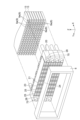
- FIG. 1 is a perspective view showing an electrical connector according to an embodiment.
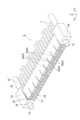
- FIG. 2 is an exploded perspective view of the electrical connector shown in FIG. 3 is a perspective view showing a sub-connector included in the electrical connector shown in FIG. 1.
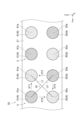
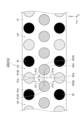
- FIG. 4 is a diagram showing the arrangement of a plurality of electric wires on the first surface of the housing shown in FIG.
- FIG. 5 is a schematic diagram showing an arrangement of a plurality of electric wires in an electric connector according to a comparative example.
- Part (a) of Figure 6, part (b) of Figure 6, and part (c) of Figure 6 are diagrams for explaining the influence of noise due to crosstalk from a pair of second signal lines in a pair of first signal lines of an electrical connector in a comparative example.
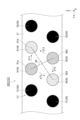
- FIG. 7 is a diagram showing the arrangement of a plurality of electric wires on a first surface of a housing of an electrical connector according to a first modified example.
- FIG. 8 is a diagram showing the arrangement of a plurality of electric wires on a first surface of a housing of an electrical connector according to a second modified example.
- FIG. 9 is a diagram showing the arrangement of a plurality of electric wires on a first surface of a housing of an electrical connector according to a third modified example.
- FIG. 10 is a diagram showing the arrangement of a plurality of electric wires on a first surface of a housing of an electrical connector according to a fourth modified example.
- the distance between the first signal wire of a certain pair of electric wires and the first signal wire of a pair of electric wires adjacent to the certain pair of electric wires is different from the distance between the second signal wire of the certain pair of electric wires and the first signal wire of the adjacent pair of electric wires.
- the strength of the crosstalk from the first signal wire of the adjacent pair of electric wires is different in each of the certain pair of electric wires.
- the difference between the positive phase signal and the negative phase signal is taken in a certain pair of electric wires, a difference in the influence of noise due to crosstalk from the first signal wire of the other adjacent pair of electric wires remains.
- a cable device includes a plurality of electric wires and a storage unit that stores the plurality of electric wires.
- the plurality of electric wires include a pair of first signal lines configured to transmit a first differential signal and a pair of second signal lines configured to transmit a second differential signal.
- Each of the plurality of electric wires extends along a first direction.
- the pair of first signal lines and the pair of second signal lines are arranged such that, in a cross section of the storage unit that intersects with the first direction, a first line segment that connects the centers of the pair of first signal lines intersects with a second line segment that connects the centers of the pair of second signal lines.
- the pair of first signal lines and the pair of second signal lines are arranged such that, in a cross section of the storage section intersecting the first direction, a first line segment connecting the centers of the pair of first signal lines intersects with a second line segment connecting the centers of the pair of second signal lines.
- the strength of the crosstalk from one second signal line in one first signal line approaches the strength of the crosstalk from one second signal line in the other first signal line.
- the effect of noise due to crosstalk from one second signal line is reduced.
- the difference between the distance between the center of one first signal line and the center of the other second signal line and the distance between the center of the other first signal line and the center of the other second signal line is reduced. This reduces the effect of noise due to crosstalk from the other second signal line in the pair of first signal lines. Therefore, the effect of noise due to crosstalk from the pair of second signal lines in the pair of first signal lines can be sufficiently eliminated.
- the pair of first signal lines and the pair of second signal lines may be arranged so that the midpoint of the first line segment coincides with the midpoint of the second line segment.
- the difference between the distance between the center of one first signal line and the center of one second signal line and the distance between the center of the other first signal line and the center of one second signal line is smaller, and the difference between the distance between the center of one first signal line and the center of the other second signal line and the distance between the center of the other first signal line and the center of the other second signal line is smaller.
- the pair of first signal lines and the pair of second signal lines may be arranged so that the first line segment and the second line segment are perpendicular to each other.
- the difference between the distance between the center of one first signal line and the center of one second signal line and the distance between the center of the other first signal line and the center of one second signal line becomes zero, and the difference between the distance between the center of one first signal line and the center of the other second signal line and the distance between the center of the other first signal line and the center of the other second signal line becomes zero.
- the pair of first signal lines and the pair of second signal lines may be arranged so that the first line segments and the second line segments are the same length.
- the centers of the pair of first signal lines and the centers of the pair of second signal lines are the four vertices of a square whose sides are line segments connecting the center of one first signal line and the center of one second signal line.
- the multiple electric wires may further include a first ground wire connected to ground.
- the first ground wire may be aligned in the second direction with the pair of first signal wires and the pair of second signal wires in a cross section of the storage section intersecting the first direction.
- the other signal wires are located on the opposite side of the first ground wire to the pair of first signal wires and the pair of second signal wires, the influence of noise due to crosstalk from the other signal wires is reduced.
- the influence of noise due to crosstalk from the other signal wires can be more effectively eliminated in the pair of first signal wires and the pair of second signal wires.
- the multiple electric wires may further include a second ground wire connected to ground.
- the first ground wire and the second ground wire may be arranged to sandwich the pair of first signal wires and the pair of second signal wires in the second direction in a cross section of the storage section intersecting the first direction.
- the influence of noise due to crosstalk from the other signal wires is reduced.
- the influence of noise due to crosstalk from the other signal wires can be more effectively eliminated in the pair of first signal wires and the pair of second signal wires.
- the multiple electric wires may further include a pair of third ground wires connected to ground.
- the pair of third ground wires may be arranged in a cross section of the storage section intersecting the first direction so as to sandwich the pair of first signal wires and the pair of second signal wires in a third direction intersecting the second direction.
- the other signal wire is located on the opposite side of the pair of first signal wires and the pair of second signal wires with respect to at least one of the pair of third ground wires, the influence of noise due to crosstalk from the other signal wires is reduced. As a result, the influence of noise due to crosstalk from the other signal wires can be more effectively eliminated in the pair of first signal wires and the pair of second signal wires.
- the storage section may be a housing that stores a plurality of electric wires.
- the cable device is an electrical connector.
- crosstalk from a pair of second signal lines to a pair of first signal lines can be a problem, but the occurrence of this crosstalk can be suppressed.
- the housing may have multiple through holes that accommodate the conductors at the ends of the multiple electric wires.
- the multiple electric wires may be multiple electric wires of a flexible flat cable.
- the cross-sectional shape of each of the multiple electric wires may be circular.
- FIG. 1 is a perspective view showing an electrical connector according to the first embodiment.
- FIG. 2 is an exploded perspective view of the electrical connector shown in FIG. 1.
- the electrical connector 1 (cable device) includes a plurality of sub-connectors 5 and a frame body 6. The plurality of sub-connectors 5 are clamped by the frame body 6.
- the sub-connector 5 includes a plurality of electric wires 7, a housing 20 (storage section), and a pair of guide pins 70.
- the plurality of electric wires 7 are integrated by a covering member 13 to form a flexible flat cable (FFC).
- FFC flexible flat cable
- the longitudinal direction of the electrical connector 1 is defined as the X direction (first direction)
- the width direction of the electrical connector 1 is defined as the Y direction (second direction)
- the direction intersecting the X direction and Y direction is defined as the Z direction (third direction).
- the multiple electric wires 7 are members for transmitting power or electrical signals. Each electric wire 7 is either a pair of first signal lines 8 and a pair of second signal lines 9 that transmit differential signals. In one example, the multiple electric wires 7 have nine pairs (18 wires) of first signal lines 8 and nine pairs (18 wires) of second signal lines 9.
- the first signal lines 8 have a conductor 8a.
- the conductor 8a is a metal such as copper. When the electrical connector 1 is connected to a mating connector, the conductor 8a is connected to the circuit of the board via a terminal provided on the mating connector. The conductor 8a may be directly connected to an electrode pad provided on the board.
- the first signal line 8 may be an insulated wire in which the conductor 8a is covered with an insulator, or a bare wire in which the conductor 8a is exposed as is.
- the cross-sectional shape of each electric wire 7 in a cross section intersecting the X-direction is, for example, circular.
- the second signal line 9 has a conductor 9a.
- the conductor 9a is a metal such as copper.
- the conductor 9a is connected to the circuit of the board via a terminal provided on the mating connector.
- the conductor 9a may be directly connected to an electrode pad provided on the board.
- the second signal line 9 may be an insulated wire in which the conductor 9a is covered with an insulator, or a bare wire in which the conductor 9a is exposed.
- the multiple electric wires 7 each extend along the X direction.
- the multiple electric wires 7 are lined up along the Y direction.
- the first signal lines 8 and the second signal lines 9 are lined up alternately along the Y direction.
- the pair of first signal lines 8 are adjacent to each other in a direction inclined with respect to the Y direction and the Z direction.
- the pair of first signal lines 8 are configured to pass currents of opposite phases to each other, and are configured to transmit signals by differential transmission in which signals are transmitted by the potential difference between the pair of first signal lines 8. In such a pair of first signal lines 8, when noise of the same amplitude occurs in each first signal line 8, the noise can be removed by taking the difference between the signals of the first signal lines 8.
- the pair of second signal lines 9 are adjacent to each other in a direction inclined with respect to the Y direction and the Z direction.
- the direction in which the pair of second signal lines 9 are adjacent to each other intersects with the direction in which the pair of first signal lines 8 are adjacent to each other.
- the pair of second signal lines 9 are configured to pass currents of opposite phases to each other, and are configured to transmit signals by differential transmission, which transmits signals by the potential difference between the pair of second signal lines 9.
- the distance between each conductor of the multiple electric wires 7 (center-to-center distance) is, for example, 0.6 mm.
- the pair of second signal lines 9 can remove noise of the same amplitude as the pair of first signal lines 8.
- the covering member 13 is a member that covers the portions of the multiple electric wires 7 except for their tip and rear ends.
- the material of the covering member 13 is, for example, a resin such as polyester.
- a portion of the covering member 13 that covers the tip of the conductor 8a of the first signal line 8 and the tip of the conductor 9a of the second signal line 9 has been removed. In other words, the tip of the conductor 8a of the first signal line 8 and the tip of the conductor 9a of the second signal line 9 are exposed from the covering member 13.
- FIG. 3 is a perspective view of the sub-connector 5 shown in FIG. 2.
- the housing 20 of the sub-connector 5 has a first surface 21, a second surface 22, a third surface 23, and a fourth surface 24.
- the first surface 21 and the second surface 22 are surfaces that extend in the Y direction and the Z direction.
- the second surface 22 is located on the opposite side of the first surface 21 in the X direction.
- the third surface 23 and the fourth surface 24 are surfaces that extend in the X direction and the Y direction.
- the fourth surface 24 is located on the opposite side of the third surface 23 in the Z direction.
- the housing 20 further has a number of through holes 25 (retaining holes) and a pair of guide holes 28.
- the through holes 25 are holes that extend along the X direction and penetrate the housing 20.
- the through holes 25 open in the first surface 21 and the second surface 22.
- the shape of the through holes 25 when viewed from the X direction is, for example, circular.
- eighteen through holes 25 are formed in the housing 20.
- the multiple through holes 25 are lined up along the Y direction.
- the inner diameter of each through hole 25 is the same as or slightly larger than the outer diameter of the conductor 8a of the first signal line 8 and the outer diameter of the conductor 9a of the second signal line 9.
- the multiple through holes 25 each house the conductor 7a at the tip of the multiple electric wires 7. Either the conductor 8a of the first signal line 8 or the conductor 9a of the second signal line 9 is arranged inside each through hole 25.
- Each through hole 25 holds the tip of the electric wire 7.
- the tips of the multiple electric wires 7 are exposed from each of the multiple through holes 25 on the first surface 21. Therefore, the housing 20 houses multiple electric wires 7.
- the pair of guide holes 28 are holes that penetrate the housing 20 along the X direction. When viewed from the X direction, the shape of the guide hole 28 is circular. Each of the pair of guide holes 28 is configured to allow a guide pin 70 to be inserted. For example, a pair of guide pins 70 are inserted into the inside of each of the pair of guide holes 28. The pair of guide holes 28 are formed to sandwich the multiple through holes 25 in the Y direction. The inner diameter of the pair of guide holes 28 is formed to be larger than the inner diameter of each of the through holes 25.
- the pair of guide pins 70 are pins that extend along the X direction.
- the material of the guide pins 70 is a metal such as stainless steel.
- Each guide pin 70 is located within each guide hole 28.
- the pair of guide pins 70 are arranged to sandwich a plurality of through holes 25 in the Y direction.
- the guide pins 70 may be screws, for example.
- the multiple sub-connectors 5 configured as described above are stacked along the Z direction and are sandwiched by a frame body 6.
- the frame body 6 is an annular member.
- the material of the frame body 6 is a resin such as polyphenylene sulfide (PPS), polybutylene terephthalate (PBT), or acrylonitrile butadiene styrene (ABS).
- PPS polyphenylene sulfide
- PBT polybutylene terephthalate
- ABS acrylonitrile butadiene styrene
- FIG. 4 is a diagram showing the arrangement of the first signal lines 8 and the second signal lines 9 on the first surface 21 of the housing 20.
- the pair of first signal lines 8 and the pair of second signal lines 9 form a unit U with two rows and two columns.
- the pair of first signal lines 8 are configured to transmit a differential signal (first differential signal).
- the pair of first signal lines 8 has a signal line 81 that transmits a positive phase signal and a signal line 82 that transmits a negative phase signal.
- the pair of second signal lines 9 has a signal line 91 that transmits a positive phase signal and a signal line 92 that transmits a negative phase signal.
- the signal lines 91 and 81 are arranged in this order in the Y direction.
- the signal lines 82 and 92 are arranged in this order in the Y direction. Therefore, the pair of first signal lines 8 and the pair of second signal lines 9 are adjacent to each other in the Y direction.
- the virtual line segment connecting the center 81a of the signal line 81 and the center 82a of the signal line 82 is referred to as the first line segment L1.
- the virtual line segment connecting the center 91a of the signal line 91 and the center 92a of the signal line 92 is referred to as the second line segment L2.
- the pair of first signal lines 8 and the pair of second signal lines 9 are arranged such that the first line segment L1 intersects the second line segment L2 in a cross section intersecting the X direction.
- the pair of first signal lines 8 and the pair of second signal lines 9 are arranged such that the midpoint of the first line segment L1 coincides with the midpoint of the second line segment L2.
- the midpoint of the first line segment L1 does not have to strictly coincide with the midpoint of the second line segment L2.
- the midpoint of the first line segment L1 may be shifted relative to the midpoint of the second line segment L2.
- the midpoint of the first line segment L1 may coincide with the vicinity of the midpoint of the second line segment L2
- the vicinity of the midpoint of the first line segment L1 may coincide with the midpoint of the second line segment L2
- the vicinity of the midpoint of the first line segment L1 may coincide with the vicinity of the midpoint of the second line segment L2.
- the vicinity of the midpoint of the first line segment L1 refers to the approximate midpoint position on the first line segment L1, the vicinity of the midpoint position on the first line segment L1, or a position close to the midpoint of the first line segment L1.
- the vicinity of the midpoint of the first line segment L1 may be a range on a line segment whose length is within a range of ⁇ 0.02 from the midpoint and shares the midpoint with the first line segment L1, assuming that the length of the first line segment L1 is 1.
- the vicinity of the midpoint of the second line segment L2 is similar to the above.
- the pair of first signal lines 8 and the pair of second signal lines 9 are arranged so that the first line segment L1 and the second line segment L2 are mutually orthogonal.
- the first line segment L1 and the second line segment L2 do not have to be strictly orthogonal to each other.
- the pair of first signal lines 8 and the pair of second signal lines 9 may be arranged so that the first line segment L1 and the second line segment L2 intersect at an angle ⁇ 1.
- the angle ⁇ 1 may be, for example, 69.2 degrees or more and 111.8 degrees or less, for example, 90 degrees.
- the pair of first signal lines 8 and the pair of second signal lines 9 are arranged so that the first line segment L1 and the second line segment L2 are mutually the same length.
- the first line segment L1 and the second line segment L2 do not have to be strictly the same length.
- the ratio of the length of the second line segment L2 to the length of the first line segment L1 may be 0.6 or more and 1.4 or less, 0.8 or more and 1.2 or less, for example, 1.0.
- the centers 81a, 82a of the pair of first signal lines 8 and the centers 91a, 92a of the pair of second signal lines 9 form the four vertices of an imaginary square, one side of which is the line segment connecting the center 81a of the signal line 81 and the center 91a of the signal line 91.
- FIG. 5 is a schematic diagram showing the arrangement of multiple electric wires 7 in the electrical connector 100 according to the comparative example.
- a pair of first signal lines 180 and a pair of second signal lines 190 are arranged in the Y direction so as to sandwich the ground line 110.
- the pair of first signal lines 180 has a signal line 181 that transmits a positive phase signal and a signal line 182 that transmits a negative phase signal.
- the pair of second signal lines 190 has a signal line 191 that transmits a positive phase signal and a signal line 192 that transmits a negative phase signal.
- the electric wire conductors used for signal transmission are electrically connected to the board, the electric wire conductors are generally arranged in a row and fixed to a holder (e.g., a housing) to form a unit.
- a holder e.g., a housing
- a ground line 110 is arranged between the pair of second signal lines 190 (pair of electric wires) to prevent crosstalk XT (leakage signal) from the pair of first signal lines 180 (other pair of electric wires).
- a plurality of pair of electric wires used in differential signal transmission are arranged next to each other and unitized in a GSSGSSG (Ground Signal Signal Ground Signal Signal Ground) arrangement.
- GSSGSSG Round Signal Signal Ground Signal Signal Ground
- crosstalk XT1 occurs in the signal line 181 due to the signal line 191
- crosstalk XT3 occurs in the signal line 181 due to the signal line 192
- Part (a) of FIG. 6 shows crosstalk XT1 and crosstalk XT3 in the signal line 181.
- the signal lines 191 and 192 transmit signals of opposite phases to each other.
- the distance between the center of the signal line 191 and the center of the signal line 181 is different from the distance between the center of the signal line 192 and the center of the signal line 181, the amplitudes of the crosstalk XT1 and crosstalk XT3 in the signal line 181 are different from each other.
- FIG. 6 Part (b) of FIG. 6 is a diagram showing crosstalk XT2 and crosstalk XT4 in signal line 182. As with signal line 181, when crosstalk XT2 and crosstalk XT4 are added together in signal line 182, crosstalk XT24 occurs.
- the pair of first signal lines 8 and the pair of second signal lines 9 are arranged such that, in a cross section intersecting the X direction, the first line segment L1 connecting the center 81a of the signal line 81 and the center 82a of the signal line 82 intersects with the second line segment L2 connecting the center 91a of the signal line 91 and the center 92a of the signal line 92.
- the difference between the distance between the center 81a of the signal line 81 and the center 91a of the signal line 91 and the distance between the center 82a of the signal line 82 and the center 91a of the signal line 91 is smaller than when the multiple signal lines 181, 182, 191, and 192 are arranged along the Y direction (see FIG. 5).
- the intensity of the crosstalk XT1 (see FIG. 4) from the signal line 91 in the signal line 81 approaches the intensity of the crosstalk XT2 (see FIG. 4) from the signal line 91 in the signal line 82.
- the influence of noise due to crosstalk XT1, XT2, XT3, and XT4 from the pair of second signal lines 9 can be sufficiently eliminated. Therefore, in the electrical connector 1, an arrangement can be realized that invalidates or reduces leakage signals from other signal lines in differential signal transmission of the pair of first signal lines 8. And, in the signal transmission using high frequency signals in the electrical connector 1, high quality transmission can be realized and provided.
- the pair of first signal lines 8 and the pair of second signal lines 9 are arranged so that the midpoint of the first line segment L1 coincides with the midpoint of the second line segment L2.
- the multiple signal lines 181, 182, 191, and 192 are arranged along the Y direction (see FIG.
- the difference between the distance between the center 81a of the signal line 81 and the center 91a of the signal line 91 and the distance between the center 82a of the signal line 82 and the center 91a of the signal line 91 is smaller, and the difference between the distance between the center 81a of the signal line 81 and the center 92a of the signal line 92 and the distance between the center 82a of the signal line 82 and the center 92a of the signal line 92 is smaller.
- the influence of noise due to the crosstalk XT1, XT2, XT3, and XT4 of the pair of second signal lines 9 is further reduced.
- the pair of first signal lines 8 and the pair of second signal lines 9 are arranged so that the first line segment L1 and the second line segment L2 are mutually orthogonal.
- the multiple signal lines 181, 182, 191, and 192 are arranged along the Y direction (see FIG.
- the difference between the distance between the center 81a of the signal line 81 and the center 91a of the signal line 91 and the distance between the center 82a of the signal line 82 and the center 91a of the signal line 91 is zero, and the difference between the distance between the center 81a of the signal line 81 and the center 92a of the signal line 92 and the distance between the center 82a of the signal line 82 and the center 92a of the signal line 92 is zero.
- the multiple electric wires 7 only have multiple first signal lines 8 and multiple second signal lines 9, but are not limited to this.
- the multiple electric wires 7 may also have multiple ground lines 30.
- [First Modification] 7 is a diagram showing the arrangement of the first signal line 8, the second signal line 9, and the ground line 30 on the first surface 21 of the housing 20A of the electrical connector 1A according to the first modification.
- the multiple electric wires 7 may have multiple ground lines 30.
- the multiple ground lines 30 include two ground lines 31 (first ground lines) and two ground lines 32 (second ground lines).
- the ground wire 30 has a conductor.
- the conductor is, for example, a metal such as copper.
- the conductor when the electrical connector 1 is connected to a mating connector, the conductor is connected to ground via a ground terminal provided on the mating connector.
- the conductor may be directly connected to an electrode pad provided on the substrate.
- the ground wire 30 may be an insulated wire in which the conductor is covered with an insulator, or a bare wire in which the conductor is exposed as is. When the ground wire 30 is an insulated wire, part of the insulation of the insulated wire is removed to expose the conductor.
- a pair of first signal lines 8, a pair of second signal lines 9, and ground lines 31, 32 constitute a unit U1 with two rows and four columns.
- a plurality of units U1 are arranged in the Y direction.
- the ground line 31, the signal line 91, the signal line 81, and the ground line 32 are arranged in this order in the Y direction.
- the ground line 31, the signal line 82, the signal line 92, and the ground line 32 are arranged in this order in the Y direction.
- the two ground lines 31 are arranged in the Z direction.
- the two ground lines 31 are arranged in the Y direction with the pair of first signal lines 8 and the pair of second signal lines 9 in the cross section along the YZ plane.
- the two ground lines 32 are arranged in the Z direction.
- the two ground lines 32 are arranged on the opposite side of the pair of first signal lines 8 and the pair of second signal lines 9 from the two ground lines 31 in a cross section intersecting the X direction. Therefore, the ground lines 31 and 32 are arranged to sandwich the pair of first signal lines 8 and the pair of second signal lines 9 in the Y direction in a cross section along the YZ plane.
- the effects of noise due to crosstalk XT1, XT2, XT3, and XT4 from the pair of second signal lines 9 can be sufficiently eliminated in the pair of first signal lines 8.
- the multiple electric wires 7 have a ground line 31 connected to ground.
- the ground line 31 is aligned in the Y direction with the pair of first signal lines 8 and the pair of second signal lines 9.
- the influence of noise due to crosstalk from the other signal lines is reduced.
- the influence of noise due to crosstalk from the other signal lines can be more effectively eliminated in the pair of first signal lines 8 and the pair of second signal lines 9.
- the multiple electric wires 7 have a ground line 32 connected to ground.
- the ground lines 31 and 32 are arranged in a cross section intersecting the X direction so as to sandwich the pair of first signal lines 8 and the pair of second signal lines 9 in the Y direction.
- the effect of noise due to crosstalk from the other signal lines is reduced.
- the effect of noise due to crosstalk from the other signal lines can be more effectively eliminated in the pair of first signal lines 8 and the pair of second signal lines 9.
- the multiple electric wires 7 may not have the ground wire 32, and may have only the ground wire 31.
- [Second Modification] 8 is a diagram showing the arrangement of the first signal line 8, the second signal line 9, and the ground line 30 on the first surface 21 of the housing 20B of the electrical connector 1B according to the second modification.
- the multiple electric wires 7 may have multiple ground wires 30.
- the multiple electric wires 7 are arranged in 4 rows and N columns (N is an integer equal to or greater than 4) on the first surface 21 of the housing 20B.
- the multiple ground wires 30 further include multiple ground wires 33.
- the first signal lines 8, the second signal lines 9, and the ground lines 31, 32, and 33 form a unit U2 with four rows and four columns.
- the units U2 are arranged in the Y direction on the first surface 21 of the housing 20B.
- the ground lines 33 are arranged in the Y direction to form a ground line row 41.
- the ground line 31, the signal line 91, the signal line 81, and the ground line 32 are arranged in this order in the Y direction.
- the ground line 31, the signal line 82, the signal line 92, and the ground line 32 are arranged in this order in the Y direction.
- the ground lines 33 are arranged in the Y direction to form a ground line row 42.
- the ground line array 41 and the ground line array 42 are arranged to sandwich the pair of first signal lines 8 and the pair of second signal lines 9 in the Z direction.
- the pair of ground lines 33 (the pair of third ground lines) arranged in the Z direction are arranged to sandwich the pair of first signal lines 8 and the pair of second signal lines 9 in the Z direction.
- the multiple first signal lines 108, the multiple second signal lines 109, and the multiple ground lines 131, 132, and 133 constitute another unit U2, which is configured similarly to the multiple first signal lines 8, the multiple second signal lines 9, and the multiple ground lines 31, 32, and 33, respectively.
- the multiple ground lines 133 constitute the ground line array 141 and the ground line array 142.
- the unit U2 and the other unit U2 are aligned in the Z direction.
- the pair of first signal lines 108 and the pair of second signal lines 109 are arranged on the opposite side of the pair of first signal lines 8 and the pair of second signal lines 9 with respect to the ground line array 42 and the ground line array 141.
- the multiple electric wires 7 have a pair of ground wires 33 connected to ground.
- the pair of ground wires 33 are arranged in a cross section intersecting the X direction so as to sandwich the pair of first signal wires 8 and the pair of second signal wires 9 in the Z direction.
- the first signal wire 108 and the second signal wire 109 are located on the opposite side of the pair of first signal wires 8 and the pair of second signal wires 9 with respect to at least one of the pair of ground wires 33, and the influence of noise due to crosstalk from the first signal wires 108 and the second signal wires 109 is reduced.
- the ground line 33 is arranged perpendicular to the arrangement of the pair of first signal lines 8 and the pair of second signal lines 9, and the arrangement of each electric wire 7 and each ground line 30 is arranged to prevent the influence of noise due to crosstalk XT (leakage signal) from the first signal line 108 and the second signal line 109 in the pair of first signal lines 8 and the pair of second signal lines 9.
- the pair of first signal lines 8 and the pair of second signal lines 9 are arranged so that the first line segment L1 and the second line segment L2 are orthogonal to each other and have the same length, but this is not limited to this.
- the first line segment L1 and the second line segment L2 may not be orthogonal to each other and may not be the same length.
- FIG. 9 is a diagram showing the arrangement of the first signal line 8, the second signal line 9, and the ground line 30 on the first surface 21 of the housing 20C of the electrical connector 1C according to the third modified example.
- the first signal line 8, the second signal line 9, and the ground line 30 constitute each unit U1.
- the pair of first signal lines 8 and the pair of second signal lines 9 are arranged such that the first line segment L1 and the second line segment L2 intersect with each other at an angle ⁇ 3.
- the angle ⁇ 3 may be, for example, 69.2 degrees or more and 111.8 degrees or less, and is, for example, 90 degrees.
- the multiple electric wires 7 may have multiple ground wires 30, as in the first modified example.
- the multiple ground wires 30 may have two ground wires 31 (first ground wires) and two ground wires 32 (second ground wires).
- the two ground wires 31 are arranged in a direction intersecting the Y direction and the Z direction in the YZ plane.
- the two ground wires 32 are arranged in a direction intersecting the Y direction and the Z direction in the YZ plane.
- the multiple electric wires 7 may not have ground wires 30, and each unit U1 may be composed of only a pair of first signal wires 8 and a pair of second signal wires 9.
- the effects of noise due to crosstalk XT1, XT2, XT3, and XT4 from the pair of second signal lines 9 can be sufficiently eliminated in the pair of first signal lines 8.
- the pair of first signal lines 8 and the pair of second signal lines 9 are arranged so as to have the same length, but this is not limited to this.
- the first line segment L1 and the second line segment L2 do not have to have the same length.
- the pair of first signal lines 8 and the pair of second signal lines 9 only need to be arranged so that the first line segment L1 crosses the second line segment L2.
- FIG. 10 is a diagram showing the arrangement of the first signal line 8, the second signal line 9, and the ground line 30 on the first surface 21 of the housing 20D of the electrical connector 1D according to the fourth modified example.
- multiple electric wires 7 are arranged in 3 rows and 2N columns (N is an integer equal to or greater than 2) on the first surface 21 of the housing 20B.
- the multiple first signal lines 8, multiple second signal lines 9, and multiple ground lines 30 form a unit U4 with three rows and two columns.
- the multiple units U4 are arranged in the Y direction and the Z direction.
- the signal line 81 and the ground line 30 are lined up along the Y direction.
- a pair of second signal lines 9 are lined up along the Y direction.
- the ground line 30 and the signal line 82 are lined up along the Y direction.
- the pair of first signal lines 8 and the pair of second signal lines 9 are arranged so that the first line segment L1 intersects the second line segment L2 in a cross section intersecting the X direction.
- the pair of first signal lines 8 and the pair of second signal lines 9 are arranged so that the first line segment L1 and the second line segment L2 are perpendicular to each other.
- the pair of first signal lines 8 and the pair of second signal lines 9 are arranged so that the midpoint of the first line segment L1 coincides with the midpoint of the second line segment L2.
- the multiple electric wires 7 may not have a ground wire 30, and each unit U4 may consist of only a pair of first signal wires 8 and a pair of second signal wires 9.
- the electrical connector 1 is a cable device, but this is not limited to the above.
- a single cable may be the cable device.
- a plurality of electric wires 7 including a pair of first signal lines 8 and a pair of second signal lines 9 may be provided.
- the pair of first signal lines 8 and the pair of second signal lines 9 may be arranged such that the first line segment L1 intersects with the second line segment L2 in a cross section intersecting with the direction in which the cable extends.
- the plurality of electric wires 7 may have a ground line 30.
- the first signal line 8 and the second signal line 9 may be aligned in the Z direction, or may be aligned alternately in the Y direction.
- the pair of first signal lines 8 may be aligned in the Z direction.
- the signal line 91 of the pair of second signal lines 9 and the signal line 92 of the other pair of second signal lines 9 may be aligned in the Z direction.
- the ground line 31 and the signal line 82 may be aligned in the Z direction.
- the signal line 81 and the ground line 32 may be aligned in the Z direction.
- the pair of second signal lines 9 may be aligned in the Z direction.
- the signal line 81 of the pair of first signal lines 8 and the signal line 82 of the other pair of first signal lines 8 may be aligned in the Z direction.
- the signal line 91 and the ground line 31 may be aligned in the Z direction.
- the ground line 32 and the signal line 92 may be aligned in the Z direction.
Landscapes
- Details Of Connecting Devices For Male And Female Coupling (AREA)
- Insulated Conductors (AREA)
Priority Applications (1)
| Application Number | Priority Date | Filing Date | Title |
|---|---|---|---|
| JP2025535693A JPWO2025022990A1 (https=) | 2023-07-24 | 2024-07-08 |
Applications Claiming Priority (2)
| Application Number | Priority Date | Filing Date | Title |
|---|---|---|---|
| JP2023-119714 | 2023-07-24 | ||
| JP2023119714 | 2023-07-24 |
Publications (1)
| Publication Number | Publication Date |
|---|---|
| WO2025022990A1 true WO2025022990A1 (ja) | 2025-01-30 |
Family
ID=94374829
Family Applications (1)
| Application Number | Title | Priority Date | Filing Date |
|---|---|---|---|
| PCT/JP2024/024649 Pending WO2025022990A1 (ja) | 2023-07-24 | 2024-07-08 | ケーブル装置 |
Country Status (3)
| Country | Link |
|---|---|
| JP (1) | JPWO2025022990A1 (https=) |
| TW (1) | TW202510435A (https=) |
| WO (1) | WO2025022990A1 (https=) |
Citations (6)
| Publication number | Priority date | Publication date | Assignee | Title |
|---|---|---|---|---|
| US6290532B1 (en) * | 2000-07-05 | 2001-09-18 | Tyco Electronics Corporation | Apparatus and method for positioning wires in a highspeed serial data connector |
| JP2004172131A (ja) * | 2002-11-21 | 2004-06-17 | Tyco Electronics Amp Gmbh | コネクタ構造及びその組立方法 |
| US7999185B2 (en) * | 2009-05-19 | 2011-08-16 | International Business Machines Corporation | Transmission cable with spirally wrapped shielding |
| JP2015092499A (ja) * | 2010-09-23 | 2015-05-14 | スリーエム イノベイティブ プロパティズ カンパニー | 遮蔽された電気ケーブル |
| JP2019533407A (ja) * | 2016-07-16 | 2019-11-14 | ローゼンベルガー ホーフフレクベンツテクニック ゲーエムベーハー アンド カンパニー カーゲー | アダプター及びアダプター付きケーブル |
| US20220131318A1 (en) * | 2020-10-23 | 2022-04-28 | Bellwether Electronic Corp. | High-speed transmission cable and cable end connector including the same |
-
2024
- 2024-07-08 JP JP2025535693A patent/JPWO2025022990A1/ja active Pending
- 2024-07-08 WO PCT/JP2024/024649 patent/WO2025022990A1/ja active Pending
- 2024-07-18 TW TW113126904A patent/TW202510435A/zh unknown
Patent Citations (6)
| Publication number | Priority date | Publication date | Assignee | Title |
|---|---|---|---|---|
| US6290532B1 (en) * | 2000-07-05 | 2001-09-18 | Tyco Electronics Corporation | Apparatus and method for positioning wires in a highspeed serial data connector |
| JP2004172131A (ja) * | 2002-11-21 | 2004-06-17 | Tyco Electronics Amp Gmbh | コネクタ構造及びその組立方法 |
| US7999185B2 (en) * | 2009-05-19 | 2011-08-16 | International Business Machines Corporation | Transmission cable with spirally wrapped shielding |
| JP2015092499A (ja) * | 2010-09-23 | 2015-05-14 | スリーエム イノベイティブ プロパティズ カンパニー | 遮蔽された電気ケーブル |
| JP2019533407A (ja) * | 2016-07-16 | 2019-11-14 | ローゼンベルガー ホーフフレクベンツテクニック ゲーエムベーハー アンド カンパニー カーゲー | アダプター及びアダプター付きケーブル |
| US20220131318A1 (en) * | 2020-10-23 | 2022-04-28 | Bellwether Electronic Corp. | High-speed transmission cable and cable end connector including the same |
Also Published As
| Publication number | Publication date |
|---|---|
| JPWO2025022990A1 (https=) | 2025-01-30 |
| TW202510435A (zh) | 2025-03-01 |
Similar Documents
| Publication | Publication Date | Title |
|---|---|---|
| US11888264B2 (en) | Electrical connector with improved electrical performance | |
| US7651379B1 (en) | Cable assembly with improved termination disposition | |
| CN100533861C (zh) | 具有相对倒置导线管理构型的电缆组件 | |
| US6676450B2 (en) | Electrical connector having contacts isolated by shields | |
| US7347721B2 (en) | Connector | |
| JP2005527960A (ja) | シールドされたケーブルのためのパドルカード終端部 | |
| JP2004534358A (ja) | インピーダンス調整された高密度コネクタ | |
| CN101142720A (zh) | 电连接器 | |
| EP0456340A2 (en) | Connector for paired wire cable | |
| KR20050007602A (ko) | 정합 커넥터 장착용 커넥터 및 그 차폐부 | |
| JP2008521180A (ja) | コミュニケーションシステムにおけるクロストーク低減導体およびコンタクトの構成 | |
| JP2017152310A (ja) | コネクタ | |
| WO2025022990A1 (ja) | ケーブル装置 | |
| JP7803217B2 (ja) | ケーブル組立構造体及びコネクタ | |
| EP1410469B1 (en) | Socket connector for receiving a plurality of termination sockets for coaxial cables | |
| US20240413584A1 (en) | Electrical connector | |
| US20240413589A1 (en) | Electrical connector | |
| JP2010033836A (ja) | コネクタ及びコネクタ用伝送配線 | |
| US20250062574A1 (en) | Electrical-connector-equipper cable | |
| US20250062557A1 (en) | Electrical-connector equipped cable | |
| JP2025027199A (ja) | 電気コネクタ付フラットケーブル | |
| WO2023013422A1 (ja) | コネクタ | |
| WO2025243981A1 (ja) | ケーブル体及び電気コネクタ | |
| JP2025110558A (ja) | 電気コネクタ、ケーブル、および接続アセンブリ | |
| TW202501926A (zh) | 連接器 |
Legal Events
| Date | Code | Title | Description |
|---|---|---|---|
| 121 | Ep: the epo has been informed by wipo that ep was designated in this application |
Ref document number: 24845371 Country of ref document: EP Kind code of ref document: A1 |
|
| ENP | Entry into the national phase |
Ref document number: 2025535693 Country of ref document: JP Kind code of ref document: A |
|
| WWE | Wipo information: entry into national phase |
Ref document number: 2025535693 Country of ref document: JP |