WO2025022496A1 - 制御装置、工作機械システム、および加工方法 - Google Patents
制御装置、工作機械システム、および加工方法 Download PDFInfo
- Publication number
- WO2025022496A1 WO2025022496A1 PCT/JP2023/026851 JP2023026851W WO2025022496A1 WO 2025022496 A1 WO2025022496 A1 WO 2025022496A1 JP 2023026851 W JP2023026851 W JP 2023026851W WO 2025022496 A1 WO2025022496 A1 WO 2025022496A1
- Authority
- WO
- WIPO (PCT)
- Prior art keywords
- drive system
- deformation amount
- machine tool
- amount
- deformation
- Prior art date
- Legal status (The legal status is an assumption and is not a legal conclusion. Google has not performed a legal analysis and makes no representation as to the accuracy of the status listed.)
- Pending
Links
Images




Classifications
-
- B—PERFORMING OPERATIONS; TRANSPORTING
- B23—MACHINE TOOLS; METAL-WORKING NOT OTHERWISE PROVIDED FOR
- B23Q—DETAILS, COMPONENTS, OR ACCESSORIES FOR MACHINE TOOLS, e.g. ARRANGEMENTS FOR COPYING OR CONTROLLING; MACHINE TOOLS IN GENERAL CHARACTERISED BY THE CONSTRUCTION OF PARTICULAR DETAILS OR COMPONENTS; COMBINATIONS OR ASSOCIATIONS OF METAL-WORKING MACHINES, NOT DIRECTED TO A PARTICULAR RESULT
- B23Q15/00—Automatic control or regulation of feed movement, cutting velocity or position of tool or work
- B23Q15/007—Automatic control or regulation of feed movement, cutting velocity or position of tool or work while the tool acts upon the workpiece
- B23Q15/18—Compensation of tool-deflection due to temperature or force
-
- G—PHYSICS
- G05—CONTROLLING; REGULATING
- G05B—CONTROL OR REGULATING SYSTEMS IN GENERAL; FUNCTIONAL ELEMENTS OF SUCH SYSTEMS; MONITORING OR TESTING ARRANGEMENTS FOR SUCH SYSTEMS OR ELEMENTS
- G05B19/00—Program-control systems
- G05B19/02—Program-control systems electric
- G05B19/18—Numerical control [NC], i.e. automatically operating machines, in particular machine tools, e.g. in a manufacturing environment, so as to execute positioning, movement or co-ordinated operations by means of program data in numerical form
- G05B19/404—Numerical control [NC], i.e. automatically operating machines, in particular machine tools, e.g. in a manufacturing environment, so as to execute positioning, movement or co-ordinated operations by means of program data in numerical form characterised by control arrangements for compensation, e.g. for backlash, overshoot, tool offset, tool wear, temperature, machine construction errors, load, inertia
-
- G—PHYSICS
- G05—CONTROLLING; REGULATING
- G05B—CONTROL OR REGULATING SYSTEMS IN GENERAL; FUNCTIONAL ELEMENTS OF SUCH SYSTEMS; MONITORING OR TESTING ARRANGEMENTS FOR SUCH SYSTEMS OR ELEMENTS
- G05B19/00—Program-control systems
- G05B19/02—Program-control systems electric
- G05B19/18—Numerical control [NC], i.e. automatically operating machines, in particular machine tools, e.g. in a manufacturing environment, so as to execute positioning, movement or co-ordinated operations by means of program data in numerical form
- G05B19/4155—Numerical control [NC], i.e. automatically operating machines, in particular machine tools, e.g. in a manufacturing environment, so as to execute positioning, movement or co-ordinated operations by means of program data in numerical form characterised by program execution, i.e. part program or machine function execution, e.g. selection of a program
Definitions
- This disclosure relates to a control device for controlling a machine tool, a machine tool system, and a machining method.
- thermal displacement of a machine tool includes thermal displacement caused by the operation of the machine tool and thermal displacement caused by factors external to the machine tool. Thermal displacement of a machine tool can be a factor in machining errors, and therefore various technologies have been proposed to correct thermal displacement of machine tools.
- Patent Document 1 discloses a machine tool that calculates an environmental temperature system thermal displacement amount, which is the thermal displacement amount caused by a heat source external to the machine tool, and a drive system thermal displacement amount, which is the thermal displacement amount caused by a heat source provided in the machine tool, and executes control to correct thermal displacement based on a total correction amount obtained by adding together a correction amount that compensates for the environmental temperature system thermal displacement amount and a correction amount that compensates for the drive system thermal displacement amount.
- the machine tool described in Patent Document 1 obtains a correction amount that compensates for the environmental temperature system thermal displacement amount by multiplying the environmental temperature system thermal displacement amount by a correction factor.
- the machine tool described in Patent Document 1 makes it possible to adjust the correction factor by which the environmental temperature system thermal displacement amount is multiplied.
- the present disclosure has been made in consideration of the above, and aims to obtain a control device that can correct thermal displacement with high precision.
- control device for controlling a machine tool having one or more feed drive systems for moving a tool and a workpiece relative to one another, and a spindle drive system for rotating the tool or the workpiece.
- the control device includes a first deformation amount estimation unit that calculates a first deformation amount, which is a deformation amount of a drive system caused by heat generation in at least one of the feed drive system and the spindle drive system, by inputting at least one of operation information representing a state quantity of the drive system and temperature information indicating the temperature of the drive system to a first deformation amount estimation model, a thermal displacement amount calculation unit that converts the first deformation amount into a thermal displacement amount, which is a relative displacement amount between the tool and the workpiece, using kinematic configuration information of the machine tool, and a correction command generation unit that generates a correction command for correcting a position commanded to the feed drive system based on the thermal displacement amount.
- a first deformation amount estimation unit that calculates a first deformation amount, which is a deformation amount of a drive system caused by heat generation in at least one of the feed drive system and the spindle drive system, by inputting at least one of operation information representing a state quantity of the drive system and temperature information indicating
- the control device disclosed herein has the effect of being able to correct thermal displacement with high precision.
- FIG. 1 is a block diagram showing a configuration example of a machine tool system according to a first embodiment.
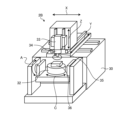
- FIG. 1 is a schematic diagram showing an external appearance of a machine tool according to a first embodiment;
- FIG. 1 is a diagram showing an example of the configuration of a first deformation amount estimation model in the first embodiment;
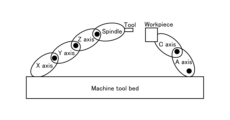
- FIG. 1 is a diagram for explaining kinematic configuration information of a machine tool in the first embodiment;
- FIG. 2 is a schematic diagram showing an external appearance of a machine tool according to a first modified example of the first embodiment;
- FIG. 1 is a diagram for explaining kinematic configuration information of a machine tool according to a first modification of the first embodiment.
- FIG. 1 is a schematic diagram showing an external appearance of a machine tool according to a second modification of the first embodiment;
- FIG. 11 is a diagram for explaining kinematic configuration information of a machine tool according to a second modification of the first embodiment.
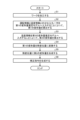
- 1 is a flowchart showing an example of an operation procedure of the machine tool system according to the first embodiment.
- FIG. 1 is a block diagram showing a configuration example of a machine tool system according to a modification of the first embodiment.
- FIG. 1 is a diagram showing a configuration example of a control circuit according to a first embodiment;
- FIG. 1 is a diagram showing an example of a configuration of a dedicated hardware circuit according to a first embodiment;
- control device machine tool system, and machining method according to the embodiment are described in detail below with reference to the drawings.
- the machine tool system is a system including a machine tool and a control device that controls the machine tool.
- the drive systems of machine tools are classified into spindle drive systems and feed drive systems.
- Feed drive systems are classified into linear feed drive systems and rotary feed drive systems.
- Linear feed drive systems impart linear motion to the driven body and position the driven body in the linear direction.
- Rotary feed drive systems impart rotational motion to the driven body and position the driven body in the rotational direction.
- Components of a machine tool other than the drive system are referred to as structural members.
- structural members include a bed, column, saddle, and table.
- Components of the drive system of a machine tool include a motor, encoder, ball screw, and shaft.
- the driven body is another drive system driven by the drive system, or the structural member.
- the components of the drive system are also referred to as machine elements.
- one or more temperature sensors are installed in the machine tool.
- the temperature sensors detect the temperature of the structural members.
- the machine tool may also be installed with a temperature sensor that detects the temperature of the drive system.
- Each drive system in a machine tool is connected to a control device.
- the control device generates commands to control each drive system according to a machining program, which is an NC (Numerical Control) program, and sends the commands to each drive system.
- NC Numerical Control
- the deformation of the shape of a structural member or the shape of a drive system due to the influence of heat is referred to as thermal deformation.
- the amount of thermal deformation is the amount by which a reference point in the shape of a structural member moves due to thermal deformation, or the amount by which a reference point in the shape of a drive system moves due to thermal deformation.
- the amount of thermal deformation of a structural member is expressed as the displacement of a reference point of the structural member using a coordinate system fixed to the structural member.
- the amount of thermal deformation of a drive system is expressed as the displacement of a reference point of the drive system using a coordinate system fixed to the drive system.
- thermal displacement between the tool and the workpiece the change in the relative position of the tool to the workpiece or the relative attitude of the tool to the workpiece caused by thermal deformation of the structural members or thermal deformation of the drive system.
- the amount of thermal displacement between the tool and the workpiece is referred to as the amount of thermal displacement.
- the amount of thermal displacement represents the thermal displacement of the tool in a coordinate system fixed to the workpiece.
- FIG. 1 is a block diagram showing an example of the configuration of a machine tool system 1 according to the first embodiment.
- the machine tool system 1 includes a machine tool 2 and a control device 3 which is a numerical control device.
- the control device 3 controls the machine tool 2.
- the machine tool 2 and the control device 3 are connected to each other so that they can communicate with each other.
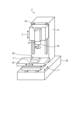
- FIG. 2 is a schematic diagram showing the appearance of a machine tool 2 according to the first embodiment.
- the machine tool 2 machines a workpiece 36 while moving a tool 35 and a workpiece 36 relative to each other by driving a plurality of axes that are feed axes.
- the machine tool 2 shown in FIG. 2 is a so-called vertical machining center.
- the machine tool 2 comprises a bed 30 which is the base of the machine tool 2, a column 31 which is placed on the bed 30, a table 32 to which a workpiece 36 is fixed, a head 33 which is supported by the column 31, and a spindle 34 which is attached to the head 33.
- a tool 35 is attached to the spindle 34.
- Each of the bed 30, the column 31, the table 32, and the head 33 is a structural member.
- the machine tool 2 includes multiple temperature sensors 10, a spindle drive system 11, an X-axis drive system 12, a Y-axis drive system 13, and a Z-axis drive system 14.
- Each of the multiple temperature sensors 10 detects the temperature of a structural member or the drive system.
- Each temperature sensor 10 outputs the temperature detection result to the control device 3.
- the spindle drive system 11 has a spindle 34.
- the spindle drive system 11 rotates a tool 35 attached to the spindle 34.
- the tool 35 rotates by the driving force of a motor provided in the spindle drive system 11.
- Each of the X-axis drive system 12, the Y-axis drive system 13, and the Z-axis drive system 14 is a linear feed drive system.
- the machine tool 2 has a three-axis linear feed drive system. Note that in FIG. 1, configurations of the machine tool 2 other than the temperature sensor 10 and each drive system are omitted from the illustration.
- the X-axis drive system 12 includes a ball screw, a motor that rotates the ball screw, and a mechanism that converts the rotational motion of the ball screw into linear motion in the X-axis direction.
- the X-axis drive system 12 moves the table 32 in the X-axis direction.
- the Y-axis drive system 13 includes a ball screw, a motor that rotates the ball screw, and a mechanism that converts the rotational motion of the ball screw into linear motion in the Y-axis direction.
- the Y-axis drive system 13 moves the table 32 in the Y-axis direction.
- the Z-axis drive system 14 includes a ball screw, a motor that rotates the ball screw, and a mechanism that converts the rotational motion of the ball screw into linear motion in the Z-axis direction.
- the Z-axis drive system 14 moves the head 33 in the Z-axis direction.
- the machine tool 2 is equipped with three feed drive systems that move the tool 35 and the workpiece 36 relative to each other, and a spindle drive system 11 that rotates the tool 35.
- the double-headed arrow marked "X” indicates the drive direction of the X-axis drive system 12.
- the double-headed arrow marked “Y” indicates the drive direction of the Y-axis drive system 13.
- the double-headed arrow marked “Z” indicates the drive direction of the Z-axis drive system 14. Details of each drive system are not shown in the figures.
- the control device 3 includes a deformation amount estimation model storage unit 20, a first deformation amount estimation unit 21, a second deformation amount estimation unit 22, a thermal displacement amount calculation unit 23, a configuration information storage unit 24, a correction command generation unit 25, and a control unit 26.
- the deformation amount estimation model storage unit 20 stores a first deformation amount estimation model and a second deformation amount estimation model.
- Each of the first deformation amount estimation model and the second deformation amount estimation model is a deformation amount estimation model for estimating the amount of thermal deformation from input information.
- the deformation amount estimation model is a mathematical description of the process of calculating the amount of thermal deformation based on input information.
- the control device 3 holds the first deformation amount estimation model and the second deformation amount estimation model in the deformation amount estimation model storage unit 20.
- the first deformation amount estimation model is a deformation amount estimation model for estimating the thermal deformation amount, which is the deformation amount of the drive system caused by heat generation in at least one of the feed drive system and the spindle drive system.
- the thermal deformation amount which is the deformation amount of the drive system caused by heat generation in the drive system, is referred to as the first deformation amount.
- the second deformation amount estimation model is a deformation amount estimation model for estimating the thermal deformation amount, which is the deformation amount of a structural member caused by temperature changes in the environment in which the machine tool 2 is installed.
- the thermal deformation amount which is the deformation amount of a structural member caused by temperature changes in the environment in which the machine tool 2 is installed, is referred to as the second deformation amount.
- the first deformation amount estimation unit 21 reads out the first deformation amount estimation model from the deformation amount estimation model storage unit 20.
- the first deformation amount estimation unit 21 calculates the first deformation amount by inputting at least one of driving information representing the state quantity of the drive system and temperature information indicating the temperature of the drive system to the first deformation amount estimation model.
- the first deformation amount estimation unit 21 outputs the calculation result of the first deformation amount to the thermal displacement amount calculation unit 23.
- the temperature information indicating the temperature of the drive system is information input to the control device 3 from the temperature sensor 10 that detects the temperature of the drive system. In the following explanation, the temperature information indicating the temperature of the drive system is referred to as temperature information of the drive system. The details of the driving information will be described later.
- the second deformation amount estimation unit 22 reads out the second deformation amount estimation model from the deformation amount estimation model storage unit 20.
- the second deformation amount estimation unit 22 calculates the second deformation amount by inputting temperature information indicating the temperature of the structural member to the second deformation amount estimation model.
- the second deformation amount estimation unit 22 outputs the calculation result of the second deformation amount to the thermal displacement amount calculation unit 23.
- the temperature information indicating the temperature of the structural member is information input to the control device 3 from the temperature sensor 10 that detects the temperature of the structural member.
- the configuration information storage unit 24 stores the kinematic configuration information of the machine tool 2. Details of the kinematic configuration information of the machine tool 2 will be described later. In the following description, the kinematic configuration information of the machine tool 2 will also be simply referred to as configuration information.
- the thermal displacement amount calculation unit 23 reads out the configuration information from the configuration information storage unit 24.
- the thermal displacement amount calculation unit 23 uses kinematic configuration information of the machine tool 2 to convert the first deformation amount into a thermal displacement amount, which is the relative displacement amount between the tool 35 and the workpiece 36.
- the thermal displacement amount calculation unit 23 also combines the second deformation amount with the thermal displacement amount converted from the first deformation amount. In this way, the thermal displacement amount calculation unit 23 calculates the thermal displacement amount combined with the second deformation amount.
- the thermal displacement amount calculation unit 23 outputs the calculated thermal displacement amount to the correction command generation unit 25.
- the correction command generating unit 25 generates a correction command to correct the command position, which is the position commanded to the feed drive system, based on the thermal displacement amount calculated by the thermal displacement amount calculating unit 23. That is, the correction command generating unit 25 generates a correction command to correct the command position based on the thermal displacement amount combined with the second deformation amount.
- the correction command generating unit 25 outputs the generated correction command to the control unit 26.
- the control unit 26 generates commands for each drive system of the machine tool 2 in accordance with the machining program.
- the control unit 26 controls each drive system by sending commands to each drive system.
- the control unit 26 corrects the command position of each drive system based on the correction command. For example, the control unit 26 performs a correction based on the correction command to subtract a length equivalent to the amount of thermal displacement from the coordinates of the command position.
- the control unit 26 outputs a command with the corrected command position to each drive system.
- the first deformation amount estimation model represents the relationship between the input and the output when at least one of drive system operation information and drive system temperature information is input and the first deformation amount, which is the thermal deformation amount of the drive system, is output.
- the inputs to the first deformation amount estimation model are drive system operation information and drive system temperature information.
- the operation information is, for example, a value used for servo control of the drive system, and indicates a state quantity such as position, speed, or current.
- the operation information is a command value output from the control device 3 to each drive system, or a value such as position, speed, or current indicating the state of each drive system.
- the operation information may be modal information.
- the modal information is operation mode information described in the machining program.
- the operation information may be a value obtained in the process of calculating a command value by the control device 3.
- the operation information may be a state quantity value obtained by a sensor installed separately from the configuration for servo control of the drive system. Two or more of the above types of operation information may be input to the first deformation amount estimation model.
- the first deformation amount estimation model is a model based on a machine learning technique.
- the first deformation amount estimation model is a neural network, which is a model based on a machine learning technique.
- the first deformation amount estimation model which is a neural network, is the result of learning the relationship between the driving information and temperature information and the first deformation amount by supervised learning.
- Supervised learning is a technique in which a pair of input and result is provided to a learning device to learn the characteristics of learning data and infer a result from the input.
- the learning data includes an input and a label that represents a result corresponding to the input.
- the driving information and temperature information correspond to the input.
- the first deformation amount is teaching data and corresponds to a label.
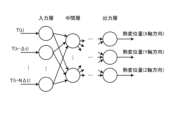
- FIG. 3 is a diagram showing an example of the configuration of a first deformation amount estimation model in the first embodiment.
- FIG. 3 shows an example of the configuration of a neural network.
- the neural network is composed of an input layer consisting of multiple neurons, a hidden layer which is an intermediate layer consisting of multiple neurons, and an output layer consisting of multiple neurons.
- the output layer consists of three neurons.
- the output layer outputs the amount of thermal displacement in the X-axis direction, the amount of thermal displacement in the Y-axis direction, and the amount of thermal displacement in the Z-axis direction using the three neurons.
- the number of neurons in the input layer is determined by the amount of operating information or temperature information selected as input data.
- the number of neurons in the intermediate layer is arbitrary.
- At least one of drive system operating information and drive system temperature information is input to the input layer as time series data.
- the operating information or temperature information input to the input layer is information from a specific time point back to a time a specified period of time.
- the input layer receives temperature information consisting of a set of "T(t-N ⁇ t), ..., T(t- ⁇ t), T(t)." T(t-N ⁇ t), ..., T(t- ⁇ t), T(t) are input to (N+1) neurons, respectively.
- ⁇ t represents the sampling period.
- N represents a constant for referencing information going back a specified period of time.
- Each of the multiple values input to the input layer is multiplied by a weight for each neuron in the input layer and then input to the intermediate layer.
- Each of the multiple values input to the intermediate layer is multiplied by a weight for each neuron in the intermediate layer and then input to the output layer.
- Each of the multiple values input to the output layer is multiplied by a weight for each neuron in the output layer.
- the output layer outputs the first deformation amount, which is the amount of thermal displacement in the X-axis direction, the amount of thermal displacement in the Y-axis direction, and the amount of thermal displacement in the Z-axis direction at time t.
- the neural network is generated by adjusting the weights so that the output for the input approaches the label.
- the first deformation amount estimation model is not limited to the neural network described above.
- the first deformation amount estimation model may be, for example, a recurrent neural network including a recursive structure.
- a recurrent neural network includes time series processing within the network, and is therefore capable of expressing the time series correspondence between input information and output information.
- the first deformation amount estimation model may be a model based on a method other than machine learning.
- the first deformation amount estimation model may be a regression model that inputs time-series driving information and calculates the deformation amount at each time.
- One example of the first deformation amount estimation model, which is a regression model, is expressed by the following formula (1).
- d drv,x represents the amount of thermal deformation of the drive system in the X-axis direction
- t represents time
- a, b, and c represent coefficients
- ⁇ represents the rotational speed of the spindle 34
- N 1 , N 2 , and N 3 represent orders
- N T represents the number of temperature sensors 10
- T represents temperature information of the drive system
- ⁇ t represents the sampling period.
- Equation (1) indicates that the amount of thermal deformation when one sampling period has elapsed from a certain time depends on the amount of thermal deformation before the current time, the rotational speed of the spindle 34 before the current time, and the temperature before the current time.
- the regression model represented by equation (1) includes a time lag term of the input information.
- "-k ⁇ t" represents a time lag.
- Each term on the right side of equation (1) is a time lag term including "-k ⁇ t”.
- Equation (1) is also a calculation formula that uses a time series signal as an input.
- Equation (1) represents a formula for calculating the amount of thermal deformation in the X-axis direction of the drive system.
- the amount of thermal deformation in the Y-axis direction of the drive system and the amount of thermal deformation in the Z-axis direction of the drive system can also be calculated using the same calculation as for the amount of thermal deformation in the X-axis direction of the drive system.
- the first deformation amount estimation model may be a model that calculates the sum of the deformation amounts of multiple mechanical elements that make up the drive system when calculating the amount of thermal deformation only in the axial direction of the drive system.
- the first deformation amount estimation model inputs temperature information for each mechanical element, such as the shaft, bearings, and ball screw, and calculates the amount of thermal deformation in the axial direction by finding the sum of each mechanical element.
- the first deformation amount estimation model for the Z-axis drive system 14 is expressed by the following equation (2).
- dz is the amount of thermal deformation in the Z-axis direction
- t is time
- i is a number representing a mechanical element of the drive system
- ⁇ is the thermal expansion coefficient of the mechanical element
- L is the axial length of the drive system
- ⁇ T is the temperature change of the mechanical element.
- Formula (2) is a calculation formula that inputs a time series signal.
- Formula (2) represents a calculation formula for the amount of thermal deformation in the Z-axis direction of the Z-axis drive system 14.
- the amount of thermal deformation in the X-axis direction of the X-axis drive system 12 and the amount of thermal deformation in the Y-axis direction of the Y-axis drive system 13 can also be calculated by the same calculation as the amount of thermal deformation in the Z-axis direction of the Z-axis drive system 14.
- the first deformation amount estimation model is not limited to the above.
- a different first deformation amount estimation model may be applied to each drive system depending on the thermal characteristics or specifications of each drive system.
- One of drive system operating information and drive system temperature information may be input to the first deformation amount estimation model.
- the second deformation amount estimation model represents the relationship between input and output when temperature information of a structural member is input and the second deformation amount, which is the thermal deformation amount of the structural member, is output.
- a neural network can be applied to the second deformation amount estimation model, as with the first deformation amount estimation model.
- the second deformation amount estimation model may be a regression model that inputs time-series temperature information and calculates the deformation amount at each time.
- One example of the second deformation amount estimation model, which is a regression model is expressed by the following equation (3).
- d str,x represents the amount of thermal deformation of the structural member in the X-axis direction
- t represents time
- a and c represent coefficients
- N T represents the number of temperature sensors 10
- T represents temperature information of the structural member
- ⁇ t represents a sampling period.
- Each term on the right side of formula (3) is a time lag term including "-k ⁇ t”.
- Formula (3) represents that the amount of thermal deformation when one sampling period has elapsed from a certain time depends on the amount of thermal deformation before the current time and the temperature before the current time.
- the regression model represented by formula (3) includes a time lag term of the input information.
- Formula (3) is also a calculation formula that inputs a time series signal.
- the second deformation amount estimation model may be a model using the finite element method.
- a model using the finite element method the structural member is divided into a plurality of infinitesimal elements, and a regression model is set in advance for each of the plurality of infinitesimal elements.
- the temperature information detected by the temperature sensor 10 is input to the second deformation amount estimation model, and the sum of the thermal deformation amounts of the infinitesimal elements contained in the structural member is output from the second deformation amount estimation model as the final thermal deformation amount.
- At least one of the first deformation amount estimation model and the second deformation amount estimation model may be a neural network model. Also, in the first embodiment, at least one of the first deformation amount estimation model and the second deformation amount estimation model may be a calculation formula that uses a time series signal as input, or a regression model that includes a time lag term for the input information.
- the thermal displacement amount calculation unit 23 uses kinematic configuration information of the machine tool 2 to convert the first deformation amount into a thermal displacement amount, which is the relative displacement amount between the tool 35 and the workpiece 36.
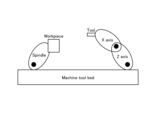
- FIG. 4 is a diagram for explaining the kinematic configuration information of the machine tool 2 in the first embodiment.
- the kinematic configuration information of the machine tool 2 is information that kinematically expresses the configuration in which each drive system is connected to the structure of the machine tool 2.
- "Machine tool bed” represents the bed 30.
- "X axis” represents the X-axis drive system 12.
- "Y axis” represents the Y-axis drive system 13.
- Z axis represents the Z-axis drive system 14.
- spindle represents the spindle drive system 11.
- Tool represents the tool 35 attached to the spindle 34.
- Workpiece represents the workpiece 36 fixed to the table 32. Note that the table 32 is omitted in FIG. 4.
- Figure 4 shows a schematic diagram of the connection between the bed 30, which is a structural member, and the drive systems, which are the spindle drive system 11, the X-axis drive system 12, the Y-axis drive system 13, and the Z-axis drive system 14.
- Figure 4 can also be said to represent the kinematic connection relationship between the tool 35 and the workpiece 36.
- Figure 4 shows that the spindle drive system 11 is positioned by the Z-axis drive system 14, the workpiece 36 is positioned by the X-axis drive system 12, and the X-axis drive system 12 is positioned by the Y-axis drive system 13.
- the transformation from a position in a coordinate system fixed to one component to a position in a coordinate system fixed to the other component can be expressed by a homogeneous transformation matrix.
- the tip position of the tool 35 in the workpiece coordinate system is expressed by the following equation (4).
- Equation (4) represents the coordinate transformation from the tool coordinate system to the workpiece coordinate system.
- the tool coordinate system is a coordinate system fixed to the tool 35.
- the workpiece coordinate system is a coordinate system fixed to the workpiece 36.
- the order of coordinate transformation in equation (4) corresponds to the kinematic configuration information of the machine tool 2 shown in FIG. 4.
- the thermal displacement calculation unit 23 converts the first deformation amount into the thermal displacement amount between the tool 35 and the workpiece 36 by the coordinate transformation using equation (4).
- the subscript at the bottom left of the bold “T” in formula (4) is represented as “m”
- the subscript at the top left of the bold “T” in formula (4) is represented as "n”.
- Each of "m” and “n” represents a component of the machine tool 2.
- the symbol “ m n T” in which "m” and “n” are added to the bold “T” is a Denavit-Hartenberg matrix (DH matrix) and represents a coordinate transformation from one component represented by "m” to a coordinate system fixed to another component represented by "n”.
- DH matrix Denavit-Hartenberg matrix
- the symbol represents a coordinate transformation from one component represented by "n” to a coordinate system fixed to another component represented by "m”.
- each of " WXT " and " TST " is an identity matrix.
- WXT " is a DH matrix representing the coordinate transformation from the workpiece 36 to the coordinate system fixed to the X-axis drive system 12.
- TST is a DH matrix representing the coordinate transformation from the tool 35 to the coordinate system fixed to the spindle drive system 11.
- XYT ", "YMT “ , “ ZMT “ , and " SZT” are expressed by the following formulas (5), (6), ( 7 ), and (8), respectively.
- XYT is a DH matrix representing the coordinate transformation from the X-axis drive system 12 to the coordinate system fixed to the Y-axis drive system 13.
- YMT is a DH matrix representing the coordinate transformation from the Y-axis drive system 13 to the coordinate system fixed to the bed 30.
- ZMT is a DH matrix representing the coordinate transformation from the Z-axis drive system 14 to the coordinate system fixed to the bed 30.
- SZT is a DH matrix representing the coordinate transformation from the spindle drive system 11 to the coordinate system fixed to the Z-axis drive system 14.
- x, y, and z respectively represent the position of the X-axis drive system 12, the position of the Y-axis drive system 13, and the position of the Z-axis drive system 14.
- ⁇ s , ⁇ x , ⁇ y , and ⁇ z respectively represent the temperature of the spindle drive system 11, the temperature of the X-axis drive system 12, the temperature of the Y-axis drive system 13, and the temperature of the Z-axis drive system 14.
- S j (i) is an amount that depends on the position of the i-axis drive system and represents the position error in the j-axis direction.
- ⁇ j (i) is an amount that depends on the position of the i-axis drive system and represents the angle error in the j-axis direction. Furthermore, the amount represented by ⁇ corresponds to the amount of thermal deformation in each drive system. Specifically, ⁇ j (i, ⁇ i ) is an amount that depends on the position and temperature of the i-axis drive system and represents the position error in the j-axis direction. ⁇ j ( ⁇ s ) is an amount that depends only on the temperature of the spindle drive system 11 and represents the position error in the j-axis direction.
- each of i and j represents any one of the symbols x representing the X-axis drive system 12, y representing the Y-axis drive system 13, and z representing the Z-axis drive system 14.
- the i-axis drive system represents any one of the X-axis drive system 12, the Y-axis drive system 13, and the Z-axis drive system 14.
- Formulas (9)-(11) allow the thermal displacement amount calculation unit 23 to calculate the amount of thermal displacement between the tool 35 and the workpiece 36 in the workpiece coordinate system as an amount that depends on the position and temperature. In other words, coordinate conversion from the first deformation amount caused by heat generation in the drive system to the amount of thermal displacement is performed based on kinematic configuration information, so that the thermal displacement amount calculation unit 23 can accurately calculate the amount of thermal displacement caused by heat generation in the drive system.
- the spindle drive system 11 is positioned by the Z-axis drive system 14, which is one feed drive system.
- the first deformation amount in the machine tool 2 is mainly the deformation amount caused in the spindle drive system 11 due to heat generation in the spindle drive system 11.
- the thermal displacement amount calculation unit 23 converts the first deformation amount into a thermal displacement amount according to the position of the spindle drive system 11 and the geometric error of the Z-axis drive system 14, which is a feed drive system that positions the spindle drive system 11, by coordinate transformation using the configuration information shown in equation (4).
- the control device 3 can accurately convert the deformation amount caused in the spindle drive system 11 into the thermal displacement amount between the tool 35 and the workpiece 36 by performing coordinate transformation according to the position of the spindle drive system 11 while taking into account the geometric error of the feed drive system.
- the X-axis drive system 12 is positioned by the Y-axis drive system 13.
- the three feed drive systems provided in the machine tool 2 include the X-axis drive system 12, which is the first feed drive system, and the Y-axis drive system 13, which is the second feed drive system that positions the first feed drive system.
- the first deformation amount in the machine tool 2 includes the deformation amount generated in the first feed drive system due to heat generation in the first feed drive system, in addition to the deformation amount generated in the spindle drive system 11. In other words, the first deformation amount includes the deformation amount generated in the X-axis drive system 12 due to heat generation in the X-axis drive system 12.
- the thermal displacement amount calculation unit 23 converts the first deformation amount into a thermal displacement amount according to the position of the X-axis drive system 12 and the geometric error of the Y-axis drive system 13, which is the second feed drive system, by coordinate transformation using the configuration information shown in equation (4).
- the control device 3 performs coordinate conversion according to the position of the first feed drive system while taking into account the geometric error of the second feed drive system, thereby enabling the amount of deformation occurring in the first feed drive system to be accurately converted into the amount of thermal displacement between the tool 35 and the workpiece 36.
- the thermal displacement amount calculation unit 23 converts the amount of thermal deformation of the drive system caused by heat generation in the drive system into the amount of thermal deformation between the tool 35 and the workpiece 36. This allows the control device 3 to correct the thermal deformation caused by heat generation in the drive system with high precision.
- the machine tool system 1 can reduce machining errors caused by heat generation in the drive system.
- the machine tool system 1 is assumed to include a machine tool 2 having a three-axis linear feed drive system, and its kinematic configuration is as shown in FIG. 4.
- the machine tool provided in the machine tool system 1 is not limited to the machine tool 2 described above.
- modified examples of the machine tool provided in the machine tool system 1 will be described.
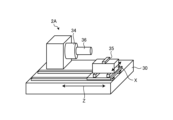
- FIG. 5 is a schematic diagram showing the appearance of a machine tool 2A according to a first variation of the first embodiment.
- the machine tool 2A is a lathe having a two-axis linear feed drive system.
- the machine tool 2A is equipped with an X-axis drive system 12 and a Z-axis drive system 14 that move a tool 35 and a workpiece 36 relative to each other, and a spindle drive system 11 that rotates the workpiece 36.
- the workpiece 36 is attached to the spindle 34.
- the machine tool 2A is equipped with a bed 30, which is a structural member.
- Machine tool 2A moves tool 35 in the X-axis and Z-axis directions by X-axis drive system 12 and Z-axis drive system 14.
- the double-headed arrow marked "X” indicates the drive direction of X-axis drive system 12.
- the double-headed arrow marked “Z” indicates the drive direction of Z-axis drive system 14.
- the X-axis drive system 12 and Z-axis drive system 14 of machine tool 2A are not shown. Only the spindle 34 of spindle drive system 11 is shown in FIG. 5.
- FIG. 6 is a diagram for explaining the kinematic configuration information of the machine tool 2A according to the first variation of the first embodiment.
- "Machine tool bed” represents the bed 30.
- "X axis” represents the X-axis drive system 12.
- “Z axis” represents the Z-axis drive system 14.
- “Spindle” represents the spindle drive system 11.
- Tool represents the tool 35 attached to the X-axis drive system 12.
- Workpiece represents the workpiece 36 attached to the spindle 34.
- Figure 6 shows a schematic diagram of the connection between the bed 30, which is a structural member, and the drive systems, which are the spindle drive system 11, the X-axis drive system 12, and the Z-axis drive system 14.
- Figure 6 can also be said to represent the kinematic connection relationship between the tool 35 and the workpiece 36.
- Figure 6 shows that the position of the spindle drive system 11 relative to the bed 30 is fixed, that the tool 35 is positioned by the X-axis drive system 12, and that the X-axis drive system 12 is positioned by the Z-axis drive system 14.
- X-axis drive system 12 is positioned by Z-axis drive system 14.
- the two feed drive systems provided in machine tool 2A include X-axis drive system 12, which is a first feed drive system, and Z-axis drive system 14, which is a second feed drive system that positions the first feed drive system.
- the thermal displacement calculation unit 23 converts the amount of thermal deformation of the drive system caused by heat generation in the drive system into the amount of thermal deformation between the tool 35 and the workpiece 36 in the same manner as in the case of the machine tool 2.
- the thermal displacement calculation unit 23 converts the first deformation amount into the amount of thermal deformation according to the position of the X-axis drive system 12 and the geometric error of the Z-axis drive system 14, which is the second feed drive system, by coordinate conversion in the same manner as in the case of the machine tool 2.
- the control device 3 can correct the thermal deformation caused by heat generation in the drive system with high precision, even when the machine tool 2A is provided in the machine tool system 1.
- FIG. 7 is a diagram showing a schematic external view of a machine tool 2B according to a second modification of the first embodiment.
- the machine tool 2B has a three-axis linear feed drive system and a two-axis rotary feed drive system.
- the machine tool 2B includes an X-axis drive system 12, a Y-axis drive system 13, a Z-axis drive system 14, an A-axis drive system, and a C-axis drive system for moving a tool 35 and a workpiece 36 relative to one another, and a spindle drive system 11 for rotating the tool 35.
- the tool 35 is attached to the spindle 34.
- the workpiece 36 is fixed to the table 32.
- Each of the bed 30, the table 32, and the head 33 is a structural member.
- Machine tool 2B moves tool 35 in the X-axis, Y-axis, and Z-axis directions by X-axis drive system 12, Y-axis drive system 13, and Z-axis drive system 14.
- Machine tool 2B rotates table 32 in the A-axis direction by the A-axis drive system.
- the A-axis direction is the direction of rotation around the A-axis.
- the A-axis is an axis parallel to the X-axis.
- Machine tool 2B rotates table 32 in the C-axis direction by the C-axis drive system.
- the C-axis direction is the direction of rotation around the C-axis.
- the C-axis is an axis parallel to the Z-axis.
- the double-headed arrow marked "X” represents the drive direction of X-axis drive system 12.
- the double-headed arrow marked “Y” represents the drive direction of Y-axis drive system 13.
- the double-headed arrow marked “Z” represents the drive direction of Z-axis drive system 14.
- the double-headed arrow marked "A” represents the drive direction of the A-axis drive system.
- the double-headed arrow marked “C” represents the drive direction of the C-axis drive system.
- the X-axis drive system 12, Y-axis drive system 13, Z-axis drive system 14, A-axis drive system, and C-axis drive system of the machine tool 2B are omitted from the illustration. In FIG. 7, only the spindle 34 of the spindle drive system 11 is shown.
- FIG. 8 is a diagram for explaining the kinematic configuration information of the machine tool 2B according to the second modification of the first embodiment.
- "Machine tool bed” represents the bed 30.
- "X axis” represents the X-axis drive system 12.
- “Y axis” represents the Y-axis drive system 13.
- “Z axis” represents the Z-axis drive system 14.
- "A axis” represents the A-axis drive system.
- C axis represents the C-axis drive system.
- spindle represents the spindle drive system 11.
- Tool represents the tool 35 attached to the spindle 34.
- “Workpiece” represents the workpiece 36 fixed to the table 32.
- Figure 8 shows a schematic diagram of the connection between the bed 30, which is a structural member, and the drive systems, which are the spindle drive system 11, the X-axis drive system 12, the Y-axis drive system 13, the Z-axis drive system 14, the A-axis drive system, and the C-axis drive system.
- Figure 8 can also be said to represent the kinematic connection relationship between the tool 35 and the workpiece 36.
- Figure 8 shows that the spindle drive system 11 is positioned by the Z-axis drive system 14, that the Z-axis drive system 14 is positioned by the Y-axis drive system 13, and that the Y-axis drive system 13 is positioned by the X-axis drive system 12.
- Figure 8 also shows that the attitude of the workpiece 36 is determined by the C-axis drive system, and that the attitude of the C-axis drive system is determined by the A-axis drive system.
- the thermal displacement amount calculation unit 23 adds conversions for the A-axis drive system and the C-axis drive system to the coordinate conversion in the case of the machine tool 2, and converts the first deformation amount into a thermal displacement amount.
- the thermal displacement amount calculation unit 23 converts the first deformation amount into a thermal displacement amount according to the angle provided by the A-axis drive system, which is a rotary feed drive system, and the angle provided by the C-axis drive system, which is a rotary feed drive system. In this way, the thermal displacement amount calculation unit 23 converts the thermal deformation amount of the drive system into the thermal displacement amount between the tool 35 and the workpiece 36 according to the angle provided by the rotary feed drive system. Even when the machine tool 2B is provided in the machine tool system 1, the control device 3 can correct the thermal displacement caused by heat generation in the drive system with high precision.
- the machine tools provided in the machine tool system 1 are not limited to the machine tools 2, 2A, and 2B described in the first embodiment.
- the machine tools provided in the machine tool system 1 may be any machine tool that includes one or more feed drive systems that move the tool 35 and the workpiece 36 relative to each other, and a spindle drive system that rotates the tool 35 or the workpiece 36.
- FIG. 9 is a flowchart showing an example of the operation procedure of the machine tool system 1 according to the first embodiment.
- the machine tool system 1 is equipped with the machine tool 2 shown in FIG. 1 and FIG. 2.
- step S1 the machine tool 2 machines the workpiece 36.
- step S2 the first deformation amount estimation unit 21 calculates the first deformation amount by inputting at least one of the driving information and the temperature information to the first deformation amount estimation model.
- the first deformation amount estimation unit 21 inputs at least one of the driving information representing the state quantity of the drive system and the temperature information indicating the temperature of the drive system to the first deformation amount estimation model.
- step S3 the second deformation amount estimation unit 22 calculates the second deformation amount by inputting the temperature information into the second deformation amount estimation model.
- the second deformation amount estimation unit 22 inputs temperature information indicating the temperature of the structural member into the second deformation amount estimation model.
- step S4 the thermal displacement calculation unit 23 converts the first deformation amount calculated in step S2 into a thermal displacement amount that is a relative displacement amount between the tool 35 and the workpiece 36.
- the thermal displacement calculation unit 23 converts the first deformation amount into a thermal displacement amount using kinematic configuration information of the machine tool 2.
- step S5 the thermal change amount calculation unit 23 combines the thermal change amount obtained in step S4 with the second deformation amount calculated in step S3. In this way, the thermal change amount calculation unit 23 calculates the thermal change amount combined with the second deformation amount.
- step S6 the correction command generation unit 25 generates a correction command to correct the command position based on the calculated thermal displacement amount.
- the correction command generation unit 25 outputs the generated correction command to the control unit 26.
- the control unit 26 corrects the command position of each drive system based on the correction command.
- the control unit 26 outputs the command with the corrected command position to each drive system.
- one machine tool 2 is connected to the control device 3.
- multiple machine tools 2 may be connected to the control device 3.
- the control device 3 controls the multiple machine tools 2.
- the control device 3 can correct thermal displacement in each of the multiple machine tools 2 with high precision.
- all of the machine tools 2 in the production line may be controlled by a single control device 3.
- the machine tool system 1 can correct thermal displacement in each machine tool 2 in the production line with high precision.
- the control device 3 includes a first deformation amount estimation unit 21 that calculates a first deformation amount by inputting at least one of operation information representing the state quantity of the drive system and temperature information indicating the temperature of the drive system to a first deformation amount estimation model, and a thermal displacement amount calculation unit 23 that converts the first deformation amount into a thermal displacement amount using kinematic configuration information of the machine tool 2.
- the control device 3 can correct the thermal displacement caused by heat generation in the drive system with high accuracy. This provides the effect that the control device 3 can correct the thermal displacement with high accuracy.
- the machine tool system 1 can reduce machining errors caused by heat generation in the drive system.
- the control device 3 also includes a second deformation amount estimation unit 22 that calculates the second deformation amount by inputting temperature information indicating the temperature of the structural member into a second deformation amount estimation model.
- a thermal displacement amount calculation unit 23 combines the second deformation amount with the thermal displacement amount converted from the first deformation amount.
- the control device 3 estimates each of the thermal displacement caused by heat generation in the drive system and the thermal displacement caused by temperature changes in the environment based on the deformation amount estimation model to calculate the thermal displacement amount. This enables the control device 3 to estimate the thermal displacement amount with high accuracy and correct the thermal displacement with high accuracy.
- the machine tool system 1 can correct the machining error caused by heat generation in the drive system and the machining error caused by temperature changes in the environment with high accuracy.
- control device 3 calculates the amount of thermal deformation using a deformation amount estimation model stored in the deformation amount estimation model storage unit 20.
- the control device 3 may also calculate the amount of thermal deformation using a deformation amount estimation model read from a device external to the control device 3.
- a deformation amount estimation model read from a device external to the control device 3 is used will be described.
- FIG. 10 is a block diagram showing an example of the configuration of a machine tool system 1A according to a modified example of the first embodiment.
- the machine tool system 1A includes a machine tool 2, a control device 3A which is a numerical control device, and a storage device 4.
- the control device 3A controls the machine tool 2.
- the storage device 4 is a device external to the control device 3A. Note that while FIG. 10 shows an example in which the machine tool system 1A includes the machine tool 2, machine tools other than the machine tool 2 may also be included. In the machine tool system 1A shown in FIG. 10, one machine tool 2 is connected to the control device 3A, but multiple machine tools 2 may be connected to the control device 3A.
- the control device 3A differs from the control device 3 shown in FIG. 1 in that the deformation amount estimation model storage unit 20 is omitted and a deformation amount estimation model acquisition unit 27 is included.
- the storage device 4 stores a plurality of deformation amount estimation models.
- the machine tool 2 and the control device 3A are connected to each other so that they can communicate with each other.
- the control device 3A and the storage device 4 are connected to each other so that they can communicate with each other.
- the storage device 4 may be connected to the control device 3A via a network.
- the network is, for example, a WAN (Wide Area Network) such as the Internet, but may also be a LAN (Local Area Network).
- the storage device 4 may be configured by a server built in a cloud environment.
- the deformation amount estimation model acquisition unit 27 selects a deformation amount estimation model to be used as the first deformation amount estimation model and a deformation amount estimation model to be used as the second deformation amount estimation model from among the multiple deformation amount estimation models stored in the storage device 4.
- the deformation amount estimation model acquisition unit 27 reads out these selected deformation amount estimation models from the storage device 4.
- the deformation amount estimation model acquisition unit 27 acquires the first deformation amount estimation model and the second deformation amount estimation model.
- the deformation amount estimation model acquisition unit 27 outputs the acquired first deformation amount estimation model to the first deformation amount estimation unit 21.
- the deformation amount estimation model acquisition unit 27 outputs the acquired second deformation amount estimation model to the second deformation amount estimation unit 22.
- the control device 3A can switch the deformation amount estimation model used as the first deformation amount estimation model depending on the drive pattern of each drive system in the machine tool 2.
- the control device 3A can calculate the first deformation amount using the first deformation amount estimation model suitable for the drive pattern. This allows the control device 3A to highly accurately correct the thermal displacement caused by heat generation in the drive system.
- the control device 3A can switch the deformation amount estimation model used as the second deformation amount estimation model depending on the environment in which the machine tool 2 is installed.
- the control device 3A can calculate the second deformation amount using the second deformation amount estimation model suitable for the environment. This allows the control device 3A to correct thermal displacement caused by temperature changes in the environment with high accuracy.
- each of the multiple machine tools 2 may use a deformation amount estimation model corresponding to the environment in which the machine tool 2 is installed as the second deformation amount estimation model. This allows the control device 3A to correct thermal displacement in each of the multiple machine tools 2 with high accuracy.
- the control device 3 is realized by a processing circuit.
- the processing circuit may be a circuit in which a processor executes software, or may be a dedicated circuit.
- the hardware configuration for realizing the control device 3A is assumed to be similar to the hardware configuration for realizing the control device 3A.
- FIG. 11 is a diagram showing an example of the configuration of the control circuit 50 according to the first embodiment.
- the control circuit 50 includes an input unit 51, a processor 52, a memory 53, and an output unit 54.
- the input unit 51 is an interface circuit that receives data input from outside the control circuit 50 and provides the data to the processor 52.
- the output unit 54 is an interface circuit that sends data from the processor 52 or memory 53 to outside the control circuit 50.
- the control device 3 is realized by software, firmware, or a combination of software and firmware.
- the software or firmware is written as a program and stored in memory 53.
- the processing circuit realizes each function of the control device 3 by the processor 52 reading and executing the program stored in memory 53.
- the processing circuit has memory 53 for storing the program that will result in the processing of the control device 3 being executed. It can also be said that these programs cause a computer to execute the procedures and methods of the control device 3.
- the processor 52 is a CPU (Central Processing Unit).
- the processor 52 may be a central processing unit, a processing unit, an arithmetic unit, a microprocessor, a microcomputer, a processor, or a DSP.
- the memory 53 may be, for example, a RAM (Random Access Memory), a ROM (Read Only Memory), a flash memory, an EPROM (Erasable Programmable Read Only Memory), an EEPROM (registered trademark) (Electrically Erasable Programmable Read Only Memory), or other non-volatile or volatile semiconductor memory, a magnetic disk, a flexible disk, an optical disk, a compact disk, a mini disk, or a DVD (Digital Versatile Disc).
- the first deformation amount estimation unit 21, the second deformation amount estimation unit 22, the correction command generation unit 25, and the control unit 26, which are the processing units of the control device 3, are realized by the processor 52 and the memory 53.
- the deformation amount estimation model storage unit 20 and the configuration information storage unit 24, which are the storage units of the control device 3, are realized by the memory 53.
- FIG. 11 shows an example of hardware in which the processing unit of the control device 3 is realized by a general-purpose processor 52 and memory 53, but the processing unit of the control device 3 may also be realized by a dedicated hardware circuit.
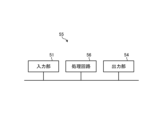
- FIG. 12 shows an example of the configuration of a dedicated hardware circuit 55 according to the first embodiment.
- the dedicated hardware circuit 55 includes an input unit 51, an output unit 54, and a processing circuit 56.
- the processing circuit 56 is a single circuit, a composite circuit, a programmed processor, a parallel programmed processor, an ASIC (Application Specific Integrated Circuit), an FPGA (Field Programmable Gate Array), or a combination of these.
- Each function of the control device 3 may be realized by the processing circuit 56 on a function-by-function basis, or each function may be realized collectively by the processing circuit 56.
- the control device 3 may also be realized by combining the control circuit 50 and the hardware circuit 55.
- the first deformation amount estimation unit 21, the second deformation amount estimation unit 22, the correction command generation unit 25, the control unit 26, and the deformation amount estimation model acquisition unit 27, which are the processing units of the control device 3A shown in FIG. 10, are realized by the processor 52 and the memory 53.
- the storage device 4 shown in FIG. 10 is realized by a hardware configuration similar to the hardware configuration illustrated in FIG. 11 or a hardware configuration similar to the hardware configuration illustrated in FIG. 12.
Landscapes
- Engineering & Computer Science (AREA)
- Human Computer Interaction (AREA)
- Manufacturing & Machinery (AREA)
- Physics & Mathematics (AREA)
- General Physics & Mathematics (AREA)
- Automation & Control Theory (AREA)
- Mechanical Engineering (AREA)
- Automatic Control Of Machine Tools (AREA)
- Numerical Control (AREA)
Priority Applications (2)
| Application Number | Priority Date | Filing Date | Title |
|---|---|---|---|
| PCT/JP2023/026851 WO2025022496A1 (ja) | 2023-07-21 | 2023-07-21 | 制御装置、工作機械システム、および加工方法 |
| JP2023567256A JP7466801B1 (ja) | 2023-07-21 | 2023-07-21 | 制御装置、工作機械システム、および加工方法 |
Applications Claiming Priority (1)
| Application Number | Priority Date | Filing Date | Title |
|---|---|---|---|
| PCT/JP2023/026851 WO2025022496A1 (ja) | 2023-07-21 | 2023-07-21 | 制御装置、工作機械システム、および加工方法 |
Publications (1)
| Publication Number | Publication Date |
|---|---|
| WO2025022496A1 true WO2025022496A1 (ja) | 2025-01-30 |
Family
ID=90622481
Family Applications (1)
| Application Number | Title | Priority Date | Filing Date |
|---|---|---|---|
| PCT/JP2023/026851 Pending WO2025022496A1 (ja) | 2023-07-21 | 2023-07-21 | 制御装置、工作機械システム、および加工方法 |
Country Status (2)
| Country | Link |
|---|---|
| JP (1) | JP7466801B1 (https=) |
| WO (1) | WO2025022496A1 (https=) |
Cited By (1)
| Publication number | Priority date | Publication date | Assignee | Title |
|---|---|---|---|---|
| JP7783466B1 (ja) * | 2025-04-18 | 2025-12-09 | ファナック株式会社 | ボールねじの熱変位の補正量算出装置及び補正量算出方法 |
Citations (7)
| Publication number | Priority date | Publication date | Assignee | Title |
|---|---|---|---|---|
| JPH0775937A (ja) * | 1993-09-07 | 1995-03-20 | Sodick Co Ltd | 工作機械及びその制御方法 |
| JPH0985582A (ja) * | 1995-09-26 | 1997-03-31 | Okuma Mach Works Ltd | 工作機械の熱変位推定装置 |
| JP2006281335A (ja) * | 2005-03-31 | 2006-10-19 | Okuma Corp | 工作機械の熱変位補正方法 |
| JP2016048499A (ja) * | 2014-08-28 | 2016-04-07 | 三菱重工業株式会社 | 工作機械の変位補正システム |
| JP2018153902A (ja) * | 2017-03-21 | 2018-10-04 | ファナック株式会社 | 機械学習装置及び熱変位補正装置 |
| JP2020059072A (ja) * | 2018-10-05 | 2020-04-16 | 村田機械株式会社 | 工作機械及び加工方法 |
| JP7221459B1 (ja) * | 2022-05-23 | 2023-02-13 | 三菱電機株式会社 | 熱変位モデル学習装置、熱変位推定装置、加工システム、および加工方法 |
-
2023
- 2023-07-21 WO PCT/JP2023/026851 patent/WO2025022496A1/ja active Pending
- 2023-07-21 JP JP2023567256A patent/JP7466801B1/ja active Active
Patent Citations (7)
| Publication number | Priority date | Publication date | Assignee | Title |
|---|---|---|---|---|
| JPH0775937A (ja) * | 1993-09-07 | 1995-03-20 | Sodick Co Ltd | 工作機械及びその制御方法 |
| JPH0985582A (ja) * | 1995-09-26 | 1997-03-31 | Okuma Mach Works Ltd | 工作機械の熱変位推定装置 |
| JP2006281335A (ja) * | 2005-03-31 | 2006-10-19 | Okuma Corp | 工作機械の熱変位補正方法 |
| JP2016048499A (ja) * | 2014-08-28 | 2016-04-07 | 三菱重工業株式会社 | 工作機械の変位補正システム |
| JP2018153902A (ja) * | 2017-03-21 | 2018-10-04 | ファナック株式会社 | 機械学習装置及び熱変位補正装置 |
| JP2020059072A (ja) * | 2018-10-05 | 2020-04-16 | 村田機械株式会社 | 工作機械及び加工方法 |
| JP7221459B1 (ja) * | 2022-05-23 | 2023-02-13 | 三菱電機株式会社 | 熱変位モデル学習装置、熱変位推定装置、加工システム、および加工方法 |
Cited By (1)
| Publication number | Priority date | Publication date | Assignee | Title |
|---|---|---|---|---|
| JP7783466B1 (ja) * | 2025-04-18 | 2025-12-09 | ファナック株式会社 | ボールねじの熱変位の補正量算出装置及び補正量算出方法 |
Also Published As
| Publication number | Publication date |
|---|---|
| JPWO2025022496A1 (https=) | 2025-01-30 |
| JP7466801B1 (ja) | 2024-04-12 |
Similar Documents
| Publication | Publication Date | Title |
|---|---|---|
| CN110355751B (zh) | 控制装置和机器学习装置 | |
| JP7604550B2 (ja) | ロボット、物品の製造方法、制御方法、制御プログラム、記録媒体 | |
| US6701212B2 (en) | Lost motion correction system and lost motion correction method for numerical control machine tool | |
| CN110076773B (zh) | 机器人设备、制造物品的方法及电机驱动设备 | |
| CN108297101A (zh) | 多关节臂串联机器人末端位姿误差检测和动态补偿方法 | |
| JP6585666B2 (ja) | 速度一定が要求されるアプリケーションにおいて学習制御を行うロボット及びその制御方法 | |
| CN101396830A (zh) | 机器人装置的控制方法以及机器人装置 | |
| JP2009104317A (ja) | 数値制御方法及び数値制御装置 | |
| JP2012240137A (ja) | 工作機械の熱変位補正方法および熱変位補正装置 | |
| CN110662636B (zh) | 减速机角度传递误差辨识系统和减速机角度传递误差辨识方法 | |
| JP3349652B2 (ja) | オフラインティーチング方法 | |
| US11141855B2 (en) | Robot system, method of controlling robot arm, recording medium, and method of manufacturing an article | |
| JP6652310B2 (ja) | ロボットシステム、ロボットアームの制御方法、プログラム、記録媒体、及び物品の製造方法 | |
| JP7466801B1 (ja) | 制御装置、工作機械システム、および加工方法 | |
| CN117555293A (zh) | 一种运动控制器的控制方法、系统、电子设备及存储介质 | |
| JP6879766B2 (ja) | 経路補正方法及び多軸加工機の制御装置 | |
| JP6896824B2 (ja) | ロボット装置、ロボットシステム、ロボット装置の制御方法、ロボット装置を用いた物品の製造方法、情報処理装置、情報処理方法、制御プログラム及び記録媒体 | |
| JP6576824B2 (ja) | ロボット制御装置 | |
| JP7111498B2 (ja) | ロボットの制御装置およびロボットの制御方法 | |
| US9067318B2 (en) | Method for estimating connection orders of modules of modular robot | |
| JP7433509B2 (ja) | 制御装置、ロボットシステム、学習装置、軌跡モデル、制御方法、およびプログラム | |
| TWI891549B (zh) | 機械手臂無刀尖點工具中心的校正方法 | |
| US12533796B2 (en) | Techniques for controlling movement of a machine | |
| CN119501921A (zh) | 机器人系统以及参数辨识方法 | |
| EP4522382A1 (en) | Techniques for controlling movement of a machine |
Legal Events
| Date | Code | Title | Description |
|---|---|---|---|
| WWE | Wipo information: entry into national phase |
Ref document number: 2023567256 Country of ref document: JP |
|
| 121 | Ep: the epo has been informed by wipo that ep was designated in this application |
Ref document number: 23946583 Country of ref document: EP Kind code of ref document: A1 |
|
| NENP | Non-entry into the national phase |
Ref country code: DE |