WO2025014668A1 - Blow moldable polyamide composition, a process of preparation thereof and a blow molded article - Google Patents

Blow moldable polyamide composition, a process of preparation thereof and a blow molded article Download PDF

Info

Publication number
WO2025014668A1
WO2025014668A1 PCT/US2024/036070 US2024036070W WO2025014668A1 WO 2025014668 A1 WO2025014668 A1 WO 2025014668A1 US 2024036070 W US2024036070 W US 2024036070W WO 2025014668 A1 WO2025014668 A1 WO 2025014668A1
Authority
WO
WIPO (PCT)
Prior art keywords
range
polyamide
composition
polyamide polymer
blow
Prior art date
Legal status (The legal status is an assumption and is not a legal conclusion. Google has not performed a legal analysis and makes no representation as to the accuracy of the status listed.)
Ceased
Application number
PCT/US2024/036070
Other languages
French (fr)
Inventor
Stephen J Hanley
James R PEET
Xiaojun He
Current Assignee (The listed assignees may be inaccurate. Google has not performed a legal analysis and makes no representation or warranty as to the accuracy of the list.)
BASF SE
BASF Corp
Original Assignee
BASF SE
BASF Corp
Priority date (The priority date is an assumption and is not a legal conclusion. Google has not performed a legal analysis and makes no representation as to the accuracy of the date listed.)
Filing date
Publication date
Application filed by BASF SE, BASF Corp filed Critical BASF SE
Priority to CN202480045775.2A priority Critical patent/CN121548610A/en
Publication of WO2025014668A1 publication Critical patent/WO2025014668A1/en
Anticipated expiration legal-status Critical
Ceased legal-status Critical Current

Links

Classifications

    • CCHEMISTRY; METALLURGY
    • C08ORGANIC MACROMOLECULAR COMPOUNDS; THEIR PREPARATION OR CHEMICAL WORKING-UP; COMPOSITIONS BASED THEREON
    • C08LCOMPOSITIONS OF MACROMOLECULAR COMPOUNDS
    • C08L77/00Compositions of polyamides obtained by reactions forming a carboxylic amide link in the main chain; Compositions of derivatives of such polymers
    • C08L77/06Polyamides derived from polyamines and polycarboxylic acids
    • CCHEMISTRY; METALLURGY
    • C08ORGANIC MACROMOLECULAR COMPOUNDS; THEIR PREPARATION OR CHEMICAL WORKING-UP; COMPOSITIONS BASED THEREON
    • C08LCOMPOSITIONS OF MACROMOLECULAR COMPOUNDS
    • C08L91/00Compositions of oils, fats or waxes; Compositions of derivatives thereof
    • C08L91/06Waxes

Definitions

  • the presently claimed invention relates to a blow moldable polyamide composition comprising a modified polyamide polymer.
  • the presently claimed invention further relates to a process for preparing the blow moldable polyamide composition.
  • the presently claimed invention further relates to a blow molded article prepared from the blow moldable polyamide composition.
  • Polyamide is a polymer containing repeating units of amides typically obtained by reacting a diamine and a dicarboxylic functional compound. Polyamides exhibit excellent chemical resistance, abrasion resistance and electrical characteristics. Therefore, polyamides are useful for various applications such as preparation of molded articles, electronic parts, automobile parts, industrial ducts, fibers, films, and sheets.
  • the molded articles are prepared from polymers by methods such as injection molding, blow molding and extrusion molding.
  • Various polymeric hollow body articles including storage containers, hoses, tubing, air ducts and pipes are prepared by the blow molding method.
  • Blow molded articles such as tubing, air ducts and pipes are used for the transport of fluids such as water, hot air and oils.
  • the molded articles used for high temperature applications need to comply with the complex property profile such as a high moldability, a high impact strength, a high temperature resistance and a high heat deflection temperature.
  • Air ducts are used in industry for the supply of air, return air and exhaust air, which at times include hot air. Industrial molded air ducts remain in contact with heat sources during their normal useful lifetime. Therefore, it is necessary that the molded air ducts withstand a high temperature.
  • US20210198488 describes a heat resistant and flame-retardant molded article prepared using a polyamide composition containing a polyamide having a melting point of 280 0 C or higher, a flame retardant (B), and an aromatic vinyl-based copolymer (C).
  • the polyamide composition is explored for high level flame retardancy in thin-walled structures.
  • W02020175290 describes a tube containing a layer containing 60 to 80% by mass of a semi-aromatic polyamide and 15 to 40% by mass of an elastomer modified with an unsaturated compound, a carboxyl group or an acid anhydride group.
  • the layer has a phase-separated structure containing the semi-aromatic polyamide-containing phase (A) and the elastomer-containing phase (B), and the phase (A) is a continuous phase, and the phase (B) is a dispersed phase dispersed in the phase (A).
  • the polyamide compositions are associated with one or more drawbacks such as a low moldability, and/or brittleness.
  • the polyamide composition has properties such as a high moldability, a high impact strength, a high temperature resistance, and a high heat deflection temperature.
  • the polyamide composition has properties such as a high moldability, a high impact strength, a high temperature resistance, and a high heat deflection temperature.
  • the blow moldable polyamide composition of the presently claimed invention has a high moldability. Further, it has desired properties such as a high impact strength, and a high heat deflection temperature and that it is suitable for preparing molded articles.
  • An aspect of the presently claimed invention relates to a blow moldable polyamide composition
  • a blow moldable polyamide composition comprising a modified polyamide polymer, wherein the modified polyamide polymer is obtainable by reacting a compounding mixture comprising a) at least one polyamide polymer having an amine functionality in the range of 2 pmol/g to 80 pmol/g and a melting point in the range of 270° C to 350° C; and b) a terpolymer derived from at least one vinyl monomer (Cl), at least one N- arylmaleimide (C2) and at least one a -unsaturated dicarboxylic anhydride (C3).
  • a compounding mixture comprising a) at least one polyamide polymer having an amine functionality in the range of 2 pmol/g to 80 pmol/g and a melting point in the range of 270° C to 350° C; and b) a terpolymer derived from at least one vinyl monomer (Cl
  • Another aspect of the presently claimed invention relates to a process for preparing a blow moldable polyamide composition comprising a modified polyamide polymer, the process comprising a step of reacting a compounding mixture comprising a. at least one polyamide polymer having an amine functionality in the range of 2 pmol/g to 80 pmol/g of the polyamide polymer and a melting point in the range of 270° C to 350° C, and b.
  • a terpolymer comprising a structural unit derived from at least one vinyl monomer (Cl), at least one N-arylmaleimide (C2) and at least one a -unsaturated dicarboxylic anhydride (C3),to obtain the blow moldable polyamide composition comprising a modified polyamide polymer.
  • Still another aspect of the presently claimed invention relates to a blow molded article prepared from a blow moldable polyamide composition
  • a modified polyamide polymer obtainable by reacting a compounding mixture comprising a) at least one polyamide polymer having an amine functionality in the range of 2 pmol/g to 80 pmol/g and a melting point in the range of 270° C to 350° C, and b) a terpolymer derived from at least one vinyl monomer (Cl), at least one N- arylmaleimide (C2) and at least one a ,0 -unsaturated dicarboxylic anhydride (C3).
  • a compounding mixture comprising a) at least one polyamide polymer having an amine functionality in the range of 2 pmol/g to 80 pmol/g and a melting point in the range of 270° C to 350° C, and b) a terpolymer derived from at least one vinyl monomer (Cl), at least one N- ary
  • Yet another aspect of the presently claimed invention relates to a method for preparing a blow molded article, the process comprising blow molding the blow moldable polyamide composition comprising a modified polyamide polymer, wherein the blow molding method is selected from molding extrusion blow molding, injection blow molding, and injection stretch blow molding to obtain the blow molded article.
  • blow moldable polyamide composition comprising a modified polyamide polymer for preparing a blow molded article.
  • a group is defined to comprise at least a certain number of embodiments, this is meant to also encompass a group which preferably consists of these embodiments only.
  • the terms 'first', 'second', 'third' or 'a', 'b', 'c', etc. and the like in the description and in the claims, are used for distinguishing between similar elements and not necessarily for describing a sequential or chronological order. It is to be understood that the terms so used are interchangeable under appropriate circumstances and that the embodiments of the presently claimed invention described herein are capable of operation in other sequences than described or illustrated herein.
  • the blow moldable polyamide composition of the presently claimed invention exhibits properties such as a high moldability as well as a high impact strength and a high heat deflection temperature, which makes it suitable for the preparation of blow molded articles used in high temperature applications. Additionally, the modified polyamide polymer of the presently claimed invention has improved thermal stability and provides a wider window for the processing the blow moldable polyamide composition.
  • An aspect of the presently claimed invention is directed to a blow moldable polyamide composition
  • a blow moldable polyamide composition comprising a modified polyamide polymer, wherein the modified polyamide polymer is obtainable by reacting a compounding mixture comprising a) at least one polyamide polymer having an amine functionality in the range of 2 pmol/g to 80 pmol/g and a melting point in the range of 270° C to 350° C; and b) a terpolymer derived from at least one vinyl monomer (Cl), at least one N- arylmaleimide (C2) and at least one a -unsaturated dicarboxylic anhydride (C3).
  • a compounding mixture comprising a) at least one polyamide polymer having an amine functionality in the range of 2 pmol/g to 80 pmol/g and a melting point in the range of 270° C to 350° C; and b) a terpolymer derived from at least one vinyl monomer (Cl
  • melt moldable refers to the ability of a molten polymer composition for forming a hollow object by inflating or blowing a thermoplastic molten tube called a “parison” in the shape of a mold cavity.
  • amine functionality refers to the presence of amine groups in the polyamide polymeric units.
  • modified polyamide polymer herein refers to a reaction product of the at least one polyamide polymer and a terpolymer derived from the at least one vinyl monomer, the at least one N-arylmaleimide and the at least one a -unsaturated dicarboxylic anhydride.
  • the amine functionality of the polyamide polymer reacts with an acid or an anhydride moiety of the terpolymer to form an imide functional group. Accordingly, the at least one polyamide polymer and the terpolymer are covalently bonded.
  • the modified polyamide polymer optionally comprises unreacted at least one polyamide polymer, the unreacted terpolymer, or both.
  • the aliphatic diamine is a linear aliphatic diamine such as 1,4-butanediamine, 1,5-pentanediamine, 1,6-hexanediamine, 1,7- heptanediamine, 1,8-octanediamine, 1,9-nonanediamine, 1,10-decanediamine, 1,11- undecanediam.ine or 1,12-dodecanediamine; or a branched aliphatic diamine such as, 1,1- di methyl- 1,4- butanediamine, 1-ethy I -1,4- butanediamine, 1,2-di methyl -1,4- butanediamine, 1,3-di methyl- 1,4- butanediamine, 1,4-di methyl- 1,4- butanediamine, 2,3-di methyl -1,4- butanediamine, 2-methyl-l,5-pentanediamine, 3-methyl-l,5-pentanediamine, 2,5-d
  • the at least one polyamide polymer is a homopolymer or a copolymer.
  • the homopolymer is obtainable by polymerizing a monomer mixture comprising an aliphatic diamine having 4 to 12 carbon atoms and terephthalic acid.
  • the aliphatic diamine is selected from 1,4- butanediamine, 1,5-pentanediamine, 1,6-hexanediamine, 1,7-heptanediamine, 1,8- octanediamine, 1,9-nonanediamine or 1,10-decanediamine.
  • the aliphatic diamine is selected from 1,6- hexanediamine, 1,9-nonanediamine, 2-methyl-l,8-octanediamine, or 1,10-decanediamine.
  • the aliphatic diamine is 1,9-nonanediamine.
  • the homopolymer is selected from polytetramethylene terephthalamide, polyhexamethylene terephthalamide, polynonamethylene terephthalamide or polydecamethylene terephthalamide.
  • the homopolymer is polynonamethylene terephthalamide.
  • the copolymer is obtainable by polymerizing a monomer mixture comprising
  • At least one acid other than terephthalic acid selected from isophthalic acid, phthalic acid, 2,6-naphthalenedicarboxylic acid, 2,7-naphthalenedicarboxylic acid, 1,4-naphthalenedicarboxylic acid, 1,4-phenylenedioxy-diacetic acid, 1,3- phenylenedioxy-diacetic acid, diphenic acid, diphenylmethane-4,4-dicarboxylic acid, diphenylsulfone-4,4-dicarboxylic acid or 4,4- biphenyldica r boxylic acid.
  • the copolymer is selected from a copolymer of poly(hexamethylene terephthalamide) and polyamide 66 (PA 6T/66), a copolymer of poly(hexamethylene terephthalamide) and poly(methylpentanediamine) terephthalamide (PA 6T/DT), or a copolymer of poly(hexamethylene terephthalamide) and poly(hexamethylene isophthalamide (PA6T/6I).
  • the amount of the at least one polyamide polymer is in the range of 60.0 to 99.9 wt.%, more preferably in the range of 50.0 wt.% to 99.9 wt.%, and most preferably in the range of 60.0 wt.% to 99.5 wt.% based on the total weight of the at least one polyamide polymer and the terpolymer.
  • 90.0 wt.% to 100.0 wt.% of the at least one polyamide polymer present in the compounding mixture reacts with the terpolymer.
  • the weight average molecular weight of the polyamide polymer is in the range of 5000 g/mol to 50000 g/mol according to DIN55672- 1.
  • the terpolymer has a glass transition temperature in the range of 120° C to 250° C, more preferably in the range of 160° C to 220° C, and most preferably in the range of 160° C to 200° C.
  • the terpolymer has a weight average molecular weight in the range of 50000 g/mol to 250000 g/mol, more preferably 100000 g/mol to 200000 g/mol determined according to DIN55672- 1.
  • the at least one polyamide polymer has an amine functionality in the range of 2 pmol/g to 80 pmol/g, more preferably in the range of 10 pmol/g to 70 pmol/g; and most preferably in the range of 20 pmol/g to 60 pmol/g.
  • the at least one polyamide polymer is polynona methylene te re phthalamide.
  • the blow moldable polyamide composition comprises a modified polyamide polymer, wherein the modified polyamide polymer is obtainable by reacting a compounding mixture comprising a) polynonamethylene terephthalamide having an amine functionality in the range of 2 pmol/g to 80 pmol/g and a melting point in the range of 270° C to 350° C; and b) a terpolymer derived from at least one vinyl monomer (Cl), at least one N- arylmaleimide (C2) and at least one a -unsaturated dicarboxylic anhydride (C3).
  • a compounding mixture comprising a) polynonamethylene terephthalamide having an amine functionality in the range of 2 pmol/g to 80 pmol/g and a melting point in the range of 270° C to 350° C; and b) a terpolymer derived from at least one vinyl monomer (Cl), at least one N- arylmaleimide (C2) and at
  • the at least one vinyl monomer (Cl) is selected from styrene, vinyl chloride, vinylidene chloride, vinyl acetate, vinyl propionate, vinyl n-butyrate, vinyl laurate, vinyl stearate, acrylonitrile, metharylonitrile, fumaronitrile, maleonitrile, acrylamide, methacrylamide, vi nylsu Ifonic acid, acrylic acid, methacrylic acid, ethacrylic acid, a -chloroacrylic acid, a -cyanoacrylic acid, 3 -methylacrylic acid (crotonic acid), a - phenylacrylic acid, 3 -acryloxypropionic acid, 2-methylisocrotonic acid, cinnamic acid, p- chlorocinnamic acid, citraconic acid or methyl methacrylate.
  • the at least one vinyl monomer (Cl) is selected from styrene or a -methylstyrene.
  • the at least one vinyl monomer is styrene.
  • the at least one N-arylmaleimide (C2) is selected from N-phenylmaleimide, N-chlorophenylmaleimide, N-methylphenylmaleimide, N- methoxyphenylmaleimide or N-tribromophenylmaleimide.
  • the at least one N-arylmaleimide (C2) is N- phenylmaleimide.
  • the at least one a , 3 - unsaturated dicarboxylic anhydride (C3) is selected from maleic anhydride or a alkyl substituted maleic anhydride having a C1-C3 alkyl group.
  • the at least one a , 3 - unsaturated dicar boxy lie anhydride (C3) is maleic anhydride.
  • the terpolymer is derived from styrene, N- phenylmaleimide and maleic anhydride.
  • the amount of the terpolymer is in the range of 0.1 wt.% to 40.0 wt.%, more preferably 0.1 wt.% to 25 wt.% and most preferably 0.5 wt.% to 10 wt.%, based on the total weight of the at least one polyamide polymer and the terpolymer.
  • 90.0 wt.% to 100.0 wt.% of the terpolymer present in the compounding mixture reacts with the at least one polyamide polymer.
  • 95.0 wt.% to 100.0 wt.% of the terpolymer present in the compounding mixture reacts with the at least one polyamide polymer.
  • the terpolymer is obtained by reacting the mixture comprising the at least one vinyl monomer (Cl), the at least one N-arylmaleimide (C2) and the at least one ct , 3 - unsaturated anhydride. Suitable processes for polymerization are well known to the person skilled in the art. [0078] Particularly, the terpolymer comprising the at least one vinyl monomer (Cl), the at least one N-arylmaleimide and the at least one a , 3 - unsaturated anhydride (C3) advantageously functionalizes the at least one polyamide polymer.
  • the amine functional groups present on the at least one polyamide polymer reacts with the anhydride moiety of the terpolymer resulting in a modified polyamide polymer having a high moldability, a high impact strength and a high heat deflection temperature.
  • the modified polyamide polymer of the presently claimed invention is thermally stable and provides a wider compounding processing window.
  • the blow moldable polyamide composition comprises 20.0 wt.% to 99.0 wt.% of the modified polyamide polymer, more preferably 40.0 wt.% to 90.0 wt.%, and most preferably 60.0 wt.% to 90.0 wt.%, based on the total amount of the blow moldable polyamide composition.
  • the blow moldable polyamide composition comprises a modified polyamide polymer, wherein the modified polyamide polymer is obtainable by reacting a compounding mixture comprising a) at least one polyamide polymer having an amine functionality in the range of 2 pmol/g to 80 pmol/g and a melting point in the range of 270° C to 350° C; and b) a terpolymer derived from styrene (Cl), N-phenylmaleimide (C2) and maleic anhydride (C3).
  • a compounding mixture comprising a) at least one polyamide polymer having an amine functionality in the range of 2 pmol/g to 80 pmol/g and a melting point in the range of 270° C to 350° C; and b) a terpolymer derived from styrene (Cl), N-phenylmaleimide (C2) and maleic anhydride (C3).
  • the blow moldable polyamide composition comprises a modified polyamide polymer, wherein the modified polyamide polymer is obtainable by reacting a compounding mixture comprising a) polynonamethylene terephthalamide having an amine functionality in the range of 2 pmol/g to 80 pmol/g and a melting point in the range of 270° C to 350° C; and b) a terpolymer derived from styrene (Cl), N-phenylmaleimide (C2) and maleic anhydride (C3).
  • a compounding mixture comprising a) polynonamethylene terephthalamide having an amine functionality in the range of 2 pmol/g to 80 pmol/g and a melting point in the range of 270° C to 350° C; and b) a terpolymer derived from styrene (Cl), N-phenylmaleimide (C2) and maleic anhydride (C3).
  • the blow moldable polyamide composition comprises at least one reinforcing agent.
  • the at least one reinforcing agent is selected from metal fiber, metalized synthetic fiber, glass fiber, carbon fiber, ceramic fiber, mineral fiber, basalt fiber, inorganic fiber, kenaf fiber, jute fiber, flax fiber, hemp fiber, cellulosic fiber, sisal fiber or coir fiber.
  • the at least one reinforcing agent is glass fiber.
  • the amount of the at least one reinforcing agent is in the range of 5.0 wt.% to 40.0 wt.% based on the total weight of the blow moldable polyamide composition.
  • the blow moldable polyamide composition comprises a modified polyamide polymer obtainable by reacting a compounding mixture comprising a) at least one polyamide polymer having an amine functionality in the range of 2 pmol/g to 80 pmol/g and a melting point in the range of 270° C to 350° C, and b) a terpolymer derived from at least one vinyl monomer (Cl), at least one N- arylmaleimide (C2) and at least one a -unsaturated dicarboxylic anhydride (C3); and at least one reinforcing agent.
  • the blow moldable polyamide further comprises at least one impact modifier.
  • the at least one impact modifier is selected from polyethylene, ethylene-propylene copolymer, or ethylene-butene copolymer.
  • the amount of the at least one impact modifier is in the range of 0.1 to 10.0 wt.% based on the total weight of the blow moldable polyamide composition.
  • the blow moldable polyamide composition comprises
  • -a modified polyamide polymer obtainable by reacting a compounding mixture comprising a) at least one polyamide polymer having an amine functionality in the range of 2 pmol/g to 80 pmol/g and a melting point in the range of 270° C to 350° C; and b) a terpolymer derived from at least one vinyl monomer (Cl), at least one N- arylmaleimide (C2) and at least one a -unsaturated dicarboxylic anhydride (C3), and at least one reinforcing agent, and at least one impact modifier.
  • a compounding mixture comprising a) at least one polyamide polymer having an amine functionality in the range of 2 pmol/g to 80 pmol/g and a melting point in the range of 270° C to 350° C; and b) a terpolymer derived from at least one vinyl monomer (Cl), at least one N- arylmaleimide (C2) and at least one a -
  • the at least one impact modifier is grafted with at least one carboxylic acid or anhydride thereof.
  • the at least one carboxylic acid is selected from maleic acid, fumaric acid, itaconic acid, acrylic acid or crotonic acid.
  • the at least one impact modifier is ethylene butene copolymer grafted with maleic anhydride.
  • the blow moldable polyamide composition further comprises at least one nucleating agent.
  • the at least one nucleating agent is selected from talc powder, sodium phenylphosphinate, aluminum oxide, silicon dioxide or mixtures thereof.
  • the at least one nucleating agent is talc powder.
  • the amount of the at least one nucleating agent is in the range of 0.05 to 2.0 wt.% based on the total weight of the blow moldable polyamide composition.
  • the blow moldable polyamide composition comprises
  • -a modified polyamide polymer obtainable by reacting a compounding mixture comprising a) at least one polyamide polymer having an amine functionality in the range of 2 pmol/g to 80 pmol/g and a melting point in the range of 270° C to 350° C; and b) a terpolymer derived from at least one vinyl monomer (Cl), at least one N- arylmaleimide (C2) and at least one a ,0 -unsaturated dicarboxylic anhydride (C3); and
  • the blow moldable polyamide composition further comprises at least one additive.
  • the at least one additive is selected from stabilizers, dyes, pigments, flame retardants, lubricants, UV absorbers, antistats, fungistats, bacteriostats, IR absorbing materials, or antioxidants.
  • the selection of additives depends on the properties to be imparted to the blow moldable polyamide composition.
  • the amounts of the at least one additive is in the range of 0.1 wt.% to 20 wt.% of the total weight of the blow moldable polyamide composition.
  • the blow moldable polyamide composition comprises a modified polyamide polymer obtainable by reacting a compounding mixture comprising a) at least one polyamide polymer having an amine functionality in the range of 2 pmol/g to 80 pmol/g and a melting point in the range of 270° C to 350° C; and b) a terpolymer derived from at least one vinyl monomer (Cl), at least one N- arylmaleimide (C2) and at least one a -unsaturated dicarboxylic anhydride (C3),
  • the blow moldable polyamide composition has a melt volume flow rate, at a temperature of 315° C and under a load of 10.0 kg, in the range of 4.50 cm3/10 minutes to 20.0 cm3/10 minutes, measured according to method ISO 1133.
  • the melt-volume flow rate of the blow moldable polyamide composition is less than the melt-volume flow rate of the at least one polyamide polymer. In general, a lower melt-volume flow rate indicates a better moldability.
  • the blow moldable polyamide composition has a notched impact strength in the range of 3.0 KJ/m2 to 10.0 KJ/m2 measured according to Charpy at 23° C according to ISO 179. In general, a higher notched impact strength indicates better impact resistance.
  • the blow moldable polyamide composition has a unnotched impact strength in the range of 25.0 KJ/m2 to 100.0 KJ/m2, measured according to Charpy at 23° C according to ISO 179.
  • the blow moldable polyamide composition has a heat deflection temperature (HDT) in the range of 250° C to 300° C at a pressure of 0.45 MPa, measured according to method ISO 180.
  • HDT heat deflection temperature
  • the blow moldable polyamide composition has a heat deflection temperature (HDT) in the range of 230° C to 280° C at a pressure of 1.8 MPa, measured according to method ISO 180.
  • the heat deflection temperature also known as heat distortion temperature is the temperature at which a polymer or plastic sample deforms under a specified load. The higher heat deflection temperature indicates improved heat resistance.
  • the modified polyamide polymer is obtainable by reacting the at least one polyamide polymer and the terpolymer at a temperature in the range of 270° C to 350° C.
  • the modified polyamide polymer is obtainable by reacting the at least one polyamide polymer and the terpolymer in an extruder.
  • Another aspect of the presently claimed invention is directed to a process of preparing a blow moldable polyamide composition comprising a modified polyamide polymer, the process comprises a step of reacting a compounding mixture comprising a. least one polyamide polymer having an amine functionality in the range of 2 pmol/g to 80 pmol/g of the polyamide polymer and a melting point in the range of 270° C to 350° C, and b.
  • a terpolymer comprising a structural unit derived from at least one vinyl monomer (Cl), at least one N-arylmaleimide (C2) and at least one a , 3 - unsaturated dicarboxylic anhydride (C3), to obtain the blow moldable polyamide composition comprising a modified polyamide polymer.
  • the modified polyamide polymer is a reaction product obtained by reacting the at least one polyamide and the terpolymer.
  • the process of the present invention involves interaction of various components of the blow moldable polyamide composition.
  • the at least one polyamide, the terpolymer, or the modified polyamide polymer do not react with other components during the process of the presently claimed invention.
  • the step of reacting involves heating the compounding mixture at a temperature in the range of 260° C to 350° C.
  • the step of reacting involves heating the compounding mixture for a time period in the range of 15 minutes to 1000 minutes; preferably in the range of 15 minutes to 600 minutes; and most preferably in the range of 60 minutes to 600 minutes.
  • the process further comprises a step of adding at least one reinforcing agent.
  • the at least one reinforcing agent is selected from metal fiber, metalized synthetic fiber, glass fiber, carbon fiber, ceramic fiber, mineral fiber, basalt fiber, inorganic fiber, kenaf fiber, jute fiber, flax fiber, hemp fiber, cellulosic fiber, sisal fiber or coir fiber.
  • the process further comprises a step of adding at least one impact modifier.
  • the at least one impact modifier is selected from polyethylene, ethylene-propylene copolymer or ethylene-butene copolymer.
  • the process further comprises a step of adding at least one additive.
  • the at least one additive is selected from stabilizers, dyes, pigments, flame retardants, lubricants, UV absorbers, antistats, fungistats, bacteriostats, IR absorbing materials, or antioxidants. The selection of additives depends on the properties to be imparted to the blow moldable polyamide composition.
  • the step of reacting the compounding mixture is carried out in an extruder.
  • the extruder refers to any suitable extruder, such as but not limited to a single screw extruder or a twin-screw extruder.
  • the extrudates obtained from these extruders are of any shape such as a continuous strip.
  • the step of reacting the compounding mixture in the extruder results in the formation of extrudates in the form of a continuous strip, which are further cooled and sent to the pelletizer for preparing the pellets.
  • the extruder comprises a first zone and at least one further zone downstream to the first zone.
  • the process comprises a step of feeding the at least one polyamide polymer and the terpolymer to the first zone of the extruder.
  • the process further comprises a step of dry blending the at least one polyamide and the terpolymer prior to feeding to the first zone of the extruder.
  • the process comprises a step of feeding the at least one polyamide polymer, the terpolymer, at least one nucleating agent and at least one additive to the first zone of the extruder.
  • the process further comprises a step of dry blending the at least one polyamide polymer, the terpolymer, at least one nucleating agent and at least one additive prior to feeding to the first zone of the extruder.
  • Suitable mixing means and blending means are well known to the person skilled in the art. Additionally, each component in the compounding mixture can be added in any manner and sequence known to the person skilled in the art.
  • the at least one reinforcing agent is fed to the first zone of the extruder.
  • the at least one reinforcing agent is fed downstream of the first zone of the extruder.
  • the at least one impact modifier is fed downstream of the first zone of the extruder.
  • the at least one impact modifier is fed to the first zone of the extruder.
  • the process of the presently claimed invention provides the blow moldable polyamide composition, which has a high moldability.
  • the blow moldable polyamide composition of the presently claimed invention exhibit a high impact strength as well as a high heat deflection temperature.
  • Still another aspect of the presently claimed invention is directed to a blow molded article prepared from a blow moldable polyamide composition
  • a modified polyamide polymer wherein the modified polyamide polymer is obtainable by reacting a compounding mixture comprising a) at least one polyamide polymer having an amine functionality in the range of 2 pmol/g to 80 pmol/g of the polyamide polymer and a melting point in the range of 270° C to 350° C, and b) a terpolymer derived from at least one vinyl monomer (Cl), at least one N- arylmaleimide (C2) and at least one a -unsaturated dicarboxylic anhydride (C3).
  • a compounding mixture comprising a) at least one polyamide polymer having an amine functionality in the range of 2 pmol/g to 80 pmol/g of the polyamide polymer and a melting point in the range of 270° C to 350° C, and b) a terpolymer derived
  • the blow moldable polyamide composition comprises at least one reinforcing agent.
  • the at least one reinforcing agent is selected from metal fiber, metalized synthetic fiber, glass fiber, carbon fiber, ceramic fiber, mineral fiber, basalt fiber, inorganic fiber, kenaf fiber, jute fiber, flax fiber, hemp fiber, cellulosic fiber, sisal fiber or coir fiber.
  • the blow moldable polyamide composition comprises at least one impact modifier.
  • the at least one impact modifier is selected from polyethylene, ethylene-propylene copolymer or ethylene-butene copolymer.
  • the blow moldable polyamide composition comprises at least one nucleating agent.
  • the at least one nucleating agent is selected from talc powder, sodium phenylphosphinate, aluminum oxide, silicon dioxide or mixtures thereof.
  • the blow moldable polyamide composition comprises at least one additive.
  • the at least one additive is selected from stabilizers, dyes, pigments, flame retardants, lubricants, UV absorbers, antistats, fungistats, bacteriostats, IR absorbing materials, or antioxidants.
  • the blow molded article is selected from an air duct, a pipe or a tubing.
  • the blow molded article is an air duct.
  • Still another aspect of the presently claimed invention is directed to a method for preparing a blow molded article, the process comprising blow molding the blow moldable polyamide composition comprising a modified polyamide of the presently claimed invention by a method selected from molding extrusion blow molding, injection blow molding, and injection stretch blow molding to obtain the blow molded article.
  • the blow moldable article is selected from an air duct, a pipe or a tubing.
  • Yet another aspect of the presently claimed invention is directed to use of the blow moldable polyamide composition comprising a modified polyamide polymer of the presently claimed invention for preparing a blow molded article.
  • the blow moldable polyamide compositions of the presently claimed invention is suitable for producing blow molded articles.
  • the blow moldable polyamide composition of the presently claimed invention has a melt volume flow rate, at a temperature of 315° C and under a load of 10.0 kg, in the range of 4.50 cm3/10 minutes to 20.0 cm3/10 minutes, measured according to method ISO 1133.
  • the blow moldable polyamide composition has notched impact strength in the range of 3.0 KJ/m2 to 10.0 KJ/m2 measured according to Charpy at 23° C according to ISO 179.
  • the unnotched impact strength of the blow moldable polyamide composition is in the range of 25.0 KJ/m2 to 100.0 KJ/m2, measured according to Charpy at 23° C according to ISO 179.
  • the blow moldable polyamide composition has a heat deflection temperature (HDT) in the range of 250° C to 300° C at a pressure of 0.45 MPa, measured according to method ISO 180 and in the range of 230° C to 280° C at a pressure of 1.8 MPa, measured according to method ISO 180.
  • HDT heat deflection temperature
  • the presently claimed invention offers one or more of the following advantages: 1.
  • the blow moldable polyamide composition of the presently claimed invention has a high moldability.
  • the blow moldable polyamide composition of the presently claimed invention has a high impact strength.
  • the blow moldable polyamide composition of the presently claimed invention has a high heat deflection temperature.
  • blow moldable polyamide composition of the presently claimed invention is processable at high temperature.
  • blow moldable polyamide composition of the presently claimed invention is suitable for preparing blow moldable articles such as air duct, pipe or tubing.
  • the articles prepared from the blow moldable polyamide composition of the presently claimed invention sustain a high temperature and a high pressure.
  • a blow moldable polyamide composition comprising a modified polyamide polymer, wherein the modified polyamide polymer is obtainable by reacting a compounding mixture comprising a) at least one polyamide polymer having an amine functionality in the range of 2 pmol/g to 80 pmol/g and a melting point in the range of 270° C to 350° C; and b) a terpolymer derived from at least one vinyl monomer (Cl), at least one N- arylmaleimide (C2) and at least one a , 3 -unsaturated dicarboxylic anhydride (C3).
  • a compounding mixture comprising a) at least one polyamide polymer having an amine functionality in the range of 2 pmol/g to 80 pmol/g and a melting point in the range of 270° C to 350° C; and b) a terpolymer derived from at least one vinyl monomer (Cl), at least one N- arylmaleimide (C2) and at least one
  • composition according to embodiment 1, wherein the at least one polyamide polymer is a homopolymer or a copolymer.
  • composition according to embodiment 2, wherein the homopolymer is obtainable by polymerizing a monomer mixture comprising an aliphatic diamine having 4 to 12 carbon atoms and terephthalic acid.
  • composition according to embodiment 2 or 3, wherein the homopolymer is selected from polytetramethylene terephthalamide, polyhexamethylene terephthalamide, polynonamethylene terephthalamide, or polydecamethylene terephthalamide.
  • composition according to embodiment 2, wherein the copolymer is obtainable by polymerizing a monomer mixture comprising at least one aliphatic diamine having 4 to 12 carbon atoms, terephthalic acid and at least one acid other than terephthalic acid selected from isophthalic acid, phthalic acid, 2,6- naphthalenedicarboxylic acid, 2,7-naphthalenedicarboxylic acid, 1,4- naphthalenedicarboxylic acid, 1,4-phenylenedioxy-diacetic acid, 1,3-phenylenedioxy- diacetic acid, diphenic acid, diphenylmethane-4,4-dicarboxylic acid, diphenylsulfone- 4,4-dicarboxylic acid, and 4,4- bi p he ny Idica r boxyl ic acid.
  • the at least one vinyl monomer (Cl) is selected from styrene, vinyl chloride
  • N-arylmaleimide (C2) is selected from N-phenylmaleimide, N- chlorophenylmaleimide, N-methylphenylmaleimide, N-methoxyphenylmaleimide, or N -tri bro mo phenyl ma lei mide.
  • composition according to any of embodiments 1 to 10 wherein the at least one ct , 3 - unsaturated dicarboxylic anhydride (C3) is selected from maleic anhydride or a alkyl substituted maleic anhydride having a Cj-Cg alkyl group.
  • the amount of the terpolymer is in the range of 0.1 wt.% to 40.0 wt.% based on the total weight of the compounding mixture.
  • composition according to any of embodiments 1 to 12 further comprising at least one reinforcing agent.
  • composition according to embodiment 13, wherein the at least one reinforcing agent is selected from metal fiber, metalized synthetic fiber, glass fiber, carbon fiber, ceramic fiber, mineral fiber, basalt fiber, inorganic fiber, kenaf fiber, jute fiber, flax fiber, hemp fiber, cellulosic fiber, sisal fiber or coir fiber.
  • composition according to embodiment 13 or 14, wherein the at least one reinforcing agent is glass fiber.
  • composition according to any of embodiments 1 to 16 further comprising at least one impact modifier.
  • composition according to embodiment 17, wherein the at least one impact modifier is selected from polyethylene, ethylene-propylene copolymer, or ethylenebutene copolymer.
  • composition according to embodiment 20, wherein the at least one nucleating agent is selected from talc powder, sodium phenylphosphinate, aluminum oxide, silicon dioxide or mixtures thereof.
  • composition according to any of embodiment 1 to 23 further comprising at least one additive.
  • composition according to embodiment 24, wherein the at least one additive is selected from stabilizers, dyes, pigments, flame retardants, lubricants, UV absorbers, antistats, fungistats, bacteriostats, IR absorbing materials, or antioxidants.
  • the polyamide composition has notched impact strength in the range of 3.0 KJ/m 2 to 10.0 KJ/m 2 measured according to Charpy at 23° C according to ISO 179.
  • HDT heat deflection temperature
  • HDT heat deflection temperature
  • composition according to any of embodiments 1 to 31, wherein the modified polyamide polymer is obtainable by reacting the at least one polyamide polymer and the terpolymer at a temperature in the range of 270° C to 350° C.
  • composition according to any of embodiments 1 to 32, wherein the modified polyamide polymer is obtainable by reacting the at least one polyamide polymer and the terpolymer in an extruder.
  • a process of preparing a blow moldable polyamide composition comprising a step of reacting a compounding mixture comprising (a) least one polyamide polymer having an amine functionality in the range of
  • a terpolymer comprising a structural unit derived from at least one vinyl monomer (Cl), at least one N-arylmaleimide (C2) and at least one a , 3 - unsaturated dicarboxylic anhydride (C3), to obtain the blow moldable polyamide composition comprising a modified polyamide polymer.
  • a blow molded article prepared from a blow moldable polyamide composition comprising a modified polyamide polymer, wherein the modified polyamide polymer is obtainable by reacting a compounding mixture comprising a) at least one polyamide polymer having an amine functionality in the range of 2 pmol/g to 80 pmol/g of the polyamide polymer and a melting point in the range of 270° C to 350° C, and b) a terpolymer derived from at least one vinyl monomer (Cl), at least one N-arylmaleimide (C2) and at least one a , 3 - unsaturated dicarboxylic anhydride (C3).
  • a compounding mixture comprising a) at least one polyamide polymer having an amine functionality in the range of 2 pmol/g to 80 pmol/g of the polyamide polymer and a melting point in the range of 270° C to 350° C, and b) a terpolymer derived from at least one vinyl monomer (Cl),
  • blow molded article according to embodiment 46 wherein the molded article is selected from an air duct, a pipe or a tubing.
  • a method for preparing a blow molded article the process comprising blow molding the polyamide composition comprising a modified polyamide polymer claimed in any of embodiments 1 to 33 and carrying out any of the method selected from molding extrusion blow molding, injection blow molding, and injection stretch blow molding to obtain the blow molded article.
  • blow moldable polyamide composition comprising a modified polyamide polymer of embodiments 1 to 33 for preparing a blow molded article.
  • Mw was determined according to DIN55672- 1 involving gel permeation chromatography using a refractometer as the detector.
  • the mobile phase used was tetrahydrofuran (THF, ImL/min, 35° C), the standard employed for determining the molecular weight being polystyrene (PS).
  • MVR Melt volume-flow rate
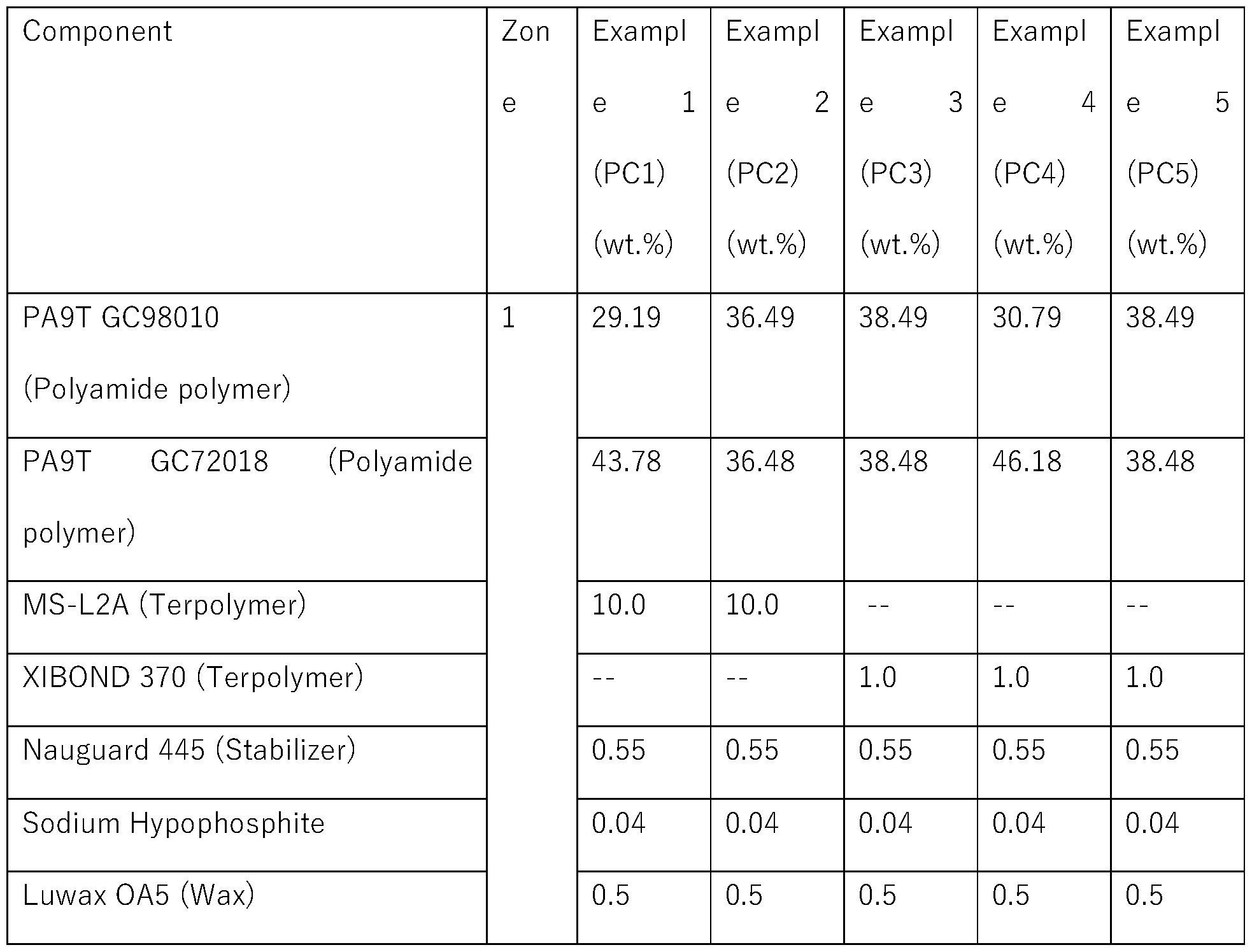
  • blow moldable polyamide compositions of the presently claimed invention have acceptable properties, particularly melt-volume flow rate, impact strength and heat deflection temperature. The properties were found to be better when compared to the properties of the comparative PA 9T blend (XA3530).
  • melt-volume flow rate (MVR) of the blow moldable polyamide compositions (PCI to PC5) was found to be substantially lower as compared to the melt-volume flow rate of the comparative PA 9T blend (XA3530), which infer improved moldability of the blow moldable polyamide compositions of the presently claimed invention during blow molding.
  • the impact strength of the blow moldable polyamide composition was found to be higher when compared with the impact strength of the comparative PA 9T blend (XA3530). It is evident that reaction of the terpolymer of the presently claimed invention with the polyamide polymer has a positive effect on the impact strength of the resultant blow moldable polyamide composition.
  • the impact strength of the blow moldable polyamide compositions (PCI to PC5) increased from 1.259 KJ/m2 for comparative PA 9T blend (XA3530) to 7.8 KJ/m2 for PC4 measured according to Charpy at 23° C.
  • the heat deflection temperature is a measure of a polymer's resistance to distortion under a given load at elevated temperature.
  • the blow moldable polyamide compositions (PCI to PC5) were found to have a higher heat deflection temperature as compared to the heat deflection temperature of the comparative PA 9T blend (XA3530).

Landscapes

  • Chemical & Material Sciences (AREA)
  • Health & Medical Sciences (AREA)
  • Chemical Kinetics & Catalysis (AREA)
  • Medicinal Chemistry (AREA)
  • Polymers & Plastics (AREA)
  • Organic Chemistry (AREA)
  • Compositions Of Macromolecular Compounds (AREA)
  • Polyamides (AREA)

Abstract

The presently claimed invention relates to a blow moldable polyamide composition. The blow moldable polyamide composition comprises a modified polyamide polymer, which is a reaction product of at least one polyamide polymer and a terpolymer. The terpolymer is derived from at least one vinyl monomer, at least one N-arylmaleimide and at least one α,β-unsaturated dicarboxylic anhydride. The blow moldable polyamide composition of the presently claimed invention exhibit a high moldability, a high impact strength and a high heat deflection temperature. The presently claimed invention also relates to a process of preparation of the blow moldable polyamide composition. The presently claimed invention also relates to a blow molded article prepared from the blow moldable polyamide composition.

Description

BLOW MOLDABLE POLYAMIDE COMPOSITION, A PROCESS OF PREPARATION THEREOF AND A BLOW MOLDED ARTICLE
FIELD OF THE INVENTION
[0001] The presently claimed invention relates to a blow moldable polyamide composition comprising a modified polyamide polymer. The presently claimed invention further relates to a process for preparing the blow moldable polyamide composition. The presently claimed invention further relates to a blow molded article prepared from the blow moldable polyamide composition.
BACKGROUND OF THE INVENTION
[0002] Polyamide is a polymer containing repeating units of amides typically obtained by reacting a diamine and a dicarboxylic functional compound. Polyamides exhibit excellent chemical resistance, abrasion resistance and electrical characteristics. Therefore, polyamides are useful for various applications such as preparation of molded articles, electronic parts, automobile parts, industrial ducts, fibers, films, and sheets.
[0003] The molded articles are prepared from polymers by methods such as injection molding, blow molding and extrusion molding. Various polymeric hollow body articles including storage containers, hoses, tubing, air ducts and pipes are prepared by the blow molding method.
[0004] Blow molded articles such as tubing, air ducts and pipes are used for the transport of fluids such as water, hot air and oils. The molded articles used for high temperature applications need to comply with the complex property profile such as a high moldability, a high impact strength, a high temperature resistance and a high heat deflection temperature. [0005] Air ducts are used in industry for the supply of air, return air and exhaust air, which at times include hot air. Industrial molded air ducts remain in contact with heat sources during their normal useful lifetime. Therefore, it is necessary that the molded air ducts withstand a high temperature.
[0006] Use of polyamide compositions in high temperature applications has been explored and is known in the state of the art and described, for instance, in the following references.
[0007] US20210198488 describes a heat resistant and flame-retardant molded article prepared using a polyamide composition containing a polyamide having a melting point of 280 0 C or higher, a flame retardant (B), and an aromatic vinyl-based copolymer (C). The polyamide composition is explored for high level flame retardancy in thin-walled structures.
[0008] W02020175290 describes a tube containing a layer containing 60 to 80% by mass of a semi-aromatic polyamide and 15 to 40% by mass of an elastomer modified with an unsaturated compound, a carboxyl group or an acid anhydride group. The layer has a phase-separated structure containing the semi-aromatic polyamide-containing phase (A) and the elastomer-containing phase (B), and the phase (A) is a continuous phase, and the phase (B) is a dispersed phase dispersed in the phase (A).
[0009] However, the polyamide compositions are associated with one or more drawbacks such as a low moldability, and/or brittleness.
[0010] There is a need for a polyamide composition having suitable properties for blow molding applications. It is desired that the polyamide composition has properties such as a high moldability, a high impact strength, a high temperature resistance, and a high heat deflection temperature. [0011] Accordingly, it is an object of the presently claimed invention to provide a blow moldable polyamide composition. It is another object of the presently claimed invention to provide a blow moldable polyamide composition having a high moldability. It is still another object of the presently claimed invention to provide a blow moldable polyamide composition having desired properties such as a high impact strength and a high heat deflection temperature.
SUMMARY OF THE INVENTION
[0012] It was surprisingly found that the blow moldable polyamide composition of the presently claimed invention has a high moldability. Further, it has desired properties such as a high impact strength, and a high heat deflection temperature and that it is suitable for preparing molded articles.
[0013] An aspect of the presently claimed invention relates to a blow moldable polyamide composition comprising a modified polyamide polymer, wherein the modified polyamide polymer is obtainable by reacting a compounding mixture comprising a) at least one polyamide polymer having an amine functionality in the range of 2 pmol/g to 80 pmol/g and a melting point in the range of 270° C to 350° C; and b) a terpolymer derived from at least one vinyl monomer (Cl), at least one N- arylmaleimide (C2) and at least one a
Figure imgf000004_0001
-unsaturated dicarboxylic anhydride (C3).
[0014] Another aspect of the presently claimed invention relates to a process for preparing a blow moldable polyamide composition comprising a modified polyamide polymer, the process comprising a step of reacting a compounding mixture comprising a. at least one polyamide polymer having an amine functionality in the range of 2 pmol/g to 80 pmol/g of the polyamide polymer and a melting point in the range of 270° C to 350° C, and b. a terpolymer comprising a structural unit derived from at least one vinyl monomer (Cl), at least one N-arylmaleimide (C2) and at least one a
Figure imgf000005_0001
-unsaturated dicarboxylic anhydride (C3),to obtain the blow moldable polyamide composition comprising a modified polyamide polymer.
[0015] Still another aspect of the presently claimed invention relates to a blow molded article prepared from a blow moldable polyamide composition comprising a modified polyamide polymer obtainable by reacting a compounding mixture comprising a) at least one polyamide polymer having an amine functionality in the range of 2 pmol/g to 80 pmol/g and a melting point in the range of 270° C to 350° C, and b) a terpolymer derived from at least one vinyl monomer (Cl), at least one N- arylmaleimide (C2) and at least one a ,0 -unsaturated dicarboxylic anhydride (C3).
[0016] Yet another aspect of the presently claimed invention relates to a method for preparing a blow molded article, the process comprising blow molding the blow moldable polyamide composition comprising a modified polyamide polymer, wherein the blow molding method is selected from molding extrusion blow molding, injection blow molding, and injection stretch blow molding to obtain the blow molded article.
[0017] Still another aspect of the presently claimed invention relates to use of the blow moldable polyamide composition comprising a modified polyamide polymer for preparing a blow molded article. [0018] Detailed description of the invention
[0019] Before the present compositions and formulations of the presently claimed invention are described, it is to be understood that this invention is not limited to particular compositions and formulations described, since such compositions and formulations may, of course, vary. It is also to be understood that the terminology used herein is not intended to be limiting, since the scope of the presently claimed invention will be limited only by the appended claims.
[0020] If hereinafter a group is defined to comprise at least a certain number of embodiments, this is meant to also encompass a group which preferably consists of these embodiments only. Furthermore, the terms 'first', 'second', 'third' or 'a', 'b', 'c', etc. and the like in the description and in the claims, are used for distinguishing between similar elements and not necessarily for describing a sequential or chronological order. It is to be understood that the terms so used are interchangeable under appropriate circumstances and that the embodiments of the presently claimed invention described herein are capable of operation in other sequences than described or illustrated herein. In case the terms 'first', 'second', 'third' or '(A)', '(B)' and '(C)' or '(a)', '(b)', '(c)', '(d)', 'i', 'ii' etc. relate to steps of a method or use or assay there is no time or time interval coherence between the steps, that is, the steps may be carried out simultaneously or there may be time intervals of seconds, minutes, hours, days, weeks, months or even years between such steps, unless otherwise indicated in the application as set forth herein above or below.
[0021] Furthermore, the ranges defined throughout the specification include the end values as well i.e., a range of 1 to 10 implies that both 1 and 10 are included in the range. For the avoidance of doubt, applicant shall be entitled to any equivalents according to applicable law.
[0022] In the following passages, different aspects of the presently claimed invention are defined in more detail. Each aspect so defined may be combined with any other aspect or aspects unless clearly indicated to the contrary. In particular, any feature indicated as being preferred or advantageous may be combined with any other feature or features indicated as being preferred or advantageous.
[0023] Reference throughout this specification to 'one embodiment' or 'an embodiment' means that a particular feature, structure, or characteristic described in connection with the embodiment is included in at least one embodiment of the presently claimed invention. Thus, appearances of the phrases 'in one embodiment' or 'in an embodiment' in various places throughout this specification are not necessarily all referring to the same embodiment but may refer to so.
[0024] Furthermore, particular features, structures or characteristics may be combined in any suitable manner, as would be apparent to a person skilled in the art from this disclosure, in one or more embodiments. Furthermore, while some embodiments described herein include some, but not other features included in other embodiments, combinations of features of different embodiments are meant to be within the scope of the presently claimed invention, and form different embodiments, as would be understood by those in the art. For example, in the appended claims, any of the claimed embodiments can be used in any combination.
[0025] It was found that the modification of a polyamide polymer by reacting with a terpolymer leads to a modified polyamide polymer that has improved properties. The blow moldable polyamide composition of the presently claimed invention exhibits properties such as a high moldability as well as a high impact strength and a high heat deflection temperature, which makes it suitable for the preparation of blow molded articles used in high temperature applications. Additionally, the modified polyamide polymer of the presently claimed invention has improved thermal stability and provides a wider window for the processing the blow moldable polyamide composition.
[0026] An aspect of the presently claimed invention is directed to a blow moldable polyamide composition comprising a modified polyamide polymer, wherein the modified polyamide polymer is obtainable by reacting a compounding mixture comprising a) at least one polyamide polymer having an amine functionality in the range of 2 pmol/g to 80 pmol/g and a melting point in the range of 270° C to 350° C; and b) a terpolymer derived from at least one vinyl monomer (Cl), at least one N- arylmaleimide (C2) and at least one a
Figure imgf000008_0001
-unsaturated dicarboxylic anhydride (C3).
[0027] The term “blow moldable”, as used herein, refers to the ability of a molten polymer composition for forming a hollow object by inflating or blowing a thermoplastic molten tube called a “parison” in the shape of a mold cavity.
[0028]
[0029] The term “amine functionality”, as used herein, refers to the presence of amine groups in the polyamide polymeric units.
[0030]
[0031] The term “modified polyamide polymer” herein refers to a reaction product of the at least one polyamide polymer and a terpolymer derived from the at least one vinyl monomer, the at least one N-arylmaleimide and the at least one a
Figure imgf000009_0001
-unsaturated dicarboxylic anhydride. The amine functionality of the polyamide polymer reacts with an acid or an anhydride moiety of the terpolymer to form an imide functional group. Accordingly, the at least one polyamide polymer and the terpolymer are covalently bonded. The modified polyamide polymer optionally comprises unreacted at least one polyamide polymer, the unreacted terpolymer, or both.
[0032]
[0033] In the context of the presently claimed invention, the aliphatic diamine is a linear aliphatic diamine such as 1,4-butanediamine, 1,5-pentanediamine, 1,6-hexanediamine, 1,7- heptanediamine, 1,8-octanediamine, 1,9-nonanediamine, 1,10-decanediamine, 1,11- undecanediam.ine or 1,12-dodecanediamine; or a branched aliphatic diamine such as, 1,1- di methyl- 1,4- butanediamine, 1-ethy I -1,4- butanediamine, 1,2-di methyl -1,4- butanediamine, 1,3-di methyl- 1,4- butanediamine, 1,4-di methyl- 1,4- butanediamine, 2,3-di methyl -1,4- butanediamine, 2-methyl-l,5-pentanediamine, 3-methyl-l,5-pentanediamine, 2,5-dimethyl- 1,6-hexanediamine, 2,4-dimethyl-l,6-hexanediamine, 3,3-dimethyl-l,6-hexanediamine, 2,2- di methyl- 1,6- hexanediamine, 2,2, 4-tri methyl -1,6- hexanediamine, 2, 4, 4-tri methyl- 1,6- hexanediamine, 2,4-diethyl-l,6-hexanediamine, 2,2-dimethyl-l,7-heptanediamine, 2,3- di methyl- 1,7- heptanediamine, 2, 4-di methyl- 1,7- heptanediamine, 2,5-di methyl- 1,7- heptanediamine, 2-methyl-l,8-octanediamine, 3-methyl-l,8-octanediamine, 4-methyl-l,8- octanediamine, l,3-dimethyl-l,8-octanediamine, l,4-dimethyl-l,8-octanediamine, 2,4- di methyl- 1,8-octanediamine, 3,4-di methyl- 1,8-octanediamine, 4, 5-di methyl- 1,8- octanediamine, 2,2-dimethyl-l,8-octanediamine, 3,3-dimethyl-l,8-octanediamine, 4,4- dimethyl-l,8-octanediamine, or 5-methyl-l,9-nonanediamine. Modified Polyamide Polymer
[0034] In a preferred embodiment, the at least one polyamide polymer is a homopolymer or a copolymer.
[0035] In a preferred embodiment, the homopolymer is obtainable by polymerizing a monomer mixture comprising an aliphatic diamine having 4 to 12 carbon atoms and terephthalic acid.
[0036] In a preferred embodiment, the aliphatic diamine is selected from 1,4- butanediamine, 1,5-pentanediamine, 1,6-hexanediamine, 1,7-heptanediamine, 1,8- octanediamine, 1,9-nonanediamine or 1,10-decanediamine.
[0037] In a more preferred embodiment, the aliphatic diamine is selected from 1,6- hexanediamine, 1,9-nonanediamine, 2-methyl-l,8-octanediamine, or 1,10-decanediamine.
[0038] In a more preferred embodiment, the aliphatic diamine is 1,9-nonanediamine.
[0039] In a preferred embodiment, the homopolymer is selected from polytetramethylene terephthalamide, polyhexamethylene terephthalamide, polynonamethylene terephthalamide or polydecamethylene terephthalamide.
[0040] In a more preferred embodiment, the homopolymer is polynonamethylene terephthalamide.
[0041] In a preferred embodiment, the copolymer is obtainable by polymerizing a monomer mixture comprising
(i) at least one aliphatic diamine having 4 to 12 carbon atoms;
(ii) terephthalic acid; and
(iii) at least one acid other than terephthalic acid selected from isophthalic acid, phthalic acid, 2,6-naphthalenedicarboxylic acid, 2,7-naphthalenedicarboxylic acid, 1,4-naphthalenedicarboxylic acid, 1,4-phenylenedioxy-diacetic acid, 1,3- phenylenedioxy-diacetic acid, diphenic acid, diphenylmethane-4,4-dicarboxylic acid, diphenylsulfone-4,4-dicarboxylic acid or 4,4- biphenyldica r boxylic acid.
[0042] In a preferred embodiment, the copolymer is selected from a copolymer of poly(hexamethylene terephthalamide) and polyamide 66 (PA 6T/66), a copolymer of poly(hexamethylene terephthalamide) and poly(methylpentanediamine) terephthalamide (PA 6T/DT), or a copolymer of poly(hexamethylene terephthalamide) and poly(hexamethylene isophthalamide (PA6T/6I).
[0043] In a preferred embodiment, the amount of the at least one polyamide polymer is in the range of 60.0 to 99.9 wt.%, more preferably in the range of 50.0 wt.% to 99.9 wt.%, and most preferably in the range of 60.0 wt.% to 99.5 wt.% based on the total weight of the at least one polyamide polymer and the terpolymer.
[0044]
[0045] In a preferred embodiment, 50.0 wt.% to 100.0 wt.% of the at least one polyamide polymer present in the compounding mixture reacts with the terpolymer.
[0046]
[0047] In a more preferred embodiment, 75.0 wt.% to 100.0 wt.% of the at least one polyamide polymer present in the compounding mixture reacts with the terpolymer.
[0048]
[0049] In an even more preferred embodiment, 90.0 wt.% to 100.0 wt.% of the at least one polyamide polymer present in the compounding mixture reacts with the terpolymer.
[0050] [0051] In most preferred embodiment, 95.0 wt.% to 100.0 wt.% of the at least one polyamide polymer present in the compounding mixture reacts with the terpolymer.
[0052]
[0053] In a preferred embodiment, the weight average molecular weight of the polyamide polymer is in the range of 5000 g/mol to 50000 g/mol according to DIN55672- 1.
[0054]
[0055] In a preferred embodiment, the terpolymer has a glass transition temperature in the range of 120° C to 250° C, more preferably in the range of 160° C to 220° C, and most preferably in the range of 160° C to 200° C.
[0056]
[0057] In a preferred embodiment, the terpolymer has a weight average molecular weight in the range of 50000 g/mol to 250000 g/mol, more preferably 100000 g/mol to 200000 g/mol determined according to DIN55672- 1.
[0058]
[0059] In a preferred embodiment, the at least one polyamide polymer has an amine functionality in the range of 2 pmol/g to 80 pmol/g, more preferably in the range of 10 pmol/g to 70 pmol/g; and most preferably in the range of 20 pmol/g to 60 pmol/g.
[0060]
[0061] In a preferred embodiment, the at least one polyamide polymer is polynona methylene te re phthalamide.
[0062] [0063] In a preferred embodiment, the blow moldable polyamide composition comprises a modified polyamide polymer, wherein the modified polyamide polymer is obtainable by reacting a compounding mixture comprising a) polynonamethylene terephthalamide having an amine functionality in the range of 2 pmol/g to 80 pmol/g and a melting point in the range of 270° C to 350° C; and b) a terpolymer derived from at least one vinyl monomer (Cl), at least one N- arylmaleimide (C2) and at least one a
Figure imgf000013_0001
-unsaturated dicarboxylic anhydride (C3).
[0064] In a preferred embodiment, the at least one vinyl monomer (Cl) is selected from styrene, vinyl chloride, vinylidene chloride, vinyl acetate, vinyl propionate, vinyl n-butyrate, vinyl laurate, vinyl stearate, acrylonitrile, metharylonitrile, fumaronitrile, maleonitrile, acrylamide, methacrylamide, vi nylsu Ifonic acid, acrylic acid, methacrylic acid, ethacrylic acid, a -chloroacrylic acid, a -cyanoacrylic acid, 3 -methylacrylic acid (crotonic acid), a - phenylacrylic acid, 3 -acryloxypropionic acid, 2-methylisocrotonic acid, cinnamic acid, p- chlorocinnamic acid, citraconic acid or methyl methacrylate.
[0065] In a more preferred embodiment, the at least one vinyl monomer (Cl) is selected from styrene or a -methylstyrene.
[0066] In a more preferred embodiment, the at least one vinyl monomer is styrene.
[0067] In a preferred embodiment, the at least one N-arylmaleimide (C2) is selected from N-phenylmaleimide, N-chlorophenylmaleimide, N-methylphenylmaleimide, N- methoxyphenylmaleimide or N-tribromophenylmaleimide.
[0068] In a more preferred embodiment, the at least one N-arylmaleimide (C2) is N- phenylmaleimide. [0069] In a preferred embodiment, the at least one a , 3 - unsaturated dicarboxylic anhydride (C3) is selected from maleic anhydride or a alkyl substituted maleic anhydride having a C1-C3 alkyl group.
[0070] In a more preferred embodiment, the at least one a , 3 - unsaturated dicar boxy lie anhydride (C3) is maleic anhydride.
[0071] In a preferred embodiment, the terpolymer is derived from styrene, N- phenylmaleimide and maleic anhydride.
[0072] In a preferred embodiment, the amount of the terpolymer is in the range of 0.1 wt.% to 40.0 wt.%, more preferably 0.1 wt.% to 25 wt.% and most preferably 0.5 wt.% to 10 wt.%, based on the total weight of the at least one polyamide polymer and the terpolymer.
[0073] In a preferred embodiment, 50.0 wt.% to 100.0 wt.% of the terpolymer present in the compounding mixture reacts with the at least one polyamide polymer.
[0074] In a more preferred embodiment, 75.0 wt.% to 100.0 wt.% of the terpolymer present in the compounding mixture reacts with the at least one polyamide polymer.
[0075] In an even more preferred embodiment, 90.0 wt.% to 100.0 wt.% of the terpolymer present in the compounding mixture reacts with the at least one polyamide polymer.
[0076] In most preferred embodiment, 95.0 wt.% to 100.0 wt.% of the terpolymer present in the compounding mixture reacts with the at least one polyamide polymer.
[0077] The terpolymer is obtained by reacting the mixture comprising the at least one vinyl monomer (Cl), the at least one N-arylmaleimide (C2) and the at least one ct , 3 - unsaturated anhydride. Suitable processes for polymerization are well known to the person skilled in the art. [0078] Particularly, the terpolymer comprising the at least one vinyl monomer (Cl), the at least one N-arylmaleimide and the at least one a , 3 - unsaturated anhydride (C3) advantageously functionalizes the at least one polyamide polymer. The amine functional groups present on the at least one polyamide polymer reacts with the anhydride moiety of the terpolymer resulting in a modified polyamide polymer having a high moldability, a high impact strength and a high heat deflection temperature. The modified polyamide polymer of the presently claimed invention is thermally stable and provides a wider compounding processing window.
Blow Moldable Polyamide Composition
[0079] In a preferred embodiment, the blow moldable polyamide composition comprises 20.0 wt.% to 99.0 wt.% of the modified polyamide polymer, more preferably 40.0 wt.% to 90.0 wt.%, and most preferably 60.0 wt.% to 90.0 wt.%, based on the total amount of the blow moldable polyamide composition.
[0080] In a preferred embodiment, the blow moldable polyamide composition comprises a modified polyamide polymer, wherein the modified polyamide polymer is obtainable by reacting a compounding mixture comprising a) at least one polyamide polymer having an amine functionality in the range of 2 pmol/g to 80 pmol/g and a melting point in the range of 270° C to 350° C; and b) a terpolymer derived from styrene (Cl), N-phenylmaleimide (C2) and maleic anhydride (C3).
[0081] In a more preferred embodiment, the blow moldable polyamide composition comprises a modified polyamide polymer, wherein the modified polyamide polymer is obtainable by reacting a compounding mixture comprising a) polynonamethylene terephthalamide having an amine functionality in the range of 2 pmol/g to 80 pmol/g and a melting point in the range of 270° C to 350° C; and b) a terpolymer derived from styrene (Cl), N-phenylmaleimide (C2) and maleic anhydride (C3).
In a preferred embodiment, the blow moldable polyamide composition comprises at least one reinforcing agent.
[0082] In a preferred embodiment, the at least one reinforcing agent is selected from metal fiber, metalized synthetic fiber, glass fiber, carbon fiber, ceramic fiber, mineral fiber, basalt fiber, inorganic fiber, kenaf fiber, jute fiber, flax fiber, hemp fiber, cellulosic fiber, sisal fiber or coir fiber.
[0083] In a preferred embodiment, the at least one reinforcing agent is glass fiber.
[0084] In a preferred embodiment, the amount of the at least one reinforcing agent is in the range of 5.0 wt.% to 40.0 wt.% based on the total weight of the blow moldable polyamide composition.
[0085] In a preferred embodiment, the blow moldable polyamide composition comprises a modified polyamide polymer obtainable by reacting a compounding mixture comprising a) at least one polyamide polymer having an amine functionality in the range of 2 pmol/g to 80 pmol/g and a melting point in the range of 270° C to 350° C, and b) a terpolymer derived from at least one vinyl monomer (Cl), at least one N- arylmaleimide (C2) and at least one a
Figure imgf000016_0001
-unsaturated dicarboxylic anhydride (C3); and at least one reinforcing agent. [0086] In a preferred embodiment, the blow moldable polyamide further comprises at least one impact modifier.
[0087] In a preferred embodiment, the at least one impact modifier is selected from polyethylene, ethylene-propylene copolymer, or ethylene-butene copolymer.
[0088] In a preferred embodiment, the amount of the at least one impact modifier is in the range of 0.1 to 10.0 wt.% based on the total weight of the blow moldable polyamide composition.
[0089] In a preferred embodiment, the blow moldable polyamide composition comprises
[0090] -a modified polyamide polymer obtainable by reacting a compounding mixture comprising a) at least one polyamide polymer having an amine functionality in the range of 2 pmol/g to 80 pmol/g and a melting point in the range of 270° C to 350° C; and b) a terpolymer derived from at least one vinyl monomer (Cl), at least one N- arylmaleimide (C2) and at least one a
Figure imgf000017_0001
-unsaturated dicarboxylic anhydride (C3), and at least one reinforcing agent, and at least one impact modifier.
[0091] In a preferred embodiment, the at least one impact modifier is grafted with at least one carboxylic acid or anhydride thereof. Preferably, the at least one carboxylic acid is selected from maleic acid, fumaric acid, itaconic acid, acrylic acid or crotonic acid.
[0092] In a preferred embodiment, the at least one impact modifier is ethylene butene copolymer grafted with maleic anhydride. [0093] In a preferred embodiment, the blow moldable polyamide composition further comprises at least one nucleating agent.
[0094] In a preferred embodiment, the at least one nucleating agent is selected from talc powder, sodium phenylphosphinate, aluminum oxide, silicon dioxide or mixtures thereof.
[0095] In a more preferred embodiment, the at least one nucleating agent is talc powder.
[0096] In a preferred embodiment, the amount of the at least one nucleating agent is in the range of 0.05 to 2.0 wt.% based on the total weight of the blow moldable polyamide composition.
[0097] In a preferred embodiment, the blow moldable polyamide composition comprises
[0098] -a modified polyamide polymer obtainable by reacting a compounding mixture comprising a) at least one polyamide polymer having an amine functionality in the range of 2 pmol/g to 80 pmol/g and a melting point in the range of 270° C to 350° C; and b) a terpolymer derived from at least one vinyl monomer (Cl), at least one N- arylmaleimide (C2) and at least one a ,0 -unsaturated dicarboxylic anhydride (C3); and
- at least one reinforcing agent,
- at least one impact modifier, and
- at least one nucleating agent. [0099] In a preferred embodiment, the blow moldable polyamide composition further comprises at least one additive.
[00100] In a preferred embodiment, the at least one additive is selected from stabilizers, dyes, pigments, flame retardants, lubricants, UV absorbers, antistats, fungistats, bacteriostats, IR absorbing materials, or antioxidants. The selection of additives depends on the properties to be imparted to the blow moldable polyamide composition.
[00101] In a preferred embodiment, the amounts of the at least one additive is in the range of 0.1 wt.% to 20 wt.% of the total weight of the blow moldable polyamide composition.
[00102] In a preferred embodiment, the blow moldable polyamide composition comprises a modified polyamide polymer obtainable by reacting a compounding mixture comprising a) at least one polyamide polymer having an amine functionality in the range of 2 pmol/g to 80 pmol/g and a melting point in the range of 270° C to 350° C; and b) a terpolymer derived from at least one vinyl monomer (Cl), at least one N- arylmaleimide (C2) and at least one a
Figure imgf000019_0001
-unsaturated dicarboxylic anhydride (C3),
- at least one reinforcing agent,
- at least one impact modifier,
- at least one nucleating agent, and
- at least one additive.
[00103] In a preferred embodiment, the blow moldable polyamide composition has a melt volume flow rate, at a temperature of 315° C and under a load of 10.0 kg, in the range of 4.50 cm3/10 minutes to 20.0 cm3/10 minutes, measured according to method ISO 1133. [00104] The melt-volume flow rate of the blow moldable polyamide composition is less than the melt-volume flow rate of the at least one polyamide polymer. In general, a lower melt-volume flow rate indicates a better moldability.
[00105] In a preferred embodiment, the blow moldable polyamide composition has a notched impact strength in the range of 3.0 KJ/m2 to 10.0 KJ/m2 measured according to Charpy at 23° C according to ISO 179. In general, a higher notched impact strength indicates better impact resistance.
[00106] In a preferred embodiment, the blow moldable polyamide composition has a unnotched impact strength in the range of 25.0 KJ/m2 to 100.0 KJ/m2, measured according to Charpy at 23° C according to ISO 179.
[00107] In a preferred embodiment, the blow moldable polyamide composition has a heat deflection temperature (HDT) in the range of 250° C to 300° C at a pressure of 0.45 MPa, measured according to method ISO 180.
[00108] In a preferred embodiment, the blow moldable polyamide composition has a heat deflection temperature (HDT) in the range of 230° C to 280° C at a pressure of 1.8 MPa, measured according to method ISO 180. The heat deflection temperature also known as heat distortion temperature is the temperature at which a polymer or plastic sample deforms under a specified load. The higher heat deflection temperature indicates improved heat resistance.
[00109] In a preferred embodiment, the modified polyamide polymer is obtainable by reacting the at least one polyamide polymer and the terpolymer at a temperature in the range of 270° C to 350° C. [00110] In a preferred embodiment, the modified polyamide polymer is obtainable by reacting the at least one polyamide polymer and the terpolymer in an extruder.
[00111] Another aspect of the presently claimed invention is directed to a process of preparing a blow moldable polyamide composition comprising a modified polyamide polymer, the process comprises a step of reacting a compounding mixture comprising a. least one polyamide polymer having an amine functionality in the range of 2 pmol/g to 80 pmol/g of the polyamide polymer and a melting point in the range of 270° C to 350° C, and b. a terpolymer comprising a structural unit derived from at least one vinyl monomer (Cl), at least one N-arylmaleimide (C2) and at least one a , 3 - unsaturated dicarboxylic anhydride (C3), to obtain the blow moldable polyamide composition comprising a modified polyamide polymer.
[00112] The modified polyamide polymer is a reaction product obtained by reacting the at least one polyamide and the terpolymer.
[00113] The process of the present invention involves interaction of various components of the blow moldable polyamide composition. Preferably, the at least one polyamide, the terpolymer, or the modified polyamide polymer do not react with other components during the process of the presently claimed invention.
[00114] In a preferred embodiment, the step of reacting involves heating the compounding mixture at a temperature in the range of 260° C to 350° C. [00115] In a preferred embodiment, the step of reacting involves heating the compounding mixture for a time period in the range of 15 minutes to 1000 minutes; preferably in the range of 15 minutes to 600 minutes; and most preferably in the range of 60 minutes to 600 minutes.
[00116] In a preferred embodiment, the process further comprises a step of adding at least one reinforcing agent. In a preferred embodiment, the at least one reinforcing agent is selected from metal fiber, metalized synthetic fiber, glass fiber, carbon fiber, ceramic fiber, mineral fiber, basalt fiber, inorganic fiber, kenaf fiber, jute fiber, flax fiber, hemp fiber, cellulosic fiber, sisal fiber or coir fiber.
[00117] In a preferred embodiment, the process further comprises a step of adding at least one impact modifier. In a preferred embodiment, the at least one impact modifier is selected from polyethylene, ethylene-propylene copolymer or ethylene-butene copolymer. [00118] In a preferred embodiment, the process further comprises a step of adding at least one additive. In a preferred embodiment, the at least one additive is selected from stabilizers, dyes, pigments, flame retardants, lubricants, UV absorbers, antistats, fungistats, bacteriostats, IR absorbing materials, or antioxidants. The selection of additives depends on the properties to be imparted to the blow moldable polyamide composition.
[00119] In a preferred embodiment, the step of reacting the compounding mixture is carried out in an extruder.
[00120] In the context of the presently claimed invention, the extruder refers to any suitable extruder, such as but not limited to a single screw extruder or a twin-screw extruder. The extrudates obtained from these extruders are of any shape such as a continuous strip. [00121] In a preferred embodiment, the step of reacting the compounding mixture in the extruder results in the formation of extrudates in the form of a continuous strip, which are further cooled and sent to the pelletizer for preparing the pellets.
[00122] In a preferred embodiment, the extruder comprises a first zone and at least one further zone downstream to the first zone.
[00123] In a preferred embodiment, the process comprises a step of feeding the at least one polyamide polymer and the terpolymer to the first zone of the extruder.
[00124] In a preferred embodiment, the process further comprises a step of dry blending the at least one polyamide and the terpolymer prior to feeding to the first zone of the extruder.
[00125] In a preferred embodiment, the process comprises a step of feeding the at least one polyamide polymer, the terpolymer, at least one nucleating agent and at least one additive to the first zone of the extruder.
[00126] In a preferred embodiment, the process further comprises a step of dry blending the at least one polyamide polymer, the terpolymer, at least one nucleating agent and at least one additive prior to feeding to the first zone of the extruder.
[00127] Suitable mixing means and blending means are well known to the person skilled in the art. Additionally, each component in the compounding mixture can be added in any manner and sequence known to the person skilled in the art.
[00128] In a preferred embodiment, the at least one reinforcing agent is fed to the first zone of the extruder.
[00129] In another embodiment, the at least one reinforcing agent is fed downstream of the first zone of the extruder. [00130] In a preferred embodiment, the at least one impact modifier is fed downstream of the first zone of the extruder.
[00131] In another embodiment, the at least one impact modifier is fed to the first zone of the extruder.
[00132] The process of the presently claimed invention provides the blow moldable polyamide composition, which has a high moldability. At the same time, the blow moldable polyamide composition of the presently claimed invention exhibit a high impact strength as well as a high heat deflection temperature.
Blow Molded Article
[00133] Still another aspect of the presently claimed invention is directed to a blow molded article prepared from a blow moldable polyamide composition comprising [00134] a modified polyamide polymer, wherein the modified polyamide polymer is obtainable by reacting a compounding mixture comprising a) at least one polyamide polymer having an amine functionality in the range of 2 pmol/g to 80 pmol/g of the polyamide polymer and a melting point in the range of 270° C to 350° C, and b) a terpolymer derived from at least one vinyl monomer (Cl), at least one N- arylmaleimide (C2) and at least one a
Figure imgf000024_0001
-unsaturated dicarboxylic anhydride (C3).
[00135] In a preferred embodiment, the blow moldable polyamide composition comprises at least one reinforcing agent.
[00136] In a preferred embodiment, the at least one reinforcing agent is selected from metal fiber, metalized synthetic fiber, glass fiber, carbon fiber, ceramic fiber, mineral fiber, basalt fiber, inorganic fiber, kenaf fiber, jute fiber, flax fiber, hemp fiber, cellulosic fiber, sisal fiber or coir fiber.
[00137] In a preferred embodiment, the blow moldable polyamide composition comprises at least one impact modifier.
[00138] In a preferred embodiment, the at least one impact modifier is selected from polyethylene, ethylene-propylene copolymer or ethylene-butene copolymer.
[00139] In a preferred embodiment, the blow moldable polyamide composition comprises at least one nucleating agent.
[00140] In a preferred embodiment, the at least one nucleating agent is selected from talc powder, sodium phenylphosphinate, aluminum oxide, silicon dioxide or mixtures thereof.
[00141] In a preferred embodiment, the blow moldable polyamide composition comprises at least one additive.
[00142] In a preferred embodiment, the at least one additive is selected from stabilizers, dyes, pigments, flame retardants, lubricants, UV absorbers, antistats, fungistats, bacteriostats, IR absorbing materials, or antioxidants.
[00143] In a preferred embodiment, the blow molded article is selected from an air duct, a pipe or a tubing.
[00144] In a more preferred embodiment, the blow molded article is an air duct.
[00145] Still another aspect of the presently claimed invention is directed to a method for preparing a blow molded article, the process comprising blow molding the blow moldable polyamide composition comprising a modified polyamide of the presently claimed invention by a method selected from molding extrusion blow molding, injection blow molding, and injection stretch blow molding to obtain the blow molded article.
[00146] In a preferred embodiment, the blow moldable article is selected from an air duct, a pipe or a tubing.
[00147] Yet another aspect of the presently claimed invention is directed to use of the blow moldable polyamide composition comprising a modified polyamide polymer of the presently claimed invention for preparing a blow molded article.
[00148] The blow moldable polyamide compositions of the presently claimed invention is suitable for producing blow molded articles. The blow moldable polyamide composition of the presently claimed invention has a melt volume flow rate, at a temperature of 315° C and under a load of 10.0 kg, in the range of 4.50 cm3/10 minutes to 20.0 cm3/10 minutes, measured according to method ISO 1133. The blow moldable polyamide composition has notched impact strength in the range of 3.0 KJ/m2 to 10.0 KJ/m2 measured according to Charpy at 23° C according to ISO 179. The unnotched impact strength of the blow moldable polyamide composition is in the range of 25.0 KJ/m2 to 100.0 KJ/m2, measured according to Charpy at 23° C according to ISO 179. The blow moldable polyamide composition has a heat deflection temperature (HDT) in the range of 250° C to 300° C at a pressure of 0.45 MPa, measured according to method ISO 180 and in the range of 230° C to 280° C at a pressure of 1.8 MPa, measured according to method ISO 180.
[00149] The presently claimed invention offers one or more of the following advantages: 1. The blow moldable polyamide composition of the presently claimed invention has a high moldability. 2. The blow moldable polyamide composition of the presently claimed invention has a high impact strength.
3. The blow moldable polyamide composition of the presently claimed invention has a high heat deflection temperature.
4. The blow moldable polyamide composition of the presently claimed invention is processable at high temperature.
5. The blow moldable polyamide composition of the presently claimed invention is suitable for preparing blow moldable articles such as air duct, pipe or tubing.
6. The articles prepared from the blow moldable polyamide composition of the presently claimed invention sustain a high temperature and a high pressure.
[00150] Embodiments:
[00151] In the following, there is provided a list of embodiments to further illustrate the present disclosure without intending to limit the disclosure to the specific embodiments listed below.
1. A blow moldable polyamide composition comprising a modified polyamide polymer, wherein the modified polyamide polymer is obtainable by reacting a compounding mixture comprising a) at least one polyamide polymer having an amine functionality in the range of 2 pmol/g to 80 pmol/g and a melting point in the range of 270° C to 350° C; and b) a terpolymer derived from at least one vinyl monomer (Cl), at least one N- arylmaleimide (C2) and at least one a , 3 -unsaturated dicarboxylic anhydride (C3).
2. The composition according to embodiment 1, wherein the at least one polyamide polymer is a homopolymer or a copolymer.
3. The composition according to embodiment 2, wherein the homopolymer is obtainable by polymerizing a monomer mixture comprising an aliphatic diamine having 4 to 12 carbon atoms and terephthalic acid.
4. The composition according to embodiment 2 or 3, wherein the homopolymer is selected from polytetramethylene terephthalamide, polyhexamethylene terephthalamide, polynonamethylene terephthalamide, or polydecamethylene terephthalamide.
5. The composition according to embodiment 2, wherein the copolymer is obtainable by polymerizing a monomer mixture comprising at least one aliphatic diamine having 4 to 12 carbon atoms, terephthalic acid and at least one acid other than terephthalic acid selected from isophthalic acid, phthalic acid, 2,6- naphthalenedicarboxylic acid, 2,7-naphthalenedicarboxylic acid, 1,4- naphthalenedicarboxylic acid, 1,4-phenylenedioxy-diacetic acid, 1,3-phenylenedioxy- diacetic acid, diphenic acid, diphenylmethane-4,4-dicarboxylic acid, diphenylsulfone- 4,4-dicarboxylic acid, and 4,4- bi p he ny Idica r boxyl ic acid.
6. The composition according to embodiment 2 or 5, wherein the copolymer is selected from a copolymer of poly(hexamethylene terephthalamide) and polyamide 66 (PA 6T/66), a copolymer of poly(hexamethylene terephthalamide) and Poly (methylpentanediamine) terephthalamide (PA 6T/DT), or a copolymer of poly(hexamethylene terephthalamide) and poly(hexamethylene isophthalamide (PA6T/6I)
7. The composition according to any of embodiments 1 to 6, wherein the amount of the at least one polyamide polymer is in the range of 60.0 wt.% to 99.5 wt.% based on the total weight of the compounding mixture.
8. The composition according to any of embodiments 1 to 7, wherein the terpolymer has a glass transition temperature in the range of 150° C to 250° C.
9. The composition according to any of embodiments 1 to 8, wherein the at least one vinyl monomer (Cl) is selected from styrene, vinyl chloride, vinylidene chloride, vinyl acetate, vinyl propionate, vinyl n-butyrate, vinyl laurate, vinyl stearate, acrylonitrile, metharylonitrile, fumaronitrile, maleonitrile, acrylamide, methacrylamide, vinylsulfonic acid, acrylic acid, methacrylic acid, ethacrylic acid, a - chloroacrylic acid, a -cyanoacrylic acid, 3 -methylacrylic acid (crotonic acid), a - phenylacrylic acid, 3 -acryloxypropionic acid, 2' -methylisocrotonic acid, cinnamic acid, p-chlorocinnamic acid, citraconic acid, or methyl methacrylate.
10. The composition according to any of embodiments 1 to 9, wherein the at least one N-arylmaleimide (C2) is selected from N-phenylmaleimide, N- chlorophenylmaleimide, N-methylphenylmaleimide, N-methoxyphenylmaleimide, or N -tri bro mo phenyl ma lei mide.
11. The composition according to any of embodiments 1 to 10, wherein the at least one ct , 3 - unsaturated dicarboxylic anhydride (C3) is selected from maleic anhydride or a alkyl substituted maleic anhydride having a Cj-Cg alkyl group. 12. The composition according to any of embodiments 1 to 11, wherein the amount of the terpolymer is in the range of 0.1 wt.% to 40.0 wt.% based on the total weight of the compounding mixture.
13. The composition according to any of embodiments 1 to 12 further comprising at least one reinforcing agent.
14. The composition according to embodiment 13, wherein the at least one reinforcing agent is selected from metal fiber, metalized synthetic fiber, glass fiber, carbon fiber, ceramic fiber, mineral fiber, basalt fiber, inorganic fiber, kenaf fiber, jute fiber, flax fiber, hemp fiber, cellulosic fiber, sisal fiber or coir fiber.
15. The composition according to embodiment 13 or 14, wherein the at least one reinforcing agent is glass fiber.
16. The composition according to any of embodiments 13 to 15, wherein the amount of the at least one reinforcing agent is in the range of 5.0 wt.% to 40.0 wt.% based on the total weight of the polyamide composition.
17. The composition according to any of embodiments 1 to 16 further comprising at least one impact modifier.
18. The composition according to embodiment 17, wherein the at least one impact modifier is selected from polyethylene, ethylene-propylene copolymer, or ethylenebutene copolymer.
19. The composition according to embodiment 17 or 18, wherein the amount of the at least one impact modifier is in the range of 0.1 to 10.0 wt.% based on the total weight of the polyamide composition. 20. The composition according to any of embodiment 1 to 19 further comprising at least one nucleating agent.
21. The composition according to embodiment 20, wherein the at least one nucleating agent is selected from talc powder, sodium phenylphosphinate, aluminum oxide, silicon dioxide or mixtures thereof.
22. The composition according to embodiment 20 or 21, wherein the amount of the at least one nucleating agent is in the range of 0.05 wt.% to 2.0 wt.% based on the total weight of the polyamide composition.
24. The composition according to any of embodiment 1 to 23 further comprising at least one additive.
25. The composition according to embodiment 24, wherein the at least one additive is selected from stabilizers, dyes, pigments, flame retardants, lubricants, UV absorbers, antistats, fungistats, bacteriostats, IR absorbing materials, or antioxidants.
26. The composition according to any of embodiments 1 to 25, wherein the at least one polyamide polymer has a number average molecular weight in the range of 5000 g/mol to 50000 g/mol according to DIN55672- 1.
27. The composition according to any of embodiments 1 to 26, wherein the polyamide composition has a melt volume flow rate, at a temperature of 315° C and under a load of 10.0 kg, in the range of 4.50 cm3/10 minutes to 20.0 cm3/10 minutes, measured according to method ISO 1133. 28. The composition according to any of embodiments 1 to 27, wherein the polyamide composition has notched impact strength in the range of 3.0 KJ/m2 to 10.0 KJ/m2 measured according to Charpy at 23° C according to ISO 179.
29. The composition according to any of embodiments 1 to 28, wherein the polyamide composition has unnotched impact strength in the range of 25.0 KJ/m2 to 100.0 KJ/m2, measured according to Charpy at 23° C according to ISO 179.
30. The composition according to any of embodiments 1 to 29, wherein the polyamide composition has a heat deflection temperature (HDT) in the range of 250° C to 300° C at a pressure of 0.45 MPa, measured according to method ISO 180.
31. The composition according to any of embodiments 1 to 30, wherein the polyamide composition has a heat deflection temperature (HDT) in the range of 230° C to 280° C at a pressure of 1.8 MPa, measured according to method ISO 180.
32. The composition according to any of embodiments 1 to 31, wherein the modified polyamide polymer is obtainable by reacting the at least one polyamide polymer and the terpolymer at a temperature in the range of 270° C to 350° C.
33. The composition according to any of embodiments 1 to 32, wherein the modified polyamide polymer is obtainable by reacting the at least one polyamide polymer and the terpolymer in an extruder.
34. A process of preparing a blow moldable polyamide composition, the process comprising a step of reacting a compounding mixture comprising (a) least one polyamide polymer having an amine functionality in the range of
2 pmol/g to 80 pmol/g of the polyamide polymer and a melting point in the range of 270° C to 350° C, and
(b) a terpolymer comprising a structural unit derived from at least one vinyl monomer (Cl), at least one N-arylmaleimide (C2) and at least one a , 3 - unsaturated dicarboxylic anhydride (C3), to obtain the blow moldable polyamide composition comprising a modified polyamide polymer.
35. The process according to embodiment 34, wherein the step of reacting involves heating the compounding mixture at a temperature in the range of 260° C to 350° C.
36. The process according to embodiment 34 or 35 further comprising a step of adding at least one reinforcing agent.
37. The process according to any of embodiments 34 to 36, further comprising a step of adding at least one impact modifier.
38. The process according to any of embodiments 34 to 37, wherein the step of reacting is carried out in an extruder.
39. The process according to embodiment 38, wherein the extruder comprises a first zone and at least one further zone downstream to the first zone.
40. The process according to embodiment 38 or 39 comprising a step of feeding the at least one polyamide polymer and the terpolymer to the first zone of the extruder.
41. The process according to any of embodiments 38 to 40 further comprising a step of dry blending the at least one polyamide and the terpolymer prior to feeding to the first zone of the extruder. 42. The process according to any of embodiments 38 to 41 comprising a step of feeding the at least one polyamide polymer, the terpolymer, at least one nucleating agent and at least one additive to the first zone of the extruder.
43. The process according to any of embodiments 38 to 42 further comprising a step of dry blending the at least one polyamide polymer, the terpolymer, at least one nucleating agent and at least one additive prior to feeding to the first zone of the extruder.
44. The process according to any of embodiments 38 to 43, wherein the at least one reinforcing agent is fed downstream of the first zone of the extruder.
45. The process according to any of embodiments 38 to 44, wherein the at least one impact modifier is fed downstream of the first zone of the extruder.
46. A blow molded article prepared from a blow moldable polyamide composition comprising a modified polyamide polymer, wherein the modified polyamide polymer is obtainable by reacting a compounding mixture comprising a) at least one polyamide polymer having an amine functionality in the range of 2 pmol/g to 80 pmol/g of the polyamide polymer and a melting point in the range of 270° C to 350° C, and b) a terpolymer derived from at least one vinyl monomer (Cl), at least one N-arylmaleimide (C2) and at least one a , 3 - unsaturated dicarboxylic anhydride (C3).
47. The blow molded article according to embodiment 46, wherein the molded article is selected from an air duct, a pipe or a tubing. 48. A method for preparing a blow molded article, the process comprising blow molding the polyamide composition comprising a modified polyamide polymer claimed in any of embodiments 1 to 33 and carrying out any of the method selected from molding extrusion blow molding, injection blow molding, and injection stretch blow molding to obtain the blow molded article.
49. Use of the blow moldable polyamide composition comprising a modified polyamide polymer of embodiments 1 to 33 for preparing a blow molded article.
EXAMPLES
[00152] The presently claimed invention is illustrated in detail by non-restrictive working examples which follow. More particularly, the test methods specified hereinafter are part of the general disclosure of the application and are not restricted to the specific working examples.
Materials and method
Figure imgf000035_0001
Figure imgf000036_0001
Figure imgf000037_0001
Standard methods
[00153] Weight average molecular weight (Mw)
[00154] Mw was determined according to DIN55672- 1 involving gel permeation chromatography using a refractometer as the detector. The mobile phase used was tetrahydrofuran (THF, ImL/min, 35° C), the standard employed for determining the molecular weight being polystyrene (PS).
Figure imgf000037_0002
Preparation of blow moldable polyamide compositions
[00155] Coperion ZSK 25 mm twin screw compounding extruder having screw diameter of 25 mm and screw length of 1025 mm was used. The processing conditions of the extruder were set as provided herein below in Table 1.
Table 1: Processing conditions of the extruder
Figure imgf000038_0001
[00156] The compounding mixture was fed to the extruder and the modified polyamide composition was extruded as a continuous strip for Examples 1-5.
[00157] Example 1: Synthesis of blow moldable polyamide composition (PCI)
[00158] 3310.14 g of PA9T GC98010 (29.19 wt.%), 4964.65 g of PA9T GC72018 (43.78 wt.%), 1134.00 g of MS-L2A (10.0 wt.%), 62.37 g of NaugaurdTM 445 (0.55 wt.%), 4.53 g of sodium hypophosphite (0.04 wt.%), 56.7 g of Luwax® OA5 (0.5 wt.%), 15.87 g of Talc 2610 (0.14 wt.%) and 90.72 g of Ultrabatch 101 (0.8 wt.%) were fed to zone 1 of the extruder.
1701.00 g of PPG 3660 HP (15 wt.%) was fed to zone 6 of the extruder. The extruded strands were cooled in water and the cooled strands were fed to the pelletizer to chop into small pellets of the blow moldable polyamide composition (PCI).
[00159] Example 2: Synthesis of blow moldable polyamide composition (PC2)
[00160] 4137.96 g of PA9T GC98010 (36.49 wt.%), 4136.83 g of PA9T GC72018 (36.48 wt.%), 1134.00 g of MS-L2A (10 wt.%), 62.37 g of NaugaurdTM 445 (0.55 wt.%), 4.53 g of sodium hypophosphite (0.04 wt.%), 56.70 g of Luwax® OA5 (0.5 wt.%), 15.87 g of Talc 2610 (0.14 wt.%) and 90.72 g of Ultrabatch 101 (0.8 wt.%) were fed to zone 1 of the extruder.
1701.00 g of PPG 3660 HP (15 wt.%) was fed to zone 6 of the extruder. The extruded strands were cooled in water and the cooled strands were fed to the pelletizer to chop the strands into small pellets of the blow moldable polyamide composition (PC2).
[00161] Example 3: Synthesis of blow moldable polyamide composition (PC3)
[00162] 4364.76 g of PA9T GC98010 (38.49 wt.%), 4363.63 g of PA9T GC72018 (38.48 wt.%), 113.4 g of NS-NIP (1.0 wt.%), 62.37g of NaugaurdTM 445 (0.55 wt.%), 4.53 g of sodium hypophosphite (0.04 wt.%), 56.70 g of Luwax® OA5 (0.5 wt.%), 5.87 of Talc 2610 (0.14 wt.%) and 90.72 g of Ultrabatch 101 (0.8 wt.%) were fed to zone 1 of the extruder.
56.70 g of Lupolen KR1270 was fed to the zone 6 of the extruder. 1701.00 g of PPG 3660 HP (15 wt.%) was fed to the zone 4 of the extruder. The extruded strands were cooled in water and the cooled strands were fed to the pelletizer to chop the strands into small pellets of the blow moldable polyamide composition (PC3).
[00163] Example 4: Synthesis of blow moldable polyamide composition (PC4)
[00164] 3491.58 g of PA9T GC98010 (30.79 wt.%), 5236.81 g of PA9T GC72018 (46.18 wt.%), 113.40 g of XIBOND 370 (1.0 wt.%), 62.37 g of NaugaurdTM 445 (0.55 wt.%), 4.53 g of sodium hypophosphite (0.04 wt.%), 56.70 g of Luwax® OA5 (0.5 wt.%), 15.87 g of Talc 2610 (0.14 wt.%) and 90.72 g of Ultrabatch 101 (0.8 wt.%) were fed to zone 1 of the extruder.
567.00 g of Lupolen KR1270 (5.0 wt.%) was fed to the zone 6 of the extruder and 1701.00 g of PPG 3660 HP (15 wt.%) was fed to the zone 4 of the extruder. The extruded strands were cooled in water and the cooled strands were fed to the pelletizer to chop the strands into small pellets of the blow moldable polyamide composition (PC4).
[00165] Example 5: Synthesis of blow moldable polyamide composition (PC5)
[00166] 4364.76 g of PA9T GC98010 (38.49 wt.%), 4329.61 g of PA9T GC72018 (38.18 wt.%), 113.40 g of XIBOND (1.0 wt.%), 62.37 g of NaugaurdTM 445 (0.55 wt.%), 4.53 g of sodium hypophosphite (0.04 wt.%), 56.70 g of Luwax® OA5 (0.5 wt.%), 15.87 g of Talc 2610 (0.14 wt.%) and 90.72 g of Ultrabatch 101 (0.8 wt.%) were fed to zone 1 of the extruder.
567.00 g of Tafmer 8510 (5.0 wt.%) was fed to zone 6 of the extruder andl701.00 g of PPG 3660 HP (15.0 wt.%) was fed to the zone 4 of the extruder. The extruded strands were cooled in water and the cooled strands were fed the pelletizer to chop the strands into small pellets of the blow moldable polyamide composition (PC5).
[00167] The weight percentages of the components used for the preparation of blow moldable polyamide compositions (PC 1 to PC5) are summarized herein below in Table 2.
Table 2: Formulation of the blow moldable polyamide compositions (PCI to PC5)
Figure imgf000040_0001
Figure imgf000041_0001
Mechanical properties of blow moldable polyamide compositions
[00168] Mechanical properties of the blow moldable polyamide compositions (PCI to PC5 were determined and are summarized herein below in Table 3. The properties of the blow moldable polyamide compositions obtained in Examples 1-5 (PCI to PC5) were compared with the comparative PA 9T blend (XA3530).
[00169] The Melt volume-flow rate (MVR) of the blow moldable polyamide compositions were determined using a standard method, ISO 1133. Charpy impact properties were determined using a standard method ISO 179 and the heat deflection temperature of the blow moldable polyamide composition was determined suing a standard method ISO 180.
Table 3: Comparison of mechanical properties of blow moldable polyamide compositions
Figure imgf000041_0002
Figure imgf000042_0001
[00170] It is evident from Table 3 that the blow moldable polyamide compositions of the presently claimed invention have acceptable properties, particularly melt-volume flow rate, impact strength and heat deflection temperature. The properties were found to be better when compared to the properties of the comparative PA 9T blend (XA3530).
[00171] The melt-volume flow rate (MVR) of the blow moldable polyamide compositions (PCI to PC5) was found to be substantially lower as compared to the melt-volume flow rate of the comparative PA 9T blend (XA3530), which infer improved moldability of the blow moldable polyamide compositions of the presently claimed invention during blow molding.
[00172] The impact strength of the blow moldable polyamide composition was found to be higher when compared with the impact strength of the comparative PA 9T blend (XA3530). It is evident that reaction of the terpolymer of the presently claimed invention with the polyamide polymer has a positive effect on the impact strength of the resultant blow moldable polyamide composition. The impact strength of the blow moldable polyamide compositions (PCI to PC5) increased from 1.259 KJ/m2 for comparative PA 9T blend (XA3530) to 7.8 KJ/m2 for PC4 measured according to Charpy at 23° C. [00173] The heat deflection temperature is a measure of a polymer's resistance to distortion under a given load at elevated temperature. The blow moldable polyamide compositions (PCI to PC5) were found to have a higher heat deflection temperature as compared to the heat deflection temperature of the comparative PA 9T blend (XA3530).

Claims

1. A blow moldable polyamide composition comprising a modified polyamide polymer, wherein the modified polyamide polymer is obtainable by reacting a compounding mixture comprising a) at least one polyamide polymer having an amine functionality in the range of 2 pmol/g to 80 pmol/g and a melting point in the range of 270° C to 350° C; and b) a terpolymer derived from at least one vinyl monomer (Cl), at least one N- arylmaleimide (C2) and at least one a
Figure imgf000044_0001
-unsaturated dicarboxylic anhydride (C3).
2. The composition according to claim 1, wherein the at least one polyamide polymer is a homopolymer or a copolymer.
3. The composition according to claim 2, wherein the homopolymer is obtainable by polymerizing a monomer mixture comprising an aliphatic diamine having 4 to 12 carbon atoms and terephthalic acid.
4. The composition according to any of claims 1 to 3, wherein the amount of the at least one polyamide polymer is in the range of 60.0 wt.% to 99.5 wt.% based on the total weight of the at least one polyamide polymer and the terpolymer.
5. The composition according to any of claims 1 to 4, wherein the terpolymer has a glass transition temperature in the range of 150° C to 250° C.
6. The composition according to any of claims 1 to 5, wherein the amount of the terpolymer is in the range of 0.1 wt.% to 40.0 wt.% based on the total weight of the at least one polyamide polymer and the terpolymer.
7. The composition according to any of claims 1 to 6 further comprising at least one reinforcing agent.
8. The composition according to claim 7, wherein the amount of the at least one reinforcing agent is in the range of 5.0 wt.% to 40.0 wt.% based on the total weight of the polyamide composition.
9. The composition according to any of claims 1 to 8 further comprising at least one impact modifier.
10. The composition according to any of claims 1 to 9 further comprising at least one nucleating agent.
11. The composition according to any of claims 1 to 10 further comprising at least one additive.
12. The composition according to any of claims 1 to 11, wherein the polyamide composition has a melt volume flow rate, at a temperature of 315° C and under a load of 10.0 kg, in the range of 4.50 cm3/10 minutes to 20.0 cm3/10 minutes, according to method ISO 1133.
13. The composition according to any of claims 1 to 12, wherein the polyamide composition has a notched impact strength in the range of 3.0 KJ/m2 to 10.0 KJ/m2 measured according to Charpy at 23° C according to ISO 179.
14. The composition according to any of claims 1 to 13, wherein the polyamide composition has a unnotched impact strength in the range of 25.0 KJ/m2 to 100.0 KJ/m2, measured according to Charpy at 23° C according to ISO 179.
15. The composition according to any of claims 1 to 14, wherein the polyamide composition has a heat deflection temperature (HDT) in the range of 250° C to 300° C at a pressure of 0.45 MPa, according to method ISO 180.
16. The composition according to any of claims 1 to 15, wherein the polyamide composition has a heat deflection temperature (HDT) in the range of 230° C to 280° C at a pressure of 1.8 MPa, according to method ISO 180.
17. The composition according to any of claims 1 to 16, wherein the modified polyamide polymer is obtainable by reacting the at least one polyamide polymer and the terpolymer at a temperature in the range of 270° C to 350° C.
18. A process of preparing a blow moldable polyamide composition comprising a modified polyamide polymer, the process comprising a step of reacting a compounding mixture comprising
(a) at least one polyamide polymer having an amine functionality in the range of 2 pmol/g to 80 pmol/g of the polyamide polymer and a melting point in the range of 270° C to 350° C, and
(b) a terpolymer comprising a structural unit derived from at least one vinyl monomer (Cl), at least one N-arylmaleimide (C2) and at least one a , 3 - unsaturated dicarboxylic anhydride (C3), to obtain the blow moldable polyamide composition comprising a modified polyamide polymer.
19. The process according to claim 18, wherein the step of reacting involves heating the compounding mixture at a temperature in the range of 260° C to 350° C.
20. The process according to claim 18 or 19 further comprising a step of adding at least one reinforcing agent.
21. The process according to any of claims 18 to 20, further comprising a step of adding at least one impact modifier.
22. The process according to any of claims 18 to 21, wherein the step of reacting the compounding mixture is carried out in an extruder.
23. The process according to claim 22, wherein the extruder comprises a first zone and at least one further zone downstream to the first zone.
24. The process according to claim 22 or 23 comprising a step of feeding the at least one polyamide polymer and the terpolymer to the first zone of the extruder.
25. A blow molded article prepared from a blow moldable polyamide composition comprising a modified polyamide polymer, wherein the modified polyamide polymer is obtainable by reacting a compounding mixture comprising a) at least one polyamide polymer having an amine functionality in the range of 2 pmol/g to 80 pmol/g of the polyamide polymer and a melting point in the range of 270° C to 350° C, and b) a terpolymer derived from at least one vinyl monomer (Cl), at least one N-arylmaleimide (C2) and at least one a
Figure imgf000048_0001
-unsaturated dicarboxylic anhydride (C3).
26. The blow molded article according to claim 25, wherein the molded article is selected from an air duct, a pipe or a tubing.
27. A method for preparing a blow molded article, the method comprising blow molding the polyamide composition comprising a modified polyamide polymer according to any of claims 1 to 17, wherein the step of blow molding is carrying out by a method selected from molding extrusion blow molding, injection blow molding, and injection stretch blow molding to obtain the blow molded article.
28. Use of the blow moldable polyamide composition comprising a modified polyamide polymer according to any of claims 1 to 17 for preparing a blow molded article.
PCT/US2024/036070 2023-07-07 2024-06-28 Blow moldable polyamide composition, a process of preparation thereof and a blow molded article Ceased WO2025014668A1 (en)

Priority Applications (1)

Application Number Priority Date Filing Date Title
CN202480045775.2A CN121548610A (en) 2023-07-07 2024-06-28 Blowable polyamide compositions, their preparation methods and blow-molded articles

Applications Claiming Priority (2)

Application Number Priority Date Filing Date Title
US202363512366P 2023-07-07 2023-07-07
US63/512,366 2023-07-07

Publications (1)

Publication Number Publication Date
WO2025014668A1 true WO2025014668A1 (en) 2025-01-16

Family

ID=91961672

Family Applications (1)

Application Number Title Priority Date Filing Date
PCT/US2024/036070 Ceased WO2025014668A1 (en) 2023-07-07 2024-06-28 Blow moldable polyamide composition, a process of preparation thereof and a blow molded article

Country Status (2)

Country Link
CN (1) CN121548610A (en)
WO (1) WO2025014668A1 (en)

Citations (4)

* Cited by examiner, † Cited by third party
Publication number Priority date Publication date Assignee Title
WO2019059357A1 (en) * 2017-09-25 2019-03-28 東洋紡株式会社 Compact including, as constituent, molded article formed of semiaromatic polyamide resin composition
JP2020066734A (en) * 2018-10-18 2020-04-30 旭化成株式会社 Thermoplastic resin composition and resin molding
WO2020175290A1 (en) 2019-02-25 2020-09-03 株式会社クラレ Tube, and polyamide resin composition
US20210198488A1 (en) 2018-08-24 2021-07-01 Kuraray Co., Ltd. Polyamide composition and molded product composed of said polyamide composition

Patent Citations (4)

* Cited by examiner, † Cited by third party
Publication number Priority date Publication date Assignee Title
WO2019059357A1 (en) * 2017-09-25 2019-03-28 東洋紡株式会社 Compact including, as constituent, molded article formed of semiaromatic polyamide resin composition
US20210198488A1 (en) 2018-08-24 2021-07-01 Kuraray Co., Ltd. Polyamide composition and molded product composed of said polyamide composition
JP2020066734A (en) * 2018-10-18 2020-04-30 旭化成株式会社 Thermoplastic resin composition and resin molding
WO2020175290A1 (en) 2019-02-25 2020-09-03 株式会社クラレ Tube, and polyamide resin composition

Also Published As

Publication number Publication date
CN121548610A (en) 2026-02-17

Similar Documents

Publication Publication Date Title
CN101622313B (en) Composite material based on polyamide and poly(lactic acid), method of manufacture and use thereof
JP4399173B2 (en) Molding material, molded article produced therefrom and use of the molding material
EP2670805B1 (en) Melt-blended thermoplastic composition
JP5954518B1 (en) Polyamide resin composition, molded product, and method for producing molded product
CN106795371B (en) Thermoplastic polymer composition with improved mechanical property
CN111448257B (en) polyamide resin composition
JP2019002025A (en) Polyamide resin composition, method for producing polyamide resin composition, and molded article
JP3083319B2 (en) Injectable thermoplastic polyamide composition
JPWO2015046247A1 (en) Polyamide resin composition and molded product
JP2023103598A (en) Semi-aromatic polyamide resin composition and molded article using the same
WO2025014668A1 (en) Blow moldable polyamide composition, a process of preparation thereof and a blow molded article
JP7195313B2 (en) Improved stabilizers for polyamides
TW202016214A (en) Polyamide composition and molded article composed of the polyamide composition
JP7644020B2 (en) Copolyamide composition containing reinforcing fibers and having high modulus stability and uses thereof
AU699659B2 (en) Flexible translucent polyamide-based composition, process for its conversion and articles obtained from this composition
JP2023112242A (en) Semi-aromatic polyamide resin composition and molded article using the same
CN116056874A (en) Aliphatic and semiaromatic polyamides with dimer acids and dimer amines
JP4106656B2 (en) Flame retardant-containing resin composition and molded article
CN113811575B (en) Copolyamide compositions comprising reinforcing fibers with high modulus stability and uses thereof
JPH0543800A (en) Stabilized resin composition and its form
JPS5949229A (en) Low water-absorptive polyamide composition
JPH083442A (en) Resin composition
JP2025004114A (en) Method for producing essentially expanded polyamides and molded articles thereof - Patents.com
WO2024041951A1 (en) Polyamide composition and article produced from the composition
CN119101349A (en) A plasticizer-free bio-based PA1010 modified material and preparation method thereof

Legal Events

Date Code Title Description
121 Ep: the epo has been informed by wipo that ep was designated in this application

Ref document number: 24746116

Country of ref document: EP

Kind code of ref document: A1

REG Reference to national code

Ref country code: BR

Ref legal event code: B01A

Ref document number: 112026000219

Country of ref document: BR

ENP Entry into the national phase

Ref document number: 2024746116

Country of ref document: EP

Effective date: 20260209

WWE Wipo information: entry into national phase

Ref document number: 2024746116

Country of ref document: EP

NENP Non-entry into the national phase

Ref country code: DE

122 Ep: pct application non-entry in european phase

Ref document number: 24746116

Country of ref document: EP

Kind code of ref document: A1