WO2025013276A1 - 被補助者の状態監視システム - Google Patents
被補助者の状態監視システム Download PDFInfo
- Publication number
- WO2025013276A1 WO2025013276A1 PCT/JP2023/025846 JP2023025846W WO2025013276A1 WO 2025013276 A1 WO2025013276 A1 WO 2025013276A1 JP 2023025846 W JP2023025846 W JP 2023025846W WO 2025013276 A1 WO2025013276 A1 WO 2025013276A1
- Authority
- WO
- WIPO (PCT)
- Prior art keywords
- condition
- measuring
- assisted
- person
- assisted person
- Prior art date
- Legal status (The legal status is an assumption and is not a legal conclusion. Google has not performed a legal analysis and makes no representation as to the accuracy of the status listed.)
- Pending
Links
Images




Classifications
-
- A—HUMAN NECESSITIES
- A61—MEDICAL OR VETERINARY SCIENCE; HYGIENE
- A61B—DIAGNOSIS; SURGERY; IDENTIFICATION
- A61B5/00—Measuring for diagnostic purposes; Identification of persons
Definitions
- the present invention relates to a system for monitoring the condition of people receiving assistance, such as infants and young children, who require human assistance (attendance).
- Patent Document 1 discloses an infant comfort monitoring system that includes one or more sensors operable to obtain information indicative of an infant's physical condition, and a controller that communicates with the sensors. The controller determines whether the infant is experiencing distress based on the information from the sensors, and operates a vehicle system to improve this based on the determination result.
- the monitoring system described in Patent Document 1 judges the condition of an infant based on information about the infant at the time an abnormality occurs, such as when the infant is feeling distressed, and is therefore unable to predict the impact that would occur if, for example, the temperature, humidity, or amount of sunlight in the infant's environment continues.
- the system does not monitor the history of changes in the infant's condition, it is not possible to grasp if the infant's condition is currently normal and there is a tendency for the condition to worsen, and so it is not possible to detect the condition until it worsens, leaving no time to take measures.
- the seat (riding area) of a stroller in which an infant is carried is partitioned into a semi-private compartment, and the basic configuration has an open front to make it easier for the infant to get in and out.
- heat from the infant's biological activity tends to build up, and the stroller is directly exposed to environmental changes such as rising temperatures due to sunlight and rising humidity on rainy days. This makes it easy for the condition of the infant to change.
- the present invention has been made in consideration of the above points, and its purpose is to provide a condition monitoring system for assisted persons that can quickly identify any tendency for the condition of an assisted person, such as an infant, to deteriorate at an early stage and take measures with ample time to respond.
- the assisted person condition monitoring system (1) of the present invention is characterized by comprising: a condition prediction model creation means (52) that performs machine learning using teacher data (58) including environmental information (60) that changes from moment to moment and biological information (62) of the assisted person being monitored, which is output from one or more measuring means (18, 22, 24, 26, 28, 30), and creates a condition prediction model that associates at least one of the environmental information (60) with the degree of condition based on the biological information (62); an evaluation means (54) that inputs the current environmental information (60) into the created condition prediction model to predict and evaluate the condition of the assisted person (3); and a notification means (56) that judges the trend of the evaluation by the evaluation means (54) and issues a notification to the outside if it is judged that the trend is worsening.
- a condition prediction model creation means (52) that performs machine learning using teacher data (58) including environmental information (60) that changes from moment to moment and biological information (62) of the assisted person being monitored, which is output from one or more measuring means (18, 22, 24, 26, 28, 30), and create
- the assisted person condition monitoring system of the present invention allows the assistant who receives the notification to be sure that they are aware that the baby's condition is deteriorating. This allows them to take immediate measures, such as removing the baby from the seat, and prevent the baby's condition from worsening.
- the measuring means for acquiring environmental information may include a temperature sensor (22) for measuring temperature and a humidity sensor (24) for measuring humidity
- the measuring means for acquiring vital information (62) may include a thermometer (26) for measuring body temperature, a pulsometer (28) for measuring pulse rate, and a respirometer for measuring respiratory rate.
- the pulse meter (28) may also be configured to function as a respiration meter. This can simplify the configuration. There is a certain correlation between the pulse rate and the respiration rate, so there is no practical problem in estimating the respiration rate from the pulse rate measured by the pulse meter.
- the measuring means for acquiring environmental information (60) may further include a solar radiation meter (18) for measuring the amount of solar radiation
- the measuring means for acquiring vital information (62) may further include a distortion sensor (30) for detecting the movements of the assisted person (3).
- Assisted persons such as infants and small children often move when they feel too hot or uncomfortable, so by capturing this with a distortion sensor, changes in condition can be grasped more accurately.
- data on the amount of solar radiation may be acquired by acquiring solar radiation forecast values from an external organization via an information and communication network, instead of using a solar radiation meter (18). This allows for a simplified configuration and reduced costs.
- the present invention makes it possible to quickly identify any deterioration in the condition of infants and other recipients of assistance at an early stage, allowing time to take measures.
- FIG. 2 is a schematic cross-sectional view of the stroller shown in FIG. 1 .
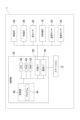
- FIG. 2 is a control block diagram of a system for monitoring the status of an assisted person.
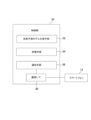
- FIG. 4 is a block diagram showing the functions of a control unit.
- FIG. 2 is a diagram showing the contents of teacher data.
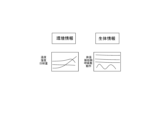
- FIG. 1 is a conceptual diagram of environmental information and biological information data.
- FIG. 13 is an image diagram showing how environmental information and biological information data change from moment to moment.
- FIGS. 1 and 2 show a stroller 2 for carrying an infant 3 who is an assisted person and requires assistance when getting on and off, and is an example of a subject of the assisted person status monitoring system 1 (see FIG. 3) according to this embodiment.
- the stroller 2 has a typical structure with an opening 4a at the front for getting on and off, a seat 4 that accommodates and covers the infant 3 being assisted, and a movable support 8 that has a handle 6 for pushing and supports the seat 4.
- the support 8, which stably supports the seat 4, is made up of rods and pipes joined together and can be moved by wheels 10 with locking levers.
- a smartphone holder 14 is attached to one of a pair of shafts 8a that extend diagonally upward from the support 8, and which holds a smartphone 12 used by the person assisting the infant 3.
- the seat 4 is surrounded by a seat cover 16 made of a flexible fabric that blocks sunlight, and the opening 4a is left open. On rainy, windy, or dusty days, the opening 4a is covered with a transparent or translucent cover (not shown) via a fastener such as a zipper.
- a solar radiation meter 18 serving as a measuring means is disposed on the outer upper surface of the seat cover 16.
- a sensor board 20 is fixed to the seat cover 16 inside the seat section 4, and a temperature sensor 22 serving as a measuring means for measuring the temperature inside the seat section 4 and a humidity sensor 24 serving as a measuring means for measuring the humidity inside the seat section 4 are disposed on the sensor board 20.
- a non-contact thermometer 26 serving as a measuring means for measuring the body temperature of the infant 3 is disposed on the upper part inside the seat section 4.
- a pulse meter 28 serving as a measuring means for measuring the pulse rate of the infant 3 is attached to the right hand of the infant 3.
- a plurality of strain sensors 30 serving as a measuring means for detecting the movements of the infant 3 are disposed inside the mat 29 on which the infant 3 sits.
- a storage box 32 is provided on the underside of the seat 4, and the storage box 32 contains a control unit 34 and a DC power supply 36 acting as a battery. Each of the above measuring means is electrically connected to the DC power supply 36 by a wire (not shown).
- the assisted person condition monitoring system 1 comprises a control unit 34 and each measuring means (solar radiation meter 18, temperature sensor 22, humidity sensor 24, thermometer 26, pulse meter 28, distortion sensor 30).
- the control unit 34 is a microcomputer comprising a CPU 38, ROM 40, RAM 42, a memory unit 46 in which a program 44 is stored, a communication I/F 48, an external I/F 50, etc.
- Each measuring means (solar radiation meter 18, temperature sensor 22, humidity sensor 24, thermometer 26, pulse meter 28, distortion sensor 30) is electrically connected via the external I/F 50.
- control unit 34 functions as a condition prediction model creation means 52 that performs machine learning using training data including ever-changing environmental information and biological information of the assisted person (infant 3) being monitored, each output from one or more measuring means, to create a condition prediction model that matches at least one piece of environmental information with the degree of condition based on the biological information; an evaluation means 54 that inputs current environmental information into the created condition prediction model to predict and evaluate the condition of the assisted person (infant 3); and a notification means 56 that judges the trend of the evaluation by the evaluation means 54 and issues a notification to the outside if it is judged that there is a worsening trend.
- condition prediction model creation means 52 that performs machine learning using training data including ever-changing environmental information and biological information of the assisted person (infant 3) being monitored, each output from one or more measuring means, to create a condition prediction model that matches at least one piece of environmental information with the degree of condition based on the biological information
- an evaluation means 54 that inputs current environmental information into the created condition prediction model to predict and evaluate the condition of the
- the control unit 14 which functions as the state prediction model creation means 52, performs machine learning using the teacher data 58 shown in FIG. 5 to create a prediction model.
- the teacher data 58 includes environmental information 60 and biological information 62 of the infant 3.
- the environmental information 60 is the temperature measured by the temperature sensor 22, the humidity measured by the humidity sensor 24, and the amount of solar radiation measured by the solar radiation meter 18.
- the biological information 62 is the body temperature measured by the thermometer 26, the pulse rate measured by the pulse rate meter 28, the respiratory rate estimated from the pulse rate, and the movement measured by the strain sensor 30. It is said that the respiratory rate is, on average, 1/4 of the pulse rate. In other words, the pulse rate meter 28 also functions as a respiration meter.
- the control unit 34 loads the program 44 stored in the memory unit 46 into the RAM 42, and the CPU 38 interprets and executes the loaded program 44 to control each means.
- Well-known machine learning techniques such as logistic regression, can be used.
- FIG. 6 is an image diagram of environmental information 60 and biological information 62 data.
- the environmental information 60 and biological information 62 measured by each of the measuring means described above change from moment to moment, and the data accumulates.
- the amount of teacher data 58 increases over time, and the control unit 14 functioning as the state prediction model creation means 52 performs machine learning using the teacher data 58, which also includes past data (history), to create a prediction model.
- the symbol t indicates the time axis.
- the control unit 34 functioning as the evaluation means 54, inputs the current environmental information into the created state prediction model to predict and evaluate the state of the infant 3.
- thresholds at which the infant 3 feels discomfort or pain are set in stages in advance, and the evaluation means 54 grasps this trend.
- the control unit 34 functioning as the notification means 56, notifies the outside when it determines that the trend grasped by the evaluation means 54 is approaching the threshold. For example, the notification is made to the smartphone 12 via the communication I/F 48 by sound or message display.
- the assistant (the person pushing the stroller 2) who receives the notification can recognize that the condition of the infant 3 is beginning to deteriorate. This allows them to quickly take measures such as removing the infant 3 from the seat 4, and can prevent the condition from worsening before it worsens. Even if the opening 4a is covered with a cover during rainy weather, etc. and the seat 4 becomes almost sealed, the tendency for the condition of the infant 3 to deteriorate due to a sudden increase in humidity or carbon dioxide concentration can be detected at an early stage, and the assistant can take prompt action.
- the present invention is not limited to the above embodiments, and various modifications are possible within the scope of the claims and the technical ideas described in the specification and drawings.
- the above embodiments are exemplified by the stroller 2, but the present invention can also be implemented in a wheelchair that carries a person in need of care, such as an elderly person.
- the stroller 2 and wheelchair may be equipped with an electric assist function.
- an example is shown in which the solar radiation meter 18 is placed directly on the stroller 2 to acquire solar radiation data, but instead of the solar radiation meter 18, a solar radiation forecast value from an external organization may be acquired via an information and communication network such as the Internet using the communication I/F 48.
- a pulse oximeter may also be used as a measuring means for acquiring biological information.
Landscapes
- Life Sciences & Earth Sciences (AREA)
- Health & Medical Sciences (AREA)
- Medical Informatics (AREA)
- Biophysics (AREA)
- Pathology (AREA)
- Engineering & Computer Science (AREA)
- Biomedical Technology (AREA)
- Heart & Thoracic Surgery (AREA)
- Physics & Mathematics (AREA)
- Molecular Biology (AREA)
- Surgery (AREA)
- Animal Behavior & Ethology (AREA)
- General Health & Medical Sciences (AREA)
- Public Health (AREA)
- Veterinary Medicine (AREA)
- Measuring And Recording Apparatus For Diagnosis (AREA)
Priority Applications (2)
| Application Number | Priority Date | Filing Date | Title |
|---|---|---|---|
| PCT/JP2023/025846 WO2025013276A1 (ja) | 2023-07-13 | 2023-07-13 | 被補助者の状態監視システム |
| JP2023542740A JPWO2025013276A1 (https=) | 2023-07-13 | 2023-07-13 |
Applications Claiming Priority (1)
| Application Number | Priority Date | Filing Date | Title |
|---|---|---|---|
| PCT/JP2023/025846 WO2025013276A1 (ja) | 2023-07-13 | 2023-07-13 | 被補助者の状態監視システム |
Publications (1)
| Publication Number | Publication Date |
|---|---|
| WO2025013276A1 true WO2025013276A1 (ja) | 2025-01-16 |
Family
ID=94214956
Family Applications (1)
| Application Number | Title | Priority Date | Filing Date |
|---|---|---|---|
| PCT/JP2023/025846 Pending WO2025013276A1 (ja) | 2023-07-13 | 2023-07-13 | 被補助者の状態監視システム |
Country Status (2)
| Country | Link |
|---|---|
| JP (1) | JPWO2025013276A1 (https=) |
| WO (1) | WO2025013276A1 (https=) |
Citations (8)
| Publication number | Priority date | Publication date | Assignee | Title |
|---|---|---|---|---|
| JP2005237719A (ja) * | 2004-02-27 | 2005-09-08 | Daikin Ind Ltd | 監視ユニットおよび監視システム |
| JP2015160131A (ja) * | 2014-06-18 | 2015-09-07 | アクシオヘリックス株式会社 | 監視装置及び監視システム |
| CN205769523U (zh) * | 2016-06-27 | 2016-12-07 | 武汉朗立创科技有限公司 | 具有环境参数与婴儿状态监测功能的婴儿车 |
| JP2020166801A (ja) * | 2019-03-29 | 2020-10-08 | 大連理工大学Dalian University of Technology | 室内環境と高齢者の健康との関連をモニタリングするIoTシステム及びモニタリング方法 |
| JP2021011651A (ja) * | 2019-07-05 | 2021-02-04 | 倉敷紡績株式会社 | 機能性衣服 |
| JP2021040753A (ja) * | 2019-09-06 | 2021-03-18 | 株式会社クォンタムオペレーション | 熱失神の予兆検知システム、熱失神の予兆検知装置、熱失神の予兆検知方法及びコンピュータプログラム |
| JP2021528135A (ja) * | 2018-06-13 | 2021-10-21 | コーニンクレッカ フィリップス エヌ ヴェKoninklijke Philips N.V. | モニタリング対象者のバイタルサインの信頼性の決定 |
| WO2021255899A1 (ja) * | 2020-06-18 | 2021-12-23 | 日本電気株式会社 | 情報処理装置、制御方法及び記憶媒体 |
Family Cites Families (3)
| Publication number | Priority date | Publication date | Assignee | Title |
|---|---|---|---|---|
| CN106361270B (zh) * | 2015-07-22 | 2021-05-07 | 松下电器(美国)知识产权公司 | 清醒度预测方法和清醒度预测装置 |
| JP6959089B2 (ja) * | 2017-09-21 | 2021-11-02 | 京セラ株式会社 | 電子機器および診断システム |
| WO2023073988A1 (ja) * | 2021-11-01 | 2023-05-04 | 日産自動車株式会社 | 警報方法および警報システム |
-
2023
- 2023-07-13 WO PCT/JP2023/025846 patent/WO2025013276A1/ja active Pending
- 2023-07-13 JP JP2023542740A patent/JPWO2025013276A1/ja active Pending
Patent Citations (8)
| Publication number | Priority date | Publication date | Assignee | Title |
|---|---|---|---|---|
| JP2005237719A (ja) * | 2004-02-27 | 2005-09-08 | Daikin Ind Ltd | 監視ユニットおよび監視システム |
| JP2015160131A (ja) * | 2014-06-18 | 2015-09-07 | アクシオヘリックス株式会社 | 監視装置及び監視システム |
| CN205769523U (zh) * | 2016-06-27 | 2016-12-07 | 武汉朗立创科技有限公司 | 具有环境参数与婴儿状态监测功能的婴儿车 |
| JP2021528135A (ja) * | 2018-06-13 | 2021-10-21 | コーニンクレッカ フィリップス エヌ ヴェKoninklijke Philips N.V. | モニタリング対象者のバイタルサインの信頼性の決定 |
| JP2020166801A (ja) * | 2019-03-29 | 2020-10-08 | 大連理工大学Dalian University of Technology | 室内環境と高齢者の健康との関連をモニタリングするIoTシステム及びモニタリング方法 |
| JP2021011651A (ja) * | 2019-07-05 | 2021-02-04 | 倉敷紡績株式会社 | 機能性衣服 |
| JP2021040753A (ja) * | 2019-09-06 | 2021-03-18 | 株式会社クォンタムオペレーション | 熱失神の予兆検知システム、熱失神の予兆検知装置、熱失神の予兆検知方法及びコンピュータプログラム |
| WO2021255899A1 (ja) * | 2020-06-18 | 2021-12-23 | 日本電気株式会社 | 情報処理装置、制御方法及び記憶媒体 |
Also Published As
| Publication number | Publication date |
|---|---|
| JPWO2025013276A1 (https=) | 2025-01-16 |
Similar Documents
| Publication | Publication Date | Title |
|---|---|---|
| JP6978111B2 (ja) | 機械学習アルゴリズムを用いた転倒リスクの識別 | |
| KR102273898B1 (ko) | 비접촉식 생체 지수 측정 방법 | |
| CN106993845B (zh) | 一种面向健康的智能鞋垫 | |
| US20100069795A1 (en) | Method and system for contour fitting and posture identification, and method for contour model adaptation | |
| CN106361270A (zh) | 清醒度预测方法和清醒度预测装置 | |
| US20160324466A1 (en) | Monitor for sids research and prevention | |
| CN113384247B (zh) | 照护系统与自动照护方法 | |
| CN112437629B (zh) | 确定被监测对象的生命体征的可靠性 | |
| JP5867847B2 (ja) | 患者行動識別方法と患者行動検知システム | |
| ES2981725T3 (es) | Sistema con sensor de datos vitales y unidad de evaluación | |
| JP2006194540A (ja) | 温冷感予測値を用いた空調制御方法、空調装置、空調装置用プログラム及びサーバ装置 | |
| CN111819585B (zh) | 生理数据智能处理方法与系统 | |
| US20210219873A1 (en) | Machine vision to predict clinical patient parameters | |
| CN108711452A (zh) | 基于视觉的人体健康状态分析方法和系统 | |
| TW201019894A (en) | Smart-type hospital bed system | |
| US20220142834A1 (en) | A sensing device, system and method | |
| CN119908678A (zh) | 一种高原病智能动态监测与评估系统及其可穿戴设备 | |
| KR20180094553A (ko) | 조종사의 생체정보인식이 가능한 항공기 조종간 | |
| KR102266857B1 (ko) | 클라우드 기반 스마트 넥밴드를 통한 반려동물 대사증후군 사전 예방 시스템, 서버 및 방법 | |
| CN107495936A (zh) | 一种儿童穿衣监护系统 | |
| WO2025013276A1 (ja) | 被補助者の状態監視システム | |
| JP2023012182A (ja) | 健康増進プログラム提供システム及び健康増進プログラム提供方法 | |
| JP5652764B2 (ja) | 睡眠状態判定装置及び睡眠状態判定プログラム | |
| CN113012391A (zh) | 看护系统、看护装置、看护方法及计算机程序产品 | |
| Vivek et al. | IoT based smart care bed with recommender system for elderly people |
Legal Events
| Date | Code | Title | Description |
|---|---|---|---|
| ENP | Entry into the national phase |
Ref document number: 2023542740 Country of ref document: JP Kind code of ref document: A |
|
| 121 | Ep: the epo has been informed by wipo that ep was designated in this application |
Ref document number: 23945149 Country of ref document: EP Kind code of ref document: A1 |
|
| NENP | Non-entry into the national phase |
Ref country code: DE |