WO2025009544A1 - 硬化性組成物入り容器、硬化膜の製造方法、パタ-ン、発光素子、表示装置および硬化性組成物の製造方法 - Google Patents
硬化性組成物入り容器、硬化膜の製造方法、パタ-ン、発光素子、表示装置および硬化性組成物の製造方法 Download PDFInfo
- Publication number
- WO2025009544A1 WO2025009544A1 PCT/JP2024/024009 JP2024024009W WO2025009544A1 WO 2025009544 A1 WO2025009544 A1 WO 2025009544A1 JP 2024024009 W JP2024024009 W JP 2024024009W WO 2025009544 A1 WO2025009544 A1 WO 2025009544A1
- Authority
- WO
- WIPO (PCT)
- Prior art keywords
- curable composition
- group
- container containing
- oxygen
- container
- Prior art date
- Legal status (The legal status is an assumption and is not a legal conclusion. Google has not performed a legal analysis and makes no representation as to the accuracy of the status listed.)
- Ceased
Links
Images
Classifications
-
- B—PERFORMING OPERATIONS; TRANSPORTING
- B65—CONVEYING; PACKING; STORING; HANDLING THIN OR FILAMENTARY MATERIAL
- B65D—CONTAINERS FOR STORAGE OR TRANSPORT OF ARTICLES OR MATERIALS, e.g. BAGS, BARRELS, BOTTLES, BOXES, CANS, CARTONS, CRATES, DRUMS, JARS, TANKS, HOPPERS, FORWARDING CONTAINERS; ACCESSORIES, CLOSURES, OR FITTINGS THEREFOR; PACKAGING ELEMENTS; PACKAGES
- B65D77/00—Packages formed by enclosing articles or materials in preformed containers, e.g. boxes, cartons, sacks or bags
-
- C—CHEMISTRY; METALLURGY
- C08—ORGANIC MACROMOLECULAR COMPOUNDS; THEIR PREPARATION OR CHEMICAL WORKING-UP; COMPOSITIONS BASED THEREON
- C08F—MACROMOLECULAR COMPOUNDS OBTAINED BY REACTIONS ONLY INVOLVING CARBON-TO-CARBON UNSATURATED BONDS
- C08F220/00—Copolymers of compounds having one or more unsaturated aliphatic radicals, each having only one carbon-to-carbon double bond, and only one being terminated by only one carboxyl radical or a salt, anhydride ester, amide, imide or nitrile thereof
- C08F220/02—Monocarboxylic acids having less than ten carbon atoms; Derivatives thereof
- C08F220/10—Esters
- C08F220/20—Esters of polyhydric alcohols or phenols, e.g. 2-hydroxyethyl (meth)acrylate or glycerol mono-(meth)acrylate
-
- C—CHEMISTRY; METALLURGY
- C08—ORGANIC MACROMOLECULAR COMPOUNDS; THEIR PREPARATION OR CHEMICAL WORKING-UP; COMPOSITIONS BASED THEREON
- C08F—MACROMOLECULAR COMPOUNDS OBTAINED BY REACTIONS ONLY INVOLVING CARBON-TO-CARBON UNSATURATED BONDS
- C08F8/00—Chemical modification by after-treatment
- C08F8/34—Introducing sulfur atoms or sulfur-containing groups
-
- C—CHEMISTRY; METALLURGY
- C08—ORGANIC MACROMOLECULAR COMPOUNDS; THEIR PREPARATION OR CHEMICAL WORKING-UP; COMPOSITIONS BASED THEREON
- C08G—MACROMOLECULAR COMPOUNDS OBTAINED OTHERWISE THAN BY REACTIONS ONLY INVOLVING UNSATURATED CARBON-TO-CARBON BONDS
- C08G75/00—Macromolecular compounds obtained by reactions forming a linkage containing sulfur with or without nitrogen, oxygen, or carbon in the main chain of the macromolecule
- C08G75/02—Polythioethers
- C08G75/04—Polythioethers from mercapto compounds or metallic derivatives thereof
- C08G75/045—Polythioethers from mercapto compounds or metallic derivatives thereof from mercapto compounds and unsaturated compounds
-
- G—PHYSICS
- G03—PHOTOGRAPHY; CINEMATOGRAPHY; ANALOGOUS TECHNIQUES USING WAVES OTHER THAN OPTICAL WAVES; ELECTROGRAPHY; HOLOGRAPHY
- G03F—PHOTOMECHANICAL PRODUCTION OF TEXTURED OR PATTERNED SURFACES, e.g. FOR PRINTING, FOR PROCESSING OF SEMICONDUCTOR DEVICES; MATERIALS THEREFOR; ORIGINALS THEREFOR; APPARATUS SPECIALLY ADAPTED THEREFOR
- G03F7/00—Photomechanical, e.g. photolithographic, production of textured or patterned surfaces, e.g. printing surfaces; Materials therefor, e.g. comprising photoresists; Apparatus specially adapted therefor
- G03F7/004—Photosensitive materials
-
- G—PHYSICS
- G03—PHOTOGRAPHY; CINEMATOGRAPHY; ANALOGOUS TECHNIQUES USING WAVES OTHER THAN OPTICAL WAVES; ELECTROGRAPHY; HOLOGRAPHY
- G03F—PHOTOMECHANICAL PRODUCTION OF TEXTURED OR PATTERNED SURFACES, e.g. FOR PRINTING, FOR PROCESSING OF SEMICONDUCTOR DEVICES; MATERIALS THEREFOR; ORIGINALS THEREFOR; APPARATUS SPECIALLY ADAPTED THEREFOR
- G03F7/00—Photomechanical, e.g. photolithographic, production of textured or patterned surfaces, e.g. printing surfaces; Materials therefor, e.g. comprising photoresists; Apparatus specially adapted therefor
- G03F7/004—Photosensitive materials
- G03F7/027—Non-macromolecular photopolymerisable compounds having carbon-to-carbon double bonds, e.g. ethylenic compounds
-
- H—ELECTRICITY
- H10—SEMICONDUCTOR DEVICES; ELECTRIC SOLID-STATE DEVICES NOT OTHERWISE PROVIDED FOR
- H10K—ORGANIC ELECTRIC SOLID-STATE DEVICES
- H10K50/00—Organic light-emitting devices
- H10K50/10—OLEDs or polymer light-emitting diodes [PLED]
-
- H—ELECTRICITY
- H10—SEMICONDUCTOR DEVICES; ELECTRIC SOLID-STATE DEVICES NOT OTHERWISE PROVIDED FOR
- H10K—ORGANIC ELECTRIC SOLID-STATE DEVICES
- H10K59/00—Integrated devices, or assemblies of multiple devices, comprising at least one organic light-emitting element covered by group H10K50/00
- H10K59/10—OLED displays
-
- H—ELECTRICITY
- H10—SEMICONDUCTOR DEVICES; ELECTRIC SOLID-STATE DEVICES NOT OTHERWISE PROVIDED FOR
- H10K—ORGANIC ELECTRIC SOLID-STATE DEVICES
- H10K59/00—Integrated devices, or assemblies of multiple devices, comprising at least one organic light-emitting element covered by group H10K50/00
- H10K59/10—OLED displays
- H10K59/12—Active-matrix OLED [AMOLED] displays
- H10K59/122—Pixel-defining structures or layers, e.g. banks
Definitions
- the present invention relates to a container containing a curable composition, a method for producing a cured film, a pattern, a light-emitting device, a display device, and a method for producing a curable composition.
- Patent Document 1 describes a negative photosensitive resin composition that contains an alkali-soluble resin or an alkali-soluble monomer having an ethylenic double bond, a photopolymerization initiator, a thiol compound having three or more mercapto groups in one molecule, and an ink repellent agent, as a composition that can be preferably used to form partition walls of optical elements.
- Patent Document 2 describes a curable composition (negative type) that contains at least an alkali-soluble resin, a polymerizable compound, a photopolymerization initiator, a thermal crosslinking agent, and at least one compound having two or more chain-transferable substituents (specifically, a thiol compound).
- curable composition In practice, there are cases where a curable composition is required to have small changes in properties due to storage. It is preferable that the properties of the curable composition are substantially unchanged immediately after production and after a certain period of time has elapsed since production. A curable composition whose characteristics change little due to storage can be produced in large quantities and stored. This leads to a reduction in the production cost of the curable composition. In addition, by using a curable composition whose characteristics change little due to storage in the production of a product, it becomes easier to produce a product of a certain quality, and an improvement in the product yield can be expected. However, based on the findings of the present inventors, there is room for improvement in terms of the changes in properties of conventional curable compositions due to storage.
- the present invention has been made in consideration of these circumstances.
- One of the objects of the present invention is to reduce the change in properties of a curable composition during storage.
- a curable composition comprising a compound having an ethylenic carbon-carbon double bond, one or more thiol compounds selected from the group consisting of thiols and thiol precursors, and a radical initiator; an oxygen-containing gas; A container containing a curable composition, said container being sealed within a container having a sealability.
- 2. 1. A container containing the curable composition according to 1. A container containing a curable composition, wherein the volume of the oxygen-containing gas is 3 to 50 volume % of the volume of the container. 3.
- the oxygen-containing gas has an oxygen concentration of 20 to 25 volume %. 5.
- the oxygen-containing gas comprises at least one selected from the group consisting of nitrogen gas and noble gases.
- a container containing the curable composition according to any one of 1. to 8. The container containing the curable composition, wherein the radical initiator comprises a photoradical initiator. 10.
- a container containing the curable composition according to any one of 1. to 9. A container containing a curable composition, wherein the curable composition contains a disulfide compound.
- a container containing the curable composition according to any one of 1. to 10. A container containing a curable composition, wherein the curable composition further contains an alkali-soluble resin.
- a container containing the curable composition according to any one of 1. to 11., A container containing a curable composition, wherein the curable composition further contains a fluorine-containing resin. 13 A container containing the curable composition according to any one of 1.
- a container containing the curable composition according to any one of 1. to 14. The container containing the curable composition is used for forming a partition wall in a light-emitting element.
- the pattern according to claim 1 A pattern used as a partition in a light-emitting element. 19. 17.
- a light-emitting element comprising the pattern according to 18.
- a display device comprising the light-emitting device according to 19. 21. a preparation step of mixing a compound having an ethylenic carbon-carbon double bond, one or more thiol compounds selected from the group consisting of thiols and thiol precursors, and a radical initiator to prepare a mixture; an oxygen contacting step of contacting the mixture with an oxygen-containing gas; A method for producing a curable composition comprising the steps of: 22. 21. A method for producing the curable composition according to claim 1, comprising the steps of: The method for producing a curable composition, wherein the oxygen contact step is carried out for 1 to 180 days. 23.
- a method for producing the curable composition according to the present invention comprising the steps of: The method for producing a curable composition, wherein the oxygen contact step is carried out at 3 to 35°C. 24. 21.
- the present invention makes it possible to reduce changes in the properties of a curable composition during storage.
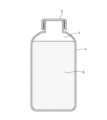
- FIG. 2 is a diagram (schematic cross-sectional view) for explaining a container containing a curable composition.
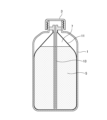
- FIG. 2 is a diagram for explaining a container containing a curable composition (different from the one shown in FIG. 1 ).
- X to Y in the description of a numerical range means from X to Y.
- “1 to 5% by mass” means “1% by mass to 5% by mass.”
- an "alkyl group” includes not only an alkyl group having no substituents (unsubstituted alkyl group) but also an alkyl group having a substituent (substituted alkyl group).
- (meth)acrylic refers to a concept that includes both acrylic and methacrylic. The same applies to similar terms such as "(meth)acrylate.”
- organic group refers to an atomic group obtained by removing one or more hydrogen atoms from an organic compound.
- a “monovalent organic group” refers to an atomic group obtained by removing one hydrogen atom from any organic compound.
- FIG. 1 is a schematic diagram showing a cross section of a container containing a curable composition according to the present embodiment.
- the container containing the curable composition may be, for example, A container body 1, A lid 3 capable of closing the opening of the container body 1; A curable composition 5 contained inside the container body 1; an oxygen-containing gas 7 filling the portion of the container body 1 that is not occupied by the curable composition 5; It is composed of:
- the combination of the container body 1 and the lid 3 provides a hermetic seal to the container as a whole. In other words, by properly closing the opening of the container body 1 with the lid 3, the inflow of substances from the outside and the outflow of substances from the inside are sufficiently prevented.
- the curable composition 5 contains a compound having an ethylenic carbon-carbon double bond, one or more thiol compounds selected from the group consisting of thiols and thiol precursors, and a radical initiator.
- the lid 3 is usually closed during storage of the curable composition 5. In other words, during storage of the curable composition 5, the curable composition and the oxygen-containing gas are sealed in a container having airtight properties.
- the curable composition comes into contact with an oxygen-containing gas. This is thought to reduce changes in the properties of the curable composition during storage. Based on the results of the inventors' studies, it is speculated that disulfide compounds produced by the reaction of oxygen in the oxygen-containing gas with thiol compounds in the curable composition inhibit deterioration of the curable composition.
- the mechanism by which the disulfide compound inhibits the deterioration of the curable composition can be considered as follows. Radicals unintentionally generated in the curable composition, particularly radicals generated by unintentional decomposition of a radical initiator, react with a thiol compound to generate an S radical. The generated S radical reacts with a disulfide compound faster than it reacts with a compound having an ethylenic carbon-carbon double bond to generate a different S radical. The radical further reacts with a disulfide compound, thereby suppressing the reaction with a compound having an ethylenic carbon-carbon double bond. Incidentally, it is assumed that the generated radicals are deactivated at a certain rate.
- disulfide compounds are not added to the curable composition, but are generated by the action of oxygen in contact with the curable composition. It is believed that this causes disulfide compounds to be generated “little by little” and “continuously.” Such generation of disulfide compounds may be effective in maintaining the properties of the curable composition over the long term.
- the space in the container was filled with an inert gas such as nitrogen gas or a noble gas to prevent deterioration.
- the container was filled with the curable composition at a filling rate of 100%.
- oxygen which can be said to be the most common substance that deteriorates curable compositions, is brought into contact with the curable composition, and is based on the unique insight of the present inventors.
- this embodiment has an aspect of sacrificing costs such as the cost of the container itself and the cost of transporting the container containing the curable composition.
- suppressing the change in properties during storage and transportation of the curable composition is necessary for improving the reliability of the curable composition.
- This embodiment particularly emphasizes the suppression of the change in properties during storage and transportation of the curable composition, among various factors considered in the industrial use of the curable composition.
- the container body 1 and the lid 3 are not particularly limited as long as they can sufficiently prevent the inflow of substances such as gas into the container body 1 and the outflow of substances such as gas from the container body 1 when the curable composition 5 is placed in the container body 1 and the lid 3 is closed. Ideally, no substances such as gas should pass through the container, but as long as changes in the properties of the curable composition are suppressed, some small amount of substances such as gas may pass through the container.
- the materials of the container body 1 and the lid 3 are not particularly limited. Any material may be used as long as it is not substantially attacked by the curable composition 5.
- the materials of the container body 1 and the lid 3 may be the same or different.
- At least the surfaces of the container body 1 and the lid 3 that can come into contact with the curable composition 5 are preferably made of a resin.
- the resin include polyolefins such as polyethylene and polypropylene, polycycloolefins, polystyrene, and polycarbonates.
- Substantially all of the container body 1 and the lid 3 may be made of resin.
- the inner walls of one or both of the container body 1 and the lid 3 may be lined with a resin such as a fluororesin.
- the outer surfaces of the container body 1 and the lid 3 may be made of a metal such as iron or stainless steel, and the inner walls of the container body 1 and the lid 3 may be lined with a resin.
- the container body 1 and the lid 3 preferably have a light-shielding property.
- the curable composition is photosensitive, deterioration of the curable composition can be further suppressed by the container body 1 and the lid 3 having a light-shielding property.
- the curable composition is non-photosensitive, deterioration of the curable composition tends to be suppressed by using a container having a light-shielding property.
- a light-shielding polyethylene container suitable for storing a curable composition is sold by Sanplatec Co., Ltd.
- the container body 1 and/or the lid 3, the outer surface of which is made of metal may be used to prevent light from reaching the curable composition contained therein.
- the volume of the container body 1 is preferably 0.1 to 200 L, more preferably 0.5 to 200 L, and even more preferably 3 to 200 L, from the viewpoint of the amount of hardenable composition that can be carried at one time and handling properties.
- the curable composition 5 includes a compound having an ethylenic carbon-carbon double bond, one or more thiol compounds selected from the group consisting of thiols and thiol precursors, and a radical initiator.
- the curable composition 5 may include any other components.
- the curable composition 5 may be non-photosensitive (thermosetting) or photosensitive. In the following, components that can be contained in the curable composition 5 when the curable composition 5 is photosensitive will be mainly described.
- the curable composition 5 contains a compound (A) having an ethylenic carbon-carbon double bond.
- the compound (A) having an ethylenic carbon-carbon double bond may be simply referred to as compound (A).
- any compound having an ethylenic carbon-carbon double bond can be used without any particular limitation.
- the term "ethylenic carbon-carbon double bond” means a carbon-carbon double bond that can react by the action of a radical.
- a conjugated and stabilized double bond such as a double bond in a benzene ring does not fall under the category of "ethylenic carbon-carbon double bond".
- the compound (A) has an ethylenic carbon-carbon double bond at its terminal.
- Compound (A) may be monofunctional or polyfunctional, that is, compound (A) may have only one ethylenic carbon-carbon double bond in one molecule, or may have two or more (specifically, 2 to 8, more specifically, 2 to 6) ethylenic carbon-carbon double bonds in one molecule. From the viewpoints of further improving the sensitivity and improving the physical properties of a cured film, the compound (A) is preferably polyfunctional.
- compound (A) is a (meth)acrylate compound, that is, a compound having a (meth)acryloyl group as a structure containing an ethylenic carbon-carbon double bond. More preferably, compound (A) is a (meth)acrylate compound.
- compound (A) examples include the following. Of course, compound (A) is not limited to these.
- the curable composition 5 may contain only one compound (A) or may contain two or more compounds (A).
- the content of the compound (A) in the total non-volatile components of the curable composition 5 is usually 5 to 60 mass %, preferably 10 to 55 mass %, and more preferably 15 to 50 mass %.
- the content of the double bond (C ⁇ C) in the compound (A) is preferably 5 to 60 mass %, more preferably 7 to 50 mass %, and more preferably 10 to 30 mass %.
- the curable composition 5 contains one or more thiol-based compounds (B) selected from the group consisting of thiols and thiol precursors.
- thiol-based compounds (B) selected from the group consisting of thiols and thiol precursors may be simply referred to as thiol-based compounds (B).
- the thiol compound (B) may be monofunctional or polyfunctional, that is, the thiol compound (B) may have only one mercapto group (or latent mercapto group) in one molecule, or may have two or more (specifically, 2 to 8) mercapto groups (or latent mercapto groups) in one molecule. From the viewpoint of improving the physical properties of the cured film, the thiol compound (B) is preferably polyfunctional.
- thiol in the thiol compound (B) include those represented by the following general formula (b).
- R is a hydrogen atom, an alkyl group or a cycloalkyl group;
- X is —CO— or —CH 2 —;
- L is an n-valent linking group;
- n is an integer of 2 or more, preferably 2 to 8, and more preferably 2 to 6.
- a plurality of R's may be the same or different from each other.
- a plurality of X's may be the same or different from each other. However, from the viewpoint of ease of synthesis, it is preferable that a plurality of R's are the same from each other, and it is preferable that a plurality of X's are the same from each other.
- the alkyl group of R may be linear or branched.
- the number of carbon atoms in the alkyl group is preferably 1 to 16, and more preferably 1 to 10.
- Specific examples of the alkyl group include a methyl group, an ethyl group, a propyl group, an isopropyl group, a butyl group, a sec-butyl group, a tert-butyl group, a pentyl group, a hexyl group, and a 2-ethylhexyl group. Of these, a methyl group, an ethyl group, a propyl group, or an isopropyl group is preferred, and a methyl group or an ethyl group is more preferred.
- L which is an n-valent linking group examples include trivalent linking groups such as a linear or branched alkylene chain (having, for example, 2 to 6 carbon atoms), a trimethylolpropane residue, an isocyanuric ring having three -(CH 2 ) p - (p is 2 to 6)), a tetravalent linking group or a pentavalent linking group such as a pentaerythritol residue, and a hexavalent linking group such as a dipentaerythritol residue.
- trivalent linking groups such as a linear or branched alkylene chain (having, for example, 2 to 6 carbon atoms), a trimethylolpropane residue, an isocyanuric ring having three -(CH 2 ) p - (p is 2 to 6)
- a tetravalent linking group or a pentavalent linking group such as a pentaerythritol residue
- thiols in the thiol-based compound (B) include, for example, the Karenz series manufactured by Showa Denko K.K.
- the thiols in this series are secondary thiols.
- Other examples include PEMP, TMMP, DPMP, and TEMPIC manufactured by SC Organic Chemical Co., Ltd.
- These thiols are primary thiols.
- primary thiols are more reactive and may be more advantageous in terms of low-temperature curing.
- secondary thiols may improve the stability of the composition by suppressing the reaction of the thiol group due to steric hindrance.
- the "thiol precursor" in the thiol compound (B) is a compound that does not have a mercapto group itself, but generates a mercapto group in the composition by physical stimulation or chemical action.
- the thiol precursor can be, for example, a thioester, a dithioester, a thiocarbamate, a dithiocarbamate, a thiocarbonate, a xanthogenate, a trithiocarbonate, etc.
- the specific structure of the thiol precursor can be, for example, one in which the -SH part in the above general formula (b) is esterified or formed into a salt.
- the thiol precursor is described, for example, in JP-A-2004-517979.
- the content ratio of mercapto groups contained in the thiol compound (B) is preferably 5 to 60 mass%, more preferably 7 to 50 mass%, and more preferably 10 to 30 mass%, relative to the molecular weight of the thiol compound (B).
- this value is calculated based on the chemical structure after the thiol precursor is converted into the thiol compound.
- the curable composition 5 may contain only one thiol-based compound (B), or may contain two or more thiol-based compounds (B).
- the content of the thiol compound (B) is not particularly limited, but in one embodiment, it is, for example, 0.1 to 10 mass%, specifically 0.5 to 8 mass%, more specifically 1 to 5 mass%, and even more specifically 1 to 3 mass% of the total non-volatile components of the curable composition 5.
- the content of the thiol compound (B) is, for example, 0.2 to 25 mass parts, specifically 1 to 20 mass parts, and more specifically 2 to 15 mass parts, relative to 100 mass parts of the compound (A).
- the thiol compound (B) when used in such an amount, it is considered that the thiol compound (B) mainly functions as a chain transfer agent and is involved in adjusting the chain length of the polymer generated by the radical polymerization reaction of the compound (A).
- the content of the thiol compound (B) is usually 10 to 70 mass%, preferably 15 to 60 mass%, more preferably 20 to 55 mass% of the total non-volatile components of the curable composition 5.
- the content of the thiol compound (B) is, for example, 30 to 80 mass parts, specifically 30 to 70 mass parts, more specifically 35 to 70 mass parts, relative to 100 mass parts of the compound (A).
- the curable composition 5 is cured mainly by the thiol-ene reaction, which is known as a bond formation reaction between a thiol and an alkene.
- both the radical polymerization reaction of compound (A) and the thiol-ene reaction may occur.
- the curable composition 5 contains a radical initiator (C).
- a radical initiator C
- a thermal radical initiator that generates radicals by heat or a photoradical initiator that generates radicals by irradiation with light typically ultraviolet light such as i-line
- light typically ultraviolet light such as i-line
- thermal radical initiator examples include diacyl peroxides such as benzoyl peroxide, peroxyesters such as t-butyl peroxybenzoate, hydroperoxides such as cumene hydroperoxide, dialkyl peroxides such as dicumyl peroxide, ketone peroxides such as methyl ethyl ketone peroxide and acetylacetone peroxide, peroxyketals, alkyl peresters, and organic peroxides such as percarbonates.
- diacyl peroxides such as benzoyl peroxide, peroxyesters such as t-butyl peroxybenzoate
- hydroperoxides such as cumene hydroperoxide
- dialkyl peroxides such as dicumyl peroxide
- ketone peroxides such as methyl ethyl ketone peroxide and acetylacetone peroxide
- peroxyketals alkyl peresters
- organic peroxides such
- azo compounds such as 2,2'-azobisisobutyronitrile, 2,2'-azobis(2,4-dimethylvaleronitrile), and 2,2'-azobis(4-methoxy-2'-dimethylvaleronitrile).
- some of the photoradical initiators specifically described below generate radicals by heat, and therefore the photoradical initiators specifically described below may also be used as thermal radical initiators.
- photoradical initiators include intramolecular cleavage types in which intramolecular bonds are cleaved by absorption of electromagnetic waves or electron beams to generate radicals, and hydrogen abstraction types in which radicals are generated by using a hydrogen donor such as a tertiary amine or ether in combination. In this embodiment, any of these may be used. Of course, other photoradical initiators may also be used.
- photoradical initiators include oxime esters, benzophenones, acetophenones, diketones, acylphosphine oxides, quinones, and acyloins.
- oxime ester photoradical initiators include BASF's CGI-325, Irgacure OXE01 (1-[4-(phenylthio)phenyl]-1,2-octadione-2-(o-benzoyloxime), Irgacure OXE02 (1-[9-ethyl-6-(2-methylbenzoyl)-9H-carbazol-3-yl]-ethanone-1-(o-acetyloxime)]), and ADEKA's N-1919.
- benzophenone-based photoradical initiators include benzophenone, 4-hydroxybenzophenone, 2-benzoylbenzoic acid, 4-benzoylbenzoic acid, 4,4'-bis(dimethylamino)benzophenone, and 4,4'-bis(diethylamino)benzophenone. Of these, 2-benzoylbenzoic acid, 4-benzoylbenzoic acid, and 4,4'-bis(diethylamino)benzophenone are preferred.
- acetophenone-based photoradical initiators include acetophenone, 2-(4-toluenesulfonyloxy)-2-phenylacetophenone, p-dimethylaminoacetophenone, 2,2'-dimethoxy-2-phenylacetophenone, p-methoxyacetophenone, 2-methyl-[4-(methylthio)phenyl]-2-morpholino-1-propanone, 2-benzyl-2-dimethylamino-1-(4-morpholinophenyl)-butan-1-one, etc.
- p-dimethylaminoacetophenone and p-methoxyacetophenone are preferred.
- diketone-based photoradical initiators include 4,4'-dimethoxybenzyl, methyl benzoylformate, and 9,10-phenanthrenequinone. Among these, 4,4'-dimethoxybenzyl and methyl benzoylformate are preferred.
- acylphosphine oxide initiators include bis(2,4,6-trimethylbenzoyl)-phenylphosphine oxide.
- quinone initiators include anthraquinone, 2-ethylanthraquinone, camphorquinone, and 1,4-naphthoquinone. Among these, camphorquinone and 1,4-naphthoquinone are preferred.
- acyloin initiators include benzoin, benzoin methyl ether, benzoin ethyl ether, and benzoin isopropyl ether. Of these, benzoin and benzoin methyl ether are preferred.
- preferred ones include BASF product names: Irgacure 127, Irgacure 184, Irgacure 369, Irgacure 651, Irgacure 819, Irgacure 907, Irgacure 2959, Irgacure OXE-01, Irgacure OXE-02, Irgacure OXE-03, Irgacure OXE-04, Darocur 1173, Lucirin TPO, and Tronly product name: TR-PBG-305.
- the curable composition 5 may contain only one radical initiator (C) or may contain two or more radical initiators (C).
- the content of the radical initiator (C) may be appropriately adjusted in consideration of sufficient curability, etc.
- the content of the radical initiator (C) is usually 0.1 to 10 mass %, preferably 0.3 to 8 mass %, and more preferably 0.5 to 5 mass %, of the total non-volatile components of the curable composition 5.
- the amount of the radical initiator (C) relative to 100 parts by mass of the compound (A) is usually 0.2 to 25 parts by mass, preferably 0.5 to 20 parts by mass, and more preferably 1 to 15 parts by mass.
- the curable composition 5 preferably contains an alkali-soluble resin (D).
- the alkali-soluble resin (D) typically has an alkali-soluble group, such as a carboxy group or a phenolic hydroxy group.
- a resin which has fluorine atoms and is alkali-soluble is usually classified as a fluorine-containing resin (E) described later. In other words, an alkali-soluble resin (D) usually does not have fluorine atoms.
- alkali-soluble resin (D) is an alkali-soluble novolak resin, which can be obtained by condensing a phenol with an aldehyde in the presence of an acid catalyst.
- phenols include phenol, o-cresol, m-cresol, p-cresol, 2,3-dimethylphenol, 2,4-dimethylphenol, 2,5-dimethylphenol, 3,4-dimethylphenol, 3,5-dimethylphenol, 2,3,5-trimethylphenol, 3,4,5-trimethylphenol, resorcinol, 2-methylresorcinol, 4-ethylresorcinol, hydroquinone, methylhydroquinone, catechol, 4-methyl-catechol, pyrogallol, phloroglucinol, thymol, isothymol, etc.
- aldehydes include formaldehyde, trioxane, paraformaldehyde, benzaldehyde, acetaldehyde, propylaldehyde, phenylacetaldehyde, ⁇ -phenylpropylaldehyde, ⁇ -phenylpropylaldehyde, o-hydroxybenzaldehyde, m-hydroxybenzaldehyde, p-hydroxybenzaldehyde, o-methylbenzaldehyde, m-methylbenzaldehyde, p-methylbenzaldehyde, nitrobenzaldehyde, furfural, glyoxal, glutaraldehyde, terephthalaldehyde, and isophthalaldehyde.
- the acid catalyst examples include hydrochloric acid, nitric acid, sulfuric acid, phosphoric acid, phosphorous acid, formic acid, oxalic acid, acetic acid, methanesulfonic acid, diethylsulfuric acid, p-toluenesulfonic acid, etc. These acid catalysts may be used alone or in combination of two or more kinds.
- alkali-soluble resin (D) examples include alkali-soluble epoxy resins and acid-modified epoxy (meth)acrylate resins derived from epoxy resins.
- the epoxy resins or acid-modified epoxy (meth)acrylate resins may have polymerizable substituents such as hydroxyl groups or (meth)acryloyl groups in the side chains.
- examples of epoxy resins include bisphenol-type epoxy resins
- examples of acid-modified epoxy (meth)acrylate resins include those obtained by reacting bisphenol-type epoxy resins with (meth)acrylic acid.
- examples of the acid-modified epoxy (meth)acrylate resins include bisphenol-type epoxy resins or acid-modified epoxy (meth)acrylate resins having a structural unit represented by the following general formula (d).
- two R's each independently represent a linear alkyl group having 1 to 3 carbon atoms or a branched alkyl group having 3 carbon atoms, a linear perfluoroalkyl group having 1 to 3 carbon atoms, or a hydrogen atom;
- Z represents a monovalent organic group or a hydrogen atom.
- Z is a monovalent organic group having a carboxy group.
- R is a linear alkyl group having 1 to 3 carbon atoms or a branched alkyl group having 3 carbon atoms
- specific examples of R include a methyl group, an ethyl group, a propyl group, and an isopropyl group. Of these, a methyl group is preferable from the viewpoint of availability.
- Specific examples of the linear perfluoroalkyl group having 1 to 3 carbon atoms include a trifluoromethyl group, a pentafluoroethyl group, and a heptafluoropropyl group. Of these, the trifluoromethyl group is preferred from the viewpoint of availability.
- Each R may have the same structure or different structures.
- Z is preferably an alkyl group having 1 to 10 carbon atoms.
- This alkyl group having 1 to 10 carbon atoms may be linear, branched, or cyclic.
- At least one hydrogen atom in the monovalent organic group of Z may be substituted with a carboxy group or a hydroxy group. This enhances alkali solubility.
- the carboxyl group or hydroxyl group of the alkyl group having 1 to 10 carbon atoms represented by Z may be reacted with an esterifying agent.
- the esterifying agent include acid halides, acid anhydrides, and acids and condensing agents.
- Z is a hydrogen atom
- -O-Z may be reacted with an esterifying agent.
- the esterifying agent include the same esterifying agents as described above.
- acid anhydrides include acrylic anhydride, methacrylic anhydride, succinic anhydride, phthalic anhydride, 1,2,3,4-tetrahydrophthalic anhydride, etc.
- the amount of carboxyl groups or hydroxyl groups in the alkali-soluble resin to be reacted with the acid anhydride may be appropriately adjusted taking into consideration the solubility in alkali required for the alkali-soluble resin.
- Epoxy (meth)acrylate resins having a structural unit represented by general formula (d) are available, for example, from Nippon Kayaku Co., Ltd.
- alkali-soluble epoxy resins or acid-modified epoxy (meth)acrylate resins other than those mentioned above can also be used.
- Specific examples include alkali-soluble novolac type epoxy resins, biphenyl type epoxy resins, and acid-modified epoxy (meth)acrylate resins derived from these epoxy resins.
- examples of the acid-modified epoxy (meth)acrylate include commercially available products, such as those available from Nippon Kayaku Co., Ltd.
- the alkali-soluble resin (D) may have a polycyclic aromatic skeleton such as a fluorene skeleton.
- a polycyclic aromatic skeleton such as a fluorene skeleton.
- the heat resistance and durability of the cured pattern may be improved.
- a resin having a polycyclic aromatic skeleton may be used, or a resin having a polycyclic aromatic skeleton may be selected from a resin family different from the acid-modified epoxy (meth)acrylate resin.
- a resin having a fluorene skeleton is sometimes referred to as a "cardo resin.”
- the alkali-soluble resin (D) having a polycyclic aromatic skeleton such as a fluorene skeleton preferably has an alkali-soluble group such as a carboxy group or a hydroxy group, like other alkali-soluble resins (D).
- the alkali-soluble resin (D) may have an ethylenic carbon-carbon double bond. It is believed that the alkali-soluble resin (D) having an ethylenic carbon-carbon double bond forms a bond with the compound (A) during curing of the composition and is incorporated into the cured product. This is believed to contribute to improving the stability and heat resistance of the cured product.
- an alkali-soluble resin having an ethylenic carbon-carbon double bond is not classified as compound (A).
- the weight average molecular weight of the alkali-soluble resin (D) is preferably from 1,000 to 50,000 from the viewpoints of the alkali solubility and resolution of the curable composition 5 .
- the acid value of the alkali-soluble resin (D) (the number of milligrams of potassium hydroxide required to neutralize 1 g of a sample) can be an index of alkali solubility.
- the acid value of the alkali-soluble resin (D) is preferably 20 to 80, more preferably 30 to 70, and even more preferably 40 to 60.
- the acid value of the alkali-soluble resin used in the examples described later is about this range.
- alkali-soluble resin (D) When the alkali-soluble resin (D) is used, only one alkali-soluble resin (D) may be used, or two or more alkali-soluble resins (D) may be used. When the alkali-soluble resin (D) is used, its amount is usually 10 to 70 mass %, preferably 15 to 60 mass %, and more preferably 20 to 55 mass %, based on the total nonvolatile components of the curable composition 5 .
- the curable composition 5 preferably contains a fluorine-containing resin (E).
- a pattern partition wall of an optical element
- the resulting pattern is more likely to repel ink for forming an organic layer. This contributes to preventing ink dropped into a certain recess from "crawling" along the side of the recess and entering an adjacent recess. In other words, unintended mixing of dye between pixels in an optical element can be prevented.
- the fluorine-containing resin (E) that can be used is not particularly limited, but the fluorine-containing resin (E) that can be preferably used will be described below.
- the fluororesin (E) preferably has a structure represented by the following general formula (1), and more preferably has a structure represented by the following general formula (2).
- two Rf's each independently represent a linear, branched or cyclic perfluoroalkyl group having 1 to 6 carbon atoms, or a fluorine atom
- R2 represents a hydrogen atom, a linear alkyl group having 1 to 6 carbon atoms, a branched alkyl group having 3 to 6 carbon atoms, or a cyclic alkyl group having 3 to 6 carbon atoms.
- two Rf's each independently represent a linear, branched or cyclic perfluoroalkyl group having 1 to 6 carbon atoms, or a fluorine atom
- R 1 represents a hydrogen atom, a fluorine atom or a methyl group
- R2 represents a hydrogen atom, a linear alkyl group having 1 to 6 carbon atoms, a branched alkyl group having 3 to 6 carbon atoms, or a cyclic alkyl group having 3 to 6 carbon atoms.
- R 1 is preferably a hydrogen atom or a methyl group.
- R 2 include a hydrogen atom, a methyl group, an ethyl group, an n-propyl group, an isopropyl group, an n-butyl group, a 1-methylpropyl group, a 2-methylpropyl group, a tert-butyl group, an n-pentyl group, an isopentyl group, a 1,1-dimethylpropyl group, a 1-methylbutyl group, a 1,1-dimethylbutyl group, an n-hexyl group, a cyclopentyl group, and a cyclohexyl group.
- a hydrogen atom, a methyl group, an ethyl group, an n-propyl group, or an isopropyl group is preferable, and a hydrogen atom or a methyl group is more preferable.
- Rf is preferably a fluorine atom, a trifluoromethyl group, a difluoromethyl group, a pentafluoroethyl group, a 2,2,2-trifluoroethyl group, a n-heptafluoropropyl group, a 2,2,3,3,3-pentafluoropropyl group, a 3,3,3-trifluoropropyl group, a hexafluoroisopropyl group, a heptafluoroisopropyl group, a n-nonafluorobutyl group, an isononafluorobutyl group, or a tert-nonafluorobutyl group, more preferably a fluorine atom, a trifluoromethyl group, a difluoromethyl group, a pentafluoroethyl group, a 2,2,2-trifluoroethyl group,
- Preferred specific structures of the above structural units include those described in paragraphs 0060 to 0061 of WO 2021/235541.
- the content of the structural unit represented by general formula (2) in the fluorine-containing resin (E) is preferably 5 to 70 mass%, more preferably 10 to 50 mass%, and particularly preferably 10 to 30 mass%, taking into consideration solubility in solvents and resistance to various treatments in the manufacture of light-emitting devices.
- the fluororesin (E) may contain a structure represented by the following general formula (3):
- R 3 and R 4 each independently represent a hydrogen atom or a methyl group.
- the liquid repellency to ink after UV ozone treatment or oxygen plasma treatment in the manufacture of the light-emitting element is more excellent, which is preferred.
- examples of the divalent linking group A1 include a methylene group, an ethylene group, a propylene group, an n-butylene group, an n-pentylene group, an n-hexalene group, an n-heptalene group, an n-octalene group, an n-nonalene group, and an n-decalene group.
- the divalent linking group A 1 is a branched alkylene group having 3 to 10 carbon atoms
- examples thereof include an isopropylene group, an isobutylene group, a sec-butylene group, a tert-butylene group, an isopentalene group, and an isohexalene group.
- divalent linking group A1 is a cyclic alkylene group having 3 to 10 carbon atoms
- examples of the divalent linking group A1 include disubstituted cyclopropane, disubstituted cyclobutane, disubstituted cyclopentane, disubstituted cyclohexane, disubstituted cycloheptane, disubstituted cyclooctane, disubstituted cyclodecane, and disubstituted 4-tert-butylcyclohexane.
- examples of the hydroxy group-substituted alkylene group include a hydroxyethylene group, a 1-hydroxy-n-propylene group, a 2-hydroxy-n-propylene group, a hydroxy-isopropylene group (-CH(CH 2 OH)CH 2 -), a 1-hydroxy-n-butylene group, a 2-hydroxy-n-butylene group, a hydroxy-sec-butylene group (-CH(CH 2 OH)CH 2 CH 2 -), a hydroxy-isobutylene group (-CH 2 CH(CH 2 OH)CH 2 -), a hydroxy-tert-butylene group (-C(CH 2 OH)(CH 3 )CH 2 -), and the like.
- the divalent linking group A 1 is preferably a methylene group, an ethylene group, a propylene group, an n-butylene group, an isobutylene group, a sec-butylene group, a cyclohexyl group, a 2-hydroxy-n-propylene group, a hydroxy-isopropylene group (-CH(CH 2 OH)CH 2 -), a 2-hydroxy-n-butylene group, or a hydroxy-sec-butylene group (-CH(CH 2 OH)CH 2 CH 2 -), more preferably an ethylene group, a propylene group, a 2-hydroxy-n-propylene group, or a hydroxy-isopropylene group (-CH(CH 2 OH)CH 2 -), and particularly preferably an ethylene group or a 2-hydroxy-n-propylene group.
- An example of the trivalent linking group A 1 is -C(CH 2 -) 2 CH 3 , and an example of the tetra
- Y1 represents a divalent linking group and is preferably -O- or -NH-, and more preferably -O-.
- u represents an integer of 1 to 3, and u is particularly preferably 1.
- n represents an integer of 1 to 3, and is particularly preferably 1.
- the substitution positions of the aromatic rings are each independently the ortho-position, meta-position, or para-position, and are preferably the para-position.
- a plurality of W 1 may be the same or different from each other.
- a plurality of A 1 may be the same or different from each other.
- a plurality of Y 1 may be the same or different from each other.
- a plurality of R 4 may be the same or different from each other.
- a plurality of W 1 are the same from each other
- a plurality of A 1 are the same from each other
- a plurality of Y 1 are the same from each other
- a plurality of R 4 are the same from each other.
- the content of the structural unit represented by general formula (3) in the fluorine-containing resin (E) is preferably 5 to 70 mass%, more preferably 10 to 50 mass%, and particularly preferably 10 to 30 mass%, taking into consideration solubility in solvents and resistance to various treatments in the manufacture of light-emitting devices.
- the fluororesin (E) may contain a structure represented by the following general formula (4):
- R 5 and R 6 each independently represent a hydrogen atom or a methyl group.
- the liquid repellency against ink after UV ozone treatment or oxygen plasma treatment in the manufacture of the light-emitting element is more excellent, which is preferred.
- examples of the alkylene groups include a methylene group, an ethylene group, a propylene group, an n-butylene group, an n-pentylene group, an n-hexalene group, an n-heptalene group, an n-octalene group, an n-nonalene group, and an n-decalene group.
- divalent linking groups A 2 and A 3 are each independently a branched alkylene group having 3 to 10 carbon atoms, examples thereof include an isopropylene group, an isobutylene group, a sec-butylene group, a tert-butylene group, an isopentalene group, and an isohexalene group.
- divalent linking groups A 2 and A 3 are each independently a cyclic alkylene group having 3 to 10 carbon atoms
- examples thereof include disubstituted cyclopropane, disubstituted cyclobutane, disubstituted cyclopentane, disubstituted cyclohexane, disubstituted cycloheptane, disubstituted cyclooctane, disubstituted cyclodecane, and disubstituted 4-tert-butylcyclohexane.
- examples of the hydroxy group-substituted alkylene group include 1-hydroxyethylene group (-CH(OH)CH 2 -), 2-hydroxyethylene group (-CH 2 CH(OH)-), 1-hydroxy-n-propylene group, 2-hydroxy-n-propylene group, hydroxy-isopropylene group (-CH(CH 2 OH)CH 2 -), 1-hydroxy-n-butylene group, 2-hydroxy-n-butylene group, hydroxy-sec-butylene group (-CH(CH 2 OH)CH 2 CH 2 -), hydroxy-isobutylene group (-CH 2 CH(CH 2 OH)CH 2 -), hydroxy-tert-butylene group (-C(CH 2 OH)(CH 3 )CH 2 -) and the like.
- the divalent linking groups A 2 and A 3 are each independently preferably a methylene group, an ethylene group, a propylene group, an n-butylene group, an isobutylene group, a sec-butylene group, a cyclohexyl group, a 1-hydroxyethylene group (-CH(OH)CH 2 -), a 2-hydroxyethylene group (-CH 2 CH(OH)-), a 2-hydroxy-n-propylene group, a hydroxy-isopropylene group (-CH(CH 2 OH)CH 2 -), a 2-hydroxy-n-butylene group, or a hydroxy-sec-butylene group (-CH(CH 2 OH)CH 2 CH 2 -), and more preferably an ethylene group, a propylene group, a 1-hydroxyethylene group (-CH(OH)CH 2 -), a 2-hydroxyethylene group (-CH 2 CH(OH)-), a 2-hydroxy-n-propylene group, a hydroxy-isopropyl group,
- Y 2 and Y 3 each independently represent a divalent linking group, preferably —O— or —NH—, and more preferably —O—.
- n represents an integer of 1 to 3. It is particularly preferable that n is 1.
- a plurality of Y3 may be the same or different from each other.
- a plurality of R6 may be the same or different from each other. However, from the viewpoint of ease of synthesis, it is preferable that a plurality of Y3 are the same from each other, and it is preferable that a plurality of R6 are the same from each other.
- the content of the structural unit represented by general formula (4) in the fluororesin (E) is preferably 5 to 70% by mass, more preferably 10 to 50% by mass, and particularly preferably 10 to 30% by mass, taking into consideration the solubility in the solvent and the adhesion of the pattern (partition wall) to the substrate.
- the fluororesin (E) may contain a structural unit represented by general formula (5).
- R7 represents a hydrogen atom or a methyl group.
- R8 represents a hydrogen atom, a linear alkyl group having 1 to 15 carbon atoms, a branched alkyl group having 3 to 15 carbon atoms, or a cyclic alkyl group having 3 to 15 carbon atoms, any number of hydrogen atoms in the alkyl group being substituted with fluorine atoms, and the fluorine content in the structural unit is 30 mass% or more.
- R8 is a linear hydrocarbon group
- specific examples include a methyl group, an ethyl group, a propyl group, a butyl group, a pentyl group, a hexyl group, a heptyl group, an octyl group, a nonyl group, or a linear alkyl group having 10 to 14 carbon atoms in which any number of hydrogen atoms have been substituted with fluorine atoms.
- R 8 is a linear hydrocarbon group
- the structural unit represented by general formula (5) is preferably a structural unit represented by the following general formula (5-1).
- R 9 has the same meaning as R 7 in formula (5).
- X is a hydrogen atom or a fluorine atom.
- X is preferably a fluorine atom.
- p is an integer from 1 to 4
- q is an integer from 1 to 14. It is particularly preferable that p is an integer from 1 to 2, and q is an integer from 2 to 8.
- the content of the structural unit represented by general formula (5) in the fluorine-containing resin (E) may be appropriately determined taking into consideration the ease with which the pattern (partition wall) repels ink and the ease with which the curable composition 5 dissolves in a solvent when the curable composition 5 is prepared.
- the content of the structural unit represented by general formula (5) in the fluorine-containing resin (E) is preferably 5 to 70% by mass, more preferably 10 to 50% by mass, and particularly preferably 10 to 30% by mass.
- the fluororesin may contain a structure represented by the following general formula (6):
- R 10 represents a hydrogen atom or a methyl group.
- m represents an integer of 0 to 3.
- the content of the structural unit represented by general formula (6) in the fluororesin (E) is preferably 5 to 70 mass%, more preferably 10 to 50 mass%, and particularly preferably 20 to 40 mass%, in consideration of obtaining a sufficient effect based on the structural unit represented by general formula (6) and of solvent solubility.
- the structural unit represented by the general formula (6) has solubility in an alkali developer. Therefore, when it is desired to obtain particularly good alkali developability, it is preferred that the fluorine-containing resin (E) contains a structural unit represented by the general formula (6) in which B1 is a hydroxy group or a carboxyl group.
- the fluororesin (E) may contain a structure represented by the following general formula (7):
- R 13 represents a hydrogen atom or a methyl group.
- examples of the divalent linking group A4 include a methylene group, an ethylene group, a propylene group, an n-butylene group, an n-pentylene group, an n-hexalene group, an n-heptalene group, an n-octalene group, an n-nonalene group, and an n-decalene group.
- the divalent linking group A4 is a branched alkylene group having 3 to 10 carbon atoms
- examples thereof include an isopropylene group, an isobutylene group, a sec-butylene group, a tert-butylene group, an isopentalene group, and an isohexalene group.
- the divalent linking group A4 is a cyclic alkylene group having 3 to 10 carbon atoms
- examples thereof include disubstituted cyclopropane, disubstituted cyclobutane, disubstituted cyclopentane, disubstituted cyclohexane, disubstituted cycloheptane, disubstituted cyclooctane, disubstituted cyclodecane, and disubstituted 4-tert-butylcyclohexane.
- examples of the hydroxy group-substituted alkylene group include 1-hydroxyethylene group (-CH(OH)CH 2 -), 2-hydroxyethylene group (-CH 2 CH(OH)-), 1-hydroxy-n-propylene group, 2-hydroxy-n-propylene group, hydroxy-isopropylene group (-CH(CH 2 OH)CH 2 -), 1-hydroxy-n-butylene group, 2-hydroxy-n-butylene group, hydroxy-sec-butylene group (-CH(CH 2 OH)CH 2 CH 2 -), hydroxy-isobutylene group (-CH 2 CH(CH 2 OH)CH 2 -), hydroxy-tert-butylene group (-C(CH 2 OH)(CH 3 )CH 2 -) and the like.
- the divalent linking group A 4 is preferably a methylene group, an ethylene group, a propylene group, an n-butylene group, an isobutylene group, a sec-butylene group, a cyclohexyl group, a 1-hydroxyethylene group (-CH(OH)CH 2 -), a 2-hydroxyethylene group (-CH 2 CH(OH)-), a 2-hydroxy-n-propylene group, a hydroxy-isopropylene group (-CH(CH 2 OH)CH 2 -), a 2-hydroxy-n-butylene group, or a hydroxy-sec-butylene group (-CH(CH 2 OH)CH 2 CH 2 -), and more preferably an ethylene group, a propylene group, a 1-hydroxyethylene group (-CH(OH)CH 2 -), a 2-hydroxyethylene group (-CH 2 CH(OH)-), a 2-hydroxy-n-propylene group, or a hydroxy-isopropylene group (--CH(
- Y 4 represents a divalent linking group, preferably —O— or —NH—, and more preferably —O—.
- E1 represents a hydroxyl group, a carboxyl group or an oxirane group.
- E1 is an oxirane group
- examples include an ethylene oxide group, a 1,2-propylene oxide group, a 1,3-propylene oxide group, etc.
- an ethylene oxide group is preferable.
- s represents 0 or 1.
- (-Y 4 -A 4 -) represents a single bond.
- E 1 is bonded to the main chain of the structural unit.
- the weight average molecular weight of the fluororesin (E) measured by gel permeation chromatography (GPC) using polystyrene as a standard substance is preferably 1,000 to 1,000,000, more preferably 2,000 to 500,000, particularly preferably 3,000 to 100,000.
- GPC gel permeation chromatography
- the dispersity (Mw/Mn) of the fluororesin (E) is preferably from 1.01 to 5.00, more preferably from 1.01 to 4.00, and particularly preferably from 1.01 to 3.00.
- the fluororesin (E) may be a random copolymer, an alternating copolymer, a block copolymer, or a graft copolymer. From the viewpoint of dispersing the respective properties appropriately rather than locally, it is preferable that it is a random copolymer.
- the fluorine content of the fluorine-containing resin (E) is preferably 20 to 50 mass%, more preferably 25 to 40 mass%. When the fluorine content is within this range, the fluorine-containing resin (E) is easily dissolved in a solvent. Furthermore, when the fluorine content of the fluorine-containing resin (E) is within this range, a pattern (partition wall) having excellent liquid repellency is easily obtained.
- the fluorine content of the fluorine-containing resin (E) can be measured, for example, in accordance with the description in paragraph 0174 of WO 2021/235541.
- the fluorine-containing resin (E) When the fluorine-containing resin (E) is used, only one fluorine-containing resin (E) may be used, or two or more fluorine-containing resins (E) may be used.
- the amount of the fluorine-containing resin (E) used is usually 0.1 to 10 mass %, preferably 0.1 to 8 mass %, and more preferably 0.5 to 5 mass %, based on the total non-volatile components of the curable composition 5.
- the curable composition 5 may contain a colorant (F).
- the colorant (F) is used to color the resulting pattern (partition wall) black.
- the black pattern (partition wall) can be used as a partition wall between pixels in a light-emitting element.
- the colorant (F) is used to make the resulting pattern (partition wall) white, thereby increasing the reflectance of the pattern (partition wall).
- a suitable colorant (G) may be selected so as to obtain a pattern that is neither black nor white depending on various purposes.
- the colorant (F) a pigment or a dye may be used. If necessary, a plurality of colorants may be used in combination.
- a black pigment such as carbon black may be used, or a plurality of non-black pigments may be mixed to obtain a substantially black color.
- a black pigment and a white pigment may be mixed to obtain a gray color.
- the pigment it is preferable to use an organic pigment.
- colorants (F) include known colorants such as perylene pigments, lactam pigments, azo pigments, phthalocyanine pigments, carbon pigments such as carbon black, and metal oxide pigments such as iron black and titanium oxide.
- the white pigment is preferably at least one inorganic substance selected from the group consisting of alumina, magnesium oxide, antimony oxide, titanium oxide, zirconium oxide, aluminum hydroxide, magnesium hydroxide, barium sulfate, magnesium carbonate, and barium carbonate. These inorganic substances have a high refractive index, and therefore tend to improve the light reflectivity of the partition walls that are formed. Titanium oxide is particularly preferred from the viewpoints of its high refractive index and good dispersibility in the composition.
- color pigments that can be used include various organic pigments such as yellow, orange, blue, red, green, purple, and brown. Pigment dispersions containing two or more types of organic pigments may also be used. By adjusting the types and quantitative ratios of the pigments used, it is possible to control optical properties such as solubility and light blocking properties. In particular, a combination of blue, purple, and orange is preferred from the standpoint of compatibility and uniformity of optical density.
- organic orange pigments examples include C.I. Pigment Orange 1, 2, 5, 13, 16, 17, 19, 20, 21, 22, 23, 24, 34, 36, 38, 39, 43, 46, 48, 49, 61, 62, 64, 65, 67, 68, 69, 70, 71, 72, 73, 74, 75, 77, 78, and 79.
- C.I. Pigment Orange 43 is preferred from the viewpoints of dispersibility and light blocking properties.
- organic blue pigments examples include C.I. Pigment Blue 15, 15:1, 15:2, 15:3, 15:4, 15:6, 16, 17, 60, 64, 65, 75, 79, and 80.
- C.I. Pigment Blue 60 is preferred from the standpoint of dispersibility and light blocking properties.
- organic purple pigments examples include C.I. Pigment Violet 1, 1:1, 2, 2:2, 3, 3:1, 3:3, 5, 5:1, 14, 15, 16, 19, 23, 25, 27, 29, 31, 32, 37, 39, 42, 44, 47, 49, and 50.
- C.I. Pigment Violet 23 is preferred from the viewpoints of dispersibility and light blocking properties.
- the pigment When a pigment is used as the colorant (F), it is preferable that the pigment has been subjected to a dispersion treatment.
- the pigment can be dispersed, for example, by treating the pigment, the dispersant, and, if necessary, a solvent, using a beads mill.
- the type of dispersant is not particularly limited, and for example, dispersants available from BYK-Chemie Corporation can be used.
- an alkali-soluble resin may be further used.
- the colorant (F) When the colorant (F) is used, only one colorant (F) may be used, or two or more colorants (F) may be used in combination.
- the amount of the colorant (F) may be appropriately adjusted in consideration of the balance between obtaining the sufficient effect of using the colorant (F) and the patterning property, developability, and strength of the pattern (partition wall) obtained.
- the amount of the colorant (F) is usually 1 to 60 mass%, preferably 3 to 55 mass%, and more preferably 5 to 50 mass% of the total non-volatile components of the curable composition 5.
- the amount of the colorant (F) including the dispersant and the alkali-soluble resin (excluding the volatile solvent) may be within the numerical range shown here.
- the curable composition 5 may contain optional components other than those described above.
- the optional components include a dissolution inhibitor, a plasticizer, a stabilizer, a surfactant, a thickener, a leveling agent, an antifoaming agent, a compatibilizer, an adhesion improver, and an antioxidant.
- Commercially available products can be used as these optional components.
- the "KAYAMER” series manufactured by Nippon Kayaku Co., Ltd. can be used as an adhesion improver.
- the curable composition 5 is usually a solution or dispersion of the above-mentioned various components in a solvent.
- the solvent usually contains an organic solvent.
- solvents that can be used. Specific examples include ketones, alcohols, polyhydric alcohols and their derivatives, ethers, esters, aromatic solvents, and fluorine-based solvents. These may be used alone or in a mixture of two or more.
- Ketones include acetone, methyl ethyl ketone, cyclopentanone, cyclohexanone, methyl isoamyl ketone, methyl isobutyl ketone, methyl isopentyl ketone, and 2-heptanone.
- alcohols examples include isopropanol, butanol, isobutanol, n-pentanol, isopentanol, tert-pentanol, 4-methyl-2-pentanol, 3-methyl-3-pentanol, 2,3-dimethyl-2-pentanol, n-hexanol, n-heptanol, 2-heptanol, n-octanol, n-decanol, s-amyl alcohol, t-amyl alcohol, isoamyl alcohol, 2-ethyl-1-butanol, lauryl alcohol, hexyldecanol, and oleyl alcohol.
- polyhydric alcohols and their derivatives include ethylene glycol, ethylene glycol monoacetate, ethylene glycol dimethyl ether, diethylene glycol, diethylene glycol dimethyl ether, diethylene glycol monoacetate, propylene glycol, propylene glycol monoacetate, propylene glycol monomethyl ether (PGME), propylene glycol monoethyl ether, propylene glycol monopropyl ether, propylene glycol monobutyl ether, propylene glycol monomethyl ether acetate (PGMEA), monomethyl ether, monoethyl ether, monopropyl ether, monobutyl ether, and monophenyl ether of dipropylene glycol or dipropylene glycol monoacetate.
- PGME propylene glycol monomethyl ether
- PGMEA propylene glycol monomethyl ether acetate
- ethers examples include diethyl ether, diisopropyl ether, tetrahydrofuran, dioxane, and anisole.
- Esters include methyl lactate, ethyl lactate (EL), methyl acetate, ethyl acetate, butyl acetate, methyl pyruvate, ethyl pyruvate, methyl methoxypropionate, ethyl ethoxypropionate, and gamma-butyrolactone.
- Aromatic solvents include xylene and toluene.
- fluorine-based solvents examples include fluorocarbons, fluorocarbon substitutes, perfluoro compounds, and hexafluoroisopropyl alcohol.
- turpentine-based petroleum naphtha solvents and paraffin-based solvents which are high-boiling weak solvents, can be used.
- the solvent is methyl ethyl ketone, cyclohexanone, methyl isoamyl ketone, 2-heptanone, ethylene glycol, ethylene glycol dimethyl ether, ethylene glycol monoacetate, diethylene glycol, diethylene glycol monoacetate, diethylene glycol dimethyl ether, propylene glycol, propylene glycol monoacetate, propylene glycol monomethyl ether (PGME), propylene glycol monomethyl ether acetate (PGMEA), dipropylene glycol, dipropylene glycol monoacetate
- the carboxylic acid ester compound contains at least one selected from the group consisting of tetramethyl ether, dipropylene glycol monoacetate monoethyl ether, dipropylene glycol monoacetate monopropyl ether, dipropylene glycol monoacetate monobutyl ether, dipropylene glycol monoacetate monophenyl ether, 1,4-dioxane,
- the solvent more preferably contains methyl ethyl ketone, propylene glycol monomethyl ether acetate (PGMEA), propylene glycol monomethyl ether (PGME), cyclohexanone, ethyl lactate, butyl acetate, or ⁇ -butyrolactone.
- PGMEA propylene glycol monomethyl ether acetate
- PGME propylene glycol monomethyl ether
- cyclohexanone ethyl lactate
- butyl acetate butyl acetate
- ⁇ -butyrolactone ⁇ -butyrolactone
- the amount of the solvent in the curable composition 5 is preferably such that the total solids concentration is, for example, 5 to 85% by mass, specifically 10 to 60% by mass.
- the amount of the solvent By adjusting the amount of the solvent, the thickness of the film to be formed can be adjusted. If the amount of the solvent is within the above range, it is easy to obtain a film having a thickness suitable for forming a partition wall in an organic EL element.
- ⁇ 0 is the viscosity of the curable composition 5 measured using a Brookfield viscometer
- ⁇ 1 is the viscosity of the curable composition 5 after storage at 40°C for 7 days measured using a Brookfield viscometer.
- ⁇ 0 is the viscosity of the curable composition 5 measured using a Brookfield viscometer
- ⁇ 1 is the viscosity of the curable composition 5 after storage at 40°C for 7 days measured using a Brookfield viscometer.
- the viscosity change rate is preferably 15% or less, more preferably 10% or less, and further preferably 5% or less. In other words, by adjusting/optimizing various conditions so that the viscosity change rate falls within the range shown here, the storage stability of the curable composition 5 can be further improved.
- the viscosity change rate is ideally 0%.
- the volume of the oxygen-containing gas 7 is preferably appropriately adjusted in consideration of bringing a sufficient amount of oxygen into contact with the curable composition and the costs associated with storing and transporting the curable composition.
- the volume of the oxygen-containing gas 7 is preferably 3 to 50% by volume of the volume of the container, more preferably 4 to 30% by volume of the volume of the container, and even more preferably 8 to 30% by volume.
- the volume of the oxygen-containing gas 7 may be 20% by volume or less, or 15% by volume or less.
- the oxygen concentration of the oxygen-containing gas 7 is usually 1 to 100% by volume, preferably 5 to 50% by volume, and more preferably 20 to 25% by volume. It is believed that an oxygen concentration of 1% by volume or more allows a sufficient amount of oxygen to come into contact with the curable composition, sufficiently minimizing changes in characteristics during storage of the curable composition. In addition, an oxygen concentration that is not too high suppresses the excessive production of disulfide compounds, which is believed to be advantageous in terms of the balance of various performance characteristics.
- the components other than oxygen in the oxygen-containing gas 7 are not particularly limited.
- the components other than oxygen usually include inert components.
- the oxygen-containing gas 7 preferably contains, in addition to oxygen gas, at least one selected from the group consisting of nitrogen gas and noble gases.
- noble gases include helium gas, neon gas, argon gas, and krypton gas.
- argon gas is preferred in terms of cost, ease of handling, and the like.
- the oxygen-containing gas 7 may or may not contain other gases such as carbon dioxide derived from the atmosphere.
- the moisture content of the oxygen-containing gas 7 is small. This further suppresses changes in the properties of the curable composition.
- the moisture content of the oxygen-containing gas 7 is preferably 0.1% (1000 ppm) or less, and more preferably 0.01% (100 ppm) or less.
- the pressure of the oxygen-containing gas 7 is not particularly limited. This pressure is preferably 0.5 to 1.5 atm, more preferably 0.8 to 1.2 atm, i.e., near normal pressure. A pressure near normal pressure is preferable from the standpoint of ease of packaging, etc.
- the net amount of oxygen in the oxygen-containing gas 7 is expressed as the volume of the oxygen-containing gas 7 x the oxygen concentration in the oxygen-containing gas 7. It is believed that by appropriately adjusting the amount of oxygen in the oxygen-containing gas 7, it is possible to sufficiently reduce changes in properties during storage of the curable composition while also making other performances good.
- the value of ⁇ (net oxygen volume in the oxygen-containing gas 7)/(volume of the curable composition 5) ⁇ 100(%) is preferably 0.05 to 10%, more preferably 0.1 to 8%, further preferably 0.2 to 7%, particularly preferably 0.3 to 5%, and particularly preferably 0.5 to 5%.
- FIG. 2 is a schematic cross-sectional view of a container containing a curable composition, which is different from FIG.
- the container containing the curable composition is A container body 1, A lid 3 capable of closing the opening of the container body 1; - an inner bag 11 accommodated inside the container body 1; A tube 13 provided in the inner bag 11; - A curable composition 5 contained inside the inner bag 11; an oxygen-containing gas 7 filling the portion of the inner bag 11 that is not occupied by the hardenable composition 5; It is composed of:
- the material of the inner bag 11 is not particularly limited.
- the material of the inner bag 11 is arbitrary as long as it is not substantially affected by the curable composition 5.
- the inner bag 11 is preferably made of a resin.
- the resin include polyolefins such as polyethylene and polypropylene, polycycloolefins, polystyrene, and polycarbonate.
- the inner bag 11 may also be made of a fluorine-based resin such as polytetrafluoroethylene. By using the inner bag 11 made of a fluorine-based resin, it is possible to particularly reduce the elution of impurities from the inner bag 11 into the curable composition 5.
- the curable composition 5 can be taken out by sucking it out of the tube 13.
- the material of the tube 13 may be a metal such as iron or stainless steel, or a resin.
- the container body 1 is not directly involved in storing the curable composition 5, but exists mainly to maintain the shape of the inner bag 11, to make it stand upright, and to protect the inner bag 11.
- the inner bag 11 is the substantial container that contains the curable composition 5 and the oxygen-containing gas 7. Therefore, it is preferable that the volume ratio of the oxygen-containing gas 7 and the filling rate of the curable composition 5 are optimized based on the internal volume of the inner bag 11 filled with the curable composition 5 and the oxygen-containing gas 7.
- the volume of the oxygen-containing gas 7 is preferably 3 to 50 volume % of the internal volume of the inner bag 11, more preferably 4 to 30 volume %, and even more preferably 8 to 30 volume % of the internal volume of the inner bag 11.
- the volume of the oxygen-containing gas 7 may be 20 volume % or less, or 15 volume % or less.
- the oxygen concentration of the oxygen-containing gas 7, the components other than oxygen in the oxygen-containing gas 7, the moisture content of the oxygen-containing gas 7, the pressure of the oxygen-containing gas 7, the net amount of oxygen in the oxygen-containing gas 7, and the like can be the same as those of the container containing the curable composition described in FIG. 1. 1.
- the curable composition 5 in FIG. 2 can be the same as the curable composition 5 described in FIG.
- the matters explained in FIG. 1 can be referred to as appropriate.
- a container having an inner bag 11 as shown in Fig. 2 is usually used without putting gas into the inner bag 11.
- a container having an inner bag 11 as shown in Fig. 2 has conventionally been used to store a curable composition without contacting it with a gas such as air.
- the embodiment shown in Fig. 2 is an embodiment in which a gas (oxygen-containing gas) is intentionally brought into contact with a curable composition using a container that has been used in the past to prevent the curable composition from contacting with gas.
- a gas oxygen-containing gas
- a method for producing a curable composition comprising the steps of:
- the oxygen contact step can usually be carried out by placing the mixture together with an oxygen-containing gas in a hermetically sealed container, sealing it, and leaving it to stand for a certain period of time.
- a hermetically sealed container are as described in [Container body 1 and lid 3] in ⁇ Container containing curable composition>.
- the container described in ⁇ Container containing curable composition: Additional embodiment> may also be used.
- Specific embodiments of the oxygen-containing gas are as described in the section [Oxygen-containing gas 7] in ⁇ Container containing curable composition>.
- the oxygen contact step is usually carried out for 1 to 180 days, preferably 7 to 120 days.
- the oxygen contact step is usually carried out at a temperature of 3 to 35°C, preferably 5 to 25°C.
- a degassing step may be performed to remove dissolved gas from the mixture.
- the degassing step can be performed, for example, by treating the mixture in an environment at a pressure lower than 1 atm.
- a degassing step By carrying out a degassing step to reduce the amount of dissolved gas in the curable composition, it may be possible to suppress the generation of bubbles when, for example, the curable composition is applied onto a substrate to form a film.
- By reducing the amount of oxygen in the curable composition by the degassing step and deliberately contacting the curable composition with oxygen in the subsequent oxygen contact step it is possible to produce a curable composition with small changes in properties due to storage.
- the pressure of the oxygen-containing gas contacted with the curable composition in the oxygen contact step is not so high (for example, 1.5 atm or less), the effect of suppressing the generation of bubbles by degassing can be sufficiently obtained.
- a film-forming step of applying the curable composition in the container for example, the curable composition 5 in FIG. 1 or FIG. 2 onto a substrate to form a film
- a heating step of heating and curing the film By carrying out the steps, a cured film can be produced.
- a film-forming step of applying the curable composition in the container onto a substrate to form a film an exposure step of pattern-exposing the film; a developing step of developing the exposed film; a heating step of heating and curing the developed film;
- the curable composition containing the components as described above is preferably used to form partition walls in a light-emitting element, for example as described in Patent Document 1. That is, in the series of steps described above, by appropriately designing the "pattern" of the pattern exposure in the exposure step, it is possible to manufacture partition walls of a desired size and shape (specifically, partition walls having "recesses” for dropping ink) made of a cured product. Then, a light emitting element can be manufactured that includes such a partition and a light emitting layer or a wavelength conversion layer that is disposed in a region (corresponding to a recess) defined by the partition. Furthermore, a display device can be manufactured using the light emitting element.
- a photosensitive curable composition is applied onto a substrate to form a film.
- the type of substrate is not particularly limited.
- the substrate may be appropriately selected depending on the product to be manufactured.
- Examples of substrate types include silicon wafers, SiN substrates, metal substrates, glass substrates, substrates with ITO films, substrates containing metal oxides, and organic resin substrates (e.g., polyimide, polycarbonate, polyester). Any layer may be formed on at least one surface of the substrate.
- a first light-emitting layer may be disposed on at least one surface of the substrate.
- the first light-emitting layer examples include layers formed of organic EL light-emitting materials, LED light-emitting materials such as mini-LEDs, ⁇ -LEDs, and nano-LEDs, and quantum dot light-emitting materials.
- the first light-emitting layer may be a monochromatic layer or a multi-color layer, but is preferably a monochromatic layer.
- the first light-emitting layer is preferably a monochromatic light-emitting layer that emits blue light.
- an organic or inorganic film may be provided between the substrate and the first light-emitting layer.
- an anti-reflection film a lower layer of a multilayer resist, a barrier layer, etc.
- a driving circuit an electrode, a planarization layer, etc. may be formed between the substrate and the first light-emitting layer.
- a wavelength conversion layer may be provided instead of the first light emitting layer.
- the substrate may have no layer such as the first light-emitting layer formed on its surface.
- the method for applying the curable composition is not particularly limited. Known methods such as spin coating, bar coating, curtain coating, etc. may be used. In some cases, an inkjet method may be applied.
- a solvent-containing curable composition it is preferable to dry the solvent by heating after coating the photosensitive curable composition.
- the heating temperature can be, for example, 50 to 150° C., preferably 50 to 100° C., more preferably 60 to 90° C., even more preferably 70 to 90° C., and particularly preferably 80 to 90° C.
- the heating time can be 60 to 200 seconds.
- the thickness of the film (dry thickness) is usually 0.5 to 20 ⁇ m, preferably 1 to 15 ⁇ m.
- the film obtained in the film formation process is exposed to a pattern.
- the film is irradiated with light generated from a light source of an exposure device through a photomask.
- the light can be ultraviolet light, gamma rays, X-rays, etc.
- ultraviolet light especially g-rays, i-rays, etc.
- the exposure dose is not particularly limited, but is usually 1 to 200 mJ/cm 2 , preferably 10 to 100 mJ/cm 2 .
- a heat treatment may or may not be carried out.
- the film after the exposure step is typically developed using a developer, which usually dissolves the unexposed areas in the film, resulting in a pattern (partition walls).
- the developer is preferably an aqueous alkaline solution, such as an aqueous tetramethylammonium hydroxide (TMAH) solution, an aqueous tetrabutylammonium hydroxide (TBAH) solution, an aqueous sodium hydroxide solution, or an aqueous potassium hydroxide solution.
- TMAH tetramethylammonium hydroxide
- TBAH tetrabutylammonium hydroxide
- the concentration of the aqueous TMAH solution is preferably 0.1 to 5% by mass, more preferably 2 to 3% by mass.
- a developer containing an organic solvent as a main component may be used in some cases.
- the development method may be a known method. For example, the dip method, paddle method, spray method, etc. are included.
- the development time (the time during which the developer is in contact with the film) is preferably 10 seconds to 3 minutes, and more preferably 30 seconds to 2 minutes.
- a step of washing the pattern with deionized water or the like may be added, if necessary.
- the washing time is preferably 10 seconds to 3 minutes, and more preferably 30 seconds to 2 minutes.
- the film after development is heated, whereby the remaining reactive groups in the pattern obtained in the development step are reacted as much as possible, and the film is hardened.
- the developed film is heated, for example, at 50 to 250° C., preferably 50 to 230° C., more preferably 60 to 220° C., and even more preferably 70 to 200° C.
- the heating time is, for example, 10 minutes to 3 hours, and preferably 15 minutes to 1 hour.
- the cured film obtained in the heating step may be subjected to a UV ozone treatment or oxygen plasma treatment, which can remove organic matter remaining in the recesses of the pattern (cured film) and reduce uneven wetting of the dropped ink when the ink is dropped, as described below.
- a second light-emitting layer forming step in which a second light-emitting layer that emits light using light from the first light-emitting layer as excitation light is formed in the recesses of the pattern (cured film), i.e., in the areas partitioned by the partitions.
- the second light-emitting layer preferably contains a conventionally known material such as a quantum dot light-emitting material.
- the second light-emitting layer can be formed, for example, as described in the Background section, by dropping ink into the recesses of the pattern (cured film) by an inkjet method, and then drying and/or solidifying the ink.
- a light-emitting element may be obtained by dropping ink for forming the second light-emitting layer into the recesses of the pattern (cured film) by an inkjet method.
- ink containing red, green or blue dye may be dropped into the recesses of the pattern (cured film), i.e., into the areas defined by the partition walls, and then the ink may be dried and/or solidified.
- the structure of the precursor of fluororesin 1 is as shown below.
- the compositional ratio of the structural units of the precursor of fluororesin 1, in terms of molar ratio, (structural unit derived from BTFBE:structural unit derived from p-AcO-St:structural unit derived from MA-C6F:structural unit derived from Gly-MA) was 15:18:29:38.
- Photoradical initiator 1 "Irgacure OXE-01" (oxime ester type) manufactured by BASF
- Fluorine-containing resin 1 Fluorine-containing resin synthesized as described above
- Alkali-soluble resin Alkali-soluble resin 1: "ZAR-2050H” manufactured by Nippon Kayaku Co., Ltd. (special BIS-A type epoxy acrylate, containing the structural unit represented by the above general formula (1). Does not contain fluorine atoms.
- Blue pigment dispersion Blue pigment dispersion prepared as above [additives]
- Additive 1 Adhesion improver "KAYAMER PM-21" manufactured by Nippon Kayaku Co., Ltd.
- Air Air (oxygen content is usually about 21% by volume) 7% O2 : A mixture of 7% oxygen and 93% nitrogen by volume. N2 : 100% nitrogen. Ar: 100% argon.
- PGMEA as a solvent were uniformly stirred and mixed to prepare a photosensitive curable composition.
- the amount of PGMEA was set to an amount such that the non-volatile component concentration was 50 mass %.
- the prepared curable composition was placed in a 200 mL volume polyethylene light-shielding container manufactured by Sanplatec Co., Ltd. The amount of the curable composition was adjusted so that the container was not filled with the curable composition, but rather a gap of the volume % shown in the "Ratio (volume %) of oxygen-containing gas in the container" in the table below was left.
- a partition (pattern) was formed on the substrate by the following procedure. (1) A 10 cm square ITO substrate was washed with ultrapure water and then with acetone, and then subjected to UV ozone treatment for 5 minutes using a UV ozone treatment device (manufactured by Sen Special Light Sources Co., Ltd., model number PL17-110). (2) After the UV ozone treatment, the curable composition was applied onto the substrate using a spin coater at a rotation speed of 300 rpm. The substrate was then heated on a hot plate at 80° C. for 150 seconds. In this manner, a resin film was obtained.
- the barrier rib pattern obtained at the optimum exposure dose E op was observed under a microscope and the resolution was evaluated according to the following criteria. ⁇ No residue at the opening in the partition, and no line edge roughness confirmed: Excellent ⁇ Slight residue at the opening and/or line edge roughness confirmed: Good ⁇ At least one of the residue at the opening and/or line edge roughness is noticeable: Unacceptable
- the average value was defined as the viscosity (after storage) ⁇ 1 . Then, the rate of change in viscosity before and after storage was calculated based on the formula: (
- Example 1 the curable composition was packed in a container and allowed to stand at 40° C. for 7 days, and then the curable composition in the container was subjected to GPC measurement. As a result, a peak thought to be a disulfide compound generated by oxidation of thiol compound 1 was observed. In contrast, the same GPC measurement was carried out for Comparative Example 1, but no peak believed to be due to a disulfide compound was observed.
Landscapes
- Chemical & Material Sciences (AREA)
- Physics & Mathematics (AREA)
- Medicinal Chemistry (AREA)
- Organic Chemistry (AREA)
- Polymers & Plastics (AREA)
- Health & Medical Sciences (AREA)
- Chemical Kinetics & Catalysis (AREA)
- General Physics & Mathematics (AREA)
- Engineering & Computer Science (AREA)
- Spectroscopy & Molecular Physics (AREA)
- Mechanical Engineering (AREA)
- Optics & Photonics (AREA)
- Microelectronics & Electronic Packaging (AREA)
- General Chemical & Material Sciences (AREA)
- Polymerisation Methods In General (AREA)
- Electroluminescent Light Sources (AREA)
Abstract
エチレン性炭素-炭素二重結合を有する化合物と、チオ-ルおよびチオ-ル前駆体からなる群より選ばれる1または2以上のチオ-ル系化合物と、ラジカル開始剤と、を含む硬化性組成物と、酸素含有気体と、が、密封性を有する容器内に密封された、硬化性組成物入り容器。また、エチレン性炭素-炭素二重結合を有する化合物と、チオ-ルおよびチオ-ル前駆体からなる群より選ばれる1または2以上のチオ-ル系化合物と、ラジカル開始剤と、を混合して混合物を調製する調製工程と、混合物を、酸素含有気体と接触させる酸素接触工程と、を含む、硬化性組成物の製造方法。
Description
本発明は、硬化性組成物入り容器、硬化膜の製造方法、パタ-ン、発光素子、表示装置および硬化性組成物の製造方法に関する。
ネガ型硬化性組成物などの硬化性組成物については、産業的重要性や応用分野の広さのため、様々な改良検討が継続的に行われている。
一例として、特許文献1は、光学素子の隔壁の形成に好ましく使用可能な組成物として、エチレン性二重結合を有するアルカリ可溶性樹脂又はアルカリ可溶性単量体と、光重合開始剤と、1分子中にメルカプト基を3個以上有するチオ-ル化合物と、撥インク剤と、を含有するネガ型感光性樹脂組成物を記載している。
別の例として、特許文献2は、アルカリ可溶性樹脂と、重合性化合物と、光重合開始剤と、熱架橋剤と、少なくとも1種の連鎖移動可能な置換基を2以上有する化合物(具体的にはチオ-ル化合物)と、を少なくとも含む硬化性組成物(ネガ型)を記載している。
実用上、硬化性組成物には、保管による特性の変化が小さいことが求められる場合がある。硬化性組成物は、製造直後と、製造されてからしばらく時間が経った後とで特性が実質的に変わらないことが好ましい。
保管による特性の変化が小さい硬化性組成物は、大量に製造して作り溜めておくことが可能である。このことは、硬化性組成物の製造コストの削減につながる。また、保管による特性の変化が小さい硬化性組成物を製品の製造に用いることで、一定の品質の製品を製造しやすくなり、製品の歩留まり向上を期待することができる。
しかし、本発明者らの知見に基づくと、従来の硬化性組成物の、保管による特性の変化については、改良の余地があった。
保管による特性の変化が小さい硬化性組成物は、大量に製造して作り溜めておくことが可能である。このことは、硬化性組成物の製造コストの削減につながる。また、保管による特性の変化が小さい硬化性組成物を製品の製造に用いることで、一定の品質の製品を製造しやすくなり、製品の歩留まり向上を期待することができる。
しかし、本発明者らの知見に基づくと、従来の硬化性組成物の、保管による特性の変化については、改良の余地があった。
本発明はこのような事情に鑑みてなされたものである。本発明の目的の1つは、硬化性組成物を保管する際の特性変化を小さくすることである。
本発明者らは、以下に提供される発明を完成させ、上記課題を解決した。
1.
エチレン性炭素-炭素二重結合を有する化合物と、チオ-ルおよびチオ-ル前駆体からなる群より選ばれる1または2以上のチオ-ル系化合物と、ラジカル開始剤と、を含む硬化性組成物と、
酸素含有気体と、
が、密封性を有する容器内に密封された、硬化性組成物入り容器。
2.
1.に記載の硬化性組成物入り容器であって、
前記酸素含有気体の体積は、前記容器の容積の3~50体積%である、硬化性組成物入り容器。
3.
1.または2.に記載の硬化性組成物入り容器であって、
前記酸素含有気体の酸素濃度は1~100体積%である、硬化性組成物入り容器。
4.
1.または2.に記載の硬化性組成物入り容器であって、
前記酸素含有気体の酸素濃度は20~25体積%である、硬化性組成物入り容器。
5.
1.~4.のいずれか1つに記載の硬化性組成物入り容器であって、
前記酸素含有気体の圧力は0.5~1.5atmである、硬化性組成物入り容器。
6.
1.~5.のいずれか1つに記載の硬化性組成物入り容器であって、
前記酸素含有気体は、窒素ガスおよび貴ガスからなる群より選ばれる少なくともいずれかを含む、硬化性組成物入り容器。
7.
1.~6.のいずれか1つに記載の硬化性組成物入り容器であって、
前記密封性を有する容器の、前記硬化性組成物が接する面は樹脂で構成されている、硬化性組成物入り容器。
8.
1.~7.のいずれか1つに記載の硬化性組成物入り容器であって、
前記密封性を有する容器は遮光性を備えている、硬化性組成物入り容器。
9.
1.~8.のいずれか1つに記載の硬化性組成物入り容器であって、
前記ラジカル開始剤は、光ラジカル開始剤を含む、硬化性組成物入り容器。
10.
1.~9.のいずれか1つに記載の硬化性組成物入り容器であって、
前記硬化性組成物中にはジスルフィド化合物が含まれる、硬化性組成物入り容器。
11.
1.~10.のいずれか1つに記載の硬化性組成物入り容器であって、
前記硬化性組成物がさらにアルカリ可溶性樹脂を含む、硬化性組成物入り容器。
12.
1.~11.のいずれか1つに記載の硬化性組成物入り容器であって、
前記硬化性組成物がさらに含フッ素樹脂を含む、硬化性組成物入り容器。
13.
1.~12.のいずれか1つに記載の硬化性組成物入り容器であって、
前記硬化性組成物がさらに着色剤を含む、硬化性組成物入り容器。
14.
1.~13.のいずれか1つに記載の硬化性組成物入り容器であって、
当該硬化性組成物入り容器中の硬化性組成物の、B型粘度計を用いて測定される粘度をη0とし、
当該硬化性組成物入り容器を、40℃で7日間保管した後の当該硬化性組成物入り容器中の硬化性組成物の、B型粘度計を用いて測定される粘度をη1としたとき、
(|η1-η0|/η0)×100(%)で定義される粘度変化率の値が15%以下である硬化性組成物入り容器。
15.
1.~14.のいずれか1つに記載の硬化性組成物入り容器であって、
当該硬化性組成物入り容器中の硬化性組成物は、発光素子中の隔壁を形成するために用いられる硬化性組成物入り容器。
16.
基板上に、1.~15.のいずれか1つに記載の硬化性組成物入り容器中の硬化性組成物を塗布して膜を形成する製膜工程と、
前記膜を加熱して硬化させる加熱工程と、
を有する硬化膜の製造方法。
17.
1.~15.のいずれか1つに記載の硬化性組成物入り容器中の硬化性組成物の硬化物で構成されたパタ-ン。
18.
17.に記載のパタ-ンであって、
発光素子中の隔壁として用いられるパタ-ン。
19.
17.または18.に記載のパタ-ンと、前記パタ-ンにより区画される領域に配置される発光層また波長変換層と、を備える発光素子。
20.
19.に記載の発光素子を備える表示装置。
21.
エチレン性炭素-炭素二重結合を有する化合物と、チオ-ルおよびチオ-ル前駆体からなる群より選ばれる1または2以上のチオ-ル系化合物と、ラジカル開始剤と、を混合して混合物を調製する調製工程と、
前記混合物を、酸素含有気体と接触させる酸素接触工程と、
を含む、硬化性組成物の製造方法。
22.
21.に記載の硬化性組成物の製造方法であって、
前記酸素接触工程は、1~180日行われる、硬化性組成物の製造方法。
23.
21.または22.に記載の硬化性組成物の製造方法であって、
前記酸素接触工程は、3~35℃下で行われる、硬化性組成物の製造方法。
24.
21.~23.のいずれか1つに記載の硬化性組成物の製造方法であって、
前記調製工程と前記酸素接触工程の間に、前記混合物中の溶存気体を脱気する脱気工程を含む、硬化性組成物の製造方法。
エチレン性炭素-炭素二重結合を有する化合物と、チオ-ルおよびチオ-ル前駆体からなる群より選ばれる1または2以上のチオ-ル系化合物と、ラジカル開始剤と、を含む硬化性組成物と、
酸素含有気体と、
が、密封性を有する容器内に密封された、硬化性組成物入り容器。
2.
1.に記載の硬化性組成物入り容器であって、
前記酸素含有気体の体積は、前記容器の容積の3~50体積%である、硬化性組成物入り容器。
3.
1.または2.に記載の硬化性組成物入り容器であって、
前記酸素含有気体の酸素濃度は1~100体積%である、硬化性組成物入り容器。
4.
1.または2.に記載の硬化性組成物入り容器であって、
前記酸素含有気体の酸素濃度は20~25体積%である、硬化性組成物入り容器。
5.
1.~4.のいずれか1つに記載の硬化性組成物入り容器であって、
前記酸素含有気体の圧力は0.5~1.5atmである、硬化性組成物入り容器。
6.
1.~5.のいずれか1つに記載の硬化性組成物入り容器であって、
前記酸素含有気体は、窒素ガスおよび貴ガスからなる群より選ばれる少なくともいずれかを含む、硬化性組成物入り容器。
7.
1.~6.のいずれか1つに記載の硬化性組成物入り容器であって、
前記密封性を有する容器の、前記硬化性組成物が接する面は樹脂で構成されている、硬化性組成物入り容器。
8.
1.~7.のいずれか1つに記載の硬化性組成物入り容器であって、
前記密封性を有する容器は遮光性を備えている、硬化性組成物入り容器。
9.
1.~8.のいずれか1つに記載の硬化性組成物入り容器であって、
前記ラジカル開始剤は、光ラジカル開始剤を含む、硬化性組成物入り容器。
10.
1.~9.のいずれか1つに記載の硬化性組成物入り容器であって、
前記硬化性組成物中にはジスルフィド化合物が含まれる、硬化性組成物入り容器。
11.
1.~10.のいずれか1つに記載の硬化性組成物入り容器であって、
前記硬化性組成物がさらにアルカリ可溶性樹脂を含む、硬化性組成物入り容器。
12.
1.~11.のいずれか1つに記載の硬化性組成物入り容器であって、
前記硬化性組成物がさらに含フッ素樹脂を含む、硬化性組成物入り容器。
13.
1.~12.のいずれか1つに記載の硬化性組成物入り容器であって、
前記硬化性組成物がさらに着色剤を含む、硬化性組成物入り容器。
14.
1.~13.のいずれか1つに記載の硬化性組成物入り容器であって、
当該硬化性組成物入り容器中の硬化性組成物の、B型粘度計を用いて測定される粘度をη0とし、
当該硬化性組成物入り容器を、40℃で7日間保管した後の当該硬化性組成物入り容器中の硬化性組成物の、B型粘度計を用いて測定される粘度をη1としたとき、
(|η1-η0|/η0)×100(%)で定義される粘度変化率の値が15%以下である硬化性組成物入り容器。
15.
1.~14.のいずれか1つに記載の硬化性組成物入り容器であって、
当該硬化性組成物入り容器中の硬化性組成物は、発光素子中の隔壁を形成するために用いられる硬化性組成物入り容器。
16.
基板上に、1.~15.のいずれか1つに記載の硬化性組成物入り容器中の硬化性組成物を塗布して膜を形成する製膜工程と、
前記膜を加熱して硬化させる加熱工程と、
を有する硬化膜の製造方法。
17.
1.~15.のいずれか1つに記載の硬化性組成物入り容器中の硬化性組成物の硬化物で構成されたパタ-ン。
18.
17.に記載のパタ-ンであって、
発光素子中の隔壁として用いられるパタ-ン。
19.
17.または18.に記載のパタ-ンと、前記パタ-ンにより区画される領域に配置される発光層また波長変換層と、を備える発光素子。
20.
19.に記載の発光素子を備える表示装置。
21.
エチレン性炭素-炭素二重結合を有する化合物と、チオ-ルおよびチオ-ル前駆体からなる群より選ばれる1または2以上のチオ-ル系化合物と、ラジカル開始剤と、を混合して混合物を調製する調製工程と、
前記混合物を、酸素含有気体と接触させる酸素接触工程と、
を含む、硬化性組成物の製造方法。
22.
21.に記載の硬化性組成物の製造方法であって、
前記酸素接触工程は、1~180日行われる、硬化性組成物の製造方法。
23.
21.または22.に記載の硬化性組成物の製造方法であって、
前記酸素接触工程は、3~35℃下で行われる、硬化性組成物の製造方法。
24.
21.~23.のいずれか1つに記載の硬化性組成物の製造方法であって、
前記調製工程と前記酸素接触工程の間に、前記混合物中の溶存気体を脱気する脱気工程を含む、硬化性組成物の製造方法。
本発明によれば、硬化性組成物を保管する際の特性変化を小さくすることができる。
以下、本発明の実施形態について、図面を参照しつつ、詳細に説明する。
すべての図面において、同様な構成要素には同様の符号を付し、適宜説明を省略する。
煩雑さを避けるため、(i)同一図面内に同一の構成要素が複数ある場合には、その1つのみに符号を付し、全てには符号を付さない場合や、(ii)特に図2以降において、図1と同様の構成要素に改めては符号を付さない場合がある。
すべての図面はあくまで説明用のものである。図面中の各部材の形状や寸法比などは、必ずしも現実の物品と対応しない。
すべての図面において、同様な構成要素には同様の符号を付し、適宜説明を省略する。
煩雑さを避けるため、(i)同一図面内に同一の構成要素が複数ある場合には、その1つのみに符号を付し、全てには符号を付さない場合や、(ii)特に図2以降において、図1と同様の構成要素に改めては符号を付さない場合がある。
すべての図面はあくまで説明用のものである。図面中の各部材の形状や寸法比などは、必ずしも現実の物品と対応しない。
本明細書中、数値範囲の説明における「X~Y」との表記は、特に断らない限り、X以上Y以下のことを表す。例えば、「1~5質量%」とは「1質量%以上5質量%以下」を意味する。
本明細書における基(原子団)の表記において、置換か無置換かを記していない表記は、置換基を有しないものと置換基を有するものの両方を包含するものである。例えば「アルキル基」とは、置換基を有しないアルキル基(無置換アルキル基)のみならず、置換基を有するアルキル基(置換アルキル基)をも包含するものである。
本明細書における「(メタ)アクリル」との表記は、アクリルとメタクリルの両方を包含する概念を表す。「(メタ)アクリレ-ト」等の類似の表記についても同様である。
本明細書における「有機基」の語は、特に断りが無い限り、有機化合物から1つ以上の水素原子を除いた原子団のことを意味する。例えば、「1価の有機基」とは、任意の有機化合物から1つの水素原子を除いた原子団のことを表す。
本明細書における基(原子団)の表記において、置換か無置換かを記していない表記は、置換基を有しないものと置換基を有するものの両方を包含するものである。例えば「アルキル基」とは、置換基を有しないアルキル基(無置換アルキル基)のみならず、置換基を有するアルキル基(置換アルキル基)をも包含するものである。
本明細書における「(メタ)アクリル」との表記は、アクリルとメタクリルの両方を包含する概念を表す。「(メタ)アクリレ-ト」等の類似の表記についても同様である。
本明細書における「有機基」の語は、特に断りが無い限り、有機化合物から1つ以上の水素原子を除いた原子団のことを意味する。例えば、「1価の有機基」とは、任意の有機化合物から1つの水素原子を除いた原子団のことを表す。
<硬化性組成物入り容器>
図1は、本実施形態の硬化性組成物入り容器の断面を模式的に示した図である。
硬化性組成物入り容器は、例えば、
・容器本体1と、
・容器本体1の開口部を閉じることができるフタ3と、
・容器本体1の内部に入っている硬化性組成物5と、
・容器本体1の内部における、硬化性組成物5で占められていない部分を充たしている酸素含有気体7と、
により構成されている。
容器本体1とフタ3との組み合わせにより、容器は全体として密封性を有している。つまり、容器本体1の開口部がフタ3で適切に閉められることにより、外部からの物質の流入や、内部からの物質の流出は、十分に抑えられる。なお、性能上問題が無ければ、少量の不可避的な物質の流入/流出は許容される。
硬化性組成物5は、エチレン性炭素-炭素二重結合を有する化合物と、チオ-ルおよびチオ-ル前駆体からなる群より選ばれる1または2以上のチオ-ル系化合物と、ラジカル開始剤と、を含む。
硬化性組成物5の保管時には、通常、フタ3は閉められている。つまり、硬化性組成物5の保管時には、硬化性組成物と酸素含有気体とは、密封性を有する容器内に密封されることとなる。
図1は、本実施形態の硬化性組成物入り容器の断面を模式的に示した図である。
硬化性組成物入り容器は、例えば、
・容器本体1と、
・容器本体1の開口部を閉じることができるフタ3と、
・容器本体1の内部に入っている硬化性組成物5と、
・容器本体1の内部における、硬化性組成物5で占められていない部分を充たしている酸素含有気体7と、
により構成されている。
容器本体1とフタ3との組み合わせにより、容器は全体として密封性を有している。つまり、容器本体1の開口部がフタ3で適切に閉められることにより、外部からの物質の流入や、内部からの物質の流出は、十分に抑えられる。なお、性能上問題が無ければ、少量の不可避的な物質の流入/流出は許容される。
硬化性組成物5は、エチレン性炭素-炭素二重結合を有する化合物と、チオ-ルおよびチオ-ル前駆体からなる群より選ばれる1または2以上のチオ-ル系化合物と、ラジカル開始剤と、を含む。
硬化性組成物5の保管時には、通常、フタ3は閉められている。つまり、硬化性組成物5の保管時には、硬化性組成物と酸素含有気体とは、密封性を有する容器内に密封されることとなる。
硬化性組成物入り容器の中では、硬化性組成物が酸素含有気体と接触している。このことにより、硬化性組成物を保管する際の特性変化が小さくなっていると考えられる。本発明者らの検討結果に基づくと、酸素含有気体中の酸素が硬化性組成物中のチオ-ル系化合物と反応することにより生成するジスルフィド化合物が、硬化性組成物の変質を抑制していると推測される。
ジスルフィド化合物が硬化性組成物の変質を抑制するメカニズムについては、以下のように考えることができる。
硬化性組成物中で意図せず発生したラジカル、特に、ラジカル開始剤の意図せぬ分解により生じたラジカルは、チオ-ル系化合物と反応し、Sラジカルが生成する。生成したSラジカルは、エチレン性炭素-炭素二重結合を有する化合物と反応するよりも早く、ジスルフィド化合物と反応し、異なるSラジカルが発生する。そのラジカルがさらにジスルフィド化合物と反応することで、エチレン性炭素-炭素二重結合を有する化合物との反応が抑制される。ちなみに、発生したラジカルは一定の割合で失活すると想定される。
硬化性組成物中で意図せず発生したラジカル、特に、ラジカル開始剤の意図せぬ分解により生じたラジカルは、チオ-ル系化合物と反応し、Sラジカルが生成する。生成したSラジカルは、エチレン性炭素-炭素二重結合を有する化合物と反応するよりも早く、ジスルフィド化合物と反応し、異なるSラジカルが発生する。そのラジカルがさらにジスルフィド化合物と反応することで、エチレン性炭素-炭素二重結合を有する化合物との反応が抑制される。ちなみに、発生したラジカルは一定の割合で失活すると想定される。
ちなみに、本実施形態においては、硬化性組成物にジスルフィド化合物を添加するのではなく、硬化性組成物と接触している酸素の作用でジスルフィド化合物が生成する。このことにより、ジスルフィド化合物は「少しずつ」「継続的に」生成すると考えられる。このようなジスルフィド化合物の生成は、硬化性組成物の特性の長期的な維持に有効である可能性がある。
念のために述べておくと、上記の推定機構等に関する説明は推定を含んでいる。また、上記説明により本発明は限定されない。
参考までに、従来は、硬化性組成物を容器に充填する際には、変質防止のため、容器内の空隙には窒素ガスや貴ガスなどの不活性ガスを満たすことが行われていた。あるいは、酸素との接触を避けるため、容器内に充填率100%で硬化性組成物を充填することも行われていた。これら従来技術に対し、本実施形態は、硬化性組成物を変質させる物質の筆頭とも言える酸素を硬化性組成物に接触させるという点で意外であり、本発明者ら独自の着眼に基づいている。
ちなみに、容器内に、硬化性組成物が存在しない空隙を敢えて設けるということは、一定量の硬化性組成物を保管または輸送する際に、より多くの容器を必要とするということである。つまり、本実施形態は、容器そのもののコストや、硬化性組成物入り容器の輸送コストなどのコストを犠牲にする側面を有する。しかし、硬化性組成物を保管・輸送する際の特性変化を抑制することは硬化性組成物の信頼性向上のために必要なことである。本実施形態は、硬化性組成物の工業的利用にあたって考慮される様々な要素のうち、特に、硬化性組成物の保管・輸送時の特性変化の抑制を重視したものである。
ちなみに、容器内に、硬化性組成物が存在しない空隙を敢えて設けるということは、一定量の硬化性組成物を保管または輸送する際に、より多くの容器を必要とするということである。つまり、本実施形態は、容器そのもののコストや、硬化性組成物入り容器の輸送コストなどのコストを犠牲にする側面を有する。しかし、硬化性組成物を保管・輸送する際の特性変化を抑制することは硬化性組成物の信頼性向上のために必要なことである。本実施形態は、硬化性組成物の工業的利用にあたって考慮される様々な要素のうち、特に、硬化性組成物の保管・輸送時の特性変化の抑制を重視したものである。
以下、図1に例示される硬化性組成物入り容器についてより具体的に説明する。
[容器本体1およびフタ3]
容器本体1およびフタ3は、硬化性組成物5を容器本体1内に入れてフタ3をしたときに、容器本体1内への気体等の物質の流入、および、容器本体1内からの気体等の物質の流出が十分に抑えられるものである限り、特に限定されない。
容器内外への気体等の物質の出入りは、無いことが理想的ではある。ただし、硬化性組成物の特性変化が抑えられる限り、気体等の物質の、微量で不可避的な出入りは許容される。
容器本体1およびフタ3は、硬化性組成物5を容器本体1内に入れてフタ3をしたときに、容器本体1内への気体等の物質の流入、および、容器本体1内からの気体等の物質の流出が十分に抑えられるものである限り、特に限定されない。
容器内外への気体等の物質の出入りは、無いことが理想的ではある。ただし、硬化性組成物の特性変化が抑えられる限り、気体等の物質の、微量で不可避的な出入りは許容される。
容器本体1およびフタ3の材質は特に限定されない。硬化性組成物5により実質的に侵されない限り、任意の材質であることができる。容器本体1およびフタ3の材質は、同じであってもよいし、異なっていてもよい。
容器本体1およびフタ3における、少なくとも硬化性組成物5が接しうる面は、好ましくは樹脂で構成されている。樹脂としては、ポリエチレン、ポリプロピレンなどのポリオレフィン、ポリシクロオレフィン、ポリスチレン、ポリカ-ボネ-トなどを挙げることができる。
容器本体1およびフタ3の実質的にすべてが樹脂で構成されていてもよい。
容器本体1およびフタ3の一方または両方の内壁は、フッ素樹脂などの樹脂でライニングされていてもよい。具体的には、容器本体1およびフタ3の外面は、鉄やステンレスなどの金属で構成され、そして容器本体1およびフタ3の内壁が樹脂でライニングされていてもよい。
容器本体1およびフタ3における、少なくとも硬化性組成物5が接しうる面は、好ましくは樹脂で構成されている。樹脂としては、ポリエチレン、ポリプロピレンなどのポリオレフィン、ポリシクロオレフィン、ポリスチレン、ポリカ-ボネ-トなどを挙げることができる。
容器本体1およびフタ3の実質的にすべてが樹脂で構成されていてもよい。
容器本体1およびフタ3の一方または両方の内壁は、フッ素樹脂などの樹脂でライニングされていてもよい。具体的には、容器本体1およびフタ3の外面は、鉄やステンレスなどの金属で構成され、そして容器本体1およびフタ3の内壁が樹脂でライニングされていてもよい。
容器本体1およびフタ3は、好ましくは、遮光性を備えている。硬化性組成物が感光性である場合には、容器本体1およびフタ3が遮光性を備えることにより、硬化性組成物の変質を一層抑えられる。また、硬化性組成物が非感光性である場合も、遮光性を備える容器を用いることにより、硬化性組成物の変質を抑えられる傾向がある。
例えばサンプラテック社からは、硬化性組成物の保管に適した、遮光性を有するポリエチレン製の容器が販売されている。また、外面が金属製である容器本体1および/またはフタ3を用いることで、内容物である硬化性組成物に光が当たらないようにしてもよい。
例えばサンプラテック社からは、硬化性組成物の保管に適した、遮光性を有するポリエチレン製の容器が販売されている。また、外面が金属製である容器本体1および/またはフタ3を用いることで、内容物である硬化性組成物に光が当たらないようにしてもよい。
容器本体1の容積は、一度に運べる硬化性組成物の量と、ハンドリング性の観点から、好ましくは0.1~200L、より好ましくは0.5~200L、さらに好ましくは3~200Lである。
[硬化性組成物5]
前述のように、硬化性組成物5は、エチレン性炭素-炭素二重結合を有する化合物と、チオ-ルおよびチオ-ル前駆体からなる群より選ばれる1または2以上のチオ-ル系化合物と、ラジカル開始剤と、を含む。硬化性組成物5は、これら以外の任意の成分を含んでいてもよい。
硬化性組成物5は、非感光性であっても(熱硬化性であっても)よいし、感光性であってもよい。以下では、主に硬化性組成物5が感光性である場合の、硬化性組成物5が含むことができる成分について説明する。
前述のように、硬化性組成物5は、エチレン性炭素-炭素二重結合を有する化合物と、チオ-ルおよびチオ-ル前駆体からなる群より選ばれる1または2以上のチオ-ル系化合物と、ラジカル開始剤と、を含む。硬化性組成物5は、これら以外の任意の成分を含んでいてもよい。
硬化性組成物5は、非感光性であっても(熱硬化性であっても)よいし、感光性であってもよい。以下では、主に硬化性組成物5が感光性である場合の、硬化性組成物5が含むことができる成分について説明する。
(エチレン性炭素-炭素二重結合を有する化合物(A))
硬化性組成物5は、エチレン性炭素-炭素二重結合を有する化合物(A)を含む。以下、エチレン性炭素-炭素二重結合を有する化合物(A)を、単に化合物(A)と表記することがある。
硬化性組成物5は、エチレン性炭素-炭素二重結合を有する化合物(A)を含む。以下、エチレン性炭素-炭素二重結合を有する化合物(A)を、単に化合物(A)と表記することがある。
化合物(A)としては、エチレン性炭素-炭素二重結合を有する化合物を特に制限なく用いることができる。「エチレン性炭素-炭素二重結合」とは、ラジカルの作用により反応可能な炭素-炭素二重結合を意味する。ベンゼン環の二重結合のような共役安定化された二重結合は「エチレン性炭素-炭素二重結合」には該当しない。
反応性向上の観点から、化合物(A)は、その末端にエチレン性炭素-炭素二重結合を有することが好ましい。
反応性向上の観点から、化合物(A)は、その末端にエチレン性炭素-炭素二重結合を有することが好ましい。
化合物(A)は、単官能であっても多官能であってもよい。つまり、化合物(A)は、1分子中に1のみのエチレン性炭素-炭素二重結合を有していてもよいし、1分子中に2以上(具体的には2~8、より具体的には2~6)のエチレン性炭素-炭素二重結合を有していてもよい。
感度のさらなる向上や、硬化膜としたときの物性向上などの観点から、化合物(A)は多官能であることが好ましい。
感度のさらなる向上や、硬化膜としたときの物性向上などの観点から、化合物(A)は多官能であることが好ましい。
化合物(A)として好ましくは、(メタ)アクリレ-ト化合物、つまり、エチレン性炭素-炭素二重結合を含む構造として(メタ)アクリロイル基を有する化合物が挙げられる。化合物(A)としてより好ましくは、(メタ)アクリレ-ト化合物が挙げられる。
化合物(A)の具体例としては、以下を挙げることができる。もちろん、化合物(A)はこれらのみに限定されない。
エチレングリコ-ルジ(メタ)アクリレ-ト、トリメチロ-ルプロパントリ(メタ)アクリレ-ト、ジトリメチロ-ルプロパンテトラ(メタ)アクリレ-ト、ペンタエリスリト-ルトリ(メタ)アクリレ-ト、ペンタエリスリト-ルテトラ(メタ)アクリレ-ト、ジペンタエリスリト-ルペンタ(メタ)アクリレ-ト、ジペンタエリスリト-ルヘキサ(メタ)アクリレ-ト等のポリオ-ルポリアクリレ-ト類、ビスフェノ-ルAジグリシジルエ-テルのジ(メタ)アクリレ-ト、ヘキサンジオ-ルジグリシジルエ-テルのジ(メタ)アクリレ-ト等のエポキシアクリレ-ト類、ポリイソシナネ-トとヒドロキシエチル(メタ)アクリレ-ト等のヒドロキシ基含有(メタ)アクリレ-トの反応によって得られるウレタン(メタ)アクリレ-トなど。
硬化性組成物5は、1のみの化合物(A)を含んでもよいし、2以上の化合物(A)を含んでもよい。
化合物(A)の含有量は、硬化性組成物5の全不揮発成分中、通常5~60質量%、好ましくは10~55質量%、より好ましくは15~50質量%である。
化合物(A)中の二重結合(C=C)の含有比率は、好ましくは5~60質量%、より好ましくは7~50質量%、より好ましくは10~30質量%である。
化合物(A)の含有量は、硬化性組成物5の全不揮発成分中、通常5~60質量%、好ましくは10~55質量%、より好ましくは15~50質量%である。
化合物(A)中の二重結合(C=C)の含有比率は、好ましくは5~60質量%、より好ましくは7~50質量%、より好ましくは10~30質量%である。
(チオ-ル系化合物(B))
硬化性組成物5は、チオ-ルおよびチオ-ル前駆体からなる群より選ばれる1または2以上のチオ-ル系化合物(B)を含む。以下、チオ-ルおよびチオ-ル前駆体からなる群より選ばれる1または2以上のチオ-ル系化合物(B)を、単にチオ-ル系化合物(B)と表記することがある。
硬化性組成物5は、チオ-ルおよびチオ-ル前駆体からなる群より選ばれる1または2以上のチオ-ル系化合物(B)を含む。以下、チオ-ルおよびチオ-ル前駆体からなる群より選ばれる1または2以上のチオ-ル系化合物(B)を、単にチオ-ル系化合物(B)と表記することがある。
チオ-ル系化合物(B)は、単官能であっても多官能であってもよい。つまり、チオ-ル系化合物(B)は、1分子中に1のみのメルカプト基(または潜在的なメルカプト基)を有していてもよいし、1分子中に2以上(具体的には2~8)のメルカプト基(または潜在的なメルカプト基)を有していてもよい。
硬化膜としたときの物性向上などの観点から、チオ-ル系化合物(B)は多官能であることが好ましい。
硬化膜としたときの物性向上などの観点から、チオ-ル系化合物(B)は多官能であることが好ましい。
チオ-ル系化合物(B)におけるチオ-ルとして、具体的には、以下一般式(b)で表されるものを挙げることができる。

一般式(b)中、
Rは、水素原子、アルキル基またはシクロアルキル基であり、
Xは、-CO-または-CH2-であり、
Lは、n価の連結基であり、
nは2以上の整数、好ましくは2~8、より好ましくは2~6である。
複数存在するRは、互いに同一であっても異なっていてもよい。また、複数存在するXは、互いに同一であっても異なっていてもよい。ただし、合成容易性などの観点からは、複数存在するRは互いに同一であることが好ましく、複数存在するXは互いに同一であることが好ましい。
Rは、水素原子、アルキル基またはシクロアルキル基であり、
Xは、-CO-または-CH2-であり、
Lは、n価の連結基であり、
nは2以上の整数、好ましくは2~8、より好ましくは2~6である。
複数存在するRは、互いに同一であっても異なっていてもよい。また、複数存在するXは、互いに同一であっても異なっていてもよい。ただし、合成容易性などの観点からは、複数存在するRは互いに同一であることが好ましく、複数存在するXは互いに同一であることが好ましい。
Rのアルキル基は、直鎖状でも分岐状でもよい。アルキル基の炭素数は、1~16が好ましく、1~10がより好ましい。アルキル基の具体例としては、メチル基、エチル基、プロピル基、イソプロピル基、ブチル基、sec-ブチル基、tert-ブチル基、ペンチル基、へキシル基、2-エチルへキシル基等が挙げられる。なかでも、メチル基、エチル基、プロピル基またはイソプロピル基が好ましく、メチル基またはエチル基がより好ましい。
n価の連結基であるLとしては、例えば、直鎖または分岐のアルキレン鎖(炭素数は例えば2~6)、トリメチロ-ルプロパン残基、-(CH2)p-(pは2~6)を3個有するイソシアヌル環などの3価の連結基、ペンタエリスリト-ル残基などの4価の連結基または5価の連結基、ジペンタエリスリト-ル残基などの6価の連結基が挙げられる。
チオ-ル系化合物(B)におけるチオ-ルの市販品としては、例えば、昭和電工株式会社製の「カレンズ」シリ-ズを挙げることができる。このシリ-ズのチオ-ルは2級チオ-ルである。また、SC有機化学株式会社の品番PEMP、TMMP、DPMP、TEMPICなども挙げることができる。これらチオ-ルは1級チオ-ルである。一般的には、1級チオ-ルのほうが高反応性であり、低温硬化の点ではより有利な可能性がある。ただし後掲の実施例で示すように2級チオ-ルであっても十分に良好な結果を得ることは可能である。ちなみに、2級チオ-ルのほうが、立体障害のためにチオ-ル基の反応が抑えられて、組成物の安定性が向上する可能性がある。
チオ-ル系化合物(B)における「チオ-ル前駆体」とは、それ自体はメルカプト基を有しないが、組成物中で、物理的刺激または科学的作用によりメルカプト基を産生する化合物のことである。チオ-ル前駆体は、例えば、チオエステル、ジチオエステル、チオカルバミン酸塩、ジチオカルバミン酸塩、チオ炭酸塩、キサントゲン酸塩、トリチオ炭酸塩などであることができる。チオ-ル前駆体の具体的構造は、例えば上記一般式(b)における-SHの部分がエステル化されていたり、塩になっていたりするものであることができる。
チオ-ル前駆体については、例えば特表2004-517979号公報で説明されている。
チオ-ル前駆体については、例えば特表2004-517979号公報で説明されている。
チオ-ル系化合物(B)が含むメルカプト基の含有比率は、チオ-ル系化合物(B)の分子量に対して、好ましくは5~60質量%、より好ましくは7~50質量%、より好ましくは10~30質量%である。ちなみに、チオ-ル系化合物(B)がチオ-ル前駆体である場合、この値は、チオ-ル前駆体がチオ-ル化合物に変換された後の化学構造に基づき算出する。
硬化性組成物5は、1のみのチオ-ル系化合物(B)を含んでもよいし、2以上のチオ-ル系化合物(B)を含んでもよい。
チオ-ル系化合物(B)の含有量は、特に限定されないが、一態様として、硬化性組成物5の全不揮発成分中、例えば0.1~10質量%、具体的には0.5~8質量%、より具体的には1~5質量%、さらに具体的には1~3質量%である。また、チオ-ル系化合物(B)の含有量は、化合物(A)100質量部に対して、例えば0.2~25質量部、具体的には1~20質量部、より具体的には2~15質量部である。ちなみに、この程度の量でチオ-ル系化合物(B)を用いた場合、チオ-ル系化合物(B)は主として連鎖移動剤として機能し、化合物(A)のラジカル重合反応により生成される重合体の鎖長を調整することに関与すると考えられる。
別の態様として、チオ-ル系化合物(B)の含有量は、硬化性組成物5の全不揮発成分中、通常10~70質量%、好ましくは15~60質量%、より好ましくは20~55質量%である。また、チオ-ル系化合物(B)の含有量は、化合物(A)100質量部に対して、例えば30~80質量部、具体的には30~70質量部、より具体的には35~70質量部である。ちなみに、この程度の量でチオ-ル系化合物(B)を用いた場合、主として、チオ-ルとアルケンとの間の結合形成反応として知られているチオ-ル・エン反応により、硬化性組成物5は硬化すると考えられる。
ちなみに、化合物(A)とチオ-ル系化合物(B)の比率によっては、化合物(A)のラジカル重合反応と、チオ-ル・エン反応の両方が起きる可能性もある。
ちなみに、化合物(A)とチオ-ル系化合物(B)の比率によっては、化合物(A)のラジカル重合反応と、チオ-ル・エン反応の両方が起きる可能性もある。
(ラジカル開始剤(C))
硬化性組成物5は、ラジカル開始剤(C)を含む。
ラジカル開始剤(C)としては、熱によりラジカルを発生する熱ラジカル開始剤や、光(典型的にはi線などの紫外線)を照射されることによりラジカルを発生する光ラジカル開始剤を特に制限なく用いることができる。
硬化性組成物5は、ラジカル開始剤(C)を含む。
ラジカル開始剤(C)としては、熱によりラジカルを発生する熱ラジカル開始剤や、光(典型的にはi線などの紫外線)を照射されることによりラジカルを発生する光ラジカル開始剤を特に制限なく用いることができる。
熱ラジカル開始剤として具体的には、ベンゾイルパ-オキサイド等のジアシルパ-オキサイド、t-ブチルパ-オキシベンゾエ-ト等のパ-オキシエステル、クメンハイドロパ-オキサイド等のハイドロパ-オキサイド、ジクミルパ-オキサイド等のジアルキルパ-オキサイド、メチルエチルケトンパ-オキサイド、アセチルアセトンパ-オキサイド等のケトンパ-オキサイド、パ-オキシケタ-ル、アルキルパ-エステル、パ-カ-ボネ-ト等の有機過酸化物を挙げることができる。
また、2,2’-アゾビスイソブチロニトリル、2,2’-アゾビス(2,4-ジメチルバレロニトリル)、2,2’-アゾビス(4-メトキシ-2’-ジメチルバレロニトリル)などのアゾ化合物を挙げることもできる。
ちなみに、以下に具体的に説明する光ラジカル開始剤の中には、熱によってラジカルを発生するものもある。よって、以下に具体的に説明する光ラジカル開始剤を、熱ラジカル開始剤として用いることができる場合もある。
また、2,2’-アゾビスイソブチロニトリル、2,2’-アゾビス(2,4-ジメチルバレロニトリル)、2,2’-アゾビス(4-メトキシ-2’-ジメチルバレロニトリル)などのアゾ化合物を挙げることもできる。
ちなみに、以下に具体的に説明する光ラジカル開始剤の中には、熱によってラジカルを発生するものもある。よって、以下に具体的に説明する光ラジカル開始剤を、熱ラジカル開始剤として用いることができる場合もある。
光ラジカル開始剤として具体的には、分子内の結合が電磁波または電子線の吸収によって開裂してラジカルを生成する分子内開裂型や、3級アミンやエ-テル等の水素供与体を併用することによってラジカルを生成する水素引き抜き型などを挙げることができる。本実施形態においては、これらのうちいずれを使用してもよい。もちろん、これら以外の光ラジカル開始剤を用いることもできる。
光ラジカル開始剤として、具体的には、オキシムエステル系、ベンゾフェノン系、アセトフェノン系、ジケトン系、アシルホスフィンオキシド系、キノン系、アシロイン系などの光ラジカル開始剤を挙げることができる。
オキシムエステル系光ラジカル開始剤として具体的には、BASF社のCGI-325、イルガキュアOXE01(1-[4-(フェニルチオ)フェニル]-1,2-オクタジオン-2-(o-ベンゾイルオキシム)、イルガキュアOXE02(1-[9-エチル-6-(2-メチルベンゾイル)-9H-カルバゾ-ル-3-イル]-エタノン-1-(o-アセチルオキシム)])、ADEKA社製のN-1919などを挙げることができる。
ベンゾフェノン系光ラジカル開始剤として具体的には、ベンゾフェノン、4-ヒドロキシベンゾフェノン、2-ベンゾイル安息香酸、4-ベンゾイル安息香酸、4,4’-ビス(ジメチルアミノ)ベンゾフェノン、4,4’-ビス(ジエチルアミノ)ベンゾフェノンなどが挙げられる。中でも、2-ベンゾイル安息香酸、4-ベンゾイル安息香酸、4,4’-ビス(ジエチルアミノ)ベンゾフェノンが好ましい。
アセトフェノン系光ラジカル開始剤として具体的には、アセトフェノン、2-(4-トルエンスルホニルオキシ)-2-フェニルアセトフェノン、p-ジメチルアミノアセトフェノン、2,2’-ジメトキシ-2-フェニルアセトフェノン、p-メトキシアセトフェノン、2-メチル-[4-(メチルチオ)フェニル]-2-モルフォリノ-1-プロパノン、2-ベンジル-2-ジメチルアミノ-1-(4-モルフォリノフェニル)-ブタン-1-オンなどが挙げられる。中でも、p-ジメチルアミノアセトフェノン、p-メトキシアセトフェノンが好ましい。
ジケトン系光ラジカル開始剤として具体的には、4,4’-ジメトキシベンジル、ベンゾイルギ酸メチル、9,10-フェナントレンキノンなどが挙げられる。中でも、4,4’-ジメトキシベンジル、ベンゾイルギ酸メチルが好ましい。
アシルホスフィンオキシド系開始剤として具体的には、ビス(2,4,6-トリメチルベンゾイル)-フェニルフォスフィンオキサイドなどが挙げられる。
キノン系開始剤として具体的には、アントラキノン、2-エチルアントラキノン、カンファ-キノン、1,4-ナフトキノンなどが挙げられる。中でも、カンファ-キノン、1,4-ナフトキノンが好ましい。
アシロイン系開始剤として具体的には、ベンゾイン、ベンゾインメチルエ-テル、ベンゾインエチルエ-テル、ベンゾインイソプロピルエ-テルなどが挙げられる。中でも、ベンゾイン、ベンゾインメチルエ-テルが好ましい。
市販の光ラジカル開始剤の中で、好ましいものとして、BASF社の製品名:イルガキュア127、イルガキュア184、イルガキュア369、イルガキュア651、イルガキュア819、イルガキュア907、イルガキュア2959、イルガキュアOXE-01、イルガキュアOXE-02、イルガキュアOXE-03、イルガキュアOXE-04、ダロキュア1173、ルシリンTPO、Tronly社の製品名:TR-PBG-305などが挙げられる。
硬化性組成物5は、1のみのラジカル開始剤(C)を含んでもよいし、2以上のラジカル開始剤(C)を含んでもよい。
ラジカル開始剤(C)の含有量は、十分な硬化性などを考慮して、適宜調整すればよい。ラジカル開始剤(C)の含有量は、硬化性組成物5の全不揮発成分中、通常0.1~10質量%、好ましくは0.3~8質量%、より好ましくは0.5~5質量%である。
別観点として、化合物(A)100質量部に対するラジカル開始剤(C)の量は、通常0.2~25質量部、好ましくは0.5~20質量部、より好ましくは1~15質量部である。
ラジカル開始剤(C)の含有量は、十分な硬化性などを考慮して、適宜調整すればよい。ラジカル開始剤(C)の含有量は、硬化性組成物5の全不揮発成分中、通常0.1~10質量%、好ましくは0.3~8質量%、より好ましくは0.5~5質量%である。
別観点として、化合物(A)100質量部に対するラジカル開始剤(C)の量は、通常0.2~25質量部、好ましくは0.5~20質量部、より好ましくは1~15質量部である。
(アルカリ可溶性樹脂(D))
硬化性組成物5は、アルカリ可溶性樹脂(D)を含むことが好ましい。アルカリ可溶性樹脂(D)を用いることにより、特に、アルカリ現像液を用いてパタ-ン(隔壁)を形成する際に、所望の形状のパタ-ンを容易に形成しやすくなる傾向がある。
アルカリ可溶性樹脂(D)は、典型的にはアルカリ可溶性基を有する。アルカリ可溶性基としては、カルボキシ基やフェノ-ル性ヒドロキシ基を挙げることができる。
ちなみに、本明細書においては、フッ素原子を有し、かつアルカリ可溶性である樹脂は、通常は後述の含フッ素樹脂(E)に分類される。つまり、アルカリ可溶性樹脂(D)は、通常、フッ素原子を有しない。
硬化性組成物5は、アルカリ可溶性樹脂(D)を含むことが好ましい。アルカリ可溶性樹脂(D)を用いることにより、特に、アルカリ現像液を用いてパタ-ン(隔壁)を形成する際に、所望の形状のパタ-ンを容易に形成しやすくなる傾向がある。
アルカリ可溶性樹脂(D)は、典型的にはアルカリ可溶性基を有する。アルカリ可溶性基としては、カルボキシ基やフェノ-ル性ヒドロキシ基を挙げることができる。
ちなみに、本明細書においては、フッ素原子を有し、かつアルカリ可溶性である樹脂は、通常は後述の含フッ素樹脂(E)に分類される。つまり、アルカリ可溶性樹脂(D)は、通常、フッ素原子を有しない。
アルカリ可溶性樹脂(D)としては、例えばアルカリ溶解性ノボラック樹脂を挙げることができる。アルカリ溶解性ノボラック樹脂は、フェノ-ル類とアルデヒド類とを酸性触媒存在下で縮合して得ることができる。
フェノ-ル類として具体的には、フェノ-ル、o-クレゾ-ル、m-クレゾ-ル、p-クレゾ-ル、2,3-ジメチルフェノ-ル、2,4-ジメチルフェノ-ル、2,5-ジメチルフェノ-ル、3,4-ジメチルフェノ-ル、3,5-ジメチルフェノ-ル、2,3,5-トリメチルフェノ-ル、3,4,5-トリメチルフェノ-ル、レゾルシノ-ル、2-メチルレゾルシノ-ル、4-エチルレゾルシノ-ル、ハイドロキノン、メチルハイドロキノン、カテコ-ル、4-メチル-カテコ-ル、ピロガロ-ル、フロログルシノ-ル、チモ-ル、イソチモ-ルなどを例示することができる。これらフェノ-ル類は単独で使用してもよいし、2種以上を組み合わせて使用してもよい。
アルデヒド類として具体的には、ホルムアルデヒド、トリオキサン、パラホルムアルデヒド、ベンズアルデヒド、アセトアルデヒド、プロピルアルデヒド、フェニルアセトアルデヒド、α-フェニルプロピルアルデヒド、β-フェニルプロピルアルデヒド、o-ヒドロキシベンズアルデヒド、m-ヒドロキシベンズアルデヒド、p-ヒドロキシベンズアルデヒド、o-メチルベンズアルデヒド、m-メチルベンズアルデヒド、p-メチルベンズアルデヒド、ニトロベンズアルデヒド、フルフラ-ル、グリオキサ-ル、グルタルアルデヒド、テレフタルアルデヒド、イソフタルアルデヒドなどを例示することができる。
酸触媒としては、具体的に、塩酸、硝酸、硫酸、リン酸、亜リン酸、ギ酸、シュウ酸、酢酸、メタンスルホン酸、ジエチル硫酸、p-トルエンスルホン酸などを例示することができる。これら酸触媒は単独で使用してもよいし、2種以上を組み合わせて使用してもよい。
フェノ-ル類として具体的には、フェノ-ル、o-クレゾ-ル、m-クレゾ-ル、p-クレゾ-ル、2,3-ジメチルフェノ-ル、2,4-ジメチルフェノ-ル、2,5-ジメチルフェノ-ル、3,4-ジメチルフェノ-ル、3,5-ジメチルフェノ-ル、2,3,5-トリメチルフェノ-ル、3,4,5-トリメチルフェノ-ル、レゾルシノ-ル、2-メチルレゾルシノ-ル、4-エチルレゾルシノ-ル、ハイドロキノン、メチルハイドロキノン、カテコ-ル、4-メチル-カテコ-ル、ピロガロ-ル、フロログルシノ-ル、チモ-ル、イソチモ-ルなどを例示することができる。これらフェノ-ル類は単独で使用してもよいし、2種以上を組み合わせて使用してもよい。
アルデヒド類として具体的には、ホルムアルデヒド、トリオキサン、パラホルムアルデヒド、ベンズアルデヒド、アセトアルデヒド、プロピルアルデヒド、フェニルアセトアルデヒド、α-フェニルプロピルアルデヒド、β-フェニルプロピルアルデヒド、o-ヒドロキシベンズアルデヒド、m-ヒドロキシベンズアルデヒド、p-ヒドロキシベンズアルデヒド、o-メチルベンズアルデヒド、m-メチルベンズアルデヒド、p-メチルベンズアルデヒド、ニトロベンズアルデヒド、フルフラ-ル、グリオキサ-ル、グルタルアルデヒド、テレフタルアルデヒド、イソフタルアルデヒドなどを例示することができる。
酸触媒としては、具体的に、塩酸、硝酸、硫酸、リン酸、亜リン酸、ギ酸、シュウ酸、酢酸、メタンスルホン酸、ジエチル硫酸、p-トルエンスルホン酸などを例示することができる。これら酸触媒は単独で使用してもよいし、2種以上を組み合わせて使用してもよい。
アルカリ可溶性樹脂(D)としては、アルカリ可溶性のエポキシ樹脂や、エポキシ樹脂から誘導される酸変性エポキシ(メタ)アクリレ-ト系樹脂を挙げることもできる。エポキシ樹脂または酸変性エポキシ(メタ)アクリレ-ト系樹脂は、側鎖にヒドロキシ基や(メタ)アクリロイル基のような重合性置換基を有していてもよい。エポキシ樹脂としては例えばビスフェノ-ル型エポキシ樹脂を挙げることができ、また、酸変性エポキシ(メタ)アクリレ-ト系樹脂としてはビスフェノ-ル型エポキシ樹脂に(メタ)アクリル酸を反応させたものを挙げることができる。具体的には以下一般式(d)で表される構造単位を有するビスフェノ-ル型エポキシ樹脂または酸変性エポキシ(メタ)アクリレ-ト系樹脂を挙げることができる。

一般式(d)中、
2つのRはそれぞれ独立して炭素数1~3の直鎖状若しくは炭素数3の分岐状のアルキル基、炭素数1~3の直鎖状のパ-フルオロアルキル基または水素原子を表し、
Zは1価の有機基又は水素原子を表す。
ただし、アルカリ可溶性樹脂(D)中の一般式(d)で表される構造単位のうち少なくとも一部において、Zはカルボキシ基を有する1価の有機基である。
2つのRはそれぞれ独立して炭素数1~3の直鎖状若しくは炭素数3の分岐状のアルキル基、炭素数1~3の直鎖状のパ-フルオロアルキル基または水素原子を表し、
Zは1価の有機基又は水素原子を表す。
ただし、アルカリ可溶性樹脂(D)中の一般式(d)で表される構造単位のうち少なくとも一部において、Zはカルボキシ基を有する1価の有機基である。
Rが炭素数1~3の直鎖状若しくは炭素数3の分岐状のアルキル基である場合、Rの具体例としては、メチル基、エチル基、プロピル基、イソプロピル基が挙げられる。なかでもメチル基が入手容易性の観点から好ましい。
炭素数1~3の直鎖状のパ-フルオロアルキル基の具体例としては、トリフルオロメチル基、ペンタフルオロエチル基、ヘプタフルオロプロピル基が挙げられる。なかでも、トリフルオロメチル基が入手容易性の観点から好ましい。
各Rは、同一の構造であってもよく、異なる構造であってもよい。
炭素数1~3の直鎖状のパ-フルオロアルキル基の具体例としては、トリフルオロメチル基、ペンタフルオロエチル基、ヘプタフルオロプロピル基が挙げられる。なかでも、トリフルオロメチル基が入手容易性の観点から好ましい。
各Rは、同一の構造であってもよく、異なる構造であってもよい。
Zが1価の有機基である場合、Zは、炭素数1~10のアルキル基が好ましい。この炭素数1~10のアルキル基は、直鎖状でも分岐鎖状でも環状でもよい。Zの1価の有機基中の少なくとも一つの水素原子は、カルボキシ基またはヒドロキシ基によって置換されていてもよい。これによりアルカリ可溶性が高まる。
Zの炭素数1~10のアルキル基が有するカルボキシル基またはヒドロキシ基は、エステル化剤と反応させてもよい。エステル化剤としては、酸ハロゲン化物、酸無水物、酸と縮合剤などが挙げられる。
Zが水素原子の場合、-O-Zをエステル化剤と反応させてもよい。エステル化剤としては、前述と同様のエステル化剤を挙げることができる。
酸無水物としては、例えば、無水アクリル酸、無水メタクリル酸、無水コハク酸、無水フタル酸、1,2,3,4-テトラヒドロ無水フタル酸等が挙げられる。これらの酸無水物と樹脂とを反応させることにより、樹脂にエチレン性不飽和結合やカルボキシル基を導入することができ。
酸無水物と反応させるアルカリ可溶性樹脂中のカルボキシル基またはヒドロキシ基の量は、アルカリ可溶性樹脂に必要なアルカリへの溶解性を考慮して、適宜調整すればよい。
Zが水素原子の場合、-O-Zをエステル化剤と反応させてもよい。エステル化剤としては、前述と同様のエステル化剤を挙げることができる。
酸無水物としては、例えば、無水アクリル酸、無水メタクリル酸、無水コハク酸、無水フタル酸、1,2,3,4-テトラヒドロ無水フタル酸等が挙げられる。これらの酸無水物と樹脂とを反応させることにより、樹脂にエチレン性不飽和結合やカルボキシル基を導入することができ。
酸無水物と反応させるアルカリ可溶性樹脂中のカルボキシル基またはヒドロキシ基の量は、アルカリ可溶性樹脂に必要なアルカリへの溶解性を考慮して、適宜調整すればよい。
一般式(d)で表される構造単位を有するエポキシ(メタ)アクリレ-ト樹脂は、例えば日本化薬社から入手可能である。
その他、上記以外のアルカリ可溶性のエポキシ樹脂または酸変性エポキシ(メタ)アクリレ-ト系樹脂も用いることができる。具体的には、アルカリ可溶性の、ノボラック型エポキシ樹脂、ビフェニル型エポキシ樹脂、これらエポキシ樹脂から誘導される酸変性エポキシ(メタ)アクリレ-ト系樹脂、などを挙げることができる。
また、酸変性エポキシ(メタ)アクリレ-トとして、市販品を挙げることもできる。市販の酸変性エポキシアクリレ-トとして、例えば、日本化薬株式会社製の製品名:CCR-1218H、CCR-1159H、CCR-1222H、CCR-1291H、CCR-1235、PCR-1050、TCR-1335H、UXE-3024、ZAR-1035、ZAR-2001H、ZFR-1185、ZCR-1569Hなどを使用することができる。
また、酸変性エポキシ(メタ)アクリレ-トとして、市販品を挙げることもできる。市販の酸変性エポキシアクリレ-トとして、例えば、日本化薬株式会社製の製品名:CCR-1218H、CCR-1159H、CCR-1222H、CCR-1291H、CCR-1235、PCR-1050、TCR-1335H、UXE-3024、ZAR-1035、ZAR-2001H、ZFR-1185、ZCR-1569Hなどを使用することができる。
アルカリ可溶性樹脂(D)としては、フルオレン骨格などの多環芳香族骨格を有するものを用いてもよい。このようなアルカリ可溶性樹脂(D)を用いることで、硬化後のパタ-ンの耐熱性や耐久性を高められる場合がある。上述の酸変性エポキシ(メタ)アクリレ-ト系樹脂の具体例として多環芳香族骨格を有するものを用いてもよいし、酸変性エポキシ(メタ)アクリレ-ト系樹脂とは異なる系統の樹脂の中から多環芳香族骨格を有するものを選択してもよい。ちなみに、フルオレン骨格を有する樹脂は「カルド樹脂」と表現されることがある。
フルオレン骨格などの多環芳香族骨格を有するアルカリ可溶性樹脂(D)は、他のアルカリ可溶性樹脂(D)と同様、カルボキシ基やヒドロキシ基などのアルカリ可溶性基を有することが好ましい。
フルオレン骨格などの多環芳香族骨格を有するアルカリ可溶性樹脂(D)は、他のアルカリ可溶性樹脂(D)と同様、カルボキシ基やヒドロキシ基などのアルカリ可溶性基を有することが好ましい。
アルカリ可溶性樹脂(D)は、エチレン性炭素-炭素二重結合を有していてもよい。エチレン性炭素-炭素二重結合を有するアルカリ可溶性樹脂(D)は、組成物の硬化時に化合物(A)と結合形成して、硬化物中に組み込まれると考えられる。このことは、硬化物の安定性や耐熱性の向上などに寄与すると考えられる。
念のため述べておくと、エチレン性炭素-炭素二重結合を有するアルカリ可溶性樹脂は、化合物(A)には分類されない。
念のため述べておくと、エチレン性炭素-炭素二重結合を有するアルカリ可溶性樹脂は、化合物(A)には分類されない。
アルカリ可溶性樹脂(D)の重量平均分子量は、硬化性組成物5のアルカリ溶解性や解像性の観点から、1,000~50,000が好ましい。
アルカリ可溶性樹脂(D)の酸価(試料1gを中和するのに必要な水酸化カリウムのミリグラム数)は、アルカリ可溶性の指標となりうる。本実施形態において、アルカリ可溶性樹脂(D)の酸価は、好ましくは20~80、より好ましくは30~70、さらに好ましくは40~60である。後掲の実施例で使用しているアルカリ可溶性樹脂の酸価はこの程度である。
アルカリ可溶性樹脂(D)の酸価(試料1gを中和するのに必要な水酸化カリウムのミリグラム数)は、アルカリ可溶性の指標となりうる。本実施形態において、アルカリ可溶性樹脂(D)の酸価は、好ましくは20~80、より好ましくは30~70、さらに好ましくは40~60である。後掲の実施例で使用しているアルカリ可溶性樹脂の酸価はこの程度である。
アルカリ可溶性樹脂(D)を用いる場合、1のみのアルカリ可溶性樹脂(D)を用いてもよいし、2以上のアルカリ可溶性樹脂(D)を用いてもよい。
アルカリ可溶性樹脂(D)を用いる場合、その量は、硬化性組成物5の全不揮発成分中、通常10~70質量%、好ましくは15~60質量%、より好ましくは20~55質量%である。
アルカリ可溶性樹脂(D)を用いる場合、その量は、硬化性組成物5の全不揮発成分中、通常10~70質量%、好ましくは15~60質量%、より好ましくは20~55質量%である。
(含フッ素樹脂(E))
硬化性組成物5は、含フッ素樹脂(E)を含むことが好ましい。含フッ素樹脂(E)を含む硬化性組成物5を用いて凹凸を有するパタ-ン(光学素子の隔壁)を形成することで、得られるパタ-ン(光学素子の隔壁)が、有機層を形成するためのインクをはじきやすくなる。このことは、ある凹部に滴下されたインクが、凹部の側面を「這って」隣接する凹部に入り込むことを抑制することに寄与する。つまり、光学素子中の画素間での色素の意図せぬ混入などを抑制することができる。
硬化性組成物5は、含フッ素樹脂(E)を含むことが好ましい。含フッ素樹脂(E)を含む硬化性組成物5を用いて凹凸を有するパタ-ン(光学素子の隔壁)を形成することで、得られるパタ-ン(光学素子の隔壁)が、有機層を形成するためのインクをはじきやすくなる。このことは、ある凹部に滴下されたインクが、凹部の側面を「這って」隣接する凹部に入り込むことを抑制することに寄与する。つまり、光学素子中の画素間での色素の意図せぬ混入などを抑制することができる。
使用可能な含フッ素樹脂(E)は特に限定されない。以下、好ましく用いることができる含フッ素樹脂(E)について説明する。
含フッ素樹脂(E)は、下記一般式(1)で表される構造を有することが好ましく、下記一般式(2)で表される構造を有することがより好ましい。
含フッ素樹脂(E)は、下記一般式(1)で表される構造を有することが好ましく、下記一般式(2)で表される構造を有することがより好ましい。

一般式(1)中、
2つのRfは、それぞれ独立に、炭素数1~6の直鎖状、炭素数3~6の分岐状若しくは炭素数3~6の環状のパ-フルオロアルキル基またはフッ素原子を表し、
R2は、水素原子、炭素数1~6の直鎖状、炭素数3~6の分岐状または炭素数3~6の環状のアルキル基を表す。
2つのRfは、それぞれ独立に、炭素数1~6の直鎖状、炭素数3~6の分岐状若しくは炭素数3~6の環状のパ-フルオロアルキル基またはフッ素原子を表し、
R2は、水素原子、炭素数1~6の直鎖状、炭素数3~6の分岐状または炭素数3~6の環状のアルキル基を表す。
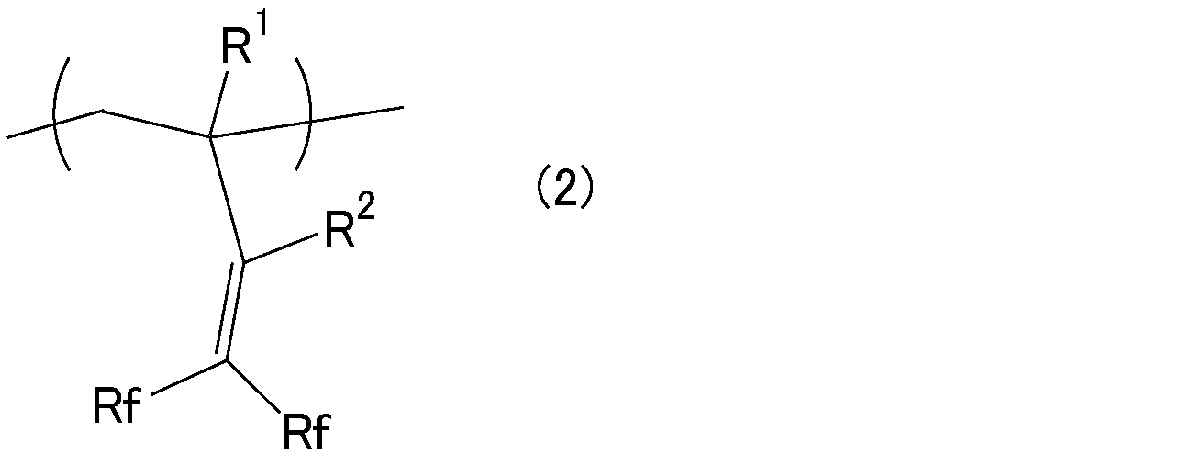
一般式(2)中、
2つのRfは、それぞれ独立に、炭素数1~6の直鎖状、炭素数3~6の分岐状若しくは炭素数3~6の環状のパ-フルオロアルキル基またはフッ素原子を表し、
R1は、水素原子、フッ素原子またはメチル基を表し、
R2は、水素原子、炭素数1~6の直鎖状、炭素数3~6の分岐状または炭素数3~6の環状のアルキル基を表す。
2つのRfは、それぞれ独立に、炭素数1~6の直鎖状、炭素数3~6の分岐状若しくは炭素数3~6の環状のパ-フルオロアルキル基またはフッ素原子を表し、
R1は、水素原子、フッ素原子またはメチル基を表し、
R2は、水素原子、炭素数1~6の直鎖状、炭素数3~6の分岐状または炭素数3~6の環状のアルキル基を表す。
一般式(2)において、R1は水素原子、メチル基が好ましい。また、R2としては、例えば、水素原子、メチル基、エチル基、n-プロピル基、イソプロピル基、n-ブチル基、1-メチルプロピル基、2-メチルプロピル基、tert-ブチル基、n-ペンチル基、イソペンチル基、1,1-ジメチルプロピル基、1-メチルブチル基、1,1-ジメチルブチル基、n-ヘキシル基、シクロペンチル基、シクロヘキシル基などを挙げることができ、水素原子、メチル基、エチル基、n-プロピル基、イソプロピル基が好ましく、水素原子、メチル基がより好ましい。
一般式(1)または一般式(2)中のRfは、フッ素原子、トリフルオロメチル基、ジフルオロメチル基、ペンタフルオロエチル基、2,2,2-トリフルオロエチル基、n-ヘプタフルオロプロピル基、2,2,3,3,3-ペンタフルオロプロピル基、3,3,3-トリフルオロプロピル基、ヘキサフルオロイソプロピル基、ヘプタフルオロイソプロピル基、n-ノナフルオロブチル基、イソノナフルオロブチル基、tert-ノナフルオロブチル基が好ましく、フッ素原子、トリフルオロメチル基、ジフルオロメチル基、ペンタフルオロエチル基、2,2,2-トリフルオロエチル基、n-ヘプタフルオロプロピル基、2,2,3,3,3-ペンタフルオロプロピル基、3,3,3-トリフルオロプロピル基、ヘキサフルオロイソプロピル基がより好ましく、フッ素原子、ジフルオロメチル基、トリフルオロメチル基が特に好ましい。
上記構造単位の好ましい具体的構造としては、国際公開第2021/235541号の段落0060~0061に記載されている構造を挙げることができる。
含フッ素樹脂(E)中の一般式(2)で表される構造単位の含有量は、溶剤への溶解性や、発光素子製造における各種処理への耐性などを考慮して、5~70質量%が好ましく、10~50質量%がより好ましく、10~30質量%が特に好ましい。
含フッ素樹脂(E)は、下記一般式(3)で表される構造を含んでいてもよい。

一般式(3)において、R3、R4は、それぞれ独立に、水素原子またはメチル基を表す。
一般式(3)において、W1は2価の連結基を表す。好ましくは、-O-、-O-C(=O)-、-C(=O)-O-、-O-C(=O)-NH-、-C(=O)-O-C(=O)-NH-または-C(=O)-NH-を表す。
中でも、-O-C(=O)-NH-、-C(=O)-O-C(=O)-NH-または-C(=O)-NH-であることが好ましい。特に、W1が、-O-C(=O)-NH-であることにより、発光素子製造におけるUVオゾン処理後または酸素プラズマ処理後のインクに対する撥液性がより優れるため、好ましい。
中でも、-O-C(=O)-NH-、-C(=O)-O-C(=O)-NH-または-C(=O)-NH-であることが好ましい。特に、W1が、-O-C(=O)-NH-であることにより、発光素子製造におけるUVオゾン処理後または酸素プラズマ処理後のインクに対する撥液性がより優れるため、好ましい。
一般式(3)において、A1は2~4価の連結基を表し、好ましくは炭素数1~10の直鎖状、炭素数3~10の分岐状または炭素数3~10の環状のアルキレン基を表す。アルキレン基中の任意の数の水素原子は、ヒドロキシ基または-O-C(=O)-CH3で置換されてもよい。
2価の連結基A1は、炭素数1~10の直鎖状のアルキレン基である場合、例えば、メチレン基、エチレン基、プロピレン基、n-ブチレン基、n-ペンチレン基、n-ヘキサレン基、n-ヘプタレン基、n-オクタレン基、n-ノナレン基、n-デカレン基を挙げることができる。
2価の連結基A1は、炭素数3~10の分岐状のアルキレン基である場合、例えば、イソプロピレン基、イソブチレン基、sec-ブチレン基、tert-ブチレン基、イソペンタレン基、イソヘキサレン基などを挙げることができる。
2価の連結基A1は、炭素数3~10の環状のアルキレン基である場合、例えば、2置換のシクロプロパン、2置換のシクロブタン、2置換のシクロペンタン、2置換のシクロヘキサン、2置換のシクロヘプタン、2置換のシクロオクタン、2置換のシクロデカン、2置換の4-tert-ブチルシクロヘキサンなどを挙げることができる。
これらアルキレン基中の任意の数の水素原子が、ヒドロキシ基で置換されている場合、ヒドロキシ基置換アルキレン基として、例えば、ヒドロキシエチレン基、1-ヒドロキシ-n-プロピレン基、2-ヒドロキシ-n-プロピレン基、ヒドロキシ-イソプロピレン基(-CH(CH2OH)CH2-)、1-ヒドロキシ-n-ブチレン基、2-ヒドロキシ-n-ブチレン基、ヒドロキシ-sec-ブチレン基(-CH(CH2OH)CH2CH2-)、ヒドロキシ-イソブチレン基(-CH2CH(CH2OH)CH2-)、ヒドロキシ-tert-ブチレン基(-C(CH2OH)(CH3)CH2-)などを挙げることができる。
また、これらアルキレン基中の任意の数の水素原子が、-O-C(=O)-CH3で置換されている場合、該置換アルキレン基として、前記に例示したヒドロキシ基置換アルキレン基のヒドロキシ基が-O-C(=O)-CH3に置き換わったものを挙げることができる。
中でも、2価の連結基A1は、メチレン基、エチレン基、プロピレン基、n-ブチレン基、イソブチレン基、sec-ブチレン基、シクロヘキシル基、2-ヒドロキシ-n-プロピレン基、ヒドロキシ-イソプロピレン基(-CH(CH2OH)CH2-)、2-ヒドロキシ-n-ブチレン基、ヒドロキシ-sec-ブチレン基(-CH(CH2OH)CH2CH2-)が好ましく、エチレン基、プロピレン基、2-ヒドロキシ-n-プロピレン基、ヒドロキシ-イソプロピレン基(-CH(CH2OH)CH2-)がより好ましく、エチレン基、2-ヒドロキシ-n-プロピレン基が特に好ましい。3価の連結基A1としては、-C(CH2-)2CH3などを挙げることができ、4価の連結基A1としては、C(CH2-)4などを挙げることができる。
一般式(3)において、Y1は2価の連結基を表し、-O-または-NH-であることが好ましく、-O-であることがより好ましい。
一般式(3)において、uは1~3の整数を表し、uは1であることが特に好ましい。
一般式(3)において、nは1~3の整数を表し、nは1であることが特に好ましい。芳香環の置換位置はそれぞれ独立に、オルト位、メタ位、パラ位を表し、パラ位であることが好ましい。
複数存在するW1は、互いに同一であっても異なっていてもよい。また、複数存在するA1は、互いに同一であっても異なっていてもよい。また、複数存在するY1は、互いに同一であっても異なっていてもよい。複数存在するR4は、互いに同一であっても異なっていてもよい。ただし、合成容易性などの観点からは、複数存在するW1は互いに同一であることが好ましく、複数存在するA1は互いに同一であることが好ましく、複数存在するY1は互いに同一であることが好ましく、複数存在するR4は互いに同一であることが好ましい。
一般式(3)において、nは1~3の整数を表し、nは1であることが特に好ましい。芳香環の置換位置はそれぞれ独立に、オルト位、メタ位、パラ位を表し、パラ位であることが好ましい。
複数存在するW1は、互いに同一であっても異なっていてもよい。また、複数存在するA1は、互いに同一であっても異なっていてもよい。また、複数存在するY1は、互いに同一であっても異なっていてもよい。複数存在するR4は、互いに同一であっても異なっていてもよい。ただし、合成容易性などの観点からは、複数存在するW1は互いに同一であることが好ましく、複数存在するA1は互いに同一であることが好ましく、複数存在するY1は互いに同一であることが好ましく、複数存在するR4は互いに同一であることが好ましい。
一般式(3)で表される構造として具体的に好ましいものとしては、国際公開第2021/235541号の段落0081~0084に記載されている構造を挙げることができる。
含フッ素樹脂(E)中の一般式(3)で表される構造単位の含有量は、溶剤への溶解性や、発光素子製造における各種処理への耐性などを考慮して、5~70質量%が好ましく、10~50質量%がより好ましく、10~30質量%が特に好ましい。
含フッ素樹脂(E)は、下記一般式(4)で表される構造を含んでいてもよい。
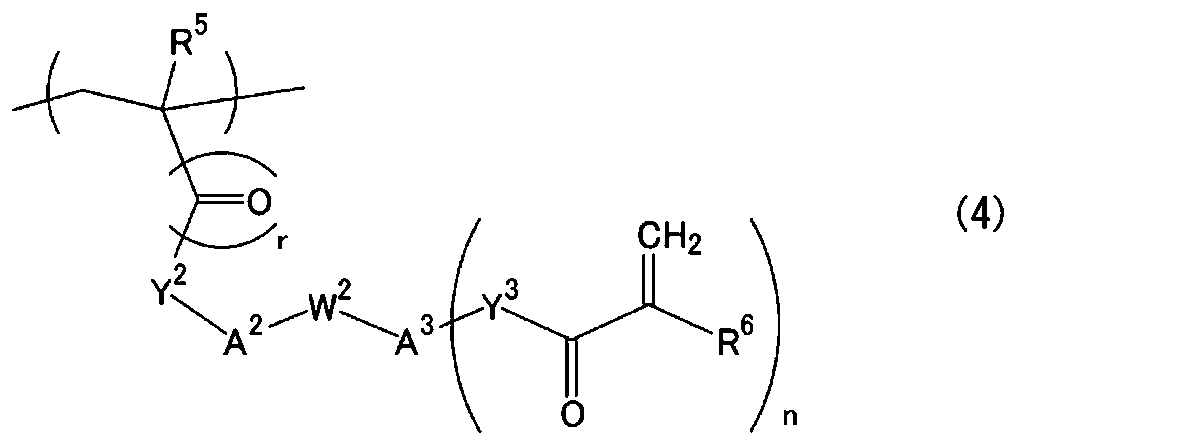
一般式(4)において、R5、R6は、それぞれ独立に、水素原子またはメチル基を表す。
式(4)において、W2は2価の連結基を表し、好ましくは-O-、-O-C(=O)-、-C(=O)-O-、-O-C(=O)-NH-、-C(=O)-O-C(=O)-NH-または-C(=O)-NH-を表す。中でも、-O-C(=O)-NH-、-C(=O)-O-C(=O)-NH-または-C(=O)-NH-が好ましい。特に、W2が、-O-C(=O)-NH-であるとき、発光素子製造におけるUVオゾン処理後または酸素プラズマ処理後のインクに対する撥液性がより優れるため、好ましい。
一般式(4)において、A2は、2価の連結基を表し、好ましくは炭素数1~10の直鎖状、炭素数3~10の分岐状または炭素数3~10の環状のアルキレン基を表す。アルキレン基中の任意の数の水素原子は、ヒドロキシ基または-O-C(=O)-CH3で置換されてもよい。
一般式(4)において、A3は、2~4価の連結基を表し、好ましくは炭素数1~10の直鎖状、炭素数3~10の分岐状または炭素数3~10の環状のアルキレン基を表す。アルキレン基中の任意の数の水素原子は、ヒドロキシ基または-O-C(=O)-CH3で置換されてもよい。
一般式(4)において、A3は、2~4価の連結基を表し、好ましくは炭素数1~10の直鎖状、炭素数3~10の分岐状または炭素数3~10の環状のアルキレン基を表す。アルキレン基中の任意の数の水素原子は、ヒドロキシ基または-O-C(=O)-CH3で置換されてもよい。
2価の連結基A2、A3は、炭素数1~10の直鎖状のアルキレン基である場合、例えば、メチレン基、エチレン基、プロピレン基、n-ブチレン基、n-ペンチレン基、n-ヘキサレン基、n-ヘプタレン基、n-オクタレン基、n-ノナレン基、n-デカレン基を挙げることができる。
2価の連結基A2、A3は、それぞれ独立に、炭素数3~10の分岐状のアルキレン基である場合、例えば、イソプロピレン基、イソブチレン基、sec-ブチレン基、tert-ブチレン基、イソペンタレン基、イソヘキサレン基などを挙げることができる。
2価の連結基A2、A3は、それぞれ独立に、炭素数3~10の環状のアルキレン基である場合、例えば、2置換のシクロプロパン、2置換のシクロブタン、2置換のシクロペンタン、2置換のシクロヘキサン、2置換のシクロヘプタン、2置換のシクロオクタン、2置換のシクロデカン、2置換の4-tert-ブチルシクロヘキサンなどを挙げることができる。
これらアルキレン基中の任意の数の水素原子が、ヒドロキシ基で置換されている場合、ヒドロキシ基置換アルキレン基として、例えば、1-ヒドロキシエチレン基(-CH(OH)CH2-)、2-ヒドロキシエチレン基(-CH2CH(OH)-)、1-ヒドロキシ-n-プロピレン基、2-ヒドロキシ-n-プロピレン基、ヒドロキシ-イソプロピレン基(-CH(CH2OH)CH2-)、1-ヒドロキシ-n-ブチレン基、2-ヒドロキシ-n-ブチレン基、ヒドロキシ-sec-ブチレン基(-CH(CH2OH)CH2CH2-)、ヒドロキシ-イソブチレン基(-CH2CH(CH2OH)CH2-)、ヒドロキシ-tert-ブチレン基(-C(CH2OH)(CH3)CH2-)などを挙げることができる。
また、これらアルキレン基中の任意の数の水素原子が、-O-C(=O)-CH3で置換されている場合、置換アルキレン基として、前述のヒドロキシ基置換アルキレン基のヒドロキシ基が-O-C(=O)-CH3に置き換わったものを挙げることができる。
中でも、2価の連結基A2、A3は、それぞれ独立に、メチレン基、エチレン基、プロピレン基、n-ブチレン基、イソブチレン基、sec-ブチレン基、シクロヘキシル基、1-ヒドロキシエチレン基(-CH(OH)CH2-)、2-ヒドロキシエチレン基(-CH2CH(OH)-)、2-ヒドロキシ-n-プロピレン基、ヒドロキシ-イソプロピレン基(-CH(CH2OH)CH2-)、2-ヒドロキシ-n-ブチレン基、ヒドロキシ-sec-ブチレン基(-CH(CH2OH)CH2CH2-)が好ましく、エチレン基、プロピレン基、1-ヒドロキシエチレン基(-CH(OH)CH2-)、2-ヒドロキシエチレン基(-CH2CH(OH)-)、2-ヒドロキシ-n-プロピレン基、ヒドロキシ-イソプロピレン基(-CH(CH2OH)CH2-)がより好ましく、エチレン基、1-ヒドロキシエチレン基(-CH(OH)CH2-)、2-ヒドロキシエチレン基(-CH2CH(OH)-)が特に好ましい。
3価の連結基A3としては、-C(CH2-)2CH3などを挙げることができ、4価の連結基A3としては、C(CH2-)4などを挙げることができる。
3価の連結基A3としては、-C(CH2-)2CH3などを挙げることができ、4価の連結基A3としては、C(CH2-)4などを挙げることができる。
一般式(4)において、Y2、Y3は、それぞれ独立に2価の連結基を表し、-O-または-NH-であることが好ましく、-O-であることがより好ましい。
一般式(4)において、nは1~3の整数を表す。nは1であることが特に好ましい。
複数存在するY3は、互いに同一であっても異なっていてもよい。また、複数存在するR6は、互いに同一であっても異なっていてもよい。ただし、合成容易性などの観点からは、複数存在するY3は互いに同一であることが好ましく、複数存在するR6は互いに同一であることが好ましい。
複数存在するY3は、互いに同一であっても異なっていてもよい。また、複数存在するR6は、互いに同一であっても異なっていてもよい。ただし、合成容易性などの観点からは、複数存在するY3は互いに同一であることが好ましく、複数存在するR6は互いに同一であることが好ましい。
一般式(4)において、rは0または1を表す。rが0のとき「(-C(=O)-)」rは単結合を表す。
一般式(4)で表される構造として具体的に好ましいものとしては、国際公開第2021/235541号の段落1005~0109に記載されている構造を挙げることができる。
含フッ素樹脂(E)中の一般式(4)で表される構造単位の含有量は、溶剤への溶解性や、パタ-ン(隔壁)の基板への密着性などを考慮して、5~70質量%が好ましく、10~50質量%がより好ましく、10~30質量%が特に好ましい。
含フッ素樹脂(E)は、一般式(5)表される構造単位を含んでいてもよい。
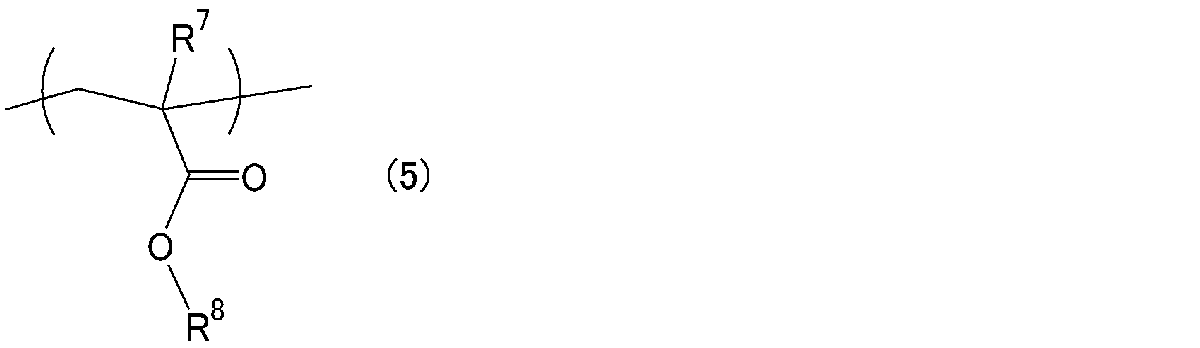
一般式(5)中、R7は水素原子またはメチル基を表す。
一般式(5)中、R8は水素原子、炭素数1~15の直鎖状、炭素数3~15の分岐状または炭素数3~15の環状のアルキル基を表し、これらアルキル基中の任意の数の水素原子がフッ素原子で置換されており、構造単位中のフッ素含有率は30質量%以上である。
R8が直鎖状の炭化水素基であるとき、具体的には、メチル基、エチル基、プロピル基、ブチル基、ペンチル基、ヘキシル基、ヘプチル基、オクチル基、ノニル基または炭素数10~14の直鎖状アルキル基の任意の数の水素原子がフッ素原子で置換されているものを例示することができる。
R8が直鎖状の炭化水素基である場合、一般式(5)で表わされる構造単位は下記一般式(5-1)で表わされる構造単位であることが好ましい。

一般式(5-1)中、R9は、一般式(5)のR7と同義である。
一般式(5-1)中、Xは水素原子またはフッ素原子である。Xはフッ素原子であることが好ましい。
一般式(5-1)中、pは1~4の整数、qは1~14の整数である。pは1~2の整数で、qは2~8の整数であることが特に好ましい。
一般式(5)で表される構造単位として具体的に好ましいものとしては、国際公開第2021/235541号の段落0125~0128に記載されている構造を挙げることができる。
含フッ素樹脂(E)中の一般式(5)で表される構造単位の含有量は、パタ-ン(隔壁)としたときのインクのはじきやすさや、硬化性組成物5を調製する際の溶剤への溶けやすさなどを勘案して適宜決定すればよい。具体的には、含フッ素樹脂(E)中の一般式(5)で表される構造単位の含有量は、5~70質量%が好ましく、10~50質量%がより好ましく、10~30質量%が特に好ましい。
含フッ素樹脂は、下記一般式(6)式で表される構造を含んでいてもよい。
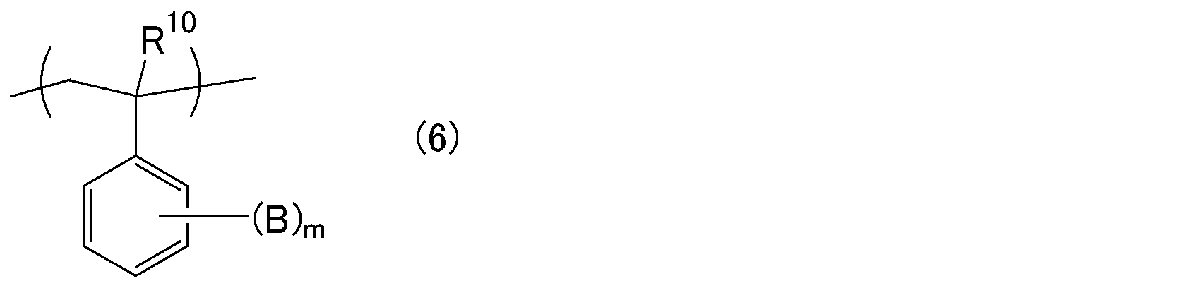
一般式(6)中、R10は水素原子またはメチル基を表す。
一般式(6)中、Bはそれぞれ独立に、水素原子、ヒドロキシ基、カルボキシル基、-C(=O)-O-R11(R11は炭素数1~15の直鎖状、炭素数3~15の分岐状または炭素数3~15の環状のアルキル基を表し、該アルキル基中の任意の数の水素原子がフッ素原子で置換されており、R11中のフッ素含有率は30質量%以上である)または-O-C(=O)-R12(R12は炭素数1~6の直鎖状、炭素数3~6の分岐状または炭素数3~6の環状のアルキル基を表す。)を表す。
また、mは0~3の整数を表す。
また、mは0~3の整数を表す。
一般式(6)で表される構造として具体的に好ましいものとしては、国際公開第2021/235541号の段落0137~0138に記載されている構造を挙げることができる。
含フッ素樹脂(E)中の一般式(6)で表される構造単位の含有量は、一般式(6)で表される構造単位に基づく効果を十分に得る点や、溶剤溶解性などを考慮して、5~70質量%が好ましく、10~50質量%がより好ましく、20~40質量%が特に好ましい。
一般式(6)において、B1がヒドロキシ基またはカルボキシル基である場合、一般式(6)で表される構造単位は、アルカリ現像液に対する溶解性を有する。そのため、特に良好なアルカリ現像性を得たい場合には、含フッ素樹脂(E)に、B1がヒドロキシ基またはカルボキシル基である場合の一般式(6)で表される構造単位を含むことが好ましい。
含フッ素樹脂(E)は、下記一般式(7)で表される構造を含んでいてもよい。

一般式(7)において、R13は、水素原子またはメチル基を表す。
一般式(7)において、A4は、2価の連結基を表し、好ましくは、炭素数1~10の直鎖状、炭素数3~10の分岐状または炭素数3~10の環状のアルキレン基を表す。アルキレン基中の任意の数の水素原子は、ヒドロキシ基または-O-C(=O)-CH3で置換されてもよい。
2価の連結基A4は、炭素数1~10の直鎖状のアルキレン基である場合、例えば、メチレン基、エチレン基、プロピレン基、n-ブチレン基、n-ペンチレン基、n-ヘキサレン基、n-ヘプタレン基、n-オクタレン基、n-ノナレン基、n-デカレン基を挙げることができる。
2価の連結基A4は、炭素数3~10の分岐状のアルキレン基である場合、例えば、イソプロピレン基、イソブチレン基、sec-ブチレン基、tert-ブチレン基、イソペンタレン基、イソヘキサレン基などを挙げることができる。
2価の連結基A4は、炭素数3~10の環状のアルキレン基である場合、例えば、2置換のシクロプロパン、2置換のシクロブタン、2置換のシクロペンタン、2置換のシクロヘキサン、2置換のシクロヘプタン、2置換のシクロオクタン、2置換のシクロデカン、2置換の4-tert-ブチルシクロヘキサンなどを挙げることができる。
これらアルキレン基中の任意の数の水素原子が、ヒドロキシ基で置換されている場合、ヒドロキシ基置換アルキレン基として、例えば、1-ヒドロキシエチレン基(-CH(OH)CH2-)、2-ヒドロキシエチレン基(-CH2CH(OH)-)、1-ヒドロキシ-n-プロピレン基、2-ヒドロキシ-n-プロピレン基、ヒドロキシ-イソプロピレン基(-CH(CH2OH)CH2-)、1-ヒドロキシ-n-ブチレン基、2-ヒドロキシ-n-ブチレン基、ヒドロキシ-sec-ブチレン基(-CH(CH2OH)CH2CH2-)、ヒドロキシ-イソブチレン基(-CH2CH(CH2OH)CH2-)、ヒドロキシ-tert-ブチレン基(-C(CH2OH)(CH3)CH2-)などを挙げることができる。
また、これらアルキレン基中の任意の数の水素原子が、-O-C(=O)-CH3で置換されている場合、その置換アルキレン基として、上述のヒドロキシ基置換アルキレン基のヒドロキシ基が-O-C(=O)-CH3に置き換わったものを挙げることができる。
中でも、2価の連結基A4は、メチレン基、エチレン基、プロピレン基、n-ブチレン基、イソブチレン基、sec-ブチレン基、シクロヘキシル基、1-ヒドロキシエチレン基(-CH(OH)CH2-)、2-ヒドロキシエチレン基(-CH2CH(OH)-)、2-ヒドロキシ-n-プロピレン基、ヒドロキシ-イソプロピレン基(-CH(CH2OH)CH2-)、2-ヒドロキシ-n-ブチレン基、ヒドロキシ-sec-ブチレン基(-CH(CH2OH)CH2CH2-)が好ましく、エチレン基、プロピレン基、1-ヒドロキシエチレン基(-CH(OH)CH2-)、2-ヒドロキシエチレン基(-CH2CH(OH)-)、2-ヒドロキシ-n-プロピレン基、ヒドロキシ-イソプロピレン基(-CH(CH2OH)CH2-)がより好ましく、エチレン基、1-ヒドロキシエチレン基(-CH(OH)CH2-)、2-ヒドロキシエチレン基(-CH2CH(OH)-)が特に好ましい。
一般式(7)において、Y4は、は2価の連結基を表し、-O-または-NH-が好ましく、-O-がより好ましい。
一般式(7)において、rは0または1を表す。rが0のとき(-C(=O)-)は単結合を表す。
一般式(7)において、E1は、ヒドロキシ基、カルボキシル基またはオキシラン基を表す。
E1がオキシラン基であるとき、例えば、エチレンオキシド基、1,2-プロピレンオキシド基、1,3-プロピレンオキシド基などを挙げることができる。中でも、エチレンオキシド基であることが好ましい。
E1がオキシラン基であるとき、例えば、エチレンオキシド基、1,2-プロピレンオキシド基、1,3-プロピレンオキシド基などを挙げることができる。中でも、エチレンオキシド基であることが好ましい。
一般式(7)において、sは0または1を表す。sが0のとき、(-Y4-A4-)は単結合を表す。rが0、かつ、sが0のときは、構造単位の主鎖にE1が結合した構造となる。
一般式(7)で表される構造として具体的に好ましいものとしては、国際公開第2021/235541号の段落0156に記載されている構造を挙げることができる。
含フッ素樹脂(E)の、ポリスチレンを標準物質としたゲルパ-ミエ-ションクロマトグラフィ(GPC)により測定した重量平均分子量で、好ましくは1,000~1,000,000、より好ましくは2,000~500,000、特に好ましくは3,000~100,000である。
含フッ素樹脂(E)の分子量の調整により、形成するパタ-ン(隔壁)の強度を高めたり、溶剤への溶解性が高まり塗布性を高めたりできる場合がある。
含フッ素樹脂(E)の分子量の調整により、形成するパタ-ン(隔壁)の強度を高めたり、溶剤への溶解性が高まり塗布性を高めたりできる場合がある。
含フッ素樹脂(E)の分散度(Mw/Mn)は、1.01~5.00が好ましく、1.01~4.00がより好ましく、1.01~3.00が特に好ましい。
含フッ素樹脂(E)は、ランダム共重合体であってもよいし、交互共重合体であってもよいし、ブロック共重合体であってもよいし、グラフト共重合体であってもよい。それぞれの特性を局所的にではなく適度に分散させる観点から、ランダム共重合体であることが好ましい。
含フッ素樹脂(E)のフッ素含有率は、20~50質量%が望ましく、25~40質量%がより望ましい。フッ素含有率がこの範囲内であることにより、含フッ素樹脂(E)は溶剤に溶解し易い。また、含フッ素樹脂(E)のフッ素含有率がこの範囲内であることにより、撥液性に優れるパタ-ン(隔壁)を得やすい。
含フッ素樹脂(E)のフッ素含有率の測定は、例えば、国際公開第2021/235541号の段落0174の記載に準じて行うことができる。
含フッ素樹脂(E)のフッ素含有率の測定は、例えば、国際公開第2021/235541号の段落0174の記載に準じて行うことができる。
含フッ素樹脂(E)を用いる場合、1のみの含フッ素樹脂(E)を用いてもよいし、2以上の含フッ素樹脂(E)を用いてもよい。
得られるパタ-ン(隔壁)の十分な撥液性と、良好なアルカリ現像性との兼ね合いから、含フッ素樹脂(E)を用いる場合の使用量は、硬化性組成物5の全不揮発成分中、通常0.1~10質量%、好ましくは0.1~8質量%、より好ましくは0.5~5質量%である。
得られるパタ-ン(隔壁)の十分な撥液性と、良好なアルカリ現像性との兼ね合いから、含フッ素樹脂(E)を用いる場合の使用量は、硬化性組成物5の全不揮発成分中、通常0.1~10質量%、好ましくは0.1~8質量%、より好ましくは0.5~5質量%である。
その他、含フッ素樹脂(E)に関しては、例えば国際公開第2021/235541号中の記載を参考にすることができる。
(着色剤(F))
硬化性組成物5は、着色剤(F)を含むことができる。
一例として、着色剤(F)を用いて、得られるパタ-ン(隔壁)を黒色とする。黒色のパタ-ン(隔壁)は、発光素子における画素間の隔壁とすることができる。
別の例として、着色剤(F)を用いて、得られるパタ-ン(隔壁)を白色とすることで、パタ-ン(隔壁)の反射率を高めることができる。
また、当然、種々の目的に応じて、黒色でもなく白色でもないパターンが得られるように適当な着色剤(G)を選択してもよい。
硬化性組成物5は、着色剤(F)を含むことができる。
一例として、着色剤(F)を用いて、得られるパタ-ン(隔壁)を黒色とする。黒色のパタ-ン(隔壁)は、発光素子における画素間の隔壁とすることができる。
別の例として、着色剤(F)を用いて、得られるパタ-ン(隔壁)を白色とすることで、パタ-ン(隔壁)の反射率を高めることができる。
また、当然、種々の目的に応じて、黒色でもなく白色でもないパターンが得られるように適当な着色剤(G)を選択してもよい。
着色剤(F)としては、顔料を用いてもよいし染料を用いてもよい。必要に応じて複数の着色剤を併用してもよい。ちなみに、得られるパタ-ン(隔壁)を黒色とする場合には、カ-ボンブラックのような黒色色素を用いることもできるし、複数の非黒色色素を混合して用いることで実質的な黒色を得るようにしてもよい。得られるパタ-ン(隔壁)を灰色とする場合には、黒色色素と白色色素を混合して灰色を得るようにしてもよい。
顔料としては、有機系顔料を用いることが好ましい。
顔料としては、有機系顔料を用いることが好ましい。
着色剤(F)として具体的には、ペリレン系顔料、ラクタム系顔料、アゾ系顔料、フタロシアニン系顔料、カ-ボンブラックのような炭素系顔料、または鉄黒や酸化チタンのような金属酸化物系顔料などの公知の着色剤を挙げることができる。
白色顔料は、アルミナ、酸化マグネシウム、酸化アンチモン、酸化チタン、酸化ジルコニウム、水酸化アルミニウム、水酸化マグネシウム、硫酸バリウム、炭酸マグネシウム及び炭酸バリウムからなる群より選択される少なくとも1種の無機物であることが好ましい。これらの無機物は、高い屈折率を有するため、形成される隔壁の光反射性を向上させやすい。特に、高い屈折率と、組成物中での良好な分散性の観点から、酸化チタンが好ましい。
その他着色顔料としては、黄色、橙色、青色、赤色、緑色、紫色、茶色など種々の有機顔料を用いることができる。また、2種類以上の有機顔料を含む顔料分散体を用いてもよい。用いる顔料の種類や量比を調整することで、溶解性や遮光性等の光学特性を制御することができる。特に、相溶性と光学濃度の均一性の観点から、青色、紫色および橙色の組み合わせが好ましい。
有機橙色顔料としては、例えば、C.I.ピグメントオレンジ1、2、5、13、16、17、19、20、21、22、23、24、34、36、38、39、43、46、48、49、61、62、64、65、67、68、69、70、71、72、73、74、75、77、78、79が挙げられる。これらの中でも、分散性や遮光性の観点から、C.I.ピグメントオレンジ43が好ましい。
有機青色顔料としては、例えば、C.I.ピグメントブル-15、15:1、15:2、15:3、15:4、15:6、16、17、60、64、65、75、79、80が挙げられる。これらの中でも、分散性や遮光性の観点から、C.I.ピグメントブル-60が好ましい。
有機紫色顔料としては、例えば、C.I.ピグメントバイオレット1、1:1、2、2:2、3、3:1、3:3、5、5:1、14、15、16、19、23、25、27、29、31、32、37、39、42、44、47、49、50が挙げられる。これらの中でも、分散性や遮光性の観点から、C.I.ピグメントバイオレット23が好ましい。
着色剤(F)として顔料を用いる場合、顔料には分散処理が施されていることが好ましい。顔料の分散は、例えば、顔料、分散剤および必要に応じて溶剤を、ビ-ズミルを用いて処理することで得ることができる。分散剤の種類は特に限定されず、例えばビックケミ-社から入手可能な分散剤を用いることができる。
また、顔料に分散処理を施して、顔料が溶剤(通常は有機溶剤)に分散した顔料分散液を製造する際には、さらにアルカリ可溶性樹脂を用いてもよい。顔料はアルカリ現像液で除去しにくく、現像残渣として残りやすいため、顔料分散液にアルカリ可溶性樹脂を含めておくことで、現像残渣の低減を期待することができる。具体的なアルカリ可溶性樹脂としては、前述のアルカリ可溶性樹脂(D)で具体的に挙げたものを用いることができる。
また、顔料に分散処理を施して、顔料が溶剤(通常は有機溶剤)に分散した顔料分散液を製造する際には、さらにアルカリ可溶性樹脂を用いてもよい。顔料はアルカリ現像液で除去しにくく、現像残渣として残りやすいため、顔料分散液にアルカリ可溶性樹脂を含めておくことで、現像残渣の低減を期待することができる。具体的なアルカリ可溶性樹脂としては、前述のアルカリ可溶性樹脂(D)で具体的に挙げたものを用いることができる。
着色剤(F)を用いる場合、1のみの着色剤(F)を用いてもよいし、2以上の着色剤(F)を併用してもよい。
着色剤(F)を用いる場合、その量は、着色剤(F)を用いることによる効果を十分に得ることと、パタ-ニング性、現像性や得られるパタ-ン(隔壁)の強度なのとの兼ね合いから適宜調整すればよい。具体的には、着色剤(F)を用いる場合、その量は、硬化性組成物5の全不揮発成分中、通常1~60質量%、好ましくは3~55質量%、より好ましくは5~50質量%である。ちなみに、着色剤(F)が分散剤やアルカリ可溶性樹脂により分散処理されている場合は、分散剤やアルカリ可溶性樹脂を含めた着色剤(F)の量(ただし揮発性溶剤は除く)がここに示す数値範囲内となっていればよい。
着色剤(F)を用いる場合、その量は、着色剤(F)を用いることによる効果を十分に得ることと、パタ-ニング性、現像性や得られるパタ-ン(隔壁)の強度なのとの兼ね合いから適宜調整すればよい。具体的には、着色剤(F)を用いる場合、その量は、硬化性組成物5の全不揮発成分中、通常1~60質量%、好ましくは3~55質量%、より好ましくは5~50質量%である。ちなみに、着色剤(F)が分散剤やアルカリ可溶性樹脂により分散処理されている場合は、分散剤やアルカリ可溶性樹脂を含めた着色剤(F)の量(ただし揮発性溶剤は除く)がここに示す数値範囲内となっていればよい。
(その他任意成分)
硬化性組成物5は、上記以外の任意の成分を含んでもよい。任意の成分としては、溶解抑制剤、可塑剤、安定剤、界面活性剤、増粘剤、レベリング剤、消泡剤、相溶化剤、密着性改良剤、酸化防止剤などを挙げることができる。これら任意成分としては、市販品を用いることができる。例えば密着性改良剤として、日本化薬社製の「KAYAMER」シリ-ズのものを用いることができる。
硬化性組成物5は、上記以外の任意の成分を含んでもよい。任意の成分としては、溶解抑制剤、可塑剤、安定剤、界面活性剤、増粘剤、レベリング剤、消泡剤、相溶化剤、密着性改良剤、酸化防止剤などを挙げることができる。これら任意成分としては、市販品を用いることができる。例えば密着性改良剤として、日本化薬社製の「KAYAMER」シリ-ズのものを用いることができる。
(溶剤)
硬化性組成物5は、通常、上記の各種成分が溶剤に溶解または分散したものである。溶剤は、通常、有機溶剤を含む。
硬化性組成物5は、通常、上記の各種成分が溶剤に溶解または分散したものである。溶剤は、通常、有機溶剤を含む。
使用可能な溶剤は特に限定されない。具体的には、ケトン類、アルコ-ル類、多価アルコ-ル類およびその誘導体、エ-テル類、エステル類、芳香族系溶剤、フッ素系溶剤などを挙げることができる。これらは単独で用いてもよいし、2種以上混合して用いてもよい。
ケトン類としては、アセトン、メチルエチルケトン、シクロペンタノン、シクロヘキサノン、メチルイソアミルケトン、メチルイソブチルケトン、メチルイソペンチルケトン、2-ヘプタノンなどを挙げることができる。
アルコ-ル類としては、イソプロパノ-ル、ブタノ-ル、イソブタノ-ル、n-ペンタノ-ル、イソペンタノ-ル、tert-ペンタノ-ル、4-メチル-2-ペンタノ-ル、3-メチル-3-ペンタノ-ル、2,3-ジメチル-2-ペンタノ-ル、n-ヘキシサノ-ル、n-ヘプタノ-ル、2-ヘプタノ-ル、n-オクタノ-ル、n-デカノ-ル、s-アミルアルコ-ル、t-アミルアルコ-ル、イソアミルアルコ-ル、2-エチル-1-ブタノ-ル、ラウリルアルコ-ル、ヘキシルデカノ-ル、オレイルアルコ-ルなどを挙げることができる。
多価アルコ-ル類及びその誘導体としては、エチレングリコ-ル、エチレングリコ-ルモノアセテ-ト、エチレングルコ-ルジメチルエ-テル、ジエチレングリコ-ル、ジエチレングリコ-ルジメチルエ-テル、ジエチレングリコ-ルモノアセテ-ト、プロピレングリコ-ル、プロピレングリコ-ルモノアセテ-ト、プロピレングリコ-ルモノメチルエ-テル(PGME)、プロピレングリコ-ルモノエチルエ-テル、プロピレングリコ-ルモノプロピルエ-テル、プロピレングリコ-ルモノブチルエ-テル、プロピレングリコ-ルモノメチルエ-テルアセテ-ト(PGMEA)、ジプロピレングリコ-ルまたはジプロピレングリコ-ルモノアセテ-トのモノメチルエ-テル、モノエチルエ-テル、モノプロピルエ-テル、モノブチルエ-テル、モノフェニルエ-テルなどを挙げることができる。
エ-テル類としては、ジエチルエ-テル、ジイソプロピルエ-テル、テトラヒドロフラン、ジオキサン、アニソ-ルなどを挙げることができる。
エステル類としては乳酸メチル、乳酸エチル(EL)、酢酸メチル、酢酸エチル、酢酸ブチル、ピルビン酸メチル、ピルビン酸エチル、メトキシプロピオン酸メチル、エトキシプロピオン酸エチル、γ-ブチロラクトンなどを挙げることができる。
芳香族系溶剤としては、キシレン、トルエンなどを挙げることができる。
フッ素系溶剤としては、フロン、代替フロン、パ-フルオロ化合物、ヘキサフルオロイソプロピルアルコ-ルなどを挙げることができる。
その他、塗布性を高める目的で、高沸点弱溶剤であるタ-ペン系の石油ナフサ溶剤やパラフィン系溶剤などを用いることができる。
中でも、溶剤は、メチルエチルケトン、シクロヘキサノン、メチルイソアミルケトン、2-ヘプタノン、エチレングリコ-ル、エチレングルコ-ルジメチルエ-テル、エチレングリコ-ルモノアセテ-ト、ジエチレングリコ-ル、ジエチレングリコ-ルモノアセテ-ト、ジエチレングリコ-ルジメチルエ-テル、プロピレングリコ-ル、プロピレングリコ-ルモノアセテ-ト、プロピレングリコ-ルモノメチルエ-テル(PGME)、プロピレングリコ-ルモノメチルエ-テルアセテ-ト(PGMEA)、ジプロピレングリコ-ル、ジプロピレングリコ-ルモノアセテ-トモノメチルエ-テル、ジプロピレングリコ-ルモノアセテ-トモノエチルエ-テル、ジプロピレングリコ-ルモノアセテ-トモノプロピルエ-テル、ジプロピレングリコ-ルモノアセテ-トモノブチルエ-テル、ジプロピレングリコ-ルモノアセテ-トモノフェニルエ-テル、1,4-ジオキサン、乳酸メチル、乳酸エチル、酢酸メチル、酢酸エチル、酢酸ブチル、メトキシプロピオン酸メチル、エトキシプロピオン酸エチル、γ-ブチロラクトンおよびヘキサフルオロイソプロピルアルコ-ルからなる群より選ばれる少なくとも1種を含むことが好ましい。
また、特に溶剤は、メチルエチルケトン、プロピレングリコ-ルモノメチルエ-テルアセテ-ト(PGMEA)、プロピレングリコ-ルモノメチルエ-テル(PGME)、シクロヘキサノン、乳酸エチル、酢酸ブチル、γ-ブチロラクトンを含むことがより好ましい。
また、特に溶剤は、メチルエチルケトン、プロピレングリコ-ルモノメチルエ-テルアセテ-ト(PGMEA)、プロピレングリコ-ルモノメチルエ-テル(PGME)、シクロヘキサノン、乳酸エチル、酢酸ブチル、γ-ブチロラクトンを含むことがより好ましい。
溶剤を用いる場合、1のみの溶剤を用いてもよいし、2以上の溶剤を用いてもよい。
溶剤を用いる場合、硬化性組成物5の溶剤の量は、全固形分濃度が、例えば5~85質量%、具体的には10~60質量%となる量で用いることが好ましい。
溶剤の量を調製することによって、形成される膜の膜厚を調製することができる。上記範囲であれば、特に有機EL素子における隔壁を得るために適した膜厚の膜を得やすい。
溶剤を用いる場合、硬化性組成物5の溶剤の量は、全固形分濃度が、例えば5~85質量%、具体的には10~60質量%となる量で用いることが好ましい。
溶剤の量を調製することによって、形成される膜の膜厚を調製することができる。上記範囲であれば、特に有機EL素子における隔壁を得るために適した膜厚の膜を得やすい。
(保存安定性についての追加説明)
上述のとおり、硬化性組成物5は適切に容器詰めされていることにより、硬化性組成物5の特性変化は小さい。特性変化の程度は、数式:(|η1-η0|/η0)×100(%)で定義される粘度変化率により定量化することができる。この数式において、η0は、B型粘度計を用いて測定される硬化性組成物5の粘度であり、η1は、B型粘度計を用いて測定される、40℃で7日間保管後の硬化性組成物5の粘度である。粘度の測定条件の詳細については後掲の実施例の記載を参照されたい。
粘度変化率は、好ましくは15%以下、より好ましくは10%以下、さらに好ましくは5%以下である。別の言い方として、粘度変化率がここで示される範囲内に収まるように諸条件調整/最適化することで、硬化性組成物5の保存安定性をいっそう高めることができる。
粘度変化率は、理想的には0%である。
上述のとおり、硬化性組成物5は適切に容器詰めされていることにより、硬化性組成物5の特性変化は小さい。特性変化の程度は、数式:(|η1-η0|/η0)×100(%)で定義される粘度変化率により定量化することができる。この数式において、η0は、B型粘度計を用いて測定される硬化性組成物5の粘度であり、η1は、B型粘度計を用いて測定される、40℃で7日間保管後の硬化性組成物5の粘度である。粘度の測定条件の詳細については後掲の実施例の記載を参照されたい。
粘度変化率は、好ましくは15%以下、より好ましくは10%以下、さらに好ましくは5%以下である。別の言い方として、粘度変化率がここで示される範囲内に収まるように諸条件調整/最適化することで、硬化性組成物5の保存安定性をいっそう高めることができる。
粘度変化率は、理想的には0%である。
[酸素含有気体7]
酸素含有気体7の体積は、十分な量の酸素を硬化性組成物に接触させる観点と、硬化性組成物の保管や輸送にかかるコストを勘案して、適切に調整されることが好ましい。
酸素含有気体7の体積は、好ましくは容器の容積の3~50体積%、より好ましくは容器の容積の4~30体積%、さらに好ましくは、8~30体積%である。酸素含有気体7の体積は、20体積%以下、15体積%以下としてもよい。
酸素含有気体7の体積は、十分な量の酸素を硬化性組成物に接触させる観点と、硬化性組成物の保管や輸送にかかるコストを勘案して、適切に調整されることが好ましい。
酸素含有気体7の体積は、好ましくは容器の容積の3~50体積%、より好ましくは容器の容積の4~30体積%、さらに好ましくは、8~30体積%である。酸素含有気体7の体積は、20体積%以下、15体積%以下としてもよい。
酸素含有気体7の酸素濃度は、通常1~100体積%、好ましくは5~50体積%、より好ましくは20~25体積%である。酸素濃度が1体積%以上であることにより、十分な量の酸素が硬化性組成物と接触して、硬化性組成物を保管する際の特性変化を十分に小さくすることができると考えられる。また、酸素濃度が大きすぎないことにより、ジスルフィド化合物の過剰な生成が抑えられて、諸性能のバランス面では有利と考えられる。
酸素含有気体7における酸素以外の成分は、特に限定されない。酸素以外の成分は、通常は不活性成分を含む。具体的には、酸素含有気体7は、酸素ガスに加え、窒素ガスおよび貴ガスからなる群より選ばれる少なくともいずれかを含むことが好ましい。貴ガスとして具体的には、ヘリウムガス、ネオンガス、アルゴンガス、クリプトンガスなどを挙げることができる。これらの中では、コストや取り扱い性などからアルゴンガスが好ましい。
酸素含有気体7は、その他、大気由来の二酸化炭素などの気体を含んでいてもよいし、含まなくてもよい。
酸素含有気体7は、その他、大気由来の二酸化炭素などの気体を含んでいてもよいし、含まなくてもよい。
酸素含有気体7の水分量は少ないことが好ましい。このことにより、硬化性組成物の特性変化はより一層抑えられる。酸素含有気体7の水分量は、好ましくは0.1%(1000ppm)以下、より好ましくは0.01%(100ppm)以下である。
酸素含有気体7の圧力は特に限定されない。この圧力は、好ましくは0.5~1.5atm、より好ましくは0.8~1.2atm、つまり常圧付近であることが好ましい。圧力が常圧付近であることは、容器詰めのしやすさなどの点で好ましい。
酸素含有気体7中の正味の酸素の量は、酸素含有気体7の体積×酸素含有気体7中の酸素濃度、で表される。酸素含有気体7中の酸素の量を適切に調整することで、硬化性組成物を保管する際の特性変化を十分に小さくしつつ、他の性能も良好とできると考えられる。
具体的には、{(酸素含有気体7中の正味の酸素の体積)/(硬化性組成物5の体積)}×100(%)の値は、好ましくは0.05~10%、より好ましくは0.1~8%、さらに好ましくは0.2~7%、特に好ましくは0.3~5%、とりわけ好ましくは0.5~5%である。
具体的には、{(酸素含有気体7中の正味の酸素の体積)/(硬化性組成物5の体積)}×100(%)の値は、好ましくは0.05~10%、より好ましくは0.1~8%、さらに好ましくは0.2~7%、特に好ましくは0.3~5%、とりわけ好ましくは0.5~5%である。
<硬化性組成物入り容器:追加実施形態>
図2は、図1とは異なる、硬化性組成物入り容器の断面を模式的に示した図である。
硬化性組成物入り容器は、具体的には、
・容器本体1と、
・容器本体1の開口部を閉じることができるフタ3と、
・容器本体1の内部に収容された内袋11と、
・内袋11内に備えられたチュ-ブ13と、
・内袋11の内部に入っている硬化性組成物5と、
・内袋11の内部における、硬化性組成物5で占められていない部分を充たしている酸素含有気体7と、
により構成されている。
図2は、図1とは異なる、硬化性組成物入り容器の断面を模式的に示した図である。
硬化性組成物入り容器は、具体的には、
・容器本体1と、
・容器本体1の開口部を閉じることができるフタ3と、
・容器本体1の内部に収容された内袋11と、
・内袋11内に備えられたチュ-ブ13と、
・内袋11の内部に入っている硬化性組成物5と、
・内袋11の内部における、硬化性組成物5で占められていない部分を充たしている酸素含有気体7と、
により構成されている。
内袋11の材質は特に限定されない。内袋11の材質は、硬化性組成物5により実質的に侵されない限り、任意である。内袋11は、好ましくは樹脂で構成されている。樹脂としては、ポリエチレン、ポリプロピレンなどのポリオレフィン、ポリシクロオレフィン、ポリスチレン、ポリカ-ボネ-トなどを挙げることができる。また、内袋11はポリテトラフルオロエチレンなどのフッ素系樹脂で構成されていてもよい。フッ素系樹脂で構成された内袋11を用いることで、内袋11から硬化性組成物5への不純物の溶出を特に低減することができる。
硬化性組成物5を用いる際には、チュ-ブ13から硬化性組成物5を吸い出して、硬化性組成物5を取り出すことができる。チュ-ブ13の材質は特に限定されない。チュ-ブ13の材質は、鉄やステンレスなどの金属であってもよいし、樹脂であってもよい。
硬化性組成物5を用いる際には、チュ-ブ13から硬化性組成物5を吸い出して、硬化性組成物5を取り出すことができる。チュ-ブ13の材質は特に限定されない。チュ-ブ13の材質は、鉄やステンレスなどの金属であってもよいし、樹脂であってもよい。
図2に示される容器においては、容器本体1は、直接には硬化性組成物5の貯留には関係せず、主として、内袋11の形状を保持して直立させることや、内袋11の保護のために存在する。内袋11が、硬化性組成物5および酸素含有気体7を収容する実質的な容器である。よって、硬化性組成物5および酸素含有気体7が充填された内袋11の内容積を基準として、酸素含有気体7の体積比率や硬化性組成物5の充填率が最適化されることが好ましい。
具体的には、硬化性組成物5および酸素含有気体7が充填された内袋11において、酸素含有気体7の体積は、好ましくは内袋11の内容積の3~50体積%、より好ましくは内袋11の内容積の4~30体積%、さらに好ましくは、8~30体積%である。酸素含有気体7の体積は、20体積%以下、15体積%以下としてもよい。
具体的には、硬化性組成物5および酸素含有気体7が充填された内袋11において、酸素含有気体7の体積は、好ましくは内袋11の内容積の3~50体積%、より好ましくは内袋11の内容積の4~30体積%、さらに好ましくは、8~30体積%である。酸素含有気体7の体積は、20体積%以下、15体積%以下としてもよい。
酸素含有気体7の酸素濃度、酸素含有気体7における酸素以外の成分、酸素含有気体7の水分量、酸素含有気体7の圧力、酸素含有気体7中の正味の酸素の量などについては、図1で説明した硬化性組成物入り容器と同様とすることができる。
また、図2における硬化性組成物5は、図1で説明した硬化性組成物5と同様であることができる。
その他、図2で説明していない事項については、図1で説明した事項を適宜参照することができる。
また、図2における硬化性組成物5は、図1で説明した硬化性組成物5と同様であることができる。
その他、図2で説明していない事項については、図1で説明した事項を適宜参照することができる。
ちなみに、図2に示されるような内袋11を備える容器は、通常は、内袋11内に気体を入れないで用いられる。別の言い方として、図2に示されるような内袋11を備える容器は、従来、硬化性組成物を空気などの気体と接触させないで保管するために用いられていた。
つまり、図2に示される実施形態は、従来は硬化性組成物を気体と接触させないために用いていた容器を用いて、硬化性組成物に敢えて気体(酸素含有気体)を接触させるものである。このような実施形態は、本発明者ら独自の着想に基づく。
つまり、図2に示される実施形態は、従来は硬化性組成物を気体と接触させないために用いていた容器を用いて、硬化性組成物に敢えて気体(酸素含有気体)を接触させるものである。このような実施形態は、本発明者ら独自の着想に基づく。
<硬化性組成物の製造方法>
上記では、「硬化性組成物入り容器」の観点から、本発明者らが着想した技術的思想の実施形態にについて説明した。
これとは異なる観点として、本発明者らが着想した技術的思想は、硬化性組成物の製造方法として表現することもできる。
上記では、「硬化性組成物入り容器」の観点から、本発明者らが着想した技術的思想の実施形態にについて説明した。
これとは異なる観点として、本発明者らが着想した技術的思想は、硬化性組成物の製造方法として表現することもできる。
具体的には、本発明者らが着想した技術的思想は、以下のように、硬化性組成物の製造方法と表現することもできる。
エチレン性炭素-炭素二重結合を有する化合物と、チオ-ルおよびチオ-ル前駆体からなる群より選ばれる1または2以上のチオ-ル系化合物と、ラジカル開始剤と、を混合して混合物を調製する調製工程と、
上記混合物を、酸素含有気体と接触させる酸素接触工程と、
を含む、硬化性組成物の製造方法。
上記混合物を、酸素含有気体と接触させる酸素接触工程と、
を含む、硬化性組成物の製造方法。
上記において、エチレン性炭素-炭素二重結合を有する化合物、チオ-ルおよびチオ-ル前駆体からなる群より選ばれる1または2以上のチオ-ル系化合物、および、ラジカル開始剤の具体例や使用量などは、<硬化性組成物入り容器>における[硬化性組成物5]の項で説明したとおりである。また、上記混合物または硬化性組成物が任意に含むことができる成分やその量についても同様である。
酸素接触工程は、通常、密封性を有する容器内に、上記混合物を、酸素含有気体とともに入れて密封して、しばらくの期間静置することで行うことができる。
密封性を有する容器の具体的態様は、<硬化性組成物入り容器>における[容器本体1およびフタ3]に記載したとおりである。また、<硬化性組成物入り容器:追加実施形態>で説明した容器も挙げることができる。
酸素含有気体の具体的態様については、<硬化性組成物入り容器>における[酸素含有気体7]の欄に記載したとおりである。
密封性を有する容器の具体的態様は、<硬化性組成物入り容器>における[容器本体1およびフタ3]に記載したとおりである。また、<硬化性組成物入り容器:追加実施形態>で説明した容器も挙げることができる。
酸素含有気体の具体的態様については、<硬化性組成物入り容器>における[酸素含有気体7]の欄に記載したとおりである。
酸素接触工程は、通常1~180日、好ましくは7~120日行われる。
酸素接触工程は、通常3~35℃下、好ましくは5~25℃下で行われる。
酸素接触工程は、通常3~35℃下、好ましくは5~25℃下で行われる。
調製工程と酸素接触工程の間には、混合物中の溶存気体を脱気する脱気工程を行ってもよい。脱気は、例えば、混合物を、1atmよりも低圧の環境下で処理することにより行うことができる。
脱気工程を行って硬化性組成物中の溶存気体の量を減らすことにより、例えば、硬化性組成物を基板上に塗布して膜とするときの泡の発生を抑えられる場合がある。
脱気工程により硬化性組成物中の酸素量を減らし、その後の酸素接触工程で硬化性組成物を敢えて酸素と接触させることで、保管による特性変化が小さい硬化性組成物を製造することができる。ちなみに、酸素接触工程において硬化性組成物と接触させる酸素含有気体の圧力がさほど高くなければ(例えば1.5atm以下であれば)脱気による泡の発生抑制の効果を十分に得ることができる。
脱気工程を行って硬化性組成物中の溶存気体の量を減らすことにより、例えば、硬化性組成物を基板上に塗布して膜とするときの泡の発生を抑えられる場合がある。
脱気工程により硬化性組成物中の酸素量を減らし、その後の酸素接触工程で硬化性組成物を敢えて酸素と接触させることで、保管による特性変化が小さい硬化性組成物を製造することができる。ちなみに、酸素接触工程において硬化性組成物と接触させる酸素含有気体の圧力がさほど高くなければ(例えば1.5atm以下であれば)脱気による泡の発生抑制の効果を十分に得ることができる。
<硬化膜の製造方法、パタ-ン、発光素子および表示装置>
基板上に、上記の硬化性組成物入り容器中の硬化性組成物(例えば、図1や図2における硬化性組成物5)を塗布して膜を形成する製膜工程と、
上記膜を加熱して硬化させる加熱工程と、
を行うことにより、硬化膜を製造することができる。
基板上に、上記の硬化性組成物入り容器中の硬化性組成物(例えば、図1や図2における硬化性組成物5)を塗布して膜を形成する製膜工程と、
上記膜を加熱して硬化させる加熱工程と、
を行うことにより、硬化膜を製造することができる。
特に、硬化性組成物が感光性である場合には、
基板上に、上記の硬化性組成物入り容器中の硬化性組成物を塗布して膜を形成する製膜工程と、
上記膜をパタ-ン露光する露光工程と、
露光後の膜を現像する現像工程と、
現像後の膜を加熱して硬化させる加熱工程と、
を行うことにより、硬化膜、具体的には硬化物で構成されたパタ-ン、を製造することができる。
基板上に、上記の硬化性組成物入り容器中の硬化性組成物を塗布して膜を形成する製膜工程と、
上記膜をパタ-ン露光する露光工程と、
露光後の膜を現像する現像工程と、
現像後の膜を加熱して硬化させる加熱工程と、
を行うことにより、硬化膜、具体的には硬化物で構成されたパタ-ン、を製造することができる。
上述のような成分を含む硬化性組成物は、好ましくは、例えば特許文献1で言及されているような、発光素子中の隔壁を形成するために用いられる。つまり、上記の一連の工程において、露光工程におけるパタ-ン露光の「パタ-ン」を適切に設計することにより、硬化物で構成された、所望のサイズ・形状の隔壁(具体的には、インクを滴下するための「凹部」を備える隔壁)を製造することができる。
そして、そのような隔壁と、その隔壁により区画される領域(凹部に相当)に配置される発光層また波長変換層と、を備える発光素子を製造することができる。
さらには、その発光素子を用いて、表示装置を製造することができる。
そして、そのような隔壁と、その隔壁により区画される領域(凹部に相当)に配置される発光層また波長変換層と、を備える発光素子を製造することができる。
さらには、その発光素子を用いて、表示装置を製造することができる。
以下、感光性の硬化性組成物を用いて、パタ-ン、具体的には発光素子中の隔壁として用いられるパタ-ン、を製造する方法について説明する。
[製膜工程]
製膜工程においては、基板上に、感光性の硬化性組成物を塗布して膜を形成する。
製膜工程においては、基板上に、感光性の硬化性組成物を塗布して膜を形成する。
基板の種類は特に限定されない。製造しようとする製品に応じて基板は適宜選択すればよい。基板の種類の例としては、シリコンウエハ、SiN基板、金属基板、ガラス基板、ITO膜付き基板、酸化金属類を含む基材、有機樹脂基板(例えばポリイミド、ポリカ-ボネ-ト、ポリエステル)等を挙げることができる。
基板の少なくとも片面には、何らかの層が形成されていてもよい。例えば、発光素子を製造しようとする場合、基板の少なくとも片面には第1発光層が配置されていてもよい。第1発光層としては、有機EL発光材料、mini-LED,μ-LED、ナノ-LED等のLED発光材料、量子ドット発光材料などで形成された層を挙げることができる。第1発光層は、単色の層であってもよく、複数色の層であってもよいが、単色の層であることが好ましい。また、第1発光層は、単色の青色発光する発光層であることが好ましい。
基板の少なくとも片面に第1発光層が配置されている場合、基板と第1発光層との間には、有機系あるいは無機系の膜が設けられていてもよい。例えば、反射防止膜、多層レジストの下層、バリア層などがあってもよい。また、基板と第1発光層との間には、駆動回路、電極、平坦化層などが形成されていてもよい。
また、第1発光層のかわりに、波長変換層が設けられていてもよい。
念のため述べておくと、基板としては、表面に第1発光層などの層が形成されていないものを用いてもよい。
基板の少なくとも片面には、何らかの層が形成されていてもよい。例えば、発光素子を製造しようとする場合、基板の少なくとも片面には第1発光層が配置されていてもよい。第1発光層としては、有機EL発光材料、mini-LED,μ-LED、ナノ-LED等のLED発光材料、量子ドット発光材料などで形成された層を挙げることができる。第1発光層は、単色の層であってもよく、複数色の層であってもよいが、単色の層であることが好ましい。また、第1発光層は、単色の青色発光する発光層であることが好ましい。
基板の少なくとも片面に第1発光層が配置されている場合、基板と第1発光層との間には、有機系あるいは無機系の膜が設けられていてもよい。例えば、反射防止膜、多層レジストの下層、バリア層などがあってもよい。また、基板と第1発光層との間には、駆動回路、電極、平坦化層などが形成されていてもよい。
また、第1発光層のかわりに、波長変換層が設けられていてもよい。
念のため述べておくと、基板としては、表面に第1発光層などの層が形成されていないものを用いてもよい。
硬化性組成物を塗布する方法は、特に限定されない。スピンコ-ト、バ-コ-ト、カ-テンコ-ト等、公知の方法を用いることができる。インクジェット法を適用可能な場合もある。
硬化性組成物として溶剤を含有するものを用いた場合、感光性の硬化性組成物の塗布後、加熱により溶剤を乾燥させることが好ましい。この加熱の温度は、例えば50~150℃、好ましくは50~100℃、より好ましくは60~90℃、さらに好ましくは70~90℃、特に好ましくは80~90℃とすることができる。また、加熱時間は60~200秒とすることができる。
膜の膜厚(乾燥厚み)は、通常0.5~20μm、好ましくは1~15μmである。
硬化性組成物として溶剤を含有するものを用いた場合、感光性の硬化性組成物の塗布後、加熱により溶剤を乾燥させることが好ましい。この加熱の温度は、例えば50~150℃、好ましくは50~100℃、より好ましくは60~90℃、さらに好ましくは70~90℃、特に好ましくは80~90℃とすることができる。また、加熱時間は60~200秒とすることができる。
膜の膜厚(乾燥厚み)は、通常0.5~20μm、好ましくは1~15μmである。
[露光工程]
露光工程では、製膜工程で得られた膜をパタ-ン露光する。具体的には、露光装置の光源から発生した光を、フォトマスクを介して膜に照射する。ここで、光は、紫外線、ガンマ線、X線などであることができる。光源の入手のしやすさなどから、光としては主に紫外線(特にg線、i線など)が用いられる。
露光量は特に限定されないが、通常1~200mJ/cm2、好ましくは10~100mJ/cm2である。
露光後、かつ、後述の現像工程の前に、加熱処理を施してもよいし、施さなくてもよい。
露光工程では、製膜工程で得られた膜をパタ-ン露光する。具体的には、露光装置の光源から発生した光を、フォトマスクを介して膜に照射する。ここで、光は、紫外線、ガンマ線、X線などであることができる。光源の入手のしやすさなどから、光としては主に紫外線(特にg線、i線など)が用いられる。
露光量は特に限定されないが、通常1~200mJ/cm2、好ましくは10~100mJ/cm2である。
露光後、かつ、後述の現像工程の前に、加熱処理を施してもよいし、施さなくてもよい。
[現像工程]
現像工程では、露光工程後の膜を、典型的には現像液を用いて現像する。これにより、通常は膜内の未露光部が溶解し、パタ-ン(隔壁)が得られる。
現像工程では、露光工程後の膜を、典型的には現像液を用いて現像する。これにより、通常は膜内の未露光部が溶解し、パタ-ン(隔壁)が得られる。
現像液としては、アルカリ水溶液が好ましく用いられる。具体的には、テトラメチルアンモニウムヒドロキシド(TMAH)水溶液、テトラブチルアンモニウムヒドロキシド(TBAH)水溶液、水酸化ナトリウム水溶液、水酸化カリウム水溶液等を使用することができる。
現像液としては、特にテトラメチルアンモニウムヒドロキシド(TMAH)の水溶液が、良好な現像性や、感光性組成物の分野における長年の使用実績を踏まえると好ましい。TMAH水溶液の濃度は、0.1~5質量%が好ましく、2~3質量%であることがより好ましい。
ちなみに、現像液として、有機溶剤を主成分とするものを用いることができる場合がある。
現像液としては、特にテトラメチルアンモニウムヒドロキシド(TMAH)の水溶液が、良好な現像性や、感光性組成物の分野における長年の使用実績を踏まえると好ましい。TMAH水溶液の濃度は、0.1~5質量%が好ましく、2~3質量%であることがより好ましい。
ちなみに、現像液として、有機溶剤を主成分とするものを用いることができる場合がある。
現像方法としては、公知の方法を用いることができる。例えば、ディップ法、パドル法、スプレ-法などが挙げられる。現像時間(現像液が膜に接触する時間)は、10秒~3分が好ましく、30秒~2分がより好ましい。
現像処理後、必要に応じて、脱イオン水などを用いて、パタ-ンを洗浄する工程を設けてもよい。洗浄時間は、10秒~3分間が好ましく、30秒~2分間であることがより好ましい。
[加熱工程]
加熱工程では、現像後の膜を加熱する。これにより、現像工程で得られたパタ-ン内の、残存する反応性基をできるだけ反応させて、膜を硬化させる。
加熱工程においては、現像後の膜は、例えば50~250℃、好ましくは50~230℃、より好ましくは60~220℃、さらに好ましくは70~200℃で加熱される。ここでの加熱温度をあまり高くしないことにより、発光素子における色素やその他材料の変質・劣化を抑制しやすい。
また、加熱時間は、例えば10分~3時間、好ましくは15分~1時間である。
加熱工程では、現像後の膜を加熱する。これにより、現像工程で得られたパタ-ン内の、残存する反応性基をできるだけ反応させて、膜を硬化させる。
加熱工程においては、現像後の膜は、例えば50~250℃、好ましくは50~230℃、より好ましくは60~220℃、さらに好ましくは70~200℃で加熱される。ここでの加熱温度をあまり高くしないことにより、発光素子における色素やその他材料の変質・劣化を抑制しやすい。
また、加熱時間は、例えば10分~3時間、好ましくは15分~1時間である。
[加熱工程後の任意工程]
加熱工程で得られた硬化膜に対して、UVオゾン処理または酸素プラズマ処理を行ってもよい。これにより、パタ-ン(硬化膜)の凹部に残留する有機物を除去することができたり、後述するインクの滴下において、滴下したインクの濡れムラを低減したりすることができる。
加熱工程で得られた硬化膜に対して、UVオゾン処理または酸素プラズマ処理を行ってもよい。これにより、パタ-ン(硬化膜)の凹部に残留する有機物を除去することができたり、後述するインクの滴下において、滴下したインクの濡れムラを低減したりすることができる。
発光素子を得るためには、パタ-ン(硬化膜)の凹部、すなわち隔壁により区画される領域に、第1発光層からの光を励起光として発光する第2発光層を形成する第2発光層形成工程を行うことが好ましい。第2発光層には、量子ドット発光材料等、従来公知の材料が含まれることが好ましい。
第2発光層は、例えば、背景技術の項で記載したように、パタ-ン(硬化膜)の凹部に、インクジェット法によりインクを滴下し、その後、そのインクを乾燥および/または固化させることにより形成することができる。つまり、第2発光層形成用のインクをインクジェット法によりパタ-ン(硬化膜)の凹部に滴下することなどにより発光素子を得ることができる場合がある。
第2発光層は、例えば、背景技術の項で記載したように、パタ-ン(硬化膜)の凹部に、インクジェット法によりインクを滴下し、その後、そのインクを乾燥および/または固化させることにより形成することができる。つまり、第2発光層形成用のインクをインクジェット法によりパタ-ン(硬化膜)の凹部に滴下することなどにより発光素子を得ることができる場合がある。
あるいは、RGB光を発する発光素子を得るため、パタ-ン(硬化膜)の凹部、すなわち隔壁により区画される領域に、赤、緑または青色の色素を含むインク(典型的には顔料が分散した液体)を滴下し、その後、そのインクを乾燥および/または固化させてもよい。
以上、本発明の実施形態について述べたが、これらは本発明の例示であり、上記以外の様々な構成を採用することができる。また、本発明は上述の実施形態に限定されるものではなく、本発明の目的を達成できる範囲での変形、改良等は本発明に含まれる。
本発明の実施態様を、実施例および比較例に基づき詳細に説明する。念のため述べておくと、本発明は実施例のみに限定されない。
まず、各種の測定手法について記載しておく。
[重合体における各構成単位のモル比]
1H-NMR、19F-NMRまたは13C-NMRの測定値から決定した。
[重合体の分子量の測定]
重合体の重量平均分子量Mwと分子量分散度(数平均分子量Mnと重量平均分子量Mwの比;Mw/Mn)は、高速ゲルパ-ミエ-ションクロマトグラフィ(以下、GPCということがある。東ソ-株式会社製、形式HLC-8320GPC)を使用し、ALPHA-MカラムとALPHA-2500カラム(ともに東ソ-株式会社製)を1本ずつ直列に繋ぎ、ポリスチレンを標準物質とし、展開溶媒としてテトラヒドロフラン(THF)を用いて測定した。検出器には、屈折率差測定検出器を用いた。
[重合体における各構成単位のモル比]
1H-NMR、19F-NMRまたは13C-NMRの測定値から決定した。
[重合体の分子量の測定]
重合体の重量平均分子量Mwと分子量分散度(数平均分子量Mnと重量平均分子量Mwの比;Mw/Mn)は、高速ゲルパ-ミエ-ションクロマトグラフィ(以下、GPCということがある。東ソ-株式会社製、形式HLC-8320GPC)を使用し、ALPHA-MカラムとALPHA-2500カラム(ともに東ソ-株式会社製)を1本ずつ直列に繋ぎ、ポリスチレンを標準物質とし、展開溶媒としてテトラヒドロフラン(THF)を用いて測定した。検出器には、屈折率差測定検出器を用いた。
<原料の準備(合成または調製)>
[含フッ素樹脂1の合成]
攪拌機付き300mLガラス製フラスコ内に、室温(約20℃)で、1,1-ビス(トリフルオロメチル)-1,3-ブタジエン(セントラル硝子株式会社製、以下、BTFBEと表記する)を2.9質量部、4-アセトキシスチレン(東京化成工業株式会社品、以下、p-AcO-Stと表記する)を2.9質量部、2-(パ-フルオロヘキシル)エチルメタクリレ-ト(東京化成工業株式会社品、以下、MA-C6Fと表記する)を12.5質量部、グリセリンモノメタクリレ-ト(東京化成工業株式会社品、以下、Gly-MAと表記する)を6.0質量部、プロピレングリコ-ルモノメチルエ-テルアセテ-ト(以下、PGMEAと表記する)を125質量部入れた。
その後、さらに、2,2’-アゾビス(2-メチルブチロニトリル)(東京化成工業株式会社品、以下、AIBNと表記する)をフラスコ内に2.3質量部入れ、攪拌しつつ脱気した。
さらにその後、フラスコ内を窒素ガスで置換し、内温79℃に昇温し終夜で反応させた。このようにして含フッ素樹脂1の前駆体溶液を得た。
[含フッ素樹脂1の合成]
攪拌機付き300mLガラス製フラスコ内に、室温(約20℃)で、1,1-ビス(トリフルオロメチル)-1,3-ブタジエン(セントラル硝子株式会社製、以下、BTFBEと表記する)を2.9質量部、4-アセトキシスチレン(東京化成工業株式会社品、以下、p-AcO-Stと表記する)を2.9質量部、2-(パ-フルオロヘキシル)エチルメタクリレ-ト(東京化成工業株式会社品、以下、MA-C6Fと表記する)を12.5質量部、グリセリンモノメタクリレ-ト(東京化成工業株式会社品、以下、Gly-MAと表記する)を6.0質量部、プロピレングリコ-ルモノメチルエ-テルアセテ-ト(以下、PGMEAと表記する)を125質量部入れた。
その後、さらに、2,2’-アゾビス(2-メチルブチロニトリル)(東京化成工業株式会社品、以下、AIBNと表記する)をフラスコ内に2.3質量部入れ、攪拌しつつ脱気した。
さらにその後、フラスコ内を窒素ガスで置換し、内温79℃に昇温し終夜で反応させた。このようにして含フッ素樹脂1の前駆体溶液を得た。
含フッ素樹脂1の前駆体の構造は以下に示されるとおりである。
また、含フッ素樹脂1の前駆体の各構造単位の組成比は、mol比で、BTFBEに由来する構造単位:p-AcO-Stに由来する構造単位:MA-C6Fに由来する構造単位:Gly-MAに由来する構造単位=15:18:29:38であった。
また、含フッ素樹脂1の前駆体の各構造単位の組成比は、mol比で、BTFBEに由来する構造単位:p-AcO-Stに由来する構造単位:MA-C6Fに由来する構造単位:Gly-MAに由来する構造単位=15:18:29:38であった。
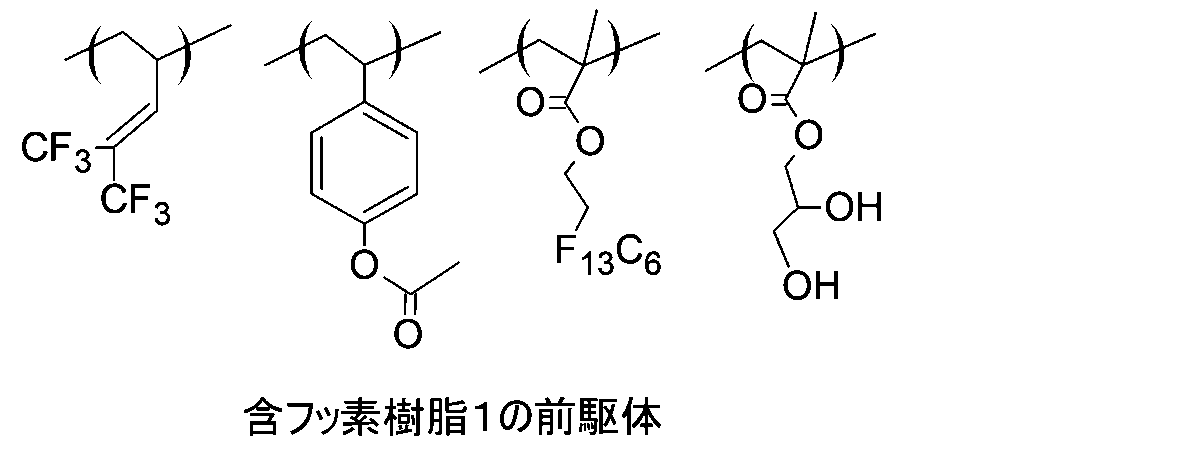
反応終了後、フラスコ内を乾燥空気で置換し、そして反応液を内温60℃に降温した。降温後、フラスコ内に、ジブチルヒドロキシトルエン(東京化成工業株式会社品、以下、BHTと表記する)を0.01質量部、2-イソシアナトエチルアクリラ-ト(昭和電工株式会社品、製品名:カレンズAOI)を11.4質量部入れて、4時間攪拌した。そして、攪拌後の溶液を室温(20℃)に冷却した。
以上のようにして含フッ素樹脂1の溶液を得た。
GPC測定結果に基づくと、含フッ素樹脂1のMwは13,300、Mw/Mnは1.7だった。
以上のようにして含フッ素樹脂1の溶液を得た。
GPC測定結果に基づくと、含フッ素樹脂1のMwは13,300、Mw/Mnは1.7だった。
[黒色顔料分散体1の調製]
下表に記載の顔料、分散剤、アルカリ可溶性樹脂および溶剤を、下表に記載の質量比となるように混合して混合物とした。この混合物を、25℃で、0.5mmφのジルコニアビーズを用い、ビーズミルにて12時間分散処理した。分散処理終了後、濾過によりビーズを取り除いた。このようにして黒色顔料分散体1を調製した。
下表に記載の顔料、分散剤、アルカリ可溶性樹脂および溶剤を、下表に記載の質量比となるように混合して混合物とした。この混合物を、25℃で、0.5mmφのジルコニアビーズを用い、ビーズミルにて12時間分散処理した。分散処理終了後、濾過によりビーズを取り除いた。このようにして黒色顔料分散体1を調製した。

[青色顔料分散体の調製]
下表に記載の顔料、分散剤、アルカリ可溶性樹脂および溶剤を、下表に記載の質量比となるように混合して混合物とした。この混合物を、25℃で、0.5mmφのジルコニアビーズを用い、ビーズミルにて12時間分散処理した。分散処理終了後、濾過によりビーズを取り除いた。このようにして青色顔料分散体を調整した。
下表に記載の顔料、分散剤、アルカリ可溶性樹脂および溶剤を、下表に記載の質量比となるように混合して混合物とした。この混合物を、25℃で、0.5mmφのジルコニアビーズを用い、ビーズミルにて12時間分散処理した。分散処理終了後、濾過によりビーズを取り除いた。このようにして青色顔料分散体を調整した。

<硬化性組成物の調製および容器詰め>
まず、硬化性組成物の調製のために用いた各成分を示す。
[エチレン性炭素-炭素二重結合を有する化合物]
エチレン性不飽和化合物1:日本化薬社製「DPHA」(ジペンタエリスリト-ルヘキサアクリレ-ト)
[チオ-ル系化合物]
チオ-ル化合物1:昭和電工社製「Karenz-MTPE1」
チオ-ル化合物2:SC有機化学工業社製「DPMP」
[ラジカル開始剤]
光ラジカル開始剤1:BASF社製「Irgacure OXE-01」(オキシムエステル系)
[含フッ素樹脂]
含フッ素樹脂1:上記のようにして合成した含フッ素樹脂
[アルカリ可溶性樹脂]
アルカリ可溶性樹脂1:日本化薬社製「ZAR-2050H」(特殊BIS-A型エポキシアクリレ-ト、前掲の一般式(1)で表される構造単位を含む。フッ素原子を含まない。)
[着色顔料分散体]
黒色顔料分散体1:上記のようにして調製した黒色顔料分散体
白色顔料分散体(大日精化工業社製「NX-501」(酸化チタン顔料、ルチル構造、顔料含有量:73質量%、粒子径:D50は、270nm)
青色顔料分散体:上記のようにして調整した青色顔料分散体
[添加剤]
添加剤1:日本化薬社製の密着性改良剤「KAYAMER PM-21」
まず、硬化性組成物の調製のために用いた各成分を示す。
[エチレン性炭素-炭素二重結合を有する化合物]
エチレン性不飽和化合物1:日本化薬社製「DPHA」(ジペンタエリスリト-ルヘキサアクリレ-ト)
[チオ-ル系化合物]
チオ-ル化合物1:昭和電工社製「Karenz-MTPE1」
チオ-ル化合物2:SC有機化学工業社製「DPMP」
[ラジカル開始剤]
光ラジカル開始剤1:BASF社製「Irgacure OXE-01」(オキシムエステル系)
[含フッ素樹脂]
含フッ素樹脂1:上記のようにして合成した含フッ素樹脂
[アルカリ可溶性樹脂]
アルカリ可溶性樹脂1:日本化薬社製「ZAR-2050H」(特殊BIS-A型エポキシアクリレ-ト、前掲の一般式(1)で表される構造単位を含む。フッ素原子を含まない。)
[着色顔料分散体]
黒色顔料分散体1:上記のようにして調製した黒色顔料分散体
白色顔料分散体(大日精化工業社製「NX-501」(酸化チタン顔料、ルチル構造、顔料含有量:73質量%、粒子径:D50は、270nm)
青色顔料分散体:上記のようにして調整した青色顔料分散体
[添加剤]
添加剤1:日本化薬社製の密着性改良剤「KAYAMER PM-21」
また、硬化性組成物とともに容器内に封入する酸素含有気体として、以下を準備した。
[酸素含有気体または比較例用気体]
Air:空気(酸素分は通常約21体積%)
7%O2:酸素7体積%と窒素93体積%の混合気体
N2:100%窒素
Ar:100%アルゴン
[酸素含有気体または比較例用気体]
Air:空気(酸素分は通常約21体積%)
7%O2:酸素7体積%と窒素93体積%の混合気体
N2:100%窒素
Ar:100%アルゴン
後掲の表に記載の各成分と、溶剤としてPGMEAとを均一に撹拌・混合して、感光性の硬化性組成物を調製した。PGMEAの量は不揮発成分濃度が50質量%となる量とした。
サンプラテック社製の、容積200mLのポリエチレン製の遮光容器に、調製した硬化性組成物を入れた。このとき、容器いっぱいに硬化性組成物を入れず、後掲の表の「容器中の酸素含有気体の割合(体積%)」に記載されている体積%のすき間ができるように、硬化性組成物の量は調整した。例えば実施例1の場合には、容器の全容積に対して、100体積%-10体積%=90体積%の量の硬化性組成物を容器内に入れた。
その後、遮光容器内の空気を、各酸素含有気体で置換した。そして、フタをしっかりと閉めて、硬化性組成物入り容器とした。この容器を保管した。
サンプラテック社製の、容積200mLのポリエチレン製の遮光容器に、調製した硬化性組成物を入れた。このとき、容器いっぱいに硬化性組成物を入れず、後掲の表の「容器中の酸素含有気体の割合(体積%)」に記載されている体積%のすき間ができるように、硬化性組成物の量は調整した。例えば実施例1の場合には、容器の全容積に対して、100体積%-10体積%=90体積%の量の硬化性組成物を容器内に入れた。
その後、遮光容器内の空気を、各酸素含有気体で置換した。そして、フタをしっかりと閉めて、硬化性組成物入り容器とした。この容器を保管した。
<評価>
[評価用の隔壁の形成]
以下手順により、基板上に、隔壁(パタ-ン)を形成した。
(1)10cm四方のITO基板を超純水、次いでアセトンにより洗浄した。そして、UVオゾン処理装置(セン特殊光源株式会社製、型番PL17-110)を用い、基板に対するUVオゾン処理を5分間行った。
(2)UVオゾン処理後の基板上に、スピンコ-タを用いて、硬化性組成物を回転数300rpmで塗布した。そして、基板をホットプレ-ト上で、80℃で150秒間加熱した。このようにして樹脂膜を得た。
(3)マスクアライナ(ズ-ス・マイクロテック株式会社製品)を用いて、ライン:スペ-ス=10μm:10μmのマスクを介し、得られた樹脂膜に、i線(波長365nm)を照射した。
(4)0.04質量%の水酸化カリウム水溶液にて、40秒間スプレ-現像を行った。現像後、純水で10秒間リンスした。そして、残留した現像液および/またはリンス液をN2ブロ-にて除去した。
(5)基板をホットプレ-ト上で、200℃で60分間加熱した。
[評価用の隔壁の形成]
以下手順により、基板上に、隔壁(パタ-ン)を形成した。
(1)10cm四方のITO基板を超純水、次いでアセトンにより洗浄した。そして、UVオゾン処理装置(セン特殊光源株式会社製、型番PL17-110)を用い、基板に対するUVオゾン処理を5分間行った。
(2)UVオゾン処理後の基板上に、スピンコ-タを用いて、硬化性組成物を回転数300rpmで塗布した。そして、基板をホットプレ-ト上で、80℃で150秒間加熱した。このようにして樹脂膜を得た。
(3)マスクアライナ(ズ-ス・マイクロテック株式会社製品)を用いて、ライン:スペ-ス=10μm:10μmのマスクを介し、得られた樹脂膜に、i線(波長365nm)を照射した。
(4)0.04質量%の水酸化カリウム水溶液にて、40秒間スプレ-現像を行った。現像後、純水で10秒間リンスした。そして、残留した現像液および/またはリンス液をN2ブロ-にて除去した。
(5)基板をホットプレ-ト上で、200℃で60分間加熱した。
[感度および解像度の評価]
上記[評価用の隔壁の形成]の(3)における露光量を変化させて、ライン:スペ-ス=10μm:10μmのマスクパタ-ンを用いて、基板上にライン:スペ-ス=10μm:10μmのパタ-ンを形成できる露光量、すなわち、マスクパタ-ンと同じ線幅のパタ-ンが解像する最適露光量Eop(mJ/cm2)を求めた。得られたEopを感度の指標とした。
上記[評価用の隔壁の形成]の(3)における露光量を変化させて、ライン:スペ-ス=10μm:10μmのマスクパタ-ンを用いて、基板上にライン:スペ-ス=10μm:10μmのパタ-ンを形成できる露光量、すなわち、マスクパタ-ンと同じ線幅のパタ-ンが解像する最適露光量Eop(mJ/cm2)を求めた。得られたEopを感度の指標とした。
また、最適露光量Eopにおいて得られた隔壁パタ-ンを顕微鏡で観察し、以下基準で解像度を評価した。
・隔壁内の開口部に残渣がなく、ラインエッジラフネスが確認できないもの:優
・僅かに開口部残渣およびラインエッジラフネスのいずれかが確認されるもの:良
・開口部残渣およびラインエッジラフネスの少なくともいずれかが顕著であるもの:不可
・隔壁内の開口部に残渣がなく、ラインエッジラフネスが確認できないもの:優
・僅かに開口部残渣およびラインエッジラフネスのいずれかが確認されるもの:良
・開口部残渣およびラインエッジラフネスの少なくともいずれかが顕著であるもの:不可
[保管による特性変化:粘度変化]
調製直後で容器詰めする前の硬化性組成物の粘度を、B型粘度計(英弘精機株式会社製、型式DV2T)を用いて、サンプル温度25℃、スピンドル回転速度15rpmの条件で測定した。スピンドルとしてはスピンドルULA(AMETEC製)を用いた。測定は6回行い、得られた6つの値の平均値を、粘度(保管前)η0とした。
また、容器詰め後に40℃で7日間保管した後の硬化性組成物の粘度を、同様にして6回測定し、平均値を算出した。そして、その平均値を、粘度(保管後)η1とした。
そして、数式:(|η1-η0|/η0)×100(%)に基づき、保管前後での粘度変化率を計算した。評価基準は以下の通りとした。
・粘度変化率が5%以下のもの:優
・粘度変化率が5%より大きく10%以下のもの:良
・粘度変化率が10%より大きく15%以下のもの:可
・粘度変化率が15%より大きい、または、固体化して測定不可であったもの:不可
調製直後で容器詰めする前の硬化性組成物の粘度を、B型粘度計(英弘精機株式会社製、型式DV2T)を用いて、サンプル温度25℃、スピンドル回転速度15rpmの条件で測定した。スピンドルとしてはスピンドルULA(AMETEC製)を用いた。測定は6回行い、得られた6つの値の平均値を、粘度(保管前)η0とした。
また、容器詰め後に40℃で7日間保管した後の硬化性組成物の粘度を、同様にして6回測定し、平均値を算出した。そして、その平均値を、粘度(保管後)η1とした。
そして、数式:(|η1-η0|/η0)×100(%)に基づき、保管前後での粘度変化率を計算した。評価基準は以下の通りとした。
・粘度変化率が5%以下のもの:優
・粘度変化率が5%より大きく10%以下のもの:良
・粘度変化率が10%より大きく15%以下のもの:可
・粘度変化率が15%より大きい、または、固体化して測定不可であったもの:不可
[保存安定性:解像度]
容器詰め後に40℃で7日間静置した硬化性組成物を用い、[評価用の隔壁の形成]と同様の手順で隔壁(パタ-ン)を形成した。このようにして得られた隔壁を、経時前の硬化性組成物を用いて形成した隔壁と比較した。そして、以下の基準により評価した。
・優:保管前の硬化性組成物を用いて形成した隔壁と同等の外観であった。
・良:保管前の硬化性組成物を用いて形成した隔壁と比較し、開口部の一部に異物および/または残渣が発生した。
・可:保管前の硬化性組成物を用いて形成した隔壁と比較し、開口部全体に異物および/または残渣が発生した。
・不可:現像後にも未露光部が溶解せず、パタ-ンが形成できなかった。
容器詰め後に40℃で7日間静置した硬化性組成物を用い、[評価用の隔壁の形成]と同様の手順で隔壁(パタ-ン)を形成した。このようにして得られた隔壁を、経時前の硬化性組成物を用いて形成した隔壁と比較した。そして、以下の基準により評価した。
・優:保管前の硬化性組成物を用いて形成した隔壁と同等の外観であった。
・良:保管前の硬化性組成物を用いて形成した隔壁と比較し、開口部の一部に異物および/または残渣が発生した。
・可:保管前の硬化性組成物を用いて形成した隔壁と比較し、開口部全体に異物および/または残渣が発生した。
・不可:現像後にも未露光部が溶解せず、パタ-ンが形成できなかった。
硬化性組成物の配合成分に関する情報および評価結果をまとめて下表に示す。
下表においては、溶液または分散液の形で組成物の調製に用いた成分についても、不揮発成分量に換算して量比を記載している。
下表においては、溶液または分散液の形で組成物の調製に用いた成分についても、不揮発成分量に換算して量比を記載している。

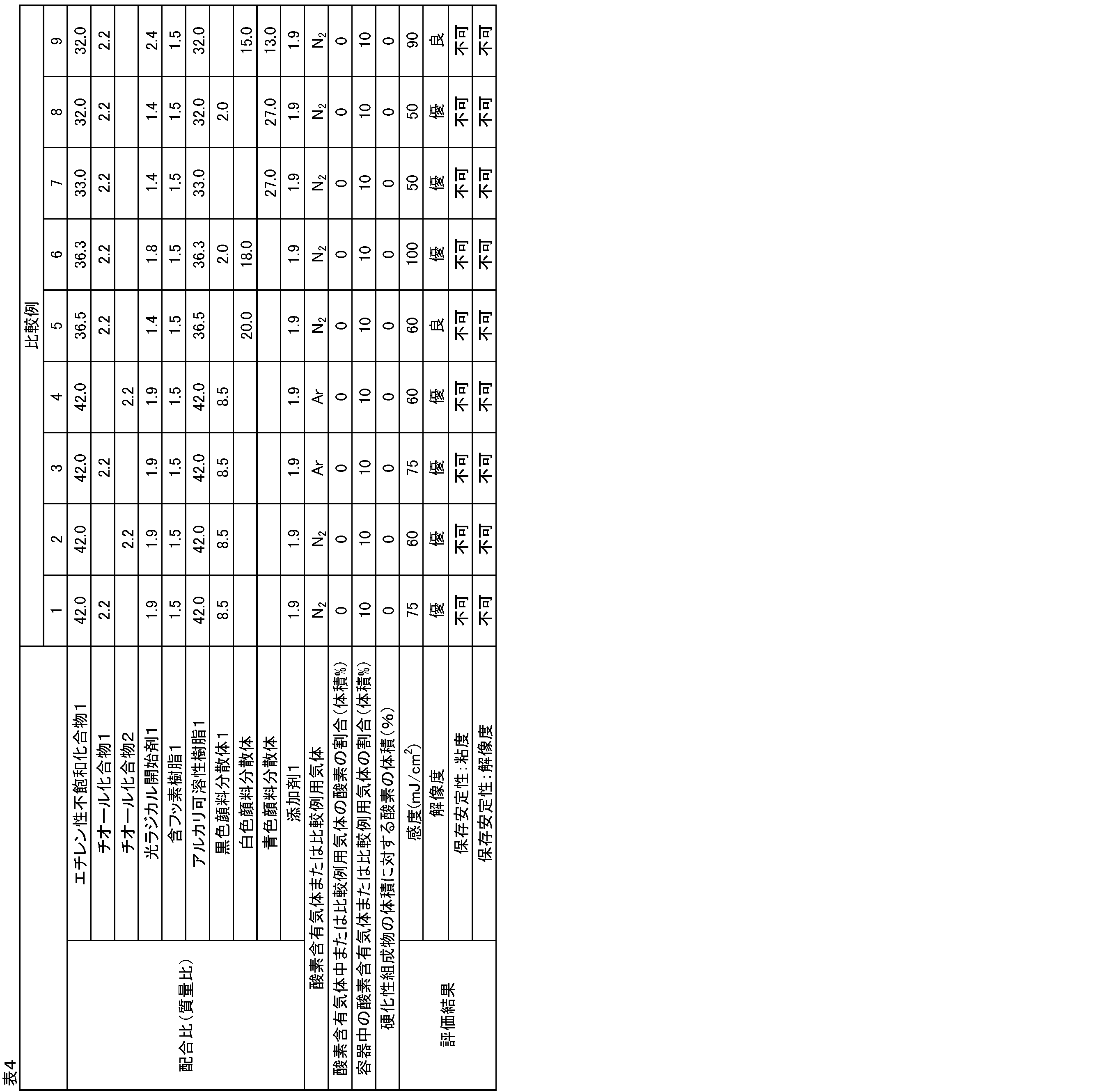
実施例では、感度および解像度は良好であった。また、容器詰めして40℃で7日間静置したときの粘度変化は小さかった。
実施例を細かく分析すると、実施例1~6および10~14と、実施例7~9との対比から、ある程度の量の酸素が容器中に含まれることにより、保管前後での粘度変化がより小さくなることが理解される。
実施例を細かく分析すると、実施例1~6および10~14と、実施例7~9との対比から、ある程度の量の酸素が容器中に含まれることにより、保管前後での粘度変化がより小さくなることが理解される。
実施例に対し、封入ガスに酸素が含まれていなかった比較例1~9では、容器詰めして40℃で7日間静置することで、硬化性組成物の特性は大きく変化してしまった。
<参考:ジスルフィド化合物の生成の確認>
実施例1において、硬化性組成物を容器詰めして40℃で7日間静置した後の容器内の硬化性組成物をGPC測定した。その結果、チオ-ル化合物1が酸化して生成したジスルフィド化合物と思われるピ-クが観測された。
これに対し、比較例1でも同様のGPC測定を行ったが、ジスルフィド化合物と思われるピ-クは確認されなかった。
これら結果は、酸素含有気体中の酸素が硬化性組成物中のチオ-ル系化合物と反応することにより生成するジスルフィド化合物が、硬化性組成物の変質を抑制しているという推定メカニズムを支持するものである。
実施例1において、硬化性組成物を容器詰めして40℃で7日間静置した後の容器内の硬化性組成物をGPC測定した。その結果、チオ-ル化合物1が酸化して生成したジスルフィド化合物と思われるピ-クが観測された。
これに対し、比較例1でも同様のGPC測定を行ったが、ジスルフィド化合物と思われるピ-クは確認されなかった。
これら結果は、酸素含有気体中の酸素が硬化性組成物中のチオ-ル系化合物と反応することにより生成するジスルフィド化合物が、硬化性組成物の変質を抑制しているという推定メカニズムを支持するものである。
この出願は、2023年7月6日に出願された日本出願特願2023-111649号を基礎とする優先権を主張し、その開示の全てをここに取り込む。
1 容器本体
3 フタ
5 硬化性組成物
7 酸素含有気体
11 内袋
13 チュ-ブ
3 フタ
5 硬化性組成物
7 酸素含有気体
11 内袋
13 チュ-ブ
Claims (24)
- エチレン性炭素-炭素二重結合を有する化合物と、チオ-ルおよびチオ-ル前駆体からなる群より選ばれる1または2以上のチオ-ル系化合物と、ラジカル開始剤と、を含む硬化性組成物と、
酸素含有気体と、
が、密封性を有する容器内に密封された、硬化性組成物入り容器。 - 請求項1に記載の硬化性組成物入り容器であって、
前記酸素含有気体の体積は、前記容器の容積の3~50体積%である、硬化性組成物入り容器。 - 請求項1または2に記載の硬化性組成物入り容器であって、
前記酸素含有気体の酸素濃度は1~100体積%である、硬化性組成物入り容器。 - 請求項1または2に記載の硬化性組成物入り容器であって、
前記酸素含有気体の酸素濃度は20~25体積%である、硬化性組成物入り容器。 - 請求項1または2に記載の硬化性組成物入り容器であって、
前記酸素含有気体の圧力は0.5~1.5atmである、硬化性組成物入り容器。 - 請求項1または2に記載の硬化性組成物入り容器であって、
前記酸素含有気体は、窒素ガスおよび貴ガスからなる群より選ばれる少なくともいずれかを含む、硬化性組成物入り容器。 - 請求項1または2に記載の硬化性組成物入り容器であって、
前記密封性を有する容器の、前記硬化性組成物が接する面は樹脂で構成されている、硬化性組成物入り容器。 - 請求項1または2に記載の硬化性組成物入り容器であって、
前記密封性を有する容器は遮光性を備えている、硬化性組成物入り容器。 - 請求項1または2に記載の硬化性組成物入り容器であって、
前記ラジカル開始剤は、光ラジカル開始剤を含む、硬化性組成物入り容器。 - 請求項1または2に記載の硬化性組成物入り容器であって、
前記硬化性組成物中にはジスルフィド化合物が含まれる、硬化性組成物入り容器。 - 請求項1または2に記載の硬化性組成物入り容器であって、
前記硬化性組成物がさらにアルカリ可溶性樹脂を含む、硬化性組成物入り容器。 - 請求項1または2に記載の硬化性組成物入り容器であって、
前記硬化性組成物がさらに含フッ素樹脂を含む、硬化性組成物入り容器。 - 請求項1または2に記載の硬化性組成物入り容器であって、
前記硬化性組成物がさらに着色剤を含む、硬化性組成物入り容器。 - 請求項1または2に記載の硬化性組成物入り容器であって、
当該硬化性組成物入り容器中の硬化性組成物の、B型粘度計を用いて測定される粘度をη0とし、
当該硬化性組成物入り容器を、40℃で7日間保管した後の当該硬化性組成物入り容器中の硬化性組成物の、B型粘度計を用いて測定される粘度をη1としたとき、
(|η1-η0|/η0)×100(%)で定義される粘度変化率の値が15%以下である硬化性組成物入り容器。 - 請求項1または2に記載の硬化性組成物入り容器であって、
当該硬化性組成物入り容器中の硬化性組成物は、発光素子中の隔壁を形成するために用いられる硬化性組成物入り容器。 - 基板上に、請求項1または2に記載の硬化性組成物入り容器中の硬化性組成物を塗布して膜を形成する製膜工程と、
前記膜を加熱して硬化させる加熱工程と、
を有する硬化膜の製造方法。 - 請求項1または2に記載の硬化性組成物入り容器中の硬化性組成物の硬化物で構成されたパタ-ン。
- 請求項17に記載のパタ-ンであって、
発光素子中の隔壁として用いられるパタ-ン。 - 請求項17に記載のパタ-ンと、前記パタ-ンにより区画される領域に配置される発光層また波長変換層と、を備える発光素子。
- 請求項19に記載の発光素子を備える表示装置。
- エチレン性炭素-炭素二重結合を有する化合物と、チオ-ルおよびチオ-ル前駆体からなる群より選ばれる1または2以上のチオ-ル系化合物と、ラジカル開始剤と、を混合して混合物を調製する調製工程と、
前記混合物を、酸素含有気体と接触させる酸素接触工程と、
を含む、硬化性組成物の製造方法。 - 請求項21に記載の硬化性組成物の製造方法であって、
前記酸素接触工程は、1~180日行われる、硬化性組成物の製造方法。 - 請求項21または22に記載の硬化性組成物の製造方法であって、
前記酸素接触工程は、3~35℃下で行われる、硬化性組成物の製造方法。 - 請求項21または22に記載の硬化性組成物の製造方法であって、
前記調製工程と前記酸素接触工程の間に、前記混合物中の溶存気体を脱気する脱気工程を含む、硬化性組成物の製造方法。
Priority Applications (3)
| Application Number | Priority Date | Filing Date | Title |
|---|---|---|---|
| JP2025531568A JPWO2025009544A1 (ja) | 2023-07-06 | 2024-07-03 | |
| CN202480042256.0A CN121548774A (zh) | 2023-07-06 | 2024-07-03 | 装有固化性组合物的容器、固化膜的制造方法、图案、发光元件、显示装置及固化性组合物的制造方法 |
| KR1020267000464A KR20260033526A (ko) | 2023-07-06 | 2024-07-03 | 경화성 조성물 함유 용기, 경화막의 제조 방법, 패턴, 발광 소자, 표시 장치 및 경화성 조성물의 제조 방법 |
Applications Claiming Priority (2)
| Application Number | Priority Date | Filing Date | Title |
|---|---|---|---|
| JP2023-111649 | 2023-07-06 | ||
| JP2023111649 | 2023-07-06 |
Publications (1)
| Publication Number | Publication Date |
|---|---|
| WO2025009544A1 true WO2025009544A1 (ja) | 2025-01-09 |
Family
ID=94171513
Family Applications (1)
| Application Number | Title | Priority Date | Filing Date |
|---|---|---|---|
| PCT/JP2024/024009 Ceased WO2025009544A1 (ja) | 2023-07-06 | 2024-07-03 | 硬化性組成物入り容器、硬化膜の製造方法、パタ-ン、発光素子、表示装置および硬化性組成物の製造方法 |
Country Status (5)
| Country | Link |
|---|---|
| JP (1) | JPWO2025009544A1 (ja) |
| KR (1) | KR20260033526A (ja) |
| CN (1) | CN121548774A (ja) |
| TW (1) | TW202506834A (ja) |
| WO (1) | WO2025009544A1 (ja) |
Citations (5)
| Publication number | Priority date | Publication date | Assignee | Title |
|---|---|---|---|---|
| JP2001305733A (ja) * | 2000-04-18 | 2001-11-02 | Sumitomo Chem Co Ltd | 感光性組成物の保存方法 |
| WO2014084279A1 (ja) * | 2012-11-28 | 2014-06-05 | 旭硝子株式会社 | ネガ型感光性樹脂組成物、樹脂硬化膜、隔壁及び光学素子 |
| JP2016212380A (ja) * | 2015-04-28 | 2016-12-15 | 富士フイルム株式会社 | 感光性樹脂組成物、硬化膜の製造方法、硬化膜、液晶表示装置、有機エレクトロルミネッセンス表示装置およびタッチパネル |
| WO2018139186A1 (ja) * | 2017-01-25 | 2018-08-02 | 富士フイルム株式会社 | 硬化性組成物、化合物、硬化膜、硬化膜の製造方法、カラーフィルタの製造方法、固体撮像素子、赤外線センサ |
| JP2022158138A (ja) * | 2021-04-01 | 2022-10-17 | 富士フイルム株式会社 | 収容体の製造方法、及び、樹脂組成物の保管方法 |
-
2024
- 2024-07-03 WO PCT/JP2024/024009 patent/WO2025009544A1/ja not_active Ceased
- 2024-07-03 KR KR1020267000464A patent/KR20260033526A/ko active Pending
- 2024-07-03 JP JP2025531568A patent/JPWO2025009544A1/ja active Pending
- 2024-07-03 CN CN202480042256.0A patent/CN121548774A/zh active Pending
- 2024-07-05 TW TW113125318A patent/TW202506834A/zh unknown
Patent Citations (5)
| Publication number | Priority date | Publication date | Assignee | Title |
|---|---|---|---|---|
| JP2001305733A (ja) * | 2000-04-18 | 2001-11-02 | Sumitomo Chem Co Ltd | 感光性組成物の保存方法 |
| WO2014084279A1 (ja) * | 2012-11-28 | 2014-06-05 | 旭硝子株式会社 | ネガ型感光性樹脂組成物、樹脂硬化膜、隔壁及び光学素子 |
| JP2016212380A (ja) * | 2015-04-28 | 2016-12-15 | 富士フイルム株式会社 | 感光性樹脂組成物、硬化膜の製造方法、硬化膜、液晶表示装置、有機エレクトロルミネッセンス表示装置およびタッチパネル |
| WO2018139186A1 (ja) * | 2017-01-25 | 2018-08-02 | 富士フイルム株式会社 | 硬化性組成物、化合物、硬化膜、硬化膜の製造方法、カラーフィルタの製造方法、固体撮像素子、赤外線センサ |
| JP2022158138A (ja) * | 2021-04-01 | 2022-10-17 | 富士フイルム株式会社 | 収容体の製造方法、及び、樹脂組成物の保管方法 |
Also Published As
| Publication number | Publication date |
|---|---|
| KR20260033526A (ko) | 2026-03-10 |
| TW202506834A (zh) | 2025-02-16 |
| JPWO2025009544A1 (ja) | 2025-01-09 |
| CN121548774A (zh) | 2026-02-17 |
Similar Documents
| Publication | Publication Date | Title |
|---|---|---|
| WO2007061115A1 (ja) | 隔壁、カラーフィルタ、有機elの製造方法 | |
| TW201708376A (zh) | 著色感光性樹脂組成物、著色圖案或黑矩陣、濾色器、液晶顯示裝置或固體影像感測元件及濾色器之製造方法 | |
| US20240085791A1 (en) | Colored photosensitive resin composition and mutilayer cured film prepared therefrom | |
| JP2023539515A (ja) | 硬化性組成物、前記組成物を用いて製造された硬化膜、および前記硬化膜を含むカラーフィルタ | |
| CN113892057A (zh) | 感光性树脂组合物及有机el元件间隔壁 | |
| CN111983891B (zh) | 用于量子点阻挡肋的结构及其制备方法 | |
| TW202315924A (zh) | 可固化組成物、使用所述組成物的固化層、包括固化層的彩色濾光片及包括彩色濾光片的顯示裝置 | |
| WO2025009544A1 (ja) | 硬化性組成物入り容器、硬化膜の製造方法、パタ-ン、発光素子、表示装置および硬化性組成物の製造方法 | |
| WO2025009543A1 (ja) | 感光性組成物、硬化膜の製造方法、隔壁、発光素子および表示装置 | |
| TWI900597B (zh) | 黑色抗蝕劑用感光性樹脂組成物、其製造方法、遮光膜、彩色濾光片、觸控面板及顯示裝置 | |
| WO2024162218A1 (ja) | 感光性組成物、樹脂硬化膜の製造方法、隔壁、発光素子および表示装置 | |
| TW202315898A (zh) | 可固化組成物、使用所述組成物的固化層、包括固化層的彩色濾光片及包括彩色濾光片的顯示裝置 | |
| WO2026034316A1 (ja) | 感光性組成物、樹脂硬化膜の製造方法、隔壁、発光素子、表示装置、光変換画素、カラーフィルタおよび画像表示装置 | |
| WO2025033369A1 (ja) | 黒色パターンを備えた基板の製造方法、黒色パターンを備えた基板、発光素子およびネガ型感光性組成物 | |
| US20220275241A1 (en) | Photosensitive resin composition and organic el element partition wall | |
| WO2026034319A1 (ja) | 感光性組成物、樹脂硬化膜の製造方法、隔壁、発光素子、表示装置、光変換画素、カラーフィルタおよび画像表示装置 | |
| WO2025094808A1 (ja) | 感光性組成物、基板の製造方法および表示装置 | |
| KR20260051386A (ko) | 흑색 패턴을 구비한 기판의 제조 방법, 흑색 패턴을 구비한 기판, 발광 소자 및 네거티브형 감광성 조성물 | |
| CN120882836A (zh) | 可固化组合物、使用所述组合物的固化层以及包含所述固化层的显示装置 | |
| TW202337920A (zh) | 可固化組成物、使用組成物的固化層、包含固化層的彩色濾光片以及包含彩色濾光片的顯示裝置 | |
| TW202500593A (zh) | 可固化組成物、使用所述組成物的固化層以及包括所述固化層的顯示裝置 | |
| TW202511302A (zh) | 可固化組成物、使用所述組成物的固化層及包括所述固化層的顯示裝置 | |
| JP2025139570A (ja) | 感光性着色組成物、硬化物、画像表示パネル、カラーフィルター、画像表示装置、及び硬化物の製造方法 | |
| TW202502944A (zh) | 可固化組成物、使用所述組成物的固化層及包括所述固化層的顯示裝置 | |
| TW202500594A (zh) | 可固化組成物、使用所述組成物的固化層及包括所述固化層的顯示裝置 |
Legal Events
| Date | Code | Title | Description |
|---|---|---|---|
| 121 | Ep: the epo has been informed by wipo that ep was designated in this application |
Ref document number: 24836057 Country of ref document: EP Kind code of ref document: A1 |
|
| ENP | Entry into the national phase |
Ref document number: 2025531568 Country of ref document: JP Kind code of ref document: A |
|
| WWE | Wipo information: entry into national phase |
Ref document number: 2025531568 Country of ref document: JP |
|
| NENP | Non-entry into the national phase |
Ref country code: DE |