WO2025009258A1 - コリン部分に安定同位体元素を含むリゾホスファチジルコリン化合物を用いた分析方法 - Google Patents
コリン部分に安定同位体元素を含むリゾホスファチジルコリン化合物を用いた分析方法 Download PDFInfo
- Publication number
- WO2025009258A1 WO2025009258A1 PCT/JP2024/016790 JP2024016790W WO2025009258A1 WO 2025009258 A1 WO2025009258 A1 WO 2025009258A1 JP 2024016790 W JP2024016790 W JP 2024016790W WO 2025009258 A1 WO2025009258 A1 WO 2025009258A1
- Authority
- WO
- WIPO (PCT)
- Prior art keywords
- lysophosphatidylcholine
- stable isotope
- lpc
- compound containing
- choline moiety
- Prior art date
- Legal status (The legal status is an assumption and is not a legal conclusion. Google has not performed a legal analysis and makes no representation as to the accuracy of the status listed.)
- Ceased
Links
Images
Classifications
-
- G—PHYSICS
- G01—MEASURING; TESTING
- G01N—INVESTIGATING OR ANALYSING MATERIALS BY DETERMINING THEIR CHEMICAL OR PHYSICAL PROPERTIES
- G01N27/00—Investigating or analysing materials by the use of electric, electrochemical, or magnetic means
- G01N27/62—Investigating or analysing materials by the use of electric, electrochemical, or magnetic means by investigating the ionisation of gases, e.g. aerosols; by investigating electric discharges, e.g. emission of cathode
- G01N27/622—Ion mobility spectrometry
- G01N27/623—Ion mobility spectrometry combined with mass spectrometry
-
- G—PHYSICS
- G01—MEASURING; TESTING
- G01N—INVESTIGATING OR ANALYSING MATERIALS BY DETERMINING THEIR CHEMICAL OR PHYSICAL PROPERTIES
- G01N27/00—Investigating or analysing materials by the use of electric, electrochemical, or magnetic means
- G01N27/62—Investigating or analysing materials by the use of electric, electrochemical, or magnetic means by investigating the ionisation of gases, e.g. aerosols; by investigating electric discharges, e.g. emission of cathode
Definitions
- the present invention relates to an analytical method using a lysophosphatidylcholine compound that contains a stable isotope element in the choline portion.
- JP 2017-187492 A proposes a method for detecting at least one of lysophosphatidylcholine (LPC) and lysophosphatidic acid (LPA) in a sample derived from human cerebrospinal fluid.
- LPC lysophosphatidylcholine
- LPA lysophosphatidic acid
- lysophosphatidylcholine examples include one or more selected from LPC_14_0, LPC_16_0, LPC_16_1, LPC_18_0, LPC_18_1, LPC_18_2, LPC_20_4, LPC_20_5, and LPC_22_6, and specific examples of lysophosphatidic acid include one or more selected from total LPA, LPA_16_0, LPA_18_0, LPA_18_1, LPA_18_2, LPA_20_4, and LPA_22_6.
- the first number indicates the number of carbon atoms in the fatty acid chain
- the second number indicates the number of double bonds in the fatty acid chain.
- LPA_17_0 unlabeled with stable isotopes
- the present invention aims to solve the above problems and develop a technology that can accurately analyze lysophosphatidylcholine and lysophosphatidic acid in cerebrospinal fluid.
- the first aspect of the present invention relates to an analytical method including a step of detecting at least one of lysophosphatidylcholine and lysophosphatidic acid in a biological sample by mass spectrometry, in which a lysophosphatidylcholine compound containing a stable isotope in the choline moiety is used as a standard sample.
- a compound not present in the body is used as a standard sample, thereby improving quantitative accuracy. Furthermore, according to the analytical method of the present invention, a lysophosphatidylcholine compound containing a stable isotope element in the choline moiety is used as a standard sample, thereby avoiding contamination of the detection target and crosstalk in mass spectrometry, thereby improving quantitative accuracy.
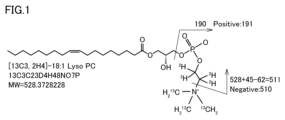
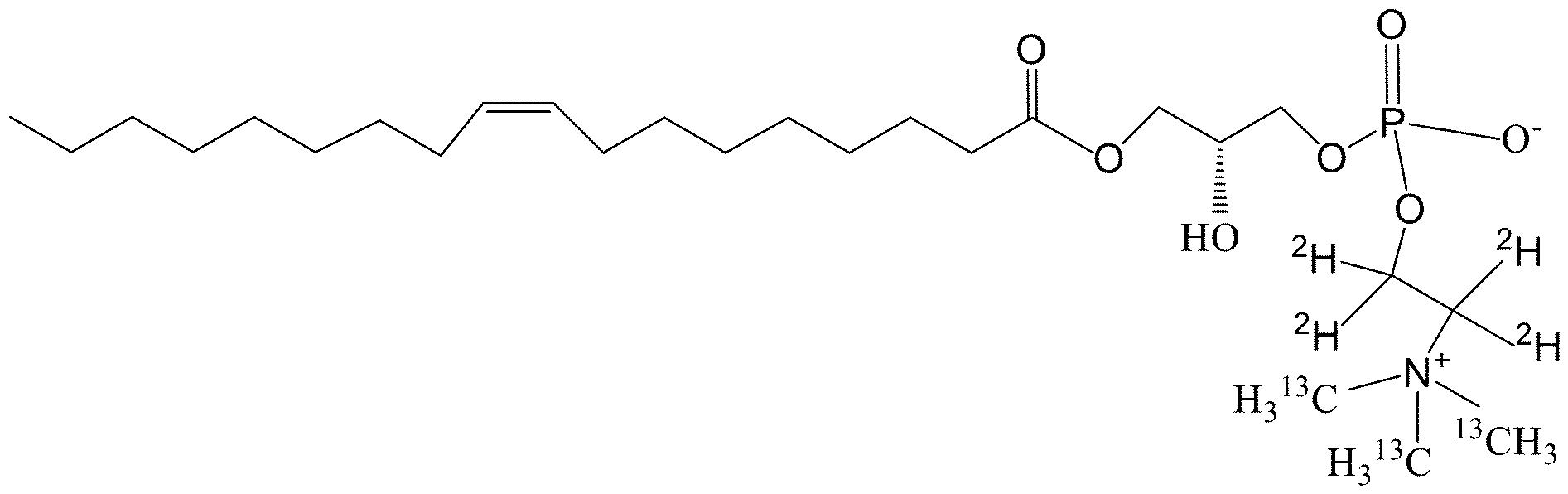
- FIG. 1 shows particularly preferred examples of lysophosphatidylcholine compounds used as labeled samples in the first aspect of the present invention.
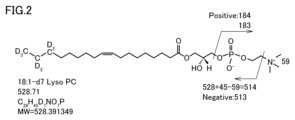
- FIG. 1 shows a conventional lysophosphatidylcholine compound into which a stable isotope has been introduced.
- the first aspect of the present invention is an analytical method including a step of detecting at least one of lysophosphatidylcholine and lysophosphatidic acid in a biological sample by mass spectrometry, in which a lysophosphatidylcholine compound containing a stable isotope in the choline moiety is used as a standard sample.
- the quantitative accuracy can be improved by using a lysophosphatidylcholine compound containing a stable isotope that is not present in vivo as a standard sample, but the quantitative accuracy can vary greatly depending on where in the lysophosphatidylcholine compound the stable isotope is contained.
- by labeling the choline portion adjacent to the phosphate group of lysophosphatidylcholine by introducing a stable isotope it is possible to avoid contamination of the detection target and crosstalk in mass spectrometry, and improve quantitative accuracy.
- the stable isotope element used in the first aspect of the present invention may be any stable isotope element of an atom constituting the choline moiety adjacent to the phosphate group of lysophosphatidylcholine, and may include at least one of deuterium ( 2H ), heavy carbon ( 13C ) and heavy nitrogen ( 15N ).
- deuterium 2H
- heavy carbon 13C
- heavy nitrogen 15N
- at least one of deuterium and heavy carbon is preferable, and it is particularly preferable that both deuterium and heavy carbon are contained.
- the lysophosphatidylcholine to be used as the lysophosphatidylcholine compound containing a stable isotope is preferably selected from LPC_14_0, LPC_16_0, LPC_16_1, LPC_18_0, LPC_18_1, LPC_18_2, LPC_20_4, LPC_20_5, and LPC_22_6 contained in cerebrospinal fluid, and among these, LPC_18_0 or LPC_18_1, which have a relatively high concentration in cerebrospinal fluid, are particularly preferred.
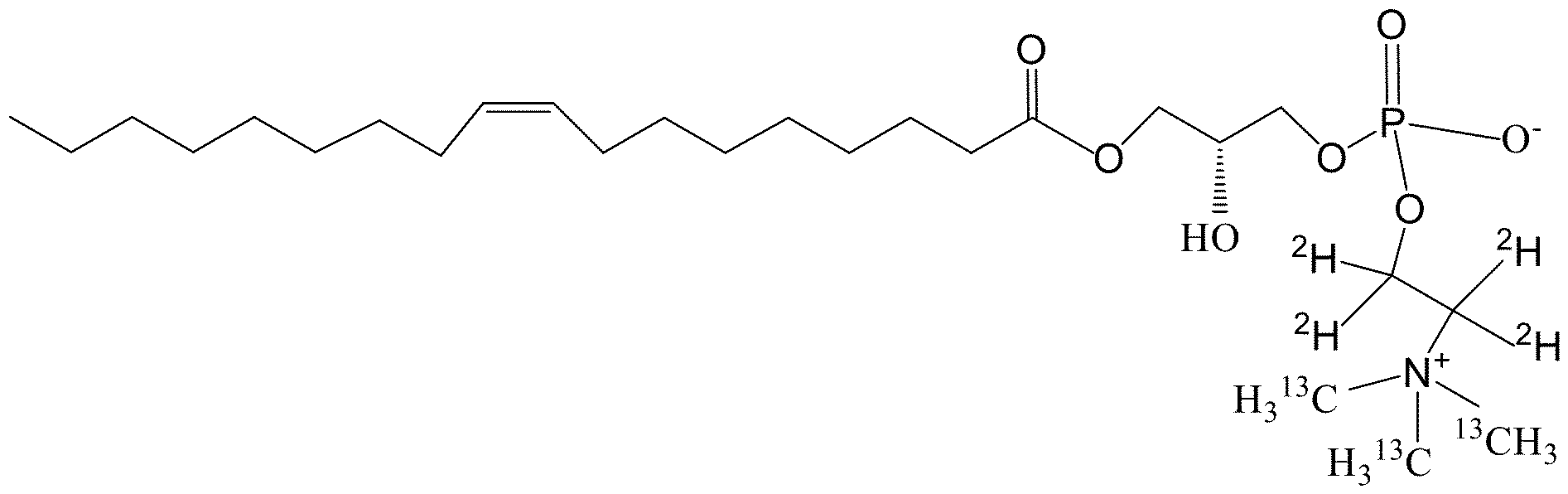
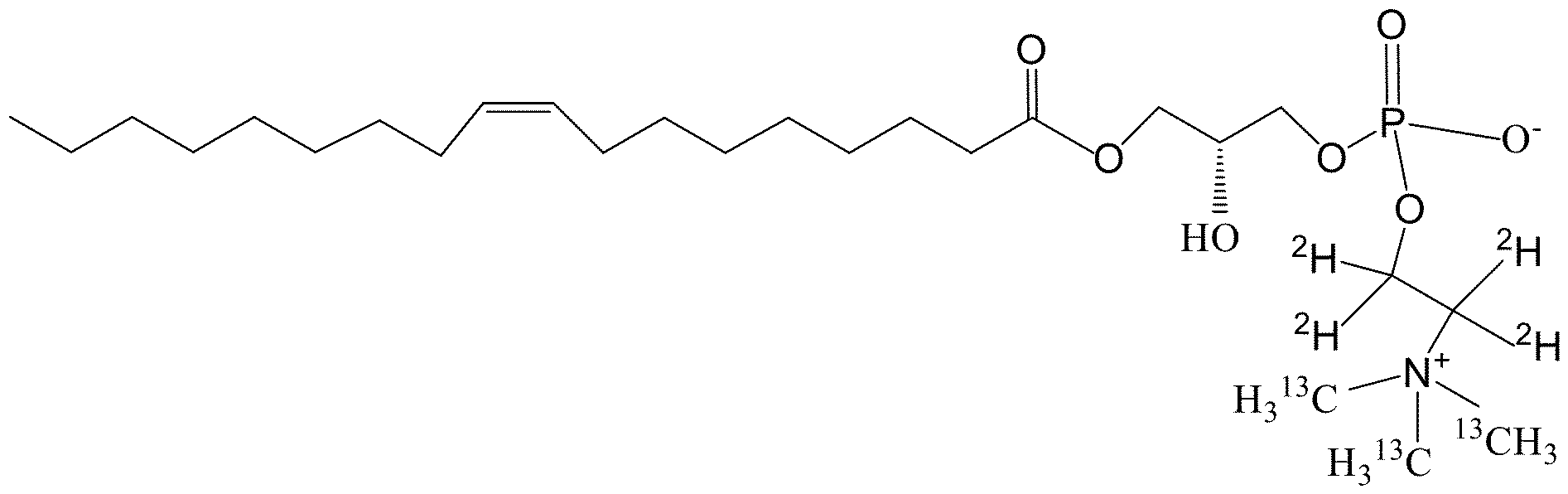
- lysophosphatidylcholine compound containing a stable isotope is the lysophosphatidylcholine compound represented by the following structure ([ 13 C3, 2 H4]-18:1 Lyso PC/ 13 C3C23D4H48NO7P).
- the above lysophosphatidylcholine compound is a labeled compound in which four deuterium atoms and three heavy carbon atoms have been introduced into the choline portion of LPC_18_1.
- the detection target in the biological sample may be at least one of lysophosphatidylcholine and lysophosphatidic acid.
- the detection target may be one or more lysophosphatidylcholine selected from LPC_14_0, LPC_16_0, LPC_16_1, LPC_18_0, LPC_18_1, LPC_18_2, LPC_20_4, LPC_20_5, and LPC_22_6, as disclosed in JP2017-187492A, and one or more lysophosphatidic acids selected from total LPA, LPA_16_0, LPA_18_0, LPA_18_1, LPA_18_2, LPA_20_4, and LPA_22_6.
- LPC_18_0 or LPC_18_1 is particularly preferred among the above specific examples.
- Lysophosphatidylcholine compounds containing stable isotopes can be appropriately synthesized by combining known methods, but it is of course also possible to obtain commercially available lysophosphatidylcholine compounds.
- the biological sample is preferably cerebrospinal fluid (human cerebrospinal fluid). Cerebrospinal fluid tests are commonly performed in clinical settings to diagnose various diseases, and a small amount of cerebrospinal fluid collected before spinal cord imaging may be used as is as the biological sample. Furthermore, the biological sample may be used to measure the concentration of components after appropriate publicly known pretreatment as necessary.
- the mass spectrometry may be, for example, Laser Desorption/Ionization Time Of Flight Mass Spectrometry (LDI-TOF/MS) or Electrospray Ionization-Mass Spectrometry (ESI-MS).
- LLI-TOF/MS Laser Desorption/Ionization Time Of Flight Mass Spectrometry
- ESI-MS Electrospray Ionization-Mass Spectrometry
- the target lipid molecular species can be detected by pattern analysis of the spectrum obtained by the TOF/MS device. By detecting the presence or absence of a peak of a specific m/z value, it is possible to qualitatively detect whether the target lipid molecular species is present in the sample. Quantitative detection is also possible by the high and low m/z peaks of the spectrum.
- LDI-TOF/MS may be, for example, matrix-assisted laser desorption/ionization time-of-flight mass spectrometry (MALDI-TOF/MS method) or surface-enhanced laser desorption/ionization time-of-flight mass spectrometry (SELDI-TOF/MS method).
- the MALDI-TOF/MS method is an omics analysis method that combines MALDI and TOF/MS.
- a biological sample is subjected to appropriate pretreatment to prepare an analytical sample, to which a matrix solution such as ⁇ -cyano-4-hydroxycinnamic acid (CHCA) and dihydroxybenzoic acid (DHB) is added, and then applied to the MALDI-TOF/MS system.
- a matrix solution such as ⁇ -cyano-4-hydroxycinnamic acid (CHCA) and dihydroxybenzoic acid (DHB) is added
- the SELDI-TOF/MS method is a protein chip technology that combines SELDI and TOF/MS.
- a biological sample is subjected to appropriate pretreatment to prepare an analytical sample, which is then applied to a protein chip to adsorb lipid molecular species onto the chip, and then loaded into a SELDI-TOF/MS system.
- chips on which functional groups such as hydrophobic groups, ion exchange groups, and metal ion immobilization groups are immobilized
- chips on which specific binding molecules e.g., antibodies, antibody fragments, aptamers, etc.
- a separation means such as high performance liquid chromatography or gas chromatography directly connected to a mass spectrometer. Since the lipid molecular species of the present invention have a relatively low molecular weight, when detecting lipid molecular species using the ESI-MS method, it is desirable to use a separation means under conditions suitable for separating lipid molecular species of low molecular weight.
- the quantitative accuracy can be improved by using a compound that does not exist in the body as a standard sample.
- a lysophosphatidylcholine compound containing a stable isotope element in the choline moiety as a standard sample, contamination of the detection target and crosstalk in mass spectrometry can be avoided, and quantitative accuracy can be improved.
- An analytical method includes a step of detecting at least one of lysophosphatidylcholine and lysophosphatidic acid in a biological sample by mass spectrometry, and uses a lysophosphatidylcholine compound containing a stable isotope in the choline moiety as a standard sample.
- the stable isotope element is at least one of deuterium and heavy carbon.
- the stable isotope element is at least one of deuterium and heavy carbon, so that a lysophosphatidylcholine compound containing a stable isotope element in the choline portion can be easily produced compared to the case where heavy nitrogen is used.
- the lysophosphatidylcholine compound containing a stable isotope atom in the choline moiety is LPC_18_0 or LPC_18_1 containing a stable isotope atom in the choline moiety.
- the lysophosphatidylcholine compound containing a stable isotope in the choline moiety has the following structure:
- the quantitative accuracy can be improved by using a lysophosphatidylcholine compound that does not exist in vivo, has the above structure, and contains a stable isotope element in the choline moiety as a standard sample. Also, according to the analytical method described in paragraph 4, the quantitative accuracy can be improved by using a lysophosphatidylcholine compound that has the above structure and contains a stable isotope element in the choline moiety as a standard sample, which avoids contamination of the detection target and crosstalk in mass spectrometry.
- lysophosphatidylcholine can be detected with high quantitative accuracy. Furthermore, according to the analytical method described in paragraph 5, contamination of the detection target and crosstalk in mass spectrometry can be avoided, and lysophosphatidylcholine can be detected with high quantitative accuracy.
- the biological sample is cerebrospinal fluid.
- the analytical method described in paragraph 6 makes it possible to accurately analyze lysophosphatidylcholine and lysophosphatidic acid in cerebrospinal fluid.
Landscapes
- Chemical & Material Sciences (AREA)
- Physics & Mathematics (AREA)
- Health & Medical Sciences (AREA)
- Life Sciences & Earth Sciences (AREA)
- Analytical Chemistry (AREA)
- Electrochemistry (AREA)
- Chemical Kinetics & Catalysis (AREA)
- Biochemistry (AREA)
- General Health & Medical Sciences (AREA)
- General Physics & Mathematics (AREA)
- Immunology (AREA)
- Pathology (AREA)
- Spectroscopy & Molecular Physics (AREA)
- Molecular Biology (AREA)
- Other Investigation Or Analysis Of Materials By Electrical Means (AREA)
Abstract
Description


上述した例示的な実施形態は、以下の態様の具体例であることが当業者により理解される。
一態様に係る分析方法は、生体試料中のリゾホスファチジルコリンおよびリゾホスファチジン酸の少なくともいずれかを質量分析により検出するステップを含む分析方法であって、コリン部分に安定同位体元素を含むリゾホスファチジルコリン化合物を標準試料として用いる。
一態様に係る分析方法において、安定同位体元素が重水素および重炭素の少なくともいずれかである。
一態様に係る分析方法において、コリン部分に安定同位体元素を含むリゾホスファチジルコリン化合物が、コリン部分に安定同位体元素を含むLPC_18_0またはLPC_18_1である。
一態様に係る分析方法において、コリン部分に安定同位体元素を含むリゾホスファチジルコリン化合物が、下記構造を有する。
一態様に係る分析方法において、生体試料中のリゾホスファチジルコリンを検出する。
一態様に係る分析方法において、生体試料が髄液である。
Claims (6)
- 生体試料中のリゾホスファチジルコリンおよびリゾホスファチジン酸の少なくともいずれかを質量分析により検出するステップを含む分析方法であって、コリン部分に安定同位体元素を含むリゾホスファチジルコリン化合物を標準試料として用いる、方法。
- 安定同位体元素が重水素および重炭素の少なくともいずれかである、請求項1に記載の方法。
- コリン部分に安定同位体元素を含むリゾホスファチジルコリン化合物が、コリン部分に安定同位体元素を含むLPC_18_0またはLPC_18_1である、請求項1または2に記載の方法。
- コリン部分に安定同位体元素を含むリゾホスファチジルコリン化合物が、下記構造を有する、請求項3に記載の方法。
- 生体試料中のリゾホスファチジルコリンを検出する、請求項1に記載の方法。
- 生体試料が髄液である、請求項1に記載の方法。
Priority Applications (3)
| Application Number | Priority Date | Filing Date | Title |
|---|---|---|---|
| EP24835780.8A EP4741813A1 (en) | 2023-07-03 | 2024-05-01 | Analysis method using lysophosphatidylcholine compound containing stable isotope element in choline moiety |
| CN202480041938.XA CN121464343A (zh) | 2023-07-03 | 2024-05-01 | 使用胆碱部分含有稳定同位素的溶血磷脂酰胆碱化合物的分析方法 |
| JP2025530994A JPWO2025009258A1 (ja) | 2023-07-03 | 2024-05-01 |
Applications Claiming Priority (2)
| Application Number | Priority Date | Filing Date | Title |
|---|---|---|---|
| JP2023109202 | 2023-07-03 | ||
| JP2023-109202 | 2023-07-03 |
Publications (1)
| Publication Number | Publication Date |
|---|---|
| WO2025009258A1 true WO2025009258A1 (ja) | 2025-01-09 |
Family
ID=94171631
Family Applications (1)
| Application Number | Title | Priority Date | Filing Date |
|---|---|---|---|
| PCT/JP2024/016790 Ceased WO2025009258A1 (ja) | 2023-07-03 | 2024-05-01 | コリン部分に安定同位体元素を含むリゾホスファチジルコリン化合物を用いた分析方法 |
Country Status (4)
| Country | Link |
|---|---|
| EP (1) | EP4741813A1 (ja) |
| JP (1) | JPWO2025009258A1 (ja) |
| CN (1) | CN121464343A (ja) |
| WO (1) | WO2025009258A1 (ja) |
Citations (3)
| Publication number | Priority date | Publication date | Assignee | Title |
|---|---|---|---|---|
| JP2017524708A (ja) * | 2014-07-30 | 2017-08-31 | メタボロン,インコーポレイテッド | 構造的に多様な複合脂質を分析するための方法、組成物およびキット |
| JP2017187492A (ja) | 2016-04-04 | 2017-10-12 | 国立大学法人 東京大学 | 疼痛の評価方法 |
| JP2022118008A (ja) * | 2016-07-22 | 2022-08-12 | 株式会社リピドームラボ | 新規リン脂質およびその利用ならびにリン脂質分離測定法の開発 |
-
2024
- 2024-05-01 JP JP2025530994A patent/JPWO2025009258A1/ja active Pending
- 2024-05-01 WO PCT/JP2024/016790 patent/WO2025009258A1/ja not_active Ceased
- 2024-05-01 EP EP24835780.8A patent/EP4741813A1/en active Pending
- 2024-05-01 CN CN202480041938.XA patent/CN121464343A/zh active Pending
Patent Citations (3)
| Publication number | Priority date | Publication date | Assignee | Title |
|---|---|---|---|---|
| JP2017524708A (ja) * | 2014-07-30 | 2017-08-31 | メタボロン,インコーポレイテッド | 構造的に多様な複合脂質を分析するための方法、組成物およびキット |
| JP2017187492A (ja) | 2016-04-04 | 2017-10-12 | 国立大学法人 東京大学 | 疼痛の評価方法 |
| JP2022118008A (ja) * | 2016-07-22 | 2022-08-12 | 株式会社リピドームラボ | 新規リン脂質およびその利用ならびにリン脂質分離測定法の開発 |
Non-Patent Citations (1)
| Title |
|---|
| PENG KANG-YU, BARLOW CHRISTOPHER K, KAMMOUN HELENE, MELLETT NATALIE A, WEIR JACQUELYN M, MURPHY ANDREW J, FEBBRAIO MARK A, MEIKLE : "Stable Isotopic Tracer Phospholipidomics Reveals Contributions of Key Phospholipid Biosynthetic Pathways to Low Hepatocyte Phosphatidylcholine to Phosphatidylethanolamine Ratio Induced by Free Fatty Acids", METABOLITES, vol. 11, no. 3, pages 188 - 188-18, XP093258586, ISSN: 2218-1989, DOI: 10.3390/metabo11030188 * |
Also Published As
| Publication number | Publication date |
|---|---|
| EP4741813A1 (en) | 2026-05-13 |
| JPWO2025009258A1 (ja) | 2025-01-09 |
| CN121464343A (zh) | 2026-02-03 |
Similar Documents
| Publication | Publication Date | Title |
|---|---|---|
| Blanksby et al. | Advances in mass spectrometry for lipidomics | |
| Paglia et al. | Metabolomics and lipidomics using traveling-wave ion mobility mass spectrometry | |
| CN114127554B (zh) | 通过质谱法测定抗抑郁药 | |
| CN115201484B (zh) | 通过质谱法定量胰岛素 | |
| US20100227352A1 (en) | Expression Quantification Using Mass Spectrometry | |
| US8426155B2 (en) | Proteome analysis in mass spectrometers containing RF ion traps | |
| WO2010099108A2 (en) | Multiplexing derivatized anayltes using mass spectroscopy | |
| US7070949B2 (en) | Protein mixture analysis by mass spectrometry | |
| US8890061B1 (en) | Methods of detecting reverse triiodothyronine by mass spectrometry | |
| US7158903B2 (en) | Methods for quantitative analysis by tandem mass spectrometry | |
| EP3555615A1 (en) | Mass spectrometry assay method for detection and quantitation of kidney function metabolites | |
| US20110240843A1 (en) | Methods for detecting catecholamines by mass spectrometry | |
| JP2016506525A (ja) | 質量分析によるcペプチド検出 | |
| WO2005114700A2 (en) | Expression quantification using mass spectrometry | |
| US20250172576A1 (en) | Method for determining chemical structure of lipid and ion mobility-tandem mass spectrometer | |
| EP4211473A1 (en) | Methods and systems for detecting prostaglandins by lc-ms/ms | |
| EP2435832A1 (en) | Methods and reagents for the quantitative determination of metabolites in biological samples | |
| CN110044998B (zh) | 通过质谱法定量他莫昔芬及其代谢物 | |
| Schultz et al. | Liquid chromatography quadrupole time-of-flight characterization of metabolites guided by the METLIN database | |
| JP2020530904A (ja) | マススペクトロメトリーによるグアニジノ酢酸、クレアチン、及びクレアチニンの検出及び定量 | |
| US6939718B2 (en) | Mass spectrometry of prostaglandins | |
| EP4741813A1 (en) | Analysis method using lysophosphatidylcholine compound containing stable isotope element in choline moiety | |
| Xie et al. | Methods of lipidomic analysis: extraction, derivatization, separation, and identification of lipids | |
| US20140361160A1 (en) | Methods for detecting lacosamide by mass spectrometry | |
| US20140212981A1 (en) | Methods and systems for determining the amount of thiopurine metabolites in a sample |
Legal Events
| Date | Code | Title | Description |
|---|---|---|---|
| 121 | Ep: the epo has been informed by wipo that ep was designated in this application |
Ref document number: 24835780 Country of ref document: EP Kind code of ref document: A1 |
|
| ENP | Entry into the national phase |
Ref document number: 2025530994 Country of ref document: JP Kind code of ref document: A |
|
| WWE | Wipo information: entry into national phase |
Ref document number: 2025530994 Country of ref document: JP |
|
| WWE | Wipo information: entry into national phase |
Ref document number: 2024835780 Country of ref document: EP |
|
| NENP | Non-entry into the national phase |
Ref country code: DE |
|
| ENP | Entry into the national phase |
Ref document number: 2024835780 Country of ref document: EP Effective date: 20260203 |
|
| WWP | Wipo information: published in national office |
Ref document number: 2024835780 Country of ref document: EP |