WO2025009241A1 - 負極用組成物、負極、及び二次電池 - Google Patents
負極用組成物、負極、及び二次電池 Download PDFInfo
- Publication number
- WO2025009241A1 WO2025009241A1 PCT/JP2024/014273 JP2024014273W WO2025009241A1 WO 2025009241 A1 WO2025009241 A1 WO 2025009241A1 JP 2024014273 W JP2024014273 W JP 2024014273W WO 2025009241 A1 WO2025009241 A1 WO 2025009241A1
- Authority
- WO
- WIPO (PCT)
- Prior art keywords
- lignin
- negative electrode
- mass
- amount
- treatment
- Prior art date
- Legal status (The legal status is an assumption and is not a legal conclusion. Google has not performed a legal analysis and makes no representation as to the accuracy of the status listed.)
- Ceased
Links
Classifications
-
- Y—GENERAL TAGGING OF NEW TECHNOLOGICAL DEVELOPMENTS; GENERAL TAGGING OF CROSS-SECTIONAL TECHNOLOGIES SPANNING OVER SEVERAL SECTIONS OF THE IPC; TECHNICAL SUBJECTS COVERED BY FORMER USPC CROSS-REFERENCE ART COLLECTIONS [XRACs] AND DIGESTS
- Y02—TECHNOLOGIES OR APPLICATIONS FOR MITIGATION OR ADAPTATION AGAINST CLIMATE CHANGE
- Y02E—REDUCTION OF GREENHOUSE GAS [GHG] EMISSIONS, RELATED TO ENERGY GENERATION, TRANSMISSION OR DISTRIBUTION
- Y02E60/00—Enabling technologies; Technologies with a potential or indirect contribution to GHG emissions mitigation
- Y02E60/10—Energy storage using batteries
Definitions
- the present invention relates to a negative electrode composition used in the negative electrode of a secondary battery, a negative electrode using the same, and a secondary battery.
- graphite-based materials are used for the negative electrodes of lithium ion secondary batteries, but the theoretical capacity of graphite-based materials is 372 mAh/g (LiC 6 ), which is currently approaching its limit.
- silicon can absorb up to 4.4 lithium atoms per silicon atom in molar ratio, and theoretically, it can obtain a capacity about 10 times that of graphite-based carbon materials.
- silicon particles absorb lithium, their volume expands by about 3 to 4 times, and repeated charging and discharging causes deterioration and a decrease in capacity, which is a problem.
- a detailed analysis of this phenomenon has confirmed that when lithium is inserted into an active material containing silicon, the volume expansion causes fine cracks in the electrode, and the electrolyte penetrates into these fine cracks to form a new coating (SEI layer). At this time, irreversible capacity that cannot be restored is generated, and as a result, the battery capacity decreases. This phenomenon appears in the change in charge and discharge efficiency during the cycle.
- Patent Document 1 describes how a negative electrode is manufactured by applying a negative electrode mixture slurry containing an electrode active material containing silicon, lignin sulfonate, and graphite as a conductive additive to a current collector and drying the mixture to form a coating film (negative electrode active material layer) on the current collector. It also describes that a battery using a negative electrode manufactured in this way has excellent capacity characteristics.
- the negative electrode mixture slurry described in the examples of Patent Document 1 contains too much components other than the active material (lignin, carboxymethyl cellulose, and conductive additives), so it is believed that the performance of a battery obtained by using a negative electrode made with this slurry is too low for practical use.
- the silicon-based active material contained in the negative electrode mixture slurry described in the examples of Patent Document 1 is about 60% on a solids basis, but if the amount of silicon-based active material is large, there is a problem that satisfactory battery characteristics cannot be obtained because deterioration progresses due to repeated charging and discharging.
- the object of the present invention is to provide a negative electrode composition that can suppress deterioration due to repeated charging and discharging, even when a negative electrode containing a silicon-based active material is used as the negative electrode active material, and can provide a secondary battery with excellent battery performance such as capacity retention rate.
- a composition for a negative electrode of a secondary battery comprising: conductive carbon; and a dispersant; the dispersant has a solubility in water of 5.0 to 100% by mass; and contains a lignin component containing a lignin derivative; the amount of an extractable component per solid content of the lignin component is 0.01 to 2.5% by mass; the amount of a methoxy group per solid content of the lignin component is 3 to 18% by mass; the mass ratio of the amount of an extractable component per solid content of the lignin component to the amount of a methoxy group is 0.001 to 0.25; the lignin derivative has a functional group represented by the following formula (1); and the S content in the functional group is 0.1 to 7.0% by mass.
- a composition for a negative electrode of a secondary battery comprising: conductive carbon; and a dispersant, the dispersant having a solubility in water of 5.0 to 100% by mass; and a lignin component containing a lignin derivative, the total yield of decomposition products by alkaline nitrobenzene oxidation being 15% or less per solid content of the lignin component; the lignin derivative having a functional group represented by the following formula (1), and the S content in the functional group being 0.1 to 7.0% by mass:
- a negative electrode for a secondary battery comprising the negative electrode composition according to (1) or (2), a negative electrode binder, and a negative electrode active material layer containing a negative electrode active material. (4)
- the present invention provides a negative electrode composition that can suppress deterioration due to repeated charging and discharging, even when a negative electrode containing a silicon-based active material is used as the negative electrode active material, and can provide a secondary battery with excellent battery performance, such as capacity retention rate.
- ⁇ includes the extreme values.
- X ⁇ Y includes the values X and Y at both ends.
- the negative electrode composition of the present invention contains conductive carbon and a dispersant, and the dispersant has a solubility in water of 5.0 to 100 mass % and contains a lignin component including a lignin derivative. It is used in the negative electrode of a secondary battery.
- Conductive carbon is a type of conductive assistant that assists the electrical conduction between active materials.
- the conductive carbon that can be used in the present invention is not particularly limited.
- acetylene black hereinafter sometimes abbreviated as "AB"
- carbon black carbon nanotubes
- ketjen black carbon black
- graphite graphene
- vapor-grown carbon fiber can be mentioned, and acetylene black is preferably used from the viewpoints of high structure, relatively small particle size, and small amount of surface functional groups.
- the dispersant used in the present invention has a solubility in water of 5.0 to 100 mass%, preferably 50 to 100 mass%, and more preferably 75 to 100 mass%, from the viewpoint of improving the adsorption to the conductive carbon. If the solubility in water is too low below the lower limit, there is a risk that the dispersant cannot be efficiently adsorbed to the conductive carbon in water.
- the dispersant is mainly used for the purpose of dispersing the conductive carbon in the dispersion medium or the negative electrode mixture composition.
- the solubility in water can be calculated as follows: Disperse 5 g (dry mass) of a sample in 150 g of water, stir for 60 minutes, and then filter. Measure the mass of the filtrate and the mass of the solids (dried filtrate). Then, calculate the mass by dividing the mass of the solids in the filtrate by the mass of the sample (5 g) and multiplying by 100.
- the dispersant used in the present invention contains a lignin component, and the lignin component contains at least a lignin derivative.
- the lignin derivative means a decomposition product of lignin, a derivative of lignin, or a derivative of a decomposition product of lignin.
- the lignin derivative may be in a powder form or a liquid form.
- the method for preparing a liquid lignin component is not particularly limited, but an example of the method is to dissolve a powdered lignin component in a suitable solvent (e.g., water, an aqueous sodium hydroxide solution, etc.) to obtain a liquid lignin component.
- a suitable solvent e.g., water, an aqueous sodium hydroxide solution, etc.
- Lignin derivatives are usually derived from woody biomass and are classified into several types with different structures and physical properties depending on the processing method.
- lignin derivatives include lignin sulfonic acid, lignin sulfonate salts, kraft lignin, soda lignin, soda-anthraquinone lignin, organosolv lignin, explosive lignin, sulfuric acid lignin, and their decomposition products.
- the lignin derivative is preferably modified from the viewpoint of improving the dispersibility of the conductive carbon.
- the types of modification include modification by alkali treatment, alkaline oxygen treatment, oxidation treatment using active oxygen species such as ozone or hydrogen peroxide, and modification of aromatic nuclei by sulfomethylation. From the viewpoint of improving the dispersibility of the conductive carbon, it is preferable to include those modified by alkali treatment, alkaline oxygen treatment, and sulfomethylation treatment.
- Sulfomethylated lignin can be obtained by sulfomethylating raw lignin, and the raw materials that can be used include kraft lignin, soda lignin, soda-anthraquinone lignin, organosolv lignin, explosive lignin, lignin sulfonate, sulfuric acid lignin, and their decomposition products, as well as their derivatives.
- the lignin derivative may be one type or a combination of two or more types. Since the higher the degree of modification, the lower the total decomposition product yield by alkaline nitrobenzene oxidation, the degree of modification can be determined by measuring the total decomposition product yield.
- the lignin derivative used in the present invention preferably has a functional group (sulfo group) represented by the following formula (1), and from the viewpoint of improving the adsorption to hydrophobic conductive carbon, the S content in the functional group is preferably 0.1 to 7.0 mass%, more preferably 0.1 to 6.0 mass%, and even more preferably 0.1 to 5.0 mass%. If the S content is too high, there is a risk that the adsorption of lignin to conductive carbon will deteriorate.
- Formula (1) -SO 3 M (wherein M represents a hydrogen atom, a monovalent metal, or a divalent metal)
- S content S content in the functional group refers to the content of sulfur atoms contained in the functional group relative to the solid content of the lignin derivative. Specifically, it is a value calculated by the following formula (2).
- S content (mass%) total S content (mass%) - inorganic S content (mass%)
- the total S content and inorganic S content of the lignin derivative both indicate the S content relative to the solid content of the lignin derivative.
- the total S content is the total S content contained in the lignin derivative and can be quantified by ICP atomic emission spectrometry.
- the inorganic S content can be calculated from the total amount of the SO3 ion content, SO4 ion content, and S2O3 ion content quantified by ion chromatography.
- the lignin component preferably contains an extractive component.
- the extractive component is an extractive component of a plant (for example, a plant used as a pulp raw material, preferably wood of a plant of the genus Cryptomeria japonica, a plant of the genus Chamaecyparis obtusifolia, a plant of the genus Pinus serrata, a plant of the genus Larch, a plant of the genus Abies serrata, or a plant of the genus Eucalyptus), and is usually a trace component that is measured and identified by an extraction treatment of wood using an organic solvent.
- a trace component that is measured and identified by an extraction treatment of wood using an organic solvent.
- extractive components those having a phenolic hydroxyl group or a carboxyl group can also be obtained by extraction using an alkali.
- the extractive components are usually determining factors of wood physical properties such as color, odor, durability, adhesiveness, and biological activity, and are said to be components that chemically characterize wood.
- organic solvents used to obtain the extractive components include hexane, benzene, ether, acetone, and alcohol.
- the content of the extractive components in wood is usually about 5% or less.
- Extracted components usually contain low molecular weight compounds. Many of these are secondary metabolic products with molecular weights of several thousand or less, and although they are generally extremely diverse, they are broadly classified into aromatic extracted components and terpenoids. Examples of aromatic extracted components include flavonoids, tannins, lignans, and stilbenes. The extracted components contain at least one type selected from these.
- Flavonoids are a general term for compounds having a diphenylpropane (C 6 -C 3 -C 6 ) skeleton, and examples thereof include flavones, flavanones, chalcones, aurone, isoflavones, catechins, and leucoanthocyanidins. Tannins may be either hydrolyzable tannins or condensed tannins. Hydrolyzable tannins are tannins having a structure in which a phenolic carboxylic acid such as gallic acid is ester-bonded to a nucleus such as glucose, and examples thereof include gallotannins and ellagitannins.
- Hydrolyzable tannins can be decomposed into simple fragments by hydrolysis with an acid, an alkali, or the like, and when gallotannins and ellagitannins are hydrolyzed, gallic acid and ellagic acid are obtained, respectively.
- Condensed tannins include, for example, amorphous polymers having catechins or leucoanthocyanidins as precursors.
- lignans examples include lignans and substances closely related thereto.
- Lignans (resinols) have a structure having a C 6 -C 3 -C 3 -C 6 skeleton in which phenylpropane units, which are the same structural units of lignin, are carbon-carbon bonded between the ⁇ -positions of the side chains. Unlike lignin, they have an asymmetric carbon in the molecule and are optically active.
- substances closely related to lignans include norlignans having a C 6 -C 3 -C 2 -C 6 skeleton, which has one less carbon atom than the lignin skeleton.
- Stilbenes may be compounds having an ⁇ , ⁇ -diphenylethylene skeleton.
- Terpenoids may be a series of compounds in which two or more isoprene units ( C5H8 ) are bonded in a chain or ring shape. Terpenoids consisting of 2, 3, 4, and 6 isoprenoid units are called monoterpenes (10 carbon atoms), sesquiterpenes (15 carbon atoms), diterpenes (20 carbon atoms: for example, abietic acid), and triterpenes (30 carbon atoms), respectively, and any of these may be used.
- Extractives have a variety of physiological activities depending on the basic carbon skeleton and substituents of the extractives.
- physiological activities include biological activity against microorganisms, insects, and plants ("Resistance of wood to biological deterioration by extractives", Wood Conservation 34 (2), 48-54, 2008), improved durability of wood, inhibitory effects on human health, and inhibitory effects on the chemical and physical processing of wood (e.g. pulping, bleaching, cement hardening).
- the mass ratio of the amount of the extracted component to the amount of the methoxy group per solid content of the lignin component is preferably 0.001 to 0.25, more preferably 0.005 to 0.2, and even more preferably 0.01 to 0.15, from the viewpoint of highly orienting the lignin and the extracted component in the negative electrode.
- the mass ratio in the above range the lignin and the extracted component can be highly oriented in the negative electrode. If the mass ratio is too large, the amount of the extracted component as an impurity increases, and the battery performance decreases, and if it is too small, the lignin and the extracted component cannot be oriented in the negative electrode.
- the extractable components can affect the orientation of the negative electrode components, particularly with lignin.
- lignin generally has a methoxy group bonded to an aromatic nucleus in its structure
- the amount of methoxy groups is an indicator of the lignin derivative content. Therefore, the above mass ratio can be said to represent the balance for achieving a high degree of orientation of lignin and the extractable components within the negative electrode.
- the amount of the extracted component per solid content of the lignin component is preferably 0.01 to 2.5 mass %, more preferably 0.1 to 2.0 mass %, from the viewpoint of affecting the orientation of the negative electrode component, particularly with the lignin.
- the amount of methoxy groups per solid content of the lignin component is preferably 3 to 18% by mass, more preferably 5 to 15% by mass, from the viewpoint of using high-purity lignin. Since methoxy groups bonded to aromatic nuclei are generally present in the structure of lignin, the amount of methoxy groups is an index of the content of lignin and lignin derivatives, i.e., the purity of lignin and lignin derivatives.
- the amount of methoxy groups can be measured by the quantitative determination of methoxy groups using the Viebock and Schwappach method (see “Lignin Chemical Research Methods", pp. 336-340, 1994, published by Uni Publishing Co., Ltd.).
- the amount of extractable components can be measured by the measurement method for hexane extractable substances described in JIS K 0102:2019.
- the lignin component has a total decomposition product yield by alkaline nitrobenzene oxidation (also simply referred to as "total decomposition product yield") of 15% or less, more preferably 2% to 13%, from the viewpoint of improving the dispersibility of materials other than CMC contained in the negative electrode mixture composition.
- total decomposition product yield By having the total decomposition product yield within the above range, the dispersibility of materials other than CMC contained in the negative electrode mixture composition can be improved, and the battery performance can be improved. If the total decomposition product yield is too high, there is a problem that the dispersibility of materials other than CMC contained in the negative electrode mixture composition becomes insufficient, and the battery performance deteriorates.
- the total decomposition product yield is too low, there is a problem that the degree of modification of lignin is too high, the characteristics of lignin are lost, and various performances derived from lignin cannot be exhibited.
- the lower the total decomposition product yield the higher the degree of modification of lignin.
- the total decomposition product yield can be quantified by the method described in "Plant Cell Wall Experimental Method” (see “Plant Cell Wall Experimental Method", pp. 128-131, 2016, published by Hirosaki University Press).
- the total decomposition product yield can be calculated from the ratio (w/w%) of the total weight of the six decomposition products (p-hydroxybenzaldehyde, p-hydroxybenzoic acid, vanillin, vanillic acid, syringaldehyde, and syringic acid) obtained by the measurement to the solid content of the sample.
- Lignosulfonic acid and lignosulfonates are lignin derivatives having a sulfo group, which are prepared from lignocellulose raw materials through a sulfite treatment.
- methods for preparing lignosulfonic acid and lignosulfonates include a method in which the lignocellulose raw materials or lignin itself is subjected to a sulfite treatment, and preferably a method in which the lignocellulose raw materials or lignin itself is subjected to a sulfite cooking treatment.
- the lignocellulose raw material is not particularly limited as long as it contains lignocellulose in the structure.
- pulp raw materials such as wood and non-wood can be mentioned.
- wood can be coniferous wood such as Yezo spruce, red pine, cedar, and cypress, and broadleaf wood such as white birch and beech.
- the age of the wood and the part where it is harvested are not important. Therefore, wood harvested from trees of different ages or wood harvested from different parts of a tree may be used in combination.
- non-wood can be bamboo, kenaf, reed, and rice.
- the lignocellulose raw material may be one type alone or two or more types in combination.
- Lignosulfonic acid and lignosulfonates may be prepared from raw materials other than lignocellulose raw materials, for example, lignin.
- lignin include naturally occurring lignin and artificially produced lignin (for example, dehydrogenation polymerized products of hydroxycinnamic alcohol analogues), and either can be used.
- Preparation of lignosulfonic acid and lignosulfonates from lignin can be performed, for example, by a method of decomposing lignin and sulfonating it.
- the sulfite treatment can be carried out by contacting the lignocellulosic raw material with at least one of sulfurous acid and a sulfite salt.
- the conditions for the sulfite treatment are not particularly limited as long as they allow introduction of a sulfo group to the ⁇ -carbon atom of the side chain of lignin contained in the lignocellulosic raw material.
- the sulfite treatment is preferably carried out by the sulfite cooking method.
- the sulfite cooking method is a method in which the lignocellulosic raw materials are reacted at high temperatures in a solution of at least one of sulfurous acid and sulfite salts (e.g., aqueous solution: cooking liquid). This method has been established and is being used industrially as a method for producing sulfite pulp, and is therefore advantageous in terms of economy and ease of implementation.
- examples of sulfite salts include magnesium salts, calcium salts, sodium salts, and ammonium salts.
- the sulfurous acid (SO 2 ) concentration in the solution of at least one of sulfurous acid and sulfite is not particularly limited, but the ratio of the mass (g) of SO 2 to 100 mL of reaction solution is preferably 1 g/100 mL or more, and more preferably 2 g/100 mL or more when sulfite cooking is performed.
- the upper limit is preferably 20 g/100 mL or less, and more preferably 15 g/100 mL or less when sulfite cooking is performed.
- the SO 2 concentration is preferably 1 g/100 mL to 20 g/100 mL, and more preferably 2 g/100 mL to 15 g/100 mL when sulfite cooking is performed.
- the pH value of the sulfurous acid treatment is not particularly limited, but is usually 10 or less. When sulfurous acid cooking is performed, it is preferably performed under acidic conditions, more preferably at a pH of 5 or less, and even more preferably at a pH of 3 or less. This allows lignin derivatives (e.g., lignin sulfonate) to be extracted efficiently, and pulp of higher quality can be obtained.
- the lower limit of the pH value is preferably 0.1 or more, and when sulfurous acid cooking is performed, it is more preferably 0.5 or more.
- the pH value during the sulfurous acid treatment is preferably 0.1 to 10, and when sulfurous acid cooking is performed, it is more preferably 0.5 to 5, and even more preferably 0.5 to 3.
- the temperature of the sulfite treatment is not particularly limited, but is preferably 170° C. or lower, and more preferably 150° C. or lower when sulfite cooking is performed.
- the lower limit is preferably 70° C. or higher, and more preferably 100° C. or higher when sulfite cooking is performed.
- the temperature condition of the sulfite treatment is preferably 70 to 170° C., and more preferably 100 to 150° C. when sulfite cooking is performed.
- the treatment time for the sulfurous acid treatment is not particularly limited, and although it depends on the conditions of the sulfurous acid treatment, it is preferably 0.5 to 24 hours, and more preferably 1.0 to 12 hours.
- a compound that supplies a counter cation salt: containing the substituent M of the group represented by formula (1).
- a compound that supplies a counter cation By adding a compound that supplies a counter cation, the pH value in the sulfite treatment can be kept constant.
- examples of compounds that supply counter cations include MgO, Mg(OH) 2 , CaO, Ca(OH) 2 , CaCO 3 , NH 3 , NH 4 OH, NaOH, NaHCO 3 , and Na 2 CO 3.
- the counter cation is preferably a calcium ion, a magnesium ion, or a sodium ion.
- the solution may contain, in addition to SO2 , the above-mentioned counter cation (salt) and a digestion and penetration agent (for example, a cyclic ketone compound such as anthraquinone sulfonate, anthraquinone, or tetrahydroanthraquinone), as necessary.
- a digestion and penetration agent for example, a cyclic ketone compound such as anthraquinone sulfonate, anthraquinone, or tetrahydroanthraquinone
- the intermediate product can be separated from the solution of at least one of sulfurous acid and sulfite salts by a conventional method.
- a method for separating the sulfurous acid digestion wastewater after sulfurous acid digestion e.g., filtration
- a method for separating the sulfurous acid digestion wastewater after sulfurous acid digestion e.g., filtration
- Another example of a method for producing lignosulfonic acid and lignosulfonates is the method of sulfonating kraft lignin described later in this specification.
- the method for sulfonating kraft lignin may be similar to the method for sulfonation by ordinary sulfite treatment or sulfite cooking treatment, but is not particularly limited and other methods may be used.
- the lignin sulfonic acid and lignin sulfonate obtained by the sulfite treatment may be used as the lignin derivative, which is an active ingredient, either as is or after concentrating as necessary.
- other treatments may be further performed. This makes it possible to obtain a lignin derivative with high purity and/or an appropriate degree of sulfonation (S content). Examples of other treatments include alkali treatment, oxidation treatment, dialysis treatment, and combinations of these.
- the alkali treatment is preferably performed on the filtration residue (insoluble matter) or filtrate after the sulfite treatment, or on the treated product after the dialysis treatment.
- the alkali treatment can be performed by placing the target sample under alkaline conditions. Placing under alkaline conditions usually means placing the sample in an aqueous solution having a pH value of 8 or more, preferably a pH value of 9 or more. The upper limit of the pH value is usually 14.
- an alkaline substance is usually brought into contact with the sulfite-treated product.
- the alkaline substance is not particularly limited, but examples include calcium hydroxide, magnesium hydroxide, sodium hydroxide, potassium hydroxide, sodium carbonate, and ammonia. Of these, sodium hydroxide and calcium hydroxide are preferred.
- the alkaline substance may be used alone or in combination of two or more types.
- Examples of methods for contacting an alkaline substance with a sulfite-treated product include a method of preparing a dispersion or solution (e.g., an aqueous dispersion or aqueous solution) of the sulfite-treated product and adding an alkaline substance to the dispersion or solution, and a method of adding a solution or dispersion of an alkaline substance (e.g., an aqueous dispersion or aqueous solution) to the sulfite-treated product.
- a dispersion or solution e.g., an aqueous dispersion or aqueous solution
- an alkaline substance e.g., an aqueous dispersion or aqueous solution
- the temperature of the alkali treatment is not particularly limited, but is preferably 40°C or higher, and more preferably 60°C or higher.
- the upper limit is preferably 150°C or lower, more preferably 140°C or lower, and even more preferably 130°C or lower.
- the amount of alkaline substance in the alkali treatment is preferably 0.5 to 40% by mass, more preferably 1.0 to 30% by mass, based on the solids mass of the sulfite-treated product, or, when preparing an aqueous solution or dispersion by dispersing the alkali-treated extract in an aqueous solvent (e.g., water), based on the mass of the aqueous solution or dispersion.
- an aqueous solvent e.g., water
- the duration of the alkali treatment is not particularly limited, but is preferably 0.1 hours or more, and more preferably 0.5 hours or more.
- the upper limit is preferably 10 hours or less, and more preferably 6 hours or less.
- the sulfite-treated product Prior to the alkali treatment, the sulfite-treated product may be dissolved, dispersed, or its concentration adjusted (preparation of a solution or dispersion in an aqueous solvent such as water) as necessary.
- Dispersion can be performed by passing through a disc refiner, adding to a mixer or disperser, kneading, or the like. Concentration can be adjusted, for example, by using an aqueous solvent such as water.
- the oxidation treatment can be carried out on the treated product obtained after the sulfurous acid treatment (for example, the filtrate after filtration) or the treated product after the alkali treatment.
- the oxidation treatment can be carried out by using an appropriate oxidizing agent.
- the oxidizing agent is a gas
- the oxidation treatment can be carried out by bubbling the gas into the filtrate.
- the oxidizing agent is a liquid
- the oxidation treatment can be carried out by adding the liquid to the filtration residue or the filtrate.
- the oxidizing agent is preferably air, oxygen, hydrogen peroxide, ozone, or a combination thereof.
- the oxidation treatment is preferably carried out under alkaline conditions (alkaline oxidation treatment).
- the treatment pH of the alkaline oxidation treatment is usually 8 or more, preferably 10 or more, and more preferably 12 or more.
- the temperature of the oxidation treatment is usually 20 to 200° C., and preferably 50 to 180° C.
- the time of the oxidation treatment is usually preferably 0.1 hours or more, and more preferably 0.5 hours or more.
- the upper limit is preferably 5 hours or less, and more preferably 3 hours or less.
- the dialysis treatment can be performed on the treated product obtained after the sulfite treatment (e.g., the filtrate after filtration).
- the dialysis membrane include cellulose-based membranes such as cellulose acetate, and synthetic polymer-based membranes such as ethylene vinyl alcohol, polyacrylonitrile, polymethyl methacrylate, polysulfone, and polyethersulfone, and the molecular weight fraction is usually 5,000 to 100,000, preferably 7,000 to 80,000, and more preferably 10,000 to 50,000.
- UF treatment can be used.
- Any known UF membrane can be used. Examples include hollow fiber membranes, spiral membranes, tubular membranes, and flat membranes. Any known material can be used for the UF membrane. Examples include cellulose acetate, aromatic polyamide, polyvinyl alcohol, polysulfone, polyvinylidene fluoride, polyethylene, polyacrylonitrile, and ceramics.
- the UF membrane may be a commercially available product.
- the molecular weight cutoff of the UF membrane is preferably 5,000 to 30,000, more preferably 10,000 to 25,000, and even more preferably 15,000 to 23,000.
- Using a UF membrane with a molecular weight cutoff of 5,000 or more can prevent the separation speed of the treatment liquid from becoming excessively slow. Also, using a UF membrane with a molecular weight cutoff of 30,000 or less can prevent lignin from being unable to be separated from the treatment liquid.
- the concentration rate by UF treatment using a UF membrane can be set as desired.
- the UF treatment can be stopped when the amount of concentrated liquid flowing out reaches a desired amount. It is preferable to concentrate the liquid 2 to 6 times. Concentrating 2 to 6 times means that the amount of raw liquid (black liquor) becomes 1/2 to 1/6 of its original amount.
- the temperature of the treatment liquid during UF treatment is not particularly limited. For example, 20 to 80°C is preferable, and considering the heat resistance of the UF membrane material, 20 to 70°C is more preferable.
- the pH value of the treatment liquid during UF treatment is preferably 2 to 11.
- the solids concentration (w/w) of the black liquor during UF treatment is preferably 2 to 30%, and more preferably 5 to 20%.
- Kraft lignin is also called thiolignin or sulfate lignin.
- Kraft lignin can be obtained, for example, by adding an acid to black liquor obtained by kraft cooking of a lignocellulosic raw material to cause precipitation.
- Kraft cooking can be carried out by placing wood chips, which are lignocellulose raw materials, in a pressure-resistant vessel together with a kraft cooking liquor containing caustic soda (NaOH) and sodium sulfide (Na 2 S).
- the liquor ratio of wood chips to cooking liquor can be, for example, 1.0 to 40 L/kg, preferably 1.5 to 30 L/kg, and more preferably 2.0 to 30 L/kg.
- the liquor ratio of wood chips to chemical liquor can be, for example, 1.0 to 5.0 L/kg, preferably 1.5 to 4.5 L/kg, and more preferably 2.0 to 4.0 L/kg.
- various cooking aids can also be used in combination in the kraft cooking.
- an alkaline cooking liquor containing 0.01 to 5% by mass of a quinone compound per bone dry chips may be added to the digester.
- the quinone compound used is a quinone compound, a hydroquinone compound, or a precursor thereof as a so-called known cooking aid, and at least one compound selected from these can be used.
- these compounds include anthraquinone, dihydroanthraquinone (e.g., 1,4-dihydroanthraquinone), tetrahydroanthraquinone (e.g., 1,4,4a,9a-tetrahydroanthraquinone, 1,2,3,4-tetrahydroanthraquinone), methylanthraquinone (e.g., 1-methylanthraquinone, 2-methylanthraquinone), methyldihydroanthraquinone (e.g., 2-methyl-1,4-dihydroanthraquinone), methyltetrahydroanthraquinone (e.g., 1-methyl-1,4,4a,9a-
- quinone compounds such as anthrahydroquinone (generally 9,10-dihydroxyanthracene), methylanthrahydroquinone (e.g., 2-methylanthrahydroquinone), dihydroanthrahydroanthraquinone (e.g., 1,4-dihydro-9,10-dihydroxyanthracene) or their alkali metal salts (e.g., disodium salt of anthrahydroquinone, disodium salt of 1,4-dihydro-9,10-dihydroxyanthracene), and precursors such as anthrone, anthranol, methylanthrone, and methylanthranol. These precursors have the potential to be converted into quinone compounds or hydroquinone compounds under cooking conditions.
- anthrahydroquinone generally 9,10-dihydroxyanthracene
- methylanthrahydroquinone e.g., 2-
- the cooking liquor can have an active alkali addition rate (AA) of 8 to 55% by mass, preferably 8 to 20% by mass, based on the absolute dry wood chip mass. If the active alkali addition rate is less than 8% by mass, the removal of lignin and hemylulose becomes insufficient, and if it exceeds 55% by mass, a decrease in yield and quality occurs.
- the active alkali addition rate is the addition rate of NaOH and Na 2 S converted into the addition rate of Na 2 O, and can be converted into the addition rate of Na 2 O by multiplying the addition rate of NaOH by 0.775.
- the sulfidity is preferably in the range of 15 to 40%. In the region of a sulfidity of less than 15%, it leads to a decrease in delignification property, a decrease in pulp viscosity, and an increase in the lees rate.
- Kraft cooking is preferably carried out at a temperature range of 120 to 180°C, and more preferably 140 to 160°C. If the temperature is too low, delignification (reduction in kappa number) will be insufficient, while if the temperature is too high, the degree of polymerization (viscosity) of cellulose will decrease.
- the cooking time in this invention is the time from when the cooking temperature reaches the maximum temperature until the temperature starts to decrease, and the cooking time is preferably 60 minutes or more and 600 minutes or less, and more preferably 120 minutes or more and 360 minutes or less. If the cooking time is less than 60 minutes, pulping will not proceed, and if it exceeds 600 minutes, pulp production efficiency will decrease, so this is not preferable.
- the obtained alkaline black liquor can be aerated with carbon dioxide to lower the pH of the black liquor to about 10, the precipitated lignin particles can be separated by filtration, the separated lignin particles can be resuspended, sulfuric acid can be added to lower the pH to about 2, the obtained precipitate can be separated by filtration, and the precipitate can be further washed with water, dried, etc. to obtain kraft lignin.
- Soda lignin can be obtained by precipitating black liquor obtained by soda cooking of lignocellulosic raw materials by adding an acid or the like to the black liquor.
- various cooking aids can also be used in soda cooking.
- an alkaline cooking liquid containing 0.01 to 5 mass% of a quinone compound per bone-dry chip to the cooking pot. If the amount of quinone compound added is less than 0.01 mass%, it will not be able to fully exert its effect as an aid, and even if the amount of quinone compound added exceeds 5 mass%, the aid will remain significantly in the pulp, affecting the quality and safety of paper when it is produced from the pulp.
- the quinone compound can be the same as that described for kraft cooking.
- the cooking liquor can have a caustic soda addition rate of 1 to 50% by mass based on the mass of bone-dry wood chips, with 10 to 30% being preferred. If the addition rate is less than 1% by mass, the removal of lignin and hemylulose will be insufficient, and if it exceeds 50% by mass, a decrease in yield and a decrease in quality will occur.
- Soda cooking is preferably carried out at a temperature range of 120 to 180°C, more preferably 140 to 160°C. If the temperature is too low, delignification (reduction in kappa number) will be insufficient, while if the temperature is too high, the degree of polymerization (viscosity) of cellulose will decrease.
- the cooking time in this invention is the time from when the cooking temperature reaches its maximum temperature until the temperature starts to decrease, and the cooking time is preferably 60 minutes or more and 600 minutes or less, more preferably 120 minutes or more and 360 minutes or less. If the cooking time is less than 60 minutes, pulping will not proceed, and if it exceeds 600 minutes, pulp production efficiency will decrease, so this is not preferable.
- filtration is performed and the resulting alkaline black liquor (filtrate) is precipitated with acid to produce acid-precipitated soda lignin.
- acid for example, sulfuric acid is added to the alkaline black liquor to lower the pH to about 2, and the resulting precipitate is separated by filtration, and the precipitate is further washed with water and dried to obtain soda lignin.
- a sulfo group is generally introduced into the aromatic nucleus via carbon at the position shown in the following general formula (1) for the C 6 -C 3 unit of lignin.
- General formula (1) shows the C 6 -C 3 unit, which is a partial structure of lignin. That is, in the reaction indicated by the arrow on the left, a sulfo group is introduced at the ⁇ -position, which is generally called sulfonation. On the other hand, in the reaction indicated by the arrow on the right, a sulfo group is introduced at the 5-position of the aromatic nucleus via formaldehyde in addition to the ⁇ -position.
- the amount of sulfite to be added is preferably 1 to 50% by mass relative to the lignin in order to efficiently carry out the reaction and to prevent unreacted material from remaining when an excess is added.
- the negative electrode of the present invention is used in a secondary battery, and includes a negative electrode active material layer containing the negative electrode composition of the present invention, a negative electrode binder, and a negative electrode active material.
- the content of the negative electrode composition in the negative electrode active material layer is preferably 0.1 to 20 mass % based on the solid content, and more preferably 0.2 to 10 mass %.
- the content of conductive carbon in the negative electrode active material layer is preferably 0.01 to 20 mass %, more preferably 0.05 to 10 mass %, and even more preferably 0.1 to 5 mass %, based on the solid content.
- the negative electrode binder used in the present invention is not particularly limited as long as it is a binder generally used for negative electrodes, but it is preferable to use carboxymethylcellulose or a salt thereof from the viewpoint of high performance when preparing a negative electrode in a water system.
- the negative electrode binder may contain other binders other than carboxymethylcellulose or a salt thereof. Examples of other binders include synthetic rubber binders.
- Carboxymethylcellulose and/or its salt (hereinafter sometimes abbreviated as "CMC") has a structure in which the hydroxyl group in the glucose unit constituting cellulose is replaced with a carboxymethyl ether group.
- Carboxymethylcellulose may be in the form of a salt.
- the salt of carboxymethylcellulose include metal salts such as sodium carboxymethylcellulose.
- cellulose refers to a polysaccharide in which D-glucopyranose (also simply called “glucose unit” or “anhydroglucose”) is linked together through ⁇ ,1-4 bonds.
- D-glucopyranose also simply called “glucose unit” or “anhydroglucose”
- Cellulose is generally classified into natural cellulose, regenerated cellulose, fine cellulose, microcrystalline cellulose (without amorphous regions) and the like, based on its origin and manufacturing method.
- Examples of natural cellulose include bleached or unbleached pulp, refined linters, and cellulose produced by microorganisms such as acetic acid bacteria.
- the raw material for bleached or unbleached pulp is not particularly limited, and examples include wood, cotton, straw, and bamboo.
- the manufacturing method for bleached or unbleached pulp is also not particularly limited, and examples include mechanical methods, chemical methods, and methods that combine mechanical and chemical methods.
- Examples of bleached or unbleached pulp include mechanical pulp, chemical pulp, groundwood pulp, sulfite pulp, kraft pulp, and paper pulp.
- Another example of bleached or unbleached pulp is dissolving pulp, which is chemically refined and mainly dissolved in chemicals before use, and is the main raw material for artificial fibers, cellophane, etc.
- regenerated cellulose is regenerated cellulose obtained by dissolving cellulose in a solvent such as cuprammonium solution, cellulose xanthate solution, or morpholine derivatives, and then spinning it again.
- a solvent such as cuprammonium solution, cellulose xanthate solution, or morpholine derivatives
- fine cellulose examples include fine cellulose obtained by depolymerizing cellulosic materials such as natural cellulose and regenerated cellulose through acid hydrolysis, alkaline hydrolysis, enzymatic decomposition, blasting, vibrating ball mill treatment, etc., and fine cellulose obtained by mechanically processing cellulosic materials.
- any of the above-mentioned celluloses can be used without any particular restrictions, but cellulose with high purity is preferred, and dissolving pulp or linter is more preferred. By using these, CMC with high purity can be obtained.
- Examples of mercerizing agents include alkali metal hydroxides such as sodium hydroxide and potassium hydroxide.
- etherifying agents include monochloroacetic acid and sodium monochloroacetate.
- the molar ratio of the mercerizing agent to the etherifying agent is generally 2.00 to 2.45 when monochloroacetic acid is used as the etherifying agent.
- the reason is that a ratio of 2.00 or more allows the etherification reaction to proceed sufficiently, and prevents unreacted monochloroacetic acid from being wasted.
- a ratio of 2.45 or less prevents a side reaction caused by the excess mercerizing agent and monochloroacetic acid from progressing to produce an alkali metal glycolate, which is economical.
- the CMC may be a commercially available product, for example, a product name "Sunrose" manufactured by Nippon Paper Industries Co., Ltd.
- the CMC has a degree of substitution of carboxymethyl groups per anhydrous glucose unit (hereinafter sometimes referred to as DS value) of 0.5 to 1.2.
- DS value degree of substitution of carboxymethyl groups per anhydrous glucose unit
- the DS value of the CMC of the present invention is 0.5 to 1.2, preferably 0.5 to 1.0, and more preferably 0.6 to 1.0.
- the degree of substitution of the carboxymethyl group is measured as follows. Approximately 2.0 g of sample is weighed out and placed in a 300 mL Erlenmeyer flask with a stopper. 100 mL of a solution of 100 mL of concentrated nitric acid in 1000 mL of methanol is added and shaken for 3 hours to convert the salt of carboxymethylcellulose (CMC) to H-CMC (hydrogen-type carboxymethylcellulose). 1.5 to 2.0 g of the bone-dry H-CMC is weighed out and placed in a 300 mL Erlenmeyer flask with a stopper.
- CMC carboxymethylcellulose
- H-CMC hydrogen-type carboxymethylcellulose
- the H-CMC is moistened with 15 mL of 80% methanol, 100 mL of 0.1N-NaOH is added, and the mixture is shaken at room temperature for 3 hours. Using phenolphthalein as an indicator, excess NaOH is back-titrated with 0.1N-H 2 SO 4 , and the degree of carboxymethyl substitution (DS value) is calculated by the following formula.
- F' Factor of 0.1N- H2SO4
- F Factor of 0.1N-NaOH
- the viscosity of a 1% by mass aqueous solution of CMC measured at 25° C. using a B-type viscometer (30 rpm) is preferably 1,000 to 20,000 mPa ⁇ s, more preferably 1,000 to 15,000 mPa ⁇ s, and even more preferably 1,000 to 10,000 mPa ⁇ s.
- the viscosity was measured by the following method. CMC is weighed into a 1000 mL glass beaker and dispersed in 900 mL of distilled water to prepare an aqueous dispersion with a solid content of 1% (w/v). The aqueous dispersion is stirred at 600 rpm for 3 hours at 25°C using a stirrer. Thereafter, the viscosity after 3 minutes is measured at 30 rpm using a B-type viscometer (manufactured by Toki Sangyo Co., Ltd.) in accordance with the method of JIS-Z-8803.
- the CMC may be one type, or a combination of two or more types of CMC with different DS values, viscosities, molecular weights, etc.
- Synthetic rubber binder As the synthetic rubber binder, one or more selected from the group consisting of styrene butadiene rubber (SBR), nitrile butadiene rubber, methyl methacrylate butadiene rubber, chloroprene rubber, carboxy-modified styrene butadiene rubber, and latexes of these synthetic rubbers can be used. Among these, styrene butadiene rubber (SBR) is preferred.
- SBR styrene butadiene rubber
- the average particle size (D50) of the SBR is preferably 50 to 300 nm, and more preferably 50 to 200 nm. If the average particle size (D50) of the SBR is too large, the SBR will not adhere uniformly to the active material, reducing its binder function and causing the problem of high electrical resistance, whereas if it is too small, the SBR will cover the active material, causing the problem of high electrical resistance.
- the glass transition temperature (Tg) of SBR is preferably -50°C to 50°C. If the glass transition temperature (Tg) is within the above range, the SBR will mix well with the carboxymethyl cellulose and/or its salt contained in the negative electrode mixture composition and the negative electrode composition of the present invention, and will have appropriate flexibility when used as a negative electrode layer, making it less likely to have high electrical resistance.
- the content ratio of the negative electrode binder in the negative electrode active material layer and the dispersant contained in the negative electrode composition is preferably 1 to 100 parts by mass, and more preferably 2 to 50 parts by mass, of dispersant per 100 parts by mass of negative electrode binder, based on the solid content, from the viewpoint of containing a balanced amount necessary and sufficient for the expression of each effect.
- Examples of the negative electrode active material used in the present invention include graphite materials such as graphite (natural graphite, artificial graphite, etc.), coke, and carbon fiber; elements capable of forming an alloy with lithium, i.e., silicon-based compounds, Al, Sn, Ag, Bi, Mg, Zn, In, Ge, Pb, Ti, and the like; compounds containing elements capable of forming an alloy with lithium; composites of elements and compounds capable of forming an alloy with lithium, carbon, and/or the graphite materials, or nitrides containing lithium.
- graphite materials and silicon-based compounds are preferred, and silicon particles or silicon oxide particles are more preferred as graphite and silicon-based compounds.
- the silicon oxide is represented by SiO x (0 ⁇ x ⁇ 2).
- the negative electrode active material is more preferably a composite of a silicon-based compound and a graphite material.
- the negative electrode active material is a composite of a graphite material and a silicon-based compound
- the content of the negative electrode active material in the negative electrode active material layer is usually 90 to 99% by weight, preferably 91 to 99% by weight, more preferably 92 to 99% by weight, even more preferably 95 to 99% by weight, particularly preferably 96 to 99% by weight, and most preferably 98 to 99% by weight.
- the negative electrode of the present invention can be obtained, for example, by preparing a slurry-like negative electrode mixture composition containing the negative electrode composition of the present invention, a negative electrode binder, a negative electrode active material, and an auxiliary used as necessary, and a solvent, and then applying the slurry to a current collector and drying the mixture to obtain a negative electrode having a negative electrode active material layer formed on a current collector.
- the method for producing the negative electrode mixture composition is not particularly limited.
- a method can be used in which the negative electrode composition of the present invention and the negative electrode binder are dissolved or dispersed in a solvent, and other materials used in the negative electrode mixture composition are added thereto, and mixed while stirring as necessary.
- a method can be adopted in which the negative electrode composition of the present invention, the negative electrode binder, the negative electrode active material, and auxiliary agents used as necessary are mixed in advance, a solvent is added thereto, and mixed while stirring as necessary.
- the properties of the negative electrode mixture composition are not particularly limited. For example, any of the following can be used: liquid, paste, slurry, etc.
- the solvent used in the negative electrode mixture composition is preferably an aqueous solvent.
- aqueous solvent there are no particular limitations on the type of aqueous solvent, but water, a water-soluble organic solvent, or a mixture of these is preferred, with water being more preferred.
- Water-soluble organic solvents are organic solvents that dissolve in water. Examples include methanol, ethanol, 2-propanol, butanol, glycerin, acetone, methyl ethyl ketone, 1,4-dioxane, N-methyl-2-pyrrolidone, tetrahydrofuran (THF), N,N-dimethylformamide (DMF), N,N-dimethylacetamide, dimethyl sulfoxide (DMSO), acetonitrile, methyl triglycol succinate, acetic acid, and combinations of these.
- THF tetrahydrofuran
- DMF N,N-dimethylformamide
- DMSO dimethyl sulfoxide
- acetonitrile methyl triglycol succinate
- acetic acid and combinations of these.
- the amount of the water-soluble organic solvent in the mixed solvent is preferably 10% by mass or more, more preferably 50% by mass or more, and even more preferably 70% by mass or more. There is no upper limit to this amount, but it is preferably 95% by mass or less, and more preferably 90% by mass or less.
- the aqueous solvent may contain a non-water-soluble organic solvent as long as it does not impair the effects of the invention.
- Methods of applying the negative electrode mixture composition onto the current collector include, for example, blade coating, bar coating, and die coating, with blade coating being preferred.
- blade coating a method of casting the negative electrode mixture composition onto the current collector using a coating device such as a doctor blade is exemplified.
- the application method is not limited to the above specific example, and a method of discharging the negative electrode mixture composition from an extrusion type injector having a slot nozzle onto the current collector wound around a backup roll and running is also exemplified.
- blade coating after casting, if necessary, drying is performed by heating (temperature is, for example, 80 to 120°C, heating time is, for example, 4 to 12 hours), and pressurization is performed by a roll press, etc. to obtain a negative electrode active material layer.
- heating temperature is, for example, 80 to 120°C, heating time is, for example, 4 to 12 hours
- pressurization is performed by a roll press, etc. to obtain a negative electrode active material layer.
- the shape of the electrode is not particularly limited, but it is usually in sheet form.
- the thickness of a sheet-shaped electrode plate (the thickness of the negative electrode active material layer formed from the negative electrode mixture composition, excluding the current collector portion) is difficult to specify because it depends on the composition of the composition and manufacturing conditions, but is usually 30 to 150 ⁇ m.
- the current collector may be any electrical conductor that will not cause a fatal chemical reaction in the electrode or battery.
- Examples of materials for the negative electrode current collector include stainless steel, nickel, copper, titanium, carbon, copper or stainless steel having carbon, nickel, titanium or silver attached thereto, etc. Among these, copper or a copper alloy is preferred, and copper is more preferred.
- the shape of the current collector can be, for example, a mesh, a punched metal, a foam metal, or a foil processed into a plate shape, with a foil processed into a plate shape being preferred.
- the secondary battery including the above-mentioned negative electrode of the present invention is preferably a lithium ion battery (lithium ion secondary battery).
- the lithium ion secondary battery may have a structure in which positive electrodes and negative electrodes are alternately stacked with separators interposed therebetween and wound many times. The stack of the positive electrodes, separators, and negative electrodes wound many times is placed in a battery container, and a non-aqueous electrolyte is injected and sealed to obtain a lithium ion secondary battery.
- the positive electrode has, for example, a positive electrode active material layer on a positive electrode current collector.
- the positive electrode active material layer contains one or more positive electrode active materials capable of absorbing and releasing lithium ions, and may contain other materials such as a positive electrode binder, a positive electrode conductive assistant, and a dispersant as necessary.
- a positive electrode binder e.g., carboxymethylcellulose and/or its salt, synthetic rubber binders, and polytetrafluoroethylene (PTFE), which are listed as negative electrode binders.
- PTFE polytetrafluoroethylene
- LiFePO 4 and LiMe x O y (Me means transition metal including at least one of Ni, Co and Mn, and x and y are arbitrary numbers) based positive electrode active materials are preferable.
- Positive electrode current collector examples of materials for the positive electrode current collector include metals such as aluminum and stainless steel, with aluminum being preferred.
- the separator may be, for example, a microporous membrane or a nonwoven fabric made of a polyolefin such as polyethylene or polypropylene, and may be impregnated with a nonaqueous electrolyte.
- the non-aqueous electrolyte usually contains a lithium salt and a non-aqueous solvent.
- the lithium salt include LiPF 6 , LiAsF 6 , LiBF 4 , and LiClO 4 .
- the non-aqueous solvent include ethylene carbonate, diethyl carbonate, dimethyl carbonate, propylene carbonate, butylene carbonate, and methyl ethyl carbonate.
- the non-aqueous solvent may be used alone or in combination of two or more.
- the concentration of the lithium salt in the non-aqueous electrolyte is usually 0.5 to 2.5 mol/L.
- the shape of the lithium ion secondary battery is not particularly limited, and may be cylindrical, rectangular, flat, coin, button, sheet, etc. Additionally, the material of the battery container is not particularly limited as long as it can prevent moisture from entering the battery, and examples of the material include metal, aluminum laminate, etc.
- the negative electrode composition of the present invention has a specific range of solubility in water as a dispersant and contains a lignin component including a lignin derivative, and therefore has excellent dispersibility of conductive carbon.
- the conductive carbon is uniformly dispersed and an effective conductive path is formed. Therefore, a lithium ion battery using the negative electrode of the present invention suppresses irreversible capacity loss due to electrical discontinuity caused by volumetric changes in the negative electrode active material during charge/discharge cycles, and as a result, the battery performance such as capacity retention rate is excellent.
- solubility of Dispersant in Water The solubility of each dispersant in water was calculated as follows. 5 g (dry mass) of a sample was dispersed in 150 g of water, stirred for 60 minutes, and then filtered. The mass of the filtrate and the mass of the solids (dried filtrate) were measured. The mass of the solids in the filtrate was then divided by the mass of the sample (5 g) and multiplied by 100 to calculate the solubility.
- the average particle size of the conductive carbon in the conductive carbon dispersion obtained in Conductive Carbon Dispersibility Tests 1 and 2 was measured using a Zetasizer 3000HSA (manufactured by Malvern). The measurement sample was prepared by putting 2 mL of water into a 4.5 mL polystyrene cuvette, adding 20 ⁇ L of the conductive carbon dispersion, and diluting by gently stirring.
- the amount of extractable components was measured by the method for measuring hexane extractable substances described in JIS K 0102:2019.
- S content The S content of the sulfo group (—SO 3 M) of the lignin derivative produced in each production example was calculated according to the following formula.
- S content (mass%) total S content (mass%) - inorganic S content (mass%) (The S content in the formula indicates the S content relative to the solid content of the lignin sample.)
- the total S content was quantified by ICP emission spectrometry.
- the inorganic S content was calculated by using the total amount of SO3 ion content, SO4 ion content, and S2O3 ion content quantified by ion chromatography .
- Total Decomposition Product Yields by Alkaline Nitrobenzene Oxidation The total yield of decomposition products by alkaline nitrobenzene oxidation of the lignin derivatives produced in each production example was measured by the method described in "Plant Cell Wall Experimental Method” (see “Plant Cell Wall Experimental Method", pp. 128-131, 2016, Hirosaki University Press). The total yield of decomposition products was calculated as the ratio (w/w%) of the total weight of the six decomposition products (p-hydroxybenzaldehyde, p-hydroxybenzoic acid, vanillin, vanillic acid, syringaldehyde, and syringic acid) obtained by the measurement to the solid content of the sample.
- the constant current for the discharge treatment was set as follows, and the discharge capacity (mAh/g) was measured after each cycle of discharge.
- Constant current of discharge treatment in each cycle 2 to 10 cycles: Discharge treatment at a constant current of 0.2C Cycles 11 to 20: constant current 1C for discharge treatment 21 cycles: constant current of 0.2C for discharge treatment Cycles 22 to 31: constant current 2C for discharge treatment 32 cycles: constant current of 0.2C for discharge treatment Cycles 33 to 42: Discharge treatment at constant current of 3C Cycles 43 to 52: Discharge treatment at a constant current of 0.2C
- the pulp was suspended in 5% by mass of NaOH (relative to pulp solids) and then subjected to alkali treatment, and then filtered to separate the alkali-treated pulp and the alkali-treated extract, and the alkali-treated extract 1 was obtained as the filtrate.
- the alkali treatment was performed under the conditions of contacting with 5% by mass of NaOH (relative to pulp solids) and treating at 100°C for 2 hours.
- the obtained filtrate 1 and alkali-treated extract 1 were mixed in a solid content mass ratio of 9/1 (filtrate 1/alkali-treated extract 1) to obtain raw material 1.
- the obtained raw material 1 was concentrated in a rotary evaporator until the solid content was 50%.
- the pH of the solution was then adjusted to pH 4.5 with NaOH and powdered with a spray dryer.
- the obtained powder was dissolved in water to prepare an aqueous solution with a solid content of 25%, and the pH was adjusted to 13 with 40% NaOH, and then the solution was subjected to alkaline air oxidation at 160°C for 120 minutes. Then, 70% sulfuric acid was added to adjust the pH to 3, and the precipitate was separated and precipitated.
- the obtained precipitate was washed with water until the filtrate became neutral, and 20 parts of the precipitate was suspended in 80 parts of water, and the precipitate was completely dissolved by adding 40% NaOH while stirring after heating to 60°C until the pH reached 9.
- the resulting solution was powdered using a spray dryer to obtain highly modified lignin derivative A (solubility in water: 100% by mass, amount of methoxy groups: 11.9% by mass, amount of extracted components: 0.7% by mass, amount of extracted components/amount of methoxy groups: 0.06, S content of sulfo groups: 1.6% by mass, total yield of decomposition products by nitrobenzene oxidation: 7.1%).
- the pulp was suspended in 5% by mass of NaOH (relative to pulp solids) and then subjected to alkali treatment, and then filtered to separate the alkali-treated pulp and the alkali-treated extract, and the alkali-treated extract 2 was obtained as the filtrate.
- the alkali treatment was performed under the conditions of contacting with 5% by mass of NaOH (relative to pulp solids) and treating at 100°C for 2 hours.
- the obtained filtrate 2 and the alkali-treated extract 2 were mixed in a solid content mass ratio of 9/1 (filtrate 2/alkali-treated extract 2) to obtain raw material 2.
- the obtained raw material 2 was concentrated in a rotary evaporator until the solid content was 50%.
- the pH of the solution was then adjusted to pH 4.5 with NaOH and powdered with a spray dryer.
- the obtained powder was dissolved in water to prepare an aqueous solution with a solid content of 25%, and the pH was adjusted to 12 with 40% NaOH, and then the solution was subjected to alkaline air oxidation at 150°C for 120 minutes. Then, 70% sulfuric acid was added to adjust the pH to 3, and the precipitate was separated and precipitated.
- the obtained precipitate was washed with water until the filtrate became neutral, and 20 parts of the precipitate was suspended in 80 parts of water, and the precipitate was completely dissolved by adding 40% NaOH while stirring after heating to 60°C until the pH reached 9.
- the resulting solution was powdered using a spray dryer to obtain highly modified lignin derivative B (solubility in water: 100% by mass, amount of methoxy groups: 11.8% by mass, amount of extracted components: 1.1% by mass, amount of extracted components/amount of methoxy groups: 0.10, S content of sulfo groups: 2.7% by mass, total yield of decomposition products by nitrobenzene oxidation: 8.9%).
- Carbon dioxide was passed through the alkali-treated extract 3 to lower the pH of the black liquor to 10, and primary filtration was carried out.
- the precipitate obtained by the primary filtration was dispersed in ion-exchanged water, and sulfuric acid was dropped to lower the pH to 2, and secondary filtration was carried out.
- the precipitate obtained by secondary filtration was washed with water and then dried to obtain a filtered precipitate 1 (kraft lignin).
- the solubility of the filtered precipitate 1 (kraft lignin) in water was 4.3% by mass.
- a 1 L separable flask equipped with a thermometer, a stirrer, and a reflux condenser was charged with 500 parts of a solution of dried filtered precipitate 1 dissolved in 40% NaOH at pH 10 to a solid content of 17%, 17 parts of sodium sulfite, and 12 parts of a 37% formaldehyde solution, and reacted for 24 hours at 95 ° C. under stirring.
- lignin sulfonate A (solubility in water: 100% by mass, amount of methoxy group: 11.1% by mass, amount of extracted component: 0.03% by mass, amount of extracted component/amount of methoxy group: 0.003, S content of sulfo group: 6.7% by mass, total decomposition product yield by nitrobenzene oxidation: 16.0%).
- Example 1 (Conductive carbon dispersion test 1) The highly modified lignin derivative A obtained in Production Example 1 was added to water so that the solid content was 0.17% by mass, and the pH was adjusted to 8.5 with NaOH. Then, acetylene black (manufactured by Stream Chemical Co., Ltd.) as conductive carbon was added to 0.07% by mass, and the mixture was stirred at 2500 rpm for 30 minutes using a homodisper to obtain a dispersion. The average particle size of acetylene black in the dispersion was measured using a Zetasizer 3000HSA (manufactured by Malvern Co., Ltd.). The measurement results of the average particle size and the dispersion state immediately after stirring are shown in Table 1.
- Example 2 to 8 Conductive carbon dispersibility test 1 was performed in the same manner as in Example 1, except that the highly modified lignin derivatives B to F or lignin sulfonates A and B obtained in Production Examples 2 to 8 were used instead of the highly modified lignin derivative A obtained in Production Example 1.
- the dispersants of Examples 1 to 8 successfully dispersed the conductive carbon in water.
- the kraft lignin of Comparative Example 1 and the humic acid of Comparative Example 2 like the highly modified lignin derivatives and lignin sulfonates shown in each Example, have an aromatic nucleus and are polybasic polymeric organic substances containing carboxyl groups and phenolic hydroxyl groups, but the conductive carbon did not disperse and separated in water.
- the highly modified lignin derivatives and lignin sulfonates of each Example are introduced with a predetermined amount of sulfo group S content to maintain high water solubility, and it is presumed that they exhibited excellent dispersion performance by efficiently adsorbing to the conductive carbon in water.
- the carboxymethylcellulose of Comparative Example 3 also did not show dispersibility in the conductive carbon.
- Carboxymethylcellulose is used for the purpose of improving the dispersibility of the negative electrode active material and for the purpose of efficiently binding the active material and the current collector by imparting a certain viscosity to the negative electrode mixture composition slurry, but it can be seen that it is not optimized as a dispersant for conductive carbon.
- Example 9 (Production of negative electrode mixture composition) SiOx as the negative electrode active material and acetylene black (Stream Chemical Co., Ltd.), carboxymethylcellulose (Nippon Paper Industries Co., Ltd., MAC500LC) (DS value: 0.65 mol / C6, 1% viscosity: 4700 mPa ⁇ s), highly modified lignin derivative A (methoxy group amount: 11.9 mass%, extractable component amount: 0.7 mass%, extractable component amount / methoxy group amount: 0.06, sulfo group S content: 1.6 mass%, total decomposition product yield by nitrobenzene oxidation: 7.1%) obtained in Production Example 1 as a dispersant, and styrene butadiene rubber (SBR, ENEOS Materials Co., Ltd., product number TRD104A) were mixed so that the solid mass ratio was 97: 0.5: 0.67: 0.33: 1.5, water was added so that the slurry concentration was 45.6 mass%, and the
- This slurry-like negative electrode mixture composition was applied to a copper foil (NC-WS, manufactured by Furukawa Electric Co., Ltd.) measuring 320 mm in length, 170 mm in width, and 17 ⁇ m in thickness using an applicator, and then air-dried for 30 minutes, and then dried in a dryer at 60° C. for 30 minutes.
- the foil was then pressed using a small tabletop roll press (SA-602, manufactured by Tester Sangyo Co., Ltd.) at 5 kN and a roll peripheral speed of 50 m/min to obtain a negative electrode plate with a basis weight of 19.7 g/m 2 and an effective discharge capacity of 2100 mAh/g.
- the negative electrode plate was then placed in a stainless steel circular dish-shaped container with a diameter of 20.0 mm, and then a separator, a positive electrode plate, a spacer (diameter 15.5 mm, thickness 1 mm), and a stainless steel washer (manufactured by Hosen Co., Ltd.) were stacked in this order, and then 300 ⁇ L of electrolyte (1 mol/L LiPF 6 , ethylene carbonate and diethyl carbonate volume ratio 1:1) was added to the circular dish-shaped container. A stainless steel cap was placed over the container via a polypropylene packing, and the container was sealed with a coin battery crimping machine (Hosen Co., Ltd.) to obtain a coin-shaped lithium-ion secondary battery.
- Example 10 to 16 The negative electrode mixture compositions were produced, the negative electrode plates were prepared, and the coin-type lithium ion secondary batteries were prepared in the same manner as in Example 9, except that the highly modified lignin derivatives B to F or the lignin sulfonates A and B were used instead of the highly modified lignin derivative A obtained in Production Example 1. The obtained batteries were also evaluated.
- the negative electrode mixture composition was produced in the same manner as in Example 9, except that the highly modified lignin derivative A was not added.
- SiOx as the negative electrode active material
- acetylene black manufactured by Stream Chemical Co., Ltd.
- carboxymethyl cellulose manufactured by Nippon Paper Industries Co., Ltd., MAC500LC
- SBR styrene butadiene rubber
- Examples 9 to 16 which used a conductive carbon dispersant containing a lignin component, showed a clear improvement in the capacity retention rate of the battery.
- the conductive carbon in the electrode was uniformly dispersed to form an effective conductive path, thereby suppressing irreversible capacity loss associated with electrical disconnection due to volumetric changes in the negative electrode active material during cycling.
- the battery using lignin sulfonate A of Example 15 which has a high S content in the sulfo group, a low amount of extractable components, and a high total yield of decomposition products due to nitrobenzene oxidation, had a lower capacity retention rate.
- the differences in the conductive carbon dispersion performance of the highly modified lignin derivatives A to F and lignin sulfonates A and B were compared in detail using a Zetasizer.
- carboxymethylcellulose manufactured by Nippon Paper Industries Co., Ltd., MAC500LC
- DS value 0.65 mol/C6, 1% viscosity: 4700 mPa ⁇ s
- Example 17 (Conductive carbon dispersion test 2) Five types of aqueous solutions were prepared so that the solid content of carboxymethylcellulose (manufactured by Nippon Paper Industries Co., Ltd., MAC500LC) (DS value: 0.65 mol/C6, 1% viscosity: 4700 mPa ⁇ s) was 0.17%, and the solid content of the highly modified lignin derivative A obtained in Production Example 1 was 0.0083%, 0.017%, 0.042%, 0.083%, and 0.17%, and all were adjusted to pH 8.5 with NaOH.
- carboxymethylcellulose manufactured by Nippon Paper Industries Co., Ltd., MAC500LC
- DS value 0.65 mol/C6, 1% viscosity: 4700 mPa ⁇ s
- acetylene black (manufactured by Stream Chemical Co., Ltd.) was added to 0.07% by mass, and the mixture was stirred at 2500 rpm for 30 minutes using a homodisper to obtain five dispersions with different concentrations of highly modified lignin derivative A.
- the average particle size of acetylene black in each dispersion was measured using a Zetasizer 3000HSA (manufactured by Malvern Co., Ltd.). The results of measuring the average particle size, the state of dispersion immediately after stirring, and the state of dispersion one day after stirring are shown in Table 3.
- Example 18 Conductive carbon dispersion test 2 was performed in the same manner as in Example 17, except that the highly modified lignin derivatives B to F or lignin sulfonates A and B obtained in Production Examples 2 to 8 were used instead of the highly modified lignin derivative A obtained in Production Example 1.
- Examples 23 and 24 which used lignin sulfonate, had a clearly larger conductive carbon particle size than Examples 17 to 22, which used highly modified lignin derivatives.
- the amount of dispersant added was 12% relative to the conductive carbon, separation of the conductive carbon was observed one day after stirring the dispersion in Examples 23 and 24, which used lignin sulfonate.
- the lignin sulfonate used in Examples 23 and 24 has a higher S content in the sulfo group than the highly modified lignin derivatives used in Examples 17 to 22, and is slightly less adsorbable to the hydrophobic conductive carbon, so it is presumed that the dispersion performance of the conductive carbon is low. For the above reasons, it is presumed that Examples 15 and 16, which used lignin sulfonate, had a relatively small effect on improving the capacity retention rate, as shown in Table 2.
Landscapes
- Battery Electrode And Active Subsutance (AREA)
Abstract
導電性カーボンと、分散剤とを含有し、前記分散剤は、水への溶解性が5.0~100質量%であり、かつリグニン誘導体を含むリグニン成分を含有する二次電池の負極用組成物を提供する。
Description
本発明は、二次電池の負極に用いられる負極用組成物、これを用いた負極、及び二次電池に関するものである。
近年、スマートフォンやタブレット等に代表される小型携帯端末や定置用蓄電池の急速な普及により、それらを駆動させる小型でエネルギー密度の高い電池に対する要求が高まっている。
一般に、リチウムイオン二次電池の負極には黒鉛系材料が用いられているが、黒鉛系材料の理論容量は372mAh/g(LiC6)であり、現状、その限界に近付いている。
さらにリチウムイオン二次電池のエネルギー密度を向上するためには、新しい材料の選択が必要となっている。そこで、炭素、リチウムに次いで電位が低く、比容量の大きいケイ素、スズ等と、リチウムとを合金化した材料が注目を集めている。
これらの材料の中でも、ケイ素は、モル比でケイ素原子1に対してリチウム原子を4.4まで吸蔵することができ、理論的には黒鉛系炭素材料の約10倍の容量が得られる。しかし、ケイ素粒子はリチウムを吸蔵すると体積がおよそ3倍~4倍に膨れるため、充放電の繰り返しにより劣化が進行し、容量が低下することが問題となっている。この現象を詳しく解析すると、ケイ素を含む活物質にリチウムが挿入されると、体積膨張により電極内に微細な割れが生じ、この微細な割れに電解液が侵入し、新たな被膜(SEI層)が形成されることが確認されている。このとき、元に戻らない不可逆な容量が発生し、結果として、電池容量が低下する。この現象は、サイクル途中の充放電効率の変化に現れる。特に体積変化の大きいサイクル初期段階におけるサイクル効率の低下は、充放電効率の高い正極と組み合わせた電池としての寿命に大きな影響を与える。そのため、ケイ素を含む活物質を用いる場合、この体積膨張による電極構造の変化に伴う悪影響を最小限に抑えることが重要な課題となっている。
特許文献1には、ケイ素を含む電極活物質と、リグニンスルホン酸塩と、導電助剤としてのグラファイトを含む負極用合剤スラリーを、集電体上に塗布・乾燥することにより負極用合剤の塗膜(負極活物質層)を集電体上に形成し、負極を製造したことが記載されている。また、このようにして製造した負極を用いた電池は、容量特性に優れることが記載されている。
しかしながら、特許文献1の実施例に記載された負極用合剤スラリーは、活物質以外の成分(リグニン、カルボキシメチルセルロース、及び導電助剤)の割合が多すぎるため、このスラリーを使用して作製した負極を用いて得られる電池は、性能が低すぎて実使用に耐えないと考えられる。
特許文献1の実施例に記載された負極用合剤スラリーに含まれるケイ素系の活物質は固形分基準で60%程度であるが、ケイ素系活物質の配合量が多い場合には、充放電の繰り返しによる劣化が進行するため、満足な電池特性が得られないという問題があった。
本発明の目的は、負極活物質としてケイ素系の活物質を含む負極を用いた場合であっても、充放電の繰り返しによる劣化を抑制することができ、容量維持率などの電池性能に優れた二次電池を得ることが可能な負極用組成物を提供することである。
本発明者らは鋭意検討の結果、導電性カーボンと、特定の分散剤を含有することにより上記課題を解決できることを見出した。
本発明は以下を提供する。
(1) 導電性カーボンと、分散剤とを含有し、前記分散剤は、水への溶解性が5.0~100質量%であり、かつリグニン誘導体を含むリグニン成分を含有し、前記リグニン成分の固形分当たりの抽出成分量が0.01~2.5質量%であり、前記リグニン成分の固形分当たりのメトキシ基量が3~18質量%であり、前記リグニン成分の固形分当たりの抽出成分量のメトキシ基量に対する質量比が0.001~0.25であり、前記リグニン誘導体が下式(1)に示す官能基を有し、前記官能基中のS含量が0.1~7.0質量%であることを特徴とする二次電池の負極用組成物。
式(1):-SO3M
(式中、Mは、水素原子、一価金属、又は二価金属を示す)
(2) 導電性カーボンと、分散剤とを含有し、前記分散剤は、水への溶解性が5.0~100質量%であり、かつリグニン誘導体を含むリグニン成分を含有し、前記リグニン成分の固形分当たりの、アルカリ性ニトロベンゼン酸化による総分解生成物収率が、15%以下であり、前記リグニン誘導体が下式(1)に示す官能基を有し、前記官能基中のS含量が0.1~7.0質量%であることを特徴とする二次電池の負極用組成物。
式(1):-SO3M
(式中、Mは、水素原子、一価金属、又は二価金属を示す)
(3) (1)または(2)に記載の負極用組成物と、負極結合剤と、負極活物質を含む負極活物質層を備える二次電池用の負極。
(4) (3)に記載の負極を含む二次電池。
(5) 前記二次電池がリチウムイオン電池である(1)または(2)に記載の負極用組成物。
(1) 導電性カーボンと、分散剤とを含有し、前記分散剤は、水への溶解性が5.0~100質量%であり、かつリグニン誘導体を含むリグニン成分を含有し、前記リグニン成分の固形分当たりの抽出成分量が0.01~2.5質量%であり、前記リグニン成分の固形分当たりのメトキシ基量が3~18質量%であり、前記リグニン成分の固形分当たりの抽出成分量のメトキシ基量に対する質量比が0.001~0.25であり、前記リグニン誘導体が下式(1)に示す官能基を有し、前記官能基中のS含量が0.1~7.0質量%であることを特徴とする二次電池の負極用組成物。
式(1):-SO3M
(式中、Mは、水素原子、一価金属、又は二価金属を示す)
(2) 導電性カーボンと、分散剤とを含有し、前記分散剤は、水への溶解性が5.0~100質量%であり、かつリグニン誘導体を含むリグニン成分を含有し、前記リグニン成分の固形分当たりの、アルカリ性ニトロベンゼン酸化による総分解生成物収率が、15%以下であり、前記リグニン誘導体が下式(1)に示す官能基を有し、前記官能基中のS含量が0.1~7.0質量%であることを特徴とする二次電池の負極用組成物。
式(1):-SO3M
(式中、Mは、水素原子、一価金属、又は二価金属を示す)
(3) (1)または(2)に記載の負極用組成物と、負極結合剤と、負極活物質を含む負極活物質層を備える二次電池用の負極。
(4) (3)に記載の負極を含む二次電池。
(5) 前記二次電池がリチウムイオン電池である(1)または(2)に記載の負極用組成物。
本発明によれば、負極活物質としてケイ素系の活物質を含む負極を用いた場合であっても、充放電の繰り返しによる劣化を抑制することができ、容量維持率などの電池性能に優れた二次電池を得ることが可能な負極用組成物を提供することができる。
以下、本発明を詳細に説明する。本発明において「~」は端値を含む。すなわち「X~Y」はその両端の値XおよびYを含む。
<<負極用組成物>>
本発明の負極用組成物は、導電性カーボンと、分散剤とを含有し、前記分散剤は、水への溶解性が5.0~100質量%であり、かつリグニン誘導体を含むリグニン成分を含有するものであり、二次電池の負極に用いられる。
本発明の負極用組成物は、導電性カーボンと、分散剤とを含有し、前記分散剤は、水への溶解性が5.0~100質量%であり、かつリグニン誘導体を含むリグニン成分を含有するものであり、二次電池の負極に用いられる。
(導電性カーボン)
導電性カーボンは、活物質間の導電を補助する導電助剤の一種である。本発明において用いることができる導電性カーボンは、特に限定されない。例えば、アセチレンブラック(以下、「AB」と略記することがある。)、カーボンブラック、カーボンナノチューブ、ケッチェンブラック、グラファイト、グラフェン及び気相成長カーボン繊維等が挙げられ、高ストラクチャー、粒子径が比較的小さい、表面官能基量が少ないといった観点からアセチレンブラックを用いることが好ましい。
導電性カーボンは、活物質間の導電を補助する導電助剤の一種である。本発明において用いることができる導電性カーボンは、特に限定されない。例えば、アセチレンブラック(以下、「AB」と略記することがある。)、カーボンブラック、カーボンナノチューブ、ケッチェンブラック、グラファイト、グラフェン及び気相成長カーボン繊維等が挙げられ、高ストラクチャー、粒子径が比較的小さい、表面官能基量が少ないといった観点からアセチレンブラックを用いることが好ましい。
(分散剤)
本発明に用いられる分散剤は、導電性カーボンに対する吸着性向上の観点から水への溶解性が5.0~100質量%であり、50~100質量%であることが好ましく、75~100質量%であることがより好ましい。水への溶解性が上記下限値より低すぎると、分散剤が水中で導電性カーボンに効率的に吸着できない虞がある。本発明において分散剤は、主に導電性カーボンを分散媒または負極用合剤組成物に分散させる目的で用いられる。
本発明に用いられる分散剤は、導電性カーボンに対する吸着性向上の観点から水への溶解性が5.0~100質量%であり、50~100質量%であることが好ましく、75~100質量%であることがより好ましい。水への溶解性が上記下限値より低すぎると、分散剤が水中で導電性カーボンに効率的に吸着できない虞がある。本発明において分散剤は、主に導電性カーボンを分散媒または負極用合剤組成物に分散させる目的で用いられる。
水への溶解性は、次のようにして算出できる。5g(乾燥質量)のサンプルを水150gに分散し、60分撹拌した後に濾過する。ろ液の質量及び固形分(ろ物を乾燥したもの)の質量を測定する。そして、ろ液の固形分の質量をサンプルの質量(5g)で割り、100倍することにより算出する。
(リグニン成分)
本発明に用いられる分散剤はリグニン成分を含有するものであり、リグニン成分は、少なくともリグニン誘導体を含む。
本発明に用いられる分散剤はリグニン成分を含有するものであり、リグニン成分は、少なくともリグニン誘導体を含む。
(リグニン誘導体)
本明細書において、リグニン誘導体とは、リグニンの分解物、リグニンの誘導体、リグニンの分解物の誘導体を意味する。リグニン誘導体は、粉体状でも、液体状でもよい。液体状のリグニン成分の調製方法は特に限定されないが、例えば、粉末状のリグニン成分を適当な溶媒(例えば水、水酸化ナトリウム水溶液など)に溶解して液体状のリグニン成分を得る方法が挙げられる。
本明細書において、リグニン誘導体とは、リグニンの分解物、リグニンの誘導体、リグニンの分解物の誘導体を意味する。リグニン誘導体は、粉体状でも、液体状でもよい。液体状のリグニン成分の調製方法は特に限定されないが、例えば、粉末状のリグニン成分を適当な溶媒(例えば水、水酸化ナトリウム水溶液など)に溶解して液体状のリグニン成分を得る方法が挙げられる。
リグニン誘導体は、通常は木質バイオマス由来であり、その処理方法によって、構造及び物性が異なるいくつかの種類に分類される。リグニン誘導体としては、例えば、リグニンスルホン酸、リグニンスルホン酸塩、クラフトリグニン、ソーダリグニン、ソーダ-アントラキノンリグニン、オルガノソルブリグニン、爆砕リグニン、硫酸リグニンおよびそれらの分解物などが挙げられる。
リグニン誘導体は、導電性カーボンの分散性向上の観点から、変性されたものであることが好ましい。変性の種類としては、アルカリ処理、アルカリ酸素処理、オゾンや過酸化水素といった活性酸素種を用いた酸化処理による変性、およびスルホメチル化による芳香核の変性等が挙げられ、導電性カーボンの分散性向上の観点から、アルカリ処理、アルカリ酸素処理およびスルホメチル化処理により変性されたものを含むことが好ましい。スルホメチル化リグニンは、原料リグニンをスルホメチル化することにより得ることができ、原料としては、クラフトリグニン、ソーダリグニン、ソーダ-アントラキノンリグニン、オルガノソルブリグニン、爆砕リグニン、リグニンスルホン酸塩、硫酸リグニンおよびそれらの分解物、並びに、これらの誘導体などを用いることができる。リグニン誘導体は1種でも2種以上の組み合わせでもよい。変性度が高いほど、アルカリ性ニトロベンゼン酸化による総分解生成物収率が低いという関係があることから、総分解生成物収率を測定することにより変性の程度がわかる。
本発明に用いるリグニン誘導体は、下式(1)に示す官能基(スルホ基)を有することが好ましく、疎水性である導電性カーボンへの吸着性向上の観点から、前記官能基中のS含量が0.1~7.0質量%が好ましく、0.1~6.0質量%がより好ましく、0.1~5.0質量%がさらに好ましい。S含量が大きすぎると、導電性カーボンへのリグニンの吸着性が悪化する虞がある。
式(1):-SO3M(式中、Mは、水素原子、一価金属、又は二価金属を示す)
式(1):-SO3M(式中、Mは、水素原子、一価金属、又は二価金属を示す)
(S含量)
ここで、上記官能基中のS含量とは、リグニン誘導体の固形分含量に対する上記官能基に含有される硫黄原子の含量をいう。具体的には、下記式(2)により算出する値である。
式(2):S含量(質量%)=全S含量(質量%)-無機態S含量(質量%)
式(2)中、リグニン誘導体の全S含量及び無機態S含量は、いずれもリグニン誘導体の固形分量に対するS含量を示す。式(2)中、全S含量は、リグニン誘導体に含まれるすべてのS含量であり、ICP発光分光分析法により定量することができる。また、無機態S含量は、イオンクロマト法により定量したSO3イオン含量、SO4イオン含量及びS2O3イオン含量の合計量より算出し得る。
ここで、上記官能基中のS含量とは、リグニン誘導体の固形分含量に対する上記官能基に含有される硫黄原子の含量をいう。具体的には、下記式(2)により算出する値である。
式(2):S含量(質量%)=全S含量(質量%)-無機態S含量(質量%)
式(2)中、リグニン誘導体の全S含量及び無機態S含量は、いずれもリグニン誘導体の固形分量に対するS含量を示す。式(2)中、全S含量は、リグニン誘導体に含まれるすべてのS含量であり、ICP発光分光分析法により定量することができる。また、無機態S含量は、イオンクロマト法により定量したSO3イオン含量、SO4イオン含量及びS2O3イオン含量の合計量より算出し得る。
(抽出成分)
リグニン成分は、抽出成分を含むことが好ましい。本明細書において抽出成分は、植物(例えばパルプ原料として用いられる植物、好ましくはスギ属植物、ヒノキ属植物、マツ属植物、カラマツ属植物、モミ属植物、ユーカリ属植物の木材)の抽出成分であり、通常、木材の有機溶媒を用いた抽出処理により測定・同定される微量成分である。抽出成分のうち、フェノール性水酸基やカルボキシ基を有するものは、アルカリを用いた抽出でも得ることができる。抽出成分は、通常、色調、におい、耐久性、接着性、生物活性等の木材物性の決定因子であり、木材を化学的に特徴付ける成分であると言われている。樹木は、セルロース及びヘミセルロースの堆積、並びにリグニンの沈着により骨格が形成された後、心材形成と連動する抽出成分の蓄積を待って、初めて生物材料として完成する。抽出成分を得る際使用される有機溶媒としては、例えば、ヘキサン、ベンゼン、エーテル、アセトン、アルコールが挙げられる。木材に対する抽出成分の含有量は、通常、約5%以下である。
リグニン成分は、抽出成分を含むことが好ましい。本明細書において抽出成分は、植物(例えばパルプ原料として用いられる植物、好ましくはスギ属植物、ヒノキ属植物、マツ属植物、カラマツ属植物、モミ属植物、ユーカリ属植物の木材)の抽出成分であり、通常、木材の有機溶媒を用いた抽出処理により測定・同定される微量成分である。抽出成分のうち、フェノール性水酸基やカルボキシ基を有するものは、アルカリを用いた抽出でも得ることができる。抽出成分は、通常、色調、におい、耐久性、接着性、生物活性等の木材物性の決定因子であり、木材を化学的に特徴付ける成分であると言われている。樹木は、セルロース及びヘミセルロースの堆積、並びにリグニンの沈着により骨格が形成された後、心材形成と連動する抽出成分の蓄積を待って、初めて生物材料として完成する。抽出成分を得る際使用される有機溶媒としては、例えば、ヘキサン、ベンゼン、エーテル、アセトン、アルコールが挙げられる。木材に対する抽出成分の含有量は、通常、約5%以下である。
抽出成分は、通常、低分子化合物を含む。その多くは分子量数千以下の二次代謝産物であり、一般には極めて多様であるが、芳香族抽出成分とテルペノイドに大別される。芳香族抽出成分としては、例えば、フラボノイド類、タンニン類、リグナン類、スチルベン類が挙げられる。抽出成分は、これらから選ばれる少なくとも1種を含む。
フラボノイド類は、ジフェニルプロパン(C6-C3-C6)骨格を持つ化合物の総称であり、例えば、フラボン、フラバノン、カルコン、オーロン、イソフラボン、カテキン、ロイコアントシアニジンが挙げられる。タンニン類は、加水分解型タンニンと縮合型タンニンのいずれでもよい。加水分解型タンニンは、グルコースなどを核として、これに没食子酸などのフェノールカルボン酸がエステル結合した構造を有するタンニンであり、例えば、ガロタンニン、エラグタンニンが挙げられる。加水分解型タンニンは、酸、アルカリなどによる加水分解により単純なフラグメントに分解され得るところ、ガロタンニン及びエラグタンニンを加水分解すると、それぞれ没食子酸、エラグ酸が得られる。縮合型タンニンとしては、例えば、カテキン類又はロイコアントシアニジン類を前駆物質とする無定形高分子が挙げられる。
リグナン類としては、例えば、リグナン及びその近縁物質が挙げられる。リグナン(レジノール)は、リグニンの構成単位と同じフェニルプロパン単位が、その側鎖β位間で炭素-炭素結合したC6-C3-C3-C6骨格を有する構造を有する。リグニンと異なり、分子内に不斉炭素をもち、光学活性を有する。リグナン近縁物質としては、例えば、リグニン骨格より炭素数が1個少ないC6-C3-C2-C6骨格を有するノルリグナン類が挙げられる。スチルベン類は、α、β-ジフェニルエチレン骨格を有する化合物であればよい。
テルペノイドは、イソプレン単位(C5H8)が2個以上、鎖状または環状に結合した一連の化合物であればよい。イソプレノイド単位2、3、4、6個からなるテルペノイドをそれぞれモノテルペン(炭素原子数10)、セスキテルペン(炭素原子数15)、ジテルペン(炭素原子数20:例えば、アビエチン酸)、トリテルペン(炭素原子数30)というが、これらのいずれでもよい。
抽出成分は、抽出成分の基本的な炭素骨格、置換基により多様な生理活性を有する。生理活性としては、例えば、微生物、昆虫、植物に対する生物活性(「抽出成分による木材の生物劣化抵抗性」、木材保存34(2)、48-54、2008)、材の耐久性の向上、人体の健康への阻害作用、材の化学的、物理的加工(例えばパルプ化、漂白、セメント硬化)への阻害作用が挙げられる。
(抽出成分/リグニン成分(質量比))
リグニン成分においては、リグニン成分の固形分当たりの、抽出成分量のメトキシ基量に対する質量比が、負極内にてリグニンと抽出成分が高度に配向するという観点から、好ましくは0.001~0.25、より好ましくは0.005~0.2、さらに好ましくは0.01~0.15である。質量比が上記範囲であることにより、負極内でリグニンと抽出成分が高度に配向することができる。質量比が上記範囲より大きすぎると、不純物としての抽出成分量が多くなるため電池性能が低下し、小さすぎると、負極内でリグニンと抽出成分が配向することができなくなる。
リグニン成分においては、リグニン成分の固形分当たりの、抽出成分量のメトキシ基量に対する質量比が、負極内にてリグニンと抽出成分が高度に配向するという観点から、好ましくは0.001~0.25、より好ましくは0.005~0.2、さらに好ましくは0.01~0.15である。質量比が上記範囲であることにより、負極内でリグニンと抽出成分が高度に配向することができる。質量比が上記範囲より大きすぎると、不純物としての抽出成分量が多くなるため電池性能が低下し、小さすぎると、負極内でリグニンと抽出成分が配向することができなくなる。
抽出成分は、負極成分中の、特にリグニンとの配向に影響することがある。また、一般にリグニンの構造中には芳香核に結合したメトキシ基が存在するため、メトキシ基量は、リグニン誘導体含量の指標である。そのため、上記質量比は、負極内でリグニンと抽出成分が高度に配向するためのバランスを表すと言える。
(抽出成分量)
リグニン成分の固形分あたりの抽出成分量は、負極成分中の、特にリグニンとの配向に影響するという観点から、0.01~2.5質量%が好ましく、0.1~2.0質量%がより好ましい。
リグニン成分の固形分あたりの抽出成分量は、負極成分中の、特にリグニンとの配向に影響するという観点から、0.01~2.5質量%が好ましく、0.1~2.0質量%がより好ましい。
(メトキシ基量)
リグニン成分の固形分あたりのメトキシ基量は、高純度のリグニンを用いるという観点から、好ましくは3~18質量%であり、より好ましくは5~15質量%である。一般にリグニンの構造中には芳香核に結合したメトキシ基が存在するため、メトキシ基量は、リグニンおよびリグニン誘導体の含量、すなわちリグニンおよびリグニン誘導体の純度の指標である。
リグニン成分の固形分あたりのメトキシ基量は、高純度のリグニンを用いるという観点から、好ましくは3~18質量%であり、より好ましくは5~15質量%である。一般にリグニンの構造中には芳香核に結合したメトキシ基が存在するため、メトキシ基量は、リグニンおよびリグニン誘導体の含量、すなわちリグニンおよびリグニン誘導体の純度の指標である。
メトキシ基量は、ViebockおよびSchwappach法によるメトキシ基の定量法(「リグニン化学研究法」、P.336~340、平成6年、ユニ出版(株)発行、参照)により測定できる。抽出成分量は、JISK 0102:2019記載のヘキサン抽出物質の測定法によって測定できる。
(総分解生成物収率)
リグニン成分は、アルカリ性ニトロベンゼン酸化による総分解生成物収率(単に、「総分解生成物収率」ともいう。)が、負極用合剤組成物に含まれるCMC以外の材料の分散性を向上させるという観点から、好ましくは15%以下であり、より好ましくは2%以上13%以下である。総分解生成物収率が上記範囲内であることにより、負極用合剤組成物に含まれるCMC以外の材料の分散性を向上させることができ、電池性能を向上させることができる。総分解生成物収率が、上記上限値より高すぎると、特に負極用合剤組成物に含まれるCMC以外の材料の分散性が不十分となり、電池性能が悪化するという問題がある。一方、総分解生成物収率が、上記下限値より低すぎると、リグニンの変性度が高すぎてリグニンとしての特質が消失し、リグニンに由来する各種性能を発揮することができないという問題がある。なお、総分解生成物収率が低いほどリグニンの変性度が高いことを意味する。ここで、総分解生成物収率の測定は、「植物細胞壁実験法」記載の方法により定量することができる(「植物細胞壁実験法」、P.128~131、2016年、弘前大学出版会発行、参照)。総分解生成物収率は、試料固形分に対する、測定で得られた6つの分解生成物類(p-ヒドロキシベンズアルデヒド、p-ヒドロキシ安息香酸、バニリン、バニリン酸、シリンガアルデヒド、シリンガ酸)の合計重量の割合(w/w%)から求めることができる。
リグニン成分は、アルカリ性ニトロベンゼン酸化による総分解生成物収率(単に、「総分解生成物収率」ともいう。)が、負極用合剤組成物に含まれるCMC以外の材料の分散性を向上させるという観点から、好ましくは15%以下であり、より好ましくは2%以上13%以下である。総分解生成物収率が上記範囲内であることにより、負極用合剤組成物に含まれるCMC以外の材料の分散性を向上させることができ、電池性能を向上させることができる。総分解生成物収率が、上記上限値より高すぎると、特に負極用合剤組成物に含まれるCMC以外の材料の分散性が不十分となり、電池性能が悪化するという問題がある。一方、総分解生成物収率が、上記下限値より低すぎると、リグニンの変性度が高すぎてリグニンとしての特質が消失し、リグニンに由来する各種性能を発揮することができないという問題がある。なお、総分解生成物収率が低いほどリグニンの変性度が高いことを意味する。ここで、総分解生成物収率の測定は、「植物細胞壁実験法」記載の方法により定量することができる(「植物細胞壁実験法」、P.128~131、2016年、弘前大学出版会発行、参照)。総分解生成物収率は、試料固形分に対する、測定で得られた6つの分解生成物類(p-ヒドロキシベンズアルデヒド、p-ヒドロキシ安息香酸、バニリン、バニリン酸、シリンガアルデヒド、シリンガ酸)の合計重量の割合(w/w%)から求めることができる。
(リグニンスルホン酸、リグニンスルホン酸塩)
リグニンスルホン酸、及びリグニンスルホン酸塩は、リグノセルロース原料から亜硫酸処理を経て調製される、スルホ基を有するリグニン誘導体である。リグニンスルホン酸、及びリグニンスルホン酸塩の調製方法としては、例えば、リグノセルロース原料またはリグニンそのものを亜硫酸処理して調製する方法、好ましくは、リグノセルロース原料またはリグニンそのものを亜硫酸蒸解処理して調製する方法が挙げられる。
リグニンスルホン酸、及びリグニンスルホン酸塩は、リグノセルロース原料から亜硫酸処理を経て調製される、スルホ基を有するリグニン誘導体である。リグニンスルホン酸、及びリグニンスルホン酸塩の調製方法としては、例えば、リグノセルロース原料またはリグニンそのものを亜硫酸処理して調製する方法、好ましくは、リグノセルロース原料またはリグニンそのものを亜硫酸蒸解処理して調製する方法が挙げられる。
(リグノセルロース原料)
リグノセルロース原料は、構成体中にリグノセルロースを含むものであれば特に限定されるものではない。例えば、木材、非木材等のパルプ原料が挙げられる。木材としては、たとえば、エゾマツ、アカマツ、スギ、ヒノキ等の針葉樹木材、シラカバ、ブナ等の広葉樹木材が挙げられる。木材の樹齢、採取部位は問わない。そのため、互いに樹齢の異なる樹木から採取された木材や、互いに樹木の異なる部位から採取された木材を組み合わせて用いてもよい。非木材としては、例えば、竹、ケナフ、葦、稲が挙げられる。リグノセルロース原料は、1種単独でもよいし、2種以上の組み合わせでもよい。
リグニンスルホン酸、及びリグニンスルホン酸塩は、リグノセルロース原料以外の原料、例えば、リグニンから調製されてもよい。リグニンとしては、天然由来のもの、人工的に製造されたもの(例えば、ヒドロキシケイ皮アルコール類縁体の脱水素重合物)が例示され、いずれも利用できる。リグニンからのリグニンスルホン酸、及びリグニンスルホン酸塩の調製は、例えば、リグニンを分解し、スルホ化する方法によることができる。
リグノセルロース原料は、構成体中にリグノセルロースを含むものであれば特に限定されるものではない。例えば、木材、非木材等のパルプ原料が挙げられる。木材としては、たとえば、エゾマツ、アカマツ、スギ、ヒノキ等の針葉樹木材、シラカバ、ブナ等の広葉樹木材が挙げられる。木材の樹齢、採取部位は問わない。そのため、互いに樹齢の異なる樹木から採取された木材や、互いに樹木の異なる部位から採取された木材を組み合わせて用いてもよい。非木材としては、例えば、竹、ケナフ、葦、稲が挙げられる。リグノセルロース原料は、1種単独でもよいし、2種以上の組み合わせでもよい。
リグニンスルホン酸、及びリグニンスルホン酸塩は、リグノセルロース原料以外の原料、例えば、リグニンから調製されてもよい。リグニンとしては、天然由来のもの、人工的に製造されたもの(例えば、ヒドロキシケイ皮アルコール類縁体の脱水素重合物)が例示され、いずれも利用できる。リグニンからのリグニンスルホン酸、及びリグニンスルホン酸塩の調製は、例えば、リグニンを分解し、スルホ化する方法によることができる。
(亜硫酸処理)
亜硫酸処理は、亜硫酸及び亜硫酸塩の少なくともいずれかをリグノセルロース原料に接触させて行うことができる。亜硫酸処理の条件は、特に限定されず、リグノセルロース原料に含まれるリグニンの側鎖のα炭素原子にスルホ基が導入され得る条件であればよい。
亜硫酸処理は、亜硫酸及び亜硫酸塩の少なくともいずれかをリグノセルロース原料に接触させて行うことができる。亜硫酸処理の条件は、特に限定されず、リグノセルロース原料に含まれるリグニンの側鎖のα炭素原子にスルホ基が導入され得る条件であればよい。
亜硫酸処理は、亜硫酸蒸解法により行うことが好ましい。これにより、リグノセルロース原料中のリグニンをより定量的にスルホ化することができる。亜硫酸蒸解法は、亜硫酸及び亜硫酸塩の少なくともいずれかの溶液(例えば、水溶液:蒸解液)中で、リグノセルロース原料を高温下で反応させる方法である。当該方法は、サルファイトパルプの製造方法として工業的に確立されており、実施されているため、経済性及び実施容易性の面で有利である。
亜硫酸塩の塩としては、亜硫酸蒸解を行う場合、例えば、マグネシウム塩、カルシウム塩、ナトリウム塩、アンモニウム塩が挙げられる。
亜硫酸及び亜硫酸塩の少なくともいずれかの溶液における亜硫酸(SO2)濃度は、特に限定されないが、反応薬液100mLに対するSO2の質量(g)の比率が、1g/100mL以上が好ましく、亜硫酸蒸解を行う場合には2g/100mL以上がより好ましい。上限は、20g/100mL以下が好ましく、亜硫酸蒸解を行う場合には15g/100mL以下がより好ましい。SO2濃度は、1g/100mL~20g/100mLが好ましく、亜硫酸蒸解を行う場合には2g/100mL~15g/100mLがより好ましい。
亜硫酸処理のpH値は特に限定されないが、通常は10以下である。亜硫酸蒸解を行う場合、酸性下で行うことが好ましく、pH5以下がより好ましく、3以下が更に好ましい。これにより、リグニン誘導体(例えば、リグニンスルホン酸塩)を効率よく取り出すことができ、より高品質のパルプを得ることができる。pH値の下限は、0.1以上が好ましく、亜硫酸蒸解を行う場合には0.5以上がより好ましい。亜硫酸処理の際のpH値は、0.1~10が好ましく、亜硫酸蒸解を行う場合には0.5~5がより好ましく、0.5~3が更に好ましい。
亜硫酸処理の温度は特に限定されないが、170℃以下が好ましく、亜硫酸蒸解を行う場合には150℃以下がより好ましい。下限は、70℃以上が好ましく、亜硫酸蒸解を行う場合には100℃以上がより好ましい。亜硫酸処理の温度条件は、70~170℃が好ましく、亜硫酸蒸解を行う場合には100℃~150℃がより好ましい。
亜硫酸処理の処理時間は特に限定されなく、亜硫酸処理の諸条件にもよるが、0.5~24時間が好ましく、1.0~12時間がより好ましい。
亜硫酸処理の処理時間は特に限定されなく、亜硫酸処理の諸条件にもよるが、0.5~24時間が好ましく、1.0~12時間がより好ましい。
亜硫酸処理においては、カウンターカチオン(塩:式(1)で表される基の置換基Mを含む)を供給する化合物を添加することが好ましい。カウンターカチオンを供給する化合物を添加することにより、亜硫酸処理におけるpH値を一定に保つことができる。カウンターカチオンを供給する化合物としては、例えば、MgO、Mg(OH)2、CaO、Ca(OH)2、CaCO3、NH3、NH4OH、NaOH、NaHCO3、Na2CO3が挙げられる。カウンターカチオンは、カルシウムイオン、マグネシウムイオン、ナトリウムイオンが好ましい。
亜硫酸処理において、亜硫酸及び亜硫酸塩の少なくともいずれかの溶液を用いる場合、溶液には必要に応じて、SO2のほかに、上記カウンターカチオン(塩)、蒸解浸透剤(例えば、アントラキノンスルホン酸塩、アントラキノン、テトラヒドロアントラキノン等の環状ケトン化合物)を含ませてもよい。
亜硫酸処理を行う際に用いる設備に限定はなく、例えば、一般に知られている溶解パルプの製造設備等を用いることができる。
亜硫酸及び亜硫酸塩の少なくともいずれかの溶液から中間生成物を分離するには、常法に従って行えばよい。分離方法としては、例えば、亜硫酸蒸解後の亜硫酸蒸解排液の分離方法(例えば、ろ過)が挙げられる。
リグニンスルホン酸、及びリグニンスルホン酸塩の製造方法の別の例としては、本明細書の後方に記載するクラフトリグニンをスルホ化する方法が挙げられる。クラフトリグニンのスルホ化の方法は、通常の亜硫酸処理や亜硫酸蒸解処理によるスルホ化にならえばよいが、特に限定されず他の方法を採用してもよい。
亜硫酸処理により得られる(例えば、亜硫酸溶液の不溶解物をろ過後のろ液又はろ過残渣として、好ましくはろ液として得られる)リグニンスルホン酸、及びリグニンスルホン酸塩は、そのまま、または必要に応じて濃縮して有効成分であるリグニン誘導体として用いてもよい。一方、必要に応じてさらに他の処理を行ってもよい。これにより、純度の高い、及び/又は、適度なスルホ化度(S含量)を有するリグニン誘導体を得ることができる。他の処理としては、例えば、アルカリ処理、酸化処理、透析処理、及びこれらの組み合わせが挙げられる。
(アルカリ処理)
アルカリ処理は、亜硫酸処理後のろ過残渣(不溶解物)やろ液、透析処理後の処理物に対して行うことが好ましい。アルカリ処理は、対象サンプルをアルカリ性条件下におけばよい。アルカリ性条件下におくとは、通常、pH値が8以上、好ましくはpH値が9以上の水溶液下におくことをいう。pH値の上限は、通常、14である。
アルカリ処理は、亜硫酸処理後のろ過残渣(不溶解物)やろ液、透析処理後の処理物に対して行うことが好ましい。アルカリ処理は、対象サンプルをアルカリ性条件下におけばよい。アルカリ性条件下におくとは、通常、pH値が8以上、好ましくはpH値が9以上の水溶液下におくことをいう。pH値の上限は、通常、14である。
アルカリ処理においては、通常、アルカリ性物質を亜硫酸処理物に接触させる。アルカリ性物質は、特に限定されないが、例えば、水酸化カルシウム、水酸化マグネシウム、水酸化ナトリウム、水酸化カリウム、炭酸ナトリウム、アンモニアが挙げられる。中でも、水酸化ナトリウム、水酸化カルシウムが好ましい。アルカリ性物質は、1種単独で用いてもよく、2種以上を組み合わせて用いてもよい。
亜硫酸処理物にアルカリ性物質を接触させる方法としては、亜硫酸処理物の分散液又は溶液(例えば、水分散液、水溶液)を調製し、該分散液又は溶液中にアルカリ性物質を添加する方法や、亜硫酸処理物にアルカリ性物質の溶液又は分散液(例えば、水分散液、水溶液)を添加する方法が例示される。
アルカリ処理の温度は特に限定されないが、40℃以上が好ましく、60℃以上がより好ましい。上限は、150℃以下が好ましく、140℃以下がより好ましく、130℃以下がさらに好ましい。
アルカリ処理におけるアルカリ性物質の量は、亜硫酸処理物の固形分質量に対して、或いは、アルカリ処理抽出物を水性溶媒(例えば、水)に分散した水溶液又は分散液を調製する場合、水溶液又は分散液の質量に対して、0.5~40質量%が好ましく、1.0~30質量%がより好ましい。
アルカリ処理の時間は特に限定されないが、0.1時間以上が好ましく、0.5時間以上がより好ましい。上限は、10時間以下が好ましく、6時間以下がより好ましい。
アルカリ処理に先立ち、必要に応じて、亜硫酸処理物の溶解、分散処理、濃度の調整(水等の水性溶媒の溶液又は分散液の調製)を行ってもよい。分散処理は、ディスクリファイナーの通過、ミキサー、ディスパーザーへの添加、ニーダー処理等により行うことができる。濃度の調整は、例えば、水等の水性溶媒を用いて行うことができる。
(酸化処理)
酸化処理は、亜硫酸処理後に得られる処理物(例えば、ろ過後のろ液)、又はアルカリ処理後の処理物に対して行うことができる。酸化処理は、適宜酸化剤を用いて行えばよく、酸化剤が気体の場合、気体をろ液中に通気することにより行うことができる。酸化剤が液体の場合、液体をろ過残渣やろ液に添加することにより行うことができる。酸化剤は、空気、酸素、過酸化水素、オゾン、又はこれらの組み合わせが好ましい。酸化処理は、アルカリ条件で行うこと(アルカリ酸化処理)が好ましい。アルカリ酸化処理の処理pHは、通常8以上であり、10以上が好ましく、12以上がより好ましい。酸化処理の温度は、通常、20~200℃であり、好ましくは50~180℃である。酸化処理の時間は、通常、0.1時間以上が好ましく、0.5時間以上がより好ましい。上限は、5時間以下が好ましく、3時間以下がより好ましい。
酸化処理は、亜硫酸処理後に得られる処理物(例えば、ろ過後のろ液)、又はアルカリ処理後の処理物に対して行うことができる。酸化処理は、適宜酸化剤を用いて行えばよく、酸化剤が気体の場合、気体をろ液中に通気することにより行うことができる。酸化剤が液体の場合、液体をろ過残渣やろ液に添加することにより行うことができる。酸化剤は、空気、酸素、過酸化水素、オゾン、又はこれらの組み合わせが好ましい。酸化処理は、アルカリ条件で行うこと(アルカリ酸化処理)が好ましい。アルカリ酸化処理の処理pHは、通常8以上であり、10以上が好ましく、12以上がより好ましい。酸化処理の温度は、通常、20~200℃であり、好ましくは50~180℃である。酸化処理の時間は、通常、0.1時間以上が好ましく、0.5時間以上がより好ましい。上限は、5時間以下が好ましく、3時間以下がより好ましい。
(透析処理またはUF処理)
透析処理は、亜硫酸処理後に得られる処理物(例えば、ろ過後のろ液)に対して行うことができる。透析膜としては、例えば、セルロースアセテート等のセルロース系膜、エチレンビニルアルコール、ポリアクリロニトリル、ポリメチルメタクリレート、ポリスルフォン、ポリエーテルスルフォン等の合成高分子系膜が挙げられ、分子量分画は通常5,000~100,000、好ましくは7,000~80,000、より好ましくは10,000~50,000である。
透析処理は、亜硫酸処理後に得られる処理物(例えば、ろ過後のろ液)に対して行うことができる。透析膜としては、例えば、セルロースアセテート等のセルロース系膜、エチレンビニルアルコール、ポリアクリロニトリル、ポリメチルメタクリレート、ポリスルフォン、ポリエーテルスルフォン等の合成高分子系膜が挙げられ、分子量分画は通常5,000~100,000、好ましくは7,000~80,000、より好ましくは10,000~50,000である。
透析処理の代わりに、UF処理を用いることができる。UF膜としては、公知のUF膜を用いることができる。例えば、中空糸膜、スパイラル膜、チューブラー膜、平膜が挙げられる。UF膜の素材は、公知のものを用いることができる。例えば、酢酸セルロース、芳香族ポリアミド、ポリビニルアルコール、ポリスルフォン、ポリフッ化ビニリデン、ポリエチレン、ポリアクリロニトリル、セラミックが挙げられる。なお、UF膜は市販品であってもよい。
UF膜の分画分子量は、5,000~30,000が好ましく、10,000~25,000がより好ましく、15,000~23,000がさらに好ましい。分画分子量が5,000以上のUF膜を用いると、処理液の分離速度が過度に遅くなることを防止し得る。また、分画分子量が30,000以下のUF膜を用いると、処理液からリグニンが分離されなくなることを防止し得る。
UF膜を用いたUF処理による濃縮倍率は、任意に設定できる。すなわち、濃縮液の流出量が任意の量になった時に、UF処理を停止すればよい。好ましくは2~6倍に濃縮することが好ましい。2~6倍に濃縮とは、原液(黒液)量が1/2~1/6量になることを意味する。
UF処理時の処理液の温度は特に限定されない。例えば、20~80℃が好ましく、UF膜材質の耐熱面を考慮すると、20~70℃がより好ましい。UF処理時の処理液のpH値は、2~11が好ましい。UF処理時の黒液の固形分濃度(w/w)は、2~30%が好ましく、5~20%がより好ましい。
(クラフトリグニン)
クラフトリグニン(Kraft lignin)は、チオリグニン(Thiolignin)、サルフェートリグニン(Sulphate Lignin)とも呼ばれる。クラフトリグニンは、例えば、リグノセルロース原料をクラフト蒸解することにより得られる黒液に対して酸添加等を行うことにより沈殿させて得ることができる。
クラフトリグニン(Kraft lignin)は、チオリグニン(Thiolignin)、サルフェートリグニン(Sulphate Lignin)とも呼ばれる。クラフトリグニンは、例えば、リグノセルロース原料をクラフト蒸解することにより得られる黒液に対して酸添加等を行うことにより沈殿させて得ることができる。
クラフト蒸解は、リグノセルロース原料である木材チップを、苛性ソーダ(NaOH)及び硫化ナトリウム(Na2S)を含むクラフト蒸解液とともに耐圧性容器に入れて行うことができる。木材チップと蒸解液の液比は、例えば、1.0~40L/kgとすることができ、1.5~30L/kgが好ましく、2.0~30L/kgがさらに好ましい。また別の態様において、木材チップと薬液の液比は、例えば、1.0~5.0L/kgとすることができ、1.5~4.5L/kgが好ましく、2.0~4.0L/kgがさらに好ましい。
本発明においては、クラフト蒸解は、苛性ソーダ(NaOH)、硫化ナトリウム(Na2S)の他に種々の蒸解助剤を併用することもできる。例えば、絶乾チップ当たり0.01~5質量%のキノン化合物を含むアルカリ性蒸解液を蒸解釜に添加してもよい。
使用されるキノン化合物はいわゆる公知の蒸解助剤としてのキノン化合物、ヒドロキノン化合物又はこれらの前駆体であり、これらから選ばれた少なくとも1種の化合物を使用することができる。これらの化合物としては、例えば、アントラキノン、ジヒドロアントラキノン(例えば、1,4-ジヒドロアントラキノン)、テトラヒドロアントラキノン(例えば、1,4,4a,9a-テトラヒドロアントラキノン、1,2,3,4-テトラヒドロアントラキノン)、メチルアントラキノン(例えば、1-メチルアントラキノン、2-メチルアントラキノン)、メチルジヒドロアントラキノン(例えば、2-メチル-1,4-ジヒドロアントラキノン)、メチルテトラヒドロアントラキノン(例えば、1-メチル-1,4,4a,9a-テトラヒドロアントラキノン、2-メチル-1,4,4a,9a-テトラヒドロアントラキノン)等のキノン化合物であり、アントラヒドロキノン(一般に、9,10-ジヒドロキシアントラセン)、メチルアントラヒドロキノン(例えば、2-メチルアントラヒドロキノン)、ジヒドロアントラヒドロアントラキノン(例えば、1,4-ジヒドロ-9,10-ジヒドロキシアントラセン)又はそのアルカリ金属塩等(例えば、アントラヒドロキノンのジナトリウム塩、1,4-ジヒドロ-9,10-ジヒドロキシアントラセンのジナトリウム塩)等のヒドロキノン化合物であり、アントロン、アントラノール、メチルアントロン、メチルアントラノール等の前駆体が挙げられる。これら前駆体は蒸解条件下ではキノン化合物又はヒドロキノン化合物に変換する可能性を有している。
蒸解液は、対絶乾木材チップ質量当たりの活性アルカリ添加率(AA)を8~55質量%とすることができ、8~20質量%とすることが好ましい。活性アルカリ添加率が8質量%未満であるとリグニンやヘミルロースの除去が不十分となり、55質量%を超えると収率の低下や品質の低下が起こる。ここで活性アルカリ添加率とは、NaOH、Na2Sの添加率をNa2Oの添加率として換算したもので、NaOHの添加率に0.775を乗じることでNa2Oの添加率に換算できる。また、硫化度は15~40%の範囲が好ましい。硫化度15%未満の領域においては、脱リグニン性の低下、パルプ粘度の低下、粕率の増加を招く。
クラフト蒸解は、120~180℃の温度範囲で行うことが好ましく、140~160℃がより好ましい。温度が低すぎると脱リグニン(カッパー価の低下)が不十分である一方、温度が高すぎるとセルロースの重合度(粘度)が低下する。また、本発明における蒸解時間とは、蒸解温度が最高温度に達してから温度が下降し始めるまでの時間であるが、蒸解時間は、60分以上600分以下が好ましく、120分以上360分以下がさらに好ましい。蒸解時間が60分未満ではパルプ化が進行せず、600分を超えるとパルプ生産効率が悪化するために好ましくない。
クラフト蒸解を行った後は、ろ過を行い、得られたアルカリ性の黒液(ろ液)を酸で沈殿させることにより、酸沈殿クラフトリグニンを調製することができる。この方法としては、例えば、粉末状の酸沈殿クラフトリグニンの調製方法(国際公開第2006/038863号、国際公開第2006/031175号、国際公開第2012/005677号)が挙げられる。
また、例えば、得られたアルカリ性の黒液に対して、二酸化炭素を通気して黒液のpHを10程度まで下げ、沈殿したリグニン粒子をろ過により分離し、分離したリグニン粒子を再度懸濁させ、硫酸を加えてpHを2程度まで下げ、得られた沈殿物をろ過により分離し、さらに沈殿物を水洗、乾燥等することによりクラフトリグニンを得ることができる。
(ソーダリグニン)
ソーダリグニンは、リグノセルロース原料をソーダ蒸解することにより得られる黒液に対して酸添加等を行うことにより沈殿させて得ることができる。
ソーダリグニンは、リグノセルロース原料をソーダ蒸解することにより得られる黒液に対して酸添加等を行うことにより沈殿させて得ることができる。
ソーダ蒸解は、リグノセルロース原料である木材チップをソーダ蒸解液(水酸化ナトリウム水溶液)とともに耐圧性容器に入れて行うことができる。木材チップと蒸解液の液比は、例えば、1.0~40L/kgとすることができ、1.5~30L/kgが好ましく、2.0~30L/kgがさらに好ましい。また別の態様において、木材チップと蒸解液の液比は、例えば、1.0~5.0L/kgとすることができ、1.5~4.5L/kgが好ましく、2.0~4.0L/kgがさらに好ましい。
本発明においては、ソーダ蒸解は、苛性ソーダ(NaOH)の他に種々の蒸解助剤を併用することもできる。例えば、絶乾チップ当たり0.01~5質量%のキノン化合物を含むアルカリ性蒸解液を蒸解釜に添加することが好ましい。キノン化合物の添加量が0.01質量%未満であると助剤としての効果を十分に発揮させることができず、また、キノン化合物の添加量が5質量%を超えても助剤のパルプ中での残存が顕著になり、パルプから紙を製造した際に品質や安全性に影響が出る。なお、キノン化合物は、クラフト蒸解で説明したものと同様のものを用いることができる。
蒸解液は、対絶乾木材チップ質量当たりの苛性ソーダ添加率を1~50質量%とすることができ、10~30質量%とすることが好ましい。添加率が1質量%未満であるとリグニンやヘミルロースの除去が不十分となり、50質量%を超えると収率の低下や品質の低下が起こる。
ソーダ蒸解は、120~180℃の温度範囲で行うことが好ましく、140~160℃がより好ましい。温度が低すぎると脱リグニン(カッパー価の低下)が不十分である一方、温度が高すぎるとセルロースの重合度(粘度)が低下する。また、本発明における蒸解時間とは、蒸解温度が最高温度に達してから温度が下降し始めるまでの時間であるが、蒸解時間は、60分以上600分以下が好ましく、120分以上360分以下がさらに好ましい。蒸解時間が60分未満ではパルプ化が進行せず、600分を超えるとパルプ生産効率が悪化するために好ましくない。
ソーダ蒸解を行った後は、ろ過を行い、得られたアルカリ性の黒液(ろ液)を酸で沈殿させることにより、酸沈殿ソーダリグニンを調製することができる。例えば、アルカリ性の黒液に対して、硫酸を加えてpHを2程度まで下げ、得られた沈殿物をろ過により分離し、さらに沈殿物を水洗、乾燥等することによりソーダリグニンを得ることができる。
上記のようにして得られるクラフトリグニンおよびソーダリグニンは、必要に応じてさらに精製処理を行って純度を高めたリグニン誘導体として用いてもよい。また、必要に応じてさらに他の処理を行ってもよい。リグニンの誘導体化は特に限定されず、例えば、スルホメチル化を行ってもよい。
(スルホメチル化リグニン)
クラフトリグニン、ソーダリグニン、ソーダ-アントラキノンリグニン、オルガノソルブリグニン、爆砕リグニン、リグニンスルホン酸塩、硫酸リグニンなど、好ましくはクラフトリグニンおよびソーダリグニン、より好ましくはクラフトリグニンは、スルホメチル化により炭素を介して芳香核にスルホ基を導入して誘導体化し、スルホメチル化リグニンとして用いることができる。
クラフトリグニン、ソーダリグニン、ソーダ-アントラキノンリグニン、オルガノソルブリグニン、爆砕リグニン、リグニンスルホン酸塩、硫酸リグニンなど、好ましくはクラフトリグニンおよびソーダリグニン、より好ましくはクラフトリグニンは、スルホメチル化により炭素を介して芳香核にスルホ基を導入して誘導体化し、スルホメチル化リグニンとして用いることができる。
クラフトリグニンのスルホメチル化反応では、一般的にリグニンのC6-C3ユニットに対して、下記一般式(1)に示す位置に炭素を介して芳香核にスルホ基が導入される。一般式(1)は、リグニンの部分構造であるC6-C3ユニットを示す。即ち、左側の矢印の反応ではα位にスルホ基が導入されており、一般にスルホ化と呼ばれる。一方、右側の矢印の反応ではα位以外に芳香核の5位にホルムアルデヒドを介してスルホ基が導入される。

スルホメチル化リグニンの製造は、公知の方法で行えばよく、例えば、クラフトリグニン又はソーダリグニンと亜硫酸塩及びアルデヒド類を反応させることによって行い得る。
リグニンをスルホメチル化する方法の一例が、米国特許第2,680,113号に開示されている。この方法において、リグニンのスルホメチル化反応は、50~200℃の温度範囲で行われ、80~170℃の温度範囲で行われることが好ましく、90~160℃の温度範囲で行われることがさらに好ましい。また、スルホメチル化反応時のpHは、8以上が好ましい。
添加する亜硫酸塩の量は、反応を効率的に行い、かつ過剰に入れた際に未反応物が残存するのを防止する観点から、リグニンに対して1~50質量%が好ましい。
アルデヒド類としては、ホルムアルデヒドが好ましい。添加するアルデヒドの量は、リグニンに対して0.25~12.5質量%が好ましい。ホルムアルデヒドがかかる範囲であると、上記一般式(1)の右側の矢印の反応が良好に進み、ホルムアルデヒドを介してスルホ基が導入される。
(任意成分)
リグニン成分は、リグニン誘導体を調製する際(例えば、亜硫酸蒸解の際)に原料より混入してくる抽出成分以外の成分、例えば、硫酸ナトリウム、亜硫酸ナトリウム、塩化ナトリウム、硫酸マグネシウム、亜硫酸マグネシウム、塩化マグネシウム、硫酸カルシウム、亜硫酸カルシウム、塩化カルシウム、硫酸アンモニウム、亜硫酸アンモニウム、塩化アンモニウム、水酸化ナトリウム等の無機塩を含んでもよい。
リグニン成分は、リグニン誘導体を調製する際(例えば、亜硫酸蒸解の際)に原料より混入してくる抽出成分以外の成分、例えば、硫酸ナトリウム、亜硫酸ナトリウム、塩化ナトリウム、硫酸マグネシウム、亜硫酸マグネシウム、塩化マグネシウム、硫酸カルシウム、亜硫酸カルシウム、塩化カルシウム、硫酸アンモニウム、亜硫酸アンモニウム、塩化アンモニウム、水酸化ナトリウム等の無機塩を含んでもよい。
本発明の負極用組成物において、導電性カーボンと分散剤との割合は、導電性カーボンの分散に必要十分な量の分散剤を加える観点から固形分基準で、導電性カーボン100質量部に対して分散剤10~250質量部が好ましく、20~200質量部がより好ましく、20~150質量部がさらに好ましい。また、本発明の負極用組成物は、導電性カーボンと、分散剤とを含むものであれば、分散媒に分散した状態で負極用組成物として用いてもよい。
(負極)
本発明の負極は、二次電池に用いられるものであり、本発明の負極用組成物と、負極結合剤と、負極活物質を含む負極活物質層を備える。
本発明の負極は、二次電池に用いられるものであり、本発明の負極用組成物と、負極結合剤と、負極活物質を含む負極活物質層を備える。
負極活物質層中の負極用組成物の含有量は、固形分基準で、0.1~20質量%が好ましく、0.2~10質量%がより好ましい。
負極活物質層中の導電性カーボンの含有量は、固形分基準で、0.01~20質量%が好ましく、0.05~10質量%がより好ましく、0.1~5質量%がさらに好ましい。
負極活物質層中の分散剤の含有量は、固形分基準で、0.05~10質量%が好ましく、0.1~5質量%がより好ましい。
(負極結合剤)
本発明に用いられる負極結合剤としては、一般的に負極に用いられる結合剤であれば特に限定されないが、水系で負極を調製する場合には性能が高いという観点から、カルボキシメチルセルロース又はその塩を用いることが好ましい。また、負極結合剤には、カルボキシメチルセルロース又はその塩以外のその他の結合剤を含んでいてもよい。その他の結合剤としては、合成ゴム系バインダーが挙げられる。
本発明に用いられる負極結合剤としては、一般的に負極に用いられる結合剤であれば特に限定されないが、水系で負極を調製する場合には性能が高いという観点から、カルボキシメチルセルロース又はその塩を用いることが好ましい。また、負極結合剤には、カルボキシメチルセルロース又はその塩以外のその他の結合剤を含んでいてもよい。その他の結合剤としては、合成ゴム系バインダーが挙げられる。
(カルボキシメチルセルロースおよび/又はその塩)
カルボキシメチルセルロースおよび/又はその塩(以下、「CMC」と略記することがある。)は、セルロースを構成するグルコース単位中の水酸基がカルボキシメチルエーテル基に置換された構造を持つ。カルボキシメチルセルロースは、塩の形態であってもよい。カルボキシメチルセルロースの塩としては、カルボキシメチルセルロースナトリウム塩などの金属塩などが例示される。
カルボキシメチルセルロースおよび/又はその塩(以下、「CMC」と略記することがある。)は、セルロースを構成するグルコース単位中の水酸基がカルボキシメチルエーテル基に置換された構造を持つ。カルボキシメチルセルロースは、塩の形態であってもよい。カルボキシメチルセルロースの塩としては、カルボキシメチルセルロースナトリウム塩などの金属塩などが例示される。
本発明においてセルロースとは、D-グルコピラノース(単に「グルコース単位」、「無水グルコース」とも言う。)がβ,1-4結合で連なった構造の多糖を意味する。セルロースは一般に起源、製法等から、天然セルロース、再生セルロース、微細セルロース、非結晶領域を除いた微結晶セルロース等に分類される。
天然セルロースとしては、晒又は未晒パルプ、精製リンター、酢酸菌等の微生物によって生産されるセルロース等が例示される。晒又は未晒パルプの原料は特に限定されず、例えば、木材、木綿、わら、竹等が挙げられる。晒又は未晒パルプの製造方法も特に限定されず、機械的方法、化学的方法、あるいは、機械的方法及び化学的方法を組み合わせた方法が例示される。晒又は未晒パルプとしては、メカニカルパルプ、ケミカルパルプ、砕木パルプ、亜硫酸パルプ、クラフトパルプ、製紙用パルプが例示される。また晒又は未晒パルプとしては、化学的に精製され、主として薬品に溶解して使用する、人造繊維、セロハンなどの主原料となる溶解パルプも例示される。
再生セルロースとしては、セルロースを、銅アンモニア溶液、セルロースザンテート溶液、モルフォリン誘導体などの溶媒に溶解し、改めて紡糸して得られる再生セルロースが例示される。
微細セルロースとしては、天然セルロース、再生セルロースなどのセルロース系素材を、酸加水分解、アルカリ加水分解、酵素分解、爆砕処理、振動ボールミル処理等によって解重合処理して得られる微細セルロース、セルロース系素材を機械的に処理して得られる微細セルロースが例示される。
CMCを製造するにあたっては、公知のCMCの製法を適用することができる。例えば、セルロースをマーセル化剤(アルカリ)で処理してマーセル化セルロース(アルカリセルロース)を調製した後に、マーセル化セルロースにエーテル化剤を添加してエーテル化反応させることでCMCを製造することができる。
原料のセルロースとしては、上述のセルロースであれば特に制限なく用いることができるが、セルロース純度が高いものが好ましく、溶解パルプ又はリンターがより好ましい。これらを用いることにより、純度の高いCMCを得ることができる。
マーセル化剤としては、水酸化ナトリウム、水酸化カリウム等の水酸化アルカリ金属塩が例示される。エーテル化剤としてはモノクロロ酢酸、モノクロロ酢酸ソーダ等が例示される。
水溶性の一般的なカルボキシメチルセルロースの製法において、マーセル化剤とエーテル化剤のモル比(マーセル化剤/エーテル化剤)は、エーテル化剤としてモノクロロ酢酸を使用する場合では2.00~2.45が一般的である。その理由は、2.00以上であることによりエーテル化反応を十分に行うことができ、未反応のモノクロロ酢酸が残って無駄となることを防止できる。2.45以下であることにより、過剰のマーセル化剤とモノクロロ酢酸による副反応が進行してグリコール酸アルカリ金属塩が生成することを防止でき、経済的である。
本発明においてCMCは市販品であってもよい。市販品としては、例えば、日本製紙(株)製の商品名「サンローズ」が挙げられる。
本発明においてCMCは市販品であってもよい。市販品としては、例えば、日本製紙(株)製の商品名「サンローズ」が挙げられる。
(カルボキシメチル基の置換度)
CMCは、無水グルコース単位当たりのカルボキシメチル基の置換度(以下、DS値ということがある。)が、0.5~1.2である。DS値が0.5以上であることにより、水への溶解性を良好に保つことができ、未溶解物の発生を抑制することができる。また、DS値が1.2以下であることにより、液の曳糸性の増加を抑え、取扱いを容易に保つことができる。よって、本発明のCMCのDS値は0.5~1.2、好ましくは0.5~1.0であり、さらに好ましくは0.6~1.0である。
CMCは、無水グルコース単位当たりのカルボキシメチル基の置換度(以下、DS値ということがある。)が、0.5~1.2である。DS値が0.5以上であることにより、水への溶解性を良好に保つことができ、未溶解物の発生を抑制することができる。また、DS値が1.2以下であることにより、液の曳糸性の増加を抑え、取扱いを容易に保つことができる。よって、本発明のCMCのDS値は0.5~1.2、好ましくは0.5~1.0であり、さらに好ましくは0.6~1.0である。
なお、カルボキシメチル基の置換度の測定方法は以下の通りである。
試料約2.0gを精秤して、300mL共栓付き三角フラスコに入れる。メタノール1000mLに特級濃硝酸100mLを加えた液100mLを加え、3時間振盪して、カルボキシメチルセルロースの塩(CMC)をH-CMC(水素型カルボキシメチルセルロース)に変換する。その絶乾H-CMCを1.5~2.0g精秤し、300mL共栓付き三角フラスコに入れる。80%メタノール15mLでH-CMCを湿潤し、0.1N-NaOHを100mL加え、室温で3時間振盪する。指示薬として、フェノールフタレインを用いて、0.1N-H2SO4で過剰のNaOHを逆滴定し、次式によってカルボキシメチル置換度(DS値)を算出する。
A=[(100×F’-0.1N-H2SO4(mL)×F)×0.1]/(H-CMCの絶乾質量(g))
カルボキシメチル置換度=0.162×A/(1-0.058×A)
F’:0.1N-H2SO4のファクター
F:0.1N-NaOHのファクター
試料約2.0gを精秤して、300mL共栓付き三角フラスコに入れる。メタノール1000mLに特級濃硝酸100mLを加えた液100mLを加え、3時間振盪して、カルボキシメチルセルロースの塩(CMC)をH-CMC(水素型カルボキシメチルセルロース)に変換する。その絶乾H-CMCを1.5~2.0g精秤し、300mL共栓付き三角フラスコに入れる。80%メタノール15mLでH-CMCを湿潤し、0.1N-NaOHを100mL加え、室温で3時間振盪する。指示薬として、フェノールフタレインを用いて、0.1N-H2SO4で過剰のNaOHを逆滴定し、次式によってカルボキシメチル置換度(DS値)を算出する。
A=[(100×F’-0.1N-H2SO4(mL)×F)×0.1]/(H-CMCの絶乾質量(g))
カルボキシメチル置換度=0.162×A/(1-0.058×A)
F’:0.1N-H2SO4のファクター
F:0.1N-NaOHのファクター
(粘度)
CMCの、25℃においてB型粘度計(30rpm)を用いて測定した1質量%水溶液の粘度は、1,000~20,000mPa・sであることが好ましく、1,000~15,000mPa・sであることがより好ましく、1,000~10,000mPa・sであることがさらに好ましい。この粘度が高すぎるとスラリー作製時に活物質や導電助剤と上手く混合できないといった問題やスラリーを集電体に塗工する際に流動性が乏しく塗工できないという問題があり、低すぎるとスラリーを集電体に塗布した際に集電体から流れ落ち、上手く塗工できないことや、塗工した後に活物質のマイグレーションが生ずる可能性があるという問題がある。
CMCの、25℃においてB型粘度計(30rpm)を用いて測定した1質量%水溶液の粘度は、1,000~20,000mPa・sであることが好ましく、1,000~15,000mPa・sであることがより好ましく、1,000~10,000mPa・sであることがさらに好ましい。この粘度が高すぎるとスラリー作製時に活物質や導電助剤と上手く混合できないといった問題やスラリーを集電体に塗工する際に流動性が乏しく塗工できないという問題があり、低すぎるとスラリーを集電体に塗布した際に集電体から流れ落ち、上手く塗工できないことや、塗工した後に活物質のマイグレーションが生ずる可能性があるという問題がある。
なお、粘度の測定方法は以下の通りである。
CMCを、1000mL容ガラスビーカーに測りとり、蒸留水900mLに分散し、固形分1%(w/v)となるように水分散体を調製する。水分散体を25℃で撹拌機を用いて600rpmで3時間撹拌する。その後、JIS-Z-8803の方法に準じて、B型粘度計(東機産業社製)を用いて、回転数30rpmで3分後の粘度を測定する。
CMCを、1000mL容ガラスビーカーに測りとり、蒸留水900mLに分散し、固形分1%(w/v)となるように水分散体を調製する。水分散体を25℃で撹拌機を用いて600rpmで3時間撹拌する。その後、JIS-Z-8803の方法に準じて、B型粘度計(東機産業社製)を用いて、回転数30rpmで3分後の粘度を測定する。
CMCは、1種類であってもよいし、DS値、粘度、分子量などの異なる2種類以上のCMCの組み合わせであってもよい。
(合成ゴム系バインダー)
合成ゴム系バインダーとしては、スチレンブタジエンゴム(SBR)、ニトリルブタジエンゴム、メチルメタクリレートブタジエンゴム、クロロプレンゴム、カルボキシ変性スチレンブタジエンゴム及びこれら合成ゴムのラテックスよりなる群から選択された1種以上が使用できる。このうち、スチレンブタジエンゴム(SBR)が好ましい。
合成ゴム系バインダーとしては、スチレンブタジエンゴム(SBR)、ニトリルブタジエンゴム、メチルメタクリレートブタジエンゴム、クロロプレンゴム、カルボキシ変性スチレンブタジエンゴム及びこれら合成ゴムのラテックスよりなる群から選択された1種以上が使用できる。このうち、スチレンブタジエンゴム(SBR)が好ましい。
ここで、SBRの平均粒子径(D50)は、50~300nmであることが好ましく、50~200nmであることがより好ましい。SBRの平均粒子径(D50)が大きすぎるとSBRが活物質に均一に付着せず、バインダー機能が低下するため、電気抵抗が高くなるという問題があり、小さすぎるとSRBが活物質を覆ってしまい、電気抵抗が高くなってしまうという問題がある。
また、SBRのガラス転移温度(Tg)は、-50℃~50℃であることが好ましい。ガラス転移温度(Tg)が上記範囲内であると、負極用合剤組成物に含まれるカルボキシメチルセルロースおよび/又はその塩、および本発明の負極用組成物とよく混ざり合い、かつ負極層とした際に適切な柔軟性を有するため、電気抵抗が高くなりにくい。
負極結合剤として、CMCとSBRとを併用する場合は、最適なバインダー性能を得るという観点から、固形分基準で、CMC100質量部に対してSBRを50~500質量部用いることが好ましい。
負極活物質層における負極結合剤と、負極用組成物に含まれる分散剤との含有割合は、それぞれの効果の発現に必要十分な量をバランスよく含有させるという観点から、固形分基準で、負極結合剤100質量部に対して分散剤1~100質量部が好ましく、2~50質量部であることがより好ましい。
(負極活物質)
本発明に用いられる負極活物質としては、黒鉛(天然黒鉛、人造黒鉛等)、コークス、炭素繊維などの黒鉛質材料;リチウムと合金を形成することが可能な元素、すなわち例えばケイ素系化合物、Al、Sn、Ag、Bi、Mg、Zn、In、Ge、Pb、Tiなどの元素;リチウムと合金を形成することが可能な元素を含む化合物;リチウムと合金を形成することが可能な元素及び前記化合物と、炭素及び/又は前記黒鉛質材料との複合化物、若しくはリチウムを含む窒化物などを例示することができる。このうち黒鉛質材料及びケイ素系化合物が好ましく、黒鉛及びケイ素系化合物としてケイ素粒子又はケイ素酸化物粒子がより好ましい。
本発明に用いられる負極活物質としては、黒鉛(天然黒鉛、人造黒鉛等)、コークス、炭素繊維などの黒鉛質材料;リチウムと合金を形成することが可能な元素、すなわち例えばケイ素系化合物、Al、Sn、Ag、Bi、Mg、Zn、In、Ge、Pb、Tiなどの元素;リチウムと合金を形成することが可能な元素を含む化合物;リチウムと合金を形成することが可能な元素及び前記化合物と、炭素及び/又は前記黒鉛質材料との複合化物、若しくはリチウムを含む窒化物などを例示することができる。このうち黒鉛質材料及びケイ素系化合物が好ましく、黒鉛及びケイ素系化合物としてケイ素粒子又はケイ素酸化物粒子がより好ましい。
なお、本発明におけるケイ素酸化物とは、SiOx(0<x≦2)で表されるものである。また本発明において、負極活物質としては、ケイ素系化合物と黒鉛質材料との複合体がさらに好適である。
前記負極活物質が黒鉛質材料とケイ素系化合物との複合体である場合、黒鉛質材料とケイ素系化合物は、黒鉛質材料:ケイ素系化合物=10:90~90:10の配合比が好ましく、50:50~80:20がさらに好ましい。
負極活物質層中の負極活物質の含有量は、通常は90~99質量%、好ましくは91~99質量%、より好ましくは92~99質量%、さらに好ましくは95~99質量%、特に好ましくは96~99重量%、最も好ましくは98~99質量%である。
(負極の製造方法)
本発明の負極は、例えば、本発明の負極用組成物、負極結合剤、負極活物質、及び必要に応じて用いられる助剤と、溶媒とを含むスラリー状の負極用合剤組成物を得てから、これを集電体に塗布・乾燥することにより、集電体上に負極活物質層が形成された負極として得ることができる。
本発明の負極は、例えば、本発明の負極用組成物、負極結合剤、負極活物質、及び必要に応じて用いられる助剤と、溶媒とを含むスラリー状の負極用合剤組成物を得てから、これを集電体に塗布・乾燥することにより、集電体上に負極活物質層が形成された負極として得ることができる。
負極用合剤組成物の製造方法は特に限定されない。例えば、本発明の負極用組成物と、負極結合剤とを溶媒に溶解又は分散させ、そこへ負極用合剤組成物に用いられるその他の材料を添加し、必要に応じて撹拌しながら混合する方法が挙げられる。また、本発明の負極用組成物、負極結合剤、負極活物質、及び必要に応じて用いられる助剤を先に混合しておき、そこへ溶媒を加えて、必要に応じて撹拌しながら混合する方法を採用してもよい。また、負極用合剤組成物の性状も特に限定されない。例えば、液状、ペースト状、スラリー状などが挙げられ、いずれであってもよい。
負極用合剤組成物に用いる溶媒としては、水系溶媒が好ましい。水系溶媒の種類は特に限定されないが、水、水溶性有機溶媒、あるいはこれらの混合溶媒であることが好ましく、水がより好ましい。
水溶性有機溶媒とは、水に溶解する有機溶媒である。その例として、メタノール、エタノール、2-プロパノール、ブタノール、グリセリン、アセトン、メチルエチルケトン、1,4-ジオキサン、N-メチル-2-ピロリドン、テトラヒドロフラン(THF)、N,N-ジメチルホルムアミド(DMF)、N,N-ジメチルアセトアミド、ジメチルスルホキシド(DMSO)、アセトニトリル、コハク酸メチルトリグリコールジエステル、酢酸およびこれらの組合せ等が挙げられる。
水系溶媒として上記混合溶媒を用いる場合において、混合溶媒中の水溶性有機溶媒の量は、10質量%以上が好ましく、50質量%以上がより好ましく、70質量%以上がさらに好ましい。当該量の上限は限定されないが95質量%以下が好ましく、90質量%以下がより好ましい。また、発明の効果を損なわない範囲で、水系溶媒は非水溶性有機溶媒を含んでいてもよい。
集電体上に負極用合剤組成物を塗布する方法としては、例えば、ブレード塗工、バー塗工、ダイ塗工が挙げられ、ブレード塗工が好ましい。例えばブレード塗工の場合には、ドクターブレードなどの塗工装置を用いて負極用合剤組成物を集電体上にキャスティングする方法が例示される。また、塗布の方法は上記具体例に限定されず、バックアップロールに巻回して走行する集電体上に、スロットノズルを有するエクストルージョン型注液器より前記負極用合剤組成物を吐出させ塗布する方法も例示される。ブレード塗工においては、キャスティング後さらに必要に応じて加熱(温度は例えば80~120℃、加熱時間は例えば4~12時間)などによる乾燥、ロールプレスなどによる加圧を行うことにより負極活物質層が得られる。
電極の形状は特に限定されないが、通常はシート状である。シート状の極板の場合の厚さ(集電体部分を除く、負極用合剤組成物から形成される負極活物質層の厚さ)は、組成物の組成や製造条件などにもよるので規定することは困難であるが、通常は30~150μmである。
(負極用集電体)
集電体としては、電極あるいは電池において致命的な化学変化を起こさない電気伝導体であれば何れも使用可能である。
集電体としては、電極あるいは電池において致命的な化学変化を起こさない電気伝導体であれば何れも使用可能である。
負極用集電体の材料としては、ステンレス鋼、ニッケル、銅、チタン、炭素、銅又はステンレス鋼の表面に、カーボン、ニッケル、チタン又は銀を付着処理させたもの等が例示される。これらのうち、銅又は銅合金が好ましく、銅がより好ましい。
集電体の形状としては、網、パンチドメタル、フォームメタル、板状に加工された箔などが例示され、板状に加工された箔が好ましい。
集電体の形状としては、網、パンチドメタル、フォームメタル、板状に加工された箔などが例示され、板状に加工された箔が好ましい。
(リチウムイオン電池)
上記した本発明の負極を含む二次電池は、好適には、リチウムイオン電池(リチウムイオン二次電池)である。
リチウムイオン二次電池は、正極及び負極が交互に、セパレータを介して積層され、多数回巻回された構造を取りうる。また、多数回巻回された正極、セパレータ、及び負極の積層体を、電池容器に入れ、非水電解質を注入して封口することによりリチウムイオン二次電池が得られる。
上記した本発明の負極を含む二次電池は、好適には、リチウムイオン電池(リチウムイオン二次電池)である。
リチウムイオン二次電池は、正極及び負極が交互に、セパレータを介して積層され、多数回巻回された構造を取りうる。また、多数回巻回された正極、セパレータ、及び負極の積層体を、電池容器に入れ、非水電解質を注入して封口することによりリチウムイオン二次電池が得られる。
(正極)
正極は、例えば、正極用集電体に正極活物質層を有している。
正極は、例えば、正極用集電体に正極活物質層を有している。
正極活物質層は、リチウムイオンの吸蔵放出可能な正極活物質のいずれか1種又は2種以上を含んでおり、必要に応じて正極用結合剤、正極導電助剤、分散剤などの他の材料を含んでいても良い。この場合、正極用結合剤、正極導電助剤に関する詳細は、例えば既に記述した負極用結合剤、負極導電助剤と同様である。なお、正極用結合剤としては、負極用結合剤として挙げたカルボキシメチルセルロース及び/又はその塩、合成ゴム系バインダーのほか、ポリテトラフルオロエチレン(PTFE)も例示される。
(正極活物質)
正極活物質としては、LiFePO4、LiMexOy(MeはNi、Co、Mnの少なくとも1種を含む遷移金属を意味する。x、yは任意の数を意味する。)系の正極活物質が好ましい。
正極活物質としては、LiFePO4、LiMexOy(MeはNi、Co、Mnの少なくとも1種を含む遷移金属を意味する。x、yは任意の数を意味する。)系の正極活物質が好ましい。
(正極用集電体)
正極用集電体の材料としては、アルミニウム、ステンレスなどの金属が例示され、アルミニウムが好ましい。
正極用集電体の材料としては、アルミニウム、ステンレスなどの金属が例示され、アルミニウムが好ましい。
(セパレータ)
セパレータとしては、例えば、ポリエチレン、ポリプロピレンなどのポリオレフィン製の微孔膜または不織布を用いることができる。なお、前記セパレータは、非水電解質で含浸され得る。
セパレータとしては、例えば、ポリエチレン、ポリプロピレンなどのポリオレフィン製の微孔膜または不織布を用いることができる。なお、前記セパレータは、非水電解質で含浸され得る。
(非水電解質)
非水電解質は、通常、リチウム塩と非水溶媒を含んでなる。リチウム塩としては、例えば、LiPF6、LiAsF6、LiBF4、LiClO4等が挙げられる。また、非水溶媒としては、エチレンカーボネート、ジエチルカーボネート、ジメチルカーボネート、プロピレンカーボネート、ブチレンカーボネート、メチルエチルカーボネート等が挙げられる。非水溶媒は、1種を単独で用いてもよいし、2種以上を組み合わせて用いてもよい。非水電解質におけるリチウム塩の濃度は、通常0.5~2.5モル/Lの濃度で用いることができる。
非水電解質は、通常、リチウム塩と非水溶媒を含んでなる。リチウム塩としては、例えば、LiPF6、LiAsF6、LiBF4、LiClO4等が挙げられる。また、非水溶媒としては、エチレンカーボネート、ジエチルカーボネート、ジメチルカーボネート、プロピレンカーボネート、ブチレンカーボネート、メチルエチルカーボネート等が挙げられる。非水溶媒は、1種を単独で用いてもよいし、2種以上を組み合わせて用いてもよい。非水電解質におけるリチウム塩の濃度は、通常0.5~2.5モル/Lの濃度で用いることができる。
リチウムイオン二次電池の形状は、特に限定はなく、円筒型、角型、扁平型、コイン型、ボタン型、シート型等を採用することができる。また、電池容器の材質としては、電池内部への水分の侵入を防ぐ目的を達成可能な限り特に限定はなく、金属、アルミニウム等のラミネート等が挙げられる。
本発明の負極用組成物は、分散剤として水への溶解性が特定範囲であり、かつリグニン誘導体を含むリグニン成分を含有するため、導電性カーボンの分散性に優れる。この負極用組成物を添加して得られた負極は、導電性カーボンが均一に分散して効果的な導電パスが形成される。したがって、本発明の負極を使用したリチウムイオン電池は、充放電サイクル中の負極活物質の体積変化による電気的断絶に伴う不可逆的な容量低下が抑制され、その結果、容量維持率等の電池性能に優れる。
以下、本発明の実施の形態を実施例により説明するが、本発明はこれにより限定されるものではない。
<測定方法および評価方法>
実施例、比較例および参考例において、以下のように測定・評価を行った。
実施例、比較例および参考例において、以下のように測定・評価を行った。
(分散剤の水への溶解性)
各分散剤の水への溶解性は、次のようにして算出した。5g(乾燥質量)のサンプルを水150gに分散し、60分撹拌した後に濾過した。ろ液の質量及び固形分(ろ物を乾燥したもの)の質量を測定した。そして、ろ液の固形分の質量をサンプルの質量(5g)で割り、100倍することにより算出した。
各分散剤の水への溶解性は、次のようにして算出した。5g(乾燥質量)のサンプルを水150gに分散し、60分撹拌した後に濾過した。ろ液の質量及び固形分(ろ物を乾燥したもの)の質量を測定した。そして、ろ液の固形分の質量をサンプルの質量(5g)で割り、100倍することにより算出した。
(導電性カーボンの平均粒子径)
実施例および比較例において、導電性カーボン分散性試験1、2で得られた導電性カーボン分散液中の導電性カーボンの平均粒子径は、ゼータサイザー 3000HSA(Malvern社製)を用いて測定した。測定サンプルは、ポリスチレン製の4.5mLキュベットに水2mLを入れた後、導電性カーボン分散液20μLを添加し、軽くかき混ぜて希釈することにより作製した。
実施例および比較例において、導電性カーボン分散性試験1、2で得られた導電性カーボン分散液中の導電性カーボンの平均粒子径は、ゼータサイザー 3000HSA(Malvern社製)を用いて測定した。測定サンプルは、ポリスチレン製の4.5mLキュベットに水2mLを入れた後、導電性カーボン分散液20μLを添加し、軽くかき混ぜて希釈することにより作製した。
(メトキシ基量)
各製造例で製造したリグニン誘導体のメトキシ基量は、Viebock及びSchwappach法によるメトキシ基の定量法(「リグニン化学研究法」、P.336~340、平成6年、ユニ出版(株)発行、参照)によって測定した。
各製造例で製造したリグニン誘導体のメトキシ基量は、Viebock及びSchwappach法によるメトキシ基の定量法(「リグニン化学研究法」、P.336~340、平成6年、ユニ出版(株)発行、参照)によって測定した。
(抽出成分量)
抽出成分量は、JIS K 0102:2019記載のヘキサン抽出物質の測定法によって測定した。
抽出成分量は、JIS K 0102:2019記載のヘキサン抽出物質の測定法によって測定した。
(S含量)
各製造例で製造したリグニン誘導体のスルホ基(-SO3M)のS含量は、以下の式により求めた。
S含量(質量%)=全S含量(質量%)-無機態S含量(質量%)
(式中のS含量は、いずれもリグニンサンプルの固形分量に対するS含量を示す。)
式中、全S含量は、ICP発光分光分析法により定量した。また、無機態S含量の算出には、イオンクロマト法により定量したSO3イオン含量、SO4イオン含量及びS2O3イオン含量の合計量を計算に用いた。
各製造例で製造したリグニン誘導体のスルホ基(-SO3M)のS含量は、以下の式により求めた。
S含量(質量%)=全S含量(質量%)-無機態S含量(質量%)
(式中のS含量は、いずれもリグニンサンプルの固形分量に対するS含量を示す。)
式中、全S含量は、ICP発光分光分析法により定量した。また、無機態S含量の算出には、イオンクロマト法により定量したSO3イオン含量、SO4イオン含量及びS2O3イオン含量の合計量を計算に用いた。
(アルカリ性ニトロベンゼン酸化による総分解生成物収率)
各製造例で製造したリグニン誘導体のアルカリ性ニトロベンゼン酸化による総分解生成物収率の測定は、「植物細胞壁実験法」記載の方法により行った(「植物細胞壁実験法」、P.128~131、2016年、弘前大学出版会発行、参照)。総分解生成物収率は、試料固形分に対する、測定で得られた6つの分解生成物類(p-ヒドロキシベンズアルデヒド、p-ヒドロキシ安息香酸、バニリン、バニリン酸、シリンガアルデヒド、シリンガ酸)の合計重量の割合(w/w%)で求めた。
各製造例で製造したリグニン誘導体のアルカリ性ニトロベンゼン酸化による総分解生成物収率の測定は、「植物細胞壁実験法」記載の方法により行った(「植物細胞壁実験法」、P.128~131、2016年、弘前大学出版会発行、参照)。総分解生成物収率は、試料固形分に対する、測定で得られた6つの分解生成物類(p-ヒドロキシベンズアルデヒド、p-ヒドロキシ安息香酸、バニリン、バニリン酸、シリンガアルデヒド、シリンガ酸)の合計重量の割合(w/w%)で求めた。
(放電容量(充放電レート試験))
実施例および比較例で作製したコイン型リチウムイオン二次電池の充放電レート試験は株式会社ナガノのBTS2004を用い、25℃の恒温槽にて、コイン型リチウムイオン二次電池を用いて、充電処理-放電処理の順で行う充放電を1サイクルとして、52サイクルを実施した。なお、充電処理の条件としては、すべてのサイクルで、定電流定電圧(CC-CV)方式(CC電流0.2C、CV電圧4.2V、終止電流0.02C)とした。
放電処理の条件としては、終止電圧を3.0Vに設定した。最初の1サイクルは、放電処理の定電流を0.2Cで行い、放電後に1サイクル後の放電容量(mAh/g)を計測した。
その後の52サイクル目までは、下記の通り放電処理の定電流を設定し、各サイクルの放電後に放電容量(mAh/g)の計測を行った。
(各サイクルにおける放電処理の定電流)
2~10サイクル :放電処理の定電流0.2C
11~20サイクル:放電処理の定電流1C
21サイクル :放電処理の定電流0.2C
22~31サイクル:放電処理の定電流2C
32サイクル :放電処理の定電流0.2C
33~42サイクル:放電処理の定電流3C
43~52サイクル:放電処理の定電流0.2C
実施例および比較例で作製したコイン型リチウムイオン二次電池の充放電レート試験は株式会社ナガノのBTS2004を用い、25℃の恒温槽にて、コイン型リチウムイオン二次電池を用いて、充電処理-放電処理の順で行う充放電を1サイクルとして、52サイクルを実施した。なお、充電処理の条件としては、すべてのサイクルで、定電流定電圧(CC-CV)方式(CC電流0.2C、CV電圧4.2V、終止電流0.02C)とした。
放電処理の条件としては、終止電圧を3.0Vに設定した。最初の1サイクルは、放電処理の定電流を0.2Cで行い、放電後に1サイクル後の放電容量(mAh/g)を計測した。
その後の52サイクル目までは、下記の通り放電処理の定電流を設定し、各サイクルの放電後に放電容量(mAh/g)の計測を行った。
(各サイクルにおける放電処理の定電流)
2~10サイクル :放電処理の定電流0.2C
11~20サイクル:放電処理の定電流1C
21サイクル :放電処理の定電流0.2C
22~31サイクル:放電処理の定電流2C
32サイクル :放電処理の定電流0.2C
33~42サイクル:放電処理の定電流3C
43~52サイクル:放電処理の定電流0.2C
(容量維持率)
容量維持率は、前述の各サイクル試験での放電容量(mAh/g)から、「容量維持率=52サイクル後の放電容量(mAh/g)/1サイクル後の放電容量(mAh/g)×100」の式より算出した。結果を表2に示した。
容量維持率は、前述の各サイクル試験での放電容量(mAh/g)から、「容量維持率=52サイクル後の放電容量(mAh/g)/1サイクル後の放電容量(mAh/g)×100」の式より算出した。結果を表2に示した。
(製造例1)
(高変性リグニン誘導体Aの製造)
木材チップ(ラジアータパイン)を亜硫酸蒸解法に基づき亜硫酸処理した。亜硫酸処理においては、SO2濃度4g/100mLの亜硫酸ナトリウムの溶液を用いて、温度140℃、pH2、処理時間4時間とした。次に、中間組成物をろ過および脱水し、ろ液1とパルプ(亜硫酸処理物)を得た。続いて、当該パルプをNaOH5質量%(対パルプ固形分)に懸濁させてからアルカリ処理し、その後ろ過してアルカリ処理パルプとアルカリ処理抽出物とを分離して、ろ液としてアルカリ処理抽出物1を得た。アルカリ処理は、NaOH5質量%(対パルプ固形分)を接触させ、100℃にて2時間処理する条件で行った。
(高変性リグニン誘導体Aの製造)
木材チップ(ラジアータパイン)を亜硫酸蒸解法に基づき亜硫酸処理した。亜硫酸処理においては、SO2濃度4g/100mLの亜硫酸ナトリウムの溶液を用いて、温度140℃、pH2、処理時間4時間とした。次に、中間組成物をろ過および脱水し、ろ液1とパルプ(亜硫酸処理物)を得た。続いて、当該パルプをNaOH5質量%(対パルプ固形分)に懸濁させてからアルカリ処理し、その後ろ過してアルカリ処理パルプとアルカリ処理抽出物とを分離して、ろ液としてアルカリ処理抽出物1を得た。アルカリ処理は、NaOH5質量%(対パルプ固形分)を接触させ、100℃にて2時間処理する条件で行った。
得られたろ液1とアルカリ処理抽出物1を固形分質量比で、ろ液1/アルカリ処理抽出物1が9/1の割合となるように混合し、原料1を得た。得られた原料1を、固形分が50%となるまでロータリーエバポレーターで濃縮した。その後溶液のpHをNaOHでpH4.5に調整し、スプレードライヤーで粉末化した。得られた粉末を水に溶解して固形分が25%の水溶液となるように調製し、40%NaOHでpH13とした後、160℃で120分間アルカリ空気酸化した。その後、70%硫酸を加えてpH3とし、沈殿物を分別沈殿させた。得られた沈殿物を、ろ液が中性となるまで水で洗浄し、沈殿物の20部を80部の水に懸濁し、60℃に加温後に撹拌しながらpHが9となるまで40%NaOHを加えて沈殿物を完全に溶解した。得られた溶液をスプレードライヤーで粉末化して高変性リグニン誘導体Aを得た(水への溶解性:100質量%、メトキシ基量:11.9質量%、抽出成分量:0.7質量%、抽出成分量/メトキシ基量:0.06、スルホ基のS含量:1.6質量%、ニトロベンゼン酸化による総分解生成物収率:7.1%)。
(製造例2)
(高変性リグニン誘導体Bの製造)
木材チップ(ラジアータパイン)を亜硫酸蒸解法に基づき亜硫酸処理した。亜硫酸処理においては、SO2濃度2.5g/100mLの亜硫酸ナトリウムの溶液を用いて、温度140℃、pH3、処理時間4時間とした。次に、中間組成物をろ過および脱水し、ろ液2とパルプ(亜硫酸処理物)を得た。続いて、当該パルプをNaOH5質量%(対パルプ固形分)に懸濁させてからアルカリ処理し、その後ろ過してアルカリ処理パルプとアルカリ処理抽出物とを分離して、ろ液としてアルカリ処理抽出物2を得た。アルカリ処理は、NaOH5質量%(対パルプ固形分)を接触させ、100℃にて2時間処理する条件で行った。
(高変性リグニン誘導体Bの製造)
木材チップ(ラジアータパイン)を亜硫酸蒸解法に基づき亜硫酸処理した。亜硫酸処理においては、SO2濃度2.5g/100mLの亜硫酸ナトリウムの溶液を用いて、温度140℃、pH3、処理時間4時間とした。次に、中間組成物をろ過および脱水し、ろ液2とパルプ(亜硫酸処理物)を得た。続いて、当該パルプをNaOH5質量%(対パルプ固形分)に懸濁させてからアルカリ処理し、その後ろ過してアルカリ処理パルプとアルカリ処理抽出物とを分離して、ろ液としてアルカリ処理抽出物2を得た。アルカリ処理は、NaOH5質量%(対パルプ固形分)を接触させ、100℃にて2時間処理する条件で行った。
得られたろ液2とアルカリ処理抽出物2を固形分質量比で、ろ液2/アルカリ処理抽出物2が9/1の割合となるように混合し、原料2を得た。得られた原料2を、固形分が50%となるまでロータリーエバポレーターで濃縮した。その後溶液のpHをNaOHでpH4.5に調整し、スプレードライヤーで粉末化した。得られた粉末を水に溶解して固形分が25%の水溶液となるように調製し、40%NaOHでpH12とした後、150℃で120分間アルカリ空気酸化した。その後、70%硫酸を加えてpH3とし、沈殿物を分別沈殿させた。得られた沈殿物を、ろ液が中性となるまで水で洗浄し、沈殿物の20部を80部の水に懸濁し、60℃に加温後に撹拌しながらpHが9となるまで40%NaOHを加えて沈殿物を完全に溶解した。得られた溶液をスプレードライヤーで粉末化して高変性リグニン誘導体Bを得た(水への溶解性:100質量%、メトキシ基量:11.8質量%、抽出成分量:1.1質量%、抽出成分量/メトキシ基量:0.10、スルホ基のS含量:2.7質量%、ニトロベンゼン酸化による総分解生成物収率:8.9%)。
(製造例3)
(高変性リグニン誘導体Cの製造)
製造例1で調製したアルカリ処理抽出物1を含む原料1を、固形分が50%となるまでロータリーエバポレーターで濃縮した。その後溶液のpHをNaOHでpH4.5に調整し、スプレードライヤーで粉末化した。得られた粉末を水に溶解して固形分が25%の水溶液となるように調製し、透析膜(分子量分画:20,000、スペクトラ/ポア セルロースエステル透析用チューブ)を用い、3日間透析処理した。透析チューブ内の溶液を集め、原液量が25%となるまで濃縮し、スプレードライヤーにより粉末化して透析処理物1を得た。
撹拌装置及び温度コントローラーのついた3L容オートクレーブに、透析処理物1を含む下記の物質を所定量仕込んだ。
透析処理物1 : 500g
水酸化ナトリウム: 75g
水 : 1,500g
(高変性リグニン誘導体Cの製造)
製造例1で調製したアルカリ処理抽出物1を含む原料1を、固形分が50%となるまでロータリーエバポレーターで濃縮した。その後溶液のpHをNaOHでpH4.5に調整し、スプレードライヤーで粉末化した。得られた粉末を水に溶解して固形分が25%の水溶液となるように調製し、透析膜(分子量分画:20,000、スペクトラ/ポア セルロースエステル透析用チューブ)を用い、3日間透析処理した。透析チューブ内の溶液を集め、原液量が25%となるまで濃縮し、スプレードライヤーにより粉末化して透析処理物1を得た。
撹拌装置及び温度コントローラーのついた3L容オートクレーブに、透析処理物1を含む下記の物質を所定量仕込んだ。
透析処理物1 : 500g
水酸化ナトリウム: 75g
水 : 1,500g
この混合液を撹拌下、140℃に加温後2時間保持し、その後70℃まで冷却し、空気を500mL/minで3時間吹き込んだ。得られた溶液をスプレードライヤーで粉末化して高変性リグニン誘導体Cを得た(水への溶解性:100質量%、メトキシ基量:9.7質量%、抽出成分量:0.2質量%、抽出成分量/メトキシ基量:0.02、スルホ基のS含量:5.6質量%、ニトロベンゼン酸化による総分解生成物収率:7.1%)。
(製造例4)
(高変性リグニン誘導体Dの製造)
木材チップ(ラジアータパイン)をクラフト蒸解法に基づき、アルカリ処理した。アルカリ処理は回転式反応釜を用いて行い、以下の条件で実施した。活性アルカリ(対絶乾チップ):20%、硫化度:25%、液比:3.2L/kg、反応温度:165℃、反応時間:180分。アルカリ処理に用いた反応液の調製には、水酸化ナトリウムおよび硫化ナトリウムを水に溶解して活性アルカリ濃度50 g/Lとしたものを使用した。反応後はろ過を行い、ろ液としてアルカリ処理抽出物3を得た。アルカリ処理抽出物3に二酸化炭素を通気して黒液のpHを10まで下げ、1次ろ過を実施した。1次ろ過により得られた沈殿物をイオン交換水に分散させ、硫酸を滴下してpH2まで下げて2次ろ過を実施した。2次ろ過により得られた沈殿物を水洗したのちに、乾燥してろ過沈殿物1(クラフトリグニン)を得た。なお、ろ過沈殿物1(クラフトリグニン)の水への溶解性は、4.3質量%であった。
温度計、撹拌装置、還流冷却器を付属した1Lセパラブルフラスコに、乾燥したろ過沈殿物1を固形分17%となるよう40%NaOHでpH10に溶解した溶液500部、亜硫酸ナトリウム17部、37%ホルムアルデヒド溶液12部を仕込み、撹拌下にて95℃で24時間反応した。室温まで冷却後、得られた溶液をスプレードライヤーで粉末化して高変性リグニン誘導体Dを得た(水への溶解性:100質量%、メトキシ基量:10.1質量%、抽出成分量:1.0質量%、抽出成分量/メトキシ基量:0.10、スルホ基のS含量:4.4質量%、ニトロベンゼン酸化による総分解生成物収率:4.7%)。
(高変性リグニン誘導体Dの製造)
木材チップ(ラジアータパイン)をクラフト蒸解法に基づき、アルカリ処理した。アルカリ処理は回転式反応釜を用いて行い、以下の条件で実施した。活性アルカリ(対絶乾チップ):20%、硫化度:25%、液比:3.2L/kg、反応温度:165℃、反応時間:180分。アルカリ処理に用いた反応液の調製には、水酸化ナトリウムおよび硫化ナトリウムを水に溶解して活性アルカリ濃度50 g/Lとしたものを使用した。反応後はろ過を行い、ろ液としてアルカリ処理抽出物3を得た。アルカリ処理抽出物3に二酸化炭素を通気して黒液のpHを10まで下げ、1次ろ過を実施した。1次ろ過により得られた沈殿物をイオン交換水に分散させ、硫酸を滴下してpH2まで下げて2次ろ過を実施した。2次ろ過により得られた沈殿物を水洗したのちに、乾燥してろ過沈殿物1(クラフトリグニン)を得た。なお、ろ過沈殿物1(クラフトリグニン)の水への溶解性は、4.3質量%であった。
温度計、撹拌装置、還流冷却器を付属した1Lセパラブルフラスコに、乾燥したろ過沈殿物1を固形分17%となるよう40%NaOHでpH10に溶解した溶液500部、亜硫酸ナトリウム17部、37%ホルムアルデヒド溶液12部を仕込み、撹拌下にて95℃で24時間反応した。室温まで冷却後、得られた溶液をスプレードライヤーで粉末化して高変性リグニン誘導体Dを得た(水への溶解性:100質量%、メトキシ基量:10.1質量%、抽出成分量:1.0質量%、抽出成分量/メトキシ基量:0.10、スルホ基のS含量:4.4質量%、ニトロベンゼン酸化による総分解生成物収率:4.7%)。
(製造例5)
(高変性リグニン誘導体Eの製造)
木材チップ(ラジアータパイン)をソーダ蒸解法に基づき、アルカリ処理した。アルカリ処理は回転式反応釜を用いて行い、以下の条件で実施した。チップを入れた回転式反応釜に、水酸化ナトリウムをチップの対固形分で25w/w%およびアントラキノンをチップの対固形分で0.02w/w%となるように添加し、液比が5.0L/kgとなるようにイオン交換水を添加した。次に回転させながら蒸気を吹き込んで160℃に昇温して4時間反応させた。反応後はろ過を行い、ろ液としてアルカリ処理抽出物4を得た。アルカリ処理抽出物4に硫酸を滴下してpH2まで下げてろ過を実施した。ろ過により得られた沈殿物を水洗したのちに、乾燥してろ過沈殿物2を得た。
温度計、撹拌装置、還流冷却器を付属した1Lセパラブルフラスコに、乾燥したろ過沈殿物2を固形分17%となるよう40%NaOHでpH10に溶解した溶液500部、亜硫酸ナトリウム8.5部、37%ホルムアルデヒド溶液6.0部を仕込み、撹拌下にて95℃で24時間反応した。室温まで冷却後、得られた溶液をスプレードライヤーで粉末化して高変性リグニン誘導体Eを得た(水への溶解性:100質量%、メトキシ基量:10.6質量%、抽出成分量:1.0質量%、抽出成分量/メトキシ基量:0.09、スルホ基のS含量:3.0質量%、ニトロベンゼン酸化による総分解生成物収率:3.7%)。
(高変性リグニン誘導体Eの製造)
木材チップ(ラジアータパイン)をソーダ蒸解法に基づき、アルカリ処理した。アルカリ処理は回転式反応釜を用いて行い、以下の条件で実施した。チップを入れた回転式反応釜に、水酸化ナトリウムをチップの対固形分で25w/w%およびアントラキノンをチップの対固形分で0.02w/w%となるように添加し、液比が5.0L/kgとなるようにイオン交換水を添加した。次に回転させながら蒸気を吹き込んで160℃に昇温して4時間反応させた。反応後はろ過を行い、ろ液としてアルカリ処理抽出物4を得た。アルカリ処理抽出物4に硫酸を滴下してpH2まで下げてろ過を実施した。ろ過により得られた沈殿物を水洗したのちに、乾燥してろ過沈殿物2を得た。
温度計、撹拌装置、還流冷却器を付属した1Lセパラブルフラスコに、乾燥したろ過沈殿物2を固形分17%となるよう40%NaOHでpH10に溶解した溶液500部、亜硫酸ナトリウム8.5部、37%ホルムアルデヒド溶液6.0部を仕込み、撹拌下にて95℃で24時間反応した。室温まで冷却後、得られた溶液をスプレードライヤーで粉末化して高変性リグニン誘導体Eを得た(水への溶解性:100質量%、メトキシ基量:10.6質量%、抽出成分量:1.0質量%、抽出成分量/メトキシ基量:0.09、スルホ基のS含量:3.0質量%、ニトロベンゼン酸化による総分解生成物収率:3.7%)。
(製造例6)
(高変性リグニン誘導体Fの製造)
温度計、撹拌装置、還流冷却器を付属した1Lセパラブルフラスコに、製造例5で得たものと同じ乾燥したろ過沈殿物2を固形分17%となるよう40%NaOHでpH10に溶解した溶液500部、亜硫酸ナトリウム2.1部、37%ホルムアルデヒド溶液1.5部を仕込み、撹拌下にて95℃で24時間反応した。室温まで冷却後、得られた溶液をスプレードライヤーで粉末化して高変性リグニン誘導体Fを得た(水への溶解性:100質量%、メトキシ基量:11.2質量%、抽出成分量:1.1質量%、抽出成分量/メトキシ基量:0.10、スルホ基のS含量:0.4質量%、ニトロベンゼン酸化による総分解生成物収率:3.5%)。
(高変性リグニン誘導体Fの製造)
温度計、撹拌装置、還流冷却器を付属した1Lセパラブルフラスコに、製造例5で得たものと同じ乾燥したろ過沈殿物2を固形分17%となるよう40%NaOHでpH10に溶解した溶液500部、亜硫酸ナトリウム2.1部、37%ホルムアルデヒド溶液1.5部を仕込み、撹拌下にて95℃で24時間反応した。室温まで冷却後、得られた溶液をスプレードライヤーで粉末化して高変性リグニン誘導体Fを得た(水への溶解性:100質量%、メトキシ基量:11.2質量%、抽出成分量:1.1質量%、抽出成分量/メトキシ基量:0.10、スルホ基のS含量:0.4質量%、ニトロベンゼン酸化による総分解生成物収率:3.5%)。
(製造例7)
(リグニンスルホン酸塩Aの製造)
製造例1にて得られたろ液1を、固形分が50%となるまでロータリーエバポレーターで濃縮した。その後溶液のpHをNaOHでpH4.5に調整し、スプレードライヤーで粉末化した。得られた粉末を水に溶解して固形分が25%の水溶液となるように調製し、透析膜(分子量分画:20,000、スペクトラ/ポア セルロースエステル透析用チューブ)を用い、3日間透析処理した。透析チューブ内の溶液を集め、原液量が25%となるまで濃縮し、スプレードライヤーにより粉末化してリグニンスルホン酸塩Aを得た(水への溶解性:100質量%、メトキシ基量:11.1質量%、抽出成分量:0.03質量%、抽出成分量/メトキシ基量:0.003、スルホ基のS含量:6.7質量%、ニトロベンゼン酸化による総分解生成物収率:16.0%)。
(リグニンスルホン酸塩Aの製造)
製造例1にて得られたろ液1を、固形分が50%となるまでロータリーエバポレーターで濃縮した。その後溶液のpHをNaOHでpH4.5に調整し、スプレードライヤーで粉末化した。得られた粉末を水に溶解して固形分が25%の水溶液となるように調製し、透析膜(分子量分画:20,000、スペクトラ/ポア セルロースエステル透析用チューブ)を用い、3日間透析処理した。透析チューブ内の溶液を集め、原液量が25%となるまで濃縮し、スプレードライヤーにより粉末化してリグニンスルホン酸塩Aを得た(水への溶解性:100質量%、メトキシ基量:11.1質量%、抽出成分量:0.03質量%、抽出成分量/メトキシ基量:0.003、スルホ基のS含量:6.7質量%、ニトロベンゼン酸化による総分解生成物収率:16.0%)。
(製造例8)
(リグニンスルホン酸塩Bの製造)
透析処理日数を3日間から2日間に変更したこと以外は製造例7と同様の手順にてリグニンスルホン酸塩Bを得た(水への溶解性:100質量%、メトキシ基量:9.8質量%、抽出成分量:0.008質量%、抽出成分量/メトキシ基量:0.0008、スルホ基のS含量:6.9質量%、ニトロベンゼン酸化による総分解生成物収率:16.2%)。
(リグニンスルホン酸塩Bの製造)
透析処理日数を3日間から2日間に変更したこと以外は製造例7と同様の手順にてリグニンスルホン酸塩Bを得た(水への溶解性:100質量%、メトキシ基量:9.8質量%、抽出成分量:0.008質量%、抽出成分量/メトキシ基量:0.0008、スルホ基のS含量:6.9質量%、ニトロベンゼン酸化による総分解生成物収率:16.2%)。
(実施例1)
(導電性カーボン分散性試験1)
製造例1で得た高変性リグニン誘導体Aを、固形分0.17質量%となるように水に添加して、NaOHでpH8.5に調整した。その後、導電性カーボンとしてのアセチレンブラック(Stream Chemical社製)を0.07質量%になるように添加して、ホモディスパーを用いて2500rpmで30分間撹拌して分散液を得た。分散液中のアセチレンブラックの平均粒子径をゼータサイザー 3000HSA(Malvern社製)にて測定した。平均粒子径の測定結果および撹拌直後の分散状態を表1に示した。
(導電性カーボン分散性試験1)
製造例1で得た高変性リグニン誘導体Aを、固形分0.17質量%となるように水に添加して、NaOHでpH8.5に調整した。その後、導電性カーボンとしてのアセチレンブラック(Stream Chemical社製)を0.07質量%になるように添加して、ホモディスパーを用いて2500rpmで30分間撹拌して分散液を得た。分散液中のアセチレンブラックの平均粒子径をゼータサイザー 3000HSA(Malvern社製)にて測定した。平均粒子径の測定結果および撹拌直後の分散状態を表1に示した。
(実施例2~8)
製造例1で得た高変性リグニン誘導体Aに代えて、製造例2~8で得た高変性リグニン誘導体B~Fまたはリグニンスルホン酸塩A、Bをそれぞれ用いたこと以外は、実施例1と同様に導電性カーボン分散性試験1を行った。
製造例1で得た高変性リグニン誘導体Aに代えて、製造例2~8で得た高変性リグニン誘導体B~Fまたはリグニンスルホン酸塩A、Bをそれぞれ用いたこと以外は、実施例1と同様に導電性カーボン分散性試験1を行った。
(比較例1)
製造例1で得た高変性リグニン誘導体Aに代えて、製造例4の中間生成物として得たろ過沈殿物1(クラフトリグニン、水への溶解性:4.3質量%)を用いたこと以外は実施例1と同様に導電性カーボン分散性試験1を行った。
製造例1で得た高変性リグニン誘導体Aに代えて、製造例4の中間生成物として得たろ過沈殿物1(クラフトリグニン、水への溶解性:4.3質量%)を用いたこと以外は実施例1と同様に導電性カーボン分散性試験1を行った。
(比較例2)
製造例1で得た高変性リグニン誘導体Aに代えて、フミン酸(富士フイルム和光純薬株式会社製、水への溶解性:0.1質量%)を用いたこと以外は実施例1と同様に導電性カーボン分散性試験1を行った。
製造例1で得た高変性リグニン誘導体Aに代えて、フミン酸(富士フイルム和光純薬株式会社製、水への溶解性:0.1質量%)を用いたこと以外は実施例1と同様に導電性カーボン分散性試験1を行った。
(比較例3)
製造例1で得た高変性リグニン誘導体Aに代えて、カルボキシメチルセルロース(日本製紙社製、MAC500LC)(DS値:0.65mol/C6、1%粘度:4700mPa・s)を用いたこと以外は実施例1と同様に導電性カーボン分散性試験1を行った。
製造例1で得た高変性リグニン誘導体Aに代えて、カルボキシメチルセルロース(日本製紙社製、MAC500LC)(DS値:0.65mol/C6、1%粘度:4700mPa・s)を用いたこと以外は実施例1と同様に導電性カーボン分散性試験1を行った。
(参考例1)
分散剤を用いなかったこと以外は実施例1と同様に導電性カーボン分散性試験1を行った。
分散剤を用いなかったこと以外は実施例1と同様に導電性カーボン分散性試験1を行った。
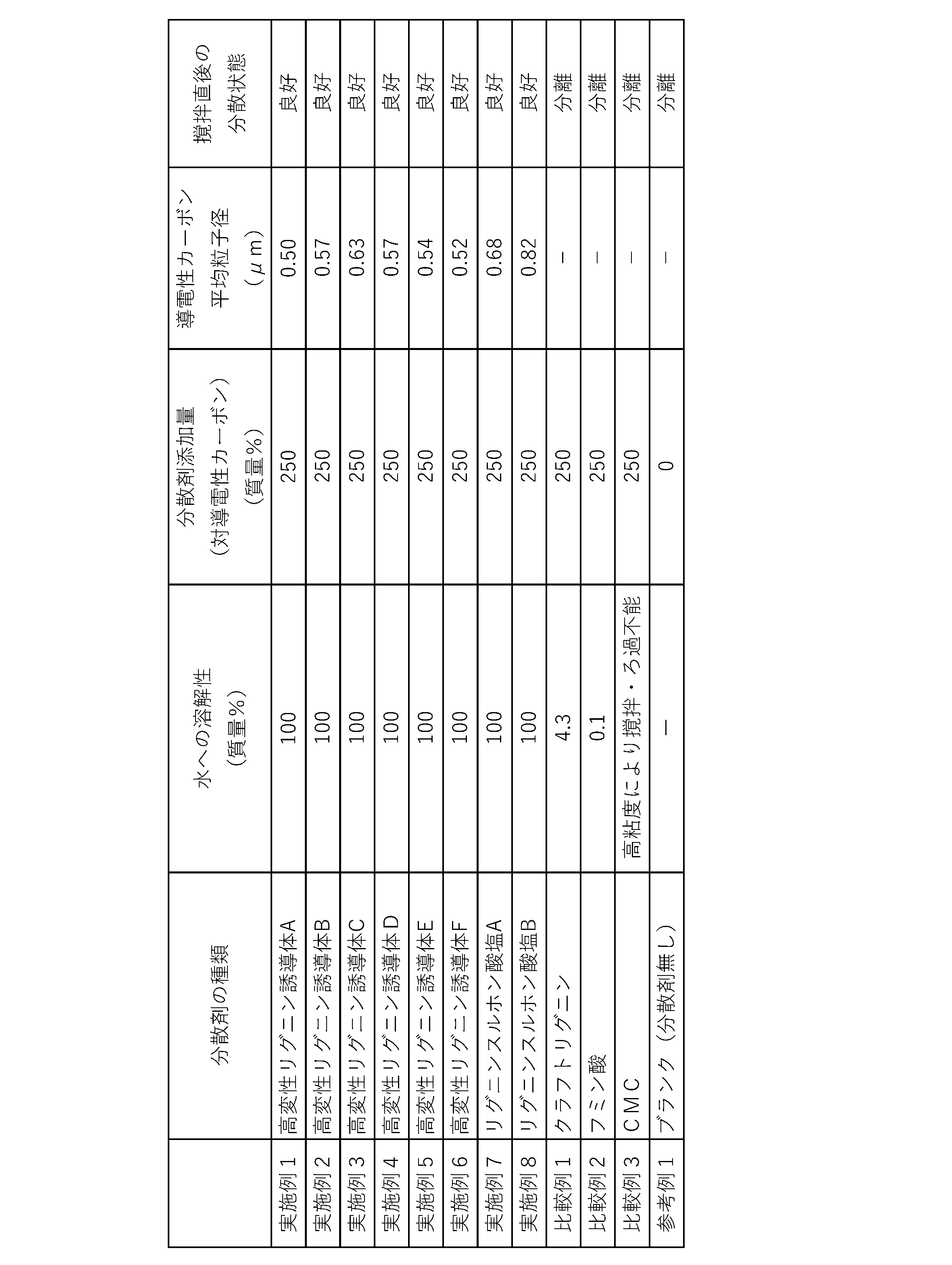
表1に示すように、実施例1~8の分散剤は導電性カーボンを水中で良好に分散させた。一方で、比較例1のクラフトリグニン、及び比較例2のフミン酸は各実施例に示す高変性リグニン誘導体、及びリグニンスルホン酸塩と同じく芳香核を有し、かつカルボキシル基やフェノール性水酸基を含む多塩基性の高分子有機物であるにもかかわらず、導電性カーボンが分散せず、水中で分離した。各実施例の高変性リグニン誘導体、及びリグニンスルホン酸塩はスルホ基が所定量のスルホ基S含量となるよう導入されて水溶性が高く保たれており、水中で導電性カーボンに効率的に吸着することで、優れた分散性能を発揮したと推測される。比較例3のカルボキシメチルセルロースも導電性カーボンに対する分散性を示さなかった。カルボキシルメチルセルロースは負極活物質の分散性を向上させる目的、及び負極用合剤組成物スラリーに一定の粘度を付与し、活物質と集電体を効率的に結着させる目的で使用されるが、導電性カーボンに対する分散剤としては最適化されていないことがわかる。
(実施例9)
(負極用合剤組成物の製造)
負極活物質としてのSiOxと、導電性カーボンとしてのアセチレンブラック(Stream Chemical社製)と、カルボキシメチルセルロース(日本製紙社製、MAC500LC)(DS値:0.65mol/C6、1%粘度:4700mPa・s)と、製造例1で得た分散剤としての高変性リグニン誘導体A(メトキシ基量:11.9質量%、抽出成分量:0.7質量%、抽出成分量/メトキシ基量:0.06、スルホ基のS含量:1.6質量%、ニトロベンゼン酸化による総分解生成物収率:7.1%)と、スチレンブタジエンゴム(SBR、株式会社ENEOSマテリアル社製、品番TRD104A)を、固形分質量比率が97:0.5:0.67:0.33:1.5になるように混合し、スラリー濃度が45.6質量%になるように水を添加し、マゼルスター(倉敷紡績製、KK-250S)を用いてよく撹拌し、スラリー状の負極用合剤組成物を得た。
(負極用合剤組成物の製造)
負極活物質としてのSiOxと、導電性カーボンとしてのアセチレンブラック(Stream Chemical社製)と、カルボキシメチルセルロース(日本製紙社製、MAC500LC)(DS値:0.65mol/C6、1%粘度:4700mPa・s)と、製造例1で得た分散剤としての高変性リグニン誘導体A(メトキシ基量:11.9質量%、抽出成分量:0.7質量%、抽出成分量/メトキシ基量:0.06、スルホ基のS含量:1.6質量%、ニトロベンゼン酸化による総分解生成物収率:7.1%)と、スチレンブタジエンゴム(SBR、株式会社ENEOSマテリアル社製、品番TRD104A)を、固形分質量比率が97:0.5:0.67:0.33:1.5になるように混合し、スラリー濃度が45.6質量%になるように水を添加し、マゼルスター(倉敷紡績製、KK-250S)を用いてよく撹拌し、スラリー状の負極用合剤組成物を得た。
(負極板の作製)
このスラリー状の負極用合剤組成物をアプリケーターで縦320mm×横170mm×厚さ17μmの銅箔(古河電気工業社製、NC-WS)に塗工して30分間風乾した後、乾燥機にて60℃で30分間乾燥した。更に小型卓上ロールプレス(テスター産業社製、SA-602)を用いて、5kN、ロール周速50m/minの条件でプレスし、目付量19.7g/m2、放電実効容量2100mAh/gの負極板を得た。
このスラリー状の負極用合剤組成物をアプリケーターで縦320mm×横170mm×厚さ17μmの銅箔(古河電気工業社製、NC-WS)に塗工して30分間風乾した後、乾燥機にて60℃で30分間乾燥した。更に小型卓上ロールプレス(テスター産業社製、SA-602)を用いて、5kN、ロール周速50m/minの条件でプレスし、目付量19.7g/m2、放電実効容量2100mAh/gの負極板を得た。
(コイン型リチウムイオン二次電池の作製)
得られた負極板と、LiCoO2正極板(NEI社製、目付量20.56mg/cm2、容量3mAh/cm2)を直径16mmの円形になるように打ち抜き、打ち抜いた負極板と正極板を120℃で12時間真空乾燥を行った。
同様に直径17mmの円形となるようにセパレータ(CS Tech社製、厚み20μmのポリプロピレンセパレータ)を打ち抜き、60℃で12時間真空乾燥を行った。
その後、直径20.0mmのステンレス製円形皿型容器に負極板を置き、次いで、セパレータ、正極板、スペーサー(直径15.5mm、厚さ1mm)、ステンレス製のワッシャー(宝泉株式会社製)をこの順で積層し、その後円形皿型容器に電解液(1mol/LのLiPF6、エチレンカーボネートとジエチルカーボネートの体積比1:1)を300μL添加した。これにポリプロピレン製のパッキンを介してステンレス製のキャップを被せ、コイン電池用かしめ機(宝泉株式会社)で密封し、コイン型のリチウムイオン二次電池を得た。
得られた負極板と、LiCoO2正極板(NEI社製、目付量20.56mg/cm2、容量3mAh/cm2)を直径16mmの円形になるように打ち抜き、打ち抜いた負極板と正極板を120℃で12時間真空乾燥を行った。
同様に直径17mmの円形となるようにセパレータ(CS Tech社製、厚み20μmのポリプロピレンセパレータ)を打ち抜き、60℃で12時間真空乾燥を行った。
その後、直径20.0mmのステンレス製円形皿型容器に負極板を置き、次いで、セパレータ、正極板、スペーサー(直径15.5mm、厚さ1mm)、ステンレス製のワッシャー(宝泉株式会社製)をこの順で積層し、その後円形皿型容器に電解液(1mol/LのLiPF6、エチレンカーボネートとジエチルカーボネートの体積比1:1)を300μL添加した。これにポリプロピレン製のパッキンを介してステンレス製のキャップを被せ、コイン電池用かしめ機(宝泉株式会社)で密封し、コイン型のリチウムイオン二次電池を得た。
得られた電池について、充放電レート試験を行い、放電容量の計測および容量維持率の算出を行った。
(実施例10~16)
製造例1で得た高変性リグニン誘導体Aに代えて高変性リグニン誘導体B~Fまたはリグニンスルホン酸塩A、Bを用いたこと以外は実施例9と同様に、それぞれ負極用合剤組成物の製造、負極板の作製、及びコイン型リチウムイオン二次電池の作製を行った。また、得られた電池の評価を行った。
製造例1で得た高変性リグニン誘導体Aに代えて高変性リグニン誘導体B~Fまたはリグニンスルホン酸塩A、Bを用いたこと以外は実施例9と同様に、それぞれ負極用合剤組成物の製造、負極板の作製、及びコイン型リチウムイオン二次電池の作製を行った。また、得られた電池の評価を行った。
(比較例4)
負極用合剤組成物の製造において、高変性リグニン誘導体Aを添加しなかったこと以外は実施例9と同様に負極用合剤組成物を製造した。なお、負極活物質としてのSiOxと、導電性カーボンとしてのアセチレンブラック(Stream Chemical社製)と、カルボキシメチルセルロース(日本製紙社製、MAC500LC)(DS値:0.65mol/C6、1%粘度:4700mPa・s)と、スチレンブタジエンゴム(SBR、株式会社ENEOSマテリアル社製、品番TRD104A)とを、固形分質量比率が97:0.5:1.0:1.5になるように混合した。これを用いて実施例9と同様にして負極板の作成、及びコイン型リチウムイオン二次電池の作製を行った。また、得られた電池の評価を行った。
負極用合剤組成物の製造において、高変性リグニン誘導体Aを添加しなかったこと以外は実施例9と同様に負極用合剤組成物を製造した。なお、負極活物質としてのSiOxと、導電性カーボンとしてのアセチレンブラック(Stream Chemical社製)と、カルボキシメチルセルロース(日本製紙社製、MAC500LC)(DS値:0.65mol/C6、1%粘度:4700mPa・s)と、スチレンブタジエンゴム(SBR、株式会社ENEOSマテリアル社製、品番TRD104A)とを、固形分質量比率が97:0.5:1.0:1.5になるように混合した。これを用いて実施例9と同様にして負極板の作成、及びコイン型リチウムイオン二次電池の作製を行った。また、得られた電池の評価を行った。
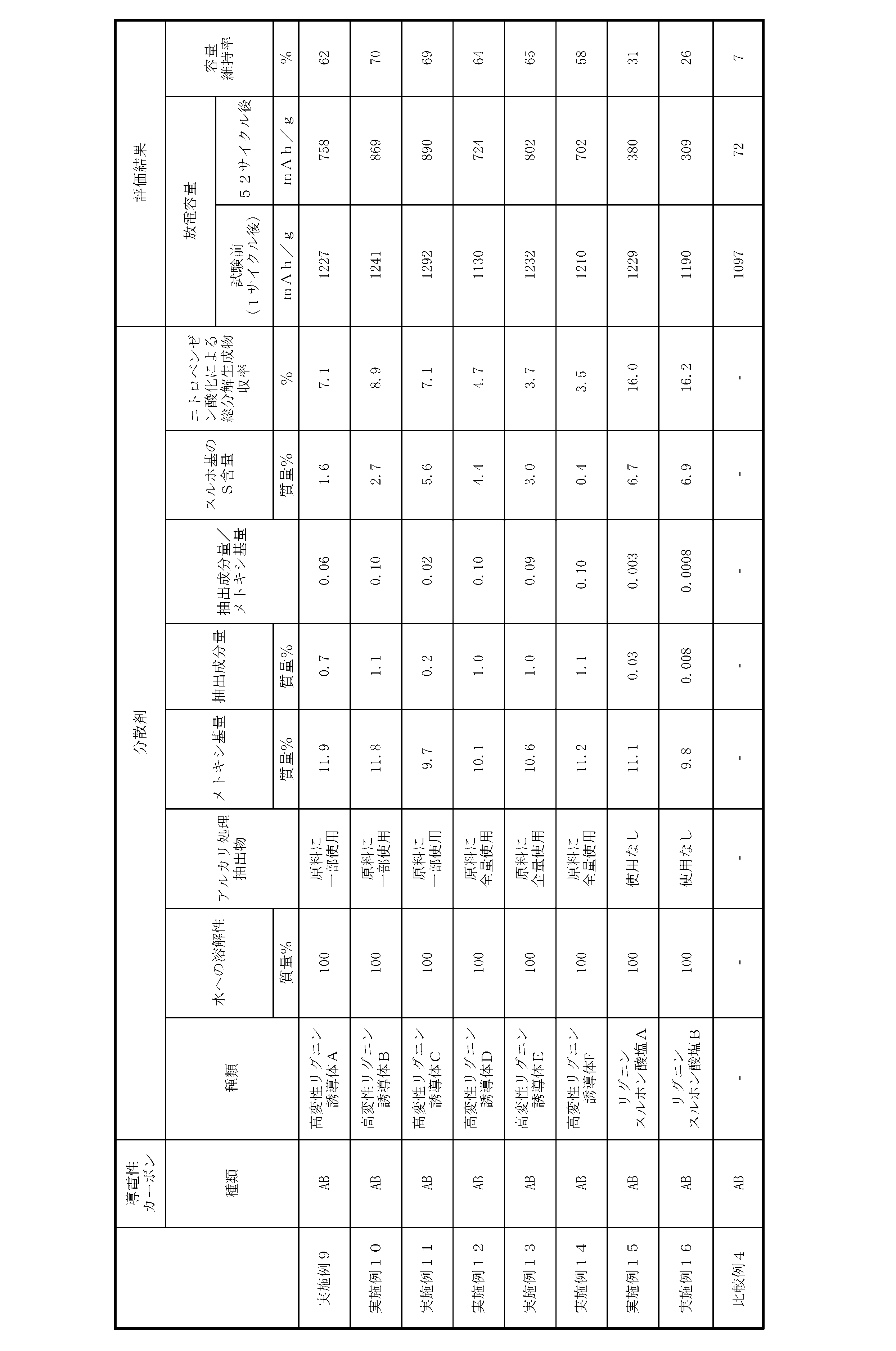
表2に示すように比較例4の電池と比較して、リグニン成分を含む導電性カーボン分散剤を使用した実施例9~16は電池の容量維持率が明らかに向上した。実施例9~16では電極内の導電性カーボンが均一に分散して効果的な導電パスが形成されることで、サイクル中の負極活物質の体積変化による電気的断絶に伴う不可逆的な容量低下を抑えることができたと推察される。
表2に示すようにスルホ基のS含量が少なく、抽出成分が多く含まれており、かつニトロベンゼン酸化よる総分解生成物収率の少ない実施例9~14の高変性リグニン誘導体A~Fを用いた電池と比較して、スルホ基のS含量が多く、抽出成分量が少なく、かつニトロベンゼン酸化による総分解生成物収率の多い実施例15のリグニンスルホン酸塩Aを用いた電池は容量維持率が低下した。リグニンスルホン酸塩Aよりも抽出成分量が少ない実施例16のリグニンスルホン酸塩Bを用いた電池は容量維持率がさらに若干低下した。それぞれの実施例で電池性能向上の程度が異なる原因を調べる目的で、ゼータサイザーを用いて高変性リグニン誘導体A~F及びリグニンスルホン酸塩A、Bの導電性カーボン分散性能の違いを詳細に比較した。負極用合剤組成物の組成に近づけるためカルボキシメチルセルロース(日本製紙社製、MAC500LC)(DS値:0.65mol/C6、1%粘度:4700mPa・s)も同時に用いた。
(実施例17)
(導電性カーボン分散性試験2)
カルボキシメチルセルロース(日本製紙社製、MAC500LC)(DS値:0.65mol/C6、1%粘度:4700mPa・s)を固形分0.17%、製造例1で得た高変性リグニン誘導体Aを固形分0.0083%、0.017%、0.042%、0.083%、及び0.17%となるように5種類の水溶液を調製し、すべてNaOHでpH8.5に調整した。その後アセチレンブラック(Stream Chemical社製)を0.07質量%になるように添加して、ホモディスパーを用いて2500rpmで30分間撹拌して高変性リグニン誘導体Aの濃度が異なる5つの分散液を得た。各分散液中のアセチレンブラックの平均粒子径をゼータサイザー 3000HSA(Malvern社製)にて測定した。平均粒子径の測定結果、撹拌直後の分散状態、及び撹拌から1日後の分散状態を表3に示した。
(導電性カーボン分散性試験2)
カルボキシメチルセルロース(日本製紙社製、MAC500LC)(DS値:0.65mol/C6、1%粘度:4700mPa・s)を固形分0.17%、製造例1で得た高変性リグニン誘導体Aを固形分0.0083%、0.017%、0.042%、0.083%、及び0.17%となるように5種類の水溶液を調製し、すべてNaOHでpH8.5に調整した。その後アセチレンブラック(Stream Chemical社製)を0.07質量%になるように添加して、ホモディスパーを用いて2500rpmで30分間撹拌して高変性リグニン誘導体Aの濃度が異なる5つの分散液を得た。各分散液中のアセチレンブラックの平均粒子径をゼータサイザー 3000HSA(Malvern社製)にて測定した。平均粒子径の測定結果、撹拌直後の分散状態、及び撹拌から1日後の分散状態を表3に示した。
(実施例18~24)
製造例1で得た高変性リグニン誘導体Aに代えて、製造例2~8で得た高変性リグニン誘導体B~Fまたはリグニンスルホン酸塩A,Bをそれぞれ用いたこと以外は、実施例17と同様に導電性カーボン分散性試験2を行った。
製造例1で得た高変性リグニン誘導体Aに代えて、製造例2~8で得た高変性リグニン誘導体B~Fまたはリグニンスルホン酸塩A,Bをそれぞれ用いたこと以外は、実施例17と同様に導電性カーボン分散性試験2を行った。
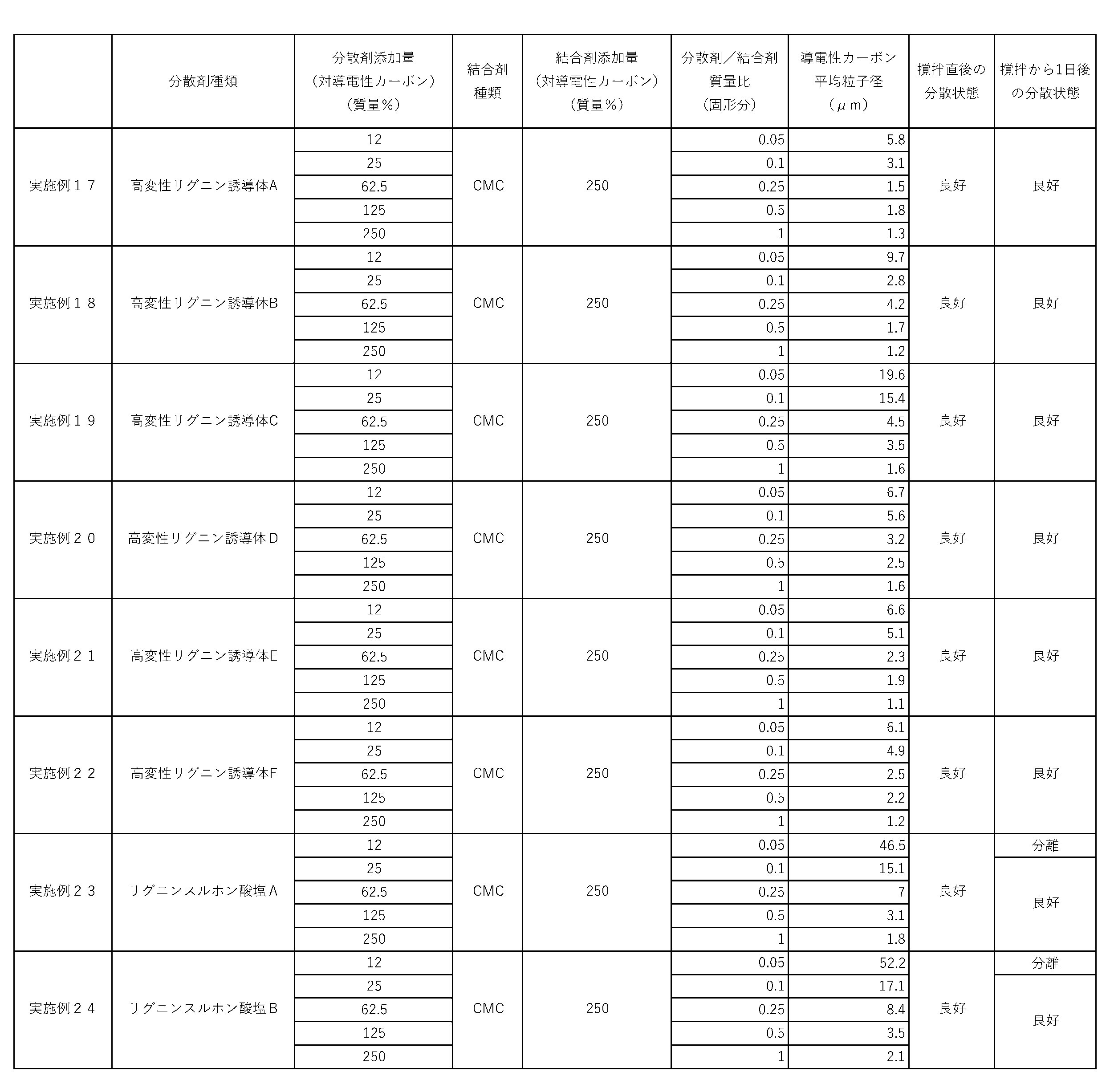
表3に示す通り、分散剤添加量の少ない条件において、リグニンスルホン酸塩を用いた実施例23、24は、高変性リグニン誘導体を用いた実施例17~22と比較して、導電性カーボンの粒子径が明らかに大きく、特に分散剤添加量が導電性カーボンに対して12%の条件では、リグニンスルホン酸塩を用いた実施例23、24は分散液の撹拌から1日後に導電性カーボンの分離がみられた。実施例23、24で用いたリグニンスルホン酸塩は実施例17~22で用いた高変性リグニン誘導体と比べてスルホ基のS含量が高く、疎水性である導電性カーボンへの吸着性が若干低いため、導電性カーボンの分散性能が低いと推察される。以上を理由として、リグニンスルホン酸塩を使用した実施例15、16では、表2で示す通り容量維持率の向上効果が比較的小さかったと推察される。
Claims (5)
- 導電性カーボンと、分散剤とを含有し、
前記分散剤は、水への溶解性が5.0~100質量%であり、かつリグニン誘導体を含むリグニン成分を含有し、
前記リグニン成分の固形分当たりの抽出成分量が0.01~2.5質量%であり、
前記リグニン成分の固形分当たりのメトキシ基量が3~18質量%であり、
前記リグニン成分の固形分当たりの抽出成分量のメトキシ基量に対する質量比が0.001~0.25であり、
前記リグニン誘導体が下式(1)に示す官能基を有し、前記官能基中のS含量が0.1~7.0質量%であることを特徴とする二次電池の負極用組成物。
式(1):-SO3M
(式中、Mは、水素原子、一価金属、又は二価金属を示す) - 導電性カーボンと、分散剤とを含有し、
前記分散剤は、水への溶解性が5.0~100質量%であり、かつリグニン誘導体を含むリグニン成分を含有し、
前記リグニン成分の固形分当たりの、アルカリ性ニトロベンゼン酸化による総分解生成物収率が、15%以下であり、
前記リグニン誘導体が下式(1)に示す官能基を有し、前記官能基中のS含量が0.1~7.0質量%であることを特徴とする二次電池の負極用組成物。
式(1):-SO3M
(式中、Mは、水素原子、一価金属、又は二価金属を示す) - 請求項1または2に記載の負極用組成物と、負極結合剤と、負極活物質を含む負極活物質層を備える二次電池用の負極。
- 請求項3に記載の負極を含む二次電池。
- 前記二次電池がリチウムイオン電池である請求項1または2に記載の負極用組成物。
Applications Claiming Priority (2)
| Application Number | Priority Date | Filing Date | Title |
|---|---|---|---|
| JP2023-109276 | 2023-07-03 | ||
| JP2023109276A JP7415072B1 (ja) | 2023-07-03 | 2023-07-03 | 負極用組成物、負極、及び二次電池 |
Publications (1)
| Publication Number | Publication Date |
|---|---|
| WO2025009241A1 true WO2025009241A1 (ja) | 2025-01-09 |
Family
ID=89534341
Family Applications (1)
| Application Number | Title | Priority Date | Filing Date |
|---|---|---|---|
| PCT/JP2024/014273 Ceased WO2025009241A1 (ja) | 2023-07-03 | 2024-04-08 | 負極用組成物、負極、及び二次電池 |
Country Status (2)
| Country | Link |
|---|---|
| JP (1) | JP7415072B1 (ja) |
| WO (1) | WO2025009241A1 (ja) |
Families Citing this family (1)
| Publication number | Priority date | Publication date | Assignee | Title |
|---|---|---|---|---|
| JP7500846B1 (ja) * | 2023-08-25 | 2024-06-17 | 日本製紙株式会社 | 負極用組成物、負極、及び二次電池 |
Citations (3)
| Publication number | Priority date | Publication date | Assignee | Title |
|---|---|---|---|---|
| JP2007273367A (ja) * | 2006-03-31 | 2007-10-18 | Shin Kobe Electric Mach Co Ltd | 鉛蓄電池 |
| WO2020013112A1 (ja) * | 2018-07-09 | 2020-01-16 | 日本製紙株式会社 | 鉛蓄電池用有機防縮剤 |
| JP2021051953A (ja) * | 2019-09-26 | 2021-04-01 | 日本製紙株式会社 | 非水電解質二次電池用結合剤、非水電解質二次電池用電極組成物、非水電解質二次電池用電極および非水電解質二次電池 |
-
2023
- 2023-07-03 JP JP2023109276A patent/JP7415072B1/ja active Active
-
2024
- 2024-04-08 WO PCT/JP2024/014273 patent/WO2025009241A1/ja not_active Ceased
Patent Citations (3)
| Publication number | Priority date | Publication date | Assignee | Title |
|---|---|---|---|---|
| JP2007273367A (ja) * | 2006-03-31 | 2007-10-18 | Shin Kobe Electric Mach Co Ltd | 鉛蓄電池 |
| WO2020013112A1 (ja) * | 2018-07-09 | 2020-01-16 | 日本製紙株式会社 | 鉛蓄電池用有機防縮剤 |
| JP2021051953A (ja) * | 2019-09-26 | 2021-04-01 | 日本製紙株式会社 | 非水電解質二次電池用結合剤、非水電解質二次電池用電極組成物、非水電解質二次電池用電極および非水電解質二次電池 |
Also Published As
| Publication number | Publication date |
|---|---|
| JP2025007700A (ja) | 2025-01-17 |
| JP7415072B1 (ja) | 2024-01-16 |
Similar Documents
| Publication | Publication Date | Title |
|---|---|---|
| JP6254335B2 (ja) | セルロースザンテートナノファイバー | |
| FI126649B (fi) | Uusi menetelmä mikroselluloosan valmistamiseksi | |
| CN108660837A (zh) | 一种植物纤维原料中纤维素、半纤维素及木质素三组分的分离方法 | |
| CN102995475B (zh) | 一种甘蔗渣纤维素的提取方法 | |
| CN115142263B (zh) | 阳离子竹纤维素纳米纤维及其制备方法 | |
| CN109790227A (zh) | 羧甲基纤维素或其盐以及电极组合物 | |
| JP7415072B1 (ja) | 負極用組成物、負極、及び二次電池 | |
| JP7341368B1 (ja) | 負極添加剤、負極、及び二次電池 | |
| JP7748403B2 (ja) | カルボキシメチルセルロースおよび/又はその塩、非水電解質二次電池用電極組成物、非水電解質二次電池用電極および非水電解質二次電池 | |
| JP7500846B1 (ja) | 負極用組成物、負極、及び二次電池 | |
| CN113327778A (zh) | 一种木质基电极薄膜的制备方法 | |
| JP7337630B2 (ja) | 非水電解質二次電池用結合剤、非水電解質二次電池用電極組成物、非水電解質二次電池用電極および非水電解質二次電池 | |
| JP7748407B2 (ja) | カルボキシメチルセルロースおよび/又はその塩、非水電解質二次電池用電極組成物、非水電解質二次電池用電極および非水電解質二次電池 | |
| JP7337616B2 (ja) | 非水電解質二次電池用結合剤、非水電解質二次電池用電極組成物、非水電解質二次電池用電極および非水電解質二次電池 | |
| Huertaa et al. | Biorefining of canola straw using pressurized aqueous ethanol: nanosized cellulose | |
| JP7603056B2 (ja) | 鉛蓄電池用有機防縮剤及びその製造方法 | |
| JP2021047988A (ja) | 非水電解質二次電池用電極組成物、非水電解質二次電池用電極および非水電解質二次電池 | |
| JP2026019377A (ja) | カルボキシメチルセルロースリチウム塩およびカルボキシメチルセルロースリチウム塩の製造方法、カルボキシメチルセルロースナノファイバーリチウム塩、非水電解質二次電池用電極組成物、非水電解質二次電池用電極および非水電解質二次電池 | |
| TWI878699B (zh) | 非水電解質二次電池電極用結合劑、非水電解質二次電池用電極組成物、非水電解質二次電池用電極及非水電解質二次電池 | |
| JP2025022258A (ja) | カルボキシメチルセルロースリチウム塩およびカルボキシメチルセルロースリチウム塩の製造方法、非水電解質二次電池用電極組成物、非水電解質二次電池用電極および非水電解質二次電池 | |
| WO2025115721A1 (ja) | 非水電解質二次電池電極用結合剤、非水電解質二次電池用電極組成物、非水電解質二次電池用電極および非水電解質二次電池 | |
| JP2023070235A (ja) | 非水電解質二次電池電極用結合剤、非水電解質二次電池用電極組成物、非水電解質二次電池用電極および非水電解質二次電池 | |
| JP2022182384A (ja) | カルボキシメチルセルロース又はその塩、及び、電極組成物 | |
| CN108130794A (zh) | 一种农林废弃物纸张及其制备方法 | |
| JP2025140533A (ja) | 非水電解質二次電池電極用結合剤、非水電解質二次電池用電極組成物、非水電解質二次電池用電極および非水電解質二次電池 |
Legal Events
| Date | Code | Title | Description |
|---|---|---|---|
| 121 | Ep: the epo has been informed by wipo that ep was designated in this application |
Ref document number: 24835763 Country of ref document: EP Kind code of ref document: A1 |
|
| NENP | Non-entry into the national phase |
Ref country code: DE |