WO2025005448A1 - 재귀반사 신호 분석식 균 검출 바이오센서 칩, 식품 병원성균 검출 칩, 재귀반사 신호 분석식 균 검출 방법 및 식품 병원성균 검출 방법 - Google Patents
재귀반사 신호 분석식 균 검출 바이오센서 칩, 식품 병원성균 검출 칩, 재귀반사 신호 분석식 균 검출 방법 및 식품 병원성균 검출 방법 Download PDFInfo
- Publication number
- WO2025005448A1 WO2025005448A1 PCT/KR2024/006152 KR2024006152W WO2025005448A1 WO 2025005448 A1 WO2025005448 A1 WO 2025005448A1 KR 2024006152 W KR2024006152 W KR 2024006152W WO 2025005448 A1 WO2025005448 A1 WO 2025005448A1
- Authority
- WO
- WIPO (PCT)
- Prior art keywords
- detection
- retroreflective
- bacteria
- signal analysis
- antibody
- Prior art date
- Legal status (The legal status is an assumption and is not a legal conclusion. Google has not performed a legal analysis and makes no representation as to the accuracy of the status listed.)
- Ceased
Links
Images



Classifications
-
- G—PHYSICS
- G01—MEASURING; TESTING
- G01N—INVESTIGATING OR ANALYSING MATERIALS BY DETERMINING THEIR CHEMICAL OR PHYSICAL PROPERTIES
- G01N33/00—Investigating or analysing materials by specific methods not covered by groups G01N1/00 - G01N31/00
- G01N33/48—Biological material, e.g. blood, urine; Haemocytometers
- G01N33/50—Chemical analysis of biological material, e.g. blood, urine; Testing involving biospecific ligand binding methods; Immunological testing
- G01N33/53—Immunoassay; Biospecific binding assay; Materials therefor
- G01N33/569—Immunoassay; Biospecific binding assay; Materials therefor for microorganisms, e.g. protozoa, bacteria, viruses
- G01N33/56911—Bacteria
- G01N33/56916—Enterobacteria, e.g. shigella, salmonella, klebsiella, serratia
-
- B—PERFORMING OPERATIONS; TRANSPORTING
- B01—PHYSICAL OR CHEMICAL PROCESSES OR APPARATUS IN GENERAL
- B01L—CHEMICAL OR PHYSICAL LABORATORY APPARATUS FOR GENERAL USE
- B01L3/00—Containers or dishes for laboratory use, e.g. laboratory glassware; Droppers
-
- B—PERFORMING OPERATIONS; TRANSPORTING
- B01—PHYSICAL OR CHEMICAL PROCESSES OR APPARATUS IN GENERAL
- B01L—CHEMICAL OR PHYSICAL LABORATORY APPARATUS FOR GENERAL USE
- B01L3/00—Containers or dishes for laboratory use, e.g. laboratory glassware; Droppers
- B01L3/50—Containers for the purpose of retaining a material to be analysed, e.g. test tubes
- B01L3/502—Containers for the purpose of retaining a material to be analysed, e.g. test tubes with fluid transport, e.g. in multi-compartment structures
- B01L3/5027—Containers for the purpose of retaining a material to be analysed, e.g. test tubes with fluid transport, e.g. in multi-compartment structures by integrated microfluidic structures, i.e. dimensions of channels and chambers are such that surface tension forces are important, e.g. lab-on-a-chip
- B01L3/502715—Containers for the purpose of retaining a material to be analysed, e.g. test tubes with fluid transport, e.g. in multi-compartment structures by integrated microfluidic structures, i.e. dimensions of channels and chambers are such that surface tension forces are important, e.g. lab-on-a-chip characterised by interfacing components, e.g. fluidic, electrical, optical or mechanical interfaces
-
- G—PHYSICS
- G01—MEASURING; TESTING
- G01N—INVESTIGATING OR ANALYSING MATERIALS BY DETERMINING THEIR CHEMICAL OR PHYSICAL PROPERTIES
- G01N21/00—Investigating or analysing materials by the use of optical means, i.e. using sub-millimetre waves, infrared, visible or ultraviolet light
- G01N21/17—Systems in which incident light is modified in accordance with the properties of the material investigated
- G01N21/55—Specular reflectivity
-
- G—PHYSICS
- G01—MEASURING; TESTING
- G01N—INVESTIGATING OR ANALYSING MATERIALS BY DETERMINING THEIR CHEMICAL OR PHYSICAL PROPERTIES
- G01N33/00—Investigating or analysing materials by specific methods not covered by groups G01N1/00 - G01N31/00
- G01N33/48—Biological material, e.g. blood, urine; Haemocytometers
- G01N33/50—Chemical analysis of biological material, e.g. blood, urine; Testing involving biospecific ligand binding methods; Immunological testing
- G01N33/53—Immunoassay; Biospecific binding assay; Materials therefor
- G01N33/569—Immunoassay; Biospecific binding assay; Materials therefor for microorganisms, e.g. protozoa, bacteria, viruses
-
- B—PERFORMING OPERATIONS; TRANSPORTING
- B01—PHYSICAL OR CHEMICAL PROCESSES OR APPARATUS IN GENERAL
- B01L—CHEMICAL OR PHYSICAL LABORATORY APPARATUS FOR GENERAL USE
- B01L2300/00—Additional constructional details
- B01L2300/08—Geometry, shape and general structure
- B01L2300/0809—Geometry, shape and general structure rectangular shaped
- B01L2300/0819—Microarrays; Biochips
-
- G—PHYSICS
- G01—MEASURING; TESTING
- G01N—INVESTIGATING OR ANALYSING MATERIALS BY DETERMINING THEIR CHEMICAL OR PHYSICAL PROPERTIES
- G01N2333/00—Assays involving biological materials from specific organisms or of a specific nature
- G01N2333/195—Assays involving biological materials from specific organisms or of a specific nature from bacteria
- G01N2333/24—Assays involving biological materials from specific organisms or of a specific nature from bacteria from Enterobacteriaceae (F), e.g. Citrobacter, Serratia, Proteus, Providencia, Morganella, Yersinia
- G01N2333/255—Salmonella (G)
Definitions
- the present invention relates to a retroreflective signal analysis-type bacteria detection biosensor chip, a food pathogen detection chip, a retroreflective signal analysis-type bacteria detection method, and a food pathogen detection method.
- the present invention relates to a field diagnostic pathogenic bacteria detection system using a biosensor chip for retroreflective signal analysis and a method for quantitatively analyzing the number of pathogenic bacteria using the same.
- the present invention relates to the development of a detection system capable of detecting and quantitatively analyzing bacteria with a simple optical device by introducing a newly developed biosensor chip for signal detection and a retroreflective Janus Particle (RJP) as an optical marker to overcome the limitations of conventional bacteria detection methods (selective culture medium method, PCR, ELISA) in field diagnosis.
- RJP retroreflective Janus Particle
- One purpose of the present invention is to provide a retroreflective signal analysis-type bacteria detection biosensor chip capable of qualitatively and quantitatively analyzing the presence or absence of pathogenic bacteria infection in a space-limited environment, and a retroreflective signal analysis-type bacteria detection method using the same.
- Another object of the present invention is to provide a food pathogen detection chip capable of determining whether food poisoning bacteria are present in food and detecting them with high sensitivity, and a method for detecting food pathogens using the chip.
- the novel biosensor chip for retroreflective signal analysis proposed by the present invention has a detection unit capable of capturing pathogenic bacteria-particle complexes and a control unit capable of capturing residual particles that have not reacted with pathogenic bacteria, similar to a lateral flow immunoassay.
- the biosensor chip is composed of a transparent material, so that signals of retroreflective particles captured in each unit can be obtained with a simple non-spectral optical system. Since retroreflective particles are special mirror structures that return light with a wavelength smaller than the particle size toward a light source, unlike conventional fluorescent/colorimetric particles, they exhibit strong signals without attenuation even under non-spectral conditions.
- a simple measurement system that can be used in the field can be configured by fabricating a transparent biosensor chip that allows light to pass through.
- the optical signal of retroreflective particles appears in the form of a bright light spot on an image, it is possible to count these and perform quantitative signal analysis.
- highly sensitive and complex equipment is required for signal detection, whereas the proposed system uses white light as a light source and retroreflective particles as signal markers, enabling the implementation of a non-spectroscopic signal detection system, and therefore, it is expected to be easy to enter the diagnostic testing market.
- the present invention provides a retroreflective signal analysis-type bacteria detection biosensor chip, comprising: a fluid chip including a flow path therein; an injection unit connected to the flow path and injecting a detection target sample including a retroreflective particle modified with a first antibody capable of binding to a detection target bacteria; and a detection unit in which a second antibody capable of binding to the detection target bacteria is fixed to an inner surface of the flow path.
- the retroreflective signal analysis type bacterial detection biosensor chip may further include a control portion in which a third antibody capable of binding to the retroreflective particle is immobilized on the inner surface of the channel.
- the first antibody and the second antibody may comprise the same antibody.
- the first antibody and the second antibody can be immobilized on a surface facing the injection portion within the euro.
- the present invention provides a food pathogen detection chip including a retroreflective signal analysis type bacteria detection biosensor chip.
- the target bacteria may include Salmonella bacteria.
- the present invention provides a method for detecting bacteria by analyzing retroreflection signals, the method including a sample injection step of injecting the detection target sample into the injection unit of a biosensor chip, the biosensor chip including a channel therein; an injection unit connected to the channel and injecting a detection target sample including a retroreflective particle modified with a first antibody capable of binding to a detection target bacteria; and a detection unit in which a second antibody capable of binding to the detection target bacteria is fixed to an inner surface of the channel; and causing the detection target sample to flow within the channel.
- the biosensor chip may be prepared further comprising a control portion in which a third antibody capable of binding to the retroreflective particle is immobilized on the inner surface of the electrode.
- the first antibody and the second antibody can be prepared to include the same antibody.
- the first antibody and the second antibody can be prepared to be fixed on a surface facing the injection portion within the euro.
- the retroreflective signal analysis method for detecting bacteria may further include a light analysis step of irradiating light onto the detection unit or the control unit, and then detecting and analyzing light reflected from the retroreflective particles coupled to the detection unit or the control unit to quantitatively analyze the target bacteria.
- the light can be irradiated from outside the surface on which the first antibody and the second antibody are fixed.
- the direction of irradiating the light and the direction of detecting the light can be irradiated and detected at an angle of 60° or less.
- the present invention provides a method for detecting food pathogenic bacteria, including a food pathogenic bacteria detection step for detecting pathogenic detection target bacteria in food using the retroreflective signal analysis method.
- the target bacteria may include Salmonella bacteria.
- a sandwich-type sensing technique was applied by fixing antibodies that recognize bacteria as antigens on retroreflective particles to perform antigen-antibody-based bacterial detection, and modifying the chip surface corresponding to the detection section with antibodies that recognize the same bacteria as antigens.
- a secondary antibody that recognizes the antibodies modified on retroreflective particles as antigens was fixed on the chip surface corresponding to the control section, so that bacterial detection and the validity of the chip could be confirmed simultaneously.
- a retroreflective signal appears in the shape of a circle based on the contrast between the detection section and the surrounding area depending on the presence or absence of bacteria, and quantitative analysis according to the bacterial concentration is possible by counting retroreflective particles.
- this system uses retroreflective particles as optical probes, making it possible to quantitatively analyze bacteria with high sensitivity using only an optical device consisting of white light and a CMOS camera without the need for a spectral filter.
- a retroreflective signal analysis biosensor chip can perform qualitative and quantitative analysis of pathogenic bacterial infection in a space-limited environment.
- a food pathogen detection chip can determine whether food poisoning bacteria are present in food and detect them with high sensitivity.
- a method for detecting bacteria by analyzing retroreflection signals can perform qualitative and quantitative analysis of whether or not a pathogenic bacteria is infected in a space-limited environment by using the retroreflection signal analysis-based bacteria detection biosensor chip.
- the method for detecting food pathogens can determine whether food poisoning bacteria are present in food and detect food with high sensitivity using the food pathogen detection chip.
- FIG. 1 is a schematic diagram illustrating a retroreflective signal analysis type bacterial detection biosensor chip according to an embodiment of the present invention.
- FIG. 2 is a flowchart schematically illustrating a method for detecting bacteria using retroreflection signal analysis according to an embodiment of the present invention.
- Figure 3 is a flow chart illustrating a method for detecting food pathogens according to an embodiment of the present invention.
- Figure 4 shows the development of a biosensor chip for retroreflection signal analysis and a method for quantitative analysis of pathogenic bacteria using the same.
- Figure 5 is a schematic diagram of an example of constructing a biosensor chip by modifying an antibody on a chip substrate made of glass.
- Figure 6 is a schematic diagram of the transparent microfluidic chip driving method for retroreflection signal analysis.
- Figure 7 illustrates a method for analyzing a retroreflection signal using an image analysis program.
- Figure 8 shows a schematic diagram of a method for detecting retroreflection signals according to the concentration of Salmonella typhimurium .
- Figure 9 shows the results of retroreflection signal analysis according to the concentration of Salmonella.
- FIG. 1 is a schematic diagram illustrating a retroreflective signal analysis type bacterial detection biosensor chip according to an embodiment of the present invention.
- a retroreflective signal analysis type bacteria detection biosensor chip (100) may include a fluid chip (110) including a flow path (110') therein; an injection unit (120) connected to the flow path (110') and injecting a detection target sample (S) including a retroreflective particle (P) modified with a first antibody (not shown) capable of binding to a detection target bacteria (G); and a detection unit (130) in which a second antibody (130A) capable of binding to the detection target bacteria (G) is fixed to the inner surface of the flow path (110').
- the above fluid chip (110) includes a path (110') therein, and is a component that constitutes the main body of the retroreflective signal analysis type bacteria detection biosensor chip (100) according to an embodiment of the present invention.
- the retroreflective signal analysis type bacteria detection biosensor chip (100) according to an embodiment of the present invention includes the fluid chip (110), so that the retroreflective signal analysis type bacteria detection biosensor chip (100) according to an embodiment of the present invention can define a surface on which an injection portion (120) into which a sample to be detected is injected, a path (110') through which the sample flows, and a detection portion (130) or control portion (140) to which a component of the sample can be combined are formed.
- the fluid chip (110) is not particularly limited in its structure or material as long as it performs the above-described function, but may have a hardness of a significant level or higher in order to ensure the stability of the component, and/or may be formed of a material having a significant level or higher transparency for optical analysis, in whole or in part.
- the above-described path (110') is a channel or passage-like member through which a sample to be analyzed by the retroreflective signal analysis-type bacteria detection biosensor chip (100) according to an embodiment of the present invention flows.
- the shape or structure of the path (110') is not particularly limited as long as the sample can flow.
- the fluid chip (110) may be extended in the longitudinal direction, and the path (110') may be extended in the same direction as the fluid chip (110).
- the injection portion (120) may be formed on one side of the fluid chip (110) and/or may be formed at the beginning of the path (110').
- the retroreflective signal analysis-type bacteria detection biosensor chip (100) according to an embodiment of the present invention may include one or more paths (110').
- the one or more paths (110') may have different functions, for example, may detect different pathogens.
- the above injection unit (120) is a member into which a sample for detecting bacteria can be injected by the retroreflective signal analysis type bacteria detection biosensor chip (100) according to an embodiment of the present invention.
- the structure or shape of the injection unit (120) is not particularly limited as long as it can inject a sample into the path (110').
- the sample injected into the injection unit (120) is not an essential component defining the retroreflective signal analysis type bacteria detection biosensor chip (100) according to an embodiment of the present invention, but may include a retroreflective particle (P) in order to fully express the function of the retroreflective signal analysis type bacteria detection biosensor chip (100) according to an embodiment of the present invention.
- the retroreflective particle (P) may be modified with a first antibody (not shown), and the first antibody (not shown) may be combined with a target bacteria (G).
- the sample may or may not include the target bacteria (G), but since the retroreflective particle (P) modified with the first antibody (not shown) is included, when the target bacteria (G) are included in the sample, the retroreflective particle (P) and the target bacteria (G) may be combined.
- the above detection unit (130) is a part of a retroreflective signal analysis type bacteria detection biosensor chip (100) according to an embodiment of the present invention to which a detection target bacteria (G) can bind in order to qualitatively and/or quantitatively detect the detection target bacteria (G) to be detected by the retroreflective signal analysis type bacteria detection biosensor chip (100) according to an embodiment of the present invention.
- the detection unit (130) may include a second antibody (130A).
- the second antibody (130A) may bind to the detection target bacteria (G).
- the present invention is at least based on the discovery that qualitative and/or quantitative analysis of the target bacteria (G) is possible through the structure as described above.
- the retroreflective signal analysis type bacteria detection biosensor chip (100) does not exclude the addition of additional elements.
- the retroreflective signal analysis type bacteria detection biosensor chip (100) may further include a control unit (140) in which a third antibody (140A) capable of binding to the retroreflective particle (P) is fixed to the inner surface of the path (110').
- the control unit (140) may include a third antibody (140A) that can bind to the retroreflective particle (P). Accordingly, when a sample including the retroreflective particle (P) is normally injected through the injection unit (120), the excess retroreflective particle (P) that is not bound to the detection unit (130) binds to the control unit (140), thereby confirming that the sample including the retroreflective particle (P) is normally injected through the injection unit (120).
- a third antibody (140A) that can bind to the retroreflective particle (P). Accordingly, when a sample including the retroreflective particle (P) is normally injected through the injection unit (120), the excess retroreflective particle (P) that is not bound to the detection unit (130) binds to the control unit (140), thereby confirming that the sample including the retroreflective particle (P) is normally injected through the injection unit (120).
- the types of the first antibody (not shown) and the second antibody (130A) are not particularly limited as long as they functionally bind to the target bacteria (G).
- the first antibody (not shown) and the second antibody (130A) may include the same antibody.
- the first antibody (not shown) and the second antibody (130A) may include different antibodies.
- the first antibody (not shown) and the second antibody (130A) can be fixed to the surface facing the injection portion (120) in the path (110').
- the retroreflective signal analysis type bacterial detection biosensor chip (100) according to the embodiment of the present invention is performed with the injection portion (120) as the upper surface
- the first antibody (not shown) and the second antibody (130A) can be fixed to the lower surface inside, thereby ensuring stability in the reaction, and the lower surface can be used for subsequent optical analysis.
- a food pathogen detection chip may include the retroreflective signal analysis-type bacteria detection biosensor chip described above.
- the description of the food pathogen detection chip according to the embodiment of the present invention can be applied identically or similarly to the same or similar terms or configurations in the description of the retroreflective signal analysis-type bacteria detection biosensor chip described above.
- the target bacteria may include Salmonella bacteria. That is, the food pathogenic bacteria detection chip according to the embodiment of the present invention can detect Salmonella bacteria.
- FIG. 2 is a flowchart schematically illustrating a method for detecting bacteria using retroreflection signal analysis according to an embodiment of the present invention.
- the retroreflection signal analysis method (200) may include a sample injection step (S210) of injecting a detection target sample into an injection unit of a biosensor chip and causing it to flow within a flow path.
- the description of the retroreflective signal analysis type bacteria detection method (200) according to the embodiment of the present invention may be applied identically or similarly to the same or similar terms or configurations in the description of the food pathogen detection chip described above and/or the description of the retroreflective signal analysis type bacteria detection biosensor chip described above. Accordingly, the biosensor chip may be the retroreflective signal analysis type bacteria detection biosensor chip according to the embodiment of the present invention described above and/or the food pathogen detection chip according to the embodiment of the present invention described above.
- the method (200) for detecting bacteria using a retroreflective signal analysis method may include a sample injection step (S210) of injecting the detection target sample into the injection unit of a biosensor chip, which includes a fluid chip having a channel therein; an injection unit connected to the channel and injecting a detection target sample including a retroreflective particle modified with a first antibody capable of binding to the detection target bacteria; and a detection unit in which a second antibody capable of binding to the detection target bacteria is fixed to the inner surface of the channel; and causing the detection target sample to flow within the channel.
- a sample injection step (S210) of injecting the detection target sample into the injection unit of a biosensor chip which includes a fluid chip having a channel therein; an injection unit connected to the channel and injecting a detection target sample including a retroreflective particle modified with a first antibody capable of binding to the detection target bacteria; and a detection unit in which a second antibody capable of binding to the detection target bacteria is fixed to the inner surface of the channel; and causing the detection
- the above sample injection step (S210) is a step in which a detection target sample that may include a detection target bacterium is injected into an injection portion of a biosensor chip, and it is possible to determine whether the detection target bacterium exists in the detection target sample.
- the biosensor chip may be a retroreflective signal analysis-type bacteria detection biosensor chip according to the above-described embodiment of the present invention and/or a food pathogen detection chip
- the biosensor chip may be prepared to further include a control portion in which a third antibody capable of binding to the retroreflective particle is fixed to the inner surface of the passage.
- the first antibody and the second antibody may be prepared to include the same antibody.
- the first antibody and the second antibody may be prepared to be fixed to a surface facing the injection portion within the passage.
- the method (200) for detecting bacteria using a retroreflective signal analysis method according to an embodiment of the present invention does not exclude the addition of an additional step.
- the method (200) for detecting bacteria using a retroreflective signal analysis method according to an embodiment of the present invention may further include a washing step for washing away unbound retroreflective particles and target bacteria by flowing a washing solution in the flow path of the fluid chip.
- the retroreflective signal analysis method (200) for detecting bacteria may further include a light analysis step of irradiating light to the detection unit or the control unit, and then detecting and analyzing light reflected from the retroreflective particles coupled to the detection unit or the control unit to quantitatively analyze the target bacteria.
- the above-mentioned light analysis step is a step of at least quantitatively analyzing the target bacteria by irradiating light.
- the present invention is based at least on the discovery that quantitative analysis of target bacteria can be performed quickly, accurately, and at low cost without a separate spectroscopic device by using retroreflective particles.
- the direction of the light irradiation is not particularly limited.
- the light can be irradiated from the outside of the surface on which the first antibody and the second antibody are fixed.
- the direction of irradiating the light and the direction of detecting the light can be irradiated and detected at an angle of 60° or less.
- Figure 3 is a flow chart illustrating a method for detecting food pathogens according to an embodiment of the present invention.
- a food pathogenic bacteria detection method (300) may include a food pathogenic bacteria detection step (S310) of detecting a pathogenic detection target bacteria in food through a retroreflection signal analysis type bacteria detection method (300).
- the description of the food pathogen detection method (300) according to the embodiment of the present invention may be applied identically or similarly to the description of the retroreflective signal analysis-type bacteria detection method (300) described above and/or the description of the food pathogen detection chip described above and/or the description of the retroreflective signal analysis-type bacteria detection biosensor chip described above for identical or similar terms or configurations.
- the retroreflective signal analysis method for detecting bacteria (300) may be the retroreflective signal analysis method for detecting bacteria (300) according to the embodiment of the present invention described above.
- the target bacteria may include Salmonella bacteria. Therefore, Salmonella bacteria can be detected by the food pathogenic bacteria detection method (300) according to the embodiment of the present invention.
- Figure 4 is about the development of a biosensor chip for retroreflection signal analysis and a method for quantitative analysis of pathogenic bacteria using the same.
- Existing methods such as selective medium culture, ELISA, and PCR require long detection times and complex optical measurement equipment, which limits their use in the field where pathogenic bacteria are present.
- There is a simple lateral flow immunoassay-based bacterial detection method that can detect pathogenic bacteria in the field, but it has the disadvantage of being difficult to quantitatively analyze the bacterial count. Therefore, for rapid and accurate field diagnosis, it is necessary to develop a method that can confirm the presence of bacteria and quantitatively analyze the bacterial count using only simple equipment.
- retroreflection particles are introduced as markers so that a simple non-spectral optical system can be used as an analysis device, and a microfluidic biosensor chip with a structure similar to the lateral flow immunoassay is developed to enable simple and rapid measurement.
- a biosensor chip for retroreflective signal analysis for target pathogenic bacteria detection, transparent glass or polymers (e.g., polycarbonate, poly(methyl methacrylate), polystyrene, polydimethylsiloxane) were used as the chip lower plate.
- Reactive moieties are introduced into the detection section and control section of the chip lower plate to immobilize antibodies that specifically bind to each target.
- the antibodies are immobilized by reacting the reactive moieties (e.g., amine, aldehyde, carboxylic acid) of the lower plate with the reactive moieties on the antibody surface.
- a cross-linking agent such as bis(sulfosuccinimidyl)suberate (BS3), glutaraldehyde (GA), 1-Ethyl-3-(3-dimethylaminopropyl)carbodiimide (EDC), or N-hydroxysuccinimide (NHS) is introduced as a medium so that the antibodies can be immobilized.
- the detection unit is immobilized with an antibody targeting the target bacteria as an antigen so that the retroreflective particle-pathogenic bacteria complex can be captured
- the control unit is immobilized with a secondary antibody capable of capturing the antibody on the surface of the retroreflective particle so that the remaining single retroreflective particle can be captured.
- the biosensor chip is manufactured by combining the chip lower plate where the detection unit and the control unit are formed and the chip upper plate where the microfluidic channels are formed.
- transparent glass or a polymer polycarbonate, poly(methyl methacrylate), polystyrene, polydimethylsiloxane, etc.
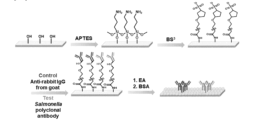
- Fig. 5 is a schematic diagram of an example of forming a biosensor chip by modifying an antibody on the chip lower plate made of glass.
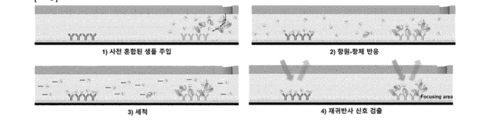
- Fig. 6 is a schematic diagram of a transparent microfluidic chip operating method for retroreflective signal analysis.
- a mixture of retroreflective particles and bacteria is injected into a transparent biosensor chip manufactured by the above method to induce an antigen-antibody reaction in the detection section and the control section inside the chip.
- the operating method is similar to the lateral flow immunoassay.
- the analyte and the marker in the sample pass through the detection section to the control section, and finally exit through the outlet.
- the retroreflective particles are captured only in the control section and a signal is generated, and no signal is generated in the detection section.
- the retroreflective particle-pathogenic bacteria complex is first captured in the detection section, and the remaining particles are captured in the control section, and signals are generated in both capture sections.
- the signals are converted into light spots on an image using a CMOS camera, and the number of light spots can be analyzed to quantitatively analyze the number of bacteria in the sample.
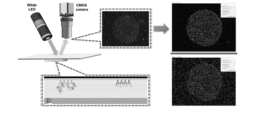
- Figure 7 illustrates a method for analyzing a retroreflection signal using an image analysis program.
- the retroreflection signal obtained through the biosensor chip for retroreflection signal analysis implemented in the present invention and the method for quantitatively analyzing the number of pathogenic bacteria using the same appears on the image in the form of a bright light spot due to the white light reflected by the retroreflection particles.
- the retroreflection signal is a light signal reflected and returned by a special mirror structure, and has a larger size than that of fluorescent/chromogenic molecules, so that it exhibits a signal in the form of a light spot that can be counted, and thus concentration analysis of target bacteria is possible by counting the number of these.
- a retroreflection image can be obtained by using a white LED as a light source and a CMOS camera as a light receiver without the need for a specific spectral filter, so that quantitative analysis of bacteria is possible by analyzing the image obtained with a simple optical system in the field.
- the basic retroreflective optical system is configured as shown in Fig. 7.
- the chip to be measured is positioned parallel to the light receiving section, and the angle of the white LED as the light source is positioned within 60° based on the light receiving section, the CMOS camera.
- the light from the light source is retroreflected by the particles inside the chip, reaches the CMOS camera, and is converted into an image signal.
- the area to be measured is enlarged to obtain a retroreflective image, and the image is processed using an image analysis program.
- a field diagnostic detection system based on the retroreflective phenomenon was designed to detect food poisoning bacteria in food, and a detection unit and a control unit were configured inside the biosensor chip similar to a lateral flow immunoassay so that the results can be intuitively confirmed on a transparent microfluidic biosensor chip.
- an analysis was performed on Salmonella typhimurium, a food poisoning bacteria in food, in an embodiment.
- An antibody that recognizes an antigen (LPS, flagella, etc.) present on the surface of Salmonella as an antigen was immobilized on the detection unit of the retroreflective particle surface, which is an optical marker, and the sensing surface, and a secondary antibody that recognizes the antibody on the surface of the retroreflective particle as an antigen was immobilized on the control unit to configure the chip.
- Figure 8 shows a schematic diagram of a method for detecting retroreflection signals according to the concentration of Salmonella typhimurium .
- the operating method starts with injecting a mixture of a sample and retroreflective particles into the inlet, similar to the lateral flow immunoassay.
- the analyte and marker in the sample pass through the detection unit to the control unit, and finally exit through the outlet.
- the retroreflective particles are captured only in the control unit and a signal is displayed, and no signal is displayed in the detection unit.
- the retroreflective particle-Salmonella complex is first captured in the detection unit, and the remaining particles are captured in the control unit, and signals are displayed in both capture units.
- the signals are converted into light spots on an image using a CMOS camera, and the number of Salmonella in the sample can be quantitatively analyzed through the above analysis method.
- particles having retroreflective ability were introduced as optical signal markers, and the signal difference according to the Salmonella concentration was analyzed through the retroreflective signal counting. The measurement range was measured from 0 CFU/mL where Salmonella does not exist to a concentration of 10 3 CFU/mL.
- Salmonella typhimurium the detection area of the glass sensing surface was modified with an antibody that specifically reacts with Salmonella, and the control area was modified with a secondary antibody that reacts with the antibody modified with the retroreflective particle, so that the effectiveness of the detection chip was verified through the control and the chip was configured to detect the target bacteria at the same time.
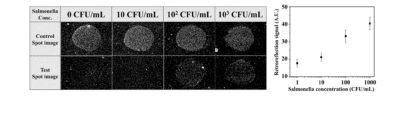
- Figure 9 shows the results of retroreflective signal analysis according to the concentration of Salmonella.
- the left figure of Figure 9 shows the analysis result image using retroreflective particles, and the right figure shows the calibration curve of the results analyzed using Image J.
- the data of the right figure are shown in the table below.
Landscapes
- Health & Medical Sciences (AREA)
- Life Sciences & Earth Sciences (AREA)
- Chemical & Material Sciences (AREA)
- Immunology (AREA)
- Engineering & Computer Science (AREA)
- General Health & Medical Sciences (AREA)
- Analytical Chemistry (AREA)
- Hematology (AREA)
- Biochemistry (AREA)
- General Physics & Mathematics (AREA)
- Pathology (AREA)
- Urology & Nephrology (AREA)
- Physics & Mathematics (AREA)
- Molecular Biology (AREA)
- Biomedical Technology (AREA)
- Clinical Laboratory Science (AREA)
- Virology (AREA)
- Tropical Medicine & Parasitology (AREA)
- Biotechnology (AREA)
- Cell Biology (AREA)
- Microbiology (AREA)
- Chemical Kinetics & Catalysis (AREA)
- Food Science & Technology (AREA)
- Medicinal Chemistry (AREA)
- Dispersion Chemistry (AREA)
- Apparatus Associated With Microorganisms And Enzymes (AREA)
Abstract
재귀반사 신호 분석식 균 검출 바이오센서 칩, 식품 병원성균 검출 칩, 재귀반사 신호 분석식 균 검출 방법 및 식품 병원성균 검출 방법이 개시된다. 상기 재귀반사 신호 분석식 균 검출 바이오센서 칩은 내부에 유로를 포함하는 유체칩; 상기 유로에 연결되고, 검출대상균에 결합할 수 있는 제1 항체가 수식된 재귀반사입자를 포함하는 검출대상샘플을 주입하는 주입부; 상기 검출대상균에 결합할 수 있는 제2 항체가 상기 유로 내부 표면에 고정된 검출부;를 포함할 수 있다.
Description
본 발명은 재귀반사 신호 분석식 균 검출 바이오센서 칩, 식품 병원성균 검출 칩, 재귀반사 신호 분석식 균 검출 방법 및 식품 병원성균 검출 방법에 관한 것이다.
구체적으로, 본 발명은 재귀반사 신호 분석용 바이오센서 칩 및 이를 이용한 병원성 세균수 정량 분석 방법을 이용한 현장 진단형 병원성 세균 검출 시스템에 관한 것이다. 세부적으로는 종래의 균 검출법 (선택적 배양 배지법, PCR, ELISA)이 현장 진단에서 갖는 한계점을 극복하기 위해 신호 검출을 위한 신규 개발된 바이오센서 칩과 광학 표지자로써 재귀반사능을 갖는 야누스 입자(Retroreflective Janus Particle, RJP)를 도입하여 간단한 광학 장치로 균 검출 및 정량 분석이 가능한 검출 시스템의 개발에 관한 것이다.
병원성 세균을 검출하는 종래의 기술로는 선택배지를 통해 균을 배양하여 배지에 형성된 콜로니의 수를 육안으로 관찰하는 선택배지 배양법, 항체에 결합된 효소를 통해 항원-항체 반응으로 항원의 농도를 분석하는 효소면역분석법 (ELISA법), 특정 DNA 서열을 증폭하여 시료 내 균 농도를 분석하는 중합효소연쇄반응법 (PCR법) 등이 사용되고 있다. 상기한 방식들은 병원성 세균을 검출 및 정량분석할 수 있으나, 소요 시간이 길고 높은 민감도와 정확성을 확보하기 위해 복잡한 광학 측정 장비가 요구된다. 이를 극복하기 위해, 다른 방식에 비해 간단한 측방 유동 면역분석법 등의 방법이 개발되었으나 세균수를 정량분석하기 위해서는 추가적인 광학 분석 장비가 필요하며, 상대적으로 낮은 검출 민감도를 가진다는 한계가 있다. 따라서, 현장에서 신속하고 정확한 검사가 가능한 신규 병원성 세균수 정량 분석 방법이 필요하다.
본 발명의 일 목적은 공간 제한적인 환경에서 병원성 세균의 감염 여부를 정성 및 정량 분석이 가능한 재귀반사 신호 분석식 균 검출 바이오센서 칩 및 이를 이용한 재귀반사 신호 분석식 균 검출 방법을 제공하는 것이다.
본 발명의 다른 목적은 식품 내 식중독균 감염 여부 판단 및 고민감도 검출이 가능한 식품 병원성균 검출 칩 및 이를 이용한 식품 병원성균 검출 방법을 제공하는 것이다.
구체적으로, 본 발명이 제시하는 재귀반사 신호 분석용 신규 바이오센서 칩은 측방 유동 면역분석법과 유사하게 병원성 세균-입자 복합체를 포획할 수 있는 검출부와 병원성 세균과 반응하지 않은 잔여 입자를 포획할 수 있는 대조부를 가지고 있다. 동시에, 바이오센서 칩은 투명한 재질로 구성되어, 각 부에 포획된 재귀반사 입자의 신호를 간단한 구성의 비분광식 광학계로 얻을 수 있도록 하였다. 재귀반사 입자는 입자의 크기보다 작은 파장의 빛을 광원 방향으로 되돌리는 특수 거울 구조체이기 때문에, 기존의 형광/비색 입자들과 달리 비분광 조건에서도 강한 신호를 감쇠 없이 나타낸다. 이 특성을 이용하여, 빛이 투과할 수 있는 투명한 바이오센서 칩을 제작하는 것으로 현장에서 사용 가능한 간단한 측정 시스템을 구성할 수 있다. 또한, 재귀반사 입자의 광학 신호는 이미지상에서 밝은 광점의 형태로 나타나므로, 이를 계수하여 신호 정량 분석이 가능하다. 상기 다양한 병원성 세균 검출법의 경우, 신호 검출을 위해 고감도의 복잡한 장비를 요구하는 반면 제안하는 본 시스템의 경우에는 광원으로 백색광을 사용하고 재귀반사 입자를 신호 표지자로 활용하여 비분광학적인 신호 검출 시스템을 구현 가능하기 때문에 진단 검사 시장 진입이 용이할 것으로 예상된다.
일 측면에서 본 발명은 내부에 유로를 포함하는 유체칩; 상기 유로에 연결되고, 검출대상균에 결합할 수 있는 제1 항체가 수식된 재귀반사입자를 포함하는 검출대상샘플을 주입하는 주입부; 상기 검출대상균에 결합할 수 있는 제2 항체가 상기 유로 내부 표면에 고정된 검출부;를 포함하는, 재귀반사 신호 분석식 균 검출 바이오센서 칩을 제공한다.
일 실시예에 있어서, 상기 재귀반사 신호 분석식 균 검출 바이오센서 칩은, 상기 재귀반사입자에 결합할 수 있는 제3 항체가 상기 유로 내부 표면에 고정된 대조부;를 더 포함할 수 있다.
일 실시예에 있어서, 상기 제1 항체와 상기 제2 항체는 동일한 항체를 포함할 수 있다.
일 실시예에 있어서, 상기 제1 항체 및 상기 제2 항체는, 상기 유로 내 상기 주입부에 대향하는 면에 고정될 수 있다.
다른 측면에서 본 발명은, 재귀반사 신호 분석식 균 검출 바이오센서 칩을 포함하는, 식품 병원성균 검출 칩을 제공한다.
일 실시예에 있어서, 상기 검출대상균은 살모넬라속(Salmonella) 균을 포함할 수 있다.
또 다른 측면에서 본 발명은, 내부에 유로를 포함하는 유체칩; 상기 유로에 연결되고, 검출대상균에 결합할 수 있는 제1 항체가 수식된 재귀반사입자를 포함하는 검출대상샘플을 주입하는 주입부; 상기 검출대상균에 결합할 수 있는 제2 항체가 상기 유로 내부 표면에 고정된 검출부;를 포함하는, 바이오센서 칩의 상기 주입부로 상기 검출대상샘플을 주입하여 상기 유로 내에 유동시키는 샘플주입단계;를 포함하는, 재귀반사 신호 분석식 균 검출 방법을 제공한다.
일 실시예에 있어서, 상기 바이오센서 칩은, 상기 재귀반사입자에 결합할 수 있는 제3 항체가 상기 유로 내부 표면에 고정된 대조부;를 더 포함하는 것으로 준비할 수 있다.
일 실시예에 있어서, 상기 제1 항체와 상기 제2 항체는 동일한 항체를 포함하는 것으로 준비할 수 있다.
일 실시예에 있어서, 상기 제1 항체 및 상기 제2 항체는, 상기 유로 내 상기 주입부에 대향하는 면에 고정된 것으로 준비할 수 있다.
일 실시예에 있어서, 상기 재귀반사 신호 분석식 균 검출 방법은, 상기 검출부 또는 상기 대조부에 광을 조사한 후, 상기 검출부 또는 상기 대조부에 결합된 상기 재귀반사입자로부터 반사된 광을 검출 및 분석하여, 상기 검출대상균을 정량분석하는 광분석단계;를 더 포함할 수 있다.
일 실시예에 있어서, 상기 광은 상기 제1 항체 및 상기 제2 항체가 고정된 면의 외부로부터 조사할 수 있다.
일 실시예에 있어서, 상기 광을 조사하는 방향과 상기 광을 검출하는 방향은 60°이하의 각도를 가지도록 조사 및 검출할 수 있다.
또 다른 측면에서 본 발명은 상기 재귀반사 신호 분석식 균 검출 방법을 통해 식품 내 병원성 검출대상균을 검출하는 식품병원성균검출단계;를 포함하는, 식품 병원성균 검출 방법을 제공한다.
일 실시예에 있어서, 상기 검출대상균은 살모넬라속(Salmonella) 균을 포함할 수 있다.
구체적으로, 항원-항체 기반의 균 검출을 수행할 수 있도록 재귀반사 입자에 균을 항원으로 인식하는 항체를 고정하고 검출부에 해당하는 칩 표면에도 동일한 균을 항원으로 인식하는 항체를 수식함으로써 샌드위치 타입의 센싱 기법을 적용했다. 또한, 대조부에 해당하는 칩 표면에는 재귀반사 입자에 수식된 항체를 항원으로 인식하는 2차 항체를 고정함으로써 균 검출과 동시에 칩의 유효성을 동시에 확인할 수 있도록 설계하였다. 바이오센서 칩의 미세유체 채널 내에 시료를 주입하게 되면 균의 존재 유무에 따라 검출부와 주변 영역과의 대비로, 원의 형태로 재귀반사 신호가 나타나게 되고 재귀반사 입자를 계수함으로써 균의 농도에 따른 정량 분석이 가능하게 된다. 본 시스템의 경우 복잡한 측정 장비와 분석 장비를 사용해야 하는 종래의 병원성 세균 검출법과는 달리 재귀반사 입자를 광학 프로브로 사용함으로써 분광 필터가 필요 없이 백색광과 CMOS 카메라만으로 구성된 광학 장치만으로도 고민감도로 균의 정량 분석이 가능하게 했다.
본 발명의 실시예에 따른 재귀반사 신호 분석식 균 검출 바이오센서 칩은 공간 제한적인 환경에서 병원성 세균의 감염 여부를 정성 및 정량 분석이 가능하다.
본 발명의 실시예에 따른 식품 병원성균 검출 칩은 식품 내 식중독균 감염 여부 판단 및 고민감도 검출이 가능하다.
본 발명의 실시예에 따른 재귀반사 신호 분석식 균 검출 방법은 상기 재귀반사 신호 분석식 균 검출 바이오센서 칩을 이용하여, 공간 제한적인 환경에서 병원성 세균의 감염 여부를 정성 및 정량 분석이 가능하다.
본 발명의 실시예에 따른 식품 병원성균 검출 방법은 상기 식품 병원성균 검출 칩을 이용하여, 식품 내 식중독균 감염 여부 판단 및 고민감도 검출이 가능하다.
본 발명에 의해, 종래의 병원성 세균 검출법이 복잡한 측정 장비 및 오랜 검출 시간을 요구했던 것과 달리 간단한 바이오센서 칩과 재귀반사 입자를 이용하여 균의 정량 분석을 수행할 수 있다.
도 1은 본 발명의 실시예에 따른 재귀반사 신호 분석식 균 검출 바이오센서 칩을 개략적으로 도시한 도면이다.
도 2는 본 발명의 실시예에 따른 재귀반사 신호 분석식 균 검출 방법을 개략적으로 도시한 흐름도이다.
도 3은 본 발명의 실시예에 따른 식품 병원성균 검출 방법을 도시한 흐름도이다.
도 4는 재귀반사 신호 분석용 바이오센서 칩의 개발과 이를 이용한 병원성 세균수 정량 분석 방법에 대한 것이다.
도 5는 유리로 구성된 칩 하판에 항체를 수식하여 바이오센서 칩을 구성하는 예시에 대한 모식도이다.
도 6은 재귀반사 신호 분석용 투명 미세유체 칩 구동 방식 모식도이다.
도 7은 이미지 분석 프로그램을 이용한 재귀반사 신호의 분석 방법을 도시한다.
도 8은 Salmonella typhimurium 농도에 따른 재귀반사 신호 검출 방법 모식도를 나타낸다.
도 9는 살모넬라균 농도에 따른 재귀반사 신호 분석 결과를 나타낸다.
이하, 첨부한 도면을 참조하여 본 발명의 실시예에 대해 상세히 설명한다. 본 발명은 다양한 변경을 가할 수 있고 여러 가지 형태를 가질 수 있는 바, 특정 실시 예들을 도면에 예시하고 본문에 상세하게 설명하고자 한다. 그러나 이는 본 발명을 특정한 개시 형태에 대해 한정하려는 것이 아니며, 본 발명의 사상 및 기술 범위에 포함되는 모든 변경, 균등물 내지 대체물을 포함하는 것으로 이해되어야 한다. 각 도면을 설명하면서 유사한 참조부호를 유사한 구성요소에 대해 사용하였다. 첨부된 도면에 있어서, 구조물들의 치수는 본 발명의 명확성을 기하기 위하여 실제보다 확대하여 도시한 것이다.
본 출원에서 사용한 용어는 단지 특정한 실시 예를 설명하기 위해 사용된 것으로, 본 발명을 한정하려는 의도가 아니다. 단수의 표현은 문맥상 명백하게 다르게 뜻하지 않는 한, 복수의 표현을 포함한다. 본 출원에서, "포함하다" 또는 "가지다" 등의 용어는 명세서 상에 기재된 특징, 숫자, 단계, 동작, 구성요소 또는 이들을 조합한 것이 존재함을 지정하려는 것이지, 하나 또는 그 이상의 다른 특징들이나 숫자, 단계, 동작, 구성요소 또는 이들을 조합한 것들의 존재 또는 부가 가능성을 미리 배제하지 않는 것으로 이해되어야 한다.
다르게 정의되지 않는 한, 기술적이거나 과학적인 용어를 포함해서 여기서 사용되는 모든 용어들은 본 발명이 속하는 기술 분야에서 통상의 지식을 가진 자에 의해 일반적으로 이해되는 것과 동일한 의미를 가지고 있다. 일반적으로 사용되는 사전에 정의되어 있는 것과 같은 용어들은 관련 기술의 문맥 상 가지는 의미와 일치하는 의미를 가지는 것으로 해석되어야 하며, 본 출원에서 명백하게 정의하지 않는 한, 이상적이거나 과도하게 형식적인 의미로 해석되지 않는다.
도 1은 본 발명의 실시예에 따른 재귀반사 신호 분석식 균 검출 바이오센서 칩을 개략적으로 도시한 도면이다.
도 1을 참조하면, 본 발명의 실시예에 따른 재귀반사 신호 분석식 균 검출 바이오센서 칩(100)은 내부에 유로(110')를 포함하는 유체칩(110); 상기 유로(110')에 연결되고, 검출대상균(G)에 결합할 수 있는 제1 항체(미도시)가 수식된 재귀반사입자(P)를 포함하는 검출대상샘플(S)을 주입하는 주입부(120); 상기 검출대상균(G)에 결합할 수 있는 제2 항체(130A)가 상기 유로(110') 내부 표면에 고정된 검출부(130);를 포함할 수 있다.
상기 유체칩(110)은 내부에 유로(110')를 포함하여, 본 발명의 실시예에 따른 재귀반사 신호 분석식 균 검출 바이오센서 칩(100)의 본체를 구성하는 부재이다. 본 발명의 실시예에 따른 재귀반사 신호 분석식 균 검출 바이오센서 칩(100)은 상기 유체칩(110)을 포함함으로써, 본 발명의 실시예에 따른 재귀반사 신호 분석식 균 검출 바이오센서 칩(100)은 검출할 샘플이 주입될 주입부(120), 샘플이 유동할 유로(110') 및 샘플의 성분이 결합할 수 있는 검출부(130) 또는 대조부(140) 등이 형성될 면을 정의할 수 있다. 상기 유체칩(110)은 상기와 같은 기능을 수행하는 한 그 구조나 재료가 특별히 제한되지 않으나, 부재의 안정성을 담보하기 위해 유의한 수준 이상의 경도를 가질 수 있고/거나 광학적 분석을 위해 그 전부 또는 일부가 유의한 수준 이상의 투명성을 가지는 재료로 형성될 수 있다.
상기 유로(110')는 본 발명의 실시예에 따른 재귀반사 신호 분석식 균 검출 바이오센서 칩(100)가 분석하고자 하는 샘플이 유동하는 채널 내지 통로 유사의 부재이다. 상기 유로(110')는 샘플이 유동할 수 있다면 그 형태나 구조가 특별히 제한되지 않는다. 일 실시예에 있어서, 상기 유체칩(110)은 길이 방향으로 연장된 형태이고, 상기 유로(110')는 상기 유체칩(110)과 동일한 방향으로 연장된 형태일 수 있다. 일 실시예에 있어서, 상기 주입부(120)는 상기 유체칩(110)의 일측에 형성되고/거나 상기 유로(110')의 시작부에 형성될 수 있다. 본 발명의 실시예에 따른 재귀반사 신호 분석식 균 검출 바이오센서 칩(100)은 1개 이상의 유로(110')를 포함할 수 있다. 일 실시예에 있어서, 상기 1개 이상의 유로(110')는 상이한 기능, 예컨대 상이한 병원균을 검출할 수 있다.
상기 주입부(120)는 본 발명의 실시예에 따른 재귀반사 신호 분석식 균 검출 바이오센서 칩(100)가 균을 검출하고자 하는 샘플이 주입될 수 있는 부재이다. 상기 주입부(120)는 상기 유로(110') 내로 샘플을 주입할 수 있는 한 그 구조나 형상이 특별히 제한되지 않는다.
상기 주입부(120)에 주입되는 샘플은 본 발명의 실시예에 따른 재귀반사 신호 분석식 균 검출 바이오센서 칩(100)을 정의하는 필수 구성은 아니나, 본 발명의 실시예에 따른 재귀반사 신호 분석식 균 검출 바이오센서 칩(100)의 기능을 온전히 발현하기 위하여, 재귀반사입자(P)를 포함할 수 있다. 상기 재귀반사입자(P)는 제1 항체(미도시)가 수식되어 있을 수 있고, 상기 제1 항체(미도시)는 검출대상균(G)과 결합될 수 있다. 상기 샘플이 검출대상균(G)을 포함할 수도 있고, 포함하지 않을 수도 있으나, 상기 제1 항체(미도시)가 수식된 재귀반사입자(P)가 포함되어 있으므로, 상기 샘플에 상기 검출대상균(G)이 포함된 경우, 상기 재귀반사입자(P)와 상기 검출대상균(G)이 결합될 수 있다.
상기 검출부(130)는 본 발명의 실시예에 따른 재귀반사 신호 분석식 균 검출 바이오센서 칩(100)가 검출하고자 하는 검출대상균(G)을 정성적 및/또는 정량적으로 검출하기 위해 검출대상균(G)이 결합할 수 있는 본 발명의 실시예에 따른 재귀반사 신호 분석식 균 검출 바이오센서 칩(100)의 일부이다. 상기 검출부(130)는 제2 항체(130A)를 포함할 수 있다. 상기 제2 항체(130A)는 상기 검출대상균(G)과 결합할 수 있다.
상기 제1 항체(미도시) 및 상기 제2 항체(130A)에 대한 설명을 참조하면, 상기 제2 항체(130A)가 상기 유체칩(110) 내 고정된 상태에서, 제1 항체(미도시)가 수식된 재귀반사입자(P) 및 검출대상균(G)을 모두 포함하는 샘플에 노출되는 경우, 상기 제1 항체(미도시) 및 상기 제2 항체(130A)가 모두 상기 검출대상균(G)에 결합하므로, 상기 유체칩(110)에 고정된 제2 항체(130A)로부터 제2 항체(130A), 검출대상균(G), 제1 항체(미도시) 및 재귀반사입자(P)의 순서를 가지는 결합 구조가 형성될 수 있다. 본 발명은 상기와 같은 구조를 통해 검출대상균(G)의 정성 및/또는 정량 분석이 가능하다는 것을 발견한 것에 적어도 기초한다.
본 발명의 실시예에 따른 재귀반사 신호 분석식 균 검출 바이오센서 칩(100)는 추가적인 부재의 부가를 배제하지 않는다. 일 실시예에 있어서, 상기 재귀반사 신호 분석식 균 검출 바이오센서 칩(100)은, 상기 재귀반사입자(P)에 결합할 수 있는 제3 항체(140A)가 상기 유로(110') 내부 표면에 고정된 대조부(140);를 더 포함할 수 있다.
상기 대조부(140)는, 상기 재귀반사입자(P)에 결합할 수 있는 제3 항체(140A)를 포함할 수 있다. 따라서, 상기 주입부(120)를 통해 재귀반사입자(P)를 포함하는 샘플이 정상적으로 주입된 경우, 상기 대조부(140)에 상기 검출부(130)에 결합하지 않은 잉여 재귀반사입자(P)가 결합하여, 상기 주입부(120)를 통해 재귀반사입자(P)를 포함하는 샘플이 정상적으로 주입되었음을 확인할 수 있다.
상기 제1 항체(미도시) 및 상기 제2 항체(130A)는 기능적으로 검출대상균(G)에 결합하는 한, 그 종류가 특별히 제한되지 않는다. 일 실시예에 있어서, 상기 제1 항체(미도시)와 상기 제2 항체(130A)는 동일한 항체를 포함할 수 있다. 일 실시예에 있어서, 상기 제1 항체(미도시)와 상기 제2 항체(130A)는 서로 상이한 항체를 포함할 수 있다.
일 실시예에 있어서, 상기 제1 항체(미도시) 및 상기 제2 항체(130A)는, 상기 유로(110') 내 상기 주입부(120)에 대향하는 면에 고정될 수 있다. 상기와 같이 배치됨으로써, 상기 주입부(120)를 상면으로하여 본 발명의 실시예에 따른 재귀반사 신호 분석식 균 검출 바이오센서 칩(100)을 실시할 때, 상기 제1 항체(미도시) 및 상기 제2 항체(130A)는 내부의 하면에 고정될 수 있어, 반응에 있어서 안정성을 도모할 수 있으며, 이후 광학적으로 분석시 하면을 이용할 수 있다.
한편, 본 발명의 실시예에 따른 식품 병원성균 검출 칩은, 상술된 재귀반사 신호 분석식 균 검출 바이오센서 칩을 포함할 수 있다.
상기 본 발명의 실시예에 따른 식품 병원성균 검출 칩에 관한 설명은 상술된 재귀반사 신호 분석식 균 검출 바이오센서 칩에 관한 설명에서 동일하거나 유사한 용어 또는 구성에 대해 동일하거나 유사하게 적용될 수 있다.
일 실시예에 있어서, 상기 검출대상균은 살모넬라속(Salmonella) 균을 포함할 수 있다. 즉, 본 발명의 실시예에 따른 식품 병원성균 검출 칩은 살모넬라속(Salmonella) 균을 검출할 수 있다.
도 2는 본 발명의 실시예에 따른 재귀반사 신호 분석식 균 검출 방법을 개략적으로 도시한 흐름도이다.
도 2를 참조하면, 본 발명의 실시예에 따른 재귀반사 신호 분석식 균 검출 방법(200)은 바이오센서 칩의 주입부로 검출대상샘플을 주입하여 유로 내에 유동시키는 샘플주입단계(S210)를 포함할 수 있다.
상기 본 발명의 실시예에 따른 재귀반사 신호 분석식 균 검출 방법(200)에 관한 설명은 상술된 식품 병원성균 검출 칩에 관한 설명 및/또는 상술된 재귀반사 신호 분석식 균 검출 바이오센서 칩에 관한 설명에서 동일하거나 유사한 용어 또는 구성에 대해 동일하거나 유사하게 적용될 수 있다. 따라서, 상기 바이오센서 칩은 상술된 본 발명의 실시예에 따른 재귀반사신호 분석식 균 검출 바이오센서 칩이고/거나 상술된 본 발명의 실시예에 따른 식품 병원성균 검출 칩일 수 있다.
이에, 상기 본 발명의 실시예에 따른 재귀반사 신호 분석식 균 검출 방법(200)은 내부에 유로를 포함하는 유체칩; 상기 유로에 연결되고, 검출대상균에 결합할 수 있는 제1 항체가 수식된 재귀반사입자를 포함하는 검출대상샘플을 주입하는 주입부; 상기 검출대상균에 결합할 수 있는 제2 항체가 상기 유로 내부 표면에 고정된 검출부;를 포함하는, 바이오센서 칩의 상기 주입부로 상기 검출대상샘플을 주입하여 상기 유로 내에 유동시키는 샘플주입단계(S210);를 포함할 수 있다.
상기 샘플주입단계(S210)는, 검출대상균을 포함할 수 있는 검출대상샘플을 바이오센서 칩의 주입부에 주입, 상기 검출대상균이 상기 검출대상샘플 내에 존재하는지 여부를 결정할 수 있는 단계이다.
상기 바이오센서 칩은 상술된 본 발명의 실시예에 따른 재귀반사신호 분석식 균 검출 바이오센서 칩이고/거나 식품 병원성균 검출 칩일 수 있으므로, 일 실시예에 있어서, 상기 바이오센서 칩은, 상기 재귀반사입자에 결합할 수 있는 제3 항체가 상기 유로 내부 표면에 고정된 대조부;를 더 포함하는 것으로 준비할 수 있다. 또한, 일 실시예에 있어서, 상기 제1 항체와 상기 제2 항체는 동일한 항체를 포함하는 것으로 준비할 수 있다. 또한, 일 실시예에 있어서, 상기 제1 항체 및 상기 제2 항체는, 상기 유로 내 상기 주입부에 대향하는 면에 고정된 것으로 준비할 수 있다.
본 발명의 실시예에 따른 재귀반사 신호 분석식 균 검출 방법(200)은 추가적인 단계의 부가를 배제하지 않는다. 일 실시예에 있어서, 상기 샘플주입단계(S210) 후, 본 발명의 실시예에 따른 재귀반사 신호 분석식 균 검출 방법(200)은 상기 유체칩의 유로에 워싱 용액을 유동시켜 결합되지 않은 재귀반사입자 및 검출대상균 등을 워싱하는 워싱단계를 더 포함할 수 있다.
또한, 일 실시예에 있어서, 상기 재귀반사 신호 분석식 균 검출 방법(200)은, 상기 검출부 또는 상기 대조부에 광을 조사한 후, 상기 검출부 또는 상기 대조부에 결합된 상기 재귀반사입자로부터 반사된 광을 검출 및 분석하여, 상기 검출대상균을 정량분석하는 광분석단계;를 더 포함할 수 있다.
상기 광분석단계는, 광을 조사하여 상기 검출대상균을 적어도 정량분석하는 단계이다. 본 발명은 재귀반사입자를 이용하여, 별도의 분광장치 없이 신속, 정확하고 낮은 비용으로 검출대상균을 정량분석 할 수 있음을 발견한 것에 적어도 기초한다.
상기 광분석단계에서, 광분석이 가능한 한, 상기 광의 조사 방향은 특별히 제한되지 않는다. 일 실시예에 있어서, 상기 광은 상기 제1 항체 및 상기 제2 항체가 고정된 면의 외부로부터 조사할 수 있다. 일 실시예에 있어서, 상기 광을 조사하는 방향과 상기 광을 검출하는 방향은 60°이하의 각도를 가지도록 조사 및 검출할 수 있다.
도 3은 본 발명의 실시예에 따른 식품 병원성균 검출 방법을 도시한 흐름도이다.
도 3을 참조하면, 본 발명의 실시예에 따른 식품 병원성균 검출 방법(300)은, 재귀반사 신호 분석식 균 검출 방법(300)을 통해 식품 내 병원성 검출대상균을 검출하는 식품병원성균검출단계(S310);를 포함할 수 있다.
상기 본 발명의 실시예에 따른 식품 병원성균 검출 방법(300)에 관한 설명은 상술된 재귀반사 신호 분석식 균 검출 방법(300)에 관한 설명 및/또는 상술된 식품 병원성균 검출 칩에 관한 설명 및/또는 상술된 재귀반사 신호 분석식 균 검출 바이오센서 칩에 관한 설명에서 동일하거나 유사한 용어 또는 구성에 대해 동일하거나 유사하게 적용될 수 있다.
따라서, 상기 재귀반사 신호 분석식 균 검출 방법(300)은, 상술된 본 발명의 실시예에 따른 재귀반사 신호 분석식 균 검출 방법(300)일 수 있다.
일 실시예에 있어서, 상기 검출대상균은 살모넬라속(Salmonella) 균을 포함할 수 있다. 따라서, 본 발명의 실시예에 따른 식품 병원성균 검출 방법(300)에 의해, 살모넬라속(Salmonella) 균을 검출할 수 있다.
이하 본 발명의 실시예에 대해 상술한다. 다만, 하기에 기재된 실시예는 본 발명의 일부 실시 형태에 불과한 것으로서, 본 발명의 범위가 하기 실시예에 한정되는 것은 아니다.
도 4는 재귀반사 신호 분석용 바이오센서 칩의 개발과 이를 이용한 병원성 세균수 정량 분석 방법에 대한 것이다. 기존의 방식인 선택배지 배양법, ELISA, PCR 등은 긴 검출 시간과 복잡한 광학 측정 장비를 요구하여 병원성 세균이 있는 현장에서의 운용에 제한이 있다. 현장에서 병원성 세균에 대한 검출이 가능한, 간단한 측방 유동 면역분석법 기반의 세균 검출 방법이 있으나, 세균수를 정량 분석하기 어렵다는 단점이 있다. 따라서, 신속하고 정확한 현장 진단을 위해서는 간단한 장비만으로 균의 존재 여부를 확인하고 균 수를 정량 분석 가능한 방법의 개발이 필요하다. 본 발명에서는 재귀반사 입자를 표지자로 도입하여 간단한 비분광식 광학계를 분석 장비로 사용할 수 있도록 하였으며, 측방 유동 면역분석법과 유사한 구조를 가진 미세유체 바이오센서 칩을 개발하여 간단하고 신속한 측정이 가능하도록 하였다. 개발된 재귀반사 신호 분석용 바이오센서 칩 및 이를 이용한 병원성 세균수 정량 분석 방법은 바이오센서 칩의 제작 방법과 재귀반사 신호 분석을 통한 세균수 정량 분석 방법에 대해 다루고 있다.
제조예
표적 병원성 세균 검출을 위한 재귀반사 신호 분석용 바이오센서 칩의 제작을 위해, 칩 하판으로 투명한 유리 또는 고분자 (Polycarbonate, Poly(methyl methacrylate), Polystyrene, Polydimethylsiloxane 등)를 사용하였다. 칩 하판의 검출부와 대조부에는 각 표적에 특이적으로 결합하는 항체를 고정하기 위해 반응 잔기를 도입한다. 하판의 반응 잔기 (Amine, Aldehyde, Carboxylic acid 등) 와 항체 표면의 반응 잔기를 반응시켜 항체를 고정한다. 항체 고정 시, 필요하다면 bis(sulfosuccinimidyl)suberate (BS3), glutaraldehyde (GA), 1-Ethyl-3-(3-dimethylaminopropyl)carbodiimide (EDC), N-hydroxysuccinimide (NHS) 등의 가교제를 매개로 도입하여 항체가 고정될 수 있도록 한다. 이 과정으로, 검출부에는 표적 균을 항원으로 하는 항체를 고정하여 재귀반사 입자-병원성 세균 복합체를 포획할 수 있도록 하고, 대조부에는 재귀반사 입자 표면의 항체를 포획 할 수 있는 2차 항체를 고정하여 잔여 단일 재귀반사 입자를 포획할 수 있도록 한다. 항체 고정 이후에는 기판에 남아있는 반응 잔기에 의한 비특이적 결합을 막기 위해 ethanolamine, L-lysine, bovine serum albumin (BSA) 등을 처리한다. 검출부와 대조부가 구성된 칩 하판에 미세유체 채널이 구성된 칩 상판을 결합하여 바이오센서 칩을 제작한다. 이 때, 칩 상판으로는 하판과 동일하게 광 투과도가 높은 투명한 유리 또는 고분자 (Polycarbonate, Poly(methyl methacrylate), Polystyrene, Polydimethylsiloxane 등) 등이 사용될 수 있다. 도 5는 유리로 구성된 칩 하판에 항체를 수식하여 바이오센서 칩을 구성하는 예시에 대한 모식도이다.
실시예
세균수 정량 분석을 위한 칩 구동 방법
도 6은 재귀반사 신호 분석용 투명 미세유체 칩 구동 방식 모식도이다. 도 6을 참조하면, 상기 방법을 통해 제작된 투명 바이오센서 칩에 재귀반사 입자와 균 혼합액을 주입하여 칩 내부의 검출부 및 대조부에서 항원-항체 반응을 유도한다. 구동 방식은 측방 유동 면역분석법과 유사하게 진행된다. 시료 내의 분석 물질과 표지자는 검출부를 거쳐 대조부로 진행되고, 최종적으로 출구를 통해 빠져나간다. 이 과정 중에, 시료 내에 균이 없는 경우에는 대조부에만 재귀반사 입자가 포획되어 신호를 나타내고 검출부에서는 신호가 나타나지 않는다. 반대로, 시료 내에 균이 존재할 경우, 재귀반사 입자-병원성 세균 복합체가 검출부에 먼저 포획되고, 잔여 입자가 대조부에 포획되어 두 포획부 모두 신호가 나타난다. 해당 신호들은 CMOS 카메라를 이용하여 이미지상의 광점으로 변환되며, 광점 수에 대한 분석을 통해 시료 내 균 수를 정량 분석할 수 있다.
재귀반사 신호 분석을 위한 이미지 처리 과정
도 7은 이미지 분석 프로그램을 이용한 재귀반사 신호의 분석 방법을 도시한다.
도 7을 참조하면, 본 발명에서 구현한 재귀반사 신호 분석용 바이오센서 칩 및 이를 이용한 병원성 세균수 정량 분석 방법을 통해 획득한 재귀반사 신호는 재귀반사 입자가 반사한 백색광으로 인하여 밝은 광점의 형태로 이미지상에 나타난다. 재귀반사 신호는 특수 거울 구조체에 의해 반사되어 되돌아오는 광 신호이며, 형광/발색 분자에 비해 큰 크기를 가지고 있어, 계수가 가능한 광점 형태의 신호를 나타내기 때문에 이 수를 세는 것으로 표적 균에 대한 농도 분석이 가능하다. 동시에, 특정 분광 필터를 사용할 필요 없이 백색 LED를 광원으로 두고 CMOS 카메라를 수광부로 사용하여 재귀반사 이미지를 얻을 수 있어, 현장에서 간단한 광학계로 얻어낸 이미지를 분석 하는 것으로 균에 대한 정량 분석이 가능하다.
기본적인 재귀반사 광학계는 도 7과 같이 구성된다. 측정하고자 하는 칩이 수광부 아래에 평행하게 위치해 있는 상황에서 수광부인 CMOS 카메라를 기준으로 광원인 백색 LED의 각도가 60° 이내에 위치할 수 있도록 한다. 상기와 같이 구성된 광학계에서, 광원으로부터 진행된 빛이 칩 내부의 입자에 재귀반사 되어 CMOS 카메라에 도달하여 이미지 신호로 변환된다. 측정하고자 하는 구역을 확대하여 재귀반사 이미지를 얻어 이미지 분석 프로그램을 통해 이미지를 처리한다.
재귀반사 신호 개수 확인
1) CMOS 카메라로 획득한 원본 이미지를 32 bit 이미지로 변환
2) 노이즈를 줄이기 위해 배경의 임계값을 10으로 설정
3) 32 bit로 변환된 이미지의 전체 면적에 나타나는 임계값 10 이상의 픽셀을 갖는 재귀반사 입자 계수 (A)
4) 변환된 이미지의 검출부와 대조부 각각에 직경 2800 픽셀 크기의 원을 설정
5) 선택 영역 내 임계값 10 이상의 픽셀을 갖는 재귀반사 입자 계수 (B)
6) 검출부의 A와 B, 대조부의 A와 B 비율을 이용한 수식을 통해 살모넬라균 정량분석
재귀반사 신호 분석용 바이오센서 칩을 이용한 시료 내 살모넬라균 수 정량 분석
본 발명의 실시예로, 식품 내 식중독균을 검출하기 위해 재귀반사 현상 기반의 현장 진단형 검출 시스템을 고안하였고, 투명 미세유체 바이오센서 칩에서 결과를 직관적으로 확인할 수 있도록 측방 유동 면역분석법과 유사하게 검출부와 대조부를 바이오센서 칩 내부에 구성하였다. 고안한 바이오센서 칩의 표적 병원성 세균수 분석 능력을 확인하기 위해 실시 예에서 식품 내 식중독균인 Salmonella typhimurium에 대한 분석을 진행하였다. 광학 표지자인 재귀반사 입자 표면과 센싱 표면의 검출부에는 살모넬라균의 표면에 존재하는 항원(LPS, flagella 등)을 항원으로 인식하는 항체를 고정하여, 대조부에는 재귀반사 입자 표면의 항체를 항원으로 인식 하는 2차 항체를 고정하여 칩을 구성하였다.
도 8은 Salmonella typhimurium 농도에 따른 재귀반사 신호 검출 방법 모식도를 나타낸다.
도 8을 참조하면, 구동 방식은 측방 유동 면역분석법과 유사하게 시료와 재귀반사 입자의 혼합액을 주입구에 투여하는 것으로 시작된다. 시료 내의 분석 물질과 표지자는 검출부를 거쳐 대조부로 진행되고, 최종적으로 출구를 통해 빠져 나간다. 이 과정 중에, 시료 내에 살모넬라균이 없는 경우에는 대조부에만 재귀반사 입자가 포획되어 신호를 나타내고 검출부에서는 신호가 나타나지 않는다. 반대로, 시료 내에 살모넬라균이 존재할 경우, 재귀반사 입자-살모넬라균 복합체가 검출부에 먼저 포획되고, 잔여 입자가 대조부에 포획되어 두 포획부 모두 신호가 나타난다. 해당 신호들은 CMOS 카메라를 이용하여 이미지상의 광점으로 변환되며, 상기 분석법을 통해 시료 내 살모넬라균의 수를 정량 분석할 수 있다.
재귀반사 신호 분석을 통한 살모넬라균 검출 및 정량 분석
본 발명을 통해 개발된 살모넬라균 검출 시스템의 실제 운용 가능성을 입증하기 위해 재귀반사능을 갖는 입자를 광학 신호 표지자로 도입하여 재귀반사 신호 계수를 통해 살모넬라균 농도에 따른 신호 차이를 분석하였 다. 측정 범위는 살모넬라균이 존재하지 않는 0 CFU/mL 부터 103 CFU/mL 농도까지 측정하였다. 표적 균인 Salmonella typhimurium의 검출을 위해 센싱 표면인 유리의 검출 영역에는 살모넬라균과 특이적으로 반응하는 항체를 수식하고 대조부에는 재귀반사 입자에 수식된 항체와 반응하는 2차 항체를 수식하여 검출 칩의 유효성을 대조를 통해 검증하는 동시에 표적 균을 검출할 수 있도록 칩을 구성하였다.
도 9는 살모넬라균 농도에 따른 재귀반사 신호 분석 결과를 나타낸다. 도 9의 좌측도는 재귀반사 입자를 활용한 분석 결과 이미지, 우측도는 Image J로 분석한 결과의 검정 곡선을 나타낸다. 우측도의 데이터는 하기 표에 나타내었다.
| Salmonella 농도 (CFU/mL) |
재귀반사 신호 카운트의 비율 |
| 0 | 17.8±2.2 |
| 10 | 21.2±2.3 |
| 102 | 33.2±3.6 |
| 103 | 40.5±3.6 |
재귀반사 이미지의 획득은 CMOS 카메라와 백색 LED 광원으로 구성된 광학계를 이용하였고, 이미지 분석 프로 그램을 이용하여 광점으로 나타나는 재귀반사 신호를 계수하였다. 결과, 살모넬라균의 농도가 증가할수록 검출 영역에서 관찰되는 입자 수가 증가했으며, 대조 영역에서는 살모넬라균의 농도와 관계없이 관찰되는 입자 수가 일정하게 나타났다. 반면, 도 9를 참조하면, 시료 속에 존재하는 살모넬라균의 농도가 높아질수록 사전 혼합 시에 더 많은 재귀반사 입자와 반응하기 때문에 측정된 이미지에서 검출 영역과 대조 영역의 주변의 전체적으로 비특이적인 반응에 의해 측정되는 재귀반사 신호가 줄어들었다. 살모넬라균 농도에 따른 신호 편차를 줄이기 위해, (대조부 B/대조부 A)*(검출부 B/검출부 A)*100의 수식을 적용하여 살모넬라균 정량 분석을 진행하였다. 최종적으로, 살모넬라균의 농도에 따른 검정 곡선을 얻을 수 있었다.도 9의 우측도의 그래프는 살모넬라 농도에 따라 대조부와 검출부에서 나타나는 재귀반사 신호를 3회 반복 실험을 통해 얻은 결과의 평균값을 나타낸 것으로, 발명된 재귀반사 신호 분석용 바이오센서 칩 및 이를 이용한 병원성 세균수 정량 분석 방법을 통해 10 CFU/mL 농도까지 세균을 검출할 수 있었다. 본 발명에서 개발한 바이오센서 칩은 기존의 PCR이나 ELISA를 통한 균 검출법에 사용되었던 복잡한 장비나 절차를 요구하지 않으면서도 짧은 시간 내에 고민감도로 측정할 수 있다는 점에서 현장 진단에 유리하게 적용될 것으로 예상된다.
상기에서는 본 발명의 바람직한 실시예를 참조하여 설명하였지만, 해당 기술 분야의 숙련된 당업자는 하기의 특허 청구 범위에 기재된 본 발명의 사상 및 영역으로부터 벗어나지 않는 범위 내에서 본 발명을 다양하게 수정 및 변경시킬 수 있음을 이해할 수 있을 것이다.
[부호의 설명]
100: 재귀반사 신호 분석식 균 검출 바이오센서 칩
110: 유체칩
110': 유로
120: 주입부
130: 검출부
130A: 제2 항체
140: 대조부
140A: 제3 항체
P: 재귀반사입자
G: 검출대상균
S: 검출대상샘플
200: 재귀반사 신호 분석식 균 검출 방법
300: 식품 병원성균 검출 방법
Claims (15)
- 내부에 유로를 포함하는 유체칩;상기 유로에 연결되고, 검출대상균에 결합할 수 있는 제1 항체가 수식된 재귀반사입자를 포함하는 검출대상샘플을 주입하는 주입부;상기 검출대상균에 결합할 수 있는 제2 항체가 상기 유로 내부 표면에 고정된 검출부;를 포함하는,재귀반사 신호 분석식 균 검출 바이오센서 칩.
- 제1항에 있어서,상기 재귀반사 신호 분석식 균 검출 바이오센서 칩은, 상기 재귀반사입자에 결합할 수 있는 제3 항체가 상기 유로 내부 표면에 고정된 대조부;를 더 포함하는,재귀반사 신호 분석식 균 검출 바이오센서 칩.
- 제1항에 있어서,상기 제1 항체와 상기 제2 항체는 동일한 항체를 포함하는,재귀반사 신호 분석식 균 검출 바이오센서 칩.
- 제1항에 있어서,상기 제1 항체 및 상기 제2 항체는, 상기 유로 내 상기 주입부에 대향하는 면에 고정된,재귀반사 신호 분석식 균 검출 바이오센서 칩.
- 제1항 내지 제4항 중 어느 한 항에 따른 재귀반사 신호 분석식 균 검출 바이오센서 칩을 포함하는,식품 병원성균 검출 칩.
- 제5항에 있어서,상기 검출대상균은 살모넬라속(Salmonella) 균을 포함하는,식품 병원성균 검출 칩.
- 내부에 유로를 포함하는 유체칩; 상기 유로에 연결되고, 검출대상균에 결합할 수 있는 제1 항체가 수식된 재귀반사입자를 포함하는 검출대상샘플을 주입하는 주입부; 상기 검출대상균에 결합할 수 있는 제2 항체가 상기 유로 내부 표면에 고정된 검출부;를 포함하는, 바이오센서 칩의 상기 주입부로 상기 검출대상샘플을 주입하여 상기 유로 내에 유동시키는 샘플주입단계;를 포함하는,재귀반사 신호 분석식 균 검출 방법.
- 제7항에 있어서,상기 바이오센서 칩은, 상기 재귀반사입자에 결합할 수 있는 제3 항체가 상기 유로 내부 표면에 고정된 대조부;를 더 포함하는 것으로 준비하는,재귀반사 신호 분석식 균 검출 방법.
- 제7항에 있어서,상기 제1 항체와 상기 제2 항체는 동일한 항체를 포함하는 것으로 준비하는,재귀반사 신호 분석식 균 검출 방법.
- 제7항에 있어서,상기 제1 항체 및 상기 제2 항체는, 상기 유로 내 상기 주입부에 대향하는 면에 고정된 것으로 준비하는,재귀반사 신호 분석식 균 검출 방법.
- 제7항에 있어서,상기 재귀반사 신호 분석식 균 검출 방법은, 상기 검출부 또는 상기 대조부에 광을 조사한 후, 상기 검출부 또는 상기 대조부에 결합된 상기 재귀반사입자로부터 반사된 광을 검출 및 분석하여, 상기 검출대상균을 정량분석하는 광분석단계;를 더 포함하는,재귀반사 신호 분석식 균 검출 방법.
- 제11항에 있어서,상기 광은 상기 제1 항체 및 상기 제2 항체가 고정된 면의 외부로부터 조사하는,재귀반사 신호 분석식 균 검출 방법.
- 제11항에 있어서,상기 광을 조사하는 방향과 상기 광을 검출하는 방향은 60°이하의 각도를 가지도록 조사 및 검출하는,재귀반사 신호 분석식 균 검출 방법.
- 제7항 내지 제13항 중 어느 한 항에 따른 재귀반사 신호 분석식 균 검출 방법을 통해 식품 내 병원성 검출대상균을 검출하는 식품병원성균검출단계;를 포함하는,식품 병원성균 검출 방법.
- 제14항에 있어서,상기 검출대상균은 살모넬라속(Salmonella) 균을 포함하는,식품 병원성균 검출 방법.
Applications Claiming Priority (2)
| Application Number | Priority Date | Filing Date | Title |
|---|---|---|---|
| KR10-2023-0081648 | 2023-06-26 | ||
| KR1020230081648A KR102805024B1 (ko) | 2023-06-26 | 2023-06-26 | 재귀반사 신호 분석식 균 검출 바이오센서 칩, 식품 병원성균 검출 칩, 재귀반사 신호 분석식 균 검출 방법 및 식품 병원성균 검출 방법 |
Publications (1)
| Publication Number | Publication Date |
|---|---|
| WO2025005448A1 true WO2025005448A1 (ko) | 2025-01-02 |
Family
ID=93938776
Family Applications (1)
| Application Number | Title | Priority Date | Filing Date |
|---|---|---|---|
| PCT/KR2024/006152 Ceased WO2025005448A1 (ko) | 2023-06-26 | 2024-05-08 | 재귀반사 신호 분석식 균 검출 바이오센서 칩, 식품 병원성균 검출 칩, 재귀반사 신호 분석식 균 검출 방법 및 식품 병원성균 검출 방법 |
Country Status (2)
| Country | Link |
|---|---|
| KR (1) | KR102805024B1 (ko) |
| WO (1) | WO2025005448A1 (ko) |
Citations (3)
| Publication number | Priority date | Publication date | Assignee | Title |
|---|---|---|---|---|
| KR101398764B1 (ko) * | 2013-08-29 | 2014-05-27 | 강릉원주대학교산학협력단 | 입자의 이동에 의해 분석물질을 검출하는 장치 및 방법 |
| KR102155218B1 (ko) * | 2019-04-17 | 2020-09-11 | 아주대학교산학협력단 | 생체물질의 분석 방법 |
| KR20220120106A (ko) * | 2021-02-23 | 2022-08-30 | 아주대학교산학협력단 | 재귀반사 신호 측정용 가젯 |
-
2023
- 2023-06-26 KR KR1020230081648A patent/KR102805024B1/ko active Active
-
2024
- 2024-05-08 WO PCT/KR2024/006152 patent/WO2025005448A1/ko not_active Ceased
Patent Citations (3)
| Publication number | Priority date | Publication date | Assignee | Title |
|---|---|---|---|---|
| KR101398764B1 (ko) * | 2013-08-29 | 2014-05-27 | 강릉원주대학교산학협력단 | 입자의 이동에 의해 분석물질을 검출하는 장치 및 방법 |
| KR102155218B1 (ko) * | 2019-04-17 | 2020-09-11 | 아주대학교산학협력단 | 생체물질의 분석 방법 |
| KR20220120106A (ko) * | 2021-02-23 | 2022-08-30 | 아주대학교산학협력단 | 재귀반사 신호 측정용 가젯 |
Non-Patent Citations (2)
| Title |
|---|
| " Basic Research Support Program Final Report.", 1 November 2021, NATIONAL RESEARCH FOUNDATION OF KOREA, article YOON, HYUN-CHUL: "Optical biosensor based on the retroreflection-enhanced upconversion luminescence signaling.", pages: 1 - 23, XP009559851 * |
| LEE DANBI, KIM EUNSUK, LEE KYUNG WON, KIM KA RAM, CHUN HYEONG JIN, YOON HYUNJIN, YOON HYUN C.: "Retroreflection-based sandwich type affinity sensing of isothermal gene amplification products for foodborne pathogen detection", ANALYST, vol. 147, no. 3, 31 January 2022 (2022-01-31), UK , pages 450 - 460, XP093111767, ISSN: 0003-2654, DOI: 10.1039/D1AN01543E * |
Also Published As
| Publication number | Publication date |
|---|---|
| KR20250000163A (ko) | 2025-01-03 |
| KR102805024B1 (ko) | 2025-05-08 |
Similar Documents
| Publication | Publication Date | Title |
|---|---|---|
| Rivnak et al. | A fully-automated, six-plex single molecule immunoassay for measuring cytokines in blood | |
| Obahiagbon et al. | A compact, low-cost, quantitative and multiplexed fluorescence detection platform for point-of-care applications | |
| WO2021201350A1 (ko) | 시분해 형광분석을 이용한 외상성 뇌손상 진단용 측방 유동 분석장치 및 이를 이용한 외상성 뇌손상 진단방법 | |
| CN101999076B (zh) | 免疫分析装置和免疫分析方法 | |
| US4980278A (en) | Method of effecting immunological analysis and apparatus for carrying out the same | |
| WO2021153928A1 (ko) | 크로마토그래피 검사장치 및 그 제어방법 | |
| WO2014137152A1 (ko) | 국소 표면플라즈몬 공명현상을 이용한 시료분석을 위한 카트리지 및 이를 이용한 분석방법 | |
| WO2017052285A1 (ko) | 표면-증강 라만 산란 기반의 고감도 측면유동 면역분석용 스트립 및 이를 이용한 검출방법 | |
| US20030119030A1 (en) | Immunoassay diagnostic probe and a method for use thereof | |
| WO2025225941A1 (ko) | 경쟁적 면역측정을 활용한 정량분석 다중스트립 면역크로마토그래피 분석 키트 | |
| WO2010008238A2 (en) | An immunochromatography detection sensor comprising optical waveguide and a detection method using the same | |
| TW201520534A (zh) | 螢光試紙、螢光激發裝置以及可攜式螢光分析系統 | |
| WO2011145895A2 (ko) | 반사식 흡광도 측정 장치 및 이를 포함하는 반사식 흡광도 및 측방유동 분석 일체형 장치 | |
| WO2025005448A1 (ko) | 재귀반사 신호 분석식 균 검출 바이오센서 칩, 식품 병원성균 검출 칩, 재귀반사 신호 분석식 균 검출 방법 및 식품 병원성균 검출 방법 | |
| WO2012144859A2 (ko) | 세포 환경 내에서의 단일 분자 수준의 단백질-단백질 상호작용 분석 방법 및 장치 | |
| Golden et al. | A “do-it-yourself” array biosensor | |
| WO2018084337A1 (ko) | 당화혈색소 비율의 측정 방법 | |
| WO2019093542A1 (ko) | 항원의 정량 분석용 마이크로 칩 및 항원의 정량 분석용 디바이스, 및 이를 이용한 항원의 정량 분석 방법 | |
| WO2019103324A1 (ko) | 측방유동 면역 분석 기반의 항ccp 항체 및 류마티스인자를 이용한 류마티스 관절염 진단 방법 | |
| KR102347135B1 (ko) | 시분해 형광분석을 이용한 노로바이러스 측방 유동 분석장치 및 이를 이용한 측정방법 | |
| WO2022182023A1 (ko) | 재귀반사 신호 측정용 가젯 | |
| CN107462700A (zh) | 免疫层析便携式分析仪 | |
| WO2019050321A1 (ko) | 다수의 검사선을 구비한 크로마토그래피용 스트립, 이를 포함하는 진단 키트 및 다수의 경쟁적 반응 측정 단계를 포함하는 정성, 반정량, 정량 분석방법 | |
| CN1598579A (zh) | 以磁性微球介导的微流体分析系统及其检测方法 | |
| WO2025023577A1 (ko) | 정량분석이 가능하며 체외 진단용 질환 표지자 농도값을 제공하는 신속 다중스트립 면역크로마토그래피 분석방법 및 장치 |
Legal Events
| Date | Code | Title | Description |
|---|---|---|---|
| 121 | Ep: the epo has been informed by wipo that ep was designated in this application |
Ref document number: 24832232 Country of ref document: EP Kind code of ref document: A1 |
|
| NENP | Non-entry into the national phase |
Ref country code: DE |