WO2025005306A1 - ウラシル誘導体を含有する医薬組成物 - Google Patents
ウラシル誘導体を含有する医薬組成物 Download PDFInfo
- Publication number
- WO2025005306A1 WO2025005306A1 PCT/JP2024/035560 JP2024035560W WO2025005306A1 WO 2025005306 A1 WO2025005306 A1 WO 2025005306A1 JP 2024035560 W JP2024035560 W JP 2024035560W WO 2025005306 A1 WO2025005306 A1 WO 2025005306A1
- Authority
- WO
- WIPO (PCT)
- Prior art keywords
- compound
- cov
- sars
- infection
- formula
- Prior art date
- Legal status (The legal status is an assumption and is not a legal conclusion. Google has not performed a legal analysis and makes no representation as to the accuracy of the status listed.)
- Pending
Links
Images




Classifications
-
- A—HUMAN NECESSITIES
- A61—MEDICAL OR VETERINARY SCIENCE; HYGIENE
- A61K—PREPARATIONS FOR MEDICAL, DENTAL OR TOILETRY PURPOSES
- A61K31/00—Medicinal preparations containing organic active ingredients
- A61K31/33—Heterocyclic compounds
- A61K31/395—Heterocyclic compounds having nitrogen as a ring hetero atom, e.g. guanethidine or rifamycins
- A61K31/495—Heterocyclic compounds having nitrogen as a ring hetero atom, e.g. guanethidine or rifamycins having six-membered rings with two or more nitrogen atoms as the only ring heteroatoms, e.g. piperazine or tetrazines
- A61K31/505—Pyrimidines; Hydrogenated pyrimidines, e.g. trimethoprim
- A61K31/506—Pyrimidines; Hydrogenated pyrimidines, e.g. trimethoprim not condensed and containing further heterocyclic rings
-
- A—HUMAN NECESSITIES
- A61—MEDICAL OR VETERINARY SCIENCE; HYGIENE
- A61K—PREPARATIONS FOR MEDICAL, DENTAL OR TOILETRY PURPOSES
- A61K31/00—Medicinal preparations containing organic active ingredients
- A61K31/33—Heterocyclic compounds
- A61K31/395—Heterocyclic compounds having nitrogen as a ring hetero atom, e.g. guanethidine or rifamycins
- A61K31/495—Heterocyclic compounds having nitrogen as a ring hetero atom, e.g. guanethidine or rifamycins having six-membered rings with two or more nitrogen atoms as the only ring heteroatoms, e.g. piperazine or tetrazines
- A61K31/505—Pyrimidines; Hydrogenated pyrimidines, e.g. trimethoprim
- A61K31/513—Pyrimidines; Hydrogenated pyrimidines, e.g. trimethoprim having oxo groups directly attached to the heterocyclic ring, e.g. cytosine
-
- A—HUMAN NECESSITIES
- A61—MEDICAL OR VETERINARY SCIENCE; HYGIENE
- A61P—SPECIFIC THERAPEUTIC ACTIVITY OF CHEMICAL COMPOUNDS OR MEDICINAL PREPARATIONS
- A61P31/00—Antiinfectives, i.e. antibiotics, antiseptics, chemotherapeutics
- A61P31/12—Antivirals
- A61P31/14—Antivirals for RNA viruses
-
- A—HUMAN NECESSITIES
- A61—MEDICAL OR VETERINARY SCIENCE; HYGIENE
- A61P—SPECIFIC THERAPEUTIC ACTIVITY OF CHEMICAL COMPOUNDS OR MEDICINAL PREPARATIONS
- A61P43/00—Drugs for specific purposes, not provided for in groups A61P1/00-A61P41/00
-
- C—CHEMISTRY; METALLURGY
- C07—ORGANIC CHEMISTRY
- C07D—HETEROCYCLIC COMPOUNDS
- C07D401/00—Heterocyclic compounds containing two or more hetero rings, having nitrogen atoms as the only ring hetero atoms, at least one ring being a six-membered ring with only one nitrogen atom
- C07D401/14—Heterocyclic compounds containing two or more hetero rings, having nitrogen atoms as the only ring hetero atoms, at least one ring being a six-membered ring with only one nitrogen atom containing three or more hetero rings
Definitions
- the present invention relates to a pharmaceutical composition containing a compound that exhibits coronavirus 3CL protease inhibitory activity.
- Coronaviruses which belong to the Orthocoronavirus subfamily of the Coronaviridae family of the Nidovirales order, have a genome size of approximately 30 kilobases and are the largest single-stranded positive-stranded RNA viruses known. Coronaviruses are classified into four genera: Alphacoronavirus, Betacoronavirus, Gammacoronavirus, and Deltacoronavirus. Seven types of coronaviruses are known to infect humans: two types of Alphacoronavirus (HCoV-229E, HCoV-NL63) and five types of Betacoronavirus (HCoV-HKU1, HCoV-OC43, SARS-CoV, MERS-CoV, SARS-CoV-2).
- HCoV-229E HCoV-NL63, HCoV-HKU1, and HCoV-OC43
- SARS-CoV Severe Acute Respiratory Syndrome coronavirus
- MERS Middle East Respiratory Syndrome coronavirus
- SARS-CoV-2 Severe Acute Respiratory Syndrome coronavirus
- SARS-CoV Middle East Respiratory Syndrome coronavirus
- SARS-CoV-2 novel coronavirus
- Non-Patent Document 1 The novel coronavirus disease (COVID-19), which broke out in December 2019, spread rapidly throughout the international community, and on March 11, 2020, the WHO declared it a pandemic.
- Droplet infection, contact infection, and aerosol infection have been reported as the main routes of infection for SARS-CoV-2, and it has been confirmed that SARS-CoV-2 remains suspended in the air with aerosols for about three hours and maintains its infectiousness (Non-Patent Document 1).
- the incubation period is about 2 to 14 days, and typical symptoms are cold-like, such as fever (87.9%), dry cough (67.7%), fatigue (38.1%), and phlegm (33.4%) (Non-Patent Document 2).
- respiratory failure due to acute respiratory distress syndrome, acute lung injury, and interstitial pneumonia occurs.
- Multiple organ failure such as renal failure and liver failure, has also been reported.
- PF-00835231 Lufotrelvir (PF-07304814): PF-07321332: In December 2021, PAXLOVIDTM was approved for emergency use authorization in the United States, and on February 10, 2022, PAXLOVID® Pak was granted special approval in Japan.
- Zocova registered trademark
- the active ingredient of Zocova is ensitrevir fumarate, and its structural formula is shown below, and its chemical structure is different from that of the compound used in the present invention (Patent Documents 10 to 13).
- Non-Patent Documents 4 to 7 and 13 to 16 Compounds having 3CL protease inhibitory activity are disclosed in Non-Patent Documents 4 to 7 and 13 to 16, but none of these documents describe or suggest the compounds to be used in the present invention.
- compounds having 3CL protease inhibitory activity are disclosed in Patent Documents 14 and 15, but none of these documents describe or suggest pharmaceutical compositions containing the compounds according to the present invention.
- Compounds having P2X3 and/or P2X2 /3 receptor inhibitory activity are disclosed in Patent Documents 3 to 9, but none of these documents describes or suggests 3CL protease inhibitory activity or antiviral effect.
- a compound having an HIV-1 reverse transcriptase inhibitory activity is described in Non-Patent Document 11, but 3CL protease inhibitory activity and anti-coronavirus effect are neither described nor suggested.
- the object of the present invention is to provide a pharmaceutical composition containing a compound having coronavirus 3CL protease inhibitory activity.
- the present invention provides a pharmaceutical containing a compound having an antiviral effect, in particular an effect of inhibiting coronavirus proliferation.
- the present invention relates to the following: (1) Formula (I-1): or a pharma- ceutically acceptable salt thereof. (2) The pharmaceutical composition according to the above item (1), which is a 3CL protease inhibitor. (3) The pharmaceutical composition according to item (1) or (2), which is used for inhibiting the proliferation of SARS-CoV-2 virus. (4) The pharmaceutical composition according to any one of items (1) to (3), which is a therapeutic and/or prophylactic agent for novel coronavirus disease (COVID-19). (5) The pharmaceutical composition according to any one of the above items (1) to (4), which is used for suppressing the aggravation of infectious diseases caused by SARS-CoV-2.
- the pharmaceutical composition according to any one of the above items (1) to (4) which is administered within 48 hours after the onset of symptoms of SARS-CoV-2 infection or after a positive diagnosis of SARS-CoV-2.
- the pharmaceutical composition according to any one of items (1) to (4) which is used to suppress viral transmission of SARS-CoV-2.
- a method for inhibiting SARS-CoV-2 viral proliferation comprising administering to an individual in need of treatment and/or prevention of novel coronavirus disease (COVID-19) a compound represented by formula (I-1): or a pharma- ceutically acceptable salt thereof, A method for inhibiting viral proliferation of SARS-CoV-2.
- a method for treating and/or preventing novel coronavirus disease (COVID-19) comprising administering to an individual in need of treatment and/or prevention of novel coronavirus disease (COVID-19) a compound represented by the formula (I-1): or a pharma- ceutically acceptable salt thereof, A method for treating and/or preventing novel coronavirus disease (COVID-19).
- a method for suppressing the aggravation of infection caused by SARS-CoV-2 comprising administering to an individual in need of treatment and/or prevention of novel coronavirus disease (COVID-19) a compound represented by the formula (I-1): or a pharma- ceutically acceptable salt thereof, A method for suppressing the aggravation of infectious diseases caused by SARS-CoV-2.
- a method for treating novel coronavirus disease comprising administering to an individual in need of treatment for novel coronavirus disease (COVID-19) a compound represented by the formula (I-1): or a pharma- ceutical acceptable salt thereof within 72 hours after the onset of symptoms of SARS-CoV-2 infection or after a positive diagnosis of SARS-CoV-2.
- Treatment methods for novel coronavirus disease (COVID-19).
- a method for treating novel coronavirus disease comprising administering to an individual in need of treatment for novel coronavirus disease (COVID-19) a compound represented by the formula (I-1): or a pharma- ceutical acceptable salt thereof within 24 hours after the onset of symptoms of SARS-CoV-2 infection or after a positive diagnosis of SARS-CoV-2.
- Treatment methods for novel coronavirus disease (COVID-19).
- a method for treating novel coronavirus disease comprising administering to an individual in need of treatment for novel coronavirus disease (COVID-19) a compound represented by the formula (I-1): or a pharma- ceutical acceptable salt thereof within 120 hours after the onset of symptoms of SARS-CoV-2 infection or after a positive diagnosis of SARS-CoV-2.
- Treatment methods for novel coronavirus disease (COVID-19).
- a method for treating novel coronavirus disease comprising administering to an individual in need of treatment for novel coronavirus disease (COVID-19) a compound represented by the formula (I-1): or a pharma- ceutical acceptable salt thereof within 48 hours after the onset of symptoms of SARS-CoV-2 infection or after a positive diagnosis of SARS-CoV-2.
- Treatment methods for novel coronavirus disease (COVID-19).
- a method for suppressing viral transmission of SARS-CoV-2 comprising administering to an individual in need of treatment for novel coronavirus disease (COVID-19) a compound represented by formula (I-1): or a pharma- ceutically acceptable salt thereof, Methods for inhibiting viral transmission of SARS-CoV-2.
- the present invention also relates to the following: (101) A preventive medicine for novel coronavirus disease (COVID-19), which is used for suppressing the onset of SARS-CoV-2 after exposure, comprising the following formula (I-1): or a pharma- ceutically acceptable salt thereof. (102) A method for preventing novel coronavirus disease (COVID-19), comprising administering to an individual in need of suppressing onset of SARS-CoV-2 after exposure a compound represented by the formula (I-1): or a pharma- ceutically acceptable salt thereof, How to prevent coronavirus disease 2019 (COVID-19). (103) A compound represented by the formula (I-1): or a pharma- ceutically acceptable salt thereof. (104) A compound according to the formula (I-1): or a pharma- ceutically acceptable salt thereof.
- the present invention relates to the following: (201) A preventive medicine for novel coronavirus disease (COVID-19), which is used for pre-exposure prophylaxis of SARS-CoV-2, comprising the following formula (I-1): or a pharma- ceutically acceptable salt thereof. (202) A method for preventing novel coronavirus disease (COVID-19), comprising administering to an individual in need of pre-exposure prophylaxis against SARS-CoV-2 a compound represented by formula (I-1): or a pharma- ceutically acceptable salt thereof, How to prevent coronavirus disease 2019 (COVID-19).
- a compound represented by the formula (I-1): or a pharma- ceutically acceptable salt thereof For pre-exposure prophylaxis against SARS-CoV-2, a compound represented by the formula (I-1): or a pharma- ceutically acceptable salt thereof. (204) A compound according to the formula (I-1): or a pharma- ceutically acceptable salt thereof.
- the present invention includes the following. (301) Formula (II): (Wherein, X is a single bond or -CH2- ; R2 is a substituted or unsubstituted aromatic carbocyclic group; R 3c is a substituted or unsubstituted aromatic carbocyclic group, a substituted or unsubstituted non-aromatic carbocyclic group, a substituted or unsubstituted aromatic heterocyclic group, a substituted or unsubstituted non-aromatic heterocyclic group, halogen, a substituted or unsubstituted alkyl, or a substituted or unsubstituted amino; R 1 is a substituted or unsubstituted aromatic heterocyclic group or a substituted or unsubstituted non-aromatic heterocyclic group; m is 0 or 1; Each R 5a is independently a hydrogen atom or a substituted or unsubstituted alkyl; R 5b each independently represents
- the graph shows the virus titer in the lung homogenate 3-4 days after infection in hamsters infected with hCoV-19/Japan/TY41-702/2022 (1.00 ⁇ 10 4 TCID 50 /hamster intranasally inoculated) when a vehicle or a compound represented by formula (I-1) was orally administered twice a day for 2-3 days starting 1 day after infection.
- the vertical axis shows the virus titer in the lung homogenate, and the horizontal axis shows each administration group and the number of days after infection.
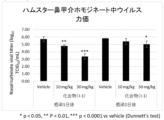
- the figure shows the virus titer in the nasal turbinate homogenate 3-4 days after infection in hamsters infected with hCoV-19/Japan/TY41-702/2022 (1.00 x 10 4 TCID 50 /hamster nasally inoculated) when a vehicle or a compound represented by formula (I-1) was orally administered twice a day for 2-3 days starting 1 day after infection.
- the vertical axis shows the virus titer in the nasal turbinate homogenate, and the horizontal axis shows each administration group and the number of days after infection.
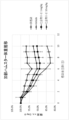
- This figure shows the weight change up to 10 days after infection in hamsters infected with hCoV-19/Japan/TY41-702/2022 (1.00 x 10 4 TCID 50 /hamster intranasally inoculated) when a vehicle or a compound represented by formula (I-1) was orally administered twice a day for 5 days starting 1 day after infection.
- the vertical axis shows the weight change (%) when the weight on the day of infection is taken as 100%, and the horizontal axis shows the number of days after infection.
- This figure shows the body weight change up to 7 days after infection in hamsters infected with hCoV-19/Japan/TY41-702/2022 (1.00 x 10 4 TCID 50 /hamster intranasally inoculated) when a vehicle or a compound represented by formula (I-1) was administered subcutaneously once 3 days or 1 day before infection.
- the vertical axis shows the body weight change (%) when the body weight on the day of infection is taken as 100%, and the horizontal axis shows the number of days after infection.
- the figure shows the virus titers in the lung homogenate 1-2 days after infection in hamsters infected with hCoV-19/Japan/TY41-702/2022 (1.00 ⁇ 10 4 TCID 50 /hamster intranasally inoculated) when a vehicle or a compound represented by formula (I-1) was administered subcutaneously once 1 day before infection.
- the vertical axis shows the virus titers in the lung homogenate, and the horizontal axis shows each administration group and the number of days after infection.
- the figure shows the virus titers in the nasal turbinate homogenate 1-2 days after infection for hamsters infected with hCoV-19/Japan/TY41-702/2022 (1.00 x 10 4 TCID 50 /hamster nasally inoculated) when a vehicle or a compound represented by formula (I-1) was administered subcutaneously once 1 day before infection.
- the vertical axis shows the virus titers in the nasal turbinate homogenate, and the horizontal axis shows each administration group and the number of days after infection.
- 1 shows a powder X-ray diffraction pattern of the anhydrous crystal of the compound represented by formula (I-1), where the horizontal axis represents 2 ⁇ (°) and the vertical axis represents intensity.
- the peak list of the powder X-ray diffraction pattern of Fig. 7 is shown below.
- Position indicates 2 ⁇ (°)
- Intensity indicates intensity.
- the crystal structure (structure in the asymmetric unit) of the anhydrous crystal of the compound represented by formula (I-1) is shown.
- 1 shows the results of differential scanning calorimetry (DSC) of the anhydrous crystals of the compound represented by formula (I-1), where the horizontal axis represents temperature (° C.) and the vertical axis represents heat amount (W/g).
- the figure shows the results of simultaneous differential thermal analysis and thermogravimetry (TG/DTA) of the anhydrous crystals of the compound represented by formula (I-1).
- the vertical axis shows the amount of heat ( ⁇ V) or the weight change (%), and the horizontal axis shows the temperature (°C).
- Cel means degrees Celsius (°C).
- 1 shows the Raman spectrum of the anhydrous crystal of the compound represented by formula (I-1), where the horizontal axis represents the Raman shift (cm ⁇ 1 ) and the vertical axis represents the peak intensity.
- the upper part shows the HPLC measurement results of the anhydrous crystals of the compound represented by formula (I-1), and the lower part shows the HPLC peak table.
- the figure shows the virus titers in nasal wash fluid (NALF) 3-7 days after infection in hamsters infected with hCoV-19/Japan/TY41-702/2022 (1.00 x 10 4 TCID 50 /hamster nasally inoculated) when a vehicle or a compound represented by formula (I-1) was orally administered twice a day for 1-5 days starting 2 days after infection.
- the vertical axis shows the virus titers in NALF, and the horizontal axis shows the number of days after infection.
- the figure shows the virus titers in nasal wash fluid (NALF) 4-8 days after infection in hamsters infected with hCoV-19/Japan/TY41-702/2022 (1.00 x 10 4 TCID 50 /hamster nasally inoculated) when a vehicle or a compound represented by formula (I-1) was orally administered twice a day for 1-5 days starting 3 days after infection.
- the vertical axis shows the virus titers in NALF, and the horizontal axis shows the number of days after infection.
- the compound was administered to a hCoV-19/Japan/TY11-927/2021-infected hamster (1.00 x 10 3 TCID 50 /hamster nasally inoculated, Index), and a non-infected hamster (Contact) was allowed to cohabit for 12 hours overnight from day 1 to day 2 after infection.
- the virus titers in the lung homogenate and nasal lavage fluid (NALF) of the non-infected hamster (Contact) four days after the start of cohabitation are shown.
- the infected hamster (Index) was orally administered a vehicle and a compound represented by formula (I-1) twice a day starting 8 hours after infection.
- the vertical axis indicates the virus titers in the lung homogenate and NALF, and the horizontal axis indicates each administration group.
- the virus titers in the lung homogenate and nasal lavage fluid (NALF) of the non-infected hamster (Contact) 4 days after the start of cohabitation when hCoV-19/Japan/TY11-927/2021-infected hamster (1.00 ⁇ 10 3 TCID 50 /hamster nasally inoculated, Index) and the non-infected hamster (Contact) administered with the compound were cohabited for 12 hours at night from 1 day after infection to 2 days after infection.
- the non-infected hamster (Contact) was subcutaneously administered with a vehicle and a compound represented by formula (I-1) 12 hours before the start of cohabitation.
- the vertical axis indicates the virus titers in the lung homogenate and NALF, and the horizontal axis indicates each administration group.
- the figure shows the survival rate up to 10 days after infection for aged hamsters infected with hCoV-19/Japan/TY11-927/2021 (1.00 x 10 4 TCID 50 /hamster intranasally inoculated, 11-month-old hamsters) when a vehicle or a compound represented by formula (I-1) was orally administered twice a day for 5 days starting 1 day after infection.
- the vertical axis shows the survival rate (%), and the horizontal axis shows the number of days after infection.
- the graph shows the weight change up to 10 days after infection in aged hamsters infected with hCoV-19/Japan/TY11-927/2021 (1.00 x 10 4 TCID 50 /hamster intranasally inoculated, 11-month-old hamsters) when a vehicle or a compound represented by formula (I-1) was orally administered twice a day for 5 days starting 1 day after infection.
- the vertical axis shows the weight change (%) when the weight on the day of infection is taken as 100%, and the horizontal axis shows the number of days after infection.
- the compounds represented by formula (I-1) or formula (II) are not limited to a specific isomer, but include all possible isomers (e.g., keto-enol isomers, imine-enamine isomers, diastereoisomers, optical isomers, rotamers, etc.), racemates, or mixtures thereof.
- One or more hydrogen, carbon and/or other atoms of the compound represented by formula (I-1) or formula (II) may be replaced with isotopes of hydrogen, carbon and/or other atoms, respectively.
- isotopes include hydrogen, carbon, nitrogen, oxygen, phosphorus, sulfur, fluorine, iodine and chlorine, such as 2H , 3H , 11C , 13C , 14C , 15N , 18O , 17O , 31P , 32P , 35S , 18F , 123I and 36Cl .
- the compound represented by formula (I-1) or formula (II) also includes compounds substituted with such isotopes (e.g., deuterium conversion compounds, etc.).
- the compounds substituted with such isotopes are also useful as pharmaceuticals.
- the compound represented by formula (I-1) or formula (II) includes all radiolabeled compounds substituted with radioisotopes contained in the isotopes.
- Also encompassed by the present invention is a "radiolabeling method" for producing said "radiolabeled substance", which is useful as a research and/or diagnostic tool in metabolism pharmacokinetic studies, binding assays.
- Deuterium-substituted derivatives of the compound represented by formula (I-1) include the following structures.
- Radiolabeled compounds of formula (I-1) or formula (II) can be prepared by methods well known in the art.
- tritium-labeled compounds of formula (I-1) or formula (II) can be prepared by introducing tritium into a particular compound of formula (I-1) or formula (II) by catalytic dehalogenation reaction using tritium. This method involves reacting a precursor of a compound of formula (I-1) or formula (II) in which a suitable halogen is substituted with tritium gas in the presence of a suitable catalyst, such as Pd/C, in the presence or absence of a base.
- a suitable catalyst such as Pd/C
- the compounds of the present invention represented by formula (I-1) or formula (II) may form prodrugs, and the present invention also includes such various prodrugs.
- Prodrugs are derivatives of the compounds of the present invention having a group that can be decomposed chemically or metabolically, and are compounds that become the pharma- ceutically active compounds of the present invention in vivo by solvolysis or under physiological conditions.
- Prodrugs include compounds that are converted to the compounds of formula (I-1) or formula (II) by enzymatic oxidation, reduction, hydrolysis, etc. under physiological conditions in the living body, and compounds that are converted to the compounds of formula (I-1) or formula (II) by hydrolysis by gastric acid, etc. Methods for selecting and producing appropriate prodrug derivatives are described, for example, in "Design of Prodrugs, Elsevier, Amsterdam, 1985". Prodrugs may themselves have activity.
- the "compound represented by formula (I-1) or formula (II)” used herein may form a salt, a cocrystal, or a solvate thereof.
- the term "a compound represented by formula (I-1) or formula (II), a pharma- ceutically acceptable salt thereof, or a solvate thereof” also encompasses such various salts, cocrystals, and solvates thereof.
- salt means that, for example, a "compound represented by formula (I-1) or formula (II)" and a counter molecule are regularly arranged in the same crystal lattice, and may contain any number of counter molecules. It refers to a compound that is bonded via ionic bonds by proton transfer between the compound and the counter molecule in the crystal lattice.
- cocrystal means that counter molecules (co-former molecules) are regularly arranged within the same crystal lattice, and may contain any number of counter molecules (co-former molecules).
- a cocrystal refers to an intermolecular interaction between a compound and a counter molecule (co-former molecule) that is mediated by a non-covalent and non-ionic chemical interaction such as a hydrogen bond or van der Waals force.
- salts are considered to be a state in which proton transfer occurs between a compound and a counter molecule, but it is also known that in some cases, proton transfer may not be complete. This state is sometimes called a cocrystal because it is not a true salt. It is also known that proton transfer may change continuously depending on the temperature. Therefore, as used herein, "a pharma- ceutically acceptable salt of a compound represented by formula (I-1) or formula (II)" includes a co-crystal and refers to a pharma- ceutically acceptable salt or co-crystal of a compound represented by formula (I-1) or formula (II).
- One aspect of the present specification is a pharma- ceutically acceptable salt or cocrystal of a compound represented by formula (I-1) or formula (II) with hydrofluoric acid, hydrochloric acid, hydrobromic acid, orthophosphoric acid, hydroiodic acid, nitric acid, phosphoric acid, boric acid, sulfuric acid, methanesulfonic acid, ethanesulfonic acid, p-toluenesulfonic acid, benzenesulfonic acid, trifluoromethylbenzenesulfonic acid, chlorobenzenesulfonic acid, methoxybenzenesulfonic acid, acetic acid, propionic acid, lactic acid, citric acid, fumaric acid, malonic acid, malic acid, succinic acid, salicylic acid, maleic acid, glycerophosphoric acid, tartaric acid, benzoic acid, glutamic acid, aspartic acid, 2-naphthalenesulfonic acid,
- Salt and co-crystal formation provides a means to modify the physicochemical and resulting biological characteristics of a drug without altering its chemical structure.
- Salt and co-crystal formation can dramatically affect the properties of a drug. Hygroscopicity, stability, solubility and processing properties are also important considerations in selecting an appropriate salt or co-crystal.
- the solubility of a salt or co-crystal can affect its suitability for use as a drug. If the aqueous solubility is low, the dissolution rate upon in vivo administration may be rate-limited by the absorption process, resulting in low bioavailability. Also, low water solubility may make administration by injection difficult, limiting the choice of an appropriate route of administration.
- the "compound represented by formula (I-1) or formula (II)” can form a solvate with water (i.e., a hydrate) or a solvate with a common organic solvent.
- the "pharmaceutical acceptable salt of the compound represented by formula (I-1) or formula (II)” can form a solvate with water (i.e., a hydrate) or a solvate with a common organic solvent.
- solvate refers to a compound of formula (I-1) or (II) regularly arranged with any number of solvent molecules.
- solvent molecules include ethyl acetate, water, ethanol, acetone, 1,1-diethoxypropane, 1,1-dimethoxymethane, 2,2-dimethoxypropane, isooctane, isopropyl ether, methyl isopropyl ketone, methyl tetrahydrofuran, petroleum ether, trichloroacetic acid, trifluoroacetic acid, acetic acid, anisole, 1-butanol, 2-butanol, n-butyl acetate, t-butyl methyl ether, cumene, dimethyl sulfoxide, diethyl ether, ethyl formate, formic acid, heptane, isobutyl acetate, isopropyl acetate, methyl acetate, 3-methyl-1
- ethyl acetate water, ethanol, acetone, 1,1-diethoxypropane, 1,1-dimethoxymethane, 2,2-dimethoxypropane, isooctane, isopropyl ether, methyl isopropyl ketone, methyl tetrahydrofuran, petroleum ether, trichloroacetic acid, and trifluoroacetic acid.
- the "compound represented by formula (I-1) or formula (II)" when left in the air, it may absorb moisture, and adsorbed water may adhere to it or a hydrate may be formed.
- crystal as used herein means a solid in which constituent atoms, ions, molecules, etc. are arranged in a three-dimensional order, and is distinguished from amorphous solids that do not have such an orderly internal structure.
- the term “crystal” as used herein may be a single crystal, a twin crystal, a polycrystal, etc.
- crystals can have “crystal polymorphs” that have the same composition but different arrangements within the crystal, and all of these are referred to as “crystal forms.”
- the "compound represented by formula (I-1) or formula (II), a pharma- ceutically acceptable salt thereof, or a solvate thereof” includes their crystal polymorphs.
- the crystals of the compounds according to the present invention may be deuterium converted.
- the crystals used herein may be labeled with an isotope (e.g., 2H , 3H , 14C , 35S , 125I , etc.).
- the crystal morphology and/or crystallinity can be confirmed by spectroscopic methods such as, for example, X-ray diffraction, Raman spectroscopy, infrared absorption spectroscopy, solid-state NMR, etc.
- the physical properties of the crystals can be confirmed by a number of techniques such as differential scanning calorimetry, moisture adsorption/desorption measurements, dissolution characteristics, etc.
- anhydrous crystal of the compound represented by formula (I-1) is an anhydrous crystal of the compound represented by formula (I-1).
- anhydrous is synonymous with “nosolvate,””nonsolvate,””anhydrate,” and “nonhydrate.”
- the theoretical content of water of crystallization in the anhydrous crystals of the compound represented by formula (I-1) is 0% by weight.
- the value may be higher than the theoretical content of water of crystallization due to the influence of the adhering water and/or the adhering solvent on the crystal surface.
- One embodiment of the present specification is an anhydrous crystal of the compound represented by formula (I-1) having a melting point of 261.3° C. ⁇ 2° C. as measured by differential scanning calorimetry (DSC).
- One embodiment of the present specification is an anhydrous crystal of the compound represented by formula (I-1) having a melting point of 265.6° C. ⁇ 2° C. as measured by simultaneous differential thermal analysis-thermogravimetry (TG/DTA).
- One embodiment of the present specification is an anhydrous crystal of the compound represented by formula (I-1) having characteristic peaks at 415.2 cm ⁇ 1 ⁇ 2 cm ⁇ 1 , 502.7 cm ⁇ 1 ⁇ 2 cm ⁇ 1 , 1431.4 cm ⁇ 1 ⁇ 2 cm ⁇ 1 , 1714.8 cm ⁇ 1 ⁇ 2 cm ⁇ 1 and 3065.4 cm ⁇ 1 ⁇ 2 cm ⁇ 1 in a Raman spectrum.
- X-Ray Powder Diffraction X-ray powder diffraction
- XRPD X-ray powder diffraction
- XRPD is one of the most sensitive analytical methods for measuring the crystalline morphology and crystallinity of solids.
- X-rays When X-rays are irradiated onto a crystal, they reflect off the crystal lattice planes and interfere with each other, resulting in orderly diffraction lines corresponding to the periodicity of the structure.
- amorphous solids usually do not have an orderly repeating period in their structure, so they do not exhibit diffraction phenomena and show featureless broad XRPD patterns (also called halo patterns).
- the crystalline form of the compound represented by formula (I-1) or formula (II) can be identified by a powder X-ray diffraction pattern and characteristic diffraction peaks.
- the crystalline form of the compound represented by formula (I-1) or formula (II) can be distinguished from other crystalline forms by the presence of characteristic diffraction peaks.
- a characteristic diffraction peak is a peak selected from the observed diffraction pattern.
- the characteristic diffraction peak is selected from about 10 peaks in the diffraction pattern, more preferably from about 5 peaks, and even more preferably from about 3 peaks.
- a peak that is confirmed in the crystal and not confirmed in other crystals is a preferred characteristic peak for identifying the crystal, rather than the peak intensity. If there are such characteristic peaks, even one or two peaks can characterize the crystal. If the charts obtained by measurement are compared and these characteristic peaks match, it can be said that the powder X-ray diffraction patterns are substantially the same.
- the diffraction angle (2 ⁇ ) in powder X-ray diffraction can have an error within the range of ⁇ 0.2°, so the value of the diffraction angle in powder X-ray diffraction should be understood to include values within the range of about ⁇ 0.2°. Therefore, the present invention includes not only crystals in which the diffraction angles of the peaks in powder X-ray diffraction are perfectly consistent, but also crystals in which the diffraction angles of the peaks match with an error of about ⁇ 0.2°.
- Single crystal structure analysis It is one of the methods for identifying a crystal, and it is possible to obtain the crystallographic parameters of the crystal, as well as atomic coordinates (values indicating the spatial positional relationship of each atom) and a three-dimensional structure model. See, for example, "X-Ray Structure Analysis Handbook” by Toshio Sakurai, published by Shokabo (1983), and X-Ray Structure Determination: A Practical Guide by Stout & Jensen, Macmillan Co., New York (1968). Single crystal structure analysis is useful for identifying the crystal structures of complexes, salts, optical isomers, tautomers, and geometric isomers such as those of the present invention.
- Raman spectra show the vibrational characteristics of a molecule or complex system. It originates from inelastic collisions between molecules and photons, which are light particles that comprise a beam of light. Collisions between molecules and photons result in an exchange of energy, which changes the energy and therefore the wavelength of the photon. That is, Raman spectra are spectral lines with extremely narrow wavelengths that are emitted when photons are incident on a molecule of interest, so a laser or other light source is used. The wavelength of each Raman line is represented by a wavenumber shift from the incident light, which is the difference between the Raman line and the reciprocal of the wavelength of the incident light.
- Raman spectra measure the vibrational state of a molecule, which is determined by its molecular structure.
- the Raman spectrum peak (cm -1 ) can have an error within the range of ⁇ 2 cm -1 , so the above Raman spectrum peak value should be understood to include a numerical value within the range of about ⁇ 2 cm -1 . Therefore, not only crystals whose Raman spectrum peaks in the Raman spectrum are completely identical, but also crystals whose Raman spectrum peaks are identical within an error of about ⁇ 2 cm -1 are included in the present invention.
- DSC Differential Scanning Calorimetry
- DSC is one of the main measurement methods in thermal analysis, and is a method for measuring the thermal properties of a substance as an aggregate of atoms and molecules.
- DSC measures the change in heat quantity with respect to temperature or time of the medicament active ingredient, and the obtained data is plotted against temperature or time to obtain a differential scanning calorimetry curve. From the differential scanning calorimetry curve, information can be obtained regarding the onset temperature when the medicament active ingredient melts, the maximum value of the endothermic peak curve accompanying melting, and the enthalpy. It is known that for DSC, the observed temperature may depend on the rate of temperature change as well as the sample preparation technique and the specific instrument used.
- the "melting point" in DSC refers to the onset temperature that is not affected by the sample preparation technique.
- the error range in the onset temperature obtained from the differential scanning calorimetry curve is approximately ⁇ 2°C. In identifying the identity of a crystal, not only the melting point but also the overall pattern is important, which may vary somewhat depending on the measurement conditions and the measurement instrument.
- TG/DTA is one of the main measurement methods in thermal analysis, and is a method for measuring the weight and thermal properties of a substance as an aggregate of atoms and molecules.
- TG/DTA is a method for measuring the change in weight and heat quantity of a pharmaceutical active ingredient with respect to temperature or time. The obtained data is plotted against temperature or time to obtain TG (thermogravimetry) and DTA ( From the TG/DTA curve, information on the changes in weight and heat quantity related to the decomposition, dehydration, oxidation, reduction, sublimation, and evaporation of the medicamentous active ingredient can be obtained.
- the "melting point" in TG/DTA refers to the temperature at which the sample melts. This refers to the onset temperature that is not easily affected by the preparation technique. In determining the identity of a crystal, not only the melting point but also the overall pattern is important, and may vary slightly depending on the measurement conditions and measurement equipment.
- the compounds according to the present invention have coronavirus 3 CL protease inhibitory activity and are therefore useful as therapeutic and/or preventive agents for diseases associated with coronavirus 3 CL protease.
- the term "therapeutic and/or prophylactic agent” includes agents for improving symptoms.
- the term “prevention” includes suppressing the onset of SARS-CoV-2 after exposure.
- the term “prevention” includes suppressing the onset of symptoms caused by SARS-CoV-2 by administering the pharmaceutical composition of the present invention to an individual in need of suppressing the onset after exposure to SARS-CoV-2.
- the term “prevention” includes pre-exposure prophylaxis of SARS-CoV-2.
- prevention includes suppressing the onset of symptoms caused by SARS-CoV-2 by administering the pharmaceutical composition of the present invention to an individual in need of suppressing the onset before exposure to SARS-CoV-2.
- prevention in the present invention includes suppressing the onset and aggravation of SARS-CoV-2 after exposure.
- coronavirus 3 CL protease Diseases in which coronavirus 3 CL protease is involved include viral infections, preferably coronavirus infections.
- the coronavirus includes a coronavirus that infects humans, including HCoV-229E, HCoV-NL63, HCoV-HKU1, HCoV-OC43, SARS-CoV, MERS-CoV, and/or SARS-CoV-2.
- the coronavirus includes an alphacoronavirus and/or a betacoronavirus, more preferably a betacoronavirus, and even more preferably a sarbecovirus.
- the alphacoronavirus includes HCoV-229E and HCoV-NL63, and is particularly preferably HCoV-229E.
- the betacoronavirus includes HCoV-HKU1, HCoV-OC43, SARS-CoV, MERS-CoV, and/or SARS-CoV-2, preferably HCoV-OC43 or SARS-CoV-2, and more preferably SARS-CoV-2.
- the beta coronavirus includes beta coronavirus lineage A, beta coronavirus lineage B, and beta coronavirus lineage C.
- the beta coronavirus lineage A and beta coronavirus lineage B are included, and particularly preferably, the beta coronavirus lineage B is included.
- the beta coronavirus A lineage include HCoV-HKU1 and HCoV-OC43, preferably HCoV-OC43.
- the beta coronavirus B lineage include SARS-CoV and SARS-CoV-2, preferably SARS-CoV-2.
- Examples of the beta coronavirus C lineage include MERS-CoV.
- the coronavirus includes HCoV-229E, HCoV-OC43, and/or SARS-CoV-2, with SARS-CoV-2 being particularly preferred.
- coronavirus infections include infections caused by HCoV-229E, HCoV-NL63, HCoV-OC43, HCoV-HKU1, SARS-CoV, MERS-CoV, and/or SARS-CoV-2.
- infections caused by HCoV-229E, HCoV-OC43, and/or SARS-CoV-2 and more preferably infections caused by SARS-CoV-2.
- a particularly preferred example of the coronavirus infection is the novel coronavirus disease (COVID-19).
- the severity classification of novel coronavirus infections is, for example, as follows: (Reference: Novel Coronavirus COVID-19 Treatment Guide, Version 10.0 (Ministry of Health, Labor and Welfare)) (Mild symptoms) Oxygen saturation is 96% or higher. Clinical condition is no respiratory symptoms, or only coughing and no dyspnea, and in either case, no signs of pneumonia are observed. (Moderate I) Oxygen saturation is less than 96% but more than 93%. There is difficulty breathing and signs of pneumonia. (Moderate II) Oxygen saturation is less than 93%. Respiratory failure occurs and oxygen administration is required. (Severe) They are in the ICU or require mechanical ventilation.
- An asymptomatic SARS-CoV-2 infected person refers to an asymptomatic pathogen carrier, such as a person who does not exhibit any of the 14 or 12 symptoms of COVID-19.
- 14 symptoms of COVID-19 fatigue, muscle or body aches, headache, chills/sweats, fever or fever, loss of taste or smell, runny or stuffy nose, sore throat, cough, shortness of breath (difficulty breathing), nausea, vomiting, diarrhea
- the 12 symptoms of COVID-19 are (malaise (fatigue), muscle or body aches, headache, chills/sweats, fever or fever, runny or stuffy nose, sore throat, cough, shortness of breath (difficulty breathing), nausea, vomiting, and diarrhea).
- suppression of aggravation includes suppressing an asymptomatic SARS-CoV-2-infected person from progressing to a severity classified as mild, moderate I, moderate II, or severe.
- suppression of aggravation includes suppressing an asymptomatic SARS-CoV-2-infected individual or a mildly infected individual from being upgraded to a severity classified as moderate I, moderate II, or severe.
- suppression of aggravation includes suppressing an asymptomatic SARS-CoV-2-infected person, a SARS-CoV-2-infected person with mild symptoms, or a SARS-CoV-2-infected person with moderate I symptoms from being classified as having a severity of moderate II symptoms or severe symptoms.
- suppression of aggravation includes upgrading the severity of an asymptomatic SARS-CoV-2-infected person, a mild SARS-CoV-2-infected person, a moderate I SARS-CoV-2-infected person, or a moderate II SARS-CoV-2-infected person to a severe level.
- suppression of aggravation includes reducing the risk of hospitalization or death in SARS-CoV-2-infected patients through the viral proliferation inhibitory effect of the drug.
- suppression of aggravation includes reducing inflammation in the lungs of a patient infected with SARS-CoV-2 through the viral proliferation inhibitory effect of the drug.
- suppression of aggravation includes suppressing pneumonia caused by SARS-CoV-2 viral infection via the viral proliferation inhibitory effect of the drug.
- suppression of aggravation includes suppressing the excessive immune response of the host caused by SARS-CoV-2 viral infection via the viral proliferation inhibitory effect of the drug.
- the pharmaceutical composition of the present invention is administered to SARS-CoV-2 infected individuals who have at least one risk factor for aggravation.
- SARS-CoV-2 infected individuals who have at least one risk factor for aggravation.
- underlying diseases related to aggravation please refer to the US CDC summary (https://www.cdc.gov/coronavirus/2019-ncov/hcp/clinical-care/underlyingconditions.html).
- the pharmaceutical composition of the present invention is administered to a SARS-CoV-2-infected individual who has at least one of the following risk factors for developing severe disease: Risk factors for severe illness: malignant tumors, metabolic diseases, cardiovascular diseases, respiratory diseases, liver diseases, kidney diseases, neuropsychiatric diseases, lack of exercise, pregnancy, smoking, childhood, genetic diseases, immunodeficiency
- the pharmaceutical composition of the present invention is administered to an infected individual who has at least one risk factor for severe symptoms, and is used to suppress the aggravation of COVID-19 symptoms.
- the pharmaceutical composition of the present invention is used for patients with pneumonia caused by SARS-CoV-2.
- prevention includes suppression of onset of SARS-CoV-2 after exposure.
- the pharmaceutical composition of the present invention can be administered to family members or cohabitants of a patient with novel coronavirus infection.
- the pharmaceutical composition of the present invention can be administered to a person who has come into contact with a patient infected with COVID-19 promptly (e.g., within 72 hours).
- the pharmaceutical composition of the present invention can be administered to an asymptomatic person infected with SARS-CoV-2 to suppress the onset of the disease.
- Prevention also includes pre-exposure prophylaxis for SARS-CoV-2.
- the pharmaceutical composition of the present invention can be administered to medical workers, elderly people, and people with risk factors for developing severe symptoms.
- the compound represented by formula (I-1) can be produced, for example, by the general synthesis method shown below. For extraction, purification, etc., treatments performed in ordinary organic chemistry experiments may be carried out. The compound can be synthesized by referring to methods known in the art. For extraction, purification, etc., treatments performed in ordinary organic chemistry experiments may be carried out.
- the compound represented by formula (I-1) can be produced by referring to methods known in the art, for example, WO2012/020742, WO2013/118855, WO2023/195529, and WO2023/195530.
- the compound represented by formula (II) can be produced, for example, by referring to WO2023/195529.
- the compounds according to the present invention have coronavirus 3CL protease inhibitory activity and are therefore useful as therapeutic and/or prophylactic agents for viral infections.
- the compound according to the present invention has pharmaceutical utility and preferably has one or more of the following excellent characteristics: a) It has a weak inhibitory effect on CYP enzymes (e.g., CYP1A2, CYP2C9, CYP2C19, CYP2D6, CYP3A4, etc.). b) It exhibits favorable pharmacokinetics, such as high bioavailability and moderate clearance. c) High metabolic stability.
- coronavirus proliferation inhibitors include those having an EC 50 of 10 ⁇ M or less, preferably 1 ⁇ M or less, and more preferably 100 nM or less in the CPE suppression effect confirmation test (SARS-CoV-2) described below.
- composition of the present invention can be administered either orally or parenterally.
- Parenteral administration methods include transdermal, subcutaneous, intravenous, intraarterial, intramuscular, intraperitoneal, transmucosal, inhalation, nasal, ophthalmic, otic, and vaginal administration.
- the drug may be prepared and administered in any of the commonly used dosage forms, such as solid preparations for internal use (e.g., tablets, powders, granules, capsules, pills, films, etc.) and liquid preparations for internal use (e.g., suspensions, emulsions, elixirs, syrups, lemonades, spirits, aromatic preparations, extracts, decoctions, tinctures, etc.), in accordance with the usual methods.
- solid preparations for internal use e.g., tablets, powders, granules, capsules, pills, films, etc.
- liquid preparations for internal use e.g., suspensions, emulsions, elixirs, syrups, lemonades, spirits, aromatic preparations, extracts, decoctions, tinctures, etc.
- Tablets may be sugar-coated tablets, film-coated tablets, enteric-coated tablets, sustained-release tablets, troches, sublingual tablets, buccal tablets, chewable tablets, or orally disintegrating tablets, powders and granules may be dry syrups, and capsules may be soft capsules, microcapsules, or sustained-release capsules.
- any of the commonly used dosage forms such as injections, drops, topical preparations (e.g., eye drops, nasal drops, ear drops, aerosols, inhalants, lotions, injections, liniments, mouthwashes, enemas, ointments, plasters, jellies, creams, patches, poultices, topical powders, suppositories, etc.) can be suitably administered.
- Injections may be emulsions such as O/W, W/O, O/W/O, and W/O/W types.
- a pharmaceutical composition can be prepared by mixing an effective amount of the compound according to the present invention with various pharmaceutical additives suitable for the dosage form, such as excipients, binders, disintegrants, lubricants, etc., as necessary.
- the pharmaceutical composition can be prepared as a pharmaceutical composition for children, elderly people, seriously ill patients, or surgical patients by appropriately changing the effective amount of the compound according to the present invention, the dosage form, and/or various pharmaceutical additives.
- a pharmaceutical composition for children can be administered to newborns (less than 4 weeks after birth), infants (4 weeks to less than 1 year after birth), toddlers (1 year to less than 7 years), children (7 years to less than 15 years), or patients aged 15 to 18 years.
- a pharmaceutical composition for the elderly can be administered to patients aged 65 years or older.
- the dosage of the pharmaceutical composition of the present invention is desirably set taking into consideration the patient's age, body weight, type and severity of the disease, route of administration, etc., but when administered orally, it is usually 0.01 to 100 mg/kg/day of the compound of the present invention, and preferably in the range of 0.05 to 50 mg/kg/day.
- When administered parenterally it varies greatly depending on the route of administration, but it is usually 0.005 to 200 mg/kg/day of the compound of the present invention, and preferably in the range of 0.01 to 100 mg/kg/day. This can be administered once or in divided doses several times a day.
- the compound according to the present invention may be used in combination with, for example, another therapeutic drug for novel coronavirus disease (COVID-19) (including approved drugs and drugs under development or to be developed in the future) (hereinafter referred to as a concomitant drug) for the purpose of enhancing the effect of the compound or reducing the dosage of the compound.
- a concomitant drug for the purpose of enhancing the effect of the compound or reducing the dosage of the compound.
- the administration timing of the compound according to the present invention and the concomitant drug is not limited, and they may be administered to the subject at the same time or at different times.
- the compound according to the present invention and the concomitant drug may be administered as two or more types of preparations containing the respective active ingredients, or as a single preparation containing those active ingredients.
- the dosage of the concomitant drug can be appropriately selected based on the dosage used clinically.
- the mixing ratio of the compound of the present invention and the concomitant drug can be appropriately selected depending on the subject of administration, the administration route, the target disease, symptoms, combination, etc. For example, when the subject of administration is a human, 0.01 to 100 parts by weight of the concomitant drug may be used per 1 part by weight of the compound of the present invention.
- FBS fetal bovine serum mM: mmol/L nM: nmol/L ⁇ M: ⁇ mol/L
- Measurement and analysis method for single crystal structure analysis The crystals obtained in the examples were subjected to single crystal structure analysis.
- the measurement conditions and analysis method are shown below.
- (Device) Rigaku XtaLAB P200 MM007 (Measurement conditions) Measurement temperature: 25°C Temperature controller: Rigaku Corporation sample spraying low temperature device Wavelength used: CuK ⁇ radiation ( ⁇ 1.5418 ⁇ )
- Data Processing Software: CrysAlisPro 1.171.39.46e (Rigaku Oxford Diffraction, 2018)
- the data were Lorentzian, polarization and absorption corrected.
- Measurement of Raman Spectrum The measurement conditions for measuring the Raman spectrum of the crystals obtained in the examples and performing baseline correction are shown below. Measurement condition 1 Measurement method: Microscopic laser Raman spectroscopy Laser wavelength: 671 nm Accumulation count: 1 Exposure time: 1 second
- DSC Differential Scanning Calorimetry
- TG/DTA Simultaneous differential thermal and thermogravimetric measurement
- the solid form (crystal) obtained in the examples was subjected to simultaneous differential thermal analysis and thermogravimetry (TG/DTA).
- the samples obtained in the examples were weighed, placed in aluminum pans, and measured in an open system.
- the measurement conditions are as follows. Equipment: Hitachi High-Technologies TG/DTA STA7200RV Measurement temperature range: Room temperature - 350°C Heating rate: 10° C./min
- Step 2 Synthesis of Compound 4 Acetic acid (40 mL) and concentrated hydrochloric acid (41 mL) were added to compound 3 (14.8 g, 48.8 mmol), and the mixture was stirred at 110° C. for 5 hours. The reaction solution was cooled to room temperature, and then water (80 ml) was added. The precipitate was collected by filtration and washed with water. The mixture was air-dried to obtain compound 4 (11.6 g, 42.2 mmol).
- Step 4 Synthesis of Compound 6 2-Bromoacetonitrile (269 ⁇ L, 4.04 mmol) was added to a solution of compound 5 (520 mg, 1.345 mmol), N,N-diisopropylethylamine (0.705 mL, 4.04 mmol), and DMF (5.2 mL), and the mixture was stirred at room temperature overnight. 2 mol/L hydrochloric acid (2 mL) was added to the reaction solution under ice cooling, and the mixture was extracted with ethyl acetate. The organic layer was washed with water, dried over sodium sulfate, and filtered.
- Step 5 Synthesis of Compound (I-1)
- Compound 6 (25.0 mg, 0.059 mmol), 6,6-difluoro-2-azaspiro[3.3]heptane trifluoroacetate (17.4 mg, 0.070 mmol), N,N-diisopropylethylamine (20.5 ⁇ L, 0.117 mmol), and DMF (0.5 mL) were mixed, and the solution was stirred at 60° C. for 2 hours. Water (2 mL) was added to the reaction solution, and the solution was extracted with ethyl acetate. The organic layer was washed with water, dried over sodium sulfate, and filtered.
- the anhydrous crystals of the compound represented by formula (I-1) showed characteristic peaks at diffraction angles (2 ⁇ ): 6.5° ⁇ 0.2°, 15.6° ⁇ 0.2°, 17.4° ⁇ 0.2°, 19.9° ⁇ 0.2°, and 20.3° ⁇ 0.2° in a powder X-ray diffraction pattern.
- V means the unit cell volume
- Z means the number of molecules in the unit cell.
- the structure in the asymmetric unit of the crystal structure is shown in FIG.
- the label numbers of the non-hydrogen atoms shown in FIG. 9 correspond to the numbers of the non-hydrogen atoms in Table 2.
- the crystal structure was identified as an anhydrous crystal of the compound represented by formula (I-1) because only one molecule of the compound represented by formula (I-1) was present in the asymmetric unit.
- the anhydrous crystals of the compound represented by formula (I-1) after pulverization were subjected to Raman spectrum measurement under the above-described measurement condition 1. The results are shown in Figure 12. The main Raman peaks are shown below.
- the anhydrous crystals of the compound represented by formula (I-1) showed characteristic peaks in the Raman spectrum at 415.2 cm ⁇ 1 ⁇ 2 cm ⁇ 1 , 502.7 cm ⁇ 1 ⁇ 2 cm ⁇ 1 , 1431.4 cm ⁇ 1 ⁇ 2 cm ⁇ 1 , 1714.8 cm ⁇ 1 ⁇ 2 cm ⁇ 1 , and 3065.4 cm ⁇ 1 ⁇ 2 cm ⁇ 1 .
- Step 1 Synthesis of Compound 8
- Compound 7 (2.6 g, 14.2 mmol), DMF (13 mL) and methyl alcohol-O 18 (1.18 mL, 29.1 mmol) were mixed, and sodium hydride (1.42 g, 35.4 mmol) was slowly added under ice cooling.
- the reaction solution was warmed to room temperature and stirred for 2 hours.
- the reaction solution was cooled in an ice bath, quenched by adding water (26 mL) and ethyl acetate (26 mL), and extracted with ethyl acetate.
- Step 3 Synthesis of Compound 11
- Compound 10 (5 g, 33.9 mmol) and water (11.5 mL) were mixed, and hydrogen bromide (11.5 mL, 102 mmol) was added under ice cooling. Then, NaNO 2 (2.384 g, 34.6 mmol) was dissolved in water (7.5 mL) and slowly added. The reaction solution was heated to 30°C, and CuBr (6.32 g, 44.0 mmol) was dissolved in hydrogen bromide (13.42 mL, 119 mmol) and added at an internal temperature of 30 to 40°C.
- Step 4 Synthesis of Compound 12 To a mixed solution of 2.76 mol/L n-butyllithium in hexane (1.8 mL, 5.04 mmol) and tetrahydrofuran (2.6 mL), a solution of compound 8 (0.75 g, 4.2 mmol) in tetrahydrofuran (70 mL) was slowly added dropwise over 5 minutes at -78°C. The reaction solution was stirred at -78°C for 1 hour. To the reaction solution, a solution of 1.9 mol/L zinc chloride in 2-methyltetrahydrofuran (2.6 mL, 82.4 mmol) was added dropwise. The reaction solution was stirred at room temperature for 2 hours.
- reaction solution compound 11 (1.2 g, 4.2 mmol) and tetrakis(triphenylphosphine)palladium (243 mg, 0.21 mmol) were added, and the mixture was stirred at 90°C for 1.5 hours.
- the reaction solution was cooled to room temperature, water (7.5 mL) was added, and the mixture was extracted with ethyl acetate. The organic layer was washed with water and saturated saline, dried over magnesium sulfate, and filtered.
- Step 5 Synthesis of Compound 13
- Compound 12 (374 mg, 1.2 mmol), acetonitrile (7.5 mL), NaI (181 mg, 1.2 mmol) and TMSCl (464 ⁇ L) were mixed and the reaction solution was heated at 40° C. NaI (181 mg, 1.2 mmol) and TMSCl (464 ⁇ L) were added about every 30 minutes until the raw material was almost disappeared. After the reaction was completed, water (15 mL) was added to the reaction solution to precipitate a solid. After the reaction solution was partially concentrated, the solid was filtered. The solid was washed with chilled acetonitrile to obtain compound 13 (246 mg, 0.88 mmol).
- Step 7 Synthesis of Compound 15 2-Bromoacetonitrile (168 ⁇ L, 2.52 mmol) was added to a mixed solution of compound 14 (330 mg, 0.84 mmol), DIPEA (440 ⁇ L, 2.52 mmol), and DMF (3.3 mL). The resulting solution was stirred at room temperature overnight. Water (14 mL) was added to the reaction solution, and the mixture was extracted with ethyl acetate. The organic layer was washed with water and saturated saline, dried over magnesium sulfate, and filtered.
- Step 8 Synthesis of Compound (I-2) Compound 15 (48.8 mg, 0.113 mmol), 6,6-difluoro-2-azaspiro[3.3]heptane trifluorohydrochloride (33.5 mg, 0.136 mmol), DMF (0.5 mL) and N,N-diisopropylethylamine (59.2 ⁇ L, 0.339 mmol) were mixed and stirred at 60° C. for 2 hours. Water (2 mL) was added to the reaction solution, and the mixture was extracted with ethyl acetate. The organic layer was washed with water, dried over magnesium sulfate, and filtered.
- Reference Example 2 The following compounds can be synthesized in the same manner as in Reference Example 1 and WO 2023/195529.
- IC50 is preferably 50 ⁇ M or less, more preferably 1 ⁇ M or less, and even more preferably 100 nM or less.
- EC50 is preferably 10 ⁇ M or less, more preferably 1 ⁇ M or less, and even more preferably 100 nM or less.
- Test Example 1 Cytopathic effect (CPE) suppression test using human TMPRSS2 and ACE2-expressing HEK293T cells (HEK293T/ACE2-TMPRSS2 cells) ⁇ Procedure> -Dilution and dispensing of test sample Test samples are preliminarily diluted with DMSO to an appropriate concentration, and a 2- to 5-fold serial dilution series is prepared, and then dispensed into a 384-well plate.
- CPE Cytopathic effect
- Dilution and dispensing of cells and SARS-CoV-2 HEK293T/ACE2-TMPRSS2 cells (GCP-SL222, 5 x 10³ cells/well) and SARS-CoV-2 ( 200-600TCID50 /well) were mixed in culture medium (MEM, 2% FBS, penicillin-streptomycin), dispensed into wells containing test samples, and then cultured in a CO2 incubator for 3 days. Dispensing of CellTiter-Glo® 2.0 and measurement of luminescence signal After the plate cultured for 3 days is returned to room temperature, CellTiter-Glo® 2.0 is dispensed into each well and mixed using a plate mixer.
- the luminescence signal (Lum) is measured using a plate reader.
- ⁇ Calculation of each measurement item value> Calculation of 50% SARS-CoV-2-infected cell death inhibitory concentration (EC 50 )
- EC 50 50% SARS-CoV-2-infected cell death inhibitory concentration
- Test Example 2-1 Inhibitory activity test against SARS-CoV-2 3CL protease ⁇ Materials> Commercially available recombinant SARS-CoV-2 3CL Protease Commercially available substrate peptide Dabcyl-Lys-Thr-Ser-Ala-Val-Leu-Gln-Ser-Gly-Phe-Arg-Lys-Met-Glu(Edans)-NH 2 (SEQ ID NO: 1) Internal Standard Peptide Dabcyl-Lys-Thr-Ser-Ala-Val-Leu( 13 C 6 , 15 N)-Gln (SEQ ID NO: 2) Dabcyl-Lys-Thr-Ser-Ala-Val-Leu( 13 C 6 , 15 N)-Gln can be synthesized with reference to the literature (Atherton, E.; Sheppard, R.
- Test samples are preliminarily diluted with DMSO to an appropriate concentration, and a 2- to 5-fold serial dilution series is prepared, and then dispensed into a 384-well plate.
- Addition of enzyme and substrate, enzyme reaction Add 8 ⁇ M substrate and 6 nM or 0.6 nM enzyme solution to the prepared compound plate and incubate at room temperature for 3 to 5 hours. After that, add reaction stop solution (0.067 ⁇ M Internal Standard, 0.1% formic acid, 10 or 25% acetonitrile) to stop the enzyme reaction.
- the plate on which the reaction was completed is measured using a RapidFire System 360 and a mass spectrometer (Agilent, 6550 iFunnel Q-TOF), or a Rapid Fire System 365 and a mass spectrometer (Agilent, 6495C Triple Quadrupole).
- Solution A (75% isopropanol, 15% acetonitrile, 5 mM ammonium formate) and solution B (0.01% trifluoroacetic acid, 0.09% formic acid) are used as the mobile phase during measurement.
- the reaction products detected by the mass spectrometer are calculated using a RapidFire Integrator or a program capable of equivalent analysis to obtain the product area value.
- the internal standard detected at the same time is also calculated to obtain the internal standard area value.
- ⁇ Calculation of each measurement item value> Calculate the area value obtained in the previous step using the following formula to calculate the P/IS.
- P/IS Product area value/Internal Standard area value ⁇ 50%
- IC 50 SARS-CoV-2 3CL protease inhibitory concentration
- Test Example 2-2 Inhibitory activity test against SARS-CoV-2 3CL protease ⁇ Materials> Commercially available recombinant SARS-CoV-2 3CL Protease ⁇ SARS-CoV-2 3CL Protease P132H Commercially available substrate peptide Dabcyl-Lys-Thr-Ser-Ala-Val-Leu-Gln-Ser-Gly-Phe-Arg-Lys-Met-Glu(Edans)-NH 2 (SEQ ID NO: 1) Internal Standard Peptide Dabcyl-Lys-Thr-Ser-Ala-Val-Leu( 13 C 6 , 15 N)-Gln (SEQ ID NO: 2) Dabcyl-Lys-Thr-Ser-Ala-Val-Leu( 13 C 6 , 15 N)-Gln can be synthesized with reference to the literature (Atherton, E.; Sheppard, R.
- Test samples are diluted in advance with DMSO to an appropriate concentration, and a 3-fold serial dilution series is prepared and then dispensed into a 384-well plate.
- Addition of enzyme and substrate, enzyme reaction Add the substrate at a final concentration of 4 ⁇ M and the enzyme at 0.3 nM to the prepared compound plate and incubate at room temperature for 4 hours. After that, add a reaction stop solution (7.2 nM internal standard, 0.1% formic acid, 10% acetonitrile) to stop the enzyme reaction.
- a reaction stop solution 7.2 nM internal standard, 0.1% formic acid, 10% acetonitrile
- Solution A (75% isopropanol, 15% acetonitrile, 5 mM ammonium formate) and solution B (0.01% trifluoroacetic acid, 0.09% formic acid) are used as the mobile phase during measurement.
- the reaction products detected by the mass spectrometer are calculated using a RapidFire Integrator to obtain the Product area value.
- the internal standards detected at the same time are also calculated to obtain the Internal Standard area value. ⁇ Calculation of each measurement item value> Calculate the area value obtained in the previous step using the following formula to calculate the P/IS.
- Test Example 3 Cytopathic effect (CPE) suppression effect confirmation test using human TMPRSS2-expressing Vero E6 cells (Vero E6/TMPRSS2 cells) ⁇ Procedure> -Dilution and dispensing of test sample Test samples are diluted in advance with DMSO to an appropriate concentration, and a 3-fold serial dilution series is prepared and then dispensed into a 96-well plate.
- CPE Cytopathic effect
- Test Example 5 Antiviral effect against HCoV-OC43 ⁇ Procedure> - Dilution and dispensing of test sample Test samples are preliminarily diluted with DMSO to an appropriate concentration, and a 3-fold serial dilution series is prepared. The dilutions are then dispensed into a 96-well plate and diluted with maintenance medium (MEM, 2% FBS, penicillin-streptomycin).
- maintenance medium MEM, 2% FBS, penicillin-streptomycin
- HCoV-OC43 MRC-5 cells (2 x 10 4 cells/well) suspended in passage medium (DMEM, 10% FBS, penicillin-streptomycin) are seeded on a 96-well plate the day before infection, and the next day, HCoV-OC43 (300 TCID 50 /well) suspended in maintenance medium (MEM, 2% FBS, penicillin-streptomycin) is infected for 1 hour. After that, the virus solution is removed, the maintenance medium containing the test reagent is added, and the cells are cultured in a CO 2 incubator for 72 hours. In addition, to examine the cytotoxicity of the test reagent, the same operation is performed in the absence of the virus.
- passage medium DMEM, 10% FBS, penicillin-streptomycin
- Test Example 6 Antiviral effect against HCoV-229E ⁇ Procedure> - Dilution and dispensing of test sample Test samples are preliminarily diluted with DMSO to an appropriate concentration, and a 3-fold serial dilution series is prepared. The dilutions are then dispensed into a 96-well plate and diluted with maintenance medium (MEM, 2% FBS, penicillin-streptomycin).
- maintenance medium MEM, 2% FBS, penicillin-streptomycin
- Dilution and dispensing of cells and HCoV-229E MRC-5 cells ( 2x10⁴ cells/well) suspended in passage medium (DMEM, 10% FBS, penicillin-streptomycin) are seeded on a 96-well plate the day before infection, and the next day, infected with HCoV-229E ( 1000TCID50 /well) suspended in maintenance medium (MEM, 2% FBS, penicillin-streptomycin) for 1 hour. After that, the virus solution is removed, maintenance medium containing the test reagent is added, and the cells are cultured in a CO2 incubator for 72 hours.
- passage medium DMEM, 10% FBS, penicillin-streptomycin
- Test Example 7 Effects of human serum, mouse serum, and hamster serum on anti-SARS-CoV-2 activity ⁇ Procedure> -Dilution and dispensing of test sample Test samples are preliminarily diluted with DMSO to an appropriate concentration, and a 3-fold serial dilution series is prepared and then dispensed into a 96-well plate. Addition of serum-supplemented medium: Prepare human serum, mouse serum, or hamster serum at final concentrations of 0, 12.5, 25, or 50% in medium (MEM, 2% FBS, penicillin-streptomycin), dispense into wells containing test samples, and incubate at room temperature for 1 hour.
- MEM medium
- FBS penicillin-streptomycin
- SARS-CoV-2 VeroE6/TMPRSS2 cells (JCRB1819, 1.5 x 10 4 cells/well) are seeded on a 96-well plate the day before infection, and the next day, SARS-CoV-2 hCoV-19/Japan/TY7-501/2021 (1000 TCID 50 /well) suspended in maintenance medium (MEM, 2% FBS, penicillin-streptomycin) is infected for 1 hour. After that, the virus solution is removed, and the test reagent and human serum, mouse serum or hamster serum-supplemented medium are added, and the cells are cultured in a CO 2 incubator for 1 day.
- maintenance medium MEM, 2% FBS, penicillin-streptomycin
- ZYMO RESEARCH Direct-zol-96 RNA Kit
- the extracted RNA solution is quantified by real-time PCR (Applied BioSystems QuantStudio5). The following probes and primers are used.
- Compounds of the invention were tested essentially as described above and the results are shown below.
- Compound I-1 Human serum PA-EC 90 7.90 nM Mouse serum PA-EC 90 19.8 nM Hamster serum PA-EC 90 8.17 nM
- Test Example 8 Test to confirm the effect of inhibiting viral proliferation using human airway epithelial cells ⁇ Operation Procedure> - Dilution and dispensing of test sample Test samples were diluted in advance with DMSO to an appropriate concentration, and a 3-fold serial dilution series was prepared. The samples were then diluted 200-fold with MucilAirTM culture medium and dispensed into a 24-well plate.
- MucilAir TM (Nasal cavity, approximately 5.0 ⁇ 10 5 cells/well) seeded in a transwell was infected with SARS-CoV-2 hCoV-19/Japan/TY41-702/2022 (Omicron BE.1/BA.5-like) (5000TCID 50 /well) and cultured for 2 hours in a CO 2 incubator. After washing with MucilAir TM culture medium, the transwell was placed on a well containing a test sample and cultured in a CO 2 incubator. Two days after infection, MucilAir TM culture medium was added to the transwell, and the supernatant was collected.
- the collected supernatant was diluted 10-fold in medium (MEM, 2% FBS, penicillin-streptomycin), mixed with VeroE6/TMPRSS2 cells (JCRB1819, 1.5 ⁇ 10 4 cells/well) and seeded on a 96-well plate. After culturing in a CO 2 incubator for 4 days, cytopathic effect (CPE) was observed and the virus titer contained in the supernatant was calculated.
- MEM 2% FBS, penicillin-streptomycin
- Test Example 9 Test for inhibition of viral titer proliferation in lung homogenate of SARS-CoV-2-infected mice by delayed administration of compound I-1 ⁇ Materials and Methods>
- DMA N,N-dimethylacetamide
- PVPVA poly(1-vinylpyrrolidone-co-vinyl acetate)
- PEG400 polyethylene glycol 400
- the administration volume was 5 mL/kg.
- mice were anesthetized by intramuscular administration of 100 ⁇ L of anesthesia solution containing 0.03 mg/mL medetomidine hydrochloride, 0.4 mg/mL midazolam, and 0.5 mg/mL butorphanol tartrate in saline.
- the lung homogenate was diluted 10-fold in medium (MEM, 2% FBS, penicillin-streptomycin), mixed with VeroE6/TMPRSS2 cells (JCRB1819, 1.5 ⁇ 10 4 cells/well) and seeded on a 96-well plate. After culturing in a CO 2 incubator for 4 days, cytopathic effect (CPE) was observed and the virus titer contained in the lung homogenate was calculated.
- MEM 2% FBS, penicillin-streptomycin
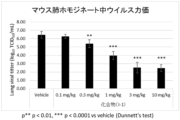
- the virus titer in the lung homogenate 3 days after infection was 6.45-log 10 TCID 50 /mL in the DMA/0.5 w/v% PVPVA in PEG400 group, and 6.27, 5.39, 3.97, 2.51, and 2.47-log 10 TCID 50 /mL in the compound I-1 0.1, 0.3, 1, 3, and 10 mg/kg groups, respectively.
- the compound I-1 group showed a lower virus titer in the lung homogenate than the DMA/0.5 w/v% PVPVA in PEG400 group, suggesting that compound I-1 has the effect of reducing the virus titer in the lung homogenate even if there is a long period between infection and administration (FIG. 1).
- Test Example 10 Test for inhibition of viral titer proliferation in lung and nasal turbinate homogenates of SARS-CoV-2-infected hamsters and test for inhibition of lung weight increase by delayed administration of compound I-1 ⁇ Materials and Methods>
- DMA N,N-dimethylacetamide
- PVPVA poly(1-vinylpyrrolidone-co-vinyl acetate)
- PEG400 polyethylene glycol 400
- the administration volume was 2.5 mL/kg.
- Virus SARS-CoV-2 hCoV-19/Japan/TY41-702/2022 strain (Omicron BE.1/BA.5-like) isolated at the National Institute of Infectious Diseases was used.
- the hamsters were anesthetized by subcutaneous administration of an anesthetic solution containing 0.07 mg/mL medetomidine hydrochloride, 6.98 mg/mL alphaxalone, and 1.16 mg/mL butorphanol tartrate at 3 mL/kg, and inoculated intranasally with 100 ⁇ L of hCoV-19/Japan/TY41-702/2022 (1.00 ⁇ 10 4 TCID 50 ).
- Compound I-1 was orally administered twice daily at doses of 0.1, 1, and 10 mg/kg to the infected hamsters, starting one day after virus inoculation.
- DMA/0.5 w/v% PVPVA in PEG400 was orally administered twice a day to the control infected and non-infected hamsters.
- Compound administration was for 5 days from the start of administration. 3 and 4 days after infection, the lungs and nasal turbinates of the infected hamsters were collected, 5 mL or 1 mL of PBS was added, homogenized, and the supernatant after centrifugation was collected. In addition, the lungs of the infected and non-infected hamsters were collected 7 days after infection, and the lung weights were measured.
- a 10-fold serial dilution of the lung and nasal turbinate homogenates was prepared in medium (MEM, 2% FBS, penicillin-streptomycin) and then inoculated onto VeroE6/TMPRSS2 cells (JCRB1819, 1.5 ⁇ 10 4 cells/well) previously cultured in a 96-well plate. After culturing for 4 days in a CO 2 incubator, cytopathic effect (CPE) was observed and the virus titer contained in the lung or nasal turbinate homogenates was calculated.
- MEM medium
- 2% FBS penicillin-streptomycin
- the virus titers in the lung homogenate fluid were 5.4-log 10 TCID 50 /mL in the DMA/0.5 w/v% PVPVA in PEG400 administration group 3 days after infection, and 5.5, 3.5, and 2.5-log 10 TCID 50 /mL in the compound I-1 0.1, 1, and 10 mg/kg administration groups, respectively.
- the virus titers were 5.6-log 10 TCID 50 /mL in the DMA/0.5 w/v% PVPVA in PEG400 administration group, and 4.6, 2.4, and 1.9-log 10 TCID 50 /mL in the compound I-1 0.1, 1, and 10 mg /kg administration groups, respectively.
- the virus titers in the nasal turbinate homogenate after 3 days from infection were 5.0-log 10 TCID 50 /mL in the DMA/0.5 w/v% PVPVA in PEG400 administration group, 4.8, 3.2, and 2.7-log 10 TCID 50 /mL in the compound I-1 0.1, 1, and 10 mg/kg administration groups, respectively.
- the virus titers in the DMA/0.5 w/v% PVPVA in PEG400 administration group were 3.8-log 10 TCID 50 /mL, and 4.0, 2.2, and 1.8-log 10 TCID 50 /mL in the compound I-1 0.1, 1, and 10 mg /kg administration groups, respectively.
- the virus titers in the lung and nasal turbinate homogenates were lower in a dose-dependent manner than in the DMA/0.5 w/v% PVPVA in PEG400 administration group, suggesting that the compound I-1 has the effect of reducing the virus titers in the lung and nasal turbinate homogenates even if there is a long period between infection and administration ( Figures 2-1 and 2-2).
- the lung weight/body weight 7 days after infection was 5.26 mg/g in the uninfected hamsters, 8.96 mg/g in the infected hamsters administered DMA/0.5 w/v% PVPVA in PEG400, and 8.24, 5.75, and 5.57 mg/g in the groups administered 0.1, 1, and 10 mg/kg of compound I-1, respectively.
- the lung weight/body weight ratio in the compound I-1-administered group was dose-dependently lower than that in the DMA/0.5 w/v% PVPVA in PEG400-administered group, suggesting that administration of compound I-1 has an inhibitory effect on the increase in lung weight induced by SARS-CoV-2 infection (Figure 3).
- Test Example 11 Test for suppressing weight loss in SARS-CoV-2-infected hamsters by administration of compound I-1 ⁇ Materials and Methods>
- DMA N,N-dimethylacetamide
- PVPVA poly(1-vinylpyrrolidone-co-vinyl acetate)
- PEG400 polyethylene glycol 400
- the administration volume was 2.5 mL/kg.
- Virus SARS-CoV-2 hCoV-19/Japan/TY41-702/2022 strain (Omicron BE.1/BA.5-like) isolated at the National Institute of Infectious Diseases was used.
- the hamsters were anesthetized by subcutaneous administration of an anesthetic solution containing 0.07 mg/mL medetomidine hydrochloride, 6.98 mg/mL alphaxalone, and 1.16 mg/mL butorphanol tartrate at 3 mL/kg, and inoculated intranasally with 100 ⁇ L of hCoV-19/Japan/TY41-702/2022 (1.00 ⁇ 10 4 TCID 50 ).
- Compound I-1 was orally administered twice daily to the infected hamsters at doses of 0.1, 1, and 10 mg/kg, starting one day after virus inoculation.
- Control infected and non-infected hamsters were orally administered DMA/0.5 w/v% PVPVA in PEG400 twice daily. Compound administration was continued for 5 days from the start of administration. Body weight was monitored once daily.
- Test Example 12 Test for inhibition of weight loss and viral proliferation in lung and nasal turbinate homogenates in SARS-CoV-2-infected hamsters by prophylactic administration of compound I-1 ⁇ Materials and Methods> Compound Compound I-1 was used as a test sample in a 0.5% methylcellulose (0.5% MC) solution at a dose of 10 mL/kg.
- Virus SARS-CoV-2 hCoV-19/Japan/TY41-702/2022 strain (Omicron BE.1/BA.5-like) isolated at the National Institute of Infectious Diseases was used.
- Hamster lung infection, medication, and body weight measurement Specific pathogen-free 6-week-old male Syrian hamsters (Japan SLC, Inc.) were used in this study.
- the hamsters were anesthetized by subcutaneous administration of an anesthetic solution containing 0.07 mg/mL medetomidine hydrochloride, 6.98 mg/mL alphaxalone, and 1.16 mg/mL butorphanol tartrate at 3 mL/kg, and 100 ⁇ L of hCoV-19/Japan/TY41-702/2022 (1.00 ⁇ 10 4 TCID 50 ) was inoculated intranasally.
- compound I-1 was subcutaneously administered once at 3 or 10 mg/kg 1 or 3 days before virus infection.
- compound I-1 was administered subcutaneously once at 10 or 30 mg/kg one day before virus infection. 0.5% MC was administered subcutaneously once to the control hamsters one day before virus infection. Body weight was monitored once a day. One and two days after infection, the lungs and nasal turbinates of the infected hamsters were collected, and 5 mL or 1 mL of PBS was added, respectively, and homogenized, followed by centrifugation to collect the supernatant.
- a 10-fold serial dilution of the lung and nasal turbinate homogenates was prepared in medium (MEM, 2% FBS, penicillin-streptomycin) and then inoculated onto VeroE6/TMPRSS2 cells (JCRB1819, 1.5 ⁇ 10 4 cells/well) previously cultured in a 96-well plate. After culturing for 4 days in a CO 2 incubator, cytopathic effect (CPE) was observed and the virus titer contained in the lung or nasal turbinate homogenates was calculated.
- MEM medium
- 2% FBS penicillin-streptomycin
- the virus titers were 6.18-log 10 TCID 50 /mL in the 0.5% MC group and 5.29 and 3.55-log 10 TCID 50 /mL in the compound I-1 10 and 30 mg /kg groups, respectively (FIG. 6-1).
- the virus titers in the nasal turbinate homogenate fluid were 5.71-log 10 TCID 50 /mL in the 0.5% MC group and 4.80 and 3.36-log 10 TCID 50 /mL in the compound I-1 10 and 30 mg/kg groups, respectively, on day 1 after infection.
- prophylactic administration of compound I-1 had an inhibitory effect on weight loss when the plasma concentration during viral infection was approximately 6 ng/mL or more, and had an inhibitory effect on viral proliferation in the lungs and nasal turbinate homogenates when the plasma concentration was approximately 12 ng/mL or more.
- Test Example 13 Test for clearance of virus titer in nasal wash of SARS-CoV-2-infected hamsters by delayed administration of compound I-1 ⁇ Materials and Methods>
- DMA N,N-dimethylacetamide
- PEG400 poly(1-vinylpyrrolidone-co-vinyl acetate)-containing polyethylene glycol 400
- PVPVA polyethylene glycol 400
- the administration volume was 2.5 mL/kg.
- Virus SARS-CoV-2 hCoV-19/Japan/TY41-702/2022 strain (Omicron BE.1/BA.5-like) isolated at the National Institute of Infectious Diseases was used.
- Hamster Nasal Infection, Medication, and Nasal Wash Collection Specific pathogen-free 6-week-old male Syrian hamsters (Japan SLC, Inc.) were used in this study.
- the hamsters were anesthetized by subcutaneous administration of anesthetic solution containing 0.07 mg/mL medetomidine hydrochloride, 6.98 mg/mL alphaxalone, and 1.16 mg/mL butorphanol tartrate at 3 mL/kg, and 100 ⁇ L of hCoV-19/Japan/TY41-702/2022 (1.00 ⁇ 10 4 TCID 50 ) was inoculated intranasally.
- Compound I-1 was orally administered twice daily at doses of 1 and 10 mg/kg to the infected hamsters, starting 2 or 3 days after virus inoculation.
- DMA/0.5 w/v% PVPVA in PEG400 was orally administered twice a day to the control infected hamsters.
- the supernatant of the nasal wash was serially diluted 10-fold with medium (MEM, 2% FBS, penicillin-streptomycin) and then inoculated onto VeroE6/TMPRSS2 cells (JCRB1819, 1.5 ⁇ 10 4 cells/well) that had been cultured in a 96-well plate in advance. After culturing in a CO 2 incubator for 4 days, cytopathic effect (CPE) was observed and the virus titer contained in the nasal wash was calculated.
- MEM medium
- TMPRSS2 cells JCRB1819, 1.5 ⁇ 10 4 cells/well
- the virus titers in the nasal washes were 4.80, 4.90, and 4.88-log 10 TCID 50 /mL at the start of administration (2 days after infection, 1 day after administration start) in the DMA/0.5 w/v% PVPVA in PEG400 group and the compound I-1 1 and 10 mg/kg groups, respectively, 3.75, 3.63, and 3.68-log 10 TCID 50 /mL at 3 days after infection (2 days after administration start), and 2.96, ⁇ 1.80, and ⁇ 1.80-log 10 TCID 50 /mL at 5 days after infection (4 days after administration start) in the DMA/0.5 w/v% PVPVA in PEG400 group and the compound I-1 1 and 10 mg /kg groups (FIG.
- the DMA/0.5 w/v% PVPVA in PEG400 group and the compound I-1 1 and 10 mg/kg groups showed 3.40, 2.93, and 3.13-log 10 TCID 50 /mL, respectively, at the start of administration (3 days after infection, 1 day after start of administration), 2.97, 1.84, and 2.13-log 10 TCID 50 /mL, respectively, 4 days after infection (1 day after start of administration), and 2.43, ⁇ 1.80, and ⁇ 1.80-log 10 TCID 50 /mL, respectively, at 6 days after infection (4 days after start of administration ) (FIG. 15).
- Test Example 14 Test for inhibition of virus transmission from SARS-CoV-2 infected animals to non-infected animals by delayed administration of compound I-1 ⁇ Materials and Methods>
- DMA N,N-dimethylacetamide
- PVPVA poly(1-vinylpyrrolidone-co-vinyl acetate)
- PEG400 polyethylene glycol 400
- the administration volume was 2.5 mL/kg.
- the hamsters were anesthetized by subcutaneous administration of an anesthetic solution containing 0.07 mg/mL medetomidine hydrochloride, 6.98 mg/mL alphaxalone, and 1.16 mg/mL butorphanol tartrate at 3 mL/kg, and inoculated intranasally with 100 ⁇ L of hCoV-19/Japan/TY11-927/2021 (1.00 ⁇ 10 3 TCID 50 ).
- Compound I-1 was orally administered twice daily at doses of 0.1, 1, and 10 mg/kg to the infected hamsters (Index), starting 8 hours after virus inoculation.
- Nasal washes or lung homogenate supernatants were serially diluted 10-fold in medium (MEM, 2% FBS, penicillin-streptomycin) and inoculated into VeroE6/TMPRSS2 cells (JCRB1819, 1.5 ⁇ 10 4 cells/well) that had been cultured in advance in a 96-well plate. After culturing in a CO 2 incubator for 4 days, cytopathic effect (CPE) was observed, and the viral titers contained in the nasal washes or lung homogenate supernatants were calculated.
- MEM medium
- FBS penicillin-streptomycin
- Test Example 15 Test for prevention of virus transmission from SARS-CoV-2-infected animals by prophylactic administration of compound I-1 to non-infected animals ⁇ Materials and Methods> Compound Compound I-1 was used as a test sample in a 0.5% methylcellulose (0.5% MC) solution at a dose of 5 mL/kg.
- Hamster Nasal Infection, Medication, Cohabitation, Nasal Wash, and Lung Collection Specific pathogen-free 6-week-old male Syrian hamsters (Japan SLC, Inc.) were used in this study.
- Test Example 16 Test for suppressing lethality and weight loss in SARS-CoV-2-infected aged hamsters by delayed administration of compound I-1 ⁇ Materials and Methods>
- DMA N,N-dimethylacetamide
- PVPVA poly(1-vinylpyrrolidone-co-vinyl acetate)
- PEG400 polyethylene glycol 400
- the administration volume was 1.25 mL/kg.
- the hamsters were anesthetized by subcutaneous administration of an anesthetic solution containing 0.07 mg/mL medetomidine hydrochloride, 6.98 mg/mL alphaxalone, and 1.16 mg/mL butorphanol tartrate at 3 mL/kg, and 100 ⁇ L of hCoV-19/Japan/TY11-927/2021 (1.00 ⁇ 10 4 TCID 50 ) was inoculated nasally.
- compound I-1 was orally administered twice daily at doses of 0.1, 1, and 10 mg/kg.
- Control infected hamsters were orally administered DMA/0.5 w/v% PVPVA in PEG400 twice a day.
- Non-clinical trials using aged hamsters are positioned as one of the non-clinical evaluation systems that mimic the process in which high-risk patients with underlying diseases become severe, and therefore support the usefulness of compound I-1 as a treatment option for patients at high risk of severe symptoms.
- the above test results suggest that the aggravation of viral infection was suppressed in the compound I-1-administered group, supporting not only the antiviral effect of compound I-1 against SARS-CoV-2, but also its usefulness as a pharmaceutical for suppressing the aggravation of infection caused by SARS-CoV-2.
- Test Example 17 In vitro combination effect confirmation test ⁇ Procedure> Test Samples Encitrervir fumarate, nilmatrervir, remdesivir, EIDD-1931, sotrovimab, and tixagevimab/silgavimab were used as test samples to be used in combination with compound I-1. -Dilution and dispensing of test samples Each test sample was diluted to an appropriate concentration with DMSO or DPBS and medium (MEM, 2% FBS, penicillin-streptomycin), and a serial dilution series was prepared on a 96-well plate.
- DMSO or DPBS and medium MEM, 2% FBS, penicillin-streptomycin
- SARS-CoV-2 A549/ACE2-TMPRSS2 cells Invivogen, a549-hace2tpsa, 1.5 x 10 4 cells/well
- SARS-CoV-2 hCoV-19/Japan/TY11-927/2021 100 TCID 50 /well
- medium MEM, 2% FBS, penicillin-streptomycin
- Synergy volume and antagonism volume were calculated using MacSynergy II. These values can be calculated with reference to previously published papers (Antiviral Research, 1990, Volume 14, p. 181-206) and the like. - Determination of combined effect The combined effect was determined for the Synergy volume and Antagonism volume of MacSynergy II at 99% reliability according to the following criteria.
- the formulation examples shown below are merely illustrative and are not intended to limit the scope of the invention in any way.
- the compounds according to the present invention can be administered as pharmaceutical compositions by any conventional route, in particular enterally, e.g. orally, e.g. in the form of tablets or capsules, or parenterally, e.g. in the form of injection solutions or suspensions, topically, e.g. in the form of lotions, gels, ointments or creams, or in the form of intranasal or suppositories.
- compositions containing the compounds of the present invention in free form or in the form of a pharma-ceutically acceptable salt together with at least one pharma-ceutically acceptable carrier or diluent can be prepared by conventional mixing, granulation or coating methods.
- oral compositions can be tablets, granules or capsules containing excipients, disintegrants, binders, lubricants, etc. and active ingredients, etc.
- injectable compositions can be solutions or suspensions, which may be sterilized and may contain preservatives, stabilizers, buffers, etc.
- the compound according to the present invention has inhibitory activity against coronavirus 3CL protease, and a pharmaceutical composition containing the compound according to the present invention is useful as a therapeutic and/or preventive agent for coronavirus infection.
Landscapes
- Health & Medical Sciences (AREA)
- Chemical & Material Sciences (AREA)
- Life Sciences & Earth Sciences (AREA)
- Organic Chemistry (AREA)
- Veterinary Medicine (AREA)
- Public Health (AREA)
- General Health & Medical Sciences (AREA)
- Animal Behavior & Ethology (AREA)
- Pharmacology & Pharmacy (AREA)
- Medicinal Chemistry (AREA)
- Nuclear Medicine, Radiotherapy & Molecular Imaging (AREA)
- General Chemical & Material Sciences (AREA)
- Chemical Kinetics & Catalysis (AREA)
- Virology (AREA)
- Epidemiology (AREA)
- Oncology (AREA)
- Communicable Diseases (AREA)
- Molecular Biology (AREA)
- Engineering & Computer Science (AREA)
- Bioinformatics & Cheminformatics (AREA)
- Pharmaceuticals Containing Other Organic And Inorganic Compounds (AREA)
Abstract
Description
3CLプロテアーゼを標的とした、COVID-19治療薬としては、2021年6月、Pfizer社によるPF-00835231のプロドラッグであるLufotrelvir(PF-07304814)のPhase1b試験の完了がClinicalTrials.govに掲載された(NCT04535167)。また、2021年3月、Pfizer社は新型コロナウイルス感染症に対する治療薬PF-07321332のPhase1試験を開始すると発表した。PF-00835231、LufotrelvirおよびPF-07321332の構造式は以下に示す通りで、本発明に使用する化合物とは化学構造が異なる(非特許文献4、8および9、ならびに特許文献1および2)。
PF-00835231:

Lufotrelvir(PF-07304814):
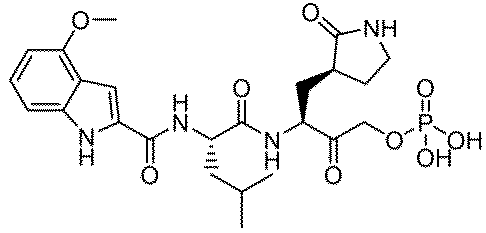
PF-07321332:

2021年12月、PAXLOVID(TM)は米国で緊急使用許可が承認され、2022年2月10日にパキロビッド(登録商標)パックが日本で特例承認された。

ゾコーバの有効成分はエンシトレルビル フマル酸であり、構造式は以下に示す通り、本発明に使用する化合物とは化学構造が異なる(特許文献10~13)。
Ρ2X3および/またはΡ2X2/3受容体阻害作用を有する化合物が特許文献3~9に開示されているが、いずれの文献においても、3CLプロテアーゼ阻害活性および抗ウイルス効果については記載も示唆もされていない。
HIV-1逆転写酵素阻害作用を有する化合物が非特許文献11に記載されているが、3CLプロテアーゼ阻害活性および抗コロナウイルス効果については記載も示唆もされていない。
(1)式(I-1):
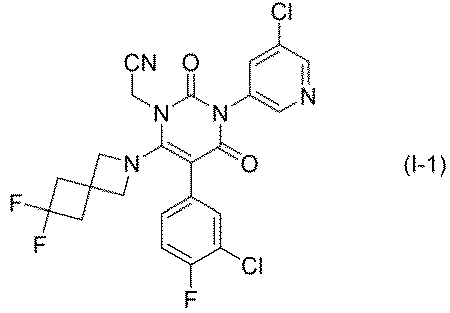
で示される化合物またはその製薬上許容される塩、を含有する医薬組成物。
(2)3CLプロテアーゼ阻害剤である、上記項目(1)記載の医薬組成物。
(3)SARS-CoV-2のウイルス増殖を阻害するために用いられる、上記項目(1)または(2)記載の医薬組成物。
(4)新型コロナウイルス感染症(COVID-19)の治療剤および/または予防剤である、上記項目(1)~(3)のいずれかに記載の医薬組成物。
(5)SARS-CoV-2による感染症の重症化抑制のために用いられる、上記項目(1)~(4)のいずれかに記載の医薬組成物。
(6)SARS-CoV-2による感染症の症状が発現してから、または、SARS-CoV-2陽性判定から、72時間以内に投与を開始するように用いられる、上記項目(1)~(4)のいずれかに記載の医薬組成物。
(7)SARS-CoV-2による感染症の症状が発現してから、または、SARS-CoV-2陽性判定から、24時間以内に投与を開始するように用いられる、上記項目(1)~(4)のいずれかに記載の医薬組成物。
(8)SARS-CoV-2による感染症の症状が発現してから、または、SARS-CoV-2陽性判定から、120時間以内に投与を開始するように用いられる、上記項目(1)~(4)のいずれかに記載の医薬組成物。
(9)SARS-CoV-2による感染症の症状が発現してから、または、SARS-CoV-2陽性判定から、48時間以内に投与を開始するように用いられる、上記項目(1)~(4)のいずれかに記載の医薬組成物。
(10)SARS-CoV-2のウイルス伝播を抑制するために用いられる、上記項目(1)~(4)のいずれかに記載の医薬組成物。
(11)SARS-CoV-2による感染症の症状が、軽症または中等症Iの症状である、上記項目(1)~(4)のいずれかに記載の医薬組成物。
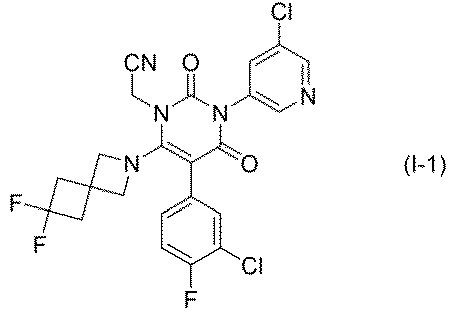
で示される化合物またはその製薬上許容される塩、を投与することを含む、
SARS-CoV-2のウイルス増殖阻害方法。
(13)新型コロナウイルス感染症(COVID-19)の治療および/または予防方法であって、新型コロナウイルス感染症(COVID-19)の治療および/または予防を必要とする個体に、式(I-1):
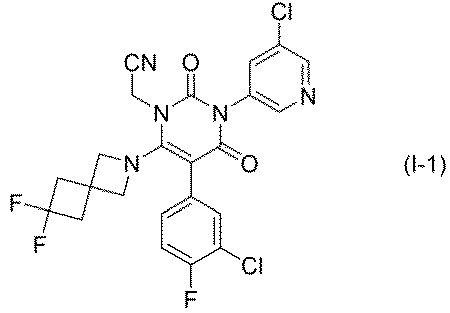
で示される化合物またはその製薬上許容される塩、を投与することを含む、
新型コロナウイルス感染症(COVID-19)の治療および/または予防方法。
(14)SARS-CoV-2による感染症の重症化抑制方法であって、新型コロナウイルス感染症(COVID-19)の治療および/または予防を必要とする個体に、式(I-1):

で示される化合物またはその製薬上許容される塩、を投与することを含む、
SARS-CoV-2による感染症の重症化抑制方法。
(15)新型コロナウイルス感染症(COVID-19)の治療方法であって、新型コロナウイルス感染症(COVID-19)の治療を必要とする個体に、式(I-1):

で示される化合物またはその製薬上許容される塩、をSARS-CoV-2による感染症の症状が発現してから、または、SARS-CoV-2陽性判定から、72時間以内に投与することを含む、
新型コロナウイルス感染症(COVID-19)の治療方法。
(16)新型コロナウイルス感染症(COVID-19)の治療方法であって、新型コロナウイルス感染症(COVID-19)の治療を必要とする個体に、式(I-1):

で示される化合物またはその製薬上許容される塩、をSARS-CoV-2による感染症の症状が発現してから、または、SARS-CoV-2陽性判定から、24時間以内に投与することを含む、
新型コロナウイルス感染症(COVID-19)の治療方法。
(17)新型コロナウイルス感染症(COVID-19)の治療方法であって、新型コロナウイルス感染症(COVID-19)の治療を必要とする個体に、式(I-1):
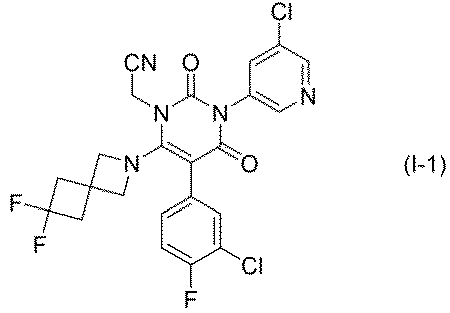
で示される化合物またはその製薬上許容される塩、をSARS-CoV-2による感染症の症状が発現してから、または、SARS-CoV-2陽性判定から、120時間以内に投与することを含む、
新型コロナウイルス感染症(COVID-19)の治療方法。
(18)新型コロナウイルス感染症(COVID-19)の治療方法であって、新型コロナウイルス感染症(COVID-19)の治療を必要とする個体に、式(I-1):
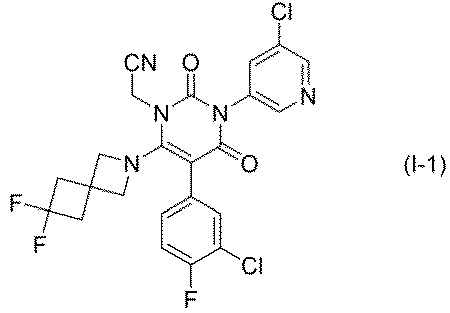
で示される化合物またはその製薬上許容される塩、をSARS-CoV-2による感染症の症状が発現してから、または、SARS-CoV-2陽性判定から、48時間以内に投与することを含む、
新型コロナウイルス感染症(COVID-19)の治療方法。
(19)SARS-CoV-2のウイルス伝播を抑制する方法であって、新型コロナウイルス感染症(COVID-19)の治療を必要とする個体に、式(I-1):

で示される化合物またはその製薬上許容される塩、を投与することを含む、
SARS-CoV-2のウイルス伝播を抑制する方法。
(20)新型コロナウイルス感染症(COVID-19)の治療方法であって、新型コロナウイルス感染症(COVID-19)の治療を必要とする個体の症状が軽症または中等症Iの症状である、式(I-1):

で示される化合物またはその製薬上許容される塩、を投与することを特徴とする、新型コロナウイルス感染症(COVID-19)の治療方法。

で示される化合物またはその製薬上許容される塩の使用。
(22)新型コロナウイルス感染症(COVID-19)の治療および/または予防用医薬を製造するための、式(I-1):

で示される化合物またはその製薬上許容される塩の使用。
(23)SARS-CoV-2による感染症の重症化抑制のための、式(I-1):
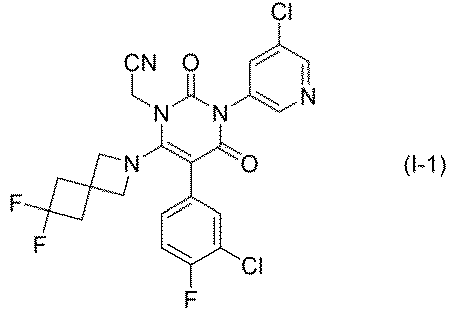
で示される化合物またはその製薬上許容される塩の使用。
(23’)新型コロナウイルス感染症(COVID-19)の重症化抑制用医薬を製造するための、式(I-1):
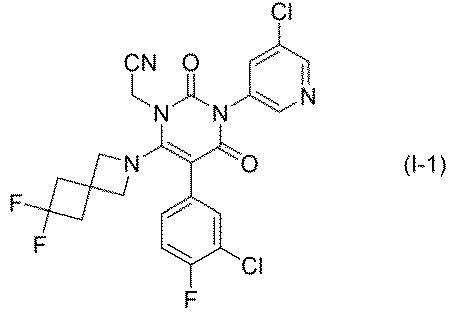
で示される化合物またはその製薬上許容される塩の使用。
(24)SARS-CoV-2による感染症の症状が発現してから、または、SARS-CoV-2陽性判定から、72時間以内に投与するための、式(I-1):

で示される化合物またはその製薬上許容される塩の使用。
(24’)新型コロナウイルス感染症(COVID-19)の治療用医薬を製造するための、式(I-1):
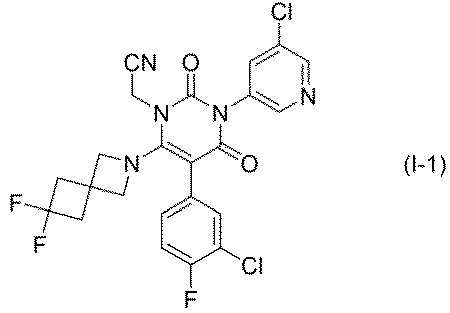
で示される化合物またはその製薬上許容される塩の使用であって、該医薬が、SARS-CoV-2による感染症の症状が発現してから、または、SARS-CoV-2陽性判定から、72時間以内に投与される、使用。
(25)SARS-CoV-2による感染症の症状が発現してから、または、SARS-CoV-2陽性判定から、24時間以内に投与するための、式(I-1):

で示される化合物またはその製薬上許容される塩の使用。
(25’)新型コロナウイルス感染症(COVID-19)の治療用医薬を製造するための、式(I-1):
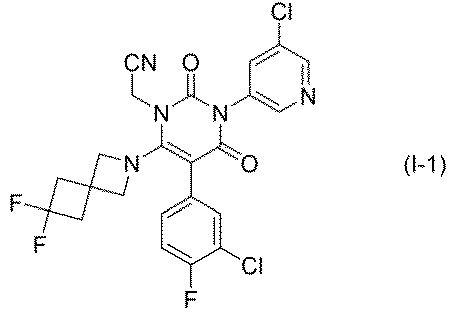
で示される化合物またはその製薬上許容される塩の使用であって、該医薬が、SARS-CoV-2による感染症の症状が発現してから、または、SARS-CoV-2陽性判定から、24時間以内に投与される、使用。
(26)SARS-CoV-2による感染症の症状が発現してから、または、SARS-CoV-2陽性判定から、120時間以内に投与するための、式(I-1):
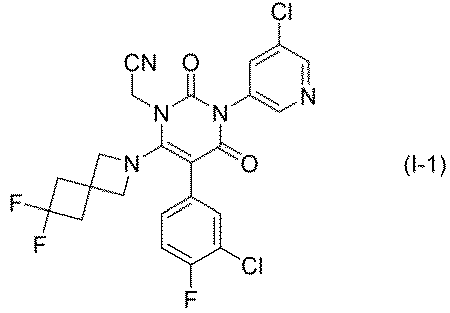
で示される化合物またはその製薬上許容される塩の使用。
(26’)新型コロナウイルス感染症(COVID-19)の治療用医薬を製造するための、式(I-1):
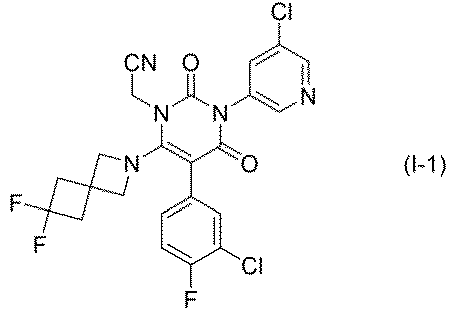
で示される化合物またはその製薬上許容される塩の使用であって、該医薬が、SARS-CoV-2による感染症の症状が発現してから、または、SARS-CoV-2陽性判定から、120時間以内に投与される、使用。
(27)SARS-CoV-2による感染症の症状が発現してから、または、SARS-CoV-2陽性判定から、48時間以内に投与するための、式(I-1):
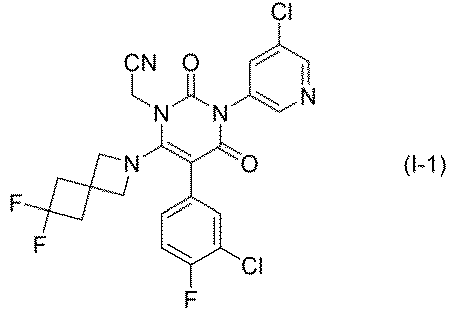
で示される化合物またはその製薬上許容される塩の使用。
(27’)新型コロナウイルス感染症(COVID-19)の治療用医薬を製造するための、式(I-1):
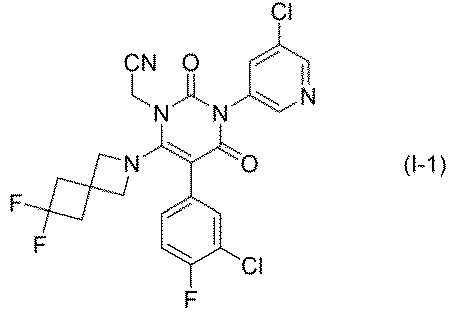
で示される化合物またはその製薬上許容される塩の使用であって、該医薬が、SARS-CoV-2による感染症の症状が発現してから、または、SARS-CoV-2陽性判定から、48時間以内に投与される、使用。
(28)SARS-CoV-2のウイルス伝播を抑制するための、式(I-1):

で示される化合物またはその製薬上許容される塩の使用。
(28’)新型コロナウイルス感染症(COVID-19)の伝播抑制用医薬を製造するための、式(I-1):
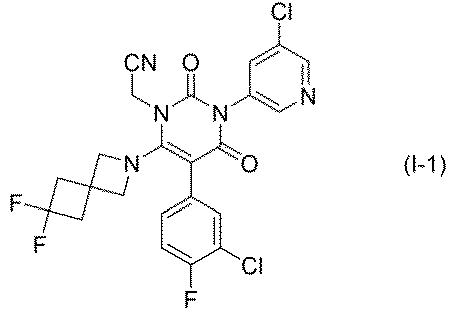
で示される化合物またはその製薬上許容される塩の使用。
(29)新型コロナウイルス感染症(COVID-19)の治療用医薬を製造するための、式(I-1):

で示される化合物またはその製薬上許容される塩の使用であって、新型コロナウイルス感染症(COVID-19)の治療を必要とする個体の症状が軽症または中等症Iの症状である使用。
(29’)新型コロナウイルス感染症(COVID-19)の治療用医薬を製造するための、式(I-1):

で示される化合物またはその製薬上許容される塩の使用であって、新型コロナウイルス感染症(COVID-19)の治療を必要とする個体の症状が軽症または中等症Iの症状である使用。
(101)新型コロナウイルス感染症(COVID-19)の予防用医薬であって、SARS-CoV-2の暴露後の発症抑制のために用いられる、以下の式(I-1):

で示される化合物またはその製薬上許容される塩、を含有する医薬組成物。
(102)新型コロナウイルス感染症(COVID-19)の予防方法であって、SARS-CoV-2の暴露後の発症抑制を必要とする個体に、式(I-1):
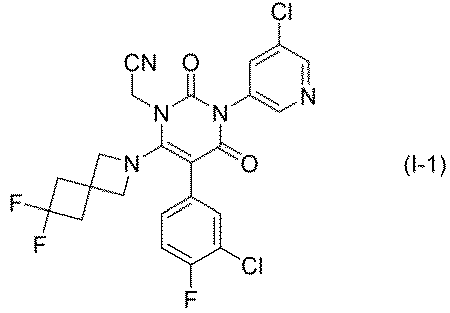
で示される化合物またはその製薬上許容される塩、を投与することを含む、
新型コロナウイルス感染症(COVID-19)の予防方法。
(103)SARS-CoV-2の暴露後の発症抑制のための、式(I-1):

で示される化合物またはその製薬上許容される塩の使用。
(104)SARS-CoV-2の暴露後の発症抑制用医薬を製造するための、式(I-1):
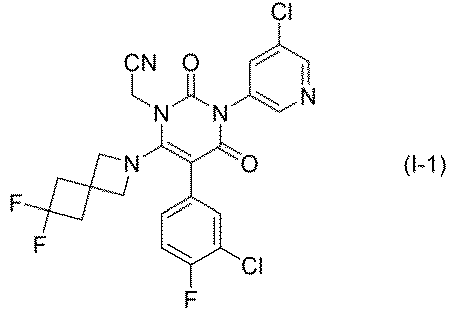
で示される化合物またはその製薬上許容される塩の使用。
(201)新型コロナウイルス感染症(COVID-19)の予防用医薬であって、SARS-CoV-2の暴露前予防のために用いられる、以下の式(I-1):

で示される化合物またはその製薬上許容される塩、を含有する医薬組成物。
(202)新型コロナウイルス感染症(COVID-19)の予防方法であって、SARS-CoV-2の暴露前予防を必要とする個体に、式(I-1):
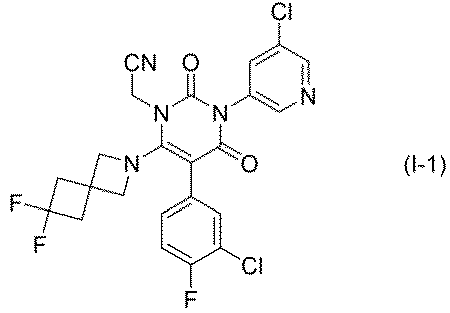
で示される化合物またはその製薬上許容される塩、を投与することを含む、
新型コロナウイルス感染症(COVID-19)の予防方法。
(203)SARS-CoV-2の暴露前予防のための、式(I-1):

で示される化合物またはその製薬上許容される塩の使用。
(204)SARS-CoV-2の暴露前予防用医薬を製造するための、式(I-1):

で示される化合物またはその製薬上許容される塩の使用。
(301)
式(II):
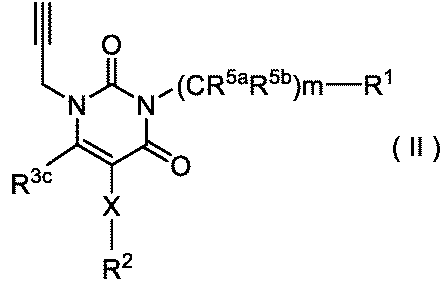
(式中、
Xは、単結合または-CH2-であり;
R2は、置換もしくは非置換の芳香族炭素環式基であり;
R3cは、置換もしくは非置換の芳香族炭素環式基、置換もしくは非置換の非芳香族炭素環式基、置換もしくは非置換の芳香族複素環式基、置換もしくは非置換の非芳香族複素環式基、ハロゲン、置換もしくは非置換のアルキルまたは置換もしくは非置換のアミノであり;
R1は、置換もしくは非置換の芳香族複素環式基または置換もしくは非置換の非芳香族複素環式基であり;
mは、0または1であり;
R5aはそれぞれ独立して、水素原子または置換もしくは非置換のアルキルであり;
R5bはそれぞれ独立して、水素原子または置換もしくは非置換のアルキルである)で示される化合物(ただし、以下の化合物:
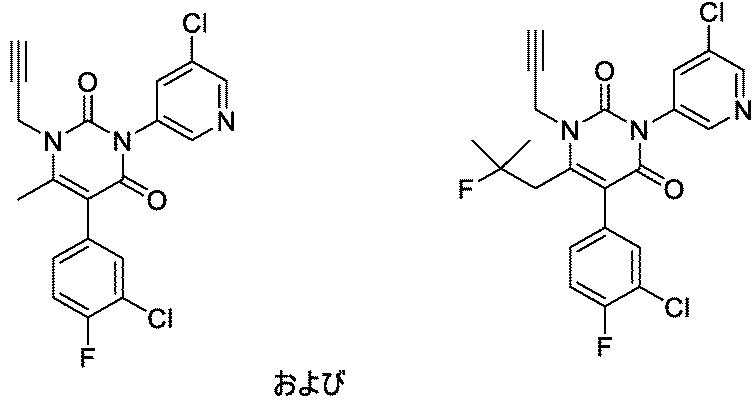
を除く)、またはその製薬上許容される塩。
(302)Xが単結合であり;
R2がハロゲンで置換されたフェニルであり;
R3cが置換基群aから選択される1~3の置換基で置換された非芳香族複素環式基もしくは非置換非芳香族複素環式基(置換基群a:ハロゲン、ヒドロキシ、C1-C3アルキル、C1-3アルキルオキシ、ハロC1-3アルキル、ハロC1-3アルキルオキシ、非置換5-6員芳香族複素環式基およびハロゲンで置換された5-6員芳香族複素環式基)または置換基群bから選択される1~3の置換基で置換されたアルキルもしくは非置換アルキル(置換基群b:ハロゲン、ヒドロキシ、C1-3アルキルオキシおよびハロC1-3アルキルオキシ)であり;
R1がハロゲンで置換されたピリジルであり;
mが0である、上記項目(301)記載の化合物、またはその製薬上許容される塩。
「からなる」という用語は、構成要件のみを有することを意味する。
「含む」および「包含する」という用語は、構成要件に限定されず、記載されていない要素を排除しないことを意味する。
以下、本発明について実施形態を示しながら説明する。本明細書の全体にわたり、単数形の表現は、特に言及しない限り、その複数形の概念をも含むことが理解されるべきである。従って、単数形の冠詞(例えば、英語の場合は「a」、「an」、「the」など)は、特に言及しない限り、その複数形の概念をも含むことが理解されるべきである。
また、本明細書において使用される用語は、特に言及しない限り、当上記分野で通常用いられる意味で用いられることが理解されるべきである。したがって、他に定義されない限り、本明細書中で使用される全ての専門用語および科学技術用語は、本発明の属する分野の当業者によって一般的に理解されるのと同じ意味を有する。矛盾する場合、本明細書(定義を含めて)が優先する。
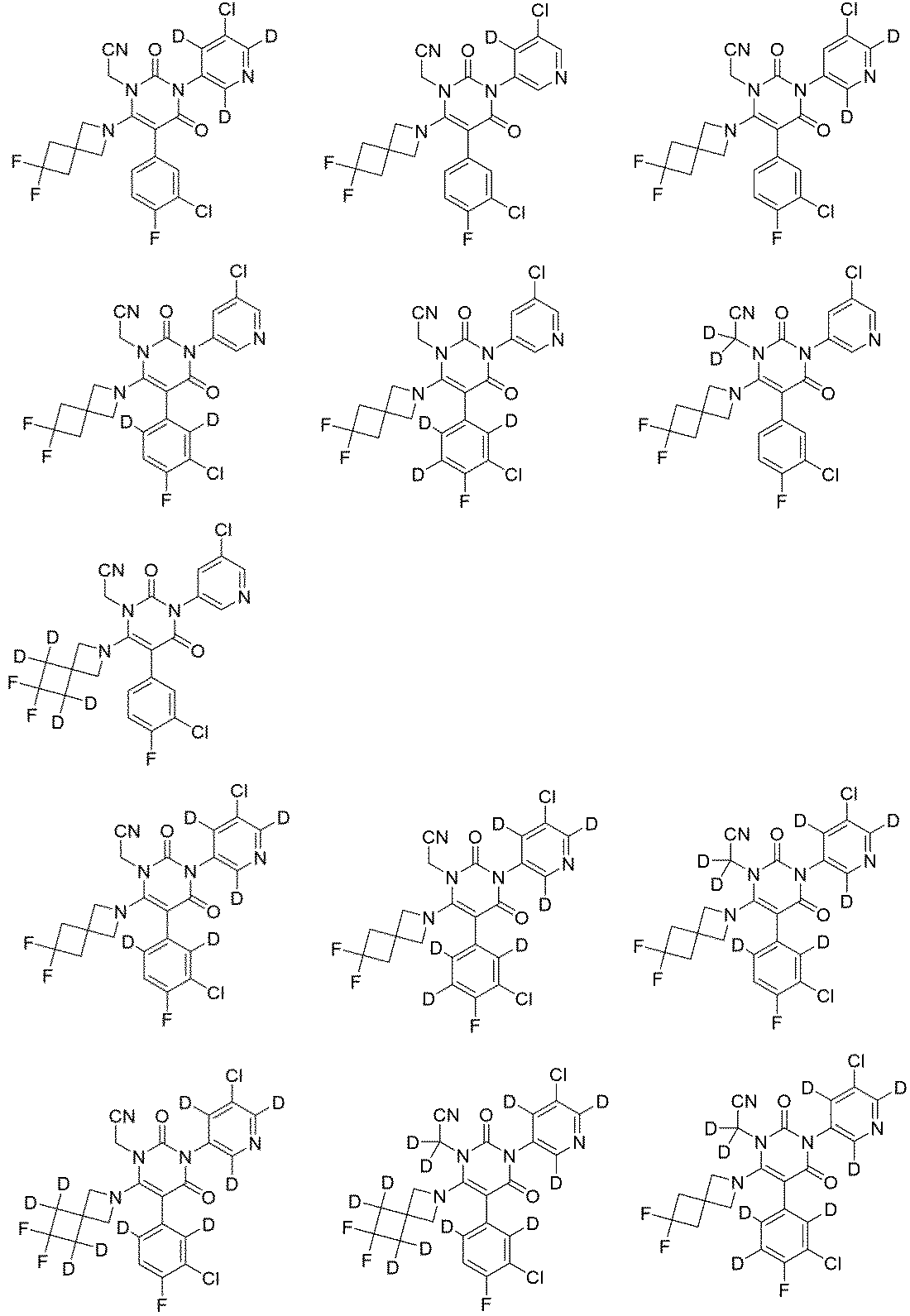
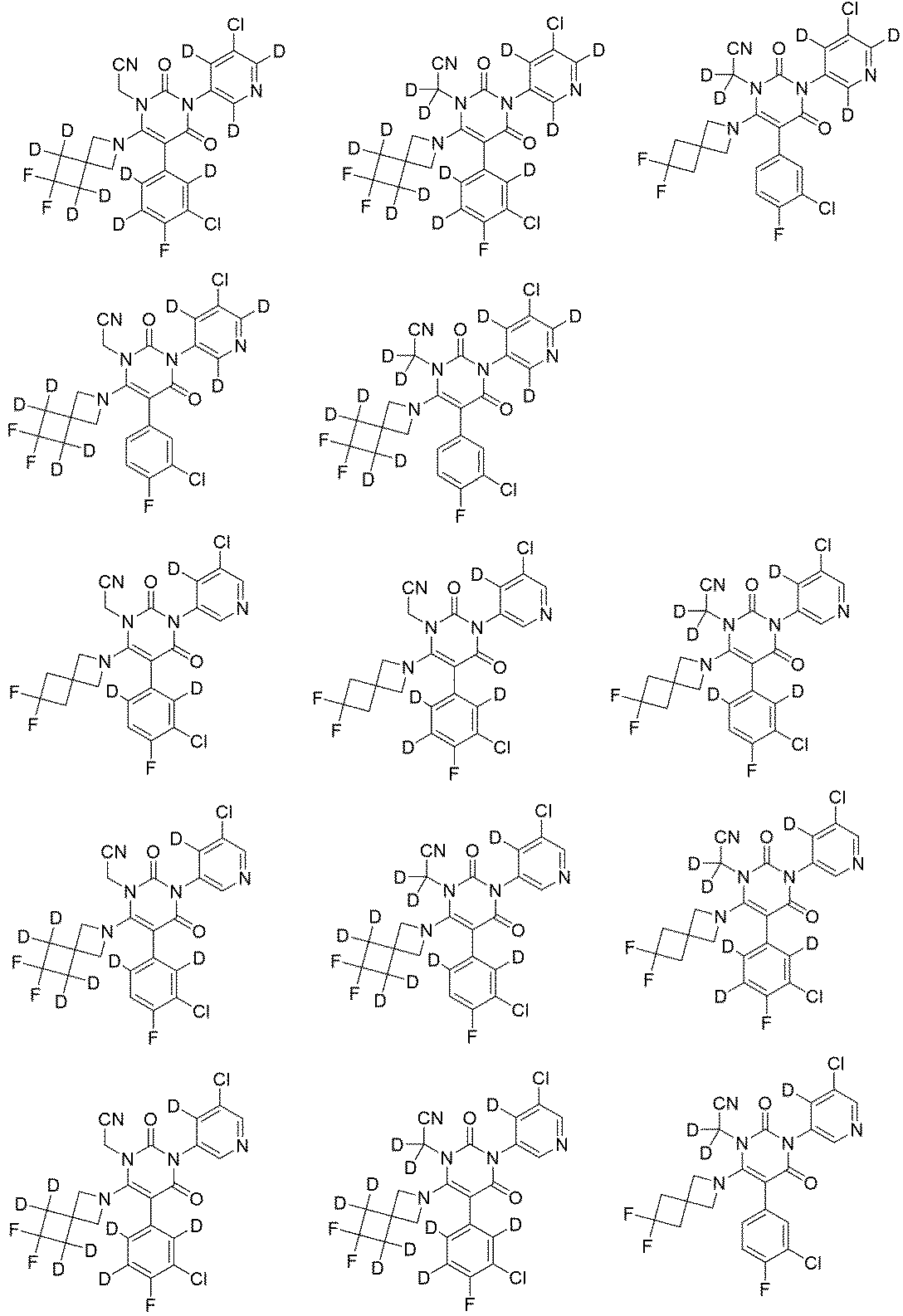
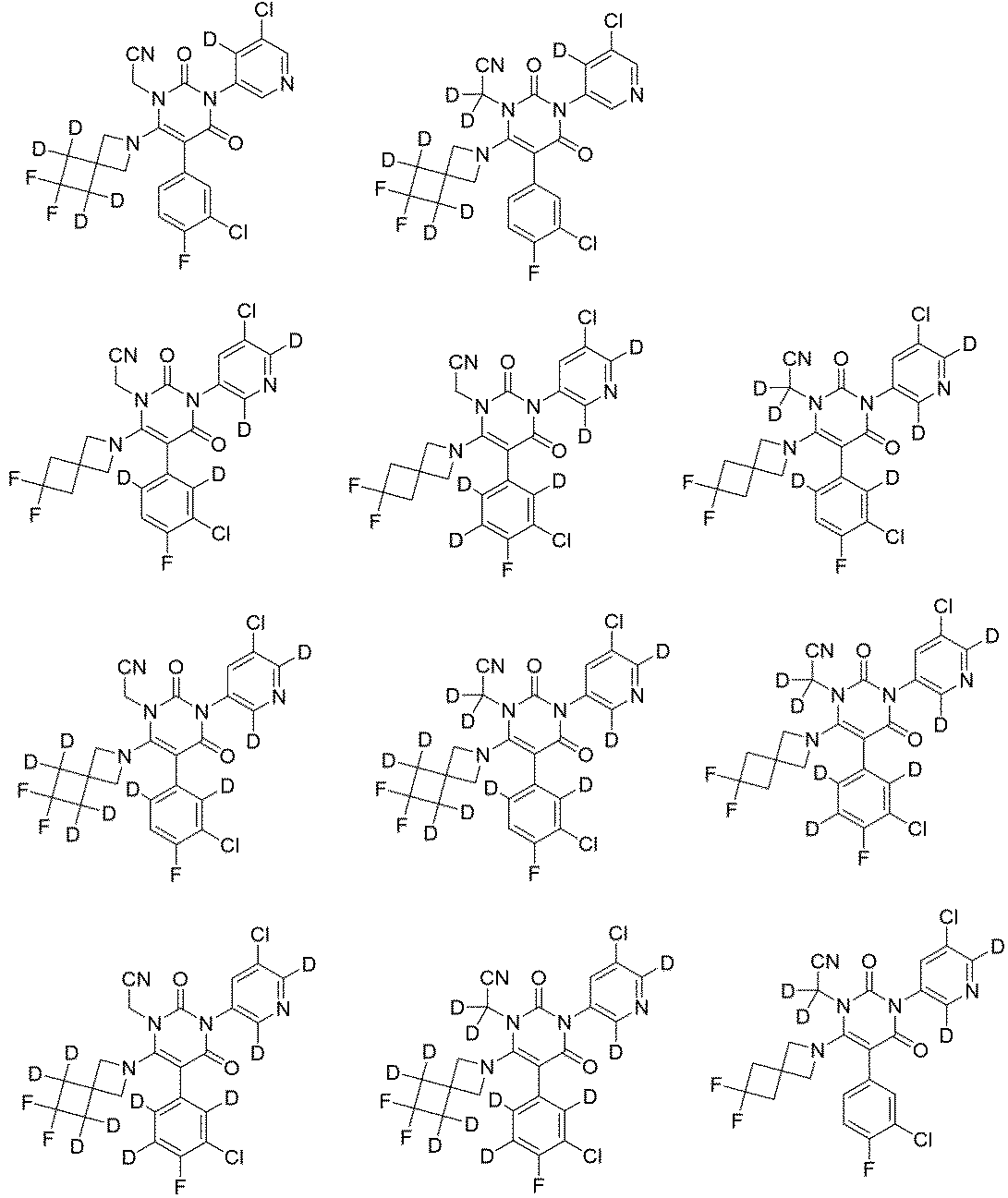

本明細書中で用いる「式(I-1)または式(II)で示される化合物、その製薬上許容される塩、又はそれらの溶媒和物」には、そのような各種の塩、共結晶、及びそれらの溶媒和物も包含する。
従って、本明細書中で用いる「式(I-1)または式(II)で示される化合物の製薬上許容される塩」は、共結晶を包含し、式(I-1)または式(II)で示される化合物の製薬上許容される塩又は共結晶を指す。
溶媒分子としては、例えば、酢酸エチル、水、エタノール、アセトン、1,1-ジエトキシプロパン、1,1-ジメトキシメタン、2,2-ジメトキシプロパン、イソオクタン、イソプロピルエーテル、メチルイソプロピルケトン、メチルテトラヒドロフラン、石油エーテル、トリクロロ酢酸、トリフルオロ酢酸、酢酸、アニソール、1-ブタノール、2-ブタノール、酢酸n-ブチル、t-ブチルメチルエーテル、クメン、ジメチルスルホキシド、ジエチルエーテル、ギ酸エチル、ギ酸、ヘプタン、酢酸イソブチル、酢酸イソプロピル、酢酸メチル、3-メチル-1-ブタノール、メチルエチルケトン、メチルイソブチルケトン、2-メチル-1-プロパノール、ペンタン、1-ペンタノール、1-プロパノール、2-プロパノール、酢酸プロピル、テトラヒドロフラン、アセトニトリル、クロロベンゼン、クロロホルム、シクロヘキサン、1,2-ジクロロエテン、ジクロロメタン、1,2-ジメトキシエタン、N,N-ジメチルアセトアミド、N,N-ジメチルホルムアミド、1,4-ジオキサン、2-エトキシエタノール、エチレングリコール、ホルムアミド、ヘキサン、メタノール、2-メトキシエタノール、メチルブチルケトン、メチルシクロヘキサン、N-メチルピロリドン、ニトロメタン、ピリジン、スルホラン、テトラリン、トルエン、1,1,2-トリクロロエテン、キシレン及びt-ブタノールが挙げられる。
好ましくは、酢酸エチル、水、エタノール、アセトン、1,1-ジエトキシプロパン、1,1-ジメトキシメタン、2,2-ジメトキシプロパン、イソオクタン、イソプロピルエーテル、メチルイソプロピルケトン、メチルテトラヒドロフラン、石油エーテル、トリクロロ酢酸、トリフルオロ酢酸、酢酸、アニソール、1-ブタノール、2-ブタノール、酢酸n-ブチル、t-ブチルメチルエーテル、クメン、ジメチルスルホキシド、ジエチルエーテル、ギ酸エチル、ギ酸、ヘプタン、酢酸イソブチル、酢酸イソプロピル、酢酸メチル、3-メチル-1-ブタノール、メチルエチルケトン、メチルイソブチルケトン、2-メチル-1-プロパノール、ペンタン、1-ペンタノール、1-プロパノール、2-プロパノール、酢酸プロピル及びテトラヒドロフランが挙げられる。
より好ましくは、酢酸エチル、水、エタノール、アセトン、1,1-ジエトキシプロパン、1,1-ジメトキシメタン、2,2-ジメトキシプロパン、イソオクタン、イソプロピルエーテル、メチルイソプロピルケトン、メチルテトラヒドロフラン、石油エーテル、トリクロロ酢酸及びトリフルオロ酢酸などが挙げられる。
また、「式(I-1)または式(II)で示される化合物」を、大気中に放置することにより、水分を吸収し、吸着水が付着する場合や、水和物を形成する場合がある。
さらに、「結晶」には、組成が同一でありながら結晶中の配列が異なる「結晶多形」が存在することがあり、それらを含めて「結晶形態」という。
「式(I-1)または式(II)で示される化合物、その製薬上許容される塩、又はそれらの溶媒和物」は、それらの結晶多形を包含する。
本発明に係る化合物の結晶は重水素変換体であってもよい。本明細書中で用いる結晶は同位元素(例、2H、3H、14C、35S、125I等)で標識されていてもよい。
結晶形態及び/又は結晶化度は、例えば、X線回折、ラマン分光、赤外吸収スペクトル、固体NMRなどの分光法によって確認することができる。また、結晶の物理的特性は、示差走査熱量測定、水分吸脱着測定、溶解特性などの多くの技術によって確認することができる。
本明細書中で用いる「無水物」は、「無溶媒和物」、「非溶媒和物」、「無水和物」及び「非水和物」と同義である。
式(I-1)で示される化合物の無水物結晶は、結晶水の理論含量は0重量%ある。ただし、水分量及び/又は溶媒量の分析においては、結晶表面に付着した付着水及び/又は付着溶媒の影響を受けて、結晶水の理論含量よりも高い値をとることがある。
以下の結晶学的データ:
空間群: Pbca
a=14.67ű0.05Å
b=11.83ű0.05Å
c=27.10ű0.05Å
α=90°
β=90°
γ=90°
により特徴付けられる、式(I-1)で示される化合物の無水物結晶である。
本明細書における一態様は、示差熱-熱重量同時測定(TG/DTA)において、融点が265.6℃±2℃である、式(I-1)で示される化合物の無水物結晶である。
粉末X線回折(XRPD)は、固体の結晶形態および結晶性を測定するための最も感度の良い分析法の1つである。X線が結晶に照射されると、結晶格子面で反射し、互いに干渉しあい、構造の周期に対応した秩序だった回折線を示す。一方、非晶質固体については、通常、その構造の中に秩序だった繰返し周期をもたないため、回折現象は起こらず、特徴のないブロードなXRPDパターン(ハローパターンとも呼ばれる)を示す。
本明細書中で用いる特徴的な回折ピークは、観測された回折パターンから選択されるピークである。特徴的な回折ピークは、好ましくは回折パターンにおける約10本、より好ましくは約5本、さらに好ましくは約3本から選択される。
複数の結晶を区別する上では、ピークの強度よりも、当該結晶で確認され、他の結晶では確認されないピークが、その結晶を特定する上で好ましい特徴的なピークとなる。そういった特徴的なピークであれば、一つまたは二つのピークでも、当該結晶を特徴付けることができる。測定して得られたチャートを比較し、これらの特徴的なピークが一致すれば、粉末X線回折パターンが実質的に一致するといえる。
結晶を特定する方法の一つで、当該結晶における結晶学的パラメーター、さらに、原子座標(各原子の空間的な位置関係を示す値)および3次元構造モデルを得ることができる。桜井敏雄著「X線構造解析の手引き」裳華房発行(1983年)、Stout & Jensen著 X-Ray Structure Determination: A Practical Guide, Macmillan Co., New York (1968)などを参照。本発明のような複合体、塩、光学異性体、互変異性体、幾何異性体の結晶の構造を同定する際には、単結晶構造解析が有用である。
ラマンスペクトルは分子または複合体系の振動の特徴を示す。その起源は分子と光線を含む光の粒子である光子との間の非弾性的な衝突にある。分子と光子の衝突はエネルギーの交換をもたらし、その結果エネルギーが変化し、これにより光子の波長が変化する。即ち、ラマンスペクトルは、対象分子に光子が入射されたときに発せられる、極めて波長の狭いスペクトル線であるため、光源としてはレーザー等が用いられる。各ラマン線の波長は入射光からの波数シフトにより表示され、これはラマン線と入射光の波長の逆数の間の差である。ラマンスペクトルは分子の振動状態を測定するものであり、これはその分子構造により決定される。
一般に、ラマンスペクトルピーク(cm-1)は±2cm-1の範囲内で誤差が生じ得るから、上記のラマンスペクトルピークの値は±2cm-1程度の範囲内の数値も含むものとして理解される必要がある。したがって、ラマンスペクトルにおけるラマンスペクトルピークが完全に一致する結晶だけでなく、ラマンスペクトルピークが±2cm-1程度の誤差で一致する結晶も本発明に含まれる。
DSCは、熱分析の主要な測定方法の一つで、原子・分子の集合体としての物質の熱的性質を測定する方法である。
DSCにより、医薬活性成分の温度または時間に係る熱量の変化を測定し、得られたデータを温度または時間に対してプロットすることにより示差走査熱量曲線が得られる。示差走査熱量曲線より、医薬活性成分が融解する際のオンセット温度、融解に伴う吸熱ピーク曲線の最大値およびエンタルピーに関する情報を得ることができる。
DSCについて、観察される温度は、温度変化速度ならびに用いる試料調製技法および特定の装置に依存し得ることが知られている。したがって、DSCにおける「融点」とは試料の調製技法の影響を受けにくいオンセット温度のことを指す。示差走査熱量曲線から得られるオンセット温度における誤差範囲はおよそ±2℃である。結晶の同一性の認定においては、融点のみならず全体的なパターンが重要であり、測定条件や測定機器によって多少は変化し得る。
TG/DTAは、熱分析の主要な測定方法の一つで、原子・分子の集合体としての物質の重量および熱的性質を測定する方法である。
TG/DTAは、医薬活性成分の温度または時間に係る重量および熱量の変化を測定する方法であり、得られたデータを温度または時間に対してプロットすることにより、TG(熱重量)およびDTA(示差熱)曲線が得られる。TG/DTA曲線より、医薬活性成分の分解、脱水、酸化、還元、昇華、蒸発に関する重量および熱量変化の情報を得ることができる。
TG/DTAについて、観察される温度、重量変化は、温度変化速度ならびに用いる試料調製技法および特定の装置に依存し得ることが知られている。したがって、TG/DTAにおける「融点」とは試料の調製技法の影響を受けにくいオンセット温度のことを指す。結晶の同一性の認定においては、融点のみならず全体的なパターンが重要であり、測定条件や測定機器によって多少は変化し得る。
本発明において「治療剤および/または予防剤」という場合、症状改善剤を包含する。
本発明において、「予防」という場合、SARS-CoV-2の暴露後の発症を抑制することを包含する。
本発明において「予防」という場合、SARS-CoV-2の暴露後であって、発症抑制を必要とする個体に本発明医薬組成物を投与することにより、SARS-CoV-2によって引き起こされる症状の発症を抑制することを包含する。
本発明において、「予防」という場合、SARS-CoV-2の暴露前予防を包含する。
本発明において「予防」という場合、SARS-CoV-2の暴露前であって、発症抑制を必要とする個体に本発明医薬組成物を投与することにより、SARS-CoV-2によって引き起こされる症状の発症を抑制することを包含する。
本発明について「予防」という場合、SARS-CoV-2の暴露後の発症および重症化を抑制することを包含する。
一つの態様として、コロナウイルスとしては、ヒトに感染するコロナウイルスが挙げられる。ヒトに感染するコロナウイルスとしては、HCoV-229E、HCoV-NL63、HCoV-HKU1、HCoV-OC43、SARS-CoV、MERS-CoV、および/またはSARS-CoV-2が挙げられる。
一つの態様として、コロナウイルスとしては、アルファコロナウイルスおよび/またはベータコロナウイルス、より好ましくはベータコロナウイルス、さらに好ましくはサルベコウイルスが挙げられる。
一つの態様として、アルファコロナウイルスとしては、HCoV-229EおよびHCoV-NL63が挙げられる。特に好ましくは、HCoV-229Eが挙げられる。
一つの態様として、ベータコロナウイルスとしては、HCoV-HKU1、HCoV-OC43、SARS-CoV、MERS-CoV、および/またはSARS-CoV-2が挙げられる。好ましくはHCoV-OC43またはSARS-CoV-2、特に好ましくはSARS-CoV-2が挙げられる。
一つの態様として、ベータコロナウイルスとしては、ベータコロナウイルスA系統(β-coronavirus lineage A)、ベータコロナウイルスB系統(β-coronavirus lineage B)、およびベータコロナウイルスC系統(β-coronavirus lineage C)が挙げられる。より好ましくは、ベータコロナウイルスA系統(β-coronavirus lineage A)、およびベータコロナウイルスB系統(β-coronavirus lineage B)、特に好ましくはベータコロナウイルスB系統(β-coronavirus lineage B)が挙げられる。
ベータコロナウイルスA系統(β-coronavirus lineage A)としては、例えばHCoV-HKU1およびHCoV-OC43、好ましくは、HCoV-OC43が挙げられる。ベータコロナウイルスB系統(β-coronavirus lineage B)としては、例えばSARS-CoVおよびSARS-CoV-2、好ましくはSARS-CoV-2が挙げられる。ベータコロナウイルスC系統(β-coronavirus lineage C)としては、好ましくはMERS-CoVが挙げられる。
一つの態様として、コロナウイルスとしては、HCoV-229E、HCoV-OC43、および/またはSARS-CoV-2、特に好ましくはSARS-CoV-2が挙げられる。
なお、ウイルスは増殖や感染を繰り返す中で変異することが一般的に知られている。上記コロナウイルスには、本発明に係る化合物が、コロナウイルス3CLプロテアーゼ阻害活性を発揮することができる株である限り、当該分野で公知の変異株のみならず、今後出現する変異株も含まれる。SARS-CoV-2の公知の変異株としては、例えば、本明細書の実施例で使用した変異株が挙げられる。
コロナウイルス感染症としては、HCoV-229E、HCoV-NL63、HCoV-OC43、HCoV-HKU1、SARS-CoV、MERS-CoV、および/またはSARS-CoV-2による感染症が挙げられる。好ましくは、HCoV-229E、HCoV-OC43、および/またはSARS-CoV-2による感染症、特に好ましくは、SARS-CoV-2による感染症が挙げられる。
コロナウイルス感染症としては、特に好ましくは、新型コロナウイルス感染症(COVID-19)が挙げられる。
(軽症)
酸素飽和度が96%以上である。臨床状態は、呼吸器症状はない、または咳のみで呼吸困難はなく、いずれの場合であっても肺炎所見を認めない。
(中等症I)
酸素飽和度が96%未満~93%超である。呼吸困難があり、肺炎所見がある。
(中等症II)
酸素飽和度が93%未満である。呼吸不全があり、酸素投与が必要である。
(重症)
ICUに入室している、または、人工呼吸器が必要である。
上記の分類は日本における重症度分類の定義であり、例えば、中国や米国NIHの重症度分類を援用することが可能である。
また、無症候のSARS-CoV-2感染者とは、無症状病原体保有者を意味する。例えば、COVID-19症状の14症状または12症状が認められていない者が挙げられる。
(COVID-19の14症状:けん怠感 (疲労感)、筋肉痛又は体の痛み、頭痛、悪寒/発汗、熱っぽさ又は発熱、味覚異常、嗅覚異常、鼻水又は鼻づまり、喉の痛み、咳、息切れ(呼吸困難)、吐き気、嘔吐、下痢)
本明細書中、重症化抑制とは、無症候のSARS-CoV-2感染者または軽症のSARS-CoV-2感染者が、中等症I、中等症IIまたは重症に分類される重症度に引き上げられることを抑制することを含む。
本明細書中、重症化抑制とは、無症候のSARS-CoV-2感染者、軽症のSARS-CoV-2感染者または中等症IのSARS-CoV-2感染者が、中等症IIまたは重症に分類される重症度に引き上げられることを抑制することを含む。
本明細書中、重症化抑制とは、無症候のSARS-CoV-2感染者、軽症のSARS-CoV-2感染者、中等症IのSARS-CoV-2感染者または中等症IIのSARS-CoV-2感染者が、重症に分類される重症度に引き上げられることを含む。
本明細書中、重症化抑制とは、本剤のウイルス増殖抑制効果を介して、SARS-CoV-2感染者の入院や死亡リスクが減少することを含む。
本明細書中、重症化抑制とは、本剤のウイルス増殖抑制効果を介して、SARS-CoV-2感染者の肺での炎症を軽減することを含む。
本明細書中、重症化抑制とは、本剤のウイルス増殖抑制効果を介して、SARS-CoV-2のウイルス感染によって引き起こされる肺炎を抑制することを含む。
本明細書中、重症化抑制とは、本剤のウイルス増殖抑制効果を介して、SARS-CoV-2のウイルス感染によって引き起こされる宿主の過剰な免疫反応を抑制することを含む。
重症化リスク因子:悪性腫瘍、代謝疾患、心血管疾患、呼吸器疾患、肝疾患、腎疾患、精神神経疾患、運動不足、妊娠、喫煙、小児、遺伝性疾患、免疫不全
例えば、新型コロナウイルス感染症を発症している患者の同居家族または共同生活者に対し、本発明の医薬組成物を投与することができる。
例えば、新型コロナウイルス感染症患者に接触後、すみやかに(例:72時間以内)接触者に対し、本発明の医薬組成物を投与することができる。
例えば、無症候のSARS-CoV-2感染者に本発明の医薬組成物を投与し、発症を抑制することができる。
また、「予防」とは、SARS-CoV-2の暴露前予防を含む。
例えば、COVID-19流行期等、SARS-CoV-2の感染リスクがある場合において、医療従事者、高齢者、重症化リスク因子を有する人に対し、本発明の医薬組成物を投与することができる。
式(I-1)で示される化合物は、例えば、下記に示す一般的合成法によって製造することができる。抽出、精製等は、通常の有機化学の実験で行う処理を行えばよい。当該分野において公知の手法を参考にしながら合成することができる。抽出、精製等は、通常の有機化学の実験で行う処理を行えばよい。
式(I-1)で示される化合物は、当該分野において公知の手法を参考にしながら製造することができる。例えば、WO2012/020742、WO2013/118855、WO2023/195529およびWO2023/195530等を参考にして製造することができる。
(式(II)で示される化合物の製造法)
式(II)で示される化合物は、例えば、WO2023/195529を参考にして製造することができる。
さらに本発明に係る化合物は、医薬としての有用性を備えており、好ましくは、下記のいずれか、または複数の優れた特徴を有している。
a)CYP酵素(例えば、CYP1A2、CYP2C9、CYP2C19、CYP2D6、CYP3A4等)に対する阻害作用が弱い。
b)高いバイオアベイラビリティー、適度なクリアランス等良好な薬物動態を示す。
c)代謝安定性が高い。
d)CYP酵素(例えば、CYP3A4)に対し、本明細書に記載する測定条件の濃度範囲内で不可逆的阻害作用を示さない。
e)変異原性を有さない。
f)心血管系のリスクが低い。
g)高い溶解性を示す。
h)タンパク質非結合率(fu値)が高い。
i)高いコロナウイルス3CLプロテアーゼ選択性を有している。
j)高いコロナウイルス増殖阻害活性を有している。例えば、ヒト血清(HS)またはヒト血清アルブミン(HSA)添加下において、高いコロナウイルス増殖阻害活性を有している。
k)3CLプロテアーゼ阻害剤耐性ウイルスに対しても、高い増殖阻害活性を有する。
コロナウイルス増殖阻害剤としては、例えば後述のCPE抑制効果確認試験(SARS-CoV-2)において、例えばEC50が10μM以下、好ましくは1μM以下、より好ましくは100nM以下である態様が挙げられる。
FBS:ウシ胎児血清
mM:mmol/L
nM:nmol/L
μM:μmol/L
各実施例で得られたNMR分析は400MHzで行い、DMSO-d6、CDCl3を用いて測定した。また、NMRデータを示す場合は、測定した全てのピークを記載していない場合が存在する。
明細書中にRTとあるのは、LC/MS:液体クロマトグラフィー/質量分析でのリテンションタイムを表し、以下の条件で測定した。
(測定条件A)
カラム:ACQUITY UPLC(登録商標)BEH C18 (1.7μm i.d.2.1x50mm) (Waters)
流速:0.8mL/分
UV検出波長:254nm
移動相:[A]は0.1%ギ酸含有水溶液、[B]は0.1%ギ酸含有アセトニトリル溶液
グラジエント:3.5分間で5%-100%溶媒[B]のリニアグラジエントを行った後、0.5分間、100%溶媒[B]を維持した。
日本薬局方の一般試験法に記載された粉末X線回折測定法に従い、実施例で得られた、固体形態(結晶)の粉末X線回折測定を行った。測定条件を以下に示す。
測定条件1:
粉末X線回折装置:リガク社製SmartLab
測定法:反射法
使用波長:CuKα線(λ=1.5418Å)
管電流:200mA
管電圧:45kV
試料プレート:アルミニウム
X線の入射角:2.5°
サンプリング幅:0.02°
検出器:HyPix-3000(2次元検出モード)
実施例で得られた結晶の単結晶構造解析を行った。測定条件及び解析方法を以下に示す。
(装置)
リガク社製 XtaLAB P200 MM007
(測定条件)
測定温度:25℃
温度コントローラ:リガク社製 試料吹付低温装置
使用波長:CuKα線(λ=1.5418Å)
ソフト:CrysAlisPro 1.171.39.46e (Rigaku Oxford Diffraction, 2018)
(データ処理)
ソフト:CrysAlisPro 1.171.39.46e (Rigaku Oxford Diffraction, 2018)
データはローレンツ及び偏光補正、吸収補正を行った。
(結晶構造解析)
直接法プログラムShelXT(Sheldrick, G.M.,2015)を用いて位相決定を行い、精密化はShelXL(Sheldrick, G.M.,2015)を用いて、full-matrix最小二乗法を実施した。非水素原子の温度因子はすべて異方性で精密化を行った。水素原子は、特に記載のない限りShelXLのデフォルトパラメータを用いて計算により導入し、riding atomとして取り扱った。また、水素原子は、等方性パラメーターで精密化を行った。
以下の構造図の作図には、PLATON(Spek,1991)/ORTEP(Johnson,1976)を使用した(30% PROBABILITY level)。
実施例で得られた結晶のラマンスペクトルの測定とベースライン補正を行った測定条件を以下に示す。
測定条件1
測定方法:顕微レーザーラマン分光法
レーザー波長:671nm
積算回数:1回
露光時間:1秒
実施例で得られた結晶のDSCの測定を行った。アルミニウムパンに試料を量り、簡易密封して測定した。測定条件を以下に示す。なお、示差走査熱量(DSC)による測定は±2℃の範囲内で誤差が生じうる。
装置:Discovery DSC/TA Instrument
測定温度範囲:-10℃-270℃
昇温速度:10℃/分
雰囲気:N2 50mL/分
実施例で得られた、固体形態(結晶)の示差熱-熱重量同時測定(TG/DTA)を行った。実施例で得られた試料を量り、アルミニウムパンにつめ、開放系にて測定した。測定条件は以下のとおりである。
装置:日立ハイテクノロジーズ TG/DTA STA7200RV
測定温度範囲:室温-350℃
昇温速度:10℃/分
機器:Agilent 1290 Infinity VL
カラム:Waters Acquity UPLC BEH C18、 1.7μm、2.1×100mm
カラム温度:40℃付近の一定温度
UV検出波長:300nm
移動相:[A]は0.1%ギ酸含有水溶液、[B]は0.1%ギ酸含有アセトニトリル溶液
グラジエント:1分間、20%溶媒[B]を維持し、32分間で20%-80%溶媒[B]のリニアグラジエントを行った後、7分間、20%溶媒[B]を維持した。
流量:0.4mL/分
注入量:3μL
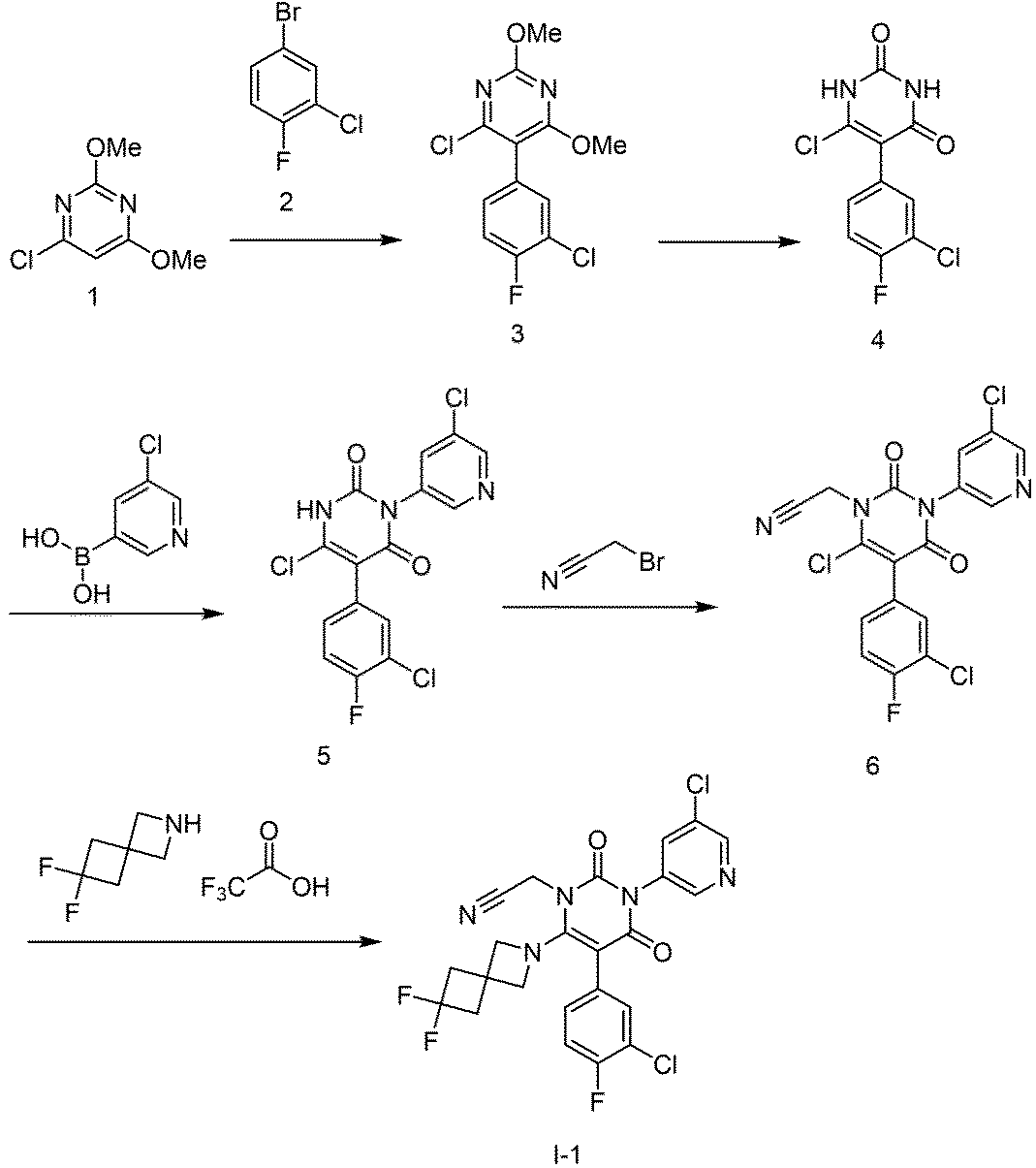
工程1 化合物3の合成
2.64mol/L n-ブチルリチウムのヘキサン溶液(31mL、82.4mmol)とテトラヒドロフラン(20mL)の混合溶液に、化合物1(12g、68.7mmol)のテトラヒドロフラン(70mL)溶液を-78℃で15分かけて滴下した。-78℃で1時間攪拌した。1.9mol/L 塩化亜鉛の2-メチルテトラヒドロフラン溶液(43mL、82.4mmol)を5分かけて滴下した。室温で2時間撹拌した。化合物2(9.1mL、75.6mmol)およびテトラキス(トリフェニルホスフィン)パラジウム(4.0g、3.44mmol)を加え、80℃で1.5時間撹拌した。反応液を常温に冷却し、水(80mL)と2mol/L塩酸(40mL)を加えて酢酸エチルで抽出した。有機層を減圧濃縮し、得られた残渣にイソプロパノール(40mL)を加えた。沈殿物を濾取してイソプロパノールで洗浄した。風乾して化合物3(14.8g、49mmol)を得た。
1H-NMR(CDCl3)δ:3.95(s,3H)、4.05(s,3H)、7.18-7.23(m,2H)、7.35(d,J=6.8Hz,1H)
LC/MS(ESI):m/z=303、RT=2.70min、LC/MS測定条件A
化合物3(14.8g、48.8mmol)に酢酸(40mL)と濃塩酸(41mL)を加え、110℃で5時間撹拌した。反応液を室温まで冷却した後に水(80ml)を加えた。沈殿物を濾取して水で洗浄した。風乾して化合物4(11.6g、42.2mmol)を得た。
1H-NMR(DMSO-d6)δ:7.31(ddd,J=8.8,4.9,2.1Hz,1H)、7.45(t,J=8.8Hz,1H)、7.53(dd,J=7.3,2.1Hz,1H)、11.57(s,1H)、12.24(brs,1H)
LC/MS(ESI):m/z=275、RT=1.81min、LC/MS測定条件A
化合物4(1.00g、3.64mmol)、5-クロロピリジン-3-ボロン酸(1.14g、7.27mmol)、酢酸銅(II)(0.99g、5.45mmol)、アセトニトリル(10mL)、トリエチルアミン(5.04mL、36.4mmol)およびピリジン(7.34mL、91.0mmol)を混合し、溶液を常温で終夜撹拌した。反応液に飽和炭酸水素ナトリウム水溶液(5mL)を加えて、酢酸エチルで抽出した。有機層を水で洗浄し、硫酸ナトリウムで乾燥し、ろ過した。ろ液を濃縮し、得られた残渣をシリカゲルカラムクロマトグラフィー(クロロホルム:メタノール=100:0~90:10)で精製し、溶媒を減圧留去した。得られた残渣を減圧乾燥し、化合物5(1.15g、2.97mmol、収率82%)を得た。
1H-NMR(DMSO-d6)δ:7.35-7.37(1H,m),7.49(1H,t,J=9.0Hz),7.54-7.56(1H,m),8.07(1H,t,J=2.1Hz),8.54(1H,d,J=2.0Hz),8.70(1H,d,J=2.3Hz).
LC/MS(ESI):m/z=386、RT=1.98min、LC/MS測定条件A
化合物5(520mg、1.345mmol)、N,N-ジイソプロピルエチルアミン(0.705mL、4.04mmol)、DMF(5.2mL)を混合した溶液に、2-ブロモアセトニトリル(269μL、4.04mmol)を加え、常温で終夜撹拌した。氷冷下で反応液に2mol/L塩酸(2mL)を加え、酢酸エチルで抽出した。有機層を水で洗浄し、硫酸ナトリウムで乾燥し、ろ過した。ろ液を濃縮し、得られた残渣をシリカゲルカラムクロマトグラフィー(クロロホルム:メタノール=100:0~99:1)で精製し、溶媒を減圧留去した。得られた残渣を減圧乾燥し、化合物6(291mg、0.684mmol、収率51%)を得た。
1H-NMR(CDCl3)δ:5.13(2H,s),7.23-7.24(2H,m),7.42(1H,d,J=7.3Hz),7.67(1H,t,J=2.1Hz),8.45(1H,d, J=2.3Hz),8.67(1H,d,J=2.3Hz).
LC/MS(ESI):m/z=425、RT=2.17min、LC/MS測定条件A
化合物6(25.0mg、0.059mmol)、6,6-ジフルオロ-2-アザスピロ[3.3]ヘプタン トリフルオロ酢酸塩(17.4mg、0.070mmol)、N,N-ジイソプロピルエチルアミン(20.5μL、0.117mmol)、DMF(0.5mL)を混合し、溶液を60℃で2時間撹拌した。反応液に水(2mL)を加え、酢酸エチルで抽出した。有機層を水で洗浄し、硫酸ナトリウムで乾燥し、ろ過した。ろ液を濃縮し、酢酸エチル(0.05mL)、ヘキサン(0.125mL)およびジイソプロピルエーテル(0.125mL)を加えた。得られた沈殿物をろ取し、ジイソプロピルエーテルで洗浄した。得られた固体を減圧乾燥し、化合物(I-1)の無水物結晶(22.0mg、0.042mmol、収率72%)を得た。
1H-NMR(CDCl3)δ:2.75(4H,t,J=12.0Hz),4.02(4H,s),4.74(2H,s),7.16-7.18(2H,m),7.32-7.35(1H,m),7.65(1H,t,J=2.1Hz),8.43(1H,d,J=2.3Hz),8.61(1H,d,J=2.3Hz).
LC/MS(ESI):m/z=522、RT=2.27min、LC/MS測定条件A
実施例1で得られた、式(I-1)で示される化合物の無水物結晶について、1000μMメッシュで篩過した後、以下条件で粉砕を行った。
装置:A-Oジェットミル(株式会社セイシン企業)
供給方法:フィーダー
供給速度:20g/時間
粉砕圧:0.30MPa
供給圧:0.40MPa
粉砕後の式(I-1)で示される化合物の無水物結晶について、上記記載の測定条件で粉末X線回折実験を行った。当該粉末X線回折パターンを図7に、粉末X線回折パターンのピークリストを図8に示す。以下、粉末X線回折パターンのピークリストの表中、Positionは2θ(°)、Intensityは強度を示す。
粉末X線回折パターンにおいて、回折角度(2θ):6.5°±0.2°、10.1°±0.2°、13.0°±0.2°、14.1°±0.2°、15.3°±0.2°、15.6°±0.2°、16.2°±0.2°、17.4°±0.2°、18.9°±0.2°、19.9°±0.2°、20.3°±0.2°、21.7°±0.2°、23.0°±0.2°、23.8°±0.2°、25.8°±0.2°、28.8°±0.2°及び30.6°±0.2°にピークが認められた。
式(I-1)で示される化合物の無水物結晶は、粉末X線回折パターンにおいて、回折角度(2θ): 6.5°±0.2°、15.6°±0.2°、17.4°±0.2°、19.9°±0.2°及び20.3°±0.2°に特徴的なピークを示した。
<単結晶の調製方法>
式(I-1)で示される化合物の結晶1mgに、400μLのメタノールを添加し、50℃に加熱して溶解させた。当該溶液を、1.5 mLのHPLCバイアルに分注して、HPLCバイアルの蓋をし、蓋にシリンジ針を刺して、室温にて静置した。溶媒蒸発法により単結晶を調製した。
<単結晶構造解析>
上記記載の方法で、単結晶回折実験及び解析を行った。なお、Cl1とCl7C、H5CAとH6CAはディスオーダーの関係にあるため、Cl1:Cl7C=0.75:0.25、H5CA:H6CA=0.25:0.75の占有率で解析した。

ここで、Vは単位格子体積、Zは単位格子中の分子数を意味する。
なお、表2における非水素原子の番号は、それぞれ図9に記載された番号に対応している。


なお、図9に記載された非水素原子のラベル番号は、表2における非水素原子の番号に対応している。
粉砕後の式(I-1)で示される化合物の無水物結晶を、アルミニウムパンに約2mg量り、上記記載の方法で測定を行った。その結果を図10に示す。オンセット温度が約261.3℃の吸熱ピークを示した。
粉砕後の式(I-1)で示される化合物の無水物結晶について、上記記載の方法で測定を行った。その結果を図11に示す。オンセット温度が約265.6℃の吸熱ピークを示した。また、重量減少は確認されなかった。
粉砕後の式(I-1)で示される化合物の無水物結晶について、上記記載の測定条件1でラマンスペクトル測定を行った。その結果を図12に示す。また、主なラマンピークを以下に示す。
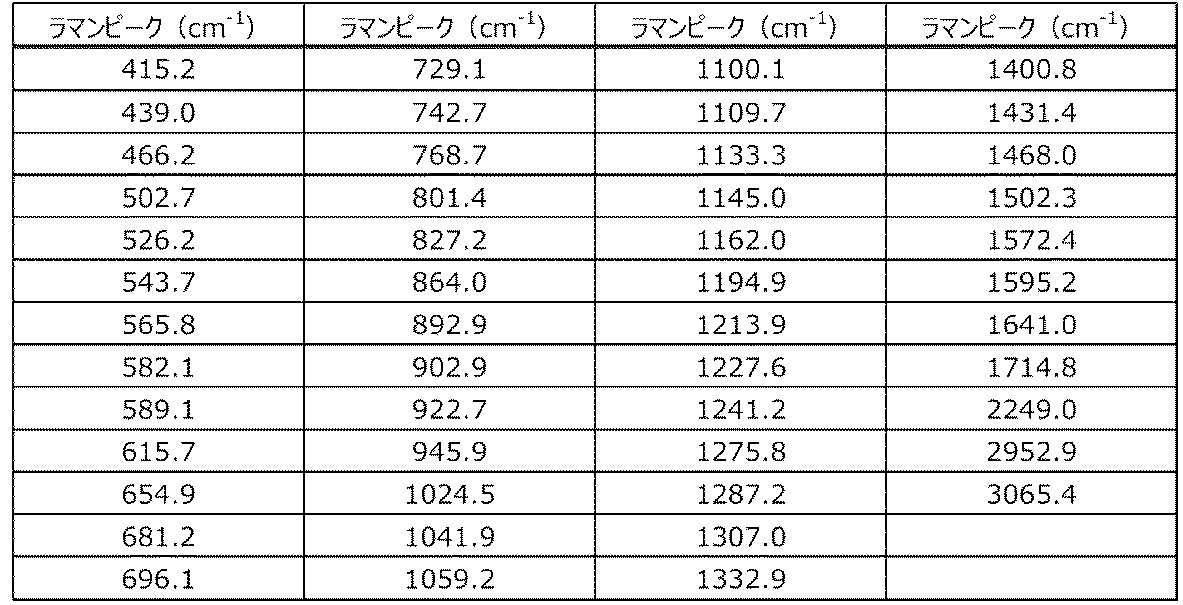
粉砕後の式(I-1)で示される化合物の無水物結晶について、上記記載の方法で測定を行った。その結果を図13に示す(約96.5pa%)。
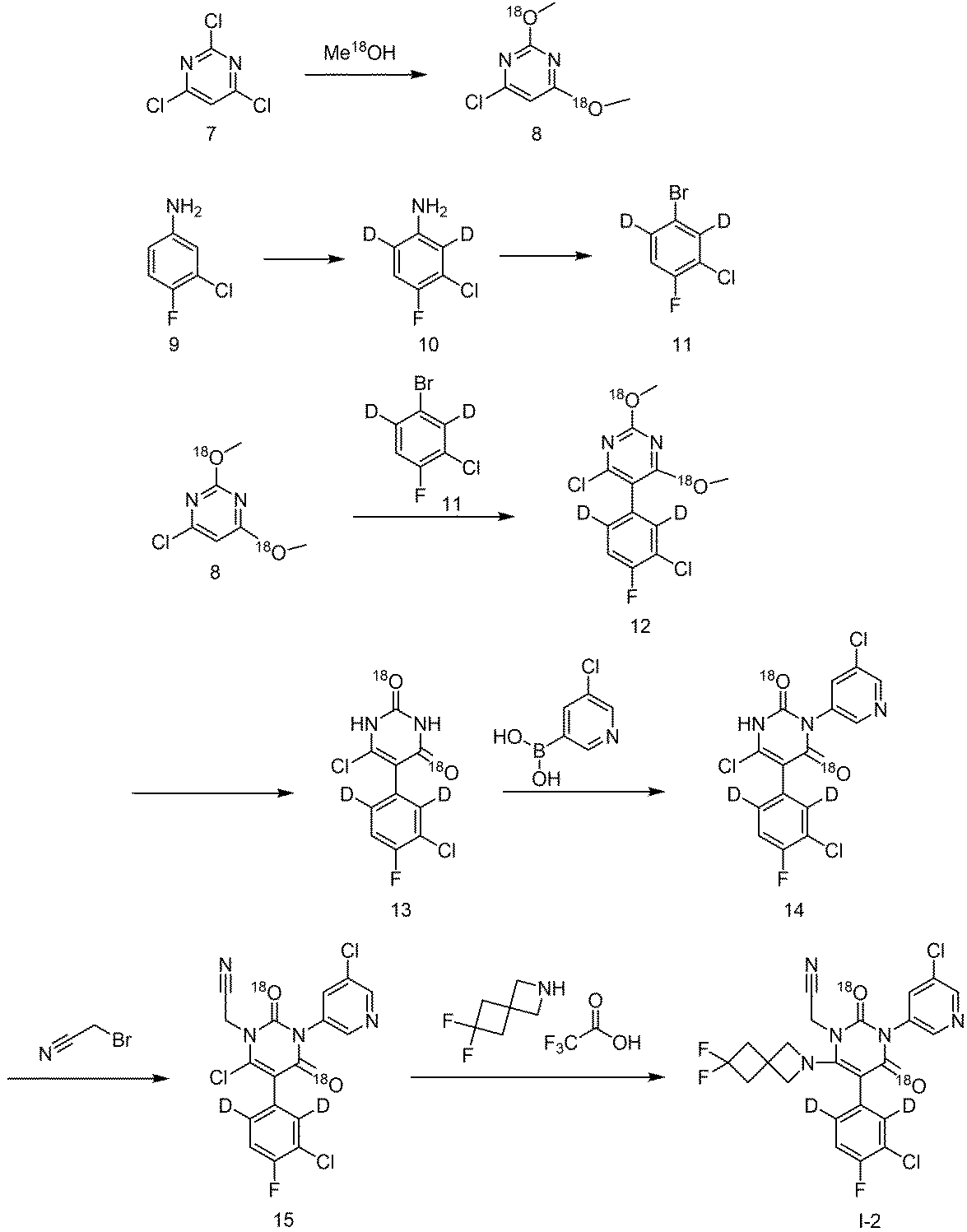
化合物7(2.6 g、14.2mmol)、DMF(13mL)およびメチルアルコール-O18(1.18mL、29.1mmol)を混合し、氷冷下で水素化ナトリウム(1.42g、35.4mmol)をゆっくり加えた。反応溶液を常温に昇温し、2時間撹拌した。反応溶液を氷浴中で冷却し、水(26mL)および酢酸エチル(26mL)を加えクエンチし、酢酸エチルで抽出した。有機層を減圧濃縮し、得られた残渣をシリカゲルカラムクロマトグラフィー(ヘキサン:酢酸エチル=10:0~9:1)で精製し、溶媒を減圧留去し、化合物8(1.57g、8.79mmol、収率62%)を得た。
LC/MS(ESI):m/z=179、RT=1.57min、LC/MS測定条件A
1H-NMR(CDCl3)δ:3.97(s,3H)、4.00(s,3H)、6.41(s,1H)
化合物9(0.5g、3.43mmol)、重水(17.1mL、945mmol)および5mol/L DCl(0.69mL、3.43mol)を混合し180℃でマイクロウェーブを用いて30分加熱した。同様の操作を10回繰り返し、全ての反応溶液を混合し、酢酸エチル50mL、1mol/L水酸化ナトリウム溶液(51.5mL)を加え、酢酸エチルで抽出したのち、水、飽和食塩水で洗浄した。有機層を減圧濃縮し、化合物10(5.02g、34mmol、収率99%)を得た。
1H-NMR(CDCl3)δ:3.59(brs,2H)、6.87~6.95(m,1H)
化合物10(5g、33.9mmol)および水(11.5mL)を混合し、氷冷下で臭化水素(11.5mL、102mmol)を加えた。その後NaNO2(2.384g、34.6mmol)を水(7.5mL)に溶かしゆっくりと加えた。反応溶液を30℃に加熱し、CuBr(6.32g、44.0mmol)を臭化水素(13.42mL、119mmol)に溶かして加え、内温30~40℃で加えた。30分撹拌したのち反応溶液にヘキサン200mL、5mol/L水酸化ナトリウム水溶液(67.8mL、339mmol)を加えた。反応溶液をセライトでろ過し、ろ液をヘキサンで抽出した。有機層を水及び飽和食塩水で洗浄し、硫酸マグネシウムで乾燥し、ろ過した。有機層を減圧濃縮し、得られた残渣をシリカゲルカラムクロマトグラフィー(ヘキサン:酢酸エチル=10:0~9:1)で精製し、溶媒を減圧留去し、化合物11(4.35g、15.1mmol、73.5wt%)を得た。化合物11は沸点が低いため、溶媒を完全に留去せずに次の反応に用いた。
1H-NMR(CDCl3)δ:7.00-7.07(m,2H)
2.76mol/L n-ブチルリチウムのヘキサン溶液(1.8mL、5.04mmol)とテトラヒドロフラン(2.6mL)の混合溶液に、化合物8(0.75g、4.2mmol)のテトラヒドロフラン(70mL)溶液を-78℃で5分かけてゆっくり滴下した。反応溶液を-78℃で1時間攪拌した。反応溶液に、1.9mol/L 塩化亜鉛の2-メチルテトラヒドロフラン溶液(2.6mL、82.4mmol)を滴下した。室温で反応溶液を2時間撹拌した。反応溶液に、化合物11(1.2g、4.2mmol)およびテトラキス(トリフェニルホスフィン)パラジウム(243mg、0.21mmol)を加え、90℃で1.5時間撹拌した。反応溶液を常温に冷却し、水(7.5mL)を加えて酢酸エチルで抽出した。有機層を水及び飽和食塩水で洗浄し、硫酸マグネシウムで乾燥し、ろ過した。有機層を減圧濃縮し、得られた残渣をシリカゲルカラムクロマトグラフィー(ヘキサン:酢酸エチル=10:0~9:1)で精製し、溶媒を減圧留去し、化合物12(374mg、1.2mmol、収率29%)を得た。
1H-NMR(CDCl3)δ:3.95(s,3H)、4.05(s,3H)、7.20(d、J=9.0Hz,2H)
LC/MS(ESI):m/z=309、RT=2.51min、LC/MS測定条件A
化合物12(374mg、1.2mmol)、アセトニトリル(7.5mL)、NaI(181mg、1.2mmol)およびTMSCl(464μL)を混合し、反応溶液を40℃で加熱した。原料がほぼ消失するまで約30分ごとにNaI(181mg、1.2mmol)およびTMSCl(464μL)を加えた。反応終了後に水(15mL)を反応溶液に加えると固体が析出した。反応溶液を一部濃縮した後、固体をろ取した。冷やしたアセトニトリルで固体を洗浄し、化合物13(246mg、0.88mmol)を得た。
1H-NMR(DMSO-d6)δ:7.43(d,J=9.5Hz,2H)、7.53(dd,J=7.3,2.1Hz,1H)、11.53(s,1H)、12.23(br s,1H)
LC/MS(ESI):m/z=281、RT=1.44min、LC/MS測定条件A
化合物13(250mg、0.89mmol)、5-クロロピリジン-3-ボロン酸(280mg、1.78mmol)、酢酸銅(II)(242mg、1.33mmol)、アセトニトリル(7.5mL)、トリエチルアミン(1.23mL、8.89mmol)およびピリジン(1.8mL、22.2mmol)を混合し、溶液を常温で終夜撹拌した。反応溶液に2mol/L塩酸(44.5mL)を加えて、酢酸エチルで抽出した。有機層を水で洗浄し、硫酸マグネシウムで乾燥し、ろ過した。ろ液を濃縮し、得られた残渣を精製せずに次の工程へと進んだ。
化合物14(330mg、0.84mmol)、DIPEA(440μL、2.52mmol)、DMF(3.3mL)を混合した溶液に、2-ブロモアセトニトリル(168μL、2.52mmol)を加えた。得られた溶液を常温で終夜撹拌した。反応溶液に水(14mL)を加えて酢酸エチルで抽出した。有機層を水及び飽和食塩水で洗浄し、硫酸マグネシウムで乾燥し、ろ過した。ろ液を濃縮し、得られた残渣をシリカゲルカラムクロマトグラフィー(ヘキサン:酢酸エチル=10:0~2:3)で精製し、溶媒を減圧留去し、化合物15(307mg、0.71mmol、収率85%)を得た。
1H-NMR(CDCl3)δ:5.13(s,2H),7.21-7.25(m,1H)、7.67(1H,t,J=2.3Hz),8.45(d,J=2.1Hz,1H),8.66(d、J=2.1Hz,1H).
LC/MS(ESI):m/z=431、RT=2.13min、LC/MS測定条件A
化合物15(48.8mg、0.113mmol)、6,6-ジフルオロ-2-アザスピロ[3.3]ヘプタン トリフルオロ塩酸塩(33.5mg、0.136mmol)、DMF(0.5mL)およびN,N-ジイソプロピルエチルアミン(59.2μL、0.339mmol)を混合し、60℃で2時間撹拌した。反応溶液に水(2mL)を加え、酢酸エチルで抽出した。有機層を水で洗浄し、硫酸マグネシウムで乾燥し、ろ過した。ろ液を減圧濃縮し、得られた残渣をシリカゲルカラムクロマトグラフィー(ヘキサン:酢酸エチル=10:0~3:7)で精製し、溶媒を減圧留去し、ジイソプロピルエーテルを加えた。得られた沈殿物をろ取し、ジイソプロピルエーテルで洗浄した。得られた固体を減圧乾燥し、化合物(I-2)(34.3mg、0.065mmol、収率57%)を得た。
1H-NMR(DMSO-d6)δ:2.83(t,J=12.5Hz,4H),4.07(s,4H)、4.86(s,2H),7.44(d,J=9.4Hz,1H)、8.01(t,J=2.2Hz,1H)、8.50(d,J=2.0Hz,1H)、8.73(d,J=2.0Hz,1H).
LC/MS(ESI):m/z=528、RT=2.19min、LC/MS測定条件A
化合物(II-1)の合成

工程1 化合物(II-1)の合成
化合物16(150mg、0.376mmol、合成法は国際公開第2023/195529号参照)、N,N-ジイソプロピルエチルアミン(0.197mL、1.13mmol)、DMF(1.2mL)を混合した溶液に、臭化プロパルギル(90μL、1.13mmol)を加え、80℃で4時間攪拌した。6,6-ジフルオロ-2-アザスピロ[3.3]ヘプタン トリフルオロ塩酸塩(186mg、0.753mmol)、N,N-ジイソプロピルエチルアミン(0.197mL、1.13mmol)を加え、溶液を80℃で3時間撹拌した。反応液に0.1mol/L塩酸水溶液(10mL)を加え、酢酸エチルで抽出した。有機層を水で洗浄し、硫酸ナトリウムで乾燥し、ろ過した。ろ液を濃縮し、得られた残渣をシリカゲルカラムクロマトグラフィー(ヘキサン:酢酸エチル=9:1~3:7)で精製し、溶媒を減圧留去し、化合物(II-1)(57mg、0.109mmol、収率29%)を得た。
1H-NMR(CDCl3)δ:2.73-2.79(4H,m),3.45(1H,s),4.06(4H,s),4.57(2H,s),7.18-7.21(2H,m),7.36-7.43(2H,m),7.97(1H,t,J=2.0Hz),8.44(1H,d,J=2.0Hz),8.66(1H,d,J=2.4Hz).
LC/MS(ESI):m/z=521、RT=2.37min、LC/MS測定条件A
参考例1および国際公開第2023/195529号と同様にして、以下の化合物を合成することができる。

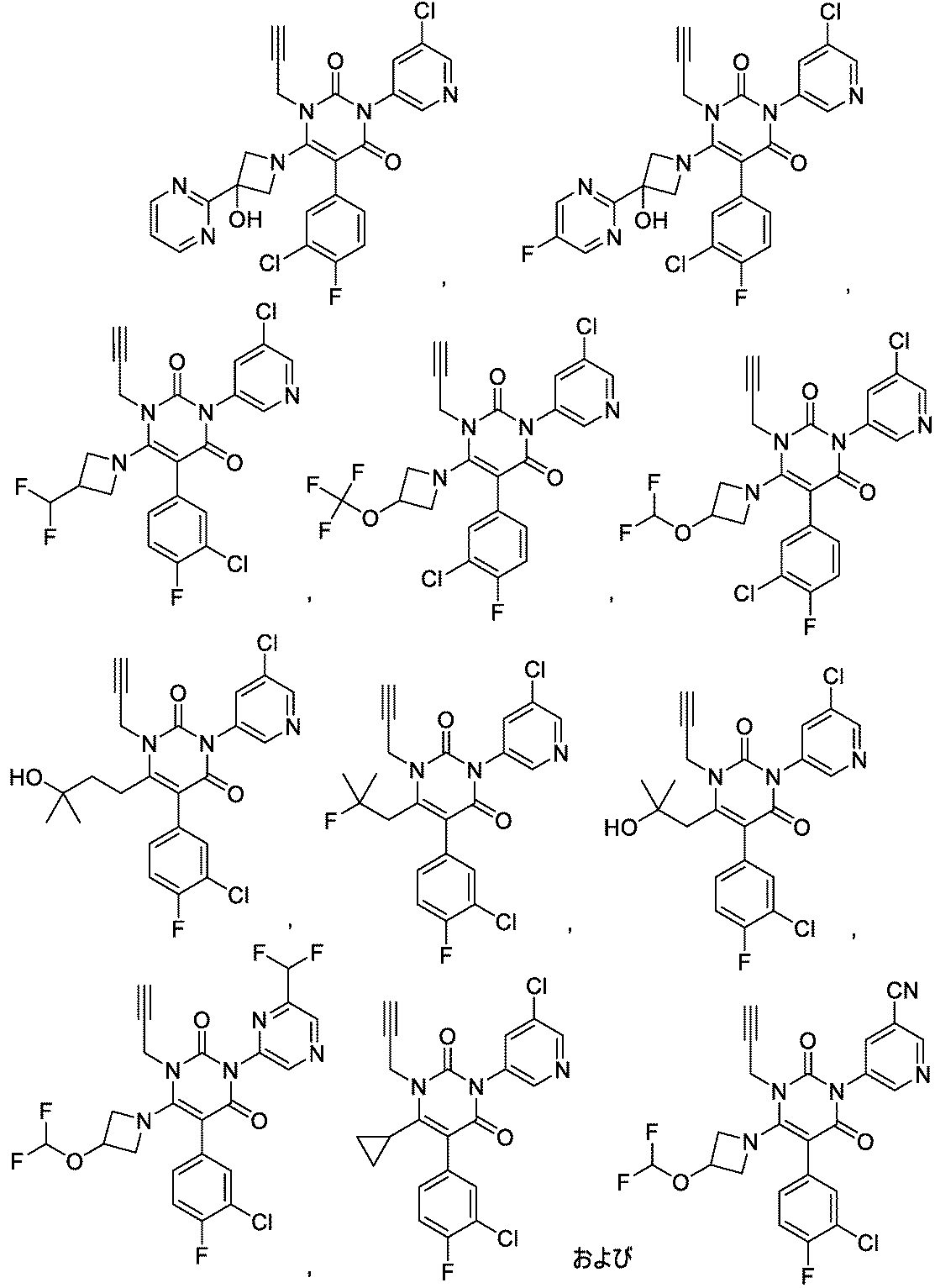
本発明に係る化合物は、コロナウイルス3CLプロテアーゼ阻害作用を有し、コロナウイルス3CLプロテアーゼを阻害する。
具体的には、以下に記載する評価方法において、IC50は50μM以下が好ましく、より好ましくは、1μM以下、さらにより好ましくは100nM以下である。EC50は10μM以下が好ましく、より好ましくは、1μM以下、さらにより好ましくは100nM以下である。
<操作手順>
・被験試料の希釈、分注
予め被験試料をDMSOで適度な濃度に希釈し、2~5倍段階希釈系列を作製後、384ウェルプレートに分注する。
・細胞およびSARS-CoV-2の希釈、分注
HEK293T/ACE2-TMPRSS2細胞(GCP-SL222、5×103cells/well)とSARS-CoV-2(200-600TCID50/well)を培地(MEM、2%FBS、ペニシリン-ストレプトマイシン)で混合し、被験試料が入ったウェルに分注した後、CO2インキュベーターで3日間培養する。
・CellTiter-Glo(登録商標)2.0の分注および発光シグナルの測定
3日間培養したプレートを室温に戻した後、CellTiter-Glo(登録商標)2.0を各ウェルに分注し、プレートミキサーで混和する。一定時間置いた後、プレートリーダーで発光シグナル(Lum)を測定する。
<各測定項目値の算出>
・50% SARS-CoV-2感染細胞死阻害濃度(EC50)算出
xを化合物濃度の対数値、yを%Efficacyとしたとき、以下のLogistic回帰式で阻害曲線を近似し、y=50(%)を代入したときのxの値をEC50として算出する。
y = min + (max - min)/{1 + (X50/x) ^Hill}
%Efficacy = {(Sample - virus control) / (cell control - virus control)} * 100%
cell control: the average of Lum of cell control wells
virus control: the average of Lum of virus control wells
min:y軸下限値、max:y軸上限値、X50:変曲点のx座標、Hill:minとmaxの中間点でのカーブの傾き
(結果)
化合物I-1:1.66nM
化合物I-2:2.36nM
<材料>
・市販のRecombinant SARS-CoV-2 3CL Protease
・市販の基質ペプチド
Dabcyl-Lys-Thr-Ser-Ala-Val-Leu-Gln-Ser-Gly-Phe-Arg-Lys-Met-Glu(Edans)-NH2(配列番号:1)
・Internal Standardペプチド
Dabcyl-Lys-Thr-Ser-Ala-Val-Leu(13C6,15N)-Gln(配列番号:2)
Dabcyl-Lys-Thr-Ser-Ala-Val-Leu(13C6,15N)-Glnは、文献(Atherton, E.; Sheppard, R. C.、“In Solid Phase Peptide Synthesis, A Practical Approach”、IRL Press at Oxford University Pres、1989.およびBioorg. Med. Chem.、5巻、9号、1997年、1883-1891頁、等)を参考に合成できる。以下に一例を示す。
Rinkアミド樹脂を用いて、Fmoc固相合成によって、H-Lys-Thr-Ser-Ala-Val-Leu(13C6,15N)-Glu(resin)-OαOtBu(Lys側鎖はBoc保護、Thr側鎖はtert-ブチル基で保護、Ser側鎖はtert-ブチル基で保護、GluのC末端OHはtert-ブチル基で保護されており、Glu側鎖のカルボン酸を樹脂に縮合)を合成する。N末端Dabcyl基の修飾は4-ジメチルアミノアゾベンゼン-4’-カルボン酸(Dabcyl-OH)をEDC/HOBTを用いて樹脂上で縮合する。最終脱保護、および樹脂からの切り出しはTFA/EDT=95:5で処理することで行う。その後、逆相HPLCによって精製する。
・RapidFire Cartridge C4 typeA
<操作手順>
・アッセイバッファーの調製
本試験では、20mM Tris-HCl、1mM EDTA、10mM DTT、0.01% BSAからなるアッセイバッファーを使用する。
・被験試料の希釈、分注
予め被験試料をDMSOで適度な濃度に希釈し、2~5倍段階希釈系列を作製後、384ウェルプレートに分注する。
・酵素と基質の添加、酵素反応
準備した化合物プレートに、8μMの基質、及び6nMまたは0.6nMの酵素溶液を添加し、室温で3~5時間インキュベーションを行う。その後、反応停止液(0.067μM Internal Standard、0.1% ギ酸、10または25% アセトニトリル)を加え酵素反応を停止させる。
・反応産物の測定
反応完了したプレートはRapidFire System 360及び質量分析器(Agilent、6550 iFunnel Q-TOF)、またはRapid Fire System 365及び質量分析器(Agilent、 6495C Triple Quadrupole)を用いて測定する。測定時の移動相としてA溶液(75% イソプロパノール、15% アセトニトリル、5mM ギ酸アンモニウム)とB溶液(0.01% トリフルオロ酢酸、0.09% ギ酸)を用いる。
質量分析器によって検出された反応産物は、RapidFire Integratorまたは同等の解析が可能なプログラムを用いて算出しProduct area値とする。また、同時に検出されたInternal Standardも算出しInternal Standard area値とする。
<各測定項目値の算出>
・P/ISの算出
前項目で得られたarea値を下記の式によって計算し、P/ISを算出する。
P/IS= Product area値/ Internal Standard area値
・50% SARS-CoV-2 3CLプロテアーゼ阻害濃度(IC50)算出
xを化合物濃度の対数値、yを%Inhibitionとしたとき、以下のLogistic回帰式で阻害曲線を近似し、y=50(%)を代入したときのxの値をIC50として算出する。
y = min + (max - min)/{1 + (X50/x) ^Hill}
%Inhibition = {1-(Sample - Control(-)) / Control(+)-Control(-))} * 100
Control(-):the average of P/IS of enzyme inhibited condition wells
Control(+):the average of P/IS of DMSO control wells
min:y軸下限値、max:y軸上限値、X50:変曲点のx座標、Hill:minとmaxの中間点でのカーブの傾き
(結果)
化合物I-1:0.00036μM
化合物I-2:0.00033μM
化合物II-1:0.00068μM
<材料>
・市販のRecombinant SARS-CoV-2 3CL Protease
・SARS-CoV-2 3CL Protease P132H
・市販の基質ペプチド
Dabcyl-Lys-Thr-Ser-Ala-Val-Leu-Gln-Ser-Gly-Phe-Arg-Lys-Met-Glu(Edans)-NH2(配列番号:1)
・Internal Standardペプチド
Dabcyl-Lys-Thr-Ser-Ala-Val-Leu(13C6,15N)-Gln(配列番号:2)
Dabcyl-Lys-Thr-Ser-Ala-Val-Leu(13C6,15N)-Glnは、文献(Atherton, E.; Sheppard, R. C.、“In Solid Phase Peptide Synthesis, A Practical Approach”、IRL Press at Oxford University Pres、1989.およびBioorg. Med. Chem.、5巻、9号、1997年、1883-1891頁、等)を参考に合成できる。以下に一例を示す。
Rinkアミド樹脂を用いて、Fmoc固相合成によって、H-Lys-Thr-Ser-Ala-Val-Leu(13C6,15N)-Glu(resin)-OαOtBu(Lys側鎖はBoc保護、Thr側鎖はtert-ブチル基で保護、Ser側鎖はtert-ブチル基で保護、GluのC末端OHはtert-ブチル基で保護されており、Glu側鎖のカルボン酸を樹脂に縮合)を合成する。N末端Dabcyl基の修飾は4-ジメチルアミノアゾベンゼン-4’-カルボン酸(Dabcyl-OH)をEDC/HOBTを用いて樹脂上で縮合する。最終脱保護、および樹脂からの切り出しはTFA/EDT=95:5で処理することで行う。その後、逆相HPLCによって精製する。
・RapidFire Cartridge C4 typeA
<操作手順>
・アッセイバッファーの調製
本試験では、20mM Tris-HCl、1mM EDTA、10mM DTT、0.01% BSAからなるアッセイバッファーを使用する。
・被験試料の希釈、分注
予め被験試料をDMSOで適度な濃度に希釈し、3倍段階希釈系列を作製後、384ウェルプレートに分注する。
・酵素と基質の添加、酵素反応
準備した化合物プレートに、最終濃度4μMの基質、0.3nMの酵素を添加し、室温で4時間インキュベーションを行う。その後、反応停止液(7.2nM Internal Standard、0.1% ギ酸、10% アセトニトリル)を加え酵素反応を停止させる。
・反応産物の測定
反応完了したプレートはRapid Fire System 365及び質量分析器(Agilent、 6495C Triple Quadrupole)を用いて測定する。測定時の移動相としてA溶液(75% イソプロパノール、15% アセトニトリル、5mM ギ酸アンモニウム)とB溶液(0.01% トリフルオロ酢酸、0.09% ギ酸)を用いる。
質量分析器によって検出された反応産物は、RapidFire Integratorを用いて算出しProduct area値とする。また、同時に検出されたInternal Standardも算出しInternal Standard area値とする。
<各測定項目値の算出>
・P/ISの算出
前項目で得られたarea値を下記の式によって計算し、P/ISを算出する。
P/IS= Product area値/ Internal Standard area値
・50% SARS-CoV-2 3CLプロテアーゼ阻害濃度(IC50)算出
xを化合物濃度の対数値、yを%Inhibitionとしたとき、以下のLogistic回帰式で阻害曲線を近似し、y=50(%)を代入したときのxの値をIC50として算出する。
y = min + (max - min)/{1 + (X50/x) ^Hill}
%Inhibition = {1-(Sample - Control(-)) / Control(+)-Control(-))} * 100
Control(-):the average of P/IS ratio in the wells without SARS-CoV-2 3CL protease and test substance
Control(+):the average of P/IS ratio in the wells with SARS-CoV-2 3CL protease and without test substance
min:y軸下限値、max:y軸上限値、X50:変曲点のx座標、Hill:minとmaxの中間点でのカーブの傾き
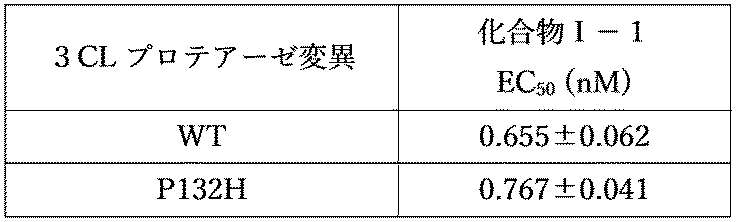
<操作手順>
・被験試料の希釈、分注
予め被験試料をDMSOで適度な濃度に希釈し、3倍段階希釈系列を作製後、96ウェルプレートに分注する。
・細胞およびSARS-CoV-2の希釈、分注
VeroE6/TMPRSS2細胞(JCRB1819、1.5×104cells/well)とSARS-CoV-2 hCoV-19/Japan/TY/WK-521/2020(Ancestral)、hCoV-19/Japan/QHN001/2020(Alpha)、hCoV-19/Japan/TY8-612/2021(Beta)、hCoV-19/Japan/TY7-501/2021(Gamma)、hCoV-19/Japan/TY11-927/2021(Delta)、hCoV-19/Japan/TY38-871/2021(Omicron BA.1.1)、hCoV-19/Japan/TY40-385/2022(Omicron BA.2)、hCoV-19/Japan/TY41-721/2022(Omicron BA.2.12.1)、hCoV-19/Japan/TY41-716/2022(Omicron BA.2.75)、hCoV-19/Japan/TY41-703/2022(Omicron BA.4.1)、hCoV-19/Japan/TY41-763/2022(Omicron BA.4.6)、hCoV-19/Japan/TY41-702/2022(Omicron BE.1/BA.5-like)、hCoV-19/Japan/TY41-704/2022(Omicron BA.5.2.1)、hCoV-19/Japan/TY41-820/2022(Omicron BF.7)、hCoV-19/Japan/TY41-828/2022(Omicron BF.7.4.1)、hCoV-19/Japan/TY41-796/2022(Omicron BQ.1.1)、hCoV-19/Japan/TY41-832/2022(Omicron CH.1.1.11)、hCoV-19/Japan/TY41-795/2022(Omicron XBB.1)、hCoV-19/Japan/23-018/2022(Omicron XBB.1.5)、hCoV-19/Japan/TY-41951/2023(Omicron XBB.1.9.1)、hCoV-19/Japan/TY41-984/2023(Omicron XBB.1.16)、hCoV-19/Japan/TY41-831/2022(Omicron XBF)、hCoV-19/Japan/TY41-686/2022(Omicron XE)(30-3000TCID50/well)を培地(MEM、2%FBS、ペニシリン-ストレプトマイシン)で混合し、被験試料が入ったウェルに分注した後、CO2インキュベーターで3日間あるいは4日間培養する。
・CellTiter-Glo(登録商標)2.0の分注および発光シグナルの測定
3日間培養したプレートを室温に戻した後、CellTiter-Glo(登録商標)2.0を各ウェルに分注し、プレートミキサーで混和する。一定時間置いた後、プレートリーダーで発光シグナル(Lum)を測定する。
・50% SARS-CoV-2感染細胞死阻害濃度(EC50)算出
xを化合物濃度の対数値、yを%Efficacyとしたとき、以下のLogistic回帰式で阻害曲線を近似し、y=50(%)を代入したときのxの値をEC50として算出する。
y = min + (max - min)/{1 + (X50/x) ^Hill}
%Efficacy = {(Sample - virus control) / (cell control - virus control)} * 100%
cell control: the average of Lum of cell control wells
virus control: the average of Lum of virus control wells
min:y軸下限値、max:y軸上限値、X50:変曲点のx座標、Hill:minとmaxの中間点でのカーブの傾き
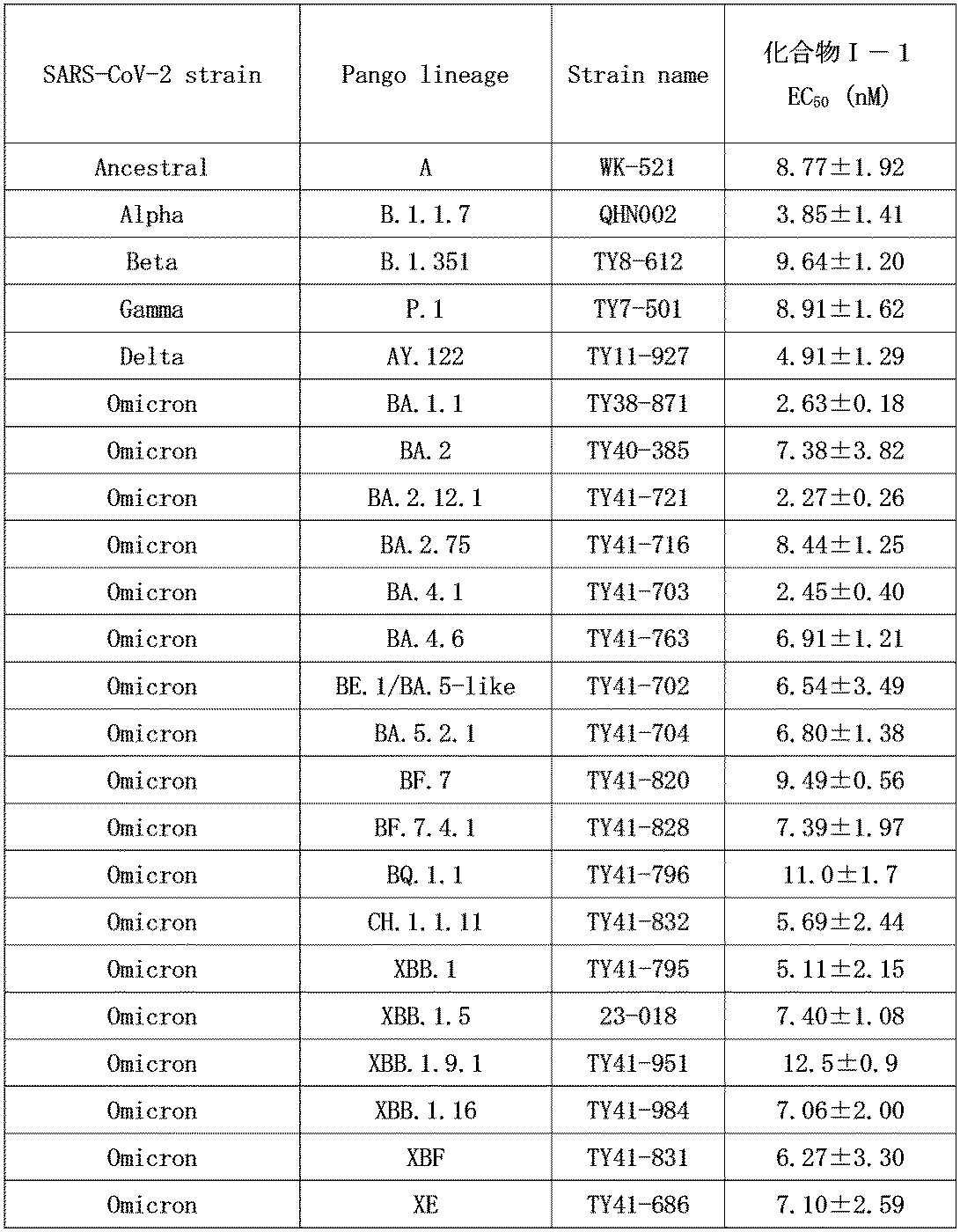
<操作手順>
・被験試料の希釈、分注
予め被験試料をDMSOで適度な濃度に希釈し、3倍段階希釈系列を作製後、96ウェルプレートに分注し維持培地(MEM、2%FBS、ペニシリン-ストレプトマイシン)で希釈する。
・細胞およびHCoV-OC43の希釈、分注
継代培地(DMEM、10%FBS、ペニシリン-ストレプトマイシン)に懸濁させたMRC-5細胞(2×10⁴cells/well)を感染前日に96wellプレートに播種し、翌日、維持培地(MEM、2%FBS、ペニシリン-ストレプトマイシン)に懸濁させたHCoV-OC43(300TCID50/well)を1時間で感染させる。その後、ウイルス液を除去し、被験試薬が入った維持培地を添加し、CO2インキュベーターで72時間培養する。また被験試薬の細胞毒性を調べるために、ウイルス非存在下にて同様の操作を実施する。
・CellTiter-Glo(登録商標)2.0の分注および発光シグナルの測定
72時間培養したプレートを室温に戻した後、CellTiter-Glo(登録商標)2.0を各ウェルに分注し、プレートミキサーで混和する。一定時間置いた後、プレートリーダーで発光シグナル(Lum)を測定する。
・50% HCoV-OC43感染細胞死阻害濃度(EC50)算出
xを化合物濃度の対数値、yを%Efficacyとしたとき、以下のLogistic回帰式で阻害曲線を近似し、y=50(%)を代入したときのxの値をEC50として算出する。
y = min + (max - min)/{1 + (X50/x) ^Hill}
%Efficacy = {(Sample - virus control) / (cell control - virus control)} * 100%
cell control: the average of Lum of cell control wells
virus control: the average of Lum of virus control wells
min:y軸下限値、max:y軸上限値、X50:変曲点のx座標、Hill:minとmaxの中間点でのカーブの傾き
・50%細胞毒性濃度の算出
xを化合物濃度の対数値、yを%Cytotoxicityとしたとき、以下のLogistic回帰式で阻害曲線を近似し、y=50(%)を代入したときのxの値をCC50として算出する。
y = min + (max - min)/{1 + (X50/x) ^Hill}
%Cytotoxicity = {(Sample - medium control) / (cell control - medium control)} * 100%
cell control: the average of Lum of cell control wells
medium control: the average of Lum of medium control wells
min:y軸下限値、max:y軸上限値、X50:変曲点のx座標、Hill:minとmaxの中間点でのカーブの傾き
化合物I-1:EC50 92.0±21.0nM、CC50>100μM
<操作手順>
・被験試料の希釈、分注
予め被験試料をDMSOで適度な濃度に希釈し、3倍段階希釈系列を作製後、96ウェルプレートに分注し維持培地(MEM、2%FBS、ペニシリン-ストレプトマイシン)で希釈する。
・細胞およびHCoV-229Eの希釈、分注
継代培地(DMEM、10%FBS、ペニシリン-ストレプトマイシン)に懸濁させたMRC-5細胞(2×10⁴cells/well)を感染前日に96wellプレートに播種し、翌日、維持培地(MEM、2%FBS、ペニシリン-ストレプトマイシン)に懸濁させたHCoV-229E(1000TCID50/well)を1時間で感染させる。その後、ウイルス液を除去し、被験試薬が入った維持培地を添加し、CO2インキュベーターで72時間培養する。
・CellTiter-Glo(登録商標)2.0の分注および発光シグナルの測定
72時間培養したプレートを室温に戻した後、CellTiter-Glo(登録商標)2.0を各ウェルに分注し、プレートミキサーで混和する。一定時間置いた後、プレートリーダーで発光シグナル(Lum)を測定する。
・50% HCoV-229E感染細胞死阻害濃度(EC50)算出
xを化合物濃度の対数値、yを%Efficacyとしたとき、以下のLogistic回帰式で阻害曲線を近似し、y=50(%)を代入したときのxの値をEC50として算出する。
y = min + (max - min)/{1 + (X50/x) ^Hill}
%Efficacy = {(Sample - virus control) / (cell control - virus control)} * 100%
cell control: the average of Lum of cell control wells
virus control: the average of Lum of virus control wells
min:y軸下限値、max:y軸上限値、X50:変曲点のx座標、Hill:minとmaxの中間点でのカーブの傾き
化合物I-1:EC50 3570±510nM
<操作手順>
・被験試料の希釈、分注
予め被験試料をDMSOで適度な濃度に希釈し、3倍段階希釈系列を作製後、96ウェルプレートに分注する。
・血清添加培地の添加
最終濃度0、12.5、25、50%ヒト血清もしくはマウス血清もしくはハムスター血清となるよう培地(MEM、2%FBS、ペニシリン-ストレプトマイシン)で調製し、被験試料が入ったウェルに分注し、室温で1時間インキュベートする。
・細胞およびSARS-CoV-2の希釈、分注
VeroE6/TMPRSS2細胞(JCRB1819、1.5×104cells/well)を感染前日に96wellプレートに播種し、翌日、維持培地(MEM、2%FBS、ペニシリン-ストレプトマイシン)に懸濁させたSARS-CoV-2 hCoV-19/Japan/TY7-501/2021(1000TCID50/well)を1時間で感染させる。その後、ウイルス液を除去し、被験試薬およびヒト血清、マウス血清あるいはハムスター血清添加培地を添加し、CO2インキュベーターで1日培養する。
・ウイルス量の定量
1日培養したプレートの上清を除去し、Trizol LSと維持培地を3:1で混和した細胞溶解液を添加し、Direct-zol-96 RNA Kit(ZYMO RESEARCH)を用いてRNAを抽出する。抽出後のRNA溶液をリアルタイムPCR(Applied BioSystems QuantStudio5)にて定量する。プローブ、プライマーは以下のものを使用する。
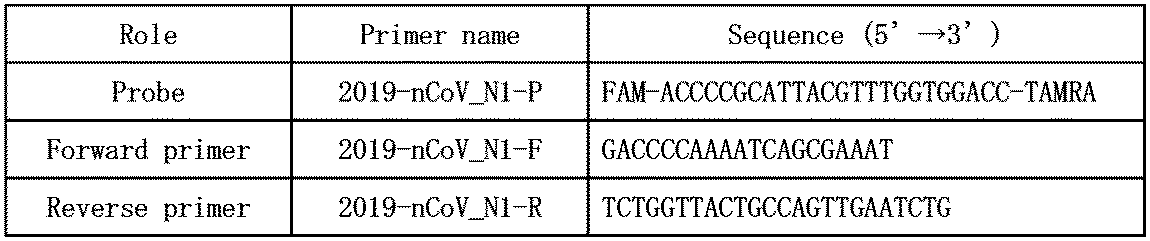
・90% SARS-CoV-2ウイルス複製阻害濃度(EC90)算出
xを化合物濃度の対数値、yをウイルスのコピー数(Log10 copies/mL)とした濃度依存性曲線においてウイルスコントロールからの1 log10 reductionに相当する値をその前後の2濃度のコピー数から二点法で算出する。すなわち、
X = the lowest concentration at the mean reduction of viral RNA copy number from that of virus control is less than z
x = the highest concentration at the mean reduction of viral RNA copy number from that of virus control is z or more.
Y = the mean of logarithmic reduction of viral RNA copy number from that of virus control at X
y = the mean of logarithmic reduction of viral RNA copy number from that of virus control at x
EC90 values were calculated by the following formula.
EC90 = 10[log(x) + (log(X) - log(x)) × (y - z)/(y - Y)]
z = log10(10/100)
・Protein-Adjusted EC90(PA-EC90)の算出
各血清濃度でのEC90を算出後、線形回帰によって血清100%条件でのPA-EC90値を計算した。
化合物I-1:
ヒト血清PA-EC90 7.90nM
マウス血清PA-EC90 19.8nM
ハムスター血清PA-EC90 8.17nM
<操作手順>
・被験試料の希釈、分注
予め被験試料をDMSOで適度な濃度に希釈し、3倍段階希釈系列を作製後、MucilAirTM培養液で200倍希釈し、24ウェルプレートに分注した。
・SARS-CoV-2感染
Transwellに播種してあるMucilAirTM(Nasal cavity、約5.0×10⁵cells/well)にSARS-CoV-2 hCoV-19/Japan/TY41-702/2022(Omicron BE.1/BA.5-like)(5000TCID50/well)を感染させ、CO2インキュベーターで2時間培養した。その後MucilAirTM培養液で洗浄し、transwellを被験試料が入ったウェルに乗せ、CO2インキュベーターで培養した。感染2日後に、transwellにMucilAirTM培養液を添加し、その上清を回収した。
・上清中ウイルス力価の測定
回収した上清を培地(MEM、2%FBS、ペニシリン-ストレプトマイシン)にて10倍希釈系列を作製後、VeroE6/TMPRSS2細胞(JCRB1819、1.5×104cells/well)と混合し、96ウェルプレートに播種した。CO2インキュベーターで4日間培養後、Cytopathic effect(CPE)を観察し、上清中に含まれるウイルス力価を算出した。
・90% SARS-CoV-2ウイルス産生阻害濃度(EC90)算出
xを化合物濃度の対数値、yをウイルス力価(Log10 TCID50/mL)とした濃度依存性曲線においてウイルスコントロールからの1 log10 reductionに相当する値をその前後の2濃度のウイルス力価から二点法で算出する。


<材料と方法>
・化合物
本発明に係る化合物I-1を、N,N-ジメチルアセトアミド(DMA)および0.5w/v% ポリ(1-ビニルピロリドン-co-酢酸ビニル)(PVPVA)含有ポリエチレングリコール400(PEG400)(DMA:0.5w/v%PVPVA含有PEG400=1:9)を用いて、被験試料とした。投与容量は、5mL/kgとした。
・ウイルス
国立感染症研究所にて分離されたSARS-CoV-2 hCoV-19/Japan/TY7-501/2021株を用いた。
・マウス肺感染、投薬、肺回収
特定病原体不在の5週齢の雌性BALB/cマウス(CLEA Japan,Inc.)を本研究において使用した。ウイルス接種の際、Saline中に0.03mg/mLの塩酸メデトミジン、0.4mg/mLのミダゾラム、0.5mg/mLの酒石酸ブトルファノールを含む100μLの麻酔液の筋内投与によってマウスを麻酔した。マウスに、麻酔下で、50μLのhCoV-19/Japan/TY7-501/2021(1.00×104TCID50)を経鼻接種した。ウイルス感染1日後を開始点として、マウス(n=5/群)に、化合物I-1を0.1、0.3、1、3、10mg/kgの用量で1日2回経口投与した。対照マウスには、DMA/0.5w/v%PVPVA in PEG400を1日2回経口投与した。化合物投与は投与開始から2日間とした。感染3日後にマウス肺を回収し、2mLのPBSを添加、ホモジナイズし、遠心後の上清を回収した。
・肺ホモジネート液中ウイルス力価の測定
肺ホモジネート液を培地(MEM、2%FBS、ペニシリン-ストレプトマイシン)にて10倍希釈系列を作製後、VeroE6/TMPRSS2細胞(JCRB1819、1.5×104cells/well)と混合し、96ウェルプレートに播種した。CO2インキュベーターで4日間培養後、Cytopathic effect(CPE)を観察し、肺ホモジネート液中に含まれるウイルス力価を算出した。
感染3日後の肺ホモジネート液中ウイルス力価はDMA/0.5w/v%PVPVA in PEG400投与群では6.45-log10TCID50/mLを示し、化合物I-1 0.1、0.3、1、3、10mg/kg投与群ではそれぞれ6.27、5.39、3.97、2.51、2.47-log10TCID50/mLを示した。化合物I-1投与群では肺ホモジネート液中ウイルス力価がDMA/0.5w/v%PVPVA in PEG400投与群に比べて低値を示したことから、感染から投与までの期間が空いても肺ホモジネート液中ウイルス力価を低減する効果があることが示唆された(図1)。
<材料と方法>
・化合物
本発明に係る化合物I-1を、N,N-ジメチルアセトアミド(DMA)および0.5w/v% ポリ(1-ビニルピロリドン-co-酢酸ビニル)(PVPVA)含有ポリエチレングリコール400(PEG400)(DMA:0.5w/v%PVPVA含有PEG400=1:9)を用いて、被験試料とした。投与容量は、2.5mL/kgとした。
・ウイルス
国立感染症研究所にて分離されたSARS-CoV-2 hCoV-19/Japan/TY41-702/2022株(Omicron BE.1/BA.5-like)を用いた。
・ハムスター肺感染、投薬、肺、鼻甲介回収
特定病原体不在の6週齢の雄性シリアンハムスター(Japan SLC,Inc.)を本研究において使用した。ウイルス接種の際、0.07mg/mLの塩酸メデトミジン、6.98mg/mLのアルファキサロン、1.16mg/mLの酒石酸ブトルファノールを含む麻酔液を3mL/kgで皮下投与によってハムスターを麻酔し、100μLのhCoV-19/Japan/TY41-702/2022(1.00×104TCID50)を経鼻接種した。感染ハムスターには、ウイルス接種1日後を開始点として、化合物I-1を0.1、1、10mg/kgの用量で1日2回経口投与した。対照の感染ハムスター及び非感染ハムスターには、DMA/0.5w/v%PVPVA in PEG400を1日2回経口投与した。化合物投与は投与開始から5日間とした。感染3、4日後に感染ハムスター肺及び鼻甲介を回収し、それぞれ5mL若しくは1mLのPBSを添加、ホモジナイズし、遠心後の上清を回収した。また、感染7日後の感染及び非感染ハムスターの肺を回収し、肺重量を測定した。
・肺及び鼻甲介ホモジネート液中ウイルス力価の測定
肺及び鼻甲介ホモジネート液を培地(MEM、2%FBS、ペニシリン-ストレプトマイシン)にて10倍希釈系列を作製後、予め96ウェルプレートに培養したVeroE6/TMPRSS2細胞(JCRB1819、1.5×104cells/well)に播種した。CO2インキュベーターで4日間培養後、Cytopathic effect(CPE)を観察し、肺若しくは鼻甲介ホモジネート液中に含まれるウイルス力価を算出した。
肺ホモジネート液中ウイルス力価は、感染3日後のDMA/0.5w/v%PVPVA in PEG400投与群では5.4-log10TCID50/mLを示し、化合物I-1を0.1、1、10mg/kg投与群ではそれぞれ5.5、3.5、2.5-log10TCID50/mLを示した。感染4日後はDMA/0.5w/v%PVPVA in PEG400投与群では5.6-log10TCID50/mLを示し、化合物I-1を0.1、1、10mg/kg投与群ではそれぞれ4.6、2.4、1.9-log10TCID50/mLを示した。
鼻甲介ホモジネート液中ウイルス力価は、感染3日後はDMA/0.5w/v%PVPVA in PEG400投与群では5.0-log10TCID50/mLを示し、化合物I-1を0.1、1、10mg/kg投与群ではそれぞれ4.8、3.2、2.7-log10TCID50/mLを示した。感染4日後はDMA/0.5w/v%PVPVA in PEG400投与群では3.8-log10TCID50/mLを示し、化合物I-1を0.1、1、10mg/kg投与群ではそれぞれ4.0、2.2、1.8-log10TCID50/mLを示した。
化合物I-1投与群では肺及び鼻甲介ホモジネート液中ウイルス力価がDMA/0.5w/v%PVPVA in PEG400投与群に比べて投与量依存的に低値を示したことから、感染から投与までの期間が空いても肺及び鼻甲介ホモジネート液中ウイルス力価を低減する効果があることが示唆された(図2-1、図2-2)。
また、感染7日後の肺重量/体重は、非感染ハムスターでは5.26mg/g、感染ハムスターのDMA/0.5w/v%PVPVA in PEG400投与群では8.96mg/g、化合物I-1を0.1、1、10mg/kg投与群ではそれぞれ8.24、5.75、5.57mg/gを示した。
化合物I-1投与群では肺重量/体重がDMA/0.5w/v%PVPVA in PEG400投与群に比べて投与量依存的に低値を示したことから、化合物I-1の投与により、SARS-CoV-2感染によって引き起こされる肺重量増加抑制効果があることが示唆された(図3)。
<材料と方法>
・化合物
本発明に係る化合物I-1を、N,N-ジメチルアセトアミド(DMA)および0.5w/v% ポリ(1-ビニルピロリドン-co-酢酸ビニル)(PVPVA)含有ポリエチレングリコール400(PEG400)(DMA:0.5w/v%PVPVA含有PEG400=1:9)を用いて、被験試料とした。投与容量は、2.5mL/kgとした。
・ウイルス
国立感染症研究所にて分離されたSARS-CoV-2 hCoV-19/Japan/TY41-702/2022株(Omicron BE.1/BA.5-like)を用いた。
・ハムスター肺感染、投薬、体重測定
特定病原体不在の6週齢の雄性シリアンハムスター(Japan SLC,Inc.)を本研究において使用した。ウイルス接種の際、0.07mg/mLの塩酸メデトミジン、6.98mg/mLのアルファキサロン、1.16mg/mLの酒石酸ブトルファノールを含む麻酔液を3mL/kgで皮下投与によってハムスターを麻酔し、100μLのhCoV-19/Japan/TY41-702/2022(1.00×104TCID50)を経鼻接種した。感染ハムスターには、ウイルス接種1日後を開始点として、化合物I-1を0.1、1、10mg/kgの用量で1日2回経口投与した。対照の感染ハムスター及び非感染ハムスターには、DMA/0.5w/v%PVPVA in PEG400を1日2回経口投与した。化合物投与は投与開始から5日間とした。体重を1日1回モニタリングした。
非感染ハムスターは体重増加が認められたが、感染ハムスターでは感染3日後から体重が減少し、感染6日後に体重が最も低値となった。このとき化合物I-1 1、10mg/kg投与群では観察した感染10日後まで全例が生存し、体重減少が抑制された(図4)。
以上の結果から、化合物I-1投与により体重減少抑制効果があることが示唆された。
<材料と方法>
・化合物
化合物I-1を、0.5%メチルセルロース(0.5%MC)溶液を用いて被験試料とした。投与容量は、10mL/kgとした。
・ウイルス
国立感染症研究所にて分離されたSARS-CoV-2 hCoV-19/Japan/TY41-702/2022株(Omicron BE.1/BA.5-like)を用いた。
・ハムスター肺感染、投薬、体重測定
特定病原体不在の6週齢の雄性シリアンハムスター(Japan SLC,Inc.)を本研究において使用した。ウイルス接種の際、0.07mg/mLの塩酸メデトミジン、6.98mg/mLのアルファキサロン、1.16mg/mLの酒石酸ブトルファノールを含む麻酔液を3mL/kgで皮下投与によってハムスターを麻酔し、100μLのhCoV-19/Japan/TY41-702/2022(1.00×104TCID50)を経鼻接種した。体重減少抑制試験ではウイルス感染1日前あるいは3日前に化合物I-1を3、10mg/kgで1回皮下投与した。肺及び鼻甲介ホモジネート液中ウイルス増殖抑制試験ではウイルス感染1日前に化合物I-1を10、30mg/kgで1回皮下投与した。対象ハムスターには0.5%MCをウイルス感染1日前に1回皮下投与した。体重は1日1回モニタリングした。感染1、2日後に感染ハムスター肺及び鼻甲介を回収し、それぞれ5mL若しくは1mLのPBSを添加、ホモジナイズし、遠心後の上清を回収した。
・肺及び鼻甲介ホモジネート液中ウイルス力価の測定
肺及び鼻甲介ホモジネート液を培地(MEM、2%FBS、ペニシリン-ストレプトマイシン)にて10倍希釈系列を作製後、予め96ウェルプレートに培養したVeroE6/TMPRSS2細胞(JCRB1819、1.5×104cells/well)に播種した。CO2インキュベーターで4日間培養後、Cytopathic effect(CPE)を観察し、肺若しくは鼻甲介ホモジネート液中に含まれるウイルス力価を算出した。
感染ハムスターでは感染3日後から体重が減少し、感染6日後に体重が最も低値となった。このとき化合物I-1を感染1日前での3、10mg/kg投与群、感染3日前での10mg/kg投与群では観察した感染7日後まで全例が生存し、体重減少が抑制された(図5)。
肺ホモジネート液中ウイルス力価は、感染1日後において、0.5%MC投与群では5.59-log10TCID50/mLを示し、化合物I-1 10、30mg/kg投与群ではそれぞれ3.34、1.84-log10TCID50/mLを示した。感染2日後において、0.5%MC投与群では6.18-log10TCID50/mLを示し、化合物I-1 10、30mg/kg投与群ではそれぞれ5.29、3.55-log10TCID50/mLを示した(図6-1)。
鼻甲介ホモジネート液中ウイルス力価は、感染1日後において、0.5%MC投与群では5.71-log10TCID50/mLを示し、化合物I-1 10、30mg/kg投与群ではそれぞれ4.80、3.36-log10TCID50/mLを示した。感染2日後において、0.5%MC投与群では5.80-log10TCID50/mLを示し、化合物I-1 10、30mg/kg投与群ではそれぞれ5.38、5.01-log10TCID50/mLを示した(図6-2)。
なお、感染直前の血漿中濃度を測定したところ、感染1日前での3、10mg/kg投与群、感染3日前での3、10mg/kg投与群で、それぞれ6.1、12.5、5.9、3.0ng/mLであった。
以上の結果から、化合物I-1の予防的投与によりウイルス感染時の血漿中濃度がおよそ6ng/mL以上で体重減少抑制効果が示され、およそ12ng/mL以上で肺および鼻甲介ホモジナイズ中ウイルス増殖抑制効果あることが示された。
<材料と方法>
・化合物
本発明に係る化合物I-1を、N,N-ジメチルアセトアミド(DMA)および0.5w/v% ポリ(1-ビニルピロリドン-co-酢酸ビニル)含有ポリエチレングリコール400(PEG400)(PVPVA)(DMA:0.5w/v%PVPVA含有PEG400=1:9)を用いて、被験試料とした。投与容量は、2.5mL/kgとした。
・ウイルス
国立感染症研究所にて分離されたSARS-CoV-2 hCoV-19/Japan/TY41-702/2022株(Omicron BE.1/BA.5-like)を用いた。
・ハムスター経鼻感染、投薬、鼻腔洗浄液回収
特定病原体不在の6週齢の雄性シリアンハムスター(Japan SLC,Inc.)を本研究において使用した。ウイルス接種の際、0.07mg/mLの塩酸メデトミジン、6.98mg/mLのアルファキサロン、1.16mg/mLの酒石酸ブトルファノールを含む麻酔液を3mL/kgで皮下投与によってハムスターを麻酔し、100μLのhCoV-19/Japan/TY41-702/2022(1.00×104TCID50)を経鼻接種した。感染ハムスターには、ウイルス接種2日あるいは3日後を開始点として、化合物I-1を1、10mg/kgの用量で1日2回経口投与した。対照の感染ハムスターには、DMA/0.5w/v%PVPVA in PEG400を1日2回経口投与した。化合物投与は投与開始から5日間とした。感染2-6日後に感染ハムスターをイソフルラン麻酔下においてDPBS400μLにて鼻腔洗浄液を回収し、遠心後の上清を回収した。各群n=4で実施した。
・鼻腔洗浄液中ウイルス力価の測定
鼻腔洗浄液の上清を培地(MEM、2%FBS、ペニシリン-ストレプトマイシン)にて10倍希釈系列を作製後、予め96ウェルプレートに培養したVeroE6/TMPRSS2細胞(JCRB1819、1.5×104cells/well)に播種した。CO2インキュベーターで4日間培養後、Cytopathic effect(CPE)を観察し、鼻腔洗浄液中に含まれるウイルス力価を算出した。
鼻腔洗浄液中ウイルス力価は、ウイルス接種2日後から化合物を投薬した群において、DMA/0.5w/v%PVPVA in PEG400投与群、化合物I-1 1、10mg/kg投与群の投与開始時点(感染2日後、投与開始1日目)では、それぞれ4.80、4.90、4.88-log10TCID50/mL、感染3日後(投与開始2日目)では、それぞれ3.75、3.63、3.68-log10TCID50/mL、感染5日後(投与開始4日目)では、それぞれ2.96、<1.80、<1.80-log10TCID50/mLを示した(図14)。ウイルス接種3日後から化合物を投薬した群において、DMA/0.5w/v%PVPVA in PEG400投与群、化合物I-1 1、10mg/kg投与群の投与開始時点(感染3日後、投与開始1日目)では、それぞれ3.40、2.93、3.13-log10TCID50/mL、感染4日後(投与開始1日後)では、それぞれ2.97、1.84、2.13-log10TCID50/mL、感染6日後(投与開始4日後)では、それぞれ2.43、<1.80、<1.80-log10TCID50/mLを示した(図15)。
化合物I-1 1、10mg/kg投与群では投与開始が感染2日後あるいは3日後のいずれにおいても、鼻腔洗浄液中ウイルス力価がDMA/0.5w/v%PVPVA in PEG400投与群に比べて低値を示したことから、感染から投与までの期間が空いても生体内においてウイルスを低減する効果があることが示された。
<材料と方法>
・化合物
本発明に係る化合物I-1を、N,N-ジメチルアセトアミド(DMA)および0.5w/v% ポリ(1-ビニルピロリドン-co-酢酸ビニル)(PVPVA)含有ポリエチレングリコール400(PEG400)(DMA:0.5w/v%PVPVA含有PEG400=1:9)を用いて、被験試料とした。投与容量は、2.5mL/kgとした。
・ウイルス
国立感染症研究所にて分離されたSARS-CoV-2 hCoV-19/Japan/TY11-927/2021を用いた。
・ハムスター経鼻感染、投薬、同居、鼻腔洗浄液及び肺回収
特定病原体不在の6週齢の雄性シリアンハムスター(Japan SLC,Inc.)を本研究において使用した。ウイルス接種の際、0.07mg/mLの塩酸メデトミジン、6.98mg/mLのアルファキサロン、1.16mg/mLの酒石酸ブトルファノールを含む麻酔液を3mL/kgで皮下投与によってハムスターを麻酔し、100μLのhCoV-19/Japan/TY11-927/2021(1.00×103TCID50)を経鼻接種した。感染ハムスター(Index)にウイルス接種8時間後を開始点として、化合物I-1を0.1、1、10mg/kgの用量で1日2回経口投与した。対照の感染ハムスター(Index)には、DMA/0.5w/v%PVPVA in PEG400を1日2回経口投与した。化合物投与は投与開始から合計3回とした。感染1日後から2日後の夜間12時間にかけて、感染ハムスター(Index)1匹とウイルスを接種しない非感染ハムスター1匹(Contact)を、同一ケージ内において、直接接触できないように別のステンレスケージに入れて2cm離した状態で同居させた。同居終了後は個別飼育した。同居開始4日後(同居解除3日後)の非感染ハムスター(Cotact)から鼻腔洗浄液及び肺を回収した。鼻腔洗浄液は、イソフルラン麻酔下においてDPBS400μLにて回収し、遠心後の上清を回収した。肺は5mLのDPBSを添加、ホモジナイズし、遠心後の上清を回収した。各群n=6で実施した。
・鼻腔洗浄液及び肺ホモジナイズ上清中ウイルス力価の測定
鼻腔洗浄液若しくは肺ホモジネート上清を培地(MEM、2%FBS、ペニシリン-ストレプトマイシン)にて10倍希釈系列を作製後、予め96ウェルプレートに培養したVeroE6/TMPRSS2細胞(JCRB1819、1.5×104cells/well)へ接種した。CO2インキュベーターで4日間培養後、Cytopathic effect(CPE)を観察し、鼻腔洗浄液若しくは肺ホモジネート上清中に含まれるウイルス力価を算出した。
感染ハムスター(Index)との同居開始4日後(同居解除3日後)の非感染ハムスター(Contact)の鼻腔洗浄液あるいは肺ホモジナイズ上清中ウイルス力価が検出限界(1.8-log10TCID50/mL)以上となった個体は、DMA/0.5w/v%PVPVA in PEG400投与群では6/6例、化合物I-1 0.1mg/kg投与群では6/6例、化合物I-1 1mg/kg投与群では0/6例、化合物I-1 10mg/kg投与群では0/6例、となり、用量依存的な伝播抑制効果を示した(図16)。これらの結果から、化合物I-1を感染ハムスター(Index)に感染後に投与することにより、非感染ハムスター(Contact)へのウイルス伝播を抑制する効果があることが示された。
<材料と方法>
・化合物
化合物I-1を、0.5%メチルセルロース(0.5%MC)溶液を用いて被験試料とした。投与容量は、5mL/kgとした。
・ウイルス
国立感染症研究所にて分離されたSARS-CoV-2 hCoV-19/Japan/TY11-927/2021(Delta)を用いた。
・ハムスター経鼻感染、投薬、同居、鼻腔洗浄液及び肺回収
特定病原体不在の6週齢の雄性シリアンハムスター(Japan SLC,Inc.)を本研究において使用した。ウイルス接種の際、0.07mg/mLの塩酸メデトミジン、6.98mg/mLのアルファキサロン、1.16mg/mLの酒石酸ブトルファノールを含む麻酔液を3mL/kgで皮下投与によってハムスターを麻酔し、100μLのhCoV-19/Japan/TY11-927/2021(1.00×103TCID50)を経鼻接種した。非感染ハムスター(Contact)に化合物I-1を3、10、30、90mg/kgの用量で同居12時間前に単回皮下投与した。対照の非感染ハムスター(Contact)には、0.5%MCを単回皮下投与した。感染ハムスター(Index)への感染1日後から2日後の夜間12時間にかけて、感染ハムスター(Index)1匹と化合物を投与した非感染ハムスター1匹(Contact)を、同一ケージ内において、直接接触できないように別のステンレスケージに入れて2cm離した状態で同居させた。同居終了後は個別飼育した。同居開始4日後(同居解除3日後)の非感染ハムスター(contact)から鼻腔洗浄液及び肺を回収した。鼻腔洗浄液は、イソフルラン麻酔下においてDPBS400μLにて回収し、遠心後の上清を回収した。肺は3mLのDPBSを添加、ホモジナイズし、遠心後の上清を回収し、DPBSで2倍希釈した。各群n=6で実施した。
・鼻腔洗浄液及び肺ホモジナイズ上清中ウイルス力価の測定
鼻腔洗浄液若しくは肺ホモジネート上清を培地(MEM、2%FBS、ペニシリン-ストレプトマイシン)にて10倍希釈系列を作製後、予め96ウェルプレートに培養したVeroE6/TMPRSS2細胞(JCRB1819、1.50×104cells/well)へ接種した。CO2インキュベーターで4日間培養後、Cytopathic effect(CPE)を観察し、鼻腔洗浄液若しくは肺ホモジネート上清中に含まれるウイルス力価を算出した。
感染ハムスター(Index)との同居開始4日後(同居解除3日後)の化合物を投与した非感染ハムスター(Contact)の鼻腔洗浄液あるいは肺ホモジナイズ上清中ウイルス力価が検出限界(1.8-log10TCID50/mL)以上となった個体は、0.5%MC投与群では6例/6例、化合物I-1 3mg/kg投与群では5/6例、化合物I-1 10mg/kg投与群では6/6例、化合物I-1 30mg/kg投与群では3/6例、化合物I-1 90mg/kg投与群では0/6例となり、用量依存的な感染予防効果を示した(図17)。これらの結果から、化合物I-1を予防的に投与することにより、感染ハムスター(Index)からのウイルス伝播を予防する効果があることが示唆された。
<材料と方法>
・化合物
本発明に係る化合物I-1を、N,N-ジメチルアセトアミド(DMA)および0.5w/v% ポリ(1-ビニルピロリドン-co-酢酸ビニル)(PVPVA)含有ポリエチレングリコール400(PEG400)(DMA:0.5w/v%PVPVA含有PEG400=1:9)を用いて、被験試料とした。投与容量は、1.25mL/kgとした。
・ウイルス
国立感染症研究所にて分離されたSARS-CoV-2 hCoV-19/Japan/TY11-927/2021を用いた。
・ハムスター経鼻感染、投薬、同居、鼻腔洗浄液及び肺回収
特定病原体不在の11カ月齢(加齢)の雄性シリアンハムスター(Japan SLC,Inc.)を本研究において使用した。ウイルス接種の際、0.07mg/mLの塩酸メデトミジン、6.98mg/mLのアルファキサロン、1.16mg/mLの酒石酸ブトルファノールを含む麻酔液を3mL/kgで皮下投与によってハムスターを麻酔し、100μLのhCoV-19/Japan/TY11-927/2021(1.00×104TCID50)を経鼻接種した。ウイルス接種1日後を開始点として、化合物I-1を0.1、1、10mg/kgの用量で1日2回経口投与した。対照の感染ハムスターには、DMA/0.5w/v%PVPVA in PEG400を1日2回経口投与した。化合物投与は投与開始から5日間とした。体重を1日1回モニタリングし、生存率の評価においては、感染直前の体重を基準として80%未満となった場合には死亡と見做した。各群n=6で実施した。
感染ハムスターのDMA/0.5w/v%PVPVA in PEG400投与群では感染8日後に2匹が致死となり、生存率は66.7%を示した。このとき化合物I-1 1、10mg/kg投与群では観察した感染10日後まで全例が生存し、体重減少が抑制された(図18および図19)。
以上の結果から、加齢ハムスターにおいても、化合物I-1投与により致死および体重減少抑制効果があることが示唆された。
また、上記試験結果は、化合物I-1投与群においてウイルス感染による重症化が抑制されたことを示唆しており、化合物I-1のSARS-CoV-2に対する抗ウイルス効果のみならず、SARS-CoV-2による感染症の重症化抑制用医薬としての有用性を支持する。
<操作手順>
・被験試料
化合物I-1と併用する被験試料としてエンシトレルビル フマル酸、ニルマトレルビル、レムデシビル、EIDD-1931、ソトロビマブ、チキサゲビマブ/シルガビマブを用いた。
・被験試料の希釈、分注
各被験試料をDMSOあるいはDPBSおよび培地(MEM、2%FBS、ペニシリン-ストレプトマイシン)で適度な濃度に希釈し、段階希釈系列を96ウェルプレートに作製した。
・細胞およびSARS-CoV-2の希釈、分注
A549/ACE2-TMPRSS2細胞(Invivogen、a549-hace2tpsa、1.5×104cells/well)とSARS-CoV-2 hCoV-19/Japan/TY11-927/2021(100TCID50/well)を培地(MEM、2%FBS、ペニシリン-ストレプトマイシン)で混合し、被験試料が入ったウェルに分注した後、CO2インキュベーターで2日間培養した。
・CellTiter-Glo(登録商標)2.0の分注および発光シグナルの測定
3日間培養したプレートを室温に戻した後、CellTiter-Glo(登録商標)2.0を各ウェルに分注し、プレートミキサーで混和した。一定時間置いた後、プレートリーダーで発光シグナル(Lum)を測定した。
MacSynergyIIによりSynegy volume及びAntagonism volumeを算出した。これらの数値は既報の論文(Antiviral Research,1990,Volume 14,p.181-206)等を参考に算出できる。
・併用効果の判定
併用効果は、MacSynergyIIの99%信頼度でのSynegy volume及びAntagonism volumeについて以下に示す基準で判定した。
synergy volume ≦ 25: additive
25 < synergy volume ≦ 50: minor synergy
50 < synergy volume ≦ 100: moderate synergy
100 < synergy volume: strong synergy
-25 ≦ antagonism volume: additive
-50 ≦ antagonism volume < -25: minor antagonism
-100 ≦ antagonism volume < -50: moderate antagonism
antagonism volume < -100: strong antagonism
本発明に係る化合物は、任意の従来の経路により、特に、経腸、例えば、経口で、例えば、錠剤またはカプセル剤の形態で、または非経口で、例えば注射液剤または懸濁剤の形態で、局所で、例えば、ローション剤、ゲル剤、軟膏剤またはクリーム剤の形態で、または経鼻形態または座剤形態で医薬組成物として投与することができる。少なくとも1種の薬学的に許容される担体または希釈剤と一緒にして、遊離形態または薬学的に許容される塩の形態の本発明の化合物を含む医薬組成物は、従来の方法で、混合、造粒またはコーティング法によって製造することができる。例えば、経口用組成物としては、賦形剤、崩壊剤、結合剤、滑沢剤等および有効成分等を含有する錠剤、顆粒剤、カプセル剤とすることができる。また、注射用組成物としては、溶液剤または懸濁剤とすることができ、滅菌されていてもよく、また、保存剤、安定化剤、緩衝化剤等を含有してもよい。
Claims (8)
- 式(I-1):

で示される化合物またはその製薬上許容される塩、を含有する医薬組成物。 - 3CLプロテアーゼ阻害剤である、請求項1記載の医薬組成物。
- SARS-CoV-2のウイルス増殖を阻害するために用いられる、請求項1または2記載の医薬組成物。
- 新型コロナウイルス感染症(COVID-19)の治療剤および/または予防剤である、請求項1~3のいずれかに記載の医薬組成物。
- SARS-CoV-2による感染症の重症化抑制のために用いられる、請求項1~4のいずれかに記載の医薬組成物。
- SARS-CoV-2による感染症の症状が発現してから、または、SARS-CoV-2陽性判定から、72時間以内に投与を開始するように用いられる、請求項1~4のいずれかに記載の医薬組成物。
- SARS-CoV-2による感染症の症状が発現してから、または、SARS-CoV-2陽性判定から、24時間以内に投与を開始するように用いられる、請求項1~4のいずれかに記載の医薬組成物。
- SARS-CoV-2のウイルス伝播を抑制するために用いられる、請求項1~4のいずれかに記載の医薬組成物。
Priority Applications (3)
| Application Number | Priority Date | Filing Date | Title |
|---|---|---|---|
| AU2024307335A AU2024307335A1 (en) | 2023-10-05 | 2024-10-04 | Pharmaceutical composition containing uracil derivative |
| JP2025509007A JP7674711B1 (ja) | 2023-10-05 | 2024-10-04 | ウラシル誘導体を含有する医薬組成物 |
| JP2025064259A JP2025108531A (ja) | 2023-10-05 | 2025-04-09 | ウラシル誘導体を含有する医薬組成物 |
Applications Claiming Priority (4)
| Application Number | Priority Date | Filing Date | Title |
|---|---|---|---|
| JP2023173420 | 2023-10-05 | ||
| JP2023-173420 | 2023-10-05 | ||
| JP2024096866 | 2024-06-14 | ||
| JP2024-096866 | 2024-06-14 |
Publications (1)
| Publication Number | Publication Date |
|---|---|
| WO2025005306A1 true WO2025005306A1 (ja) | 2025-01-02 |
Family
ID=93938355
Family Applications (1)
| Application Number | Title | Priority Date | Filing Date |
|---|---|---|---|
| PCT/JP2024/035560 Pending WO2025005306A1 (ja) | 2023-10-05 | 2024-10-04 | ウラシル誘導体を含有する医薬組成物 |
Country Status (4)
| Country | Link |
|---|---|
| JP (2) | JP7674711B1 (ja) |
| AU (1) | AU2024307335A1 (ja) |
| TW (1) | TW202523309A (ja) |
| WO (1) | WO2025005306A1 (ja) |
Citations (4)
| Publication number | Priority date | Publication date | Assignee | Title |
|---|---|---|---|---|
| WO2022138988A1 (ja) * | 2021-04-14 | 2022-06-30 | 塩野義製薬株式会社 | ウイルス増殖阻害作用を有するトリアジン誘導体およびそれらを含有する医薬組成物 |
| JP2022534186A (ja) * | 2020-09-03 | 2022-07-28 | ファイザー・インク | ニトリル含有抗ウイルス化合物 |
| JP2023519035A (ja) * | 2020-04-05 | 2023-05-10 | ファイザー・インク | Covid-19を処置するための化合物および方法 |
| WO2023195529A1 (ja) * | 2022-04-08 | 2023-10-12 | 塩野義製薬株式会社 | ウイルス増殖阻害活性を有するウラシル誘導体およびそれらを含有する医薬組成物 |
-
2024
- 2024-10-04 AU AU2024307335A patent/AU2024307335A1/en active Pending
- 2024-10-04 WO PCT/JP2024/035560 patent/WO2025005306A1/ja active Pending
- 2024-10-04 JP JP2025509007A patent/JP7674711B1/ja active Active
- 2024-10-04 TW TW113137842A patent/TW202523309A/zh unknown
-
2025
- 2025-04-09 JP JP2025064259A patent/JP2025108531A/ja active Pending
Patent Citations (6)
| Publication number | Priority date | Publication date | Assignee | Title |
|---|---|---|---|---|
| JP2023519035A (ja) * | 2020-04-05 | 2023-05-10 | ファイザー・インク | Covid-19を処置するための化合物および方法 |
| JP2022534186A (ja) * | 2020-09-03 | 2022-07-28 | ファイザー・インク | ニトリル含有抗ウイルス化合物 |
| WO2022138988A1 (ja) * | 2021-04-14 | 2022-06-30 | 塩野義製薬株式会社 | ウイルス増殖阻害作用を有するトリアジン誘導体およびそれらを含有する医薬組成物 |
| WO2022138987A1 (ja) * | 2021-04-14 | 2022-06-30 | 塩野義製薬株式会社 | ウイルス増殖阻害作用を有するトリアジン誘導体およびそれらを含有する医薬組成物 |
| WO2023195529A1 (ja) * | 2022-04-08 | 2023-10-12 | 塩野義製薬株式会社 | ウイルス増殖阻害活性を有するウラシル誘導体およびそれらを含有する医薬組成物 |
| WO2023195530A1 (ja) * | 2022-04-08 | 2023-10-12 | 塩野義製薬株式会社 | ウイルス増殖阻害活性を有するウラシル誘導体およびそれらを含有する医薬組成物 |
Also Published As
| Publication number | Publication date |
|---|---|
| JP7674711B1 (ja) | 2025-05-12 |
| TW202523309A (zh) | 2025-06-16 |
| AU2024307335A1 (en) | 2026-04-16 |
| JPWO2025005306A1 (ja) | 2025-01-02 |
| JP2025108531A (ja) | 2025-07-23 |
Similar Documents
| Publication | Publication Date | Title |
|---|---|---|
| JP7105430B1 (ja) | ウイルス増殖阻害作用を有するトリアジン誘導体およびそれらを含有する医薬組成物 | |
| JP7466731B2 (ja) | トリアジン誘導体を含有する経口投与する製剤 | |
| TW202320793A (zh) | 含有三嗪衍生物之醫藥組合物 | |
| JP7273455B1 (ja) | 新型コロナウイルス感染症治療用医薬 | |
| JP7236065B1 (ja) | トリアジン誘導体を含有する医薬組成物 | |
| JP2024178473A (ja) | ウイルス増殖阻害活性を有する二環性含窒素複素環誘導体およびそれらを含有する医薬組成物 | |
| WO2023095860A1 (ja) | 3clプロテアーゼ阻害剤及びcovid-19治療用薬剤を組み合わせることを特徴とするcovid-19治療用医薬 | |
| JP7261529B1 (ja) | ウイルス増殖阻害作用を有するトリアジン誘導体の製造方法 | |
| CN116782904A (zh) | 含有三嗪衍生物的医药组合物 | |
| JP7674711B1 (ja) | ウラシル誘導体を含有する医薬組成物 | |
| JP7692546B1 (ja) | ウラシル誘導体の製造方法 | |
| TWI916636B (zh) | 新型冠狀病毒感染症治療用醫藥 | |
| RU2806042C1 (ru) | Триазиновые производные, имеющие ингибиторную активность в отношении репликации вируса, и содержащая их фармацевтическая композиция | |
| HK40114521A (en) | Pharmaceutical composition containing triazine derivative | |
| HK40081541A (en) | Triazine derivative having virus propagation inhibitory effect, and pharmaceutical composition containing same | |
| HK40081541B (zh) | 具有病毒增殖抑制作用的三嗪衍生物及含有其的药物组合物 | |
| CN117120057A (zh) | 新型冠状病毒传染病治疗用药物 |
Legal Events
| Date | Code | Title | Description |
|---|---|---|---|
| WWE | Wipo information: entry into national phase |
Ref document number: 2025509007 Country of ref document: JP |
|
| 121 | Ep: the epo has been informed by wipo that ep was designated in this application |
Ref document number: 24832161 Country of ref document: EP Kind code of ref document: A1 |
|
| WWE | Wipo information: entry into national phase |
Ref document number: AU2024307335 Country of ref document: AU |
|
| REG | Reference to national code |
Ref country code: BR Ref legal event code: B01A Ref document number: 112026007815 Country of ref document: BR |
|
| ENP | Entry into the national phase |
Ref document number: 2024307335 Country of ref document: AU Date of ref document: 20241004 Kind code of ref document: A |