WO2025005305A1 - ウラシル誘導体を含有する製剤 - Google Patents
ウラシル誘導体を含有する製剤 Download PDFInfo
- Publication number
- WO2025005305A1 WO2025005305A1 PCT/JP2024/035558 JP2024035558W WO2025005305A1 WO 2025005305 A1 WO2025005305 A1 WO 2025005305A1 JP 2024035558 W JP2024035558 W JP 2024035558W WO 2025005305 A1 WO2025005305 A1 WO 2025005305A1
- Authority
- WO
- WIPO (PCT)
- Prior art keywords
- formula
- compound represented
- cellulose
- formulation
- sodium
- Prior art date
- Legal status (The legal status is an assumption and is not a legal conclusion. Google has not performed a legal analysis and makes no representation as to the accuracy of the status listed.)
- Pending
Links
Images












Classifications
-
- A—HUMAN NECESSITIES
- A61—MEDICAL OR VETERINARY SCIENCE; HYGIENE
- A61K—PREPARATIONS FOR MEDICAL, DENTAL OR TOILETRY PURPOSES
- A61K31/00—Medicinal preparations containing organic active ingredients
- A61K31/33—Heterocyclic compounds
- A61K31/395—Heterocyclic compounds having nitrogen as a ring hetero atom, e.g. guanethidine or rifamycins
- A61K31/495—Heterocyclic compounds having nitrogen as a ring hetero atom, e.g. guanethidine or rifamycins having six-membered rings with two or more nitrogen atoms as the only ring heteroatoms, e.g. piperazine or tetrazines
- A61K31/505—Pyrimidines; Hydrogenated pyrimidines, e.g. trimethoprim
- A61K31/513—Pyrimidines; Hydrogenated pyrimidines, e.g. trimethoprim having oxo groups directly attached to the heterocyclic ring, e.g. cytosine
-
- A—HUMAN NECESSITIES
- A61—MEDICAL OR VETERINARY SCIENCE; HYGIENE
- A61K—PREPARATIONS FOR MEDICAL, DENTAL OR TOILETRY PURPOSES
- A61K47/00—Medicinal preparations characterised by the non-active ingredients used, e.g. carriers or inert additives; Targeting or modifying agents chemically bound to the active ingredient
- A61K47/02—Inorganic compounds
-
- A—HUMAN NECESSITIES
- A61—MEDICAL OR VETERINARY SCIENCE; HYGIENE
- A61K—PREPARATIONS FOR MEDICAL, DENTAL OR TOILETRY PURPOSES
- A61K47/00—Medicinal preparations characterised by the non-active ingredients used, e.g. carriers or inert additives; Targeting or modifying agents chemically bound to the active ingredient
- A61K47/06—Organic compounds, e.g. natural or synthetic hydrocarbons, polyolefins, mineral oil, petrolatum or ozokerite
- A61K47/08—Organic compounds, e.g. natural or synthetic hydrocarbons, polyolefins, mineral oil, petrolatum or ozokerite containing oxygen, e.g. ethers, acetals, ketones, quinones, aldehydes, peroxides
- A61K47/10—Alcohols; Phenols; Salts thereof, e.g. glycerol; Polyethylene glycols [PEG]; Poloxamers; PEG/POE alkyl ethers
-
- A—HUMAN NECESSITIES
- A61—MEDICAL OR VETERINARY SCIENCE; HYGIENE
- A61K—PREPARATIONS FOR MEDICAL, DENTAL OR TOILETRY PURPOSES
- A61K47/00—Medicinal preparations characterised by the non-active ingredients used, e.g. carriers or inert additives; Targeting or modifying agents chemically bound to the active ingredient
- A61K47/06—Organic compounds, e.g. natural or synthetic hydrocarbons, polyolefins, mineral oil, petrolatum or ozokerite
- A61K47/08—Organic compounds, e.g. natural or synthetic hydrocarbons, polyolefins, mineral oil, petrolatum or ozokerite containing oxygen, e.g. ethers, acetals, ketones, quinones, aldehydes, peroxides
- A61K47/12—Carboxylic acids; Salts or anhydrides thereof
-
- A—HUMAN NECESSITIES
- A61—MEDICAL OR VETERINARY SCIENCE; HYGIENE
- A61K—PREPARATIONS FOR MEDICAL, DENTAL OR TOILETRY PURPOSES
- A61K47/00—Medicinal preparations characterised by the non-active ingredients used, e.g. carriers or inert additives; Targeting or modifying agents chemically bound to the active ingredient
- A61K47/06—Organic compounds, e.g. natural or synthetic hydrocarbons, polyolefins, mineral oil, petrolatum or ozokerite
- A61K47/08—Organic compounds, e.g. natural or synthetic hydrocarbons, polyolefins, mineral oil, petrolatum or ozokerite containing oxygen, e.g. ethers, acetals, ketones, quinones, aldehydes, peroxides
- A61K47/14—Esters of carboxylic acids, e.g. fatty acid monoglycerides, medium-chain triglycerides, parabens or PEG fatty acid esters
-
- A—HUMAN NECESSITIES
- A61—MEDICAL OR VETERINARY SCIENCE; HYGIENE
- A61K—PREPARATIONS FOR MEDICAL, DENTAL OR TOILETRY PURPOSES
- A61K47/00—Medicinal preparations characterised by the non-active ingredients used, e.g. carriers or inert additives; Targeting or modifying agents chemically bound to the active ingredient
- A61K47/06—Organic compounds, e.g. natural or synthetic hydrocarbons, polyolefins, mineral oil, petrolatum or ozokerite
- A61K47/26—Carbohydrates, e.g. sugar alcohols, amino sugars, nucleic acids, mono-, di- or oligo-saccharides; Derivatives thereof, e.g. polysorbates, sorbitan fatty acid esters or glycyrrhizin
-
- A—HUMAN NECESSITIES
- A61—MEDICAL OR VETERINARY SCIENCE; HYGIENE
- A61K—PREPARATIONS FOR MEDICAL, DENTAL OR TOILETRY PURPOSES
- A61K47/00—Medicinal preparations characterised by the non-active ingredients used, e.g. carriers or inert additives; Targeting or modifying agents chemically bound to the active ingredient
- A61K47/30—Macromolecular organic or inorganic compounds, e.g. inorganic polyphosphates
- A61K47/32—Macromolecular compounds obtained by reactions only involving carbon-to-carbon unsaturated bonds, e.g. carbomers, poly(meth)acrylates, or polyvinyl pyrrolidone
-
- A—HUMAN NECESSITIES
- A61—MEDICAL OR VETERINARY SCIENCE; HYGIENE
- A61K—PREPARATIONS FOR MEDICAL, DENTAL OR TOILETRY PURPOSES
- A61K47/00—Medicinal preparations characterised by the non-active ingredients used, e.g. carriers or inert additives; Targeting or modifying agents chemically bound to the active ingredient
- A61K47/30—Macromolecular organic or inorganic compounds, e.g. inorganic polyphosphates
- A61K47/36—Polysaccharides; Derivatives thereof, e.g. gums, starch, alginate, dextrin, hyaluronic acid, chitosan, inulin, agar or pectin
-
- A—HUMAN NECESSITIES
- A61—MEDICAL OR VETERINARY SCIENCE; HYGIENE
- A61K—PREPARATIONS FOR MEDICAL, DENTAL OR TOILETRY PURPOSES
- A61K47/00—Medicinal preparations characterised by the non-active ingredients used, e.g. carriers or inert additives; Targeting or modifying agents chemically bound to the active ingredient
- A61K47/30—Macromolecular organic or inorganic compounds, e.g. inorganic polyphosphates
- A61K47/36—Polysaccharides; Derivatives thereof, e.g. gums, starch, alginate, dextrin, hyaluronic acid, chitosan, inulin, agar or pectin
- A61K47/38—Cellulose; Derivatives thereof
-
- A—HUMAN NECESSITIES
- A61—MEDICAL OR VETERINARY SCIENCE; HYGIENE
- A61K—PREPARATIONS FOR MEDICAL, DENTAL OR TOILETRY PURPOSES
- A61K47/00—Medicinal preparations characterised by the non-active ingredients used, e.g. carriers or inert additives; Targeting or modifying agents chemically bound to the active ingredient
- A61K47/44—Oils, fats or waxes according to two or more groups of A61K47/02-A61K47/42; Natural or modified natural oils, fats or waxes, e.g. castor oil, polyethoxylated castor oil, montan wax, lignite, shellac, rosin, beeswax or lanolin
-
- A—HUMAN NECESSITIES
- A61—MEDICAL OR VETERINARY SCIENCE; HYGIENE
- A61K—PREPARATIONS FOR MEDICAL, DENTAL OR TOILETRY PURPOSES
- A61K9/00—Medicinal preparations characterised by special physical form
- A61K9/14—Particulate form, e.g. powders, Processes for size reducing of pure drugs or the resulting products, Pure drug nanoparticles
-
- A—HUMAN NECESSITIES
- A61—MEDICAL OR VETERINARY SCIENCE; HYGIENE
- A61K—PREPARATIONS FOR MEDICAL, DENTAL OR TOILETRY PURPOSES
- A61K9/00—Medicinal preparations characterised by special physical form
- A61K9/14—Particulate form, e.g. powders, Processes for size reducing of pure drugs or the resulting products, Pure drug nanoparticles
- A61K9/16—Agglomerates; Granulates; Microbeadlets ; Microspheres; Pellets; Solid products obtained by spray drying, spray freeze drying, spray congealing,(multiple) emulsion solvent evaporation or extraction
-
- A—HUMAN NECESSITIES
- A61—MEDICAL OR VETERINARY SCIENCE; HYGIENE
- A61K—PREPARATIONS FOR MEDICAL, DENTAL OR TOILETRY PURPOSES
- A61K9/00—Medicinal preparations characterised by special physical form
- A61K9/20—Pills, tablets, discs, rods
-
- A—HUMAN NECESSITIES
- A61—MEDICAL OR VETERINARY SCIENCE; HYGIENE
- A61K—PREPARATIONS FOR MEDICAL, DENTAL OR TOILETRY PURPOSES
- A61K9/00—Medicinal preparations characterised by special physical form
- A61K9/48—Preparations in capsules, e.g. of gelatin, of chocolate
-
- A—HUMAN NECESSITIES
- A61—MEDICAL OR VETERINARY SCIENCE; HYGIENE
- A61P—SPECIFIC THERAPEUTIC ACTIVITY OF CHEMICAL COMPOUNDS OR MEDICINAL PREPARATIONS
- A61P31/00—Antiinfectives, i.e. antibiotics, antiseptics, chemotherapeutics
- A61P31/12—Antivirals
- A61P31/14—Antivirals for RNA viruses
-
- A—HUMAN NECESSITIES
- A61—MEDICAL OR VETERINARY SCIENCE; HYGIENE
- A61P—SPECIFIC THERAPEUTIC ACTIVITY OF CHEMICAL COMPOUNDS OR MEDICINAL PREPARATIONS
- A61P43/00—Drugs for specific purposes, not provided for in groups A61P1/00-A61P41/00
-
- C—CHEMISTRY; METALLURGY
- C07—ORGANIC CHEMISTRY
- C07D—HETEROCYCLIC COMPOUNDS
- C07D401/00—Heterocyclic compounds containing two or more hetero rings, having nitrogen atoms as the only ring hetero atoms, at least one ring being a six-membered ring with only one nitrogen atom
- C07D401/14—Heterocyclic compounds containing two or more hetero rings, having nitrogen atoms as the only ring hetero atoms, at least one ring being a six-membered ring with only one nitrogen atom containing three or more hetero rings
-
- C—CHEMISTRY; METALLURGY
- C12—BIOCHEMISTRY; BEER; SPIRITS; WINE; VINEGAR; MICROBIOLOGY; ENZYMOLOGY; MUTATION OR GENETIC ENGINEERING
- C12N—MICROORGANISMS OR ENZYMES; COMPOSITIONS THEREOF; PROPAGATING, PRESERVING, OR MAINTAINING MICROORGANISMS; MUTATION OR GENETIC ENGINEERING; CULTURE MEDIA
- C12N9/00—Enzymes; Proenzymes; Compositions thereof; Processes for preparing, activating, inhibiting, separating or purifying enzymes
- C12N9/99—Enzyme inactivation by chemical treatment
Definitions
- the present invention relates to a preparation containing a uracil derivative. More specifically, the present invention relates to a preparation containing a uracil derivative exhibiting coronavirus 3CL protease inhibitory activity, a pharma- ceutically acceptable salt thereof, or a solvate thereof. The present invention also relates to uracil derivatives, their pharma- ceutically acceptable salts, or solid-state (crystalline and amorphous) solvates thereof, which exhibit coronavirus 3CL protease inhibitory activity.
- Coronaviruses which belong to the Orthocoronavirus subfamily of the Coronaviridae family of the Nidovirales order, have a genome size of approximately 30 kilobases and are the largest single-stranded positive-stranded RNA viruses known. Coronaviruses are classified into four genera: Alphacoronavirus, Betacoronavirus, Gammacoronavirus, and Deltacoronavirus. There are seven known coronaviruses that infect humans: two types of Alphacoronavirus (HCoV-229E, HCoV-NL63) and five types of Betacoronavirus (HCoV-HKU1, HCoV-OC43, SARS-CoV, MERS-CoV, SARS-CoV-2).
- HCoV-229E HCoV-NL63, HCoV-HKU1, and HCoV-OC43
- SARS-CoV Severe Acute Respiratory Syndrome coronavirus
- MERS Middle East Respiratory Syndrome coronavirus
- SARS-CoV-2 Severe Acute Respiratory Syndrome coronavirus
- SARS-CoV Middle East Respiratory Syndrome coronavirus
- SARS-CoV-2 novel coronavirus
- Non-Patent Document 1 The novel coronavirus disease (COVID-19), which broke out in December 2019, spread rapidly throughout the international community, and on March 11, 2020, the WHO declared it a pandemic.
- Droplet infection, contact infection, and aerosol infection have been reported as the main routes of infection for SARS-CoV-2, and it has been confirmed that SARS-CoV-2 remains suspended in the air with aerosols for about three hours and maintains its infectiousness (Non-Patent Document 1).
- the incubation period is about 2 to 14 days, and typical symptoms are cold-like symptoms such as fever (87.9%), dry cough (67.7%), fatigue (38.1%), and phlegm (33.4%) (Non-Patent Document 2).
- respiratory failure due to acute respiratory distress syndrome, acute lung injury, interstitial pneumonia, etc. occurs. Multiple organ failure such as kidney failure and liver failure has also been reported.
- Non-Patent Document 3 Compounds having various chemical structures are known as active ingredients of COVID-19 therapeutic agents targeting 3CL protease, but their chemical structures are different from those of the compounds used in the present invention.
- Patent Documents 1 to 4 Compounds having 3CL protease inhibitory activity are disclosed in Patent Documents 1 to 4 and Non-Patent Documents 4 to 14, but none of these documents describes or suggests the compound to be used in the present invention.
- the object of the present invention is to provide a preparation containing, as an active ingredient, a uracil derivative exhibiting coronavirus 3CL protease inhibitory activity, a pharma- ceutically acceptable salt thereof, or a solvate thereof.
- the present invention is to provide an oral preparation containing a uracil derivative exhibiting antiviral activity, particularly an inhibitory activity against coronavirus proliferation, a pharma- ceutically acceptable salt thereof, or a solvate thereof.
- Another object of the present invention is to provide a uracil derivative, a pharma- ceutically acceptable salt thereof, or a solid state (crystalline and amorphous) solvate thereof, which exhibits coronavirus 3 CL protease inhibitory activity.
- the present invention relates to the following: (1) Formula (I): A preparation comprising a compound represented by the formula (I) or a pharma- ceutically acceptable salt thereof, or a solvate thereof, as an active ingredient. (2) The formulation according to the above (1), wherein the active ingredient is an amorphous form of the compound represented by formula (I), a pharma- ceutically acceptable salt thereof, or a solvate thereof. (3) The formulation according to (2) above, wherein the active ingredient is an amorphous compound represented by formula (I). (4) The preparation according to the above (3), which contains an amorphous form of the compound represented by the formula (I) in a solid dispersion.
- the polymer is a vinyl polymer
- the vinyl polymer is one or more selected from the group consisting of copovidone, polyvinylpyrrolidone, polyvinylpolypyrrolidone, polyvinyl alcohol, polyvinyl alcohol-acrylic acid-methyl methacrylate copolymer, polyvinyl alcohol-polyethylene glycol graft copolymer, polyvinyl acetal diethylaminoacetate, a mixture of fumaric acid, stearic acid, polyvinyl acetal diethylaminoacetate, and hydroxypropyl methylcellulose, and polyvinyl acetal diethylaminoacetate.
- the polymer is an acrylic acid-based polymer
- the acrylic acid-based polymer is one or more selected from the group consisting of methacrylic acid copolymer L, aminoalkyl methacrylate copolymer E, methacrylic acid copolymer LD, methacrylic acid copolymer S, aminoalkyl methacrylate copolymer RS, ethyl acrylate-methyl methacrylate copolymer, ammonia alkyl methacrylate copolymer, methyl acrylate-methacrylic acid-methyl methacrylate copolymer, and 2-methyl-5-vinylpyridine methylacrylate-methacrylic acid copolymer.
- the disintegrant is one or more selected from the group consisting of croscarmellose sodium, carmellose, carmellose calcium, carmellose sodium, hydroxypropyl cellulose, low-substituted hydroxypropyl cellulose, powdered cellulose, partially pregelatinized starch, potato starch, corn starch, hydroxypropyl starch, sodium carboxymethyl starch, low-substituted sodium carboxymethyl starch, sodium starch glycolate, pregelatinized starch, starch, polyvinyl alcohol, and crospovidone.
- the disintegrant is croscarmellose sodium.
- the formulation according to (14) above, wherein the disintegrant is crospovidone.
- the excipient is selected from the group consisting of crystalline cellulose, silicic acid-treated crystalline cellulose, lactose, anhydrous lactose, sucrose, glucose, fructose, sucrose, mannitol, sorbitol, erythritol, xylitol, powdered maltose syrup, maltitol, starch, potato starch, corn starch, rice starch, partially pregelatinized starch, pregelatinized starch, porous starch, sodium carboxystarch, hydroxypropyl starch, low-substituted sodium carboxymethylstarch, powdered cellulose, carmellose sodium, carmellose, carmellose calcium, carboxymethylethylcellulose, low-substituted hydroxypropylcellulose, silicate derivatives, and phosphates.
- the lubricant is one or more selected from the group consisting of sodium stearyl fumarate, magnesium stearate, calcium stearate, stearic acid, stearyl alcohol, polyoxyl 40 stearate, talc, light anhydrous silicic acid, hydrated silicon dioxide, magnesium carbonate, precipitated calcium carbonate, dried aluminum hydroxide gel, magnesium aluminometasilicate, magnesium silicate, synthetic aluminum silicate, magnesium oxide, magnesium sulfate, cacao butter, carnauba wax, glycerin fatty acid ester, hydrogenated oil, white beeswax, hydrogenated soybean oil, beeswax, cetanol, sodium laurate, sucrose fatty acid ester, and polyethylene glycol (macrogol).
- the lubricant is one or more selected from the group consisting of sodium stearyl fumarate, magnesium stearate, calcium stearate, stearic acid, stearyl alcohol, polyoxyl 40 ste
- Formula (I) Amorphous form of a compound represented by the formula: (30)
- polymer is a vinyl polymer
- the vinyl polymer is one or more selected from the group consisting of copovidone (polyvinylpyrrolidone-vinyl acetate copolymer, PVPVA), polyvinylpyrrolidone (povidone), polyvinylpolypyrrolidone, polyvinyl alcohol, polyvinyl alcohol-acrylic acid-methyl methacrylate copolymer, polyvinyl alcohol-polyethylene glycol graft copolymer, polyvinyl acetal diethylamino acetate, a mixture of fumaric acid, stearic acid, polyvinyl acetal diethylamino acetate, and hydroxypropyl methylcellulose, and a water-soluble polymer.
- copovidone polyvinylpyrrolidone-vinyl acetate copolymer
- povidone polyvinylpyrrolidone
- polyvinylpolypyrrolidone polyvinyl
- the preparation according to the present invention has inhibitory activity against coronavirus 3CL protease and is useful as a therapeutic and/or preventive agent for coronavirus infections. Furthermore, the solid state (crystalline and amorphous) according to the present invention has inhibitory activity against coronavirus 3CL protease and is useful as a pharmaceutical ingredient for treating and/or preventing coronavirus infections.
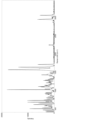
- 1 shows a powder X-ray diffraction pattern of an anhydrous crystal of the compound represented by formula (I), where the horizontal axis represents 2 ⁇ (°) and the vertical axis represents intensity.
- the peak list of the powder X-ray diffraction pattern of Fig. 1 is shown below. In the table, Position indicates 2 ⁇ (°), and Intensity indicates intensity.
- 1 shows the crystal structure (structure in the asymmetric unit) of an anhydrous crystal of the compound represented by formula (I).
- 1 shows the results of differential scanning calorimetry (DSC) of the anhydrous crystals of the compound represented by formula (I).
- the horizontal axis represents temperature (° C.), and the vertical axis represents heat amount (W/g).
- the figure shows the results of simultaneous differential thermal analysis and thermogravimetry (TG/DTA) of the anhydrous crystals of the compound represented by formula (I).
- the vertical axis shows the amount of heat ( ⁇ V) or the weight change (%), and the horizontal axis shows the temperature (°C).
- Cel means degrees Celsius (°C).
- 1 shows the Raman spectrum of anhydrous crystals of the compound of formula (I), where the horizontal axis represents the Raman shift (cm ⁇ 1 ) and the vertical axis represents the peak intensity.
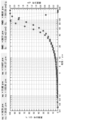
- 1 shows the particle size distribution of the anhydrous crystals of the compound represented by formula (I) before grinding used in Example 2A.
- 2 shows the particle size distribution of the anhydrous crystals of the compound of formula (I) after grinding obtained in Example 2A.
- NMR of the ethyl acetate solvate crystal of the compound represented by formula (I) is shown.
- the horizontal axis represents the chemical shift ( ⁇ ) value, and the vertical axis represents the relative intensity of the proton signal.
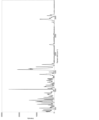
- 1 shows a powder X-ray diffraction pattern of the ethyl acetate solvate crystal of the compound represented by formula (I).
- the horizontal axis represents 2 ⁇ (°), and the vertical axis represents intensity (Count).
- the peak list of the powder X-ray diffraction pattern of Fig. 10 is shown below. In the table, Position indicates 2 ⁇ (°), and Intensity indicates intensity.
- FIG. 1 shows the Raman spectrum of the ethyl acetate solvate crystal of the compound represented by formula (I), where the horizontal axis represents the Raman shift (cm ⁇ 1 ) and the vertical axis represents the peak intensity.
- the figure shows the results of simultaneous differential thermal analysis and thermogravimetry (TG/DTA) of the ethyl acetate solvate crystal of the compound represented by formula (I).
- the vertical axis shows the amount of heat ( ⁇ V) or the weight change (%), and the horizontal axis shows the temperature (°C).
- Cel means degrees Celsius (°C).
- FIG. 2 shows the particle size distribution of the ethyl acetate solvate crystals of the compound represented by formula (I) before grinding used in Example 3E.
- Example 1 shows the particle size distribution of the ethyl acetate solvate crystals of the compound of formula (I) after pulverization obtained in Example 3E.
- the chromatogram of anhydrous crystals of the compound represented by formula (I) (particle size distribution D10: 0.86 ⁇ m, D50: 3.29 ⁇ m, D90: 10.15 ⁇ m) measured by liquid chromatography is shown.
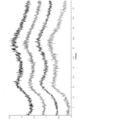
- 1 shows the powder X-ray diffraction pattern of the solid dispersion of Example 4B-1 (a solid dispersion comprising the compound represented by formula (I) and copovidone).
- the horizontal axis represents 2 ⁇ (°), and the vertical axis represents intensity.
- the four patterns, from the top, are those after storage in a closed glass bottle in a 60° C.
- Example 4B-2 shows the powder X-ray diffraction pattern of the solid dispersion of Example 4B-2 (a solid dispersion consisting of the compound represented by formula (I) and hypromellose acetate succinate (grade MF)).
- the horizontal axis represents 2 ⁇ (°), and the vertical axis represents intensity.
- the four patterns, from the top, are those after storage in a closed glass bottle in a 60° C.
- Example 4B-3 shows the powder X-ray diffraction pattern of the solid dispersion of Example 4B-3 (a solid dispersion consisting of the compound represented by formula (I) and povidone).
- the horizontal axis represents 2 ⁇ (°), and the vertical axis represents intensity.
- the four patterns, from the top, are those after storage in a closed glass bottle in a 60° C.
- Example 4B-4 shows the powder X-ray diffraction patterns of the solid dispersion of Example 4B-4 (a solid dispersion consisting of the compound represented by formula (I) and hypromellose acetate succinate (grade LF)).
- the horizontal axis represents 2 ⁇ (°), and the vertical axis represents intensity.
- the four patterns, from the top are those after storage in a closed glass bottle for one week in a 60° C. environment, after storage in a closed glass bottle for one week in a 40° C.
- Example 5C-1 plain tablet
- Example 5D-1 suspension
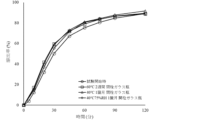
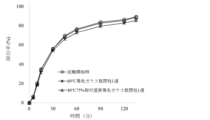
- the horizontal axis represents time (min), and the vertical axis represents dissolution rate (%).
- the dissolution behavior of the tablet of Example 5E-1 at the start of the test, after storage in a 40°C, 75% relative humidity environment in a closed polyethylene bottle for one month, and after storage in a 40°C, 75% relative humidity environment in a closed polyethylene bottle for three months is shown.
- the horizontal axis represents time (minutes), and the vertical axis represents dissolution rate (%).
- the dissolution behavior of the tablet of Example 6B-1 at the start of the test after storage at 60°C in a sealed brown glass bottle for two weeks, after storage at 40°C in a sealed brown glass bottle for one month, and after storage at 40°C in a sealed brown glass bottle at 75% relative humidity for one month is shown.
- the horizontal axis represents time (minutes) and the vertical axis represents dissolution rate (%).
- the dissolution behavior of the tablets of Example 6B-2 at the start of the test, after storage at 60°C in a sealed brown glass bottle for two weeks, after storage at 40°C in a sealed brown glass bottle for one month, and after storage at 40°C in a sealed brown glass bottle at 75% relative humidity for one month is shown.
- the horizontal axis represents time (minutes) and the vertical axis represents the dissolution rate (%).
- the dissolution behavior of the tablet of Example 6C-1 at the start of the test, after storage at 60°C in a sealed brown glass bottle for one week, and after storage at 40°C in a sealed brown glass bottle for one week at 75% relative humidity is shown.
- the horizontal axis represents time (min), and the vertical axis represents dissolution rate (%).
- the dissolution behavior of the tablets of Example 6C-2 at the start of the test, after storage at 60°C in a sealed brown glass bottle for one week, and after storage at 40°C in a sealed brown glass bottle for one week at 75% relative humidity is shown.
- the horizontal axis represents time (min), and the vertical axis represents dissolution rate (%).
- 8 shows the dissolution profile of the solution formulation of Example 8-1.
- the horizontal axis represents time (min), and the vertical axis represents the dissolution rate (%).
- the dissolution profiles of the capsules of Examples 9C-1, 9C-2, 9C-3 and 9C-4 are shown in the figure.
- the horizontal axis represents time (min) and the vertical axis represents dissolution rate (%).
- the figure shows the dissolution profile of the capsules of Examples 10-1 and 10-2.
- the horizontal axis represents time (minutes) and the vertical axis represents the dissolution rate (%).
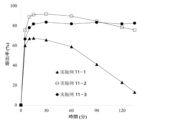
- the dissolution behavior of the solution preparations of Examples 11-1, 11-2 and 11-3 after storage for 3 days in a heated environment at 5° C. is shown.
- the horizontal axis represents time (min) and the vertical axis represents dissolution rate (%).
- Formula (I) The compound represented by formula (I) is compound (I-077) described in WO 2023/195529 and WO 2023/195530, and can be produced by the synthesis method of Examples 5 to 6 in the documents. It is also described in the documents that the compound represented by formula (I) has a coronavirus 3CL protease inhibitory effect and inhibits coronavirus 3CL protease. In this specification, the compound represented by formula (I) may be referred to as compound (I).
- the compounds represented by formula (I) are not limited to any particular isomer, but include all possible isomers (e.g., keto-enol isomers, imine-enamine isomers, diastereoisomers, optical isomers, rotamers, etc.), racemates, or mixtures thereof.
- One or more hydrogen, carbon and/or other atoms of the compound represented by formula (I) may be replaced with isotopes of hydrogen, carbon and/or other atoms, respectively.
- isotopes include hydrogen, carbon, nitrogen, oxygen, phosphorus, sulfur, fluorine, iodine and chlorine, such as 2H , 3H , 11C , 13C , 14C , 15N , 18O , 17O , 31P , 32P , 35S , 18F , 123I and 36Cl .
- the compound represented by formula (I) also includes compounds replaced with such isotopes (e.g., deuterium replacements, etc.). The compound replaced with the isotope is also useful as a pharmaceutical.
- the compound represented by formula (I) includes all radiolabeled compounds replaced with radioisotopes contained in the isotope. Also encompassed in the present invention is a "radiolabeling method" for producing said "radiolabeled substance,” which is useful as a research and/or diagnostic tool in metabolism pharmacokinetic studies, binding assays.
- Radiolabeled compounds of formula (I) can be prepared by methods well known in the art.
- tritium-labeled compounds of formula (I) can be prepared by introducing tritium into a particular compound of formula (I) by catalytic dehalogenation using tritium. This method involves reacting a precursor of a compound of formula (I) that is appropriately halogenated with tritium gas in the presence of a suitable catalyst, such as Pd/C, in the presence or absence of a base.
- a suitable catalyst such as Pd/C
- Other suitable methods for preparing tritium-labeled compounds can be found in "Isotopes in the Physical and Biomedical Sciences, Vol. 1, Labeled Compounds (Part A), Chapter 6 (1987)".
- 14 C-labeled compounds can be prepared by using a raw material having 14 C carbon.
- the compounds of formula (I) used herein may form prodrugs, and the present invention also includes such various prodrugs.
- Prodrugs are derivatives of the compounds of the present invention having a group that can be decomposed chemically or metabolically, and are compounds that become the pharma- ceutically active compounds of the present invention in vivo by solvolysis or under physiological conditions.
- Prodrugs include compounds that are converted to the compounds of formula (I) by enzymatic oxidation, reduction, hydrolysis, etc. under physiological conditions in the living body, and compounds that are converted to the compounds of formula (I) by hydrolysis with gastric acid, etc. Methods for selecting and preparing suitable prodrug derivatives are described, for example, in "Design of Prodrugs, Elsevier, Amsterdam, 1985". Prodrugs may themselves have activity.
- the compound according to the present invention has coronavirus 3 CL protease inhibitory activity and is therefore useful as a therapeutic and/or preventive agent for diseases associated with coronavirus 3 CL protease.
- the term "therapeutic and/or preventive agent” also includes agents for improving symptoms.
- Diseases associated with coronavirus 3 CL protease include viral infections, preferably coronavirus infections.
- Coronavirus infections include infections caused by HCoV-229E, HCoV-NL63, HCoV-OC43, HCoV-HKU1, SARS-CoV, MERS-CoV, and/or SARS-CoV-2.
- infections caused by HCoV-229E, HCoV-OC43, and/or SARS-CoV-2 and more preferably infections caused by SARS-CoV-2.
- a particularly preferred example of the coronavirus infection is the novel coronavirus disease (COVID-19).
- the "compound represented by formula (I)” may form a salt, a cocrystal, or a solvate thereof.
- a compound represented by formula (I), a pharma- ceutically acceptable salt thereof, or a solvate thereof also encompasses such various salts, cocrystals, and solvates thereof.
- salt means that, for example, a “compound represented by formula (I)" and a counter molecule are regularly arranged in the same crystal lattice, and may contain any number of counter molecules. It refers to a compound that is bonded via ionic bonds by proton transfer between the compound and the counter molecule in the crystal lattice.
- cocrystal means that counter molecules (co-former molecules) are regularly arranged within the same crystal lattice, and may contain any number of counter molecules (co-former molecules).
- a cocrystal refers to an intermolecular interaction between a compound and a counter molecule (co-former molecule) that is mediated by a non-covalent and non-ionic chemical interaction such as a hydrogen bond or van der Waals force.
- salts are considered to be a state in which proton transfer occurs between a compound and a counter molecule, but it is also known that in some cases, proton transfer may not be complete. This state is sometimes called a cocrystal because it is not a true salt. It is also known that proton transfer may change continuously depending on the temperature.
- a pharma- ceutically acceptable salt of a compound of formula (I) includes co-crystals and refers to a pharma- ceutically acceptable salt or co-crystal of a compound of formula (I).
- One embodiment of the present specification is a pharma- ceutically acceptable salt or cocrystal of a compound represented by formula (I) with hydrofluoric acid, hydrochloric acid, hydrobromic acid, orthophosphoric acid, hydroiodic acid, nitric acid, phosphoric acid, boric acid, sulfuric acid, methanesulfonic acid, ethanesulfonic acid, p-toluenesulfonic acid, benzenesulfonic acid, trifluoromethylbenzenesulfonic acid, chlorobenzenesulfonic acid, methoxybenzenesulfonic acid, acetic acid, propionic acid, lactic acid, citric acid, fumaric acid, malonic acid, malic acid, succinic acid, salicylic acid, maleic acid, glycerophosphoric acid, tartaric acid, benzoic acid, glutamic acid, aspartic acid, 2-naphthalenesulfonic acid, hexanoic acid
- Salt and co-crystal formation provides a means to modify the physicochemical and resulting biological characteristics of a drug without altering its chemical structure.
- Salt and co-crystal formation can dramatically affect the properties of a drug. Hygroscopicity, stability, solubility and processing properties are also important considerations in selecting an appropriate salt or co-crystal.
- the solubility of a salt or co-crystal can affect its suitability for use as a drug. If the aqueous solubility is low, the dissolution rate upon in vivo administration may be rate-limited by the absorption process, resulting in low bioavailability. Also, low water solubility may make administration by injection difficult, limiting the choice of an appropriate route of administration.
- the "compound represented by formula (I)” can form a solvate with water (i.e., a hydrate) or a solvate with a common organic solvent.
- the "pharmaceutical acceptable salt of the compound represented by formula (I)” can form a solvate with water (i.e., a hydrate) or a solvate with a common organic solvent.
- solvate refers to a compound of formula (I) and any number of solvent molecules arranged in a regular order.
- solvent molecules include ethyl acetate, water, ethanol, acetone, 1,1-diethoxypropane, 1,1-dimethoxymethane, 2,2-dimethoxypropane, isooctane, isopropyl ether, methyl isopropyl ketone, methyl tetrahydrofuran, petroleum ether, trichloroacetic acid, trifluoroacetic acid, acetic acid, anisole, 1-butanol, 2-butanol, n-butyl acetate, t-butyl methyl ether, cumene, dimethyl sulfoxide, diethyl ether, ethyl formate, formic acid, heptane, isobutyl acetate, isopropyl acetate, methyl acetate, 3-methyl-1-but
- ethyl acetate water, ethanol, acetone, 1,1-diethoxypropane, 1,1-dimethoxymethane, 2,2-dimethoxypropane, isooctane, isopropyl ether, methyl isopropyl ketone, methyl tetrahydrofuran, petroleum ether, trichloroacetic acid, and trifluoroacetic acid.
- ethyl acetate most preferred is ethyl acetate.
- the "compound represented by formula (I)" when the "compound represented by formula (I)" is left in the air, it may absorb moisture, and may adhere with adsorbed water or form a hydrate.
- One embodiment of the present specification is an "ethyl acetate solvate of the compound represented by formula (I).” For example, it contains about 1 molar equivalent of ethyl acetate molecules relative to the "compound represented by formula (I).”
- the present invention relates to the solid state (crystalline and amorphous) of the compound represented by formula (I), its pharma- ceutically acceptable salt, or a solvate thereof.
- the solid state may be either a single state or a mixed state.
- the crystal may be either a single-phase crystal or a mixed crystal.
- a pharmacoactive ingredient may have substantially different physical properties depending on its solid state. Such differences in physical properties can have a significant impact on, for example, the bioavailability, purity, manufacturing method, pharmaceutical composition (formulation) containing the pharmacoactive ingredient, or administration method of the pharmacoactive ingredient, so the choice of solid state is extremely important in drug development.
- the present invention provides an ethyl acetate solvate crystal of the compound represented by formula (I), an amorphous compound represented by formula (I), and a solid dispersion of the compound represented by formula (I), which are very useful as compared with other solid states.
- the present invention also provides a preparation containing a solid dispersion of the compound represented by formula (I), a preparation containing an anhydrous crystal of the compound represented by formula (I), and a preparation containing an ethyl acetate solvate crystal of the compound represented by formula (I), which are very useful as compared with other pharmaceutical formulations.
- the solid state and the formulation have at least any of the following characteristics: (1) It has good stability against heat, humidity, solvents, light, etc., and has high storage stability.
- crystal as used herein means a solid in which constituent atoms, ions, molecules, etc. are arranged in a three-dimensional order, and is distinguished from amorphous solids that do not have such an orderly internal structure.
- the term “crystal” as used herein may be a single crystal, a twin crystal, a polycrystal, etc.
- crystals can have “crystal polymorphs” that have the same composition but different arrangements within the crystal, and all of these are referred to as “crystal forms.”
- the "compound represented by formula (I), a pharma- ceutically acceptable salt thereof, or a solvate thereof” includes crystal polymorphs thereof.
- the crystals used herein may be deuterium converted.
- the crystals used herein may be labeled with an isotope (eg, 3 H, 14 C, 35 S, 125 I, etc.).
- the crystal morphology and/or crystallinity can be confirmed by spectroscopic methods such as, for example, X-ray diffraction, Raman spectroscopy, infrared absorption spectroscopy, solid-state NMR, etc.
- the physical properties of the crystals can be confirmed by a number of techniques such as differential scanning calorimetry, moisture adsorption/desorption measurements, dissolution characteristics, etc.
- anhydrous is synonymous with “nosolvate,””nonsolvate,””anhydrate,” and “nonhydrate.”
- the theoretical content of water of crystallization in the anhydrous crystals of the compound represented by formula (I) is 0% by weight. However, in the analysis of the water content and/or the solvent content, the value may be higher than the theoretical content of water of crystallization due to the influence of the water and/or the solvent attached to the crystal surface.
- One embodiment herein is a crystalline anhydrous form of the compound of formula (I) having a melting point of 261.3° C. ⁇ 2° C. as measured by differential scanning calorimetry (DSC).
- One embodiment of the present specification is an anhydrous crystal of the compound represented by formula (I) having a melting point of 265.6° C. ⁇ 2° C. as measured by simultaneous differential thermal analysis-thermogravimetry (TG/DTA).
- One aspect of the present specification is an anhydrous crystal of the compound represented by formula (I) having characteristic peaks in a Raman spectrum at 415.2 cm ⁇ 1 ⁇ 2 cm ⁇ 1 , 502.7 cm ⁇ 1 ⁇ 2 cm ⁇ 1 , 1431.4 cm ⁇ 1 ⁇ 2 cm ⁇ 1 , 1714.8 cm ⁇ 1 ⁇ 2 cm ⁇ 1 and 3065.4 cm ⁇ 1 ⁇ 2 cm ⁇ 1 .
- the D50 of the anhydrous crystals of the compound represented by formula (I) herein is, for example, 0.02 to 200 ⁇ m, preferably 0.1 to 150 ⁇ m, more preferably 0.2 to 100 ⁇ m.
- the D90 of the anhydrous crystals of the compound represented by formula (I) herein is, for example, 0.05 to 300 ⁇ m, preferably 0.5 to 200 ⁇ m, more preferably 1.0 to 150 ⁇ m.
- the D50 of the anhydrous crystals of the compound represented by formula (I) used in the formulation of the present invention is, for example, 0.02 to 20 ⁇ m, preferably 0.1 to 10 ⁇ m, more preferably 0.2 to 8 ⁇ m.
- the D90 of the anhydrous crystals of the compound represented by formula (I) used in the formulation of the present invention is, for example, 0.05 to 40 ⁇ m, preferably 0.2 to 20 ⁇ m, more preferably 0.5 to 16 ⁇ m.
- particles of the anhydrous crystals of the compound represented by formula (I) having a D50 of about 200 to 1500 nm can be used.
- One aspect of the present invention is an ethyl acetate solvate crystal of the compound represented by formula (I).
- the crystal contains about 1 molar equivalent of ethyl acetate molecules relative to the compound represented by formula (I).
- One aspect of the present invention is "an ethyl acetate solvate crystal of the compound represented by formula (I)" which consists of the compound represented by formula (I) and ethyl acetate in a molar ratio of 1: 1.
- the theoretical content of ethyl acetate in the crystal is about 14.4% by weight.
- the ethyl acetate content in the "ethyl acetate solvate crystal of the compound represented by formula (I)" of the present invention is, for example, 4 to 20% by weight, preferably 9 to 18% by weight, and more preferably 12 to 16% by weight.
- a part of the ethyl acetate in the crystal may be released before the measurement, resulting in a low content.
- One aspect of the present invention is an ethyl acetate solvate crystal of the compound represented by formula (I), which shows an endothermic peak at 129.5°C ⁇ 2°C and a weight loss in simultaneous differential thermal and thermogravimetric analysis (TG/DTA).
- One embodiment of the present invention is an ethyl acetate solvate crystal of the compound represented by formula (I), which has characteristic peaks in a Raman spectrum at 421.2 cm ⁇ 1 ⁇ 2 cm ⁇ 1 , 509.7 cm ⁇ 1 ⁇ 2 cm ⁇ 1 , 1585.3 cm ⁇ 1 ⁇ 2 cm ⁇ 1 , 1709.9 cm ⁇ 1 ⁇ 2 cm ⁇ 1 and 3052.9 cm ⁇ 1 ⁇ 2 cm ⁇ 1 .
- the D50 of the ethyl acetate solvate crystals of the compound of formula (I) of the present invention is, for example, 0.1 to 200 ⁇ m, preferably 0.3 to 150 ⁇ m, more preferably 0.5 to 100 ⁇ m.
- the D90 of the ethyl acetate solvate crystals of the compound of formula (I) of the present invention is, for example, 0.2 to 300 ⁇ m, preferably 0.5 to 200 ⁇ m, more preferably 1 to 150 ⁇ m.
- the D50 of the ethyl acetate solvate crystals of the compound of formula (I) used in the formulation of the present invention is, for example, 0.1 to 25 ⁇ m, preferably 0.5 to 10 ⁇ m, more preferably 1 to 8 ⁇ m.
- the D90 of the ethyl acetate solvate crystals of the compound of formula (I) used in the formulation of the present invention is, for example, 0.2 to 40 ⁇ m, preferably 1 to 20 ⁇ m, more preferably 2 to 15 ⁇ m.
- One embodiment of the present invention is an amorphous compound represented by formula (I).
- amorphous is synonymous with “non-crystalline solid,””amorphous,” and “glass,” and refers to a solid state that does not have a regular structure like a crystal. The constituent atoms, ions, molecules, etc. do not have a three-dimensionally ordered repeating period.
- amorphous refers to a substantially amorphous state. For example, it means that 80% or more, preferably 90% or more, more preferably 95% or more, and most preferably 99% or more of the medicament active ingredient (drug) present in the composition is in an amorphous form.
- the crystallinity means, for example, a crystallinity of about 20% or less, preferably a crystallinity of about 10% or less, more preferably a crystallinity of about 5% or less, and most preferably a crystallinity of about 1% or less.
- Amorphous solids do not have an ordered repeating period in their structure, so they do not cause diffraction phenomena, and can be confirmed by powder X-ray diffraction measurement.
- the powder X-ray diffraction pattern of an amorphous solid is a featureless broad XRPD pattern, also called a halo pattern.
- amorphous solids do not show polarized light like crystals, so they can be confirmed by a microscope or a polarized observation mode of a digital microscope. In addition, they can be confirmed by other techniques such as Raman spectroscopy, infrared absorption spectroscopy, solid-state NMR, and differential scanning calorimetry.
- One aspect of the present invention is a solid dispersion of a compound of formula (I).
- One aspect of the present invention is a solid dispersion of a compound represented by formula (I), wherein the compound represented by formula (I) is amorphous.
- One aspect of the present invention is a solid dispersion of the compound of formula (I), which exhibits a halo pattern in powder X-ray diffraction measurement.
- One aspect of the present invention is a solid dispersion comprising a compound of formula (I) and a polymer.
- solid dispersion refers to a matrix in which the medicament active ingredient (drug) and the polymer are mixed, solidified, and the amorphous medicament active ingredient (drug) is stably dispersed in the polymer.
- solid dispersion refers to a matrix in which the medicament active ingredient (drug) and the polymer are dissolved and mixed in a co-solvent, solidified, and the amorphous medicament active ingredient (drug) is stably dispersed in the polymer.
- the manufacturing method thereof includes a spray-drying method (solvent removal method), a heat-melting method, and a mixed grinding method (mechanochemical method).
- “improving solubility” means increasing the solubility of the compound represented by formula (I) in water, a buffer solution, or the like.
- the solubility of a solid dispersion containing a compound represented by formula (I) is specified to be 1.5 times or more, in another embodiment 2 times or more, in yet another embodiment 5 times or more, and in a further embodiment 10 times or more, the solubility of compound (I) itself.
- the solid dispersion is stable means that the compound represented by formula (I), which is in an amorphous state in the solid dispersion, does not crystallize in a time stability test of the solid dispersion.
- the polymer used in the solid dispersion of the present invention may be any polymer that can be used pharmaceutical preparations, and may be a mixture of two or more types.
- examples of the polymer include vinyl-based polymers, cellulose-based polymers, acrylic acid-based polymers, polyether-based polymers, etc.
- Preferred are vinyl-based polymers, cellulose-based polymers, and acrylic acid-based polymers, and more preferably vinyl-based polymers.
- vinyl polymers used in the solid dispersion of the present invention include copovidone (sometimes referred to herein as polyvinylpyrrolidone-vinyl acetate copolymer, PVPVA), polyvinylpyrrolidone (sometimes referred to herein as povidone), polyvinylpolypyrrolidone, polyvinyl alcohol, polyvinyl alcohol-acrylic acid-methyl methacrylate copolymer, polyvinyl alcohol-polyethylene glycol graft copolymer, polyvinyl acetal diethylaminoacetate, a mixture of fumaric acid, stearic acid, polyvinyl acetal diethylaminoacetate, and hydroxypropyl methylcellulose, polyvinyl acetal diethylaminoacetate, etc.
- Preferred are copovidone and polyvinylpyrrolidone, and particularly preferred is copovidone.
- One aspect of the present invention is a solid dispersion containing a compound represented by formula (I) and copovidone.
- cellulose-based polymers used in the solid dispersion of the present invention include hypromellose acetate succinate (sometimes referred to as hydroxypropyl methylcellulose acetate succinate in this specification), hypromellose phthalate, hydroxypropyl cellulose (sometimes referred to as HPC in this specification), low-substituted hydroxypropyl cellulose, hypromellose (sometimes referred to as hydroxypropyl methylcellulose, HPMC in this specification), hydroxyethyl cellulose, hydroxyethyl methylcellulose, hydroxypropyl methylcellulose, phthalate, methylcellulose (sometimes referred to as MC in this specification), methylhydroxyethylcellulose carboxymethylethylcellulose, ethylcellulose, crystalline cellulose, microcrystalline cellulose, crystalline cellulose-carmellose sodium, carmellose, carmellose sodium, carmellose calcium, powdered cellulose, a mixture of fumaric acid, stearic acid, polyvinyl acetal
- Acrylic acid polymers used in the solid dispersion of the present invention include methacrylic acid copolymer L, aminoalkyl methacrylate copolymer E, methacrylic acid copolymer LD, methacrylic acid copolymer S, aminoalkyl methacrylate copolymer RS, ethyl acrylate-methyl methacrylate copolymer, ammonia alkyl methacrylate copolymer, methyl acrylate-methacrylic acid-methyl methacrylate copolymer, 2-methyl-5-vinylpyridine methyl acrylate-methacrylic acid copolymer, etc.
- Methacrylic acid copolymer L is preferred.
- the weight ratio of the "compound represented by formula (I), a pharma- ceutically acceptable salt thereof, or a solvate thereof" to the polymer is, for example, 1:0.1 to 1:50, preferably 1:0.5 to 1:25, more preferably 1:1 to 1:10, and particularly preferably 1:1 to 1:6.
- One embodiment of the present invention is a solid dispersion, wherein the weight ratio of the compound represented by formula (I) and copovidone is 1:3.
- the solid dispersion of the present invention can be produced by a known method.
- the solid dispersion can be produced by dissolving and/or suspending the "compound represented by formula (I), a pharma- ceutically acceptable salt thereof, or a solvate thereof" and a polymer in a pharma- ceutically acceptable solvent, and then distilling off the solvent.
- the solvent is not particularly limited as long as it is a solvent that can maintain the compound represented by formula (I) in an amorphous state in the presence of a polymer.
- it may be a Class 3 solvent (a solvent that is considered to have low toxicity and low risk to human health) in ICH-Q3C (Guideline on Residual Solvents in Pharmaceuticals).
- the amount of the solvent is not particularly limited as long as it is an amount necessary for the compound represented by formula (I) to be in an amorphous state, and is, for example, 1 to 100 times (w/w), preferably 5 to 20 times (w/w), the weight of the "compound represented by formula (I), a pharma- ceutically acceptable salt thereof, or a solvate thereof" and the polymer.
- the method for distilling off the solvent is not particularly limited as long as it is a method for distilling off the solvent, and examples thereof include spray drying, reduced pressure drying, and forced air drying.
- the D50 of the solid dispersion of the compound represented by formula (I) of the present invention is, for example, 0.1 to 500 ⁇ m, preferably 0.5 to 200 ⁇ m, more preferably 1 to 100 ⁇ m.
- the powder X-ray diffraction pattern of the "solid dispersion of the compound represented by formula (I)" of the present invention exhibits a halo pattern.
- the present invention relates to a preparation containing, as an active ingredient, "a compound represented by formula (I), a pharma- ceutically acceptable salt thereof, or a solvate thereof.”
- the pharmaceutical composition of the present invention may contain 1 to 100 mg, preferably 5 to 50 mg, and particularly preferably 20 to 40 mg, of the compound represented by formula (I).
- the preparation is, for example, an oral preparation or a parenteral preparation, preferably an oral preparation, more preferably a solid preparation for oral administration, particularly preferably a tablet, granule, powder or capsule.
- Oral preparations include solid preparations for internal use (e.g., tablets, powders, granules, capsules, pills, films, etc.), liquid preparations for internal use (e.g., suspensions, emulsions, elixirs, syrups, lemonades, spirits, aromatic preparations, extracts, decoctions, tinctures, etc.).
- Tablets may be sugar-coated tablets, film-coated tablets, enteric-coated tablets, sustained-release tablets, troches, sublingual tablets, buccal tablets, chewable tablets, or orally disintegrating tablets, powders and granules may be dry syrups, and capsules may be soft capsules, microcapsules, or sustained-release capsules.
- Parenteral preparations include injections, drops, and topical preparations (e.g., eye drops, nasal drops, ear drops, aerosols, inhalants, lotions, injections, liniments, mouthwashes, enemas, ointments, plasters, jellies, creams, patches, poultices, powders for topical use, suppositories, etc.).
- Injections may be emulsions such as O/W, W/O, O/W/O, and W/O/W types.
- One aspect of the present invention is a preparation containing a compound represented by formula (I), a pharma- ceutically acceptable salt thereof, or a solvate thereof as an active ingredient.
- the "preparation containing the compound represented by formula (I), its pharma- ceutically acceptable salt, or a solvate thereof as an active ingredient" of the present invention can be produced by a known method.
- the preparation may contain pharma- ceutically acceptable additives, such as disintegrants, excipients, lubricants, binders, coating agents, etc.
- One aspect of the present invention is a preparation containing, as an active ingredient, a solid dispersion of a compound represented by formula (I).
- One aspect of the present invention is a preparation containing, as active ingredients, a solid dispersion containing a compound represented by formula (I) and copovidone.
- One embodiment of the present invention is a preparation containing an anhydrous crystal of the compound represented by formula (I) as an active ingredient.
- One embodiment of the present invention is a preparation containing an ethyl acetate solvate crystal of the compound represented by formula (I) as an active ingredient.
- Preferred forms of the preparation include solid preparations, and particularly preferred are granules, powders, capsules, or tablets.
- the manufacturing method of "granules containing a compound represented by formula (I), a pharma- ceutically acceptable salt thereof, or a solvate thereof as an active ingredient” is not particularly limited, but specifically, it is a method of mixing "a compound represented by formula (I), a pharma- ceutically acceptable salt thereof, or a solvate thereof” with additives such as a disintegrant and excipient to produce a mixed powder, and then granulating the mixed powder.
- it is a wet granulation method in which water or water or a solvent containing a binder is added to granulate, or a dry granulation method or melt granulation method in which compression molding is performed without using water.
- a V-type mixer or container blender can be used as a machine for mixing a medicament active ingredient (drug) and additives.
- a wet extrusion granulator, a fluidized bed granulator, an agitation granulator, a dry crushing granulator, or a melt extrusion granulator can be used as a machine for granulation.
- tablettes containing the compound represented by formula (I), its pharma- ceutically acceptable salt, or a solvate thereof as an active ingredient are manufactured by the above method, and then excipients, disintegrants, lubricants, etc. are mixed with the granules, and the mixed granules are tableted with a tablet press, or a medicament active ingredient (drug), excipients, disintegrants, lubricants, etc. are mixed, and the mixture is tableted with a tablet press.
- a V-type mixer or container blender can be used as a machine for mixing the active ingredient and additives.
- a single shot tablet press, a rotary tablet press, etc. can be used as a tablet press.
- the disintegrants include croscarmellose sodium, carmellose, carmellose calcium, carmellose sodium, hydroxypropyl cellulose, low-substituted hydroxypropyl cellulose, crystalline cellulose, powdered cellulose, partially pregelatinized starch, potato starch, corn starch, hydroxypropyl starch, sodium carboxymethyl starch, low-substituted sodium carboxymethyl starch, sodium starch glycolate, pregelatinized starch, starch, polyvinyl alcohol, crospovidone, etc.
- Preferred are croscarmellose sodium, low-substituted hydroxypropyl cellulose, sodium starch glycolate, and crospovidone, and particularly preferred are croscarmellose sodium and crospovidone.
- One embodiment of the present invention is a solid formulation comprising a solid dispersion of a compound of formula (I) and croscarmellose sodium.
- One embodiment of the present invention is a solid formulation containing a solid dispersion comprising a compound of formula (I) and copovidone, and croscarmellose sodium.
- One embodiment of the present invention is a solid formulation containing anhydrous crystalline compound of formula (I) and crospovidone.
- Preferred forms of the solid preparation include granules, powders, capsules and tablets, with tablets being particularly preferred.
- the excipients in question include crystalline cellulose, silicic acid-treated crystalline cellulose, lactose, anhydrous lactose, sucrose, glucose, fructose, sucrose, mannitol, sorbitol, erythritol, xylitol, powdered maltose syrup, maltitol, starch, potato starch, corn starch (sometimes referred to as corn starch in this specification), rice starch, partially pregelatinized starch, pregelatinized starch, porous starch, sodium carboxystarch, hydroxypropyl starch, low-substituted sodium carboxymethyl starch, powdered cellulose, carmellose sodium, carmellose, carmellose calcium, carboxymethylethyl cellulose, low-substituted hi
- the calcium phosphate include hydroxypropyl cellulose, silicate derivatives, phosphates, carbonates, sulfates, magnesium oxide, titanium oxide, calcium lactate, synthetic hydrotalcite
- One embodiment of the present invention is a solid formulation comprising a solid dispersion of a compound represented by formula (I), croscarmellose sodium, microcrystalline cellulose and mannitol.
- One embodiment of the present invention is a solid formulation comprising a solid dispersion comprising a compound represented by formula (I) and copovidone, croscarmellose sodium, microcrystalline cellulose and mannitol.
- One embodiment of the present invention is a solid formulation comprising anhydrous crystals of the compound of formula (I), crospovidone and microcrystalline cellulose.
- Preferred forms of the solid preparation include granules, powders, capsules and tablets, with tablets being particularly preferred.
- the lubricants include sodium stearyl fumarate, light anhydrous silicic acid, magnesium stearate, calcium stearate, stearic acid, stearyl alcohol, polyoxyl 40 stearate, talc, hydrated silicon dioxide, magnesium carbonate, precipitated calcium carbonate, dried aluminum hydroxide gel, magnesium aluminometasilicate, magnesium silicate, synthetic aluminum silicate, magnesium oxide, magnesium sulfate, cacao butter, carnauba wax, glycerin fatty acid ester, hardened oil, white beeswax, soybean hardened oil, beeswax, cetanol, sodium laurate, sucrose fatty acid ester, polyethylene glycol (sometimes referred to as macrogol in this specification), etc.
- Sodium stearyl fumarate, light anhydrous silicic acid, magnesium stearate, calcium stearate are preferred, and sodium stearyl fumarate and/or light anhydrous silicic acid are particularly preferred.
- One embodiment of the present invention is a solid formulation comprising a solid dispersion of a compound represented by formula (I), croscarmellose sodium, microcrystalline cellulose, mannitol, sodium stearyl fumarate and light anhydrous silicic acid.
- One embodiment of the present invention is a solid formulation comprising a solid dispersion containing a compound represented by formula (I) and copovidone, croscarmellose sodium, microcrystalline cellulose, mannitol, as well as sodium stearyl fumarate and light anhydrous silicic acid.
- One embodiment of the present invention is a solid formulation comprising anhydrous crystals of the compound of formula (I), crospovidone, microcrystalline cellulose and sodium stearyl fumarate.
- Preferred forms of the solid preparation include granules, powders, capsules and tablets, with tablets being particularly preferred.
- the "preparation comprising the compound represented by formula (I), a pharma- ceutically acceptable salt thereof, or a solvate thereof as an active ingredient” of the present invention may contain a photostabilizing substance.
- One aspect of the present invention is a "formulation containing a compound represented by formula (I), a pharma- ceutically acceptable salt thereof, or a solvate thereof, and a photostabilizer.”
- the photostabilizing substance of the formulation of the present invention may be incorporated into the formulation or may coat the surface of the formulation.
- the formulation contains the photostabilizing substance in a coating layer that coats the surface of the formulation.
- the preparation of the present invention may have a coating layer, and the coating layer may contain a light stabilizing substance and a polymer. After producing granules or tablets, the preparation of the present invention may be coated with a coating layer.
- the preparation of the present invention may be a coated tablet or a coated granule.
- a fluidized bed granulation coating machine When forming a coating layer on granules, a fluidized bed granulation coating machine, a fluidized bed rolling coating machine, etc. can be used.
- a pan coating machine, an aeration type coating machine, etc. can be used. In the coating machine, while the granules or tablets are fluidized, the coating liquid is sprayed onto the granules or tablets, and dried to form a coating layer.
- One aspect of the present invention is "a solid preparation having a coating layer and containing as an active ingredient a compound represented by formula (I), a pharma- ceutically acceptable salt thereof, or a solvate thereof".
- One aspect of the present invention is "a solid preparation having a coating layer containing a photostabilizing substance and a polymer and containing as an active ingredient a compound represented by formula (I), a pharma- ceutically acceptable salt thereof, or a solvate thereof”.
- a solid dispersion of the compound represented by formula (I), an anhydrous crystal of the compound represented by formula (I), or an ethyl acetate solvate crystal of the compound represented by formula (I) can be used.
- Preferred forms of the solid preparation include granules, powders, capsules, and tablets, and particularly preferred are tablets and capsules.
- the light stabilizing substance may be a light-shielding substance that has a light-shielding effect, or a light-absorbing substance that has a light-absorbing effect.
- Examples include Food Red No. 2, Food Red No. 3, Food Red No. 102, Food Red No. 104, Food Red No. 105, Food Red No. 106, Food Yellow No. 4, Food Yellow No. 5, Food Green No. 3, Food Blue No. 1, Food Blue No. 2, Food Red No. 3 Aluminum Lake, Food Yellow No. 4 Aluminum Lake, Food Yellow No. 5 Aluminum Lake, Food Blue No. 1 Aluminum Lake, Food Blue No.
- the light stabilizing substance is iron sesquioxide, yellow iron sesquioxide, and/or talc.
- the polymers in the coating layer include hypromellose, hydroxypropyl cellulose, carboxymethylethyl cellulose, hypromellose phthalate, hydroxypropyl methylcellulose acetate succinate, ethyl cellulose, polyvinyl alcohol, etc.
- Hypromellose is preferred.
- One aspect of the present invention is "a solid preparation comprising, as an active ingredient, a solid dispersion of the compound represented by formula (I) having a coating layer containing ferric oxide, yellow ferric oxide, and/or talc.”
- a solid preparation comprising, as an active ingredient, a solid dispersion of the compound represented by formula (I) having a coating layer containing ferric oxide, yellow ferric oxide, talc, and hypromellose.”
- One aspect of the present invention is “a solid preparation comprising, as an active ingredient, an anhydrous crystal of the compound represented by formula (I), which has a coating layer containing ferric oxide, yellow ferric oxide, and/or talc.”
- a solid preparation comprising, as an active ingredient, an anhydrous crystal of the compound represented by formula (I), which has a coating layer containing ferric oxide, yellow ferric oxide, talc, and hypromellose.”
- Preferred forms of the solid preparation include granules, powders, capsules
- the amount of the coating layer in the solid preparation of the present invention is not particularly limited, but is 0.1 to 20% by weight, preferably 0.5 to 10% by weight, and more preferably 1 to 8% by weight, based on the total amount of the preparation. When two or more types of coating layers are used, the total amount of the coating layers may be within the above content range.
- the solid preparation of the present invention may contain a plasticizer together with the light stabilizer and polymer, and plasticizers listed in the Japanese Pharmacopoeia, Japanese Pharmacopoeia Non-Drug Standards, Pharmaceutical Additives Standards, Food Additives Official Specification, etc. can be used.
- plasticizers include citric acid esters, glycerin fatty acid esters, surfactants, monostearin, diethyl phthalate, dibutyl phthalate, diethyl sebacate, dibutyl sebacate, etc.
- One embodiment of the present invention is a solid formulation comprising a crystal of an ethyl acetate solvate of the compound of formula (I), croscarmellose sodium, mannitol, crystalline cellulose and sodium stearyl fumarate.
- Preferred forms of the solid preparation include granules, powders, capsules and tablets, and capsules are particularly preferred.
- X-Ray Powder Diffraction X-ray powder diffraction
- XRPD X-ray powder diffraction
- XRPD is one of the most sensitive analytical techniques for measuring the crystalline morphology and crystallinity of solids.
- X-rays When X-rays are irradiated onto a crystal, they reflect off the crystal lattice planes and interfere with each other, resulting in orderly diffraction lines corresponding to the periodicity of the structure.
- amorphous solids usually do not have an orderly repeating period in their structure, so they do not exhibit diffraction phenomena and show featureless broad XRPD patterns (also called halo patterns).
- a characteristic diffraction peak is a peak selected from the observed diffraction pattern.
- the characteristic diffraction peak is selected from about 10, more preferably from about 5, peaks in the diffraction pattern.
- a peak that is confirmed in the crystal and not confirmed in other crystals is a preferred characteristic peak for identifying the crystal, rather than the peak intensity. If the characteristic peak is one or two peaks, the crystal can be characterized. When the measured patterns are compared and the characteristic peaks match, it can be said that the powder X-ray diffraction patterns are substantially the same.
- the diffraction angle (2 ⁇ ) in powder X-ray diffraction can have an error within the range of ⁇ 0.2°, so the value of the diffraction angle in powder X-ray diffraction should be understood to include values within the range of about ⁇ 0.2°. Therefore, the present invention includes not only crystals in which the diffraction angles of the peaks in powder X-ray diffraction are perfectly consistent, but also crystals in which the diffraction angles of the peaks match with an error of about ⁇ 0.2°.
- powder X-ray diffraction measurement can be performed under a specific temperature and/or relative humidity.
- a specific temperature and/or relative humidity For example, when an anhydrous crystal changes to a hydrate crystal due to moisture absorption, when a hydrate crystal changes to an anhydrous crystal due to dehydration, when a solvate crystal undergoes crystal transition to an anhydrous crystal due to solvent desorption, when an anhydrous crystal and a hydrate crystal change reversibly due to moisture absorption and dehydration, etc., it is suitable to perform measurements at a specific temperature and/or relative humidity, or to perform measurements in which the temperature and/or relative humidity are continuously changed. In such cases, it is possible to estimate the relative humidity at which the change occurs and the amount of water of crystallization and/or the solvent for crystallization.
- the crystalline form of the compound represented by formula (I) can be identified by the powder X-ray diffraction pattern and the diffraction angle (2 ⁇ ) of the characteristic peak.
- the crystalline form of the compound represented by formula (I) e.g., the anhydride of the compound represented by formula (I) and the ethyl acetate solvate crystal of the compound represented by formula (I)
- X-ray powder diffraction-differential scanning calorimetry X-ray powder diffraction-differential scanning calorimetry
- Simultaneous measurement of powder X-ray diffraction and differential scanning calorimetry XRD-DSC measurement allows simultaneous observation of changes in crystal form (crystal structure) and changes in heat quantity with respect to temperature and/or relative humidity.
- crystal form crystal structure
- changes in crystal form such as when an anhydrous crystals undergo crystal transition to a hydrate crystal due to moisture absorption, when a hydrate crystal undergoes crystal transition to an anhydrous crystal due to dehydration, when a solvate crystal undergoes crystal transition to an anhydrous crystal due to solvent desorption, and when an anhydrous crystals and a hydrate crystal undergo reversible crystal transition due to moisture absorption and dehydration.
- Single crystal structure analysis is one of the methods for identifying the crystal form, and can obtain crystallographic parameters, atomic coordinates (values indicating the spatial relationship of each atom), and a three-dimensional structure model.
- Single crystal structure analysis see "X-Ray Structure Analysis Handbook" by Toshio Sakurai, published by Shokabo Publishing (1983), and “X-Ray Structure Determination: A Practical Guide” by Stout & Jensen, Macmillan Co., New York (1968), etc.
- Single crystal structure analysis is useful in identifying the structures of optical isomers, tautomers, geometric isomers, salts, co-crystals, and solvates (hydrates).
- Raman spectra show the vibrational characteristics of a molecule or complex system. It originates from inelastic collisions between molecules and photons, which are light particles that comprise a beam of light. Collisions between molecules and photons result in an exchange of energy, which changes the energy and thus the wavelength of the photon. That is, Raman spectra are spectral lines with extremely narrow wavelengths that are emitted when photons are incident on a molecule of interest, so a laser or similar light source is used. The wavelength of each Raman line is represented by a wavenumber shift from the incident light, which is the difference between the Raman line and the reciprocal of the wavelength of the incident light.
- Raman spectra measure the vibrational state of a molecule, which is determined by its molecular structure.
- the wavelength shift amount (cm -1 ) in a Raman spectrum can have an error within the range of ⁇ 2 cm -1 , so the value of the Raman spectrum peak should be understood to include a numerical value within the range of about ⁇ 2 cm -1 . Therefore, not only crystals whose Raman spectrum peaks perfectly match, but also crystals whose Raman spectrum peaks match with an error of about ⁇ 2 cm -1 are included in the present invention.
- Infrared absorption spectroscopy is a method for measuring the degree of absorption of infrared light when it passes through a sample for each wave number. Infrared absorption spectra are usually shown as graphs with wave numbers on the horizontal axis and transmittance or absorbance on the vertical axis. The wave numbers and transmittance (or absorbance) of the absorption peaks can be read on the graph, or values calculated by a data processing device can be used. The infrared absorption spectrum is determined by the chemical structure of the substance. Therefore, the substance can be confirmed or quantified by measuring the absorption at various wave numbers.
- the absorption peaks corresponding to the characteristic functional groups are selected from about 20 absorption peaks, more preferably about 10 absorption peaks, and most preferably about 5 absorption peaks.
- the absorption spectrum of a sample is measured in the wavenumber range of 4000 cm -1 to 400 cm -1 .
- the absorption spectrum is measured under the same operating conditions as those used to check the resolution, wavenumber scale and wavenumber accuracy of the instrument.
- the absorption band (cm -1 ) in infrared absorption spectroscopy may have an error within the range of ⁇ 2 cm -1 , so the above absorption peak value should be understood to include a numerical value within the range of about ⁇ 2 cm -1 . Therefore, not only crystals whose absorption band peaks in infrared absorption spectroscopy are completely the same, but also crystals whose absorption band peaks are the same within an error of about ⁇ 2 cm -1 are included in the present invention.
- Infrared absorption spectrum measurement methods include the potassium bromide tablet method, solution method, paste method, liquid film method, thin film method, gas sample measurement method, ATR method, and diffuse reflection method.
- the ATR method (Attenuated total reflection) is called the total reflection measurement method and is one of the reflection methods.
- a sample is attached to the surface of a prism made of a material with a high refractive index such as KRS-5, light is incident on the prism at an angle equal to or greater than the critical angle, and the light totally reflected at the boundary between the prism and the sample is measured to obtain an absorption spectrum.
- the refractive index of the prism is greater than that of the sample, so the material of the prism must be changed depending on the sample.
- Another condition is that the prism and the sample must be in close contact with each other. Therefore, it is suitable for measuring liquids, powders, plastics, soft rubber, etc., and has the advantage that the sample can be measured without chemically or physically treating it.
- the diffuse reflectance method is a method for measuring powder samples without creating potassium bromide tablets, and instead measures the powder as is.
- Solid 13C -NMR (nuclear magnetic resonance)
- the number of spectra corresponds to the number of carbon atoms of the target compound
- the chemical shift range is wider than that of 1H -NMR
- the signal is different from that of solid-state 1H -NMR.
- the margin of error in solid-state 13C NMR spectra is approximately ⁇ 0.5 ppm.
- DSC Differential Scanning Calorimetry
- DSC Differential scanning calorimetry
- onset temperature extractated melting point onset temperature
- maximum value of the endothermic peak curve accompanying melting and enthalpy. It is known that for DSC, the observed temperature may depend on the rate of temperature change as well as the sample preparation technique and the specific instrument used.
- the "melting point” in DSC refers to the onset temperature (extrapolated melting point onset temperature) that is not easily affected by the sample preparation technique.
- the error range in the onset temperature (extrapolated melting point onset temperature) obtained from a differential scanning calorimetry curve is approximately ⁇ 2°C. In identifying the identity of a crystal, not only the melting point but also the overall pattern is important, and may vary somewhat depending on the measurement conditions and the measurement instrument.
- thermogravimetry/differential thermal analysis is one of the main methods of thermal analysis, and is a method for measuring the weight and thermal properties of a substance as an aggregate of atoms and molecules.
- TG/DTA is a method for measuring the change in weight and heat quantity of a pharmaceutical active ingredient with respect to temperature or time. By plotting the obtained data against temperature or time, TG (thermogravimetry) and DTA (differential thermal analysis) can be performed.
- the "melting point" in TG/DTA refers to the temperature at which the sample melts. This refers to the onset temperature (extrapolated melting point onset temperature) that is not easily affected by the preparation technique. In determining the identity of a crystal, not only the melting point but also the overall pattern is important, and the measurement conditions and measurement equipment can affect the onset temperature. There may be some variation.
- the moisture sorption/desorption isotherm (DVS) is a method for measuring the moisture sorption and desorption behavior of a solid by measuring the weight change under various relative humidity conditions.
- the basic measurement method is to use the dry weight at 0% RH (relative humidity 0%) as the standard, and then increase the relative humidity by 5% or 10% at each step. After the weight stabilizes at each relative humidity, The amount of adsorbed water can be calculated from the weight increase. Similarly, the amount of desorbed water can be measured by lowering the relative humidity from 100% RH or 95% RH in increments of 5% or 10%. It is.
- DSC Differential scanning calorimetry
- TG/DTA simultaneous differential thermal-thermogravimetry
- DFS moisture adsorption/desorption isotherm
- Karl Fischer moisture meter and gas chromatography are analytical methods that detect water and/or solvent (residual solvent) adhering to the "surface" of a crystal.
- the amount of water and/or solvent may be higher than the theoretical content of water of crystallization in a hydrate crystal and/or the theoretical content of solvent of crystallization in a solvate crystal.
- powder X-ray diffraction and single crystal structure analysis are measurement methods for analyzing the "internal structure" of a crystal, and show characteristic peaks at the same position regardless of the presence or absence of adhering water and/or solvent (residual solvent) on the "surface" of the crystal.
- the same is true for Raman spectroscopy and infrared absorption spectroscopy (IR method). Therefore, in powder X-ray diffraction, single crystal structure analysis, Raman spectroscopy, and infrared absorption spectroscopy (IR method), even if the amount of water and/or solvent is higher than the theoretical content in the crystal, it can be interpreted as being substantially the same crystal as long as it has the characteristic peaks described in the specification.
- D10, D50, D90 refer to particle sizes at points where a cumulative curve is 10%, 50%, and 90% when the total volume of a powder aggregate is taken as 100%, and can be measured by a dry method or a wet method.
- the "compound represented by formula (I)” is compound (I-077) described in WO 2023/195529 and WO 2023/195530, and can be produced by the synthesis methods of Examples 5 to 6 described in the literature. In addition, it can be synthesized with reference to methods known in the art. Extraction, purification, etc. may be performed in the same manner as in ordinary organic chemistry experiments.
- Step 2 Synthesis of Compound 4 Acetic acid (40 mL) and concentrated hydrochloric acid (41 mL) were added to compound 3 (14.8 g, 48.8 mmol), and the mixture was stirred at 110° C. for 5 hours. The reaction solution was cooled to room temperature, and then water (80 ml) was added. The precipitate was collected by filtration and washed with water. The mixture was air-dried to obtain compound 4 (11.6 g, 42.2 mmol).
- Step 4 Synthesis of Compound 6 2-Bromoacetonitrile (269 ⁇ L, 4.04 mmol) was added to a solution of compound 5 (520 mg, 1.345 mmol), N,N-diisopropylethylamine (0.705 mL, 4.04 mmol), and DMF (5.2 mL), and the mixture was stirred at room temperature overnight. 2 mol/L hydrochloric acid (2 mL) was added to the reaction solution under ice cooling, and the mixture was extracted with ethyl acetate. The organic layer was washed with water, dried over sodium sulfate, and filtered.
- Step 5 Synthesis of Compound (I)
- Compound 6 (25.0 mg, 0.059 mmol), 6,6-difluoro-2-azaspiro[3.3]heptane trifluoroacetate (17.4 mg, 0.070 mmol), N,N-diisopropylethylamine (20.5 ⁇ L, 0.117 mmol), and DMF (0.5 mL) were mixed, and the solution was stirred at 60° C. for 2 hours. Water (2 mL) was added to the reaction solution, and the mixture was extracted with ethyl acetate. The organic layer was washed with water, dried over sodium sulfate, and filtered.
- Example 1A Biological testing of compound (I)
- the compound represented by formula (I) according to the present invention may be any compound as long as it has an inhibitory effect on coronavirus 3 CL protease and inhibits coronavirus 3 CL protease.
- IC50 is preferably 50 ⁇ M or less, more preferably 1 ⁇ M or less, and even more preferably 100 nM or less.
- EC50 is preferably 10 ⁇ M or less, more preferably 1 ⁇ M or less, and even more preferably 100 nM or less.
- the biological test results of the compound represented by formula (I) are described as compound (I-077) in WO 2023/195529 and WO 2023/195530.
- Test Example 1 Cytopathic effect (CPE) suppression test using human TMPRSS2 and ACE2-expressing HEK293T cells (HEK293T/ACE2-TMPRSS2 cells) ⁇ Procedure> -Dilution and dispensing of test sample Test samples are preliminarily diluted with DMSO to an appropriate concentration, and a 2- to 5-fold serial dilution series is prepared, and then dispensed into a 384-well plate.
- CPE Cytopathic effect
- Dilution and dispensing of cells and SARS-CoV-2 HEK293T/ACE2-TMPRSS2 cells (GCP-SL222, 5 x 10³ cells/well) and SARS-CoV-2 ( 200-600TCID50 /well) were mixed in culture medium (MEM, 2% FBS, penicillin-streptomycin), dispensed into wells containing the test samples, and then cultured in a CO2 incubator for 3 days.
- Dispensing of CellTiter-Glo (registered trademark) 2.0 and measurement of luminescence signal After returning the plate cultured for 3 days to room temperature, dispense CellTiter-Glo (registered trademark) 2.0 into each well and mix using a plate mixer.
- Test Example 2 Inhibitory activity test against SARS-CoV-2 3CL protease ⁇ Materials> Commercially available recombinant SARS-CoV-2 3CL Protease Commercially available substrate peptide Dabcyl-Lys-Thr-Ser-Ala-Val-Leu-Gln-Ser-Gly-Phe-Arg-Lys-Met-Glu(Edans)-NH 2 (SEQ ID NO: 1) Internal Standard Peptide Dabcyl-Lys-Thr-Ser-Ala-Val-Leu( 13 C 6 , 15 N)-Gln (SEQ ID NO: 2) Dabcyl-Lys-Thr-Ser-Ala-Val-Leu( 13 C 6 , 15 N)-Gln can be synthesized with reference to the literature (Atherton, E.; Sheppard, R.
- Test samples are preliminarily diluted with DMSO to an appropriate concentration, and a 2- to 5-fold serial dilution series is prepared, and then dispensed into a 384-well plate.
- Addition of enzyme and substrate, enzyme reaction Add 8 ⁇ M substrate and 6 nM or 0.6 nM enzyme solution to the prepared compound plate and incubate at room temperature for 3 to 5 hours. After that, add reaction stop solution (0.067 ⁇ M Internal Standard, 0.1% formic acid, 10 or 25% acetonitrile) to stop the enzyme reaction.
- the plate on which the reaction was completed is measured using a RapidFire System 360 and a mass spectrometer (Agilent, 6550 iFunnel Q-TOF), or a Rapid Fire System 365 and a mass spectrometer (Agilent, 6495C Triple Quadrupole).
- Solution A (75% isopropanol, 15% acetonitrile, 5 mM ammonium formate) and solution B (0.01% trifluoroacetic acid, 0.09% formic acid) are used as the mobile phase during measurement.
- the reaction products detected by the mass spectrometer are calculated using a RapidFire Integrator or a program capable of equivalent analysis to obtain the product area value.
- the internal standard detected at the same time is also calculated to obtain the internal standard area value.
- ⁇ Calculation of each measurement item value> Calculate the area value obtained in the previous step using the following formula to calculate the P/IS.
- P/IS Product area value/Internal Standard area value ⁇ 50%
- IC 50 SARS-CoV-2 3CL protease inhibitory concentration
- Test Example 3 X-ray powder diffraction experiment (XRPD) According to the powder X-ray diffraction measurement method described in the general test method of the Japanese Pharmacopoeia, the solid state (crystalline and amorphous) and solid dispersion obtained in each example were subjected to powder X-ray diffraction measurement. The measurement conditions are shown below.
- Test Example 4 Measurement of powder X-ray diffraction pattern under temperature and/or relative humidity control Using an attachment attached to the X-ray diffractometer, the temperature and relative humidity of the measurement sample are controlled, and powder X-ray diffraction measurement is performed according to the powder X-ray diffraction measurement method described in the general test method of the Japanese Pharmacopoeia. The measurement conditions are shown below.
- Test Example 5 Measurement and analysis method for single crystal structure analysis The crystals obtained in each Example were subjected to single crystal structure analysis. The measurement conditions and analysis method are shown below.
- Data Processing Software: CrysAlisPro 1.171.39.46e (Rigaku Oxford Diffraction, 2018) The data were Lorentzian, polarization and absorption corrected.
- Test Example 6 Measurement of Raman spectrum The measurement conditions for measuring the Raman spectrum of the crystals obtained in each Example and performing baseline correction are shown below. Measurement condition 1 Measurement method: Microscopic laser Raman spectroscopy Laser wavelength: 671 nm Accumulation count: 1 Exposure time: 1 second
- Test Example 7 Differential Scanning Calorimetry (DSC) The crystals obtained in each example were subjected to DSC measurement. The sample was weighed in an aluminum pan, simply sealed, and measured. The measurement conditions are shown below. Note that the measurement by differential scanning calorimetry (DSC) may have an error within the range of ⁇ 2°C.
- Test Example 8 Differential thermal and thermogravimetry simultaneous measurement (TG/DTA) The solid state (crystalline and amorphous) and solid dispersion obtained in each Example were subjected to simultaneous differential thermal analysis and thermogravimetry (TG/DTA). The samples obtained in each Example were weighed, placed in an aluminum pan, and measured in an open system. The measurement conditions were as follows. Equipment: Hitachi High-Technologies TG/DTA STA7200RV Measurement temperature range: Room temperature - 350°C Heating rate: 10° C./min
- Test Example 9 Moisture adsorption/desorption isotherm measurement (DVS) The moisture adsorption/desorption isotherm (DVS) of the crystals obtained in each Example was carried out. The crystals obtained in each Example were weighed in an aluminum pan and left to stand at 25°C and 0% relative humidity. After the compound was sufficiently dried and the weight was stabilized, the measurement was started, and the weight was recorded when the relative humidity changed by 5% from 0% to 95%. Next, the weight was recorded when the relative humidity changed by 5% from 95% to 0%. Apparatus: DVS Adventure manufactured by Surface Measurement Systems
- Test Example 10 Particle size distribution/dry method The particle size distribution of the crystals and solid dispersions obtained in each Example was measured. The particle size distribution was measured by a dry method using a laser diffraction particle size distribution measuring device.
- Test Example 11 Particle size distribution/wet method The particle size distribution of the crystals obtained in each Example was measured. The particle size distribution was measured by a wet method using a laser diffraction/scattering type particle size distribution measuring device Microtrac MT3200II type (manufactured by MicrotracBEL). Measurement range: 0.243 to 1408 ⁇ m Solvent: Water Refractive Index: 1.333 Measurement time: 30 seconds Particle shape: non-spherical particles Transmittance: Transmitted particle refractive index: 1.81
- Example 1B Solid-state analysis of compound (I)
- the compound (I) produced by the synthesis method of Example 1 above was subjected to powder X-ray diffraction experiments and simultaneous differential thermal analysis/thermogravimetry (TG/DTA), and was confirmed to be an anhydrous crystal of the compound represented by formula (I).
- Example 2 Analysis of anhydrous crystals of the compound represented by formula (I)
- the anhydrous crystals of the compound represented by formula (I) were pulverized and subjected to powder X-ray diffraction experiments, single crystal structure analysis, differential scanning calorimetry (DSC), simultaneous differential thermal-thermogravimetry (TG/DTA), moisture adsorption/desorption isotherm measurement (DVS), Raman spectroscopy, and particle size distribution measurement.
- Example 2A Grinding of anhydrous crystals of the compound of formula (I)
- the anhydrous crystals of the compound represented by formula (I) were sieved through a 1000 ⁇ M mesh and then pulverized under the following conditions.
- Example 2B Powder X-ray diffraction experiment of anhydrous crystals of the compound represented by formula (I)
- the anhydrous crystals of the compound of formula (I) after pulverization were subjected to a powder X-ray diffraction experiment under the measurement condition 1 described in Test Example 3 above.
- the powder X-ray diffraction pattern is shown in Figure 1, and a peak list of the powder X-ray diffraction pattern is shown in Figure 2.
- Position indicates 2 ⁇ (°)
- Intensity indicates intensity.
- the anhydrous crystals of the compound represented by formula (I) showed characteristic peaks in the powder X-ray diffraction pattern at diffraction angles (2 ⁇ ): 6.5° ⁇ 0.2°, 10.1° ⁇ 0.2°, 15.6° ⁇ 0.2°, 16.2° ⁇ 0.2°, 17.4° ⁇ 0.2°, 19.9° ⁇ 0.2°, 20.3° ⁇ 0.2°, 21.7° ⁇ 0.2°, 23.0° ⁇ 0.2° and 23.8° ⁇ 0.2°.
- the anhydrous crystals of the compound represented by formula (I) showed characteristic peaks in the powder X-ray diffraction pattern at diffraction angles (2 ⁇ ): 6.5° ⁇ 0.2°, 15.6° ⁇ 0.2°, 17.4° ⁇ 0.2°, 19.9° ⁇ 0.2°, and 20.3° ⁇ 0.2°.
- Example 2C Single crystal structure analysis of the anhydrous crystal of the compound represented by formula (I)
- Method of preparing single crystals 400 ⁇ L of methanol was added to 1 mg of crystals of the compound represented by formula (I) and dissolved by heating to 50° C. The solution was dispensed into 1.5 mL HPLC vials, the HPLC vials were capped, a syringe needle was inserted into the cap, and the vials were allowed to stand at room temperature. Single crystals were prepared by the solvent evaporation method.
- V means the unit cell volume
- Z means the number of molecules in the unit cell.
- the structure in the asymmetric unit of the crystal structure is shown in FIG.
- the label numbers of the non-hydrogen atoms shown in FIG. 3 correspond to the numbers of the non-hydrogen atoms in Table 2.
- the crystal structure was identified as an anhydrous crystal of the compound represented by formula (I) because only one molecule of the compound represented by formula (I) was present in the asymmetric unit.
- Example 2D Differential scanning calorimetry of anhydrous crystals of the compound represented by formula (I)
- About 2 mg of the anhydrous crystals of the compound of formula (I) after pulverization was weighed out in an aluminum pan and measured by the method described in the above Test Example 7. The results are shown in Figure 4. An endothermic peak was observed with an onset temperature of about 261.3°C.
- Example 2E Simultaneous Differential Thermal-Thermogravimetric Measurement of Anhydrous Crystals of the Compound of Formula (I)
- the anhydrous crystals of the compound of formula (I) after pulverization were measured by the method described in the above Test Example 8. The results are shown in Figure 5. An endothermic peak was observed with an onset temperature of about 265.6°C. No weight loss was observed.
- Example 2F Raman Spectroscopic Measurement of Anhydrous Crystal of the Compound Represented by Formula (I)
- the ground anhydrous crystals of the compound represented by formula (I) were subjected to Raman spectroscopy under the measurement condition 1 described in the above Test Example 6. The results are shown in Figure 6. The main Raman peaks are shown below.
- the anhydrous crystals of the compound of formula (I) showed characteristic peaks in the Raman spectrum at 415.2 cm ⁇ 1 ⁇ 2 cm ⁇ 1 , 502.7 cm ⁇ 1 ⁇ 2 cm ⁇ 1 , 1431.4 cm ⁇ 1 ⁇ 2 cm ⁇ 1 , 1714.8 cm ⁇ 1 ⁇ 2 cm ⁇ 1 , and 3065.4 cm ⁇ 1 ⁇ 2 cm ⁇ 1 .
- Example 2G Particle size distribution of anhydrous crystals of the compound of formula (I)
- the particle size distribution of the anhydrous crystals of the compound of formula (I) before pulverization used in Example 2A was measured by the method described in Measurement Condition 2 of Test Example 10. As a result, D10 was 1.16 ⁇ m, D50 was 4.42 ⁇ m, and D90 was 13.13 ⁇ m. The particle size distribution is shown in FIG.
- Example 2H Particle size distribution of anhydrous crystals of the compound represented by formula (I)
- the particle size distribution of the pulverized anhydrous crystals of the compound of formula (I) obtained in Example 2A was measured by the method described in Measurement Condition 1 of Test Example 10. As a result, D10 was 0.79 ⁇ m, D50 was 2.90 ⁇ m, and D90 was 7.32 ⁇ m. The particle size distribution is shown in FIG.
- Example 3 Preparation and analysis of ethyl acetate solvate crystals of the compound represented by formula (I)
- Ethyl acetate solvate crystals of the compound represented by formula (I) were prepared, and each crystal was subjected to NMR measurement, powder X-ray diffraction experiment, single crystal structure analysis, differential scanning calorimetry (DSC), simultaneous differential thermal-thermogravimetry (TG/DTA), moisture adsorption/desorption isotherm measurement (DVS), Raman spectrum measurement, and particle size distribution measurement.
- Example 3A Preparation of ethyl acetate solvate crystals of the compound represented by formula (I)
- Compound 6 800 mg, 1.880 mmol
- Example 3B Powder X-ray diffraction experiment of the solid prepared by the method of Example 3A
- a powder X-ray diffraction experiment was carried out on the sample prepared by the method of Example 3A under the measurement condition 1 described in the above Test Example 3.
- the sample prepared by the method of Example 3A was a crystal different from the anhydrous crystal of the compound represented by formula (I).
- the sample prepared by the method of Example 3A was "an ethyl acetate solvate crystal of the compound represented by formula (I)".
- Example 3C Single crystal structure analysis of the ethyl acetate solvate crystal of the compound represented by formula (I)
- a single crystal diffraction experiment and analysis were carried out on the ethyl acetate solvate crystal of the compound represented by formula (I) by the method described in the above Test Example 5.
- the compound represented by formula (I) and ethyl acetate were present in a molar ratio of 1:1 in the ethyl acetate solvate crystal. Note that a part of the compound represented by formula (I) had a disordered structure.
- Example 3D NMR measurement of ethyl acetate solvate crystal of the compound represented by formula (I)
- the ethyl acetate solvate crystals of the compound represented by formula (I) were air-dried overnight at room temperature and subjected to NMR measurement by the method described above in (Method of identifying the compound).
- the results of 1 H-NMR are shown in FIG. A peak of ethyl acetate was observed in the NMR chart. From the integral ratio of 1 H-NMR, the molar ratio of the compound represented by formula (I) to ethyl acetate was about 1:1.
- Example 3E Trituration of ethyl acetate solvate crystals of the compound represented by formula (I)
- the ethyl acetate solvate crystals of the compound represented by formula (I) were ground under the following conditions.
- Example 3F Powder X-ray diffraction experiment of ethyl acetate solvate crystal of the compound represented by formula (I)
- the ethyl acetate solvate crystals of the compound of formula (I) after grinding were subjected to a powder X-ray diffraction experiment under the measurement condition 1 described in the above Test Example 3.
- the powder X-ray diffraction pattern is shown in Figure 10, and a peak list of the powder X-ray diffraction pattern is shown in Figure 11.
- the ethyl acetate solvate crystal of the compound represented by formula (I) showed characteristic peaks in the powder X-ray diffraction pattern at diffraction angles (2 ⁇ ): 6.9° ⁇ 0.2°, 8.8° ⁇ 0.2°, 13.1° ⁇ 0.2°, 13.6° ⁇ 0.2°, 16.3° ⁇ 0.2°, 17.6° ⁇ 0.2°, 18.6 ⁇ 0.2°, 20.9 ⁇ 0.2°, 21.7 ⁇ 0.2° and 23.7° ⁇ 0.2°.
- the ethyl acetate solvate crystal of the compound represented by formula (I) showed characteristic peaks at diffraction angles (2 ⁇ ): 6.9° ⁇ 0.2°, 8.8° ⁇ 0.2°, 13.1° ⁇ 0.2°, 16.3° ⁇ 0.2°, and 23.7° ⁇ 0.2° in a powder X-ray diffraction pattern.
- Example 3G Raman spectrum measurement of ethyl acetate solvate crystal of the compound represented by formula (I)
- the ethyl acetate solvate crystals of the compound of formula (I) after grinding were subjected to Raman spectrum measurement under the measurement condition 1 described in the above Test Example 6. The results are shown in Figure 12. The main Raman peaks are shown below.
- the ethyl acetate solvate crystal of the compound represented by formula (I) showed characteristic peaks in the Raman spectrum at 421.2 cm ⁇ 1 ⁇ 2 cm ⁇ 1 , 509.7 cm ⁇ 1 ⁇ 2 cm ⁇ 1 , 1585.3 cm ⁇ 1 ⁇ 2 cm ⁇ 1 , 1709.9 cm ⁇ 1 ⁇ 2 cm ⁇ 1 and 3052.9 cm ⁇ 1 ⁇ 2 cm ⁇ 1 .
- Example 3H Simultaneous Differential Thermal and Thermogravimetric Measurement of Ethyl Acetate Solvate Crystal of the Compound of Formula (I)
- the ethyl acetate solvate crystal of the compound represented by formula (I) was measured by the method described in Test Example 8 above. The results are shown in Figure 13. An endothermic peak was observed with an onset temperature of about 129.5°C, and at almost the same time, a weight loss of about 14% was confirmed. This change is considered to be due to desolvation (elimination) of ethyl acetate from the "ethyl acetate solvate crystal of the compound represented by formula (I)".
- the "ethyl acetate solvate crystal of the compound represented by formula (I)" in which the molar ratio of the compound represented by formula (I) and ethyl acetate is 1:1 has a theoretical content of ethyl acetate in the crystal of 14.4% by weight, which is generally consistent with the result of this thermogravimetry (TG).
- a plurality of lots of the ethyl acetate solvate crystals of the compound represented by formula (I) were measured by the method described in Test Example 8 above. In each measurement, endothermic peaks were observed at 92.5° C., 95.7° C., and 116.7° C., respectively, and weight loss was confirmed at the temperatures of the endothermic peaks.
- the powder X-ray diffraction experiment was performed on the sample under the measurement condition 1 described in the above Test Example 3, and the powder X-ray diffraction pattern was very similar. The main peaks were consistent within a range of ⁇ 0.2°, and the relative intensities were slightly different.
- Example 3I Particle size distribution of ethyl acetate solvate crystals of the compound represented by formula (I)
- the particle size distribution of the ethyl acetate solvate crystals of the compound of formula (I) before grinding used in Example 3E was measured by the method described in Measurement Condition 2 of Test Example 10. As a result, D10 was 18.73 ⁇ m, D50 was 71.82 ⁇ m, and D90 was 114.67 ⁇ m.
- the particle size distribution is shown in FIG.
- Example 3J Particle size distribution of ethyl acetate solvate crystals of the compound represented by formula (I)
- the particle size distribution of the ethyl acetate solvate crystals of the compound of formula (I) after pulverization obtained in Example 3E was measured by the method described in Measurement Condition 1 of Test Example 10. As a result, D10 was 0.68 ⁇ m, D50 was 3.59 ⁇ m, and D90 was 8.80 ⁇ m.
- the particle size distribution is shown in FIG.
- Test Example 12 Analysis method 1 for related substances The amount of related substances was measured by liquid chromatography using the following method and conditions. Detector: ultraviolet spectrophotometer (measurement wavelength: 247 nm) Column: ACQUITY UPLC BEH C18 (1.7 ⁇ m, 2.1 ⁇ 100 mm, Waters) Column temperature: constant temperature around 40°C Mobile phase A: water/formic acid mixture (1000:1) Mobile phase B: Liquid chromatography grade acetonitrile/formic acid mixture (2000:1) Delivery of mobile phase: The mixing ratio of mobile phase A and mobile phase B was changed as follows to control the concentration gradient. Flow rate: 0.4mL/min Injection volume: 5 ⁇ L Sample cooler temperature: constant temperature around 10°C Needle washing solvent or auto injector washing solution: acetonitrile Area measurement range: up to 43 minutes after sample solution injection
- Example 4 Preparation and analysis of solid dispersion of compound of formula (I) Solid dispersions of the compound represented by formula (I) were prepared, and each solid dispersion was observed with a digital microscope, subjected to powder X-ray diffraction experiments, and subjected to differential scanning calorimetry (DSC), measurement of particle size distribution, and measurement of related substances.
- DSC differential scanning calorimetry
- Example 4A Selection of polymer for use in solid dispersion of compound represented by formula (I)
- the anhydrous crystals of the compound of formula (I) and the polymer were dissolved in acetone, ethanol or a mixture thereof, and then dropped onto a slide glass. A solid dispersion was obtained by evaporating the solvent.
- the anhydrous crystals of the compound represented by formula (I) were ground under the following conditions, and the ground product was used.
- PVPVA polyvinylpyrrolidone-vinyl acetate copolymer
- hypromellose acetate succinate hydroxypropyl methylcellulose acetate succinate
- the formulation is shown below. ⁇ Evaluation of the Presence or Absence of Crystal Precipitation> Immediately after dropping onto the slide glass, after storage for one week in an environment of 40°C and 75% relative humidity, and after storage for one week in an environment of 60°C, the presence or absence of precipitation of crystals was observed using a digital microscope (VHX-7000, manufactured by KEYENCE) in polarized observation mode. As a result, the solid dispersions using polyvinylpyrrolidone, in which the content of the compound represented by formula (I) was 10 wt%, 25 wt%, and 50 wt%, showed no crystal precipitation immediately after preparation or after storage under each condition, and were excellent.
- the solid dispersions using copovidone in which the content of the compound represented by formula (I) was 10 wt% and 25 wt%, showed no crystal precipitation immediately after preparation or after storage under each condition, and were excellent.
- the solid dispersions using hypromellose acetate succinate (Grade 1 and MF) at contents of the compound represented by formula (I) of 10% by weight and 25% by weight were excellent in that no precipitation of coarse crystals of 100 ⁇ m or more was observed immediately after preparation or after storage under each condition.
- Example 4B Preparation of solid dispersion of compound of formula (I) 1
- the anhydrous crystals of the compound represented by formula (I) (the ground product of Example 4A) and each polymer were dissolved in acetone. After confirming that they were completely dissolved, a solid dispersion was produced using a spray dryer (Advance B-290 type spray dryer for organic solvents, manufactured by BUCHI) under the conditions of an inlet temperature of 90° C., a liquid delivery pump at 20%, and a nitrogen flow rate scale of 40.
- a spray dryer Advanced B-290 type spray dryer for organic solvents, manufactured by BUCHI
- copovidone manufactured by BASF
- povidone manufactured by BASF
- hypromellose acetate succinate manufactured by Shin-Etsu Chemical Co., Ltd., grades MF and LF
- the content of the compound represented by formula (I) in the solid dispersion was 25% by weight.
- the formulation is shown below.
- Example 4C Powder X-ray diffraction experiment of solid dispersion of the compound represented by formula (I)
- Powder X-ray diffraction experiments were performed on the solid dispersion obtained in Example 4B under the measurement condition 1 described in the above Test Example 3 immediately after preparation, after storage for 1 week in an opened glass bottle under an environment of 40°C and 75% relative humidity, after storage for 1 week in a closed glass bottle under an environment of 40°C and 75% relative humidity, and after storage for 1 week in a closed glass bottle under an environment of 60°C.
- the results of Example 4B-1 are shown in Figure 17, the results of Example 4B-2 in Figure 18, the results of Example 4B-3 in Figure 19, and the results of Example 4B-4 in Figure 20.
- Example 4B Each solid dispersion obtained in Example 4B showed no diffraction peak and only a halo pattern immediately after preparation and after storage under each condition. It was confirmed that each solid dispersion maintained its amorphous state. As described in Example 2B above, the anhydrous crystals of the compound of formula (I) alone showed a good powder X-ray diffraction pattern.
- Example 4D Preparation of solid dispersion of compound represented by formula (I) 2
- the anhydrous crystals of the compound represented by formula (I) and copovidone manufactured by ASHLAND
- spray drying was carried out using a spray dryer under the conditions of an outlet temperature of 50°C, a feed flow rate of about 6 kg/hour, and a spray pressure of 1.0 bar.
- the solution was then vacuum dried for about 40 hours using a benchtop vacuum dryer to obtain a solid dispersion.
- the formulation is shown below.
- ⁇ Particle size distribution of anhydrous crystals of the compound represented by formula (I)> The particle size distribution of the anhydrous crystals of the compound represented by formula (I) used in Example 4D-1 was measured under measurement condition 3 (dry method) described in Test Example 10, and the results were D10: 0.86 ⁇ m, D50: 3.29 ⁇ m, and D90: 10.15 ⁇ m.
- the particle size distribution of the anhydrous crystals of the compound represented by formula (I) used in Example 4D-1 was measured under Test Example 11 (wet method), and the results were D10: 3.94 ⁇ m, D50: 9.18 ⁇ m, and D90: 20.32 ⁇ m.
- Example 4E Stability test of solid dispersion of compound represented by formula (I) over time
- the solid dispersion obtained in Example 4D was stored in an environment of 25° C. and 60% relative humidity for 3 months and in an environment of 40° C. and 75% relative humidity for 3 months, and the increase in the amount of related substances was measured.
- Test Example 13 Analysis method 2 for related substances The amount of related substances was measured by liquid chromatography using the following method and conditions. Detector: ultraviolet spectrophotometer (measurement wavelength: 247 nm) Column: ACQUITY UPLC BEH C18 (1.7 ⁇ m, 2.1 ⁇ 100 mm, Waters) Column temperature: constant temperature around 40°C Mobile phase A: water/formic acid mixture (1000:1) Mobile phase B: Liquid chromatography grade acetonitrile/formic acid mixture (2000:1) Delivery of mobile phase: The mixing ratio of mobile phase A and mobile phase B was changed as follows to control the concentration gradient. Flow rate: 0.4mL/min Injection volume: 5 ⁇ L Sample cooler temperature: constant temperature around 25°C Needle washing solvent or auto injector washing solution: acetonitrile Area measurement range: up to 53 minutes after sample solution injection
- the amounts of related substances with a relative retention time of 0.44 at the start of the test, after three months of storage in an environment of 25° C. and 60% relative humidity, and after three months of storage in an environment of 40° C. and 75% relative humidity are shown below. Although the amount of a related substance with a relative retention time of 0.44 increased slightly compared to the start of the test, it was confirmed that the solid dispersion was stable.
- Example 4F Solubility test of solid dispersion of compound of formula (I) The solubilities of the solid dispersion obtained in Example 4D and the anhydrous crystals of the compound represented by formula (I) were measured.
- Test Example 14 Solubility Test The solid dispersion obtained in Example 4D and the anhydrous crystals of the compound represented by formula (I) (Example 4F-1) were added to various test solutions to prepare 30 to 50 mL suspensions. The prepared suspensions were placed in centrifuge tubes and shaken at a shaking speed of 100 rpm or more. 5 mL was collected 60 minutes after the start of shaking and immediately filtered with a filter (chromatodisk 0.45 ⁇ m, 25A) to obtain samples.
- chromatodisk 0.45 ⁇ m, 25A chromatodisk 0.45 ⁇ m, 25A
- Example 4G PK study of solid dispersion of compound of formula (I) in rats A suspension of a solid dispersion consisting of the anhydrous crystalline form of the compound represented by formula (I) and copovidone was prepared, and its oral absorbability in rats was evaluated.
- Test Example 15 PK test in rats After feeding, male rats were orally administered with a test sample. The dosage of the suspension was adjusted so that the dosage of the compound represented by formula (I) was 3 mg/kg body weight. After administration of Examples 4G-1, 4G-2, and 4G-3 shown below, blood was collected at each blood collection time, and the maximum plasma drug concentration (Cmax), the time to reach the maximum plasma drug concentration (Tmax), and the area under the plasma drug concentration-time curve (AUC) from the time of administration up to 24 hours later were calculated using LC/MS/MS.
- Cmax maximum plasma drug concentration
- Tmax time to reach the maximum plasma drug concentration
- AUC area under the plasma drug concentration-time curve
- Example 4G-1 Preparation of suspension of solid dispersion of compound represented by formula (I)
- the compound represented by formula (I) and copovidone manufactured by ASHLAND
- spray drying was carried out using a spray dryer under conditions of an outlet temperature of 50° C., a feed flow rate of about 6 kg/hour, and a spray pressure of 1.0 bar.
- the solution was vacuum dried for about 40 hours using a benchtop vacuum dryer to obtain a solid dispersion.
- the obtained solid dispersion was suspended in an aqueous solution containing 0.5% methylcellulose to a concentration of 6 mg/mL to obtain a suspension.
- Example 4G-2 Preparation of a suspension of anhydrous crystals of the compound of formula (I) The anhydrous crystals of the compound represented by formula (I) were suspended in an aqueous solution containing 0.5% methylcellulose to a concentration of 6 mg/mL to obtain a suspension.
- Example 4G-3 Preparation of a suspension of ethyl acetate solvate crystals of the compound of formula (I) The ethyl acetate solvate crystals of the compound represented by formula (I) were suspended in an aqueous solution containing 0.5% methylcellulose to a concentration of 6 mg/mL to obtain a suspension.
- Example 4G-1 showed increased Cmax and AUC compared to Examples 4G-2 and 4G-3, and significantly improved oral absorbability. Also, Example 4G-1 showed a shorter Tmax compared to Examples 4G-2 and 4G-3, and showed rapid absorbability.
- Example 5 Preparation containing anhydrous crystals of the compound of formula (I) The production method and evaluation results of the "preparation containing the anhydrous crystals of the compound represented by formula (I) as an active ingredient" are shown below.
- Example 5A Study 1 of uncoated tablets containing anhydrous crystals of the compound represented by formula (I)
- Uncoated tablets containing 50% by weight of the anhydrous crystals of the compound represented by formula (I) and 5% by weight of a disintegrant were prepared and subjected to a dissolution test.
- ⁇ Manufacturing method of uncoated tablets The following ingredients were used: anhydrous crystals of the compound of formula (I), D-mannitol (manufactured by ROQUETTE), crystalline cellulose (manufactured by Asahikasei), croscarmellose sodium (manufactured by Dupont), low-substituted hydroxypropylcellulose (manufactured by Shin-Etsu Chemical Co., Ltd.), sodium starch glycolate (manufactured by JRS Pharma), crospovidone (grades CLM and CL, manufactured by BASF), and magnesium stearate (manufactured by MALLINCKRODT).
- the formulation is shown below (units are mg).
- the anhydrous crystals of the compound represented by formula (I), excipients, disintegrants, and half of the magnesium stearate were mixed with a spatula and sieved with a wire mesh. Then, the mixture was compressed with a simple tablet molding machine (model: HANDTAB-200, manufactured by Ichihashi Seiki Co., Ltd.). Then, the mixture was sized with a 20-mesh sieve, and the remaining magnesium stearate was added and mixed with a spatula. The obtained granules for tableting were compressed with a simple tablet molding machine (model: HANDTAB-200, manufactured by Ichihashi Seiki Co., Ltd.) to obtain plain tablets.
- a simple tablet molding machine model: HANDTAB-200, manufactured by Ichihashi Seiki Co., Ltd.
- Dissolution test A dissolution test was carried out for the preparations obtained in each Example (one tablet in the case of tablets) according to the dissolution test method of the 18th edition of the Japanese Pharmacopoeia.
- the test liquid used was the second dissolution test liquid containing a surfactant, and the test was carried out using the paddle method at a paddle rotation speed of 50 rpm (changed to 250 rpm 120 minutes after the start of the test).
- Example 5A-1 which used crospovidone (grade CLM), showed the best dissolution properties.
- Example 5B Study 2 of uncoated tablets containing anhydrous crystals of the compound represented by formula (I)
- Uncoated tablets containing 50% by weight of the anhydrous crystals of the compound represented by formula (I) and 10% by weight of a disintegrant were prepared and subjected to a dissolution test.
- Example 5B-1, 5B-2 and 5B-3 disintegrant blending ratio: 10% by weight
- the dissolution rate of each disintegrant was improved compared to Examples 5A-1, 5A-2 and 5A-5 (disintegrant blending ratio: 5% by weight).
- Example 5B-1, which used crospovidone as the disintegrant showed the most rapid dissolution.
- Example 5C Study 3 of uncoated tablets containing anhydrous crystals of the compound represented by formula (I)
- Uncoated tablets containing 10% by weight of the anhydrous crystals of the compound represented by formula (I) and 10% by weight of a disintegrant were prepared and subjected to a dissolution test.
- Example 5C-1 which used crospovidone as a disintegrant, showed good dissolution properties. Therefore, it is considered that crospovidone is optimal as a disintegrant when the blending ratio of the anhydrous crystals of the compound represented by formula (I) is 10 to 50% by weight.
- Example 5D Suspension containing anhydrous crystals of the compound represented by formula (I)
- a suspension containing the anhydrous crystals of the compound represented by formula (I) was prepared.
- a dissolution test was carried out on the suspension and the above Example 5C-1 (uncoated tablet containing the anhydrous crystals of the compound represented by formula (I)).
- Example 5C-1 plain tablet
- Example 5D-1 suspension
- Example 5E Study 1 of tablets containing anhydrous crystals of the compound represented by formula (I)
- uncoated tablets containing the anhydrous crystals of the compound of formula (I) were coated with light stabilizers and polymers, and the amount of related substances in the formulation and the appearance properties were evaluated. Stability tests were carried out on the uncoated tablets and tablets in a heated and humidified environment, and the dissolution properties of each were evaluated.
- Example 5E-1 The tablets of Example 5E-1 were stored in a stoppered polyethylene bottle under an environment of 40°C and 75% relative humidity for one month, and stored in a stoppered polyethylene bottle under an environment of 40°C and 75% relative humidity for three months.
- a dissolution test was performed according to the method of Test Example 16. The results are shown in Figure 22. It was confirmed that the dissolution rate did not decrease even after storage in a heated and humidified environment for three months.
- Test Example 17 Analysis method 3 for related substances The amount of related substances was measured by liquid chromatography using the following method and conditions. Detector: ultraviolet spectrophotometer (measurement wavelength: 247 nm) Column: ACQUITY UPLC BEH C18 (1.7 ⁇ m, 2.1 ⁇ 100 mm, Waters) Column temperature: constant temperature around 40°C Mobile phase A: water/formic acid mixture (1000:1) Mobile phase B: Liquid chromatography grade acetonitrile/formic acid mixture (2000:1) Delivery of mobile phase: The mixing ratio of mobile phase A and mobile phase B was changed as follows to control the concentration gradient. Flow rate: 0.4mL/min Injection volume: 5 ⁇ L Sample cooler temperature: constant temperature around 25°C Needle washing solvent or auto injector washing solution: acetonitrile Area measurement range: up to 43 minutes after sample solution injection
- Example 5E-1 had a significantly reduced amount of related substances with a relative retention time of 0.84 and a significantly reduced amount of total related substances compared to Example 5C-1.
- Example 5C-1 turned yellowish compared to before irradiation, but Example 5E-1 showed no change in appearance compared to before irradiation.
- Example 5F Study of capsules and plain tablets containing anhydrous crystals of the compound represented by formula (I)
- Granules containing the anhydrous crystals of the compound of formula (I) were filled into capsules to prepare capsules.
- the amount of related substances in the capsules and plain tablets was evaluated.
- the amount of related substances was measured based on the relative retention time of 0.98 and the total amount of related substances.
- Example 5F-2 The mixture was then sized using a 20-mesh sieve, half of the magnesium stearate was added, and the mixture was mixed with a spatula to obtain granules.
- the granules were manually filled into hypromellose capsules (manufactured by Qualicaps) using a spatula to prepare capsules of Example 5F-1.
- the granules were also compressed into tablets using a simple tablet molding machine (model: HANDTAB-200, manufactured by Ichihashi Seiki Co., Ltd.) to prepare plain tablets of Example 5F-2. Each formulation is shown below.
- Test Example 18 Analysis method 4 for related substances The amount of related substances was measured by liquid chromatography using the following method and conditions. Detector: ultraviolet spectrophotometer (measurement wavelength: 254 nm) Column: ACQUITY UPLC BEH C18 (1.7 ⁇ m, 2.1 ⁇ 100 mm, Waters) Column temperature: constant temperature around 40°C Mobile phase A: water/trifluoroacetic acid mixture (1000:1) Mobile phase B: acetonitrile for liquid chromatography Mobile phase delivery: The mixing ratio of mobile phase A and mobile phase B was changed as follows to control the concentration gradient. Flow rate: 0.3mL/min Injection volume: 4 ⁇ L Sample cooler temperature: constant temperature around 10°C Needle washing solvent: methanol
- Example 5F-1 significantly suppressed the amount of related substances with a relative retention time of 0.98 and the total amount of related substances compared with Example 5F-2.
- the light blocking effect of capsule filling was confirmed.
- Example 6 Formulation containing a solid dispersion of the compound of formula (I)
- Formulation considerations for preparations containing a solid dispersion of a compound of formula (I) are given below.
- Example 6A Study of uncoated tablets containing a solid dispersion of the compound represented by formula (I)
- An uncoated tablet containing a solid dispersion of the compound represented by formula (I) was prepared and subjected to a dissolution test.
- the mixture was granulated using a 20 mesh sieve, and half of the amount of sodium stearyl fumarate was added and mixed with a spatula.
- the obtained granules were compressed into tablets using a simple tablet molding machine (model: HANDTAB-200, manufactured by Ichihashi Seiki Co., Ltd.) to obtain plain tablets.
- the formulation is shown below.
- Example 6A-1 which used croscarmellose sodium, showed good dissolution properties. Therefore, for tablets containing a solid dispersion, croscarmellose sodium is considered to be a suitable disintegrant.
- Example 6B-1 Study 1 of tablets containing a solid dispersion of the compound represented by formula (I)
- a tablet was produced by coating a light stabilizer and a polymer on a plain tablet containing a solid dispersion of the compound represented by formula (I).
- the tablet was subjected to a stability test under a heated and humidified environment.
- ⁇ Tablet manufacturing method> The anhydrous crystals of the compound represented by formula (I) and copovidone were dissolved in acetone, and after confirming that the solution was completely dissolved, spray drying was carried out using a spray dryer under the conditions of an outlet temperature of 50° C., a feed flow rate of about 6 kg/hr, and a spray pressure of 1.0 bar.
- the solution was then vacuum dried for about 40 hours using a benchtop vacuum dryer to obtain a solid dispersion.
- the obtained solid dispersion was mixed with D-mannitol (manufactured by ROQUETTE), crystalline cellulose (manufactured by Asahikasei), croscarmellose sodium (manufactured by Dupont), light anhydrous silicic acid (manufactured by Cabot), and half of the sodium stearyl fumarate (manufactured by JRS Pharma) in a mixer for 8 minutes and sieved through a 30 mesh sieve.
- D-mannitol manufactured by ROQUETTE
- crystalline cellulose manufactured by Asahikasei
- croscarmellose sodium manufactured by Dupont
- light anhydrous silicic acid manufactured by Cabot
- half of the sodium stearyl fumarate manufactured by JRS Pharma
- dry granulation was performed using a roller compactor under conditions of a roll pressure of 7 MPa, a roll rotation speed of about 4 rpm, and a screw rotation speed of about 40 rpm. Then, dry granulation was performed using a granulator at a rotation speed of about 3000 rpm. The obtained granulated granules and half of the sodium stearyl fumarate were mixed in a mixer for 5 minutes, and then uncoated tablets were produced using a rotary tablet press at a rotation speed of about 30 rpm.
- coating was carried out under the conditions of an air supply volume of 0.80 m3/min, an air supply temperature setting value of 60°C, a liquid flow rate of 2.0 to 2.9 g/min, a spray pressure of about 0.18 MPa, and a spray air volume of about 50 NL/min, to obtain tablets.
- the formulation is shown below.
- Example 6B-1 ⁇ Stability test and dissolution test>
- the tablets of Example 6B-1 were stored in a sealed brown glass bottle at 60° C. for 2 weeks, at 40° C. for 1 month, and at 40° C., 75% relative humidity for 1 month in a sealed brown glass bottle.
- a dissolution test was performed using the method of Test Example 16. The results are shown in Figure 23. It was confirmed that the dissolution rate did not decrease after storage under any of the conditions.
- Example 6B-2 Study 2 of tablets containing a solid dispersion of the compound represented by formula (I)
- a plain tablet having a content of the solid dispersion of the compound represented by formula (I) and copovidone different from that of Example 6B-1 was produced, and the tablet was produced by coating with a light stabilizer and a polymer. The tablet was subjected to a stability test under a heated and humidified environment.
- the obtained solid dispersion was mixed with D-mannitol (manufactured by ROQUETTE), crystalline cellulose (manufactured by Asahikasei), croscarmellose sodium (manufactured by Dupont), light anhydrous silicic acid (manufactured by Cabot), and half of the amount of sodium stearyl fumarate (manufactured by JRS Pharma) in a mixer for 15 minutes, and sieved using a screen with a hole diameter of 1.6 mm. Then, dry granulation was performed using a roller compactor under conditions of a roll pressure of 5 MPa, a roll rotation speed of about 5 rpm, and a screw rotation speed of about 5 rpm.
- Example 6B-2 ⁇ Stability test and dissolution test> The tablets of Example 6B-2 were stored in a sealed brown glass bottle at 60° C. for 2 weeks, at 40° C. for 1 month, and at 40° C. and 75% relative humidity for 1 month in a sealed brown glass bottle.
- dissolution tests were performed using the following method.
- (Dissolution test method) A dissolution test was carried out on one tablet of each tablet according to the Japanese Pharmacopoeia, 18th Edition, using the second dissolution test fluid as the test fluid, using the paddle method and a paddle rotation speed of 50 rpm. The results are shown in Figure 24. It was confirmed that the dissolution rate did not decrease after storage under any of the conditions.
- Example 6C Study 3 of tablets containing a solid dispersion of the compound represented by formula (I)
- Two types of uncoated tablets were produced, the mixing ratio of the anhydrous crystals of the compound represented by formula (I) and the solid dispersion consisting of copovidone being different from that of Example 6B-1.
- Each uncoated tablet was coated with a light stabilizer and a polymer to produce a tablet.
- the tablets were subjected to a stability test under a heated and humidified environment.
- Tablet manufacturing method> The anhydrous crystals of the compound represented by formula (I) and copovidone were dissolved in acetone.
- a solid dispersion was obtained using a spray dryer under the conditions of an inlet temperature of 90° C., a liquid delivery pump at 20%, and a nitrogen flow rate scale of 40.
- the obtained solid dispersion, D-mannitol (manufactured by ROQUETTE), crystalline cellulose (manufactured by Asahikasei), croscarmellose sodium (manufactured by Dupont), and half of the amount of sodium stearyl fumarate (manufactured by JRS Pharma) were mixed with a spatula and sieved through a wire mesh.
- the mixture was compressed into tablets using a simple tablet molding machine (model: HANDTAB-200, manufactured by Ichihashi Seiki Co., Ltd.). Thereafter, the mixture was sized using a 20-mesh sieve, and half of the amount of sodium stearyl fumarate was added and mixed with a spatula.
- the obtained granules for tableting were compressed into tablets using a simple tablet molding machine (model: HANDTAB-200, manufactured by Ichihashi Seiki Co., Ltd.), and then coated using a coating machine (Powrex) to obtain tablets.
- the formulation is shown below.
- Example 6C-1 and Example 6C-2 were stored in a sealed brown glass bottle in a heated environment of 60° C. for one week and in a sealed brown glass bottle in a 40° C., 75% relative humidity environment for one week, and then a dissolution test was performed.
- the results of Example 6C-1 are shown in Figure 25, and the results of Example 6C-2 are shown in Figure 26. It was confirmed that the dissolution rate did not decrease when the glass bottle was stored in a heated environment of 60°C for one week and in a stopped glass bottle was stored in an environment of 40°C and 75% relative humidity for one week.
- Example 6D Study of tablets containing a solid dispersion of the compound represented by formula (I) 4)
- a plain tablet containing a solid dispersion of the compound represented by formula (I) and copovidone, and a tablet coated with a light stabilizer and a polymer were produced.
- the plain tablet and the tablet were irradiated with a total light dose of 1.2 million lux-hr, and the amount of related substances in the formulation and the external appearance were evaluated at the start of the test and after the exposure to 1.2 million lux-hr.
- the obtained solid dispersion, D-mannitol (manufactured by ROQUETTE), crystalline cellulose (manufactured by Asahikasei), croscarmellose sodium (manufactured by Dupont), light anhydrous silicic acid (manufactured by Cabot), and half of the sodium stearyl fumarate (manufactured by JRS Pharma) were mixed in a mixer for 8 minutes and sieved through a 30 mesh sieve. Then, dry granulation was performed using a roller compactor under conditions of a roll pressure of 7 MPa, a roll rotation speed of about 4 rpm, and a screw rotation speed of about 40 rpm.
- Example 6D-1 plain tablets
- Example 6D-2 coating was then performed using a coating machine under the conditions of an intake air volume of 0.80 m3/min, an intake air temperature setting of 60°C, a liquid flow rate of 2.0 to 2.9 g/min, a spray atomization pressure of about 0.18 MPa, and a spray air volume of about 50 NL/min to obtain tablets.
- the formulation is shown below.
- Examples 6D-1 and 6D-2 were irradiated with a total light dose of 1.2 million lux-hr, and the amount of related substances in the formulation and the external appearance were evaluated at the start of the test and after irradiation with 1.2 million lux-hr.
- the amount of related substances was measured using the method of Test Example 17, with a relative retention time of 1.59 and the total amount of related substances being measured. The external appearance was also evaluated visually.
- Example 6D-1 turned yellow compared to before irradiation, but Example 6D-2 showed no change in appearance compared to before irradiation.
- Example 6E Study of tablets containing a solid dispersion of the compound represented by formula (I) 5
- a plain tablet having a content of a solid dispersion composed of anhydrous crystals of the compound represented by formula (I) and copovidone different from that of Example 6D, and a tablet coated with a light stabilizer and a polymer were produced.
- the plain tablet and the tablet were irradiated with light of 1.2 million lux-hr as a total irradiation light amount, and the amount of related substances in the preparation and the external appearance properties were evaluated at the start of the test and after the irradiation with 1.2 million lux-hr.
- the obtained solid dispersion was mixed with D-mannitol (manufactured by ROQUETTE), crystalline cellulose (manufactured by Asahikasei), croscarmellose sodium (manufactured by Dupont), light anhydrous silicic acid (manufactured by Cabot), and half of the amount of sodium stearyl fumarate (manufactured by JRS Pharma) in a mixer for 15 minutes, and then sieved using a screen with a hole diameter of 1.6 mm, and then dry granulated using a roller compactor under conditions of a roll pressure of 5 MPa, a roll rotation speed of about 5 rpm, and a screw rotation speed of about 5 rpm.
- Example 6E-1 coating was then performed using a coating machine under the conditions of an intake air volume of 12 m3/min, an intake air temperature setting value of 60°C, a liquid flow rate of 40 to 80 g/min, a spray atomization pressure of about 0.4 MPa, and a spray air volume of about 130 NL/min to obtain tablets.
- the prescription is shown below.
- Examples 6E-1 and 6E-2 were irradiated with a total light exposure of 1.2 million lux-hr, and the amount of related substances in the formulation and the external appearance were evaluated at the start of the test and after irradiation with 1.2 million lux-hr.
- the amount of related substances was measured using the method of Test Example 17, with a relative retention time of 1.59 and the total amount of related substances. Additionally, the external appearance was evaluated visually.
- Example 6E-1 The amounts of related substances with a relative retention time of 1.59 at the start of the test and after irradiation with 1.2 million lux ⁇ hr of light are shown below. The total amount of related substances at the start of the test and after irradiation with 1.2 million lux ⁇ hr of light is shown below. In Example 6E-1, the amount of related substances with a relative retention time of 1.59 and the total amount of related substances were both significantly suppressed compared to Example 6E-2.
- Example 6E-2 when the plain tablet of Example 6E-2 was irradiated with light of 1.2 million lx-hr, it turned yellow compared to before irradiation, but when the tablet of Example 6E-1 was irradiated with light of 1.2 million lx-hr, no change in appearance was observed compared to before irradiation.
- Example 7 Capsules containing a solution of the compound of formula (I)
- the capsules shown below were manufactured in order to examine a pharmaceutical formulation that would enable confirmation of absorption, distribution, metabolism, and excretion after oral administration (ADME test).
- Capsules containing a solution of the compound represented by formula (I) were prepared, and the stability of the capsules was evaluated.
- Capsules having the following formulation were prepared, and a stability test was carried out.
- Example 8 Solution formulation of the compound of formula (I)
- the following solution formulation was produced.
- Solution preparations having the formulations shown in Table 38 were produced and stored in a heated environment of 5°C or 25°C for 7 days, and then a dissolution test was performed.
- ⁇ Production Method> The compound represented by formula (I) was added to Macrogol 400 (manufactured by BASF) stirred with a stirrer and dissolved.
- Copovidone manufactured by ASHLAND
- ascorbic acid manufactured by DSM
- ⁇ Dissolution test> A dissolution test was carried out for the solution preparations obtained in each Example according to the Japanese Pharmacopoeia, 18th Edition, using the second dissolution test fluid as the test fluid, using the paddle method and a paddle rotation speed of 50 rpm (changed to 250 rpm 120 minutes after the start of the test).
- Example 8-1 The results of the dissolution test of Example 8-1 are shown in Figure 27.
- the preparation of Example 8-1 showed good dissolution properties even at the start of the test, and the dissolution rate did not decrease even after storage for 7 days in a heated environment at 5°C or 25°C.
- Example 9 Preparation containing ethyl acetate solvate crystals of the compound represented by formula (I)
- the formulation of a preparation containing the ethyl acetate solvate crystals of the compound represented by formula (I) as an active ingredient is shown below.
- Example 9A Study of uncoated tablets containing ethyl acetate solvate crystals of the compound of formula (I)
- Uncoated tablets containing the ethyl acetate solvate crystals of the compound of formula (I) as an active ingredient were produced, and stability tests and dissolution tests were carried out.
- the mixture was granulated with a 20-mesh sieve, and half of the magnesium stearate was added and mixed with a spatula.
- the obtained tableting granules were compressed with a simple tablet molding machine (model: HANDTAB-200, manufactured by Ichihashi Seiki Co., Ltd.) to obtain plain tablets.
- the formulation is shown below.
- Example 9A-1 ⁇ Stability test and dissolution test>
- the plain tablets of Example 9A-1 were stored in a closed brown glass bottle in a heated environment of 60° C. for 2 weeks and in an opened brown glass bottle in a 40° C., 75% relative humidity environment for 2 weeks, and then subjected to a dissolution test.
- Dissolution test A dissolution test was carried out for the preparations obtained in each Example (one tablet in the case of tablets) according to the dissolution test method of the 18th edition of the Japanese Pharmacopoeia.
- the test liquid used was fed artificial intestinal fluid, and the test was carried out using the paddle method at a paddle rotation speed of 50 rpm (changed to 250 rpm 120 minutes after the start of the test).
- Example 9B Study 1 of capsules containing ethyl acetate solvate crystals of the compound represented by formula (I)
- a capsule containing the ethyl acetate solvate crystals of the compound of formula (I) was prepared, and a PK test of the capsule in dogs was carried out.
- the mixture was then sized using a 20 mesh sieve, and half of the magnesium stearate was added and mixed with a spatula to obtain granules.
- the granules were manually filled into gelatin capsules using a spatula to prepare capsules.
- the formulation is shown below.
- Test Example 20 Dog PK test Male beagle dogs were fed 30 minutes to 2 hours before administration, and then one capsule was orally administered. Table 33 shows the formulation of a capsule containing 120.0 mg of granules of the compound represented by formula (I), but in this test, the mass of granules per capsule was adjusted according to the body weight of the male beagle dog so that the dose of the compound represented by formula (I) was 3 mg/kg body weight. After administration of each sample, blood was collected at each blood collection time, and the maximum plasma drug concentration (Cmax), the time to reach the maximum plasma drug concentration (Tmax), and the area under the plasma drug concentration-time curve (AUC) from the time of administration to 48 hours later were calculated using LC/MS/MS.
- Cmax maximum plasma drug concentration
- Tmax time to reach the maximum plasma drug concentration
- AUC area under the plasma drug concentration-time curve
- Example 9C Study 2 of capsules containing ethyl acetate solvate of the compound represented by formula (I)
- Capsules containing the ethyl acetate solvate of the compound of formula (I) in a formulation different from that in Example 9B were produced, and the dissolution properties of the capsules were evaluated.
- ⁇ Dissolution test> The preparations (one capsule) obtained in each Example were subjected to a dissolution test according to the Japanese Pharmacopoeia, 18th Edition, using fasting artificial intestinal fluid (FaSSIF-V2) as the test fluid, using the paddle method and a paddle rotation speed of 50 rpm (changed to 250 rpm 120 minutes after the start of the test).
- FaSSIF-V2 fasting artificial intestinal fluid
- Example 9C-1 in which the ethyl acetate solvate of the compound represented by formula (I) was filled into a hypromellose capsule, did not show sufficient dissolution, the dissolution was improved by adding 30.0 mg of copovidone and 7.5 mg of croscarmellose sodium (Examples 9C-2 and 9C-3). Furthermore, by adding D-mannitol and magnesium stearate and adjusting the amount of copovidone from 30 mg to 7.5 mg, even better dissolution was shown (Example 9C-4).
- Example 10 Capsules containing a solution of the ethyl acetate solvate of the compound of formula (I)
- the capsules shown below were manufactured in order to examine a pharmaceutical formulation that would enable confirmation of absorption, distribution, metabolism, and excretion after oral administration (ADME test).
- Capsules containing a solution of the ethyl acetate solvate of the compound of formula (I) were prepared, and the dissolution properties of the capsules were evaluated.
- Capsules having the following formulation were prepared, and a dissolution test was carried out.
- ⁇ Dissolution test> The preparations (2 capsules) obtained in each Example were subjected to a dissolution test according to the Japanese Pharmacopoeia, 18th Edition, using the second dissolution test fluid as the test fluid, the paddle method, and a paddle rotation speed of 50 rpm (changed to 250 rpm 120 minutes after the start of the test).
- Example 10-1 The results of the dissolution test of Example 10-1 and Example 10-2 are shown in Figure 29.
- Example 10-1 When the ethyl acetate solvate of the compound represented by formula (I) was dissolved in Macrogol 400, good dissolution was observed (Example 10-1).
- Example 10-2 When 150.4 mg of copovidone was added, even better dissolution was observed (Example 10-2).
- Example 11 Solution preparation of ethyl acetate solvate of the compound of formula (I)
- the capsules shown below were manufactured in order to examine a pharmaceutical formulation that would enable confirmation of absorption, distribution, metabolism, and excretion after oral administration (ADME test).
- a solution preparation having the following formulation was produced and stored in a heated environment at 5° C. for 3 days, and then a dissolution test was carried out.
- ⁇ Production Method> The ethyl acetate solvate of the compound represented by formula (I) was added to Macrogol 400 (manufactured by BASF) stirred with a stirrer and dissolved.
- Copovidone (manufactured by ASHLAND) was added to water for injection and stirred with a stirrer to dissolve.
- An aqueous solution of copovidone (manufactured by ASHLAND) was added to the solution of the ethyl acetate solvate of the compound represented by formula (I) in Macrogol 400 and stirred with a stirrer to obtain a solution preparation.
- ⁇ Dissolution test> A dissolution test was carried out for the solution preparations obtained in each Example according to the Japanese Pharmacopoeia, 18th Edition, using the second dissolution test fluid as the test fluid, using the paddle method and a paddle rotation speed of 50 rpm (changed to 250 rpm 120 minutes after the start of the test).
- Example 12 PK study in rats of a formulation containing the compound represented by formula (I) and an ethyl acetate solvate of the compound represented by formula (I)
- ADME test a formulation that allows for confirmation of absorption, distribution, metabolism, and excretion upon oral administration
- the formulation shown below was manufactured and a rat PK test was carried out.
- male rats were fed and then administered with the compound represented by formula (I) at 0.3 mg/head or 1 mg/kg.
- Example 12-1 The anhydrous crystals of the compound represented by formula (I), copovidone (manufactured by ASHLAND), and ascorbic acid (manufactured by DSM) were added to Macrogol 400 (manufactured by BASF) stirred with a stirrer. After confirming that the mixture was clear, propylene glycol (manufactured by BASF) was added and mixed with a stirrer to obtain a sample for administration.
- Cmax maximum plasma drug concentration
- AUC area under the plasma drug concentration-time curve
- Example 12-2 The ethyl acetate solvate of the compound represented by formula (I) and copovidone (manufactured by ASHLAND) were added to Macrogol 400 (manufactured by BASF) stirred with a stirrer. After confirming that the mixture was clear, the mixture was filled into a gelatin capsule (manufactured by Capsugel) to obtain a sample for administration.
- Example 12-3 The ethyl acetate solvate of the compound represented by formula (I), copovidone (manufactured by ASHLAND), crystalline cellulose (manufactured by Asahikasei), D-mannitol (manufactured by ROQUETTE), croscarmellose sodium (manufactured by Dupont), and magnesium stearate (manufactured by MALLINCKRODT) were mixed with a spatula and sieved through a wire mesh, and then the mixture was filled into a gelatin capsule (manufactured by Capsugel) with the spatula to obtain a sample for administration.
- copovidone manufactured by ASHLAND
- crystalline cellulose manufactured by Asahikasei
- D-mannitol manufactured by ROQUETTE
- croscarmellose sodium manufactured by Dupont
- magnesium stearate manufactured by MALLINCKRODT
- Example 12-4 The ethyl acetate solvate of the compound represented by formula (I) was suspended in an aqueous solution containing 1% hydroxypropyl cellulose (manufactured by Nippon Soda Co., Ltd.), and the suspension was filled into a gelatin capsule (manufactured by Capsugel Co., Ltd.) to obtain a sample for evaluation.
- Example 12-5 A solid dispersion powder of the compound represented by formula (I) was suspended in an aqueous solution containing 0.5% methylcellulose to obtain a sample for administration.
- Example 12-6 The anhydrous crystals of the compound of formula (I) were suspended in an aqueous solution containing 0.5% methylcellulose to obtain a sample for administration.
- Example 12-1 to Example 12-5 showed high absorbability.
- formulations and crystals of the present invention have an inhibitory effect on coronavirus 3 CL protease and are considered to be useful as therapeutic and/or preventive agents for diseases or conditions involving coronavirus 3 CL protease.
Landscapes
- Health & Medical Sciences (AREA)
- Chemical & Material Sciences (AREA)
- Life Sciences & Earth Sciences (AREA)
- General Health & Medical Sciences (AREA)
- Medicinal Chemistry (AREA)
- Veterinary Medicine (AREA)
- Public Health (AREA)
- Animal Behavior & Ethology (AREA)
- Pharmacology & Pharmacy (AREA)
- Epidemiology (AREA)
- Engineering & Computer Science (AREA)
- General Chemical & Material Sciences (AREA)
- Organic Chemistry (AREA)
- Bioinformatics & Cheminformatics (AREA)
- Chemical Kinetics & Catalysis (AREA)
- Oil, Petroleum & Natural Gas (AREA)
- Inorganic Chemistry (AREA)
- Molecular Biology (AREA)
- Virology (AREA)
- Nuclear Medicine, Radiotherapy & Molecular Imaging (AREA)
- Genetics & Genomics (AREA)
- Biochemistry (AREA)
- Zoology (AREA)
- Wood Science & Technology (AREA)
- Communicable Diseases (AREA)
- Microbiology (AREA)
- Oncology (AREA)
- General Engineering & Computer Science (AREA)
- Biotechnology (AREA)
- Biomedical Technology (AREA)
- Pharmaceuticals Containing Other Organic And Inorganic Compounds (AREA)
- Medicinal Preparation (AREA)
Abstract
Description
また、本発明は、コロナウイルス3CLプロテアーゼ阻害活性を示すウラシル誘導体、その製薬上許容される塩、又はそれらの溶媒和物の固体状態(結晶及び非晶質)に関する。
3CLプロテアーゼを標的としたCOVID-19治療薬の有効成分としては、様々な化学構造を有する化合物が知られているが、本発明に使用する化合物とは化学構造が異なる。
また、本発明の目的は、コロナウイルス3CLプロテアーゼ阻害活性を示すウラシル誘導体、その製薬上許容される塩、又はそれらの溶媒和物の固体状態(結晶及び非晶質)を提供することにある。
(1)式(I):

で示される化合物、その製薬上許容される塩、又はそれらの溶媒和物を有効成分として含有する製剤。
(2)有効成分が、式(I)で示される化合物、その製薬上許容される塩、又はそれらの溶媒和物の非晶質である、上記(1)記載の製剤。
(3)有効成分が、式(I)で示される化合物の非晶質である、上記(2)記載の製剤。
(4)式(I)で示される化合物の非晶質を固体分散体中に含有する、上記(3)記載の製剤。
(5)さらに高分子を固体分散体中に含有する、上記(4)記載の製剤。
(6)当該高分子が、ビニル系高分子、セルロース系高分子、アクリル酸系高分子から選択される1以上である、上記(5)記載の製剤。
(7)当該高分子がビニル系高分子であり、当該ビニル系高分子がコポビドン、ポリビニルピロリドン、ポリビニルポリピロリドン、ポリビニルアルコール、ポリビニルアルコール・アクリル酸・メタクリル酸メチルコポリマー、ポリビニルアルコール・ポリエチレングリコール・グラフトコポリマー、ポリビニルアセタールジエチルアミノアセテート、フマル酸・ステアリル酸・ポリビニルアセタールジエチルアミノアセテート・ヒドロキシプロピルメチルセルロース混合物及びポリビニルアセタールジエチルアミノアセテートからなる群から選択される1以上である、上記(6)記載の製剤。
(8)当該ビニル系高分子がコポビドンである、上記(7)記載の製剤。
(9)当該高分子がセルロース系高分子であり、当該セルロース系高分子が、ヒプロメロース酢酸エステルコハク酸エステル、ヒプロメロースフタル酸エステル、ヒドロキシプロピルセルロース、低置換度ヒドロキシプロピルセルロース、ヒプロメロース、ヒドロキシエチルセルロース、ヒドロキシエチルメチルセルロース、ヒドロキシプロピルメチルセルロース、フタレート、メチルセルロース、メチルヒドロキシエチルセルロースカルボキシメチルエチルセルロース、エチルセルロース、結晶セルロース、微結晶セルロース、結晶セルロース・カルメロースナトリウム、カルメロース、カルメロースナトリウム、カルメロースカルシウム、粉末セルロース及びフマル酸・ステアリン酸・ポリビニルアセタールジエチルアミノアセテート・ヒドロキシプロピルメチルセルロース混合物からなる群から選択される1以上である、上記(6)記載の製剤。
(10)当該高分子がアクリル酸系高分子であり、当該アクリル酸系高分子がメタクリル酸コポリマーL、アミノアルキルメタクリレートコポリマーE、メタクリル酸コポリマーLD、メタクリル酸コポリマーS、アミノアルキルメタクリレートコポリマーRS、アクリル酸エチル・メタクリル酸メチルコポリマー、アンモニアアルキルメタクリレートコポリマー、メチルアクリレート・メタクリル酸・メチルメタクリレートコポリマー及び2-メチル-5-ビニルピリジンメチルアクリレート・メタクリル酸コポリマーからなる群から選択される1以上である、上記(6)記載の製剤。
(11)有効成分が、式(I)で示される化合物、その製薬上許容される塩、又はそれらの溶媒和物の結晶である、上記(1)記載の製剤。
(12)有効成分が式(I)で示される化合物の無水物結晶である、上記(11)記載の製剤。
(13)さらに崩壊剤、賦形剤及び/又は滑沢剤を含有する、上記(1)~(12)のいずれかに記載の製剤。
(14)崩壊剤が、クロスカルメロースナトリウム、カルメロース、カルメロースカルシウム、カルメロースナトリウム、ヒドロキシプロピルセルロース、低置換度ヒドロキシプロピルセルロース、粉末セルロース、部分アルファー化デンプン、バレイショデンプン、コーンスターチ、ヒドロキシプロピルスターチ、カルボキシメチルスターチナトリウム、低置換度カルボキシメチルスターチナトリウム、デンプングリコール酸ナトリウム、アルファー化デンプン、デンプン、ポリビニルアルコール及びクロスポビドンからなる群から選択される1以上である、上記(13)記載の製剤。
(15)当該崩壊剤がクロスカルメロースナトリウムである、上記(14)記載の製剤。
(16)当該崩壊剤がクロスポビドンである、上記(14)記載の製剤。
(17)当該賦形剤が、結晶セルロース、ケイ酸処理結晶セルロース、乳糖、無水乳糖、白糖、ブドウ糖、果糖、ショ糖、マンニトール、ソルビトール、エリスリトール、キシリトール、粉末麦芽糖水あめ、マルチトール、デンプン、バレイショデンプン、トウモロコシデンプン(コーンスターチ)、コメデンプン、部分アルファー化デンプン、アルファー化デンプン、有孔デンプン、カルボキシスターチナトリウム、ヒドロキシプロピルスターチ、低置換度カルボキシメチルスターチナトリウム、粉末セルロース、カルメロースナトリウム、カルメロース、カルメロースカルシウム、カルボキシメチルエチルセルロース、低置換度ヒドロキシプロピルセルロース、ケイ酸塩誘導体、リン酸塩、炭酸塩、硫酸塩、酸化マグネシウム、酸化チタン、乳酸カルシウム、合成ヒドロタルサイト、タルク、カオリン、乾燥水酸化アルミニウム、酸化マグネシウム、ベントナイト、含水二酸化ケイ素、軽質無水ケイ酸等の二酸化ケイ素、メタケイ酸アルミン酸マグネシウム、合成ケイ酸アルミニウム、ケイ酸カルシウム、無水リン酸水素カルシウム、リン酸一水素カルシウム、リン酸水素カルシウム、リン酸水素ナトリウム、リン酸二カリウム、リン酸二水素カリウム、リン酸二水素カルシウム、リン酸二水素ナトリウム、沈降炭酸カルシウム、炭酸カルシウム、炭酸マグネシウム及び硫酸カルシウムからなる群から選択される1以上である、上記(13)~(16)のいずれかに記載の製剤。
(18)当該滑沢剤が、フマル酸ステアリルナトリウム、ステアリン酸マグネシウム、ステアリン酸カルシウム、ステアリン酸、ステアリルアルコール、ステアリン酸ポリオキシル40、タルク、軽質無水ケイ酸、含水二酸化ケイ素、炭酸マグネシウム、沈降炭酸カルシウム、乾燥水酸化アルミニウムゲル、メタケイ酸アルミン酸マグネシウム、ケイ酸マグネシウム、合成ケイ酸アルミニウム、酸化マグネシウム、硫酸マグネシウム、カカオ脂、カルナウバロウ、グリセリン脂肪酸エステル、硬化油、サラシミツロウ、ダイズ硬化油、ミツロウ、セタノール、ラウリル酸ナトリウム、ショ糖脂肪酸エステル及びポリエチレングリコール(マクロゴール)からなる群から選択される1以上である、上記(13)~(17)のいずれかに記載の製剤。
(19)被覆層を有する、上記(1)~(18)のいずれかに記載の製剤。
(20)被覆層に光安定化物質及び高分子を含有する、上記(19)記載の製剤。
(21)被覆層中の光安定化物質が、食用赤色2号、食用赤色3号、食用赤色102号、食用赤色104号、食用赤色105号、食用赤色106号、食用黄食4号、食用黄色5号、食用緑色3号、食用青色1号、食用青色2号、食用赤色3号アルミニウムレーキ、食用黄色4号アルミニウムレーキ、食用黄色5号アルミニウムレーキ、食用青色1号アルミニウムレーキ、食用青色2号アルミニウムレーキ、カルミン、銅クロロフィリンナトリウム、銅クロロフィル、ベンガラ、黒酸化鉄、黄酸化鉄、酸化チタン、三二酸化鉄、黄色三二酸化鉄及びタルクからなる群から選択される1以上である、上記(20)記載の製剤。
(22)当該光安定化物質が三二酸化鉄、黄色三二酸化鉄及び/又はタルクである、上記(21)記載の製剤。
(23)被覆層中の高分子が、ヒプロメロース、ヒドロキシプロピルセルロース、カルボキシメチルエチルセルロース、ヒプロメロースフタル酸エステル、ヒドロキシプロピルメチルセルロースアセテートサクシネート、エチルセルロース及びポリビニルアルコールから選択される1以上である、上記(20)~(22)のいずれかに記載の製剤。
(24)被覆層中の高分子がヒプロメロースである、上記(23)記載の製剤。
(25)製剤が経口製剤である、上記(1)~(24)のいずれかに記載の製剤。
(26)製剤が錠剤、顆粒剤、散剤又はカプセル剤である、上記(25)記載の製剤。
(27)有効成分が、式(I)で示される化合物の酢酸エチル和物結晶である、上記(11)記載の製剤。
(28)カプセル剤である、上記(27)記載の製剤。
(29)式(I):
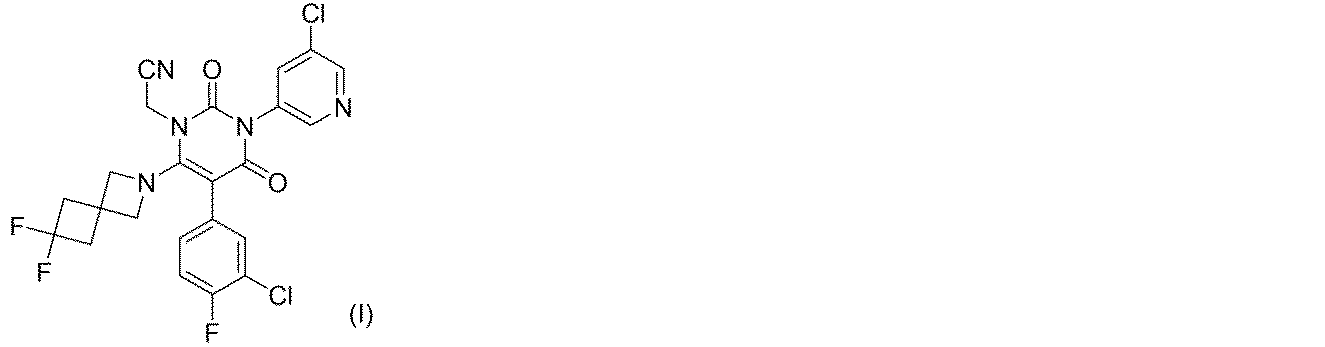
(30)式(I):
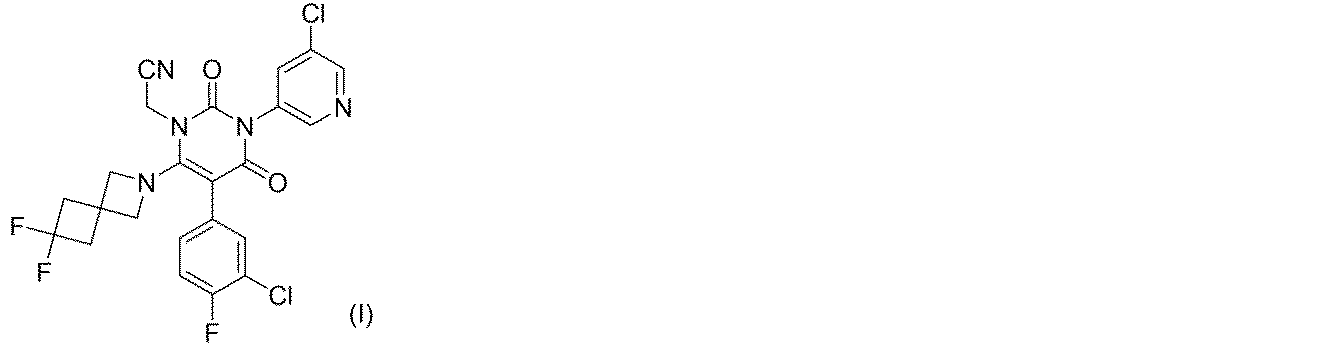
(31)式(I):
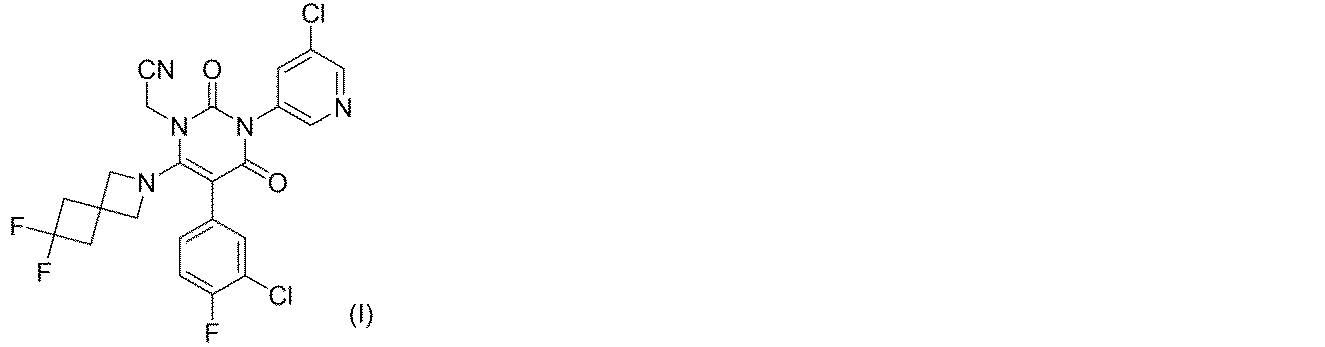
(32)当該高分子が、ビニル系高分子、セルロース系高分子、アクリル酸系高分子から選択される1以上である、上記(31)記載の固体分散体。
(33)当該高分子がビニル系高分子であり、当該ビニル系高分子がコポビドン(ポリビニルピロリドン・酢酸ビニル共重合体、PVPVA)、ポリビニルピロリドン(ポビドン)、ポリビニルポリピロリドン、ポリビニルアルコール、ポリビニルアルコール・アクリル酸・メタクリル酸メチルコポリマー、ポリビニルアルコール・ポリエチレングリコール・グラフトコポリマー、ポリビニルアセタールジエチルアミノアセテート、フマル酸・ステアリル酸・ポリビニルアセタールジエチルアミノアセテート・ヒドロキシプロピルメチルセルロース混合物及びポリ及び水溶性高分子を含有する固体分散体。ビニルアセタールジエチルアミノアセテートからなる群から選択される1以上である、上記(32)記載の固体分散体。
(34)当該ビニル系高分子がコポビドンである、上記(33)記載の固体分散体。
(35)式(I)で示される化合物とコポビドンの重量比が1:3である、上記(34)記載の固体分散体。
(36)有効成分として式(I)で示される化合物が20.0mg含まれる、上記(25)記載の製剤。
(37)粉末X線回折パターンにおいて、回折角度(2θ):6.9°±0.2°、8.8°±0.2°、13.1°±0.2°、16.3°±0.2°及び23.7°±0.2°にピークを有する、上記(30)記載の酢酸エチル和物結晶。
(38)ラマンスペクトルにおいて、421.2cm-1±2cm-1、509.7cm-1±2cm-1、1585.3cm-1±2cm-1、1709.9cm-1±2cm-1及び3052.9cm-1±2cm-1にピークを有する、上記(30)又は(37)記載の酢酸エチル和物結晶。
(39)当該賦形剤が結晶セルロース及び/又はマンニトールである、上記(17)記載の製剤。
(40)当該滑沢剤がフマル酸ステアリルナトリウム及び/又は軽質無水ケイ酸である、上記(18)のいずれかに記載の製剤。
また、本発明に係る固体状態(結晶及び非晶質)は、コロナウイルス3CLプロテアーゼに対する阻害活性を有し、コロナウイルス感染症の治療剤及び/又は予防剤の医薬原体として有用である。
「からなる」という用語は、構成要件のみを有することを意味する。「含む」および「包含する」という用語は、構成要件に限定されず、記載されていない要素を排除しないことを意味する。
以下、本発明について実施形態を示しながら説明する。本明細書の全体にわたり、単数形の表現は、特に言及しない限り、その複数形の概念をも含むことが理解されるべきである。従って、単数形の冠詞(例えば、英語の場合は「a」、「an」、「the」など)は、特に言及しない限り、その複数形の概念をも含むことが理解されるべきである。
また、本明細書において使用される用語は、特に言及しない限り、当上記分野で通常用いられる意味で用いられることが理解されるべきである。したがって、他に定義されない限り、本明細書中で使用される全ての専門用語及び科学技術用語は、本発明の属する分野の当業者によって一般的に理解されるのと同じ意味を有する。矛盾する場合、本明細書(定義を含めて)が優先する。
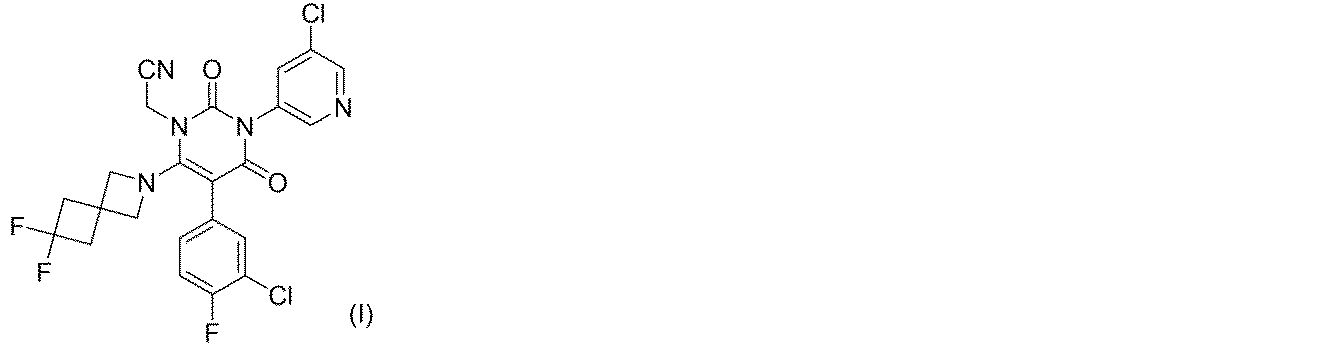
で示される化合物は、国際公開第2023/195529及び国際公開第2023/195530に記載の化合物(I-077)であり、当該文献の実施例5~6の合成法によって製造することができる。また、式(I)で示される化合物がコロナウイルス3CLプロテアーゼ阻害作用を有し、コロナウイルス3CLプロテアーゼを阻害することは、当該文献に記載されている。本明細書において、式(I)で示される化合物を、化合物(I)と表記することもある。
コロナウイルス感染症としては、HCoV-229E、HCoV-NL63、HCoV-OC43、HCoV-HKU1、SARS-CoV、MERS-CoV、及び/又はSARS-CoV-2による感染症が挙げられる。好ましくは、HCoV-229E、HCoV-OC43、及び/又はSARS-CoV-2による感染症、特に好ましくは、SARS-CoV-2による感染症が挙げられる。
コロナウイルス感染症としては、特に好ましくは、新型コロナウイルス感染症(COVID-19)が挙げられる。
本明細書中で用いる「式(I)で示される化合物、その製薬上許容される塩、又はそれらの溶媒和物」には、そのような各種の塩、共結晶、及びそれらの溶媒和物も包含する。
従って、本明細書中で用いる「式(I)で示される化合物の製薬上許容される塩」は、共結晶を包含し、式(I)で示される化合物の製薬上許容される塩又は共結晶を指す。
溶媒分子としては、例えば、酢酸エチル、水、エタノール、アセトン、1,1-ジエトキシプロパン、1,1-ジメトキシメタン、2,2-ジメトキシプロパン、イソオクタン、イソプロピルエーテル、メチルイソプロピルケトン、メチルテトラヒドロフラン、石油エーテル、トリクロロ酢酸、トリフルオロ酢酸、酢酸、アニソール、1-ブタノール、2-ブタノール、酢酸n-ブチル、t-ブチルメチルエーテル、クメン、ジメチルスルホキシド、ジエチルエーテル、ギ酸エチル、ギ酸、ヘプタン、酢酸イソブチル、酢酸イソプロピル、酢酸メチル、3-メチル-1-ブタノール、メチルエチルケトン、メチルイソブチルケトン、2-メチル-1-プロパノール、ペンタン、1-ペンタノール、1-プロパノール、2-プロパノール、酢酸プロピル、テトラヒドロフラン、アセトニトリル、クロロベンゼン、クロロホルム、シクロヘキサン、1,2-ジクロロエテン、ジクロロメタン、1,2-ジメトキシエタン、N,N-ジメチルアセトアミド、N,N-ジメチルホルムアミド、1,4-ジオキサン、2-エトキシエタノール、エチレングリコール、ホルムアミド、ヘキサン、メタノール、2-メトキシエタノール、メチルブチルケトン、メチルシクロヘキサン、N-メチルピロリドン、ニトロメタン、ピリジン、スルホラン、テトラリン、トルエン、1,1,2-トリクロロエテン、キシレン及びt-ブタノールが挙げられる。
好ましくは、酢酸エチル、水、エタノール、アセトン、1,1-ジエトキシプロパン、1,1-ジメトキシメタン、2,2-ジメトキシプロパン、イソオクタン、イソプロピルエーテル、メチルイソプロピルケトン、メチルテトラヒドロフラン、石油エーテル、トリクロロ酢酸、トリフルオロ酢酸、酢酸、アニソール、1-ブタノール、2-ブタノール、酢酸n-ブチル、t-ブチルメチルエーテル、クメン、ジメチルスルホキシド、ジエチルエーテル、ギ酸エチル、ギ酸、ヘプタン、酢酸イソブチル、酢酸イソプロピル、酢酸メチル、3-メチル-1-ブタノール、メチルエチルケトン、メチルイソブチルケトン、2-メチル-1-プロパノール、ペンタン、1-ペンタノール、1-プロパノール、2-プロパノール、酢酸プロピル及びテトラヒドロフランが挙げられる。
より好ましくは、酢酸エチル、水、エタノール、アセトン、1,1-ジエトキシプロパン、1,1-ジメトキシメタン、2,2-ジメトキシプロパン、イソオクタン、イソプロピルエーテル、メチルイソプロピルケトン、メチルテトラヒドロフラン、石油エーテル、トリクロロ酢酸及びトリフルオロ酢酸などが挙げられる。
最も好ましくは、酢酸エチルである。
また、「式(I)で示される化合物」を、大気中に放置することにより、水分を吸収し、吸着水が付着する場合や、水和物を形成する場合がある。
また、本発明は、他の製剤処方と比較して非常に有用な、式(I)で示される化合物の固体分散体を含有する製剤、式(I)で示される化合物の無水物結晶を含有する製剤、及び式(I)で示される化合物の酢酸エチル和物結晶を含有する製剤を提供する。
当該固体状態及び当該製剤は、少なくとも以下のいずれかの特徴を有する。
(1)熱、湿度、溶媒、光等に対する安定性が良好であり、保管安定性が高い。
(2)光照射後に、顕著な着色を示さない。
(3)水又は有機溶媒に対する溶解度が良好である。
(4)水又は有機溶媒に対する溶解速度が速い。
(5)高純度である。
(6)有機溶媒の残存率が低い。
(7)濾過、遠心分離、製剤化等の操作性に優れている。
(8)比容積が小さい。
(9)帯電しにくい。
(10)環境負荷が少ない条件下、高収率で製造され、大量製造が可能である。
(11)経口剤、注射剤等の医薬活性成分又はその製造用原体として有用である。
(12)血管痛を伴わない静脈注射に適したpH範囲に制御できるため、製剤時の液量コントロールや賦形剤の削減などに有利である。
(13)流動性が良好である。
(14)圧縮度(%)が低い。
さらに、「結晶」には、組成が同一でありながら結晶中の配列が異なる「結晶多形」が存在することがあり、それらを含めて「結晶形態」という。
「式(I)で示される化合物、その製薬上許容される塩、又はそれらの溶媒和物」は、それらの結晶多形を包含する。
本明細書中で用いる結晶は重水素変換体であってもよい。本明細書中で用いる結晶は同位元素(例、3H、14C、35S、125I等)で標識されていてもよい。
結晶形態及び/又は結晶化度は、例えば、X線回折、ラマン分光、赤外吸収スペクトル、固体NMRなどの分光法によって確認することができる。また、結晶の物理的特性は、示差走査熱量測定、水分吸脱着測定、溶解特性などの多くの技術によって確認することができる。
本明細書中で用いる「無水物」は、「無溶媒和物」、「非溶媒和物」、「無水和物」及び「非水和物」と同義である。
式(I)で示される化合物の無水物結晶は、結晶水の理論含量は0重量%ある。ただし、水分量及び/又は溶媒量の分析においては、結晶表面に付着した付着水及び/又は付着溶媒の影響を受けて、結晶水の理論含量よりも高い値をとることがある。
以下の結晶学的データ:
空間群: Pbca
a=14.67ű0.05Å
b=11.83ű0.05Å
c=27.10ű0.05Å
α=90°
β=90°
γ=90°
により特徴付けられる、式(I)で示される化合物の無水物結晶である。
本明細書における一態様は、示差熱-熱重量同時測定(TG/DTA)において、融点が265.6℃±2℃である、式(I)で示される化合物の無水物結晶である。
本発明の製剤に用いる、式(I)で示される化合物の無水物結晶のD50は、例えば0.02~20μm、好ましくは0.1~10μm、より好ましくは0.2~8μmである。本発明の製剤に用いる、式(I)で示される化合物の無水物結晶のD90は、例えば0.05~40μm、好ましくは0.2~20μm、より好ましくは0.5~16μmである。なお、製剤の種類によっては、D50が200~1500nm程度の式(I)で示される化合物の無水物結晶の粒子を用いることができる。
本発明の一態様は、式(I)で示される化合物及び酢酸エチルからなり、存在モル比が1:1である、「式(I)で示される化合物の酢酸エチル和物結晶」である。当該結晶中の酢酸エチルの理論含有量は約14.4重量%である。
本発明の「式(I)で示される化合物の酢酸エチル和物結晶」の酢酸エチル含量は、例えば4~20重量%、好ましくは9~18重量%、より好ましくは12~16重量%である。なお、酢酸エチル含有量の分析において、結晶に付着した水や酢酸エチルの影響で、含有量が高くなる場合、測定前に結晶中の酢酸エチルの一部が脱離し、含有量が低くなる場合がある。
本発明の製剤に用いる、式(I)で示される化合物の酢酸エチル和物結晶のD50は、例えば0.1~25μm、好ましくは0.5~10μm、より好ましくは1~8μmである。本発明の製剤に用いる、本発明の式(I)で示される化合物の酢酸エチル和物結晶のD90は、例えば0.2~40μm、好ましくは1~20μm、より好ましくは2~15μmである。
本明細書において「非晶質」とは、実質的に非晶質状態であることをいう。例えば、組成物中に存在する医薬活性成分(薬物)のうちの、80%以上、好ましくは90%以上、より好ましくは95%以上、最も好ましくは99%以上が非晶質形態にあることを意味する。また、結晶化度としては、例えば、約20%以下の結晶化度、好ましくは約10%以下の結晶化度、より好ましくは約5%以下の結晶化度、最も好ましくは約1%以下の結晶化度を有することを意味する。
非晶質固体は、その構造の中に秩序だった繰返し周期をもたないため、回折現象を起こさないことから、粉末X線回折測定で確認することができる。非晶質固体の粉末X線回折パターンは、特徴のないブロードなXRPDパターンであり、ハローパターンとも呼ばれる。また、非晶質固体は、結晶のような偏光を示さないことから、顕微鏡又はデジタルマイクロスコープの偏光観察モードで確認することができる。その他には、例えば、ラマン分光、赤外吸収スペクトル、固体NMRなどの分光法、示差走査熱量測定などの技術によって確認することができる。
本発明の一態様は、式(I)で示される化合物の固体分散体であって、式(I)で示される化合物が非晶質である、固体分散体である。
本発明の一態様は、粉末X線回折測定においてハローパターンを示す、式(I)で示される化合物の固体分散体である。
本発明の一態様は、式(I)で示される化合物及び高分子を含有する固体分散体である。
結晶性の難溶性薬物について、固体分散体化することによって、医薬活性成分(薬物)を非晶質化し、溶解度及び溶解速度の改善を図ることができる。
本発明の一態様は、式(I)で示される化合物とコポビドンの重量比が1:3である固体分散体である。
当該溶媒は、高分子の存在下で、式(I)で示される化合物が非晶質状態で維持し得る溶媒であれば特に制限されない。例えば、ICH-Q3C(医薬品の残留溶媒ガイドライン)において、クラス3の溶媒(毒性が低く、ヒトの健康に及ぼすリスクも低いと考えられる溶媒)が挙げられる。具体的には、アセトンなどのケトン類、メタノール、エタノール、プロパノールなどのアルコール類、塩化メチレン、又はこれらの混合溶媒及び水との混合溶媒が挙げられる。好ましくは、アセトン、又はアセトン及びエタノールの混合溶媒、より好ましくはアセトンである。
当該溶媒の量としては、式(I)で示される化合物が非晶質状態となり得るのに必要な量であれば特に制限されない。「式(I)で示される化合物、その製薬上許容される塩、又はそれらの溶媒和物」と高分子との重量に対し、例えば1~100倍量(w/w)、好ましくは5~20倍量(w/w)である。
当該溶媒を留去する方法としては、溶媒を留去する方法であれば特に限定されないが、例えば噴霧乾燥法、減圧乾燥法、通風乾燥法等が挙げられる。
本発明の「式(I)で示される化合物の固体分散体」の粉末X線回折パターンは、ハローパターンを示す。
本発明の医薬組成物において、式(I)で示される化合物等は、1~100mg含まれていてもよく、好ましく5~50mg含まれていてもよい。特に好ましくは、20~40mgである。
当該製剤としては、例えば経口剤、非経口剤、好ましくは経口剤、より好ましくは経口投与する固形製剤、特に好ましくは、錠剤、顆粒剤、散剤又はカプセル剤である。
本発明の「式(I)で示される化合物、その製薬上許容される塩、又はそれらの溶媒和物を有効成分として含有する製剤」は、公知の方法で製造することができる。当該製剤は製薬上許容される添加剤を配合してもよく、例えば崩壊剤、賦形剤、滑沢剤、結合剤、コーティング剤等が挙げられる。
本発明の一態様は、式(I)で示される化合物の無水物結晶を有効成分として含有する製剤である。
本発明の一態様は、式(I)で示される化合物の酢酸エチル和物結晶を有効成分として含有する製剤である。
製剤の好ましい形態としては固形製剤が挙げられ、特に好ましくは顆粒剤、散剤、カプセル剤又は錠剤である。
本発明の一態様は、式(I)で示される化合物及びコポビドンを含む固体分散体並びにクロスカルメロースナトリウムを含有する固形製剤である。
本発明の一態様は、式(I)で示される化合物の無水物結晶及びクロスポビドンを含有する固形製剤である。
固形製剤の好ましい形態としては顆粒剤、散剤、カプセル剤又は錠剤が挙げられ、特に好ましくは錠剤である。
本発明の一態様は、式(I)で示される化合物及びコポビドンを含む固体分散体、クロスカルメロースナトリウム、結晶セルロース並びにマンニトールを含有する固形製剤である。
本発明の一態様は、式(I)で示される化合物の無水物結晶、クロスポビドン及び結晶セルロースを含有する固形製剤である。
固形製剤の好ましい形態としては顆粒剤、散剤、カプセル剤又は錠剤が挙げられ、特に好ましくは錠剤である。
本発明の一態様は、式(I)で示される化合物及びコポビドンを含む固体分散体、クロスカルメロースナトリウム、結晶セルロース、マンニトール並びにフマル酸ステアリルナトリウム及び軽質無水ケイ酸を含有する固形製剤である。
本発明の一態様は、式(I)で示される化合物の無水物結晶、クロスポビドン、結晶セルロース及びフマル酸ステアリルナトリウムを含有する固形製剤である。
固形製剤の好ましい形態としては顆粒剤、散剤、カプセル剤又は錠剤が挙げられ、特に好ましくは錠剤である。
本発明の一態様は、「式(I)で示される化合物、その製薬上許容される塩、又はそれらの溶媒和物、及び光安定化物質を含有する製剤」である。
顆粒剤に被覆層を形成する際、流動層造粒コーティング機、流動層転動コーティング機等を用いることができる。錠剤に被覆層を形成する際、パンコーティング機、通気式コーティング機等を用いることができる。コーティング機の中で、顆粒剤や錠剤を流動させながら、この顆粒剤や錠剤に当該コーティング液を噴霧、乾燥し、被覆層を形成する。
「式(I)で示される化合物、その製薬上許容される塩、又はそれらの溶媒和物」の好ましい形態としては、式(I)で示される化合物の固体分散体、式(I)で示される化合物の無水物結晶又は式(I)で示される化合物の酢酸エチル和物結晶を使用することができる。
固形製剤の好ましい形態としては、顆粒剤、散剤、カプセル剤又は錠剤が挙げられ、特に好ましくは錠剤又はカプセル剤である。
本発明の一態様は、「三二酸化鉄、黄色三二酸化鉄及び/又はタルクを含有する被覆層を有する、式(I)で示される化合物の無水物結晶を有効成分として含有する固形製剤」である。本発明の一態様は、「三二酸化鉄、黄色三二酸化鉄、タルク及びヒプロメロースを含有する被覆層を有する、式(I)で示される化合物の無水物結晶を有効成分として含有する固形製剤」である。
固形製剤の好ましい形態としては、顆粒剤、散剤、カプセル剤又は錠剤が挙げられ、特に好ましくは錠剤である。
固形製剤の好ましい形態としては、顆粒剤、散剤、カプセル剤又は錠剤が挙げられ、特に好ましくはカプセル剤である。
粉末X線回折(XRPD)は、固体の結晶形態及び結晶性を測定するための最も感度の良い分析法の1つである。X線が結晶に照射されると、結晶格子面で反射し、互いに干渉しあい、構造の周期に対応した秩序だった回折線を示す。一方、非晶質固体については、通常、その構造の中に秩序だった繰返し周期をもたないため、回折現象は起こらず、特徴のないブロードなXRPDパターン(ハローパターンとも呼ばれる)を示す。
複数の結晶を区別する上では、ピークの強度よりも、当該結晶で確認され、他の結晶では確認されないピークが、その結晶を特定する上で好ましい特徴的なピークとなる。そういった特徴的なピークであれば、一つ又は二つのピークでも、当該結晶を特徴付けることができる。測定して得られたパターンを比較し、これらの特徴的なピークが一致すれば、粉末X線回折パターンが実質的に一致するといえる。
例えば、吸湿により無水物結晶が水和物結晶へ変化する場合、脱水により水和物結晶が無水物結晶へ変化する場合、溶媒脱離により溶媒和物結晶が無水物結晶へ結晶転移する場合、吸湿・脱水により無水物結晶と水和物結晶が可逆的に変化する場合などは、特定の温度及び/又は相対湿度下での測定、温度及び/又は相対湿度を連続的に変化させる測定が適している。そのような場合に、変化が起こる相対湿度及び結晶水及び/又は結晶溶媒の量を推察することが可能である。
粉末X線回折と示差走査熱量の同時測定(XRD-DSC測定)は、温度及び/又は相対湿度に対する、結晶形態(結晶構造)の変化と熱量変化を同時に観察できる。例えば、吸湿により無水物結晶が水和物結晶へ結晶転移する場合、脱水により水和物結晶が無水物結晶へ結晶転移する場合、溶媒脱離により溶媒和物結晶が無水物結晶へ結晶転移する場合、吸湿・脱水により無水物結晶と水和物結晶が可逆的に結晶転移する場合などの結晶形態(結晶構造)変化の観察に適している。
単結晶構造解析は結晶形態を特定する方法の一つで、結晶学的パラメーター、さらに、原子座標(各原子の空間的な位置関係を示す値)及び3次元構造モデルを得ることができる。単結晶構造解析については、桜井敏雄著「X線構造解析の手引き」裳華房発行(1983年)、Stout & Jensen著 X-Ray Structure Determination: A Practical Guide, Macmillan Co., New York(1968)などを参照とする。
光学異性体、互変異性体、幾何異性体、塩、共結晶、溶媒和物(水和物)の構造を同定する際には、単結晶構造解析が有用である。
なお、単結晶X線回折実験は、低温で測定を行うことにより、データの質が向上することが知られているため、測定結晶に応じて室温又は低温で測定を行う。また、水和物及び/又は溶媒和物の単結晶X線回折実験は、測定前に結晶をパラフィンオイル等でコーティングすることにより、データの質が向上することが知られている。
ラマンスペクトルは分子又は複合体系の振動の特徴を示す。その起源は分子と光線を含む光の粒子である光子との間の非弾性的な衝突にある。分子と光子の衝突はエネルギーの交換をもたらし、その結果エネルギーが変化し、これにより光子の波長が変化する。即ち、ラマンスペクトルは、対象分子に光子が入射されたときに発せられる、極めて波長の狭いスペクトル線であるため、光源としてはレーザー等が用いられる。各ラマン線の波長は入射光からの波数シフトにより表示され、これはラマン線と入射光の波長の逆数の間の差である。ラマンスペクトルは分子の振動状態を測定するものであり、これはその分子構造により決定される。
一般に、ラマンスペクトルにおける波長シフト量(cm-1)は±2cm-1の範囲内で誤差が生じ得るから、ラマンスペクトルピークの値は±2cm-1程度の範囲内の数値も含むものとして理解される必要がある。したがって、ラマンスペクトルにおけるラマンスペクトルピークが完全に一致する結晶だけでなく、ラマンスペクトルピークが±2cm-1程度の誤差で一致する結晶も本発明に含まれる。
赤外吸収スペクトル測定法は、赤外線が試料を通過するときに吸収される度合いを、各波数について測定する方法である。赤外吸収スペクトルは通例、横軸に波数を、縦軸に透過率又は吸光度をとったグラフで示される。吸収ピークの波数及び透過率(又は吸光度)はグラフ上で読み取ることができるほか、データ処理装置による算出値を用いることができる。赤外吸収スペクトルはその物質の化学構造によって定まる。従って、種々の波数における吸収を測定して物質を確認又は定量することができる。結晶多形の判別は、その結晶多形に特徴的な官能基、即ち、主として結晶構造中の水素結合に関与する官能基、例えばC=O結合、OH結合及びNH結合等ならびに、その他特徴的な官能基、例えば、C-X(ハロゲン)結合、C=C結合及びC≡C結合等の吸収帯を比較することによって行なうことができる。特徴的な官能基に対応する約20個の吸収ピーク、より好ましくは約10個の吸収ピーク、最も好ましくは約5個の吸収ピークから選択される。通例、試料の吸収スペクトルは波数4000cm-1~400cm-1の範囲で測定する。吸収スペクトルの測定は装置の分解能、波数目盛り及び波数精度の確認を行なったときと同一の操作条件の下で行なう。
固体13C-NMRは、(i)スペクトル数と対象化合物の炭素数が一致すること、(ii)化学シフト範囲が1H-NMRに比べ広いこと、(iii)シグナルが固体1H-NMRに比べてシャープであること、(iv)添加物が含まれていても、相互作用がない場合は、化学シフトが変化しないこと等から、結晶形の特定に有用である。なお、用いられる特定の分光計及び分析者の試料調製技法に応じて観察される化学シフトは、わずかに変動することが予想される。固体13C-NMRスペクトルにおける誤差範囲はおよそ±0.5ppmである。
示差走査熱量測定法(DSC)は、熱分析の主要な測定方法の一つで、原子・分子の集合体としての物質の熱的性質を測定する方法である。
DSCにより、医薬活性成分の温度又は時間に係る熱量の変化を測定し、得られたデータを温度又は時間に対してプロットすることにより示差走査熱量曲線が得られる。示差走査熱量曲線より、医薬活性成分が融解する際のオンセット温度(外挿融点開始温度)、融解に伴う吸熱ピーク曲線の最大値及びエンタルピーに関する情報を得ることができる。
DSCについて、観察される温度は、温度変化速度ならびに用いる試料調製技法及び特定の装置に依存し得ることが知られている。従って、DSCにおける「融点」とは試料の調製技法の影響を受けにくいオンセット温度(外挿融点開始温度)のことを指す。示差走査熱量曲線から得られるオンセット温度(外挿融点開始温度)における誤差範囲はおよそ±2℃である。結晶の同一性の認定においては、融点のみならず全体的なパターンが重要であり、測定条件や測定機器によって多少は変化し得る。
示差熱-熱重量同時測定法(TG/DTA)は、熱分析の主要な測定方法のひとつで、原子・分子の集合体としての物質の重量及び熱的性質を測定する方法である。
TG/DTAは医薬活性成分の温度又は時間に係る重量及び熱量の変化を測定する方法であり、得られたデータを温度又は時間に対してプロットすることにより、TG(熱重量)及びDTA(示差熱)曲線が得られる。TG/DTA曲線より、医薬活性成分の分解、脱水、酸化、還元、昇華、蒸発に関する重量及び熱量変化の情報を得ることができる。
TG/DTAについて、観察される温度、重量変化は、温度変化速度ならびに用いる試料調製技法及び特定の装置に依存し得ることが知られている。従って、TG/DTAにおける「融点」とは試料の調製技法の影響を受けにくいオンセット温度(外挿融点開始温度)のことを指す。結晶の同一性の認定においては、融点のみならず全体的なパターンが重要であり、測定条件や測定機器によって多少は変化し得る。
水分吸脱着等温線測定法(DVS)は、測定対象の固体について各相対湿度条件下での重量変化を測定することで、水分の吸着、脱着挙動を計測する測定法である。
基本的な測定法として、0%RH(相対湿度0%)での乾燥重量を基準とし、5%又は10%ごとに相対湿度を上げ、それぞれの相対湿度での重量安定化後、基準値からの重量増加から、吸着水の量を求める事が出来る。同様に、100%RH又は95%RHから5%又は10%ごとに相対湿度を下げる事で、水の脱着量を測定する事が可能である。
各相対湿度での重量変化値をプロットすることで、吸脱着等温線を得ることができる。この結果から、各湿度における付着水分の吸着、脱着現象の考察が可能である。
付着水及び結晶水の吸脱着は粒子径、結晶化度、晶癖等の影響を受けるため、測定結果は多少変化し得る。
それに対し、粉末X線回折、単結晶構造解析は、結晶の「内部構造」を分析する測定法であり、結晶「表面」の付着水及び/又は付着溶媒(残留溶媒)の有無にかかわらず、同じ位置に特徴的なピークを示す。ラマン分光法、赤外吸収スペクトル測定法(IR法)も同様である。従って、粉末X線回折、単結晶構造解析、ラマン分光法、赤外吸収スペクトル測定法(IR法)においては、結晶中の理論含量よりも高い水分量及び/又は溶媒量を示す場合であっても、明細書記載の特徴的なピークを有する限り、実質的に同一の結晶であると解釈することができる。
本明細書中で用いる「D10、D50、D90」は、粉末の集合の全体積を100%として累積カーブを求めたとき、その累積カーブが10%、50%、90%となる点の粒子径を意味し、乾式法又は湿式法により測定することができる。
特筆しない限り、%は成分の重量%及び組成物の全重量の重量%であり、圧力は大気圧か又はそれに近い圧力である。
各実施例で得られたNMR分析は400MHzで行い、DMSO-d6、CDCl3を用いて測定した。また、NMRデータを示す場合は、測定した全てのピークを記載していない場合が存在する。
明細書中にRTとあるのは、LC/MS:液体クロマトグラフィー/質量分析でのリテンションタイムを表し、以下の条件で測定した。
(測定条件A)
カラム:ACQUITY UPLC(登録商標)BEH C18 (1.7μm i.d.2.1x50mm) (Waters)
流速:0.8mL/分
UV検出波長:254nm
移動相:[A]は0.1%ギ酸含有水溶液、[B]は0.1%ギ酸含有アセトニトリル溶液
グラジエント:3.5分間で5%-100%溶媒[B]のリニアグラジエントを行った後、0.5分間、100%溶媒[B]を維持した。
(測定条件B)
カラム:ACQUITY UPLC(登録商標)BEH C18 (1.7μm i.d.2.1x50mm) (Waters)
流速:0.8mL/分
UV検出波長:254nm
移動相:[A]は0.1%ギ酸含有水溶液、[B]は0.1%ギ酸含有アセトニトリル溶液
グラジエント:3.5分間で5%-100%溶媒[B]のリニアグラジエントを行った後、0.5分間、100%溶媒[B]を維持した。
なお、明細書中、MS(m/z)との記載は、質量分析で観測された値を示す。
「式(I)で示される化合物」は、国際公開第2023/195529及び国際公開第2023/195530に記載の、化合物(I-077)であり、当該文献記載の実施例5~6の合成法によって製造することができる。また、当該分野において公知の手法を参考にしながら合成することができる。抽出、精製等は、通常の有機化学の実験で行う処理を行えばよい。

工程1 化合物3の合成
2.64mol/L n-ブチルリチウムのヘキサン溶液(31mL、82.4mmol)とテトラヒドロフラン(20mL)の混合溶液に、化合物1(12g、68.7mmol)のテトラヒドロフラン(70mL)溶液を-78℃で15分かけて滴下した。-78℃で1時間攪拌した。1.9mol/L 塩化亜鉛の2-メチルテトラヒドロフラン溶液(43mL、82.4mmol)を5分かけて滴下した。室温で2時間撹拌した。化合物2(9.1mL、75.6mmol)及びテトラキス(トリフェニルホスフィン)パラジウム(4.0g、3.44mmol)を加え、80℃で1.5時間撹拌した。反応液を常温に冷却し、水(80mL)と2mol/L塩酸(40mL)を加えて酢酸エチルで抽出した。有機層を減圧濃縮し、得られた残渣にイソプロパノール(40mL)を加えた。沈殿物を濾取してイソプロパノールで洗浄した。風乾して化合物3(14.8g、49mmol)を得た。
1H-NMR(CDCl3)δ:3.95(s,3H)、4.05(s,3H)、7.18―7.23(m,2H)、7.35(d,J=6.8Hz,1H)
LC/MS(ESI):m/z=303、RT=2.70min、LC/MS測定条件A
化合物3(14.8g、48.8mmol)に酢酸(40mL)と濃塩酸(41mL)を加え、110℃で5時間撹拌した。反応液を室温まで冷却した後に水(80ml)を加えた。沈殿物を濾取して水で洗浄した。風乾して化合物4(11.6g、42.2mmol)を得た。
1H-NMR(DMSO-d6)δ:7.31(ddd,J=8.8,4.9,2.1Hz,1H)、7.45(t,J=8.8Hz,1H)、7.53(dd,J=7.3,2.1Hz,1H)、11.57(s,1H)、12.24(brs,1H)
LC/MS(ESI):m/z=275、RT=1.81min、LC/MS測定条件A
化合物4(1.00g、3.64mmol)、5-クロロピリジン-3-ボロン酸(1.14g、7.27mmol)、酢酸銅(II)(0.99g、5.45mmol)、アセトニトリル(10mL)、トリエチルアミン(5.04mL、36.4mmol)及びピリジン(7.34mL、91.0mmol)を混合し、溶液を常温で終夜撹拌した。反応液に飽和炭酸水素ナトリウム水溶液(5mL)を加えて、酢酸エチルで抽出した。有機層を水で洗浄し、硫酸ナトリウムで乾燥し、ろ過した。ろ液を濃縮し、得られた残渣をシリカゲルカラムクロマトグラフィー(クロロホルム:メタノール=100:0~90:10)で精製し、溶媒を減圧留去した。得られた残渣を減圧乾燥し、化合物5(1.15g、2.97mmol、収率82%)を得た。
1H-NMR(DMSO-d6)δ:7.35-7.37(1H,m),7.49(1H,t,J=9.0Hz),7.54-7.56(1H,m),8.07(1H,t,J=2.1Hz),8.54(1H,d,J=2.0Hz),8.70(1H,d,J=2.3Hz).
LC/MS(ESI):m/z=386、RT=1.98min、LC/MS測定条件A
化合物5(520mg、1.345mmol)、N,N-ジイソプロピルエチルアミン(0.705mL、4.04mmol)、DMF(5.2mL)を混合した溶液に、2-ブロモアセトニトリル(269μL、4.04mmol)を加え、常温で終夜撹拌した。氷冷下で反応液に2mol/L塩酸(2mL)を加え、酢酸エチルで抽出した。有機層を水で洗浄し、硫酸ナトリウムで乾燥し、ろ過した。ろ液を濃縮し、得られた残渣をシリカゲルカラムクロマトグラフィー(クロロホルム:メタノール=100:0~99:1)で精製し、溶媒を減圧留去した。得られた残渣を減圧乾燥し、化合物6(291mg、0.684mmol、収率51%)を得た。
1H-NMR(CDCl3)δ:5.13(2H,s),7.23-7.24(2H,m),7.42(1H,d,J=7.3Hz),7.67(1H,t,J=2.1Hz),8.45(1H,d, J=2.3Hz),8.67(1H,d,J=2.3Hz).
LC/MS(ESI):m/z=425、RT=2.17min、LC/MS測定条件A
化合物6(25.0mg、0.059mmol)、6,6-ジフルオロ-2-アザスピロ[3.3]ヘプタン トリフルオロ酢酸塩(17.4mg、0.070mmol)、N,N-ジイソプロピルエチルアミン(20.5μL、0.117mmol)、DMF(0.5mL)を混合し、溶液を60℃で2時間撹拌した。反応液に水(2mL)を加え、酢酸エチルで抽出した。有機層を水で洗浄し、硫酸ナトリウムで乾燥し、ろ過した。ろ液を濃縮し、酢酸エチル(0.05mL)、ヘキサン(0.125mL)及びジイソプロピルエーテル(0.125mL)を加えた。得られた沈殿物をろ取し、ジイソプロピルエーテルで洗浄した。得られた固体を減圧乾燥し、化合物(I)(22.0mg、0.042mmol、収率72%)を得た。
1H-NMR(CDCl3)δ:2.75(4H,t,J=12.0Hz),4.02(4H,s),4.74(2H,s),7.16-7.18(2H,m),7.32-7.35(1H,m),7.65(1H,t,J=2.1Hz),8.43(1H,d,J=2.3Hz),8.61(1H,d,J=2.3Hz).
LC/MS(ESI):m/z=522、RT=2.27min、LC/MS測定条件A
以下に、本発明に係る化合物の生物試験例を記載する。
本発明に係る式(I)で示される化合物は、コロナウイルス3CLプロテアーゼ阻害作用を有し、コロナウイルス3CLプロテアーゼを阻害するものであればよい。
具体的には、以下に記載する評価方法において、IC50は50μM以下が好ましく、より好ましくは、1μM以下、さらにより好ましくは100nM以下である。EC50は10μM以下が好ましく、より好ましくは、1μM以下、さらにより好ましくは100nM以下である。
式(I)で示される化合物の生物試験結果は、国際公開第2023/195529及び国際公開第2023/195530に化合物(I-077)として記載されている。
<操作手順>
・被験試料の希釈、分注
予め被験試料をDMSOで適度な濃度に希釈し、2~5倍段階希釈系列を作製後、384ウェルプレートに分注する。
・細胞及びSARS-CoV-2の希釈、分注
HEK293T/ACE2-TMPRSS2細胞(GCP-SL222、5×103cells/well)とSARS-CoV-2(200-600TCID50/well)を培地(MEM、2%FBS、ペニシリン-ストレプトマイシン)で混合し、被験試料が入ったウェルに分注した後、CO2インキュベーターで3日間培養する。
・CellTiter-Glo(登録商標)2.0の分注及び発光シグナルの測定
3日間培養したプレートを室温に戻した後、CellTiter-Glo(登録商標)2.0を各ウェルに分注し、プレートミキサーで混和する。一定時間置いた後、プレートリーダーで発光シグナル(Lum)を測定する。
<各測定項目値の算出>
・50% SARS-CoV-2感染細胞死阻害濃度(EC50)算出
xを化合物濃度の対数値、yを%Efficacyとしたとき、以下のLogistic回帰式で阻害曲線を近似し、y=50(%)を代入したときのxの値をEC50として算出する。
y = min + (max - min)/{1 + (X50/x) ^Hill}
%Efficacy = {(Sample - virus control) / (cell control - virus control)} * 100%
cell control: the average of Lum of cell control wells
virus control: the average of Lum of virus control wells
min:y軸下限値、max:y軸上限値、X50:変曲点のx座標、Hill:minとmaxの中間点でのカーブの傾き
(結果)
化合物(I):1.66nM
<材料>
・市販のRecombinant SARS-CoV-2 3CL Protease
・市販の基質ペプチド
Dabcyl-Lys-Thr-Ser-Ala-Val-Leu-Gln-Ser-Gly-Phe-Arg-Lys-Met-Glu(Edans)-NH2(配列番号:1)
・Internal Standardペプチド
Dabcyl-Lys-Thr-Ser-Ala-Val-Leu(13C6,15N)-Gln(配列番号:2)
Dabcyl-Lys-Thr-Ser-Ala-Val-Leu(13C6,15N)-Glnは、文献(Atherton, E.; Sheppard, R. C.,“In Solid Phase Peptide Synthesis, A Practical Approach”、IRL Press at Oxford University Pres、1989.及びBioorg. Med. Chem.、5巻、9号、1997年、1883-1891頁、等)を参考に合成できる。以下に一例を示す。
Rinkアミド樹脂を用いて、Fmoc固相合成によって、H-Lys-Thr-Ser-Ala-Val-Leu(13C6,15N)-Glu(resin)-OαOtBu(Lys側鎖はBoc保護、Thr側鎖はtert-ブチル基で保護、Ser側鎖はtert-ブチル基で保護、GluのC末端OHはtert-ブチル基で保護されており、Glu側鎖のカルボン酸を樹脂に縮合)を合成する。N末端Dabcyl基の修飾は4-ジメチルアミノアゾベンゼン-4’-カルボン酸(Dabcyl-OH)をEDC/HOBTを用いて樹脂上で縮合する。最終脱保護、及び樹脂からの切り出しはTFA/EDT=95:5で処理することで行う。その後、逆相HPLCによって精製する。
・RapidFire Cartridge C4 typeA
<操作手順>
・アッセイバッファーの調製
本試験では、20mM Tris-HCl、1mM EDTA、10mM DTT、0.01% BSAからなるアッセイバッファーを使用する。
・被験試料の希釈、分注
予め被験試料をDMSOで適度な濃度に希釈し、2~5倍段階希釈系列を作製後、384ウェルプレートに分注する。
・酵素と基質の添加、酵素反応
準備した化合物プレートに、8μMの基質、及び6nM又は0.6nMの酵素溶液を添加し、室温で3~5時間インキュベーションを行う。その後、反応停止液(0.067μM Internal Standard、0.1% ギ酸、10又は25% アセトニトリル)を加え酵素反応を停止させる。
・反応産物の測定
反応完了したプレートはRapidFire System 360及び質量分析器(Agilent、6550 iFunnel Q-TOF)、又はRapid Fire System 365及び質量分析器(Agilent、 6495C Triple Quadrupole)を用いて測定する。測定時の移動相としてA溶液(75% イソプロパノール、15% アセトニトリル、5mM ギ酸アンモニウム)とB溶液(0.01% トリフルオロ酢酸、0.09% ギ酸)を用いる。
質量分析器によって検出された反応産物は、RapidFire Integrator又は同等の解析が可能なプログラムを用いて算出しProduct area値とする。また、同時に検出されたInternal Standardも算出しInternal Standard area値とする。
<各測定項目値の算出>
・P/ISの算出
前項目で得られたarea値を下記の式によって計算し、P/ISを算出する。
P/IS= Product area値/ Internal Standard area値
・50% SARS-CoV-2 3CLプロテアーゼ阻害濃度(IC50)算出
xを化合物濃度の対数値、yを%Inhibitionとしたとき、以下のLogistic回帰式で阻害曲線を近似し、y=50(%)を代入したときのxの値をIC50として算出する。
y = min + (max - min)/{1 + (X50/x) ^Hill}
%Inhibition = {1-(Sample - Control(-)) / Control(+)-Control(-))} * 100
Control(-):the average of P/IS of enzyme inhibited condition wells
Control(+):the average of P/IS of DMSO control wells
min:y軸下限値、max:y軸上限値、X50:変曲点のx座標、Hill:minとmaxの中間点でのカーブの傾き
(結果)
化合物(I):0.00036μM
日本薬局方の一般試験法に記載された粉末X線回折測定法に従い、各実施例で得られた、固体状態(結晶及び非晶質)並びに固体分散体の粉末X線回折測定を行った。測定条件を以下に示す。
測定条件1:
粉末X線回折装置:リガク社製SmartLab
測定法:反射法
使用波長:CuKα線(λ=1.5418Å)
管電流:200mA
管電圧:45kV
試料プレート:アルミニウム
X線の入射角:2.5°
サンプリング幅:0.02°
検出器:HyPix-3000(2次元検出モード)
X線回折装置付属のアッタチメントを用いて、測定試料部の温度及び相対湿度を制御し、日本薬局方の一般試験法に記載された粉末X線回折測定法に従って、粉末X線回折測定を行う。測定条件を以下に示す。
測定条件2:
(X線回折測定)
粉末X線回折装置:リガク製RINT2100Ultima+
測定法:反射法
使用波長:CuKα線(λ=1.5418Å)
管電流:40mA
管電圧:40kV
試料プレート:アルミニウム
X線の測定範囲:5°-35°
サンプリング幅:0.02°
スキャンスピード:60°/min
(温度及び相対湿度の制御)
温度コントローラ:リガク製 ThermoPlus
湿度コントローラ:リガク製 HUM-1
各実施例で得られた結晶の単結晶構造解析を行った。測定条件及び解析方法を以下に示す。
(装置)
リガク社製 XtaLAB P200 MM007
(測定条件)
測定温度:25℃
温度コントローラ:リガク社製 試料吹付低温装置
使用波長:CuKα線(λ=1.5418Å)
ソフト:CrysAlisPro 1.171.39.46e (Rigaku Oxford Diffraction, 2018)
(データ処理)
ソフト:CrysAlisPro 1.171.39.46e (Rigaku Oxford Diffraction, 2018)
データはローレンツ及び偏光補正、吸収補正を行った。
(結晶構造解析)
直接法プログラムShelXT(Sheldrick, G.M.,2015)を用いて位相決定を行い、精密化はShelXL(Sheldrick, G.M.,2015)を用いて、full-matrix最小二乗法を実施した。非水素原子の温度因子はすべて異方性で精密化を行った。水素原子は、特に記載のない限りShelXLのデフォルトパラメータを用いて計算により導入し、riding atomとして取り扱った。また、水素原子は、等方性パラメーターで精密化を行った。
以下の構造図の作図には、PLATON(Spek,1991)/ORTEP(Johnson,1976)を使用した(30% PROBABILITY level)。
各実施例で得られた結晶のラマンスペクトルの測定とベースライン補正を行った測定条件を以下に示す。
測定条件1
測定方法:顕微レーザーラマン分光法
レーザー波長:671nm
積算回数:1回
露光時間:1秒
各実施例で得られた結晶のDSCの測定を行った。アルミニウムパンに試料を量り、簡易密封して測定した。測定条件を以下に示す。なお、示差走査熱量(DSC)による測定は±2℃の範囲内で誤差が生じうる。
装置:Discovery DSC/TA Instrument
測定温度範囲:-10℃-270℃
昇温速度:10℃/分
雰囲気:N2 50mL/分
各実施例で得られた、固体状態(結晶及び非晶質)並びに固体分散体の示差熱-熱重量同時測定(TG/DTA)を行った。各実施例で得られた試料を量り、アルミニウムパンにつめ、開放系にて測定した。測定条件は以下のとおりである。
装置:日立ハイテクノロジーズ TG/DTA STA7200RV
測定温度範囲:室温-350℃
昇温速度:10℃/分
各実施例で得られた結晶の水分吸脱着等温線測定(DVS)を行った。各実施例で得られた結晶をアルミニウムパンに量り、25℃相対湿度0%で静置した。化合物が十分に乾燥し重量が安定した後に測定を開始し、相対湿度が0%から95%まで5%ずつ変化した時の重量を記録した。次に、相対湿度が95%から0%まで5%ずつ変化した時の重量を記録した。
装置:Surface Measurement Systems社製 DVS Adventure
各実施例で得られた、結晶及び固体分散体の粒度分布を測定した。粒度分布は、レーザー回折式粒度分布測定装置を用いて乾式法にて測定した。
測定条件1
装置:HELOS&RODOS(シンパテック社製)
レンジ:R1
分散圧:2bar
トリガー条件:ストップ2秒測定濃度≦0.5%又は10秒実時間
測定条件2
装置:HELOS&RODOS(シンパテック社製)
レンジ:R3
分散圧:2bar
トリガー条件:ストップ2秒測定濃度≦0.5%又は10秒実時間
測定条件3
装置:マイクロトラックMT3200II型(MicrotracBEL社製)
各実施例で得られた結晶の粒度分布を測定した。粒度分布は、レーザー回折・散乱式粒子径分布測定装置 マイクロトラックMT3200II型(MicrotracBEL社製)を用いて湿式法にて測定した。
測定範囲:0.243~1408μm
溶媒:水
溶媒屈折率:1.333
測定時間:30秒
粒子形状:非球形
粒子透過性:透過
粒子屈折率:1.81
上記実施例1の合成方法で製造した化合物(I)について、粉末X線回折実験、示差熱-熱重量同時測定(TG/DTA)を行い、式(I)で示される化合物の無水物結晶であることを確認した。
式(I)で示される化合物の無水物結晶について、粉砕を行い、粉末X線回折実験、単結晶構造解析、示差走査熱量測定(DSC)、示差熱-熱重量同時測定(TG/DTA)、水分吸脱着等温線測定法(DVS)、ラマンスペクトル測定、粒度分布の測定を行った。
式(I)で示される化合物の無水物結晶について、1000μMメッシュで篩過した後、以下条件で粉砕を行った。
装置:A-Oジェットミル(株式会社セイシン企業)
供給方法:フィーダー
供給速度:20g/時間
粉砕圧:0.30MPa
供給圧:0.40MPa
粉砕後の式(I)で示される化合物の無水物結晶について、上記試験例3記載の測定条件1で粉末X線回折実験を行った。
当該粉末X線回折パターンを図1に、粉末X線回折パターンのピークリストを図2に示す。以下、粉末X線回折パターンのピークリストの表中、Positionは2θ(°)、Intensityは強度を示す。
粉末X線回折パターンにおいて、回折角度(2θ):6.5°±0.2°、10.1°±0.2°、13.0°±0.2°、14.1°±0.2°、15.3±0.2°、15.6°±0.2°、16.2°±0.2°、17.4°±0.2°、18.9°±0.2°、19.9°±0.2°、20.3°±0.2°、21.7°±0.2°、23.0°±0.2°、23.8°±0.2°、25.8°±0.2°、28.8°±0.2°及び30.6°±0.2°にピークが認められた。
式(I)で示される化合物の無水物結晶は、粉末X線回折パターンにおいて、回折角度(2θ): 6.5°±0.2°、10.1°±0.2°、15.6°±0.2°、16.2°±0.2°、17.4°±0.2°、19.9°±0.2°、20.3°±0.2°、21.7°±0.2°、23.0°±0.2°及び23.8°±0.2°に特徴的なピークを示した。
式(I)で示される化合物の無水物結晶は、粉末X線回折パターンにおいて、回折角度(2θ): 6.5°±0.2°、15.6°±0.2°、17.4°±0.2°、19.9°±0.2°及び20.3°±0.2°に特徴的なピークを示した。
<単結晶の調製方法>
式(I)で示される化合物の結晶1mgに、400μLのメタノールを添加し、50℃に加熱して溶解させた。当該溶液を、1.5mLのHPLCバイアルに分注して、HPLCバイアルの蓋をし、蓋にシリンジ針を刺して、室温にて静置した。溶媒蒸発法により単結晶を調製した。
<単結晶構造解析>
上記試験例5に記載の方法で、単結晶回折実験及び解析を行った。なお、Cl1とCl7C、H5CAとH6CAはディスオーダーの関係にあるため、Cl1:Cl7C=0.75:0.25、H5CA:H6CA=0.25:0.75の占有率で解析した。

ここで、Vは単位格子体積、Zは単位格子中の分子数を意味する。


なお、図3に記載された非水素原子のラベル番号は、表2における非水素原子の番号に対応している。
粉砕後の式(I)で示される化合物の無水物結晶を、アルミニウムパンに約2mg量り、上記試験例7に記載の方法で測定を行った。その結果を図4に示す。オンセット温度が約261.3℃の吸熱ピークを示した。
粉砕後の式(I)で示される化合物の無水物結晶について、上記試験例8に記載の方法で測定を行った。その結果を図5に示す。オンセット温度が約265.6℃の吸熱ピークを示した。また、重量減少は確認されなかった。
粉砕後の式(I)で示される化合物の無水物結晶について、上記試験例6に記載の測定条件1でラマンスペクトル測定を行った。その結果を図6に示す。また、主なラマンピークを以下に示す。
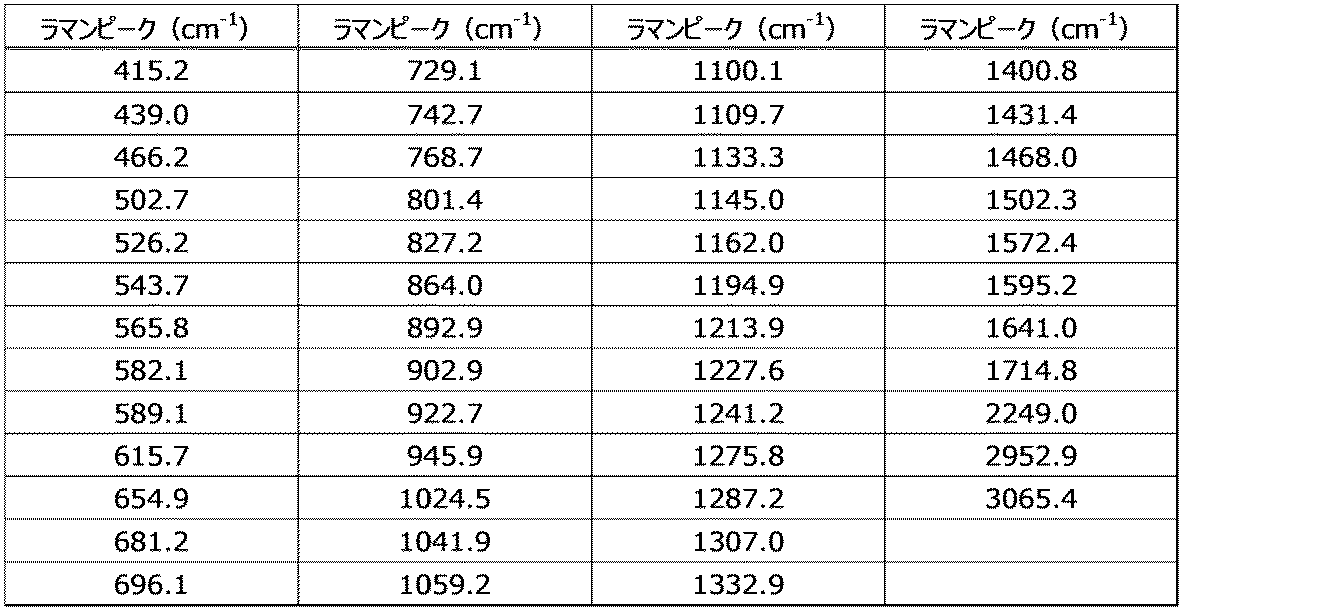
式(I)で示される化合物の無水物結晶は、ラマンスペクトルにおいて、415.2cm-1±2cm-1、502.7cm-1±2cm-1、1431.4cm-1±2cm-1、1714.8cm-1±2cm-1、及び3065.4cm-1±2cm-1に特徴的なピークを示した。
実施例2Aで用いた、粉砕前の式(I)で示される化合物の無水物結晶について、粒度分布を、試験例10の測定条件2に記載の方法で測定を行った。その結果、D10は1.16μm、D50 は4.42μm、D90は13.13μmであった。粒度分布を図7に示す。
実施例2Aで得られた、粉砕後の式(I)で示される化合物の無水物結晶について、粒度分布を、試験例10の測定条件1に記載の方法で測定を行った。
その結果、D10は0.79μm、D50は2.90μm、D90は7.32μmであった。粒度分布を図8に示す。
式(I)で示される化合物の酢酸エチル和物結晶を調製し、各結晶について、NMR測定、粉末X線回折実験、単結晶構造解析、示差走査熱量測定(DSC)、示差熱-熱重量同時測定(TG/DTA)、水分吸脱着等温線測定法(DVS)、ラマンスペクトルの測定、粒度分布の測定を行った。
実施例1記載の、化合物6(800mg、1.880mmol)、6,6-ジフルオロ-2-アザスピロ[3.3]ヘプタン トリフルオロ酢酸塩(557mg、2.256mmol)をDMF(8.0mL)に溶解させ、N,N-ジイソプロピルエチルアミン(985μL、5.64mmol)を加えた後、60℃で2時間撹拌した。反応液に水を加え、酢酸エチルで抽出した。有機層を水、次いで飽和食塩水で洗浄し、硫酸マグネシウムで乾燥し、ろ過した。ろ液を減圧下にて溶媒を留去した後、シリカゲルカラムクロマトグラフィーに付した。ヘキサン/酢酸エチルにて溶出させて後、所望の化合物を含む画分を集めた。溶媒を減圧下濃縮した後、ジイソプロピルエーテルを加え、析出した固体を濾取した。得られた残渣を減圧下乾燥し、化合物(I)(954mg、1.563mmol、収率83%)を得た。
上記(化合物の同定方法)に記載の方法で、NMR測定を行った。NMRチャートにおいて、酢酸エチルのピークが認められた。
1H-NMR (DMSO-D6)δ:1.18(3H,t ,J=7.0Hz),1.99(3H,s),2.79(4H,t,J=12.4Hz),4.03-4.06(6H,m),4.82(2H,s),7.21(1H,s),7.39-7.42(2H,m),7.96(1H,s),8.46(1H,s),8.69(1H,s).
LC/MS(ESI):m/z=522、RT=2.30min、LC/MS測定条件B
実施例3Aの方法で調製した試料について、上記試験例3記載の測定条件1で粉末X線回折実験を行った。その結果、実施例3Aの方法で調製した試料は、式(I)で示される化合物の無水物結晶とは異なる結晶であることを確認した。
実施例3AのNMR測定、及び実施例3Bの結果より、実施例3Aの方法で調製した試料は「式(I)で示される化合物の酢酸エチル和物結晶」であると推定した。
式(I)で示される化合物の酢酸エチル和物結晶について、上記試験例5に記載の方法で、単結晶回折実験及び解析を行った。その結果、式(I)で示される化合物、酢酸エチルの存在モル比が1:1の酢酸エチル和物結晶であることを確認した。なお、式(I)で示される化合物の一部は、ディスオーダー構造をとっていた。
室温で終夜風乾を行った、式(I)で示される化合物の酢酸エチル和物結晶について、上記(化合物の同定方法)に記載の方法で、NMR測定を行った。1H-NMRの結果を図9に示す。
NMRチャートにおいて、酢酸エチルのピークが認められた。1H-NMRの積分比から、式(I)で示される化合物、酢酸エチルの存在モル比は、約1:1であった。当該結晶は、測定前に室温で風乾を行っているため、結晶表面に酢酸エチルが付着しているのではなく、結晶格子に酢酸エチルが内包された、酢酸エチル和物結晶と推定した。この結果は、実施例3Cの単結晶構造解析とも一致した。
式(I)で示される化合物の酢酸エチル和物結晶について、以下条件で粉砕を行った。
装置:Hosokawa/ALPINE SPIRAL JET MILL50AS (ホソカワミクロン株式会社)
供給方法:手動
供給速度:30.15g/25分
粉砕圧:0.10MPa
供給圧:0.20MPa
粉砕後の式(I)で示される化合物の酢酸エチル和物結晶について、上記試験例3記載の測定条件1で粉末X線回折実験を行った。当該粉末X線回折パターンを図10に、粉末X線回折パターンのピークリストを図11に示す。
粉末X線回折パターンにおいて、回折角度(2θ):6.9°±0.2°、8.8°±0.2°、11.2°±0.2°、13.1°±0.2°、13.6°±0.2°、13.9°±0.2°、16.3°±0.2°、17.6°±0.2°、18.6°±0.2°、19.0°±0.2°、19.8°±0.2°、20.1°±0.2°、20.6°±0.2°、20.9°±0.2°、21.2°±0.2°、21.7°±0.2°、22.1°±0.2°、22.6°±0.2°、22.9°±0.2°、23.7°±0.2°、24.5°±0.2°、25.1°±0.2°、25.4°±0.2°、25.7°±0.2°、26.7°±0.2°、27.0°±0.2°、27.4°±0.2°、28.0°±0.2°、28.7°±0.2°及び29.7°±0.2°にピークが認められた。
式(I)で示される化合物の酢酸エチル和物結晶は、粉末X線回折パターンにおいて、回折角度(2θ):6.9°±0.2°、8.8°±0.2°、13.1°±0.2°、13.6°±0.2°、16.3°±0.2°、17.6°±0.2°、18.6±0.2°、20.9±0.2°、21.7±0.2°及び23.7°±0.2°に特徴的なピークを示した。
式(I)で示される化合物の酢酸エチル和物結晶は、粉末X線回折パターンにおいて、回折角度(2θ):6.9°±0.2°、8.8°±0.2°、13.1°±0.2°、16.3°±0.2°及び23.7°±0.2°に特徴的なピークを示した。
粉砕後の式(I)で示される化合物の酢酸エチル和物結晶について、上記試験例6に記載の測定条件1でラマンスペクトル測定を行った。その結果を図12に示す。また、主なラマンピークを以下に示す。
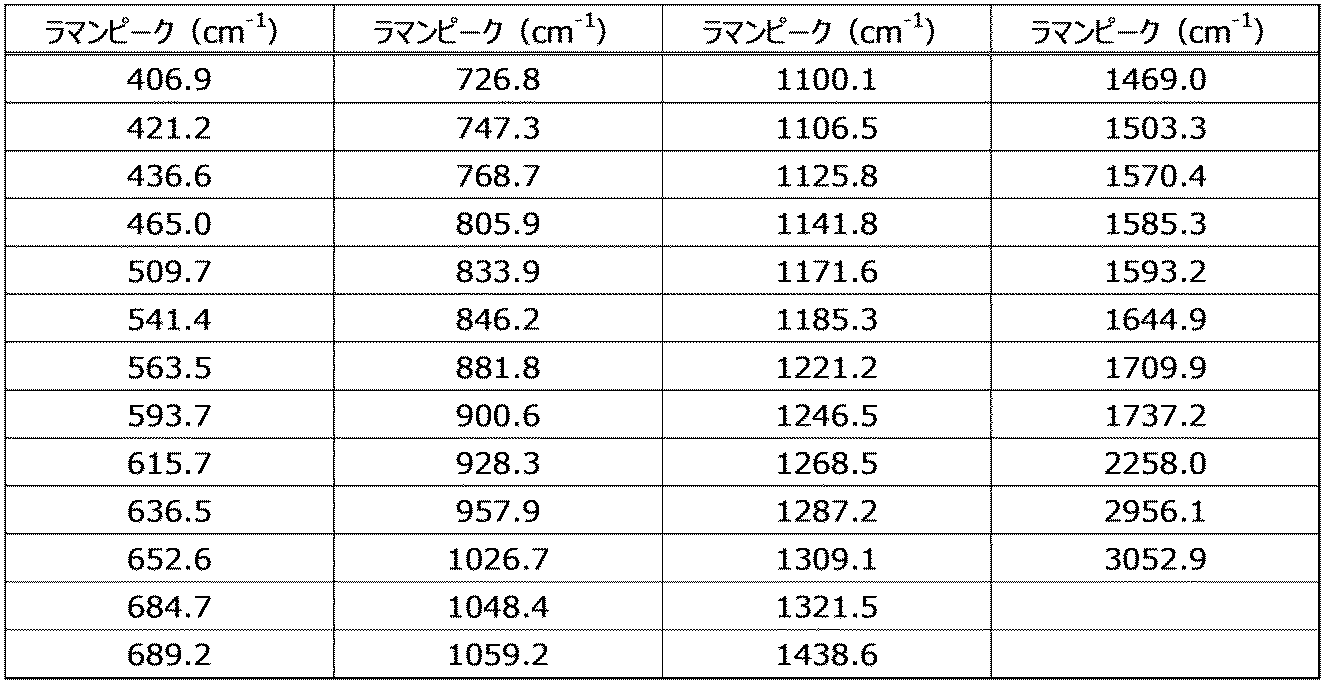
式(I)で示される化合物の酢酸エチル和物結晶は、ラマンスペクトルにおいて、421.2cm-1±2cm-1、509.7cm-1±2cm-1、1585.3cm-1±2cm-1、1709.9cm-1±2cm-1及び3052.9cm-1±2cm-1に特徴的なピークを示した。
式(I)で示される化合物の酢酸エチル和物結晶について、上記試験例8に記載の方法で測定を行った。その結果を図13に示す。オンセット温度が約129.5℃の吸熱ピークを示し、ほぼ同時に約14%の重量減少が確認された。この変化は、「式(I)で示される化合物の酢酸エチル和物結晶」から酢酸エチルが脱溶媒(脱離)したと考えられる。
なお、式(I)で示される化合物、酢酸エチルの存在モル比が1:1である「式(I)で示される化合物の酢酸エチル和物結晶」は、結晶中の酢酸エチルの理論含有量は14.4重量%であり、本熱重量測定(TG)の結果と概ね一致していた。
なお、当該試料について、上記試験例3記載の測定条件1で粉末X線回折実験を行ったが、粉末X線回折パターンは酷似していた。主なピークは±0.2°の範囲で一致しており、相対強度が若干異なっていた。
当該試料はいずれも、粉末X線回折パターンにおいて、回折角度(2θ):6.9°±0.2°、8.8°±0.2°、13.1°±0.2°、16.3°±0.2°及び23.7°±0.2°に特徴的なピークを示した。
実施例3Eで用いた、粉砕前の式(I)で示される化合物の酢酸エチル和物結晶の粒度分布を、試験例10の測定条件2に記載の方法で測定を行った。その結果、D10は18.73μm、D50 は71.82μm、D90は114.67μmであった。粒度分布を図14に示す。
実施例3Eで得られた、粉砕後の式(I)で示される化合物の酢酸エチル和物結晶について、粒度分布を、試験例10の測定条件1に記載の方法で測定を行った。
その結果、D10は0.68μm、D50は3.59μm、D90は8.80μmであった。粒度分布を図15に示す。
(2)のD10が0.86μm、D50が3.29μm、D90が10.15μmである粒子径の化合物を試験例12に示す液体クロマトグラフ法により、測定した際のクロマトグラムを図16に示す。式(I)で示される化合物は純度(pa%)99.58%で保持時間24.941分に検出された。
以下の方法、条件によって、液体クロマトグラフで類縁物質の量を測定した。
検出器:紫外吸光光度計(測定波長:247nm)
カラム:ACQUITY UPLC BEH C18(1.7μm、2.1×100mm、Waters)
カラム温度:40℃付近の一定温度
移動相A:水/ギ酸混液(1000:1)
移動相B:液体クロマトグラフィー用アセトニトリル/ギ酸混液(2000:1)
移動相の送液:移動相A及び移動相Bの混合比を以下のように変えて濃度勾配制御した。

注入量:5μL
サンプルクーラー温度:10℃付近の一定温度
ニードル洗浄溶媒又はオートインジェクタ―洗浄液:アセトニトリル
面積測定範囲:試料溶液注入後43分まで
式(I)で示される化合物の固体分散体を調製し、各固体分散体について、デジタルマイクロスコープによる観察、粉末X線回折実験、示差走査熱量測定(DSC)、粒度分布の測定、類縁物質の測定を行った。
式(I)で示される化合物の無水物結晶及び高分子を、アセトン、エタノール又はその混合液に溶解した後、スライドグラスに滴下した。溶媒蒸発により、固体分散体を得た。
式(I)で示される化合物の無水物結晶は、以下条件で粉砕し、粉砕品を使用した。
装置:Hosokawa/ALPINE SPIRAL JET MILL50AS (ホソカワミクロン株式会社)
供給方法:フィーダー
供給速度:60g/時間
粉砕圧:0.05MPa
供給圧:0.10MPa
粉砕後の式(I)で示される化合物の無水物結晶を試験例10の測定条件1に記載の方法で粒度分布を測定したところ、D10は0.78μm、D50は2.09μm、D90は4.77μmであった。
<固体分散体の調製>
固体分散体中の式(I)で示される化合物の含有率は、10重量%、25重量%及び50重量%で検討した。
高分子としては、コポビドン(ポリビニルピロリドン・酢酸ビニル共重合体、PVPVA)(BASF製)、ポリビニルピロリドン(ポビドン)(BASF製)、ヒプロメロース酢酸エステルコハク酸エステル(ヒドロキシプロピルメチルセルロースアセテートサクシネート)(信越化学工業製、グレードLF及びMF)、ヒプロメロースフタル酸エステル(信越化学工業製)、ヒドロキシプロピルセルロース(日本曹達製)及びメタクリル酸コポリマーL(エボニック製)を使用した。処方を以下に示す。
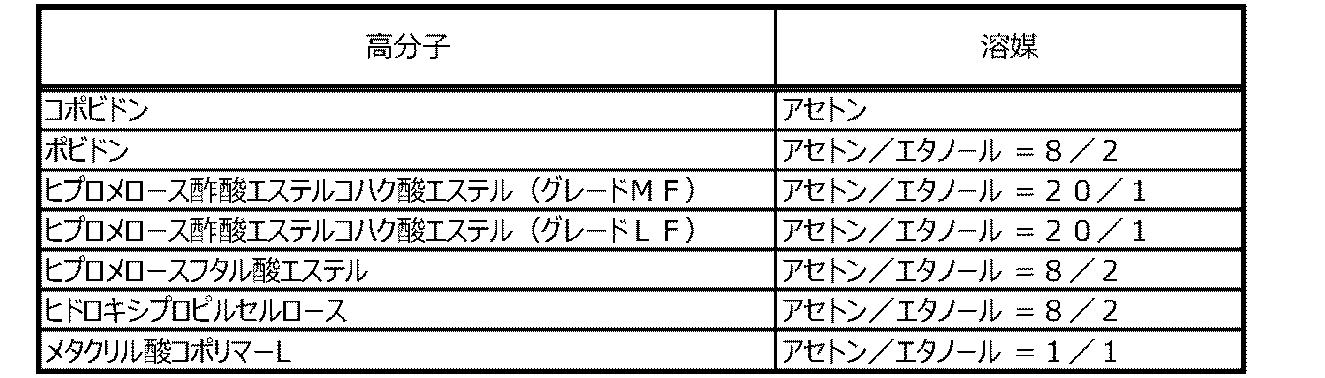
<結晶析出有無の評価>
スライドグラスに滴下した直後、40℃75%相対湿度環境下で1週間保管後、及び60℃環境下で1週間保管後について、デジタルマイクロスコープ(VHX-7000、(KEYENCE製)の偏光観察モードにて、結晶の析出有無を観察した。
その結果、ポリビニルピロリドンを用いた固体分散体は、式(I)で示される化合物の含有率が10重量%、25重量%、50重量%において、調製直後及び各条件での保管後、いずれも結晶の析出を認めず、良好であった。コポビドンを用いた固体分散体は、式(I)で示される化合物の含有率が10重量%及び25重量%において、調製直後及び各条件での保管後、いずれも結晶の析出を認めず、良好であった。
ヒプロメロース酢酸エステルコハク酸エステル(グレードびMF)を用いた固体分散体は、式(I)で示される化合物の含有率が10重量%及び25重量%において、調製直後及び各条件での保管後、いずれも100μm以上の粗大結晶の析出を認めず、良好であった。
式(I)で示される化合物の無水物結晶(実施例4Aの粉砕品)及び各高分子をアセトンに溶解し、完溶したことを確認後、スプレードライヤー(有機溶媒用スプレードライヤーアドバンス B-290型、BUCHI製)を用いて、入口温度90℃、送液ポンプ20%、窒素流量目盛40の条件で、固体分散体を製造した。
高分子としては、コポビドン(BASF製)、ポビドン(BASF製)、ヒプロメロース酢酸エステルコハク酸エステル(信越化学工業製、グレードMF及びLF)を使用した。固体分散体中の式(I)で示される化合物の含有率は25重量%とした。処方を以下に示す。

実施例4Bで得られた固体分散体について、調製直後、40℃75%相対湿度環境下でガラスボトル開栓1週間保管後、40℃75%相対湿度環境下でガラスボトル閉栓下1週間保管後、及び60℃環境下でガラスボトル閉栓1週間保管後に、上記試験例3記載の測定条件1で粉末X線回折実験を行った。
実施例4B-1の結果を図17、実施例4B-2の結果を図18、実施例4B-3の結果を図19、実施例4B-4の結果を図20に示す。実施例4Bで得られた各固体分散体は、調製直後、各条件での保管後、いずれも回折ピークを示さず、ハローパターンのみを示した。当該固体分散体は、いずれも非晶質を維持していることを確認した。
なお、式(I)で示される化合物の無水物結晶単体は、上記実施例2Bに記載の通り、良好な粉末X線回折パターンを示した。
式(I)で示される化合物の無水物結晶及びコポビドン(ASHLAND製)をアセトンに溶解し、完溶したことを確認後、スプレードライヤーを用いて出口温度50℃、フィード流量約6kg/時間、噴霧圧1.0barの条件で噴霧乾燥を実施した。その後、卓上型真空乾燥機で約40時間真空乾燥して、固体分散体を得た。以下に処方を示す。

実施例4D-1の固体分散体について、試験例10記載の測定条件3(乾式法)で粒度分布を測定したところ、D10は2.08μm、D50は5.01μm、D90は11.00μmであった。
実施例4D-1で用いた、式(I)で示される化合物の無水物結晶について、試験例10記載の測定条件3(乾式法)で粒度分布を測定したところ、D10は0.86μm、D50は3.29μm、D90は10.15μmであった。また、実施例4D-1で用いた、式(I)で示される化合物の無水物結晶について、試験例11(湿式法)で粒度分布を測定したところ、D10は3.94μm、D50は9.18μm、D90は20.32μmであった。
実施例4Dで得られた固体分散体を、25℃60%相対湿度環境下で3箇月、40℃75%相対湿度環境下で3箇月保管し、類縁物質の増加量を測定した。
以下の方法、条件によって、液体クロマトグラフィーで類縁物質の量を測定した。
検出器:紫外吸光光度計(測定波長:247nm)
カラム:ACQUITY UPLC BEH C18(1.7μm、2.1×100mm、Waters)
カラム温度:40℃付近の一定温度
移動相A:水/ギ酸混液(1000:1)
移動相B:液体クロマトグラフィー用アセトニトリル/ギ酸混液(2000:1)
移動相の送液:移動相A及び移動相Bの混合比を、以下のように変えて濃度勾配制御した。
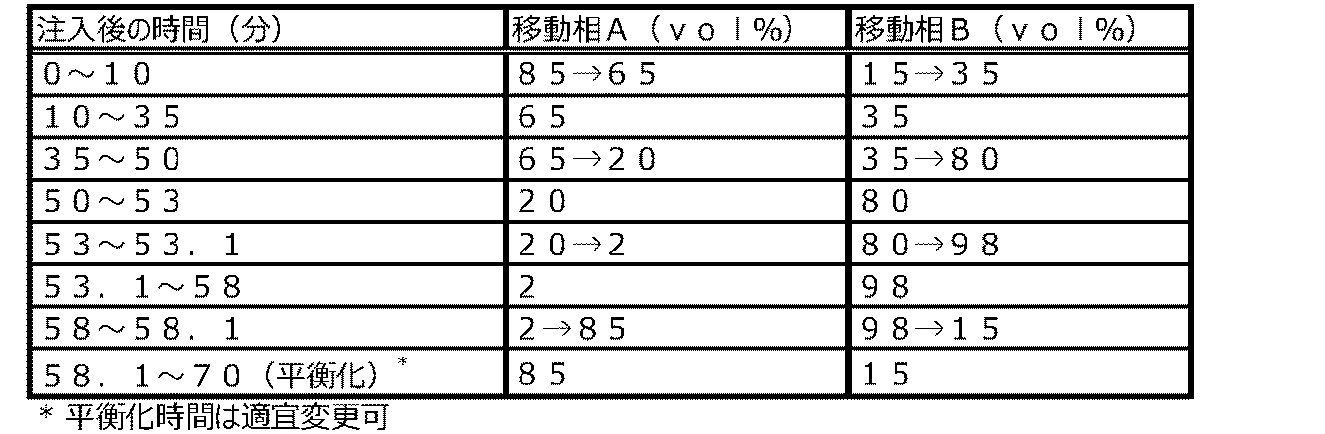
流量:0.4mL/分
注入量:5μL
サンプルクーラー温度:25℃付近の一定温度
ニードル洗浄溶媒又はオートインジェクタ―洗浄液:アセトニトリル
面積測定範囲:試料溶液注入後53分まで

実施例4Dで得られた固体分散体、及び式(I)で示される化合物の無水物結晶単体の溶解度を測定した。
実施例4Dで得られた固体分散体、及び式(I)で示される化合物の無水物結晶単体(実施例4F-1)を各種試験液に加えて30~50mLの懸濁液を調製した。調製した懸濁液を遠沈管にいれ、振盪速度100rpm以上の条件で振盪した。振盪開始60分後で5mL採取し、速やかにフィルター(クロマトディスク0.45μm、25A)でろ過して検体とした。

式(I)で示される化合物の無水物結晶単体及びコポビドンからなる固体分散体の懸濁剤を製造し、ラットにおける経口吸収性を評価した。
雄ラットに対して給餌を行った後、検体を経口投与した。なお、式(I)で示される化合物の投与量が3mg/kg体重になるように、懸濁剤の投与量を調整した。
以下に示す、実施例4G-1、実施例4G-2及び実施例4G-3を投与した後、各採血時間において採血を行い、LC/MS/MSを用いて最大血漿中薬物濃度(Cmax)、最高血漿中薬物濃度到達時間(Tmax)及び投与時から24時間後までの血漿中薬物濃度-時間曲線下面積(AUC)を算出した。
<実施例4G-1:式(I)で示される化合物の固体分散体の懸濁液の調製>
式(I)で示される化合物及びコポビドン(ASHLAND製)を重量比1:3で、アセトンに溶解し、完溶したことを確認後、スプレードライヤーを用いて出口温度50℃、フィード流量約6kg/時間、噴霧圧1.0barの条件で噴霧乾燥を実施した。卓上型真空乾燥機で約40時間真空乾燥し、固体分散体を得た。
得られた固体分散体を0.5%のメチルセルロースを含む水溶液に6mg/mLになるように懸濁することにより、懸濁液を得た。
<実施例4G-2:式(I)で示される化合物の無水物結晶の懸濁液の調製>
式(I)で示される化合物の無水物結晶を、0.5%のメチルセルロースを含む水溶液に6mg/mLになるように懸濁することにより、懸濁液を得た。
<実施例4G-3:式(I)で示される化合物の酢酸エチル和物結晶の懸濁液の調製>
式(I)で示される化合物の酢酸エチル和物結晶を、0.5%のメチルセルロースを含む水溶液に6mg/mLになるように懸濁することにより、懸濁液を得た。

実施例4G-1は、実施例4G-2及び4G-3に対して、Cmax及びAUCが増加し、経口吸収性が顕著に改善した。また、実施例4G-1は、実施例4G-2及び4G-3に対して、Tmaxが短くなり、速やかな吸収性を示した。
以下に、「式(I)で示される化合物の無水物結晶を有効成分として含有する製剤」の製造方法及び評価結果を示す。
式(I)で示される化合物の無水物結晶を50重量%、崩壊剤を5重量%含有する素錠を製造し、溶出試験を実施した。
<素錠の製造方法>
式(I)で示される化合物の無水物結晶、D-マンニトール(ROQUETTE製)、結晶セルロース(Asahikasei製)、クロスカルメロースナトリウム(Dupont製)、低置換度ヒドロキシプロピルセルロース(信越化学工業製)、デンプングリコール酸ナトリウム(JRS Pharma製)、クロスポビドン(グレードCLM及びグレードCL、BASF製)、ステアリン酸マグネシウム(MALLINCKRODT製)を使用した。以下に処方を示す(単位はmgである)。
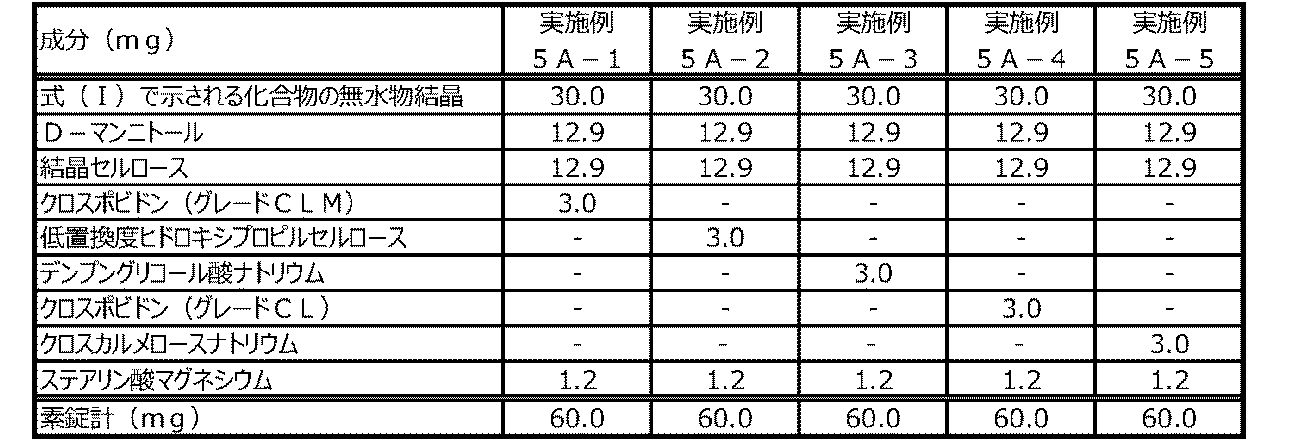
式(I)で示される化合物の無水物結晶、賦形剤、崩壊剤及び半量のステアリン酸マグネシウムをスパーテルで混合し、金網で篩過した。その後、簡易錠剤成形機(型式:HANDTAB-200、市橋精機株式会社製)により打錠した。その後、20メッシュ篩で整粒し、残りのステアリン酸マグネシウムを加えてスパーテルで混合した。得られた打錠用顆粒を簡易錠剤成形機(型式:HANDTAB-200、市橋精機株式会社製)により打錠し、素錠を得た。
試験例16:溶出試験
各実施例で得られた製剤(錠剤の場合は1錠)について、第18改正日本薬局方溶出試験法にて、溶出試験を実施した。試験液には界面活性剤を含有した溶出試験第2液を使用し、パドル法、パドル回転数50rpm(試験開始120分後に250rpmに変更)で実施した。
式(I)で示される化合物の無水物結晶を50重量%、崩壊剤を10重量%含有する素錠を製造し、溶出試験を実施した。
<素錠の製造方法>
実施例5Aと同様の方法で製造した。以下に処方を示す。
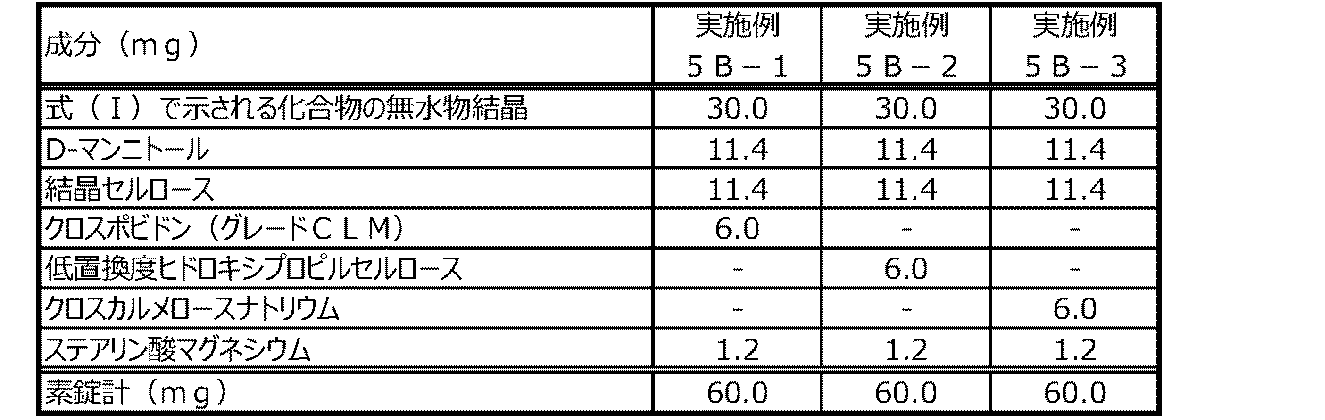
溶出試験は試験例16を実施した。その結果、実施例5B-1、実施例5B-2及び実施例5B-3(崩壊剤の配合比率10重量%)は、実施例5A-1、実施例5A-2及び実施例5A-5(崩壊剤の配合比率5重量%)と比較して、いずれの崩壊剤も溶出速度が向上した。また、崩壊剤にクロスポビドンを用いた実施例5B-1が最も速やかな溶出性を示した。
式(I)で示される化合物の無水物結晶を10重量%、崩壊剤を10重量%含有する素錠を製造し、溶出試験を実施した。
<素錠の製造方法>
式(I)で示される化合物の無水物結晶、D-マンニトール(ROQUETTE製)、結晶セルロース(Asahikasei製)、クロスポビドン(グレードINF-10、ASHLAND製)、クロスカルメロースナトリウム(Dupont製)、フマル酸ステアリルナトリウム(JRS Pharma製)を使用した。
製造方法は、実施例5A及び実施例5Bと同様の方法で実施した。以下に処方を示す。

溶出試験は試験例16を実施した。その結果、崩壊剤としてクロスポビドンを用いた実施例5C-1が良好な溶出性を示した。従って、式(I)で示される化合物の無水物結晶の配合比率10~50重量%において、崩壊剤にはクロスポビドンが最適であると考えられる。
式(I)で示される化合物の無水物結晶を含有する懸濁剤を調製した。当該懸濁剤及び上記実施例5C-1(式(I)で示される化合物の無水物結晶を含有する素錠)について、溶出試験を実施した。
<懸濁剤の調整方法>
式(I)で示される化合物の無水物結晶、ヒドロキシプロピルセルロース(日本曹達製
)及び酸化チタン(Merck製)をスパーテルにて混合した後、少量の注射用水(大塚製薬工場製)を加えながら、スパーテルを用いて練合した。その後、超音波照射を実施しながら残りの注射用水を加え、懸濁剤を得た。以下に処方を示す。

溶出試験は試験例16を実施した。実施例5C-1及び実施例5D-1の溶出試験結果を図21示す。その結果、実施例5C-1(素錠)は、実施例5D-1(懸濁液)と比較して速やかな溶出を示した。
光安定化物質の影響を調べるために、式(I)で示される化合物の無水物結晶を含有する素錠に光安定化物質および高分子を被覆して、製剤中の類縁物質量および外観性状を評価した。当該素錠及び錠剤について、加温加湿環境下における安定性試験を実施し、それぞれ溶出性を評価した。
<錠剤の製造方法>
式(I)で示される化合物の無水物結晶、D-マンニトール(ROQUETTE製)、結晶セルロース(Asahikasei製)、クロスポビドン(グレードINF-10、ASHLAND製)及び半量のフマル酸ステアリルナトリウム(JRS Pharma製)について、ポリエチレン袋による混合を行い、30メッシュの篩で篩過を実施した。その後、ローラーコンパクターを用いてロール圧7MPa、ロール回転数約4rpm、スクリュー回転数約30rpmの条件で造粒した。その後、整粒機を用いて回転数約1800rpmで整粒を実施した。得られた整粒顆粒及び半量のフマル酸ステアリルナトリウムを混合機にて5分間混合した後、ロータリー型打錠機を用いて回転盤回転数20~30rpmで打錠し、素錠を製造した。
その後、コーティング機を用いて、給気風量0.80m3/min、給気温度設定値60℃、液流量2.0~2.9g/min、スプレー噴霧圧約0.18MPa、スプレー空気量約50NL/minの条件でコーティングを実施して、実施例5E-1の錠剤を得た。光安定化物質としてはタルク、三二酸化鉄及び黄色三二酸化鉄を、高分子としてはヒプロメロースを用いた。以下に処方を示す。
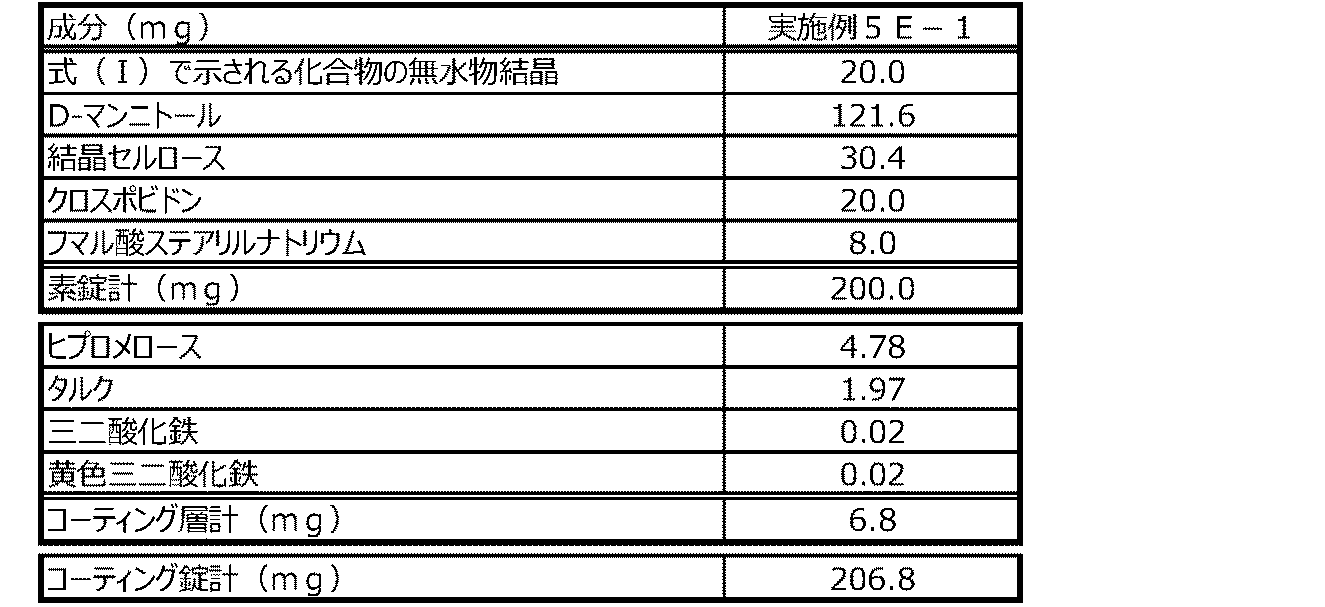
実施例5E-1の錠剤を、40℃75%相対湿度環境下でポリエチレン瓶閉栓1箇月保管、及び40℃75%相対湿度環境下でポリエチレン瓶閉栓3箇月保管した。試験開始時、及び各環境で保管後について、試験例16の方法で溶出試験を実施した。
結果を図22示す。加温加湿環境下で3箇月間保管した場合においても、溶出率が低下しないことを確認した。
式(I)で示される化合物の無水物結晶を含有する素錠(上記、実施例5C-1)及び安定化物質及び高分子を被覆した錠剤(上記、実施例5E-1)に、総照射光量として120万lux・hrの光を照射し、試験開始時及び120万lux・hr光照射後の、製剤中の類縁物質量及び外観性状を評価した。類縁物質量としては、相対保持時間0.84及び総類縁物質量を測定した。また、外観性状は目視にて評価した。
以下の方法、条件によって、液体クロマトグラフで類縁物質の量を測定した。
検出器:紫外吸光光度計(測定波長:247nm)
カラム:ACQUITY UPLC BEH C18(1.7μm、2.1×100mm、Waters)
カラム温度:40℃付近の一定温度
移動相A:水/ギ酸混液(1000:1)
移動相B:液体クロマトグラフィー用アセトニトリル/ギ酸混液(2000:1)
移動相の送液:移動相A及び移動相Bの混合比を以下のように変えて濃度勾配制御した。
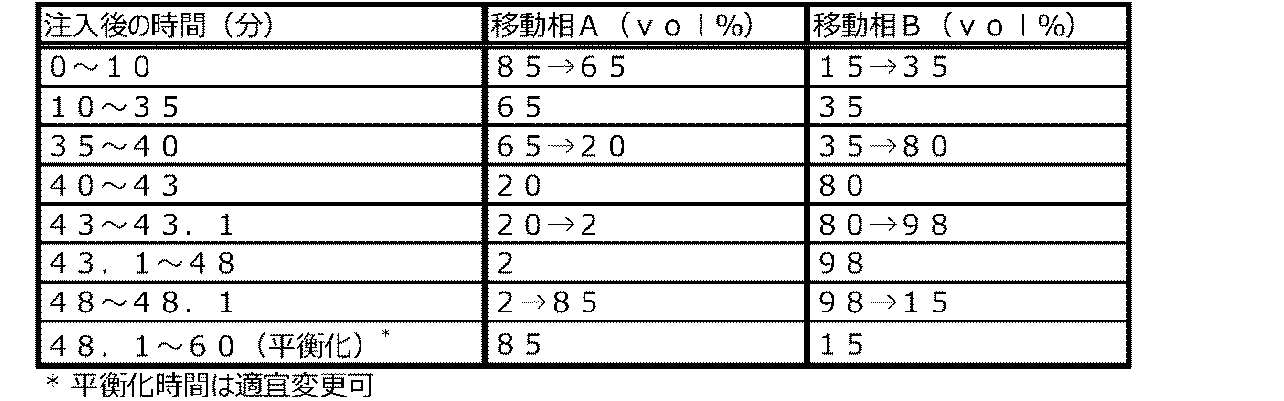
流量:0.4mL/min
注入量:5μL
サンプルクーラー温度:25℃付近の一定温度
ニードル洗浄溶媒又はオートインジェクタ―洗浄液:アセトニトリル
面積測定範囲:試料溶液注入後43分まで

試験開始時及び120万lux・hrの光照射後について、総類縁物質量を以下に示す。

総照射光量として120万lux・hrの光照射後について、実施例5E-1は、実施例5C-1と比較して、相対保持時間0.84の類縁物質量及び総類縁物質量が顕著に抑制されていた。また、総照射光量として120万lux・hrの光照射後の外観性状について、実施例5C-1は照射前と比較して黄色く変色したが、実施例5E-1は照射前と比較して外観変化を認めなかった。
式(I)で示される化合物の無水物結晶を含有する顆粒をカプセルに充てんし、カプセル剤を調製した。カプセル剤及び素錠中の類縁物質量を評価した。類縁物質量としては相対保持時間0.98及び総類縁物質量を測定した。
<カプセル剤及び素錠の製造方法>
式(I)で示される化合物の無水物結晶、D-マンニトール(ROQUETTE製)、結晶セルロース(Asahikasei製)、クロスカルメロースナトリウム(Dupont製)及び半量のステアリン酸マグネシウム(MALLINCKRODT製)をスパーテルで混合し、金網で篩過した。その後、簡易錠剤成形機(型式:HANDTAB-200、市橋精機株式会社製)により打錠した。その後、20メッシュ篩で整粒し、半量のステアリン酸マグネシウムを加えてスパーテルで混合し、顆粒を得た。
当該顆粒を、ヒプロメロースカプセル(クオリカプス製)にスパーテルを用いて手動で充てんし、実施例5F-1のカプセル剤を調製した。また、当該顆粒を簡易錠剤成形機(型式:HANDTAB-200、市橋精機株式会社製)により打錠し、実施例5F-2の素錠を調製した。各処方を以下に示す。
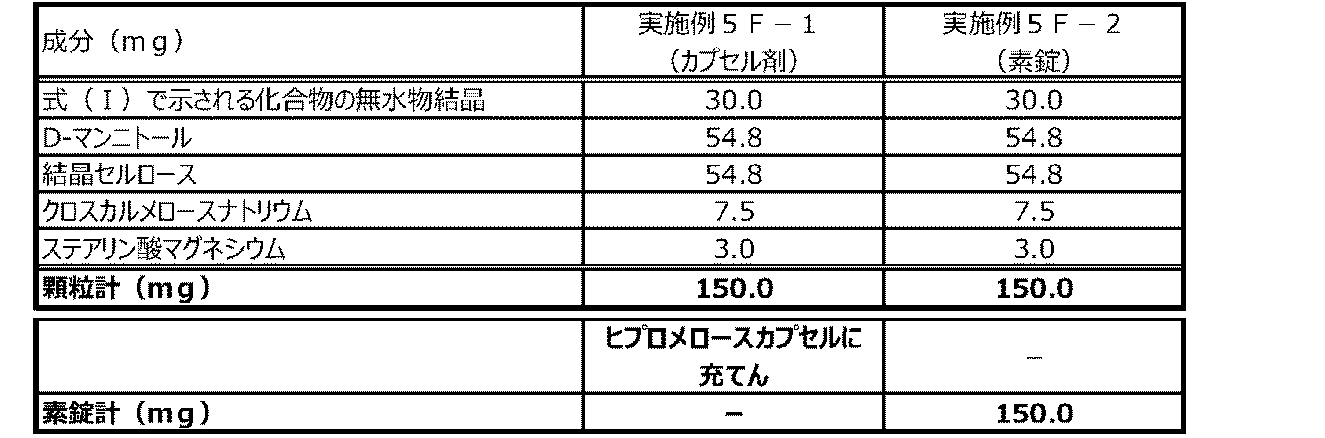
以下の方法、条件によって、液体クロマトグラフで類縁物質の量を測定した。
検出器:紫外吸光光度計(測定波長:254nm)
カラム:ACQUITY UPLC BEH C18(1.7μm、2.1×100mm、Waters)
カラム温度:40℃付近の一定温度
移動相A:水/トリフルオロ酢酸混液(1000:1)
移動相B:液体クロマトグラフィー用アセトニトリル
移動相の送液:移動相A及び移動相Bの混合比を、以下のように変えて濃度勾配制御した。

流量:0.3mL/min
注入量:4μL
サンプルクーラー温度:10℃付近の一定温度
ニードル洗浄溶媒:メタノール
試験開始時及び120万lux・hrの光照射後について、相対保持時間0.98の類縁物質量を以下に示す。

試験開始時及び120万lux・hrの光照射後について、総類縁物質量を以下に示す。

実施例5F-1は、実施例5F-2と比較して、相対保持時間0.98の類縁物質量及び総類縁物質量が顕著に抑制されたことを確認した。カプセル充てんによる遮光効果を確認した。
式(I)で示される化合物の固体分散体を含有する製剤の処方検討を以下に示す。
式(I)で示される化合物の固体分散体を含有する素錠を製造し、溶出試験を実施した。
<素錠の製造方法>
式(I)で示される化合物の無水物結晶及びコポビドンをアセトンに溶解し、完溶したことを確認後、スプレードライヤーを用いて出口温度50℃、フィード流量約6kg/hr、噴霧圧1.0barの条件で噴霧乾燥を実施した。その後、卓上型真空乾燥機で約40時間真空乾燥して、固体分散体を得た。
得られた固体分散体、D-マンニトール(ROQUETTE製)、結晶セルロース(Asahikasei製)、クロスカルメロースナトリウム(Dupont製)又はクロスポビドン(ASHLAND製)、軽質無水ケイ酸 (Cabot製)及び半量のフマル酸ステアリルナトリウム(JRS Pharma製)をスパーテルで混合し、金網で篩過した。その後、簡易錠剤成形機(型式:HANDTAB-200、市橋精機株式会社製)により打錠した。その後、20メッシュ篩で整粒し、半量のフマル酸ステアリルナトリウムを加えてスパーテルで混合した。得られた顆粒を簡易錠剤成形機 (型式:HANDTAB-200、市橋精機株式会社製)により打錠し、素錠を得た。以下に処方を示す。
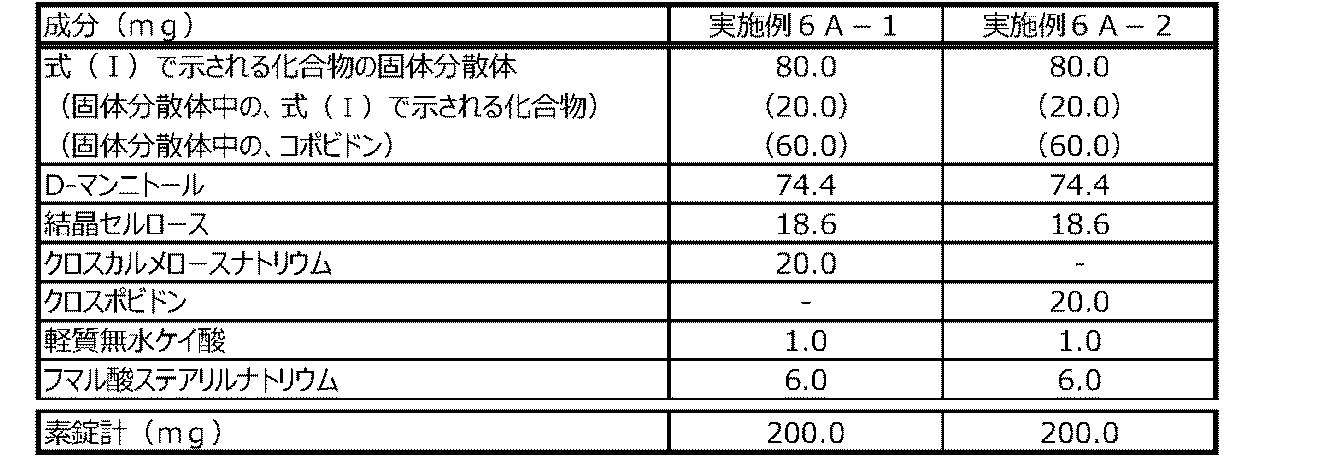
溶出試験は試験例16を実施した。その結果、クロスカルメロースナトリウムを用いた実施例6A-1が良好な溶出性を示した。従って、固体分散体を含有する錠剤については、崩壊剤はクロスカルメロースナトリウムが適していると考えられる。
式(I)で示される化合物の固体分散体を含有する素錠に、光安定化物質及び高分子を被覆して錠剤を製造した。当該錠剤について、加温加湿環境下における安定性試験を実施した。
<錠剤の製造方法>
式(I)で示される化合物の無水物結晶及びコポビドンをアセトンに溶解し、完溶したことを確認後、スプレードライヤーを用いて出口温度50℃、フィード流量約6kg/hr、噴霧圧1.0barの条件で噴霧乾燥を実施した。その後、卓上型真空乾燥機で約40時間真空乾燥して、固体分散体を得た。
得られた固体分散体を、D-マンニトール(ROQUETTE製)、結晶セルロース(Asahikasei製)、クロスカルメロースナトリウム(Dupont製)、軽質無水ケイ酸 (Cabot製)及び半量のフマル酸ステアリルナトリウム(JRS Pharma製)と混合機にて8分間混合し、30メッシュの篩で篩過した。その後、ローラーコンパクターを用いてロール圧7MPa、ロール回転数約4rpm、スクリュー回転数約40rpmの条件で乾式造粒した。その後、整粒機を用いて回転数約3000rpmで乾式整粒を実施した。得られた整粒顆粒及び半量のフマル酸ステアリルナトリウムを混合機にて5分間混合した後、ロータリー型打錠機を用いて、回転盤回転数約30rpmで素錠を製造した。
その後、コーティング機を用いて、給気風量0.80m3/min、給気温度設定値60℃、液流量2.0~2.9g/min、スプレー噴霧圧約0.18MPa、スプレー空気量約50NL/minの条件でコーティングを実施し、錠剤を得た。以下に処方を示す。

実施例6B-1の錠剤を、60℃加温下で褐色ガラス瓶閉栓2週間、40℃下で褐色ガラス瓶閉栓1箇月間、及び40℃75%相対湿度環境下で褐色ガラス瓶閉栓1箇月間保管した。試験開始時、各環境で保管後について、試験例16の方法で溶出試験を実施した。
結果を図23示す。いずれの条件での保管後も溶出率が低下しないことを確認した。
式(I)で示される化合物及びコポビドンからなる固体分散体の含有量が実施例6B-1とは異なる素錠を製造し、光安定化物質及び高分子で被覆して錠剤を製造した。当該錠剤について、加温加湿環境下における安定性試験を実施した。
<錠剤の製造方法>
式(I)で示される化合物の無水物結晶及びコポビドンをアセトンに溶解し、完溶したことを確認後、スプレードライヤーを用いて出口温度50℃、フィード流量約80kg/hr、噴霧圧2.5barの条件で噴霧乾燥を実施した。その後、回転型真空乾燥機で約37時間真空乾燥して、固体分散体を得た。
得られた固体分散体を、D-マンニトール(ROQUETTE製)、結晶セルロース(Asahikasei製)、クロスカルメロースナトリウム(Dupont製)、軽質無水ケイ酸 (Cabot製)及び半量のフマル酸ステアリルナトリウム(JRS Pharma製)と混合機にて15分間混合し、穴径1.6mmのスクリーンを用いて篩過した。その後、ローラーコンパクターを用いてロール圧5MPa、ロール回転数約5rpm、スクリュー回転数約5rpmの条件で乾式造粒した。その後、整粒機を用いて回転数約100rpmで乾式整粒を実施した。得られた整粒顆粒及び半量のフマル酸ステアリルナトリウムを混合機にて3分間混合した後、ロータリー型打錠機を用いて、回転盤回転数約20rpmで素錠を製造した。
その後、コーティング機を用いて、給気風量12m3/min、給気温度設定値60℃、液流量40~80g/min、スプレー噴霧圧約0.4MPa、スプレー空気量約130NL/minの条件でコーティングを実施し、錠剤を得た。以下に処方を示す。

実施例6B-2の錠剤を、60℃加温下で褐色ガラス瓶閉栓2週間、40℃下で褐色ガラス瓶閉栓1箇月間、及び40℃75%相対湿度環境下で褐色ガラス瓶閉栓1箇月間保管した。試験開始時、各環境で保管後について、下記の方法で溶出試験を実施した。
(溶出試験法)
各錠剤1錠を、第18改正日本薬局方溶出試験法にて溶出試験を実施した。試験液には溶出試験第2液を使用し、パドル法、パドル回転数50rpmで実施した。
結果を図24示す。いずれの条件での保管後も溶出率が低下しないことを確認した。
式(I)で示される化合物の無水物結晶及びコポビドンからなる固体分散体の配合比率が実施例6B-1とは異なる素錠を、2種製造した。各素錠を光安定化物質及び高分子で被覆し、錠剤を製造した。当該錠剤について、加温加湿環境下における安定性試験を実施した。
<錠剤の製造方法>
式(I)で示される化合物の無水物結晶及びコポビドンをアセトンに溶解し、完溶したことを確認後、スプレードライヤーを用いて入口温度90℃、送液ポンプ20%、窒素流量目盛40の条件で、固体分散体を得た。
得られた固体分散体、D-マンニトール(ROQUETTE製)、結晶セルロース(Asahikasei製)、クロスカルメロースナトリウム(Dupont製)及び半量のフマル酸ステアリルナトリウム(JRS Pharma製)をスパーテルで混合し、金網で篩過した。その後、簡易錠剤成形機(型式:HANDTAB-200、市橋精機株式会社製)により打錠した。その後、20メッシュ篩で整粒し、半量のフマル酸ステアリルナトリウムを加えてスパーテルで混合した。得られた打錠用顆粒を簡易錠剤成形機(型式:HANDTAB-200、市橋精機株式会社製)により打錠した後、コーティング機(パウレック性)を用いてコーティングを実施し、錠剤を得た。以下に処方を示す。

実施例6C-1及び実施例6C-2の錠剤を、60℃加温環境下で褐色ガラス瓶閉栓1週間及び40℃75%相対湿度環境下で褐色ガラス瓶閉栓1週間保管し、溶出試験を実施した。溶出試験は試験例16を実施した。
実施例6C-1の結果を図25に、実施例6C-2の結果を図26に示す。60℃加温環境下でガラス瓶閉栓1週間及び40℃75%相対湿度環境下でガラス瓶閉栓1週間保管した場合において、溶出率が低下しないことを確認した。
式(I)で示される化合物の無水物結晶及びコポビドンからなる固体分散体を含有する素錠、及び素錠に光安定化物質及び高分子を被覆した錠剤を製造した。当該素錠及び錠剤について、総照射光量として120万lux・hrの光を照射し、試験開始時及び120万lux・hr光照射後の、製剤中の類縁物質量及び外観性状を評価した。
<素錠及び錠剤の製造方法>
式(I)で示される化合物の無水物結晶及びコポビドンをアセトンに溶解し、完溶したことを確認後、出口温度50℃、フィード流量約6kg/hr、噴霧圧1.0barの条件で噴霧乾燥を実施した。その後、卓上型真空乾燥機で約40時間真空乾燥して、固体分散体を得た。
得られた固体分散体、D-マンニトール(ROQUETTE製)、結晶セルロース(Asahikasei製)、クロスカルメロースナトリウム(Dupont製)、軽質無水ケイ酸 (Cabot製)及び半量のフマル酸ステアリルナトリウム(JRS Pharma製)を混合機にて8分間混合ならびに30メッシュの篩で篩過した。その後、ローラーコンパクターを用いてロール圧7MPa、ロール回転数約4rpm、スクリュー回転数約40rpmの条件で乾式造粒した。その後、整粒機を用いて回転数約3000rpmで乾式整粒を実施した。得られた整粒顆粒及び半量のフマル酸ステアリルナトリウムを混合機にて5分間混合した後、ロータリー型打錠機を用いて、回転盤回転数約30rpmで素錠(実施例6D-1)を製造した。
実施例6D-2については、その後、コーティング機を用いて、給気風量0.80m3/min、給気温度設定値60℃、液流量2.0~2.9g/min、スプレー噴霧圧約0.18MPa、スプレー空気量約50NL/minの条件でコーティングを実施し、錠剤を得た。以下に処方を示す。

試験開始時及び120万lux・hrの光照射後について、相対保持時間1.59の類縁物質量を以下に示す。

試験開始時及び120万lux・hrの光照射後について、総類縁物質量を以下に示す。

総照射光量として120万lux・hrの光照射後について、実施例6D-2は、実施例6D-1と比較して、相対保持時間1.59の類縁物質量及び総類縁物質量が顕著に抑制されていた。また、総照射光量として120万lux・hrの光照射後の外観性状について、実施例6D-1は照射前と比較して黄色く変色したが、実施例6D-2は照射前と比較して外観変化を認めなかった。
式(I)で示される化合物の無水物結晶及びコポビドンからなる固体分散体の含有量が実施例6Dとは異なる素錠、および素錠に光安定化物質及び高分子で被覆した錠剤を製造した。当該素錠及び錠剤について、総照射光量として120万lux・hrの光を照射し、試験開始時及び120万lux・hr光照射後の、製剤中の類縁物質量及び外観性状を評価した。
<素錠及び錠剤の製造方法>
式(I)で示される化合物の無水物結晶及びコポビドンをアセトンに溶解し、完溶したことを確認後、スプレードライヤーを用いて出口温度50℃、フィード流量約80kg/hr、噴霧圧2.5barの条件で噴霧乾燥を実施した。その後、回転型真空乾燥機で約37時間真空乾燥して、固体分散体を得た。
得られた固体分散体を、D-マンニトール(ROQUETTE製)、結晶セルロース(Asahikasei製)、クロスカルメロースナトリウム(Dupont製)、軽質無水ケイ酸 (Cabot製)及び半量のフマル酸ステアリルナトリウム(JRS Pharma製)と混合機にて15分間混合、ならびに穴径1.6mmのスクリーンを用いて篩過した後、ローラーコンパクターを用いてロール圧5MPa、ロール回転数約5rpm、スクリュー回転数約5rpmの条件で乾式造粒した。その後、整粒機を用いて回転数約100rpmで乾式整粒を実施した。得られた整粒顆粒及び半量のフマル酸ステアリルナトリウムを混合機にて3分間混合した後、ロータリー型打錠機を用いて、回転盤回転数約20rpmで素錠(実施例6E-2)を製造した。
実施例6E-1については、その後コーティング機を用いて、給気風量12m3/min、給気温度設定値60℃、液流量40~80g/min、スプレー噴霧圧約0.4MPa、スプレー空気量約130NL/minの条件でコーティングを実施し、錠剤を得た。
以下に処方を示す。

試験開始時及び120万lux・hrの光照射後について、相対保持時間1.59の類縁物質量を以下に示す。

試験開始時及び120万lux・hrの光照射後について、総類縁物質量を以下に示す。

実施例6E-2と比較して実施例6E-1では相対保持時間1.59の類縁物質量及び総類縁物質量が共に顕著に抑制された。また、外観性状については、実施例6E-2の素錠に120万lx・hrの光を照射した際には照射前と比較して黄色く変色したものの、実施例6E-1の錠剤に120万lx・hrの光を照射した際には照射前と比較して外観性状に変化を認めなかった。
経口投与での吸収、分布、代謝並びに排泄の確認(ADME試験)が可能な製剤処方の検討として、以下に示すカプセル剤を製造した。
式(I)で示される化合物の溶液を含有するカプセル剤を製造し、当該カプセル剤の安定性を評価した。以下に示す処方のカプセル剤を製造し、安定性試験を実施した。
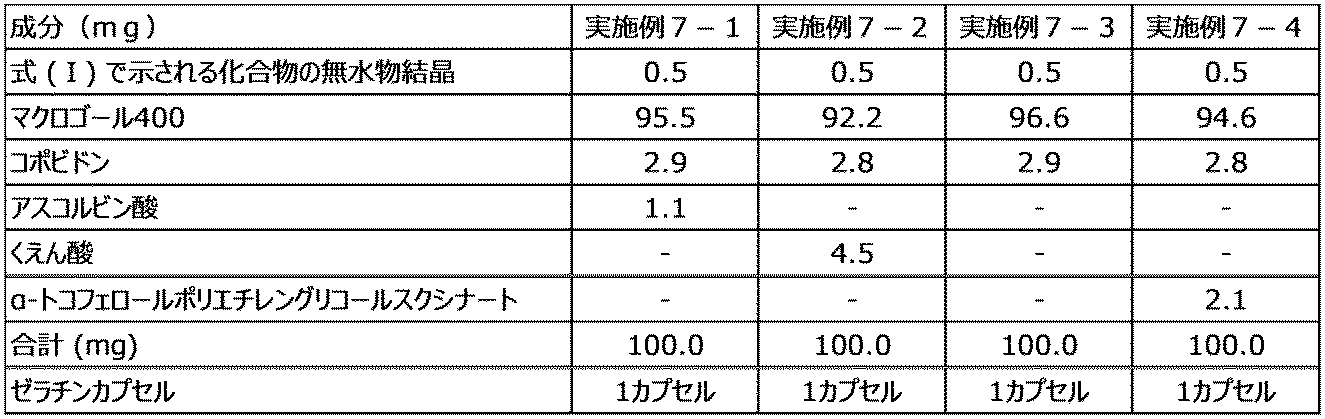
攪拌子を用いて攪拌したマクロゴール400(BASF製)に、式(I)で示される化合物の無水物結晶、コポビドン(ASHLAND製)、アスコルビン酸(関東化学製)、くえん酸(富士フイルム和光純薬製)、及びα-トコフェロールポリエチレングリコールスクシナート(BLD Pharmatech製)を添加した。澄明であることを確認した後、ゼラチンカプセル(カプスゲル製)に充填し、評価用検体を得た。
表36で示す実施例7-1~実施例7-4を、25℃加温環境下で褐色ガラス瓶閉栓6日間保管し、製剤中の類縁物質量を評価した。類縁物質試験は試験例17の条件で行い、注入量は25μLで実施した。
試験開始時及び25℃6日間保管時したときの、0.1%以上の類縁物質の総量を以下に示す。実施例7-1及び実施例7-2では類縁物質の発生が抑制された。また、実施例7-1及び実施例7-2においては試験開始時から25℃6日間保管後まで0.1%以上を示す個々の類縁物質を認めなかった。

経口投与での吸収、分布、代謝並びに排泄の確認(ADME試験)が可能な製剤処方の検討として、以下に示す溶液製剤を製造した。
表38に示す処方の溶液製剤を製造し、5℃または25℃加温環境下で7日間保管し、溶出試験を実施した。
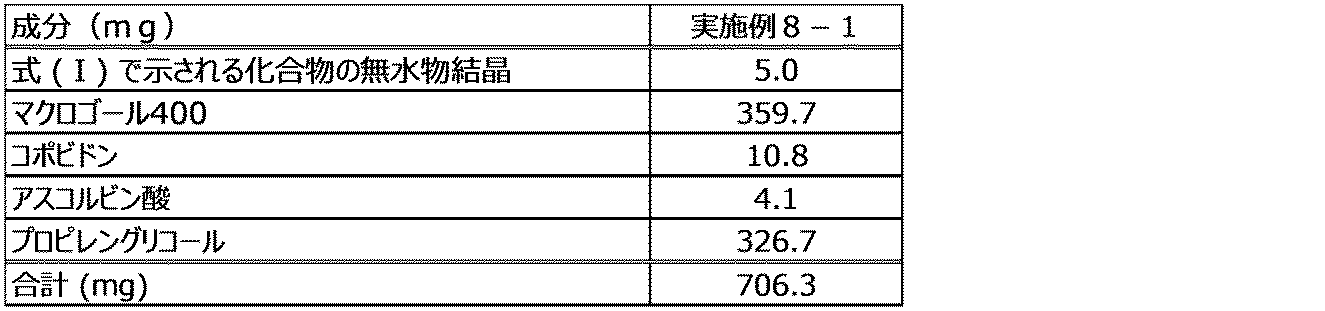
<製造方法>
攪拌子を用いて攪拌したマクロゴール400(BASF製)に、式(I)で示される化合物を添加して溶解させた。コポビドン(ASHLAND製)、およびアスコルビン酸(DSM製)を添加して攪拌子を用いて攪拌し、溶解させた。澄明であることを確認した後にプロピレングリコール(BASF製)を添加し、攪拌子を用いて攪拌することで溶液製剤を得た。
各実施例で得られた溶液製剤について、第18改正日本薬局方溶出試験法にて溶出試験を実施した。試験液には溶出試験第2液を使用し、パドル法、パドル回転数50rpm(試験開始120分後に250rpmに変更)で実施した。
実施例8-1の溶出試験結果を図27に示す。実施例8-1の製剤は試験開始時においても良好な溶出性を示し、5℃または25℃加温環境下で7日間保管した場合においても、溶出率が低下しなかった。
式(I)で示される化合物の酢酸エチル和物結晶を有効成分として含有する製剤の処方検討を以下に示す。
式(I)で示される化合物の酢酸エチル和物結晶を有効成分として含有する素錠を製造し、安定性試験及び溶出試験を実施した。
<素錠の製造方法>
式(I)で示される化合物の酢酸エチル和物結晶、D-マンニトール(ROQUETTE製)、結晶セルロース(Asahikasei製)、クロスカルメロースナトリウム(Dupont製)及び半量のステアリン酸マグネシウム(MALLINCKRODT製)をスパーテルで混合を行い、金網で篩過した。その後、簡易錠剤成形機(型式:HANDTAB-200、市橋精機株式会社製)により打錠した。その後、20メッシュ篩で整粒し、半量のステアリン酸マグネシウムを加えてスパーテルで混合した。得られた打錠用顆粒を簡易錠剤成形機(型式:HANDTAB-200、市橋精機株式会社製)により打錠し、素錠を得た。以下に処方を示す。
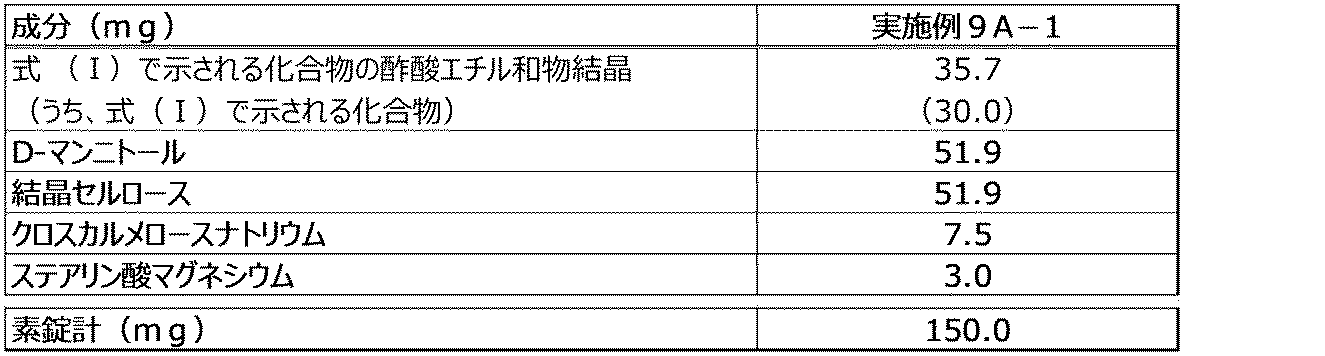
実施例9A-1の素錠を、60℃加温環境下で褐色ガラス瓶閉栓2週間及び40℃75%相対湿度環境下で褐色ガラス瓶開栓2週間保管し、溶出試験を実施した。溶出試験は試験例19を実施した。
試験例19:溶出試験
各実施例で得られた製剤(錠剤の場合は1錠)について、第18改正日本薬局方溶出試験法にて、溶出試験を実施した。試験液には摂食時人工腸液を使用し、パドル法、パドル回転数50rpm(試験開始120分後に250rpmに変更)で実施した。
式(I)で示される化合物の酢酸エチル和物結晶を含有するカプセル剤を製造し、当該カプセル剤のイヌPK試験を実施した。
<カプセル剤の製造方法>
式(I)で示される化合物の酢酸エチル和物結晶、D-マンニトール(ROQUETTE製)、結晶セルロース(Asahikasei製)、クロスカルメロースナトリウム(Dupont製)、及び半量のステアリン酸マグネシウム(MALLINCKRODT製)をスパーテルで混合し、金網で篩過した。その後、簡易錠剤成形機(型式:HANDTAB-200、市橋精機株式会社製)により打錠した。その後、20メッシュ篩で整粒し、半量のステアリン酸マグネシウムを加えてスパーテルで混合し、顆粒を得た。当該顆粒をゼラチンカプセルにスパーテルを用いて手動で充てんし、カプセル剤を調製した。以下に処方を示す。

雄ビーグル犬に対して、給餌を投与30分~2時間前に行った後、1カプセル剤を経口投与した。なお、表33に式(I)で示される化合物の顆粒を120.0mg含有するカプセル剤の処方を示したが、当該試験では式(I)で示される化合物の投与量が3mg/kg体重になるように、雄ビーグル犬の体重に応じて、1カプセル剤当たりの顆粒の質量を調整した。各検体の投与後、各採血時間において採血を行い、LC/MS/MSを用いて最大血漿中薬物濃度(Cmax)、最高血漿中薬物濃度到達時間(Tmax)及び投与時から48時間後までの血漿中薬物濃度-時間曲線下面積(AUC)を算出した。
式(I)で示される化合物の酢酸エチル和物を含む処方が実施例9Bと異なるカプセル剤を製造し、当該カプセル剤の溶出性を評価した。
<カプセル剤の製造方法>
式(I)で示される化合物の酢酸エチル和物、コポビドン(ASHLAND製)、結晶セルロース(Asahikasei製)、D-マンニトール(ROQUETTE製)、クロスカルメロースナトリウム(Dupont製)、及びステアリン酸マグネシウム(MALLINCKRODT製)をスパーテルで混合し、金網で篩過した後、ヒプロメロースカプセル(クオリカプス製)にスパーテルを用いて充填し、カプセル剤を調製した。以下に処方を示す。
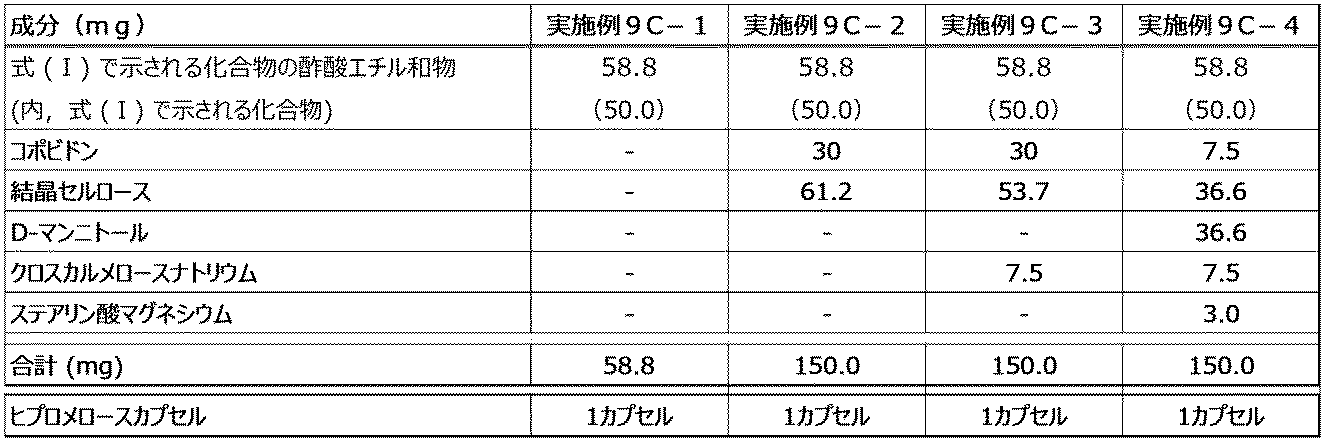
各実施例で得られた製剤(1カプセル)を、第18改正日本薬局方溶出試験法にて溶出試験を実施した。試験液には絶食時人工腸液(FaSSIF-V2)を使用し、パドル法、パドル回転数50rpm(試験開始120分後に250rpmに変更)で実施した。
実施例9C-1~9C-4の溶出試験結果を図28に示す。式(I)で示される化合物の酢酸エチル和物をヒプロメロースカプセルに充填した実施例9C-1では十分な溶出性を示さなかったものの、コポビドン30.0mg及びクロスカルメロースナトリウム7.5mgを添加することで溶出性が改善した(実施例9C-2、実施例9C-3)。また、D-マンニトール、ステアリン酸マグネシウムを加え、コポビドンの配合量を30mgから7.5mgに調整することで、さらに良好な溶出性を示した(実施例9C-4)。
経口投与での吸収、分布、代謝並びに排泄の確認(ADME試験)が可能な製剤処方の検討として、以下に示すカプセル剤を製造した。
式(I)で示される化合物の酢酸エチル和物の溶液を含有するカプセル剤を製造し、当該カプセル剤の溶出性を評価した。以下に示す処方のカプセル剤を製造し、溶出試験を実施した。
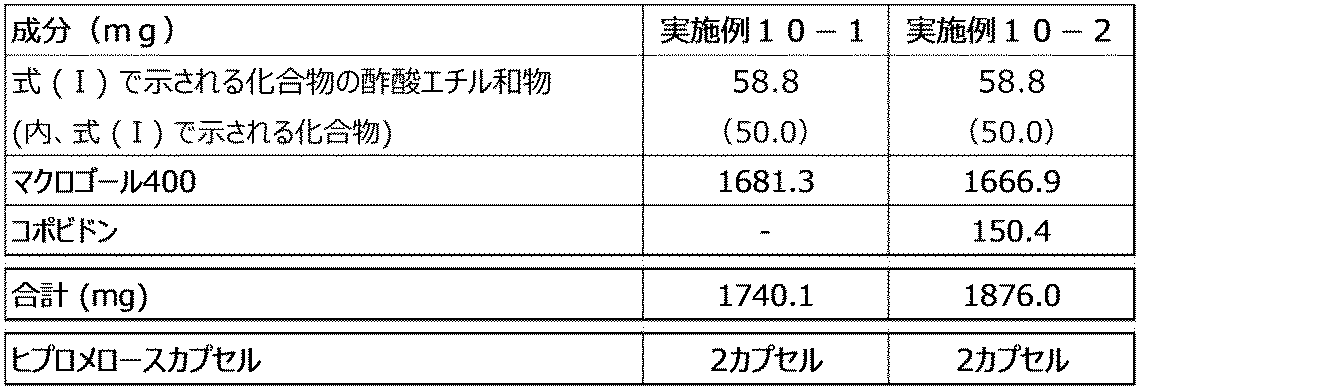
<製造方法>
攪拌子を用いて攪拌したマクロゴール400(BASF製)に、式(I)で示される化合物の酢酸エチル和物及びコポビドン(ASHLAND製)を添加した。澄明であることを確認した後にヒプロメロースカプセル(クオリカプス製)に充填し、カプセル剤を得た。
各実施例で得られた製剤(2カプセル)を、第18改正日本薬局方溶出試験法にて溶出試験を実施した。試験液には溶出試験第2液を使用し、パドル法、パドル回転数50rpm(試験開始120分後に250rpmに変更)で実施した。
実施例10-1及び実施例10-2の溶出試験結果を図29に示す。式(I)で示される化合物の酢酸エチル和物をマクロゴール400に溶解した結果、良好な溶出性を示した(実施例10-1)。コポビドン150.4mgを添加した結果、さらに良好な溶出性を示した(実施例10-2)。
経口投与での吸収、分布、代謝並びに排泄の確認(ADME試験)が可能な製剤処方の検討として、以下に示すカプセル剤を製造した。
以下に示す処方の溶液製剤を製造し、5℃加温環境下で3日間保管し、溶出試験を実施した。
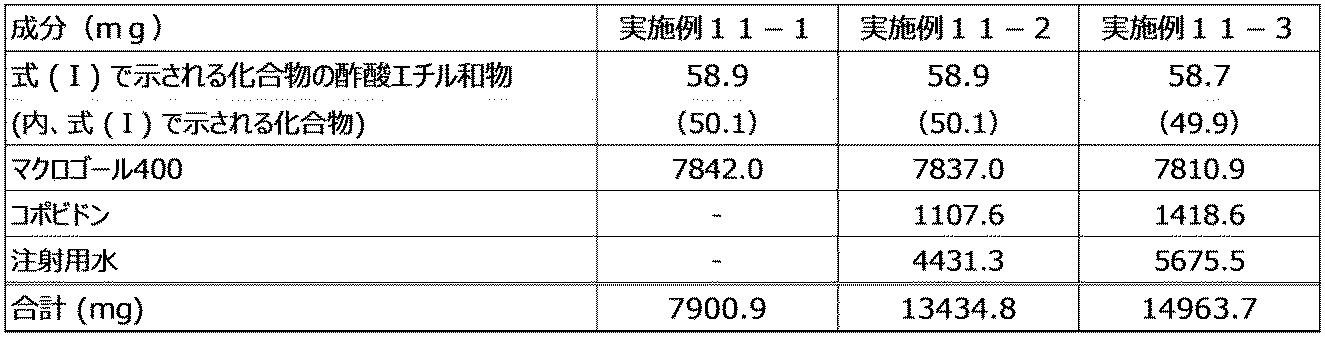
攪拌子を用いて攪拌したマクロゴール400(BASF製)に、式(I)で示される化合物の酢酸エチル和物を添加して溶解させた。注射用水にコポビドン(ASHLAND製)を添加して攪拌子を用いて攪拌し、溶解させた。式(I)で示される化合物の酢酸エチル和物のマクロゴール400溶液に、コポビドン(ASHLAND製)の水溶液を添加し、攪拌子を用いて攪拌することで溶液製剤を得た。
各実施例で得られた溶液製剤について、第18改正日本薬局方溶出試験法にて溶出試験を実施した。試験液には溶出試験第2液を使用し、パドル法、パドル回転数50rpm(試験開始120分後に250rpmに変更)で実施した。
実施例11-1、実施例11-2及び実施例11-3の溶出試験結果を図30に示す。実施例11-1の製剤を5℃加温環境下で3日間保管した場合、溶出率が低下した。コポビドンを1107.6mg及び1418.6mg添加した実施例11-2及び実施例11-3では溶出率の低下は抑制され、高い溶出率を維持した。
経口投与での吸収、分布、代謝並びに排泄の確認(ADME試験)が可能な製剤処方の検討として、以下に示す処方の製剤を製造し、ラットPK試験を実施した。
ラットPK試験は雄ラットに対して給餌を行った後、式(I)で示される化合物を0.3mg/headまたは1mg/kgになるように投与した。
以下に示す、実施例12-1~実施例12-6を投与した後、各採血時間において採血を行い、LC/MS/MSを用いて最大血漿中薬物濃度(Cmax)及び投与時から24時間後までの血漿中薬物濃度-時間曲線下面積(AUC)を算出した。
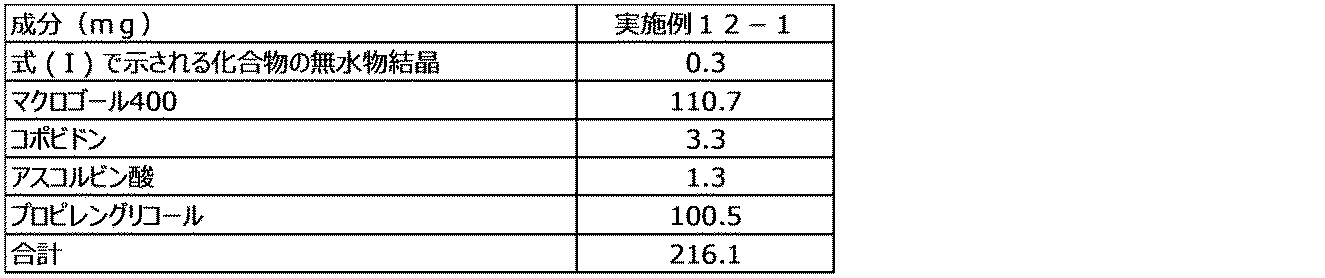


<製造方法>
実施例12-1
攪拌子を用いて攪拌したマクロゴール400(BASF製)に、式(I)で示される化合物の無水物結晶、コポビドン(ASHLAND製)、及びアスコルビン酸(DSM製)を添加した。澄明であることを確認した後にプロピレングリコール(BASF製)を添加し、攪拌子を用いて混合することで投与用検体を得た。
実施例12-2
攪拌子を用いて攪拌したマクロゴール400(BASF製)に、式(I)で示される化合物の酢酸エチル和物、及びコポビドン(ASHLAND製)を添加した。澄明であることを確認した後にゼラチンカプセル(カプスゲル製)に充てんすることで投与用検体を得た。
実施例12-3
式(I)で示される化合物の酢酸エチル和物、コポビドン(ASHLAND製)、結晶セルロース(Asahikasei製)、D-マンニトール(ROQUETTE製)、クロスカルメロースナトリウム(Dupont製)、ステアリン酸マグネシウム(MALLINCKRODT製)をスパーテルで混合及び金網で篩過した後、ゼラチンカプセル(カプスゲル製)にスパーテルを用いて充填し、投与用検体を得た。
実施例12-4
式(I)で示される化合物の酢酸エチル和物を、ヒドロキシプロピルセルロース(日本曹達製)を1%含む水溶液に懸濁させ、ゼラチンカプセル(カプスゲル製)に充てんすることで評価用検体を得た。
実施例12-5
式(I)示される化合物の固体分散体末を、0.5%のメチルセルロースを含む水溶液に懸濁することにより、投与用検体を得た。
実施例12-6
式(I)で示される化合物の無水物結晶を、0.5%のメチルセルロースを含む水溶液に懸濁することにより、投与用検体を得た。
各実施例における、式(I)で示される化合物のCmax及びAUCについて、結果を以下に示す。実施例12-1~実施例12-5は高い吸収性を示した。

Claims (30)
- 式(I):
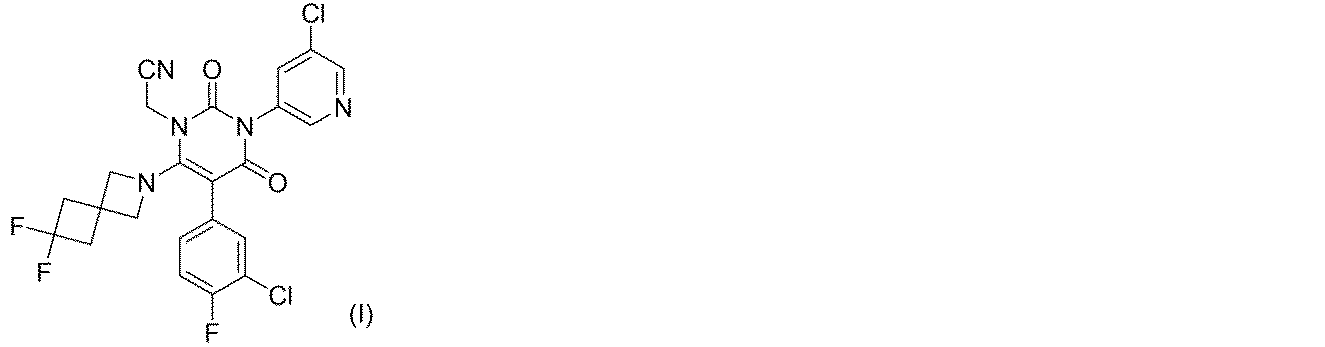
で示される化合物、その製薬上許容される塩、又はそれらの溶媒和物を有効成分として含有する製剤。 - 有効成分が、式(I)で示される化合物、その製薬上許容される塩、又はそれらの溶媒和物の非晶質である、請求項1記載の製剤。
- 有効成分が、式(I)で示される化合物の非晶質である、請求項2記載の製剤。
- 式(I)で示される化合物の非晶質を固体分散体中に含有する、請求項3記載の製剤。
- さらに高分子を固体分散体中に含有する、請求項4記載の製剤。
- 当該高分子が、ビニル系高分子、セルロース系高分子、アクリル酸系高分子から選択される1以上である、請求項5記載の製剤。
- 当該高分子がビニル系高分子であり、当該ビニル系高分子がコポビドン、ポリビニルピロリドン、ポリビニルポリピロリドン、ポリビニルアルコール、ポリビニルアルコール・アクリル酸・メタクリル酸メチルコポリマー、ポリビニルアルコール・ポリエチレングリコール・グラフトコポリマー、ポリビニルアセタールジエチルアミノアセテート、フマル酸・ステアリル酸・ポリビニルアセタールジエチルアミノアセテート・ヒドロキシプロピルメチルセルロース混合物およびポリビニルアセタールジエチルアミノアセテートからなる群から選択される1以上である、請求項6記載の製剤。
- 当該ビニル系高分子がコポビドンである、請求項7記載の製剤。
- 当該高分子がセルロース系高分子であり、当該セルロース系高分子がヒプロメロース酢酸エステルコハク酸エステル、ヒプロメロースフタル酸エステル、ヒドロキシプロピルセルロース、低置換度ヒドロキシプロピルセルロース、ヒプロメロース、ヒドロキシエチルセルロース、ヒドロキシエチルメチルセルロース、ヒドロキシプロピルメチルセルロース、フタレート、メチルセルロース、メチルヒドロキシエチルセルロースカルボキシメチルエチルセルロース、エチルセルロース、結晶セルロース、微結晶セルロース、結晶セルロース・カルメロースナトリウム、カルメロース、カルメロースナトリウム、カルメロースカルシウム、粉末セルロースおよびフマル酸・ステアリン酸・ポリビニルアセタールジエチルアミノアセテート・ヒドロキシプロピルメチルセルロース混合物からなる群から選択される1以上である、請求項6記載の製剤。
- 当該高分子がアクリル酸系高分子であり、当該アクリル酸系高分子がメタクリル酸コポリマーL、アミノアルキルメタクリレートコポリマーE、メタクリル酸コポリマーLD、メタクリル酸コポリマーS、アミノアルキルメタクリレートコポリマーRS、アクリル酸エチル・メタクリル酸メチルコポリマー、アンモニアアルキルメタクリレートコポリマー、メチルアクリレート・メタクリル酸・メチルメタクリレートコポリマーおよび2-メチル-5-ビニルピリジンメチルアクリレート・メタクリル酸コポリマーからなる群から選択される1以上である、請求項6記載の製剤。
- 有効成分が、式(I)で示される化合物、その製薬上許容される塩、又はそれらの溶媒和物の結晶である、請求項1記載の製剤。
- 有効成分が式(I)で示される化合物の無水物結晶である、請求項11記載の製剤。
- さらに崩壊剤、賦形剤及び/又は滑沢剤を含有する、請求項1~12のいずれかに記載の製剤。
- 当該崩壊剤が、クロスカルメロースナトリウム、カルメロース、カルメロースカルシウム、カルメロースナトリウム、ヒドロキシプロピルセルロース、低置換度ヒドロキシプロピルセルロース、粉末セルロース、部分アルファー化デンプン、バレイショデンプン、コーンスターチ、ヒドロキシプロピルスターチ、カルボキシメチルスターチナトリウム、低置換度カルボキシメチルスターチナトリウム、デンプングリコール酸ナトリウム、アルファー化デンプン、デンプン、ポリビニルアルコールおよびクロスポビドンからなる群から選択される1以上である、請求項13記載の製剤。
- 当該崩壊剤がクロスカルメロースナトリウムである、請求項14記載の製剤。
- 当該崩壊剤がクロスポビドンである、請求項14記載の製剤。
- 当該賦形剤が、結晶セルロース、ケイ酸処理結晶セルロース、乳糖、無水乳糖、白糖、ブドウ糖、果糖、ショ糖、マンニトール、ソルビトール、エリスリトール、キシリトール、粉末麦芽糖水あめ、マルチトール、デンプン、バレイショデンプン、トウモロコシデンプン、コメデンプン、部分アルファー化デンプン、アルファー化デンプン、有孔デンプン、カルボキシスターチナトリウム、ヒドロキシプロピルスターチ、低置換度カルボキシメチルスターチナトリウム、粉末セルロース、カルメロースナトリウム、カルメロース、カルメロースカルシウム、カルボキシメチルエチルセルロース、低置換度ヒドロキシプロピルセルロース、ケイ酸塩誘導体、リン酸塩、炭酸塩、硫酸塩、酸化マグネシウム、酸化チタン、乳酸カルシウム、合成ヒドロタルサイト、タルク、カオリン、乾燥水酸化アルミニウム、酸化マグネシウム、ベントナイト、含水二酸化ケイ素、軽質無水ケイ酸等の二酸化ケイ素、メタケイ酸アルミン酸マグネシウム、合成ケイ酸アルミニウム、ケイ酸カルシウム、無水リン酸水素カルシウム、リン酸一水素カルシウム、リン酸水素カルシウム、リン酸水素ナトリウム、リン酸二カリウム、リン酸二水素カリウム、リン酸二水素カルシウム、リン酸二水素ナトリウム、沈降炭酸カルシウム、炭酸カルシウム、炭酸マグネシウムおよび硫酸カルシウムからなる群から選択される1以上である、請求項13~16のいずれかに記載の製剤。
- 当該滑沢剤が、フマル酸ステアリルナトリウム、ステアリン酸マグネシウム、ステアリン酸カルシウム、ステアリン酸、ステアリルアルコール、ステアリン酸ポリオキシル40、タルク、軽質無水ケイ酸、含水二酸化ケイ素、炭酸マグネシウム、沈降炭酸カルシウム、乾燥水酸化アルミニウムゲル、メタケイ酸アルミン酸マグネシウム、ケイ酸マグネシウム、合成ケイ酸アルミニウム、酸化マグネシウム、硫酸マグネシウム、カカオ脂、カルナウバロウ、グリセリン脂肪酸エステル、硬化油、サラシミツロウ、ダイズ硬化油、ミツロウ、セタノール、ラウリル酸ナトリウム、ショ糖脂肪酸エステルおよびポリエチレングリコールからなる群から選択される1以上である、請求項13~17のいずれかに記載の製剤。
- 被覆層を有する、請求項1~18のいずれかに記載の製剤。
- 被覆層に光安定化物質および高分子を含有する、請求項19記載の製剤。
- 被覆層中の光安定化物質が、食用赤色2号、食用赤色3号、食用赤色102号、食用赤色104号、食用赤色105号、食用赤色106号、食用黄食4号、食用黄色5号、食用緑色3号、食用青色1号、食用青色2号、食用赤色3号アルミニウムレーキ、食用黄色4号アルミニウムレーキ、食用黄色5号アルミニウムレーキ、食用青色1号アルミニウムレーキ、食用青色2号アルミニウムレーキ、カルミン、銅クロロフィリンナトリウム、銅クロロフィル、ベンガラ、黒酸化鉄、黄酸化鉄、酸化チタン、三二酸化鉄、黄色三二酸化鉄およびタルクからなる群から選択される1以上である、請求項20記載の製剤。
- 当該光安定化物質が三二酸化鉄、黄色三二酸化鉄および/又はタルクである、請求項21記載の製剤。
- 被覆層中の高分子が、ヒプロメロース、ヒドロキシプロピルセルロース、カルボキシメチルエチルセルロース、ヒプロメロースフタル酸エステル、ヒドロキシプロピルメチルセルロースアセテートサクシネート、エチルセルロースおよびポリビニルアルコールから選択される1以上である、請求項20~22のいずれかに記載の製剤。
- 被覆層中の高分子がヒプロメロースである、請求項23記載の製剤。
- 製剤が経口製剤である、請求項1~24のいずれかに記載の製剤。
- 製剤が錠剤、顆粒剤、散剤又はカプセル剤である、請求項25記載の製剤。
- 有効成分が、式(I)で示される化合物の酢酸エチル和物結晶である、請求項11記載の製剤。
- カプセル剤である、請求項27記載の製剤。
- 式(I):

で示される化合物の非晶質。 - 式(I):
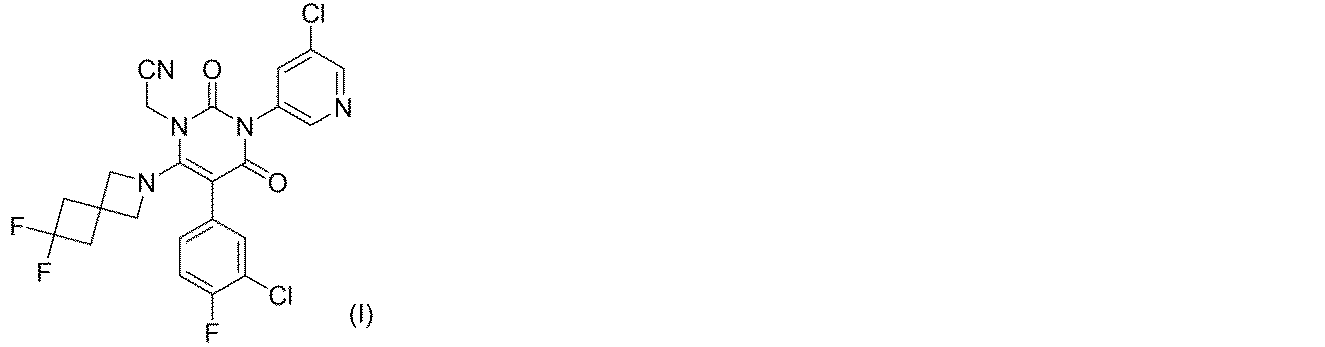
で示される化合物の酢酸エチル和物結晶。
Priority Applications (2)
| Application Number | Priority Date | Filing Date | Title |
|---|---|---|---|
| JP2025515644A JP7701585B2 (ja) | 2023-10-05 | 2024-10-04 | ウラシル誘導体を含有する製剤 |
| AU2024309726A AU2024309726A1 (en) | 2023-10-05 | 2024-10-04 | Preparation containing uracil derivative |
Applications Claiming Priority (4)
| Application Number | Priority Date | Filing Date | Title |
|---|---|---|---|
| JP2023173297 | 2023-10-05 | ||
| JP2023-173297 | 2023-10-05 | ||
| JP2024088082 | 2024-05-30 | ||
| JP2024-088082 | 2024-05-30 |
Publications (1)
| Publication Number | Publication Date |
|---|---|
| WO2025005305A1 true WO2025005305A1 (ja) | 2025-01-02 |
Family
ID=93938364
Family Applications (1)
| Application Number | Title | Priority Date | Filing Date |
|---|---|---|---|
| PCT/JP2024/035558 Pending WO2025005305A1 (ja) | 2023-10-05 | 2024-10-04 | ウラシル誘導体を含有する製剤 |
Country Status (4)
| Country | Link |
|---|---|
| JP (1) | JP7701585B2 (ja) |
| AU (1) | AU2024309726A1 (ja) |
| TW (1) | TW202523308A (ja) |
| WO (1) | WO2025005305A1 (ja) |
Citations (4)
| Publication number | Priority date | Publication date | Assignee | Title |
|---|---|---|---|---|
| WO2022138988A1 (ja) * | 2021-04-14 | 2022-06-30 | 塩野義製薬株式会社 | ウイルス増殖阻害作用を有するトリアジン誘導体およびそれらを含有する医薬組成物 |
| JP2022534186A (ja) * | 2020-09-03 | 2022-07-28 | ファイザー・インク | ニトリル含有抗ウイルス化合物 |
| JP2023519035A (ja) * | 2020-04-05 | 2023-05-10 | ファイザー・インク | Covid-19を処置するための化合物および方法 |
| WO2023195529A1 (ja) * | 2022-04-08 | 2023-10-12 | 塩野義製薬株式会社 | ウイルス増殖阻害活性を有するウラシル誘導体およびそれらを含有する医薬組成物 |
-
2024
- 2024-10-04 AU AU2024309726A patent/AU2024309726A1/en active Pending
- 2024-10-04 WO PCT/JP2024/035558 patent/WO2025005305A1/ja active Pending
- 2024-10-04 TW TW113137840A patent/TW202523308A/zh unknown
- 2024-10-04 JP JP2025515644A patent/JP7701585B2/ja active Active
Patent Citations (6)
| Publication number | Priority date | Publication date | Assignee | Title |
|---|---|---|---|---|
| JP2023519035A (ja) * | 2020-04-05 | 2023-05-10 | ファイザー・インク | Covid-19を処置するための化合物および方法 |
| JP2022534186A (ja) * | 2020-09-03 | 2022-07-28 | ファイザー・インク | ニトリル含有抗ウイルス化合物 |
| WO2022138988A1 (ja) * | 2021-04-14 | 2022-06-30 | 塩野義製薬株式会社 | ウイルス増殖阻害作用を有するトリアジン誘導体およびそれらを含有する医薬組成物 |
| WO2022138987A1 (ja) * | 2021-04-14 | 2022-06-30 | 塩野義製薬株式会社 | ウイルス増殖阻害作用を有するトリアジン誘導体およびそれらを含有する医薬組成物 |
| WO2023195529A1 (ja) * | 2022-04-08 | 2023-10-12 | 塩野義製薬株式会社 | ウイルス増殖阻害活性を有するウラシル誘導体およびそれらを含有する医薬組成物 |
| WO2023195530A1 (ja) * | 2022-04-08 | 2023-10-12 | 塩野義製薬株式会社 | ウイルス増殖阻害活性を有するウラシル誘導体およびそれらを含有する医薬組成物 |
Also Published As
| Publication number | Publication date |
|---|---|
| TW202523308A (zh) | 2025-06-16 |
| AU2024309726A1 (en) | 2026-04-16 |
| JPWO2025005305A1 (ja) | 2025-01-02 |
| JP7701585B2 (ja) | 2025-07-01 |
Similar Documents
| Publication | Publication Date | Title |
|---|---|---|
| JP7466731B2 (ja) | トリアジン誘導体を含有する経口投与する製剤 | |
| CN102405219B (zh) | 用于治疗copd的5-吡唑基-2-吡啶酮衍生物的对甲苯磺酸盐 | |
| CA2939546A1 (en) | Crystalline solid forms of n-{4-[(6,7-dimethoxyquinolin-4-yl)oxy]phenyl}-n'-(4-fluorophenyl) cyclopropane-1,1-dicarboxamide, processes for making, and methods of use | |
| ES2628920T3 (es) | Forma cristalina novedosa de sulfato de sitagliptina | |
| JP7402404B2 (ja) | キナゾリン誘導体を含有する固形製剤 | |
| US12570627B2 (en) | Pharmaceutical composition in which production of impurities is suppressed | |
| CN116514734A (zh) | 三嗪衍生物的制造方法和含有三嗪衍生物的口服给与的制剂 | |
| JP7701585B2 (ja) | ウラシル誘導体を含有する製剤 | |
| CN106146446A (zh) | 达格列净半水合物及其晶型、其制备方法及药物组合物 | |
| KR20150102852A (ko) | 무정형 솔리페나신 또는 그의 염을 포함하는 안정성이 증가된 고체분산체 조성물 및 그 제조방법 | |
| CN110526899A (zh) | 埃索美拉唑锶新化合物及其药物组合物和用途 | |
| JP2025038019A (ja) | ウラシル誘導体を含有する非経口製剤 | |
| CN115477647A (zh) | 小檗碱富马酸盐晶型及其制备方法和其组合物与应用 | |
| HK40013337A (en) | Solid preparation comprising quinazoline derivative | |
| HK1162498B (en) | Tosylate salt of a 5-pyrazolyl-2-pyridone derivative, useful in the treatment of copd |
Legal Events
| Date | Code | Title | Description |
|---|---|---|---|
| 121 | Ep: the epo has been informed by wipo that ep was designated in this application |
Ref document number: 24832160 Country of ref document: EP Kind code of ref document: A1 |
|
| WWE | Wipo information: entry into national phase |
Ref document number: 2025515644 Country of ref document: JP |
|
| WWE | Wipo information: entry into national phase |
Ref document number: AU2024309726 Country of ref document: AU |
|
| REG | Reference to national code |
Ref country code: BR Ref legal event code: B01A Ref document number: 112026008157 Country of ref document: BR |
|
| ENP | Entry into the national phase |
Ref document number: 2024309726 Country of ref document: AU Date of ref document: 20241004 Kind code of ref document: A |