WO2025005117A1 - 導光体及び導光体アセンブリ - Google Patents
導光体及び導光体アセンブリ Download PDFInfo
- Publication number
- WO2025005117A1 WO2025005117A1 PCT/JP2024/023131 JP2024023131W WO2025005117A1 WO 2025005117 A1 WO2025005117 A1 WO 2025005117A1 JP 2024023131 W JP2024023131 W JP 2024023131W WO 2025005117 A1 WO2025005117 A1 WO 2025005117A1
- Authority
- WO
- WIPO (PCT)
- Prior art keywords
- light
- light guide
- section
- entrance
- continuous
- Prior art date
- Legal status (The legal status is an assumption and is not a legal conclusion. Google has not performed a legal analysis and makes no representation as to the accuracy of the status listed.)
- Ceased
Links
Images


















Classifications
-
- F—MECHANICAL ENGINEERING; LIGHTING; HEATING; WEAPONS; BLASTING
- F21—LIGHTING
- F21S—NON-PORTABLE LIGHTING DEVICES; SYSTEMS THEREOF; VEHICLE LIGHTING DEVICES SPECIALLY ADAPTED FOR VEHICLE EXTERIORS
- F21S11/00—Non-electric lighting devices or systems using daylight
- F21S11/002—Non-electric lighting devices or systems using daylight characterised by the means for collecting or concentrating the sunlight, e.g. parabolic reflectors or Fresnel lenses
-
- F—MECHANICAL ENGINEERING; LIGHTING; HEATING; WEAPONS; BLASTING
- F21—LIGHTING
- F21S—NON-PORTABLE LIGHTING DEVICES; SYSTEMS THEREOF; VEHICLE LIGHTING DEVICES SPECIALLY ADAPTED FOR VEHICLE EXTERIORS
- F21S11/00—Non-electric lighting devices or systems using daylight
-
- G—PHYSICS
- G02—OPTICS
- G02B—OPTICAL ELEMENTS, SYSTEMS OR APPARATUS
- G02B6/00—Light guides; Structural details of arrangements comprising light guides and other optical elements, e.g. couplings
-
- G—PHYSICS
- G02—OPTICS
- G02B—OPTICAL ELEMENTS, SYSTEMS OR APPARATUS
- G02B6/00—Light guides; Structural details of arrangements comprising light guides and other optical elements, e.g. couplings
- G02B6/0001—Light guides; Structural details of arrangements comprising light guides and other optical elements, e.g. couplings specially adapted for lighting devices or systems
- G02B6/0011—Light guides; Structural details of arrangements comprising light guides and other optical elements, e.g. couplings specially adapted for lighting devices or systems the light guides being planar or of plate-like form
- G02B6/0033—Means for improving the coupling-out of light from the light guide
- G02B6/0035—Means for improving the coupling-out of light from the light guide provided on the surface of the light guide or in the bulk of it
-
- G—PHYSICS
- G02—OPTICS
- G02B—OPTICAL ELEMENTS, SYSTEMS OR APPARATUS
- G02B6/00—Light guides; Structural details of arrangements comprising light guides and other optical elements, e.g. couplings
- G02B6/0001—Light guides; Structural details of arrangements comprising light guides and other optical elements, e.g. couplings specially adapted for lighting devices or systems
- G02B6/0011—Light guides; Structural details of arrangements comprising light guides and other optical elements, e.g. couplings specially adapted for lighting devices or systems the light guides being planar or of plate-like form
- G02B6/0033—Means for improving the coupling-out of light from the light guide
- G02B6/0035—Means for improving the coupling-out of light from the light guide provided on the surface of the light guide or in the bulk of it
- G02B6/0038—Linear indentations or grooves, e.g. arc-shaped grooves or meandering grooves, extending over the full length or width of the light guide
-
- G—PHYSICS
- G02—OPTICS
- G02B—OPTICAL ELEMENTS, SYSTEMS OR APPARATUS
- G02B6/00—Light guides; Structural details of arrangements comprising light guides and other optical elements, e.g. couplings
- G02B6/0001—Light guides; Structural details of arrangements comprising light guides and other optical elements, e.g. couplings specially adapted for lighting devices or systems
- G02B6/0011—Light guides; Structural details of arrangements comprising light guides and other optical elements, e.g. couplings specially adapted for lighting devices or systems the light guides being planar or of plate-like form
- G02B6/0075—Arrangements of multiple light guides
- G02B6/0076—Stacked arrangements of multiple light guides of the same or different cross-sectional area
Definitions
- the present invention relates to a light guide and a light guide assembly.
- Patent Document 1 discloses a light collecting device that includes a light guide section extending parallel to an incident surface where light enters, a plurality of light collecting elements each having a light collecting section that is gradually tapered when connected to the light guide section and has a reflecting surface at its end, a plurality of coupled waveguides that guide light that enters from the plurality of light collecting elements through the reflecting surfaces, and an integrated waveguide that is connected to the plurality of coupled waveguides and collects light.
- the light collecting element in such a light collecting device collects a lot of light, but when the collected light goes backwards, it leaks out from the light collecting element, so the light collecting efficiency is not necessarily high.
- Patent Document 1 JP 2008-251468 A
- the reflective surfaces may include a third reflective surface and a fourth reflective surface located on one side and the other side of the discontinuous portion in the second direction, respectively, facing each other.
- the third reflecting surface and the fourth reflecting surface may be inclined in different directions with respect to the second direction.
- the continuous portion and the discontinuous portion adjacent to the continuous portion may have different widths in the second direction.
- the continuous portion and the discontinuous portion adjacent to the continuous portion may have widths approximately equal to each other in the second direction.
- the multiple continuous portions may include a first width continuous portion having a first length in the second direction, and a second width continuous portion having a second length in the second direction that is different from the first length.
- the first width continuous portions and the second width continuous portions may be arranged alternately.
- the light entrance portion may be formed to extend in the second direction, and the light entrance surface may be formed in a planar shape having a width in a third direction that intersects with both the first direction and the second direction.
- the light guiding portion may be formed to extend in the second direction.
- the light guiding portion may have an end portion opposite to the light entrance portion in the first direction formed in a flat shape.
- the continuous portion may be formed to extend in the third direction.
- the continuous portion may be disposed so that the third direction is substantially parallel to a plane including a path of movement of the sun.
- the light guiding section may be disposed so that the second direction is substantially perpendicular to a plane including a path of movement of the sun.
- the light entrance surface may include a diffractive optical element or a surface treatment layer formed so that the refractive index changes continuously in the first direction.
- the light receiving surface may be disposed so that an intersection line between a plane including the path of the sun's movement and the light receiving surface is inclined with respect to the horizontal direction.
- the light entrance portion and the light guide portion may be formed as separate bodies and joined to each other via the continuous portion.
- the light entrance portion and the light guide portion may be joined by welding.
- the light entrance portion and the light guide portion may be formed from the same material.
- the light guide assembly may comprise two of the light guides stacked in the first direction.
- a reflective surface of a lower light guide may be located below a light transmitting portion of an upper light guide of the two light guides.
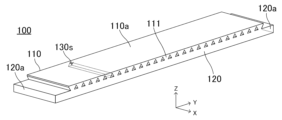
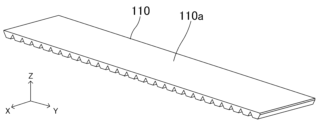
- FIG. 2 shows the configuration of a light guide according to the present embodiment.
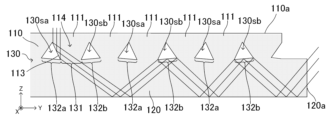
- 2 shows the configuration of the light entrance portion and the boundary portion.
- 1 shows light input to a light guide being collected by a light entrance portion and guided by a light guide portion.
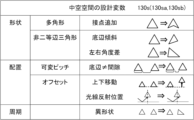
- the design parameters of the hollow space are shown.
- 1 shows examples of shapes of the hollow space and design parameters relating to the shapes.
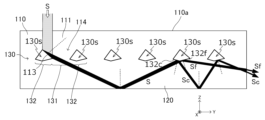
- 1 shows the guiding of light input into a light guide having a polygonal hollow space.
- 1 shows an example of the arrangement and period of a plurality of hollow spaces, and design parameters relating to the arrangement and period.
- 4 shows another design example and design parameters of the hollow space.
- the arrangement of the light guides and the angle of incidence ⁇ of light due to the diurnal orbit of the sun are shown.
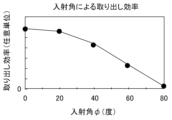
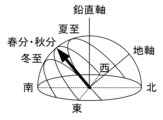
- FIG. 6B shows the light extraction efficiency versus the incident angle ⁇ shown in FIG. 6A. Shows seasonal variations in solar orbit and solar altitude. The arrangement of the light guide and the solar altitude (noon angle) ⁇ are shown. The light extraction efficiency is shown with respect to the solar altitude (incident angle) ⁇ shown in FIG. 7B.
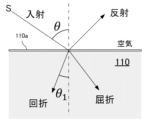
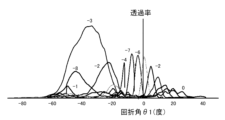
- 4 shows an example of a light guide arrangement optimized for variations in solar altitude. 4 shows a first modified light guide configuration optimized for variations in solar altitude. The definitions of the incidence angle and diffraction angle of light entering the input section from the light entrance surface are shown below. This shows the intensity versus diffraction angle of light diffracted after entering a light guide from a light entrance surface having a surface treatment layer.
- 4 shows a second modified light guide configuration optimized for variations in solar altitude.
- 4 shows a side view of a light guide configuration according to a third variant optimized for the diurnal orbit of the sun; 13 shows an arrangement in which a light guide according to a third modified example is inclined with respect to the meridian angle.
- 1 shows a first manufacturing flow of a light guide body. The state inside the die after the die and insert setting step in the first manufacturing method is shown in a front view (cross section along reference line AA in FIG. 16B).
- the state inside the die after the die and insert setting step in the first manufacturing method is shown in a side view (cross section along reference line BB in FIG. 16A).
- 4 shows the flow of resin in a molding process in the first manufacturing method.
- 11 shows a state in which the insert is being pulled out in a insert pulling step in the first manufacturing method.
- 4 shows a second manufacturing flow of the light guide body.
- 13 shows a front view of the state inside the mold after a first mold setting step in the second manufacturing method.
- 11 shows the configuration of a light entrance portion molded in a light entrance portion molding step using a first mold in a second manufacturing method. The configuration of the bottom surface of the light entrance portion and the continuous portion is shown.
- 13 shows a second die in the second manufacturing method and the state inside the die after a nesting setting step, as viewed from the front. 13 is a perspective view showing a second die and the state inside the die after a nesting setting step in the second manufacturing method.
- 4 shows a third manufacturing flow of the light guide body. 11 shows the configuration of a light entrance portion molded in a light entrance portion molding step in the third manufacturing method. 11 shows the configuration of a light guiding portion molded in a light guiding portion molding step in the third manufacturing method. 13 shows the state in which the light entrance portion and the light guide portion are welded by the welding step in the third manufacturing method.
- 1 illustrates a light guide assembly according to an embodiment.
- FIG. 2 shows the principle of light collection by a light input section of a light guide assembly and light guiding by a light guide section.
- 13 shows the configuration and light collecting principle of a light guide assembly according to a modified example.
- 13 shows the configuration of a light guide according to a sixth modified example having a bottom structure.
- 13 shows the light guide of light input to a light guide according to a sixth modified example.
- 13 shows the light guide of light input to a light guide according to a sixth modified example.
- 13 shows the light guide of light input to a light guide according to a sixth modified example.
- 13 shows the light guide of light input to a light guide according to a sixth modified example.
- Another example of the bottom structure is shown.
- the light guide 100 is an optical device that efficiently collects light input from the light entrance surface 110a and outputs the collected light by guiding it to a light exit surface 120a different from the light entrance surface 110a without leakage or with little leakage, and includes the light entrance section 110, the light guide section 120, and the boundary section 130.
- the light guide 100 has an approximately plate shape that extends in two dimensions with the X-axis direction as the short side and the Y-axis direction as the long side, and has a thickness in the Z-axis direction.
- the light entrance section 110 is an optical member that collects light that is input in the input direction (in this embodiment, the -Z direction) through the light entrance surface 110a, and has a plurality of light-collecting elements 111.
- the plurality of light-collecting elements 111 are columnar members that have an inverted, approximately isosceles trapezoidal cross section with a maximum width P in the Y-axis direction and a height d in the Z-axis direction, and are arranged in parallel in the Y-axis direction with the +Z sides of the Y side surfaces (i.e., the +Y side surface and the -Y side surface) in contact with each other and the -Z sides spaced apart from each other.
- the plurality of light-collecting elements 111 are integrally molded by being connected to each other (however, for the convenience of explaining the configuration and function of the light entrance section 110, the light entrance section 110 will be described as including a plurality of light-collecting elements 111).
- the light entrance section 110 is formed to extend in the Y-axis direction, and the +Z faces of the plurality of light-collecting elements 111 are connected to each other to form a planar light entrance surface 110a having a width in the X-axis direction.
- the light entrance surface 110a is provided so that light is input from the +Z side.
- two adjacent light-collecting elements 111 form a hollow space (also simply called a space) 130s between them that has a triangular cross section and extends in the X-axis direction.
- the multiple focusing elements 111 may be arranged in parallel and spaced apart from each other in the Y-axis direction. In such a case, each of the +Z surfaces of the multiple focusing elements 111 functions as an independent light entrance surface.
- the light-collecting element 111 has reflecting surfaces 112, 113 and a light-transmitting portion 114 located below (in the -Z direction) the light-entering surface 110a.
- the light-collecting element 111 can be formed using a resin having a high refractive index, such as acrylic resin (refractive index 1.49) or polycarbonate resin (refractive index 1.58), or glass (for example, refractive index 1.51 to 1.53 for BK7).
- the boundary between the light-collecting element 111 and the space 130s, i.e., the ⁇ Y side surface of the light-collecting element 111 functions as reflecting surfaces 112, 113 that reflect a portion of the light input into the light-collecting element 111 through the light-entering surface 110a.
- the critical angle is approximately 42 degrees for acrylic resin, approximately 41 degrees for polycarbonate resin, and approximately 42 degrees for glass. Therefore, the ⁇ Y side surfaces of the light-collecting element 111 are formed so that their normals form an angle equal to or greater than the critical angle with respect to the light input direction (the Z-axis direction in this embodiment).
- the portion of the light-collecting element 111 between the reflecting surfaces 112 and 113 functions as a light-transmitting portion 114 that transmits a portion of the light input from the light-entering surface 110a (the remaining portion that does not enter the reflecting surfaces 112 and 113 in this embodiment) and the reflected light reflected by the reflecting surfaces 112 and 113.
- the reflective surfaces 112, 113 are positioned opposite each other on the +Y and -Y sides of the light-transmitting portion 114, respectively, and are provided so as to reflect the light input from the light-entering surface 110a towards the light-transmitting portion 114.
- the reflective surfaces 112, 113 are formed linearly on the YZ cross section.
- the reflective surfaces 112, 113 i.e., the ⁇ Y side surfaces of the focusing element 111, may be mirror-finished.
- a reflective film may also be provided using a metal or the like.
- the light guide 120 is an optical member that has a light output surface 120a located on the -Z side of the light input surface 110, and further guides the reflected light reflected by the reflecting surfaces 112 and 113 of the light input surface 110 in the +Y and/or -Y directions and outputs it from the light output surface 120a.
- the light guide 120 is formed in a plate shape extending in the Y-axis direction.
- the width of the light guide 120 in the X-axis direction is equal to (or may be greater than) the width of the light input surface 110
- the length in the Y-axis direction is greater than (or may be equal to) the length of the light input surface 110
- the thickness in the Z-axis direction is greater than the thickness of the light input surface 110 (may be determined arbitrarily).
- the +Y side surface and/or -Y side surface of the light guide 120 forms the light output surface 120a that outputs light
- the -Z end surface 120b is formed in a flat shape, thereby functioning as a reflecting surface that reflects the light guided into the light guide 120 inward.
- the light guide section 120 can be made of the same material as the light entrance section 110 (light collecting element 111). To increase the reflectance, the -Z end surface 120b of the light guide section 120 can be mirror-finished. A reflective film can also be provided using a metal or the like.
- the light entrance section 110 is disposed closer to the light entrance surface 110a than the light guide section 120, and the light guide section 120 is disposed closer to the light exit surface 120a than the light entrance section 110.
- the boundary portion 130 is a portion located at the boundary between the light entrance portion 110 and the light guide portion 120, and includes a continuous portion 131 and a discontinuous portion 132.
- the continuous portion 131 is provided so that the light-transmitting portion 114 of the light entrance portion 110 and the light guide portion 120 are physically continuous, and guides the light input from the light entrance surface 110a, i.e., the reflected light reflected by the reflecting surfaces 112 and 113, and the remaining light that does not enter the reflecting surfaces 112 and 113, into the light guide portion 120.
- the continuous portion 131 has an opening width A in the Y-axis direction and extends in the X-axis direction.
- the continuous portion 131 can be formed from the same material as the light collecting element 111.
- the continuous portion 131 may also be formed integrally with the light entrance portion 110 and/or the light guide portion 120 as part of them.
- the discontinuous portion 132 is provided so that the reflective surfaces 112, 113 of the light entrance portion 110 and the light guide portion 120 are spaced apart, and is disposed adjacent to each of the ⁇ Y sides of the continuous portion 131.
- the discontinuous portion 132 separates the light guide portion 120 from the light entrance portion 110 (the reflective surfaces 112, 113 formed on the ⁇ Y side surfaces) to form a space 130s between them, so that the interface between the discontinuous portion 132 and the light guide portion 120 functions as a reflective surface that reflects the reflected light input from the light transmitting portion 114 of the light entrance portion 110 through the continuous portion 131 to the light guide portion 120 and guides it to the light exit surface 120a.
- the interface between the discontinuous portion 132 and the light guide portion 120 i.e., the +Z end face of the light guide portion 120 below the space 130s, may be mirror-finished.
- a reflective film may also be provided using metal or the like.
- the reflective surfaces 112, 113 and the light-transmitting portions 114 of the light-entering portion 110 are arranged in a plurality of positions along the Y-axis direction within the light-entering portion 110 by arranging the light-collecting elements 111 in parallel in the Y-axis direction to form the light-entering portion 110. Accordingly, the continuous portions 131 and the discontinuous portions 132 are provided in a plurality of positions at the boundary between the light-entering portion 110 and the light-guiding portion 120, and the plurality of continuous portions 131 and the plurality of discontinuous portions 132 are arranged alternately along the Y-axis direction.
- the continuous portions 131 have a width A (equal to the width of the light-transmitting portions 114) in the Y-axis direction and are arranged periodically with a pitch P in the Y-axis direction.
- the discontinuous portions 132 have a width approximately equal to that of the continuous portions 131 and are arranged adjacent to the continuous portions 131 or between the continuous portions 131.
- the aperture ratio A/P is approximately halved.
- the continuous portion 131 and the adjacent discontinuous portion 132 may have different widths in the Y-axis direction, and the aperture ratio A/P may be greater than or less than about half.
- the multiple discontinuous portions 132 i.e., the multiple discontinuous portions 132 arranged in the Y-axis direction via the continuous portions 131, have equal or approximately equal widths in the Y-axis direction.
- the multiple continuous portions 131 may include a first width continuous portion 131a having a first length in the Y-axis direction and a second width continuous portion 131b having a second length different from the first length (see FIG. 4C), which may be arranged alternately via the discontinuous portions 132.
- the reflecting surfaces 112 and 113 of the light-entering section 110 reflect the light input from the light-entering surface 110a toward the continuous section 131.
- the reflecting surfaces 112 and 113 reflect the light input from a direction perpendicular to the light-entering surface 110a (the Z-axis direction in this embodiment) toward the continuous section 131.
- the light reflected by the reflecting surface 112 forms parallel light and passes through the continuous section 131; that is, the light reflected at the +Z side of the reflecting surface 112 passes through the +Y side of the continuous section 131, the light reflected at the center of the reflecting surface 112 passes through the center of the continuous section 131, and the light reflected at the -Z side of the reflecting surface 112 passes through the -Y side of the continuous section 131, and then enters the light-guiding section 120.
- the light reflected by the reflecting surface 113 forms parallel light and enters the light guide 120 in the same manner as the light reflected by the reflecting surface 112, except that the light travels in the opposite direction.
- the discontinuous portion 132 is disposed below the reflecting surfaces 112, 113 of the light entrance portion 110, and includes discontinuous portion 132b separating the reflecting surface 112 from the light guide portion 120 and discontinuous portion 132a separating the reflecting surface 113 from the light guide portion 120.
- the light-collecting elements 111 are arranged in parallel in the Y-axis direction within the light entrance portion 110, so that a space 130s having a triangular cross section as viewed in the Y-direction is formed inside the Y-side surfaces of two adjacent light-collecting elements 111 and the discontinuous portion 132 (the +Z end portion of the light guide portion 120), and the reflecting surfaces 112, 113 of the two adjacent light-collecting elements 111 face each other via the space 130s, and the discontinuous portions 132 located below each other are continuous.
- the end of the discontinuous portion 132 on the light-guiding portion 120 side (i.e., the interface with the discontinuous portion 132 of the light-guiding portion 120) is inclined with respect to the Y-axis direction.
- the interfaces between the light-guiding portion 120 and each of the adjacent discontinuous portions 132 are inclined in different directions with respect to the Y-axis direction.
- the interface between the light-guiding portion 120 and the discontinuous portion 132a is inclined in the clockwise direction with respect to the Y-axis
- the interface between the light-guiding portion 120 and the discontinuous portion 132b is inclined in the counterclockwise direction with respect to the Y-axis.
- the discontinuous portions 132 arranged in the Y-axis direction include discontinuous portions 132a and 132b arranged alternately.
- the opposing reflecting surfaces 112, 113 of one focusing element 111 have the same inclination angle and in the opposite directions with respect to the Z axis.
- the inclination angles may be different for each of the adjacent focusing elements 111, or may be alternately different.
- the reflecting surfaces 112, 113 facing each other through the space 130s between two adjacent focusing elements 111 have different inclination angles.
- the triangular cross sections of the multiple spaces 130s arranged in the Y-axis direction may be rotated in alternately different directions.
- the rotation of the multiple spaces 130s refers to the rotation around a reference axis parallel to the X-axis direction passing through the center of the space 130s on the YZ plane.
- the left space 130sa is rotated clockwise and the right space 130sb is rotated counterclockwise with respect to the state before rotation shown by the dotted line in the figure (i.e., the state in which the base of the triangle is parallel to the Y-axis direction).
- the clockwise rotated spaces 130sa and the counterclockwise rotated spaces 130sb are arranged alternately in the Y-axis direction.
- the boundary 130 between the light entrance section 110 and the light guide section 120 forms a straight line extending in the Y-axis direction in the YZ plane, and the continuous section 131 and the discontinuous section 132 also form a continuous straight line in the YZ plane.
- the boundary 130 forms a non-straight line extending in the Y-axis direction by repeatedly bending in the ⁇ Z directions in the YZ plane, and the continuous section 131 and the discontinuous section 132 also form a non-straight line continuing in the YZ plane.
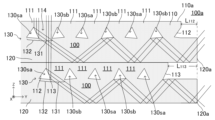
- FIG. 2 shows the collection of light input to the light guide 100 by the light entrance section 110 and the guidance of the light by the light guide section 120.
- the optical path of light that enters in the -Z direction from the light entrance surface 110a and is reflected by the reflecting surface 113 of the light entrance section 110 (the right inclined surface of the space 130sa at the leftmost part of the drawing) is shown.
- the opening width A of the continuous section 131 is large (aperture ratio A/P ⁇ 0.5)
- the light reflected by the reflecting surface 113 (reflected light) maintains its parallel light form and passes through the continuous section 131 to enter the light guide section 120.
- the reflected light that enters light-guiding section 120 is reflected by -Z end face 120b of light-guiding section 120, returns in the +Z direction, is reflected at the interface with discontinuous section 132, in this case discontinuous section 132b below the space 130sb that is three spaces to the right of discontinuous section 132, space 130sa below reflective surface 113, in this example, is reflected by -Z end face 120b of light-guiding section 120, returns in the +Z direction, and is further reflected at the interface with discontinuous section 132b below the space 130sb that is two spaces to the right, is guided to the right within light-guiding section 120, and is output from light output surface 120a.
- the interfaces of the discontinuous parts 132 (discontinuous parts 132a, 132b) arranged in the Y-axis direction with the light guide part 120 are alternately inclined in different directions, and the reflecting surfaces 112, 113 of the light collecting elements 111 arranged in the Y-axis direction have alternately different inclination angles (absolute value of the inclination angle with respect to the Z-axis), so that the light reflected by the reflecting surface 113 is reflected at the interface of the same discontinuous part 132 (discontinuous part 132b in this example) and guided through the light guide part 120.
- the inclination angles of the discontinuous parts 132a, 132b and/or the inclination angles of the reflecting surfaces 112, 113 are determined so that the light that enters the light guide part 120 from the light collecting element 111 does not leak through the light guide 100 in the +Z direction through the light transmitting parts 114 of the different light collecting elements 111, that is, so that the light is reflected at the interfaces of the multiple discontinuous parts 132.
- Figure 3 shows the design variables for the hollow space 130s.
- the design variables are grouped into three groups: shape, arrangement, and period.
- the group of shape variables includes design variables related to the cross-sectional shape of the space 130s when viewed in the X direction.
- two shapes, a polygon and a non-isosceles triangle are adopted as the main shapes of the space 130s.
- the design variables for the polygon include adding tangent points to define a polygon, with a triangle as the basic shape.
- a quadrilateral shape (a wedge shape in this example) is derived by adding one tangent point to the basic shape.
- the design variables for the non-isosceles triangle include base inclination and left-right angle difference.
- Base inclination includes inclining the bottom surface (-Z surface) of the space 130s, i.e., the base of the cross-sectional shape when viewed in the X direction.
- a deformed triangle can be derived by inclining the base of the triangle, which is the basic shape, downward and to the right.
- Left-right angle difference includes setting a difference in the inclination angle of the left and right hypotenuses (i.e., the reflecting surfaces 112, 113) of the triangle, which is the basic shape. For example, by making the angle of the right hypotenuse relative to the base smaller than the angle of the left hypotenuse, a triangle extending to the right is derived.
- Figure 4A shows an example of the shape of hollow space 130s and design parameters related to the shape.
- a quadrangle shape is derived by adding one tangent point to the base of the triangular basic shape, and the inclination of the base determines the inclination of the two bases (left discontinuous portion 132c and left discontinuous portion 132f of discontinuous portion 132), i.e., the lower rear slope angle Bb and the lower front slope angle Bf, and the difference between the left and right angles determines the inclination of the two oblique sides (reflecting surfaces 112, 113), i.e., the upper rear slope angle Ub and the upper front slope angle Uf.
- Figure 4B shows the light guide of light S input to light guide 100 having polygonal hollow space 130s.
- spaces 130s having a diamond-shaped cross section as shown in Figure 4A are arranged at equal intervals in the Y-axis direction.
- Light S enters light entrance section 110 via light entrance surface 110a and enters the right oblique side of the first space 130s (i.e., reflecting surface 113), is reflected by reflecting surface 113, enters light guide section 120 via continuous section 131, and is reflected by the bottom surface of light guide section 120 toward the bottom surface of the third space 130s.
- the bottom surface of space 130s includes two surfaces (left discontinuous portion 132c and left discontinuous portion 132f shown in Figure 4A) facing in different directions, so that light S branches into two lights Sc and Sf.
- Light Sc is reflected by the bottom surface of light guide 120 at a small angle relative to the Z-axis direction toward the bottom surface of adjacent space 130s, where it is reflected again and guided in the +Y direction within light guide 120.
- Light Sf is reflected by the bottom surface of light guide 120 at a large angle and guided in the +Y direction within light guide 120. In this way, by appropriately branching the light and reflecting each of the branched lights in an appropriate direction at the bottom surface of space 130s, it is possible to increase the light guide distance in the Y direction within light guide 120.
- the group of placement variables includes design variables related to the placement of the spaces 130s in the Y-axis direction.
- variable pitch and offset are adopted as placement variables for the spaces 130s.
- the design variables for variable pitch include determining the width (texture width Tw in FIG. 4A) of the bottom surface (discontinuous portion 132) of the spaces 130s in the Y-axis direction, and making the width of the gap (continuous portion 131) between the two spaces 130s equal or different to the width of the bottom surface.
- a dense arrangement of the spaces 130s is derived by making the gap between the two spaces 130s smaller than the width of the bottom surface.
- the design variables for offset include vertical movement and light reflection position.
- the design coefficient for vertical movement includes offsetting some of the spaces 130s among the multiple spaces 130s arranged in the Y-axis direction upward (+Z direction) or downward (-Z direction) relative to the other spaces 130s. For example, an arrangement is derived in which the right space is offset upward relative to the left space 130s.
- the design variables for the light reflection position include the position of the light incident on the bottom surface of the space 130s. For example, a configuration is derived in which the incident position of the light is shifted from the center of the bottom surface of the space 130s to the right of the center.
- the group of periodic variables includes design variables related to the arrangement of the spaces 130s in the Y-axis direction.
- irregular shapes are included as periodic variables for the spaces 130s.
- the design variables for irregular shapes include making the cross-sectional shapes of some of the spaces 130s, out of the multiple spaces 130s arranged in the Y-axis direction, different from the cross-sectional shapes of the other spaces 130s. For example, an arrangement is derived in which spaces 130s with equilateral triangular cross sections and spaces 130s with triangular cross sections extending to the right are alternately arranged in the Y-axis direction.
- Figure 4C shows an example of the arrangement and period of multiple hollow spaces 130s, and design parameters related to the arrangement and period. Note that the design parameters for the arrangement are shown as an example of the light guide path of light SA entering the right oblique side (reflective surface 113) of space 130sa.
- a shape and period of space 130s is adopted in which no contact points are added (triangular cross section), the base of the triangular cross section is inclined diagonally downward to the left (-Y, -Z direction) or diagonally downward to the right (+Y, -Z direction) due to the inclination of the base, an angle difference is provided between the left and right oblique sides (reflective surfaces 112, 113), and spaces 130sa with a base inclined diagonally downward to the left and spaces 130sb with a base inclined diagonally downward to the right due to an irregular shape are alternately arranged in the Y axis direction.
- the variable pitch determines the texture width Tw (see FIG.
- Figure 5 shows another design example and design parameters of hollow space 130s. If the cross-sectional shape of space 130s is triangular (no additional contacts) and the base is inclined by inclining the base, the texture width Tw will increase, which will result in a smaller propagation ray projection width Sw (width of continuous portion 131) or a larger texture pitch Tp, and it may become difficult to determine optimal design parameters. In such a case, by defining a rectangular shape by adding contacts and inclining the base to, for example, set the lower rear slope angle Bb to 90 degrees, it is possible to incline the base without changing the texture width Tw, propagation ray projection width Sw, or texture pitch Tp.
- Figure 6A shows the arrangement of the light guide 100 and the angle of incidence ⁇ of light accompanying the sun's diurnal orbit.
- the light guide 100 is arranged so that the extension direction of the continuous portion 131 (i.e., the X-axis direction) is approximately parallel to a plane (movement trajectory plane) 99 that includes the movement trajectory accompanying the sun's diurnal orbit, and so that the normal direction of the light entrance surface 110a is approximately parallel to the movement trajectory plane 99, i.e., so that the light collecting element 111 faces approximately parallel to the movement trajectory plane 99.
- the angle of incidence ⁇ of light is determined based on the normal direction of the light entrance surface 110a.
- the sun's movement trajectory plane 99 is the plane formed by the trajectory of the sun's orbital motion.
- Figure 6B shows the light extraction efficiency of the light guide 100 for the incident angle ⁇ shown in Figure 6A.
- the extraction efficiency can be analyzed by so-called light ray simulation, and is calculated by dividing the amount of light output from the light output surface 120a by the amount of light input to the light input surface 110a.
- the incident angle ⁇ is zero (normal incidence on the light input surface 110a)
- most of the light that enters the light input section 110 via the light input surface 110a is guided inside the light guide section 120 and output from the light output surface 120a.
- the incident angle exceeds 20 degrees
- the extraction efficiency gradually decreases, and becomes almost zero at an incident angle of 80 degrees. It can be seen that a high extraction efficiency can be obtained at least within the range of incident angles of 0 to 40 degrees, that is, during the long hours of daylight.
- Figure 7A shows the seasonal variations in the sun's diurnal orbit and solar altitude (noon altitude).
- the sun's diurnal motion causes it to rise in the east of the horizon, reach its noon, and then set in the west.
- the diurnal orbit changes according to the season, with the sun's altitude being highest at the summer solstice and lowest at the winter solstice.
- Figure 7B shows the arrangement of the light guide 100 and the solar altitude (also called the noon angle) ⁇ .
- the light guide 100 is arranged so that the arrangement direction of the spaces 130s or the continuous portions 131 (i.e., the Y-axis direction) is approximately parallel to the north-south plane 98 that determines the solar altitude, and so that the normal direction of the light entrance surface 110a is approximately parallel to the north-south plane 98, i.e., so that the light collecting elements 111 face vertically.
- the light incidence angle ⁇ is determined based on the normal direction of the light entrance surface 110a.
- Figure 7C shows the light extraction efficiency versus the solar altitude (incident angle) ⁇ shown in Figure 7B.
- the extraction efficiency can be analyzed by so-called light ray simulation, and is calculated by dividing the amount of light output from light exit surface 120a by the amount of light input to light entrance surface 110a.
- the incident angle ⁇ is zero (normal incidence on light entrance surface 110a)
- most of the light that enters light entrance section 110 via light entrance surface 110a is guided within light guide section 120 and output from light exit surface 120a.
- the incident angle becomes even slightly larger (exceeding approximately 3 degrees)
- the extraction efficiency drops sharply, reaching a minimum at an incident angle of approximately 10 degrees.
- FIG. 8 shows an example of the arrangement of the light guide 100 optimized for variations in the solar altitude.
- the light guide 100 is arranged so that the light guide direction (i.e., the Y-axis direction) of the light guide section 120 is approximately perpendicular to the plane (movement trajectory plane 99 in FIG. 6A) that includes the sun's movement trajectory (movement trajectory associated with diurnal motion).
- the light guide 100 is tilted by an angle ⁇ ' depending on the solar noon altitude, so that the normal direction of the light entrance surface 110a is within a range of approximately -3 to 3 degrees of the solar altitude. This brings the incident angle ⁇ of the light S into a range of -3 to 3 degrees, maximizing the light extraction efficiency.
- the inclination of the light guide 100 may be adjusted multiple times throughout the year, for example, four times at the vernal equinox, summer solstice, autumn equinox, and winter solstice, so that the normal direction of the light entrance surface 110a approximately coincides with the solar altitude.
- FIG. 9 shows the configuration of a light guide 100d1 according to a first modified example optimized for variations in the solar altitude.
- the light guide 100d1 has a light guide section 120d1 whose thickness (thickness in the Z-axis direction) increases in the +Y direction.
- the light guide section 120d1 has a generally right-angled triangular shape in a front view, with a top surface inclined at an angle ⁇ ' with respect to the Y-axis direction and a bottom surface parallel to the horizontal plane.
- the light entrance section 110 is disposed on the top surface of the light guide section 120. This allows the light guide 100 to be installed on a horizontal plane while the light entrance section 110 can be inclined approximately equal to the solar altitude, thereby maximizing the light extraction efficiency in the same way as the light guide 100 shown in FIG. 8.
- the light entrance surface 110a of the entrance portion 110 may be surface-treated so that light from a wide angle range enters the light entrance portion 110 approximately perpendicularly.
- a surface-treated surface treatment layer 110b is provided on the light entrance surface 110a.
- the surface treatment layer 110b includes, for example, a diffractive optical element and a moth-eye structure.
- the diffractive optical element may be, for example, a diffractive element in which a frustum-shaped fine pattern having a structure or period of 100 nm or more and 10 ⁇ m or less in length extending in the Z-axis direction is arranged in the XY direction, or an oblique grating formed by arranging a plate-shaped grating inclined with respect to the Z-axis direction with its longitudinal direction facing the X-axis direction in the Y-axis direction.
- the moth-eye structure is a structure formed by arranging fine protrusions having a structure of 100 nm or more and 10 ⁇ m or less in length extending in the Z-axis direction in the XY direction, so that the refractive index changes continuously in the Z-axis direction.
- FIG. 10A shows the definitions of the incidence angle ⁇ and diffraction angle ⁇ 1 of light S entering the light entrance section 110 from the light entrance surface 110a.
- the incidence angle ⁇ of light S is determined by the angle with respect to the normal direction (shown by a dashed line) of the light entrance surface 110a.
- the diffraction angle ⁇ 1 is also determined by the angle with respect to the normal direction (shown by a dashed line) of the light entrance surface 110a. Note that if the surface treatment layer 110b is not provided on the light entrance surface 110a, the light is refracted when it enters the light entrance section 110.
- Figure 10B shows the transmittance versus diffraction angle ⁇ 1 of light diffracted after entering the light entrance section 110 from the light entrance surface 110a having the surface treatment layer 110b.
- the numbers in the figure indicate the diffraction order.
- the surface treatment layer 110b uses a diffractive optical element in which a frustum-shaped fine pattern having a structure or period of 100 nm or more and 10 ⁇ m or less is arranged.
- Light S is diffracted upon entering the surface treatment layer 110b, and the zeroth to -8th order diffracted light spreads within an angular range of -60 to 40 degrees.
- the -2nd, -4th, -6th, and -8th order diffracted light spreads with high transmittance within an angular range of -20 to 20 degrees. Therefore, by providing the surface treatment layer 110b on the light entrance surface 110a and forming the surface treatment layer 110b so that the diffracted light (for example, -2nd, -4th, -6th, and -8th diffracted light) relative to the solar altitude is concentrated within this range of diffraction angle ⁇ 1 and is guided in the Z-axis direction, the light can be guided in the Y-axis direction within the light guide 100, improving the extraction efficiency.
- the diffracted light for example, -2nd, -4th, -6th, and -8th diffracted light
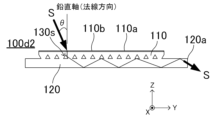
- FIG. 11 shows the configuration of a light guide 100d2 according to a second modified example optimized for variations in the solar altitude.
- the light guide 100d2 includes a surface treatment layer 110b formed on the light entrance surface 110a.
- the surface treatment layer 110b may be, for example, a diffractive optical element in which a trapezoidal fine pattern having a structure or period of 100 nm or more and 10 ⁇ m or less in length is arranged in the XY direction.
- the fine shape pattern By designing the fine shape pattern so that when light is incident at an incident angle ⁇ in the YZ plane, most of the diffracted light is diffracted at a diffraction angle of almost zero or in a diffraction angle range near zero, most of the light S that enters the light entrance surface 110a at a noon angle (incident angle ⁇ ) can be directed in the Z-axis direction within the light entrance section 110 and guided to the light guide section 120.
- FIG. 12 shows a side view of the configuration of a light guide 100d3 according to a third modified example optimized for the diurnal orbit of the sun.
- the light guide 100d3 includes a surface treatment layer 110b formed on the light entrance surface 110a.
- the surface treatment layer 110b may be, for example, a diffractive optical element in which a frustum-shaped fine pattern is arranged in the XY direction.
- the light guide 100 may be tilted around the Y axis so that light enters the light entrance surface 110a at an angle of incidence ⁇ relative to the meridian altitude. This allows strong light from the sun at meridian to enter the light entrance surface 110a, maximizing the amount of light guided to the light guide section 120.
- the -3rd order, -2nd order and -8th order diffracted light in particular spreads with high transmittance within the angle range of -50 to -20 degrees. Therefore, by providing the surface treatment layer 110b on the light entrance surface 110a and forming the surface treatment layer 110b so that the diffracted light (for example, the -3rd order diffracted light) is concentrated in this range of diffraction angle ⁇ 1 with respect to the diurnal altitude of the sun and is guided in the Z-axis direction, the light can be guided in the Y-axis direction within the light guide 100, improving the extraction efficiency.
- the diffracted light for example, the -3rd order diffracted light
- the light guide 100 with the surface treatment layer 110b provided on the light entrance surface 110a can be arranged so that the intersection line between the plane including the movement trajectory of the sun (movement trajectory plane 99 in FIG. 6A) and the light entrance surface 110a is inclined with respect to the horizontal direction.
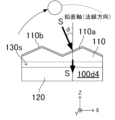
- FIG. 14A and 14B show side views of the configurations of the fourth and fifth modified light guides 100d4 and 100d5 optimized for the diurnal orbit of the sun.
- These light guides 100d4 and 100d5 have a light entrance section 110 having a light entrance surface 110a that is inclined around the Y axis with respect to the light guide section 120 that extends in the XY direction.
- the light entrance section 110 of the light guide 100d4 has an inverted W-shaped light entrance surface 110a including two inclined surfaces facing the -X, +Z directions and two inclined surfaces facing the +X, +Z directions in side view.
- a surface treatment layer 110b including a diffractive optical element having a structure or period of a frustum shape with a length of 100 nm or more and 10 ⁇ m or less arranged in the XY direction may be provided on the light entrance surface 110a.
- the fine shape pattern By designing the fine shape pattern so that when light enters an inclined surface inclined in the -X, +Z directions by an angle ⁇ ' with respect to the vertical axis in the XZ plane, most of the diffracted light is diffracted in the diffraction angle range approximately in the Z axis direction or near the Z axis, most of the light S entering the light entrance surface 110a can be directed in the Z axis direction within the light entrance section 110 and guided to the light guide section 120.
- the diffractive optical element even if light enters an inclined surface that is inclined in the +X and +Z directions in the opposite direction to the previous direction, most of the light S that enters the light entrance surface 110a can be directed in the Z-axis direction within the light entrance section 110 and guided to the light guide section 120.
- the light entrance section 110 of the light guide 100d5 has a sawtooth-shaped light entrance surface 110a including three inclined surfaces facing the -X and +Z directions in a side view.
- a surface treatment layer 110b including a diffractive optical element in which a frustum-shaped fine pattern is arranged in the XY direction may be provided on the light entrance surface 110a.
- the fine shape pattern By designing the fine shape pattern so that when light enters an inclined surface inclined in the -X and +Z directions by an angle ⁇ ' with respect to the vertical axis in the XZ plane, most of the diffracted light is diffracted in the diffraction angle range approximately in the Z axis direction or near the Z axis, most of the light S entering the light entrance surface 110a can be directed in the Z axis direction within the light entrance section 110 and guided to the light guide section 120.
- the light entrance surface 110a is not limited to three, and may include one, two, four or more inclined surfaces.
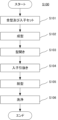
- FIG. 15 shows the first manufacturing flow S100 of the light guide 100.
- acrylic resin is used as the molding material for the light guide 100.
- the light entrance section 110 and the light guide section 120 are formed from the same material.
- step S101 the molds 151 and 152 and the multiple inserts 153 are set.
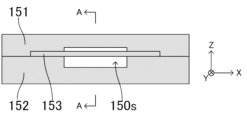
- Figures 16A and 16B show the state inside the molds 151 and 152 in a front view (about reference line AA in Figure 16B) and a side view (about reference line BB in Figure 16A), respectively.
- the mold 151 is a metal mold for forming the light entrance section 110, and includes an internal space having a size and shape capable of accommodating the light entrance section 110 and the multiple inserts 153.
- the mold 152 is a metal mold for forming the light guide section 120, and includes an internal space having a size and shape capable of accommodating the light guide section 120.
- the multiple inserts 153 are metal molds for forming spaces 130s in the light entrance section 110 (between the multiple light collecting elements 111), and are solid columns having a cross-sectional shape that is approximately an isosceles triangle.
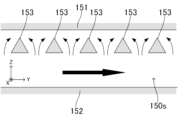
- the mold 152 is placed with its internal space facing the +Z direction, multiple nesting pieces 153 are arranged on the mold 152 in the Y-axis direction so as to straddle the internal space of the mold 152 in the X-axis direction, and the mold 151 is placed over the mold 152 with its internal space facing the -Z direction.
- This forms an internal space 150s between the molds 151 and 152, separated vertically by the multiple nesting pieces 153 except for a portion.
- step S102 acrylic resin is injected into the molds 151 and 152 to mold the light guide 100.
- Figure 16C shows the flow of resin inside the molds 151 and 152. The resin is injected downward through a through hole (not shown) in the mold 152 into the internal space 150s, and while filling in the direction of the black arrow, it fills upward through the gaps between the multiple nesting parts 153. After a certain amount of time has passed and the resin has cooled, the process moves to the next step.
- step S103 the mold 151 is pulled in the +Z direction to open the mold.
- the light entrance section 110 is exposed on the mold 152 with the light guide section 120 fitted into the internal space of the mold 152.
- step S104 the multiple nesting elements 153 are pulled out.
- Figure 16D shows the state in which the multiple nesting elements 153 are pulled out from the light guide 100.
- the multiple nesting elements 153 are pulled out in the direction of the white arrow (+X direction).
- the multiple nesting elements 153 may be formed in a tapered shape in which the +X end is narrower than the -X end so that they can be easily pulled out from the light guide 100.
- step S105 the light guide 100 is removed from the mold 152. This results in the light guide 100 shown in FIG. 1A.
- step S106 the molds 151 and 152 and the multiple inserts 153 are cleaned. This ends the flow. By repeating steps S101 to S106, multiple light guides 1 can be manufactured.
- FIG. 17 shows the second manufacturing flow S200 of the light guide 100.
- acrylic resin is used as the molding material for the light guide 100.
- the light entrance section 110 and the light guide section 120 are formed from the same material.
- step S201 the molds 161 and 162 are set.
- FIG. 18A shows the internal state of the molds 161 and 162 from a front view (viewed in the X-axis direction).
- the molds 161 and 162 are a pair of metal dies for forming the light entrance section 110.
- the mold 161 includes an internal space having a size and shape capable of accommodating the light entrance section 110.
- the mold 162 has multiple protruding edges 162a that protrude from the top surface in the +Z direction and are aligned in the Y-axis direction.
- the multiple protruding edges 162a are a structure for forming a space 130s in the light entrance section 110 (between the multiple focusing elements 111), and are formed to have a cross-sectional shape of an approximately isosceles triangle and extend in the X-axis direction.
- the mold 162 is placed with multiple protruding edges 162a facing in the +Z direction, and the mold 161 is placed over the mold 162 with its internal space facing in the -Z direction to accommodate the protruding edges 162a. This forms an internal space 161s between the molds 161 and 162.
- step S202 acrylic resin is injected into the molds 161, 162 to mold the light entrance portion 110.
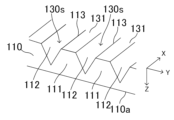
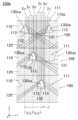
- Figures 18B and 18C respectively show the overall configuration and the -Z side structure of the molded light entrance portion 110.
- the light entrance portion 110 is integrally molded with multiple focusing elements 111 arranged in parallel in the Y-axis direction, and spaces 130s are included between adjacent focusing elements 111.
- a continuous portion 131 is formed on the -Z surface of each focusing element 111.
- the continuous portion 131 is integrally molded with the light entrance portion 110.
- the detailed configuration of the continuous portion 131 is as described above.
- step S203 mold 162 is opened from mold 161. In this state, light entrance portion 110 is housed within mold 161.
- step S204 the molds 161, 163 and the multiple inserts 165 are set.
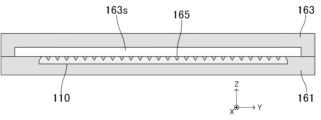
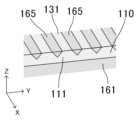
- Figures 18D and 18E show the internal state of the molds 161, 163 in a front view (viewed in the X-axis direction) and an oblique view, respectively.
- the mold 163 is configured in the same way as the previously described mold 152.
- the multiple inserts 165 are configured in the same way as the previously described insert 153. However, their length is equal to the width of the light entrance portion 110 in the X-axis direction.
- the mold 161 housing the light entrance section 110 is turned upside down, and the inserts 165 are inserted into each of the spaces 130s in the light entrance section 110, and the mold 163 is placed over the mold 161 with its internal space facing in the -Z direction.
- the light entrance section 110 with the inserts 165 fitted into the spaces 130s is housed in the internal space of the mold 161, and an internal space 163s is formed between the mold 161 and the mold 163.
- step S205 acrylic resin is injected into the molds 161 and 163 to mold the light guide 100 by casting.
- the resin is injected into the internal space 163s through a through hole (not shown) in the mold 163, and fills the +Z side of the light entrance section 110.
- the resin forms the light guide section 120 and is integrated with the light entrance section 110 via the continuous section 131 (see FIG. 18C).
- step S206 the light guide 100 is removed from the molds 161 and 163, and the multiple inserts 165 are pulled out from the light guide 100.
- the multiple inserts 165 may be formed in a tapered shape in which the +X end is narrower than the -X end so that they can be easily pulled out from the light guide 100. This results in the light guide 100 shown in FIG. 1A.
- step S207 the molds 161, 162, and 163 and the multiple inserts 165 are cleaned. This ends the flow. By repeating steps S201 to S207, multiple light guides 100 can be manufactured.
- FIG. 19 shows the third manufacturing flow S300 for the light guide 100.
- acrylic resin is used as the molding material for the light guide 100.
- the light entrance section 110 and the light guide section 120 are formed from the same material.
- step S302 the light entrance section 110 is molded.
- the light entrance section 110 can be molded by steps S201 to S203 described above.
- Figure 20A shows the structure of the molded light entrance section 110.
- the light entrance section 110 is formed as a separate body from the light guide section 120.
- step S304 the light guiding section 120 is molded. Details of the molding are omitted.
- Figure 20B shows the configuration of the molded light guiding section 120.
- the light guiding section 120 is formed as a separate body from the light entrance section 110.
- step S306 the light entrance section 110 and the light guide section 120 are welded together to form the light guide 100.
- the light entrance section 110 is placed on the +Z end face of the light guide section 120 with one end face in which the space 130s is formed facing the -Z side. This causes the -Z face of the light entrance section 110 to abut against the +Z end face of the light guide section 120.
- ultrasonic vibration is applied to the light entrance section 110 and/or the light guide section 120 to weld them together. This causes the light entrance section 110 and the light guide section 120 to be joined together via the continuous section 131, forming the light guide 100.
- the welding sections Before applying ultrasonic vibrations to the light entrance section 110 and/or the light guide section 120, the welding sections may be preheated, for example by irradiating them with infrared light, and then the light entrance section 110 and the light guide section 120 may be brought into contact with each other, and then pressure may be applied in the contact direction while vibrating in a direction parallel to the contacting surfaces to generate frictional heat, thereby welding the light entrance section 110 and the light guide section 120. This allows welding without air entrapment and with reduced beads.
- the light entrance section 110 and the light guide section 120 may be bonded to each other by, for example, using a solvent, instead of by welding.
- the light entrance section 110 and the light guide section 120 may be bonded to each other by providing a small gap between the light entrance section 110 and the light guide section 120, pouring a photocurable adhesive into the gap by capillary force, and curing the photocurable adhesive by irradiating it with light.
- the light entrance section 110 and the light guide section 120 may also be bonded to each other by using optical tape (e.g., ACO04N by 3M).
- the light guide 100 may also be molded using a 3D printer.
- FIG. 21 shows a light guide assembly 100a according to this embodiment.
- the light guide assembly 100a comprises two light guides 100 stacked in the Z-axis direction.
- the upper light guide 100 is placed on the light entrance surface 110a of the lower light guide 100.
- a small gap is provided between the light entrance surface 110a of the lower light guide 100 and the -Z surface of the upper light guide 100.
- the light entrance section 110 is formed with 180-degree rotational symmetry with respect to the Z-axis direction.
- the reflection surface 112 is located on the +Y end face, and the reflection surface 113 is located on the -Y end face.
- the light guide section 120 is also formed with 180-degree rotational symmetry with respect to the Z-axis direction.
- the difference between the distance L 112 from the +Y end of the light guide section 120 to the reflection surface 112 of the light entrance section 110 closest to the +Y end and the distance L 113 from the -Y end of the light guide section 120 to the light entrance section 110 closest to the -Y end is approximately equal to the width in the Y-axis direction of the continuous section 131 and the discontinuous section 132, i.e., half the arrangement pitch P of the multiple light collecting elements 111.
- the lower light guide 100 is rotated 180 degrees about the Z axis relative to the upper light guide 100.
- the reflecting surface 113 is located on the +Y end surface of the light entrance portion 110, and the reflecting surface 112 is located on the -Y end surface.
- the upper light guide 100 is placed on the light entrance surface 110a of the lower light guide 100, and the ⁇ Y end surfaces are aligned.
- the light collecting elements 111 of the upper light guide 100 are arranged with an offset of P/2 in the Y axis direction relative to the light collecting elements 111 of the lower light guide 100, and the reflecting surfaces 112 and 113 of the multiple light collecting elements 111 of the lower light guide 100 are located below (in the -Z direction) the light transmitting portions 114 of the multiple light collecting elements 111 of the upper light guide 100.
- Figure 22 shows the principle of light collection by the light entrance section 110 of light input to the light guide assembly 100a and light guidance by the light guide section 120.
- the optical path of light that is not reflected by the reflective surfaces 112, 113 of the light entrance section 110 of the upper light guide 100 and enters the light guide section 120 via the transparent section 114 between them (the transparent section 114 of the light collecting element 111 on the left side of the drawing) is shown.
- the guidance of light that enters the reflective surfaces 112, 113 of the light entrance section 110 is as previously explained using Figure 2.
- the reflecting surfaces 112, 113 of the lower light guide 100 are located below the light-transmitting section 114 of the upper light guide 100, light that has passed through the +Y side of the upper light-transmitting section 114 is reflected by the reflecting surface 113 on the +Y side of the lower section, passes through the continuous section 131 while maintaining parallel light, and enters the lower light guide section 120.
- the reflected light that enters the light guide section 120 is reflected by the -Z end surface 120b of the light guide section 120 and the interface between the light guide section 120 and the discontinuous section 132, is guided to the right inside the light guide section 120, and is output from the light output surface 120a.
- light (not shown) that passes through the -Y side of the upper light-transmitting section 114 is reflected by the reflecting surface 112 on the -Y side of the lower section, passes through the adjacent continuous section 131 while maintaining parallel light, and enters the lower light-guiding section 120.
- the reflected light that enters the light-guiding section 120 is guided to the left inside the light-guiding section 120 and is output from the other light-emitting surface 120a.
- Figure 23 shows the configuration and focusing principle of a modified light guide assembly 100b.
- the light guide assembly 100b has three light guides 100 stacked in the Z-axis direction.
- the middle light guide 100 is arranged on the light entrance surface 110a of the lower light guide 100
- the upper light guide 100 is arranged on the light entrance surface 110a of the middle light guide 100.
- Small gaps are provided between the three light guides 100.
- the continuous portion 131 has a width twice that of the discontinuous portion 132
- the three light guides 100 are arranged with their respective focusing elements 111 offset by P/3 in the Y-axis direction.
- the reflecting surfaces 112, 113 of the focusing elements 111 of the middle and lower light guides 100 are located below (in the -Z direction) the light transmitting portion 114 of the focusing element 111 of the upper light guide 100.
- light I11 and I12 are reflected by the reflecting surfaces 112, 113 of the upper light-entering section 110, respectively, and guided through the upper light guide section 120, and output from the light-exiting surface 120a.
- light I21 and I22 that pass through the -Y side are reflected by the reflecting surfaces 112, 113 of the middle light-entering section 110, respectively, and guided through the middle light guide section 120
- light I31 and I32 that pass through the +Y side are reflected by the reflecting surfaces 112, 113 of the lower light-entering section 110, respectively, and guided through the lower light guide section 120, and output from the light-exiting surface 120a of each light guide 100.
- the widths of the reflective surfaces 112, 113 and the continuous portion 131 of the light entrance portion 110 can be changed (1 to N-1), the light guide 100 can be stacked in multiple (N) stages, and offset by P/N in the Y-axis direction to form a light guide assembly.
- the light guide 100 is a light guide that guides light input from the light entrance surface 110a to the light exit surface 120a and outputs it from the light exit surface 120a, and has a light entrance surface 110a where light is input in the -Z direction, reflective surfaces 112 and 113 located in the -Z direction relative to the light entrance surface 110a, and a light transmitting portion 114, where the reflective surfaces 112 and 113 reflect a portion of the light input from the light entrance surface 110a, and the light transmitting portion 114 reflects another portion of the light input from the light entrance surface 110a and the reflected light.
- the optical element includes a light entrance section 110 which transmits light reflected by surfaces 112, 113, a light exit surface 120a which is located on the -Z side of the light entrance section 110 and which guides the reflected light in the Y-axis direction and outputs it from the light exit surface 120a, continuous sections 131 which are disposed at the boundaries between the light entrance section 110 and the light exit section 120 and provided so that the light transmitting section 114 and the light exit section 120 are continuous, and discontinuous sections 132 which are provided so that the reflective surfaces 112, 113 and the light exit section 120 are spaced apart.
- a portion of the light input to the light entrance section 110 in the -Z direction via the light entrance surface 110a is reflected by the reflecting surfaces 112 and 113 of the light entrance section 110, and the reflected light is introduced into the light guide section 120 via the light transmitting section 114 of the light entrance section 110 and the continuous section 131, and is guided inside the light guide section 120 to the Y axis, so that most of the light focused by the light entrance section 110 can be output from the light exit surface 120a.
- the light guide assembly 100a includes two light guides 100 stacked in the Z-axis direction. This allows light that is emitted from the light entrance section 110 (light collecting element 111) of the upper light guide 100 through the light transmitting section 114 and light guide section 120 between them without being reflected by the reflective surfaces 112 and 113 to the outside of the light guide 100, i.e., leaked light, to be collected by the lower light guide 100, so that most of the light that has entered the light guide assembly 100a can be trapped within the light guide section 120 and output from the light exit surface 120a.
- a bottom structure 121 may be provided on the bottom surface of the light-guiding section 120 so that the light guided from the light-entering section 110 to the light-guiding section 120 can be guided a long distance in the Y-axis direction without leakage or with minimal leakage through the light-entering section 110.
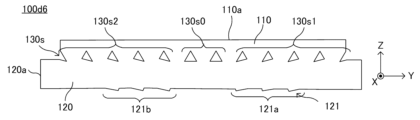
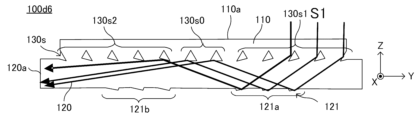
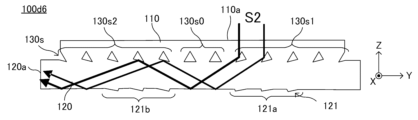
- Figure 24A shows the configuration of a light guide 100d6 according to a sixth modified example having a bottom structure 121.
- the light guide 100d6 includes a light entrance section 110 and a light guide section 120, and a plurality of spaces 130s are arranged in the Y-axis direction between the light entrance section 110 and the light guide section 120.
- the plurality of spaces 130s include, as an example, two spaces 130s0 having an equilateral triangular cross section in the center in the Y-axis direction, five spaces 130s1 having a triangular cross section extending in the -Y and -Z directions on the +Y side, and five spaces 130s2 having a triangular cross section extending in the +Y and -Z directions on the -Y side.
- the light guide section 120 includes, on its bottom surface, a bottom structure 121 that protrudes in the -Z direction and extends in the X-axis direction.
- the bottom surface structure 121 includes three bottom surface structures 121a having inclined surfaces facing the +Y and -Z directions on the +Y side of the light guiding section 120, and three bottom surface structures 121b having inclined surfaces facing the -Y and -Z directions on the -Y side of the light guiding section 120. Note that the number of spaces 130s and the number of bottom surface structures 121 may be determined arbitrarily.
- 24B to 24E show the light guide of light input to the light guide 100d6 of the sixth modified example.
- FIG. 24B of the light that enters the light input section 110 from the light input surface 110a, light S1 reflected on the left slope (reflecting surface 112) of the three spaces 130s1 on the +Y side is guided to the three bottom structures 121a and reflected on the slope, then guided to the bottom surfaces of the two spaces 130s0 and the bottom surface (discontinuous portion 132) of the space 130s2 on the +Y side and reflected, and output from the light output surface 120a on the -Y side.
- the light S2 reflected by the left slope (reflection surface 112) of the two spaces 130s1 on the -Y side is guided to the center of the bottom surface of the light guide section 120 and reflected, then guided to the bottom surface (discontinuous portion 132) of the two spaces 130s2 on the +Y side and reflected, and output from the light output surface 120a on the -Y side.
- the left slope (reflection surface 112) of the two spaces 130s1 on the -Y side is guided to the center of the bottom surface of the light guide section 120 and reflected, then guided to the bottom surface (discontinuous portion 132) of the two spaces 130s2 on the +Y side and reflected, and output from the light output surface 120a on the -Y side.
- the light S3 reflected by the left slope (reflection surface 112) of the two spaces 130s0 and the left slope (reflection surface 112) of the space 130s2 on the +Y side is guided to the three bottom surface structures 121b and reflected by the inclined surface, then guided to the bottom surface (discontinuous portion 132) of the three spaces 130s2 on the -Y side and reflected, and output from the light output surface 120a on the -Y side.
- the light output surface 120a on the -Y side As shown in FIG.
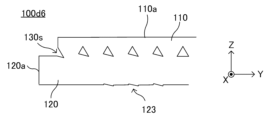
- FIGS 25A and 25B show another example of bottom structures 122, 123.
- Bottom structure 122 shown in Figure 25A is a groove-like structure formed on the bottom surface of light-guiding section 120 so as to be recessed in the +Z direction and extend in the X-axis direction.
- Bottom structure 123 shown in Figure 25B is an uneven structure formed on the bottom surface of light-guiding section 120 so that half of it protrudes in the -Z direction and the other half is recessed in the +Z direction and extends in the X-axis direction.
- the inclined surfaces of bottom structures 122, 123 are inclined at the same angle as the inclined surface of bottom structure 121.
- the -Z end faces may be mirror-finished.
- a reflective film may also be provided using metal or the like.
- Figure 26 shows a light guide assembly 100c formed using a light guide portion 100d6 according to the sixth modified example.
- the light guide assembly 100c includes two light guides 100d6 stacked in the Z-axis direction.
- the two light guides 100d6 have a bottom surface structure 122.
- the upper light guide 100d6 is disposed on the light entrance surface 110a of the lower light guide 100d6.
- the focusing elements 111 of the upper light guide 100d6 are arranged offset by P/2 in the Y-axis direction relative to the focusing elements 111 of the lower light guide 100d6, and the reflecting surfaces 112, 113 of the multiple focusing elements 111 of the lower light guide 100 are located below (in the -Z direction) the light transmitting portions 114 of the multiple focusing elements 111 of the upper light guide 100.
- the upper surface (light entrance surface 110a of light entrance section 110) and the lower surface (-Z surface of light guide section 120) of the light guide 100 according to this embodiment may be smooth. This can prevent the accumulation of dust and other particles when the light guide 100 is installed outdoors.
- the light guide section 120 is formed in a plate shape extending in the Y-axis direction perpendicular to the light input direction (Z-axis direction), but is not limited to this, and may be curved in any direction intersecting the input direction, such as curved in an arc or spherical shell shape.
- the light guide section 120 may be curved or bent in any direction from the portion overlapping with the light entrance section 110, and may be formed to extend to the light exit surface 120a by widening or narrowing, increasing or decreasing its thickness. As a result, the light collected by the light entrance section 110 is guided into the light guide section 120, and then reflected by its end surface and guided in any direction toward the light exit surface 120a.
- the light output from the light output surface 120a of the light guide 100 may be input to another light guide (such as an optical fiber) different from the light guide 100, and output (emitted) at the other end of the other light guide.
- another light guide such as an optical fiber
- the abutment surface of the light guide 100 abutting the second light guide 100 may be regarded as the light output surface 120a.
- the boundary portion of the two light guides 100 i.e., the abutment surface before welding
- the surface from which the light input from the light guide 100 is output may be considered as the light output surface 120a.
Landscapes
- Physics & Mathematics (AREA)
- General Physics & Mathematics (AREA)
- Optics & Photonics (AREA)
- Life Sciences & Earth Sciences (AREA)
- Sustainable Development (AREA)
- Engineering & Computer Science (AREA)
- General Engineering & Computer Science (AREA)
- Light Guides In General And Applications Therefor (AREA)
Priority Applications (3)
| Application Number | Priority Date | Filing Date | Title |
|---|---|---|---|
| JP2025530159A JPWO2025005117A1 (https=) | 2023-06-30 | 2024-06-26 | |
| CN202480016924.2A CN120826566A (zh) | 2023-06-30 | 2024-06-26 | 导光体及导光体组件 |
| US19/346,595 US20260029097A1 (en) | 2023-06-30 | 2025-10-01 | Light guide and light guide assembly |
Applications Claiming Priority (4)
| Application Number | Priority Date | Filing Date | Title |
|---|---|---|---|
| JP2023108184 | 2023-06-30 | ||
| JP2023-108184 | 2023-06-30 | ||
| JP2023-222936 | 2023-12-28 | ||
| JP2023222936 | 2023-12-28 |
Related Child Applications (1)
| Application Number | Title | Priority Date | Filing Date |
|---|---|---|---|
| US19/346,595 Continuation US20260029097A1 (en) | 2023-06-30 | 2025-10-01 | Light guide and light guide assembly |
Publications (1)
| Publication Number | Publication Date |
|---|---|
| WO2025005117A1 true WO2025005117A1 (ja) | 2025-01-02 |
Family
ID=93938622
Family Applications (1)
| Application Number | Title | Priority Date | Filing Date |
|---|---|---|---|
| PCT/JP2024/023131 Ceased WO2025005117A1 (ja) | 2023-06-30 | 2024-06-26 | 導光体及び導光体アセンブリ |
Country Status (4)
| Country | Link |
|---|---|
| US (1) | US20260029097A1 (https=) |
| JP (1) | JPWO2025005117A1 (https=) |
| CN (1) | CN120826566A (https=) |
| WO (1) | WO2025005117A1 (https=) |
Citations (4)
| Publication number | Priority date | Publication date | Assignee | Title |
|---|---|---|---|---|
| JP2005019587A (ja) * | 2003-06-25 | 2005-01-20 | Kuraray Co Ltd | 採光装置および光発電装置 |
| JP2010525582A (ja) * | 2007-05-01 | 2010-07-22 | モーガン ソーラー インコーポレーテッド | 導光ソーラーパネルおよびその製造方法 |
| JP2011503902A (ja) * | 2007-11-16 | 2011-01-27 | クォルコム・メムズ・テクノロジーズ・インコーポレーテッド | 薄膜ソーラコンセントレータ/コレクタ |
| JP2011515018A (ja) * | 2008-02-12 | 2011-05-12 | クォルコム・メムズ・テクノロジーズ・インコーポレーテッド | 2層式薄膜ホログラフィック太陽光コレクタ及び太陽光コンセントレータ |
-
2024
- 2024-06-26 WO PCT/JP2024/023131 patent/WO2025005117A1/ja not_active Ceased
- 2024-06-26 JP JP2025530159A patent/JPWO2025005117A1/ja active Pending
- 2024-06-26 CN CN202480016924.2A patent/CN120826566A/zh active Pending
-
2025
- 2025-10-01 US US19/346,595 patent/US20260029097A1/en active Pending
Patent Citations (4)
| Publication number | Priority date | Publication date | Assignee | Title |
|---|---|---|---|---|
| JP2005019587A (ja) * | 2003-06-25 | 2005-01-20 | Kuraray Co Ltd | 採光装置および光発電装置 |
| JP2010525582A (ja) * | 2007-05-01 | 2010-07-22 | モーガン ソーラー インコーポレーテッド | 導光ソーラーパネルおよびその製造方法 |
| JP2011503902A (ja) * | 2007-11-16 | 2011-01-27 | クォルコム・メムズ・テクノロジーズ・インコーポレーテッド | 薄膜ソーラコンセントレータ/コレクタ |
| JP2011515018A (ja) * | 2008-02-12 | 2011-05-12 | クォルコム・メムズ・テクノロジーズ・インコーポレーテッド | 2層式薄膜ホログラフィック太陽光コレクタ及び太陽光コンセントレータ |
Also Published As
| Publication number | Publication date |
|---|---|
| US20260029097A1 (en) | 2026-01-29 |
| CN120826566A (zh) | 2025-10-21 |
| JPWO2025005117A1 (https=) | 2025-01-02 |
Similar Documents
| Publication | Publication Date | Title |
|---|---|---|
| US8498505B2 (en) | Dimpled light collection and concentration system, components thereof, and methods | |
| US9036963B2 (en) | Light collecting and emitting apparatus, method, and applications | |
| US9246038B2 (en) | Light collecting and emitting apparatus, method, and applications | |
| US20090080192A1 (en) | Prism sheet and backlight module using the same | |
| EP2519978B1 (en) | Photovoltaic concentrator with optical stepped lens and method for designing the same | |
| US20100108124A1 (en) | Solar energy concentrator | |
| US7726827B2 (en) | Prism sheet and backlight module using the same | |
| CN114371529B (zh) | 一种堆叠光栅及ar显示装置 | |
| JP2001042112A (ja) | 回折光学素子及びそれを用いた光学系 | |
| US20120140352A1 (en) | Light-Guide Solar Energy Concentrator | |
| JP2008139878A (ja) | 光学板 | |
| US7042642B2 (en) | Diffractive optical element | |
| US20090080218A1 (en) | Prism sheet and backlight module using the same | |
| JP4387855B2 (ja) | 光学系 | |
| US9163858B2 (en) | Concentrating and spectrum splitting optical device for solar energy applications | |
| US7744245B2 (en) | Prism sheet and backlight module using the same | |
| JP2016138911A (ja) | フレネルレンズ、集光型太陽光発電モジュール、及び集光型太陽光発電装置 | |
| WO2025005117A1 (ja) | 導光体及び導光体アセンブリ | |
| US20120087008A1 (en) | Diffractive optical element, optical system, and optical apparatus | |
| US8740397B2 (en) | Optical cover employing microstructured surfaces | |
| US20140130855A1 (en) | Dispersive optical systems and methods and related electricity generation systems and methods | |
| US7712945B2 (en) | Prism sheet and backlight module using the same | |
| WO2024005191A1 (ja) | 導光体 | |
| KR101880729B1 (ko) | 태양광 집광판 | |
| CN109906362B (zh) | 小型化光学装置,诸如分光计和分光计模块,和其制造 |
Legal Events
| Date | Code | Title | Description |
|---|---|---|---|
| 121 | Ep: the epo has been informed by wipo that ep was designated in this application |
Ref document number: 24831976 Country of ref document: EP Kind code of ref document: A1 |
|
| WWE | Wipo information: entry into national phase |
Ref document number: 2025530159 Country of ref document: JP |
|
| WWE | Wipo information: entry into national phase |
Ref document number: 202480016924.2 Country of ref document: CN |
|
| WWP | Wipo information: published in national office |
Ref document number: 202480016924.2 Country of ref document: CN |
|
| NENP | Non-entry into the national phase |
Ref country code: DE |