WO2025005033A1 - 吸収性物品 - Google Patents
吸収性物品 Download PDFInfo
- Publication number
- WO2025005033A1 WO2025005033A1 PCT/JP2024/022787 JP2024022787W WO2025005033A1 WO 2025005033 A1 WO2025005033 A1 WO 2025005033A1 JP 2024022787 W JP2024022787 W JP 2024022787W WO 2025005033 A1 WO2025005033 A1 WO 2025005033A1
- Authority
- WO
- WIPO (PCT)
- Prior art keywords
- sheet
- absorbent article
- colored
- color difference
- difference
- Prior art date
- Legal status (The legal status is an assumption and is not a legal conclusion. Google has not performed a legal analysis and makes no representation as to the accuracy of the status listed.)
- Ceased
Links
Images

Classifications
-
- A—HUMAN NECESSITIES
- A61—MEDICAL OR VETERINARY SCIENCE; HYGIENE
- A61F—FILTERS IMPLANTABLE INTO BLOOD VESSELS; PROSTHESES; DEVICES PROVIDING PATENCY TO, OR PREVENTING COLLAPSING OF, TUBULAR STRUCTURES OF THE BODY, e.g. STENTS; ORTHOPAEDIC, NURSING OR CONTRACEPTIVE DEVICES; FOMENTATION; TREATMENT OR PROTECTION OF EYES OR EARS; BANDAGES, DRESSINGS OR ABSORBENT PADS; FIRST-AID KITS
- A61F13/00—Bandages or dressings; Absorbent pads
- A61F13/15—Absorbent pads, e.g. sanitary towels, swabs or tampons for external or internal application to the body; Supporting or fastening means therefor; Tampon applicators
- A61F13/45—Absorbent pads, e.g. sanitary towels, swabs or tampons for external or internal application to the body; Supporting or fastening means therefor; Tampon applicators characterised by the shape
- A61F13/49—Absorbent pads, e.g. sanitary towels, swabs or tampons for external or internal application to the body; Supporting or fastening means therefor; Tampon applicators characterised by the shape specially adapted to be worn around the waist, e.g. diapers or nappies
- A61F13/496—Absorbent pads, e.g. sanitary towels, swabs or tampons for external or internal application to the body; Supporting or fastening means therefor; Tampon applicators characterised by the shape specially adapted to be worn around the waist, e.g. diapers or nappies in the form of pants or briefs
-
- A—HUMAN NECESSITIES
- A61—MEDICAL OR VETERINARY SCIENCE; HYGIENE
- A61F—FILTERS IMPLANTABLE INTO BLOOD VESSELS; PROSTHESES; DEVICES PROVIDING PATENCY TO, OR PREVENTING COLLAPSING OF, TUBULAR STRUCTURES OF THE BODY, e.g. STENTS; ORTHOPAEDIC, NURSING OR CONTRACEPTIVE DEVICES; FOMENTATION; TREATMENT OR PROTECTION OF EYES OR EARS; BANDAGES, DRESSINGS OR ABSORBENT PADS; FIRST-AID KITS
- A61F13/00—Bandages or dressings; Absorbent pads
- A61F13/15—Absorbent pads, e.g. sanitary towels, swabs or tampons for external or internal application to the body; Supporting or fastening means therefor; Tampon applicators
- A61F13/42—Absorbent pads, e.g. sanitary towels, swabs or tampons for external or internal application to the body; Supporting or fastening means therefor; Tampon applicators with wetness indicator or alarm
-
- A—HUMAN NECESSITIES
- A61—MEDICAL OR VETERINARY SCIENCE; HYGIENE
- A61F—FILTERS IMPLANTABLE INTO BLOOD VESSELS; PROSTHESES; DEVICES PROVIDING PATENCY TO, OR PREVENTING COLLAPSING OF, TUBULAR STRUCTURES OF THE BODY, e.g. STENTS; ORTHOPAEDIC, NURSING OR CONTRACEPTIVE DEVICES; FOMENTATION; TREATMENT OR PROTECTION OF EYES OR EARS; BANDAGES, DRESSINGS OR ABSORBENT PADS; FIRST-AID KITS
- A61F13/00—Bandages or dressings; Absorbent pads
- A61F13/15—Absorbent pads, e.g. sanitary towels, swabs or tampons for external or internal application to the body; Supporting or fastening means therefor; Tampon applicators
- A61F13/51—Absorbent pads, e.g. sanitary towels, swabs or tampons for external or internal application to the body; Supporting or fastening means therefor; Tampon applicators characterised by the outer layers of the pads
-
- A—HUMAN NECESSITIES
- A61—MEDICAL OR VETERINARY SCIENCE; HYGIENE
- A61F—FILTERS IMPLANTABLE INTO BLOOD VESSELS; PROSTHESES; DEVICES PROVIDING PATENCY TO, OR PREVENTING COLLAPSING OF, TUBULAR STRUCTURES OF THE BODY, e.g. STENTS; ORTHOPAEDIC, NURSING OR CONTRACEPTIVE DEVICES; FOMENTATION; TREATMENT OR PROTECTION OF EYES OR EARS; BANDAGES, DRESSINGS OR ABSORBENT PADS; FIRST-AID KITS
- A61F13/00—Bandages or dressings; Absorbent pads
- A61F13/15—Absorbent pads, e.g. sanitary towels, swabs or tampons for external or internal application to the body; Supporting or fastening means therefor; Tampon applicators
- A61F13/42—Absorbent pads, e.g. sanitary towels, swabs or tampons for external or internal application to the body; Supporting or fastening means therefor; Tampon applicators with wetness indicator or alarm
- A61F2013/422—Absorbent pads, e.g. sanitary towels, swabs or tampons for external or internal application to the body; Supporting or fastening means therefor; Tampon applicators with wetness indicator or alarm the alarm being a colour change
Definitions
- the present invention relates to an absorbent article having a fiber sheet with colored fibers.
- Patent Document 1 discloses a fiber sheet having colored fibers.
- the colored fiber sheet is configured to be visible from the outside of the absorbent article.
- the fiber sheet is provided on an absorbent body, and the entire absorbent body or a portion of a layer in the thickness direction is colored with dyed fibers. According to the absorbent article of Patent Document 1, the absorbent body can be made to stand out by being colored.
- the fiber sheet in Patent Document 1 is dyed in a single color, and the design quality could not be improved sufficiently.
- the present invention aims to improve the design quality of a colored sheet having colored fibers.
- the absorbent article has a colored sheet having colored fibers.
- the difference between the maximum value of the reference color difference, which is the color difference with respect to a reference plate, in the sheet placement area in which the colored sheet is placed and the minimum value of the reference color difference in the sheet placement area is 3.0 or more.
- FIG. 1 is a schematic front view of an absorbent article 1 according to an embodiment.
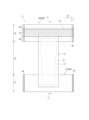
- FIG. 2 is a plan view of the absorbent article 1 according to the embodiment in an unfolded and extended state.
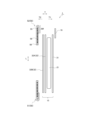
- FIG. 3 is a cross-sectional view taken along line AA shown in FIG.
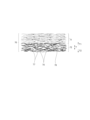
- FIG. 4 is a schematic cross-sectional view of a colored sheet.
- the absorbent article according to aspect 1 includes a colored sheet having colored fibers.
- the difference between the maximum value of a reference color difference, which is a color difference with respect to a reference plate, in a sheet-arrangement area in which the colored sheet is arranged and the minimum value of the reference color difference in the sheet-arrangement area is 3.0 or more.
- the difference between the maximum value and the minimum value is 3.0 or more, a user can recognize multiple colors in the colored sheet, and a high decorative effect can be achieved compared to a single-color sheet, thereby improving design.
- the invention according to embodiment 2 may have the following features in the invention according to embodiment 1.
- the difference between the maximum value of the reference color difference in the sheet placement area and the minimum value of the reference color difference in the sheet placement area is 10.0 or less.
- the user since the difference between the maximum value and the minimum value is 10.0 or less, the user can easily recognize multiple colors as different but similar colors, and can easily recognize them as an integrated pattern design having multiple similar colors. Therefore, the design of the wearing sheet can be further improved.
- the invention according to embodiment 3 may have the following features in the invention according to embodiment 1 or embodiment 2.
- the absorbent article has a non-sheet area adjacent to the sheet arrangement area, in which the colored sheet is not arranged.
- the difference between the average value of the reference color difference in the non-sheet arrangement area and the average value of the reference color difference in the sheet arrangement area is 3.0 or more.
- the user since the difference between the average value of the reference color difference in the non-sheet arrangement area and the average value of the reference color difference in the sheet arrangement area is 3.0 or more, the user can recognize the sheet arrangement area and the non-sheet arrangement area as separate areas, making it easier to recognize the design of the sheet arrangement area.
- the invention according to embodiment 4 may have the following features in the invention according to any one of embodiments 1 to 3.
- the sheet arrangement area has a stretchable area. If the average value of the reference color difference in the natural state of the stretchable area is taken as the natural average value, and the average value of the reference color difference in the stretchable area in the stretched state is taken as the stretch average value, one of the natural average value and the stretch average value is 1.5 times or more the other.
- the stretchable area stretches. At this time, the color of the stretchable area changes significantly, improving the design of the colored sheet.
- the stretching state of the colored sheet can be indicated by a change in color, and the function of the stretching of the area where the colored sheet is arranged can be visually conveyed to the user, allowing the user to intuitively grasp the function of the absorbent article.
- the invention according to embodiment 5 may have the following features in the invention according to any one of embodiments 1 to 4.
- the colored sheet is disposed on the one surface of the absorbent article. According to this embodiment, the user can more easily view the colored sheet by visually checking the one surface of the absorbent article, and can more easily grasp the color and design of the colored sheet.
- the invention according to embodiment 6 may have the following features in the invention according to any one of embodiments 1 to 5.
- the absorbent article has an absorbent core.
- the colored sheet is arranged at a distance from the absorbent core in a planar view of the absorbent article.
- the highly designed colored sheet is arranged at a distance from the absorbent core in a planar view, so that the user focuses on the colored sheet, relatively reducing the visibility of the absorbent core and reducing the visibility of the excrement absorbed by the absorbent core.
- the invention according to embodiment 7 may have the following features in the invention according to any one of embodiments 1 to 5.
- the absorbent article has an absorbent core.
- the colored sheet is disposed on the one side of the absorbent core in the area where it overlaps with the absorbent core. According to this embodiment, the colored sheet can conceal the excrement absorbed by the absorbent core, reducing the visibility of the excrement absorbed by the absorbent core.
- the invention according to embodiment 8 may have the following features in the invention according to any one of embodiments 1 to 7.
- the difference between the maximum value of the reference color difference in the sheet arrangement area and the minimum value of the reference color difference in the sheet arrangement area is 3.0 or more.
- the absorbent article has a non-skin side fiber sheet that abuts against the non-skin side of the colored sheet and has fibers.
- the fiber density of the non-skin side fiber sheet is higher than the fiber density of the colored sheet.
- the body fluid absorbed by the colored sheet is easily guided to the non-skin side fiber sheet due to the fiber density gradient. Therefore, the design of the colored sheet is prevented from being deteriorated by the body fluid absorbed by the colored sheet, and the user can easily continue to view the highly designed colored sheet when viewed from the skin side of the absorbent article.
- the invention according to embodiment 9 may have the following features in the invention according to any one of embodiments 1 to 8.
- the colored sheet is a laminated sheet in which a first layer having fibers of a certain color is laminated with a second layer having fibers of a color different from the certain color.
- a colored sheet having multiple colors can be constructed at low cost without using multiple sheets of nonwoven fabric of different colors.
- the invention according to embodiment 10 may have the following features in the invention according to any one of embodiments 1 to 9.
- a mottled pattern is formed on the outer surface of the colored sheet.
- the mottled pattern provided on the outer surface of the colored sheet can further improve the design of the colored sheet.
- the inventions according to aspects 1 to 10 only need to satisfy the configuration in at least one of the absorbent articles in a natural state and in a stretched state, unless otherwise specified. Specifically, for example, it is sufficient that the difference between the maximum value of the reference color difference and the minimum value of the reference color difference is 3.0 or more in at least one of the absorbent articles in a natural state and in a stretched state.
- the absorbent article 1 is an absorbent article capable of absorbing bodily fluids of a wearer.
- the absorbent article 1 may be a disposable diaper or incontinence pad for absorbing urine, a sanitary napkin for absorbing menstrual blood, or a panty liner for absorbing vaginal discharge.
- the disposable diaper may be a tape type or a pants type.
- the absorbent article 1 of the present embodiment is a pants type disposable diaper.
- FIG. 1 is a schematic front view of the absorbent article 1 according to the embodiment.
- FIG. 2 is a schematic plan view of the absorbent article 1 according to the embodiment in an unfolded and stretched state as viewed from the skin side T1. The unfolded and stretched state shown in FIG.
- the "extended state” refers to a state in which the entire product (the entire product) is stretched without wrinkles, specifically, a state in which the dimensions of each component constituting the absorbent article 1 are stretched to a dimension that matches or is close to the dimensions of the component alone.
- the “natural state” is the state of the absorbent article 1 when it is left for a predetermined period of time.
- the waistband of the manufactured absorbent article 1 is taken out of the package and pulled outward in both the left and right directions to put the waistband in a "stretched state.”
- This stretched state is continued for 15 seconds, after which the absorbent article 1 is released from the tension and placed on a flat surface such as a desk.
- the state after 5 minutes of being left in this flat state is considered to be the natural state.
- the absorbent article 1 has a front waist region S1, a rear waist region S2, and a crotch region S3.
- the front waist region S1 is a region facing the front waist (abdomen) of the wearer.
- the rear waist region S2 is a region facing the rear waist (back) of the wearer.
- the crotch region S3 is a region located between the front waist region S1 and the rear waist region S2, under the crotch of the wearer.
- the crotch region S3 may be a region in which leg openings 66 are provided.
- a side joint 60 may be provided by joining an end of the front waist region S1 (front outer body 51) in the width direction W with an end of the rear waist region S2 (rear outer body 52) in the width direction W.
- the side joint 60 is defined by a portion where the outer side of the front waist region S1 and the outer side of the rear waist region S2 are engaged with each other.
- the absorbent article 1 is formed with a waist opening 62 that encircles the waist of the wearer and through which the torso of the wearer is passed, and a pair of leg openings 66 that encircle the legs of the wearer and through which the legs of the wearer are inserted, respectively.
- the waist opening 62 may be defined by the front edge of the front waist region S1 and the rear edge of the rear waist region S2.
- FIG. 2 shows the absorbent article 1 unfolded after the joining at the side joint 60 is released.
- the outer portion is a portion occupying a certain range in the width direction W including the outer edge in the width direction W, and the outer edge is the outer edge in the width direction W.
- the inner portion is a portion occupying a certain range in the width direction W including the inner edge in the width direction W, and the inner edge is the inner edge in the width direction W.
- the front end and rear end are portions occupying a certain range in the front-to-back direction L including edges in the front-to-back direction L, and the front edge and rear edge are edges in the front-to-back direction L.
- the outer end includes the front end and rear end, and the outer edge includes the front edge and rear edge.
- the absorbent article 1 may have an exterior body 50 and an absorbent main body 15.
- the exterior body 50 may have a portion located on the non-skin side T2 of the absorbent main body 15, and covers at least the waist of the wearer.
- a portion of the exterior body 50 (e.g., the colored sheet 70) may be located on the skin side T1 of the absorbent main body 15.
- the exterior body 50 may have a front exterior body 51 located in the front waist region S1, and a rear exterior body 52 located in the rear waist region S2.
- the front exterior body 51 and the rear exterior body 52 may be located at a distance in the front-to-rear direction L.
- the front exterior body 51 and the rear exterior body 52 may be integrated.
- the front exterior body 51 and the rear exterior body 52 may have a skin-side sheet 55 arranged on the skin side T1 in the thickness direction T, a non-skin-side sheet 56 laminated adjacent to the non-skin side of the skin-side sheet 55, and a waist-line elastic member 58 (see FIG. 3) such as rubber thread provided between the skin-side sheet 55 and the non-skin-side sheet 56.
- the skin side sheet 55 and the non-skin side sheet 56 are rectangular sheet members in plan view, and may be formed of nonwoven fabric such as SMS nonwoven fabric.
- the outer end of the non-skin side sheet 56 in the front-rear direction L may have a folded portion 56f folded from the non-skin side T2 to the skin side T1 and from the outside to the inside in the front-rear direction L.
- the folded portion 56f does not necessarily have to be provided.
- the waist elastic member 58 is a stretchable member that is provided along the width direction W and can stretch in the width direction, and in this embodiment, white thread rubber is used.
- the waist elastic members 58 are arranged in a row in the front-rear direction L between the skin side sheet 55 and the non-skin side sheet 56, and are attached in a stretched state in the width direction W.
- the front waist region S1 and the rear waist region S2 fit the waist of the wearer due to the stretchability exhibited by the waist elastic member 58.
- the absorbent article 1 of this embodiment is provided with waist elastic members 58, but they are not limited to rubber threads.
- Elastic members such as elastic sheets may be arranged to allow the front waist region S1 and the rear waist region S2 to stretch in the left-right direction.
- the absorbent body 15 may be arranged across the front waist region S1, the rear waist region S2 and the crotch region S3.
- the absorbent body 15 may be constructed as a separate body from the front exterior body 51 and the rear exterior body 52, and may be joined to the front exterior body 51 and the rear exterior body 52 in the front waist region S1 and the rear waist region S2, respectively.
- the absorbent body 15 may have at least an absorbent core 21, a top sheet 31 arranged on the skin side T1 of the absorbent core 21, and a back sheet 32 arranged on the non-skin side T2 of the absorbent core 21.
- the absorbent core 21 may contain, for example, ground pulp or superabsorbent polymer (SAP), or a mixture of these.
- the absorbent core 21 may be covered by a core wrap (not shown).
- the top sheet 31 may be a liquid-permeable sheet.
- the back sheet 32 may have a liquid-impermeable leak-proof sheet 32A and a main body outer sheet 32B arranged on the non-skin side of the leak-proof sheet 32A.
- the leak-proof sheet 32A may be made of a film, and the main body outer sheet 32B may be made of a nonwoven fabric.
- the absorbent article 1 may have a stretchable member that stretches in at least one of the front-rear direction L and the width direction W.
- the stretchable member may be provided on the exterior body 50 or on the absorbent main body 15.
- the stretchable member may be made of rubber thread or a stretch sheet.
- the absorbent article 1 has at least waistline elastic members 58 arranged in the rear waistline region S2 and the front waistline region S1.
- the waistline elastic members 58 arranged in the rear waistline region S2 are arranged so as to overlap the colored sheet 70 and are configured to stretch at least a portion of the sheet arrangement region R1 in which the colored sheet 70 is arranged.
- the absorbent article 1 has a colored sheet 70 having colored fibers.
- the colored sheet 70 is configured to be visible from at least one of the skin side T1 and non-skin side T2 of the absorbent article 1.
- the state in which it is visible from one side of the absorbent article 1 may be a state in which the object to be evaluated for visibility (e.g., the colored sheet 70) is placed on one side of the absorbent article (in this embodiment, the skin side) or a state in which a member located on one side of the object is overlapped, and the visible light transmittance is 60% or more.
- the visible state means that the object can be seen when a subject with good vision (1.0 or higher) in both eyes looks at the object from the skin side T1 of the absorbent article 1 at a distance of about 30 to 50 cm in a room brightly lit with daylight white (approximate color temperature: 4600 to 5400 K (Kelvin)) (approximate color temperature: 500 to 750 lx (lux)).
- the colored sheet 70 of this embodiment is composed of an absorbent sheet arranged on the skin side T1 surface of the rear waist region S2, and is arranged on the skin side T1 surface of the absorbent article 1 and is visible from the skin side T1 of the absorbent article 1.
- the colored sheet is not limited to being an absorbent sheet, and may be composed of other components of the exterior body 50 or may be composed of components of the absorbent main body 15.
- the colored sheet 70 may be any color in which at least a portion of the fibers constituting the sheet are colored with a predetermined color.
- the colored sheet 70 may be made of woven fabric or nonwoven fabric.
- the colored sheet 70 of this embodiment is made of nonwoven fabric.
- the fibers may be colored with a color other than white.
- "white” includes, for example, a color represented as "N9.5” in the Munsell color system and a color represented as "255, 255, 255" in the RGB color space (so-called pure white), as well as colors whose color difference from pure white is less than 12.
- a color difference meter such as Konica Minolta's CR-300 can be used, and the light source of the measuring instrument can be C light source (standard of the International Commission on Illumination (CIE)).
- CIE International Commission on Illumination
- the diameter of the measuring window of the measuring instrument is 40 mm.
- the color difference is ⁇ L*, ⁇ a*, and ⁇ b* in the (L*a*b*) color space relative to the white reference plate.
- the color difference relative to the white reference plate can be calculated by measuring the lab values of the white reference plate and the lab values of the target sample.
- the white reference plate is set to lab0 at (X93.19, Y95.20, Z112.28).
- L* is a value that indexes brightness
- colored fibers are fibers other than colorless and transparent and the above white colors, and are realized by coloring the fibers with a specified colorant (dye, content).
- the absorbent article has a sheet arrangement region R1 in which a colored sheet 70 is arranged.
- the sheet arrangement region R1 is the region in which the colored sheet 70 is arranged in a planar view. More specifically, the sheet arrangement region R1 is the region in which the colored sheet 70 is arranged, which is visible when the absorbent article 1 is viewed from the skin side T1 and/or when it is viewed from the non-skin side T2.
- the colored sheet 70 in this embodiment is arranged on the surface of the skin side T1 of the absorbent article 1, and is visible from the skin side T1 of the absorbent article 1, but is not visible from the non-skin side T2 of the absorbent article 1.
- the sheet arrangement region R1 is the region in which the colored sheet 70 is arranged when the absorbent article 1 is viewed from the skin side T1.
- the difference between the maximum value of the reference color difference in the sheet arrangement region R1 and the minimum value of the reference color difference in the sheet arrangement region R1 is 3.0 or more. That is, any of patterns 1 to 3 is acceptable.
- the difference between the maximum value and the minimum value is 3.0 or more, and when measured from the non-skin side T2 surface of the absorbent article 1, the difference between the maximum value and the minimum value is less than 3.0.
- pattern 2 when measured from the skin side T1 surface of the absorbent article 1, the difference between the maximum value and the minimum value is less than 3.0, and when measured from the non-skin side T2 surface of the absorbent article 1, the difference between the maximum value and the minimum value is 3.0 or more.
- pattern 3 the difference between the maximum and minimum values is 3.0 or more when measured from the skin side T1 of the absorbent article 1, and the difference between the maximum and minimum values is 3.0 or more when measured from the non-skin side T2 of the absorbent article 1.
- the difference between the maximum and minimum values of the reference color difference of the colored sheet 70 is 3.0 or more, so that the user can recognize multiple colors in the colored sheet 70 when visually inspecting from at least one of the skin side T1 surface and the non-skin side T2 surface of the absorbent article 1.
- the difference between the maximum and minimum values of the reference color difference in the sheet arrangement region R1 may be 3.0 or more, but may preferably be 6.0 or more, and more preferably be 8.0 or more.
- the reference color difference is the color difference with respect to a reference plate, which can be defined by a predetermined sample, for example, the above-mentioned white reference plate can be used.
- sample number NO: SN: 502515 is used as the reference plate.
- a measuring device of model number CR8 from 3nh can be used for measuring the reference color difference.
- the color difference with respect to the reference plate can be measured.
- the color difference can be measured in an absorbent article in a stretched state. Therefore, for example, the difference between the maximum value and the minimum value may be satisfied in an absorbent article in a stretched state.
- the color difference may be measured in an absorbent article in a natural state.
- the difference between the maximum value and the minimum value may be satisfied in an absorbent article in a natural state.
- the reference color difference is measured at any measurement point within the sheet arrangement region R1.
- the interval and number of measurement points are not particularly limited, but it is preferable to have at least one measurement point per 10 mm square.
- the highest reference color difference value among all the measured values is defined as the maximum value, and the lowest reference color difference value among all the measured values is defined as the minimum value.
- the difference between the maximum value and the minimum value can be calculated by subtracting the minimum value from the maximum value.
- the difference between the maximum value of the reference color difference in the sheet placement area R1 and the minimum value of the reference color difference in the sheet placement area R1 may be 10.0 or less.
- the difference between the maximum and minimum values of the reference color difference be 10.0 or less, the user can easily recognize the multiple colors as different but similar colors, and can easily recognize them as an integrated pattern design having multiple similar colors. This can further improve the design of the colored sheet 70.
- the absorbent article 1 may have a non-sheet placement area R2 adjacent to the sheet placement area R1, in which the colored sheet 70 is not placed in a planar view.
- the non-sheet placement area R2 is disposed on the front and rear sides of the sheet placement area R1.
- the difference between the average value of the reference color difference in the non-sheet placement area R2 and the average value of the reference color difference in the sheet placement area R1 may be 3.0 or more.
- the average value of the reference color difference can be obtained by measuring the reference color difference at 10 mm intervals in the front-rear and width directions of each area in the above-mentioned color difference measurement method, and calculating the average value of the overall measurement value.
- the difference between the average value of the reference color difference in the non-sheet region R2 and the average value of the reference color difference in the sheet-arranged region R1 may be 3.0 or more, preferably 6.0 or more, and more preferably 9.0 or more.
- the difference between the average value of the reference color difference in the non-sheet region R2 and the average value of the reference color difference in the sheet-arranged region R1 in the natural state of the absorbent article 1 may be larger than the difference between the average value of the reference color difference in the non-sheet region R2 and the average value of the reference color difference in the sheet-arranged region R1 in the stretched state of the absorbent article 1.
- the difference between the average value of the reference color difference in the non-sheet region R2 and the average value of the reference color difference in the sheet-arranged region R1 in the natural state of the absorbent article 1 may be 10.0 or more, and the difference between the average value of the reference color difference in the non-sheet region R2 and the average value of the reference color difference in the sheet-arranged region R1 in the stretched state of the absorbent article 1 may be 9.0 or more.
- the sheet arrangement region R1 may have a stretchable region.
- the stretchable region may be a region in which the colored sheet 70 itself is stretchable, or may be a region that is stretchable by a stretchable member (e.g., waist circumference elastic member 58) arranged to overlap the colored sheet 70. If the average value of the reference color difference in the natural state of the stretchable region is the natural average value, and the average value of the reference color difference in the stretchable region in the stretched state is the stretched average value, one of the natural average value and the stretched average value may be 1.5 times or more the other. In other words, the reference color difference in the stretched state and the reference color difference in the natural state differ from each other by 1.5 times or more. When the absorbent article 1 is worn or operated, the stretchable region stretches.
- the color of the stretchable region changes significantly, and the design of the colored sheet 70 can be improved.
- the stretching state of the colored sheet 70 can be indicated by a change in color, and the function of the stretchable region in which the colored sheet 70 is arranged can be visually conveyed to the user, and the user can intuitively grasp the function of the absorbent article 1.
- the colored sheet 70 may be disposed on one side of the absorbent article 1. That is, the colored sheet 70 may be exposed and not covered by any member when viewed from one side of the absorbent article 1. In this embodiment, the colored sheet 70 is exposed on the skin side T1 of the absorbent article 1. This configuration allows the user to more easily view the colored sheet 70 and to more easily grasp the color and design of the colored sheet 70.
- the colored sheet 70 may be arranged at a distance from the absorbent core 21 in a plan view of the absorbent article 1. That is, the colored sheet 70 may be arranged in a region that does not overlap with the absorbent core 21 in a plan view of the absorbent article. According to this configuration, the highly designed colored sheet 70 is arranged at a distance from the absorbent core in a plan view, so that the user focuses on the colored sheet 70, relatively reducing the visibility of the absorbent core 21 and reducing the visibility of the excrement absorbed by the absorbent core 21.
- the colored sheet 70 is arranged behind the absorbent core 21. More specifically, the front edge of the colored sheet 70 is located behind the rear edge of the absorbent core 21, and the rear edge of the colored sheet is located forward of the waist opening 62 in the rear waist region.
- the colored sheet 70 may be positioned on one side of the absorbent core 21 in the area where it overlaps with the absorbent core 21. That is, the colored sheet 70 may be positioned to cover one side of the absorbent core 21 (the skin side in this embodiment). With this configuration, the colored sheet 70 can conceal the excrement absorbed by the absorbent core 21, reducing the visibility of the excrement absorbed by the absorbent core 21.
- the absorbent article 1 may have a non-skin side fiber sheet that contacts the non-skin side T2 surface of the colored sheet 70 and has fibers.
- the folded portion 56f of the non-skin side sheet 56 and the top sheet 31 are arranged on the non-skin side surface of the colored sheet 70.
- the non-skin side sheet 56 and the top sheet 31 are both made of nonwoven fabric having fibers, and constitute a non-skin side fiber sheet.
- the fiber density of the non-skin side fiber sheet may be higher than the fiber density of the colored sheet. According to this configuration, the body fluid absorbed by the colored sheet 70 is easily guided to the non-skin side fiber sheet due to the fiber density gradient.
- the design of the colored sheet 70 is prevented from being deteriorated by the body fluid absorbed by the colored sheet 70, and the user can easily continue to view the colored sheet 70 with a high design when viewed from the skin side of the absorbent article.
- the fiber densities of the sheets can be compared by a known method. For example, the fiber density of each sheet is measured assuming that it is uniform, but if it is not uniform, multiple points are measured and the average density is compared.
- the fiber densities can be compared by cutting out a sample of a predetermined size from each sheet, measuring the area and mass of each sample, and calculating the basis weight (g/ m2 ), which is the mass per unit area.
- the thickness of each sample can also be measured by the above method, and the density can be calculated by dividing the basis weight (g/ m2 ) of the sample by the thickness (m) (g/ m3 ).
- FIG. 4 is a schematic diagram showing a cross section of a colored sheet 70.
- the colored sheet 70 may be a laminated sheet formed by laminating a first layer 71 having fibers 75 of a certain color and a second layer 72 having fibers 76 of a different color.
- the first layer 71 and the second layer 72 are overlapped in the thickness direction. Since the colored sheet 70 is formed by two laminated sheets of different colors, a color can be formed in which the two colors contained in the two layers overlapping in the thickness direction T intersect. More specifically, when a user looks at the colored sheet 70 from the thickness direction (non-skin side or skin side), a mottled pattern with light and dark on the surface is visible. This is because the colored sheet 70 is formed by laminating multiple layers of different colors.
- the colored sheet may also have at least a first layer and a second layer, and may have a third layer having fibers of a different color from the first layer and the second layer.
- the colored sheet 70 may also have multiple first layers 71 and multiple second layers 72.
- the "certain color” may be any color that includes white
- the "color different from the certain color” may be any color other than white when the certain color is white, or may be any color that includes white when the certain color is not white. That is, at least a part of the fibers included in the colored sheet may be colored with a color other than white, and the colored sheet may include white fibers.
- the first layer and the second layer may be "different colors” if a user can visually determine that the colors of the layers are different.
- the difference is 2 or more on the 24-color color chart classified according to the Ostwald color wheel.
- the colored sheet 70 may be a nonwoven fabric.
- the fiber density of a nonwoven fabric varies depending on the location, forming a so-called "uneven texture.” Therefore, when the colored sheet 70 is a nonwoven fabric having a first layer 71 and a second layer 72 of different colors, the color shading becomes uneven when viewed in the thickness direction, and multiple colors are visible on the surface of a single nonwoven fabric. For example, the color of a part of the first layer differs from that of another part of the first layer, and the color shading is not uniform even within the same area (for example, an area).
- the overlapping of layers of different colors makes the appearance of colors on the surface of a single nonwoven fabric more complex, and for example, a marbled or rainbow-like pattern is visible.
- the colored sheet 70 made of nonwoven fabric may have multiple fused parts 77 in which fibers are fused. Since the density of the colored sheet is increased in the part where the fused parts 77 are formed, color shading is more likely to occur compared to when the fused parts 77 are not formed. For example, when viewed from the thickness direction, the color of the portion where the fused portion 77 is formed appears darker than the other portions. This makes it easier for the user to recognize the difference in color.
- the colored sheet is arranged on the skin-side surface of the absorbent article, but the colored sheet may be arranged on the non-skin-side surface of the absorbent article, may be arranged on the inner side of the skin-side surface of the absorbent article in the thickness direction, or may be arranged on the inner side of the non-skin-side surface of the absorbent article in the thickness direction.
- the colored sheet may be provided in the front waist region or on the absorbent body.
- Absorbent article 15 Absorbent body 21: Absorbent core 31: Top sheet (non-skin side fiber sheet) 32: Back sheet 50: Outer body 51: Front outer body 52: Rear outer body 55: Skin side sheet 56: Non-skin side sheet (non-skin side fiber sheet) 58: waist elastic member 60: side joint 62: waist opening 66: leg opening 70: colored sheet R1: sheet placement area R2: sheet non-placement area S1: front waist area S2: rear waist area S3: crotch area L: front-rear direction T1: skin side T2: non-skin side W: width direction
Landscapes
- Health & Medical Sciences (AREA)
- Epidemiology (AREA)
- Engineering & Computer Science (AREA)
- Biomedical Technology (AREA)
- Heart & Thoracic Surgery (AREA)
- Vascular Medicine (AREA)
- Life Sciences & Earth Sciences (AREA)
- Animal Behavior & Ethology (AREA)
- General Health & Medical Sciences (AREA)
- Public Health (AREA)
- Veterinary Medicine (AREA)
- Absorbent Articles And Supports Therefor (AREA)
Abstract
Description
本明細書及び添付図面の記載により、少なくとも以下の事項が明らかとなる。
態様1に係る吸収性物品は、吸収性物品は、着色された繊維を有する着色シートを有する。前記吸収性物品の肌側の面及び非肌側の面のうち少なくとも一方側の面から測定したときに、前記着色シートが配置されたシート配置領域における、基準板に対する色差である基準色差の最大値と、前記シート配置領域における前記基準色差の最小値と、の差は、3.0以上である。本態様によれば、最大値と最小値の差が3.0以上であるため、使用者は、着色シートにおいて複数の色を認識し、単色のシートと比較して高い装飾効果を発揮でき、デザイン性を向上できる。
以下、図面を参照して、実施形態に係る吸収性物品1について説明する。なお、以下の図面の記載において、同一又は類似の部分には、同一又は類似の符号を付している。ただし、図面は模式的なものであり、各寸法の比率等は現実のものとは異なることに留意すべきである。したがって、具体的な寸法等は、以下の説明を参酌して判断すべきである。また、図面相互間においても互いの寸法の関係や比率が異なる部分が含まれ得る。
15 :吸収性本体
21 :吸収コア
31 :表面シート(非肌側繊維シート)
32 :裏面シート
50 :外装体
51 :前側外装体
52 :後側外装体
55 :肌側シート
56 :非肌側シート(非肌側繊維シート)
58 :胴回り弾性部材
60 :サイド接合部
62 :ウエスト開口部
66 :脚回り開口部
70 :着色シート
R1:シート配置領域
R2:シート非配置領域
S1 :前胴回り域
S2 :後胴回り域
S3 :股下域
L :前後方向
T1 :肌側
T2 :非肌側
W :幅方向
Claims (10)
- 着色された繊維を有する着色シートを有する吸収性物品であって、
前記吸収性物品の肌側の面及び非肌側の面のうち少なくとも一方側の面から測定したときに、前記着色シートが配置されたシート配置領域における、基準板に対する色差である基準色差の最大値と、前記シート配置領域における前記基準色差の最小値と、の差は、3.0以上である、吸収性物品。 - 前記吸収性物品の前記一方側の面から測定したときに、前記シート配置領域における前記基準色差の最大値と、前記シート配置領域における前記基準色差の最小値と、の差は、10.0以下である、請求項1に記載の吸収性物品。
- 前記シート配置領域と隣接し、前記着色シートが配置されていないシート非配置領域を有し、
前記吸収性物品の前記一方側の面から測定したときに、前記シート非配置領域における前記基準色差の平均値と、前記シート配置領域における前記基準色差の平均値と、の差は、3.0以上である、請求項1又は請求項2に記載の吸収性物品。 - 前記シート配置領域は、伸縮可能な伸縮領域を有し、
前記伸縮領域の自然状態における前記基準色差の平均値を自然平均値として、前記伸縮領域の伸長状態における前記基準色差の平均値を伸長平均値とすると、前記自然平均値と前記伸長平均値の一方は、他方に対する1.5倍以上である、請求項1又は請求項2に記載の吸収性物品。 - 前記着色シートは、前記吸収性物品の前記一方側の面に配置されている、請求項1又は請求項2に記載の吸収性物品。
- 前記吸収性物品は、吸収コアを有しており、
前記着色シートは、前記吸収性物品の平面視にて前記吸収コアと離間して配置されている、請求項1又は請求項2に記載の吸収性物品。 - 前記吸収性物品は、吸収コアを有しており、
前記着色シートは、前記吸収コアと重なる領域において前記吸収コアよりも前記一方側に配置されている、請求項1又は請求項2に記載の吸収性物品。 - 前記吸収性物品の肌側の面から測定したときに、前記シート配置領域における前記基準色差の最大値と、前記シート配置領域における前記基準色差の最小値と、の差は、3.0以上であり、
前記吸収性物品は、前記着色シートの非肌側の面に当接し、かつ繊維を有する非肌側繊維シートを有し、
前記非肌側繊維シートの繊維密度は、前記着色シートの繊維密度よりも高い、請求項1又は請求項2に記載の吸収性物品。 - 前記着色シートは、或る色の繊維を有する第1層と、前記或る色と異なる色の繊維を有する第2層と、を積層した積層シートである、請求項1又は請求項2に記載の吸収性物品。
- 前記着色シートの外表面には、斑模様が形成されている、請求項1又は請求項2に記載の吸収性物品。
Priority Applications (1)
| Application Number | Priority Date | Filing Date | Title |
|---|---|---|---|
| JP2025530114A JPWO2025005033A1 (ja) | 2023-06-28 | 2024-06-24 |
Applications Claiming Priority (2)
| Application Number | Priority Date | Filing Date | Title |
|---|---|---|---|
| CN202310770321.9 | 2023-06-28 | ||
| CN202310770321.9A CN119214867A (zh) | 2023-06-28 | 2023-06-28 | 吸收性物品 |
Publications (1)
| Publication Number | Publication Date |
|---|---|
| WO2025005033A1 true WO2025005033A1 (ja) | 2025-01-02 |
Family
ID=93938620
Family Applications (1)
| Application Number | Title | Priority Date | Filing Date |
|---|---|---|---|
| PCT/JP2024/022787 Ceased WO2025005033A1 (ja) | 2023-06-28 | 2024-06-24 | 吸収性物品 |
Country Status (3)
| Country | Link |
|---|---|
| JP (1) | JPWO2025005033A1 (ja) |
| CN (1) | CN119214867A (ja) |
| WO (1) | WO2025005033A1 (ja) |
Citations (4)
| Publication number | Priority date | Publication date | Assignee | Title |
|---|---|---|---|---|
| JP2017225508A (ja) * | 2016-06-20 | 2017-12-28 | 大王製紙株式会社 | 使い捨て着用物品 |
| JP2020179012A (ja) * | 2019-04-26 | 2020-11-05 | 花王株式会社 | 吸収性物品 |
| JP2021007546A (ja) * | 2019-06-28 | 2021-01-28 | ユニ・チャーム株式会社 | 吸収性物品及びその製造方法 |
| JP2022184653A (ja) * | 2021-06-01 | 2022-12-13 | 花王株式会社 | 吸収性物品 |
-
2023
- 2023-06-28 CN CN202310770321.9A patent/CN119214867A/zh active Pending
-
2024
- 2024-06-24 JP JP2025530114A patent/JPWO2025005033A1/ja active Pending
- 2024-06-24 WO PCT/JP2024/022787 patent/WO2025005033A1/ja not_active Ceased
Patent Citations (4)
| Publication number | Priority date | Publication date | Assignee | Title |
|---|---|---|---|---|
| JP2017225508A (ja) * | 2016-06-20 | 2017-12-28 | 大王製紙株式会社 | 使い捨て着用物品 |
| JP2020179012A (ja) * | 2019-04-26 | 2020-11-05 | 花王株式会社 | 吸収性物品 |
| JP2021007546A (ja) * | 2019-06-28 | 2021-01-28 | ユニ・チャーム株式会社 | 吸収性物品及びその製造方法 |
| JP2022184653A (ja) * | 2021-06-01 | 2022-12-13 | 花王株式会社 | 吸収性物品 |
Also Published As
| Publication number | Publication date |
|---|---|
| CN119214867A (zh) | 2024-12-31 |
| JPWO2025005033A1 (ja) | 2025-01-02 |
Similar Documents
| Publication | Publication Date | Title |
|---|---|---|
| WO2021170026A1 (en) | Pant-type absorbent article | |
| CN110769791B (zh) | 一次性卫生吸收性产品 | |
| CN112153952B (zh) | 一次性裤型物品和制造一次性裤型物品的方法 | |
| CN104302259B (zh) | 穿着物品 | |
| WO2013021651A1 (en) | Disposable wearing article | |
| EP3585340A1 (en) | Absorbent article having elastic belt | |
| US20200085644A1 (en) | Pant-type wearable article | |
| CN112188878B (zh) | 一次性裤型物品的系列和制造一次性裤型物品系列的方法 | |
| JP6092370B2 (ja) | 外側カバーアセンブリおよび使い捨て吸収性物品 | |
| JP2012170577A (ja) | パンツ型吸収性物品 | |
| RU2667872C1 (ru) | Впитывающее изделие в виде трусов, такое как подгузник-трусы, гигиенические трусы или урологические трусы | |
| CN116916864B (zh) | 吸收性物品 | |
| JP3225857U (ja) | 吸収性物品の個包装体 | |
| US11666492B2 (en) | Pant-type wearable article | |
| JP2020073019A (ja) | 吸収性物品の個包装体 | |
| CN119214867A (zh) | 吸收性物品 | |
| JP2018086221A (ja) | パンツ型吸収性物品 | |
| WO2021153377A1 (ja) | 吸収性物品の個包装体 | |
| JP2025181444A (ja) | 吸収性物品 | |
| WO2025205656A1 (ja) | パンツ型吸収性物品 | |
| WO2025205617A1 (ja) | 吸収性物品 | |
| JP2026042156A (ja) | パンツ型吸収性物品 | |
| WO2025100269A1 (ja) | 吸収性パッド、吸収性物品群、及び吸収性物品の製造方法 | |
| WO2025234282A1 (ja) | パンツ型吸収性物品 | |
| CN118369077A (zh) | 吸收制品 |
Legal Events
| Date | Code | Title | Description |
|---|---|---|---|
| 121 | Ep: the epo has been informed by wipo that ep was designated in this application |
Ref document number: 24831894 Country of ref document: EP Kind code of ref document: A1 |
|
| ENP | Entry into the national phase |
Ref document number: 2025530114 Country of ref document: JP Kind code of ref document: A |
|
| WWE | Wipo information: entry into national phase |
Ref document number: 2025530114 Country of ref document: JP |
|
| NENP | Non-entry into the national phase |
Ref country code: DE |
|
| 122 | Ep: pct application non-entry in european phase |
Ref document number: 24831894 Country of ref document: EP Kind code of ref document: A1 |