WO2025005013A1 - 化合物、組成物、硬化物、成形体、光学部材、及びレンズ - Google Patents
化合物、組成物、硬化物、成形体、光学部材、及びレンズ Download PDFInfo
- Publication number
- WO2025005013A1 WO2025005013A1 PCT/JP2024/022643 JP2024022643W WO2025005013A1 WO 2025005013 A1 WO2025005013 A1 WO 2025005013A1 JP 2024022643 W JP2024022643 W JP 2024022643W WO 2025005013 A1 WO2025005013 A1 WO 2025005013A1
- Authority
- WO
- WIPO (PCT)
- Prior art keywords
- present
- compound
- composition
- lens
- cured product
- Prior art date
- Legal status (The legal status is an assumption and is not a legal conclusion. Google has not performed a legal analysis and makes no representation as to the accuracy of the status listed.)
- Ceased
Links
Classifications
-
- C—CHEMISTRY; METALLURGY
- C07—ORGANIC CHEMISTRY
- C07C—ACYCLIC OR CARBOCYCLIC COMPOUNDS
- C07C49/00—Ketones; Ketenes; Dimeric ketenes; Ketonic chelates
- C07C49/76—Ketones containing a keto group bound to a six-membered aromatic ring
- C07C49/84—Ketones containing a keto group bound to a six-membered aromatic ring containing ether groups, groups, groups, or groups
-
- C—CHEMISTRY; METALLURGY
- C07—ORGANIC CHEMISTRY
- C07C—ACYCLIC OR CARBOCYCLIC COMPOUNDS
- C07C69/00—Esters of carboxylic acids; Esters of carbonic or haloformic acids
- C07C69/52—Esters of acyclic unsaturated carboxylic acids having the esterified carboxyl group bound to an acyclic carbon atom
- C07C69/533—Monocarboxylic acid esters having only one carbon-to-carbon double bond
- C07C69/54—Acrylic acid esters; Methacrylic acid esters
-
- C—CHEMISTRY; METALLURGY
- C08—ORGANIC MACROMOLECULAR COMPOUNDS; THEIR PREPARATION OR CHEMICAL WORKING-UP; COMPOSITIONS BASED THEREON
- C08F—MACROMOLECULAR COMPOUNDS OBTAINED BY REACTIONS ONLY INVOLVING CARBON-TO-CARBON UNSATURATED BONDS
- C08F16/00—Homopolymers and copolymers of compounds having one or more unsaturated aliphatic radicals, each having only one carbon-to-carbon double bond, and at least one being terminated by an alcohol, ether, aldehydo, ketonic, acetal or ketal radical
- C08F16/36—Homopolymers and copolymers of compounds having one or more unsaturated aliphatic radicals, each having only one carbon-to-carbon double bond, and at least one being terminated by an alcohol, ether, aldehydo, ketonic, acetal or ketal radical by a ketonic radical
-
- C—CHEMISTRY; METALLURGY
- C08—ORGANIC MACROMOLECULAR COMPOUNDS; THEIR PREPARATION OR CHEMICAL WORKING-UP; COMPOSITIONS BASED THEREON
- C08F—MACROMOLECULAR COMPOUNDS OBTAINED BY REACTIONS ONLY INVOLVING CARBON-TO-CARBON UNSATURATED BONDS
- C08F20/00—Homopolymers and copolymers of compounds having one or more unsaturated aliphatic radicals, each having only one carbon-to-carbon double bond, and only one being terminated by only one carboxyl radical or a salt, anhydride, ester, amide, imide or nitrile thereof
- C08F20/02—Monocarboxylic acids having less than ten carbon atoms, Derivatives thereof
- C08F20/10—Esters
- C08F20/26—Esters containing oxygen in addition to the carboxy oxygen
- C08F20/30—Esters containing oxygen in addition to the carboxy oxygen containing aromatic rings in the alcohol moiety
-
- G—PHYSICS
- G02—OPTICS
- G02B—OPTICAL ELEMENTS, SYSTEMS OR APPARATUS
- G02B1/00—Optical elements characterised by the material of which they are made; Optical coatings for optical elements
- G02B1/04—Optical elements characterised by the material of which they are made; Optical coatings for optical elements made of organic materials, e.g. plastics
Definitions
- the present invention relates to a compound, a composition, a cured product, a molded product, an optical member, and a lens.
- glass materials have been used for the optical components of imaging modules such as cameras, video cameras, camera-equipped mobile phones, videophones, and camera-equipped door phones.
- Imaging modules such as cameras, video cameras, camera-equipped mobile phones, videophones, and camera-equipped door phones.
- Glass materials have been favored because they have a variety of optical properties and excellent environmental resistance, but they have the disadvantages of being difficult to make lightweight and compact, and of poor processability and productivity.
- cured resins or resin molded products can be mass-produced and have excellent processability, so in recent years they have come to be used for a variety of optical components.
- miniaturizing optical components can cause problems with chromatic aberration. Therefore, for optical components that use cured resin or molded resin, studies are being conducted to correct chromatic aberration by adjusting the dispersion characteristics of the refractive index using monomers or additives that make up the polymer in the cured resin or molded resin.
- compounds and thermoplastic resins containing polycyclic condensed rings containing nitrogen atoms in the atoms constituting the condensed rings have a low Abbe number ( ⁇ d) as a wavelength dispersion characteristic of the refractive index, or a high ⁇ g,F value, which is a partial dispersion ratio, as an abnormal partial dispersion, and therefore are being developed as materials for optical components used in imaging modules.
- ⁇ d Abbe number
- ⁇ g,F value which is a partial dispersion ratio
- 1,3-diphenyl-2-propen-1-one and its hydroxy derivative, a chalcone compound are known as a dye exhibiting an orange-yellow or orange-red color.
- chalcone compounds for example, Patent Document 2 describes a diol in which a cyano group is substituted at the carbonyl ⁇ -position of the chalcone skeleton and a polyurethane using the same, Patent Document 3 describes a diol and a (meth)acrylic compound in which the carbonyl ⁇ -position of the chalcone skeleton is a hydrogen atom and a liquid crystal composition containing the (meth)acrylic compound, and Patent Document 4 describes a diol in which the carbonyl ⁇ -position of the chalcone skeleton is a hydrogen atom and a polycarbonate using the same.
- the chalcone compounds described in the above Patent Documents 2 to 4 have a high ⁇ g,F value, which is a partial dispersion ratio, and high anomalous partial dispersion, but are colored and require improvement.
- the present invention aims to provide a compound that is almost colorless and has high abnormal partial dispersion.
- Another object of the present invention is to provide a composition containing the compound, a cured product obtained by curing the composition, or a molded product obtained by molding the composition.
- Another object of the present invention is to provide an optical member and a lens that contain the cured product or molded product.
- R represents an aliphatic hydrocarbon group.
- R 1 to R 10 represent a substituent represented by the following general formula (2), and the remaining eight represent a hydrogen atom or a monovalent substituent.
- L represents an alkylene group having 2 to 6 carbon atoms
- X represents a hydrogen atom or a substituent represented by any one of the following formulae (Pol-1) to (Pol-6), where * represents a bond.
- R represents an aliphatic hydrocarbon group
- R 1 , R 2 and R 4 to R 10 represent a hydrogen atom or a monovalent substituent
- L 1 and L 2 represent an alkylene group having 2 to 6 carbon atoms
- X 1 and X 2 represent a hydrogen atom or a substituent represented by any of the above formulas (Pol-1) to (Pol-6).
- R is an alkyl group having 1 to 10 carbon atoms.
- ⁇ 4> The compound according to any one of ⁇ 1> to ⁇ 3>, wherein the X is a hydrogen atom or a substituent represented by the formula (Pol-1) or (Pol-2).
- ⁇ 5> A composition comprising the compound according to any one of ⁇ 1> to ⁇ 4>.
- ⁇ 6> The composition according to ⁇ 5>, which is a composition for a thermosetting resin.
- ⁇ 7> The composition according to ⁇ 5>, which is a thermoplastic resin-containing composition. However, the compound described in ⁇ 1> is not incorporated as a structural unit in the thermoplastic resin.
- ⁇ 8> A cured product obtained from the composition according to ⁇ 6>.
- ⁇ 9> A molded article obtained from the composition according to ⁇ 7>.
- An optical member comprising the cured product according to ⁇ 8> or the molded product according to ⁇ 9>.
- ⁇ 11> A lens comprising the cured product according to ⁇ 8> or the molded product according to
- substituents, etc. when there are a plurality of substituents or linking groups, etc., represented by a specific symbol or formula (hereinafter referred to as substituents, etc.), or when a plurality of substituents, etc., are specified at the same time, unless otherwise specified, each of the substituents, etc. may be the same or different from each other (regardless of the presence or absence of the expression "independently", each of the substituents, etc. may be the same or different from each other). This also applies to the definition of the number of substituents, etc. In addition, when a plurality of substituents, etc., are adjacent to each other (especially when adjacent), they may be linked to each other to form a ring, unless otherwise specified.
- a ring for example, an alicyclic ring, an aromatic ring, or a heterocyclic ring may be further condensed to form a condensed ring.
- a double bond has an E-type or a Z-type in a molecule, it may be either of them or a mixture thereof.
- the wavy line in the general formula indicates that the compound may have either an E-type or a Z-type stereoconfiguration or a mixture thereof.
- the stereochemistry of such asymmetric carbons can be either the (R) or (S) form, independently of one another, and as a result, the compound may be a mixture of stereoisomers, such as optical isomers or diastereoisomers, or may be a racemate.
- the repeating numbers of the repeating structures may all be the same, or a mixture of compounds having different repeating numbers may be used.
- the description of the compounds in the present invention includes those in which a part of the structure has been changed, as long as the effect of the present invention is not impaired.
- the compounds that are not specified as substituted or unsubstituted it means that they may have any substituent, as long as the effect of the present invention is not impaired.
- the optional substituents that the compounds may have include alkyl groups, alkoxy groups, fluoro groups, chloro groups, and cyano groups.
- the alkyl groups and alkoxy groups may have a substituent, and the preferred examples of the optional substituents are fluoro groups and chloro groups.
- the group may have any substituent within a range that does not impair the desired effect.
- a numerical range expressed using “to” means a range including the numerical values before and after "to” as the lower and upper limits.
- each component compound of the present invention, and other components that may be appropriately contained
- the structure derived from the compound of the present invention in the resin in the obtained cured product, optical member and lens may be one type of structure or two or more types of structures depending on the type of the compound of the present invention used as a monomer.
- the solid content in the composition of the present invention means, in addition to the compound of the present invention, components remaining in a cured product or molded article obtained from the composition of the present invention. Usually, the remainder excluding the solvent is the "solid content".
- (meth)acrylate refers to either or both of acrylate and methacrylate
- (meth)acryloyl refers to either or both of acryloyl and methacryloyl.
- a monomer is distinguished from an oligomer and a polymer, and refers to a compound having a mass average molecular weight of 1000 or less.
- aliphatic hydrocarbon group means a chain aliphatic hydrocarbon group or an alicyclic hydrocarbon group.
- the chain aliphatic hydrocarbon group represents an alkyl group obtained by removing any one hydrogen atom from a straight-chain or branched alkane, an alkenyl group obtained by removing any one hydrogen atom from a straight-chain or branched alkene, or an alkynyl group obtained by removing any one hydrogen atom from a straight-chain or branched alkyne.
- the chain aliphatic hydrocarbon group is preferably an alkyl group obtained by removing any one hydrogen atom from a straight-chain or branched alkane.
- the aliphatic hydrocarbon group (unsubstituted) is preferably an alkyl group having 1 to 10 carbon atoms, more preferably an alkyl group having 1 to 6 carbon atoms, even more preferably an alkyl group having 1 to 4 carbon atoms, particularly preferably a methyl group or an ethyl group, and most preferably a methyl group.
- the alkyl group refers to a straight-chain or branched alkyl group.
- examples of the alkyl group include the above-mentioned examples.
- the alkyl group in a group containing an alkyl group also refers to a straight-chain or branched alkyl group, and examples of the alkyl group include the above-mentioned examples.
- examples of the alkylene group include groups obtained by removing any one hydrogen atom from the above-mentioned alkyl groups, and the alkylene group may be either linear or branched.
- the compound of the present invention is almost free of coloration and has high anomalous partial dispersion.
- the composition of the present invention, the cured product obtained by curing this composition, the molded product obtained by molding this composition, and the optical components and lenses containing these cured products or molded products are almost free of coloration and have high anomalous partial dispersion.
- the compound of the present invention is a compound represented by the general formula (1) described below, and is almost free from coloration and has high abnormal partial dispersibility.
- the compound of the present invention has a structure represented by the general formula (2) on two benzene rings constituting the chalcone skeleton, that is, a structure having two groups selected from a hydroxy group and a polymerizable group via a specific linking group, as represented by the general formula (1) described later.
- the compound of the present invention further has an aliphatic hydrocarbon group as a substituent R at the carbonyl ⁇ -position of the chalcone compound (therefore, the compound of the present invention is an ⁇ -substituted chalcone compound).
- the compound of the present invention can shift the light absorption derived from the chalcone skeleton around 430 nm to the short wavelength side, which is possessed by the compound having a cyano group at the carbonyl ⁇ -position described in Patent Document 2 and the compound having an unsubstituted (hydrogen atom) carbonyl ⁇ -position described in Patent Documents 3 and 4, respectively, and can maintain abnormal partial dispersion without almost any coloring. Therefore, the compound of the present invention can be suitably used as an additive for resins for optical materials that require light transmittance and abnormal partial dispersion, and further as a raw material monomer for resins. In addition, the compound of the present invention has excellent light resistance, so that it can be suitably used in optical materials that require light resistance.
- Examples of the monovalent substituents which the remaining eight of R 1 to R 10 may have include an alkyl group, an alkoxy group, a fluoro group, a chloro group, and a cyano group, and the alkyl group, alkoxy group, fluoro group, and chloro group are preferred.
- the alkyl group and alkoxy group may have a substituent, and preferred examples of the substituents which may be had are a fluoro group and a chloro group.
- the number of groups that are monovalent substituents is preferably 4 or less, more preferably 2 or less, and even more preferably 1 or less. It is also preferable that all of the remaining eight groups R 1 to R 10 are hydrogen atoms.
- R has the same meaning as R in the above general formula (1).
- the monovalent substituent which R 1 to R 10 may have is the same as the monovalent substituent which the remaining eight of R 1 to R 10 may have.
- R 2 , R 4 , R 5 , R 9 and R 10 are preferably hydrogen atoms.
- R 2 , R 4 to R 7 , R 9 and R 10 are preferably hydrogen atoms.
- R 1 , R 3 to R 7 , R 9 and R 10 are preferably hydrogen atoms.
- R 2 , R 4 to R 7 , R 9 and R 10 are preferably hydrogen atoms.
- R 1 , R 4 to R 10 are preferably hydrogen atoms.
- R 1 , R 4 to R 10 are preferably hydrogen atoms. Of these, it is preferable that R 1 to R 10 are hydrogen atoms.
- the molecular weight of the compound of the present invention is not particularly limited, but it is preferably, for example, 500 or less.
- the compound represented by general formula (1) i.e., a compound having an ⁇ -substituted chalcone skeleton
- a compound having an ⁇ -substituted chalcone skeleton can be synthesized, for example, by condensing a benzaldehyde compound with an aromatic ketone compound as shown below, and the synthesis method described in Bing-zhao Ren et al., Medicinal Chemistry Research, 2017, volume 26, issue 9, pp. 1871-1883, can be used as a reference.
- the Abbe number ( ⁇ d) and partial dispersion ratio ( ⁇ g, F) of the compound of the present invention are values measured using an ellipsometer (for example, J.A. Woollam Co., Ltd., product name: M-2000XI-210). Specifically, based on the description in the evaluation of anomalous partial dispersion described in the Examples below, the refractive index of the compound of the present invention is measured and calculated as an extrapolated value of a resin film prepared by changing the content concentration of the compound of the present invention.
- the deviation ( ⁇ g,F) of the wavelength partial dispersion ratio ( ⁇ g,F) of the compound of the present invention is preferably 0.04 or more, more preferably 0.08 or more, even more preferably 0.16 or more, and particularly preferably 0.20 or more.
- the upper limit of the deviation ( ⁇ g,F) of the wavelength partial dispersion ratio ( ⁇ g,F) of the compound of the present invention is not particularly limited, but is usually 0.50 or less.
- thermoplastic resin-containing composition of the present invention may further contain additives other than the compound of the present invention.
- a thermoplastic resin used for optical applications can be used without particular limitation within the range that does not impair the effects of the present invention, and examples of the thermoplastic resin include polycarbonate, polyester, (meth)acrylate polymer, and cyclic olefin (co)polymer.
- additives that may be contained in the thermoplastic resin-containing composition of the present invention, the description regarding other components given below is incorporated by reference.
- the content of the compound of the present invention in the composition for a thermosetting resin or the composition containing a thermoplastic resin of the present invention is preferably 1 to 50 mass %, more preferably 3 to 45 mass %, and even more preferably 5 to 40 mass %, of the total solid content of the composition.
- the content of the compound of the present invention in the composition for a thermosetting resin of the present invention is preferably 15 to 99 mass %, more preferably 25 to 99 mass %, and even more preferably 35 to 97 mass %, of the total solid content of the composition.
- thermosetting resin composition or thermoplastic resin-containing composition of the present invention By setting the content of the compound of the present invention in the thermosetting resin composition or thermoplastic resin-containing composition of the present invention within the above range, it is possible to realize the effect of the present invention, that is, almost no coloring and high abnormal partial dispersion (i.e., in a cured product having a predetermined Abbe number ( ⁇ d), a partial dispersion ratio ( ⁇ g,F) higher than the predicted partial dispersion ratio ( ⁇ g,F) is achieved), at a higher level.
- ⁇ d Abbe number
- ⁇ g,F partial dispersion ratio
- composition of the present invention contains two or more types of the compound of the present invention, it is preferable that the total content of these compounds is within the above range.
- the content of the (meth)acrylate monomer in the thermosetting resin composition of the present invention is preferably 1 to 85 mass%, more preferably 1 to 75 mass%, and even more preferably 3 to 65 mass%.
- thermosetting resin composition of the present invention may contain a polymerization initiator in accordance with the method of obtaining the thermosetting resin.
- the thermosetting resin composition of the present invention more preferably contains at least one of a thermal radical polymerization initiator and a photoradical polymerization initiator.
- thermosetting resin composition of the present invention preferably contains a thermal radical polymerization initiator.
- a thermal radical polymerization initiator By thermally polymerizing (curing) the thermosetting resin composition of the present invention by the action of this thermal radical polymerization initiator, a cured product that is almost free of coloration and has high abnormal partial dispersion can be obtained.
- thermal radical polymerization initiator a compound that is usually used as a thermal radical polymerization initiator can be appropriately used according to the conditions of the thermal polymerization (thermal curing) step described later.
- organic peroxides can be mentioned, and specifically, the following compounds can be used.
- peroxy group examples include 1,1-di(t-hexylperoxy)cyclohexane, 1,1-di(t-butylperoxy)cyclohexane, 2,2-di(4,4-di-(t-butylperoxy)cyclohexyl)propane, t-hexylperoxyisopropyl monocarbonate, t-butylperoxy-3,5,5-trimethylhexanoate, t-butylperoxylaurate, dicumyl peroxide, di-t-butyl peroxide, t-butylperoxy-2-ethylhexanoate, di-t-hexyl peroxide, t-hexylperoxy-2-ethylhexanoate, cumene hydroperoxide, t-butyl hydroperoxide, t-butylperoxy-2-ethylhexyl, and 2,3-dimethyl-2,3-diphen
- the content of the thermal radical polymerization initiator in the thermosetting resin composition of the present invention is preferably 0.01 to 5.0 mass%, more preferably 0.02 to 3.0 mass%, even more preferably 0.03 to 2.0 mass%, and particularly preferably 0.05 to 1.0 mass%.
- thermosetting resin composition of the present invention preferably contains a photoradical polymerization initiator.
- a photoradical polymerization initiator a compound usually used as a photoradical polymerization initiator can be appropriately used according to the conditions of the photopolymerization (photocuring) step described later, and specifically, the following compounds can be used.
- photocationic polymerization initiator any commonly used photocationic polymerization initiator can be used, and the amount of the initiator can be adjusted as appropriate.
- the Abbe number ( ⁇ d) and partial dispersion ratio ( ⁇ g, F) of the cured product and molded product are values measured using an ellipsometer (for example, M-2000XI-210, product name, manufactured by J.A. Woollam Co., Ltd.). Specifically, they are measured based on the description in the evaluation of abnormal partial dispersion described in the Examples below.
- the Abbe number ( ⁇ d) and partial dispersion ratio ( ⁇ g, F) of the cured product and molded product are calculated by the following formula. When molding the cured product, it may be produced and molded by the method described in the Reference Examples below.
- JIS B 7090:1999 Optics and optical instruments-Reference wavelengths may be appropriately referred to.
- ⁇ d (nd-1)/(nF-nC) ⁇ g
- F (ng-nF)/(nF-nC)
- nd represents the refractive index at a wavelength of 589 nm
- nF represents the refractive index at a wavelength of 486 nm
- nC represents the refractive index at a wavelength of 656 nm
- ng represents the refractive index at a wavelength of 436 nm.
- the cured product and molded product of the present invention have a large deviation ( ⁇ g,F) (i.e., distance from the standard line) of the wavelength partial dispersion ratio ( ⁇ g,F) from a standard line obtained by connecting the glass type NSL7 (nd: 1.51, Abbe number ( ⁇ d): 60.5, wavelength partial dispersion ratio ( ⁇ g,F): 0.54) serving as a standard for normal glass with the glass type PBM2 (nd: 1.62, ⁇ d: 36.3, ⁇ g,F: 0.58), and are located above the standard line, and therefore have large positive anomalous partial dispersion.
- ⁇ g,F Abbe number
- ⁇ g,F wavelength partial dispersion ratio
- the Abbe number ( ⁇ d) of the cured product and molded product of the present invention is not particularly limited, but is preferably 35 or less, more preferably 30 or less, even more preferably 29 or less, and especially preferably 28 or less.
- the Abbe number ( ⁇ d) of the cured product and molded product of the present invention is not particularly limited, but is preferably 1 or more, more preferably 3 or more, even more preferably 5 or more, and especially preferably 7 or more.
- the partial dispersion ratio ( ⁇ g, F) of the cured product and molded product of the present invention is not particularly limited, but is preferably 0.65 or more, more preferably 0.70 or more, even more preferably 0.72 or more, and particularly preferably 0.75 or more.
- the partial dispersion ratio ( ⁇ g, F) of the cured product and molded product of the present invention is not particularly limited, but is preferably 2 or less, more preferably 1.8 or less, and even more preferably 1.7 or less.
- the performance required is that they do not absorb in the visible light region, i.e., they are transparent.
- the cured product and molded product of the present invention have substantially no absorption in the long wavelength region of the visible light region, and the transmittance decreases toward the short wavelength side. Therefore, the transparency of the cured product and molded product of the present invention can be evaluated by measuring the transmittance at a wavelength of 430 nm.
- the transmittance at a wavelength of 430 nm of the cured product and molded product of the present invention is a value measured using an ultraviolet-visible spectrophotometer (for example, UV-2600 (product name, manufactured by Shimadzu Corporation)).
- a transparent glass mold having a diameter of 20 mm is used to prepare a cured product having a thickness of about 0.1 mm, and the transmittance at a wavelength of 430 nm is measured.
- a molded product having a thickness of about 0.1 mm is prepared using a spacer having a thickness of 0.1 mm, and the transmittance at a wavelength of 430 nm is measured.
- the light irradiation test for evaluating the light resistance of the cured product and the molded product is carried out based on the xenon light irradiation test described in the Examples below.
- the transmittance immediately after preparation of the cured product and molded article of the present invention i.e., the transmittance before the light irradiation test, is not particularly limited, but is preferably 80% or more, more preferably 82% or more, even more preferably 83% or more, and particularly preferably 85% or more.
- the transmittance of the cured product and molded article of the present invention after a light irradiation test is not particularly limited, but in evaluation item 3 described below (transmittance after a 24-hour xenon light irradiation test), it is preferably 72% or more, more preferably 75% or more, even more preferably 79% or more, and particularly preferably 81% or more.
- thermosetting resin composition of the present invention by a method including at least one of a photocuring step and a heat curing step, and it is more preferable that the method for producing the cured product includes a step of forming a semi-cured product by irradiating the thermosetting resin composition with violet light or heating the thermosetting resin composition, and a step of forming a cured product by irradiating the obtained semi-cured product with ultraviolet light or heating the semi-cured product.
- the molded article of the present invention can be produced by molding the thermoplastic resin-containing composition of the present invention.
- the molding method for the molded article include hot and pressure molding, and for example, compression molding, injection molding, extrusion molding, blow molding, embossing molding, etc. can be used.
- thermoplastic resin-containing composition of the present invention preferably pellets of the thermoplastic resin-containing composition of the present invention
- resin films such as polyimide films on the top and bottom, heated and compressed, and then removed from the resin films together with the spacer, and cooled to room temperature (including standing to cool), thereby molding.
- an injection molding machine (including an injection compression molding machine) is used.
- the molten thermoplastic resin-containing composition of the present invention is stored at the tip of a cylinder, and then the molten thermoplastic resin-containing composition of the present invention is injected into a mold to form the composition.
- a commonly used injection molding machine can be used.
- the cylinder is made of a material that exhibits low adhesion to the thermoplastic resin-containing composition of the present invention and is corrosion-resistant and abrasion-resistant.
- An example of an injection molding machine is the Micro-1 manufactured by Meiho Co., Ltd.
- coating layers include transparent conductive films or gas barrier films made of inorganic oxide or inorganic nitride coating layers, and gas barrier films or hard coat films made of organic coating layers.
- the coating method for forming the coating layer can be a commonly used coating method such as vacuum deposition, CVD (Chemical Vapor Deposition), sputtering, dip coating, spin coating, etc.
- thermoplastic resin-containing composition of the present invention for example, a molten pelletized thermoplastic resin-containing composition of the present invention is injected into a molding die using an injection molding machine, a transparent glass lens is placed over the entire surface of the resin that is not in contact with the molding die, the lens is spread, and the lens is cooled, after which the die is separated to obtain a composite lens.
- the periphery of the lens substrate may be fitted and fixed in a substrate holding frame, etc.
- these films or frames are members added to the lens substrate and are distinguished from the lens substrate itself referred to in this specification.
- the type of the other lens is not particularly limited, and examples thereof include a disc-shaped convex lens, a concave lens, a meniscus lens, an aspheric lens, a cylindrical lens having a cylindrical lens surface, a ball lens, a rod lens, etc.
- the material of the other lens is not particularly limited, and may be a glass lens, a resin lens, or a composite lens.
- Glass lens As the glass lens, any commonly used glass lens can be used without any restrictions.
- An example of a commercially available glass lens is BK7 (product name) manufactured by Ohara Corporation. Similar glass lenses can be used when the composite lens includes a glass lens.
- the lens adhesive may contain a polymer or oligomer (hereinafter also referred to as "polymer”) for the purpose of adjusting the viscosity or the Young's modulus of the cured product.
- polymer a polymer or oligomer
- the description of the polymer and its content described in paragraphs [0269] to [0312] of WO 2022/255228 can be applied to the present invention without any particular restrictions.
- the lens adhesive may contain a (meth)acrylate monomer.
- the (meth)acrylate monomer the same as those mentioned in the composition of the present invention can be used.
- the description of the (meth)acrylate monomer described in paragraphs [0313] to [0315] of WO 2022/255228 can be applied to the present invention without any particular restrictions.
- the description regarding the content of the (meth)acrylate monomer described in paragraph [0316] of WO 2022/255228 can be applied to the present invention without any particular limitations.
- the thickness of the adhesive layer is preferably 10 to 50 ⁇ m, and more preferably 20 to 30 ⁇ m.
- a thickness of 10 ⁇ m or more can provide sufficient UV absorption effects.
- a thickness of 50 ⁇ m or less can provide high adhesion while increasing transmittance in the short wavelength region of visible light (wavelength region of 400-430 nm).
- the transmittance of the adhesive layer can be measured using a visible-ultraviolet spectrophotometer (e.g., UV-2550 (product name) manufactured by Shimadzu Corporation).
- a visible-ultraviolet spectrophotometer e.g., UV-2550 (product name) manufactured by Shimadzu Corporation.
- the amount of the compound represented by general formula (1) described in WO 2022/255228 in the lens adhesive can be adjusted to within the above ranges.
- Example [Synthesis Example] The compounds were synthesized as follows. Incidentally, w/v % means mass to volume percentage, and room temperature means 25°C.
- Comparative compound CM-2 (15.9 g) was obtained in the same manner as in the synthesis of compound B-1, except that propiophenone was replaced with benzoylacetonitrile.
- ⁇ Evaluation item 1 Transmittance> Using a Shimadzu Corporation ultraviolet-visible spectrophotometer (UV-2550), the transmittance of the diluted solution at a wavelength of 430 nm was measured under the following conditions, and the results were evaluated according to the following criteria: The higher the transmittance at a wavelength of 430 nm, the less yellow coloring there was. (Measurement conditions) Cell: Square quartz cell (optical path length: 1 cm) Sample: A compound of the present invention or a comparative compound was dissolved in tetrahydrofuran (THF) to prepare a sample having a concentration of 50.0 mg/5 mL. Blank: THF - Evaluation criteria - A: 99% or more B: 98% or more but less than 99% C: 90% or more but less than 98% D: 80% or more but less than 90% E: Less than 80%
- ⁇ Evaluation item 2 Abnormal partial dispersion> (1) Preparation of Samples 0.20 g of the compound of the present invention or the comparative compound, and 0.80 g of polycarbonate (manufactured by Teijin Limited, product name: Panlite L-1225Y) were dissolved in 20 mL of cyclohexanone to prepare coating solution 1. Similarly, 0.40 g of the compound of the present invention or the comparative compound, and 0.60 g of polycarbonate (manufactured by Teijin Limited, product name: Panlite L-1225Y) were dissolved in 20 mL of cyclohexanone to prepare coating solution 2.
- the refractive index at a point where the blending ratio of the compound of the present invention or the comparative compound is 100% was calculated for each wavelength as an extrapolated value using the refractive indexes at three points where the blending ratios of the compound of the present invention or the comparative compound are 0%, 20% and 40%, and the wavelength partial dispersion ratios ( ⁇ g, F) and Abbe numbers ( ⁇ d) of the refractive index of the compound of the present invention and the comparative compound were calculated from the following formulas.
- ⁇ d (nd-1)/(nF-nC) ⁇ g
- F (ng-nF)/(nF-nC)
- nd is the refractive index at a wavelength of 589 nm
- nF is the refractive index at a wavelength of 486 nm
- nC is the refractive index at a wavelength of 656 nm
- ng is the refractive index at a wavelength of 436 nm.
- nd, nF, nC, and ng are all refractive indices (extrapolated values) at the point where the blending ratio of the above compound or the comparative compound is 100%.
- the deviation ( ⁇ g,F) of the wavelength partial dispersion ratio ( ⁇ g,F) from the standard line obtained by connecting glass type NSL7 (refractive index at d line (nd): 1.51, Abbe number ( ⁇ d): 60.5, wavelength partial dispersion ratio ( ⁇ g,F): 0.54) serving as a standard for normal glass with glass type PBM2 (nd: 1.62, ⁇ d: 36.3, ⁇ g,F: 0.58) was determined for each of the compounds of the present invention and the comparative compounds, and evaluated according to the following criteria.
- ⁇ g,F was also determined for a sample prepared from Coating Liquid 3, and evaluated according to the following criteria as a comparative sample.
- Both NSL7 and PBM2 are optical glasses manufactured by Ohara Inc.
- the definitions of nd, ⁇ d, and ⁇ g,F are the same as those in the above formula.
- ⁇ Evaluation item 3 Light resistance> (1) Preparation of a sample for evaluating light resistance 0.20 g of the compound of the present invention or a comparative compound, and 0.80 g of polycarbonate (manufactured by Teijin Ltd., trade name: Panlite L-1225Y) were dissolved in 5.0 mL of methylene chloride. 1.5 g of this was weighed out on an aluminum dish with a diameter of 4 cm, and dried at room temperature for 3 days to prepare a film-like sample for evaluating light resistance with a thickness of about 0.1 mm.
- polycarbonate manufactured by Teijin Ltd., trade name: Panlite L-1225Y
- the decrease in transmittance at a wavelength of 430 nm was less than 5%.
- the above-mentioned decrease in transmittance is a value calculated by subtracting the transmittance value after irradiation with xenon light from the transmittance value before irradiation with xenon light.
- Apparatus Xenon light irradiation conditions
- Apparatus Xenon accelerated weathering tester Q-SUN Xe-1 (product name, manufactured by Q-Lab Corporation)
- Light source Xenon arc lamp
- Optical filter Extended UV Q/B (product name, manufactured by Q-Lab Corporation)
- Illuminance 0.43W/m 2 (340nm illuminance meter)
- Black panel temperature 63°C Test duration: 24 hours - Evaluation criteria -
- B The decrease in transmittance is 5% or more and less than 8%.
- C The decrease in transmittance is 8% or more and less than 10%.
- D The decrease in transmittance is 10% or more.
- A-1, A-2, B-1 and B-2 Compounds A-1, A-2, B-1 and B-2, respectively.
- CM-1 and CM-2 Comparative compounds CM-1 and CM-2, respectively.
- the comparative compound CM-1 corresponds to the compound used in Example 6 of US Pat. No. 3,043,802, and the comparative compound CM-2 corresponds to compound D-3 synthesized in Example 3 of Korean Patent Publication No. 2021-0043115.
- the column for comparative sample shows data for polycarbonate (manufactured by Teijin Limited, trade name: Panlite L-1225Y) alone, which does not contain the compound or comparative compound. "-" indicates that no comparative sample was present.
- Comparative compounds CM-1 and CM-2 are not compounds defined in the present invention in that R in the general formula (1) of the present invention is not an aliphatic hydrocarbon group but is a hydrogen atom or a cyano group.
- the transmittance of these comparative compounds at a wavelength of 430 nm, at which absorption derived from the chalcone skeleton is observed, was less than 90% for comparative compound CM-1 and less than 80% for comparative compound CM-2, and coloring derived from the chalcone skeleton was observed.
- the compounds A-1, A-2, B-1 and B-2 of the present invention all had a high transmittance of 98% or more at a wavelength of 430 nm, and also had a high anomalous partial dispersion of 0.16 or more, and were found to have almost no coloring and excellent anomalous partial dispersion.
- the compounds A-1, A-2, B-1 and B-2 of the present invention also had excellent light resistance.
- the compound of the present invention is almost free from coloration and has excellent abnormal partial dispersibility.
- the cured product and molded product of the present invention obtained by using the composition for thermosetting resin or the thermoplastic resin-containing composition containing the compound of the present invention are also almost free from coloration derived from the compound of the present invention and have excellent abnormal partial dispersibility.
- thermosetting resin composition was prepared by mixing 4.0 g of compound A-2, 3.0 g of 2-phenoxyethyl acrylate, 3.0 g of 1,6-hexanediol dimethacrylate, 10 mg of Perhexyl D (trade name, manufactured by NOF Corporation, di-tert-hexyl peroxide) as a thermal radical polymerization initiator, and 5.0 mg of phenylbis(2,4,6-trimethylbenzoyl)phosphine oxide as a photoradical polymerization initiator.
- the obtained thermosetting resin composition was poured into a circular transparent glass mold with a diameter of 20 mm so that the thickness of the cured product was 0.1 mm.
- This glass mold was made of borosilicate glass whose surface was hydrophobized with dichlorodimethylsilane.
- Execure 3000 (trade name, manufactured by HOYA Corporation) as a light source
- 1000 mJ/cm 2 ultraviolet light was irradiated from above the transparent glass mold in an atmosphere substituted with nitrogen so that the oxygen concentration was 1% or less, to prepare a photocured sample.
- the obtained photocured sample was then heated at 180° C. for 30 minutes in an atmosphere with an oxygen concentration of 1% or less to prepare a cured product in which the curing reaction had progressed completely.
- a xenon light irradiation test was performed on the obtained cured product under the same conditions as in evaluation item 3 above.
Landscapes
- Chemical & Material Sciences (AREA)
- Organic Chemistry (AREA)
- Health & Medical Sciences (AREA)
- Chemical Kinetics & Catalysis (AREA)
- Medicinal Chemistry (AREA)
- Polymers & Plastics (AREA)
- Physics & Mathematics (AREA)
- General Physics & Mathematics (AREA)
- Optics & Photonics (AREA)
- Organic Low-Molecular-Weight Compounds And Preparation Thereof (AREA)
Abstract
下記一般式(1)で表される化合物、この化合物を含む組成物、この組成物を硬化反応してなる硬化物、又はこの組成物を成形してなる成形体、この硬化物又は成形体を含む光学部材及びレンズ。上記式中、Rは脂肪族炭化水素基を示す。R1~R10のうちの2つが下記一般式(2)で表される置換基を示し、残りの8つが水素原子または1価の置換基を示す。*―O―L―O―X 式(2) 上記式中、Lは炭素数2~6のアルキレン基を示し、Xは水素原子又は下記式(Pol-1)~(Pol-6)のいずれかで表される置換基を示す。*は結合手を示す。
Description
本発明は、化合物、組成物、硬化物、成形体、光学部材、及びレンズに関する。
従来、カメラ、ビデオカメラあるいはカメラ付携帯電話、テレビ電話あるいはカメラ付ドアホンなどの撮像モジュールの光学部材にはガラス材料が用いられていた。ガラス材料は様々な光学特性を備えており、環境耐性に優れるため好ましく用いられてきた反面、軽量化及び小型化が容易ではなく、加工性及び生産性が悪いという欠点を有していた。これに対し、樹脂硬化物又は樹脂成形体は、大量生産が可能であり、加工性にも優れているため、近年、様々な光学部材に用いられるようになってきている。
撮像モジュールの小型化に伴い、撮像モジュールに用いられる光学部材を小型化することが求められている。しかし、光学部材を小型化していくと、色収差の問題が生じる。そこで、樹脂硬化物又は樹脂成形体を用いた光学部材においては、樹脂硬化物又は樹脂成形体のポリマーを構成するモノマー又は添加物により、屈折率の分散特性を調整して色収差の補正を行うことが検討されている。
例えば、縮合環を構成する原子に窒素原子を含む多環縮合環を含む化合物及び熱可塑性樹脂は、屈折率の波長分散特性としてアッベ数(νd)が低く、または異常部分分散性として部分分散比であるθg,F値が高いことから、撮像モジュールに用いられる光学部材の構成材料として開発が進められている。しかし、特許文献1に記載されるように、上記の縮合環を構成する原子に窒素原子を含む多環縮合環を含む化合物を使用する場合には、耐光性の点で改良が必要であることが知られている。そのため、屈折率の分散特性を示す新たな化合物の開発が求められている。
他方、橙黄色または橙赤色を示す色素として、1,3-ジフェニル-2-プロペン-1-オンおよびそのヒドロキシ誘導体であるカルコン化合物が知られている。このようなカルコン化合物として、例えば、特許文献2には、カルコン骨格のカルボニルα位にシアノ基が置換したジオール及びこれを用いたポリウレタンが、特許文献3には、カルコン骨格のカルボニルα位が水素原子であるジオール及び(メタ)アクリル化合物並びにこの(メタ)アクリル化合物を含有する液晶組成物が、特許文献4には、カルコン骨格のカルボニルα位が水素原子であるジオール及びこれを用いたポリカーボネートが、それぞれ記載されている。
他方、橙黄色または橙赤色を示す色素として、1,3-ジフェニル-2-プロペン-1-オンおよびそのヒドロキシ誘導体であるカルコン化合物が知られている。このようなカルコン化合物として、例えば、特許文献2には、カルコン骨格のカルボニルα位にシアノ基が置換したジオール及びこれを用いたポリウレタンが、特許文献3には、カルコン骨格のカルボニルα位が水素原子であるジオール及び(メタ)アクリル化合物並びにこの(メタ)アクリル化合物を含有する液晶組成物が、特許文献4には、カルコン骨格のカルボニルα位が水素原子であるジオール及びこれを用いたポリカーボネートが、それぞれ記載されている。
屈折率の分散特性が求められる光学部材では、光の透過性を兼ね備えることが求められる場合がある。本発明者らの検討の結果、上記特許文献2~4に記載されているカルコン化合物は、部分分散比であるθg,F値が高く、異常部分分散性が高いものの、着色があり、改善が必要であった。
本発明は、着色がほとんどなく、かつ異常部分分散性が高い化合物を提供することを課題とする。また本発明は、この化合物を含む組成物、この組成物を硬化反応してなる硬化物、又はこの組成物を成形してなる成形体を提供することを課題とする。また、本発明は、上記硬化物又は成形体を含む光学部材及びレンズを提供することを課題とする。
本発明は、着色がほとんどなく、かつ異常部分分散性が高い化合物を提供することを課題とする。また本発明は、この化合物を含む組成物、この組成物を硬化反応してなる硬化物、又はこの組成物を成形してなる成形体を提供することを課題とする。また、本発明は、上記硬化物又は成形体を含む光学部材及びレンズを提供することを課題とする。
すなわち、本発明の上記課題は、下記の手段によって解決された。
<1>
下記一般式(1)で表される化合物。

上記式中、Rは脂肪族炭化水素基を示す。R1~R10のうちの2つが下記一般式(2)で表される置換基を示し、残りの8つが水素原子または1価の置換基を示す。

上記式中、Lは炭素数2~6のアルキレン基を示し、Xは水素原子又は下記式(Pol-1)~(Pol-6)のいずれかで表される置換基を示す。*は結合手を示す。

<2>
下記一般式(1-1)又は(1-2)で表される、<1>に記載の化合物。
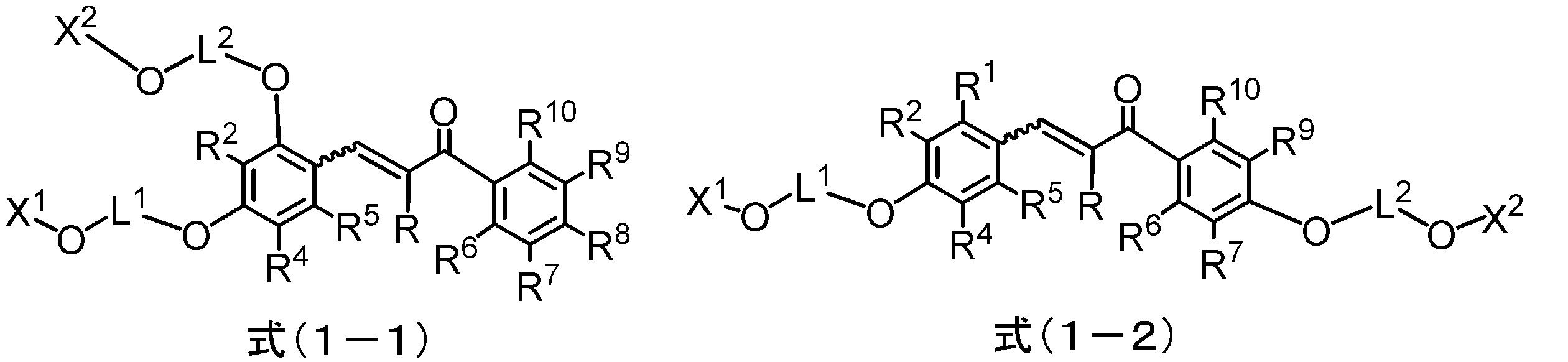
上記式中、Rは脂肪族炭化水素基を示し、R1、R2及びR4~R10は水素原子又は1価の置換基を示し、L1及びL2は炭素数2~6のアルキレン基を示し、X1及びX2は水素原子又は上記式(Pol-1)~(Pol-6)のいずれかで表される置換基を示す。
<3>
上記Rが炭素数1~10のアルキル基である、<1>又は<2>に記載の化合物。
<4>
上記Xが水素原子、又は、上記式(Pol-1)もしくは(Pol-2)で表される置換基である、<1>~<3>のいずれか1つに記載の化合物。
<5>
<1>~<4>のいずれか1つに記載の化合物を含む組成物。
<6>
熱硬化性樹脂用組成物である、<5>に記載の組成物。
<7>
熱可塑性樹脂含有組成物である、<5>に記載の組成物。
ただし、<1>に記載の化合物が、熱可塑性樹脂中に構造単位として組み込まれていることはない。
<8>
<6>に記載の組成物から得られる硬化物。
<9>
<7>に記載の組成物から得られる成形体。
<10>
<8>に記載の硬化物又は<9>に記載の成形体を含む光学部材。
<11>
<8>に記載の硬化物又は<9>に記載の成形体を含むレンズ。
<1>
下記一般式(1)で表される化合物。
下記一般式(1-1)又は(1-2)で表される、<1>に記載の化合物。
<3>
上記Rが炭素数1~10のアルキル基である、<1>又は<2>に記載の化合物。
<4>
上記Xが水素原子、又は、上記式(Pol-1)もしくは(Pol-2)で表される置換基である、<1>~<3>のいずれか1つに記載の化合物。
<5>
<1>~<4>のいずれか1つに記載の化合物を含む組成物。
<6>
熱硬化性樹脂用組成物である、<5>に記載の組成物。
<7>
熱可塑性樹脂含有組成物である、<5>に記載の組成物。
ただし、<1>に記載の化合物が、熱可塑性樹脂中に構造単位として組み込まれていることはない。
<8>
<6>に記載の組成物から得られる硬化物。
<9>
<7>に記載の組成物から得られる成形体。
<10>
<8>に記載の硬化物又は<9>に記載の成形体を含む光学部材。
<11>
<8>に記載の硬化物又は<9>に記載の成形体を含むレンズ。
本発明において、特定の符号又は式で表示された置換基もしくは連結基等(以下、置換基等という)が複数あるとき、又は、複数の置換基等を同時に規定するときには、特段の断りがない限り、それぞれの置換基等は互いに同一でも異なっていてもよい(「それぞれ独立に」の表現の有無にかかわらず、それぞれの置換基等は互いに同一でも異なっていてもよい)。このことは、置換基等の数の規定についても同様である。また、複数の置換基等が近接するとき(特に、隣接するとき)には、特段の断りがない限り、それらが互いに連結して環を形成していてもよい。また、特段の断りがない限り、環、例えば脂環、芳香族環、ヘテロ環は、さらに縮環して縮合環を形成していてもよい。
本発明において、特段の断りがない限り、二重結合については、分子内にE型及びZ型が存在する場合、そのいずれであっても、またこれらの混合物であってもよい。例えば、一般式(1)で表される化合物、一般式(1-1)~(1-5)のいずれかで表される化合物において、一般式中における波線は、E型及びZ型のいずれの立体配置であってもよく、またこれらの混合物であってもよいことを示す。
また、本発明において、特段の断りがない限り、化合物中に1個又は2個以上の不斉炭素を有する場合、このような不斉炭素の立体化学についてはそれぞれ独立して(R)体又は(S)体のいずれかをとることができる。この結果、化合物は、光学異性体又はジアステレオ異性体などの立体異性体の混合物であってもよく、ラセミ体であってもよい。
本発明において、特段の断りがない限り、化合物中に繰り返し構造を有する場合、繰り返し構造の繰り返し数については、全て同じ繰り返し数であってもよく、繰り返し数の異なる化合物の混合物であってもよい。
また、本発明において化合物の表示は、本発明の効果を損なわない範囲で、構造の一部を変化させたものを含む意味である。更に、置換又は無置換を明記していない化合物については、本発明の効果を損なわない範囲で、任意の置換基を有していてもよい意味である。化合物が有していてもよい任意の置換基としては、アルキル基、アルコキシ基、フルオロ基、クロロ基及びシアノ基などを挙げることができる。ここで、アルキル基及びアルコキシ基は置換基を有していてもよく、有していてもよい置換基としてはフルオロ基及びクロロ基が好ましく挙げられる。
本発明において置換又は無置換を明記していない置換基(連結基及び環についても同様)については、所望の効果を損なわない範囲で、その基に任意の置換基を有していてもよい意味である。例えば、「アルキル基」という場合、無置換アルキル基と置換アルキル基の両方を含む意味である。
本発明において、ある基の炭素数を規定する場合、この炭素数は、本発明ないし本明細書において特段の断りのない限りは、基全体の炭素数を意味する。つまり、この基がさらに置換基を有する形態である場合、この置換基を含めた全体の炭素数を意味する。
本発明において、特段の断りがない限り、二重結合については、分子内にE型及びZ型が存在する場合、そのいずれであっても、またこれらの混合物であってもよい。例えば、一般式(1)で表される化合物、一般式(1-1)~(1-5)のいずれかで表される化合物において、一般式中における波線は、E型及びZ型のいずれの立体配置であってもよく、またこれらの混合物であってもよいことを示す。
また、本発明において、特段の断りがない限り、化合物中に1個又は2個以上の不斉炭素を有する場合、このような不斉炭素の立体化学についてはそれぞれ独立して(R)体又は(S)体のいずれかをとることができる。この結果、化合物は、光学異性体又はジアステレオ異性体などの立体異性体の混合物であってもよく、ラセミ体であってもよい。
本発明において、特段の断りがない限り、化合物中に繰り返し構造を有する場合、繰り返し構造の繰り返し数については、全て同じ繰り返し数であってもよく、繰り返し数の異なる化合物の混合物であってもよい。
また、本発明において化合物の表示は、本発明の効果を損なわない範囲で、構造の一部を変化させたものを含む意味である。更に、置換又は無置換を明記していない化合物については、本発明の効果を損なわない範囲で、任意の置換基を有していてもよい意味である。化合物が有していてもよい任意の置換基としては、アルキル基、アルコキシ基、フルオロ基、クロロ基及びシアノ基などを挙げることができる。ここで、アルキル基及びアルコキシ基は置換基を有していてもよく、有していてもよい置換基としてはフルオロ基及びクロロ基が好ましく挙げられる。
本発明において置換又は無置換を明記していない置換基(連結基及び環についても同様)については、所望の効果を損なわない範囲で、その基に任意の置換基を有していてもよい意味である。例えば、「アルキル基」という場合、無置換アルキル基と置換アルキル基の両方を含む意味である。
本発明において、ある基の炭素数を規定する場合、この炭素数は、本発明ないし本明細書において特段の断りのない限りは、基全体の炭素数を意味する。つまり、この基がさらに置換基を有する形態である場合、この置換基を含めた全体の炭素数を意味する。
本発明において、「~」を用いて表される数値範囲は、「~」の前後に記載される数値を下限値及び上限値として含む範囲を意味する。
本発明の組成物(熱硬化性樹脂用組成物又は熱可塑性樹脂含有組成物)において、各成分(本発明の化合物、さらに適宜含有していてもよいその他の成分)は、それぞれ1種を用いてもよく、2種以上を混合して用いてもよい。このことは、本発明の組成物(熱硬化性樹脂用組成物又は熱可塑性樹脂含有組成物)から得られる硬化物又は成形体における各成分についても、また、光学部材及びレンズにおける各成分についても同様である。なお、本発明の化合物が、樹脂の原料モノマーとして用いられる場合、得られる硬化物、光学部材及びレンズにおいて、樹脂中の本発明の化合物由来の構造は、モノマーとして用いた本発明の化合物の種類に応じて、1種の構造であってもよく、2種以上の構造であってもよい。
本発明の組成物中における各成分の含有量の記載において、本発明の組成物における固形分とは、本発明の化合物に加え、本発明の組成物から得られる硬化物又は成形体中に残存する成分を意味する。通常は、溶媒を除いた残部が「固形分」である。
本発明の組成物(熱硬化性樹脂用組成物又は熱可塑性樹脂含有組成物)において、各成分(本発明の化合物、さらに適宜含有していてもよいその他の成分)は、それぞれ1種を用いてもよく、2種以上を混合して用いてもよい。このことは、本発明の組成物(熱硬化性樹脂用組成物又は熱可塑性樹脂含有組成物)から得られる硬化物又は成形体における各成分についても、また、光学部材及びレンズにおける各成分についても同様である。なお、本発明の化合物が、樹脂の原料モノマーとして用いられる場合、得られる硬化物、光学部材及びレンズにおいて、樹脂中の本発明の化合物由来の構造は、モノマーとして用いた本発明の化合物の種類に応じて、1種の構造であってもよく、2種以上の構造であってもよい。
本発明の組成物中における各成分の含有量の記載において、本発明の組成物における固形分とは、本発明の化合物に加え、本発明の組成物から得られる硬化物又は成形体中に残存する成分を意味する。通常は、溶媒を除いた残部が「固形分」である。
本発明において、「(メタ)アクリレート」はアクリレート及びメタクリレートのいずれか一方又は両方を表し、「(メタ)アクリロイル」はアクリロイル及びメタクリロイルのいずれか一方又は両方を表す。本発明におけるモノマーは、オリゴマー及びポリマーと区別され、質量平均分子量が1000以下の化合物をいう。
本発明において、脂肪族炭化水素基というときは、鎖状脂肪族炭化水素基又は脂環式炭化水素基を意味する。
鎖状脂肪族炭化水素基としては、直鎖もしくは分岐のアルカンから任意の水素原子を1つ除いて得られるアルキル基、直鎖もしくは分岐のアルケンから任意の水素原子を1つ除いて得られるアルケニル基、又は、直鎖もしくは分岐のアルキンから任意の水素原子を1つ除いて得られるアルキニル基を表す。本発明において、鎖状脂肪族炭化水素基は好ましくは、直鎖もしくは分岐のアルカンから、任意の水素原子を1つ除いて得られるアルキル基である。
アルキル基としては、メチル基、エチル基、プロピル基、イソプロピル基、ブチル基、イソブチル基、sec-ブチル基、tert-ブチル基、ペンチル基、1-メチルブチル基、3-メチルブチル基、ヘキシル基、1-メチルペンチル基、4-メチルペンチル基、ヘプチル基、1-メチルヘキシル基、5-メチルヘキシル基、2-エチルヘキシル基、オクチル基、1-メチルヘプチル基、ノニル基、1-メチルオクチル基、デシル基、ウンデシル基、ドデシル基、トリデシル基、テトラデシル基、ペンタデシル基、ヘキサデシル基、ヘプタデシル基、オクタデシル基、ノナデシル基、エイコシル基等が挙げられる。
また、本発明において、脂肪族炭化水素基(無置換)は、炭素数1~10のアルキル基が好ましく、炭素数1~6のアルキル基がより好ましく、炭素数1~4のアルキル基が更に好ましく、メチル基又はエチル基が特に好ましく、メチル基が最も好ましい。
鎖状脂肪族炭化水素基としては、直鎖もしくは分岐のアルカンから任意の水素原子を1つ除いて得られるアルキル基、直鎖もしくは分岐のアルケンから任意の水素原子を1つ除いて得られるアルケニル基、又は、直鎖もしくは分岐のアルキンから任意の水素原子を1つ除いて得られるアルキニル基を表す。本発明において、鎖状脂肪族炭化水素基は好ましくは、直鎖もしくは分岐のアルカンから、任意の水素原子を1つ除いて得られるアルキル基である。
アルキル基としては、メチル基、エチル基、プロピル基、イソプロピル基、ブチル基、イソブチル基、sec-ブチル基、tert-ブチル基、ペンチル基、1-メチルブチル基、3-メチルブチル基、ヘキシル基、1-メチルペンチル基、4-メチルペンチル基、ヘプチル基、1-メチルヘキシル基、5-メチルヘキシル基、2-エチルヘキシル基、オクチル基、1-メチルヘプチル基、ノニル基、1-メチルオクチル基、デシル基、ウンデシル基、ドデシル基、トリデシル基、テトラデシル基、ペンタデシル基、ヘキサデシル基、ヘプタデシル基、オクタデシル基、ノナデシル基、エイコシル基等が挙げられる。
また、本発明において、脂肪族炭化水素基(無置換)は、炭素数1~10のアルキル基が好ましく、炭素数1~6のアルキル基がより好ましく、炭素数1~4のアルキル基が更に好ましく、メチル基又はエチル基が特に好ましく、メチル基が最も好ましい。
本発明において、アルキル基というときは、直鎖もしくは分岐のアルキル基を表す。アルキル基としては、上記の例が挙げられる。アルキル基を含む基(アルコキシ基等)中のアルキル基についても同様に、直鎖もしくは分岐のアルキル基を表し、アルキル基としては上記の例が挙げられる。
また、本発明において、アルキレン基の例としては、上記アルキル基から任意の水素原子を1つ除いて得られる基が挙げられ、直鎖状及び分岐状のいずれであってもよい。
また、本発明において、アルキレン基の例としては、上記アルキル基から任意の水素原子を1つ除いて得られる基が挙げられ、直鎖状及び分岐状のいずれであってもよい。
本発明の化合物は、着色がほとんどなく、かつ異常部分分散性が高い。また本発明の組成物、この組成物を硬化反応してなる硬化物、この組成物を成形してなる成形体、これらの硬化物又は成形体を含む光学部材及びレンズは、着色がほとんどなく、かつ異常部分分散性が高い。
本発明の化合物は、後記一般式(1)で表される化合物であり、着色がほとんどなく、かつ、異常部分分散性が高い。
本発明の化合物は、後記一般式(1)で表されるように、カルコン骨格を構成する2つのベンゼン環上に、一般式(2)で表される構造、すなわち、特定の連結基を介してヒドロキシ基及び重合性基から選ばれる基を、2つ有する構造を有する。本発明の化合物はさらに、カルコン化合物のカルボニルα位に置換基Rとして脂肪族炭化水素基を有する(したがって、本発明の化合物はα-置換カルコン化合物である)。このような特異な構造を有することによって、本発明の化合物は、特許文献2に記載されるカルボニルα位にシアノ基を有する化合物、並びに、特許文献3及び4に記載されるカルボニルα位が無置換の(水素原子である)化合物がそれぞれ有する、430nm付近のカルコン骨格由来の光吸収を短波長側にシフトさせることができ、着色がほとんどなく、かつ、異常部分分散性も維持できる。そのため、本発明の化合物は、光の透過性が求められ、かつ異常部分分散性が求められる光学材料用の樹脂の添加剤、更には樹脂の原料モノマーとして好適に用いることができる。また、本発明の化合物は、耐光性にも優れるため、耐光性が求められる光学材料にも好適に用いることができる。
本発明の化合物は、後記一般式(1)で表されるように、カルコン骨格を構成する2つのベンゼン環上に、一般式(2)で表される構造、すなわち、特定の連結基を介してヒドロキシ基及び重合性基から選ばれる基を、2つ有する構造を有する。本発明の化合物はさらに、カルコン化合物のカルボニルα位に置換基Rとして脂肪族炭化水素基を有する(したがって、本発明の化合物はα-置換カルコン化合物である)。このような特異な構造を有することによって、本発明の化合物は、特許文献2に記載されるカルボニルα位にシアノ基を有する化合物、並びに、特許文献3及び4に記載されるカルボニルα位が無置換の(水素原子である)化合物がそれぞれ有する、430nm付近のカルコン骨格由来の光吸収を短波長側にシフトさせることができ、着色がほとんどなく、かつ、異常部分分散性も維持できる。そのため、本発明の化合物は、光の透過性が求められ、かつ異常部分分散性が求められる光学材料用の樹脂の添加剤、更には樹脂の原料モノマーとして好適に用いることができる。また、本発明の化合物は、耐光性にも優れるため、耐光性が求められる光学材料にも好適に用いることができる。
本発明について詳細に説明する。以下に記載する構成要件の説明は、代表的な実施形態又は具体例等に基づいてなされることがあるが、本発明はそのような実施形態に限定されない。
[化合物]
本発明の一般式(1)で表される化合物は、下記の通りである。
本発明の一般式(1)で表される化合物は、下記の通りである。

上記式中、Rは脂肪族炭化水素基を示す。R1~R10のうちの2つが後記一般式(2)で表される置換基を示し、残りの8つが水素原子または1価の置換基を示す。
以下、式(1)における置換基等について詳述する。
(1)R
Rとしての脂肪族炭化水素基は、鎖状脂肪族炭化水素基であることが好ましく、炭素数1~10のアルキル基、炭素数2~10のアルケニル基又は炭素数2~10のアルキニル基であることがより好ましく、炭素数1~10のアルキル基であることがさらに好ましく、炭素数1~4のアルキル基であることがさらに好ましく、メチル基またはエチル基であることがさらに好ましく、メチル基が特に好ましい。
Rとしての脂肪族炭化水素基は、鎖状脂肪族炭化水素基であることが好ましく、炭素数1~10のアルキル基、炭素数2~10のアルケニル基又は炭素数2~10のアルキニル基であることがより好ましく、炭素数1~10のアルキル基であることがさらに好ましく、炭素数1~4のアルキル基であることがさらに好ましく、メチル基またはエチル基であることがさらに好ましく、メチル基が特に好ましい。
(2)R1~R10
R1~R10のうちの2つが下記一般式(2)で表される置換基を示し、残りの8つが水素原子または1価の置換基を示す。
R1~R10のうちの2つが下記一般式(2)で表される置換基を示し、残りの8つが水素原子または1価の置換基を示す。

上記式中、Lは炭素数2~6のアルキレン基を示し、Xは水素原子又は下記式(Pol-1)~(Pol-6)のいずれかで表される置換基を示す。*は結合手を示す。

Lは炭素数2~6のアルキレン基であり、炭素数2~4のアルキレン基が好ましく、エチレン基がより好ましい。
Xは、水素原子であるか、又は、上記式(Pol-1)もしくは(Pol-2)で表される置換基であることが好ましい。
Xは、水素原子であるか、又は、上記式(Pol-1)もしくは(Pol-2)で表される置換基であることが好ましい。
R1~R10のうち、上記一般式(2)で表される置換基以外の8つ(本発明において、単に「残りの8つ」とも称す。)は、水素原子または1価の置換基を示す。
R1~R10の残りの8つが採り得る1価の置換基としては、本発明の効果が損なわれない範囲で任意の置換基を採用することができる。なお、R1~R10の残りの8つが採り得る1価の置換基には、上記一般式(2)で表される置換基は含まれない。
R1~R10の残りの8つが採り得る1価の置換基としては、例えば、アルキル基、アルコキシ基、フルオロ基、クロロ基及びシアノ基などを挙げることができ、アルキル基、アルコキシ基、フルオロ基又はクロロ基が好ましい。ここで、アルキル基及びアルコキシ基は置換基を有していてもよく、有していてもよい置換基としてはフルオロ基及びクロロ基が好ましく挙げられる。
R1~R10の残りの8つのうち、1価の置換基である基の数は、4つ以下であることが好ましく、2つ以下であることがより好ましく、1つ以下であることが更に好ましい。なお、R1~R10の残りの8つのうち全てが水素原子であることも好ましい。
R1~R10の残りの8つが採り得る1価の置換基としては、本発明の効果が損なわれない範囲で任意の置換基を採用することができる。なお、R1~R10の残りの8つが採り得る1価の置換基には、上記一般式(2)で表される置換基は含まれない。
R1~R10の残りの8つが採り得る1価の置換基としては、例えば、アルキル基、アルコキシ基、フルオロ基、クロロ基及びシアノ基などを挙げることができ、アルキル基、アルコキシ基、フルオロ基又はクロロ基が好ましい。ここで、アルキル基及びアルコキシ基は置換基を有していてもよく、有していてもよい置換基としてはフルオロ基及びクロロ基が好ましく挙げられる。
R1~R10の残りの8つのうち、1価の置換基である基の数は、4つ以下であることが好ましく、2つ以下であることがより好ましく、1つ以下であることが更に好ましい。なお、R1~R10の残りの8つのうち全てが水素原子であることも好ましい。
上記一般式(1)で表される化合物は、異常部分分散性をより高める観点から、下記一般式(1-1)~(1-5)のいずれかで表される化合物であることが好ましく、下記一般式(1-1)又は(1-2)で表される化合物であることがより好ましい。
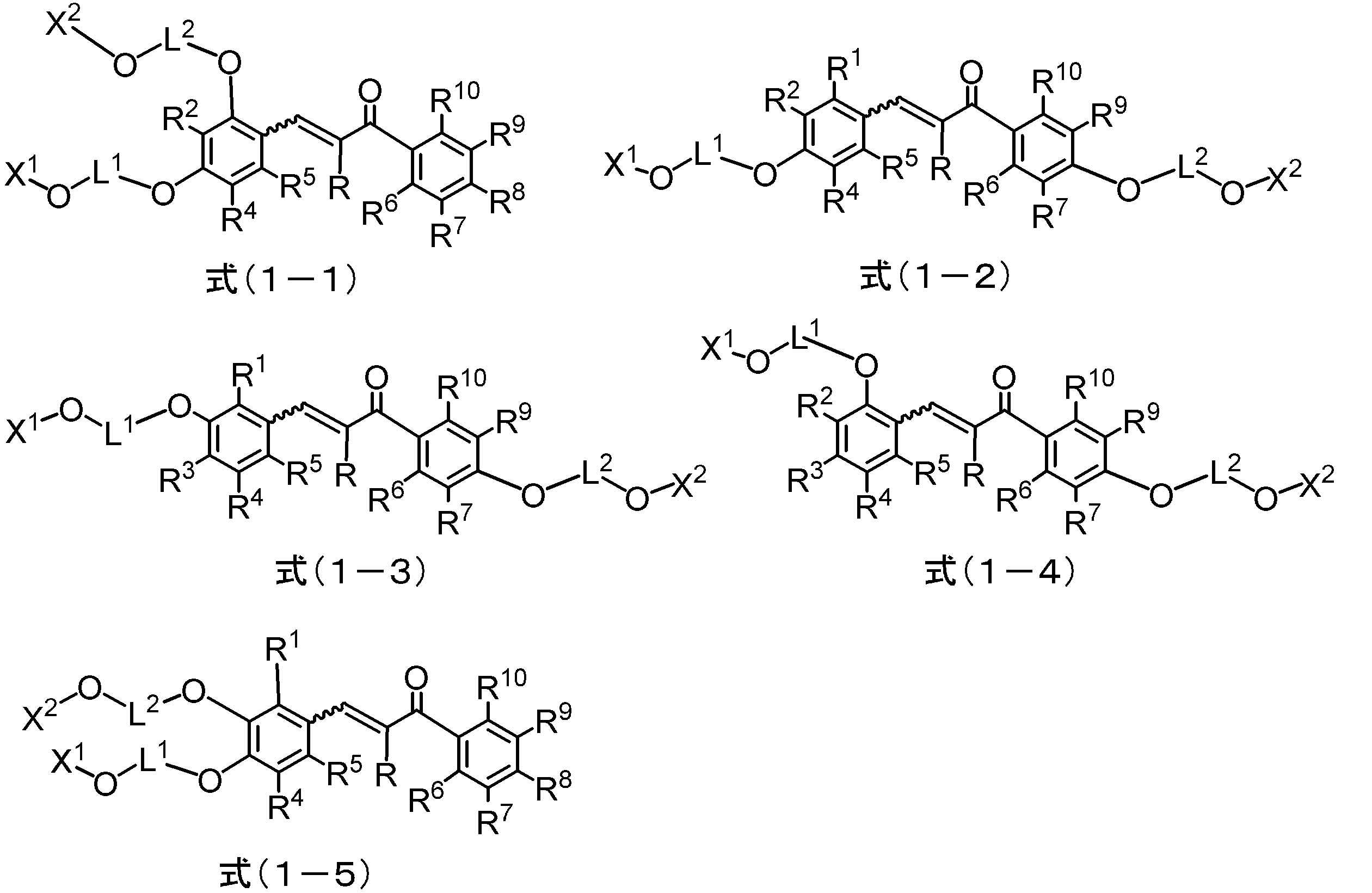
上記式中、Rは脂肪族炭化水素基を示し、R1~R10は水素原子又は1価の置換基を示し、L1及びL2は炭素数2~6のアルキレン基を示し、X1及びX2は水素原子又は前述の式(Pol-1)~(Pol-6)のいずれかで表される置換基を示す。
Rは上記一般式(1)におけるRと同義である。
R1~R10が採り得る1価の置換基は、上記R1~R10の残りの8つが採り得る1価の置換基と同義である。
上記一般式(1-1)においては、R2、R4、R5、R9及びR10は水素原子であることが好ましい。上記一般式(1-2)においては、R2、R4~R7、R9及びR10は水素原子であることが好ましい。上記一般式(1-3)においては、R1、R3~R7、R9及びR10は水素原子であることが好ましい。上記一般式(1-4)においては、R2、R4~R7、R9及びR10は水素原子であることが好ましい。上記一般式(1-5)においては、R1、R4~R10は水素原子であることが好ましい。
なかでも、R1~R10は、水素原子であることが好ましい。
R1~R10が採り得る1価の置換基は、上記R1~R10の残りの8つが採り得る1価の置換基と同義である。
上記一般式(1-1)においては、R2、R4、R5、R9及びR10は水素原子であることが好ましい。上記一般式(1-2)においては、R2、R4~R7、R9及びR10は水素原子であることが好ましい。上記一般式(1-3)においては、R1、R3~R7、R9及びR10は水素原子であることが好ましい。上記一般式(1-4)においては、R2、R4~R7、R9及びR10は水素原子であることが好ましい。上記一般式(1-5)においては、R1、R4~R10は水素原子であることが好ましい。
なかでも、R1~R10は、水素原子であることが好ましい。
L1及びL2は炭素数2~6のアルキレン基を示し、炭素数2~4のアルキレン基が好ましく、エチレン基がより好ましい。
X1及びX2は、水素原子であるか、又は、上記式(Pol-1)もしくは(Pol-2)で表される置換基であることが好ましい。
X1及びX2は、水素原子であるか、又は、上記式(Pol-1)もしくは(Pol-2)で表される置換基であることが好ましい。
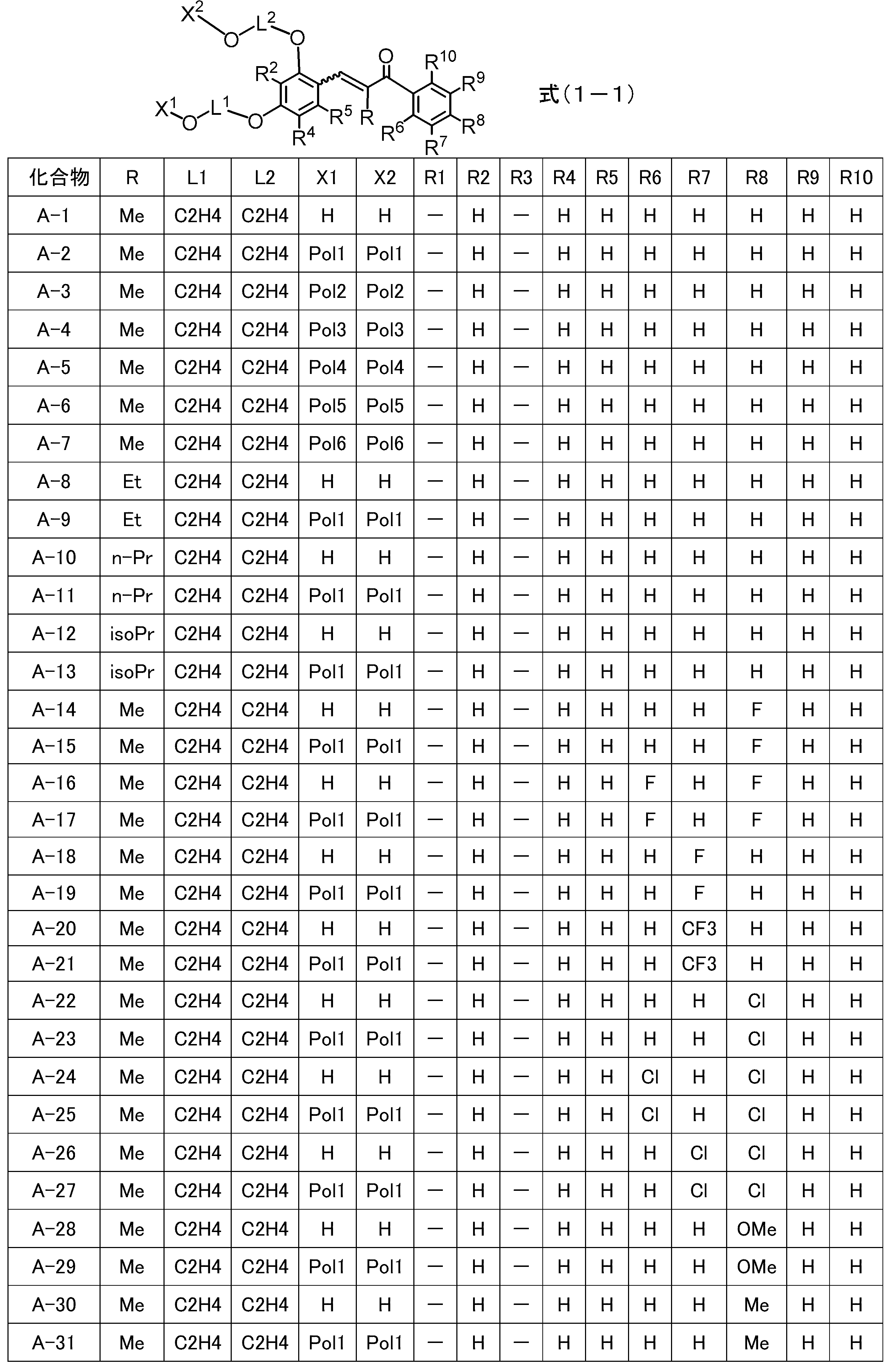
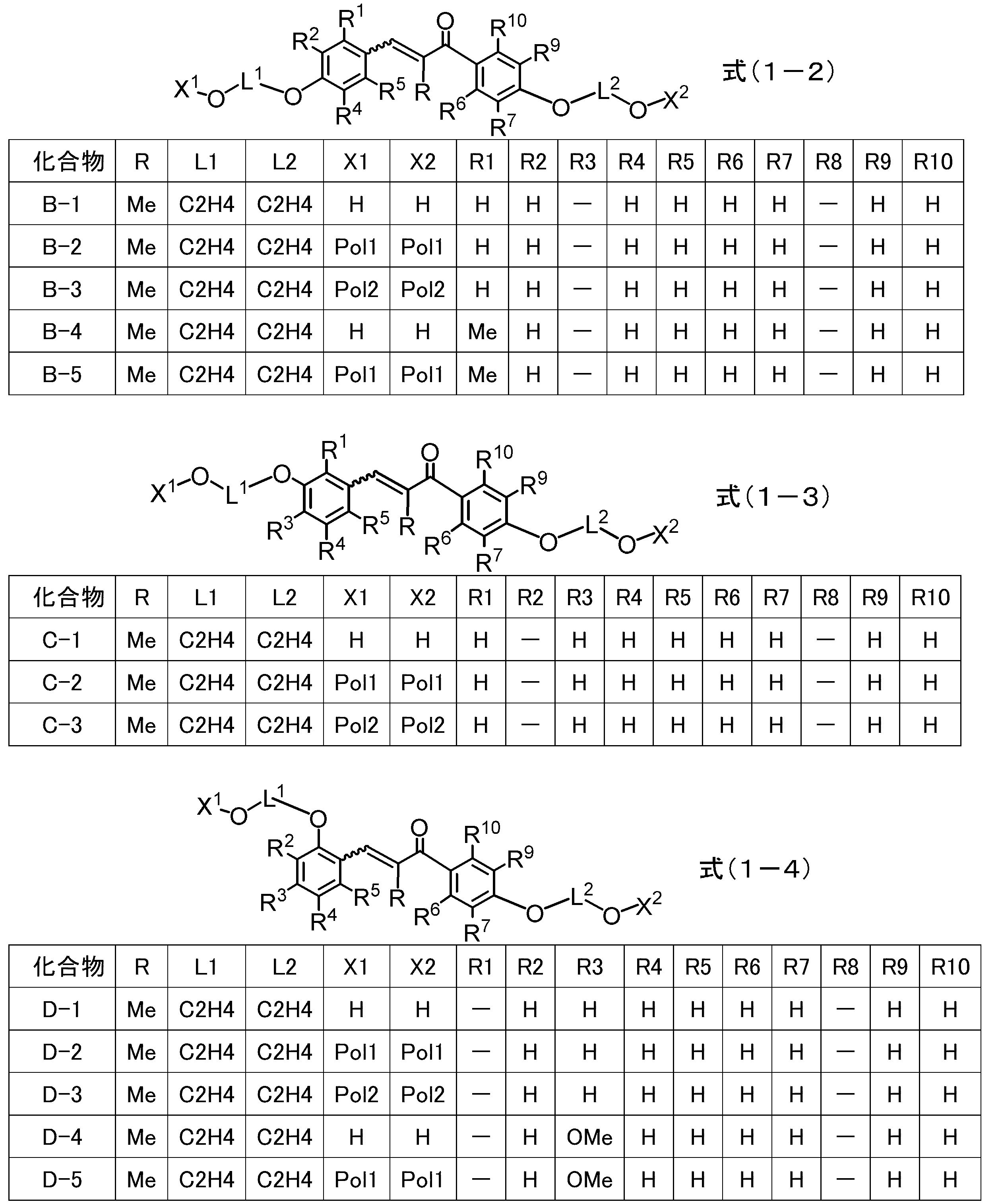
以下において、本発明の一般式(1)で表される化合物の具体例を列挙するが、これらに限定されるものではない。
なお、以下の表中におけるMeはメチル基、Etはエチル基、isoPrはiso-プロピル基、n-Prはn-プロピル基、OMeはメトキシ基、CF3はトリフルオロメチル基、Hは水素原子、Fはフルオロ基、Clはクロロ基、C2H4はエチレン基を表す。また、Pol1~Pol6はそれぞれ上記式(Pol-1)~(Pol-6)で表される置換基を表す。「-」は該当する基が存在しないことを表す。
なお、以下の表中におけるMeはメチル基、Etはエチル基、isoPrはiso-プロピル基、n-Prはn-プロピル基、OMeはメトキシ基、CF3はトリフルオロメチル基、Hは水素原子、Fはフルオロ基、Clはクロロ基、C2H4はエチレン基を表す。また、Pol1~Pol6はそれぞれ上記式(Pol-1)~(Pol-6)で表される置換基を表す。「-」は該当する基が存在しないことを表す。

本発明の化合物の分子量は特に制限されないが、例えば、500以下であることが好ましい。
一般式(1)で表される化合物、すなわちα-置換カルコン骨格を有する化合物は、例えば、下記に示すように、ベンズアルデヒド化合物と芳香族ケトン化合物とを縮合することにより合成することができ、Bing-zhao Ren et al.,Medicinal Chemistry Research,2017年,volume 26,issue 9,p.1871-1883に記載の合成法等を参考にすることができる。

上記スキーム中において、R及びR1~R10は、前述の一般式(1)におけるR及びR1~R10とそれぞれ同義である。
すなわち、一般式(1)で表される化合物は、ベンズアルデヒド化合物及び/又は芳香族ケトン化合物におけるR1~R10のうちの2つが前述の一般式(2)で表される置換基を有する化合物(原料)を用いることにより、合成することができる。
また、上記スキームにおいて、ベンズアルデヒド化合物及び/又は芳香族ケトン化合物におけるR1~R10のうちの2つが前述の一般式(2)で表される置換基の前駆体となる基を有する化合物(原料)を用いてα-置換カルコン骨格を有する前駆体化合物を合成した後、後続する反応として、脱保護反応、エステル化反応、エーテル化反応などを行うことにより、一般式(2)で表される置換基の前駆体となる基を一般式(2)で表される置換基に変換し、一般式(1)で表される化合物を合成してもよい。
一般式(1)で表される化合物は、上記のようにして、後述の実施例に記載の方法等も参考に、常法に従い製造することができる。
すなわち、一般式(1)で表される化合物は、ベンズアルデヒド化合物及び/又は芳香族ケトン化合物におけるR1~R10のうちの2つが前述の一般式(2)で表される置換基を有する化合物(原料)を用いることにより、合成することができる。
また、上記スキームにおいて、ベンズアルデヒド化合物及び/又は芳香族ケトン化合物におけるR1~R10のうちの2つが前述の一般式(2)で表される置換基の前駆体となる基を有する化合物(原料)を用いてα-置換カルコン骨格を有する前駆体化合物を合成した後、後続する反応として、脱保護反応、エステル化反応、エーテル化反応などを行うことにより、一般式(2)で表される置換基の前駆体となる基を一般式(2)で表される置換基に変換し、一般式(1)で表される化合物を合成してもよい。
一般式(1)で表される化合物は、上記のようにして、後述の実施例に記載の方法等も参考に、常法に従い製造することができる。
本発明の化合物は、前述の通り、着色がほとんどなく、かつ異常部分分散性が高い。また、本発明の化合物は、優れた耐光性をも示すことができる。
本発明の化合物のアッベ数(νd)及び部分分散比(θg,F)は、エリプソメーター(例えば、J.A.Woollam社製、商品名:M-2000XI-210)を用いて測定される値である。具体的には、後述の実施例に記載の異常部分分散性の評価における記載に基づき、本発明の化合物の含有濃度を変えて作製した樹脂フィルムの外挿値として、本発明の化合物の屈折率を測定、算出する。
化合物のアッベ数(νd)及び部分分散比(θg,F)は、下記式により算出される。また、JIS B 7090:1999 光学及び光学機器-基準波長(ISO 7944:1998 Optics and optical instruments-Reference wavelengths)を適宜参照することができる。
νd=(nd-1)/(nF-nC)
θg,F=(ng-nF)/(nF-nC)
ここで、ndは波長589nmにおける屈折率、nFは波長486nmにおける屈折率、nCは波長656nmにおける屈折率、ngは波長436nmにおける屈折率を表す。
化合物のアッベ数(νd)及び部分分散比(θg,F)は、下記式により算出される。また、JIS B 7090:1999 光学及び光学機器-基準波長(ISO 7944:1998 Optics and optical instruments-Reference wavelengths)を適宜参照することができる。
νd=(nd-1)/(nF-nC)
θg,F=(ng-nF)/(nF-nC)
ここで、ndは波長589nmにおける屈折率、nFは波長486nmにおける屈折率、nCは波長656nmにおける屈折率、ngは波長436nmにおける屈折率を表す。
本発明の化合物は、横軸アッベ数(νd)-縦軸波長部分分散比(θg,F)のグラフにおける、ノーマルガラスの基準となる硝種NSL7(nd:1.51、アッベ数(νd):60.5、波長部分分散比(θg,F):0.54)と硝種PBM2(nd:1.62、νd:36.3、θg,F:0.58)とを結んで得られる標準線からの波長部分分散比(θg,F)の偏差(Δθg,F)(すなわち、標準線からの距離)が大きく、標準線に対して上側に位置するため、正の異常部分分散性が大きい。
本発明の化合物の波長部分分散比(θg,F)の偏差(Δθg,F)は、0.04以上であることが好ましく、0.08以上であることがより好ましく、0.16以上であることが更に好ましく、0.20以上であることが特に好ましい。また、本発明の化合物の波長部分分散比(θg,F)の偏差(Δθg,F)の上限値は特に限定されるものではないが、通常0.50以下である。
本発明の化合物の波長部分分散比(θg,F)の偏差(Δθg,F)は、0.04以上であることが好ましく、0.08以上であることがより好ましく、0.16以上であることが更に好ましく、0.20以上であることが特に好ましい。また、本発明の化合物の波長部分分散比(θg,F)の偏差(Δθg,F)の上限値は特に限定されるものではないが、通常0.50以下である。
本発明の化合物のアッベ数(νd)は、特に限定されるものではないが、35以下であることが好ましく、30以下であることがより好ましく、29以下であることがさらに好ましく、28以下であることが特に好ましい。また、本発明の化合物のアッベ数(νd)は、特に限定されるものではないが、1以上であることが好ましく、3以上であることがより好ましく、5以上であることがさらに好ましく、7以上であることが特に好ましい。
本発明の化合物の部分分散比(θg,F)は特に限定されるものではないが、0.75以上であることが好ましく、0.80以上であることがより好ましい。また、本発明の化合物の部分分散比(θg,F)は特に限定されるものではないが、2以下であることが好ましく、1.8以下であることがより好ましく、1.7以下であることがさらに好ましい。
本発明の化合物は着色がほとんどなく、可視光領域の光の透過性に優れる。
本発明の化合物は、可視光領域における長波長領域には実質的に吸収を有さず、短波長側になるにつれ、透過率の低下がみられる。そのため、波長430nmにおける透過率を測定することにより、本発明の化合物の透明性を評価することができる。
本発明の化合物の波長430nmにおける透過率は、紫外可視分光光度計(例えば、UV-2600(商品名、島津製作所社製))を用いて測定される値である。具体的には、後述の実施例に記載の透過率の測定と同様にして、例えばTHF(テトラヒドロフラン)溶液について波長430nmにおける透過率を測定する。
また、化合物の耐光性を評価するための光照射試験は、後述の実施例に記載のキセノン光照射試験に基づき行う。
本発明の化合物は、可視光領域における長波長領域には実質的に吸収を有さず、短波長側になるにつれ、透過率の低下がみられる。そのため、波長430nmにおける透過率を測定することにより、本発明の化合物の透明性を評価することができる。
本発明の化合物の波長430nmにおける透過率は、紫外可視分光光度計(例えば、UV-2600(商品名、島津製作所社製))を用いて測定される値である。具体的には、後述の実施例に記載の透過率の測定と同様にして、例えばTHF(テトラヒドロフラン)溶液について波長430nmにおける透過率を測定する。
また、化合物の耐光性を評価するための光照射試験は、後述の実施例に記載のキセノン光照射試験に基づき行う。
以下、上記方法により測定される、本発明の化合物の波長430nmにおける透過率について、好ましい値を記載する。
本発明の化合物の透過率、すなわち、光照射試験前の透過率は、特に限定されるものではないが、98%以上であることが好ましく、99%以上であることがより好ましい。
また、本発明の化合物の光照射試験後の透過率は、特に限定されるものではないが、後述の評価項目3(キセノン光24時間照射試験後の透過率)では、90%超えであることが好ましく、91%超えであることがより好ましく、93%超えであることがさらに好ましく、94%超えであることが特に好ましい。
本発明の硬化物及び成形体の光照射試験前後における透過率の低下幅は、特に限定されるものではないが、後述の評価項目3(キセノン光24時間照射試験前後での透過率の低下幅)では、8%未満であることが好ましく、5%未満であることがより好ましい。
上記光照射試験前後における透過率の低下幅とは、上記光照射試験前の透過率の値から上記光照射試験後の透過率の値を引くことにより、算出される。
本発明の化合物の透過率、すなわち、光照射試験前の透過率は、特に限定されるものではないが、98%以上であることが好ましく、99%以上であることがより好ましい。
また、本発明の化合物の光照射試験後の透過率は、特に限定されるものではないが、後述の評価項目3(キセノン光24時間照射試験後の透過率)では、90%超えであることが好ましく、91%超えであることがより好ましく、93%超えであることがさらに好ましく、94%超えであることが特に好ましい。
本発明の硬化物及び成形体の光照射試験前後における透過率の低下幅は、特に限定されるものではないが、後述の評価項目3(キセノン光24時間照射試験前後での透過率の低下幅)では、8%未満であることが好ましく、5%未満であることがより好ましい。
上記光照射試験前後における透過率の低下幅とは、上記光照射試験前の透過率の値から上記光照射試験後の透過率の値を引くことにより、算出される。
[組成物]
本発明の組成物は本発明の化合物を含有する。
<熱硬化性樹脂用組成物>
本発明の組成物としては、熱硬化性樹脂用組成物が好ましく挙げられる。
本発明において熱硬化性樹脂用組成物とは、本発明の化合物を含み、かつ熱硬化性樹脂を得るために用いられる組成物を意味する。すなわち、本発明において熱硬化性樹脂用組成物は、熱硬化性樹脂の原料モノマーを、本発明の化合物として、又は本発明の化合物とは別に、含有する組成物である。
したがって、本発明の組成物が熱硬化性樹脂用組成物である場合、本発明の化合物は、本発明の熱硬化性樹脂用組成物を硬化反応させて得られる熱硬化性樹脂中において、樹脂の添加剤として存在していてもよく、上記熱硬化性樹脂中に構造単位として組み込まれていてもよい。すなわち、本発明の熱硬化性樹脂用組成物において、本発明の化合物が樹脂の添加剤として含有され、本発明の化合物とは別に熱硬化性樹脂の原料モノマーが含有されていてもよく、本発明の化合物が熱硬化性樹脂を構成する成分、すなわち熱硬化性樹脂の原料モノマーとして含有されていてもよい。
本発明の組成物は本発明の化合物を含有する。
<熱硬化性樹脂用組成物>
本発明の組成物としては、熱硬化性樹脂用組成物が好ましく挙げられる。
本発明において熱硬化性樹脂用組成物とは、本発明の化合物を含み、かつ熱硬化性樹脂を得るために用いられる組成物を意味する。すなわち、本発明において熱硬化性樹脂用組成物は、熱硬化性樹脂の原料モノマーを、本発明の化合物として、又は本発明の化合物とは別に、含有する組成物である。
したがって、本発明の組成物が熱硬化性樹脂用組成物である場合、本発明の化合物は、本発明の熱硬化性樹脂用組成物を硬化反応させて得られる熱硬化性樹脂中において、樹脂の添加剤として存在していてもよく、上記熱硬化性樹脂中に構造単位として組み込まれていてもよい。すなわち、本発明の熱硬化性樹脂用組成物において、本発明の化合物が樹脂の添加剤として含有され、本発明の化合物とは別に熱硬化性樹脂の原料モノマーが含有されていてもよく、本発明の化合物が熱硬化性樹脂を構成する成分、すなわち熱硬化性樹脂の原料モノマーとして含有されていてもよい。
なお、本発明の熱硬化性樹脂用組成物において、本発明の化合物が樹脂の添加剤として含有される形態では、本発明の化合物以外の添加剤を更に含有していてもよい。また、熱硬化性樹脂の原料モノマーとしては、光学用途で使用される熱硬化性樹脂を構成し得る原料モノマーを、本発明の効果を損なわない範囲で特に制限なく使用することができ、例えば、後述の(メタ)アクリレートモノマー、ビニルモノマー、エポキシモノマー、オキセタニルモノマーが好ましく挙げられる。
また、本発明の熱硬化性樹脂用組成物において、本発明の化合物が熱硬化性樹脂の原料モノマーとして含有される形態では、本発明の化合物以外の熱硬化性樹脂の原料モノマーを更に含有していてもよく、本発明の効果を損なわない範囲で特に制限なく使用することができ、例えば、後述の(メタ)アクリレートモノマー、ビニルモノマー、エポキシモノマー、オキセタニルモノマーが好ましく挙げられる。また、光学用途で使用される添加剤を、本発明の効果を損なわない範囲で特に制限なく含有することもできる。
本発明の熱硬化性樹脂用組成物に含有させてもよい添加剤としては、後述のその他の成分に係る記載を援用する。
また、本発明の熱硬化性樹脂用組成物において、本発明の化合物が熱硬化性樹脂の原料モノマーとして含有される形態では、本発明の化合物以外の熱硬化性樹脂の原料モノマーを更に含有していてもよく、本発明の効果を損なわない範囲で特に制限なく使用することができ、例えば、後述の(メタ)アクリレートモノマー、ビニルモノマー、エポキシモノマー、オキセタニルモノマーが好ましく挙げられる。また、光学用途で使用される添加剤を、本発明の効果を損なわない範囲で特に制限なく含有することもできる。
本発明の熱硬化性樹脂用組成物に含有させてもよい添加剤としては、後述のその他の成分に係る記載を援用する。
<熱可塑性樹脂含有組成物>
本発明の組成物としては、熱可塑性樹脂含有組成物も好ましく挙げられる。
本発明において熱可塑性樹脂含有組成物とは、本発明の化合物と熱可塑性樹脂とを含有する組成物を意味する。
ただし、本発明の組成物が熱可塑性樹脂含有組成物である場合、本発明の化合物は、本発明の熱可塑性樹脂含有組成物に含有される熱可塑性樹脂中に構造単位として組み込まれていることはない。すなわち、本発明の熱可塑性樹脂含有組成物において、本発明の化合物は樹脂の添加剤として含有される。
本発明の組成物としては、熱可塑性樹脂含有組成物も好ましく挙げられる。
本発明において熱可塑性樹脂含有組成物とは、本発明の化合物と熱可塑性樹脂とを含有する組成物を意味する。
ただし、本発明の組成物が熱可塑性樹脂含有組成物である場合、本発明の化合物は、本発明の熱可塑性樹脂含有組成物に含有される熱可塑性樹脂中に構造単位として組み込まれていることはない。すなわち、本発明の熱可塑性樹脂含有組成物において、本発明の化合物は樹脂の添加剤として含有される。
なお、本発明の熱可塑性樹脂含有組成物は、本発明の化合物以外の添加剤を更に含有していてもよい。また、熱可塑性樹脂としては、光学用途で使用される熱可塑性樹脂を、本発明の効果を損なわない範囲で特に制限なく使用することができ、例えば、ポリカーボネート、ポリエステル、(メタ)アクリレートポリマー、環状オレフィン(コ)ポリマーが好ましく挙げられる。
本発明の熱可塑性樹脂含有組成物に含有させてもよい添加剤としては、後述のその他の成分に係る記載を援用する。
本発明の熱可塑性樹脂含有組成物に含有させてもよい添加剤としては、後述のその他の成分に係る記載を援用する。
本発明の熱硬化性樹脂用組成物又は熱可塑性樹脂含有組成物中に、本発明の化合物を樹脂の添加剤として含有させる場合(熱硬化性樹脂用組成物においては非モノマー成分として含有させる場合)、本発明の熱硬化性樹脂用組成物又は熱可塑性樹脂含有組成物中における本発明の化合物の含有量は、組成物の全固形分中において、1~50質量%であることが好ましく、3~45質量%であることがより好ましく、5~40質量%であることがさらに好ましい。
また、本発明の熱硬化性樹脂用組成物中に本発明の化合物を熱硬化性樹脂の原料モノマーとして含有させる場合、本発明の熱硬化性樹脂用組成物中における本発明の化合物の含有量は、組成物の全固形分中において、15~99質量%であることが好ましく、25~99質量%であることがより好ましく、35~97質量%であることがさらに好ましい。
本発明の熱硬化性樹脂用組成物又は熱可塑性樹脂含有組成物中における本発明の化合物の含有量を上記範囲内とすることにより、着色がほとんどなく、かつ、異常部分分散性が高い(すなわち、所定のアッベ数(νd)を有する硬化物において、予測される部分分散比(θg,F)よりも高い部分分散比(θg,F)が達成される)という本発明の効果を、より高いレベルで実現することが可能となる。
また、本発明の熱硬化性樹脂用組成物中に本発明の化合物を熱硬化性樹脂の原料モノマーとして含有させる場合、本発明の熱硬化性樹脂用組成物中における本発明の化合物の含有量は、組成物の全固形分中において、15~99質量%であることが好ましく、25~99質量%であることがより好ましく、35~97質量%であることがさらに好ましい。
本発明の熱硬化性樹脂用組成物又は熱可塑性樹脂含有組成物中における本発明の化合物の含有量を上記範囲内とすることにより、着色がほとんどなく、かつ、異常部分分散性が高い(すなわち、所定のアッベ数(νd)を有する硬化物において、予測される部分分散比(θg,F)よりも高い部分分散比(θg,F)が達成される)という本発明の効果を、より高いレベルで実現することが可能となる。
本発明の組成物中に本発明の化合物が2種以上含有されている場合は、それらの合計の含有量が上記範囲内であることが好ましい。
<その他の成分>
本発明の組成物は、本発明の化合物に加えて、さらにその他の成分を含んでいてもよい。
その他の成分としては、例えば、(メタ)アクリレートモノマー、ラジカル重合性基を側鎖に有する重合体、及び、重合開始剤等が挙げられる。また、上述した成分以外のポリマー又はモノマー、分散剤、可塑剤、熱安定剤、離型剤、溶媒等を含んでいてもよい。熱安定剤としては、例えば、特開2021-1328号公報の段落[0261]及び[0262]に記載のヒンダードフェノール系熱安定剤又はリン系熱安定剤を用いることができる。ラジカル重合性基を側鎖に有する重合体としては、例えば、国際公開第2022/255228号の段落[0198]及び[0205]に記載のラジカル重合性基を側鎖に有する重合体を用いることができる。
なお、本発明の熱可塑性樹脂含有組成物においては、さらなる重合(硬化)反応を必要としないため、重合性基を有するポリマー又はモノマー、重合開始剤を含有しないことが好ましい。
本発明の組成物は、本発明の化合物に加えて、さらにその他の成分を含んでいてもよい。
その他の成分としては、例えば、(メタ)アクリレートモノマー、ラジカル重合性基を側鎖に有する重合体、及び、重合開始剤等が挙げられる。また、上述した成分以外のポリマー又はモノマー、分散剤、可塑剤、熱安定剤、離型剤、溶媒等を含んでいてもよい。熱安定剤としては、例えば、特開2021-1328号公報の段落[0261]及び[0262]に記載のヒンダードフェノール系熱安定剤又はリン系熱安定剤を用いることができる。ラジカル重合性基を側鎖に有する重合体としては、例えば、国際公開第2022/255228号の段落[0198]及び[0205]に記載のラジカル重合性基を側鎖に有する重合体を用いることができる。
なお、本発明の熱可塑性樹脂含有組成物においては、さらなる重合(硬化)反応を必要としないため、重合性基を有するポリマー又はモノマー、重合開始剤を含有しないことが好ましい。
((メタ)アクリレートモノマー)
本発明の熱硬化性樹脂用組成物は(メタ)アクリレートモノマーを含んでいてもよい。(メタ)アクリレートモノマーは、分子中に2つ以上の(メタ)アクリロイル基を有する多官能(メタ)アクリレートモノマーであってもよく、分子中に1つの(メタ)アクリロイル基を有する単官能(メタ)アクリレートモノマーであってもよい。
(メタ)アクリレートモノマーの具体例としては、例えば、下記のモノマー1~モノマー6及びM-1~M-10を挙げることができる。下記モノマー5におけるnは繰り返し数を意味する。その他、特開2012-107191号公報の段落0037~0046に記載の(メタ)アクリレートモノマーなどを挙げることができる。
(メタ)アクリレートモノマーの分子量は100~500であることが好ましい。
本発明の熱硬化性樹脂用組成物は(メタ)アクリレートモノマーを含んでいてもよい。(メタ)アクリレートモノマーは、分子中に2つ以上の(メタ)アクリロイル基を有する多官能(メタ)アクリレートモノマーであってもよく、分子中に1つの(メタ)アクリロイル基を有する単官能(メタ)アクリレートモノマーであってもよい。
(メタ)アクリレートモノマーの具体例としては、例えば、下記のモノマー1~モノマー6及びM-1~M-10を挙げることができる。下記モノマー5におけるnは繰り返し数を意味する。その他、特開2012-107191号公報の段落0037~0046に記載の(メタ)アクリレートモノマーなどを挙げることができる。
(メタ)アクリレートモノマーの分子量は100~500であることが好ましい。
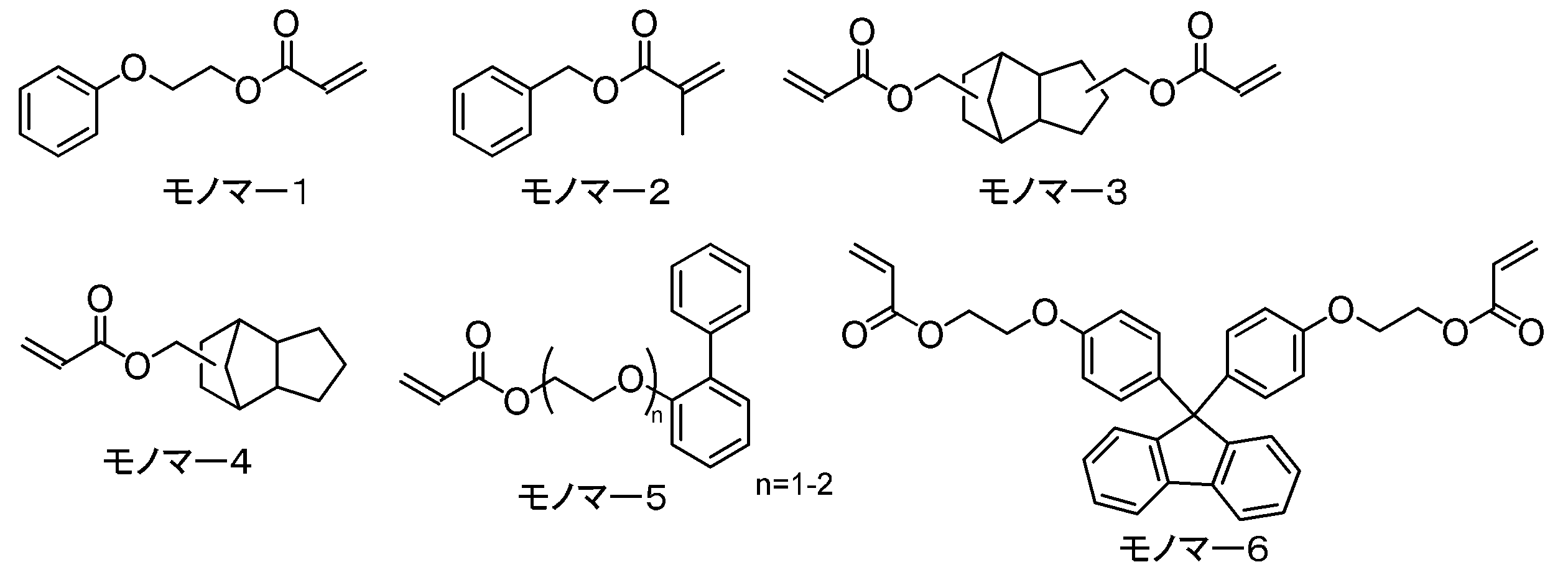
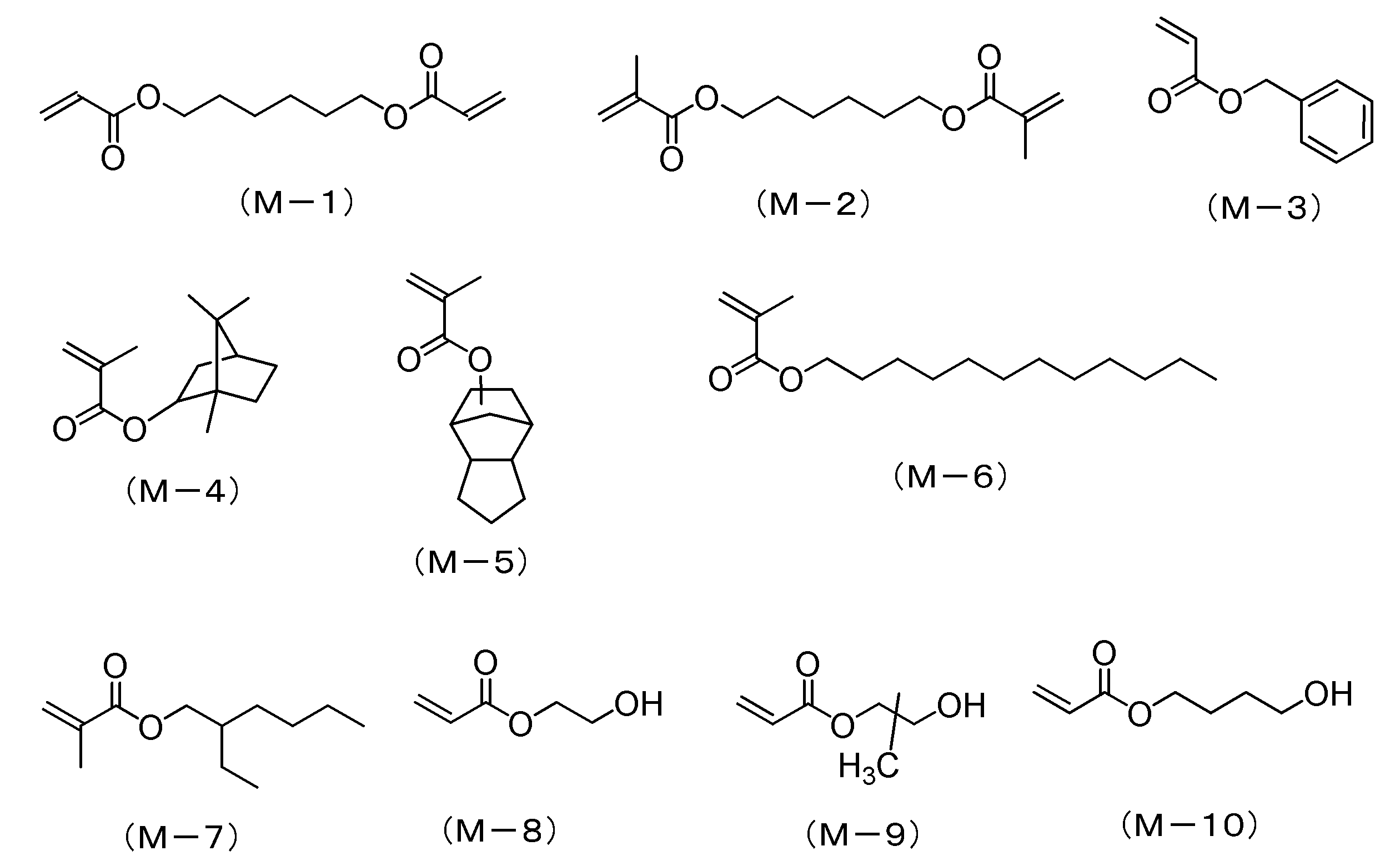
(メタ)アクリレートモノマーの入手方法については特に制限は無く、商業的に入手してもよく、常法により合成してもよい。
商業的に入手する場合は、例えば、ビスコート#192 PEA(上記モノマー1)(大阪有機化学工業社製)、ビスコート#160 BZA(上記モノマー2)(大阪有機化学工業社製)、ライトエステルBz(上記モノマー2)(共栄社化学社製)、A-DCP(上記モノマー3)(新中村化学工業社製)、FA-513AS(上記モノマー4)(日立化成工業社製)、オグソールEA-0200(上記モノマー6)(大阪ガスケミカル社製)、A-HD-N(上記M-1)(新中村化学工業社製)、HD-N(上記M-2)(新中村化学工業社製)、FA-BZA(上記M-3)(日立化成工業社製)、ライトエステルIB-X(上記M-4)(共栄社化学社製)、FA-513M(上記M-5)(日立化成工業社製)、ライトエステルL(上記M-6)(共栄社化学社製)、2EHA(上記M-7)(東亞合成社製)、HEA(上記M-8)(大阪有機化学工業社製)、ライトエステルHOP-A(N)(上記M-9)(共栄社化学社製)、4-HBA(上記M-10)(大阪有機化学工業社製)を好ましく用いることができる。
商業的に入手する場合は、例えば、ビスコート#192 PEA(上記モノマー1)(大阪有機化学工業社製)、ビスコート#160 BZA(上記モノマー2)(大阪有機化学工業社製)、ライトエステルBz(上記モノマー2)(共栄社化学社製)、A-DCP(上記モノマー3)(新中村化学工業社製)、FA-513AS(上記モノマー4)(日立化成工業社製)、オグソールEA-0200(上記モノマー6)(大阪ガスケミカル社製)、A-HD-N(上記M-1)(新中村化学工業社製)、HD-N(上記M-2)(新中村化学工業社製)、FA-BZA(上記M-3)(日立化成工業社製)、ライトエステルIB-X(上記M-4)(共栄社化学社製)、FA-513M(上記M-5)(日立化成工業社製)、ライトエステルL(上記M-6)(共栄社化学社製)、2EHA(上記M-7)(東亞合成社製)、HEA(上記M-8)(大阪有機化学工業社製)、ライトエステルHOP-A(N)(上記M-9)(共栄社化学社製)、4-HBA(上記M-10)(大阪有機化学工業社製)を好ましく用いることができる。
本発明の熱硬化性樹脂用組成物が(メタ)アクリレートモノマーを含有する場合、本発明の熱硬化性樹脂用組成物中における(メタ)アクリレートモノマーの含有量は、1~85質量%が好ましく、1~75質量%がより好ましく、3~65質量%がさらに好ましい。本発明の熱硬化性樹脂用組成物中の(メタ)アクリレートモノマー量を調整することによって、硬化物が熱変化する際の応力を緩和する機能を調整することができる。
(重合開始剤)
本発明の熱硬化性樹脂用組成物は、重合開始剤を含有していることが好ましく、例えば、熱ラジカル重合開始剤、光ラジカル重合開始剤、光カチオン重合開始剤が挙げられる。
なお、本発明の熱硬化性樹脂用組成物は、硬化後は、再加熱しても熱可塑性樹脂のように柔らかくなったり溶けたりしない性質を示す熱硬化性樹脂の硬化物を得られる限り、熱硬化物を得る方法については制限されず、本発明の熱硬化性樹脂用組成物の熱重合による硬化の他、紫外線を照射する光重合による硬化、熱を加えずに硬化促進剤を用いた硬化のいずれであってもよく、これらを併用してもよい。そのため、本発明の熱硬化性樹脂用組成物は、上記の熱硬化物を得る方法にあわせて、重合開始剤を含有することができる。
本発明の熱硬化性樹脂用組成物は、なかでも、熱ラジカル重合開始剤及び光ラジカル重合開始剤のうちの少なくとも1種を含んでいることがより好ましい。
本発明の熱硬化性樹脂用組成物は、重合開始剤を含有していることが好ましく、例えば、熱ラジカル重合開始剤、光ラジカル重合開始剤、光カチオン重合開始剤が挙げられる。
なお、本発明の熱硬化性樹脂用組成物は、硬化後は、再加熱しても熱可塑性樹脂のように柔らかくなったり溶けたりしない性質を示す熱硬化性樹脂の硬化物を得られる限り、熱硬化物を得る方法については制限されず、本発明の熱硬化性樹脂用組成物の熱重合による硬化の他、紫外線を照射する光重合による硬化、熱を加えずに硬化促進剤を用いた硬化のいずれであってもよく、これらを併用してもよい。そのため、本発明の熱硬化性樹脂用組成物は、上記の熱硬化物を得る方法にあわせて、重合開始剤を含有することができる。
本発明の熱硬化性樹脂用組成物は、なかでも、熱ラジカル重合開始剤及び光ラジカル重合開始剤のうちの少なくとも1種を含んでいることがより好ましい。
(熱ラジカル重合開始剤)
本発明の熱硬化性樹脂用組成物は、熱ラジカル重合開始剤を含むことが好ましい。この熱ラジカル重合開始剤の作用によって、本発明の熱硬化性樹脂用組成物を熱重合(硬化)することにより、着色がほとんどなく、かつ、異常部分分散性が高い硬化物を得ることができる。
本発明の熱硬化性樹脂用組成物は、熱ラジカル重合開始剤を含むことが好ましい。この熱ラジカル重合開始剤の作用によって、本発明の熱硬化性樹脂用組成物を熱重合(硬化)することにより、着色がほとんどなく、かつ、異常部分分散性が高い硬化物を得ることができる。
熱ラジカル重合開始剤としては、熱ラジカル重合開始剤として通常用いられる化合物を、後述する熱重合(熱硬化)工程の条件にあわせて適宜用いることができる。例えば、有機過酸化物等が挙げられ、具体的には以下の化合物を用いることができる。
例えば、1,1-ジ(t-ヘキシルペルオキシ)シクロヘキサン、1,1-ジ(t-ブチルペルオキシ)シクロヘキサン、2,2-ジ(4,4-ジ-(t-ブチルペルオキシ)シクロヘキシル)プロパン、t-ヘキシルペルオキシイソプロピルモノカーボネート、t-ブチルペルオキシ-3,5,5-トリメチルヘキサノエート、t-ブチルペルオキシラウレート、ジクミルペルオキシド、ジ-t-ブチルペルオキシド、t-ブチルペルオキシ-2-エチルヘキサノエート、ジ-t-ヘキシルペルオキシド、t-ヘキシルペルオキシ-2-エチルヘキサノエート、クメンハイドロペルオキシド、t-ブチルハイドロペルオキシド、t-ブチルペルオキシ2-エチルヘキシル、2,3-ジメチル-2,3-ジフェニルブタン等を挙げることができる。なお、「t-ブチル」とは「tert-ブチル」を意味する。
例えば、1,1-ジ(t-ヘキシルペルオキシ)シクロヘキサン、1,1-ジ(t-ブチルペルオキシ)シクロヘキサン、2,2-ジ(4,4-ジ-(t-ブチルペルオキシ)シクロヘキシル)プロパン、t-ヘキシルペルオキシイソプロピルモノカーボネート、t-ブチルペルオキシ-3,5,5-トリメチルヘキサノエート、t-ブチルペルオキシラウレート、ジクミルペルオキシド、ジ-t-ブチルペルオキシド、t-ブチルペルオキシ-2-エチルヘキサノエート、ジ-t-ヘキシルペルオキシド、t-ヘキシルペルオキシ-2-エチルヘキサノエート、クメンハイドロペルオキシド、t-ブチルハイドロペルオキシド、t-ブチルペルオキシ2-エチルヘキシル、2,3-ジメチル-2,3-ジフェニルブタン等を挙げることができる。なお、「t-ブチル」とは「tert-ブチル」を意味する。
熱ラジカル重合開始剤を含有する場合、本発明の熱硬化性樹脂用組成物中における熱ラジカル重合開始剤の含有量は、0.01~5.0質量%であることが好ましく、0.02~3.0質量%であることがより好ましく、0.03~2.0質量%であることがさらに好ましく、0.05~1.0質量%であることが特に好ましい。
(光ラジカル重合開始剤)
本発明の熱硬化性樹脂用組成物は、光ラジカル重合開始剤を含むことが好ましい。光ラジカル重合開始剤としては、光ラジカル重合開始剤として通常用いられる化合物を、後述する光重合(光硬化)工程の条件にあわせて適宜用いることができ、具体的には以下の化合物を用いることができる。
例えば、ビス(2,6-ジメトキシベンゾイル)-2,4,4-トリメチルペンチルホスフィンオキシド、ビス(2,6-ジメチルベンゾイル)-2,4,4-トリメチルペンチルホスフィンオキシド、ビス(2,4,6-トリメチルベンゾイル)-2,4,4-トリメチルペンチルホスフィンオキシド、ビス(2,6-ジクロルベンゾイル)-2,4,4-トリメチルペンチルホスフィンオキシド、1-フェニル-2-ヒドロキシ-2-メチルプロパン-1-オン、1-ヒドロキシシクロヘキシルフェニルケトン、1-(4-イソプロピルフェニル)-2-ヒドロキシ-2-メチルプロパン-1-オン、1,2-ジフェニルエタンジオン、メチルフェニルグリオキシレート、1-[4-(2-ヒドロキシエトキシ)-フェニル]-2-ヒドロキシ-2-メチル-1-プロパン-1-オン、2-ヒドロキシ-1-{4-[4-(2-ヒドロキシ-2-メチル-プロピオニル)-ベンジル]フェニル}-2-メチルプロパン-1-オン、2,2-ジメトキシ-1,2-ジフェニルエタン-1-オン、2-メチル-1-(4-メチルチオフェニル)-2-モルフォリノプロパン-1-オン、2-ベンジル-2-ジメチルアミノ-1-(4-モルフォリノフェニル)-ブタノン-1、2,4,6-トリメチルベンゾイル-ジフェニル-ホスフィンオキシド、ビス(2,4,6-トリメチルベンゾイル)フェニルホスフィンオキシド等を挙げることができる。
なお、上記で挙げた光ラジカル重合開始剤のうち、アシルホスフィンオキシド光ラジカル重合開始剤は、耐光性に優れた硬化物が得られる点から好ましい。
本発明の熱硬化性樹脂用組成物は、光ラジカル重合開始剤を含むことが好ましい。光ラジカル重合開始剤としては、光ラジカル重合開始剤として通常用いられる化合物を、後述する光重合(光硬化)工程の条件にあわせて適宜用いることができ、具体的には以下の化合物を用いることができる。
例えば、ビス(2,6-ジメトキシベンゾイル)-2,4,4-トリメチルペンチルホスフィンオキシド、ビス(2,6-ジメチルベンゾイル)-2,4,4-トリメチルペンチルホスフィンオキシド、ビス(2,4,6-トリメチルベンゾイル)-2,4,4-トリメチルペンチルホスフィンオキシド、ビス(2,6-ジクロルベンゾイル)-2,4,4-トリメチルペンチルホスフィンオキシド、1-フェニル-2-ヒドロキシ-2-メチルプロパン-1-オン、1-ヒドロキシシクロヘキシルフェニルケトン、1-(4-イソプロピルフェニル)-2-ヒドロキシ-2-メチルプロパン-1-オン、1,2-ジフェニルエタンジオン、メチルフェニルグリオキシレート、1-[4-(2-ヒドロキシエトキシ)-フェニル]-2-ヒドロキシ-2-メチル-1-プロパン-1-オン、2-ヒドロキシ-1-{4-[4-(2-ヒドロキシ-2-メチル-プロピオニル)-ベンジル]フェニル}-2-メチルプロパン-1-オン、2,2-ジメトキシ-1,2-ジフェニルエタン-1-オン、2-メチル-1-(4-メチルチオフェニル)-2-モルフォリノプロパン-1-オン、2-ベンジル-2-ジメチルアミノ-1-(4-モルフォリノフェニル)-ブタノン-1、2,4,6-トリメチルベンゾイル-ジフェニル-ホスフィンオキシド、ビス(2,4,6-トリメチルベンゾイル)フェニルホスフィンオキシド等を挙げることができる。
なお、上記で挙げた光ラジカル重合開始剤のうち、アシルホスフィンオキシド光ラジカル重合開始剤は、耐光性に優れた硬化物が得られる点から好ましい。
中でも、本発明では、光ラジカル重合開始剤として、1-ヒドロキシシクロヘキシルフェニルケトン、ビス(2,4,6-トリメチルベンゾイル)フェニルホスフィンオキシド、2,4,6-トリメチルベンゾイル-ジフェニル-ホスフィンオキシド、2,2-ジメトキシ-1,2-ジフェニルエタン-1-オン、1-[4-(2-ヒドロキシエトキシ)-フェニル]-2-ヒドロキシ-2-メチル-1-プロパン-1-オン又は2-メチル-1-(4-メチルチオフェニル)-2-モルフォリノプロパン-1-オンを好ましく用いることができる。
光ラジカル重合開始剤を含有する場合、上記熱硬化性樹脂用組成物中における光ラジカル重合開始剤の含有量は、0.01~5.0質量%であることが好ましく、0.05~1.0質量%であることがより好ましく、0.05~0.5質量%であることがさらに好ましい。
なお、熱硬化性樹脂用組成物は、光ラジカル重合開始剤と熱ラジカル重合開始剤の両方を含むことが好ましく、この場合、光ラジカル重合開始剤と熱ラジカル重合開始剤の合計含有量は、熱硬化性樹脂用組成物の全質量に対して、0.01~5.0質量%であることが好ましく、0.05~1.0質量%であることがより好ましく、0.05~0.5質量%であることがさらに好ましい。
なお、熱硬化性樹脂用組成物は、光ラジカル重合開始剤と熱ラジカル重合開始剤の両方を含むことが好ましく、この場合、光ラジカル重合開始剤と熱ラジカル重合開始剤の合計含有量は、熱硬化性樹脂用組成物の全質量に対して、0.01~5.0質量%であることが好ましく、0.05~1.0質量%であることがより好ましく、0.05~0.5質量%であることがさらに好ましい。
光カチオン重合開始剤としては、常用の光カチオン重合開始剤を使用することができ、配合量についても適宜整することができる。
本発明の熱硬化性樹脂用組成物の25℃における粘度は、硬化物を成形する際のハンドリング性を高め、高品質な硬化物を形成する観点から、1000~30000mPa・sであることが好ましく、3000~20000mPa・sであることがより好ましく、5000~15000mPa・sであることがさらに好ましい。
[硬化物又は成形体]
本発明の硬化物は、本発明の熱硬化性樹脂用組成物から得られる硬化物である。
すなわち、本発明の硬化物は、本発明の熱硬化性樹脂用組成物に含有される熱硬化性樹脂の原料モノマーの重合反応が進行し、硬化することにより得られるものである。本発明の硬化物を得る重合反応としては、熱重合による硬化の他、紫外線を照射する光重合による硬化、熱を加えずに硬化促進剤を用いた硬化等が挙げられ、いずれにより行ってもよく、これら2種以上の併用であってもよい。本発明の硬化物は未反応のモノマー(例えば未反応の本発明の化合物)等を含んでいてもよい。
本発明の成形体は、本発明の熱可塑性樹脂含有組成物から得られる成形体である。
すなわち、本発明の成形体は、本発明の熱可塑性樹脂含有組成物を成形することにより得られるものである。
本発明の硬化物は、本発明の熱硬化性樹脂用組成物から得られる硬化物である。
すなわち、本発明の硬化物は、本発明の熱硬化性樹脂用組成物に含有される熱硬化性樹脂の原料モノマーの重合反応が進行し、硬化することにより得られるものである。本発明の硬化物を得る重合反応としては、熱重合による硬化の他、紫外線を照射する光重合による硬化、熱を加えずに硬化促進剤を用いた硬化等が挙げられ、いずれにより行ってもよく、これら2種以上の併用であってもよい。本発明の硬化物は未反応のモノマー(例えば未反応の本発明の化合物)等を含んでいてもよい。
本発明の成形体は、本発明の熱可塑性樹脂含有組成物から得られる成形体である。
すなわち、本発明の成形体は、本発明の熱可塑性樹脂含有組成物を成形することにより得られるものである。
本発明の硬化物及び成形体は、前述の通り、着色がほとんどなく、かつ、異常部分分散性が高い。また、本発明の硬化物及び成形体は、優れた耐光性をも示すことができる。
硬化物及び成形体のアッベ数(νd)及び部分分散比(θg,F)は、エリプソメーター(例えば、J.A.Woollam社製、商品名:M-2000XI-210)を用いて測定される値である。具体的には、後述の実施例に記載の異常部分分散性の評価における記載に基づき測定する。
硬化物及び成形体のアッベ数(νd)及び部分分散比(θg,F)は、下記式により算出される。なお、硬化物を成形する際には、後述の参考例に記載の方法により作製、成形すればよい。また、JIS B 7090:1999 光学及び光学機器-基準波長(ISO 7944:1998 Optics and optical instruments-Reference wavelengths)を適宜参照することができる。
νd=(nd-1)/(nF-nC)
θg,F=(ng-nF)/(nF-nC)
ここで、ndは波長589nmにおける屈折率、nFは波長486nmにおける屈折率、nCは波長656nmにおける屈折率、ngは波長436nmにおける屈折率を表す。
硬化物及び成形体のアッベ数(νd)及び部分分散比(θg,F)は、下記式により算出される。なお、硬化物を成形する際には、後述の参考例に記載の方法により作製、成形すればよい。また、JIS B 7090:1999 光学及び光学機器-基準波長(ISO 7944:1998 Optics and optical instruments-Reference wavelengths)を適宜参照することができる。
νd=(nd-1)/(nF-nC)
θg,F=(ng-nF)/(nF-nC)
ここで、ndは波長589nmにおける屈折率、nFは波長486nmにおける屈折率、nCは波長656nmにおける屈折率、ngは波長436nmにおける屈折率を表す。
本発明の硬化物及び成形体は、横軸アッベ数(νd)-縦軸波長部分分散比(θg,F)のグラフにおける、ノーマルガラスの基準となる硝種NSL7(nd:1.51、アッベ数(νd):60.5、波長部分分散比(θg,F):0.54)と硝種PBM2(nd:1.62、νd:36.3、θg,F:0.58)とを結んで得られる標準線からの波長部分分散比(θg,F)の偏差(Δθg,F)(すなわち、標準線からの距離)が大きく、標準線に対して上側に位置するため、正の異常部分分散性が大きい。
本発明の硬化物及び成形体の波長部分分散比(θg,F)の偏差(Δθg,F)は、0.04以上であることが好ましく、0.08以上であることがより好ましく、0.16以上であることが更に好ましく、0.20以上であることが特に好ましい。また、本発明の硬化物及び成形体の波長部分分散比(θg,F)の偏差(Δθg,F)の上限値は特に限定されるものではないが、通常0.50以下である。
本発明の硬化物及び成形体の波長部分分散比(θg,F)の偏差(Δθg,F)は、0.04以上であることが好ましく、0.08以上であることがより好ましく、0.16以上であることが更に好ましく、0.20以上であることが特に好ましい。また、本発明の硬化物及び成形体の波長部分分散比(θg,F)の偏差(Δθg,F)の上限値は特に限定されるものではないが、通常0.50以下である。
本発明の硬化物及び成形体のアッベ数(νd)は、特に限定されるものではないが、35以下であることが好ましく、30以下であることがより好ましく、29以下であることがさらに好ましく、28以下であることが特に好ましい。また、本発明の硬化物及び成形体のアッベ数(νd)は、特に限定されるものではないが、1以上であることが好ましく、3以上であることがより好ましく、5以上であることがさらに好ましく、7以上であることが特に好ましい。
本発明の硬化物及び成形体の部分分散比(θg,F)は特に限定されるものではないが、0.65以上であることが好ましく、0.70以上であることがより好ましく、0.72以上であることがさらに好ましく、0.75以上であることが特に好ましい。また、本発明の硬化物及び成形体の部分分散比(θg,F)は特に限定されるものではないが、2以下であることが好ましく、1.8以下であることがより好ましく、1.7以下であることがさらに好ましい。
本発明の硬化物及び成形体は、レンズとして用いる際には、可視光領域に吸収を有しない、すなわち透明であることが性能として求められる。
本発明の硬化物及び成形体は、可視光領域における長波長領域には実質的に吸収を有さず、短波長側になるにつれ、透過率の低下がみられる。そのため、波長430nmにおける透過率を測定することにより、本発明の硬化物及び成形体の透明性を評価することができる。
本発明の硬化物及び成形体の波長430nmにおける透過率は、紫外可視分光光度計(例えば、UV-2600(商品名、島津製作所社製))を用いて測定される値である。具体的には、後述の参考例に記載の硬化物の作製と同様にして、例えば直径20mmの透明ガラス型を使用して作製した、厚み約0.1mmの硬化物について波長430nmにおける透過率を測定する。また、成形体については、例えば厚さ0.1mmのスペーサーを使用して作製した、厚み約0.1mmの成形体について波長430nmにおける透過率を測定する。
また、硬化物及び成形体の耐光性を評価するための光照射試験は、後述の実施例に記載のキセノン光照射試験に基づき行う。
本発明の硬化物及び成形体は、可視光領域における長波長領域には実質的に吸収を有さず、短波長側になるにつれ、透過率の低下がみられる。そのため、波長430nmにおける透過率を測定することにより、本発明の硬化物及び成形体の透明性を評価することができる。
本発明の硬化物及び成形体の波長430nmにおける透過率は、紫外可視分光光度計(例えば、UV-2600(商品名、島津製作所社製))を用いて測定される値である。具体的には、後述の参考例に記載の硬化物の作製と同様にして、例えば直径20mmの透明ガラス型を使用して作製した、厚み約0.1mmの硬化物について波長430nmにおける透過率を測定する。また、成形体については、例えば厚さ0.1mmのスペーサーを使用して作製した、厚み約0.1mmの成形体について波長430nmにおける透過率を測定する。
また、硬化物及び成形体の耐光性を評価するための光照射試験は、後述の実施例に記載のキセノン光照射試験に基づき行う。
以下、上記方法により測定される、本発明の硬化物及び成形体の波長430nmにおける透過率について、好ましい値を記載する。
本発明の硬化物及び成形体の作製直後の透過率、すなわち、光照射試験前の透過率は、特に限定されるものではないが、80%以上であることが好ましく、82%以上であることがより好ましく、83%以上であることがさらに好ましく、85%以上であることが特に好ましい。
また、本発明の硬化物及び成形体の光照射試験後の透過率は、特に限定されるものではないが、後述の評価項目3(キセノン光24時間照射試験後の透過率)では、72%以上であることが好ましく、75%以上であることがより好ましく、79%以上であることがさらに好ましく、81%以上であることが特に好ましい。
本発明の硬化物及び成形体の光照射試験前後における透過率の低下幅は、特に限定されるものではないが、後述の評価項目3(キセノン光24時間照射試験前後での透過率の低下幅)では、15%以下であることが好ましく、12%以下であることがより好ましく、8%以下であることがさらに好ましく、5%未満であることが特に好ましい。
上記光照射試験前後における透過率の低下幅とは、上記光照射試験前の透過率の値から上記光照射試験後の透過率の値を引くことにより、算出される。
本発明の硬化物及び成形体の作製直後の透過率、すなわち、光照射試験前の透過率は、特に限定されるものではないが、80%以上であることが好ましく、82%以上であることがより好ましく、83%以上であることがさらに好ましく、85%以上であることが特に好ましい。
また、本発明の硬化物及び成形体の光照射試験後の透過率は、特に限定されるものではないが、後述の評価項目3(キセノン光24時間照射試験後の透過率)では、72%以上であることが好ましく、75%以上であることがより好ましく、79%以上であることがさらに好ましく、81%以上であることが特に好ましい。
本発明の硬化物及び成形体の光照射試験前後における透過率の低下幅は、特に限定されるものではないが、後述の評価項目3(キセノン光24時間照射試験前後での透過率の低下幅)では、15%以下であることが好ましく、12%以下であることがより好ましく、8%以下であることがさらに好ましく、5%未満であることが特に好ましい。
上記光照射試験前後における透過率の低下幅とは、上記光照射試験前の透過率の値から上記光照射試験後の透過率の値を引くことにより、算出される。
また、後述の、本発明の硬化物又は成形体を用いて製造されたレンズ基材を含む複合レンズ(以下、本段落において単に「複合レンズ」と称す。)の波長430nmにおける透過率について、好ましい値を記載する。
上記複合レンズの透過率、すなわち、光照射試験前の透過率は、特に限定されるものではないが、80%以上であることが好ましく、82%以上であることがより好ましく、83%以上であることがさらに好ましく、85%以上であることが特に好ましい。
また、上記複合レンズの光照射試験後の透過率は、特に限定されるものではないが、後述の評価項目3(キセノン光24時間照射試験後の透過率)では、74%以上であることが好ましく、75%以上であることがより好ましく、78%以上であることがさらに好ましく、79%以上であることが特に好ましい。
上記複合レンズの光照射試験前後における透過率の低下幅は、特に限定されるものではないが、後述の評価項目3(キセノン光24時間照射試験前後での透過率の低下幅)では、15%以下であることが好ましく、12%以下であることがより好ましく、8%以下であることがさらに好ましく、5%以下であることが特に好ましい。
上記光照射試験前後における透過率の低下幅とは、上記光照射試験前の透過率の値から上記光照射試験後の透過率の値を引くことにより、算出される。
上記複合レンズの波長430nmにおける透過率は、紫外可視分光光度計(例えば、UV-2600(商品名、島津製作所社製))を用いて測定される値である。具体的には、国際公開第2022/255228号の参考例1に記載の複合レンズの作製と同様にして作製した複合レンズについて、波長430nmにおける透過率を測定する。
上記複合レンズの透過率、すなわち、光照射試験前の透過率は、特に限定されるものではないが、80%以上であることが好ましく、82%以上であることがより好ましく、83%以上であることがさらに好ましく、85%以上であることが特に好ましい。
また、上記複合レンズの光照射試験後の透過率は、特に限定されるものではないが、後述の評価項目3(キセノン光24時間照射試験後の透過率)では、74%以上であることが好ましく、75%以上であることがより好ましく、78%以上であることがさらに好ましく、79%以上であることが特に好ましい。
上記複合レンズの光照射試験前後における透過率の低下幅は、特に限定されるものではないが、後述の評価項目3(キセノン光24時間照射試験前後での透過率の低下幅)では、15%以下であることが好ましく、12%以下であることがより好ましく、8%以下であることがさらに好ましく、5%以下であることが特に好ましい。
上記光照射試験前後における透過率の低下幅とは、上記光照射試験前の透過率の値から上記光照射試験後の透過率の値を引くことにより、算出される。
上記複合レンズの波長430nmにおける透過率は、紫外可視分光光度計(例えば、UV-2600(商品名、島津製作所社製))を用いて測定される値である。具体的には、国際公開第2022/255228号の参考例1に記載の複合レンズの作製と同様にして作製した複合レンズについて、波長430nmにおける透過率を測定する。
[硬化物の製造方法]
本発明の硬化物は、再加熱しても熱可塑性樹脂のように柔らかくなったり溶けたりしない性質を示す熱硬化性樹脂の硬化物を得られる限り、熱硬化物を得る方法については制限されず、本発明の熱硬化性樹脂用組成物の熱重合による硬化の他、紫外線を照射する光重合による硬化、熱を加えずに硬化促進剤を用いた硬化のいずれであってもよく、これらを併用してもよい。
なかでも、本発明の熱硬化性樹脂用組成物を光硬化する工程及び熱硬化する工程の少なくとも一方を含む方法で製造することが好ましく、硬化物の製造方法は、熱硬化性樹脂用組成物に紫線を照射するか又は熱硬化性樹脂用組成物を加熱することによって半硬化物を形成する工程と、得られた半硬化物に紫外線を照射するか又は半硬化物を加熱することによって硬化物を形成する工程と、を含むことがより好ましい。
本発明の硬化物は、再加熱しても熱可塑性樹脂のように柔らかくなったり溶けたりしない性質を示す熱硬化性樹脂の硬化物を得られる限り、熱硬化物を得る方法については制限されず、本発明の熱硬化性樹脂用組成物の熱重合による硬化の他、紫外線を照射する光重合による硬化、熱を加えずに硬化促進剤を用いた硬化のいずれであってもよく、これらを併用してもよい。
なかでも、本発明の熱硬化性樹脂用組成物を光硬化する工程及び熱硬化する工程の少なくとも一方を含む方法で製造することが好ましく、硬化物の製造方法は、熱硬化性樹脂用組成物に紫線を照射するか又は熱硬化性樹脂用組成物を加熱することによって半硬化物を形成する工程と、得られた半硬化物に紫外線を照射するか又は半硬化物を加熱することによって硬化物を形成する工程と、を含むことがより好ましい。
「半硬化物を形成する工程」、「硬化物を形成する工程」及び「半硬化物」としては、特段の断りのない限り、それぞれ、国際公開第2019/044863号の[0106]~[0117]、[0118]~[0124]及び[0125]における「半硬化物を形成する工程」、「硬化物を形成する工程」及び「半硬化物」の記載を、「硬化性組成物」を「本発明の熱硬化性樹脂用組成物」に読み替えて、そのまま適用することができる。
なお、本発明においては、「硬化物を形成する工程」における加圧変形における圧力は、0.098MPa~9.8MPaであることが好ましく、0.154MPa~4.9MPaであることがより好ましく、0.154MPa~2.94MPaであることがさらに好ましい。
なお、本発明においては、「硬化物を形成する工程」における加圧変形における圧力は、0.098MPa~9.8MPaであることが好ましく、0.154MPa~4.9MPaであることがより好ましく、0.154MPa~2.94MPaであることがさらに好ましい。
[成形体の製造方法]
本発明の成形体は、本発明の熱可塑性樹脂含有組成物を成形することにより製造することができる。成形体の成形方法としては、加熱加圧成形を挙げることができ、例えば、圧縮成形、射出成形、押出成形、ブロー成形、エンボス成形等を採用することができる。
本発明の成形体は、本発明の熱可塑性樹脂含有組成物を成形することにより製造することができる。成形体の成形方法としては、加熱加圧成形を挙げることができ、例えば、圧縮成形、射出成形、押出成形、ブロー成形、エンボス成形等を採用することができる。
加熱加圧成形を行う前には、本発明の熱可塑性樹脂含有組成物をペレット化してもよい。本発明の熱可塑性樹脂含有組成物をペレット化することにより、加熱加圧成形をする際の樹脂のハンドリング性を高めることができる。本発明の熱可塑性樹脂含有組成物をペレット化する際には、例えば、ベント式単軸押出機等を用いることができる。
圧縮成形を行う場合、所望の厚みのスペーサーを用い、本発明の熱可塑性樹脂含有組成物(好ましくは本発明の熱可塑性樹脂含有組成物のペレット)の上下をポリイミドフィルム等の樹脂フィルムで挟み、加熱圧縮した後、スペーサーごと樹脂フィルムから取り外し、室温まで冷却(放冷を含む)することにより、成形することができる。
加熱圧縮を行う際の条件としては、加熱温度は、180~450℃であることが好ましく、180~390℃であることがより好ましく、圧力は、0.098MPa~9.8MPaであることが好ましく、0.294MPa~9.8MPaであることがより好ましく、1.0MPa~9.8MPaであることがさらに好ましく、加圧時間は、30~1000秒であることが好ましく、30~500秒であることがより好ましく、60~500秒であることがさらに好ましい。
加熱圧縮を行う際の条件としては、加熱温度は、180~450℃であることが好ましく、180~390℃であることがより好ましく、圧力は、0.098MPa~9.8MPaであることが好ましく、0.294MPa~9.8MPaであることがより好ましく、1.0MPa~9.8MPaであることがさらに好ましく、加圧時間は、30~1000秒であることが好ましく、30~500秒であることがより好ましく、60~500秒であることがさらに好ましい。
射出成形を行う場合、射出成形機(射出圧縮成形機を含む)を用いる。射出成形機では、本発明の熱可塑性樹脂含有組成物の溶融物をシリンダーの先端にため込み、その後、金型の中に本発明の熱可塑性樹脂含有組成物の溶融物を注入して成形する。射出成形機としては一般的に使用されているものを用いることができる。シリンダーは本発明の熱可塑性樹脂含有組成物の付着性が低く、かつ耐蝕性、耐摩耗性を示す材料から構成されたものであることが好ましい。射出成形機としては、例えば、メイホー社製のMicro-1を例示することができる。
射出成形を行う際のシリンダー温度は200~450℃であることが好ましく、250~390℃であることがより好ましい。また、金型の温度は50~300℃であることが好ましく、100~250℃であることがより好ましい。
[硬化物及び成形体の用途]
本発明の硬化物及び成形体は、着色がほとんどなく、かつ、異常部分分散性が高い硬化物又は成形体であって、優れた耐光性をも示すため、様々な用途に用いることができ、なかでも光学部材に好ましく用いることができる。
本発明の硬化物及び成形体は、着色がほとんどなく、かつ、異常部分分散性が高い硬化物又は成形体であって、優れた耐光性をも示すため、様々な用途に用いることができ、なかでも光学部材に好ましく用いることができる。
<光学部材>
本発明の光学部材は、本発明の硬化物又は成形体を含む。
光学部材の種類は、特に制限されないが、特に光を透過する光学部材(いわゆるパッシブ光学部材)であれば好適に利用することができる。このような光学部材を備えた光学機能装置としては、例えば、各種ディスプレイ装置(液晶ディスプレイ又はプラズマディスプレイ等)、各種プロジェクタ装置(OHP(Overhead projector)、液晶プロジェクタ等)、光ファイバー通信装置(光導波路、光増幅器等)、カメラ又はビデオ等の撮影装置等が挙げられる。
本発明の光学部材は、本発明の硬化物又は成形体を含む。
光学部材の種類は、特に制限されないが、特に光を透過する光学部材(いわゆるパッシブ光学部材)であれば好適に利用することができる。このような光学部材を備えた光学機能装置としては、例えば、各種ディスプレイ装置(液晶ディスプレイ又はプラズマディスプレイ等)、各種プロジェクタ装置(OHP(Overhead projector)、液晶プロジェクタ等)、光ファイバー通信装置(光導波路、光増幅器等)、カメラ又はビデオ等の撮影装置等が挙げられる。
パッシブ光学部材としては、例えば、レンズ、プリズム、プリズムシート、パネル(板状成形体)、フィルム、光導波路(フィルム状又はファイバー状等)、光ディスク、LED(Light Emitting Diode)の封止剤等が例示される。パッシブ光学部材には、必要に応じて任意の被覆層又は任意の付加機能層が設けられていてもよい。例えば、パッシブ光学部材には、摩擦又は摩耗を原因とする塗布面の機械的損傷を防止する保護層、無機粒子又は基材等の劣化原因となる望ましくない波長の光線を吸収する光線吸収層、水分又は酸素ガス等の反応性低分子の透過を抑制あるいは防止する透過遮蔽層、防眩層、反射防止層、低屈折率層等が設けられていてもよい。被覆層の具体例としては、無機酸化物または無機窒化物コーティング層からなる透明導電膜又はガスバリア膜、有機物コーティング層からなるガスバリア膜又はハードコート膜等が挙げられる。コーティング層を形成するためのコーティング法としては、真空蒸着法、CVD(Chemical Vapor Deposition)法、スパッタリング法、ディップコート法、スピンコート法等の常用のコーティング法を用いることができる。
[レンズ基材]
光学部材は、レンズ基材であってもよい。すなわち、本発明の硬化物又は成形体は、レンズ基材として用いられていてもよい。本明細書において「レンズ基材」は、レンズ機能を発揮することができる単一部材を意味する。本発明の硬化物又は成形体を用いて製造されたレンズ基材は着色がほとんどなく、かつ、異常部分分散性が高く、更には優れた耐光性をも示す。好ましくは、また、本発明の熱硬化性樹脂用組成物を構成する原料モノマーの種類又は本発明の熱可塑性樹脂含有組成物に含有される熱可塑性樹脂を適宜調整することにより、レンズ基材の屈折率を任意に調節することが可能であり、また、さらに高屈折性、高部分分散比、および軽量性を併せ持つレンズ基材とすることができる。
光学部材は、レンズ基材であってもよい。すなわち、本発明の硬化物又は成形体は、レンズ基材として用いられていてもよい。本明細書において「レンズ基材」は、レンズ機能を発揮することができる単一部材を意味する。本発明の硬化物又は成形体を用いて製造されたレンズ基材は着色がほとんどなく、かつ、異常部分分散性が高く、更には優れた耐光性をも示す。好ましくは、また、本発明の熱硬化性樹脂用組成物を構成する原料モノマーの種類又は本発明の熱可塑性樹脂含有組成物に含有される熱可塑性樹脂を適宜調整することにより、レンズ基材の屈折率を任意に調節することが可能であり、また、さらに高屈折性、高部分分散比、および軽量性を併せ持つレンズ基材とすることができる。
レンズ基材の表面又は周囲には、レンズの使用環境又は用途に応じて膜又は部材を設けることができる。例えば、レンズ基材の表面には、保護膜、反射防止膜、ハードコート膜等を形成することができる。また、本発明の硬化物又は成形体を用いて製造されたレンズ基材を、ガラスレンズ基材およびプラスチックレンズ基材などから選択される他の1つ以上のレンズ基材(以下、「その他のレンズ基材」と称す。)と積層させた複合レンズにすることができる。
このような複合レンズは、例えば、その他のレンズ基材上に本発明の熱硬化性樹脂用組成物を光硬化することで半硬化物を形成し、得られた半硬化物を加熱することによって硬化物を形成することにより、製造することができる。半硬化物を形成する工程及び硬化物を形成する工程については、それぞれ上述の記載を好ましく適用することができる。本発明の熱硬化性樹脂用組成物を用いて得られる硬化物は着色がほとんどなく異常部分分散性が高く、更には優れた耐光性をも示すため、優れた品質の複合レンズを得ることができる。
また、本発明の熱可塑性樹脂含有組成物を用いる場合には、例えば、射出成形機を用いて、ペレット化した本発明の熱可塑性樹脂含有組成物の溶融物を成形金型に射出し、樹脂の成形金型と接していない側のすべての表面上を覆うように透明なガラスレンズを被せて押し広げ、冷却した後、金型を引き離すことにより複合レンズを得ることができる。
レンズ基材の周囲は基材保持枠などに嵌入され固定されていてもよい。但し、これらの膜又は枠などは、レンズ基材に付加される部材であり、本明細書中でいうレンズ基材そのものとは区別される。
このような複合レンズは、例えば、その他のレンズ基材上に本発明の熱硬化性樹脂用組成物を光硬化することで半硬化物を形成し、得られた半硬化物を加熱することによって硬化物を形成することにより、製造することができる。半硬化物を形成する工程及び硬化物を形成する工程については、それぞれ上述の記載を好ましく適用することができる。本発明の熱硬化性樹脂用組成物を用いて得られる硬化物は着色がほとんどなく異常部分分散性が高く、更には優れた耐光性をも示すため、優れた品質の複合レンズを得ることができる。
また、本発明の熱可塑性樹脂含有組成物を用いる場合には、例えば、射出成形機を用いて、ペレット化した本発明の熱可塑性樹脂含有組成物の溶融物を成形金型に射出し、樹脂の成形金型と接していない側のすべての表面上を覆うように透明なガラスレンズを被せて押し広げ、冷却した後、金型を引き離すことにより複合レンズを得ることができる。
レンズ基材の周囲は基材保持枠などに嵌入され固定されていてもよい。但し、これらの膜又は枠などは、レンズ基材に付加される部材であり、本明細書中でいうレンズ基材そのものとは区別される。
本発明のレンズは、本発明の硬化物又は成形体を含む。
すなわち、レンズ基材をレンズとして利用するに際しては、レンズ基材そのものを単独でレンズとして用いてもよいし、上述した膜又は枠、その他レンズ基材などを付加してレンズとして用いてもよい。レンズ基材を用いたレンズの種類又は形状は、特に制限されないが、最大厚みが0.1~10mmであることが好ましい。最大厚みは、より好ましくは0.1~5mmであり、さらに好ましくは0.15~3mmである。また、レンズ基材は、最大直径が1~1000mmの円形状のものであることが好ましい。最大直径は、より好ましくは2~200mmであり、さらに好ましくは2.5~100mmである。
すなわち、レンズ基材をレンズとして利用するに際しては、レンズ基材そのものを単独でレンズとして用いてもよいし、上述した膜又は枠、その他レンズ基材などを付加してレンズとして用いてもよい。レンズ基材を用いたレンズの種類又は形状は、特に制限されないが、最大厚みが0.1~10mmであることが好ましい。最大厚みは、より好ましくは0.1~5mmであり、さらに好ましくは0.15~3mmである。また、レンズ基材は、最大直径が1~1000mmの円形状のものであることが好ましい。最大直径は、より好ましくは2~200mmであり、さらに好ましくは2.5~100mmである。
レンズ基材は、携帯電話又はデジタルカメラ等の撮像用レンズ又はテレビ、ビデオカメラ等の撮映レンズ、さらには車載レンズ、内視鏡レンズ等に使用されることが好ましい。
<接合レンズ>
本発明の組成物を用いて製造されたレンズ基材又はレンズを、他のレンズとレンズ用接着剤を用いて接着することにより、接合レンズを製造することができる。
本発明の組成物を用いて製造されたレンズ基材又はレンズを、他のレンズとレンズ用接着剤を用いて接着することにより、接合レンズを製造することができる。
[他のレンズ]
他のレンズの種類は特に限定されず、例えば、円盤状の凸レンズ、凹レンズ、メニスカスレンズ、非球面レンズ、円筒面状のレンズ面を有するシリンドリカルレンズ、ボールレンズ、ロッドレンズ等が挙げられる。また、他のレンズの材料は特に限定されず、ガラスレンズ、樹脂レンズ、又は複合レンズであればよい。
他のレンズの種類は特に限定されず、例えば、円盤状の凸レンズ、凹レンズ、メニスカスレンズ、非球面レンズ、円筒面状のレンズ面を有するシリンドリカルレンズ、ボールレンズ、ロッドレンズ等が挙げられる。また、他のレンズの材料は特に限定されず、ガラスレンズ、樹脂レンズ、又は複合レンズであればよい。
(ガラスレンズ)
ガラスレンズとしては、常用のものを制限なく使用できる。市販のガラスレンズとしては、例えば、オハラ社製のBK7(商品名)が挙げられる。
複合レンズがガラスレンズを含むときも同様のガラスレンズを用いることができる。
ガラスレンズとしては、常用のものを制限なく使用できる。市販のガラスレンズとしては、例えば、オハラ社製のBK7(商品名)が挙げられる。
複合レンズがガラスレンズを含むときも同様のガラスレンズを用いることができる。
(樹脂レンズ、複合レンズ)
樹脂レンズは樹脂硬化物からなるレンズを意味する。
本明細書において、複合レンズはガラスからなる層と樹脂層とを含むレンズであることが好ましい。樹脂層は樹脂硬化物からなる層である。複合レンズに含まれる各層は、レンズ(単レンズ)であってもよく、この場合、各単レンズの光軸(両球面の曲率中心を結ぶ線)は一致していることが好ましい。複合レンズは樹脂層を表面に有していてもよく、内部に有していてもよい。
樹脂レンズは樹脂硬化物からなるレンズを意味する。
本明細書において、複合レンズはガラスからなる層と樹脂層とを含むレンズであることが好ましい。樹脂層は樹脂硬化物からなる層である。複合レンズに含まれる各層は、レンズ(単レンズ)であってもよく、この場合、各単レンズの光軸(両球面の曲率中心を結ぶ線)は一致していることが好ましい。複合レンズは樹脂層を表面に有していてもよく、内部に有していてもよい。
[レンズ用接着剤]
レンズ用接着剤としては、常用されているものを制限なく使用できる。
レンズ用接着剤としては、例えば、国際公開第2022/255228号の段落[0241]~[0268]に記載の一般式(1)で表される化合物及びその含有量に係る記載を特に制限することなく本発明に適用することができ、国際公開第2022/255228号に記載の一般式(1)で表される化合物を含むレンズ用接着剤を用いることが好ましい。国際公開第2022/255228号に記載の一般式(1)で表される化合物を含むレンズ用接着剤は紫外光を吸収する一方、紫外線照射に対する堅牢性に優れているため、このレンズ用接着剤を用いることにより、接合レンズとして光安定性の高い硬化物を得ることができる。また、国際公開第2022/255228号に記載の一般式(1)で表される化合物を含有するレンズ用接着剤から形成された接着層はヒートショック耐性が高い。
レンズ用接着剤としては、常用されているものを制限なく使用できる。
レンズ用接着剤としては、例えば、国際公開第2022/255228号の段落[0241]~[0268]に記載の一般式(1)で表される化合物及びその含有量に係る記載を特に制限することなく本発明に適用することができ、国際公開第2022/255228号に記載の一般式(1)で表される化合物を含むレンズ用接着剤を用いることが好ましい。国際公開第2022/255228号に記載の一般式(1)で表される化合物を含むレンズ用接着剤は紫外光を吸収する一方、紫外線照射に対する堅牢性に優れているため、このレンズ用接着剤を用いることにより、接合レンズとして光安定性の高い硬化物を得ることができる。また、国際公開第2022/255228号に記載の一般式(1)で表される化合物を含有するレンズ用接着剤から形成された接着層はヒートショック耐性が高い。
(重合体)
レンズ用接着剤は、粘度又は硬化物のヤング率を調整する目的で、ポリマー又はオリゴマー(以下「重合体」とも言う)を含んでいてもよい。重合体としては、国際公開第2022/255228号の段落[0269]~[0312]に記載の重合体及びその含有量に係る記載を特に制限することなく本発明に適用することができる。
レンズ用接着剤は、粘度又は硬化物のヤング率を調整する目的で、ポリマー又はオリゴマー(以下「重合体」とも言う)を含んでいてもよい。重合体としては、国際公開第2022/255228号の段落[0269]~[0312]に記載の重合体及びその含有量に係る記載を特に制限することなく本発明に適用することができる。
((メタ)アクリレートモノマー)
レンズ用接着剤は、(メタ)アクリレートモノマーを含んでもよい。(メタ)アクリレートモノマーとしては、上述の本発明の組成物において挙げたものと同様のものを用いることができる。また、国際公開第2022/255228号の段落[0313]~[0315]に記載の(メタ)アクリレートモノマーに係る記載を特に制限することなく本発明に適用することができる。
(メタ)アクリレートモノマーの含有量については、国際公開第2022/255228号の段落[0316]に記載の(メタ)アクリレートモノマーの含有量に係る記載を特に制限することなく本発明に適用することができる。
レンズ用接着剤は、(メタ)アクリレートモノマーを含んでもよい。(メタ)アクリレートモノマーとしては、上述の本発明の組成物において挙げたものと同様のものを用いることができる。また、国際公開第2022/255228号の段落[0313]~[0315]に記載の(メタ)アクリレートモノマーに係る記載を特に制限することなく本発明に適用することができる。
(メタ)アクリレートモノマーの含有量については、国際公開第2022/255228号の段落[0316]に記載の(メタ)アクリレートモノマーの含有量に係る記載を特に制限することなく本発明に適用することができる。
(重合開始剤)
レンズ用接着剤は、光ラジカル重合開始剤を含むことが好ましい。光ラジカル重合開始剤としては、上述の本発明の組成物において記載する光ラジカル重合開始剤に係る記載を適用することができる。
また、レンズ用接着剤は、光ラジカル重合開始剤に加えて熱ラジカル重合開始剤を含んでいてもよい。熱ラジカル重合開始剤をさらに含むことによって、光の届かない領域の硬化を促進することができる。熱ラジカル重合開始剤としては、上述の本発明の組成物において記載する熱ラジカル重合開始剤に係る記載を適用することができる。
レンズ用接着剤は、光ラジカル重合開始剤を含むことが好ましい。光ラジカル重合開始剤としては、上述の本発明の組成物において記載する光ラジカル重合開始剤に係る記載を適用することができる。
また、レンズ用接着剤は、光ラジカル重合開始剤に加えて熱ラジカル重合開始剤を含んでいてもよい。熱ラジカル重合開始剤をさらに含むことによって、光の届かない領域の硬化を促進することができる。熱ラジカル重合開始剤としては、上述の本発明の組成物において記載する熱ラジカル重合開始剤に係る記載を適用することができる。
[接合レンズの製造]
接合レンズは、レンズ用接着剤を介して2つのレンズを重ね合わせた後、接着剤を硬化して接着層を形成することにより得ることができる。硬化は上記の重ね合わせのあと、接着剤に混入した気泡を除去した後に行うことが好ましい。
接着剤の硬化は光照射及び/又は加熱により実施することができる。硬化は少なくとも光照射を実施することで行うことが好ましい。また、光照射を行った後に更に加熱する工程を実施してもよい。光照射及び加熱による接着剤の硬化については、接着層が形成される限り特に制限されず、常法により硬化することができる。
接合レンズは、レンズ用接着剤を介して2つのレンズを重ね合わせた後、接着剤を硬化して接着層を形成することにより得ることができる。硬化は上記の重ね合わせのあと、接着剤に混入した気泡を除去した後に行うことが好ましい。
接着剤の硬化は光照射及び/又は加熱により実施することができる。硬化は少なくとも光照射を実施することで行うことが好ましい。また、光照射を行った後に更に加熱する工程を実施してもよい。光照射及び加熱による接着剤の硬化については、接着層が形成される限り特に制限されず、常法により硬化することができる。
接着層の厚みは、10~50μmが好ましく、20~30μmがより好ましい。10μm以上の厚みとすることにより紫外線吸収の効果を十分に得ることができる。また、50μm以下の厚みとすることにより、高い接着性を発現しつつ、可視光の短波長領域(波長400-430nmの領域)における透過率を高めることができる。
接着層の波長587nmにおける屈折率は1.51以上であることが好ましく、1.53以上であることがより好ましく、1.55以上であることがさらに好ましい。接合されるレンズとの屈折率の差異が小さくなるためである。
また、カットオフ波長は、膜厚30μmの接着層において、380nm以下であることが好ましく、385nm以下であることがより好ましく、390nm以下であることがさらに好ましい。なお、ここで、透過率の高い波長側から接着層の透過率を測定した際に、接着層の透過率が初めて0.5%以下となる波長をカットオフ波長と定義する。接着層の透過率は、可視紫外分光光度計(例えば島津製作所社製のUV-2550(商品名))を用いて測定することができる。
例えば、レンズ用接着剤における国際公開第2022/255228号に記載の一般式(1)で表される化合物の量を調節することにより、上記の範囲に接着層の屈折率とカットオフ波長を調整することができる。
また、カットオフ波長は、膜厚30μmの接着層において、380nm以下であることが好ましく、385nm以下であることがより好ましく、390nm以下であることがさらに好ましい。なお、ここで、透過率の高い波長側から接着層の透過率を測定した際に、接着層の透過率が初めて0.5%以下となる波長をカットオフ波長と定義する。接着層の透過率は、可視紫外分光光度計(例えば島津製作所社製のUV-2550(商品名))を用いて測定することができる。
例えば、レンズ用接着剤における国際公開第2022/255228号に記載の一般式(1)で表される化合物の量を調節することにより、上記の範囲に接着層の屈折率とカットオフ波長を調整することができる。
以下に実施例に基づき本発明について更に詳細に説明する。以下の実施例に示す材料、使用量、割合、処理内容、処理手順等は、本発明の趣旨を逸脱しない限り適宜変更することができる。したがって、本発明の範囲は以下に示す具体例により限定的に解釈されるべきものではない。
なお、熱硬化性樹脂用組成物の調製工程、及び、調製後の熱硬化性樹脂用組成物を用いた硬化物の作製、評価に用いるまでの保管工程は、照明として黄色灯を使用する環境下で行った。
なお、熱硬化性樹脂用組成物の調製工程、及び、調製後の熱硬化性樹脂用組成物を用いた硬化物の作製、評価に用いるまでの保管工程は、照明として黄色灯を使用する環境下で行った。
実施例
[合成例]
化合物について、以下の通り合成した。
なお、w/v%は質量対容量百分率を意味し、室温は25℃を意味する。
[合成例]
化合物について、以下の通り合成した。
なお、w/v%は質量対容量百分率を意味し、室温は25℃を意味する。
〔1.化合物A-1及びA-2の合成〕

(1)中間体a-1の合成
1Lの三口フラスコに、4-ヒドロキシベンズアルデヒド 50.0g、4-ヒドロキシプロピオフェノン 63.0g、エタノール170mL、ピペリジン125mL、氷酢酸50mLを量り取り、還流下で36時間攪拌し、反応させた。室温まで冷却後、酢酸エチル500mLで希釈したのち、水500mL、希塩酸500mL、2%食塩水500mLの順で洗浄した。有機層を濃縮したのち、シリカゲルカラムクロマトグラフィーにより精製し、中間体a-1を32.0g得た。
(2)化合物A-1の合成
500mLの三口フラスコに、中間体a-1 22.0g、炭酸エチレン 30.0g、炭酸カリウム6.0gおよびN,N-ジメチルアセトアミド(DMAc)60mLを量り取り、120℃で1時間攪拌し、反応させた。80℃まで冷却後、50w/v%水酸化ナトリウム水溶液15.0mLおよび水60mLを加え、さらに1時間攪拌した。室温まで冷却したのち、上澄み液をデカントすることで析出した固体を回収し、得られた固体をシリカゲルカラムクロマトグラフィーにより精製することで化合物A-1を18.0g得た。
1H-NMR(400MHz,DMSO-d6):δ2.16ppm(s,3H)、3.70-3.80ppm(m,4H)、4.02-4.12ppm(m,4H)、4.90ppm(m,2H)、7.00-7.15ppm(m,5H)、7.46ppm(d,2H)、7.72ppm(d,2H)
(3)化合物A-2の合成
100mLの三口フラスコに、化合物A-1を5.0g、p-メトキシフェノール(MEHQ)を50mg、テトラヒドロフラン(THF)を50mL及びトリエチルアミン(Et3N)を3.7g加え、氷浴中で10分撹拌した。ここに塩化アクリロイル2.8gを15分かけて滴下し、室温で4時間攪拌して反応させたのち少量の水を加え、反応を停止した。反応液を酢酸エチルで希釈し、水及び飽和食塩水で洗浄後、シリカゲルカラムクロマトグラフィーにより精製することで化合物A-2を3.2g得た。
1H-NMR(400MHz,DMSO-d6):δ2.16ppm(s,3H)、4.10-4.20ppm(m,4H)、4.40-4.50ppm(m,4H)、5.85-5.95ppm(m,2H)、6.15-6.25ppm(m,2H)、6.30-6.40ppm(m,2H)、7.00-7.15ppm(m,5H)、7.48ppm(d,2H)、7.75ppm(d,2H)
1Lの三口フラスコに、4-ヒドロキシベンズアルデヒド 50.0g、4-ヒドロキシプロピオフェノン 63.0g、エタノール170mL、ピペリジン125mL、氷酢酸50mLを量り取り、還流下で36時間攪拌し、反応させた。室温まで冷却後、酢酸エチル500mLで希釈したのち、水500mL、希塩酸500mL、2%食塩水500mLの順で洗浄した。有機層を濃縮したのち、シリカゲルカラムクロマトグラフィーにより精製し、中間体a-1を32.0g得た。
(2)化合物A-1の合成
500mLの三口フラスコに、中間体a-1 22.0g、炭酸エチレン 30.0g、炭酸カリウム6.0gおよびN,N-ジメチルアセトアミド(DMAc)60mLを量り取り、120℃で1時間攪拌し、反応させた。80℃まで冷却後、50w/v%水酸化ナトリウム水溶液15.0mLおよび水60mLを加え、さらに1時間攪拌した。室温まで冷却したのち、上澄み液をデカントすることで析出した固体を回収し、得られた固体をシリカゲルカラムクロマトグラフィーにより精製することで化合物A-1を18.0g得た。
1H-NMR(400MHz,DMSO-d6):δ2.16ppm(s,3H)、3.70-3.80ppm(m,4H)、4.02-4.12ppm(m,4H)、4.90ppm(m,2H)、7.00-7.15ppm(m,5H)、7.46ppm(d,2H)、7.72ppm(d,2H)
(3)化合物A-2の合成
100mLの三口フラスコに、化合物A-1を5.0g、p-メトキシフェノール(MEHQ)を50mg、テトラヒドロフラン(THF)を50mL及びトリエチルアミン(Et3N)を3.7g加え、氷浴中で10分撹拌した。ここに塩化アクリロイル2.8gを15分かけて滴下し、室温で4時間攪拌して反応させたのち少量の水を加え、反応を停止した。反応液を酢酸エチルで希釈し、水及び飽和食塩水で洗浄後、シリカゲルカラムクロマトグラフィーにより精製することで化合物A-2を3.2g得た。
1H-NMR(400MHz,DMSO-d6):δ2.16ppm(s,3H)、4.10-4.20ppm(m,4H)、4.40-4.50ppm(m,4H)、5.85-5.95ppm(m,2H)、6.15-6.25ppm(m,2H)、6.30-6.40ppm(m,2H)、7.00-7.15ppm(m,5H)、7.48ppm(d,2H)、7.75ppm(d,2H)
〔2.化合物B-1及びB-2の合成〕
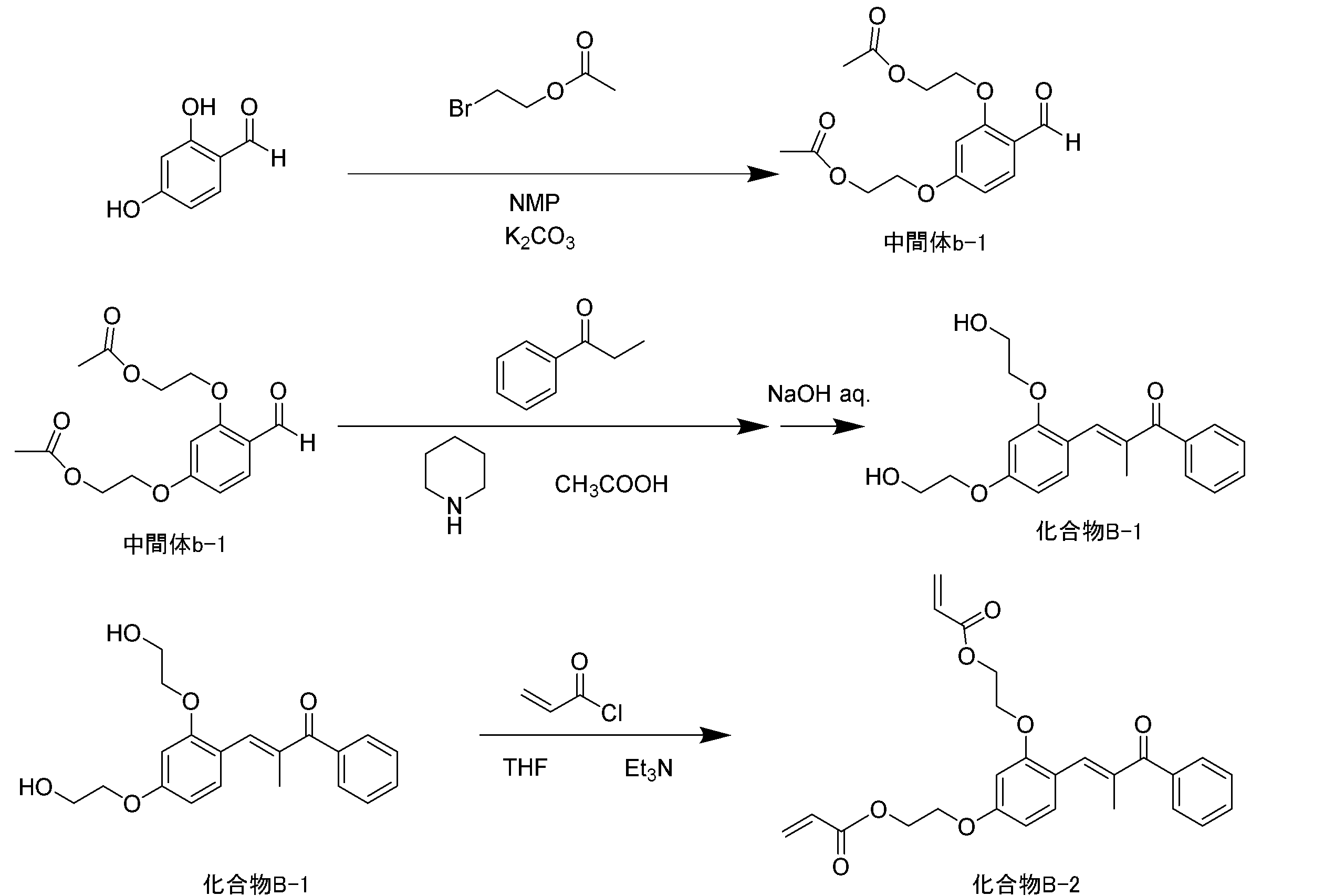
(1)中間体b-1の合成
1Lの三口フラスコに、2,4-ジヒドロキシベンズアルデヒド 41.4g、N-メチルピロリドン(DMP)170mL、炭酸カリウム100gを量り取り、70℃に昇温した。ここに酢酸2-ブロモエチル105gを30分かけて滴下し、80℃で3時間攪拌し、反応させた。室温まで冷却したのち、酢酸エチル500mLで希釈し、水300mL、飽和食塩水300mLの順で洗浄した。無水硫酸マグネシウムで脱水し、これをろ過したのち、有機層にヘキサンを添加することで結晶を析出させた。得られた結晶を真空乾燥させ、中間体b-1を43.0g得た。
(2)化合物B-1の合成
1Lの三口フラスコに、中間体b-1を27.0g、プロピオフェノン 12.0g、エタノール80mL、ピペリジン20mL、氷酢酸10mLを量り取り、80℃で36時間攪拌し、反応させた。続いて、50w/v%水酸化ナトリウム水溶液15.0mLおよび水10mLを加え、さらに80℃で6時間攪拌した。室温まで冷却後、酢酸エチル300mLで希釈したのち、水300mL、希塩酸300mL、飽和食塩水300mLの順で洗浄した。有機層を濃縮したのち、シリカゲルカラムクロマトグラフィーにより精製し、化合物B-1を19.0g得た。
1H-NMR(400MHz,DMSO-d6):δ2.16ppm(s,3H)、3.65-3.75ppm(m,4H)、3.96-4.10ppm(m,4H)、4.78ppm(t,1H)、4.88ppm(t,1H)、6.60-6.64ppm(m,2H)、7.36-7.46ppm(m,2H)、7.50-7.56ppm(m,2H)、7.58-7.64ppm(m,1H)、7.68-7.74ppm(m,2H)
(3)化合物B-2の合成
化合物A-2の合成において、化合物A-1を化合物B-1に代えた以外は同様にして、化合物B-2を3.4g得た。
1H-NMR(400MHz,DMSO-d6):δ2.16ppm(s,3H)、4.05-4.15ppm(m,4H)、4.40-4.50ppm(m,4H)、5.85-5.95ppm(m,2H)、6.15-6.25ppm(m,2H)、6.30-6.40ppm(m,2H)、6.64-6.70ppm(m,2H)、7.36-7.46ppm(m,2H)、7.50-7.56ppm(m,2H)、7.58-7.64ppm(m,1H)、7.68-7.74ppm(m,2H)
1Lの三口フラスコに、2,4-ジヒドロキシベンズアルデヒド 41.4g、N-メチルピロリドン(DMP)170mL、炭酸カリウム100gを量り取り、70℃に昇温した。ここに酢酸2-ブロモエチル105gを30分かけて滴下し、80℃で3時間攪拌し、反応させた。室温まで冷却したのち、酢酸エチル500mLで希釈し、水300mL、飽和食塩水300mLの順で洗浄した。無水硫酸マグネシウムで脱水し、これをろ過したのち、有機層にヘキサンを添加することで結晶を析出させた。得られた結晶を真空乾燥させ、中間体b-1を43.0g得た。
(2)化合物B-1の合成
1Lの三口フラスコに、中間体b-1を27.0g、プロピオフェノン 12.0g、エタノール80mL、ピペリジン20mL、氷酢酸10mLを量り取り、80℃で36時間攪拌し、反応させた。続いて、50w/v%水酸化ナトリウム水溶液15.0mLおよび水10mLを加え、さらに80℃で6時間攪拌した。室温まで冷却後、酢酸エチル300mLで希釈したのち、水300mL、希塩酸300mL、飽和食塩水300mLの順で洗浄した。有機層を濃縮したのち、シリカゲルカラムクロマトグラフィーにより精製し、化合物B-1を19.0g得た。
1H-NMR(400MHz,DMSO-d6):δ2.16ppm(s,3H)、3.65-3.75ppm(m,4H)、3.96-4.10ppm(m,4H)、4.78ppm(t,1H)、4.88ppm(t,1H)、6.60-6.64ppm(m,2H)、7.36-7.46ppm(m,2H)、7.50-7.56ppm(m,2H)、7.58-7.64ppm(m,1H)、7.68-7.74ppm(m,2H)
(3)化合物B-2の合成
化合物A-2の合成において、化合物A-1を化合物B-1に代えた以外は同様にして、化合物B-2を3.4g得た。
1H-NMR(400MHz,DMSO-d6):δ2.16ppm(s,3H)、4.05-4.15ppm(m,4H)、4.40-4.50ppm(m,4H)、5.85-5.95ppm(m,2H)、6.15-6.25ppm(m,2H)、6.30-6.40ppm(m,2H)、6.64-6.70ppm(m,2H)、7.36-7.46ppm(m,2H)、7.50-7.56ppm(m,2H)、7.58-7.64ppm(m,1H)、7.68-7.74ppm(m,2H)
〔3.比較化合物CM-1の合成〕

(1)中間体c-1の合成
中間体a-1の合成において、4-ヒドロキシプロピオフェノンを4-ヒドロキシアセトフェノンに代えた以外は同様にして、中間体c-1を29.0g得た。
(2)比較化合物CM-1の合成
化合物A-1の合成において、中間体a-1を中間体c-1に代えた以外は同様にして、比較化合物CM-1を7.9g得た。
中間体a-1の合成において、4-ヒドロキシプロピオフェノンを4-ヒドロキシアセトフェノンに代えた以外は同様にして、中間体c-1を29.0g得た。
(2)比較化合物CM-1の合成
化合物A-1の合成において、中間体a-1を中間体c-1に代えた以外は同様にして、比較化合物CM-1を7.9g得た。
〔4.比較化合物CM-2の合成〕

化合物B-1の合成において、プロピオフェノンをベンゾイルアセトニトリルに代えた以外は同様にして、比較化合物CM-2を15.9g得た。
上記で作製した各化合物について、透過率、異常部分分散性及び耐光性を、以下のようにして評価した。結果をまとめて表1に示す。
<評価項目1:透過率>
島津製作所社製の紫外可視分光光度計(UV-2550)を用い、下記条件にて波長430nmにおける希釈溶液の透過率を測定し、以下の基準に当てはめ評価した。波長430nmにおける透過率が高いほど、黄色の着色が少ないことを示す。
(測定条件)
セル:角型石英セル(光路長:1cm)
サンプル:濃度50.0mg/5mLとなるように、本発明の化合物又は比較化合物をテトラヒドロフラン(THF)に溶解させ、調製した。
ブランク:THF
- 評価基準 -
A:99%以上
B:98%以上99%未満
C:90%以上98%未満
D:80%以上90%未満
E:80%未満
島津製作所社製の紫外可視分光光度計(UV-2550)を用い、下記条件にて波長430nmにおける希釈溶液の透過率を測定し、以下の基準に当てはめ評価した。波長430nmにおける透過率が高いほど、黄色の着色が少ないことを示す。
(測定条件)
セル:角型石英セル(光路長:1cm)
サンプル:濃度50.0mg/5mLとなるように、本発明の化合物又は比較化合物をテトラヒドロフラン(THF)に溶解させ、調製した。
ブランク:THF
- 評価基準 -
A:99%以上
B:98%以上99%未満
C:90%以上98%未満
D:80%以上90%未満
E:80%未満
<評価項目2:異常部分分散性>
(1)サンプルの作製
本発明の化合物又は比較化合物0.20g、およびポリカーボネート(帝人社製、商品名:パンライトL-1225Y)0.80gをシクロヘキサノン20mLに溶解し、塗布液1を調製した。同様に、本発明の化合物又は比較化合物0.40g、およびポリカーボネート(帝人社製、商品名:パンライトL-1225Y)0.60gをシクロヘキサノン20mLに溶解し、塗布液2を調製した。また、ポリカーボネート(帝人社製、商品名:パンライトL-1225Y)1.0gをシクロヘキサノン20mLに溶解し、塗布液3を調製した。
石英基板上に各塗布液をスピンコーティングして、ポリカーボネート(樹脂)と化合物の混合物からなるスピンコート膜、及びポリカーボネート(樹脂)のスピンコート膜を作製し、これらを屈折率測定用サンプルとして用いた。
(2)異常部分分散性の評価
上記で作製した屈折率測定用サンプルについて、エリプソメーター(J.A.Woollam社製、商品名:M-2000XI-210)を用いて、436nm、486nm、589nm、656nmの各波長における屈折率を測定した。
塗布液1~3それぞれを用いて作製した屈折率測定用サンプルの各波長における屈折率の値から、本発明の化合物又は比較化合物の配合比率が100%となる点の屈折率を、本発明の化合物又は比較化合物の配合比率が0%、20%及び40%の3点における屈折率を用いた外挿値として各波長毎に算出し、以下の式から、本発明の化合物及び比較化合物の屈折率の波長部分分散比(θg,F)およびアッベ数(νd)をそれぞれ求めた。
νd=(nd-1)/(nF-nC)
θg,F=(ng-nF)/(nF-nC)
上記式中、ndは波長589nmにおける屈折率、nFは波長486nmにおける屈折率、nCは波長656nmにおける屈折率、ngは波長436nmにおける屈折率をそれぞれ示す。nd、nF、nC及びngはいずれも、上記の化合物又は比較化合物の配合比率が100%となる点の屈折率(外挿値)である。
次いで、横軸アッベ数(νd)-縦軸波長部分分散比(θg,F)のグラフにおける、ノーマルガラスの基準となる硝種NSL7(d線における屈折率(nd):1.51、アッベ数(νd):60.5、波長部分分散比(θg,F):0.54)と硝種PBM2(nd:1.62、νd:36.3、θg,F:0.58)とを結んで得られる標準線からの波長部分分散比(θg,F)の偏差(Δθg,F)(すなわち、標準線からの距離)を本発明の化合物及び比較化合物についてそれぞれ求め、以下の基準に当てはめ評価した。また、塗布液3から作製したサンプルについても、Δθg,Fの値を求め、比較サンプルとして以下の基準に当てはめ評価した。
なお、NSL7とPBM2はともにオハラ社製の光学ガラスである。また、nd、νd及びθg,Fの定義については、上記式における定義と同義である。
- 評価基準 -
A:0.20以上
B:0.16以上0.20未満
C:0.08以上0.16未満
D:0.04以上0.08未満
E:0.04未満
(1)サンプルの作製
本発明の化合物又は比較化合物0.20g、およびポリカーボネート(帝人社製、商品名:パンライトL-1225Y)0.80gをシクロヘキサノン20mLに溶解し、塗布液1を調製した。同様に、本発明の化合物又は比較化合物0.40g、およびポリカーボネート(帝人社製、商品名:パンライトL-1225Y)0.60gをシクロヘキサノン20mLに溶解し、塗布液2を調製した。また、ポリカーボネート(帝人社製、商品名:パンライトL-1225Y)1.0gをシクロヘキサノン20mLに溶解し、塗布液3を調製した。
石英基板上に各塗布液をスピンコーティングして、ポリカーボネート(樹脂)と化合物の混合物からなるスピンコート膜、及びポリカーボネート(樹脂)のスピンコート膜を作製し、これらを屈折率測定用サンプルとして用いた。
(2)異常部分分散性の評価
上記で作製した屈折率測定用サンプルについて、エリプソメーター(J.A.Woollam社製、商品名:M-2000XI-210)を用いて、436nm、486nm、589nm、656nmの各波長における屈折率を測定した。
塗布液1~3それぞれを用いて作製した屈折率測定用サンプルの各波長における屈折率の値から、本発明の化合物又は比較化合物の配合比率が100%となる点の屈折率を、本発明の化合物又は比較化合物の配合比率が0%、20%及び40%の3点における屈折率を用いた外挿値として各波長毎に算出し、以下の式から、本発明の化合物及び比較化合物の屈折率の波長部分分散比(θg,F)およびアッベ数(νd)をそれぞれ求めた。
νd=(nd-1)/(nF-nC)
θg,F=(ng-nF)/(nF-nC)
上記式中、ndは波長589nmにおける屈折率、nFは波長486nmにおける屈折率、nCは波長656nmにおける屈折率、ngは波長436nmにおける屈折率をそれぞれ示す。nd、nF、nC及びngはいずれも、上記の化合物又は比較化合物の配合比率が100%となる点の屈折率(外挿値)である。
次いで、横軸アッベ数(νd)-縦軸波長部分分散比(θg,F)のグラフにおける、ノーマルガラスの基準となる硝種NSL7(d線における屈折率(nd):1.51、アッベ数(νd):60.5、波長部分分散比(θg,F):0.54)と硝種PBM2(nd:1.62、νd:36.3、θg,F:0.58)とを結んで得られる標準線からの波長部分分散比(θg,F)の偏差(Δθg,F)(すなわち、標準線からの距離)を本発明の化合物及び比較化合物についてそれぞれ求め、以下の基準に当てはめ評価した。また、塗布液3から作製したサンプルについても、Δθg,Fの値を求め、比較サンプルとして以下の基準に当てはめ評価した。
なお、NSL7とPBM2はともにオハラ社製の光学ガラスである。また、nd、νd及びθg,Fの定義については、上記式における定義と同義である。
- 評価基準 -
A:0.20以上
B:0.16以上0.20未満
C:0.08以上0.16未満
D:0.04以上0.08未満
E:0.04未満
<評価項目3:耐光性>
(1)耐光性評価用サンプルの作製
本発明の化合物又は比較化合物0.20g、およびポリカーボネート(帝人社製、商品名:パンライトL-1225Y)0.80gを塩化メチレン5.0mLに溶解した。これを直径4cmのアルミ皿に1.5g量り取り、室温で3日間乾燥させることで、厚み約0.1mmのフィルム状の耐光性評価用サンプルを作製した。また、ポリカーボネート(帝人社製、商品名:パンライトL-1225Y)1.0gを塩化メチレン5.0mLに溶解し、上記と同様にしてアルミ皿上で乾燥させた厚み約0.1mmの比較用フィルムを作製した。
(2)耐光性の評価
上記で作製した耐光性評価用サンプルについて、下記条件でキセノン光照射試験を実施し、キセノン光照射前後の波長450nmにおける透過率の低下幅を求め、以下の基準に当てはめ耐光性を評価した。この照射試験は、太陽光環境下に対する耐光性加速試験に相当する。
なお、本発明の化合物A-1、A-2、B-1及びB-2は、いずれも、波長430nmにおける透過率の低下幅自体も5%未満であった。
また、上記の透過率の低下幅とは、キセノン光照射前の透過率の値からキセノン光照射後の透過率の値を引くことにより算出される値である。
(キセノン光照射条件)
装置:キセノン促進耐候性試験機Q-SUN Xe-1(商品名、Q-Lab Corporation社製)
光源:キセノンアークランプ
光学フィルター:Extended UV Q/B(商品名、Q-Lab Corporation社製)
照度:0.43W/m2(340nm照度計)
ブラックパネル温度:63℃
試験時間:24時間
- 評価基準 -
A:透過率の低下幅が5%未満
B:透過率の低下幅が5%以上8%未満
C:透過率の低下幅が8%以上10%未満
D:透過率の低下幅が10%以上
(1)耐光性評価用サンプルの作製
本発明の化合物又は比較化合物0.20g、およびポリカーボネート(帝人社製、商品名:パンライトL-1225Y)0.80gを塩化メチレン5.0mLに溶解した。これを直径4cmのアルミ皿に1.5g量り取り、室温で3日間乾燥させることで、厚み約0.1mmのフィルム状の耐光性評価用サンプルを作製した。また、ポリカーボネート(帝人社製、商品名:パンライトL-1225Y)1.0gを塩化メチレン5.0mLに溶解し、上記と同様にしてアルミ皿上で乾燥させた厚み約0.1mmの比較用フィルムを作製した。
(2)耐光性の評価
上記で作製した耐光性評価用サンプルについて、下記条件でキセノン光照射試験を実施し、キセノン光照射前後の波長450nmにおける透過率の低下幅を求め、以下の基準に当てはめ耐光性を評価した。この照射試験は、太陽光環境下に対する耐光性加速試験に相当する。
なお、本発明の化合物A-1、A-2、B-1及びB-2は、いずれも、波長430nmにおける透過率の低下幅自体も5%未満であった。
また、上記の透過率の低下幅とは、キセノン光照射前の透過率の値からキセノン光照射後の透過率の値を引くことにより算出される値である。
(キセノン光照射条件)
装置:キセノン促進耐候性試験機Q-SUN Xe-1(商品名、Q-Lab Corporation社製)
光源:キセノンアークランプ
光学フィルター:Extended UV Q/B(商品名、Q-Lab Corporation社製)
照度:0.43W/m2(340nm照度計)
ブラックパネル温度:63℃
試験時間:24時間
- 評価基準 -
A:透過率の低下幅が5%未満
B:透過率の低下幅が5%以上8%未満
C:透過率の低下幅が8%以上10%未満
D:透過率の低下幅が10%以上
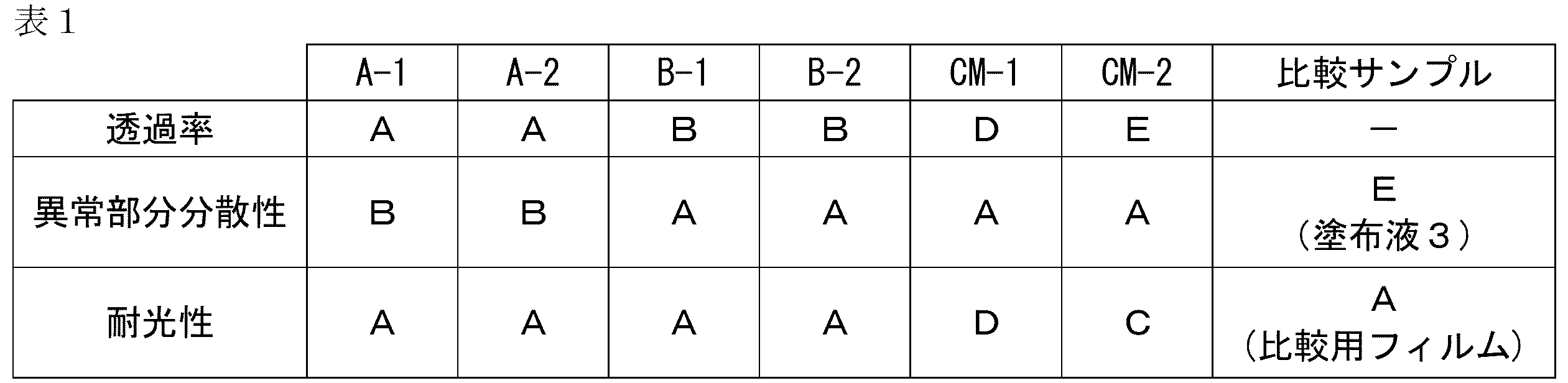
<表の注>
A-1、A-2、B-1及びB-2:それぞれ化合物A-1、A-2、B-1及びB-2を示す。
CM-1及びCM-2:それぞれ比較化合物CM-1及びCM-2を示す。なお、比較化合物CM-1は、米国特許第3043802号明細書のExample6で使用している化合物に相当し、比較化合物CM-2は、韓国公開特許第2021-0043115号公報の実施例3で合成している化合物D-3に相当する。
比較サンプルの欄には、化合物又は比較化合物を含有しない、ポリカーボネート(帝人社製、商品名:パンライトL-1225Y)単体でのデータを示す。
「-」は、比較サンプルが存在しないことを示す。
A-1、A-2、B-1及びB-2:それぞれ化合物A-1、A-2、B-1及びB-2を示す。
CM-1及びCM-2:それぞれ比較化合物CM-1及びCM-2を示す。なお、比較化合物CM-1は、米国特許第3043802号明細書のExample6で使用している化合物に相当し、比較化合物CM-2は、韓国公開特許第2021-0043115号公報の実施例3で合成している化合物D-3に相当する。
比較サンプルの欄には、化合物又は比較化合物を含有しない、ポリカーボネート(帝人社製、商品名:パンライトL-1225Y)単体でのデータを示す。
「-」は、比較サンプルが存在しないことを示す。
表1の結果から、以下のことがわかる。
比較化合物CM-1及びCM-2は、本発明の一般式(1)におけるRが脂肪族炭化水素基ではなく、水素原子又はシアノ基である点で、本発明で規定する化合物ではない。これらの比較化合物の、カルコン骨格に由来する吸収が観測される波長430nmにおける透過率は、比較化合物CM-1が90%未満、比較化合物CM-2が80%未満であり、カルコン骨格由来の着色が見られた。
対して、本発明の化合物A-1、A-2、B-1及びB-2は、波長430nmにおける透過率がいずれも98%以上と高く、しかも、異常部分分散性も0.16以上と大きく、着色がほとんどなく、かつ、異常部分分散性に優れることがわかった。また、本発明の化合物A-1、A-2、B-1及びB-2は耐光性にも優れていた。
このように、本発明の化合物は、着色がほとんどなく、かつ、異常部分分散性に優れている。そのため、本発明の化合物を含有する熱硬化性樹脂用組成物又は熱可塑性樹脂含有組成物を用いて得られる本発明の硬化物及び成形体においても、本発明の化合物由来の着色はほとんどなく、かつ、異常部分分散性に優れたものとできることがわかる。
比較化合物CM-1及びCM-2は、本発明の一般式(1)におけるRが脂肪族炭化水素基ではなく、水素原子又はシアノ基である点で、本発明で規定する化合物ではない。これらの比較化合物の、カルコン骨格に由来する吸収が観測される波長430nmにおける透過率は、比較化合物CM-1が90%未満、比較化合物CM-2が80%未満であり、カルコン骨格由来の着色が見られた。
対して、本発明の化合物A-1、A-2、B-1及びB-2は、波長430nmにおける透過率がいずれも98%以上と高く、しかも、異常部分分散性も0.16以上と大きく、着色がほとんどなく、かつ、異常部分分散性に優れることがわかった。また、本発明の化合物A-1、A-2、B-1及びB-2は耐光性にも優れていた。
このように、本発明の化合物は、着色がほとんどなく、かつ、異常部分分散性に優れている。そのため、本発明の化合物を含有する熱硬化性樹脂用組成物又は熱可塑性樹脂含有組成物を用いて得られる本発明の硬化物及び成形体においても、本発明の化合物由来の着色はほとんどなく、かつ、異常部分分散性に優れたものとできることがわかる。
[参考例]
上記で作製した化合物A-2をモノマーとして用いた硬化物について、耐光性を以下のようにして評価した。
上記で作製した化合物A-2をモノマーとして用いた硬化物について、耐光性を以下のようにして評価した。
<硬化物の作製、評価>
化合物A-2を4.0g、2-フェノキシエチルアクリレートを3.0g、1,6-ヘキサンジオールジメタクリレートを3.0g、熱ラジカル重合開始剤としてパーヘキシルD(商品名、日本油脂社製、ジ-tert-ヘキシルパーオキシド)を10mg、光ラジカル重合開始剤としてフェニルビス(2,4,6-トリメチルベンゾイル)ホスフィンオキシドを5.0mgを混合し、熱硬化性樹脂用組成物を調製した。
得られた熱硬化性樹脂用組成物を、硬化物の厚みが0.1mmとなるように直径20mmの円形の透明ガラス型に注入した。このガラス型は、表面をジクロロジメチルシランで疎水処理したホウケイ酸ガラス製である。光源としてExecure3000(商品名、HOYA社製)を用い、酸素濃度1%以下となるよう窒素置換した雰囲気下、透明ガラス型の上方から1000mJ/cm2の紫外線を照射し、光硬化サンプルを作製した。続いて、得られた光硬化サンプルを、酸素濃度1%以下の雰囲気下、180℃で30分加熱し、硬化反応が完全に進行した硬化物を作製した。
得られた硬化物について、上記評価項目3と同様の条件でキセノン光照射試験を行ったところ、キセノン光照射前後の波長450nmにおける透過率の低下幅及び波長430nmにおける透過率の低下幅はいずれも5%未満と低く、優れた耐光性を示すことがわかった。
化合物A-2を4.0g、2-フェノキシエチルアクリレートを3.0g、1,6-ヘキサンジオールジメタクリレートを3.0g、熱ラジカル重合開始剤としてパーヘキシルD(商品名、日本油脂社製、ジ-tert-ヘキシルパーオキシド)を10mg、光ラジカル重合開始剤としてフェニルビス(2,4,6-トリメチルベンゾイル)ホスフィンオキシドを5.0mgを混合し、熱硬化性樹脂用組成物を調製した。
得られた熱硬化性樹脂用組成物を、硬化物の厚みが0.1mmとなるように直径20mmの円形の透明ガラス型に注入した。このガラス型は、表面をジクロロジメチルシランで疎水処理したホウケイ酸ガラス製である。光源としてExecure3000(商品名、HOYA社製)を用い、酸素濃度1%以下となるよう窒素置換した雰囲気下、透明ガラス型の上方から1000mJ/cm2の紫外線を照射し、光硬化サンプルを作製した。続いて、得られた光硬化サンプルを、酸素濃度1%以下の雰囲気下、180℃で30分加熱し、硬化反応が完全に進行した硬化物を作製した。
得られた硬化物について、上記評価項目3と同様の条件でキセノン光照射試験を行ったところ、キセノン光照射前後の波長450nmにおける透過率の低下幅及び波長430nmにおける透過率の低下幅はいずれも5%未満と低く、優れた耐光性を示すことがわかった。
本願は、2023年6月29日に日本国で特許出願された特願2023-107392に基づく優先権を主張するものであり、これはここに参照してその内容を本明細書の記載の一部として取り込む。
Claims (11)
- 下記一般式(1)で表される化合物。



- 下記一般式(1-1)又は(1-2)で表される、請求項1に記載の化合物。
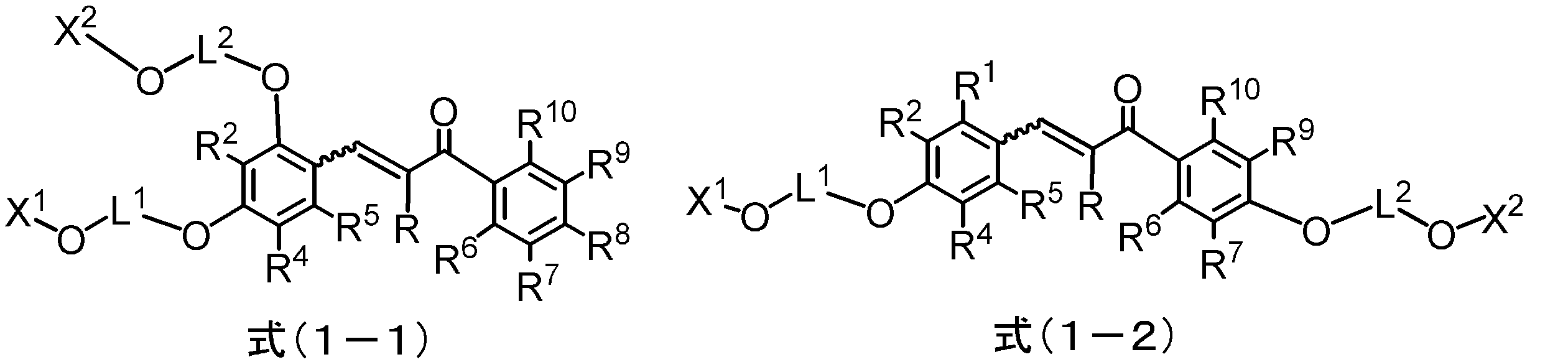
- 前記Rが炭素数1~10のアルキル基である、請求項1に記載の化合物。
- 前記Xが水素原子、又は、前記式(Pol-1)もしくは(Pol-2)で表される置換基である、請求項1に記載の化合物。
- 請求項1に記載の化合物を含む組成物。
- 熱硬化性樹脂用組成物である、請求項5に記載の組成物。
- 熱可塑性樹脂含有組成物である、請求項5に記載の組成物。
ただし、請求項1に記載の化合物が、熱可塑性樹脂中に構造単位として組み込まれていることはない。 - 請求項6に記載の組成物から得られる硬化物。
- 請求項7に記載の組成物から得られる成形体。
- 請求項8に記載の硬化物又は請求項9に記載の成形体を含む光学部材。
- 請求項8に記載の硬化物又は請求項9に記載の成形体を含むレンズ。
Priority Applications (1)
| Application Number | Priority Date | Filing Date | Title |
|---|---|---|---|
| JP2025530099A JPWO2025005013A1 (ja) | 2023-06-29 | 2024-06-21 |
Applications Claiming Priority (2)
| Application Number | Priority Date | Filing Date | Title |
|---|---|---|---|
| JP2023-107392 | 2023-06-29 | ||
| JP2023107392 | 2023-06-29 |
Publications (1)
| Publication Number | Publication Date |
|---|---|
| WO2025005013A1 true WO2025005013A1 (ja) | 2025-01-02 |
Family
ID=93938561
Family Applications (1)
| Application Number | Title | Priority Date | Filing Date |
|---|---|---|---|
| PCT/JP2024/022643 Ceased WO2025005013A1 (ja) | 2023-06-29 | 2024-06-21 | 化合物、組成物、硬化物、成形体、光学部材、及びレンズ |
Country Status (2)
| Country | Link |
|---|---|
| JP (1) | JPWO2025005013A1 (ja) |
| WO (1) | WO2025005013A1 (ja) |
Citations (5)
| Publication number | Priority date | Publication date | Assignee | Title |
|---|---|---|---|---|
| US3043802A (en) * | 1958-08-18 | 1962-07-10 | Bayer Ag | Light-sensitive high molecular polycarbonates |
| WO2018008581A1 (ja) * | 2016-07-04 | 2018-01-11 | シャープ株式会社 | 液晶表示装置、及び、液晶表示装置の製造方法 |
| JP2020055775A (ja) * | 2018-10-02 | 2020-04-09 | Dic株式会社 | 重合性化合物並びにそれを使用した液晶組成物及び液晶表示素子 |
| KR20210043115A (ko) * | 2019-10-11 | 2021-04-21 | 주식회사 엘지화학 | 카르밤산 유도체 폴리머 합성용 단량체 화합물, 카르밤산 유도체 폴리머, 고분자 수지 조성물, 고분자 필름 및 이를 포함하는 자동차용 부품 |
| WO2022255228A1 (ja) * | 2021-05-31 | 2022-12-08 | 富士フイルム株式会社 | 組成物、硬化物又は成形体、光学部材、及び、レンズ |
-
2024
- 2024-06-21 JP JP2025530099A patent/JPWO2025005013A1/ja active Pending
- 2024-06-21 WO PCT/JP2024/022643 patent/WO2025005013A1/ja not_active Ceased
Patent Citations (5)
| Publication number | Priority date | Publication date | Assignee | Title |
|---|---|---|---|---|
| US3043802A (en) * | 1958-08-18 | 1962-07-10 | Bayer Ag | Light-sensitive high molecular polycarbonates |
| WO2018008581A1 (ja) * | 2016-07-04 | 2018-01-11 | シャープ株式会社 | 液晶表示装置、及び、液晶表示装置の製造方法 |
| JP2020055775A (ja) * | 2018-10-02 | 2020-04-09 | Dic株式会社 | 重合性化合物並びにそれを使用した液晶組成物及び液晶表示素子 |
| KR20210043115A (ko) * | 2019-10-11 | 2021-04-21 | 주식회사 엘지화학 | 카르밤산 유도체 폴리머 합성용 단량체 화합물, 카르밤산 유도체 폴리머, 고분자 수지 조성물, 고분자 필름 및 이를 포함하는 자동차용 부품 |
| WO2022255228A1 (ja) * | 2021-05-31 | 2022-12-08 | 富士フイルム株式会社 | 組成物、硬化物又は成形体、光学部材、及び、レンズ |
Also Published As
| Publication number | Publication date |
|---|---|
| JPWO2025005013A1 (ja) | 2025-01-02 |
Similar Documents
| Publication | Publication Date | Title |
|---|---|---|
| US10370473B2 (en) | Compound, curable composition, cured product, optical member, and lens | |
| JP6712341B2 (ja) | 硬化性組成物、硬化物、光学部材、レンズ及び化合物 | |
| JP7165797B2 (ja) | 硬化性組成物、硬化物、光学部材、レンズ、及び化合物 | |
| CN111032704B (zh) | 固化物、光学部件、透镜、化合物及固化性组合物 | |
| US20120010361A1 (en) | Curable composition and cured product thereof | |
| US11370744B2 (en) | Compound, curable composition, cured product, optical member, and lens | |
| US11396613B2 (en) | Cured product, optical member, lens, and compound | |
| US12590177B2 (en) | Compound, curable resin composition, cured product, optical member, and lens | |
| JPWO2019216008A1 (ja) | 光学樹脂組成物及び光学レンズ | |
| WO2025005013A1 (ja) | 化合物、組成物、硬化物、成形体、光学部材、及びレンズ | |
| US12173101B2 (en) | Curable composition, cured substance, optical member, and lens | |
| US12286409B2 (en) | Curable composition, cured product, optical member, lens, and method for manufacturing optical member | |
| US20240084062A1 (en) | Composition, cured substance or molded body, optical member, and lens | |
| WO2025143211A1 (ja) | 化合物、重合性化合物、熱可塑性樹脂含有組成物及びその成形体、熱硬化性樹脂用組成物及びその硬化物、光学部材、並びにレンズ | |
| US12384864B2 (en) | Curable composition, cured substance, optical member, and lens | |
| JP6887017B2 (ja) | 硬化性組成物、半硬化物、硬化物、光学部材、レンズ及び化合物 | |
| JPH01198611A (ja) | 高屈折率樹脂レンズ |
Legal Events
| Date | Code | Title | Description |
|---|---|---|---|
| 121 | Ep: the epo has been informed by wipo that ep was designated in this application |
Ref document number: 24831874 Country of ref document: EP Kind code of ref document: A1 |
|
| ENP | Entry into the national phase |
Ref document number: 2025530099 Country of ref document: JP Kind code of ref document: A |
|
| NENP | Non-entry into the national phase |
Ref country code: DE |