WO2025004398A1 - 廃ゴムのリサイクル方法、熱分解生成物の製造方法、熱分解生成物、ゴム製品の製造方法、ゴム製品、タイヤの製造方法、タイヤ、ゴム組成物の製造方法 - Google Patents
廃ゴムのリサイクル方法、熱分解生成物の製造方法、熱分解生成物、ゴム製品の製造方法、ゴム製品、タイヤの製造方法、タイヤ、ゴム組成物の製造方法 Download PDFInfo
- Publication number
- WO2025004398A1 WO2025004398A1 PCT/JP2023/040464 JP2023040464W WO2025004398A1 WO 2025004398 A1 WO2025004398 A1 WO 2025004398A1 JP 2023040464 W JP2023040464 W JP 2023040464W WO 2025004398 A1 WO2025004398 A1 WO 2025004398A1
- Authority
- WO
- WIPO (PCT)
- Prior art keywords
- rubber
- waste rubber
- product
- waste
- data
- Prior art date
- Legal status (The legal status is an assumption and is not a legal conclusion. Google has not performed a legal analysis and makes no representation as to the accuracy of the status listed.)
- Ceased
Links
Images



Classifications
-
- Y—GENERAL TAGGING OF NEW TECHNOLOGICAL DEVELOPMENTS; GENERAL TAGGING OF CROSS-SECTIONAL TECHNOLOGIES SPANNING OVER SEVERAL SECTIONS OF THE IPC; TECHNICAL SUBJECTS COVERED BY FORMER USPC CROSS-REFERENCE ART COLLECTIONS [XRACs] AND DIGESTS
- Y02—TECHNOLOGIES OR APPLICATIONS FOR MITIGATION OR ADAPTATION AGAINST CLIMATE CHANGE
- Y02W—CLIMATE CHANGE MITIGATION TECHNOLOGIES RELATED TO WASTEWATER TREATMENT OR WASTE MANAGEMENT
- Y02W30/00—Technologies for solid waste management
- Y02W30/50—Reuse, recycling or recovery technologies
- Y02W30/62—Plastics recycling; Rubber recycling
Definitions
- the present disclosure relates to a method for recycling waste rubber, a method for producing pyrolysis products, a method for producing pyrolysis products and rubber products, a method for producing rubber products and tires, and a method for producing tires and rubber compositions.
- Patent Document 1 discloses a method of recovering liquid rubber by performing a preliminary treatment in which a rubber molded product is subjected to a shear force, extracting it with an organic solvent to separate the solvent extract from the extraction residue, and removing the solvent from the separated solvent extract.
- waste rubber When recycling waste rubber, it is sometimes sorted by size, for example based on an upper size limit, but traditionally, waste rubber has rarely been sorted in any other way. As a result, waste rubber containing various components is recycled together, resulting in variation in the quality of the resulting pyrolysis products. It is difficult to maintain the quality of recycled products such as tires, which use the pyrolysis products obtained through recycling as raw materials. Also, additional processing is required to ensure that the quality of the pyrolysis products is consistent, which generally results in poor recycling efficiency.
- Patent Document 2 discloses identifying the properties of rubber materials, but assumes that the process is performed by trained workers or that all final products are tagged with a composition label. Therefore, it is difficult to use the technology of Patent Document 2 in cases such as recycling shredded waste rubber.
- the purpose of this disclosure is to provide a method for recycling waste rubber that can improve the quality of the product and the recycling efficiency in recycling, a method for producing pyrolysis products, a method for producing pyrolysis products and rubber products, a method for producing rubber products and tires, and a method for producing tires and rubber compositions.
- a method for recycling waste rubber according to an embodiment of the present disclosure, A recovery step of recovering waste rubber; A data acquisition step of acquiring waste rubber data related to at least one of the specifications and components of the waste rubber or the rubber product that generated the waste rubber based on information read from the waste rubber or information read from the rubber product that generated the waste rubber; A classification step of classifying the waste rubber into groups based on the waste rubber data; and a recycling step of carrying out a recycling process on the classified waste rubber under appropriate conditions for each group.
- the waste rubber includes buffing powder, peeling rubber, and scraps of the rubber products.
- the information read from the waste rubber or the information read from the rubber product that generated the waste rubber includes an identification number of the waste rubber, and the waste rubber data is acquired by accessing via a network a database in which the identification number and the waste rubber data are associated.
- the waste rubber data includes at least one of data on the category, type, size, rubber physical properties, manufacturer, and manufacturing date of the rubber product that generated the waste rubber
- the classification step classifies the waste rubber based on at least one of the category, type, size, rubber physical properties, manufacturer, and manufacturing date of the rubber product that generated the waste rubber.
- the waste rubber data includes data regarding at least one of the components of polymer, filler, and sulfur of the waste rubber;
- the classification step classifies the waste rubber based on data regarding at least one of the components of polymer, filler, and sulfur of the waste rubber.
- a method for producing a pyrolysis product includes: A recovery step of recovering waste rubber; A data acquisition step of acquiring waste rubber data related to at least one of the specifications and components of the waste rubber or the rubber product that generated the waste rubber based on information read from the waste rubber or information read from the rubber product that generated the waste rubber; A classification step of classifying the waste rubber into groups based on the waste rubber data; A recycling process step of carrying out a recycling process, which is pyrolysis, on the classified waste rubber under appropriate conditions for each group; and extracting the pyrolysis products produced by the pyrolysis.
- the pyrolysis product according to one embodiment of the present disclosure is (6) is produced by the method for producing a pyrolysis product described above.
- a method for producing a rubber product according to an embodiment of the present disclosure includes: (6) The pyrolysis product produced by the method for producing a pyrolysis product is used as part of the raw materials to produce a rubber product.
- a rubber product according to one embodiment of the present disclosure, (8) is produced by the method for producing a rubber product according to the present invention.
- a method for manufacturing a tire according to an embodiment of the present disclosure includes: (6) A tire is manufactured by using the pyrolysis product produced by the method for producing a pyrolysis product as part of the raw materials.
- a tire according to one embodiment of the present disclosure (10) The tire is manufactured by the tire manufacturing method.
- a method for producing a rubber composition includes: A recovery step of recovering waste rubber; A data acquisition step of acquiring waste rubber data related to at least one of the specifications and components of the waste rubber or the rubber product that generated the waste rubber based on information read from the waste rubber or information read from the rubber product that generated the waste rubber; A classification step of classifying the waste rubber into groups based on the waste rubber data; A recycling process step of carrying out a decrosslinking recycling process on the classified waste rubber under appropriate conditions for each group; and an extraction step of extracting the rubber composition produced by the decrosslinking.
- the present disclosure provides a method for recycling waste rubber that can improve the quality of the product and the recycling efficiency in recycling, a method for producing pyrolysis products, a method for producing pyrolysis products and rubber products, a method for producing rubber products and tires, and a method for producing tires and rubber compositions.
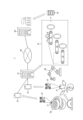
- FIG. 1 is a diagram showing an example of the configuration of a recycling system that executes a waste rubber recycling method according to an embodiment of the present disclosure.
- FIG. 2 is another diagram showing an example of the configuration of the recycling system of FIG.
- FIG. 3 is a diagram illustrating the first waste rubber data.
- FIG. 4 is a diagram illustrating the second waste rubber data.
- FIG. 5 is a flow chart illustrating the process of a waste rubber recycling method according to one embodiment of the present disclosure.
- FIGS. 1 and 2 are diagrams showing an example of the configuration of a recycling system 1 that executes a waste rubber recycling method according to one embodiment of the present disclosure.
- the recycling system 1 includes an information processing device 10.
- the information processing device 10 is a device that is installed in, for example, a recycling facility and controls the recycling facility.
- FIG. 1 is a block diagram including an example of the internal configuration of the information processing device 10.
- FIG. 2 shows the overall configuration of the recycling system 1.
- waste rubber is recycled.
- Waste rubber is discarded rubber, and is also called scrap rubber or scrap rubber.
- Waste rubber is not limited to rubber generated from rubber products, but refers to all discarded rubber, including unnecessary scraps generated from the production or repair of rubber products.
- waste rubber is not limited to crosslinked rubber, but also includes unvulcanized rubber.
- the rubber product includes tires 30 and the like. In this embodiment, the rubber product is described as a tire 30, but the rubber product is not limited to the tire 30. Rubber products include final products such as rubber hoses and rubber conveyor belts, and rubber parts or components in the manufacturing stage of the final product.
- the tire 30 may be, for example, a newly manufactured tire, a tire that has been retreaded, a waste tire generated from tire replacement, scrapping, etc., and an ELT (End-of-Life Tire) that has reached the end of its life as a tire.
- Retreading refers to scraping the tread rubber of the tire 30, attaching new rubber, and vulcanizing it to reuse it.
- the tire 30 is described as being for vehicles such as passenger cars, trucks, and buses, but it may also be for aircraft, mining, agricultural use, etc., and is not limited by tire type.
- the waste rubber recycled by the recycling system 1 includes buffing powder, peeling rubber, and scraps of rubber products.
- Buffing powder is fine rubber generated during the buffing process in which the tread portion remaining on the base tire is scraped off during retreading.
- Peeling rubber is a long piece of rubber, for example 1 to 2 cm wide, that is peeled off from the surface of the tire 30 (see FIG. 2). Peeling rubber is generated by scraping the surface of the tire 30 using a knife with a U-shaped or V-shaped tip like a peeler.
- Scraps of rubber products are excess rubber generated during the manufacturing process of rubber products such as the tire 30.
- Buffing powder, peeling rubber, and scraps of rubber products have a smaller size or particle diameter than other rubbers to be recycled. Therefore, by appropriately classifying buffing powder, peeling rubber, and scraps of rubber products, which are waste rubbers with a smaller size or particle diameter, recycling with reduced heating time and reduced use of solvents and catalysts is possible.
- the pyrolysis product 82 When waste rubber is pyrolyzed in a pyrolysis furnace, gas, oil, carbon black, ash, etc. are generated.
- the pyrolysis product 82 is specifically described as the oil generated.
- the pyrolysis product 82 is not limited to oil, and may be, for example, carbon black.
- the extracted pyrolysis product 82 is processed into a state that can be used as a raw material as needed, and is recycled by being used as part of the raw material of the tire 30 at the tire 30 factory.
- the extracted pyrolysis product 82 and its processed products may be used as part of the raw material of rubber products at a factory for rubber products other than the tire 30.
- the oil extracted by pyrolyzing the waste rubber has components corresponding to the waste rubber (for example, sulfur content [wt %]).
- sulfur content [wt %] for example, sulfur content [wt %]
- the information processing device 10 includes a communication unit 11, a storage unit 12, and a control unit 13.
- the control unit 13 includes a data acquisition unit 131, a classification unit 132, and an output unit 133.
- the information processing device 10 may be, for example, a computer as a hardware configuration. Details of the components of the information processing device 10 will be described later.
- the recycling facility in which the information processing device 10 is installed is not limited to a facility in which all processing up to pyrolysis is performed in one place, and may be configured such that, for example, a facility for classifying waste rubber and a facility for pyrolysis, which will be described later, are performed in different locations or by different businesses.
- the information processing device 10 may not be a single device, but may be composed of multiple devices that are placed in each facility and can send and receive data between them via a network 40.
- the information processing device 10 may be, for example, a single computer as a hardware configuration, or may be composed of multiple computers connected via a network 40.
- the storage unit 12 may be a shared memory that can be accessed by each computer.
- the information processing device 10 may constitute a recycling system 1 together with a server 60 connected via a network 40.
- the network 40 may be, for example, the Internet.
- the network 40 may also be configured to include, for example, a LAN (Local Area Network) in part.
- the recycling system 1 may also be configured to include a reading unit 70 and recycling equipment connected to the information processing device 10.
- the server 60 is, for example, a computer separate from the information processing device 10.
- the server 60 is a computer of the tire 30 manufacturer, and stores and manages information about the tires 30 being manufactured in a database.
- the information processing device 10 can access the database via the network 40.
- the information processing device 10 acquires waste rubber data related to at least one of the specifications and components of the waste rubber (or the rubber product that generated the waste rubber) from the database for appropriate recycling.
- waste rubber data related to at least one of the specifications and components of the waste rubber (or the rubber product that generated the waste rubber) from the database for appropriate recycling.
- Conventionally, information about tires 30 has only been used at the manufacturing site (factory) and has rarely been used in recycling.
- a system such as that shown in FIG. 2 is configured, and the information processing device 10 uses the waste rubber data, which can be used for classification in recycling, which will be described later.
- the reading unit 70 is a general-purpose mobile terminal such as a smartphone or tablet terminal, but is not limited to such mobile terminals as long as it is a device with an imaging function.
- the reading unit 70 may be an imaging device such as a camera.
- the reading unit 70 may be used by an administrator or operator of the recycling facility.
- the reading unit 70 may also be provided in the server 60. In this case, the reading unit 70 may be used by a manufacturer or operator at the manufacturing site.
- the tire 30 that generated the waste rubber is provided with an indicator 31 including an identifier 32.
- the indicator 31 may be provided by gluing, printing, or kneading into the rubber of the tire 30.
- the reading unit 70 may capture an image of the identifier 32 attached to the tire 30 using an imaging function, and output an image of the identifier 32 to the information processing device 10.
- the control unit 13 of the information processing device 10 may identify information such as an identification number and model number based on the identifier 32.
- the imaging function is realized, for example, by a camera provided in the reading unit 70.
- the identifier 32 is, for example, a two-dimensional barcode, but is not limited to this.
- a barcode, a marker showing a specific color, a serial code, etc. may be used as the identifier 32.
- the identification number may be configured to include not only numbers, but also letters, symbols, etc.
- the identification number is a number unique to the tire 30 that generated the waste rubber, but will be referred to as the identification number of the waste rubber in the following description.
- the recycling system 1 is not limited to a configuration including an indicator 31 and a reading unit 70 having an imaging function.
- the recycling system 1 may be configured to include an RFID tag and a reading unit 70 that reads radio waves from the RFID tag.
- the control unit 13 may obtain information such as the tire 30 number and model number from the reading unit 70.
- the recycling system 1 may be configured to include a marker substance mixed into the rubber and a reading unit 70 that detects the marker substance.
- the marker substance is a substance that serves as an identifier to distinguish a specific rubber from other rubbers.
- the indicator 31 may be attached to the waste rubber itself (it may be scraped off from the tire 30 together with the indicator 31).
- the indicator 31 may be attached to a container in which the waste rubber is stored for transportation.
- the reading unit 70 may read the identifier 32 from the waste rubber, the reading unit 70 may read the identifier 32 from the rubber product (tire 30) that generated the waste rubber, or the reading unit 70 may read the identifier 32 from the container.
- the waste rubber is in the form of fine particles and the storage container does not have an indicator 31 attached, information about the identifier 32 read from the rubber product that generated the waste rubber may be obtained via the network 40.
- the communication unit 11 is configured to include one or more communication modules that connect to the network 40.
- the communication unit 11 may include a communication module that supports mobile communication standards such as 4G (4th Generation) and 5G (5th Generation).
- the communication unit 11 may include a communication module that supports a wireless LAN standard (IEEE802.11 as one example).
- the communication unit 11 may also include a communication module that supports a wired LAN standard.
- the storage unit 12 is one or more memories.
- the memories are, for example, semiconductor memory, magnetic memory, optical memory, etc., but are not limited to these and can be any memory.
- the storage unit 12 is, for example, built into the information processing device 10, but can also be configured to be accessed from outside by the information processing device 10 via any interface.
- the storage unit 12 stores various data used in the various calculations performed by the control unit 13.
- the storage unit 12 may also store the results and intermediate data of the various calculations performed by the control unit 13.
- the memory unit 12 may also store waste rubber data acquired via the communication unit 11.
- the waste rubber data includes data on at least one of the specifications and components of the waste rubber, or data on at least one of the specifications and components of the rubber product that generated the waste rubber.
- the waste rubber data is referenced to classify and recycle the waste rubber.
- the waste rubber data stored in the memory unit 12 may be updated based on a database of the tire 30 manufacturer, for example, periodically or when the recycling facility is started up.
- the first waste rubber data mainly includes data on the specifications of the rubber product (tire 30) that generated the waste rubber.
- the first waste rubber data is a table in which the identification number of the waste rubber is associated with specifications such as model number.
- the first waste rubber data may also include at least one of data on the category, type, size, rubber properties, manufacturer, and manufacturing date of the rubber product.
- the category of the rubber product may be a classification by vehicle type, such as PSR (radial tire for passenger cars) and TBR (radial tire for trucks and buses).
- the type of the rubber product may be a classification by function, such as studless, run-flat, and summer.
- the size of the rubber product may be a specification value such as width, aspect ratio, and rim diameter.
- the rubber properties of the rubber product may be a value indicating performance such as rolling resistance coefficient and elastic modulus.
- the manufacturer of the rubber product may be, for example, the manufacturer name.
- the manufacturing date of the rubber product may be information such as the year and month of manufacture.
- the first waste rubber data may be part of data managed by the manufacturer of the tire 30, which is the rubber product that generated the waste rubber, and stored in a database.
- the information processing device 10 may access the database via the network 40, acquire the first waste rubber data, and store it in the storage unit 12.
- FIG. 4 is a diagram illustrating the second waste rubber data.
- the second waste rubber data mainly includes data on the components of the waste rubber.
- the second waste rubber data is a table in which information on components such as the molecular weight of the polymer of the waste rubber is associated with part of the specifications (model number and manufacturing date) of the rubber product (tire 30) that generated the waste rubber.
- the second waste rubber data may include data on at least one of the components of the waste rubber, such as the polymer, filler, and sulfur.
- the data on the components of the polymer of the waste rubber may be, for example, information on the molecular weight, whether or not butyl rubber is included, etc.
- the filler is compounded to reinforce the rubber composition, and an example of this is carbon black.
- the filler is described as a reinforcing material.
- examples of the filler include inorganic fillers such as silica, clay, talc, calcium carbonate, and aluminum hydroxide.
- the data on the components of the filler of the waste rubber may be, for example, information on whether or not silica is included, the grade of carbon black, etc.
- the grade of carbon black may be classified as, for example, SAF (Super Abrasion Furnace, ultra-abrasion resistant) or ISAF (Intermediate SAF, semi-super abrasion resistant).
- the data on the sulfur component of the waste rubber may be, for example, a numerical value such as the compounding amount (content).
- the second waste rubber data may be part of the data managed by the manufacturer of the tire 30, which is the rubber product that generated the waste rubber, and accumulated in a database.
- the information processing device 10 may access the database via the network 40, acquire the second waste rubber data, and store it in the storage unit 12.
- the second waste rubber data may further include data on polymers, fillers, compounds other than sulfur, and regulated substances.
- the second waste rubber data is a table in which information on the components of the waste rubber is associated with part of the specifications of the waste rubber. Therefore, the first waste rubber data and the second waste rubber data can be associated through the common waste rubber specifications.
- the waste rubber data is managed as two tables, but they may be integrated and managed as one table. At this time, they may be integrated by partial combination, that is, by extracting part of the first waste rubber data and part of the second waste rubber data.
- the waste rubber data is stored in the storage unit 12 by the information processing device 10.
- the waste rubber data may be managed in a distributed manner.
- the waste rubber data may be stored and managed using blockchain technology.
- the control unit 13 is one or more processors.
- the processor may be, for example, a general-purpose processor or a dedicated processor specialized for a particular process, but is not limited to these and may be any processor.
- the control unit 13 controls the overall operation of the information processing device 10.
- the control unit 13 also controls the recycling process in the recycling facility in which the information processing device 10 is installed.
- the recycling facility is provided with a recovery unit 80 used to recover waste rubber.
- the recovery unit 80 is a device controlled by the information processing device 10 and different from the information processing device 10, and may include, for example, a robot hand.
- the recycling facility is provided with a sorting device 81 used to classify waste rubber into groups.
- the sorting device 81 is a device controlled by the information processing device 10 and different from the information processing device 10, and may include, for example, a belt conveyor. In the example of FIG. 2, three groups G1 to G3 are shown, but the number of groups is not limited to three.
- the recycling facility is provided with a recycling processing unit for recycling under conditions for each group.
- the recycling processing unit is a device controlled by the information processing device 10 and different from the information processing device 10, and may be, for example, a pyrolysis processing device.
- the information processing device 10 controls the recycling processing in the recycling facility by controlling the recovery unit 80, the sorting device 81, and the recycling processing unit.
- the information processing device 10 may have the following software configuration.
- One or more programs used to control the operation of the information processing device 10 are stored in the memory unit 12.
- the programs stored in the memory unit 12 are loaded by the processor of the control unit 13, they cause the processor to function as a data acquisition unit 131, a classification unit 132, and an output unit 133.
- the data acquisition unit 131 acquires waste rubber data related to at least one of the specifications and components of the waste rubber or the rubber product that generated the waste rubber, based on information read from the waste rubber or information read from the rubber product that generated the waste rubber.
- the read information includes the identification number of the waste rubber.
- the data acquisition unit 131 may acquire the waste rubber data from the storage unit 12 if the waste rubber data already stored in the storage unit 12 includes the identification number of the target waste rubber. If the waste rubber data in the storage unit 12 does not include the identification number of the target waste rubber, the data acquisition unit 131 may acquire the waste rubber data by accessing a database in which the identification number and the waste rubber data are associated via the network 40. In other words, the recycling facility does not need to own all of the waste rubber data, and by using a database managed by the manufacturer of the tire 30, it becomes possible to accurately classify the waste rubber as described below and perform appropriate recycling.
- the classification unit 132 classifies the waste rubber into groups based on the waste rubber data acquired by the data acquisition unit 131.
- a group is a collection of waste rubber that is similar in terms of the components contained therein.
- the waste rubber is classified into groups in order to suppress the variation in quality of the product (pyrolysis product 82 in this embodiment) generated by the recycling process (pyrolysis in this embodiment) and to achieve the desired quality.
- the classification unit 132 may classify the waste rubber based on the data of the specifications of the waste rubber or the rubber product that generated the waste rubber contained in the waste rubber data. For example, using the first waste rubber data, the classification unit 132 may classify the waste rubber based on at least one of the category, type, size, rubber properties, manufacturer, and manufacturing time of the rubber product that generated the waste rubber. In this case, the waste rubber can be indirectly classified by component by distinguishing it as a tire 30. For example, tires 30 of a specific type made by the same manufacturer are considered to have similar components. Therefore, by grouping according to the manufacturer and type of the rubber product (tire 30), the variation in the quality of the pyrolysis product 82 can be suppressed.
- the classification unit 132 may classify the waste rubber based on the data on the specifications of the waste rubber or the rubber product that generated the waste rubber contained in the waste rubber data.
- the classification unit 132 may classify the waste rubber based on data on the components contained in the waste rubber data. For example, using the second waste rubber data, the classification unit 132 may classify the waste rubber based on data on at least one of the components of the waste rubber's polymer, filler, and sulfur. In this case, the waste rubber can be directly classified by component. Therefore, compared to indirect classification, the effect of suppressing the variation in the quality of the pyrolysis product 82 can be enhanced.
- the output unit 133 may output information such as the groups into which the waste rubber has been classified by the classification unit 132 to a display device or the like so that the manager or operator of the recycling facility can understand the information.
- the display device may be, for example, a display provided in the reading unit 70.
- the display device may also include a display connected to the information processing device 10.
- FIG. 5 is a flowchart showing the process of the waste rubber recycling method according to this embodiment, which is executed by the recycling system 1.
- Waste rubber is collected by the collection unit 80 (step S1, collection step).
- the identifier 32 of the collected waste rubber is read by the reading unit 70.
- the information read from the waste rubber includes the identification number of the collected waste rubber (i.e., the waste rubber to be processed).
- the identification number of the waste rubber is obtained via the network 40.
- the identifier 32 is read from the tire 30 even in a process of scraping the surface of the tire 30 to generate peeled rubber.
- the identification number of the waste rubber cannot be obtained directly, the identification number of the waste rubber can be obtained via the network 40 by tracing the previous process.
- the history of the previous process of the collected waste rubber may be obtained from the database of the manufacturer or retreader via the network 40 and stored in the memory unit 12 in the same manner as the waste rubber data.
- the data acquisition unit 131 acquires waste rubber data from the manufacturer's database via the memory unit 12 or the network 40 as described above based on the information read from the waste rubber (or the rubber product that generated the waste rubber) (step S2, data acquisition step).
- the sorting unit 132 sorts the waste rubber into groups based on the waste rubber data (step S3, sorting step).
- the control unit 13 may also control the sorting device 81 so that the waste rubber is transported to the recycling processing unit of the assigned group.
- the recycling processing section performs recycling processing on the classified waste rubber under appropriate conditions for each group (step S4, recycling processing step).
- the conditions for recycling processing are, for example, the operating conditions of the pyrolysis processing device. For example, the temperature setting and processing time of the pyrolysis processing device are changed depending on the group. In this way, the waste rubber is grouped, and recycling processing is performed for each group under appropriate conditions for each group, and pyrolysis products 82 are obtained for each group. Since the pyrolysis products 82 of each group are generated from waste rubber containing similar components, they become products of desired quality with little variation.
- the appropriate conditions are operating conditions such as temperature settings and processing times that are determined for each group and adjusted to improve the efficiency of the recycling processing.
- recycling processing may be performed with a shorter heating time than other groups and with reduced amounts of solvent and catalyst used.
- the appropriate conditions generally differ for each group, but the same conditions may ultimately be obtained for different groups.
- the waste rubber recycling method of FIG. 5 constitutes a method for manufacturing a pyrolysis product by including a recycling process of pyrolysis and an extraction step of extracting the pyrolysis product 82 produced by the pyrolysis.
- This method for manufacturing a pyrolysis product produces a high-quality pyrolysis product.
- the pyrolysis product 82 produced by this method for manufacturing a pyrolysis product or a processed product thereof can be used as part of the raw materials to manufacture a high-quality tire 30 or rubber product.
- the method for manufacturing a pyrolysis product and the step of manufacturing the tire 30 or rubber product constitute a method for manufacturing a tire 30 or rubber product.
- the tire 30 may be a newly manufactured tire or a retreaded tire.
- the method for manufacturing the tire 30 includes a method for manufacturing a retreaded tire.
- the waste rubber recycling method according to this embodiment can improve the quality and recycling efficiency of the product in the recycling process by appropriately classifying the components.
- this recycling method there are provided a method for manufacturing a pyrolysis product, a method for manufacturing a rubber product, and a method for manufacturing a tire, which can produce high-quality raw materials (pyrolysis products 82) or products.
- the pyrolysis products, rubber products, and tires manufactured by these manufacturing methods are of higher quality than conventional ones.
- the recycling system 1 that decomposes waste rubber in a pyrolysis furnace and recycles it has been described, but the recycling system 1 may also decrosslink and plasticize waste rubber, and regenerate it as a raw material for rubber products. Recycling by decrosslinking is effective for tire products and the like that mainly contain crosslinked rubber, and the PAN method is known in which the crosslinked rubber is separated from the product, crushed into particles of 3 mm or less, and the crosslinked structure of the crosslinked rubber is cleaved by applying pressure and heat to regenerate natural rubber.
- the decrosslinking process mainly includes a process of separating uncrosslinked rubber from crosslinked rubber, and a process of decrosslinking only the crosslinked rubber.
- a rubber composition having a polymer molecular weight of 150,000 or more can be obtained by the decrosslinking process.
- the waste rubber recycling method according to this embodiment can be used for recycling by decrosslinking. That is, the above recycling process step may be a recycling process that is decrosslinking.
- the conditions of the recycling process are, for example, the operating conditions of the decrosslinking processing device. For example, the pressure and heat settings and processing time applied to the separated and crushed crosslinked rubber are changed depending on the group.
- the above extraction step extracts the rubber composition produced by decrosslinking. By extracting the rubber composition to be recycled in this manner, a method for producing a rubber composition is provided that can improve the quality and recycling efficiency of the rubber composition.
- the waste rubber in the recycling facility may be classified into groups based on the compounding contents and the degree of reduction of oil, antioxidant, wax, adhesive material, etc. contained in the waste rubber.
- impurities e.g., Co, etc.
- carbon black e.g., terpene oil, etc.
- antioxidant, etc. obtained by thermal decomposition
- the compounding contents and the degree of reduction may be estimated based on information at the time of new manufacture of the product (hereinafter referred to as the "original product") before the waste rubber is discarded.
- the information at the time of new manufacture may be obtained from a computer or the like of the manufacturer of the original product of the waste rubber.
- the information at the time of new manufacture may include, for example, the compounding contents, compounding ratio, manufacturing date, recycling information of raw materials, etc.
- the compounding contents and the degree of reduction may be estimated based on the information at the time of new manufacture and the information at the time of use by further acquiring information at the time of use of the original product.
- the compounding contents and the degree of reduction may be estimated by preparing a deterioration model based on past performance data in advance and inputting information at the time of new manufacture, etc. into the deterioration model.
- the degradation model may be generated, for example, by machine learning.
- the original product needs to be managed individually.
- the indicator 31 specifies information such as an identification number and a model number.
- the recycling system 1 may further include a tire 30 management device (such as a computer connected via a network 40) that manages this information.
- the tire 30 management device may manage information on the time of use by associating it with a table or the like.
- the information processing device 10 may be able to access a table managed by the tire 30 management device.
- the information on the time of use may be, for example, input by a worker at a maintenance and inspection work site for a vehicle on which the tire 30, which is the original product, was fitted, such as the driving history, the wear state of the tire 30, and other measured values, and may be sent to the tire 30 management device as information on the time of use. Furthermore, if the tire 30 has been retreaded, information such as the number of retreads may be input by the worker and sent to the tire 30 management device as information on the time of use.
- the estimated compounding contents and degree of wear may be corrected (e.g., the degree of wear may be increased) depending on the usage condition of the original product (e.g., multiple retreads, high wear, etc.).
- the wear condition may be an actual measurement value, or a predicted value using a known prediction method based on the driving history or date of manufacture, etc.
Landscapes
- Separation, Recovery Or Treatment Of Waste Materials Containing Plastics (AREA)
Priority Applications (1)
| Application Number | Priority Date | Filing Date | Title |
|---|---|---|---|
| JP2025529415A JPWO2025004398A1 (https=) | 2023-06-26 | 2023-11-09 |
Applications Claiming Priority (2)
| Application Number | Priority Date | Filing Date | Title |
|---|---|---|---|
| JP2023104285 | 2023-06-26 | ||
| JP2023-104285 | 2023-06-26 |
Publications (1)
| Publication Number | Publication Date |
|---|---|
| WO2025004398A1 true WO2025004398A1 (ja) | 2025-01-02 |
Family
ID=93938391
Family Applications (1)
| Application Number | Title | Priority Date | Filing Date |
|---|---|---|---|
| PCT/JP2023/040464 Ceased WO2025004398A1 (ja) | 2023-06-26 | 2023-11-09 | 廃ゴムのリサイクル方法、熱分解生成物の製造方法、熱分解生成物、ゴム製品の製造方法、ゴム製品、タイヤの製造方法、タイヤ、ゴム組成物の製造方法 |
Country Status (2)
| Country | Link |
|---|---|
| JP (1) | JPWO2025004398A1 (https=) |
| WO (1) | WO2025004398A1 (https=) |
Citations (9)
| Publication number | Priority date | Publication date | Assignee | Title |
|---|---|---|---|---|
| JPH09155328A (ja) * | 1995-12-12 | 1997-06-17 | Hitachi Ltd | 製品の処理システム |
| WO2003090944A1 (en) * | 2002-04-24 | 2003-11-06 | Teijin Fibers Limited | Recycle method and system thereof |
| WO2010137352A1 (ja) * | 2009-05-29 | 2010-12-02 | 株式会社ブリヂストン | 高分子系廃棄物の熱分解方法及び熱分解装置、炭化物の回収方法、並びに炭化物、該炭化物を含むゴム組成物及び該ゴム組成物を用いたタイヤ |
| JP2012001698A (ja) * | 2010-06-21 | 2012-01-05 | Bridgestone Corp | 炭化物の製造方法 |
| WO2014115437A1 (ja) * | 2013-01-23 | 2014-07-31 | 積水化学工業株式会社 | リサイクル材料の製造方法、タイヤ及びタイヤの製造方法 |
| US20160307169A1 (en) * | 2013-12-19 | 2016-10-20 | Bridgestone Americas Tire Operations, Llc | System and method for recycling tires including tire pyrolysis |
| WO2021074919A1 (en) * | 2019-10-15 | 2021-04-22 | Security Matters Ltd. | Management of recyclable goods and their source materials |
| WO2022080476A1 (ja) * | 2020-10-15 | 2022-04-21 | 株式会社ブリヂストン | 脱硫ゴム、ゴム組成物、タイヤ用ゴム組成物、タイヤ、ホース、ベルト、クローラ |
| WO2022107099A1 (en) * | 2020-11-23 | 2022-05-27 | Defugo Technologies Pte Ltd | Feedstock processing method and system |
-
2023
- 2023-11-09 JP JP2025529415A patent/JPWO2025004398A1/ja active Pending
- 2023-11-09 WO PCT/JP2023/040464 patent/WO2025004398A1/ja not_active Ceased
Patent Citations (9)
| Publication number | Priority date | Publication date | Assignee | Title |
|---|---|---|---|---|
| JPH09155328A (ja) * | 1995-12-12 | 1997-06-17 | Hitachi Ltd | 製品の処理システム |
| WO2003090944A1 (en) * | 2002-04-24 | 2003-11-06 | Teijin Fibers Limited | Recycle method and system thereof |
| WO2010137352A1 (ja) * | 2009-05-29 | 2010-12-02 | 株式会社ブリヂストン | 高分子系廃棄物の熱分解方法及び熱分解装置、炭化物の回収方法、並びに炭化物、該炭化物を含むゴム組成物及び該ゴム組成物を用いたタイヤ |
| JP2012001698A (ja) * | 2010-06-21 | 2012-01-05 | Bridgestone Corp | 炭化物の製造方法 |
| WO2014115437A1 (ja) * | 2013-01-23 | 2014-07-31 | 積水化学工業株式会社 | リサイクル材料の製造方法、タイヤ及びタイヤの製造方法 |
| US20160307169A1 (en) * | 2013-12-19 | 2016-10-20 | Bridgestone Americas Tire Operations, Llc | System and method for recycling tires including tire pyrolysis |
| WO2021074919A1 (en) * | 2019-10-15 | 2021-04-22 | Security Matters Ltd. | Management of recyclable goods and their source materials |
| WO2022080476A1 (ja) * | 2020-10-15 | 2022-04-21 | 株式会社ブリヂストン | 脱硫ゴム、ゴム組成物、タイヤ用ゴム組成物、タイヤ、ホース、ベルト、クローラ |
| WO2022107099A1 (en) * | 2020-11-23 | 2022-05-27 | Defugo Technologies Pte Ltd | Feedstock processing method and system |
Also Published As
| Publication number | Publication date |
|---|---|
| JPWO2025004398A1 (https=) | 2025-01-02 |
Similar Documents
| Publication | Publication Date | Title |
|---|---|---|
| Ferrer | The economics of tire remanufacturing | |
| JP5739593B2 (ja) | タイヤの製造方法 | |
| US6380269B1 (en) | Surface devulcanization of cured rubber crumb | |
| US20140220280A1 (en) | Process of recycling plastics, products and applications thereof | |
| US6387965B1 (en) | Surface devulcanization of cured rubber crumb | |
| WO2025004398A1 (ja) | 廃ゴムのリサイクル方法、熱分解生成物の製造方法、熱分解生成物、ゴム製品の製造方法、ゴム製品、タイヤの製造方法、タイヤ、ゴム組成物の製造方法 | |
| van Hoek | Closing the Loop: Reuse of Devulcanized Rubber in New Tires | |
| EP4523928A1 (en) | Waste tire assessment method, recycled material production method, tire production method | |
| WO2024135145A1 (ja) | 使用済タイヤのリサイクル方法、熱分解生成物の製造方法、熱分解生成物、ゴム製品の製造方法、ゴム製品、タイヤの製造方法、タイヤ | |
| WO2025253692A1 (ja) | カーボンブラックの製造方法、ゴム組成物、タイヤ | |
| Debo et al. | Tire recovery: the RetreadCo case | |
| JP2007126518A (ja) | 再生ゴム含有ゴム組成物及び空気入りタイヤ | |
| WO2000020461A1 (en) | Method for treatment of vulcanized rubber | |
| JP2010260208A (ja) | 微粉砕ゴムの製造方法および装置並びにゴム組成物 | |
| JP2009126111A5 (https=) | ||
| Vankar Bharat et al. | A Literature Review on Life Cycle Analysis of Tyre Retreading | |
| JP2009126111A (ja) | 更生タイヤの製造管理システム及び更生タイヤの製造方法 | |
| Kumar | Tyre Retreading by Hot Retreading Process | |
| EP4666236A2 (en) | Reuse of products | |
| KR102931705B1 (ko) | 폐타이어 재활용 방법 | |
| CN202656345U (zh) | 废旧轮胎回收筛选处理装置 | |
| JP2025093718A (ja) | タイヤリサイクル情報提示方法、タイヤリサイクル情報提示プログラム、タイヤリサイクル情報提示装置、及びタイヤリサイクル情報提示システム | |
| IT201900005548A1 (it) | Dispositivo di identificazione per pneumatici, pneumatico provvisto di detto dispositivo di identificazione e metodo per lo smaltimento di uno pneumatico | |
| DE102024203120A1 (de) | Verfahren zur Vorbereitung von Fahrzeugreifen für den Einsatz in der kalten Runderneuerung von Fahrzeugreifen | |
| WO2014164437A1 (en) | Method for selective breakdown of vehicle tires |
Legal Events
| Date | Code | Title | Description |
|---|---|---|---|
| 121 | Ep: the epo has been informed by wipo that ep was designated in this application |
Ref document number: 23943784 Country of ref document: EP Kind code of ref document: A1 |
|
| ENP | Entry into the national phase |
Ref document number: 2025529415 Country of ref document: JP Kind code of ref document: A |
|
| WWE | Wipo information: entry into national phase |
Ref document number: 2025529415 Country of ref document: JP |
|
| NENP | Non-entry into the national phase |
Ref country code: DE |