WO2025004299A1 - 情報処理装置、表示制御方法、および表示制御プログラム - Google Patents
情報処理装置、表示制御方法、および表示制御プログラム Download PDFInfo
- Publication number
- WO2025004299A1 WO2025004299A1 PCT/JP2023/024311 JP2023024311W WO2025004299A1 WO 2025004299 A1 WO2025004299 A1 WO 2025004299A1 JP 2023024311 W JP2023024311 W JP 2023024311W WO 2025004299 A1 WO2025004299 A1 WO 2025004299A1
- Authority
- WO
- WIPO (PCT)
- Prior art keywords
- elements
- group
- nodes
- display control
- information processing
- Prior art date
- Legal status (The legal status is an assumption and is not a legal conclusion. Google has not performed a legal analysis and makes no representation as to the accuracy of the status listed.)
- Ceased
Links
Images




Classifications
-
- G—PHYSICS
- G06—COMPUTING OR CALCULATING; COUNTING
- G06N—COMPUTING ARRANGEMENTS BASED ON SPECIFIC COMPUTATIONAL MODELS
- G06N5/00—Computing arrangements using knowledge-based models
- G06N5/02—Knowledge representation; Symbolic representation
Definitions
- Patent Document 1 discloses a data analysis device that accepts input of variables indicating each phenomenon to be analyzed and input of the causal direction between the variables, generates a causal relationship diagram showing the causal relationships between the variables, and sets variables specified as objective variables in the causal relationship diagram and variables that are on the causal side of the objective variable in the causal relationship diagram in an analysis tool that analyzes variables that affect the objective variable.
- the causal relationship diagram shown in Patent Document 1 is generated by having an operator input arrows that connect blocks with variable names. Therefore, when there are many variables, a complex causal relationship diagram may be generated in which arrows intersect between many blocks. Note that a causal relationship diagram can be referred to as a causal graph. Similarly, blocks can be referred to as nodes, and arrows as edges.
- causal relationships between multiple elements being analyzed can be automatically inferred using techniques such as causal discovery, which infers from each of the elements what causal relationships (or lack of causal relationships) exist between those elements.
- causal discovery which infers from each of the elements what causal relationships (or lack of causal relationships) exist between those elements.
- the edges connecting the nodes can be irregularly interwoven, making it difficult to smoothly recognize the relationships between the nodes.
- causal graph does not necessarily make it easy for the operator to recognize the causal relationships between each node. Furthermore, even if the operator is able to change the arrangement of the nodes, a causal graph may contain a large number of nodes, and adjusting the arrangement of the nodes one by one would hinder smooth analysis. This type of problem is not limited to causal graphs, but is a common problem that occurs when displaying various graphs that show the relationships between elements using nodes and edges.
- One aspect of the present invention has been made in consideration of such problems, and one example of its objective is to provide a technique that makes it possible to efficiently change the arrangement of nodes in a graph that indicates the relationships between elements using nodes and edges.
- An information processing device includes a display control means for displaying nodes classified into the same group in association with each other in a graph in which the relationships between a plurality of elements are represented by nodes corresponding to each element and edges indicating the relationships between the elements, and a reception means for receiving a display position change operation for the group, and the display control means collectively changes the display positions of all the nodes belonging to the group that is the target of the change operation in response to the change operation.
- a display control method includes at least one processor displaying, in a graph in which relationships between a plurality of elements are represented by nodes corresponding to each element and edges indicating the relationships between the elements, nodes classified into the same group in association with each other, accepting a display position change operation targeting the group, and, in response to the change operation, collectively changing the display positions of all the nodes belonging to the group that is the target of the change operation.
- a display control program causes a computer to execute the following processes: in a graph in which relationships between a plurality of elements are represented by nodes corresponding to each element and edges indicating the relationships between the elements, the process of displaying nodes classified into the same group in association with each other; a process of accepting a display position change operation for the group; and a process of collectively changing the display positions of all the nodes belonging to the group that are the target of the change operation in response to the change operation.
- FIG. 1 is a block diagram showing a configuration of an information processing device according to a first exemplary embodiment of the present invention
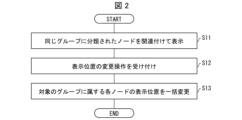
- 1 is a flow chart showing the flow of a display control method according to an exemplary embodiment 1 of the present invention.
- FIG. 11 is a block diagram showing a configuration of an information processing device according to an exemplary embodiment 2 of the present invention.
- FIG. 13 is a diagram showing a display example of a causal graph.
- 13A and 13B are diagrams illustrating an example of changing a group by changing a display position of a node.
- 13A and 13B are diagrams illustrating an example in which nodes to be grouped are selected after narrowing down the nodes to be displayed.
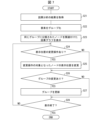
- FIG. 11 is a flow chart showing the flow of a display control method according to an exemplary embodiment 2 of the present invention.
- FIG. 1 is a diagram showing an example of a computer that executes instructions of a program, which is software that realizes the functions of each device according to each exemplary embodiment of the present invention.
- Example embodiment 1 DETAILED DESCRIPTION OF THE PREFERRED EMBODIMENTS
- This exemplary embodiment is a basic form of the exemplary embodiments described below.
- Fig. 1 is a block diagram showing the configuration of the information processing device 1. As shown in the figure, the information processing device 1 includes a display control unit 11 and a reception unit 12.
- the display control unit 11 displays, in a graph that represents the relationships between multiple elements using nodes corresponding to each element and edges that indicate the relationships between each element, nodes that are classified into the same group in an associated manner.
- the reception unit 12 receives a display position change operation for a group.
- the display control unit 11 then changes the display positions of all the nodes that belong to the group that is the target of the change operation in accordance with the change operation received by the reception unit 12.
- the information processing device 1 includes a display control unit 11 that displays nodes classified into the same group in association with each other in a graph in which the relationships between multiple elements are represented by nodes corresponding to each element and edges indicating the relationships between the elements, and a reception unit 12 that receives a display position change operation for the group. Then, in response to the change operation received by the reception unit 12, the display control unit 11 collectively changes the display positions of all nodes belonging to the group that is the target of the change operation. Therefore, the information processing device 1 according to this exemplary embodiment has the effect of making it possible to efficiently change the arrangement of nodes in a graph that indicates the relationships between elements using nodes and edges.
- the above-mentioned functions of the information processing device 1 can also be realized by a program.
- the display control program according to the present exemplary embodiment is configured to execute the following operations on a computer: in a graph in which the relationships between a plurality of elements are represented by nodes corresponding to each element and edges indicating the relationships between the elements, the nodes classified into the same group are associated and displayed; a process of accepting a display position change operation for the group; and a process of collectively changing the display positions of the nodes belonging to the group that is the target of the change operation in response to the change operation. Therefore, according to the display control program according to the present exemplary embodiment, it is possible to efficiently change the arrangement of the nodes in the graph in which the relationships between elements are represented by nodes and edges.
- Flow of display control method The flow of the display control method according to this exemplary embodiment will be described with reference to Fig. 2.
- Fig. 2 is a flow diagram showing the flow of the display control method. Note that the execution subject of each step in this display control method may be a processor provided in the information processing device 1, a processor provided in another device, or a processor provided in a different device.
- At least one processor associates and displays nodes classified into the same group in a graph that represents relationships between multiple elements using nodes corresponding to each element and edges that indicate relationships between each element.
- At least one processor accepts an operation to change the display position of the group.
- At least one processor collectively changes the display positions of all nodes belonging to the group that is the target of the change operation in accordance with the change operation accepted in S12.
- the display control method includes displaying nodes classified into the same group in association with each other in a graph in which relationships between a plurality of elements are represented by nodes corresponding to each element and edges indicating the relationships between the elements, accepting a display position change operation for the group, and collectively changing the display positions of all nodes belonging to the group that is the target of the change operation in response to the change operation. Therefore, the display control method according to this exemplary embodiment has the effect of making it possible to efficiently change the arrangement of nodes that indicate relationships between elements using nodes and edges.
- Fig. 3 is a block diagram showing the configuration of the information processing device 2.
- the information processing device 2 is a device having a function of supporting analysis using a causal graph. Note that the information processing device 2 may be a device whose main function is to support analysis using a causal graph, or may be a general-purpose device having other functions as well.
- the information processing device 2 can also support analysis using graphs other than causal graphs, so long as the graph represents the relationships between multiple elements using nodes corresponding to each element and edges indicating the relationships between the elements.
- graphs such as knowledge graphs also represent the relationships between elements using nodes and edges, so the information processing device 2 can also support analysis using knowledge graphs, etc. Therefore, the term “causal graph” in the following description can be read as any "graph” that represents the relationships between any elements using nodes and edges.
- the term “causal analysis” in the following description can be read as any "analysis” of any relationship between any elements.
- the information processing device 2 includes a control unit 20 that controls each unit of the information processing device 2, and a storage unit 21 that stores various data used by the information processing device 2.
- the information processing device 2 also includes a communication unit 22 that allows the information processing device 2 to communicate with other devices, an input unit 23 that accepts various data input to the information processing device 2, and an output unit 24 that allows the information processing device 2 to output various data.
- the control unit 20 of the information processing device 2 includes a data acquisition unit 201, a grouping unit 202, a reception unit 203, and a display control unit 204.
- Each of the components from the storage unit 21 to the output unit 24 may be built into the information processing device 2, or may be an external device attached to the information processing device 2.
- the data acquisition unit 201 acquires various data used to support analysis using a causal graph.
- the data acquisition unit 201 acquires analysis result data that indicates the results of a causal analysis.
- the analysis result data may be anything that can display a causal graph, and may be, for example, data that indicates each element that was the subject of the causal analysis and the relationship (causal relationship) between those elements.
- the data acquisition unit 201 may acquire analysis result data by performing causal analysis.
- causal analysis is a method of inferring what kind of causal relationship exists (or does not exist) between multiple elements through causal exploration from each of the elements, and estimating the strength of the inferred causal relationship.
- a specific method of causal exploration is known, for example, a method using a structural equation model, and the data acquisition unit 201 may acquire analysis result data generated by applying such a method.
- the result of the causal analysis may be obtained by causal analysis using AI (Artificial Intelligence).
- AI Artificial Intelligence
- the AI used for the causal analysis is not particularly limited as long as it is capable of inputting the elements to be subjected to the causal analysis and outputting information indicating the causal relationship between the elements and its strength.
- a causal graph may be generated by an operator specifying causal relationships between elements, in which case the data acquisition unit 201 may acquire analysis result data indicating the contents of the specification.
- the analysis result data may indicate, for example, the results of causal analysis involving natural language analysis.
- the causal graph may be an effective acyclic graph, a graph indicating bidirectional causal relationships, or a graph indicating looping causal relationships.
- the data acquisition unit 201 may acquire analysis result data generated by another device.
- the method of acquiring the analysis result data is not particularly limited.
- the data acquisition unit 201 may acquire analysis result data input by an operator of the information processing device 2 via the input unit 23, or may acquire analysis result data from another device by communication via the communication unit 22. This is also true in the case of acquiring data other than analysis result data.
- the grouping unit 202 groups the elements to be analyzed. Since each node included in the causal graph corresponds to each element to be analyzed, the grouping unit 202 can be said to group each node included in the causal graph. The specific grouping method will be described later.
- the reception unit 203 receives various operations by an operator using the information processing device 2 in supporting analysis using a causal graph. For example, the reception unit 203 receives an operation to change the display position of a node in a displayed causal graph or a group consisting of multiple nodes.
- the display control unit 204 causes the display device to display various information for supporting analysis using the causal graph.
- the display device may be included in the information processing device 2, or may be an external device to the information processing device 2.
- the display control unit 204 displays a causal graph in which the causal relationships between multiple elements being analyzed are represented by nodes corresponding to each element and edges indicating the causal relationships between each element.
- the display control unit 204 displays nodes classified into the same group in an associated manner. Note that displaying nodes in an associated manner means displaying the nodes in a manner that allows the nodes to be recognized as being related to each other.
- the display control unit 204 in response to a display position change operation for a group received by the reception unit 203, the display control unit 204 collectively changes the display positions of all nodes belonging to the group that is the target of the change operation.
- the information processing device 2 includes a display control unit 204 that displays nodes classified into the same group in association with each other in a causal graph in which the causal relationships between a plurality of elements are represented by nodes corresponding to each element and edges indicating the causal relationships between each element, and a reception unit 203 that receives a change operation for the display position of the group. Then, in response to the change operation received by the reception unit 203, the display control unit 204 collectively changes the display positions of all the nodes belonging to the group that is the target of the change operation.
- ausal relationships can be interpreted as any “relationship”
- causal graph can be interpreted as any “graph” that shows the relationships between any elements with nodes and edges.
- the data acquisition unit 201 may acquire a graph (that is, a graph that is not a causal graph), such as a knowledge graph.
- the display control unit 204 associates and displays nodes classified into the same group in the acquired graph.
- the reception unit 203 accepts a display position change operation for the group, and the display control unit 204 collectively changes the display positions of all nodes belonging to the group that is the target of the change operation in accordance with the change operation accepted by the reception unit 203. This makes it possible to efficiently change the arrangement of nodes in the graph.
- the information processing device 2 has the effect of making it possible to efficiently change the arrangement of nodes in a graph that indicates the relationships between elements using nodes and edges.
- the information processing device 2 includes a grouping unit 202 that groups the elements to be analyzed, and the display control unit 204 displays each node corresponding to each element classified into the same group by the grouping unit 202 in association with each other.
- This provides the effect of being able to group the elements to be analyzed by the information processing device 2, in addition to the effect provided by the information processing device 1 according to exemplary embodiment 1, even if the elements to be analyzed have not been grouped in advance.
- Fig. 4 is a diagram showing an example of a causal graph displayed.
- a causal graph G1 shown in the upper left of Fig. 4 represents causal relationships between a plurality of elements by nodes N1 to N9 corresponding to each element and edges (one-way arrows connecting nodes) indicating the causal relationships between each element.
- each node is labeled with a name that indicates the corresponding element.
- "Cultural and artistic activities" listed in node N2 indicates the name given to the element of node N2.
- the name given to each element may be displayed in association with the node corresponding to that element.
- node N1 is an element that corresponds to the objective variable
- all other nodes are elements that correspond to explanatory variables.
- the elements that are the subject of causal analysis may include elements other than explanatory variables and objective variables.
- causal graph G1 the nodes are not displayed in association with each other by group.
- causal graph G1' shown in the upper right of Figure 4 shows the causal relationships between nodes N1 to N9 like causal graph G1, but nodes classified into the same group are displayed in association with each other.
- nodes N1 to N3 are associated by being displayed on oval object a1.
- nodes N4 to N7 are associated by being displayed on object a2, and nodes N8 and N9 are associated by being displayed on object a3.
- nodes in the same group need only be displayed in a manner that allows the nodes to be recognized as being related to each other, and the display manner is not limited to the example of FIG. 4.
- nodes in the same group may be associated by being displayed in a display area corresponding to the group, or nodes in the same group may be associated by being displayed in the same or similar color.
- the display positions of nodes that are associated with each other in the causal graph G1' can be changed collectively.
- the reception unit 203 may receive a display position change operation in which the object a3 is dragged using the cursor Cu and dropped at the desired position.
- the display control unit 204 then changes the display positions of the nodes N8 and N9 on the object a3 collectively in response to this change operation.
- Causal graph G1" shown at the bottom of Figure 4 is obtained by moving nodes N8 and N9 on object a3 in causal graph G1'. By moving nodes N8 and N9 together, it becomes easier to recognize the relationship between these nodes and other nodes (e.g., node N1). In this way, the information processing device 2 can efficiently change the arrangement of nodes in the causal graph.
- the positional relationship between nodes N8 and N9 inside object a3 remains unchanged before and after the change in display position.
- the display control unit 204 may change the display positions of those nodes while maintaining the positional relationship between the nodes. This prevents the relationship between the nodes from becoming difficult to understand after the display positions are changed.
- the node positional relationship when changing the display positions of multiple grouped nodes collectively does not necessarily need to be fixed.
- the display control unit 204 may change the display positions of the nodes so that edges do not overlap.
- the display control unit 204 may arrange those nodes in order from the upstream node in the causal relationship. This allows the orientation of the edges between the nodes to be aligned after the display positions are changed.
- the grouping unit 202 groups the elements to be analyzed.
- the grouping method is not particularly limited.
- the receiving unit 203 may receive a designation of elements or nodes to be grouped by an operator, and in this case, the grouping unit 202 performs grouping according to the designation by the operator.
- the grouping unit 202 may also automatically group the elements to be analyzed without the intervention of an operator. For example, if grouping rules are determined in advance, such as classifying all elements into one group and limiting the number of elements in each group to two or more, the grouping unit 202 can group each element according to the rules.
- the grouping unit 202 may classify a plurality of elements into a plurality of groups by exploratory factor analysis. This provides the effect of being able to automatically group elements related to each other in addition to the effect provided by the information processing device 1 according to the exemplary embodiment 1.
- exploratory factor analysis is an analytical method that estimates what factors bring about correlations between multiple variables, based on the correlation coefficients between each variable.
- the elements included in each group correspond to one factor that brings about a correlation between those elements.
- the number of groups into which the elements are classified may be determined in advance, or may be specified by the operator. Note that in exploratory factor analysis, one element may be associated with multiple factors.
- the multiple elements that are the subject of causal analysis may include those that are generated based on the respondent's answers to specific questions.
- the grouping unit 202 may classify multiple elements generated based on answers to the same or related questions into the same group. This provides the effect of being able to automatically group elements that are related to each other, in addition to the effect provided by the information processing device 1 according to the exemplary embodiment 1.
- the "causal analysis" in the above configuration can be read as any "analysis.”
- the above classification can be achieved by preparing in advance related data that indicates which question each element corresponds to and the relevance between the questions.
- the related data may be stored in advance in the storage unit 21 or the like, or may be acquired by the data acquisition unit 201.
- a survey is conducted in which a specific group of subjects are asked to answer multiple questions such as "What do you consider important when deciding where to live?", and the answers are collated to create multiple elements (e.g., "adequate public facilities" and "abundance of greenery") that are the subject of causal analysis.
- the grouping unit 202 can classify elements that correspond to the same questions into the same group using the associated data that indicates the questions that correspond to each element.
- the questions may be grouped by theme.
- the grouping unit 202 may classify elements corresponding to questions that belong to the same group, i.e., mutually related questions, into the same group, using the associated data indicating the question corresponding to each element and the associated data indicating the group to which each question belongs.
- the grouping unit 202 may also determine the optimal group for each element based on the manner in which the value of each element changes over time. This provides the effect of being able to automatically group the elements according to the manner in which the value of each element changes over time, in addition to the effect provided by the information processing device 1 according to the first exemplary embodiment.
- the receiving unit 203 may receive input of time series data of the values of each element.
- the grouping unit 202 then generates information indicating the manner in which the value of each element changes (e.g., the rate of change or the amount of change) from the time series data. This allows the grouping unit 202 to determine the optimal group for each element based on the generated information, in other words, to optimize the group to which each element belongs.
- the above time series data may be obtained, for example, from a wearable device (e.g., a smart watch) worn by the user, from a measuring device such as a weighing scale used by the user, or from health checkup results, etc.
- a wearable device e.g., a smart watch
- a measuring device such as a weighing scale used by the user
- health checkup results etc.
- the grouping unit 202 may group elements based on the magnitude of the amount of change or the rate of change. Whether the amount of change or the rate of change is large can be determined by comparing the amount of change or the rate of change with a predetermined threshold, or by comparing with the average value of the amount of change or the rate of change of each element. In other words, the evaluation of the magnitude of the amount of change or the rate of change may be an absolute evaluation or a relative evaluation.
- Elements with a large amount of change or rate of change can be said to be “unstable elements", while elements with a small amount of change or rate of change can be said to be “stable elements”.
- the grouping unit 202 can group “unstable elements” and “stable elements” separately. For example, if the rate of change in the values of elements such as the amount of exercise or amount of sleep is large, the grouping unit 202 groups those elements as “unstable elements”. Such group information suggests that the user's lifestyle is irregular and can encourage the user to improve their lifestyle.
- the grouping unit 202 groups those elements as “stable elements.” Information on such a group suggests that the user's eating habits are stable, and can encourage the user to continue their current eating habits.
- the method of determining the optimal group based on the manner in which the values of each element change over time is particularly useful in the medical and healthcare fields when causal analysis is used to help users adopt healthy lifestyle habits.
- the reception unit 203 may receive an operation to change the group set for each element, and the grouping unit 202 may change the group in response to the operation. Any operation may be used to change the group. For example, when an operation to select a node in the displayed causal graph is performed, the display control unit 204 may display options for changing the group of the element corresponding to the node. Then, when the reception unit 203 receives an operation to select the option, the display control unit 204 may display a list of groups that are candidates for the change destination. In this case, the grouping unit 202 changes the group of the element to the group selected from the list.
- the grouping unit 202 may change the classification of the element corresponding to the node from one group to another group. This provides the effect of making it possible to easily change groups through intuitive operations in addition to the effect provided by the information processing device 1 according to the first exemplary embodiment.
- Figure 5 is a diagram that explains an example of changing groups by changing the display position of a node.
- Causal graph G2 shown in the upper left of Figure 5 shows the causal relationships between the elements corresponding to nodes N1 to N9, and these nodes are classified into three groups. Specifically, nodes N6 to N9, which are classified into the same group, are associated by being displayed on object b2. Furthermore, nodes N1 to N3 are associated by being displayed on object a1, and nodes N3 to N5 are associated by being displayed on object b3.
- the groups corresponding to objects b1 to b3 are referred to as the first to third groups, respectively.
- node N3 is within the display area of object b1 and is displayed within the display area of object b3. This indicates that the element corresponding to node N3 belongs to both the first group and the third group.
- the grouping unit 202 may allow one element to be classified into multiple groups.
- the display control unit 204 changes the display position of node N3 even if an operation to change the display position is performed on either object b1 or b3.
- the display control unit 204 may deform the shape of both or one of objects b1 and b3 so that node N3 after the change in display position is within the display area of both objects b1 and b3.
- the operator can also change the group of elements corresponding to node N3 by moving node N3. For example, the operator may drag node N3 with cursor Cu and drop node N3 outside the display area of object b1 but within the display area of object b3. This allows node N3 to be moved to a position outside the display area of object b1 but within the display area of object b3, and changes the group of elements corresponding to node N3 from the first and third groups to only the third group.
- Causal graph G2' shown in the upper right of FIG. 5 is obtained by moving node N3 in causal graph G2 outside the display area of object b1 and into the display area of object b3.
- the grouping unit 202 changes the group of the element corresponding to node N3 to only the third group. As a result, when an operation to change the display position of the first group is performed, the display position of node N3 does not change.
- Causal graph G2" shown at the bottom of Figure 5 is obtained by changing the display position of each node belonging to the third group in causal graph G2'. In this way, the operator can check the group corresponding to each node in causal graph G2, and then intuitively change the group of the element corresponding to node N3 by moving the display position of node N3 into the display area of object b3.
- elements that are the subject of group changes are not limited to elements that belong to multiple groups.
- the grouping unit 202 can change the affiliation of an element that belongs to one group to another group, and can also make an element that does not belong to any group belong to a group.
- Fig. 6 is a diagram for explaining an example in which the nodes to be grouped are selected after narrowing down the nodes to be displayed.
- Causal graph G3 shown in the upper left of Figure 6 shows the causal relationships between each of the nodes N1 to N8.
- edges connecting nodes are displayed as lines with a thickness according to the path coefficient.
- the display control unit 204 may display edges in a display mode according to the path coefficient. This allows the operator to recognize paths with a stronger influence, allowing smooth analysis of the relationship between each element.
- the path coefficient is a coefficient calculated using the weight value of the path connecting each element.
- the weight value can be calculated using known methods of causal inference and causal search. Note that the path coefficient can be represented not only by the thickness of the edge, but also by the edge length or color, for example.
- the display control unit 204 displays an object c1 together with the causal graph G3.
- the object c1 is a threshold specification object that accepts specification of a threshold value for the path coefficient in the causal graph G3.
- object c1 is an object having a slider arranged on a slider bar that can be moved on the slider bar.
- the slider bar indicates the range in which the pass coefficient threshold can be changed, and the position of the slider indicates the pass coefficient threshold.
- the operator can use object c1 to set the threshold to a small value, thereby displaying all of the nodes and edges that make up causal graph G3. Also, as shown in the lower left of Figure 6, the operator can operate object c1 with cursor Cu to change the threshold to a larger value. Note that the method of operating object c1 is not limited to using cursor Cu.
- causal graph G3' shown in the lower left of Figure 6 is a graph in which, among the nodes included in causal graph G3, nodes that are the starting points of paths whose path coefficients are less than the changed threshold are hidden. Compared to causal graph G3, causal graph G3' makes it easier to recognize the relationships between paths whose path coefficients are equal to or greater than the threshold and the nodes included in those paths.
- the index value used as the criterion for switching between displaying and hiding a node is not limited to the path coefficient.
- the display and hiding of a node can be switched based on any index value as long as it is an index value related to the causal relationship between multiple elements.
- the display control unit 204 may switch between displaying and hiding a node based on a P-value.
- the display control unit 204 may display an object that changes the threshold value of the P-value. Note that in the case of the P-value, the threshold value may be changed in stages rather than continuously.
- the operator can group the desired nodes. For example, in the causal graph G3', multiple nodes can be grouped by surrounding them with the cursor Cu.
- Causal graph G3 shown on the right side of Figure 6 shows an example of grouping target nodes by performing a drag operation to surround them.
- causal graph G3 the trajectory of the drag operation performed by cursor Cu on the display screen is shown by dashed line c2.
- the grouping unit 202 groups the elements corresponding to these nodes.
- grouping method when the nodes to be displayed have been narrowed down is not limited to this example. For example, even if you manually specify a group, you may select multiple nodes to group and group them, or you may group them automatically using the method described above in "Grouping Methods.”
- the reception unit 203 may receive a specified threshold value for a predetermined index value related to the causal relationship between multiple elements, and the display control unit 204 may switch between displaying and hiding each node based on the specified threshold value.
- the grouping unit 202 may then perform grouping for the elements corresponding to the displayed nodes. In this way, in addition to the effect of the information processing device 1 according to the first exemplary embodiment, it is possible to obtain an effect that it is possible to set groups by narrowing down the nodes to be displayed and clarifying the causal relationship between elements.
- the "causal relationship" in the above configuration may be read as any "relationship.”
- Fig. 7 is a flow diagram showing the flow of the display control method.
- the data acquisition unit 201 acquires analysis result data indicating the results of the causal analysis.
- the data acquisition unit 201 may acquire analysis result data by performing a causal analysis, or may acquire analysis result data indicating the results of a causal analysis performed by another device.
- the grouping unit 202 groups the elements that were the subject of the causal analysis and are shown in the analysis result data acquired in S21. As explained in the section "Grouping Methods,” various methods can be applied as grouping methods.
- the display control unit 204 displays a causal graph that associates the nodes classified into the same group in S22 (more precisely, the nodes corresponding to the elements classified into the same group).
- the reception unit 203 determines whether or not a change operation has been performed on the display position. Specifically, when the reception unit 203 receives a change operation on the display position of a single node or a group of nodes, it determines that a change operation has been performed (YES in S24) and proceeds to S25. On the other hand, when the reception unit 203 determines that a change operation has not been performed (NO in S24), it proceeds to S26.
- the display control unit 204 changes the display position of the node that is the target of the change operation. Specifically, when the display control unit 204 receives an operation to change the display position of a single node, it changes the display position of that node in accordance with the change operation. On the other hand, when the display control unit 204 receives an operation to change the display position of a group of nodes, it changes the display positions of all the nodes that belong to the group that is the target of the change operation collectively. For example, as in the examples of Figures 4 and 5, when nodes that belong to the same group are displayed on the same object, the operation to change the display position of the object may be an operation to change the display position of the group of nodes.
- the grouping unit 202 determines whether or not a group change has occurred. Specifically, the grouping unit 202 determines that a group change has occurred (YES in S26) if both conditions (1) and (2) below are satisfied, and determines that a group change has not occurred (NO in S26) if either or both conditions are not satisfied. If the determination in S26 is YES, the process proceeds to S27, and if the determination in S26 is NO, the process proceeds to S28.
- the grouping unit 202 updates the group. Specifically, the grouping unit 202 changes the group of the element corresponding to the node whose display position has been changed to the group associated with the position where the node is displayed. Note that it may be permitted for one element to belong to multiple groups. For example, suppose that there is an overlapping portion between a display area associated with a certain group and a display area associated with another group, and the node is moved to this overlapping portion. In this case, the grouping unit 202 may set the group to which the element corresponding to the node belongs to both the certain group and the other group.
- the display control unit 204 may reflect the update of the group in the display. For example, assume that a node is moved from a display area associated with a group to a display area associated with another group. In this case, the display control unit 204 may narrow the display area associated with a group (for example, the display area of object b1 in FIG. 5) and widen the display area associated with the other group (for example, the display area of object b3 in FIG. 5).
- the display control unit 204 determines whether or not to end the display of the causal graph. For example, the display control unit 204 may determine to end the display of the causal graph when the reception unit 203 receives an operation to end the display of the causal graph. If it is determined as YES in S28 (i.e., to end the display), the display control method of FIG. 7 ends. On the other hand, if it is determined as NO in S28 (i.e., to continue the display), the process returns to S24.
- the display control method includes displaying nodes classified into the same group in association with each other in a causal graph in which the causal relationships between a plurality of elements are represented by nodes corresponding to each element and edges indicating the causal relationships between each element (S23), accepting a display position change operation for the group (S26), and collectively changing the display positions of all nodes belonging to the group that is the target of the change operation in response to the change operation (S25).
- the "causal relationship" in the above display control method can be read as any "relationship,” and the "causal graph” can be read as any "graph” that shows the relationship between any elements with nodes and edges.
- the display control method according to this exemplary embodiment has the effect of making it possible to efficiently change the arrangement of nodes in any graph that shows the relationship between elements with nodes and edges.
- the execution subject of each process described in the above embodiment is arbitrary and is not limited to the above example.
- the functions of the information processing devices 1 and 2 can be realized by multiple devices (which can also be called processors) that can communicate with each other.
- processors which can also be called processors
- each process described in the flowcharts of Figures 2 and 7 can be shared and executed by multiple processors.
- the execution subject of the display control method in the above embodiment may be one processor or multiple processors.
- Some or all of the functions of the information processing device 1 or 2 may be realized by hardware such as an integrated circuit (IC chip), or may be realized by software.
- information processing device 1 or 2 is realized, for example, by a computer that executes instructions of a program, which is software that realizes each function.
- a computer that executes instructions of a program, which is software that realizes each function.
- An example of such a computer (hereinafter referred to as computer C) is shown in Figure 8.
- Computer C has at least one processor C1 and at least one memory C2.
- Memory C2 stores a program (display control program) P for operating computer C as information processing device 1 or 2.
- processor C1 reads and executes program P from memory C2, thereby realizing each function of information processing device 1 or 2.
- the processor C1 may be, for example, a CPU (Central Processing Unit), GPU (Graphic Processing Unit), DSP (Digital Signal Processor), MPU (Micro Processing Unit), FPU (Floating point number Processing Unit), PPU (Physics Processing Unit), TPU (Tensor Processing Unit), quantum processor, microcontroller, or a combination of these.
- the memory C2 may be, for example, a flash memory, HDD (Hard Disk Drive), SSD (Solid State Drive), or a combination of these.
- Computer C may further include a RAM (Random Access Memory) for expanding program P during execution and for temporarily storing various data.
- Computer C may further include a communications interface for sending and receiving data to and from other devices.
- Computer C may further include an input/output interface for connecting input/output devices such as a keyboard, mouse, display, and printer.
- the program P can also be recorded on a non-transitory, tangible recording medium M that can be read by the computer C.
- a recording medium M can be, for example, a tape, a disk, a card, a semiconductor memory, or a programmable logic circuit.
- the computer C can obtain the program P via such a recording medium M.
- the program P can also be transmitted via a transmission medium.
- a transmission medium can be, for example, a communications network or broadcast waves.
- the computer C can also obtain the program P via such a transmission medium.
- An information processing device comprising: a display control means for displaying nodes classified into the same group in an associated manner in a graph in which the relationships between a plurality of elements are represented by nodes corresponding to each element and edges indicating the relationships between the elements; and a reception means for receiving a display position change operation targeting the group, wherein the display control means collectively changes the display positions of each node belonging to the group that is the target of the change operation in response to the change operation.
- Appendix 4 The information processing device described in Appendix 2, wherein the multiple elements include those generated based on the respondent's answers to specific questions, and the grouping means classifies the multiple elements generated based on answers to the same or related questions into the same group.
- Appendix 5 The information processing device described in Appendix 2, wherein the receiving means receives specification of a threshold value of a predetermined index value regarding the relationship between the multiple elements, the display control means switches between displaying and hiding each node based on the specified threshold value, and the grouping means groups the elements corresponding to the displayed nodes.
- Appendix 7 An information processing device as described in any of Appendices 2 to 5, wherein when the node displayed in a specified display area associated with a certain group is moved to a specified display area associated with another group, the grouping unit changes the classification of the element corresponding to the node from the certain group to the other group.
- a display control method including: at least one processor displaying nodes classified into the same group in an associated manner in a graph in which relationships between a plurality of elements are represented by nodes corresponding to each element and edges indicating the relationships between the elements; accepting a display position change operation targeting the group; and collectively changing the display positions of each node belonging to the group that is the target of the change operation in response to the change operation.
- a display control program that causes a computer to execute the following processes: displaying nodes classified into the same group in an associated manner in a graph in which the relationships between multiple elements are represented by nodes corresponding to each element and edges indicating the relationships between the elements; accepting a display position change operation for the group; and, in response to the change operation, changing the display positions of all nodes belonging to the group that is the target of the change operation.
- An information processing device including at least one processor, the processor executing a process of displaying nodes classified into the same group in association with each other in a graph in which relationships between a plurality of elements are represented by nodes corresponding to the elements and edges indicating the relationships between the elements, a process of accepting an operation to change a display position of the group, and a process of collectively changing the display positions of all the nodes belonging to the group that are the target of the change operation in response to the change operation.
- the information processing device may further include a memory, and the memory may store a display control program for causing the processor to execute the process of displaying the nodes in association with each other, the process of accepting the change operation, and the process of changing the display positions all at once.
- the display control program may also be recorded on a computer-readable, non-transitory, tangible recording medium.
- Display control unit (display control means) 12 Reception unit (reception means) 2 Information processing device 202 Grouping unit (grouping means) 203 Reception unit (reception means) 204 Display control unit (display control means)
Landscapes
- Engineering & Computer Science (AREA)
- Theoretical Computer Science (AREA)
- Computing Systems (AREA)
- Data Mining & Analysis (AREA)
- Evolutionary Computation (AREA)
- Physics & Mathematics (AREA)
- Computational Linguistics (AREA)
- General Engineering & Computer Science (AREA)
- General Physics & Mathematics (AREA)
- Mathematical Physics (AREA)
- Software Systems (AREA)
- Artificial Intelligence (AREA)
- User Interface Of Digital Computer (AREA)
Priority Applications (2)
| Application Number | Priority Date | Filing Date | Title |
|---|---|---|---|
| JP2025529151A JPWO2025004299A1 (https=) | 2023-06-30 | 2023-06-30 | |
| PCT/JP2023/024311 WO2025004299A1 (ja) | 2023-06-30 | 2023-06-30 | 情報処理装置、表示制御方法、および表示制御プログラム |
Applications Claiming Priority (1)
| Application Number | Priority Date | Filing Date | Title |
|---|---|---|---|
| PCT/JP2023/024311 WO2025004299A1 (ja) | 2023-06-30 | 2023-06-30 | 情報処理装置、表示制御方法、および表示制御プログラム |
Publications (1)
| Publication Number | Publication Date |
|---|---|
| WO2025004299A1 true WO2025004299A1 (ja) | 2025-01-02 |
Family
ID=93938183
Family Applications (1)
| Application Number | Title | Priority Date | Filing Date |
|---|---|---|---|
| PCT/JP2023/024311 Ceased WO2025004299A1 (ja) | 2023-06-30 | 2023-06-30 | 情報処理装置、表示制御方法、および表示制御プログラム |
Country Status (2)
| Country | Link |
|---|---|
| JP (1) | JPWO2025004299A1 (https=) |
| WO (1) | WO2025004299A1 (https=) |
Citations (5)
| Publication number | Priority date | Publication date | Assignee | Title |
|---|---|---|---|---|
| US20050007383A1 (en) * | 2003-05-22 | 2005-01-13 | Potter Charles Mike | System and method of visual grouping of elements in a diagram |
| JP2008052494A (ja) * | 2006-08-24 | 2008-03-06 | Sony Corp | ネットワーク分析支援装置および方法、プログラム並びに記録媒体 |
| JP2018005645A (ja) * | 2016-07-05 | 2018-01-11 | 山本 隆義 | 対象物の状態変化の原因探索方法 |
| WO2018168193A1 (ja) * | 2017-03-17 | 2018-09-20 | 株式会社日立製作所 | 業務改善支援装置および業務改善支援方法 |
| KR20210090930A (ko) * | 2020-01-13 | 2021-07-21 | 에스케이 주식회사 | 지식 그래프 기반 정보 검색 시스템 및 정보 검색 방법 |
-
2023
- 2023-06-30 JP JP2025529151A patent/JPWO2025004299A1/ja active Pending
- 2023-06-30 WO PCT/JP2023/024311 patent/WO2025004299A1/ja not_active Ceased
Patent Citations (5)
| Publication number | Priority date | Publication date | Assignee | Title |
|---|---|---|---|---|
| US20050007383A1 (en) * | 2003-05-22 | 2005-01-13 | Potter Charles Mike | System and method of visual grouping of elements in a diagram |
| JP2008052494A (ja) * | 2006-08-24 | 2008-03-06 | Sony Corp | ネットワーク分析支援装置および方法、プログラム並びに記録媒体 |
| JP2018005645A (ja) * | 2016-07-05 | 2018-01-11 | 山本 隆義 | 対象物の状態変化の原因探索方法 |
| WO2018168193A1 (ja) * | 2017-03-17 | 2018-09-20 | 株式会社日立製作所 | 業務改善支援装置および業務改善支援方法 |
| KR20210090930A (ko) * | 2020-01-13 | 2021-07-21 | 에스케이 주식회사 | 지식 그래프 기반 정보 검색 시스템 및 정보 검색 방법 |
Also Published As
| Publication number | Publication date |
|---|---|
| JPWO2025004299A1 (https=) | 2025-01-02 |
Similar Documents
| Publication | Publication Date | Title |
|---|---|---|
| US11036523B2 (en) | Systems and methods for adaptive user interfaces | |
| Enquist et al. | Modelling the evolution and diversity of cumulative culture | |
| Deb et al. | An integrated approach to automated innovization for discovering useful design principles: Case studies from engineering | |
| US10628001B2 (en) | Adapting user interfaces based on gold standards | |
| KR102591481B1 (ko) | 인공지능 기반 트렌드에 기초한 판매제품 추천 시스템 | |
| JP2005122703A (ja) | コンピュータ上で視覚化グラフを提供する方法、および視覚化グラフを提供するコンピュータ | |
| CN109923510A (zh) | 用于应用程序数据的动态洞察对象 | |
| US10803349B2 (en) | Apparatus and method for determining taste of user based on latent variable | |
| CN109858528A (zh) | 推荐系统训练方法、装置、计算机设备及存储介质 | |
| CN115221397B (zh) | 媒体信息的推荐方法、装置、电子设备及存储介质 | |
| KR102345753B1 (ko) | 서로 다른 복수의 인공신경망을 이용하여 데이터를 지능적으로 시각화하는 방법 | |
| US20220113951A1 (en) | Linking Stages in Process Flows with Machine Learning | |
| CN109543085A (zh) | 数据提取方法、装置及计算机可读存储介质 | |
| WO2025004299A1 (ja) | 情報処理装置、表示制御方法、および表示制御プログラム | |
| Garcia et al. | Strategic advice for decision-making under conflict based on observed behaviour | |
| WO2025004302A1 (ja) | 情報処理装置、表示制御方法、および表示制御プログラム | |
| US20250110635A1 (en) | Multi-criteria option comparison tool | |
| JP7259874B2 (ja) | 情報可視化装置、情報可視化方法、及びプログラム | |
| WO2024134797A1 (ja) | 情報処理装置、シミュレーション方法、およびシミュレーションプログラム | |
| JP6268322B1 (ja) | 学習データ精度可視化システム、学習データ精度可視化方法、及びプログラム | |
| WO2025004300A1 (ja) | 情報処理装置、支援方法、および支援プログラム | |
| WO2023105610A1 (ja) | 情報処理装置、情報処理方法、およびプログラム | |
| EP4723121A1 (en) | Sequence generation device and sequence generation method | |
| JP7460188B2 (ja) | 行動支援システム、行動支援方法及び行動支援プログラム | |
| WO2025004301A1 (ja) | 情報処理装置、モデル生成方法、およびモデル生成プログラム |
Legal Events
| Date | Code | Title | Description |
|---|---|---|---|
| 121 | Ep: the epo has been informed by wipo that ep was designated in this application |
Ref document number: 23943690 Country of ref document: EP Kind code of ref document: A1 |
|
| ENP | Entry into the national phase |
Ref document number: 2025529151 Country of ref document: JP Kind code of ref document: A |
|
| WWE | Wipo information: entry into national phase |
Ref document number: 2025529151 Country of ref document: JP |
|
| NENP | Non-entry into the national phase |
Ref country code: DE |