WO2025004264A1 - エアロゾル生成装置 - Google Patents
エアロゾル生成装置 Download PDFInfo
- Publication number
- WO2025004264A1 WO2025004264A1 PCT/JP2023/024177 JP2023024177W WO2025004264A1 WO 2025004264 A1 WO2025004264 A1 WO 2025004264A1 JP 2023024177 W JP2023024177 W JP 2023024177W WO 2025004264 A1 WO2025004264 A1 WO 2025004264A1
- Authority
- WO
- WIPO (PCT)
- Prior art keywords
- power supply
- unit
- power
- aerosol
- generating device
- Prior art date
- Legal status (The legal status is an assumption and is not a legal conclusion. Google has not performed a legal analysis and makes no representation as to the accuracy of the status listed.)
- Ceased
Links
Images





Classifications
-
- A—HUMAN NECESSITIES
- A24—TOBACCO; CIGARS; CIGARETTES; SIMULATED SMOKING DEVICES; SMOKERS' REQUISITES
- A24F—SMOKERS' REQUISITES; MATCH BOXES; SIMULATED SMOKING DEVICES
- A24F40/00—Electrically operated smoking devices; Component parts thereof; Manufacture thereof; Maintenance or testing thereof; Charging means specially adapted therefor
- A24F40/10—Devices using liquid inhalable precursors
-
- A—HUMAN NECESSITIES
- A24—TOBACCO; CIGARS; CIGARETTES; SIMULATED SMOKING DEVICES; SMOKERS' REQUISITES
- A24F—SMOKERS' REQUISITES; MATCH BOXES; SIMULATED SMOKING DEVICES
- A24F40/00—Electrically operated smoking devices; Component parts thereof; Manufacture thereof; Maintenance or testing thereof; Charging means specially adapted therefor
- A24F40/20—Devices using solid inhalable precursors
-
- A—HUMAN NECESSITIES
- A24—TOBACCO; CIGARS; CIGARETTES; SIMULATED SMOKING DEVICES; SMOKERS' REQUISITES
- A24F—SMOKERS' REQUISITES; MATCH BOXES; SIMULATED SMOKING DEVICES
- A24F40/00—Electrically operated smoking devices; Component parts thereof; Manufacture thereof; Maintenance or testing thereof; Charging means specially adapted therefor
- A24F40/40—Constructional details, e.g. connection of cartridges and battery parts
-
- A—HUMAN NECESSITIES
- A24—TOBACCO; CIGARS; CIGARETTES; SIMULATED SMOKING DEVICES; SMOKERS' REQUISITES
- A24F—SMOKERS' REQUISITES; MATCH BOXES; SIMULATED SMOKING DEVICES
- A24F40/00—Electrically operated smoking devices; Component parts thereof; Manufacture thereof; Maintenance or testing thereof; Charging means specially adapted therefor
- A24F40/50—Control or monitoring
-
- A—HUMAN NECESSITIES
- A24—TOBACCO; CIGARS; CIGARETTES; SIMULATED SMOKING DEVICES; SMOKERS' REQUISITES
- A24F—SMOKERS' REQUISITES; MATCH BOXES; SIMULATED SMOKING DEVICES
- A24F40/00—Electrically operated smoking devices; Component parts thereof; Manufacture thereof; Maintenance or testing thereof; Charging means specially adapted therefor
- A24F40/60—Devices with integrated user interfaces
Definitions
- This disclosure relates to an aerosol generating device.
- the aerosol generating device which generates aerosol by heating an aerosol source, is equipped with user interface circuits (hereinafter referred to as “notification units”) such as LEDs (Light Emitting Diodes) and vibrators.
- Notification units such as LEDs (Light Emitting Diodes) and vibrators.
- MCU Micro Controller Unit
- the MCU (hereinafter referred to as the "control unit") has a lower limit operating voltage, and as long as a driving power supply equal to or higher than the lower limit operating voltage is supplied to the MCU, the control unit normally controls the notification unit. However, the driving power supplied to the control unit may fall below the lower limit voltage, for example, when the aerosol generating device is reset. In this case, the control unit stops control, but since the threshold voltage of the transistor is lower than the lower limit voltage, an operation that is not originally intended may be performed.
- the present disclosure provides a technology that prevents unintended operation of the notification unit when the drive power supplied to the control unit falls below the lower operating limit voltage.
- an aerosol generating device has a heating unit that heats an aerosol source, a notification unit that notifies a user of information related to the heating of the aerosol source, a control unit that controls the operation of the notification unit, a control element that is controlled by the control unit and opens and closes an electrical connection of the notification unit, a first power supply that supplies power to the control unit, a second power supply that supplies power to the notification unit, and a first switch that uses the power supplied from the first power supply as an enable signal to control the power supply from the second power supply to the notification unit.
- the notification unit may include a light-emitting element.
- the aerosol generating device may further include a voltage divider circuit that divides the potential of the first power supply, and the voltage after division by the voltage divider circuit may be used as the enable signal.
- the first switch here may be configured to turn off when the enable signal voltage is higher than the lower limit operating voltage of the control unit.
- the threshold voltage of the control element is lower than the lower limit operating voltage of the control unit.
- the aerosol generating device may include a third power source different from the second power source that supplies power to the heating section.
- the supply of power from the third power supply to the heating unit is controlled by a second control element, and a switch that uses the power supplied from the first power supply as an enable signal to control the supply of power from the third power supply to the heating unit may not be included between the third power supply and the heating unit.
- the heating section may be supplied with power from a second power source.
- the aerosol source may be a solid.
- the aerosol source may be a liquid.
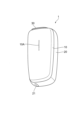
- FIG. 2 is a view of the front side of the aerosol generation device observed from diagonally above.
- FIG. 2 is a view of the front side of the aerosol generation device observed from diagonally below.
- FIG. 2 is a front view of the main unit with the front panel removed.
- FIG. 2 is a diagram illustrating an internal configuration of a main unit device.
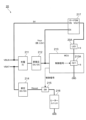
- FIG. 2 is a diagram illustrating an electronic circuit used in the first embodiment.
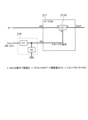
- FIG. 2 is a circuit diagram illustrating an example of the internal configuration of a load switch used in the first embodiment.
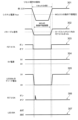
- 10 is a diagram illustrating power supply to an LED when a reset operation is performed in the electronic circuit used in the first embodiment.
- FIG. 13 is a diagram illustrating power supply to an LED when a reset operation is performed in an electronic circuit that does not include a load switch.
- FIG. FIG. 11 is a diagram illustrating an electronic circuit used in the second embodiment.
- FIG. 11 is a circuit diagram illustrating an example of the internal configuration of a load switch used in a second embodiment.
- 13 is a diagram illustrating the power supply to an LED when a reset operation is performed in the electronic circuit used in the second embodiment.
- FIG. FIG. 11 is a diagram illustrating an electronic circuit used in the second embodiment.
- the aerosol generation device is a form of electronic cigarette.
- the substance generated by the aerosol generating device is called an aerosol.
- An aerosol is a mixture of air or other gas and minute liquid or solid particles suspended in gas.
- an aerosol generating device that generates an aerosol without combustion will be described. Inhalation of the aerosol generated by the aerosol generating device is also called a "puff.”
- an aerosol generating device to which a solid aerosol source can be attached will be described.
- the container for storing the solid aerosol source is called a "capsule” or a "stick-type substrate” depending on the product form. Capsules and stick-type substrates are consumables. For this reason, a replacement guideline is set for the capsule and stick-type substrate.
- FIG. 1 is a diagram of the front side of the aerosol generation device 1 observed from obliquely above.
- FIG. 2 is a view of the front side of the aerosol generation device 1 observed from obliquely below.
- FIG. 3 is a front view of the main unit 20 with the front panel 10 removed.
- the aerosol generation device 1 used in this embodiment has a size that allows a user to hold it in one hand.
- the aerosol generating device 1 has a main body device 20, a front panel 10 attached to the front of the main body device 20, and a shutter 30 arranged on the top surface of the main body device 20 and capable of sliding along the top surface.
- the front panel 10 is a member that can be attached to and detached from the main body device 20. The front panel 10 is attached and detached by a user.
- the front panel 10 attached to the main unit 20 covers the front portion of the main unit 20, as shown in Figures 1 and 2.
- the main unit 20 can be observed from the outside except for the front portion.
- the side, back, top, and bottom surfaces of the main unit 20 can be observed from the outside even after the front panel 10 is attached.
- a window 10A is provided on the front panel 10.
- the window 10A is provided in a position facing a light-emitting element on the main device 20 side.
- eight LEDs 20A are provided on the main device 20.
- the LEDs 20A are an example of a "notification unit" that notifies information related to heating of the aerosol source.
- the window 10A in the first embodiment is made of a material that transmits light, although the window 10A may be a slit that penetrates from the front surface to the back surface.
- the operating state of the aerosol generating device is assigned to the lighting and blinking patterns of LED 20A.
- the lighting and blinking of LED 20A is assigned to a state related to the heating of the aerosol source.
- the states related to the heating of the aerosol source include, for example, the completion of preparation for heating the aerosol source, the start of heating, the completion or end of heating, the number of aerosol sources that can be inhaled, the remaining time that can be inhaled, and an abnormality in the temperature of the main body.
- the lighting and blinking of LED 20A are assigned to the occurrence of a breakdown or malfunction of the main body device 20, the remaining battery level, charging or completion of charging, the pairing state, and the like. Malfunctions here include abnormalities related to the environmental temperature.
- the lighting and blinking of the light-emitting element is controlled by the control unit 206 (see FIG. 4), which will be described later.
- the front panel 10 also has a role of buffering the transmission of heat emitted from the main unit 20. In the case of the present embodiment, only when the front panel 10 is attached to the main unit 20, generation of aerosol is permitted.
- the front panel 10 used in this embodiment is deformed when the user presses a position below the window 10A with the fingertip, and returns to its original shape when the user stops pressing. This deformation makes it possible to operate the power button 20B provided on the main unit 20 while the front panel 10 is attached to the main unit 20.
- a type C USB (Universal Serial Bus) connector 21 is provided on the bottom side of the main device 20.
- the shape and type of the USB connector 21 are merely examples.
- the USB connector 21 is used to charge the power supply unit 201 (see FIG. 4) built into the main device 20.
- a hole (not shown) for inserting a stick-shaped substrate 40 (see FIG. 4) containing an aerosol source is provided on the top surface of the main body device 20.
- the hole is exposed by sliding the shutter 30 to the open position, and is concealed by sliding the shutter 30 to the closed position.
- the stick-shaped substrate 40 used in this embodiment has a structure in which a solid aerosol source is housed in a substantially cylindrical paper tube.
- a magnet for example, is attached to the back surface of the shutter 30.
- a Hall IC is attached to the main body device 20 within the movable range of the shutter 30.
- the Hall IC is a magnetic sensor that is composed of a Hall element and an operational amplifier, and outputs a voltage according to the strength of the magnetic field that crosses the Hall element.
- the opening and closing of the shutter 30 is detected from a change in voltage output from the Hall IC accompanying the sliding of the shutter 30. That is, it is detected whether the shutter 30 is in the open position or the closed position.
- the power button 20B is located approximately in the center of the front of the main unit 20. As described above, the power button 20B can be operated with the front panel 10 attached.
- the power button 20B is used, for example, to turn the power of the main body device on and off, to turn on and off the power supply to the heating unit 207 (see Figure 4) that heats the aerosol source, and to instruct Bluetooth (registered trademark) pairing.
- pressing the power button 20B for a long time for example, for 5 seconds or more
- BLE Bluetooth Low Energy
- magnets 20C used to attach the front panel 10 are located at the top and bottom of the front of the main unit 20.
- the magnets 20C are located opposite a magnet (not shown) located on the inside of the front panel 10. For example, if the magnet on the front panel 10 has a north pole, the magnet 20C on the main unit 20 side has a south pole.
- the front panel 10 is removably attached to the main unit 20 by the attractive force between the magnets.
- Either the magnet on the front panel 10 side or the magnet 20C on the main unit 20 side may be a piece of iron or other magnetic metal.
- the attachment of the front panel 10 to the main unit 20 is detected by a Hall IC provided on the main unit 20 side.
- various electronic components necessary for generating aerosol are built into the main device 20.
- the device configuration in which the front panel 10 is attached to the main device 20 is referred to as the aerosol generating device 1, but in the narrow sense, the main device 20 is referred to as the aerosol generating device.
- Fig. 4 is a diagram showing a schematic internal configuration of the main body device 20.
- Fig. 4 shows a state in which the stick-shaped substrate 40 is attached to the main body device 20. 4 is intended to explain the components and their positional relationships provided in the main unit 20. Therefore, the appearance of the components and the like shown in FIG. 4 does not necessarily match the appearance diagram described above.
- the main body device 20 is composed of a power supply unit 201 , a sensor unit 202 , a notification unit 203 , a memory unit 204 , a communication unit 205 , a control unit 206 , a heating unit 207 , a heat insulation unit 208 , and a holding unit 209 .
- 4 shows a state in which the stick-shaped substrate 40 is held by the holding portion 209. In this state, the user inhales the aerosol.
- the power supply unit 201 is a unit that supplies power to each component.
- the power supply unit 201 uses a secondary battery to store the power required by the main unit 20.
- a lithium ion secondary battery is used as the secondary battery.
- the secondary battery can be charged from an external power source.
- the external power source is supplied via a USB connector 21 (see FIG. 2).
- the power supplied from the secondary battery is referred to as "VBAT”, and the power supplied via the USB connector 21 is referred to as "VBUS”.
- the power supply VBUS is a 5V power supply.
- the 5V power supply can also be generated from VBAT.
- the sensor unit 202 is an electronic component that detects various types of information related to the main device 20 .
- the sensor unit 202 includes, for example, a pressure sensor such as a microphone condenser and a flow rate sensor.
- the sensor unit 202 outputs detected information to the control unit 206. For example, when detecting a change in air pressure or air flow associated with inhalation, the sensor unit 202 outputs a numerical value indicating the inhalation of aerosol by the user to the control unit 206.
- the sensor unit 202 is provided in association with, for example, a button or switch used to receive an operation from a user.
- the button in this case is the power button 20B (see FIG. 3) described above.
- the switch is the shutter 30 (see FIG. 1) described above.
- the sensor unit 202 has a temperature sensor that detects the temperature of the heating unit 207.
- the temperature sensor detects the temperature of the heating unit 207 based on, for example, changes in the electrical resistance value of the conductive track of the heating unit 207.
- the temperature sensor outputs a voltage corresponding to the current electrical resistance value.
- the control unit 206 calculates the temperature of the heating unit 207 from the output voltage of the temperature sensor.
- the calculated temperature can also be considered as the temperature of the stick-shaped substrate 40 held in the holding unit 209.
- Other temperature sensors include a temperature sensor that detects the ambient temperature of the heating unit 207 and a temperature sensor that detects the temperature near the surface of the main unit 20.
- the notification unit 203 is an electronic component that notifies the user of various information related to the main device 20.
- the notification unit 203 includes, for example, an LED 20A (see FIG. 3).
- the light emission and blinking of the LED 20A is controlled in a pattern according to the content of the notification. If multiple LEDs 20A with different light emission colors are provided, the light emission and blinking may be combined with different light emission colors. For example, red may be used to notify the user that use has been suspended or that repairs are required, and white, green, blue, etc. may be used to notify the user of normal use.
- the notification unit 203 may include other devices used together with the LED 20A or in place of the LED 20A.
- the other devices include a display device that displays characters, images, and other information, a sound output device that outputs sound, a vibration device that vibrates the main body device 20, and the like.
- a light-emitting device, a display device, a sound output device, a vibration device, etc. are also examples of a "notification unit" that notifies the operating status of the aerosol generation device 1.
- the storage unit 204 is an electronic component that stores various information related to the operation of the main device 20.
- the storage unit 204 is configured by a non-volatile semiconductor storage medium such as a flash memory.
- the information stored in the storage unit 204 includes, for example, an OS (Operating System), FW (FirmWare), and other programs.
- the information stored in the storage unit 204 includes, for example, information related to the control of electronic components.
- the communication unit 205 is a communication interface for realizing communication between the main device 20 and other devices.
- the communication unit 205 communicates with other devices in accordance with any wired or wireless communication standard. Examples of communication standards include wireless LAN (Local Area Network), USB, Wi-Fi (registered trademark), and Bluetooth (registered trademark).
- Examples of communication standards include wireless LAN (Local Area Network), USB, Wi-Fi (registered trademark), and Bluetooth (registered trademark).
- the communication unit 205 transmits information about inhalation by the user to the smartphone.
- the communication unit 205 also downloads, from the server, update programs and a heating profile that defines a temperature change of the heating unit 207 in the heating mode.
- the control unit 206 functions as an arithmetic processing unit or a control device, and controls the operation of each part constituting the main unit 20 in accordance with various programs.
- the control signal is transmitted through a signal line different from the power line.
- the communication within the main unit 20 uses a serial communication method such as an I2C (Inter-Integrated Circuit) communication method, an SPI (Serial Peripheral Interface) communication method, or a UART (Universal Asynchronous Receiver Transmitter) communication method.
- the control unit 206 is realized by electronic circuits such as a CPU (Central Processing Unit), an MCU (Micro Controller Unit), an MPU (Micro Processing Unit), a GPU (Graphical Processing Unit), an ASIC (application specific integrated circuit), an FPGA (Field Programmable Gate Array), or a DSP (Digital Signal Processor).
- the control unit 206 may include a ROM (Read Only Memory) that stores programs, calculation parameters, etc., and a RAM (Random Access Memory) that temporarily stores parameters that change as appropriate.
- the control unit 206 executes various processes and controls through the execution of programs.
- the processing and control here include, for example, power supply by power supply unit 201, charging of power supply unit 201, detection of information by sensor unit 202, notification of information using notification unit 203, writing of information to memory unit 204 or reading of information from memory unit 204, and sending and receiving of information using communication unit 205.
- the control unit 206 also controls the input of information to the electronic components and processing based on information output from the electronic components.
- the holding portion 209 is a generally cylindrical container.
- the internal space 209A is generally columnar.
- the holding portion 209 here corresponds to a hole exposed by sliding the shutter 30.
- the holding part 209 is provided with an opening 209B that connects the internal space 209A to the outside.
- the stick-shaped substrate 40 is inserted into the internal space 209A from this opening 209B.
- the stick-shaped substrate 40 is inserted until its tip hits the bottom 209C. Only a portion of the stick-shaped substrate 40 is accommodated in the internal space 209A.
- the stick-shaped substrate 40 is said to be held in the internal space 209A.
- the holding portion 209 is formed so that the inner diameter of at least a portion of the holding portion 209 in the axial direction is smaller than the outer diameter of the stick-shaped substrate 40 . For this reason, the outer peripheral surface of the stick-shaped substrate 40 inserted into the internal space 209A is pressed by the inner wall of the holding part 209. Due to this pressure, the stick-shaped substrate 40 is deformed and is held in the internal space 209A.
- the holder 209 also has the function of defining an air flow path that passes through the stick-shaped substrate 40.
- An air inlet hole which is an air inlet to the flow path, is disposed, for example, in the bottom 209C. Note that the opening 209B corresponds to an air outlet hole, which is an air outlet.
- the portion of stick-shaped substrate 40 held by holding portion 209 is referred to as substrate portion 40A, and the portion protruding from the housing is referred to as suction mouth portion 40B.
- the aerosol source is a substance that is atomized by heating to generate an aerosol. Aerosol sources include tobacco cuts, processed products made from tobacco raw materials in the form of granules, sheets, or powder, and other tobacco-derived substances.
- the aerosol source may include non-tobacco derived substances made from plants other than tobacco, such as mints, herbs, etc.
- the aerosol source may include flavoring ingredients such as menthol.
- the aerosol source may contain a medicine for the patient to inhale.
- the aerosol source is not limited to a solid, and may be, for example, a polyhydric alcohol such as glycerin or propylene glycol, or a liquid such as water.
- At least a portion of the suction mouth portion 40B is held in the user's mouth when inhaling.
- the air that flows in passes through the internal space 209A and the base portion 40A and reaches the user's mouth.
- the air that reaches the user's mouth contains aerosol generated in the base portion 40A.
- the heating unit 207 is composed of a heater or other heat generating element.
- the heating unit 207 is composed of any material such as metal, polyimide, etc.
- the heating unit 207 is, for example, in the form of a film, and is attached to the outer circumferential surface of the holding unit 209.
- the aerosol source contained in the stick-shaped substrate 40 is heated and atomized by the heat generated by the heating unit 207.
- the atomized aerosol source is mixed with air or the like to generate an aerosol.
- the vicinity of the periphery of the stick-shaped substrate 40 is heated first, and the heated range gradually moves toward the center.
- the heating unit 207 generates heat when power is supplied from the power supply unit 201.
- the predetermined operation by the user here includes an operation on the shutter 30 (see FIG. 1) or the power button 20B (see FIG. 3).
- the user can inhale the aerosol.
- the change in the target temperature over time from the start of heating to the end of heating is stored in the storage unit 204 as a heating profile.
- the heating profile is an example of a control sequence.
- the inhalation of the aerosol by the user is detected by a flow rate sensor or the like of the sensor unit 202 and stored in the storage unit 204.
- power supply to the heating unit 207 is stopped.
- the predetermined operation is, for example, removal of the stick-shaped substrate 40.
- the heating unit 207 is disposed on the outer periphery of the stick-shaped substrate 40 , but the heating unit 207 may be a blade-shaped metal piece that is inserted into the stick-shaped substrate 40 .
- an induction heating method may be used to atomize the aerosol source.
- the heating unit 207 has at least an electromagnetic induction source such as a coil that generates a magnetic field.
- a susceptor is placed at a position where it overlaps with the magnetic field generated by the electromagnetic induction source. The susceptor generates heat with the generation of the magnetic field and heats the aerosol source.
- the susceptor may be a metal piece built into the stick-shaped substrate 40.
- a coil that inductively heats the metal piece is placed around the holding unit 209.
- a susceptor may be placed on the outer periphery of the stick-shaped substrate 40 in the main device 20, and a coil that is an electromagnetic induction source may be wound around the outer periphery.
- the heat insulating section 208 is a member that reduces the propagation of heat generated in the heating section 207 to the surroundings. For this reason, the heat insulating section 208 is disposed so as to cover at least the outer circumferential surface of the heating section 207.
- the heat insulating section 208 is composed of, for example, a vacuum heat insulating material, an aerogel heat insulating material, etc.
- the vacuum heat insulating material is a heat insulating material in which, for example, glass wool and silica (silicon powder) are wrapped in a resin film and placed in a high vacuum state, thereby reducing the thermal conduction of gas to as close to zero as possible.
- Fig. 5 is a diagram showing a schematic diagram of an electronic circuit used in the first embodiment.
- power supply lines wiring used for supplying power
- control lines wiring used for control
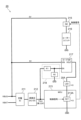
- the electronic circuit shown in FIG. 5 is composed of a charging IC 211, a step-up/step-down DC/DC circuit 212, an MCU 213, a step-up DC/DC circuit 214, a heater switch 215, a heater unit 216, a load switch 217, a voltage division circuit 218, and an LED 20A.
- the charging IC 211 switches the power supply path. For example, when a USB cable is connected to the USB connector 21 (see FIG. 2), the charging IC 211 connects the power supply VBUS to the step-up/step-down DC/DC circuit 212 and the step-up DC/DC circuit 214. On the other hand, when a USB cable is not connected to the USB connector 21, the charging IC 211 connects the power supply VBAT to the step-up/step-down DC/DC circuit 212.
- the step-up/step-down DC/DC circuit 212 is a circuit that converts the power supply VBUS or the power supply VBAT supplied from the charging IC 211 into a system power supply Vsys having a constant voltage.
- the system power supply Vsys is 3.3V. 5
- the system power supply Vsys is supplied to the MCU 213 and the voltage dividing circuit 218.
- the system power supply Vsys here is an example of a first power supply that supplies power to the MCU 213.
- the above-mentioned 5V power supply (or power supply VBUS) is an example of a second power supply.
- the step-up/step-down DC/DC circuit 212 when a power supply VBAT is supplied, the step-up/step-down DC/DC circuit 212 generates the system power supply Vsys by stepping up or stepping down the power supply VBAT.
- the power supply VBAT fluctuates depending on the remaining capacity and degree of deterioration of the secondary battery, but is converted to a constant voltage by the step-up/step-down DC/DC circuit 212.
- the step-up/step-down DC/DC circuit 212 steps down the power supply VBUS to generate the system power supply Vsys.
- the MCU 213 is an example of the control unit 206 (see FIG. 4) that controls the operation of each part constituting the aerosol generating device 1 (see FIG. 1), and is operated by the system power supply Vsys.
- the MCU 213 controls the turning on and off of the LED 20A.
- the MCU 213 controls the turning on and off of the LED 20A through the opening and closing control of a field effect transistor (FET) 213A, which is a switching element.
- FET 213A is an example of a control element that opens and closes the electrical connection of the LED 20A.
- the FET 213A is connected in series to a wiring that connects the LED 20A to ground (GND).
- the MCU 213 controls the FET 213A to an on or off state by switching the voltage applied to the gate terminal (so-called control terminal) of the FET 213A.
- the gate voltage Vg applied to the gate terminal is called the control signal.
- the gate voltage Vg is higher than the gate threshold voltage Vth
- the FET 213A is closed and the LED 20A is turned on.
- the gate voltage Vg is lower than the gate threshold voltage Vth
- the FET 213A is open and the LED 20A is turned off.
- the gate threshold voltage Vth of FET 213A shown in FIG. 5 is approximately 1 V or less.
- the gate threshold voltage Vth here is lower than the lower limit operating voltage at which normal operation of MCU 213 is guaranteed. In other words, the lower limit operating voltage of MCU 213 is higher than the gate threshold voltage Vth of FET 213A. For this reason, there is a possibility that FET 213A may unintentionally enter a closed state during a period when MCU 213 is not controlling the operation of FET 213A.
- FETs 213A are provided for eight LEDs 20A.
- One LED 20A and one FET 213A form a series circuit. Therefore, the eight series circuits are connected in parallel to a 5V power supply. The lighting and extinguishing of each LED 20A is individually controlled by the FET 213A.
- the FET 213A is built in the MCU 213, but the FET 213A can also be provided outside the MCU 213.
- the boost DC/DC circuit 214 is a circuit that converts the power supply VBAT supplied from a secondary battery (not shown) into a constant voltage boost power supply Vboost.
- the boost power supply Vboost is a power supply with a higher potential than the system power supply. For example, it is 5V.
- the boost power supply Vboost is an example of a third power supply different from the 5V power supply. In the case of the first embodiment, the 5V power supply and the boost power supply Vboost are wired separately for the purpose of distributing the load.
- the heater switch (SW) 215 controls the application of the boost power supply Vboost to the heater unit 216.
- the heater switch 215 is a switch element connected in series to the power supply line connecting the step-up DC/DC circuit 214 and the heater unit 216.
- the heater switch 215 is composed of a field effect transistor. The opening and closing of the heater switch 215 as a switch element is controlled by the MCU 213.
- the boost power source Vboost When the heater switch 215 is in a closed state, the boost power source Vboost is supplied to the heater unit 216. On the other hand, when the heater switch 215 is in an open state, the boost power source Vboost is not supplied to the heater unit 216. By controlling the supply of this boost power source Vboost, the temperature of the heater unit 216 transitions in accordance with a predetermined heating profile.
- the opening and closing control of the heater switch 215 may be started by detecting a predetermined user input, for example, an input from the power button 20B (see FIG. 3 ).
- the heater switch 215 is an example of a second control element.
- the heater unit 216 is a component that generates heat when electricity is applied, and heats the stick-shaped substrate 40 inserted in the holding section 209.
- the heater unit 216 is an example of the heating section 207.
- the temperature of the heater unit 216 can be calculated based on the potential difference that appears between both ends of the heater unit 216 (i.e., between the power supply side and the ground side). Incidentally, the calculation of the temperature based on the measured potential difference is performed by the MCU 213.
- the load switch 217 is a switch that controls the supply of 5V power to the LED 20A. 5, a 5V power supply is applied to the VIN terminal of the load switch 217, and a potential obtained by dividing the system power supply Vsys (3.3V in FIG. 5) is applied to the enable terminal EN.
- a voltage divider circuit 218 is used to divide the system power supply Vsys.
- the voltage dividing circuit 218 shown in FIG. 5 is formed of a series circuit of resistors R 1 and R 2 , and the connection midpoint between the resistors R 1 and R 2 is connected to the enable terminal EN of the load switch 217 .
- the resistance value of the resistor R1 is set to a value larger than that of the resistor R2.
- the resistance value of the resistor R1 is set to 500 k ⁇
- the resistance value of the resistor R2 is set to 300 k ⁇ .
- a voltage of approximately 40% of the system power supply Vsys is applied to the enable terminal EN.
- the system power supply Vsys output from the step-up/step-down DC/DC circuit 212 gradually drops and eventually becomes 0 V.
- the voltage divider circuit 218 serves to make the potential applied to the enable terminal EN lower than the potential of the system power supply Vsys.
- the difference between the potential applied to the enable terminal EN and the lower limit operating voltage of the MCU 213 can be set larger than when the resistance value of resistor R1 is set to a value smaller than the resistance value of resistor R2.
- 1 V is output from the voltage dividing circuit 218 when the system power supply Vsys drops to 2.5 V
- 0.8 V is output from the voltage dividing circuit 218 when the system power supply Vsys drops to 2 V.
- the load switch 217 using the output of the voltage dividing circuit 218 as an enable signal can stop the supply of 5V power to the LED 20A at an earlier timing than when the system power supply Vsys is used as an enable signal.
- the load switch 217 that controls the supply of power to the LED 20A in this manner is an example of a first switch.
- Fig. 6 is a circuit diagram illustrating an example of the internal configuration of the load switch 217 used in embodiment 1.
- the load switch 217 shown in Fig. 6 has an N-channel FET 217A connected in series to a 5V power supply. 6, a 5V power supply is applied to a drain terminal D of the FET 217A through a VIN terminal.
- a source terminal S of the FET 217A is connected to an anode terminal of the LED 20A through a VOUT terminal.
- An enable signal is applied to a gate terminal G of the FET 217A through an enable terminal EN.
- the gate threshold voltage Vth of FET 217A is designed to be higher than the lower operating voltage limit of MCU 213 and lower than the potential of the enable signal when the system power supply Vsys is applied in the normal state (here, 3.3 V ⁇ (R2/(R1 + R2))).
- this magnitude relationship will be referred to as "relationship 1."
- the normal state is a state in which the system power supply Vsys is supplied stably and does not include transient states such as the rise and fall of the system power supply Vsys. Since the lower limit operating voltage of the MCU 213 is determined as a characteristic of the MCU 213, the gate threshold voltage Vth of the FET 217A and the resistance values of the resistors R1 and R2 are designed to satisfy the relationship 1.
- the FET 217A of the load switch 217 remains on during normal operation, and when the potential of the system power supply Vsys drops, such as during a reset operation, the FET 217A switches from on to off at a potential higher than the lower operating voltage limit of the MCU 213. That is, during normal operation when the potential of the enable signal is higher than the gate threshold voltage Vth, the FET 217A turns on and outputs 5V power to the VOUT terminal.
- the load switch 217 for the LED 20A is not provided on the wiring to which the boost power source Voost that supplies power to the heater unit 216 is applied. For this reason, if the gate threshold voltage Vth of the heater switch 215 is lower than the lower limit operating voltage of the MCU 213, there is a possibility that the heater switch 215 will be unintentionally turned on during a period when the MCU 213 cannot be controlled. However, even if the heater switch 215 is unintentionally turned on during the reset period, the period is about 0.4 seconds. Therefore, even if power is supplied unintentionally, the temperature rise of the heater unit 216 is limited and does not affect the user's use.
- the occurrence of unintended power supply to the heater unit 216 is not recognized by the user. Therefore, unlike the light emission of the LED 20A, it does not affect the behavior of the user. Furthermore, in order to achieve high heating efficiency, the fewer the resistance elements on the wiring to which the boost power supply Vost is applied, the better. For this reason, in the first embodiment, no load switch is provided on the wiring to which the boost power supply Vost is applied.
- FIG. 7 is a diagram for explaining power supply to the LED 20A when a reset operation is executed in the electronic circuit used in the first embodiment.
- the supply of the system power Vsys output by the step-up/step-down DC/DC circuit 212 to the MCU 213 and the like is stopped. This supply is stopped by a load switch (not shown).
- the off control of the load switch (not shown) is performed by a power driver. For example, when the power driver detects pressing of the power button 20B with the front panel 10 detached from the main unit 20, it controls the load switch to be off.
- the power driver operates independently of the MCU 213.
- the waveform 301 of the system power supply Vsys supplied to the MCU 213 and the voltage dividing circuit 218 starts to decrease from 3.3V.
- the waveform 302 of the enable signal output from the voltage divider circuit 218 starts to drop from a voltage lower than 3.3V.
- the potential of the enable signal drops to or below the gate threshold voltage Vth of the FET 217A in the load switch 217 before the system power supply Vsys supplied to the MCU 213 drops to the lower limit operating voltage.
- the FET 217A in the load switch 217 turns off before the system power supply Vsys supplied to the MCU 213 drops to the lower limit operating voltage. That is, the FET 217A switches from the on state to the off state before the uncontrollable period of the MCU 213 starts. Also, after the uncontrollable period of the MCU 213 ends, the FET 217A switches from the off state to the on state. As a result, even if the supply of 5 V power (waveform 304) continues, at the point when the uncontrollable period begins, the potential applied to the anode terminal of LED 20A (hereinafter referred to as the “anode potential”) drops to near 0 V, as shown by waveform 305.
- Comparative Example Fig. 8 is a diagram for explaining the power supply to the LED 20A when a reset operation is executed by an electronic circuit that does not include a load switch 217.
- parts corresponding to those in Fig. 7 are denoted by the same reference numerals.
- the load switch 217 is not provided, so even if the potential of the system power supply Vsys (waveform 301) supplied to the MCU 213 falls below the lower limit operating voltage of the MCU 213 due to the reset operation, the supply of 5 V power (waveform 305) continues to be supplied to the anode terminal of LED 20A.
- a load switch 217 is provided on the power supply line that supplies power to the LED 20A (see FIG. 1), and a mechanism is adopted that stops the supply of power during a period in which the potential of the system power supply Vsys falls below the lower limit voltage of the operation of the MCU 213 (see FIG. 5).
- the system power supply Vsys supplied to the MCU 213 is used as an enable signal, and control is performed so that operating power is not supplied to the LED 20A during a period in which the MCU 213 (see FIG. 5) cannot be controlled.
- the aerosol generating device 1 employs a mechanism in which the system power supply Vsys is divided by the voltage divider circuit 218, and the divided potential is provided to the load switch 217 as an enable signal. This allows the load switch 217 to be switched to the off state prior to the timing at which the system power supply Vsys drops to the lower operating voltage limit of the MCU 213 due to a reset. In other words, it becomes possible to stop the supply of operating power to the LED 20A earlier than the drop in the system power supply Vsys.
- Fig. 9 is a diagram showing a schematic diagram of an electronic circuit used in the embodiment 2.
- parts corresponding to those in Fig. 5 are denoted by the same reference numerals.
- the electronic circuit shown in FIG. 9 differs from the first embodiment in that the system power supply Vsys supplied to the MCU 213 is supplied to a load switch 217 .
- Fig. 10 is a circuit diagram for explaining an example of the internal configuration of the load switch 217 used in the second embodiment.
- parts corresponding to those in Fig. 6 are denoted by the same reference numerals.
- the condition required for the gate threshold voltage Vth of the FET 217B that switches the supply of 5V power to the LED 20A differs from that of the FET 217A described in FIG.
- the gate threshold voltage Vth of the FET 217B is designed to be higher than the lower limit operating voltage of the MCU 213 and lower than the potential of the enable signal when the system power supply Vsys is applied in the normal state (here, 3.3 V).
- this magnitude relationship will be referred to as "relationship 2.” Since the lower limit operating voltage of the MCU 213 is determined as a characteristic of the MCU 213, the gate threshold voltage Vth of the FET 217B is designed to satisfy the relationship 2.
- Fig. 11 is a diagram for explaining power supply to the LED 20A when a reset operation is executed in the electronic circuit used in the second embodiment.
- parts corresponding to those in Fig. 7 are denoted by the same reference numerals.
- Fig. 11 differs from Fig. 7 in that the system power supply Vsys coincides with the enable signal, and therefore the waveform 302 described in Fig. 7 is not depicted in Fig. 11.
- the gate threshold voltage Vth of the FET 217 B is designed to be an intermediate potential between 3.3 V and the lower limit operating voltage of the MCU 213 . Therefore, when the system power supply Vsys falls below the gate threshold voltage Vth of the FET 217B due to the reset operation, the FET 217B switches from the on state to the off state (waveform 303). From this timing, the potential (waveform 305) applied to the anode terminal of the LED 20A starts to decrease.
- the anode potential of the LED 20A drops to near 0V before the system power supply Vsys drops to the lower limit operating voltage of the MCU 213. Therefore, even if the FET 213A turns on for some reason during the period when the MCU 213 is not controllable (pulse of waveform 306), the anode potential of the LED 20A is insufficient for light emission. Therefore, the LED 20A does not light up, as shown by waveform 307. In other words, lighting of the LED 20A without the control of the MCU 213 (i.e., unintentional lighting) is prevented.
- a load switch 217 is provided on the power line supplying power to LED 20A (see Figure 1), and a mechanism is adopted to stop the supply of power during the period when the potential of the system power supply Vsys falls below the lower operating voltage limit of MCU 213 (see Figure 5).
- a mechanism is adopted to stop the supply of power during the period when the potential of the system power supply Vsys falls below the lower operating voltage limit of MCU 213 (see Figure 5).
- Fig. 12 is a diagram showing a schematic diagram of an electronic circuit used in the embodiment 3.
- parts corresponding to those in Fig. 5 are denoted by the same reference numerals.
- the electronic circuit shown in FIG. 12 differs from the first embodiment in that there is no step-up DC/DC circuit 214 (see FIG. 5) and that the power supply VBUS is supplied to a heater unit 216 via a heater switch 215. 12, the wiring supplying the 5V power supply (or power supply VBUS) is branched into two, one connected to the load switch 217 and the other connected to the heater switch 215. Therefore, both the 5V power supply (or power supply VBUS) supplied to the load switch 217 and the 5V power supply (or power supply VBUS) supplied to the heater switch 215 are examples of the second power supply.
- the load switch 217 for the LED 20A is not provided on the wiring to which the boost power source Vboost that supplies power to the heater unit 216 is applied.
- the gate threshold voltage Vth of the heater switch 215 is lower than the lower limit operating voltage of the MCU 213, there is a possibility that the heater switch 215 will be unintentionally turned on during a period when the MCU 213 cannot be controlled.
- the period is about 0.4 seconds. Therefore, even if power is supplied unintentionally, the temperature rise of the heater unit 216 is limited and does not affect the user's use.
- the occurrence of unintended power supply to the heater unit 216 is not recognized by the user. Therefore, unlike the lighting of the LED 20A, it does not affect the user's behavior. Furthermore, in order to achieve high heating efficiency, the fewer the resistance elements on the wiring to which the boost power supply Vboost is applied, the better. Taking this into consideration, in the first embodiment, no load switch is provided on the wiring to which the boost power supply Vboost is applied.
- a load switch 217 is provided on the power line supplying power to LED 20A (see Figure 1), and a mechanism is adopted to stop the supply of power during the period when the potential of the system power supply Vsys falls below the lower operating voltage limit of MCU 213 (see Figure 5).
- a mechanism is adopted to stop the supply of power during the period when the potential of the system power supply Vsys falls below the lower operating voltage limit of MCU 213 (see Figure 5).
- the system power supply Vsys is divided by the voltage divider circuit 218, and the potential after the voltage division is provided to the enable terminal EN of the load switch 217. This makes it possible to stop the supply of operating power to the LED 20A earlier than the decrease in the system power supply Vsys.
- a circuit configuration without the voltage divider circuit 218 may be used.
- the load switch 217 is used to prevent the LED 20A from turning on unintentionally.
- the load switch 217 may be used to prevent the display device, sound output device, and vibration device from operating unintentionally.
- the load switch 217 may be provided on all or some of the LED 20A and other light-emitting devices, the display device, the sound output device, and the vibration device.
- the system power supply Vsys or a voltage obtained by dividing the system power supply Vsys is used as the enable signal, but the supply of 5V power to LED 20A by load switch 217 may be controlled by other circuit configurations.
- the system power supply Vsys or the system power supply Vsys may be compared with a reference voltage, and the FET 217A in the load switch 217 may be switched by the H-level output and the L-level output that are the comparison result.
- the aerosol source is described as being solid, but the aerosol source may be liquid.
- the aerosol source is liquid, a method is adopted in which the aerosol source is guided to a thin tube called a wick by using capillary action, and the aerosol source is evaporated by heating a coil wound around the wick.
- the heating of the aerosol source is linked to the inhalation of the user.
- the liquid aerosol source is heated.
- an upper limit e.g., 2.5 seconds
- heating time length for one inhalation is set for the heating time length for one inhalation, and heating of the aerosol source is stopped when the upper limit is reached even if the inhalation continues beyond the upper limit.
- the amount of power required for heating is less for a liquid aerosol source than for a solid aerosol source, so it is easier to employ the electronic circuit described in the third embodiment in the case of a liquid aerosol source than in the case of a solid aerosol source.
- an aerosol generating device that generates an aerosol by heating a solid aerosol source has been described.
- an aerosol generating device that generates an aerosol by separately heating a solid aerosol source and a liquid aerosol source may also be used.
- This type of aerosol generating device is also called a hybrid aerosol generating device.
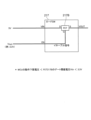
- An aerosol generating device having a heating unit that heats an aerosol source, a notification unit that notifies a user of information related to the heating of the aerosol source, a control unit that controls the operation of the notification unit, a control element controlled by the control unit that opens and closes an electrical connection of the notification unit, a first power supply that supplies power to the control unit, a second power supply that supplies power to the notification unit, and a first switch that uses power supplied from the first power supply as an enable signal to control the power supply from the second power supply to the notification unit.
- An aerosol generating device described in (6) in which the supply of power from a third power source to the heating unit is controlled by a second control element, and no switch is included between the third power source and the heating unit for controlling the supply of power from the third power source to the heating unit using the power supplied from the first power source as an enable signal.
- An aerosol generating device described in (8) which does not include a switch between the second power source and the heating unit that uses power supplied from the first power source as an enable signal to control the power supply from the second power source to the heating unit.
- 1...aerosol generating device 10...front panel, 10A...window, 20...main body device, 20A...LED, 20B...power button, 20C...magnet, 21...USB connector, 30...shutter, 40...stick-shaped substrate, 40A...substrate part, 40B...suction port part, 201...power supply part, 202...sensor part, 203...notification part, 204...memory part, 205...communication part, 206...control part, 2 07...heating section, 208...insulating section, 209...holding section, 209A...internal space, 209B...opening, 209C...bottom, 211...charging IC, 212...step-up/step-down DC/DC circuit, 213...MCU, 213A, 217A, 217B...FET, 214...step-up DC/DC circuit, 215...heater switch, 216...heater unit, 217...load switch, 218...voltage divider circuit
Landscapes
- Engineering & Computer Science (AREA)
- Human Computer Interaction (AREA)
- Charge And Discharge Circuits For Batteries Or The Like (AREA)
- Catching Or Destruction (AREA)
Priority Applications (6)
| Application Number | Priority Date | Filing Date | Title |
|---|---|---|---|
| EP23943659.5A EP4736687A1 (en) | 2023-06-29 | 2023-06-29 | Aerosol generation device |
| PCT/JP2023/024177 WO2025004264A1 (ja) | 2023-06-29 | 2023-06-29 | エアロゾル生成装置 |
| KR1020257041171A KR20260003845A (ko) | 2023-06-29 | 2023-06-29 | 에어로졸 생성 장치 |
| JP2025529121A JPWO2025004264A1 (https=) | 2023-06-29 | 2023-06-29 | |
| CN202380099500.2A CN121358365A (zh) | 2023-06-29 | 2023-06-29 | 气溶胶产生装置 |
| TW112138330A TW202500032A (zh) | 2023-06-29 | 2023-10-05 | 霧氣生成裝置 |
Applications Claiming Priority (1)
| Application Number | Priority Date | Filing Date | Title |
|---|---|---|---|
| PCT/JP2023/024177 WO2025004264A1 (ja) | 2023-06-29 | 2023-06-29 | エアロゾル生成装置 |
Publications (1)
| Publication Number | Publication Date |
|---|---|
| WO2025004264A1 true WO2025004264A1 (ja) | 2025-01-02 |
Family
ID=93938007
Family Applications (1)
| Application Number | Title | Priority Date | Filing Date |
|---|---|---|---|
| PCT/JP2023/024177 Ceased WO2025004264A1 (ja) | 2023-06-29 | 2023-06-29 | エアロゾル生成装置 |
Country Status (6)
| Country | Link |
|---|---|
| EP (1) | EP4736687A1 (https=) |
| JP (1) | JPWO2025004264A1 (https=) |
| KR (1) | KR20260003845A (https=) |
| CN (1) | CN121358365A (https=) |
| TW (1) | TW202500032A (https=) |
| WO (1) | WO2025004264A1 (https=) |
Citations (6)
| Publication number | Priority date | Publication date | Assignee | Title |
|---|---|---|---|---|
| JPS63204930A (ja) * | 1987-02-20 | 1988-08-24 | Mitsubishi Electric Corp | 発光素子駆動回路 |
| JP2016129185A (ja) * | 2015-01-09 | 2016-07-14 | セイコーエプソン株式会社 | 電子機器、印刷装置、及び、電子機器の制御方法 |
| JP2021526007A (ja) | 2019-04-30 | 2021-09-30 | ケーティー・アンド・ジー・コーポレーション | エアロゾル発生装置用カートリッジ、及びそれを製造する方法 |
| JP2021528084A (ja) | 2018-06-25 | 2021-10-21 | ジュール・ラブズ・インコーポレイテッドJuul Labs, Inc. | 気化器デバイスのヒータ制御装置 |
| JP2022044472A (ja) * | 2020-09-07 | 2022-03-17 | 日本たばこ産業株式会社 | エアロゾル生成装置の電源ユニット |
| WO2023105772A1 (ja) * | 2021-12-10 | 2023-06-15 | 日本たばこ産業株式会社 | エアロゾル生成装置の電源ユニット |
-
2023
- 2023-06-29 KR KR1020257041171A patent/KR20260003845A/ko active Pending
- 2023-06-29 CN CN202380099500.2A patent/CN121358365A/zh active Pending
- 2023-06-29 EP EP23943659.5A patent/EP4736687A1/en active Pending
- 2023-06-29 WO PCT/JP2023/024177 patent/WO2025004264A1/ja not_active Ceased
- 2023-06-29 JP JP2025529121A patent/JPWO2025004264A1/ja active Pending
- 2023-10-05 TW TW112138330A patent/TW202500032A/zh unknown
Patent Citations (6)
| Publication number | Priority date | Publication date | Assignee | Title |
|---|---|---|---|---|
| JPS63204930A (ja) * | 1987-02-20 | 1988-08-24 | Mitsubishi Electric Corp | 発光素子駆動回路 |
| JP2016129185A (ja) * | 2015-01-09 | 2016-07-14 | セイコーエプソン株式会社 | 電子機器、印刷装置、及び、電子機器の制御方法 |
| JP2021528084A (ja) | 2018-06-25 | 2021-10-21 | ジュール・ラブズ・インコーポレイテッドJuul Labs, Inc. | 気化器デバイスのヒータ制御装置 |
| JP2021526007A (ja) | 2019-04-30 | 2021-09-30 | ケーティー・アンド・ジー・コーポレーション | エアロゾル発生装置用カートリッジ、及びそれを製造する方法 |
| JP2022044472A (ja) * | 2020-09-07 | 2022-03-17 | 日本たばこ産業株式会社 | エアロゾル生成装置の電源ユニット |
| WO2023105772A1 (ja) * | 2021-12-10 | 2023-06-15 | 日本たばこ産業株式会社 | エアロゾル生成装置の電源ユニット |
Also Published As
| Publication number | Publication date |
|---|---|
| KR20260003845A (ko) | 2026-01-07 |
| CN121358365A (zh) | 2026-01-16 |
| EP4736687A1 (en) | 2026-05-06 |
| TW202500032A (zh) | 2025-01-01 |
| JPWO2025004264A1 (https=) | 2025-01-02 |
Similar Documents
| Publication | Publication Date | Title |
|---|---|---|
| CN107183785A (zh) | 蒸气输送装置 | |
| CN104135877A (zh) | 充电电子香烟 | |
| EP3979456B1 (en) | Power supply unit for aerosol generation device | |
| CN117500395A (zh) | 吸入器用控制器 | |
| US20240100275A1 (en) | Controller for inhalation apparatus | |
| WO2025004264A1 (ja) | エアロゾル生成装置 | |
| KR20240006535A (ko) | 에어로졸 생성 장치의 회로 유닛 및 에어로졸 생성 장치 | |
| KR20230093182A (ko) | 에어로졸 생성 장치 | |
| WO2025004266A1 (ja) | エアロゾル生成装置 | |
| WO2025004267A1 (ja) | エアロゾル生成装置 | |
| JP7802186B2 (ja) | カバー部材 | |
| JP7843104B2 (ja) | 電子機器及びプログラム | |
| EP4613134A1 (en) | Aerosol generation device and program | |
| WO2023047550A1 (ja) | エアロゾル生成装置の電源ユニット | |
| CN115697106A (zh) | 气溶胶生成装置的电源单元 | |
| EP4608063A1 (en) | Cover member | |
| EP4635345A1 (en) | Electronic device and aerosol generation device | |
| EP4640092A1 (en) | Aerosol generation device and program | |
| WO2024134765A1 (ja) | エアロゾル生成装置及びプログラム | |
| WO2024127627A1 (ja) | エアロゾル生成装置 | |
| WO2024053052A1 (ja) | エアロゾル生成装置及びプログラム |
Legal Events
| Date | Code | Title | Description |
|---|---|---|---|
| 121 | Ep: the epo has been informed by wipo that ep was designated in this application |
Ref document number: 23943659 Country of ref document: EP Kind code of ref document: A1 |
|
| ENP | Entry into the national phase |
Ref document number: 2025529121 Country of ref document: JP Kind code of ref document: A Ref document number: 1020257041171 Country of ref document: KR Free format text: ST27 STATUS EVENT CODE: A-0-1-A10-A15-NAP-PA0105 (AS PROVIDED BY THE NATIONAL OFFICE) |
|
| WWE | Wipo information: entry into national phase |
Ref document number: 1020257041171 Country of ref document: KR Ref document number: 2025529121 Country of ref document: JP |
|
| WWP | Wipo information: published in national office |
Ref document number: 1020257041171 Country of ref document: KR |
|
| WWE | Wipo information: entry into national phase |
Ref document number: 2023943659 Country of ref document: EP |
|
| NENP | Non-entry into the national phase |
Ref country code: DE |
|
| ENP | Entry into the national phase |
Ref document number: 2023943659 Country of ref document: EP Effective date: 20260129 |
|
| ENP | Entry into the national phase |
Ref document number: 2023943659 Country of ref document: EP Effective date: 20260129 |