WO2025003074A1 - Fabrication de kits d'amplification en chaine par polymerase optimisant une phase d'hybridation de l'amplification - Google Patents
Fabrication de kits d'amplification en chaine par polymerase optimisant une phase d'hybridation de l'amplification Download PDFInfo
- Publication number
- WO2025003074A1 WO2025003074A1 PCT/EP2024/067684 EP2024067684W WO2025003074A1 WO 2025003074 A1 WO2025003074 A1 WO 2025003074A1 EP 2024067684 W EP2024067684 W EP 2024067684W WO 2025003074 A1 WO2025003074 A1 WO 2025003074A1
- Authority
- WO
- WIPO (PCT)
- Prior art keywords
- molecules
- hybridization
- matrix
- concentration
- simulation
- Prior art date
- Legal status (The legal status is an assumption and is not a legal conclusion. Google has not performed a legal analysis and makes no representation as to the accuracy of the status listed.)
- Ceased
Links
Classifications
-
- G—PHYSICS
- G16—INFORMATION AND COMMUNICATION TECHNOLOGY [ICT] SPECIALLY ADAPTED FOR SPECIFIC APPLICATION FIELDS
- G16B—BIOINFORMATICS, i.e. INFORMATION AND COMMUNICATION TECHNOLOGY [ICT] SPECIALLY ADAPTED FOR GENETIC OR PROTEIN-RELATED DATA PROCESSING IN COMPUTATIONAL MOLECULAR BIOLOGY
- G16B5/00—ICT specially adapted for modelling or simulations in systems biology, e.g. gene-regulatory networks, protein interaction networks or metabolic networks
- G16B5/30—Dynamic-time models
-
- G—PHYSICS
- G16—INFORMATION AND COMMUNICATION TECHNOLOGY [ICT] SPECIALLY ADAPTED FOR SPECIFIC APPLICATION FIELDS
- G16B—BIOINFORMATICS, i.e. INFORMATION AND COMMUNICATION TECHNOLOGY [ICT] SPECIALLY ADAPTED FOR GENETIC OR PROTEIN-RELATED DATA PROCESSING IN COMPUTATIONAL MOLECULAR BIOLOGY
- G16B25/00—ICT specially adapted for hybridisation; ICT specially adapted for gene or protein expression
- G16B25/20—Polymerase chain reaction [PCR]; Primer or probe design; Probe optimisation
Definitions
- a polymerase chain reaction also called a polymerase chain reaction, and abbreviated "PCR" is a reaction allowing the multiplication of nucleic acid molecules (for example DNA or RNA). At each reaction cycle, each nucleic acid molecule is duplicated.
- PCR amplification is generally carried out in a PCR kit applying different temperatures in order to trigger the successive steps of the amplification cycles.
- the PCR kit initially contains primers making it possible to initiate the amplification.
- PCR kit The success and speed of PCR amplification depend on many parameters of the PCR kit, including the durations and temperatures of the different stages of the reaction, the sequences of the primers initially present in the kit, their concentration, the concentrations of monovalent and divalent salts, oligonucleotides in solution, the length of the expected amplicons (shorter amplicons also allowing shorter cycle times), etc.
- the designer performs the following steps: a) identifies for each microorganism a list of specific potential targets (i.e.
- a method for manufacturing a kit for the characterization of microorganisms included in a sample by using a polymerase chain reaction, said kit comprising a plurality of validated primers, method in which the plurality of primers and the concentration vector for said plurality of primers are obtained by a simulation method according to one of the embodiments of the invention.
- This makes it possible to manufacture a device reproducing the reaction as simulated. The device thus produced will therefore allow the multiplication of targets as previously simulated.
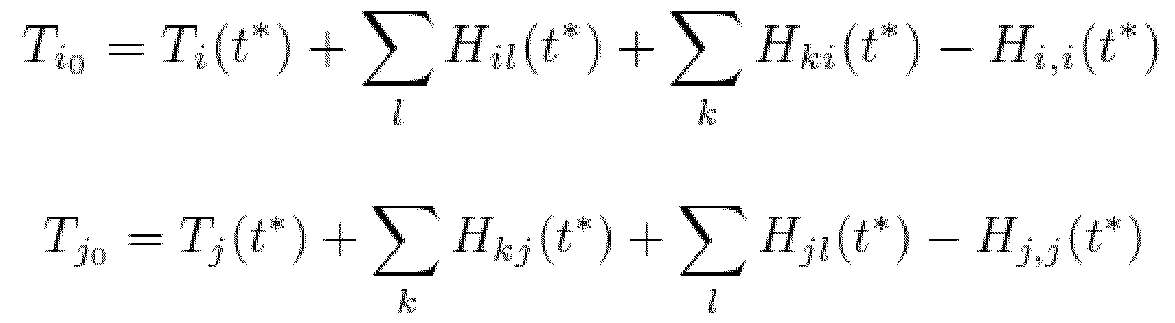
- the differential equation integrates mass conservation equations of the form:
- ⁇ ⁇ represents the time elapsed since the start of the hybridization phase
- the notations ⁇ ⁇ and ⁇ ⁇ respectively denote the concentrations of two nucleic acid molecules in the form of single strands of indices i and j in the vector ⁇ of concentrations of a plurality of nucleic acid molecules
- the notation ⁇ ⁇ ⁇ denotes the concentration of a duplex formed by the hybridization of the pair of nucleic acid molecules in the form of single strands of indices x and y in the vector ⁇ of concentrations of a plurality of nucleic acid molecules
- matrix differential equation is of the following form: in which: H is the concentration matrix of the duplexes; T0 is the initial value for the cycle of the concentration vector of the plurality of molecules; Kon is the association matrix; Koff is the dissociation matrix; the operator ⁇ ⁇ , ⁇ represents a two-dimensional matrix comprising i rows and j columns whose elements are all equal to 1; the operator "diag()" denotes a operator taking as parameter a square matrix and extracting from this square matrix a vector having as dimension the number of rows or columns of the square matrix and containing all the elements of the diagonal of the square matrix.
- the modification of the plurality of primers comprises: the identification of a target to be favored according to the results of the simulation of the polymerase chain reaction; the identification, from the association matrix or the dissociation matrix, of a nucleic acid molecule in the form of a single strand forming a pair with a primer associated with said target; the carrying out at least one modification of the chosen polymerase chain reaction among: a decrease, in the initial concentration vector, of the initial concentration of said nucleic acid molecule in the form of a single strand forming a pair with the primer associated with said target; a modification of the salt concentration; a modification of the hybridization temperature for at least one cycle; a modification of the hybridization duration of at least one cycle.
- the sample is taken from an inanimate object, said method comprising the choice of an antimicrobial according to the characterization of the microorganisms present in said sample, and the application of said antimicrobial to said inanimate object.
- a method for numerical simulation of a polymerase chain reaction of at least one target is proposed, said method comprising the simulation of a plurality of successive cycles of the amplification, each cycle comprising, sequentially: a hybridization phase between the at least one target and a plurality of primers; an elongation phase; then a denaturation phase; wherein, for each cycle: the hybridization phase comprises: obtaining an initial value for the cycle of a vector of concentrations of a plurality of single-stranded nucleic acid molecules comprising the at least one target and the plurality of primers; calculating a matrix of concentrations of partial duplexes formed by the hybridization of the plurality of single-stranded nucleic acid molecules, each element of said matrix representing the concentration of the duplexes
- a kit for polymerase chain reaction manufactured by a method as defined herein.
- a computer program comprising instructions for implementing all or part of a method as defined herein when this program is executed by a processor.
- a non-transitory, computer-readable recording medium on which such a program is recorded.
- At least one duplex results from the pairing between two primers;
- the elongation phase simulates the concentration of each duplex resulting from the pairing between two primers in a single concentration of elongated duplex resulting from the pairing between two primers;
- the coefficients of the denaturation tensor are defined so as to distribute each concentration of elongated duplex resulting from the pairing between two primers into nucleic acid molecules in the form of single strands corresponding to an elongation of the duplex resulting from the pairing between the two primers in both directions.
- the concentrations of elongated duplexes comprise a concentration of an elongated virtual duplex equal to the sum of the concentrations of the elongated duplexes formed by the elongation in each of the two directions of the duplexes formed by the hybridization of the two primers; the coefficients of the denaturation tensor of the elongated duplexes corresponding to the distribution of the concentration of the elongated virtual duplex towards each of the two primers, and each of the two nucleic acids in the form of single strands resulting from the elongation in one of the two directions are all equal to 0.5.
- concentration of an elongated virtual duplex is meant a concentration of an elongated duplex not corresponding to a real molecule, but to several elongated duplexes resulting from the hybridization of the same primer on the same nucleic acid molecule in single-strand form in several distinct locations, then from the elongation of the duplexes thus formed.
- concentration of the virtual elongated duplex is then equal to the sum of the concentrations of the real elongated duplexes created by the hybridization reactions of the primer with the nucleic acid molecule in single-strand form in the different positions, then the elongation of the duplexes thus formed.
- the elongation phase comprises: obtaining the concentrations of the elongated duplexes by multiplying the concentrations of the duplexes by elongation coefficients.
- the term “elongation coefficient” means the fraction, between 0 and 1, of the molecules of a given duplex that are elongated during an elongation phase. [0077] This makes it possible to take into account each possible difference in the elongation process of the different duplexes.
- the elongation phase further comprises updating the duplex concentration vector, representing the concentration of the non-elongated duplexes at the end of the elongation phase;
- the denaturation phase further comprises multiplying said duplex concentration vector by a denaturation tensor of the non-elongated duplexes to update the initial value for the following cycle of the concentration vector of the plurality of nucleic acid molecules in the form of single strands.
- the method comprises a subsequent step of validating or modifying the plurality of primers and the initial value of the concentration vector for said plurality of primers in the first cycle of the reaction by comparing a value representative of the kinetics of a reaction to a threshold.
- the sample is taken from an animal or a human being, said method comprising the choice of an antimicrobial according to the characterization of the microorganisms present in said sample, and the administration of said antimicrobial to said animal or human being.
- the sample is taken from an inanimate object, said method comprising the choice of an antimicrobial according to the characterization of the microorganisms present in said sample, and the application of said antimicrobial to said inanimate object.
- FIG.7 shows an example of hybridization, elongation and denaturation reactions over 3 successive PCR amplification cycles in a set of embodiments of the invention.
- Fig.8 [0096] [Fig.8] shows an example of a method according to a set of embodiments of the invention integrating a validation or modification of the PCR amplification parameters.
- Fig.9 [0097] [Fig.9] shows an example of a method according to a set of embodiments of the invention integrating a validation or modification of the PCR amplification parameters, and a manufacture of a validated PCR amplification kit.
- Fig. 10 [0098] [Fig.
- FIG. 10 shows an example of a method for characterizing a microorganism using a PCR amplification kit manufactured according to a set of embodiments of the invention.
- Fig. 11 [0099] [Fig. 11] shows an example of visualization of the kinetics of several PCR reactions according to a set of embodiments of the invention.
- Fig. 12 [0100] [Fig. 12] shows an example of visualization of the kinetics of several PCR reactions under two distinct experimental conditions according to a set of embodiments of the invention. Description of the embodiments [0101] Reference is now made to FIG. 1. [0102] FIG.
- kits 1 represent an example of a K1 kit for polymerase chain reaction for the manufacture of which the invention can be implemented, for example a kit used for the FilmArray and Spotfire platforms manufactured and marketed by the Applicant. Such a kit is for example described in the document US 8,394,608 or US 9932634 incorporated by reference.
- the kit K1 is part of a test equipment Tst1 intended to test the presence of one or more microorganisms, for example by one or more viruses, bacteria, fungi and antibiotic resistance genes.
- the test equipment Tst1 comprises a swab Ecv1 allowing a nasal sample to be taken from a patient.
- the sample can then be provided as input to the K1 kit in order to perform a PCR amplification, in order to amplify one or more nucleic acids representative of the microorganism(s) whose presence is sought, for example as described in the aforementioned documents.
- a PCR amplification in order to amplify one or more nucleic acids representative of the microorganism(s) whose presence is sought, for example as described in the aforementioned documents.
- the sampling may be carried out on a human being, an animal or an inanimate object, and may result in the characterization of one or more microorganisms.
- the characterization of one or more microorganisms may allow the choice of an antimicrobial, with a view to its administration to a human being or an animal, or its application to the inanimate object.
- the invention applies to the step of PCR amplification of a targeted part of genomes before their complete sequencing, for example an amplification of the r16S portion in the context of microbial metagenomic identification.
- Figure 2 shows an example of a polymerase chain reaction that can be simulated according to a set of embodiments.
- the polymerase chain reaction comprises several successive cycles Cyc21, Cyc22, Cyc23...Cyc2n. In order to improve the readability of the figure, only the first cycle Cyc21 will be detailed.
- the PCR2 reaction is carried out in a PCR kit, for example in the K1 kit.
- the PCR kit initially contains: - nucleic acids of one or more sequences to be amplified, or “target”, for example the Cib2 target shown in Figure 2.
- the nucleic acids of the sequences to be amplified may initially come from a sample, for example via the Ecv1 swab; - dNTP2 nucleotides; - PolyM2 polymerase; - AM2 primers.
- Each PCR amplification cycle comprises: - a denaturation phase, denoted Denat21 for the Cyc21 cycle, during which the nucleic acids in the form of double strands are separated into two nucleic acids in the form of single strands.
- Denat21 a denaturation phase
- a target Cib2 is initially present in the form of a double-stranded nucleic acid.
- the denaturation phase it is separated into two nucleic acids in the form of single strands Nuc21 and Nuc22; - a hybridization phase, denoted Hybr21 for the Cyc21 cycle, during which primers hybridize to the nucleic acids in the form of single strands.
- the primers AM21 and AM22 respectively hybridize with the nucleic acids in the form of single strands Nuc21 and Nuc22; - an elongation phase, noted Elong21 for cycle 21, during which nucleotides complete the primers to form nucleic acids in the form of double strands identical to the initial target, called amplicons, Amp21 and Amp22 in the case of the Elong21 phase.
- a single Cib2 target has made it possible to generate two identical amplicons Amp21 and Amp22, which can themselves be duplicated in the following cycle.
- the amplicons are thus duplicated: a single Cib2 target results in the generation of two amplicons at the end of the 1 e Cyc21 cycle, four amplicons at the end of 2 e Cyc22 cycle, eight amplicons at the end of 3 e Cyc23 cycle, etc.
- the amplification shown in Figure 2 is provided as a non-limiting example only of an amplification that can be simulated by the invention.
- Graph Grph3 more precisely represents the evolution of the temperature as a function of time, for an example of two successive PCR amplification cycles Cyc31 and Cyc32. Indeed, the different phases of PCR amplification are activated by temperature variations in the amplification kit. In this example, the temperature profile is identical between the cycles, and will be detailed for the cyc31 cycle. [0121] Generally speaking, the temperature changes as follows during a PCR amplification cycle: - it is initially at a first temperature during the hybridization phase, simultaneous with the elongation phase; - then increases rapidly to reach a second, higher temperature, triggering the denaturation phase, before returning to the level of the first temperature for the hybridization phase of the following cycle.
- the hybridization and elongation phases Hybr31 are activated by a first temperature of 60° for a duration Thybr; - the denaturation phase Denat31 is activated by a higher temperature, in this example, of 96°.
- the times and temperatures shown in Figure 3 are provided as a non-limiting example only, and the invention is applicable to PCR amplifications carried out for very different times and temperatures. If in the example of Figure 3 the hybridization and elongation phases are simultaneous, in other PCR amplification reactions, three separate temperatures are used to trigger the hybridization, elongation and denaturation phases respectively. The temperatures and times of the different phases influence the amplification reaction.
- the amplification reaction(s) are therefore impacted by numerous parameters such as: - the temperatures and times of each phase of the reaction (which may be fixed or vary according to the cycles); - the choice and concentrations of the primers; - the concentrations of monovalent and divalent salts; - the length of the expected amplicons; - etc. [0125] These different factors can also promote unexpected reactions such as for example: - the formation of primer dimers, when two primers hybridize to each other; - multi-hybridization reactions when primers hybridize not only to one end of a nucleic acid in the form of single strands, but also to other locations, for example in the middle of a strand.
- the amplification parameters can therefore facilitate, or on the contrary slow down a desired amplification, called a specific reaction, or even prevent the proper development of a reaction, when unwanted/unexpected reactions, called non-specific reactions, hinder it.
- One of the objectives of the simulation of a PCR amplification reaction is therefore to model as accurately as possible the amplification reaction according to the environmental parameters of the reaction, in order to validate, or on the contrary to modify the design of a kit (i.e. the parameter values used to promote a given amplification reaction – e.g.
- the simulation comprises a plurality of successive amplification cycles, each cycle successively comprising a hybridization phase S41, an elongation phase S42 and a denaturation phase S43.
- the simulation can be carried out for a limited number of cycles. For example, each cycle can be identified by a cycle index ncyc, incremented during a step S45 between each cycle.
- a stopping criterion can be verified.
- the simulation can be carried out for a predefined number of cycles NCyc.
- the concentrations of the amplicons can be compared between two cycles, and the simulation stopped when a minimum number of cycles is reached, and the difference between the concentrations of the amplicons at the end of two successive cycles is lower than a threshold predefined.
- this criterion consists in detecting the cycle from which the reaction is considered to be finished; - the simulation can be stopped as soon as the concentration of a given amplicon is greater than a threshold, for example a detectability threshold of the amplicon; - etc.
- Figure 4 represents an example where the stopping criterion is the achievement of a number of cycles NCyc. However, this example is provided as a non-limiting example only. As indicated above, one or more different criteria can be used to detect the end of the simulation. [0134] In the remainder of the description, several simulation examples will be described, using certain notations introduced below.
- the concentrations of the molecules of interest will be noted in a vector noted ⁇ represented below: Equation 1 [0136]
- the elements ⁇ ⁇ ⁇ 1 , ... ⁇ ⁇ ⁇ ⁇ ⁇ represent the concentrations of possible amplicons (specific and non-specific) produced during PCR amplification. It should be noted here that, since the targets and amplicons correspond to the same molecule, these values correspond to the sum of the concentrations of the targets and amplicons for a given target.
- the elements ⁇ ⁇ 1 , ... ⁇ ⁇ ⁇ represent the concentrations of the possible primers.
- the units of the vector elements can be mol.L -1 .
- the plurality of molecules whose concentrations are noted in the vector ⁇ can be obtained in different ways, and includes in particular the concentration of the amplicons, and the plurality of primers present in the simulated kit.
- the plurality of molecules whose concentrations are noted in the vector ⁇ can come from a list of molecules defined by an expert user.
- the plurality of molecules whose concentration is noted in the vector ⁇ is determined by means of an initial simulation of a limited number of cycles.
- the initial simulation has the sole purpose of determining the molecules present in the amplification kit at the end of the limited number of cycles, regardless of their concentration.
- the plurality of molecules can be initialized like the molecules initially present in the polymerase chain reaction (in particular amplicons and primers), then the initial simulation can comprise the simulation of a plurality of successive cycles of the following steps: - obtaining the hybridization reactions of the molecules forming each pair of molecules among said plurality of molecules having an affinity lower than a threshold (or higher in absolute value, the affinities being negative values).
- this step consists in identifying, from the molecules initially present in the cycle of the initial simulation, the pairs of molecules having an affinity lower than a threshold (or higher in absolute value), that is to say the pairs of molecules which can be considered to react together; - simulation of a hybridization phase implementing said hybridization reactions.
- This initial simulation hybridization phase consists solely of identifying the duplexes formed by the identified hybridization reactions; - simulation of an elongation phase.
- This initial simulation hybridization phase consists solely of identifying the elongated duplexes obtained from the duplexes identified in the previous step; - simulation of a denaturation phase.
- This initial simulation of the denaturation phase consists of identifying the molecules obtained by the denaturation of the duplexes, and elongated duplexes, obtained in the two previous steps; - an addition to said plurality of molecules of the additional molecules obtained at the end of the hybridization, elongation and denaturation phases.
- This step consists of adding to the plurality of molecules the molecules which are obtained at the end of a cycle and which were not yet present therein. [0142]
- new molecules resulting from the reactions of the previous cycle can be added to the plurality of molecules already identified, these new molecules themselves being capable of generating new reactions.
- the number of cycles of the initial simulation can be defined in different ways. For example: - it can be a predefined number of initial simulation cycles; - the number of molecules added at the end of each cycle can be counted, and the initial simulation can be stopped when the number of molecules added at the end of a given cycle is zero or low, for example if the number of molecules added is less than a given threshold. - Etc. [0144] The inventors have found that the number of initial simulation cycles can be between 3 and 7, and for example equal to 5, a sufficient number to obtain a definitive list of molecules having a significant impact on the results of the PCR. [0145] This provides a good compromise between the number of molecules added and their importance.
- molecules added after the 3 e , 5 e or 7 e cycle can be considered as not likely to give rise to significant reactions.
- a simulation over a limited number of cycles is sufficient, because the molecules that would only appear after a few cycles would not be likely to generate significant reactions, compared to reactions that have already started for several cycles. Indeed, their very low concentration compared to the molecules already present with which they are in competition in the mixture does not allow them to multiply significantly.
- FIG. 5 represents an example of a hybridization phase in a set of embodiments of the invention.
- the hybridization phase S41 for a given cycle comprises a first sub-step S411 of obtaining an initial value ⁇ 0 for the cycle of a vector of concentrations of a plurality of nucleic acid molecules in the form of single strands comprising the plurality of amplicons and the plurality of primers.
- the vector of concentrations may for example be the vector ⁇ mentioned above.
- the initial value ⁇ 0 of the vector can for example correspond to: - the initial concentrations of the molecules before the start of the amplification reaction, if the simulated cycle is the first cycle; and 0 for the molecules appearing in the following cycles - the concentrations of the molecules at the end of the previous cycle, if the cycle is not the first cycle.
- the simulation of the hybridization phase then aims to model the hybridization reactions taking place during the cycle.
- Hybridization is governed by the following equilibrium relationships between each pair of molecules ⁇ ⁇ and ⁇ ⁇ likely to hybridize: Equation 2 [0153] It should be noted here that such an equation must therefore be established by taking into account for each possible hybridization reaction between a pair of molecules of indices i and j (i and j can be equal), depending on the molecules present in the vector ⁇ .
- Equation 3 [0155]
- - the notations ⁇ ⁇ and ⁇ ⁇ respectively denote the concentrations of a pair of nucleic acid molecules in the form of single strands with indices i and j in the vector ⁇ involved in a given hybridization reaction
- - the notation ⁇ ⁇ ⁇ denotes the concentration of a duplex formed by the hybridization of the pair of nucleic acid molecules in the form of single strands of indices i and j in the vector ⁇
- - the notations ⁇ ⁇ ⁇ ⁇ and ⁇ ⁇ ⁇ ⁇ ⁇ denote respectively the association and dissociation constants of the hybridization reaction of the pair of nucleic acid molecules in the form of single strands of indices i and j in the vector ⁇ .
- the predefined threshold may be identical for all reactions, or chosen from different thresholds depending on the cases.
- the threshold value may be chosen from at least two predefined threshold values, the lowest threshold value being reserved for pairs of molecules comprising a matched amplicon and primer.
- the threshold of variation of free enthalpy above which a hybridization reaction is not taken into account in the simulation is lower (closer to 0) for hybridization reactions between an amplicon and a primer than for the others (and therefore also lower in absolute value, the thresholds of variation of free enthalpy being negative).
- the differential equations integrate mass conservation equations of the following form: Equation 5 [0162] In which: - ⁇ ⁇ represents the time elapsed since the start of the hybridization phase; - the notations ⁇ ⁇ and ⁇ ⁇ respectively denote the concentrations of two nucleic acid molecules in the form of single strands of indices i and j in the vector ⁇ of concentrations of a plurality of nucleic acid molecules; - the notation ⁇ ⁇ ⁇ denotes the concentration of a duplex formed by the hybridization of the pair of nucleic acid molecules in the form of single strands of indices x
- Equation 6 In order to solve the system of differential equations, one of the principles of the simulation of the hybridization phase as represented in FIG. 5 is to represent these equations in the form of a matrix differential equation. [0168] For this purpose, in the example of FIG.
- the simulation of the hybridization phase S41 comprises a sub-second step S412 of initializing a matrix of concentrations ⁇ , or ⁇ of the duplexes formed by the hybridization of the plurality of nucleic acid molecules in the form of single strands.
- the matrix may be an N x N matrix (N being the length of the vector ⁇ ) formed in the following manner: - each row and each column corresponds to a nucleic acid molecule; - each cell includes the concentration of the duplex formed by the hybridization of the pair of nucleic acid molecules of the row and column to which the cell belongs.
- the hybridization phase S41 for a given cycle then comprises a third sub-step S413 of calculating, by successive time steps, the evolution of the concentration matrix during the hybridization phase, by applying to the concentration matrix a matrix differential equation representing the kinetics of formation of said duplexes as a function of the concentrations of the plurality of nucleic acid molecules in the form of single strands.
- the calculation of the evolution of the matrix can for example be carried out in the following manner: - the calculation is carried out for a number of time steps Npdt corresponding to the duration of the hybridization phase.
- a time step can for example have a duration of between 1 and 10 milliseconds.
- a time step can for example be chosen to find a compromise between convergence of the calculation, calculation speed and precision of the result; - a time step index npdt is initialized to 1; - at each time step, the sub-step S413 of calculating the evolution of the concentration matrix is performed; - at the end of the calculation, a sub-step S414 verifies that the index of the time step npdt is indeed less than the number of time steps Npdt; - if the index of the time step npdt is less than the number of time steps Npdt, the index of the time step npdt is incremented in sub-step S412, then a new iteration of the sub-step S413 of calculating the evolution of the concentration matrix is performed; - when the index of the time step npdt is equal to the number of time steps Npdt, the simulation of the hybridization phase is finished, and the simulation of the elongation phase S42 is started.
- the simulation of the hybridization phase can be done by the simulation of Npdt successive time steps of the hybridization reactions, each time step comprising the calculation of the matrix differential equation on the basis of the concentrations of the molecules in the vector ⁇ at the end of the previous time step.
- This example of a loop of successive calculations is provided as a non-limiting example only of a loop for calculating the hybridization phase. More generally, any calculation loop making it possible to simulate the hybridization phase according to the desired number of time steps can be used within the scope of the invention.
- the time step index can be initialized to 0 and the exit condition of the loop at step S414 adapted, etc.
- the matrix differential equation is parameterized by at least one association matrix comprising the association constants associated with each duplex and at least one dissociation matrix comprising the dissociation constants associated with each duplex.
- the association matrices thus contain all the association coefficients involved in equations 3 and 5.
- the association and dissociation coefficients can be integrated into the association and dissociation matrices according to the same principle as the concentrations in the matrix ⁇ (e.g.
- the association and dissociation matrices are square matrices in which each row and each column correspond to molecules, each cell of the association matrix(es) includes the association constant between the molecules of the row and the column towards a partial duplex, and each cell of the dissociation matrix includes the dissociation constant associated with the dissociation reaction of the duplex towards the pair of molecules associated with the row and the column).
- the association and dissociation matrices can therefore be written respectively: Equation 8 For the association matrix, and: Equation 9 For the dissociation matrix.
- the units of the association constants can be m 3 .mol -1 .s -1 (or L.mol -1 .s -1 ), while the units of dissociation constants can be s -1 .
- the association and dissociation constants are therefore only integrated for the reactions considered to be sufficiently important, i.e. the reactions which will have the greatest impact on the simulation.
- the values of the association and dissociation constants in the matrices will be equal to 0 for less important reactions, for example if the variation of free enthalpy ( ⁇ G) associated with the hybridization reaction of the molecules forming the pair is greater than a given threshold (or lower in absolute value).
- the threshold for taking into account a hybridization reaction, and therefore integrating the association and dissociation constants into the matrices may be identical for all reactions, or different depending on whether the reaction is an amplicon-primer hybridization reaction or another hybridization reaction (primer-primer for example).
- the evolution of the duplex concentration matrix can therefore, thanks to the association and dissociation matrices, be written in the form of a matrix differential equation, and sub-step S413 can thus consist of solving the matrix differential equation for a given time step.
- Equation 10 [0186]
- - H is the concentration matrix of the duplexes
- - T0 is the initial value for the cycle of the concentration vector of the plurality of molecules
- - Kon is the association matrix
- - Koff is the dissociation matrix
- - is the identity matrix of size N
- - diag() represents the diagonal operator converting a square matrix of size N x N into a vector of size N comprising all the elements of the diagonal of the matrix.
- Figure 6 shows an example of two elongation and denaturation phases in a set of embodiments of the invention.
- Figure 7 shows an example of a set of hybridization, elongation and denaturation reactions occurring during three successive PCR amplification reaction cycles, the reactions shown in Figure 7 making it possible to better illustrate the steps of the simulations of the elongation and denaturation phases shown in Figure 6.
- Figure 7 represents a simplified example of a single target amplification reaction.
- Figure 7 more specifically represents series of hybridization, elongation, denaturation reactions occurring in a given context, with new reactions appearing successively in cycle 2 and then in cycle 3, as new by-products are generated.
- the simulation initially includes (start of the hybridization phase of cycle 1): - nucleic acids in the form of single strands "sense” and "antisense" of the target, respectively ⁇ ⁇ ⁇ ⁇ and ⁇ ⁇ ⁇ ⁇ ; - a “meaningful” primer ⁇ 1 ⁇ ⁇ ⁇ ⁇ , and two “antisense” primers ⁇ 1 ⁇ ⁇ ⁇ and ⁇ 2 ⁇ ⁇ ⁇ ; [0195] During the first cycle the reactions are as follows: - React71 reaction: ⁇ ⁇ ⁇ ⁇ pairs with the primer ⁇ 1 ⁇ ⁇ ⁇ in a first position to give the duplex ⁇ ⁇ 1 ⁇ ⁇ ⁇ ⁇ ⁇ ⁇ , which will then be elongated into an elongated duplex ⁇ ⁇ 1 ⁇ ⁇ ⁇ ⁇ ⁇ ⁇ ⁇ ⁇ , which will be denatured into two single-stranded nucleic acids ⁇ ⁇ ⁇ ⁇ ⁇
- the React71 and React72 reactions therefore respectively generate two distinct single-stranded molecules ⁇ ⁇ ⁇ 1 ⁇ ⁇ ⁇ and ⁇ ⁇ ⁇ 2 ⁇ ⁇ ⁇ ; - React73 reaction: ⁇ ⁇ ⁇ ⁇ pairs with the primer ⁇ 1 ⁇ ⁇ ⁇ to give the duplex ⁇ ⁇ ⁇ ⁇ ⁇ ⁇ ⁇ , which will then be elongated into an elongated duplex ⁇ ⁇ ⁇ ⁇ ⁇ ⁇ ⁇ ⁇ , which will be denatured into two single-stranded nucleic acids ⁇ ⁇ ⁇ ⁇ and ⁇ ⁇ ⁇ ⁇ ⁇ ; - React74 reaction: ⁇ 1 ⁇ ⁇ ⁇ pairs with ⁇ 2 ⁇ ⁇ ⁇ to give the duplex ⁇ ⁇ ⁇ ⁇ ⁇ ⁇ , which will then be elongated into an elongated duplex ⁇ ⁇ ⁇ ⁇ ⁇ ⁇ ⁇ ⁇ , which will be de
- the React78 and React79 reactions therefore generate two distinct single-stranded molecules respectively ⁇ 1 ⁇ ⁇ ⁇ and ⁇ 2 ⁇ ⁇ ⁇ ; - React710 reaction: ⁇ ⁇ ⁇ ⁇ ⁇ pairs with ⁇ 2 ⁇ ⁇ ⁇ to give the duplex ⁇ ⁇ / ⁇ ⁇ ⁇ ⁇ ⁇ ⁇ , which will then be elongated into an elongated duplex ⁇ ⁇ ⁇ ⁇ / ⁇ ⁇ ⁇ ⁇ ⁇ ⁇ , which will be denatured into two single-stranded nucleic acids ⁇ ⁇ ⁇ ⁇ ⁇ and ⁇ ⁇ ⁇ ⁇ ⁇ ; - React711 reaction: ⁇ 1 ⁇ ⁇ ⁇ pairs with ⁇ ⁇ ⁇ ⁇ ⁇ ⁇ to give the duplex ⁇ ⁇ / ⁇ ⁇ ⁇ ⁇ ⁇ , which will then be elongated into an elongated duplex ⁇ ⁇ ⁇ ⁇ / ⁇
- ⁇ ⁇ 1 ⁇ 1 ⁇ ⁇ ⁇ ⁇ ⁇ are considered for the purposes of the simulation as two different molecules associated with two different concentrations, it is in reality the same molecule; - React715 reaction: ⁇ 2 pairs with the primer ⁇ to give the duple 2 ⁇ ⁇ ⁇ ⁇ 1 ⁇ ⁇ ⁇ xe ⁇ ⁇ ⁇ ⁇ ⁇ ⁇ , which will then be elongated into an elongated duplex ⁇ ⁇ 2 ⁇ ⁇ ⁇ ⁇ , which will be denatured into two single-stranded nucleic acids ⁇ 2 ⁇ ⁇ ⁇ and ⁇ 2 ⁇ ⁇ ⁇ .
- One of the principles of the simulation of the hybridization and denaturation phases in the exemplary embodiments of the invention shown in Figure 6 and exemplified in Figure 7 is to simulate several multiple hybridization reactions (for example, the React71 and React72 reactions, or the React76 and React77 reactions) as a single reaction generating several reaction products, and then use a denaturation tensor to distribute the concentrations of the products of the multiple hybridization reactions for the next simulation cycle.
- the concentrations of the duplexes and elongated duplexes corresponding to different pairing positions are therefore represented by a single value.
- the elongation phase simulates the elongation of such a duplex into a single elongated duplex
- the coefficients of the denaturation tensor are defined such that the concentration of the single elongated duplex resulting from the pairing of the two primers generates reaction products corresponding to the elongations in both directions.
- the reactions can therefore be represented by the following equations, in which: - ⁇ ⁇ represents an elongation constant linked to each reaction; - ⁇ ⁇ represents a denaturation constant linked to each reaction; - ⁇ represents the respective weights associated with the molecules resulting from several reactions, when for the purposes of the simulation a concentration of elongated duplex actually represents the concentration of several distinct duplexes; - the three successive arrows for each reaction represent hybridization, elongation and denaturation; - the molecules to the right of the last arrow therefore represent the products of denaturation. In order to improve the readability of the equations, only the new molecules have been indicated.
- the reactions React71 and React72 can be represented by the equation: Equation 11 [0206] Note that, in the case of this multiple hybridization, the two concentrations of duplexes ⁇ 1 ⁇ ⁇ ⁇ ⁇ ⁇ ⁇ and ⁇ 2 ⁇ ⁇ ⁇ ⁇ ⁇ ⁇ are represented by a single concentration ⁇ ⁇ ⁇ ⁇ ⁇ ⁇ ⁇ ⁇ ⁇ , the two concentrations of elongated duplexes ⁇ ⁇ 1 ⁇ ⁇ ⁇ ⁇ ⁇ ⁇ and ⁇ ⁇ 2 ⁇ ⁇ ⁇ ⁇ ⁇ ⁇ are represented by a single concentration ⁇ ⁇ ⁇ ⁇ ⁇ ⁇ ⁇ ⁇ ⁇ ⁇ , and that the applications of the respective weights ⁇ in the denaturation tensor allows to update the concentrations of the two molecules ⁇ ⁇ ⁇ 1 ⁇ ⁇ ⁇ and ⁇ ⁇ ⁇ 2 ⁇ ⁇ ⁇ to take into account the respective weights of the reactions from the two pairings.
- the React73 reaction is represented by the equation: Equation 12
- the reactions React74 and React75 can be represented by the equation: Equation 13 [0209] It is noted that, in this reaction resulting from the pairing of two primers (primer dimer), the two concentrations of elongated duplexes ⁇ ⁇ ⁇ ⁇ ⁇ ⁇ and ⁇ ⁇ ⁇ ⁇ ⁇ ⁇ are represented by a single concentration ⁇ ⁇ ⁇ , the two concentrations of elongated duplexes ⁇ ⁇ ⁇ ⁇ ⁇ ⁇ and ⁇ ⁇ ⁇ ⁇ ⁇ ⁇ are represented by a single concentration ⁇ ⁇ ⁇ ⁇ ⁇ ⁇ , and that the application of the respective weights ⁇ in the denaturation tensor makes it possible to update the concentrations of the two molecules ⁇ ⁇ ⁇ ⁇ ⁇ and ⁇ ⁇ ⁇ ⁇ ⁇ .
- an equation representing several reactions such as equation 13 can be associated with several weights, for example stored in the denaturation tensor, representing the relative importance of the different reactions.
- the reactions React74 and React75 can be associated respectively with a weight ⁇ ⁇ ⁇ ⁇ ⁇ ⁇ 74 and ⁇ ⁇ ⁇ ⁇ ⁇ 75 .
- the unique concentration ⁇ ⁇ ⁇ ⁇ ⁇ is divided into concentrations of the reaction products.
- the concentration of the molecule ⁇ ⁇ ⁇ ⁇ ⁇ ⁇ would be increased at the end of the cycle by ⁇ ⁇ ⁇ ⁇ ⁇ ⁇ 74 * ⁇ ⁇ ⁇ ⁇ ⁇ ⁇
- the concentration of the molecule ⁇ ⁇ ⁇ ⁇ ⁇ would be increased at the end of the cycle by ⁇ ⁇ ⁇ ⁇ ⁇ 75 * ⁇ ⁇ ⁇ ⁇ ⁇ ⁇ .
- the React710 reaction is represented by the equation: Equation 17 [0216]
- the reaction React711 is represented by the equation: Equation 18 [0217]
- the reaction React712 is represented by the equation: Equation 19 [0218]
- the reaction React713 is represented by the equation: Equation 20 [0219]
- the reaction React714 is represented by the equation: Equation 21 [0220]
- the reaction React715 is represented by the equation: Equation 22 [0221]
- - each molecule involved in the simulation is associated with an index in the vector ⁇ ; - the concentrations of the duplexes resulting from the hybridization phase are noted in a square matrix ⁇ where each row and each column represents one of the molecules, in the order of their indices in the vector ⁇ .
- Equation 23 the matrix ⁇ can for example be written: Equation 23 [0223]
- the single-stranded molecules linked to each column and row are respectively noted above each column and to the left of each row.
- a single duplex concentration is noted in the matrix, in fact representing the concentration of several duplexes corresponding to several pairing positions.
- the cell corresponding to the row " ⁇ 1 ⁇ ⁇ ⁇ » and the column « ⁇ ⁇ ⁇ ⁇ » includes concentration ⁇ ⁇ ⁇ ⁇ ⁇ ⁇ ⁇ , actually representing the sum of the concentrations ⁇ ⁇ 1 ⁇ ⁇ 2 ⁇ ⁇ ⁇ and ⁇ ⁇ ⁇ ⁇ ⁇ ⁇ ;
- obtaining the concentrations of the elongated duplexes during the simulation S42 of the elongation phase is done by multiplying the concentrations of the duplexes by elongation constants.
- the elongation constants can be listed in an elongation tensor constructed on the same principle as the matrix ⁇ , that is to say that each cell of the elongation tensor ⁇ ⁇ ⁇ ⁇ ⁇ ⁇ contains a duplex elongation coefficient of the corresponding cell of the matrix ⁇ .
- the elongation tensor would therefore be: Equation 24
- the numbering of the elongation constants here refers to the indices of the single-stranded nucleic acid molecules in the vector ⁇ .
- the constant ⁇ ⁇ 11.1 noted at 1 e column and 11 e tensor line ⁇ ⁇ ⁇ ⁇ ⁇ ⁇ ⁇ ⁇ , represents the elongation coefficient of the duplex formed by the hybridization of the molecules of index 1 and 11 in the vector ⁇ (therefore the molecules ⁇ ⁇ ⁇ 1 ⁇ ⁇ ⁇ and ⁇ ⁇ 1 ⁇ ⁇ ⁇ ), that is to say ⁇ ⁇ 1 ⁇ / ⁇ ⁇ ⁇ ⁇ ⁇ ⁇ , also noted at 1 e column and 11 e row of the matrix ⁇ .
- the elongation constants can for example be read in a database, or obtained experimentally.
- Each elongation coefficient therefore represents the coefficient, between 0 and 1, of the molecules of a given duplex which are elongated during an elongation phase.
- a coefficient of 0.5 for a given duplex means that half of the molecules of this duplex are elongated during the elongation phase.
- the concentration of elongated duplexes at the end of the elongation phase will therefore be half the concentration of non-elongated duplexes at the beginning of the elongation phase.
- the elongation tensor is therefore made up of elongation coefficients between 0 and 1.
- the simulation phase of the elongation phase can be carried out by a step S421 of multiplication of the concentration matrix of the non-elongated duplexes by the elongation tensor: Equation 25 [0230]
- - C represents the PCR amplification cycle index
- - ⁇ ⁇ ⁇ represents the duration of the elongation phase
- - ⁇ ⁇ represents the concentration matrix of non-elongated duplexes at the C-th PCR amplification cycle
- - ⁇ ⁇ ⁇ represents the concentration matrix of the duplexes elongated at the C-th cycle of PCR amplification
- - ⁇ ⁇ ⁇ ⁇ ⁇ represents the elongation tensor.
- the concentration of non-elongated duplexes at the end of the cycle is therefore equal to the concentration of non-elongated duplexes at the beginning of the cycle minus the concentration of elongated duplexes at the end of the phase.
- ⁇ ⁇ +1 (0) ⁇ ⁇ (0) ⁇ ⁇ ⁇ ⁇ ( ⁇ ⁇ ⁇ ) Equation 26
- the elongation phase has here been illustrated by means of a Hadamard matrix product. However, this is not the only way to simulate an elongation phase.
- the elongation phase can be more generally simulated by multiplying the concentration of each unextended duplex at the beginning of the elongation phase by the elongation coefficient of this duplex.
- the concentrations of the unextended duplexes can be integrated into a concentration vector of the unextended duplexes, and this vector can be multiplied by a vector of elongation coefficients.
- the denaturation phase may in practice comprise two steps: - a step S431 of multiplying the concentrations of elongated and optionally non-elongated duplexes by one or more denaturation tensors representing the distribution of the duplexes in nucleic acid molecules in the form of single strands; - a step S432 of multiplying the concentrations of the duplexes, or of the product of the concentrations of the duplexes by the denaturation tensor(s) by one or more denaturation coefficients representing the rate of duplexes actually denatured during the denaturation phase.
- the denaturation phase comprises multiplying the concentrations of elongated duplexes by a denaturation tensor of the elongated duplexes.
- the denaturation tensor of the elongated duplexes represents in practice the redistribution of the elongated duplexes towards the nucleic acid molecules in the form of single strands during the denaturation phase.
- This makes it possible to simulate the denaturation of the duplexes which have been elongated, and to integrate the concentrations of elongated and denatured duplexes in the initial conditions of the following cycle.
- the denaturation phase further comprises the multiplication of the concentrations of non-elongated duplexes by a denaturation tensor of the non-elongated duplexes.
- the simulation of the denaturation phase takes into account both the denaturation of the elongated duplexes, but also the denaturation of the duplexes which have not been elongated, thus making it possible to obtain a more precise simulation result.
- a denaturation coefficient can also be applied to the concentrations of elongated/non-elongated duplexes and/or to the concentrations of single-stranded nucleic acids resulting from the multiplication of the concentrations of elongated/non-elongated duplexes by the denaturation tensors.
- the denaturation coefficients represent the proportion of duplexes of a given type that are actually denatured during the denaturation phase.
- the denaturation coefficients can for example be read from a database, or obtained experimentally.
- Each denaturation coefficient therefore represents the coefficient, between 0 and 1, of the molecules of a given duplex that are denatured during a denaturation phase.
- a coefficient of 0.5 for a given duplex means that half of the molecules of this duplex are denatured during the denaturation phase.
- - the same denaturation coefficient can be applied to a given elongated duplex, and to the corresponding non-elongated duplex. This allows a good approximation of the denaturation, while simplifying the calculations; - two distinct denaturation coefficients can be applied respectively to a given elongated duplex, and to the corresponding non-elongated duplex.
- the denaturation coefficients can for example be applied by means of matrix multiplications.
- the denaturation phase can be simulated by the following equations: Equation 29 [0243] In which: - ° represents the Hadamard product; - ⁇ ⁇ ⁇ ⁇ ⁇ ⁇ ⁇ ⁇ ⁇ ⁇ is the identity matrix; - ⁇ ⁇ ⁇ ⁇ ⁇ ⁇ ⁇ is a denaturation matrix comprising denaturation coefficients associated with each duplex; - ⁇ ⁇ ⁇ ⁇ ⁇ ⁇ ⁇ is the elongation matrix; - ⁇ ⁇ ( ⁇ ⁇ ) is the concentration matrix of non-elongated duplexes at the end of the denaturation phase in cycle C; - is the concentration matrix of elongated duplexes at the beginning of the denaturation phase in cycle C; - ⁇ ⁇ +1 (0) is
- Equation 28 represents the concentration of elongated and non-denatured duplexes found at the beginning of the amplification cycle following C+1.
- Equation 29 represents the distribution of nucleic acids in the form of single strands of the denatured duplexes at the beginning of the amplification cycle following C+1.
- - ⁇ ⁇ ⁇ ⁇ ⁇ ⁇ ⁇ ⁇ ⁇ ⁇ ⁇ ( ⁇ ⁇ ) represents the distribution of elongated duplexes in single-stranded nucleic acids by application of the denaturation tensor of elongated duplexes
- - ⁇ ⁇ ⁇ ⁇ ⁇ ⁇ ⁇ ⁇ represents the distribution of unelongated duplexes in single-stranded nucleic acids by application of the unelongated duplex denaturation tensor
- - ⁇ ⁇ ⁇ ⁇ ⁇ ⁇ ° represents the application of the denaturation tensor to the distribution of nucleic acids in the form of single strands
- - the term ⁇ ⁇ ⁇ ⁇ ⁇ ⁇ ⁇ ° [ ⁇ ⁇ ⁇ ⁇ ⁇ ⁇ ⁇ ⁇ ( ⁇ ⁇ ) ] therefore represents the variation of single-stranded nucleic acids during the PCR amplification cycle of index C.
- each cell of the elongation tensor ⁇ ⁇ ⁇ ⁇ ⁇ ⁇ ⁇ contains a coefficient of elongation of the duplex of the corresponding cell of the matrix ⁇ .
- the denaturation tensor would therefore be: Equation 30 [0249]
- the numbering of the elongation constants here refers to the indices of the single-stranded nucleic acid molecules in the vector ⁇ .
- the constant ⁇ ⁇ 11.1 noted at 1 e column and 11 e tensor line ⁇ , represents the denaturation coefficient of the duplex formed by the hybridization of the molecules of index 1 and 11 in the vector ⁇ (therefore the molecules ⁇ ⁇ ⁇ 1 ⁇ ⁇ ⁇ and ⁇ ⁇ 1 ⁇ ⁇ ⁇ ), that is to say ⁇ ⁇ 1 ⁇ / ⁇ ⁇ ⁇ ⁇ ⁇ ⁇ ⁇ , also noted at 1 e column and 11 e row of the matrix ⁇ .
- each denaturation coefficient therefore represents the coefficient, between 0 and 1, of the molecules of a given duplex that are denatured during a denaturation phase.
- a coefficient of 0.5 for a given duplex means that half of the molecules of this duplex are denatured during the elongation phase.
- the concentration of elongated/non-elongated duplexes at the end of the denaturation phase will therefore be half of the concentration of elongated/non-elongated duplexes at the start of the denaturation phase.
- the denaturation tensor is therefore made up of denaturation coefficients between 0 and 1.
- each line includes the reference of a partial duplex, its index in the vector ⁇ ⁇ ⁇ ⁇ ⁇ , the two nucleic acid molecules in single-strand form whose hybridization has allowed to form the duplex, and which are re-created at the end of the denaturation phase, and the indices of these two molecules:
- Table 1 The denaturation tensor of non-elongated duplexes ⁇ ⁇ can therefore be written in this example: Equation 31 [0254]
- the denaturation tensor of non-elongated duplexes ⁇ ⁇ is in this example a tensor of size 12x14: it includes 12 lines corresponding respectively to the 12 duplexes in the vector ⁇ ⁇ ⁇ ⁇ ⁇ .
- the 12 duplexes are noted to the left of each corresponding line, and noted in the order of their indices in the vector ⁇ ⁇ ⁇ ⁇ ⁇ . It also includes 14 columns corresponding respectively to the 14 single-stranded nucleic acid molecules in the ⁇ vector. The 14 single-stranded nucleic acid molecules are noted above each corresponding column, and noted in the order of their indices in the ⁇ vector. The value “1” is inscribed in each cell belonging to the row of a duplex, and the column of a nucleic acid in the form of single strands generated by the denaturation of this elongated duplex.
- the denaturation tensor thus makes it possible to distribute the concentrations of molecules of ⁇ ⁇ ⁇ ⁇ ⁇ towards for the next cycle in a single simple algebraic operation.
- the form of the denaturation tensor also allows us to verify that the reaction is correct by summing each row. Indeed, the sum of the elements of each row must be equal to 2 (since each duplex generates two nucleic acid molecules in the form of single strands during the denaturation phase).
- the denaturation tensor of the elongated duplexes is also in our example of size 12x14, each row representing an elongated duplex in the order of their indices in the vector ⁇ ⁇ ⁇ ⁇ ⁇ ⁇ ⁇ , and each column representing a single-stranded nucleic acid molecule in the order of their indices in the vector ⁇ .
- each row representing an elongated duplex in the order of their indices in the vector ⁇ ⁇ ⁇ ⁇ ⁇ ⁇ ⁇
- each column representing a single-stranded nucleic acid molecule in the order of their indices in the vector ⁇ .
- the denaturation tensor of the elongated duplexes also contains specific coefficients in the case of multiple hybridizations, i.e. hybridization of the same primer at several locations of the same single-stranded nucleic acid, as for example in the case of the React71 and React72 reactions, or the React78 and React79 reactions for example.
- the denaturation generates not two but at least three nucleic acids in the form of single strands.
- the denaturation will produce three nucleic acids in the form of single strands because the multiple hybridization has been carried out at two positions, but the same principle can be extended to a greater number of denaturation products in the case of hybridizations at a greater number of positions.
- the duplex concentrations and the elongated duplex concentrations respectively comprise a concentration of a virtual duplex equal to the sum of the concentrations of the duplexes formed by the multiple hybridization reactions, and a concentration of an elongated virtual duplex equal to the sum of the concentrations of the elongated duplexes formed by the elongation of the duplexes formed by the multiple hybridization reactions.
- the concentrations of non-elongated duplexes include the concentration of representing the sum of the concentrations
- - elongated duplex concentrations include the elongated virtual duplex concentration ⁇ ⁇ ⁇ ⁇ ⁇ ⁇ ⁇ representing the sum of the concentrations ⁇ ⁇ 1 ⁇ ⁇ ⁇ ⁇ ⁇ ⁇ ⁇ ⁇ ⁇ ;
- the concentrations of non-elongated duplexes include the concentration of virtual duplex ⁇ ⁇ / ⁇ ⁇ ⁇ ⁇ ⁇ representing the sum of the concentrations ⁇ ⁇ 1 ⁇ / ⁇ ⁇ ⁇ ⁇ ⁇ and ⁇ ⁇ 2 ⁇ / ⁇ ⁇ ⁇ ⁇ ⁇ ;
- the concentrations of elongated duplexes include the concentration of elongated virtual duplex ⁇
- the coefficients of the denaturation tensor of the elongated duplexes corresponding to the distribution of the concentration of the elongated virtual duplex towards each single-stranded nucleic acid associated with one of the multiple hybridization reactions may be respectively equal to the ratio between the interaction energy of the multiple hybridization reaction divided by the sum of the interaction energies of all the multiple hybridization reactions with said single-stranded nucleic acid.
- the virtual duplex ⁇ ⁇ ⁇ ⁇ ⁇ ⁇ ⁇ ⁇ ⁇ will be distorted: - on the one hand, towards ⁇ ⁇ ⁇ ⁇ , which was present in both React71 and React72 reactions.
- the associated coefficient will therefore be 1; - on the other hand, towards ⁇ ⁇ ⁇ 1 ⁇ ⁇ ⁇ and ⁇ ⁇ ⁇ 2 ⁇ ⁇ ⁇ , corresponding to the reactions React71 and React72.
- the coefficients associated with the molecules ⁇ ⁇ ⁇ 1 ⁇ ⁇ ⁇ and ⁇ ⁇ ⁇ 2 ⁇ ⁇ ⁇ must therefore correspond to the respective importance of the reactions React71 and React72, that is to say to the respective importance of the hybridization of React71 and the hybridization of React72.
- these two coefficients can be respectively equal to the interaction energy of the hybridization of React71 divided by the sum of the hybridization energies of React71 and React72, and the interaction energy of the hybridization of React72 divided by the sum of the hybridization energies of React71 and React72.
- the denaturation tensor of the elongated duplexes also contains specific coefficients in the case of hybridizations between two primers, or "primer dimer". Indeed, in this case, the duplex formed by the hybridization of the two primers can be elongated in both directions, which ultimately generates distinct denaturation products, as for example in the React74 and React75 reactions.
- the concentrations of elongated duplexes comprise a concentration of a virtual elongated duplex equal to the sum of the concentrations of the elongated duplexes formed by the elongation in each of the two directions of the duplex formed by the hybridization of the two primers.
- the concentrations of the elongated duplexes may include a concentration of a virtual elongated duplex ⁇ ⁇ ⁇ ⁇ ⁇ , representing the sum of the concentrations of ⁇ ⁇ ⁇ ⁇ ⁇ ⁇ ⁇ ⁇ and ⁇ ⁇ ⁇ ⁇ ⁇ ⁇ ⁇ ⁇ .Thus, the concentration of the elongated virtual duplex ⁇ ⁇ ⁇ ⁇ ⁇ ⁇ does not correspond to a concentration of a real duplex, but makes it easier to simulate.
- the coefficients of the denaturation tensor of the elongated duplexes corresponding to the distribution of the concentration of the elongated virtual duplex towards each of the two primers, and each of the two nucleic acids in the form of single strands resulting from the elongation in one of the two directions can then all be equal to 0.5, to represent the fact that the elongation occurs approximately once out of two in each of the two directions.
- the denaturation products are the primers ⁇ ⁇ ⁇ ⁇ ⁇ and ⁇ ⁇ ⁇ ⁇ ⁇ , as well as nucleic acids ⁇ 1 ⁇ ⁇ ⁇ and ⁇ 2 ⁇ ⁇ ⁇ .
- FIG. 8 shows an example of a method according to a set of embodiments of the invention integrating a validation or modification of the parameters of the PCR amplification.
- the characteristics of the PCR kit for example the choice of the plurality of primers and the initial value of the concentration vector for said plurality of primers in the first cycle of the reaction, can be validated or modified according to the results of the simulation.
- the method P8 comprises, in addition to the steps of the method P4: - a step S81 of displaying the results of the simulation.
- This display may for example include a display of curves of evolution of the concentrations of the molecules, values representative of the kinetics of the reaction, etc.; - a step S82 of comparing a value representative of the kinetics of a reaction to a threshold; - if the comparison is positive, a step S83 of validating the primers and the initial concentrations of the primers; - otherwise, a step S84 of modifying the primers and/or the initial concentrations of the primers. [0280] At the end of step S84, the simulation can be re-executed on the basis of the modified parameters.
- Step S82 of comparing a value representative of the kinetics of a reaction to a threshold makes it possible in particular to verify that a given amplification reaction will be fast enough to be detected.
- the threshold considered may be one of the following thresholds: - a threshold cycle (Ct); - a crossover point (Cp); - a final concentration of a nucleic acid molecule amplified by the reaction; - a concentration of amplicons at the end of the reaction.
- step S82 may consist of verifying that a Ct or Cp for an amplification reaction of a given target is greater than a reference threshold (i.e. that the threshold cycle Ct, or crossover point Cp is too high, which means that the amplification reaction is not fast enough), which means that the reaction will not be fast enough.
- a reference threshold i.e. that the threshold cycle Ct, or crossover point Cp is too high, which means that the amplification reaction is not fast enough
- the method P8 comprises a display step S81
- the display can for example allow an expert user to validate or not the parameters of the simulation, but the comparison in step S82 can also be carried out automatically, without prior display.
- the implementation of a modification in step S84 can be carried out in different ways. For example, the modification can be carried out manually by an expert user.
- step S84 can comprise a sub-step S841 of identifying a target to be favored based on the results of the simulation of the polymerase chain reaction.
- the target to be favored may be a target whose kinetics are not sufficiently fast.
- Step S84 may then comprise a second substep S842 of identifying, from the association matrix or the dissociation matrix, a nucleic acid molecule in single-strand form forming a pair with a primer associated with said target.
- Substep S842 therefore consists in identifying a molecule other than the target forming a pair with a primer associated with said target, that is to say a molecule which will compete with the target (and the amplicons resulting from the amplification of the target) to pair with the primer.
- a molecule can be identified using the association matrix ⁇ ⁇ ⁇ , or the dissociation matrix ⁇ ⁇ ⁇ ⁇ . Indeed, these matrices contain coefficients for each pair of molecules linked by a sufficiently strong hybridization reaction.
- the molecule can therefore for example be identified as a molecule having an association constant with the primer, or an association constant greater than a threshold with the primer.
- Step S84 can then comprise carrying out at least one modification of the polymerase chain reaction.
- the at least one modification of the polymerase chain reaction may in particular comprise at least one modification chosen from: - a reduction, in the initial concentration vector, of the initial concentration of said nucleic acid molecule in the form of a single strand forming a pair with the primer associated with said target; - a modification of the salt concentration; - a modification of the hybridization temperature for at least one cycle.
- Figure 9 shows an example of a method according to a set of embodiments of the invention integrating a validation or modification of the parameters of the PCR amplification, and a manufacture of a validated PCR amplification kit.
- Method P9 is a manufacturing method comprising all the steps of method P8.
- Method P9 further comprises, at the end of the validation in step S83, a step of manufacturing a kit for the characterization of microorganisms included in a sample by using a polymerase chain reaction, or "PCR kit” such as the kit K1 shown in Figure 1 for example.
- the kit manufactured by method P9 thus comprises the primers, and concentrations as validated by method P8, that is to say whose simulation has shown that a desired amplification can be carried out with satisfactory kinetics.
- the method P9 therefore makes it possible to manufacture a kit validated by the simulation, and allowing satisfactory amplification of the desired targets. [0300] Reference is now made to FIG. 10. [0301] FIG.
- the method P10 comprises a first step S101 of preparing the sample so as to carry out a PCR on the prepared sample, said preparation comprising a step of adding a kit (K1) manufactured in accordance with a method such as the method P9.
- the sample may have been taken from a human, an animal, or even an inanimate object.
- the method P10 then comprises a step S102 of implementing the PCR on the sample taken. At the end of this step, the nucleic acid sequences of interest will have been amplified by PCR, and are present in sufficient quantities to be characterized.
- the method P10 therefore comprises a third step S103 of characterizing the microorganisms according to the results of the PCR.
- An antimicrobial can be chosen according to the characterization and either administered to the human or the animal if the sample was taken from a living being, or applied to an inanimate object if the sample was taken from an inanimate object.
- the method P10 thus makes it possible to carry out a PCR on a sample, in order to characterize a microorganism contained in the sample, and if necessary select an antimicrobial adapted to this microorganism.
- Figure 11 shows a graph Gr11 representing the evolution of the Ct for a simulation of amplification of a nucleic acid from yeast of the fungus (S. cerevisiae) as a function of the duration of the hybridization phase according to a simulation method of the invention.
- the graph represents more precisely: - on the abscissa axis, the duration of the hybridization phase ⁇ h ⁇ ⁇ ⁇ , in seconds; - on the ordinate axis, the difference ⁇ ⁇ ⁇ between the ⁇ ⁇ corresponding to the maximum time tested for the hybridization phase (here, 10 seconds), and the ⁇ ⁇ for a given duration of the hybridization phase, shorter.
- the Crv110 curve represents the simulated evolution of ⁇ ⁇ ⁇ as a function of ⁇ h ⁇ ⁇ ⁇ , for a concentration of 0.4 ⁇ M
- the Crv111 curve represents the simulated evolution of ⁇ ⁇ ⁇ as a function of ⁇ h ⁇ ⁇ ⁇ , for a concentration of 0.8 ⁇ M
- - the Crv112 curve represents the simulated evolution of ⁇ ⁇ ⁇ as a function of ⁇ h ⁇ ⁇ ⁇ , for a concentration of 2 ⁇ M.
- Figure 12 shows an example of visualization of the kinetics of several PCR reactions under two distinct experimental conditions according to a set of embodiments of the invention.
- two simulations according to the invention were executed to reproduce: - the amplification of a target within a first multiplex amplification, with a first set of primers. This first simulation is represented by the points "OPA”, - the amplification of a target within a second multiplex amplification, with a modification of the first set of primers.
- This first simulation is represented by the points "OPB”.
- the analysis of the simulation results makes it possible to optimize the choice of amplification parameters, for example the choice of primers, primer concentrations, or phase durations in order to validate the ability of a PCR amplification kit constructed according to the simulated parameters to generate a satisfactory amplification of a given target.
- the present disclosure is not limited to the examples of method, computer program, kit for polymerase chain reaction above, only by way of example, but it encompasses all the variants that a person skilled in the art may envisage within the framework of the protection sought.
- Thanks to the invention it is possible to determine whether an initial choice of primers and their concentration leads to an appropriate amplification of the target nucleic acid molecules.
- the invention also makes it possible to adopt a systematic approach for the design of PCR amplification kits.
- a grid of initial parameters is determined. For example, for each set of candidate primers for a kit, their concentration range is discretized with a predetermined step. An initial parameter is then this set of primers with concentration values in said ranges.
- a simulation is launched for each of the parameters and once the entire grid has been covered, the parameter(s) giving the best performance are retained, then one or more corresponding kits are manufactured.
- the invention also makes it possible to test a set of primers in the context of a multiplex PCR, and in this case to test and compare alternative designs in order to achieve the expected performances.
- the manufactured kit is then used in a manner known per se. In the context of a clinical application, such as for example the detection of pathogenic microorganisms in a biological sample taken from a patient (or an animal), the clinician (resp. the veterinarian) can then adapt his therapy, for example choosing an antibiotic adapted to the pathogen detected.
- the parameters ⁇ ⁇ can be obtained according to state-of-the-art methods, for example the so-called “Nearest Neighbors” methods disclosed for example by SantaLucia Jr, J. (1998).
- state-of-the-art methods for example the so-called “Nearest Neighbors” methods disclosed for example by SantaLucia Jr, J. (1998).
- the simulation of PCR amplification is implemented by computer, namely by means of hardware circuits comprising computer memories (cache, RAM, ROM, etc.) and one or more microprocessors or processors, organized or not in the form of calculation nodes, necessary for the execution of computer instructions stored in the memories for the implementation of said simulation.
- computer memories cache, RAM, ROM, etc.
- microprocessors or processors organized or not in the form of calculation nodes, necessary for the execution of computer instructions stored in the memories for the implementation of said simulation.
Landscapes
- Life Sciences & Earth Sciences (AREA)
- Health & Medical Sciences (AREA)
- Physics & Mathematics (AREA)
- Engineering & Computer Science (AREA)
- Bioinformatics & Cheminformatics (AREA)
- Biotechnology (AREA)
- Chemical & Material Sciences (AREA)
- Biophysics (AREA)
- General Health & Medical Sciences (AREA)
- Molecular Biology (AREA)
- Medical Informatics (AREA)
- Evolutionary Biology (AREA)
- Spectroscopy & Molecular Physics (AREA)
- Theoretical Computer Science (AREA)
- Bioinformatics & Computational Biology (AREA)
- Chemical Kinetics & Catalysis (AREA)
- Genetics & Genomics (AREA)
- Physiology (AREA)
- Measuring Or Testing Involving Enzymes Or Micro-Organisms (AREA)
- Organic Chemistry (AREA)
- Proteomics, Peptides & Aminoacids (AREA)
- Wood Science & Technology (AREA)
- Zoology (AREA)
- Microbiology (AREA)
- Immunology (AREA)
- Biochemistry (AREA)
- General Engineering & Computer Science (AREA)
- Analytical Chemistry (AREA)
Abstract
Description







Claims

Priority Applications (3)
| Application Number | Priority Date | Filing Date | Title |
|---|---|---|---|
| KR1020257040693A KR20260032911A (ko) | 2023-06-28 | 2024-06-24 | 증폭 혼성화 단계를 최적화하는 중합효소 연쇄 증폭 키트의 제조 |
| EP24735636.3A EP4736166A1 (fr) | 2023-06-28 | 2024-06-24 | Fabrication de kits d'amplification en chaine par polymerase optimisant une phase d'hybridation de l'amplification |
| CN202480040204.XA CN121368800A (zh) | 2023-06-28 | 2024-06-24 | 优化扩增杂交阶段的聚合酶链式扩增试剂盒的制造 |
Applications Claiming Priority (2)
| Application Number | Priority Date | Filing Date | Title |
|---|---|---|---|
| FR2306808 | 2023-06-28 | ||
| FRFR2306808 | 2023-06-28 |
Publications (1)
| Publication Number | Publication Date |
|---|---|
| WO2025003074A1 true WO2025003074A1 (fr) | 2025-01-02 |
Family
ID=88965699
Family Applications (1)
| Application Number | Title | Priority Date | Filing Date |
|---|---|---|---|
| PCT/EP2024/067684 Ceased WO2025003074A1 (fr) | 2023-06-28 | 2024-06-24 | Fabrication de kits d'amplification en chaine par polymerase optimisant une phase d'hybridation de l'amplification |
Country Status (4)
| Country | Link |
|---|---|
| EP (1) | EP4736166A1 (fr) |
| KR (1) | KR20260032911A (fr) |
| CN (1) | CN121368800A (fr) |
| WO (1) | WO2025003074A1 (fr) |
Citations (3)
| Publication number | Priority date | Publication date | Assignee | Title |
|---|---|---|---|---|
| US8394608B2 (en) | 2005-05-09 | 2013-03-12 | Biofire Diagnostics, Inc. | Self-contained biological analysis |
| CN104662160A (zh) * | 2012-05-24 | 2015-05-27 | 犹他州大学研究基金会 | 极端pcr |
| EP3000066B1 (fr) * | 2013-05-22 | 2020-08-26 | PMC Advanced Technology, LLC | Système et procédés de détermination de protocoles de cycle de température pour des amplifications en chaîne par polymérase |
-
2024
- 2024-06-24 KR KR1020257040693A patent/KR20260032911A/ko active Pending
- 2024-06-24 EP EP24735636.3A patent/EP4736166A1/fr active Pending
- 2024-06-24 WO PCT/EP2024/067684 patent/WO2025003074A1/fr not_active Ceased
- 2024-06-24 CN CN202480040204.XA patent/CN121368800A/zh active Pending
Patent Citations (4)
| Publication number | Priority date | Publication date | Assignee | Title |
|---|---|---|---|---|
| US8394608B2 (en) | 2005-05-09 | 2013-03-12 | Biofire Diagnostics, Inc. | Self-contained biological analysis |
| CN104662160A (zh) * | 2012-05-24 | 2015-05-27 | 犹他州大学研究基金会 | 极端pcr |
| US9932634B2 (en) | 2012-05-24 | 2018-04-03 | University Of Utah Research Foundation | Methods for fast nucleic acid amplification |
| EP3000066B1 (fr) * | 2013-05-22 | 2020-08-26 | PMC Advanced Technology, LLC | Système et procédés de détermination de protocoles de cycle de température pour des amplifications en chaîne par polymérase |
Non-Patent Citations (2)
| Title |
|---|
| BOGDAN IULIA ET AL: "The Assessment of Multiplex PCR in Identifying Bacterial Infections in Patients Hospitalized with SARS-CoV-2 Infection: A Systematic Review", vol. 12, no. 3, 24 February 2023 (2023-02-24), pages 465, XP093136158, ISSN: 2079-6382, Retrieved from the Internet <URL:https://www.ncbi.nlm.nih.gov/pmc/articles/PMC10044563/pdf/antibiotics-12-00465.pdf> DOI: 10.3390/antibiotics12030465 * |
| SANTALUCIA JR, J: "A unified view of polymer, dumbbell, and oligonucleotide DNA nearest-neighbor thermodynamics", PROCEEDINGS OF THE NATIONAL ACADEMY OF SCIENCES, vol. 95, no. 4, 1998, pages 1460 - 1465, XP002250113, DOI: 10.1073/pnas.95.4.1460 |
Also Published As
| Publication number | Publication date |
|---|---|
| EP4736166A1 (fr) | 2026-05-06 |
| KR20260032911A (ko) | 2026-03-10 |
| CN121368800A (zh) | 2026-01-20 |
Similar Documents
| Publication | Publication Date | Title |
|---|---|---|
| JP2022554386A (ja) | バルク組織トランスクリプトームからの正確でロバストな情報逆畳み込み | |
| WO2021180771A1 (fr) | Technologie moleculaire de prediction d'un caractere phenotypique d'une bacterie a partir de son genome | |
| AU2021369495B2 (en) | Systems and methods for per-cluster intensity correction and base calling | |
| Angelini et al. | BATS: a Bayesian user-friendly software for analyzing time series microarray experiments | |
| WO2021180768A9 (fr) | Technologie moléculaire de détection d'une séquence génomique dans le génome d'une bactérie | |
| Miossec et al. | Evaluation of computational methods for human microbiome analysis using simulated data | |
| Plazzi et al. | Phylogenetic representativeness: a new method for evaluating taxon sampling in evolutionary studies | |
| WO2009090344A1 (fr) | Mesure d'une population d'acides nucléiques, en particulier par pcr en temps réel | |
| WO2025003074A1 (fr) | Fabrication de kits d'amplification en chaine par polymerase optimisant une phase d'hybridation de l'amplification | |
| WO2025003077A1 (fr) | Fabrication de kits d'amplification en chaine par polymerase optimisant une phase de denaturation de l'amplification | |
| FR2858446A1 (fr) | Methode d'analyse de reseaux d'interactions moleculaires biologiques | |
| JP2010512777A (ja) | 差分解析により取得されるトランスクリプトーム実験の結果を処理するための補正方法 | |
| Tadesse et al. | Identification of differentially expressed genes in high-density oligonucleotide arrays accounting for the quantification limits of the technology | |
| FR2891278A1 (fr) | Procede pour determiner l'etat d'un ensemble de cellules et systeme pour la mise en oeuvre dudit procede | |
| Nagel et al. | Bayesian inference under the multispecies coalescent with ancient DNA sequences | |
| WO2010066960A1 (fr) | Méthode de calcul par ordinateur de la probabilité d'observer différentes séquences d'arrangements d'états observés d'une variable modélisée par un modèle de markov caché | |
| EP3227813B1 (fr) | Procédé d'estimation de l'affinité sonde-cible d'une puce a adn et procédé de fabrication d'une puce a adn | |
| Thompson et al. | Comparing performance of non–tree-based and tree-based association mapping methods | |
| Weber et al. | FRET-guided selection of RNA 3D structures | |
| Troitskaia | Expeditious detection of DNA damage: Probing the sequence-sensing and damage-sensing mechanism (s) of the XPD helicase | |
| Rajaram | A novel meta-analysis method exploiting consistency of high-throughput experiments | |
| WO2024188816A1 (fr) | Methode de determination de la susceptibilite d'une souche de l'espece mycobacterium tuberbulosis au pyrazinamide | |
| HK40090027A (en) | Systems and methods for per-cluster intensity correction and base calling | |
| Sachs et al. | Development and Validation of Predictive Signatures | |
| Beisser | Integrated functional analysis of biological networks |
Legal Events
| Date | Code | Title | Description |
|---|---|---|---|
| 121 | Ep: the epo has been informed by wipo that ep was designated in this application |
Ref document number: 24735636 Country of ref document: EP Kind code of ref document: A1 |
|
| REG | Reference to national code |
Ref country code: BR Ref legal event code: B01A Ref document number: 112025026753 Country of ref document: BR |
|
| WWE | Wipo information: entry into national phase |
Ref document number: 2024735636 Country of ref document: EP |
|
| NENP | Non-entry into the national phase |
Ref country code: DE |
|
| ENP | Entry into the national phase |
Ref document number: 2024735636 Country of ref document: EP Effective date: 20260128 |
|
| ENP | Entry into the national phase |
Ref document number: 2024735636 Country of ref document: EP Effective date: 20260128 |