WO2024262614A1 - 細胞培養基材の製造方法 - Google Patents
細胞培養基材の製造方法 Download PDFInfo
- Publication number
- WO2024262614A1 WO2024262614A1 PCT/JP2024/022600 JP2024022600W WO2024262614A1 WO 2024262614 A1 WO2024262614 A1 WO 2024262614A1 JP 2024022600 W JP2024022600 W JP 2024022600W WO 2024262614 A1 WO2024262614 A1 WO 2024262614A1
- Authority
- WO
- WIPO (PCT)
- Prior art keywords
- cell culture
- culture substrate
- solvent
- cell
- peptide
- Prior art date
- Legal status (The legal status is an assumption and is not a legal conclusion. Google has not performed a legal analysis and makes no representation as to the accuracy of the status listed.)
- Ceased
Links
Images



Classifications
-
- C—CHEMISTRY; METALLURGY
- C12—BIOCHEMISTRY; BEER; SPIRITS; WINE; VINEGAR; MICROBIOLOGY; ENZYMOLOGY; MUTATION OR GENETIC ENGINEERING
- C12M—APPARATUS FOR ENZYMOLOGY OR MICROBIOLOGY; APPARATUS FOR CULTURING MICROORGANISMS FOR PRODUCING BIOMASS, FOR GROWING CELLS OR FOR OBTAINING FERMENTATION OR METABOLIC PRODUCTS, i.e. BIOREACTORS OR FERMENTERS
- C12M3/00—Tissue, human, animal or plant cell, or virus culture apparatus
Definitions
- the present invention relates to a method for producing a cell culture substrate.
- cell scaffold materials containing natural polymeric materials such as laminin, vitronectin, and matrigel, as well as cell scaffold materials containing synthetic resins, are known as the above-mentioned cell scaffold materials.
- a coating liquid containing cell scaffolding components may be applied to the cell culture substrate body, and then the coating liquid may be dried to produce a cell culture substrate having a cell scaffolding material, which is a dried layer of the coating liquid.
- the object of the present invention is to provide a method for producing a cell culture substrate that can produce a cell culture substrate in which whitening of the cell scaffold material is suppressed.
- This specification discloses the following method for producing a cell culture substrate.
- Item 1 A method for producing a cell culture substrate, comprising a coating step of coating a coating liquid containing a cell scaffold component onto a first surface of a cell culture substrate body, and a drying step of drying the cell culture substrate body coated with the coating liquid in a space that satisfies the formula: Y ⁇ -X+70 when the relative humidity is X% and the temperature is Y°C.
- Item 2 The method for producing a cell culture substrate according to Item 1, wherein the amount of the coating liquid applied in the coating step is an amount such that the average thickness of the cell scaffold obtained after the drying step is 20 nm or more.
- Item 3 The method for producing a cell culture substrate according to item 1 or 2, wherein the content of the cell scaffold component in 100% by weight of the coating liquid is 0.01% by weight or more and 1% by weight or less.
- Item 4 The method for producing a cell culture substrate according to any one of items 1 to 3, wherein the cell scaffold component includes a synthetic resin.
- Item 5 The method for producing a cell culture substrate according to Item 4, wherein the synthetic resin comprises a polyvinyl acetal resin, a poly(meth)acrylic acid ester, or a peptide-containing resin having a synthetic resin portion and a peptide portion.
- the synthetic resin comprises a polyvinyl acetal resin, a poly(meth)acrylic acid ester, or a peptide-containing resin having a synthetic resin portion and a peptide portion.
- Item 6 The method for producing a cell culture substrate according to Item 4 or 5, wherein the synthetic resin includes a peptide-containing resin having a synthetic resin portion and a peptide portion.
- Item 7 The method for producing a cell culture substrate according to any one of Items 4 to 6, wherein the synthetic resin comprises a peptide-containing polyvinyl acetal resin having a polyvinyl acetal resin portion and a peptide portion.
- Item 8 The method for producing a cell culture substrate according to any one of Items 4 to 7, wherein the synthetic resin comprises a peptide-containing polyvinyl butyral resin having a polyvinyl butyral resin portion and a peptide portion.
- Item 9 The method for producing a cell culture substrate according to any one of items 1 to 8, wherein the coating liquid contains a solvent.
- Item 10 The method for producing a cell culture substrate according to Item 9, wherein the solvent includes a first solvent having a boiling point of 50°C or higher and 90°C or lower.
- Item 11 The method for producing a cell culture substrate according to Item 10, wherein the first solvent is an alcohol.
- Item 12 The method for producing a cell culture substrate according to Item 10 or 11, wherein the solvent comprises the first solvent and a second solvent having a boiling point of more than 90°C.
- Item 13 The method for producing a cell culture substrate according to Item 12, wherein the content of the second solvent is 1% by weight or more and 20% by weight or less in 100% by weight of the solvent.
- Item 14 The method for producing a cell culture substrate according to Item 12 or 13, wherein the second solvent contains an alcohol having 3 to 6 carbon atoms or a carboxylic acid having 1 to 3 carbon atoms.
- Item 15 The method for producing a cell culture substrate according to any one of Items 12 to 14, wherein in the coating step, the coating amount of the coating liquid is an amount such that the coating amount of the second solvent per 1 cm2 of coating area is 0.23 mg or more and 0.36 mg or less.
- Item 16 The method for producing a cell culture substrate according to any one of Items 12 to 15, wherein the cell scaffold component contains a synthetic resin, and the second solvent does not contain water or contains water, and when the second solvent contains water, the content of the water is 1 wt% or less in 100 wt% of the coating liquid.
- Item 17 The method for producing a cell culture substrate according to any one of Items 1 to 16, wherein in the coating step, the coating liquid is placed on the center of the first surface of the cell culture substrate body, and then the coating liquid is spread from the center of the first surface outward.
- Item 18 The method for producing a cell culture substrate according to any one of items 1 to 17, wherein the cell culture substrate body is a container.
- the method for producing a cell culture substrate according to the present invention comprises a coating step of coating a coating liquid containing a cell scaffold component onto a first surface of a cell culture substrate body, and a drying step of drying the cell culture substrate body coated with the coating liquid in a space that satisfies the formula: Y ⁇ -X+70 when the relative humidity is X% and the temperature is Y°C. Since the method for producing a cell culture substrate according to the present invention comprises the above-mentioned configuration, it is possible to obtain a cell culture substrate in which whitening of the cell scaffold material is suppressed.
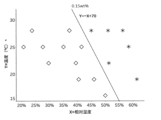
- Fig. 1 is a diagram showing the relationship between the drying conditions in the drying step and the presence or absence of whitening of the cell scaffold in Experiment 1.
- Fig. 1 is a diagram showing the case where the content of the cell scaffold component in 100% by weight of the coating liquid is 0.1% by weight.
- Fig. 2 is a diagram showing the relationship between the drying conditions in the drying step and the presence or absence of whitening of the cell scaffold in Experiment 1.
- Fig. 2 is a diagram showing the case where the content of the cell scaffold component in 100% by weight of the coating liquid is 0.15% by weight.
- Fig. 3 is a diagram showing the relationship between the drying conditions in the drying step and the presence or absence of whitening of the cell scaffold in Experiment 1.
- Fig. 1 is a diagram showing the case where the content of the cell scaffold component in 100% by weight of the coating liquid is 0.1% by weight.
- Fig. 2 is a diagram showing the relationship between the drying conditions in the drying step and the presence or absence of whitening of the cell scaffold in Experi
- FIG. 3 is a diagram showing the case where the content of the cell scaffold component in 100% by weight of the coating liquid is 0.2% by weight.
- FIG. 4 is a diagram showing the relationship between the average thickness of the cell scaffold and the cell proliferation rate (relative to VN %) in Experiment 2.
- FIG. 5 is a photograph of a cell culture substrate in which a coffee ring has formed on the cell scaffold.
- the method for producing a cell culture substrate according to the present invention includes a coating step of coating a coating liquid containing a cell scaffold component onto a first surface of a cell culture substrate body, and a drying step of drying the cell culture substrate body coated with the coating liquid in a space that satisfies the formula: Y ⁇ -X+70 when the relative humidity is X% and the temperature is Y°C.
- the method for producing a cell culture substrate according to the present invention makes it possible to obtain a cell culture substrate having a cell scaffold material that is a dried layer of a coating liquid.
- the method for producing a cell culture substrate according to the present invention is a method for producing a cell culture substrate having a cell culture substrate body and a cell scaffold material.
- the method for producing a cell culture substrate according to the present invention has the above-mentioned configuration, so that a cell culture substrate can be obtained in which whitening of the cell scaffold material is suppressed.
- the method for producing a cell culture substrate according to the present invention includes the drying step, and therefore can effectively prevent condensation from occurring during the drying step. Therefore, the method for producing a cell culture substrate according to the present invention can obtain a cell culture substrate in which whitening of the cell scaffold material is suppressed, and therefore a cell culture substrate with excellent appearance can be obtained. In addition, the surface of the cell scaffold material can be made suitable for cell culture.
- a thick cell scaffold (e.g., a thickness of 20 nm or more) can be easily obtained by appropriately adjusting the content of the cell scaffold component in the coating liquid.
- the cell proliferation can be improved more than when a thin cell scaffold is used.
- the coating liquid contains a cell scaffold component.
- the coating liquid preferably contains the cell scaffold component and a solvent.
- the cell scaffold component may be a conventionally known component used as a cell scaffold.
- the cell scaffold component include cell adhesive proteins, synthetic resins, polysaccharides, and polypeptides.
- the cell scaffold component may be used alone or in combination of two or more.
- the above-mentioned cell adhesive proteins include laminin, vitronectin, collagen, and the like.
- the above-mentioned cell scaffold component may be a component containing a cell adhesive protein, such as Matrigel.
- the above-mentioned Matrigel includes Matrigel derived from mouse sarcoma, and the like.
- the synthetic resin may include a synthetic resin having a synthetic resin portion and a peptide portion (synthetic resin to which a peptide is bonded), as described below.
- the synthetic resin may include a synthetic resin not having a peptide portion (synthetic resin to which a peptide is not bonded).
- Examples of the synthetic resin include polyvinyl alcohol derivatives, peptide-containing polyvinyl alcohol derivatives having a polyvinyl alcohol derivative portion and a peptide portion, (meth)acrylic copolymers, and peptide-containing (meth)acrylic copolymers having a poly(meth)acrylic acid ester portion and a peptide portion.
- the polyvinyl alcohol derivatives include polyvinyl acetal resins.
- synthetic resin having a synthetic resin portion and a peptide portion may be referred to as a "peptide-containing resin.”
- the cell scaffold component preferably contains a cell adhesive protein or a synthetic resin, and more preferably contains a synthetic resin.
- a cell culture substrate in which whitening of the cell scaffold occurs is likely to be obtained.
- the present invention includes the drying process, even when the cell scaffold component contains a synthetic resin, a cell culture substrate in which whitening of the cell scaffold is suppressed can be obtained.
- a synthetic resin is used as the cell scaffold component, it is less expensive, there is less variation between lots, and safety can be improved compared to when a natural polymer material such as a cell adhesive protein is used.
- the synthetic resin preferably contains a polyvinyl acetal resin, a poly(meth)acrylic acid ester, or a peptide-containing resin, and more preferably contains a peptide-containing resin.
- the polyvinyl acetal resin is preferably a polyvinyl butyral resin.
- the content of the cell scaffold component is preferably 0.01% by weight or more, more preferably 0.05% by weight or more, even more preferably 0.1% by weight or more, preferably 1% by weight or less, more preferably 0.75% by weight or less, and even more preferably 0.5% by weight or less.
- the content of the cell scaffold component is equal to or more than the lower limit, a thick cell scaffold can be easily formed, and cell proliferation can be further improved.
- the solubility of the cell scaffold component in the solvent can be further improved, and coatability can be improved.
- the cell scaffold component preferably contains a peptide-containing resin having a synthetic resin portion and a peptide portion.
- the peptide-containing resin is a synthetic resin to which a peptide is bound.
- the peptide-containing resin has a synthetic resin portion and a peptide portion. Only one type of the peptide-containing resin may be used, or two or more types may be used in combination.
- the synthetic resin portion preferably has a polyvinyl alcohol derivative portion or a poly(meth)acrylic acid ester portion.
- the peptide-containing resin preferably has a polyvinyl alcohol derivative portion or a poly(meth)acrylic acid ester portion and a peptide portion. In this case, the cell proliferation can be further improved.
- the peptide-containing resin may have both a polyvinyl alcohol derivative portion and a poly(meth)acrylic acid ester portion.
- the polyvinyl alcohol derivative portion and the peptide portion are preferably bonded via a linker portion. Therefore, the peptide-containing resin having the polyvinyl alcohol derivative portion preferably has a polyvinyl alcohol derivative portion, a peptide portion, and a linker portion.
- the poly(meth)acrylic acid ester portion and the peptide portion may be bonded via a linker portion, or may be bonded directly without a linker portion.
- the peptide-containing resin having the poly(meth)acrylic acid ester portion may have a poly(meth)acrylic acid ester portion, a peptide portion, and a linker portion.
- (meth)acrylic means either or both of “acrylic” and “methacrylic”
- (meth)acrylate means either or both of “acrylate” and “methacrylate”.
- the polyvinyl alcohol derivative portion (polyvinyl alcohol derivative skeleton) is a structural portion derived from a polyvinyl alcohol derivative.
- the polyvinyl alcohol derivative is a compound derived from polyvinyl alcohol.
- the peptide-containing resin is preferably a peptide-containing polyvinyl alcohol derivative having a polyvinyl alcohol derivative portion and a peptide portion.
- the cell scaffold component preferably contains a peptide-containing polyvinyl alcohol derivative having a polyvinyl alcohol derivative portion and a peptide portion.
- the synthetic resin preferably contains a peptide-containing polyvinyl alcohol derivative.
- the polyvinyl alcohol derivative is preferably a polyvinyl acetal resin, and the polyvinyl alcohol derivative portion is preferably a polyvinyl acetal resin portion. That is, the peptide-containing resin preferably has a polyvinyl acetal resin portion and a peptide portion.
- the cell scaffold component preferably includes a peptide-containing polyvinyl acetal resin having a polyvinyl acetal resin portion and a peptide portion.
- the synthetic resin preferably includes a peptide-containing polyvinyl acetal resin.
- the polyvinyl alcohol derivative and the polyvinyl acetal resin may each be used alone or in combination of two or more types.
- the polyvinyl alcohol derivative portion and the polyvinyl acetal resin portion preferably have an acetal group, a hydroxyl group, and an acetyl group in the side chain.
- the polyvinyl alcohol derivative portion and the polyvinyl acetal resin portion may not have an acetyl group, for example.
- all of the acetyl groups in the polyvinyl acetal resin portion may be bonded to a linker, so that the polyvinyl alcohol derivative portion and the polyvinyl acetal resin portion may not have an acetyl group.
- the above polyvinyl acetal resin can be synthesized by acetalizing polyvinyl alcohol with an aldehyde.
- the aldehyde used in the acetalization of polyvinyl alcohol is not particularly limited.
- Examples of the aldehyde include aldehydes having 1 to 10 carbon atoms.
- the aldehyde may or may not have a chain aliphatic group, a cyclic aliphatic group, or an aromatic group.
- the aldehyde may be a chain aldehyde or a cyclic aldehyde. Only one type of the aldehyde may be used, or two or more types may be used in combination.
- the aldehyde is preferably formaldehyde, acetaldehyde, propionaldehyde, butyraldehyde, or pentanal, and more preferably butyraldehyde. Therefore, the polyvinyl acetal resin is more preferably a polyvinyl butyral resin. From the viewpoint of further enhancing the adhesiveness between the cell scaffold material and the cells, the polyvinyl acetal resin portion is preferably a polyvinyl butyral resin portion.
- the peptide-containing resin preferably has a polyvinyl butyral resin portion and a peptide portion.
- the cell scaffold material component preferably includes a peptide-containing polyvinyl butyral resin having a polyvinyl butyral resin portion and a peptide portion.
- the synthetic resin preferably includes a peptide-containing polyvinyl butyral resin.
- the degree of acetalization of the polyvinyl acetal resin portion is preferably 40 mol% or more, more preferably 50 mol% or more, preferably 90 mol% or less, more preferably 85 mol% or less. If the degree of acetalization is equal to or greater than the lower limit, the peptide-containing polyvinyl acetal resin is less likely to swell in the culture medium. If the degree of acetalization is equal to or less than the upper limit, the solubility in the solvent can be improved.
- the hydroxyl group content (hydroxyl group amount) of the above polyvinyl acetal resin portion is preferably 15 mol% or more, more preferably 20 mol% or more, preferably 45 mol% or less, more preferably 30 mol% or less, and even more preferably 25 mol% or less.
- the degree of acetylation (amount of acetyl groups) of the polyvinyl acetal resin portion is preferably 1 mol% or more, more preferably 2 mol% or more, preferably 5 mol% or less, more preferably 4 mol% or less.
- the degree of acetylation is equal to or more than the lower limit and equal to or less than the upper limit, the reaction efficiency between the polyvinyl acetal resin and the linker can be increased.
- the degree of acetalization, the degree of acetylation, and the amount of hydroxyl groups in the polyvinyl acetal resin portion can be measured by 1H -NMR (nuclear magnetic resonance spectroscopy).
- the degree of acetalization, the degree of acetylation, and the amount of hydroxyl groups in the polyvinyl acetal resin portion are usually expressed as mol % relative to the sum (100 mol %) of the amounts of substances of the structural units constituting the peptide-containing polyvinyl acetal resin.
- the poly(meth)acrylic acid ester portion (poly(meth)acrylic acid ester skeleton) is a structural portion derived from a poly(meth)acrylic acid ester.
- the peptide-containing resin preferably has a poly(meth)acrylic acid ester portion, and more preferably is a peptide-containing (meth)acrylic copolymer having a poly(meth)acrylic acid ester portion and a peptide portion.
- the cell scaffold component preferably contains a peptide-containing (meth)acrylic copolymer having a poly(meth)acrylic acid ester portion and a peptide portion.
- the synthetic resin preferably contains a peptide-containing (meth)acrylic copolymer.
- the poly(meth)acrylic acid ester portion has a skeleton derived from a (meth)acrylic acid ester.
- the poly(meth)acrylic acid ester is obtained by polymerizing a (meth)acrylic acid ester. Only one type of the poly(meth)acrylic acid ester may be used, or two or more types may be used in combination.
- the above (meth)acrylic acid esters include (meth)acrylic acid alkyl esters, (meth)acrylic acid cyclic alkyl esters, (meth)acrylic acid aryl esters, (meth)acrylic acid polyethylene glycols, (meth)acrylic acid phosphorylcholine, etc.
- the above (meth)acrylic acid esters may be used alone or in combination of two or more kinds.
- Examples of the (meth)acrylic acid alkyl esters include methyl (meth)acrylate, ethyl (meth)acrylate, n-propyl (meth)acrylate, isopropyl (meth)acrylate, n-butyl (meth)acrylate, isobutyl (meth)acrylate, t-butyl (meth)acrylate, n-octyl (meth)acrylate, isooctyl (meth)acrylate, 2-ethylhexyl (meth)acrylate, nonyl (meth)acrylate, isononyl (meth)acrylate, decyl (meth)acrylate, isodecyl (meth)acrylate, lauryl (meth)acrylate, stearyl (meth)acrylate, and isotetradecyl (meth)acrylate.
- the above (meth)acrylic acid alkyl esters may be substituted with a substituent such as an alkoxy group having 1 to 3 carbon atoms and a tetrahydrofurfuryl group.
- a substituent such as an alkoxy group having 1 to 3 carbon atoms and a tetrahydrofurfuryl group.
- Examples of such (meth)acrylic acid alkyl esters include methoxyethyl acrylate and tetrahydrofurfuryl acrylate.
- Examples of the (meth)acrylic acid cyclic alkyl esters include cyclohexyl (meth)acrylate and isobornyl (meth)acrylate.
- Examples of the (meth)acrylic acid aryl ester include phenyl (meth)acrylate and benzyl (meth)acrylate.
- polyethylene glycol (meth)acrylates examples include methoxy-polyethylene glycol (meth)acrylate, ethoxy-polyethylene glycol (meth)acrylate, hydroxy-polyethylene glycol (meth)acrylate, methoxy-diethylene glycol (meth)acrylate, ethoxy-diethylene glycol (meth)acrylate, hydroxy-diethylene glycol (meth)acrylate, methoxy-triethylene glycol (meth)acrylate, ethoxy-triethylene glycol (meth)acrylate, and hydroxy-triethylene glycol (meth)acrylate.
- Examples of the (meth)acrylate phosphorylcholine include 2-(meth)acryloyloxyethyl phosphorylcholine.
- the peptide-containing resin having the poly(meth)acrylic acid ester portion may have a skeleton derived from a monomer other than a (meth)acrylic acid ester.
- Examples of the monomer other than the (meth)acrylic acid esters include (meth)acrylamides and vinyl compounds.
- the monomer other than the (meth)acrylic acid esters may be used alone or in combination of two or more.
- the above (meth)acrylamides include (meth)acrylamide, N-isopropyl(meth)acrylamide, N-tert-butyl(meth)acrylamide, N,N'-dimethyl(meth)acrylamide, (3-(meth)acrylamidopropyl)trimethylammonium chloride, 4-(meth)acryloylmorpholine, 3-(meth)acryloyl-2-oxazolidinone, N-[3-(dimethylamino)propyl](meth)acrylamide, N-(2-hydroxyethyl)(meth)acrylamide, N-methylol(meth)acrylamide, and 6-(meth)acrylamidohexanoic acid.
- the vinyl compounds include ethylene, allylamine, vinylpyrrolidone, maleic anhydride, maleimide, itaconic acid, (meth)acrylic acid, and vinylamine.
- the peptide portion is a structural portion derived from a peptide.
- the peptide portion has an amino acid sequence.
- the peptide constituting the peptide portion may be an oligopeptide or a polypeptide. Only one type of the peptide may be used, or two or more types may be used in combination.
- the number of amino acid residues in the peptide portion is preferably 3 or more, more preferably 4 or more, even more preferably 5 or more, and preferably 10 or less, more preferably 8 or less, and even more preferably 6 or less. If the number of amino acid residues is equal to or greater than the above lower limit and equal to or less than the above upper limit, the adhesiveness between the cell scaffold material and the cells after seeding can be further increased, and the cell proliferation rate can be further increased. However, the number of amino acid residues in the peptide portion may be more than 10 or more than 15.
- the peptide portion preferably has a cell-adhesive amino acid sequence.
- the cell-adhesive amino acid sequence refers to an amino acid sequence whose cell-adhesive activity has been confirmed by the phage display method, the Sepharose bead method, or the plate coating method.
- the phage display method for example, the method described in "The Journal of Cell Biology, Volume 130, Number 5, September 1995, pp. 1189-1196" can be used.
- Sepharose bead method for example, the method described in "Protein, Nucleic Acid, Enzyme, Vol. 45, No. 15 (2000), 2477” can be used.
- the plate coating method for example, the method described in "Protein, Nucleic Acid, Enzyme, Vol. 45, No. 15 (2000), 2477” can be used.
- cell adhesive amino acid sequences include the RGD sequence (Arg-Gly-Asp), the YIGSR sequence (Tyr-Ile-Gly-Ser-Arg), the PDSGR sequence (Pro-Asp-Ser-Gly-Arg), the HAV sequence (His-Ala-Val), the ADT sequence (Ala-Asp-Thr), and the QAV sequence (Gln-Ala-Val).
- LDV sequence Leu-Asp-Val
- IDS sequence Ile-Asp-Ser
- REDV sequence Arg-Glu-Asp-Val
- IDAPS sequence Ile-Asp-Ala-Pro-Ser
- KQAGDV sequence Lys-Gln-Ala-Gly-Asp-Val
- TDE sequence Thr-Asp-Glu
- the peptide portion may have only one type of cell adhesive amino acid sequence, or may have two or more types.
- the peptide portion preferably has at least one of the cell adhesive amino acid sequences described above, more preferably has at least an RGD sequence, a YIGSR sequence, or a PDSGR sequence, even more preferably has an RGD sequence, and particularly preferably has at least an RGD sequence represented by the following formula (1).
- the adhesiveness between the cell scaffold and the cells after seeding can be further increased, and the cell proliferation rate can be further increased.
- X represents Gly, Ala, Val, Ser, Thr, Phe, Met, Pro, or Asn.
- the peptide portion may be linear or may have a cyclic peptide backbone.
- the cyclic peptide backbone is a cyclic backbone composed of a plurality of amino acids. From the viewpoint of more effectively exerting the effects of the present invention, the cyclic peptide backbone is preferably composed of 4 or more amino acids, more preferably composed of 5 or more amino acids, and preferably composed of 10 or less amino acids.
- the content of the peptide portion is preferably 0.05 mol% or more, more preferably 0.1 mol% or more, even more preferably 0.15 mol% or more, particularly preferably 0.2 mol% or more, preferably 25 mol% or less, more preferably 20 mol% or less, even more preferably 15 mol% or less, particularly preferably 10 mol% or less.
- the content of the peptide portion is equal to or greater than the lower limit, the adhesion between the cell scaffold material and the cells after seeding can be further improved, and the cell proliferation rate can be further increased.
- the content of the peptide portion is equal to or less than the upper limit, production costs can be reduced.
- the content (mol %) of the peptide portion is the amount of substance of the peptide portion relative to the sum of the amounts of substance of each structural unit constituting the peptide-containing resin.
- the content of the above peptide portion can be measured, for example, by NMR (nuclear magnetic resonance).
- the linker portion is a structural portion derived from a linker.
- the linker portion is usually located between the polyvinyl alcohol derivative portion or the poly(meth)acrylic acid ester portion and the peptide portion.
- the polyvinyl alcohol derivative portion or the poly(meth)acrylic acid ester portion and the peptide portion are bonded via the linker portion.
- the linker portion is formed by a linker (crosslinking agent). Only one type of the linker may be used, or two or more types may be used in combination.
- the linker is preferably a compound having a functional group capable of binding to the peptide, and more preferably a compound having a functional group capable of condensing with a carboxyl group or amino group of the peptide.
- Functional groups that can condense with the carboxyl or amino group of the above peptides include carboxyl, thiol, amino, hydroxyl, and cyano groups.
- the linker is preferably a compound having a carboxyl group or an amino group, and more preferably a compound having a carboxyl group.
- examples of the linker having a carboxyl group include (meth)acrylic acid and acrylamide containing a carboxyl group.
- a carboxylic acid (carboxylic acid monomer) having a polymerizable unsaturated group as the linker having a carboxyl group, the carboxylic acid monomer can be polymerized by graft polymerization when the linker is introduced, and therefore the number of carboxyl groups that can react with the peptide can be increased.
- the linker is preferably (meth)acrylic acid, and more preferably acrylic acid.
- the linker When obtaining a peptide-containing resin having a poly(meth)acrylic acid ester portion, the linker preferably has a functional group capable of bonding with a (meth)acrylic acid ester.
- the functional group capable of bonding with the (meth)acrylic acid ester include a vinyl group, a (meth)acryloyl group, and an allyl group. It is more preferable that the linker has a (meth)acryloyl group as the functional group capable of bonding with the (meth)acrylic acid ester, and is preferably a compound having a carboxyl group or an amino group and a (meth)acryloyl group.
- examples of the linker include (meth)acrylic acid, itaconic acid, and acrylamide.
- the linker is preferably (meth)acrylic acid or itaconic acid, and more preferably (meth)acrylic acid.
- the number average molecular weight of the peptide-containing resin is preferably 10,000 or more, more preferably 50,000 or more, even more preferably 100,000 or more, preferably 5,000,000 or less, more preferably 2,500,000 or less, even more preferably 1,000,000 or less. If the number average molecular weight is equal to or greater than the lower limit, the cell scaffold material is less likely to dissolve into the liquid medium during cell culture, and is less likely to peel off from the substrate during cell culture. If the number average molecular weight is equal to or less than the upper limit, the solubility in alcohol solvents can be increased.
- the number average molecular weight of the peptide-containing resin can be measured, for example, by the following method.
- the peptide-containing resin is dissolved in tetrahydrofuran (THF) to prepare a 0.2 wt % solution of the peptide-containing resin.
- GPC gel permeation chromatography
- the coating liquid preferably contains a solvent.
- the solvent may be used alone or in combination of two or more.
- the above solvents include alcohols, carboxylic acids, dimethyl sulfoxide, N,N-dimethylformamide, N-methylpyrrolidone, dichloromethane, acetonitrile, and water.
- the solvent preferably contains a first solvent having a boiling point of 50° C. or more and 90° C. or less.
- the first solvent is a solvent having a relatively fast drying speed. Therefore, by using the first solvent, the manufacturing efficiency of the cell culture substrate can be improved.
- condensation occurs on the surface of the coating film due to the heat of vaporization generated when the first solvent volatilizes, and the cell scaffold material is likely to whiten.
- the present invention is provided with the drying step, even when the coating liquid contains the first solvent, a cell culture substrate in which whitening of the cell scaffold material is suppressed can be obtained.
- the first solvent may be used alone or in combination of two or more types.
- the boiling point of the first solvent is 50°C or higher and 90°C or lower, preferably 60°C or higher and preferably 80°C or lower.
- the first solvent may be an alcohol such as methanol, ethanol, isopropanol, or tert-butyl alcohol; methyl ethyl ketone; tetrahydrofuran; acetone; etc.
- an alcohol such as methanol, ethanol, isopropanol, or tert-butyl alcohol; methyl ethyl ketone; tetrahydrofuran; acetone; etc.
- the first solvent is preferably an organic solvent, more preferably an alcohol, even more preferably containing ethanol, and particularly preferably ethanol. In this case, a cell scaffold having a uniform thickness can be formed even better.
- the content of the first solvent in 100% by weight of the solvent is preferably 80% by weight or more, more preferably 90% by weight or more, preferably 100% by weight or less, more preferably 99% by weight or less, even more preferably 97% by weight or less, and particularly preferably 95% by weight or less.
- the content of the first solvent is equal to or more than the lower limit and equal to or less than the upper limit, the production efficiency of the cell culture substrate can be improved.
- the solvent preferably includes a second solvent having a boiling point exceeding 90°C.
- the solvent more preferably includes the first solvent and the second solvent. If the solvent volatilizes too quickly in the drying step, coffee rings may occur in the cell scaffold.
- FIG. 5 shows a photograph of a cell culture substrate in which coffee rings occur in the cell scaffold.
- the first solvent and the second solvent are used in combination, the first solvent volatilizes more in the drying step, and then the second solvent volatilizes more. Therefore, when the first solvent and the second solvent are used in combination, the volatilization rate of the solvent decreases as the drying proceeds, so that a cell culture substrate with a particularly excellent appearance in which coffee rings are suppressed can be obtained. Only one type of the second solvent may be used, or two or more types may be used in combination.
- the boiling point of the second solvent is greater than 90°C, preferably greater than 110°C, and preferably less than 150°C.
- the second solvent may be, for example, alcohols such as 1-butanol, 2-butanol, isobutanol, 1-propanol, 1-pentanol, 1-hexanol, benzyl alcohol, octyl alcohol, lauryl alcohol, and ethylene glycol; carboxylic acids such as acetic acid, formic acid, and propionic acid; water, etc.
- alcohols such as 1-butanol, 2-butanol, isobutanol, 1-propanol, 1-pentanol, 1-hexanol, benzyl alcohol, octyl alcohol, lauryl alcohol, and ethylene glycol
- carboxylic acids such as acetic acid, formic acid, and propionic acid
- water etc.
- the second solvent preferably contains an organic solvent, more preferably contains an alcohol or a carboxylic acid, even more preferably contains an alcohol having 3 to 6 carbon atoms or a carboxylic acid having 1 to 3 carbon atoms, even more preferably contains acetic acid, 1-butanol, 2-butanol or isobutanol, and particularly preferably contains acetic acid or 1-butanol.
- an organic solvent more preferably contains an alcohol or a carboxylic acid, even more preferably contains an alcohol having 3 to 6 carbon atoms or a carboxylic acid having 1 to 3 carbon atoms, even more preferably contains acetic acid, 1-butanol, 2-butanol or isobutanol, and particularly preferably contains acetic acid or 1-butanol.
- the content of the second solvent in 100% by weight of the solvent is preferably 1% by weight or more, more preferably 3% by weight or more, even more preferably 5% by weight or more, preferably 20% by weight or less, and more preferably 10% by weight or less.
- the content of the second solvent is equal to or more than the lower limit and equal to or less than the upper limit, the occurrence of coffee rings can be suppressed even more effectively.
- the total content of the first solvent and the second solvent in 100% by weight of the solvent is preferably 95% by weight or more, more preferably 98% by weight or more, even more preferably 99% by weight or more, and most preferably 100% by weight.
- the total content is equal to or more than the lower limit, the production efficiency of the cell culture substrate can be improved, and the occurrence of coffee rings can be more effectively suppressed.
- the weight ratio of the content of the first solvent to the content of the second solvent is preferably 5 or more, more preferably 8 or more, and preferably 50 or less, more preferably 30 or less.
- the second solvent does not contain water.
- the second solvent may contain water.
- the content of the water in 100% by weight of the coating liquid is preferably 1% by weight or less, more preferably 0.5% by weight or less, and even more preferably 0.1% by weight or less. In this case, the effect of the present invention can be exerted even more effectively.
- the content of the solvent in 100% by weight of the coating liquid is preferably 95% by weight or more, more preferably 99% by weight or more, even more preferably 99.5% by weight or more, preferably 99.99% by weight or less, more preferably 99.95% by weight or less, and even more preferably 99.9% by weight or less.
- the content of the solvent is equal to or greater than the lower limit, the solubility of the cell scaffold component in the solvent can be further increased, and the coatability can be improved.
- the content of the solvent is equal to or less than the upper limit, the content of the cell scaffold component in the coating liquid can be relatively increased, so that a thick cell scaffold can be easily formed, and the cell proliferation can be further improved.
- the coating liquid can be obtained, for example, by mixing the cell adhesive protein (cell scaffold component) with the solvent, or by mixing the synthetic resin (cell scaffold component) with the solvent.
- the coating liquid containing the peptide-containing resin (cell scaffolding material component) and the solvent is preferably obtained by the following method. That is, the method for producing the coating liquid containing the peptide-containing resin and the solvent preferably includes a preparation step of preparing a solution containing synthetic resin X having a functional group capable of reacting with an amino group or a carboxyl group, a peptide, and a condensing agent, and a reaction step of reacting the synthetic resin X with the peptide.
- the synthetic resin X may have a functional group capable of reacting with an amino group, may have a functional group capable of reacting with a carboxyl group, or may have a functional group capable of reacting with an amino group and a functional group capable of reacting with a carboxyl group.
- the synthetic resin X may be a (meth)acrylic copolymer or a polyvinyl acetal derivative having a linker bonded thereto. Only one type of the synthetic resin X may be used, or two or more types may be used in combination.
- the above peptides include peptides having the number of amino acid residues and amino acid sequence described in the above-mentioned peptide portion column. Only one type of the above peptides may be used, or two or more types may be used in combination.
- condensation agent a conventionally known condensation agent can be used.
- the condensation agent include 1-ethyl-3-(3-dimethylaminopropyl)carbodiimide hydrochloride, N,N'-dicyclohexylcarbodiimide, 1-hydroxybenzotriazole, 1-hydroxy-7-azabenzotriazole, diphenylphosphoric azide, hexamethylphosphoric triamide, O-(benzotriazol-1-yl)-N,N,N',N'-tetramethyluronium hexafluorophosphate, and 2-chloro-4,6-dimethoxy-1,3,5-triazine.
- a solution containing synthetic resin X, a peptide, a condensing agent, and a solvent is prepared.
- the solution containing synthetic resin X, a peptide, a condensing agent, and a solvent may be a dispersion liquid.
- the solution may be obtained by mixing synthetic resin X, a peptide, and a condensing agent in the same solvent, and for example, the solution may be obtained by mixing solution P containing at least one component of synthetic resin X, a peptide, and a condensing agent with solution Q containing at least one component of synthetic resin X, a peptide, and a condensing agent.
- the preparation step preferably includes a step of preparing a first solution containing solvent A, synthetic resin X, and a peptide, a step of preparing a second solution containing solvent B and a condensing agent, and a step of mixing the first solution and the second solution.
- the solvent A and the solvent B may be the same type of solvent or different types of solvents.
- the second solution may be prepared after the first solution, or the first solution may be prepared after the second solution. The first solution and the second solution may be prepared simultaneously.
- solvent A may be the solvents described above (first solvent, second solvent), or may be solvents other than these.
- the synthetic resin X is reacted with the peptide. It is preferable to bond a functional group of the synthetic resin X that can react with the amino group or carboxyl group to a carboxyl group or amino group of an amino acid that constitutes the peptide. This makes it possible to obtain the peptide-containing resin.
- the liquid thus obtained liquid containing the peptide-containing resin
- the method for producing a coating liquid containing the peptide-containing resin and the solvent preferably further comprises a purification step.
- the purification method in the purification step is not particularly limited, but examples include (1) a method of recovering a liquid phase containing the peptide-containing resin after liquid-liquid phase separation, (2) a method of recovering the peptide-containing resin after reprecipitation, and (3) a method of performing ion exchange using an ion exchange resin.
- the method for producing a coating liquid containing the peptide-containing resin and the solvent comprises the purification step, a coating liquid with fewer impurities can be obtained by removing unreacted condensing agent and peptide.
- a plurality of purification methods may be combined.
- the solution obtained after purification may be used as it is as a coating liquid, or the solvent may be evaporated from the solution obtained after purification, and the obtained solid content may be redissolved in the solvent to be used as a coating liquid.
- Cell culture substrate body As the cell culture substrate body, a conventionally known cell culture substrate body can be used.
- Examples of the material of the cell culture substrate body include synthetic resins, metals, and glass.
- Examples of the synthetic resins include polystyrene, polyethylene, polypropylene, polyethersulfone, polycarbonate, polyester, polyisoprene, cycloolefin polymers, polyimides, polyamides, polyamideimides, (meth)acrylic resins, epoxy resins, and silicones.
- the cell culture substrate body may be a container, a fiber, a nonwoven fabric, a hollow fiber, a particle, a film, a porous membrane, etc.
- the cell culture substrate body is preferably a container.
- the shape and size of the container are not particularly limited. Examples of the container include 2- to 384-well plates, single-layer flasks, multi-layer flasks, multi-sided flasks, dishes, roller bottles, bags, insert cups, and microchannel chips.
- the first surface of the cell culture substrate body is preferably the bottom surface of the container (the bottom surface of the container in the cell culture region).
- the first surface of the cell culture substrate body may or may not be surface-treated. Examples of the surface treatment include plasma treatment and low-adhesion treatment.
- the method for producing the cell culture substrate includes a step of applying a coating liquid containing a cell scaffold component onto a first surface of a cell culture substrate body (a coating step).
- the method of applying the coating liquid to the first surface of the cell culture substrate body is not particularly limited and can be appropriately selected depending on the size and shape of the cell culture substrate body.
- the coating liquid may be applied to the entire surface of the first surface of the cell culture substrate body, or may be applied to only a portion of the first surface of the cell culture substrate body.
- the coating liquid in the central portion of the first surface of the cell culture substrate body, and then spread the coating liquid from the central portion of the first surface outward.
- the coating liquid can be applied satisfactorily over the entire surface of the first surface.
- it becomes easier to apply the coating liquid with a uniform thickness and as a result, a cell scaffold material having a uniform thickness can be obtained satisfactorily.
- Such methods for applying the coating liquid include cast coating and spin coating.
- the coating step it is more preferable to place the coating liquid in the central portion of the first surface of the cell culture substrate body, and then spread the coating liquid from the central portion of the first surface outward, thereby coating the coating liquid over the entire surface of the first surface.
- the coating liquid When the coating liquid is applied to only a portion of the first surface of the cell culture substrate body, the coating liquid may be applied so as to form a pattern such as a dot or stripe pattern.
- Methods for applying the coating liquid so as to form a pattern include an inkjet method, a screen printing method, and a microcontact printing method.
- coating liquid Other methods for applying the coating liquid include spray coating, roller coating, and dip coating.
- the amount of the coating liquid is preferably an amount that results in an average thickness of the cell scaffold material (dried layer of the coating liquid) obtained after the drying process of 20 nm or more, preferably an amount that results in an average thickness of 30 nm or more, and preferably an amount that results in an average thickness of 40 nm or more.
- the amount of the coating liquid is equal to or more than the lower limit, the cell proliferation can be further improved.
- the amount of the coating liquid is, for example, an amount that results in an average thickness of the cell scaffold material (dried layer of the coating liquid) obtained after the drying process of 1 ⁇ m or less.
- the amount of the coating liquid is equal to or less than the upper limit, the uniformity of the thickness of the cell scaffold material can be improved.
- the manufacturing cost of the cell culture substrate can be kept low.
- the amount of the coating liquid per 1 cm2 of coating area is preferably 6.3 ⁇ L or more, more preferably 6.9 ⁇ L or more.
- the upper limit of the amount of the coating liquid per 1 cm2 of coating area is not particularly limited.
- the amount of the coating liquid per 1 cm2 of coating area is, for example, 100 ⁇ L or less.
- the uniformity of the thickness of the cell scaffold can be improved.
- the manufacturing cost of the cell culture substrate can be kept low.
- the coating amount of the coating liquid is preferably an amount such that the coating amount of the second solvent per 1 cm2 of coating area is 0.23 mg or more, more preferably an amount such that the coating amount is 0.25 mg or more, and preferably an amount such that the coating amount is 0.36 mg or less, and more preferably an amount such that the coating amount is 0.34 mg or less.
- the coating amount of the coating liquid is equal to or more than the lower limit and equal to or less than the upper limit, the occurrence of coffee ring can be more effectively suppressed.
- the method for producing the cell culture substrate includes a step of drying the cell culture substrate body coated with the coating liquid in a space that satisfies the formula: Y ⁇ X+70 when the relative humidity is X% and the temperature is Y° C. (drying step).
- the above relative humidity (X) is preferably 0% or more, preferably 50% or less, and more preferably 40% or less.
- the above temperature (Y) is preferably 0°C or higher, more preferably 15°C or higher, and preferably 30°C or lower, more preferably 25°C or lower.
- the drying time of the drying step is not particularly limited as long as the coating liquid is dried.
- the drying time of the drying step may be 15 minutes or more, 30 minutes or more, 60 minutes or more, 120 minutes or more, 6 hours or less, or 3 hours or less.
- the drying process may be carried out under atmospheric pressure or under reduced pressure.
- the pressure in the space during the drying process may be 0 atm or more, 0.1 atm or more, 1 atm or less, 0.5 atm or less, or 0.3 atm or less.
- the drying step can be carried out, for example, by placing the cell culture substrate body coated with the coating liquid in a constant temperature and humidity chamber.
- the method for producing a cell culture substrate can produce a cell culture substrate comprising a cell culture substrate body and a cell scaffold material.
- the cell scaffold material is a dried layer of the coating liquid.
- the cell scaffold material is disposed on the first surface of the cell culture substrate body.
- the above-mentioned method for producing a cell culture substrate is preferably a method for producing a cell culture vessel.
- Cells can be cultured using the cell culture substrate.
- the cell scaffold material is used as a scaffold for the cells when they are cultured.
- the above cells include animal cells such as human, mouse, rat, pig, cow, and monkey cells.
- the above cells also include somatic cells, such as stem cells, progenitor cells, and mature cells.
- the above somatic cells may be cancer cells.
- the above stem cells include somatic stem cells and embryonic stem cells, such as neural stem cells, hematopoietic stem cells, mesenchymal stem cells (MSCs), iPS cells, ES cells, Muse cells, embryonic cancer cells, embryonic germ stem cells, and mGS cells.
- somatic stem cells such as neural stem cells, hematopoietic stem cells, mesenchymal stem cells (MSCs), iPS cells, ES cells, Muse cells, embryonic cancer cells, embryonic germ stem cells, and mGS cells.
- the above-mentioned mature cells include nerve cells, cardiac muscle cells, retinal cells, and liver cells.
- Cell culture substrate body (A): Falcon Cell Culture 6-well Multiwell Plate (Corning, product number: 353046)
- DMF Dimethylformamide
- solvent A solvent A
- solvent B solvent B
- a cyclic peptide having an amino acid sequence of Arg-Gly-Asp-Phe-Lys (5 amino acid residues, Arg and Lys are bonded to form a cyclic skeleton, Phe is D-form, c-RGDfK) was prepared as a peptide.
- 1-ethyl-3-(3-dimethylaminopropyl)carbodiimide hydrochloride was prepared as a condensing agent. 50 parts by weight of polyvinyl acetal resin (X) and 2 parts by weight of peptide were mixed with 1000 parts by weight of solvent A to prepare a first solution.
- condensing agent 1 part by weight was mixed with 1000 parts by weight of solvent B to prepare a second solution.
- Reaction steps The obtained solution was reacted at 40° C. for 2 hours to cause dehydration condensation between the carboxyl group in the structural unit derived from acrylic acid of the polyvinyl acetal resin (X) and the amino group of Lys of the peptide, thereby obtaining a solution containing a peptide-containing polyvinyl acetal resin.
- the obtained solution containing the peptide-containing polyvinyl acetal resin was diluted 100 times with DMF and dropped at a rate of 0.3 mL/min into a column filled with an ion exchange resin (manufactured by Organo Corporation) to wash it.
- the washed solution was vacuum dried at 60°C for 3 hours to obtain a dried solid, which was then dissolved in 95 parts by weight of ethanol (first solvent), and 5 parts by weight of acetic acid (second solvent) was added.
- a coating liquid containing a peptide-containing polyvinyl acetal resin (cell scaffold component), ethanol (first solvent), and acetic acid (second solvent) was obtained.
- the content of the peptide-containing polyvinyl acetal resin in the coating liquid was set to three conditions: 0.1% by weight, 0.15% by weight, and 0.2% by weight.
- ⁇ Coating process> 70 ⁇ L of the obtained coating liquid was dispensed using a pipette onto the center of the bottom surface of the well of the cell culture substrate body (A), and the coating liquid was spread from the center of the bottom surface of the well outward.
- ⁇ Drying process> The cell culture substrate body (A) coated with the coating liquid was left to stand for 30 minutes at 1 atm in a thermo-hygrostat in which the relative humidity and temperature were set to predetermined values, thereby removing the solvent. In this way, a cell culture substrate (cell culture vessel) was obtained in which a cell scaffold material, which is a dried layer of the coating liquid, was arranged on the bottom surface of the well of the cell culture substrate body (A).
- Figures 1 to 3 are plots in which the horizontal axis represents the relative humidity during the drying process and the vertical axis represents the temperature.
- Figures 1 to 3 are plots in which the content of the cell scaffold component (peptide-containing polyvinyl acetal resin) in 100% by weight of the coating liquid is 0.1%, 0.15%, and 0.2% by weight, respectively.
- ⁇ diamond indicates that the cell scaffold did not whiten
- * asterisk indicates that the cell scaffold did whiten.
- the cell culture substrate body coated with the coating liquid is dried in a space that satisfies the formula: Y ⁇ -X+70 (where X is the relative humidity (%) and Y is the temperature (°C)), thereby making it possible to obtain a cell culture substrate in which whitening of the cell scaffold is suppressed.
- Example 2 Relationship between average thickness of cell scaffold and cell proliferation
- the content of the cell scaffold component in the coating liquid was 0.1 wt%.
- the relative humidity and temperature in the drying process were 30% and 22°C, respectively.
- the amount of coating liquid per 1 cm2 of coating area was a predetermined amount.
- cell culture substrates cell culture vessels
- the cell scaffold material which was a dried layer of the coating liquid, was arranged at various average thicknesses on the bottom surface of the well of the cell culture substrate main body (A).
- the coating amount of the coating liquid per 1 cm2 of coating area was set within the following range.
- Coating volume 10 ⁇ L (minimum) to 100 ⁇ L (maximum)
- the obtained cell culture substrate was placed in a UV sterilization lamp for 10 minutes to sterilize the front and back surfaces of the cell culture substrate.
- a cell suspension containing 5 x 10⁴ cells (human induced pluripotent stem cells, 201B7 strain established at Kyoto University) in 2.0 mL of liquid medium was prepared. This cell suspension was seeded into each well of the sterilized cell culture substrate. The cell culture substrate was then placed in an incubator at 37°C and a CO2 concentration of 5% to culture the cells.
- a cell culture substrate was prepared in which the bottom surface of the cell culture substrate body (A) was coated with vitronectin (Thermo Fisher, Vitronectin (VTN-N) Recombinant Human Protein, Truncated A14700).
- vitronectin Thermo Fisher, Vitronectin (VTN-N) Recombinant Human Protein, Truncated A14700.
- cells were cultured for 5 days in the same manner as above, and the number of cells after 5 days of culture was counted using a NucleoCounter NC-3000 (MS Techno Systems).
- the cell proliferation rate (relative to VN) was calculated using the following formula:
- Figure 4 is a plot diagram with the average thickness of the cell scaffold on the horizontal axis and the cell proliferation rate (relative to VN%) on the vertical axis. As shown in Figure 4, it can be seen that cell proliferation is enhanced when the amount of coating liquid applied in the coating process is an amount that results in an average thickness of the cell scaffold obtained after the drying process of 20 nm or more.
- the cell scaffolds in the cell culture substrates obtained in Experiment 2 were visually observed to check whether or not whitening had occurred in the cell scaffolds. No whitening was observed in the cell scaffolds in any of the cell culture substrates.
- the content of the cell scaffold component in the coating liquid was 0.1% by weight.
- the type and content of the solvent in the coating liquid, and the coating amount of the coating liquid in the coating step were set to the conditions shown in Tables 1 to 4 below.
- the relative humidity in the drying step was 30% and the temperature was 22°C.
- the cell scaffolds in the cell culture substrates obtained in Experiment 3 were visually observed to check whether or not whitening had occurred in the cell scaffolds. No whitening was observed in the cell scaffolds in any of the cell culture substrates.
- Example 1 Except for changing the details of the coating liquid, coating process, and drying process to the conditions shown in Table 5, a cell culture substrate (cell culture vessel) was obtained in the same manner as in Experiment 1, in which a cell scaffold material, which is a dried layer of the coating liquid, was placed on the bottom surface of the well of the cell culture substrate main body (A).
- Example 2 A cell culture substrate was prepared in the same manner as in Example 1, except that the cell culture substrate body (B) described below was used instead of the cell culture substrate body (A).
- Example 3 A cell culture substrate was prepared in the same manner as in Example 1, except that the cell culture substrate body (C) described below was used instead of the cell culture substrate body (A).
- Cell culture substrate body (C): Suspension cell culture plate 6-well plate (Sumitomo Bakelite Co., Ltd., product number: MS-8006R)
Landscapes
- Life Sciences & Earth Sciences (AREA)
- Engineering & Computer Science (AREA)
- Health & Medical Sciences (AREA)
- Wood Science & Technology (AREA)
- Biomedical Technology (AREA)
- Organic Chemistry (AREA)
- Bioinformatics & Cheminformatics (AREA)
- Chemical & Material Sciences (AREA)
- Zoology (AREA)
- Cell Biology (AREA)
- Sustainable Development (AREA)
- Microbiology (AREA)
- Biotechnology (AREA)
- Biochemistry (AREA)
- General Engineering & Computer Science (AREA)
- General Health & Medical Sciences (AREA)
- Genetics & Genomics (AREA)
- Virology (AREA)
- Apparatus Associated With Microorganisms And Enzymes (AREA)
Priority Applications (1)
| Application Number | Priority Date | Filing Date | Title |
|---|---|---|---|
| JP2025528139A JPWO2024262614A1 (https=) | 2023-06-21 | 2024-06-21 |
Applications Claiming Priority (2)
| Application Number | Priority Date | Filing Date | Title |
|---|---|---|---|
| JP2023101875 | 2023-06-21 | ||
| JP2023-101875 | 2023-06-21 |
Publications (1)
| Publication Number | Publication Date |
|---|---|
| WO2024262614A1 true WO2024262614A1 (ja) | 2024-12-26 |
Family
ID=93935589
Family Applications (1)
| Application Number | Title | Priority Date | Filing Date |
|---|---|---|---|
| PCT/JP2024/022600 Ceased WO2024262614A1 (ja) | 2023-06-21 | 2024-06-21 | 細胞培養基材の製造方法 |
Country Status (2)
| Country | Link |
|---|---|
| JP (1) | JPWO2024262614A1 (https=) |
| WO (1) | WO2024262614A1 (https=) |
Citations (5)
| Publication number | Priority date | Publication date | Assignee | Title |
|---|---|---|---|---|
| JPS58163475A (ja) * | 1982-03-23 | 1983-09-28 | Mitsubishi Rayon Co Ltd | 合成樹脂物品の表面塗布硬化方法およびその装置 |
| JP2007248871A (ja) * | 2006-03-16 | 2007-09-27 | Nitto Denko Corp | 粘着型光学フィルムの製造方法、粘着型光学フィルムおよび画像表示装置 |
| JP2021003062A (ja) * | 2019-06-26 | 2021-01-14 | 積水化学工業株式会社 | 細胞培養用足場材料及び細胞培養用容器 |
| JP2021023287A (ja) * | 2019-08-02 | 2021-02-22 | 積水化学工業株式会社 | 細胞培養用足場材及び細胞培養用容器 |
| JP2022158092A (ja) * | 2019-08-20 | 2022-10-17 | 昭和電工マテリアルズ株式会社 | 馴化細胞作製方法 |
-
2024
- 2024-06-21 JP JP2025528139A patent/JPWO2024262614A1/ja active Pending
- 2024-06-21 WO PCT/JP2024/022600 patent/WO2024262614A1/ja not_active Ceased
Patent Citations (5)
| Publication number | Priority date | Publication date | Assignee | Title |
|---|---|---|---|---|
| JPS58163475A (ja) * | 1982-03-23 | 1983-09-28 | Mitsubishi Rayon Co Ltd | 合成樹脂物品の表面塗布硬化方法およびその装置 |
| JP2007248871A (ja) * | 2006-03-16 | 2007-09-27 | Nitto Denko Corp | 粘着型光学フィルムの製造方法、粘着型光学フィルムおよび画像表示装置 |
| JP2021003062A (ja) * | 2019-06-26 | 2021-01-14 | 積水化学工業株式会社 | 細胞培養用足場材料及び細胞培養用容器 |
| JP2021023287A (ja) * | 2019-08-02 | 2021-02-22 | 積水化学工業株式会社 | 細胞培養用足場材及び細胞培養用容器 |
| JP2022158092A (ja) * | 2019-08-20 | 2022-10-17 | 昭和電工マテリアルズ株式会社 | 馴化細胞作製方法 |
Also Published As
| Publication number | Publication date |
|---|---|
| JPWO2024262614A1 (https=) | 2024-12-26 |
Similar Documents
| Publication | Publication Date | Title |
|---|---|---|
| JP7806107B2 (ja) | 細胞培養用足場材料により形成された樹脂膜、細胞培養用担体及び細胞培養用容器 | |
| JP7835506B2 (ja) | 細胞培養用足場材及び細胞培養用容器 | |
| JP2026063527A (ja) | 細胞培養用マイクロキャリア及び細胞の培養方法 | |
| JP7610368B2 (ja) | 細胞培養用足場材及び細胞培養用容器 | |
| WO2024262614A1 (ja) | 細胞培養基材の製造方法 | |
| US20240052301A1 (en) | Microcarrier for cell culture and cell culture method | |
| WO2023127779A1 (ja) | 細胞足場材形成用塗工液及びその製造方法 | |
| CN117795055A (zh) | 细胞支架材料形成用涂布液及其制造方法 | |
| US20230311126A1 (en) | Microfluidic chip, cell analysis device, cell analysis system, and cell analysis method | |
| US20250011475A1 (en) | Coating solution for forming cell scaffold and production method thereof | |
| WO2024248098A1 (ja) | 造血前駆細胞の製造方法及び白血球の製造方法 | |
| CN116829695A (zh) | 细胞培养用微载体及细胞的培养方法 | |
| KR20250162771A (ko) | 인공 다능성 줄기 세포의 제조 방법 |
Legal Events
| Date | Code | Title | Description |
|---|---|---|---|
| 121 | Ep: the epo has been informed by wipo that ep was designated in this application |
Ref document number: 24826015 Country of ref document: EP Kind code of ref document: A1 |
|
| ENP | Entry into the national phase |
Ref document number: 2025528139 Country of ref document: JP Kind code of ref document: A |
|
| WWE | Wipo information: entry into national phase |
Ref document number: 2025528139 Country of ref document: JP |
|
| NENP | Non-entry into the national phase |
Ref country code: DE |