WO2024262526A1 - バルーンカテーテル - Google Patents
バルーンカテーテル Download PDFInfo
- Publication number
- WO2024262526A1 WO2024262526A1 PCT/JP2024/022197 JP2024022197W WO2024262526A1 WO 2024262526 A1 WO2024262526 A1 WO 2024262526A1 JP 2024022197 W JP2024022197 W JP 2024022197W WO 2024262526 A1 WO2024262526 A1 WO 2024262526A1
- Authority
- WO
- WIPO (PCT)
- Prior art keywords
- balloon
- group
- distal
- proximal
- shaft
- Prior art date
- Legal status (The legal status is an assumption and is not a legal conclusion. Google has not performed a legal analysis and makes no representation as to the accuracy of the status listed.)
- Ceased
Links
Images



Classifications
-
- A—HUMAN NECESSITIES
- A61—MEDICAL OR VETERINARY SCIENCE; HYGIENE
- A61M—DEVICES FOR INTRODUCING MEDIA INTO, OR ONTO, THE BODY; DEVICES FOR TRANSDUCING BODY MEDIA OR FOR TAKING MEDIA FROM THE BODY; DEVICES FOR PRODUCING OR ENDING SLEEP OR STUPOR
- A61M25/00—Catheters; Hollow probes
- A61M25/10—Balloon catheters
Definitions
- the present invention relates to a balloon catheter.
- angioplasty which uses a balloon catheter to expand the narrowed area.
- Angioplasty is a minimally invasive therapy that does not require open chest surgery like bypass surgery, and is widely performed.
- Aortic valve stenosis is a condition in which the aortic valve becomes hardened due to calcification, making it difficult to open and impeding blood flow.
- Treatment for aortic valve stenosis can involve surgical open-chest surgery and catheter placement to replace the hardened aortic valve with a biological valve (artificial valve).
- the placed biological valve deteriorates over time due to calcification and wear. When the placed biological valve deteriorates, it must be replaced.
- a procedure under consideration is to apply high pressure to the placed biological valve using a braided balloon catheter or multiple balloon catheters to deform or destroy it, expand the valve's lumen, and then place a new biological valve inside the deformed or destroyed biological valve using techniques such as transcatheter aortic valve replacement.
- Patent Document 1 discloses a balloon catheter having multiple balloon members, with multiple outer balloon members arranged to surround the outer surface of an inner balloon member
- Patent Document 2 discloses a device having a perfusion balloon with an internal passage and a balloon arranged in the internal passage of the perfusion balloon.
- the present invention aims to provide a balloon catheter that can accurately apply pressure to the desired location.
- a balloon catheter that can solve the above problems is as follows.
- a shaft extending in a longitudinal direction from a proximal side to a distal side; and a first balloon disposed in a distal portion of the shaft.
- a balloon group including a plurality of second balloons arranged in a circumferential direction of the first balloon outside the first balloon, a balloon catheter in which, when the first balloon and the balloon group are in an expanded state, a length from a distal end of the first balloon to a proximal end of the first balloon in the longitudinal direction is shorter than a length from a distal end of the second balloon to a proximal end of the second balloon in the longitudinal direction.
- the first balloon and the second balloon each have a straight pipe portion, a proximal tapered portion located proximal to the straight pipe portion, and a distal tapered portion located distal to the straight pipe portion, 2.
- the balloon catheter according to claim 1 wherein, when the first balloon and the balloon group are in an expanded state, a proximal end of the proximal tapered portion of the first balloon is distal to a proximal end of the proximal tapered portion of the second balloon, and a distal end of the distal tapered portion of the first balloon is proximal to a distal end of the distal tapered portion of the second balloon.
- the shaft has a first inflation lumen and a second inflation lumen extending in the longitudinal direction, the first inflation lumen is connected to the first balloon;
- the shaft has a guidewire lumen extending in the longitudinal direction and through which a guidewire is inserted, a guidewire tube having an inner lumen communicating with the guidewire lumen;
- the balloon catheter according to any one of [1] to [6], wherein the guidewire tube is disposed in the inner cavity of the first balloon.
- the length of the first balloon in the longitudinal direction is shorter than the length of the second balloon, so that the portion where the first balloon is present tends to expand more than the portion where the first balloon is not present.
- FIG. 1 illustrates a side view of a balloon catheter according to one embodiment of the present invention.
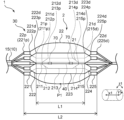
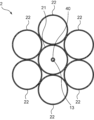
- FIG. 2 illustrates a side view of the balloon of the balloon catheter shown in FIG. 3 shows a cross-sectional view of the balloon catheter shown in FIG. 1 taken along line III-III.
- 4 shows a cross-sectional view of the balloon catheter shown in FIG. 1 taken along line IV-IV.
- 2 shows a cross-sectional view of the balloon catheter shown in FIG. 1 taken along the line VV.
- the balloon catheter according to an embodiment of the present invention has a shaft extending longitudinally from the proximal side to the distal side, a first balloon disposed at the distal portion of the shaft, and a balloon group consisting of a plurality of second balloons disposed in a circumferential direction of the first balloon outside the first balloon, and when the first balloon and the balloon group are in an expanded state, the length from the distal end of the first balloon to the proximal end of the first balloon in the longitudinal direction is shorter than the length from the distal end of the second balloon to the proximal end of the second balloon in the longitudinal direction.
- Figure 1 is a side view of a balloon catheter according to an embodiment of the present invention
- Figure 2 is a side view of a balloon of the balloon catheter shown in Figure 1.
- Figure 3 is a III-III cross-sectional view of the balloon catheter shown in Figure 1, showing a cross-sectional view perpendicular to the longitudinal direction at a portion where the first balloon and the balloon group are present.
- Figure 4 is a IV-IV cross-sectional view of the balloon catheter shown in Figure 1, showing a cross-sectional view perpendicular to the longitudinal direction at a portion where the first balloon and the balloon group are connected to the shaft.
- Figure 5 is a V-V cross-sectional view of the balloon catheter shown in Figure 1, showing a cross-sectional view perpendicular to the longitudinal direction of the shaft.
- the balloon catheter 1 has a shaft 10 extending longitudinally from the proximal side to the distal side, a first balloon 21 disposed at the distal portion of the shaft 10, and a balloon group 30 composed of a plurality of second balloons 22 arranged in a line around the circumference of the first balloon 21 outside the first balloon 21.
- the balloon of the balloon catheter 1 including the first balloon 21 and the plurality of second balloons 22 constituting the balloon group 30 may be referred to simply as "balloon 2".
- the shaft 10 has a longitudinal direction x1, a radial direction y1 connecting the centroid of the outer edge of the shaft 10 to a point on the outer edge in a cross section perpendicular to the longitudinal direction x1, and a circumferential direction z1 along the outer edge of the shaft 10 in a cross section perpendicular to the longitudinal direction x1.
- the direction toward the user's hand in the longitudinal direction x1 is referred to as the proximal side
- the opposite side to the proximal side i.e., the direction toward the subject of treatment
- Members and parts other than the shaft 10 also have longitudinal, radial, and circumferential directions, which may or may not be the same as the longitudinal direction x1, radial direction y1, and circumferential direction z1 of the shaft 10. However, for ease of understanding, this specification will be described as assuming that all members and parts have the same longitudinal, radial, and circumferential directions as the longitudinal direction x1, radial direction y1, and circumferential direction z1 of the shaft 10.
- the first balloon 21 and the second balloon 22 are connected to the distal portion of the shaft 10.
- the first balloon 21 and the second balloon 22 can be expanded by introducing a fluid through the inner cavity of the shaft 10, and the first balloon 21 and the second balloon 22 can be contracted by discharging the fluid.
- a fluid can be introduced or discharged using an indeflator (a balloon pressurizer).
- a balloon pressurizer a balloon pressurizer
- saline or a mixture of a contrast agent and saline can be used as the fluid.
- the fluid may be a pressurized fluid pressurized by a pump or the like.
- the number of first balloons 21 may be multiple, but is preferably one. In other words, it is preferable that the balloon catheter 1 has one first balloon 21 and multiple second balloons 22.
- the first balloon 21 is less likely to move inside the balloon group 30 when the first balloon 21 and the balloon group 30 are in an expanded state. As a result, the first balloon 21 is more likely to suppress the expansion of the multiple second balloons 22 that make up the balloon group 30, and the hardness of the balloon 2 is increased, making it easier to increase the expansion force.
- Examples of materials that can be used to form the first balloon 21 include polyamide resins such as nylon 11 and nylon 12, polyester resins such as polyethylene terephthalate and polybutylene terephthalate, polyurethane resins, and thermoplastic elastomers such as polyether block amide copolymers.
- the balloon group 30 is composed of a plurality of second balloons 22.
- the plurality of second balloons 22 constituting the balloon group 30 are arranged outside the first balloon 21 and in a line in the circumferential direction of the first balloon 21.
- the plurality of second balloons 22 constituting the balloon group 30 are arranged along the outer periphery of the first balloon 21.
- the balloon 2 has a balloon group 30 composed of a first balloon 21 and a plurality of second balloons 22, and the plurality of second balloons 22 constituting the balloon group 30 are arranged outside the first balloon 21 and in a line in the circumferential direction.
- the balloon group 30 suppresses the outward expansion of the first balloon 21, and the first balloon 21 suppresses the inward expansion of the second balloons 22 constituting the balloon group 30.
- the first balloon 21 and the balloon group 30 mutually suppress the expansion of each other, so that the balloon 2 is made to have a high pressure resistance, the hardness of the balloon 2 is increased, and the expansion force can be improved.
- the first balloon 21 and the balloon group 30 mutually suppress the expansion, making it difficult for the balloon 2 to expand. Therefore, even if high pressure is applied to the balloon 2, overexpansion of the balloon 2 is suppressed, preventing the balloon 2 from expanding beyond the targeted outer diameter, reducing damage to the aortic valve and other internal lumen of the body and improving safety.
- the number of second balloons 22 constituting the balloon group 30 is preferably 3 or more, more preferably 4 or more, and even more preferably 5 or more.
- the balloon group 30 is more likely to surround the outer periphery of the first balloon 21, and the balloon group 30 is more likely to suppress the expansion of the first balloon 21.
- the first balloon 21 is less likely to inflate, the hardness of the first balloon 21 is increased, and the expansion force of the balloon 2 can be increased.
- the number of second balloons 22 constituting the balloon group 30 is preferably 20 or less, more preferably 12 or less, even more preferably 10 or less, and particularly preferably 8 or less.
- the second balloons 22 constituting the balloon group 30 are less likely to move in the circumferential direction z1 when the balloon 2 is expanded, making it easier for the balloon group 30 to suppress the expansion of the first balloon 21.
- the materials listed as the materials for the first balloon 21 can be used as the material for the second balloon 22.
- the material for the second balloon 22 may be the same as the material for the first balloon 21, or it may be different.
- each of the multiple second balloons 22 constituting the balloon group 30 may be different, but are preferably the same.
- the balloon group 30 is preferably composed of multiple second balloons 22 made of the same material.
- the maximum outer diameters of the second balloons 22 constituting the balloon group 30 may be different, but are preferably the same.
- the fact that the maximum outer diameters of the second balloons 22 constituting the balloon group 30 are the same means that the maximum outer diameters of the second balloons 22 constituting the balloon group 30 are approximately the same, and specifically means that the maximum outer diameter of one second balloon 22 is 90% to 110% of the maximum outer diameters of all the other second balloons 22.
- the maximum outer diameters of the second balloons 22 constituting the balloon group 30 are the same, making it easier to align the timing of expansion of all the second balloons 22 constituting the balloon group 30, and making it easier to control the expansion of the balloon 2.
- the expanded state of the first balloon 21 means a state in which a fluid is introduced into the inner cavity of the first balloon 21 and the first balloon 21 is expanded.
- the expanded state of the balloon group 30 means that a fluid is introduced into the inner cavity of each of the second balloons 22 that make up the balloon group 30, and all of the second balloons 22 that make up the balloon group 30 are expanded.
- the maximum outer diameter of the first balloon 21 may be different from the maximum outer diameter of each of the second balloons 22 constituting the balloon group 30, but is preferably the same.
- the maximum outer diameter of the first balloon 21 being the same as the maximum outer diameter of each of the second balloons 22 constituting the balloon group 30 means that the maximum outer diameter of the first balloon 21 and the maximum outer diameter of each of the second balloons 22 constituting the balloon group 30 are approximately the same, and specifically means that the maximum outer diameter of the first balloon 21 is 90% or more and 110% or less of the average value of the maximum outer diameters of each of the second balloons 22.
- the maximum outer diameter of the first balloon 21 being the same as the maximum outer diameter of each of the second balloons 22 constituting the balloon group 30 makes it easier to balance the force that the first balloon 21 tries to expand and the force that the second balloon 22 tries to suppress the expansion of the first balloon 21 by expanding. As a result, the hardness of the first balloon 21 and the balloon group 30 is increased, making it easier to increase the expansion force of the balloon 2.
- the length L2 from the distal end 22d of each of the second balloons 22 in the longitudinal direction x1 to the proximal end 22p of the second balloon 22 may be different, but is preferably the same.
- the length L2 from the distal end 22d of each of the second balloons 22 in the longitudinal direction x1 to the proximal end 22p of the second balloon 22 being the same for each of the second balloons 22 in the longitudinal direction x1 for each of the second balloons 22 in the balloon group 30 means that the length L2 in the longitudinal direction x1 of each of the second balloons 22 in the balloon group 30 is approximately the same, and specifically means that the length L2 in the longitudinal direction x1 of one second balloon 22 is 90% or more and 110% or less of the length L2 in the longitudinal direction x1 of all the other second balloons 22.
- the length L2 in the longitudinal direction x1 of the multiple second balloons 22 that make up the balloon group 30 is the same, which makes it easier to align the timing at which all the second balloons 22 expand, making it easier to control the expansion of the balloons 2.
- the length L1 from the distal end 21d of the first balloon 21 to the proximal end 21p of the first balloon 21 in the longitudinal direction x1 is shorter than the length L2 from the distal end 22d of each of the second balloons 22 to the proximal end 22p of the second balloon 22 in the longitudinal direction x1. Since the length L1 of the first balloon 21 is shorter than the length L2 of the second balloon 22, the first balloon 21 is restrained by the multiple second balloons 22, and the position of the first balloon 21 is less likely to shift.
- the portion where the first balloon 21 is present is more likely to expand than the portion where the first balloon 21 is not present, it is easier to apply pressure to the portion where the first balloon 21 is present, and it is possible to accurately apply pressure to the target location.
- the balloon 2 is less likely to expand significantly in the portion where the first balloon 21 is not present and it is difficult to apply pressure, it is less likely to apply load to the portion that is not the target location, and the low invasiveness of the balloon catheter 1 can be improved.
- the length L1 from the distal end 21d of the first balloon 21 to the proximal end 21p of the first balloon 21 in the longitudinal direction x1 is preferably 95% or less, more preferably 90% or less, and even more preferably 85% or less of the length L2 from the distal end 22d of the second balloon 22 to the proximal end 22p of the second balloon 22 in the longitudinal direction x1.
- a balloon catheter 1 can be made that can easily apply high pressure accurately to the desired location.
- the length L1 from the distal end 21d of the first balloon 21 to the proximal end 21p of the first balloon 21 in the longitudinal direction x1 in the expanded state of the first balloon 21 and the balloon group 30 is preferably 20% or more, more preferably 25% or more, and even more preferably 30% or more of the length L2 from the distal end 22d of the second balloon 22 to the proximal end 22p of the second balloon 22 in the longitudinal direction x1.
- the first balloon 21 and the second balloon 22 each have straight tube sections 213, 223, proximal taper sections 212, 222 located proximal to the straight tube sections 213, 223, and distal taper sections 214, 224 located distal to the straight tube sections 213, 223.
- the first balloon 21 has a straight tube section 213, a proximal taper section 212 located proximal to the straight tube section 213, and a distal taper section 214 located distal to the straight tube section 213, and the second balloon 22 has a straight tube section 223, a proximal taper section 222 located proximal to the straight tube section 223, and a distal taper section 224 located distal to the straight tube section 223.
- the straight tube sections 213, 223 are preferably generally cylindrical with approximately the same diameter in the longitudinal direction x1, but may have different diameters in the longitudinal direction x1.
- the proximal tapered sections 212, 222 and the distal tapered sections 214, 224 are preferably formed into a generally conical or truncated conical shape with a reduced diameter as they move away from the straight tube sections 213, 223.
- the outer diameter of the proximal taper portions 212, 222 and the distal taper portions 214, 224 when the first balloon 21 and the balloon group 30 are deflated, the outer diameter of the proximal end and distal end of the second balloon 22 constituting the balloon group 30 can be reduced to reduce the step between the shaft 10 and the balloon group 30. Therefore, when the first balloon 21 and the balloon group 30 are in a deflated state, the outer surface of the balloon catheter 1 becomes smooth, making it easier to insert the balloon catheter 1 into a body cavity.
- the proximal end 212p of the proximal taper portion 212 of the first balloon 21 is distal to the proximal end 222p of the proximal taper portion 222 of the second balloon 22, and the distal end 214d of the distal taper portion 214 of the first balloon 21 is proximal to the distal end 224d of the distal taper portion 224 of the second balloon 22.
- the proximal end 212p of the proximal taper portion 212 of the first balloon 21 is located distal to the proximal end 222p of the proximal taper portion 222 of the second balloon 22 and the distal end 214d of the distal taper portion 214 of the first balloon 21 is located proximal to the distal end 224d of the distal taper portion 224 of the second balloon 22, the position of the proximal taper portion 212 of the first balloon 21 is unlikely to overlap with the position of the proximal taper portion 222 of the second balloon 22, and the position of the distal taper portion 214 of the first balloon 21 is unlikely to overlap with the position of the distal taper portion 224 of the second balloon 22.
- the balloon group 30 is restrained by the shaft 10, and the balloon 2 is unlikely to inflate outward from the balloon group 30.
- the outer diameter of both ends of the balloon 2 is unlikely to increase when the balloon 2 is in an expanded state
- the outer diameter of the central portion of the balloon 2 is likely to increase
- the outer surface of the balloon group 30 is likely to bend in a bow shape in the longitudinal direction x1 and assume an ellipsoidal shape (a long spheroid shaped like a rugby ball). Therefore, the portion to which a load is applied by expanding the balloon 2 is likely to be the central portion of the balloon 2, making it easier to apply pressure only to the desired location, improving minimal invasiveness.
- the outer diameter of both ends of the balloon 2 can be reduced even when the balloon 2 is in a contracted state. This makes it possible to reduce the outer diameter of the sheath, etc. used to transport the balloon catheter 1 to the treatment site, thereby improving minimal invasiveness.
- the proximal end 212p of the proximal taper portion 212 of the first balloon 21 is distal to the distal end 222d of the proximal taper portion 222 of the second balloon 22, and the distal end 214d of the distal taper portion 214 of the first balloon 21 is proximal to the proximal end 224p of the distal taper portion 224 of the second balloon 22.
- the proximal end 212p of the proximal taper portion 212 of the first balloon 21 is located distal to the distal end 222d of the proximal taper portion 222 of the second balloon 22, and the distal end 214d of the distal taper portion 214 of the first balloon 21 is located proximal to the proximal end 224p of the distal taper portion 224 of the second balloon 22.
- first balloon 21 and the second balloon 22 each have a proximal sleeve portion 211, 221 located proximal to the proximal taper portion 212, 222, and a distal sleeve portion 215, 225 located distal to the distal taper portion 214, 224.
- the first balloon 21 has a proximal sleeve portion 211 located proximal to the proximal taper portion 212, and a distal sleeve portion 215 located distal to the distal taper portion 214
- the second balloon 22 has a proximal sleeve portion 221 located proximal to the proximal taper portion 222, and a distal sleeve portion 225 located distal to the distal taper portion 224.
- the proximal taper section 212, the straight tube section 213, and the distal taper section 214 are the sections that expand when a fluid is introduced into the first balloon 21, and in the second balloon 22, the proximal taper section 222, the straight tube section 223, and the distal taper section 224 are the sections that expand when a fluid is introduced into the second balloon 22, whereas the proximal sleeve sections 211, 221 and the distal sleeve sections 215, 225 are preferably the sections that do not expand.
- proximal sleeve sections 211, 221 and the distal sleeve sections 215, 225 By not allowing the proximal sleeve sections 211, 221 and the distal sleeve sections 215, 225 to expand, it is possible to provide a configuration in which at least a portion of the proximal sleeve sections 211, 221 and at least a portion of the distal sleeve sections 215, 225 can be easily fixed to the shaft 10.
- the distance from the proximal end 21p of the first balloon 21 to the proximal end 22p of the second balloon 22 in the longitudinal direction x1 is approximately the same as the distance from the distal end 21d of the first balloon 21 to the distal end 22d of the second balloon 22 in the longitudinal direction x1.
- the distance from the proximal end 21p of the first balloon 21 to the proximal end 22p of the second balloon 22 in the longitudinal direction x1 is 90% or more and 110% or less of the distance from the distal end 21d of the first balloon 21 to the distal end 22d of the second balloon 22 in the longitudinal direction x1.
- the first balloon 21 is more likely to be located in the center of the balloon group 30 in the longitudinal direction x1.
- the part to which the load is applied by expanding the balloon 2 is more likely to be the center of the balloon 2, making it easier to adjust the part to which pressure is applied by the balloon 2.
- the position of the midpoint of the length L1 from the distal end 21d of the first balloon 21 to the proximal end 21p of the first balloon 21 in the longitudinal direction x1 coincides with the position of the midpoint P1 of the length of the balloon group 30 in the longitudinal direction x1.
- the balloon 2 is most likely to expand at the position of the midpoint P1 of the length of the balloon group 30, making it easier to apply high pressure.
- the outer diameter of the balloon group 30 at the midpoint P1 of the length of the balloon group 30 in the longitudinal direction x1 is preferably larger than the outer diameter of the balloon group 30 at the distal end 223d of the straight tube section 223 of the second balloon 22 and the outer diameter of the balloon group 30 at the proximal end 223p of the straight tube section 223 of the second balloon 22.
- the outer diameter of the balloon group 30 refers to the diameter of the circumscribing circle of the multiple second balloons 22 that constitute the balloon group 30.
- the outer diameter of the balloon group 30 at the midpoint P1 of the length of the balloon group 30 is preferably larger than the diameters of the circumscribing circles of the balloon group 30 at the distal end 223d and the proximal end 223p of the straight tube section 223 of the second balloon 22.
- the outer diameter of the balloon group 30 at the midpoint P1 of the length of the balloon group 30 is larger than the outer diameter of the balloon group 30 at the distal end 223d of the straight tube portion 223 of the second balloon 22 and the outer diameter of the balloon group 30 at the proximal end 223p of the straight tube portion 223 of the second balloon 22, the outer shape of the balloon group 30 tends to be an ellipsoid curved like a bow in the longitudinal direction x1. Therefore, the balloon 2 is greatly expanded at the midpoint P1 of the length of the balloon group 30, making it easier to apply pressure to the target location.
- the balloon 2 does not expand at the distal end 223d and proximal end 223p of the straight tube portion 223 of the second balloon 22 compared to the midpoint P1 of the length of the balloon group 30, so it is difficult to apply pressure to the non-target location, making it possible to improve low invasiveness.
- the outer diameter of the balloon group 30 at the midpoint P1 of the length of the balloon group 30 in the longitudinal direction x1 is preferably at least 1.1 times the outer diameter of the balloon group 30 at the distal end 223d of the straight tube section 223 of the second balloon 22 and the outer diameter of the balloon group 30 at the proximal end 223p of the straight tube section 223 of the second balloon 22, more preferably at least 1.3 times, and even more preferably at least 1.5 times.
- the outer diameter of the balloon group 30 at the midpoint P1 of the length of the balloon group 30 is easily expanded sufficiently larger than the outer diameter of the balloon group 30 at the distal end 223d and the proximal end 223p of the straight tube portion 223 of the second balloon 22.
- the outer diameter of the balloon group 30 at the midpoint P1 of the length of the balloon group 30 in the longitudinal direction x1 is preferably 10 times or less, more preferably 9 times or less, and even more preferably 8 times or less of the outer diameter of the balloon group 30 at the distal end 223d of the straight tube portion 223 of the second balloon 22 and the outer diameter of the balloon group 30 at the proximal end 223p of the straight tube portion 223 of the second balloon 22.
- the outer diameter of the balloon group 30 is less likely to become excessively large at the midpoint P1 of the length of the balloon group 30, thereby improving the minimal invasiveness of the balloon catheter 1.
- At least one pair of adjacent second balloons 22 constituting the balloon group 30 are in contact with each other.
- the outer surfaces of at least two second balloons 22 are in contact with each other in the expanded state of the balloon 2. Since at least one pair of adjacent second balloons 22 constituting the balloon group 30 are in contact with each other, when fluid is introduced into both the first balloon 21 and the balloon group 30 to expand the balloon 2, the adjacent second balloons 22 suppress each other's expansion. Therefore, inside the second balloon 22, the pressure of the fluid sent in to expand the second balloon 22 increases, and the hardness of the second balloon 22 increases, making it possible to increase the expansion force of the balloon 2.
- all the second balloons 22 constituting the balloon group 30 are in contact with the adjacent second balloons 22.
- the second balloon 22 is in contact with the second balloons 22 located on both sides of the second balloon 22 in the circumferential direction z1. Since all the second balloons 22 constituting the balloon group 30 are in contact with the adjacent second balloons 22, when the balloon 2 is in the expanded state, all the second balloons 22 constituting the balloon group 30 suppress each other's expansion, and the internal pressure of all the second balloons 22 increases. Therefore, the hardness of the entire balloon group 30 increases, and the expansion force of the balloon 2 can be further increased.
- the balloon group 30 is in contact with the outer circumferential surface of the first balloon 21.
- all of the second balloons constituting the balloon group 30 are in contact with the outer circumferential surface of the first balloon 21.
- the effect of the first balloon 21 and the balloon group 30 suppressing each other's expansion is more likely to be enhanced, making it easier to further increase the expansion force of the balloon 2.
- the shaft 10 has a first inflation lumen 11 and a second inflation lumen 12 extending in the longitudinal direction x1, and the first inflation lumen 11 is preferably connected to the first balloon 21, and the second inflation lumen 12 is preferably connected to the second balloon 22 constituting the balloon group 30. Since the shaft 10 has the first inflation lumen 11 connected to the first balloon 21 and the second inflation lumen 12 connected to the second balloon 22, the first balloon 21 and the second balloon 22 are each connected to different inflation lumens. Therefore, the timing of expansion and the expansion pressure can be changed for the first balloon 21 and the balloon group 30 composed of multiple second balloons 22, making it possible to provide a balloon catheter 1 that can respond to various treatments and conditions of the lesion.
- the shaft 10 has the first inflation lumen 11 connected to the first balloon 21 and the second inflation lumen 12 connected to the second balloon 22, the balloon 2 of the balloon catheter 1 can be placed at a target site of a biological lumen such as a blood vessel, and the first balloon 21 and the balloon group 30 can be expanded, and then the fluid inside the first balloon 21 can be discharged through the first inflation lumen 11.
- the first balloon 21 can be deflated to increase the amount of blood perfusion.
- the balloon catheter 1 shows a so-called rapid exchange type balloon catheter 1 having a guidewire port 50 on the way from the distal side to the proximal side of the shaft 10 and a guidewire tube 40 that functions as a guidewire insertion passage from the guidewire port 50 to the distal side of the shaft 10.
- the balloon catheter 1 preferably has a distal shaft 15 and a proximal shaft 16, and the distal shaft 15 and the proximal shaft 16 may be separate members, and the proximal end of the distal shaft 15 may be connected to the distal end of the proximal shaft 16 to form a shaft 10 that extends from the balloon 2 to the proximal end of the balloon catheter 1.
- one shaft 10 may extend from the balloon 2 to the proximal end of the balloon catheter 1, and the distal shaft 15 and the proximal shaft 16 may be further composed of multiple tube members.
- the shaft 10 preferably has a fluid flow path and a guidewire insertion path inside.
- the shaft 10 can be configured to have a fluid flow path and a guidewire insertion path inside by configuring the guidewire tube 40 disposed inside the shaft 10 to function as the guidewire insertion path, and the space between the shaft 10 and the guidewire tube 40 to function as a fluid flow path.
- the guidewire tube 40 extends from the distal end of the shaft 10 and penetrates the balloon 2, the distal side of the balloon 2 is connected to the guidewire tube 40, and the proximal side of the balloon 2 is connected to the shaft 10.
- the shaft 10 is preferably made of a resin, a metal, or a combination of a resin and a metal.
- a resin as the material for the shaft 10
- a metal as the material for the shaft 10
- the deliverability of the balloon catheter 1 can be improved.
- resins that make up the shaft 10 include polyamide resins, polyester resins, polyurethane resins, polyolefin resins, fluorine resins, vinyl chloride resins, silicone resins, natural rubber, synthetic rubber, etc. These may be used alone or in combination of two or more types.
- Examples of metals that make up the shaft 10 include stainless steels such as SUS304 and SUS316, platinum, nickel, cobalt, chromium, titanium, tungsten, gold, Ni-Ti alloys, Co-Cr alloys, and combinations thereof.
- the shaft 10 is composed of a distal shaft 15 and a proximal shaft 16 that are separate members, the distal shaft 15 may be made of resin, and the proximal shaft 16 may be made of metal, for example.
- the shaft 10 may also have a layered structure made of different materials or the same material.
- the shaft 10 has a guidewire lumen 13 extending in the longitudinal direction x1 and through which a guidewire is inserted, and further has a guidewire tube 40 having an inner cavity communicating with the guidewire lumen 13, and the guidewire tube 40 is preferably disposed in the inner cavity of the first balloon 21. Since the balloon catheter 1 has a guidewire tube 40 having an inner cavity communicating with the guidewire lumen 13, it becomes easy to insert the guidewire into the balloon catheter 1, and it becomes possible to transport the balloon catheter 1 into the body along the guidewire. Furthermore, by inserting the guidewire into the guidewire tube 40, it is possible to prevent the guidewire from damaging the first balloon 21, the second balloon 22, etc.
- the material constituting the guidewire tube 40 may be, for example, a polyolefin resin such as polyethylene or polypropylene, a polyamide resin such as nylon, a polyester resin such as PET, an aromatic polyetherketone resin such as PEEK, a polyetherpolyamide resin, a polyurethane resin, a polyimide resin, a fluorine resin such as PTFE, PFA, or ETFE, or a synthetic resin such as polyvinyl chloride resin.
- the material constituting the guidewire tube 40 is preferably a polyimide resin. By using a polyimide resin as the material constituting the guidewire tube 40, the slipperiness of the guidewire tube 40 is improved.
- the guidewire tube 40 may also have a multi-layer structure including a braided layer such as a metal braid.
- a multi-layer structure for the guidewire tube 40 the strength of the guidewire tube 40, the slipperiness with respect to the guidewire, and the kink resistance can be improved.
- the proximal end of the guidewire tube 40 is preferably connected to the distal end of the shaft 10.
- the shaft 10 has a distal shaft 15 and a proximal shaft 16
- the proximal end of the guidewire tube 40 is preferably connected to the distal end of the distal shaft 15.
- the balloon 2 and the shaft 10 can be joined by bonding with an adhesive, welding, or by attaching a ring-shaped member to the overlapping portion of the end of the balloon 2 and the shaft 10 and crimping the end. Of these, it is preferable that the balloon 2 and the shaft 10 are joined by welding. By joining the balloon 2 and the shaft 10 by welding, the bond between the balloon 2 and the shaft 10 is unlikely to come undone even if the balloon 2 is repeatedly expanded or contracted, and the bond strength can be improved.
- the distal end of the balloon catheter 1 is preferably provided with a tip member 60.
- the tip member 60 may be provided at the distal end of the balloon catheter 1 by being connected to the distal end of the balloon 2 as a separate member from the guidewire tube 40, or the guidewire tube 40 that extends distally beyond the distal end of the balloon 2 may function as the tip member 60.
- an X-ray-opaque marker 70 may be placed on the guidewire tube 40 inside the balloon 2 at the location where the balloon 2 is located in the longitudinal axis direction x1 so that the position of the balloon 2 can be confirmed by X-ray fluoroscopy.
- the position on the guidewire tube 40 where the X-ray opaque marker 70 is arranged may be, for example, the midpoint of the length L1 from the distal end 21d of the first balloon 21 to the proximal end 21p of the first balloon 21, the proximal end 213p and the distal end 213d of the straight tube portion 213 of the first balloon 21, and the proximal end 223p and the distal end 223d of the straight tube portion 223 of the second balloon 22.
- the position on the guidewire tube 40 where the X-ray opaque marker 70 is arranged is preferably the proximal end 213p and the distal end 213d of the straight tube portion 213 of the first balloon 21.
- the balloon catheter 1 can be made to easily apply pressure to the desired location.
- a hub 5 may be provided on the proximal side of the shaft 10.
- the hub 5 may also be provided with a fluid injection section 6 that is connected to a flow path for fluid to be supplied to the inside of the balloon 2.
- the shaft 10 and the hub 5 can be joined by, for example, bonding with an adhesive, welding, etc. Among these, it is preferable that the shaft 10 and the hub 5 are joined by adhesion. By joining the shaft 10 and the hub 5 by adhesion, the bond strength between the shaft 10 and the hub 5 can be increased and the durability of the balloon catheter 1 can be improved when the materials constituting the shaft 10 and the hub 5 are different, for example, when the shaft 10 is made of a highly flexible material and the hub 5 is made of a highly rigid material.
- the present invention can also be applied to so-called over-the-wire type balloon catheters that have a guidewire passage from the distal side to the proximal side of the shaft.
- the balloon catheter is an over-the-wire type, it is preferable that the inflation lumen and the guidewire lumen extend to a hub located on the proximal side, and that the proximal opening of each lumen is provided in a bifurcated hub.
- the balloon catheter 1 is of the rapid exchange type, it is preferable that the outer wall of at least one of the distal shaft 15 and the proximal shaft 16 is coated, and it is more preferable that the outer walls of both the distal shaft 15 and the proximal shaft 16 are coated. If the balloon catheter is of the over-the-wire type, it is preferable that the outer wall of the outer shaft is coated.
- the coating applied to the shaft 10 can be a hydrophilic coating or a hydrophobic coating depending on the purpose, and can be applied by immersing the shaft 10 in a hydrophilic coating agent or a hydrophobic coating agent, applying a hydrophilic coating agent or a hydrophobic coating agent to the outer wall of the shaft 10, covering the outer wall of the shaft 10 with a hydrophilic coating agent or a hydrophobic coating agent, etc.
- the coating agent may contain drugs, additives, etc.
- Hydrophilic coating agents include hydrophilic polymers such as polyvinyl alcohol, polyethylene glycol, polyacrylamide, polyvinylpyrrolidone, methyl vinyl ether maleic anhydride copolymer, and hydrophilic coating agents made from any combination thereof.
- Hydrophobic coating agents include polytetrafluoroethylene (PTFE), fluorinated ethylene propylene (FEP), perfluoroalkoxyalkane (PFA), silicone oil, hydrophobic urethane resin, carbon coat, diamond coat, diamond-like carbon (DLC) coat, ceramic coat, and substances with low surface free energy terminated with alkyl groups or perfluoroalkyl groups.
- PTFE polytetrafluoroethylene
- FEP fluorinated ethylene propylene
- PFA perfluoroalkoxyalkane
- silicone oil silicone oil
- hydrophobic urethane resin carbon coat
- diamond coat diamond coat
- DLC diamond-like carbon
- ceramic coat and substances with low surface free energy terminated with alkyl groups or perfluoroalkyl groups.
- the balloon catheter 1 of the present invention is preferably used to expand an aortic valve, deform a biological valve placed in the heart, or destroy a biological valve.
- the balloon catheter 1 of the present invention is preferably used for the purpose of expanding an aortic valve that has hardened due to calcification or the like, or for the purpose of deforming or destroying an artificial valve ring of a biological valve to replace a deteriorated biological valve placed in the heart.
- the balloon catheter 1 of the present invention is easy to apply high pressure to the portion where the first balloon 21 is present, and therefore can be suitably used to easily expand a hardened aortic valve and deform or destroy a biological valve that could not be sufficiently expanded with conventional balloon catheters.
- Balloon catheter 2 Balloon 5: Hub 6: Fluid injection section 10: Shaft 11: First inflation lumen 12: Second inflation lumen 13: Guidewire lumen 15: Distal shaft 16: Proximal shaft 21: First balloon 21d: Distal end 21p of first balloon: Proximal end 211 of first balloon: Proximal sleeve portion 211d of first balloon: Distal end 211p of proximal sleeve portion of first balloon: Proximal end 212 of proximal sleeve portion of first balloon: Proximal taper portion 212d of first balloon: First balloon Distal end 212p of the proximal tapered portion of the first balloon: Proximal end 213 of the proximal tapered portion of the first balloon: Straight tube portion 213d of the first balloon: Distal end 213p of the straight tube portion of the first balloon: Proximal end 214 of the straight tube portion of the first balloon: Distal tapered portion 214d of the first balloon: Distal tape
Landscapes
- Health & Medical Sciences (AREA)
- Life Sciences & Earth Sciences (AREA)
- Heart & Thoracic Surgery (AREA)
- Engineering & Computer Science (AREA)
- Biophysics (AREA)
- Pulmonology (AREA)
- Child & Adolescent Psychology (AREA)
- Anesthesiology (AREA)
- Biomedical Technology (AREA)
- Hematology (AREA)
- Animal Behavior & Ethology (AREA)
- General Health & Medical Sciences (AREA)
- Public Health (AREA)
- Veterinary Medicine (AREA)
- Media Introduction/Drainage Providing Device (AREA)
Priority Applications (3)
| Application Number | Priority Date | Filing Date | Title |
|---|---|---|---|
| JP2025528086A JPWO2024262526A1 (https=) | 2023-06-22 | 2024-06-19 | |
| CN202480039100.7A CN121335734A (zh) | 2023-06-22 | 2024-06-19 | 球囊导管 |
| EP24825927.7A EP4732880A1 (en) | 2023-06-22 | 2024-06-19 | Balloon catheter |
Applications Claiming Priority (2)
| Application Number | Priority Date | Filing Date | Title |
|---|---|---|---|
| JP2023102816 | 2023-06-22 | ||
| JP2023-102816 | 2023-06-22 |
Publications (1)
| Publication Number | Publication Date |
|---|---|
| WO2024262526A1 true WO2024262526A1 (ja) | 2024-12-26 |
Family
ID=93935570
Family Applications (1)
| Application Number | Title | Priority Date | Filing Date |
|---|---|---|---|
| PCT/JP2024/022197 Ceased WO2024262526A1 (ja) | 2023-06-22 | 2024-06-19 | バルーンカテーテル |
Country Status (4)
| Country | Link |
|---|---|
| EP (1) | EP4732880A1 (https=) |
| JP (1) | JPWO2024262526A1 (https=) |
| CN (1) | CN121335734A (https=) |
| WO (1) | WO2024262526A1 (https=) |
Citations (7)
| Publication number | Priority date | Publication date | Assignee | Title |
|---|---|---|---|---|
| US20070185445A1 (en) * | 2006-02-06 | 2007-08-09 | Cryocath Technologies Inc. | Cryo-perfusion balloon device |
| US20110144742A1 (en) * | 2009-12-15 | 2011-06-16 | Edwards Lifesciences Corporation | Expansion Device for Treatment of Vascular Passageways |
| US20120209375A1 (en) | 2011-02-11 | 2012-08-16 | Gilbert Madrid | Stability device for use with percutaneous delivery systems |
| JP2016174646A (ja) * | 2015-03-18 | 2016-10-06 | テルモ株式会社 | バルーンカテーテル |
| JP2018536474A (ja) | 2015-11-06 | 2018-12-13 | シー・アール・バード・インコーポレーテッドC R Bard Incorporated | 選択的に作動可能なバルブを有する灌流バルーン |
| WO2022046834A1 (en) * | 2020-08-25 | 2022-03-03 | Edwards Lifesciences Corporation | Medical balloon sensing assembly |
| JP2023102816A (ja) | 2022-01-13 | 2023-07-26 | キヤノン株式会社 | デバイス、デバイスの製造方法 |
-
2024
- 2024-06-19 JP JP2025528086A patent/JPWO2024262526A1/ja active Pending
- 2024-06-19 CN CN202480039100.7A patent/CN121335734A/zh active Pending
- 2024-06-19 WO PCT/JP2024/022197 patent/WO2024262526A1/ja not_active Ceased
- 2024-06-19 EP EP24825927.7A patent/EP4732880A1/en active Pending
Patent Citations (7)
| Publication number | Priority date | Publication date | Assignee | Title |
|---|---|---|---|---|
| US20070185445A1 (en) * | 2006-02-06 | 2007-08-09 | Cryocath Technologies Inc. | Cryo-perfusion balloon device |
| US20110144742A1 (en) * | 2009-12-15 | 2011-06-16 | Edwards Lifesciences Corporation | Expansion Device for Treatment of Vascular Passageways |
| US20120209375A1 (en) | 2011-02-11 | 2012-08-16 | Gilbert Madrid | Stability device for use with percutaneous delivery systems |
| JP2016174646A (ja) * | 2015-03-18 | 2016-10-06 | テルモ株式会社 | バルーンカテーテル |
| JP2018536474A (ja) | 2015-11-06 | 2018-12-13 | シー・アール・バード・インコーポレーテッドC R Bard Incorporated | 選択的に作動可能なバルブを有する灌流バルーン |
| WO2022046834A1 (en) * | 2020-08-25 | 2022-03-03 | Edwards Lifesciences Corporation | Medical balloon sensing assembly |
| JP2023102816A (ja) | 2022-01-13 | 2023-07-26 | キヤノン株式会社 | デバイス、デバイスの製造方法 |
Also Published As
| Publication number | Publication date |
|---|---|
| JPWO2024262526A1 (https=) | 2024-12-26 |
| EP4732880A1 (en) | 2026-04-29 |
| CN121335734A (zh) | 2026-01-13 |
Similar Documents
| Publication | Publication Date | Title |
|---|---|---|
| CN113646030B (zh) | 球囊导管 | |
| WO2020195170A1 (ja) | バルーンカテーテル | |
| JP2024072607A (ja) | バルーンカテーテル用バルーン及びそれを備えるバルーンカテーテル、並びにバルーンカテーテルの製造方法 | |
| WO2024262526A1 (ja) | バルーンカテーテル | |
| WO2024262529A1 (ja) | バルーンカテーテル、および該バルーンカテーテルにおけるバルーンの拡張方法 | |
| JP2025002563A (ja) | バルーンカテーテル、および該バルーンカテーテルにおけるバルーンの拡張方法 | |
| WO2023079906A1 (ja) | バルーンカテーテル用バルーン | |
| JP2025109390A (ja) | バルーンカテーテル | |
| WO2024262528A1 (ja) | バルーンカテーテル | |
| JP2025002562A (ja) | バルーンカテーテル | |
| WO2024262527A1 (ja) | バルーンカテーテル | |
| WO2025204185A1 (ja) | バルーンカテーテル | |
| WO2025197596A1 (ja) | バルーンカテーテル | |
| WO2025197348A1 (ja) | バルーンカテーテル | |
| JP2025142774A (ja) | バルーンカテーテル | |
| JP2025147477A (ja) | バルーンカテーテル | |
| US20250152922A1 (en) | Balloon catheter | |
| WO2025197347A1 (ja) | バルーンカテーテル | |
| US20260076709A1 (en) | Balloon for balloon catheter and balloon catheter including same | |
| US20250269155A1 (en) | Balloon for balloon catheter and balloon catheter including same | |
| WO2024106176A1 (ja) | バルーンカテーテル用バルーン及びそれを備えるバルーンカテーテル、並びにバルーンカテーテルの製造方法 | |
| US20260115433A1 (en) | Balloon for balloon catheter, balloon catheter including same, and method for manufacturing balloon catheter | |
| JP7526112B2 (ja) | カテーテル | |
| JP2025002564A (ja) | バルーンカテーテル | |
| WO2025150255A1 (ja) | バルーンカテーテル |
Legal Events
| Date | Code | Title | Description |
|---|---|---|---|
| 121 | Ep: the epo has been informed by wipo that ep was designated in this application |
Ref document number: 24825927 Country of ref document: EP Kind code of ref document: A1 |
|
| ENP | Entry into the national phase |
Ref document number: 2025528086 Country of ref document: JP Kind code of ref document: A |
|
| WWE | Wipo information: entry into national phase |
Ref document number: 2025528086 Country of ref document: JP |
|
| WWE | Wipo information: entry into national phase |
Ref document number: CN2024800391007 Country of ref document: CN |
|
| WWE | Wipo information: entry into national phase |
Ref document number: 2024825927 Country of ref document: EP |
|
| NENP | Non-entry into the national phase |
Ref country code: DE |
|
| ENP | Entry into the national phase |
Ref document number: 2024825927 Country of ref document: EP Effective date: 20260122 |
|
| ENP | Entry into the national phase |
Ref document number: 2024825927 Country of ref document: EP Effective date: 20260122 |
|
| ENP | Entry into the national phase |
Ref document number: 2024825927 Country of ref document: EP Effective date: 20260122 |