WO2024262021A1 - 空転滑走検知装置および空転滑走検知方法 - Google Patents
空転滑走検知装置および空転滑走検知方法 Download PDFInfo
- Publication number
- WO2024262021A1 WO2024262021A1 PCT/JP2023/023364 JP2023023364W WO2024262021A1 WO 2024262021 A1 WO2024262021 A1 WO 2024262021A1 JP 2023023364 W JP2023023364 W JP 2023023364W WO 2024262021 A1 WO2024262021 A1 WO 2024262021A1
- Authority
- WO
- WIPO (PCT)
- Prior art keywords
- gradient
- acceleration
- vehicle
- skid
- unit
- Prior art date
- Legal status (The legal status is an assumption and is not a legal conclusion. Google has not performed a legal analysis and makes no representation as to the accuracy of the status listed.)
- Ceased
Links
Images






Classifications
-
- B—PERFORMING OPERATIONS; TRANSPORTING
- B60—VEHICLES IN GENERAL
- B60L—PROPULSION OF ELECTRICALLY-PROPELLED VEHICLES; SUPPLYING ELECTRIC POWER FOR AUXILIARY EQUIPMENT OF ELECTRICALLY-PROPELLED VEHICLES; ELECTRODYNAMIC BRAKE SYSTEMS FOR VEHICLES IN GENERAL; MAGNETIC SUSPENSION OR LEVITATION FOR VEHICLES; MONITORING OPERATING VARIABLES OF ELECTRICALLY-PROPELLED VEHICLES; ELECTRIC SAFETY DEVICES FOR ELECTRICALLY-PROPELLED VEHICLES
- B60L15/00—Methods, circuits, or devices for controlling the traction-motor speed of electrically-propelled vehicles
- B60L15/20—Methods, circuits, or devices for controlling the traction-motor speed of electrically-propelled vehicles for control of the vehicle or its driving motor to achieve a desired performance, e.g. speed, torque, programmed variation of speed
Definitions
- This disclosure relates to a skid detection device and a skid detection method for use on trains.
- on-board devices mounted on trains have been used to detect skidding or sliding that occurs on the train's wheels.
- the on-board device determines the state of skidding or sliding based only on a tachograph generator attached to the wheel, it is unable to detect the start and end points of the skidding or sliding, especially when there is only one tachograph generator.
- the on-board device calculates the vehicle acceleration from the output of an acceleration sensor attached to the train, removing the gravitational acceleration component due to the gradient of the track, and detects the start point of the skidding or sliding based on the change in acceleration, i.e., jerk information, and can detect the end point of the skidding or sliding by comparing the speed obtained by integrating the vehicle acceleration with the speed obtained from the tachograph generator.
- Patent Document 1 discloses a technology that detects the occurrence of skidding or sliding based on a rotation detection signal corresponding to the rotation speed of the train's axles or wheels and the sensor value of an inertial sensor.
- the on-board device described in Patent Document 1 uses information about the gradient of the line the train runs on to cancel the gradient component of the gravitational acceleration from the acceleration obtained from an inertial sensor or the like to calculate the acceleration in the train's direction of travel.
- some inertial sensors such as acceleration sensors are low-cost and low-precision, and the zero point of such inertial sensors fluctuates due to effects such as temperature changes and vibrations while the train is running, resulting in an inaccurate value because the output value contains the fluctuation of the zero point.
- the database referenced to obtain gradient information may be inaccurate depending on the line. Therefore, with the above conventional technology, even if the gradient component of the gravitational acceleration is cancelled out from the acceleration obtained from an inertial sensor or the like to calculate the acceleration in the direction of the train's travel, there are cases where an accurate value cannot be obtained.
- the present disclosure has been made in consideration of the above, and aims to obtain a skid detection device that can reduce the effect of the gradient component of the gravitational acceleration acting on a vehicle and improve the accuracy of calculating the acceleration in the vehicle's traveling direction.
- the skid detection device disclosed herein comprises a first change detection unit that detects a change in vehicle speed output from a speed sensor that calculates the vehicle speed based on the number of rotations of the wheels of the vehicle and outputs the change as a first acceleration, a second change detection unit that detects a change in a second acceleration output from an acceleration sensor with at least one axis whose detection direction is the traveling direction of the vehicle and outputs the change as a jerk, a skid/slide determination unit that determines whether a skid or slide has occurred on the vehicle based on the first acceleration and the jerk, a gradient information storage unit in which information on the gradient value of the route relative to the position of the route on which the vehicle is traveling is registered, and a skid/slide determination unit that determines whether a skid or slide has occurred on the vehicle.
- the vehicle is characterized by having a sensor calibration unit that calibrates the zero point of the acceleration sensor using the gradient value registered in the gradient information storage unit for the vehicle's current position when it is determined that the vehicle is in normal driving and neither skidding nor sliding is occurring; a gradient information correction unit that corrects the gradient value registered in the gradient information storage unit during normal driving based on the first acceleration and a third acceleration obtained by correcting the second acceleration based on the calibrated zero point; and a skid/slide end determination unit that determines that the skid or slide occurring in the vehicle has ended based on the vehicle speed and a fourth acceleration obtained by correcting the third acceleration based on the acceleration caused by gravity that occurs in the vehicle due to the gradient of the route.
- the skid detection device disclosed herein has the effect of reducing the effect of the gradient component of the gravitational acceleration acting on the vehicle, thereby improving the accuracy of calculating the acceleration in the vehicle's traveling direction.
- FIG. 1 is a diagram showing a configuration example of a train control system according to a first embodiment
- FIG. 1 is a diagram showing a configuration example of a slippage detection device according to a first embodiment
- a flowchart showing the operation of the zero point calibration process of the acceleration sensor and the update process of the gradient value registered in the gradient information storage unit performed by the skid detection device according to the first embodiment during normal vehicle running.
- a diagram showing examples of errors that occur in sensors installed in a typical vehicle.
- FIG. 2 is a diagram showing an example of an estimated gradient value of a gradient at an angle ⁇ at which a vehicle equipped with a skid detection device according to the first embodiment travels, and an example of acceleration generated by the vehicle;
- a flowchart showing an operation of the skid/slide detection device according to the first embodiment to determine that a skid or slide has ended after a skid or slide has occurred on a vehicle.
- FIG. 13 is a diagram showing an example of gradient values in a gradient information storage unit that are corrected by the operation of the skid detection device according to the first embodiment;
- FIG. 1 is a diagram showing an example of a case where a processing circuit included in a skid detection device according to a first embodiment is configured with a processor and a memory.
- FIG. 1 is a diagram showing an example in which a processing circuit included in the slippage detection device according to the first embodiment is configured with dedicated hardware.
- FIG. 1 shows a configuration example of a train control system according to a second embodiment.
- FIG. 1 is a diagram showing a configuration example of a slippage detection device according to a second embodiment;
- FIG. 13 is a diagram showing an example of gradient change points in the gradient information storage unit that are corrected by the operation of the skid detection device according to the second embodiment;
- FIG. 1 is a first diagram showing a configuration example of a slippage detection device according to a third embodiment
- FIG. 2 is a second diagram showing a configuration example of a slippage detection device according to the third embodiment
- 10 is a first flowchart showing an operation of a gradient information creating unit of a skid detection device according to a third embodiment of the present invention for creating gradient information to be registered in a gradient information storage unit.
- 11 is a second flowchart showing the operation of the gradient information creation unit of the skid detection device according to the third embodiment to create gradient information to be registered in the gradient information storage unit.
- 3 is a third flowchart showing an operation of the gradient information creation unit of the slippage detection device according to the third embodiment to create gradient information to be registered in the gradient information storage unit.
- FIG. 1 is a diagram showing an example of the configuration of a train control system 60 according to the first embodiment.
- the train control system 60 is mounted on a vehicle 50.
- the train control system 60 includes a train control device 30, a speed sensor 41, and an acceleration sensor 42.
- the train control device 30 controls the running of a train including the vehicle 50.
- the train control device 30 includes a skid/slide detection device 10 and a command value generation unit 20.
- the skid/slide detection device 10 detects the occurrence of a skid or slide in the vehicle 50 based on detection values acquired from the speed sensor 41 and the acceleration sensor 42, and outputs information such as the occurrence of a skid or slide and the end of the skid or slide to the command value generation unit 20.
- the command value generation unit 20 generates and outputs a command value for running the train to an on-board device (not shown) based on the information acquired from the skid/slide detection device 10.
- the speed sensor 41 is a sensor that calculates the vehicle speed based on the rotation speed of the wheels of the vehicle 50.
- the speed sensor 41 outputs the calculated vehicle speed to the skid detection device 10.
- the speed sensor 41 may output only a pulse signal corresponding to the rotation speed of the wheels of the vehicle 50 to the skid detection device 10. In this case, the skid detection device 10 calculates the vehicle speed based on the acquired pulse signal.
- the acceleration sensor 42 is a sensor that has at least one detection direction, with the detection direction being the traveling direction of the vehicle 50.
- the acceleration sensor 42 outputs the detected acceleration to the skid detection device 10.
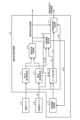
- FIG. 2 is a diagram showing an example of the configuration of the skid detection device 10 according to the first embodiment.
- the skid detection device 10 includes a first change detection unit 11, a second change detection unit 12, a skid determination unit 13, a gradient information storage unit 14, a sensor calibration unit 15, a gradient information correction unit 16, and a skid end determination unit 17.
- the first change detection unit 11 detects changes in the vehicle speed v_TM output from the speed sensor 41, and outputs the first acceleration ⁇ _TM to the skid determination unit 13 and the gradient information correction unit 16.
- the second change detection unit 12 detects a change in the second acceleration ⁇ 0, which is the acceleration output from the acceleration sensor 42, and outputs it as a jerk to the skid/slip determination unit 13.
- the skid/slide determination unit 13 obtains the first acceleration ⁇ _TM from the first change detection unit 11 and obtains the jerk from the second change detection unit 12, and determines that a skid or slide has occurred on the vehicle 50 based on the first acceleration ⁇ _TM and the jerk. For example, when the second acceleration ⁇ 0 is shown to be unchanged in the jerk and the first acceleration ⁇ _TM is changed, the skid/slide determination unit 13 determines that a skid or slide has occurred on the vehicle 50. Note that the method by which the skid/slide determination unit 13 determines that a skid or slide has occurred on the vehicle 50 may be a general method and is not limited to this.
- the skid/slide determination unit 13 may obtain the second acceleration ⁇ 0 from the second change detection unit 12, and in this case, it can still be determined that a skid or slide has occurred on the vehicle 50.
- the skid/slide determination unit 13 outputs a skid/slide determination result, which determines whether or not a skid or slide has occurred on the vehicle 50, to the sensor calibration unit 15, the gradient information correction unit 16, the skid/slide end determination unit 17, and the command value generation unit 20.
- the skid/slide determination result indicates that a skid or slide has occurred on the vehicle 50, or indicates that a skid or slide has not occurred on the vehicle 50.
- the gradient information storage unit 14 is a storage unit in which information on the gradient value of the route relative to the position of the route on which the vehicle 50 is traveling is registered.
- the gradient information storage unit 14 can express the position of the route on which the vehicle 50 is traveling, for example, in kilometers from a reference position, but may also express it in other ways.
- the sensor calibration unit 15 calibrates the zero point of the acceleration sensor 42 using the gradient value registered in the gradient information storage unit 14 for the current position of the vehicle 50. The detailed operation of the sensor calibration unit 15 will be described later.
- the gradient information correction unit 16 corrects the gradient value registered in the gradient information storage unit 14 based on the first acceleration ⁇ _TM and the third acceleration ⁇ 1 obtained by correcting the second acceleration ⁇ 0 based on the calibrated zero point during normal driving of the vehicle 50. The detailed operation of the gradient information correction unit 16 will be described later.
- the skid/slide end determination unit 17 determines that the skid or slide occurring on the vehicle 50 has ended based on the vehicle speed v_TM and the fourth acceleration ⁇ 2 obtained by correcting the third acceleration ⁇ 1 based on the acceleration caused by gravity that occurs on the vehicle 50 due to the gradient of the route.
- the skid/slide end determination unit 17 outputs the skid/slide end determination result, which determines that the skid or slide occurring on the vehicle 50 has ended, to the command value generation unit 20. The detailed operation of the skid/slide end determination unit 17 will be described later.
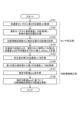
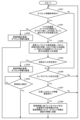
- FIG. 3 is a flow chart showing the operation of the skid detection device 10 according to embodiment 1, which performs the process of calibrating the zero point of the acceleration sensor 42 and the process of updating the gradient value registered in the gradient information storage unit 14 while the vehicle 50 is running normally.
- the sensor calibration unit 15 acquires the second acceleration ⁇ 0 from the acceleration sensor 42 (step S101).
- the sensor calibration unit 15 acquires the vehicle speed v_TM from the speed sensor 41, and calculates the current position of the vehicle 50 by integrating the vehicle speed v_TM (step S102).
- the sensor calibration unit 15 acquires the gradient value of the current position of the vehicle 50 from the gradient information storage unit 14 (step S103).
- the sensor calibration unit 15 calculates the average value of the second acceleration ⁇ 0 over the specified period ⁇ T as the offset value ⁇ _offs (step S104). In this way, the sensor calibration unit 15 calibrates the zero point of the acceleration sensor 42 during normal driving by using the average value of the second acceleration ⁇ 0 over the specified period ⁇ T as the offset value ⁇ _offs.
- the offset value ⁇ _offs is ideally "0", but in reality it is a value other than "0" due to factors such as those described below.
- the sensor calibration unit 15 calculates the third acceleration ⁇ 1, which is the acceleration after calibration, using formula (1) (step S105).
- the value of " ⁇ _offs" can be positive or negative, so the "-" before “ ⁇ _offs” can be written as "+”.
- the sensor calibration unit 15 outputs the third acceleration ⁇ 1 to the gradient information correction unit 16. In this way, the sensor calibration unit 15 calculates the third acceleration ⁇ 1 by subtracting the offset value ⁇ _offs from the second acceleration ⁇ 0. This allows the sensor calibration unit 15 to calibrate the zero point of the acceleration sensor 42 when the zero point of the acceleration sensor 42 fluctuates due to the effects of temperature changes, vibrations while the vehicle 50 is traveling, and the like.
- Figure 4 is a diagram showing an example of an error that occurs in a sensor attached to a typical vehicle.
- Figure 4(a) shows an example of an error in the yawing direction that occurs when the sensor is fixed to the vehicle.
- Figure 4(b) shows an example of an error in the pitching direction that occurs between the actual traveling direction of the vehicle and the detection direction of the sensor due to the influence of air springs at the front and rear of the vehicle when the vehicle is traveling on a gradient section.
- the detection value of the acceleration sensor detected in a vehicle such as that shown in Figure 4 will contain an error expressed by the following equation (2).
- Acceleration sensor detection value true vehicle acceleration + (sensor installation error) + (vehicle pitching error due to gradient) + (acceleration error due to estimated gradient error) + (sensor sensitivity error) + (zero point shift when gravity's effects are excluded) + (zero point shift due to temperature change, aging, etc.) + (high frequency fluctuation) + (nonlinear error) + (other-axis interference error) ...
- the gradient information correction unit 16 obtains the first acceleration ⁇ _TM from the first change detection unit 11 (step S106).
- the gradient information correction unit 16 obtains the third acceleration ⁇ 1 from the sensor calibration unit 15. If the vehicle 50 is determined to be traveling normally by the skid/slide determination unit 13, the relationship in the following formula (3) holds. If the gravitational acceleration acting on the vehicle 50 is g, then the gradient information correction unit 16 calculates an estimated gradient value grad [%] of the gradient of the current position while the vehicle 50 is traveling from the relationship shown in formulas (3) and (4) (step S107).
- ⁇ _TM ⁇ 1-g ⁇ sin ⁇ ...(3)
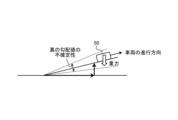
- FIG. 5 is a diagram showing an example of an estimated gradient value grad of the gradient of the angle ⁇ at which the vehicle 50 equipped with the skid detection device 10 according to the first embodiment travels, and an example of the acceleration generated by the vehicle 50.
- the X-axis indicates the traveling direction of the vehicle 50. Note that the Z-axis indicating the vertical direction of the vehicle 50 does not need to be taken into consideration. Substituting the right side of equation (1) into ⁇ 1 in equation (3) gives equation (5).
- ⁇ _TM ⁇ 0- ⁇ _offs-g ⁇ sin ⁇ ...(5)
- ⁇ _TM ⁇ 0 ⁇ _offs ⁇ g ⁇ grad/ ⁇ (grad 2 +100 2 ) ...(6)
- the gradient information correction unit 16 updates the gradient value in the gradient information storage unit 14 based on the estimated gradient value grad obtained by calculation (step S108). For example, when the difference between the estimated gradient value grad calculated using the first acceleration ⁇ _TM and the third acceleration ⁇ 1 and the gradient value registered in the gradient information storage unit 14 is equal to or greater than the specified gradient value threshold ⁇ grad_th, the gradient information correction unit 16 corrects the gradient value registered in the gradient information storage unit 14 with the estimated gradient value grad.
- the gradient values for each speed range of the vehicle 50 may be registered in the gradient information storage unit 14. For example, when the speed of the vehicle 50 is less than 36 km/h, the skid detection device 10 uses the gradient values registered every 10 m as the position of the vehicle 50, and when the speed of the vehicle 50 is 36 km/h or more and less than 72 km/h, the skid detection device 10 uses the gradient values registered every 20 m as the position of the vehicle 50.
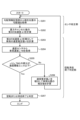
- FIG. 6 is a flowchart showing the operation of the skid/slide detection device 10 according to embodiment 1 to determine that a skid or slide has ended after a skid or slide has occurred on the vehicle 50.
- the sensor calibration unit 15 obtains the gradient value of the current position of the vehicle 50 from the gradient information storage unit 14 (step S201).
- the sensor calibration unit 15 calculates the fourth acceleration ⁇ 2, which is the acceleration after canceling the gravitational acceleration g, using equation (8) (step S202).
- the sensor calibration unit 15 calculates the fourth acceleration ⁇ 2 by subtracting the acceleration due to gravity from the third acceleration ⁇ 1.
- the sensor calibration unit 15 outputs the fourth acceleration ⁇ 2 to the skid end determination unit 17.
- the skid end determination unit 17 calculates the speed estimate v1, which is an estimate of the vehicle speed of the vehicle 50, by integrating the fourth acceleration ⁇ 2 from the time when the skid end determination unit 13 determines that the vehicle 50 is skidding or skidding (step S203).
- the skid end determination unit 17 acquires the vehicle speed v_TM from the speed sensor 41 (step S204). If the difference between the speed estimate v1 of the vehicle 50 obtained by integrating the fourth acceleration ⁇ 2 and the vehicle speed v_TM is greater than the specified speed threshold ⁇ v_th (step S205: No), the skid end determination unit 17 integrates the speed estimate v1 to calculate an estimate of the vehicle position of the vehicle 50 (step S206).
- the skid end detection device 10 then returns to the operation of step S201.
- step S205 If the difference between the vehicle speed v_TM and the estimated speed v1 of the vehicle 50 obtained by integrating the fourth acceleration ⁇ 2 is equal to or less than the specified speed threshold ⁇ v_th (step S205: Yes), the skid or slide end determination unit 17 determines that the skid or slide occurring in the vehicle 50 has ended (step S207).
- FIG. 7 is a diagram showing an example of gradient values in the gradient information storage unit 14 that are corrected by the operation of the skid detection device 10 according to the first embodiment.
- the gradient values registered in the gradient information storage unit 14 have uncertainty with respect to the true gradient value of the route on which the vehicle 50 runs.
- Various methods for removing some of the errors expressed by equation (2) have been shown, but in this embodiment, the skid detection device 10 can remove errors due to zero point shifts when the effects of gravity are excluded, and zero point shifts due to temperature changes, aging, and the like, by the operation of step S105.
- the skid detection device 10 can remove sensor installation errors, vehicle pitching errors due to gradients, acceleration errors due to estimated gradient errors, and sensor sensitivity errors, by the operation of step S202.
- the gradient information storage unit 14 is a memory.
- the first change detection unit 11, the second change detection unit 12, the skid determination unit 13, the sensor calibration unit 15, the gradient information correction unit 16, and the skid end determination unit 17 are realized by a processing circuit.
- the processing circuit may be a processor and memory that executes a program stored in a memory, or it may be dedicated hardware.
- FIG. 8 is a diagram showing an example in which the processing circuit 90 provided in the skid detection device 10 according to the first embodiment is configured with a processor 91 and a memory 92.
- each function of the processing circuit 90 of the skid detection device 10 is realized by software, firmware, or a combination of software and firmware.
- the software or firmware is written as a program and stored in the memory 92.
- each function is realized by the processor 91 reading and executing the program stored in the memory 92.
- the processing circuit 90 includes a memory 92 for storing a program that will result in the processing of the skid detection device 10 being executed. It can also be said that these programs cause a computer to execute the procedures and methods of the skid detection device 10.
- the above program includes a first change detection step in which the first change detection unit 11 detects a change in the vehicle speed v_TM output from a speed sensor 41 that calculates the vehicle speed v_TM based on the number of rotations of the wheels of the vehicle 50, and outputs the change as a first acceleration ⁇ _TM; a second change detection step in which the second change detection unit 12 detects a change in the second acceleration ⁇ 0 output from an acceleration sensor 42 having at least one axis whose detection direction is the traveling direction of the vehicle 50, and outputs the change as a jerk; a skid/slide determination step in which the skid/slide determination unit 13 determines that a skid or slide has occurred on the vehicle 50 based on the first acceleration ⁇ _TM and the jerk; and if the skid/slide determination unit 13 determines that the vehicle 50 is in normal driving with neither a skid nor a slide occurring, the sensor calibration unit 15: It can also be said that the program causes the skid detection device 10 to execute
- the processor 91 may be a CPU (Central Processing Unit), a processing device, an arithmetic unit, a microprocessor, a microcomputer, or a DSP (Digital Signal Processor).
- the memory 92 may be, for example, a RAM (Random Access Memory), a ROM (Read Only Memory), a flash memory, an EPROM (Erasable Programmable ROM), an EEPROM (Electrically EPROM), or other non-volatile or volatile semiconductor memory, a magnetic disk, a flexible disk, an optical disk, a compact disk, a mini disk, or a DVD (Digital Versatile Disc).
- FIG. 9 is a diagram showing an example in which the processing circuit 93 provided in the skid detection device 10 according to embodiment 1 is configured with dedicated hardware.
- the processing circuit 93 shown in FIG. 9 corresponds to, for example, a single circuit, a composite circuit, a programmed processor, a parallel programmed processor, an ASIC (Application Specific Integrated Circuit), an FPGA (Field Programmable Gate Array), or a combination of these.
- Each function of the skid detection device 10 may be realized by the processing circuit 93 on a function-by-function basis, or each function may be realized collectively by the processing circuit 93.
- skid detection device 10 may be realized by dedicated hardware, and some by software or firmware.
- the processing circuit can realize each of the above-mentioned functions by dedicated hardware, software, firmware, or a combination of these.
- the skid detection device 10 refers to the gradient information storage unit 14 while the vehicle 50 is traveling, calibrates the zero point of the acceleration sensor 42 in a section where the gradient value is constant, calculates the estimated gradient value grad using the first acceleration ⁇ _TM based on the vehicle speed v_TM from the speed sensor 41 and the third acceleration ⁇ 1 obtained by calibrating the second acceleration ⁇ 0 from the acceleration sensor 42 with the offset value ⁇ _offs, and corrects the gradient value registered in the gradient information storage unit 14. This allows the skid detection device 10 to reduce the influence of the gradient component of the gravitational acceleration g acting on the vehicle 50, and improves the calculation accuracy of the acceleration in the traveling direction of the vehicle 50.
- the skid detection device 10 can calculate the offset value ⁇ _offs as appropriate to calibrate the fluctuation of the zero point.
- the skid detection device 10 can calculate the estimated gradient value grad at any time when the vehicle 50 is not skidding or skidding, and can appropriately correct the gradient value registered in the gradient information storage unit 14 based on the result of comparing the estimated gradient value grad with the gradient value registered in the gradient information storage unit 14.
- the skid detection device 10 uses the detection results of the speed sensor 41 and the acceleration sensor 42.
- the skid detection device further uses the detection result of a gyro sensor.
- FIG. 10 is a diagram showing an example of the configuration of a train control system 60a according to the second embodiment.
- the train control system 60a is obtained by replacing the train control device 30 with a train control device 30a and adding a gyro sensor 43 to the train control system 60 according to the first embodiment shown in FIG. 1.
- the train control device 30a is obtained by replacing the skid detection device 10 with a skid detection device 10a in the train control device 30 according to the first embodiment shown in FIG. 1.
- the skid detection device 10a detects the occurrence of a skid or slide in the vehicle 50 based on the detection values acquired from the speed sensor 41, the acceleration sensor 42, and the gyro sensor 43, and outputs information such as the occurrence of a skid or slide and the end of the skid or slide to the command value generation unit 20.
- the gyro sensor 43 is an inertial sensor with at least one axis whose detection direction is the pitch direction of at least the acceleration sensor 42.
- the gyro sensor 43 outputs the detected angular velocity to the skid detection device 10a.
- FIG. 11 is a diagram showing an example of the configuration of a skid detection device 10a according to embodiment 2.
- the skid detection device 10a is obtained by adding a third change detection unit 18 to the skid detection device 10 of embodiment 1 shown in FIG. 2.
- the third change detection unit 18 determines, based on the detection result of the gyro sensor 43, that the vehicle 50 has passed a gradient change point where the gradient value of the route changes, and outputs the gradient change determination result to the sensor calibration unit 15. For example, the third change detection unit 18 calculates the change amount ⁇ gyro1 of the angular velocity output value in the pitch direction based on the detection result of the gyro sensor 43. If the change amount ⁇ gyro1 is less than the specified angular velocity threshold ⁇ gyro_th, the third change detection unit 18 outputs the gradient change determination result indicating that the vehicle 50 has not passed the gradient change point of the route to the sensor calibration unit 15.
- the third change detection unit 18 If the change amount ⁇ gyro1 is equal to or greater than the specified angular velocity threshold ⁇ gyro_th, the third change detection unit 18 outputs the gradient change determination result indicating that the vehicle 50 has passed the gradient change point of the route to the sensor calibration unit 15. Note that the third change detection unit 18 may acquire the detection result of the gyro sensor 43 via a high-pass filter or the like.
- the sensor calibration unit 15 determines the timing to use the changed gradient value based on the gradient change judgment result obtained from the third change detection unit 18. For example, when the gradient value read from the gradient information storage unit 14 has changed from gradient value a to gradient value b, but no gradient change judgment result indicating that the vehicle 50 has passed a gradient change point on the route has been obtained from the third change detection unit 18, the sensor calibration unit 15 continues to use gradient value a and calculates the third acceleration ⁇ 1, the fourth acceleration ⁇ 2, etc., as described above.
- the sensor calibration unit 15 obtains a gradient change judgment result indicating that the vehicle 50 has passed a gradient change point on the route from the third change detection unit 18, it changes the gradient value to be used from gradient value a to gradient value b, and calculates the third acceleration ⁇ 1, the fourth acceleration ⁇ 2, etc.
- the sensor calibration unit 15 reads the gradient value b following the gradient value a from the gradient information storage unit 14 at the time when it acquires from the third change detection unit 18 a gradient change determination result indicating that the vehicle 50 has passed a gradient change point on the route, it cannot change the gradient value used to calculate the third acceleration ⁇ 1, the fourth acceleration ⁇ 2, etc. from gradient value a to gradient value b. Therefore, the sensor calibration unit 15 reads from the gradient information storage unit 14 a gradient value corresponding to a position preceding the actual position where the vehicle 50 is traveling. This allows the sensor calibration unit 15 to appropriately change the gradient value read from the gradient information storage unit 14 and used to calculate the third acceleration ⁇ 1, the fourth acceleration ⁇ 2, etc. from gradient value a to gradient value b depending on the timing when it acquires from the third change detection unit 18 a gradient change determination result indicating that the vehicle 50 has passed a gradient change point on the route.
- the gradient information correction unit 16 corrects the change position of the gradient value registered in the gradient information storage unit 14 based on the timing of using the changed gradient value determined by the sensor calibration unit 15.
- FIG. 13 is a diagram showing an example of gradient change points in the gradient information storage unit 14 that are corrected by the operation of the skid detection device 10a according to embodiment 2.
- the gradient change points that indicate a change in the gradient value registered in the gradient information storage unit 14 have uncertainty with respect to the true gradient change points of the gradient of the route on which the vehicle 50 is traveling.
- the skid detection device 10a can reduce the uncertainty of the vehicle position of the vehicle 50 when referring to the gradient information storage unit 14 by the operation of step S208.
- the third change detection unit 18 is realized by a processing circuit.
- the processing circuit may be a processor and memory that executes a program stored in a memory, or it may be dedicated hardware.
- the skid detection device 10a can further use the detection results of the gyro sensor 43 to determine whether the vehicle 50 has reached a gradient change point, and therefore, in addition to the effect of embodiment 1, can correct the deviation of the gradient change point from the gradient value registered in the gradient information storage unit 14.
- Embodiment 3 a case will be described in which information on gradient values to be registered in the gradient information storage unit 14 used in the skid detection device 10 of embodiment 1 and the skid detection device 10a of embodiment 2 is created.
- FIG. 14 is a first diagram showing a configuration example of a skid detection device 10b according to embodiment 3.
- FIG. 15 is a second diagram showing a configuration example of a skid detection device 10c according to embodiment 3.
- the skid detection device 10b shown in FIG. 14 is obtained by adding a gradient information creation unit 19 to the skid detection device 10 of embodiment 1 shown in FIG. 2.
- the skid detection device 10c shown in FIG. 15 is obtained by adding a gradient information creation unit 19 to the skid detection device 10a of embodiment 2 shown in FIG. 11.
- the configuration of a train control system equipped with the skid detection device 10b is obtained by replacing the skid detection device 10 with the skid detection device 10b in the train control system 60 shown in FIG. 1.
- the configuration of a train control system equipped with the skid detection device 10c is the same as that of the train control system 60a shown in FIG. 10, except that the skid detection device 10a is replaced with the skid detection device 10c.
- the gradient information creation unit 19 performs the same operation. Therefore, hereinafter, the skid detection device 10b shown in FIG. 14 will be described as an example.
- the gradient information creation unit 19 acquires the vehicle speed v_TM from the speed sensor 41, acquires the second acceleration ⁇ 0 from the acceleration sensor 42, and acquires the skid determination result from the skid determination unit 13.
- the gradient information creation unit 19 also acquires gradient value information indicating the gradient value at a reference point defined on the route on which the vehicle 50 travels.
- the gradient information creation unit 19 calculates the gradient value of the route at the position on the route on which the vehicle 50 travels based on the vehicle speed v_TM, the second acceleration ⁇ 0, the determination result of the skid determination unit 13, and the gradient value information indicating the gradient value at a reference point defined on the route on which the vehicle 50 travels, and registers the calculated gradient values at each position on the route in the gradient information storage unit 14.
- the gradient information creation unit 19 can determine the offset value ⁇ _offs from equation (9) by taking the measured acceleration as the second acceleration ⁇ 0, the traveling direction acceleration as the first acceleration ⁇ _TM that can be calculated from the vehicle speed v_TM, and the gradient value at the sensor offset calibration position as ⁇ .
- the transponder holds position information on the route on which the transponder is installed, and transmits this information together with the aforementioned gradient value information to the gradient information creation unit 19 of the skid detection device 10b.
- the gradient information creation unit 19 of the skid detection device 10b can determine the position at which the position information was obtained from the transponder by acquiring the position information transmitted from the transponder via an on-board coil (not shown) or the like. Since the gradient information creation unit 19 can determine the position of the vehicle 50 using the position information from the transponder, it can determine the traveling position of the vehicle 50 by adding the traveling distance obtained by integrating the vehicle speed v_TM from the speed sensor 41 to the installation position of the transponder.
- FIG. 16 is a first flowchart showing the operation of the gradient information creation unit 19 of the skid detection device 10b according to embodiment 3 to create gradient information to be registered in the gradient information storage unit 14.
- the gradient information creation unit 19 When the gradient information creation unit 19 has acquired the offset information required to calculate the offset value ⁇ _offs (step S301: Yes), it updates the vehicle position of the vehicle 50 from the vehicle speed v_TM obtained from the speed sensor 41, and stores the first acceleration ⁇ _TM obtained from the vehicle speed v_TM at the corresponding vehicle position and the second acceleration ⁇ 0 from the acceleration sensor 42 (step S302).
- the offset information required to calculate the offset value ⁇ _offs is the gradient value information, position information, etc. obtained from the transponder.
- step S303: Yes the gradient information creation unit 19 discards the accumulated information accumulated in step S302 and also discards the offset information (step S304).
- the gradient information creation unit 19 waits until it detects that the vehicle 50 has stopped (step S305: No), and when it detects that the vehicle 50 has stopped (step S305: Yes), it returns to step S301.
- the skid/slide end determination unit 17 in the skid/slide detection device 10b can determine the end of the skid or slide that occurred in the vehicle 50, but in order for the skid/slide end determination unit 17 to make a determination, the gradient information storage unit 14 in which accurate gradient value information is registered is required.
- the skid/slide end determination unit 17 cannot make a determination at a stage where the gradient information storage unit 14 has not been created. Therefore, the gradient information creation unit 19 determines that the skid or slide has definitely ended by detecting that the vehicle 50 has stopped.
- step S301 determines whether the position of the vehicle 50 is a sensor offset calibration position (step S306). If the position is not a sensor offset calibration position (step S306: No), the gradient information creation unit 19 returns to step S301. If the position is a sensor offset calibration position (step S306: Yes), the gradient information creation unit 19 acquires a new offset value ⁇ _offs and determines whether the information obtained in step S302, i.e., the sensor information for each position, has been accumulated (step S307).
- step S307 If the gradient information creation unit 19 has not accumulated sensor information for each position (step S307: No), it returns to step S301. If the gradient information creation unit 19 has accumulated sensor information for each position (step S307: Yes), it determines whether the error between the offset value ⁇ _offs obtained from the previous offset information and the offset value ⁇ _offs obtained from the current offset information is within a permissible value (step S308).
- the gradient information creation unit 19 creates gradient information between the offset calibration positions between the previous sensor offset calibration position and the current sensor offset calibration position based on the accumulated information accumulated in step S302, and registers it in the gradient information storage unit 14.
- the gradient information creation unit 19 also resets the accumulated information obtained in step S302 and updates the offset information to the latest information (step S309). If there is a section for which gradient information has already been created, the gradient information creation unit 19 may increase the accuracy of the information registered in the gradient information storage unit 14 by a method such as taking the average value of the gradient values.
- the vehicle 50 passes the sensor offset calibration position multiple times while traveling, but the sensor offset calibration positions that are passed multiple times may be different sensor offset calibration positions, or may be the same sensor offset calibration position if the vehicle 50 travels on a circular route.
- Figure 17 is a second flowchart showing the operation of the gradient information creation unit 19 of the skid detection device 10b of embodiment 3 creating gradient information to be registered in the gradient information storage unit 14.
- the operations from steps S301 to S307 and S309 in the flowchart shown in Figure 17 are the same as the operations from steps S301 to S307 and S309 in the flowchart shown in Figure 16.
- the gradient information creation unit 19 has already acquired the offset information required to calculate the offset value ⁇ _offs (step S301: Yes)
- step S401: No If the difference between the measured values of the two acceleration sensors minus the offset value ⁇ _offs exceeds the allowable value (step S401: No), the gradient information creation unit 19 discards the accumulated information accumulated in step S302, discards the offset information as well (step S402), and returns to step S301. If the difference between the measured values of the two acceleration sensors minus the offset value ⁇ _offs is within the allowable value (step S401: Yes), the gradient information creation unit 19 proceeds to step S302. If the gradient information creation unit 19 has accumulated sensor information for each position (step S307: Yes), it proceeds to step S309. In the flowchart shown in FIG. 17, the difference between the offset value ⁇ _offs is confirmed using the two acceleration sensors in step S401, so step S308 is omitted.
- the gradient information creation unit 19 may stop creating gradient information depending on the travel distance, travel time, etc. from the sensor offset calibration position.
- FIG. 18 is a third flowchart showing the operation of the gradient information creation unit 19 of the skid detection device 10b according to embodiment 3 creating gradient information to be registered in the gradient information storage unit 14.
- the operations of steps S301 to S307 and S309 in the flowchart shown in FIG. 18 are the same as the operations of steps S301 to S307 and S309 in the flowcharts shown in FIG. 16 and FIG. 17.
- the gradient information creation unit 19 has already acquired the offset information required for calculating the offset value ⁇ _offs (step S301: Yes)
- the amount of time elapsed refers to the distance traveled by the vehicle 50 since the gradient information creation unit 19 acquired the offset information, and in the case of the acquisition time, it refers to the time elapsed since the gradient information creation unit 19 acquired the offset information. If the amount of progress is greater than the specified value (step S501: No), the gradient information creation unit 19 discards the accumulated information accumulated in step S302, discards the offset information as well (step S502), and returns to step S301. If the amount of progress is less than the specified value (step S501: Yes), the gradient information creation unit 19 proceeds to step S302.
- step S307 If the gradient information creation unit 19 has accumulated sensor information for each position (step S307: Yes), the gradient information creation unit 19 proceeds to step S309. Note that in the flowchart shown in FIG. 18, the deviation of the offset value ⁇ _offs is confirmed using the amount of progress from the offset information acquisition position or acquisition time in step S501, and therefore step S308 is omitted.
- the skid detection devices 10b, 10c can use the gradient information creation unit 19 to create gradient information to be registered in the gradient information storage unit 14, specifically, information on gradient values for positions on the route on which the vehicle 50 travels, and register the information in the gradient information storage unit 14. This eliminates the need for the skid detection devices 10b, 10c to prepare in advance the gradient information to be registered in the gradient information storage unit 14, and also reduces the effort required for workers to register gradient information in the gradient information storage unit 14.
- Embodiment 4 when the difference between the estimated gradient value grad and the gradient value registered in the gradient information storage unit 14 is equal to or greater than the gradient value threshold ⁇ grad_th, the gradient information correction unit 16 corrects the gradient value registered in the gradient information storage unit 14 with the estimated gradient value grad.
- the detection values of the speed sensor 41 and the acceleration sensor 42 may contain noise. In such a case, the gradient information correction unit 16 may correct the gradient value registered in the gradient information storage unit 14, which is actually an accurate value, with the estimated gradient value grad calculated under the influence of noise.
- the gradient information correction unit 16 may correct the gradient value registered in the gradient information storage unit 14 with the estimated gradient value grad when the number of times that the difference between the estimated gradient value grad calculated using the first acceleration ⁇ _TM and the third acceleration ⁇ 1 and the gradient value registered in the gradient information storage unit 14 becomes equal to or greater than the specified gradient value threshold ⁇ grad_th exceeds a specified first number threshold. This enables the gradient information correction unit 16 to reduce the situation in which the gradient value registered in the gradient information storage unit 14 is corrected with an inaccurate estimated gradient value grad caused by sudden noise or the like.
- the gradient information correction unit 16 may correct the change position of the gradient value registered in the gradient information storage unit 14 based on the timing determined by the sensor calibration unit 15 when the number of times that the difference between the gradient value change position indicated at the timing determined by the sensor calibration unit 15 and the gradient value change position registered in the gradient information storage unit 14 has exceeded a specified change position threshold exceeds a specified second number threshold. This makes it possible for the gradient information correction unit 16 to reduce the situation in which the change position of the gradient value registered in the gradient information storage unit 14 is corrected based on an inaccurate change position of the gradient value caused by sudden noise or the like.
Landscapes
- Engineering & Computer Science (AREA)
- Power Engineering (AREA)
- Transportation (AREA)
- Mechanical Engineering (AREA)
- Regulating Braking Force (AREA)
Priority Applications (2)
| Application Number | Priority Date | Filing Date | Title |
|---|---|---|---|
| PCT/JP2023/023364 WO2024262021A1 (ja) | 2023-06-23 | 2023-06-23 | 空転滑走検知装置および空転滑走検知方法 |
| JP2025527022A JPWO2024262021A1 (https=) | 2023-06-23 | 2023-06-23 |
Applications Claiming Priority (1)
| Application Number | Priority Date | Filing Date | Title |
|---|---|---|---|
| PCT/JP2023/023364 WO2024262021A1 (ja) | 2023-06-23 | 2023-06-23 | 空転滑走検知装置および空転滑走検知方法 |
Publications (1)
| Publication Number | Publication Date |
|---|---|
| WO2024262021A1 true WO2024262021A1 (ja) | 2024-12-26 |
Family
ID=93935248
Family Applications (1)
| Application Number | Title | Priority Date | Filing Date |
|---|---|---|---|
| PCT/JP2023/023364 Ceased WO2024262021A1 (ja) | 2023-06-23 | 2023-06-23 | 空転滑走検知装置および空転滑走検知方法 |
Country Status (2)
| Country | Link |
|---|---|
| JP (1) | JPWO2024262021A1 (https=) |
| WO (1) | WO2024262021A1 (https=) |
Citations (3)
| Publication number | Priority date | Publication date | Assignee | Title |
|---|---|---|---|---|
| JP2001341625A (ja) * | 2000-05-31 | 2001-12-11 | Railway Technical Res Inst | 電空併用ブレーキ式鉄道電気車の制動制御装置、及び電空併用ブレーキ式鉄道電気車の制動制御方法 |
| JP2022032727A (ja) * | 2020-08-13 | 2022-02-25 | 株式会社東芝 | 列車速度位置算出装置、列車運転支援装置、列車運転制御装置及び列車速度位置算出方法 |
| JP7123273B1 (ja) * | 2021-05-25 | 2022-08-22 | 三菱電機株式会社 | 空転滑走検知装置および空転滑走検知方法 |
-
2023
- 2023-06-23 WO PCT/JP2023/023364 patent/WO2024262021A1/ja not_active Ceased
- 2023-06-23 JP JP2025527022A patent/JPWO2024262021A1/ja not_active Ceased
Patent Citations (3)
| Publication number | Priority date | Publication date | Assignee | Title |
|---|---|---|---|---|
| JP2001341625A (ja) * | 2000-05-31 | 2001-12-11 | Railway Technical Res Inst | 電空併用ブレーキ式鉄道電気車の制動制御装置、及び電空併用ブレーキ式鉄道電気車の制動制御方法 |
| JP2022032727A (ja) * | 2020-08-13 | 2022-02-25 | 株式会社東芝 | 列車速度位置算出装置、列車運転支援装置、列車運転制御装置及び列車速度位置算出方法 |
| JP7123273B1 (ja) * | 2021-05-25 | 2022-08-22 | 三菱電機株式会社 | 空転滑走検知装置および空転滑走検知方法 |
Also Published As
| Publication number | Publication date |
|---|---|
| JPWO2024262021A1 (https=) | 2024-12-26 |
Similar Documents
| Publication | Publication Date | Title |
|---|---|---|
| US8195357B2 (en) | In-vehicle sensor-based calibration algorithm for yaw rate sensor calibration | |
| KR101417456B1 (ko) | 차량 요레이트센서의 바이어스 획득방법 | |
| CN102168977B (zh) | 使用全球定位系统的车轮定位诊断 | |
| US9273966B2 (en) | Technique for calibrating dead reckoning positioning data | |
| US10953900B2 (en) | Abnormality detection device, abnormality detection method, and program | |
| ES3004657T3 (en) | Method for determining a local carriage speed of a carriage | |
| CN104990563A (zh) | 车辆行驶里程计算方法 | |
| JP3342365B2 (ja) | ヨーレートセンサの較正方法 | |
| JP4903269B2 (ja) | ピッチレートセンサの信号のずれを求めるための方法と装置 | |
| JP2004148910A (ja) | 空気圧低下の検知装置およびこれを用いて行われるセンサの補正方法 | |
| US20180372858A1 (en) | Distance estimation device, distance estimation method and program | |
| WO2024262021A1 (ja) | 空転滑走検知装置および空転滑走検知方法 | |
| US8489355B2 (en) | Method for the determination of long-term offset drifts of acceleration sensors in motor vehicles | |
| EP4121782B1 (en) | Method for estimating a longitudinal acceleration of at least one railway vehicle | |
| JP7123273B1 (ja) | 空転滑走検知装置および空転滑走検知方法 | |
| CN117741181A (zh) | 一种单轴加速度计动态校准方法及系统 | |
| JP2010516534A (ja) | ロールレートセンサの信号のずれを求めるための方法と装置 | |
| KR102667255B1 (ko) | 차량에 제공된 가속도 센서의 배향을 교정하기 위한 방법 | |
| JP7530516B2 (ja) | 速度検出装置および速度検出方法 | |
| JP3169213B2 (ja) | 移動速度検出方法及び装置、車両のすべり角検出装置 | |
| JP2723352B2 (ja) | 車載用ナビゲーションシステム | |
| JP7848154B2 (ja) | 速度・位置算出装置、運転支援装置および自動運転装置 | |
| JPH11211745A (ja) | 速度距離計 | |
| JPH08313280A (ja) | ナビゲーション装置 | |
| JPWO2024262021A5 (https=) |
Legal Events
| Date | Code | Title | Description |
|---|---|---|---|
| 121 | Ep: the epo has been informed by wipo that ep was designated in this application |
Ref document number: 23942452 Country of ref document: EP Kind code of ref document: A1 |
|
| ENP | Entry into the national phase |
Ref document number: 2025527022 Country of ref document: JP Kind code of ref document: A |
|
| WWE | Wipo information: entry into national phase |
Ref document number: 2025527022 Country of ref document: JP |
|
| NENP | Non-entry into the national phase |
Ref country code: DE |