WO2024257814A1 - 洗浄液、洗浄方法、及び半導体素子の製造方法 - Google Patents
洗浄液、洗浄方法、及び半導体素子の製造方法 Download PDFInfo
- Publication number
- WO2024257814A1 WO2024257814A1 PCT/JP2024/021389 JP2024021389W WO2024257814A1 WO 2024257814 A1 WO2024257814 A1 WO 2024257814A1 JP 2024021389 W JP2024021389 W JP 2024021389W WO 2024257814 A1 WO2024257814 A1 WO 2024257814A1
- Authority
- WO
- WIPO (PCT)
- Prior art keywords
- cleaning solution
- group
- cleaning
- solution according
- acid
- Prior art date
- Legal status (The legal status is an assumption and is not a legal conclusion. Google has not performed a legal analysis and makes no representation as to the accuracy of the status listed.)
- Ceased
Links
Classifications
-
- C—CHEMISTRY; METALLURGY
- C11—ANIMAL OR VEGETABLE OILS, FATS, FATTY SUBSTANCES OR WAXES; FATTY ACIDS THEREFROM; DETERGENTS; CANDLES
- C11D—DETERGENT COMPOSITIONS; USE OF SINGLE SUBSTANCES AS DETERGENTS; SOAP OR SOAP-MAKING; RESIN SOAPS; RECOVERY OF GLYCEROL
- C11D17/00—Detergent materials or soaps characterised by their shape or physical properties
- C11D17/08—Liquid soap, e.g. for dispensers; capsuled
-
- C—CHEMISTRY; METALLURGY
- C11—ANIMAL OR VEGETABLE OILS, FATS, FATTY SUBSTANCES OR WAXES; FATTY ACIDS THEREFROM; DETERGENTS; CANDLES
- C11D—DETERGENT COMPOSITIONS; USE OF SINGLE SUBSTANCES AS DETERGENTS; SOAP OR SOAP-MAKING; RESIN SOAPS; RECOVERY OF GLYCEROL
- C11D7/00—Compositions of detergents based essentially on non-surface-active compounds
- C11D7/02—Inorganic compounds
- C11D7/04—Water-soluble compounds
- C11D7/08—Acids
-
- C—CHEMISTRY; METALLURGY
- C11—ANIMAL OR VEGETABLE OILS, FATS, FATTY SUBSTANCES OR WAXES; FATTY ACIDS THEREFROM; DETERGENTS; CANDLES
- C11D—DETERGENT COMPOSITIONS; USE OF SINGLE SUBSTANCES AS DETERGENTS; SOAP OR SOAP-MAKING; RESIN SOAPS; RECOVERY OF GLYCEROL
- C11D7/00—Compositions of detergents based essentially on non-surface-active compounds
- C11D7/22—Organic compounds
-
- C—CHEMISTRY; METALLURGY
- C11—ANIMAL OR VEGETABLE OILS, FATS, FATTY SUBSTANCES OR WAXES; FATTY ACIDS THEREFROM; DETERGENTS; CANDLES
- C11D—DETERGENT COMPOSITIONS; USE OF SINGLE SUBSTANCES AS DETERGENTS; SOAP OR SOAP-MAKING; RESIN SOAPS; RECOVERY OF GLYCEROL
- C11D7/00—Compositions of detergents based essentially on non-surface-active compounds
- C11D7/22—Organic compounds
- C11D7/32—Organic compounds containing nitrogen
-
- H—ELECTRICITY
- H10—SEMICONDUCTOR DEVICES; ELECTRIC SOLID-STATE DEVICES NOT OTHERWISE PROVIDED FOR
- H10P—GENERIC PROCESSES OR APPARATUS FOR THE MANUFACTURE OR TREATMENT OF DEVICES COVERED BY CLASS H10
- H10P52/00—Grinding, lapping or polishing of wafers, substrates or parts of devices
Definitions
- the present invention relates to a cleaning solution, a cleaning method, and a method for manufacturing semiconductor devices.
- a method for manufacturing a semiconductor element is to sequentially form a conductive film, an insulating film, a resist film, etc. on a semiconductor substrate such as a silicon wafer, form a circuit pattern through processes such as lithography and etching, and then form an oxide film, followed by planarization through chemical mechanical polishing (CMP). Furthermore, a new layer may be stacked on the flat surface to form a multi-layer semiconductor element.
- CMP chemical mechanical polishing
- polishing is performed using a slurry-like polishing agent containing abrasive particles (also called abrasive grains).
- abrasive particles also called abrasive grains.
- cerium compound-containing particles are preferably used as the abrasive grains from the viewpoint of improving the polishing rate.
- the surface of the semiconductor element may contain unnecessary components such as polishing agent components (e.g., abrasive grains and organic components such as polymers) and polishing debris, etc. Therefore, the semiconductor element after the CMP process is generally cleaned with a cleaning solution.
- cerium compound-containing particles may be difficult to remove because they form bonds with the surfaces of silicon compound films such as silicon dioxide films and silicon nitride films during the CMP process, or may adhere strongly due to the attractive force of zeta potential under acidic conditions. Therefore, cleaning has traditionally been performed using strong chemicals such as diluted hydrofluoric acid and sulfuric acid/hydrogen peroxide, but development of cleaning solutions with better handling properties is underway.
- Patent Document 1 discloses an aqueous cleaning liquid containing an inorganic acid containing a fluorine atom (excluding hydrogen fluoride) or a salt thereof. Furthermore, Patent Document 2 discloses a post-CMP cleaning composition containing a specific organic acid, a specific fluoride, a specific additive, and the like. Patent Documents 1 and 2 do not disclose an embodiment including a fluoropolymer having an acidic group.
- This disclosure has been made in consideration of the above circumstances, and aims to provide a cleaning solution that can effectively remove abrasive grains and organic components adhering to an object to be cleaned, a cleaning method that uses the cleaning solution, and a method for manufacturing semiconductor elements.
- a cleaning solution for removing abrasive grains comprising a fluoropolymer having an acidic group and water.
- R 1 and R 2 each independently represent a hydrogen atom, a fluorine atom, or a chlorine atom
- R3 is a hydrogen atom, a fluorine atom, a chlorine atom, a methyl group, or a fluoromethyl group
- R f1 is a linear or branched fluoroalkyl chain which may contain an etheric oxygen atom, Or, R 2 and R f1 are linked to each other to form a straight or branched fluoroalkyl
- R 1 and R 2 each independently represent a hydrogen atom, a fluorine atom, or a chlorine atom;
- R3 is a hydrogen atom, a fluorine atom, a chlorine atom, a methyl group, or a fluoromethyl group;
- R f1 is a linear or branched fluoroalkylene group which may contain an etheric oxygen atom, and when R f1 is a fluoroalkylene group which does not contain an etheric oxygen atom, it has 1 to 10 carbon atoms,
- Z is -SO3H , -SO3Z1 , -CO2H , -CO2Z1 , -PO(OH) 2 , -PO3 ( OZ1 ) 2 , or OH, and Z1 is a cation.
- the cleaning solution according to [17] above, wherein the exposed surface contains at least one material selected from the group consisting of silicon dioxide and silicon nitride.
- the present disclosure provides a cleaning solution that can effectively remove abrasive grains and organic components adhering to an object to be cleaned, a cleaning method that uses the cleaning solution, and a method for manufacturing semiconductor devices.
- fluoroalkylene chain refers to a group obtained by removing the required number of fluorine atoms and hydrogen atoms from a straight-chain, branched, or cyclic fluoroalkane.
- a "divalent fluoroalkylene chain” refers to a group obtained by removing a total of two fluorine atoms and hydrogen atoms from a fluoroalkane, and is also called a "fluoroalkylene group.” The required number can be determined from the chemical formula.
- the cleaning solution of the present disclosure is characterized by containing a fluoropolymer having an acidic group (hereinafter, sometimes simply referred to as "fluoropolymer”) and water.
- fluoropolymer having an acidic group
- the fluoropolymer having an acidic group appropriately controls the zeta potential, inhibits the adsorption or bonding between the object to be cleaned and the abrasive component, and makes it easier to peel off the abrasive grains and organic components attached to the object to be cleaned.
- the fluoropolymer adsorbs to the peeled abrasive grain components and functions as a dispersant, preventing them from re-adhering to the surface of the object to be cleaned.
- the abrasive components can be effectively removed from the surface of the object to be cleaned.
- This cleaning solution can be suitably used for removing abrasive grains, and in particular, can effectively remove abrasive grains bonded or attached to the substrate surface after the CMP process.
- the cleaning solution contains at least a fluoropolymer having an acidic group and water, and may further contain other components within the range in which the effects of the present invention are achieved. Each component that may be contained in the polishing agent will be described below.
- the fluoropolymer having an acidic group used in the present cleaning solution is a polymer having at least one acidic group and at least one fluorine atom in the molecule.
- the fluoropolymer is preferably one that becomes uniform in water and is preferably one that can be dispersed or dissolved in water.
- the acidic group is a proton-donating group, and specific examples thereof include a sulfonic acid group, a carboxy group, a phosphoric acid group, and a hydroxy group, which may be in the form of a salt.
- the proportion of fluorine atoms in the polymer represented by the following formula (I) is preferably 60% or more, more preferably 80% or more, and even more preferably substantially 100% (perfluoropolymer).
- Formula (I): Percentage of fluorine atoms (%) (number of fluorine atoms)/ ⁇ (number of fluorine atoms)+(number of hydrogen atoms) ⁇ 100
- the fluoropolymer may have at least one acidic group.
- concentration of the acidic group in the polymer per unit mass represented by the following formula (II) is preferably 0.3 mmol/g or more, more preferably 0.8 mmol/g or more.
- the upper limit is not particularly limited, but from the viewpoint of excellent handleability of the polymer, it is preferably 4.0 mmol/g or less.
- the TQ value (volume flow rate value) of the fluoropolymer having sulfonic acid groups is preferably 200 to 300°C, more preferably 220 to 300°C, and particularly preferably 240 to 290°C. If the TQ value is equal to or greater than the lower limit of the above range, the fluoropolymer has a sufficient molecular weight to effectively disperse particles. If the TQ value is equal to or less than the upper limit of the above range, the solubility of the fluoropolymer is improved, allowing a homogeneous solution to be prepared as a cleaning liquid.
- the TQ value is an index of the molecular weight of a fluoropolymer having a sulfonic acid group.
- TQ value the temperature at which the extrusion rate becomes 100 mm 3 /sec when the above fluoropolymer is melt-extruded using a nozzle having a length of 1 mm and an inner diameter of 1 mm under an extrusion pressure of 2.94 MPa.
- the number average molecular weight (Mn) of the fluoropolymer having a carboxylic acid group is preferably 1,000 or more, more preferably 1,500 or more, and particularly preferably 2,500 or more.
- Mn of the fluoropolymer is preferably 1,000,000 or less, more preferably 900,000 or less, and particularly preferably 800,000 or less.
- the Mn is a value determined by gel permeation chromatography (GPC) in terms of standard polystyrene.
- the fluoropolymer preferably has a unit represented by the following formula (1) (also referred to as structural unit (1)) from the viewpoints of excellent cleanability, ability to prevent redeposition of abrasive grains, and solubility in water.
- R 1 and R 2 each independently represent a hydrogen atom, a fluorine atom, or a chlorine atom;
- R3 is a hydrogen atom, a fluorine atom, a chlorine atom, a methyl group, or a fluoromethyl group;
- R f1 is a linear or branched fluoroalkyl chain which may contain an etheric oxygen atom, Or, R 2 and R f1 are linked to each other to form a straight or branched fluoroalkyl chain which may contain an ether oxygen atom between carbon atoms;
- R 3 and R f1 are linked to each other to form a linear or branched fluoroalkyl chain which may contain an ether oxygen atom between carbon atoms;
- Z is -SO3H , -SO3Z1 , -CO2H , -CO2Z1 ,
- R2 and R3 are not linked to Rf1 .
- R 1 and R 2 each independently represent a hydrogen atom, a fluorine atom or a chlorine atom. From the viewpoint of superior cleaning properties, a fluorine atom or a chlorine atom is preferred, and a fluorine atom is more preferred.
- R3 is a hydrogen atom, a fluorine atom, a chlorine atom, a methyl group, or a fluoromethyl group. Examples of the fluoromethyl group include CH2F- , CHF2- , and CF3- , with CHF2- and CF3- being preferred, and CF3- (perfluoromethyl group) being more preferred.
- a fluorine atom, a chlorine atom, or a fluoromethyl group is preferred, a fluorine atom or a fluoromethyl group is more preferred, and a fluorine atom is even more preferred.
- R f1 is a linear or branched fluoroalkyl chain which may contain an ethereal oxygen atom.
- the ethereal oxygen atom may be present between carbon atoms constituting R f1 , or the end bonded to CR 3 may be an ethereal oxygen atom, i.e., an oxyfluoroalkyl chain.
- R f1 in the formula (1) when n is 1, that is, when one structural unit (1) contains one Z, will be described.
- the linear or branched fluoroalkyl chain containing an etheric oxygen atom between carbon atoms in R f1 is a fluoroalkylene group.
- the fluoroalkylene group include groups represented by the following formula (F1). -R f11 -(OR f11 ) m1 -*...(F1)
- Each R f11 independently represents a linear or branched fluoroalkylene group having 1 to 6 carbon atoms; m1 represents an integer of 1 to 200; and * represents a bond to Z.
- R f11 include -CF 2 -, -CHF-; -CF 2 CF 2 -, -CHFCF 2 -, -CHFCHF-, -CH 2 CF 2 -, -CH 2 CHF-; -CF 2 CF 2 CF 2 -, -CF 2 CHFCF 2 -, -CF 2 CH 2 CF 2 -, -CHFCF 2 CF 2 -, -CHFCHF 2 -, -CHFCHFCHF-, -CHFCH 2 CF 2 -, -CH 2 CF 2 CF 2 -, -CH 2 CHFCF 2 -, -CH 2 CHFCF 2 -, -CH 2 CHFCF-, -CH 2 CHFCHF-, -CH 2 CH 2 CHF-, -CH 2 CHFCHF-, -CH 2 CH 2 CHF-, -CF(CF 3 )CF 2 -, -CF(CHF 2 ) CF 2 -, -CF(
- R f11 may be the same or different. From the viewpoint of superior cleaning properties, R f11 is preferably a perfluoroalkylene group. The number of carbon atoms in R f11 is preferably 1 to 4, and more preferably 2 to 3. m1 may be 1 to 200, and from the viewpoint of superior cleaning properties, it is preferably 1 to 150, and more preferably 1 to 120.
- the linear or branched fluoroalkyl chain containing an etheric oxygen atom between carbon atoms in R f1 is an oxyfluoroalkylene group.
- the oxyfluoroalkylene group include groups represented by the following formula (F2). -(OR f12 ) m2 -*...(F2)
- Each R f12 independently represents a linear or branched fluoroalkylene group having 1 to 6 carbon atoms
- m2 represents an integer of 1 to 200
- * represents a bond to Z.
- Specific examples and preferred embodiments of Rf12 are the same as those of Rf11 .
- Specific examples and preferred embodiments of m2 are the same as those of m1.
- the fluoroalkyl chain in R f1 that does not contain an etheric oxygen atom between carbon atoms includes a group represented by the following formula (F3). -(O) m3 -R f13 -*...(F3)
- R f13 is a linear or branched fluoroalkylene group having 1 to 10 carbon atoms
- m3 is 0 or 1
- * is a bond to Z.
- R f13 include, in addition to those listed for R f11 , -CF 2 CF 2 CF 2 CF 2 CF 2 CF 2 CF 2 -, -CF 2 CF 2 CF 2 CF 2 CF 2 CF 2 CF 2 -, -CF 2 CF 2 CF 2 CF 2 CF 2 CF 2 CF 2 -, -CF 2 CF 2 CF 2 CF 2 CF 2 CF 2 CF 2 -, -CF 2 CF 2 CF 2 CF 2 CF 2 CF 2 CF 2 - , etc.
- the preferred number of carbon atoms for R f13 is 1 to 6, and the more preferred structure is the same as that for R f11 , with a perfluoroalkylene group being preferred.
- R f1 in the formula (1) when n is 2, that is, when one structural unit (1) contains two Zs, will be described.
- Examples of the linear or branched fluoroalkyl chain which may contain an etheric oxygen atom in R f1 include a group represented by the following formula (F4).
- Each R f14 is independently a linear or branched fluoroalkylene group having 1 to 6 carbon atoms
- R f15 is a linear or branched fluoroalkyl chain having 1 to 6 carbon atoms
- each L 1 is independently a linear or branched fluoroalkylene group which may contain an etheric oxygen atom
- m4 is 0 or 1
- m5 is an integer of 0 to 200
- * is a bond to Z.
- Specific examples and preferred embodiments of R f14 are the same as those of R f11 .
- R f15 include trivalent groups in which any one hydrogen atom or fluorine atom has been removed from the specific examples of R f11 .
- m5 may be from 0 to 200, and from the viewpoint of superior cleaning properties, it is preferably from 0 to 150, and more preferably from 0 to 120.
- L1 examples include groups represented by the following formula (L1). -(O) p1 -L f1 -(OL f2 ) p2 -*...(L1)
- L f1 and L f2 each independently represent a linear or branched fluoroalkylene group having 1 to 6 carbon atoms; p1 is 0 or 1; p2 is an integer of 0 to 200; and * represents a bond to Z.
- L f1 and L f2 are the same as those of R f11 , and a perfluoroalkylene group is preferred, provided that when p1 is 0, R f15 L 1 or R f15 L 12 preferably has 1 to 10 carbon atoms, more preferably 1 to 6 carbon atoms.
- p2 may be an integer of 0 to 200, and is preferably an integer of 0 to 100, and more preferably an integer of 0 to 50, from the viewpoint of superior cleaning properties.
- the fluoroalkyl chain in R f1 that does not contain an etheric oxygen atom between carbon atoms includes a group represented by the following formula (F5). -(O) m6 -R f16 -*...(F5)
- R f16 is a linear or branched trivalent fluoroalkyl chain having 1 to 10 carbon atoms, m3 is 0 or 1, and * is a bond to Z.
- Specific examples of R f16 include trivalent groups in which any one hydrogen atom or fluorine atom has been removed from the specific examples of R f13 .
- R2 and Rf1 are linked together.
- R 1 is a hydrogen atom, a fluorine atom or a chlorine atom, and from the viewpoint of cleaning properties, a fluorine atom or a chlorine atom is preferred, and a fluorine atom is more preferred.
- R3 is a hydrogen atom, a fluorine atom, a chlorine atom, a methyl group, or a fluoromethyl group. From the viewpoint of cleaning properties, a fluorine atom, a chlorine atom, or a fluoromethyl group is preferable, a fluorine atom or a fluoromethyl group is more preferable, and a fluorine atom is even more preferable.
- R f17 each independently represents a linear or branched fluoroalkylene group having 1 to 6 carbon atoms, m7 is 0 or 1, m8 is an integer of 0 to 50, m9 is 0 or 1, * is a bond on the CR1 side, and ** is a bond on the CR3 side.
- R f17 are the same as those of R f11 , except that at least one of R f17 has a bond to Z, and the R f17 having the bond can be a residue obtained by removing one or two arbitrary hydrogen atoms or fluorine atoms from the specific examples of R f11 .
- R f17 is preferably a perfluoroalkylene group.
- m8 is an integer of 0 to 50, preferably 0 to 12, and more preferably 0 to 6.
- R 1 and R 2 each independently represent a hydrogen atom, a fluorine atom or a chlorine atom. From the viewpoint of cleaning properties, a fluorine atom or a chlorine atom is preferred, and a fluorine atom is more preferred.
- R f18 each independently represents a linear or branched fluoroalkylene group having 1 to 6 carbon atoms, m10 is 0 or 1, m11 is an integer of 0 to 50, m12 is 0 or 1, * represents a bond on the CR1 side, and ** represents a bond on the CR3 side.
- R f18 are the same as those of R f11 , except that at least one of R f18 has a bond to Z, and the R f18 having the bond can be a residue obtained by removing one or two arbitrary hydrogen atoms or fluorine atoms from the specific examples of R f11 .
- R f18 is preferably a perfluoroalkylene group.
- m11 is an integer of 0 to 50, preferably 0 to 12, and more preferably 0 to 6.
- Z is -SO3H , -SO3Z1 , -CO2H , -CO2Z1, -PO3H, -PO3Z1, or OH, and Z1 is a cation.
- Z1 include alkali metal ions such as sodium ion and potassium ion, and ammonium ions obtained by neutralization with ammonia or ethanolamine from the viewpoint of superior cleaning properties, with ammonium ions obtained by neutralization with ammonia or ethanolamine being preferred.
- Z is preferably -SO3H , -SO3Z1 , -CO2H , or OH from the viewpoint of further improving cleaning properties and easiness of polymer synthesis.
- each of the multiple symbols may be the same or different.
- R 1 , R 2 and R 3 of the unit represented by formula (1) are all fluorine atoms.
- the fluoroalkylene chain or oxyfluoroalkylene chain in R f1 is a perfluoroalkylene chain or an oxyperfluoroalkylene chain.
- n is an integer of 1 to 200
- the acidic group may be in the form of a salt.
- the structural unit (1) preferably has (i) of embodiment (I), and is preferably a unit represented by the following formula (1A): -[CR 1 R 2 -CR 3 (R f1 -Z)] - ...
- Z is -SO3H , -SO3Z1 , -CO2H , -CO2Z1 , -PO(OH) 2 , -PO3 ( OZ1 ) 2 , or OH, and Z1 is a cation.
- the symbols in formula (1A) are the same as those in formula (1), and the preferred embodiments are also as described above, so that the explanation thereof will be omitted here.
- the present fluoropolymer may be a polymer consisting only of units represented by formula (1), or may be a copolymer containing other structural units.
- Examples of other structural units include the following structural units (11) to (13).
- Structural unit (11) A structural unit having an acidic group and a fluorine atom, and having a structure different from that of formula (1)
- Structural unit (12) A structural unit having a fluorine atom and no acidic group
- Structural unit (13) A structural unit not having a fluorine atom
- Examples of the structural unit (11) include units derived from monomers in which at least one hydrogen atom has been substituted with a fluorine atom in a monomer having a known acidic group, such as (meth)acrylic acid.
- R 21 and R 22 each independently represent a hydrogen atom, a fluorine atom or a chlorine atom. From the viewpoint of cleaning properties, a fluorine atom or a chlorine atom is preferred, and a fluorine atom is more preferred.
- R 23 is a hydrogen atom, a fluorine atom, a chlorine atom, a methyl group, or a fluoromethyl group. From the viewpoint of cleaning properties, a fluorine atom, a chlorine atom, or a fluoromethyl group is preferable, a fluorine atom or a fluoromethyl group is more preferable, and a fluorine atom is even more preferable.
- Rf21 are the same as those of Rf11 .
- Specific examples and preferred embodiments of m21 are the same as those of m1.
- R25 is preferably a fluorine atom.
- each R f22 independently represents a linear or branched fluoroalkylene group having 1 to 6 carbon atoms
- m22 represents an integer of 1 to 200
- R 26 represents a hydrogen atom or a fluorine atom.
- Specific examples and preferred embodiments of Rf22 are the same as those of Rf11 .
- Specific examples and preferred embodiments of m22 are the same as those of m1.
- the fluoroalkyl group or oxyfluoroalkyl group not containing an etheric oxygen atom between carbon atoms in R 24 includes groups represented by the following formula (23). -(O) m23 -R f23 -R 27 ...(23)
- R f23 is a linear or branched fluoroalkyl group having 1 to 10 carbon atoms
- m23 is 0 or 1
- R 27 is a hydrogen atom or a fluorine atom.
- Specific examples and preferred embodiments of R f23 are the same as those of R f11 and R f13 .
- each of the multiple symbols may be the same or different.
- R 21 and R 22 of the unit represented by formula (12) are both fluorine atoms.
- R 23 is preferably a fluorine atom or a fluoromethyl group, and more preferably a fluorine atom.
- R 24 is preferably a fluorine atom, a linear or branched perfluoroalkyl group which may contain an etheric oxygen atom between the carbon-carbon atom, or a linear or branched oxyperfluoroalkyl group which may contain an etheric oxygen atom between the carbon-carbon atom, and more preferably a fluorine atom.
- the structural unit (12) include the following: -CF 2 -CF 2 - -CF 2 -CF (OCF 2 CF 2 CF 3 )- -CF2- CF ⁇ OCF2CF ( CF3 ) OCF2CF3 ⁇ - -CF 2 -CF ⁇ OCF 2 CF (CF 3 )OCF 2 CF 2 CF 3 ⁇ - -CF2- CF[ CF2O ⁇ CF ( CF3 ) CF2O ⁇ nCF2 ( CF3 )]- -CF2 - CF ( OCF2CF2CF2OCF2CF3 ) - -CF2 - CF ( OCF2CF2OCF2CF3 ) - -CF 2 -CF (OCF 2 CF 2 CF 2 CF 3 )- -CF 2 -CF(OCF 3 )-
- n is an integer from 1 to 200.
- Examples of the structural unit (13) include structural units derived from known monomers that do not contain fluorine atoms.
- monomers include vinyl monomers such as ethylene, vinyl chloride, vinylidene chloride, styrene, methylstyrene, vinyltoluene, and p-t-butylstyrene; (meth)acrylate monomers such as methyl (meth)acrylate, ethyl (meth)acrylate, and n-propyl (meth)acrylate; acrylamide monomers such as (meth)acrylamide, N,N-dimethyl (meth)acrylamide, and N,N-diethyl (meth)acrylamide; and (meth)acrylic acid.
- vinyl monomers such as ethylene, vinyl chloride, vinylidene chloride, styrene, methylstyrene, vinyltoluene, and p-t-butylstyrene
- (meth)acrylate monomers such
- the fluoropolymer used in the present cleaning solution preferably contains the structural unit (1), more preferably the structural unit (1A), and from the viewpoints of improved cleaning properties and polymer handleability, it is preferred that the fluoropolymer further contains the structural unit (12).
- the structural unit (12) is contained, the molar ratio of the structural unit (1) to the structural unit (12) is preferably from 5:95 to 60:40, more preferably from 10:90 to 50:50, and even more preferably from 15:85 to 40:60.
- the structural unit (13) is preferably present in an amount of no more than 10 mol %, more preferably no more than 5 mol %, and even more preferably no more than 1 mol %, relative to all structural units constituting the fluoropolymer, and it is particularly preferable that the structural unit (13) is not present.
- each constituent unit is not particularly limited, and may be a random copolymer or a block copolymer. From the viewpoint of excellent cleaning properties, a random copolymer is preferred.
- the proportion of the fluoropolymer in the cleaning solution is preferably 0.001 to 30 mass% relative to the total amount of the cleaning solution, more preferably 0.005 to 20 mass%, and particularly preferably 0.01 to 10 mass%. Note that a cleaning solution containing a high concentration of the fluoropolymer may be prepared and then appropriately diluted at the time of use.
- the synthesis method of the fluoropolymer is not particularly limited.
- the following monomer (1a) corresponding to the structural unit (1) and the following monomer (12a) corresponding to the structural unit (12) may be mixed, and an initiator may be further added to polymerize the mixture by a known polymerization method such as solution polymerization, bulk polymerization, or various radical polymerizations. Solution polymerization is preferred in terms of ease of adjusting the number average molecular weight of the polymer.
- a block of the structural unit (1) may be synthesized first, and the monomer (12a) may be polymerized to the block of the structural unit (1), or the order of synthesis may be reversed in the production method.
- the block of the structural unit (1) and the block of the structural unit (12) may be synthesized separately, and then the block of the structural unit (1) and the block of the structural unit (12) may be coupled.
- CR 1 R 2 CR 3 ⁇ R f1 - (Z) n ⁇ ...(1a)
- CR21R22 CR23R24 ... ( 12a )
- the symbols in the formula are as defined above.
- the cleaning solution may further contain other components, such as a reducing compound, a complexing agent, a heterocyclic aromatic compound, an acidic compound, a preservative, a rust inhibitor, a surfactant, a basic compound, and a water-soluble organic solvent.
- the cleaning solution may contain a reducing compound that, for example, reduces cerium ( CeO4 ) bonded to silicon oxide on the surface to be cleaned to water-soluble Ce3 + , making it easier to remove from the surface to be cleaned and improving the cleaning effect.
- the reducing compound can be appropriately selected from those having a reducing effect on the abrasive grain components.
- the reducing compound is preferably gallic acid or its salt, gallic acid ester, pyrogallol, catechol, resorcinol, thiosulfuric acid or its salt, dithioic acid or its salt, ascorbic acid, uric acid, diphosphorous acid or its salt, oxalic acid or its salt, hydrogen peroxide, or hydroquinone.
- the proportion of the reducing compound in the cleaning solution is preferably 0.001% by mass to 30% by mass, more preferably 0.005% by mass to 20% by mass, and even more preferably 0.01% by mass to 10% by mass, based on the total amount of the cleaning solution.
- the cleaning solution may contain a complexing agent.
- the complexing agent can be appropriately selected from among those that form complexes with the metal components in the abrasive grains and the metal components in the residues derived from the substrate generated by polishing.
- the complexing agent is preferably an organic compound having a molecular weight of 1,000 g/mol or less and having two or more substituents selected from a carboxyl group, an amino group, a phosphoryl group, a sulfonic acid group, and a hydroxyl group in the molecule.
- the complexing agent may be tetramethylethylenediamine (TMEDA), ethylenediaminetetraacetic acid (EDTA), N-hydroxyethylethylenediaminetriacetic acid (NHEDTA), nitrilotriacetic acid (NTA), diethylenetriaminepentaacetic acid (DPTA), ethanol diglycinate, citric acid, malic acid, gluconic acid, oxalic acid, phosphoric acid, tartaric acid, malonic acid, succinic acid, dimercaptosuccinic acid, glutaric acid, maleic acid, phthalic acid, fumaric acid, methyldiphosphonic acid, aminotrismethylenephosphonic acid, ethylidene-diphosphonic acid, 1-methyl-2-methyl-2-propanediol ...
- TEDA tetramethylethylenediamine
- EDTA ethylenediaminetetraacetic acid
- NHEDTA N-hydroxyethylethylenediaminetriace
- 1,1-hydroxyethane-1,1-diphosphonic acid HEDP
- 1-hydroxypropylidene-1,1-diphosphonic acid ethylaminobismethylenephosphonic acid
- dodecylaminobismethylenephosphonic acid nitrilotrismethylenephosphonic acid
- ethylenediaminebismethylenephosphonic acid ethylenediaminetetrakismethylenephosphonic acid, hexadiaminetetrakismethylenephosphonic acid, diethylenetriaminepentamethylenephosphonic acid, and 1,2-propanediaminepentamethylenephosphonic acid or ammonium salts.
- the content of the complexing agent in the cleaning solution is preferably 0.01 to 30% by mass, more preferably 0.05 to 20% by mass, and still more preferably 0.1 to 10% by mass, based on the total amount of the cleaning solution.
- the cleaning solution may contain a heterocyclic aromatic compound.
- the cleaning solution containing the heterocyclic aromatic compound is less susceptible to deterioration of quality due to microorganisms and the like, and can provide a more excellent cleaning effect.
- the heterocyclic aromatic compound include imidazole compounds, pyrazole compounds, thiazole compounds, and triazole compounds.
- the imidazole compounds include imidazole, 2-ethyl-4-methylimidazole, 1,2-dimethylimidazole, 1-benzyl-2-methylimidazole, and 1-benzyl-2-phenylimidazole.
- Examples of the pyrazole compounds include pyrazole, 3-methylpyrazole, and 3,5-dimethylpyrazole.
- Examples of the thiazole compounds include benzisothiazoline, isothiazolin, 1,2-benzisothiazolin-3-one, 5-chloro-2-methyl-4-isothiazolin-3-one, 2-(thiocyanomethylthio)benzthiazole, 2-mercaptobenzthiazole, and 3-allyloxy-1,2-benzisothiazole-1,1-oxide.
- Examples of the triazole compounds include 1H-benzotriazole, 4-methyl-1H-benzotriazole, and 5-methyl-1H-benzotriazole.
- the content of the heterocyclic aromatic compound in the cleaning solution is preferably 0.01 to 30 mass %, more preferably 0.05 to 20 mass %, and particularly preferably 0.1 to 10 mass %, based on the total amount of the cleaning solution.
- the cleaning solution may contain a surfactant, which may be ionic or nonionic.
- Surfactants include salts containing suitable hydrophobic groups such as alkyl carboxylates, alkyl polyacrylates, alkyl sulfates, alkyl phosphates, alkyl bicarboxylates, alkyl bisulfates, alkyl biphosphates, substituted aryl carboxylates, substituted aryl sulfates, substituted aryl phosphates, substituted aryl bicarboxylates, substituted aryl bisulfates, substituted aryl biphosphates, long chain alcohols, ethoxylated alcohols, ethoxylated acetylenic diol surfactants, polyethylene glycol alkyl ethers, propylene glycol alkyl ethers, glucoside alkyl ethers, polyethylene glycol octylphenyl ethers, polyethylene glycol alkyl
- the cleaning solution may contain an acidic compound other than the fluoropolymer having an acidic group.
- the acidic compound is used for the purpose of adjusting the pH, etc.
- inorganic acids such as nitric acid, sulfuric acid, hydrochloric acid, phosphoric acid, and condensed phosphoric acid are preferable.
- the cleaning solution may contain a basic compound for the purpose of adjusting the pH, etc.
- the basic compound include monoethanolamine (MEA), diethanolamine, triethanolamine (TMA), morpholine, isopropylamine, hydroxylamine, diisopropanolamine, diglycolamine, triethylamine, N-methylmorpholine, methylethanolamine, N-aminopropylmorpholine, and 3-amino-propanol, tetramethylammonium hydroxide (TMAH), ammonium hydroxide, tetraethylammonium hydroxide (TEAH), tetrapropylammonium hydroxide (TPAH), tetrabutylammonium hydroxide (TBAH), tributylmethylammonium hydroxide (TBMAH), benzyltrimethylammonium hydroxide (BTMAH), choline, choline hydroxide, ethyltrimethylammonium hydroxide, ethy
- the cleaning performance of this cleaning solution can be improved by adjusting the pH to within the range of 1 to 12.
- the pH is preferably 7 or less, and more preferably 1 to 5, in order to further improve cleaning performance.
- the pH is preferably 7 or more, and more preferably 8 to 12, in order to further improve cleaning performance.
- the cleaning solution may contain a water-soluble organic solvent.
- the water-soluble organic solvent include propylene glycol (PG), glycol ether, and aprotic solvents.
- examples of the aprotic solvent include N-methylpyrrolidone (NMP), dimethylsulfoxide (DMSO), dimethylacetamide (DMAC), sulfolane, and dimethylformamide (DMF).
- the water-soluble organic solvent may be a mixed solvent of two or more kinds.
- This cleaning liquid is suitable as a cleaning liquid for removing abrasive grains from a surface to be cleaned, and can also effectively remove organic components such as polymers contained in the abrasive.
- the surface to be cleaned may be an exposed surface (surface) of a semiconductor substrate, and the exposed surface may include a silicon dioxide surface and/or a silicon nitride surface.
- the surface to be cleaned may be an exposed surface that has been polished using an abrasive containing abrasive grains. Examples of the abrasive grains include silica particles, alumina particles, zirconia particles, titania particles, germania particles, and cerium compound-containing particles.
- the present cleaning solution is particularly suitable for cerium compound-containing particles such as ceria particles and cerium hydroxide particles.
- the present cleaning solution can also be suitably used for fine abrasive grains, and exhibits excellent cleaning effects even for abrasive grains having an average particle size of 300 nm or less, for example.
- the cleaning target for which this cleaning solution exhibits particularly excellent effects is a semiconductor substrate after CMP processing using an abrasive containing cerium compound-containing particles as abrasive grains, and which includes an exposed surface on which an oxide film, nitride film, etc. remain. Cerium particles adsorbed or bonded to the oxide film, etc. remain on the exposed surface, and this cleaning solution can suitably remove these particles.
- the cleaning method of the present disclosure includes cleaning the surface to be cleaned using the above-mentioned cleaning liquid.
- cleaning liquid is supplied to the surface to be cleaned such as a semiconductor substrate while a cleaning member such as a pad or brush is physically brought into contact with the surface to be cleaned to remove abrasive grains
- immersion cleaning in which an object to be cleaned including the surface to be cleaned is immersed in the cleaning liquid
- spin-drop cleaning in which the cleaning liquid is dropped onto the object to be cleaned while rotating it
- spray cleaning in which the cleaning liquid is sprayed.
- ultrasonic treatment may be performed on the cleaning liquid.
- the above-mentioned cleaning process may be performed only once, or may be performed two or more times.
- the temperature of the cleaning liquid may be appropriately adjusted in consideration of the heat resistance of the object to be cleaned, etc.
- the temperature of the cleaning liquid may be appropriately adjusted within the range of, for example, 10 to 60°C, and preferably 15 to 50°C.
- the cleaning time may be appropriately adjusted within the range of 10 seconds to 5 minutes, and is preferably 20 seconds to 3 minutes.
- the present disclosure further provides a semiconductor element obtained by the above cleaning method.
- the semiconductor element obtained by the above cleaning method has a clean surface with few abrasive grains or polishing residues.
- the present invention will be specifically explained below with reference to examples and comparative examples, but the present invention is not limited to these examples.
- the room temperature is 20 to 25°C.
- Examples 1 to 15 are examples, and Examples 16 to 19 are comparative examples.
- evaluation items and evaluation methods are as follows. ⁇ pH> While stirring with a magnetic stirrer, the pH of the cleaning solution was measured with a commercially available pH meter, using a pH meter "F-2000PI-S” and a Tou pH electrode "9615S-10D” manufactured by Horiba, Ltd.
- ⁇ Cerium oxide and organic component removal performance> (Preparation of polished substrate) A commercially available slurry-like abrasive (polishing slurry) containing cerium oxide particles having an average particle size of 300 nm or less, an organic component such as a polymer, a surfactant, and water was prepared. One surface of the quartz glass plate was polished for 30 seconds using a commercially available CMP device and the above-mentioned abrasive. A "FAM12B" manufactured by SpeedFam was used as the CMP device. A hard urethane pad was used as the polishing pad.
- polishing pressure was 14 kPa
- the platen rotation speed was 40 rpm
- 30 cc of chemical solution was poured per minute to perform polishing for 5 minutes. Polishing was performed under the above conditions, and the substrate was rinsed several times with pure water and then submerged and stored to obtain a ceria-contaminated substrate.
- the obtained ceria-contaminated SiO2 substrate was subjected to PVA disk sponge cleaning (rotation speed 300 rpm, substrate conveying speed 12.5 mm/s, cleaning process using 5 ml of cleaning solution was performed twice for each substrate). After rinsing with pure water several times, the substrate was dried to obtain a substrate after cleaning.
- the polished substrate after the above treatment is referred to as "polished substrate after post-cleaning”.
- Fluoropolymer 1 A binary water-soluble fluorocopolymer containing a tetrafluoroethylene (-CF 2 CF 2 -) structure and a SO 3 H group-containing fluoroalkylene (-CF 2 CF(OCF 2 CF(CF 3 )OCF 2 CF 2 SO 3 H)-) structure in a molar ratio of 73:27.
- the concentration of acidic groups per unit mass is 1.40 mmol/g.
- Fluoropolymer 2 a binary water-soluble fluorocopolymer containing the above monomer unit structures in a molar ratio of 78:22.
- the concentration of acidic groups per unit mass is 1.25 mmol/g.
- Fluoropolymer 3 a binary water-soluble polymer containing the above monomer unit structures in a molar ratio of 82:18.
- the concentration of acidic groups per unit mass is 1.10 mmol/g.
- Fluoropolymer 4 A water-soluble fluorine homopolymer formed only of a CO 2 H group-containing fluoroalkylene (-CF 2 CF(OCF 2 CF 2 CF 2 CO 2 H)-) structure.
- the concentration of acidic groups per unit mass was 3.42 mmol/g.
- Fluoropolymer 5 A water-soluble fluorine homopolymer formed solely of a CO 2 H group-containing fluoroalkylene (-CF 2 CF(OCF 2 CF(CF 3 )OCF 2 CF 2 CO 2 H)-) structure. The concentration of acidic groups per unit mass is 2.45 mmol/g. Polyacrylic acid (water-soluble polymer for comparison): purity 100% by mass, reagent.
- ⁇ pH Adjuster> Inorganic acid compounds 0.1N HNO 3 aq.: 0.1N nitric acid aqueous solution, reagent. 0.1N polyphosphoric acid aq.: 0.1N condensed phosphoric acid (P(O)(OH)O) n , reagent. (Basic Compound) 0.1N triethanolamine aq.: 0.1N triethanolamine aqueous solution, reagent.
- Citric acid 100% purity by mass, reagent.
- HEDP 1-hydroxyethylidene-1,1-diphosphonic acid, purity 60% by mass, manufactured by Chelest Corporation "Chelest PH-210".
- Example 1 At room temperature, 0.2 g of fluoropolymer 1 and 0.3 g of 0.075% KB-838 were added to 99.5% ultrapure water and mixed with stirring to prepare a cleaning liquid. The total concentration of the pH adjuster, reducing compound, organic acid compound, and heterocyclic aromatic compound was determined as the amount of active ingredients (total content of active ingredients, total concentration of active ingredients). The total concentration of the active ingredients was 0.20 mass%. The pH of the cleaning solution was 3.00. The compounding compositions and the evaluation results are shown in Table 1.
- Examples 2 to 19 A cleaning solution was prepared in the same manner as in Example 1, except that the blending composition was changed to that shown in Table 1. The blending composition and the evaluation results are shown in Table 1.
- the cleaning solution disclosed herein can be used, for example, as a cleaning solution for abrasives used in CMP, and contributes to improving the production efficiency of semiconductor elements.
Landscapes
- Chemical & Material Sciences (AREA)
- Life Sciences & Earth Sciences (AREA)
- Engineering & Computer Science (AREA)
- Chemical Kinetics & Catalysis (AREA)
- Oil, Petroleum & Natural Gas (AREA)
- Wood Science & Technology (AREA)
- Organic Chemistry (AREA)
- Inorganic Chemistry (AREA)
- Detergent Compositions (AREA)
- Cleaning Or Drying Semiconductors (AREA)
Abstract
被洗浄物に付着した砥粒及び有機成分を効果的に除去できる洗浄液、当該洗浄液を用いた洗浄方法、及び半導体素子の製造方法を提供すること。 酸性基を有するフッ素ポリマーと、水とを含む、砥粒除去用の洗浄液である。
Description
本発明は、洗浄液、洗浄方法、及び半導体素子の製造方法に関する。
半導体デバイス等の半導体装置では、高性能化のために高集積化が進んでおり、トランジスタ等の半導体素子の微細化と配線の多層化が進められている。
半導体素子の製造方法は、一例として、シリコンウエハ等の半導体基板の上に、導電膜、絶縁膜、レジスト膜等を順次成膜し、リソグラフィー、エッチング等の工程を経て回路パターンを形成し、更に酸化膜を成膜した後、化学機械研磨(CMP:Chemical Mechanical Polishing)処理を行って平坦化する方法が挙げられる。更に、平坦面上に新たな層を積み重ねて多層の半導体素子としてもよい。
CMPでは、研磨粒子(砥粒とも言う。)を含むスラリー状の研磨剤を用いて、研磨を行う。二酸化ケイ素膜及び窒化ケイ素膜等のシリコン化合物膜のCMPでは、研磨レート向上の観点から、砥粒としてセリウム化合物含有粒子が好ましく用いられる。
CMP工程後の半導体素子の表面には、研磨剤の成分(例えば、砥粒、及び、ポリマー等の有機成分)や研磨屑等の不要成分が存在することがある。そのため、CMP工程後の半導体素子は、洗浄液による洗浄を行うことが一般的である。
一般的に、セリウム化合物含有粒子は、CMP工程中に二酸化ケイ素膜及び窒化ケイ素膜等のシリコン化合物膜の表面と結合を形成したり、酸性条件下ゼータ電位による引力により強く付着することがあるため、除去が困難なことがある。そのため、従来は、希釈フッ化水素酸及び硫酸過水等の強力な薬品を用いて洗浄が行われてきたが、よりハンドリング性に優れた洗浄液の開発が進められている。
半導体素子の製造方法は、一例として、シリコンウエハ等の半導体基板の上に、導電膜、絶縁膜、レジスト膜等を順次成膜し、リソグラフィー、エッチング等の工程を経て回路パターンを形成し、更に酸化膜を成膜した後、化学機械研磨(CMP:Chemical Mechanical Polishing)処理を行って平坦化する方法が挙げられる。更に、平坦面上に新たな層を積み重ねて多層の半導体素子としてもよい。
CMPでは、研磨粒子(砥粒とも言う。)を含むスラリー状の研磨剤を用いて、研磨を行う。二酸化ケイ素膜及び窒化ケイ素膜等のシリコン化合物膜のCMPでは、研磨レート向上の観点から、砥粒としてセリウム化合物含有粒子が好ましく用いられる。
CMP工程後の半導体素子の表面には、研磨剤の成分(例えば、砥粒、及び、ポリマー等の有機成分)や研磨屑等の不要成分が存在することがある。そのため、CMP工程後の半導体素子は、洗浄液による洗浄を行うことが一般的である。
一般的に、セリウム化合物含有粒子は、CMP工程中に二酸化ケイ素膜及び窒化ケイ素膜等のシリコン化合物膜の表面と結合を形成したり、酸性条件下ゼータ電位による引力により強く付着することがあるため、除去が困難なことがある。そのため、従来は、希釈フッ化水素酸及び硫酸過水等の強力な薬品を用いて洗浄が行われてきたが、よりハンドリング性に優れた洗浄液の開発が進められている。
特許文献1には、フッ素原子を含んだ無機酸(フッ化水素を除く)又はその塩を含む、水性洗浄液が開示されている。
また特許文献2には、特定の有機酸、特定のフッ化物、特定の添加剤等を含む、ポストCMP洗浄組成物が開示されている。
特許文献1、2には、酸性基を有するフッ素ポリマーを含む態様に関しては開示されていない。
また特許文献2には、特定の有機酸、特定のフッ化物、特定の添加剤等を含む、ポストCMP洗浄組成物が開示されている。
特許文献1、2には、酸性基を有するフッ素ポリマーを含む態様に関しては開示されていない。
半導体装置の生産効率向上の観点から、CMP工程後の基板表面に結合又は付着した砥粒を効果的に除去できることが望ましい。
本開示は上記事情に鑑みてなされたものであり、被洗浄物に付着した砥粒及び有機成分を効果的に除去できる洗浄液、当該洗浄液を用いた洗浄方法、及び半導体素子の製造方法の提供を目的とする。
本開示は、以下の砥粒除去用の洗浄液、洗浄方法、半導体素子の製造方法を提供する。
[1]
酸性基を有するフッ素ポリマーと、水とを含む、砥粒除去用の洗浄液。
[2]
前記フッ素ポリマーが、下記式(1)で表される単位を有する、前記[1]の洗浄液。
-[CR1R2-CR3{Rf1-(Z)n}]- …(1)
式(1)中、
R1及びR2はそれぞれ独立に、水素原子、フッ素原子、又は塩素原子であり、
R3は、水素原子、フッ素原子、塩素原子、メチル基、又はフルオロメチル基であり、
Rf1は、エーテル性酸素原子を含んでもよい直鎖状又は分岐状のフルオロアルキル鎖であるか、
又は、R2及びRf1は連結して、炭素-炭素原子間にエーテル性酸素原子を含んでもよい直鎖状又は分岐状の、一つのフルオロアルキル鎖であるか、
もしくは、R3及びRf1は連結して、炭素-炭素原子間にエーテル性酸素原子を含んでもよい直鎖状又は分岐状の、一つのフルオロアルキル鎖であり、
Zは、-SO3H、-SO3Z1、-CO2H、-CO2Z1、-PO(OH)2、-PO3(OZ1)2、又はOHであり、Z1はカチオンであり、
nは、1又は2である。
[3]
前記フッ素ポリマーが、下記式(1A)で表される単位を有する、前記[1]又は[2]の洗浄液。
-[CR1R2-CR3(Rf1-Z)]- …(1A)
式(1A)中、
R1及びR2はそれぞれ独立に、水素原子、フッ素原子又は塩素原子であり、
R3は、水素原子、フッ素原子、塩素原子、メチル基、又はフルオロメチル基であり、
Rf1は、エーテル性酸素原子を含んでもよい直鎖状又は分岐状のフルオロアルキレン基であって、Rf1がエーテル性酸素原子を含まないフルオロアルキレン基の場合、炭素数は1~10であり、
Zは、-SO3H、-SO3Z1、-CO2H、-CO2Z1、-PO(OH)2、-PO3(OZ1)2、又はOHであり、Z1はカチオンである。
[4]
R1、R2及びR3が、いずれもフッ素原子である、前記[2]又は[3]の洗浄液。
[5]
前記フッ素ポリマー1gに含まれる酸性基の濃度が、0.3~4.0mmоl/gである、前記[1]~[4]のいずれかの洗浄液。
[6]
更に還元性化合物を含む、前記[1]~[5]のいずれかの洗浄液。
[7]
前記還元性化合物が、没食子酸、没食子酸エステル、ピロガロール、カテコール、レゾルシノール、アスコルビン酸、尿酸、ジ亜リン酸、ジチオン酸、チオ硫酸、シュウ酸、過酸化水素、及びヒドロキノンからなる群より選ばれる少なくとも1種を含む、前記[6]の洗浄液。
[8]
分子内にカルボキシル基、アミノ基、ホスホリル基、スルホン酸基、水酸基から選ばれる置換基を2つ以上有する分子量1,000g/mоl以下の有機化合物を少なくとも1種の錯化剤を更に含む、前記[1]~[7]のいずれかの洗浄液。
[9]
イミダゾール系化合物、ピラゾール系化合物、チアゾール系化合物、及びトリアゾール系化合物からなる群より選ばれる少なくとも1種の複素環式芳香族化合物を更に含む、前記[1]~[8]のいずれかの洗浄液。
[10]
前記フッ素ポリマーを0.001質量%~30質量%含む、前記[1]~[9]のいずれかの洗浄液。
[11]
前記還元性化合物を0.001質量%~30質量%含む前記[6]又は[7]の洗浄液。
[12]
pHが1~5である、前記[1]~[11]のいずれかの洗浄液。
[13]
硝酸、硫酸、塩酸、リン酸、及び縮合リン酸からなる群より選ばれる少なくとも1種を更に含む、前記[12]の洗浄液。
[14]
pHが8~12である、前記[1]~[11]のいずれかの洗浄液。
[15]
水酸化アンモニウム、コリン、ヒドロキシアミン、モノエタノールアミン、ジエタノールアミン、及びトリエタノールアミンからなる群より選ばれる少なくとも1種を更に含む、前記[14]の洗浄液。
[16]
前記砥粒が、セリウム化合物含有粒子を含む、前記[1]~[15]のいずれかの洗浄液。
[17]
半導体基板の露出面に砥粒成分及び有機成分が付着した被洗浄物の洗浄用である、前記[1]~[16]のいずれかの洗浄液。
[18]
前記露出面が二酸化ケイ素及び窒化ケイ素からなる群より選ばれる少なくとも1種を含む、前記[17]の洗浄液。
[19]
砥粒を含む研磨剤を用いて表面研磨された被洗浄物の洗浄用である、前記[1]~[18]のいずれかの洗浄液。
[20]
前記砥粒の平均粒子径が300nm以下である、前記[1]~[19]のいずれかの洗浄液。
[21]
前記[1]~[20]のいずれかの洗浄液を用いて、被洗浄面を洗浄することを含む、洗浄方法。
[22]
前記[1]~[20]のいずれかの洗浄液を用いて、半導体基板の露出面を洗浄することを含む、半導体素子の製造方法。
[1]
酸性基を有するフッ素ポリマーと、水とを含む、砥粒除去用の洗浄液。
[2]
前記フッ素ポリマーが、下記式(1)で表される単位を有する、前記[1]の洗浄液。
-[CR1R2-CR3{Rf1-(Z)n}]- …(1)
式(1)中、
R1及びR2はそれぞれ独立に、水素原子、フッ素原子、又は塩素原子であり、
R3は、水素原子、フッ素原子、塩素原子、メチル基、又はフルオロメチル基であり、
Rf1は、エーテル性酸素原子を含んでもよい直鎖状又は分岐状のフルオロアルキル鎖であるか、
又は、R2及びRf1は連結して、炭素-炭素原子間にエーテル性酸素原子を含んでもよい直鎖状又は分岐状の、一つのフルオロアルキル鎖であるか、
もしくは、R3及びRf1は連結して、炭素-炭素原子間にエーテル性酸素原子を含んでもよい直鎖状又は分岐状の、一つのフルオロアルキル鎖であり、
Zは、-SO3H、-SO3Z1、-CO2H、-CO2Z1、-PO(OH)2、-PO3(OZ1)2、又はOHであり、Z1はカチオンであり、
nは、1又は2である。
[3]
前記フッ素ポリマーが、下記式(1A)で表される単位を有する、前記[1]又は[2]の洗浄液。
-[CR1R2-CR3(Rf1-Z)]- …(1A)
式(1A)中、
R1及びR2はそれぞれ独立に、水素原子、フッ素原子又は塩素原子であり、
R3は、水素原子、フッ素原子、塩素原子、メチル基、又はフルオロメチル基であり、
Rf1は、エーテル性酸素原子を含んでもよい直鎖状又は分岐状のフルオロアルキレン基であって、Rf1がエーテル性酸素原子を含まないフルオロアルキレン基の場合、炭素数は1~10であり、
Zは、-SO3H、-SO3Z1、-CO2H、-CO2Z1、-PO(OH)2、-PO3(OZ1)2、又はOHであり、Z1はカチオンである。
[4]
R1、R2及びR3が、いずれもフッ素原子である、前記[2]又は[3]の洗浄液。
[5]
前記フッ素ポリマー1gに含まれる酸性基の濃度が、0.3~4.0mmоl/gである、前記[1]~[4]のいずれかの洗浄液。
[6]
更に還元性化合物を含む、前記[1]~[5]のいずれかの洗浄液。
[7]
前記還元性化合物が、没食子酸、没食子酸エステル、ピロガロール、カテコール、レゾルシノール、アスコルビン酸、尿酸、ジ亜リン酸、ジチオン酸、チオ硫酸、シュウ酸、過酸化水素、及びヒドロキノンからなる群より選ばれる少なくとも1種を含む、前記[6]の洗浄液。
[8]
分子内にカルボキシル基、アミノ基、ホスホリル基、スルホン酸基、水酸基から選ばれる置換基を2つ以上有する分子量1,000g/mоl以下の有機化合物を少なくとも1種の錯化剤を更に含む、前記[1]~[7]のいずれかの洗浄液。
[9]
イミダゾール系化合物、ピラゾール系化合物、チアゾール系化合物、及びトリアゾール系化合物からなる群より選ばれる少なくとも1種の複素環式芳香族化合物を更に含む、前記[1]~[8]のいずれかの洗浄液。
[10]
前記フッ素ポリマーを0.001質量%~30質量%含む、前記[1]~[9]のいずれかの洗浄液。
[11]
前記還元性化合物を0.001質量%~30質量%含む前記[6]又は[7]の洗浄液。
[12]
pHが1~5である、前記[1]~[11]のいずれかの洗浄液。
[13]
硝酸、硫酸、塩酸、リン酸、及び縮合リン酸からなる群より選ばれる少なくとも1種を更に含む、前記[12]の洗浄液。
[14]
pHが8~12である、前記[1]~[11]のいずれかの洗浄液。
[15]
水酸化アンモニウム、コリン、ヒドロキシアミン、モノエタノールアミン、ジエタノールアミン、及びトリエタノールアミンからなる群より選ばれる少なくとも1種を更に含む、前記[14]の洗浄液。
[16]
前記砥粒が、セリウム化合物含有粒子を含む、前記[1]~[15]のいずれかの洗浄液。
[17]
半導体基板の露出面に砥粒成分及び有機成分が付着した被洗浄物の洗浄用である、前記[1]~[16]のいずれかの洗浄液。
[18]
前記露出面が二酸化ケイ素及び窒化ケイ素からなる群より選ばれる少なくとも1種を含む、前記[17]の洗浄液。
[19]
砥粒を含む研磨剤を用いて表面研磨された被洗浄物の洗浄用である、前記[1]~[18]のいずれかの洗浄液。
[20]
前記砥粒の平均粒子径が300nm以下である、前記[1]~[19]のいずれかの洗浄液。
[21]
前記[1]~[20]のいずれかの洗浄液を用いて、被洗浄面を洗浄することを含む、洗浄方法。
[22]
前記[1]~[20]のいずれかの洗浄液を用いて、半導体基板の露出面を洗浄することを含む、半導体素子の製造方法。
本開示により、被洗浄物に付着した砥粒及び有機成分を効果的に除去できる洗浄液と、当該洗浄液を用いた洗浄方法、及び半導体素子の製造方法が提供される。
以下、本発明の実施形態について説明する。本発明は以下の実施形態に限定されるものではなく、本発明の趣旨に合致する限り、他の実施の形態も本発明の範疇に属し得る。
なお、数値範囲を示す「~」は、特に断りのない限り、その前後に記載された数値を下限値及び上限値として含む。
「(メタ)アクリル」は、「メタクリル」と「アクリル」の総称であり、(メタ)アクリロイル、(メタ)アクリレート等もこれに準ずる。
また、本明細書において「フルオロアルキレン鎖」とは、直鎖、分岐、又は環状のフルオロアルカンから、フッ素原子及び水素原子を必要数取り除いた基をいう。例えば、「2価のフルオロアルキレン鎖」は、フルオロアルカンからフッ素原子及び水素原子を合計で2個取り除いた基をいい、「フルオロアルキレン基」ともいう。なお上記必要数は、化学式から特定できる。
なお、数値範囲を示す「~」は、特に断りのない限り、その前後に記載された数値を下限値及び上限値として含む。
「(メタ)アクリル」は、「メタクリル」と「アクリル」の総称であり、(メタ)アクリロイル、(メタ)アクリレート等もこれに準ずる。
また、本明細書において「フルオロアルキレン鎖」とは、直鎖、分岐、又は環状のフルオロアルカンから、フッ素原子及び水素原子を必要数取り除いた基をいう。例えば、「2価のフルオロアルキレン鎖」は、フルオロアルカンからフッ素原子及び水素原子を合計で2個取り除いた基をいい、「フルオロアルキレン基」ともいう。なお上記必要数は、化学式から特定できる。
[洗浄液]
本開示の洗浄液は、酸性基を有するフッ素ポリマー(以下、単に「フッ素ポリマー」ということがある。)と、水とを含むことを特徴とする。本洗浄液は、酸性基を有するフッ素ポリマーがゼータ電位を適切に制御し、被洗浄物と研磨剤成分との間の吸着又は結合を阻害して、被洗浄物に付着した砥粒や有機成分が剥離しやすくなる。更にフッ素ポリマーは剥離した砥粒成分に吸着して分散剤として機能し、被洗浄物表面への再付着を防止する。これらの結果、被洗浄物表面から研磨剤成分を効果的に除去できる。本洗浄液は、砥粒の除去用途に好適に用いることができ、中でも、CMP工程後の基板表面に結合又は付着した砥粒を効果的に除去できる。
本洗浄液は少なくとも酸性基を有するフッ素ポリマーと、水とを含み、本発明の効果を奏する範囲で、更に他の成分を含有してもよい。以下、本研磨剤に含まれ得る各成分について説明する。
本開示の洗浄液は、酸性基を有するフッ素ポリマー(以下、単に「フッ素ポリマー」ということがある。)と、水とを含むことを特徴とする。本洗浄液は、酸性基を有するフッ素ポリマーがゼータ電位を適切に制御し、被洗浄物と研磨剤成分との間の吸着又は結合を阻害して、被洗浄物に付着した砥粒や有機成分が剥離しやすくなる。更にフッ素ポリマーは剥離した砥粒成分に吸着して分散剤として機能し、被洗浄物表面への再付着を防止する。これらの結果、被洗浄物表面から研磨剤成分を効果的に除去できる。本洗浄液は、砥粒の除去用途に好適に用いることができ、中でも、CMP工程後の基板表面に結合又は付着した砥粒を効果的に除去できる。
本洗浄液は少なくとも酸性基を有するフッ素ポリマーと、水とを含み、本発明の効果を奏する範囲で、更に他の成分を含有してもよい。以下、本研磨剤に含まれ得る各成分について説明する。
<酸性基を有するフッ素ポリマー>
本洗浄液に用いる酸性基を有するフッ素ポリマーは、分子中に少なくとも1個の酸性基と、少なくとも1個のフッ素原子を有するポリマーである。フッ素ポリマーは、水中で均一になることが好ましく、水に分散又は溶解するものが好ましい。
本洗浄液に用いる酸性基を有するフッ素ポリマーは、分子中に少なくとも1個の酸性基と、少なくとも1個のフッ素原子を有するポリマーである。フッ素ポリマーは、水中で均一になることが好ましく、水に分散又は溶解するものが好ましい。
上記酸性基はプロトン供与性基であり、具体例としては、スルホン酸基、カルボキシ基、リン酸基、ヒドロキシ基等が挙げられ、塩の形態であってもよい。
また、フッ素原子は分子中に少なくとも1個あればよいが、洗浄効果の点から、下記式(I)で表されるポリマー中のフッ素原子の割合は、60%以上が好ましく、80%以上がより好ましく、実質的に100%(ペルフルオロポリマー)が更に好ましい。
数式(I):フッ素原子の割合(%)=(フッ素原子の数)/{(フッ素原子の数)+(水素原子の数)}×100
また、フッ素原子は分子中に少なくとも1個あればよいが、洗浄効果の点から、下記式(I)で表されるポリマー中のフッ素原子の割合は、60%以上が好ましく、80%以上がより好ましく、実質的に100%(ペルフルオロポリマー)が更に好ましい。
数式(I):フッ素原子の割合(%)=(フッ素原子の数)/{(フッ素原子の数)+(水素原子の数)}×100
また、上記酸性基はフッ素ポリマー中に少なくとも1個あればよい。洗浄効果に優れる点から、下記式(II)で表される単位質量当たりのポリマー中の酸性基の濃度は、0.3mmоl/g以上が好ましく、0.8mmоl/g以上がより好ましい。一方、上限値は特に限定されないが、ポリマーの取り扱い性に優れる点から、4.0mmоl/g以下が好ましい。
数式(II):ポリマー中の酸性基の濃度(mmоl/g)=(酸性基を有するモノマーのモル分率)/[{(酸性基を有するモノマーのモル分率)×(酸性基を有するモノマーのモル質量)}+Σ{(共重合モノマーのモル分率)×(共重合モノマーのモル質量)}]×1000
数式(II):ポリマー中の酸性基の濃度(mmоl/g)=(酸性基を有するモノマーのモル分率)/[{(酸性基を有するモノマーのモル分率)×(酸性基を有するモノマーのモル質量)}+Σ{(共重合モノマーのモル分率)×(共重合モノマーのモル質量)}]×1000
また、洗浄性や砥粒の再付着防止性に優れる点から、スルホン酸基を有するフッ素ポリマーのTQ値(容量流速値)は200~300℃が好ましく、220~300℃がより好ましく、240~290℃が特に好ましい。
TQ値が上記範囲の下限値以上であればフッ素ポリマーが充分な分子量を有し、粒子を効果的に分散できる。TQ値が上記範囲の上限値以下であればフッ素ポリマーの溶解性が向上するので、洗浄液として均一な溶液が作成できる。TQ値は、スルホン酸基を有するフッ素ポリマーの分子量の指標である。
TQ値:長さ1mm、内径1mmのノズルを用い、2.94MPaの押出し圧力の条件で上記フッ素ポリマーの溶融押出しを行った際の押出し量が100mm3/秒となる温度である。
TQ値が上記範囲の下限値以上であればフッ素ポリマーが充分な分子量を有し、粒子を効果的に分散できる。TQ値が上記範囲の上限値以下であればフッ素ポリマーの溶解性が向上するので、洗浄液として均一な溶液が作成できる。TQ値は、スルホン酸基を有するフッ素ポリマーの分子量の指標である。
TQ値:長さ1mm、内径1mmのノズルを用い、2.94MPaの押出し圧力の条件で上記フッ素ポリマーの溶融押出しを行った際の押出し量が100mm3/秒となる温度である。
また、洗浄性や砥粒の再付着防止性に優れる点から、カルボン酸基を有するフッ素ポリマーの数平均分子量(Mn)は1,000以上が好ましく、1,500以上がより好ましく、2,500以上が特に好ましい。また、フッ素ポリマーのMnの上限は特に限定されないが、フッ素ポリマーの水への溶解性及び/又は分散性に優れる点から、1,000,000以下が好ましく、900,000以下がより好ましく、800,000以下が特に好ましい。
なおMnは、ゲル・パーミエーション・クロマトグラフィー(GPC)により、標準ポリスチレン換算値として求めた値である。
なおMnは、ゲル・パーミエーション・クロマトグラフィー(GPC)により、標準ポリスチレン換算値として求めた値である。
(構成単位(1))
フッ素ポリマーは、洗浄性、砥粒の再付着防止性、水への溶解性により優れる点から、下記式(1)で表される単位(構成単位(1)ともいう)を有することが好ましい。
-[CR1R2-CR3{Rf1-(Z)n}]- …(1)
式(1)中、
R1及びR2はそれぞれ独立に、水素原子、フッ素原子、又は塩素原子であり、
R3は、水素原子、フッ素原子、塩素原子、メチル基、又はフルオロメチル基であり、
Rf1は、エーテル性酸素原子を含んでもよい直鎖状又は分岐状のフルオロアルキル鎖であるか、
又は、R2及びRf1は連結して、炭素-炭素原子間にエーテル性酸素原子を含んでもよい直鎖状又は分岐状の、一つのフルオロアルキル鎖であるか、
もしくは、R3及びRf1は連結して、炭素-炭素原子間にエーテル性酸素原子を含んでもよい直鎖状又は分岐状の、一つのフルオロアルキル鎖であり、
Zは、-SO3H、-SO3Z1、-CO2H、-CO2Z1、-PO(OH)2、-PO3(OZ1)2、又はOHであり、Z1はカチオンであり、
nは、1又は2である。
以下、構成単位(1)について、3つの形態に分けて説明する。
フッ素ポリマーは、洗浄性、砥粒の再付着防止性、水への溶解性により優れる点から、下記式(1)で表される単位(構成単位(1)ともいう)を有することが好ましい。
-[CR1R2-CR3{Rf1-(Z)n}]- …(1)
式(1)中、
R1及びR2はそれぞれ独立に、水素原子、フッ素原子、又は塩素原子であり、
R3は、水素原子、フッ素原子、塩素原子、メチル基、又はフルオロメチル基であり、
Rf1は、エーテル性酸素原子を含んでもよい直鎖状又は分岐状のフルオロアルキル鎖であるか、
又は、R2及びRf1は連結して、炭素-炭素原子間にエーテル性酸素原子を含んでもよい直鎖状又は分岐状の、一つのフルオロアルキル鎖であるか、
もしくは、R3及びRf1は連結して、炭素-炭素原子間にエーテル性酸素原子を含んでもよい直鎖状又は分岐状の、一つのフルオロアルキル鎖であり、
Zは、-SO3H、-SO3Z1、-CO2H、-CO2Z1、-PO(OH)2、-PO3(OZ1)2、又はOHであり、Z1はカチオンであり、
nは、1又は2である。
以下、構成単位(1)について、3つの形態に分けて説明する。
・実施形態(I) R2及びR3がRf1と連結していない形態。
R1及びR2はそれぞれ独立に、水素原子、フッ素原子又は塩素原子であり、洗浄性により優れる点から、フッ素原子又は塩素原子が好ましく、フッ素原子がより好ましい。
R3は、水素原子、フッ素原子、塩素原子、メチル基、又はフルオロメチル基である。フルオロメチル基としては、CH2F-、CHF2-、CF3-が挙げられ、CHF2-、CF3-が好ましく、CF3-(ペルフルオロメチル基)がより好ましい。洗浄性により優れる点からは、フッ素原子、塩素原子、又はフルオロメチル基が好ましく、フッ素原子又はフルオロメチル基がより好ましく、フッ素原子が更に好ましい。
R1及びR2はそれぞれ独立に、水素原子、フッ素原子又は塩素原子であり、洗浄性により優れる点から、フッ素原子又は塩素原子が好ましく、フッ素原子がより好ましい。
R3は、水素原子、フッ素原子、塩素原子、メチル基、又はフルオロメチル基である。フルオロメチル基としては、CH2F-、CHF2-、CF3-が挙げられ、CHF2-、CF3-が好ましく、CF3-(ペルフルオロメチル基)がより好ましい。洗浄性により優れる点からは、フッ素原子、塩素原子、又はフルオロメチル基が好ましく、フッ素原子又はフルオロメチル基がより好ましく、フッ素原子が更に好ましい。
Rf1は、エーテル性酸素原子を含んでもよい直鎖状又は分岐状のフルオロアルキル鎖である。エーテル性酸素原子は、Rf1を構成する炭素-炭素原子間に含んでいてもよく、CR3に結合する末端がエーテル性酸素原子、すなわち、オキシフルオロアルキル鎖であってもよい。
(i)式(1)においてnが1、すなわち、1つの構成単位(1)中に、Zが1個含まれる場合のRf1について説明する。
Rf1における炭素-炭素原子間にエーテル性酸素原子を含む直鎖状又は分岐状のフルオロアルキル鎖は、フルオロアルキレン基である。フルオロアルキレン基としては、下記式(F1)で表される基が挙げられる。
-Rf11-(ORf11)m1-* …(F1)
式(F1)中、
Rf11はそれぞれ独立に、炭素数1~6の直鎖状又は分岐状のフルオロアルキレン基であり、m1は1~200の整数であり、*はZとの結合手である。
Rf1における炭素-炭素原子間にエーテル性酸素原子を含む直鎖状又は分岐状のフルオロアルキル鎖は、フルオロアルキレン基である。フルオロアルキレン基としては、下記式(F1)で表される基が挙げられる。
-Rf11-(ORf11)m1-* …(F1)
式(F1)中、
Rf11はそれぞれ独立に、炭素数1~6の直鎖状又は分岐状のフルオロアルキレン基であり、m1は1~200の整数であり、*はZとの結合手である。
Rf11の具体例としては、-CF2-、-CHF-;
-CF2CF2-、-CHFCF2-、-CHFCHF-、-CH2CF2-、-CH2CHF-;
-CF2CF2CF2-、-CF2CHFCF2-、-CF2CH2CF2-、-CHFCF2CF2-、-CHFCHFCF2-、-CHFCHFCHF-、-CHFCH2CF2-、-CH2CF2CF2-、-CH2CHFCF2-、-CH2CH2CF2-、-CH2CF2CHF-、-CH2CHFCHF-、-CH2CH2CHF-、-CF(CF3)CF2-、-CF(CHF2)CF2-、-CF(CH2F)CF2-、-CF(CH3)CF2-、-CF(CF3)CHF-、-CF(CHF2)CHF-、-CF(CH2F)CHF-、-CF(CH3)CHF-、-CF(CF3)CH2-、-CF(CHF2)CH2-、-CF(CH2F)CH2-、-CF(CH3)CH2-、-CH(CF3)CF2-、-CH(CHF2)CF2-、-CH(CH2F)CF2-、-CH(CH3)CF2-、-CH(CF3)CHF-、-CH(CHF2)CHF-、-CH(CH2F)CHF-、-CH(CH3)CHF-、-CH(CF3)CH2-、-CH(CHF2)CH2-、-CH(CH2F)CH2-;
-CF2CF2CF2CF2-、-CHFCF2CF2CF2-、-CH2CF2CF2CF2-、-CF2CHFCF2CF2-、-CHFCHFCF2CF2-、-CH2CHFCF2CF2-、-CF2CH2CF2CF2-、-CHFCH2CF2CF2-、-CH2CH2CF2CF2-、-CHFCF2CHFCF2-、-CH2CF2CHFCF2-、-CF2CHFCHFCF2-、-CHFCHFCHFCF2-、-CH2CHFCHFCF2-、-CF2CH2CHFCF2-、-CHFCH2CHFCF2-、-CH2CH2CHFCF2-、-CF2CH2CH2CF2-、-CHFCH2CH2CF2-、-CH2CH2CH2CF2-、-CHFCH2CH2CHF-、-CH2CH2CH2CHF-、-CF2C(CF3)FCF2-;
-CF2CF2CF2CF2CF2-、-CHFCF2CF2CF2CF2-、-CH2CHFCF2CF2CF2-、-CF2CHFCF2CF2CF2-、-CHFCHFCF2CF2CF2-、-CF2CH2CF2CF2CF2-、-CHFCH2CF2CF2CF2-、-CH2CH2CF2CF2CF2-、-CF2CF2CHFCF2CF2-、-CHFCF2CHFCF2CF2-、-CH2CF2CHFCF2CF2-、-CH2CF2CF2CF2CH2-、-CF2C(C2F5)FCF2-;
-CF2CF2CF2CF2CF2CF2-、-CF2CF2CHFCHFCF2CF2-、-CHFCF2CF2CF2CF2CF2-、-CHFCHFCHFCHFCHFCHF-、-CHFCF2CF2CF2CF2CH2-、-CH2CF2CF2CF2CF2CH2-等が挙げられる。
-CF2CF2-、-CHFCF2-、-CHFCHF-、-CH2CF2-、-CH2CHF-;
-CF2CF2CF2-、-CF2CHFCF2-、-CF2CH2CF2-、-CHFCF2CF2-、-CHFCHFCF2-、-CHFCHFCHF-、-CHFCH2CF2-、-CH2CF2CF2-、-CH2CHFCF2-、-CH2CH2CF2-、-CH2CF2CHF-、-CH2CHFCHF-、-CH2CH2CHF-、-CF(CF3)CF2-、-CF(CHF2)CF2-、-CF(CH2F)CF2-、-CF(CH3)CF2-、-CF(CF3)CHF-、-CF(CHF2)CHF-、-CF(CH2F)CHF-、-CF(CH3)CHF-、-CF(CF3)CH2-、-CF(CHF2)CH2-、-CF(CH2F)CH2-、-CF(CH3)CH2-、-CH(CF3)CF2-、-CH(CHF2)CF2-、-CH(CH2F)CF2-、-CH(CH3)CF2-、-CH(CF3)CHF-、-CH(CHF2)CHF-、-CH(CH2F)CHF-、-CH(CH3)CHF-、-CH(CF3)CH2-、-CH(CHF2)CH2-、-CH(CH2F)CH2-;
-CF2CF2CF2CF2-、-CHFCF2CF2CF2-、-CH2CF2CF2CF2-、-CF2CHFCF2CF2-、-CHFCHFCF2CF2-、-CH2CHFCF2CF2-、-CF2CH2CF2CF2-、-CHFCH2CF2CF2-、-CH2CH2CF2CF2-、-CHFCF2CHFCF2-、-CH2CF2CHFCF2-、-CF2CHFCHFCF2-、-CHFCHFCHFCF2-、-CH2CHFCHFCF2-、-CF2CH2CHFCF2-、-CHFCH2CHFCF2-、-CH2CH2CHFCF2-、-CF2CH2CH2CF2-、-CHFCH2CH2CF2-、-CH2CH2CH2CF2-、-CHFCH2CH2CHF-、-CH2CH2CH2CHF-、-CF2C(CF3)FCF2-;
-CF2CF2CF2CF2CF2-、-CHFCF2CF2CF2CF2-、-CH2CHFCF2CF2CF2-、-CF2CHFCF2CF2CF2-、-CHFCHFCF2CF2CF2-、-CF2CH2CF2CF2CF2-、-CHFCH2CF2CF2CF2-、-CH2CH2CF2CF2CF2-、-CF2CF2CHFCF2CF2-、-CHFCF2CHFCF2CF2-、-CH2CF2CHFCF2CF2-、-CH2CF2CF2CF2CH2-、-CF2C(C2F5)FCF2-;
-CF2CF2CF2CF2CF2CF2-、-CF2CF2CHFCHFCF2CF2-、-CHFCF2CF2CF2CF2CF2-、-CHFCHFCHFCHFCHFCHF-、-CHFCF2CF2CF2CF2CH2-、-CH2CF2CF2CF2CF2CH2-等が挙げられる。
複数あるRf11は互いに同一であっても異なっていてもよい。洗浄性により優れる点から、Rf11はペルフルオロアルキレン基が好ましい。またRf11の炭素数は1~4が好ましく、2~3がより好ましい。m1は1~200であればよく、洗浄性により優れる点から、1~150が好ましく、1~120がより好ましい。
Rf1における炭素-炭素原子間にエーテル性酸素原子を含む直鎖状又は分岐状のフルオロアルキル鎖は、オキシフルオロアルキレン基である。オキシフルオロアルキレン基としては、下記式(F2)で表される基が挙げられる。
-(ORf12)m2-* …(F2)
式(F2)中、
Rf12はそれぞれ独立に、炭素数1~6の直鎖状又は分岐状のフルオロアルキレン基であり、m2は1~200の整数であり、*はZとの結合手である。
Rf12の具体例及び好ましい態様は、前記Rf11と同様である。またm2の具体例及び好ましい態様は、前記m1と同様である。
-(ORf12)m2-* …(F2)
式(F2)中、
Rf12はそれぞれ独立に、炭素数1~6の直鎖状又は分岐状のフルオロアルキレン基であり、m2は1~200の整数であり、*はZとの結合手である。
Rf12の具体例及び好ましい態様は、前記Rf11と同様である。またm2の具体例及び好ましい態様は、前記m1と同様である。
Rf1における炭素-炭素原子間にエーテル性酸素原子を含まないフルオロアルキル鎖としては、下記式(F3)で表される基が挙げられる。
-(O)m3-Rf13-* …(F3)
式(F3)中、
Rf13は炭素数1~10の直鎖状又は分岐状のフルオロアルキレン基であり、m3は0又は1であり、*はZとの結合手である。
Rf13の具体例としては、前記Rf11で挙げたものの他、-CF2CF2CF2CF2CF2CF2CF2-、-CF2CF2CF2CF2CF2CF2CF2CF2-、-CF2CF2CF2CF2CF2CF2CF2CF2CF2-、-CF2CF2CF2CF2CF2CF2CF2CF2CF2CF2-等が挙げられる。Rf13の好ましい炭素数は1~6であり、より好ましい構成はRf11と同様であり、ペルフルオロアルキレン基が好ましい。
-(O)m3-Rf13-* …(F3)
式(F3)中、
Rf13は炭素数1~10の直鎖状又は分岐状のフルオロアルキレン基であり、m3は0又は1であり、*はZとの結合手である。
Rf13の具体例としては、前記Rf11で挙げたものの他、-CF2CF2CF2CF2CF2CF2CF2-、-CF2CF2CF2CF2CF2CF2CF2CF2-、-CF2CF2CF2CF2CF2CF2CF2CF2CF2-、-CF2CF2CF2CF2CF2CF2CF2CF2CF2CF2-等が挙げられる。Rf13の好ましい炭素数は1~6であり、より好ましい構成はRf11と同様であり、ペルフルオロアルキレン基が好ましい。
(ii)次に式(1)においてnが2、すなわち、1つの構成単位(1)中に、Zが2個含まれる場合のRf1について説明する。
Rf1におけるエーテル性酸素原子を含んでもよい直鎖状又は分岐状のフルオロアルキル鎖としては、下記式(F4)で表される基が挙げられる。
-(O)m4-Rf14-(ORf14)m5-ORf15(L1-*)2 …(F4)
式(F4)中、
Rf14はそれぞれ独立に、炭素数1~6の直鎖状又は分岐状のフルオロアルキレン基であり、Rf15は、炭素数1~6の直鎖状又は分岐状のフルオロアルキル鎖であり、L1はそれぞれ独立に、エーテル性酸素原子を含んでもよい直鎖状又は分岐状のフルオロアルキレン基であり、m4は0又は1であり、m5は0~200の整数であり、*はZとの結合手である。
Rf14の具体例及び好ましい態様は、前記Rf11と同様である。
Rf15の具体例としては、前記Rf11の具体例から任意の水素原子又はフッ素原子を1つ除いた3価の基が挙げられる。
m5は0~200であればよく、洗浄性により優れる点から、0~150が好ましく、0~120がより好ましい。
Rf1におけるエーテル性酸素原子を含んでもよい直鎖状又は分岐状のフルオロアルキル鎖としては、下記式(F4)で表される基が挙げられる。
-(O)m4-Rf14-(ORf14)m5-ORf15(L1-*)2 …(F4)
式(F4)中、
Rf14はそれぞれ独立に、炭素数1~6の直鎖状又は分岐状のフルオロアルキレン基であり、Rf15は、炭素数1~6の直鎖状又は分岐状のフルオロアルキル鎖であり、L1はそれぞれ独立に、エーテル性酸素原子を含んでもよい直鎖状又は分岐状のフルオロアルキレン基であり、m4は0又は1であり、m5は0~200の整数であり、*はZとの結合手である。
Rf14の具体例及び好ましい態様は、前記Rf11と同様である。
Rf15の具体例としては、前記Rf11の具体例から任意の水素原子又はフッ素原子を1つ除いた3価の基が挙げられる。
m5は0~200であればよく、洗浄性により優れる点から、0~150が好ましく、0~120がより好ましい。
L1は、下記式(L1)で表される基が挙げられる。
-(O)p1-Lf1-(OLf2)p2-* …(L1)
式(L1)中、
Lf1及びLf2はそれぞれ独立に、炭素数1~6の直鎖状又は分岐状のフルオロアルキレン基であり、p1は0又は1であり、p2は0~200の整数であり、*はZとの結合手である。
Lf1及びLf2の具体例及び好ましい態様は、前記Rf11と同様であり、ペルフルオロアルキレン基が好ましい。ただし、p1が0のとき、Rf15L1又はRf15L1 2中の炭素数は1~10が好ましく、1~6がより好ましい。
p2は0~200であればよく、洗浄性により優れる点から、0~100が好ましく、0~50がより好ましい。
-(O)p1-Lf1-(OLf2)p2-* …(L1)
式(L1)中、
Lf1及びLf2はそれぞれ独立に、炭素数1~6の直鎖状又は分岐状のフルオロアルキレン基であり、p1は0又は1であり、p2は0~200の整数であり、*はZとの結合手である。
Lf1及びLf2の具体例及び好ましい態様は、前記Rf11と同様であり、ペルフルオロアルキレン基が好ましい。ただし、p1が0のとき、Rf15L1又はRf15L1 2中の炭素数は1~10が好ましく、1~6がより好ましい。
p2は0~200であればよく、洗浄性により優れる点から、0~100が好ましく、0~50がより好ましい。
Rf1における炭素-炭素原子間にエーテル性酸素原子を含まないフルオロアルキル鎖としては、下記式(F5)で表される基が挙げられる。
-(O)m6-Rf16-* …(F5)
式(F5)中、
Rf16は炭素数1~10の直鎖状又は分岐状の3価のフルオロアルキル鎖であり、m3は0又は1であり、*はZとの結合手である。
Rf16の具体例としては、前記Rf13の具体例から任意の水素原子又はフッ素原子を1つ除いた3価の基が挙げられる。
-(O)m6-Rf16-* …(F5)
式(F5)中、
Rf16は炭素数1~10の直鎖状又は分岐状の3価のフルオロアルキル鎖であり、m3は0又は1であり、*はZとの結合手である。
Rf16の具体例としては、前記Rf13の具体例から任意の水素原子又はフッ素原子を1つ除いた3価の基が挙げられる。
・実施形態(II) R2及びRf1が連結している形態。
R1は、水素原子、フッ素原子又は塩素原子であり、洗浄性の点からは、フッ素原子又は塩素原子が好ましく、フッ素原子がより好ましい。
R3は、水素原子、フッ素原子、塩素原子、メチル基、又はフルオロメチル基であり、洗浄性の点からは、フッ素原子、塩素原子、又はフルオロメチル基が好ましく、フッ素原子又はフルオロメチル基がより好ましく、フッ素原子が更に好ましい。
R1は、水素原子、フッ素原子又は塩素原子であり、洗浄性の点からは、フッ素原子又は塩素原子が好ましく、フッ素原子がより好ましい。
R3は、水素原子、フッ素原子、塩素原子、メチル基、又はフルオロメチル基であり、洗浄性の点からは、フッ素原子、塩素原子、又はフルオロメチル基が好ましく、フッ素原子又はフルオロメチル基がより好ましく、フッ素原子が更に好ましい。
R2及びRf1は連結して形成される、炭素-炭素原子間にエーテル性酸素原子を含んでもよい直鎖状又は分岐状の、一つのフルオロアルキル鎖は、例えば、下記式(F6)で表される基が挙げられる。
*-(O)m7-Rf17-(ORf17)m8-(O)m9-** …(F6)
式(F6)中、Rf17はそれぞれ独立に、炭素数1~6の直鎖状又は分岐状のフルオロアルキレン基であり、m7は0又は1であり、m8は0~50の整数であり、m9は0又は1であり、*はCR1側の結合手であり、**はCR3側の結合手である。
*-(O)m7-Rf17-(ORf17)m8-(O)m9-** …(F6)
式(F6)中、Rf17はそれぞれ独立に、炭素数1~6の直鎖状又は分岐状のフルオロアルキレン基であり、m7は0又は1であり、m8は0~50の整数であり、m9は0又は1であり、*はCR1側の結合手であり、**はCR3側の結合手である。
Rf17の具体例及び好ましい態様は、前記Rf11と同様である、ただし、Rf17のうち少なくとも1つは、Zとの結合手を有し、当該結合手を有するRf17は、前記Rf11の具体例から任意の水素原子又はフッ素原子を1つ又は2つ除いた残基が挙げられる。Rf17は、中でもペルフルオロアルキレン基が好ましい。
m8は、0~50の整数であり、0~12が好ましく、0~6がより好ましい。
m8は、0~50の整数であり、0~12が好ましく、0~6がより好ましい。
・実施形態(III) R3及びRf1が連結している形態。
R1及びR2は、それぞれ独立に、水素原子、フッ素原子又は塩素原子であり、洗浄性の点からは、フッ素原子又は塩素原子が好ましく、フッ素原子がより好ましい。
R1及びR2は、それぞれ独立に、水素原子、フッ素原子又は塩素原子であり、洗浄性の点からは、フッ素原子又は塩素原子が好ましく、フッ素原子がより好ましい。
R3及びRf1は連結して形成される、炭素-炭素原子間にエーテル性酸素原子を含んでもよい直鎖状又は分岐状の一つのフルオロアルキル鎖は、例えば、下記式(F7)で表される基が挙げられる。
*-(O)m10-Rf18-(ORf18)m11-(O)m12-** …(F7)
式(F7)中、Rf18はそれぞれ独立に、炭素数1~6の直鎖状又は分岐状のフルオロアルキレン基であり、m10は0又は1であり、m11は0~50の整数であり、m12は0又は1であり、*はCR1側の結合手であり、**はCR3側の結合手である。
*-(O)m10-Rf18-(ORf18)m11-(O)m12-** …(F7)
式(F7)中、Rf18はそれぞれ独立に、炭素数1~6の直鎖状又は分岐状のフルオロアルキレン基であり、m10は0又は1であり、m11は0~50の整数であり、m12は0又は1であり、*はCR1側の結合手であり、**はCR3側の結合手である。
Rf18の具体例及び好ましい態様は、前記Rf11と同様である、ただし、Rf18のうち少なくとも1つは、Zとの結合手を有し、当該結合手を有するRf18は、前記Rf11の具体例から任意の水素原子又はフッ素原子を1つ又は2つ除いた残基が挙げられる。Rf18は、中でもペルフルオロアルキレン基が好ましい。
m11は、0~50の整数であり、0~12が好ましく、0~6がより好ましい。
m11は、0~50の整数であり、0~12が好ましく、0~6がより好ましい。
Zは、-SO3H、-SO3Z1、-CO2H、-CO2Z1、-PO3H、-PO3Z1、又はOHであり、Z1はカチオンである。Z1の具体例としては、ナトリウムイオン、カリウムイオン等のアルカリ金属イオン、洗浄性により優れる点から、アンモニアやエタノールアミンで中和することで得られるアンモニウムイオン等が挙げられ、アンモニアやエタノールアミンで中和することで得られるアンモニウムイオンが好ましい。またZは、洗浄性をより向上する点やポリマーの合成の容易性の点等から、-SO3H、-SO3Z1、-CO2H、又はOHが好ましい。
フッ素ポリマーが構成単位(1)を2個以上有する場合、複数ある各符号はそれぞれ同一であっても異なっていてもよい。洗浄性により優れる点から、式(1)で表される単位は、R1、R2及びR3のいずれもフッ素原子が好ましい。また、洗浄性により優れる点から、Rf1におけるフルオロアルキレン鎖、又はオキシフルオロアルキレン鎖がペルフルオロアルキレン鎖又はオキシペルフルオロアルキレン鎖が好ましい。
式(1)で表される単位のうち、実施形態(I)の(i)の具体例として、以下のものが挙げられる。ただし、nは1~200の整数であり、酸性基は塩の形態でもよい。
-CF2-CF{OCF2CF(CF3)OCF2CF2COOH}-
-CF2-CF[CF2O{CF(CF3)CF2O}nCF(CF3)COOH]- -CF2-CF(OCF2CF2CF2OCF2CF2COOH)-
-CF2-CF(OCF2CF2OCF2CF2COOH)-
-CF2-CF(OCF2CF2COOH)-
-CF2-CF(OCF2CF2CF2COOH)-
-CF2-CF(OCF2CF2CF2CF2CF2COOH)-
-CF2-CF{OCF2CF(CF3)OCF2CF2SO3H}-
-CF2-CF(OCF2CF2SO3H)-
-CF2-CF(OCF2CF2CF2SO3H)-
-CF2-CF(OCF2CF2CF2CF2SO3H)-
-CF2-CF(OCF2CF2OCF2CF2SO3H)-
-CF2-CF{OCF2CF(CF3)OCF2CF(CF3)OCF2CF2SO3H}-
-CF2-CF(CF2CF2SO3H)-
-CF2-CF(CF2CF2CF2CF2SO3H)-
-CF2-CF(CF2OCF2CF2SO3H)-
-CF2-CF{OCF2CF(CF3)OCF2CF2COOH}-
-CF2-CF[CF2O{CF(CF3)CF2O}nCF(CF3)COOH]- -CF2-CF(OCF2CF2CF2OCF2CF2COOH)-
-CF2-CF(OCF2CF2OCF2CF2COOH)-
-CF2-CF(OCF2CF2COOH)-
-CF2-CF(OCF2CF2CF2COOH)-
-CF2-CF(OCF2CF2CF2CF2CF2COOH)-
-CF2-CF{OCF2CF(CF3)OCF2CF2SO3H}-
-CF2-CF(OCF2CF2SO3H)-
-CF2-CF(OCF2CF2CF2SO3H)-
-CF2-CF(OCF2CF2CF2CF2SO3H)-
-CF2-CF(OCF2CF2OCF2CF2SO3H)-
-CF2-CF{OCF2CF(CF3)OCF2CF(CF3)OCF2CF2SO3H}-
-CF2-CF(CF2CF2SO3H)-
-CF2-CF(CF2CF2CF2CF2SO3H)-
-CF2-CF(CF2OCF2CF2SO3H)-
式(1)で表される単位のうち、実施形態(I)の(ii)の具体例として、以下のものが挙げられる。

式(1)で表される単位のうち、実施形態(II)の具体例として、以下のものが挙げられる。
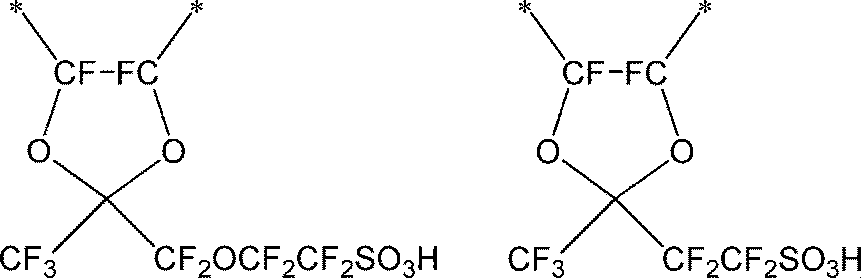
式(1)で表される単位のうち、実施形態(III)の具体例として、以下のものが挙げられる。

構成単位(1)は、洗浄性により優れる点や、ポリマーの合成の容易性等の点から、中でも、実施形態(I)の(i)を有することが好ましく、下記式(1A)で表される単位が好ましい。
-[CR1R2-CR3(Rf1-Z)]- …(1A)
式(1A)中、
R1及びR2はそれぞれ独立に、水素原子、フッ素原子又は塩素原子であり、
R3は、水素原子、フッ素原子、塩素原子、メチル基、又はフルオロメチル基であり、
Rf1は、エーテル性酸素原子を含んでもよい直鎖状又は分岐状のフルオロアルキレン基であって、Rf1がエーテル性酸素原子を含まないフルオロアルキレン基の場合、炭素数は1~10である。
Zは、-SO3H、-SO3Z1、-CO2H、-CO2Z1、-PO(OH)2、-PO3(OZ1)2、又はOHであり、Z1はカチオンである。
なお式(1A)中の各符号は、前記式(1)におけるものと同様であり、好ましい態様も前述のとおりであるため、ここでの説明は省略する。
-[CR1R2-CR3(Rf1-Z)]- …(1A)
式(1A)中、
R1及びR2はそれぞれ独立に、水素原子、フッ素原子又は塩素原子であり、
R3は、水素原子、フッ素原子、塩素原子、メチル基、又はフルオロメチル基であり、
Rf1は、エーテル性酸素原子を含んでもよい直鎖状又は分岐状のフルオロアルキレン基であって、Rf1がエーテル性酸素原子を含まないフルオロアルキレン基の場合、炭素数は1~10である。
Zは、-SO3H、-SO3Z1、-CO2H、-CO2Z1、-PO(OH)2、-PO3(OZ1)2、又はOHであり、Z1はカチオンである。
なお式(1A)中の各符号は、前記式(1)におけるものと同様であり、好ましい態様も前述のとおりであるため、ここでの説明は省略する。
(他の構成単位)
本フッ素ポリマーは、式(1)で表される単位のみからなるポリマーであってもよく、他の構成単位を含むコポリマーであってもよい。
他の構成単位としては、下記構成単位(11)~(13)等が挙げられる。
構成単位(11):酸性基とフッ素原子を有し、式(1)とは異なる構造を有する構成単位
構成単位(12):フッ素原子を有し、酸性基を有しない構成単位
構成単位(13):フッ素原子を有しない構成単位
本フッ素ポリマーは、式(1)で表される単位のみからなるポリマーであってもよく、他の構成単位を含むコポリマーであってもよい。
他の構成単位としては、下記構成単位(11)~(13)等が挙げられる。
構成単位(11):酸性基とフッ素原子を有し、式(1)とは異なる構造を有する構成単位
構成単位(12):フッ素原子を有し、酸性基を有しない構成単位
構成単位(13):フッ素原子を有しない構成単位
構成単位(11)としては、例えば、(メタ)アクリル酸等、公知の酸性基を有するモノマーにおいて、水素原子の少なくとも1つがフッ素置換されたモノマー由来の単位が挙げられる。
構成単位(12)としては下記式(12)で表される単位が挙げられる。
-CR21R22-CR23R24- …(12)
式(12)中、
R21及びR22はそれぞれ独立に、水素原子、フッ素原子又は塩素原子であり、
R23は、水素原子、フッ素原子、塩素原子、メチル基、又はフルオロメチル基であり、
R24は、水素原子、フッ素原子、塩素原子、炭素-炭素原子間にエーテル性酸素原子を含んでもよい直鎖状もしくは分岐状のフルオロアルキル基、又は炭素-炭素原子間にエーテル性酸素原子を含んでもよい直鎖状もしくは分岐状のオキシフルオロアルキル基であり、R24の炭素数は前記エーテル性酸素原子を有しない場合は1~10である。
-CR21R22-CR23R24- …(12)
式(12)中、
R21及びR22はそれぞれ独立に、水素原子、フッ素原子又は塩素原子であり、
R23は、水素原子、フッ素原子、塩素原子、メチル基、又はフルオロメチル基であり、
R24は、水素原子、フッ素原子、塩素原子、炭素-炭素原子間にエーテル性酸素原子を含んでもよい直鎖状もしくは分岐状のフルオロアルキル基、又は炭素-炭素原子間にエーテル性酸素原子を含んでもよい直鎖状もしくは分岐状のオキシフルオロアルキル基であり、R24の炭素数は前記エーテル性酸素原子を有しない場合は1~10である。
R21及びR22はそれぞれ独立に、水素原子、フッ素原子又は塩素原子であり、洗浄性の点からは、フッ素原子又は塩素原子が好ましく、フッ素原子がより好ましい。
R23は、水素原子、フッ素原子、塩素原子、メチル基、又はフルオロメチル基であり、洗浄性の点からは、フッ素原子、塩素原子、又はフルオロメチル基が好ましく、フッ素原子又はフルオロメチル基がより好ましく、フッ素原子が更に好ましい。
R23は、水素原子、フッ素原子、塩素原子、メチル基、又はフルオロメチル基であり、洗浄性の点からは、フッ素原子、塩素原子、又はフルオロメチル基が好ましく、フッ素原子又はフルオロメチル基がより好ましく、フッ素原子が更に好ましい。
R24における炭素-炭素原子間にエーテル性酸素原子を含んでもよい直鎖状もしくは分岐状のフルオロアルキル基としては、下記式(21)で表される基が挙げられる。
-Rf21-(ORf21)m21-R25 …(21)
式(21)中、
Rf21はそれぞれ独立に、炭素数1~6の直鎖状又は分岐状のフルオロアルキレン基であり、m21は1~200の整数であり、R25は水素原子又はフッ素原子である。
-Rf21-(ORf21)m21-R25 …(21)
式(21)中、
Rf21はそれぞれ独立に、炭素数1~6の直鎖状又は分岐状のフルオロアルキレン基であり、m21は1~200の整数であり、R25は水素原子又はフッ素原子である。
Rf21の具体例及び好ましい態様は、前記Rf11と同様である。またm21の具体例及び好ましい態様は、前記m1と同様である。またR25はフッ素原子が好ましい。
R24における炭素-炭素原子間にエーテル性酸素原子を含んでもよい直鎖状もしくは分岐状のオキシフルオロアルキル基としては、下記式(22)で表される基が挙げられる。
-(ORf22)m22-R26 …(22)
式(22)中、
Rf22はそれぞれ独立に、炭素数1~6の直鎖状又は分岐状のフルオロアルキレン基であり、m22は1~200の整数であり、R26は水素原子又はフッ素原子である。
Rf22の具体例及び好ましい態様は、前記Rf11と同様である。またm22の具体例及び好ましい態様は、前記m1と同様である。
-(ORf22)m22-R26 …(22)
式(22)中、
Rf22はそれぞれ独立に、炭素数1~6の直鎖状又は分岐状のフルオロアルキレン基であり、m22は1~200の整数であり、R26は水素原子又はフッ素原子である。
Rf22の具体例及び好ましい態様は、前記Rf11と同様である。またm22の具体例及び好ましい態様は、前記m1と同様である。
R24における炭素-炭素原子間にエーテル性酸素原子を含まない、フルオロアルキル基又はオキシフルオロアルキル基は、下記式(23)で表される基が挙げられる。
-(O)m23-Rf23-R27 …(23)
式(23)中、
Rf23は炭素数1~10の直鎖状又は分岐状のフルオロアルキル基であり、m23は0又は1であり、R27は水素原子又はフッ素原子である。
Rf23の具体例及び好ましい態様は、前記Rf11及びRf13と同様である。
-(O)m23-Rf23-R27 …(23)
式(23)中、
Rf23は炭素数1~10の直鎖状又は分岐状のフルオロアルキル基であり、m23は0又は1であり、R27は水素原子又はフッ素原子である。
Rf23の具体例及び好ましい態様は、前記Rf11及びRf13と同様である。
フッ素ポリマーが構成単位(12)を2個以上有する場合、複数ある各符号はそれぞれ同一であっても異なっていてもよい。洗浄性の点から、式(12)で表される単位は、R21、R22が、いずれもフッ素原子が好ましい。洗浄性により優れる点から、R23は、フッ素原子又はフルオロメチル基が好ましく、フッ素原子が好ましい。また、洗浄性の点から、R24は、フッ素原子、炭素-炭素原子間にエーテル性酸素原子を含んでもよい直鎖状もしくは分岐状のペルフルオロアルキル基、又は炭素-炭素原子間にエーテル性酸素原子を含んでもよい直鎖状もしくは分岐状のオキシペルフルオロアルキル基が好ましく、フッ素原子がより好ましい。
構成単位(12)の具体例として、以下のものが挙げられる。
-CF2-CF2-
-CF2-CF(OCF2CF2CF3)-
-CF2-CF{OCF2CF(CF3)OCF2CF3}-
-CF2-CF{OCF2CF(CF3)OCF2CF2CF3}-
-CF2-CF[CF2O{CF(CF3)CF2O}nCF2(CF3)]-
-CF2-CF(OCF2CF2CF2OCF2CF3)-
-CF2-CF(OCF2CF2OCF2CF3)-
-CF2-CF(OCF2CF2CF2CF2CF3)-
-CF2-CF(OCF2CF3)-
-CF2-CF(OCF3)-
ただし、nは1~200の整数である。
構成単位(12)の具体例として、以下のものが挙げられる。
-CF2-CF2-
-CF2-CF(OCF2CF2CF3)-
-CF2-CF{OCF2CF(CF3)OCF2CF3}-
-CF2-CF{OCF2CF(CF3)OCF2CF2CF3}-
-CF2-CF[CF2O{CF(CF3)CF2O}nCF2(CF3)]-
-CF2-CF(OCF2CF2CF2OCF2CF3)-
-CF2-CF(OCF2CF2OCF2CF3)-
-CF2-CF(OCF2CF2CF2CF2CF3)-
-CF2-CF(OCF2CF3)-
-CF2-CF(OCF3)-
ただし、nは1~200の整数である。
構成単位(13)としては、フッ素原子を有しない公知のモノマー由来の構成単位が挙げられる。
このようなモノマーの具体例としては、エチレン、塩化ビニル、塩化ビニリデン、スチレン、メチルスチレン、ビニルトルエン、p-t-ブチルスチレン等のビニル系モノマー; メチル(メタ)アクリレート、エチル(メタ)アクリレート、n-プロピル(メタ)アクリレート等の(メタ)アクリレート系モノマー; (メタ)アクリルアミド、N,N-ジメチル(メタ)アクリルアミド、N,N-ジエチル(メタ)アクリルアミド等のアクリルアミド系モノマー; (メタ)アクリル酸等が挙げられる。
このようなモノマーの具体例としては、エチレン、塩化ビニル、塩化ビニリデン、スチレン、メチルスチレン、ビニルトルエン、p-t-ブチルスチレン等のビニル系モノマー; メチル(メタ)アクリレート、エチル(メタ)アクリレート、n-プロピル(メタ)アクリレート等の(メタ)アクリレート系モノマー; (メタ)アクリルアミド、N,N-ジメチル(メタ)アクリルアミド、N,N-ジエチル(メタ)アクリルアミド等のアクリルアミド系モノマー; (メタ)アクリル酸等が挙げられる。
(構成比率)
本洗浄液に用いるフッ素ポリマーは構成単位(1)を含むことが好ましく、構成単位(1A)を含むことがより好ましい。また、洗浄性及びポリマーの取扱い性により優れる点から、フッ素ポリマーはさらに構成単位(12)を含むことが好ましい。
構成単位(12)を含む場合、構成単位(1)と、構成単位(12)の比率はモル比で、5:95~60:40が好ましく、10:90~50:50がより好ましく、15:85~40:60が更に好ましい。
構成単位(13)は、洗浄性に優れる点から、フッ素ポリマーを構成する全構成単位に対して、10モル%以下が好ましく、5モル%以下がより好ましく、1モル%以下が更に好ましく、構成単位(13)を含まないことが特に好ましい。
本洗浄液に用いるフッ素ポリマーは構成単位(1)を含むことが好ましく、構成単位(1A)を含むことがより好ましい。また、洗浄性及びポリマーの取扱い性により優れる点から、フッ素ポリマーはさらに構成単位(12)を含むことが好ましい。
構成単位(12)を含む場合、構成単位(1)と、構成単位(12)の比率はモル比で、5:95~60:40が好ましく、10:90~50:50がより好ましく、15:85~40:60が更に好ましい。
構成単位(13)は、洗浄性に優れる点から、フッ素ポリマーを構成する全構成単位に対して、10モル%以下が好ましく、5モル%以下がより好ましく、1モル%以下が更に好ましく、構成単位(13)を含まないことが特に好ましい。
各構成単位の配置は特に限定されず、ランダムコポリマーであってもよく、ブロックコポリマーであってもよい。洗浄性に優れる点からはランダムコポリマーが好ましい。
洗浄液中のフッ素ポリマーの割合は洗浄液全量に対して0.001~30質量%が好ましく、0.005~20質量%がより好ましく、0.01~10質量%が特に好ましい。なお、フッ素ポリマーを高濃度で含む洗浄液を調製して、使用時に適宜希釈してもよい。
(フッ素ポリマーの合成)
フッ素ポリマーの合成方法は特に限定されない。例えば、構成単位(1)と構成単位(12)のランダムコポリマーを合成する場合、構成単位(1)に対応する下記モノマー(1a)と、構成単位(12)に対する下記モノマー(12a)とを混合し、更に開始剤を加えて、溶液重合、塊状重合、各種ラジカル重合等公知の重合法により重合すればよい。ポリマーの数平均分子量の調整がしやすい点からは溶液重合が好ましい。またブロックポリマーの場合、例えば構成単位(1)のブロックを先に合成し、当該構成単位(1)ブロックにモノマー(12a)を重合してもよく、当該製造方法において合成の順番を逆にしてもよい。また、構成単位(1)のブロックと、構成単位(12)のブロックとを別々に合成し、その後、構成単位(1)のブロックと構成単位(12)のブロックをカップリングしてもよい。
CR1R2=CR3{Rf1-(Z)n} …(1a)
CR21R22=CR23R24 …(12a)
なお式中の各符号は、前述のとおりである。
フッ素ポリマーの合成方法は特に限定されない。例えば、構成単位(1)と構成単位(12)のランダムコポリマーを合成する場合、構成単位(1)に対応する下記モノマー(1a)と、構成単位(12)に対する下記モノマー(12a)とを混合し、更に開始剤を加えて、溶液重合、塊状重合、各種ラジカル重合等公知の重合法により重合すればよい。ポリマーの数平均分子量の調整がしやすい点からは溶液重合が好ましい。またブロックポリマーの場合、例えば構成単位(1)のブロックを先に合成し、当該構成単位(1)ブロックにモノマー(12a)を重合してもよく、当該製造方法において合成の順番を逆にしてもよい。また、構成単位(1)のブロックと、構成単位(12)のブロックとを別々に合成し、その後、構成単位(1)のブロックと構成単位(12)のブロックをカップリングしてもよい。
CR1R2=CR3{Rf1-(Z)n} …(1a)
CR21R22=CR23R24 …(12a)
なお式中の各符号は、前述のとおりである。
<水>
本洗浄液は、前記フッ素ポリマーを分散又は溶解させる媒体として水を含む。水の種類については特に限定されないが、他の成分への影響、不純物の混入の防止、pH等への影響を考慮して、純水、超純水、イオン交換水等を用いることが好ましい。
本洗浄液は、前記フッ素ポリマーを分散又は溶解させる媒体として水を含む。水の種類については特に限定されないが、他の成分への影響、不純物の混入の防止、pH等への影響を考慮して、純水、超純水、イオン交換水等を用いることが好ましい。
<任意成分>
本洗浄液は、更に他の成分を含んでいてもよい。他の成分としては、還元性化合物、錯化剤、複素環式芳香族化合物、酸性化合物、防腐剤、防錆剤、界面活性剤、塩基性化合物、水溶性有機溶剤等が挙げられる。
本洗浄液は、更に他の成分を含んでいてもよい。他の成分としては、還元性化合物、錯化剤、複素環式芳香族化合物、酸性化合物、防腐剤、防錆剤、界面活性剤、塩基性化合物、水溶性有機溶剤等が挙げられる。
(還元性化合物)
本洗浄液は、還元性化合物を含んでいてもよい。還元性化合物は、例えば、被洗浄面の酸化ケイ素と結合したセリウム(CeO4)を、水溶性のCe3+に還元することで、被洗浄面から除去しやすくなり、洗浄効果が向上する。
還元性化合物は、砥粒成分に対して還元作用を有するものの中から適宜選択できる。還元性化合物としては、中でも、没食子酸又はその塩、没食子酸エステル、ピロガロール、カテコール、レゾルシノール、チオ硫酸又はその塩、ジチオン酸又はその塩、アスコルビン酸、尿酸、ジ亜リン酸又はその塩、シュウ酸又はその塩、過酸化水素、又はヒドロキノンが好ましい。
本洗浄液は、還元性化合物を含んでいてもよい。還元性化合物は、例えば、被洗浄面の酸化ケイ素と結合したセリウム(CeO4)を、水溶性のCe3+に還元することで、被洗浄面から除去しやすくなり、洗浄効果が向上する。
還元性化合物は、砥粒成分に対して還元作用を有するものの中から適宜選択できる。還元性化合物としては、中でも、没食子酸又はその塩、没食子酸エステル、ピロガロール、カテコール、レゾルシノール、チオ硫酸又はその塩、ジチオン酸又はその塩、アスコルビン酸、尿酸、ジ亜リン酸又はその塩、シュウ酸又はその塩、過酸化水素、又はヒドロキノンが好ましい。
還元性化合物を用いる場合、洗浄液中の還元性化合物の割合は洗浄液全量に対して0.001質量%~30質量%が好ましく、0.005~20質量%がより好ましく、0.01~10質量%がより好ましい。
(錯化剤)
本洗浄液は、錯化剤を含んでいてもよい。錯化剤は、砥粒中の金属成分、研磨により生じた基板由来の残渣中の金属成分と錯形成するものの中から適宜選択できる。本洗浄液においては、洗浄効果を向上する点から、錯化剤として、分子内にカルボキシル基、アミノ基、ホスホリル基、スルホン酸基、水酸基から選ばれる置換基を2つ以上有する分子量1,000g/mоl以下の有機化合物が好ましい。
錯化剤としては、テトラメチルエチレンジアミン(TMEDA)、エチレンジアミン四酢酸(EDTA)、N-ヒドロキシエチルエチレンジアミン三酢酸(NHEDTA)、ニトリロ三酢酸(NTA)、ジエチレントリアミン五酢酸(DPTA)、エタノールジグリシネート、クエン酸、リンゴ酸、グルコン酸、シュウ酸、リン酸、酒石酸、マロン酸、コハク酸、ジメルカプトコハク酸、グルタル酸、マレイン酸、フタル酸、フマル酸、メチルジホスホン酸、アミノトリスメチレンホスホン酸、エチリデン-ジホスホン酸、1-ヒドロキシエタン-1,1-ジホスホン酸(HEDP)、1-ヒドロキシプロピリデン-1,1-ジホスホン酸、エチルアミノビスメチレンホスホン酸、ドデシルアミノビスメチレンホスホン酸、ニトリロトリスメチレンホスホン酸、エチレンジアミンビスメチレンホスホン酸、エチレンジアミンテトラキスメチレンホスホン酸、ヘキサジアミンテトラキスメチレンホスホン酸、ジエチレントリアミンペンタメチレンホスホン酸、及び1,2-プロパンジアミンペンタメチレンホスホン酸又はアンモニウム塩等が挙げられる。
錯化剤を用いる場合、洗浄液中の錯化剤の割合は洗浄液全量に対して0.01質量%~30質量%が好ましく、0.05~20質量%がより好ましく、0.1~10質量%がより好ましい。
本洗浄液は、錯化剤を含んでいてもよい。錯化剤は、砥粒中の金属成分、研磨により生じた基板由来の残渣中の金属成分と錯形成するものの中から適宜選択できる。本洗浄液においては、洗浄効果を向上する点から、錯化剤として、分子内にカルボキシル基、アミノ基、ホスホリル基、スルホン酸基、水酸基から選ばれる置換基を2つ以上有する分子量1,000g/mоl以下の有機化合物が好ましい。
錯化剤としては、テトラメチルエチレンジアミン(TMEDA)、エチレンジアミン四酢酸(EDTA)、N-ヒドロキシエチルエチレンジアミン三酢酸(NHEDTA)、ニトリロ三酢酸(NTA)、ジエチレントリアミン五酢酸(DPTA)、エタノールジグリシネート、クエン酸、リンゴ酸、グルコン酸、シュウ酸、リン酸、酒石酸、マロン酸、コハク酸、ジメルカプトコハク酸、グルタル酸、マレイン酸、フタル酸、フマル酸、メチルジホスホン酸、アミノトリスメチレンホスホン酸、エチリデン-ジホスホン酸、1-ヒドロキシエタン-1,1-ジホスホン酸(HEDP)、1-ヒドロキシプロピリデン-1,1-ジホスホン酸、エチルアミノビスメチレンホスホン酸、ドデシルアミノビスメチレンホスホン酸、ニトリロトリスメチレンホスホン酸、エチレンジアミンビスメチレンホスホン酸、エチレンジアミンテトラキスメチレンホスホン酸、ヘキサジアミンテトラキスメチレンホスホン酸、ジエチレントリアミンペンタメチレンホスホン酸、及び1,2-プロパンジアミンペンタメチレンホスホン酸又はアンモニウム塩等が挙げられる。
錯化剤を用いる場合、洗浄液中の錯化剤の割合は洗浄液全量に対して0.01質量%~30質量%が好ましく、0.05~20質量%がより好ましく、0.1~10質量%がより好ましい。
(複素環式芳香族化合物)
本洗浄液は、複素環式芳香族化合物を含んでもよい。複素環式芳香族化合物を含む浄液は、微生物等によりの品質低下が抑制され、より優れた洗浄効果が得られる。複素環式芳香族化合物としては、イミダゾール系化合物、ピラゾール系化合物、チアゾール系化合物、トリアゾール系化合物等が挙げられる。
イミダゾール系化合物としては、イミダゾール、2-エチル-4-メチルイミダゾール、1,2-ジメチルイミダゾール、1-ベンジル-2-メチルイミダゾール、1-ベンジル-2-フェニルイミダゾール等が挙げられる。ピラゾール系化合物としては、ピラゾール、3-メチルピラゾール、3,5-ジメチルピラゾール等が挙げられる。チアゾール系化合物としては、ベンズイソチアゾリン、イソチアゾリン、1,2-ベンズイソチアゾリン-3-オン、5-クロロ-2-メチル-4-イソチアゾリン-3-オン、2-(チオシアノメチルチオ)ベンズチアゾール、2-メルカプトベンズチアゾール、3-アリルオキシ-1,2-ベンズイソチアゾール-1,1-オキシド等が挙げられる。また、トリアゾール系化合物としては、1H-ベンゾトリアゾール、4-メチル-1H-ベンゾトリアゾール、5-メチル-1H-ベンゾトリアゾール等が挙げられる。
複素環式芳香族化合物を用いる場合、洗浄液中の複素環式芳香族化合物の割合は洗浄液全量に対して0.01~30質量%が好ましく、0.05~20質量%がより好ましく、0.1~10質量%が特に好ましい。
本洗浄液は、複素環式芳香族化合物を含んでもよい。複素環式芳香族化合物を含む浄液は、微生物等によりの品質低下が抑制され、より優れた洗浄効果が得られる。複素環式芳香族化合物としては、イミダゾール系化合物、ピラゾール系化合物、チアゾール系化合物、トリアゾール系化合物等が挙げられる。
イミダゾール系化合物としては、イミダゾール、2-エチル-4-メチルイミダゾール、1,2-ジメチルイミダゾール、1-ベンジル-2-メチルイミダゾール、1-ベンジル-2-フェニルイミダゾール等が挙げられる。ピラゾール系化合物としては、ピラゾール、3-メチルピラゾール、3,5-ジメチルピラゾール等が挙げられる。チアゾール系化合物としては、ベンズイソチアゾリン、イソチアゾリン、1,2-ベンズイソチアゾリン-3-オン、5-クロロ-2-メチル-4-イソチアゾリン-3-オン、2-(チオシアノメチルチオ)ベンズチアゾール、2-メルカプトベンズチアゾール、3-アリルオキシ-1,2-ベンズイソチアゾール-1,1-オキシド等が挙げられる。また、トリアゾール系化合物としては、1H-ベンゾトリアゾール、4-メチル-1H-ベンゾトリアゾール、5-メチル-1H-ベンゾトリアゾール等が挙げられる。
複素環式芳香族化合物を用いる場合、洗浄液中の複素環式芳香族化合物の割合は洗浄液全量に対して0.01~30質量%が好ましく、0.05~20質量%がより好ましく、0.1~10質量%が特に好ましい。
(界面活性剤)
本洗浄液は、界面活性剤を含んでいてもよい。界面活性剤はイオン性であってもノニオン性であってもよい。
界面活性剤としては、アルキルカルボキシレート、アルキルポリアクリル酸塩、アルキルサルフェート、アルキルホスフェート、アルキルビカルボキシレート、アルキルビサルフェート、アルキルビホスフェート、置換アリールカルボキシレート、置換アリールサルフェート、置換アリールホスフェート、置換アリールビカルボキシレート、置換アリールビサルフェート、置換アリールビホスフェート等の好適な疎水性を含む塩、長鎖アルコール、エトキシル化アルコール、エトキシル化アセチレンジオール界面活性剤、ポリエチレングリコールアルキルエーテル、プロピレングリコールアルキルエーテル、グルコシドアルキルエーテル、ポリエチレングリコールオクチルフェニルエーテル、ポリエチレングリコールアルキルフェニルエーテル、グリセロールアルキルエステル、ポリオキシエチレングリコールソルビトンアルキルエステル、ソルビトンアルキルエステル、コカミドジエタノールアミンドデシルジメチルアミンオキシド、ポリエチレングリコールとポリプロピレングリコールのブロックコポリマー、ポリエトキシル化タローアミン、フッ素界面活性剤等が挙げられる。
本洗浄液は、界面活性剤を含んでいてもよい。界面活性剤はイオン性であってもノニオン性であってもよい。
界面活性剤としては、アルキルカルボキシレート、アルキルポリアクリル酸塩、アルキルサルフェート、アルキルホスフェート、アルキルビカルボキシレート、アルキルビサルフェート、アルキルビホスフェート、置換アリールカルボキシレート、置換アリールサルフェート、置換アリールホスフェート、置換アリールビカルボキシレート、置換アリールビサルフェート、置換アリールビホスフェート等の好適な疎水性を含む塩、長鎖アルコール、エトキシル化アルコール、エトキシル化アセチレンジオール界面活性剤、ポリエチレングリコールアルキルエーテル、プロピレングリコールアルキルエーテル、グルコシドアルキルエーテル、ポリエチレングリコールオクチルフェニルエーテル、ポリエチレングリコールアルキルフェニルエーテル、グリセロールアルキルエステル、ポリオキシエチレングリコールソルビトンアルキルエステル、ソルビトンアルキルエステル、コカミドジエタノールアミンドデシルジメチルアミンオキシド、ポリエチレングリコールとポリプロピレングリコールのブロックコポリマー、ポリエトキシル化タローアミン、フッ素界面活性剤等が挙げられる。
(酸性化合物)
本洗浄液は、酸性基を有するフッ素ポリマー以外の酸性化合物を含んでいてもよい。酸性化合物はpH調整等を目的として用いられる。酸性化合物としては、硝酸、硫酸、塩酸、リン酸、縮合リン酸等の無機酸が好ましい。
本洗浄液は、酸性基を有するフッ素ポリマー以外の酸性化合物を含んでいてもよい。酸性化合物はpH調整等を目的として用いられる。酸性化合物としては、硝酸、硫酸、塩酸、リン酸、縮合リン酸等の無機酸が好ましい。
(塩基性化合物)
本洗浄液は、塩基性化合物を含んでいてもよい。塩基性化合物はpH調整等を目的として用いられる。
塩基性化合物としては、モノエタノールアミン(MEA)、ジエタノールアミン、トリエタノールアミン(TMA)、モルホリン、イソプロピルアミン、ヒドロキシアミン、ジイソプロパノールアミン、ジグリコールアミン、トリエチルアミン、N-メチルモルホリン、メチルエタノールアミン、N-アミノプロピルモルホリン、及び3-アミノ-プロパノール、水酸化テトラメチルアンモニウム(TMAH)、水酸化アンモニウム、水酸化テトラエチルアンモニウム(TEAH)、水酸化テトラプロピルアンモニウム(TPAH)、水酸化テトラブチルアンモニウム(TBAH)、水酸化トリブチルメチルアンモニウム(TBMAH)、水酸化ベンジルトリメチルアンモニウム(BTMAH)、コリン、水酸化コリン、水酸化エチルトリメチルアンモニウム、水酸化トリス(2-ヒドロキシエチル)メチルアンモニウム、水酸化ジエチルジメチルアンモニウム及びそれらの組み合わせが挙げられる。塩基性化合物は、中でも、水酸化アンモニウム、コリン、モノエタノールアミン、ヒドロキシアミン、又はトリエタノールアミンが好ましい。
本洗浄液は、塩基性化合物を含んでいてもよい。塩基性化合物はpH調整等を目的として用いられる。
塩基性化合物としては、モノエタノールアミン(MEA)、ジエタノールアミン、トリエタノールアミン(TMA)、モルホリン、イソプロピルアミン、ヒドロキシアミン、ジイソプロパノールアミン、ジグリコールアミン、トリエチルアミン、N-メチルモルホリン、メチルエタノールアミン、N-アミノプロピルモルホリン、及び3-アミノ-プロパノール、水酸化テトラメチルアンモニウム(TMAH)、水酸化アンモニウム、水酸化テトラエチルアンモニウム(TEAH)、水酸化テトラプロピルアンモニウム(TPAH)、水酸化テトラブチルアンモニウム(TBAH)、水酸化トリブチルメチルアンモニウム(TBMAH)、水酸化ベンジルトリメチルアンモニウム(BTMAH)、コリン、水酸化コリン、水酸化エチルトリメチルアンモニウム、水酸化トリス(2-ヒドロキシエチル)メチルアンモニウム、水酸化ジエチルジメチルアンモニウム及びそれらの組み合わせが挙げられる。塩基性化合物は、中でも、水酸化アンモニウム、コリン、モノエタノールアミン、ヒドロキシアミン、又はトリエタノールアミンが好ましい。
本洗浄液は、pHを1~12の範囲内に調整することでより洗浄性能が向上する。本洗浄液を酸性で使用する場合、洗浄性能をより向上する点から、pHは7以下が好ましく、1~5がより好ましい。本洗浄液を塩基性で使用する場合、洗浄性能をより向上する点から、pHは7以上が好ましく、8~12がより好ましい。
(水溶性有機溶剤)
本洗浄液は、水溶性有機溶剤を含んでいてもよい。水溶性有機溶剤としては、プロピレングリコール(PG)、グリコールエーテル、及び非プロトン性溶媒が挙げられる。非プロトン性溶媒としては、N-メチルピロリドン(NMP)、ジメチルスルホキシド(DMSO)、ジメチルアセトアミド(DMAC)、スルホラン、ジメチルホルムアミド(DMF)が挙げられる。水溶性有機溶剤は、2種以上の混合溶剤であってもよい。
本洗浄液は、水溶性有機溶剤を含んでいてもよい。水溶性有機溶剤としては、プロピレングリコール(PG)、グリコールエーテル、及び非プロトン性溶媒が挙げられる。非プロトン性溶媒としては、N-メチルピロリドン(NMP)、ジメチルスルホキシド(DMSO)、ジメチルアセトアミド(DMAC)、スルホラン、ジメチルホルムアミド(DMF)が挙げられる。水溶性有機溶剤は、2種以上の混合溶剤であってもよい。
<洗浄液の用途>
本洗浄液は、被洗浄面から砥粒を除去するための洗浄液として好適であり、研磨剤に含まれるポリマー等の有機成分も好適に除去できる。
被洗浄面としては、半導体基板の露出面(表面)等が挙げられ、当該露出面には、二酸化ケイ素面及び/又は窒化ケイ素面が含まれていてもよい。被洗浄面は、砥粒を含む研磨剤を用いて表面研磨された露出面であってもよい。当該砥粒としては、シリカ粒子、アルミナ粒子、ジルコニア粒子、チタニア粒子、ゲルマニア粒子、及びセリウム化合物含有粒子等が挙げられる。本洗浄液は、中でも、セリア粒子、水酸化セリウム粒子等セリウム化合物含有粒子に対し好適である。また、本洗浄液は微細な砥粒に対しても好適に用いることができ、例えば平均粒子径が300nm以下の砥粒に対しても優れた洗浄効果を発揮する。
本洗浄液が特に優れた効果を発揮する洗浄対象は、砥粒としてセリウム化合物含有粒子を含む研磨剤を用いてCMP処理を行った後の半導体基板であって、酸化膜、窒化膜等が露出した露出面を含む半導体基板である。当該露出面には、酸化膜等に吸着又は結合したセリウム粒子が残留するが、本洗浄液によれば当該粒子を好適に除去できる。
本洗浄液は、被洗浄面から砥粒を除去するための洗浄液として好適であり、研磨剤に含まれるポリマー等の有機成分も好適に除去できる。
被洗浄面としては、半導体基板の露出面(表面)等が挙げられ、当該露出面には、二酸化ケイ素面及び/又は窒化ケイ素面が含まれていてもよい。被洗浄面は、砥粒を含む研磨剤を用いて表面研磨された露出面であってもよい。当該砥粒としては、シリカ粒子、アルミナ粒子、ジルコニア粒子、チタニア粒子、ゲルマニア粒子、及びセリウム化合物含有粒子等が挙げられる。本洗浄液は、中でも、セリア粒子、水酸化セリウム粒子等セリウム化合物含有粒子に対し好適である。また、本洗浄液は微細な砥粒に対しても好適に用いることができ、例えば平均粒子径が300nm以下の砥粒に対しても優れた洗浄効果を発揮する。
本洗浄液が特に優れた効果を発揮する洗浄対象は、砥粒としてセリウム化合物含有粒子を含む研磨剤を用いてCMP処理を行った後の半導体基板であって、酸化膜、窒化膜等が露出した露出面を含む半導体基板である。当該露出面には、酸化膜等に吸着又は結合したセリウム粒子が残留するが、本洗浄液によれば当該粒子を好適に除去できる。
[洗浄方法]
本開示の洗浄方法は、上記洗浄液を用いて、被洗浄面を洗浄することを含む。具体的には、半導体基板等の被洗浄面に前記洗浄液を供給しながらパッド、ブラシ等の洗浄部材を被洗浄面に物理的に接触させて砥粒等を除去するスクラブ洗浄、洗浄液に被洗浄面を含む洗浄対象物を浸漬する浸漬式洗浄、洗浄対象物を回転させながら洗浄液を滴下するスピン滴下式洗浄、洗浄液を噴霧する噴霧(スプレー)式洗浄等が挙げられる。浸漬式の洗浄では、洗浄液に対して超音波処理を行ってもよい。上記洗浄工程は、1回のみ実施してもよく、2回以上実施してもよい。
本開示の洗浄方法は、上記洗浄液を用いて、被洗浄面を洗浄することを含む。具体的には、半導体基板等の被洗浄面に前記洗浄液を供給しながらパッド、ブラシ等の洗浄部材を被洗浄面に物理的に接触させて砥粒等を除去するスクラブ洗浄、洗浄液に被洗浄面を含む洗浄対象物を浸漬する浸漬式洗浄、洗浄対象物を回転させながら洗浄液を滴下するスピン滴下式洗浄、洗浄液を噴霧する噴霧(スプレー)式洗浄等が挙げられる。浸漬式の洗浄では、洗浄液に対して超音波処理を行ってもよい。上記洗浄工程は、1回のみ実施してもよく、2回以上実施してもよい。
洗浄液の温度は、洗浄対象物の耐熱性等を考慮して適宜調整すればよい。洗浄液の温度は、例えば10~60℃の範囲で適宜調整すればよく、15~50℃が好ましい。
洗浄時間は、10秒~5分の範囲で適宜調整すればよく、20秒~3分が好ましい。
洗浄時間は、10秒~5分の範囲で適宜調整すればよく、20秒~3分が好ましい。
本洗浄方法は、上記洗浄液による洗浄の後、必要に応じて更に水等で洗浄を行ってもよく、また、必要に応じて乾燥を行ってもよい。
更に本開示は、上記洗浄方法により得られた半導体素子を提供する。上記洗浄方法により得られた半導体素子は、砥粒や研磨残渣の少ない清浄な表面を有する。
以下、本発明を実施例及び比較例により具体的に説明するが、本発明はこれらの実施例に限定されるものではない。特に明記しない限り、常温は20~25℃である。なお、例1~15が実施例であり、例16~19が比較例である。
[評価項目と評価方法]
評価項目と評価方法は、以下の通りである。
<pH>
マグネティックスターラーを用いて撹拌しながら、市販のpH計を用いて洗浄液のpHを測定した。pH計として、堀場製作所社製のpHメータ「F-2000PI-S」、ToupH電極「9615S-10D」を用いた。
評価項目と評価方法は、以下の通りである。
<pH>
マグネティックスターラーを用いて撹拌しながら、市販のpH計を用いて洗浄液のpHを測定した。pH計として、堀場製作所社製のpHメータ「F-2000PI-S」、ToupH電極「9615S-10D」を用いた。
<酸化セリウムと有機成分の除去性能>
(研磨基板の用意)
平均粒子径が300nm以下の酸化セリウム粒子、ポリマー等の有機成分、界面活性剤、及び水を含む市販のスラリー状の研磨剤(研磨スラリー)を用意した。
市販のCMP装置と上記研磨剤とを用いて、石英ガラス板の一方の表面を、30秒間研磨した。CMP装置として、SpeedFam社製「FAM12B」を用いた。研磨パッドは硬質ウレタンパッドを使用した。研磨圧力は14kPa、定盤回転数を40rpmとして毎分30ccの薬液をかけ流し5分間の研磨を行った。以上の条件にて研磨を行い、純水で数回すすいだ後、水没保管しセリア汚染された基板を得た。
(研磨基板の用意)
平均粒子径が300nm以下の酸化セリウム粒子、ポリマー等の有機成分、界面活性剤、及び水を含む市販のスラリー状の研磨剤(研磨スラリー)を用意した。
市販のCMP装置と上記研磨剤とを用いて、石英ガラス板の一方の表面を、30秒間研磨した。CMP装置として、SpeedFam社製「FAM12B」を用いた。研磨パッドは硬質ウレタンパッドを使用した。研磨圧力は14kPa、定盤回転数を40rpmとして毎分30ccの薬液をかけ流し5分間の研磨を行った。以上の条件にて研磨を行い、純水で数回すすいだ後、水没保管しセリア汚染された基板を得た。
(研磨基板の後洗浄)
得られたセリア汚染SiO2基板に対して、PVAディスクスポンジ洗浄(回転数300rpm、基板搬送速度12.5mm/s、5mlの洗浄液使用する洗浄工程を基板毎に2回)を行った。純水で数回すすいだ後乾燥させ洗浄後の基板を得た。以上の処理を終えた研磨基板を、「後洗浄後の研磨基板」という。
得られたセリア汚染SiO2基板に対して、PVAディスクスポンジ洗浄(回転数300rpm、基板搬送速度12.5mm/s、5mlの洗浄液使用する洗浄工程を基板毎に2回)を行った。純水で数回すすいだ後乾燥させ洗浄後の基板を得た。以上の処理を終えた研磨基板を、「後洗浄後の研磨基板」という。
(後洗浄後の残酸化セリウム量と酸化セリウムの除去性能の評価)
後洗浄後の研磨基板に対して、パーティクル検査装置(LAZIN社製LODAS)を使用して基板上に残存しているセリア汚染粒子をカウントした。酸化セリウムの除去性能を、下記基準にて評価した。
A(良):後洗浄後のパーティクルカウント数が500以下。
B(可):後洗浄後のパーティクルカウント数が1,000以下。
C(不良):後洗浄後のパーティクルカウント数が1,000超。
後洗浄後の研磨基板に対して、パーティクル検査装置(LAZIN社製LODAS)を使用して基板上に残存しているセリア汚染粒子をカウントした。酸化セリウムの除去性能を、下記基準にて評価した。
A(良):後洗浄後のパーティクルカウント数が500以下。
B(可):後洗浄後のパーティクルカウント数が1,000以下。
C(不良):後洗浄後のパーティクルカウント数が1,000超。
[材料]
各例で用いた材料は、以下の通りである。
<水溶性ポリマー>
フッ素ポリマー1:テトラフルオロエチレン(-CF2CF2-)構造と含SO3H基フルオロアルキレン(-CF2CF(OCF2CF(CF3)OCF2CF2SO3H)-)構造がモル比で73:27の比率で含まれる二元系水溶性フッ素コポリマー。単位質量当たりの酸性基の濃度は1.40mmоl/g。
フッ素ポリマー2:上記モノマーユニット構造がモル比で78:22の比率で含まれる二元系水溶性フッ素コポリマー。単位質量当たりの酸性基の濃度は1.25mmоl/g。
フッ素ポリマー3:上記モノマーユニット構造がモル比で82:18の比率で含まれる二元系水溶性リマー。単位質量当たりの酸性基の濃度は1.10mmоl/g。
フッ素ポリマー4:含CO2H基フルオロアルキレン(-CF2CF(OCF2CF2CF2CO2H)-)構造のみで形成される水溶性フッ素ホモポリマー。単位質量当たりの酸性基の濃度は3.42mmоl/g。
フッ素ポリマー5:含CO2H基フルオロアルキレン(-CF2CF(OCF2CF(CF3)OCF2CF2CO2H)-)構造のみで形成される水溶性フッ素ホモポリマー。
単位質量当たりの酸性基の濃度は2.45mmоl/g。
ポリアクリル酸(比較用の水溶性ポリマー):純度100質量%、試薬。
各例で用いた材料は、以下の通りである。
<水溶性ポリマー>
フッ素ポリマー1:テトラフルオロエチレン(-CF2CF2-)構造と含SO3H基フルオロアルキレン(-CF2CF(OCF2CF(CF3)OCF2CF2SO3H)-)構造がモル比で73:27の比率で含まれる二元系水溶性フッ素コポリマー。単位質量当たりの酸性基の濃度は1.40mmоl/g。
フッ素ポリマー2:上記モノマーユニット構造がモル比で78:22の比率で含まれる二元系水溶性フッ素コポリマー。単位質量当たりの酸性基の濃度は1.25mmоl/g。
フッ素ポリマー3:上記モノマーユニット構造がモル比で82:18の比率で含まれる二元系水溶性リマー。単位質量当たりの酸性基の濃度は1.10mmоl/g。
フッ素ポリマー4:含CO2H基フルオロアルキレン(-CF2CF(OCF2CF2CF2CO2H)-)構造のみで形成される水溶性フッ素ホモポリマー。単位質量当たりの酸性基の濃度は3.42mmоl/g。
フッ素ポリマー5:含CO2H基フルオロアルキレン(-CF2CF(OCF2CF(CF3)OCF2CF2CO2H)-)構造のみで形成される水溶性フッ素ホモポリマー。
単位質量当たりの酸性基の濃度は2.45mmоl/g。
ポリアクリル酸(比較用の水溶性ポリマー):純度100質量%、試薬。
<pH調整剤>
(無機酸化合物)
0.1N HNO3 aq.:0.1N硝酸水溶液、試薬。
0.1N ポリリン酸 aq.:0.1N縮合リン酸(P(O)(OH)O)n、試薬。
(塩基性化合物)
0.1N トリエタノールアミン aq.:0.1Nトリエタノールアミン水溶液、試薬。
(無機酸化合物)
0.1N HNO3 aq.:0.1N硝酸水溶液、試薬。
0.1N ポリリン酸 aq.:0.1N縮合リン酸(P(O)(OH)O)n、試薬。
(塩基性化合物)
0.1N トリエタノールアミン aq.:0.1Nトリエタノールアミン水溶液、試薬。
<還元性化合物>
30% H2O2 aq.:30質量%過酸化水素水。
没食子酸:純度98質量%、試薬。
ピロガロール:純度100質量%、試薬。
アスコルビン酸:純度100質量%、試薬。
ヒドロキノン:純度100質量%、試薬。
30% H2O2 aq.:30質量%過酸化水素水。
没食子酸:純度98質量%、試薬。
ピロガロール:純度100質量%、試薬。
アスコルビン酸:純度100質量%、試薬。
ヒドロキノン:純度100質量%、試薬。
<錯化剤>
クエン酸:純度100質量%、試薬。
HEDP:1-ヒドロキシエチリデン-1,1-ジホスホン酸、純度60質量%、キレスト社製「キレストPH-210」。
クエン酸:純度100質量%、試薬。
HEDP:1-ヒドロキシエチリデン-1,1-ジホスホン酸、純度60質量%、キレスト社製「キレストPH-210」。
<複素環式芳香族化合物>
(チアゾール系化合物)
KB-838:0.075%水溶液、アイケイ化成社製「KB-838」を水で100倍希釈した希釈液。
(チアゾール系化合物)
KB-838:0.075%水溶液、アイケイ化成社製「KB-838」を水で100倍希釈した希釈液。
[例1]
常温下で、超純水99.5に対して、0.2gのフッ素ポリマー1と、0.3gの0.075%KB-838とを添加し、撹拌混合して、洗浄液を調製した。
有効成分量(有効成分の総含有量、有効成分の合計濃度)として、pH調整剤、還元性化合物、有機酸化合物、及び複素環式芳香族化合物の合計濃度を求めた。有効成分の合計濃度は、0.20質量%であった。洗浄液のpHは、3.00あった。
配合組成と評価結果を表1に示す。
常温下で、超純水99.5に対して、0.2gのフッ素ポリマー1と、0.3gの0.075%KB-838とを添加し、撹拌混合して、洗浄液を調製した。
有効成分量(有効成分の総含有量、有効成分の合計濃度)として、pH調整剤、還元性化合物、有機酸化合物、及び複素環式芳香族化合物の合計濃度を求めた。有効成分の合計濃度は、0.20質量%であった。洗浄液のpHは、3.00あった。
配合組成と評価結果を表1に示す。
[例2~19]
表1に示す配合組成に変更した以外は例1と同様にして、洗浄液を調製した。配合組成と評価結果を表1に示す。
表1に示す配合組成に変更した以外は例1と同様にして、洗浄液を調製した。配合組成と評価結果を表1に示す。
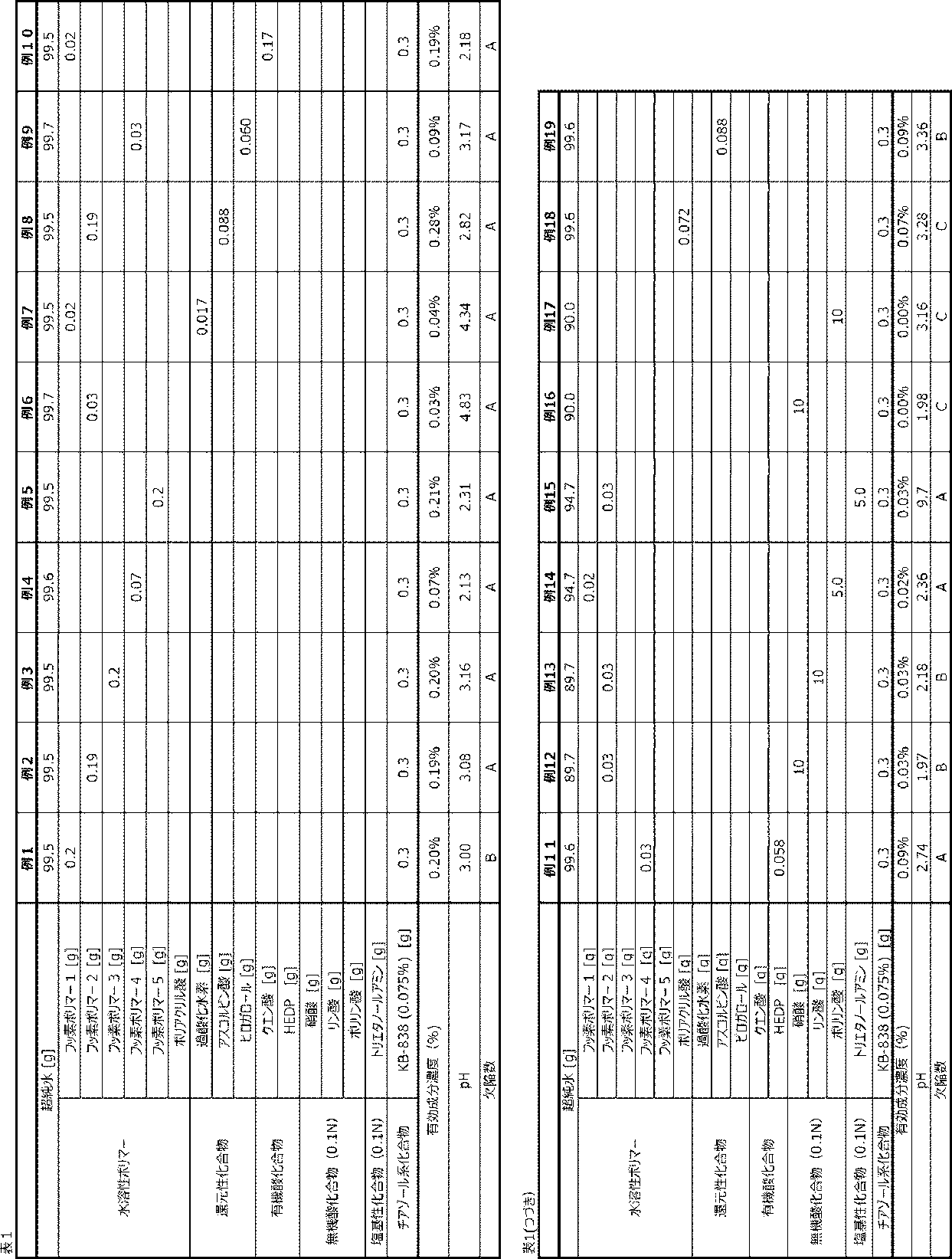
[結果のまとめ]
酸性基を有するフッ素ポリマーを含む例1~15の洗浄液は、セリア粒子の除去性能に優れていることが示された。フッ素ポリマーの代わりにポリアクリル酸を使用した例18ではこのような洗浄効果は見いだせなかった。また硝酸を用いてpHを低くした例16の洗浄液でも充分な洗浄効果は得られなかった。このように酸性基を有するフッ素ポリマーを用いることで高い洗浄性能を有する洗浄液が得られることが見いだされた。
酸性基を有するフッ素ポリマーを含む例1~15の洗浄液は、セリア粒子の除去性能に優れていることが示された。フッ素ポリマーの代わりにポリアクリル酸を使用した例18ではこのような洗浄効果は見いだせなかった。また硝酸を用いてpHを低くした例16の洗浄液でも充分な洗浄効果は得られなかった。このように酸性基を有するフッ素ポリマーを用いることで高い洗浄性能を有する洗浄液が得られることが見いだされた。
本開示の洗浄液は、例えば、CMP用の研磨剤の洗浄液として用いることができ、半導体素子の生産効率向上に寄与する。
この出願は、2023年6月14日に出願された日本出願特願2023-97860を基礎とする優先権を主張し、その開示の全てをここに取り込む。
Claims (22)
- 酸性基を有するフッ素ポリマーと、水とを含む、砥粒除去用の洗浄液。
- 前記フッ素ポリマーが、下記式(1)で表される単位を有する、請求項1に記載の洗浄液。
-[CR1R2-CR3{Rf1-(Z)n}]- …(1)
式(1)中、
R1及びR2はそれぞれ独立に、水素原子、フッ素原子、又は塩素原子であり、
R3は、水素原子、フッ素原子、塩素原子、メチル基、又はフルオロメチル基であり、
Rf1は、エーテル性酸素原子を含んでもよい直鎖状又は分岐状のフルオロアルキル鎖であるか、
又は、R2及びRf1は連結して、炭素-炭素原子間にエーテル性酸素原子を含んでもよい直鎖状又は分岐状の、一つのフルオロアルキル鎖であるか、
もしくは、R3及びRf1は連結して、炭素-炭素原子間にエーテル性酸素原子を含んでもよい直鎖状又は分岐状の、一つのフルオロアルキル鎖であり、
Zは、-SO3H、-SO3Z1、-CO2H、-CO2Z1、-PO(OH)2、-PO3(OZ1)2、又はOHであり、Z1はカチオンであり、
nは、1又は2である。 - 前記フッ素ポリマーが、下記式(1A)で表される単位を有する、請求項1に記載の洗浄液。
-[CR1R2-CR3(Rf1-Z)]- …(1A)
式(1A)中、
R1及びR2はそれぞれ独立に、水素原子、フッ素原子又は塩素原子であり、
R3は、水素原子、フッ素原子、塩素原子、メチル基、又はフルオロメチル基であり、
Rf1は、エーテル性酸素原子を含んでもよい直鎖状又は分岐状のフルオロアルキレン基であって、Rf1がエーテル性酸素原子を含まないフルオロアルキレン基の場合、炭素数は1~10であり、
Zは、-SO3H、-SO3Z1、-CO2H、-CO2Z1、-PO(OH)2、-PO3(OZ1)2、又はOHであり、Z1はカチオンである。 - R1、R2及びR3が、いずれもフッ素原子である、請求項3に記載の洗浄液。
- 前記フッ素ポリマー1gに含まれる酸性基の濃度が、0.3~4.0mmоl/gである、請求項1に記載の洗浄液。
- 更に還元性化合物を含む、請求項1に記載の洗浄液。
- 前記還元性化合物が、没食子酸、没食子酸エステル、ピロガロール、カテコール、レゾルシノール、アスコルビン酸、尿酸、ジ亜リン酸、ジチオン酸、チオ硫酸、シュウ酸、過酸化水素、及びヒドロキノンからなる群より選ばれる少なくとも1種を含む、請求項6に記載の洗浄液。
- 分子内にカルボキシル基、アミノ基、ホスホリル基、スルホン酸基、水酸基から選ばれる置換基を2つ以上有する分子量1,000g/mоl以下の有機化合物を少なくとも1種の錯化剤を更に含む、請求項1に記載の洗浄液。
- イミダゾール系化合物、ピラゾール系化合物、チアゾール系化合物、及びトリアゾール系化合物からなる群より選ばれる少なくとも1種の複素環式芳香族化合物を更に含む、請求項1に記載の洗浄液。
- 前記フッ素ポリマーを0.001質量%~30質量%含む、請求項1に記載の洗浄液。
- 前記還元性化合物を0.001質量%~30質量%含む、請求項6に記載の洗浄液。
- pHが1~5である、請求項1に記載の洗浄液。
- 硝酸、硫酸、塩酸、リン酸、及び縮合リン酸からなる群より選ばれる少なくとも1種を更に含む、請求項12に記載の洗浄液。
- pHが8~12である、請求項1に記載の洗浄液。
- 水酸化アンモニウム、コリン、ヒドロキシアミン、モノエタノールアミン、ジエタノールアミン、及びトリエタノールアミンからなる群より選ばれる少なくとも1種を更に含む、請求項14に記載の洗浄液。
- 前記砥粒が、セリウム化合物含有粒子を含む、請求項1に記載の洗浄液。
- 半導体基板の露出面に砥粒成分及び有機成分が付着した被洗浄物の洗浄用である、請求項1に記載の洗浄液。
- 前記露出面が二酸化ケイ素及び窒化ケイ素からなる群より選ばれる少なくとも1種を含む、請求項17に記載の洗浄液。
- 砥粒を含む研磨剤を用いて表面研磨された被洗浄物の洗浄用である、請求項1に記載の洗浄液。
- 前記砥粒の平均粒子径が300nm以下である、請求項1に記載の洗浄液。
- 請求項1~20のいずれか一項に記載の洗浄液を用いて、被洗浄面を洗浄することを含む、洗浄方法。
- 請求項1~20いずれか一項に記載の洗浄液を用いて、半導体基板の露出面を洗浄することを含む、半導体素子の製造方法。
Priority Applications (2)
| Application Number | Priority Date | Filing Date | Title |
|---|---|---|---|
| JP2025527978A JPWO2024257814A1 (ja) | 2023-06-14 | 2024-06-12 | |
| CN202480033606.7A CN121153103A (zh) | 2023-06-14 | 2024-06-12 | 清洗液、清洗方法以及半导体元件的制造方法 |
Applications Claiming Priority (2)
| Application Number | Priority Date | Filing Date | Title |
|---|---|---|---|
| JP2023097860 | 2023-06-14 | ||
| JP2023-097860 | 2023-06-14 |
Publications (1)
| Publication Number | Publication Date |
|---|---|
| WO2024257814A1 true WO2024257814A1 (ja) | 2024-12-19 |
Family
ID=93852186
Family Applications (1)
| Application Number | Title | Priority Date | Filing Date |
|---|---|---|---|
| PCT/JP2024/021389 Ceased WO2024257814A1 (ja) | 2023-06-14 | 2024-06-12 | 洗浄液、洗浄方法、及び半導体素子の製造方法 |
Country Status (4)
| Country | Link |
|---|---|
| JP (1) | JPWO2024257814A1 (ja) |
| CN (1) | CN121153103A (ja) |
| TW (1) | TW202506982A (ja) |
| WO (1) | WO2024257814A1 (ja) |
Citations (5)
| Publication number | Priority date | Publication date | Assignee | Title |
|---|---|---|---|---|
| JP2016138282A (ja) * | 2007-05-17 | 2016-08-04 | アドバンスド テクノロジー マテリアルズ,インコーポレイテッド | Cmp後洗浄配合物用の新規な酸化防止剤 |
| JP2017536332A (ja) * | 2014-09-23 | 2017-12-07 | スリーエム イノベイティブ プロパティズ カンパニー | 窒素含有ハイドロフルオロエーテル及びその使用方法 |
| WO2019181435A1 (ja) * | 2018-03-22 | 2019-09-26 | 富士フイルム株式会社 | ろ過装置、精製装置、薬液の製造方法 |
| JP2020004968A (ja) * | 2018-06-26 | 2020-01-09 | バーサム マテリアルズ ユーエス,リミティド ライアビリティ カンパニー | ポスト化学機械平坦化(cmp)洗浄 |
| WO2023095806A1 (ja) * | 2021-11-25 | 2023-06-01 | Agc株式会社 | 化合物、組成物、表面処理剤、コーティング液、物品、及び物品の製造方法 |
-
2024
- 2024-06-12 JP JP2025527978A patent/JPWO2024257814A1/ja active Pending
- 2024-06-12 CN CN202480033606.7A patent/CN121153103A/zh active Pending
- 2024-06-12 WO PCT/JP2024/021389 patent/WO2024257814A1/ja not_active Ceased
- 2024-06-13 TW TW113121900A patent/TW202506982A/zh unknown
Patent Citations (6)
| Publication number | Priority date | Publication date | Assignee | Title |
|---|---|---|---|---|
| JP2016138282A (ja) * | 2007-05-17 | 2016-08-04 | アドバンスド テクノロジー マテリアルズ,インコーポレイテッド | Cmp後洗浄配合物用の新規な酸化防止剤 |
| JP2017536332A (ja) * | 2014-09-23 | 2017-12-07 | スリーエム イノベイティブ プロパティズ カンパニー | 窒素含有ハイドロフルオロエーテル及びその使用方法 |
| WO2019181435A1 (ja) * | 2018-03-22 | 2019-09-26 | 富士フイルム株式会社 | ろ過装置、精製装置、薬液の製造方法 |
| JP2020004968A (ja) * | 2018-06-26 | 2020-01-09 | バーサム マテリアルズ ユーエス,リミティド ライアビリティ カンパニー | ポスト化学機械平坦化(cmp)洗浄 |
| JP2022009467A (ja) * | 2018-06-26 | 2022-01-14 | バーサム マテリアルズ ユーエス,リミティド ライアビリティ カンパニー | ポスト化学機械平坦化(cmp)洗浄 |
| WO2023095806A1 (ja) * | 2021-11-25 | 2023-06-01 | Agc株式会社 | 化合物、組成物、表面処理剤、コーティング液、物品、及び物品の製造方法 |
Also Published As
| Publication number | Publication date |
|---|---|
| JPWO2024257814A1 (ja) | 2024-12-19 |
| CN121153103A (zh) | 2025-12-16 |
| TW202506982A (zh) | 2025-02-16 |
Similar Documents
| Publication | Publication Date | Title |
|---|---|---|
| TWI754154B (zh) | 化學機械平坦化(cmp)後的清潔 | |
| TWI418622B (zh) | 銅鈍化之後段化學機械拋光清洗組成物及利用該組成物之方法 | |
| JP6014985B2 (ja) | 半導体デバイス用基板洗浄液及び洗浄方法 | |
| JP6066552B2 (ja) | 電子デバイス用洗浄液組成物 | |
| KR102397821B1 (ko) | 실리콘 웨이퍼 연마용 조성물 | |
| EP1569267A1 (en) | Cleaning composition, method for cleaning semiconductor substrate, and process for manufacturing semiconductor device | |
| WO2009058274A1 (en) | Chemical mechanical polishing and wafer cleaning composition comprising amidoxime compounds and associated method for use | |
| CN101855334A (zh) | 高负电动势多面体倍半硅氧烷组合物及无损坏半导体湿式清洁方法 | |
| CN108431931A (zh) | 用于化学机械抛光后清洁的组合物 | |
| CN108473918A (zh) | 用于化学机械抛光后清洁的组合物 | |
| KR20200038014A (ko) | 표면처리 조성물 및 그것을 이용한 표면처리 방법 | |
| JP6348927B2 (ja) | シリコンウェーハ研磨用組成物 | |
| CN110168703A (zh) | 用于半导体装置用基板的清洗剂组合物 | |
| CN107353832A (zh) | 半导体处理用组合物及处理方法 | |
| JP6849564B2 (ja) | 表面処理組成物およびこれを用いた表面処理方法 | |
| JP7821783B2 (ja) | ポスト化学機械平坦化(cmp)洗浄 | |
| JP6713887B2 (ja) | 半導体デバイス用基板用の洗浄剤組成物 | |
| CN121153103A (zh) | 清洗液、清洗方法以及半导体元件的制造方法 | |
| US20200208051A1 (en) | Composition for semiconductor surface treatment and treatment method of semiconductor surface | |
| JP2026513800A (ja) | 洗浄組成物及びその使用方法 | |
| TWI855138B (zh) | 半導體處理用組成物及處理方法 | |
| WO2025115729A1 (ja) | 洗浄液、洗浄方法、及び半導体素子の製造方法 | |
| JP2025510755A (ja) | Cmp後洗浄組成物 | |
| CN115992031A (zh) | 化学机械研磨后清洗液组合物 | |
| WO2025171204A1 (en) | Cleaning compositions and methods of use thereof |
Legal Events
| Date | Code | Title | Description |
|---|---|---|---|
| 121 | Ep: the epo has been informed by wipo that ep was designated in this application |
Ref document number: 24823429 Country of ref document: EP Kind code of ref document: A1 |
|
| ENP | Entry into the national phase |
Ref document number: 2025527978 Country of ref document: JP Kind code of ref document: A |
|
| NENP | Non-entry into the national phase |
Ref country code: DE |