WO2024257799A1 - 酵素の検出方法及び酵素の検出キット - Google Patents
酵素の検出方法及び酵素の検出キット Download PDFInfo
- Publication number
- WO2024257799A1 WO2024257799A1 PCT/JP2024/021356 JP2024021356W WO2024257799A1 WO 2024257799 A1 WO2024257799 A1 WO 2024257799A1 JP 2024021356 W JP2024021356 W JP 2024021356W WO 2024257799 A1 WO2024257799 A1 WO 2024257799A1
- Authority
- WO
- WIPO (PCT)
- Prior art keywords
- enzyme
- detection
- adp
- detecting
- atp
- Prior art date
- Legal status (The legal status is an assumption and is not a legal conclusion. Google has not performed a legal analysis and makes no representation as to the accuracy of the status listed.)
- Ceased
Links
Images




Classifications
-
- C—CHEMISTRY; METALLURGY
- C12—BIOCHEMISTRY; BEER; SPIRITS; WINE; VINEGAR; MICROBIOLOGY; ENZYMOLOGY; MUTATION OR GENETIC ENGINEERING
- C12Q—MEASURING OR TESTING PROCESSES INVOLVING ENZYMES, NUCLEIC ACIDS OR MICROORGANISMS; COMPOSITIONS OR TEST PAPERS THEREFOR; PROCESSES OF PREPARING SUCH COMPOSITIONS; CONDITION-RESPONSIVE CONTROL IN MICROBIOLOGICAL OR ENZYMOLOGICAL PROCESSES
- C12Q1/00—Measuring or testing processes involving enzymes, nucleic acids or microorganisms; Compositions therefor; Processes of preparing such compositions
- C12Q1/26—Measuring or testing processes involving enzymes, nucleic acids or microorganisms; Compositions therefor; Processes of preparing such compositions involving oxidoreductase
-
- C—CHEMISTRY; METALLURGY
- C12—BIOCHEMISTRY; BEER; SPIRITS; WINE; VINEGAR; MICROBIOLOGY; ENZYMOLOGY; MUTATION OR GENETIC ENGINEERING
- C12Q—MEASURING OR TESTING PROCESSES INVOLVING ENZYMES, NUCLEIC ACIDS OR MICROORGANISMS; COMPOSITIONS OR TEST PAPERS THEREFOR; PROCESSES OF PREPARING SUCH COMPOSITIONS; CONDITION-RESPONSIVE CONTROL IN MICROBIOLOGICAL OR ENZYMOLOGICAL PROCESSES
- C12Q1/00—Measuring or testing processes involving enzymes, nucleic acids or microorganisms; Compositions therefor; Processes of preparing such compositions
- C12Q1/48—Measuring or testing processes involving enzymes, nucleic acids or microorganisms; Compositions therefor; Processes of preparing such compositions involving transferase
-
- C—CHEMISTRY; METALLURGY
- C12—BIOCHEMISTRY; BEER; SPIRITS; WINE; VINEGAR; MICROBIOLOGY; ENZYMOLOGY; MUTATION OR GENETIC ENGINEERING
- C12Q—MEASURING OR TESTING PROCESSES INVOLVING ENZYMES, NUCLEIC ACIDS OR MICROORGANISMS; COMPOSITIONS OR TEST PAPERS THEREFOR; PROCESSES OF PREPARING SUCH COMPOSITIONS; CONDITION-RESPONSIVE CONTROL IN MICROBIOLOGICAL OR ENZYMOLOGICAL PROCESSES
- C12Q1/00—Measuring or testing processes involving enzymes, nucleic acids or microorganisms; Compositions therefor; Processes of preparing such compositions
- C12Q1/48—Measuring or testing processes involving enzymes, nucleic acids or microorganisms; Compositions therefor; Processes of preparing such compositions involving transferase
- C12Q1/50—Measuring or testing processes involving enzymes, nucleic acids or microorganisms; Compositions therefor; Processes of preparing such compositions involving transferase involving creatine phosphokinase
Definitions
- the present invention relates to an enzyme detection method for detecting enzymes including kinases that serve as disease markers, and an enzyme detection kit used therefor.
- Immunochemical techniques can be used to detect enzymes in small amounts and large numbers of samples, and can be applied to the detection of disease and infection biomarkers.
- a multiplexed single enzyme assay technology has been developed to examine the isozymes of enzymes. Isozymes are enzymes that catalyze the same reaction, but have slightly different structures and different substrate specificities. This assay is a method to identify isozymes by measuring their substrate-specific activity at the single molecule level. Since there are various organ-specific isozymes in the blood, it is possible to investigate with high sensitivity which organ may be the source of the disease.
- isozymes that form multimers may not have a uniform activity distribution of one molecule, and by investigating the shape of this distribution, it is possible to investigate which disease is affected.
- a method that automatically performs detection and analysis has also been developed, and these digital bioanalyses (digital ELISAs) are also attracting attention as a method for detecting biomarkers with high sensitivity.
- Patent Document 1 discloses a detection device and a detection method for detecting the enzyme activity of a large number of trace samples, which includes a microchamber array having a plurality of storage sections filled with a hydrophilic solvent containing a biological sample, and an image sensor having pixels corresponding to the storage sections, in which the microchamber array has a flow passage communicating with the opening of the storage section, a hydrophobic solvent supply section connected to the flow passage, and a through hole through which the hydrophilic solvent can enter and exit the flow passage, and the hydrophobic solvent supply section causes the hydrophobic solvent to flow into the flow passage by a force applied from the outside, and a detection method using the same.
- This technology aims to obtain a detection device and a detection method using the same that can prevent a decrease in the concentration of the biological sample and reagent contained in the storage section and improve measurement sensitivity by sealing the opening of the storage section with a hydrophobic solvent and confining the hydrophilic solvent containing the biological sample in the storage section.
- conventional biomarker detection techniques are capable of detecting a large number of samples with high sensitivity, but are unable to detect various enzyme-type biomarkers. That is, in conventional biomarker detection techniques, a substrate that reacts with an enzyme of interest is prepared, and the enzyme reacts with the substrate (e.g., the substrate is partially cleaved by the enzyme reaction) to detect the enzyme. For this purpose, for example, a part of the substrate is modified so that it can be detected by the reaction.
- fluorescent substrates enzymes for which such specific substrates (substrates that can be used for fluorescence detection, hereinafter sometimes referred to as fluorescent substrates) have not been found, for example, enzymes that catalyze reactions of general molecules in living organisms such as ADP and ATP, they cannot be detected. Even if a substrate is found, it cannot be detected if it is difficult to modify it so that the reaction can be detected.
- kinases are involved in the proliferation and invasion of cancer cells, and it is believed that kinase mutations lead to cancer.
- Many kinase inhibitors have been developed as molecular targeting drugs for cancer.
- mutations in Raf kinase and activity of thymidine kinase in blood are biomarkers closely related to cell proliferation, and are expected to be used as tools for monitoring the prognosis of cancer treatment.
- an increase in thymidine kinase activity in serum is associated with neoplastic disease, malignant disease, vitamin B12 deficiency, and viral infection.
- thymidine kinase Activity of thymidine kinase is a biomarker closely related to cell proliferation, and is expected to be used as a tool for monitoring the prognosis of cancer treatment.
- Creatine kinase (CK) in blood increases in blood concentration after the onset of myocardial infarction. Therefore, it is widely used in diagnosing myocardial infarction.
- CK contains isozymes derived from the brain, smooth muscle, heart, and skeletal muscle, and by identifying the type, it is possible to infer which organ is damaged.
- Kinases are thus very important as target molecules in clinical diagnosis, but their enzymatic activity catalyzes the conversion (synthesis) of ATP and ADP.
- thymidine kinase catalyzes the reaction of thymidine + ATP by adding a phosphate to thymidine to form thymidylic acid (TMP) + ADP.
- TMP thymidylic acid
- the present invention has been made in consideration of the above circumstances, and its purpose is to provide an enzyme detection method and enzyme detection kit for use therein that can detect enzymes that synthesize ATP or ADP, and that can detect these enzymes that do not have a fluorescent substrate with high sensitivity at the single molecule level, enabling highly sensitive measurement of disease biomarkers, etc.
- a method for detecting a target enzyme that synthesizes ADP or ATP from an enzyme sample comprising: A detection device is provided that includes a microchamber array member having an array of multiple storage sections that can be filled with a detection solution; a sample addition step of filling the container of the detection device with the enzyme sample and a detection reagent containing a hexokinase enzyme to prepare the detection solution; a detection step of detecting a signal due to synthesis of ADP or ATP from the detection solution; A method for detecting an enzyme comprising the steps of: [2] The method for detecting an enzyme according to [1], wherein the target enzyme is a kinase.
- [3] The method for detecting an enzyme according to [1] or [2], wherein when the target enzyme is an enzyme that synthesizes ADP, the hexokinase enzyme is an ADP-dependent hexokinase, and when the target enzyme is an enzyme that synthesizes ATP, the hexokinase enzyme is an ATP-dependent hexokinase.
- the detection reagent comprises resazurin and diaphorase.
- [6] The method for detecting an enzyme according to any one of [1] to [5], wherein the detection reagent does not contain an amine compound or HEPES, but contains a phosphate.
- the method for detecting an enzyme according to any one of [1] to [7] further comprising an ADP removal treatment step of adding a pretreatment solution containing creatine kinase and phosphocreatine to the enzyme sample prior to the sample addition step, to allow the reaction to proceed.
- An enzyme detection kit for detecting a target enzyme that synthesizes ADP or ATP from an enzyme sample comprising: A detection device including a microchamber array member in which a plurality of storage sections capable of being filled with a detection liquid in which an enzyme sample and a detection reagent are mixed are arranged; the detection reagent comprising a hexokinase enzyme; An enzyme detection kit comprising:
- the present invention makes it possible to detect enzymes that synthesize ATP or ADP, and enables highly sensitive detection at the single molecule level for these enzymes that do not have a fluorescent substrate, thereby providing an enzyme detection method and an enzyme detection kit for use therein that enable highly sensitive measurement of disease biomarkers, etc.
- FIG. 2 is an exploded partial enlarged view of the detection device according to the embodiment.
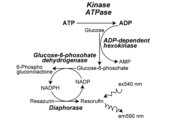
- FIG. 2 is a schematic diagram showing a reaction in a sample addition step when the target enzyme contained in the enzyme sample of this embodiment is an enzyme that synthesizes ADP.
- FIG. 2 is a schematic diagram showing a reaction in a sample addition step when the target enzyme contained in the enzyme sample of this embodiment is an enzyme that synthesizes ATP.
- FIG. 2 is a photograph of the fluorescent signal of Test Example 1 of this embodiment taken from the bottom direction.
- FIG. 1 shows the single molecule activity distribution per ⁇ in Test Example 1 of this embodiment.
- FIG. 2 is a photograph of the fluorescent signal of Test Example 2 of this embodiment taken from the bottom direction.
- FIG. 1 shows the single molecule activity distribution per ⁇ in Test Example 1 of this embodiment.
- FIG. 13 is a diagram showing the single molecule activity distribution per ⁇ in Test Example 2 of this embodiment.
- FIG. 1 is a photograph of the fluorescent signal of Test Example 3 of this embodiment taken from the bottom direction.
- FIG. 13 is a diagram showing the single molecule activity distribution per ⁇ in Test Example 3 of this embodiment.
- FIG. 1 is a photograph of the fluorescent signal from Test Example 4 of this embodiment taken from the bottom.
- FIG. 13 is a diagram showing the single molecule activity distribution per ⁇ in Test Example 4 of this embodiment.
- the enzyme detection method of this embodiment is an enzyme detection method for detecting a target enzyme that synthesizes ADP or ATP from an enzyme sample, and includes a detection device equipped with a microchamber array member in which a plurality of storage sections into which a detection liquid can be filled are arranged, and a sample addition step of filling the storage sections of the detection device with the enzyme sample and a detection reagent containing a hexokinase enzyme to prepare the detection liquid, and a detection step of detecting a signal due to the synthesis of ADP or ATP from the detection liquid.
- the enzyme sample broadly includes samples that may contain enzymes.
- samples that may contain enzymes include samples taken from living organisms, including tissues, various body fluids, processed products thereof, and extracts. Examples of such samples include serum.
- biological tissues include tissue samples obtained from various organs of living organisms. Living organisms include, inter alia, humans and non-human animals, Humans include, for example, healthy individuals and individuals suffering from various types of cancer.
- the number of enzyme molecules contained in the enzyme sample can be detected from one molecule per enzyme sample (a liquid sample filled in one of the storage sections described below). For example, by detecting the fluorescent signal of the reaction described below and by setting conditions for reducing the background, the signal of the enzyme reaction of one molecule can be detected.
- the target enzyme that synthesizes ADP or ATP broadly refers to an enzyme that catalyzes a reaction in which ADP or ATP is synthesized through its enzymatic activity.
- an enzyme that catalyzes a reaction in which ADP or ATP is synthesized is also referred to as "an enzyme that synthesizes ADP or ATP.
- the target enzyme can be any enzyme that has some activity that synthesizes ADP or ATP. These enzymes can be selected from, for example, various ATPases, various ATP synthases, or various kinases.
- the target enzyme of this embodiment is preferably a kinase.
- Kinases are enzymes that transfer phosphate groups from molecules having high-energy phosphate bonds such as ATP to substrates or target molecules (phosphorylating the target molecule and synthesizing ADP from the ATP), and function as regulators of various intracellular signal transduction and metabolism.
- Kinases that can be used include the above-mentioned thymidine kinase, creatine kinase, Raf kinase, choline kinase (hChK), and other kinases.
- Kinases have the advantage that by obtaining information on their expression, exploration, and reaction mechanisms, the information can be applied to cancer diagnosis, treatment, and development of therapeutic drugs (e.g., molecular targeted drugs), etc.
- therapeutic drugs e.g., molecular targeted drugs
- CKs have traditionally been identified by absorbance-based measurement and isozyme-specific inhibitory antibodies, and therefore, analysis methods using batch detection methods are known, making it possible to study the detection method of this embodiment.
- Kinase is an enzyme that synthesizes ADP, and can also function as an enzyme that synthesizes ATP through a reverse reaction. In this embodiment, either reaction can be detected.
- Examples of enzymes that synthesize ADP include F 1 -ATPase, ie, F 1 from thermophilic Bacillus PS3 (TF 1 ), which has ATPase activity.
- PK pyruvate kinase
- the detection device 1 is an exploded partial enlarged view of a detection device 100 according to this embodiment.
- the detection device according to this embodiment includes a microchamber array member 30 in which a plurality of containers 31 capable of being filled with a detection liquid 20 are arranged.
- the microchamber array member 30 is made of a plate-like member formed of, for example, glass, silicon, polymer resin, or the like.
- the microchamber array member 30 has a plurality of cylindrical holes arranged (arrayed) that are connected from the flat portion to the bottom portion of the plate-like member, and the holes serve as a plurality of storage sections 31 that can be filled with detection liquid.
- the bottom surface of the microchamber array member 30 is provided with a bottom surface member 32. The bottom surface of the storage section 31 is blocked by this bottom surface member 32, so that the storage section 31 can be filled with detection liquid 20.
- the bottom surface member 32 is made of a light-transmitting constituent material so as not to interfere with the optical detection of the detection liquid 20 by a member (not shown) for detecting a signal, which will be described later.
- the bottom surface member 32 is made of a light-transmitting constituent material such as glass or polymer resin.
- the storage sections 31 are arranged with a distance I between them. This distance I is set to a length that allows the fluorescent signals from the array to be sufficiently separated without overlapping.
- the size of the storage section 31, i.e., the depth T (in this embodiment, the thickness of the microchamber array member 30) and diameter D, are appropriately selected based on the volume of the detection liquid 20 to be detected and the distance I. In this embodiment, the depth T is 3 ⁇ m and the diameter D is 4 ⁇ m.
- a member for detecting a signal due to synthesis of ADP or ATP may be provided as appropriate as long as it is in a form that allows detection of the storage section 31.
- detection is performed using an sCMOS camera (not shown) attached to a fluorescent microscope for observing the microchamber array member 30.
- any member capable of detecting a fluorescent signal can be used appropriately. Fluorescence signals are widely used in combination with immunological detection means, and are effective because they can increase sensitivity and selectivity. In this embodiment, the fluorescent signal of resorufin produced by a detection solution described later can be detected.
- the hydrophobic solvent supply unit and the internal space of the flow channel may be connected, and the hydrophilic solvent may be held in the flow channel in a state separated from the hydrophobic solvent filled in the hydrophobic solvent supply unit.
- the internal height of the main body may be equal to or smaller than the size of an oil droplet of the hydrophobic solvent.
- a partition that can be broken by the force may be provided between the hydrophobic solvent supply unit and the flow channel, a deformation unit in the hydrophobic solvent supply unit that can be elastically deformed by a force applied from the outside, the hydrophilic solvent not containing the sample concentrated in the flow channel, and an openable and closable lid unit that closes the through hole.
- a sensor member having sensors respectively corresponding to the positions of the plurality of storage sections 31 may be provided.
- the sensor member is provided adjacent to the bottom surface of the microchamber array member, the bottom member.
- the sensor member is provided with position sensors respectively corresponding to the plurality of storage sections.
- the detection device of this embodiment may be, for example, that described in Patent Document 1.
- This detection device is a detection device that includes a microchamber array (microchamber array member) that is disposed inside a main body and has a plurality of storage units filled with a hydrophilic solvent containing a biological sample, and an image sensor (sensor member) in which pixels are provided corresponding to the storage units, in which the main body has a flow passage that communicates with an opening of the storage unit, a hydrophobic solvent supply unit that is connected to the flow passage, and a through hole that allows the hydrophilic solvent to enter and exit the flow passage, the microchamber array has a hydrophobic surface, and the hydrophobic solvent supply unit can cause the hydrophobic solvent to flow into the flow passage by a force applied from the outside.
- a microchamber array microchamber array member
- the main body has a flow passage that communicates with an opening of the storage unit, a hydrophobic solvent supply unit that is connected to the flow passage, and a through hole that allows the hydrophilic solvent to enter and exit the flow passage
- the microchamber array has
- sample Addition Step each step of the enzyme detection method of the present embodiment will be described.
- the enzyme sample and a detection reagent containing a hexokinase enzyme are filled into the container of the detection device to prepare the detection solution.
- a reaction of a substance contained in the detection reagent is catalyzed by the target enzyme contained in the enzyme sample, and a signal is generated by the reaction in the detection solution.
- the detection reagent contains a substance that causes an enzymatic reaction or a cascade of enzymatic reactions by a hexokinase enzyme to proceed using ADP or ATP synthesized by the target enzyme, and ultimately emits a signal, i.e., the detection reagent contains the hexokinase enzyme and substrates, enzymes, and other reagents required for the enzymatic reaction or the cascade of enzymatic reactions.
- the reagent when detecting a target enzyme that synthesizes ADP, may contain a reagent for proceeding to a cascade reaction of enzyme reactions that uses the ADP synthesized by the target enzyme to phosphorylate glucose by an ADP-dependent hexokinase reaction, and then proceeds to an enzyme reaction that finally emits a fluorescent signal.
- the target enzyme is an enzyme that synthesizes ADP
- the hexokinase enzyme is preferably ADP-dependent hexokinase.
- the reagent when detecting a target enzyme that synthesizes ATP, may contain a reagent for proceeding to a cascade reaction of enzyme reactions, which uses the ATP synthesized by the target enzyme to phosphorylate glucose through an ATP-dependent hexokinase reaction, and then proceeds to an enzyme reaction that finally emits a fluorescent signal.
- the target enzyme is an enzyme that synthesizes ATP
- the hexokinase enzyme is preferably an ATP-dependent hexokinase.
- the reaction in this sample addition step will be described more specifically below, taking as an example a case in which the target sample is an enzyme that synthesizes ADP.
- 2 is a schematic diagram showing a reaction in a sample addition step when a target enzyme contained in an enzyme sample is an enzyme that synthesizes ADP.
- the enzyme that synthesizes ADP includes various kinases and ATPases.
- the detection reagent contains the compounds shown in the figure for this reaction, ATP, glucose, NADP, and resazurin as reaction substrates, and ADP-dependent hexokinase, glucose-6-phosphate dehydrogenase, and diaphorase as reaction enzymes.
- the detection reagent When the detection reagent is added to the enzyme sample containing the target enzyme, ATP is first catalyzed by the target enzyme, and ADP is synthesized.
- the target enzyme is a kinase
- the phosphorylated substrate that is the target of phosphorylation by the kinase may be added together with the detection reagent.
- the phosphorylated substrate is choline.
- ADP and choline phosphate are synthesized from ATP.
- glucose is then catalyzed by ADP-dependent hexokinase to synthesize AMP and glucose-6-phosphate.
- Glucose-6-phosphate is synthesized, and then NADP and glucose-6-phosphate are catalyzed by glucose-6-phosphate dehydrogenase to synthesize NADPH and 6-phosphogluconolactone.
- NADPH is synthesized, and then NADPH and resazurin are catalyzed by diaphorase to synthesize NADP and resorufin.
- Resorufin emits fluorescence with a wavelength of 590 nm in response to incidence of excitation light with a wavelength of 540 nm. Therefore, when the detection reagent is added to an enzyme sample containing the target enzyme, a fluorescent signal can be detected in the detection solution, and thus the target enzyme contained in the enzyme sample can be detected.
- the reaction in this sample addition step will now be described in more detail, taking as an example a case in which the target sample is an enzyme that synthesizes ATP.
- 3 is a schematic diagram showing the reaction in the sample addition step when the target enzyme contained in the enzyme sample is an enzyme that synthesizes ATP.
- the enzyme that synthesizes ADP includes various kinases as well as ATP synthase. When various kinases are used, the reverse reaction can be detected from the case of the enzyme that synthesizes ADP.
- the detection reagent contains the compounds shown in the figure for this reaction, ADP, glucose, NADP, and resazurin as reaction substrates, and ATP-dependent hexokinase, glucose-6-phosphate dehydrogenase, and diaphorase as reaction enzymes.
- ADP is first catalyzed by the target enzyme to synthesize ATP.
- the target enzyme is a kinase
- a phosphorylated substrate may be added together with the detection solution.
- the kinase is pyruvate kinase
- ATP and pyruvate are synthesized from the phosphorylated substrate phosphoenolpyruvate (PEP) and ADP.
- PEP phosphoenolpyruvate
- glucose is then catalyzed by ATP-dependent hexokinase to synthesize ADP and glucose-6-phosphate.
- Glucose-6-phosphate is synthesized, and then NADP and glucose-6-phosphate are catalyzed by glucose-6-phosphate dehydrogenase to synthesize NADPH and 6-phosphogluconolactone.
- NADPH is synthesized, and then NADPH and resazurin are catalyzed by diaphorase to synthesize NADP and resorufin.
- Resorufin emits fluorescence with a wavelength of 590 nm in response to incidence of excitation light with a wavelength of 540 nm. Therefore, when the detection reagent is added to an enzyme sample containing the target enzyme, a fluorescent signal can be detected in the detection solution, and thus the target enzyme contained in the enzyme sample can be detected.
- the detection reagent may be configured to contain the above components in separate substrate liquids containing the above-mentioned reaction substrates and enzyme liquids containing the above-mentioned reaction enzymes, and to mix the substrate liquid and enzyme liquid in the sample addition step. By mixing the substrate liquid and enzyme liquid immediately before the test, the above reaction can occur during the test.
- the detection reagent comprises resazurin and diaphorase.
- the reaction in which NADPH is converted to NADP and resazurin is synthesized into resorufin is catalyzed by diaphorase. Therefore, when the detection reagent contains resazurin and diaphorase, the fluorescence emitted by resorufin can be suitably detected.
- the detection reagent does not contain an amine compound or HEPES, but contains a phosphate, where the amine compound, HEPES and phosphate refer to those that are added mainly as buffer compounds in a pH buffer solution.
- examples of amine compounds not included in the detection reagent of this embodiment include Tris (trishydroxymethylaminomethane).
- examples of phosphates that are preferably contained in the detection reagent of this embodiment include potassium phosphate and sodium phosphate. It is more preferable that the detection solution of this embodiment contains potassium phosphate. That is, the detection reagent of this embodiment is preferably a phosphate buffer to which a phosphate has been added.
- the background light of these background reactions can be prevented by preparing the detection reagent as a buffer solution that does not contain an amine compound or HEPES but contains phosphate, for example, a phosphate buffer.
- the diaphorase and hexokinase enzymes are recombinant enzymes derived from thermophilic bacteria.
- diaphorase and hexokinase enzymes may contain enzymes that react even when the enzyme sample does not contain the target enzyme, and may produce many bright spots during detection, i.e., a high false positive rate.
- a recombinant enzyme derived from a thermophilic bacterium is expressed and purified so as to reduce false positives, and thus the false positives can be reduced.
- thermophilic bacteria an expression system for a recombinant enzyme derived from thermophilic bacteria is constructed, and while digital measurements are performed to check for false positives, careful heat treatment and purification are performed to reduce false positive signals by about 30-40 times.
- kits containing a detection reagent that can be used to detect the enzymes that synthesize ADP and ATP As a kit containing a detection reagent that can be used to detect the enzymes that synthesize ADP and ATP, the Fluorospark(R) Kinase/ADP Multi-Assay Kit (Fujifilm Wako Pure Chemical Industries, Ltd.) or a detection kit containing a similar composition can be used.
- the enzyme detection method of this embodiment preferably further includes an ADP removal treatment step of adding a pretreatment solution for removing ADP to the enzyme sample and reacting it before the sample addition step.
- This pretreatment is performed when detecting an enzyme that synthesizes ADP.
- the pretreatment solution for removing ADP for example, one containing a phosphorylated substrate and a kinase that catalyzes the dephosphorylation of the substrate can be used.
- the pretreatment solution can be one containing phosphocreatine as the phosphorylated substrate and creatine kinase as the kinase.
- ADP removal process a pretreatment solution containing creatine kinase and phosphocreatine is added to the enzyme sample and reacted to remove ADP from the enzyme sample.
- Creatine kinase causes a phosphoryl transfer reaction from phosphocreatine to ADP, which results in the conversion of ADP to ATP, resulting in a reduction in ADP.
- this process reduces ADP to 0.1% or less. If ADP is contained in the enzyme sample before it is synthesized by the target enzyme, it will become a background signal when detecting ADP synthesis, and the data and calibration curve of the control sample for ADP synthesis will be inaccurate. By carrying out this ADP removal treatment step, these problems can be prevented.
- the ADP removal treatment step is particularly effective in increasing the accuracy of detection.
- an enzyme and a fluorescent substrate dedicated to that enzyme are introduced into a microchamber array, sealed in oil, and the fluorescence associated with the reaction is imaged using a microscope or the like.
- an assay solution conjugated with three enzyme reactions is added, and the ADP and ATP produced in the enzyme reaction are converted into fluorescent substances, and the fluorescence is imaged.
- a fluorescent substrate dedicated to the enzyme is no longer necessary, and in principle, all enzymes that produce ADP and ATP can be measured with this one system.
- Another advantage is that the decomposition reaction of the enzyme's original natural substrate can be measured at the level of a single enzyme molecule, rather than using an artificial fluorescent substrate.
- the enzyme detection kit of this embodiment is an enzyme detection kit for detecting a target enzyme that synthesizes ADP or ATP from an enzyme sample, and includes a detection device having a microchamber array member in which a plurality of storage sections are arranged in which a detection liquid containing a mixture of an enzyme sample and a detection reagent can be filled, and the detection reagent containing a hexokinase enzyme.
- the enzyme sample, target enzyme, detection reagent, and detection device can be selected from the same ones as those described in the enzyme detection method described above.
- the enzyme detection kit of this embodiment can suitably detect a target enzyme using the enzyme detection method.
- the enzyme detection kit of this embodiment contains the above-mentioned components and may also contain optional components described below.
- the reaction may contain a reaction terminating solution for terminating the enzyme reaction.
- the reaction terminating solution may contain, for example, a reducing agent.
- a reagent containing a substrate, a control, or ATP or ADP for a calibration curve may be included in addition to the substrate solution and enzyme solution.
- This embodiment provides a new digital bioanalysis technology that does not require a fluorescent substrate to be recognized by the target enzyme.
- the technology of this embodiment makes it possible to perform digital bioanalysis on enzymes that do not have a fluorescent substrate.
- bioassays in conventional technology have a one-to-one correspondence between substrate types and enzyme types, it has become possible to construct a system that allows digital measurement of multiple enzymes on a single assay platform.
- the technology of this embodiment can be applied to various enzymes that produce ATP and ADP, and is expected to be applied to the precise measurement of the activity of single enzyme molecules, which was previously impossible to measure, and the detection of disease biomarkers using enzyme activity patterns.
- kinases and enzymes that synthesize ATP and ADP may be useful as biomarkers for diseases such as cancer.
- ATPase and AMPase activities in serum are significantly higher in colorectal cancer patients than in healthy subjects. It has been reported that these activities are significantly increased, especially in advanced cancer patient groups.
- ATP, ADP, and AMP hydrolysis activities in serum are significantly higher than in healthy subjects.
- Patients with lower clinical stages (CS-IIA) showed increased ATP hydrolysis activity compared to patients with more advanced clinical stages (CS-IIB and CS-III). It has been reported.
- the method of this embodiment for detecting enzymes that synthesize ATP and ADP may be applicable to methods for obtaining information about cancer.
- the present invention provides a method for diagnosing a disease using the method for detecting an enzyme. In one embodiment, the present invention provides a method for diagnosing cancer or myocardial infarction using the enzyme detection method. In one embodiment, the present invention provides a method for diagnosing a disease using the enzyme detection kit. In one embodiment, the present invention provides a method for diagnosing cancer or myocardial infarction using the enzyme detection kit. In one embodiment, the present invention provides a method for producing a detection kit for the enzyme. In one embodiment, the present invention provides the use of said detection reagent for the manufacture of a kit for the detection of said enzyme. In one embodiment, the present invention provides the use of said detection device for the manufacture of a detection kit for said enzyme.
- hChK human choline kinase
- the detection apparatus described in the above embodiment (5 million containers (reactors) per apparatus) was used.
- An enzyme sample was prepared in which the hChK concentration was adjusted so that the ratio of the number of enzymes used to the number of containers was ⁇ .
- Resazurin solution and reaction stop solution were prepared for adjusting the detection solution.
- the substrate solution and the above solutions were used at concentrations that did not produce background when used.
- ATP solution and ADP solution were prepared for the kinase substrate and calibration curve.
- a phosphate buffer using potassium phosphate without containing an amine compound or HEPES 50 mM potassium phosphate, pH 7.5, 100 mM KCL, 2 mM MgCl 2 , 0.02% Tween 20, 1 mM glucose, 100 ⁇ M NADP+, 100 ⁇ M resazurin
- the diaphorase enzyme and the hexokinase enzyme a recombinant enzyme derived from a thermophile was produced, and heat-treated and purified until the false positive signal was reduced by about 30-40 times.
- a pretreatment solution containing creatine kinase and phosphocreatine was added to the enzyme sample before the sample addition step and reacted. That is, an ADP removal treatment step was performed to reduce ADP by converting ADP in the enzyme sample to ATP through a phosphorylation transfer reaction from phosphocreatine to ADP, and the amount of residual ADP was reduced to 0.1% or less.
- the number of molecules of enzyme contained in a container can be calculated from the number of enzymes dispensed into the container relative to the number of containers.
- the fluorescent signal of the enzyme is detected in the storage section containing one enzyme molecule.
- FIG. 5 shows the single molecule activity distribution per ⁇ .
- the vertical axis (Counts) is the number of containers
- the horizontal axis (Slope) is the activity (au/min). For example, a high peak appears near the left end of each graph, which indicates that a large number of empty containers with no activity (no enzyme molecules inside) were detected.
- a graph (lower left) with the vertical axis of 8000 to 12 ⁇ 10 3 and the horizontal axis of 10 to 40 is shown superimposed with a partially enlarged view (upper right).
- the peak of the active compartment was confirmed in the figure of the test in which choline was added (Choline +), and the peak was seen on the active side (more to the right) in the figure of the test in which choline was not added.
- the peak was observed in a choline-dependent manner, the activity of one molecule of hChK could be detected.
- the distribution shape was not a single clear peak (heterogeneous). This may be because there may be inactive molecular species derived from multimers, which may have been detected in this test.
- Test Example 2 Detection of ATPase
- F 1 -ATPase which is an ATPase
- the detection device and detection reagent were the same as in Test Example 1.
- Figure 6 is a photograph of the fluorescent signal from the detection device taken from the bottom.
- the white dots in the figure indicate the storage sections where the fluorescent signal of the enzyme could be detected among the arranged storage sections.
- FIG. 7 is a diagram showing the single molecule activity distribution per ⁇ .
- the explanation in the figure is the same as in Test Example 1.
- a peak of activity was confirmed in the test graph for each ⁇ , indicating that the activity of each F 1 -ATPase molecule could be detected.
- Test Example 3 Detection of pyruvate kinase
- PK pyruvate kinase
- the detection device and detection reagent were the same as those in Test Example 1.
- Pyruvate kinase is widely known to catalyze the final reaction of the thawing system (PEP+ADP to Pyruvate+ATP).
- PK works as a tetramer.
- PKM2 is involved in the metabolism specific to cancer cells, and is attracting attention as a target molecule for cancer therapeutic drugs and as a blood biomarker for cancer.
- Figure 8 is a photograph of the fluorescent signal from the detection device taken from the bottom.
- the white dots in the figure indicate the storage sections where the fluorescent signal of the enzyme could be detected among the arranged storage sections.
- FIG. 9 is a diagram showing the single molecule activity distribution per ⁇ .
- the explanation in the figure is the same as in Test Example 1.
- a peak of activity was confirmed in the test graph for each ⁇ . In other words, it was demonstrated that the activity of each pyruvate kinase molecule could be detected.
- Test Example 4 Detection of alkaline phosphatase
- ALP alkaline phosphatase
- a test was conducted on the sensitivity of the enzyme detection to the number of enzymes per enzyme sample.
- the detection device and detection reagent were the same as those in Test Example 1.
- Alkaline phosphatase is widely known as an enzyme that breaks down phosphate compounds, and is used, for example, as a criterion for diagnosing liver disease.
- Alkaline phosphatase is an enzyme for which a fluorescent substrate exists that can be used in conventional techniques. In other words, we investigated whether the method of this example can be used in place of conventional methods.
- Figure 10 is a photograph of the fluorescent signal from the detection device taken from the bottom.
- the white dots in the figure indicate the storage sections where the fluorescent signal of the enzyme could be detected among the arranged storage sections.
- FIG. 11 is a diagram showing the single molecule activity distribution per ⁇ .
- the explanation in the figure is the same as in Test Example 1.
- a peak of the active storage portion was confirmed in the graph of each ⁇ test.
- alkaline phosphatase has a heterogeneous distribution in which two activity peaks occur depending on whether two subdomains show activity.
- the activity of alkaline phosphatase can be detected by the method of this example. From this result, it is considered that the method of this example is also effective for detecting enzymes in the presence of conventional fluorescent substrates.
- the present invention makes it possible to detect enzymes that synthesize ATP or ADP, and enables highly sensitive detection at the single molecule level for these enzymes that do not have a fluorescent substrate, thereby providing an enzyme detection method and an enzyme detection kit for use therein that enable highly sensitive measurement of disease biomarkers, etc.
Landscapes
- Chemical & Material Sciences (AREA)
- Organic Chemistry (AREA)
- Life Sciences & Earth Sciences (AREA)
- Zoology (AREA)
- Wood Science & Technology (AREA)
- Proteomics, Peptides & Aminoacids (AREA)
- Health & Medical Sciences (AREA)
- Engineering & Computer Science (AREA)
- Microbiology (AREA)
- Immunology (AREA)
- Physics & Mathematics (AREA)
- Molecular Biology (AREA)
- Biotechnology (AREA)
- Biophysics (AREA)
- Analytical Chemistry (AREA)
- Biochemistry (AREA)
- Bioinformatics & Cheminformatics (AREA)
- General Engineering & Computer Science (AREA)
- General Health & Medical Sciences (AREA)
- Genetics & Genomics (AREA)
- Measuring Or Testing Involving Enzymes Or Micro-Organisms (AREA)
Abstract
ATP又はADPを合成する酵素が検出可能であり、これらの酵素のうち蛍光基質をもたない酵素について1分子レベルの高感度検出が可能になり、疾患バイオマーカー等の高感度計測が可能な酵素の検出方法及びそれに用いる酵素の検出キットを提供する。酵素試料から、ADP又はATPを合成する標的酵素を検出するための酵素の検出方法であって、検出液を充填可能な複数の収容部が配列されたマイクロチャンバーアレイ部材を備えた検出装置を用意し、前記検出装置の前記収容部に、前記酵素試料とヘキソキナーゼ酵素とを含む検出液を充填する試料添加工程と、前記検出液からADP又はATPの合成によるシグナルを検出する検出工程と、を備えた、酵素の検出方法及びそれに用いる酵素の検出キットである。
Description
本発明は、疾患のマーカーとなるキナーゼ等を含む酵素を検出するための酵素の検出方法及びそれに用いる酵素の検出キットに関する。
本願は、2023年6月16日に出願された特願2023-099051号に基づき優先権を主張し、その内容をここに援用する。
本願は、2023年6月16日に出願された特願2023-099051号に基づき優先権を主張し、その内容をここに援用する。
従来、様々な生体試料から特定の活性を有する酵素を検出することで、生体試料および酵素の情報を得る技術が用いられている。例えば、特定臓器由来の試料から酵素を検出することで、疾病や感染との関連を検出することができる(疾病・感染バイオマーカー)。疾病バイオマーカーとしては、キナーゼなどが考えられる。
免疫化学的手法、特にELISA法を用いて少量、多数の試料の酵素を検出することができ、疾病・感染バイオマーカーの検出に応用することができる。
また、酵素のisozymeを調べるMultiplxed single enzyme assayの技術が開発されている。isozymeとは、同じ反応を触媒する酵素だが、少し異なる構造を持つもので、異なる基質特異性を持つ。このアッセイはその基質特異的な活性を1分子レベルで計測することで、isozymeを特定する手法である。血中には臓器特異的なisozymeが様々存在するため、どの臓器由来の疾患の可能性があるのか高感度に調べることができる。他にも、多量体を形成するisozymeは、1分子の活性分布が一様ではなくなることがあり、この分布の形を調べることで、どの疾病の影響があるのか調べることができる。また、ELISA法などの少量、多数の試料の分析では、検出および解析までを自動で行う方法も開発されており、これらのデジタルバイオ分析(デジタルELISA)も高感度にバイオマーカーを検出する手法として注目されている。
また、酵素のisozymeを調べるMultiplxed single enzyme assayの技術が開発されている。isozymeとは、同じ反応を触媒する酵素だが、少し異なる構造を持つもので、異なる基質特異性を持つ。このアッセイはその基質特異的な活性を1分子レベルで計測することで、isozymeを特定する手法である。血中には臓器特異的なisozymeが様々存在するため、どの臓器由来の疾患の可能性があるのか高感度に調べることができる。他にも、多量体を形成するisozymeは、1分子の活性分布が一様ではなくなることがあり、この分布の形を調べることで、どの疾病の影響があるのか調べることができる。また、ELISA法などの少量、多数の試料の分析では、検出および解析までを自動で行う方法も開発されており、これらのデジタルバイオ分析(デジタルELISA)も高感度にバイオマーカーを検出する手法として注目されている。
多数の微量試料の酵素活性を検出するための検出装置および検出方法として、例えば、特許文献1では、生体試料を含む親水性溶媒を充填する複数の収容部を有するマイクロチャンバーアレイと、前記収容部に対応して画素が設けられているイメージセンサと、を備える検出装置において、前記マイクロチャンバーアレイは、前記収容部の開口部に連通している流通路と、前記流通路に連設されている疎水性溶媒供給部と、前記流通路に対し前記親水性溶媒が出入り可能な貫通穴とを有し、前記疎水性溶媒供給部は外部から加えられた力によって疎水性溶媒を前記流通路に流入させることを特徴とする検出装置、及びそれを用いた検出方法を開示している。この技術は、収容部の開口部を疎水性溶媒で封止し収容部に生体試料を含む親水性溶媒を閉じ込めるので、収容部内に収容される生体試料や試薬の濃度の低下を防いで測定感度を向上することができる検出装置、及びそれを用いた検出方法を得ようとするものである。
上述したように、従来のバイオマーカーの検出技術では多数の試料を高感度に検出することができるが、様々な酵素タイプのバイオマーカーを検出することができない。
すなわち、従来のバイオマーカーの検出技術では、目的の酵素に反応する基質を準備し、酵素が基質に反応することで(例えば、酵素の反応により基質が一部切断されることで)検出することができる。この目的のため、例えば基質の一部を修飾するなどを行い、反応により検出することができるようにする。
しかしながら、こうした特定の基質(蛍光検出に使用できる基質として、以下蛍光基質と呼ぶことがある)が見つかっていない酵素の場合、例えば、ADP、ATPのような生物内で一般的な分子の反応を触媒する酵素の場合、検出することができない。また、基質が見つかっていても、反応を検出できるような修飾が困難な場合は、検出することができない。
すなわち、従来のバイオマーカーの検出技術では、目的の酵素に反応する基質を準備し、酵素が基質に反応することで(例えば、酵素の反応により基質が一部切断されることで)検出することができる。この目的のため、例えば基質の一部を修飾するなどを行い、反応により検出することができるようにする。
しかしながら、こうした特定の基質(蛍光検出に使用できる基質として、以下蛍光基質と呼ぶことがある)が見つかっていない酵素の場合、例えば、ADP、ATPのような生物内で一般的な分子の反応を触媒する酵素の場合、検出することができない。また、基質が見つかっていても、反応を検出できるような修飾が困難な場合は、検出することができない。
例えば、キナーゼはがん細胞の増殖、浸潤に関与し、キナーゼ変異からがん化が生ずると考えられている。がんの分子標的薬として多くのキナーゼ阻害剤が開発されている。例えば、Rafキナーゼの変異、血中のチミジンキナーゼの活性は細胞増殖に密接に関連するバイオマーカーで、がん治療の予後モニターのツールとして期待されている。例えば、チミジンキナーゼに関しては、血清中のチミジンキナーゼ活性上昇が,腫瘍性疾患,悪性疾患,ビタミンB12欠乏症,ウイルス感染症に関連することが報告されている。チミジンキナーゼの活性は細胞増殖に密接に関連するバイオマーカーで、がん治療の予後モニターのツールとして期待されている。血中のクレアチンキナーゼ(CK)は、心筋梗塞発症後、血中濃度が上昇する。そのため心筋梗塞診断に広く用いられている。CKには脳・平滑筋、心臓、骨格筋由来のisozymeが存在し、タイプを特定することで、どの臓器にダメージが生じているかを推測することができる。
このようにキナーゼは臨床診断のターゲット分子として非常に重要だが、しかし、その酵素活性は、ATPとADPの変換(合成)を触媒するものである。例えばチミジンキナーゼはチミジン+ATPから、チミジンにリン酸を付与し、チミジル酸(TMP)+ADPとする反応を触媒する。
そのため、チミジンキナーゼを含むキナーゼは蛍光基質が見つかっていないため、デジタルバイオ分析による、1分子レベルの高感度検出はいまだ成功していない。
このようにキナーゼは臨床診断のターゲット分子として非常に重要だが、しかし、その酵素活性は、ATPとADPの変換(合成)を触媒するものである。例えばチミジンキナーゼはチミジン+ATPから、チミジンにリン酸を付与し、チミジル酸(TMP)+ADPとする反応を触媒する。
そのため、チミジンキナーゼを含むキナーゼは蛍光基質が見つかっていないため、デジタルバイオ分析による、1分子レベルの高感度検出はいまだ成功していない。
本発明は上記のような事情を鑑みてなされたものであり、その目的は、ATP又はADPを合成する酵素が検出可能であり、これらの酵素のうち蛍光基質をもたない酵素について1分子レベルの高感度検出が可能になり、疾患バイオマーカー等の高感度計測が可能な酵素の検出方法及びそれに用いる酵素の検出キットを提供することにある。
本発明の実施態様は、以下の側面を有する。
[1] 酵素試料から、ADP又はATPを合成する標的酵素を検出するための酵素の検出方法であって、
検出液を充填可能な複数の収容部が配列されたマイクロチャンバーアレイ部材を備えた検出装置を用意し、
前記検出装置の前記収容部に、前記酵素試料と、ヘキソキナーゼ酵素を含む検出試薬を充填し、前記検出液とする試料添加工程と、
前記検出液からADP又はATPの合成によるシグナルを検出する検出工程と、
を備えた、酵素の検出方法。
[2] 前記標的酵素が、キナーゼである、[1]に記載の酵素の検出方法。
[3] 前記標的酵素がADPを合成する酵素である場合は、前記ヘキソキナーゼ酵素はADP依存性ヘキソキナーゼであり、前記標的酵素がATPを合成する酵素である場合は、前記ヘキソキナーゼ酵素はATP依存性ヘキソキナーゼである、[1]又は[2]に記載の酵素の検出方法。
[4] 前記検出試薬が、レサズリン及びジアフォラーゼを含む、[1]から[3]のいずれかに記載の酵素の検出方法。
[5] 前記検出工程は、蛍光シグナルを検出する、[1]から[4]のいずれかに記載の酵素の検出方法。
[6] 前記検出試薬が、アミン化合物又はHEPESを含まず、リン酸塩を含む、[1]から[5]のいずれかに記載の酵素の検出方法。
[7] 前記検出試薬がジアフォラーゼを含み、前記ジアフォラーゼ及び前記ヘキソキナーゼ酵素が好熱菌由来のリコンビナント酵素である、[1]から[6]のいずれかに記載の酵素の検出方法。
[8] 前記試料添加工程の前に、前記酵素試料にクレアチンキナーゼ及びホスホクレアチンを含む前処理溶液を添加して反応させるADP除去処理工程をさらに含む、[1]から[7]のいずれかに記載の酵素の検出方法。
[9] 酵素試料から、ADP又はATPを合成する標的酵素を検出するための酵素の検出キットであって、
酵素試料および検出試薬を混合した検出液を充填可能な複数の収容部が配列されたマイクロチャンバーアレイ部材を備えた検出装置と、
ヘキソキナーゼ酵素を含む前記検出試薬と、
を備えた、酵素の検出キット。
[1] 酵素試料から、ADP又はATPを合成する標的酵素を検出するための酵素の検出方法であって、
検出液を充填可能な複数の収容部が配列されたマイクロチャンバーアレイ部材を備えた検出装置を用意し、
前記検出装置の前記収容部に、前記酵素試料と、ヘキソキナーゼ酵素を含む検出試薬を充填し、前記検出液とする試料添加工程と、
前記検出液からADP又はATPの合成によるシグナルを検出する検出工程と、
を備えた、酵素の検出方法。
[2] 前記標的酵素が、キナーゼである、[1]に記載の酵素の検出方法。
[3] 前記標的酵素がADPを合成する酵素である場合は、前記ヘキソキナーゼ酵素はADP依存性ヘキソキナーゼであり、前記標的酵素がATPを合成する酵素である場合は、前記ヘキソキナーゼ酵素はATP依存性ヘキソキナーゼである、[1]又は[2]に記載の酵素の検出方法。
[4] 前記検出試薬が、レサズリン及びジアフォラーゼを含む、[1]から[3]のいずれかに記載の酵素の検出方法。
[5] 前記検出工程は、蛍光シグナルを検出する、[1]から[4]のいずれかに記載の酵素の検出方法。
[6] 前記検出試薬が、アミン化合物又はHEPESを含まず、リン酸塩を含む、[1]から[5]のいずれかに記載の酵素の検出方法。
[7] 前記検出試薬がジアフォラーゼを含み、前記ジアフォラーゼ及び前記ヘキソキナーゼ酵素が好熱菌由来のリコンビナント酵素である、[1]から[6]のいずれかに記載の酵素の検出方法。
[8] 前記試料添加工程の前に、前記酵素試料にクレアチンキナーゼ及びホスホクレアチンを含む前処理溶液を添加して反応させるADP除去処理工程をさらに含む、[1]から[7]のいずれかに記載の酵素の検出方法。
[9] 酵素試料から、ADP又はATPを合成する標的酵素を検出するための酵素の検出キットであって、
酵素試料および検出試薬を混合した検出液を充填可能な複数の収容部が配列されたマイクロチャンバーアレイ部材を備えた検出装置と、
ヘキソキナーゼ酵素を含む前記検出試薬と、
を備えた、酵素の検出キット。
本発明によれば、ATP又はADPを合成する酵素が検出可能であり、これらの酵素のうち蛍光基質をもたない酵素について1分子レベルの高感度検出が可能になり、疾患バイオマーカー等の高感度計測が可能な酵素の検出方法及びそれに用いる酵素の検出キットが得られる。
以下、本発明の酵素の検出方法及びそれに用いる酵素の検出キットについて、実施形態を示して説明する。ただし、本発明は以下の実施形態に限定されるものではない。
[酵素の検出方法]
(酵素試料、標的酵素)
本実施形態の酵素の検出方法は、酵素試料から、ADP又はATPを合成する標的酵素を検出するための酵素の検出方法であって、検出液を充填可能な複数の収容部が配列されたマイクロチャンバーアレイ部材を備えた検出装置を用意し、前記検出装置の前記収容部に、前記酵素試料と、ヘキソキナーゼ酵素を含む検出試薬を充填し前記検出液とする試料添加工程と、前記検出液からADP又はATPの合成によるシグナルを検出する検出工程と、を備える。
(酵素試料、標的酵素)
本実施形態の酵素の検出方法は、酵素試料から、ADP又はATPを合成する標的酵素を検出するための酵素の検出方法であって、検出液を充填可能な複数の収容部が配列されたマイクロチャンバーアレイ部材を備えた検出装置を用意し、前記検出装置の前記収容部に、前記酵素試料と、ヘキソキナーゼ酵素を含む検出試薬を充填し前記検出液とする試料添加工程と、前記検出液からADP又はATPの合成によるシグナルを検出する検出工程と、を備える。
酵素試料は、酵素を含んでいる可能性のある試料を広く含む。酵素を含んでいる可能性のある試料としては、例えば生物から採取した試料があり、組織、各種体液、その加工物、抽出物などを含む。このような試料としては、例えば血清などがある。生物の組織としては、生物の様々な臓器から得られた組織の試料が挙げられる。
生物としては特にヒト及びヒト以外の動物が挙げられる。ヒトとしては例えば健常者や、各種の癌患者が挙げられる。
生物としては特にヒト及びヒト以外の動物が挙げられる。ヒトとしては例えば健常者や、各種の癌患者が挙げられる。
酵素試料に含まれる酵素の分子数としては、本実施形態では、酵素試料(後述する収容部の1つに充填される液体試料)あたり、1分子から検出することができる。例えば後述する反応の蛍光シグナルを検知することにより、またバックグラウンドを低減させるための条件を設定することにより、1分子の酵素反応のシグナルを検出できることによる。
ADP又はATPを合成する標的酵素は、その酵素活性によって、ADP又はATPを合成される反応を触媒する酵素を広く指す。(本明細書では、「ADP又はATPが合成される反応を触媒する酵素」を、「ADP又はATPを合成する酵素」ともいう。)標的酵素は、ADP又はATPを合成するなんらかの活性を持つ酵素であれば全て選択できる。これらの酵素としては、例えば、各種のATPase、各種のATPシンターゼ、または各種のキナーゼなどから選択できる。
本実施形態の標的酵素は、キナーゼであることが好ましい。
キナーゼはATPなどの高エネルギーリン酸結合を有する分子からリン酸基を基質あるいはターゲット分子に転移する(ターゲット分子をリン酸化し、前記ATPからはADPを合成する)酵素であり、細胞内における様々なシグナル伝達や代謝の調節因子として機能している。キナーゼとしては、前述したチミジンキナーゼ、クレアチンキナーゼ、Rafキナーゼ、コリンキナーゼ(hChK)及びその他のキナーゼを用いることができる。
キナーゼは、その発現、探索、反応機序の情報を得ることによって、その情報をがんの診断、治療、治療薬(例えば分子標的薬)の開発などに応用することができる利点がある。例えばCKは吸光度ベースの計測、isozyme特異的な阻害抗体で型を判別することが従来行われているため、バッチでの検出法での解析方法が知られているため、本実施形態の検出法の検討が可能という利点がある。
キナーゼについては、ADPを合成する酵素であると共に、逆反応でATPを合成する酵素として働くことがあり、本実施形態では、いずれの反応も検出することができる。
キナーゼはATPなどの高エネルギーリン酸結合を有する分子からリン酸基を基質あるいはターゲット分子に転移する(ターゲット分子をリン酸化し、前記ATPからはADPを合成する)酵素であり、細胞内における様々なシグナル伝達や代謝の調節因子として機能している。キナーゼとしては、前述したチミジンキナーゼ、クレアチンキナーゼ、Rafキナーゼ、コリンキナーゼ(hChK)及びその他のキナーゼを用いることができる。
キナーゼは、その発現、探索、反応機序の情報を得ることによって、その情報をがんの診断、治療、治療薬(例えば分子標的薬)の開発などに応用することができる利点がある。例えばCKは吸光度ベースの計測、isozyme特異的な阻害抗体で型を判別することが従来行われているため、バッチでの検出法での解析方法が知られているため、本実施形態の検出法の検討が可能という利点がある。
キナーゼについては、ADPを合成する酵素であると共に、逆反応でATPを合成する酵素として働くことがあり、本実施形態では、いずれの反応も検出することができる。
ADPを合成する酵素の例として、ATPase活性を持つ酵素としては、F1-ATPase、すなわちF1 from thermophilic Bacillus PS3(TF1)などが挙げられる。
ATPを合成する酵素の例として、ATPシンターゼ活性を持つ酵素としては、ピルビン酸キナーゼ(PK)などが挙げられる。
(検出装置)
図1は、本実施形態の検出装置100の分解一部拡大図である。本実施形態の検出装置は、検出液20を充填可能な複数の収容部31が配列されたマイクロチャンバーアレイ部材30を備える。
図1は、本実施形態の検出装置100の分解一部拡大図である。本実施形態の検出装置は、検出液20を充填可能な複数の収容部31が配列されたマイクロチャンバーアレイ部材30を備える。
本実施形態では、マイクロチャンバーアレイ部材30は、例えばガラス、シリコン、高分子樹脂等で形成された板状部材からなる。本実施形態では、マイクロチャンバーアレイ部材30は、板状部材の平面部から底面部にそれぞれ連通して円筒形の孔が、配列(アレイ)して複数設けられ、同孔が検出液を充填可能な複数の収容部31となっている。本実施形態では、マイクロチャンバーアレイ部材30の底面は、底面部材32が設けられている。この底面部材32で、収容部31の底面が塞がれることによって、収容部31には検出液20を充填可能となっている。底面部材32は、後述するシグナルを検出するための部材(図示せず)による検出液20の光学的検知を妨げないよう、光透過性の構成素材からなる。本実施形態では、底面部材32は光透過性のガラスや高分子樹脂を構成素材とする。
収容部31はそれぞれ、互いに間隔Iを設けて配列されている。この間隔Iは、アレイからの蛍光シグナルが重ならずに十分に分離できる長さに設定される。収容部31の大きさ、すなわち深さT(本実施形態ではマイクロチャンバーアレイ部材30の厚み)及び径Dは、検出する検出液20の容量と前記間隔Iをもとに適宜選択される。本実施形態では深さTは3μm、径Dは4μmである。
ADP又はATPの合成によるシグナルを検出するための部材は、前記収容部31の検出が可能な形態であれば適宜設けられていてもよい。本実施形態では、前記マイクロチャンバーアレイ部材30を観察するための蛍光顕微鏡に取り付けられたsCMOSカメラ(図示せず)を用いて検出している。
前記シグナルを検出するための部材は、蛍光のシグナルを検出できるものを適宜使用できる。
蛍光シグナルは免疫学的な検出手段と組み合わせて広く用いられており、感度や選択性を上げることができるため有効である。本実施形態では、後述する検出液によるレゾルフィンの蛍光シグナルを検出するために用いることができる。
蛍光シグナルは免疫学的な検出手段と組み合わせて広く用いられており、感度や選択性を上げることができるため有効である。本実施形態では、後述する検出液によるレゾルフィンの蛍光シグナルを検出するために用いることができる。
この検出装置としては、前記疎水性溶媒供給部と前記流通路の内部空間が接続されており、前記親水性溶媒が前記疎水性溶媒供給部に充填された前記疎水性溶媒と分離した状態で前記流通路に保持されていてもよい。また、前記本体の内部の高さが、前記疎水性溶媒の油滴の大きさ以下であってもよい。また、前記疎水性溶媒供給部と前記流通路の間に前記力によって破断可能な隔壁、前記疎水性溶媒供給部に有する外部から加えられた力によって弾性変形可能な変形部、前記流通路に重点された前記試料を含まない前記親水性溶媒、前記貫通穴を閉塞する開閉可能な蓋部などの構成が設けられていてもよい。
上述の検出装置の検出に利用できる別の実施形態として、前記複数の収容部31の位置にそれぞれ対応するセンサを有するセンサ部材とを備えていてもよい。この場合、センサ部材は、マイクロチャンバーアレイ部材の底面、底面部材に隣接するように設けられている。センサ部材は、複数の収容部にそれぞれ対応する位置センサが設けられている。
また、別の実施形態として、本実施形態の検出装置としては、例えば、特許文献1に記載のものが使用できる。この検出装置は、本体の内部に配置され、生体試料を含む親水性溶媒を充填する複数の収容部を有するマイクロチャンバーアレイ(マイクロチャンバーアレイ部材)と、前記収容部に対応して画素が設けられているイメージセンサ(センサ部材)と、を備える検出装置において、前記本体は、前記収容部の開口部に連通している流通路と、前記流通路に連設されている疎水性溶媒供給部と、前記流通路に対し前記親水性溶媒が出入り可能な貫通穴とを有し、前記マイクロチャンバーアレイは、表面が疎水性を有し、前記疎水性溶媒供給部は外部から加えられた力によって疎水性溶媒を前記流通路に流入させることができる。
また、別の実施形態として、本実施形態の検出装置としては、例えば、特許文献1に記載のものが使用できる。この検出装置は、本体の内部に配置され、生体試料を含む親水性溶媒を充填する複数の収容部を有するマイクロチャンバーアレイ(マイクロチャンバーアレイ部材)と、前記収容部に対応して画素が設けられているイメージセンサ(センサ部材)と、を備える検出装置において、前記本体は、前記収容部の開口部に連通している流通路と、前記流通路に連設されている疎水性溶媒供給部と、前記流通路に対し前記親水性溶媒が出入り可能な貫通穴とを有し、前記マイクロチャンバーアレイは、表面が疎水性を有し、前記疎水性溶媒供給部は外部から加えられた力によって疎水性溶媒を前記流通路に流入させることができる。
(試料添加工程)
次に、本実施形態の酵素の検出方法の各工程について説明する。試料添加工程では、前記検出装置の前記収容部に、前記酵素試料と、ヘキソキナーゼ酵素を含む検出試薬とを充填し、前記検出液とする。
次に、本実施形態の酵素の検出方法の各工程について説明する。試料添加工程では、前記検出装置の前記収容部に、前記酵素試料と、ヘキソキナーゼ酵素を含む検出試薬とを充填し、前記検出液とする。
試料添加工程では、酵素試料に含まれる標的酵素によって、検出試薬に含まれる物質の反応が触媒され、検出液内で、その反応によりシグナルを生じさせる。
検出試薬は、標的酵素により合成されたADPまたはATPを用いて、ヘキソキナーゼ酵素による酵素反応又は酵素反応のカスケードの反応が進み、最終的にシグナルを発するための物質を含む。すなわち、ヘキソキナーゼ酵素および前記酵素反応又は酵素反応のカスケードに必要とされる基質、酵素、その他の試薬を含む。
具体的には、例えば、ADPを合成する標的酵素を検出する場合は、標的酵素により合成されたADPを用いて、ADP依存性ヘキソキナーゼ反応によりグルコースをリン酸化する反応と、その反応からついで最終的に蛍光シグナルを発する酵素反応に進む酵素反応のカスケードの反応に進むための試薬を含んでいてもよい。すなわち、前記標的酵素がADPを合成する酵素である場合は、前記ヘキソキナーゼ酵素はADP依存性ヘキソキナーゼであることが好ましい。
また例えば、ATPを合成する標的酵素を検出する場合は、標的酵素により合成されたATPを用いて、ATP依存性ヘキソキナーゼ反応によりグルコースをリン酸化する反応と、その反応からついで最終的に蛍光シグナルを発する酵素反応に進む酵素反応のカスケードの反応に進むための試薬を含んでいてもよい。すなわち、前記標的酵素がATPを合成する酵素である場合は、前記ヘキソキナーゼ酵素はATP依存性ヘキソキナーゼであることが好ましい。
検出試薬は、標的酵素により合成されたADPまたはATPを用いて、ヘキソキナーゼ酵素による酵素反応又は酵素反応のカスケードの反応が進み、最終的にシグナルを発するための物質を含む。すなわち、ヘキソキナーゼ酵素および前記酵素反応又は酵素反応のカスケードに必要とされる基質、酵素、その他の試薬を含む。
具体的には、例えば、ADPを合成する標的酵素を検出する場合は、標的酵素により合成されたADPを用いて、ADP依存性ヘキソキナーゼ反応によりグルコースをリン酸化する反応と、その反応からついで最終的に蛍光シグナルを発する酵素反応に進む酵素反応のカスケードの反応に進むための試薬を含んでいてもよい。すなわち、前記標的酵素がADPを合成する酵素である場合は、前記ヘキソキナーゼ酵素はADP依存性ヘキソキナーゼであることが好ましい。
また例えば、ATPを合成する標的酵素を検出する場合は、標的酵素により合成されたATPを用いて、ATP依存性ヘキソキナーゼ反応によりグルコースをリン酸化する反応と、その反応からついで最終的に蛍光シグナルを発する酵素反応に進む酵素反応のカスケードの反応に進むための試薬を含んでいてもよい。すなわち、前記標的酵素がATPを合成する酵素である場合は、前記ヘキソキナーゼ酵素はATP依存性ヘキソキナーゼであることが好ましい。
この試料添加工程における反応について、標的試料がADPを合成する酵素である場合を例示してさらに具体的に説明する。
図2は、酵素試料に含まれる標的酵素がADPを合成する酵素である場合の、試料添加工程における反応を示す概略図である。ここで、ADPを合成する酵素は、各種のキナーゼの他、ATPaseなどが挙げられる。
図2は、酵素試料に含まれる標的酵素がADPを合成する酵素である場合の、試料添加工程における反応を示す概略図である。ここで、ADPを合成する酵素は、各種のキナーゼの他、ATPaseなどが挙げられる。
検出試薬には、本反応のために図中に示す化合物、反応基質としてATP、グルコース、NADP、レサズリンを含み、反応酵素としてADP依存性ヘキソキナーゼ、グルコース-6-リン酸デヒドロゲナーゼ、ジアフォラーゼを含む。
標的酵素が含まれる酵素試料に検出試薬を添加すると、まず、ATPが、標的酵素に触媒され、ADPが合成される。このとき、標的酵素がキナーゼであるとき、キナーゼがリン酸化する対象であるリン酸化基質を検出試薬とあわせて添加してもよい。例えば、キナーゼがコリンキナーゼである場合、リン酸化基質はコリンである。その場合、ATPからADPとリン酸コリンが合成される。
ADPが合成されることにより、ついで、グルコースが、ADP依存性ヘキソキナーゼに触媒され、AMPおよびグルコース-6-リン酸が合成される。
グルコース-6-リン酸が合成されることにより、ついで、NADPおよびグルコース-6-リン酸が、グルコース-6-リン酸デヒドロゲナーゼに触媒され、NADPHおよび6-ホスホグルコノラクトンが合成される。
NADPHが合成されることにより、ついで、NADPHおよびレサズリンが、ジアフォラーゼに触媒され、NADPおよびレゾルフィンが合成される。
レゾルフィンは、波長540nmの励起光の入射に対して波長590nmの蛍光を発する。
したがって、標的酵素が含まれる酵素試料に検出試薬を添加すると、検出液内に蛍光シグナルを検出することができる。よって、酵素試料に含まれる標的酵素を検出することができる。
ADPが合成されることにより、ついで、グルコースが、ADP依存性ヘキソキナーゼに触媒され、AMPおよびグルコース-6-リン酸が合成される。
グルコース-6-リン酸が合成されることにより、ついで、NADPおよびグルコース-6-リン酸が、グルコース-6-リン酸デヒドロゲナーゼに触媒され、NADPHおよび6-ホスホグルコノラクトンが合成される。
NADPHが合成されることにより、ついで、NADPHおよびレサズリンが、ジアフォラーゼに触媒され、NADPおよびレゾルフィンが合成される。
レゾルフィンは、波長540nmの励起光の入射に対して波長590nmの蛍光を発する。
したがって、標的酵素が含まれる酵素試料に検出試薬を添加すると、検出液内に蛍光シグナルを検出することができる。よって、酵素試料に含まれる標的酵素を検出することができる。
また、この試料添加工程における反応について、標的試料がATPを合成する酵素である場合を例示してさらに具体的に説明する。
図3は、酵素試料に含まれる標的酵素がATPを合成する酵素である場合の、試料添加工程における反応を示す概略図である。ここで、ADPを合成する酵素は、各種のキナーゼの他、ATPシンターゼなどが挙げられる。各種のキナーゼを用いる場合、ADPを合成する酵素としての場合とは逆反応について検出することができる。
図3は、酵素試料に含まれる標的酵素がATPを合成する酵素である場合の、試料添加工程における反応を示す概略図である。ここで、ADPを合成する酵素は、各種のキナーゼの他、ATPシンターゼなどが挙げられる。各種のキナーゼを用いる場合、ADPを合成する酵素としての場合とは逆反応について検出することができる。
検出試薬には、本反応のために図中に示す化合物、反応基質としてADP、グルコース、NADP、レサズリンを含み、反応酵素としてATP依存性ヘキソキナーゼ、グルコース-6-リン酸デヒドロゲナーゼ、ジアフォラーゼを含む。
標的酵素が含まれる酵素試料に検出試薬を添加すると、まず、ADPが、標的酵素に触媒され、ATPが合成される。このとき、標的酵素がキナーゼであるとき、リン酸化基質を検出液とあわせて添加してもよい。キナーゼがピルビン酸キナーゼである場合、リン酸化基質であるホスホエノールピルビン酸(PEP)とADPからATPとピルビン酸が合成される。
ATPが合成されることにより、ついで、グルコースが、ATP依存性ヘキソキナーゼに触媒され、ADPおよびグルコース-6-リン酸が合成される。
グルコース-6-リン酸が合成されることにより、ついで、NADPおよびグルコース-6-リン酸が、グルコース-6-リン酸デヒドロゲナーゼに触媒され、NADPHおよび6-ホスホグルコノラクトンが合成される。
NADPHが合成されることにより、ついで、NADPHおよびレサズリンが、ジアフォラーゼに触媒され、NADPおよびレゾルフィンが合成される。
レゾルフィンは、波長540nmの励起光の入射に対して波長590nmの蛍光を発する。
したがって、標的酵素が含まれる酵素試料に検出試薬を添加すると、検出液内に蛍光シグナルを検出することができる。よって、酵素試料に含まれる標的酵素を検出することができる。
ATPが合成されることにより、ついで、グルコースが、ATP依存性ヘキソキナーゼに触媒され、ADPおよびグルコース-6-リン酸が合成される。
グルコース-6-リン酸が合成されることにより、ついで、NADPおよびグルコース-6-リン酸が、グルコース-6-リン酸デヒドロゲナーゼに触媒され、NADPHおよび6-ホスホグルコノラクトンが合成される。
NADPHが合成されることにより、ついで、NADPHおよびレサズリンが、ジアフォラーゼに触媒され、NADPおよびレゾルフィンが合成される。
レゾルフィンは、波長540nmの励起光の入射に対して波長590nmの蛍光を発する。
したがって、標的酵素が含まれる酵素試料に検出試薬を添加すると、検出液内に蛍光シグナルを検出することができる。よって、酵素試料に含まれる標的酵素を検出することができる。
なお、検出試薬は、前記した反応基質を含む基質液と、前記した反応酵素を含む酵素液とに分けて上記成分を含み、試料添加工程において基質液と酵素液とを混合するように構成されていてもよい。検査の直前に基質液と酵素液を混合することで、検査時に上記反応を起こすことができる。
前記検出試薬は、レサズリン及びジアフォラーゼを含むことも好ましい。
前述のNADPHがNADPに変換されると共に、レサズリンがレゾルフィンへ合成される反応は、ジアフォラーゼによって触媒される。したがって、検出試薬がレザズリン及びジアフォラーゼを含むことで、レゾルフィンの発する蛍光を好適に検出できる。
前述のNADPHがNADPに変換されると共に、レサズリンがレゾルフィンへ合成される反応は、ジアフォラーゼによって触媒される。したがって、検出試薬がレザズリン及びジアフォラーゼを含むことで、レゾルフィンの発する蛍光を好適に検出できる。
前記検出試薬が、アミン化合物又はHEPESを含まず、リン酸塩を含むことも好ましい。ここで、アミン化合物、HEPESおよびリン酸塩は、主にpH緩衝液における緩衝化合物として添加されるものを指す。
具体的には、本実施形態の検出試薬に含まれないアミン化合物として、Tris(トリスヒドロキシメチルアミノメタン)などが挙げられる。
また、本実施形態の検出試薬に含まれることが好ましいリン酸塩としては、リン酸カリウム、リン酸ナトリウムなどが挙げられる。本実施形態の検出液は、リン酸カリウムを含むことがより好ましい。すなわち、本実施形態の検出試薬は、リン酸塩を添加されたリン酸バッファーであることが好ましい。
具体的には、本実施形態の検出試薬に含まれないアミン化合物として、Tris(トリスヒドロキシメチルアミノメタン)などが挙げられる。
また、本実施形態の検出試薬に含まれることが好ましいリン酸塩としては、リン酸カリウム、リン酸ナトリウムなどが挙げられる。本実施形態の検出液は、リン酸カリウムを含むことがより好ましい。すなわち、本実施形態の検出試薬は、リン酸塩を添加されたリン酸バッファーであることが好ましい。
従来の技術では、蛍光を検出するアッセイ系では、緩衝液(バッファー)に添加されるpH緩衝用の化合物として、アミン系のバッファー、HEPESなどを含む検出試薬を用いていたことがあった。これらのアミン系、HEPESを含んでいると、蛍光顕微鏡観察ではバックグラウンド反応の速度が速く、背景光が急速に明るくなる(Photoreductionの可能性がある)ため正確な検出が困難となることがある。
従来の技術での、収容部(酵素試料を含む溶液)の容量の大きいバルクでの測定では、酵素濃度を上げれば相対的にバックグラウンド反応の背景光を少なくできるので、影響を少なくすることができる。しかしながら、本実施形態のようにスケールの小さい系、収容部(検出液)の容量の小さい測定を行おうとすると、少量の分子の活性のシグナルと背景光の上昇との比較になるので問題になる。
本実施形態では、アミン化合物又はHEPESを含まず、リン酸塩を含む緩衝液とすること、例えばリン酸バッファーとして検出試薬を調整することで、これらのバックグラウンド反応の背景光を防ぐことができる。
従来の技術での、収容部(酵素試料を含む溶液)の容量の大きいバルクでの測定では、酵素濃度を上げれば相対的にバックグラウンド反応の背景光を少なくできるので、影響を少なくすることができる。しかしながら、本実施形態のようにスケールの小さい系、収容部(検出液)の容量の小さい測定を行おうとすると、少量の分子の活性のシグナルと背景光の上昇との比較になるので問題になる。
本実施形態では、アミン化合物又はHEPESを含まず、リン酸塩を含む緩衝液とすること、例えばリン酸バッファーとして検出試薬を調整することで、これらのバックグラウンド反応の背景光を防ぐことができる。
また、検出試薬がジアフォラーゼ及びヘキソキナーゼ酵素を含む場合、前記ジアフォラーゼ及び前記ヘキソキナーゼ酵素が好熱菌由来のリコンビナント酵素であることも好ましい。
ジアフォラーゼ及びヘキソキナーゼ酵素は、精製の過程によっては、前記酵素内に、酵素試料にターゲットの酵素が含まれていない場合でも反応する酵素が含まれ、検出時に明るい輝点が多く出る、いわゆる擬陽性が非常に高い場合がある。例えば、市販のジアフォラーゼ、ADPヘキソキナーゼ(グルコキナーゼ)をそのまま用いると擬陽性が高くなることがある。
本実施形態では、好熱菌由来のリコンビナント酵素を発現させ、擬陽性が低くなるよう精製を行った酵素を用いることで、この擬陽性を低くすることができる。
ジアフォラーゼ及びヘキソキナーゼ酵素は、精製の過程によっては、前記酵素内に、酵素試料にターゲットの酵素が含まれていない場合でも反応する酵素が含まれ、検出時に明るい輝点が多く出る、いわゆる擬陽性が非常に高い場合がある。例えば、市販のジアフォラーゼ、ADPヘキソキナーゼ(グルコキナーゼ)をそのまま用いると擬陽性が高くなることがある。
本実施形態では、好熱菌由来のリコンビナント酵素を発現させ、擬陽性が低くなるよう精製を行った酵素を用いることで、この擬陽性を低くすることができる。
本実施形態では、好熱菌由来のリコンビナント酵素の発現系を構築し、デジタル計測を行い擬陽性を確認しながら、念入りに熱処理・精製を行うことで、擬陽性シグナルを30-40倍程度低減させたものを用いている。
ADP及びATPを合成する酵素の検出に使用できる検出試薬を含むキットとしてFluorospark(R) Kinase/ADP Multi-Assay Kit(富士フィルム和光純薬)や、同等の構成を含有する検出用のキットを用いることができる。
本実施形態の酵素の検出方法は、前記試料添加工程の前に、前記酵素試料にADPを除去するための前処理溶液を添加して反応させるADP除去処理工程をさらに含むことが好ましい。この前処理は、ADPを合成する酵素を検出する場合に行われる。ADPを除去するための前処理溶液としては、例えば、リン酸化した基質と該基質の脱リン酸化を触媒するキナーゼを含むものを用いることができる。具体的には、前処理溶液は、前記リン酸化基質としてホスホクレアチン、前記キナーゼとしてクレアチンキナーゼを含むものを用いることができる。
ADP除去処理工程では、酵素試料にクレアチンキナーゼ及びホスホクレアチンを含む前処理溶液を添加して反応させることで、酵素試料に含まれるADPを除去することができる。クレアチンキナーゼにより、ホスホクレアチンからADPへのリン酸転移反応が起こり、その結果、ADPがATPになることで、ADPが減少する。目安として、この工程によりADPが0.1%以下に減少すると考えられる。
酵素試料に、標的酵素により合成される前からADPが含まれていると、例えばADP合成を検出する場合のバックグラウンドとなり、また、ADP合成のコントロール試料のデータや検量線が不正確となる問題がある。このADP除去処理工程を行うことで、それらを防ぐことができる。
さらに、本実施形態ではスケールの小さい系、収容部の容量の小さい測定を行おうとすると、前記の酵素試料に含まれるADPの影響はより大きくなる。そのため、本実施形態ではADP除去処理工程は検出の正確性を増すために特に有効となる。
ADP除去処理工程では、酵素試料にクレアチンキナーゼ及びホスホクレアチンを含む前処理溶液を添加して反応させることで、酵素試料に含まれるADPを除去することができる。クレアチンキナーゼにより、ホスホクレアチンからADPへのリン酸転移反応が起こり、その結果、ADPがATPになることで、ADPが減少する。目安として、この工程によりADPが0.1%以下に減少すると考えられる。
酵素試料に、標的酵素により合成される前からADPが含まれていると、例えばADP合成を検出する場合のバックグラウンドとなり、また、ADP合成のコントロール試料のデータや検量線が不正確となる問題がある。このADP除去処理工程を行うことで、それらを防ぐことができる。
さらに、本実施形態ではスケールの小さい系、収容部の容量の小さい測定を行おうとすると、前記の酵素試料に含まれるADPの影響はより大きくなる。そのため、本実施形態ではADP除去処理工程は検出の正確性を増すために特に有効となる。
本実施形態の効果として、例えば特許文献1などのマイクロチャンバーアレイを用いた従来のデジタルバイオ分析では、酵素とその酵素専用の蛍光基質をマイクロチャンバーアレイに導入し、オイルで封入後、反応に伴う蛍光を顕微鏡などでイメージングしていた。本実施形態では、専用の蛍光基質のかわりに、3つの酵素反応を共役させたアッセイ溶液を加えることで、酵素反応で生じるADPやATPを蛍光物質に変換し、その蛍光をイメージングする。こうすることで、酵素専用の蛍光基質が必要なくなり、ADPやATPを産生する酵素は、原理上全てこの系1つで計測が可能になる。人工の蛍光基質ではなく、酵素本来の天然基質の分解反応を酵素1分子レベルで計測可能なことも利点である。
[酵素の検出キット]
本実施形態の酵素の検出キットは、酵素試料から、ADP又はATPを合成する標的酵素を検出するための酵素の検出キットであって、酵素試料および検出試薬を混合した検出液を充填可能な複数の収容部が配列されたマイクロチャンバーアレイ部材を備えた検出装置と、ヘキソキナーゼ酵素を含む前記検出試薬と、を備える。
本実施形態の酵素の検出キットは、酵素試料から、ADP又はATPを合成する標的酵素を検出するための酵素の検出キットであって、酵素試料および検出試薬を混合した検出液を充填可能な複数の収容部が配列されたマイクロチャンバーアレイ部材を備えた検出装置と、ヘキソキナーゼ酵素を含む前記検出試薬と、を備える。
前記酵素試料、標的酵素、検出試薬、および検出装置は、前述した酵素の検出方法で述べたものと同様のものを選択できる。
本実施形態の酵素の検出キットによれば、前記酵素の検出方法を用いた標的酵素の検出を好適に行うことができる。
本実施形態の酵素の検出キットは、上述の成分を含んでいれば、後述する任意成分を含んでいてもよい。
例えば、前記酵素反応を停止させるための反応停止液を含んでいてもよい。反応停止液には、例えば還元剤などが含まれていてもよい。
また、基質、コントロールまたは検量線用のATPまたはADPを含む試薬を、前記基質液や酵素液とは別に含んでいてもよい。
例えば、前記酵素反応を停止させるための反応停止液を含んでいてもよい。反応停止液には、例えば還元剤などが含まれていてもよい。
また、基質、コントロールまたは検量線用のATPまたはADPを含む試薬を、前記基質液や酵素液とは別に含んでいてもよい。
[本実施形態の効果]
本実施形態により、ATP又はADPを合成する酵素が検出可能であり、これらの酵素のうち蛍光基質をもたない酵素について1分子レベルの高感度検出が可能になり、疾患バイオマーカー等の高感度計測が可能な酵素の検出方法及びそれに用いる酵素の検出キットが得られる。
本実施形態により、ATP又はADPを合成する酵素が検出可能であり、これらの酵素のうち蛍光基質をもたない酵素について1分子レベルの高感度検出が可能になり、疾患バイオマーカー等の高感度計測が可能な酵素の検出方法及びそれに用いる酵素の検出キットが得られる。
本実施形態により、ターゲット酵素が認識する蛍光基質を必要としない新しいデジタルバイオ分析技術が得られる。本実施形態の技術により、蛍光基質をもたない酵素にデジタルバイオ分析が可能となった。また、従来技術におけるバイオアッセイは、基質種・酵素種について1対1の対応であったが、一つのアッセイプラットフォームで、複数の酵素のデジタル計測が可能な系を構築することができた。本実施形態の技術は、ATPやADPを産生する様々な酵素に適用可能であり、これまで計測不可能であった酵素1分子の活性の精密測定や、酵素の活性パターンを利用した疾患バイオマーカーの検出への応用が期待される。
前述したように、キナーゼやATP、ADPを合成する酵素は、癌などの疾病のバイオマーカーとして使用できる可能性が考えられている。
例えば、結腸直腸癌患者では、健常者に比べATPaseとAMPaseの血清中での活性が有意に高い。特に進行した癌患者グループで、これらが有意に増加する報告がある。前立腺癌患者では、健常者に比べ血清中でのATP,ADP,AMPの加水分解活性が有意に高い。臨床病期がより低い患者(CS-IIA)は、臨床病期がより進んだ患者(CS-IIBおよびCS-III)と比較して、ATP加水分解活性の上昇を示した。ことが報告されている。これらの結果より、癌リスク評価のための新しいバイオマーカーとしてATPaseが使用できる可能性が考えられる。
したがって、本実施形態のATP、ADPを合成する酵素の検出方法は、癌についての情報を得るための方法に応用できる可能性がある。
本実施形態によれば、がんなどの疾病のバイオマーカーとしてよく用いられるキナーゼについて、少量の分子、例えば1分子単位での高感度活性計測も可能であり、疾病ごとに特徴的な活性分布も検出できる。このような活性分布を利用することで、より高感度かつ選択的に酵素バイオマーカーの発見や診断が可能になると期待される。
例えば、結腸直腸癌患者では、健常者に比べATPaseとAMPaseの血清中での活性が有意に高い。特に進行した癌患者グループで、これらが有意に増加する報告がある。前立腺癌患者では、健常者に比べ血清中でのATP,ADP,AMPの加水分解活性が有意に高い。臨床病期がより低い患者(CS-IIA)は、臨床病期がより進んだ患者(CS-IIBおよびCS-III)と比較して、ATP加水分解活性の上昇を示した。ことが報告されている。これらの結果より、癌リスク評価のための新しいバイオマーカーとしてATPaseが使用できる可能性が考えられる。
したがって、本実施形態のATP、ADPを合成する酵素の検出方法は、癌についての情報を得るための方法に応用できる可能性がある。
本実施形態によれば、がんなどの疾病のバイオマーカーとしてよく用いられるキナーゼについて、少量の分子、例えば1分子単位での高感度活性計測も可能であり、疾病ごとに特徴的な活性分布も検出できる。このような活性分布を利用することで、より高感度かつ選択的に酵素バイオマーカーの発見や診断が可能になると期待される。
(その他の実施形態)
一実施形態において、本発明は、前記酵素の検出方法を用いた疾病の診断方法を提供する。
一実施形態において、本発明は、前記酵素の検出方法を用いたがん又は心筋梗塞の診断方法を提供する。
一実施形態において、本発明は、前記酵素の検出キットを用いた疾病の診断方法を提供する。
一実施形態において、本発明は、前記酵素の検出キットを用いたがん又は心筋梗塞の診断方法を提供する。
一実施形態において、本発明は、前記酵素の検出キットの製造方法を提供する。
一実施形態において、本発明は、前記酵素の検出キットの製造のための前記検出試薬の使用を提供する。
一実施形態において、本発明は、前記酵素の検出キットの製造のための前記検出装置の使用を提供する。
一実施形態において、本発明は、前記酵素の検出方法を用いた疾病の診断方法を提供する。
一実施形態において、本発明は、前記酵素の検出方法を用いたがん又は心筋梗塞の診断方法を提供する。
一実施形態において、本発明は、前記酵素の検出キットを用いた疾病の診断方法を提供する。
一実施形態において、本発明は、前記酵素の検出キットを用いたがん又は心筋梗塞の診断方法を提供する。
一実施形態において、本発明は、前記酵素の検出キットの製造方法を提供する。
一実施形態において、本発明は、前記酵素の検出キットの製造のための前記検出試薬の使用を提供する。
一実施形態において、本発明は、前記酵素の検出キットの製造のための前記検出装置の使用を提供する。
これらの各実施形態において、各構成及び使用条件等については、上述したものと同様である。
以下に、実施例を示して本実施形態を説明するが、本発明は以下の実施例に限定されるものではない。
(試験例1:ヒトコリンキナーゼの検出)
標的酵素としてヒトコリンキナーゼ(hChK)を用い、酵素試料あたりの酵素数に対して酵素を検出できる感度について試験を行った。
hChKは、α1,α2,βの3つのisoformが存在し、2量体で働くことが知られており、生体内でのリン脂質合成の最初のステップを触媒する機能が知られている。hChKα1は腫瘍形成に関与しており、がん治療薬の新しい標的分子として注目されている。
標的酵素としてヒトコリンキナーゼ(hChK)を用い、酵素試料あたりの酵素数に対して酵素を検出できる感度について試験を行った。
hChKは、α1,α2,βの3つのisoformが存在し、2量体で働くことが知られており、生体内でのリン脂質合成の最初のステップを触媒する機能が知られている。hChKα1は腫瘍形成に関与しており、がん治療薬の新しい標的分子として注目されている。
上述の実施形態に記載した検出装置(1装置あたり収容部(リアクター)数500万個)を用いた。
収容部の個数に対して、使用する酵素の個数の比がλとなるようにhChK濃度を調整した酵素試料を準備した。
検出液の調整用に、レサズリン液、反応停止液を準備した。基質液および前記各液の濃度は各用時にバックグラウンドが出ない条件を検討して使用した。キナーゼの基質と検量線用にATP溶液およびADP溶液を準備した。
検出試薬について、アミン化合物又はHEPESを含まない、リン酸カリウムを用いたリン酸バッファーを用いた(50mMリン酸カリウム,pH7.5,100mM KCL,2mM MgCl2,0.02% Tween20,1mM グルコース,100μM NADP+,100μM レサズリン)を用いた。ジアフォラーゼ酵素及びヘキソキナーゼ酵素については、好熱菌由来のリコンビナント酵素を製造し、擬陽性シグナルが30-40倍程度低減するまで熱処理・精製を行ったものを用いた。酵素試料については、試料添加工程の前に、前記酵素試料にクレアチンキナーゼ及びホスホクレアチンを含む前処理溶液を添加して反応させた。すなわち、ホスホクレアチンからADPへのリン酸化転移反応によって、酵素試料内のADPをATPとして、ADPを減少させるADP除去処理工程を行い、ADPの残留量を0.1%以下に減少させた。
収容部の個数に対して、使用する酵素の個数の比がλとなるようにhChK濃度を調整した酵素試料を準備した。
検出液の調整用に、レサズリン液、反応停止液を準備した。基質液および前記各液の濃度は各用時にバックグラウンドが出ない条件を検討して使用した。キナーゼの基質と検量線用にATP溶液およびADP溶液を準備した。
検出試薬について、アミン化合物又はHEPESを含まない、リン酸カリウムを用いたリン酸バッファーを用いた(50mMリン酸カリウム,pH7.5,100mM KCL,2mM MgCl2,0.02% Tween20,1mM グルコース,100μM NADP+,100μM レサズリン)を用いた。ジアフォラーゼ酵素及びヘキソキナーゼ酵素については、好熱菌由来のリコンビナント酵素を製造し、擬陽性シグナルが30-40倍程度低減するまで熱処理・精製を行ったものを用いた。酵素試料については、試料添加工程の前に、前記酵素試料にクレアチンキナーゼ及びホスホクレアチンを含む前処理溶液を添加して反応させた。すなわち、ホスホクレアチンからADPへのリン酸化転移反応によって、酵素試料内のADPをATPとして、ADPを減少させるADP除去処理工程を行い、ADPの残留量を0.1%以下に減少させた。
基質として、コリン分子を添加したものと添加しないサンプルも準備した。ヒトコリンキナーゼの反応により、コリン+ATPからリン酸化コリン+ADPが合成される。
図4は、検出装置の蛍光シグナルを底面方向より撮影した写真図である。図の白点が、配列した収容部のうち酵素の蛍光シグナルが検出できた収容部を示す。
収容部に何分子の酵素が含まれるかは、収容部の個数に対する、収容部に分注される酵素の数から求められる。全ての収容部に対して、酵素が一定個数入った試料溶液を分注した場合を考えると、全ての収容部の個数に対する全ての試料溶液中の酵素の個数の比がλであるとき、収容部1つに対して酵素がn個入る確率P(n)は、ポアソン分布P(n,λ)=(λn・e-λ)/n!より、λ=0.1以下であれば、概ね1つの収容部に対して酵素が1分子以下入るとされる。
図中のλ=0.1、0.01においては、0分子の酵素が入っている収容部と、1分子の酵素が入っている収容部があると考えられる。図より、一部の収容部にのみ蛍光シグナルが検出される。すなわち、1分子の酵素が入っている収容部について、その酵素の蛍光シグナルが検出されていると考えられる。
一方でλ=0では、全ての収容部に酵素が無いが、酵素の検出が見られない。λ=1では、全ての収容部に1以上の酵素が収納されているが、全ての収容部から過剰なシグナルが見られる。
図に示した例より、この酵素の検出方法では、λ=0.01、0.1において、収容部ごとの分子の有無を検出することができ、収容部あたり分子1つの酵素が存在すれば検出できる感度が得られることが明らかとなった。
収容部に何分子の酵素が含まれるかは、収容部の個数に対する、収容部に分注される酵素の数から求められる。全ての収容部に対して、酵素が一定個数入った試料溶液を分注した場合を考えると、全ての収容部の個数に対する全ての試料溶液中の酵素の個数の比がλであるとき、収容部1つに対して酵素がn個入る確率P(n)は、ポアソン分布P(n,λ)=(λn・e-λ)/n!より、λ=0.1以下であれば、概ね1つの収容部に対して酵素が1分子以下入るとされる。
図中のλ=0.1、0.01においては、0分子の酵素が入っている収容部と、1分子の酵素が入っている収容部があると考えられる。図より、一部の収容部にのみ蛍光シグナルが検出される。すなわち、1分子の酵素が入っている収容部について、その酵素の蛍光シグナルが検出されていると考えられる。
一方でλ=0では、全ての収容部に酵素が無いが、酵素の検出が見られない。λ=1では、全ての収容部に1以上の酵素が収納されているが、全ての収容部から過剰なシグナルが見られる。
図に示した例より、この酵素の検出方法では、λ=0.01、0.1において、収容部ごとの分子の有無を検出することができ、収容部あたり分子1つの酵素が存在すれば検出できる感度が得られることが明らかとなった。
図5は、各λあたりの1分子活性分布を示す図である。図中、縦軸(Counts)は収容部の数、横軸(Slope)は活性(a.u./min)の値である。例えば、各グラフの左端の活性0近くに高いピークが出ているのは、活性のない(酵素の分子が入っていない)空の収容部が多数検出されていることを示す。また、それぞれの試験の図に対して、縦軸が8000~12×103、横軸が10~40のグラフ(左下)と、その一部拡大図(右上)を重ね合わせて示している。
図に示すように、コリンを添加している試験の図(Choline+)については活性を有する収容部のピークが確認でき、添加していない試験の図では活性のある側(より右側)にピークが見られている。すなわち、コリン依存的にピークが観察できたため、hChKの1分子の活性を検出することができた。
また、ピークが見られたCholine+の試験の図では、分布の形が1つの明確なピークのみではない(ヘテロな)形状となっている。これは、多量体由来の不活性な分子種が存在する可能性があり、本試験ではそれが検出されている可能性がある。
また、ピークが見られたCholine+の試験の図では、分布の形が1つの明確なピークのみではない(ヘテロな)形状となっている。これは、多量体由来の不活性な分子種が存在する可能性があり、本試験ではそれが検出されている可能性がある。
(試験例2:ATPaseの検出)
標的酵素としてATPaseであるF1-ATPaseを用い、酵素試料あたりの酵素数に対して酵素を検出できる感度について試験を行った。
検出装置及び検出試薬は試験例1と同様に行った。
標的酵素としてATPaseであるF1-ATPaseを用い、酵素試料あたりの酵素数に対して酵素を検出できる感度について試験を行った。
検出装置及び検出試薬は試験例1と同様に行った。
図6は、検出装置の蛍光シグナルを底面方向より撮影した写真図である。図の白点が、配列した収容部のうち酵素の蛍光シグナルが検出できた収容部を示す。図中のλ=0.3において、一部の収容部にのみ蛍光シグナルが検出され、この酵素の検出方法では、λ=0.3において、収容部ごとの分子の有無を検出することができることが明らかとなった。
図7は、各λあたりの1分子活性分布を示す図である。図中の説明は試験例1と同様である。λ=1、0.5、0.3、0にて行った。
図に示すように、各λの試験の図において活性を有する収容部のピークが確認できた。すなわち、F1-ATPaseの1分子ごとの活性を検出することができることが示された。
図に示すように、各λの試験の図において活性を有する収容部のピークが確認できた。すなわち、F1-ATPaseの1分子ごとの活性を検出することができることが示された。
(試験例3:ピルビン酸キナーゼの検出)
標的酵素としてATPを合成するピルビン酸キナーゼ(PK)を用い、酵素試料あたりの酵素数に対して酵素を検出できる感度について試験を行った。検出装置及び検出試薬は試験例1と同様に行った。
ピルビン酸キナーゼは、解凍系の最終段階の反応(PEP+ADPからPyruvate+ATP)を触媒することで広く知られている。PKは、4量体で働く。PKには、PKL,PKR,PKM1,PKM2の4つのisoformが存在する。PKM2は癌細胞特有の代謝に関与しており、癌治療薬の標的分子としてや、癌の血中バイオマーカーとしても注目されている。
標的酵素としてATPを合成するピルビン酸キナーゼ(PK)を用い、酵素試料あたりの酵素数に対して酵素を検出できる感度について試験を行った。検出装置及び検出試薬は試験例1と同様に行った。
ピルビン酸キナーゼは、解凍系の最終段階の反応(PEP+ADPからPyruvate+ATP)を触媒することで広く知られている。PKは、4量体で働く。PKには、PKL,PKR,PKM1,PKM2の4つのisoformが存在する。PKM2は癌細胞特有の代謝に関与しており、癌治療薬の標的分子としてや、癌の血中バイオマーカーとしても注目されている。
図8は、検出装置の蛍光シグナルを底面方向より撮影した写真図である。図の白点が、配列した収容部のうち酵素の蛍光シグナルが検出できた収容部を示す。図中のλ=0.1において、一部の収容部にのみ蛍光シグナルが検出され、この酵素の検出方法では、λ=0.1において、収容部ごとの分子の有無を検出することができることが明らかとなった。
図9は、各λあたりの1分子活性分布を示す図である。図中の説明は試験例1と同様である。λ=1、0.1、0にて行った。
図に示すように、各λの試験の図において活性を有する収容部のピークが確認できた。すなわち、ピルビン酸キナーゼの1分子ごとの活性を検出することができることが示された。
図に示すように、各λの試験の図において活性を有する収容部のピークが確認できた。すなわち、ピルビン酸キナーゼの1分子ごとの活性を検出することができることが示された。
(試験例4:アルカリフォスファターゼの検出)
標的酵素としてアルカリフォスファターゼ(ALP)を用い、酵素試料あたりの酵素数に対して酵素を検出できる感度について試験を行った。検出装置及び検出試薬は試験例1と同様に行った。
アルカリフォスファターゼは、リン酸化合物を分解する酵素として広く知られており、例えば肝疾患の判断基準として用いられる。アルカリフォスファターゼは、従来の技術でも利用可能な蛍光基質が存在する酵素であり、すなわち、本実施例の方法が従来の方法にかえて使用可能かも検討した。
標的酵素としてアルカリフォスファターゼ(ALP)を用い、酵素試料あたりの酵素数に対して酵素を検出できる感度について試験を行った。検出装置及び検出試薬は試験例1と同様に行った。
アルカリフォスファターゼは、リン酸化合物を分解する酵素として広く知られており、例えば肝疾患の判断基準として用いられる。アルカリフォスファターゼは、従来の技術でも利用可能な蛍光基質が存在する酵素であり、すなわち、本実施例の方法が従来の方法にかえて使用可能かも検討した。
図10は、検出装置の蛍光シグナルを底面方向より撮影した写真図である。図の白点が、配列した収容部のうち酵素の蛍光シグナルが検出できた収容部を示す。図中のλ=0.1において、一部の収容部にのみ蛍光シグナルが検出され、この酵素の検出方法では、λ=0.1において、収容部ごとの分子の有無を検出することができることが明らかとなった。
図11は、各λあたりの1分子活性分布を示す図である。図中の説明は試験例1と同様である。λ=0.1、0.01、0.001、0にて行った。
図に示すように、各λの試験の図において活性を有する収容部のピークが確認できた。λ=0.1、0.01、0.02のいずれも、ヘテロ分布(2ピーク)を示している。アルカリフォスファターゼは、2つのサブドメインが活性を示すかにより活性ピークが2つになるヘテロ分布になることが知られている。すなわち、本実施例の方法でアルカリフォスファターゼの活性を検出することができることが示された。この結果により、本実施例の方法は従来の蛍光基質が存在する酵素の検出についても有効であると考えられる。
図に示すように、各λの試験の図において活性を有する収容部のピークが確認できた。λ=0.1、0.01、0.02のいずれも、ヘテロ分布(2ピーク)を示している。アルカリフォスファターゼは、2つのサブドメインが活性を示すかにより活性ピークが2つになるヘテロ分布になることが知られている。すなわち、本実施例の方法でアルカリフォスファターゼの活性を検出することができることが示された。この結果により、本実施例の方法は従来の蛍光基質が存在する酵素の検出についても有効であると考えられる。
以上、本発明のいくつかの実施形態を説明したが、これらの実施形態は、例として提示したものであり、発明の範囲を限定することは意図していない。これら実施形態は、その他の様々な形態で実施されることが可能であり、発明の要旨を逸脱しない範囲で、種々の省略、置き換え、変更を行うことができる。これら実施形態やその変形は、発明の範囲や要旨に含まれると同様に、特許請求の範囲に記載された発明とその均等の範囲に含まれるものである。
本発明によれば、ATP又はADPを合成する酵素が検出可能であり、これらの酵素のうち蛍光基質をもたない酵素について1分子レベルの高感度検出が可能になり、疾患バイオマーカー等の高感度計測が可能な酵素の検出方法及びそれに用いる酵素の検出キットが得られる。
20 検出液
30 マイクロチャンバーアレイ部材
31 収容部
32 底面部材
100 検出装置
D 径
I 間隔
T 深さ
30 マイクロチャンバーアレイ部材
31 収容部
32 底面部材
100 検出装置
D 径
I 間隔
T 深さ
Claims (9)
- 酵素試料から、ADP又はATPを合成する標的酵素を検出するための酵素の検出方法であって、
検出液を充填可能な複数の収容部が配列されたマイクロチャンバーアレイ部材を備えた検出装置を用意し、
前記検出装置の前記収容部に、前記酵素試料と、ヘキソキナーゼ酵素を含む検出試薬とを充填し、前記検出液とする試料添加工程と、
前記検出液からADP又はATPの合成によるシグナルを検出する検出工程と、
を備えた、酵素の検出方法。 - 前記標的酵素が、キナーゼである、請求項1に記載の酵素の検出方法。
- 前記標的酵素がADPを合成する酵素である場合は、前記ヘキソキナーゼ酵素はADP依存性ヘキソキナーゼであり、前記標的酵素がATPを合成する酵素である場合は、前記ヘキソキナーゼ酵素はATP依存性ヘキソキナーゼである、請求項1又は2に記載の酵素の検出方法。
- 前記検出試薬が、レサズリン及びジアフォラーゼを含む、請求項1又は2に記載の酵素の検出方法。
- 前記検出工程は、蛍光シグナルを検出する、請求項1又は2に記載の酵素の検出方法。
- 前記検出試薬が、アミン化合物又はHEPESを含まず、リン酸塩を含む、請求項1又は2に記載の酵素の検出方法。
- 前記検出試薬がジアフォラーゼを含み、前記ジアフォラーゼ及び前記ヘキソキナーゼ酵素が好熱菌由来のリコンビナント酵素である、請求項1又は2に記載の酵素の検出方法。
- 前記試料添加工程の前に、前記酵素試料にクレアチンキナーゼ及びホスホクレアチンを含む前処理溶液を添加して反応させるADP除去処理工程をさらに含む、請求項1又は2に記載の酵素の検出方法。
- 酵素試料から、ADP又はATPを合成する標的酵素を検出するための酵素の検出キットであって、
酵素試料および検出試薬を混合した検出液を充填可能な複数の収容部が配列されたマイクロチャンバーアレイ部材を備えた検出装置と、
ヘキソキナーゼ酵素を含む前記検出試薬と、
を備えた、酵素の検出キット。
Applications Claiming Priority (2)
| Application Number | Priority Date | Filing Date | Title |
|---|---|---|---|
| JP2023-099051 | 2023-06-16 | ||
| JP2023099051A JP2024179837A (ja) | 2023-06-16 | 2023-06-16 | 酵素の検出方法及び酵素の検出キット |
Publications (1)
| Publication Number | Publication Date |
|---|---|
| WO2024257799A1 true WO2024257799A1 (ja) | 2024-12-19 |
Family
ID=93852139
Family Applications (1)
| Application Number | Title | Priority Date | Filing Date |
|---|---|---|---|
| PCT/JP2024/021356 Ceased WO2024257799A1 (ja) | 2023-06-16 | 2024-06-12 | 酵素の検出方法及び酵素の検出キット |
Country Status (2)
| Country | Link |
|---|---|
| JP (1) | JP2024179837A (ja) |
| WO (1) | WO2024257799A1 (ja) |
Citations (5)
| Publication number | Priority date | Publication date | Assignee | Title |
|---|---|---|---|---|
| JPH10309192A (ja) * | 1997-05-09 | 1998-11-24 | Unitika Ltd | 耐熱性ジアホラーゼ遺伝子 |
| US7338775B1 (en) * | 2005-02-09 | 2008-03-04 | Myriad Genetics, Inc. | Enzyme assay and use thereof |
| WO2015076361A1 (ja) * | 2013-11-21 | 2015-05-28 | 国立大学法人東京大学 | 蛍光又は吸光度の検出方法、バックグラウンド抑制方法、adpの測定方法、adpを生成する酵素の活性測定方法、及び糖転移酵素の活性測定方法 |
| JP2021072837A (ja) * | 2016-04-27 | 2021-05-13 | ソシエテ・デクスプロワタシオン・デ・プロデュイ・プール・レ・アンデュストリー・シミック・セピックSociete D’Exploitation De Produits Pour Les Industries Chimiques Seppic | 組成物の筋損傷および筋疲労を予防する能力を評価する方法;食品補助剤および医薬品 |
| JP2023501002A (ja) * | 2019-11-11 | 2023-01-17 | バイオクルーシブル リミテッド | 生化学反応方法及び天然変性領域を含む試薬 |
-
2023
- 2023-06-16 JP JP2023099051A patent/JP2024179837A/ja active Pending
-
2024
- 2024-06-12 WO PCT/JP2024/021356 patent/WO2024257799A1/ja not_active Ceased
Patent Citations (5)
| Publication number | Priority date | Publication date | Assignee | Title |
|---|---|---|---|---|
| JPH10309192A (ja) * | 1997-05-09 | 1998-11-24 | Unitika Ltd | 耐熱性ジアホラーゼ遺伝子 |
| US7338775B1 (en) * | 2005-02-09 | 2008-03-04 | Myriad Genetics, Inc. | Enzyme assay and use thereof |
| WO2015076361A1 (ja) * | 2013-11-21 | 2015-05-28 | 国立大学法人東京大学 | 蛍光又は吸光度の検出方法、バックグラウンド抑制方法、adpの測定方法、adpを生成する酵素の活性測定方法、及び糖転移酵素の活性測定方法 |
| JP2021072837A (ja) * | 2016-04-27 | 2021-05-13 | ソシエテ・デクスプロワタシオン・デ・プロデュイ・プール・レ・アンデュストリー・シミック・セピックSociete D’Exploitation De Produits Pour Les Industries Chimiques Seppic | 組成物の筋損傷および筋疲労を予防する能力を評価する方法;食品補助剤および医薬品 |
| JP2023501002A (ja) * | 2019-11-11 | 2023-01-17 | バイオクルーシブル リミテッド | 生化学反応方法及び天然変性領域を含む試薬 |
Non-Patent Citations (1)
| Title |
|---|
| UENO HIROSHI, SANO MIO, HARA MAYU, NOJI HIROYUKI: "Digital Cascade Assays for ADP- or ATP-Producing Enzymes Using a Femtoliter Reactor Array Device", ACS SENSORS, AMERICAN CHEMICAL SOCIETY, US, vol. 8, no. 9, 22 September 2023 (2023-09-22), US, pages 3400 - 3407, XP093248695, ISSN: 2379-3694, DOI: 10.1021/acssensors.3c00587 * |
Also Published As
| Publication number | Publication date |
|---|---|
| JP2024179837A (ja) | 2024-12-26 |
Similar Documents
| Publication | Publication Date | Title |
|---|---|---|
| US8101375B2 (en) | Compositions and methods for detecting phosphomonoester | |
| US6689565B2 (en) | Assay methods and systems | |
| US8530178B2 (en) | Hydrolase detection system with caged substrates | |
| US9376707B2 (en) | Kit for determination of thymidine kinase activity and use thereof | |
| CN113549673B (zh) | 涉及测试溶酶体贮积紊乱的方法 | |
| US20140273036A1 (en) | Luminescent detection of inorganic phosphate and coupled reactions | |
| EP4567126A1 (en) | Evaluation method, complex, and kit | |
| WO2011131685A1 (en) | Analytical applications of enzymatic growth of fluorescent quantum dots | |
| JP2024179837A (ja) | 酵素の検出方法及び酵素の検出キット | |
| JP2008104356A (ja) | リン酸化−脱リン酸化反応検出用基質群およびそれを用いた検出方法 | |
| US7338775B1 (en) | Enzyme assay and use thereof | |
| EA005092B1 (ru) | Новый сцинтилляционный анализ близкого расстояния для изучения связывающих аминогликозид молекул (abm) | |
| US20100317544A1 (en) | Methods, Particles, and Kits for Determining Activity of a Kinase | |
| EP1874953B1 (en) | Methods for determining phosphoryltransferase activity using adenosine 5'-triphosphate (atp)-gamma-s | |
| EP1418239A2 (en) | Fluorescence polarization assays involving polyions | |
| HK1117197B (en) | A method and kit for determination of thymidine kinase activity and use thereof |
Legal Events
| Date | Code | Title | Description |
|---|---|---|---|
| 121 | Ep: the epo has been informed by wipo that ep was designated in this application |
Ref document number: 24823414 Country of ref document: EP Kind code of ref document: A1 |
|
| NENP | Non-entry into the national phase |
Ref country code: DE |
|
| 122 | Ep: pct application non-entry in european phase |
Ref document number: 24823414 Country of ref document: EP Kind code of ref document: A1 |