WO2024257781A1 - 配線基板形成用熱硬化性樹脂組成物、硬化物、プリプレグおよび層間絶縁フィルム - Google Patents
配線基板形成用熱硬化性樹脂組成物、硬化物、プリプレグおよび層間絶縁フィルム Download PDFInfo
- Publication number
- WO2024257781A1 WO2024257781A1 PCT/JP2024/021280 JP2024021280W WO2024257781A1 WO 2024257781 A1 WO2024257781 A1 WO 2024257781A1 JP 2024021280 W JP2024021280 W JP 2024021280W WO 2024257781 A1 WO2024257781 A1 WO 2024257781A1
- Authority
- WO
- WIPO (PCT)
- Prior art keywords
- group
- compounds
- carbon atoms
- resin composition
- thermosetting resin
- Prior art date
- Legal status (The legal status is an assumption and is not a legal conclusion. Google has not performed a legal analysis and makes no representation as to the accuracy of the status listed.)
- Ceased
Links
Classifications
-
- C—CHEMISTRY; METALLURGY
- C08—ORGANIC MACROMOLECULAR COMPOUNDS; THEIR PREPARATION OR CHEMICAL WORKING-UP; COMPOSITIONS BASED THEREON
- C08F—MACROMOLECULAR COMPOUNDS OBTAINED BY REACTIONS ONLY INVOLVING CARBON-TO-CARBON UNSATURATED BONDS
- C08F290/00—Macromolecular compounds obtained by polymerising monomers on to polymers modified by introduction of aliphatic unsaturated end or side groups
- C08F290/02—Macromolecular compounds obtained by polymerising monomers on to polymers modified by introduction of aliphatic unsaturated end or side groups on to polymers modified by introduction of unsaturated end groups
- C08F290/06—Polymers provided for in subclass C08G
- C08F290/062—Polyethers
-
- B—PERFORMING OPERATIONS; TRANSPORTING
- B32—LAYERED PRODUCTS
- B32B—LAYERED PRODUCTS, i.e. PRODUCTS BUILT-UP OF STRATA OF FLAT OR NON-FLAT, e.g. CELLULAR OR HONEYCOMB, FORM
- B32B15/00—Layered products comprising a layer of metal
- B32B15/04—Layered products comprising a layer of metal comprising metal as the main or only constituent of a layer, which is next to another layer of the same or of a different material
- B32B15/08—Layered products comprising a layer of metal comprising metal as the main or only constituent of a layer, which is next to another layer of the same or of a different material of synthetic resin
-
- B—PERFORMING OPERATIONS; TRANSPORTING
- B32—LAYERED PRODUCTS
- B32B—LAYERED PRODUCTS, i.e. PRODUCTS BUILT-UP OF STRATA OF FLAT OR NON-FLAT, e.g. CELLULAR OR HONEYCOMB, FORM
- B32B15/00—Layered products comprising a layer of metal
- B32B15/20—Layered products comprising a layer of metal comprising aluminium or copper
-
- C—CHEMISTRY; METALLURGY
- C08—ORGANIC MACROMOLECULAR COMPOUNDS; THEIR PREPARATION OR CHEMICAL WORKING-UP; COMPOSITIONS BASED THEREON
- C08F—MACROMOLECULAR COMPOUNDS OBTAINED BY REACTIONS ONLY INVOLVING CARBON-TO-CARBON UNSATURATED BONDS
- C08F2/00—Processes of polymerisation
- C08F2/44—Polymerisation in the presence of compounding ingredients, e.g. plasticisers, dyestuffs, fillers
-
- C—CHEMISTRY; METALLURGY
- C08—ORGANIC MACROMOLECULAR COMPOUNDS; THEIR PREPARATION OR CHEMICAL WORKING-UP; COMPOSITIONS BASED THEREON
- C08F—MACROMOLECULAR COMPOUNDS OBTAINED BY REACTIONS ONLY INVOLVING CARBON-TO-CARBON UNSATURATED BONDS
- C08F212/00—Copolymers of compounds having one or more unsaturated aliphatic radicals, each having only one carbon-to-carbon double bond, and at least one being terminated by an aromatic carbocyclic ring
- C08F212/34—Monomers containing two or more unsaturated aliphatic radicals
- C08F212/36—Divinylbenzene
-
- C—CHEMISTRY; METALLURGY
- C08—ORGANIC MACROMOLECULAR COMPOUNDS; THEIR PREPARATION OR CHEMICAL WORKING-UP; COMPOSITIONS BASED THEREON
- C08F—MACROMOLECULAR COMPOUNDS OBTAINED BY REACTIONS ONLY INVOLVING CARBON-TO-CARBON UNSATURATED BONDS
- C08F222/00—Copolymers of compounds having one or more unsaturated aliphatic radicals, each having only one carbon-to-carbon double bond, and at least one being terminated by a carboxyl radical and containing at least one other carboxyl radical in the molecule; Salts, anhydrides, esters, amides, imides, or nitriles thereof
- C08F222/36—Amides or imides
- C08F222/40—Imides, e.g. cyclic imides
-
- C—CHEMISTRY; METALLURGY
- C08—ORGANIC MACROMOLECULAR COMPOUNDS; THEIR PREPARATION OR CHEMICAL WORKING-UP; COMPOSITIONS BASED THEREON
- C08F—MACROMOLECULAR COMPOUNDS OBTAINED BY REACTIONS ONLY INVOLVING CARBON-TO-CARBON UNSATURATED BONDS
- C08F226/00—Copolymers of compounds having one or more unsaturated aliphatic radicals, each having only one carbon-to-carbon double bond, and at least one being terminated by a single or double bond to nitrogen or by a heterocyclic ring containing nitrogen
- C08F226/06—Copolymers of compounds having one or more unsaturated aliphatic radicals, each having only one carbon-to-carbon double bond, and at least one being terminated by a single or double bond to nitrogen or by a heterocyclic ring containing nitrogen by a heterocyclic ring containing nitrogen
-
- C—CHEMISTRY; METALLURGY
- C08—ORGANIC MACROMOLECULAR COMPOUNDS; THEIR PREPARATION OR CHEMICAL WORKING-UP; COMPOSITIONS BASED THEREON
- C08F—MACROMOLECULAR COMPOUNDS OBTAINED BY REACTIONS ONLY INVOLVING CARBON-TO-CARBON UNSATURATED BONDS
- C08F290/00—Macromolecular compounds obtained by polymerising monomers on to polymers modified by introduction of aliphatic unsaturated end or side groups
- C08F290/08—Macromolecular compounds obtained by polymerising monomers on to polymers modified by introduction of aliphatic unsaturated end or side groups on to polymers modified by introduction of unsaturated side groups
- C08F290/12—Polymers provided for in subclasses C08C or C08F
-
- C—CHEMISTRY; METALLURGY
- C08—ORGANIC MACROMOLECULAR COMPOUNDS; THEIR PREPARATION OR CHEMICAL WORKING-UP; COMPOSITIONS BASED THEREON
- C08G—MACROMOLECULAR COMPOUNDS OBTAINED OTHERWISE THAN BY REACTIONS ONLY INVOLVING UNSATURATED CARBON-TO-CARBON BONDS
- C08G65/00—Macromolecular compounds obtained by reactions forming an ether link in the main chain of the macromolecule
- C08G65/34—Macromolecular compounds obtained by reactions forming an ether link in the main chain of the macromolecule from hydroxy compounds or their metallic derivatives
- C08G65/38—Macromolecular compounds obtained by reactions forming an ether link in the main chain of the macromolecule from hydroxy compounds or their metallic derivatives derived from phenols
- C08G65/40—Macromolecular compounds obtained by reactions forming an ether link in the main chain of the macromolecule from hydroxy compounds or their metallic derivatives derived from phenols from phenols (I) and other compounds (II), e.g. OH-Ar-OH + X-Ar-X, where X is halogen atom, i.e. leaving group
-
- C—CHEMISTRY; METALLURGY
- C08—ORGANIC MACROMOLECULAR COMPOUNDS; THEIR PREPARATION OR CHEMICAL WORKING-UP; COMPOSITIONS BASED THEREON
- C08G—MACROMOLECULAR COMPOUNDS OBTAINED OTHERWISE THAN BY REACTIONS ONLY INVOLVING UNSATURATED CARBON-TO-CARBON BONDS
- C08G65/00—Macromolecular compounds obtained by reactions forming an ether link in the main chain of the macromolecule
- C08G65/34—Macromolecular compounds obtained by reactions forming an ether link in the main chain of the macromolecule from hydroxy compounds or their metallic derivatives
- C08G65/38—Macromolecular compounds obtained by reactions forming an ether link in the main chain of the macromolecule from hydroxy compounds or their metallic derivatives derived from phenols
- C08G65/40—Macromolecular compounds obtained by reactions forming an ether link in the main chain of the macromolecule from hydroxy compounds or their metallic derivatives derived from phenols from phenols (I) and other compounds (II), e.g. OH-Ar-OH + X-Ar-X, where X is halogen atom, i.e. leaving group
- C08G65/4006—(I) or (II) containing elements other than carbon, oxygen, hydrogen or halogen as leaving group (X)
-
- C—CHEMISTRY; METALLURGY
- C08—ORGANIC MACROMOLECULAR COMPOUNDS; THEIR PREPARATION OR CHEMICAL WORKING-UP; COMPOSITIONS BASED THEREON
- C08G—MACROMOLECULAR COMPOUNDS OBTAINED OTHERWISE THAN BY REACTIONS ONLY INVOLVING UNSATURATED CARBON-TO-CARBON BONDS
- C08G65/00—Macromolecular compounds obtained by reactions forming an ether link in the main chain of the macromolecule
- C08G65/34—Macromolecular compounds obtained by reactions forming an ether link in the main chain of the macromolecule from hydroxy compounds or their metallic derivatives
- C08G65/48—Polymers modified by chemical after-treatment
-
- C—CHEMISTRY; METALLURGY
- C08—ORGANIC MACROMOLECULAR COMPOUNDS; THEIR PREPARATION OR CHEMICAL WORKING-UP; COMPOSITIONS BASED THEREON
- C08J—WORKING-UP; GENERAL PROCESSES OF COMPOUNDING; AFTER-TREATMENT NOT COVERED BY SUBCLASSES C08B, C08C, C08F, C08G or C08H
- C08J5/00—Manufacture of articles or shaped materials containing macromolecular substances
- C08J5/24—Impregnating materials with prepolymers which can be polymerised in situ, e.g. manufacture of prepregs
-
- C—CHEMISTRY; METALLURGY
- C08—ORGANIC MACROMOLECULAR COMPOUNDS; THEIR PREPARATION OR CHEMICAL WORKING-UP; COMPOSITIONS BASED THEREON
- C08K—Use of inorganic or non-macromolecular organic substances as compounding ingredients
- C08K3/00—Use of inorganic substances as compounding ingredients
- C08K3/01—Use of inorganic substances as compounding ingredients characterized by their specific function
- C08K3/013—Fillers, pigments or reinforcing additives
-
- C—CHEMISTRY; METALLURGY
- C08—ORGANIC MACROMOLECULAR COMPOUNDS; THEIR PREPARATION OR CHEMICAL WORKING-UP; COMPOSITIONS BASED THEREON
- C08L—COMPOSITIONS OF MACROMOLECULAR COMPOUNDS
- C08L23/00—Compositions of homopolymers or copolymers of unsaturated aliphatic hydrocarbons having only one carbon-to-carbon double bond; Compositions of derivatives of such polymers
- C08L23/02—Compositions of homopolymers or copolymers of unsaturated aliphatic hydrocarbons having only one carbon-to-carbon double bond; Compositions of derivatives of such polymers not modified by chemical after-treatment
- C08L23/04—Homopolymers or copolymers of ethene
- C08L23/08—Copolymers of ethene
-
- C—CHEMISTRY; METALLURGY
- C08—ORGANIC MACROMOLECULAR COMPOUNDS; THEIR PREPARATION OR CHEMICAL WORKING-UP; COMPOSITIONS BASED THEREON
- C08L—COMPOSITIONS OF MACROMOLECULAR COMPOUNDS
- C08L25/00—Compositions of, homopolymers or copolymers of compounds having one or more unsaturated aliphatic radicals, each having only one carbon-to-carbon double bond, and at least one being terminated by an aromatic carbocyclic ring; Compositions of derivatives of such polymers
- C08L25/02—Homopolymers or copolymers of hydrocarbons
- C08L25/04—Homopolymers or copolymers of styrene
- C08L25/08—Copolymers of styrene
-
- C—CHEMISTRY; METALLURGY
- C08—ORGANIC MACROMOLECULAR COMPOUNDS; THEIR PREPARATION OR CHEMICAL WORKING-UP; COMPOSITIONS BASED THEREON
- C08L—COMPOSITIONS OF MACROMOLECULAR COMPOUNDS
- C08L71/00—Compositions of polyethers obtained by reactions forming an ether link in the main chain; Compositions of derivatives of such polymers
- C08L71/08—Polyethers derived from hydroxy compounds or from their metallic derivatives
- C08L71/10—Polyethers derived from hydroxy compounds or from their metallic derivatives from phenols
-
- H—ELECTRICITY
- H05—ELECTRIC TECHNIQUES NOT OTHERWISE PROVIDED FOR
- H05K—PRINTED CIRCUITS; CASINGS OR CONSTRUCTIONAL DETAILS OF ELECTRIC APPARATUS; MANUFACTURE OF ASSEMBLAGES OF ELECTRICAL COMPONENTS
- H05K1/00—Printed circuits
- H05K1/02—Details
- H05K1/03—Use of materials for the substrate
-
- H—ELECTRICITY
- H05—ELECTRIC TECHNIQUES NOT OTHERWISE PROVIDED FOR
- H05K—PRINTED CIRCUITS; CASINGS OR CONSTRUCTIONAL DETAILS OF ELECTRIC APPARATUS; MANUFACTURE OF ASSEMBLAGES OF ELECTRICAL COMPONENTS
- H05K1/00—Printed circuits
- H05K1/02—Details
- H05K1/03—Use of materials for the substrate
- H05K1/0313—Organic insulating material
- H05K1/0353—Organic insulating material consisting of two or more materials, e.g. two or more polymers, polymer + filler, + reinforcement
Definitions
- the present invention relates to a thermosetting resin composition for forming wiring boards, a cured product, a prepreg, and an interlayer insulating film.
- PPE polyphenylene ether resins
- vinylbenzyl ether resins vinylbenzyl ether resins
- compositions using polyphenylene ether resins include polyolefin resins, styrene resins, fluororesins, polyphenylene ether resins (PPE), vinylbenzyl ether resins, and compositions using polyphenylene ether resins.
- PPE has excellent high-frequency characteristics (dielectric characteristics) such as a low dielectric constant and low loss (dielectric loss) due to dielectric tangent, and is widely used as an insulating material for printed wiring boards in electronic devices such as mobile devices that use high frequencies.
- molding materials such as substrate materials are required to have not only excellent low dielectric properties but also excellent heat resistance, etc.
- Patent Document 1 describes a polyphenylene ether compound containing a polyphenylene ether having a polyphenylene ether moiety in its molecular structure, having an ethenylbenzyl group or the like at its molecular end, and having a number average molecular weight of 1000 to 7000, and a crosslinking curing agent.
- Patent Document 2 describes a resin composition with an acenaphthylene compound in order to further enhance the heat resistance of polyphenylene ether having an ethenylbenzyl group at its molecular end.
- compositions and laminates disclosed in the above Patent Documents 1 and 2 do not all have a good balance of heat resistance, adhesion to copper wiring, and high-frequency properties, and further improvements in the low dielectric tangent of the compositions and laminates are required to accommodate the high frequencies of information and communication devices aimed at high-speed, large-volume information transmission.
- thermosetting resin composition for forming wiring boards that provides a cured product with an excellent balance of low dielectric tangent, adhesion, and heat resistance.
- Another embodiment of the present invention aims to solve is to provide a cured product, prepreg, and interlayer insulating film that has low dielectric tangent, excellent heat resistance, and peelability.
- a thermosetting resin composition for forming a wiring board comprising:
- R a1 is a divalent group represented by the following formula (2)
- R a2 is a divalent group selected from the following formulas (R a2 -1), (R a2 -2) and (R a2 -3).
- Ar a1 and Ar a2 are each independently an unsubstituted or substituted aromatic hydrocarbon group
- L is a single bond, -O-, -S-, -N(R 8 )-, -C(O)-, -C(O)-O-, -C(O)-NH-, -S(O)-, -S(O) 2 -, -P(O)- or a divalent organic group
- R 8 is a hydrogen atom, a monovalent hydrocarbon group having 1 to 20 carbon atoms or a monovalent halogenated hydrocarbon group having 1 to 20 carbon atoms
- y is an integer of 0 to 5, and when y is 2 or greater, multiple Ar a1 and L are each the same or different
- R a6 and R a7 are each independently a single bond, a methylene group, or an alkylene group having 2 to 4 carbon atoms.
- R 1 's are each independently a halogen atom, a monovalent hydrocarbon group having 1 to 20 carbon atoms, a monovalent halogenated hydrocarbon group having 1 to 20 carbon atoms, a nitro group, a cyano group, a primary to tertiary amino group, or a salt of a primary to tertiary amino group, and n's are each independently an integer from 0 to 2.
- n is 2
- multiple R 1 's are the same or different and are combined with each other to form a part of a ring structure having 5 to 10 ring members together with the carbon atoms to which they are bonded.
- thermosetting resin composition for forming a wiring board according to ⁇ 1> wherein the copolymer (B) has a number average molecular weight of 500 or more and 100,000 or less.
- the aromatic vinyl compound in the copolymer (B) is an aromatic vinyl compound having 8 to 20 carbon atoms, and the content of structural units derived from the aromatic vinyl compound is more than 0 mass% and 70 mass% or less when the mass of all structural units constituting the copolymer (B) is 100 mass%.
- ⁇ 5> The thermosetting resin composition for forming a wiring board according to any one of ⁇ 1> to ⁇ 4>, further comprising a curable compound (C) and an organic solvent (E).
- thermosetting resin composition for forming a wiring board according to ⁇ 5> wherein the curable compound (C) is at least one compound selected from the group consisting of vinyl compounds, maleimide compounds, allyl compounds, acrylic compounds, methacrylic compounds, thiol compounds, oxazine compounds, cyanate compounds, epoxy compounds, oxetane compounds, methylol compounds, benzocyclobutene compounds, propargyl compounds, and silane compounds.
- the curable compound (C) is at least one compound selected from the group consisting of vinyl compounds, maleimide compounds, allyl compounds, acrylic compounds, methacrylic compounds, thiol compounds, oxazine compounds, cyanate compounds, epoxy compounds, oxetane compounds, methylol compounds, benzocyclobutene compounds, propargyl compounds, and silane compounds.
- a filler F
- ⁇ 11> A copper-clad laminate which is a laminate of the prepreg according to ⁇ 10> and a copper substrate.
- An interlayer insulating film comprising the thermosetting resin composition for forming a wiring board according to any one of ⁇ 1> to ⁇ 8>.
- thermosetting resin composition for forming wiring boards which provides a cured product with low dielectric tangent, excellent adhesion, and heat resistance.
- a cured product, prepreg, and interlayer insulating film are provided that have an excellent balance of low dielectric tangent, adhesion, and heat resistance.
- thermosetting resin composition for forming wiring board comprises a polymer having a structural unit represented by formula (1-1). and a copolymer (B) having a structural unit derived from ethylene or an ⁇ -olefin, a structural unit derived from an aromatic vinyl compound, and a structural unit derived from an aromatic polyfunctional vinyl compound. do. Since the thermosetting resin composition has the above-mentioned composition, the resulting cured product has an excellent balance of low dielectric tangent, adhesion, and heat resistance. The reason for this is not clear, but the following mechanism is presumed. .
- thermosetting resin composition contains the polymer (A) having a specific structure and the copolymer (B) having a specific structural unit.
- the compatibility of the polymer (A) and the copolymer (B) is improved, and the cured product obtained from the thermosetting resin composition has heat resistance due to the structure of the polymer (A). It is presumed that the inclusion of the copolymer (C) results in a low dielectric tangent, and therefore the cured product obtained from the thermosetting resin composition has an excellent balance of low dielectric tangent, adhesion, and heat resistance.
- Each component of the thermosetting resin composition will be described in detail below.
- the polymer (A) has a structural unit represented by formula (1-1).
- R a1 is a divalent group represented by the following formula (2)
- R a2 is a divalent group selected from the following formulas (R a2 -1), (R a2 -2) and (R a2 -3).
- Ar a1 and Ar a2 are each independently an unsubstituted or substituted aromatic hydrocarbon group
- L is a single bond, -O-, -S-, -N(R 8 )-, -C(O)-, -C(O)-O-, -C(O)-NH-, -S(O)-, -S(O) 2 -, -P(O)- or a divalent organic group
- R 8 is a hydrogen atom, a monovalent hydrocarbon group having 1 to 20 carbon atoms or a monovalent halogenated hydrocarbon group having 1 to 20 carbon atoms
- y is an integer from 0 to 5 and when y is 2 or greater
- multiple Ar a1 and L are each the same or different
- R a6 and R a7 are each independently a single bond, a methylene group, or an alkylene group having 2 to 4 carbon atoms.
- the unsubstituted or substituted aromatic hydrocarbon groups represented by Ar a1 and Ar a2 are each independently preferably an aromatic hydrocarbon group having 6 to 30 carbon atoms, more preferably a phenyl group, a naphthyl group, or an anthryl group, and particularly preferably a phenyl group or a naphthyl group.
- the number of substituents on the substituted aromatic hydrocarbon group is preferably 0 to 8, more preferably 0 to 4, and even more preferably 0 to 2. With this number of substituents, the polymerization reaction is stabilized and it is easy to obtain a polymer with a constant molecular weight (narrow molecular weight distribution), and a thermosetting resin composition using such a polymer makes it easy to control the curability of the cured product and the fluidity during pressing when molding prepregs and laminates.
- the substituent in the aromatic hydrocarbon group is not particularly limited, and examples thereof include an allyl group, a halogen atom, a monovalent hydrocarbon group having 1 to 20 carbon atoms, a monovalent halogenated hydrocarbon group having 1 to 20 carbon atoms, an alkoxy group having 1 to 20 carbon atoms, an alkylthio group having 1 to 20 carbon atoms, a nitro group, a cyano group, a carboxy group, a sulfonic acid group, a phosphonic acid group, a phosphoric acid group, a hydroxy group, a primary to tertiary amino group, a salt of a carboxy group, a salt of a sulfonic acid group, a salt of a phosphonic acid group, a salt of a phosphoric acid group, a salt of a hydroxy group, and a salt of a primary to tertiary amino group.
- the substituent on the aromatic hydrocarbon group is preferably a monovalent
- the halogen atom is not particularly limited, and examples include a fluorine atom, a chlorine atom, a bromine atom, and an iodine atom.
- the monovalent hydrocarbon group having 1 to 20 carbon atoms is not particularly limited and may be, for example, a linear or cyclic hydrocarbon group.
- Examples of the cyclic hydrocarbon group include an alicyclic hydrocarbon group and an aromatic hydrocarbon group.
- the cyclic hydrocarbon group may be a monocyclic group or a condensed ring (polycyclic group).
- the chain-like hydrocarbon group may be a linear or branched, saturated or unsaturated hydrocarbon group.
- Examples of the chain-like hydrocarbon group include alkyl groups such as methyl, ethyl, n-propyl, isopropyl, n-butyl, isobutyl, sec-butyl, tert-butyl, and n-pentyl; alkenyl groups such as ethenyl, propenyl, butenyl, and pentenyl; and alkynyl groups such as ethynyl, propynyl, butynyl, and pentynyl.
- alicyclic hydrocarbon groups include monocyclic cycloalkyl groups such as cyclopropyl, cyclobutyl, cyclopentyl, and cyclohexyl groups; polycyclic cycloalkyl groups such as norbornyl and adamantyl groups; monocyclic cycloalkenyl groups such as cyclopropenyl, cyclobutenyl, cyclopentenyl, and cyclohexenyl groups; and polycyclic cycloalkenyl groups such as norbornenyl groups.
- the aromatic hydrocarbon group is not particularly limited, and examples thereof include aryl groups such as phenyl, tolyl, xylyl, naphthyl, and anthryl groups; and aralkyl groups such as benzyl, phenethyl, phenylpropyl, and naphthylmethyl groups.
- Examples of the monovalent halogenated hydrocarbon group having 1 to 20 carbon atoms include groups in which some or all of the hydrogen atoms of the monovalent hydrocarbon group having 1 to 20 carbon atoms have been substituted with halogen atoms such as fluorine atoms, chlorine atoms, bromine atoms, and iodine atoms.
- alkoxy groups having 1 to 20 carbon atoms include methoxy groups, ethoxy groups, n-propoxy groups, isopropoxy groups, butoxy groups, pentyloxy groups, hexyloxy groups, and octyloxy groups.
- alkylthio groups having 1 to 20 carbon atoms include methylthio, ethylthio, n-propylthio, isopropylthio, butylthio, pentylthio, hexylthio, and octylthio groups.
- the substituent (R) in the secondary amino group (-NHR) and the tertiary amino group (-NR 2 ) is not particularly limited, and examples of the substituent (R) include monovalent hydrocarbon groups having 1 to 20 carbon atoms. Specific examples include the groups exemplified as the substituent in the unsubstituted nitrogen-containing heteroaromatic ring described below.
- the cations constituting the cationic moieties in the salts of the carboxyl group, the salts of the sulfonic acid group, the salts of the phosphonic acid group, the salts of the phosphoric acid group, and the salts of the hydroxyl group are not particularly limited, and examples thereof include known cations such as Na + .
- the anion constituting the anionic moiety in the salt of the amino group is not particularly limited, and examples thereof include known anions such as Cl ⁇ .
- Ar a1 and Ar a2 may each independently be an aromatic hydrocarbon group having an allyl group.
- the divalent organic group for L is preferably a divalent organic group having 1 to 20 carbon atoms, and examples thereof include a methylene group, an alkylene group having 2 to 20 carbon atoms, a halogenated methylene group, a halogenated alkylene group having 2 to 20 carbon atoms, a divalent cardo structure, or a group represented by the following formula (L1):
- R c is an unsubstituted or substituted divalent alicyclic hydrocarbon group having 5 to 30 ring members.
- Examples of the alkylene group having 2 to 20 carbon atoms in L include an ethylene group, an n-propylene group, an isopropylene group, an n-butylene group, a sec-butylene group, a neopentylene group, a 4-methyl-pentane-2,2-diyl group, a nonane-1,9-diyl group, and a decane-1,1-diyl group.
- halogenated methylene groups in L include groups in which some or all of the hydrogen atoms in a methylene group have been replaced with halogen atoms such as fluorine, chlorine, bromine, or iodine atoms.
- halogenated alkylene groups having 2 to 20 carbon atoms in L include groups in which some or all of the hydrogen atoms in the alkylene group having 2 to 20 carbon atoms have been replaced with halogen atoms such as fluorine atoms, chlorine atoms, bromine atoms, and iodine atoms.
- the divalent cardo structure in L can be, for example, a divalent group derived from fluorene represented by the following formula (L2) (i.e., a group obtained by removing two hydrogen atoms from a compound having a fluorene skeleton).
- R 8 and R 9 each independently represent a hydrogen atom, a fluorine atom, or a monovalent chain hydrocarbon group having 1 to 20 carbon atoms, and each k independently represents an integer of 0 to 4.
- the divalent cardo structure may, for example, be a structure derived from a compound represented by the following formula:
- Examples of the unsubstituted or substituted divalent alicyclic hydrocarbon group having 5 to 30 ring members represented by R c in formula (L1) include unsubstituted or substituted monocyclic alicyclic hydrocarbon groups having 5 to 15 ring members, unsubstituted or substituted monocyclic fluorinated alicyclic hydrocarbon groups having 5 to 15 ring members, unsubstituted or substituted polycyclic alicyclic hydrocarbon groups having 7 to 30 ring members, and unsubstituted or substituted polycyclic fluorinated alicyclic hydrocarbon groups having 7 to 30 ring members.
- Examples of the unsubstituted or substituted monocyclic alicyclic hydrocarbon group having 5 to 15 ring members include cyclopentane-1,1-diyl group, cyclohexane-1,1-diyl group, 3,3,5-trimethylcyclohexane-1,1-diyl group, cyclopentene-3,3-diyl group, cyclohexene-3,3-diyl group, cyclooctane-1,1-diyl group, cyclodecane-1,1-diyl group, cyclododecane-1,1-diyl group, and groups in which some or all of the hydrogen atoms of these groups have been substituted with monovalent linear hydrocarbon groups having 1 to 20 carbon atoms.
- Examples of the unsubstituted or substituted monocyclic fluorinated alicyclic hydrocarbon group having 5 to 15 ring members include groups in which some or all of the hydrogen atoms in the groups exemplified as the monocyclic alicyclic hydrocarbon group having 5 to 15 ring members are substituted with fluorine atoms.
- Examples of the unsubstituted or substituted polycyclic alicyclic hydrocarbon group having 7 to 30 ring members include groups in which two hydrogen atoms bonded to one carbon atom of a polycyclic alicyclic hydrocarbon such as norbornane, norbornene, adamantane, tricyclo[ 5.2.1.02,6 ]decane, pinane, camphane, decalin, nortricyclane, perhydroanthracene, perhydroazulene, cyclopentanohydrophenanthrene, bicyclo[2.2.2]-2-octene, etc. have been removed, and groups in which some or all of the hydrogen atoms of these groups have been substituted with monovalent chain hydrocarbon groups having 1 to 20 carbon atoms.
- a polycyclic alicyclic hydrocarbon such as norbornane, norbornene, adamantane, tricyclo[ 5.2.1.02,6 ]decane, pinane, camphane, decalin
- Examples of the unsubstituted or substituted polycyclic fluorinated alicyclic hydrocarbon group having 7 to 30 ring members include groups in which some or all of the hydrogen atoms in the groups exemplified as the polycyclic alicyclic hydrocarbon group having 7 to 30 ring members are substituted with fluorine atoms.
- R 8 in -N(R 8 )- in L is a hydrogen atom, a monovalent hydrocarbon group having 1 to 20 carbon atoms, or a monovalent halogenated hydrocarbon group having 1 to 20 carbon atoms.
- Examples of the monovalent hydrocarbon group having 1 to 20 carbon atoms and the monovalent halogenated hydrocarbon group having 1 to 20 carbon atoms include the monovalent hydrocarbon groups having 1 to 20 carbon atoms and the monovalent halogenated hydrocarbon groups having 1 to 20 carbon atoms exemplified above for Ar a1 and Ar a2 , respectively.
- L is preferably a single bond, -O-, -S-, -C(O)-, -S(O)-, -S(O) 2- , -C(O)-NH-, -C(O)-O-, a methylene group, an alkylene group having 2 to 5 carbon atoms, the above formula (L1), a halogenated methylene group, a halogenated alkylene group having 2 to 10 carbon atoms, or a divalent cardo structure.
- y is an integer of 0 to 5. From the viewpoint of the structural stability of the polymer (A), y is preferably an integer of 0 to 4, and more preferably an integer of 0 to 3.
- R a6 and R a7 each independently represent a single bond, a methylene group, or an alkylene group having 2 to 4 carbon atoms.
- alkylene group having 2 to 4 carbon atoms include an ethylene group, an n-propylene group, an isopropylene group, an n-butylene group, a sec-butylene group, etc.
- R a6 and R a7 are each independently preferably a single bond, a methylene group, or an ethylene group, from the viewpoint of synthesizing the polymer (A) with good polymerization reactivity.
- Examples of monomers that can be used as raw materials for the moiety containing R a1 in formula (1-1) include dihydroxyphenyl compounds such as hydroquinone, resorcinol, catechol, and phenylhydroquinone; 9,9-bis(4-hydroxyphenyl)fluorene, 9,9-bis(4-hydroxy-3-methylphenyl)fluorene, 9,9-bis(4-hydroxy-3-phenylphenyl)fluorene, 1,1-bis(4-hydroxyphenyl)-1-phenylethane, bis(4-hydroxyphenyl)diphenylmethane, 2,2-bis(4-hydroxyphenyl)propane, 2,2-bis(4-hydroxy-3-allylphenyl)propane, 2,2-bis(4-hydroxy-3-methylphenyl)propane, 2,2-bis(4-hydroxy-3-phenylphenyl)propane, 4,4'-(1,3-dimethyl
- R a2 is a divalent group selected from the following formulae (R a2-1 ), (R a2-2 ) and (R a2-3 ).
- R 1 's are each independently a halogen atom, a monovalent hydrocarbon group having 1 to 20 carbon atoms, a monovalent halogenated hydrocarbon group having 1 to 20 carbon atoms, a nitro group, a cyano group, a primary to tertiary amino group, or a salt of a primary to tertiary amino group; each n is independently an integer of 0 to 2; when n is 2, multiple R 1 's are the same or different and are combined with each other to form a part of a ring structure having 5 to 10 ring members together with the carbon atoms to which they are bonded.
- Examples of the halogen atom represented by R 1 in the above formulae (R a2 -1) to (R a2 -3) include a fluorine atom, a chlorine atom, a bromine atom, and an iodine atom.
- Examples of the monovalent hydrocarbon group having 1 to 20 carbon atoms represented by R 1 in the above formulas (R a2-1 ) to (R a2-3 ) include linear hydrocarbon groups, alicyclic hydrocarbon groups, and aromatic hydrocarbon groups.
- chain hydrocarbon group examples include alkyl groups such as methyl, ethyl, n-propyl, isopropyl, n-butyl, isobutyl, sec-butyl, tert-butyl, and n-pentyl; alkenyl groups such as ethenyl, propenyl, butenyl, and pentenyl; and alkynyl groups such as ethynyl, propynyl, butynyl, and pentynyl.
- alkyl groups such as methyl, ethyl, n-propyl, isopropyl, n-butyl, isobutyl, sec-butyl, tert-butyl, and n-pentyl
- alkenyl groups such as ethenyl, propenyl, butenyl, and pentenyl
- alkynyl groups such as ethynyl, propyn
- Examples of the alicyclic hydrocarbon group include monocyclic cycloalkyl groups such as cyclopropyl, cyclobutyl, cyclopentyl, and cyclohexyl groups; polycyclic cycloalkyl groups such as norbornyl and adamantyl groups; monocyclic cycloalkenyl groups such as cyclopropenyl, cyclobutenyl, cyclopentenyl, and cyclohexenyl groups; and polycyclic cycloalkenyl groups such as norbornenyl groups.
- aromatic hydrocarbon group examples include aryl groups such as phenyl, tolyl, xylyl, naphthyl, and anthryl; and aralkyl groups such as benzyl, phenethyl, phenylpropyl, and naphthylmethyl.
- Examples of the monovalent halogenated hydrocarbon group having 1 to 20 carbon atoms represented by R1 include groups in which some or all of the hydrogen atoms of the monovalent hydrocarbon groups having 1 to 20 carbon atoms exemplified above as the group represented by R1 have been substituted with halogen atoms such as fluorine atoms, chlorine atoms, bromine atoms, iodine atoms, etc.
- R 1 is preferably a halogen atom, a monovalent hydrocarbon group having 1 to 3 carbon atoms, a monovalent halogenated hydrocarbon group having 1 to 3 carbon atoms, a nitro group, or a cyano group, and more preferably a fluorine atom, a chlorine atom, a methyl group, a nitro group, or a cyano group.
- n is preferably 0 or 1, and more preferably 0.
- the position of one bond relative to the other bond is preferably the meta position or para position, and more preferably the meta position, from the viewpoint of improving the polymerization reactivity.
- R a2 is preferably a group represented by the above formula (R a2 -2) having a pyrimidine skeleton.
- the polymer (A) may have a terminal group Y represented by the following formula (a) at the end of the structural unit represented by formula (1-1).
- Y is a group containing an ethylenically unsaturated double bond having 3 to 50 carbon atoms, an unsubstituted or substituted aromatic hydrocarbon group having 6 to 50 carbon atoms, an unsubstituted or substituted aliphatic hydrocarbon group having 6 to 50 carbon atoms, or an unsubstituted nitrogen-containing heteroaromatic ring, and if the aromatic hydrocarbon group or aliphatic hydrocarbon group has a substituent, the substituent is a group other than a hydroxy group.
- the terminal group Y When the terminal group Y is bonded to the main chain terminal of the polymer (A), a partial structure represented by the following formula (a1) or (a2) is formed at the terminal portion of the polymer (A).
- the terminal group Y is a group different from the groups constituting the ends of R a1 and R a2 in formula (1-1) (for example, Ar a1 , Ar a2 and the substituents in R a2 ).
- Y has the same meaning as Y in formula (a), and R a1 and R a2 have the same meaning as R a1 and R a2 in formula (1-1).
- polymer (A) having a terminal group Y represented by formula (a) include polymers represented by the following formulas (3) and (4).
- the "main chain” refers to the relatively longest bond chain in the polymer.
- R a1 and R a2 each independently have the same meaning as R a1 and R a2 in the above formula (1-1), and the same preferred embodiments apply.
- Y has the same meaning as Y represented by the above formula (a), and the same preferred embodiments apply.
- n is an integer of 0 to 100, and more preferably 2 to 30.
- the terminal group Y is preferably an aromatic or aliphatic hydrocarbon group or a nitrogen-containing heteroaromatic ring group, which have low polarization.
- the terminal group Y is a group containing an ethylenically unsaturated double bond, the crosslink density is improved, so that the resin composition has excellent curing properties and the obtained cured product has excellent heat resistance.
- Examples of the group containing an ethylenically unsaturated double bond having 3 to 50 carbon atoms and represented by Y include aromatic ring-containing groups such as 3-isopropenylphenyl group, 4-isopropenylphenyl group, 2-allylphenyl group, 2-methoxy-4-allylphenyl group, 4-(1-propenyl)-2-methoxyphenyl group, 4-vinylbenzyl group, 3-vinylbenzyl group, and 2-vinylbenzyl group, allyl group, acrylic group, and methacryl group.
- aromatic ring-containing groups such as 3-isopropenylphenyl group, 4-isopropenylphenyl group, 2-allylphenyl group, 2-methoxy-4-allylphenyl group, 4-(1-propenyl)-2-methoxyphenyl group, 4-vinylbenzyl group, 3-vinylbenzyl group, and 2-vinylbenzyl group, allyl group,
- aromatic hydrocarbon groups having 6 to 50 carbon atoms represented by Y include aryl groups such as phenyl, biphenyl, tolyl, xylyl, naphthyl, and anthryl; and aralkyl groups such as benzyl, phenethyl, phenylpropyl, and naphthylmethyl.
- the aliphatic hydrocarbon group having 6 to 50 carbon atoms represented by Y includes, for example, monocyclic cycloalkyl groups such as cyclopropyl, cyclobutyl, cyclopentyl, and cyclohexyl groups; polycyclic cycloalkyl groups such as norbornyl and adamantyl groups; monocyclic cycloalkenyl groups such as cyclopropenyl, cyclobutenyl, cyclopentenyl, and cyclohexenyl groups; and polycyclic cycloalkenyl groups such as norbornenyl groups.
- Examples of the unsubstituted nitrogen-containing heteroaromatic ring represented by Y include a pyrrole ring, a pyridine ring, a pyrimidine ring, a pyrazine ring, a pyridazine ring, a triazine ring, a quinoline ring, an isoquinoline ring, a quinoxaline ring, a phthalazine ring, a quinazoline ring, a naphthyridine ring, a carbazole ring, an acridine ring, and a phenazine ring, and among these, a pyrimidine ring is preferred.
- Examples of the substituent in the unsubstituted or substituted aromatic hydrocarbon group having 6 to 50 carbon atoms, the unsubstituted or substituted aliphatic hydrocarbon group having 6 to 50 carbon atoms, and the unsubstituted nitrogen-containing heteroaromatic ring include groups other than a hydroxy group.
- the substituent is not particularly limited, and examples thereof include an allyl group, a halogen atom, a monovalent hydrocarbon group having 1 to 20 carbon atoms, a monovalent halogenated hydrocarbon group having 1 to 20 carbon atoms, an alkoxy group having 1 to 20 carbon atoms, an alkylthio group having 1 to 20 carbon atoms, a nitro group, a cyano group, a carboxy group, a sulfonic acid group, a phosphonic acid group, a phosphoric acid group, a primary to tertiary amino group, a salt of a carboxy group, a salt of a sulfonic acid group, a salt of a phosphonic acid group, a salt of a phosphoric acid group, and a salt of a primary to tertiary amino group.
- an allyl group is preferable.
- Examples of a method for forming a polymer in which the terminal of the polymer (A) is capped with an end group Y include a method of reacting, as a raw material, at least one monomer for forming the end group Y selected from the group consisting of a monohydric phenol compound, a monovalent amine compound, a monovalent thiol compound, a monovalent aliphatic halide, a monovalent acid halide, and a monovalent acid anhydride in addition to the monomers for forming R a1 or R a2 in the formula (1-1).
- the polymer (A) containing the terminal group Y which is a group containing an ethylenically unsaturated double bond having 3 to 50 carbon atoms, for example, in order to avoid gelation due to reaction between ethylenically unsaturated double bonds when polymerizing a monomer serving as a raw material for the portion containing R a1 and a monomer serving as a raw material for the portion containing R a2 , the monomer serving as a raw material for the portion containing R a1 and the monomer serving as a raw material for the portion containing R a2 may be polymerized and then reacted with a monomer for forming the terminal group Y.
- Examples of the monomer for forming the terminal group Y include monohydric phenol compounds such as ter-butylphenol, nonylphenol, 4-isopropenylphenol, 4-vinylphenol, 2-allylphenol, isoeugenol, tocotrienol, ⁇ -tocophenol, 4-hydroxyphenylmaleimide, and 2-phenylphenol; monovalent amine compounds such as 4-hexylaniline and diallylamine; monovalent thiol compounds such as 1-octanethiol; monovalent aliphatic halides such as allyl chloride, 4-(chloromethyl)styrene, and 3-(chloromethyl)styrene; monovalent acid halides such as acryl chloride, methacryl chloride, crotonoyl chloride, and cinnamoyl chloride; and monovalent acid anhydrides such as acrylic anhydride, crotonic anhydride, and methacrylic anhydride.
- monohydric phenol compounds
- the polymer (A) may contain a structural unit represented by the following formula (1-2):
- R a2 is a divalent group selected from the above formulas (R a2-1 ), (R a2-2 ) and (R a2-3 ); each R 12 independently represents a substituted or unsubstituted divalent aromatic hydrocarbon group; R 13 represents a hydrocarbon group having 1 to 20 carbon atoms; m represents an integer of 1 to 6; and ** represents a bond to another structural unit in polymer (A).
- R a2 and R 12 are the same as those in the formula (1-2), and R 13x represents a hydrocarbon group having 1 to 20 carbon atoms to which at least one group represented by the following formula (1-2b) is bonded in addition to the two R 12s :
- the unsubstituted aromatic hydrocarbon group (arylene group) in R 12 may be a single ring or a condensed ring.
- the number of carbon atoms in the unsubstituted aromatic hydrocarbon group is preferably 6 to 20, and more preferably 6 to 18.
- Examples of the aromatic hydrocarbon group include a phenylene group, a naphthylene group, and an anthrylene group.
- the substituent in the substituted aromatic hydrocarbon group for R 12 is not particularly limited, and examples thereof include an allyl group, a halogen atom, a monovalent hydrocarbon group having 1 to 20 carbon atoms, a monovalent halogenated hydrocarbon group having 1 to 20 carbon atoms, an alkoxy group having 1 to 20 carbon atoms, an alkylthio group having 1 to 20 carbon atoms, a nitro group, a cyano group, a carboxy group, a sulfonic acid group, a phosphonic acid group, a phosphate group, a hydroxy group, a primary to tertiary amino group, and salts thereof.
- R 12 in the formula (1-2) or (1-2a) is each independently a group represented by the following formula (5).
- a bond represented by a straight line extending across the edge of a ring structure represents the replacement of any hydrogen atom in that ring structure, and a bond represented by a straight line extending across multiple ring structures represents the replacement of any hydrogen atom in any of the ring structures.
- R 51 each independently represents an alkyl group having 1 to 10 carbon atoms, an alkoxy group having 1 to 10 carbon atoms, or a cycloalkyl group having 3 to 10 carbon atoms;
- n 52 represents an integer of 0 to 4;
- n 53 represents an integer of 0 to 2; * represents a bond to R 13 in formula (1-2) or R 13x in formula (1-2a); and
- *** represents a bond to O in formula (1-2) or formula (1-2a).
- n 52 preferably represents an integer of 1 to 3, and more preferably represents 1 or 2.
- n 53 preferably represents 0 or 1, and more preferably 1.
- the group represented by formula (5) is preferably a group represented by formula (5-1) or formula (5-2) below.
- R 51 each independently represents an alkyl group having 1 to 10 carbon atoms, an alkoxy group having 1 to 10 carbon atoms, or a cycloalkyl group having 3 to 10 carbon atoms
- R 52 represents an alkyl group having 1 to 10 carbon atoms, an alkoxy group having 1 to 10 carbon atoms, or a cycloalkyl group having 3 to 10 carbon atoms
- n 53 represents an integer of 0 to 2
- n 54 represents an integer of 0 to 3
- n 55 represents an integer of 0 to 2
- * represents a bond to R 13 in the formula (1-2) or (1-2a); and *** represents a bond to the oxygen atom in the formula (1-2) or (1-2a).
- the alkyl group having 1 to 10 carbon atoms in R 51 and R 52 may be linear or branched.
- the alkyl group having 1 to 10 carbon atoms is preferably an alkyl group having 1 to 8 carbon atoms, and more preferably an alkyl group having 1 to 6 carbon atoms.
- Examples of the alkyl group having 1 to 10 carbon atoms include a methyl group, an ethyl group, an n-propyl group, an isopropyl group, an n-butyl group, an isobutyl group, a sec-butyl group, a tert-butyl group, and an n-pentyl group.
- the alkoxy group having 1 to 10 carbon atoms in R 51 and R 52 is preferably an alkoxy group having 1 to 8 carbon atoms, and examples thereof include a methoxy group, an ethoxy group, an n-propoxy group, an isopropoxy group, a butoxy group, a pentyloxy group, a hexyloxy group, and an octyloxy group.
- the cycloalkyl group having 3 to 10 carbon atoms in R 51 and R 52 is preferably a cycloalkyl group having 3 to 8 carbon atoms, and examples thereof include a cyclopropyl group, a cyclobutyl group, a cyclopentyl group, and a cyclohexyl group.
- n53 has the same definition as n53 in formula (5), and the preferred embodiments are also the same.
- the n54 represents an integer of 0 to 3, preferably an integer of 0 to 2
- the n55 represents an integer of 0 to 2, preferably 0 or 1.
- R 13 represents a group that introduces a branched structure into the structural unit represented by the formula (1-2).
- the hydrocarbon group having 1 to 20 carbon atoms in R 13 and R 13x may be a linear or branched hydrocarbon group having 1 to 20 carbon atoms, a cyclic hydrocarbon group having 3 to 20 carbon atoms, or a combination thereof.
- the branched structure is preferably a structure formed by a tertiary carbon or a quaternary carbon in R 13 and R 13x .
- the hydrocarbon group is linear or branched, it is preferably a linear or branched hydrocarbon group having 1 to 10 carbon atoms, more preferably a linear or branched hydrocarbon group having 1 to 6 carbon atoms, and even more preferably a linear or branched hydrocarbon group having 1 to 4 carbon atoms.
- the cyclic hydrocarbon group may be an alicyclic hydrocarbon group or an aromatic hydrocarbon group.
- the alicyclic hydrocarbon group is preferably an alicyclic hydrocarbon group having 3 to 10 carbon atoms, more preferably an alicyclic hydrocarbon group having 3 to 8 carbon atoms, and even more preferably an alicyclic hydrocarbon group having 3 to 6 carbon atoms.
- the aromatic hydrocarbon group is preferably an aromatic hydrocarbon group having 6 to 18 carbon atoms, and more preferably an aromatic hydrocarbon group having 6 to 12 carbon atoms.
- R 13 is preferably a group represented by -(LZ)n Z -.
- L represents a single bond or an alicyclic hydrocarbon group having 3 to 10 carbon atoms
- Z represents a linear or branched hydrocarbon group having 1 to 10 carbon atoms
- nZ represents 1 or 2.
- the alicyclic hydrocarbon group having 3 to 10 carbon atoms for L is preferably an alicyclic hydrocarbon group having 3 to 6 carbon atoms.
- the linear or branched hydrocarbon group having 1 to 10 carbon atoms for Z is preferably a linear or branched hydrocarbon group having 1 to 6 carbon atoms, more preferably a linear or branched hydrocarbon group having 1 to 4 carbon atoms.
- ** represents a bond to another structural unit in the polymer (A).
- the other structural unit in the polymer (A) may be a structural unit represented by another formula (1-2), may be a structural unit represented by the above formula (1-1), may be the above terminal group Y, or may be another structural unit described later.
- ** in the structural unit (1-2) represented by formula (1-2) in the polymer (A) represents a bond to another structural unit represented by formula (1-2) or a structural unit represented by formula (1-1)
- the ** is bonded to R 2a in the other structural unit represented by formula (1-2) and the structural unit represented by formula (1-1), but is not bonded to O (oxygen atom).
- the structural unit represented by formula (1-2) or formula (1-2a) may be exemplified by structural units having the following partial structures, but is not limited to these.
- Examples of a method for forming the structural unit represented by formula (1-2) or formula (1-2a) include a method of reacting a monomer forming the portion sandwiched between two oxygen atoms in formula (1-2) (-R 12 -R 13 (R 12 -O-**)m-R 12 -) or a monomer forming the portion sandwiched between two oxygen atoms in formula (1-2a) (-R 12 -R 13x -R 12 -) with a monomer forming R a2 .
- Examples of the monomer forming ( --R.sub.12 - R.sub.13 ( R.sub.12 -O-**)m- R.sub.12- ) or ( --R.sub.12 - R.sub.13x - R.sub.12- ) include compounds represented by the following formula (6).
- R 13 represents an n61 -valent hydrocarbon group having 1 to 20 carbon atoms
- each R 61 independently represents an alkyl group having 1 to 10 carbon atoms, an alkoxy group having 1 to 10 carbon atoms, or a cycloalkyl group having 3 to 10 carbon atoms
- n 61 represents an integer of 2 to 4
- n 62 represents an integer of 1 to 5
- n 63 represents an integer of 0 to 4, with the proviso that the sum of n 62 and n 63 is an integer of 1 to 5.
- the compound represented by formula (6) is preferably a compound represented by formula (6-1) or formula (6-2) below.
- R 13 , R 61 and n 61 have the same meanings as R 13 , R 61 and n 61 in the formula (6).
- Examples of the monomer forming (-R 12 -R 13 (R 12 -O-**)m-R 12 - or the monomer forming (-R 12 -R 13x -R 12 -) include the exemplary compounds shown below, but the present invention is not limited to these compounds.
- the content of the structural unit represented by formula (1-2) or formula (1-2a) is preferably 5 mol% or more and 95 mol% or less, more preferably 10 mol% or more and 90 mol% or less, and even more preferably 20 mol% or more and 80 mol% or less, relative to 100 mol% of all structural units contained in polymer (A).
- the polymer (A) may have structural units other than the structural units represented by formula (1-1) and formula (1-2) or formula (1-2a) (hereinafter also referred to as "other structural units"), if necessary. Accordingly, the repeating units represented by the formula (1-1) may be those which are bonded to each other, or to the other structural units or to the terminal group Y represented by the formula (a).
- the polymer (A) has a plurality of repeating units represented by formula (1-1)
- the plurality of R a1 may be the same or different from each other, and the same applies to R a2 and other repeating units.
- Examples of other structural units include structural units derived from monomers such as compounds that derive structural units containing a carbonate bond, a thiocarbonate bond, or a selenocarbonate bond, such as diphenyl carbonate, diphenyl thiocarbonate, diphenyl selenocarbonate, phosgene, thiophosgene, and selenophosgene; dihydroxy compounds such as benzene dimethanol and cyclohexane dimethanol; phosphine oxide compounds such as bis(fluorophenyl)phenylphosphine oxide, bis(fluorophenyl)naphthylphosphine oxide, and bis(fluorophenyl)anthrylphosphine oxide; and dihalides of dicarboxylic acids such as phthalic acid dichloride, isophthalic acid dichloride, and terephthalic acid dichloride.
- the monomers which derive the other structural units may be used alone or in combination of
- the synthesis method of the polymer (A) is not particularly limited, and a known synthesis method can be used.
- the synthesis method of the polymer (A) includes a method of heating the monomer that is the raw material of the portion containing R a1 , the monomer that is the raw material of the portion containing R a2 , and, if necessary, the monomer for forming the terminal group Y and/or the compound represented by the formula (6), and the monomer that derives the other structural unit, together with a polymerization inhibitor, an alkali metal, an alkali metal compound, etc., in an organic solvent.
- the monomer for deriving the other structural unit and/or the monomer for forming the terminal group Y may be reacted by polymerizing a monomer serving as a raw material for the portion including R a1 , a monomer serving as a raw material for the portion including R a2 , and, if necessary, a compound represented by formula (6), followed by heating and mixing.
- the monomers which derive the R a1 and the other structural units and the monomers for forming the terminal group Y may be reacted by polymerizing a monomer which is a raw material for the portion containing the R a2 and a monomer which is a raw material for the portion containing the R 13 or R 13x , and then heating and mixing them.
- alkali metals and alkali metal compounds When a compound having a hydroxy group, such as a phenol compound, is used as a raw material in the process of synthesizing the polymer (A), the alkali metal and alkali metal compound react with the compound having a hydroxy group to form an alkali metal salt.
- alkali metals and alkali metal compounds include: Alkali metals such as lithium, sodium, potassium, etc.; Alkali metal hydrides such as lithium hydride, sodium hydride, potassium hydride, etc.; Alkali metal hydroxides such as lithium hydroxide, sodium hydroxide, potassium hydroxide, etc.
- Alkali metal carbonates such as lithium carbonate, sodium carbonate, and potassium carbonate
- Examples of the hydrogen carbonate include alkali metal hydrogen carbonates such as lithium hydrogen carbonate, sodium hydrogen carbonate, and potassium hydrogen carbonate. Of these, alkali metal carbonates are preferred, with potassium carbonate being more preferred.
- the amount of alkali metal and alkali metal compound used is such that the lower limit of the ratio of the number of moles of alkali metal atoms to the number of moles of hydroxyl groups in all compounds used in the synthesis of polymer (A) is preferably 1, more preferably 1.1, and even more preferably 1.2, and the upper limit of said ratio is preferably 3, more preferably 2, and even more preferably 1.8.
- Organic solvents examples include Ether solvents such as tetrahydrofuran (THF), dioxane, cyclopentyl methyl ether, anisole, phenetole, diphenyl ether, dialkoxybenzene, and trialkoxybenzene; Nitrogen-containing solvents such as N,N-dimethylacetamide (DMAc), N,N-dimethylformamide, N-methyl-2-pyrrolidone, and 1,3-dimethyl-2-imidazolidinone; ester solvents such as ⁇ -butyrolactone; Sulfur-containing solvents such as sulfolane, dimethyl sulfoxide, diethyl sulfoxide, dimethyl sulfone, diethyl sulfone, diisopropyl sulfone, and diphenyl sulfone; Ketone solvents such as benzophenone, 2-heptanone, cyclohexanone, and
- 2-heptanone, cyclohexanone, N-methyl-2-pyrrolidone, toluene, and xylene are preferred, and N-methyl-2-pyrrolidone, 2-heptanone, and cyclohexanone are more preferred.
- the lower limit of the reaction temperature during the synthesis is preferably 50°C, more preferably 80°C, and the upper limit of the reaction temperature is preferably 300°C, more preferably 200°C.
- the lower limit of the reaction time in the synthesis is preferably 1 hour, more preferably 2 hours, and even more preferably 3 hours, and the upper limit of the reaction temperature is preferably 100 hours, more preferably 50 hours, and even more preferably 24 hours.
- the lower limit of the reaction temperature when the monomer for forming the terminal group Y is added after polymerization is preferably 0°C, more preferably 10°C, and the upper limit of the reaction temperature is preferably 130°C, more preferably 110°C.
- the lower limit of the reaction time when the monomer for forming the terminal group Y is added after polymerization and reacted is preferably 1 hour, more preferably 2 hours, and even more preferably 3 hours, and the upper limit of the reaction temperature is preferably 48 hours, more preferably 24 hours, and even more preferably 10 hours.
- the lower limit of the weight average molecular weight (Mw) of the polymer (A) is preferably 1,000, more preferably 2,000, even more preferably 3,000, and particularly preferably 5,000, in terms of polystyrene.
- the upper limit of the weight average molecular weight (Mw) of the polymer (A) is preferably 500,000, more preferably 100,000, even more preferably 50,000, more preferably 30,000, and particularly preferably 15,000, in terms of polystyrene.
- the weight average molecular weight (Mw) of the polymer (A) is within the above range, the polymer has excellent, well-balanced adhesion, heat resistance, impregnation into glass cloth, moldability such as resin flow, and the like.
- the weight average molecular weight (Mw) is determined by measurement using gel permeation chromatography (GPC) under the conditions described in the Examples section below.
- the dielectric loss tangent (tan ⁇ ) of the polymer (A) is preferably less than 0.0030, more preferably 0.0020 or less, and even more preferably 0.0012 or less, from the viewpoint of reducing the transmission loss when a composition containing the polymer (A) is prepared.
- the lower limit of the dielectric loss tangent (tan ⁇ ) is not particularly limited, but is preferably 0.0005 or more. Specifically, the dielectric loss tangent can be determined by the measurement method described in the examples below.
- the content of polymer (A), relative to the total mass of solids in the composition taken as 100 mass%, is preferably 0.05 mass% or more, more preferably 10 mass% or more, and even more preferably 20 mass% or more, and is preferably 99.95 mass% or less, more preferably 90 mass% or less, and even more preferably 80 mass% or less. It is preferable for the content of the polymer (A) to be within the above range, since this makes it possible to further improve the adhesiveness, heat resistance, curability, electrical properties, etc. of the resulting cured product.
- the polymer (A) may be used alone or in combination of two or more kinds.
- thermosetting resin composition contains two or more kinds of polymers (A), for example, polymers (A) having different weight average molecular weights (Mw) within the above-mentioned range of weight average molecular weight (Mw) may be mixed to adjust the desired physical properties, etc.
- thermosetting resin composition contains a copolymer (B) (hereinafter, may be simply referred to as "copolymer (B)") having a structural unit derived from ethylene or an ⁇ -olefin, a structural unit derived from an aromatic vinyl compound, and a structural unit derived from an aromatic polyfunctional vinyl compound.
- copolymer (B) having a structural unit derived from ethylene or an ⁇ -olefin, a structural unit derived from an aromatic vinyl compound, and a structural unit derived from an aromatic polyfunctional vinyl compound.
- the ⁇ -olefin is an olefin having three or more carbon atoms and a terminal double bond.
- the ⁇ -olefin is preferably a compound that is substantially free of oxygen atoms, nitrogen atoms, or halogen atoms and is composed of carbon atoms and hydrogen atoms, and examples thereof include one or more compounds selected from linear or branched ⁇ -olefins and cyclic olefins having from 5 to 20 carbon atoms.
- the ⁇ -olefin is preferably an ⁇ -olefin having from 3 to 20 carbon atoms, and more preferably a linear or branched ⁇ -olefin having from 3 to 20 carbon atoms.
- the ⁇ -olefin is not particularly limited, and examples thereof include propylene, 1-butene, 1-hexene, 1-octene, 1-decane, 1-dodecane, 4-methyl-1-pentene, and 3,5,5-trimethyl-1-hexene.
- the structural units derived from ethylene or an ⁇ -olefin may be contained in the copolymer (B) either individually or in combination of two or more kinds.
- the content of structural units derived from ethylene or an ⁇ -olefin (when two or more types of structural units derived from ethylene or an ⁇ -olefin are contained, the total content of the structural units) is preferably 35 mass% or more, particularly preferably 45 mass% or more.
- the total of the structural units derived from the ethylene or ⁇ -olefin, the structural units derived from the aromatic vinyl compound and the structural units derived from the aromatic polyfunctional vinyl compound is 100% by mass.
- the toughness (elongation) of the finally obtained cured product is improved, and cracking during curing, a decrease in the impact resistance of the cured product, and cracking during a heat cycle test of the cured product are suppressed.
- the content of structural units derived from ethylene or an ⁇ -olefin in the copolymer (B) is preferably 90 mass % or less.
- the mass ratio of the structural units derived from the ⁇ -olefin to the structural units derived from ethylene is preferably 1/7 or less, more preferably 1/10 or less, since this improves the breaking strength (strength at break) and breaking elongation (elongation at break) of the obtained cured product and improves the peel strength from the copper foil or copper wiring, which is preferable.
- the content of structural units derived from ⁇ -olefin contained in the copolymer (B) is more preferably 6% by mass or less, and most preferably 4% by mass or less, which is more preferable because it further improves the peel strength from copper foil or copper wiring.
- the glass transition temperature of the ethylene- ⁇ -olefin-aromatic vinyl compound-aromatic polyfunctional vinyl compound chain of the finally obtained cured product can be appropriately adjusted within the range of approximately -60°C to -5°C depending on the type and content of the ⁇ -olefin.
- the aromatic vinyl compound is an aromatic hydrocarbon compound having one vinyl group in one molecule, and is preferably an aromatic vinyl compound having a carbon number of 8 to 20.
- Examples of the aromatic vinyl compound include styrene, paramethylstyrene, paraisobutylstyrene, various vinylnaphthalenes, and various vinylanthracenes.
- the content of structural units derived from an aromatic vinyl compound is preferably more than 0 mass% and not more than 70 mass%, and more preferably 10 mass% or more and less than 60 mass%.
- the structural unit derived from the aromatic vinyl compound may be contained in the copolymer (B) either alone or in combination of two or more kinds.
- An aromatic polyfunctional vinyl compound is a compound having multiple vinyl groups and one or multiple aromatic groups in one molecule, that is, a compound in which even if one of the multiple vinyl groups is used in a polymerization reaction and polymerized, the remaining vinyl groups are still reactive.
- the aromatic polyfunctional vinyl compound preferably has 5 or more and 20 or less carbon atoms, and more preferably has 8 or more and 20 or less carbon atoms.
- the aromatic polyfunctional vinyl compound is preferably an aromatic hydrocarbon compound having two vinyl groups in one molecule, and examples thereof include various ortho-, meta- and para-divinylbenzenes or mixtures thereof, divinylnaphthalene, divinylanthracene, p-(2-propenyl)styrene, p-(3-butenyl)styrene, 1,2-bis(vinylphenyl)ethane, and the like.
- the aromatic polyfunctional vinyl compound is preferably any of ortho-, meta- and para-divinylbenzenes or a mixture thereof, and most preferably a mixture of meta- and para-divinylbenzene.
- divinylbenzenes may be referred to as divinylbenzenes.
- divinylbenzenes When divinylbenzenes are used as the aromatic polyfunctional vinyl compound, the curing efficiency is excellent when the resin composition is subjected to a curing treatment, and the resin composition is easily cured, which is preferable.
- Each of the monomers of ethylene, ⁇ -olefin, aromatic vinyl compound, and aromatic polyfunctional vinyl compound may contain a polar group, for example, an olefin containing an oxygen atom, a nitrogen atom, etc., an aromatic vinyl compound containing an oxygen atom, a nitrogen atom, etc., or an aromatic polyfunctional vinyl compound containing an oxygen atom, a nitrogen atom, etc.
- the content of structural units derived from monomers containing polar groups is preferably 10 mass% or less, more preferably 3 mass% or less, and even more preferably 1 mass% or less, based on the mass of all structural units of the copolymer (B), and it is most preferable that the copolymer does not substantially contain structural units derived from monomers containing polar groups.
- the low dielectric properties (low dielectric constant/low dielectric loss) of the cured product obtained by curing the thermosetting resin composition are further improved.
- the content of structural units derived from an aromatic polyfunctional vinyl compound is preferably more than 0 mass% and not more than 70 mass%, and more preferably 10 mass% or more and less than 60 mass%.
- the structural unit derived from the aromatic polyfunctional vinyl compound may be contained in the copolymer (B) either alone or in combination of two or more kinds.
- the number average molecular weight (Mn) of the copolymer (B) is preferably 500 or more and 100,000 or less, more preferably 20,000 or more and 100,000 or less, and further preferably 30,000 or more and 100,000 or less.
- the number average molecular weight (Mn) is 500 or more, the finally obtained cured product can be easily given good physical properties such as high strength at break and high elongation at break, and toughness can be easily given, which is preferable.
- the tensile elongation at break is 30% or more.
- the number average molecular weight (Mn) is 20,000 or more, the thermosetting resin composition becomes less sticky in the uncured state, and the effect of improving thermoplasticity can be obtained.
- the number average molecular weight (Mn) is 100,000 or less, the thermosetting resin composition before curing can be easily molded.
- the number average molecular weight (Mn) is determined by measurement using gel permeation chromatography (GPC) under the conditions described in the Examples section below.
- the content of structural units derived from an aromatic vinyl compound contained in copolymer (B) is preferably 10 mass% or more and less than 60 mass%.
- the glass transition temperature of the finally obtained cured product of the composition is unlikely to be near room temperature, and a decrease in toughness at low temperatures can be suppressed, and a decrease in elongation can also be suppressed.
- the content of structural units derived from an aromatic vinyl compound is less than 60% by mass, the peel strength from a metal foil (particularly a copper foil) can be improved compared to when the content is 60% by mass or more.
- the content of structural units derived from aromatic vinyl compounds contained in copolymer (B) is particularly preferably 10% by mass or more and 55% by mass or less when the mass of all structural units constituting copolymer (B) is taken as 100% by mass.
- the content of structural units derived from aromatic vinyl compounds is 10% by mass or more, the decrease in aromaticity of copolymer (B) is suppressed, compatibility with flame retardants and fillers is improved, and when the composition contains a flame retardant, bleeding out is suppressed and the ease of filling with fillers can be improved.
- the content of structural units derived from aromatic vinyl compounds is 10% by mass or more, a cured product with high peel strength with metal foil (particularly copper foil) and copper wiring is easily obtained.
- the content of vinyl groups derived from structural units derived from an aromatic polyfunctional vinyl compound (hereinafter also referred to as "aromatic polyfunctional vinyl units”) (hereinafter also referred to as "vinyl group content”) is preferably 1.5 or more and less than 20, more preferably 3 or more and less than 20, per number average molecular weight of the copolymer (B). If the vinyl group content is 1.5 or more, the crosslinking efficiency is excellent and the storage modulus at high temperatures can be further increased. By setting the vinyl group content within the above range, it is preferable that the crosslinking efficiency and crosslinking density are increased and the storage modulus at high temperatures can be easily increased while maintaining or improving mechanical properties such as breaking strength and breaking elongation at room temperature. This effect is particularly remarkable when the amount of aromatic polyfunctional vinyl compound used is relatively low.
- the vinyl group content derived from aromatic polyfunctional vinyl units (e.g., divinylbenzene units) per number average molecular weight (Mn) in the copolymer (B) can be determined by comparing the number average molecular weight (Mn) calculated in terms of standard polystyrene obtained by GPC (gel permeation chromatography) method known to those skilled in the art with the vinyl group content derived from aromatic polyfunctional vinyl compounds obtained by 1H -NMR measurement.
- Mn number average molecular weight
- the assignment of the peaks obtained by 1H -NMR measurement of copolymer (B) can be determined by known literature. Also, the method of determining the composition of copolymer (B) from the comparison of the peak areas obtained by 1H -NMR measurement can be determined by known methods.
- the aromatic polyfunctional vinyl unit in the copolymer (B) is, for example, a divinylbenzene unit
- the content of the divinylbenzene unit is determined from the peak intensity (measured by 1 H-NMR) of the vinyl group derived from the divinylbenzene unit. That is, the content of divinylbenzene units can be calculated from the content of vinyl groups derived from divinylbenzene units, assuming that one vinyl group is derived from one divinylbenzene unit in copolymer (B).
- copolymer (B) examples include ethylene-styrene-divinylbenzene copolymer, ethylene-propylene-styrene-divinylbenzene copolymer, ethylene-1-hexene-styrene-divinylbenzene copolymer, and ethylene-1-octene-styrene-divinylbenzene copolymer.
- the copolymer (B) preferably satisfies any one of the following (1) to (3), and more preferably satisfies all of (1) to (3).
- the number average molecular weight (Mn) of the copolymer (B) is preferably 500 or more and 100,000 or less, more preferably 20,000 or more and 100,000 or less, and even more preferably 30,000 or more and 100,000 or less.
- the aromatic vinyl compound is preferably an aromatic vinyl compound having 8 to 20 carbon atoms, and the content of structural units derived from the aromatic vinyl compound when all structural units constituting the copolymer (B) are taken as 100 mass % is preferably more than 0 mass % and not more than 70 mass %, more preferably 10 mass % or more and less than 60 mass %.
- the ⁇ -olefin in the copolymer (B) is preferably one or more ⁇ -olefins selected from ⁇ -olefins having 3 to 20 carbon atoms, and the total of the structural units derived from ethylene or the ⁇ -olefin, the structural units derived from an aromatic vinyl compound, and the structural units derived from an aromatic polyfunctional vinyl compound is 100 mass%.
- the copolymer (B) may further satisfy the following (4): (4)
- the aromatic polyfunctional vinyl compound is an aromatic polyfunctional vinyl compound having 5 to 20 carbon atoms and having multiple vinyl groups in one molecule, and the content of vinyl groups derived from aromatic polyfunctional vinyl units is preferably 1.5 or more and less than 20 per number average molecular weight (Mn) of the copolymer (B).
- the method for producing the general copolymer (B) is not particularly limited, and any known method can be used. Examples of the method include the methods described in JP 2009-161743 A, JP 2010-280771 A, or WO 2000/37517 A.
- copolymer (B) is not particularly limited, and any known synthesis method can be used.
- Copolymer (B) can be obtained, for example, by copolymerizing each of the monomers of an ⁇ -olefin, an aromatic vinyl compound, and an aromatic polyfunctional vinyl compound.
- the thermosetting resin composition may contain a curable compound (C).
- the curable compound (C) is a compound other than the above-mentioned polymer (A) and copolymer (B), and is a compound that is cured by irradiation with heat or light (e.g. visible light, ultraviolet light, near infrared light, far infrared light).
- the curable compound (C) may be used in combination with a curing assistant, which will be described later.
- the curable compound (C) is not particularly limited, and examples thereof include vinyl compounds, maleimide compounds, allyl compounds, acrylic compounds, methacrylic compounds, thiol compounds, oxazine compounds, cyanate compounds, epoxy compounds, oxetane compounds, methylol compounds, benzo Examples include cyclobutene compounds, propargyl compounds, and silane compounds. Among these, from the viewpoints of compatibility with the polymer (A), reactivity, etc., the curable compound (C) is preferably a vinyl compound, a maleimide compound, an allyl compound, an acrylic compound, a methacrylic compound, a thiol compound, an oxazine compound, or the like.
- the compound is at least one compound selected from the group consisting of a vinyl compound, a maleimide compound, a cyanate compound, an epoxy compound, an oxetane compound, a methylol compound, a benzocyclobutene compound, a propargyl compound, and a silane compound. More preferably, it is at least one compound selected from the group consisting of allyl compounds.
- the curable compound (C) may be used alone or in combination of two or more kinds.
- Examples of the vinyl compound include compounds represented by the following formulas (b-1-1) to (b-1-5).
- the vinyl compound in the present invention is not limited to these exemplified compounds.
- n is each independently an integer from 1 to 5000.
- l, m, and n are each independently an integer from 1 to 5000.
- maleimide compound examples include compounds represented by the following formulas (b-2-1) to (b-2-8).
- the maleimide compound in the present invention is not limited to these exemplified compounds.
- n is independently an integer from 1 to 50.
- the allyl compounds include, for example, compounds represented by the following formulas (b-3-1) to (b-3-6). However, the allyl compounds in the present invention are not limited to these exemplified compounds.
- acrylic compound examples include compounds represented by the following formulas (b-4-1) to (b-4-7).
- the acrylic compound in the present invention is not limited to these example compounds.
- n is independently an integer from 1 to 50.
- m is an integer from 1 to 50.
- R is a divalent hydrocarbon group having 1 to 20 carbon atoms.
- the methacrylic compound is not particularly limited, and examples include bisphenol A type epoxy methacrylate, phenol novolac type epoxy methacrylate, trimethylolpropane methacrylate, dipentaerythritol hexamethacrylate, SA-9000 (manufactured by Sabic), etc.
- the thiol compound is not particularly limited, and examples thereof include 1,4-bis(3-mercaptobutyryloxy)butane, 1,3,5-tris(2-(3-sulfanylbutanoyloxy)ethyl)-1,3,5-triazinane-2,4,6-trione, 2-(dibutylamino)-1,3,5-triazine-4,6-dithiol, and 6-diallylamino-1,3,5-triazine-2,4-dithiol.
- the silane compound is not particularly limited, and examples include KF-99 (manufactured by Shin-Etsu Chemical Co., Ltd.) and KF-9901 (manufactured by Shin-Etsu Chemical Co., Ltd.).
- Examples of the oxazine compound include compounds represented by the following formulas (b-5-1) to (b-5-5). However, the oxazine compound in the present invention is not limited to these exemplary compounds.
- Examples of the cyanate compound include compounds represented by the following formulas (b-6-1) to (b-6-7). However, the cyanate compound in the present invention is not limited to these exemplified compounds.
- n is independently an integer from 0 to 30.
- the epoxy compound is not particularly limited, and examples thereof include compounds represented by the following formulas (b-7-1) to (b-7-5).
- Examples of the epoxy compound include polyglycidyl ether of dicyclopentadiene-phenol polymer, phenol novolac type liquid epoxy compound, cresol novolac type epoxy compound, epoxidized product of styrene-butadiene block copolymer, 3',4'-epoxycyclohexylmethyl-3,4-epoxycyclohexanecarboxylate, XER-81 (manufactured by JSR Corporation, epoxy group-containing NBR particles), JP-100 (manufactured by Nippon Soda Co., Ltd.), and the like.
- n is an integer from 0 to 5000.
- Examples of the oxetane compound include compounds represented by the following formulas (b-8-1) to (b-8-3). However, the oxetane compound in the present invention is not limited to these example compounds.
- each n is independently an integer from 0 to 30.
- the methylol compound is not particularly limited, and examples thereof include the methylol compounds described in JP-A-2006-178059 and JP-A-2012-226297. Specific examples of such compounds include melamine-based methylol compounds such as polymethylolated melamine, hexamethoxymethylmelamine, hexaethoxymethylmelamine, hexapropoxymethylmelamine, and hexabutoxymethylmelamine; glycoluril-based methylol compounds such as polymethylolated glycoluril, tetramethoxymethylglycoluril, and tetrabutoxymethylglycoluril; guanamine-based methylol compounds such as 3,9-bis[2-(3,5-diamino-2,4,6-triazaphenyl)ethyl]-2,4,8,10-tetraoxospiro[5.5]undecane and 3,9-bis[2-(3,5-diamino-2,4,6-triazaphen
- the benzocyclobutene compound is not particularly limited, and examples include the compounds described in JP-A-2005-60507.
- propargyl compound examples include compounds represented by the following formulas (b-9-1) to (b-9-2).
- the propargyl compound in the present invention is not limited to these exemplified compounds.
- the content ratio of the compound (C) in the thermosetting resin composition is preferably 0.05% by mass or more, more preferably 10% by mass or more, and even more preferably 20% by mass or more, and is preferably 90% by mass or less, more preferably 80% by mass or less, and even more preferably 50% by mass or less, when the total solid content in the curable resin composition is 100% by mass. It is preferable that the content of the curable compound (C) is within the above range, since the strength and heat resistance of the cured product obtained from the thermosetting resin composition can be further improved.
- the lower limit of the content of the curable compound (C) is preferably 1 mass% or more, more preferably 5 mass% or more, and even more preferably 10 mass% or more, and the upper limit of the content of the curable compound (C) is preferably 99 mass% or less, more preferably 95 mass% or less, and even more preferably 90 mass% or less. It is preferable for the content of the curable compound (C) to be within the above range, since the toughness and heat resistance of the obtained cured product can be further improved.
- the thermosetting resin composition may contain a polymerization initiator (D).
- the polymerization initiator (D) is not particularly limited, and may be any known polymerization initiator used in a thermosetting resin composition. Examples of the polymerization initiator (D) include thermal or photoradical polymerization initiators, cationic curing agents, and anionic curing agents.
- thermal or photo-radical polymerization initiators include organic peroxides such as dicumyl peroxide, 1,1-di(t-butylperoxy)cyclohexane, di(t-butylperoxyisopropyl)benzene, 2,5-dimethyl-2,5-di(t-butylperoxy)hexyne-3, and benzoyl peroxide; and azo compounds such as azobisbutyronitrile, 1,1'-azobis(1-acetoxy-1-phenylethane), 2,2'-azobis(2,4-dimethylvaleronitrile), 1,1'-azobis(cyclohexane-1-carbonitrile), dimethyl-2,2'-azobis(isobutyrate), and 2,2'-azobis(2-methylbutyronitrile).
- organic peroxides such as dicumyl peroxide, 1,1-di(t-butylperoxy)cyclohexane, di(t-butyl
- Examples of the cationic curing agent include SP70, SP172, and CP66 manufactured by ADEKA CORPORATION; "CI2855” and “CI2823” manufactured by Nippon Soda Co., Ltd.; and “SI100” and “SI150” manufactured by Sanshin Chemical Industry Co., Ltd.; diallyliodonium salts having BF4 , PF6 , SbF6 , or the like as a counter anion, trialkylsulfonium salts, phosphonium salts such as butyltriphenylphosphonium thiocyanate, and boron trifluoride.
- anionic curing agents include imidazole compounds such as 2-methylimidazole, 2-ethyl-4-methylimidazole, 2-undecylimidazole, 2-heptadecylimidazole, 2-phenylimidazole, 1-benzyl-2-methylimidazole, 1-cyanoethyl-2-methylimidazole, 1-cyanoethyl-2-ethyl-4-methylimidazole, 2-methylimidazolium isocyanurate, 2,4-diamino-6-[2-methylimidazoline-(1)]-ethyl-S-triazine, and 2,4-diamino-6-[2-ethyl-4-methylimidazoline-(1)]-ethyl-S-triazine; phosphorus compounds such as triphenylphosphine; and amine compounds such as 4,4'-diaminodiphenylmethane.
- imidazole compounds such as 2-methylimidazole,
- examples of the curing aid include platinum black, platinic chloride, chloroplatinic acid, reaction products of chloroplatinic acid with monohydric alcohols, complexes of chloroplatinic acid with olefins, platinum group metal catalysts such as platinum-based catalysts such as platinum bisacetoacetate, palladium-based catalysts, and rhodium-based catalysts, zinc benzoate, and zinc octoate.
- examples of the curing assistant include phenol and its derivatives, cyanate esters, Bronsted acids such as p-toluenesulfonic acid, adipic acid, p-toluenesulfonic acid esters, 4,4'-diaminodiphenyl sulfone, aromatic amine compounds such as melamine, bases such as 2-ethyl-4-methylimidazole, boron trifluoride, Lewis acids, and other curing agents.
- phenol and its derivatives include cyanate esters, Bronsted acids such as p-toluenesulfonic acid, adipic acid, p-toluenesulfonic acid esters, 4,4'-diaminodiphenyl sulfone, aromatic amine compounds such as melamine, bases such as 2-ethyl-4-methylimidazole, boron trifluoride, Lewis acids, and other curing agents.
- the content of the curing aid is preferably within a range in which the composition cures well and a cured product is obtained. Specifically, the content is preferably 0.000001 parts by mass or more, more preferably 0.001 parts by mass or more, and preferably 20 parts by mass or less, more preferably 10 parts by mass or less, per 100 parts by mass of the total solid content of the polymer (A) and the copolymer (B).
- the thermosetting resin composition preferably further contains an organic solvent (E), and more preferably further contains the above-mentioned curable compound (C) and an organic solvent (E).
- organic solvent (E) include amide-based solvents such as N,N-dimethylformamide, ester-based solvents such as ⁇ -butyrolactone and butyl acetate, ketone-based solvents such as cyclopentanone, cyclohexanone, methyl ethyl ketone and 2-heptanone, ether-based solvents such as 1,2-methoxyethane, anisole and tetrahydrofuran, polyfunctional solvents such as 1-methoxy-2-propanol and propylene glycol methyl ether acetate, sulfone-based solvents such as dimethyl sulfoxide, methylene chloride, benzene, toluene, xylene and trialkoxybenzene (number of carbon
- the content ratio of the organic solvent (E) is not particularly limited and can be appropriately changed depending on the purpose. For example, it is preferably 0 parts by mass or more and 2000 parts by mass or less, more preferably 0 parts by mass or more and 1000 parts by mass or less, based on 100 parts by mass of the total solid content of the polymer (A), the copolymer (B) and the curable compound (C). In addition, when the polymer (A), the copolymer (B), and the curable compound (C) have high solubility in the organic solvent (E), the content of the organic solvent (E) may be 50 parts by mass or more and 200 parts by mass or less.
- the thermosetting resin composition may contain a filler (F).
- the filler (F) is not particularly limited, and may be an inorganic filler or an organic filler.
- the inorganic filler is not particularly limited, and examples thereof include silicas such as natural silica, fused silica, and amorphous silica, white carbon, titanium white, aerosil, alumina, talc, natural mica, synthetic mica, clay, barium sulfate, E-glass, A-glass, C-glass, L-glass, D-glass, S-glass, S-glass, and M-glass G20.
- the inorganic filler may be surface-treated. There is no particular limitation on the surface treatment agent, and any known surface treatment agent may be used. Examples of the surface treatment agent include a silane coupling agent.
- the content of the inorganic filler is, for example, preferably 0.1 parts by mass or more and 300 parts by mass or less per 100 parts by mass of the total solid content of the polymer (A) and the copolymer (B).
- the inorganic filler may be in a state of being dispersed in the solvent by the polymer (A).
- the organic filler may be a fluorine-based resin or fluorine-based particle such as polytetrafluoroethylene (PTFE), polyperfluoroalkoxy resin, polyethylene propylene fluoride resin, or polytetrafluoroethylene-polyethylene copolymer, a polystyrene resin or particle, a rubber-like resin or particle such as polybutadiene or styrene butadiene resin, or a hollow particle with a shell of divinylbenzene or divinylbiphenyl.
- PTFE polytetrafluoroethylene
- PTFE polytetrafluoroethylene
- polyperfluoroalkoxy resin polyethylene propylene fluoride resin
- polytetrafluoroethylene-polyethylene copolymer a polystyrene resin or particle
- a rubber-like resin or particle such as polybutadiene or styrene butadiene resin
- the content of the organic filler is, for example, preferably 0.1 parts by mass or more and 300 parts by mass or less per 100 parts by mass of the total solid content of the polymer (A) and the copolymer (B).
- the organic filler may be in a state of being dispersed in the solvent by the polymer (A).
- the thermosetting resin composition may contain components other than the polymer (A), the copolymer (B), the curable compound (C), the polymerization initiator (D), the organic solvent (E) and the filler (F) (hereinafter also referred to as "other components") for the purpose of imparting various functions.
- the other components include additives such as antioxidants, flame retardants, and adhesion aids.
- the antioxidant include hindered phenol compounds, phosphorus compounds, sulfur compounds, metal compounds, and hindered amine compounds. Among these, the hindered phenol compounds are preferred as the antioxidant.
- Hindered phenol compounds having a molecular weight of 500 or more are preferred.
- Examples of hindered phenol compounds having a molecular weight of 500 or more include triethylene glycol-bis[3-(3-t-butyl-5-methyl-4-hydroxyphenyl)propionate], 1,6-hexanediol-bis[3-(3,5-di-t-butyl-4-hydroxyphenyl)propionate], 2,4-bis-(n-octylthio)-6-(4-hydroxy-3,5-di-t-butylanilino)-3,5-triazine, pentaerythritol tetrakis[3-(3,5-t-butyl-4-hydroxyphenyl)propionate], 1,1,3-tris[2 -Methyl-4-[3-(3,5-di-t-butyl-4-hydroxyphenyl)propionyloxy]-5-t-butylphenyl]butan
- Hindered amine compounds include, for example, 2,2,6,6-tetramethyl-4-hydroxypiperidine-1-oxyl [ADEKA CORPORATION, Adeka STAB LA-7RD], IRGASTABUV 10 (4,4'-[1,10-dioxo-1,10-decanediyl)bis(oxy)]bis[2,2,6,6-tetramethyl]-1-piperidinyloxy) (CAS.
- TINUVIN 123 (4-hydroxy-2,2,6,6-tetramethylpiperidine-N-oxyl) (all manufactured by BASF), FA-711HM, FA-712HM (2,2,6,6-tetramethylpiperidinyl methacrylate, manufactured by Showa Denko Materials Co., Ltd.), T INUVIN111FDL, TINUVIN 144, TINUVIN 152, TINUVIN 292, TINUVIN 765, TINUVIN 770DF, TINUVIN 5100, SANOLLS-2626, CHIMASSORB 119FL, CHIMASSORB 2020 FDL, CHIMASSORB 94 4.
- FDL FDL, TINUVIN 622 LD (all manufactured by BASF), LA-52, LA-57, LA-62, LA-63P, LA-68LD, LA-77Y, LA-77G, LA-81, LA-82 (1,2,2,6,6-pentamethyl-4-piperidyl methacrylate), and LA-87 (all manufactured by ADEKA Corporation).
- the content of the additives is preferably 0.001 parts by mass or more and 10 parts by mass or less per 100 parts by mass of the total solid content of the polymer (A) and the copolymer (B).
- thermosetting resin composition can be prepared, for example, by uniformly mixing the polymer (A), the copolymer (B), the curable compound (C), the polymerization initiator (D), the organic solvent (E), the filler (F), and the other components.
- the order in which the components are mixed and the mixing conditions are not particularly limited, and a conventionally known mixer can be used for mixing.
- the cured product according to the present invention is made of the above-mentioned thermosetting resin composition.
- the cured product is a cured body obtained by curing the above-mentioned thermosetting resin composition.
- the cured product may be, for example, a partially cured product of the thermosetting resin composition obtained by drying the solvent from the thermosetting resin composition.
- the method for curing the thermosetting resin composition is not particularly limited, and a known curing method can be used, and typically includes a method of thermal curing by heating, a method of photocuring by irradiation with light, etc. Note that a plurality of curing methods may be used in combination.
- the heating temperature is preferably 50° C. or higher, more preferably 100° C. or higher, and even more preferably 120° C. or higher, and is preferably 250° C. or lower, and more preferably 220° C. or lower.
- the heating time is preferably 0.1 hours or longer, more preferably 0.5 hours or longer, and is preferably 36 hours or shorter, and more preferably 5 hours or shorter.
- examples of the light to be irradiated include visible light, ultraviolet light, near infrared light, and far infrared light.
- the lower limit of the glass transition temperature (Tg) of the cured product is preferably 100° C., more preferably 110° C., and the upper limit is, for example, 300° C.
- Tg glass transition temperature
- the glass transition temperature (Tg) can be determined by the measurement method described in the Examples section below.
- the dielectric loss tangent (tan ⁇ ) of the cured product is preferably 0.0025 or less, more preferably 0.0018 or less, and even more preferably 0.0015 or less, from the viewpoint of reducing transmission loss, and although there is no particular lower limit, it is preferably 0.0005 or more.
- the dielectric loss tangent can be determined by measuring the dielectric loss tangent using the method described in the examples below.
- the shape of the cured product is not particularly limited, and a suitable shape can be selected depending on the application, purpose, etc.
- Examples of the shape of the cured product include a film, a plate, a rod, etc.
- a film-shaped cured product can be obtained by melt molding or cast molding the thermosetting resin composition.
- the thickness of the cured product is not particularly limited and can be appropriately selected depending on the desired application.
- the thickness is, for example, 10 ⁇ m or more, preferably 30 ⁇ m or more, and, for example, 2 mm or less, preferably 1 mm or less.
- a laminate including a layer of the cured product (cured product layer) and a substrate may be used.
- the laminate may have two or more substrate layers, may have two or more cured product layers, or may have other layers known in the art other than the substrate and the cured product layer.
- the laminate may have the substrate and the cured product layer in contact with each other, or may have other layers between the substrate and the cured product layer.
- the laminate has two or more substrate layers, cured product layers, or other layers, these may be the same layer (plate) or different layers (plates).
- examples of the substrate include an inorganic substrate, a metal substrate, a resin substrate, etc. Furthermore, a prepreg, which will be described later, may be used as the substrate.
- examples of the inorganic substrate include inorganic substrates containing silicon, silicon carbide, silicon nitride, alumina, glass, gallium nitride, and the like as components.
- examples of the metal substrate include metal substrates containing copper, aluminum, gold, silver, nickel, palladium, etc.
- the shape of the metal substrate is not particularly limited, and may be a plate, metal foil, or the like.
- the copper-clad laminate according to the present invention is a laminate of a prepreg described below and a copper substrate, and is preferably a laminate of a prepreg described below and a copper foil.
- the resin substrate include resin substrates containing liquid crystal polymer, polyimide, polyphenylene sulfide, polyether ether ketone, polyamide (nylon), polyethylene terephthalate, polyethylene naphthalate, cycloolefin polymer, polyolefin, and the like.
- the method for forming the cured material layer is not particularly limited, and examples thereof include the curing methods described in the section on cured materials.
- the thickness of the cured material layer is not particularly limited, but is, for example, from 1 ⁇ m to 3 mm.
- the prepreg according to the present invention is prepared by impregnating a fibrous substrate plate with the above-mentioned thermosetting resin composition.
- the substrate is not particularly limited, and suitable examples thereof include fibrous substrates such as glass cloth, aramid nonwoven fabric, polyester nonwoven fabric, etc.
- the prepreg may be a cured prepreg.
- thermosetting resin composition and the cured product can be suitably used as structural materials used in the transportation industry such as the aircraft industry and the automobile industry, and electrical and electronic materials used in the electrical and electronic industry.
- it can be suitably used in sealing materials for electrical and electronic components, interlayer insulating films (films), and primers for stress relaxation; laminate applications (e.g., prepregs, copper-clad laminates, (multilayer) printed wiring boards, interlayer adhesives, solder resists, and solder pastes); adhesive applications (e.g., adhesive sheets for forming insulating layers, thermally conductive adhesives, and adhesive sheets); structural adhesives and prepregs used in various structural materials; various coatings, optical component applications (e.g., optical films such as wavelength plates and retardation plates, various special lenses such as conical lenses, spherical lenses, and cylindrical lenses, lens arrays), and insulating films for printed wiring boards.
- the interlayer insulating film comprising the above-mentione
- the electronic components include circuit boards, semiconductor packages, display boards, etc.
- the cured product (cured film) can be used as a prepreg, a copper-clad laminate, a printed wiring board, an adhesive sheet for forming an insulating layer, a surface protective film, a rewiring layer, or a planarizing film for these electronic components. Since the cured product can maintain its insulating properties even under high temperature and high humidity conditions, an electronic component equipped with the cured product can protect a circuit pattern from external environmental factors such as dust, heat, and humidity, and has excellent insulation reliability between circuit patterns, enabling it to operate stably for many years.
- the cured product can be used to fill metal between the patterns formed on the cured product (cured film) by plating or the like, and if necessary, further cured products (cured films) can be stacked and metal can be filled repeatedly to form a rewiring layer. This makes it possible to manufacture electronic components having a substrate and a rewiring layer including metal wiring and an insulating film.
- the precipitated solid was filtered off, washed with a small amount of methanol, and recovered by filtration again, and then dried under reduced pressure at 120° C. for 12 hours using a vacuum dryer to obtain a polymer (A2) having a structural unit represented by the following formula (2).
- the resulting reaction solution was diluted with N-methyl-2-pyrrolidone (368.0 g), and the salt was removed from the solution by filtration, and the resulting solution was then poured into methanol (19.40 kg). The precipitated solid was filtered off, washed with a small amount of methanol, and recovered by filtration again. The solid was then dried under reduced pressure at 120° C. for 12 hours using a vacuum dryer to obtain a polymer (A4) represented by the following formula (4).
- the resulting reaction solution was diluted with N-methyl-2-pyrrolidone (55.0 g), and the salt was removed from the solution by filtration, and the resulting solution was then poured into methanol (6900 g). The precipitated solid was filtered off, washed with a small amount of methanol, and collected by filtration again. The solid was then dried under reduced pressure at 60° C. for 12 hours using a vacuum dryer to obtain a polymer (A6) represented by the following formula (6).
- polymer (A9) is a polymer having the above structural unit.
- * indicates bonding to any **, and polymer (A9) has a group represented by the above formula (Y) at the polymer end.
- Y the above formula
- Examples 1 to 21 and Comparative Examples 1 and 2 The components shown in Table 2 were mixed in a mixer rotor in the ratio (parts by mass) shown in the column of the composition blend ratio, and the concentration was adjusted with toluene (E1) to a solid content of 50 mass%, to prepare a thermosetting resin composition. Details of each component in Table 2 are as follows.
- B1 Ethylene-styrene-1-octene-divinylbenzene copolymer (number average molecular weight: 22,000, content of structural units derived from aromatic vinyl compounds: 40% by mass)
- B2 Ethylene-styrene-divinylbenzene copolymer (number average molecular weight: 8,000, content of structural units derived from aromatic vinyl compounds: 48% by mass)
- B3 Ethylene-styrene-1-octene-divinylbenzene copolymer (number average molecular weight: 22,000, content of structural units derived from aromatic vinyl compounds: 60% by mass)
- B4 Ethylene-styrene-divinylbenzene copolymer (number average molecular weight: 8,000, content of structural units derived from aromatic vinyl compounds: 63% by mass)
- B1 Styrene butadiene thermoplastic elastomer
- C1 DVB960 (manufactured by Nippon Steel Chemical & Material Co., Ltd., divinylbenzene)
- C2 Bis-(3-ethyl-5-methyl-4-maleimidophenyl)methane (product name: BMI-70, manufactured by K.I. Chemicals Co., Ltd.)
- C3 Triallyl isocyanurate (product name: TAIC (manufactured by Shinryo Co., Ltd. (formerly MGC))
- D1 Dicumyl peroxide (manufactured by NOF Corporation)
- D2 2,2'-Azobis(N-butyl-2-methylpropionamide (product name: Vam-110, manufactured by Fujifilm Wako Pure Chemical Industries, Ltd.)
- F1 Spherical silica (product name: FB-3SDC, manufactured by Denka Co., Ltd.)
- F2 Spherical alumina (product name: DAW-05, manufactured by Denka Co., Ltd.)
- compositions obtained in the above Examples and Comparative Examples were applied onto copper foil (model number: CF-T49A-DS-HD2, manufactured by Fukuda Metals Co., Ltd.) using a Baker-type applicator (gap: 125 ⁇ m), then dried at 100° C. for 5 minutes and then at 140° C. for 5 minutes, and then baked under nitrogen at 200° C. for 2 hours.
- the obtained cured film with the copper foil was immersed in a 40% by mass iron chloride solution, the copper foil was removed, and then the film was washed with water and dried in an oven at 80° C. for 30 minutes to produce a cured film with a thickness of 50 ⁇ m.
- Tg Glass transition temperature
- a test piece (width: 3 mm x length: 1 cm) was cut out from the cured film prepared above, and measured using a dynamic viscoelasticity measuring device (Seiko Instruments Inc., model number: "EXSTAR4000") at a heating rate of 10°C/min from 50°C to 300°C at 1 Hz, and tan ⁇ at this time was taken as the glass transition temperature (Tg).
- Tg glass transition temperature
- test piece width: 5 mm x length: 10 cm
- a universal testing machine Instron, model number: Instron 5567
- the peel strength was measured in accordance with IPC-TM-650 (Test Method Manual) 2.4.9, and evaluated according to the following evaluation criteria. If the evaluation criteria below are "A” or "B", it can be said that the adhesiveness is excellent.
- ⁇ Dielectric tangent> A test piece (width: 6 cm x length: 6 cm) was cut out from the cured film prepared above, and the dielectric loss tangent of the test piece at 10 GHz was measured using a cavity resonator method (TE mode resonator, dielectric constant measurement system, manufactured by AET Corporation), and the dielectric loss tangent was evaluated according to the following evaluation criteria. When the following evaluation criteria are "A” or "B", it can be said that the low dielectric loss tangent is excellent.
- the cured films of Examples 1 to 21 have a better balance of heat resistance, adhesion, and low dielectric tangent than the cured films of Comparative Examples 1 and 2.
Landscapes
- Chemical & Material Sciences (AREA)
- Health & Medical Sciences (AREA)
- Chemical Kinetics & Catalysis (AREA)
- Medicinal Chemistry (AREA)
- Polymers & Plastics (AREA)
- Organic Chemistry (AREA)
- Engineering & Computer Science (AREA)
- Materials Engineering (AREA)
- Microelectronics & Electronic Packaging (AREA)
- Manufacturing & Machinery (AREA)
- General Chemical & Material Sciences (AREA)
- Addition Polymer Or Copolymer, Post-Treatments, Or Chemical Modifications (AREA)
Abstract
式(1-1)で表される構造単位を有する重合体(A)と、エチレンまたはα-オレフィンに由来する構造単位、芳香族ビニル化合物に由来する構造単位および芳香族多官能ビニル化合物に由来する構造単位を有する共重合体(B)と、を含有する配線基板形成用熱硬化性樹脂組成物、硬化物、プリプレグおよび層間絶縁フィルム。式(1-1)の詳細は明細書に示す。
Description
本発明は、配線基板形成用熱硬化性樹脂組成物、硬化物、プリプレグおよび層間絶縁フィルムに関する。
近年の情報通信分野では、モバイル等の通信機器を中心に各種電子機器は、高速・大容量伝送化が進み、情報処理量の増大に伴い、搭載される半導体デバイスの高集積化、配線の高密度化および多層化並びに高周波対応等の実装技術が急速に進展している。このため、各種電子機器において用いられるプリント配線板等には、耐熱性が高いだけではなく、高密度化・微細化した配線(例えば、銅)との密着性や、高周波帯を含む電気信号の伝送速度を高めるために、信号伝送時の損失を低減させることなどが求められる。この要求を満たすためには、配線板に用いられる絶縁層の基板材料として、誘電率および誘電正接がより低い材料が必要とされている。
この高周波化に対応する材料として、ポリオレフィン樹脂、スチレン樹脂、フッ素樹脂、ポリフェニレンエーテル樹脂(PPE)、ビニルベンジルエーテル樹脂、または、ポリフェニレンエーテル樹脂を用いた組成物などが知られている。中でもPPEは誘電率が低く、また、誘電正接に起因する損失(誘電損失)が少ない等の高周波特性(誘電特性)が優れており、高周波数帯を利用するモバイル等の電子機器のプリント配線板用の絶縁材料として広く用いられている。
一方、基材材料等の成形材料には、低誘電特性に優れるだけではなく、耐熱性等に優れていることも求められている。このことから、基板材料に含有される樹脂を、硬化剤等とともに重合できるように変性(例えば、ビニル基等を導入)させて、耐熱性を高めることが考えられる。
例えば、特許文献1には、ポリフェニレンエーテル部分を分子構造内に有し、この分子末端にエテニルベンジル基等を有し、且つ数平均分子量が1000~7000であるポリフェニレンエーテルと、架橋型硬化剤とを含むポリフェニレンエーテル化合物が記載されている。また、例えば、特許文献2には、分子末端にエテニルベンジル基を有するポリフェニレンエーテルの耐熱性をより高めるためにアセナフチレン化合物との樹脂組成物が記載されている。
一方、基材材料等の成形材料には、低誘電特性に優れるだけではなく、耐熱性等に優れていることも求められている。このことから、基板材料に含有される樹脂を、硬化剤等とともに重合できるように変性(例えば、ビニル基等を導入)させて、耐熱性を高めることが考えられる。
例えば、特許文献1には、ポリフェニレンエーテル部分を分子構造内に有し、この分子末端にエテニルベンジル基等を有し、且つ数平均分子量が1000~7000であるポリフェニレンエーテルと、架橋型硬化剤とを含むポリフェニレンエーテル化合物が記載されている。また、例えば、特許文献2には、分子末端にエテニルベンジル基を有するポリフェニレンエーテルの耐熱性をより高めるためにアセナフチレン化合物との樹脂組成物が記載されている。
電子材料においては、誘電率が低いことや誘電正接が低いこと(以下、「低誘電正接」ともいう。)に加えて、耐熱性、接着性などの特性も満たすことが求められている。上記特許文献1および2に開示されている組成物や積層体では、耐熱性、銅配線との接着性、および、高周波特性の全てがバランスよく優れているわけではなく、高速かつ大容量の情報伝送を目的とした情報通信機器の高周波に対応するには組成物や積層体の低誘電正接についても更なる改良が求められている。
本発明の一実施形態が解決しようとする課題は、得られる硬化物の低誘電正接、接着性および耐熱性のバランスに優れる配線基板形成用熱硬化性樹脂組成物を提供することである。また、本発明の他の実施形態が解決しようとする課題は、低誘電正接、耐熱性および剥離性に優れる硬化物、プリプレグおよび層間絶縁フィルムを提供することである。
上記課題を解決する手段には、以下の態様が含まれる。
<1> 下記式(1-1)で表される構造単位を有する重合体(A)と、
エチレンまたはα-オレフィンに由来する構造単位、芳香族ビニル化合物に由来する構造単位、および芳香族多官能ビニル化合物に由来する構造単位を有する共重合体(B)と、
を含有する配線基板形成用熱硬化性樹脂組成物。
<1> 下記式(1-1)で表される構造単位を有する重合体(A)と、
エチレンまたはα-オレフィンに由来する構造単位、芳香族ビニル化合物に由来する構造単位、および芳香族多官能ビニル化合物に由来する構造単位を有する共重合体(B)と、
を含有する配線基板形成用熱硬化性樹脂組成物。

式(1-1)中、Ra1は、下記式(2)で表される2価の基であり、Ra2は、下記式(Ra2-1)、(Ra2-2)および(Ra2-3)より選ばれる1種で表される2価の基である。

式(2)中、Ara1およびAra2はそれぞれ独立して、非置換若しくは置換の芳香族炭化水素基であり、Lは、単結合、-O-、-S-、-N(R8)-、-C(O)-、-C(O)-O-、-C(O)-NH-、-S(O)-、-S(O)2-、-P(O)-または2価の有機基であり、前記R8は、水素原子、炭素数1~20の1価の炭化水素基または炭素数1~20の1価のハロゲン化炭化水素基であり、yは、0~5の整数であり、yが2以上の場合、複数のAra1およびLは、それぞれ同一であるかまたは異なり、Ra6およびRa7はそれぞれ独立して、単結合、メチレン基または炭素数2~4のアルキレン基である。

式(Ra2-1)~(Ra2-3)中、R1は、それぞれ独立して、ハロゲン原子、炭素数1~20の1価の炭化水素基、炭素数1~20の1価のハロゲン化炭化水素基、ニトロ基、シアノ基、1~3級アミノ基、または1~3級アミノ基の塩であり、nは、それぞれ独立して、0~2の整数である。nが2の場合、複数のR1は、同一であるかまたは異なり、互いに合わせられこれらが結合する炭素原子と共に構成される、環員数5~10の環構造の一部である。
<2> 前記共重合体(B)の数平均分子量が500以上10万以下である、<1>に記載の配線基板形成用熱硬化性樹脂組成物。
<3> 前記共重合体(B)における前記芳香族ビニル化合物が、炭素数8以上20以下の芳香族ビニル化合物であり、前記共重合体(B)を構成する全構造単位の質量を100質量%としたときの芳香族ビニル化合物に由来する構造単位の含有量が0質量%を超え70質量%以下である、<1>または<2>に記載の配線基板形成用熱硬化性樹脂組成物。
<4> 前記共重合体(B)における前記α-オレフィンが炭素数3以上20以下のα-オレフィンから選ばれる1種または2種以上であり、前記エチレンまたはα-オレフィンに由来する構造単位、芳香族ビニル化合物に由来する構造単位および芳香族多官能ビニル化合物に由来する構造単位の合計が共重合体(B)の全構造単位の質量に対して100質量%である、<1>~<3>のいずれか1つに記載の配線基板形成用熱硬化性樹脂組成物。
<5> 硬化性化合物(C)および有機溶剤(E)を更に含有する<1>~<4>のいずれか1つに記載の配線基板形成用熱硬化性樹脂組成物。
<6> 前記硬化性化合物(C)がビニル化合物、マレイミド化合物、アリル化合物、アクリル化合物、メタクリル化合物、チオール化合物、オキサジン化合物、シアネート化合物、エポキシ化合物、オキセタン化合物、メチロール化合物、ベンゾシクロブテン化合物、プロパギル化合物、およびシラン化合物からなる群より選択される少なくとも1種の化合物である<5>に記載の配線基板形成用熱硬化性樹脂組成物。
<7> 重合開始剤(D)を更に含む<1>~<6>のいずれか1つの配線基板形成用熱硬化性樹脂組成物。
<8> フィラー(F)を更に含む<1>~<7>のいずれか1つの配線基板形成用熱硬化性樹脂組成物。
<9> <1>~<8>のいずれか1つに記載の配線基板形成用熱硬化性樹脂組成物からなる硬化物。
<10> 繊維状基材に<1>~<8>のいずれか1つに記載の配線基板形成用熱硬化性樹脂組成物を含浸させてなるプリプレグ。
<11> <10>に記載のプリプレグと銅基板との積層体である銅張積層板。
<12> <1>~<8>のいずれか1つに記載の配線基板形成用熱硬化性樹脂組成物を備える層間絶縁フィルム。
<2> 前記共重合体(B)の数平均分子量が500以上10万以下である、<1>に記載の配線基板形成用熱硬化性樹脂組成物。
<3> 前記共重合体(B)における前記芳香族ビニル化合物が、炭素数8以上20以下の芳香族ビニル化合物であり、前記共重合体(B)を構成する全構造単位の質量を100質量%としたときの芳香族ビニル化合物に由来する構造単位の含有量が0質量%を超え70質量%以下である、<1>または<2>に記載の配線基板形成用熱硬化性樹脂組成物。
<4> 前記共重合体(B)における前記α-オレフィンが炭素数3以上20以下のα-オレフィンから選ばれる1種または2種以上であり、前記エチレンまたはα-オレフィンに由来する構造単位、芳香族ビニル化合物に由来する構造単位および芳香族多官能ビニル化合物に由来する構造単位の合計が共重合体(B)の全構造単位の質量に対して100質量%である、<1>~<3>のいずれか1つに記載の配線基板形成用熱硬化性樹脂組成物。
<5> 硬化性化合物(C)および有機溶剤(E)を更に含有する<1>~<4>のいずれか1つに記載の配線基板形成用熱硬化性樹脂組成物。
<6> 前記硬化性化合物(C)がビニル化合物、マレイミド化合物、アリル化合物、アクリル化合物、メタクリル化合物、チオール化合物、オキサジン化合物、シアネート化合物、エポキシ化合物、オキセタン化合物、メチロール化合物、ベンゾシクロブテン化合物、プロパギル化合物、およびシラン化合物からなる群より選択される少なくとも1種の化合物である<5>に記載の配線基板形成用熱硬化性樹脂組成物。
<7> 重合開始剤(D)を更に含む<1>~<6>のいずれか1つの配線基板形成用熱硬化性樹脂組成物。
<8> フィラー(F)を更に含む<1>~<7>のいずれか1つの配線基板形成用熱硬化性樹脂組成物。
<9> <1>~<8>のいずれか1つに記載の配線基板形成用熱硬化性樹脂組成物からなる硬化物。
<10> 繊維状基材に<1>~<8>のいずれか1つに記載の配線基板形成用熱硬化性樹脂組成物を含浸させてなるプリプレグ。
<11> <10>に記載のプリプレグと銅基板との積層体である銅張積層板。
<12> <1>~<8>のいずれか1つに記載の配線基板形成用熱硬化性樹脂組成物を備える層間絶縁フィルム。
本発明の一実施形態によれば、得られる硬化物の低誘電正接、接着性および耐熱性に優れる配線基板形成用熱硬化性樹脂組成物が提供される。また、本発明の一実施形態によれば、低誘電正接、接着性および耐熱のバランスに優れる硬化物、プリプレグおよび層間絶縁フィルムが提供される。
以下、本発明に係る好適な実施形態について詳細に説明する。なお、本発明は、以下に記載された実施形態のみに限定されるものではなく、本発明の要旨を変更しない範囲において実施される各種の変形例も含むものとして理解されるべきである。
本明細書において、「~」を用いて記載された数値範囲は、「~」の前後に記載される数値を下限値および上限値として含む意味である。
本明細書において、「重合体」とは、単独重合体および共重合体を含む概念である。
本明細書において、数値範囲を示す「~」とはその前後いずれか一方に記載される単位は、特に断りがない限り同じ単位を示すことを意味する。
本明細書において、2以上の好ましい態様の組み合わせは、より好ましい態様である。
本明細書において、「α-オレフィン」の語には、エチレンは含まれない。 以下、本発明の一実施形態に係る重合体、組成物、硬化物、積層体または電子部品を詳細に説明する。
本明細書において、「~」を用いて記載された数値範囲は、「~」の前後に記載される数値を下限値および上限値として含む意味である。
本明細書において、「重合体」とは、単独重合体および共重合体を含む概念である。
本明細書において、数値範囲を示す「~」とはその前後いずれか一方に記載される単位は、特に断りがない限り同じ単位を示すことを意味する。
本明細書において、2以上の好ましい態様の組み合わせは、より好ましい態様である。
本明細書において、「α-オレフィン」の語には、エチレンは含まれない。 以下、本発明の一実施形態に係る重合体、組成物、硬化物、積層体または電子部品を詳細に説明する。
<配線基板形成用熱硬化性樹脂組成物>
本発明に係る配線基板形成用熱硬化性樹脂組成物(以下、単に「熱硬化性樹脂組成物」ともいう場合がある。)は、式(1-1)で表される構造単位を有する重合体(A)と、エチレンまたはα-オレフィンに由来する構造単位、芳香族ビニル化合物に由来する構造単位および芳香族多官能ビニル化合物に由来する構造単位を有する共重合体(B)と、を含有する。
熱硬化性樹脂組成物は、上記構成を有するので得られる硬化物の低誘電正接、接着性および耐熱性のバランスに優れる。このような理由は明らかではないが以下のようなメカニズムが推定される。
熱硬化性樹脂組成物は、特定構造を有する上記重合体(A)と特定の構造単位を有する上記共重合体(B)とを含むので、上記重合体(A)および共重合体(B)の相溶性が良好となり、該熱硬化性樹脂組成物により得られる硬化物は、重合体(A)の構造に起因する耐熱性を備え、また、上記重合体(A)および共重合体(B)を含むことにより、低誘電正接に優れることから、熱硬化性樹脂組成物から得られる硬化物の低誘電正接、接着性および耐熱性のバランスに優れると推察している。
以下、熱硬化性樹脂組成物の各構成について詳細に説明する。
本発明に係る配線基板形成用熱硬化性樹脂組成物(以下、単に「熱硬化性樹脂組成物」ともいう場合がある。)は、式(1-1)で表される構造単位を有する重合体(A)と、エチレンまたはα-オレフィンに由来する構造単位、芳香族ビニル化合物に由来する構造単位および芳香族多官能ビニル化合物に由来する構造単位を有する共重合体(B)と、を含有する。
熱硬化性樹脂組成物は、上記構成を有するので得られる硬化物の低誘電正接、接着性および耐熱性のバランスに優れる。このような理由は明らかではないが以下のようなメカニズムが推定される。
熱硬化性樹脂組成物は、特定構造を有する上記重合体(A)と特定の構造単位を有する上記共重合体(B)とを含むので、上記重合体(A)および共重合体(B)の相溶性が良好となり、該熱硬化性樹脂組成物により得られる硬化物は、重合体(A)の構造に起因する耐熱性を備え、また、上記重合体(A)および共重合体(B)を含むことにより、低誘電正接に優れることから、熱硬化性樹脂組成物から得られる硬化物の低誘電正接、接着性および耐熱性のバランスに優れると推察している。
以下、熱硬化性樹脂組成物の各構成について詳細に説明する。
<<重合体(A)>>
重合体(A)は式(1-1)で表される構造単位を有する。
重合体(A)は式(1-1)で表される構造単位を有する。

式(1-1)中、Ra1は、下記式(2)で表される2価の基であり、Ra2は、下記式(Ra2-1)、(Ra2-2)および(Ra2-3)より選ばれる1種で表される2価の基である。

式(2)中、Ara1およびAra2はそれぞれ独立して、非置換または置換の芳香族炭化水素基であり、Lは、単結合、-O-、-S-、-N(R8)-、-C(O)-、-C(O)-O-、-C(O)-NH-、-S(O)-、-S(O)2-、-P(O)-または2価の有機基であり、前記R8は、水素原子、炭素数1~20の1価の炭化水素基または炭素数1~20の1価のハロゲン化炭化水素基であり、yは、0~5の整数であり、yが2以上の場合、複数のAra1およびLは、それぞれ同一であるかまたは異なり、Ra6およびRa7はそれぞれ独立して、単結合、メチレン基または炭素数2~4のアルキレン基である。
〔Ara1およびAra2〕
Ara1およびAra2で表される非置換または置換の芳香族炭化水素基としては、それぞれ独立して、炭素数6~30の芳香族炭化水素基が好ましく、フェニル基、ナフチル基またはアントリル基がより好ましく、フェニル基またはナフチル基が特に好ましい。
Ara1およびAra2で表される非置換または置換の芳香族炭化水素基としては、それぞれ独立して、炭素数6~30の芳香族炭化水素基が好ましく、フェニル基、ナフチル基またはアントリル基がより好ましく、フェニル基またはナフチル基が特に好ましい。
上記置換の芳香族炭化水素基が有する置換基数は、好ましくは0~8個、より好ましくは0~4個、さらに好ましくは0~2個である。前記置換基数であると重合反応が安定化し、一定の分子量(分子量分布が狭い)の重合体が得られ易く、そのような重合体を用いる熱硬化性樹脂組成物は、硬化物の硬化性や、プリプレグ、積層板成形時のプレス時の流動性コントロールがし易くなる。
上記芳香族炭化水素基における置換基としては、特に制限はなく、例えば、アリル基、ハロゲン原子、炭素数1~20の1価の炭化水素基、炭素数1~20の1価のハロゲン化炭化水素基、炭素数1~20のアルコキシ基、炭素数1~20のアルキルチオ基、ニトロ基、シアノ基、カルボキシ基、スルホン酸基、ホスホン酸基、リン酸基、ヒドロキシ基、1~3級アミノ基、カルボキシ基の塩、スルホン酸基の塩、ホスホン酸基の塩、リン酸基の塩、ヒドロキシ基の塩、および、1~3級アミノ基の塩などが挙げられる。
これらの中でも芳香族炭化水素基における置換基としては、炭素数1~20の1価の炭化水素基、アリル基が好ましい。
これらの中でも芳香族炭化水素基における置換基としては、炭素数1~20の1価の炭化水素基、アリル基が好ましい。
上記ハロゲン原子としては、特に制限はなく、例えば、フッ素原子、塩素原子、臭素原子、ヨウ素原子などが挙げられる。
上記炭素数1~20の1価の炭化水素基としては、特に制限はなく、例えば、鎖状または環状の炭化水素基であってもよい。
環状の炭化水素基としては、脂環式炭化水素基、および、芳香族炭化水素基が挙げられる。
環状の炭化水素基は、単環であってもよいし、縮合環(多環)であってもよい。
環状の炭化水素基としては、脂環式炭化水素基、および、芳香族炭化水素基が挙げられる。
環状の炭化水素基は、単環であってもよいし、縮合環(多環)であってもよい。
鎖状の炭化水素基としては、直鎖状または分岐鎖状の飽和または不飽和の炭化水素基が挙げられる。鎖状の炭化水素基としては、例えば、メチル基、エチル基、n-プロピル基、イソプロピル基、n-ブチル基、イソブチル基、sec-ブチル基、tert-ブチル基、n-ペンチル基等のアルキル基;エテニル基、プロペニル基、ブテニル基、ペンテニル基等のアルケニル基;エチニル基、プロピニル基、ブチニル基、および、ペンチニル基等のアルキニル基が挙げられる。
脂環式炭化水素基としては、例えば、シクロプロピル基、シクロブチル基、シクロペンチル基、シクロヘキシル基等の単環のシクロアルキル基;ノルボルニル基、アダマンチル基等の多環のシクロアルキル基;シクロプロペニル基、シクロブテニル基、シクロペンテニル基、シクロヘキセニル基等の単環のシクロアルケニル基;ノルボルネニル基等の多環のシクロアルケニル基が挙げられる。
芳香族炭化水素基としては、特に制限はなく、例えば、フェニル基、トリル基、キシリル基、ナフチル基、アントリル基等のアリール基;ベンジル基、フェネチル基、フェニルプロピル基、ナフチルメチル基等のアラルキル基などが挙げられる。
前記炭素数1~20の1価のハロゲン化炭化水素基としては、例えば、前記炭素数1~20の1価の炭化水素基の水素原子の一部または全部をフッ素原子、塩素原子、臭素原子、ヨウ素原子等のハロゲン原子で置換した基が挙げられる。
炭素数1~20のアルコキシ基としては、例えば、メトキシ基、エトキシ基、n-プロポキシ基、イソプロポキシ基、ブトキシ基、ペンチルオキシ基、ヘキシルオキシ基、オクチルオキシ基などが挙げられる。
炭素数1~20のアルキルチオ基としては、例えば、メチルチオ基、エチルチオ基、n-プロピルチオ基、イソプロピルチオ基、ブチルチオ基、ペンチルチオ基、ヘキシルチオ基、オクチルチオ基などが挙げられる。
上記アミノ基が2級アミノ基および3級アミノ基である場合、2級アミノ基(-NHR)および3級アミノ基(-NR2)における置換基(R)は特に限定されず、置換基(R)としては、例えば、炭素数1~20の1価の炭化水素基が挙げられる。
具体例としては、後述する非置換含窒素複素芳香族環における置換基として例示する基が挙げられる。
具体例としては、後述する非置換含窒素複素芳香族環における置換基として例示する基が挙げられる。
カルボキシ基の塩、スルホン酸基の塩、ホスホン酸基の塩、リン酸基の塩、および、ヒドロキシ基の塩におけるカチオン部位を構成するカチオンは特に限定されず、Na+等の公知のカチオンが挙げられる。
アミノ基の塩におけるアニオン部位を構成するアニオンは特に限定されず、Cl-等の公知のアニオンが挙げられる。
アミノ基の塩におけるアニオン部位を構成するアニオンは特に限定されず、Cl-等の公知のアニオンが挙げられる。
架橋密度の高い硬化物が容易に得られやすい等という点から、前記Ara1およびAra2はそれぞれ独立して、アリル基を有する芳香族炭化水素基であってもよい。
〔L〕
Lにおける2価の有機基としては、炭素数1~20の2価の有機基が好ましく、例えば、メチレン基、炭素数2~20のアルキレン基、ハロゲン化メチレン基、炭素数2~20のハロゲン化アルキレン基、2価のカルド構造、または、下記式(L1)で表される基が挙げられる。
Lにおける2価の有機基としては、炭素数1~20の2価の有機基が好ましく、例えば、メチレン基、炭素数2~20のアルキレン基、ハロゲン化メチレン基、炭素数2~20のハロゲン化アルキレン基、2価のカルド構造、または、下記式(L1)で表される基が挙げられる。

式(L1)中、Rcは、非置換または置換の環員数5~30の2価の脂環式炭化水素基である。
Lにおける炭素数2~20のアルキレン基としては、例えば、エチレン基、n-プロピレン基、イソプロピレン基、n-ブチレン基、sec-ブチレン基、ネオペンチレン基、4-メチル-ペンタン-2,2-ジイル基、ノナン-1,9-ジイル基、デカン-1,1-ジイル基などが挙げられる。
Lにおけるハロゲン化メチレン基としては、例えば、メチレン基の水素原子の一部または全部をフッ素原子、塩素原子、臭素原子、ヨウ素原子等のハロゲン原子で置換した基が挙げられる。
Lにおける炭素数2~20のハロゲン化アルキレン基としては、例えば、前記炭素数2~20のアルキレン基の水素原子の一部または全部をフッ素原子、塩素原子、臭素原子、ヨウ素原子等のハロゲン原子で置換した基が挙げられる。
Lにおける2価のカルド構造としては、例えば、下記式(L2)で表されるフルオレンに由来する2価の基(すなわち、フルオレン骨格を有する化合物における2つの水素原子を除いた基)が挙げられる。

式(L2)中、R8およびR9はそれぞれ独立して、水素原子、フッ素原子または炭素数1~20の1価の鎖状炭化水素基であり、kはそれぞれ独立して、0~4の整数である。
前記2価のカルド構造としては、例えば、下記式で表される化合物に由来する構造が挙げられる。
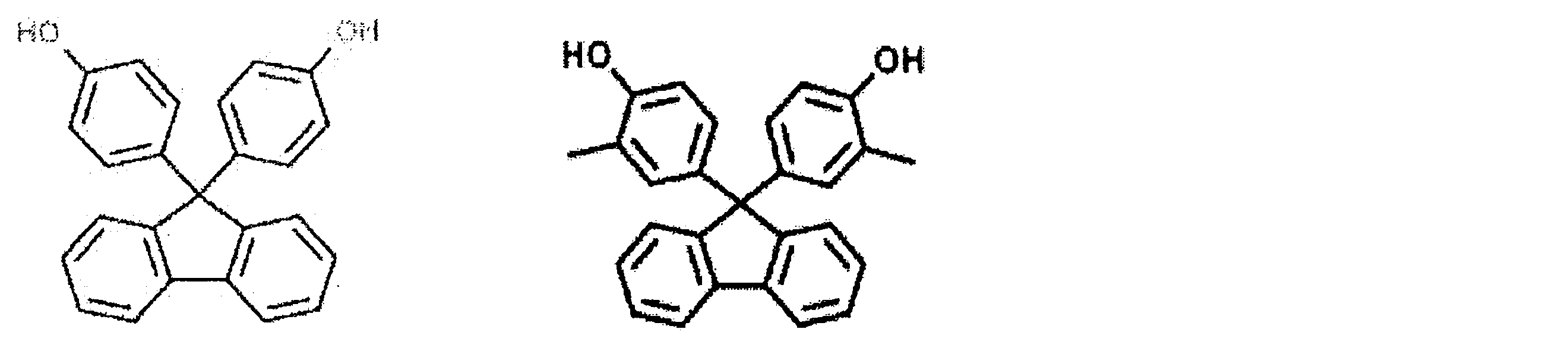
式(L1)中のRcで表される非置換または置換の環員数5~30の2価の脂環式炭化水素基としては、例えば、非置換または置換の環員数5~15の単環の脂環式炭化水素基、非置換または置換の環員数5~15の単環のフッ素化脂環式炭化水素基、非置換または置換の環員数7~30の多環の脂環式炭化水素基、非置換または置換の環員数7~30の多環のフッ素化脂環式炭化水素基などが挙げられる。
前記非置換または置換の環員数5~15の単環の脂環式炭化水素基としては、例えば、シクロペンタン-1,1-ジイル基、シクロヘキサン-1,1-ジイル基、3,3,5-トリメチルシクロヘキサン-1,1-ジイル基、シクロペンテン-3,3-ジイル基、シクロヘキセン-3,3-ジイル基、シクロオクタン-1,1-ジイル基、シクロデカン-1,1-ジイル基、シクロドデカン-1,1-ジイル基、これらの基の水素原子の一部または全部が炭素数1~20の1価の鎖状炭化水素基で置換された基などが挙げられる。
前記非置換または置換の環員数5~15の単環のフッ素化脂環式炭化水素基としては、例えば、前記環員数5~15の単環の脂環式炭化水素基として例示した基の水素原子の一部または全部がフッ素原子で置換された基が挙げられる。
前記非置換または置換の環員数7~30の多環の脂環式炭化水素基としては、例えば、ノルボルナン、ノルボルネン、アダマンタン、トリシクロ[5.2.1.02,6]デカン、ピナン、カンファン、デカリン、ノルトリシクラン、ペルヒドロアントラセン、ペルヒドロアズレン、シクロペンタノヒドロフェナントレン、ビシクロ[2.2.2]-2-オクテン等の多環の脂環式炭化水素の1つの炭素原子に結合している2つの水素原子を除いた基、これらの基の水素原子の一部または全部が炭素数1~20の1価の鎖状炭化水素基で置換された基などが挙げられる。
前記非置換または置換の環員数7~30の多環のフッ素化脂環式炭化水素基としては、例えば、前記環員数7~30の多環の脂環式炭化水素基として例示した基の水素原子の一部または全部がフッ素原子で置換された基が挙げられる。
Lにおける-N(R8)-中のR8は、水素原子、炭素数1~20の1価の炭化水素基、または、炭素数1~20の1価のハロゲン化炭化水素基である。炭素数1~20の1価の炭化水素基および炭素数1~20の1価のハロゲン化炭化水素基としてはそれぞれ、例えば、前記Ara1およびAra2で例示した炭素数1~20の1価の炭化水素基および炭素数1~20の1価のハロゲン化炭化水素基が挙げられる。
Lとしては、重合体(A)の構造安定性の観点から、単結合、-O-、-S-、-C(O)-、-S(O)-、-S(O)2-、-C(O)-NH-、-C(O)-O-、メチレン基、炭素数2~5のアルキレン基、前記式(L1)、ハロゲン化メチレン基、炭素数2~10のハロゲン化アルキレン基、または2価のカルド構造が好ましい。
〔y〕
式(2)中、yは、0~5の整数である。重合体(A)の構造安定性の観点から、yは、0~4が好ましく、0~3がより好ましい。
式(2)中、yは、0~5の整数である。重合体(A)の構造安定性の観点から、yは、0~4が好ましく、0~3がより好ましい。
〔Ra6およびRa7〕
式(2)中、Ra6およびRa7はそれぞれ独立して、単結合、メチレン基または炭素数2~4のアルキレン基である。
上記炭素数2~4のアルキレン基としては、例えば、エチレン基、n-プロピレン基、イソプロピレン基、n-ブチレン基、sec-ブチレン基などが挙げられる。Ra6およびRa7としてはそれぞれ独立して、重合反応性よく重合体(A)を合成することができる観点から、単結合、メチレン基、またはエチレン基が好ましい。
式(2)中、Ra6およびRa7はそれぞれ独立して、単結合、メチレン基または炭素数2~4のアルキレン基である。
上記炭素数2~4のアルキレン基としては、例えば、エチレン基、n-プロピレン基、イソプロピレン基、n-ブチレン基、sec-ブチレン基などが挙げられる。Ra6およびRa7としてはそれぞれ独立して、重合反応性よく重合体(A)を合成することができる観点から、単結合、メチレン基、またはエチレン基が好ましい。
式(1-1)中のRa1を含む部分(すなわち、式(2)で表される2価の基)の原料となる単量体としては、例えば、ヒドロキノン、レゾルシノール、カテコール、フェニルヒドロキノン等のジヒドロキシフェニル化合物;9,9-ビス(4-ヒドロキシフェニル)フルオレン、9,9-ビス(4-ヒドロキシ-3-メチルフェニル)フルオレン、9,9-ビス(4-ヒドロキシ-3-フェニルフェニル)フルオレン、1,1-ビス(4-ヒドロキシフェニル)-1-フェニルエタン、ビス(4-ヒドロキシフェニル)ジフェニルメタン、2,2-ビス(4-ヒドロキシフェニル)プロパン、2,2-ビス(4-ヒドロキシ-3-アリルフェニル)プロパン、2,2-ビス(4-ヒドロキシ-3-メチルフェニル)プロパン、2,2-ビス(4-ヒドロキシ-3-フェニルフェニル)プロパン、4,4'-(1,3-ジメチルブチリデン)ビスフェノール、1,1-ビス(4-ヒドロキシフェニル)-ノナン、ビス(4-ヒドロキシフェニル)スルホン、1,1-ビス(4-ヒドロキシフェニル)シクロヘキサン、1,1-ビス(4-ヒドロキシフェニル)-3,3,5-トリメチルシクロヘキサン、1,1-ビス(3-メチル-4-ヒドロキシフェニル)-3,3,5-トリメチルシクロヘキサン、1,1-ビス(3-シクロヘキシル-4-ヒドロキシフェニル)-3,3,5-トリメチルシクロヘキサン、1,4-ビス[2-(4-ヒドロキシフェニル)-2-プロピル]ベンゼン、1,3-ビス[2-(4-ヒドロキシフェニル)-2-プロピル]ベンゼン、4,4'-シクロドデシリデンビスフェノール、4,4'-デシリデンビスフェノール等のビスフェノール化合物;プリプラスト1901、1838、3186、3192、3197、3199(クローダジャパン(株)製)等のジオール化合物が挙げられる。なお、これらの単量体は、1種単独で使用してもよいし、2種以上を使用してもよい。
<Ra2>
Ra2は、下記式(Ra2-1)、(Ra2-2)および(Ra2-3)より選ばれる1種で表される2価の基である。
Ra2は、下記式(Ra2-1)、(Ra2-2)および(Ra2-3)より選ばれる1種で表される2価の基である。
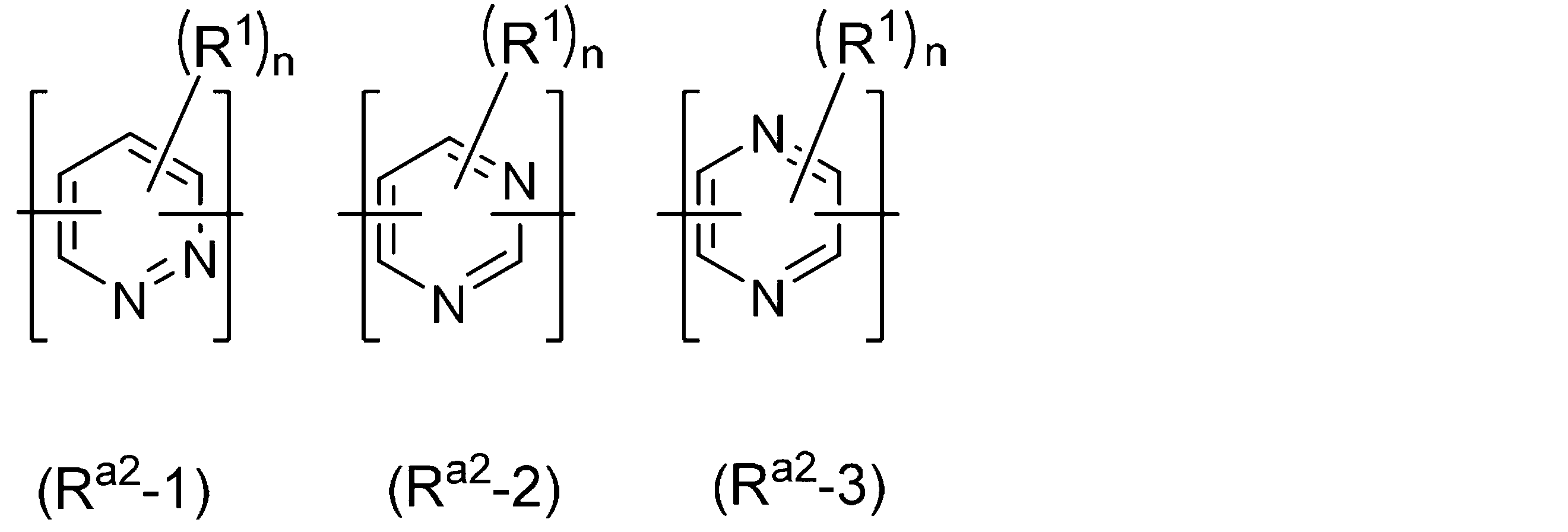
式(Ra2-1)~(Ra2-3)中、R1は、それぞれ独立して、ハロゲン原子、炭素数1~20の1価の炭化水素基、炭素数1~20の1価のハロゲン化炭化水素基、ニトロ基、シアノ基、1~3級アミノ基、または1~3級アミノ基の塩であり、nは、それぞれ独立して、0~2の整数であり、nが2の場合、複数のR1は、同一であるかまたは異なり、互いに合わさりこれらが結合する炭素原子と共に構成される、環員数5~10の環構造の一部である。
上記式(Ra2-1)~(Ra2-3)中のR1で表されるハロゲン原子としては、例えば、フッ素原子、塩素原子、臭素原子、ヨウ素原子等が挙げられる。
上記式(Ra2-1)~(Ra2-3)中のR1で表される炭素数1~20の1価の炭化水素基としては、例えば、鎖状炭化水素基、脂環式炭化水素基、および、芳香族炭化水素基等が挙げられる。
上記鎖状炭化水素基としては、例えば、メチル基、エチル基、n-プロピル基、イソプロピル基、n-ブチル基、イソブチル基、sec-ブチル基、ter-ブチル基、n-ペンチル基等のアルキル基;エテニル基、プロペニル基、ブテニル基、ペンテニル基等のアルケニル基;エチニル基、プロピニル基、ブチニル基、ペンチニル基等のアルキニル基などが挙げられる。
上記脂環式炭化水素基としては、例えばシクロプロピル基、シクロブチル基、シクロペンチル基、シクロヘキシル基等の単環のシクロアルキル基;ノルボルニル基、アダマンチル基等の多環のシクロアルキル基;シクロプロペニル基、シクロブテニル基、シクロペンテニル基、シクロヘキセニル基等の単環のシクロアルケニル基;ノルボルネニル基等の多環のシクロアルケニル基などが挙げられる。
上記芳香族炭化水素基としては、例えばフェニル基、トリル基、キシリル基、ナフチル基、アントリル基等のアリール基;ベンジル基、フェネチル基、フェニルプロピル基、ナフチルメチル基等のアラルキル基などが挙げられる。
R1で表される炭素数1~20の1価のハロゲン化炭化水素基としては、例えば上記R1で表される基として例示した炭素数1~20の1価の炭化水素基の水素原子の一部または全部をフッ素原子、塩素原子、臭素原子、ヨウ素原子等のハロゲン原子で置換した基などが挙げられる。
R1としては、重合反応性を向上させる観点から、ハロゲン原子、炭素数1~3の1価の炭化水素基、炭素数1~3の1価のハロゲン化炭化水素基、ニトロ基およびシアノ基が好ましく、フッ素原子、塩素原子、メチル基、ニトロ基およびシアノ基がより好ましい。同様の観点から、nとしては、0または1が好ましく、0がより好ましい。
式(Ra2-1)、(Ra2-2)および(Ra2-3)より選ばれる1種で表される2価の基において、一方の結合手に対する他方の結合手の位置としては、重合反応性を向上させる観点から、メタ位およびパラ位が好ましく、メタ位がより好ましい。
また、重合反応性を向上させ、かつ、各種有機溶媒への溶解性を向上させる観点から、Ra2としては、ピリミジン骨格を有する上記式(Ra2-2)で表される基であることが好ましい。
<<末端基>>
重合体(A)は、式(1-1)で表される構造単位の末端に下記式(a)で表される末端基Yを有していてもよい。
重合体(A)は、式(1-1)で表される構造単位の末端に下記式(a)で表される末端基Yを有していてもよい。

式(a)中、Yは、炭素数3~50のエチレン性不飽和二重結合を含有する基、炭素数6~50の非置換若しくは置換の芳香族炭化水素基、炭素数6~50の非置換若しくは置換の脂肪族炭化水素基、または、非置換含窒素複素芳香族環であり、前記芳香族炭化水素基または脂肪族炭化水素基が置換基を有する場合、該置換基はヒドロキシ基以外の基である。
なお、末端基Yが重合体(A)の主鎖末端に結合した場合、下記式(a1)または(a2)で表される部分構造が重合体(A)の末端部分に形成される。
この場合、末端基Yは、式(1-1)中のRa1およびRa2における端部(例:Ara1、Ara2およびRa2における置換基)を構成する基とは異なる基である。
この場合、末端基Yは、式(1-1)中のRa1およびRa2における端部(例:Ara1、Ara2およびRa2における置換基)を構成する基とは異なる基である。

式(a1)および式(a2)中、Yは、前記式(a)で表されるYと同義であり、Ra1およびRa2は、前記式(1-1)中のRa1およびRa2と同義である。
式(a)で表される末端基Yを有する重合体(A)の具体例としては、以下の式(3)または(4)で表される重合体が挙げられる。ここで、「主鎖」とは、重合体中で相対的に最も長い結合鎖をいう。

上記式(3)および式(4)中、Ra1およびRa2は、それぞれ独立に、上記式(1-1)中のRa1およびRa2は同義であり、好ましい態様も同様である。Yは上記式(a)で表されるYと同義であり好ましい態様も同様である。nは、0~100の整数であり、より好ましくは2~30である。
末端基Yは、誘電特性を改善させるという観点からは、分極の小さい芳香族または脂肪族炭化水素基および含窒素複素芳香族環基が好ましい。末端基Yがエチレン性不飽和二重結合を含有する基である場合には、架橋密度が向上するため樹脂組成物の硬化性に優れ、また得られる硬化物の耐熱性に優れる。
Yで表される前記炭素数3~50のエチレン性不飽和二重結合を含有する基としては、例えば、3-イソプロペニルフェニル基、4-イソプロペニルフェニル基、2-アリルフェニル基、2-メトキシ-4-アリルフェニル基、4-(1-プロペニル)-2-メトキシフェニル基、4-ビニルベンジル基、3-ビニルベンジル基、2-ビニルベンジル基等の芳香環含有基、アリル基、アクリル基、メタクリル基などが挙げられる。
Yで表される炭素数6~50の芳香族炭化水素基としては、例えば、フェニル基、ビフェニル基、トリル基、キシリル基、ナフチル基、アントリル基等のアリール基;ベンジル基、フェネチル基、フェニルプロピル基、ナフチルメチル基等のアラルキル基などが挙げられる。
Yで表される前記炭素数6~50の脂肪族炭化水素基としては、例えば、シクロプロピル基、シクロブチル基、シクロペンチル基、シクロヘキシル基等の単環のシクロアルキル基;ノルボルニル基、アダマンチル基等の多環のシクロアルキル基;シクロプロペニル基、シクロブテニル基、シクロペンテニル基、シクロヘキセニル基等の単環のシクロアルケニル基;ノルボルネニル基等の多環のシクロアルケニル基などが挙げられる。
Yで表される非置換含窒素複素芳香族環としては、例えば、ピロール環、ピリジン環、ピリミジン環、ピラジン環、ピリダジン環、トリアジン環、キノリン環、イソキノリン環、キノキサリン環、フタラジン環、キナゾリン環、ナフチリジン環、カルバゾール環、アクリジン環、フェナジン環などが挙げられ、これらの中でもピリミジン環が好ましい。
前記炭素数6~50の非置換または置換の芳香族炭化水素基、炭素数6~50の非置換または置換の脂肪族炭化水素基、および、非置換含窒素複素芳香族環における置換基としては、ヒドロキシ基以外の基が挙げられる。
上記置換基としては特に制限されないが、例えば、アリル基、ハロゲン原子、炭素数1~20の1価の炭化水素基、炭素数1~20の1価のハロゲン化炭化水素基、炭素数1~20のアルコキシ基、炭素数1~20のアルキルチオ基、ニトロ基、シアノ基、カルボキシ基、スルホン酸基、ホスホン酸基、リン酸基、1~3級アミノ基、カルボキシ基の塩、スルホン酸基の塩、ホスホン酸基の塩、リン酸基の塩、1~3級アミノ基の塩が挙げられる。これらの中でもアリル基が好ましい。
上記置換基としては特に制限されないが、例えば、アリル基、ハロゲン原子、炭素数1~20の1価の炭化水素基、炭素数1~20の1価のハロゲン化炭化水素基、炭素数1~20のアルコキシ基、炭素数1~20のアルキルチオ基、ニトロ基、シアノ基、カルボキシ基、スルホン酸基、ホスホン酸基、リン酸基、1~3級アミノ基、カルボキシ基の塩、スルホン酸基の塩、ホスホン酸基の塩、リン酸基の塩、1~3級アミノ基の塩が挙げられる。これらの中でもアリル基が好ましい。
重合体(A)の末端を末端基Yで封止された重合体の形成方法としては、前記式(1-1)におけるRa1やRa2を形成する単量体に加え、1価フェノール化合物、1価アミン化合物、1価チオール化合物、1価脂肪族ハロゲン化物、1価酸ハロゲン化物、および、1価酸無水物からなる群より選ばれる少なくとも1種の末端基Y形成用の単量体を原料に用いて反応させる方法が挙げられる。
炭素数3~50のエチレン性不飽和二重結合を含有する基である末端基Yを含む重合体(A)を合成する方法としては、例えば、Ra1を含む部分の原料となる単量体とRa2を含む部分の原料となる単量体とを重合する時に、エチレン性不飽和二重結合同士が反応してゲル化することを避けるため、Ra1を含む部分の原料となる単量体とRa2を含む部分の原料となる単量体とを重合させた後に、末端基Y形成用の単量体を反応させてもよい。
炭素数3~50のエチレン性不飽和二重結合を含有する基である末端基Yを含む重合体(A)を合成する方法としては、例えば、Ra1を含む部分の原料となる単量体とRa2を含む部分の原料となる単量体とを重合する時に、エチレン性不飽和二重結合同士が反応してゲル化することを避けるため、Ra1を含む部分の原料となる単量体とRa2を含む部分の原料となる単量体とを重合させた後に、末端基Y形成用の単量体を反応させてもよい。
前記末端基Y形成用の単量体としては、例えば、ter-ブチルフェノール、ノニルフェノール、4-イソプロペニルフェノール、4-ビニルフェノール、2-アリルフェノール、イソオイゲノール、トコトリエノール、α-トコフェノール、4-ヒドロキシフェニルマレイミド、2-フェニルフェノール等の1価フェノール化合物;4-ヘキシルアニリン、ジアリルアミン等の1価アミン化合物;1-オクタンチオール等の1価チオール化合物;アリルクロリド、4-(クロロメチル)スチレン、3-(クロロメチル)スチレン等の1価脂肪族ハロゲン化物、アクリルクロリド、メタクリルクロリド、クロトノイルクロリド、シンナモイルクロリド等の1価酸ハロゲン化物、アクリル酸無水物、クロトン酸無水物、メタクリル酸無水物などの1価酸無水物が挙げられる。
なお、末端基Y形成用の単量体は、1種単独で使用してもよいし、2種以上を使用してもよい。
なお、末端基Y形成用の単量体は、1種単独で使用してもよいし、2種以上を使用してもよい。
重合体(A)は下記式(1-2)で表される構造単位を含んでいてもよい。

式(1-2)中、Ra2は上記式(Ra2-1)、(Ra2-2)および(Ra2-3)より選ばれる1種で表される2価の基であり、R12はそれぞれ独立に、置換または非置換である2価の芳香族炭化水素基を表し、R13は炭素数1~20の炭化水素基を表し、mは1~6の整数を表し、**は重合体(A)中の他の構造単位との結合手を表す。
上記式(1-2)は、下記式(1-2a)で表すことができる。

前記式(1-2a)において、Ra2およびR12は、それぞれ上記式(1-2)中と同義である。R13xは、2つのR12以外に下記式(1-2b)で表される基が少なくとも1つ結合した炭素数1~20の炭化水素基を表す。

前記式(1-2b)において、*は、前記R13xへの結合手を表し、**は、前記重合体(A)中の他の構造単位との結合手を表し、R12は、前記式(1-2)中のR12と同義である。
〔R12〕
R12における非置換の芳香族炭化水素基(アリーレン基)は、単環であってもよいし、縮合環であってもよい。非置換の芳香族炭化水素基の炭素原子数としては、好ましくは6~20であり、より好ましくは6~18である。芳香族炭化水素基としては、例えば、フェニレン基、ナフチレン基、アントリレン基等が挙げられる。
R12における非置換の芳香族炭化水素基(アリーレン基)は、単環であってもよいし、縮合環であってもよい。非置換の芳香族炭化水素基の炭素原子数としては、好ましくは6~20であり、より好ましくは6~18である。芳香族炭化水素基としては、例えば、フェニレン基、ナフチレン基、アントリレン基等が挙げられる。
R12における置換の芳香族炭化水素基における置換基としては、特に制限されず、例えば、アリル基、ハロゲン原子、炭素数1~20の1価の炭化水素基、炭素数1~20の1価のハロゲン化炭化水素基、炭素数1~20のアルコキシ基、炭素数1~20のアルキルチオ基、ニトロ基、シアノ基、並びに、カルボキシ基、スルホン酸基、ホスホン酸基、リン酸基、ヒドロキシ基、1~3級アミノ基、および、これらの塩などが挙げられる。
前記式(1-2)または式(1-2a)中のR12は、重合体(A)のガラス転移温度(Tg)を向上させる観点から、それぞれ独立に、下記式(5)で表される基であることが好ましい。
なお、環構造の辺にまたがる直線であらわされた結合はその環構造の任意の水素原子を置換することを表している。また、複数の環構造にまたがる直線で表された結合はその環構造のいずれかにおける任意の水素原子を置換することを表している。
なお、環構造の辺にまたがる直線であらわされた結合はその環構造の任意の水素原子を置換することを表している。また、複数の環構造にまたがる直線で表された結合はその環構造のいずれかにおける任意の水素原子を置換することを表している。

前記式(5)において、R51は、それぞれ独立に、炭素数1~10のアルキル基、炭素数1~10のアルコキシ基、または、炭素数3~10のシクロアルキル基を表し、n52は0~4の整数を表し、n53は0~2の整数を表し、*は、式(1-2)中のR13または式(1-2a)中のR13xとの結合手を表し、***は、式(1-2)または式(1-2a)中のOとの結合手を表す。
n52は好ましくは1~3の整数を表し、より好ましくは1または2を表す。n53は好ましくは0または1を表し、より好ましくは1である。
また、前記式(5)で表される基は、低誘電率・低誘電正接を維持して耐熱性(例えば、重合体(A)のTg)を向上させる観点から、下記式(5-1)または下記式(5-2)で表される基であることが好ましい。
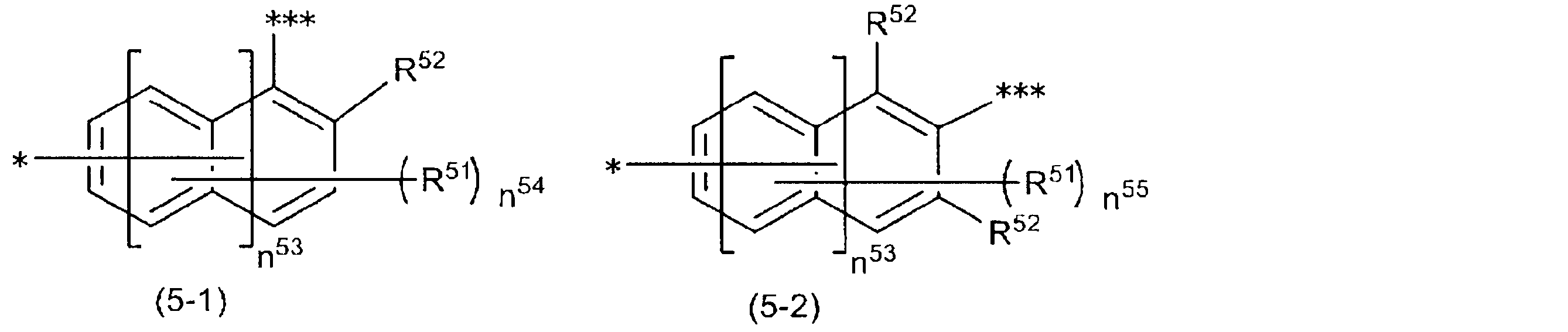
前記式(5-1)および式(5-2)中、R51はそれぞれ独立に、炭素数1~10のアルキル基、炭素数1~10のアルコキシ基、または、炭素数3~10のシクロアルキル基を表し、R52は炭素数1~10のアルキル基、炭素数1~10のアルコキシ基、または、炭素数3~10のシクロアルキル基を表し、n53は0~2の整数を表し、n54は0~3の整数を表し、n55は0~2の整数を表し、*は、前記式(1-2)または式(1-2a)中のR13との結合手を表し、***は、前記式(1-2)または式(1-2a)中の酸素原子との結合手を表す。
前記R51およびR52における炭素数1~10のアルキル基は、直鎖状であってもよいし分岐鎖であってもよい。炭素数1~10のアルキル基は、好ましくは炭素数1~8のアルキル基であり、より好ましくは1~6のアルキル基である。炭素数1~10のアルキル基としては、例えば、メチル基、エチル基、n-プロピル基、イソプロピル基、n-ブチル基、イソブチル基、sec-ブチル基、tert-ブチル基、n-ペンチル基が挙げられる。
前記R51およびR52における炭素数1~10のアルコキシ基としては、好ましくは、炭素数1~8のアルコキシ基であり、例えば、メトキシ基、エトキシ基、n-プロポキシ基、イソプロポキシ基、ブトキシ基、ペンチルオキシ基、ヘキシルオキシ基、オクチルオキシ基などが挙げられる。
前記R51およびR52における炭素数3~10のシクロアルキル基としては、好ましくは炭素数3~8のシクロアルキル基であり、例えば、シクロプロピル基、シクロブチル基、シクロペンチル基、シクロヘキシル基などが挙げられる。
n53は式(5)中のn53と同義であり、好ましい態様も同様である。前記n54は0~3の整数を表し、好ましくは0~2の整数を表し、前記n55は0~2の整数を表し、好ましくは0または1である。
〔R13およびR13x〕
R13は前記式(1-2)で表される構造単位中に分岐構造を導入する基を表す。
R13およびR13xにおける炭素数1~20の炭化水素基は、直鎖状または分岐鎖状の炭素数1~20の炭化水素基であってもよいし、環状の炭素数3~20の炭化水素基であってもよいし、これらの組み合わせであってもよい。なお、前記分岐構造は、前記R13およびR13x中の第3級炭素または第4級炭素により形成された構造であることが好ましい。
上記炭化水素基が直鎖状または分岐鎖状である場合、好ましくは炭素数1~10の直鎖状または分岐鎖状の炭化水素基であり、より好ましくは炭素数1~6の直鎖状または分岐鎖状の炭化水素基であり、さらに好ましくは炭素数1~4の直鎖状または分岐鎖状の炭化水素基である。
環状の炭化水素基としては、脂環式炭化水素基であってもよいし、芳香族炭化水素基であってもよい。
脂環式炭化水素基としては、好ましくは炭素数3~10の脂環式炭化水素基であり、より好ましくは炭素数3~8の脂環式炭化水素基であり、さらに好ましくは炭素数3~6の脂環式炭化水素基である。
芳香族炭化水素基としては、好ましくは炭素数6~18の芳香族炭化水素基であり、より好ましくは炭素数6~12の芳香族炭化水素基である。
R13は前記式(1-2)で表される構造単位中に分岐構造を導入する基を表す。
R13およびR13xにおける炭素数1~20の炭化水素基は、直鎖状または分岐鎖状の炭素数1~20の炭化水素基であってもよいし、環状の炭素数3~20の炭化水素基であってもよいし、これらの組み合わせであってもよい。なお、前記分岐構造は、前記R13およびR13x中の第3級炭素または第4級炭素により形成された構造であることが好ましい。
上記炭化水素基が直鎖状または分岐鎖状である場合、好ましくは炭素数1~10の直鎖状または分岐鎖状の炭化水素基であり、より好ましくは炭素数1~6の直鎖状または分岐鎖状の炭化水素基であり、さらに好ましくは炭素数1~4の直鎖状または分岐鎖状の炭化水素基である。
環状の炭化水素基としては、脂環式炭化水素基であってもよいし、芳香族炭化水素基であってもよい。
脂環式炭化水素基としては、好ましくは炭素数3~10の脂環式炭化水素基であり、より好ましくは炭素数3~8の脂環式炭化水素基であり、さらに好ましくは炭素数3~6の脂環式炭化水素基である。
芳香族炭化水素基としては、好ましくは炭素数6~18の芳香族炭化水素基であり、より好ましくは炭素数6~12の芳香族炭化水素基である。
R13は、-(L-Z)nZ-で表される基であることが好ましい。
上記Lは単結合、または、炭素数3~10の脂環式炭化水素基を表し、Zは直鎖状または分岐鎖状の炭素数1~10の炭化水素基を表し、nZは1または2を表す。
Lにおける炭素数3~10の脂環式炭化水素基は、好ましくは炭素数3~6の脂環式炭化水素基である。Zにおける直鎖状または分岐鎖状の炭素数1~10の炭化水素基は、好ましくは直鎖状または分岐鎖状の炭素数1~6の炭化水素基であり、より好ましくは直鎖状または分岐鎖状の炭素数1~4の炭化水素基である。
上記Lは単結合、または、炭素数3~10の脂環式炭化水素基を表し、Zは直鎖状または分岐鎖状の炭素数1~10の炭化水素基を表し、nZは1または2を表す。
Lにおける炭素数3~10の脂環式炭化水素基は、好ましくは炭素数3~6の脂環式炭化水素基である。Zにおける直鎖状または分岐鎖状の炭素数1~10の炭化水素基は、好ましくは直鎖状または分岐鎖状の炭素数1~6の炭化水素基であり、より好ましくは直鎖状または分岐鎖状の炭素数1~4の炭化水素基である。
前記式(1-2)中の**は、前記重合体(A)中の他の構造単位との結合手を表す。
重合体(A)中の他の構造単位は、他の式(1-2)で表される構造単位であってもよいし、上記式(1-1)で表される構造単位であってもよいし、上記末端基Yであってもよいし、後述するその他の構造単位であってもよい。
なお、重合体(A)中の式(1-2)で表される構造単位(1-2)中の**が、他の式(1-2)で表される構造単位または式(1-1)で表される構造単位との結合手を表す場合、前記**は、他の式(1-2)で表される構造単位および式(1-1)で表される構造単位中のR2aと結合し、O(酸素原子)とは結合しない。
重合体(A)中の他の構造単位は、他の式(1-2)で表される構造単位であってもよいし、上記式(1-1)で表される構造単位であってもよいし、上記末端基Yであってもよいし、後述するその他の構造単位であってもよい。
なお、重合体(A)中の式(1-2)で表される構造単位(1-2)中の**が、他の式(1-2)で表される構造単位または式(1-1)で表される構造単位との結合手を表す場合、前記**は、他の式(1-2)で表される構造単位および式(1-1)で表される構造単位中のR2aと結合し、O(酸素原子)とは結合しない。
式(1-2)または式(1-2a)で表される構造単位は、下記の部分構造を有する構造単位が例示されるが、これらに限定されるわけではない。

〔式(1-2)または式(1-2a)で表される構造単位の形成方法〕
式(1-2)または式(1-2a)で表される構造単位を形成方法する方法としては、式(1-2)中の2つの酸素原子に挟まれた部分(-R12-R13(R12-O-**)m-R12-)を形成する単量体または式(1-2a)中の2つの酸素原子に挟まれた部分(-R12-R13x-R12-)を形成する単量体と、Ra2を形成する単量体と、を反応させて形成する方法が挙げられる。
(-R12-R13(R12-O-**)m-R12-)または(-R12-R13x-R12-)を形成する単量体としては、例えば、下記式(6)で表される化合物が挙げられる。
式(1-2)または式(1-2a)で表される構造単位を形成方法する方法としては、式(1-2)中の2つの酸素原子に挟まれた部分(-R12-R13(R12-O-**)m-R12-)を形成する単量体または式(1-2a)中の2つの酸素原子に挟まれた部分(-R12-R13x-R12-)を形成する単量体と、Ra2を形成する単量体と、を反応させて形成する方法が挙げられる。
(-R12-R13(R12-O-**)m-R12-)または(-R12-R13x-R12-)を形成する単量体としては、例えば、下記式(6)で表される化合物が挙げられる。

前記式(6)において、R13は、炭素数1~20のn61価の炭化水素基を表し、R61は、それぞれ独立に炭素数1~10のアルキル基、炭素数1~10のアルコキシ基または炭素数3~10のシクロアルキル基を表し、n61は2~4の整数を表し、n62は1~5の整数を表し、n63は0~4の整数を表す、但し、n62とn63との合計数は1~5の整数である。
前記式(6)で表される化合物は、下記式(6-1)または下記式(6-2)で表される化合物であることが好ましい。

前記式(6-1)および(6-2)において、R13、R61およびn61は、前記式(6)中のR13、R61およびn61と同義である。
(-R12-R13(R12-O-**)m-R12-を形成する単量体または(-R12-R13x-R12-)を形成する単量体としては、以下に示す例示化合物が挙げられるが、本発明はこれら化合物に限定されるものではない。

式(1-2)または式(1-2a)で表される構造単位の含有量は、重合体(A)に含まれる全ての構造単位を100モル%に対して、好ましくは5モル%以上95モル%以下、より好ましくは10モル%以上90モル%以下、さらに好ましくは20モル%以上80モル%以下である。
<<その他の構造単位>>
重合体(A)は、式(1-1)および式(1-2)または式(1-2a)で表される構造単位以外の構造単位(以下、「その他の構造単位」ともいう。)を、必要に応じて有していてもよい。
従って、前記式(1-1)で表される繰り返し単位は、該繰り返し単位同士が結合するか、前記その他の構造単位や、式(a)で表される末端基Yと結合する構造単位が挙げられる。
重合体(A)が、複数の式(1-1)で表される繰り返し単位を有する場合、複数のRa1は、それぞれ同一であっても異なっていてもよい。このことは、Ra2や他の繰り返し単位でも同様である。
重合体(A)は、式(1-1)および式(1-2)または式(1-2a)で表される構造単位以外の構造単位(以下、「その他の構造単位」ともいう。)を、必要に応じて有していてもよい。
従って、前記式(1-1)で表される繰り返し単位は、該繰り返し単位同士が結合するか、前記その他の構造単位や、式(a)で表される末端基Yと結合する構造単位が挙げられる。
重合体(A)が、複数の式(1-1)で表される繰り返し単位を有する場合、複数のRa1は、それぞれ同一であっても異なっていてもよい。このことは、Ra2や他の繰り返し単位でも同様である。
その他の構造単位としては、例えば、ジフェニルカーボネート、ジフェニルチオカーボネート、ジフェニルセレノカーボネート、ホスゲン、チオホスゲン、セレノホスゲン等のカーボネート結合、チオカーボネート結合またはセレノカーボネート結合を含む構造単位を誘導する化合物;ベンゼンジメタノール、シクロヘキサンジメタノール等のジヒドロキシ化合物;ビス(フルオロフェニル)フェニルホスフィンオキシド、ビス(フルオロフェニル)ナフチルホスフィンオキシド、ビス(フルオロフェニル)アントリルホスフィンオキシド等のホスフィンオキシド化合物;フタル酸ジクロリド、イソフタル酸ジクロリド、テレフタル酸ジクロリド等のジカルボン酸のジハロゲン化物などの単量体から誘導される構造単位が挙げられる。
その他の構造単位を誘導する単量体は、1種単独で使用してもよいし、2種以上を併用してもよい。
その他の構造単位を誘導する単量体は、1種単独で使用してもよいし、2種以上を併用してもよい。
〔重合体(A)の合成方法〕
重合体(A)の合成方法は特に限定されず、公知の合成方法を用いることができる。重合体(A)の合成方法としては、例えば、前記Ra1を含む部分の原料となる単量体と、前記Ra2を含む部分の原料となる単量体と、必要に応じて、前記末端基Y形成用の単量体および/または前記式(6)で表される化合物、前記他の構造単位を誘導する単量体とを、有機溶媒中、重合禁止剤、アルカリ金属やアルカリ金属化合物等と共に加熱する方法が挙げられる。
前記他の構造単位を誘導する単量体および/または前記末端基Y形成用の単量体は、前記Ra1を含む部分の原料となる単量体と、前記Ra2を含む部分の原料となる単量体と、必要に応じて前記式(6)で表される化合物とを重合した後に、加熱混合し反応させてもよい。
前記Ra1および前記他の構造単位を誘導する単量体や前記末端基Y形成用の単量体は、前記Ra2を含む部分の原料となる単量体と、前記R13またはR13xを含む部分の原料となる単量体とを重合した後に、加熱混合し反応させてもよい。
重合体(A)の合成方法は特に限定されず、公知の合成方法を用いることができる。重合体(A)の合成方法としては、例えば、前記Ra1を含む部分の原料となる単量体と、前記Ra2を含む部分の原料となる単量体と、必要に応じて、前記末端基Y形成用の単量体および/または前記式(6)で表される化合物、前記他の構造単位を誘導する単量体とを、有機溶媒中、重合禁止剤、アルカリ金属やアルカリ金属化合物等と共に加熱する方法が挙げられる。
前記他の構造単位を誘導する単量体および/または前記末端基Y形成用の単量体は、前記Ra1を含む部分の原料となる単量体と、前記Ra2を含む部分の原料となる単量体と、必要に応じて前記式(6)で表される化合物とを重合した後に、加熱混合し反応させてもよい。
前記Ra1および前記他の構造単位を誘導する単量体や前記末端基Y形成用の単量体は、前記Ra2を含む部分の原料となる単量体と、前記R13またはR13xを含む部分の原料となる単量体とを重合した後に、加熱混合し反応させてもよい。
-アルカリ金属およびアルカリ金属化合物-
前記アルカリ金属およびアルカリ金属化合物は、重合体(A)の合成の過程で、原料として、フェノール化合物等のヒドロキシ基を有する化合物を用いる場合、該ヒドロキシ基を有する化合物と反応してアルカリ金属塩を形成する。
このようなアルカリ金属およびアルカリ金属化合物としては、例えば、
リチウム、ナトリウム、カリウム等のアルカリ金属;
水素化リチウム、水素化ナトリウム、水素化カリウム等の水素化アルカリ金属;
水酸化リチウム、水酸化ナトリウム、水酸化カリウム等の水酸化アルカリ金属;
炭酸リチウム、炭酸ナトリウム、炭酸カリウム等のアルカリ金属炭酸塩;
炭酸水素リチウム、炭酸水素ナトリウム、炭酸水素カリウム等のアルカリ金属炭酸水素塩が挙げられる。
これらの中では、アルカリ金属炭酸塩が好ましく、炭酸カリウムがより好ましい。
前記アルカリ金属およびアルカリ金属化合物は、重合体(A)の合成の過程で、原料として、フェノール化合物等のヒドロキシ基を有する化合物を用いる場合、該ヒドロキシ基を有する化合物と反応してアルカリ金属塩を形成する。
このようなアルカリ金属およびアルカリ金属化合物としては、例えば、
リチウム、ナトリウム、カリウム等のアルカリ金属;
水素化リチウム、水素化ナトリウム、水素化カリウム等の水素化アルカリ金属;
水酸化リチウム、水酸化ナトリウム、水酸化カリウム等の水酸化アルカリ金属;
炭酸リチウム、炭酸ナトリウム、炭酸カリウム等のアルカリ金属炭酸塩;
炭酸水素リチウム、炭酸水素ナトリウム、炭酸水素カリウム等のアルカリ金属炭酸水素塩が挙げられる。
これらの中では、アルカリ金属炭酸塩が好ましく、炭酸カリウムがより好ましい。
重合体(A)の合成に際し、ヒドロキシ基を有する化合物を用いる場合、アルカリ金属およびアルカリ金属化合物の使用量としては、重合体(A)の合成に用いる全化合物中のヒドロキシ基のモル数に対するアルカリ金属原子のモル数の比の下限が、好ましくは1、より好ましくは1.1、更に好ましくは1.2となる量であり、前記比の上限が、好ましくは3、より好ましくは2、更に好ましくは1.8となる量である。
-有機溶媒-
前記有機溶媒としては、例えば、
テトラヒドロフラン(THF)、ジオキサン、シクロペンチルメチルエーテル、アニソール、フェネトール、ジフェニルエーテル、ジアルコキシベンゼン、トリアルコキシベンゼン等のエーテル系溶媒;
N,N-ジメチルアセトアミド(DMAc)、N,N-ジメチルホルムアミド、N-メチル-2-ピロリドン、1,3-ジメチル-2-イミダゾリジノン等の含窒素系溶媒;
γ-ブチロラクトンなどのエステル系溶媒;
スルホラン、ジメチルスルホキシド、ジエチルスルホキシド、ジメチルスルホン、ジエチルスルホン、ジイソプロピルスルホン、ジフェニルスルホン等の含硫黄系溶媒;
ベンゾフェノン、2-ヘプタノン、シクロヘキサノン、メチルエチルケトン等のケトン系溶媒;
塩化メチレン、クロロホルム、クロロベンゼン等のハロゲン系溶媒;
ベンゼン、トルエン、キシレン等の芳香族炭化水素系溶媒が挙げられる。
これらの有機溶媒の中では、2-ヘプタノン、シクロヘキサノン、N-メチル-2-ピロリドン、トルエン、キシレンが好ましく、N-メチル-2-ピロリドン、2-ヘプタノン、シクロヘキサノンがより好ましい。
前記有機溶媒としては、例えば、
テトラヒドロフラン(THF)、ジオキサン、シクロペンチルメチルエーテル、アニソール、フェネトール、ジフェニルエーテル、ジアルコキシベンゼン、トリアルコキシベンゼン等のエーテル系溶媒;
N,N-ジメチルアセトアミド(DMAc)、N,N-ジメチルホルムアミド、N-メチル-2-ピロリドン、1,3-ジメチル-2-イミダゾリジノン等の含窒素系溶媒;
γ-ブチロラクトンなどのエステル系溶媒;
スルホラン、ジメチルスルホキシド、ジエチルスルホキシド、ジメチルスルホン、ジエチルスルホン、ジイソプロピルスルホン、ジフェニルスルホン等の含硫黄系溶媒;
ベンゾフェノン、2-ヘプタノン、シクロヘキサノン、メチルエチルケトン等のケトン系溶媒;
塩化メチレン、クロロホルム、クロロベンゼン等のハロゲン系溶媒;
ベンゼン、トルエン、キシレン等の芳香族炭化水素系溶媒が挙げられる。
これらの有機溶媒の中では、2-ヘプタノン、シクロヘキサノン、N-メチル-2-ピロリドン、トルエン、キシレンが好ましく、N-メチル-2-ピロリドン、2-ヘプタノン、シクロヘキサノンがより好ましい。
前記合成の際における反応温度の下限としては、好ましくは50℃、より好ましくは80℃であり、上記反応温度の上限としては、好ましくは300℃、より好ましくは200℃である。
前記合成の際における反応時間の下限としては、好ましくは1時間、より好ましくは2時間、更に好ましくは3時間であり、上記反応温度の上限としては、好ましくは100時間、より好ましくは50時間、更に好ましくは24時間である。
前記合成の際における反応時間の下限としては、好ましくは1時間、より好ましくは2時間、更に好ましくは3時間であり、上記反応温度の上限としては、好ましくは100時間、より好ましくは50時間、更に好ましくは24時間である。
重合液のゲル化抑制を目的に、末端基Y形成用の単量体を重合後に添加する際の反応温度の下限としては、好ましくは0℃、より好ましくは10℃であり、上記反応温度の上限としては、好ましくは130℃、より好ましくは110℃である。
前記末端基Y形成用の単量体を重合後に添加して反応させる際の反応時間の下限としては、好ましくは1時間、より好ましくは2時間、更に好ましくは3時間であり、上記反応温度の上限としては、好ましくは48時間、より好ましくは24時間、更に好ましくは10時間である。
前記末端基Y形成用の単量体を重合後に添加して反応させる際の反応時間の下限としては、好ましくは1時間、より好ましくは2時間、更に好ましくは3時間であり、上記反応温度の上限としては、好ましくは48時間、より好ましくは24時間、更に好ましくは10時間である。
〔重合体(A)の物性〕
重合体(A)の重量平均分子量(Mw)の下限は、ポリスチレン換算で、好ましくは1,000、より好ましくは2,000、更に好ましくは3,000、特に好ましくは5,000である。重合体(A)の重量平均分子量(Mw)の上限は、ポリスチレン換算で、好ましくは500,000、より好ましくは100,000、更に好ましくは50,000、より好ましくは30,000、特に好ましくは15,000である。
重合体(A)の重量平均分子量(Mw)が上記範囲にあると、密着性、耐熱性、ガラスクロスへの含浸性、樹脂フローなどの成形性等がバランスよく優れる。
重量平均分子量(Mw)は、後述する実施例に記載の条件で、ゲルパーミエーションクロマトグラフィー(GPC)により測定して求められる。
重合体(A)の重量平均分子量(Mw)の下限は、ポリスチレン換算で、好ましくは1,000、より好ましくは2,000、更に好ましくは3,000、特に好ましくは5,000である。重合体(A)の重量平均分子量(Mw)の上限は、ポリスチレン換算で、好ましくは500,000、より好ましくは100,000、更に好ましくは50,000、より好ましくは30,000、特に好ましくは15,000である。
重合体(A)の重量平均分子量(Mw)が上記範囲にあると、密着性、耐熱性、ガラスクロスへの含浸性、樹脂フローなどの成形性等がバランスよく優れる。
重量平均分子量(Mw)は、後述する実施例に記載の条件で、ゲルパーミエーションクロマトグラフィー(GPC)により測定して求められる。
重合体(A)の誘電正接(tanδ)は、重合体(A)を含む組成物とした時の伝送損失を低減できる等の点から、好ましくは0.0030未満、より好ましくは0.0020以下、さらに好ましくは0.0012以下である。誘電正接(tanδ)の下限は特に制限されないが、好ましくは0.0005以上である。
誘電正接は、具体的には、後述する実施例に記載の測定方法により求められる。
誘電正接は、具体的には、後述する実施例に記載の測定方法により求められる。
重合体(A)の含有割合は、組成物中の固形分全質量を100質量%とした場合に、好ましくは0.05質量%以上、より好ましくは10質量%以上、更に好ましくは20質量%以上であり、好ましくは99.95質量%以下、より好ましくは90質量%以下、更に好ましくは80質量%以下である。
重合体(A)の含有割合が上記範囲にあると、得られる硬化物の接着性、耐熱性、硬化性、および、電気特性等をより向上させることができるの点から好ましい。
重合体(A)は、1種単独であってもよいし、2種以上を併用してもよい。
熱硬化性樹脂組成物が2種以上の重合体(A)を含む場合、例えば、上記重量平均分子量(Mw)の範囲において異なる重量平均分子量(Mw)を有する重合体(A)をそれぞれ混合して所望する物性等に調整してもよい。
重合体(A)の含有割合が上記範囲にあると、得られる硬化物の接着性、耐熱性、硬化性、および、電気特性等をより向上させることができるの点から好ましい。
重合体(A)は、1種単独であってもよいし、2種以上を併用してもよい。
熱硬化性樹脂組成物が2種以上の重合体(A)を含む場合、例えば、上記重量平均分子量(Mw)の範囲において異なる重量平均分子量(Mw)を有する重合体(A)をそれぞれ混合して所望する物性等に調整してもよい。
<共重合体(B)>
熱硬化性樹脂組成物は、エチレンまたはα-オレフィンに由来する構造単位、芳香族ビニル化合物に由来する構造単位、および、芳香族多官能ビニル化合物に由来する構造単位を有する共重合体(B)(以下、単に「共重合体(B)」とも称する場合がある。)を含有する。
以下、共重合体(B)が有する各構造単位の詳細について説明する。
熱硬化性樹脂組成物は、エチレンまたはα-オレフィンに由来する構造単位、芳香族ビニル化合物に由来する構造単位、および、芳香族多官能ビニル化合物に由来する構造単位を有する共重合体(B)(以下、単に「共重合体(B)」とも称する場合がある。)を含有する。
以下、共重合体(B)が有する各構造単位の詳細について説明する。
<<α-オレフィン>>
α-オレフィンは、末端に二重結合を有する炭素数3以上のオレフィンである。
α-オレフィンは、実質的に酸素原子や窒素原子、ハロゲン原子を含まず、炭素原子と水素原子から構成される化合物であることが好ましく、例えば、直鎖状または分岐鎖状のα-オレフィン、および炭素数5以上20以下の環状オレフィンから選ばれる一種以上の化合物が挙げられる。
α-オレフィンとしては、好ましくは炭素数3以上20以下のα-オレフィンであり、より好ましくは炭素数3以上20以下の直鎖状または分岐鎖状のα-オレフィンである。上記α-オレフィンとしては、特に制限はなく、例えば、プロピレン、1-ブテン、1-ヘキセン、1-オクテン、1-デカン、1-ドデカン、4-メチル-1-ペンテン、3,5,5-トリメチル-1-ヘキセンなどが挙げられる。
α-オレフィンは、末端に二重結合を有する炭素数3以上のオレフィンである。
α-オレフィンは、実質的に酸素原子や窒素原子、ハロゲン原子を含まず、炭素原子と水素原子から構成される化合物であることが好ましく、例えば、直鎖状または分岐鎖状のα-オレフィン、および炭素数5以上20以下の環状オレフィンから選ばれる一種以上の化合物が挙げられる。
α-オレフィンとしては、好ましくは炭素数3以上20以下のα-オレフィンであり、より好ましくは炭素数3以上20以下の直鎖状または分岐鎖状のα-オレフィンである。上記α-オレフィンとしては、特に制限はなく、例えば、プロピレン、1-ブテン、1-ヘキセン、1-オクテン、1-デカン、1-ドデカン、4-メチル-1-ペンテン、3,5,5-トリメチル-1-ヘキセンなどが挙げられる。
エチレンまたはα-オレフィンに由来する構造単位は、共重合体(B)中に1種単独で含まれていてもよいし、2種以上が含まれていてもよい。
共重合体(B)において、エチレンまたはα-オレフィンに由来する構造単位の含有量(エチレンまたはα-オレフィンに由来する構造単位が2種以上含まれる場合はその含有量の合計)は、好ましくは35質量%以上であり、特に好ましくは45質量%以上である。
但し、前記エチレンまたはα-オレフィンに由来する構造単位、芳香族ビニル化合物に由来する構造単位および芳香族多官能ビニル化合物に由来する構造単位の合計は100質量%である。
エチレンまたはα-オレフィンに由来する構造単位の含有量が35質量%以上であると、最終的に得られる硬化物の靱性(伸び)が向上し、硬化途中での割れや、硬化物の耐衝撃性の低下、および、硬化物のヒートサイクル試験中での割れの発生が抑制される。
共重合体(B)におけるエチレンまたはα-オレフィンに由来する構造単位の含有量は好ましくは90質量%以下である。
共重合体(B)において、エチレンまたはα-オレフィンに由来する構造単位の含有量(エチレンまたはα-オレフィンに由来する構造単位が2種以上含まれる場合はその含有量の合計)は、好ましくは35質量%以上であり、特に好ましくは45質量%以上である。
但し、前記エチレンまたはα-オレフィンに由来する構造単位、芳香族ビニル化合物に由来する構造単位および芳香族多官能ビニル化合物に由来する構造単位の合計は100質量%である。
エチレンまたはα-オレフィンに由来する構造単位の含有量が35質量%以上であると、最終的に得られる硬化物の靱性(伸び)が向上し、硬化途中での割れや、硬化物の耐衝撃性の低下、および、硬化物のヒートサイクル試験中での割れの発生が抑制される。
共重合体(B)におけるエチレンまたはα-オレフィンに由来する構造単位の含有量は好ましくは90質量%以下である。
エチレンに由来する構造単位とα-オレフィンに由来する構造単位とが共重合体(B)に含まれる場合、エチレンに由来する構造単位に対するα-オレフィンに由来する構造単位の質量比が好ましくは1/7以下、より好ましくは1/10以下である場合は、得られる硬化物の破断強度(破断点強度)および破断伸び(破断点伸び)が向上し、銅箔または銅配線との剥離強度が向上するため好ましい。
共重合体(B)に含まれるα-オレフィンに由来する構造単位の含有量は、より好ましくは6質量%以下であり、最も好ましくは4質量%以下である。このような含有量である場合、銅箔や銅配線との剥離強度をさらに向上するためより好ましい。
エチレンとα-オレフィンとの組み合わせでは、最終的に得られる硬化物のエチレン-αオレフィン-芳香族ビニル化合物-芳香族多官能ビニル化合物連鎖のガラス転移温度はα-オレフィンの種類および含有量により、おおむね-60℃~-5℃の範囲で適宜に調整することができる。
共重合体(B)に含まれるα-オレフィンに由来する構造単位の含有量は、より好ましくは6質量%以下であり、最も好ましくは4質量%以下である。このような含有量である場合、銅箔や銅配線との剥離強度をさらに向上するためより好ましい。
エチレンとα-オレフィンとの組み合わせでは、最終的に得られる硬化物のエチレン-αオレフィン-芳香族ビニル化合物-芳香族多官能ビニル化合物連鎖のガラス転移温度はα-オレフィンの種類および含有量により、おおむね-60℃~-5℃の範囲で適宜に調整することができる。
<<芳香族ビニル化合物>>
芳香族ビニル化合物は、1分子中にビニル基を1つ有する芳香族炭化水素化合物であり、好ましくは炭素数8以上20以下の芳香族ビニル化合物である。芳香族ビニル化合物としては、例えばスチレン、パラメチルスチレン、パライソブチルスチレン、各種ビニルナフタレン、各種ビニルアントラセンなどが挙げられる。
芳香族ビニル化合物は、1分子中にビニル基を1つ有する芳香族炭化水素化合物であり、好ましくは炭素数8以上20以下の芳香族ビニル化合物である。芳香族ビニル化合物としては、例えばスチレン、パラメチルスチレン、パライソブチルスチレン、各種ビニルナフタレン、各種ビニルアントラセンなどが挙げられる。
共重合体(B)を構成する全構造単位の質量を100質量%としたときの芳香族ビニル化合物に由来する構造単位の含有量は、好ましくは0質量%を超え70質量%以下であり、より好ましくは10質量%以上60質量%未満である。
芳香族ビニル化合物に由来する構造単位は、共重合体(B)中に1種単独で含まれていてもよいし、2種以上含まれていてもよい。
芳香族ビニル化合物に由来する構造単位は、共重合体(B)中に1種単独で含まれていてもよいし、2種以上含まれていてもよい。
<<芳香族多官能ビニル化合物>>
芳香族多官能ビニル化合物は、1分子中に複数のビニル基と単数または複数の芳香族基とを有する化合物である。すなわち、芳香族多官能ビニル化合物は、複数あるビニル基の1つが重合反応に用いられて重合した状態であっても残りの他のビニル基が反応可能な化合物である。
芳香族多官能ビニル化合物の炭素数としては、好ましくは炭素数5以上20以下であり、より好ましくは炭素数8以上20以下である。
芳香族多官能ビニル化合物は、好ましくは、1分子中に2つのビニル基を有する芳香族炭化水素化合物であり、例えば、オルト、メタおよびパラの各種ジビニルベンゼンまたはこれらの混合物、ジビニルナフタレン、ジビニルアントラセン、p-(2-プロペニル)スチレン、p-(3-ブテニル)スチレン、1,2-ビス(ビニルフェニル)エタン等が挙げられる。
これらの中でも、芳香族多官能ビニル化合物としては、好ましくは、オルト、メタ、パラの各種ジビニルベンゼン、またはこれらの混合物であり、最も好ましくはメタおよびパラジビニルベンゼンの混合物である。
本明細書ではこれらジビニルベンゼンをジビニルベンゼン類と記す場合がある。芳香族多官能ビニル化合物としてジビニルベンゼン類を用いた場合、樹脂組成物について硬化処理を行う際に硬化効率に優れ、また、樹脂組成物の硬化が容易であるため好ましい。
芳香族多官能ビニル化合物は、1分子中に複数のビニル基と単数または複数の芳香族基とを有する化合物である。すなわち、芳香族多官能ビニル化合物は、複数あるビニル基の1つが重合反応に用いられて重合した状態であっても残りの他のビニル基が反応可能な化合物である。
芳香族多官能ビニル化合物の炭素数としては、好ましくは炭素数5以上20以下であり、より好ましくは炭素数8以上20以下である。
芳香族多官能ビニル化合物は、好ましくは、1分子中に2つのビニル基を有する芳香族炭化水素化合物であり、例えば、オルト、メタおよびパラの各種ジビニルベンゼンまたはこれらの混合物、ジビニルナフタレン、ジビニルアントラセン、p-(2-プロペニル)スチレン、p-(3-ブテニル)スチレン、1,2-ビス(ビニルフェニル)エタン等が挙げられる。
これらの中でも、芳香族多官能ビニル化合物としては、好ましくは、オルト、メタ、パラの各種ジビニルベンゼン、またはこれらの混合物であり、最も好ましくはメタおよびパラジビニルベンゼンの混合物である。
本明細書ではこれらジビニルベンゼンをジビニルベンゼン類と記す場合がある。芳香族多官能ビニル化合物としてジビニルベンゼン類を用いた場合、樹脂組成物について硬化処理を行う際に硬化効率に優れ、また、樹脂組成物の硬化が容易であるため好ましい。
以上のエチレン、α-オレフィン、芳香族ビニル化合物、および、芳香族多官能ビニル化合物の各単量体は、極性基、例えば、酸素原子、窒素原子等を含むオレフィン、酸素原子や、窒素原子等を含む芳香族ビニル化合物、または、酸素原子、窒素原子等を含む芳香族多官能ビニル化合物を含んでいてもよい。極性基を含む単量体に由来する構造単位の含有量は、共重合体(B)の全構造単位の質量に対して10質量%以下が好ましく、3質量%以下がより好ましく、1質量%以下がさらに好ましく、極性基を含む単量体に由来する構造単位を実質的に含まないことが最も好ましい。
極性基を含む単量体に由来する構造単位の含有量が10質量%以下にすることにより、熱硬化性樹脂組成物を硬化して得られる硬化物の低誘電特性(低誘電率/低誘電損失)がより向上される。
極性基を含む単量体に由来する構造単位の含有量が10質量%以下にすることにより、熱硬化性樹脂組成物を硬化して得られる硬化物の低誘電特性(低誘電率/低誘電損失)がより向上される。
共重合体(B)を構成する全構造単位の質量を100質量%としたときの芳香族多官能ビニル化合物に由来する構造単位の含有量は、好ましくは0質量%を超え70質量%以下であり、より好ましくは10質量%以上60質量%未満である。
芳香族多官能ビニル化合物に由来する構造単位は、共重合体(B)中に1種単独で含まれていてもよいし、2種以上含まれていてもよい。
芳香族多官能ビニル化合物に由来する構造単位は、共重合体(B)中に1種単独で含まれていてもよいし、2種以上含まれていてもよい。
共重合体(B)の数平均分子量(Mn)は好ましくは500以上10万以下であり、より好ましくは2万以上10万以下であり、さらに好ましくは3万以上10万以下である。
数平均分子量(Mn)が500以上であると、最終的に得られる硬化物に高い破断点強度、高い破断点伸び等の良好な物性を容易に付与することができ、靭性を付与しやすく好ましい。具体的には引張破断点伸び(引張破断伸び)で30%以上を示すことが好ましい。数平均分子量(Mn)が2万以上である場合、未硬化の状態で熱硬化性樹脂組成物がべた付きにくくなり、熱可塑性を向上できる効果が得られる。
数平均分子量(Mn)が10万以下であると、硬化前の熱硬化性樹脂組成物の成形加工がしやすくなる。
数平均分子量(Mn)は、後述する実施例に記載の条件で、ゲルパーミエーションクロマトグラフィー(GPC)により測定して求められる。
数平均分子量(Mn)が500以上であると、最終的に得られる硬化物に高い破断点強度、高い破断点伸び等の良好な物性を容易に付与することができ、靭性を付与しやすく好ましい。具体的には引張破断点伸び(引張破断伸び)で30%以上を示すことが好ましい。数平均分子量(Mn)が2万以上である場合、未硬化の状態で熱硬化性樹脂組成物がべた付きにくくなり、熱可塑性を向上できる効果が得られる。
数平均分子量(Mn)が10万以下であると、硬化前の熱硬化性樹脂組成物の成形加工がしやすくなる。
数平均分子量(Mn)は、後述する実施例に記載の条件で、ゲルパーミエーションクロマトグラフィー(GPC)により測定して求められる。
共重合体(B)を構成する全構造単位の質量を100質量%としたときの共重合体(B)に含まれる芳香族ビニル化合物に由来する構造単位の含有量は、好ましくは10質量%以上60質量%未満である。
芳香族ビニル化合物に由来する構造単位の含有量が60質量%未満の場合には、最終的に得られる組成物の硬化物のガラス転移温度が室温付近となりにくく、低温での靱性の低下を抑制し、また、伸びの低下を抑制することもできる。
また芳香族ビニル化合物に由来する構造単位の含有量が60質量%未満の場合には、金属箔(特に銅箔)との剥離強度が、60質量%以上の場合と比較して向上することができる。
芳香族ビニル化合物に由来する構造単位の含有量が60質量%未満の場合には、最終的に得られる組成物の硬化物のガラス転移温度が室温付近となりにくく、低温での靱性の低下を抑制し、また、伸びの低下を抑制することもできる。
また芳香族ビニル化合物に由来する構造単位の含有量が60質量%未満の場合には、金属箔(特に銅箔)との剥離強度が、60質量%以上の場合と比較して向上することができる。
共重合体(B)を構成する全構造単位の質量を100質量%としたときの共重合体(B)に含まれる芳香族ビニル化合物に由来する構造単位の含有量は、特に好ましくは10質量%以上55質量%以下である。芳香族ビニル化合物に由来する構造単位の含有量が10質量%以上であると、共重合体(B)の芳香族性の低下が抑制され、難燃剤やフィラーとのなじみが良好となり、組成物が難燃剤を含む場合においてブリードアウトを抑制し、フィラーの充填のしやすさを向上することもできる。また芳香族ビニル化合物に由来する構造単位の含有量が10質量%以上であると、金属箔(特に銅箔)や銅配線との剥離強度が高い硬化物が得られやすい。
共重合体(B)において、芳香族多官能ビニル化合物に由来する構造単位(以下、「芳香族多官能ビニル単位」ともいう。)に由来するビニル基の含有量(以下、「ビニル基含有量と」いうこともある)は、共重合体(B)の数平均分子量あたり好ましくは1.5個以上20個未満、より好ましくは3個以上20個未満である。
1.5個以上であると架橋効率に優れ、高温下での貯蔵弾性率をより高かめることが可能である。ビニル基含有量を上記範囲内とすることで、常温での破断強度、破断伸び等の力学物性を維持、または向上しつつ、より架橋効率や架橋密度を上げ、高温下での貯蔵弾性率を高めることが容易になり好ましい。特に芳香族多官能ビニル化合物の使用量が比較的低い場合に本効果は顕著になる。
1.5個以上であると架橋効率に優れ、高温下での貯蔵弾性率をより高かめることが可能である。ビニル基含有量を上記範囲内とすることで、常温での破断強度、破断伸び等の力学物性を維持、または向上しつつ、より架橋効率や架橋密度を上げ、高温下での貯蔵弾性率を高めることが容易になり好ましい。特に芳香族多官能ビニル化合物の使用量が比較的低い場合に本効果は顕著になる。
共重合体(B)中の数平均分子量(Mn)あたりの芳香族多官能ビニル単位(例えば、ジビニルベンゼン単位)に由来するビニル基含有量は、当業者に公知のGPC(ゲルパーミエーションクロマトグラフィー)法により求められる標準ポリスチレン換算の数平均分子量(Mn)と、1H-NMR測定により得られる芳香族多官能ビニル化合物に由来するビニル基含有量を比較することで求められる。
例として、1H-NMR測定により得られる各ピーク面積の強度比較により、共重合体(B)中の芳香族多官能ビニル単位に由来するビニル基含有量が0.095質量%であり、GPC測定による標準ポリスチレン換算の数平均分子量(Mn)が68000である場合、数平均分子量(Mn)中の芳香族多官能ビニル単位に由来するビニル基の分子量は、これらの積である64.8となり、これをビニル基の式量27で割ることで、2.4となる。
すなわち、共重合体(B)中の数平均分子量(Mn)あたりの芳香族多官能ビニル単位に由来するビニル基含有量は、2.4個として求められる。
例として、1H-NMR測定により得られる各ピーク面積の強度比較により、共重合体(B)中の芳香族多官能ビニル単位に由来するビニル基含有量が0.095質量%であり、GPC測定による標準ポリスチレン換算の数平均分子量(Mn)が68000である場合、数平均分子量(Mn)中の芳香族多官能ビニル単位に由来するビニル基の分子量は、これらの積である64.8となり、これをビニル基の式量27で割ることで、2.4となる。
すなわち、共重合体(B)中の数平均分子量(Mn)あたりの芳香族多官能ビニル単位に由来するビニル基含有量は、2.4個として求められる。
共重合体(B)の1H-NMR測定で得られるピークの帰属は公知の文献により求められる。また1H-NMR測定で得られるピーク面積の比較から共重合体(B)の組成を求める方法も公知の方法により求められる。
また本明細書では共重合体(B)中の芳香族多官能ビニル単位が、例えば、ジビニルベンゼン単位である場合、ジビニルベンゼン単位の含有量は、ジビニルベンゼン単位に由来するビニル基のピーク強度(1H-NMR測定による)から求められる。
すなわちジビニルベンゼン単位に由来するビニル基含量から、当該ビニル基1個は共重合体(B)中のジビニルベンゼンユニット1個に由来するとしてジビニルベンゼン単位の含量が求められる。
また本明細書では共重合体(B)中の芳香族多官能ビニル単位が、例えば、ジビニルベンゼン単位である場合、ジビニルベンゼン単位の含有量は、ジビニルベンゼン単位に由来するビニル基のピーク強度(1H-NMR測定による)から求められる。
すなわちジビニルベンゼン単位に由来するビニル基含量から、当該ビニル基1個は共重合体(B)中のジビニルベンゼンユニット1個に由来するとしてジビニルベンゼン単位の含量が求められる。
共重合体(B)は、エチレン-スチレン-ジビニルベンゼン共重合体、エチレン-プロピレン-スチレン-ジビニルベンゼン共重合体、エチレン-1-ヘキセン-スチレン-ジビニルベンゼン共重合体、および、エチレン-1-オクテン-スチレン-ジビニルベンゼン共重合体などが例示される。
共重合体(B)は以下の(1)~(3)のいずれか1つを満たすことが好ましく、(1)~(3)をすべて満たすことがより好ましい。
(1)共重合体(B)の数平均分子量(Mn)は、好ましくは、500以上10万以下でありよりに好ましくは2万以上10万以下であり、さらに好ましくは3万以上10万以下である。
(2)芳香族ビニル化合物が、好ましくは炭素数8以上20以下の芳香族ビニル化合物であり、共重合体(B)を構成する全構造単位を100質量%としたときの芳香族ビニル化合物に由来する構造単位の含有量が好ましくは0質量%を超え70質量%以下であり、より好ましくは10質量%以上60質量%未満である。
(3)共重合体(B)におけるα-オレフィンが、好ましくは炭素数3以上20以下のα-オレフィンから選ばれる1種または2種以上であり、エチレンまたはα-オレフィンに由来する構造単位、芳香族ビニル化合物に由来する構造単位および芳香族多官能ビニル化合物に由来する構造単位の合計が100質量%である。
共重合体(B)は、下記(4)を更に満たしていてもよい。(4)芳香族多官能ビニル化合物が、1分子中にビニル基を複数有する炭素数5以上20以下の芳香族多官能ビニル化合物であり、かつ、芳香族多官能ビニル単位に由来するビニル基の含有量が共重合体(B)の数平均分子量(Mn)あたり好ましくは1.5個以上20個未満である。
〔共重合体(B)の製造方法〕
一般的な共重合体(B)の製造方法としては、特に制限はなく、公知の製造方法を用いることができる。上記製造方法としては、例えば特開2009-161743号公報、特開2010-280771号公報、または、国際公開第2000/37517号に記載されている製造方法が挙げられる。
一般的な共重合体(B)の製造方法としては、特に制限はなく、公知の製造方法を用いることができる。上記製造方法としては、例えば特開2009-161743号公報、特開2010-280771号公報、または、国際公開第2000/37517号に記載されている製造方法が挙げられる。
共重合体(B)の合成方法としては、特に制限はなく、公知の合成方法を用いることができる。共重合体(B)、例えば、α-オレフィン、芳香族ビニル化合物、および芳香族多官能ビニル化合物の各単量体をそれぞれ共重合することで得ることができる。
<<硬化性化合物(C)>>
熱硬化性樹脂組成物は、硬化性化合物(C)を含有していてもよい。
硬化性化合物(C)は、上記重合体(A)および共重合体(B)以外の化合物であり、熱や光(例:可視光、紫外線、近赤外線、遠赤外線)の照射により硬化する化合物である。また、硬化性化合物(C)は後述する硬化助剤と併用するものであってもよい。
硬化性化合物(C)としては、特に制限はなく、例えば、ビニル化合物、マレイミド化合物、アリル化合物、アクリル化合物、メタクリル化合物、チオール化合物、オキサジン化合物、シアネート化合物、エポキシ化合物、オキセタン化合物、メチロール化合物、ベンゾシクロブテン化合物、プロパルギル化合物、およびシラン化合物などが挙げられる。
これらの中でも、重合体(A)との相容性、反応性等の点から、硬化性化合物(C)としては、ビニル化合物、マレイミド化合物、アリル化合物、アクリル化合物、メタクリル化合物、チオール化合物、オキサジン化合物、シアネート化合物、エポキシ化合物、オキセタン化合物、メチロール化合物、ベンゾシクロブテン化合物、プロパルギル化合物、およびシラン化合物からなる群より選択される少なくとも1種の化合物であること好ましく、特にビニル化合物、マレイミド化合物、およびアリル化合物からなる群より選択される少なくとも1種の化合物であることがより好ましい。
硬化性化合物(C)は、1種単独で用いてもよいし、2種以上を用いてもよい。
熱硬化性樹脂組成物は、硬化性化合物(C)を含有していてもよい。
硬化性化合物(C)は、上記重合体(A)および共重合体(B)以外の化合物であり、熱や光(例:可視光、紫外線、近赤外線、遠赤外線)の照射により硬化する化合物である。また、硬化性化合物(C)は後述する硬化助剤と併用するものであってもよい。
硬化性化合物(C)としては、特に制限はなく、例えば、ビニル化合物、マレイミド化合物、アリル化合物、アクリル化合物、メタクリル化合物、チオール化合物、オキサジン化合物、シアネート化合物、エポキシ化合物、オキセタン化合物、メチロール化合物、ベンゾシクロブテン化合物、プロパルギル化合物、およびシラン化合物などが挙げられる。
これらの中でも、重合体(A)との相容性、反応性等の点から、硬化性化合物(C)としては、ビニル化合物、マレイミド化合物、アリル化合物、アクリル化合物、メタクリル化合物、チオール化合物、オキサジン化合物、シアネート化合物、エポキシ化合物、オキセタン化合物、メチロール化合物、ベンゾシクロブテン化合物、プロパルギル化合物、およびシラン化合物からなる群より選択される少なくとも1種の化合物であること好ましく、特にビニル化合物、マレイミド化合物、およびアリル化合物からなる群より選択される少なくとも1種の化合物であることがより好ましい。
硬化性化合物(C)は、1種単独で用いてもよいし、2種以上を用いてもよい。
前記ビニル化合物としては、例えば、下記式(b-1-1)~(b-1-5)で表される化合物が挙げられる。但し、本発明においてビニル化合物はこれらの例示化合物に限定されることはない。

式(b-1-2)および(b-1-4)中、nはそれぞれ独立して、1~5000の整数である。式(b-1-5)中、l、mおよびnはそれぞれ独立して、1~5000の整数である。
前記マレイミド化合物としては、例えば、下記式(b-2-1)~(b-2-8)で表される化合物が挙げられる。但し、本発明においてマレイミド化合物はこれらの例示化合物に限定されることはない。
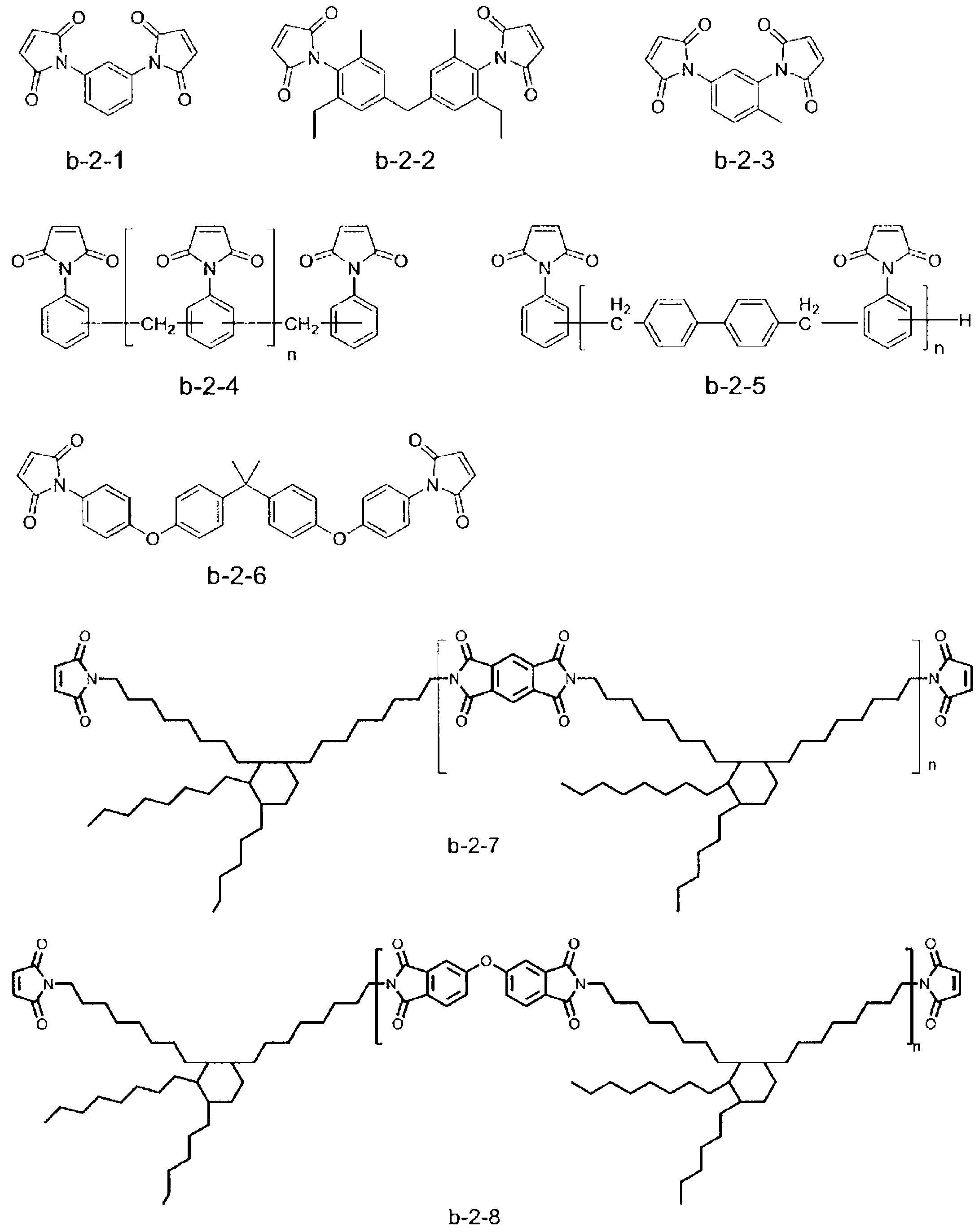
式(b-2-4)、(b-2-5)、(b-2-7)および(b-2-8)中、nは独立して、1~50の整数である。
前記アリル化合物としては、例えば、下記式(b-3-1)~(b-3-6)で表される化合物が挙げられる。但し、本発明においてアリル化合物はこれらの例示化合物に限定されることはない。

前記アクリル化合物としては、例えば、下記式(b-4-1)~(b-4-7)で表される化合物が挙げられる。但し、本発明においてアクリル化合物はこれらの例示化合物に限定されることはない。
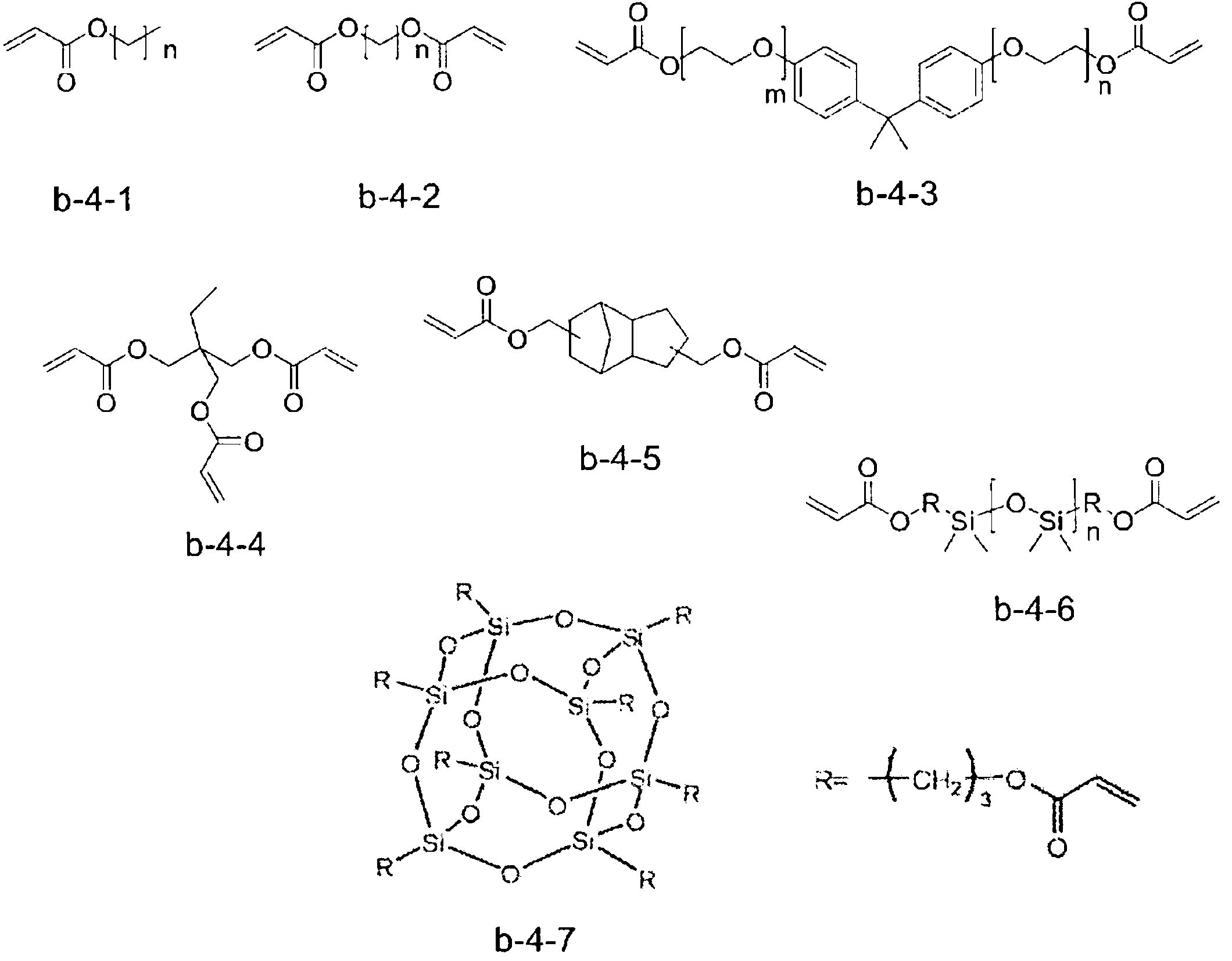
式(b-4-1)、(b-4-2)、(b-4-3)および式(b-4-6)中、nは独立して、1~50の整数である。式(b-4-3)中、mは1~50の整数である。式(b-4-6)中、Rは炭素数1~20の2価の炭化水素基である。
前記メタクリル化合物としては、特に制限はなく、例えば、ビスフェノールA型エポキシメタクリレート、フェノールノボラック型エポキシメタクリレート、トリメチロールプロパンメタクリレート、ジペンタエリスリトールヘキサメタクリレート、SA-9000(Sabic社製)などが挙げられる。
前記チオール化合物としては、特に制限はなく、例えば、1,4-ビス(3-メルカプトブチリルオキシ)ブタン、1,3,5-トリス(2-(3-スルファニルブタノイルオキシ)エチル)-1,3,5-トリアジナン-2,4,6-トリオン、2-(ジブチルアミノ)-1,3,5-トリアジン-4,6-ジチオール、6-ジアリルアミノ-1,3,5-トリアジン-2,4-ジチオールなどが挙げられる。
前記シラン化合物としては、特に制限はなく、例えば、KF-99(信越化学工業(株)製)、KF-9901(信越化学工業(株)製)などが挙げられる。
前記オキサジン化合物としては、例えば、下記式(b-5-1)~(b-5-5)で表される化合物が挙げられる。但し、本発明においてオキサジン化合物はこれらの例示化合物に限定されることはない。
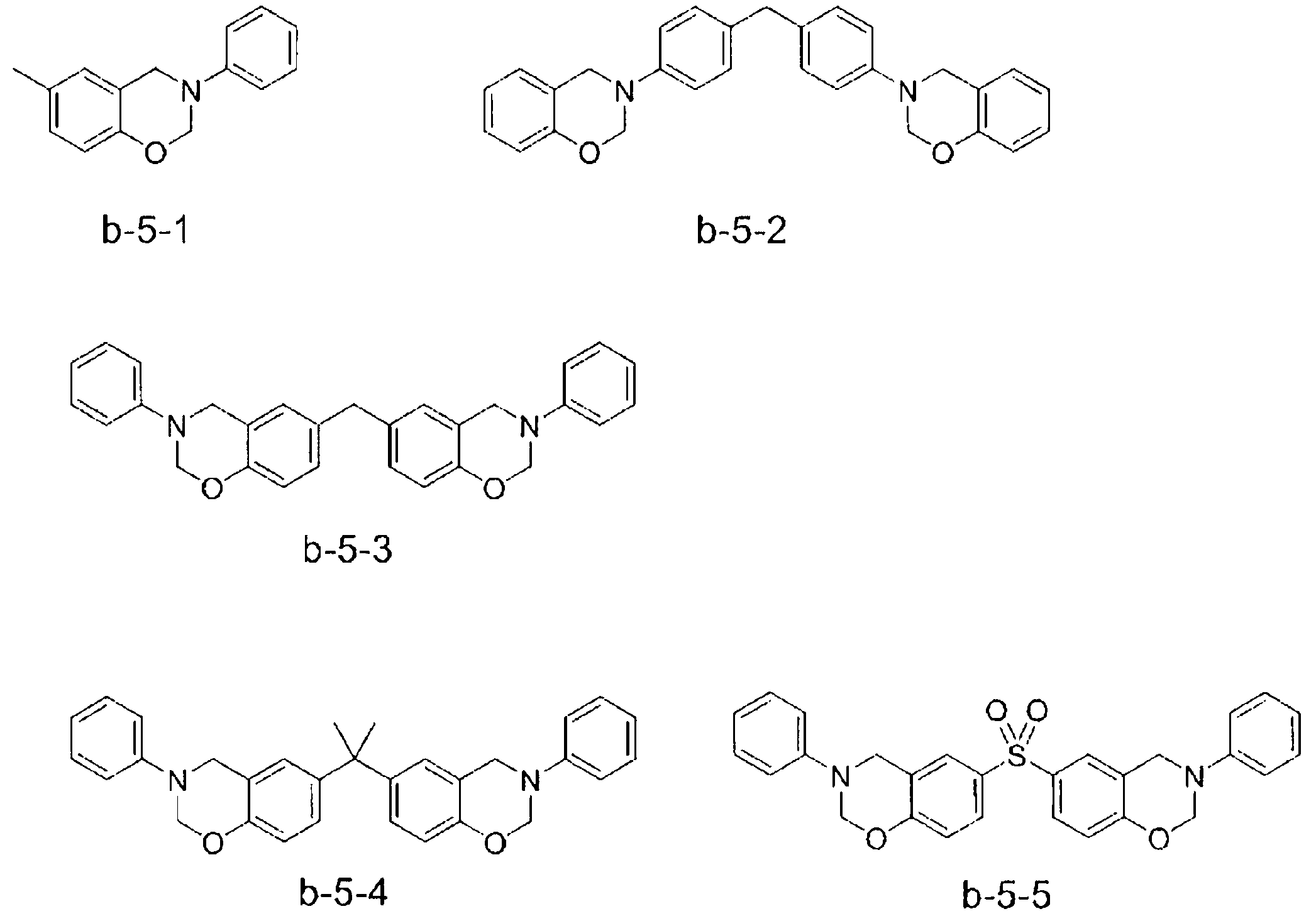
前記シアネート化合物としては、例えば、下記式(b-6-1)~(b-6-7)で表される化合物が挙げられる。但し、本発明においてシアネート化合物はこれらの例示化合物に限定されることはない。
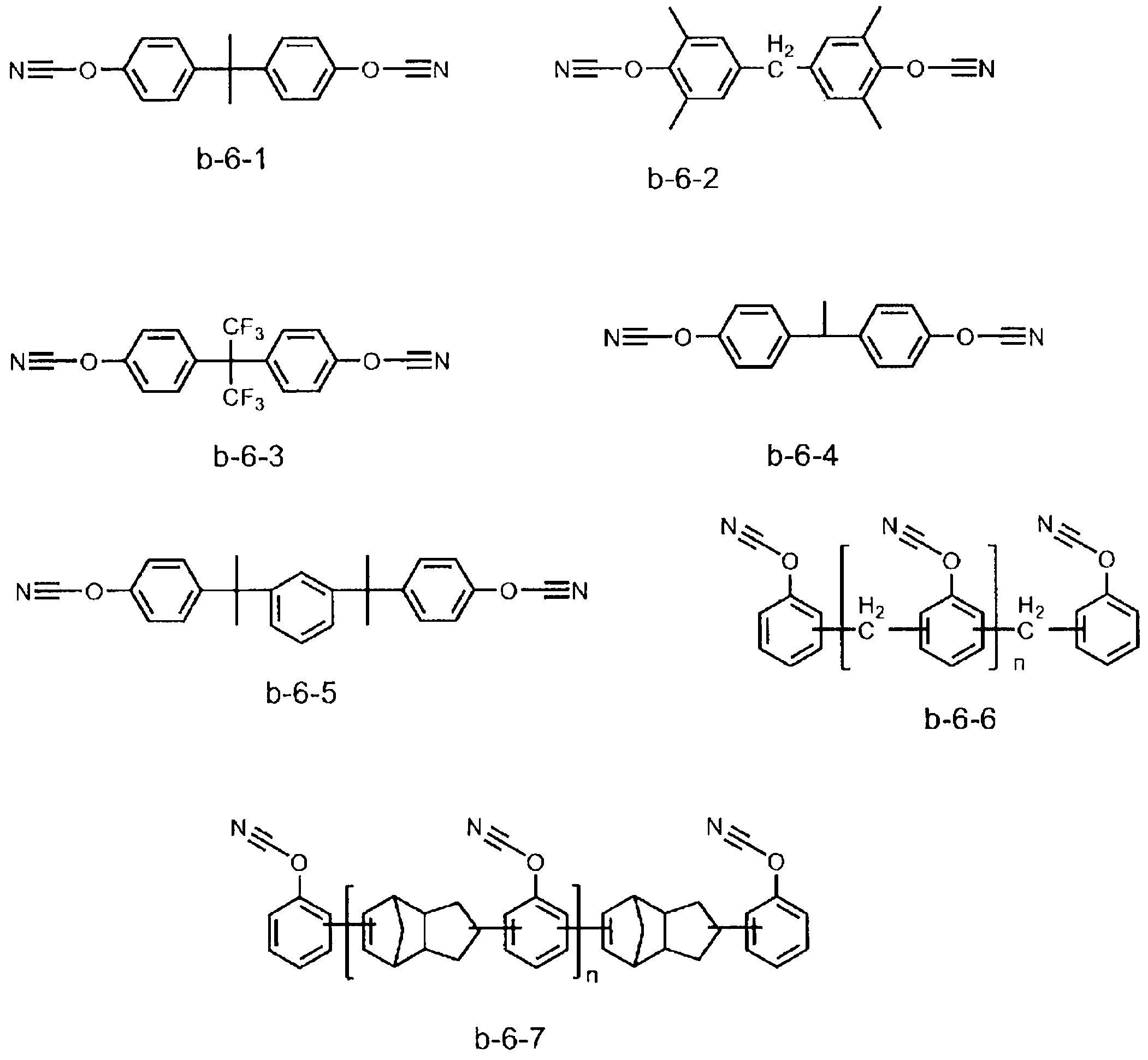
式(b-6-6)および(b-6-7)中、nは独立して、0~30の整数である。
前記エポキシ化合物としては、特に制限はなく、例えば、下記式(b-7-1)~(b-7-5)で表される化合物が挙げられる。
前記エポキシ化合物としては、例えば、ジシクロペンタジエン・フェノール重合物のポリグリシジルエーテル、フェノールノボラック型液状エポキシ化合物、クレゾールノボラック型エポキシ化合物、スチレン-ブタジエンブロック共重合体のエポキシ化物、3',4'-エポキシシクロヘキシルメチル-3,4-エポキシシクロヘキサンカルボキシレート、XER-81(JSR(株)製、エポキシ基含有NBR粒子)、JP-100(日本曹達(株)製)等も挙げられる。
前記エポキシ化合物としては、例えば、ジシクロペンタジエン・フェノール重合物のポリグリシジルエーテル、フェノールノボラック型液状エポキシ化合物、クレゾールノボラック型エポキシ化合物、スチレン-ブタジエンブロック共重合体のエポキシ化物、3',4'-エポキシシクロヘキシルメチル-3,4-エポキシシクロヘキサンカルボキシレート、XER-81(JSR(株)製、エポキシ基含有NBR粒子)、JP-100(日本曹達(株)製)等も挙げられる。
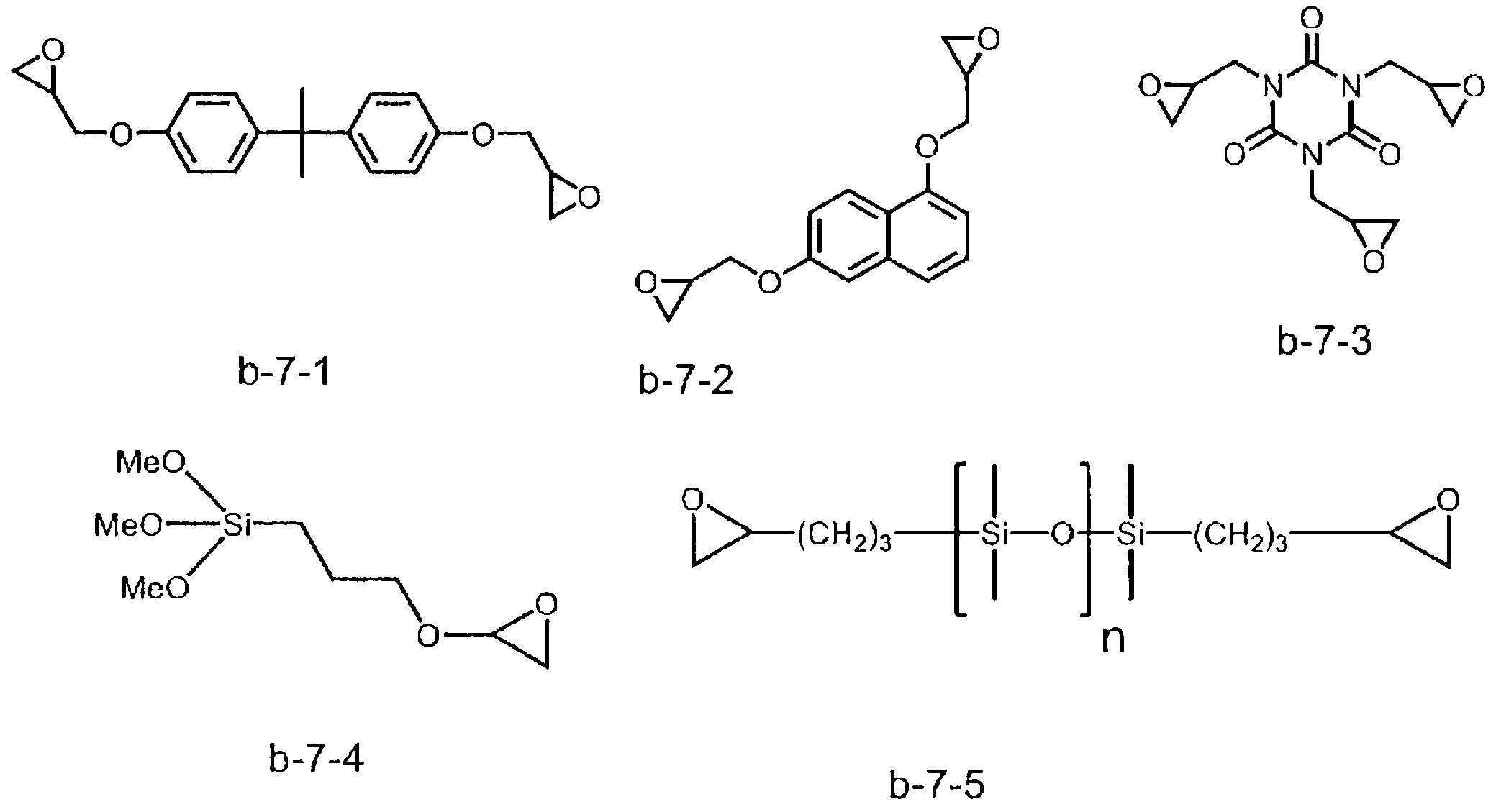
式(b-7-5)中、nは0~5000の整数である。
前記オキセタン化合物としては、例えば、下記式(b-8-1)~(b-8-3)で表される化合物が挙げられる。但し、本発明においてオキセタン化合物はこれらの例示化合物に限定されることはない。
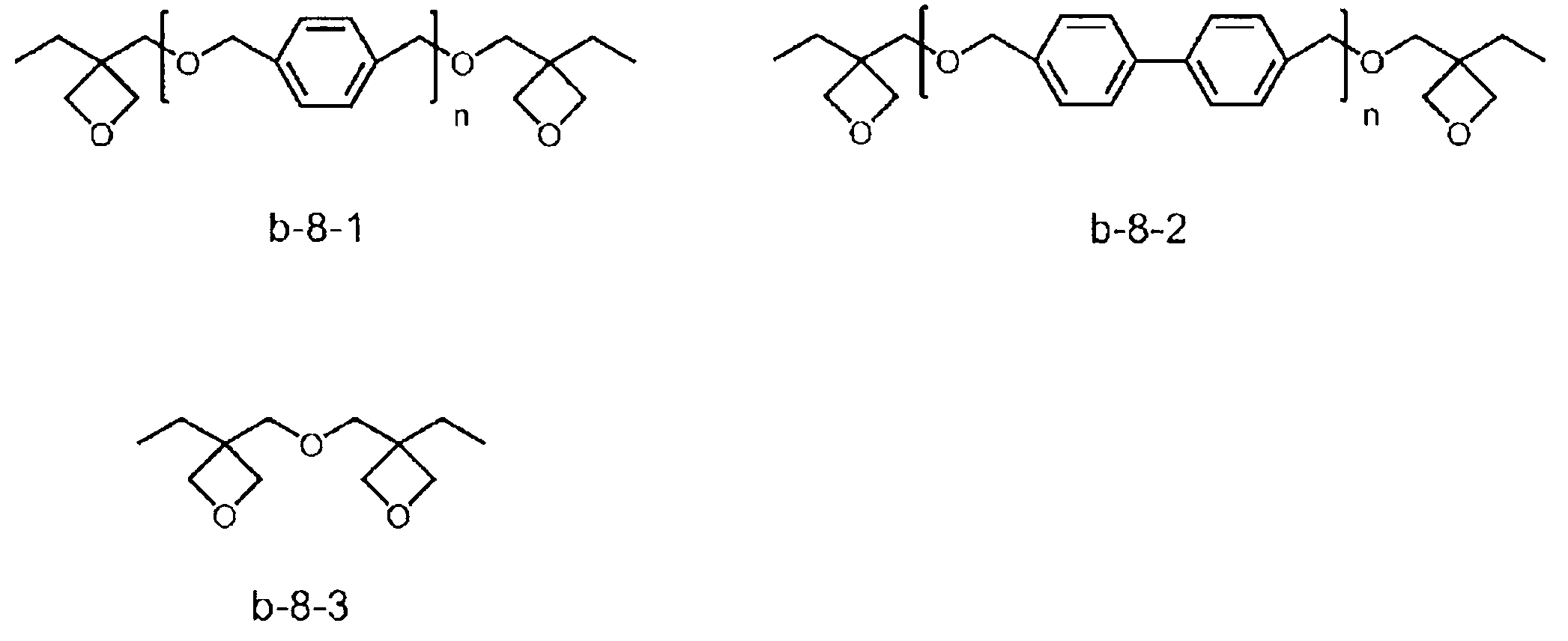
式(b-8-1)および(b-8-2)中、nはそれぞれ独立に、0~30の整数である。
前記メチロール化合物としては、特に制限はなく、例えば、特開2006-178059号公報および特開2012-226297号公報に記載のメチロール化合物が挙げられる。具体的には、例えば、ポリメチロール化メラミン、ヘキサメトキシメチルメラミン、ヘキサエトキシメチルメラミン、ヘキサプロポキシメチルメラミン、ヘキサブトキシメチルメラミン等のメラミン系メチロール化合物;ポリメチロール化グリコールウリル、テトラメトキシメチルグリコールウリル、テトラブトキシメチルグリコールウリル等のグリコールウリル系メチロール化合物;3,9-ビス[2-(3,5-ジアミノ-2,4,6-トリアザフェニル)エチル]-2,4,8,10-テトラオキソスピロ[5.5]ウンデカン、3,9-ビス[2-(3,5-ジアミノ-2,4,6-トリアザフェニル)プロピル]-2,4,8,10-テトラオキソスピロ[5.5]ウンデカン等のグアナミンをメチロール化した化合物、および当該化合物中の活性メチロール基の全部または一部をアルキルエーテル化した化合物等のグアナミン系メチロール化合物が挙げられる。
前記ベンゾシクロブテン化合物としては、特に制限はなく、例えば、特開2005-60507号公報に記載の化合物が挙げられる。
前記プロパルギル化合物としては、例えば、下記式(b-9-1)~(b-9-2)で表される化合物が挙げられる。但し、本発明においてプロパルギル化合物はこれらの例示化合物に限定されることはない。
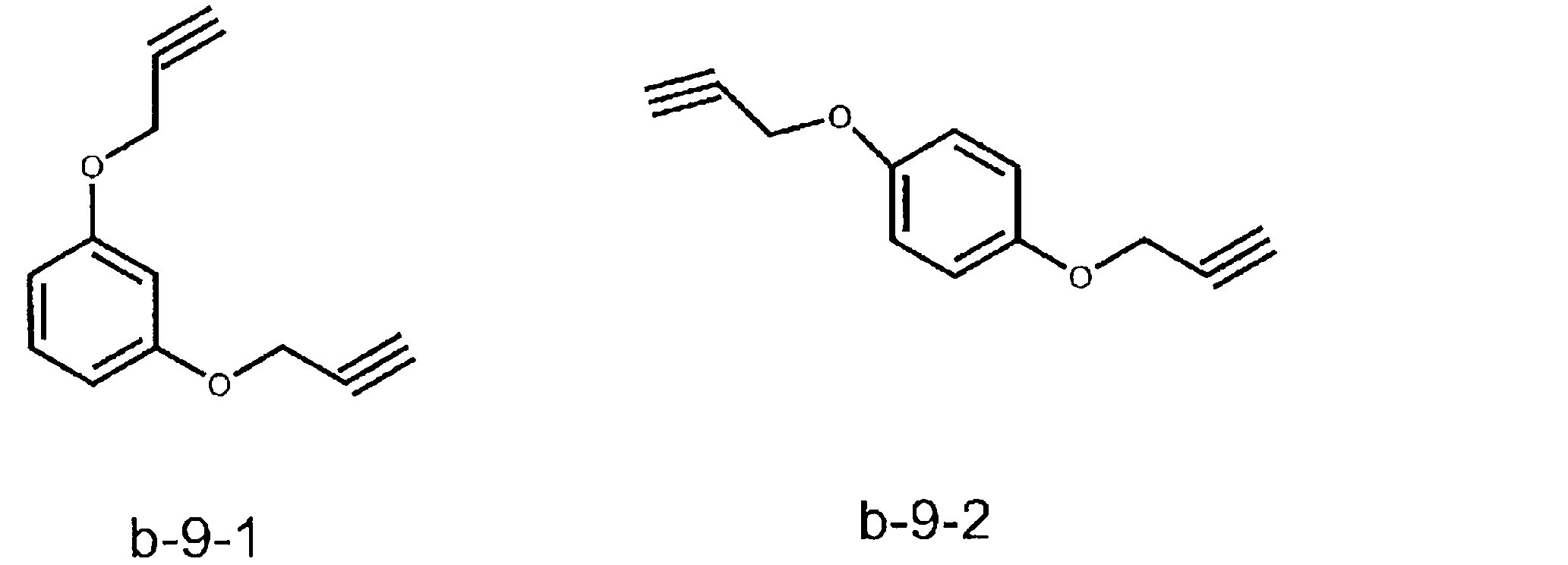
[硬化性化合物(C)の含有割合]
熱硬化性樹脂組成物における化合物(C)の含有割合は、硬化性樹脂組成物中の固形分全体を100質量%とした場合に、好ましくは0.05質量%以上、より好ましくは10質量%以上、更に好ましくは20質量%以上であり、好ましくは90質量%以下、より好ましくは80質量%以下、更に好ましくは50質量%以下である。
硬化性化合物(C)の含有割合が前記範囲にあると、熱硬化性樹脂組成物から得られる硬化物の強度、耐熱性をより向上させることができる等の点から好ましい。
熱硬化性樹脂組成物における化合物(C)の含有割合は、硬化性樹脂組成物中の固形分全体を100質量%とした場合に、好ましくは0.05質量%以上、より好ましくは10質量%以上、更に好ましくは20質量%以上であり、好ましくは90質量%以下、より好ましくは80質量%以下、更に好ましくは50質量%以下である。
硬化性化合物(C)の含有割合が前記範囲にあると、熱硬化性樹脂組成物から得られる硬化物の強度、耐熱性をより向上させることができる等の点から好ましい。
また、熱硬化性樹脂組成物中の重合体(A)および共重合体(B)の固形分の合計を100質量%とした場合に、硬化性化合物(C)の含有割合の下限値は、好ましくは1質量%以上、より好ましくは5質量%以上、さらに好ましくは10質量%以上であり、硬化性化合物(C)の含有割合の上限値は、好ましくは99質量%以下、より好ましくは95質量%以下、さらに好ましくは90質量%以下である。
硬化性化合物(C)の含有割合が前記範囲にあると、得られる硬化物の靱性、耐熱性をより向上させることができる等の点から好ましい。
硬化性化合物(C)の含有割合が前記範囲にあると、得られる硬化物の靱性、耐熱性をより向上させることができる等の点から好ましい。
<<重合開始剤(D)>>
熱硬化性樹脂組成物は重合開始剤(D)を含有していてもよい。
重合開始剤(D)としては、特に制限はなく、熱硬化性樹脂組成物に用いられる公知の重合開始剤が挙げられる。重合開始剤(D)としては、例えば、熱または光ラジカル重合開始剤、カチオン硬化剤、アニオン硬化剤等の重合開始剤が挙げられる。
熱硬化性樹脂組成物は重合開始剤(D)を含有していてもよい。
重合開始剤(D)としては、特に制限はなく、熱硬化性樹脂組成物に用いられる公知の重合開始剤が挙げられる。重合開始剤(D)としては、例えば、熱または光ラジカル重合開始剤、カチオン硬化剤、アニオン硬化剤等の重合開始剤が挙げられる。
熱または光ラジカル重合開始剤としては、例えば、ジクミルパーオキサイド、1,1-ジ(t-ブチルパーオキシ)シクロヘキサン、ジ(t-ブチルパーオキシイソプロピル)ベンゼン、2,5-ジメチル-2,5-ジ(t-ブチルパーオキシ)ヘキシン-3、過酸化ベンゾイル等の有機過酸化物;アゾビスブチロニトリル、1,1'-アゾビス(1-アセトキシ-1-フェニルエタン)]、2,2'-アゾビス(2,4-ジメチルバレロニトリル)、1,1'-アゾビス(シクロヘキサン-1-カルボニトリル)、ジメチル-2,2'-アゾビス(イソブチレート)、2,2'-アゾビス(2-メチルブチロニトリル)等のアゾ化合物が挙げられる。
カチオン硬化剤としては、例えば、(株)ADEKA製のSP70、SP172、CP66;日本曹達(株)製の「CI2855」、「CI2823」;三新化学工業(株)製の「SI100」、「SI150」;等の、BF4、PF6、SbF6などを対アニオンとするジアリルヨ-ドニウム塩、トリアルキルスルホニウム塩、ブチルトリフェニルホスホニウムチオシアネートなどのホスホニウム塩、三フッ化ホウ素などが挙げられる。
アニオン硬化剤としては、例えば、2-メチルイミダゾール、2-エチル-4-メチルイミダゾール、2-ウンデシルイミダゾール、2-ヘプタデシルイミダゾール、2-フェニルイミダゾール、1-ベンジル-2-メチルイミダゾール、1-シアノエチル-2-メチルイミダゾール、1-シアノエチル-2-エチル-4-メチルイミダゾール、2-メチルイミダゾリウムイソシアヌレート、2,4-ジアミノ-6-[2-メチルイミダゾリン-(1)]-エチル-S-トリアジン、2,4-ジアミノ-6-[2-エチル-4-メチルイミダゾリン-(1)]-エチル-S-トリアジン等のイミダゾール化合物;トリフェニルホスフィン等のリン化合物;4,4'-ジアミノジフェニルメタン等のアミン化合物などが挙げられる。
また、硬化性化合物(C)としてシラン化合物を用いる場合における硬化助剤としては、例えば、白金黒、塩化第2白金、塩化白金酸、塩化白金酸と一価アルコールとの反応物、塩化白金酸とオレフィン類との錯体、白金ビスアセトアセテート等の白金系触媒;パラジウム系触媒;ロジウム系触媒;等の白金族金属触媒、安息香酸亜鉛、オクチル酸亜鉛が挙げられる。
硬化性化合物(C)としてオキサジン化合物を用いる場合における硬化助剤としては、例えば、フェノールおよびその誘導体、シアン酸エステル、p-トルエンスルホン酸等のブレンステッド酸、アジピン酸、p-トルエンスルホン酸エステル、4,4'-ジアミノジフェニルスルホン、メラミン等の芳香族アミン化合物、2-エチル-4-メチルイミダゾール等の塩基、三フッ化ホウ素、ルイス酸等の硬化剤が挙げられる。
熱硬化性樹脂組成物が硬化助剤を含有する場合、該硬化助剤の含有割合は、組成物が良好に硬化して、硬化物が得られる範囲であることが好ましい。具体的には、重合体(A)および共重合体(B)の固形分の合計100質量部に対して、好ましくは0.000001質量部以上、より好ましくは0.001質量部以上であり、好ましくは20質量部以下、より好ましくは10質量部以下である。
<<有機溶剤(E)>>
熱硬化性樹脂組成物は、有機溶剤(E)を更に含有することが好ましく、上記硬化性化合物(C)および有機溶剤(E)を更に含有することがより好ましい。
有機溶剤(E)としては、例えば、N,N-ジメチルホルムアミド等のアミド系溶剤、γ-ブチロラクトン、酢酸ブチル等のエステル系溶剤、シクロペンタノン、シクロヘキサノン、メチルエチルケトン、2-ヘプタノン等のケトン系溶剤、1,2-メトキシエタン、アニソール、テトラヒドロフラン等のエーテル系溶剤、1-メトキシ-2-プロパノール、プロピレングリコールメチルエーテルアセテート等の多官能性溶剤、ジメチルスルホキシド等のスルホン系溶剤、塩化メチレン、ベンゼン、トルエン、キシレン、トリアルコキシベンゼン(アルコキシ基の炭素数;1~4)が挙げられる。
熱硬化性樹脂組成物は、有機溶剤(E)を更に含有することが好ましく、上記硬化性化合物(C)および有機溶剤(E)を更に含有することがより好ましい。
有機溶剤(E)としては、例えば、N,N-ジメチルホルムアミド等のアミド系溶剤、γ-ブチロラクトン、酢酸ブチル等のエステル系溶剤、シクロペンタノン、シクロヘキサノン、メチルエチルケトン、2-ヘプタノン等のケトン系溶剤、1,2-メトキシエタン、アニソール、テトラヒドロフラン等のエーテル系溶剤、1-メトキシ-2-プロパノール、プロピレングリコールメチルエーテルアセテート等の多官能性溶剤、ジメチルスルホキシド等のスルホン系溶剤、塩化メチレン、ベンゼン、トルエン、キシレン、トリアルコキシベンゼン(アルコキシ基の炭素数;1~4)が挙げられる。
有機溶剤(E)の含有割合は、特に制限はなく、目的に応じて適宜変更することができる。例えば、重合体(A)、共重合体(B)および硬化性化合物(C)の固形分の合計100質量部に対して、好ましくは0質量部以上2000質量部以下、より好ましくは0質量部以上1000質量部以下である。
また、有機溶剤(E)に対し、重合体(A)や共重合体(B)および硬化性化合物(C)の溶解性が高い場合には、有機溶剤(E)の含有割合は、50質量部以上200質量部以下としてもよい。
また、有機溶剤(E)に対し、重合体(A)や共重合体(B)および硬化性化合物(C)の溶解性が高い場合には、有機溶剤(E)の含有割合は、50質量部以上200質量部以下としてもよい。
<<フィラー(F)>>
熱硬化性樹脂組成物はフィラー(F)を含有していてもよい。フィラー(F)は特に制限はなく、無機フィラーであってもよいし、有機フィラーであってもよい。
前記無機フィラーとしては、特に制限はなく、例えば、天然シリカ、溶融シリカ、アモルファスシリカ等のシリカ類、ホワイトカーボン、チタンホワイト、アエロジル、アルミナ、タルク、天然マイカ、合成マイカ、クレー、硫酸バリウム、E-ガラス、A-ガラス、C-ガラス、L-ガラス、D-ガラス、S-ガラス、S-ガラス、M-ガラスG20などが挙げられる。
無機フィラーは、表面処理されていてもよい。表面処理剤としては特に制限はなく、公知の表面処理剤を用いることができる。表面処理剤としては、例えば、シランカップリング剤などが挙げられる。
熱硬化性樹脂組成物はフィラー(F)を含有していてもよい。フィラー(F)は特に制限はなく、無機フィラーであってもよいし、有機フィラーであってもよい。
前記無機フィラーとしては、特に制限はなく、例えば、天然シリカ、溶融シリカ、アモルファスシリカ等のシリカ類、ホワイトカーボン、チタンホワイト、アエロジル、アルミナ、タルク、天然マイカ、合成マイカ、クレー、硫酸バリウム、E-ガラス、A-ガラス、C-ガラス、L-ガラス、D-ガラス、S-ガラス、S-ガラス、M-ガラスG20などが挙げられる。
無機フィラーは、表面処理されていてもよい。表面処理剤としては特に制限はなく、公知の表面処理剤を用いることができる。表面処理剤としては、例えば、シランカップリング剤などが挙げられる。
熱硬化性樹脂組成物が無機充填剤を含有する場合、該無機充填剤の含有割合は、例えば、重合体(A)および共重合体(B)の固形分の合計100質量部に対して、好ましくは0.1質量部以上300質量部以下である。また、無機充填剤は、重合体(A)によって溶媒中に分散した状態であってもよい。
前記有機フィラーとしては、ポリテトラフルオロエチレン(PTFE)、ポリパーフルオロアルコキシ樹脂、ポリフッ化エチレンプロピレン樹脂、ポリテトラフルオロエチレン-ポリエチレン共重合体等のフッ素系樹脂またはフッ素系粒子、ポリスチレン樹脂または粒子、ポリブタジエン、スチレンブタジエン樹脂等のゴム状樹脂または粒子、ジビニルベンゼンやジビニルビフェニルをシェルとする中空状粒子が挙げられる。
熱硬化性樹脂組成物が有機フィラーを含有する場合、該有機フィラーの含有割合は、例えば、重合体(A)および共重合体(B)の固形分の合計100質量部に対して、好ましくは0.1質量部以上300質量部以下である。有機フィラーは、重合体(A)によって溶媒中に分散した状態であってもよい。
<<添加剤>>
熱硬化性樹脂組成物は、重合体(A)、共重合体(B)、硬化性化合物(C)、重合開始剤(D)、有機溶剤(E)およびフィラー(F)以外の成分(以下、「その他の成分」ともいう。)を種々の機能を付与する目的で含んでいてもよい。その他の成分としては、酸化防止剤、難燃剤、密着助剤などの添加剤が挙げられる。
酸化防止剤としては、例えば、ヒンダードフェノール系化合物、リン系化合物、硫黄系化合物、金属系化合物、ヒンダードアミン系化合物が挙げられる。これらの中でも、酸化防止剤としてはヒンダードフェノール系化合物が好ましい。
熱硬化性樹脂組成物は、重合体(A)、共重合体(B)、硬化性化合物(C)、重合開始剤(D)、有機溶剤(E)およびフィラー(F)以外の成分(以下、「その他の成分」ともいう。)を種々の機能を付与する目的で含んでいてもよい。その他の成分としては、酸化防止剤、難燃剤、密着助剤などの添加剤が挙げられる。
酸化防止剤としては、例えば、ヒンダードフェノール系化合物、リン系化合物、硫黄系化合物、金属系化合物、ヒンダードアミン系化合物が挙げられる。これらの中でも、酸化防止剤としてはヒンダードフェノール系化合物が好ましい。
ヒンダードフェノール系化合物としては、分子量500以上の化合物が好ましい。分子量500以上のヒンダードフェノール系化合物としては、例えば、トリエチレングリコール-ビス[3-(3-t-ブチル-5-メチル-4-ヒドロキシフェニル)プロピオネート]、1,6-ヘキサンジオール-ビス[3-(3,5-ジ-t-ブチル-4-ヒドロキシフェニル)プロピオネート]、2,4-ビス-(n-オクチルチオ)-6-(4-ヒドロキシ-3,5-ジ-t-ブチルアニリノ)-3,5-トリアジン、ペンタエリスリトールテトラキス[3-(3,5-t-ブチル-4-ヒドロキシフェニル)プロピオネート]、1,1,3-トリス[2-メチル-4-〔3-(3,5-ジ-t-ブチル-4-ヒドロキシフェニル)プロピオニルオキシ〕-5-t-ブチルフェニル]ブタン、2,2-チオ-ジエチレンビス[3-(3,5-ジ-t-ブチル-4-ヒドロキシフェニル)プロピオネート]、オクタデシル-3-(3,5-ジ-t-ブチル-4-ヒドロキシフェニル)プロピオネート、N,N-ヘキサメチレンビス(3,5-ジ-t-ブチル-4-ヒドロキシ-ヒドロシンナマミド)、1,3,5-トリメチル-2,4,6-トリス(3,5-ジ-t-ブチル-4-ヒドロキシベンジル)ベンゼン、トリス-(3,5-ジ-t-ブチル-4-ヒドロキシベンジル)-イソシアヌレート、3,9-ビス[2-〔3-(3-t-ブチル-4-ヒドロキシ-5-メチルフェニル)プロピオニルオキシ〕-1,1-ジメチルエチル]-2,4,8,10-テトラオキサスピロ[5.5]ウンデカン、2,6-di-tert-butyl-p-cresol(BHT)、1,3,5-tris(3,5-di-tert-butyl-4-hydroxybenzyl)-1,3,5-triazine-2,4,6(1H,3H,5H)-trione[(株)ADEKA製、AO-020]、4,4',4''-(1-methylpropanyl-3-ylidene)tris(6-tert-butyl-m-cresol)[(株)ADEKA製、AO-030]、6,6'-di-tert-butyl-4,4'-butylidenedi-m-cresol[(株)ADEKA製、AO-040],1,3,5-tris(3,5-di-tert-butyl-4-hydroxyphenylmethyl)-2,4,6-trimethylbenzene[(株)ADEKA製、AO-330]が挙げられる。
ヒンダードアミン系化合物としては、例えば、2,2,6,6-テトラメチル-4-ヒドロキシピペリジン-1-オキシル[(株)ADEKA製、アデカスタブ LA-7RD]、IRGASTABUV 10(4,4'-[1,10-ジオキソ-1,10-デカンジイル)ビス(オキシ)]ビス[2,2,6,6-テトラメチル]-1-ピペリジニルオキシ)(CAS.2516-92-9)、TINUVIN123(4-ヒドロキシ-2,2,6,6,-テトラメチルピペリジン-N-オキシル)(以上、BASF社製)、FA-711HM、FA-712HM(2,2,6,6-テトラメチルピペリジニルメタクリレート、昭和電工マテリアルズ(株)製)、TINUVIN111FDL、TINUVIN 144、TINUVIN 152、TINUVIN 292、TINUVIN 765、TINUVIN 770DF、TINUVIN 5100、SANOLLS-2626、CHIMASSORB 119FL、CHIMASSORB 2020 FDL、CHIMASSORB 944 FDL、TINUVIN 622 LD(以上、BASF社製)、LA-52、LA-57、LA-62、LA-63P、LA-68LD、LA-77Y、LA-77G、LA-81、LA-82(1,2,2,6,6-ペンタメチル-4-ピペリジルメタクリレート)、LA-87(以上、(株)ADEKA製)が挙げられる。
熱硬化性樹脂組成物が上記添加剤を含有する場合、添加剤の含有割合は、重合体(A)および共重合体(B)の固形分の合計100質量部に対して、好ましくは0.001質量部以上10質量部以下である。
〔熱硬化性樹脂組成物の調製方法〕
熱硬化性樹脂組成物は、例えば、重合体(A)、共重合体(B)、硬化性化合物(C)、重合開始剤(D)、有機溶剤(E)およびフィラー(F)および、前記その他の成分を均一に混合することで調製することができる。この場合、各成分を混合する順番や、混合条件等は特に制限されず、また、混合に際し、従来公知の混合機を使用することができる。
熱硬化性樹脂組成物は、例えば、重合体(A)、共重合体(B)、硬化性化合物(C)、重合開始剤(D)、有機溶剤(E)およびフィラー(F)および、前記その他の成分を均一に混合することで調製することができる。この場合、各成分を混合する順番や、混合条件等は特に制限されず、また、混合に際し、従来公知の混合機を使用することができる。
<硬化物>
本発明に係る硬化物は、上記熱硬化性樹脂組成物からなる。硬化物は、上記熱硬化性樹脂組成物を硬化させて得られる硬化体である。
硬化物は、例えば、熱硬化性樹脂組成物から溶剤を乾燥させて得られる熱硬化性樹脂組成物の部分硬化物であってもよい。
熱硬化性樹脂組成物の硬化方法は特に限定されず、公知の硬化方法を用いることができ、通常、加熱により熱硬化させる方法や、光の照射により光硬化させる方法などが挙げられる。なお、硬化方法は複数の硬化方法を併用してもよい。
本発明に係る硬化物は、上記熱硬化性樹脂組成物からなる。硬化物は、上記熱硬化性樹脂組成物を硬化させて得られる硬化体である。
硬化物は、例えば、熱硬化性樹脂組成物から溶剤を乾燥させて得られる熱硬化性樹脂組成物の部分硬化物であってもよい。
熱硬化性樹脂組成物の硬化方法は特に限定されず、公知の硬化方法を用いることができ、通常、加熱により熱硬化させる方法や、光の照射により光硬化させる方法などが挙げられる。なお、硬化方法は複数の硬化方法を併用してもよい。
熱硬化させる場合、加熱温度は、好ましくは50℃以上、より好ましくは100℃以上、更に好ましくは120℃以上であり、好ましくは250℃以下、より好ましくは220℃以下である。加熱時間は、好ましくは0.1時間以上、より好ましくは0.5時間以上であり、好ましくは36時間以下、より好ましくは5時間以下である。
光硬化させる場合、照射する光としては、例えば、可視光、紫外線、近赤外線、遠赤外線が挙げられる。
光硬化させる場合、照射する光としては、例えば、可視光、紫外線、近赤外線、遠赤外線が挙げられる。
<<ガラス転移温度(Tg)>>
硬化物のガラス転移温度(Tg)の下限は、好ましくは100℃、より好ましくは110℃であり、上限は、例えば300℃である。Tgが前記範囲にあることで、溶融成形をより容易に行うことができ、また、耐熱性に優れる硬化物を容易に得ることができる。
ガラス転移温度(Tg)は、後述する実施例に記載された測定方法により求められる。
硬化物のガラス転移温度(Tg)の下限は、好ましくは100℃、より好ましくは110℃であり、上限は、例えば300℃である。Tgが前記範囲にあることで、溶融成形をより容易に行うことができ、また、耐熱性に優れる硬化物を容易に得ることができる。
ガラス転移温度(Tg)は、後述する実施例に記載された測定方法により求められる。
硬化物の誘電正接(tanδ)は、伝送損失を低減する等の点から、好ましくは0.0025以下、より好ましくは0.0018以下、さらに好ましくは0.0015以下であり、その下限は特に制限されないが、好ましくは0.0005以上である。
該誘電正接は、具体的には、後述する実施例に記載の方法で測定し求められる。
該誘電正接は、具体的には、後述する実施例に記載の方法で測定し求められる。
硬化物の形状は特に限定されず、用途や目的等に応じて適した形状を適宜選択することができる。硬化物の形状としては、例えば、フィルム状、板状、棒状などが挙げられる。例えば、熱硬化性樹脂組成物を溶融成形またはキャスト成形することによって、フィルム状の硬化物が得られる。
前記硬化物の厚みは特に制限されず、所望の用途に応じて適宜選択することができる。厚みとしては、例えば10μm以上、好ましくは30μm以上であり、例えば2mm以下、好ましくは1mm以下である。
また、上記硬化物の層(硬化物層)と、基板と、を備えた積層体としてもよい。
積層体は、2層以上の基板を備えていてもよく、2層以上の硬化物層を備えていてもよく、基板と硬化物層以外の従来公知の他の層等を有していてもよい。積層体は、基板と硬化物層とが接していてもよいし、基板と硬化物層との間に他の層を備えていてもよい。積層体が、2層以上の基板や硬化物層、他の層を有する場合、これらはそれぞれ同一の層(板)であってもよく、異なる層(板)であってもよい。
積層体は、2層以上の基板を備えていてもよく、2層以上の硬化物層を備えていてもよく、基板と硬化物層以外の従来公知の他の層等を有していてもよい。積層体は、基板と硬化物層とが接していてもよいし、基板と硬化物層との間に他の層を備えていてもよい。積層体が、2層以上の基板や硬化物層、他の層を有する場合、これらはそれぞれ同一の層(板)であってもよく、異なる層(板)であってもよい。
前記基板としては、接着性や実用上の観点から、無機基板、金属基板、樹脂基板等が挙げられる。また、後述するプリプレグを基板としてもよい。
前記無機基板としては、例えば、シリコン、シリコンカーバイト、窒化シリコン、アルミナ、ガラス、窒化ガリウム等を成分として有する無機基板が挙げられる。
前記金属基板としては、例えば、銅、アルミニウム、金、銀、ニッケル、パラジウム等を成分とする金属基板が挙げられる。金属基板の形状としては、特に制限はなく、板状、金属箔などであってもよい。
本発明に係る銅張積層板は、後述するプリプレグと銅基板との積層体であり、後述するプリプレグと銅箔との積層体であることが好ましい。
前記樹脂基板としては、例えば、液晶ポリマー、ポリイミド、ポリフェニレンスルフィド、ポリエーテルエーテルケトン、ポリアミド(ナイロン)、ポリエチレンテレフタレート、ポリエチレンナフタレート、シクロオレフィンポリマー、ポリオレフィン等を成分とする樹脂基板が挙げられる。
前記無機基板としては、例えば、シリコン、シリコンカーバイト、窒化シリコン、アルミナ、ガラス、窒化ガリウム等を成分として有する無機基板が挙げられる。
前記金属基板としては、例えば、銅、アルミニウム、金、銀、ニッケル、パラジウム等を成分とする金属基板が挙げられる。金属基板の形状としては、特に制限はなく、板状、金属箔などであってもよい。
本発明に係る銅張積層板は、後述するプリプレグと銅基板との積層体であり、後述するプリプレグと銅箔との積層体であることが好ましい。
前記樹脂基板としては、例えば、液晶ポリマー、ポリイミド、ポリフェニレンスルフィド、ポリエーテルエーテルケトン、ポリアミド(ナイロン)、ポリエチレンテレフタレート、ポリエチレンナフタレート、シクロオレフィンポリマー、ポリオレフィン等を成分とする樹脂基板が挙げられる。
前記硬化物層の形成方法としては、特に制限はなく、例えば、前記硬化物の欄に記載の硬化方法が挙げられる。
前記硬化物層の厚みは特に限定されないが、例えば、1μm~3mmである。
前記硬化物層の厚みは特に限定されないが、例えば、1μm~3mmである。
<<プリプレグ>>
本発明に係るプリプレグは、繊維状基材板に上記熱硬化性樹脂組成物を含浸させてなる。
基材としては、特に制限はなく、例えば、ガラスクロス、アラミド不織布、ポリエステル不織布等の繊維状基材が好適に挙げられる。プリプレグは、硬化させたプリプレグであってもよい。
本発明に係るプリプレグは、繊維状基材板に上記熱硬化性樹脂組成物を含浸させてなる。
基材としては、特に制限はなく、例えば、ガラスクロス、アラミド不織布、ポリエステル不織布等の繊維状基材が好適に挙げられる。プリプレグは、硬化させたプリプレグであってもよい。
<<用途>>
熱硬化性樹脂組成物および硬化物は、航空機産業や自動車産業等の輸送機産業で用いられる構造用材料、電気電子産業で用いられる電気電子材料等に好適に用いることができる。具体的には、例えば、電気電子部品の封止材、層間絶縁膜(フィルム)、応力緩和用プライマー;積層板用途(例:プリプレグ、銅張り積層板、(多層)プリント配線基板、層間接着剤、ソルダレジスト、ソルダペースト);接着剤用途(例:絶縁層形成用接着シート、熱伝導性接着剤、接着シート);各種構造材料に用いる構造接着剤・プリプレグ;各種コーティング、光学部品用途(例:波長板、位相差板等の光学フィルム、円錐レンズ、球面レンズ、円筒レンズ等の各種特殊レンズ、レンズアレイ)、プリント配線板用絶縁性フィルムに好適に利用することができる。特に、上記熱硬化性樹脂組成物を備える層間絶縁フィルムは、低誘電正接、接着性および耐熱性に優れる。
熱硬化性樹脂組成物および硬化物は、航空機産業や自動車産業等の輸送機産業で用いられる構造用材料、電気電子産業で用いられる電気電子材料等に好適に用いることができる。具体的には、例えば、電気電子部品の封止材、層間絶縁膜(フィルム)、応力緩和用プライマー;積層板用途(例:プリプレグ、銅張り積層板、(多層)プリント配線基板、層間接着剤、ソルダレジスト、ソルダペースト);接着剤用途(例:絶縁層形成用接着シート、熱伝導性接着剤、接着シート);各種構造材料に用いる構造接着剤・プリプレグ;各種コーティング、光学部品用途(例:波長板、位相差板等の光学フィルム、円錐レンズ、球面レンズ、円筒レンズ等の各種特殊レンズ、レンズアレイ)、プリント配線板用絶縁性フィルムに好適に利用することができる。特に、上記熱硬化性樹脂組成物を備える層間絶縁フィルムは、低誘電正接、接着性および耐熱性に優れる。
前記電子部品としては、回路基板、半導体パッケージまたは表示基板等が挙げられる。前記硬化物(硬化膜)は、これら電子部品の、プリプレグ、銅張積層板、プリント配線板、絶縁層形成用接着シート、表面保護膜、再配線層または平坦化膜として用いることができる。
前記硬化物は、高温高湿下においても絶縁性を維持できることから、前記硬化物を備える電子部品は、埃、熱、湿気などの外部環境から回路パターンを保護できるとともに、回路パターン間の絶縁信頼性に優れ、長年にわたって安定して作動することが可能となる。
前記硬化物は、高温高湿下においても絶縁性を維持できることから、前記硬化物を備える電子部品は、埃、熱、湿気などの外部環境から回路パターンを保護できるとともに、回路パターン間の絶縁信頼性に優れ、長年にわたって安定して作動することが可能となる。
前記硬化物は、例えば、前記硬化物(硬化膜)上に形成されたパターン間に、メッキ等により金属を充填し、必要に応じて、さらに硬化物(硬化膜)を積層し、金属を充填することを繰り返して再配線層を形成することができる。これにより、基板と、金属配線および絶縁膜を含む再配線層とを有する電子部品を製造することができる。
以下、実施例に基づいて本発明をより具体的に説明するが、本発明はこれら実施例に何ら限定されるものではない。
[合成例1]
撹拌装置を備えた四つ口セパラブルフラスコに、1,1-ビス(4-ヒドロキシ-3-メチルフェニル)-3,3,5-トリメチルシクロヘキサン(20.3g)、2,5-ジ-t-ブチルヒドロキノン(8.9g)、4,6-ジクロロピリミジン(14.9g)、および炭酸カリウム(18.7g)を量り入れ、N-メチル-2-ピロリドン(102.9g)を加え、窒素雰囲気下、130℃で6時間反応させた。反応終了後、N-メチル-2-ピロリドン(206g)を加えて希釈し、濾過により塩を除去した後、この溶液をメタノール(7kg)に投入した。析出した固体を濾別し、少量のメタノールで洗浄し、再度濾別して回収した後、真空乾燥機を用いて減圧下120℃で12時間乾燥し、下記式(1)に示す構造単位を有する重合体(A1)を得た。
撹拌装置を備えた四つ口セパラブルフラスコに、1,1-ビス(4-ヒドロキシ-3-メチルフェニル)-3,3,5-トリメチルシクロヘキサン(20.3g)、2,5-ジ-t-ブチルヒドロキノン(8.9g)、4,6-ジクロロピリミジン(14.9g)、および炭酸カリウム(18.7g)を量り入れ、N-メチル-2-ピロリドン(102.9g)を加え、窒素雰囲気下、130℃で6時間反応させた。反応終了後、N-メチル-2-ピロリドン(206g)を加えて希釈し、濾過により塩を除去した後、この溶液をメタノール(7kg)に投入した。析出した固体を濾別し、少量のメタノールで洗浄し、再度濾別して回収した後、真空乾燥機を用いて減圧下120℃で12時間乾燥し、下記式(1)に示す構造単位を有する重合体(A1)を得た。
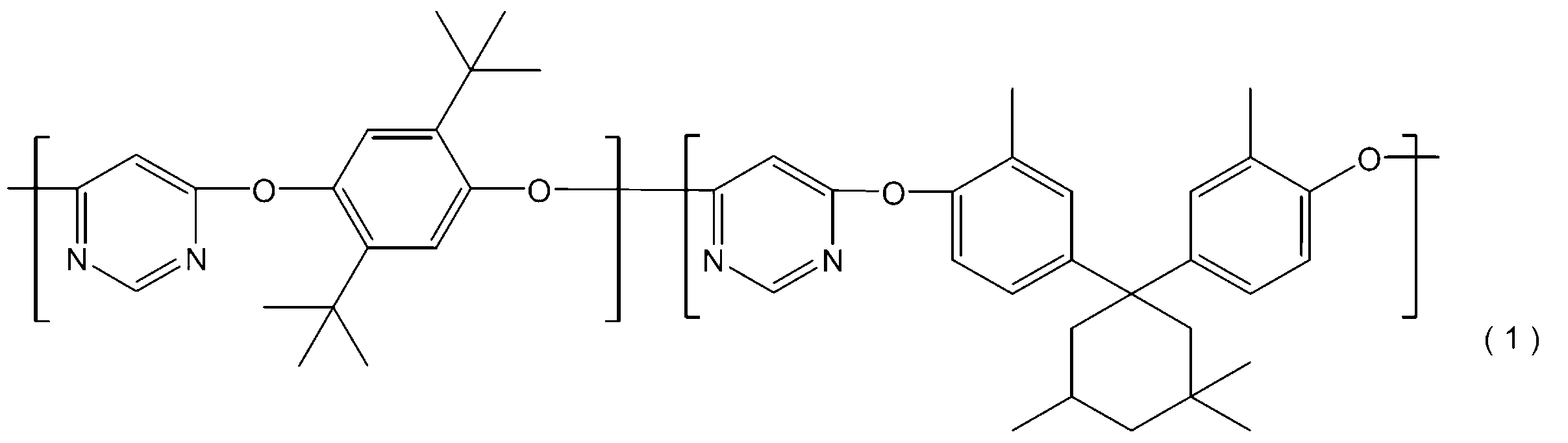
[合成例2]
撹拌装置を備えた四つ口セパラブルフラスコに、1,1-ビス(4-ヒドロキシ-3-メチルフェニル)-3,3,5-トリメチルシクロヘキサン(25.4g)、4,6-ジクロロピリミジン(11.2g)、および炭酸カリウム(14.0g)を量り入れ、N-メチル-2-ピロリドン(85g)を加え、窒素雰囲気下、130℃で6時間反応させた。反応終了後、N-メチル-2-ピロリドン(300g)を加えて希釈し、濾過により塩を除去した後、この溶液をメタノール(6kg)に投入した。析出した固体を濾別し、少量のメタノールで洗浄し、再度濾別して回収した後、真空乾燥機を用いて減圧下120℃で12時間乾燥し、下記式(2)に示す構造単位を有する重合体(A2)を得た。
撹拌装置を備えた四つ口セパラブルフラスコに、1,1-ビス(4-ヒドロキシ-3-メチルフェニル)-3,3,5-トリメチルシクロヘキサン(25.4g)、4,6-ジクロロピリミジン(11.2g)、および炭酸カリウム(14.0g)を量り入れ、N-メチル-2-ピロリドン(85g)を加え、窒素雰囲気下、130℃で6時間反応させた。反応終了後、N-メチル-2-ピロリドン(300g)を加えて希釈し、濾過により塩を除去した後、この溶液をメタノール(6kg)に投入した。析出した固体を濾別し、少量のメタノールで洗浄し、再度濾別して回収した後、真空乾燥機を用いて減圧下120℃で12時間乾燥し、下記式(2)に示す構造単位を有する重合体(A2)を得た。
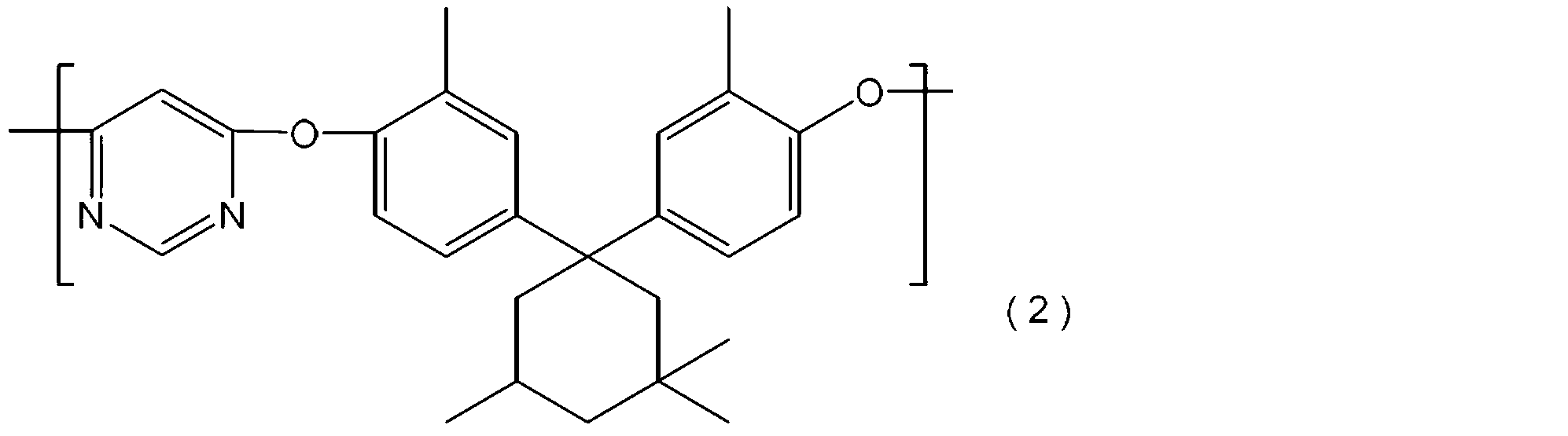
[合成例3]
撹拌装置を備えた四つ口セパラブルフラスコに、1,1-ビス(4-ヒドロキシフェニル)-3,3,5-トリメチルシクロヘキサン(62.08g)、4,6-ジクロロピリミジン(30.99g)、イソプロペニルフェノール(2.170g)、および、炭酸カリウム(38.83g)を量り入れ、N-メチル-2-ピロリドン(64.00g)を加え、窒素雰囲気下、130℃で6時間反応させた。反応終了後、N-メチル-2-ピロリドン(368.0g)を加えて希釈し、濾過により塩を除去した後の溶液をメタノール(19.4kg)に投入した。析出した固体を濾別し、該固体を少量のメタノールで洗浄し、再度濾別して回収した後、真空乾燥機を用いて減圧下120℃で12時間乾燥し、下記式(3)で表される構造単位を有する重合体(A3)を得た。
撹拌装置を備えた四つ口セパラブルフラスコに、1,1-ビス(4-ヒドロキシフェニル)-3,3,5-トリメチルシクロヘキサン(62.08g)、4,6-ジクロロピリミジン(30.99g)、イソプロペニルフェノール(2.170g)、および、炭酸カリウム(38.83g)を量り入れ、N-メチル-2-ピロリドン(64.00g)を加え、窒素雰囲気下、130℃で6時間反応させた。反応終了後、N-メチル-2-ピロリドン(368.0g)を加えて希釈し、濾過により塩を除去した後の溶液をメタノール(19.4kg)に投入した。析出した固体を濾別し、該固体を少量のメタノールで洗浄し、再度濾別して回収した後、真空乾燥機を用いて減圧下120℃で12時間乾燥し、下記式(3)で表される構造単位を有する重合体(A3)を得た。

[合成例4]
撹拌装置を備えた四つ口セパラブルフラスコに、1,1-ビス(4-ヒドロキシフェニル)-3,3,5-トリメチルシクロヘキサン(86.92g)、4,6-ジクロロピリミジン(47.58g)、および、炭酸カリウム(59.66g)を量り入れ、N-メチル-2-ピロリドン(64.00g)を加え、窒素雰囲気下、130℃で6時間反応させた。反応後、容器を10℃に冷却した状態で、アリルブロマイド(10.67g)を滴下した後、70℃で6時間反応させた。得られた反応液に、N-メチル-2-ピロリドン(368.0g)を加えて希釈した液から、濾過により塩を除去した後、得られた溶液をメタノール(19.40kg)に投入した。析出した固体を濾別し、該固体を少量のメタノールで洗浄し、再度濾別して回収した後、真空乾燥機を用いて減圧下120℃で12時間乾燥し、下記式(4)で表される重合体(A4)を得た。
撹拌装置を備えた四つ口セパラブルフラスコに、1,1-ビス(4-ヒドロキシフェニル)-3,3,5-トリメチルシクロヘキサン(86.92g)、4,6-ジクロロピリミジン(47.58g)、および、炭酸カリウム(59.66g)を量り入れ、N-メチル-2-ピロリドン(64.00g)を加え、窒素雰囲気下、130℃で6時間反応させた。反応後、容器を10℃に冷却した状態で、アリルブロマイド(10.67g)を滴下した後、70℃で6時間反応させた。得られた反応液に、N-メチル-2-ピロリドン(368.0g)を加えて希釈した液から、濾過により塩を除去した後、得られた溶液をメタノール(19.40kg)に投入した。析出した固体を濾別し、該固体を少量のメタノールで洗浄し、再度濾別して回収した後、真空乾燥機を用いて減圧下120℃で12時間乾燥し、下記式(4)で表される重合体(A4)を得た。

[合成例5]
用いた原料およびアルカリ金属化合物を、2,2-ビス(4-ヒドロキシ-3-メチルフェニル)プロパン(51.27g)、イソプロペニルフェノール(7.83g)、4,6-ジクロロ-2-フェニルピリミジン(51.51g)、炭酸カリウム(35.93g)に変更した以外は合成例3と同様の手順で合成し、下記式(5)で表される重合体(A5)を得た。
用いた原料およびアルカリ金属化合物を、2,2-ビス(4-ヒドロキシ-3-メチルフェニル)プロパン(51.27g)、イソプロペニルフェノール(7.83g)、4,6-ジクロロ-2-フェニルピリミジン(51.51g)、炭酸カリウム(35.93g)に変更した以外は合成例3と同様の手順で合成し、下記式(5)で表される重合体(A5)を得た。

[合成例6]
撹拌装置を備えた四つ口セパラブルフラスコに、2,2-ビス(4-ヒドロキシ-3-メチルフェニル)プロパン(26.43g)、4,6-ジクロロ-2-フェニルピリミジン(17.08g)、および、炭酸カリウム(19.23g)を量り入れ、N-メチル-2-ピロリドン(42.50g)を加え、窒素雰囲気下、100℃で6時間反応させた。反応後、容器を10℃に冷却した状態で、m,p-(クロロメチル)スチレン(11.53g)を滴下した後、100℃で4時間反応させた。得られた反応液に、N-メチル-2-ピロリドン(55.0g)を加えて希釈した液から、濾過により塩を除去した後、得られた溶液をメタノール(6900g)に投入した。析出した固体を濾別し、該固体を少量のメタノールで洗浄し、再度濾別して回収した後、真空乾燥機を用いて減圧下60℃で12時間乾燥し、下記式(6)で表される重合体(A6)を得た。
撹拌装置を備えた四つ口セパラブルフラスコに、2,2-ビス(4-ヒドロキシ-3-メチルフェニル)プロパン(26.43g)、4,6-ジクロロ-2-フェニルピリミジン(17.08g)、および、炭酸カリウム(19.23g)を量り入れ、N-メチル-2-ピロリドン(42.50g)を加え、窒素雰囲気下、100℃で6時間反応させた。反応後、容器を10℃に冷却した状態で、m,p-(クロロメチル)スチレン(11.53g)を滴下した後、100℃で4時間反応させた。得られた反応液に、N-メチル-2-ピロリドン(55.0g)を加えて希釈した液から、濾過により塩を除去した後、得られた溶液をメタノール(6900g)に投入した。析出した固体を濾別し、該固体を少量のメタノールで洗浄し、再度濾別して回収した後、真空乾燥機を用いて減圧下60℃で12時間乾燥し、下記式(6)で表される重合体(A6)を得た。

[合成例7]
用いた原料およびアルカリ金属化合物を、1,1-ビス(4-ヒドロキシ-3-メチルフェニル)-3,3,5-トリメチルシクロヘキサン(33.85g)、4,6-ジクロロ-2-フェニルピリミジン(16.66g)、m,p-クロロメチルスチレン(8.680g)、炭酸カリウム(18.66g)、N-メチル-2-ピロリドン(42.50g)に変更した以外は、合成例6と同様の手順で合成し、下記式(7)で表される重合体(A7)を得た。
用いた原料およびアルカリ金属化合物を、1,1-ビス(4-ヒドロキシ-3-メチルフェニル)-3,3,5-トリメチルシクロヘキサン(33.85g)、4,6-ジクロロ-2-フェニルピリミジン(16.66g)、m,p-クロロメチルスチレン(8.680g)、炭酸カリウム(18.66g)、N-メチル-2-ピロリドン(42.50g)に変更した以外は、合成例6と同様の手順で合成し、下記式(7)で表される重合体(A7)を得た。

[合成例8]
用いた原料およびアルカリ金属化合物を、2,2-ビス(4-ヒドロキシ-3-メチルフェニル)プロパン(25.63g)、4,6-ジクロロ-2-フェニルピリミジン(29.25g)、2-アリルフェノール(8.131g)、炭酸カリウム(24.31g)に変更した以外は、合成例3と同様の手順で合成し、下記式(8)で表される重合体(A8)を得た。
用いた原料およびアルカリ金属化合物を、2,2-ビス(4-ヒドロキシ-3-メチルフェニル)プロパン(25.63g)、4,6-ジクロロ-2-フェニルピリミジン(29.25g)、2-アリルフェノール(8.131g)、炭酸カリウム(24.31g)に変更した以外は、合成例3と同様の手順で合成し、下記式(8)で表される重合体(A8)を得た。

[合成例9]
撹拌装置を備えた四つ口セパラブルフラスコに、2,2-ビス(3-メチル-4-ヒドロキシフェニル)プロパン(51.27g)、α,α,α'-トリス(4-ヒドロキシフェニル)-1-エチル-4-イソプロピルベンゼン(21.23g)、4,6-ジクロロ-2-フェニルピリミジン(41.43g)、および、炭酸カリウム(51.31g)を量り入れ、N-メチル-2-ピロリドン(113.92g)を加え、窒素雰囲気下、130℃で6時間反応させた。反応後、容器を10℃に冷却した状態で、クロロメチルスチレン(38.55g)を滴下した後、65℃で6時間反応させた。得られた反応液に、N-メチル-2-ピロリドン(258.1g)を加えて希釈した液から、濾過により塩を除去した後、得られた溶液をメタノール(4960g)に投入した。析出した固体を濾別し、該固体を少量のメタノールで洗浄し、再度濾別して回収した後、真空乾燥機を用いて減圧下80℃で12時間乾燥することにより、下記式(9)で表される重合体(A9)を得た。
撹拌装置を備えた四つ口セパラブルフラスコに、2,2-ビス(3-メチル-4-ヒドロキシフェニル)プロパン(51.27g)、α,α,α'-トリス(4-ヒドロキシフェニル)-1-エチル-4-イソプロピルベンゼン(21.23g)、4,6-ジクロロ-2-フェニルピリミジン(41.43g)、および、炭酸カリウム(51.31g)を量り入れ、N-メチル-2-ピロリドン(113.92g)を加え、窒素雰囲気下、130℃で6時間反応させた。反応後、容器を10℃に冷却した状態で、クロロメチルスチレン(38.55g)を滴下した後、65℃で6時間反応させた。得られた反応液に、N-メチル-2-ピロリドン(258.1g)を加えて希釈した液から、濾過により塩を除去した後、得られた溶液をメタノール(4960g)に投入した。析出した固体を濾別し、該固体を少量のメタノールで洗浄し、再度濾別して回収した後、真空乾燥機を用いて減圧下80℃で12時間乾燥することにより、下記式(9)で表される重合体(A9)を得た。

上記式は重合体(A9)が上記構造単位を有する重合体であることを表す。上記式中*はいずれかの**と結合していることを表し、重合体(A9)は重合体末端に上記式(Y)で表される基を有する。以下の合成例においても同様である。
[合成例10]
用いた原料を2,2-ビス(3-メチル-4-ヒドロキシフェニル)プロパン(51.27g)、4,4',4'',4'''-(プロパン-2,2-ジイルビス(シクロヘキサン-4,1,1-トリイル)テトラフェノール(28.84g)、4,6-ジクロロ-2-フェニルピリミジン(41.43g)、炭酸カリウム(55.98g)、クロロメチルスチレン(49.15g)に変更した以外は合成例9と同様の手順で合成し、下記式(10)で表される重合体(A10)を得た(収量121.50g、収率88%)。
用いた原料を2,2-ビス(3-メチル-4-ヒドロキシフェニル)プロパン(51.27g)、4,4',4'',4'''-(プロパン-2,2-ジイルビス(シクロヘキサン-4,1,1-トリイル)テトラフェノール(28.84g)、4,6-ジクロロ-2-フェニルピリミジン(41.43g)、炭酸カリウム(55.98g)、クロロメチルスチレン(49.15g)に変更した以外は合成例9と同様の手順で合成し、下記式(10)で表される重合体(A10)を得た(収量121.50g、収率88%)。
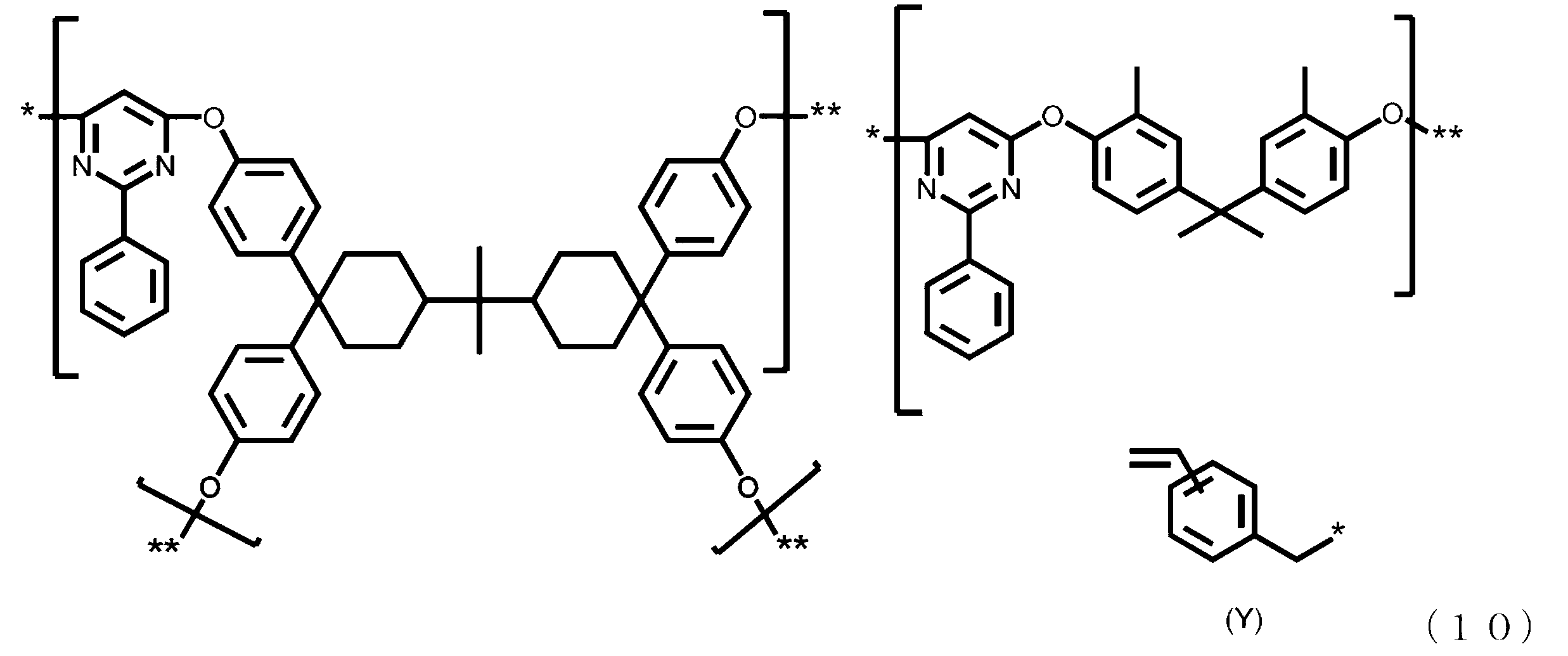
[合成例11]
用いた原料を9,9-ビス(4-ヒドロキシ-3-メチルフェニル)フルオレン(56.77g)、α,α,α'-トリス(4-ヒドロキシフェニル)-1-エチル-4-イソプロピルベンゼン(15.92g)、4,6-ジクロロ-2-フェニルピリミジン(31.07g)、炭酸カリウム(38.48g)、クロロメチルスチレン(28.91g)に変更した以外は合成例9と同様の手順で合成し、下記式(11)で表される重合体(A11)を得た。
用いた原料を9,9-ビス(4-ヒドロキシ-3-メチルフェニル)フルオレン(56.77g)、α,α,α'-トリス(4-ヒドロキシフェニル)-1-エチル-4-イソプロピルベンゼン(15.92g)、4,6-ジクロロ-2-フェニルピリミジン(31.07g)、炭酸カリウム(38.48g)、クロロメチルスチレン(28.91g)に変更した以外は合成例9と同様の手順で合成し、下記式(11)で表される重合体(A11)を得た。

[合成例12]
用いた原料を2,2-ビス(3-メチル-4-ヒドロキシフェニル)プロパン(64.09g)、4,6-ジクロロ-2-フェニルピリミジン(31.08g)、4,6-ジクロロピリミジン(6.86g)、炭酸カリウム(46.65g)、クロロメチルスチレン(22.01g)に変更した以外は合成例9と同様の手順で合成し、下記式(12)で表される重合体(A12)を得た。
用いた原料を2,2-ビス(3-メチル-4-ヒドロキシフェニル)プロパン(64.09g)、4,6-ジクロロ-2-フェニルピリミジン(31.08g)、4,6-ジクロロピリミジン(6.86g)、炭酸カリウム(46.65g)、クロロメチルスチレン(22.01g)に変更した以外は合成例9と同様の手順で合成し、下記式(12)で表される重合体(A12)を得た。

[比較用重合体(a1)]
・末端変性ポリフェニレンエーテル(製品名:NorylTMSA9000樹脂、Sabic社製)
・末端変性ポリフェニレンエーテル(製品名:NorylTMSA9000樹脂、Sabic社製)

[重量平均分子量(Mw)および数平均分子量(Mn)]
合成例1~12で合成した重合体(A1)~(A12)および下記比較例1で用いた重合体(a1)の重量平均分子量(Mw)および数平均分子量(Mn)は、GPC装置(東ソー(株)製、型番:「HLC-8320」)を使用し、下記条件で測定した。結果を表1に示す。
・カラム:東ソー(株)製の「TSKgelα-M」と東ソー(株)製の「TSKgelguardcolumnα」とを連結したもの
・展開溶剤:N-メチル-2-ピロリドン
・カラム温度:40℃
・流速:1.0mL/分
・試料濃度:0.75質量%
・試料注入量:50μL
・検出器:屈折計
・標準物質:単分散ポリスチレン
・測定用サンプルの濃度:0.1質量%
合成例1~12で合成した重合体(A1)~(A12)および下記比較例1で用いた重合体(a1)の重量平均分子量(Mw)および数平均分子量(Mn)は、GPC装置(東ソー(株)製、型番:「HLC-8320」)を使用し、下記条件で測定した。結果を表1に示す。
・カラム:東ソー(株)製の「TSKgelα-M」と東ソー(株)製の「TSKgelguardcolumnα」とを連結したもの
・展開溶剤:N-メチル-2-ピロリドン
・カラム温度:40℃
・流速:1.0mL/分
・試料濃度:0.75質量%
・試料注入量:50μL
・検出器:屈折計
・標準物質:単分散ポリスチレン
・測定用サンプルの濃度:0.1質量%

[実施例1~21、並びに、比較例1および2]
表2に記載の各成分を組成物の配合比率の欄に記載の比率(質量部)となるようミックスロータで混合し、固形分の濃度が50質量%となるようトルエン(E1)で濃度調整することで熱硬化性樹脂組成物を調製した。表2中の各成分の詳細は以下のとおりである。
表2に記載の各成分を組成物の配合比率の欄に記載の比率(質量部)となるようミックスロータで混合し、固形分の濃度が50質量%となるようトルエン(E1)で濃度調整することで熱硬化性樹脂組成物を調製した。表2中の各成分の詳細は以下のとおりである。
<共重合体(B)>
・(B1):エチレン-スチレン-1-オクテン-ジビニルベンゼン共重合体(数平均分子量:22,000、芳香族ビニル化合物に由来する構造単位の含有量:40質量%)
・(B2):エチレン-スチレン-ジビニルベンゼン共重合体(数平均分子量:8,000、芳香族ビニル化合物に由来する構造単位の含有量:48質量%)
・(B3):エチレン-スチレン-1-オクテン-ジビニルベンゼン共重合体(数平均分子量:22,000、芳香族ビニル化合物に由来する構造単位の含有量:60質量%)
・(B4):エチレン-スチレン-ジビニルベンゼン共重合体(数平均分子量:8,000、芳香族ビニル化合物に由来する構造単位の含有量:63質量%)
・(b1):スチレンブタジエン熱可塑性エラストマー(製品名:タフプレン(登録商標)912、旭化成(株)製)
・(B1):エチレン-スチレン-1-オクテン-ジビニルベンゼン共重合体(数平均分子量:22,000、芳香族ビニル化合物に由来する構造単位の含有量:40質量%)
・(B2):エチレン-スチレン-ジビニルベンゼン共重合体(数平均分子量:8,000、芳香族ビニル化合物に由来する構造単位の含有量:48質量%)
・(B3):エチレン-スチレン-1-オクテン-ジビニルベンゼン共重合体(数平均分子量:22,000、芳香族ビニル化合物に由来する構造単位の含有量:60質量%)
・(B4):エチレン-スチレン-ジビニルベンゼン共重合体(数平均分子量:8,000、芳香族ビニル化合物に由来する構造単位の含有量:63質量%)
・(b1):スチレンブタジエン熱可塑性エラストマー(製品名:タフプレン(登録商標)912、旭化成(株)製)
<硬化性化合物(C)>
・(C1): DVB960(日鉄ケミカル&マテリアル(株)製、ジビニルベンゼン)
・(C2):Bis-(3-ethyl-5-methyl-4-maleimidophenyl)methane)(製品名:BMI-70、ケイ・アイ化成(株)製)
・(C3):トリアリルイソシアヌレート(製品名:TAIC(株)新菱(旧MGC)製)
・(C1): DVB960(日鉄ケミカル&マテリアル(株)製、ジビニルベンゼン)
・(C2):Bis-(3-ethyl-5-methyl-4-maleimidophenyl)methane)(製品名:BMI-70、ケイ・アイ化成(株)製)
・(C3):トリアリルイソシアヌレート(製品名:TAIC(株)新菱(旧MGC)製)
<ラジカル重合開始剤(D)>
・(D1):ジクミルパーオキサイド(日油(株)製)
・(D2):2,2'-Azobis(N-butyl-2-methylpropionamide(製品名:Vam-110、富士フイルム和光純薬(株)製)
・(D1):ジクミルパーオキサイド(日油(株)製)
・(D2):2,2'-Azobis(N-butyl-2-methylpropionamide(製品名:Vam-110、富士フイルム和光純薬(株)製)
<有機溶剤(E)>
・(E1):トルエン
・(E1):トルエン
<フィラー(F)>
・(F1):球状シリカ(製品名:FB-3SDC、デンカ(株)製)
・(F2):球状アルミナ(製品名:DAW-05、デンカ(株)製)
・(F1):球状シリカ(製品名:FB-3SDC、デンカ(株)製)
・(F2):球状アルミナ(製品名:DAW-05、デンカ(株)製)

<硬化膜の作製>
前記実施例および比較例で得られた組成物を、ベーカ式アプリケータ(隙間:125μm)を用いて、銅箔(型番:CF-T49A-DS-HD2、福田金属(株)製)上に塗工した後、100℃で5分、その後140℃で5分間乾燥した後、窒素下200℃で2時間焼成した。得られた銅箔付き硬化膜を、40質量%塩化鉄溶液中に浸漬し、銅箔を除去した後、水で洗浄し、80℃で30分間、オーブンで乾燥することで、厚さ50μmの硬化膜を作製した。
前記実施例および比較例で得られた組成物を、ベーカ式アプリケータ(隙間:125μm)を用いて、銅箔(型番:CF-T49A-DS-HD2、福田金属(株)製)上に塗工した後、100℃で5分、その後140℃で5分間乾燥した後、窒素下200℃で2時間焼成した。得られた銅箔付き硬化膜を、40質量%塩化鉄溶液中に浸漬し、銅箔を除去した後、水で洗浄し、80℃で30分間、オーブンで乾燥することで、厚さ50μmの硬化膜を作製した。
<ガラス転移温度(Tg)>
上記で作製した硬化膜から試験片(幅:3mm×長さ:1cm)を切り出し、動的粘弾性測定装置(セイコーインスツル(株)製、型番:「EXSTAR4000」)を用いて、50℃から300℃まで昇温速度10℃/分、1Hzで測定し、この際のtanδをガラス転移温度(Tg)とした。なお、tanδが2つ以上存在する時には、最も低い値示すものをTgとして採用した。得られたTg値は下記の評価基準に従って評価した。下記の評価基準が「A」または「B」である場合、耐熱性に優れるといえる。
上記で作製した硬化膜から試験片(幅:3mm×長さ:1cm)を切り出し、動的粘弾性測定装置(セイコーインスツル(株)製、型番:「EXSTAR4000」)を用いて、50℃から300℃まで昇温速度10℃/分、1Hzで測定し、この際のtanδをガラス転移温度(Tg)とした。なお、tanδが2つ以上存在する時には、最も低い値示すものをTgとして採用した。得られたTg値は下記の評価基準に従って評価した。下記の評価基準が「A」または「B」である場合、耐熱性に優れるといえる。
-評価基準-
Tgが180℃を超える場合をA、Tgが150℃を超え180℃以下である場合をB、Tgが150℃以下である場合をCとした。
結果を表3に示す。
Tgが180℃を超える場合をA、Tgが150℃を超え180℃以下である場合をB、Tgが150℃以下である場合をCとした。
結果を表3に示す。
<ピール(剥離)強度>
前記実施例および比較例で得られた組成物を、銅箔(型番:CF-V9S-SV、福田金属(株)製)上に塗工し、100℃で5分間加熱した後、130℃で5分間乾燥し、塗膜を形成した。得られた塗膜上に、銅箔(型番:CF-V9S-SV、福田金属(株)製)を重ね、150℃で5分間真空プレスした後、窒素下200℃で2時間焼成することで、銅箔付き硬化膜(銅箔:18μm、硬化膜10μm)を作製し、これをピール強度用サンプルとした。
前記実施例および比較例で得られた組成物を、銅箔(型番:CF-V9S-SV、福田金属(株)製)上に塗工し、100℃で5分間加熱した後、130℃で5分間乾燥し、塗膜を形成した。得られた塗膜上に、銅箔(型番:CF-V9S-SV、福田金属(株)製)を重ね、150℃で5分間真空プレスした後、窒素下200℃で2時間焼成することで、銅箔付き硬化膜(銅箔:18μm、硬化膜10μm)を作製し、これをピール強度用サンプルとした。
作製したピール強度用サンプルから試験片(幅:5mm×長さ:10cm)を切り出し、万能試験機(インストロン社製、型番:「Instron 5567」)を用い、500mm/分の条件で試験片(ピール強度用サンプルにおける1つの銅箔と硬化膜との積層部分)を90度方向に引っ張り、「IPC-TM-650(試験方法(テストメソッドマニュアル)) 2.4.9」に準拠してピール強度を測定し以下の評価基準に従ってピール強度を評価した。下記の評価基準が「A」または「B」である場合、接着性に優れるといえる。
-評価基準-
ピール強度が0.7N/mm以上の場合を「A」、ピール強度が0.5N/mm以上0.7N/mm未満の場合を「B」、ピール強度が0.5N/mm未満の場合を「C」とした。
結果を表3に示す。
ピール強度が0.7N/mm以上の場合を「A」、ピール強度が0.5N/mm以上0.7N/mm未満の場合を「B」、ピール強度が0.5N/mm未満の場合を「C」とした。
結果を表3に示す。
<誘電正接>
上記で作製した硬化膜から試験片(幅:6cm×長さ:6cm)を切り出し、空洞共振器法((株)エーイーティー製、誘電率測定システム TEモード共振器)を用いて、該試験片の10GHzにおける誘電正接を測定し、以下の評価基準に従って誘電正接を評価した。下記の評価基準が「A」または「B」である場合、低誘電正接に優れるといえる。
上記で作製した硬化膜から試験片(幅:6cm×長さ:6cm)を切り出し、空洞共振器法((株)エーイーティー製、誘電率測定システム TEモード共振器)を用いて、該試験片の10GHzにおける誘電正接を測定し、以下の評価基準に従って誘電正接を評価した。下記の評価基準が「A」または「B」である場合、低誘電正接に優れるといえる。
-評価基準-
誘電正接が0.0015未満の場合を「A」、誘電正接が0.0015以上0.0025未満の場合を「B」、誘電正接が0.0025以上の場合を「C」とした。
結果を表3に示す。
誘電正接が0.0015未満の場合を「A」、誘電正接が0.0015以上0.0025未満の場合を「B」、誘電正接が0.0025以上の場合を「C」とした。
結果を表3に示す。

表3に示すとおり、実施例1~21に係る硬化膜は比較例1および2の硬化膜に比べて耐熱性、接着性および低誘電正接のバランスに優れていることがわかる。
Claims (12)
- 下記式(1-1)で表される構造単位を有する重合体(A)と、
エチレンまたはα-オレフィンに由来する構造単位、芳香族ビニル化合物に由来する構造単位、および芳香族多官能ビニル化合物に由来する構造単位を有する共重合体(B)と、
を含有する配線基板形成用熱硬化性樹脂組成物。


- 前記共重合体(B)の数平均分子量が500以上10万以下である、請求項1に記載の配線基板形成用熱硬化性樹脂組成物。
- 前記共重合体(B)における前記芳香族ビニル化合物が、炭素数8以上20以下の芳香族ビニル化合物であり、前記共重合体(B)を構成する全構造単位の質量を100質量%としたときの芳香族ビニル化合物に由来する構造単位の含有量が0質量%を超え70質量%以下である、請求項1に記載の配線基板形成用熱硬化性樹脂組成物。
- 前記共重合体(B)における前記α-オレフィンが炭素数3以上20以下のα-オレフィンから選ばれる1種または2種以上のα-オレフィンであり、前記エチレンまたはα-オレフィンに由来する構造単位、芳香族ビニル化合物に由来する構造単位および芳香族多官能ビニル化合物に由来する構造単位の合計が共重合体(B)の全構成単位の質量に対して100質量%である、請求項1に記載の配線基板形成用熱硬化性樹脂組成物。
- 硬化性化合物(C)および有機溶剤(E)を更に含有する請求項1に記載の配線基板形成用熱硬化性樹脂組成物。
- 前記硬化性化合物(C)がビニル化合物、マレイミド化合物、アリル化合物、アクリル化合物、メタクリル化合物、チオール化合物、オキサジン化合物、シアネート化合物、エポキシ化合物、オキセタン化合物、メチロール化合物、ベンゾシクロブテン化合物、プロパギル化合物、およびシラン化合物からなる群より選択される少なくとも1種の化合物である請求項5に記載の配線基板形成用熱硬化性樹脂組成物。
- 重合開始剤(D)を更に含む請求項1または請求項5の配線基板形成用熱硬化性樹脂組成物。
- フィラー(F)を更に含む請求項1または請求項5の配線基板形成用熱硬化性樹脂組成物。
- 請求項1または請求項5に記載の配線基板形成用熱硬化性樹脂組成物からなる硬化物。
- 繊維状基材に請求項1または請求項5に記載の配線基板形成用熱硬化性樹脂組成物を含浸させてなるプリプレグ。
- 請求項10に記載のプリプレグと銅基板との積層体である銅張積層板。
- 請求項1または5に記載の配線基板形成用熱硬化性樹脂組成物を備える層間絶縁フィルム。
Priority Applications (3)
| Application Number | Priority Date | Filing Date | Title |
|---|---|---|---|
| JP2025527956A JPWO2024257781A1 (ja) | 2023-06-16 | 2024-06-12 | |
| CN202480026968.3A CN121014262A (zh) | 2023-06-16 | 2024-06-12 | 配线基板形成用热硬化性树脂组合物、硬化物、预浸体、层间绝缘膜 |
| KR1020257040788A KR20260027147A (ko) | 2023-06-16 | 2024-06-12 | 배선 기판 형성용 열경화성 수지 조성물, 경화물, 프리프레그 및 층간 절연 필름 |
Applications Claiming Priority (2)
| Application Number | Priority Date | Filing Date | Title |
|---|---|---|---|
| JP2023-099518 | 2023-06-16 | ||
| JP2023099518 | 2023-06-16 |
Publications (1)
| Publication Number | Publication Date |
|---|---|
| WO2024257781A1 true WO2024257781A1 (ja) | 2024-12-19 |
Family
ID=93852250
Family Applications (1)
| Application Number | Title | Priority Date | Filing Date |
|---|---|---|---|
| PCT/JP2024/021280 Ceased WO2024257781A1 (ja) | 2023-06-16 | 2024-06-12 | 配線基板形成用熱硬化性樹脂組成物、硬化物、プリプレグおよび層間絶縁フィルム |
Country Status (5)
| Country | Link |
|---|---|
| JP (1) | JPWO2024257781A1 (ja) |
| KR (1) | KR20260027147A (ja) |
| CN (1) | CN121014262A (ja) |
| TW (1) | TW202500608A (ja) |
| WO (1) | WO2024257781A1 (ja) |
Citations (4)
| Publication number | Priority date | Publication date | Assignee | Title |
|---|---|---|---|---|
| JP2010280771A (ja) * | 2009-06-03 | 2010-12-16 | Denki Kagaku Kogyo Kk | 後硬化性樹脂組成物及びそれを用いた電気絶縁材料 |
| JP2016183204A (ja) * | 2015-03-25 | 2016-10-20 | Jsr株式会社 | 熱硬化性樹脂組成物およびその用途 |
| WO2022050064A1 (ja) * | 2020-09-01 | 2022-03-10 | Jsr株式会社 | プリプレグ、金属張積層板、及びプリント配線板 |
| WO2022210095A1 (ja) * | 2021-04-02 | 2022-10-06 | Jsr株式会社 | 重合体、組成物、硬化物、積層体及び電子部品 |
-
2024
- 2024-06-12 TW TW113121647A patent/TW202500608A/zh unknown
- 2024-06-12 WO PCT/JP2024/021280 patent/WO2024257781A1/ja not_active Ceased
- 2024-06-12 KR KR1020257040788A patent/KR20260027147A/ko active Pending
- 2024-06-12 JP JP2025527956A patent/JPWO2024257781A1/ja active Pending
- 2024-06-12 CN CN202480026968.3A patent/CN121014262A/zh active Pending
Patent Citations (4)
| Publication number | Priority date | Publication date | Assignee | Title |
|---|---|---|---|---|
| JP2010280771A (ja) * | 2009-06-03 | 2010-12-16 | Denki Kagaku Kogyo Kk | 後硬化性樹脂組成物及びそれを用いた電気絶縁材料 |
| JP2016183204A (ja) * | 2015-03-25 | 2016-10-20 | Jsr株式会社 | 熱硬化性樹脂組成物およびその用途 |
| WO2022050064A1 (ja) * | 2020-09-01 | 2022-03-10 | Jsr株式会社 | プリプレグ、金属張積層板、及びプリント配線板 |
| WO2022210095A1 (ja) * | 2021-04-02 | 2022-10-06 | Jsr株式会社 | 重合体、組成物、硬化物、積層体及び電子部品 |
Also Published As
| Publication number | Publication date |
|---|---|
| JPWO2024257781A1 (ja) | 2024-12-19 |
| KR20260027147A (ko) | 2026-02-27 |
| CN121014262A (zh) | 2025-11-25 |
| TW202500608A (zh) | 2025-01-01 |
Similar Documents
| Publication | Publication Date | Title |
|---|---|---|
| JP7827200B2 (ja) | 重合体、組成物、硬化物、積層体及び電子部品 | |
| CN106255713B (zh) | 聚苯醚衍生物、热固化性树脂组合物、树脂清漆、预浸渍体、层叠板及多层印制线路板 | |
| JP7673862B2 (ja) | 樹脂組成物、プリプレグ、金属箔張積層板、樹脂複合シート、および、プリント配線板 | |
| KR102671536B1 (ko) | 수지 조성물, 프리프레그, 금속박 피복 적층판, 수지 시트 및 프린트 배선판 | |
| JP6939780B2 (ja) | アリル基含有マレイミド化合物およびその製造方法、並びに前記化合物を用いた組成物および硬化物 | |
| CN105308118A (zh) | 树脂组合物、预浸料、树脂片和覆金属箔层叠板 | |
| WO2022054867A1 (ja) | 樹脂組成物、プリプレグ、樹脂付きフィルム、樹脂付き金属箔、金属張積層板、及び配線板 | |
| KR20250009960A (ko) | 수지 조성물, 프리프레그, 적층판, 수지 필름, 프린트 배선판 및 반도체 패키지 | |
| WO2024053282A1 (ja) | 重合体、組成物、硬化物、積層体及び電子部品 | |
| KR102728878B1 (ko) | 수지 조성물, 프리프레그, 금속박 피복 적층판, 수지 시트, 및 프린트 배선판 | |
| JP2024061610A (ja) | 重合体、組成物、硬化物、積層体及び電子部品 | |
| CN122055400A (zh) | 组合物、预浸料和覆金属层压板 | |
| KR20260027147A (ko) | 배선 기판 형성용 열경화성 수지 조성물, 경화물, 프리프레그 및 층간 절연 필름 | |
| WO2020130008A1 (ja) | 複合材及びその製造方法、プリプレグ、積層板、プリント配線板並びに半導体パッケージ | |
| KR20250097842A (ko) | 수지 조성물, 경화물, 프리프레그, 금속박 피복 적층판, 수지 복합 시트, 및 프린트 배선판 | |
| CN116917376A (zh) | 聚合物、组合物、硬化物、层叠体及电子零件 | |
| WO2025115606A1 (ja) | 樹脂組成物、硬化物、および電子部品 | |
| KR102090439B1 (ko) | 수지 조성물, 프리프레그, 금속박 피복 적층판, 수지 시트 및 프린트 배선판 | |
| JP2026020129A (ja) | 樹脂組成物、硬化物、積層体及び電子部品 | |
| WO2025069916A1 (ja) | 樹脂組成物、硬化物、プリプレグ、銅張積層板、層間絶縁フィルムおよび化合物 | |
| WO2025105440A1 (ja) | 硬化性組成物、プリプレグ、金属張積層板、プリント配線板、半導体パッケージ、及び成型品 | |
| WO2025234476A1 (ja) | 樹脂組成物、硬化物、プリプレグ、銅張積層板および層間絶縁フィルム | |
| JP2024035605A (ja) | 樹脂材料、硬化物、絶縁層付き回路基板、多層プリント配線板及びイミド化合物の製造方法 | |
| KR20260073348A (ko) | 수지 조성물, 경화물, 프리프레그, 동장 적층판, 층간 절연 필름 및 화합물 | |
| CN117050464A (zh) | 树脂组合物 |
Legal Events
| Date | Code | Title | Description |
|---|---|---|---|
| 121 | Ep: the epo has been informed by wipo that ep was designated in this application |
Ref document number: 24823396 Country of ref document: EP Kind code of ref document: A1 |
|
| ENP | Entry into the national phase |
Ref document number: 2025527956 Country of ref document: JP Kind code of ref document: A |
|
| NENP | Non-entry into the national phase |
Ref country code: DE |