WO2024257551A1 - アリールアミン化合物およびその利用 - Google Patents
アリールアミン化合物およびその利用 Download PDFInfo
- Publication number
- WO2024257551A1 WO2024257551A1 PCT/JP2024/018421 JP2024018421W WO2024257551A1 WO 2024257551 A1 WO2024257551 A1 WO 2024257551A1 JP 2024018421 W JP2024018421 W JP 2024018421W WO 2024257551 A1 WO2024257551 A1 WO 2024257551A1
- Authority
- WO
- WIPO (PCT)
- Prior art keywords
- group
- carbon atoms
- charge
- formula
- organic
- Prior art date
- Legal status (The legal status is an assumption and is not a legal conclusion. Google has not performed a legal analysis and makes no representation as to the accuracy of the status listed.)
- Ceased
Links
Classifications
-
- C—CHEMISTRY; METALLURGY
- C07—ORGANIC CHEMISTRY
- C07D—HETEROCYCLIC COMPOUNDS
- C07D209/00—Heterocyclic compounds containing five-membered rings, condensed with other rings, with one nitrogen atom as the only ring hetero atom
- C07D209/56—Ring systems containing three or more rings
- C07D209/80—[b, c]- or [b, d]-condensed
- C07D209/82—Carbazoles; Hydrogenated carbazoles
- C07D209/86—Carbazoles; Hydrogenated carbazoles with only hydrogen atoms, hydrocarbon or substituted hydrocarbon radicals, directly attached to carbon atoms of the ring system
-
- H—ELECTRICITY
- H05—ELECTRIC TECHNIQUES NOT OTHERWISE PROVIDED FOR
- H05B—ELECTRIC HEATING; ELECTRIC LIGHT SOURCES NOT OTHERWISE PROVIDED FOR; CIRCUIT ARRANGEMENTS FOR ELECTRIC LIGHT SOURCES, IN GENERAL
- H05B33/00—Electroluminescent light sources
- H05B33/12—Light sources with substantially two-dimensional [2D] radiating surfaces
- H05B33/14—Light sources with substantially two-dimensional [2D] radiating surfaces characterised by the chemical or physical composition or the arrangement of the electroluminescent material, or by the simultaneous addition of the electroluminescent material in or onto the light source
-
- H—ELECTRICITY
- H10—SEMICONDUCTOR DEVICES; ELECTRIC SOLID-STATE DEVICES NOT OTHERWISE PROVIDED FOR
- H10K—ORGANIC ELECTRIC SOLID-STATE DEVICES
- H10K50/00—Organic light-emitting devices
- H10K50/10—OLEDs or polymer light-emitting diodes [PLED]
-
- H—ELECTRICITY
- H10—SEMICONDUCTOR DEVICES; ELECTRIC SOLID-STATE DEVICES NOT OTHERWISE PROVIDED FOR
- H10K—ORGANIC ELECTRIC SOLID-STATE DEVICES
- H10K50/00—Organic light-emitting devices
- H10K50/10—OLEDs or polymer light-emitting diodes [PLED]
- H10K50/11—OLEDs or polymer light-emitting diodes [PLED] characterised by the electroluminescent [EL] layers
- H10K50/115—OLEDs or polymer light-emitting diodes [PLED] characterised by the electroluminescent [EL] layers comprising active inorganic nanostructures, e.g. luminescent quantum dots
-
- H—ELECTRICITY
- H10—SEMICONDUCTOR DEVICES; ELECTRIC SOLID-STATE DEVICES NOT OTHERWISE PROVIDED FOR
- H10K—ORGANIC ELECTRIC SOLID-STATE DEVICES
- H10K50/00—Organic light-emitting devices
- H10K50/10—OLEDs or polymer light-emitting diodes [PLED]
- H10K50/14—Carrier transporting layers
- H10K50/15—Hole transporting layers
-
- H—ELECTRICITY
- H10—SEMICONDUCTOR DEVICES; ELECTRIC SOLID-STATE DEVICES NOT OTHERWISE PROVIDED FOR
- H10K—ORGANIC ELECTRIC SOLID-STATE DEVICES
- H10K50/00—Organic light-emitting devices
- H10K50/10—OLEDs or polymer light-emitting diodes [PLED]
- H10K50/17—Carrier injection layers
-
- H—ELECTRICITY
- H10—SEMICONDUCTOR DEVICES; ELECTRIC SOLID-STATE DEVICES NOT OTHERWISE PROVIDED FOR
- H10K—ORGANIC ELECTRIC SOLID-STATE DEVICES
- H10K85/00—Organic materials used in the body or electrodes of devices covered by this subclass
- H10K85/60—Organic compounds having low molecular weight
-
- H—ELECTRICITY
- H10—SEMICONDUCTOR DEVICES; ELECTRIC SOLID-STATE DEVICES NOT OTHERWISE PROVIDED FOR
- H10K—ORGANIC ELECTRIC SOLID-STATE DEVICES
- H10K85/00—Organic materials used in the body or electrodes of devices covered by this subclass
- H10K85/60—Organic compounds having low molecular weight
- H10K85/615—Polycyclic condensed aromatic hydrocarbons, e.g. anthracene
-
- H—ELECTRICITY
- H10—SEMICONDUCTOR DEVICES; ELECTRIC SOLID-STATE DEVICES NOT OTHERWISE PROVIDED FOR
- H10K—ORGANIC ELECTRIC SOLID-STATE DEVICES
- H10K85/00—Organic materials used in the body or electrodes of devices covered by this subclass
- H10K85/60—Organic compounds having low molecular weight
- H10K85/615—Polycyclic condensed aromatic hydrocarbons, e.g. anthracene
- H10K85/626—Polycyclic condensed aromatic hydrocarbons, e.g. anthracene containing more than one polycyclic condensed aromatic rings, e.g. bis-anthracene
-
- H—ELECTRICITY
- H10—SEMICONDUCTOR DEVICES; ELECTRIC SOLID-STATE DEVICES NOT OTHERWISE PROVIDED FOR
- H10K—ORGANIC ELECTRIC SOLID-STATE DEVICES
- H10K85/00—Organic materials used in the body or electrodes of devices covered by this subclass
- H10K85/60—Organic compounds having low molecular weight
- H10K85/631—Amine compounds having at least two aryl rest on at least one amine-nitrogen atom, e.g. triphenylamine
- H10K85/636—Amine compounds having at least two aryl rest on at least one amine-nitrogen atom, e.g. triphenylamine comprising heteroaromatic hydrocarbons as substituents on the nitrogen atom
-
- H—ELECTRICITY
- H10—SEMICONDUCTOR DEVICES; ELECTRIC SOLID-STATE DEVICES NOT OTHERWISE PROVIDED FOR
- H10K—ORGANIC ELECTRIC SOLID-STATE DEVICES
- H10K85/00—Organic materials used in the body or electrodes of devices covered by this subclass
- H10K85/60—Organic compounds having low molecular weight
- H10K85/649—Aromatic compounds comprising a hetero atom
- H10K85/657—Polycyclic condensed heteroaromatic hydrocarbons
- H10K85/6572—Polycyclic condensed heteroaromatic hydrocarbons comprising only nitrogen in the heteroaromatic polycondensed ring system, e.g. phenanthroline or carbazole
Definitions
- the present invention relates to arylamine compounds and their uses.
- organic electroluminescence (hereinafter referred to as organic EL) elements are expected to be put to practical use in fields such as displays and lighting, and various developments have been made on materials and element structures with the aim of achieving low-voltage operation, high brightness, long life, etc.
- this organic EL element a number of functional thin films are used.
- the hole injection layer is responsible for the exchange of charges between the anode and the hole transport layer or the light-emitting layer, and plays an important role in achieving low-voltage operation and high brightness of the organic EL element.
- the methods for producing this hole injection layer are roughly divided into dry processes, such as deposition, and wet processes, such as ink-jet and spin-coating. Compared to these processes, wet processes can efficiently produce thin films with high flatness over a large area. For this reason, as organic EL displays are currently being made larger in area, there is a demand for hole injection layers that can be formed by wet processes.
- quantum dot electroluminescence (hereafter referred to as quantum dot EL) elements which use quantum dot materials as their light-emitting layer, have appeared and show the prospect of a wide range of applications. While these quantum dot EL elements can be manufactured at low cost using wet processes, they have attracted much attention in fields such as display technology and lighting due to their characteristics such as control of emission wavelength, high color purity, high luminous efficiency, and use in flexible applications.
- the present invention has been made in consideration of these circumstances, and aims to provide an arylamine compound that has good solubility in organic solvents and gives a thin film with good charge transport properties, and that can realize an organic EL element with good characteristics when this thin film is applied to a hole injection layer or the like.
- an arylamine compound having a specific chain molecular structure has good solubility in organic solvents, that a varnish obtained by dissolving this in an organic solvent gives a thin film with excellent charge transport properties, and that when this thin film is applied to a hole injection layer or the like, an organic EL element with good characteristics is obtained, thus completing the present invention.
- Ar 1 each independently represents a group represented by the following formula (b1) or (b2): wherein Y represents NZ3 , O or S; Z 1 , Z 2 and Z 3 each independently represent a group represented by any one of the following formulae (c1) to (c4):
- the dashed lines represent bonds.
- n represents an integer of 0 to 5. However, when n is 0, X 1 does not represent a single bond. 2.
- a charge transporting material comprising any one of the arylamine compounds of 1 to 6.
- a charge-transporting varnish comprising any one of the arylamine compounds according to 1 to 6 and an organic solvent.
- the charge transport varnish of 8 further comprising a dopant material.
- An electronic device comprising the charge transport thin film of 10.
- the electronic device of 11, wherein the charge transporting thin film is a hole injection layer or a hole transport layer.
- the electronic device according to 12, wherein the electronic device is an organic EL device or a quantum dot EL device.
- the arylamine compound of the present invention has good solubility in organic solvents, and by using a charge-transporting varnish containing this arylamine compound, a charge-transporting thin film having excellent charge transport properties can be obtained.
- This charge-transporting thin film can be suitably used as a thin film for electronic devices such as organic EL devices and quantum dot EL devices, particularly as a thin film for electronic devices in which a thin film is laminated on top by a wet process.
- By applying the charge-transporting thin film of the present invention to the hole injection layer of an organic EL device or a quantum dot EL device it is possible to prepare a device having good characteristics.
- the present invention will be described in further detail below.
- the arylamine compound according to the present invention is characterized by being represented by the following formula (1).
- X 1s each independently represent a single bond or a group represented by any one of the following formulae (a1-1) to (a1-2), (a2-1) to (a2-4), (a3-1) to (a3-4), and (a4) to (a9); and X 2s each independently represent a group represented by any one of the following formulae (a1-1) to (a1-2), (a2-1) to (a2-4), (a3-1) to (a3-4), and (a4) to (a9);
- R 1 each independently represents an alkyl group having 1 to 20 carbon atoms.
- Ar 1 each independently represents a group represented by the following formula (b1) or (b2):
- Y represents NZ 3 , O or S
- Z 1 , Z 2 and Z 3 each independently represent a group represented by any one of the following formulas (c1) to (c4):
- n an integer of 0 to 5, provided that when n is 0, X 1 does not represent a single bond.
- the alkyl group having 1 to 20 carbon atoms may be linear, branched, or cyclic, and examples thereof include linear or branched alkyl groups having 1 to 20 carbon atoms, such as methyl, ethyl, n-propyl, isopropyl, n-butyl, isobutyl, s-butyl, t-butyl, n-pentyl, n-hexyl, n-heptyl, n-octyl, n-nonyl, and n-decyl groups; and cyclic alkyl groups having 3 to 20 carbon atoms, such as cyclopropyl, cyclobutyl, cyclopentyl, cyclohexyl, cycloheptyl, cyclooctyl, cyclononyl, cyclodecyl, bicyclobutyl, bicyclopentyl, bicyclohexyl, bicycl
- X 1 is preferably a single bond or a group represented by any one of the above formulas (a1-1) to (a1-2), (a2-1) to (a2-4), (a4) and (a7).
- X2 is preferably a group represented by any one of the above formulas (a1-1) to (a1-2), (a2-1) to (a2-4), (a4) and (a7).
- X1 and X2 are phenylene groups (i.e., not all of X1 and X2 are groups represented by formulas (a1-1) and (a1-2)).
- Ar 1 is preferably a group represented by the above formula (b1).
- the above Y is preferably NZ3
- the above Z1 , Z2 and Z3 are preferably groups represented by the above formula (c1).
- a preferred embodiment of the arylamine compound represented by the above formula (1) is a compound represented by the following formula (1-1), but is not limited thereto.
- the arylamine compound of the present invention represented by formula (1) can be produced by reacting a specific aryldiamine compound with a specific aryl halide compound in the presence of a catalyst.
- the method can be based on known methods described in WO2020/241730 and the like.
- the above-mentioned arylamine compound of the present invention can be suitably used as a charge transporting material.
- it can be used as a charge transporting varnish containing the arylamine compound of the present invention and an organic solvent, and this charge transporting varnish may contain a dopant material for the purpose of improving its charge transporting ability, etc., depending on the application of the thin film obtained.
- the arylamine compound of the present invention can also be used in combination with other conventionally known charge transporting materials such as aniline derivatives and thiophene derivatives, but it is preferable to use the arylamine compound of the present invention alone as a charge transporting material.
- the term "charge transporting property" is synonymous with "electrical conductivity.”
- the charge transporting varnish may be one which itself has charge transporting property, or one which produces a solid film having charge transporting property.
- the dopant substance there are no particular limitations on the dopant substance, so long as it dissolves in at least one solvent used in the varnish, and both inorganic and organic dopant substances can be used.
- the inorganic and organic dopant substances may be used alone or in combination of two or more.
- the dopant substance may be a substance whose function as a dopant substance is first expressed or improved by, for example, removing a part of its molecule due to an external stimulus, such as heating during baking, in the process of obtaining a charge-transporting thin film, which is a solid film, from the varnish, such as an arylsulfonate compound protected by a group from which the sulfonic acid group is easily removed.
- heteropolyacids are particularly preferred as inorganic dopant substances.
- Heteropolyacids are polyacids that have a structure in which a heteroatom is located at the center of the molecule, typically represented by a Keggin type chemical structure represented by formula (H1) or a Dawson type chemical structure represented by formula (H2), and are formed by condensing an isopolyacid, which is an oxyacid of vanadium (V), molybdenum (Mo), tungsten (W), etc., with an oxyacid of a different element.
- examples of such oxyacids of different elements include oxyacids of silicon (Si), phosphorus (P), and arsenic (As).
- heteropolyacids include phosphomolybdic acid, silicomolybdic acid, phosphotungstic acid, silicotungstic acid, phosphotungstomolybdic acid, etc., which may be used alone or in combination of two or more. These heteropolyacids are commercially available or can be synthesized by known methods. In particular, when one type of heteropolyacid is used, the one type of heteropolyacid is preferably phosphotungstic acid or phosphomolybdic acid, and most preferably phosphotungstic acid.
- one of the two or more types of heteropolyacids is preferably phosphotungstic acid or phosphomolybdic acid, and more preferably phosphotungstic acid.
- the heteropolyacid may be used in the present invention even if the number of elements in the structure represented by the general formula is large or small in quantitative analysis such as elemental analysis, as long as it is a commercially available product or is appropriately synthesized according to a known synthesis method.
- phosphotungstic acid is generally represented by the chemical formula H3 ( PW12O40 ) nH2O
- phosphomolybdic acid is represented by the chemical formula H3 ( PMo12O40 ) nH2O
- P (phosphorus), O ( oxygen), W (tungsten), or Mo (molybdenum) in this formula is large or small in quantitative analysis, they can be used in the present invention as long as they are commercially available or appropriately synthesized according to a known synthesis method.
- the mass of the heteropolyacid specified in the present invention does not mean the mass of pure phosphotungstic acid (phosphotungstic acid content) in a synthesized product or a commercially available product, but means the total mass including hydration water and other impurities in a form available as a commercially available product or in a form that can be isolated by a known synthesis method.
- the amount of heteropolyacid used can be about 0.001 to 50.0 parts by mass per 1 part of charge transporting substance, but is preferably about 0.01 to 20.0 parts, and more preferably about 0.1 to 10.0 parts.
- tetracyanoquinodimethane derivatives and benzoquinone derivatives can be used.
- tetracyanoquinodimethane derivatives include 7,7,8,8-tetracyanoquinodimethane (TCNQ) and a halotetracyanoquinodimethane represented by the formula (H3).
- benzoquinone derivatives include tetrafluoro-1,4-benzoquinone (F4BQ), tetrachloro-1,4-benzoquinone (chloranil), tetrabromo-1,4-benzoquinone, and 2,3-dichloro-5,6-dicyano-1,4-benzoquinone (DDQ).
- F4BQ tetrafluoro-1,4-benzoquinone
- chloranil tetrachloro-1,4-benzoquinone
- DDQ 2,3-dichloro-5,6-dicyano-1,4-benzoquinone
- R 500 to R 503 each independently represent a hydrogen atom or a halogen atom, and at least one is a halogen atom, preferably at least two are halogen atoms, more preferably at least three are halogen atoms, and most preferably all are halogen atoms.
- the halogen atom include the same as those mentioned above, but a fluorine atom or a chlorine atom is preferred, and a fluorine atom is more preferred.
- halotetracyanoquinodimethanes include 2-fluoro-7,7,8,8-tetracyanoquinodimethane, 2-chloro-7,7,8,8-tetracyanoquinodimethane, 2,5-difluoro-7,7,8,8-tetracyanoquinodimethane, 2,5-dichloro-7,7,8,8-tetracyanoquinodimethane, 2,3,5,6-tetrachloro-7,7,8,8-tetracyanoquinodimethane, and 2,3,5,6-tetrafluoro-7,7,8,8-tetracyanoquinodimethane (F4TCNQ).
- the amount of the tetracyanoquinodimethane derivative and the benzoquinone derivative used is preferably 0.0001 to 100 equivalents, more preferably 0.01 to 50 equivalents, and even more preferably 1 to 20 equivalents, relative to the charge transporting substance.
- organic dopant material electrically neutral onium borate salts consisting of a monovalent or divalent anion represented by the following formula (e1) and a counter cation represented by the following formulas (f1) to (f5) can be used.
- each Ar independently represents an aryl group having 6 to 20 carbon atoms which may have a substituent, or a heteroaryl group having 2 to 20 carbon atoms which may have a substituent
- L represents an alkylene group having 1 to 20 carbon atoms, -NH-, an oxygen atom, a sulfur atom, or -CN + -.
- the alkylene group having 1 to 20 carbon atoms may be linear, branched, or cyclic, and specific examples include methylene, methylmethylene, dimethylmethylene, ethylene, trimethylene, propylene, tetramethylene, pentamethylene, and hexamethylene groups.
- aryl and heteroaryl groups include those listed above.
- a suitable example of the anion of formula (e1) above is one represented by formula (e2), but is not limited thereto.
- the amount of the onium borate salt used may be about 0.1 to 10 in terms of the substance amount (molar) ratio to the charge transporting substance.
- the onium borate salt can be synthesized by referring to the known method described in, for example, JP-A-2005-314682.
- arylsulfonic acid compounds arylsulfonic acid ester compounds, and fluorinated arylsulfonic acid polymer compounds can also be suitably used as organic dopant substances.
- arylsulfonic acid compounds include benzenesulfonic acid, tosylic acid, p-styrenesulfonic acid, 2-naphthalenesulfonic acid, 4-hydroxybenzenesulfonic acid, 5-sulfosalicylic acid, p-dodecylbenzenesulfonic acid, dihexylbenzenesulfonic acid, 2,5-dihexylbenzenesulfonic acid, dibutylnaphthalenesulfonic acid, 6,7-dibutyl-2-naphthalenesulfonic acid, dodecylnaphthalenesulfonic acid, 3-dodecyl-2-naphthalenesulfonic acid, hexylnaphthalenesulfonic acid, 4-hexyl-1-naphthalenesulfonic acid, 7-hexyl-1-naphthalenesulfonic acid, and Examples of such
- arylsulfonic acid compounds include arylsulfonic acid compounds represented by formula (H4) or (H5).
- a 1 represents O or S, with O being preferred.
- A2 represents a naphthalene ring or an anthracene ring, with a naphthalene ring being preferred.
- A3 represents a divalent to tetravalent perfluorobiphenyl group, p represents the number of bonds between A1 and A3 and is an integer satisfying 2 ⁇ p ⁇ 4, but it is preferable that A3 is a perfluorobiphenyldiyl group, preferably a perfluorobiphenyl-4,4'-diyl group, and p is 2.
- q represents the number of sulfonic acid groups bonded to A2 and is an integer satisfying 1 ⁇ q ⁇ 4, with 2 being optimal.
- a 4 to A 8 each independently represent a hydrogen atom, a halogen atom, a cyano group, an alkyl group having 1 to 20 carbon atoms, a halogenated alkyl group having 1 to 20 carbon atoms, or a halogenated alkenyl group having 2 to 20 carbon atoms, provided that at least three of A 4 to A 8 are halogen atoms.
- Halogenated alkyl groups having 1 to 20 carbon atoms include trifluoromethyl, 2,2,2-trifluoroethyl, 1,1,2,2,2-pentafluoroethyl, 3,3,3-trifluoropropyl, 2,2,3,3,3-pentafluoropropyl, 1,1,2,2,3,3,3-heptafluoropropyl, 4,4,4-trifluorobutyl, 3,3,4,4,4-pentafluorobutyl, 2,2,3,3,4,4,4-heptafluorobutyl, and 1,1,2,2,3,3,4,4,4-nonafluorobutyl groups.
- halogenated alkenyl group having 2 to 20 carbon atoms examples include perfluorovinyl, perfluoropropenyl (perfluoroallyl), and perfluorobutenyl groups.
- Other examples of the halogen atom and the alkyl group having 1 to 20 carbon atoms include those similar to those mentioned above, with the halogen atom being preferably a fluorine atom.
- a 4 to A 8 are a hydrogen atom, a halogen atom, a cyano group, an alkyl group having 1 to 10 carbon atoms, a halogenated alkyl group having 1 to 10 carbon atoms, or a halogenated alkenyl group having 2 to 10 carbon atoms, and at least three of A 4 to A 8 are fluorine atoms, and it is more preferable that A 4 to A 8 are a hydrogen atom, a fluorine atom, a cyano group, an alkyl group having 1 to 5 carbon atoms, a fluorinated alkyl group having 1 to 5 carbon atoms, or a fluorinated alkenyl group having 2 to 5 carbon atoms, and at least three of A 4 to A 8 are fluorine atoms, and it is even more preferable that A 4 , A 5 and A 8 are fluorine atoms.
- the perfluoroalkyl group is an alkyl group in which all hydrogen atoms have been substituted with fluorine atoms
- the perfluoroalkenyl group is an alkenyl group in which all hydrogen atoms have been substituted with fluorine atoms.
- r represents the number of sulfonic acid groups bonded to the naphthalene ring and is an integer satisfying 1 ⁇ r ⁇ 4, with 2 to 4 being preferred and 2 being optimal.
- the molecular weight of the arylsulfonic acid compound used as the dopant material is not particularly limited, but taking into consideration the solubility in organic solvents when used together with the arylamine compound of the present invention, it is preferably 2000 or less, more preferably 1500 or less.
- Suitable aryl sulfonic acid compounds are given below, but are not limited to these.
- the amount of the arylsulfonic acid compound used is preferably about 0.01 to 20.0, more preferably about 0.4 to 5.0, per 1 part of the charge transporting substance (molar ratio).
- commercially available arylsulfonic acid compounds may be used, they can also be synthesized by known methods described in WO 2006/025342, WO 2009/096352, WO 2015/111654, WO 2015/053320, WO 2015/115515, and the like.
- arylsulfonic acid ester compounds include the arylsulfonic acid ester compounds disclosed in WO 2017/217455, the arylsulfonic acid ester compounds disclosed in WO 2017/217457, and the arylsulfonic acid ester compounds described in Japanese Patent Application No. 2017-243631 (WO 2019/124412), and more specifically, those represented by any of the following formulae (H6) to (H8) are preferred.
- j is an integer satisfying 1 ⁇ j ⁇ 4, preferably 2.
- k is an integer satisfying 1 ⁇ k ⁇ 4, preferably 2.
- a 11 is a j-valent group derived from perfluorobiphenyl.
- a 12 is —O— or —S—, with —O— being preferred.
- a 13 is a (k+1)-valent group derived from naphthalene or anthracene, with a group derived from naphthalene being preferred.
- R s1 to R s4 are each independently a hydrogen atom or a linear or branched alkyl group having 1 to 6 carbon atoms, and R s5 is an optionally substituted monovalent hydrocarbon group having 2 to 20 carbon atoms.
- linear or branched alkyl group having 1 to 6 carbon atoms include methyl, ethyl, n-propyl, isopropyl, n-butyl, isobutyl, t-butyl, and n-hexyl groups, with alkyl groups having 1 to 3 carbon atoms being preferred.
- the monovalent hydrocarbon group having 2 to 20 carbon atoms may be linear, branched, or cyclic.
- alkyl groups such as ethyl, n-propyl, isopropyl, n-butyl, isobutyl, and t-butyl groups
- aryl groups such as phenyl, naphthyl, and phenanthryl groups.
- R s1 to R s4 it is preferred that R s1 or R s3 is a linear alkyl group having 1 to 3 carbon atoms and the remainder is a hydrogen atom, or that R s1 is a linear alkyl group having 1 to 3 carbon atoms and R s2 to R s4 are hydrogen atoms.
- the linear alkyl group having 1 to 3 carbon atoms is preferably a methyl group.
- R s5 is preferably a linear alkyl group having 2 to 4 carbon atoms or a phenyl group.
- a 14 is an optionally substituted hydrocarbon group having 6 to 20 carbon atoms and a valence of j, which contains one or more aromatic rings, and this hydrocarbon group is a group obtained by removing j hydrogen atoms from a hydrocarbon compound having 6 to 20 carbon atoms and containing one or more aromatic rings.
- hydrocarbon compounds include benzene, toluene, xylene, ethylbenzene, biphenyl, naphthalene, anthracene, and phenanthrene.
- the above-mentioned hydrocarbon groups may have some or all of their hydrogen atoms further substituted with a substituent.
- substituents include a fluorine atom, a chlorine atom, a bromine atom, an iodine atom, nitro, cyano, hydroxy, amino, silanol, thiol, carboxy, sulfonate ester, phosphoric acid, phosphate ester, ester, thioester, amide, organooxy, organoamino, organosilyl, organothio, acyl, sulfo, and monovalent hydrocarbon groups.
- a 14 is preferably a group derived from benzene, biphenyl, or the like.
- a 15 is --O-- or --S--, with --O-- being preferred.
- A16 is a (k+1)-valent aromatic hydrocarbon group having 6 to 20 carbon atoms, and this aromatic hydrocarbon group is a group obtained by removing (k+1) hydrogen atoms from the aromatic ring of an aromatic hydrocarbon compound having 6 to 20 carbon atoms. Examples of such aromatic hydrocarbon compounds include benzene, toluene, xylene, biphenyl, naphthalene, anthracene, and pyrene. Among these, A 16 is preferably a group derived from naphthalene or anthracene, and more preferably a group derived from naphthalene.
- R s6 and R s7 are each independently a hydrogen atom or a linear or branched monovalent aliphatic hydrocarbon group
- R s8 is a linear or branched monovalent aliphatic hydrocarbon group, provided that the total number of carbon atoms in R s6 , R s7 and R s8 is 6 or more.
- There is no particular upper limit to the total number of carbon atoms in R s6 , R s7 and R s8 but it is preferably 20 or less, more preferably 10 or less.
- linear or branched monovalent aliphatic hydrocarbon group examples include alkyl groups having 1 to 20 carbon atoms, such as methyl, ethyl, n-propyl, isopropyl, n-butyl, isobutyl, t-butyl, n-hexyl, n-octyl, 2-ethylhexyl, and decyl groups; and alkenyl groups having 2 to 20 carbon atoms, such as vinyl, 1-propenyl, 2-propenyl, isopropenyl, 1-methyl-2-propenyl, 1-butenyl, 2-butenyl, 3-butenyl, and hexenyl groups.
- R s6 is preferably a hydrogen atom
- R s7 and R s8 are each preferably an alkyl group having 1 to 6 carbon atoms.
- R s9 to R s13 each independently represent a hydrogen atom, a nitro group, a cyano group, a halogen atom, an alkyl group having 1 to 10 carbon atoms, a halogenated alkyl group having 1 to 10 carbon atoms, or a halogenated alkenyl group having 2 to 10 carbon atoms.
- the alkyl group having 1 to 10 carbon atoms may be linear, branched, or cyclic, and specific examples thereof include methyl, ethyl, n-propyl, isopropyl, n-butyl, isobutyl, s-butyl, t-butyl, n-pentyl, cyclopentyl, n-hexyl, cyclohexyl, n-heptyl, n-octyl, n-nonyl, and n-decyl groups.
- the halogenated alkyl group having 1 to 10 carbon atoms is not particularly limited as long as it is a group in which some or all of the hydrogen atoms of the alkyl group having 1 to 10 carbon atoms are substituted with halogen atoms, and specific examples include trifluoromethyl, 2,2,2-trifluoroethyl, 1,1,2,2,2-pentafluoroethyl, 3,3,3-trifluoropropyl, 2,2,3,3,3-pentafluoropropyl, 1,1,2,2,3,3,3-heptafluoropropyl, 4,4,4-trifluorobutyl, 3,3,4,4,4-pentafluorobutyl, 2,2,3,3,4,4,4-heptafluorobutyl, and 1,1,2,2,3,3,4,4,4-nonafluorobutyl groups.
- the halogenated alkenyl group having 2 to 10 carbon atoms is not particularly limited as long as it is an alkenyl group having 2 to 10 carbon atoms in which some or all of the hydrogen atoms have been replaced with halogen atoms, and specific examples include perfluorovinyl, perfluoro-1-propenyl, perfluoro-2-propenyl, perfluoro-1-butenyl, perfluoro-2-butenyl, and perfluoro-3-butenyl groups.
- R s9 is preferably a nitro group, a cyano group, a halogenated alkyl group having 1 to 10 carbon atoms, or a halogenated alkenyl group having 2 to 10 carbon atoms, more preferably a nitro group, a cyano group, a halogenated alkyl group having 1 to 4 carbon atoms, or a halogenated alkenyl group having 2 to 4 carbon atoms, and still more preferably a nitro group, a cyano group, a trifluoromethyl group, or a perfluoropropenyl group.
- R s10 to R s13 are preferably a halogen atom, more preferably a fluorine atom.
- a 17 is --O--, --S-- or --NH--, and is preferably --O--.
- A18 is a (k+1)-valent aromatic hydrocarbon group having 6 to 20 carbon atoms, and this aromatic hydrocarbon group is a group obtained by removing (k+1) hydrogen atoms from the aromatic ring of an aromatic hydrocarbon compound having 6 to 20 carbon atoms.
- aromatic hydrocarbon compounds include benzene, toluene, xylene, biphenyl, naphthalene, anthracene, and pyrene.
- a 18 is preferably a group derived from naphthalene or anthracene, more preferably a group derived from naphthalene.
- R s14 to R s17 each independently represent a hydrogen atom or a linear or branched monovalent aliphatic hydrocarbon group having 1 to 20 carbon atoms.
- monovalent aliphatic hydrocarbon groups include alkyl groups having 1 to 20 carbon atoms, such as methyl, ethyl, n-propyl, isopropyl, n-butyl, isobutyl, s-butyl, t-butyl, n-pentyl, cyclopentyl, n-hexyl, cyclohexyl, n-heptyl, n-octyl, n-nonyl, n-decyl, n-undecyl, and n-dodecyl groups; and alkenyl groups having 2 to 20 carbon atoms, such as vinyl, 1-propenyl, 2-propenyl, isopropenyl, 1-methyl-2-propenyl, 1-buten
- R s18 is a linear or branched monovalent aliphatic hydrocarbon group having 1 to 20 carbon atoms, or OR s19 .
- R s19 is an optionally substituted monovalent hydrocarbon group having 2 to 20 carbon atoms. Examples of the linear or branched monovalent aliphatic hydrocarbon group having 1 to 20 carbon atoms for R s18 include the same as those mentioned above.
- R s18 is preferably an alkyl group having 1 to 20 carbon atoms, more preferably an alkyl group having 1 to 10 carbon atoms, and even more preferably an alkyl group having 1 to 8 carbon atoms.
- Examples of the monovalent hydrocarbon group having 2 to 20 carbon atoms for R s19 include the monovalent aliphatic hydrocarbon groups mentioned above except for methyl groups, as well as aryl groups such as phenyl, naphthyl, and phenanthryl groups. Among these, R s19 is preferably a linear alkyl group having 2 to 4 carbon atoms or a phenyl group. Examples of the substituent that the monovalent hydrocarbon group may have include a fluorine atom, an alkoxy group having 1 to 4 carbon atoms, a nitro group, and a cyano group.
- Suitable arylsulfonic acid ester compounds include, but are not limited to, those shown below.
- the amount of the arylsulfonic acid ester compound used is preferably about 0.01 to 20, more preferably about 0.05 to 10, per 1 part of the charge transporting substance (molar ratio).
- a commercially available arylsulfonic acid ester compound may be used, but it can also be synthesized by a known method described in WO 2017/217455, WO 2017/217457, WO 2019/124412, etc.
- the fluorinated arylsulfonic acid polymer compound is characterized by containing a repeating unit represented by the following formula (F1):
- Ar F represents a fluorinated arylene group.
- the fluorinated arylene group of ArF is not particularly limited as long as at least one hydrogen atom on the arylene group is substituted with a fluorine atom, but it is preferable that at least one of the remaining hydrogen atoms is substituted with an electron-withdrawing group other than a sulfo group.
- the electron-withdrawing group examples include halogen atoms such as a fluorine atom, a chlorine atom, a bromine atom, and an iodine atom; a nitro group; a cyano group; an acyl group; a carboxy group; a carboxylate group; and an acyl group such as a formyl group or an acetyl group.
- the fluorinated arylene group of Ar 2 F is preferably an arylene group substituted with two or more fluorine atoms, and more preferably a perfluoroarylene group.
- the number of carbon atoms in the arylene group constituting ArF is not particularly limited, but the number of carbon atoms is preferably 6 to 20, and more preferably 6 to 16. Specific examples thereof include 1,4-phenylene, 1,3-phenylene, 1,2-phenylene, 1,5-naphthylene, 1,7-naphthylene, 1,8-naphthylene, 2,6-naphthylene, 2,7-naphthylene, 4,4'-biphenylylene, and anthracenyl groups, with a phenylene group being preferred, and a 1,4-phenylene group being more preferred. Therefore, Ar F is preferably a tetrafluorophenylene group, and more preferably a 2,3,5,6-tetrafluoro-1,4-phenylene group.
- X represents O, S, NH, CONH or NHCO, with O and S being preferred and O being more preferred.
- a suitable fluorinated arylsulfonic acid polymer compound of the present invention is one represented by the following formula (F1-1):
- n1 represents an integer of 1 to 4.
- a more suitable fluorinated arylsulfonic acid polymer compound is one represented by the following formula (F1-2):
- n1 represents an integer of 1 to 4.
- fluorinated arylsulfonic acid polymer compound is one represented by the following formula (F1-3):
- Ars represents an aryl group having at least one SO3Rw group on the ring, where Rw represents a hydrogen atom or an alkali metal atom such as Li, Na or K, with a hydrogen atom being preferred.
- Rw represents a hydrogen atom or an alkali metal atom such as Li, Na or K, with a hydrogen atom being preferred.
- the number of carbon atoms in the aryl group constituting ArS is not particularly limited, but the number of carbon atoms is preferably 6 to 30, more preferably 6 to 20, and even more preferably 6 to 12.
- Ar S may be one or more, but is preferably from two to four, and more preferably two.
- Suitable Ar S include those represented by the following formulae (Ar S -1) to (Ar S -6).
- n2 represents an integer of 2 to 4.
- the fluorinated arylsulfonic acid polymer compound of the present invention may be a polymer containing only the repeating unit represented by the above formula (1), but from the viewpoint of increasing solubility in organic solvents, it is preferable that the polymer further contains a repeating unit represented by the following formula (F2).
- R' represents a monovalent organic group.
- the monovalent organic group include a monovalent hydrocarbon group, a heteroaryl group, and a -COOR" group (wherein R" represents a hydrogen atom or an alkyl group having 1 to 10 carbon atoms).
- the number of carbon atoms in the monovalent hydrocarbon group is not particularly limited, but preferably 1 to 20 carbon atoms, more preferably 6 to 20 carbon atoms, and even more preferably 6 to 10 carbon atoms.
- alkyl groups such as methyl, ethyl, n-propyl, isopropyl, n-butyl, isobutyl, sec-butyl, tert-butyl, n-pentyl, cyclopentyl, n-hexyl, cyclohexyl, n-heptyl, n-octyl, n-nonyl, and n-decyl groups; and aryl groups such as phenyl, 1-naphthyl, 2-naphthyl, 1-anthryl, 2-anthryl, 9-anthryl, 1-phenanthryl, 2-phenanthryl, 3-phenanthryl, 4-phenanthryl, and 9-phenanthryl groups.
- heteroaryl groups include heteroaryl groups having 2 to 20 carbon atoms, such as 2-thienyl, 3-thienyl, 2-furanyl, 3-furanyl, 2-oxazolyl, 4-oxazolyl, 5-oxazolyl, 3-isoxazolyl, 4-isoxazolyl, 5-isoxazolyl, 2-thiazolyl, 4-thiazolyl, 5-thiazolyl, 3-isothiazolyl, 4-isothiazolyl, 5-isothiazolyl, 2-imidazolyl, 4-imidazolyl, 2-pyridyl, 3-pyridyl, and 4-pyridyl groups.
- R" may be an alkyl group having 1 to 10 carbon atoms, similar to the groups exemplified above, with alkyl groups having 1 to 5 carbon atoms being preferred.
- the monovalent hydrocarbon group, heteroaryl group, and alkyl group having 1 to 10 carbon atoms represented by R" may have some or all of their hydrogen atoms substituted with a substituent.
- substituents include halogen atoms, cyano groups, nitro groups, carboxy groups, sulfo groups, and hydroxyl groups.
- halogen atoms include the same atoms exemplified above.
- R' is preferably an aryl group substituted with a halogen atom, more preferably a fluorinated aryl group, and even more preferably a perfluoroaryl group.
- a phenyl group substituted with a halogen atom is preferred, a fluorinated phenyl group is more preferred, and a perfluorophenyl group is even more preferred.
- the content ratio of the units of formula (F1) and formula (F2) is not particularly limited, but in consideration of improving the device characteristics when used as a dopant material, the molar ratio of formula (F1):formula (F2) is preferably 10:1 to 1:10, more preferably 5:1 to 1:5, even more preferably 3:1 to 1:3, and even more preferably 1:1.
- the molecular weight of the fluorinated arylsulfonic acid polymer compound of the present invention is not particularly limited, but from the viewpoint of improving heat resistance and ensuring solubility in a solvent, the weight average molecular weight Mw is preferably 1,000 to 50,000, more preferably 1,500 to 10,000, and even more preferably 2,000 to 10,000.
- the molecular weight distribution (Mw/Mn) is preferably 1-3, and more preferably 1-2.
- the weight average molecular weight is a value measured by gel permeation chromatography (GPC) using polyethylene oxide as a standard sample.
- the fluorinated arylsulfonic acid polymer compound of the present invention can be obtained by polymerizing a monomer represented by the following formula (F1A) and, if necessary, a monomer represented by the following formula (F2A) in the presence of a solvent and a radical polymerization initiator by a known radical polymerization method.
- a monomer represented by the following formula (F1A) may be used in combination
- two or more kinds of monomers represented by formula (F2A) may be used in combination.
- an arylsulfonic acid compound when considering the preparation of a charge transporting thin film with excellent charge transport properties, it is preferable to use an arylsulfonic acid compound, an arylsulfonic acid ester compound, or a fluorinated arylsulfonic acid polymer compound as a dopant substance, and when considering solubility in a solvent, it is more preferable to use an arylsulfonic acid ester compound.
- the charge transport varnish may contain an organosilane compound for the purpose of improving the injection into the hole transport layer and improving the life characteristics of the element.
- the content of the organosilane compound is usually about 1 to 30% by mass based on the total mass of the charge transport material and the dopant material.
- the organic solvent used in preparing the charge transport varnish of the present invention may be a highly polar solvent capable of dissolving the arylamine compound of the present invention well.
- the arylamine compound of the present invention can be dissolved in a solvent regardless of the polarity of the solvent.
- a low polarity solvent may be used since it has better process compatibility than a high polarity solvent.
- a low polarity solvent is defined as one having a relative dielectric constant of less than 7 at a frequency of 100 kHz
- a high polarity solvent is defined as one having a relative dielectric constant of 7 or more at a frequency of 100 kHz.
- low polarity solvents examples include Chlorinated solvents such as chloroform and chlorobenzene; Aromatic hydrocarbon solvents such as toluene, xylene, tetralin, cyclohexylbenzene, and decylbenzene; Aliphatic alcohol solvents such as 1-octanol, 1-nonanol, and 1-decanol; Ether solvents such as tetrahydrofuran, 1,4-dioxane, anisole, 4-methoxytoluene, 3-phenoxytoluene, dibenzyl ether, diethylene glycol dimethyl ether, diethylene glycol butyl methyl ether, triethylene glycol dimethyl ether, and triethylene glycol butyl methyl ether; Examples of the solvent include ester-based solvents such as methyl benzoate, ethyl benzoate, butyl benzoate, isoamyl benzoate, dimethyl phthalate, bis(2-ethy
- highly polar solvents include Amide solvents such as N,N-dimethylformamide, N,N-dimethylacetamide, N,N-dimethylisobutyramide, N-methylpyrrolidone, and 1,3-dimethyl-2-imidazolidinone; Ketone solvents such as ethyl methyl ketone, isophorone, and cyclohexanone; Cyano-based solvents such as acetonitrile and 3-methoxypropionitrile; Polyhydric alcohol solvents such as ethylene glycol, diethylene glycol, triethylene glycol, dipropylene glycol, 1,3-butanediol, and 2,3-butanediol; monohydric alcohol solvents other than aliphatic alcohols, such as diethylene glycol monomethyl ether, diethylene glycol monophenyl ether, triethylene glycol monomethyl ether, dipropylene glycol monomethyl ether, benzyl alcohol, 2-phenoxyethanol, 2-benzyl
- the viscosity of the charge-transporting varnish is determined appropriately depending on the thickness of the thin film to be produced and the solid content concentration, but is usually 1 to 50 mPa ⁇ s at 25° C.
- the solid content means the components other than the solvent contained in the charge-transporting varnish of the present invention.
- the solids concentration of the charge-transporting varnish is appropriately set taking into consideration the viscosity and surface tension of the varnish, the thickness of the thin film to be produced, and the like, but is usually about 0.1 to 20.0 mass %, and in consideration of improving the coatability of the varnish, it is preferably about 0.5 to 10.0 mass %, and more preferably about 1.0 to 5.0 mass %.
- the method for preparing the charge-transporting varnish is not particularly limited, but examples include a method in which all of the solid content of the charge-transporting substance, including the arylamine compound of the present invention, is dissolved in an organic solvent at once, or a method in which a portion of the solid content is dissolved in an organic solvent and then the remaining solid content is dissolved.
- the charge transporting varnish described above can be used to easily produce a charge transporting thin film, and is therefore suitable for use in producing electronic devices, particularly organic EL devices and quantum dot EL devices.
- the charge transporting thin film can be formed by applying the above-mentioned charge transporting varnish onto a substrate and baking it.
- the method for applying the varnish is not particularly limited, and examples thereof include dipping, spin coating, transfer printing, roll coating, brush coating, inkjet coating, spraying, and slit coating. It is preferable to adjust the viscosity and surface tension of the varnish depending on the application method.
- the atmosphere in which the charge-transporting varnish is baked after application is not particularly limited, and a thin film with a uniform film surface and high charge transport properties can be obtained not only in an air atmosphere, but also in an inert gas such as nitrogen or in a vacuum.
- an inert gas such as nitrogen or in a vacuum.
- a thin film with higher charge transport properties may be reproducibly obtained by baking the varnish in an air atmosphere.
- the baking temperature is appropriately set within a range of about 100 to 260° C., taking into consideration the use of the resulting thin film, the degree of charge transport property to be imparted to the resulting thin film, the type and boiling point of the solvent, etc.
- the baking temperature is preferably about 140 to 250° C., and more preferably about 145 to 240° C.
- the temperature may be changed in two or more stages in order to achieve a more uniform film formation or to promote the reaction on the substrate. Heating may be performed using a suitable device such as a hot plate or an oven.
- the thickness of the charge transport thin film is not particularly limited, but when used as a hole injection layer, hole transport layer, or hole injection transport layer in an organic EL element or quantum dot EL element, a thickness of 5 to 300 nm is preferable.
- Methods for changing the film thickness include changing the solids concentration in the varnish, or changing the amount of solution (amount of varnish) on the substrate during application.
- organic EL element or the quantum dot EL element may be configured to include the charge transporting thin film between a pair of electrodes.
- Representative configurations of organic EL elements and quantum dot EL elements include, but are not limited to, the following (a) to (f).
- an electron blocking layer or the like can be provided between the light-emitting layer and the anode, and a hole (positive hole) blocking layer or the like can be provided between the light-emitting layer and the cathode, if necessary.
- the hole injection layer, the hole transport layer, or the hole injection transport layer may also function as an electron blocking layer, etc.
- the electron injection layer, the electron transport layer, or the electron injection transport layer may also function as a hole (positive hole) blocking layer, etc.
- an arbitrary functional layer can be provided between each layer, if necessary.
- anode/hole injection layer/hole transport layer/light emitting layer/electron transport layer/electron injection layer/cathode (b) anode/hole injection layer/hole transport layer/light emitting layer/electron injection transport layer/cathode (c) anode/hole injection transport layer/light emitting layer/electron transport layer/electron injection layer/cathode (d) anode/hole injection transport layer/light emitting layer/electron injection transport layer/cathode (e) anode/hole injection layer/hole transport layer/light emitting layer/cathode (f) anode/hole injection transport layer/light emitting layer/cathode
- the "hole injection layer”, “hole transport layer” and “hole injection transport layer” are layers formed between the light emitting layer and the anode, and have the function of transporting holes from the anode to the light emitting layer.
- the hole injection transport layer When only one layer of a hole transport material is provided between the light emitting layer and the anode, it is the “hole injection transport layer”.
- the layer closest to the anode is the “hole injection layer” and the other layers are the “hole transport layers”.
- a thin film is used that is excellent not only in the ability to accept holes from the anode but also in the ability to inject holes into the hole transport (light emitting) layer.
- electrostatic injection layer refers to a layer formed between a light-emitting layer and a cathode, and have the function of transporting electrons from the cathode to the light-emitting layer.
- electroctron injection transport layer When only one layer of an electron transporting material is provided between the light-emitting layer and the cathode, it is the “electron injection transport layer”.
- the layer closest to the cathode is the “electron injection layer” and the other layers are “electron transport layers”.
- the "light-emitting layer” is an organic layer having a light-emitting function, and contains a host material and a dopant material when a doping system is adopted.
- the host material mainly has a function of promoting the recombination of electrons and holes and confining the excitons in the light-emitting layer
- the dopant material has a function of efficiently emitting the excitons obtained by the recombination.
- the host material mainly has a function of confining the excitons generated by the dopant in the light-emitting layer.
- the charge-transporting thin film produced from the charge-transporting varnish of the present invention can be used as a functional layer such as a hole injection layer, a hole transport layer, or a hole injection transport layer that is provided between the anode and the light-emitting layer of an organic EL element or a quantum dot EL element, but as mentioned above, it is usually suitable as a hole injection layer over which an upper layer is formed by a coating method.
- the materials to be used and the production method thereof may be, but are not limited to, those described below.
- An example of a method for producing an OLED element having a hole injection layer made of a thin film obtained from the charge transporting varnish is as follows. Note that it is preferable to previously perform surface treatment on the electrodes, such as washing with alcohol, pure water, or the like, or UV ozone treatment, oxygen plasma treatment, or the like, within a range that does not adversely affect the electrodes.
- a hole injection layer is formed on an anode substrate by the above-mentioned method using the charge transport varnish.
- a hole transport layer, a light emitting layer, an electron transport layer/hole blocking layer, an electron injection layer, and a cathode metal are sequentially deposited.
- these layers are formed by a wet process using a hole transport layer forming composition containing a hole transport polymer and a light emitting layer forming composition containing a light emitting polymer.
- an electron blocking layer may be provided between the light emitting layer and the hole transport layer.
- anode materials include transparent electrodes such as indium tin oxide (ITO) and indium zinc oxide (IZO), metal anodes such as aluminum, or alloys thereof, and preferably those that have been subjected to planarization treatment. Polythiophene derivatives and polyaniline derivatives having high charge transport properties can also be used. Other metals constituting the metal anode include, but are not limited to, gold, silver, copper, indium, and alloys thereof.
- Materials for forming the hole transport layer include triarylamines such as (triphenylamine) dimer derivatives, [(triphenylamine) dimer] spiro dimer, N,N'-bis(naphthalene-1-yl)-N,N'-bis(phenyl)-benzidine ( ⁇ -NPD), 4,4',4"-tris[3-methylphenyl(phenyl)amino]triphenylamine (m-MTDATA), 4,4',4"-tris[1-naphthyl(phenyl)amino]triphenylamine (1-TNATA), and oligothiophenes such as 5,5"-bis- ⁇ 4-[bis(4-methylphenyl)amino]phenyl ⁇ -2,2':5',2"-terthiophene (BMA-3T).
- triarylamines such as (triphenylamine) dimer derivatives, [(triphenylamine) dimer] spiro dimer,
- Examples of materials for forming the light-emitting layer include, but are not limited to, low-molecular-weight light-emitting materials such as metal complexes such as aluminum complexes of 8-hydroxyquinoline, metal complexes of 10-hydroxybenzo[h]quinoline, bisstyrylbenzene derivatives, bisstyrylarylene derivatives, metal complexes of (2-hydroxyphenyl)benzothiazole, and silole derivatives; and systems in which a light-emitting material and an electron transfer material are mixed into a polymer compound such as poly(p-phenylenevinylene), poly[2-methoxy-5-(2-ethylhexyloxy)-1,4-phenylenevinylene], poly(3-alkylthiophene), or polyvinylcarbazole.
- low-molecular-weight light-emitting materials such as metal complexes such as aluminum complexes of 8-hydroxyquinoline, metal complexes of 10-hydroxybenzo[h]quinoline
- a light-emitting layer when forming a light-emitting layer by vapor deposition, it may be co-deposited with a light-emitting dopant.
- the light-emitting dopant include, but are not limited to, metal complexes such as tris(2-phenylpyridine)iridium(III) (Ir( ppy )), naphthacene derivatives such as rubrene, quinacridone derivatives, and condensed polycyclic aromatic rings such as perylene.
- Materials for forming the electron transport layer/hole blocking layer include, but are not limited to, oxydiazole derivatives, triazole derivatives, phenanthroline derivatives, phenylquinoxaline derivatives, benzimidazole derivatives, pyrimidine derivatives, etc.
- Materials for forming the electron injection layer include, but are not limited to, metal oxides such as lithium oxide ( Li2O), magnesium oxide (MgO), and alumina (Al2O3 ) , and metal fluorides such as lithium fluoride (LiF) and sodium fluoride (NaF).
- Cathode materials include, but are not limited to, aluminum, magnesium-silver alloy, aluminum-lithium alloy, and the like.
- Examples of materials for forming the electron blocking layer include, but are not limited to, tris(phenylpyrazole)iridium.
- Hole-transporting polymers include poly[(9,9-dihexylfluorenyl-2,7-diyl)-co-(N,N'-bis ⁇ p-butylphenyl ⁇ -1,4-diaminophenylene)], poly[(9,9-dioctylfluorenyl-2,7-diyl)-co-(N,N'-bis ⁇ p-butylphenyl ⁇ -1,1'-biphenylene-4,4-diamine)], and poly[(9,9-bis ⁇ 1'-penten-5'-yl ⁇ fluorenyl-2,7-diyl)-co-(N,N'-biphenylene-4,4-diamine)].
- polysilsesquioxane poly[(9,9-dioctylfluorenyl-2,7-diyl)-co-(4,4'-(N-(p-butylphenyl))diphenylamine)], poly(9-vinylcarbazole), poly(4-butyl-N,N-diphenylaniline), etc.
- Light-emitting polymers include polyfluorene derivatives such as poly(9,9-dialkylfluorene) (PDAF), polyphenylenevinylene derivatives such as poly(2-methoxy-5-(2'-ethylhexoxy)-1,4-phenylenevinylene) (MEH-PPV), polythiophene derivatives such as poly(3-alkylthiophene) (PAT), polyvinylcarbazole (PVCz), etc.
- PDAF poly(9,9-dialkylfluorene)
- MEH-PPV polyphenylenevinylene derivatives
- MEH-PPV poly(2-methoxy-5-(2'-ethylhexoxy)-1,4-phenylenevinylene)
- PAT poly(3-alkylthiophene)
- PVCz polyvinylcarbazole
- the quantum dot material may include at least one semiconductor material selected from the group consisting of II-VI group semiconductors, III-V group semiconductors, I-III-VI group semiconductors, IV group semiconductors, and I-II-IV-VI group semiconductors.
- Specific examples of the semiconductor material include CdS, CdSe, CdTe, ZnS, ZnSe, ZnTe, ZnO, HgS, HgSe, HgTe, CdSeS, CdSeTe, CdSTe, ZnSeS, ZnSeTe, ZnSTe, HgSeS, HgSeTe, HgSTe, CdZnS, CdZnSe, CdZnTe, CdHgS, CdHgSe, CdHgTe , HgZnS, HgZnSe, CdHgZnTe, CdZnSeS, CdZnSeTe, CdZnST
- the charge transporting thin film obtained from the charge transporting varnish of the present invention can be used as a functional layer such as a hole injection layer, a hole transport layer, or a hole injection transport layer provided between the anode and the light emitting layer of an organic EL element or a quantum dot EL element, but can also be used as a charge transporting thin film in electronic elements such as organic photoelectric conversion elements, organic thin film solar cells, organic perovskite photoelectric conversion elements, organic integrated circuits, organic field effect transistors, organic thin film transistors, organic light emitting transistors, organic optical inspection instruments, organic photoreceptors, organic field quenching elements, light emitting electrochemical cells, quantum lasers, organic laser diodes, and organic plasmon light emitting elements.
- electronic elements such as organic photoelectric conversion elements, organic thin film solar cells, organic perovskite photoelectric conversion elements, organic integrated circuits, organic field effect transistors, organic thin film transistors, organic light emitting transistors, organic optical inspection instruments, organic photoreceptors, organic field quen
- intermediate A (orange solid, 10.81 g, yield 82%).
- the 1 H-NMR measurement results of intermediate A are shown below.
- intermediate A (5.00 g, 11.1 mmol), 3-(7-bromo9,9-dimethyl-9H-fluoren-2-yl)-9-phenyl-9H-carbazole (3.81 g, 7.40 mmol), Pd(dba) 2 (0.064 g, 0.111 mmol), tri-tert-butylphosphonium tetrafluoroborate (0.064 g, 0.222 mmol), sodium tert-butoxide (1.42 g, 14.8 mmol) and toluene (150 mL) were added, and the inside of the reaction vessel was degassed to form a nitrogen atmosphere. The resulting mixture was heated to 100° C.
- the reaction liquid was suction filtered using Celite 545, and the Celite 545 was washed with toluene.
- the obtained filtrate was washed successively with water and saturated saline.
- the washed solution was filtered by suction using SiO2 , and the SiO2 was washed with toluene.
- intermediate A (2.00 g, 4.43 mmol), 2,7-dibromo-9,9-dimethyl-9H-fluorene (0.52 g, 1.48 mmol), Pd(dba) 2 (0.025 g, 0.044 mmol), tri-tert-butylphosphonium tetrafluoroborate (0.025 g, 0.089 mmol), sodium tert-butoxide (0.710 g, 7.40 mmol) and toluene (30 mL) were added, and the inside of the reaction vessel was degassed to form a nitrogen atmosphere. The resulting mixture was heated to 100°C and stirred with heating for 6 hours, and then the reaction liquid was allowed to cool.
- the reaction liquid was suction filtered using Celite 545, and the Celite 545 was washed with toluene.
- the obtained filtrate was washed successively with water and saturated saline.
- the washed solution was suction filtered using SiO 2 , and the SiO 2 was washed with toluene.
- the obtained filtrate was concentrated under reduced pressure, and the solvent was removed until the solution became 5 g.
- the obtained solution was dropped into 150 g of acetonitrile, stirred for a while, and then suction filtered.
- the resulting filtrate was washed successively with water and saturated saline.
- the washed solution was suction filtered using SiO 2 , and the SiO 2 was washed with toluene.
- the resulting filtrate was concentrated under reduced pressure, and the solvent was removed until the solution amounted to 5 g.
- the resulting solution was added dropwise to 100 g of methanol, stirred for a while, and then suction filtered.
- the obtained solid was added to 100 g of acetonitrile and dissolved by heating to 80° C.
- the solution was filtered, and the filtrate was concentrated under reduced pressure to obtain intermediate C (reddish brown solid, yield: 5.15 g, 67%).
- the measurement results of 1 H-NMR of intermediate C are shown below.
- reaction solution was suction filtered using Celite 545, and the Celite 545 was washed with toluene.
- the resulting filtrate was concentrated under reduced pressure, and the resulting residue was purified by silica gel column chromatography (developing solvent: toluene) to obtain compound 4 (yellow solid, yield 336.0 mg, 28%).
- the measurement results of 1 H-NMR of compound 4 are shown below.
- Comparative Example 1-2 Synthesis of N 4 ,N 4 ,N 4 ′ ,N 4′ -tetrakis(9,9-dimethyl-7-(9-phenyl-9H-carbazol-3-yl)-9H-fluoren-2-yl)-3,3′,5,5′-tetramethyl-[1,1′-biphenyl]-4,4′-diamine (Comparative Compound 2)
- intermediate A (0.216 g, 4.20 mmol), 4,4'-diamino-3,3',5,5'-tetramethylbiphenyl (0.240 g, 1.00 mmol), Pd(dba) 2 (0.115 g, 0.20 mmol), RuPhos (0.140 g, 0.30 mmol), LiHMDS (toluene solution, 4.4 mL, 4.4 mmol) and 20 mL of 1,4-dioxane were added, and the inside of the reaction vessel was degassed to create a nitrogen atmosphere. The resulting mixture was heated to 90°C and stirred for 20 hours, and then the reaction mixture was allowed to cool.
- Example 2-2 Preparation of Charge-Transporting Varnish 2 Charge-transporting varnish 2 was obtained in the same manner as in Example 2-1, except that compound 2 (198 mg, 0.181 mmol) was used instead of compound 1, and arylsulfonic acid ester A (452 mg, 0.363 mmol) was used.
- Example 2-3 Preparation of Charge-Transporting Varnish 3 Charge-transporting varnish 3 was obtained in the same manner as in Example 2-1, except that compound 3 (193 mg, 0.183 mmol) was used instead of compound 1, and arylsulfonic acid ester A (457 mg, 0.367 mmol) was used.
- Example 2-4 Preparation of Charge-Transporting Varnish 4 Charge-transporting varnish 4 was obtained in the same manner as in Example 2-1, except that compound 4 (245 mg, 0.162 mmol) was used instead of compound 1, and arylsulfonic acid ester A (405 mg, 0.325 mmol) was used.
- Comparative Example 2-1 Preparation of Charge-Transporting Varnish 5 Charge-transporting varnish 5 was obtained in the same manner as in Example 2-1, except that comparative compound 1 (200 mg, 0.180 mmol) was used instead of compound 1, and arylsulfonic acid ester A (450 mg, 0.361 mmol) was used.
- Comparative Example 2-2 Preparation of Charge-Transporting Varnish 6 Charge-transporting varnish 6 was obtained in the same manner as in Example 2-1, except that comparative compound 2 (287 mg, 0.145 mmol) was used instead of compound 1, and arylsulfonic acid ester A (363 mg, 0.291 mmol) was used.
- Example 3-1 Fabrication and Characterization of Hole-Only Device (HOD)
- Charge transport varnish 1 was applied to an ITO substrate using a spin coater, and then pre-baked in an air atmosphere at 120° C. for 1 minute, and then baked at 230° C. for 15 minutes to form a 65 nm thin film on the ITO substrate.
- As the ITO substrate a 25 mm ⁇ 25 mm ⁇ 0.7 t glass substrate with a patterned ITO film of 150 nm on its surface was used, and impurities on the surface were removed using an O2 plasma cleaning device (150 W, 30 seconds) before use.
- O2 plasma cleaning device 150 W, 30 seconds
- a 30 nm-thick ⁇ -NPD thin film was formed thereon at 0.2 nm/sec using a vapor deposition apparatus (vacuum degree 1.0 ⁇ 10 ⁇ 5 Pa).
- a 80 nm-thick aluminum thin film was then formed thereon at 0.2 nm/sec using a vapor deposition apparatus (vacuum degree 1.0 ⁇ 10 ⁇ 5 Pa).
- the device was sealed with a sealing substrate to prevent deterioration of characteristics due to the influence of oxygen, water, etc. in the air. Sealing was performed according to the following procedure. In a nitrogen atmosphere with an oxygen concentration of 2 ppm or less and a dew point of ⁇ 76° C.
- the HOD was placed between the sealing substrates, and the sealing substrates were bonded together with an adhesive (MORESCO Moisture Cut WB90US(P) manufactured by MORESCO Co., Ltd.).
- an adhesive MORESCO Moisture Cut WB90US(P) manufactured by MORESCO Co., Ltd.
- a water-repellent HD-071010W-40 manufactured by DYNIC Co., Ltd.
- the bonded sealing substrates were irradiated with UV light (wavelength: 365 nm, irradiation dose: 6,000 mJ/cm 2 ) and then annealed at 80° C. for 1 hour to harden the adhesive, forming a hole-only device (HOD).
- Examples 3-2 to 3-4, Comparative Examples 3-1 to 3-2] HOD was obtained in the same manner as in Example 3-1, except that Charge Transporting Varnish 2 to 6 were used instead of Charge Transporting Varnish 1.
- the thin film made from the charge transport varnish of the present invention exhibited good charge transport properties.
Landscapes
- Chemical & Material Sciences (AREA)
- Physics & Mathematics (AREA)
- Engineering & Computer Science (AREA)
- Organic Chemistry (AREA)
- Optics & Photonics (AREA)
- Spectroscopy & Molecular Physics (AREA)
- Materials Engineering (AREA)
- Crystallography & Structural Chemistry (AREA)
- Inorganic Chemistry (AREA)
- Nanotechnology (AREA)
- Organic Low-Molecular-Weight Compounds And Preparation Thereof (AREA)
- Electroluminescent Light Sources (AREA)
Abstract
有機溶媒への溶解性が良好であるとともに、電荷輸送性が良好な薄膜を与え、この薄膜を正孔注入層等に適用した場合に良好な特性を有する有機EL素子を実現できるアリールアミン化合物として、例えば、下記式(1a)で表されるアリールアミン化合物を提供する。
Description
本発明は、アリールアミン化合物およびその利用に関する。
有機エレクトロルミネッセンス(以下、有機ELという)素子は、ディスプレイや照明といった分野での実用化が期待されており、低電圧駆動、高輝度、高寿命等を目的とし、材料や素子構造に関する様々な開発がなされている。
この有機EL素子では複数の機能性薄膜が用いられるが、その中の1つである正孔注入層は、陽極と正孔輸送層または発光層との電荷の授受を担い、有機EL素子の低電圧駆動および高輝度を達成するために重要な役割を果たす。
この有機EL素子では複数の機能性薄膜が用いられるが、その中の1つである正孔注入層は、陽極と正孔輸送層または発光層との電荷の授受を担い、有機EL素子の低電圧駆動および高輝度を達成するために重要な役割を果たす。
この正孔注入層の作製方法は、蒸着法に代表されるドライプロセスと、インクジェット法やスピンコート法に代表されるウェットプロセスとに大別される。これらのプロセスを比べると、ウェットプロセスの方が大面積に平坦性の高い薄膜を効率的に製造できる。
このため、有機ELディスプレイの大面積化が進められている現在、ウェットプロセスで形成可能な正孔注入層が望まれている。
このため、有機ELディスプレイの大面積化が進められている現在、ウェットプロセスで形成可能な正孔注入層が望まれている。
このような事情に鑑み、本発明者らは、各種ウェットプロセスに適用可能であるとともに、有機EL素子の正孔注入層に適用した場合に優れたEL素子特性を実現できる薄膜を与える電荷輸送性材料や、それに用いる有機溶媒に対する溶解性の良好な化合物を開発してきている(特許文献1~3参照)。
また、近年ではディスプレイ技術の発展に伴い、量子ドット材料を発光層とする量子ドットエレクトロルミネッセンス(以下、量子ドットELという)素子が登場し、広い応用の見通しを示している。この量子ドットEL素子は、ウェットプロセスで低コストに製造できる一方で、発光波長の制御、色純度の高さ、発光効率の高さ、フレキシブル用途に用いられるなどの特性により、ディスプレイ技術、照明などの分野で多くの注目を集めている。
しかし、有機EL素子および量子ドットEL素子のさらなる性能向上の観点から、正孔注入層等の電荷輸送性薄膜を形成するための材料についてさらなる検討が進められている。
本発明は、このような事情に鑑みてなされたものであり、有機溶媒への溶解性が良好であるとともに、電荷輸送性が良好な薄膜を与え、この薄膜を正孔注入層等に適用した場合に良好な特性を有する有機EL素子を実現できるアリールアミン化合物を提供することを目的とする。
本発明者は、上記目的を達成するために鋭意検討を重ねた結果、特定の鎖状分子構造を有するアリールアミン化合物が、有機溶媒への溶解性が良好であり、これを有機溶媒に溶かして得られるワニスが電荷輸送性に優れた薄膜を与え、この薄膜を正孔注入層等に適用した場合に良好な特性を有する有機EL素子が得られることを見出し、本発明を完成した。
すなわち、本発明は、下記アリールアミン化合物およびその利用を提供する。
1. 下記式(1)で表されるアリールアミン化合物。

[式中、X1は、それぞれ独立して、単結合、または下記式(a1-1)~(a1-2)、(a2-1)~(a2-4)、(a3-1)~(a3-4)および(a4)~(a9)のいずれかで表される基を表し、
X2は、それぞれ独立して、下記式(a1-1)~(a1-2)、(a2-1)~(a2-4)、(a3-1)~(a3-4)および(a4)~(a9)のいずれかで表される基を表し、
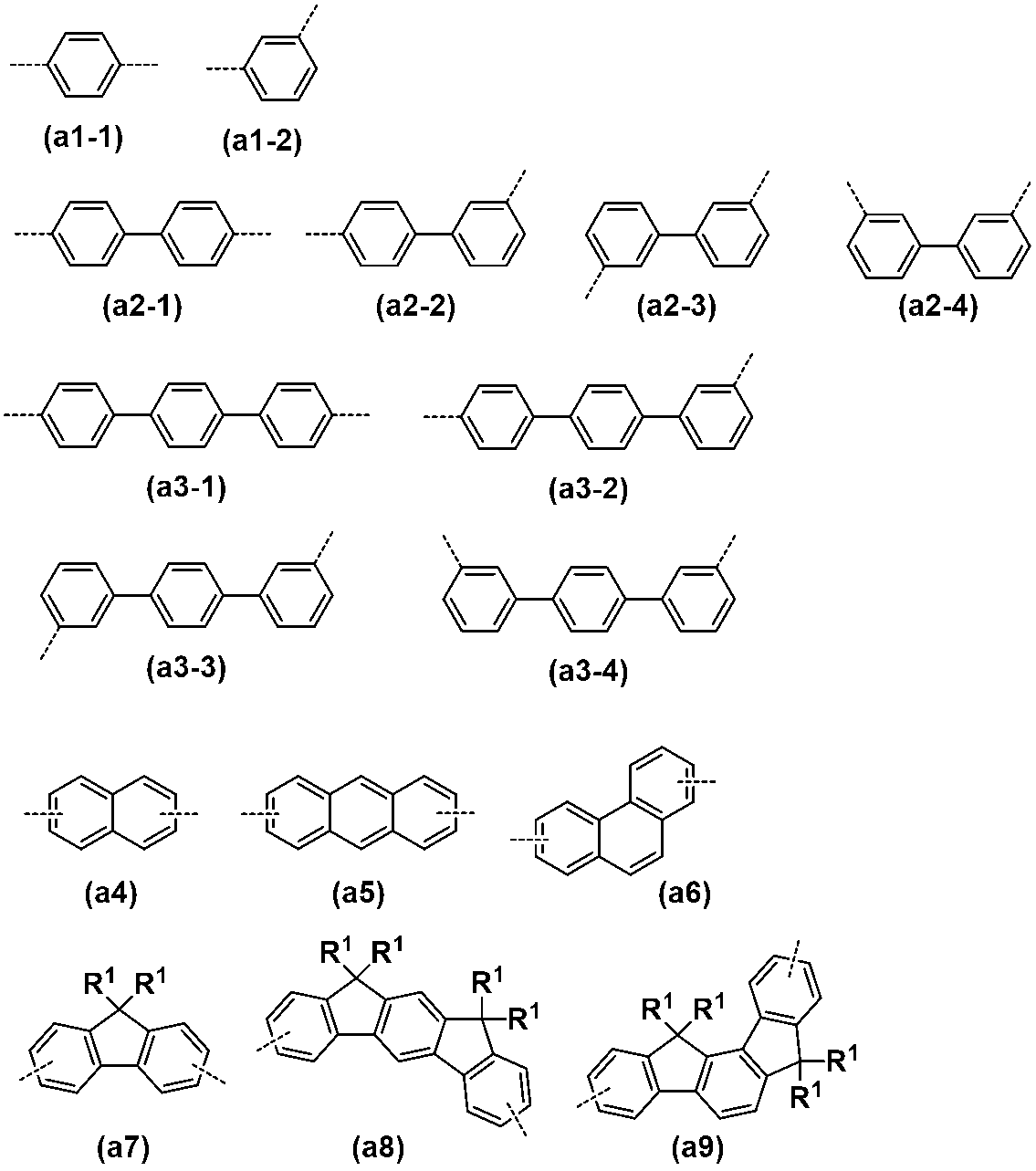
(式中、R1は、それぞれ独立して、炭素数1~20のアルキル基を表す。破線は、結合手を表す。)
Ar1は、それぞれ独立して、下記式(b1)または(b2)で表される基を表し、
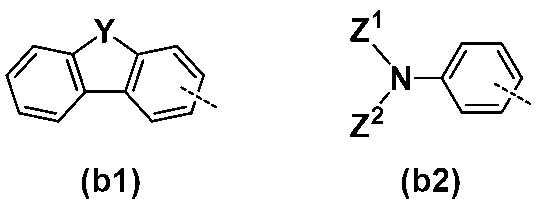
{式中、Yは、NZ3、OまたはSを表し、
Z1、Z2およびZ3は、それぞれ独立して、下記式(c1)~(c4)のいずれかで表される基を表す。破線は、結合手を表す。

(式中、破線は、結合手を表す。)}
nは、0~5の整数を表す。ただし、nが0の場合、X1は単結合にならない。]
2. 上記X1が、それぞれ独立して、単結合、または上記式(a1-1)~(a1-2)、(a2-1)~(a2-4)、(a4)および(a7)のいずれかで表される基であり、上記X2が、それぞれ独立して、上記式(a1-1)~(a1-2)、(a2-1)~(a2-4)、(a4)および(a7)のいずれかで表される基である1のアリールアミン化合物。
3. 上記Ar1が、上記式(b1)で表される基である1または2のアリールアミン化合物。
4. 上記R1が、それぞれ独立して、炭素数1~4のアルキル基である1~3のいずれかのアリールアミン化合物。
5. 上記Yが、NZ3である1~4のいずれかのアリールアミン化合物。
6. 上記Z1、Z2およびZ3が、上記式(c1)で表される基である1~5のいずれかのアリールアミン化合物。
7. 1~6のいずれかのアリールアミン化合物からなる電荷輸送性物質。
8. 1~6のいずれかのアリールアミン化合物と、有機溶媒とを含む電荷輸送性ワニス。
9. さらに、ドーパント物質を含む8の電荷輸送性ワニス。
10. 8または9の電荷輸送性ワニスから得られる電荷輸送性薄膜。
11. 10の電荷輸送性薄膜を備える電子素子。
12. 上記電荷輸送性薄膜が、正孔注入層または正孔輸送層である11の電子素子。
13. 上記電子素子が、有機EL素子または量子ドットEL素子である12の電子素子。
1. 下記式(1)で表されるアリールアミン化合物。
X2は、それぞれ独立して、下記式(a1-1)~(a1-2)、(a2-1)~(a2-4)、(a3-1)~(a3-4)および(a4)~(a9)のいずれかで表される基を表し、
Ar1は、それぞれ独立して、下記式(b1)または(b2)で表される基を表し、
Z1、Z2およびZ3は、それぞれ独立して、下記式(c1)~(c4)のいずれかで表される基を表す。破線は、結合手を表す。
nは、0~5の整数を表す。ただし、nが0の場合、X1は単結合にならない。]
2. 上記X1が、それぞれ独立して、単結合、または上記式(a1-1)~(a1-2)、(a2-1)~(a2-4)、(a4)および(a7)のいずれかで表される基であり、上記X2が、それぞれ独立して、上記式(a1-1)~(a1-2)、(a2-1)~(a2-4)、(a4)および(a7)のいずれかで表される基である1のアリールアミン化合物。
3. 上記Ar1が、上記式(b1)で表される基である1または2のアリールアミン化合物。
4. 上記R1が、それぞれ独立して、炭素数1~4のアルキル基である1~3のいずれかのアリールアミン化合物。
5. 上記Yが、NZ3である1~4のいずれかのアリールアミン化合物。
6. 上記Z1、Z2およびZ3が、上記式(c1)で表される基である1~5のいずれかのアリールアミン化合物。
7. 1~6のいずれかのアリールアミン化合物からなる電荷輸送性物質。
8. 1~6のいずれかのアリールアミン化合物と、有機溶媒とを含む電荷輸送性ワニス。
9. さらに、ドーパント物質を含む8の電荷輸送性ワニス。
10. 8または9の電荷輸送性ワニスから得られる電荷輸送性薄膜。
11. 10の電荷輸送性薄膜を備える電子素子。
12. 上記電荷輸送性薄膜が、正孔注入層または正孔輸送層である11の電子素子。
13. 上記電子素子が、有機EL素子または量子ドットEL素子である12の電子素子。
本発明のアリールアミン化合物は、有機溶媒への溶解性が良好であり、このアリールアミン化合物を含む電荷輸送性ワニスを用いることで、電荷輸送性に優れる電荷輸送性薄膜を得ることができる。
この電荷輸送性薄膜は、有機EL素子や量子ドットEL素子をはじめとした電子素子用薄膜として、特に、上層にウェットプロセスで薄膜が積層される電子素子用薄膜として好適に用いることができ、本発明の電荷輸送性薄膜を有機EL素子や量子ドットEL素子の正孔注入層等に適用することで、良好な特性を有する素子を作製することができる。
この電荷輸送性薄膜は、有機EL素子や量子ドットEL素子をはじめとした電子素子用薄膜として、特に、上層にウェットプロセスで薄膜が積層される電子素子用薄膜として好適に用いることができ、本発明の電荷輸送性薄膜を有機EL素子や量子ドットEL素子の正孔注入層等に適用することで、良好な特性を有する素子を作製することができる。
以下、本発明についてさらに詳しく説明する。
本発明に係るアリールアミン化合物は、下記式(1)で表されることを特徴とする。
本発明に係るアリールアミン化合物は、下記式(1)で表されることを特徴とする。
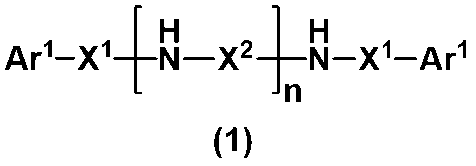
式(1)において、X1は、それぞれ独立して、単結合、または下記式(a1-1)~(a1-2)、(a2-1)~(a2-4)、(a3-1)~(a3-4)および(a4)~(a9)のいずれかで表される基を表し、X2は、それぞれ独立して、下記式(a1-1)~(a1-2)、(a2-1)~(a2-4)、(a3-1)~(a3-4)および(a4)~(a9)のいずれかで表される基を表す。

式(a7)~(a9)において、R1は、それぞれ独立して、炭素数1~20のアルキル基を表す。
Ar1は、それぞれ独立して、下記式(b1)または(b2)で表される基を表し、
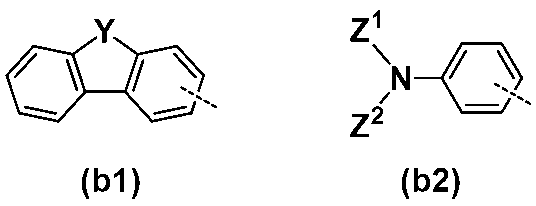
式(b1)~(b2)において、Yは、NZ3、OまたはSを表し、Z1、Z2およびZ3は、それぞれ独立して、下記式(c1)~(c4)のいずれかで表される基を表す。
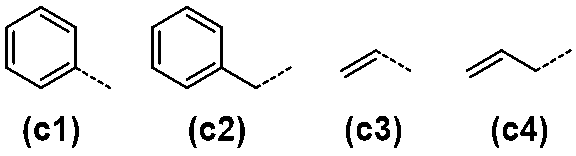
nは、0~5の整数を表す。ただし、nが0の場合、X1は単結合にならない。
炭素数1~20のアルキル基としては、直鎖状、分岐鎖状、環状のいずれでもよく、例えば、メチル、エチル、n-プロピル、イソプロピル、n-ブチル、イソブチル、s-ブチル、t-ブチル、n-ペンチル、n-ヘキシル、n-ヘプチル、n-オクチル、n-ノニル、n-デシル基等の炭素数1~20の直鎖または分岐鎖状アルキル基;シクロプロピル、シクロブチル、シクロペンチル、シクロヘキシル、シクロヘプチル、シクロオクチル、シクロノニル、シクロデシル、ビシクロブチル、ビシクロペンチル、ビシクロヘキシル、ビシクロヘプチル、ビシクロオクチル、ビシクロノニル、ビシクロデシル基等の炭素数3~20の環状アルキル基等が挙げられる。本発明では、電荷輸送性の点から、炭素数1~4のアルキル基が好ましく、メチル基がより好ましい。
上記X1としては、電荷輸送性の点から、単結合、または上記式(a1-1)~(a1-2)、(a2-1)~(a2-4)、(a4)および(a7)のいずれかで表される基が好ましい。
上記X2としては、電荷輸送性の点から、上記式(a1-1)~(a1-2)、(a2-1)~(a2-4)、(a4)および(a7)のいずれかで表される基であることが好ましい。
なお、上記X1およびX2は、膜としたときの透明性を担保する点または電荷輸送性の点から、全てがフェニレン基ではない(すなわち、全てが式(a1-1)および(a1-2)で表される基ではない)ほうが好ましい。
上記Ar1は、電荷輸送性の点から、上記式(b1)で表される基が好ましい。
上記Yは、電荷輸送性の点から、NZ3が好ましく、上記Z1、Z2およびZ3は、上記式(c1)で表される基が好ましい。
上記式(a4)~(a9)で表される基としては、電荷輸送性の点から、下記式(a4-1)~(a9-3)で表される基が好ましいが、これらに限定されるものではない。

上記式(1)で表されるアリールアミン化合物の好ましい態様としては、下記式(1-1)で表される化合物が挙げられるが、これに限定されるものではない。

以下、式(1)で表される化合物の具体例として、下記式(1a)~(1d)で表される化合物が挙げられるが、これらに限定されるものではない。

本発明の式(1)で表されるアリールアミン化合物は、所定のアリールジアミン化合物と、所定のハロゲン化アリール化合物とを触媒存在下で反応させて製造することができ、その方法としては、国際公開第2020/241730号等に記載された公知の方法を参考にすることができる。
上述した本発明のアリールアミン化合物は、電荷輸送性物質として好適に利用することができる。この場合、本発明のアリールアミン化合物と、有機溶媒とを含む電荷輸送性ワニスとして用いることができるが、この電荷輸送性ワニスには、得られる薄膜の用途に応じ、その電荷輸送能の向上等を目的としてドーパント物質を含んでいてもよい。また、本発明のアリールアミン化合物は、アニリン誘導体、チオフェン誘導体等の従来公知のその他の電荷輸送性物質と併用することもできるが、本発明のアリールアミン化合物単独で電荷輸送性物質として用いることが好ましい。
なお、本発明において、電荷輸送性とは導電性と同義である。電荷輸送性ワニスとは、それ自体に電荷輸送性があるものでもよく、それにより得られる固形膜が電荷輸送性を有するものでもよい。
なお、本発明において、電荷輸送性とは導電性と同義である。電荷輸送性ワニスとは、それ自体に電荷輸送性があるものでもよく、それにより得られる固形膜が電荷輸送性を有するものでもよい。
ドーパント物質としては、ワニスに使用する少なくとも1種の溶媒に溶解するものであれば特に限定されず、無機系のドーパント物質、有機系のドーパント物質のいずれも使用できる。
また、無機系および有機系のドーパント物質は、1種類単独で用いてもよく、2種類以上組み合わせて用いてもよい。
さらにドーパント物質は、ワニスから固体膜である電荷輸送性薄膜を得る過程で、例えば焼成時の加熱といった外部からの刺激によって、例えば分子内の一部が外れることによってドーパント物質としての機能が初めて発現または向上するようになる物質、例えばスルホン酸基が脱離しやすい基で保護されたアリールスルホン酸エステル化合物であってもよい。
また、無機系および有機系のドーパント物質は、1種類単独で用いてもよく、2種類以上組み合わせて用いてもよい。
さらにドーパント物質は、ワニスから固体膜である電荷輸送性薄膜を得る過程で、例えば焼成時の加熱といった外部からの刺激によって、例えば分子内の一部が外れることによってドーパント物質としての機能が初めて発現または向上するようになる物質、例えばスルホン酸基が脱離しやすい基で保護されたアリールスルホン酸エステル化合物であってもよい。
特に、本発明においては、無機系のドーパント物質としては、ヘテロポリ酸が好ましい。
ヘテロポリ酸とは、代表的に式(H1)で表されるKeggin型あるいは式(H2)で表されるDawson型の化学構造で示される、ヘテロ原子が分子の中心に位置する構造を有し、バナジウム(V)、モリブデン(Mo)、タングステン(W)等の酸素酸であるイソポリ酸と、異種元素の酸素酸とが縮合してなるポリ酸である。このような異種元素の酸素酸としては、主にケイ素(Si)、リン(P)、ヒ素(As)の酸素酸が挙げられる。
ヘテロポリ酸とは、代表的に式(H1)で表されるKeggin型あるいは式(H2)で表されるDawson型の化学構造で示される、ヘテロ原子が分子の中心に位置する構造を有し、バナジウム(V)、モリブデン(Mo)、タングステン(W)等の酸素酸であるイソポリ酸と、異種元素の酸素酸とが縮合してなるポリ酸である。このような異種元素の酸素酸としては、主にケイ素(Si)、リン(P)、ヒ素(As)の酸素酸が挙げられる。

ヘテロポリ酸の具体例としては、リンモリブデン酸、ケイモリブデン酸、リンタングステン酸、ケイタングステン酸、リンタングストモリブデン酸等が挙げられ、これらは単独で用いてもよく、2種以上組み合わせて用いてもよい。なお、これらのヘテロポリ酸は、市販品として入手可能であり、また、公知の方法により合成することもできる。
特に、1種類のヘテロポリ酸を用いる場合、その1種類のヘテロポリ酸は、リンタングステン酸またはリンモリブデン酸が好ましく、リンタングステン酸が最適である。また、2種類以上のヘテロポリ酸を用いる場合、その2種類以上のヘテロポリ酸の1つは、リンタングステン酸またはリンモリブデン酸が好ましく、リンタングステン酸がより好ましい。
なお、ヘテロポリ酸は、元素分析等の定量分析において、一般式で示される構造から元素の数が多いもの、または少ないものであっても、それが市販品として入手したもの、あるいは、公知の合成方法にしたがって適切に合成したものである限り、本発明において用いることができる。
すなわち、例えば、一般的には、リンタングステン酸は化学式H3(PW12O40)・nH2Oで、リンモリブデン酸は化学式H3(PMo12O40)・nH2Oでそれぞれ示されるが、定量分析において、この式中のP(リン)、O(酸素)またはW(タングステン)もしくはMo(モリブデン)の数が多いもの、または少ないものであっても、それが市販品として入手したもの、あるいは、公知の合成方法にしたがって適切に合成したものである限り、本発明において用いることができる。この場合、本発明に規定されるヘテロポリ酸の質量とは、合成物や市販品中における純粋なリンタングステン酸の質量(リンタングステン酸含量)ではなく、市販品として入手可能な形態および公知の合成法にて単離可能な形態において、水和水やその他の不純物等を含んだ状態での全質量を意味する。
特に、1種類のヘテロポリ酸を用いる場合、その1種類のヘテロポリ酸は、リンタングステン酸またはリンモリブデン酸が好ましく、リンタングステン酸が最適である。また、2種類以上のヘテロポリ酸を用いる場合、その2種類以上のヘテロポリ酸の1つは、リンタングステン酸またはリンモリブデン酸が好ましく、リンタングステン酸がより好ましい。
なお、ヘテロポリ酸は、元素分析等の定量分析において、一般式で示される構造から元素の数が多いもの、または少ないものであっても、それが市販品として入手したもの、あるいは、公知の合成方法にしたがって適切に合成したものである限り、本発明において用いることができる。
すなわち、例えば、一般的には、リンタングステン酸は化学式H3(PW12O40)・nH2Oで、リンモリブデン酸は化学式H3(PMo12O40)・nH2Oでそれぞれ示されるが、定量分析において、この式中のP(リン)、O(酸素)またはW(タングステン)もしくはMo(モリブデン)の数が多いもの、または少ないものであっても、それが市販品として入手したもの、あるいは、公知の合成方法にしたがって適切に合成したものである限り、本発明において用いることができる。この場合、本発明に規定されるヘテロポリ酸の質量とは、合成物や市販品中における純粋なリンタングステン酸の質量(リンタングステン酸含量)ではなく、市販品として入手可能な形態および公知の合成法にて単離可能な形態において、水和水やその他の不純物等を含んだ状態での全質量を意味する。
ヘテロポリ酸の使用量は、質量比で、電荷輸送性物質1に対して0.001~50.0程度とすることができるが、好ましくは0.01~20.0程度、より好ましくは0.1~10.0程度である。
一方、有機系のドーパント物質としては、特にテトラシアノキノジメタン誘導体やベンゾキノン誘導体を用いることができる。
テトラシアノキノジメタン誘導体の具体例としては、7,7,8,8-テトラシアノキノジメタン(TCNQ)や、式(H3)で表されるハロテトラシアノキノジメタンなどが挙げられる。
また、ベンゾキノン誘導体の具体例としては、テトラフルオロ-1,4-ベンゾキノン(F4BQ)、テトラクロロ-1,4-ベンゾキノン(クロラニル)、テトラブロモ-1,4-ベンゾキノン、2,3-ジクロロ-5,6-ジシアノ-1,4-ベンゾキノン(DDQ)などが挙げられる。
テトラシアノキノジメタン誘導体の具体例としては、7,7,8,8-テトラシアノキノジメタン(TCNQ)や、式(H3)で表されるハロテトラシアノキノジメタンなどが挙げられる。
また、ベンゾキノン誘導体の具体例としては、テトラフルオロ-1,4-ベンゾキノン(F4BQ)、テトラクロロ-1,4-ベンゾキノン(クロラニル)、テトラブロモ-1,4-ベンゾキノン、2,3-ジクロロ-5,6-ジシアノ-1,4-ベンゾキノン(DDQ)などが挙げられる。
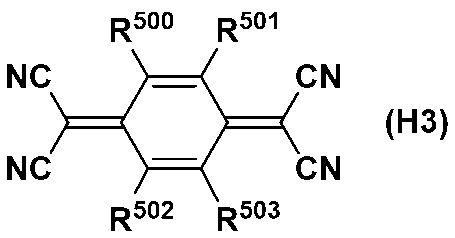
式中、R500~R503は、それぞれ独立して、水素原子またはハロゲン原子を表すが、少なくとも1つはハロゲン原子であり、少なくとも2つはハロゲン原子であることが好ましく、少なくとも3つがハロゲン原子であることがより好ましく、全てがハロゲン原子であることが最も好ましい。
ハロゲン原子としては上記と同じものが挙げられるが、フッ素原子または塩素原子が好ましく、フッ素原子がより好ましい。
ハロゲン原子としては上記と同じものが挙げられるが、フッ素原子または塩素原子が好ましく、フッ素原子がより好ましい。
このようなハロテトラシアノキノジメタンの具体例としては、2-フルオロ-7,7,8,8-テトラシアノキノジメタン、2-クロロ-7,7,8,8-テトラシアノキノジメタン、2,5-ジフルオロ-7,7,8,8-テトラシアノキノジメタン、2,5-ジクロロ-7,7,8,8-テトラシアノキノジメタン、2,3,5,6-テトラクロロ-7,7,8,8-テトラシアノキノジメタン、2,3,5,6-テトラフルオロ-7,7,8,8-テトラシアノキノジメタン(F4TCNQ)等が挙げられる。
テトラシアノキノジメタン誘導体およびベンゾキノン誘導体の使用量は、電荷輸送性物質に対して、好ましくは0.0001~100当量、より好ましくは0.01~50当量、より一層好ましくは1~20当量である。
また、有機系ドーパント物質としては、下記式(e1)で表される1価または2価のアニオンと式(f1)~(f5)で表される対カチオンからなる、電気的に中性なオニウムボレート塩を用いることもできる。

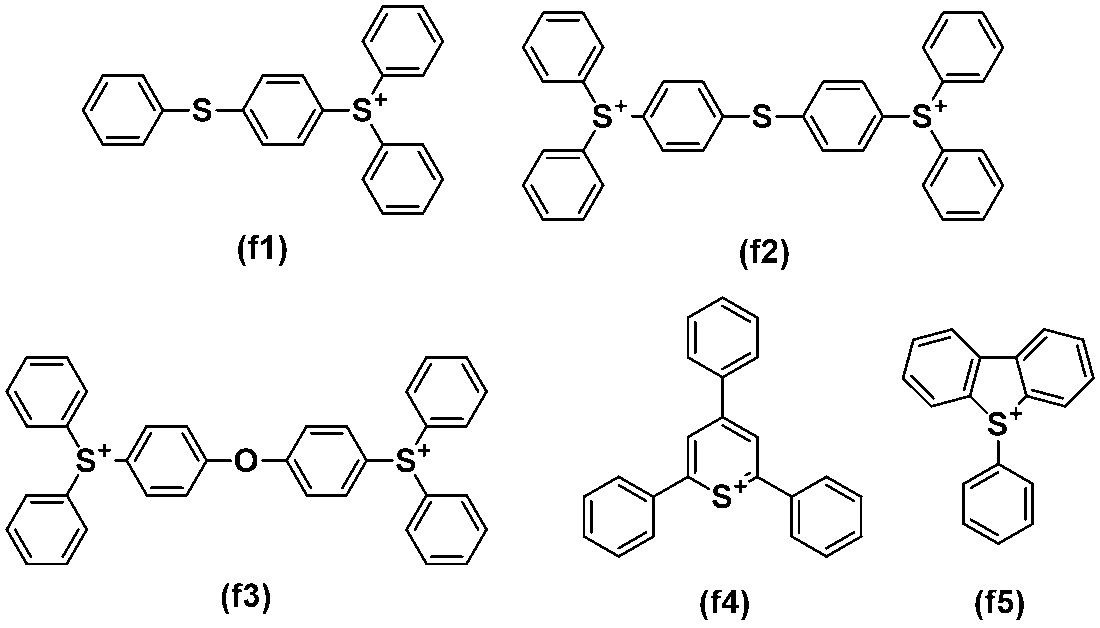
式(e1)において、炭素数1~20のアルキレン基としては、直鎖状、分岐鎖状、環状のいずれでもよく、その具体例としては、メチレン、メチルメチレン、ジメチルメチレン、エチレン、トリメチレン、プロピレン、テトラメチレン、ペンタメチレン、ヘキサメチレン基等が挙げられる。なお、アリール基、ヘテロアリール基としては、上記と同様のものが挙げられる。
上記式(e1)のアニオンの好適例としては、式(e2)で表されるものが挙げられるが、これに限定されるものではない。

オニウムボレート塩の使用量は、物質量(モル)比で、電荷輸送性物質に対して、0.1~10程度とすることができる。
なお、上記オニウムボレート塩は、例えば、特開2005-314682号公報等に記載された公知の方法を参考に合成することができる。
なお、上記オニウムボレート塩は、例えば、特開2005-314682号公報等に記載された公知の方法を参考に合成することができる。
また、有機系のドーパント物質として、アリールスルホン酸化合物、アリールスルホン酸エステル化合物、フッ素化アリールスルホン酸ポリマー化合物も好適に用いることができる。
アリールスルホン酸化合物の具体例としては、ベンゼンスルホン酸、トシル酸、p-スチレンスルホン酸、2-ナフタレンスルホン酸、4-ヒドロキシベンゼンスルホン酸、5-スルホサリチル酸、p-ドデシルベンゼンスルホン酸、ジヘキシルベンゼンスルホン酸、2,5-ジヘキシルベンゼンスルホン酸、ジブチルナフタレンスルホン酸、6,7-ジブチル-2-ナフタレンスルホン酸、ドデシルナフタレンスルホン酸、3-ドデシル-2-ナフタレンスルホン酸、ヘキシルナフタレンスルホン酸、4-ヘキシル-1-ナフタレンスルホン酸、7-へキシル-1-ナフタレンスルホン酸、6-ヘキシル-2-ナフタレンスルホン酸、オクチルナフタレンスルホン酸、2-オクチル-1-ナフタレンスルホン酸、ジノニルナフタレンスルホン酸、2,7-ジノニル-4-ナフタレンスルホン酸、ジノニルナフタレンジスルホン酸、2,7-ジノニル-4,5-ナフタレンジスルホン酸、国際公開第2005/000832号記載の1,4-ベンゾジオキサンジスルホン酸化合物、国際公開第2006/025342号記載のアリールスルホン酸化合物、国際公開第2009/096352号記載のアリールスルホン酸化合物等が挙げられる。
好ましいアリールスルホン酸化合物の例としては、式(H4)または(H5)で表されるアリールスルホン酸化合物が挙げられる。
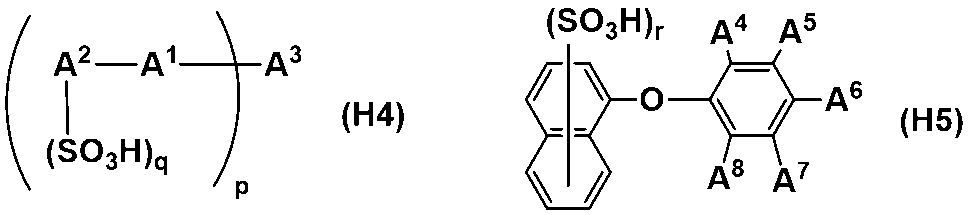
A1は、OまたはSを表すが、Oが好ましい。
A2は、ナフタレン環またはアントラセン環を表すが、ナフタレン環が好ましい。
A3は、2~4価のパーフルオロビフェニル基を表し、pは、A1とA3との結合数を示し、2≦p≦4を満たす整数であるが、A3がパーフルオロビフェニルジイル基、好ましくはパーフルオロビフェニル-4,4’-ジイル基であり、かつ、pが2であることが好ましい。
qは、A2に結合するスルホン酸基数を表し、1≦q≦4を満たす整数であるが、2が最適である。
A2は、ナフタレン環またはアントラセン環を表すが、ナフタレン環が好ましい。
A3は、2~4価のパーフルオロビフェニル基を表し、pは、A1とA3との結合数を示し、2≦p≦4を満たす整数であるが、A3がパーフルオロビフェニルジイル基、好ましくはパーフルオロビフェニル-4,4’-ジイル基であり、かつ、pが2であることが好ましい。
qは、A2に結合するスルホン酸基数を表し、1≦q≦4を満たす整数であるが、2が最適である。
A4~A8は、それぞれ独立して、水素原子、ハロゲン原子、シアノ基、炭素数1~20のアルキル基、炭素数1~20のハロゲン化アルキル基、または炭素数2~20のハロゲン化アルケニル基を表すが、A4~A8のうち少なくとも3つは、ハロゲン原子である。
炭素数1~20のハロゲン化アルキル基としては、トリフルオロメチル、2,2,2-トリフルオロエチル、1,1,2,2,2-ペンタフルオロエチル、3,3,3-トリフルオロプロピル、2,2,3,3,3-ペンタフルオロプロピル、1,1,2,2,3,3,3-ヘプタフルオロプロピル、4,4,4-トリフルオロブチル、3,3,4,4,4-ペンタフルオロブチル、2,2,3,3,4,4,4-ヘプタフルオロブチル、1,1,2,2,3,3,4,4,4-ノナフルオロブチル基等が挙げられる。
炭素数2~20のハロゲン化アルケニル基としては、パーフルオロビニル、パーフルオロプロペニル(パーフルオロアリル)、パーフルオロブテニル基等が挙げられる。
その他、ハロゲン原子、炭素数1~20のアルキル基の例としては上記と同様のものが挙げられるが、ハロゲン原子としては、フッ素原子が好ましい。
その他、ハロゲン原子、炭素数1~20のアルキル基の例としては上記と同様のものが挙げられるが、ハロゲン原子としては、フッ素原子が好ましい。
これらの中でも、A4~A8は、水素原子、ハロゲン原子、シアノ基、炭素数1~10のアルキル基、炭素数1~10のハロゲン化アルキル基、または炭素数2~10のハロゲン化アルケニル基であり、かつ、A4~A8のうち少なくとも3つは、フッ素原子であることが好ましく、水素原子、フッ素原子、シアノ基、炭素数1~5のアルキル基、炭素数1~5のフッ化アルキル基、または炭素数2~5のフッ化アルケニル基であり、かつ、A4~A8のうち少なくとも3つはフッ素原子であることがより好ましく、水素原子、フッ素原子、シアノ基、炭素数1~5のパーフルオロアルキル基、または炭素数1~5のパーフルオロアルケニル基であり、かつ、A4、A5およびA8がフッ素原子であることがより一層好ましい。
なお、パーフルオロアルキル基とは、アルキル基の水素原子全てがフッ素原子に置換された基であり、パーフルオロアルケニル基とは、アルケニル基の水素原子全てがフッ素原子に置換された基である。
なお、パーフルオロアルキル基とは、アルキル基の水素原子全てがフッ素原子に置換された基であり、パーフルオロアルケニル基とは、アルケニル基の水素原子全てがフッ素原子に置換された基である。
rは、ナフタレン環に結合するスルホン酸基数を表し、1≦r≦4を満たす整数であるが、2~4が好ましく、2が最適である。
ドーパント物質として用いるアリールスルホン酸化合物の分子量は、特に限定されるものではないが、本発明のアリールアミン化合物とともに用いた場合における有機溶媒への溶解性を考慮すると、好ましくは2000以下、より好ましくは1500以下である。
以下、好適なアリールスルホン酸化合物の具体例を挙げるが、これらに限定されるわけではない。



アリールスルホン酸化合物の使用量は、物質量(モル)比で、電荷輸送性物質1に対して、好ましくは0.01~20.0程度、より好ましくは0.4~5.0程度である。
アリールスルホン酸化合物は市販品を用いてもよいが、国際公開第2006/025342号、国際公開第2009/096352号、国際公開第2015/111654号、国際公開第2015/053320号、国際公開第2015/115515号等に記載の公知の方法で合成することもできる。
アリールスルホン酸化合物は市販品を用いてもよいが、国際公開第2006/025342号、国際公開第2009/096352号、国際公開第2015/111654号、国際公開第2015/053320号、国際公開第2015/115515号等に記載の公知の方法で合成することもできる。
一方、アリールスルホン酸エステル化合物としては、国際公開第2017/217455号に開示されたアリールスルホン酸エステル化合物、国際公開第2017/217457号に開示されたアリールスルホン酸エステル化合物、特願2017-243631(国際公開第2019/124412号)に記載のアリールスルホン酸エステル化合物等が挙げられ、具体的には、下記式(H6)~(H8)のいずれかで表されるものが好ましい。
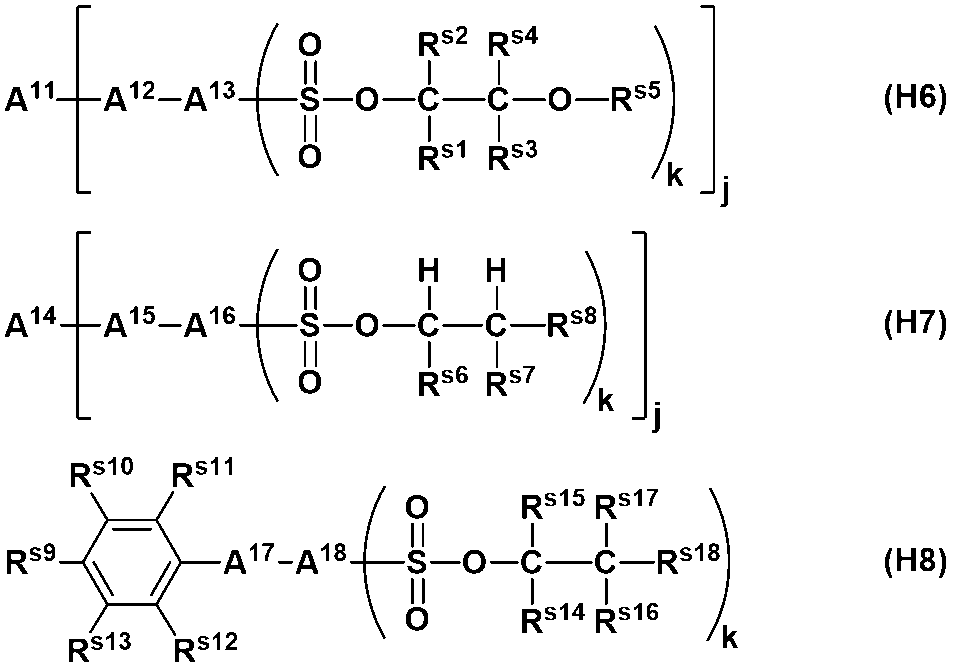
式(H6)において、A11は、パーフルオロビフェニルから誘導されるj価の基である。
A12は、-O-または-S-であるが、-O-が好ましい。
A13は、ナフタレンまたはアントラセンから誘導される(k+1)価の基であるが、ナフタレンから誘導される基が好ましい。
Rs1~Rs4は、それぞれ独立して、水素原子、または直鎖状もしくは分岐鎖状の炭素数1~6のアルキル基であり、Rs5は、置換されていてもよい炭素数2~20の1価炭化水素基である。
A12は、-O-または-S-であるが、-O-が好ましい。
A13は、ナフタレンまたはアントラセンから誘導される(k+1)価の基であるが、ナフタレンから誘導される基が好ましい。
Rs1~Rs4は、それぞれ独立して、水素原子、または直鎖状もしくは分岐鎖状の炭素数1~6のアルキル基であり、Rs5は、置換されていてもよい炭素数2~20の1価炭化水素基である。
直鎖状または分岐鎖状の炭素数1~6アルキル基の具体例としては、メチル、エチル、n-プロピル、イソプロピル、n-ブチル、イソブチル、t-ブチル、n-ヘキシル基等が挙げられるが、炭素数1~3のアルキル基が好ましい。
炭素数2~20の1価炭化水素基は、直鎖状、分岐鎖状、環状のいずれでもよく、その具体例としては、エチル、n-プロピル、イソプロピル、n-ブチル、イソブチル、t-ブチル基等のアルキル基;フェニル、ナフチル、フェナントリル基等のアリール基などが挙げられる。
炭素数2~20の1価炭化水素基は、直鎖状、分岐鎖状、環状のいずれでもよく、その具体例としては、エチル、n-プロピル、イソプロピル、n-ブチル、イソブチル、t-ブチル基等のアルキル基;フェニル、ナフチル、フェナントリル基等のアリール基などが挙げられる。
特に、Rs1~Rs4のうち、Rs1またはRs3が炭素数1~3の直鎖アルキル基であり、残りが水素原子であるか、Rs1が炭素数1~3の直鎖アルキル基であり、Rs2~Rs4が水素原子であることが好ましい。この場合、炭素数1~3の直鎖アルキル基としては、メチル基が好ましい。
また、Rs5としては、炭素数2~4の直鎖アルキル基またはフェニル基が好ましい。
また、Rs5としては、炭素数2~4の直鎖アルキル基またはフェニル基が好ましい。
式(H7)において、A14は、置換されていてもよい、1つ以上の芳香環を含む炭素数6~20のj価の炭化水素基であり、この炭化水素基は、1つ以上の芳香環を含む炭素数6~20の炭化水素化合物からj個の水素原子を取り除いて得られる基である。
このような炭化水素化合物としては、ベンゼン、トルエン、キシレン、エチルベンゼン、ビフェニル、ナフタレン、アントラセン、フェナントレン等が挙げられる。
なお、上記炭化水素基は、その水素原子の一部または全部が、更に置換基で置換されていてもよく、このような置換基としては、フッ素原子、塩素原子、臭素原子、ヨウ素原子、ニトロ、シアノ、ヒドロキシ、アミノ、シラノール、チオール、カルボキシ、スルホン酸エステル、リン酸、リン酸エステル、エステル、チオエステル、アミド、オルガノオキシ、オルガノアミノ、オルガノシリル、オルガノチオ、アシル、スルホ、1価炭化水素基等が挙げられる。
これらの中でも、A14としては、ベンゼン、ビフェニル等から誘導される基が好ましい。
このような炭化水素化合物としては、ベンゼン、トルエン、キシレン、エチルベンゼン、ビフェニル、ナフタレン、アントラセン、フェナントレン等が挙げられる。
なお、上記炭化水素基は、その水素原子の一部または全部が、更に置換基で置換されていてもよく、このような置換基としては、フッ素原子、塩素原子、臭素原子、ヨウ素原子、ニトロ、シアノ、ヒドロキシ、アミノ、シラノール、チオール、カルボキシ、スルホン酸エステル、リン酸、リン酸エステル、エステル、チオエステル、アミド、オルガノオキシ、オルガノアミノ、オルガノシリル、オルガノチオ、アシル、スルホ、1価炭化水素基等が挙げられる。
これらの中でも、A14としては、ベンゼン、ビフェニル等から誘導される基が好ましい。
また、A15は、-O-または-S-であるが、-O-が好ましい。
A16は、炭素数6~20の(k+1)価の芳香族炭化水素基であり、この芳香族炭化水素基は、炭素数6~20の芳香族炭化水素化合物の芳香環上から(k+1)個の水素原子を取り除いて得られる基である。
このような芳香族炭化水素化合物としては、ベンゼン、トルエン、キシレン、ビフェニル、ナフタレン、アントラセン、ピレン等が挙げられる。
中でも、A16としては、ナフタレンまたはアントラセンから誘導される基が好ましく、ナフタレンから誘導される基がより好ましい。
A16は、炭素数6~20の(k+1)価の芳香族炭化水素基であり、この芳香族炭化水素基は、炭素数6~20の芳香族炭化水素化合物の芳香環上から(k+1)個の水素原子を取り除いて得られる基である。
このような芳香族炭化水素化合物としては、ベンゼン、トルエン、キシレン、ビフェニル、ナフタレン、アントラセン、ピレン等が挙げられる。
中でも、A16としては、ナフタレンまたはアントラセンから誘導される基が好ましく、ナフタレンから誘導される基がより好ましい。
Rs6およびRs7は、それぞれ独立して、水素原子、または直鎖状もしくは分岐鎖状の1価脂肪族炭化水素基であり、Rs8は、直鎖状または分岐鎖状の1価脂肪族炭化水素基である。ただし、Rs6、Rs7およびRs8の炭素数の合計は6以上である。Rs6、Rs7およびRs8の炭素数の合計の上限は、特に限定されないが、20以下が好ましく、10以下がより好ましい。
上記直鎖状または分岐鎖状の1価脂肪族炭化水素基の具体例としては、メチル、エチル、n-プロピル、イソプロピル、n-ブチル、イソブチル、t-ブチル、n-ヘキシル、n-オクチル、2-エチルヘキシル、デシル基等の炭素数1~20のアルキル基;ビニル、1-プロペニル、2-プロペニル、イソプロペニル、1-メチル-2-プロペニル、1-ブテニル、2-ブテニル、3-ブテニル、ヘキセニル基等の炭素数2~20のアルケニル基などが挙げられる。
これらの中でも、Rs6は水素原子が好ましく、Rs7およびRs8は、それぞれ独立して、炭素数1~6のアルキル基が好ましい。
上記直鎖状または分岐鎖状の1価脂肪族炭化水素基の具体例としては、メチル、エチル、n-プロピル、イソプロピル、n-ブチル、イソブチル、t-ブチル、n-ヘキシル、n-オクチル、2-エチルヘキシル、デシル基等の炭素数1~20のアルキル基;ビニル、1-プロペニル、2-プロペニル、イソプロペニル、1-メチル-2-プロペニル、1-ブテニル、2-ブテニル、3-ブテニル、ヘキセニル基等の炭素数2~20のアルケニル基などが挙げられる。
これらの中でも、Rs6は水素原子が好ましく、Rs7およびRs8は、それぞれ独立して、炭素数1~6のアルキル基が好ましい。
式(H8)において、Rs9~Rs13は、それぞれ独立して、水素原子、ニトロ基、シアノ基、ハロゲン原子、炭素数1~10のアルキル基、炭素数1~10のハロゲン化アルキル基、または炭素数2~10のハロゲン化アルケニル基である。
炭素数1~10のアルキル基は、直鎖状、分岐鎖状、環状のいずれでもよく、その具体例としては、メチル、エチル、n-プロピル、イソプロピル、n-ブチル、イソブチル、s-ブチル、t-ブチル、n-ペンチル、シクロペンチル、n-ヘキシル、シクロヘキシル、n-ヘプチル、n-オクチル、n-ノニル、n-デシル基等が挙げられる。
炭素数1~10のアルキル基は、直鎖状、分岐鎖状、環状のいずれでもよく、その具体例としては、メチル、エチル、n-プロピル、イソプロピル、n-ブチル、イソブチル、s-ブチル、t-ブチル、n-ペンチル、シクロペンチル、n-ヘキシル、シクロヘキシル、n-ヘプチル、n-オクチル、n-ノニル、n-デシル基等が挙げられる。
炭素数1~10のハロゲン化アルキル基は、上記炭素数1~10のアルキル基の水素原子の一部または全部がハロゲン原子で置換された基であれば、特に限定されるものではなく、その具体例としては、トリフルオロメチル、2,2,2-トリフルオロエチル、1,1,2,2,2-ペンタフルオロエチル、3,3,3-トリフルオロプロピル、2,2,3,3,3-ペンタフルオロプロピル、1,1,2,2,3,3,3-ヘプタフルオロプロピル、4,4,4-トリフルオロブチル、3,3,4,4,4-ペンタフルオロブチル、2,2,3,3,4,4,4-ヘプタフルオロブチル、1,1,2,2,3,3,4,4,4-ノナフルオロブチル基等が挙げられる。
炭素数2~10のハロゲン化アルケニル基としては、炭素数2~10のアルケニル基の水素原子の一部または全部がハロゲン原子で置換された基であれば、特に限定されるものではなく、その具体例としては、パーフルオロビニル、パーフルオロ-1-プロペニル、パーフルオロ-2-プロペニル、パーフルオロ-1-ブテニル、パーフルオロ-2-ブテニル、パーフルオロ-3-ブテニル基等が挙げられる。
これらの中でも、Rs9としては、ニトロ基、シアノ基、炭素数1~10のハロゲン化アルキル基、炭素数2~10のハロゲン化アルケニル基が好ましく、ニトロ基、シアノ基、炭素数1~4のハロゲン化アルキル基、炭素数2~4のハロゲン化アルケニル基がより好ましく、ニトロ基、シアノ基、トリフルオロメチル基、パーフルオロプロペニル基がより一層好ましい。
Rs10~Rs13としては、ハロゲン原子が好ましく、フッ素原子がより好ましい。
Rs10~Rs13としては、ハロゲン原子が好ましく、フッ素原子がより好ましい。
A17は、-O-、-S-または-NH-であるが、-O-が好ましい。
A18は、炭素数6~20の(k+1)価の芳香族炭化水素基であり、この芳香族炭化水素基は、炭素数6~20の芳香族炭化水素化合物の芳香環上から(k+1)個の水素原子を取り除いて得られる基である。
このような芳香族炭化水素化合物としては、ベンゼン、トルエン、キシレン、ビフェニル、ナフタレン、アントラセン、ピレン等が挙げられる。
これらの中でも、A18としては、ナフタレンまたはアントラセンから誘導される基が好ましく、ナフタレンから誘導される基がより好ましい。
A18は、炭素数6~20の(k+1)価の芳香族炭化水素基であり、この芳香族炭化水素基は、炭素数6~20の芳香族炭化水素化合物の芳香環上から(k+1)個の水素原子を取り除いて得られる基である。
このような芳香族炭化水素化合物としては、ベンゼン、トルエン、キシレン、ビフェニル、ナフタレン、アントラセン、ピレン等が挙げられる。
これらの中でも、A18としては、ナフタレンまたはアントラセンから誘導される基が好ましく、ナフタレンから誘導される基がより好ましい。
Rs14~Rs17は、それぞれ独立して、水素原子、または直鎖状もしくは分岐鎖状の炭素数1~20の1価脂肪族炭化水素基である。
1価脂肪族炭化水素基の具体例としては、メチル、エチル、n-プロピル、イソプロピル、n-ブチル、イソブチル、s-ブチル、t-ブチル、n-ペンチル、シクロペンチル、n-ヘキシル、シクロヘキシル、n-ヘプチル、n-オクチル、n-ノニル、n-デシル、n-ウンデシル、n-ドデシル基等の炭素数1~20のアルキル基;ビニル、1-プロペニル、2-プロペニル、イソプロペニル、1-メチル-2-プロペニル、1-ブテニル、2-ブテニル、3-ブテニル、ヘキセニル基等の炭素数2~20のアルケニル基などが挙げられるが、炭素数1~20のアルキル基が好ましく、炭素数1~10のアルキル基がより好ましく、炭素数1~8のアルキル基がより一層好ましい。
1価脂肪族炭化水素基の具体例としては、メチル、エチル、n-プロピル、イソプロピル、n-ブチル、イソブチル、s-ブチル、t-ブチル、n-ペンチル、シクロペンチル、n-ヘキシル、シクロヘキシル、n-ヘプチル、n-オクチル、n-ノニル、n-デシル、n-ウンデシル、n-ドデシル基等の炭素数1~20のアルキル基;ビニル、1-プロペニル、2-プロペニル、イソプロペニル、1-メチル-2-プロペニル、1-ブテニル、2-ブテニル、3-ブテニル、ヘキセニル基等の炭素数2~20のアルケニル基などが挙げられるが、炭素数1~20のアルキル基が好ましく、炭素数1~10のアルキル基がより好ましく、炭素数1~8のアルキル基がより一層好ましい。
Rs18は、直鎖状または分岐鎖状の炭素数1~20の1価脂肪族炭化水素基、またはORs19である。Rs19は、置換されていてもよい炭素数2~20の1価炭化水素基である。
Rs18の直鎖状または分岐状の炭素数1~20の1価脂肪族炭化水素基としては、上記と同様のものが挙げられる。
Rs18が1価脂肪族炭化水素基である場合、Rs18は、炭素数1~20のアルキル基が好ましく、炭素数1~10のアルキル基がより好ましく、炭素数1~8のアルキル基がより一層好ましい。
Rs19の炭素数2~20の1価炭化水素基としては、前述した1価脂肪族炭化水素基のうちメチル基以外のもののほか、フェニル、ナフチル、フェナントリル基等のアリール基などが挙げられる。
これらの中でも、Rs19は、炭素数2~4の直鎖アルキル基またはフェニル基が好ましい。
なお、上記1価炭化水素基が有していてもよい置換基としては、フッ素原子、炭素数1~4のアルコキシ基、ニトロ基、シアノ基等が挙げられる。
Rs18の直鎖状または分岐状の炭素数1~20の1価脂肪族炭化水素基としては、上記と同様のものが挙げられる。
Rs18が1価脂肪族炭化水素基である場合、Rs18は、炭素数1~20のアルキル基が好ましく、炭素数1~10のアルキル基がより好ましく、炭素数1~8のアルキル基がより一層好ましい。
Rs19の炭素数2~20の1価炭化水素基としては、前述した1価脂肪族炭化水素基のうちメチル基以外のもののほか、フェニル、ナフチル、フェナントリル基等のアリール基などが挙げられる。
これらの中でも、Rs19は、炭素数2~4の直鎖アルキル基またはフェニル基が好ましい。
なお、上記1価炭化水素基が有していてもよい置換基としては、フッ素原子、炭素数1~4のアルコキシ基、ニトロ基、シアノ基等が挙げられる。
好適なアリールスルホン酸エステル化合物の具体例としては、以下に示すものが挙げられるが、これらに限定されない。
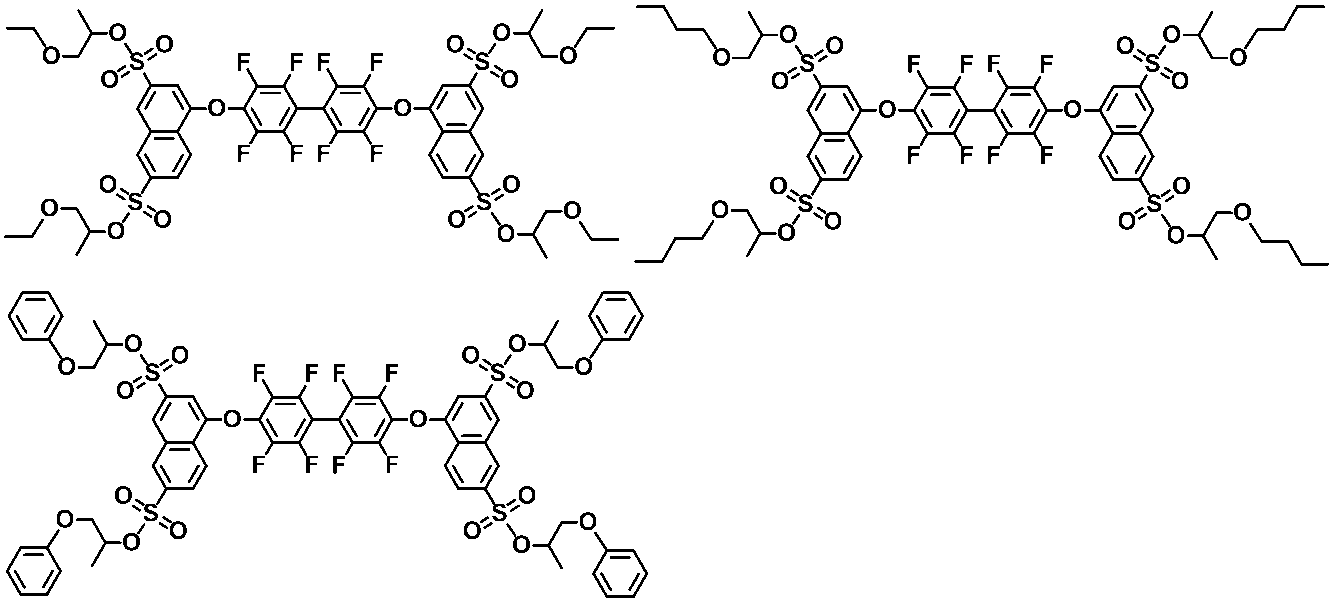

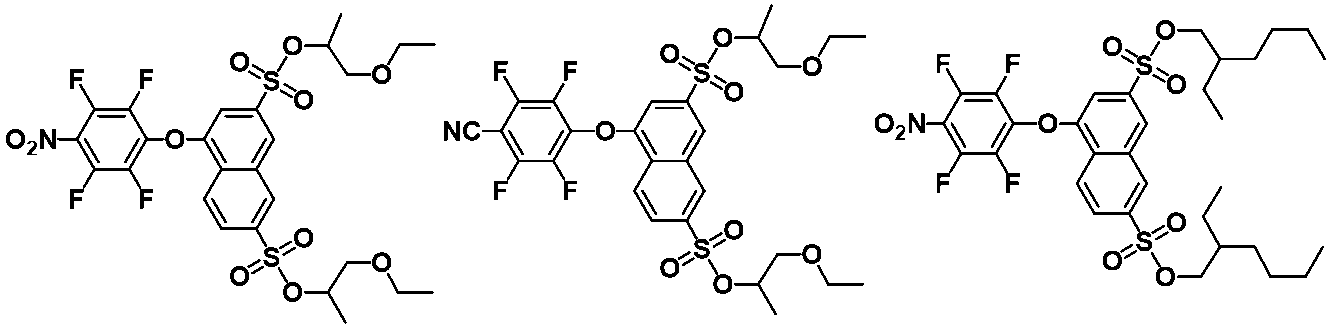
アリールスルホン酸エステル化合物の使用量は、物質量(モル)比で、電荷輸送性物質1に対して、好ましくは0.01~20程度、より好ましくは0.05~10程度である。
アリールスルホン酸エステル化合物は市販品を用いてもよいが、国際公開第2017/217455号、国際公開第2017/217457号、国際公開第2019/124412号等に記載の公知の方法で合成することもできる。
アリールスルホン酸エステル化合物は市販品を用いてもよいが、国際公開第2017/217455号、国際公開第2017/217457号、国際公開第2019/124412号等に記載の公知の方法で合成することもできる。
フッ素化アリールスルホン酸ポリマー化合物は、下記式(F1)で表される繰り返し単位を含むことを特徴とする。

式(F1)において、ArFは、フッ化アリーレン基を表す。
ArFのフッ化アリーレン基は、アリーレン基上の少なくとも1つの水素原子がフッ素原子で置換されたものであれば特に限定はないが、残りの水素原子の少なくとも1つがスルホ基以外の電子吸引基で置換されていることが好ましい。
電子吸引基としては、フッ素原子、塩素原子、臭素原子、ヨウ素原子等のハロゲン原子;ニトロ基;シアノ基;アシル基;カルボキシ基;カルボン酸エステル基;ホルミル基、アセチル基等のアシル基などが挙げられる。
特にArFのフッ化アリーレン基は、2つ以上のフッ素原子で置換されたアリーレン基が好ましく、パーフルオロアリーレン基がより好ましい。
ArFのフッ化アリーレン基は、アリーレン基上の少なくとも1つの水素原子がフッ素原子で置換されたものであれば特に限定はないが、残りの水素原子の少なくとも1つがスルホ基以外の電子吸引基で置換されていることが好ましい。
電子吸引基としては、フッ素原子、塩素原子、臭素原子、ヨウ素原子等のハロゲン原子;ニトロ基;シアノ基;アシル基;カルボキシ基;カルボン酸エステル基;ホルミル基、アセチル基等のアシル基などが挙げられる。
特にArFのフッ化アリーレン基は、2つ以上のフッ素原子で置換されたアリーレン基が好ましく、パーフルオロアリーレン基がより好ましい。
ArFを構成するアリーレン基の炭素数に特に制限はないが、炭素数6~20が好ましく、炭素数6~16がより好ましい。その具体例としては、1,4-フェニレン、1,3-フェニレン、1,2-フェニレン、1,5-ナフチレン、1,7-ナフチレン、1,8-ナフチレン、2,6-ナフチレン、2,7-ナフチレン、4,4’-ビフェニリレン、アントラセニル基等が挙げられるが、フェニレン基が好ましく、1,4-フェニレン基がより好ましい。
したがって、ArFとしては、テトラフルオロフェニレン基が好ましく、2,3,5,6-テトラフルオロ-1,4-フェニレン基がより好ましい。
したがって、ArFとしては、テトラフルオロフェニレン基が好ましく、2,3,5,6-テトラフルオロ-1,4-フェニレン基がより好ましい。
Xは、O、S、NH、CONHまたはNHCOを表すが、O、Sが好ましく、Oがより好ましい。
本発明の好適なフッ素化アリールスルホン酸ポリマー化合物としては、下記式(F1-1)で示されるものが挙げられる。

より好適なフッ素化アリールスルホン酸ポリマー化合物としては、下記式(F1-2)で示されるものが挙げられる。

より一層好適なフッ素化アリールスルホン酸ポリマー化合物としては、下記式(F1-3)で示されるものが挙げられる。

ArSは、環上に少なくとも1つのSO3Rw基を有するアリール基を表し、Rwは、水素原子、またはLi、Na、K等のアルカリ金属原子を表すが、水素原子が好ましい。
ArSを構成するアリール基の炭素数に特に制限はないが、炭素数6~30が好ましく、炭素数6~20がより好ましく、炭素数6~12がより一層好ましい。その具体例としては、フェニル、1-ナフチル、2-ナフチル、1-アントリル、2-アントリル、9-アントリル、1-フェナントリル、2-フェナントリル、3-フェナントリル、4-フェナントリル、9-フェナントリル基等が挙げられるが、ナフチル基が好ましく、1-ナフチル基がより好ましい。
また、ArSが有するSO3R基の数は、1つ以上であればよいが、2~4個が好ましく、2個がより好ましい。
好適なArSとしては、下記式(ArS-1)~(ArS-6)で示されるものが挙げられる。
ArSを構成するアリール基の炭素数に特に制限はないが、炭素数6~30が好ましく、炭素数6~20がより好ましく、炭素数6~12がより一層好ましい。その具体例としては、フェニル、1-ナフチル、2-ナフチル、1-アントリル、2-アントリル、9-アントリル、1-フェナントリル、2-フェナントリル、3-フェナントリル、4-フェナントリル、9-フェナントリル基等が挙げられるが、ナフチル基が好ましく、1-ナフチル基がより好ましい。
また、ArSが有するSO3R基の数は、1つ以上であればよいが、2~4個が好ましく、2個がより好ましい。
好適なArSとしては、下記式(ArS-1)~(ArS-6)で示されるものが挙げられる。
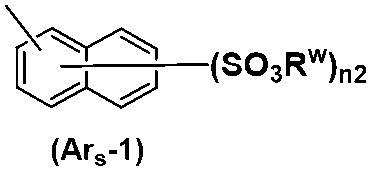


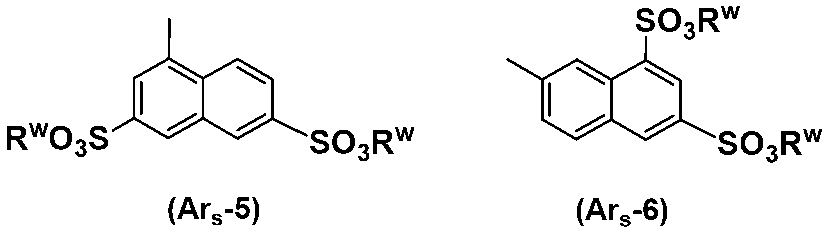
本発明のフッ素化アリールスルホン酸ポリマー化合物は、上記式(1)で表される繰り返し単位のみを含むポリマーでよいが、有機溶媒に対する溶解性を高めるという点から、さらに下記式(F2)で表される繰り返し単位を含むポリマーが好ましい。

式(F2)において、R’は、1価の有機基を表す。
この1価の有機基としては、1価炭化水素基、ヘテロアリール基、-COOR”基(R”は、水素原子または炭素数1~10のアルキル基を表す。)等が挙げられる。
1価炭化水素基の炭素数に特に制限はないが、炭素数1~20が好ましく、炭素数6~20がより好ましく、炭素数6~10がより一層好ましい。その具体例としては、メチル、エチル、n-プロピル、イソプロピル、n-ブチル、イソブチル、sec-ブチル、tert-ブチル、n-ペンチル、シクロペンチル、n-ヘキシル、シクロヘキシル、n-ヘプチル、n-オクチル、n-ノニル、n-デシル基等のアルキル基;フェニル、1-ナフチル、2-ナフチル、1-アントリル、2-アントリル、9-アントリル、1-フェナントリル、2-フェナントリル、3-フェナントリル、4-フェナントリル、9-フェナントリル基等のアリール基等が挙げられる。
この1価の有機基としては、1価炭化水素基、ヘテロアリール基、-COOR”基(R”は、水素原子または炭素数1~10のアルキル基を表す。)等が挙げられる。
1価炭化水素基の炭素数に特に制限はないが、炭素数1~20が好ましく、炭素数6~20がより好ましく、炭素数6~10がより一層好ましい。その具体例としては、メチル、エチル、n-プロピル、イソプロピル、n-ブチル、イソブチル、sec-ブチル、tert-ブチル、n-ペンチル、シクロペンチル、n-ヘキシル、シクロヘキシル、n-ヘプチル、n-オクチル、n-ノニル、n-デシル基等のアルキル基;フェニル、1-ナフチル、2-ナフチル、1-アントリル、2-アントリル、9-アントリル、1-フェナントリル、2-フェナントリル、3-フェナントリル、4-フェナントリル、9-フェナントリル基等のアリール基等が挙げられる。
ヘテロアリール基の具体例としては、2-チエニル、3-チエニル、2-フラニル、3-フラニル、2-オキサゾリル、4-オキサゾリル、5-オキサゾリル、3-イソオキサゾリル、4-イソオキサゾリル、5-イソオキサゾリル、2-チアゾリル、4-チアゾリル、5-チアゾリル、3-イソチアゾリル、4-イソチアゾリル、5-イソチアゾリル、2-イミダゾリル、4-イミダゾリル、2-ピリジル、3-ピリジル、4-ピリジル基等の炭素数2~20のヘテロアリール基などが挙げられる。
R”の炭素数1~10のアルキル基としては、上記で例示した基と同様のものが挙げられるが、中でも、炭素数1~5のアルキル基が好ましい。
なお、上記1価炭化水素基、ヘテロアリール基、R”の炭素数1~10のアルキル基は、その水素原子の一部または全部が置換基で置換されていてもよい。そのような置換基としては、ハロゲン原子、シアノ基、ニトロ基、カルボキシ基、スルホ基、水酸基等が挙げられる。ハロゲン原子としては、上記で例示した原子と同様のものが挙げられる。
これらの中でも、本発明のフッ素化アリールスルホン酸ポリマー化合物をドーパント物質として用いて得られる有機EL素子の素子特性や寿命特性を向上させることを考慮すると、R’は、ハロゲン原子で置換されたアリール基が好ましく、フッ化アリール基がより好ましく、パーフルオロアリール基がより一層好ましい。
特に、ハロゲン原子で置換されたフェニル基が好ましく、フッ化フェニル基がより好ましく、パーフルオロフェニル基がより一層好ましい。
特に、ハロゲン原子で置換されたフェニル基が好ましく、フッ化フェニル基がより好ましく、パーフルオロフェニル基がより一層好ましい。
本発明のフッ素化アリールスルホン酸ポリマー化合物が式(F2)で表される繰り返し単位を含む場合、式(F1)の単位と式(F2)の単位との含有比率は特に限定されるものではないが、ドーパント物質として用いた場合の素子特性を向上させることを考慮すると、モル比で、式(F1):式(F2)=10:1~1:10が好ましく、5:1~1:5がより好ましく、3:1~1:3がより一層好ましく、1:1がさらに好ましい。
本発明のフッ素化アリールスルホン酸ポリマー化合物の分子量は特に限定されるものではないが、耐熱性向上効果と溶媒に対する溶解性確保の観点から、重量平均分子量Mw1,000~50,000が好ましく、1,500~10,000がより好ましく、2,000~10,000がより一層好ましい。
また、分子量分布(Mw/Mn)は、1~3が好ましく、1~2がより好ましい。
なお、この重量平均分子量は、ポリエチレンオキシドを標準試料としたゲルパーミエーションクロマトグラフィー(GPC)による測定値である。
また、分子量分布(Mw/Mn)は、1~3が好ましく、1~2がより好ましい。
なお、この重量平均分子量は、ポリエチレンオキシドを標準試料としたゲルパーミエーションクロマトグラフィー(GPC)による測定値である。
本発明のフッ素化アリールスルホン酸ポリマー化合物は、下記式(F1A)で示されるモノマーおよび必要に応じて下記式(F2A)で示されるモノマーを、溶媒およびラジカル重合開始剤の存在下、公知のラジカル重合法によって重合させて得ることができる。
なお、この際、式(F1A)で表されるモノマーは2種以上を組み合わせて用いてもよく、式(F2A)で表されるモノマーは2種以上を組み合わせて用いてもよい。
なお、この際、式(F1A)で表されるモノマーは2種以上を組み合わせて用いてもよく、式(F2A)で表されるモノマーは2種以上を組み合わせて用いてもよい。

本発明においては、電荷輸送性に優れる電荷輸送性薄膜を作製することを考慮すると、ドーパント物質として、アリールスルホン酸化合物、アリールスルホン酸エステル化合物、フッ素化アリールスルホン酸ポリマー化合物を用いることが好ましく、溶媒に対する溶解性を考慮すると、アリールスルホン酸エステル化合物を用いることがより好ましい。
さらに、得られる薄膜を有機EL素子の正孔注入層として用いる場合、正孔輸送層への注入性の向上、素子の寿命特性等の改善を目的として、上記電荷輸送性ワニスは、有機シラン化合物を含んでいてもよい。その含有量は、電荷輸送性物質およびドーパント物質の合計質量に対して、通常1~30質量%程度である。
本発明の電荷輸送性ワニスを調製する際に用いられる有機溶媒としては、本発明のアリールアミン化合物を良好に溶解し得る高極性溶媒を用いることができる。本発明のアリールアミン化合物は、溶媒の極性を問わず、溶媒中に溶解することが可能である。また、必要に応じて、高極性溶媒よりもプロセス適合性に優れている点で低極性溶媒を用いてもよい。本発明において、低極性溶媒とは周波数100kHzでの比誘電率が7未満のものを、高極性溶媒とは周波数100kHzでの比誘電率が7以上のものと定義する。
低極性溶媒としては、例えば、
クロロホルム、クロロベンゼン等の塩素系溶媒;
トルエン、キシレン、テトラリン、シクロヘキシルベンゼン、デシルベンゼン等の芳香族炭化水素系溶媒;
1-オクタノール、1-ノナノール、1-デカノール等の脂肪族アルコール系溶媒;
テトラヒドロフラン、1,4-ジオキサン、アニソール、4-メトキシトルエン、3-フェノキシトルエン、ジベンジルエーテル、ジエチレングリコールジメチルエーテル、ジエチレングリコールブチルメチルエーテル、トリエチレングリコールジメチルエーテル、トリエチレングリコールブチルメチルエーテル等のエーテル系溶媒;
安息香酸メチル、安息香酸エチル、安息香酸ブチル、安息香酸イソアミル、フタル酸ジメチル、フタル酸ビス(2-エチルヘキシル)、マレイン酸ジブチル、シュウ酸ジブチル、酢酸ヘキシル、マロン酸ジイソプロピル、ジエチレングリコールモノエチルエーテルアセテート、ジエチレングリコールモノブチルエーテルアセテート等のエステル系溶媒
等が挙げられる。
クロロホルム、クロロベンゼン等の塩素系溶媒;
トルエン、キシレン、テトラリン、シクロヘキシルベンゼン、デシルベンゼン等の芳香族炭化水素系溶媒;
1-オクタノール、1-ノナノール、1-デカノール等の脂肪族アルコール系溶媒;
テトラヒドロフラン、1,4-ジオキサン、アニソール、4-メトキシトルエン、3-フェノキシトルエン、ジベンジルエーテル、ジエチレングリコールジメチルエーテル、ジエチレングリコールブチルメチルエーテル、トリエチレングリコールジメチルエーテル、トリエチレングリコールブチルメチルエーテル等のエーテル系溶媒;
安息香酸メチル、安息香酸エチル、安息香酸ブチル、安息香酸イソアミル、フタル酸ジメチル、フタル酸ビス(2-エチルヘキシル)、マレイン酸ジブチル、シュウ酸ジブチル、酢酸ヘキシル、マロン酸ジイソプロピル、ジエチレングリコールモノエチルエーテルアセテート、ジエチレングリコールモノブチルエーテルアセテート等のエステル系溶媒
等が挙げられる。
また、高極性溶媒としては、例えば、
N,N-ジメチルホルムアミド、N,N-ジメチルアセトアミド、N,N-ジメチルイソブチルアミド、N-メチルピロリドン、1,3-ジメチル-2-イミダゾリジノン等のアミド系溶媒;
エチルメチルケトン、イソホロン、シクロヘキサノン等のケトン系溶媒;
アセトニトリル、3-メトキシプロピオニトリル等のシアノ系溶媒;
エチレングリコール、ジエチレングリコール、トリエチレングリコール、ジプロピレングリコール、1,3-ブタンジオール、2,3-ブタンジオール等の多価アルコール系溶媒;
ジエチレングリコールモノメチルエーテル、ジエチレングリコールモノフェニルエーテル、トリエチレングリコールモノメチルエーテル、ジプロピレングリコールモノメチルエーテル、ベンジルアルコール、2-フェノキシエタノール、2-ベンジルオキシエタノール、3-フェノキシベンジルアルコール、テトラヒドロフルフリルアルコール等の脂肪族アルコール以外の1価アルコール系溶媒;
ジメチルスルホキシド等のスルホキシド系溶媒
等が挙げられる。
N,N-ジメチルホルムアミド、N,N-ジメチルアセトアミド、N,N-ジメチルイソブチルアミド、N-メチルピロリドン、1,3-ジメチル-2-イミダゾリジノン等のアミド系溶媒;
エチルメチルケトン、イソホロン、シクロヘキサノン等のケトン系溶媒;
アセトニトリル、3-メトキシプロピオニトリル等のシアノ系溶媒;
エチレングリコール、ジエチレングリコール、トリエチレングリコール、ジプロピレングリコール、1,3-ブタンジオール、2,3-ブタンジオール等の多価アルコール系溶媒;
ジエチレングリコールモノメチルエーテル、ジエチレングリコールモノフェニルエーテル、トリエチレングリコールモノメチルエーテル、ジプロピレングリコールモノメチルエーテル、ベンジルアルコール、2-フェノキシエタノール、2-ベンジルオキシエタノール、3-フェノキシベンジルアルコール、テトラヒドロフルフリルアルコール等の脂肪族アルコール以外の1価アルコール系溶媒;
ジメチルスルホキシド等のスルホキシド系溶媒
等が挙げられる。
電荷輸送性ワニスの粘度は、作製する薄膜の厚み等や固形分濃度に応じて適宜定まるものではあるが、通常、25℃で1~50mPa・sである。なお、本発明において、固形分とは、本発明の電荷輸送性ワニスに含まれる溶媒以外の成分を意味する。
また、電荷輸送性ワニスの固形分濃度は、ワニスの粘度および表面張力等や、作製する薄膜の厚み等を勘案して適宜設定されるものではあるが、通常、0.1~20.0質量%程度であり、ワニスの塗布性を向上させることを考慮すると、好ましくは0.5~10.0質量%程度、より好ましくは1.0~5.0質量%程度である。
また、電荷輸送性ワニスの固形分濃度は、ワニスの粘度および表面張力等や、作製する薄膜の厚み等を勘案して適宜設定されるものではあるが、通常、0.1~20.0質量%程度であり、ワニスの塗布性を向上させることを考慮すると、好ましくは0.5~10.0質量%程度、より好ましくは1.0~5.0質量%程度である。
電荷輸送性ワニスの調製法としては、特に限定されるものではないが、例えば、本発明のアリールアミン化合物を含む電荷輸送性物質等の固形分全てを有機溶媒に一度に溶解させる手法や、固形分の一部を有機溶媒に溶解させ、その後に残りの固形分を溶解させる手法等が挙げられる。
特に、電荷輸送性ワニスの調製の際、より平坦性の高い薄膜を再現性よく得る観点から、電荷輸送性物質、ドーパント物質等を有機溶媒に溶解させた後、サブマイクロメートルオーダーのフィルター等を用いて濾過することが望ましい。
以上説明した電荷輸送性ワニスは、これを用いることで容易に電荷輸送性薄膜を製造できることから、電子素子、特に有機EL素子や量子ドットEL素子を製造する際に好適に用いることができる。
この場合、電荷輸送性薄膜は、上述した電荷輸送性ワニスを基材上に塗布して焼成して形成することができる。
ワニスの塗布方法としては、特に限定されるものではなく、ディップ法、スピンコート法、転写印刷法、ロールコート法、刷毛塗り、インクジェット法、スプレー法、スリットコート法等が挙げられ、塗布方法に応じてワニスの粘度および表面張力を調節することが好ましい。
この場合、電荷輸送性薄膜は、上述した電荷輸送性ワニスを基材上に塗布して焼成して形成することができる。
ワニスの塗布方法としては、特に限定されるものではなく、ディップ法、スピンコート法、転写印刷法、ロールコート法、刷毛塗り、インクジェット法、スプレー法、スリットコート法等が挙げられ、塗布方法に応じてワニスの粘度および表面張力を調節することが好ましい。
また、塗布後の電荷輸送性ワニスの焼成雰囲気も特に限定されるものではなく、大気雰囲気だけでなく、窒素等の不活性ガスや真空中でも均一な成膜面および高い電荷輸送性を有する薄膜を得ることができるが、用いるドーパント物質の種類によっては、ワニスを大気雰囲気下で焼成することで、より高い電荷輸送性を有する薄膜が再現性よく得られる場合がある。
焼成温度は、得られる薄膜の用途、得られる薄膜に付与する電荷輸送性の程度、溶媒の種類や沸点等を勘案して、100~260℃程度の範囲内で適宜設定され、得られる薄膜を有機EL素子や量子ドットEL素子の正孔注入層として用いる場合、140~250℃程度が好ましく、145~240℃程度がより好ましい。
なお、焼成の際、より高い均一成膜性を発現させたり、基材上で反応を進行させたりする目的で、2段階以上の温度変化をつけてもよく、加熱は、例えば、ホットプレートやオーブン等、適当な機器を用いて行えばよい。
なお、焼成の際、より高い均一成膜性を発現させたり、基材上で反応を進行させたりする目的で、2段階以上の温度変化をつけてもよく、加熱は、例えば、ホットプレートやオーブン等、適当な機器を用いて行えばよい。
電荷輸送性薄膜の膜厚は、特に限定されないが、有機EL素子や量子ドットEL素子の正孔注入層、正孔輸送層または正孔注入輸送層として用いる場合、5~300nmが好ましい。膜厚を変化させる方法としては、ワニス中の固形分濃度を変化させたり、塗布時の基板上の溶液量(ワニス量)を変化させたりする等の方法がある。
上記電荷輸送性薄膜を有機EL素子や量子ドットEL素子に適用する場合、有機EL素子や量子ドットEL素子を構成する一対の電極の間に、上述の電荷輸送性薄膜を備える構成とすることができる。
有機EL素子や量子ドットEL素子の代表的な構成としては、以下(a)~(f)が挙げられるが、これらに限定されるわけではない。なお、下記構成において、必要に応じて、発光層と陽極の間に電子ブロック層等を、発光層と陰極の間にホール(正孔)ブロック層等を設けることもできる。また、正孔注入層、正孔輸送層あるいは正孔注入輸送層が電子ブロック層等としての機能を兼ね備えていてもよく、電子注入層、電子輸送層あるいは電子注入輸送層がホール(正孔)ブロック層等としての機能を兼ね備えていてもよい。さらに、必要に応じて各層の間に任意の機能層を設けることも可能である。
(a)陽極/正孔注入層/正孔輸送層/発光層/電子輸送層/電子注入層/陰極
(b)陽極/正孔注入層/正孔輸送層/発光層/電子注入輸送層/陰極
(c)陽極/正孔注入輸送層/発光層/電子輸送層/電子注入層/陰極
(d)陽極/正孔注入輸送層/発光層/電子注入輸送層/陰極
(e)陽極/正孔注入層/正孔輸送層/発光層/陰極
(f)陽極/正孔注入輸送層/発光層/陰極
有機EL素子や量子ドットEL素子の代表的な構成としては、以下(a)~(f)が挙げられるが、これらに限定されるわけではない。なお、下記構成において、必要に応じて、発光層と陽極の間に電子ブロック層等を、発光層と陰極の間にホール(正孔)ブロック層等を設けることもできる。また、正孔注入層、正孔輸送層あるいは正孔注入輸送層が電子ブロック層等としての機能を兼ね備えていてもよく、電子注入層、電子輸送層あるいは電子注入輸送層がホール(正孔)ブロック層等としての機能を兼ね備えていてもよい。さらに、必要に応じて各層の間に任意の機能層を設けることも可能である。
(a)陽極/正孔注入層/正孔輸送層/発光層/電子輸送層/電子注入層/陰極
(b)陽極/正孔注入層/正孔輸送層/発光層/電子注入輸送層/陰極
(c)陽極/正孔注入輸送層/発光層/電子輸送層/電子注入層/陰極
(d)陽極/正孔注入輸送層/発光層/電子注入輸送層/陰極
(e)陽極/正孔注入層/正孔輸送層/発光層/陰極
(f)陽極/正孔注入輸送層/発光層/陰極
「正孔注入層」、「正孔輸送層」および「正孔注入輸送層」とは、発光層と陽極との間に形成される層であって、正孔を陽極から発光層へ輸送する機能を有するものであり、発光層と陽極の間に、正孔輸送性材料の層が1層のみ設けられる場合、それが「正孔注入輸送層」であり、発光層と陽極の間に、正孔輸送性材料の層が2層以上設けられる場合、陽極に近い層が「正孔注入層」であり、それ以外の層が「正孔輸送層」である。特に、正孔注入(輸送)層は、陽極からの正孔受容性だけでなく、正孔輸送(発光)層への正孔注入性にも優れる薄膜が用いられる。
「電子注入層」、「電子輸送層」および「電子注入輸送層」とは、発光層と陰極との間に形成される層であって、電子を陰極から発光層へ輸送する機能を有するものであり、発光層と陰極の間に、電子輸送性材料の層が1層のみ設けられる場合、それが「電子注入輸送層」であり、発光層と陰極の間に、電子輸送性材料の層が2層以上設けられる場合、陰極に近い層が「電子注入層」であり、それ以外の層が「電子輸送層」である。
「発光層」とは、発光機能を有する有機層であって、ドーピングシステムを採用する場合、ホスト材料とドーパント材料を含んでいる。このとき、ホスト材料は、主に電子と正孔の再結合を促し、励起子を発光層内に閉じ込める機能を有し、ドーパント材料は、再結合で得られた励起子を効率的に発光させる機能を有する。燐光素子の場合、ホスト材料は主にドーパントで生成された励起子を発光層内に閉じ込める機能を有する。
「電子注入層」、「電子輸送層」および「電子注入輸送層」とは、発光層と陰極との間に形成される層であって、電子を陰極から発光層へ輸送する機能を有するものであり、発光層と陰極の間に、電子輸送性材料の層が1層のみ設けられる場合、それが「電子注入輸送層」であり、発光層と陰極の間に、電子輸送性材料の層が2層以上設けられる場合、陰極に近い層が「電子注入層」であり、それ以外の層が「電子輸送層」である。
「発光層」とは、発光機能を有する有機層であって、ドーピングシステムを採用する場合、ホスト材料とドーパント材料を含んでいる。このとき、ホスト材料は、主に電子と正孔の再結合を促し、励起子を発光層内に閉じ込める機能を有し、ドーパント材料は、再結合で得られた励起子を効率的に発光させる機能を有する。燐光素子の場合、ホスト材料は主にドーパントで生成された励起子を発光層内に閉じ込める機能を有する。
本発明の電荷輸送性ワニスから作製された電荷輸送性薄膜は、有機EL素子や量子ドットEL素子の陽極と発光層との間に設けられる正孔注入層、正孔輸送層、正孔注入輸送層等の機能層として用いることができるが、上述のとおり、通常、塗布法によりその上層が形成される正孔注入層として好適である。
本発明の電荷輸送性ワニスを用いて有機EL素子を作製する場合の使用材料や、作製方法としては、下記のようなものが挙げられるが、これらに限定されるものではない。
上記電荷輸送性ワニスから得られる薄膜からなる正孔注入層を有するOLED素子の作製方法の一例は、以下のとおりである。なお、電極は、電極に悪影響を与えない範囲で、アルコール、純水等による洗浄や、UVオゾン処理、酸素-プラズマ処理等による表面処理を予め行うことが好ましい。
陽極基板上に、上記の方法により、上記電荷輸送性ワニスを用いて正孔注入層を形成する。これを真空蒸着装置内に導入し、正孔輸送層、発光層、電子輸送層/ホールブロック層、電子注入層、陰極金属を順次蒸着する。あるいは、当該方法において蒸着で正孔輸送層と発光層を形成する代わりに、正孔輸送性高分子を含む正孔輸送層形成用組成物と発光性高分子を含む発光層形成用組成物を用いてウェットプロセスによってこれらの層を形成する。なお、必要に応じて、発光層と正孔輸送層との間に電子ブロック層を設けてよい。
上記電荷輸送性ワニスから得られる薄膜からなる正孔注入層を有するOLED素子の作製方法の一例は、以下のとおりである。なお、電極は、電極に悪影響を与えない範囲で、アルコール、純水等による洗浄や、UVオゾン処理、酸素-プラズマ処理等による表面処理を予め行うことが好ましい。
陽極基板上に、上記の方法により、上記電荷輸送性ワニスを用いて正孔注入層を形成する。これを真空蒸着装置内に導入し、正孔輸送層、発光層、電子輸送層/ホールブロック層、電子注入層、陰極金属を順次蒸着する。あるいは、当該方法において蒸着で正孔輸送層と発光層を形成する代わりに、正孔輸送性高分子を含む正孔輸送層形成用組成物と発光性高分子を含む発光層形成用組成物を用いてウェットプロセスによってこれらの層を形成する。なお、必要に応じて、発光層と正孔輸送層との間に電子ブロック層を設けてよい。
陽極材料としては、インジウム錫酸化物(ITO)、インジウム亜鉛酸化物(IZO)に代表される透明電極や、アルミニウムに代表される金属、またはこれらの合金等から構成される金属陽極が挙げられ、平坦化処理を行ったものが好ましい。高電荷輸送性を有するポリチオフェン誘導体やポリアニリン誘導体を用いることもできる。
なお、金属陽極を構成するその他の金属としては、金、銀、銅、インジウムやこれらの合金等が挙げられるが、これらに限定されるわけではない。
なお、金属陽極を構成するその他の金属としては、金、銀、銅、インジウムやこれらの合金等が挙げられるが、これらに限定されるわけではない。
正孔輸送層を形成する材料としては、(トリフェニルアミン)ダイマー誘導体、[(トリフェニルアミン)ダイマー]スピロダイマー、N,N’-ビス(ナフタレン-1-イル)-N,N’-ビス(フェニル)-ベンジジン(α-NPD)、4,4’,4”-トリス[3-メチルフェニル(フェニル)アミノ]トリフェニルアミン(m-MTDATA)、4,4’,4”-トリス[1-ナフチル(フェニル)アミノ]トリフェニルアミン(1-TNATA)等のトリアリールアミン類、5,5”-ビス-{4-[ビス(4-メチルフェニル)アミノ]フェニル}-2,2’:5’,2”-ターチオフェン(BMA-3T)等のオリゴチオフェン類などが挙げられる。
発光層を形成する材料としては、8-ヒドロキシキノリンのアルミニウム錯体等の金属錯体、10-ヒドロキシベンゾ[h]キノリンの金属錯体、ビススチリルベンゼン誘導体、ビススチリルアリーレン誘導体、(2-ヒドロキシフェニル)ベンゾチアゾールの金属錯体、シロール誘導体等の低分子発光材料;ポリ(p-フェニレンビニレン)、ポリ[2-メトキシ-5-(2-エチルヘキシルオキシ)-1,4-フェニレンビニレン]、ポリ(3-アルキルチオフェン)、ポリビニルカルバゾール等の高分子化合物に発光材料と電子移動材料を混合した系等が挙げられるが、これらに限定されない。
また、蒸着で発光層を形成する場合、発光性ドーパントと共蒸着してもよく、発光性ドーパントとしては、トリス(2-フェニルピリジン)イリジウム(III)(Ir(ppy)3)等の金属錯体や、ルブレン等のナフタセン誘導体、キナクリドン誘導体、ペリレン等の縮合多環芳香族環等が挙げられるが、これらに限定されない。
また、蒸着で発光層を形成する場合、発光性ドーパントと共蒸着してもよく、発光性ドーパントとしては、トリス(2-フェニルピリジン)イリジウム(III)(Ir(ppy)3)等の金属錯体や、ルブレン等のナフタセン誘導体、キナクリドン誘導体、ペリレン等の縮合多環芳香族環等が挙げられるが、これらに限定されない。
電子輸送層/ホールブロック層を形成する材料としては、オキシジアゾール誘導体、トリアゾール誘導体、フェナントロリン誘導体、フェニルキノキサリン誘導体、ベンズイミダゾール誘導体、ピリミジン誘導体等が挙げられるが、これらに限定されない。
電子注入層を形成する材料としては、酸化リチウム(Li2O)、酸化マグネシウム(MgO)、アルミナ(Al2O3)等の金属酸化物、フッ化リチウム(LiF)、フッ化ナトリウム(NaF)等の金属フッ化物などが挙げられるが、これらに限定されない。
陰極材料としては、アルミニウム、マグネシウム-銀合金、アルミニウム-リチウム合金等が挙げられるが、これらに限定されない。
電子ブロック層を形成する材料としては、トリス(フェニルピラゾール)イリジウム等が挙げられるが、これに限定されない。
陰極材料としては、アルミニウム、マグネシウム-銀合金、アルミニウム-リチウム合金等が挙げられるが、これらに限定されない。
電子ブロック層を形成する材料としては、トリス(フェニルピラゾール)イリジウム等が挙げられるが、これに限定されない。
正孔輸送性高分子としては、ポリ[(9,9-ジヘキシルフルオレニル-2,7-ジイル)-co-(N,N’-ビス{p-ブチルフェニル}-1,4-ジアミノフェニレン)]、ポリ[(9,9-ジオクチルフルオレニル-2,7-ジイル)-co-(N,N’-ビス{p-ブチルフェニル}-1,1’-ビフェニレン-4,4-ジアミン)]、ポリ[(9,9-ビス{1’-ペンテン-5’-イル}フルオレニル-2,7-ジイル)-co-(N,N’-ビス{p-ブチルフェニル}-1,4-ジアミノフェニレン)]、ポリ[N,N’-ビス(4-ブチルフェニル)-N,N’-ビス(フェニル)-ベンジジン]-エンドキャップド ウィズ ポリシルセスキオキサン、ポリ[(9,9-ジジオクチルフルオレニル-2,7-ジイル)-co-(4,4’-(N-(p-ブチルフェニル))ジフェニルアミン)]、ポリ(9-ビニルカルバゾール)、ポリ(4-ブチル-N,N-ジフェニルアニリン)等が挙げられる。
発光性高分子としては、ポリ(9,9-ジアルキルフルオレン)(PDAF)等のポリフルオレン誘導体、ポリ(2-メトキシ-5-(2’-エチルヘキソキシ)-1,4-フェニレンビニレン)(MEH-PPV)等のポリフェニレンビニレン誘導体、ポリ(3-アルキルチオフェン)(PAT)等のポリチオフェン誘導体、ポリビニルカルバゾール(PVCz)等が挙げられる。
量子ドット材料としては、半導体材料として、II-VI族半導体、III-V族半導体、I-III-VI族半導体、IV族半導体およびI-II-IV-VI族半導体からなる群より選択される少なくとも1種の半導体材料を含むことができる。上記半導体材料の具体例としては、例えば、CdS、CdSe、CdTe、ZnS、ZnSe、ZnTe、ZnO、HgS、HgSe、HgTe、CdSeS、CdSeTe、CdSTe、ZnSeS、ZnSeTe、ZnSTe、HgSeS、HgSeTe、HgSTe、CdZnS、CdZnSe、CdZnTe、CdHgS、CdHgSe、CdHgTe、HgZnS、HgZnSe、CdHgZnTe、CdZnSeS、CdZnSeTe、CdZnSTe、CdHgSeS、CdHgSeTe、CdHgSTe、HgZnSeS、HgZnSeTe、HgZnSTe;GaN、GaP、GaAs、GaSb、AlN、AlP、AlAs、AlSb、InN、InP、InAs、InSb、GaNP、GaNAs、GaNSb、GaPAs、GaPSb、AlNP、AlNAs、AlNSb、AlPAs、AlPSb、InNP、InNAs、InNSb、InPAs、InPSb、GaAlNP、GaAlNAs、GaAlNSb、GaAlPAs、GaAlPSb、GaInNP、GaInNAs、GaInNSb、GaInPAs、GaInPSb、InAlNP、InAlNAs、InAlNSb、InAlPAs、InAlPSb;SnS、SnSe、SnTe、PbS、PbSe、PbTe、SnSeS、SnSeTe、SnSTe、PbSeS、PbSeTe、PbSTe、SnPbS、SnPbSe、SnPbTe、SnPbSSe、SnPbSeTe、SnPbSTe;Si、Ge、SiC、SiGe、AgInSe2、CuGaSe2、CuInS2、CuGaS2、CuInSe2、AgInS2、AgGaSe2、AgGaS2、C、SiおよびGe等が挙げられるが、これらに限定されない。
本発明の電荷輸送性ワニスから得られる電荷輸送性薄膜は、有機EL素子や量子ドットEL素子の陽極と発光層との間に設けられる正孔注入層、正孔輸送層、正孔注入輸送層等の機能層として用い得るが、その他にも有機光電変換素子、有機薄膜太陽電池、有機ペロブスカイト光電変換素子、有機集積回路、有機電界効果トランジスタ、有機薄膜トランジスタ、有機発光トランジスタ、有機光学検査器、有機光受容器、有機電場消光素子、発光電子化学電池、量子レーザー、有機レーザーダイオードおよび有機プラスモン発光素子等の電子素子における電荷輸送性薄膜としても用い得る。
以下、合成例、実施例および比較例を挙げて本発明をより具体的に説明するが、本発明は下記の実施例に限定されない。なお、使用した装置および試薬は以下のとおりである。
[装置]
(1)1H-NMR:Bruker社製、核磁気共鳴分光計AVANCE III HD 500MHz
(2)基板洗浄:長州産業(株)製、基板洗浄装置(減圧プラズマ方式)
(3)電荷輸送性ワニスの塗布:ミカサ(株)製、スピンコーターMS-A100
(4)膜厚測定:(株)小坂研究所製、微細形状測定機サーフコーダET-4000
(5)素子の作製:長州産業(株)製、多機能蒸着装置システムC-E2L1G1-N
(6)素子の電気特性等の測定:(株)EHC製、多チャンネルIVL測定装置
(1)1H-NMR:Bruker社製、核磁気共鳴分光計AVANCE III HD 500MHz
(2)基板洗浄:長州産業(株)製、基板洗浄装置(減圧プラズマ方式)
(3)電荷輸送性ワニスの塗布:ミカサ(株)製、スピンコーターMS-A100
(4)膜厚測定:(株)小坂研究所製、微細形状測定機サーフコーダET-4000
(5)素子の作製:長州産業(株)製、多機能蒸着装置システムC-E2L1G1-N
(6)素子の電気特性等の測定:(株)EHC製、多チャンネルIVL測定装置
[試薬]
3-(7-ブロモ-9,9-ジメチル-9H-フルオレン-2-イル)-9-フェニル-9H-カルバゾール Suna Tech Inc製
Pd(dba)2 東京化成工業(株)製
トリ-tert-ブチルホスホニウムテトラフルオロボラート 富士フイルムワコーケミカル(株)製
リチウムビス(トリメチルシリル)アミド1.0mol/Lトルエン溶液 Aldrich社製
2,7-ジブロモ-9,9-ジメチル-9H-フルオレン 東京化成工業(株)製
4,4’-ジブロモ-1,1’-ビフェニル 東京化成工業(株)製
2-ブロモ-9,9-ジメチルフルオレン 東京化成工業(株)製
5%Pdカーボン粉末(含水品)STDタイプ エヌ・イーケムキャット(株)製
4,4’-ジアミノ-3,3’,5,5’-テトラメチルビフェニル 東京化成工業(株)製
RuPhos Aldrich社製
トルエン 関東化学(株)製
ヘキサン 関東化学(株)製
酢酸エチル 関東化学(株)製
アセトニトリル 関東化学(株)製
アセトン 関東化学(株)製
メタノール 関東化学(株)製
テトラヒドロフラン 関東化学(株)製
1,4-ジオキサン 関東化学(株)製
塩化メチレン 関東化学(株)製
酢酸 関東化学(株)製
硝酸1.42 関東化学(株)製
1N塩酸水溶液 関東化学(株)製
水酸化ナトリウム 純正化学(株)製
塩化アンモニウム 純正化学(株)製
セライトNo.545 富士フイルムワコーケミカル(株)製
シリカゲルN60 関東化学(株)製
3-(7-ブロモ-9,9-ジメチル-9H-フルオレン-2-イル)-9-フェニル-9H-カルバゾール Suna Tech Inc製
Pd(dba)2 東京化成工業(株)製
トリ-tert-ブチルホスホニウムテトラフルオロボラート 富士フイルムワコーケミカル(株)製
リチウムビス(トリメチルシリル)アミド1.0mol/Lトルエン溶液 Aldrich社製
2,7-ジブロモ-9,9-ジメチル-9H-フルオレン 東京化成工業(株)製
4,4’-ジブロモ-1,1’-ビフェニル 東京化成工業(株)製
2-ブロモ-9,9-ジメチルフルオレン 東京化成工業(株)製
5%Pdカーボン粉末(含水品)STDタイプ エヌ・イーケムキャット(株)製
4,4’-ジアミノ-3,3’,5,5’-テトラメチルビフェニル 東京化成工業(株)製
RuPhos Aldrich社製
トルエン 関東化学(株)製
ヘキサン 関東化学(株)製
酢酸エチル 関東化学(株)製
アセトニトリル 関東化学(株)製
アセトン 関東化学(株)製
メタノール 関東化学(株)製
テトラヒドロフラン 関東化学(株)製
1,4-ジオキサン 関東化学(株)製
塩化メチレン 関東化学(株)製
酢酸 関東化学(株)製
硝酸1.42 関東化学(株)製
1N塩酸水溶液 関東化学(株)製
水酸化ナトリウム 純正化学(株)製
塩化アンモニウム 純正化学(株)製
セライトNo.545 富士フイルムワコーケミカル(株)製
シリカゲルN60 関東化学(株)製
1H-NMRスペクトルの化学シフト値はppmで表記し、溶媒には重クロロホルム(CDCl3)、重ジメチルスルホキシド(DMSO-d6)、重テトラヒドロフラン(THF-d8)を用いた。1H-NMRスペクトルにおいては、溶媒の残存プロトン由来のシグナルを用い、内部標準としてクロロホルムをδ 7.26ppm、ジメチルスルホキシドをδ 2.50ppm、テトラヒドロフランをδ 1.72ppmに設定した。
[1]化合物の合成
[合成例1]: 9,9-ジメチル-7-(9-フェニル-9H-カルバゾール-3-イル)-9H-フルオレン-2-アミン(中間体A)

[合成例1]: 9,9-ジメチル-7-(9-フェニル-9H-カルバゾール-3-イル)-9H-フルオレン-2-アミン(中間体A)
枝付きフラスコに、3-(7-ブロモ-9,9-ジメチル-9H-フルオレン-2-イル)-9-フェニル-9H-カルバゾール(15.0g、29.16mmol)、Pd(dba)2(0.84g、1.46mmol)、トリ-tert-ブチルホスホニウムテトラフルオロボラート(0.42g、1.46mmol)を加え、脱気して窒素雰囲気とした。ここにトルエン(75mL)を加え、攪拌しながらゆっくりとリチウムビス(トリメチルシリル)アミド(トルエン溶液,32.0mL、32.07mmol)を加えた。15時間後、TLCにて3-(7-ブロモ-9,9-ジメチル-9H-フルオレン-2-イル)-9-フェニル-9H-カルバゾールが消失していることを確認した。0℃に冷やした反応溶液に1N塩酸水溶液(20mL)を加え、pHを3に調整した。それを2N水酸化ナトリウム水溶液でpHを12に調整した。この溶液を吸引ろ過でKCフロックに通し、トルエンで洗浄した。その後、トルエンで抽出後、有機層を水で洗浄した。この有機層を留去し粗生成物を得た。得られた粗生成物をトルエン(5mL)に溶解させ、その溶液をヘキサン(300g)に滴下し、沈殿した固体をろ別し乾燥させ、中間体Aを得た(橙色固体、10.81g、収率82%)。中間体Aの1H-NMRの測定結果を以下に示す。
1H-NMR(CDCl3,500Hz):δ 8.39(1H,d,J=1.5Hz),8.22(1H,d,J=7.7Hz),7.71-7.59(8H,m),7.55(1H,d,J=8.0Hz),7.48(2H,d,J=8.6Hz),7.44-7.42(2H,m),7.33-7.30(1H,m),6.80(1H,d,J=2.0Hz),6.69(1H,dd,J=2.1Hz,8.0Hz),3.78(2H,s),1.27(6H,s).
1H-NMR(CDCl3,500Hz):δ 8.39(1H,d,J=1.5Hz),8.22(1H,d,J=7.7Hz),7.71-7.59(8H,m),7.55(1H,d,J=8.0Hz),7.48(2H,d,J=8.6Hz),7.44-7.42(2H,m),7.33-7.30(1H,m),6.80(1H,d,J=2.0Hz),6.69(1H,dd,J=2.1Hz,8.0Hz),3.78(2H,s),1.27(6H,s).
[実施例1-1]:ビス(9,9-ジメチル-7-(9-フェニル-9H-カルバゾール-3-イル)-9H-フルオレン-2-イル)アミン(化合物1)の合成
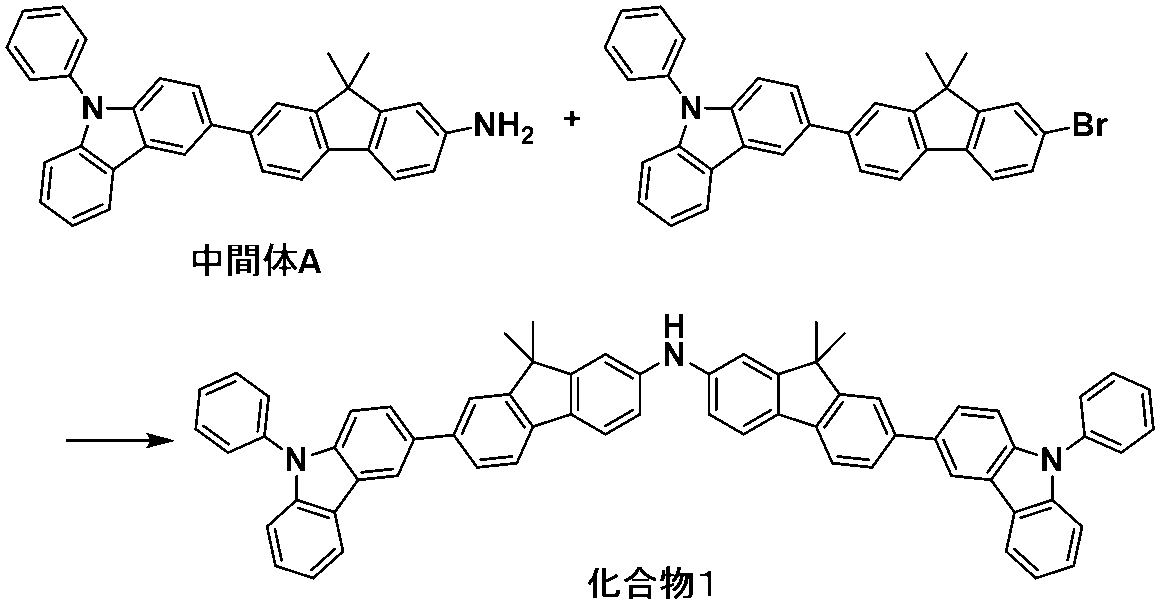
枝付きフラスコに、中間体A(5.00g、11.1mmol)、3-(7-ブロモ9,9-ジメチル-9H-フルオレン-2-イル)-9-フェニル-9H-カルバゾール(3.81g、7.40mmol)、Pd(dba)2(0.064g、0.111mmol)、トリ-tert-ブチルホスホニウムテトラフルオロボラート(0.064g、0.222mmol)、tert-ブトキシナトリウム(1.42g、14.8mmol)およびトルエン(150mL)を加えて反応容器内を脱気し、窒素雰囲気とした。得られた混合物を100℃まで昇温させて24時間加熱攪拌した後、反応液を放冷した。反応液を、セライト545を用いて吸引ろ過し、セライト545をトルエンで洗浄した。得られたろ液を、水、飽和食塩水を用いて順次洗浄した。洗浄した溶液を、SiO2を用いて吸引ろ過し、SiO2をトルエンで洗浄した。得られた溶液を減圧下濃縮し、残渣をシリカゲルカラムクロマトグラフィー(展開溶媒:ヘキサン/酢酸エチル=4/1→2/1→1/1)で精製した。得られた溶液を減圧下濃縮して油状物を得た。油状物にトルエン3gを加え、アセトニトリル100g中に滴下し、しばらく攪拌した後、吸引ろ過して化合物1を得た(茶色固体、収量4.70g、収率72%)。化合物1の1H-NMRスペクトルを、以下に示す。
1H-NMR(DMSO-d6,500Hz):δ 8.66(2H,s),8.54(1H,s),8.40(2H,d,J=7.6Hz),7.95(2H,s),7.83(2H,d,J=8.6Hz),7.80(2H,d,J=7.8Hz),7.76-7.71(8H,m),7.68(4H,d,J=7.8Hz),7.57(2H,t,J=14.3Hz,7.1Hz),7.48-7.45(4H,m),7.41(2H,d,J=8.2),7.35-7.33(4H,m),7.25(2H,t,J=14.8Hz,7.5Hz),1.55(12H,s).
1H-NMR(DMSO-d6,500Hz):δ 8.66(2H,s),8.54(1H,s),8.40(2H,d,J=7.6Hz),7.95(2H,s),7.83(2H,d,J=8.6Hz),7.80(2H,d,J=7.8Hz),7.76-7.71(8H,m),7.68(4H,d,J=7.8Hz),7.57(2H,t,J=14.3Hz,7.1Hz),7.48-7.45(4H,m),7.41(2H,d,J=8.2),7.35-7.33(4H,m),7.25(2H,t,J=14.8Hz,7.5Hz),1.55(12H,s).
[実施例1-2]:N2,N7-ビス[9,9-ジメチル-7-(9-フェニル-9H-カルバゾール-3-イル)-9H-フルオレン-2-イル]-9,9-ジメチル-9H-フルオレン-2,7-ジアミン(化合物2)の合成

枝付きフラスコに、中間体A(2.00g、4.43mmol)、2,7-ジブロモ-9,9-ジメチル-9H-フルオレン(0.52g、1.48mmol)、Pd(dba)2(0.025g、0.044mmol)、トリ-tert-ブチルホスホニウムテトラフルオロボラート(0.025g、0.089mmol)、tert-ブトキシナトリウム(0.710g、7.40mmol)およびトルエン(30mL)を加えて反応容器内を脱気し、窒素雰囲気とした。得られた混合物を100℃まで昇温させて6時間加熱攪拌した後、反応液を放冷した。反応液を、セライト545を用いて吸引ろ過し、セライト545をトルエンで洗浄した。得られたろ液を、水、飽和食塩水を用いて順次洗浄した。洗浄した溶液を、SiO2を用いて吸引ろ過し、SiO2をトルエンで洗浄した。得られたろ液を減圧下濃縮し、溶液が5gになるまで溶媒を取り除いた。得られた溶液をアセトニトリル150g中に滴下し、しばらく攪拌した後、吸引ろ過した。得られた固体をシリカゲルカラムクロマトグラフィー(展開溶媒:ヘキサン/酢酸エチル=4/1)で精製した。得られた溶液を減圧下濃縮して油状物を得た。油状物に酢酸エチル2gを加え、アセトニトリル50g中に滴下し、しばらく攪拌した後、吸引ろ過して化合物2を得た(淡緑色固体、収量403.0mg、収率25%)。化合物2の1H-NMRの測定結果を以下に示す。
1H-NMR(DMSO-d6,500Hz):δ 8.66(2H,s),8.42(2H,s),8.40(2H,d,J=7.8Hz),7.94(2H,s),7.83(2H,d,J=8.6Hz),7.78(2H,d,J=7.8Hz),7.72(8H,t,J=14.9Hz,7.5Hz),7.68(4H,d,J=7.8Hz),7.61-7.56(4H,m),7.48-7.45(4H,m),7.41(2H,d,J=8.2Hz),7.33(2H,t,J=14.6Hz,7.3Hz),7.28(4H,s),7.09(4H,d,J=8.0Hz),1.53(12H,s),1.45(6H,s).
1H-NMR(DMSO-d6,500Hz):δ 8.66(2H,s),8.42(2H,s),8.40(2H,d,J=7.8Hz),7.94(2H,s),7.83(2H,d,J=8.6Hz),7.78(2H,d,J=7.8Hz),7.72(8H,t,J=14.9Hz,7.5Hz),7.68(4H,d,J=7.8Hz),7.61-7.56(4H,m),7.48-7.45(4H,m),7.41(2H,d,J=8.2Hz),7.33(2H,t,J=14.6Hz,7.3Hz),7.28(4H,s),7.09(4H,d,J=8.0Hz),1.53(12H,s),1.45(6H,s).
[実施例1-3]:N4,N4’-ビス[9,9-ジメチル-7-(9-フェニル-9H-カルバゾール-3-イル)-9H-フルオレン-2-イル]-[1,1’-ビフェニル]-4,4’-ジアミン(化合物3)の合成
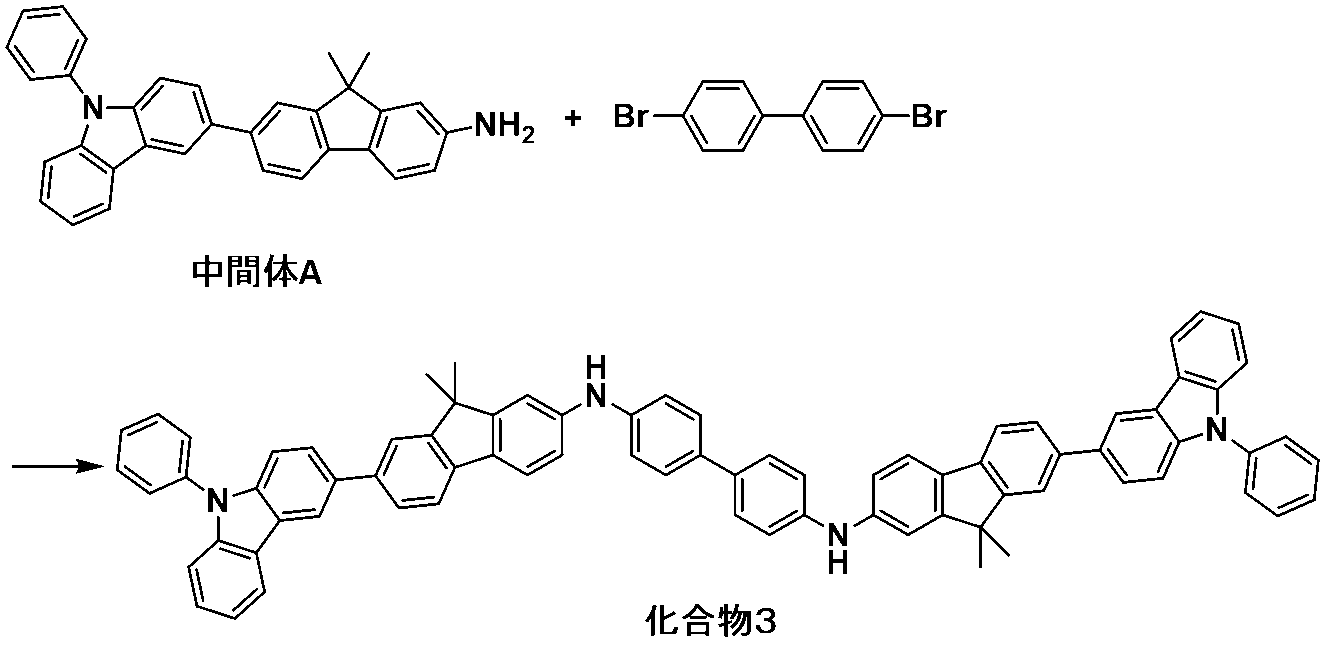
2,7-ジブロモ-9,9-ジメチル-9H-フルオレンの代わりに、4,4’-ジブロモ-1,1’-ビフェニル(0.46g、1.48mmol)を用いた以外は、実施例1-2と同様にして、化合物3を得た(淡黄色固体、収量428.1mg、収率28%)。化合物3の1H-NMRの測定結果を以下に示す。
1H-NMR(DMSO-d6,500Hz):δ 8.66(2H,s),8.44(2H,s),8.40(2H,d,J=7.7Hz),7.94(2H,s),7.83(2H,d,J=8.6Hz),7.79(2H,d,J=7.8Hz),7.72(8H,t,J=8.2Hz),7.68(4H,d,J=7.8Hz),7.57(6H,d,J=8.1Hz),7.48-7.45(4H,m),7.41(2H,d,J=8.2Hz),7.33(2H,t,J=7.3Hz),7.28(2H,s),7.21(4H,d,J=8.1Hz),7.13(2H,d,J=8.2Hz),1.55(12H,s).
1H-NMR(DMSO-d6,500Hz):δ 8.66(2H,s),8.44(2H,s),8.40(2H,d,J=7.7Hz),7.94(2H,s),7.83(2H,d,J=8.6Hz),7.79(2H,d,J=7.8Hz),7.72(8H,t,J=8.2Hz),7.68(4H,d,J=7.8Hz),7.57(6H,d,J=8.1Hz),7.48-7.45(4H,m),7.41(2H,d,J=8.2Hz),7.33(2H,t,J=7.3Hz),7.28(2H,s),7.21(4H,d,J=8.1Hz),7.13(2H,d,J=8.2Hz),1.55(12H,s).
[合成例2]:2-ブロモ-9,9―ジメチル-7-ニトロ-9H-フルオレン(中間体B)の合成

反応容器に2-ブロモ-9,9-ジメチルフルオレン(22.2g、81.3mmol)及び酢酸(400mL)を加えて50℃まで昇温し、2-ブロモ-9,9-ジメチルフルオレンを溶解させ、その溶液に硝酸1.42(110mL)をゆっくりと滴下した。得られた混合物を85℃まで昇温させて3時間加熱攪拌した。その後、反応混合物を氷水で0℃にした。500gの氷の中に反応混合物を加えて、15分攪拌した。混合物を吸引ろ過し、得られた固体を水で洗浄した。得られた固体をトルエンで再結晶し、乾燥させて中間体Bを得た(淡黄色固体、収量22.3g、収率86%)。中間体Bの1H-NMRの測定結果を以下に示す。
1H-NMR(DMSO-d6,500Hz):δ 8.49(1H,s),8.28 (1H,d,J=8.4Hz),8.14(1H,d,J=8.4Hz),7.99(1H,d,J=8.1Hz),7.95(1H,s),7.64(1H,d,J=8.1Hz),1.53(6H,s).
1H-NMR(DMSO-d6,500Hz):δ 8.49(1H,s),8.28 (1H,d,J=8.4Hz),8.14(1H,d,J=8.4Hz),7.99(1H,d,J=8.1Hz),7.95(1H,s),7.64(1H,d,J=8.1Hz),1.53(6H,s).
[合成例3]:N-[9,9-ジメチル-7-(9-フェニル-9H-カルバゾール-3-イル)-9H-フルオレン-2-イル]-9,9-ジメチル-7-ニトロ-9H-フルオレン-2-アミン(中間体C)の合成
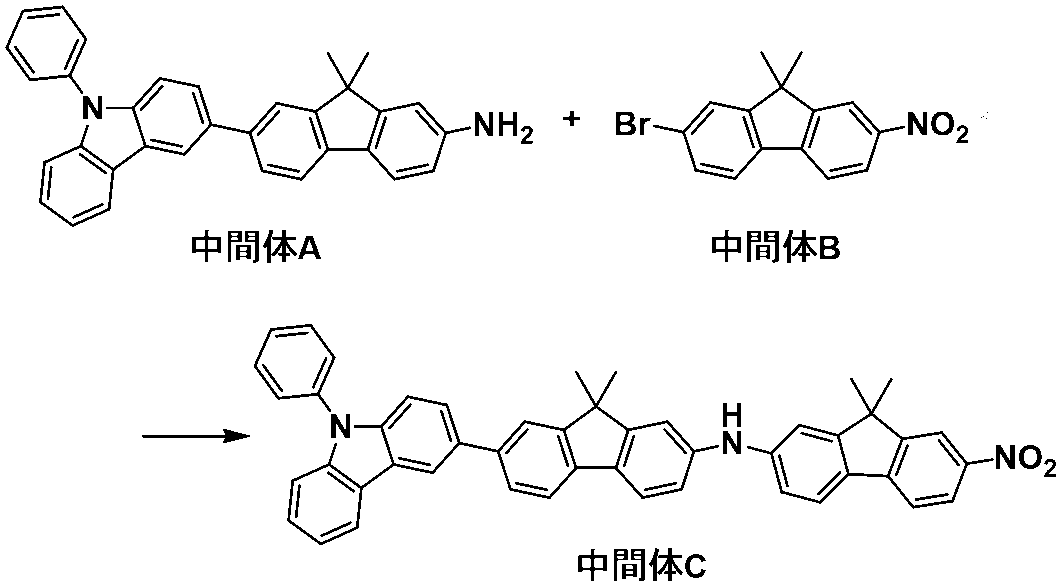
枝付きフラスコに中間体A(5.00g、11.10mmol)、中間体B(2.94g、9.25mmol)、Pd(dba)2(0.27g、0.46mmol)、トリ-tert-ブチルホスホニウムテトラフルオロボラート(0.20g、0.69mmol)、tert-ブトキシナトリウム(1.33g、13.87mmol)及びトルエン(120mL)を加えて反応容器内を脱気し、窒素雰囲気とした。得られた混合物を室温で15時間攪拌した。反応液を、セライト545を用いて吸引ろ過し、セライト545をトルエンで洗浄した。得られたろ液を、水、飽和食塩水を用いて順次洗浄した。洗浄した溶液を、SiO2を用いて吸引ろ過し、SiO2をトルエンで洗浄した。得られたろ液を減圧下濃縮し、溶液が5gになるまで溶媒を取り除いた。得られた溶液をメタノール100g中に滴下し、しばらく攪拌した後、吸引ろ過した。得られた固体をアセトニトリル100g中に加え、80℃に加熱して溶解させた。この溶液をろ過し、ろ液を減圧下濃縮して中間体Cを得た(赤褐色固体、収量5.15g、収率67%)。中間体Cの1H-NMRの測定結果を以下に示す。
1H-NMR(DMSO-d6,500Hz):δ 8.80(1H,s),8.67(1H,s),8.41-8.39(2H,m),8.23(1H,d,J=8.4Hz),7.96(1H,s),7.89(2H,q,J=11.4Hz,8.6Hz),7.83(2H,t,J=15.5Hz,8.2Hz),7.79(1H,d,J=8.1Hz),7.75(1H,d,J=8.8Hz),7.72(2H,d,J=7.5Hz),7.68(2H,d,J=7.9Hz),7.57(1H,t,J=14.3Hz,7.3Hz),7.48-7.45(2H,m),7.42(1H,d,J=8.2Hz),7.37(1H,s),7.35-7.32(2H,m),7.17-7.12(2H,m),1.55(6H,s),1.50(6H,s).
1H-NMR(DMSO-d6,500Hz):δ 8.80(1H,s),8.67(1H,s),8.41-8.39(2H,m),8.23(1H,d,J=8.4Hz),7.96(1H,s),7.89(2H,q,J=11.4Hz,8.6Hz),7.83(2H,t,J=15.5Hz,8.2Hz),7.79(1H,d,J=8.1Hz),7.75(1H,d,J=8.8Hz),7.72(2H,d,J=7.5Hz),7.68(2H,d,J=7.9Hz),7.57(1H,t,J=14.3Hz,7.3Hz),7.48-7.45(2H,m),7.42(1H,d,J=8.2Hz),7.37(1H,s),7.35-7.32(2H,m),7.17-7.12(2H,m),1.55(6H,s),1.50(6H,s).
[合成例4]:N2-(9,9-ジメチル-7-(9-フェニル-9H-カルバゾール-3-イル)-9H-フルオレン-2-イル)-9,9-ジメチル-9H-フルオレン-2,7-ジアミン(中間体D)の合成

枝付きフラスコに中間体C(2.00g、2.91mmol)およびテトラヒドロフラン10mLを加えて反応容器内を脱気し、窒素雰囲気とした。そこに5%Pdカーボン粉末(含水品)STDタイプ(0.2g)を加えて反応容器内を脱気後、水素雰囲気として、室温で18時間攪拌した。反応容器内を脱気して窒素雰囲気にした後、反応液にセライト545を2g加えて攪拌した。混合物を、セライト545を用いて吸引ろ過し、セライト545をテトラヒドロフランで洗浄した。得られたろ液を減圧下濃縮し、得られた残渣をシリカゲルカラムクロマトグラフィー(展開溶媒:トルエン→トルエン/アセトン=19/1)で精製し、中間体Dを得た(橙色固体、収量1.86g、収率97%)。中間体Dの1H-NMRの測定結果を以下に示す。
1H-NMR(DMSO-d6,500Hz):δ 8.65(1H,d,J=1.6Hz),8.40(1H,d,J=7.7Hz),8.30(1H,s),7.92(1H,d,J=1.1Hz),7.82(1H,dd,J=8.6Hz,1.8Hz),7.75(1H,t,J=15.1Hz,7.8Hz),7.73-7.66(6H,m),7.58-7.55(1H,m),7.48-7.45(3H,m),7.41(1H,d,J=8.2Hz),7.35-7.32(2H,m),7.23-7.22(2H,m),7.05-7.02(2H,m),6.67(1H,d,J=1.9Hz),6.52(1H,dd,J=8.0Hz,2.0Hz),5.10(2H,s),1.52(6H,s),1.37(6H,s).
1H-NMR(DMSO-d6,500Hz):δ 8.65(1H,d,J=1.6Hz),8.40(1H,d,J=7.7Hz),8.30(1H,s),7.92(1H,d,J=1.1Hz),7.82(1H,dd,J=8.6Hz,1.8Hz),7.75(1H,t,J=15.1Hz,7.8Hz),7.73-7.66(6H,m),7.58-7.55(1H,m),7.48-7.45(3H,m),7.41(1H,d,J=8.2Hz),7.35-7.32(2H,m),7.23-7.22(2H,m),7.05-7.02(2H,m),6.67(1H,d,J=1.9Hz),6.52(1H,dd,J=8.0Hz,2.0Hz),5.10(2H,s),1.52(6H,s),1.37(6H,s).
[実施例1-4]:N2,N2’-(9,9-ジメチル-9H-フルオレン-2,7-ジイル)ビス{N7-[9,9-ジメチル-7-(9-フェニル-9H-カルバゾール-3-イル)-9H-フルオレン-2-イル]-9,9-ジメチル-9H-フルオレン-2,7-ジアミン}(化合物4)の合成
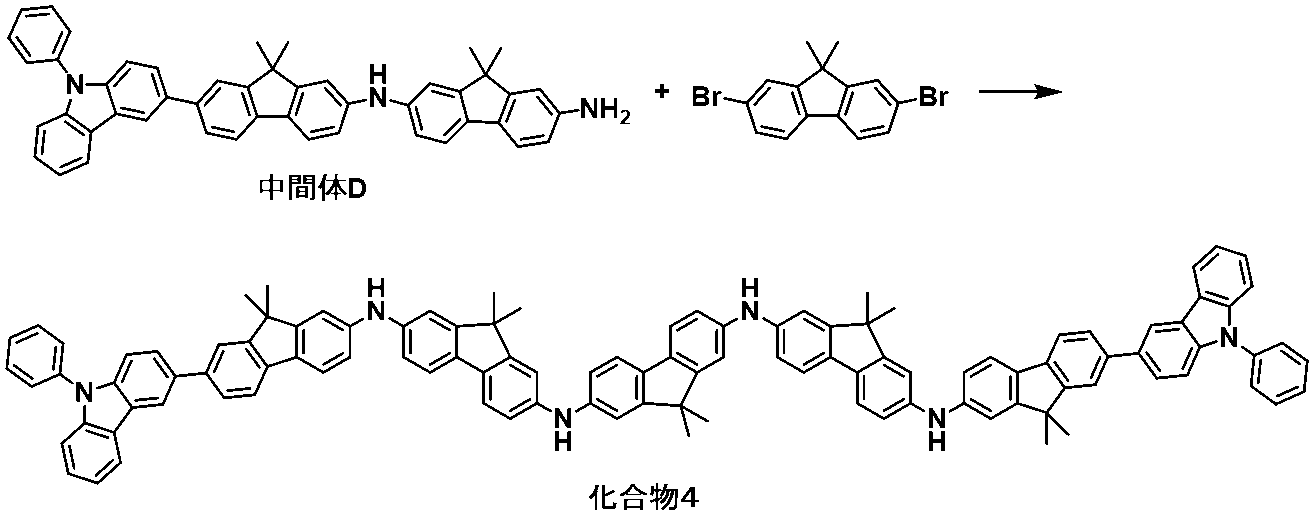
枝付きフラスコに中間体D(1.56g、2.38mmol)、2,7-ジブロモ-9,9-ジメチル-9H-フルオレン(0.28g、0.79mmol)、Pd(dba)2(0.046g、0.079mmol)、トリ-tert-ブチルホスホニウムテトラフルオロボラート(0.035g、0.12mmol)、tert-ブトキシナトリウム(0.23g、2.38mmol)およびトルエン(20mL)を加えて反応容器内を脱気し、窒素雰囲気とした。得られた混合物を室温で15時間攪拌した。反応液を、セライト545を用いて吸引ろ過し、セライト545をトルエンで洗浄した。得られたろ液を減圧下濃縮し、得られた残渣をシリカゲルカラムクロマトグラフィー(展開溶媒:トルエン)で精製して化合物4を得た(黄色固体、収量336.0mg、収率28%)。化合物4の1H-NMRの測定結果を以下に示す。
1H-NMR(DMSO-d6,500Hz):δ 8.65(2H,s),8.40(4H,d,J=7.6Hz),8.29(2H, s),7.93(2H,s),7.83(2H,dd,J=8.6Hz,1.5Hz),7.77(2H,d,J=7.9Hz),7.73-7.70(8H,m),7.67(4H,d,J=7.1Hz),7.58-7.55(8H,m),7.47-7.45(4H,m),7.41(2H,d,J=8.2Hz),7.33(2H,t,J=15.1Hz,7.4Hz),7.27(4H, s),7.23(4H, s),7.09-7.03(8H,m),1.53(12H,s),1.43(12H,s),1.42(6H,s).
1H-NMR(DMSO-d6,500Hz):δ 8.65(2H,s),8.40(4H,d,J=7.6Hz),8.29(2H, s),7.93(2H,s),7.83(2H,dd,J=8.6Hz,1.5Hz),7.77(2H,d,J=7.9Hz),7.73-7.70(8H,m),7.67(4H,d,J=7.1Hz),7.58-7.55(8H,m),7.47-7.45(4H,m),7.41(2H,d,J=8.2Hz),7.33(2H,t,J=15.1Hz,7.4Hz),7.27(4H, s),7.23(4H, s),7.09-7.03(8H,m),1.53(12H,s),1.43(12H,s),1.42(6H,s).
[比較例1-1]:N4,N4’-ビス[9,9-ジメチル-7-(9-フェニル-9H-カルバゾール-3-イル)-9H-フルオレン-2-イル]-3,3’,5,5’-テトラメチル-[1,1’-ビフェニル]-4,4’-ジアミン(比較化合物1)の合成

枝付きフラスコに中間体A(1.35g、2.62mmol)、4,4’-ジアミノ-3,3’,5,5’-テトラメチルビフェニル(0.30g、1.25mmol)、Pd(dba)2(0.046g、0.079mmol)、トリ-tert-ブチルホスホニウムテトラフルオロボラート(0.054g、0.187mmol)、tert-ブトキシナトリウム(0.30g、3.12mmol)、トルエン(20mL)およびテトラヒドロフラン(10mL)を加えて反応容器内を脱気し、窒素雰囲気とした。得られた混合物を室温で20時間攪拌した。反応液を、セライト545を用いて吸引ろ過し、セライト545をトルエンで洗浄した。得られたろ液を減圧下濃縮し、得られた残渣をシリカゲルカラムクロマトグラフィー(展開溶媒:トルエン)で精製して比較化合物1を得た(淡緑色固体、収量1.14g、収率83%)。比較化合物1の1H-NMRの測定結果を以下に示す。
1H-NMR(DMSO-d6,500Hz):δ 8.64(2H,d,J=1.4Hz),8.41(2H,d,J=4.6Hz),7.89(2H,s),7.81(2H,dd,J=1.5Hz,8.6Hz),7.74-7.67(10H,m),7.62-7.53(8H,m),7.46(4H,d,J=8.3Hz),7.41(2H,d,J=8.2Hz),7.33(2H,t,J=7.5Hz,14.4Hz),7.25(2H,t,J=7.5Hz,15.0Hz),7.18(2H,d,J=6.5Hz),6.68(2H,s),6.45(2H,d,J=9.4Hz),2.28(12H,s),1.48(12H,s).
1H-NMR(DMSO-d6,500Hz):δ 8.64(2H,d,J=1.4Hz),8.41(2H,d,J=4.6Hz),7.89(2H,s),7.81(2H,dd,J=1.5Hz,8.6Hz),7.74-7.67(10H,m),7.62-7.53(8H,m),7.46(4H,d,J=8.3Hz),7.41(2H,d,J=8.2Hz),7.33(2H,t,J=7.5Hz,14.4Hz),7.25(2H,t,J=7.5Hz,15.0Hz),7.18(2H,d,J=6.5Hz),6.68(2H,s),6.45(2H,d,J=9.4Hz),2.28(12H,s),1.48(12H,s).
[比較例1-2]:N4,N4,N4’,N4’-テトラキス(9,9-ジメチル-7-(9-フェニル-9H-カルバゾール-3-イル)-9H-フルオレン-2-イル)-3,3’,5,5’-テトラメチル-[1,1’-ビフェニル]-4,4’-ジアミン(比較化合物2)の合成

枝付きフラスコに中間体A(0.216g、4.20mmol)、4,4’-ジアミノ-3,3’,5,5’-テトラメチルビフェニル(0.240g、1.00mmol)、Pd(dba)2(0.115g、0.20mmol)、RuPhos(0.140g、0.30mmol)、LiHMDS(トルエン溶液、4.4mL、4.4mmol)及び1,4-ジオキサン20mLを加えて反応容器内を脱気し、窒素雰囲気とした。得られた混合物を90℃まで昇温させて20時間加熱攪拌した後、反応混合物を放冷した。反応液に飽和塩化アンモニウム水溶液100mLと混合有機溶媒(酢酸エチル/テトラヒドロフラン=2/1、100mL)を加えて分液した。得られた有機層を飽和食塩水で洗浄し、無水硫酸ナトリウムで乾燥した。無水硫酸ナトリウムをろ過し、ろ液を減圧下濃縮した。得られた残渣をシリカゲルカラムクロマトグラフィー(展開溶媒:塩化メチレン)で精製して比較化合物2を得た(橙色固体、収量1.76g、収率89%)。比較化合物2の1H-NMRの測定結果を以下に示す。
1H-NMR(THF-d8,500Hz):δ 8.50(4H,s),8.25(4H,d,J=7.7Hz),7.84(4H,s),7.75(8H,d,J=8.1Hz),7.70(4H,d,J=7.9Hz),7.66-7.64(20H,m),7.60(4H,s),7.49-7.46(8H,m),7.41-7.38(12H,m),7.25(4H,t,J=14.3Hz,7.4Hz),6.95(4H,d,J=8.3Hz),2.22(12H,s),1.54(24H,s).
1H-NMR(THF-d8,500Hz):δ 8.50(4H,s),8.25(4H,d,J=7.7Hz),7.84(4H,s),7.75(8H,d,J=8.1Hz),7.70(4H,d,J=7.9Hz),7.66-7.64(20H,m),7.60(4H,s),7.49-7.46(8H,m),7.41-7.38(12H,m),7.25(4H,t,J=14.3Hz,7.4Hz),6.95(4H,d,J=8.3Hz),2.22(12H,s),1.54(24H,s).
[2]電荷輸送性ワニスの調製
[実施例2-1]電荷輸送性ワニス1の調製
化合物1(170mg、0.192mmol)と、国際公開第2017/217455号に記載された方法に従って合成した下記式で表されるアリールスルホン酸エステルA(480mg、0.385mmol)とを、トリエチレングリコールブチルメチルエーテル(4.68g)、マロン酸ジイソプロピル(2.80g)およびフタル酸ジメチル(1.87g)の混合溶媒に室温で攪拌して溶解させた。得られた溶液を、孔径0.2μmのPP製フィルターを用いてろ過し、電荷輸送性ワニス1を得た。
[実施例2-1]電荷輸送性ワニス1の調製
化合物1(170mg、0.192mmol)と、国際公開第2017/217455号に記載された方法に従って合成した下記式で表されるアリールスルホン酸エステルA(480mg、0.385mmol)とを、トリエチレングリコールブチルメチルエーテル(4.68g)、マロン酸ジイソプロピル(2.80g)およびフタル酸ジメチル(1.87g)の混合溶媒に室温で攪拌して溶解させた。得られた溶液を、孔径0.2μmのPP製フィルターを用いてろ過し、電荷輸送性ワニス1を得た。
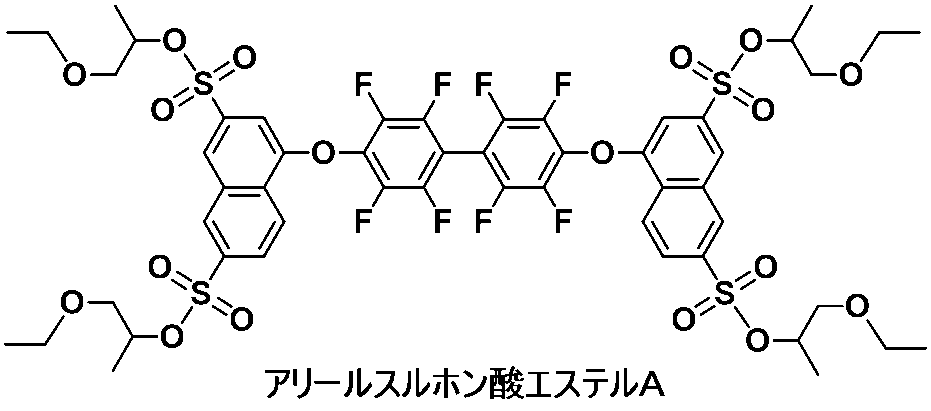
[実施例2-2]電荷輸送性ワニス2の調製
化合物1の代わりに化合物2(198mg、0.181mmol)を用い、アリールスルホン酸エステルA(452mg、0.363mmol)を用いた以外は、実施例2-1と同じ方法で、電荷輸送性ワニス2を得た。
化合物1の代わりに化合物2(198mg、0.181mmol)を用い、アリールスルホン酸エステルA(452mg、0.363mmol)を用いた以外は、実施例2-1と同じ方法で、電荷輸送性ワニス2を得た。
[実施例2-3]電荷輸送性ワニス3の調製
化合物1の代わりに化合物3(193mg,0.183mmol)を用い、アリールスルホン酸エステルA(457mg,0.367mmol)を用いた以外は、実施例2-1と同じ方法で、電荷輸送性ワニス3を得た。
化合物1の代わりに化合物3(193mg,0.183mmol)を用い、アリールスルホン酸エステルA(457mg,0.367mmol)を用いた以外は、実施例2-1と同じ方法で、電荷輸送性ワニス3を得た。
[実施例2-4]電荷輸送性ワニス4の調製
化合物1の代わりに化合物4(245mg,0.162mmol)を用い、アリールスルホン酸エステルA(405mg,0.325mmol)を用いた以外は、実施例2-1と同じ方法で、電荷輸送性ワニス4を得た。
化合物1の代わりに化合物4(245mg,0.162mmol)を用い、アリールスルホン酸エステルA(405mg,0.325mmol)を用いた以外は、実施例2-1と同じ方法で、電荷輸送性ワニス4を得た。
[比較例2-1]電荷輸送性ワニス5の調製
化合物1の代わりに比較化合物1(200mg,0.180mmol)を用い、アリールスルホン酸エステルA(450mg,0.361mmol)を用いた以外は、実施例2-1と同じ方法で、電荷輸送性ワニス5を得た。
化合物1の代わりに比較化合物1(200mg,0.180mmol)を用い、アリールスルホン酸エステルA(450mg,0.361mmol)を用いた以外は、実施例2-1と同じ方法で、電荷輸送性ワニス5を得た。
[比較例2-2]電荷輸送性ワニス6の調製
化合物1の代わりに比較化合物2(287mg,0.145mmol)を用い、アリールスルホン酸エステルA(363mg,0.291mmol)を用いた以外は、実施例2-1と同じ方法で、電荷輸送性ワニス6を得た。
化合物1の代わりに比較化合物2(287mg,0.145mmol)を用い、アリールスルホン酸エステルA(363mg,0.291mmol)を用いた以外は、実施例2-1と同じ方法で、電荷輸送性ワニス6を得た。
[3]ホールオンリー素子(HOD)の作製および特性評価
[実施例3-1]
電荷輸送性ワニス1を、スピンコーターを用いてITO基板に塗布した後、大気雰囲気下、120℃で1分間仮焼成をし、次いで230℃で15分間本焼成をし、ITO基板上に65nmの薄膜を形成した。なお、ITO基板としては、パターニングされた厚さ150nmのITO膜が表面に形成された、25mm×25mm×0.7tのガラス基板を用い、使用前にO2プラズマ洗浄装置(150W、30秒間)によって表面上の不純物を除去した。
この上に、蒸着装置(真空度1.0×10⁻⁵Pa)を用いて0.2nm/秒にて膜厚30nmのα-NPD薄膜を形成した。さらにこの上に、蒸着装置(真空度1.0×10-5Pa)を用いて0.2nm/秒にて膜厚80nmのアルミニウム薄膜を形成した。その後、空気中の酸素、水等の影響による特性劣化を防止するため、封止基板により封止した。封止は、以下の手順で行った。酸素濃度2ppm以下、露点-76℃以下の窒素雰囲気中で、HODを封止基板の間に収め、封止基板を接着剤((株)MORESCO製、モレスコモイスチャーカットWB90US(P))により貼り合わせた。この際、甫水剤(ダイニック株製HD-071010W-40)を有機EL素子とともに封止基板内に収めた。貼り合わせた封止基板に対し、UV光を照射(波長:365nm、照射量:6,000mJ/cm2)した後、80℃で1時間、アニーリング処理して接着剤を硬化させた。これをホールオンリー素子(HOD)とした。
[実施例3-1]
電荷輸送性ワニス1を、スピンコーターを用いてITO基板に塗布した後、大気雰囲気下、120℃で1分間仮焼成をし、次いで230℃で15分間本焼成をし、ITO基板上に65nmの薄膜を形成した。なお、ITO基板としては、パターニングされた厚さ150nmのITO膜が表面に形成された、25mm×25mm×0.7tのガラス基板を用い、使用前にO2プラズマ洗浄装置(150W、30秒間)によって表面上の不純物を除去した。
この上に、蒸着装置(真空度1.0×10⁻⁵Pa)を用いて0.2nm/秒にて膜厚30nmのα-NPD薄膜を形成した。さらにこの上に、蒸着装置(真空度1.0×10-5Pa)を用いて0.2nm/秒にて膜厚80nmのアルミニウム薄膜を形成した。その後、空気中の酸素、水等の影響による特性劣化を防止するため、封止基板により封止した。封止は、以下の手順で行った。酸素濃度2ppm以下、露点-76℃以下の窒素雰囲気中で、HODを封止基板の間に収め、封止基板を接着剤((株)MORESCO製、モレスコモイスチャーカットWB90US(P))により貼り合わせた。この際、甫水剤(ダイニック株製HD-071010W-40)を有機EL素子とともに封止基板内に収めた。貼り合わせた封止基板に対し、UV光を照射(波長:365nm、照射量:6,000mJ/cm2)した後、80℃で1時間、アニーリング処理して接着剤を硬化させた。これをホールオンリー素子(HOD)とした。
[実施例3-2~3-4、比較例3-1~3-2]
電荷輸送性ワニス1の代わりに電荷輸送性ワニス2~6を用いた以外は、実施例3-1と同様の方法で、HODを得た。
電荷輸送性ワニス1の代わりに電荷輸送性ワニス2~6を用いた以外は、実施例3-1と同様の方法で、HODを得た。
実施例3-1~3-4および比較例3-1~3-2で作製したHODについて、駆動電圧3Vでの電流密度を測定した。結果を表1に示す。
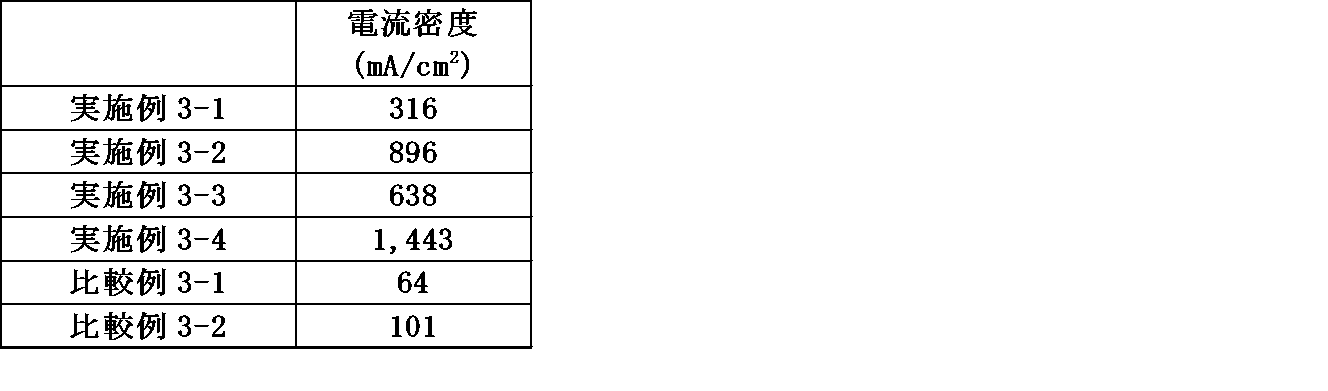
表1に示したように、本発明の電荷輸送性ワニスから作製した薄膜は、良好な電荷輸送性を示した。
Claims (13)
- 下記式(1)で表されるアリールアミン化合物。
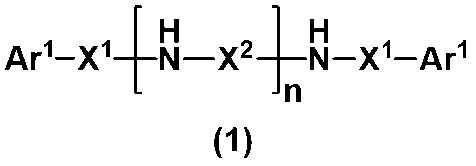
X2は、それぞれ独立して、下記式(a1-1)~(a1-2)、(a2-1)~(a2-4)、(a3-1)~(a3-4)および(a4)~(a9)のいずれかで表される基を表し、

Ar1は、それぞれ独立して、下記式(b1)または(b2)で表される基を表し、

Z1、Z2およびZ3は、それぞれ独立して、下記式(c1)~(c4)のいずれかで表される基を表す。破線は、結合手を表す。
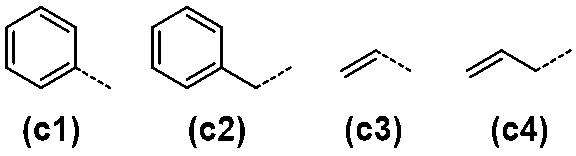
nは、0~5の整数を表す。ただし、nが0の場合、X1は単結合にならない。] - 上記X1が、それぞれ独立して、単結合、または上記式(a1-1)~(a1-2)、(a2-1)~(a2-4)、(a4)および(a7)のいずれかで表される基であり、上記X2が、それぞれ独立して、上記式(a1-1)~(a1-2)、(a2-1)~(a2-4)、(a4)および(a7)のいずれかで表される基である請求項1記載のアリールアミン化合物。
- 上記Ar1が、上記式(b1)で表される基である請求項1記載のアリールアミン化合物。
- 上記R1が、それぞれ独立して、炭素数1~4のアルキル基である請求項1記載のアリールアミン化合物。
- 上記Yが、NZ3である請求項1記載のアリールアミン化合物。
- 上記Z1、Z2およびZ3が、上記式(c1)で表される基である請求項1記載のアリールアミン化合物。
- 請求項1~6のいずれか1項記載のアリールアミン化合物からなる電荷輸送性物質。
- 請求項1~6のいずれか1項記載のアリールアミン化合物と、有機溶媒とを含む電荷輸送性ワニス。
- さらに、ドーパント物質を含む請求項8記載の電荷輸送性ワニス。
- 請求項8記載の電荷輸送性ワニスから得られる電荷輸送性薄膜。
- 請求項10記載の電荷輸送性薄膜を備える電子素子。
- 上記電荷輸送性薄膜が、正孔注入層または正孔輸送層である請求項11記載の電子素子。
- 上記電子素子が、有機EL素子または量子ドットEL素子である請求項12記載の電子素子。
Priority Applications (3)
| Application Number | Priority Date | Filing Date | Title |
|---|---|---|---|
| JP2025527591A JPWO2024257551A1 (ja) | 2023-06-12 | 2024-05-20 | |
| CN202480039065.9A CN121311469A (zh) | 2023-06-12 | 2024-05-20 | 芳基胺化合物及其利用 |
| KR1020257038418A KR20260021605A (ko) | 2023-06-12 | 2024-05-20 | 아릴아민 화합물 및 그 이용 |
Applications Claiming Priority (2)
| Application Number | Priority Date | Filing Date | Title |
|---|---|---|---|
| JP2023-095945 | 2023-06-12 | ||
| JP2023095945 | 2023-06-12 |
Publications (1)
| Publication Number | Publication Date |
|---|---|
| WO2024257551A1 true WO2024257551A1 (ja) | 2024-12-19 |
Family
ID=93852095
Family Applications (1)
| Application Number | Title | Priority Date | Filing Date |
|---|---|---|---|
| PCT/JP2024/018421 Ceased WO2024257551A1 (ja) | 2023-06-12 | 2024-05-20 | アリールアミン化合物およびその利用 |
Country Status (5)
| Country | Link |
|---|---|
| JP (1) | JPWO2024257551A1 (ja) |
| KR (1) | KR20260021605A (ja) |
| CN (1) | CN121311469A (ja) |
| TW (1) | TW202513546A (ja) |
| WO (1) | WO2024257551A1 (ja) |
Citations (10)
| Publication number | Priority date | Publication date | Assignee | Title |
|---|---|---|---|---|
| WO2008129947A1 (ja) * | 2007-04-12 | 2008-10-30 | Nissan Chemical Industries, Ltd. | オリゴアニリン化合物 |
| JP2009079092A (ja) * | 2007-09-25 | 2009-04-16 | Mitsui Chemicals Inc | 高分子化合物、および該高分子化合物を含有する有機電界発光素子 |
| WO2013084664A1 (ja) * | 2011-12-05 | 2013-06-13 | 日産化学工業株式会社 | 帯電防止膜形成組成物及びオリゴマー化合物 |
| WO2014132834A1 (ja) * | 2013-02-26 | 2014-09-04 | 日産化学工業株式会社 | 電荷輸送性ワニス |
| WO2014171484A1 (ja) * | 2013-04-16 | 2014-10-23 | 日産化学工業株式会社 | 金属陽極用正孔輸送性ワニスおよび複合金属陽極 |
| WO2015050253A1 (ja) * | 2013-10-04 | 2015-04-09 | 日産化学工業株式会社 | アニリン誘導体およびその利用 |
| WO2016136544A1 (ja) * | 2015-02-24 | 2016-09-01 | 日産化学工業株式会社 | アニリン誘導体およびその利用 |
| WO2017217457A1 (ja) * | 2016-06-16 | 2017-12-21 | 日産化学工業株式会社 | スルホン酸エステル化合物及びその利用 |
| WO2020241730A1 (ja) * | 2019-05-31 | 2020-12-03 | 日産化学株式会社 | アリールアミン化合物およびその利用 |
| CN113072568A (zh) * | 2020-01-04 | 2021-07-06 | 江苏三月光电科技有限公司 | 一种含有双硼的有机电致发光材料及其应用 |
-
2024
- 2024-05-20 JP JP2025527591A patent/JPWO2024257551A1/ja active Pending
- 2024-05-20 KR KR1020257038418A patent/KR20260021605A/ko active Pending
- 2024-05-20 WO PCT/JP2024/018421 patent/WO2024257551A1/ja not_active Ceased
- 2024-05-20 CN CN202480039065.9A patent/CN121311469A/zh active Pending
- 2024-05-29 TW TW113119865A patent/TW202513546A/zh unknown
Patent Citations (10)
| Publication number | Priority date | Publication date | Assignee | Title |
|---|---|---|---|---|
| WO2008129947A1 (ja) * | 2007-04-12 | 2008-10-30 | Nissan Chemical Industries, Ltd. | オリゴアニリン化合物 |
| JP2009079092A (ja) * | 2007-09-25 | 2009-04-16 | Mitsui Chemicals Inc | 高分子化合物、および該高分子化合物を含有する有機電界発光素子 |
| WO2013084664A1 (ja) * | 2011-12-05 | 2013-06-13 | 日産化学工業株式会社 | 帯電防止膜形成組成物及びオリゴマー化合物 |
| WO2014132834A1 (ja) * | 2013-02-26 | 2014-09-04 | 日産化学工業株式会社 | 電荷輸送性ワニス |
| WO2014171484A1 (ja) * | 2013-04-16 | 2014-10-23 | 日産化学工業株式会社 | 金属陽極用正孔輸送性ワニスおよび複合金属陽極 |
| WO2015050253A1 (ja) * | 2013-10-04 | 2015-04-09 | 日産化学工業株式会社 | アニリン誘導体およびその利用 |
| WO2016136544A1 (ja) * | 2015-02-24 | 2016-09-01 | 日産化学工業株式会社 | アニリン誘導体およびその利用 |
| WO2017217457A1 (ja) * | 2016-06-16 | 2017-12-21 | 日産化学工業株式会社 | スルホン酸エステル化合物及びその利用 |
| WO2020241730A1 (ja) * | 2019-05-31 | 2020-12-03 | 日産化学株式会社 | アリールアミン化合物およびその利用 |
| CN113072568A (zh) * | 2020-01-04 | 2021-07-06 | 江苏三月光电科技有限公司 | 一种含有双硼的有机电致发光材料及其应用 |
Also Published As
| Publication number | Publication date |
|---|---|
| TW202513546A (zh) | 2025-04-01 |
| KR20260021605A (ko) | 2026-02-13 |
| JPWO2024257551A1 (ja) | 2024-12-19 |
| CN121311469A (zh) | 2026-01-09 |
Similar Documents
| Publication | Publication Date | Title |
|---|---|---|
| JP2018104674A (ja) | 高分子化合物、組成物、液状組成物、薄膜並びにエレクトロルミネッセンス素子用材料及びエレクトロルミネッセンス素子 | |
| JP2025036480A (ja) | アリールアミン化合物およびその利用 | |
| TWI856118B (zh) | 電荷輸送性塗料 | |
| JP7290149B2 (ja) | アニリン誘導体およびその利用 | |
| WO2023189399A1 (ja) | ポリマーおよびその利用 | |
| TW202513546A (zh) | 芳基胺化合物以及其利用 | |
| KR102794314B1 (ko) | 전하 수송성 바니시 | |
| JP7491302B2 (ja) | アリールアミン化合物およびその利用 | |
| US11411188B2 (en) | Arylamine polymer including silicone, and electroluminescence device material and electroluminescence device using the polymer | |
| TWI855047B (zh) | 茀衍生物及其利用 | |
| WO2024241890A1 (ja) | 電荷輸送性ワニスおよび化合物 | |
| WO2024241889A1 (ja) | 電荷輸送性ワニス | |
| US20250311610A1 (en) | Copolymer, and composition, liquid composition, and electroluminsecnt device including the copolymer | |
| US20260040821A1 (en) | Laminate, and quantum dot electroluminescent device comprising the laminate | |
| WO2025100171A1 (ja) | 電荷輸送性ワニスおよび量子ドットエレクトロルミネッセンス素子用電荷輸送性ワニス | |
| JP2025128766A (ja) | 電荷輸送性インク組成物 | |
| WO2025018147A1 (ja) | フッ素化アリールスルホン酸ポリマー化合物およびその利用 | |
| WO2025033132A1 (ja) | 電荷輸送性ワニスおよびその製造方法 | |
| WO2024260416A1 (zh) | 一种有机化合物及其制备方法、电子器件 | |
| CN120157587A (zh) | 有机化合物及其制备方法、组合物、光电器件及显示装置 | |
| CN120209264A (zh) | 聚合物及其制备方法、组合物、光电器件及显示装置 | |
| CN120230119A (zh) | 有机化合物及其制备方法、组合物及光电器件 |
Legal Events
| Date | Code | Title | Description |
|---|---|---|---|
| 121 | Ep: the epo has been informed by wipo that ep was designated in this application |
Ref document number: 24823173 Country of ref document: EP Kind code of ref document: A1 |
|
| ENP | Entry into the national phase |
Ref document number: 2025527591 Country of ref document: JP Kind code of ref document: A |
|
| WWE | Wipo information: entry into national phase |
Ref document number: CN2024800390659 Country of ref document: CN |
|
| NENP | Non-entry into the national phase |
Ref country code: DE |