WO2024257326A1 - 経路探索装置、経路探索方法、およびプログラム - Google Patents
経路探索装置、経路探索方法、およびプログラム Download PDFInfo
- Publication number
- WO2024257326A1 WO2024257326A1 PCT/JP2023/022367 JP2023022367W WO2024257326A1 WO 2024257326 A1 WO2024257326 A1 WO 2024257326A1 JP 2023022367 W JP2023022367 W JP 2023022367W WO 2024257326 A1 WO2024257326 A1 WO 2024257326A1
- Authority
- WO
- WIPO (PCT)
- Prior art keywords
- network
- access concentration
- bases
- impact
- network information
- Prior art date
- Legal status (The legal status is an assumption and is not a legal conclusion. Google has not performed a legal analysis and makes no representation as to the accuracy of the status listed.)
- Ceased
Links
Images




Classifications
-
- G—PHYSICS
- G01—MEASURING; TESTING
- G01C—MEASURING DISTANCES, LEVELS OR BEARINGS; SURVEYING; NAVIGATION; GYROSCOPIC INSTRUMENTS; PHOTOGRAMMETRY OR VIDEOGRAMMETRY
- G01C21/00—Navigation; Navigational instruments not provided for in groups G01C1/00 - G01C19/00
- G01C21/26—Navigation; Navigational instruments not provided for in groups G01C1/00 - G01C19/00 specially adapted for navigation in a road network
- G01C21/34—Route searching; Route guidance
-
- G—PHYSICS
- G06—COMPUTING OR CALCULATING; COUNTING
- G06Q—INFORMATION AND COMMUNICATION TECHNOLOGY [ICT] SPECIALLY ADAPTED FOR ADMINISTRATIVE, COMMERCIAL, FINANCIAL, MANAGERIAL OR SUPERVISORY PURPOSES; SYSTEMS OR METHODS SPECIALLY ADAPTED FOR ADMINISTRATIVE, COMMERCIAL, FINANCIAL, MANAGERIAL OR SUPERVISORY PURPOSES, NOT OTHERWISE PROVIDED FOR
- G06Q10/00—Administration; Management
- G06Q10/04—Forecasting or optimisation specially adapted for administrative or management purposes, e.g. linear programming or "cutting stock problem"
- G06Q10/047—Optimisation of routes or paths, e.g. travelling salesman problem
-
- G—PHYSICS
- G08—SIGNALLING
- G08G—TRAFFIC CONTROL SYSTEMS
- G08G1/00—Traffic control systems for road vehicles
-
- H—ELECTRICITY
- H04—ELECTRIC COMMUNICATION TECHNIQUE
- H04L—TRANSMISSION OF DIGITAL INFORMATION, e.g. TELEGRAPHIC COMMUNICATION
- H04L12/00—Data switching networks
- H04L12/28—Data switching networks characterised by path configuration, e.g. LAN [Local Area Networks] or WAN [Wide Area Networks]
- H04L12/40—Bus networks
Definitions
- One aspect of the present invention relates to a route search device, a route search method, and a program.
- Delivery services are drawing attention. They not only deliver parcels and other items, but also include visits by recovery vehicles after disasters such as earthquakes and typhoons. For example, when power is cut off due to a disaster, telecommunications carriers immediately deliver power supply vehicles and workers to buildings that provide telecommunications services (telecommunications buildings). Large-scale power outages during wide-area disasters require the delivery of fuel, and equipment failures necessitate equipment replacement. Optimizing delivery routes is also important for speeding up the restoration of telecommunications buildings.
- VRP vehicle routing problem
- Non-Patent Document 2 discloses a technique that takes into account the routes of a multi-layer network in the event of a large-scale failure and maximizes the amount of traffic between specific endpoints up to the upper capacity limit.
- This invention was made with the above in mind, and aims to provide technology that can calculate a recovery order that minimizes the impact on communication services.
- a route search device is a route search device that searches for a route for moving a vehicle to a plurality of bases that provide services to a user.
- the route search device includes a network information input unit, a situation input unit, a recovery order search unit, and an access concentration impact calculation unit.
- the network information input unit inputs network information of a network in which a plurality of bases are nodes and links exist between the nodes.
- the situation input unit inputs the respective situations of the nodes and links.
- the recovery order search unit formulates a planning problem that models the access concentration of traffic in the network based on the network information and the situation, and searches for candidate recovery orders of the bases as routes.
- the access concentration impact calculation unit evaluates the impact of access concentration on each of the recovery orders using an objective function value obtained by optimizing the planning problem.
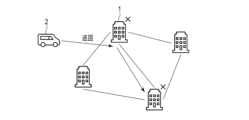
- FIG. 1 is a diagram for explaining a use case of the embodiment.
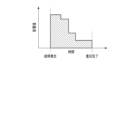
- FIG. 2 is a diagram for explaining a use case of the embodiment.
- FIG. 3 is a block diagram showing an example of a route search device according to an embodiment of the present invention.
- FIG. 4 is a functional block diagram showing an example of the route search device 100 shown in FIG.
- FIG. 5 is a diagram for explaining the degree of influence of access concentration.
- FIG. 6 is a diagram showing the flow of data between functional blocks in the processor 10.
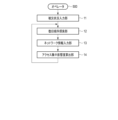
- FIG. 7 is a flowchart illustrating an example of a processing procedure of the route search device according to the embodiment.
- FIG. 8 is a diagram for explaining a method for optimizing the recovery order using the impact degree of access concentration.
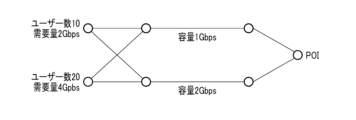
- FIG. 9 is a diagram illustrating an example of a network topology.
- FIG. 10 is a diagram showing routes selected by a method using a multi-item flow according to the embodiment.
- FIG. 11 is a diagram showing a route selected by maximizing traffic.
- FIG. 1 is a diagram showing an example of a use case of a route search device according to an embodiment.
- the communication carrier will have a vehicle 2 visit the damaged communication building 1 to carry out recovery measures. Since the resources required for recovery work are limited, a plan is made to restore each communication building 1 in stages. In this case, in order to decide the order in which to visit the communication buildings 1, it is necessary to take into account the importance of the communication building in the communication service.
- the status of communication services in the recovery status of each communication building is evaluated. In other words, the impact on communication services of the failure or recovery of a communication building is quantitatively evaluated.
- FIG. 4 is a functional block diagram showing an example of the route search device 100 shown in FIG. 3.
- the memory 20 is a semiconductor memory such as a ROM (Read Only Memory) or a RAM (Random Access Memory).
- the storage 50 also includes an area for storing the network topology 52 of the network for which route searching is to be performed, an area for storing the number of users 53, an area for storing position data 54, and an area for storing travel time data 55.
- the number of users 53 is the number of users at each location (node), that is, the number of users who use the network service at each location.
- the location data 54 is the location of each base, expressed, for example, by latitude and longitude.
- the travel time data 55 is data that indicates the travel time between each of the bases in a matrix format.
- the processor 10 includes, as processing functions according to one embodiment of the present invention, a damage status input unit 11, a recovery order search unit 12, a network information input unit 13, and an access concentration impact calculation unit 14.
- the damage status input unit 11, the recovery order search unit 12, the network information input unit 13, and the access concentration impact calculation unit 14 are realized by the processor 10 executing a program loaded into the memory 20.
- the program 51 includes instructions for causing the processor 10 to function as the damage status input unit 11, as the recovery order search unit 12, as the network information input unit 13, and as the access concentration impact calculation unit 14.
- the network information input unit 13 stores the input data in the storage 50. That is, the disaster situation input unit 11 stores the network topology 52, the number of users 53, the location data 54, and the travel time data 55 in the storage 50. For example, the network information input unit 13 passes the location data 54 to a map API (Application Programming Interface) 201 of the cloud 200, and in response obtains the travel time data 55 returned and stores it in the storage 50.
- the map API 201 is a service provided by the cloud 200.
- the damage status input unit 11 acquires the damage status of nodes and links, for example, through input by an operator.
- the maximum flow algorithm can be used to calculate the impact of a communication outage.
- the maximum flow algorithm calculates the number of users that can connect to a POI when the available routes are used to the maximum extent possible.
- the optimal route that minimizes the degree of impact is found, and the number of users affected by communication is calculated based on the state of access concentration on the link at that time. For example, the network topology and link capacity, the number of users at each node, and traffic demand are input, and the flow on the link is found by optimizing the planning problem. Then, after counting the number of users affected by access concentration, the degree of impact of access concentration is calculated.
- FIG. 8 is a diagram for explaining a method for optimizing the restoration order using the impact of access concentration.
- the node to be restored next is determined so as to minimize the impact of access concentration in a network in the middle of restoration.
- Nodes A and B in FIG. 8 are considered as candidates for the node to be restored next.
- all users can connect to the POI, so the impact of communication interruption is 0.
- FIG. 10 shows a case where a route is selected to optimize the planning problem of the embodiment and minimize the impact.
- FIG. 11 shows a case where a route is selected using the maximum flow algorithm and the impact of access concentration is calculated.
- network access concentration is formulated as a planning problem, and the impact of access concentration is output when a route with the least impact is selected, taking into account the user traffic volume and the network link capacity. This makes it possible to evaluate the number of users whose communication quality will be reduced due to access concentration when optimizing the vehicle's route. In other words, the number of affected users can be evaluated by taking into account the network traffic and the number of users. In addition, by modeling access concentration, the number of users affected by the degradation of communication quality due to access concentration can be evaluated.
- this invention is not limited to the above-described embodiment as it is, and in the implementation stage, the components can be modified and embodied without departing from the gist of the invention.
- various inventions can be formed by appropriately combining multiple components disclosed in the above-described embodiment. For example, some components may be deleted from all of the components shown in the embodiment. Furthermore, components from different embodiments may be appropriately combined.
Landscapes
- Engineering & Computer Science (AREA)
- Business, Economics & Management (AREA)
- Physics & Mathematics (AREA)
- General Physics & Mathematics (AREA)
- Remote Sensing (AREA)
- Radar, Positioning & Navigation (AREA)
- Human Resources & Organizations (AREA)
- Strategic Management (AREA)
- Economics (AREA)
- Quality & Reliability (AREA)
- Development Economics (AREA)
- Entrepreneurship & Innovation (AREA)
- Marketing (AREA)
- Operations Research (AREA)
- Game Theory and Decision Science (AREA)
- Tourism & Hospitality (AREA)
- General Business, Economics & Management (AREA)
- Theoretical Computer Science (AREA)
- Signal Processing (AREA)
- Computer Networks & Wireless Communication (AREA)
- Automation & Control Theory (AREA)
- Data Exchanges In Wide-Area Networks (AREA)
Abstract
この発明の一態様に係る経路探索装置は、ユーザにサービスを提供する複数の拠点に車両を移動させるための経路を探索する。経路探索装置は、ネットワーク情報入力部と、状況入力部と、復旧順序探索部と、アクセス集中影響度算出部とを具備する。ネットワーク情報入力部は、複数の拠点をノードとしノードの間をリンクとするネットワークのネットワーク情報を入力する。状況入力部は、ノードおよびリンクのそれぞれの状況を入力する。復旧順序探索部は、ネットワークにおけるトラフィックのアクセス集中をモデル化する計画問題を、ネットワーク情報と状況とに基づいて定式化して、拠点の復旧順序の候補を経路として探索する。アクセス集中影響度算出部は、計画問題を最適化して得られた目的関数値を用いて、復旧順序の各々に対するアクセス集中の影響度を評価する。
Description
この発明の一態様は、経路探索装置、経路探索方法、およびプログラムに関する。
配送サービス(delivery service)に注目が集まっている。小包などの荷物だけでなく、地震や台風等の災害時における復旧車輌の訪問も配送サービスの一つである。例えば、通信事業者は災害等で電力が途絶えると、通信サービスを提供するビル(通信ビル)に電源車や作業員をただちに配送する。広域災害時の大規模停電には燃料の配送が必要であり、装置故障時には装置交換が必要である。配送ルートを最適化することは、通信ビルの復旧を速めるためにも重要である。
配送計画問題(VRP:Vehicle Routing Problem)は、複数の車両に複数の拠点を訪問させる際の順序(復旧順序)を最適化するという問題である。それぞれの復旧順序を評価するための基準には、トラフィック量や通信可能なユーザ数が用いられる。
非特許文献1は、段階的なネットワークのノードの復旧において、特定端点間を流れるトラフィック量を最大化すべく復旧順序を最適化する技術を開示する。
非特許文献2は、大規模故障においてマルチレイヤのネットワークの経路を考慮し、容量の上限まで特定端点間のトラフィック量を最大化する技術を開示する。
J. Wang, et al. "On progressive network recovery after a major disruption," INFOCOM, 2011.
K. Genda, et al. "Multi-stage network recovery considering traffic demand after a large-scale failure," ICC, 2016.
既存の技術は、トラフィック量のみを考慮して拠点の復旧順序を最適化するもので、通信品質に関しては考慮されない。まして、通信サービスに接続するユーザの数や、影響を受けるユーザの数といった要素も考慮されない。このことを鑑み、例えば、POI(Point of Interface)に接続できないユーザ数に基づく指標を影響度とし、影響度に基づいて復旧順序を最適化することが考えられている。ここに、通信可能な通信ビルが減少することによるアクセス集中といった要素を組み合わせることができれば、さらに的確な復旧順序を算出できる可能性がある。
この発明は、上記事情に着目してなされたもので、通信サービスへの影響を最小限にする復旧順序を算出することの可能な技術を提供しようとするものである。
この発明の一態様に係る経路探索装置は、ユーザにサービスを提供する複数の拠点に車両を移動させるための経路を探索する経路探索装置である。経路探索装置は、ネットワーク情報入力部と、状況入力部と、復旧順序探索部と、アクセス集中影響度算出部とを具備する。ネットワーク情報入力部は、複数の拠点をノードとしノードの間をリンクとするネットワークのネットワーク情報を入力する。状況入力部は、ノードおよびリンクのそれぞれの状況を入力する。復旧順序探索部は、ネットワークにおけるトラフィックのアクセス集中をモデル化する計画問題を、ネットワーク情報と状況とに基づいて定式化して、拠点の復旧順序の候補を経路として探索する。アクセス集中影響度算出部は、計画問題を最適化して得られた目的関数値を用いて、復旧順序の各々に対するアクセス集中の影響度を評価する。
この発明の一態様によれば、通信サービスへの影響を最小限にする復旧順序を算出することが可能になる。
以下、図面を参照してこの発明に係わる実施形態を説明する。先ず、図1および図2を参照して実施形態のユースケースについて説明する。
図1は、実施形態に係わる経路探索装置のユースケースの一例を示す図である。例えば通信ビルが被災するような災害が発生すると、通信事業者は、被災した通信ビル1に車両2を訪問させて復旧対応を行う。復旧作業に必要なリソースは限られるので、各通信ビル1を段階的に復旧するための計画が立案される。その際、通信ビル1を訪問する順序を決めるためには、通信サービスにおける通信ビルの重要性を考慮する必要がある。
ネットワークにおける通信ビルの重要性を適切に評価することで、通信サービスへの影響を最小限に抑えた復旧計画の立案が可能になる。それぞれの通信ビルの重要性を個々に評価するために、実施形態では、各通信ビルの復旧状況における通信サービスの状況を評価する。すなわち、通信ビルの故障あるいは復旧が、通信サービスに与える影響を定量的に評価する。
図2に示されるように、重要な通信ビルを優先的に復旧することで、影響度を段階的に減少させ、延べ影響度を最小限に抑えることができる。
図3は、この発明の一実施形態に係る経路探索装置の一例を示すブロック図である。図3の経路探索装置100は、ユーザにサービスを提供する複数の拠点に車両を移動させるための経路を探索する装置である。
経路探索装置100は、プロセッサ10、メモリ20、ストレージ50、および入出力部60と、これらを接続するバス45とを備えるコンピュータである。入出力部60は、経路探索装置100とクラウド200との間に通信リンクを設定し、各種のデータを授受する。
プロセッサ10は、CPU(Central Processing Unit)やMPU(Micro Processing Unit)などの演算デバイスであり、ストレージ50からメモリ20にロードされたプログラムに従って、実施形態に係わる処理機能を実現する。
図4は、図3に示される経路探索装置100の一例を示す機能ブロック図である。図4において、メモリ20は、ROM(Read Only Memory)やRAM(Random Access Memory)等の半導体メモリである。
ストレージ50は、HDD(Hard Disk Drive)、またはSSD(Solid State Drive)等の不揮発性メモリであり、OS(Operating System)等の基本ソフトウェアに加えて、実施形態に係る処理を実現するためのプログラム51を記憶する。すなわちプログラム51は、経路探索装置100にインストールされることが可能である。
また、ストレージ50は、経路探索の対象とするネットワークのネットワークトポロジ52を記憶するエリアと、ユーザ数53を記憶するエリアと、位置データ54を記憶するエリアと、移動時間データ55を記憶するエリアとを備える。
ネットワークトポロジ52は、経路探索の対象とするネットワークのトポロジを表すデータである。実施形態では、車両の配送の対象となる複数の拠点をノードとし、ノード間をリンク(またはアーク)と称する。
ユーザ数53は、それぞれの拠点(ノード)ごとのユーザ数である。つまり、各拠点においてネットワークサービスを利用するユーザの数である。
位置データ54は、例えば緯度・経度で表される、各拠点の位置である。
移動時間データ55は、それぞれの拠点間の移動時間を行列形式で示すデータである。
位置データ54は、例えば緯度・経度で表される、各拠点の位置である。
移動時間データ55は、それぞれの拠点間の移動時間を行列形式で示すデータである。
プロセッサ10は、この発明の一実施形態に係る処理機能として、被災状況入力部11、復旧順序探索部12、ネットワーク情報入力部13、および、アクセス集中影響度算出部14を備える。
被災状況入力部11、復旧順序探索部12、ネットワーク情報入力部13、および、アクセス集中影響度算出部14は、メモリ20にロードされたプログラムをプロセッサ10が実行することで実現される。つまりプログラム51は、プロセッサ10を、被災状況入力部11として機能させる命令と、復旧順序探索部12として機能させる命令と、ネットワーク情報入力部13として機能させる命令と、アクセス集中影響度算出部14として機能させる命令とを含む。
ネットワーク情報入力部13は、ネットワークのネットワーク情報を入力する。ネットワーク情報は、例えばオペレータ(ユーザ)により入力されることができる。その場合、ネットワーク情報入力部13は、オペレータにGUI(Graphical User Interface)環境を提供する。ネットワーク情報は、例えばストレージ50に記憶されたネットワークトポロジ52、拠点ごとのユーザ数53、および、拠点間の移動時間データ55とを含むことができる。さらに、ネットワーク情報は、リンクの容量、各ノードのユーザ数とトラフィックの需要量を含んでよい。
ネットワーク情報入力部13は、入力されたデータをストレージ50に記憶させる。すなわち被災状況入力部11は、ネットワークトポロジ52、ユーザ数53、位置データ54、および、移動時間データ55をストレージ50に記憶させる。例えば、ネットワーク情報入力部13は、位置データ54をクラウド200の地図API(Application Programming Interface)201に渡し、これに応じて返送された移動時間データ55を取得してストレージ50に記憶させる。地図API201は、クラウド200により提供されるサービスである。
被災状況入力部11は、ノードの被災状況、および、リンクの被災状況を、例えばオペレータの入力により取得する。
復旧順序探索部12は、ネットワークにおけるトラフィックのアクセス集中をモデル化する計画問題を定式化する。復旧順序探索部12は、例えば、上記ネットワーク情報と、上記被災状況とに基づいて計画問題を定式化する。さらに、復旧順序探索部12は、定式化した計画問題に基づいて、拠点の復旧順序の候補を車両2の経路として探索する。
アクセス集中影響度算出部14は、上記計画問題を最適化して得られた目的関数値を用いて、復旧順序の各々に対する、アクセス集中の影響度を評価する。また、アクセス集中影響度算出部14は、アクセス集中の影響度の評価を復旧順序探索部12にフィードバックして、経路の最適解を探索させる。最終的に得られた最適解が、最適経路300である。
入出力部60は、算出された最適経路300を出力する。
入出力部60は、算出された最適経路300を出力する。
図5は、アクセス集中の影響度について説明するための図である。実施形態では、災害復旧における通信ビルの重要性を評価するために、ネットワークのアクセス集中により影響を受けるユーザ数を定量的に評価するモデルを作成する。ここで、各通信ビルに収容されたユーザからPOIへの通信における、アクセス集中によって通信品質が低下するユーザ数を[アクセス集中の影響度]として定義する。アクセス集中の影響度は、他の指標である例えば[通信断の影響度]とは区別される。
ちなみに通信断の影響度を算出するためには、最大流アルゴリズムを用いることができる。すなわち、利用可能な経路を最大限利用した場合における、POIに接続可能なユーザ数を最大流アルゴリズムで算出する。
しかし、最大流アルゴリズムをアクセス集中の算出に適用すると、リンク容量まで最大限フローを流すためアクセス集中が多発する経路が選択されやすい。また、そのリンクを利用するユーザを区別しないため、アクセス集中によるユーザへの影響を評価することができない。
図5に示されるように、アクセス集中を定式化するために、ユーザのトラフィック量がリンクの容量を超過することをモデル化する。大規模災害時には通信可能な経路が減少し、特定のリンクにアクセスが集中することによって、そのリンクを利用するユーザの通信品質が低下する。経路制御プロトコルには、最短経路を選択する方法やアクセス集中箇所を迂回する方法が存在するので、アクセス集中の観点で最も良い経路が選択される場合を考える。
実施形態では、影響度を最小化するうえで最適な経路を求め、その時のリンクのアクセス集中の状況から、通信に影響を受けるユーザ数を計算する。例えば、ネットワークのトポロジとリンクの容量、各ノードのユーザ数とトラフィックの需要量を入力し、計画問題を最適化することでリンク上のフローを求める。そうして、アクセス集中の影響を受けるユーザ数を数え上げた後、アクセス集中の影響度を算出する。
ここで、アクセス集中をモデル化する計画問題について数式を用いて説明する。ここでは、各ノードからのフローを区別するため多品種フローを考える。入力、および出力に関して以下のように定義する。
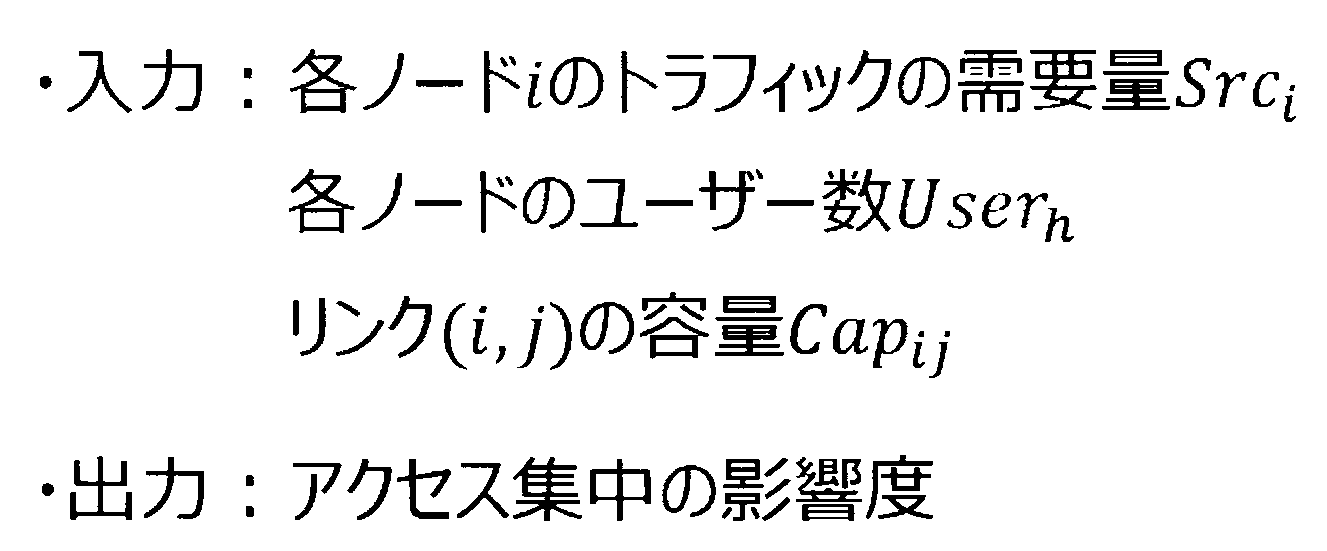
各ノードにおけるフロー保存則は、式(1)で表される。

式(1)の左辺は、ユーザhからの(i,j)のフローの総和である。右辺第2項において、Srcii=Srciである。i∈SのSはノード集合を表し、h∈HのHはユーザ集合を表す。
アクセス集中を、トラフィックがリンクの容量を超えることとして表すと、《1》であって、式(2)が成り立つ。
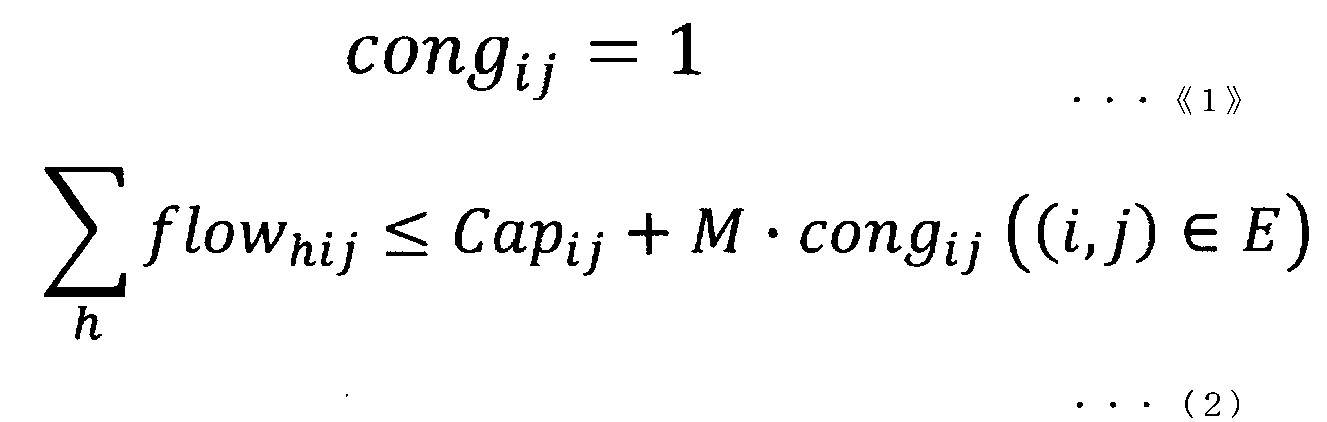
式(2)の右辺第2稿のMは、十分大きな数である。(i,j)∈Eは、リンク集合を表す。
ノードの通信が影響を受ける場合は、《2》であって、式(3)が成り立つ。式(3)において変数の積は線形化する。

影響を受けるユーザを最小化する条件式は(4)で表される。

以上のように定式化された計画問題を最適化し、その際の目的関数値を用いてアクセス集中の影響度を評価する。
図6は、プロセッサ10における機能ブロック間のデータの流れを示す図である。図6に示されるように、アクセス集中影響度算出部14から出力されたアクセス集中の影響度は、復旧順序探索部12にフィードバックされて、最も影響度の小さい復旧順序が見つかるまで計算が繰り返される。最終的に得られた解は、通信サービスへの影響を最小限にする復旧順序を与える。
図7は、実施形態に係わる経路探索装置100の処理手順の一例を示すフローチャートである。図7において、経路探索装置100は、入力されたネットワーク情報を取得する(ステップS1)。この過程では、ネットワークトポロジ52、ユーザ数53、位置データ54、および、移動時間データ55も取得される。さらに、ノードおよびリンクのそれぞれの被災状況も取得される。
次に、経路探索装置100は、取得されたネットワーク情報、および被災状況に基づいて、ネットワークにおけるトラフィックのアクセス集中をモデル化する計画問題を定式化する(ステップS2)。
次に、経路探索装置100は、計画問題を最適化して、拠点の復旧順序の候補を経路として探索する(ステップS3)。
そして、経路探索装置100は、計画問題を最適化して得られた目的関数値を用いて、復旧順序の各々に対するアクセス集中の影響度を評価する。その結果は、最適解が得られるまでフィードバックされ、入出力部60から出力される(ステップS4)。
そして、経路探索装置100は、計画問題を最適化して得られた目的関数値を用いて、復旧順序の各々に対するアクセス集中の影響度を評価する。その結果は、最適解が得られるまでフィードバックされ、入出力部60から出力される(ステップS4)。
図8は、アクセス集中の影響度を用いて復旧順序を最適化する方法について説明するための図である。実施形態では、復旧途中のネットワークにおいて、アクセス集中の影響度を最小にできるように、次に復旧すべきノードを決定する。次に復旧するノードの候補として、図8のノードA,Bを考える。図8(a)、(b)のいずれの場合も、全てのユーザはPOIに接続できるので、通信断の影響度は0である。
しかし、各リンク容量とトラフィック集中の状況とから、アクセス集中の影響度はそれぞれ異なる。例えば図8(a)での影響度が20であり、図8(b)での影響度が40であれば、より影響度が小さくなるノードAを先に復旧させる。
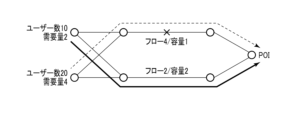
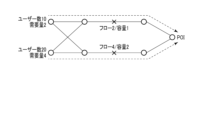
図9~図11を参照して、実施形態の多品種フローを用いた経路選択と、トラフィック最大化による経路選択との違いについて説明する。図9に示されるトポロジのネットワークを例に採り、図10、図11において、左端の2点のノードから右端のPOIへの通信を考える。
図10は、実施形態の計画問題を最適化して影響度を最小化するように経路選択を行った場合を示す。図11は、最大流アルゴリズムで経路選択を行い、アクセス集中の影響度を算出した場合を示す。
トラフィック量を最大化する方法では、どちらのリンクにアクセス集中が生じるかが考慮されないため、図10、図11のどちらの解も得られる可能性がある。図11の解は両方のリンクでアクセス集中が生じるために双方の通信(点線の矢印)で通信品質が低下する。一方、図10の解はアクセス集中を考慮するため、影響度を最小化するような経路選択を行った場合の影響度を評価できる。すなわち、影響度を最小化するような経路選択を行うことは、通信断の影響度における最大流アルゴリズムが利用可能な経路を最大限利用するという考え方と同じである。
以上述べたように、実施形態では、ネットワークのアクセス集中を計画問題に定式化し、ユーザのトラフィック量とネットワークのリンクの容量を考慮して、最もアクセス集中の影響度の小さい経路が選択された場合の影響度を出力する。これにより、車両の巡回経路を最適化するに際して、アクセス集中によって通信品質が低下するユーザ数を評価することが可能になる。すなわち、ネットワークのトラフィックおよびユーザ数を考慮することによって、影響を受けるユーザ数を評価できる。また、アクセス集中をモデル化することで、アクセス集中による通信品質低下の影響を受けるユーザ数を評価することができる。
このようにしたので、ネットワークサービスへのアクセスが集中することにより、(ネットワークサービスに接続できるが)通信品質が低下してしまうユーザへの影響度を最小にする復旧順序を算出することができる。従って、通信品質が低下するようなユーザへの影響を最小限に抑えた復旧計画を策定することができる。これらのことから、実施形態によれば、通信サービスへの影響を最小限にする復旧順序を算出することが可能になる。
なお、この発明は上記実施の形態に限定されるものではない。例えば、実施形態では、経路探索装置100が被災状況入力部11、復旧順序探索部12、ネットワーク情報入力部13、アクセス集中影響度算出部14を含む形態について説明した。これに代えて、経路探索装置100とは別体のサーバコンピュータに、これらの機能ブロックを実装することももちろん可能である。この形態では、経路探索装置100は、生成した計画問題を入出力部60からサーバコンピュータに渡し、解を受け取ることとなる。あるいは、クラウド200のサービスとして各機能ブロックを実装しても良い。
すなわち、この発明は、上記実施形態そのままに限定されるものではなく、実施段階ではその要旨を逸脱しない範囲で構成要素を変形して具体化できる。また、上記実施形態に開示されている複数の構成要素の適宜な組み合せにより種々の発明を形成できる。例えば、実施形態に示される全構成要素から幾つかの構成要素を削除してもよい。さらに、異なる実施形態に亘る構成要素を適宜組み合せてもよい。
1…通信ビル
2…車両
10…プロセッサ
11…被災状況入力部
12…復旧順序探索部
13…ネットワーク情報入力部
14…アクセス集中影響度算出部
20…メモリ
45…バス
50…ストレージ
51…プログラム
52…ネットワークトポロジ
54…位置データ
55…移動時間データ
60…入出力部
100…経路探索装置
200…クラウド
300…最適経路。
2…車両
10…プロセッサ
11…被災状況入力部
12…復旧順序探索部
13…ネットワーク情報入力部
14…アクセス集中影響度算出部
20…メモリ
45…バス
50…ストレージ
51…プログラム
52…ネットワークトポロジ
54…位置データ
55…移動時間データ
60…入出力部
100…経路探索装置
200…クラウド
300…最適経路。
Claims (6)
- ユーザにサービスを提供する複数の拠点に車両を移動させるための経路を探索する経路探索装置であって、
前記複数の拠点をノードとし前記ノードの間をリンクとするネットワークのネットワーク情報を入力するネットワーク情報入力部と、
前記ノードおよび前記リンクのそれぞれの状況を入力する状況入力部と、
前記ネットワークにおけるトラフィックのアクセス集中をモデル化する計画問題を、前記ネットワーク情報と前記状況とに基づいて定式化して、前記拠点の復旧順序の候補を前記経路として探索する復旧順序探索部と、
前記計画問題を最適化して得られた目的関数値を用いて、前記復旧順序の各々に対する前記アクセス集中の影響度を評価するアクセス集中影響度算出部とを具備する、経路探索装置。 - 前記ネットワーク情報は、前記ネットワークのネットワークトポロジと、前記拠点ごとのユーザ数と、それぞれの拠点間の移動時間とを含む、請求項1に記載の経路探索装置。
- 前記復旧順序探索部は、多品種フローにより前記計画問題を定式化する、請求項1に記載の経路探索装置。
- 前記復旧順序探索部は、前記トラフィックが前記リンクの容量を超えたこととして前記アクセス集中をモデル化する、請求項1に記載の経路探索装置。
- ユーザにサービスを提供する複数の拠点に車両を移動させるための経路を、コンピュータを用いて探索する経路探索方法であって、
前記コンピュータが、前記複数の拠点をノードとし前記ノードの間をリンクとするネットワークのネットワーク情報を取得する過程と、
前記コンピュータが、前記ノードおよび前記リンクのそれぞれの状況を取得する過程と、
前記コンピュータが、前記ネットワークにおけるトラフィックのアクセス集中をモデル化する計画問題を、前記ネットワーク情報と前記状況とに基づいて定式化して、前記拠点の復旧順序の候補を前記経路として探索する過程と、
前記コンピュータが、前記計画問題を最適化して得られた目的関数値を用いて、前記復旧順序の各々に対する前記アクセス集中の影響度を評価する過程とを具備する、経路探索方法。 - コンピュータを、請求項1乃至請求項4のいずれかに記載の経路探索装置として機能させる命令を含む、プログラム。
Priority Applications (2)
| Application Number | Priority Date | Filing Date | Title |
|---|---|---|---|
| PCT/JP2023/022367 WO2024257326A1 (ja) | 2023-06-16 | 2023-06-16 | 経路探索装置、経路探索方法、およびプログラム |
| JP2025527178A JPWO2024257326A1 (ja) | 2023-06-16 | 2023-06-16 |
Applications Claiming Priority (1)
| Application Number | Priority Date | Filing Date | Title |
|---|---|---|---|
| PCT/JP2023/022367 WO2024257326A1 (ja) | 2023-06-16 | 2023-06-16 | 経路探索装置、経路探索方法、およびプログラム |
Publications (1)
| Publication Number | Publication Date |
|---|---|
| WO2024257326A1 true WO2024257326A1 (ja) | 2024-12-19 |
Family
ID=93851606
Family Applications (1)
| Application Number | Title | Priority Date | Filing Date |
|---|---|---|---|
| PCT/JP2023/022367 Ceased WO2024257326A1 (ja) | 2023-06-16 | 2023-06-16 | 経路探索装置、経路探索方法、およびプログラム |
Country Status (2)
| Country | Link |
|---|---|
| JP (1) | JPWO2024257326A1 (ja) |
| WO (1) | WO2024257326A1 (ja) |
Citations (3)
| Publication number | Priority date | Publication date | Assignee | Title |
|---|---|---|---|---|
| JP2015041976A (ja) * | 2013-08-23 | 2015-03-02 | 株式会社日立製作所 | 非常時の迂回経路計算方法 |
| JP2017098894A (ja) * | 2015-11-27 | 2017-06-01 | 日本電信電話株式会社 | ネットワーク管理装置、復旧手順決定方法及びプログラム |
| WO2022259298A1 (ja) * | 2021-06-07 | 2022-12-15 | 日本電信電話株式会社 | ネットワーク管理装置、方法およびプログラム |
-
2023
- 2023-06-16 JP JP2025527178A patent/JPWO2024257326A1/ja active Pending
- 2023-06-16 WO PCT/JP2023/022367 patent/WO2024257326A1/ja not_active Ceased
Patent Citations (3)
| Publication number | Priority date | Publication date | Assignee | Title |
|---|---|---|---|---|
| JP2015041976A (ja) * | 2013-08-23 | 2015-03-02 | 株式会社日立製作所 | 非常時の迂回経路計算方法 |
| JP2017098894A (ja) * | 2015-11-27 | 2017-06-01 | 日本電信電話株式会社 | ネットワーク管理装置、復旧手順決定方法及びプログラム |
| WO2022259298A1 (ja) * | 2021-06-07 | 2022-12-15 | 日本電信電話株式会社 | ネットワーク管理装置、方法およびプログラム |
Non-Patent Citations (1)
| Title |
|---|
| JIANPING WANG ; CHUNMING QIAO ; HONGFANG YU: "On progressive network recovery after a major disruption", INFOCOM, 2011 PROCEEDINGS IEEE, IEEE, 10 April 2011 (2011-04-10), pages 1925 - 1933, XP031953385, ISBN: 978-1-4244-9919-9, DOI: 10.1109/INFCOM.2011.5934996 * |
Also Published As
| Publication number | Publication date |
|---|---|
| JPWO2024257326A1 (ja) | 2024-12-19 |
Similar Documents
| Publication | Publication Date | Title |
|---|---|---|
| CN108011817B (zh) | 一种对电力通信专网业务路由进行重部署的方法及系统 | |
| CN105122730B (zh) | 用于快速链路故障处理的系统和方法 | |
| JP7510311B2 (ja) | 災害対応支援方法および災害対応支援システム | |
| US8654629B1 (en) | Network capacity planning | |
| US9705773B2 (en) | Parallelized network traffic flow availability simulation using stochastic process and traffic engineering algorithms | |
| US20100232299A1 (en) | Simulation of communication networks | |
| He et al. | Hybrid genetic algorithms for telecommunications network back-up routeing | |
| JP7589810B2 (ja) | ネットワーク管理装置、方法およびプログラム | |
| JP7452680B2 (ja) | 復旧支援装置、復旧支援方法およびプログラム | |
| JP6665785B2 (ja) | 避難予測システム、避難予測方法及びコンピュータ読み取り可能記録媒体 | |
| TWI435224B (zh) | 路由政策之系統可靠度評估方法 | |
| WO2010058785A1 (ja) | 経路計算順決定方法、プログラムおよび計算装置 | |
| Khorsi et al. | Pareto-based grouping meta-heuristic algorithm for humanitarian relief logistics with multistate network reliability | |
| US20090259769A1 (en) | Dynamic Component Placement in an Event-Driven Component-Oriented Network Data Processing System | |
| CN113516424B (zh) | 一种线路生成方法、装置、电子设备和存储介质 | |
| CN112860496B (zh) | 故障修复操作推荐方法、装置及存储介质 | |
| Zhang et al. | Probabilistic Analysis of Network Availability. | |
| JP7568088B2 (ja) | ネットワーク管理装置、方法およびプログラム | |
| JP6944156B2 (ja) | オーケストレータ装置、プログラム、情報処理システム、及び制御方法 | |
| Huang et al. | Exact algorithms on reliable routing problems under uncertain topology using aggregation techniques for exponentially many scenarios | |
| Sánchez-Cambronero et al. | A new model for locating plate recognition devices to minimize the impact of the uncertain knowledge of the routes on traffic estimation results | |
| Wu et al. | Optimized restoration schedule for disrupted railroad network | |
| WO2024127508A1 (ja) | 配置最適化装置、配置最適化方法、および配置最適化プログラム | |
| JP7294450B2 (ja) | ネットワークトポロジーを生成する装置、方法及びプログラム | |
| WO2024185009A1 (ja) | 経路探索装置、経路探索方法、およびプログラム |
Legal Events
| Date | Code | Title | Description |
|---|---|---|---|
| 121 | Ep: the epo has been informed by wipo that ep was designated in this application |
Ref document number: 23941628 Country of ref document: EP Kind code of ref document: A1 |
|
| ENP | Entry into the national phase |
Ref document number: 2025527178 Country of ref document: JP Kind code of ref document: A |
|
| WWE | Wipo information: entry into national phase |
Ref document number: 2025527178 Country of ref document: JP |
|
| NENP | Non-entry into the national phase |
Ref country code: DE |