WO2024252769A1 - 無方向性電磁鋼板およびその製造方法 - Google Patents
無方向性電磁鋼板およびその製造方法 Download PDFInfo
- Publication number
- WO2024252769A1 WO2024252769A1 PCT/JP2024/013541 JP2024013541W WO2024252769A1 WO 2024252769 A1 WO2024252769 A1 WO 2024252769A1 JP 2024013541 W JP2024013541 W JP 2024013541W WO 2024252769 A1 WO2024252769 A1 WO 2024252769A1
- Authority
- WO
- WIPO (PCT)
- Prior art keywords
- less
- steel sheet
- hot
- group
- rolled
- Prior art date
- Legal status (The legal status is an assumption and is not a legal conclusion. Google has not performed a legal analysis and makes no representation as to the accuracy of the status listed.)
- Ceased
Links
Images
Classifications
-
- H—ELECTRICITY
- H01—ELECTRIC ELEMENTS
- H01F—MAGNETS; INDUCTANCES; TRANSFORMERS; SELECTION OF MATERIALS FOR THEIR MAGNETIC PROPERTIES
- H01F1/00—Magnets or magnetic bodies characterised by the magnetic materials therefor; Selection of materials for their magnetic properties
- H01F1/01—Magnets or magnetic bodies characterised by the magnetic materials therefor; Selection of materials for their magnetic properties of inorganic materials
- H01F1/03—Magnets or magnetic bodies characterised by the magnetic materials therefor; Selection of materials for their magnetic properties of inorganic materials characterised by their coercivity
- H01F1/12—Magnets or magnetic bodies characterised by the magnetic materials therefor; Selection of materials for their magnetic properties of inorganic materials characterised by their coercivity of soft-magnetic materials
- H01F1/14—Magnets or magnetic bodies characterised by the magnetic materials therefor; Selection of materials for their magnetic properties of inorganic materials characterised by their coercivity of soft-magnetic materials metals or alloys
- H01F1/147—Alloys characterised by their composition
- H01F1/14766—Fe-Si based alloys
- H01F1/14775—Fe-Si based alloys in the form of sheets
-
- C—CHEMISTRY; METALLURGY
- C21—METALLURGY OF IRON
- C21D—MODIFYING THE PHYSICAL STRUCTURE OF FERROUS METALS; GENERAL DEVICES FOR HEAT TREATMENT OF FERROUS OR NON-FERROUS METALS OR ALLOYS; MAKING METAL MALLEABLE, e.g. BY DECARBURISATION OR TEMPERING
- C21D6/00—Heat treatment of ferrous alloys
- C21D6/008—Heat treatment of ferrous alloys containing Si
-
- C—CHEMISTRY; METALLURGY
- C21—METALLURGY OF IRON
- C21D—MODIFYING THE PHYSICAL STRUCTURE OF FERROUS METALS; GENERAL DEVICES FOR HEAT TREATMENT OF FERROUS OR NON-FERROUS METALS OR ALLOYS; MAKING METAL MALLEABLE, e.g. BY DECARBURISATION OR TEMPERING
- C21D8/00—Modifying the physical properties of ferrous metals or ferrous alloys by deformation combined with, or followed by, heat treatment
- C21D8/12—Modifying the physical properties of ferrous metals or ferrous alloys by deformation combined with, or followed by, heat treatment during manufacturing of articles with special electromagnetic properties
- C21D8/1216—Modifying the physical properties of ferrous metals or ferrous alloys by deformation combined with, or followed by, heat treatment during manufacturing of articles with special electromagnetic properties characterised by the working steps
- C21D8/1222—Hot rolling
-
- C—CHEMISTRY; METALLURGY
- C21—METALLURGY OF IRON
- C21D—MODIFYING THE PHYSICAL STRUCTURE OF FERROUS METALS; GENERAL DEVICES FOR HEAT TREATMENT OF FERROUS OR NON-FERROUS METALS OR ALLOYS; MAKING METAL MALLEABLE, e.g. BY DECARBURISATION OR TEMPERING
- C21D8/00—Modifying the physical properties of ferrous metals or ferrous alloys by deformation combined with, or followed by, heat treatment
- C21D8/12—Modifying the physical properties of ferrous metals or ferrous alloys by deformation combined with, or followed by, heat treatment during manufacturing of articles with special electromagnetic properties
- C21D8/1216—Modifying the physical properties of ferrous metals or ferrous alloys by deformation combined with, or followed by, heat treatment during manufacturing of articles with special electromagnetic properties characterised by the working steps
- C21D8/1233—Cold rolling
-
- C—CHEMISTRY; METALLURGY
- C21—METALLURGY OF IRON
- C21D—MODIFYING THE PHYSICAL STRUCTURE OF FERROUS METALS; GENERAL DEVICES FOR HEAT TREATMENT OF FERROUS OR NON-FERROUS METALS OR ALLOYS; MAKING METAL MALLEABLE, e.g. BY DECARBURISATION OR TEMPERING
- C21D8/00—Modifying the physical properties of ferrous metals or ferrous alloys by deformation combined with, or followed by, heat treatment
- C21D8/12—Modifying the physical properties of ferrous metals or ferrous alloys by deformation combined with, or followed by, heat treatment during manufacturing of articles with special electromagnetic properties
- C21D8/1244—Modifying the physical properties of ferrous metals or ferrous alloys by deformation combined with, or followed by, heat treatment during manufacturing of articles with special electromagnetic properties characterised by the heat treatment
- C21D8/1261—Modifying the physical properties of ferrous metals or ferrous alloys by deformation combined with, or followed by, heat treatment during manufacturing of articles with special electromagnetic properties characterised by the heat treatment following hot rolling
-
- C—CHEMISTRY; METALLURGY
- C21—METALLURGY OF IRON
- C21D—MODIFYING THE PHYSICAL STRUCTURE OF FERROUS METALS; GENERAL DEVICES FOR HEAT TREATMENT OF FERROUS OR NON-FERROUS METALS OR ALLOYS; MAKING METAL MALLEABLE, e.g. BY DECARBURISATION OR TEMPERING
- C21D8/00—Modifying the physical properties of ferrous metals or ferrous alloys by deformation combined with, or followed by, heat treatment
- C21D8/12—Modifying the physical properties of ferrous metals or ferrous alloys by deformation combined with, or followed by, heat treatment during manufacturing of articles with special electromagnetic properties
- C21D8/1244—Modifying the physical properties of ferrous metals or ferrous alloys by deformation combined with, or followed by, heat treatment during manufacturing of articles with special electromagnetic properties characterised by the heat treatment
- C21D8/1272—Final recrystallisation annealing
-
- C—CHEMISTRY; METALLURGY
- C21—METALLURGY OF IRON
- C21D—MODIFYING THE PHYSICAL STRUCTURE OF FERROUS METALS; GENERAL DEVICES FOR HEAT TREATMENT OF FERROUS OR NON-FERROUS METALS OR ALLOYS; MAKING METAL MALLEABLE, e.g. BY DECARBURISATION OR TEMPERING
- C21D9/00—Heat treatment, e.g. annealing, hardening, quenching or tempering, adapted for particular articles; Furnaces therefor
- C21D9/46—Heat treatment, e.g. annealing, hardening, quenching or tempering, adapted for particular articles; Furnaces therefor for sheet metals
-
- C—CHEMISTRY; METALLURGY
- C22—METALLURGY; FERROUS OR NON-FERROUS ALLOYS; TREATMENT OF ALLOYS OR NON-FERROUS METALS
- C22C—ALLOYS
- C22C38/00—Ferrous alloys, e.g. steel alloys
- C22C38/002—Ferrous alloys, e.g. steel alloys containing In, Mg, or other elements not provided for in one single group C22C38/001 - C22C38/60
-
- C—CHEMISTRY; METALLURGY
- C22—METALLURGY; FERROUS OR NON-FERROUS ALLOYS; TREATMENT OF ALLOYS OR NON-FERROUS METALS
- C22C—ALLOYS
- C22C38/00—Ferrous alloys, e.g. steel alloys
- C22C38/004—Very low carbon steels, i.e. having a carbon content of less than 0,01%
-
- C—CHEMISTRY; METALLURGY
- C22—METALLURGY; FERROUS OR NON-FERROUS ALLOYS; TREATMENT OF ALLOYS OR NON-FERROUS METALS
- C22C—ALLOYS
- C22C38/00—Ferrous alloys, e.g. steel alloys
- C22C38/005—Ferrous alloys, e.g. steel alloys containing rare earths, i.e. Sc, Y, Lanthanides
-
- C—CHEMISTRY; METALLURGY
- C22—METALLURGY; FERROUS OR NON-FERROUS ALLOYS; TREATMENT OF ALLOYS OR NON-FERROUS METALS
- C22C—ALLOYS
- C22C38/00—Ferrous alloys, e.g. steel alloys
- C22C38/008—Ferrous alloys, e.g. steel alloys containing tin
-
- C—CHEMISTRY; METALLURGY
- C22—METALLURGY; FERROUS OR NON-FERROUS ALLOYS; TREATMENT OF ALLOYS OR NON-FERROUS METALS
- C22C—ALLOYS
- C22C38/00—Ferrous alloys, e.g. steel alloys
- C22C38/02—Ferrous alloys, e.g. steel alloys containing silicon
-
- C—CHEMISTRY; METALLURGY
- C22—METALLURGY; FERROUS OR NON-FERROUS ALLOYS; TREATMENT OF ALLOYS OR NON-FERROUS METALS
- C22C—ALLOYS
- C22C38/00—Ferrous alloys, e.g. steel alloys
- C22C38/04—Ferrous alloys, e.g. steel alloys containing manganese
-
- C—CHEMISTRY; METALLURGY
- C22—METALLURGY; FERROUS OR NON-FERROUS ALLOYS; TREATMENT OF ALLOYS OR NON-FERROUS METALS
- C22C—ALLOYS
- C22C38/00—Ferrous alloys, e.g. steel alloys
- C22C38/06—Ferrous alloys, e.g. steel alloys containing aluminium
-
- C—CHEMISTRY; METALLURGY
- C22—METALLURGY; FERROUS OR NON-FERROUS ALLOYS; TREATMENT OF ALLOYS OR NON-FERROUS METALS
- C22C—ALLOYS
- C22C38/00—Ferrous alloys, e.g. steel alloys
- C22C38/12—Ferrous alloys, e.g. steel alloys containing tungsten, tantalum, molybdenum, vanadium, or niobium
-
- C—CHEMISTRY; METALLURGY
- C22—METALLURGY; FERROUS OR NON-FERROUS ALLOYS; TREATMENT OF ALLOYS OR NON-FERROUS METALS
- C22C—ALLOYS
- C22C38/00—Ferrous alloys, e.g. steel alloys
- C22C38/14—Ferrous alloys, e.g. steel alloys containing titanium or zirconium
-
- C—CHEMISTRY; METALLURGY
- C22—METALLURGY; FERROUS OR NON-FERROUS ALLOYS; TREATMENT OF ALLOYS OR NON-FERROUS METALS
- C22C—ALLOYS
- C22C38/00—Ferrous alloys, e.g. steel alloys
- C22C38/18—Ferrous alloys, e.g. steel alloys containing chromium
- C22C38/40—Ferrous alloys, e.g. steel alloys containing chromium with nickel
- C22C38/42—Ferrous alloys, e.g. steel alloys containing chromium with nickel with copper
-
- C—CHEMISTRY; METALLURGY
- C22—METALLURGY; FERROUS OR NON-FERROUS ALLOYS; TREATMENT OF ALLOYS OR NON-FERROUS METALS
- C22C—ALLOYS
- C22C38/00—Ferrous alloys, e.g. steel alloys
- C22C38/18—Ferrous alloys, e.g. steel alloys containing chromium
- C22C38/40—Ferrous alloys, e.g. steel alloys containing chromium with nickel
- C22C38/44—Ferrous alloys, e.g. steel alloys containing chromium with nickel with molybdenum or tungsten
-
- C—CHEMISTRY; METALLURGY
- C22—METALLURGY; FERROUS OR NON-FERROUS ALLOYS; TREATMENT OF ALLOYS OR NON-FERROUS METALS
- C22C—ALLOYS
- C22C38/00—Ferrous alloys, e.g. steel alloys
- C22C38/18—Ferrous alloys, e.g. steel alloys containing chromium
- C22C38/40—Ferrous alloys, e.g. steel alloys containing chromium with nickel
- C22C38/50—Ferrous alloys, e.g. steel alloys containing chromium with nickel with titanium or zirconium
-
- C—CHEMISTRY; METALLURGY
- C22—METALLURGY; FERROUS OR NON-FERROUS ALLOYS; TREATMENT OF ALLOYS OR NON-FERROUS METALS
- C22C—ALLOYS
- C22C38/00—Ferrous alloys, e.g. steel alloys
- C22C38/18—Ferrous alloys, e.g. steel alloys containing chromium
- C22C38/40—Ferrous alloys, e.g. steel alloys containing chromium with nickel
- C22C38/54—Ferrous alloys, e.g. steel alloys containing chromium with nickel with boron
-
- C—CHEMISTRY; METALLURGY
- C22—METALLURGY; FERROUS OR NON-FERROUS ALLOYS; TREATMENT OF ALLOYS OR NON-FERROUS METALS
- C22C—ALLOYS
- C22C38/00—Ferrous alloys, e.g. steel alloys
- C22C38/60—Ferrous alloys, e.g. steel alloys containing lead, selenium, tellurium, or antimony, or more than 0.04% by weight of sulfur
-
- H—ELECTRICITY
- H01—ELECTRIC ELEMENTS
- H01F—MAGNETS; INDUCTANCES; TRANSFORMERS; SELECTION OF MATERIALS FOR THEIR MAGNETIC PROPERTIES
- H01F1/00—Magnets or magnetic bodies characterised by the magnetic materials therefor; Selection of materials for their magnetic properties
- H01F1/01—Magnets or magnetic bodies characterised by the magnetic materials therefor; Selection of materials for their magnetic properties of inorganic materials
- H01F1/03—Magnets or magnetic bodies characterised by the magnetic materials therefor; Selection of materials for their magnetic properties of inorganic materials characterised by their coercivity
- H01F1/12—Magnets or magnetic bodies characterised by the magnetic materials therefor; Selection of materials for their magnetic properties of inorganic materials characterised by their coercivity of soft-magnetic materials
- H01F1/14—Magnets or magnetic bodies characterised by the magnetic materials therefor; Selection of materials for their magnetic properties of inorganic materials characterised by their coercivity of soft-magnetic materials metals or alloys
- H01F1/147—Alloys characterised by their composition
- H01F1/14766—Fe-Si based alloys
- H01F1/14791—Fe-Si-Al based alloys, e.g. Sendust
-
- H—ELECTRICITY
- H01—ELECTRIC ELEMENTS
- H01F—MAGNETS; INDUCTANCES; TRANSFORMERS; SELECTION OF MATERIALS FOR THEIR MAGNETIC PROPERTIES
- H01F1/00—Magnets or magnetic bodies characterised by the magnetic materials therefor; Selection of materials for their magnetic properties
- H01F1/01—Magnets or magnetic bodies characterised by the magnetic materials therefor; Selection of materials for their magnetic properties of inorganic materials
- H01F1/03—Magnets or magnetic bodies characterised by the magnetic materials therefor; Selection of materials for their magnetic properties of inorganic materials characterised by their coercivity
- H01F1/12—Magnets or magnetic bodies characterised by the magnetic materials therefor; Selection of materials for their magnetic properties of inorganic materials characterised by their coercivity of soft-magnetic materials
- H01F1/14—Magnets or magnetic bodies characterised by the magnetic materials therefor; Selection of materials for their magnetic properties of inorganic materials characterised by their coercivity of soft-magnetic materials metals or alloys
- H01F1/16—Magnets or magnetic bodies characterised by the magnetic materials therefor; Selection of materials for their magnetic properties of inorganic materials characterised by their coercivity of soft-magnetic materials metals or alloys in the form of sheets
-
- C—CHEMISTRY; METALLURGY
- C21—METALLURGY OF IRON
- C21D—MODIFYING THE PHYSICAL STRUCTURE OF FERROUS METALS; GENERAL DEVICES FOR HEAT TREATMENT OF FERROUS OR NON-FERROUS METALS OR ALLOYS; MAKING METAL MALLEABLE, e.g. BY DECARBURISATION OR TEMPERING
- C21D2211/00—Microstructure comprising significant phases
- C21D2211/004—Dispersions; Precipitations
-
- Y—GENERAL TAGGING OF NEW TECHNOLOGICAL DEVELOPMENTS; GENERAL TAGGING OF CROSS-SECTIONAL TECHNOLOGIES SPANNING OVER SEVERAL SECTIONS OF THE IPC; TECHNICAL SUBJECTS COVERED BY FORMER USPC CROSS-REFERENCE ART COLLECTIONS [XRACs] AND DIGESTS
- Y02—TECHNOLOGIES OR APPLICATIONS FOR MITIGATION OR ADAPTATION AGAINST CLIMATE CHANGE
- Y02P—CLIMATE CHANGE MITIGATION TECHNOLOGIES IN THE PRODUCTION OR PROCESSING OF GOODS
- Y02P10/00—Technologies related to metal processing
- Y02P10/20—Recycling
Definitions
- the present invention relates to a non-oriented electrical steel sheet with excellent punching workability and magnetic properties, and a method for manufacturing the same.
- Non-oriented electrical steel sheets used in the drive motors of electric and hybrid vehicles are required to have low iron loss in order to reduce energy loss. It has been proposed that adding elements such as Si and Al is an effective way to reduce iron loss, but this method has the problem of significantly degrading the punching workability when the electrical steel sheets are made into motor cores. Poor punching workability also means that the punching dies wear out quickly.
- Patent Document 1 discloses a method for manufacturing a non-oriented electrical steel sheet characterized by controlling the mass ratio of Si and Al. Specifically, the objective is to provide a non-oriented electrical steel sheet that has excellent magnetic properties as an electrical equipment core material and also has excellent punching workability that facilitates forming into electrical equipment cores.
- the non-oriented electrical steel sheet has excellent magnetic properties and punching workability, characterized by containing, by mass%, C: 0.003% or less, Si: 1.0% to 3.0% or less, Al: 0.1% to 3.0% or less, and Mn: 0.1% to 1.0% or less, the Al and Si contents satisfying the relationship 0.2 ⁇ Al/(Si+Al) ⁇ 0.6, the balance being Fe and inevitable impurity elements, and having a steel composition, and having a yield ratio expressed as (yield strength/tensile strength) of 0.6 or more and a Vickers hardness of 200 or less.
- Patent Document 2 discloses a method of adding Cr to the composition.
- the object is to provide an electrical steel sheet having low iron loss after finish annealing and excellent punching workability.
- the non-oriented electrical steel sheet has excellent punching workability and is characterized by containing, by mass%, C: 0.005% or less, P: 0.05% or less, Si: 1 to 3.5%, Mn: 0.05 to 1.5%, Al: 0.1 to 3%, S: 0.02% or less, N: 0.005% or less, Cr: 0.2 to 3%, and the balance being substantially Fe, the Vickers hardness of the steel sheet surface is 190 or less, and the number of oxide-based inclusions having a diameter of 1 ⁇ m or more in the cross section of the steel sheet is 30 pieces/ mm2 or less.
- Patent Document 1 it is necessary to add Al in an amount of 2.29% or more as shown in the examples, which causes a problem in the manufacturability of the steel sheet. Furthermore, the technique described in Patent Document 2 has a problem in that expensive Cr is added, resulting in high manufacturing costs.
- the present invention was developed in consideration of the above-mentioned problems with conventional technology, and aims to provide an excellent non-oriented electrical steel sheet that combines punching workability and low iron loss at a low cost.
- the non-oriented electrical steel sheet according to the present invention which advantageously solves the above problems, is configured as follows. [1] In mass%, C: 0.005% or less, Si: 2.5% or more and 5.0% or less, Mn: 0.1% or more and 3.0% or less, P: 0.100% or less, S: 0.005% or less, Al: 2.0% or less, N: 0.005% or less, Pb: 0.00010% or more and 0.00200% or less, and Ca: 0.0010% or more and 0.020% or less, and optionally further containing at least one group of components selected from the following groups A to E; Group A: one or more selected from Mo: 0.001-0.050%, Zn: 0.001-0.010%, Ti: 0.001-0.010%, Sn: 0.001-0.200%, and Sb: 0.001-0.200%.
- Group B one or more selected from As: 0.020% or less, Nb: 0.005% or less, W: 0.050% or less, V: 0.050% or less, Ta: 0.0020% or less, and Cu: 0.01-1.0%.
- Group C one or more selected from Ni: 0.01-1.0%, B: 0.0020% or less.
- Group D one or more selected from Cr: 0.01 to 3.0%, Mg: 0.0001 to 0.005%, REM: 0.001 to 0.05%;
- Group E one or more selected from Co: 0.10% or less, Ge: 0.030% or less, Ga: 0.030% or less, with the balance being Fe and unavoidable impurities.
- This non-oriented electrical steel sheet is characterized in that it has a component composition in which the number density of Pb precipitates having a grain size of 10 to 100 nm is 100 precipitates/mm2 or less , and the number density of Pb-Ca composite precipitates having a grain size of 0.5 to 5.0 ⁇ m is 0.1 precipitates/mm2 or more and 1000 precipitates/mm2 or less .
- the method for producing a non-oriented electrical steel sheet according to the present invention is configured as follows. [2] In mass%, C: 0.005% or less, Si: 2.5% or more and 5.0% or less, Mn: 0.1% or more and 3.0% or less, P: 0.100% or less, S: 0.005% or less, Al: 2.0% or less, N: 0.005% or less, Pb: 0.00010% or more and 0.00200% or less, Ca: 0.0010% or more and 0.020% or less, and optionally, further containing at least one group of components selected from the following groups A to E; Group A: one or more selected from Mo: 0.001-0.050%, Zn: 0.001-0.010%, Ti: 0.001-0.010%, Sn: 0.001-0.200%, and Sb: 0.001-0.200%.
- Group B one or more selected from As: 0.020% or less, Nb: 0.005% or less, W: 0.050% or less, V: 0.050% or less, Ta: 0.0020% or less, and Cu: 0.01-1.0%.
- Group C one or more selected from Ni: 0.01-1.0%, B: 0.0020% or less.
- Group D one or more selected from Cr: 0.01 to 3.0%, Mg: 0.0001 to 0.005%, REM: 0.001 to 0.05%
- Group E one or more selected from Co: 0.10% or less, Ge: 0.030% or less, Ga: 0.030% or less, with the balance being Fe and unavoidable impurities
- a hot rolling process in which a steel slab having a composition is heated and hot rolled to obtain a hot rolled steel sheet
- a hot rolled sheet annealing process in which the hot rolled steel sheet is annealed to obtain a hot rolled annealed sheet
- a cold rolling process in which the hot rolled annealed sheet is subjected to one cold rolling or two or more cold rollings with intermediate annealing therebetween to obtain a cold rolled steel sheet
- a finish annealing process in which the cold rolled steel sheet is subjected to finish annealing.
- the heating of the steel slab includes a two-stage step of heating the steel slab at a first stage at 460°C or more and 540°C or less for 5 min or more and at a second stage at 1060°C or more and 1140°C or less for 20 min or more, in which the finishing rolling of the hot rolling has an inlet steel sheet temperature of 940°C or more and 1100°C or less in the first pass and a rolling reduction rate of the first pass of 40% or more, and in which the hot-rolled sheet annealing process has an annealing temperature of 900°C or more and 1100°C or less.
- the method for producing a non-oriented electrical steel sheet is a thin slab continuously cast to a plate thickness of 70 mm or more and 200 mm or less.
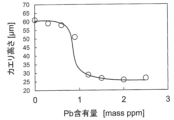
- FIG. 1 is a graph showing the relationship between the Pb content in a steel sheet and the burr height of a punched test piece.
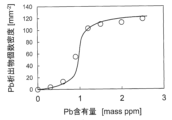
- FIG. 2 is a graph showing the relationship between the Pb content in a steel sheet and the number density of Pb precipitates having a grain size of 10 to 100 nm.
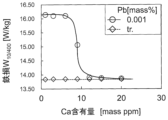
- FIG. 3 is a graph showing the effect of the addition of Pb on the relationship between the Ca content in the steel sheet and the iron loss W 10/400 .
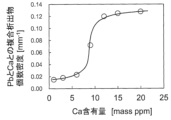
- FIG. 4 is a graph showing the relationship between the Ca content in a steel sheet and the number density of Pb-Ca composite precipitates having a grain size of 0.5 to 5.0 ⁇ m.
- test materials were heated at 1100°C for 20 minutes and then hot-rolled to obtain hot-rolled steel sheets with a thickness of 2.0 mm.
- the temperature at the entry side of the first pass of hot rolling was 1050° C.
- the reduction ratio of the steel sheet was 50%
- the temperature at the exit side of the final pass was 950° C.
- hot-rolled sheet annealing was performed at 980° C. for 30 s.
- the sheet was cold-rolled to a cold-rolled steel sheet with a sheet thickness of 0.25 mm
- an Epstein test sample of width: 30 mm ⁇ length: 280 mm was cut out, and the iron loss W 10/400 was measured with an Epstein tester.
- the punching workability was evaluated by the burr height of the end face of the test piece when a 17 mm square was punched 2 ⁇ 105 times with a die made of SKD11 from the obtained steel sheet.
- This test material was subjected to hot rolling and finish annealing in the same manner as in Experiment 1, and an Epstein test sample with a width of 30 mm and a length of 280 mm was cut out from the rolling direction and the sheet width direction of the obtained steel sheet, and the iron loss W 10/400 was measured with an Epstein device.
- the Pb-Ca composite precipitate is a precipitate in which the ratio of Pb is 10% or more and the ratio of Ca is 20% or more in the atomic ratio obtained by EDS (energy dispersive X-ray spectrometry). Therefore, the inventors have investigated the control of Pb--Ca composite precipitates and the suppression of the increase in iron loss due to Pb.
- test materials were heated in two stages, at 500 ° C for 5 min and then at 1100 ° C for 20 min, and then hot rolled to obtain a hot rolled sheet having a thickness of 2.0 mm.
- the temperature at the first pass of hot rolling was 1050 ° C
- the rolling reduction ratio of the steel sheet was 50%
- the temperature at the final pass was 950 ° C.
- an Epstein test sample of width: 30 mm ⁇ length: 280 mm was cut out, and the iron loss W 10/400 was measured with an Epstein tester.
- the punching workability was evaluated by the burr height of the end face of the test piece when a 17 mm square was punched 2 ⁇ 105 times with a die made of SKD11 from the obtained steel sheet.
- Figure 3 shows the relationship between the amount of Ca in the steel sheet and the iron loss W 10/400 in Pb-added and Pb-less materials. It is clear from Figure 3 that the addition of Ca to Pb-added materials reduces iron loss. In comparison with Pb-less materials, the reduction in iron loss due to the addition of Ca is thought to be due to Ca suppressing the increase in iron loss caused by Pb.
- FIG. 4 shows the relationship between the number density of Pb-Ca composite precipitates and the amount of Ca.
- Figure 4 shows that as the amount of Ca increased with the addition of Ca, the number density of Pb-Ca composite precipitates increased. This shows that the amount of Pb precipitates, which is a cause of the refinement of the structure, decreased.
- the non-oriented electrical steel sheet according to this embodiment will be described.
- the chemical components of the non-oriented electrical steel sheet are, in mass%, C: 0.005% or less, Si: 2.5% to 5.0%, Mn: 0.1% to 3.0%, P: 0.100% or less, S: 0.005% or less, Al: 2.0% or less, N: 0.005% or less, Pb: 0.00010% to 0.00200%, and Ca: 0.0010% to 0.020%.
- Each component is described below.
- "%" representing the content of a component means “mass%” unless otherwise specified.
- C 0.005% or less
- C is a harmful element that causes magnetic aging in the product sheet, forming carbides and deteriorating iron loss. Therefore, in order to suppress magnetic aging, the C content is set to 0.005% or less. There is no particular lower limit for the C content, but from the viewpoint of suppressing decarburization costs, it is preferable to set it to about 0.0001%.
- Si 2.5% or more and 5.0% or less Si has the effect of increasing the electrical resistance of the steel sheet and reducing iron loss. In order to sufficiently reduce iron loss, it is necessary to add 2.5% or more. Therefore, the Si content is set to 2.5% or more. On the other hand, if the Si content exceeds 5.0%, not only does it become difficult to roll, but punching workability is also reduced. Therefore, the Si content is set to 5.0% or less. From the viewpoint of manufacturability, the Si content is preferably 4.0% or less.
- Mn 0.1% or more and 3.0% or less Mn, like Si and Al, has the effect of increasing the electrical resistance of the steel sheet and reducing iron loss. Therefore, the Mn content is set to 0.1% or more. On the other hand, if the Mn content exceeds 3.0%, Mn carbides precipitate, which actually worsens the iron loss. Therefore, the Mn content is set to 3.0% or less. Preferably, the Mn content is in the range of 0.2% or more and 1.0% or less.
- P 0.100% or less P has the effect of increasing the strength of steel and can be used for strength adjustment. On the other hand, if the P content exceeds 0.100%, the steel becomes brittle and the manufacturability decreases. Therefore, the P content is set to 0.100% or less. There is no particular lower limit for the P content, but from the viewpoint of suppressing the dephosphorization cost, it is preferable to set it to about 0.001 mass%.
- S 0.005% or less
- S is a harmful element that forms fine sulfides, inhibits grain growth, and increases iron loss, so it is desirable to reduce it as much as possible.
- the S content is set to 0.005% or less. More preferably, the S content is 0.003% or less.
- Al 2.0% or less Al, like Si, has the effect of increasing the electrical resistance of the steel sheet and reducing iron loss. However, if the Al content exceeds 2.0%, not only does it become difficult to roll the steel sheet, but also the punching workability decreases. Therefore, the Al content is set to 2.0% or less. However, when the Al content is in the range of 0.01% or more and less than 0.1%, fine AlN precipitates and the iron loss increases, so the Al content is preferably in the range of 0.1% or more and 2.0% or less.
- N 0.005% or less
- N is a harmful element that forms fine nitrides, inhibits grain growth, and increases iron loss, so it is desirable to reduce it as much as possible.
- the N content exceeds 0.005%, the above-mentioned adverse effects become significant, so the N content is set to 0.005% or less. More preferably, the N content is 0.003% or less.
- Pb 0.00010% to 0.00200% Adding Pb can improve punching workability. Therefore, the Pb content is set to 0.00010% or more. On the other hand, if the Pb content exceeds 0.00200%, Pb alone forms many fine precipitates, inhibiting grain growth and increasing iron loss. Therefore, the Pb content is set to 0.00010% to 0.00200%.
- Ca 0.0010% or more and 0.020% or less Ca reacts with S to form coarse precipitates as CaS, which has the effect of suppressing the precipitation of fine sulfides such as MnS and reducing iron loss. CaS and CaO also form complex precipitates with Pb, which has the effect of suppressing the precipitation of fine Pb precipitates. Therefore, the Ca content is set to 0.0010% or more. On the other hand, if it exceeds 0.020%, the amount of CaS and CaO increases, which inhibits grain growth and increases iron loss. Therefore, the Ca content is set to 0.020% or less.
- Group A one or more selected from Mo: 0.001-0.050%, Zn: 0.001-0.010%, Ti: 0.001-0.010%, Sn: 0.001-0.200%, and Sb: 0.001-0.200%.
- Group B one or more selected from As: 0.020% or less, Nb: 0.005% or less, W: 0.050% or less, V: 0.050% or less, Ta: 0.0020% or less, and Cu: 0.01-1.0%.
- Group C one or more selected from Ni: 0.01-1.0%, B: 0.0020% or less.
- Group D Cr: 0.01-3.0%, Mg: 0.0001-0.005%, REM: 0.001-0.05%;
- Group E Co: 0.10% or less, Ge: 0.030% or less, Ga: 0.030% or less,
- Mo 0.001-0.050% Mo reacts with C to form carbides at grain boundaries, improving strength. Therefore, the Mo content is set to 0.001% or more. However, if it exceeds 0.050%, iron loss tends to increase. Therefore, the Mo content is set to 0.050% or less.
- Zn 0.001-0.010% Zn reacts with S to form coarse sulfides, suppressing the precipitation of fine sulfides such as MnS, and has the effect of reducing iron loss. Therefore, the Zn content is set to 0.001% or more. On the other hand, if the Zn content exceeds 0.010%, the amount of the above sulfides increases, which inhibits grain growth and increases iron loss. Therefore, the Zn content is set to 0.010% or less.
- Ti 0.001 ⁇ 0.010% Like Mo, Ti reacts with C to form carbides, which suppresses grain growth and improves toughness. Therefore, the Ti content is set to 0.001% or more. However, if the Ti content is less than 0.001%, If the Ti content exceeds 0.010%, iron loss tends to increase, so the Ti content is set to 0.010% or less.
- Sn 0.001-0.200%
- the addition of Sn can greatly improve the texture, increase the magnetic flux density, and reduce the iron loss. Therefore, the Sn content is set to 0.001% or more. However, if the Sn content exceeds 0.200%, the effect becomes saturated and manufacturability is deteriorated. Therefore, the Sn content is set to 0.200% or less.
- Sb 0.001-0.200%
- the addition of Sb greatly improves the texture, increases the magnetic flux density, and reduces the iron loss. Therefore, the Sb content is set to 0.001% or more.
- the Sb content is set to 0.200% or less.
- Nb 0.005% or less Nb has the effect of refining crystal grains and improving strength. On the other hand, if the content exceeds 0.005%, fine precipitates are generated and iron loss increases. Therefore, the Nb content is set to 0.005% or less.
- W 0.050% or less W has the effect of refining crystal grains and improving strength. On the other hand, if the content exceeds 0.050%, fine precipitates are generated and iron loss increases. Therefore, the W content is set to 0.050% or less.
- V 0.050% or less V has the effect of refining crystal grains and improving strength. On the other hand, if the content exceeds 0.050%, fine precipitates are generated and iron loss increases. Therefore, the V content is set to 0.050% or less.
- Ta 0.0020% or less Ta has the effect of refining crystal grains and improving strength. On the other hand, if it is contained in an amount exceeding 0.0020%, fine precipitates are generated and iron loss is increased. Therefore, the Ta content is set to 0.0020% or less.
- Cu 0.01 ⁇ 1.0% Cu has the effect of improving the strength of steel sheets by aging treatment. Therefore, the Cu content is set to 0.01% or more. On the other hand, if the Cu content exceeds 1.0%, the precipitates Therefore, the Cu content is set to 0.01 to 1.0%.
- Ni 0.01 ⁇ 1.0% Ni has the effect of improving the toughness of steel plates and increasing productivity. Therefore, the Ni content is set to 0.01% or more. On the other hand, if the Ni content exceeds 1.0%, the effect saturates. This not only increases the cost but also the amount of Ni added. Therefore, the Ni content is set to 0.01 to 1.0%.
- B 0.0020% or less B has the effect of improving the toughness of the steel plate and increasing productivity. On the other hand, if the B content exceeds 0.0020%, the iron loss increases. Therefore, the B content is set to 0.0020% or less.
- Cr:0.01 ⁇ 3.0% Cr has the effect of increasing the electrical resistance of the steel sheet and reducing iron loss. Therefore, the Cr content is set to 0.01% or more. On the other hand, if the Cr content exceeds 3.0%, the magnetic flux density decreases. Therefore, the Cr content is set to 3.0% or less.
- Mg 0.0001-0.005%
- Mg has the effect of forming coarse sulfides with S in the steel and reducing iron loss. Therefore, the Mg content is set to 0.0001% or more. On the other hand, if the Mg content exceeds 0.005%, Adding Mg would instead increase iron loss, so the Mg content is set to 0.0001% to 0.005%.
- REM 0.001 ⁇ 0.05% REM has the effect of coarsening sulfides in steel and reducing iron loss. Therefore, the REM content is set to 0.001% or more. On the other hand, if the content exceeds 0.05%, the iron loss is increased. Therefore, the REM content is set to 0.001 to 0.05%.
- Co 0.10% or less Co has the effect of improving the texture of the steel sheet and increasing the magnetic flux density. On the other hand, if the Co content exceeds 0.10%, the effect is saturated and the cost increases. Therefore, the Co content is set to 0.10% or less.
- Ge 0.030% or less Ge has the effect of improving the texture of the steel sheet and increasing the magnetic flux density. On the other hand, if the Ge content exceeds 0.030%, the effect is saturated and the cost increases. Therefore, the Ge content is set to 0.030% or less.
- Ga 0.030% or less Ga has the effect of improving the texture of the steel sheet and increasing the magnetic flux density. On the other hand, if the Ga content exceeds 0.030%, the effect is saturated and the cost increases. Therefore, the Ga content is set to 0.030% or less.
- the chemical composition of the non-oriented electrical steel sheet according to this embodiment contains the above elements, with the remainder being Fe and unavoidable impurities.
- the number density of Pb precipitates having a grain size of 10 to 100 nm is controlled to be within the range of 100 precipitates/mm2 or less .
- the number density of composite precipitates of Pb and Ca having a grain size of 0.5 to 5.0 ⁇ m is controlled to be within the range of 0.1 precipitates/mm2 or more and 1000 precipitates/mm2 or less .
- the grain size of the precipitates is evaluated as a circle-equivalent diameter from a projected area measured under a microscope.
- the non-oriented electrical steel sheet is manufactured by a process including a hot rolling step of a steel slab adjusted to the above-mentioned composition, a hot-rolled sheet annealing step, a cold rolling step, and a finish annealing step.
- Slabs can be produced by melting steel having a composition suitable for the present invention in a refining process consisting of a converter and vacuum degassing, and then using a conventional continuous casting method, ingot casting-blooming rolling method, etc. From the viewpoint of reducing the environmental load (reducing CO2 emissions), it is preferable to use an electric furnace method using scrap instead of blast furnace pig iron as the steel raw material (iron source).
- scrap is melted in an electric furnace to produce slabs, the Pb content is high due to the Pb contained in the scrap, so there is also the advantage that the cost of adding Pb can be reduced.
- the scrap also contains elements such as Mo, Ti, and Zn that can be added arbitrarily in the present invention, so it is possible to improve the properties of the steel plate while reducing the environmental load.
- Hot Rolling Process The slab is reheated before hot rolling. At that time, at least two heating devices with different output values are installed in series to perform heating in two steps.
- the first stage of heating is intended to dissolve the Pb present as a single substance, increase fluidity, and facilitate composite precipitation with Ca, and the heating temperature is set to 460°C or higher and 540°C or lower, and the heating time is set to 5 min or more. If the slab heating temperature is lower than 460°C, Pb cannot be dissolved, and composite precipitation of Ca and Pb becomes difficult. On the other hand, if the temperature exceeds 540°C, Pb will preferentially exist as a single substance rather than as a composite precipitation with Ca, making it difficult to precipitate a composite precipitate of Pb and Ca. There is no particular upper limit on the heating time, but from the viewpoint of reducing operating costs, it is preferable to set it to about 10 min.
- the second heating stage is intended to raise the slab temperature to facilitate rolling, with the heating temperature set to 1060°C to 1140°C and the heating time set to 20 min or more. If the slab heating temperature exceeds 1140°C, precipitates such as AlN and MnS will dissolve in the steel and re-precipitate in subsequent processes, inhibiting grain growth and increasing iron loss. On the other hand, if the temperature falls below 1060°C, the hot rolling load will increase and the finishing rolling entry temperature (hereinafter, the rolling entry temperature will also be referred to as FET) will not be able to be secured. There is no particular upper limit on the heating time, but from the viewpoint of reducing operating costs, it is preferable to set it to around 30 min.
- Hot rolling consists of rough rolling, in which the slab is turned into a sheet bar of a specified thickness using multiple single-stand rolling mills, and then finishing rolling, which follows the rough rolling and continues to roll to the target thickness using a finishing mill consisting of multiple stands. Conventional methods can be used for rough rolling.
- the steel sheet temperature at the entry side of the first pass i.e., the finish rolling entry side temperature FET (°C)
- the finish rolling entry side temperature FET is set to 940°C or higher to promote recrystallization and grain growth.
- the reduction rate in the first pass is set to 40% or more. There is no upper limit for the reduction rate, but a range of 40 to 50% is preferable when considering manufacturability.
- the temperature at the exit is preferably 930°C or higher from the viewpoint of promoting recrystallization and grain growth in the hot-rolled steel sheet and improving the magnetic properties.
- Hot-rolled sheet annealing process the above hot-rolled steel sheet is subjected to hot-rolled sheet annealing, which is held at a predetermined temperature for 1 s or more.
- the hot-rolled sheet annealing temperature is set to 900 ° C or higher.
- the hot-rolled sheet annealing temperature exceeds 1100 ° C, some of the precipitates containing MnS and Pb will dissolve and precipitate in the subsequent process, increasing iron loss, so the hot-rolled sheet annealing temperature is set to 1100 ° C or lower.
- pickling, cold rolling, and finish annealing after hot-rolled sheet annealing may be performed by conventional methods.
- Cold rolling is a process in which the hot-rolled annealed sheet that has been pickled is cold-rolled to the thickness (final thickness) of the product sheet.
- This cold rolling is preferably 50% or more, more preferably 70% or more.
- the cold rolling is not limited to one time, and two or more cold rollings with intermediate annealing in between may be performed as necessary.
- the intermediate annealing conditions in this case may also be ordinary conditions, and are not particularly limited.
- Finish annealing process is a process of annealing a cold-rolled sheet having a final thickness by cold rolling to impart desired magnetic properties and strength properties.
- the finish annealing temperature of the cold-rolled sheet is preferably 850 ° C or higher.
- the finish annealing temperature of the cold-rolled sheet is more preferably 880 ° C or higher.
- the finish annealing temperature of the cold-rolled sheet is preferably 1050 ° C or lower. More preferably, the finish annealing temperature of the cold-rolled sheet is 1030 ° C or lower.
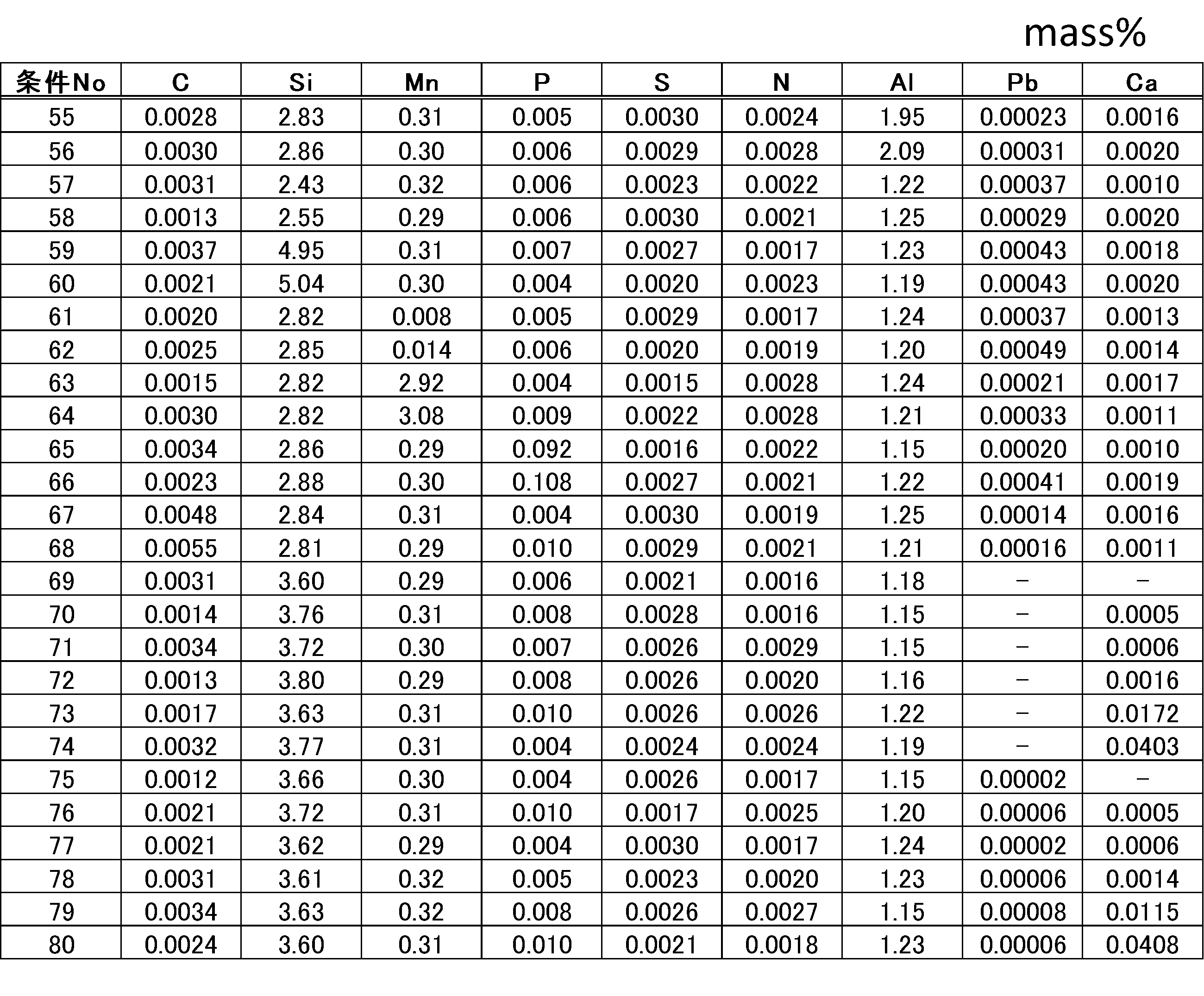
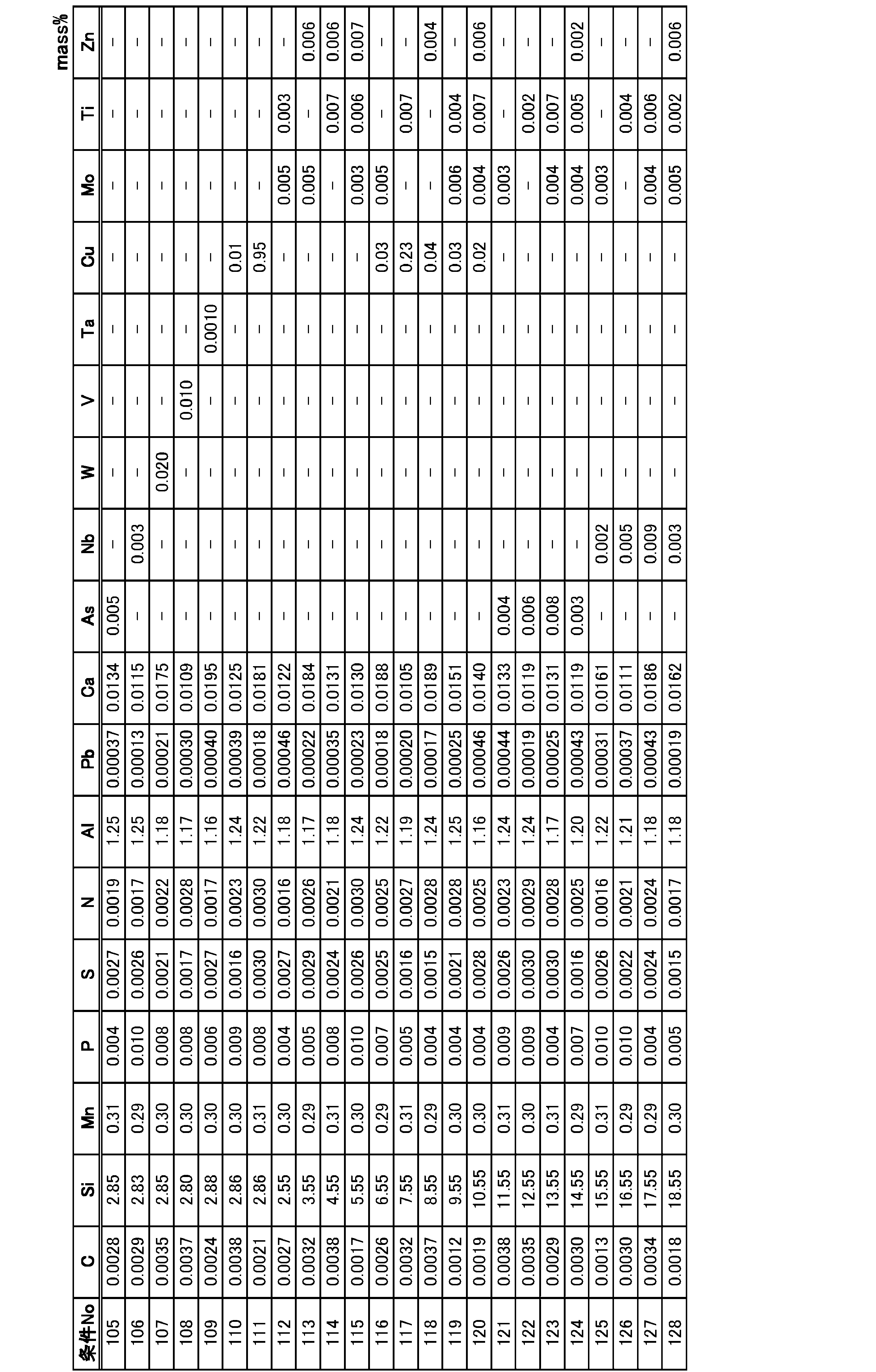
- steels No. 1 to 104 having the composition shown in Tables 1-1 to 1-4 were melted and formed into slabs by continuous casting, and the slabs were heated in two steps at 500°C for 5 min and then at 1100°C for 20 min, and hot rolled to obtain hot rolled steel sheets with a thickness of 2.0 mm.
- the temperature at the entry side of the first pass of hot rolling was 1050°C with a reduction rate of 50% and the temperature at the exit side of the final pass was 950°C.
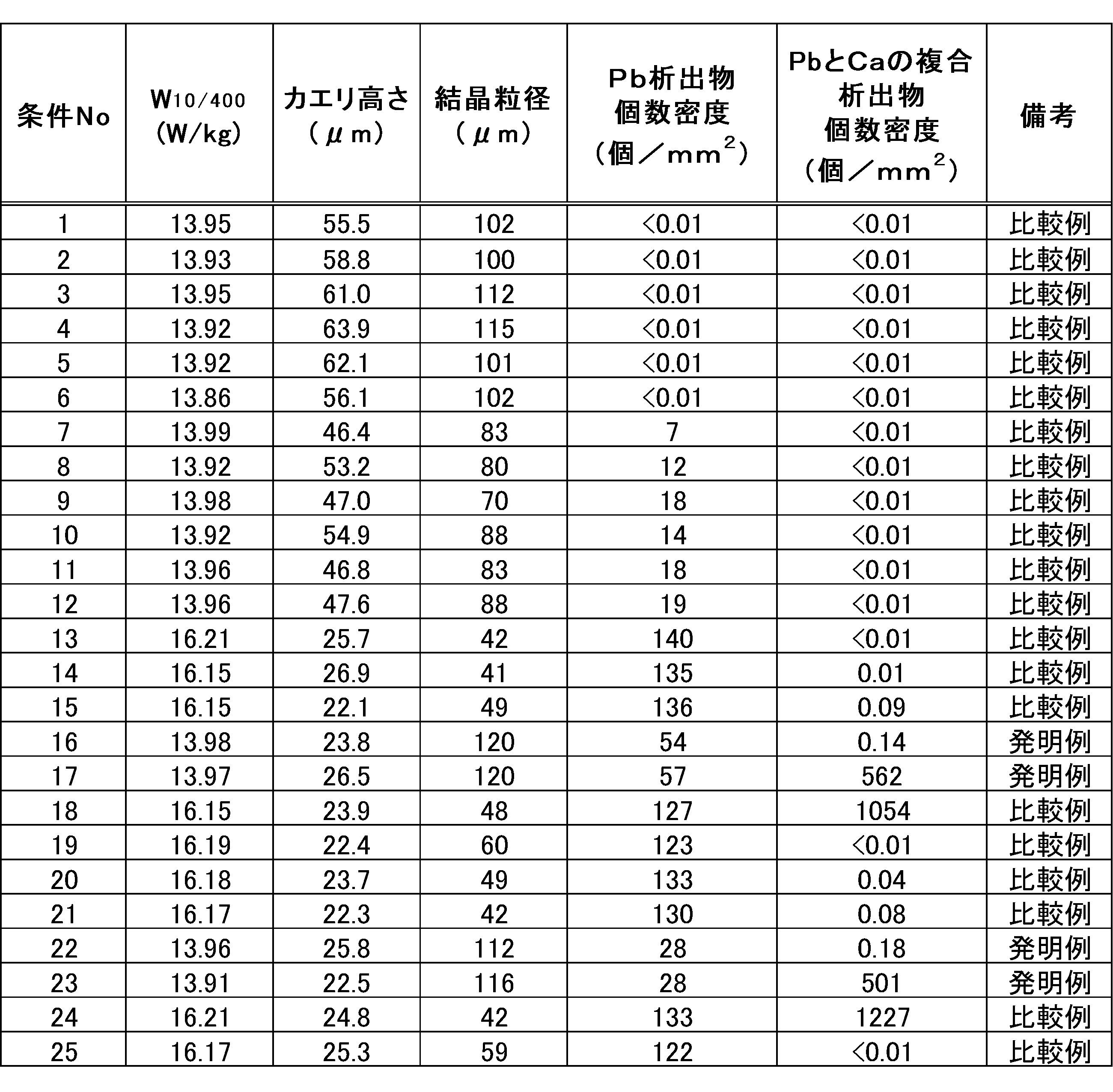
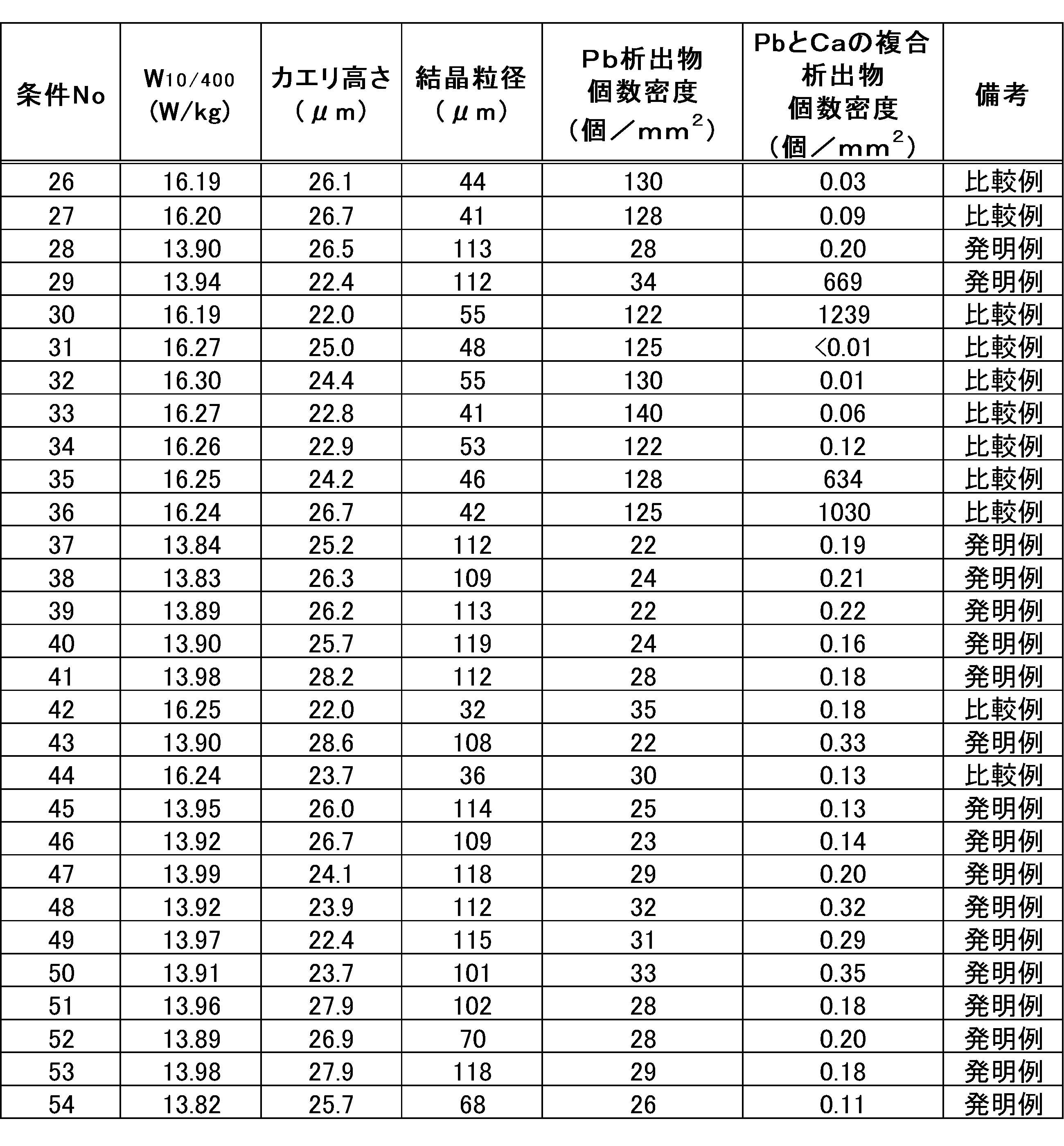
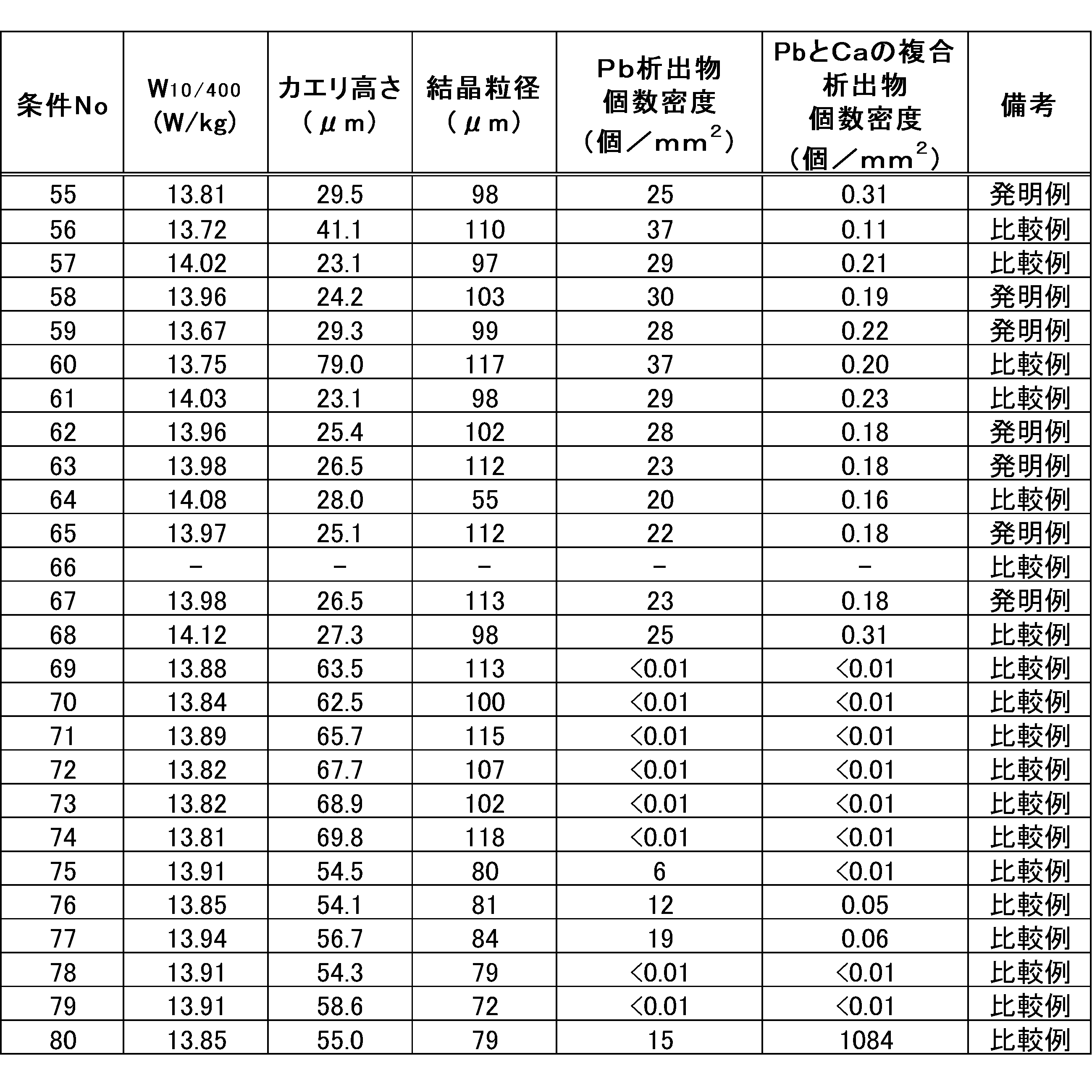
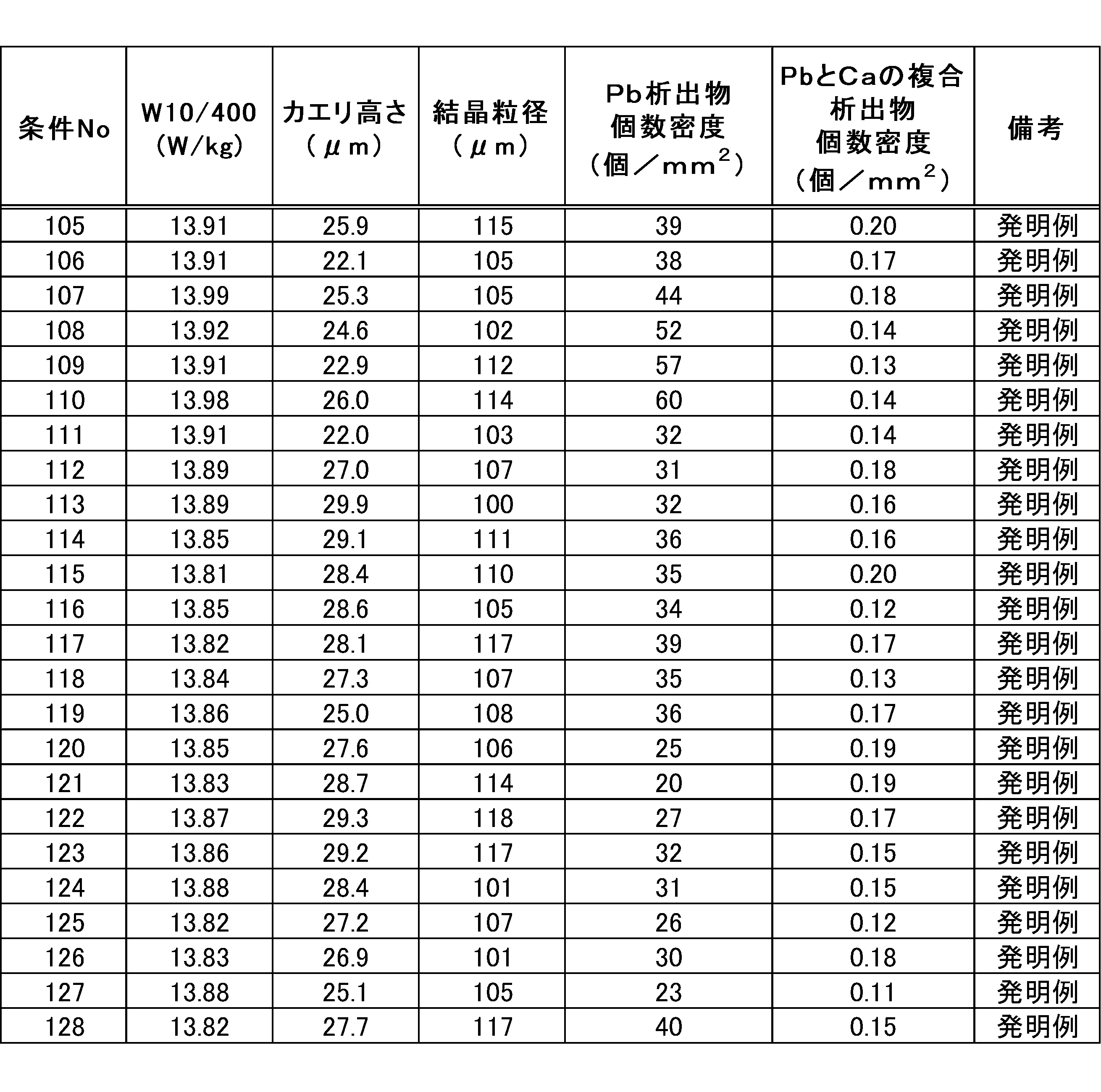
- An Epstein test sample having a width of 30 mm and a length of 280 mm was cut out from the rolling direction and the width direction of the steel plate thus obtained, and an Epstein test in accordance with JIS C 2550-3 (2019) was performed to measure the iron loss W 10/400 . If the plate thickness is 0.25 mm, it is good if the iron loss W 10/400 is 14 W/kg or less.
- a test piece of 17 mm square was cut out from the obtained steel plate, and punched 2 ⁇ 10 5 times with a die made of SKD11, and the burr height of the end face of the test piece was measured. If the burr height is 30 ⁇ m or less, the punching workability is good.
- Tables 2-1 to 2-4 show that by controlling the composition of the steel material within the range of this invention, a non-oriented electrical steel sheet with excellent core loss and punching workability can be obtained.
- steel having, by mass%, C: 0.0025%, Si: 2.85%, Mn: 0.30%, P: 0.006%, S: 0.0018%, N: 0.0025%, Al: 1.20%, Pb: 0.0006%, and Ca: 0.04% was produced.
- the steel was then formed into a slab by a continuous casting method.
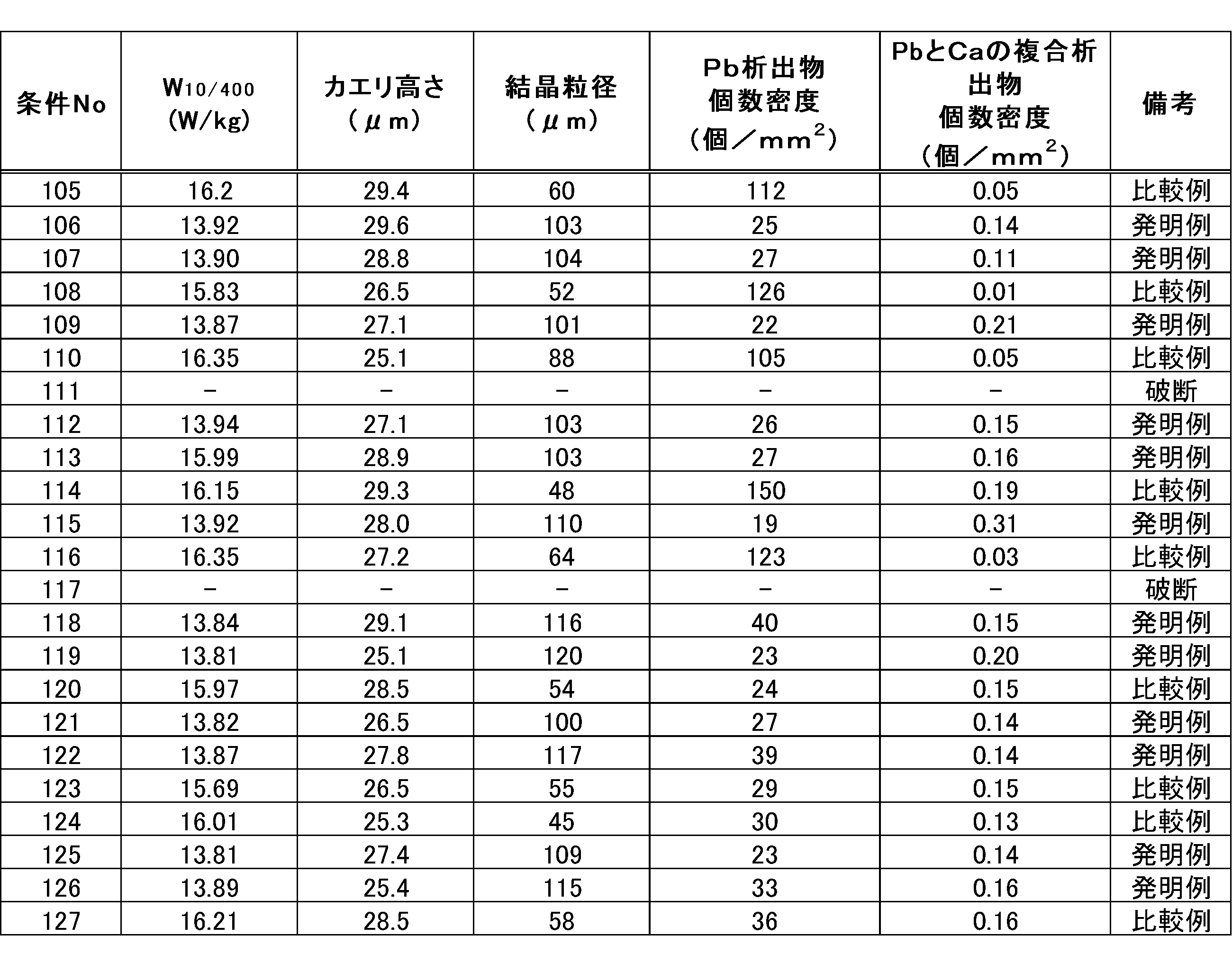
- An Epstein test sample having a width of 30 mm and a length of 280 mm was cut out from the rolling direction and the width direction of the steel plate thus obtained, and an Epstein test in accordance with JIS C 2550-3 (2019) was performed to measure the iron loss W 10/400 . If the plate thickness is 0.25 mm, it is good if the iron loss W 10/400 is 14 W/kg or less.
- a test piece of 17 mm square was cut out from the obtained steel plate, and punched 2 ⁇ 10 5 times with a die made of SKD11, and the burr height of the end face of the test piece was measured. If the burr height is 30 ⁇ m or less, the punching workability is good.
- Table 4 shows that by controlling the manufacturing conditions of the steel sheet within the range of the present invention, a non-oriented electrical steel sheet that combines low core loss and punching workability can be obtained.
Landscapes
- Chemical & Material Sciences (AREA)
- Engineering & Computer Science (AREA)
- Materials Engineering (AREA)
- Mechanical Engineering (AREA)
- Metallurgy (AREA)
- Organic Chemistry (AREA)
- Physics & Mathematics (AREA)
- Electromagnetism (AREA)
- Thermal Sciences (AREA)
- Crystallography & Structural Chemistry (AREA)
- Manufacturing & Machinery (AREA)
- Dispersion Chemistry (AREA)
- Power Engineering (AREA)
- Manufacturing Of Steel Electrode Plates (AREA)
- Soft Magnetic Materials (AREA)
Abstract
Description
また、特許文献2に記載の技術では、高価なCrを添加するため、製造コストが高くなる問題点がある。
[1]質量%で、C:0.005%以下、Si:2.5%以上5.0%以下、Mn:0.1%以上3.0%以下、P:0.100%以下、S:0.005%以下、Al:2.0%以下、N:0.005%以下、Pb:0.00010%以上0.00200%以下、及び
Ca:0.0010%以上0.020%以下を含有し、任意選択的に、さらに下記A群~E群のうち少なくとも1群の成分を含有し、
A群;Mo:0.001~0.050%、Zn:0.001~0.010%、Ti:0.001~0.010%、Sn:0.001~0.200%、及びSb:0.001~0.200%から選ばれる1種以上
B群;As:0.020%以下、Nb:0.005%以下、W:0.050%以下、V:0.050%以下、Ta:0.0020%以下、Cu:0.01~1.0%から選ばれる1種以上
C群;Ni:0.01~1.0%、B:0.0020%以下から選ばれる1種以上
D群;Cr:0.01~3.0%、Mg:0.0001~0.005%、REM:0.001~0.05%から選ばれる1種以上
E群;Co:0.10%以下、Ge:0.030%以下、Ga:0.030%以下から選ばれる1種以上
残部がFe及び不可避的不純物からなる成分組成を有し、粒径が10~100nmであるPb析出物の個数密度が100個/mm2以下であり、粒径が0.5~5.0μmであるPb―Ca複合析出物の個数密度が0.1個/mm2以上1000個/mm2以下であることを満たすことを特徴とする無方向性電磁鋼板である。
[2]質量%で、C:0.005%以下、Si:2.5%以上5.0%以下、Mn:0.1%以上3.0%以下、P:0.100%以下、S:0.005%以下、Al:2.0%以下、N:0.005%以下、Pb:0.00010%以上0.00200%以下、Ca:0.0010%以上0.020%以下を含有し、任意選択的に、さらに下記A群~E群のうち少なくとも1群の成分を含有し、
A群;Mo:0.001~0.050%、Zn:0.001~0.010%、Ti:0.001~0.010%、Sn:0.001~0.200%、及びSb:0.001~0.200%から選ばれる1種以上
B群;As:0.020%以下、Nb:0.005%以下、W:0.050%以下、V:0.050%以下、Ta:0.0020%以下、Cu:0.01~1.0%から選ばれる1種以上
C群;Ni:0.01~1.0%、B:0.0020%以下から選ばれる1種以上
D群;Cr:0.01~3.0%、Mg:0.0001~0.005%、REM:0.001~0.05%から選ばれる1種以上
E群;Co:0.10%以下、Ge:0.030%以下、Ga:0.030%以下から選ばれる1種以上
残部がFe及び不可避的不純物からなる成分組成を有する鋼スラブを加熱し熱間圧延して熱延鋼板とする熱間圧延工程と、前記熱延鋼板を焼鈍して熱延焼鈍板とする熱延板焼鈍工程と、前記熱延焼鈍板に1回の冷間圧延または中間焼鈍を挟む2回以上の冷間圧延を施し冷延鋼板とする冷間圧延工程と、前記冷延鋼板に仕上焼鈍を施す仕上焼鈍工程と、を含み、前記熱間圧延工程では、前記鋼スラブの加熱は、1段目を460℃以上540℃以下で5min以上とし、2段目を1060℃以上1140℃以下で20min以上とする2段ステップを含み、熱間圧延の仕上げ圧延は、1パス目の入側の鋼板温度を940℃以上1100℃以下とし、1パス目の圧下率を40%以上とし、前記熱延板焼鈍工程では、焼鈍温度を900℃以上1100℃以下とすることを特徴とする無方向性電磁鋼板の製造方法である。
[3]上記の[2]において、前記鋼スラブは、板厚70mm以上200mm以下に連続鋳造した薄スラブである無方向性電磁鋼板の製造方法である。
[図2]鋼板中のPb含有量と粒径が10~100nmのPb析出物の個数密度との関係を示すグラフである。
[図3]鋼板中のCa含有量と鉄損W10/400との関係に耐えるPb添加有無の影響を示すグラフである。
[図4]鋼板中のCa含有量と粒径が0.5~5.0μmのPb‐Ca複合析出物の個数密度との関係を示すグラフである。
<実験1>
発明者らは、打ち抜き加工性に優れた無方向性電磁鋼板を開発するべく、Pb添加の効果に着目し、Pbが鋼板の加工性及び磁気特性に及ぼす影響を明らかにするため、打ち抜き加工性と鉄損の測定を行った。質量%で、C:0.002%、Si:3.4%、Mn:0.3%、P:0.01%、S:0.002%、N:0.002%、Al:1.2%、残部Feおよび不可避不純物を有する鋼組成をベースとし、これらにPbを0~0.005%の範囲で変化させて添加した、鋼スラブを供試材とした。これらの供試材を1100℃で20minの加熱をした後、熱間圧延して板厚2.0mmの熱延鋼板とした。
なお、熱間圧延の1パス目入側の温度は1050℃で鋼板の圧下率50%、最終パス出側の温度を950℃とした。次いで、980℃で30sの熱延板焼鈍を実施した。その後、冷間圧延して板厚0.25mmの冷延鋼板とし、最後に、vol%比でH2:N2=25:75の乾燥雰囲気下で、960℃で10sの仕上焼鈍を施した。
一方、Pbを鋼に添加すると顕著に鉄損が増加した。また、光学顕微鏡で観察した鋼板の平均結晶粒径はPbを添加すると小さくなった。
このような組織微細化が生じる原因を調査するために、薄膜法を用いて透過型電子顕微鏡(TEM)で鋼板の析出物観察を行ったところ、Pbを添加した鋼板では、粒径が10~100nmのPb析出物が多数認められた。ここで、粒成長を阻害し、鉄損に悪影響を与える上記の微細なPb析出物について個数を特定した。
したがって、鉄損が増加した理由は、Pb析出物の増加に伴う粒成長性の低下により、ヒステリシス損が増加したためであると考えられる。
Pbを含有した無方向性電磁鋼板において、Caを添加が鉄損に及ぼす影響を調査した。すなわち、質量%で、C:0.002%、Si:3.4%、Mn:0.3%、P:0.01%、S:0.002%、N:0.002%、Al:1.2%、Pb:0.0010%、残部Feおよび不可避不純物を有する鋼組成をベースとし、これらにCaを0~0.05%の範囲で変化させて添加した、鋼スラブを供試材とした。この供試材を実験1と同様の手法で熱間圧延から仕上焼鈍まで施し、得られた鋼板の圧延方向と板幅方向とから、幅:30mm×長さ:280mmのエプスタイン試験サンプルを切り出し鉄損W10/400をエプスタイン装置で測定した。
なお、本発明におけるPb-Ca複合析出物とは、EDS(エネルギー分散型X線分析:Energy dispersive X-ray spectrometry)により得られる原子数比にて、Pbの比率が10%以上、Caの比率が20%以上となる、析出物とした。
そこで、発明者らはPb-Ca複合析出物の制御とPbによる鉄損増加の抑制について検討した。
PbとCaを含有した無方向性電磁鋼板において、熱延前のスラブ再加熱条件が鉄損および打ち抜き加工性に及ぼす影響を調査した。すなわち、質量%で、C:0.002%、Si:3.4%、Mn:0.3%、P:0.01%、S:0.002%、N:0.002%、Al:1.2%、Pb:0.0010%、残部Feおよび不可避不純物を有する鋼組成をベースとし、これらにCaを0~0.05%の範囲で変化させて添加した、鋼スラブを供試材とした。また比較材としてPbが入っていない鋼スラブも用意した。
これらの結果から、Pbに加えてさらにCaを添加した成分組成を有するスラブ加熱を2段実施し、鉄損の増加を抑制したうえで打ち抜き加工性に優れた無方向性電磁鋼板を作製できることが明らかとなった。
<無方向性電磁鋼板の成分組成>
無方向性電磁鋼板の化学成分は、質量%で、C:0.005%以下、Si:2.5%以上5.0%以下、Mn:0.1%以上3.0%以下、P:0.100%以下、S:0.005%以下、Al:2.0%以下、N:0.005%以下、Pb:0.00010%以上0.00200%以下、Ca:0.0010%以上0.020%以下の範囲で含有する。以下で各成分を説明する。以下の説明において、成分の含有量を表す「%」は特に断らない限り「質量%」を意味する。
Cは、製品板において磁気時効を起こして炭化物を形成し、鉄損を劣化させる有害元素である。よって、磁気時効を抑制するため、C含有量は、0.005%以下とする。なお、C含有量の下限は特に規定しないが、脱炭コストを抑制する観点から、0.0001%程度とすることが好ましい。
Siは、鋼板の電気抵抗を高め、鉄損を低減する効果がある。鉄損を十分低減するためには2.5%以上の添加が必要である。よって、Si含有量は2.5%以上とする。一方、Si含有量が5.0%を超えると圧延することが困難になるだけではなく、打ち抜き加工性が低下する。したがってSi含有量は5.0%以下とする。なお、製造性の観点から、Si含有量は4.0%以下が好ましい。
Mnは、Si、Alと同様に鋼板の電気抵抗を高め、鉄損を低減する効果がある。よって、Mn含有量は0.1%以上とする。一方、Mn含有量が3.0%を超えるとMn炭化物が析出し、却って鉄損が悪化するようになる。したがって、Mn含有量は3.0%以下とする。好ましくは、Mn含有量は0.2%以上1.0%以下の範囲である。
Pは、鋼の強度を上げる効果があり、強度調整に用いることができる。一方で、P含有量が0.100%を超えると、鋼が脆化し、製造性の低下を招く。そのため、P含有量は0.100%以下とする。なお、P含有量の下限は特に規定しないが、脱Pコストを抑制する観点からは、0.001mass%程度とするのが好ましい。
Sは、微細な硫化物を形成して粒成長を阻害し、鉄損を増加させる有害元素であるため、極力低減することが望ましい。特に、S含有量が0.005%を超えると、上記の悪影響が顕著になるので0.005%以下とする。より好ましくは、S含有量は0.003%以下である。
Alは、Siと同様に鋼板の電気抵抗を高め、鉄損を低減する効果がある。しかしながら、Al含有量が2.0%を超えると圧延することが困難になるだけではなく、打ち抜き加工性が低下する。したがって、Al含有量は2.0%以下とする。
ただし、Alの含有量が0.01%以上0.1%未満の範囲では微細なAlNが析出して鉄損が増加するため、好ましくは、Al含有量は0.1%以上2.0%以下の範囲である。
Nは、微細な窒化物を形成して粒成長を阻害し、鉄損を増加させる有害元素であるため、極力低減することが望ましい。特に、N含有量が0.005%を超えると、上記の悪影響が顕著になるので0.005%以下とする。より好ましくは、N含有量は0.003%以下である。
Pbを添加することにより打ち抜き加工性を改善することができる。よって、Pb含有量は0.00010%以上とする。一方、Pb含有量が0.00200%を超えるとPbが単体で微細な析出物を多数形成して、粒成長を阻害し、鉄損を増加させる。したがって、Pb含有量は0.00010%以上0.00200%以下とする。
CaはSと反応し、CaSとなって粗大な析出物を形成し、MnS等の微細な硫化物の析出を抑制して、鉄損を低減する効果がある。また、CaS、CaOはPbと複合析出し、微細なPb析出物の析出を抑制する効果がある。よってCa含有量は0.0010%以上とする。一方、0.020%を超えるとCaSやCaOの量が増加し、却って粒成長を阻害して鉄損が増加する。したがってCa含有量は0.020%以下とする。
A群;Mo:0.001~0.050%、Zn:0.001~0.010%、Ti:0.001~0.010%、Sn:0.001~0.200%、及びSb:0.001~0.200%から選ばれる1種以上
B群;As:0.020%以下、Nb:0.005%以下、W:0.050%以下、V:0.050%以下、Ta:0.0020%以下、Cu:0.01~1.0%から選ばれる1種以上
C群;Ni:0.01~1.0%、B:0.0020%以下から選ばれる1種以上
D群;Cr:0.01~3.0%、Mg:0.0001~0.005%、REM:0.001~0.05%から選ばれる1種以上
E群;Co:0.10%以下、Ge:0.030%以下、Ga:0.030%以下から選ばれる1種以上
MoはCと反応し、炭化物を粒界に形成して強度を向上させる。よって、Mo含有量は0.001%以上とする。ただし、0.050%を超えると鉄損が増加する傾向にあるため、Mo含有量は0.050%以下とする。
ZnはSと反応して粗大な硫化物を形成し、MnS等の微細な硫化物の析出を抑制して、鉄損を低減する効果がある。よって、Zn含有量は0.001%以上とする。一方、0.010%を超えると上記硫化物の量が増加し、却って粒成長を阻害して鉄損を増加させる。したがってZn含有量は0.010%以下とする。
Moと同様に、TiはCと反応し、炭化物を形成するため、粒成長を抑制し、靭性が向上する。よって、Ti含有量は0.001%以上とする。ただし、Ti含有量が0.010%を超えると鉄損が増加する傾向にあるため、Ti含有量は0.010%以下とする。
Pと同様に、Snを添加することで、集合組織が大きく改善し、磁束密度が向上するとともに、鉄損を低下させることができる。よって、Sn含有量は0.001%以上とする。一方、Sn含有量が0.200%を超えると効果が飽和することに加えて、製造性の低下を招く。したがってSn含有量は0.200%以下とする。
P、Snと同様に、Sbを添加することで、集合組織が大きく改善し、磁束密度が向上するとともに、鉄損を低下させることができる。よって、Sb含有量は0.001%以上とする。一方、Sb含有量が0.200%を超えると効果が飽和することに加えて、製造性の低下を招く。したがってSb含有量は0.200%以下とする。
Asには結晶粒を細粒化し、強度を向上させる効果がある。一方で、0.020%を超えて含有すると、冷延破断を引き起こす可能性がある。したがってAs含有量は0.020%以下とする。
Nbには結晶粒を細粒化し、強度を向上させる効果がある。一方で、0.005%を超えて含有すると、微細な析出物を生成し、鉄損を増加させてしまう。したがってNb含有量は0.005%以下とする。
Wには結晶粒を細粒化し、強度を向上させる効果がある。一方で、0.050%を超えて含有すると、微細な析出物を生成し、鉄損を増加させてしまう。したがってW含有量は0.050%以下とする。
Vには結晶粒を細粒化し、強度を向上させる効果がある。一方で、0.050%を超えて含有すると、微細な析出物を生成し、鉄損を増加させてしまう。したがってV含有量は0.050%以下とする。
Taには結晶粒を細粒化し、強度を向上させる効果がある。一方で、0.0020%を超えて含有すると、微細な析出物を生成し、鉄損を増加させてしまう。したがってTa含有量は0.0020%以下とする。
Cuには時効処理をすることで鋼板の強度を向上させる効果がある。よってCuの添加含有量を0.01%以上とする。一方で、1.0%を超えて含有すると、析出物を生成し却って鉄損を増加させてしまう。したがってCu含有量は0.01~1.0%とする。
Niには鋼板の靭性を改善し、生産性を向上させる効果がある。よってNiの含有量を0.01%以上とする。一方で、1.0%を超えてNiを含有すると効果が飽和することに加えコストの増加を招く。したがってNi含有量は0.01~1.0%とする。
Bは鋼板の靭性を改善し、生産性を向上させる効果がある。一方で0.0020%を超えてBを含有すると、鉄損が増加する。したがってBの含有量は0.0020%以下とする。
Crは鋼板の電気抵抗を高め、鉄損を低減する効果がある。よってCr含有量は0.01%以上とする。一方で、Cr含有量が3.0%を超えると磁束密度が低下してしまう。したがってCr含有量は3.0%以下とする。
Mgは鋼中のSと粗大な硫化物を形成して、鉄損を低減する効果がある。よってMgの含有量を0.0001%以上とする。一方で、0.005%を超えてMgを添加すると、却って鉄損の増加を招く。したがって、Mgの含有量は0.0001%~0.005%とする。
REMは鋼中の硫化物を粗大化し、鉄損を低減する効果がある。よってREMの含有量を0.001%以上とする。一方で0.05%を超えて含有すると、却って鉄損の増加を招く。したがってREMの含有量は0.001~0.05%とする。
Coは鋼板の集合組織を改善し、磁束密度を向上させる効果がある。一方で、0.10%を超えてCoを含有すると効果が飽和することに加えて、コストの増加を招く。したがってCoの含有量は0.10%以下とする。
Geは鋼板の集合組織を改善し、磁束密度を向上させる効果がある。一方で、0.030%を超えてGeを含有すると効果が飽和することに加えて、コストの増加を招く。したがってGeの含有量は0.030%以下とする。
Gaは鋼板の集合組織を改善し、磁束密度を向上させる効果がある。一方で、0.030%を超えてGaを含有すると効果が飽和することに加えて、コストの増加を招く。したがってGaの含有量は0.030%以下とする。
次に、無方向性電磁鋼板の析出物について説明する。
粒界のピン止めに大きな影響を及ぼすため、粒径10~100nmのPb析出物の個数密度を100個/mm2以下の範囲で制御する。また、Pb析出物の数を制御するために、粒径0.5~5.0μmのPbとCaの複合析出物の個数密度を0.1個/mm2以上1000個/mm2以下の範囲で制御する。
ここで析出物の粒径は、顕微鏡で測定した投影面積から円相当径で評価する。
次に、無方向性電磁鋼板の金属組織について説明する。
上述したようにPb析出物及びPbとCaの複合析出物の個数密度を制御することで鋼板の平均結晶粒径を60μm以上、300μm以下とすることが好ましい。なお、鋼板の平均結晶粒径は60μm未満の場合、鉄損が増加し、一方、鋼板の組織が粗大になりすぎると、すなわち平均結晶粒径が300μmを超えると靭性が劣化し、加工の際に破断しやすくなる。
次に、本実施形態に係る無方向性電磁鋼板の製造方法を説明する。
無方向性電磁鋼板の製造は、上記の成分組成に調整した鋼スラブの熱間圧延工程、熱延板焼鈍工程、冷間圧延工程、仕上焼鈍工程を含むプロセスで実施される。
スラブは、転炉や真空脱ガス処理等からなる情報の精錬プロセスで本発明に適合する成分組成の鋼を溶製し、常法の連続鋳造法や造塊―分塊圧延法等を用いて製造することができる。環境負荷低減(CO2の排出量削減)の観点から鋼原料(鉄源)として高炉銑を使用せず、スクラップを用いる電炉法が好ましい。スクラップを電炉で溶解してスラブを製造する場合は、スクラップ中に含まれるPbに起因してPb含有量が高くなるため、Pb添加コストを低減できるという利点もある。スクラップ中にはさらに本発明において任意に添加可能なMo、Ti、Znといった元素も含まれるため環境負荷を低減させつつ、鋼板の特性を向上させることが可能である。
スラブは、熱間圧延前に再加熱されるが、その際、出力値の異なる加熱装置を少なくとも2台連続して設置し、2段ステップの加熱を実施する。
1段目の加熱は、単体で存在するPbを溶解させ流動性を高め、Caとの複合析出を容易にすることを目的とし、加熱温度を460℃以上540℃以下とし、加熱時間を5min以上とする。スラブ加熱温度が460℃を下回ると、Pbを溶解させることができずCaとPbの複合析出が困難となる。一方、540℃を超えるとPbはCaと複合析出するよりも、単体で優先的に存在するようになるため、PbとCaの複合析出物を析出させることが困難になる。加熱時間の上限については特に規定しないが、操業コストを下げる観点から、10min程度とするのが好ましい。
次いで、上記の熱延鋼板に対して、所定の温度で1s以上保持する熱延板焼鈍を施す。熱延板焼鈍は熱延板の組織を再結晶させ、良好な磁気特性を得るために熱延板焼鈍温度は900℃以上にする。一方、熱延板焼鈍温度が1100℃を超えると、MnSやPbを含んだ析出物の一部が溶解し、後工程で析出して鉄損を増加させるため熱延板焼鈍温度は1100℃以下とする。なお、熱延板焼鈍後の酸洗、冷延および仕上焼鈍は常法でよい。
冷間圧延は、酸洗を経た熱延焼鈍板に、冷間で圧延して製品板の板厚(最終板厚)とする工程である。この冷間圧延は、最終板厚とすることができれば、特に制限はない。ただし、冷間圧延での圧下率が低すぎる場合、仕上げ焼鈍後の鋼板強度が大きく低下する可能性があるため、冷間圧延での圧下率は、好ましくは50%以上、より好ましくは70%以上である。また、冷間圧延は、1回に限定されず、必要に応じて中間焼鈍を挟む2回以上の冷間圧延を行ってもよい。この場合の中間焼鈍条件も常用の条件であればよく、特に制限はない。
冷延板の仕上焼鈍は、冷間圧延にて最終板厚とした冷延板に焼鈍を施して所望の磁気特性と強度特性を付与する工程である。冷間圧延で導入された歪みを、再結晶させて十分に解消し、良好な磁気特性を得るため、冷延板の仕上焼鈍温度は、850℃以上とするのが好ましい。さらに、良好な磁気特性を得るため、冷延板の仕上焼鈍温度は、880℃以上とするのがより好ましい。一方、冷延板の仕上焼鈍温度が高すぎると、再結晶組織が粗大になり過ぎて磁気特性が低下するため、冷延板の仕上焼鈍温度は1050℃以下とするのが好ましい。より好ましくは、冷延板の仕上焼鈍温度は、1030℃以下である。
次いで、980℃で30sの熱延板焼鈍を実施した。
その後、冷間圧延して板厚0.25mmの冷延鋼板とし、最後に、vol%比でH2:N2=25:75の乾燥雰囲気下で、960℃で10sの仕上焼鈍を施した。
その後、冷間圧延して板厚0.25mmの冷延鋼板とし、最後に、vol%比でH2:N2=25:75の乾燥雰囲気下で、960℃で10sの仕上焼鈍を施した。







Claims (3)
- 質量%で、
C :0.005%以下、
Si:2.5%以上5.0%以下、
Mn:0.1%以上3.0%以下、
P :0.100%以下、
S :0.005%以下、
Al:2.0%以下、
N :0.005%以下、
Pb:0.00010%以上0.00200%以下、及び
Ca:0.0010%以上0.020%以下
を含有し、
任意選択的に、さらに下記A群~E群のうち少なくとも1群の成分を含有し、
A群;Mo:0.001~0.050%、Zn:0.001~0.010%、Ti:0.001~0.010%、Sn:0.001~0.200%、及びSb:0.001~0.200%から選ばれる1種以上
B群;As:0.020%以下、Nb:0.005%以下、W:0.050%以下、V:0.050%以下、Ta:0.0020%以下、Cu:0.01~1.0%から選ばれる1種以上
C群;Ni:0.01~1.0%、B:0.0020%以下から選ばれる1種以上
D群;Cr:0.01~3.0%、Mg:0.0001~0.005%、REM:0.001~0.05%から選ばれる1種以上
E群;Co:0.10%以下、Ge:0.030%以下、Ga:0.030%以下から選ばれる1種以上
残部がFe及び不可避的不純物からなる成分組成を有し、
粒径が10~100nmであるPb析出物の個数密度が100個/mm2以下であり、
粒径が0.5~5.0μmであるPb―Ca複合析出物の個数密度が0.1個/mm2以上1000個/mm2以下であることを満たすことを特徴とする無方向性電磁鋼板。 - 質量%で、
C :0.005%以下、
Si:2.5%以上5.0%以下、
Mn:0.1%以上3.0%以下、
P :0.100%以下、
S :0.005%以下、
Al:2.0%以下、
N :0.005%以下、
Pb:0.00010%以上0.00200%以下、
Ca:0.0010%以上0.020%以下
を含有し、
任意選択的に、さらに下記A群~E群のうち少なくとも1群の成分を含有し、
A群;Mo:0.001~0.050%、Zn:0.001~0.010%、Ti:0.001~0.010%、Sn:0.001~0.200%、及びSb:0.001~0.200%から選ばれる1種以上
B群;As:0.020%以下、Nb:0.005%以下、W:0.050%以下、V:0.050%以下、Ta:0.0020%以下、Cu:0.01~1.0%から選ばれる1種以上
C群;Ni:0.01~1.0%、B:0.0020%以下から選ばれる1種以上
D群;Cr:0.01~3.0%、Mg:0.0001~0.005%、REM:0.001~0.05%から選ばれる1種以上
E群;Co:0.10%以下、Ge:0.030%以下、Ga:0.030%以下から選ばれる1種以上
残部がFe及び不可避的不純物からなる成分組成を有する鋼スラブを加熱し熱間圧延して熱延鋼板とする熱間圧延工程と、
前記熱延鋼板を焼鈍して熱延焼鈍板とする熱延板焼鈍工程と、
前記熱延焼鈍板に1回の冷間圧延または中間焼鈍を挟む2回以上の冷間圧延を施し冷延鋼板とする冷間圧延工程と、
前記冷延鋼板に仕上焼鈍を施す仕上焼鈍工程と、
を含み、
前記熱間圧延工程では、前記鋼スラブの加熱は、1段目を460℃以上540℃以下で5min以上とし、2段目を1060℃以上1140℃以下で20min以上とする2段ステップを含み、熱間圧延の仕上げ圧延は、1パス目の入側の鋼板温度を940℃以上1100℃以下とし、1パス目の圧下率を40%以上とし、
前記熱延板焼鈍工程では、焼鈍温度を900℃以上1100℃以下とすることを特徴とする無方向性電磁鋼板の製造方法。 - 前記鋼スラブは、板厚70mm以上200mm以下に連続鋳造した薄スラブであることを特徴とする請求項2に記載の無方向性電磁鋼板の製造方法。
Priority Applications (5)
| Application Number | Priority Date | Filing Date | Title |
|---|---|---|---|
| JP2024541651A JP7845480B2 (ja) | 2023-06-06 | 2024-04-02 | 無方向性電磁鋼板およびその製造方法 |
| CN202480037157.3A CN121241157A (zh) | 2023-06-06 | 2024-05-27 | 无取向性电磁钢板及其制造方法 |
| EP24819008.4A EP4722403A1 (en) | 2023-06-06 | 2024-05-27 | Non-oriented magnetic steel sheet and method for manufacturing same |
| KR1020257043533A KR20260015922A (ko) | 2023-06-06 | 2024-05-27 | 무방향성 전자 강판 및 그의 제조 방법 |
| MX2025014623A MX2025014623A (es) | 2023-06-06 | 2024-05-27 | Lamina de acero electrico no orientado y metodo para su fabricacion |
Applications Claiming Priority (2)
| Application Number | Priority Date | Filing Date | Title |
|---|---|---|---|
| JP2023-093004 | 2023-06-06 | ||
| JP2023093004 | 2023-06-06 |
Publications (1)
| Publication Number | Publication Date |
|---|---|
| WO2024252769A1 true WO2024252769A1 (ja) | 2024-12-12 |
Family
ID=93795793
Family Applications (1)
| Application Number | Title | Priority Date | Filing Date |
|---|---|---|---|
| PCT/JP2024/013541 Ceased WO2024252769A1 (ja) | 2023-06-06 | 2024-05-27 | 無方向性電磁鋼板およびその製造方法 |
Country Status (7)
| Country | Link |
|---|---|
| EP (1) | EP4722403A1 (ja) |
| JP (1) | JP7845480B2 (ja) |
| KR (1) | KR20260015922A (ja) |
| CN (1) | CN121241157A (ja) |
| MX (1) | MX2025014623A (ja) |
| TW (1) | TWI901072B (ja) |
| WO (1) | WO2024252769A1 (ja) |
Cited By (1)
| Publication number | Priority date | Publication date | Assignee | Title |
|---|---|---|---|---|
| CN120624775A (zh) * | 2025-08-13 | 2025-09-12 | 江苏省沙钢钢铁研究院有限公司 | 无取向硅钢的生产方法 |
Citations (5)
| Publication number | Priority date | Publication date | Assignee | Title |
|---|---|---|---|---|
| JP2003027195A (ja) | 2001-07-13 | 2003-01-29 | Nkk Corp | 打ち抜き加工性に優れた無方向性電磁鋼板 |
| WO2014142149A1 (ja) * | 2013-03-15 | 2014-09-18 | Jfeスチール株式会社 | 高周波鉄損特性に優れる無方向性電磁鋼板 |
| JP2015214758A (ja) | 2015-07-10 | 2015-12-03 | 新日鐵住金株式会社 | 磁気特性と打ち抜き加工性に優れた無方向性電磁鋼板 |
| WO2017115657A1 (ja) * | 2015-12-28 | 2017-07-06 | Jfeスチール株式会社 | 無方向性電磁鋼板および無方向性電磁鋼板の製造方法 |
| WO2024057940A1 (ja) * | 2022-09-13 | 2024-03-21 | Jfeスチール株式会社 | 高強度無方向性電磁鋼板とその製造方法 |
Family Cites Families (5)
| Publication number | Priority date | Publication date | Assignee | Title |
|---|---|---|---|---|
| JP3333794B2 (ja) * | 1994-09-29 | 2002-10-15 | 川崎製鉄株式会社 | 無方向性電磁鋼板の製造方法 |
| JP4352691B2 (ja) * | 2002-12-05 | 2009-10-28 | Jfeスチール株式会社 | 打ち抜き性及び鉄損の優れた時効硬化性無方向性電磁鋼板、その製造方法及びそれを用いたローターの製造方法 |
| KR20130116332A (ko) * | 2011-08-18 | 2013-10-23 | 신닛테츠스미킨 카부시키카이샤 | 무방향성 전자 강판, 그 제조 방법, 모터 철심용 적층체 및 그 제조 방법 |
| JP6531864B2 (ja) * | 2016-02-22 | 2019-06-19 | Jfeスチール株式会社 | 方向性電磁鋼板の製造方法 |
| EP3770294B1 (en) * | 2018-03-23 | 2023-09-27 | Nippon Steel Corporation | Non-oriented electrical steel sheet |
-
2024
- 2024-04-02 JP JP2024541651A patent/JP7845480B2/ja active Active
- 2024-05-27 CN CN202480037157.3A patent/CN121241157A/zh active Pending
- 2024-05-27 MX MX2025014623A patent/MX2025014623A/es unknown
- 2024-05-27 EP EP24819008.4A patent/EP4722403A1/en active Pending
- 2024-05-27 KR KR1020257043533A patent/KR20260015922A/ko active Pending
- 2024-05-27 WO PCT/JP2024/013541 patent/WO2024252769A1/ja not_active Ceased
- 2024-05-31 TW TW113113598A patent/TWI901072B/zh active
Patent Citations (5)
| Publication number | Priority date | Publication date | Assignee | Title |
|---|---|---|---|---|
| JP2003027195A (ja) | 2001-07-13 | 2003-01-29 | Nkk Corp | 打ち抜き加工性に優れた無方向性電磁鋼板 |
| WO2014142149A1 (ja) * | 2013-03-15 | 2014-09-18 | Jfeスチール株式会社 | 高周波鉄損特性に優れる無方向性電磁鋼板 |
| JP2015214758A (ja) | 2015-07-10 | 2015-12-03 | 新日鐵住金株式会社 | 磁気特性と打ち抜き加工性に優れた無方向性電磁鋼板 |
| WO2017115657A1 (ja) * | 2015-12-28 | 2017-07-06 | Jfeスチール株式会社 | 無方向性電磁鋼板および無方向性電磁鋼板の製造方法 |
| WO2024057940A1 (ja) * | 2022-09-13 | 2024-03-21 | Jfeスチール株式会社 | 高強度無方向性電磁鋼板とその製造方法 |
Cited By (1)
| Publication number | Priority date | Publication date | Assignee | Title |
|---|---|---|---|---|
| CN120624775A (zh) * | 2025-08-13 | 2025-09-12 | 江苏省沙钢钢铁研究院有限公司 | 无取向硅钢的生产方法 |
Also Published As
| Publication number | Publication date |
|---|---|
| MX2025014623A (es) | 2026-02-03 |
| TW202449179A (zh) | 2024-12-16 |
| JPWO2024252769A1 (ja) | 2024-12-12 |
| TWI901072B (zh) | 2025-10-11 |
| EP4722403A1 (en) | 2026-04-08 |
| KR20260015922A (ko) | 2026-02-03 |
| JP7845480B2 (ja) | 2026-04-14 |
| CN121241157A (zh) | 2025-12-30 |
Similar Documents
| Publication | Publication Date | Title |
|---|---|---|
| US11718891B2 (en) | Non-oriented electrical steel sheet and method for producing same, and motor core and method for producing same | |
| US12448662B2 (en) | Non-oriented electrical steel sheet and method for producing same | |
| JP7609266B2 (ja) | 無方向性電磁鋼板用熱延鋼板の製造方法および無方向性電磁鋼板の製造方法 | |
| KR20210003908A (ko) | 무방향성 전자 강판 및 그의 제조 방법 | |
| WO2022163723A1 (ja) | 方向性電磁鋼板の製造方法および電磁鋼板製造用圧延設備 | |
| TWI850132B (zh) | 無方向性電磁鋼板的製造方法 | |
| TWI550104B (zh) | 高頻率鐵損特性優良的無方向性電磁鋼板 | |
| CN120981596A (zh) | 无取向电工钢和制造无取向电工钢的方法 | |
| JP7845480B2 (ja) | 無方向性電磁鋼板およびその製造方法 | |
| US9637812B2 (en) | Non-oriented electrical steel sheet | |
| JP4331969B2 (ja) | 無方向性電磁鋼板の製造方法 | |
| WO2020090156A1 (ja) | 無方向性電磁鋼板の製造方法 | |
| JP2008156737A (ja) | 無方向性電磁鋼板およびその製造方法 | |
| JP7736157B2 (ja) | 無方向性電磁鋼板とその製造方法 | |
| JP2018111847A (ja) | 無方向性電磁鋼板 | |
| JP2026509847A (ja) | 高強度および低鉄損無方向性電磁鋼板およびその製造方法 | |
| TW202307230A (zh) | 無方向性電磁鋼板及其製造方法、以及馬達鐵芯 | |
| JPH0533056A (ja) | 磁気特性の優れた方向性けい素鋼板の製造方法 | |
| JP7473862B1 (ja) | 無方向性電磁鋼板の製造方法 | |
| JP2007177282A (ja) | 高磁束密度を有する無方向性電磁鋼板の製造方法 | |
| TW202532661A (zh) | 無方向性電磁鋼板用熱軋鋼板的製造方法及無方向性電磁鋼板的製造方法 | |
| JP6852965B2 (ja) | 電磁鋼板とその製造方法 | |
| TW202609083A (zh) | 無方向性電磁鋼板及其製造方法 | |
| JPH1060609A (ja) | 鉄損特性または低磁場特性の優れた無方向性電磁鋼板 | |
| JP2002194513A (ja) | 加工変形特性に優れるシリコンクロム鋼板及びその製造方法 |
Legal Events
| Date | Code | Title | Description |
|---|---|---|---|
| WWE | Wipo information: entry into national phase |
Ref document number: 2024541651 Country of ref document: JP |
|
| 121 | Ep: the epo has been informed by wipo that ep was designated in this application |
Ref document number: 24819008 Country of ref document: EP Kind code of ref document: A1 |
|
| WWE | Wipo information: entry into national phase |
Ref document number: 2501008270 Country of ref document: TH |
|
| WWE | Wipo information: entry into national phase |
Ref document number: MX/A/2025/014623 Country of ref document: MX |
|
| ENP | Entry into the national phase |
Ref document number: 1020257043533 Country of ref document: KR Free format text: ST27 STATUS EVENT CODE: A-0-1-A10-A15-NAP-PA0105 (AS PROVIDED BY THE NATIONAL OFFICE) |
|
| WWE | Wipo information: entry into national phase |
Ref document number: 1020257043533 Country of ref document: KR Ref document number: 202517133081 Country of ref document: IN |
|
| WWE | Wipo information: entry into national phase |
Ref document number: 2024819008 Country of ref document: EP |
|
| NENP | Non-entry into the national phase |
Ref country code: DE |
|
| WWP | Wipo information: published in national office |
Ref document number: 202517133081 Country of ref document: IN |
|
| ENP | Entry into the national phase |
Ref document number: 2024819008 Country of ref document: EP Effective date: 20260102 |
|
| ENP | Entry into the national phase |
Ref document number: 2024819008 Country of ref document: EP Effective date: 20260102 |
|
| ENP | Entry into the national phase |
Ref document number: 2024819008 Country of ref document: EP Effective date: 20260102 |
|
| WWP | Wipo information: published in national office |
Ref document number: 1020257043533 Country of ref document: KR Ref document number: MX/A/2025/014623 Country of ref document: MX |
|
| ENP | Entry into the national phase |
Ref document number: 2024819008 Country of ref document: EP Effective date: 20260102 |
|
| WWP | Wipo information: published in national office |
Ref document number: 2024819008 Country of ref document: EP |