WO2024247932A1 - コンピュータプログラム、横編機及び情報処理方法 - Google Patents
コンピュータプログラム、横編機及び情報処理方法 Download PDFInfo
- Publication number
- WO2024247932A1 WO2024247932A1 PCT/JP2024/019261 JP2024019261W WO2024247932A1 WO 2024247932 A1 WO2024247932 A1 WO 2024247932A1 JP 2024019261 W JP2024019261 W JP 2024019261W WO 2024247932 A1 WO2024247932 A1 WO 2024247932A1
- Authority
- WO
- WIPO (PCT)
- Prior art keywords
- knitting
- defective
- needle
- image
- determined
- Prior art date
- Legal status (The legal status is an assumption and is not a legal conclusion. Google has not performed a legal analysis and makes no representation as to the accuracy of the status listed.)
- Ceased
Links
Images







Classifications
-
- D—TEXTILES; PAPER
- D04—BRAIDING; LACE-MAKING; KNITTING; TRIMMINGS; NON-WOVEN FABRICS
- D04B—KNITTING
- D04B35/00—Details of, or auxiliary devices incorporated in, knitting machines, not otherwise provided for
- D04B35/10—Indicating, warning, or safety devices, e.g. stop motions
- D04B35/18—Indicating, warning, or safety devices, e.g. stop motions responsive to breakage, misplacement, or malfunctioning of knitting instruments
-
- G—PHYSICS
- G06—COMPUTING OR CALCULATING; COUNTING
- G06T—IMAGE DATA PROCESSING OR GENERATION, IN GENERAL
- G06T1/00—General purpose image data processing
- G06T1/0014—Image feed-back for automatic industrial control, e.g. robot with camera
Definitions
- This disclosure relates to a computer program, a flat knitting machine, and an information processing method.
- a large number of knitting needles are arranged in rows on at least two needle beds facing each other from the front to the back, and the knitting needles are selectively driven by a carriage that moves over the needle beds, and the knitted fabric is formed by hooking the knitting yarn supplied. Bent or damaged knitting needles can cause knitting defects.
- Patent document 1 discloses a method for optically monitoring the quality of knitting machine needles by photographing them with a camera.
- Patent Document 1 can detect defects such as gross or minute damage to needles, but does not provide information about the location of defective needles or the defect itself.
- the present disclosure has been made in consideration of the above circumstances, and aims to provide a computer program, a flat knitting machine, and an information processing method that output at least one of the position of a knitting member determined to be defective and information related to the defect.
- the computer program of this embodiment causes the computer to execute a process of acquiring images of knitting members of a flat knitting machine having multiple knitting members arranged in a row, determining whether the knitting members are good or bad based on the acquired images of the knitting members, and outputting at least one of the position of knitting members that are determined to be defective and information related to the defect.
- the flat knitting machine of this embodiment includes an acquisition unit that acquires images of knitting members of a flat knitting machine having multiple knitting members arranged in a row, a judgment unit that judges whether the knitting members are good or bad based on the acquired images of the knitting members, and an output unit that outputs at least one of the position of the knitting members that are judged to be defective and information related to the defect.
- the information processing method of this embodiment acquires images of knitting members of a flat knitting machine having multiple knitting members arranged in a row, judges whether the knitting members are good or bad based on the acquired images of the knitting members, and outputs at least one of the position of the knitting members judged to be defective and information related to the defect.
- the quality of the knitting member is determined based on the acquired image of the knitting member.
- the knitting member is, for example, a knitting needle, but in addition to the knitting needle, it also includes a loop presser and a transfer jack.
- the knitting needle includes a hook, which is the tip of the needle, a latch, a slider, and a needle shaft.
- the quality can be determined, for example, using the similarity (for example, cosine similarity) between the acquired image of the knitting member and an image of a normal knitting member, a learning model generated by machine learning, etc.
- Information related to the defect includes, for example, the certainty (probability) of the defect and the cause of the defect. According to this embodiment, at least one of the position of the knitting member determined to be defective and information related to the defect can be provided.
- the computer program of this embodiment causes the computer to execute a process that outputs countermeasures for a knitting component that is determined to be defective, based on a database that associates defects in knitting components with countermeasures.
- a defect in a knitting member is, for example, the cause of the defect, and includes bending or loss of the knitting member.
- this includes bending, breaking, bowing (displacement of the hook tip), etc.
- Solutions include adjusting the knitting method (for example, separate knitting, changing the stitch size), adjusting the output of the servo motor that drives the needle bed, adjusting the pull-down force of the knitted fabric, etc. According to this embodiment, it is possible to provide the user with an appropriate solution to a defective knitting member.
- the computer program of this embodiment acquires historical information including the knitting program used in knitting and knitting machine adjustment data, and based on information about the knitting component determined to be defective and the acquired historical information, determines the factors that impose a load on the knitting component determined to be defective, and causes the computer to execute a process to output the determination result.
- the information on the knitting member determined to be defective includes, for example, the position of the defective knitting member and the cause of the defect.
- the knitting program is an instruction content that instructs which knitting member (e.g., knitting needle, etc.) to move in each knitting course, and how to move the yarn feeder and carriage.
- a course is one movement of the carriage during knitting.
- the knitting machine adjustment data includes, for example, the setting of the pull-down device that pulls down the knitted fabric (e.g., which area of the knitted fabric is pulled down, for how long, and with how much force), the knitting speed setting (the carriage movement speed), the stitch value setting (the amount by which the knitting needle that holds the knitting yarn is lowered by the cam to achieve the target stitch size, etc.).
- the history information is the knitting program and flat knitting machine adjustment data used for such knitting, collected for each knitting. Specifically, the history information is the knitting program and flat knitting machine adjustment data for reversely looking up what knitting the knitting member was used for in the past when it is determined to be defective.
- the stitch connections can be emulated based on the knitting program.
- the stitch connections can be expressed in two dimensions, for example, with the position of the knitting needles on the horizontal axis and the course (time) on the vertical axis, or in three dimensions by adding the relationship between the front and rear needle beds. It is possible to monitor the state of all knitting members in each course based on the knitting program and knitting machine adjustment data. It is possible to determine how the knitting members on each course corresponding to the position of a knitting member determined to be defective will behave and what the knitting state is, making it possible to determine the factors that are causing stress to the knitting members.
- the computer program of this embodiment when an image of a trained component that is determined to be normal is input, the acquired image of the trained component is input to a first learning model that has been trained to reconstruct the image of the trained component, a reconstructed image is output, and the computer is caused to execute a process of comparing the acquired image of the trained component with the output reconstructed image to determine whether the trained component is good or bad.
- the first learning model may be, for example, an autoencoder.
- the first learning model is generated (trained) to reconstruct an image of a normal trained member when the image is input.
- the acquired image of the trained member is input to the first learning model.
- the input image of the trained member is compared with the reconstructed image output by the first learning model. The comparison can be made by finding the difference between the input image of the trained member and the reconstructed image. If the difference is small, the trained member can be determined to be normal, and if the difference is large or small, the trained member can be determined to be defective. According to this embodiment, even if it is difficult to collect images of defective trained members as training data, the quality of the trained member can be determined by using images of normal trained members as training data.
- the computer program of this embodiment causes the computer to execute a process to determine whether the knitting member is good or bad based on the similarity between the acquired image of the knitting member and an image of a normal knitting member.
- the similarity can be, for example, cosine similarity.
- Cosine similarity is the cosine value of the angle between two vectors, and can be calculated by dividing the inner product of two vectors by the magnitude of the two vectors.
- the pixel values of each pixel in the image of the knitting member can be vectorized.
- the cosine similarity is normalized to the range of -1 to 1, and when the cosine similarity is 1 or close to 1, the knitting member can be determined to be normal, and when the cosine similarity is -1 or close to -1, the knitting member can be determined to be defective. In other words, when the cosine similarity is equal to or less than a predetermined threshold, the knitting member can be determined to be defective. According to this embodiment, there is no need to prepare a huge number of images of good and defective products, which reduces the effort required for advance preparation and enables highly accurate identification processing.
- the computer program of this embodiment causes the computer to execute a process of inputting the acquired image of the formation member into a second learning model that has been trained to output information regarding the quality of the formation member when an image of the formation member is input, and outputting information regarding the quality of the formation member.
- the information on the quality of the knitting member includes, for example, the probability (accuracy) that the knitting member is defective and the probability (accuracy) that the knitting member is normal. For example, if the threshold for determining that the knitting member is normal is 90%, the knitting member can be determined to be defective if the output of the second learning model indicates that the knitting member has an 80% probability of being normal and a 20% probability of being defective. Furthermore, if the output of the second learning model indicates that the knitting member has a 95% probability of being normal and a 5% probability of being defective, the knitting member can be determined to be normal.
- the threshold may be set to a different value depending on the type of knitting needle (hook, latch, slider, needle stem, etc.), loop presser, transfer jack, etc. According to this embodiment, the accuracy of determining the quality of the knitting member can be improved by appropriately setting the threshold.
- the computer program of this embodiment causes the computer to execute a process of inputting the acquired image of the trained component into a third learning model that has been trained to output the defective parts and causes of the defects in the trained component when an image of the trained component is input, and outputting the defective parts and causes of the defects in the trained component.
- the third learning model can use, for example, YOLO (You Only Look Once), SSD (Single Shot MultiBox Detector), Faster R-CNN, etc.
- the third learning model extracts features from the input images of the train components, represents defective parts of the train components with bounding boxes, and estimates the probability of the cause of the defect. The cause with the highest probability can be determined to be the cause of the defect.
- the computer program of this embodiment causes the computer to execute a process to output information about defects in the knitting components to a monitor.
- information regarding defects in knitting components e.g., the likelihood (probability) of the defect, the cause of the defect, etc.
- defects in knitting components e.g., the likelihood (probability) of the defect, the cause of the defect, etc.
- the computer program of this embodiment causes the computer to execute a process of outputting to a monitor at least one of an image of the knitting member determined to be defective and information for identifying the position of the knitting member determined to be defective.
- the computer program of this embodiment causes the computer to execute a process to move knitting members determined to be defective to a height different from the height of the knitting members according to the knitting program.
- the height of the knitting component that is determined to be defective is moved to a height different from normal, so the position of the defective knitting component can be clearly notified to the user.
- the computer program of this embodiment causes the computer to execute a process of outputting the position of the defective knitting member and the cause of the defect to the monitor of the customer's flat knitting machine, receiving information on the success or failure of the outputted position of the knitting member and the cause of the defect, and storing the received information on success or failure and images of the knitting member determined to be defective as training data.
- the location of the defective knitting member and the cause of the defect are provided to the customer, and the customer can judge whether the provided information is correct or not, and can correct the provided information if necessary.
- Information such as the location of the defective knitting member and the cause of the defect, which has been judged to be correct or not by the customer, can be collected as training data for a third learning model used in the flat knitting machine operated by the customer.
- the computer program of this embodiment causes a computer to execute a process of identifying the third learning model, retrained using the training data, for the customer's flat knitting machine.
- a third learning model tuned for the customer's flat knitting machine can be used.
- FIG. 1 is a diagram showing a front view of an overall configuration of a flat knitting machine according to an embodiment of the present invention.
- FIG. 2 is a diagram showing an example of a configuration of a needle bed and a carriage.
- 5A and 5B are diagrams illustrating an example of a configuration of a cam mechanism provided in a carriage.
- FIG. 2 is a diagram illustrating an example of a configuration of a control unit.
- FIG. 13 is a diagram showing a second example of quality determination of a knitting needle.
- FIG. 13 is a diagram showing a third example of quality determination of a knitting needle.
- FIG. 11A and 11B are diagrams showing an example of a method for determining the position of a defective knitting needle and the cause of the defect.
- 11A and 11B are diagrams showing an example of a method for determining the position of a defective knitting needle and the cause of the defect.
- FIG. 11 is a diagram showing a first example of a quality determination result of a knitting needle.
- FIG. 11 is a diagram showing a second example of a quality determination result of a knitting needle.
- FIG. 11 is a diagram showing an example of information associating causes of defects in knitting needles with countermeasures;
- FIG. 1 is a diagram showing an example of a separate train.
- FIG. 2 is a diagram showing an example of a separate train.
- FIG. 1 is a diagram showing an example of a separate train.
- FIG. 1 is a diagram showing an example of a separate train.
- FIG. 1 is a diagram showing an example of a separate train.
- FIG. 1 is a diagram showing an example of a separate train.
- FIG. 13 is a diagram illustrating an emulation result of stitch connection.
- FIG. 11 is a diagram showing an example of a factor that applies a load to a knitting needle.
- FIG. 11 is a diagram illustrating an example of a processing procedure performed by a control unit.
- Fig. 1 is a front view of the overall configuration of a flat knitting machine 100 of this embodiment
- Fig. 2 is a diagram showing an example of the configuration of a needle bed 10 and a carriage 20
- Fig. 3 is a diagram showing an example of the configuration of a cam mechanism 21 provided on the carriage 20.
- the directions indicated by arrows U, D, F, B, L, and R in Figs. 1 to 3 are defined as upward, downward, forward, backward, leftward, and rightward, respectively.
- some components are omitted from the illustrations in each figure.
- the flat knitting machine 100 includes a needle bed 10, a carriage 20, a thread guide rail 30, a thread stand 40, a servo motor and a control unit (not shown), and the like.
- the flat knitting machine 100 knits a knitted fabric K.
- the needle beds 10 are arranged so as to face each other in the front and rear with the needle gap S between them.
- the front and rear needle beds 10 are arranged in an inverted V shape in side view, inclined upward toward the front and rear center (opposing sides) (see FIG. 2).
- Each needle bed 10 is provided with a large number of knitting needles 11 arranged along the longitudinal direction (left and right direction) of the needle bed 10.
- the front and rear needle beds 10 can move relatively left and right when transferring stitches to each other.
- the knitting needles 11 include hooks, latches, sliders, needle shafts, etc., which are the tips of the needles, as described later.
- the flat knitting machine 100 may be provided with a total of four needle beds 10 by arranging two needle beds 10 on the upper and lower sides of each of the front and rear.
- the knitting member is, for example, the knitting needle 11, but in addition to the knitting needle 11, a loop presser, a transfer jack, and the like are also included.
- the loop presser is a member that is driven by the carriage 20 to press the yarn between the stitches, and is used to prevent the knitted fabric and the yarn from floating up.
- the transfer jack is used to receive the stitch from the knitting needle 11 of the needle bed 10, move it relatively to the left and right with respect to the needle bed 10, and then transfer the stitch back to the knitting needle 11.
- defects may occur in the loop presser and the transfer jack, as well as in the knitting needle 11.
- a loop presser if the needle bed on the opposite side becomes a racking amount (amount of movement to the left and right) smaller than the target due to an increase in yarn tension, there is a possibility that the loop presser will collide with the knitting needle on the opposite side when it is advanced, causing damage.
- a transfer jack there is a possibility that the needle bed 10 will bend when it is moved relatively under high yarn tension, similar to the bending of the knitting needle 11.
- knitting needles 11 are used as an example of a knitting member, but the knitting member is not limited to knitting needles 11.
- a pair of carriages 20 are arranged in front and behind so as to face the front and rear needle beds 10 from above.
- the carriages 20 can move back and forth along the longitudinal direction of the needle beds 10 by a servo motor (not shown).
- the front needle bed 10 is also referred to as the front needle bed 10F
- the rear needle bed 10 is also referred to as the rear needle bed 10B
- the front carriage 20 is also referred to as the front carriage 20F
- the rear carriage 20 is also referred to as the rear carriage 20B.
- the yarn guide rail 30 supports a yarn carrier 31 that supplies the knitting yarn Y so that it can move.
- the carriage 20 is provided with a camera 22 and an optical element 23 (e.g., a prism, a lens, etc.).
- the camera 22 photographs the knitting needle 11 when the knitting needle 11 is moved to a predetermined position by the cam mechanism 21 and when the knitting yarn is not engaged with the knitting needle 11.
- the optical element 23 guides the light from the knitting needle 11 to the camera 22 by refracting or reflecting the light.
- an illumination unit 24 is provided at a required position on the carriage 20.
- the illumination unit 24 includes, for example, a required number of LED elements, and the LED elements to be used for each needle bed 10 are divided, allowing the illumination conditions (exposure time, current of the LED elements, etc.) to be optimized.
- the front carriage 20F is provided with three cam mechanisms 21 for moving the knitting needles 11 forward and backward. Specifically, a first stitch transfer cam mechanism 21A, a knit cam mechanism 21B, and a second stitch transfer cam mechanism 21C are arranged along the movement direction (left-right direction) of the carriage 20.
- Each cam mechanism 21 can move the knitting needle 11 forward and backward by guiding the butt of the knitting needle 11 selected based on the knitting program along the forward and backward trajectory L. This allows stitches to be formed using the knitting yarn Y and stitch transfer to be performed.
- the butt is a member that is operated by the cam mechanism 21 when the knitting needle 11 is advanced to the needle gap S.
- the knit cam mechanism 21B becomes the leading system and forms the stitch.
- the first stitch transfer cam mechanism 21A becomes the trailing system and transfers the stitch formed by the knit cam mechanism 21B.
- the second stitch transfer cam mechanism 21C does not transfer the stitch. The same applies when the carriage 20 moves to the left.
- cam mechanism 21 is just one example.
- three cam mechanisms 21 may be used to transfer stitches, form stitches, and transfer stitches in that order.
- FIG. 4 is a diagram showing an example of the configuration of the control unit 50.
- the control unit 50 includes a control unit 51 that controls the entire control unit 50, a communication unit 52, a memory 53, an interface unit 54, a determination unit 55, and a storage unit 56.
- a database 71, a monitor 72, and a servo motor 73 are connected to the control unit 50.
- the control unit 51 is configured by incorporating a required number of CPUs, MPUs, GPUs, etc.
- the control unit 51 may also be configured by combining DSPs, FPGAs, etc.
- the communication unit 52 is equipped with a communication module and has a communication function with an external device (not shown).
- Memory 53 can be composed of semiconductor memory such as SRAM, DRAM, ROM, flash memory, etc.
- the interface unit 54 has an interface function between the monitor 72 and the servo motor 73.
- the control unit 51 can control the operation of the servo motor 73 via the interface unit 54.
- the control unit 51 can move the carriage 20 as desired by controlling the operation of the servo motor 73.
- the control unit 51 can also detect the position of the carriage 20 based on the number of rotations of the servo motor 73.
- the control unit 51 can also control the operation of the cam mechanism 21, the camera 22, and the lighting unit 24 via the interface unit 54.
- the control unit 51 controls the operation of the servo motor 73, the camera 22, and the lighting unit 24 to photograph the knitting needles 11 and acquire images of the knitting needles 11 between the end of knitting a fabric and the start of knitting the next fabric, just before the knitting machine is turned off after the required number of garments have been knitted, or when the machine operation is temporarily stopped for oiling or cleaning.
- the control unit 51 functions as an acquisition unit that acquires images of the knitting needles 11. In the case of knitting that places a large burden on the knitting needles 11, the predetermined number may be small, and in the case of knitting that places a small burden on the knitting needles 11, the predetermined number may be large.
- the cam mechanism 21 displaces the knitting needles 11 to an advanced state and the knitting yarn is not engaged with the knitting needles 11.
- the storage unit 56 can be configured, for example, with a hard disk or semiconductor memory, and can store a computer program (program product) 60, a knitting program 61, knitting machine adjustment data 62, a first learning model 63, a second learning model 64, a third learning model 65, a template image 66, and required information.
- the first learning model 63, the second learning model 64, and the third learning model 65 include a model before learning, a model after learning, and a model after relearning.
- Computer program 60 is deployed in memory 53 and executed by control unit 51.
- Control unit 51 can execute the processing defined in computer program 60.
- the processing by control unit 51 is also the processing by computer program 60.
- the computer program 60 may be downloaded from an external device via the communication unit 52 and stored in the storage unit 56. Also, the computer program 60 recorded on a recording medium M (e.g., an optically readable disk storage medium such as a CD-ROM) may be read by a recording medium reading unit (not shown) and stored in the storage unit 56.
- the computer program 60 may be deployed to be executed on a single computer, or on multiple computers located at one site, or distributed across multiple sites and interconnected by a communications network.
- the determination unit 55, knitting program 61, knitting machine adjustment data 62, first learning model 63, second learning model 64, third learning model 65, and template image 66 will be described later.
- the first learning model 63, second learning model 64, and third learning model 65 may be provided on a cloud server, and processing using the first learning model 63, second learning model 64, and third learning model 65 may be performed on the server, and the processing results may be transmitted to the control unit 50.
- FIG. 5A to 5D are diagrams showing an example of the configuration of a knitting needle 11 and an image of a defective knitting needle 11.
- FIG. 5A shows the configuration of the tip of a latch needle 1 as a knitting needle 11.
- a hook 2 is provided at the tip of the latch needle 1, and the hook 2 is opened and closed by a latch 3.
- the latch 3 swings around an axis 4.
- the latch 3 can swing between a state in which the hook 2 is closed and a state in which the hook 2 is fully opened.
- the knitting yarn of the needle loop moves to the left relative to the latch needle 1. If the latch needle 1 continues to move to the right, the knitting yarn of the needle loop opens the latch 3 and moves to the needle stem 5 side. A shoulder 6 with a large step is provided on the needle stem 5 side, and even if the latch needle 1 continues to move to the right during transfer, the knitting yarn of the needle loop remains on the shoulder 6 and does not move to the base 7 side of the latch needle 1.
- Figure 5B shows the main parts of the compound needle 12 as the knitting needle 11.
- the compound needle 12 includes a needle body 13 and a slider 16.
- the slider 16 includes two blades 14 and a base 15.
- the needle body 13 has a hook 13a at the tip of the needle shaft, and the needle shaft is provided with a slider groove 13c.
- the blades 14 are overlapped in the width direction, and at least the lower part is accommodated in the slider groove 13c of the needle body 13.
- a tang 14a is provided at the front end of the blade 14. When the blade 14 and the base 15 are combined, it functions as the slider 16.
- Figure 5B shows the state in which the hook mouth of the hook 13a is closed by the tang 14a. When the needle body 13 advances relatively to the slider 16, the hook mouth of the hook 13a opens.
- the knitting needle 11 includes the hook 2, 13a, the latch 3, the slider 16 (particularly the blade 14), the needle shaft 5, etc.
- Figure 5C shows an example of an image of a defective hook.
- Causes of defective hooks include, for example, a broken (damaged) hook, a bent hook, or a bowed (reverse bowed) hook.
- a broken hook is when the tip of the hook is missing.
- a bent hook is when part of the hook is curved or bent.
- a bowed hook is when the tip of the hook is closer to the needle stem than a good hook, and a reverse bow is when the tip of the hook is on the opposite side of the needle stem than a good hook.
- FIG. 5D shows an example of an image of a defective slider.
- one of the two sliders is partially missing.
- the image of the defective knitting needle 11 is not limited to the example in FIG. 5.
- FIG. 6 is a diagram showing a first example of the quality judgment of the knitting needle 11.
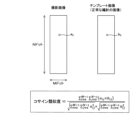
- the control unit 51 can judge the quality of the acquired knitting needle 11 based on the similarity between the acquired image of the knitting needle 11 (also referred to as the "photographed image") and the image of a normal knitting needle 11 (also referred to as the "template image”).
- the size (resolution) of the photographed image and the template image is N dots x M dots
- the pixel value of pixel (i, j) of the photographed image is a i, j
- the pixel value of pixel (i, j) of the template image is b i, j .
- the photographed image can be an image including one entire knitting needle 11. Note that areas not subject to quality judgment can be deleted in advance from the photographed image of the knitting needle 11.
- the similarity can be, for example, cosine similarity.
- Cosine similarity is the cosine value of the angle between two vectors, and can be obtained by dividing the inner product of two vectors by the magnitude of the two vectors.
- the pixel values of each pixel of the image can be vectorized.
- the cosine similarity is normalized to the range of -1 to 1, and when the cosine similarity is 1 or close to 1, the knitting needle 11 can be determined to be normal, and when the cosine similarity is -1 or close to -1, the knitting needle 11 can be determined to be defective. In other words, when the cosine similarity is equal to or less than a predetermined threshold, the knitting needle 11 can be determined to be defective.
- the similarity is not limited to cosine similarity, and other methods such as Euclidean distance may be used.
- the deterioration level of the knitting needles 11 may be determined.
- the deterioration level may be classified into several levels, such as “considerably deteriorated,” “slightly deteriorated,” “not very deteriorated,” and “not deteriorated.”
- the level may be determined according to the value of the cosine similarity within the range of -1 to 1.
- An ID is assigned to each captured image of the knitting needle 11 being judged, corresponding to the position of the knitting needle 11, and the position of the defective knitting needle 11 can be identified by the ID of the captured image judged to be defective.
- the template images 66 can be stored in advance in the memory unit 56 for each type of knitting needle 11 (hook, latch, slider, needle stem, etc.).
- the operating time of the flat knitting machine 100 can be divided into multiple sections, and a template image 66 can be prepared for each section. Since the condition of the knitting needles 11 gradually deteriorates as the operating time of the flat knitting machine 100 increases, the accuracy of pass/fail judgment can be improved by using a template image 66 that reflects the deteriorated state.
- multiple template images 66 may be prepared corresponding to the length of time the knitting needle 11 has been used.
- the control unit 51 judges whether the knitting needle 11 is good or bad, it can identify a template image 66 that corresponds to the usage time from among the multiple template images 66 depending on the usage time of the knitting needle 11 at the time of judgment, and use the identified template image 66 to judge whether the knitting needle 11 is good or bad.
- Figure 7 is a diagram showing a second example of determining whether the knitting needle 11 is good or bad.
- the control unit 51 receives an image of a knitting needle 11 that is determined to be normal, it inputs the acquired image of the knitting needle 11 into a first learning model 63 that has been trained to reconstruct the image of the knitting needle 11, outputs a reconstructed image, and can determine whether the knitting needle 11 is good or bad by comparing the acquired image of the knitting needle 11 with the reconstructed image output by the first learning model 63.
- the control unit 51 functions as a determination unit that uses the first learning model 63 to determine whether the knitting needle 11 is good or bad.
- the first learning model 63 can be, for example, an autoencoder, and includes an encoder 631 and a decoder 632.
- the encoder 631 extracts a feature vector from an input image, and the decoder 632 restores (reconstructs) the original image based on the extracted feature vector.
- the first learning model 63 is not limited to an autoencoder, and other models such as, for example, Conditional GAN may be used.
- the first learning model 63 is generated (learned) to reconstruct the image when an image of a normal knitting needle 11 is input.
- the acquired image (photographed image) of the knitting needle 11 is input to the first learning model 63.
- the input image of the knitting needle 11 is compared with the reconstructed image output by the first learning model 63.
- the comparison can be performed by finding the difference between the input image of the knitting needle 11 and the reconstructed image.
- the difference can be calculated by calculating the difference in pixel value for each corresponding pixel between the image of the knitting needle 11 and the reconstructed image, and adding up the calculated differences for each pixel.
- the knitting needle 11 can be determined to be normal, and if the difference is large or small, the knitting needle 11 can be determined to be defective. According to this embodiment, even if it is difficult to collect an image of a defective knitting needle 11 as training data, the quality of the knitting needle 11 can be determined by using an image of a normal knitting needle 11 as training data.
- the difference may also be calculated as follows. That is, the difference in pixel value for each corresponding pixel between the image of the knitting needle 11 and the reconstructed image may be compared with a predetermined threshold, and the number of pixels having a difference equal to or greater than the threshold may be determined as the difference.
- the image of the knitting needle 11 input to the first learning model 63 may be an image including the entire knitting needle 11, or a split image obtained by splitting the image into parts of the knitting needle 11 (hook, slider, latch, etc.). Areas that are not subject to pass/fail judgment can be deleted in advance from the image of the knitting needle 11.
- the pass/fail judgment for each area can be made by calculating the difference for each of multiple areas of the entire image, and the location of the abnormality in the knitting needle 11 can be determined by identifying the defective area.
- the difference between the split image and the reconstructed image corresponding to the split image can be calculated, and the pass/fail judgment can be made for each split image.
- the deterioration level of the knitting needle 11 may be determined.
- the deterioration level may be classified into several levels, such as “considerably deteriorated,” “slightly deteriorated,” “not very deteriorated,” and “not deteriorated.”
- the level may be determined according to the difference value. This makes it possible to display, like a heat map, which parts of the knitting needle 11 are deteriorated and which parts are not deteriorated.
- the first learning model 63 can be generated (learned) as follows. Images of normal knitting needles 11 are collected as training data. In this case, training data may be collected for images of normal knitting needles 11 with varying shooting conditions, distance to the knitting needles 11, position, etc. Based on the collected training data, the image of the normal knitting needle 11 is input to the first learning model 63, and the parameters of the first learning model 63 are adjusted so that the reconstructed image output by the first learning model 63 approaches the image of the knitting needle 11 that was input.
- FIG. 8 is a diagram showing a third example of determining whether the knitting needle 11 is good or bad.
- the control unit 51 can input the acquired image (photographed image) of the knitting needle 11 to the second learning model 64, which has been trained to output information regarding the quality of the knitting needle 11 when an image of the knitting needle 11 is input, and output information regarding the quality of the knitting needle 11.
- the control unit 51 has a function as an output unit that outputs information regarding the quality of the knitting needle 11 using the second learning model 64.
- the image of the knitting needle 11 input to the second learning model 64 may be an image including the entire knitting needle 11, or may be a divided image obtained by dividing the image into parts of the knitting needle 11 (hook, slider, latch, etc.). Note that areas that are not subject to quality determination can be deleted in advance from the photographed image of the knitting needle 11.
- the second learning model 64 may use, for example, a CNN (Convolutional Neural Network).
- the information on the quality of the knitting needle 11 includes, for example, the probability (accuracy) that the knitting needle 11 is defective and the probability (accuracy) that the knitting needle 11 is normal. For example, if the threshold for determining that the knitting needle 11 is normal is 90%, the knitting needle 11 can be determined to be defective when the output of the second learning model 64 indicates that the knitting needle 11 has an 80% probability of being normal and a 20% probability of being defective. In addition, when the output of the second learning model 64 indicates that the knitting needle 11 has a 95% probability of being normal and a 5% probability of being defective, the knitting needle 11 can be determined to be normal.
- the threshold may be set to a different value depending on the type of knitting needle 11 (hook, latch, slider, needle stem, etc.). According to this embodiment, the accuracy of determining the quality of the knitting needle 11 can be improved by appropriately setting the threshold.
- the deterioration level of the needle 11 may be judged.
- the deterioration level may be classified into several levels, such as “considerably deteriorated,” “slightly deteriorated,” “not very deteriorated,” and “not deteriorated.” The level may be judged according to the probability of the needle being defective.
- the second learning model 64 can be generated (trained) as follows. Images of normal knitting needles 11, images of defective knitting needles 11, a "normal” label associated with the image of the normal knitting needle 11, and a "defective" label associated with the image of the defective knitting needle 11 are collected as training data. Based on the collected training data, an image of a normal knitting needle 11 is input to the second learning model 64, and the parameters of the second learning model 64 are adjusted so that the label output by the second learning model 64 approaches the "normal” label. Also, based on the collected training data, an image of a defective knitting needle 11 is input to the second learning model 64, and the parameters of the second learning model 64 are adjusted so that the label output by the second learning model 64 approaches the "defective" label.
- the second learning model 64 can be configured to output the cause of the defect in the knitting needle 11 when an image of the knitting needle 11 is input.
- 9A to 9B are diagrams showing an example of a method for determining the defective part and the cause of the defect of a defective knitting needle 11.
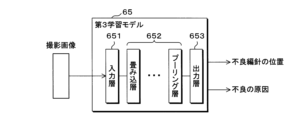
- the control unit 51 can input the acquired image of the knitting needle 11 to the third learning model 65, which has been trained to output the defective part and the cause of the defect of the knitting needle 11 when an image of the knitting needle 11 is input, and output the defective part and the cause of the defect of the knitting needle 11.
- the control unit 51 has a function as an output unit that outputs the defective part and the cause of the defect of the knitting needle 11 using the third learning model 65.
- the image of the knitting needle 11 input to the third learning model 65 may be an image including the entire knitting needle 11, or may be a divided image obtained by dividing the image into parts of the knitting needle 11 (hook, slider, latch, etc.). Note that areas that are not subject to pass/fail judgment can be deleted in advance from the image of the knitting needle 11.
- the third learning model 65 may use, for example, YOLO (You Only Look Once), SSD (Single Shot MultiBox Detector), Faster R-CNN, etc.
- the third learning model 65 includes an input layer 651, a convolutional layer/pooling layer 652, and an output layer 653.
- the third learning model 65 extracts features from the input image (photographed image) of the knitting needle 11.
- the third learning model 65 represents, for example, a defective part of the knitting needle 11 with a bounding box and estimates the probability of the cause of the defect.
- the cause with the highest probability can be determined to be the cause of the defect (for example, a bent, bowed or broken hook, a bent or missing slider, a bent or missing latch, etc.).
- the third learning model 65 is not limited to YOLO.
- the above-mentioned configuration makes it possible to provide the user with the defective location of the defective knitting needle 11 and the cause of the defect.
- the third learning model 65 can be generated (trained) as follows. Training data that associates images of defective knitting needles 11, defective parts of the defective knitting needles 11, and "cause" labels indicating the cause of the defects is collected. Based on the collected training data, images of the defective knitting needles 11 are input to the third learning model 65, and the parameters of the third learning model 65 are adjusted so that the defective parts and labels output by the third learning model 65 are close to the defective parts and "cause" labels of the defective knitting needles 11 in the training data. In addition, training data including images of normal knitting needles 11 is collected, images of normal knitting needles 11 are input to the third learning model 65, and the parameters of the third learning model 65 are adjusted so that the third learning model 65 does not output defective parts.
- the quality judgment result screen 200 can be displayed on the monitor 72.
- the knitting needle 11 is photographed, judged to be good or bad, etc., automatically when the knitting machine is turned off after the required number of garments are knitted, or when the machine operation is temporarily stopped for oiling or cleaning, and the quality judgment result screen 200 is displayed on the monitor 72. That is, the control unit 51 has a function as an output unit that outputs at least one of the position of the knitting needle 11 judged to be defective and information regarding the defect.
- the quality judgment result screen 200 displays the detection result.
- the detection result includes, for example, the total number of defective needles of the knitting needles 11 judged to be defective among all the knitting needles 11, the number of defective needles by bed (front upper, front lower, back upper, back lower) in a model equipped with four needle beds, the position of the defective needles, the deterioration level of the defective needles, etc.
- the position of the defective needle is displayed by selecting the bed selection tab 204. In the example of FIG. 10, the front upper bed is selected, and the number of the defective needle (needle number) is displayed.
- the deterioration level of the defective needle can be classified into four levels, for example, from level 1 to 4, where level 1 is “not deteriorated", level 2 is “not deteriorated much", level 3 is “slightly deteriorated", and level 4 is "considerably deteriorated". Level 4 is a deterioration level that requires replacement, and level 3 can be a deterioration level that requires attention.
- the accuracy (probability) of the judgment of each defective needle may be displayed. For example, the probability of the defect of the XXth knitting needle is OO%.
- the position of the defective needle can include information on which needle bed the needle belongs to.
- the quality judgment result screen 200 displays a deterioration status field 206.
- the deterioration status field 206 displays a selection field for selecting a defective needle, the deterioration level of the selected defective needle at the time of the previous judgment, and the deterioration level at the time of the current judgment. This allows the user to grasp the degree of deterioration each time a quality judgment is made.
- the pass/fail judgment result screen 200 can display images of normal needles (good products) and images of needles judged to be defective so that they can be compared.
- the pass/fail judgment result screen 200 also displays a solution column 207, which can, for example, encourage the user to replace a defective knitting needle 11 that needs replacing.
- the solution column 207 may also display a solution to a knitting needle 11 that has been judged to be defective, based on a database 71 that associates the cause of the defect in the knitting needle 11 with a solution.
- the threshold is a threshold for determining whether the knitting needle 11 is good or bad, and a threshold can be set for each of the hook, slider, and latch.
- the cosine similarity illustrated in FIG. 6 is used to determine whether the knitting needle 11 is good or bad, the determination is made based on whether the cosine similarity is equal to or greater than the threshold.
- the first learning model 63 illustrated in FIG. 7 is used to determine whether the knitting needle 11 is good or bad
- the determination is made based on whether the difference is equal to or greater than the threshold.
- the second learning model 64 illustrated in FIG. 8 is used to determine whether the knitting needle 11 is good or bad, the determination is made based on whether the probability is equal to or greater than the threshold.
- the "Re-determine" icon 202 is an icon for confirming the input threshold.
- the "marking" icon 203 is an icon for performing dummy knitting and changing the height of the needle judged to be defective. Dummy knitting is knitting in which the knitting needle 11 is raised and lowered without resting the yarn from the yarn feeder. The knitting needle 11 is photographed during the dummy knitting process to judge its quality. Images of needles judged to be defective can be displayed, and the user can be asked to judge their quality. The user can operate the confirmation icon 205 of the needle (needle number) that is judged to be defective after checking the images.
- the carriage can be moved by operating the "marking" icon 203, and the knitting needle 11 judged to be defective can be displaced to a height different from the normal height. Note that this is not limited to a configuration in which the height of the knitting needle 11 judged to be defective is displaced to a height different from the normal height by manual operation based on the operation of the "marking" icon 203, and the height of the knitting needle 11 judged to be defective may be automatically displaced to a height different from the normal height.
- control unit 51 can output information regarding defects in the knitting needles 11 to the monitor 72. This makes it possible to provide the user with information regarding defects in the knitting needles 11 (e.g., the accuracy (probability) of the defect, the cause of the defect, etc.).
- the control unit 51 can also output to the monitor 72 at least one of an image of the knitting needle 11 determined to be defective and information for identifying the position of the knitting needle 11 determined to be defective. This makes it possible to provide the user with at least one of an image of the knitting needle 11 determined to be defective and information for identifying the position of the knitting needle 11 determined to be defective.
- the control unit 51 can also displace (move) the knitting needles 11 that are determined to be defective to a height different from the height of the knitting needles 11 according to the knitting program. This makes it possible to clearly inform the user of the defective knitting needles 11 among the knitting needles 11 arranged in a row on the needle bed 10.
- FIG. 11 is a diagram showing a second example of the quality judgment result of the knitting needle 11.
- the detection result on the quality judgment result screen 210 includes the position of the defective needle by bed (upper front, lower front, upper back, lower back), the cause of the defect, etc.
- the upper front bed is selected, and the number of the defective needle (needle number) and the cause of the defect of the defective needle are displayed.
- the cause of the defect of the XXth needle is a bent hook
- the cause of the defect of the XOth needle is a missing slider.
- the user can display an image of the defective needle by operating the selection icon 215 of the knitting needle 11 that has been judged to be defective.
- the pass/fail judgment result screen 210 can be displayed using the results of processing using the third learning model 65 illustrated in FIG. 9.
- the user (the customer using the flat knitting machine 100) can input whether the detection result by the control unit 50 is correct or not. As shown in FIG. 11, the user can correct the detection result by inputting or selecting whether the position of the defective knitting needle 11 is correct or not and whether the cause of the defect is correct or not in the correct or not reception field and operating the "correction" icon 211.
- control unit 51 outputs the position of the defective knitting needle 11 and the cause of the defect to the monitor 72 of the customer's flat knitting machine, receives information on the success or failure of the output position of the knitting needle 11 and the cause of the defect, and can associate the received information on success or failure with an image of the knitting needle 11 determined to be defective and store the result as training data in the memory unit 56 or database 71.
- the position of the defective knitting needle 11 and the cause of the defect can be provided to the customer, and the customer can judge whether the provided information is correct or not, and the provided information can be corrected if necessary.
- Information such as the position of the defective knitting needle 11 and the cause of the defect, which has been judged to be correct or not by the customer, can be collected as training data for a third learning model 65 used in a flat knitting machine operated by the customer.
- the control unit 51 can identify the third learning model 65 that has been re-trained using the training data for each customer collected as described above, for that customer's flat knitting machine.
- the identified third learning model 65 can replace the third learning model 65 already installed in that customer's flat knitting machine. This makes it possible to use a customer-specific third learning model 65 that has been tuned for the customer's flat knitting machine, even if it is the same third learning model 65.
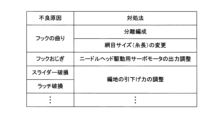
- the database 71 stores information that associates the cause of defects in the knitting needles 11 with countermeasures.
- FIG. 12 is a diagram showing an example of information relating the cause of a defect in the knitting needle 11 to a countermeasure.
- separate knitting can be performed to deal with bent hooks, but countermeasures such as changing the stitch size (yarn length) can also be used. For example, knitting with a larger stitch size can prevent the hook from bending due to a certain degree of pulling.
- Figs. 13A to 13F are diagrams showing an example of separate knitting. Separate knitting will be explained with reference to Fig. 13.
- Figs. 13A to 13C show an example without separate knitting
- Figs. 13D to 13F show an example with separate knitting.
- Figs. 13A and 13B looking at loop numbers #2 and #3, #2 and #3 are directly connected by one needle pitch.
- Fig. 13C in the process of knitting a cable pattern in which the positions of pairs #1, #2 and #3, #4 are swapped, #2 and #3 are pulled diagonally by three needle pitches. This can cause the hooks to bend.
- Figures 13D-F show the case of separate knitting where one course of separate knitting is inserted.
- Figures 13D and E looking at loop numbers #2, #3, and #5, #2 and #5 are directly connected at three diagonal pitches, and #3 is directly connected to #2A and #4 formed in the knitting course immediately before #2.
- Figure 13F in the process of knitting the knitting yarn, the front and rear needle beds move relative to each other by the amount of three needles, causing #2 and #3 to be pulled apart diagonally, but because it is #2A that is directly connected to #3, the burden on the needles is reduced, and the occurrence of bent hooks can be prevented or suppressed.
- the output of the servo motor 73 for driving the needle bed can be adjusted to deal with the bowing of the hook.
- the cause of the bowing of the hook is thought to be that when racking (relative movement of the needle bed) is performed with an extreme load on the knitting needle 11, the position of the needle bed deviates from the target position due to the pull of the knitted fabric, causing the hook to collide with the yarn feeder that is stopped when the needle advances, or with the opposing knitting needle 11 when transferring the stitch.
- the output of the servo motor 73 is adjusted so that it does not succumb to the lateral pull (external force) of the knitted fabric.
- the force pulling down the knitted fabric can be adjusted. If the device for pulling down the knitted fabric is not properly adjusted, excessive load will be placed on the knitting needle 11, which may cause damage to the slider or latch.
- the information relating the cause of the defect in the knitting needle 11 and the countermeasure is only one example, and is not limited to the example in Figure 12.
- control unit 51 can output a countermeasure for a knitting needle 11 determined to be defective based on the database 71 that associates defects (causes of defects) of the knitting needles 11 with countermeasures.
- the knitting needles 11 determined to be defective and the countermeasures can be output (displayed) on the monitor 72. This makes it possible to provide the user with an appropriate countermeasure for a defective knitting needle 11.
- the information on the knitting needle 11 determined to be defective includes, for example, the position of the defective knitting needle 11 and the cause of the defect.
- the knitting program 61 is an instruction content that instructs how to move which knitting needle 11 in each knitting course, how to move the yarn feeder and the carriage, etc.
- a course refers to one movement of the carriage during knitting.
- the knitting machine adjustment data 62 includes, for example, settings of the pull-down device that pulls down the knitted fabric (for example, which area of the knitted fabric is pulled down, for how long, and with how much force), knitting speed settings (carriage movement speed), stitch value settings (the amount by which the knitting needle 11 that holds the knitting yarn is lowered by the cam to achieve the target stitch size, etc.).
- the history information can be stored in the database 71, and is the knitting program and flat knitting machine adjustment data used during the knitting collected for each knitting.
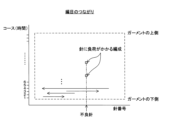
- FIG. 14 is a diagram showing a schematic diagram of the emulation result of the stitch connection.
- the above-mentioned history information can be used for the emulation.
- the horizontal axis indicates the needle number (position) of the knitting needle 11, and the vertical axis indicates the course (time).
- Course 1 represents the lower side (lowest end) of the garment product, and increases in the course number move toward the upper side (upper end).
- the emulation result shown in FIG. 14 emulates the stitch connection based on the knitting program 61, and it is possible to monitor all the states of the knitting needle 11 in each course based on the knitting program 61 and the knitting machine adjustment data 62.
- the degree of pulling force (stress) applied to the knitting needle 11 depending on the number of yarns held by the knitting needle 11, the needle pitch between the stitches, the size of the stitches, the movement of the knitting needle 11, and the like. Stitches for which the pulling force applied to the knitting needle 11 exceeds a predetermined threshold value can be determined in advance as knitting that places a strain on the needle.
- a program that can reverse the above-mentioned judgment method is prepared.
- the defective needle number can be input into the above-mentioned program to identify knitting that places a load on the needle in each course corresponding to the defective needle number.
- knitting that places a load on the needle in two courses is identified.
- FIG. 15 is a diagram showing an example of factors that impose a load on the knitting needle 11.
- Factors that impose a load on the knitting needle 11 include, for example, racking, stitch size, multiple hooks, special knitting methods, the friction coefficient of the yarn, and the pulling force of the knitted fabric.
- the determination unit 55 acquires history information including the knitting program and knitting machine adjustment data used for knitting, and determines the factors that impose a load on the knitting needle 11 that has been determined to be defective based on the information on the knitting needle 11 that has been determined to be defective and the acquired history information, and outputs the determination result to the monitor 72.
- the information on the knitting needle 11 that has been determined to be defective includes, for example, the position of the knitting needle 11 (needle number), etc.
- control unit 51 identifies the correspondence between the knitting patterns that place a load on the knitting needles 11 on each course of the knitting, and the knitting needles 11, based on the acquired history information. For the knitting needles 11 that have been determined to be defective, the control unit 51 uses the identified correspondence to identify the knitting patterns that place a load on the defective knitting needles 11, and can determine the factors that place a load on the knitting needles 11 based on the identified knitting patterns.
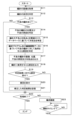
- FIG. 16 is a diagram showing an example of a processing procedure by the control unit 50.
- the control unit 51 acquires an image of the knitting needle 11 (S11), and judges whether the knitting needle 11 is good or bad based on the acquired image (S12). The judgment of good or bad can use, for example, the methods exemplified in FIGS. 6 to 8.
- the control unit 51 judges whether there is a defective knitting needle 11 (S13), and if there is no defective knitting needle 11 (NO in S13), performs the processing of step S22 described below.
- step S14 determines the position of the defective knitting needle 11 and the cause of the defect (S14).
- the process of step S14 can use, for example, the method illustrated in FIG. 9.
- the control unit 51 identifies a countermeasure for the defective knitting needle 11 based on a database 71 that associates defects in knitting needles 11 with countermeasures (S15).
- the control unit 51 determines the cause of the load on the defective knitting needle 11 based on the knitting program and the knitting machine adjustment data (S16).
- the process of step S16 can use, for example, the method illustrated in Figs. 14-15.
- the control unit 51 outputs an image of the defective knitting needle 11, its position, the cause of the defect, and a remedy (S17), and outputs the cause of the load on the knitting needle 11 (S18).
- the control unit 51 determines whether or not a request for the judgment result has been received (S19), and if a request for necessity has been received (YES in S19), the request is accepted (S20) and the corrected judgment result is stored in the memory unit 56 (S21). If a request for necessity has not been received (NO in S19), the control unit 51 performs the process of step S22 described above.
- the control unit 51 determines whether or not to end the process (S22), and if not (NO in S22), continues knitting (S23), and determines whether or not it is time to photograph the knitting needles 11 (S24).
- the photographing timing can be, for example, the point in time when a predetermined number of garment products have been produced, but is not limited to this.
- control unit 51 continues the process of step S24. If it is time to photograph (YES in S24), the control unit 51 photographs the knitting needles 11 and performs the process from step S11 onwards. If it is time to end the process (YES in S22), the control unit 51 ends the process.
- the control unit 51 acquires images of the knitting needles 11 of the flat knitting machine 100 having a plurality of knitting needles 11, judges whether the knitting needles 11 are good or bad based on the acquired images of the knitting needles 11, and outputs at least one of the position of the knitting needles 11 that have been judged to be defective and information related to the defect.
- Information related to the defect includes, for example, the accuracy (probability) of the defect, the cause of the defect, etc. According to this embodiment, at least one of the position of the knitting needles 11 that have been judged to be defective and information related to the defect can be provided.
- the means for notifying the position of the knitting needle 11 determined to be defective may be, for example, a method of indicating the defective knitting needle 11 with a laser pointer, or a method of marking the defective knitting needle 11 with a required color in an identifiable manner.
- Knitting members include, for example, members such as loop pressers or transfer jacks that are arranged in a row in large numbers on the needle bed and are configured to be able to advance and retreat relative to the needle gap.
Landscapes
- Engineering & Computer Science (AREA)
- Robotics (AREA)
- Physics & Mathematics (AREA)
- General Physics & Mathematics (AREA)
- Theoretical Computer Science (AREA)
- Textile Engineering (AREA)
- Knitting Machines (AREA)
Priority Applications (3)
| Application Number | Priority Date | Filing Date | Title |
|---|---|---|---|
| CN202480036012.1A CN121219459A (zh) | 2023-05-31 | 2024-05-24 | 计算机程序、横机及信息处理方法 |
| JP2025524071A JPWO2024247932A1 (https=) | 2023-05-31 | 2024-05-24 | |
| DE112024002365.7T DE112024002365T5 (de) | 2023-05-31 | 2024-05-24 | Computerprogramm, Flachstrickmaschine und Informationsverarbeitungsverfahren |
Applications Claiming Priority (2)
| Application Number | Priority Date | Filing Date | Title |
|---|---|---|---|
| JP2023-090287 | 2023-05-31 | ||
| JP2023090287 | 2023-05-31 |
Publications (1)
| Publication Number | Publication Date |
|---|---|
| WO2024247932A1 true WO2024247932A1 (ja) | 2024-12-05 |
Family
ID=93657464
Family Applications (1)
| Application Number | Title | Priority Date | Filing Date |
|---|---|---|---|
| PCT/JP2024/019261 Ceased WO2024247932A1 (ja) | 2023-05-31 | 2024-05-24 | コンピュータプログラム、横編機及び情報処理方法 |
Country Status (4)
| Country | Link |
|---|---|
| JP (1) | JPWO2024247932A1 (https=) |
| CN (1) | CN121219459A (https=) |
| DE (1) | DE112024002365T5 (https=) |
| WO (1) | WO2024247932A1 (https=) |
Citations (2)
| Publication number | Priority date | Publication date | Assignee | Title |
|---|---|---|---|---|
| JP2021195698A (ja) * | 2020-06-18 | 2021-12-27 | 株式会社島精機製作所 | 編機及び不良検出システム |
| JP2022531897A (ja) * | 2019-05-09 | 2022-07-12 | ビティエッセエッレ インターナショナル ソチエタ ペル アチオーニ | 針を用いる繊維機械において破損した針の存在を検出するための方法及びシステム |
Family Cites Families (1)
| Publication number | Priority date | Publication date | Assignee | Title |
|---|---|---|---|---|
| JPH0733998Y2 (ja) | 1988-02-29 | 1995-08-02 | 株式会社島津製作所 | 小型飛翔体 |
-
2024
- 2024-05-24 JP JP2025524071A patent/JPWO2024247932A1/ja active Pending
- 2024-05-24 CN CN202480036012.1A patent/CN121219459A/zh active Pending
- 2024-05-24 DE DE112024002365.7T patent/DE112024002365T5/de active Pending
- 2024-05-24 WO PCT/JP2024/019261 patent/WO2024247932A1/ja not_active Ceased
Patent Citations (2)
| Publication number | Priority date | Publication date | Assignee | Title |
|---|---|---|---|---|
| JP2022531897A (ja) * | 2019-05-09 | 2022-07-12 | ビティエッセエッレ インターナショナル ソチエタ ペル アチオーニ | 針を用いる繊維機械において破損した針の存在を検出するための方法及びシステム |
| JP2021195698A (ja) * | 2020-06-18 | 2021-12-27 | 株式会社島精機製作所 | 編機及び不良検出システム |
Also Published As
| Publication number | Publication date |
|---|---|
| CN121219459A (zh) | 2025-12-26 |
| JPWO2024247932A1 (https=) | 2024-12-05 |
| DE112024002365T5 (de) | 2026-03-12 |
Similar Documents
| Publication | Publication Date | Title |
|---|---|---|
| CN113818143B (zh) | 针织机及不合格检测系统 | |
| CN101750726B (zh) | 成像装置 | |
| CN204803513U (zh) | 具有断线检测功能的经编机 | |
| CN111862069B (zh) | 一种基于灰度梯度法的圆纬编横条疵点在线检测方法 | |
| US11080835B2 (en) | Pixel error detection system | |
| CN107144570B (zh) | 一种基于机器视觉的簇绒机排纱错误检测方法 | |
| CN110992343A (zh) | 一种基于机器人的飘丝飘杂视检方法、存储介质及电子设备 | |
| WO2024247932A1 (ja) | コンピュータプログラム、横編機及び情報処理方法 | |
| WO2006052425A2 (en) | Image sensor annotation method and apparatus | |
| CN117309759A (zh) | 缺陷检测系统、方法、电子设备和存储介质 | |
| CN115855951A (zh) | 布面瑕疵检测方法以及系统 | |
| CN118814353A (zh) | 基于智能学习与多传感器融合的织带编织控制方法及系统 | |
| CN110791944A (zh) | 整纬机控制方法、装置、计算机设备和存储介质 | |
| WO2020181915A1 (zh) | 一种高速型双针床经编机花型加载的控制实现方法 | |
| CN116745673A (zh) | 图像处理装置、摄像装置、图像处理方法及程序 | |
| JP6874671B2 (ja) | 認証システムおよびデータ処理方法 | |
| KR102841931B1 (ko) | 팔의 활동성과 늘어짐 방지를 위한 스판사 인타샤가 형성된 니트를 제작하는 스마트 편직기 | |
| CN116882432A (zh) | 多种物料的扫描方法、系统、可读存储介质及计算机设备 | |
| CN114820464A (zh) | 手套机的断针检测方法、设备、存储介质以及程序产品 | |
| CN118166486A (zh) | 一种超长厚料智能全自动工业缝制设备控制系统 | |
| CN108677372B (zh) | 一种经编机用贾卡电子提花断电续编控制方法 | |
| CN113445201A (zh) | 基于相机阵列的双针床经编机断丝在线检测系统及其方法 | |
| CN116745477A (zh) | 反转添纱用修正数据的生成方法及生成系统 | |
| CN115731150B (zh) | 一种用于自动售货机显示界面异常的检测方法及系统 | |
| CN118756412A (zh) | 一种提花机错针监视系统及方法 |
Legal Events
| Date | Code | Title | Description |
|---|---|---|---|
| 121 | Ep: the epo has been informed by wipo that ep was designated in this application |
Ref document number: 24815415 Country of ref document: EP Kind code of ref document: A1 |
|
| ENP | Entry into the national phase |
Ref document number: 2025524071 Country of ref document: JP Kind code of ref document: A |
|
| WWE | Wipo information: entry into national phase |
Ref document number: 2025524071 Country of ref document: JP |
|
| WWE | Wipo information: entry into national phase |
Ref document number: 112024002365 Country of ref document: DE |
|
| WWP | Wipo information: published in national office |
Ref document number: 112024002365 Country of ref document: DE |