WO2024241890A1 - 電荷輸送性ワニスおよび化合物 - Google Patents
電荷輸送性ワニスおよび化合物 Download PDFInfo
- Publication number
- WO2024241890A1 WO2024241890A1 PCT/JP2024/017195 JP2024017195W WO2024241890A1 WO 2024241890 A1 WO2024241890 A1 WO 2024241890A1 JP 2024017195 W JP2024017195 W JP 2024017195W WO 2024241890 A1 WO2024241890 A1 WO 2024241890A1
- Authority
- WO
- WIPO (PCT)
- Prior art keywords
- group
- carbon atoms
- substituted
- formula
- halogen atom
- Prior art date
- Legal status (The legal status is an assumption and is not a legal conclusion. Google has not performed a legal analysis and makes no representation as to the accuracy of the status listed.)
- Ceased
Links
Images

Classifications
-
- H—ELECTRICITY
- H10—SEMICONDUCTOR DEVICES; ELECTRIC SOLID-STATE DEVICES NOT OTHERWISE PROVIDED FOR
- H10K—ORGANIC ELECTRIC SOLID-STATE DEVICES
- H10K85/00—Organic materials used in the body or electrodes of devices covered by this subclass
- H10K85/60—Organic compounds having low molecular weight
- H10K85/631—Amine compounds having at least two aryl rest on at least one amine-nitrogen atom, e.g. triphenylamine
- H10K85/636—Amine compounds having at least two aryl rest on at least one amine-nitrogen atom, e.g. triphenylamine comprising heteroaromatic hydrocarbons as substituents on the nitrogen atom
-
- C—CHEMISTRY; METALLURGY
- C07—ORGANIC CHEMISTRY
- C07D—HETEROCYCLIC COMPOUNDS
- C07D209/00—Heterocyclic compounds containing five-membered rings, condensed with other rings, with one nitrogen atom as the only ring hetero atom
- C07D209/56—Ring systems containing three or more rings
- C07D209/80—[b, c]- or [b, d]-condensed
- C07D209/82—Carbazoles; Hydrogenated carbazoles
- C07D209/88—Carbazoles; Hydrogenated carbazoles with hetero atoms or with carbon atoms having three bonds to hetero atoms with at the most one bond to halogen, e.g. ester or nitrile radicals, directly attached to carbon atoms of the ring system
-
- C—CHEMISTRY; METALLURGY
- C07—ORGANIC CHEMISTRY
- C07D—HETEROCYCLIC COMPOUNDS
- C07D403/00—Heterocyclic compounds containing two or more hetero rings, having nitrogen atoms as the only ring hetero atoms, not provided for by group C07D401/00
- C07D403/14—Heterocyclic compounds containing two or more hetero rings, having nitrogen atoms as the only ring hetero atoms, not provided for by group C07D401/00 containing three or more hetero rings
-
- C—CHEMISTRY; METALLURGY
- C07—ORGANIC CHEMISTRY
- C07F—ACYCLIC, CARBOCYCLIC OR HETEROCYCLIC COMPOUNDS CONTAINING ELEMENTS OTHER THAN CARBON, HYDROGEN, HALOGEN, OXYGEN, NITROGEN, SULFUR, SELENIUM OR TELLURIUM
- C07F7/00—Compounds containing elements of Groups 4 or 14 of the Periodic Table
- C07F7/02—Silicon compounds
- C07F7/08—Compounds having one or more C—Si linkages
- C07F7/18—Compounds having one or more C—Si linkages as well as one or more C—O—Si linkages
-
- C—CHEMISTRY; METALLURGY
- C07—ORGANIC CHEMISTRY
- C07F—ACYCLIC, CARBOCYCLIC OR HETEROCYCLIC COMPOUNDS CONTAINING ELEMENTS OTHER THAN CARBON, HYDROGEN, HALOGEN, OXYGEN, NITROGEN, SULFUR, SELENIUM OR TELLURIUM
- C07F7/00—Compounds containing elements of Groups 4 or 14 of the Periodic Table
- C07F7/02—Silicon compounds
- C07F7/08—Compounds having one or more C—Si linkages
- C07F7/18—Compounds having one or more C—Si linkages as well as one or more C—O—Si linkages
- C07F7/1804—Compounds having Si-O-C linkages
-
- H—ELECTRICITY
- H05—ELECTRIC TECHNIQUES NOT OTHERWISE PROVIDED FOR
- H05B—ELECTRIC HEATING; ELECTRIC LIGHT SOURCES NOT OTHERWISE PROVIDED FOR; CIRCUIT ARRANGEMENTS FOR ELECTRIC LIGHT SOURCES, IN GENERAL
- H05B33/00—Electroluminescent light sources
- H05B33/12—Light sources with substantially two-dimensional [2D] radiating surfaces
- H05B33/14—Light sources with substantially two-dimensional [2D] radiating surfaces characterised by the chemical or physical composition or the arrangement of the electroluminescent material, or by the simultaneous addition of the electroluminescent material in or onto the light source
-
- H—ELECTRICITY
- H10—SEMICONDUCTOR DEVICES; ELECTRIC SOLID-STATE DEVICES NOT OTHERWISE PROVIDED FOR
- H10K—ORGANIC ELECTRIC SOLID-STATE DEVICES
- H10K50/00—Organic light-emitting devices
- H10K50/10—OLEDs or polymer light-emitting diodes [PLED]
- H10K50/14—Carrier transporting layers
- H10K50/15—Hole transporting layers
-
- H—ELECTRICITY
- H10—SEMICONDUCTOR DEVICES; ELECTRIC SOLID-STATE DEVICES NOT OTHERWISE PROVIDED FOR
- H10K—ORGANIC ELECTRIC SOLID-STATE DEVICES
- H10K59/00—Integrated devices, or assemblies of multiple devices, comprising at least one organic light-emitting element covered by group H10K50/00
- H10K59/10—OLED displays
-
- H—ELECTRICITY
- H10—SEMICONDUCTOR DEVICES; ELECTRIC SOLID-STATE DEVICES NOT OTHERWISE PROVIDED FOR
- H10K—ORGANIC ELECTRIC SOLID-STATE DEVICES
- H10K71/00—Manufacture or treatment specially adapted for the organic devices covered by this subclass
- H10K71/10—Deposition of organic active material
- H10K71/12—Deposition of organic active material using liquid deposition, e.g. spin coating
-
- H—ELECTRICITY
- H10—SEMICONDUCTOR DEVICES; ELECTRIC SOLID-STATE DEVICES NOT OTHERWISE PROVIDED FOR
- H10K—ORGANIC ELECTRIC SOLID-STATE DEVICES
- H10K85/00—Organic materials used in the body or electrodes of devices covered by this subclass
- H10K85/40—Organosilicon compounds, e.g. TIPS pentacene
-
- H—ELECTRICITY
- H10—SEMICONDUCTOR DEVICES; ELECTRIC SOLID-STATE DEVICES NOT OTHERWISE PROVIDED FOR
- H10K—ORGANIC ELECTRIC SOLID-STATE DEVICES
- H10K85/00—Organic materials used in the body or electrodes of devices covered by this subclass
- H10K85/60—Organic compounds having low molecular weight
-
- H—ELECTRICITY
- H10—SEMICONDUCTOR DEVICES; ELECTRIC SOLID-STATE DEVICES NOT OTHERWISE PROVIDED FOR
- H10K—ORGANIC ELECTRIC SOLID-STATE DEVICES
- H10K85/00—Organic materials used in the body or electrodes of devices covered by this subclass
- H10K85/60—Organic compounds having low molecular weight
- H10K85/649—Aromatic compounds comprising a hetero atom
- H10K85/657—Polycyclic condensed heteroaromatic hydrocarbons
- H10K85/6572—Polycyclic condensed heteroaromatic hydrocarbons comprising only nitrogen in the heteroaromatic polycondensed ring system, e.g. phenanthroline or carbazole
Definitions
- the present invention relates to a charge transport varnish and a novel compound.
- organic electroluminescence (hereinafter referred to as organic EL) elements use organic functional films made of organic compounds as the light-emitting layer and charge injection layer.
- the hole transport layer is responsible for the exchange of charges between the hole injection layer and the light-emitting layer, and plays an important role in achieving low-voltage operation and high brightness of the organic EL element.
- quantum dot electroluminescence (hereafter referred to as quantum dot EL) elements which use quantum dot materials as their light-emitting layer, have appeared and show the prospect of a wide range of applications. While these quantum dot EL elements can be manufactured at low cost using wet processes, they have attracted much attention in fields such as display technology and lighting due to their characteristics such as control of emission wavelength, high color purity, high luminous efficiency, and use in flexible applications.
- the present invention has been made in consideration of the above circumstances, and aims to provide a charge-transporting varnish that has excellent charge transport properties, particularly hole transport properties, and a novel compound that is suitable as a charge-transporting substance for charge-transporting varnishes.
- a charge-transporting thin film having excellent charge transport properties can be obtained by using a charge-transporting varnish that uses a combination of a specific charge-transporting substance and SiO2 nanoparticles, and have completed the present invention.
- the present invention provides the following charge-transporting varnish and compound.
- a charge transport material, SiO2 nanoparticles, and a solvent are included,
- the charge transporting varnish, wherein the charge transporting substance comprises an arylamine derivative (excluding the compound represented by the following formula (E1)).
- Z represents a group represented by any one of the following formulas (z1) to (z6); (In the formula, each R z1 independently represents a hydrogen atom or an alkyl group having 1 to 20 carbon atoms.)
- Ar each independently represents a group represented by the following formulae (J1) to (J4);
- R z2 represents a hydrogen atom, an alkyl group having 1 to 20 carbon atoms; an aryl group having 6 to 20 carbon atoms which may be substituted with a cyano group, a nitro group, a halogen atom, an alkyl group having 1 to 20 carbon atoms, or a haloalkyl group having 1 to 20 carbon atoms; or a group represented by any of the following formulas (J5) to (J7):
- D represents a diarylamino group in which each aryl group is independently an aryl group having 6 to 20 carbon atoms, and in formulas
- Ar F each independently represents a cyano group, a chlorine atom, a bromine atom, an iodine atom, a nitro group, an alkyl group having 1 to 20 carbon atoms, a fluoroalkyl group having 1 to 20 carbon atoms, or a fluoroalkoxy group having 1 to 20 carbon atoms, which may be substituted; an aryl group having 6 to 20 carbon atoms which is substituted with a fluoroalkyl group having 1 to 20 carbon atoms, a fluorocycloalkyl group having 3 to 20 carbon atoms, a fluorobicycloalkyl group having 4 to 20 carbon atoms, a fluoroalkenyl group having 2 to 20 carbon atoms, or a fluoroalkynyl group having 2 to 20 carbon atoms, and which may be substituted with a cyano group, a halogen atom, or a fluoroalkoxy group having 1 to 20 carbon atoms.
- each R q1 independently represents a hydrogen atom, a halogen atom, a nitro group, a cyano group, an alkyl group having 1 to 20 carbon atoms, a halogenated alkyl group having 1 to 20 carbon atoms, an alkoxy group having 1 to 20 carbon atoms, or an aryl group having 6 to 20 carbon atoms; each R q2 independently represents an aryl group which may be substituted and which may contain a heteroatom; and each Ar s independently represents an arylene group which may be substituted and which may contain a heteroatom.
- charge transport varnish of the present invention By using the charge transport varnish of the present invention, a charge transport thin film with excellent charge transport properties (particularly hole transport properties) can be obtained.
- This charge transport thin film can be suitably used as a thin film for electronic devices, including organic EL devices and quantum dot EL devices.
- the charge transport varnish of the present invention is used to form the hole transport layer of an organic EL device or quantum dot EL device, the hole transport properties to the light-emitting layer formed thereon are improved, and this is expected to improve the luminance characteristics, etc., of the device.
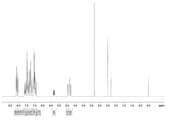
- FIG. 1 is a 1 H-NMR spectrum of the arylamine compound A1-1 (containing the residual solvent toluene) obtained in Synthesis Example 1.
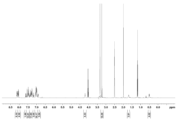
- FIG. 1 is a 1 H-NMR spectrum of arylamine compound A2 (containing ethyl acetate) obtained in Synthesis Example 2.
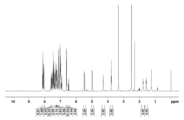
- FIG. 1 is a 1 H-NMR spectrum of arylamine compound A1-2 (containing residual solvent toluene) obtained in Synthesis Example 3.
- FIG. 1 is a 1 H-NMR spectrum of arylamine compound A3 (containing residual solvent toluene) obtained in Synthesis Example 4.
- the charge transporting varnish according to the present invention is characterized by containing a specific charge transporting substance, SiO2 nanoparticles, and a solvent.
- charge transportability is synonymous with “electrical conductivity” and "hole transportability.”
- the charge transportable varnish may be one that itself has charge transportability, or a solid film obtained from the varnish may have charge transportability.
- Charge transporting substance The charge transporting substance used in the present invention includes an arylamine derivative (excluding the compound represented by the following formula (E1)). However, it is not particularly limited and may be appropriately selected from charge transporting compounds, charge transporting oligomers, charge transporting polymers, and the like used in the field of organic electroluminescence (EL), and the like. Specific examples thereof include arylamine derivatives such as oligoaniline derivatives, N,N'-diarylbenzidine derivatives, and N,N,N',N'-tetraarylbenzidine derivatives, with arylamine derivatives represented by the formulas (T1) to (T3) described below being preferred.
- arylamine derivatives such as oligoaniline derivatives, N,N'-diarylbenzidine derivatives, and N,N,N',N'-tetraarylbenzidine derivatives, with arylamine derivatives represented by the formulas (T1) to (T3) described below being preferred.
- Ph1 represents a group represented by formula (P1).
- R3 to R6 each independently represent a hydrogen atom, a halogen atom, a nitro group, a cyano group, or an alkyl group having 1 to 20 carbon atoms, an alkenyl group having 2 to 20 carbon atoms, an alkynyl group having 2 to 20 carbon atoms, an aryl group having 6 to 20 carbon atoms, or a heteroaryl group having 2 to 20 carbon atoms, each of which may be substituted with a halogen atom.
- Halogen atoms include fluorine atoms, chlorine atoms, bromine atoms, iodine atoms, etc., with fluorine atoms being preferred.
- the alkyl group having 1 to 20 carbon atoms may be linear, branched, or cyclic, and examples thereof include linear or branched alkyl groups having 1 to 20 carbon atoms, such as methyl, ethyl, n-propyl, isopropyl, n-butyl, isobutyl, s-butyl, t-butyl, n-pentyl, n-hexyl, n-heptyl, n-octyl, n-nonyl, and n-decyl; and cyclic alkyl groups having 3 to 20 carbon atoms, such as cyclopropyl, cyclobutyl, cyclopentyl, cyclohexyl, cycloheptyl, cyclooctyl, cyclononyl, cyclodecyl, bicyclobutyl, bicyclopentyl, bicyclohexyl, bicyclo
- alkenyl groups having 2 to 20 carbon atoms include ethenyl, n-1-propenyl, n-2-propenyl, 1-methylethenyl, n-1-butenyl, n-2-butenyl, n-3-butenyl, 2-methyl-1-propenyl, 2-methyl-2-propenyl, 1-ethylethenyl, 1-methyl-1-propenyl, 1-methyl-2-propenyl, n-1-pentenyl, n-1-decenyl, and n-1-eicosenyl.
- alkynyl groups having 2 to 20 carbon atoms include ethynyl, n-1-propynyl, n-2-propynyl, n-1-butynyl, n-2-butynyl, n-3-butynyl, 1-methyl-2-propynyl, n-1-pentynyl, n-2-pentynyl, n-3-pentynyl, n-4-pentynyl, 1-methyl-n-butynyl, 2-methyl-n-butynyl, 3-methyl-n-butynyl, 1,1-dimethyl-n-propynyl, n-1-hexynyl, n-1-decynyl, n-1-pentadecinyl, and n-1-eicosynyl.
- aryl groups having 6 to 20 carbon atoms include phenyl, 1-naphthyl, 2-naphthyl, 1-anthryl, 2-anthryl, 9-anthryl, 1-phenanthryl, 2-phenanthryl, 3-phenanthryl, 4-phenanthryl, and 9-phenanthryl groups.
- heteroaryl groups having 2 to 20 carbon atoms include oxygen-containing heteroaryl groups such as 2-thienyl, 3-thienyl, 2-furanyl, 3-furanyl, 2-oxazolyl, 4-oxazolyl, 5-oxazolyl, 3-isoxazolyl, 4-isoxazolyl, and 5-isoxazolyl groups, and sulfur-containing heteroaryl groups such as 2-thiazolyl, 4-thiazolyl, 5-thiazolyl, 3-isothiazolyl, 4-isothiazolyl, and 5-isothiazolyl groups.
- oxygen-containing heteroaryl groups such as 2-thienyl, 3-thienyl, 2-furanyl, 3-furanyl, 2-oxazolyl, 4-oxazolyl, 5-oxazolyl, 3-isoxazolyl, 4-isoxazolyl, and 5-isothiazolyl groups
- sulfur-containing heteroaryl groups such as 2-thiazolyl, 4-thiazolyl, 5-thiazolyl, 3-
- a aryl group a 2-imidazolyl group, a 4-imidazolyl group, a 2-pyridyl group, a 3-pyridyl group, a 4-pyridyl group, a 2-pyrazyl group, a 3-pyrazyl group, a 5-pyrazyl group, a 6-pyrazyl group, a 2-pyrimidyl group, a 4-pyrimidyl group, a 5-pyrimidyl group, a 6-pyrimidyl group, a 3-pyridazyl group, a 4-pyridazyl group, a 5-pyridazyl group, a 6-pyridazyl group, a 1,2,3-triazin-4-yl group, a 1,2,3-triazin-5-yl group, a 1,2,4-triazine-3- yl group, 1,2,4-triazin-5-yl group, 1,2,4-triazin-6-yl group, 1,3,5-tri
- R 3 to R 6 are preferably a hydrogen atom, a fluorine atom, a cyano group, an alkyl group having 1 to 20 carbon atoms which may be substituted with a halogen atom, an aryl group having 6 to 20 carbon atoms which may be substituted with a halogen atom, or a heteroaryl group having 2 to 20 carbon atoms which may be substituted with a halogen atom, more preferably a hydrogen atom, a fluorine atom, a cyano group, an alkyl group having 1 to 10 carbon atoms which may be substituted with a halogen atom, or a phenyl group which may be substituted with a halogen atom, still more preferably a hydrogen atom, a fluorine atom, a methyl group, or a trifluoromethyl group, and most preferably a hydrogen atom.
- Ar 1 's each independently represent a group represented by any one of formulas [B1] to [B11], and are particularly preferably a group represented by any one of formulas [B1'] to [B11'].
- R 7 to R 27 , R 30 to R 51 and R 53 to R 154 each independently represent a hydrogen atom, a halogen atom, a nitro group, a cyano group, or a diphenylamino group, which may be substituted with a halogen atom, an alkyl group having 1 to 20 carbon atoms, an alkenyl group having 2 to 20 carbon atoms, an alkynyl group having 2 to 20 carbon atoms, an aryl group having 6 to 20 carbon atoms, or a heteroaryl group having 2 to 20 carbon atoms;
- R 28 and R 29 each independently represent an aryl group having 6 to 20 carbon atoms or a heteroaryl group having 2 to 20 carbon atoms, which may be substituted with Z 1 ;
- R 52 each independently represent a hydrogen atom, an alkyl group having 1 to 20 carbon atoms, an alkenyl group having 2 to 20 carbon atoms, or an alkynyl group having 2 to 20 carbon
- organosilyl group of Z4 examples include trialkylsilyl groups in which the alkyl group has 1 to 10 carbon atoms, such as trimethylsilyl group, triethylsilyl group, tripropylsilyl group, tributylsilyl group, tripentylsilyl group, trihexylsilyl group, pentyldimethylsilyl group, hexyldimethylsilyl group, octyldimethylsilyl group, and decyldimethylsilyl group.
- trialkylsilyl groups in which the alkyl group has 1 to 10 carbon atoms such as trimethylsilyl group, triethylsilyl group, tripropylsilyl group, tributylsilyl group, tripentylsilyl group, trihexylsilyl group, pentyldimethylsilyl group, hexyldimethylsilyl group, octy
- organosilyl group of Z4 examples include trialkylsilyl groups in which the alkyl group has 1 to 10 carbon atoms, such as trimethoxysilyl group, triethoxysilyl group, tri-n-propoxysilyl group, triisopropoxysilyl group, tri-n-butoxysilyl group, tri-s-butoxysilyl group, tri-t-butoxysilyl group, tri-n-pentoxysilyl group, tri-n-hexyloxysilyl group, tri-n-octyloxysilyl group, and tri-n-decyloxysilyl group.
- trimethoxysilyl group triethoxysilyl group, tri-n-propoxysilyl group, triisopropoxysilyl group, tri-n-butoxysilyl group, tri-s-butoxysilyl group, tri-t-butoxysilyl group, tri-n-pentoxysilyl group, tri-n-he
- the aryloxy group represented by Z 4 above includes aryloxy groups having 6 to 20 carbon atoms, such as a phenoxy group, an anthracenoxy group, a naphthoxy group, a phenanthrenoxy group, and a fluorenoxy group.
- R to R 27 , R to R 51 and R to R 154 are preferably a hydrogen atom, a fluorine atom, a cyano group, a diphenylamino group which may be substituted with a halogen atom, an alkyl group of 1 to 20 carbon atoms which may be substituted with a halogen atom, an aryl group of 6 to 20 carbon atoms which may be substituted with a halogen atom, or a heteroaryl group of 2 to 20 carbon atoms which may be substituted with a halogen atom, more preferably a hydrogen atom, a fluorine atom, a cyano group, an alkyl group of 1 to 10 carbon atoms which may be substituted with a halogen atom, or a phenyl group which may be substituted with a halogen atom, still more preferably a hydrogen atom, a fluorine atom, a methyl group or a trifluoromethyl group,
- R 52 is preferably a hydrogen atom, an aryl group having 6 to 20 carbon atoms which may be substituted with Z 1 , a heteroaryl group having 2 to 20 carbon atoms which may be substituted with Z 1 , or an alkyl group having 1 to 20 carbon atoms which may be substituted with Z 4 , more preferably a hydrogen atom, an aryl group having 6 to 14 carbon atoms which may be substituted with Z 1 , a heteroaryl group having 2 to 14 carbon atoms which may be substituted with Z 1 , or an alkyl group having 1 to 10 carbon atoms which may be substituted with Z 4 , still more preferably a hydrogen atom, an aryl group having 6 to 14 carbon atoms which may be substituted with Z 1 , a nitrogen-containing heteroaryl group having 2 to 14 carbon atoms which may be substituted with Z 1 , or an alkyl group having 1 to 10 carbon atoms which may be substituted with Z 4 , still more preferably a hydrogen
- Each Ar3 independently represents an aryl group having 6 to 20 carbon atoms which may be substituted with a di(aryl group having 6 to 20 carbon atoms)amino group.
- Specific examples of the aryl group having 6 to 20 carbon atoms include those similar to those explained for R to R.
- Specific examples of the di(aryl group having 6 to 20 carbon atoms)amino group include a diphenylamino group, a 1-naphthylphenylamino group, a di(1-naphthyl)amino group, a 1-naphthyl-2-naphthylamino group, and a di(2-naphthyl)amino group.
- Ar3 is preferably a phenyl group, a 1-naphthyl group, a 2-naphthyl group, a 1-anthryl group, a 2-anthryl group, a 9-anthryl group, a 1-phenanthryl group, a 2-phenanthryl group, a 3-phenanthryl group, a 4-phenanthryl group, a 9-phenanthryl group, a p-(diphenylamino)phenyl group, a p-(1-naphthylphenylamino)phenyl group, a p-(di(1-naphthyl)amino)phenyl group, a p-(1-naphthyl-2-naphthylamino)phenyl group, or a p-(di(2-naphthyl)amino)phenyl group, and more preferably a p-(diphenyla
- R 52 has the same meaning as above.
- R 155 represents a hydrogen atom, an alkyl group having 1 to 20 carbon atoms which may be substituted with Z 4 , an alkenyl group having 2 to 20 carbon atoms, or an alkynyl group having 2 to 20 carbon atoms which may be substituted with Z 1 , or an aryl group having 6 to 20 carbon atoms or a heteroaryl group having 2 to 20 carbon atoms which may be substituted with Z 1
- R 156 and R 157 each independently represent an aryl group having 6 to 20 carbon atoms or a heteroaryl group having 2 to 20 carbon atoms which may be substituted with Z 1
- DPA represents a diphenylamino group
- Ar 3 , Z 1 , and Z 3 to Z 5 have the same meaning as above.
- alkyl groups having 1 to 20 carbon atoms alkenyl groups having 2 to 20 carbon atoms, alkynyl groups having 2 to 20 carbon atoms, aryl groups having 6 to 20 carbon atoms, and heteroaryl groups having 2 to 20 carbon atoms include those described above for R3 to R6 .
- R 156 and R 157 are preferably an aryl group having 6 to 14 carbon atoms which may be substituted with Z 1 , or a heteroaryl group having 2 to 14 carbon atoms which may be substituted with Z 1 , more preferably an aryl group having 6 to 14 carbon atoms which may be substituted with Z 1 , and even more preferably a phenyl group which may be substituted with Z 1 , a 1-naphthyl group which may be substituted with Z 1 , or a 2-naphthyl group which may be substituted with Z 1 .
- the arylamine derivative represented by the formula (T1) is more preferably an arylamine derivative represented by the formula (T1-1).
- the arylamine derivative represented by formula (T1) is preferably an arylamine derivative represented by formula (T1-1), since it can be synthesized relatively easily using bis(4-aminophenyl)amine, which is a relatively inexpensive raw material compound, and has excellent solubility in organic solvents.
- Ph1 and k have the same meaning as above, and Ar4 simultaneously represents a group represented by any one of formulas [D1] to [D13], and is particularly preferably a group represented by any one of formulas [D1'] to [D13'].
- Specific examples of Ar 4 include the same as those mentioned above as specific examples of groups suitable for Ar 1 .
- the arylamine derivative represented by formula (T1) is preferably an arylamine derivative represented by formula (T1-2), since it can be synthesized relatively easily using bis(4-aminophenyl)amine, which is a relatively inexpensive raw material compound, and the resulting arylamine derivative has excellent solubility in organic solvents.
- Ar 5 also represents a group represented by any one of formulas [E1] to [E14].
- R 52 has the same meaning as above.
- k represents an integer of 1 to 10, but from the viewpoint of increasing the solubility of the compound in organic solvents, 1 to 5 is preferable, 1 to 3 is more preferable, 1 or 2 is even more preferable, and 1 is optimal.
- Z 1 is preferably a halogen atom, a nitro group, a cyano group, an alkyl group having 1 to 10 carbon atoms which may be substituted with Z 2 , an alkenyl group having 2 to 10 carbon atoms which may be substituted with Z 2 , or an alkynyl group having 2 to 10 carbon atoms which may be substituted with Z 2 , more preferably a halogen atom, a nitro group, a cyano group, an alkyl group having 1 to 3 carbon atoms which may be substituted with Z 2 , an alkenyl group having 2 to 3 carbon atoms which may be substituted with Z 2 , or an alkynyl group having 2 to 3 carbon atoms which may be substituted with Z 2 , and even more preferably a fluorine atom, an alkyl group having 1 to 3 carbon atoms which may be substituted with Z 2 , an alkyl group having 1 to 3 carbon atoms which may be substituted with Z 2
- Z 4 is preferably a halogen atom, a nitro group, a cyano group, an aryl group having 6 to 14 carbon atoms which may be substituted with Z 5 , an organosilyl group, or an aryloxy group which may have a substituent, more preferably a halogen atom, a nitro group, a cyano group, an aryl group having 6 to 10 carbon atoms which may be substituted with Z 5 , a trialkoxysilyl group, or an aryloxy group having 6 to 20 carbon atoms which may have a substituent, still more preferably a fluorine atom, an aryl group having 6 to 10 carbon atoms which may be substituted with Z 5 , a trialkoxysilyl group in which each alkoxy group has 1 to 10 carbon atoms, or an aryloxy group having 6 to 14 carbon atoms which may have a substituent
- Z 2 is preferably a halogen atom, a nitro group, a cyano group or an aryl group having 6 to 14 carbon atoms which may be substituted with Z 3, more preferably a halogen atom, a nitro group, a cyano group or an aryl group having 6 to 10 carbon atoms which may be substituted with Z 3 , still more preferably a fluorine atom or an aryl group having 6 to 10 carbon atoms which may be substituted with Z 3 , and still more preferably a fluorine atom or a phenyl group which may be substituted with Z 3.
- Z 5 is preferably a halogen atom, a nitro group, a cyano group, an alkyl group having 1 to 10 carbon atoms which may be substituted with Z 3 , an alkenyl group having 2 to 10 carbon atoms which may be substituted with Z 3 , or an alkynyl group having 2 to 10 carbon atoms which may be substituted with Z 3 , more preferably a halogen atom, a nitro group, a cyano group, an alkyl group having 1 to 3 carbon atoms which may be substituted with Z 3 , an alkenyl group having 2 to 3 carbon atoms which may be substituted with Z 3 , or an alkynyl group having 2 to 3 carbon atoms which may be substituted with Z 3 , and even more preferably a fluorine atom, an alkyl group having 1 to 3 carbon atoms which may be substituted with Z 3 , an alkyl group having 1 to 3 carbon atoms which may be substituted with Z 3
- Z 3 is preferably a halogen atom, more preferably a fluorine atom.
- Z is preferably a halogen atom, a nitro group, a cyano group, an alkyl group having 1 to 3 carbon atoms which may be substituted with Z , an alkenyl group having 2 to 3 carbon atoms which may be substituted with Z , or an alkynyl group having 2 to 3 carbon atoms which may be substituted with Z, more preferably a halogen atom or an alkyl group having 1 to 3 carbon atoms which may be substituted with Z , and even more preferably a fluorine atom or a methyl group which may be substituted with Z.
- Z is preferably a halogen atom, a nitro group, a cyano group, or an aryl group having 6 to 10 carbon atoms which may be substituted with Z , more preferably a halogen atom or an aryl group having 6 to 10 carbon atoms which may be substituted with Z , and even more preferably a fluorine atom or a phenyl group which may be substituted with Z.
- Z is preferably a halogen atom, a nitro group, a cyano group or an aryl group having 6 to 10 carbon atoms which may be substituted with Z , more preferably a halogen atom or an aryl group having 6 to 10 carbon atoms which may be substituted with Z , and even more preferably a fluorine atom or a phenyl group which may be substituted with Z.
- Z is preferably a halogen atom, a nitro group, a cyano group, an alkyl group having 1 to 3 carbon atoms which may be substituted with Z, an alkenyl group having 2 to 3 carbon atoms which may be substituted with Z , or an alkynyl group having 2 to 3 carbon atoms which may be substituted with Z , more preferably a halogen atom or an alkyl group having 1 to 3 carbon atoms which may be substituted with Z , and even more preferably a fluorine atom or a methyl group which may be substituted with Z.
- Z 3 is preferably a halogen atom, more preferably a fluorine atom.
- R 52 and R 155 include the following groups, but are not limited thereto.
- the alkyl group, alkenyl group and alkynyl group each preferably have 10 or less carbon atoms, more preferably 6 or less carbon atoms, and even more preferably 4 or less carbon atoms.
- the aryl group and heteroaryl group each preferably have 14 or less carbon atoms, more preferably 10 or less carbon atoms, and even more preferably 6 or less carbon atoms.
- the arylamine derivative represented by the formula (T1) has an organosilyl group
- a part or all of the organosilyl group may form a complex with the SiO2 nanoparticles described later.
- the arylamine derivative not only functions as a charge transport material but also functions as a silane coupling agent.
- the arylamine derivative represented by formula (T1) of the present invention can be synthesized by a known method, for example, by the method described in WO 2015/050253.
- Arylamine derivatives represented by formula (T2) include, but are not limited to, those shown below.
- Z represents a group represented by any one of the following formulas (z1) to (z6).
- Z is a group represented by formula (z3) or (z4), the carbon atom contained in this group is adjacent to the nitrogen atom in formula (T2).
- R z1 each independently represents a hydrogen atom or an alkyl group having 1 to 20 carbon atoms, preferably a hydrogen atom.
- the alkyl group having 1 to 20 carbon atoms may be linear, branched, or cyclic. Specific examples include linear or branched alkyl groups having 1 to 20 carbon atoms, such as methyl, ethyl, n-propyl, isopropyl, n-butyl, isobutyl, sec-butyl, tert-butyl, n-pentyl, n-hexyl, n-heptyl, n-octyl, n-nonyl, and n-decyl; and cyclic alkyl groups having 3 to 20 carbon atoms, such as cyclopropyl, cyclobutyl, cyclopentyl, cyclohexyl, cycloheptyl, cyclooctyl, cyclononyl, cyclodecyl, bicyclobutyl, bicyclopentyl, bicyclohexyl, bicycloh
- a group represented by the formula (z1), (z2), (z3), (z4) or (z5) is preferable, a group represented by the formula (z1), (z3) or (z5) is more preferable, and a group represented by the formula (z1) is even more preferable.
- each Ar independently represents a group represented by the following formulas (J1) to (J4).
- R z2 represents a hydrogen atom, an alkyl group having 1 to 20 carbon atoms; an aryl group having 6 to 20 carbon atoms which may be substituted with a cyano group, a nitro group, a halogen atom, an alkyl group having 1 to 20 carbon atoms, or a haloalkyl group having 1 to 20 carbon atoms; or a group represented by any of the following formulas (J5) to (J7).
- D represents a diarylamino group in which each aryl group is independently an aryl group having 6 to 20 carbon atoms.
- R z54 to R z77 will be described later.
- the alkyl group having 1 to 20 carbon atoms includes the same as those mentioned above.
- the aryl group having 6 to 20 carbon atoms includes phenyl group, 1-naphthyl group, 2-naphthyl group, 1-anthryl group, 2-anthryl group, 9-anthryl group, 1-phenanthryl group, 2-phenanthryl group, 3-phenanthryl group, 4-phenanthryl group, 9-phenanthryl group, etc.
- the diarylamino group includes diphenylamino group, dinaphthylamino group, dianthrylamino group, N-phenyl-N-naphthylamino group, N-phenyl-N-anthrylamino group, N-naphthyl-N-anthrylamino group, etc.
- R z2 is preferably a hydrogen atom, a phenyl group, a 1-naphthyl group, a 2-naphthyl group, a 1-anthryl group, a 2-anthryl group, a 9-anthryl group, a 1-phenanthryl group, a 2-phenanthryl group, a 3-phenanthryl group, a 4-phenanthryl group, a 9-phenanthryl group, a group represented by formula (J5-1), a group represented by formula (J6-1), or the like, more preferably a group represented by formula (J5-1), a group represented by formula (J6-1), or a phenyl group, and still more preferably a phenyl group.
- R z3 to R z77 each independently represent a hydrogen atom, a cyano group, a nitro group, a halogen atom, an alkyl group having 1 to 20 carbon atoms, or a haloalkyl group having 1 to 20 carbon atoms.
- alkyl group having 1 to 20 carbon atoms include those described above.
- halogen atom include a fluorine atom, a chlorine atom, a bromine atom, and an iodine atom.
- the haloalkyl group include those in which some or all of the hydrogen atoms of the alkyl group have been substituted with the halogen atoms.
- R z3 to R z77 are preferably a hydrogen atom, a cyano group, a nitro group, a halogen atom, an alkyl group having 1 to 10 carbon atoms, or a haloalkyl group having 1 to 10 carbon atoms, more preferably a hydrogen atom, a cyano group, a nitro group, a halogen atom, or a trifluoromethyl group, and even more preferably all are hydrogen atoms.
- Groups represented by formulas (J1) to (J7) include, but are not limited to, those shown below.
- Ar F each independently represents a cyano group, a chlorine atom, a bromine atom, an iodine atom, a nitro group, an alkyl group having 1 to 20 carbon atoms, a fluoroalkyl group having 1 to 20 carbon atoms, or a fluoroalkoxy group having 1 to 20 carbon atoms, a fluoroaryl group having 6 to 20 carbon atoms which may be substituted with a fluoroalkyl group having 1 to 20 carbon atoms, a fluorocycloalkyl group having 3 to 20 carbon atoms, a fluorobicycloalkyl group having 4 to 20 carbon atoms, a fluoroalkenyl group having 2 to 20 carbon atoms, or a fluoroalkynyl group having 2 to 20 carbon atoms, and which may be substituted with a cyano group, a halogen atom, or a fluoroalkoxy group having 1 to 20 carbon atoms, and which
- the fluoroaryl group is not particularly limited as long as it is an aryl group in which at least one hydrogen atom on a carbon atom is replaced with a fluorine atom, but examples thereof include 2-fluorophenyl group, 3-fluorophenyl group, 4-fluorophenyl group, 2,3-difluorophenyl group, 2,4-difluorophenyl group, 2,5-difluorophenyl group, 2,6-difluorophenyl group, 3,4-difluorophenyl group, 3,5-difluorophenyl group, 2,3,4-trifluorophenyl group, 2 , 3,5-trifluorophenyl group, 2,3,6-trifluorophenyl group, 2,4,5-trifluorophenyl group, 2,4,6-trifluorophenyl group, 3,4,5-trifluorophenyl group, 2,3,4,5-tetrafluorophenyl group, 2,3,4,6-tetra
- a phenyl group substituted with three or more fluorine atoms which may be substituted with a cyano group, a chlorine atom, a bromine atom, an iodine atom, a nitro group, an alkyl group having 1 to 20 carbon atoms, a fluoroalkyl group having 1 to 20 carbon atoms, or a fluoroalkoxy group having 1 to 20 carbon atoms, is preferred.
- the aryl group having 6 to 20 carbon atoms (hereinafter, for convenience, also referred to as a substituted aryl group) which is substituted with the above-mentioned fluoroalkyl group having 1 to 20 carbon atoms, fluorocycloalkyl group having 3 to 20 carbon atoms, fluorobicycloalkyl group having 4 to 20 carbon atoms, fluoroalkenyl group having 2 to 20 carbon atoms, or fluoroalkynyl group having 2 to 20 carbon atoms and may be substituted with a cyano group, a halogen atom, or a fluoroalkoxy group having 1 to 20 carbon atoms, is not particularly limited as long as it is an aryl group in which at least one hydrogen atom on a carbon atom is substituted with a fluoroalkyl group having 1 to 20 carbon atoms, fluorocycloalkyl group having 3 to 20 carbon atoms, fluorobicycloalkyl group having 4 to
- the fluoroalkyl group is not particularly limited as long as it is a linear or branched alkyl group in which at least one hydrogen atom on a carbon atom is replaced with a fluorine atom, but examples thereof include a fluoromethyl group, a difluoromethyl group, a trifluoromethyl group, a 1-fluoroethyl group, a 2-fluoroethyl group, a 1,2-difluoroethyl group, a 1,1-difluoroethyl group, a 2,2-difluoroethyl group, a 1,1,2-trifluoroethyl group, a 1,2,2-trifluoroethyl group, a 2,2,2-trifluoroethyl group, a 1,1,2,2-tetrafluoroethyl group, a 1,2,2,2-tetrafluoroethyl group, a 1,1,2,2,2-pentafluoroethyl group,
- the fluoroalkoxy group is not particularly limited as long as it is an alkoxy group in which at least one hydrogen atom on a carbon atom is replaced with a fluorine atom, but examples include a fluoromethoxy group, a difluoromethoxy group, a trifluoromethoxy group, a 1-fluoroethoxy group, a 2-fluoroethoxy group, a 1,2-difluoroethoxy group, a 1,1-difluoroethoxy group, a 2,2-difluoroethoxy group, a 1,1,2-trifluoroethoxy group, and a 1,2,2-trifluoroethoxy group.
- the above-mentioned fluorocycloalkyl group is not particularly limited as long as it is a cycloalkyl group in which at least one hydrogen atom on a carbon atom is replaced with a fluorine atom, but examples thereof include 1-fluorocyclopropyl group, 2-fluorocyclopropyl group, 2,2-difluorocyclopropyl group, 2,2,3,3-tetrafluorocyclopropyl group, pentafluorocyclopropyl group, 2,2-difluorocyclobutyl group, 2,2,3,3-tetrafluorocyclobutyl group, 2,2,3,3,4,4-hexafluorocyclobutyl group, heptafluorocyclobutyl group, Examples include orocyclobutyl group, 1-fluorocyclopentyl group, 3-fluorocyclopentyl group, 3,3-difluorocyclopentyl group, 3,3,4,4-tetrafluor
- the fluorobicycloalkyl group is not particularly limited as long as it is a bicycloalkyl group in which at least one hydrogen atom on a carbon atom is replaced with a fluorine atom, and examples thereof include 3-fluorobicyclo[1.1.0]butan-1-yl group, 2,2,4,4-tetrafluorobicyclo[1.1.0]butan-1-yl group, pentafluorobicyclo[1.1.0]butan-1-yl group, 3-fluorobicyclo[1.1.1]pentan-1-yl group, 2,2,4,4,5-pentafluorobicyclo[1.1.1]pentan-1-yl group, 2,2,4,4,5,5-hexafluorobicyclo[1.1.1]pentan-1-yl group, 5-fluorobicyclo[3.1.0]hexan-6-yl group, and 6-fluorobicyclo[3.1.0]hexan-6-yl group.
- the fluoroalkenyl group is not particularly limited as long as it is an alkenyl group in which at least one hydrogen atom on a carbon atom is replaced with a fluorine atom, and examples thereof include 1-fluoroethenyl group, 2-fluoroethenyl group, 1,2-difluoroethenyl group, 1,2,2-trifluoroethenyl group, 2,3,3-trifluoro-1-propenyl group, 3,3,3-trifluoro-1-propenyl group, 2,3,3,3-tetrafluoro-1-propenyl group, pentafluoro-1-propenyl group, 1-fluoro-2-propenyl group, 1,1-difluoro-2-propenyl group, 2,3-difluoro-2-propenyl group, 3,3-difluoro-2-propenyl group, 2,3,3-trifluoro-2-propenyl group, 1,2,3,3-tetrafluor
- the above fluoroalkynyl group is not particularly limited as long as it is an alkynyl group in which at least one hydrogen atom on a carbon atom is replaced with a fluorine atom, but examples include a fluoroethynyl group, a 3-fluoro-1-propynyl group, a 3,3-difluoro-1-propynyl group, a 3,3,3-trifluoro-1-propynyl group, a 1-fluoro-2-propynyl group, and a 1,1-difluoro-2-propynyl group.
- Ar F is preferably the above-mentioned optionally substituted fluoroaryl group having 6 to 20 carbon atoms or the above-mentioned substituted aryl group, more preferably the above-mentioned optionally substituted fluorophenyl group or the above-mentioned substituted phenyl group, and even more preferably the above-mentioned optionally substituted trifluorophenyl group, the above-mentioned optionally substituted tetrafluorophenyl group, the above-mentioned optionally substituted pentafluorophenyl group or a phenyl group substituted with 1 to 3 trifluoromethyl groups. From the viewpoint of ease of synthesis of the arylamine derivative, it is preferable that Ar F are the same group.
- arylamine derivatives represented by formula (T2) are given below, but are not limited to these.
- the arylamine derivative represented by formula (T2) of the present invention can be synthesized by a known method, for example, by the method described in WO 2017/122649.
- each Ar c independently represents a group represented by the following formula (Q), each Y independently represents an optionally substituted phenylene group, and each g independently represents an integer of 1 to 10.
- each Ar c independently represents a group represented by the following formula (Q') or (Q''):
- R q1 each independently represents a hydrogen atom, a halogen atom, a nitro group, a cyano group, an alkyl group having 1 to 20 carbon atoms, a halogenated alkyl group having 1 to 20 carbon atoms, an alkoxy group having 1 to 20 carbon atoms, or an aryl group having 6 to 20 carbon atoms;
- R q2 each independently represents an aryl group which may be substituted and which may contain a heteroatom;
- Ar s each independently represents an arylene group which may be substituted and which may contain a heteroatom.
- halogen atom examples include a fluorine atom, a chlorine atom, a bromine atom, and an iodine atom.
- the alkyl group having 1 to 20 carbon atoms may be linear, branched, or cyclic, and examples thereof include linear or branched alkyl groups having 1 to 20 carbon atoms, such as methyl, ethyl, n-propyl, isopropyl, n-butyl, isobutyl, s-butyl, t-butyl, n-pentyl, n-hexyl, n-heptyl, n-octyl, n-nonyl, and n-decyl groups; and cyclic alkyl groups having 3 to 20 carbon atoms, such as cyclopropyl, cyclobutyl, cyclopentyl, cyclohexyl, cycloheptyl, cyclooctyl
- the alkyl group may be linear, branched, or cyclic, and specific examples include methoxy, ethoxy, n-propoxy, isopropoxy, n-butoxy, isobutoxy, s-butoxy, t-butoxy, n-pentoxy, n-hexyloxy, n-octyloxy, n-decyloxy, 2-methylhexyloxy, 2-ethylhexyloxy, 2-n-propylhexyloxy, 2-n-butylhexyloxy, 2-ethyldecyloxy, and 3-ethylhexyloxy groups.
- aryl groups having 6 to 20 carbon atoms include phenyl, 1-naphthyl, 2-naphthyl, 1-anthryl, 2-anthryl, 9-anthryl, 1-phenanthryl, 2-phenanthryl, 3-phenanthryl, 4-phenanthryl, and 9-phenanthryl groups.
- Halogenated alkyl groups having 1 to 20 carbon atoms are groups in which at least one hydrogen atom of the alkyl groups having 1 to 20 carbon atoms is replaced with a halogen atom, and specific examples include fluoromethyl, difluoromethyl, trifluoromethyl, bromodifluoromethyl, 2-chloroethyl, 2-bromoethyl, 1,1-difluoroethyl, 2,2,2-trifluoroethyl, 1,1,2,2-tetrafluoroethyl, 2-chloro-1,1,2-trifluoroethyl, pentafluoroethyl, 3-bromopropyl, 2,2,3,3-tetrafluoropropyl, 1,1,2,3,3,3-hexafluoropropyl, 1,1,1,3,3,3-hexafluoropropan-2-yl, 3-bromo-2-methylpropyl, 4-bromobutyl, perfluoropentyl, and 2-
- R q1 is preferably a hydrogen atom, an alkyl group having 1 to 20 carbon atoms, an alkoxy group having 1 to 20 carbon atoms, or an aryl group having 6 to 20 carbon atoms, more preferably a hydrogen atom or an alkyl group having 1 to 10 carbon atoms, and even more preferably all are hydrogen atoms.
- the aryl group of R q2 in the above formulae (Q), (Q') and (Q'') which may be substituted and may contain a heteroatom is an arylene group which may contain a heteroatom as a constituent atom, and may have a structure in which rings are condensed or linked.
- the number of carbon atoms is not particularly limited, but is usually 6 to 60, preferably 40 or less, more preferably 30 or less.
- substituent of the aryl group of R q2 which may be substituted and may contain a heteroatom include a halogen atom, a nitro group, a cyano group, an alkyl group having 1 to 20 carbon atoms, an alkenyl group having 2 to 20 carbon atoms, an alkynyl group having 2 to 20 carbon atoms, a halogenated alkyl group having 1 to 20 carbon atoms, an alkoxy group having 1 to 20 carbon atoms, and an aryl group having 6 to 20 carbon atoms.
- halogen atom the alkyl group having 1 to 20 carbon atoms
- halogenated alkyl group having 1 to 20 carbon atoms the alkoxy group having 1 to 20 carbon atoms
- aryl group having 6 to 20 carbon atoms are the same as those mentioned above.
- alkenyl groups having 2 to 20 carbon atoms include ethenyl, n-1-propenyl, n-2-propenyl, 1-methylethenyl, n-1-butenyl, n-2-butenyl, n-3-butenyl, 2-methyl-1-propenyl, 2-methyl-2-propenyl, 1-ethylethenyl, 1-methyl-1-propenyl, 1-methyl-2-propenyl, n-1-pentenyl, n-1-decenyl, and n-1-eicosenyl groups.
- alkynyl groups having 2 to 20 carbon atoms include ethynyl, n-1-propynyl, n-2-propynyl, n-1-butynyl, n-2-butynyl, n-3-butynyl, 1-methyl-2-propynyl, n-1-pentynyl, n-2-pentynyl, n-3-pentynyl, n-4-pentynyl, 1-methyl-n-butynyl, 2-methyl-n-butynyl, 3-methyl-n-butynyl, 1,1-dimethyl-n-propynyl, n-1-hexynyl, n-1-decynyl, n-1-pentadecinyl, and n-1-eicosynyl groups.
- an aryl group having 6 to 10 carbon atoms which may be substituted and which may contain a heteroatom is preferable, an optionally substituted phenyl group or an optionally substituted naphthyl group is more preferable, both of which are still more preferably a phenyl group or a naphthyl group, and both of which are still more preferably a phenyl group.
- Specific examples of groups suitable as R q2 are shown below, but are not limited thereto.
- the optionally substituted arylene group of Ars in the above formulae (Q), (Q') and (Q'') which may contain a heteroatom is an arylene group which may contain a heteroatom as a constituent atom, and may have a structure in which rings are condensed or a structure in which rings are linked.
- the number of carbon atoms is not particularly limited, but is usually 6 to 60, preferably 40 or less, more preferably 30 or less.
- Each R q3 independently represents a hydrogen atom, a halogen atom, a nitro group, a cyano group, an alkyl group having 1 to 20 carbon atoms, a halogenated alkyl group having 1 to 20 carbon atoms, an alkoxy group having 1 to 20 carbon atoms, or an aryl group having 6 to 20 carbon atoms; each V 1 independently represents C(R q4 ) 2 (each R q4 independently represents a hydrogen atom, an alkyl group having 1 to 20 carbon atoms, or a halogenated alkyl group having 1 to 20 carbon atoms), NR q5 (R q5 represents a hydrogen atom, an alkyl group having 1 to 20 carbon atoms, or an aryl group having 6 to 20 carbon atoms), S, O, or SO 2 ; and V 2 independently represents NR q5 (R q5 has the same meaning as above), S, or O.
- examples of the halogen atom, the alkyl group having 1 to 20 carbon atoms, the alkoxy group having 1 to 20 carbon atoms, the aryl group having 6 to 20 carbon atoms, and the halogenated alkyl group having 1 to 20 carbon atoms are the same as those mentioned above.
- R q3 is preferably each independently a hydrogen atom, a halogen atom, a nitro group, a cyano group, an alkyl group having 1 to 10 carbon atoms, or a halogenated alkyl group having 1 to 10 carbon atoms, more preferably a hydrogen atom, an alkyl group having 1 to 5 carbon atoms, or a fluoroalkyl group having 1 to 5 carbon atoms, and still more preferably a hydrogen atom, a methyl group, or a trifluoromethyl group.
- Each R q4 is independently preferably an alkyl group having 1 to 10 carbon atoms, more preferably an alkyl group having 1 to 5 carbon atoms, and all of them are still more preferably a methyl group.
- R q5 is preferably a hydrogen atom, an alkyl group having 1 to 10 carbon atoms, or an aryl group having 6 to 10 carbon atoms, more preferably a hydrogen atom, an alkyl group having 1 to 5 carbon atoms, a phenyl group, or a naphthyl group, and still more preferably a hydrogen atom, a methyl group, or a phenyl group.
- Ars is preferably a group represented by any one of the following formulas (101A) to (118A).
- Examples of the optionally substituted phenylene group for Y in the above formula (T3) include 1,4-phenylene groups, 1,3-phenylene groups, and 1,2-phenylene groups that may be substituted with a halogen atom, an alkyl group, an alkenyl group, an alkynyl group, or the like, with the 1,4-phenylene group or 1,3-phenylene group being preferred.
- g's each independently represent an integer from 1 to 10. Taking into consideration the solubility of the compound in an organic solvent and the transparency of the resulting thin film, an integer from 1 to 7 is preferred, an integer from 1 to 5 is more preferred, an integer from 1 to 3 is even more preferred, and 1 or 2 is even more preferred. Taking into consideration the availability of the raw material compounds, 1 is optimal.
- Ars is preferably a group represented by formula (107), more preferably a group represented by any one of formulas (107A) to (107C), still more preferably a group represented by any one of formulas (107A-1) to (107C-5), and even more preferably a group represented by formula (107B-1) or (107C-1).
- Ar c in formula (T3) be the same group.
- Ar c is preferably a group (Ar C1 ) represented by formula (Q-1), and more preferably a group (Ar C2 ) represented by formula (Q-2) or a group (Ar C3 ) represented by formula (Q-3).
- R q1 , R q2 and R q4 have the same meanings as above.
- the arylamine compound of the present invention is represented by the following formula (T3-1), and in a more preferred embodiment, is represented by either of the following formulas (T3-2) and (T3-3).
- the arylamine derivative represented by formula (T3) of the present invention can be synthesized by a known method, for example, by the method described in WO 2020/241730.
- the content of the charge transporting substance in the charge transporting varnish of the present invention is usually determined appropriately taking into consideration the desired film thickness, the viscosity of the varnish, etc., and is preferably within the range of 10 to 90% by mass, more preferably 15 to 85% by mass, and even more preferably 20 to 80% by mass of the solid content.
- SiO2 nanoparticles The charge transport varnish of the present invention contains SiO2 nanoparticles. Note that nanoparticles refer to fine particles whose primary particle average particle diameter is on the order of nanometers (typically 500 nm or less). SiO2 nanoparticles refer to SiO2 formed into nanoparticles.
- the primary particle size of the SiO2 nanoparticles is not particularly limited as long as it is nano-sized, but is usually 5 nm or more, and from the viewpoint of ensuring good dispersibility of the particles, ease of production, etc., it is usually 200 nm or less, preferably 100 nm or less, and more preferably 30 nm or less.
- the SiO2 nanoparticles may be surface-treated with a silane coupling agent.
- a silane coupling agent include a silane coupling agent represented by the following formula (S1) and a compound represented by the formula (T1-4), which is a new compound described below, but are not limited thereto.
- R v1 to R v3 each independently represent a hydrogen atom, a chlorine atom, a hydroxyl group, an alkoxy group which may have a substituent, or an alkyl group which may have a substituent
- At least one of R v1 to R v3 represents a hydrogen atom, a chlorine atom, a hydroxyl group, or an alkoxy group which may have a substituent
- L represents a single bond or an alkylene group having 1 to 10 carbon atoms
- R v4 represents an alkyl group having 1 to 10 carbon atoms, which may have at least one substituent selected from the group consisting of a halogen atom, a sulfo group, and a hydroxy group
- an alkoxy group having 1 to 10 carbon atoms which may have at least one substituent selected from the group consisting of a halogen atom, a sulfo group, and a hydroxy group
- the alkoxy groups of R v1 to R v3 may have an alkyl group that is linear, branched, or cyclic, and specific examples thereof include alkoxy groups having 1 to 10 carbon atoms, such as a methoxy group, an ethoxy group, an n-propoxy group, an isopropoxy group, an n-butoxy group, an isobutoxy group, a sec-butoxy group, a tert-butoxy group, an n-pentoxy group, an n-hexoxy group, an n-heptyloxy group, an n-octyloxy group, an n-nonyloxy group, or an n-decyloxy group.
- An alkoxy group having 1 to 5 carbon atoms is preferred, an alkoxy group having 1 to 3 carbon atoms is more preferred, and a methoxy group or an ethoxy group is even more preferred.
- the alkyl group of R v1 to R v3 may be either linear or branched, and specific examples thereof include alkyl groups having 1 to 10 carbon atoms, such as a methyl group, an ethyl group, an n-propyl group, an isopropyl group, an n-butyl group, an isobutyl group, a sec-butyl group, a tert-butyl group, an n-pentyl group, a cyclopentyl group, an n-hexyl group, a cyclohexyl group, an n-heptyl group, an n-octyl group, an n-nonyl group, and an n-decyl group.
- alkyl groups having 1 to 10 carbon atoms such as a methyl group, an ethyl group, an n-propyl group, an isopropyl group, an n-butyl group, an iso
- An alkyl group having 1 to 5 carbon atoms is preferable, an alkyl group having 1 to 3 carbon atoms is more preferable, and a methyl group, an ethyl group, and an n-propyl group are even more preferable.
- R v1 to R v3 may have a substituent.
- substituents include a halogen atom, a hydroxy group, an amino group, an organosilyl group, etc.
- the number of the substituents is preferably 1 to 6, and more preferably 1 to 3.
- Halogen atoms include fluorine, chlorine, bromine and iodine atoms, with fluorine atoms being preferred.
- Organosilyl groups include trialkylsilyl groups, such as trimethylsilyl, triethylsilyl, tripropylsilyl, tributylsilyl, tripentylsilyl, trihexylsilyl, pentyldimethylsilyl, hexyldimethylsilyl, octyldimethylsilyl, and decyldimethylsilyl, in which the alkyl group has 1 to 10 carbon atoms.
- trialkoxysilyl groups such as trimethoxysilyl, triethoxysilyl, tri-n-propoxysilyl, triisopropoxysilyl, tri-n-butoxysilyl, tri-s-butoxysilyl, tri-t-butoxysilyl, tri-n-pentoxysilyl, tri-n-hexyloxysilyl, tri-n-octyloxysilyl, and tri-n-decyloxysilyl, in which the alkoxy group has 1 to 10 carbon atoms, are also included.
- the alkylene group of L having 1 to 10 carbon atoms may be linear, branched, or cyclic, and specific examples include methylene, ethylene, propylene, trimethylene, tetramethylene, pentamethylene, hexamethylene, heptamethylene, octamethylene, nonamethylene, and decylene groups.
- alkylene groups having 2 to 5 carbon atoms are preferred, alkylene groups having 2 to 4 carbon atoms are more preferred, and ethylene, trimethylene, and tetramethylene groups are even more preferred.
- halogen atom for R v4 examples include the same as those exemplified above.
- the alkyl group therein may be any of linear, branched, and cyclic, and specific examples thereof include a methoxy group, an ethoxy group, an n-propoxy group, an isopropoxy group, an n-butoxy group, an isobutoxy group, a sec-butoxy group, a tert-butoxy group, an n-pentoxy group, an n-hexoxy group, an n-heptyloxy group, an n-octyloxy group, an n-nonyloxy group, and an n-decyloxy group.
- An alkoxy group having 1 to 5 carbon atoms is preferable, an alkoxy group having 1 to 3 carbon atoms is more preferable, and a methoxy group, an ethoxy group, or an n-propoxy group is even more preferable.
- R v4 has a substituent
- the number of the substituents is preferably 1 to 10, and more preferably 1 to 7.
- the silane coupling agent represented by the above formula (S1) is preferably one in which R v1 to R v3 are an alkyl group having 1 to 10 carbon atoms which may have a substituent, an alkoxy group having 1 to 10 carbon atoms which may have a substituent, or a hydroxy group, more preferably an alkyl group having 1 to 5 carbon atoms which may have a substituent or an alkoxy group having 1 to 5 carbon atoms which may have a substituent, even more preferably an alkyl group having 1 to 3 carbon atoms which may have a substituent or an alkoxy group having 1 to 3 carbon atoms which may have a substituent, and further preferably a methyl group, an ethyl group, a methoxy group, or an ethoxy group.
- At least one is an alkoxy group having 1 to 10 carbon atoms which may have a substituent, and it is even more preferable that at least one is an alkoxy group having 1 to 5 carbon atoms which may have a substituent.
- silane coupling agent represented by the above formula (S1) examples include trimethoxy(methyl)silane, trimethoxy(3-methoxypropyl)silane, trimethoxy(propyl)silane, trimethoxy(4-methoxyphenyl)silane, trimethoxyphenylsilane, methoxytrimethylsilane, [3-(1,1,2,3,3,3-hexafluoropropoxy)propyl]trimethoxysilane, trifluoropropyltrimethoxysilane, 1,1,1-trifluoro-2-(trifluoromethyl)-5-(trimethoxysilyl)pentan-2-ol, trimethoxy[3-(perfluorophenyl)propyl]silane, Examples of these include trimethoxyphenylsilane, ethoxytriethylsilane, methoxydimethyl(phenyl)silane, pentafluorophen
- L k represents an alkylene group having 2 to 10 carbon atoms
- R k represents an alkoxy group having 1 to 5 carbon atoms.
- Specific examples of L k are similar to the alkyl groups having 2 to 10 carbon atoms among the alkyl groups having 1 to 20 carbon atoms which may be substituted by Z 4 of R 52
- specific examples of -Si(R k ) 3 are similar to the organosilyl groups described in the explanation of Z 4 .
- the silane coupling agent may be a commercially available product. It can also be obtained by reacting various allyl compounds with a metal catalyst using a known method of hydrosilylation (for example, see non-patent document RSC Adv., 2015, 20603-20616.).
- the primary particle diameter of the SiO2 nanoparticles constituting the above-mentioned surface-treated SiO2 nanoparticles is not particularly limited as long as it is nano-sized, but is usually 5 nm or more, and from the viewpoint of ensuring good dispersibility of the particles and ease of production, etc., it is usually 200 nm or less, preferably 100 nm or less, and more preferably 30 nm or less.
- the content of SiO2 nanoparticles or surface-treated SiO2 nanoparticles contained in the charge-transporting varnish of the present invention is not particularly limited, but from the viewpoint of improving the hole transport property of the obtained thin film and enhancing the uniformity of the film, the lower limit of the solid content is preferably 10 mass%, more preferably 15 mass%, and even more preferably 20 mass%, and the upper limit is preferably 90 mass%, more preferably 85 mass%, and even more preferably 80 mass%.
- T1-4 is an arylaniline derivative
- the SiO 2 nanoparticles or surface-treated SiO 2 nanoparticles used in the present invention may be used in the form of a sol dispersed in a dispersion medium.
- the dispersion medium include methanol, methyl ethyl ketone, methyl isobutyl ketone, N,N-dimethylacetamide, ethylene glycol, isopropanol, methanol, ethylene glycol monopropyl ether, cyclohexanone, ethyl acetate, toluene, propylene glycol monomethyl ether acetate, and triethylene glycol butyl methyl ether.
- the solid content concentration of the sol is not particularly limited, but is preferably from 5 to 60% by mass, more preferably from 5 to 50% by mass, and even more preferably from 5 to 35% by mass.
- the amount of the sol used is appropriately determined in consideration of the concentration so that the amount of surface-treated SiO 2 nanoparticles finally contained in the varnish is the blended amount of the SiO 2 nanoparticles described above.
- a high polarity solvent capable of dissolving the charge transporting material used can be used.
- a low polarity solvent may be used because it has better process compatibility than a high polarity solvent.
- a low polarity solvent is defined as a solvent having a relative dielectric constant of less than 7 at a frequency of 100 kHz
- a high polarity solvent is defined as a solvent having a relative dielectric constant of 7 or more at a frequency of 100 kHz.
- low polarity solvents examples include Chlorinated solvents such as chloroform and chlorobenzene; Aromatic hydrocarbon solvents such as toluene, xylene, tetralin, cyclohexylbenzene, and decylbenzene; Aliphatic alcohol solvents such as 1-octanol, 1-nonanol, and 1-decanol; Ether solvents such as tetrahydrofuran, dioxane, anisole, 4-methoxytoluene, 3-phenoxytoluene, dibenzyl ether, diethylene glycol dimethyl ether, diethylene glycol butyl methyl ether, triethylene glycol dimethyl ether, and triethylene glycol butyl methyl ether;
- the solvent include ester-based solvents such as methyl benzoate, ethyl benzoate, butyl benzoate, isoamyl benzoate, dimethyl phthalate, bis(2-ethylhexy
- highly polar solvents include Amide solvents such as N,N-dimethylformamide, N,N-dimethylacetamide, N,N-dimethylisobutyramide, N-methylpyrrolidone, and 1,3-dimethyl-2-imidazolidinone; Ketone solvents such as ethyl methyl ketone, isophorone, and cyclohexanone; Cyano-based solvents such as acetonitrile and 3-methoxypropionitrile; Polyhydric alcohol solvents such as ethylene glycol, diethylene glycol, triethylene glycol, dipropylene glycol, 1,3-butanediol, and 2,3-butanediol; monohydric alcohol solvents other than aliphatic alcohols, such as diethylene glycol monomethyl ether, diethylene glycol monophenyl ether, triethylene glycol monomethyl ether, dipropylene glycol monomethyl ether, benzyl alcohol, 2-phenoxyethanol, 2-benzyl
- the charge-transporting varnish of the present invention may contain a dopant substance for the purpose of improving the charge-transporting ability, etc., depending on the application of the resulting thin film.
- the dopant substance is not particularly limited as long as it dissolves in at least one solvent used in the varnish, and both inorganic and organic dopant substances can be used.
- the inorganic and organic dopant substances may be used alone or in combination of two or more.
- a dopant substance is contained, its content cannot be generally defined since it is appropriately determined taking into consideration the type of the dopant substance, the desired degree of charge transportability, etc., but is usually within a range of 0.0001 to 100.0 in terms of mass ratio per 1 part of the charge transporting substance.
- Inorganic dopant substances include inorganic acids such as hydrogen chloride, sulfuric acid, nitric acid, and phosphoric acid; metal halides such as aluminum chloride (III) (AlCl 3 ), titanium tetrachloride (IV) (TiCl 4 ), boron tribromide (BBr 3 ), boron trifluoride ether complex (BF 3 .OEt 2 ), iron chloride (III) (FeCl 3 ), copper chloride (II) (CuCl 2 ), antimony pentachloride (V) (SbCl 5 ), antimony pentafluoride (V) (SbF 5 ), arsenic pentafluoride (V) (AsF 5 ), phosphorus pentafluoride (PF 5 ), and tris(4-bromophenyl)aluminum hexachloroantimonate (TBPAH); and metal halides such as Cl 2 , Br 2 , I 2 ,
- organic dopant substances include tetracyanoquinodimethanes such as 7,7,8,8-tetracyanoquinodimethane (TCNQ) and 2,5-difluoro-7,7,8,8-tetracyanoquinodimethane; tetrafluoro-7,7,8,8-tetracyanoquinodimethane (F4TCNQ), tetrachloro-7,7,8,8-tetracyanoquinodimethane, 2-fluoro-7,7,8,8-tetracyanoquinodimethane, 2-chloro-7,7,8,8-tetracyanoquinodimethane, 2,5-difluoro-7,7,8,8-tetracyanoquinodimethane, 2,5- Halotetracyanoquinodimethanes (haloTCNQs) such as dichloro-7,7,8,8-tetracyanoquinodimethane; benzoquinone derivatives such as
- arylsulfonic acid compounds are preferred, and examples of preferred arylsulfonic acid compounds include arylsulfonic acid compounds represented by formula (H1) or (H2).
- a 1 represents O or S, with O being preferred.
- A2 represents a naphthalene ring or an anthracene ring, with a naphthalene ring being preferred.
- A3 represents a divalent to tetravalent perfluorobiphenyl group, s represents the number of bonds between A1 and A3 and is an integer satisfying 2 ⁇ s ⁇ 4, but it is preferable that A3 is a perfluorobiphenyldiyl group, preferably a perfluorobiphenyl-4,4′-diyl group, and s is 2.
- q represents the number of sulfonic acid groups bonded to A2 and is an integer satisfying 1 ⁇ q ⁇ 4, with 2 being optimal.
- a 4 to A 8 each independently represent a hydrogen atom, a halogen atom, a cyano group, an alkyl group having 1 to 20 carbon atoms, a halogenated alkyl group having 1 to 20 carbon atoms, or a halogenated alkenyl group having 2 to 20 carbon atoms, provided that at least three of A 4 to A 8 are halogen atoms.
- Halogenated alkyl groups having 1 to 20 carbon atoms include trifluoromethyl, 2,2,2-trifluoroethyl, 1,1,2,2,2-pentafluoroethyl, 3,3,3-trifluoropropyl, 2,2,3,3,3-pentafluoropropyl, 1,1,2,2,3,3,3-heptafluoropropyl, 4,4,4-trifluorobutyl, 3,3,4,4,4-pentafluorobutyl, 2,2,3,3,4,4,4-heptafluorobutyl, and 1,1,2,2,3,3,4,4,4-nonafluorobutyl groups.
- halogenated alkenyl group having 2 to 20 carbon atoms examples include a perfluorovinyl group, a perfluoropropenyl group (allyl group), and a perfluorobutenyl group.
- Other examples of the halogen atom and the alkyl group having 1 to 20 carbon atoms include those similar to those mentioned above, with the halogen atom being preferably a fluorine atom.
- a 4 to A 8 are a hydrogen atom, a halogen atom, a cyano group, an alkyl group having 1 to 10 carbon atoms, a halogenated alkyl group having 1 to 10 carbon atoms, or a halogenated alkenyl group having 2 to 10 carbon atoms, and at least three of A 4 to A 8 are fluorine atoms, and it is more preferable that A 4 to A 8 are a hydrogen atom, a fluorine atom, a cyano group, an alkyl group having 1 to 5 carbon atoms, a fluorinated alkyl group having 1 to 5 carbon atoms, or a fluorinated alkenyl group having 2 to 5 carbon atoms, and at least three of A 4 to A 8 are fluorine atoms, and it is even more preferable that A 4 , A 5 and A 8 are fluorine atoms.
- the perfluoroalkyl group is an alkyl group in which all hydrogen atoms have been substituted with fluorine atoms
- the perfluoroalkenyl group is an alkenyl group in which all hydrogen atoms have been substituted with fluorine atoms.
- r represents the number of sulfonic acid groups bonded to the naphthalene ring and is an integer satisfying 1 ⁇ r ⁇ 4, with 2 to 4 being preferred and 2 being optimal.
- the molecular weight thereof is preferably 3,000 or less, more preferably 2,500 or less, taking into consideration the solubility in organic solvents.
- the molecular weight of the low molecular weight arylsulfonic acid compound used as the dopant material is not particularly limited, but is preferably 2,000 or less, more preferably 1,500 or less, taking into consideration the solubility in organic solvents.
- the amount of the arylsulfonic acid compound used is preferably about 0.01 to 20.0, more preferably about 0.4 to 5.0, per 1 charge transport substance such as a polythiophene derivative or an arylamine derivative, in terms of mole ratio.
- the dopant substance may also be a substance whose function as a dopant substance is first expressed or improved by, for example, part of the molecule being removed by an external stimulus, such as heating during baking, during the process of obtaining a charge-transporting thin film, which is a solid film, from the varnish, for example an arylsulfonic acid ester compound protected by a group that easily removes the sulfonic acid group.
- the arylsulfonate compound is not particularly limited as long as it has a sulfonate ester group bonded to an aromatic ring.
- the molecular weight of the arylsulfonate compound is not particularly limited. In a preferred embodiment of the present invention, the molecular weight of the arylsulfonate compound is preferably 100 or more, more preferably 200 or more, and preferably 5,000 or less, more preferably 4,000 or less, even more preferably 3,000 or less, and even more preferably 2,000 or less.
- the number of sulfonate ester groups in the arylsulfonate compound is preferably 2 or more, more preferably 3 or more, and preferably 6 or less, more preferably 5 or less.
- the arylsulfonate compound preferably contains an aromatic ring substituted with fluorine.
- aryl sulfonate compound examples include the aryl sulfonate compounds disclosed in WO 2017/217455, the aryl sulfonate compounds disclosed in WO 2017/217457, and the aryl sulfonate compounds described in WO 2019/124412.
- the arylsulfonic acid ester compound is preferably one represented by the following formula (B1) or (B1').
- a 01 is an s-valent hydrocarbon group having 6 to 20 carbon atoms containing one or more aromatic rings, which may have a substituent, or an s-valent group derived from a compound represented by formula (B1a) or (B1b) below (i.e., a group obtained by removing s hydrogen atoms on the aromatic ring of a compound represented by formula (B1a) or (B1b) below).
- W 1 and W 2 each independently represent -O-, -S-, -S(O)- or -S(O 2 )-, or -N-, -Si-, -P- or -P(O)- which may have a substituent.
- An s-valent hydrocarbon group having 6 to 20 carbon atoms and containing one or more aromatic rings is a group obtained by removing s hydrogen atoms from a hydrocarbon having 6 to 20 carbon atoms and containing one or more aromatic rings.
- Examples of the above-mentioned hydrocarbons containing one or more aromatic rings include benzene, toluene, xylene, biphenyl, naphthalene, anthracene, pyrene, etc. Of these, groups derived from benzene, biphenyl, etc. are preferred as s-valent hydrocarbon groups.
- hydrocarbon groups may further have some or all of their hydrogen atoms substituted with a substituent.
- substituents include halogen atoms (fluorine, chlorine, bromine, and iodine atoms), nitro, cyano, hydroxy, amino, silanol, thiol, carboxy, sulfonate esters, phosphoric acid, phosphate esters, esters, thioesters, amides, monovalent hydrocarbons, organooxy, organoamino, organosilyl, organothio, acyl, and sulfo groups.
- the monovalent hydrocarbon group may be linear, branched, or cyclic, and specific examples include alkyl groups having 1 to 10 carbon atoms, such as methyl, ethyl, n-propyl, isopropyl, n-butyl, isobutyl, sec-butyl, tert-butyl, n-pentyl, cyclopentyl, n-hexyl, cyclohexyl, n-heptyl, n-octyl, n-nonyl, and n-decyl; alkenyl groups having 2 to 10 carbon atoms, such as vinyl, 1-propenyl, 2-propenyl, isopropenyl, 1-methyl-2-propenyl, 1-butenyl, 2-butenyl, 3-butenyl, and hexenyl; aryl groups having 6 to 20 carbon atoms, such as phenyl, xylyl, tolyl;
- organooxy group examples include alkoxy, alkenyloxy, and aryloxy groups.
- the alkyl, alkenyl, and aryl groups contained therein are the same as those described above.
- organoamino group examples include alkylamino groups having 1 to 12 carbon atoms, such as methylamino, ethylamino, propylamino, butylamino, pentylamino, hexylamino, cyclohexylamino, heptylamino, octylamino, nonylamino, decylamino, and dodecylamino groups; dialkylamino groups in which each alkyl group has 1 to 12 carbon atoms, such as dimethylamino, diethylamino, dipropylamino, dibutylamino, dipentylamino, dihexylamino, dicyclohexylamino, diheptylamino, dioctylamino, dinonylamino, and didecylamino groups; and morpholino groups.
- organosilyl group examples include trialkylsilyl groups, each of which is an alkyl group having 1 to 10 carbon atoms, such as trimethylsilyl, triethylsilyl, tripropylsilyl, tributylsilyl, tripentylsilyl, trihexylsilyl, pentyldimethylsilyl, hexyldimethylsilyl, octyldimethylsilyl, and decyldimethylsilyl groups.
- trialkylsilyl groups each of which is an alkyl group having 1 to 10 carbon atoms, such as trimethylsilyl, triethylsilyl, tripropylsilyl, tributylsilyl, tripentylsilyl, trihexylsilyl, pentyldimethylsilyl, hexyldimethylsilyl, octyldimethylsilyl, and decyld
- organothio group examples include alkylthio groups having 1 to 12 carbon atoms, such as methylthio, ethylthio, propylthio, butylthio, pentylthio, hexylthio, heptylthio, octylthio, nonylthio, decylthio and dodecylthio groups.
- alkylthio groups having 1 to 12 carbon atoms such as methylthio, ethylthio, propylthio, butylthio, pentylthio, hexylthio, heptylthio, octylthio, nonylthio, decylthio and dodecylthio groups.
- acyl group examples include acyl groups having 1 to 10 carbon atoms, such as formyl, acetyl, propionyl, butyryl, isobutyryl, valeryl, isova
- fluorine atoms fluorine atoms, sulfonic acid groups, alkyl groups, organooxy groups, and organosilyl groups are more preferred.
- a 02 is —O—, —S— or —NH—.
- —O— is preferred because of ease of synthesis.
- a 03 is a (q+1)-valent aromatic group having 6 to 20 carbon atoms.
- the (q+1)-valent aromatic group is a group obtained by removing (q+1) hydrogen atoms on an aromatic ring from an aromatic compound having 6 to 20 carbon atoms.
- the aromatic compound means an aromatic hydrocarbon or an aromatic heterocyclic compound. Examples of the aromatic compound include benzene, toluene, xylene, biphenyl, naphthalene, anthracene, pyrene, etc., and among these, the aromatic group represented by A3 is preferably a group derived from naphthalene or anthracene.
- X1 is an alkylene group having 2 to 5 carbon atoms, and this alkylene group may have -O-, -S- or a carbonyl group between its carbon atoms (carbon-carbon bonds), and some or all of its hydrogen atoms may be further substituted by alkyl groups having 1 to 20 carbon atoms.
- X1 is preferably an ethylene, trimethylene, methyleneoxymethylene, or methylenethiomethylene group, and some or all of the hydrogen atoms in these groups may be further substituted with an alkyl group having 1 to 20 carbon atoms.
- alkyl group examples include methyl, ethyl, n-propyl, isopropyl, n-butyl, isobutyl, sec-butyl, tert-butyl, n-pentyl, cyclopentyl, n-hexyl, cyclohexyl, n-heptyl, n-octyl, n-nonyl, n-decyl, n-undecyl, n-dodecyl, and bicyclohexyl groups.
- X2 is a single bond, -O-, -S- or NR-.
- R is a hydrogen atom or a monovalent hydrocarbon group having 1 to 10 carbon atoms.
- this monovalent hydrocarbon group an alkyl group such as a methyl, ethyl or n-propyl group is preferred.
- X2 is preferably a single bond, --O-- or --S--, and more preferably a single bond or --O--.
- X3 is a monovalent hydrocarbon group having 1 to 20 carbon atoms which may be substituted.
- This monovalent hydrocarbon group may be linear, branched, or cyclic, and specific examples thereof include alkyl groups having 1 to 20 carbon atoms, such as methyl, ethyl, n-propyl, isopropyl, n-butyl, isobutyl, sec-butyl, tert-butyl, n-pentyl, cyclopentyl, n-hexyl, cyclohexyl, n-heptyl, n-octyl, n-nonyl, n-decyl, n-undecyl, n-dodecyl, and bicyclohexyl groups; vinyl, 1-propenyl, 2-propenyl, isopropenyl, 1-methyl-2-propenyl, 1-butene, and the alkyl groups having 1 to 20 carbon
- alkenyl groups having 2 to 20 carbon atoms such as phenyl, 2-butenyl, 3-butenyl, and hexenyl groups
- aryl groups having 6 to 20 carbon atoms such as phenyl, xylyl, tolyl, 1-naphthyl, 2-naphthyl, 1-anthryl, 2-anthryl, 9-anthryl, 1-phenanthryl, 2-phenanthryl, 3-phenanthryl, 4-phenanthryl, 9-phenanthryl, 2-biphenylyl, 3-biphenylyl, and 4-biphenylyl groups
- aralkyl groups having 7 to 20 carbon atoms such as benzyl, phenylethyl, and phenylcyclohexyl groups.
- X 3 is preferably an alkyl group having 1 to 20 carbon atoms, or an aryl group having 6 to 20 carbon atoms.
- s is an integer satisfying 1 ⁇ s ⁇ 4, preferably 2.
- q is an integer satisfying 1 ⁇ q ⁇ 4, preferably 2.
- the arylsulfonate ester compounds represented by formulae (B1) and (B1') are highly soluble in a wide range of solvents, including low polarity solvents, and therefore the physical properties of the solution can be adjusted using a wide variety of solvents, resulting in high coating properties. For this reason, it is preferable to coat the compound in the form of a sulfonate ester and generate sulfonic acid when the coating is dried or baked.
- the temperature at which sulfonic acid is generated from the sulfonate ester is stable at room temperature and is preferably below the baking temperature, so is preferably 40 to 260°C. Furthermore, considering the high stability in the varnish and the ease of desorption during baking, 80 to 230°C is preferable, and 120 to 180°C is more preferable.
- the arylsulfonic acid ester compound represented by formula (B1) is preferably one represented by any of the following formulas (B1-1) to (B1-3).
- a 11 is an s-valent group derived from perfluorobiphenyl (i.e., a group obtained by removing s fluorine atoms from perfluorobiphenyl).
- a 12 is -O- or -S-, with -O- being preferred.
- a 13 is a (q+1)-valent group derived from naphthalene or anthracene (i.e., a group obtained by removing (q+1) hydrogen atoms from naphthalene or anthracene), with a group derived from naphthalene being preferred.
- R s1 to R s4 each independently represent a hydrogen atom or a linear or branched alkyl group having 1 to 6 carbon atoms
- R s5 represents an optionally substituted monovalent hydrocarbon group having 2 to 20 carbon atoms.
- linear or branched alkyl group having 1 to 6 carbon atoms include methyl, ethyl, n-propyl, isopropyl, n-butyl, isobutyl, sec-butyl, tert-butyl, and n-hexyl groups. Of these, alkyl groups having 1 to 3 carbon atoms are preferred.
- R s1 to R s4 it is preferable that R s1 or R s3 is a linear alkyl group having 1 to 3 carbon atoms, and the remainder are hydrogen atoms. It is further preferable that R s1 is a linear alkyl group having 1 to 3 carbon atoms, and R s2 to R s4 are hydrogen atoms.
- the linear alkyl group having 1 to 3 carbon atoms is preferably a methyl group.
- R s5 is preferably a linear alkyl group having 2 to 4 carbon atoms or a phenyl group.
- s is an integer that satisfies 1 ⁇ s ⁇ 4, preferably 2.
- q is an integer that satisfies 1 ⁇ q ⁇ 4, preferably 2.
- a 14 is an s-valent hydrocarbon group having 6 to 20 carbon atoms and containing one or more aromatic rings, which may be substituted.
- the s-valent hydrocarbon group is a group obtained by removing s hydrogen atoms from a hydrocarbon having 6 to 20 carbon atoms and containing one or more aromatic rings.
- the hydrocarbon include benzene, toluene, xylene, ethylbenzene, biphenyl, naphthalene, anthracene, and phenanthrene.
- the above-mentioned hydrocarbon group may further have some or all of its hydrogen atoms substituted with a substituent, and such substituents include halogen atoms (fluorine atom, chlorine atom, bromine atom, iodine atom), nitro, cyano, hydroxy, amino, silanol, thiol, carboxy, sulfonate ester, phosphoric acid, phosphate ester, ester, thioester, amide, monovalent hydrocarbon, organooxy, organoamino, organosilyl, organothio, acyl, sulfo group, etc.
- A14 is preferably a group derived from benzene, biphenyl, etc.
- a 15 is —O— or —S—, and is preferably —O—.
- a 16 is a (q+1)-valent aromatic hydrocarbon group having 6 to 20 carbon atoms.
- the (q+1)-valent aromatic hydrocarbon group is a group obtained by removing (q+1) hydrogen atoms from the aromatic ring of an aromatic hydrocarbon compound having 6 to 20 carbon atoms.
- this aromatic hydrocarbon compound include benzene, toluene, xylene, biphenyl, naphthalene, anthracene, pyrene, etc.
- a 16 is preferably a group derived from naphthalene or anthracene, and more preferably a group derived from naphthalene.
- linear or branched monovalent aliphatic hydrocarbon group examples include alkyl groups having 1 to 20 carbon atoms, such as methyl, ethyl, n-propyl, isopropyl, n-butyl, isobutyl, sec-butyl, tert-butyl, n-hexyl, n-octyl, 2-ethylhexyl, and decyl groups; and alkenyl groups having 2 to 20 carbon atoms, such as vinyl, 1-propenyl, 2-propenyl, isopropenyl, 1-methyl-2-propenyl, 1-butenyl, 2-butenyl, 3-butenyl, and hexenyl groups.
- alkyl groups having 1 to 20 carbon atoms such as methyl, ethyl, n-propyl, isopropyl, n-butyl, isobutyl, sec-butyl, tert-butyl,
- R s6 is preferably a hydrogen atom
- R s7 and R s8 are preferably an alkyl group having a carbon number of 1 to 6. In this case, R s7 and R s8 may be the same or different.
- s is an integer that satisfies 1 ⁇ s ⁇ 4, preferably 2.
- q is an integer that satisfies 1 ⁇ q ⁇ 4, preferably 2.
- R s9 to R s13 each independently represent a hydrogen atom, a nitro group, a cyano group, a halogen atom, an alkyl group having 1 to 10 carbon atoms, a halogenated alkyl group having 1 to 10 carbon atoms, or a halogenated alkenyl group having 2 to 10 carbon atoms.
- the alkyl group having 1 to 10 carbon atoms may be linear, branched, or cyclic, and specific examples include methyl, ethyl, n-propyl, isopropyl, n-butyl, isobutyl, sec-butyl, tert-butyl, n-pentyl, cyclopentyl, n-hexyl, cyclohexyl, n-heptyl, n-octyl, n-nonyl, and n-decyl groups.
- the halogenated alkyl group having 1 to 10 carbon atoms is not particularly limited as long as it is a group in which some or all of the hydrogen atoms of an alkyl group having 1 to 10 carbon atoms are substituted with halogen atoms.
- the halogenated alkyl group may be linear, branched, or cyclic, and specific examples thereof include trifluoromethyl, 2,2,2-trifluoroethyl, 1,1,2,2,2-pentafluoroethyl, 3,3,3-trifluoropropyl, 2,2,3,3,3-pentafluoropropyl, 1,1,2,2,3,3,3-heptafluoropropyl, 4,4,4-trifluorobutyl, 3,3,4,4,4-pentafluorobutyl, 2,2,3,3,4,4,4-heptafluorobutyl, and 1,1,2,2,3,3,4,4,4-nonafluorobutyl groups.
- the halogenated alkenyl group having 2 to 10 carbon atoms is not particularly limited as long as it is an alkenyl group having 2 to 10 carbon atoms in which some or all of the hydrogen atoms have been substituted with halogen atoms.
- Specific examples include perfluorovinyl, perfluoro-1-propenyl, perfluoro-2-propenyl, perfluoro-1-butenyl, perfluoro-2-butenyl, and perfluoro-3-butenyl groups.
- R s9 is preferably a nitro group, a cyano group, a halogenated alkyl group having 1 to 10 carbon atoms, a halogenated alkenyl group having 2 to 10 carbon atoms, etc., more preferably a nitro group, a cyano group, a halogenated alkyl group having 1 to 4 carbon atoms, a halogenated alkenyl group having 2 to 4 carbon atoms, etc., and even more preferably a nitro group, a cyano group, a trifluoromethyl group, a perfluoropropenyl group, etc.
- R s10 to R s13 are preferably a halogen atom, more preferably a fluorine atom.
- a 18 is a (q+1)-valent aromatic hydrocarbon group having 6 to 20 carbon atoms.
- the (q+1)-valent aromatic hydrocarbon group is a group obtained by removing (q+1) hydrogen atoms from the aromatic ring of an aromatic hydrocarbon compound having 6 to 20 carbon atoms.
- the aromatic hydrocarbon compound include benzene, toluene, xylene, biphenyl, naphthalene, anthracene, and pyrene.
- a 18 is preferably a group derived from naphthalene or anthracene, and more preferably a group derived from naphthalene.
- R s14 to R s17 are each independently a hydrogen atom or a linear or branched monovalent aliphatic hydrocarbon group having 1 to 20 carbon atoms.
- the monovalent aliphatic hydrocarbon group may be linear, branched, or cyclic, and specific examples thereof include alkyl groups having 1 to 20 carbon atoms, such as methyl, ethyl, n-propyl, isopropyl, n-butyl, isobutyl, sec-butyl, tert-butyl, n-pentyl, cyclopentyl, n-hexyl, cyclohexyl, n-heptyl, n-octyl, n-nonyl, n-decyl, n-undecyl, and n-dodecyl groups; and alkenyl groups having 2 to 20 carbon atoms, such as vinyl, 1-propenyl, 2-propeny
- R s18 is a linear or branched monovalent aliphatic hydrocarbon group having 1 to 20 carbon atoms, or OR s19 .
- R s19 is an optionally substituted monovalent hydrocarbon group having 2 to 20 carbon atoms.
- Examples of the linear or branched monovalent aliphatic hydrocarbon group having 1 to 20 carbon atoms represented by R s18 include those similar to those described in the explanation of R s14 to R s17 .
- R s18 is a monovalent aliphatic hydrocarbon group
- R s18 is preferably an alkyl group having 1 to 20 carbon atoms, more preferably an alkyl group having 1 to 10 carbon atoms, and even more preferably an alkyl group having 1 to 8 carbon atoms.
- q is an integer satisfying 1 ⁇ q ⁇ 4, with 2 being preferred.
- arylsulfonic acid ester compound represented by formula (B1-3) those represented by the following formula (B1-3-1) or (B1-3-2) are particularly preferred.
- the total number of carbon atoms in R s14 , R s16 and R s20 is preferably 6 or more.
- the upper limit of the total number of carbon atoms in R s14 , R s16 and R s20 is preferably 20 or less, more preferably 10 or less.
- R s14 is preferably a hydrogen atom
- R s16 and R s20 are preferably an alkyl group having 1 to 6 carbon atoms.
- R s16 and R s20 may be the same or different from each other.
- the arylsulfonic acid ester compound represented by formula (B1) may be used alone or in combination of two or more.
- Suitable arylsulfonic acid ester compounds include, but are not limited to, those shown below.
- the amount of the arylsulfonic acid ester compound used is preferably about 0.01 to 20.0, more preferably about 0.05 to 15, in terms of mole ratio per 1 part of the organic functional material such as a polythiophene derivative or an arylamine derivative.
- the dopant material may also be a fluorinated arylsulfonic acid polymer compound.
- the fluorinated arylsulfonic acid polymer compound is characterized by containing a repeating unit represented by the following formula (F1):
- ArF represents a fluorinated arylene group.
- the fluorinated arylene group of ArF is not particularly limited as long as at least one hydrogen atom on the arylene group is substituted with a fluorine atom, but it is preferable that at least one of the remaining hydrogen atoms is substituted with an electron-withdrawing group other than a sulfo group.
- the electron-withdrawing group examples include halogen atoms such as a fluorine atom, a chlorine atom, a bromine atom, and an iodine atom; a nitro group; a cyano group; an acyl group; a carboxy group; a carboxylate group; and an acyl group such as a formyl group or an acetyl group.
- the fluorinated arylene group of Ar 2 F is preferably an arylene group substituted with two or more fluorine atoms, and more preferably a perfluoroarylene group.
- the number of carbon atoms in the arylene group constituting ArF is not particularly limited, but the number of carbon atoms is preferably 6 to 20, and more preferably 6 to 16. Specific examples thereof include 1,4-phenylene, 1,3-phenylene, 1,2-phenylene, 1,5-naphthylene, 1,7-naphthylene, 1,8-naphthylene, 2,6-naphthylene, 2,7-naphthylene, 4,4'-biphenylylene, and anthracenyl groups, with a phenylene group being preferred, and a 1,4-phenylene group being more preferred. Therefore, Ar F is preferably a tetrafluorophenylene group, and more preferably a 2,3,5,6-tetrafluoro-1,4-phenylene group.
- X represents O, S, NH, CONH or NHCO, with O and S being preferred and O being more preferred.
- a suitable fluorinated arylsulfonic acid polymer compound of the present invention is one represented by the following formula (F1-1):
- n1 represents an integer of 1 to 4.
- a more suitable fluorinated arylsulfonic acid polymer compound is one represented by the following formula (F1-2):
- n1 represents an integer of 1 to 4.
- fluorinated arylsulfonic acid polymer compound is one represented by the following formula (F1-3):
- Ars represents an aryl group having at least one SO3Rw group on the ring, where Rw represents a hydrogen atom or an alkali metal atom such as Li, Na or K, with a hydrogen atom being preferred.
- Rw represents a hydrogen atom or an alkali metal atom such as Li, Na or K, with a hydrogen atom being preferred.
- the number of carbon atoms in the aryl group constituting ArS is not particularly limited, but the number of carbon atoms is preferably 6 to 30, more preferably 6 to 20, and even more preferably 6 to 12.
- Ar S may be one or more, but is preferably from two to four, and more preferably two.
- Suitable Ar S include those represented by the following formulae (Ar S -1) to (Ar S -6).
- n2 represents an integer of 2 to 4.
- the fluorinated arylsulfonic acid polymer compound of the present invention may be a polymer containing only the repeating unit represented by the above formula (1), but from the viewpoint of increasing solubility in organic solvents, it is preferable that the polymer further contains a repeating unit represented by the following formula (F2).
- R' represents a monovalent organic group.
- the monovalent organic group include a monovalent hydrocarbon group, a heteroaryl group, and a -COOR" group (wherein R" represents a hydrogen atom or an alkyl group having 1 to 10 carbon atoms).
- the number of carbon atoms in the monovalent hydrocarbon group is not particularly limited, but preferably 1 to 20 carbon atoms, more preferably 6 to 20 carbon atoms, and even more preferably 6 to 10 carbon atoms.
- alkyl groups such as methyl, ethyl, n-propyl, isopropyl, n-butyl, isobutyl, sec-butyl, tert-butyl, n-pentyl, cyclopentyl, n-hexyl, cyclohexyl, n-heptyl, n-octyl, n-nonyl, and n-decyl groups; and aryl groups such as phenyl, 1-naphthyl, 2-naphthyl, 1-anthryl, 2-anthryl, 9-anthryl, 1-phenanthryl, 2-phenanthryl, 3-phenanthryl, 4-phenanthryl, and 9-phenanthryl groups.
- heteroaryl groups include heteroaryl groups having 2 to 20 carbon atoms, such as 2-thienyl, 3-thienyl, 2-furanyl, 3-furanyl, 2-oxazolyl, 4-oxazolyl, 5-oxazolyl, 3-isoxazolyl, 4-isoxazolyl, 5-isoxazolyl, 2-thiazolyl, 4-thiazolyl, 5-thiazolyl, 3-isothiazolyl, 4-isothiazolyl, 5-isothiazolyl, 2-imidazolyl, 4-imidazolyl, 2-pyridyl, 3-pyridyl, and 4-pyridyl groups.
- R" may be an alkyl group having 1 to 10 carbon atoms, similar to the groups exemplified above, with alkyl groups having 1 to 5 carbon atoms being preferred.
- the monovalent hydrocarbon group, heteroaryl group, and alkyl group having 1 to 10 carbon atoms represented by R" may have some or all of their hydrogen atoms substituted with a substituent.
- substituents include halogen atoms, cyano groups, nitro groups, carboxy groups, sulfo groups, and hydroxyl groups.
- halogen atoms include the same atoms exemplified above.
- R' is preferably an aryl group substituted with a halogen atom, more preferably a fluorinated aryl group, and even more preferably a perfluoroaryl group.
- a phenyl group substituted with a halogen atom is preferred, a fluorinated phenyl group is more preferred, and a perfluorophenyl group is even more preferred.
- the content ratio of the units of formula (F1) and formula (F2) is not particularly limited, but in consideration of improving the device characteristics when used as a dopant material, the molar ratio of formula (F1):formula (F2) is preferably 10:1 to 1:10, more preferably 5:1 to 1:5, even more preferably 3:1 to 1:3, and even more preferably 1:1.
- the molecular weight of the fluorinated arylsulfonic acid polymer compound of the present invention is not particularly limited, but from the viewpoint of improving heat resistance and ensuring solubility in a solvent, the weight average molecular weight Mw is preferably 1,000 to 50,000, more preferably 1,500 to 10,000, and even more preferably 2,000 to 10,000.
- the molecular weight distribution (Mw/Mn) is preferably 1-3, and more preferably 1-2.
- the weight average molecular weight is a value measured by gel permeation chromatography (GPC) using polyethylene oxide as a standard sample.
- the fluorinated arylsulfonic acid polymer compound of the present invention can be obtained by polymerizing a monomer represented by the following formula (F1A) and, if necessary, a monomer represented by the following formula (F2A) in the presence of a solvent and a radical polymerization initiator by a known radical polymerization method.
- a monomer represented by the following formula (F1A) may be used in combination
- two or more kinds of monomers represented by formula (F2A) may be used in combination.
- Heteropolyacids can also be suitably used as dopant substances.
- Heteropolyacids are polyacids formed by condensing isopolyacids, which are oxyacids of vanadium (V), molybdenum (Mo), tungsten (W), etc., with oxyacids of different elements, and have a structure in which a heteroatom is located at the center of the molecule, typically represented by the chemical structure of the Keggin type shown in formula (D1) or the Dawson type shown in formula (D2).
- Examples of oxyacids of different elements include oxyacids of silicon (Si), phosphorus (P), and arsenic (As).
- heteropolyacids include phosphomolybdic acid, silicomolybdic acid, phosphotungstic acid, silicotungstic acid, phosphotungstomolybdic acid, etc., which may be used alone or in combination of two or more.
- the heteropolyacids used in the present invention are commercially available, or may be synthesized by known methods.
- the one type of heteropolyacid preferably contains tungsten, i.e., phosphotungstic acid, silicotungstic acid, phosphotungstomolybdic acid, etc. are preferred, and phosphotungstic acid and silicotungstic acid are more preferred.
- a heteropolyacid has a large or small number of elements in the structure represented by the general formula in a quantitative analysis such as elemental analysis, it can be used in the present invention as long as it is available as a commercial product or appropriately synthesized according to a known synthesis method. That is, for example, phosphotungstic acid is generally represented by the chemical formula H3 ( PW12O40 ) nH2O , but even if the number of P (phosphorus), O (oxygen) or W (tungsten) in this formula is large or small in quantitative analysis, it can be used in the present invention as long as it is obtained as a commercial product or appropriately synthesized according to a known synthesis method.
- the mass of the heteropolyacid specified in the present invention does not mean the mass of pure phosphotungstic acid (phosphotungstic acid content) in a synthesized product or a commercial product, but means the total mass including water of hydration and other impurities in a form available as a commercial product or in a form that can be isolated by a known synthesis method.
- the amount of heteropolyacid used can be about 0.001 to 50.0 parts by mass per 1 part of charge transporting substance such as polythiophene derivatives or arylamine derivatives, but is preferably about 0.01 to 20.0 parts, and more preferably about 0.1 to 10.0 parts.
- the viscosity of the charge-transporting varnish is determined appropriately depending on the thickness of the thin film to be produced and the solid content concentration, but is usually 1 to 50 mPa ⁇ s at 25° C.
- the solid content means the components other than the solvent contained in the charge-transporting varnish.
- the solids concentration of the charge-transporting varnish is appropriately determined taking into consideration the viscosity and surface tension of the varnish, the thickness of the thin film to be produced, and the like, but is usually about 0.1 to 10.0 mass %, and in consideration of improving the coatability of the varnish, it is preferably about 0.5 to 8.0 mass %, and more preferably about 1.0 to 6.0 mass %.
- the method for preparing the charge transporting varnish is not particularly limited, but examples thereof include a method in which a charge transporting substance and, if necessary, a dopant substance are dissolved in a high polarity solvent, and then a low polarity solvent and SiO2 nanoparticles or surface-treated SiO2 nanoparticles are added thereto, and a method in which a high polarity solvent and a low polarity solvent are mixed, a charge transporting substance and, if necessary, a dopant substance are dissolved therein, and then SiO2 nanoparticles or surface-treated SiO2 nanoparticles are added thereto.
- the charge transporting varnish described above can be used to easily produce a charge transporting thin film, and is therefore suitable for use in producing electronic devices, particularly organic EL devices and quantum dot EL devices.
- the charge transporting thin film can be formed by applying the above-mentioned charge transporting varnish onto a substrate and baking it.
- the method for applying the varnish is not particularly limited, and examples thereof include dipping, spin coating, transfer printing, roll coating, brush coating, inkjet coating, spraying, and slit coating. It is preferable to adjust the viscosity and surface tension of the varnish depending on the application method.
- the atmosphere in which the charge-transporting varnish is baked after application is not particularly limited, and a thin film with a uniform film surface and high charge transport properties can be obtained not only in an air atmosphere, but also in an inert gas such as nitrogen or in a vacuum.
- a thin film with charge transport properties may be reproducibly obtained by baking the varnish in an air atmosphere.
- the baking temperature is appropriately determined within a range of about 100 to 260° C., taking into consideration the use of the resulting thin film, the degree of charge transport property to be imparted to the resulting thin film, the type and boiling point of the solvent, etc.
- the baking temperature is preferably about 140 to 250° C., and more preferably about 145 to 240° C.
- the temperature may be changed in two or more stages in order to achieve a more uniform film formation or to promote the reaction on the substrate. Heating may be performed using a suitable device such as a hot plate or an oven.
- the thickness of the charge transport thin film is not particularly limited, but when used as a functional layer provided between the anode and the light-emitting layer, such as a hole injection layer, hole transport layer, or hole injection transport layer of an organic EL element or a quantum dot EL element, a thickness of 5 to 300 nm is preferable.
- Methods for changing the film thickness include changing the solids concentration in the varnish or changing the amount of solution on the substrate during application.
- Organic EL element and quantum dot EL element When the above-mentioned charge transporting thin film is applied to an organic EL element or a quantum dot EL element, the organic EL element or the quantum dot EL element may be configured to include the above-mentioned charge transporting thin film between a pair of electrodes constituting the organic EL element or the quantum dot EL element.
- Representative configurations of organic EL elements and quantum dot EL elements include, but are not limited to, the following (a) to (f).
- an electron blocking layer or the like can be provided between the light-emitting layer and the anode, and a hole (positive hole) blocking layer or the like can be provided between the light-emitting layer and the cathode, if necessary.
- the hole injection layer, the hole transport layer, or the hole injection transport layer may also function as an electron blocking layer, etc.
- the electron injection layer, the electron transport layer, or the electron injection transport layer may also function as a hole (positive hole) blocking layer, etc.
- an arbitrary functional layer can be provided between each layer, if necessary.
- anode/hole injection layer/hole transport layer/light emitting layer/electron transport layer/electron injection layer/cathode (b) anode/hole injection layer/hole transport layer/light emitting layer/electron injection transport layer/cathode (c) anode/hole injection transport layer/light emitting layer/electron transport layer/electron injection layer/cathode (d) anode/hole injection transport layer/light emitting layer/electron injection transport layer/cathode (e) anode/hole injection layer/hole transport layer/light emitting layer/cathode (f) anode/hole injection transport layer/light emitting layer/cathode
- the "hole injection layer”, “hole transport layer” and “hole injection transport layer” are layers formed between the light emitting layer and the anode, and have the function of transporting holes from the anode to the light emitting layer.
- the hole injection transport layer When only one layer of a hole transport material is provided between the light emitting layer and the anode, it is the “hole injection transport layer”.
- the layer closest to the anode is the “hole injection layer” and the other layers are the “hole transport layers”.
- a thin film is used that is excellent not only in the ability to accept holes from the anode but also in the ability to inject holes into the hole transport (light emitting) layer.
- electrostatic injection layer refers to a layer formed between a light-emitting layer and a cathode, and have the function of transporting electrons from the cathode to the light-emitting layer.
- electroctron injection transport layer When only one layer of an electron transporting material is provided between the light-emitting layer and the cathode, it is the “electron injection transport layer”.
- the layer closest to the cathode is the “electron injection layer” and the other layers are “electron transport layers”.
- the "light-emitting layer” is an organic layer having a light-emitting function, and contains a host material and a dopant material when a doping system is adopted.
- the host material mainly has a function of promoting the recombination of electrons and holes and confining the excitons in the light-emitting layer
- the dopant material has a function of efficiently emitting the excitons obtained by the recombination.
- the host material mainly has a function of confining the excitons generated by the dopant in the light-emitting layer.
- the charge transport thin film of the present invention can be used as a functional layer provided between the anode and the light emitting layer in an organic EL element or a quantum dot EL element, but is suitable as a hole injection layer, a hole transport layer, or a hole injection transport layer, more suitable as a hole injection layer or a hole transport layer, and even more suitable as a hole transport layer.
- the materials to be used and the production method thereof are as follows, but are not limited thereto.
- An example of a method for producing an OLED element having a hole injection layer made of a thin film obtained from the charge transport varnish of the present invention is as follows. It is preferable to previously perform a surface treatment on the electrodes, such as washing with alcohol, pure water, or the like, or a UV ozone treatment or oxygen plasma treatment, within a range that does not adversely affect the electrodes.
- a hole injection layer and a hole transport layer made of the charge transport thin film of the present invention are formed by the above method.
- a light emitting layer, an electron transport layer, an electron injection layer, and a cathode metal are sequentially deposited.
- these layers are formed by a wet process using a light emitting layer forming composition containing a light emitting polymer.
- an electron blocking layer may be provided between the light emitting layer and the hole transport layer.
- anode materials include transparent electrodes such as indium tin oxide (ITO) and indium zinc oxide (IZO), and metal anodes made of metals such as aluminum or alloys thereof, and it is preferable to use those that have been subjected to a planarization treatment. Polythiophene derivatives and polyaniline derivatives having high charge transport properties can also be used. Other metals constituting the metal anode include, but are not limited to, gold, silver, copper, indium, and alloys thereof.
- Examples of materials for forming the hole injection layer include copper phthalocyanine, titanium oxide phthalocyanine, platinum phthalocyanine, pyrazino[2,3-f][1,10]phenanthroline-2,3-dicarbonitrile, N,N,N',N'-tetrakis(4-methoxyphenyl)benzidine, 2,7-bis[N,N-bis(4-methoxy-phenyl)amino]-9,9-spirobifluorene, 2,2'-bis[N,N-bis(4-methoxy-phenyl)amino]-9,9-spirobifluorene, N,N'-diphenyl-N,N'-di[4-(N,N-ditolylamino)phenyl]benzidine, N,N'-diphenyl-N,N'-di[4-(N,N-diphenylamino)phenyl]benzidine, N 4 ,N 4' -(
- Examples of materials for forming the light-emitting layer include, but are not limited to, low-molecular-weight light-emitting materials such as metal complexes such as aluminum complexes of 8-hydroxyquinoline, metal complexes of 10-hydroxybenzo[h]quinoline, bisstyrylbenzene derivatives, bisstyrylarylene derivatives, metal complexes of (2-hydroxyphenyl)benzothiazole, and silole derivatives; and systems in which a light-emitting material and an electron transfer material are mixed into a polymer compound such as poly(p-phenylenevinylene), poly[2-methoxy-5-(2-ethylhexyloxy)-1,4-phenylenevinylene], poly(3-alkylthiophene), or polyvinylcarbazole.
- low-molecular-weight light-emitting materials such as metal complexes such as aluminum complexes of 8-hydroxyquinoline, metal complexes of 10-hydroxybenzo[h]quinoline
- a light-emitting layer when forming a light-emitting layer by vapor deposition, it may be co-deposited with a light-emitting dopant.
- the light-emitting dopant include, but are not limited to, metal complexes such as tris(2-phenylpyridine)iridium(III) (Ir( ppy )), naphthacene derivatives such as rubrene, quinacridone derivatives, and condensed polycyclic aromatic rings such as perylene.
- Materials for forming the electron transport layer/hole blocking layer include, but are not limited to, oxydiazole derivatives, triazole derivatives, phenanthroline derivatives, phenylquinoxaline derivatives, benzimidazole derivatives, pyrimidine derivatives, etc.
- Materials for forming the electron injection layer include, but are not limited to, metal oxides such as lithium oxide (Li2O), magnesium oxide (MgO), and alumina (Al2O3 ) , and metal fluorides such as lithium fluoride (LiF) and sodium fluoride (NaF).
- Cathode materials include, but are not limited to, aluminum, magnesium-silver alloy, aluminum-lithium alloy, and the like.
- Examples of materials for forming the electron blocking layer include, but are not limited to, tris(phenylpyrazole)iridium.
- Light-emitting polymers include polyfluorene derivatives such as poly(9,9-dialkylfluorene) (PDAF), polyphenylenevinylene derivatives such as poly(2-methoxy-5-(2'-ethylhexoxy)-1,4-phenylenevinylene) (MEH-PPV), polythiophene derivatives such as poly(3-alkylthiophene) (PAT), polyvinylcarbazole (PVCz), etc.
- PDAF poly(9,9-dialkylfluorene)
- MEH-PPV polyphenylenevinylene derivatives
- MEH-PPV poly(2-methoxy-5-(2'-ethylhexoxy)-1,4-phenylenevinylene)
- PAT poly(3-alkylthiophene)
- PVCz polyvinylcarbazole
- the quantum dot material may include at least one semiconductor material selected from the group consisting of II-VI group semiconductors, III-V group semiconductors, I-III-VI group semiconductors, IV group semiconductors, and I-II-IV-VI group semiconductors.
- Specific examples of the semiconductor material include CdS, CdSe, CdTe, ZnS, ZnSe, ZnTe, ZnO, HgS, HgSe, HgTe, CdSeS, CdSeTe, CdSTe, ZnSeS, ZnSeTe, ZnSTe, HgSeS, HgSeTe, HgSTe, CdZnS, CdZnSe, CdZnTe, CdHgS, CdHgSe, CdHgTe , HgZnS, HgZnSe, CdHgZnTe, CdZnSeS, CdZnSeTe, CdZnST
- the charge transport varnish of the present invention is suitable for use in forming functional layers such as hole injection layers, hole transport layers, and hole injection transport layers that are provided between the anode and light-emitting layer of organic EL elements and quantum dot EL elements, but it can also be used to form charge transport thin films in electronic elements such as organic photoelectric conversion elements, organic thin-film solar cells, organic perovskite photoelectric conversion elements, organic integrated circuits, organic field-effect transistors, organic thin-film transistors, organic light-emitting transistors, organic optical inspection devices, organic photoreceptors, organic field quenching elements, light-emitting electrochemical cells, quantum lasers, organic laser diodes, and organic plasmon light-emitting elements.
- functional layers such as hole injection layers, hole transport layers, and hole injection transport layers that are provided between the anode and light-emitting layer of organic EL elements and quantum dot EL elements
- electronic elements such as organic photoelectric conversion elements, organic thin-film solar cells, organic perovskite photoelectric conversion elements
- the present invention also provides compounds represented by the following formulae (T1-3) and (T1-4) as novel compounds suitable as charge transport materials for charge transport varnishes. Note that the types of suitable substituents in the compounds represented by formulae (T1-3) and (T1-4) are the same as those described or exemplified above.
- the compound represented by the above formula (T1-4) is not only suitable as a charge transporting substance for a charge transporting varnish, but can also be used as a silane coupling agent for surface treatment of SiO2 nanoparticles.
- Measurement of current density of hole-only element and organic EL element Multi-channel IVL measuring device manufactured by EHC Co., Ltd.
- Measurement of lifetime of EL element luminance half-life measurement: Organic EL luminance lifetime evaluation system PEL-105S manufactured by EHC Co., Ltd.
- the arylamine compound A1-1 (1.2 g, 0.87 mol) obtained in Synthesis Example 1 was placed in a 10 mL eggplant flask, and the flask was purged with N 2 , and then toluene (4.5 g) and a toluene solution of 1,3-divinyltetramethyldisiloxane platinum (0) complex (0.33 g, 0.017 mmol, 2% toluene solution, manufactured by Sigma-Aldrich) were added and stirred.
- the specific gravity of SiO 2 was 2.2 g/cm 3
- the radius r of the particles used in Production Examples 3 to 6 was 12 nm or 5 nm.
- the methanol was removed under reduced pressure using a rotary evaporator, and the mixture was filtered through a PTFE filter with a pore size of 1.0 ⁇ m to obtain a triethylene glycol butyl methyl ether-dispersed silica sol (ST4) containing 18.0 mass% SiO 2 .
- Example 1-1 In a 20 mL sample bottle, 0.12 g of the following arylamine compound A4 synthesized according to the method described in International Publication WO 2015/050253 was dissolved in a mixed solvent of 1.98 g of triethylene glycol butyl methyl ether, 1.41 g of butyl benzoate, and 0.94 g of dimethyl phthalate under a nitrogen atmosphere. 0.55 g of the silica sol (ST2) obtained in Production Example 2 was added thereto and stirred, and the resulting solution was filtered through a syringe filter with a pore size of 0.2 ⁇ m to obtain a charge transporting varnish (solid content concentration 6% by mass).
- Example 1-2 A charge-transporting varnish (solid content concentration 6% by mass) was obtained in the same manner as in Example 1-1, except that the following arylamine compound A5 synthesized according to the method described in WO 2020/241730 was used instead of the arylamine compound A4 used in Example 1-1.
- Examples 1-3 A charge-transporting varnish (solid content concentration 6% by mass) was obtained in the same manner as in Example 1-1, except that the following arylamine compound A6 synthesized according to the method described in WO 2020/241730 was used instead of the arylamine compound A4 used in Example 1-1.
- Examples 1 to 4 A charge-transporting varnish (solid content concentration: 6% by mass) was obtained in the same manner as in Example 1-1, except that the following arylamine compound A7 synthesized according to the method described in WO 2015/050253 was used instead of the arylamine compound A4 used in Example 1.
- Examples 1 to 5 A charge-transporting varnish (solid content concentration: 6% by mass) was obtained in the same manner as in Example 1-1, except that 0.084 g of the following arylamine compound A8 synthesized according to the method described in WO 2017/122649 and 0.55 g of the above arylamine compound A1 were used instead of the arylamine compound A4 used in Example 1-1.
- Example 1 A charge-transporting varnish (solid content concentration: 6% by mass) was obtained in the same manner as in Example 1-1, except that the following arylamine compound A9 synthesized according to the method described in WO 2015/050253 was used instead of the arylamine compound A4 used in Example 1-1.
- Examples 1 to 9 A charge-transporting varnish (solid content concentration: 6% by mass) was obtained in the same manner as in Example 1-1, except that the arylamine compound A1 was used instead of the arylamine compound A4 used in Example 1-1.
- Example 10 Under a nitrogen atmosphere, 0.06 g of the arylamine compound (A1) was dissolved in a mixed solvent of 1.86 g of triethylene glycol butyl methyl ether, 1.41 g of butyl benzoate, and 0.94 g of dimethyl phthalate. 0.73 g of the silica sol (ST2) obtained in Production Example 2 was added thereto and stirred, and the resulting solution was filtered through a syringe filter with a pore size of 0.2 ⁇ m to obtain a charge transporting varnish (solid content concentration 6% by mass).
- Examples 1-12 A charge-transporting varnish (solid content concentration: 6% by mass) was obtained in the same manner as in Example 1-1, except that the following arylamine compound A10 synthesized according to the method described in WO 2015/050253 was used instead of the arylamine compound A4 used in Example 1-1.
- Example 1-13 A charge-transporting varnish (solid content concentration: 6% by mass) was obtained in the same manner as in Example 1-1, except that the arylamine compound A3 obtained in Synthesis Example 4 was used instead of the arylamine compound A4 used in Example 1-1.
- Example 1-15 Under a nitrogen atmosphere, 0.12 g of arylamine compound A1 was dissolved in a mixed solvent of 1.94 g of triethylene glycol butyl methyl ether, 1.41 g of butyl benzoate, and 0.94 g of dimethyl phthalate. 0.59 g of silica sol (ST6) obtained in Production Example 6 was added thereto and stirred, and the resulting solution was filtered through a syringe filter having a pore size of 0.2 ⁇ m to obtain a charge transporting varnish (solid content concentration 6% by mass).
- Example 1-11 contains a composite of an arylamine derivative [compound represented by formula (T1-4)] and silica sol, the contents shown in the table indicate the blending ratio (mass ratio) of both components.
- Example 2-1 Fabrication and Characterization of Hole-Only Device (HOD)
- the charge transport varnish obtained in Preparation Example 3 was applied to an ITO substrate using a spin coater, and then dried at 120°C for 1 minute in air. The dried ITO substrate was then baked at 230°C for 15 minutes in air to form a uniform thin film of 65 nm on the ITO substrate.
- As the ITO substrate a 25mm x 25mm x 0.7t glass substrate with a patterned indium tin oxide (ITO) film of 50 nm thickness formed on the surface was used, and impurities on the surface were removed using an O2 plasma cleaning device (150W, 30 seconds) before use.
- ITO indium tin oxide
- Example 1-1 the varnish obtained in Example 1-1 was applied using a spin coater in a glove box, and then dried at 120°C for 1 minute, and then baked at 230°C for 15 minutes.
- a hole-only element was produced by forming an 80 nm film of aluminum at 0.2 nm/sec.
- the element was sealed with a sealing substrate, and then its characteristics were evaluated. Sealing was performed according to the following procedure.
- the element was placed between the sealing substrates, and the sealing substrates were bonded together with an adhesive (Moresco Moisture Cut WB90US(P) manufactured by MORESCO Corporation).
- an adhesive Mooresco Moisture Cut WB90US(P) manufactured by MORESCO Corporation.
- a moisture scavenger (HD-071010W-40 manufactured by DYNIC Co., Ltd.) was placed inside the sealing substrate together with the element.
- the bonded sealing substrates were irradiated with UV light (wavelength: 365 nm, irradiation amount: 6,000 mJ/cm 2 ), and then annealed at 80°C for 1 hour to harden the adhesive.
- Example 2-2 to 2-11, 2-14, 2-15, Comparative Examples 2-1 to 2-8 HOD was obtained in the same manner as in Example 2-1, except that the charge-transporting varnish obtained in Example 1-1 was replaced with the varnishes obtained in Examples 1-2 to 1-11, 1-14, and 1-15, and Comparative Examples 1-1 to 1-8, respectively.
- Examples 2-12 to 2-13, Comparative Examples 2-9 and 2-10 HOD was obtained in the same manner as in Example 2-1, except that the charge-transporting varnish obtained in Example 1-1 was replaced with the varnishes obtained in Examples 1-12, 1-13, and Comparative Examples 1-9 and 1-10, respectively, and that the drying at 120°C for 1 minute and then the baking were performed at 200°C for 30 minutes.
- Example 2-11 to 2-13 HOD was obtained in the same manner as in Example 2-1, except that the charge-transporting varnish obtained in Example 1-1 was replaced with the varnishes obtained in Comparative Examples 1-11 to 1-13, respectively, and that the drying at 120°C for 1 minute and then the baking were performed at 200°C for 15 minutes.
- the thin films made from the charge transporting varnishes of the present invention containing silica sols ST2 and ST4 to ST6 show better charge transport properties than the thin films of the comparative examples. It is also clear that the aniline compound (A11) shows almost no charge transport properties even though it contains ST2.
- Example 1-9 the charge transport varnish obtained in Example 1-9 was applied using a spin coater, and then dried at 120°C for 1 minute in air.
- the dried ITO substrate was baked at 200°C for 30 minutes in air to form a uniform thin film of 80 nm.
- an electron block material HTEB-01 manufactured by Kanto Chemical Co., Ltd. was laminated to a thickness of 10 nm by vapor deposition.
- the light-emitting layer host material NS60 manufactured by Nippon Steel & Sumikin Chemical Co., Ltd. and the light-emitting layer dopant material Ir(ppy) 3 were co-deposited. The deposition rate of the co-deposition was controlled so that the concentration of Ir(ppy) 3 was 6%, and 40 nm was deposited.
- thin films of Alq3 , lithium fluoride, and aluminum were sequentially deposited to obtain an organic EL device.
- the deposition rate was 0.2 nm/sec for Alq3 and aluminum, and 0.02 nm/sec for lithium fluoride, and the film thicknesses were 20 nm, 0.5 nm, and 80 nm, respectively.
- the organic EL element was sealed with a sealing substrate before evaluating its characteristics. Sealing was performed according to the following procedure. In a nitrogen atmosphere with an oxygen concentration of 2 ppm or less and a dew point of -76°C or less, the organic EL element was placed between the sealing substrates, and the sealing substrates were bonded together with an adhesive (MORESCO Moisture Cut WB90US(P) manufactured by MORESCO Corporation). At this time, a moisture scavenger (HD-071010W-40 manufactured by DYNIC Co., Ltd.) was placed in the sealing substrate together with the organic EL element. The bonded sealing substrates were irradiated with UV light (wavelength: 365 nm, irradiation amount: 6,000 mJ/cm 2 ), and then annealed at 80°C for 1 hour to harden the adhesive.
- UV light wavelength: 365 nm, irradiation amount: 6,000 mJ/cm 2
- Example 3-1 An organic EL element was obtained in the same manner as in Example 3-1, except that the charge transporting varnish obtained in Comparative Example 1-7 was used instead of the charge transporting varnish obtained in Example 1-9.
- Example 3-1 For each of the organic EL elements prepared in Example 3-1 and Comparative Example 3-1, the driving voltage, current density, luminous efficiency, and life span (luminance decay rate 70 hours after the start of measurement) were measured when driven at a luminance of 10,000 cd/m2. The results are shown in Table 9.
- the organic EL element produced in Example 3-1 exhibited good organic EL element characteristics, including a low driving voltage, high current and external quantum efficiency, and a long lifespan.
Landscapes
- Chemical & Material Sciences (AREA)
- Organic Chemistry (AREA)
- Engineering & Computer Science (AREA)
- Physics & Mathematics (AREA)
- Materials Engineering (AREA)
- Spectroscopy & Molecular Physics (AREA)
- Manufacturing & Machinery (AREA)
- Optics & Photonics (AREA)
- Electroluminescent Light Sources (AREA)
- Photoreceptors In Electrophotography (AREA)
Priority Applications (3)
| Application Number | Priority Date | Filing Date | Title |
|---|---|---|---|
| CN202480033267.2A CN121176178A (zh) | 2023-05-19 | 2024-05-09 | 电荷传输性清漆和化合物 |
| JP2025522291A JPWO2024241890A1 (https=) | 2023-05-19 | 2024-05-09 | |
| KR1020257036258A KR20260014531A (ko) | 2023-05-19 | 2024-05-09 | 전하 수송성 바니시 및 화합물 |
Applications Claiming Priority (2)
| Application Number | Priority Date | Filing Date | Title |
|---|---|---|---|
| JP2023083104 | 2023-05-19 | ||
| JP2023-083104 | 2023-05-19 |
Publications (1)
| Publication Number | Publication Date |
|---|---|
| WO2024241890A1 true WO2024241890A1 (ja) | 2024-11-28 |
Family
ID=93589143
Family Applications (1)
| Application Number | Title | Priority Date | Filing Date |
|---|---|---|---|
| PCT/JP2024/017195 Ceased WO2024241890A1 (ja) | 2023-05-19 | 2024-05-09 | 電荷輸送性ワニスおよび化合物 |
Country Status (5)
| Country | Link |
|---|---|
| JP (1) | JPWO2024241890A1 (https=) |
| KR (1) | KR20260014531A (https=) |
| CN (1) | CN121176178A (https=) |
| TW (1) | TW202513545A (https=) |
| WO (1) | WO2024241890A1 (https=) |
Citations (3)
| Publication number | Priority date | Publication date | Assignee | Title |
|---|---|---|---|---|
| JP2019009468A (ja) * | 2017-01-18 | 2019-01-17 | 日産化学株式会社 | 電荷輸送性薄膜 |
| WO2019124413A1 (ja) * | 2017-12-20 | 2019-06-27 | 日産化学株式会社 | 電荷輸送性ワニス及び電荷輸送性薄膜 |
| WO2020009138A1 (ja) * | 2018-07-04 | 2020-01-09 | 日産化学株式会社 | 電荷輸送性組成物 |
Family Cites Families (1)
| Publication number | Priority date | Publication date | Assignee | Title |
|---|---|---|---|---|
| EP2062870B1 (en) | 2006-09-13 | 2016-11-09 | Nissan Chemical Industries, Ltd. | Oligoaniline compounds |
-
2024
- 2024-05-09 JP JP2025522291A patent/JPWO2024241890A1/ja active Pending
- 2024-05-09 WO PCT/JP2024/017195 patent/WO2024241890A1/ja not_active Ceased
- 2024-05-09 CN CN202480033267.2A patent/CN121176178A/zh active Pending
- 2024-05-09 KR KR1020257036258A patent/KR20260014531A/ko active Pending
- 2024-05-17 TW TW113118361A patent/TW202513545A/zh unknown
Patent Citations (3)
| Publication number | Priority date | Publication date | Assignee | Title |
|---|---|---|---|---|
| JP2019009468A (ja) * | 2017-01-18 | 2019-01-17 | 日産化学株式会社 | 電荷輸送性薄膜 |
| WO2019124413A1 (ja) * | 2017-12-20 | 2019-06-27 | 日産化学株式会社 | 電荷輸送性ワニス及び電荷輸送性薄膜 |
| WO2020009138A1 (ja) * | 2018-07-04 | 2020-01-09 | 日産化学株式会社 | 電荷輸送性組成物 |
Also Published As
| Publication number | Publication date |
|---|---|
| JPWO2024241890A1 (https=) | 2024-11-28 |
| TW202513545A (zh) | 2025-04-01 |
| CN121176178A (zh) | 2025-12-19 |
| KR20260014531A (ko) | 2026-01-30 |
Similar Documents
| Publication | Publication Date | Title |
|---|---|---|
| EP3819958A1 (en) | Charge-transporting composition | |
| TWI856118B (zh) | 電荷輸送性塗料 | |
| JP7351314B2 (ja) | 電荷輸送性ワニス | |
| JP7823652B2 (ja) | 電荷輸送性ワニス | |
| WO2024241890A1 (ja) | 電荷輸送性ワニスおよび化合物 | |
| JP7290149B2 (ja) | アニリン誘導体およびその利用 | |
| CN113646376A (zh) | 电荷传输性清漆 | |
| WO2023189399A1 (ja) | ポリマーおよびその利用 | |
| WO2025033132A1 (ja) | 電荷輸送性ワニスおよびその製造方法 | |
| JP7491311B2 (ja) | 電荷輸送性ワニス | |
| JP7711709B2 (ja) | 有機機能膜付き基板の製造方法 | |
| WO2024241889A1 (ja) | 電荷輸送性ワニス | |
| JP2025128766A (ja) | 電荷輸送性インク組成物 | |
| WO2024257551A1 (ja) | アリールアミン化合物およびその利用 | |
| WO2025100171A1 (ja) | 電荷輸送性ワニスおよび量子ドットエレクトロルミネッセンス素子用電荷輸送性ワニス | |
| WO2025018147A1 (ja) | フッ素化アリールスルホン酸ポリマー化合物およびその利用 | |
| WO2024209990A1 (ja) | 電荷輸送性インク組成物 |
Legal Events
| Date | Code | Title | Description |
|---|---|---|---|
| 121 | Ep: the epo has been informed by wipo that ep was designated in this application |
Ref document number: 24810898 Country of ref document: EP Kind code of ref document: A1 |
|
| ENP | Entry into the national phase |
Ref document number: 2025522291 Country of ref document: JP Kind code of ref document: A |
|
| WWE | Wipo information: entry into national phase |
Ref document number: 2025522291 Country of ref document: JP |
|
| WWE | Wipo information: entry into national phase |
Ref document number: CN2024800332672 Country of ref document: CN |
|
| NENP | Non-entry into the national phase |
Ref country code: DE |