WO2024236693A1 - データ拡張方法 - Google Patents
データ拡張方法 Download PDFInfo
- Publication number
- WO2024236693A1 WO2024236693A1 PCT/JP2023/018118 JP2023018118W WO2024236693A1 WO 2024236693 A1 WO2024236693 A1 WO 2024236693A1 JP 2023018118 W JP2023018118 W JP 2023018118W WO 2024236693 A1 WO2024236693 A1 WO 2024236693A1
- Authority
- WO
- WIPO (PCT)
- Prior art keywords
- data
- frequency response
- response spectrum
- vibration
- frequency
- Prior art date
- Legal status (The legal status is an assumption and is not a legal conclusion. Google has not performed a legal analysis and makes no representation as to the accuracy of the status listed.)
- Ceased
Links
Images

Classifications
-
- G—PHYSICS
- G01—MEASURING; TESTING
- G01N—INVESTIGATING OR ANALYSING MATERIALS BY DETERMINING THEIR CHEMICAL OR PHYSICAL PROPERTIES
- G01N29/00—Investigating or analysing materials by the use of ultrasonic, sonic or infrasonic waves; Visualisation of the interior of objects by transmitting ultrasonic or sonic waves through the object
- G01N29/04—Analysing solids
- G01N29/12—Analysing solids by measuring frequency or resonance of acoustic waves
Definitions
- This disclosure relates to a data augmentation method.
- Patent Document 1 discloses a method for evaluating the degree of deterioration of a structure based on vibration data acquired by striking the structure.
- vibration data of structures obtained through actual measurements has a large distribution bias within the potential vibration data distribution, and does not cover the entire potential vibration data distribution. Therefore, there was an issue that high generalization performance could not be expected when only measured vibration data was used as training data for statistical machine learning methods.
- This disclosure has been made in consideration of the above circumstances, and the purpose of this disclosure is to provide a technology that efficiently generates vibration data with a distribution close to that of vibration data that can be actually measured from vibration data of a structure modeled in a computer.
- a data expansion device applies forces from three orthogonal directions to a rectangular parallelepiped model structure modeled in a computer, and performs a first step of calculating a frequency response spectrum for each direction corresponding to the vibration caused by each force, and a second step of multiplying the frequency response spectrum for each direction by a different weight and adding up the multiplied values.
- This disclosure provides a technology that efficiently generates vibration data with a distribution close to that of vibration data that can be actually measured from vibration data of a structure modeled in a computer.
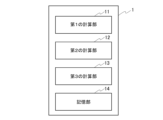
- FIG. 1 is a diagram showing the configuration of a data expansion device.
- FIG. 2 is a diagram showing a data extension method.
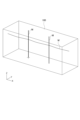
- FIG. 3 is a diagram showing an example of a model structure.
- FIG. 4 is a diagram showing an example of a frequency response spectrum.
- FIG. 5 is a diagram showing the data extension method 1.
- FIG. 6 is a diagram showing the data extension method 2.
- FIG. 7 is a diagram showing data extension method 3.
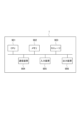
- FIG. 8 is a diagram illustrating a hardware configuration of the data expansion device.
- the present disclosure relates to a technique for estimating abnormalities or changes in a structure from vibration data of the structure.
- a method can be considered that artificially generates vibration data under various conditions from vibration data of a structure modeled in a computer.
- High-quality training data is important for improving the generalization accuracy of statistical machine learning.
- High-quality training data is data that has been sampled randomly and without bias from the range of data distribution that may be obtained during estimation. To prepare such training data, this disclosure focuses on the following two points.
- the measured strength of the resonant frequency corresponding to the resonant mode of a structure depends on the direction and magnitude of the force actually applied to the structure and the frequency components contained in the applied force. In other words, when a force biased toward a specific direction is applied, the resonant mode frequency corresponding to the vibration in that direction is measured strongly.
- This disclosure focuses on the above two points and provides a data expansion method that does not incur computational costs.
- the Data expansion device 1 is a diagram showing the configuration of a data expansion device according to this embodiment.
- the data expansion device 1 is a device for expanding vibration data of a structure, and includes a first calculation unit 11, a second calculation unit 12, a third calculation unit 13, and a storage unit 14.
- the first calculation unit 11 has a function of calculating information about a rectangular parallelepiped that encloses the general shape of a model structure modeled in a computer. Specifically, the first calculation unit 11 calculates the lengths of the three sides, the length, width, and depth, of a rectangular parallelepiped model structure modeled in a modeling software program, as viewed from each of three orthogonal axes (X-axis, Y-axis, and Z-axis).
- the second calculation unit 12 has a function for calculating vibration data of the structure. Specifically, the second calculation unit 12 applies forces from three orthogonal directions (X direction, Y direction, and Z direction) to a rectangular parallelepiped model structure modeled in the computer, and calculates the frequency response spectrum in each direction corresponding to the vibration caused by each force.
- the third calculation unit 13 has the function of expanding the vibration data of the structure.
- the third calculation unit 13 multiplies the frequency response spectrum in each direction calculated by the second calculation unit 12 by different weights and adds up the multiplied values.
- the weight is, for example, a multiplication value of a weighting coefficient that multiplies the spectrum intensity by a constant and a random number that disturbs the spectrum.
- the third calculation unit 13 performs a frequency domain modulation operation on the frequency response spectrum in each direction calculated by the second calculation unit 12, multiplying the high frequency region by a large value and the low frequency region by a small value, or multiplying the high frequency region by a small value and the low frequency region by a large value, and then adds up the calculated values.
- the third calculation unit 13 performs calculations by combining data extension methods 1 and 2.
- the memory unit 14 has the function of storing various data required for calculating vibration data.
- FIG. 2 is a diagram showing a data extension method.
- the first calculation unit 11 calculates the lengths of the three sides of a rectangular parallelepiped model structure modeled in a computer (step S1).
- the second calculation unit 12 applies forces to the rectangular parallelepiped model structure in the X, Y, and Z directions, respectively, and calculates the frequency response spectrum for each direction corresponding to the vibration caused by each force (step S2).
- the third calculation unit 13 expands the frequency response spectrum for each direction calculated in step S2 by performing one of data expansion methods 1 to 3 (step S3).
- Data augmentation method 1 is a method in which the direction of the resonance mode is taken into consideration and different weights are applied to the frequency response spectrum in each direction.
- the long and short axis directions of this model structure 100 are provisionally called the X and Y directions.
- one eigenmode having a fluctuation component corresponding to the Y direction is represented as a straight line marked with the letter M.
- the second calculation unit 12 performs frequency response analysis for the application of forces in the X, Y, and Z directions, thereby calculating the frequency response spectrum for each of the X, Y, and Z directions ( Figure 4).
- the eigenmode M in the Y direction is expressed as a curve marked M' by the application of a force in the Y direction.
- the third calculation unit 13 prepares weighting coefficients Wx, Wy, Wz (scalar quantities) for the frequency response spectra Hx, Hy, Hz (vector quantities) in the X, Y, and Z directions, respectively, and three sets of random number vectors Rndx, Rndy, and Rndz with randomness.
- the third calculation unit 13 calculates Hgen using equation (1) and outputs Hgen as the expanded frequency response spectrum ( Figure 5).
- Hgen Hx ⁇ Wx ⁇ Rndx+Hy ⁇ Wy ⁇ Rndy+Hz ⁇ Wz ⁇ Rndz...(1)
- the values of Wx, Wy, and Wz may be different from each other or may be the same as each other.
- the values of Rndx, Rndy, and Rndz may be different from each other or may be the same as each other. It is sufficient that "Wy x Rndy" and "Wz x Rndz" have different values.
- Data expansion method 2 is a method in which a high-pass filter or a low-pass filter with an appropriate threshold value is applied to the frequency response analysis spectrum.
- the collision-like stimuli caused by artificial vibrations can be simulated by applying a high-pass filter.
- the long-period vibrations caused by natural vibrations can be simulated by applying a low-pass filter.
- Data augmentation method 2 takes these points into consideration.
- the third calculation unit 13 prepares a high-pass filter Hpass(cutoff) or a low-pass filter Lpass(cutoff) with randomness (Rndcutoff) and an appropriate cutoff frequency (cutoff) for the frequency response spectra Hx, Hy, Hz (vector quantities) in the X, Y, and Z directions of the model structure.
- the third calculation unit 13 calculates Hgen using equation (2) or equation (3) and outputs Hgen as the expanded frequency response spectrum ( Figure 6).
- Data extension method 3 is a method in which data extension methods 1 and 2 are used in combination.
- the third calculation unit 13 calculates Hgen using equation (4) or equation (5) and outputs Hgen as the expanded frequency response spectrum ( Figure 7).
- data with a distribution close to that of data that can be actually measured can be generated at low computational cost from vibration data of a model structure modeled in a computer.
- frequency response analysis is performed on a model structure modeled in a computer from three orthogonal directions, and the results are multiplied by different weights (specifically, random vectors with different randomness) and linearly combined, making it possible to efficiently generate vibration data that is likely to occur in reality.
- a frequency response analysis is performed on a model structure modeled in a computer from three orthogonal directions, and a high-pass filter or low-pass filter with an appropriate threshold is applied to the results, making it possible to efficiently generate vibration data that is likely to occur in reality due to man-made or natural phenomena.
- Data extension method 3 provides the combined effect of data extension methods 1 and 2.
- the data expansion device 1 of the present embodiment described above can be realized, for example, as shown in FIG. 8, by using a general-purpose computer system equipped with a CPU 901, memory 902, storage 903, communication device 904, input device 905, and output device 906.
- the memory 902 and storage 903 are storage devices.
- the CPU 901 executes a specific program loaded onto the memory 902, thereby realizing each function of the data expansion device 1.
- the data extension device 1 may be implemented in one computer.
- the data extension device 1 may be implemented in multiple computers.
- the data extension device 1 may be a virtual machine implemented in a computer.
- the program for the data expansion device 1 can be stored in a computer-readable recording medium such as a HDD, SSD, USB memory, CD, or DVD.
- the computer-readable recording medium is, for example, a non-transitory recording medium.
- the program for the data expansion device 1 can also be distributed via a communication network.
Landscapes
- Physics & Mathematics (AREA)
- Acoustics & Sound (AREA)
- Health & Medical Sciences (AREA)
- Life Sciences & Earth Sciences (AREA)
- Chemical & Material Sciences (AREA)
- Analytical Chemistry (AREA)
- Biochemistry (AREA)
- General Health & Medical Sciences (AREA)
- General Physics & Mathematics (AREA)
- Immunology (AREA)
- Pathology (AREA)
- Measurement Of Mechanical Vibrations Or Ultrasonic Waves (AREA)
Priority Applications (2)
| Application Number | Priority Date | Filing Date | Title |
|---|---|---|---|
| PCT/JP2023/018118 WO2024236693A1 (ja) | 2023-05-15 | 2023-05-15 | データ拡張方法 |
| JP2025520267A JPWO2024236693A1 (https=) | 2023-05-15 | 2023-05-15 |
Applications Claiming Priority (1)
| Application Number | Priority Date | Filing Date | Title |
|---|---|---|---|
| PCT/JP2023/018118 WO2024236693A1 (ja) | 2023-05-15 | 2023-05-15 | データ拡張方法 |
Publications (1)
| Publication Number | Publication Date |
|---|---|
| WO2024236693A1 true WO2024236693A1 (ja) | 2024-11-21 |
Family
ID=93518836
Family Applications (1)
| Application Number | Title | Priority Date | Filing Date |
|---|---|---|---|
| PCT/JP2023/018118 Ceased WO2024236693A1 (ja) | 2023-05-15 | 2023-05-15 | データ拡張方法 |
Country Status (2)
| Country | Link |
|---|---|
| JP (1) | JPWO2024236693A1 (https=) |
| WO (1) | WO2024236693A1 (https=) |
Citations (5)
| Publication number | Priority date | Publication date | Assignee | Title |
|---|---|---|---|---|
| JPH05298277A (ja) * | 1992-04-24 | 1993-11-12 | Hitachi Ltd | ニュ−ラルネット学習装置及び学習方法 |
| JP2020085631A (ja) * | 2018-11-22 | 2020-06-04 | 義昭 新納 | 内部状態推定システム |
| JP2020106340A (ja) * | 2018-12-26 | 2020-07-09 | キヤノン株式会社 | 情報処理装置、情報処理装置の制御方法、及びプログラム |
| CN112052940A (zh) * | 2020-08-26 | 2020-12-08 | 西安电子科技大学 | 基于向量压缩与重构的社交网络特征动态提取方法 |
| JP2022039989A (ja) * | 2020-08-26 | 2022-03-10 | キヤノン株式会社 | 画像処理装置、画像処理方法、学習装置、学習方法、及びプログラム |
-
2023
- 2023-05-15 WO PCT/JP2023/018118 patent/WO2024236693A1/ja not_active Ceased
- 2023-05-15 JP JP2025520267A patent/JPWO2024236693A1/ja active Pending
Patent Citations (5)
| Publication number | Priority date | Publication date | Assignee | Title |
|---|---|---|---|---|
| JPH05298277A (ja) * | 1992-04-24 | 1993-11-12 | Hitachi Ltd | ニュ−ラルネット学習装置及び学習方法 |
| JP2020085631A (ja) * | 2018-11-22 | 2020-06-04 | 義昭 新納 | 内部状態推定システム |
| JP2020106340A (ja) * | 2018-12-26 | 2020-07-09 | キヤノン株式会社 | 情報処理装置、情報処理装置の制御方法、及びプログラム |
| CN112052940A (zh) * | 2020-08-26 | 2020-12-08 | 西安电子科技大学 | 基于向量压缩与重构的社交网络特征动态提取方法 |
| JP2022039989A (ja) * | 2020-08-26 | 2022-03-10 | キヤノン株式会社 | 画像処理装置、画像処理方法、学習装置、学習方法、及びプログラム |
Also Published As
| Publication number | Publication date |
|---|---|
| JPWO2024236693A1 (https=) | 2024-11-21 |
Similar Documents
| Publication | Publication Date | Title |
|---|---|---|
| Kihm et al. | Understanding how kurtosis is transferred from input acceleration to stress response and it's influence on fatigue life | |
| He et al. | Structural response reconstruction based on empirical mode decomposition in time domain | |
| Mršnik et al. | Frequency-domain methods for a vibration-fatigue-life estimation–application to real data | |
| JP4499920B2 (ja) | 非線形モデルの発生及びそれを用いたシミュレーション試験用駆動信号の発生 | |
| US20140100798A1 (en) | Turbine blade fatigue life analysis using non-contact measurement and dynamical response reconstruction techniques | |
| Friswell et al. | Using linear model reduction to investigate the dynamics of structures with local non-linearities | |
| Zhu et al. | Bayesian model selection in nonlinear subspace identification | |
| Pacheco et al. | Using orthogonal functions for identification and sensitivity analysis of mechanical systems | |
| Ramsey | Experimental modal analysis, structural modifications and FEM analysis on a desktop computer. | |
| JP6477411B2 (ja) | 解析プログラム | |
| Marinone et al. | Efficient computational nonlinear dynamic analysis using modal modification response technique | |
| Wang et al. | An improved OPAX method based on moving multi-band model | |
| Lei et al. | Hybrid time–frequency method for vibration fatigue damage analysis under non-stationary non-gaussian random excitation | |
| Rixen | Substructuring using impulse response functions for impact analysis | |
| WO2024236693A1 (ja) | データ拡張方法 | |
| Koruk et al. | Damping uncertainty due to noise and exponential windowing | |
| Tarpø et al. | Full-field stress estimation of offshore structures using modal expansion and principal component analysis | |
| Kerschen et al. | Generation of accurate finite element models of nonlinear systems–application to an aeroplane-like structure | |
| Arslan et al. | Modal identification of non-linear structures and the use of modal model in structural dynamic analysis | |
| Praveen Krishna et al. | Experimental and numerical investigations of impacting cantilever beams part 1: first mode response | |
| Vigsø et al. | Scenario based approach for load identification | |
| US20130179132A1 (en) | Analysis Method, Apparatus and Software for a System With Frequency Dependent Materials | |
| Kim et al. | Structural parameters identification using improved normal frequency response function method | |
| JP2004045294A (ja) | 構造物の損傷危険度判定システムおよびプログラム | |
| Behling et al. | Influence of shaker limitations on the success of MIMO environment reconstruction |
Legal Events
| Date | Code | Title | Description |
|---|---|---|---|
| 121 | Ep: the epo has been informed by wipo that ep was designated in this application |
Ref document number: 23937437 Country of ref document: EP Kind code of ref document: A1 |
|
| ENP | Entry into the national phase |
Ref document number: 2025520267 Country of ref document: JP Kind code of ref document: A |
|
| WWE | Wipo information: entry into national phase |
Ref document number: 2025520267 Country of ref document: JP |
|
| NENP | Non-entry into the national phase |
Ref country code: DE |