WO2024236454A1 - 電池モジュール - Google Patents
電池モジュール Download PDFInfo
- Publication number
- WO2024236454A1 WO2024236454A1 PCT/IB2024/054609 IB2024054609W WO2024236454A1 WO 2024236454 A1 WO2024236454 A1 WO 2024236454A1 IB 2024054609 W IB2024054609 W IB 2024054609W WO 2024236454 A1 WO2024236454 A1 WO 2024236454A1
- Authority
- WO
- WIPO (PCT)
- Prior art keywords
- layer
- battery
- metal layer
- negative electrode
- oxide
- Prior art date
- Legal status (The legal status is an assumption and is not a legal conclusion. Google has not performed a legal analysis and makes no representation as to the accuracy of the status listed.)
- Ceased
Links
Images



















Classifications
-
- H—ELECTRICITY
- H01—ELECTRIC ELEMENTS
- H01M—PROCESSES OR MEANS, e.g. BATTERIES, FOR THE DIRECT CONVERSION OF CHEMICAL ENERGY INTO ELECTRICAL ENERGY
- H01M10/00—Secondary cells; Manufacture thereof
- H01M10/42—Methods or arrangements for servicing or maintenance of secondary cells or secondary half-cells
- H01M10/425—Structural combination with electronic components, e.g. electronic circuits integrated to the outside of the casing
- H01M10/4257—Smart batteries, e.g. electronic circuits inside the housing of the cells or batteries
-
- H—ELECTRICITY
- H01—ELECTRIC ELEMENTS
- H01M—PROCESSES OR MEANS, e.g. BATTERIES, FOR THE DIRECT CONVERSION OF CHEMICAL ENERGY INTO ELECTRICAL ENERGY
- H01M10/00—Secondary cells; Manufacture thereof
- H01M10/05—Accumulators with non-aqueous electrolyte
- H01M10/058—Construction or manufacture
- H01M10/0583—Construction or manufacture of accumulators with folded construction elements except wound ones, i.e. folded positive or negative electrodes or separators, e.g. with "Z"-shaped electrodes or separators
-
- H—ELECTRICITY
- H01—ELECTRIC ELEMENTS
- H01M—PROCESSES OR MEANS, e.g. BATTERIES, FOR THE DIRECT CONVERSION OF CHEMICAL ENERGY INTO ELECTRICAL ENERGY
- H01M10/00—Secondary cells; Manufacture thereof
- H01M10/05—Accumulators with non-aqueous electrolyte
- H01M10/058—Construction or manufacture
- H01M10/0585—Construction or manufacture of accumulators having only flat construction elements, i.e. flat positive electrodes, flat negative electrodes and flat separators
-
- H—ELECTRICITY
- H01—ELECTRIC ELEMENTS
- H01M—PROCESSES OR MEANS, e.g. BATTERIES, FOR THE DIRECT CONVERSION OF CHEMICAL ENERGY INTO ELECTRICAL ENERGY
- H01M50/00—Constructional details or processes of manufacture of the non-active parts of electrochemical cells other than fuel cells, e.g. hybrid cells
- H01M50/10—Primary casings; Jackets or wrappings
- H01M50/102—Primary casings; Jackets or wrappings characterised by their shape or physical structure
- H01M50/105—Pouches or flexible bags
-
- H—ELECTRICITY
- H01—ELECTRIC ELEMENTS
- H01M—PROCESSES OR MEANS, e.g. BATTERIES, FOR THE DIRECT CONVERSION OF CHEMICAL ENERGY INTO ELECTRICAL ENERGY
- H01M50/00—Constructional details or processes of manufacture of the non-active parts of electrochemical cells other than fuel cells, e.g. hybrid cells
- H01M50/10—Primary casings; Jackets or wrappings
- H01M50/14—Primary casings; Jackets or wrappings for protecting against damage caused by external factors
- H01M50/141—Primary casings; Jackets or wrappings for protecting against damage caused by external factors for protecting against humidity
-
- H—ELECTRICITY
- H10—SEMICONDUCTOR DEVICES; ELECTRIC SOLID-STATE DEVICES NOT OTHERWISE PROVIDED FOR
- H10W—GENERIC PACKAGES, INTERCONNECTIONS, CONNECTORS OR OTHER CONSTRUCTIONAL DETAILS OF DEVICES COVERED BY CLASS H10
- H10W70/00—Package substrates; Interposers; Redistribution layers [RDL]
- H10W70/40—Leadframes
- H10W70/474—Batteries in combination with leadframes
-
- Y—GENERAL TAGGING OF NEW TECHNOLOGICAL DEVELOPMENTS; GENERAL TAGGING OF CROSS-SECTIONAL TECHNOLOGIES SPANNING OVER SEVERAL SECTIONS OF THE IPC; TECHNICAL SUBJECTS COVERED BY FORMER USPC CROSS-REFERENCE ART COLLECTIONS [XRACs] AND DIGESTS
- Y02—TECHNOLOGIES OR APPLICATIONS FOR MITIGATION OR ADAPTATION AGAINST CLIMATE CHANGE
- Y02E—REDUCTION OF GREENHOUSE GAS [GHG] EMISSIONS, RELATED TO ENERGY GENERATION, TRANSMISSION OR DISTRIBUTION
- Y02E60/00—Enabling technologies; Technologies with a potential or indirect contribution to GHG emissions mitigation
- Y02E60/10—Energy storage using batteries
Definitions
- the invention disclosed in this specification (hereinafter, sometimes referred to as "the present invention” in this specification) relates to a power storage device, a secondary battery, etc. In particular, it relates to a lithium ion battery.
- the present invention relates to an object, a method, or a manufacturing method. Or, the present invention relates to a process, a machine, a manufacture, or a composition of matter. Or, the present invention relates to a semiconductor device, a display device, a light-emitting device, a power storage device, a lighting device, an electronic device, a vehicle, or a manufacturing method thereof.
- batteries may generate heat due to an internal short circuit or overcharging, which can cause the battery to go into thermal runaway and smoke, catch fire, or explode.
- a battery control circuit (sometimes called a protection circuit) that prevents overcharging or over-discharging has been implemented as an IC chip on a rigid circuit board (printed wiring board).
- the rigid circuit board and battery cells are often connected by welding the mounting terminals of the rigid circuit board to the lead terminals of the battery cells, but this type of structure makes it difficult to reduce space.
- Battery abnormalities can occur not only inside the battery, but also outside the battery.
- An example of an abnormality that can occur outside the battery is a short circuit in the circuitry surrounding the battery, a so-called external short circuit.
- Patent Document 2 a power storage module has been proposed to ensure safety when the circuitry surrounding the battery gets wet or submerged in water.
- One aspect of the present invention aims to realize a battery module configuration that is equipped with a circuit that safely controls the battery, while also being able to accommodate space savings that come with a smaller housing.
- One aspect of the present invention aims to realize a safe battery module configuration in which a short circuit between the positive and negative electrodes does not occur when condensation occurs, the battery becomes wet, or the battery is submerged in water.
- One aspect of the present invention is a flexible printed circuit board, an outer casing, a positive electrode, and a negative electrode
- the flexible printed circuit board having a first resin layer, a second resin layer, a third resin layer, a first metal layer located between the first resin layer and the second resin layer, and a second metal layer located between the second resin layer and the third resin layer, the first resin layer and the outer casing being bonded at a sealing portion, the positive electrode having a positive electrode current collector, and the negative electrode having
- the battery module has a negative electrode current collector, and in a sealed space surrounded by a first resin layer, an exterior body, and a sealing portion, the first resin layer has a first opening that reaches the first metal layer, and the first resin layer, the first metal layer, and the second resin layer have second openings that reach the second metal layer, the positive electrode current collector is connected to the first metal layer at the first opening, and the negative electrode current collector is connected to the second metal layer at the second opening.
- the first metal layer contains aluminum and the second metal layer contains copper.
- the flexible printed circuit board has a control circuit section, the control circuit section is connected to the positive electrode current collector via a first metal layer, and the control circuit section is connected to the negative electrode current collector via a second metal layer.
- the flexible printed circuit board has a control circuit section and a connection terminal
- the control circuit section has a transistor and a control IC
- the second metal layer has a first portion and a second portion
- the gate of the transistor is connected to the control IC
- one of the source or drain of the transistor is connected to the positive electrode collector via the first portion
- the other of the source or drain of the transistor is connected to the connection terminal via the second portion.
- the transistor is a transistor using an oxide semiconductor.
- the transistor is a vertical transistor.
- One aspect of the present invention makes it possible to realize a battery module configuration that is equipped with a circuit for safely controlling the battery while also being able to accommodate space-saving features that come with a smaller housing.
- One aspect of the present invention makes it possible to realize a safe battery module configuration in which short circuits between the positive and negative electrodes do not occur when condensation occurs, the battery becomes wet, or the battery is submerged in water.
- FIG. 1A is a schematic perspective view of a configuration example of a battery
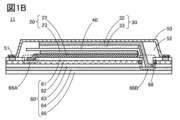
- Fig. 1B is a schematic cross-sectional view of a configuration example of a power storage section of a battery module
- Fig. 1C is a configuration example of a connection terminal.
- 2A to 2E are schematic top views illustrating configuration examples of an FPC board.
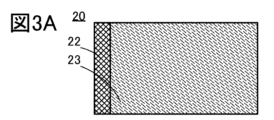
- FIG. 3A is a schematic top view illustrating an example of the configuration of a positive electrode
- FIG. 3B is a schematic top view illustrating an example of the configuration of a separator
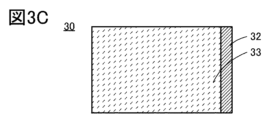
- FIG. 3C is a schematic top view illustrating an example of the configuration of a negative electrode
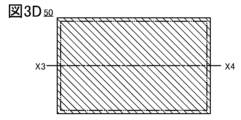
- FIG. 3D is a schematic top view illustrating an example of the configuration of an outer casing
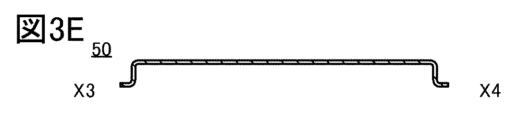
- 3E is a schematic cross-sectional view illustrating an example of the configuration of an outer casing.
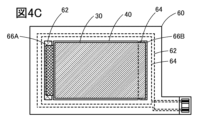
- 4A to 4C are schematic top views illustrating an example of a method for producing a battery module.
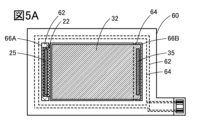
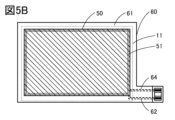
- 5A and 5B are schematic top views illustrating an example of a method for producing a battery module.
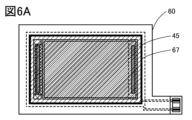
- 6A and 6B are schematic top views illustrating an example of a method for producing a battery module.
- 7A and 7B are schematic cross-sectional views illustrating an example of the configuration of a battery module.
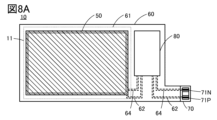
- FIG. 8A is a schematic top view illustrating an example of the configuration of a battery module having a control circuit section
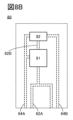
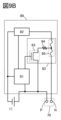
- FIG. 8B is a schematic top view illustrating an example of the configuration of the control circuit section
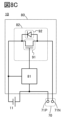
- FIG. 8C is a circuit diagram illustrating the circuit configuration of the battery module.
- 9A is a schematic top view illustrating an example of the configuration of a control circuit section
- FIG. 9B is a circuit diagram illustrating the circuit configuration of a battery module
- FIG. 9C is a circuit diagram illustrating the circuit configuration of a switch.
- 10A and 10B show examples of the configuration of a semiconductor device.
- 11A to 11H are diagrams illustrating an example of an electronic device.
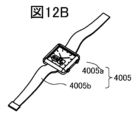
- 12A to 12D are diagrams illustrating an example of an electronic device.
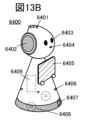
- 13A to 13C are diagrams illustrating an example of an electronic device.
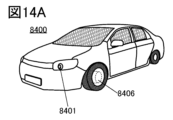
- 14A and 14B are diagrams illustrating an example of a vehicle.
- FIG. 15A is a diagram showing an electric bicycle
- FIG. 15B is a diagram showing a secondary battery of the electric bicycle
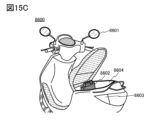
- FIG. 15C is a diagram explaining a scooter.
- ordinal numbers “first” and “second” are used for convenience and do not limit the number of components or the order of the components (e.g., the order of processes or the order of stacking).
- an ordinal number attached to a component in one place in this specification may not match an ordinal number attached to the same component in another place in this specification or in the claims.
- film and “layer” can be interchanged depending on the circumstances.
- conductive layer can be changed to the term “conductive film.”
- insulating film can be changed to the term “insulating layer.”
- the terms “above” and “below” do not limit the positional relationship of components to “directly above” or “directly below.”
- the expression “gate electrode on a gate insulating film” does not exclude other components between the gate insulating film and the gate electrode.
- electrode and “wiring” used in this specification do not limit the functionality of these components.
- an “electrode” may be used as part of a “wiring”, and vice versa.
- the terms “electrode” and “wiring” also include cases where multiple “electrodes” and “wirings” are formed as a single unit.
- source and drain may be interchangeable when transistors of different polarity are used, or when the direction of current changes during circuit operation. For this reason, in this specification, the terms “source” and “drain” can be used interchangeably.
- a state in which a path through which current can flow between A and B includes cases in which A is connected to B without a circuit element (such as a transistor or resistor element) (direct connection) and cases in which A is connected to B via a circuit element (indirect connection). Note that a direct connection is also said to occur when A is connected to B via wiring, without including wiring as a circuit element.
- A when A is connected to B via the source and drain of a transistor, a path is formed between A and B through which current can flow via the source and drain of the transistor. Therefore, regardless of whether the transistor is on or off, it can be said that "A is electrically connected to B.” However, if the path from A to B includes an insulator (for example, the dielectric of a capacitive element or the gate insulating film of a transistor), a path through which current can flow from A to B is not formed.
- an insulator for example, the dielectric of a capacitive element or the gate insulating film of a transistor
- FIGS. 1A to 1C are diagrams showing an example of a battery module according to one embodiment of the present invention.
- FIG. 1A is a perspective view of the battery module 10, and FIG. 1B is a schematic cross-sectional view taken along dashed line X1-X2 in FIG. 1A.
- FIG. 1C is a schematic diagram illustrating an example of the configuration of a connection terminal 70.
- the battery module 10 has a flexible printed circuit (FPC) board 60, an exterior body 50, and a connection terminal 70.
- the FPC board 60 and the exterior body 50 are bonded at a sealing portion 51, and the space surrounded by the FPC board 60 and the exterior body 50 is sealed, and this space is called the sealed space 52 of the battery module 10.
- the part of the battery module 10 that includes the sealed space 52, the exterior body 50, and the FPC board 60 that contacts the sealed space 52 and the sealing portion 51 is called the power storage portion 11.
- the battery module 10 is connected to electronic devices, vehicles, etc., described later, at the connection terminal 70.
- FIG. 1B is a schematic diagram illustrating an example of the cross-sectional structure of the storage unit 11.
- the storage unit 11 has a positive electrode 20, a negative electrode 30, and a separator 40 in a sealed space 52.
- the positive electrode 20 has a positive electrode collector 22 and a positive electrode active material layer 23 on the positive electrode collector 22.
- the negative electrode 30 has a negative electrode collector 32 and a negative electrode active material layer 33 on the negative electrode collector 32.
- the separator 40 is located between the positive electrode active material layer 23 and the negative electrode active material layer 33, and is provided so that the positive electrode 20 and the negative electrode 30 are not in direct contact with each other.
- electrolytes are contained in the voids of the positive electrode active material layer 23, the voids of the negative electrode active material layer 33, and the voids of the separator 40.
- the FPC board 60 has a first resin layer 61, a first metal layer 62, a second resin layer 63, a second metal layer 64, and a third resin layer 65.
- the first resin layer 61, the second resin layer 63, and the third resin layer 65 are insulating, and the first metal layer 62 and the second metal layer 64 are conductive.
- a first resin layer 61, a first metal layer 62, a second resin layer 63, a second metal layer 64, and a third resin layer 65 are laminated in this order, and the first metal layer 62 and the second metal layer 64 are insulated.
- connection terminal 70 has a positive terminal 71P electrically connected to the first metal layer 62, and a negative terminal 71N electrically connected to the second metal layer 64.
- the connection terminal 70 may have a sealing rubber 72 as shown in FIG. 1C.
- the sealing rubber 72 can seal the positive terminal 71P and the negative terminal 71N by being in close contact with the periphery of the connection terminal of the electronic device to which the battery module 10 is connected.
- the first resin layer 61 has a first opening 66A that reaches the first metal layer 62.
- the first resin layer 61, the first metal layer 62, and the second resin layer 63 have a second opening 66B that reaches the second metal layer 64.
- the first opening 66A and the second opening 66B are located in the sealed space 52.
- the positive electrode collector 22 is connected to the first metal layer 62.
- the negative electrode collector 32 is connected to the second metal layer 64. That is, in the sealed space 52, the positive electrode collector 22 is connected to the first metal layer 62, and the negative electrode collector 32 is connected to the second metal layer 64.
- first metal layer 62 and the second metal layer 64 are not exposed at the side ends of the FPC board 60.
- the FPC board 60 not only functions as a circuit board that connects the power storage unit 11 and the connection terminal, but also functions as an exterior member that seals the sealed space 52 of the power storage unit 11.
- a control circuit unit can be provided on the FPC board 60. Therefore, the battery module 10 of one embodiment of the present invention can realize a space-saving battery module configuration that is equipped with a circuit that safely controls the battery while also being able to accommodate space-saving that comes with a smaller housing.
- the battery module 10 of one embodiment of the present invention shown above has a safe battery module configuration in which the portion electrically connected to the positive electrode 20 (e.g., the first metal layer 62) and the portion electrically connected to the negative electrode 30 (e.g., the second metal layer 64) are not exposed, and short circuits between the positive electrode 20 and the negative electrode 30 do not occur when condensation occurs, the battery is wet, or the battery is submerged in water.
- the portion electrically connected to the positive electrode 20 e.g., the first metal layer 62
- the portion electrically connected to the negative electrode 30 e.g., the second metal layer 64
- FPC board An example of the FPC board 60 will be described with reference to FIGS. 2A to 2E.
- FIG. 2A is a schematic top view of the FPC board 60
- FIG. 2B is a schematic top view of the first resin layer 61
- FIG. 2C is a schematic top view of the first metal layer 62
- FIG. 2D is a schematic top view of the second resin layer 63
- FIG. 2E is a schematic top view of the second metal layer 64.
- the first metal layer 62 and the second metal layer 64 overlap so as not to protrude from the outer periphery of the first resin layer 61, the outer periphery of the second resin layer 63, and the outer periphery of the third resin layer 65. Therefore, the first metal layer 62 and the second metal layer 64 are not exposed at the side ends of the FPC board 60.
- the first resin layer 61 has a first opening 66A and a second opening 66B.
- the first metal layer 62 has a second opening 66B.
- the second resin layer 63 has a second opening 66B.
- FIG. 2E shows an example configuration in which the second metal layer 64 does not have an opening, but the shape of the second metal layer 64 is not limited to this, and it may have an opening, and may be used as the circuit wiring of the FPC board 60.
- the second metal layer 64 when viewed from above on the FPC board 60, the second metal layer 64 must be present at a position overlapping the second opening 66B of the first metal layer 62.
- One reason for this is that if the second metal layer 64 is not present at a position overlapping the second opening 66B, the negative electrode current collector 32 and the second metal layer 64 cannot be connected.
- Another reason is that in the battery module 10, the first metal layer 62 plays a role in preventing the intrusion of air and water from the outside of the battery module into the sealed space 52, so if the second metal layer 64 is not present at a position overlapping the second opening 66B, it becomes difficult to prevent the intrusion of air and water from the outside of the battery into the sealed space 52.
- the first metal layer 62 is electrically connected to the positive terminal 71P of the connection terminal 70
- the second metal layer 64 is electrically connected to the negative terminal 71N of the connection terminal 70.
- the first resin layer 61 is preferably made of a material that does not react with the electrolyte, since it may come into contact with the electrolyte in the storage unit 11.
- a film made of a material such as polypropylene, polyethylene, polycarbonate, ionomer, or polyamide can be used as the first resin layer 61.
- polypropylene is preferable for the first resin layer 61, since it is the same material as the fusion layer of an aluminum laminate film that is easily available as an exterior body, and therefore it is possible to form the sealing portion 51 well.
- the thickness of the first resin layer 61 is preferably 10 ⁇ m or more and 500 ⁇ m or less, more preferably 20 ⁇ m or more and 200 ⁇ m or less, and even more preferably 25 ⁇ m or more and 100 ⁇ m or less.
- the first metal layer 62 is preferably a material that is stable even at the potential of the positive electrode, since it is connected to the positive electrode collector 22 at the first opening 66A of the storage unit 11.
- any one of aluminum foil, stainless steel foil, chromium foil, nickel foil, molybdenum foil, tantalum foil, tungsten foil, gold foil, platinum foil, iridium foil, etc. can be used as the first metal layer 62.
- aluminum foil is suitable as the first metal layer 62 because it is lightweight and inexpensive.
- the thickness of the first metal layer 62 is preferably 10 ⁇ m or more and 100 ⁇ m or less, more preferably 10 ⁇ m or more and 50 ⁇ m or less, more preferably 10 ⁇ m or more and 30 ⁇ m or less, and even more preferably 10 ⁇ m or more and 20 ⁇ m or less.
- the second resin layer 63 may be a film made of a material such as polyamide (eg, nylon), polyimide, or polyester (eg, polyethylene terephthalate).
- the thickness of the second resin layer 63 is preferably 10 ⁇ m or more and 500 ⁇ m or less, more preferably 20 ⁇ m or more and 200 ⁇ m or less, and even more preferably 25 ⁇ m or more and 100 ⁇ m or less.
- the second metal layer 64 is preferably a material that is stable even at the negative electrode potential because it is connected to the negative electrode collector 32 at the second opening 66B of the storage unit 11.
- any one of copper foil, stainless steel foil, chromium foil, nickel foil, molybdenum foil, tantalum foil, tungsten foil, gold foil, platinum foil, iridium foil, etc. can be used as the second metal layer 64.
- copper foil is suitable as the second metal layer 64 because it has low reactivity with lithium at the negative electrode potential and is relatively inexpensive compared to the other metal foils mentioned above.
- the thickness of the second metal layer 64 is preferably 10 ⁇ m or more and 100 ⁇ m or less, more preferably 10 ⁇ m or more and 50 ⁇ m or less, more preferably 10 ⁇ m or more and 30 ⁇ m or less, and more preferably 10 ⁇ m or more and 20 ⁇ m or less.
- the third resin layer 65 may be a film made of a material such as polyamide (eg, nylon), polyimide, or polyester (eg, polyethylene terephthalate).
- the thickness of the third resin layer 65 is preferably 10 ⁇ m or more and 500 ⁇ m or less, more preferably 20 ⁇ m or more and 200 ⁇ m or less, and even more preferably 25 ⁇ m or more and 100 ⁇ m or less.
- Figures 3A to 3D are schematic top views of the components of the battery module 10.
- the positive electrode 20 has a positive electrode collector 22, and a positive electrode active material layer 23 on one or both surfaces of the positive electrode collector 22.
- FIG. 1B and FIG. 3A show an example in which the positive electrode collector 22 has a positive electrode active material layer 23 on one surface. As shown in FIG. 3A, one surface of the positive electrode collector 22 having the positive electrode active material layer 23 has an area where the positive electrode collector 22 is exposed. The positive electrode collector 22 and the FPC board 60 can be connected in this area.
- the negative electrode 30 has a negative electrode collector 32, and a negative electrode active material layer 33 on one or both surfaces of the negative electrode collector 32.
- FIG. 1B and FIG. 3C show an example in which the negative electrode collector 32 has a negative electrode active material layer 33 on one surface. As shown in FIG. 3C, one surface of the negative electrode collector 32 having the negative electrode active material layer 33 has an area where the negative electrode collector 32 is exposed. The negative electrode collector 32 and the FPC board 60 can be connected in this area.
- the separator 40 shown in FIG. 3B is larger than the area where the positive electrode 20 and the negative electrode 30 overlap when viewed from above the battery module 10.
- the exterior body 50 shown in FIG. 3D is larger than the positive electrode 20, the negative electrode 30, and the separator 40 when viewed from above the battery module 10.
- FIG. 3E is a schematic cross-sectional view of the exterior body 50 that has been drawn, taken along dashed dotted line E3-E4 in FIG. 3D.
- FIGS 4A to 5B are schematic top views illustrating the flow of manufacturing the battery module 10.
- an example of a manufacturing method using one FPC board 60 one positive electrode 20 (also called a single-sided coated positive electrode) having a positive electrode active material layer 23 on one side of a positive electrode current collector 22, one separator 40, one negative electrode 30 (also called a single-sided coated negative electrode) having a negative electrode active material layer 33 on one side of a negative electrode current collector 32, and one exterior body 50 is described.
- the positive electrode 20 is placed on the surface of the FPC board 60 facing the first resin layer.
- the positive electrode current collector 22, which does not have the positive electrode active material layer 23, is placed on the FPC board 60 side.
- the separator 40 is placed on top of the positive electrode 20.
- the negative electrode 30 is layered on the separator 40.
- the negative electrode active material layer 33 is layered on the separator 40 side.
- connection part 25 The connection point between the positive electrode collector 22 and the first metal layer 62 is shown as connection part 25 in the figure.
- connection part 35 As described above, the negative electrode collector 32 and the second metal layer 64 are connected.
- the negative electrode collector 32 and the second metal layer 64 can be connected by ultrasonic welding or the like.
- the connection point between the negative electrode collector 32 and the second metal layer 64 is shown as connection part 35 in the figure.
- the electrolyte is injected so that it fills the gaps in the positive electrode active material layer 23, the negative electrode active material layer 33, and the separator 40, and then, as shown in FIG. 5B, the exterior body 50 is placed over the positive electrode 20, the negative electrode 30, the separator 40, the first opening 66A, and the second opening 66B. Then, the exterior body 50 and the first resin layer 61 of the FPC board 60 are bonded together at the sealing portion 51.
- An adhesive can be used for bonding.
- a part of the exterior body 50 and a part of the first resin layer 61 can be heat-sealed to bond them together.
- a bank 67 can be provided and electrolyte 45 can be injected so that the inside of the bank is filled with electrolyte 45.
- the electrolyte 45 may be dropped onto each of them, and the electrolyte 45 may be impregnated into the voids in the positive electrode active material layer 23, the voids in the negative electrode active material layer 33, and the voids in the separator 40.
- a battery module 10 according to one embodiment of the present invention can be produced.
- the sealing portion 51 between the exterior body 50 and the FPC board 60 can be provided at a position where it contacts the third resin layer 65 of the FPC board 60.
- the position of the sealing portion 51 in a plan view can be provided inside the power storage section 11, making it possible to realize a more space-saving battery module configuration.
- the separator 40 can be configured in a zigzag pattern, as shown in FIG. 7B. With such a configuration, it is possible to further prevent the positive electrodes 20 and the negative electrodes 30 from coming into direct contact.
- a battery module according to one embodiment of the present invention can be configured as shown in FIG. 8A, in which an FPC board 60 has a control circuit section 80, and the power storage section 11 and the connection terminal 70 are connected via the control circuit section 80.
- FIG. 8B is a schematic top view showing an example of the control circuit unit 80 in Fig. 8A.
- Fig. 8C is a circuit diagram of the battery module 10 shown in Fig. 8A and Fig. 8B.
- the control circuit section 80 has a control IC (Integrated Circuit) 81 and a switch 82.
- the first metal layer 62 is divided into a first metal layer 62A and a first metal layer 62B.
- the second metal layer 64 is divided into a second metal layer 64A and a second metal layer 64B.
- the first metal layer 62A is connected to the power storage unit 11, the control IC 81, and the positive terminal 71P.
- the second metal layer 64A is connected to the power storage unit 11, the control IC 81, and the switch 82.
- the first metal layer 62A is connected to the positive electrode collector 22 in the power storage unit 11, and the second metal layer 64A is connected to the negative electrode collector 32 in the power storage unit 11.
- the first metal layer 62B is connected to the control IC 81 and the switch 82.
- the second metal layer 64B is connected to the switch 82 and the negative terminal 71N.
- the first metal layer 62 and the second metal layer 64 of the FPC board 60 can be used as wiring layers that connect between elements such as the control IC 81, the switch 82, and the connection terminal 70.
- the wiring shape of the first metal layer 62 and the second metal layer 64 shown in FIG. 8B is an example for the purpose of explanation, and the first metal layer 62 and the second metal layer 64 may also be arranged in a wiring shape that intersects.
- elements such as resistive elements and capacitive elements may also be provided as appropriate.
- the control IC 81 has a function of detecting the voltage of the power storage unit 11. For example, if the control IC 81 detects an abnormality in the voltage of the power storage unit 11, it can control the switch 82 to cut off the current.
- the switch 82 can be configured to include a transistor 91. Also, as shown in FIG. 8C, the switch 82 can be configured to block current flow in one direction by providing a transistor 91 and a diode 92 in parallel. For example, in the configuration shown in FIG. 8C, when the control IC 81 detects an overcharge voltage, it blocks the current flowing through the transistor 91, but allows the discharge current from the storage unit 11 to pass through the diode 92.
- FIG. 9A is a schematic top view showing an example of the control circuit unit 80 of Figure 8A.
- Figure 9B is a circuit diagram of the battery module 10 shown in Figures 8A and 9A.
- the control circuit section 80 has a control IC 81, a switch 82, and an SCP (Self Control Protector) element 83.
- the first metal layer 62 is divided into a first metal layer 62A, a first metal layer 62B, and a first metal layer 62C.
- the second metal layer 64 is also divided into a second metal layer 64A, a second metal layer 64B, and a second metal layer 64C.
- the first metal layer 62A is connected to the power storage unit 11, the control IC 81, the SCP element 83, and the positive terminal 71P.
- the second metal layer 64A is connected to the power storage unit 11, the control IC 81, and the switch 82.
- the first metal layer 62A is connected to the positive electrode collector 22 in the power storage unit 11, and the second metal layer 64A is connected to the negative electrode collector 32 in the power storage unit 11.
- the first metal layer 62B is connected to the control IC 81 and the switch 82.
- the first metal layer 62C is connected to the control IC 81 and the SCP element 83.
- the second metal layer 64B is connected to the switch 82 and the SCP element 83.
- the second metal layer 64C is connected to the SCP element 83 and the negative terminal 71N.
- the first metal layer 62 and the second metal layer 64 of the FPC board 60 can be used as wiring layers that connect between elements such as the control IC 81, the switch 82, the SCP element 83, and the connection terminal 70.
- the wiring shape of the first metal layer 62 and the second metal layer 64 shown in FIG. 9A is an example for the purpose of explanation, and the first metal layer 62 and the second metal layer 64 may also be arranged in a wiring shape that intersects.
- elements such as resistive elements and capacitive elements may also be provided as appropriate.
- the control IC 81 and the switch 82 can be the same as those described in [Configuration Example 1 of the Control Circuit Unit 80].
- the SCP element 83 has a transistor 93, a resistor 94, and a fuse 95.
- the transistor 93 of the SCP element 83 can pass a current through the resistor 94 under the control of the control IC 81.
- the resistor 94 when a current flows through the resistor 94, the resistor 94 generates heat and the fuse 95 adjacent to the resistor 94 is blown. In this way, the power storage unit 11 can be separated from the external circuit.
- the control circuit unit 80 shown in FIGS. 9A and 9B can be said to be a control circuit having a switch 82 for primary protection and an SCP element 83 for secondary protection.
- the switch 82 may be configured as switch 82B shown in FIG. 9C instead of the circuit configuration described in FIG. 8C.
- Switch 82B is configured by connecting a parallel connection of transistor 91 and diode 92 in series with a parallel connection of transistor 96 and diode 97 in series, with diode 92 and diode 97 connected in the opposite directions. This configuration makes it possible to control the charging current and discharging current independently.
- transistors that can be used as the transistor 91, the transistor 93, and the transistor 96 used in the structure examples described with reference to FIGS. 8C, 9B, and 9C will be described.
- a silicon transistor or a transistor using an oxide semiconductor can be used as the transistor.
- a charging control circuit or a battery control system having a memory circuit including a transistor using an oxide semiconductor may be called a BTOS (Battery operating system, or Battery oxide semiconductor).
- the transistors may be planar type transistors, trench type transistors, or vertical type transistors. Alternatively, a combination of multiple of the above transistors may be used.
- the vertical transistor has a semiconductor layer, a gate insulating layer, a gate electrode, a first electrode, and a second electrode.
- the first electrode functions as one of a source electrode and a drain electrode, and the second electrode functions as the other.
- the second electrode is provided above the first electrode.
- An insulating layer that functions as a spacer is provided between the first electrode and the second electrode.
- the spacer has an opening that reaches the first electrode, and the semiconductor layer is provided in contact with the first electrode, the second electrode, and the sidewall (also called the side surface) within the opening of the insulating layer.
- a gate insulating layer and a gate electrode are provided to cover the semiconductor layer.
- the first electrode and the second electrode may be electrodes different from the semiconductor layer, or a part of the semiconductor layer may function as the first electrode or the second electrode.
- the source electrode and drain electrode are located at different heights, so the current flowing through the semiconductor layer flows in the height direction.
- the channel length direction can be said to have a height (vertical) component, so the transistor can also be called a VFET (Vertical Field Effect Transistor), vertical transistor, vertical channel transistor, etc.
- VFET Vertical Field Effect Transistor
- the above transistor allows the source electrode, semiconductor layer, and drain electrode to be stacked on top of each other, so it can occupy a much smaller area than a so-called planar type transistor (also called a lateral transistor, LFET (Lateral FET)) in which the semiconductor layer is arranged on a flat surface.
- planar type transistor also called a lateral transistor, LFET (Lateral FET)
- LFET Lateral FET
- the channel length of the transistor can be precisely controlled by the thickness of the insulating layer, the variation in channel length can be made extremely small compared to planar transistors.
- transistors with extremely short channel lengths can be manufactured. For example, transistors with channel lengths of 2 ⁇ m or less, 1 ⁇ m or less, 500 nm or less, 300 nm or less, 200 nm or less, 100 nm or less, 50 nm or less, 30 nm or less, or 20 nm or less, and 5 nm or more, 7 nm or more, or 10 nm or more can be manufactured.
- the semiconductor layer it is preferable to use a metal oxide (also called oxide semiconductor) film having semiconductor properties, since this can achieve both high performance and high productivity.
- a metal oxide (also called oxide semiconductor) film having semiconductor properties since this can achieve both high performance and high productivity.
- an oxide semiconductor film having crystallinity since this can provide high reliability.
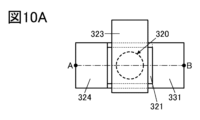
- FIG. 10A is a top view of transistor 300
- FIG. 10B is a cross-sectional view taken along line A-B in FIG. 10A. Note that some components (such as insulating layers) are omitted in FIG. 10A.
- the transistor 300 is provided on a substrate 311 and has a semiconductor layer 321, an insulating layer 322, a conductive layer 323, a conductive layer 324, and a conductive layer 331.
- a conductive layer 324 is provided on a substrate 311, and insulating layers 329a, 328, and 329b are provided in this order to cover the conductive layer 324. Furthermore, a conductive layer 331 is provided on insulating layer 329b. An opening 320 that reaches the conductive layer 324 is provided in the conductive layer 331, insulating layer 329b, insulating layer 328, and insulating layer 329a. For example, it can be said that the sidewalls (side surfaces) of the conductive layer 331, insulating layer 329b, insulating layer 328, and insulating layer 329a at the opening 320 overlap the conductive layer 324.
- the semiconductor layer 321 contacts the top surface of the conductive layer 324 located at the bottom of the opening 320, the side surfaces of the insulating layer 329a, the side surfaces of the insulating layer 328, the side surfaces of the insulating layer 329b, and the side surfaces of the conductive layer 331 in the opening 320, and the top surface of the conductive layer 331.
- the portion of the semiconductor layer 321 in contact with the conductive layer 331 functions as one of the source region and the drain region, and the portion in contact with the conductive layer 324 functions as the other, and the region between them (particularly the region in contact with the insulating layer 328) functions as a region where a channel is formed (channel formation region). It is preferable that the region of the semiconductor layer 321 in contact with the insulating layer 329a and the region in contact with the insulating layer 329b have a higher carrier concentration and lower resistance than the channel formation region.
- An insulating layer 322 that functions as a gate insulating layer is provided to cover the insulating layer 329b, the conductive layer 331, and the semiconductor layer 321.
- a conductive layer 323 that functions as a gate electrode is further provided to cover the insulating layer 322.
- the semiconductor layer 321 has a portion that contacts the side of the insulating layer 328 and functions as a channel formation region.
- the insulating layer 322 has a portion that faces the side of the insulating layer 328 via the semiconductor layer 321.
- the conductive layer 323 has a portion that faces the side of the insulating layer 328 via the semiconductor layer 321 and the insulating layer 322.
- the interface between the semiconductor layer 321 and the insulating layer 322 and the interface between the insulating layer 322 and the conductive layer 323 have portions that are parallel to the side of the insulating layer 328.
- the semiconductor layer 321 preferably contains a metal oxide (oxide semiconductor).
- metal oxides examples include In oxide, Ga oxide, and Zn oxide.
- the metal oxide preferably contains at least In or Zn.
- the metal oxide preferably contains two or three elements selected from In, element M, and Zn.
- the element M is a metal element or semimetal element with a high bond energy with oxygen, for example, a metal element or semimetal element with a higher bond energy with oxygen than In.
- Specific examples of element M include Al, Ga, Sn, Y, Ti, V, Cr, Mn, Fe, Co, Ni, Zr, Mo, Hf, Ta, W, La, Ce, Nd, Mg, Ca, Sr, Ba, B, Si, Ge, and Sb.
- the element M contained in the metal oxide is preferably one or more of the above elements, and is preferably one or more of Al, Ga, Y, and Sn, and more preferably Ga.
- a metal oxide having In, M, and zinc may be referred to as an In-M-Zn oxide.
- metal elements and metalloid elements may be collectively referred to as "metal elements", and "metalloid elements" described in this specification may include metalloid elements.
- the metal oxide is an In-M-Zn oxide
- the atomic ratio of In in the In-M-Zn oxide is equal to or greater than the atomic ratio of M.
- the term "close composition" includes a range of ⁇ 30% of the desired atomic ratio.
- the atomic ratio of In in the In-M-Zn oxide may be less than the atomic ratio of M.
- the semiconductor layer 321 may be, for example, In-Zn oxide, In-Ga oxide, In-Sn oxide, In-Ti oxide, In-Ga-Al oxide, In-Ga-Sn oxide, In-Ga-Zn oxide, In-Sn-Zn oxide, In-Al-Zn oxide, In-Ti-Zn oxide, In-Ga-Sn-Zn oxide, In-Ga-Al-Zn oxide, etc.
- Ga-Zn oxide may also be used.
- the metal oxide may contain one or more metal elements with a large periodic number.
- metal elements with a large periodic number include metal elements belonging to the fifth period and metal elements belonging to the sixth period. Specific examples of such metal elements include Y, Zr, Ag, Cd, Sn, Sb, Ba, Pb, Bi, La, Ce, Pr, Nd, Pm, Sm, and Eu. Note that La, Ce, Pr, Nd, Pm, Sm, and Eu are called light rare earth elements.
- the metal oxide may also contain one or more nonmetallic elements.
- the field effect mobility of the transistor may be increased.
- nonmetallic elements include carbon, nitrogen, phosphorus, sulfur, selenium, fluorine, chlorine, bromine, and hydrogen.
- the metal oxide can be preferably formed by sputtering or atomic layer deposition (ALD).
- ALD atomic layer deposition
- the composition of the metal oxide after film formation may differ from the composition of the target.
- the zinc content in the metal oxide after film formation may decrease to about 50% compared to the target.
- the content of a certain metal element in a metal oxide refers to the ratio of the number of atoms of that element to the total number of atoms of the metal element contained in the metal oxide.
- the content of metal element X can be expressed as Ax / ( Ax + Ay + Az ).
- metal element X when the ratio of the numbers of atoms of metal element X, metal element Y , and metal element Z in the metal oxide (atomic ratio) is expressed as Bx :By: Bz , the content of metal element X can be expressed as Bx /( Bx + By + Bz ).
- a transistor with high reliability when a positive bias is applied can be obtained.
- a transistor with a small amount of variation in threshold voltage in a PBTS (Positive Bias Temperature Stress) test can be obtained.
- the Ga content it is possible to produce a transistor with high reliability against light.
- NBTIS Near Bias Temperature Illumination Stress
- a metal oxide in which the atomic ratio of Ga is equal to or greater than the atomic ratio of In has a larger band gap, and it is possible to reduce the amount of variation in threshold voltage in NBTIS testing of a transistor.
- the metal oxide becomes highly crystalline, and the diffusion of impurities in the metal oxide can be suppressed. This suppresses fluctuations in the electrical characteristics of the transistor, and increases reliability.
- the semiconductor layer 321 may have a stacked structure having two or more metal oxide layers.
- the two or more metal oxide layers in the semiconductor layer 321 may have the same or approximately the same composition.
- a stacked structure of metal oxide layers having the same composition for example, they can be formed using the same sputtering target, thereby reducing manufacturing costs.
- a stacked structure in which two or more oxide semiconductor layers having different compositions are stacked may also be used.
- the semiconductor layer 321 is preferably a crystalline metal oxide layer.
- a metal oxide layer having a CAAC (c-axis aligned crystal) structure, a polycrystalline (Poly-crystal) structure, a nanocrystalline (nc: nano-crystal) structure, or the like can be used.
- a crystalline metal oxide layer for the semiconductor layer 321 the defect level density in the semiconductor layer 321 can be reduced, and a highly reliable semiconductor device can be realized.
- the CAAC structure is a crystal structure in which multiple microcrystals (typically multiple IGZO microcrystals) have a c-axis orientation, and the multiple microcrystals are connected without being oriented in the a-b plane.
- the CAAC structure has fewer crystal grain boundaries and grains in the a-b plane than the polycrystalline structure, and therefore a highly reliable semiconductor device can be realized.
- Transistors using an oxide semiconductor have extremely high field-effect mobility compared to transistors using amorphous silicon.
- the leakage current between the source and drain of an OS transistor in an off state (also referred to as off-current) is extremely small, and the charge accumulated in a capacitor connected in series with the transistor can be held for a long period of time.
- the use of an OS transistor can reduce the power consumption of a semiconductor device.
- OS transistors Compared to transistors using silicon (hereinafter referred to as Si transistors), OS transistors have a higher withstand voltage between the source and drain, so a high voltage can be applied between the source and drain of the OS transistor. Furthermore, when the transistor operates in the saturation region, the OS transistor can reduce the change in source-drain current in response to a change in gate-source voltage compared to a Si transistor.
- OS transistors have small variations in electrical characteristics due to radiation exposure, i.e., they have high resistance to radiation, and therefore can be suitably used in environments where radiation may be present. It can also be said that OS transistors have high reliability against radiation.
- OS transistors can be suitably used in pixel circuits of X-ray flat panel detectors.
- OS transistors can also be suitably used in semiconductor devices used in outer space.
- radiation include electromagnetic radiation (e.g., X-rays and gamma rays) and particle radiation (e.g., alpha rays, beta rays, proton rays, and neutron rays).
- the semiconductor material that can be used for the semiconductor layer 321 is not limited to an oxide semiconductor.
- a semiconductor made of a single element or a compound semiconductor can be used.
- semiconductors made of a single element include silicon (including single crystal silicon, polycrystalline silicon, microcrystalline silicon, and amorphous silicon) and germanium.
- compound semiconductors include gallium arsenide and silicon germanium.
- compound semiconductors include organic semiconductors, nitride semiconductors, and oxide semiconductors. These semiconductor materials may contain impurities as dopants.
- the semiconductor layer 321 may have a layered material that functions as a semiconductor.
- a layered material is a general term for a group of materials that have a layered crystal structure.
- a layered crystal structure is a structure in which layers formed by covalent or ionic bonds are stacked via bonds weaker than covalent or ionic bonds, such as van der Waals forces.
- a layered material has high electrical conductivity within a unit layer, that is, high two-dimensional electrical conductivity.
- Examples of the layered material include graphene, silicene, and chalcogenides.
- Chalcogenides are compounds containing chalcogen (an element belonging to Group 16).
- Examples of the chalcogenides include transition metal chalcogenides and Group 13 chalcogenides.
- transition metal chalcogenides that can be used as the semiconductor layer of a transistor include molybdenum sulfide (representatively MoS 2 ), molybdenum selenide (representatively MoSe 2 ), molybdenum tellurium (representatively MoTe 2 ), tungsten sulfide (representatively WS 2 ), tungsten selenide (representatively WSe 2 ), tungsten tellurium (representatively WTe 2 ), hafnium sulfide (representatively HfS 2 ), hafnium selenide (representatively HfSe 2 ), zirconium sulfide (representatively ZrS 2 ), zirconium selenide (representatively ZrSe 2 ), and the like.
- the crystallinity of the semiconductor material used for the semiconductor layer 321 is not particularly limited, and any of an amorphous semiconductor, a single crystalline semiconductor, and a semiconductor having crystallinity other than single crystal (a polycrystalline semiconductor, a microcrystalline semiconductor, or a semiconductor having a crystalline region in part) may be used.
- the use of a crystalline semiconductor is preferable because it can suppress deterioration of the transistor characteristics.
- the conductive layer 324 and the conductive layer 331 each have an upper surface in contact with the semiconductor layer 321.
- an oxide semiconductor is used as the semiconductor layer 321
- a metal that is easily oxidized such as aluminum
- an insulating oxide e.g., aluminum oxide
- a light-transmitting oxide conductive material can be used for the conductive layer 324 and the conductive layer 331.
- a conductive oxide such as indium oxide, zinc oxide, In-Sn oxide, In-Zn oxide, In-W oxide, In-W-Zn oxide, In-Ti oxide, In-Ti-Sn oxide, In-Sn oxide containing silicon, or zinc oxide doped with gallium can be used.
- a conductive oxide containing indium is preferable because of its high conductivity.
- a conductive material that absorbs or reflects a portion of visible light may be used.
- tantalum nitride, titanium nitride, nitrides containing titanium and aluminum, nitrides containing tantalum and aluminum, ruthenium oxide, ruthenium nitride, oxides containing strontium and ruthenium, oxides containing lanthanum and nickel, etc. can be used.
- titanium, ruthenium, tungsten, etc. can also be used. These are conductive materials that are difficult to oxidize, or materials that maintain their conductivity even when oxidized, and are therefore preferable.
- the insulating layer 322 functions as a gate insulating layer.
- an oxide semiconductor is used for the semiconductor layer 321, it is preferable to use an oxide insulating film for at least the film of the insulating layer 322 that is in contact with the semiconductor layer 321.
- silicon oxide, silicon oxynitride, aluminum oxide, aluminum oxynitride, hafnium oxide, hafnium oxynitride, gallium oxide, gallium oxynitride, yttrium oxide, yttrium oxynitride, and Ga-Zn oxide can be used.
- a nitride insulating film such as silicon nitride, silicon nitride oxide, aluminum nitride, or aluminum nitride oxide can be used as the insulating layer 322.
- the insulating layer 322 may have a stacked structure, and may have, for example, a stacked structure having one or more oxide insulating films and one or more nitride insulating films.
- oxynitride refers to a material that contains more oxygen than nitrogen.
- Nitrogen oxide refers to a material that contains more nitrogen than oxygen.
- the conductive layer 323 functions as a gate electrode, and various conductive materials can be used.
- the conductive layer 323 can be formed using, for example, one or more of chromium, copper, aluminum, gold, silver, zinc, molybdenum, tantalum, titanium, tungsten, manganese, nickel, iron, cobalt, molybdenum, and niobium, or an alloy containing one or more of the above-mentioned metals.
- the conductive layer 323 may also be formed using nitrides and oxides that can be used for the conductive layer 324 and the conductive layer 331.
- the insulating layer 328 has a portion in contact with the semiconductor layer 321.
- an oxide semiconductor is used for the semiconductor layer 321
- silicon oxide or silicon oxynitride can be suitably used.
- a film that releases oxygen when heated for the insulating layer 328 This allows oxygen to be supplied to the semiconductor layer 321 by heat applied during the manufacturing process of the transistor 300, and oxygen vacancies in the semiconductor layer 321 can be reduced, thereby improving reliability.
- Methods for supplying oxygen to the insulating layer 328 include heat treatment in an oxygen atmosphere and plasma treatment in an oxygen atmosphere.
- Oxygen may also be supplied by forming an oxide film in an oxygen atmosphere on the upper surface of the insulating layer 328 by a sputtering method. The oxide film may then be removed.
- the insulating layer 328 is preferably formed by a deposition method such as a sputtering method or a plasma CVD method.
- a deposition method such as a sputtering method or a plasma CVD method.
- a sputtering method that does not use hydrogen gas as a deposition gas a film with an extremely low hydrogen content can be obtained. This can prevent hydrogen from being supplied to the semiconductor layer 321, and stabilize the electrical characteristics of the transistor 300.
- the insulating layers 329a and 329b are preferably made of a film through which oxygen does not easily diffuse. This can prevent oxygen contained in the insulating layer 328 from permeating through the insulating layer 329a to the substrate 311 side due to heating, and from permeating through the insulating layer 329b to the insulating layer 322 side. In other words, by sandwiching the insulating layer 328 from above and below with the insulating layers 329a and 329b through which oxygen does not easily diffuse, the oxygen contained in the insulating layer 328 can be trapped. This can effectively supply oxygen to the semiconductor layer 321.
- silicon nitride, silicon nitride oxide, silicon oxynitride, aluminum oxide, aluminum oxynitride, aluminum nitride, hafnium oxide, and hafnium aluminate can be used as the insulating layer 329a and the insulating layer 329b.
- silicon nitride and silicon nitride oxide have the characteristics of releasing little impurities (e.g., water and hydrogen) from themselves and being difficult for oxygen and hydrogen to permeate, and therefore can be suitably used as the insulating layer 329a and the insulating layer 329b.
- the channel length L of the transistor 300 refers to the shortest distance between the portion of the semiconductor layer 321 that contacts the conductive layer 324 and the portion that contacts the conductive layer 331, as shown in FIG. 10B.
- the channel width W of the transistor 300 coincides with the perimeter of the opening 320. As shown in FIG. 10A, when the top surface shape of the opening 320 is circular and its diameter is R, the channel width W of the transistor 300 coincides with the length of the circumference of the opening 320, which is ⁇ R. When the top surface shape of the opening 320 is circular, the transistor can have the smallest channel width W.
- the diameter of the opening 320 often changes in the depth direction.
- the average value of the diameter at the highest point of the insulating layer 328 in a cross-sectional view, the diameter at the lowest point, and the diameter at the midpoint between these three points can be used as the diameter of the opening 320.
- the diameter of the opening 320 may be any of the diameter at the highest point of the insulating layer 328, the diameter at the lowest point, and the diameter at the midpoint between these two points.
- the shape of the opening 320 is circular, but it is not limited to this and can be various shapes.
- a circle it can be an ellipse, a rectangle with rounded corners, etc.
- It can also be a regular polygon such as an equilateral triangle, square, or regular pentagon, or a polygon other than a regular polygon.
- the channel width can be increased by making it a concave polygon, such as a star-shaped polygon, which is a polygon with at least one interior angle exceeding 180 degrees.
- the side surfaces of the insulating layer 328, the insulating layer 329a, and the insulating layer 329b are inclined upward, which is an example of a so-called tapered shape.
- the angle ⁇ when the angle between the side surface of the insulating layer 328 in the opening 320 and the upper surface of the conductive layer 324 located at the bottom of the opening 320 is the angle ⁇ , for example, it is preferable that the angle ⁇ is 90 degrees or more and has a portion where it is 135 degrees or less, preferably 125 degrees or less, more preferably 120 degrees or less, and more preferably 110 degrees or less.
- the angle ⁇ is to a right angle, that is, the closer the side surface of the insulating layer 328 is to vertical, the more the area occupied by the transistor 300 can be reduced. Note that, if the stack of the semiconductor layer 321, the insulating layer 322, and the conductive layer 323 can cover the side surface of the insulating layer 328, the angle ⁇ may be less than 90 degrees.
- the semiconductor layer 321 is formed along the side surfaces of the openings of the insulating layer 329a, the insulating layer 328, and the insulating layer 329b.
- a film formed using a film forming method such as a sputtering method or a plasma CVD method tends to be thinner on a surface that is inclined or perpendicular to the substrate surface than on a surface that is horizontal to the substrate surface. Therefore, when the semiconductor layer 321 is formed by a sputtering method, the thickness of the portion in contact with the insulating layer 328 may be thinner than the thickness of the portion in contact with the top surface of the conductive layer 324 and the thickness of the portion in contact with the top surface of the conductive layer 331.
- the insulating layer 322 and the conductive layer 323 can be formed so that the thickness of the portions formed along the side surfaces of the openings in the insulating layer 328, etc., is thinner than the portions formed on the upper surfaces of the conductive layers 324 and 331.
- a film of uniform thickness can be formed regardless of the inclination angle of the surface on which it is formed, so there may be little difference in thickness between the semiconductor layer 321, the insulating layer 322, the conductive layer 323, etc.
- the substrate 311 can be made of glass, quartz, ceramics, sapphire, resin, metal, alloy, semiconductor, etc. If a flexible material is used for the substrate 311, the flexible FPC substrate 60 and the transistors provided on the FPC substrate 60 can also be flexible, increasing the flexibility of the battery module 10 and realizing a flexible battery.
- the substrate 311 may be made of polyester resins such as polyethylene terephthalate (PET) and polyethylene naphthalate (PEN), polyacrylonitrile resin, acrylic resin, polyimide resin, polymethyl methacrylate resin, polycarbonate (PC) resin, polyethersulfone (PES) resin, polyamide resin (nylon, aramid, etc.), polysiloxane resin, cycloolefin resin, polystyrene resin, polyamideimide resin, polyurethane resin, polyvinyl chloride resin, polyvinylidene chloride resin, polypropylene resin, polytetrafluoroethylene (PTFE) resin, ABS resin, cellulose nanofiber, etc.
- polyester resins such as polyethylene terephthalate (PET) and polyethylene naphthalate (PEN), polyacrylonitrile resin, acrylic resin, polyimide resin, polymethyl methacrylate resin, polycarbonate (PC) resin, polyethersulfone (PES) resin, polyamide resin (n
- the above transistors may be fabricated directly on the flexible substrate 311, or may be fabricated by fabricating the transistors on a substrate different from the substrate 311 and then transferring the transistors to the substrate 311.
- the negative electrode includes a negative electrode active material layer and a negative electrode current collector.
- the negative electrode active material layer includes a negative electrode active material, and may further include a conductive material and a binder.
- the current collector can be, for example, a metal foil.
- the negative electrode can be formed by applying a slurry onto the metal foil and drying it. After drying, pressing may also be performed.
- the negative electrode is formed by forming an active material layer on the current collector.
- the term "slurry” refers to a material liquid used to form an active material layer on a current collector, containing an active material, a binder, and a solvent, and preferably further mixed with a conductive material.
- the slurry is also called an electrode slurry or active material slurry, and when forming a negative electrode active material layer, it is also called a negative electrode slurry.
- the negative electrode active material for example, a carbon material, an oxide material, a nitride material, or an alloy material can be used.
- carbon materials examples include graphite (natural graphite, artificial graphite), easily graphitizable carbon (soft carbon), non-graphitizable carbon (hard carbon), carbon fiber (carbon nanotubes), graphene, carbon black, etc.
- Graphite includes artificial graphite and natural graphite.
- artificial graphite include mesocarbon microbeads (MCMB), coke-based artificial graphite, and pitch-based artificial graphite.
- MCMB mesocarbon microbeads
- pitch-based artificial graphite spherical graphite having a spherical shape
- MCMB may have a spherical shape, which is preferable.
- it is relatively easy to reduce the surface area of MCMB which may be preferable.
- natural graphite include flake graphite and spheroidized natural graphite.
- graphite When lithium ions are inserted into graphite (when a lithium-graphite intercalation compound is formed), graphite exhibits a low potential (0.05 V to 0.3 V vs. Li/Li + ) similar to that of lithium metal. This allows lithium ion batteries using graphite to exhibit a high operating voltage. Furthermore, graphite is preferred because it has the advantages of a relatively high capacity per unit volume, a relatively small volume expansion, low cost, and higher safety than lithium metal.
- Non-graphitizable carbon can be obtained, for example, by firing synthetic resins such as phenolic resins, or organic matter derived from plants.
- the non-graphitizable carbon contained in the negative electrode active material of a lithium-ion battery according to one embodiment of the present invention preferably has a (002) plane spacing measured by X-ray diffraction (XRD) of 0.34 nm or more and 0.50 nm or less, and more preferably 0.35 nm or more and 0.42 nm or less.
- XRD X-ray diffraction
- the negative electrode active material can be an element capable of performing a charge/discharge reaction by alloying/dealloying reaction with lithium.
- a material containing at least one of silicon, tin, gallium, aluminum, germanium, lead, antimony, bismuth, silver, zinc, cadmium, indium, etc. can be used.
- Such elements have a larger capacity than carbon, and silicon in particular has a high theoretical capacity of 4200 mAh/g. For this reason, it is preferable to use silicon as the negative electrode active material. Compounds containing these elements may also be used.
- Examples include SiO , Mg2Si , Mg2Ge , SnO, SnO2 , Mg2Sn , SnS2 , V2Sn3 , FeSn2, CoSn2 , Ni3Sn2 , Cu6Sn5, Ag3Sn , Ag3Sb, Ni2MnSb, CeSb3, LaSn3, La3Co2Sn7 , CoSb3 , InSb , SbSn , etc.
- elements capable of carrying out charge/discharge reactions by alloying/dealloying reactions with lithium, and compounds containing such elements may be referred to as alloy - based materials.
- SiO refers to, for example, silicon monoxide.
- SiO can be expressed as SiO x .
- x preferably has a value of 1 or close to 1.
- x is preferably 0.2 or more and 1.5 or less, and more preferably 0.3 or more and 1.2 or less.
- oxides such as titanium dioxide ( TiO2 ), lithium titanium oxide ( Li4Ti5O12 ), lithium- graphite intercalation compound ( LixC6 ), niobium pentoxide ( Nb2O5 ), tungsten oxide ( WO2 ), and molybdenum oxide ( MoO2 ) can be used.
- Li2.6Co0.4N3 is preferable because it shows a large discharge capacity (900mAh/g, 1890mAh/ cm3 ).
- the composite nitride of lithium and a transition metal When a composite nitride of lithium and a transition metal is used, lithium ions are contained in the negative electrode active material, and therefore it is preferable that the composite nitride of lithium and a transition metal can be combined with a material that does not contain lithium ions as a positive electrode active material, such as V 2 O 5 or Cr 3 O 8. Even when a material that contains lithium ions is used as the positive electrode active material, the composite nitride of lithium and a transition metal can be used as the negative electrode active material by desorbing the lithium ions contained in the positive electrode active material in advance.
- a material that undergoes a conversion reaction can be used as the negative electrode active material.
- a transition metal oxide that does not form an alloy with lithium such as cobalt oxide (CoO), nickel oxide (NiO), or iron oxide (FeO) may be used as the negative electrode active material.
- materials that undergo a conversion reaction include oxides such as Fe2O3 , CuO, Cu2O , RuO2 , and Cr2O3 , sulfides such as CoS0.89 , NiS, and CuS, nitrides such as Zn3N2 , Cu3N , and Ge3N4 , phosphides such as NiP2 , FeP2 , and CoP3 , and fluorides such as FeF3 and BiF3 .
- oxides such as Fe2O3 , CuO, Cu2O , RuO2 , and Cr2O3
- sulfides such as CoS0.89 , NiS, and CuS
- nitrides such as Zn3N2 , Cu3N , and Ge3N4
- phosphides such as NiP2 , FeP2 , and CoP3
- fluorides such as FeF3 and BiF3 .
- negative electrode active material it is possible to use one type of negative electrode active material from the above-mentioned negative electrode active materials, but it is also possible to use a combination of multiple types. For example, a combination of a carbon material and silicon, or a combination of a carbon material and silicon monoxide can be used.
- the negative electrode it may be a negative electrode that does not have a negative electrode active material at the end of the battery production.
- An example of a negative electrode that does not have a negative electrode active material is a negative electrode that has only a negative electrode current collector at the end of the battery production, in which lithium ions that are released from the positive electrode active material by charging the battery are deposited as lithium metal on the negative electrode current collector to form a negative electrode active material layer.
- a battery that uses such a negative electrode is sometimes called a negative electrode-free (anode-free) battery, a negative electrode-less (anode-less) battery, etc.
- a film for uniforming the deposition of lithium may be provided on the negative electrode current collector.
- a solid electrolyte having lithium ion conductivity can be used as the film for uniforming the deposition of lithium.
- a sulfide-based solid electrolyte, an oxide-based solid electrolyte, a polymer-based solid electrolyte, and the like can be used as the film for uniforming the deposition of lithium.
- a polymer-based solid electrolyte is suitable as a film for uniforming the deposition of lithium because it is relatively easy to form a uniform film on the negative electrode current collector.
- a metal film that forms an alloy with lithium can be used as a film for uniforming the deposition of lithium.
- a magnesium metal film can be used as a metal film that forms an alloy with lithium. Lithium and magnesium form a solid solution over a wide composition range, so it is suitable as a film for uniforming the deposition of lithium.
- a negative electrode current collector with irregularities can be used.
- the concaves of the negative electrode current collector become cavities into which the lithium contained in the negative electrode current collector can easily deposit, so that it is possible to prevent the lithium from forming a dendritic shape when it deposits.
- Binder As the binder, it is preferable to use a rubber material such as styrene-butadiene rubber (SBR), styrene-isoprene-styrene rubber, acrylonitrile-butadiene rubber, butadiene rubber, ethylene-propylene-diene copolymer, etc. Also, as the binder, fluororubber can be used.
- SBR styrene-butadiene rubber
- fluororubber can be used as the binder.
- a water-soluble polymer as the binder.
- polysaccharides can be used as the water-soluble polymer.
- cellulose derivatives such as carboxymethyl cellulose (CMC), methyl cellulose, ethyl cellulose, hydroxypropyl cellulose, diacetyl cellulose, and regenerated cellulose, or starch can be used as the polysaccharide.
- CMC carboxymethyl cellulose
- methyl cellulose methyl cellulose
- ethyl cellulose methyl cellulose
- hydroxypropyl cellulose diacetyl cellulose
- regenerated cellulose or starch
- polystyrene polymethyl acrylate, polymethyl methacrylate (polymethyl methacrylate, PMMA), sodium polyacrylate, polyvinyl alcohol (PVA), polyethylene oxide (PEO), polypropylene oxide, polyimide, polyvinyl chloride, polytetrafluoroethylene, polyethylene, polypropylene, polyisobutylene, polyethylene terephthalate, nylon, polyvinylidene fluoride (PVDF), polyacrylonitrile (PAN), ethylene propylene diene polymer, polyvinyl acetate, and nitrocellulose as the binder.
- PVDF polyvinylidene fluoride
- PAN polyacrylonitrile
- a material with particularly excellent viscosity adjustment effects may be used in combination with other materials.
- rubber materials have excellent adhesive strength and elasticity, it may be difficult to adjust the viscosity when mixed with a solvent. In such cases, it is preferable to mix with a material with particularly excellent viscosity adjustment effects.
- a water-soluble polymer may be used as a material with particularly excellent viscosity adjustment effects.
- the above-mentioned polysaccharides for example, carboxymethylcellulose (CMC), methylcellulose, ethylcellulose, hydroxypropylcellulose, and diacetylcellulose, cellulose derivatives such as regenerated cellulose, or starch may be used.
- CMC carboxymethylcellulose
- methylcellulose methylcellulose
- ethylcellulose methylcellulose
- hydroxypropylcellulose hydroxypropylcellulose
- diacetylcellulose cellulose derivatives such as regenerated cellulose, or starch
- the solubility of cellulose derivatives such as carboxymethylcellulose can be increased by converting them into salts such as sodium salt or ammonium salt of carboxymethylcellulose, making them more effective as viscosity adjusters. Increasing the solubility can also increase the dispersibility with the active material or other components when preparing the electrode slurry.
- the cellulose and cellulose derivatives used as electrode binders include their salts.
- Water-soluble polymers stabilize the viscosity by dissolving in water, and can stably disperse active materials and other materials combined with them as binders, such as styrene-butadiene rubber, in an aqueous solution.
- binders such as styrene-butadiene rubber
- cellulose derivatives such as carboxymethyl cellulose
- functional groups such as hydroxyl groups or carboxyl groups
- the polymers are expected to interact with each other and widely cover the surface of the active material.
- a passive film is a film that has no electrical conductivity or has extremely low electrical conductivity.
- a passive film when a passive film is formed on the surface of an active material, it can suppress decomposition of the electrolyte at the battery reaction potential. Furthermore, it is even more desirable for the passive film to suppress electrical conductivity while still being able to conduct lithium ions.
- the conductive material is also called a conductive agent or conductive assistant, and is made of a carbon material.
- attaching does not only refer to the physical adhesion between the active material and the conductive material, but also includes the case where a covalent bond is formed, the case where the conductive material is bonded by van der Waals forces, the case where the conductive material covers a part of the surface of the active material, the case where the conductive material is embedded in the surface irregularities of the active material, and the case where the two materials are electrically connected even if they are not in contact with each other.
- the active material layers such as the positive electrode active material layer and the negative electrode active material layer, preferably contain a conductive material.
- the conductive material for example, one or more of the following can be used: carbon black such as acetylene black and furnace black; graphite such as artificial graphite and natural graphite; carbon fibers such as carbon nanofibers and carbon nanotubes; and graphene compounds.
- carbon fiber for example, mesophase pitch-based carbon fiber, isotropic pitch-based carbon fiber, etc. can be used.
- carbon nanofiber or carbon nanotube can be used as the carbon fiber. Carbon nanotube can be produced, for example, by vapor phase growth method.
- graphene compounds include graphene, multi-layer graphene, multi-graphene, graphene oxide, multi-layer graphene oxide, multi-graphene oxide, reduced graphene oxide, reduced multi-layer graphene oxide, reduced multi-graphene oxide, graphene quantum dots, etc.
- Graphene compounds have carbon, have a shape such as a plate or sheet, and have a two-dimensional structure formed of six-membered carbon rings. The two-dimensional structure formed of six-membered carbon rings may be called a carbon sheet.
- Graphene compounds may have functional groups.
- graphene compounds preferably have a curved shape.
- graphene compounds may be rolled up to resemble carbon nanofibers.
- the active material layer may also contain metal powder or metal fibers such as copper, nickel, aluminum, silver, or gold as a conductive material, or a conductive ceramic material.
- the content of the conductive material relative to the total amount of the active material layer is preferably 1 wt% or more and 10 wt% or less, and more preferably 1 wt% or more and 5 wt% or less.
- graphene compounds Unlike granular conductive materials such as carbon black, which make point contact with the active material, graphene compounds enable surface contact with low contact resistance, so a smaller amount than normal conductive materials can improve the electrical conductivity between the granular active material and the graphene compound. This makes it possible to increase the ratio of active material in the active material layer, thereby increasing the discharge capacity of the battery.
- Particulate carbon-containing compounds such as carbon black and graphite, or fibrous carbon-containing compounds such as carbon nanotubes, tend to enter tiny spaces.
- a tiny space refers to, for example, the area between multiple active materials.
- a carbon-containing compound that tends to enter tiny spaces with a sheet-like carbon-containing compound such as graphene that can provide conductivity across multiple particles, the density of the electrode can be increased and an excellent conductive path can be formed.
- a battery obtained by the manufacturing method of one embodiment of the present invention has a high capacity density per volume and is stable, making it effective as an in-vehicle battery.
- the current collector may be made of a material that has high electrical conductivity and does not form an alloy with carrier ions such as lithium, such as metals such as stainless steel, gold, platinum, zinc, iron, copper, aluminum, and titanium, and alloys thereof.
- the current collector may be in any suitable shape, such as a sheet, mesh, punched metal, or expanded metal.
- a resin collector can be used as the current collector.
- resin collectors include resins such as polyolefin (polypropylene, polyethylene, etc.), nylon (polyamide), polyimide, vinylon, polyester, acrylic, polyurethane, etc., and resin collectors having particulate or fibrous conductive material (also called conductive filler).
- the conductive material of the resin current collector may be one or more of a conductive carbon material and a metal material such as aluminum, titanium, stainless steel, gold, platinum, zinc, iron, copper, etc.
- the conductive carbon material may be, for example, one or more of the following: carbon black such as acetylene black and furnace black; graphite such as artificial graphite and natural graphite; carbon fibers such as carbon nanofibers and carbon nanotubes; graphene; and graphene compounds.
- the resin current collector is used as the positive electrode current collector, it is preferable that the resin current collector further contains an antioxidant such as a hindered phenol-based material.
- carbon fiber for example, mesophase pitch-based carbon fiber, isotropic pitch-based carbon fiber, etc. can be used.
- carbon nanofiber or carbon nanotube can be used as the carbon fiber. Carbon nanotube can be produced, for example, by vapor phase growth method.
- the particle size of the conductive material contained in the resin collector can be an average particle size of 10 nm or more and 10 ⁇ m or less, and preferably 30 nm or more and 5 ⁇ m or less.
- a current collector with a thickness of 5 ⁇ m or more and 30 ⁇ m or less.
- the positive electrode has a positive electrode active material layer and a positive electrode current collector.
- the positive electrode active material layer has a positive electrode active material, and may further have at least one of a conductive material and a binder.
- the positive electrode current collector, the conductive material, and the binder may be the same as those described in [Negative Electrode].
- the current collector can be, for example, a metal foil.
- the positive electrode can be formed by applying a slurry onto the metal foil and drying it. After drying, pressing may also be performed.
- the positive electrode is formed by forming an active material layer on the current collector.
- Slurry is a material liquid used to form an active material layer on a current collector, and contains an active material, a binder, and a solvent, and preferably also contains a conductive material.
- the slurry is also called an electrode slurry or an active material slurry, and when a positive electrode active material layer is formed, it is also called a positive electrode slurry.
- the positive electrode active material at least one of a composite oxide having a layered rock-salt structure, a composite oxide having an olivine structure, and a composite oxide having a spinel structure can be used.
- the layered rock-salt structure composite oxide may be any one or more of lithium cobalt oxide, lithium nickel-cobalt-manganese oxide, lithium nickel-cobalt-aluminate, and lithium nickel-manganese-aluminate.
- the composition formula may be LiM1O2 (where M1 is one or more selected from nickel, cobalt, manganese, and aluminum), but the coefficients of the composition formula are not limited to integers.
- lithium cobalt oxide for example, lithium cobalt oxide to which magnesium and fluorine have been added can be used. It is also preferable to use lithium cobalt oxide to which magnesium, fluorine, aluminum, and nickel have been added.
- the lithium nickel-cobalt-manganese oxide it is preferable to use, for example, lithium nickel-cobalt-manganese oxide to which one or more of aluminum, calcium, barium, strontium, and gallium have been added.
- the composite oxide having an olivine structure may be any one or more of lithium iron phosphate, lithium manganese phosphate, lithium cobalt phosphate, and lithium iron manganese phosphate.
- the composition formula can be LiM2PO4 (where M2 is one or more selected from iron, manganese, and cobalt), but the coefficients of the composition formula are not limited to integers.
- a composite oxide having a spinel structure such as LiMn 2 O 4 can be used.
- an electrolyte solution having a solvent and an electrolyte dissolved in the solvent can be used.
- the electrolyte solution has a solvent and a lithium salt.
- an aprotic organic solvent is preferable, and for example, one of ethylene carbonate (EC), propylene carbonate (PC), butylene carbonate, chloroethylene carbonate, vinylene carbonate, ⁇ -butyrolactone, ⁇ -valerolactone, dimethyl carbonate (DMC), diethyl carbonate (DEC), ethyl methyl carbonate (EMC), methyl formate, methyl acetate, ethyl acetate, methyl propionate, ethyl propionate, propyl propionate, methyl butyrate, 1,3-dioxane, 1,4-dioxane, dimethoxyethane (DME), dimethyl sulfoxide, die
- a mixed organic solvent containing a fluorinated cyclic carbonate (sometimes written as a fluorinated cyclic carbonate) or a fluorinated chain carbonate (sometimes written as a fluorinated chain carbonate) can be used as the electrolyte.
- the mixed organic solvent contains both a fluorinated cyclic carbonate and a fluorinated chain carbonate. Both the fluorinated cyclic carbonate and the fluorinated chain carbonate have a substituent that exhibits electron-withdrawing properties, and are preferable because they lower the solvation energy of lithium ions. Therefore, both the fluorinated cyclic carbonate and the fluorinated chain carbonate are suitable for the electrolyte, and these mixed organic solvents are suitable.
- fluorinated cyclic carbonates examples include fluoroethylene carbonate (fluoroethylene carbonate, FEC, F1EC), difluoroethylene carbonate (DFEC, F2EC), trifluoroethylene carbonate (F3EC), and tetrafluoroethylene carbonate (F4EC).
- DFEC has isomers such as cis-4,5 and trans-4,5. All of the fluorinated cyclic carbonates have electron-withdrawing substituents, so the solvation energy of lithium ions is thought to be low. In FEC, the electron-withdrawing substituent is an F group.
- a fluorinated chain carbonate is methyl 3,3,3-trifluoropropionate.
- the abbreviation for methyl 3,3,3-trifluoropropionate is "MTFP.”
- MTFP the electron-withdrawing substituent is a CF3 group.
- FEC is a cyclic carbonate with a high dielectric constant, and therefore when used in an organic solvent, it has the effect of promoting the dissociation of lithium salts.
- FEC has a substituent that exhibits electron-withdrawing properties, so it is easier to desolvate with lithium ions than ethylene carbonate (EC).
- EC ethylene carbonate
- the solvation energy of lithium ions in FEC is smaller than that of EC that does not have a substituent that exhibits electron-withdrawing properties. Therefore, it is easier to separate lithium ions from the surfaces of the positive and negative active materials, and the internal resistance of the secondary battery can be reduced.
- FEC has a deep highest occupied molecular orbital (HOMO)
- HOMO deep highest occupied molecular orbital
- FEC has a high viscosity. Therefore, it is recommended to use a mixed organic solvent that further contains MTFP in the electrolyte, rather than just FEC.
- MTFP is a type of chain carbonate, and can reduce the viscosity of the electrolyte, or maintain the viscosity at room temperature (typically 25°C) even at low temperatures (typically 0°C).
- MTFP has a smaller solvation energy than methyl propionate (abbreviated as "MP"), which does not have a substituent that exhibits electron-withdrawing properties, it may form a solvate with lithium ions when used in an electrolyte.
- MP methyl propionate
- the organic solvent described above is preferably highly purified with a low content of particulate waste or molecules other than the constituent molecules of the organic solvent (hereinafter simply referred to as "impurities", including oxygen ( O2 ), water ( H2O ) or moisture). It is also preferable that the reaction by-products during synthesis are suppressed through appropriate purification.
- the impurities in the electrolyte are 100 ppm or less, preferably 50 ppm or less, and more preferably less than 10 ppm.
- the concentration of moisture among the impurities can be detected by Karl Fischer titration.
- the above-mentioned organic solvent has almost no peaks due to impurities confirmed by NMR measurement or the like. Almost no peaks can be confirmed includes that the ratio of the integrated area of the peak due to the impurities to the integrated area of the peak due to the main component (simply referred to as integral ratio) is 0.005 or less, preferably 0.002 or less.
- the device used for the NMR measurement is not particularly limited, but for example, Bruker's "AVANCE III 400 type" can be used.
- the central peak of the five peaks of acetonitrile derived from acetonitrile-d 3 used as a solvent in the 1 H-NMR measurement can be 1.94 ppm.
- the total content of the mixed organic solvent containing FEC and MTFP having such physical properties is 100 vol%, and it is recommended to mix them so that the volume ratio is x:100-x (where 5 ⁇ x ⁇ 30, preferably 10 ⁇ x ⁇ 20). In other words, it is recommended to mix them so that there is more MTFP than FEC in the mixed organic solvent.
- ionic liquids room-temperature molten salts
- the ionic liquid is composed of a cation and an anion, and includes an organic cation and an anion.
- Examples of the organic cation used in the electrolyte include aliphatic onium cations such as quaternary ammonium cations, tertiary sulfonium cations, and quaternary phosphonium cations, and aromatic cations such as imidazolium cations and pyridinium cations.
- Examples of the anion used in the electrolyte include monovalent amide anions, monovalent methide anions, fluorosulfonate anions, perfluoroalkylsulfonate anions, tetrafluoroborate anions, perfluoroalkylborate anions, hexafluorophosphate anions, and perfluoroalkylphosphate anions.
- lithium salts also called electrolytes
- examples of lithium salts (also called electrolytes) dissolved in the above- mentioned solvent include LiPF6 , LiClO4 , LiAsF6 , LiBF4 , LiAlCl4 , LiSCN, LiBr , LiI, Li2SO4 , Li2B10Cl10, Li2B12Cl12 , LiCF3SO3 , LiC4F9SO3 , LiC( CF3SO2 ) 3 , LiC ( C2F5SO2 ) 3 , LiN ( CF3SO2 ) 2 , LiN ( C4F9SO2 ) ( CF3SO2 ) , LiN ( C2F5SO2 ) .
- the lithium salt is preferably 0.5 mol/L or more and 3.0 mol/L or less relative to the solvent.
- fluorides such as LiPF 6 and LiBF 4 improves the safety of the lithium ion battery.
- the above-mentioned electrolyte is preferably a highly purified electrolyte with a low content of granular waste or elements other than the constituent elements of the electrolyte (hereinafter simply referred to as "impurities").
- impurities a highly purified electrolyte with a low content of granular waste or elements other than the constituent elements of the electrolyte (hereinafter simply referred to as "impurities").
- the weight ratio of impurities to the electrolyte is 1 wt% or less, preferably 0.1 wt% or less, and more preferably 0.01 wt% or less.
- the electrolyte may contain an additive.
- the additive can suppress the reactive decomposition of the electrolyte that may occur on the positive electrode surface or the negative electrode surface when the battery is operated at high voltage and/or high temperature.
- vinylene carbonate (VC), propane sultone (PS), tert-butylbenzene (TBB), fluoroethylene carbonate (FEC), and lithium bis(oxalate)borate (LiBOB) can be used as the additive.
- LiBOB is particularly preferred because it is easy to form a good coating.
- VC or FEC is preferred because it can form a good coating on the negative electrode during aging of the battery or charging in the early stages of use, thereby improving the cycle characteristics.
- one or more dinitrile compounds can be used as the additive.
- dinitrile compounds include succinonitrile, glutaronitrile, adiponitrile (ADN), and ethylene glycol bis(propionitrile) ether (EGBE).
- fluorobenzene may be added to the organic solvent.
- concentration of the additive may be, for example, 0.1 wt% or more and 5 wt% or less with respect to the entire electrolyte.
- PS or EGBE are preferable because they form a good coating on the positive electrode during charging and discharging, improving cycle characteristics.
- FB is preferable because it improves the wettability of the organic solvent to the positive electrode and negative electrode.
- Dinitrile compounds are preferable because the nitrile groups are oriented to the positive electrode and negative electrode, inhibiting the oxidative decomposition of the organic solvent, improving high voltage resistance.
- dinitrile compounds are preferable because they can prevent copper dissolution during overdischarge when a copper-containing current collector is used for the negative electrode. Considering the use of the battery at high voltages, it is preferable to add a nitrile compound.
- Gel electrolyte As the gel electrolyte, a polymer gel in which a polymer is swollen with an electrolytic solution may be used. By using a polymer gel electrolyte, a semi-solid electrolyte layer can be provided, and safety against leakage and the like can be improved. In addition, the battery can be made thinner and lighter.
- Polymers that can be gelled include silicone gel, acrylic gel, acrylonitrile gel, polyethylene oxide gel, polypropylene oxide gel, fluorine-based polymer gel, etc.
- polymer for example, a polymer having a polyalkylene oxide structure such as polyethylene oxide (PEO), PVDF, polyacrylonitrile, etc., and copolymers containing these can be used.
- PEO polyethylene oxide
- PVDF-HFP which is a copolymer of PVDF and hexafluoropropylene (HFP)
- the polymer formed may also have a porous shape.
- Solid electrolyte instead of the electrolyte, a solid electrolyte having an inorganic material such as a sulfide or oxide, or a solid electrolyte having a polymer material such as a PEO (polyethylene oxide) can be used.
- a solid electrolyte When a solid electrolyte is used, the installation of a separator and/or a spacer becomes unnecessary.
- the entire battery can be solidified, there is no risk of leakage, and safety is dramatically improved.
- a separator is disposed between the positive electrode and the negative electrode.
- the separator may be made of, for example, fibers containing cellulose such as paper, nonwoven fabric, glass fiber, ceramics, or synthetic fibers using nylon (polyamide), vinylon (polyvinyl alcohol fiber), polyester, acrylic, polyolefin, or polyurethane.
- the separator is preferably processed into a bag shape and disposed so as to encase either the positive electrode or the negative electrode.
- the separator may have a multi-layer structure.
- an organic material film such as polypropylene or polyethylene may be coated with a ceramic material, a fluorine material, a polyamide material, or a mixture of these.
- ceramic materials that can be used include aluminum oxide particles and silicon oxide particles.
- fluorine materials that can be used include PVDF and polytetrafluoroethylene.
- polyamide materials that can be used include nylon and aramid (meta-aramid, para-aramid).
- Coating with ceramic materials improves oxidation resistance, suppressing the deterioration of the separator during high-voltage charging and improving battery reliability. Coating with fluorine-based materials also improves adhesion between the separator and electrodes, improving output characteristics. Coating with polyamide-based materials, especially aramid, improves heat resistance, improving battery safety.
- both sides of a polypropylene film may be coated with a mixture of aluminum oxide and aramid.
- the surface of the polypropylene film that comes into contact with the positive electrode may be coated with a mixture of aluminum oxide and aramid, and the surface that comes into contact with the negative electrode may be coated with a fluorine-based material.
- the safety of the battery can be maintained even if the overall thickness of the separator is thin, allowing the capacity per unit volume of the battery to be increased.
- the exterior body of the battery can be made of metal materials such as aluminum, stainless steel, titanium, or resin materials.
- a film-shaped exterior body can also be used.
- a three-layer structure film can be used in which a metal thin film or metal foil with excellent flexibility such as aluminum, stainless steel, titanium, copper, or nickel is provided on a film made of a material such as polyethylene, polypropylene, polycarbonate, ionomer, or polyamide, and an insulating synthetic resin film such as a polyamide resin or polyester resin is provided on the metal thin film as the outer surface of the exterior body.
- a multilayer structure film can be called a laminate film.
- the laminate film may be called an aluminum (aluminum) laminate film, a stainless steel laminate film, a titanium laminate film, a copper laminate film, a nickel laminate film, or the like, using the material name of the metal layer of the laminate film.
- the material or thickness of the metal layer of the laminate film may affect the flexibility of the battery.
- an aluminum laminate film having a polypropylene layer, an aluminum layer, and a nylon layer is preferably used as an exterior body for batteries where flexibility or weight reduction is important.
- the thickness of the aluminum layer is preferably 50 ⁇ m or less, more preferably 40 ⁇ m or less, more preferably 30 ⁇ m or less, and more preferably 20 ⁇ m or less. If the aluminum layer is thinner than 10 ⁇ m, there is a concern that the gas barrier properties will be reduced due to pinholes in the aluminum layer, so the thickness of the aluminum layer is preferably 10 ⁇ m or more.
- a stainless steel laminate film having a polypropylene layer, a stainless steel layer, and a nylon layer is preferably used as an exterior body for a battery that places importance on physical strength or safety.
- a polyethylene terephthalate layer may be provided on the nylon layer.
- the thickness of the stainless steel layer is preferably 50 ⁇ m or less, more preferably 40 ⁇ m or less, more preferably 30 ⁇ m or less, and more preferably 20 ⁇ m or less. If the stainless steel layer is thinner than 10 ⁇ m, there is a concern that the gas barrier property may be reduced due to pinholes in the stainless steel layer, so the thickness of the stainless steel layer is preferably 10 ⁇ m or more.
- stainless steel refers to steel (an alloy of iron and carbon) containing approximately 12% or more of chromium, and can be broadly classified into martensitic, ferritic, and austenitic types in terms of composition. It also includes stainless steel to which one or more types selected from Ti, Nb, Mo, Cu, Ni, and Si are added.
- the thickness of the titanium layer is preferably 50 ⁇ m or less, more preferably 40 ⁇ m or less, more preferably 30 ⁇ m or less, and more preferably 20 ⁇ m or less. If the titanium layer is thinner than 10 ⁇ m, there is a concern that the gas barrier properties may be reduced due to pinholes in the titanium layer, so the thickness of the titanium layer is desirably 10 ⁇ m or more.
- FIGS. 11A to 11G show examples of electronic devices incorporating the battery described in the previous embodiment.
- Examples of electronic devices to which the battery is applied include television devices (also called televisions or television receivers), computer monitors, digital cameras, digital video cameras, digital photo frames, mobile phones (also called mobile phones or mobile phone devices), portable game machines, personal digital assistants, audio playback devices, and large game machines such as pachinko machines.
- batteries with a flexible shape can be incorporated into the interior or exterior walls of houses and buildings, and along the curved surfaces of the interior or exterior of automobiles.
- FIG. 11A shows an example of a mobile phone.
- the mobile phone 7400 includes a display portion 7402 built into a housing 7401, operation buttons 7403, an external connection port 7404, a speaker 7405, a microphone 7406, and the like.
- the mobile phone 7400 includes a battery 7407.
- a battery according to one embodiment of the present invention as the battery 7407, a lightweight mobile phone with a long life can be provided.
- FIG 11B shows the mobile phone 7400 in a bent state.
- the battery 7407 installed inside is also bent.
- Figure 11C shows the bent state of the battery 7407 at that time.
- the battery 7407 is a thin storage battery.
- the battery 7407 is fixed in a bent state.
- the battery 7407 has a lead electrode electrically connected to a current collector.
- FIG. 11D shows an example of a bangle-type display device.
- the portable display device 7100 includes a housing 7101, a display unit 7102, an operation button 7103, and a battery 7104.
- FIG. 11E shows a bent battery 7104.
- the housing deforms and the curvature of part or all of the battery 7104 changes.
- the degree of bending at any point on the curve expressed by the value of the radius of the corresponding circle is called the radius of curvature, and the reciprocal of the radius of curvature is called the curvature.
- part or all of the main surface of the housing or the battery 7104 changes within a range of 40 mm to 150 mm.
- the radius of curvature of the main surface of the battery 7104 is within a range of 40 mm to 150 mm, high reliability can be maintained.
- a battery according to one embodiment of the present invention as the battery 7104, a lightweight portable display device with a long life can be provided.
- FIG. 11F shows an example of a wristwatch-type mobile information terminal.
- the mobile information terminal 7200 includes a housing 7201, a display portion 7202, a band 7203, a buckle 7204, operation buttons 7205, an input/output terminal 7206, and the like.
- the portable information terminal 7200 can execute various applications such as mobile phone calls, e-mail, text browsing and creation, music playback, Internet communication, and computer games.
- the display surface of the display unit 7202 is curved, and display can be performed along the curved display surface.
- the display unit 7202 also has a touch sensor, and can be operated by touching the screen with a finger or a stylus. For example, an application can be started by touching an icon 7207 displayed on the display unit 7202.
- the operation button 7205 can have various functions, such as time setting, power on/off operation, wireless communication on/off operation, silent mode activation/cancellation, and power saving mode activation/cancellation.
- the functions of the operation button 7205 can be freely set by an operating system built into the mobile information terminal 7200.
- the mobile information terminal 7200 is also capable of performing standardized short-range wireless communication. For example, it can communicate hands-free by communicating with a wireless headset.
- the portable information terminal 7200 also includes an input/output terminal 7206, and can directly exchange data with other information terminals via a connector. Charging can also be performed via the input/output terminal 7206. Note that charging can also be performed by wireless power supply without using the input/output terminal 7206.
- the display portion 7202 of the mobile information terminal 7200 includes a battery according to one embodiment of the present invention.
- a battery according to one embodiment of the present invention a lightweight mobile information terminal with a long life can be provided.
- the battery 7104 shown in FIG. 11E can be incorporated in a curved state inside the housing 7201 or in a bendable state inside the band 7203.
- the mobile information terminal 7200 preferably has a sensor.
- the mobile information terminal 7200 is equipped with a fingerprint sensor, a pulse sensor, a human body sensor such as a body temperature sensor, a touch sensor, a pressure sensor, an acceleration sensor, etc.
- FIG. 11G shows an example of an armband-type display device.
- the display device 7300 has a display portion 7304 and a battery of one embodiment of the present invention.
- the display device 7300 can also be provided with a touch sensor in the display portion 7304 and can also function as a portable information terminal.
- the display surface of the display unit 7304 is curved, and display can be performed along the curved display surface.
- the display device 7300 can change the display status by using standardized short-range wireless communication, etc.
- the display device 7300 also has an input/output terminal, and can directly exchange data with other information terminals via a connector. Charging can also be performed via the input/output terminal. Note that charging can also be performed by wireless power supply without using the input/output terminal.
- a lightweight display device with a long life can be provided.
- a battery according to one embodiment of the present invention as a battery in everyday electronic devices, it is possible to provide products that are lightweight and have a long life.
- everyday electronic devices include electric toothbrushes, electric shavers, and electric beauty devices, and the batteries used in these products are required to be stick-shaped, small, lightweight, and have a large discharge capacity, making them easy for users to hold.
- the electronic cigarette 7500 is composed of an atomizer 7501 including a heating element, a battery 7504 that supplies power to the atomizer, and a cartridge 7502 including a liquid supply bottle and a sensor.
- a protection circuit that prevents overcharging and/or over-discharging of the battery 7504 may be electrically connected to the battery 7504.
- the battery 7504 shown in FIG. 11H has an external terminal so that it can be connected to a charging device. Since the battery 7504 is the tip part when held, it is desirable that the total length is short and the weight is light.
- the battery of one embodiment of the present invention has a high discharge capacity and good cycle characteristics, so that a small and lightweight electronic cigarette 7500 that can be used for a long period of time can be provided.
- FIG. 12A shows an example of a wearable device.
- Wearable devices use batteries as a power source. Furthermore, when used by a user at home or outdoors, there is a demand for wearable devices that can be charged wirelessly as well as via wired charging with an exposed connector in order to improve splash-proof, water-resistant, or dust-proof performance.
- a battery according to one embodiment of the present invention can be mounted on a glasses-type device 4000 as shown in FIG. 12A.
- the glasses-type device 4000 has a frame 4000a and a display unit 4000b.
- the glasses-type device 4000 can be made lightweight, well-balanced in weight, and capable of long continuous use.
- a configuration can be realized that can accommodate space-saving features that accompany a smaller housing.
- the headset type device 4001 can be equipped with a battery according to one embodiment of the present invention.
- the headset type device 4001 has at least a microphone unit 4001a, a flexible pipe 4001b, and an earphone unit 4001c.
- a battery can be provided in the flexible pipe 4001b and/or in the earphone unit 4001c.
- the battery according to one embodiment of the present invention can be mounted on the device 4002 that can be directly attached to the body.
- the battery 4002b can be provided inside the thin housing 4002a of the device 4002.
- the battery according to one embodiment of the present invention can be mounted on the device 4003 that can be attached to clothing.
- the battery 4003b can be provided inside the thin housing 4003a of the device 4003.
- the belt-type device 4006 can be equipped with a battery according to one embodiment of the present invention.
- the belt-type device 4006 has a belt portion 4006a and a wireless power receiving portion 4006b, and a battery can be mounted inside the belt portion 4006a.
- a configuration can be realized that can accommodate space saving associated with a smaller housing.
- the battery according to one embodiment of the present invention can be mounted on the wristwatch device 4005.
- the wristwatch device 4005 has a display portion 4005a and a belt portion 4005b, and a battery can be provided on the display portion 4005a or the belt portion 4005b.
- the display unit 4005a can display not only the time, but also various other information such as incoming emails and phone calls.
- the wristwatch-type device 4005 is a wearable device that is worn directly on the arm, it may be equipped with sensors that measure the user's pulse, blood pressure, etc. Data on the user's amount of exercise and health can be accumulated to manage the user's health.
- FIG. 12B shows an oblique view of the wristwatch device 4005 removed from the wrist.
- FIG. 12C shows the state in which a battery 913 is built inside.
- the battery 913 is the battery described in embodiment 2.
- the battery 913 is provided in a position overlapping with the display portion 4005a, and is small and lightweight.
- FIG. 12D shows an example of a wireless earphone.
- the wireless earphone is shown having a pair of main bodies 4100a and 4100b, but this does not necessarily have to be a pair.
- the main bodies 4100a and 4100b each have a driver unit 4101, an antenna 4102, and a battery 4103. They may also have a display unit 4104. They also preferably have a substrate on which a circuit such as a wireless IC is mounted, a charging terminal, and the like. They may also have a microphone.
- the case 4110 has a battery 4111. It also preferably has a board on which circuits such as a wireless IC and a charging control IC are mounted, and a charging terminal. It may also have a display unit, buttons, etc.
- Main units 4100a and 4100b can wirelessly communicate with other electronic devices such as smartphones. This allows sound data and the like sent from other electronic devices to be played on main units 4100a and 4100b. Furthermore, if main units 4100a and 4100b have a microphone, sound picked up by the microphone can be sent to the other electronic device, and the sound data after processing by the electronic device can be sent back to main units 4100a and 4100b for playback. This allows them to be used as, for example, a translation machine.
- the battery 4103 in the main body 4100a can be charged from the battery 4111 in the case 4110.
- the coin-type battery, cylindrical battery, or the like described in the previous embodiment can be used as the battery 4111 and the battery 4103.
- the battery obtained in embodiment 1 has a high energy density, and by using it for the battery 4103 and the battery 4111, a configuration can be realized that can accommodate space saving associated with miniaturization of wireless earphones.
- FIG. 13A shows an example of a cleaning robot.
- the cleaning robot 6300 has a display unit 6302 arranged on the top surface of a housing 6301, multiple cameras 6303 arranged on the side, brushes 6304, operation buttons 6305, a battery 6306, various sensors, and the like.
- the cleaning robot 6300 is equipped with tires, a suction port, and the like.
- the cleaning robot 6300 can move by itself, detect dirt 6310, and suck up the dirt from a suction port arranged on the bottom surface.
- the cleaning robot 6300 can analyze an image captured by the camera 6303 and determine whether or not there is an obstacle such as a wall, furniture, or a step. Furthermore, if an object that may become entangled in the brush 6304, such as a wire, is detected by image analysis, the rotation of the brush 6304 can be stopped.
- the cleaning robot 6300 includes therein a battery 6306 according to one embodiment of the present invention and a semiconductor device or electronic component. By using the battery 6306 according to one embodiment of the present invention in the cleaning robot 6300, the cleaning robot 6300 can be an electronic device with long operating time and high reliability.
- FIG. 13B shows an example of a robot.
- the robot 6400 shown in FIG. 13B includes a battery 6409, an illuminance sensor 6401, a microphone 6402, an upper camera 6403, a speaker 6404, a display unit 6405, a lower camera 6406, an obstacle sensor 6407, a movement mechanism 6408, a computing device, etc.
- the microphone 6402 has a function of detecting the user's voice and environmental sounds.
- the speaker 6404 has a function of emitting sound.
- the robot 6400 can communicate with the user using the microphone 6402 and the speaker 6404.
- the display unit 6405 has a function of displaying various information.
- the robot 6400 can display information desired by the user on the display unit 6405.
- the display unit 6405 may be equipped with a touch panel.
- the display unit 6405 may also be a removable information terminal, and by installing it in a fixed position on the robot 6400, charging and data transfer are possible.
- the upper camera 6403 and the lower camera 6406 have the function of capturing images of the surroundings of the robot 6400. Furthermore, the obstacle sensor 6407 can detect the presence or absence of obstacles in the direction of travel when the robot 6400 moves forward using the moving mechanism 6408. The robot 6400 can recognize the surrounding environment and move safely using the upper camera 6403, the lower camera 6406, and the obstacle sensor 6407.
- the robot 6400 includes a battery 6409 according to one embodiment of the present invention and a semiconductor device or electronic component.
- the robot 6400 can be an electronic device with a long operating time and high reliability.
- FIG. 13C shows an example of an aircraft.
- the aircraft 6500 shown in FIG. 13C has a propeller 6501, a camera 6502, a battery 6503, etc., and has the ability to fly autonomously.
- the flying object 6500 includes therein a battery 6503 according to one embodiment of the present invention.
- the flying object 6500 can be an electronic device with a long operating time and high reliability.
- next-generation clean energy vehicles such as hybrid vehicles (HVs), electric vehicles (EVs), or plug-in hybrid vehicles (PHVs) can be realized.
- HVs hybrid vehicles
- EVs electric vehicles
- PVs plug-in hybrid vehicles
- FIG. 14 illustrates an example of a vehicle using a battery according to one embodiment of the present invention.
- the automobile 8400 illustrated in FIG. 14A is an electric automobile that uses an electric motor as a power source for running. Alternatively, it is a hybrid automobile that can use an electric motor and an engine as a power source for running. By using one embodiment of the present invention, a vehicle with a long driving range can be realized.
- the automobile 8400 also has a battery.
- battery modules can be arranged on the floor of the vehicle. The battery can not only drive the electric motor 8406, but also supply power to light-emitting devices such as the headlight 8401 and room light (not shown).
- the battery can also supply power to display devices such as a speedometer and a tachometer that the automobile 8400 has.
- the battery can also supply power to semiconductor devices such as a navigation system that the automobile 8400 has.
- the automobile 8500 shown in FIG. 14B can charge the battery of the automobile 8500 by receiving power supply from an external charging facility by a plug-in method and/or a contactless power supply method.
- FIG. 14B shows a state in which charging is being performed from a ground-mounted charging device 8021 to a battery 8024 mounted on the automobile 8500 via a cable 8022.
- the charging method and connector standards may be appropriately performed using a predetermined method such as CHAdeMO (registered trademark) or combo.
- the charging device 8021 may be a charging station installed in a commercial facility or a home power source.
- the battery 8024 mounted on the automobile 8500 can be charged by an external power supply using plug-in technology. Charging can be performed by converting AC power to DC power via a conversion device such as an AC-DC converter.
- a power receiving device can be mounted on the vehicle and power can be supplied contactlessly from a power transmitting device on the ground for charging.
- this contactless power supply method by incorporating a power transmitting device into the road and/or exterior wall, charging can be performed not only when the vehicle is stopped but also while it is moving.
- This contactless power supply method can also be used to send and receive power between vehicles.
- solar cells can be installed on the exterior of the vehicle to charge the battery when the vehicle is stopped and/or moving. Electromagnetic induction and/or magnetic resonance methods can be used for such contactless power supply.
- the cycle characteristics of the battery are improved, and the discharge capacity of the battery can be increased.
- the battery itself can be made smaller and lighter. If the battery itself can be made smaller and lighter, this contributes to reducing the weight of the vehicle, and the cruising distance can be improved.
- the battery installed in the vehicle can be used as a power supply source for something other than the vehicle. In this case, it is possible to avoid using a commercial power source during peak power demand, for example. If it is possible to avoid using a commercial power source during peak power demand, it can contribute to energy conservation and reducing carbon dioxide emissions.
- FIG. 15A is an example of an electric bicycle using a power storage device of one embodiment of the present invention.
- the power storage device of one embodiment of the present invention can be applied to the electric bicycle 8700 shown in FIG. 15A.
- the power storage device of one embodiment of the present invention includes, for example, a plurality of storage batteries and a protection circuit.
- the electric bicycle 8700 includes a power storage device 8702.
- the power storage device 8702 can supply electricity to a motor that assists the rider.
- the power storage device 8702 is portable, and is shown in a state removed from the bicycle in FIG. 15B.
- the power storage device 8702 includes a plurality of built-in storage batteries 8701, which are included in the power storage device of one embodiment of the present invention, and the remaining battery charge and the like can be displayed on a display unit 8703.
- FIG. 15C illustrates an example of a two-wheeled vehicle using a power storage device of one embodiment of the present invention.
- a scooter 8600 illustrated in FIG. 15C includes a power storage device 8602, a side mirror 8601, and a turn signal light 8603.
- the power storage device 8602 can supply electricity to the turn signal light 8603.
- the scooter 8600 shown in FIG. 15C can store the power storage device 8602 in the under-seat storage 8604.
- the power storage device 8602 can be stored in the under-seat storage 8604 even if the under-seat storage 8604 is small.
- 10 battery module, 11: power storage section, 20: positive electrode, 22: positive electrode current collector, 23: positive electrode active material layer, 25: connection section, 30: negative electrode, 32: negative electrode current collector, 33: negative electrode active material layer, 35: connection section, 40: separator, 45: electrolyte, 50: exterior body, 51: sealing section, 52: sealed space, 60: FPC board, 61: first resin layer, 62: first metal layer, 63: second resin layer, 64: second Metal layer, 65: third resin layer, 66A: first opening, 66B: second opening, 67: bank, 70: connection terminal, 71P: positive terminal, 71N: negative terminal, 72: sealing rubber, 80: control circuit section, 81: control IC, 82: switch, 91: transistor, 92: diode, 93: transistor, 94: resistor, 95: fuse, 96: transistor, 97: diode
Landscapes
- Chemical & Material Sciences (AREA)
- Chemical Kinetics & Catalysis (AREA)
- Electrochemistry (AREA)
- General Chemical & Material Sciences (AREA)
- Engineering & Computer Science (AREA)
- Manufacturing & Machinery (AREA)
- Microelectronics & Electronic Packaging (AREA)
- Battery Mounting, Suspending (AREA)
Priority Applications (3)
| Application Number | Priority Date | Filing Date | Title |
|---|---|---|---|
| KR1020257037638A KR20260011695A (ko) | 2023-05-18 | 2024-05-13 | 전지 모듈 |
| JP2025520197A JPWO2024236454A1 (https=) | 2023-05-18 | 2024-05-13 | |
| CN202480032087.2A CN121219897A (zh) | 2023-05-18 | 2024-05-13 | 电池模块 |
Applications Claiming Priority (2)
| Application Number | Priority Date | Filing Date | Title |
|---|---|---|---|
| JP2023-082539 | 2023-05-18 | ||
| JP2023082539 | 2023-05-18 |
Publications (1)
| Publication Number | Publication Date |
|---|---|
| WO2024236454A1 true WO2024236454A1 (ja) | 2024-11-21 |
Family
ID=93519184
Family Applications (1)
| Application Number | Title | Priority Date | Filing Date |
|---|---|---|---|
| PCT/IB2024/054609 Ceased WO2024236454A1 (ja) | 2023-05-18 | 2024-05-13 | 電池モジュール |
Country Status (4)
| Country | Link |
|---|---|
| JP (1) | JPWO2024236454A1 (https=) |
| KR (1) | KR20260011695A (https=) |
| CN (1) | CN121219897A (https=) |
| WO (1) | WO2024236454A1 (https=) |
Citations (2)
| Publication number | Priority date | Publication date | Assignee | Title |
|---|---|---|---|---|
| JP2020167168A (ja) * | 2013-07-16 | 2020-10-08 | 株式会社半導体エネルギー研究所 | 電子機器 |
| JP2021034219A (ja) * | 2019-08-23 | 2021-03-01 | 株式会社ケーヒン | 電池モジュール |
Family Cites Families (2)
| Publication number | Priority date | Publication date | Assignee | Title |
|---|---|---|---|---|
| JP7327927B2 (ja) | 2018-11-16 | 2023-08-16 | 株式会社半導体エネルギー研究所 | 半導体装置 |
| JP2022177336A (ja) | 2019-10-29 | 2022-12-01 | 三洋電機株式会社 | 電源装置とこれを備える蓄電装置及び電動車両 |
-
2024
- 2024-05-13 JP JP2025520197A patent/JPWO2024236454A1/ja active Pending
- 2024-05-13 WO PCT/IB2024/054609 patent/WO2024236454A1/ja not_active Ceased
- 2024-05-13 CN CN202480032087.2A patent/CN121219897A/zh active Pending
- 2024-05-13 KR KR1020257037638A patent/KR20260011695A/ko active Pending
Patent Citations (2)
| Publication number | Priority date | Publication date | Assignee | Title |
|---|---|---|---|---|
| JP2020167168A (ja) * | 2013-07-16 | 2020-10-08 | 株式会社半導体エネルギー研究所 | 電子機器 |
| JP2021034219A (ja) * | 2019-08-23 | 2021-03-01 | 株式会社ケーヒン | 電池モジュール |
Also Published As
| Publication number | Publication date |
|---|---|
| CN121219897A (zh) | 2025-12-26 |
| KR20260011695A (ko) | 2026-01-23 |
| JPWO2024236454A1 (https=) | 2024-11-21 |
Similar Documents
| Publication | Publication Date | Title |
|---|---|---|
| JP7809188B2 (ja) | 正極活物質粒子 | |
| US12218338B2 (en) | Electrode, storage battery, power storage device, and electronic device | |
| JP7580524B2 (ja) | 二次電池用集電体 | |
| JP7767357B2 (ja) | 蓄電装置 | |
| CN109792049B (zh) | 正极活性物质粒子以及正极活性物质粒子的制造方法 | |
| JP2026048963A (ja) | 電子機器 | |
| JP7284215B2 (ja) | 蓄電池、電池制御ユニットおよび電子機器 | |
| JP2022116188A (ja) | 蓄電体 | |
| JP7731902B2 (ja) | 蓄電システム、車両、および電子機器 | |
| JP2016085962A (ja) | 蓄電体および電子機器 | |
| WO2015071808A1 (en) | Power storage unit and electronic device including the same | |
| JP7830611B2 (ja) | 二次電池 | |
| US20170237127A1 (en) | Electrode, manufacturing method thereof, negative electrode, manufacturing method thereof, power storage device, and electronic device | |
| US20230216051A1 (en) | Electrode, negative electrode active material, vehicle, electronic device, and method for manufacturing negative electrode active material | |
| JP7696709B2 (ja) | 二次電池用正極の作製方法 | |
| US20250007051A1 (en) | Secondary battery and electronic device | |
| US20220140332A1 (en) | Analysis method of lithium composite oxide, positive electrode active material, and secondary battery | |
| US20250167359A1 (en) | Secondary battery | |
| WO2024236454A1 (ja) | 電池モジュール | |
| WO2024246682A1 (ja) | 電池モジュール | |
| US20250385535A1 (en) | Method for charging battery | |
| US20240006682A1 (en) | Power storage device and electronic device | |
| US20240421445A1 (en) | Battery | |
| JP2024136951A (ja) | 二次電池 | |
| WO2024241189A1 (ja) | 二次電池および二次電池の作製方法 |
Legal Events
| Date | Code | Title | Description |
|---|---|---|---|
| 121 | Ep: the epo has been informed by wipo that ep was designated in this application |
Ref document number: 24806745 Country of ref document: EP Kind code of ref document: A1 |
|
| WWE | Wipo information: entry into national phase |
Ref document number: 2025520197 Country of ref document: JP |
|
| WWE | Wipo information: entry into national phase |
Ref document number: CN2024800320872 Country of ref document: CN |
|
| NENP | Non-entry into the national phase |
Ref country code: DE |