WO2024225325A1 - 情報処理装置、情報処理方法及び情報処理プログラム - Google Patents
情報処理装置、情報処理方法及び情報処理プログラム Download PDFInfo
- Publication number
- WO2024225325A1 WO2024225325A1 PCT/JP2024/016101 JP2024016101W WO2024225325A1 WO 2024225325 A1 WO2024225325 A1 WO 2024225325A1 JP 2024016101 W JP2024016101 W JP 2024016101W WO 2024225325 A1 WO2024225325 A1 WO 2024225325A1
- Authority
- WO
- WIPO (PCT)
- Prior art keywords
- information
- bct
- behavior
- information processing
- specific service
- Prior art date
- Legal status (The legal status is an assumption and is not a legal conclusion. Google has not performed a legal analysis and makes no representation as to the accuracy of the status listed.)
- Ceased
Links
Images




Classifications
-
- G—PHYSICS
- G06—COMPUTING OR CALCULATING; COUNTING
- G06Q—INFORMATION AND COMMUNICATION TECHNOLOGY [ICT] SPECIALLY ADAPTED FOR ADMINISTRATIVE, COMMERCIAL, FINANCIAL, MANAGERIAL OR SUPERVISORY PURPOSES; SYSTEMS OR METHODS SPECIALLY ADAPTED FOR ADMINISTRATIVE, COMMERCIAL, FINANCIAL, MANAGERIAL OR SUPERVISORY PURPOSES, NOT OTHERWISE PROVIDED FOR
- G06Q50/00—Information and communication technology [ICT] specially adapted for implementation of business processes of specific business sectors, e.g. utilities or tourism
- G06Q50/10—Services
Definitions
- This disclosure relates to an information processing device, an information processing method, and an information processing program.
- Patent Document 1 describes outputting to a subject a message set linked to a behavior change technique that acts on the subject's behavior change factors.
- an object of the present disclosure is to provide an information processing device, an information processing method, and an information processing program that are capable of efficiently implementing intervention design for behavioral change of users of a service.
- An information processing device includes an acquisition unit that acquires information about content constituting a specific service and information about a target behavior by a user of the specific service, an extraction unit that extracts first information about a first behavior change technique applied to the specific service based on the information about the content, a derivation unit that derives second information about a second behavior change technique recommended for changing the user's behavior based on the information about the target behavior, a generation unit that generates an element set including one or more elements for intervention in the specific service based on the first information and the second information, and an output unit that outputs information about the element set.
- An information processing method includes the steps of acquiring information about content constituting a specific service and information about a target behavior by a user of the specific service, extracting first information about a first behavior change technique applied to the specific service based on the information about the content, deriving second information about a second behavior change technique recommended for changing the user's behavior based on the information about the target behavior, generating an element set including one or more elements for intervention in the specific service based on the first information and the second information, and outputting information about the element set.
- An information processing program causes a computer to execute the steps of acquiring information about content constituting a specific service and information about a target behavior by a user of the specific service, extracting first information about a first behavior change technique applied to the specific service based on the information about the content, deriving second information about a second behavior change technique recommended for changing the user's behavior based on the information about the target behavior, generating an element set including one or more elements for intervention in the specific service based on the first information and the second information, and outputting information about the element set.
- This disclosure makes it possible to efficiently design interventions to change the behavior of service users.
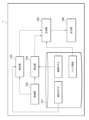
- FIG. 1 is a conceptual diagram of intervention design using an information processing device according to this embodiment.
- FIG. 2A is a diagram showing an example of applied BCT information and recommended BCT information according to this embodiment.
- FIG. 2B is a diagram showing an example of applied BCT information and recommended BCT information according to this embodiment.
- FIG. 3 is a diagram showing an example of a nudge factor associated with the BCT according to the present embodiment.
- FIG. 4A is a diagram showing an example of a nudge element set according to this embodiment.
- FIG. 4B is a diagram showing an example of a nudge element set according to this embodiment.
- FIG. 5 is a diagram showing an example of a hardware configuration of an information processing device according to the present embodiment.
- FIG. 6 is a diagram illustrating an example of a functional configuration of the information processing device according to the present embodiment.
- FIG. 7 is a flowchart showing an example of the operation of the information processing device according to the present embodiment.
- the information processing device acquires information on content constituting a specific service (hereinafter referred to as “content information”) and information on a target behavior by a user of the specific service (hereinafter referred to as “target behavior information”).
- the information processing device extracts first information (hereinafter referred to as “applied BCT information”) on a first behavior change technique (BCT) (hereinafter referred to as “applied BCT”) applied to the specific service based on the content information.
- first information hereinafter referred to as “applied BCT information”
- BCT first behavior change technique
- the information processing device derives second information (hereinafter referred to as “recommended BCT information”) on a second behavior change technique (BCT) (hereinafter referred to as “recommended BCT”) recommended for behavior change of a user of the specific service based on the target behavior information.
- the information processing device generates an element set (hereinafter referred to as a “nudge element set”) including one or more elements (hereinafter referred to as “nudge elements”) for intervention in a specific service based on the applied BCT information and the recommended BCT information, and outputs information regarding the generated nudge element set.
- the behavior change technique (BCT) is a technique or method that acts (works) on behavior change.
- BCTTv1 Machie S, Richardson M, Johnston M, et al.: The behavior change technique taxonomy (v1) of 93 hierarchically clustered techniques: building an international consensus for the reporting of behavior change interventions. Ann Behav Med 2013; 46: 81-95.
- BCTs are not limited to BCTTv1, and they may be defined in any way as long as they comprehensively cover behavior change techniques.
- the BCT according to this embodiment includes a group including one or more BCTs (hereinafter referred to as a "BCT group") (for example, a group of BCTTv1), and the terms BCT group and BCT may be interchangeable.
- the specific service may be any service in which an intervention is implemented to change the user's behavior. Examples include, but are not limited to, language learning or diet support services, and sales of financial products offered by financial institutions.
- the specific service is not limited to those provided to the user using electromagnetic methods such as applications installed on a terminal, web pages, e-mails, and short messages, but may be provided to the user using other methods (e.g., customer service, mail, etc.).
- the content information constituting the specific service is, for example, text information related to the specific service (e.g., chat logs, etc.), moving images, still images, audio of conversations, data related to applications, etc., but is not limited to these and may be any information related to the content of the specific service.
- the nudge element in this embodiment may be, for example, the text of a message using each BCT (e.g., the text of a message for email or short message service), or it may be any element that has characteristics related to the associated BCT, such as a human being with the behavioral characteristics or personality of each BCT, an application using each BCT, artificial intelligence that realizes each BCT (e.g., generative AI), an organization with the characteristics of each BCT, or a combination of at least two of these.
- the text of a message using each BCT e.g., the text of a message for email or short message service
- the nudge element in this embodiment may be, for example, the text of a message using each BCT (e.g., the text of a message for email or short message service), or it may be any element that has characteristics related to the associated BCT, such as a human being with the behavioral characteristics or personality of each BCT, an application using each BCT, artificial intelligence that realizes each BCT (e.g., generative AI
- FIG. 1 is a conceptual diagram of intervention design using an information processing device according to this embodiment.
- a diet support service is illustrated as an example of a specific service that is the subject of intervention design.
- a supporter supports a user's diet through chat with the user.
- content information is, for example, a chat log used in the diet support service.
- target behavior information is, for example, "lose 5 kg on a diet.” Note that FIG. 1 is merely an example, and the specific service, content information, and target behavior information according to this embodiment are not limited to those illustrated.
- the information processing device 1 acquires, as content information, a chat log between a user who uses a diet support service and a supporter. Based on the log, the information processing device 1 extracts applied BCT information regarding the BCT applied to the diet support service.
- the applied BCT information may indicate one or more components of the BCT applied to the diet support service.
- the information processing device 1 acquires information indicating a "loss 5 kg diet" as target behavior information. Based on the information, the information processing device 1 extracts recommended BCT information recommended for the "loss 5 kg diet".
- the recommended BCT information may indicate one or more BCT components recommended for the "loss 5 kg diet”.
- the information processing device 1 generates a nudge element set including one or more nudge elements for intervention in a specific service based on the applied BCT information and the recommended BCT information, and outputs information about the generated nudge element set.
- the nudge element set may be called a "nudge cocktail” or a “complementary nudge cocktail", etc.
- the information processing device 1 may identify a BCT for intervention based on a comparison between applied BCT information and recommended BCT information, and generate a nudge element set including nudge elements associated with at least a portion of the identified BCT for intervention.
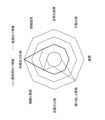
- FIGs 2A and 2B are diagrams showing an example of a comparison using applied BCT information and recommended BCT information according to this embodiment.
- the components of eight BCTs “Goals and planning," “Shaping knowledge,” “Natural consequences,” “Comparison of behavior,” “Associations,” “Repetition and substitution,” “Comparison of outcomes,” and “Reward and threat” are shown as the applied BCT information and recommended BCT information, respectively.
- each BCT shown in Figures 2A and 2B may be a BCT group including one or more subordinate BCTs, or may be the sum of the components of the one or more BCTs.
- the recommended BCT information may be generated based on the target behavior information so that the ratio between the components of the recommended BCT approaches 1.
- the ratio between any two of the recommended BCT components, among the components "goals and plans," “information provision,” “natural results,” “behavioral comparison,” “coordination,” “repetition and substitution,” “comparison of results,” and “reward and threat,” is 1.
- the recommended BCT information so that the ratio between the components of the recommended BCT approaches 1
- the recommended BCT information may be generated based on the target behavior information so that the ratio between a specific component of the recommended BCT and other components is greater than the ratio between the other components of the recommended BCT.
- the ratio between the components of a specific recommended "goals and plans" and the components of other recommended BCTs is greater than the ratio between the components of the other recommended BCTs.
- the information processing device 1 then analyzes the difference between the applied BCT information and the recommended BCT information, and identifies an intervention BCT for the diet support service based on the results of the analysis. Specifically, the information processing device 1 may identify at least some of the BCTs (in FIG. 2B, the six BCTs "Goals and Plans,” “Information Provision,” “Natural Results,” “Action Comparison,” “Collaboration,” and “Result Comparison”) in which the components of the applied BCT information are insufficient compared to the components of the recommended BCT information, as intervention BCTs. The information processing device 1 generates a nudge element set including one or more nudge elements associated with the identified intervention BCT, and outputs information related to the nudge element set.
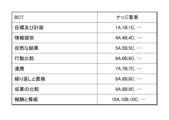
- FIG. 3 is a diagram showing an example of a nudge element associated with a BCT according to this embodiment.
- the information processing device 1 may store a nudge element in association with each BCT.
- Each BCT shown in FIG. 3 may be a BCT group including one or more BCTs under it, and a nudge element may be associated with each BCT in the BCT group.
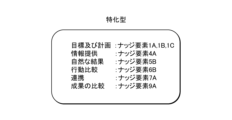
- FIGS. 4A and 4B are diagrams showing an example of a nudge element set according to this embodiment.
- FIG. 4A shows an example of a balanced nudge element set
- FIG. 4B shows an example of a specialized nudge element set. Note that in FIGS. 4A and 4B, it is assumed that a difference occurs between the applied BCT information and the recommended BCT information, as shown in FIGS. 2A and 2B, respectively.
- the nudge element set may include nudge elements associated with all BCT groups in which the applied BCT information components are insufficient compared to the recommended BCT information components (e.g., in Figure 2A, the six BCT groups "Goals and Plans,” “Information Provision,” “Action Comparison,” “Repetition and Substitution,” “Outcome Comparison,” and “Reward and Threat”)
- the nudge element set When implementing an intervention using the balanced nudge element set shown in Figure 4A, the nudge element set includes nudge elements associated with all BCTs for which the components of the applied BCT information are insufficient compared to the components of the recommended BCT information. This makes it possible to effectively support behavioral change in the target behavior of users of a particular service even when there is variation in the behavioral characteristics of the users.
- nudge elements associated with all BCTs for which the components of the applied BCT information are insufficient compared to the components of the recommended BCT information may be included in the nudge element set.
- which BCT to emphasize in a specialized nudge element set may be determined based on, for example, the behavioral characteristics of users of a particular service, or the magnitude of the difference between the components of the recommended BCT information and the components of the applied BCT information, or environmental constraints related to the implementation system.
- nudge elements associated with BCTs in which the applied BCT information components are insufficient compared to the recommended BCT information components are included in the nudge element set.
- the nudge element set When implementing an intervention using the specialized nudge element set shown in Figure 4B, the nudge element set includes nudge elements associated with each BCT for which the components of the applied BCT information are insufficient compared to the components of the recommended BCT information. This makes it possible to more effectively support behavioral change in the target behavior of users of a particular service when the users' behavioral characteristics are somewhat similar.
- the information processing device 1 may control the number or amount of nudge elements for each BCT to be included in a balanced or specialized nudge element set (e.g., FIG. 4A or FIG. 4B) based on the magnitude of the difference between the components of the recommended BCT information and the components of the applied BCT information.
- a balanced or specialized nudge element set e.g., FIG. 4A or FIG. 4B
- the difference between the applied BCT information and the recommended BCT information for the BCTs “goal and plan,” “information provision,” “action comparison,” “repeat and replacement,” and “comparison of results” is larger than the difference between the applied BCT information and the recommended BCT information for the BCT "reward and threat.”
- nudge elements associated with the BCTs "goal and plan,” “information provision,” “action comparison,” “repeat and replacement,” and “comparison of results” may be extracted than the nudge elements associated with the BCT “reward and threat.”
- the difference between the applied BCT information and the recommended BCT information for the BCT “goals and plans” is larger than the difference between the applied BCT information and the recommended BCT information for the BCTs "information provision,” “natural results,” “behavior comparison,” “collaboration,” and “results comparison.” Therefore, in the specialized nudge element set shown in FIG.
- nudge elements associated with the BCT "goals and plans" may be extracted than nudge elements associated with other BCTs.
- the number or amount of nudge elements for each BCT included in the nudge element set based on the magnitude of the difference between the components of the recommended BCT information and the components of the applied BCT information, it is possible to more effectively intervene to change the behavior of users of the service.
- a nudge element set including one or more nudge elements for intervention in a specific service is generated based on applied BCT information and recommended BCT information, and an intervention in a specific service is designed based on information related to the generated nudge element set. Therefore, additionally required nudge elements are automatically extracted based on the BCT that is missing in a service to which some BCT has already been applied, and efficient intervention design can be implemented.
- a specialized nudge element set is generated, and if the target group has a low level of behavioral science understanding, a balanced nudge element set is generated.
- specialized or balanced nudge element sets can also be generated by generating specialized or balanced recommended BCT information according to the target group's level of behavioral science understanding.
- the information processing device 1 may be configured as a single device, or may be configured to include multiple devices.
- the information processing device 1 may be configured as multiple devices that implement some of the functional configuration described below, and the functional configuration described below may be realized by the multiple devices that are connected by a wired and/or wireless network.
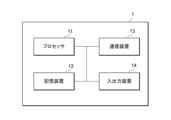
- FIG. 5 is a diagram showing an example of the hardware configuration of the information processing device 1 according to this embodiment.
- the information processing device 1 has a processor 11 such as a CPU (Central Processing Unit) that corresponds to a calculation device, a storage device 12, a communication device 13, and an input/output device 14.
- a processor 11 such as a CPU (Central Processing Unit) that corresponds to a calculation device
- a storage device 12 a communication device 13
- an input/output device 14 Each of these components is connected via a bus so that they can send and receive data to and from each other.
- CPU Central Processing Unit
- the processor 11 is, for example, a CPU (Central Processing Unit), and is a control unit that controls the execution of programs stored in the storage device 12 and calculates and processes data.
- the processor 11 receives various input data from the input/output device 14 and/or the communication device 13, and outputs (e.g., displays) the results of calculations on the input data to the input/output device 14, stores the results in the storage device 12, or transmits them via the communication device 13.
- CPU Central Processing Unit
- the storage device 12 is at least one of a memory, a hard disk drive (HDD), and a solid state drive (SSD).
- the storage device 12 of the information processing device 1 may store an action support program executed by the processor 11.
- the storage device 12 may be called a "storage unit" or the like.
- the communication device 13 is a device that communicates via a wired and/or wireless network, and may include, for example, a network card, a communication module, a chip, an antenna, etc.
- the communication device 13 may be called a "transmitter” or a “receiver”, etc.
- the input/output device 14 includes, for example, an input device such as a keyboard, a touch panel, a mouse, and/or a microphone, and an output device such as a display and/or a speaker.
- the input/output device may be called an "input section" or an “output section”, etc.
- the hardware configuration described above is merely one example.
- the information processing device 1 may omit some of the hardware shown in FIG. 5, or may include hardware not shown in FIG. 5.
- the hardware shown in FIG. 5 may be configured from one or more chips. If the information processing device 1 is configured from multiple devices, each device may include at least some of the hardware.
- FIG. 6 is a diagram showing the functional configuration of the information processing device 1 according to this embodiment.
- the information processing device 1 includes a storage unit 101, an acquisition unit 102, an extraction unit 103, a derivation unit 104, a generation unit 105, and an output unit 106.
- the storage unit 101 can be realized by using the storage device 12. At least a part of the functions realized by the acquisition unit 102 and the output unit 106 can be realized by using at least one of the communication device 13 and the input/output device 14. At least a part of the functions realized by the extraction unit 103, the derivation unit 104, and the generation unit 105 can be realized by the processor 11 executing an information processing program stored in the storage device 12.
- the information processing program can be stored in a storage medium.
- the storage medium storing the program may be a non-transitory computer readable medium.
- the non-transitory storage medium is not particularly limited, and may be, for example, a storage medium such as a USB memory or a CD-ROM.
- the information processing device 1 may also be provided with functions not shown.
- the memory unit 101 stores nudge elements in association with the BCT (for example, FIG. 3).
- the nudge elements stored in the memory unit 101 may be set according to the specific service that is the target of the intervention. For example, the memory unit 101 may be set to store the text of a message to which the BCT is applied as a nudge element associated with the BCT when intervening in a certain service. Furthermore, the memory unit 101 may store information on a person who has the behavioral characteristics of the BCT as a nudge element associated with the BCT when intervening in another service. Similarly, the memory unit 101 may be set to store a nudge element having the behavioral characteristics of the BCT in association with the BCT when intervening in each service.
- the storage unit 101 may also store a first model (hereinafter referred to as the "extraction model") used to extract applied BCT information.
- the extraction model may be generated based on machine learning using information about the content (e.g., text, image, audio, etc.) and information about the BCT as learning data.
- the storage unit 101 may also store a second model (hereinafter, "recommended model") used to derive recommended BCT information.
- the recommended model may be generated based on machine learning using information on behavior and information on the BCT as learning data.
- the acquisition unit 102 acquires content information related to the content that constitutes a specific service and target behavior information related to target behavior by users of the specific service.
- the extraction unit 103 extracts applied BCT information (first information) regarding a BCT (first behavior modification method) applied to a specific service based on the content information. Specifically, the extraction unit 103 may input the content information acquired by the acquisition unit 102 into an extraction model stored in the storage unit 101 to extract the applied BCT information.
- the derivation unit 104 derives recommended BCT information (second information) regarding a BCT (second behavior change method) recommended for behavior change of a user of a specific service based on the target behavior information.
- the derivation unit 104 may input the target behavior information acquired by the acquisition unit 102 into a recommendation model stored in the storage unit 101 to derive the recommended BCT information.
- the derivation unit 104 may derive information on all BCTs, regardless of the target behavior, as the recommended BCT information.
- the derivation unit 104 may also derive the recommended BCT information based on the target behavior information so that the ratio between the components of the recommended BCT approaches 1 (for example, FIG. 2A).
- the derivation unit 104 may also derive the recommended BCT information based on the target behavior information so that the ratio between the components of a specific recommended BCT and the components of other recommended BCTs is greater than the ratio between the components of the other recommended BCTs (for example, FIG. 2B).
- the derivation unit 104 may generate recommended BCT information (e.g., specialized or balanced recommended BCT information) according to the degree of behavioral scientific understanding of the subject group.
- the generating unit 105 generates a nudge element set including one or more nudge elements for intervention for a specific service based on the content information and target behavior information acquired by the acquiring unit 102. Specifically, the generating unit 105 may identify a BCT for intervention based on a comparison using the applied BCT information and the recommended BCT information, and generate a nudge element set including nudge elements associated in the storage unit 101 with the identified BCT for intervention. For example, as shown in Figures 2A and 2B, the generating unit 105 may compare the applied BCT information with the recommended BCT information, and analyze the difference between the applied BCT information and the recommended BCT information for each BCT.
- the generating unit 105 may identify all BCTs whose applied BCT information has insufficient components compared to the components indicated by the recommended BCT information as BCTs for intervention. Alternatively, the generating unit 105 may identify some of the BCTs whose applied BCT information has insufficient components compared to the components indicated by the recommended BCT information as BCTs for intervention.
- the generating unit 105 may identify at least a portion of the BCTs in which the components of the applied BCT information are deficient compared to the components indicated by the recommended BCT information as BCTs for intervention, and generate a nudge element set including nudge elements associated with the identified BCTs for intervention.
- the generating unit 105 may also control the number or amount of nudge elements associated with the BCT for intervention based on the magnitude of the difference between the components of the applied BCT information compared to the components of the recommended BCT information. For example, the generating unit 105 may increase the number or amount of nudge elements associated with the BCT for intervention the larger the difference between the components of the applied BCT information compared to the components of the recommended BCT information. On the other hand, the generating unit 105 may decrease the number or amount of nudge elements associated with the BCT for intervention the smaller the difference between the components of the applied BCT information compared to the components of the recommended BCT information.
- the output unit 106 outputs information about the nudge element set generated by the generation unit 105.
- the output unit 106 may output information about the nudge element set to an intervention designer for a specific service.
- the output unit 106 may output information on the BCT for intervention as the information on the nudge element set.
- the output unit 106 may output information on a nudge element associated with the BCT for intervention as the information on the nudge element set.
- the output unit 106 may output the text of a message to which the BCT for intervention is applied as the information on the nudge element set.
- the output unit 106 may output information on components of the recommended BCT information as the information on the nudge factor set.
- the output unit 106 may output information on components of the applied BCT information as the information on the nudge factor set.
- the output unit 106 may output information on components of the applied BCT information in a form that compares information on components of the recommended BCT information as the information on the nudge factor set.
- FIG. 7 is a flowchart showing the operation of the information processing device 1 according to this embodiment. Note that the operation of the information processing device 1 shown in Fig. 7 is merely an example and is not limited to that shown in the figure. For example, the order of steps S102 and S103 may be interchanged. Also, in Fig. 7, it is assumed that various nudge elements corresponding to the service to be intervened are stored in the storage unit 101 of the information processing device 1 in association with each BCT.
- the information processing device 1 acquires content information related to the content of a specific service and target behavior information related to the target behavior of a user of the specific service (step S101).
- the information processing device 1 extracts the applied BCT information based on the content information acquired in step S101 (step S102). Specifically, the information processing device 1 may input the content information into an extraction model to extract the applied BCT information.
- the information processing device 1 derives recommended BCT information based on the target behavior information acquired in step S101 (step S103). Specifically, the information processing device 1 may input the target behavior information into a recommendation model and extract recommended BCT information. Alternatively, the derivation unit 104 may derive information on all BCTs, regardless of the target behavior, as recommended BCT information.
- the information processing device 1 generates a nudge element set for intervention for a specific service based on the applied BCT information extracted in step S102 and the recommended BCT information derived in step S103 (step S104).
- the generating unit 105 may identify a BCT for intervention based on a comparison using the applied BCT information and the recommended BCT information, and generate a nudge element set including nudge elements associated with the identified BCT for intervention.
- the generating unit 105 may compare the applied BCT information with the recommended BCT information, identify at least a portion of the BCT in which the components of the applied BCT information are insufficient compared to the components indicated by the recommended BCT information, as a BCT for intervention, and generate a nudge element set (for example, a balanced nudge element set in Figure 4A or a specialized nudge element set in Figure 4B) including nudge elements associated with the identified BCT for intervention.
- a nudge element set for example, a balanced nudge element set in Figure 4A or a specialized nudge element set in Figure 4B
- the information processing device 1 outputs information regarding the nudge element set generated in step S104 (step S105).
- a nudge element set including one or more nudge elements for intervention in a specific service is generated based on applied BCT information and recommended BCT information, and an intervention in a specific service is designed based on information related to the generated nudge element set. Therefore, efficient intervention design can be implemented based on the BCT that is missing in a service to which some BCT has already been applied.
- applied BCT information is extracted from content information of a specific service using an extraction model, so that the intervener can more easily identify the BCT to be applied to the specific service.
- recommended BCT information is derived from target behavior information using a recommendation model, so that the BCT recommended for the target behavior of the specific service can be more easily identified. Furthermore, improving the metacognition of the provider of a specific service can also contribute to the provider's self-cognition and recognition of others.
- the information processing device 1 may input the applied BCT information and the recommended BCT information into a predetermined model without comparing the applied BCT information with the recommended BCT information, and generate a nudge element set as an output of the predetermined model.
- the information processing device 1 outputs information regarding the nudge element set to an intervention designer of a specific service, but this is not limited to this, and the information may be output to a user of a specific service.
- the information processing device 1 may output information regarding one or more nudge elements included in the nudge element set to a user once or multiple times as information regarding the nudge element set.
- the information processing device 1 may output information regarding a nudge element randomly selected from the multiple nudge elements included in the nudge element set to a user.
- the information processing device 1 may generate information regarding the nudge element set for all users of a specific service, or may generate information for each user or for each user group including one or more users.
- the information processing device 1 may generate a nudge element set for each user or user group (also called an "adaptive nudge cocktail”) based on the response of each user or each user group in response to a nudge element set for all users (also called a "MECE (Mutually Exclusive and Collectively Exhaustive) nudge cocktail").
Landscapes
- Business, Economics & Management (AREA)
- Tourism & Hospitality (AREA)
- Health & Medical Sciences (AREA)
- Economics (AREA)
- General Health & Medical Sciences (AREA)
- Human Resources & Organizations (AREA)
- Marketing (AREA)
- Primary Health Care (AREA)
- Strategic Management (AREA)
- Physics & Mathematics (AREA)
- General Business, Economics & Management (AREA)
- General Physics & Mathematics (AREA)
- Engineering & Computer Science (AREA)
- Theoretical Computer Science (AREA)
- Management, Administration, Business Operations System, And Electronic Commerce (AREA)
- Stored Programmes (AREA)
Applications Claiming Priority (2)
| Application Number | Priority Date | Filing Date | Title |
|---|---|---|---|
| JP2023-071462 | 2023-04-25 | ||
| JP2023071462A JP7357418B1 (ja) | 2023-04-25 | 2023-04-25 | 情報処理装置、情報処理方法及び情報処理プログラム |
Publications (1)
| Publication Number | Publication Date |
|---|---|
| WO2024225325A1 true WO2024225325A1 (ja) | 2024-10-31 |
Family
ID=88205094
Family Applications (1)
| Application Number | Title | Priority Date | Filing Date |
|---|---|---|---|
| PCT/JP2024/016101 Ceased WO2024225325A1 (ja) | 2023-04-25 | 2024-04-24 | 情報処理装置、情報処理方法及び情報処理プログラム |
Country Status (2)
| Country | Link |
|---|---|
| JP (2) | JP7357418B1 (https=) |
| WO (1) | WO2024225325A1 (https=) |
Families Citing this family (1)
| Publication number | Priority date | Publication date | Assignee | Title |
|---|---|---|---|---|
| JP7802312B1 (ja) * | 2025-01-27 | 2026-01-20 | 株式会社Godot | 情報処理装置及びプログラム |
Citations (6)
| Publication number | Priority date | Publication date | Assignee | Title |
|---|---|---|---|---|
| US20170301255A1 (en) * | 2016-04-14 | 2017-10-19 | Motiv8 Technologies, Inc. | Behavior change system |
| JP2019101654A (ja) * | 2017-11-30 | 2019-06-24 | オムロンヘルスケア株式会社 | 健康管理支援装置、方法およびプログラム |
| JP2020149131A (ja) * | 2019-03-11 | 2020-09-17 | 大日本印刷株式会社 | 医療情報連携装置、コンピュータプログラム及び医療情報連携方法 |
| WO2021044645A1 (ja) * | 2019-09-05 | 2021-03-11 | 日本電信電話株式会社 | 情報提示装置、情報取得装置、情報提示方法、情報取得方法、及びプログラム |
| JP6935118B1 (ja) * | 2021-04-15 | 2021-09-15 | ケイスリー株式会社 | 行動支援システム、行動支援方法及び行動支援プログラム |
| JP7062327B1 (ja) * | 2022-03-08 | 2022-05-06 | ケイスリー株式会社 | 行動支援システム、行動支援方法及び行動支援プログラム |
-
2023
- 2023-04-25 JP JP2023071462A patent/JP7357418B1/ja active Active
- 2023-09-19 JP JP2023150763A patent/JP2024157502A/ja active Pending
-
2024
- 2024-04-24 WO PCT/JP2024/016101 patent/WO2024225325A1/ja not_active Ceased
Patent Citations (6)
| Publication number | Priority date | Publication date | Assignee | Title |
|---|---|---|---|---|
| US20170301255A1 (en) * | 2016-04-14 | 2017-10-19 | Motiv8 Technologies, Inc. | Behavior change system |
| JP2019101654A (ja) * | 2017-11-30 | 2019-06-24 | オムロンヘルスケア株式会社 | 健康管理支援装置、方法およびプログラム |
| JP2020149131A (ja) * | 2019-03-11 | 2020-09-17 | 大日本印刷株式会社 | 医療情報連携装置、コンピュータプログラム及び医療情報連携方法 |
| WO2021044645A1 (ja) * | 2019-09-05 | 2021-03-11 | 日本電信電話株式会社 | 情報提示装置、情報取得装置、情報提示方法、情報取得方法、及びプログラム |
| JP6935118B1 (ja) * | 2021-04-15 | 2021-09-15 | ケイスリー株式会社 | 行動支援システム、行動支援方法及び行動支援プログラム |
| JP7062327B1 (ja) * | 2022-03-08 | 2022-05-06 | ケイスリー株式会社 | 行動支援システム、行動支援方法及び行動支援プログラム |
Also Published As
| Publication number | Publication date |
|---|---|
| JP2024157228A (ja) | 2024-11-07 |
| JP7357418B1 (ja) | 2023-10-06 |
| JP2024157502A (ja) | 2024-11-07 |
Similar Documents
| Publication | Publication Date | Title |
|---|---|---|
| Mohanty et al. | Web-services classification using intelligent techniques | |
| US20230401192A1 (en) | Systems and methods for optimizing data processing in a distributed computing environment | |
| JP2015166975A (ja) | 注釈情報付与プログラム及び情報処理装置 | |
| US20180336792A1 (en) | Method, apparatus, and computer program for operating machine-learning framework | |
| CN112070545B (zh) | 用于优化信息触达的方法、装置、介质和电子设备 | |
| WO2024225325A1 (ja) | 情報処理装置、情報処理方法及び情報処理プログラム | |
| Samreen et al. | Transferable knowledge for low-cost decision making in cloud environments | |
| Abacha et al. | Synthetic data aided federated learning using foundation models | |
| Johnson et al. | Analyzing the Evolution of the Internet. | |
| EP3690790A1 (en) | Portfolio presentation program, portfolio presentation method, and portfolio presentation device | |
| CN105556514B (zh) | 一种基于用户搜索行为进行数据挖掘的方法和装置 | |
| Rana et al. | Dynamics and control of a discrete predator–prey model with prey refuge: Holling type I functional response | |
| Kim et al. | Identifying aberrant data in structural equation models with IRLS-ADF | |
| Kaligotla et al. | Model exploration of an information-based healthcare intervention using parallelization and active learning | |
| CN109685091A (zh) | 使用贝叶斯方式的数字体验目标确定 | |
| JP2023137514A (ja) | 情報処理装置、情報処理方法および情報処理プログラム | |
| JP2023130608A (ja) | 行動支援システム、行動支援方法及び行動支援プログラム | |
| EP4372626A1 (en) | Information processing program, method for processing information, and information processing apparatus | |
| JP7745187B1 (ja) | 情報管理システム、情報管理方法、プログラム | |
| Peluso et al. | A federated learning-based android malware detector through differential privacy | |
| JP7625236B1 (ja) | 支援システム、支援方法及び支援プログラム | |
| JP7460188B2 (ja) | 行動支援システム、行動支援方法及び行動支援プログラム | |
| Guo et al. | Service composition optimization method based on parallel particle swarm algorithm on spark | |
| WO2026013913A1 (ja) | 提供装置、提供方法、及びプログラム | |
| Chaturvedi et al. | Twitter Profile Analyzer: A Tool for Combating Hate Speech and Promoting Positive Online Communication |
Legal Events
| Date | Code | Title | Description |
|---|---|---|---|
| 121 | Ep: the epo has been informed by wipo that ep was designated in this application |
Ref document number: 24797071 Country of ref document: EP Kind code of ref document: A1 |
|
| NENP | Non-entry into the national phase |
Ref country code: DE |
|
| 122 | Ep: pct application non-entry in european phase |
Ref document number: 24797071 Country of ref document: EP Kind code of ref document: A1 |