WO2024219420A1 - コンテナ固定装置 - Google Patents
コンテナ固定装置 Download PDFInfo
- Publication number
- WO2024219420A1 WO2024219420A1 PCT/JP2024/015257 JP2024015257W WO2024219420A1 WO 2024219420 A1 WO2024219420 A1 WO 2024219420A1 JP 2024015257 W JP2024015257 W JP 2024015257W WO 2024219420 A1 WO2024219420 A1 WO 2024219420A1
- Authority
- WO
- WIPO (PCT)
- Prior art keywords
- stopper
- fixing device
- container
- container fixing
- fitting
- Prior art date
- Legal status (The legal status is an assumption and is not a legal conclusion. Google has not performed a legal analysis and makes no representation as to the accuracy of the status listed.)
- Ceased
Links
Images








Classifications
-
- B—PERFORMING OPERATIONS; TRANSPORTING
- B65—CONVEYING; PACKING; STORING; HANDLING THIN OR FILAMENTARY MATERIAL
- B65D—CONTAINERS FOR STORAGE OR TRANSPORT OF ARTICLES OR MATERIALS, e.g. BAGS, BARRELS, BOTTLES, BOXES, CANS, CARTONS, CRATES, DRUMS, JARS, TANKS, HOPPERS, FORWARDING CONTAINERS; ACCESSORIES, CLOSURES, OR FITTINGS THEREFOR; PACKAGING ELEMENTS; PACKAGES
- B65D90/00—Component parts, details or accessories for large containers
- B65D90/0006—Coupling devices between containers, e.g. ISO-containers
- B65D90/0013—Twist lock
-
- B—PERFORMING OPERATIONS; TRANSPORTING
- B65—CONVEYING; PACKING; STORING; HANDLING THIN OR FILAMENTARY MATERIAL
- B65D—CONTAINERS FOR STORAGE OR TRANSPORT OF ARTICLES OR MATERIALS, e.g. BAGS, BARRELS, BOTTLES, BOXES, CANS, CARTONS, CRATES, DRUMS, JARS, TANKS, HOPPERS, FORWARDING CONTAINERS; ACCESSORIES, CLOSURES, OR FITTINGS THEREFOR; PACKAGING ELEMENTS; PACKAGES
- B65D88/00—Large containers
- B65D88/02—Large containers rigid
- B65D88/12—Large containers rigid specially adapted for transport
- B65D88/121—ISO containers
-
- B—PERFORMING OPERATIONS; TRANSPORTING
- B65—CONVEYING; PACKING; STORING; HANDLING THIN OR FILAMENTARY MATERIAL
- B65D—CONTAINERS FOR STORAGE OR TRANSPORT OF ARTICLES OR MATERIALS, e.g. BAGS, BARRELS, BOTTLES, BOXES, CANS, CARTONS, CRATES, DRUMS, JARS, TANKS, HOPPERS, FORWARDING CONTAINERS; ACCESSORIES, CLOSURES, OR FITTINGS THEREFOR; PACKAGING ELEMENTS; PACKAGES
- B65D90/00—Component parts, details or accessories for large containers
-
- B—PERFORMING OPERATIONS; TRANSPORTING
- B65—CONVEYING; PACKING; STORING; HANDLING THIN OR FILAMENTARY MATERIAL
- B65D—CONTAINERS FOR STORAGE OR TRANSPORT OF ARTICLES OR MATERIALS, e.g. BAGS, BARRELS, BOTTLES, BOXES, CANS, CARTONS, CRATES, DRUMS, JARS, TANKS, HOPPERS, FORWARDING CONTAINERS; ACCESSORIES, CLOSURES, OR FITTINGS THEREFOR; PACKAGING ELEMENTS; PACKAGES
- B65D2590/00—Component parts, details or accessories for large containers
- B65D2590/0008—Coupling device between containers
- B65D2590/0025—Twist lock
-
- B—PERFORMING OPERATIONS; TRANSPORTING
- B65—CONVEYING; PACKING; STORING; HANDLING THIN OR FILAMENTARY MATERIAL
- B65D—CONTAINERS FOR STORAGE OR TRANSPORT OF ARTICLES OR MATERIALS, e.g. BAGS, BARRELS, BOTTLES, BOXES, CANS, CARTONS, CRATES, DRUMS, JARS, TANKS, HOPPERS, FORWARDING CONTAINERS; ACCESSORIES, CLOSURES, OR FITTINGS THEREFOR; PACKAGING ELEMENTS; PACKAGES
- B65D2590/00—Component parts, details or accessories for large containers
- B65D2590/0008—Coupling device between containers
- B65D2590/0025—Twist lock
- B65D2590/0033—Semi or fully automatic twist lock, i.e. semi or fully automatic locking/unlocking
Definitions
- the present invention relates to a container fixing device that can fix containers stacked one on top of the other.
- this patent document 1 discloses that the container is fixed in place when the flange portion comes into contact with the outer surface of the corner fitting and the movable convex portion comes into contact with the inner corner portion located at the inner side of the opening during the rotational movement, thereby reducing the gap between the movable convex portion and the groove hole and making it possible to stack many containers.
- Patent Document 2 also discloses a container fixing device that includes a flange portion located outside a groove in a corner fitting of a container, a support portion provided on the flange portion, a fitting portion provided on the support portion that fits into the groove in the corner fitting, a movable convex portion that forms part of the fitting portion and protrudes laterally from a vertical surface portion of the support portion to form a container fixed state, and a stopper that maintains (locks) the container fixed state by limiting the rotation of the movable convex portion.
- the opening 1150b has an opening vertical surface A due to the thickness of the surrounding wall, an entrance corner B (tapered portion) located on the entrance side of the opening vertical surface A, an outer surface C that is perpendicular to the opening vertical surface A and connects to the entrance corner B, a rear corner D that is located on the rear side of the opening vertical surface A, and an inner surface E that is perpendicular to the opening vertical surface A and connects to the rear corner D.
- Patent Document 1 Japanese Patent No. 6570743
- Patent Document 2 Japanese Patent No. 6371471
- the container fixing device with a bifurcated convex structure described in Patent Document 1 is not structured to be able to lock the container in the fixed state.
- a structure that can lock the container in the fixed state is required.
- the present invention aims to provide a container fixing device that can lock the container in a fixed state.
- the container fixing device of the present invention comprises: a flange portion located outside a slot of a corner fitting of the container; A first support portion is provided on the flange portion and is fitted into an elongated opening of the slot; a first fitting portion provided on the first support portion and fitted into the hollow portion of the slot; a second support portion provided on a side of the flange portion opposite to the side on which the first support portion is provided and adapted to fit into an elongated opening of a slot in a corner fitting of another container; and a second fitting portion that is provided on the second support portion and fits into a hollow portion of a slot of a corner fitting of the other container; a stopper that is arranged movably between an opposing position that is a position opposing an opening vertical surface portion on a long side of the opening into which the first support portion fits and a retracted position that is a position on the second support portion side; a stopper insertion portion formed in the flange portion to allow movement of the stopper; a stopper receiving
- the container fixing state is locked. In this locked state, with the container fixing device engaged with both the upper and lower corner fittings of containers stacked in two tiers, it becomes possible to lift the lower container by lifting the upper container at the same time.
- the opposing position when the container fixing device is in use, the opposing position is located below the retracted position, and when the stopper moves to the opposing position, the upper side of the stopper is located within the stopper insertion portion and the lower side of the stopper is located at the opposing position, and when the stopper moves to the retracted position, the upper side of the stopper is located within the stopper accommodating groove and the lower side of the stopper is located within the stopper insertion portion.
- a portion of the stopper may protrude from the surface of the second support column and be positioned in the elongated hole-shaped opening of the corner fitting of the other container, thereby preventing the second support column from rotating relative to the corner fitting of the other container.
- the stopper may be made up of multiple parts, and some of the parts may be inserted into the stopper insertion portion while other parts are connectable to the some of the parts.
- the operating part may include a rotation shaft that passes through the flange part, a rotation engagement member whose base side is connected to the rotation shaft and whose tip side engages with a recess formed in the stopper, and an operating handle that is located outside the flange part and rotates the rotation shaft.
- the opposing position is located below the retracted position, and the tip side of the rotating engagement member is located below the rotation center of the base side of the rotating engagement member when the stopper is located at the opposing position, and may be located above the rotation center of the base side of the rotating engagement member when the stopper is located at the retracted position.
- a base accommodating groove for accommodating the base side of the pivoting engagement member may be formed within the stopper insertion portion.
- the upper surface of the tip side of the pivoting engagement member when the stopper is in the retracted position, may be inclined upward relative to the portion near the entrance of the recess, or may be approximately horizontal.
- a ball pressing member may be attached in a hole extending from the surface of the flange portion to the pivot shaft, and the ball of the ball pressing member may fit into one of a number of recesses formed in the pivot shaft, thereby maintaining the pivot state of the pivot shaft.
- a ball pressing member may be attached in a hole extending from the surface of the flange portion to the stopper, and the ball of the ball pressing member may fit into one of a number of recesses formed in the stopper, thereby maintaining the movement position of the stopper.
- the first fitting portion has two protrusions at different heights, and of the two protrusions, the protrusion that is on the lower side when the container fixing device is in use is a fixed protrusion, and the protrusion that is on the upper side when the container fixing device is in use is a movable protrusion that is biased so as to protrude laterally from the vertical surface of the first support portion, and the movable protrusion does not contact the center side of the longitudinal direction of the elongated hole-shaped opening, but may have contact portions that contact each end side of the longitudinal direction.
- the container fixing state may be formed with the flange portion contacting the outer surface of the corner fitting, and the contact portion contacting the rear corner portion located at the rear side of the opening during the rotational movement.
- the first fitting portion may be a fixing protrusion.
- the present invention makes it possible to lock the fixed state of the container. Therefore, when the container is in a fixed state in which it is engaged with both the upper and lower corner fittings of containers stacked in two layers, by performing the above locking, it becomes possible to lift the lower container at the same time by lifting the upper container.
- FIG. 1 is an explanatory diagram showing a container fixing device according to one embodiment, a corner fitting on the lower surface of an upper container, and a corner fitting on the upper surface of a lower container.
- FIG. 2 is a cross-sectional view showing a locked state of the container fixing device according to the embodiment.
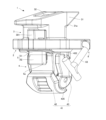
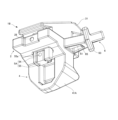
- FIG. 3 is a perspective view showing the container fixing device according to the embodiment.
- FIG. 4 is a perspective view showing the container fixing device according to the embodiment.
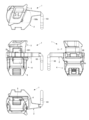
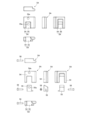
- FIG. 5 is a diagram showing the bottom, front, back and plan views of the container fixing device of the embodiment.
- FIG. 6 is an explanatory diagram showing the upper support pillars, stoppers, corner fittings, etc. of the container fixing device of the embodiment.
- FIG. 1 is an explanatory diagram showing a container fixing device according to one embodiment, a corner fitting on the lower surface of an upper container, and a corner fitting on the upper surface of a lower container.
- FIG. 2 is a cross-sectional view showing a locked state of the container fixing device
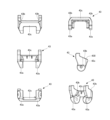
- FIG. 7 is a front view, a rear view, a bottom view, a plan view, a side view and a perspective view of the movable protrusion of the container fixing device of the embodiment.
- FIG. 8 is an explanatory diagram of a stopper of the container fixing device according to the embodiment.
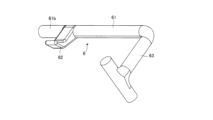
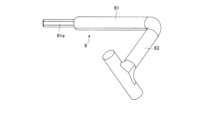
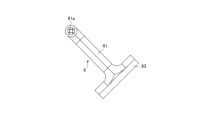
- FIG. 9A is a perspective view of an operating portion of a container fixing device according to an embodiment.
- FIG. 9B is a perspective view of the operating portion of the container fixing device according to the embodiment.
- FIG. 10A is a perspective view of an operating portion (socket portion and pivot engagement member are omitted) of the container fixing device of the embodiment.
- FIG. 10B is a perspective view of the operating portion (without the socket portion and the pivotable engagement member) of the container fixing device of the embodiment.
- FIG. 11 is a cross-sectional view showing the container fixing device of the embodiment in an unlocked state.
- FIG. 12 is a cross-sectional view showing a locked state of a container fixing device according to another embodiment.
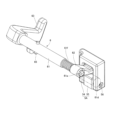
- FIG. 13 is a perspective view showing a container fixing device according to another embodiment.
- FIG. 14 is an explanatory diagram showing the engagement relationship between the rotation shaft, the rotation engagement member, and the stopper of the container fixing device shown in FIG.
- FIG. 15 is an explanatory view of a stopper of the container fixing device shown in FIG.
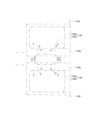
- FIG. 16 is an explanatory diagram showing corner fittings of upper and lower containers.
- FIG. 1 and 2 show the use of the container fixing device 1.
- a corner fitting 100a is provided at the corner of the bottom surface of an upper container 100
- a corner fitting 101a is provided at the corner of the top surface of a lower container 101.
- the container fixing device 1 is located between the corner fittings 100a and 101a, and connects and fixes the upper container 100 and the lower container 101.
- the slot 150 of the corner fitting 100a is made up of a hollow portion 150a formed inside the peripheral wall of the corner fitting 100a, and an elongated opening 150b formed in the peripheral wall, which leads to the hollow portion 150a and is smaller than the hollow portion 150a.
- the opening 150b has an opening vertical surface A formed by the thickness of the peripheral wall, an entrance corner B (tapered portion) located on the entrance side of the opening vertical surface A, an outer surface C that is perpendicular to the opening vertical surface A and connects to the entrance corner B, a rear corner D located on the rear side of the opening vertical surface A, and an inner surface E that is perpendicular to the opening vertical surface A and connects to the rear corner D.
- the slot 151 of the corner fitting 101a is made up of a hollow portion 151a formed inside the peripheral wall of the corner fitting 101a, and an opening 151b formed in the peripheral wall, which is connected to the hollow portion 151a and has a generally long hole shape that is smaller than the hollow portion 151a.
- the opening 151b has an opening vertical surface A formed by the thickness of the peripheral wall, an entrance corner B (tapered portion) located on the entrance side of the opening vertical surface A, an outer surface C that is perpendicular to the opening vertical surface A and connects to the entrance corner B, a rear corner D located on the rear side of the opening vertical surface A, and an inner surface E that is perpendicular to the opening vertical surface A and connects to the rear corner D.
- the container fixing device 1 has a flange portion 2.
- This flange portion 2 is located outside the slots 150, 151 of the corner fittings 100a, 101a.
- An upper support portion (second support portion) 3 is provided on the upper surface side of the flange portion 2, and a lower support portion (first support portion) 4 is provided on the lower surface side.
- the flange portion 2 comes into contact with the outer surface portion C of the corner fittings 100a, 101a.
- the boundary between the lower support portion (first support portion) 4 and the flange portion 2 has a support portion side tapered portion 4a that has a slope that follows the slope of the entrance corner B and comes into contact with the entrance corner B.
- An upper cone (second fitting portion) 31 is provided on the upper side of the upper support portion 3.
- the upper support portion 3 fits into the opening portion 150b, and the upper cone 31 fits into the hollow portion 150a.
- a lower cone (first fitting portion) 41 is provided on the lower side of the lower support portion 4.
- the lower support portion 4 fits into the opening portion 151b, and the lower cone 41 fits into the hollow portion 151a.
- the upper support section 3 and the upper cone 31 have, for example, a substantially parallelogram-shaped cross section, and can be inserted into the opening 150b of the corner fitting 100a from the sharp end side of the upper cone 31. Furthermore, with the upper support section 3 and the upper cone 31 inserted into the hollow section 150a, the container fixing device 1 can be rotated within a predetermined range. At the end of this rotation, the longitudinal direction of the lower support section 4 coincides with the longitudinal directions of the openings 150b and 151b.
- the lower support 4 has vertical surfaces that are positioned parallel to the vertical surfaces A of the opening 151b on the long side.
- the lower cone (first fitting portion) 41 has a fixed protrusion 42 that protrudes from one of the vertical surfaces, and a movable protrusion (latch) 43 that protrudes from the other vertical surface.
- the most protruding point of the fixed protrusion 42 and the most protruding point of the movable protrusion 43 are offset vertically, with the movable protrusion 43 being positioned closer to the flange 2 (upper side) than the fixed protrusion 42.
- the fixing convex portion 42 has a first inclined surface 420, a second inclined surface 421, and a convex apex 422 located between these inclined surfaces.
- the first inclined surface 420 comes into contact with the rear corner D located at the rear side of the opening 151b during the pulling operation for unloading.
- the second inclined surface 421 comes into contact with the entrance corner B located on the entrance side of the opening vertical surface A during the lowering operation for fixing the container.
- the convex apex 422 comes into contact with the opening vertical surface A during the lowering operation for fixing the container and the pulling operation for unloading.
- the movable convex portion 43 has a first inclined surface 430, a second inclined surface 431, and a convex apex 432 located between these inclined surfaces.
- the first inclined surface 430 contacts the rear corner D located at the rear side of the opening 151b during the pulling operation for unloading.
- the second inclined surface 431 contacts the entrance corner B located at the entrance side of the opening vertical surface A during the lowering operation for fixing the container.
- the convex apex 432 contacts the opening vertical surface A during the lowering operation for fixing the container and the pulling operation for unloading.
- the movable convex portion 43 is formed with a rotation stopper 433, which prevents the movable convex portion 43 from rotating (protruding) beyond a specified amount.
- the lower cone (first mating part) 41 of the container fixing device 1 needs to move laterally (horizontally).
- the unlocked state in which the lateral movement of the lower support part 4 and the lower cone (first mating part) 41 is possible, the above-mentioned pulling out operation during lifting is possible.
- the container fixing device 1 When the container fixing device 1 is engaged with both the upper and lower corner fittings 101a, 100a of the containers 101, 100 stacked in two tiers, and the container fixing device 1 is operated to the locked state, it becomes possible to lift the lower container 101 at the same time by lifting the upper container 100.
- the switching between the locked state and the unlocked state is performed by the stopper 5.
- the stopper 5 is operated by the operating unit 6. The stopper 5 and the operating unit 6 will be described in detail later.
- the movable convex portion 43 has a pair of shaft hole forming portions 43a, contact portions 43b that exist as part of each shaft hole forming portion 43a, and a plate-like portion 43c that is provided to connect these between the shaft hole forming portions 43a.
- the portion of the contact portion 43b that forms the first inclined surface 430 does not contact the center side of the longitudinal direction of the elongated hole-shaped opening 151b, but contacts each end side in the longitudinal direction.
- the contact portion 43b can contact the end side of the opening 151b of the corner fitting 101a, rather than the center side. This makes it easier for a load to be applied near the end of the opening 151b, making it possible to suppress convex deformation near the center of the opening 151b and prevent the corner fitting 101a from becoming defective.
- an axis member 435 that rotatably supports the movable convex portion 43 is inserted into the axis hole formed in the axis hole forming portion 43a.
- an axis support portion 425 that supports the axis member 435 is formed in the fixed convex portion 42.
- a recessed portion 425a is formed in the center of this axis support portion 425, and within this recessed portion 425a, as shown in FIG. 2, a coil spring 44 is attached to the periphery of the axis member 435.
- One end side of the coil spring 44 contacts the back side portion of the fixed convex portion 42, and the other end side of the coil spring 44 contacts the back side portion of the plate-shaped portion 43c.
- the movable convex portion 43 rotates due to the elastic force of the coil spring 44 and protrudes laterally from the vertical surface of the lower support portion 4. Furthermore, during the lowering operation to secure the container and during the pulling operation to lift the container, the movable convex portion 43 rotates against the elastic force of the coil spring 44 and temporarily enters the lower support portion 4. In other words, the movable convex portion 43 is capable of protruding laterally from the vertical surface of the lower support portion 4 and entering the lower support portion 4.
- the stopper 5 faces the opening vertical surface portion A on the long side of the opening 151b (facing position) and fits into the gap between this opening vertical surface portion A and the lower support portion 4.
- the stopper 5 slips out of the gap and retreats to the upper support portion 3 side (retracted position).
- the stopper 5 is arranged to be movable between the facing position and the retracted position.
- the flange portion 2 has a stopper insertion portion 21, which is an opening that allows the stopper 5 to move.
- the upper support section (second support section) 3 is formed with a stopper accommodating groove 301 that allows the stopper 5 to move.
- the opposing position is located below the retracted position, and when the stopper 5 moves to the opposing position, the upper side of the stopper 5 is located in the stopper insertion portion 21 and the lower side of the stopper 5 is located in the gap. On the other hand, when the stopper 5 moves to the retracted position, the upper side of the stopper 5 is located in the stopper accommodating groove 301 and the lower side of the stopper 5 is located in the stopper insertion portion 21.
- the upper corner 5c which is a part of the side 5a of the stopper 5, protrudes laterally from the surface of the upper support column (second support column) 3 as shown in FIG. 6 and faces the vertical opening surface A of the elongated opening 150b of the slot 150 of the corner fitting 100a of the upper container 100.
- the function of preventing the above-mentioned rotation of the upper support column 3 relative to the corner fitting 100a of the upper container 100 is not exerted.
- the rotation of the lower support column 4 relative to the corner fitting 100a is suppressed, and as a result, the rotation of the upper support column 3 relative to the corner fitting 100a of the upper container 100 is suppressed.
- the stopper 5 can be separated into a first part 51 located on the upper side and a second part 52 located on the lower side, and after only the first part 51 is inserted into the stopper insertion portion 21, the second part 52 can be connected to the first part 51.
- a female thread for bolt screwing is formed on the lower side of the first part 51 (the connection side of the second part 52), and a bolt insertion hole is formed in the second part 52.
- the second part 52 and the first part 51 can be integrated by screwing a bolt passed through the bolt insertion hole into the female thread.
- the front side of the stopper 5 that faces the opening vertical surface A on the long side of the opening 151b is a flat surface.
- a recess 5b is formed on the back side of the stopper 5.
- the tip side of the pivot engagement member 62 in the operating unit 6 engages with this recess 5b.
- the stopper 5 can be moved between the opposing position and the retracted position by operating the operating unit 6.
- the operating unit 6 includes a rotation shaft 61 that is rotatably provided within the flange portion 2, a rotation engagement member 62 whose base side is connected to the rotation shaft 61 and whose tip side engages with the recess 5b of the stopper 5, and an operating handle 63 that is located outside the flange portion 2 and rotates the rotation shaft 61.
- a base accommodation groove 21a that accommodates the base side of the rotation engagement member 62 is formed within the stopper insertion portion 21 of the flange portion 2.
- the rotating shaft 61 is passed through the flange portion 2 in parallel with the shaft member 435.
- An operating handle 63 is provided on one end of the rotating shaft 61.
- the rotating shaft 61 has a square shaft 61a from a midway position to the other end.
- a female screw is formed on the tip side of the square shaft 61a.
- a cylindrical socket portion 61b is fitted into this tip side.
- the socket portion 61b is rotatably fitted into the flange portion 2 from the opposite side to the operating handle 63.
- a bolt insertion hole 61c is formed on the other end side of the socket portion 61b, and a bolt passed through this bolt insertion hole 61c is screwed into the female screw on the tip side of the square shaft 61a, so that the rotating shaft 61 is rotatably attached to the flange portion 2.
- the square shaft 61a is present in the base housing groove 21a.
- the tip side of the pivot engagement member 62 is located below the rotation center on the base side of the pivot engagement member 62.
- the tip side is located above the rotation center on the base side of the pivot engagement member 62.
- the top surface of the tip side of the pivot engagement member 62 is approximately horizontal with respect to the portion near the entrance of the recess 5b. It is to be noted that the tip side of the top surface of the pivot engagement member 62 is not limited to being approximately horizontal, and may be inclined upward. When the tip side top surface of the pivot engagement member 62 is formed in this manner, it becomes easier to lower the height of the top surface of the base accommodation groove 21a.
- the flange portion 2 has a hole 2b formed in the thickness direction of the flange portion 2, which extends from the surface of the flange portion 2 to the pivot shaft 61.
- a ball plunger (ball pressing member) 28 that presses a ball with a built-in spring is attached inside this hole 2b.
- the socket portion 61b of the pivot shaft 61 has recesses formed at locations that correspond to the rotation positions corresponding to the locked and unlocked states. The rotation state of the pivot shaft 61 is maintained by fitting the ball of the ball plunger 28 into one of the recesses.
- the upper support 3 and the upper cone 31 are formed with a vertical hole 32 that leads to the base housing groove 21a, which reduces the weight of the container fixing device 1 and allows rainwater to drain.
- the container fixing device 1 With the above container fixing device 1, the basic operation in the unlocked state causes the flange portion 2 to come into contact with the outer surface C (upper surface) of the corner fitting 101a, the lower cone 41 to enter the groove hole 151, and the movable convex portion 43 to protrude laterally from the vertical surface of the lower support portion 4, forming a container fixing state. Furthermore, the container fixing device 1 of this embodiment forms a container fixing state with the movable convex portion 43 rotated to its maximum within the hollow portion 151a. That is, in this container fixing state, the movable convex portion 43 is prevented from rotating by the rotation preventing portion 433, and a gap exists between the first inclined surface 430 of the movable convex portion 43 and the rear corner portion D.
- the container securing device 1 When the container is in an unlocked, secured state and a pull-out operation is performed, the container securing device 1 rises straight up until the first inclined surface 430 comes into contact with the rear corner D, and then, when the first inclined surface 430 comes into contact with the rear corner D, it maintains this contact state and is lifted diagonally upward (to the upper left in Figure 11).
- the convex top portion 422 moves while contacting the opening vertical surface portion A.
- the container fixing device 1 forms the container fixing state when the movable convex portion 43 is rotated to the maximum extent within the hollow portion 151a, but is not limited to this structure.
- the container fixing device 1 may be structured such that the container fixing state is formed when the movable convex portion 43 comes into contact with the inner corner portion D located at the inner side of the opening 151b during the rotational movement.
- the flange portion 2 comes into contact with the outer surface portion C of the corner fitting 101a, and the movable convex portion 43 comes into contact with the inner corner portion D located at the inner side of the opening 151b during the rotational movement, so the gap between the movable convex portion 43 and the groove hole 151 can be made small. This makes it possible to stack many containers, and has the advantage of reducing container transportation costs.
- the container fixing device 1 is not limited to a structure having a movable convex portion 43 with a bifurcated convex structure, and may be a container fixing device 1A as shown in FIG. 12.
- the lower support portion 4 of the container fixing device 1A is equipped with a lower cone (first fitting portion) 41A consisting of a fixed convex portion.
- the other parts of the container fixing device 1A are similar to the configuration of the container fixing device 1, for example.
- the lower cone (first fitting portion) 41A is not limited to a bifurcated convex structure, and may be a general single convex structure.
- a container fixing device 1B shown in Figs. 13 and 14 can be used.
- a cylindrical socket portion 61d is fitted into the tip side of the square shaft 61a.
- This socket portion 61b can be fitted into the flange portion 2 from the side where the operating handle 63 is located.
- a coil spring 61f is attached to the outer periphery of the square shaft 61a between the base of the rotating engagement member 62 and the end of the rotating shaft 61.
- a hole into which a spring pin 65 can be driven is formed in a position of the rotating shaft 61 close to the operating handle 63.
- the container fixing device 1B also includes a stopper 5A.
- the stopper 5A is made up of a first part 54 and a second part 55.
- the first part 54 has a gate-like shape with an opening from the center to the bottom side, and the second part 55 has a shape that fits into the opening from below. With the second part 55 fitted into the opening, the first part 54 and the second part 55 are integrated by screwing in a bolt 56.
- a recess 54a is formed on the back surface of the first part 54, and a recess 55a is formed on the back surface of the second part 55.
- a ball plunger 28 (ball pressing member) is attached in a hole that extends from the surface of the flange portion 2 to the above-mentioned back surface of the stopper 5A. The movement position of the stopper 5A is maintained by fitting the ball of the ball plunger 28 into one of the multiple recesses 54a, 55a formed in the stopper 51A.
- the stopper 5A and other components of the container fixing device 1B can also be applied to the container fixing device 1 shown in FIG. 1 and the container fixing device 1A shown in FIG. 12.
- Container fixing device 1A Container fixing device 1B: Container fixing device 2: Flange portion 2b: Hole portion 3: Upper support portion (second support portion) 4: Lower support section (first support section) 4a: Tapered portion on support portion side 5: Stopper 5A: Stopper 5a: Side portion 5b: Recess 5c: Upper corner portion (part of the stopper) 6: Operation portion 21: Stopper insertion portion 21a: Base accommodation groove 28: Ball plunger (ball pressing member) 31: Upper cone (second fitting portion) 32: Vertical hole portion 41: Lower cone (first fitting portion) 41A: Lower cone (first fitting portion) 42 : Fixed convex portion 43 : Movable convex portion 43a : Shaft hole forming portion 43b : Contact portion 43c : Plate-shaped portion 44 : Coil spring 51 : First part 52 : Second part 54 : First part 54a : Recessed portion 55 : Second part 55a : Recessed portion 56 : Bolt 61 : Rotating shaft 61a : Square shaft
Landscapes
- Engineering & Computer Science (AREA)
- Mechanical Engineering (AREA)
- Stackable Containers (AREA)
Priority Applications (4)
| Application Number | Priority Date | Filing Date | Title |
|---|---|---|---|
| JP2025515258A JPWO2024219420A1 (https=) | 2023-04-21 | 2024-04-17 | |
| EP24792692.6A EP4699955A1 (en) | 2023-04-21 | 2024-04-17 | Container fixing device |
| CN202480027182.3A CN120981404A (zh) | 2023-04-21 | 2024-04-17 | 集装箱固定装置 |
| KR1020257030754A KR20250153808A (ko) | 2023-04-21 | 2024-04-17 | 컨테이너 고정 장치 |
Applications Claiming Priority (2)
| Application Number | Priority Date | Filing Date | Title |
|---|---|---|---|
| JP2023070219 | 2023-04-21 | ||
| JP2023-070219 | 2023-04-21 |
Publications (1)
| Publication Number | Publication Date |
|---|---|
| WO2024219420A1 true WO2024219420A1 (ja) | 2024-10-24 |
Family
ID=93152525
Family Applications (1)
| Application Number | Title | Priority Date | Filing Date |
|---|---|---|---|
| PCT/JP2024/015257 Ceased WO2024219420A1 (ja) | 2023-04-21 | 2024-04-17 | コンテナ固定装置 |
Country Status (5)
| Country | Link |
|---|---|
| EP (1) | EP4699955A1 (https=) |
| JP (1) | JPWO2024219420A1 (https=) |
| KR (1) | KR20250153808A (https=) |
| CN (1) | CN120981404A (https=) |
| WO (1) | WO2024219420A1 (https=) |
Citations (9)
| Publication number | Priority date | Publication date | Assignee | Title |
|---|---|---|---|---|
| JPH0215830Y2 (https=) * | 1986-06-10 | 1990-04-27 | ||
| JPH10299737A (ja) * | 1997-04-24 | 1998-11-10 | Taiyo Seiki Kogyo Kk | コンテナ連結具 |
| WO2006051781A1 (ja) * | 2004-11-09 | 2006-05-18 | Taiyo Seiki Iron Works Co., Ltd. | コンテナ連結具 |
| JP2007045523A (ja) * | 2005-11-09 | 2007-02-22 | Taiyo Seiki Kogyo Kk | コンテナ連結具 |
| US20160107804A1 (en) * | 2014-10-16 | 2016-04-21 | Mi-Jack Products, Inc. | Self-Latching Interbox Connector for Automatic Securement of a Top Container to a Bottom Container |
| JP2016204024A (ja) * | 2015-04-22 | 2016-12-08 | 港製器工業株式会社 | コンテナ固定装置 |
| JP6371471B2 (ja) | 2015-04-09 | 2018-08-08 | 港製器工業株式会社 | コンテナ固定装置 |
| JP2019514769A (ja) * | 2016-04-28 | 2019-06-06 | マクレガー フィンランド オサケイティエMacgregor Finland Oy | ロック機構 |
| JP6570743B2 (ja) | 2016-05-19 | 2019-09-04 | 港製器工業株式会社 | コンテナ固定装置 |
-
2024
- 2024-04-17 EP EP24792692.6A patent/EP4699955A1/en active Pending
- 2024-04-17 KR KR1020257030754A patent/KR20250153808A/ko active Pending
- 2024-04-17 WO PCT/JP2024/015257 patent/WO2024219420A1/ja not_active Ceased
- 2024-04-17 JP JP2025515258A patent/JPWO2024219420A1/ja active Pending
- 2024-04-17 CN CN202480027182.3A patent/CN120981404A/zh active Pending
Patent Citations (9)
| Publication number | Priority date | Publication date | Assignee | Title |
|---|---|---|---|---|
| JPH0215830Y2 (https=) * | 1986-06-10 | 1990-04-27 | ||
| JPH10299737A (ja) * | 1997-04-24 | 1998-11-10 | Taiyo Seiki Kogyo Kk | コンテナ連結具 |
| WO2006051781A1 (ja) * | 2004-11-09 | 2006-05-18 | Taiyo Seiki Iron Works Co., Ltd. | コンテナ連結具 |
| JP2007045523A (ja) * | 2005-11-09 | 2007-02-22 | Taiyo Seiki Kogyo Kk | コンテナ連結具 |
| US20160107804A1 (en) * | 2014-10-16 | 2016-04-21 | Mi-Jack Products, Inc. | Self-Latching Interbox Connector for Automatic Securement of a Top Container to a Bottom Container |
| JP6371471B2 (ja) | 2015-04-09 | 2018-08-08 | 港製器工業株式会社 | コンテナ固定装置 |
| JP2016204024A (ja) * | 2015-04-22 | 2016-12-08 | 港製器工業株式会社 | コンテナ固定装置 |
| JP2019514769A (ja) * | 2016-04-28 | 2019-06-06 | マクレガー フィンランド オサケイティエMacgregor Finland Oy | ロック機構 |
| JP6570743B2 (ja) | 2016-05-19 | 2019-09-04 | 港製器工業株式会社 | コンテナ固定装置 |
Non-Patent Citations (1)
| Title |
|---|
| See also references of EP4699955A1 |
Also Published As
| Publication number | Publication date |
|---|---|
| KR20250153808A (ko) | 2025-10-27 |
| EP4699955A1 (en) | 2026-02-25 |
| JPWO2024219420A1 (https=) | 2024-10-24 |
| CN120981404A (zh) | 2025-11-18 |
Similar Documents
| Publication | Publication Date | Title |
|---|---|---|
| KR102453268B1 (ko) | 컨테이너 고정 장치 | |
| JP5574649B2 (ja) | コンテナとコンテナとを連結するための連結装置 | |
| JP6859458B2 (ja) | ロックユニットおよびロックユニットを備えるトレーボックス | |
| US8733803B2 (en) | Fastener for a transport container | |
| TWI833765B (zh) | 閂鎖 | |
| US5637004A (en) | Connector with latch for releasably locking module therein | |
| CN111155855B (zh) | 锁具及具有其的托盘集装箱 | |
| EP2907771B1 (en) | Container with cover locking mechanism | |
| CN115946987B (zh) | 锁具组件和托盘箱 | |
| JP2013521199A (ja) | コンテナとコンテナとを連結するための、特に貨物船で使用されるコンテナとコンテナとを連結するための連結装置 | |
| WO2024219420A1 (ja) | コンテナ固定装置 | |
| JP4629052B2 (ja) | コンテナ連結具 | |
| CN110847703A (zh) | 锁具的开锁方法 | |
| WO2004108564A1 (ja) | コンテナ連結金具 | |
| KR102382031B1 (ko) | 핸들 장치 | |
| US6519816B1 (en) | Container coupling device | |
| KR20030031405A (ko) | 트레일러 적재용 컨테이너의 자동 록킹장치 | |
| US6490766B1 (en) | Coupling device including automatic latching lock | |
| JP6570743B2 (ja) | コンテナ固定装置 | |
| JP4762694B2 (ja) | コンテナ固定具 | |
| CN212837223U (zh) | 一种轴向闭锁机构及锁具 | |
| KR100759199B1 (ko) | 선박 적재용 컨테이너의 자동 잠금장치 | |
| RU2157786C2 (ru) | Захватное устройство для грузов с фигурной головкой | |
| US8287296B2 (en) | Socket connector having CPU retention arrangement | |
| HK40000229A (en) | Container-securing device |
Legal Events
| Date | Code | Title | Description |
|---|---|---|---|
| 121 | Ep: the epo has been informed by wipo that ep was designated in this application |
Ref document number: 24792692 Country of ref document: EP Kind code of ref document: A1 |
|
| DPE1 | Request for preliminary examination filed after expiration of 19th month from priority date (pct application filed from 20040101) | ||
| ENP | Entry into the national phase |
Ref document number: 1020257030754 Country of ref document: KR Free format text: ST27 STATUS EVENT CODE: A-0-1-A10-A15-NAP-PA0105 (AS PROVIDED BY THE NATIONAL OFFICE) |
|
| ENP | Entry into the national phase |
Ref document number: 2025515258 Country of ref document: JP Kind code of ref document: A |
|
| WWE | Wipo information: entry into national phase |
Ref document number: 2025515258 Country of ref document: JP |
|
| WWP | Wipo information: published in national office |
Ref document number: 1020257030754 Country of ref document: KR |
|
| WWE | Wipo information: entry into national phase |
Ref document number: 2024792692 Country of ref document: EP |
|
| NENP | Non-entry into the national phase |
Ref country code: DE |
|
| ENP | Entry into the national phase |
Ref document number: 2024792692 Country of ref document: EP Effective date: 20251121 |
|
| WWE | Wipo information: entry into national phase |
Ref document number: 11202506585T Country of ref document: SG |
|
| WWP | Wipo information: published in national office |
Ref document number: 11202506585T Country of ref document: SG |
|
| ENP | Entry into the national phase |
Ref document number: 2024792692 Country of ref document: EP Effective date: 20251121 |
|
| ENP | Entry into the national phase |
Ref document number: 2024792692 Country of ref document: EP Effective date: 20251121 |
|
| ENP | Entry into the national phase |
Ref document number: 2024792692 Country of ref document: EP Effective date: 20251121 |
|
| ENP | Entry into the national phase |
Ref document number: 2024792692 Country of ref document: EP Effective date: 20251121 |
|
| ENP | Entry into the national phase |
Ref document number: 2024792692 Country of ref document: EP Effective date: 20251121 |
|
| ENP | Entry into the national phase |
Ref document number: 2024792692 Country of ref document: EP Effective date: 20251121 |
|
| ENP | Entry into the national phase |
Ref document number: 2024792692 Country of ref document: EP Effective date: 20251121 |
|
| ENP | Entry into the national phase |
Ref document number: 2024792692 Country of ref document: EP Effective date: 20251121 |
|
| WWP | Wipo information: published in national office |
Ref document number: 2024792692 Country of ref document: EP |