WO2024219308A1 - 位置検出方法、集積回路、及びセンサ装置 - Google Patents
位置検出方法、集積回路、及びセンサ装置 Download PDFInfo
- Publication number
- WO2024219308A1 WO2024219308A1 PCT/JP2024/014586 JP2024014586W WO2024219308A1 WO 2024219308 A1 WO2024219308 A1 WO 2024219308A1 JP 2024014586 W JP2024014586 W JP 2024014586W WO 2024219308 A1 WO2024219308 A1 WO 2024219308A1
- Authority
- WO
- WIPO (PCT)
- Prior art keywords
- coil conductors
- drive circuit
- sensor controller
- magnetic field
- alternating magnetic
- Prior art date
- Legal status (The legal status is an assumption and is not a legal conclusion. Google has not performed a legal analysis and makes no representation as to the accuracy of the status listed.)
- Ceased
Links
Images













Classifications
-
- G—PHYSICS
- G06—COMPUTING OR CALCULATING; COUNTING
- G06F—ELECTRIC DIGITAL DATA PROCESSING
- G06F3/00—Input arrangements for transferring data to be processed into a form capable of being handled by the computer; Output arrangements for transferring data from processing unit to output unit, e.g. interface arrangements
- G06F3/01—Input arrangements or combined input and output arrangements for interaction between user and computer
- G06F3/03—Arrangements for converting the position or the displacement of a member into a coded form
- G06F3/033—Pointing devices displaced or positioned by the user, e.g. mice, trackballs, pens or joysticks; Accessories therefor
- G06F3/038—Control and interface arrangements therefor, e.g. drivers or device-embedded control circuitry
-
- G—PHYSICS
- G06—COMPUTING OR CALCULATING; COUNTING
- G06F—ELECTRIC DIGITAL DATA PROCESSING
- G06F3/00—Input arrangements for transferring data to be processed into a form capable of being handled by the computer; Output arrangements for transferring data from processing unit to output unit, e.g. interface arrangements
- G06F3/01—Input arrangements or combined input and output arrangements for interaction between user and computer
- G06F3/03—Arrangements for converting the position or the displacement of a member into a coded form
- G06F3/041—Digitisers, e.g. for touch screens or touch pads, characterised by the transducing means
- G06F3/046—Digitisers, e.g. for touch screens or touch pads, characterised by the transducing means by electromagnetic means
-
- G—PHYSICS
- G06—COMPUTING OR CALCULATING; COUNTING
- G06F—ELECTRIC DIGITAL DATA PROCESSING
- G06F3/00—Input arrangements for transferring data to be processed into a form capable of being handled by the computer; Output arrangements for transferring data from processing unit to output unit, e.g. interface arrangements
- G06F3/01—Input arrangements or combined input and output arrangements for interaction between user and computer
- G06F3/03—Arrangements for converting the position or the displacement of a member into a coded form
- G06F3/033—Pointing devices displaced or positioned by the user, e.g. mice, trackballs, pens or joysticks; Accessories therefor
- G06F3/0354—Pointing devices displaced or positioned by the user, e.g. mice, trackballs, pens or joysticks; Accessories therefor with detection of two-dimensional [2D] relative movements between the device, or an operating part thereof, and a plane or surface, e.g. 2D mice, trackballs, pens or pucks
- G06F3/03545—Pens or stylus
-
- G—PHYSICS
- G06—COMPUTING OR CALCULATING; COUNTING
- G06F—ELECTRIC DIGITAL DATA PROCESSING
- G06F3/00—Input arrangements for transferring data to be processed into a form capable of being handled by the computer; Output arrangements for transferring data from processing unit to output unit, e.g. interface arrangements
- G06F3/01—Input arrangements or combined input and output arrangements for interaction between user and computer
- G06F3/03—Arrangements for converting the position or the displacement of a member into a coded form
- G06F3/041—Digitisers, e.g. for touch screens or touch pads, characterised by the transducing means
-
- G—PHYSICS
- G06—COMPUTING OR CALCULATING; COUNTING
- G06F—ELECTRIC DIGITAL DATA PROCESSING
- G06F3/00—Input arrangements for transferring data to be processed into a form capable of being handled by the computer; Output arrangements for transferring data from processing unit to output unit, e.g. interface arrangements
- G06F3/01—Input arrangements or combined input and output arrangements for interaction between user and computer
- G06F3/03—Arrangements for converting the position or the displacement of a member into a coded form
- G06F3/041—Digitisers, e.g. for touch screens or touch pads, characterised by the transducing means
- G06F3/0416—Control or interface arrangements specially adapted for digitisers
-
- G—PHYSICS
- G06—COMPUTING OR CALCULATING; COUNTING
- G06F—ELECTRIC DIGITAL DATA PROCESSING
- G06F3/00—Input arrangements for transferring data to be processed into a form capable of being handled by the computer; Output arrangements for transferring data from processing unit to output unit, e.g. interface arrangements
- G06F3/01—Input arrangements or combined input and output arrangements for interaction between user and computer
- G06F3/03—Arrangements for converting the position or the displacement of a member into a coded form
- G06F3/041—Digitisers, e.g. for touch screens or touch pads, characterised by the transducing means
- G06F3/0416—Control or interface arrangements specially adapted for digitisers
- G06F3/04166—Details of scanning methods, e.g. sampling time, grouping of sub areas or time sharing with display driving
-
- G—PHYSICS
- G06—COMPUTING OR CALCULATING; COUNTING
- G06F—ELECTRIC DIGITAL DATA PROCESSING
- G06F3/00—Input arrangements for transferring data to be processed into a form capable of being handled by the computer; Output arrangements for transferring data from processing unit to output unit, e.g. interface arrangements
- G06F3/01—Input arrangements or combined input and output arrangements for interaction between user and computer
- G06F3/048—Interaction techniques based on graphical user interfaces [GUI]
- G06F3/0487—Interaction techniques based on graphical user interfaces [GUI] using specific features provided by the input device, e.g. functions controlled by the rotation of a mouse with dual sensing arrangements, or of the nature of the input device, e.g. tap gestures based on pressure sensed by a digitiser
- G06F3/0488—Interaction techniques based on graphical user interfaces [GUI] using specific features provided by the input device, e.g. functions controlled by the rotation of a mouse with dual sensing arrangements, or of the nature of the input device, e.g. tap gestures based on pressure sensed by a digitiser using a touch-screen or digitiser, e.g. input of commands through traced gestures
- G06F3/04883—Interaction techniques based on graphical user interfaces [GUI] using specific features provided by the input device, e.g. functions controlled by the rotation of a mouse with dual sensing arrangements, or of the nature of the input device, e.g. tap gestures based on pressure sensed by a digitiser using a touch-screen or digitiser, e.g. input of commands through traced gestures for inputting data by handwriting, e.g. gesture or text
Definitions
- the present invention relates to a position detection method, an integrated circuit, and a sensor device.
- the electromagnetic induction method is known as one method for detecting the position of an electromagnetic induction pen on the panel surface of a tablet terminal or the like.
- a tablet terminal using the EMR method has a pen detection sensor (hereinafter referred to as the "EMR sensor") arranged on the panel surface, and a sensor controller connected to the EMR sensor.
- the EMR sensor is composed of multiple Tx coils arranged in a line in the y direction and multiple Rx coils arranged in a line in the x direction.
- the sensor controller detects the position of the electromagnetic induction pen by sequentially sending out alternating magnetic fields from the multiple Tx coils and receiving the reflected signal (hereinafter referred to as the "pen signal") sent by the electromagnetic induction pen at each Rx coil, and at the same time, detects the position of the electromagnetic induction pen and receives the data sent by the electromagnetic induction pen.
- Patent Document 1 discloses an example of an EMR sensor.
- the S/N ratio of the pen signal received by the sensor controller is as large as possible.
- the transmission period of the pen signal is simply lengthened, another problem occurs, that is, the frequency of position detection decreases.
- the sensor controller receives the pen signal in parallel with multiple Rx coils, it is possible to lengthen the transmission period of the pen signal without decreasing the frequency of position detection, but then, in this case, the number of receiving circuits corresponding to the number of parallel receptions is required, and the circuit scale of the sensor controller increases.
- one of the objects of the present invention is to provide a position detection method, integrated circuit, and sensor device that can improve the S/N ratio of the pen signal received by the sensor controller without reducing the frequency of position detection and without increasing the circuit scale of the sensor controller.
- the position detection method is a position detection method including the steps of: during a first period, connecting each of a plurality of parallel-arranged transmission coil conductors to a drive circuit in a first connection form, and detecting, using a detection coil, an alternating magnetic field generated by an indicator in response to an alternating magnetic field simultaneously transmitted from the plurality of transmission coil conductors by an alternating current supplied from the drive circuit, thereby obtaining a first result; during a second period different from the first period, connecting each of the plurality of transmission coil conductors to the drive circuit in a second connection form different from the first connection form, and detecting, using a detection coil, an alternating magnetic field generated by the indicator in response to an alternating magnetic field simultaneously transmitted from the plurality of transmission coil conductors by an alternating current supplied from the drive circuit, thereby obtaining a second result; and deriving the position of the indicator based on the first result and the second result.
- the integrated circuit according to the present invention is an integrated circuit that is connected to a plurality of parallelly arranged transmission coil conductors, a drive circuit, and a detection coil, and derives the position of an indicator, and in a first period, each of the plurality of transmission coil conductors is connected to the drive circuit in a first connection form, and a first result is obtained by detecting, using the detection coil, an alternating magnetic field generated by the indicator in response to an alternating magnetic field simultaneously transmitted from the plurality of transmission coil conductors by an alternating current supplied from the drive circuit, and in a second period different from the first period, each of the plurality of transmission coil conductors is connected to the drive circuit in a second connection form different from the first connection form, and a second result is obtained by detecting, using the detection coil, an alternating magnetic field generated by the indicator in response to an alternating magnetic field simultaneously transmitted from the plurality of transmission coil conductors by an alternating current supplied from the drive circuit, and the position of the indicator is derived based on the first result and the second
- the sensor device is a sensor device that derives the position of an indicator, and includes a plurality of parallel-arranged transmission coil conductors, a drive circuit, a detection coil, and an integrated circuit connected to the parallel-arranged transmission coil conductors, the drive circuit, and the detection coil, and the integrated circuit obtains a first result by connecting each of the plurality of transmission coil conductors to the drive circuit in a first connection configuration during a first period, and detecting, using the detection coil, an alternating magnetic field generated by the indicator in response to an alternating magnetic field simultaneously transmitted from the plurality of transmission coil conductors by an alternating current supplied from the drive circuit, and obtains a second result by connecting each of the plurality of transmission coil conductors to the drive circuit in a second connection configuration during a second period different from the first period, and detecting, using the detection coil, an alternating magnetic field generated by the indicator in response to an alternating magnetic field simultaneously transmitted from the plurality of transmission coil conductors by an alternating current supplied from the drive circuit, and obtains
- alternating magnetic fields are simultaneously emitted from multiple transmission coil conductors during each of the first and second periods, and the signals detected by the detection coils can be separated for each transmission coil conductor, making it possible to improve the S/N ratio of the pen signal received by the sensor controller without reducing the frequency of position detection and without increasing the circuit scale of the sensor controller.
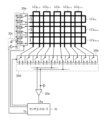
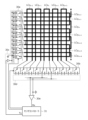
- FIG. 1 is a diagram showing a configuration of a position detection system 1 according to a first embodiment of the present invention.
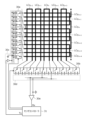
- 2 is a diagram showing an internal configuration of a switch unit 30 shown in FIG. 1 .
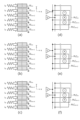
- 4A to 4C are diagrams showing the state of the switch section 30 when the sensor controller 31 detects the position of the electromagnetic induction pen P.
- 4A to 4C are diagrams showing the state of the switch section 30 when the sensor controller 31 detects the position of the electromagnetic induction pen P.
- 4A to 4C are diagrams showing the state of the switch section 30 when the sensor controller 31 detects the position of the electromagnetic induction pen P.
- 11 is a diagram illustrating a reception signal Rx supplied from an operational amplifier 30e to a sensor controller 31.
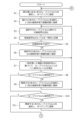
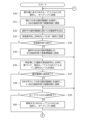
- FIG. 4 is a flowchart showing the overall flow of position detection of the electromagnetic induction pen P executed by the sensor controller 31.
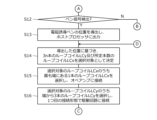
- FIG. 4 is a flowchart showing the overall flow of position detection of the electromagnetic induction pen P executed by the sensor controller 31.
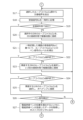
- FIG. 4 is a flowchart showing the overall flow of position detection of the electromagnetic induction pen P executed by the sensor controller 31.
- FIG. 11 is a diagram illustrating a received signal Rx according to a first comparative example of the first embodiment of the present invention.
- FIG. 11 is a diagram illustrating a received signal Rx according to a second comparative example of the first embodiment of the present invention.
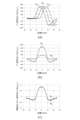
- FIG. 13 is a diagram showing the results of a simulation of the level of the pen signal received in response to the alternating magnetic fields emitted from each of the loop coils LCy m in the vicinity of an electromagnetic induction pen P when the latter is positioned above the loop coil LCy m (the level after separation in the case of separate acquisition).
- FIG. 11 is a diagram showing a configuration of a position detection system 1 according to a second embodiment of the present invention.
- 14 is a diagram showing an internal configuration of a switch unit 30 shown in FIG. 13.
- 4A to 4C are diagrams showing the state of the switch section 30 when the sensor controller 31 detects the position of the electromagnetic induction pen P.
- FIG. 13 is a diagram showing a configuration of a position detection system 1 according to a third embodiment of the present invention.
- 19 is a diagram showing an internal configuration of a switch unit 30 shown in FIG. 18.
- 4A to 4C are diagrams illustrating states of a switch unit 30 when a sensor controller 31 detects the position of a finger F.
- 4A to 4C are diagrams showing the state of the switch section 30 when the sensor controller 31 detects the position of the electromagnetic induction pen P.
- 4A to 4C are diagrams showing the state of the switch section 30 when the sensor controller 31 detects the position of the electromagnetic induction pen P.
- 4A to 4C are diagrams showing the state of the switch section 30 when the sensor controller 31 detects the position of the electromagnetic induction pen P. 21 to 23, and (d) to (f) are diagrams showing equivalent circuits when AC currents iA and iB are supplied to six linear electrodes EL m to EL m+5 using the methods shown in (a) to (c), respectively.
- 4 is a flowchart showing the overall flow of position detection of the electromagnetic induction pen P executed by the sensor controller 31.
- FIG. 4 is a flowchart showing the overall flow of position detection of the electromagnetic induction pen P executed by the sensor controller 31.
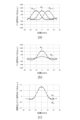
- FIG. 24(a) to (c) are diagrams showing the received signal Rx_EMR (-E m,n +E m +1 ,n -E m+2,n , E m,n -E m+1,n -E m+2,n , -E m,n -E m+1,n + E m +2,n ) input to the sensor controller 31 when the electromagnetic induction pen P is located above the pseudo loop coil PLC m +1 in the connection configurations of Figures 24(a) to (c), and (d) to (f) are diagrams showing the levels E m,n , E m+1,n , E m+2,n of the pen signal obtained when the received signal Rx_EMR shown in (a) to (c) is acquired.
- FIG. 4 is a diagram for explaining angles ⁇ and ⁇ that indicate the inclination of the electromagnetic induction pen P.
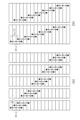
- 1A is a diagram for explaining a method for selecting a linear electrode EL in a position detection system 1 according to a third embodiment of the present invention, and FIG.
- FIG. 1B is a diagram for explaining a method for selecting a linear electrode EL in a position detection system 1 according to a fourth embodiment of the present invention.
- (a), (b), and (c) are figures showing methods of selecting linear electrodes EL in CDM1, CDM3, and CDM7, respectively
- (d), (e), and (f) are figures showing the levels of pen signals obtained by CDM1, CDM3, and CDM7 (levels after restoration calculation if a restoration calculation is performed), respectively.
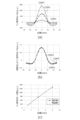
- 1A and 1B are graphs showing the levels of the pen signal obtained when using CDM1, CDM3, and CDM7, respectively
- FIG. 1C is a graph plotting the measured values and theoretical values for the peak values of the pen signal levels in CDM1, CDM3, and CDM7, respectively.
- 1A, 1B, and 1C are diagrams showing cases where an alternating magnetic field is transmitted from a pseudo loop coil PLC using different methods
- 1D, 1E, and 1F are diagrams showing the levels of the pen signal obtained when an alternating magnetic field is transmitted from a pseudo loop coil PLC using the methods shown in 1A, 1B, and 1C, respectively.
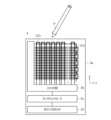
- FIG. 1 is a diagram showing the configuration of a position detection system 1 according to a first embodiment of the present invention.
- the position detection system 1 is configured to have an electromagnetic induction pen P and a position detection device 3.
- the electromagnetic induction pen P is a pen that supports position detection using the EMR method, and is configured to have a resonant circuit including a coil and a capacitor inside.
- the position detection device 3 is a device capable of detecting the position of an electromagnetic induction pen P using the EMR method, and is configured to include a plurality of loop coils LCx (detection coils), a plurality of loop coils LCy (transmission coil conductors), a switch section 30, a sensor controller 31, and a host processor 32.
- a typical example of the position detection device 3 is a tablet terminal or notebook computer whose display surface also serves as a touch surface, but the position detection device 3 may also be configured using a digitizer or the like that does not have a display surface.
- the illustrated x and y directions are both directions within the touch surface and are perpendicular to each other.
- the multiple loop coils LCx are each formed to extend in the y direction (first direction) and are arranged side by side in the x direction (second direction).
- the multiple loop coils LCy are each formed to extend in the x direction and are arranged side by side in the y direction. Both ends of each loop coil LCx and each loop coil LCy are connected to the switch section 30.
- the switch unit 30 is a switch assembly consisting of multiple switches for switching the connections between the multiple loop coils LCx and the multiple loop coils LCy and the sensor controller 31.
- the switch unit 30 may be provided on a dedicated circuit board or in an integrated circuit, or may be provided in the same integrated circuit as the sensor controller 31. The switching state of the switch unit 30 is controlled by the sensor controller 31.
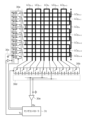
- Fig. 2 is a diagram showing the internal configuration of the switch section 30. For simplicity, only five loop coils LCx and three loop coils LCy (loop coils LCx n-2 to LCx n+2 , loop coils LCy m to LCy m+2 ) are shown in the figure. This also applies to Figs. 3 to 5 shown later.
- the switch section 30 is configured to include two types of switches 30a and 30b, a drive circuit 30c, a wiring section 30d, and an operational amplifier 30e.
- the switch 30a is configured to supply the loop coil LCy with an AC current Tx for generating an alternating magnetic field on the touch surface and a ground potential, and is configured with an output pin provided at each end of the loop coil LCy and two input pins provided at each output pin. One of the two input pins is supplied with an AC current from the drive circuit 30c, and the other is supplied with a ground potential from the drive circuit 30c.
- the switch 30a plays a role in connecting each output pin to one of the two corresponding input pins according to the control of the sensor controller 31.
- the drive circuit 30c is a circuit that generates an AC current in response to the AC current Tx supplied from the sensor controller 31, and supplies it to each loop coil LCy via the switch 30a.
- the process by which the drive circuit 30c generates an AC current in response to the AC current Tx is typically an amplification process of the AC current Tx.
- the drive circuit 30c also plays a role in supplying a ground potential to each loop coil LCy via the switch 30a.
- the drive circuit 30c supplies the generated AC current in common to one of the two input pins corresponding to each loop coil LCy in the switch 30a, and supplies a ground potential in common to the other of the two input pins corresponding to each loop coil LCy in the switch 30a.
- the switch 30b and the wiring section 30d are configured to supply the pen signal received by each loop coil LCx (a signal indicated by the alternating magnetic field generated by the electromagnetic induction pen P in response to the alternating magnetic field generated in the loop coil LCy) to the operational amplifier 30e.
- the switch 30b is configured with an input pin provided at each end of the loop coil LCx and four output pins provided for each input pin.
- the switch 30b plays a role in connecting each input pin to one of the corresponding four output pins according to the control of the sensor controller 31.
- the wiring section 30d is configured with two wirings L1 and L2. Of these, wiring L1 is grounded.
- the two output pins for each input pin of the switch 30b are provided corresponding to these two wirings L1 and L2, and are each connected to the corresponding wirings.
- the operational amplifier 30e is a circuit that generates a received signal Rx by amplifying the voltage difference between an input terminal and a ground terminal, and together with the sensor controller 31, constitutes a pen signal receiving circuit.
- the input terminal of the operational amplifier 30e is connected to the wiring L2 of the wiring section 30d, so that the received signal Rx is an amplified version of the signal that appears on the wiring L2.
- the received signal Rx generated by the operational amplifier 30e is supplied to the sensor controller 31.
- a differential amplifier that generates the received signal Rx by amplifying the voltage difference between the wiring L2 and the wiring L1 may be used.
- the sensor controller 31 is an integrated circuit that has the function of detecting the position of the electromagnetic induction pen P on the touch surface using the EMR method.
- the sensor controller 31 is also configured with the function of acquiring the data transmitted by the electromagnetic induction pen P by demodulating the pen signal transmitted by the electromagnetic induction pen P.
- the sensor controller 31 is configured to sequentially supply the detected position and acquired data to the host processor 32.
- the host processor 32 uses the position and data supplied from the sensor controller 31 to perform processes such as moving the cursor displayed on the display surface and generating stroke data that indicates the trajectory of the electromagnetic induction pen P on the touch surface. With regard to the stroke data, the host processor 32 also performs processes such as rendering and displaying the generated stroke data, generating and recording digital ink that includes the generated stroke data, and transmitting the generated digital ink to an external device in response to a user instruction.
- FIGS. 3 to 5 are diagrams showing the state of the switch section 30 when the sensor controller 31 detects the position of the electromagnetic induction pen P. While connecting any one of the loop coils LCx (loop coil LCx n in FIGS. 3 to 5 ) to the operational amplifier 30e by controlling the switch 30b, the sensor controller 31 performs processing to control the switch 30a so that each time, the three loop coils LCy constituting the selected set are selected in order and connected to the drive circuit 30c in three different connection configurations with different connection polarities.
- the loop coil LCy m is connected counterclockwise (indicated as "-1" in the figure) as viewed from the drive circuit 30c, the loop coil LCy m+1 is connected clockwise (indicated as "1" in the figure), and finally the loop coil LCy m+2 is connected counterclockwise.
- the loop coil LCy m is connected clockwise, the loop coil LCy m+1 is connected counterclockwise, and the loop coil LCy m+2 is connected counterclockwise.
- FIG. 5 as viewed from the drive circuit 30c, the loop coil LCy m is connected counterclockwise, the loop coil LCy m+1 is connected counterclockwise, and the loop coil LCy m+2 is connected clockwise.
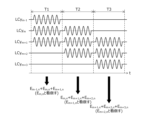
- FIG. 6 is a diagram explaining the received signal Rx supplied from the operational amplifier 30e to the sensor controller 31 as a result of making the above-mentioned connections.
- the pen signal detection periods T1 to T3 (first to third periods) shown in the figure correspond to the connection states in FIGS. 3 to 5, respectively. Note that in reality, the alternating magnetic field transmission time is placed in the first half of each pen signal detection period, but this is omitted in FIG. 6. Also, the actual received signal Rx attenuates over time, but to make it easier to understand, this attenuation is not depicted in FIG. 6. The same applies to FIGS. 10 and 11, which will be shown later.
- the alternating magnetic field emitted during the pen signal detection period T1 has an opposite phase between the loop coil LCy m+1 and the loop coils LCy m and LCy m+2 . This is because, as described above, the loop coil LCy m+1 rotates clockwise, and the loop coils LCy m and LCy m+2 rotate counterclockwise.
- the received signal Rx (result value) supplied from the operational amplifier 30e to the sensor controller 31 during the pen signal detection period T1 is expressed as -E m,n +E m+1,n -E m+2,n, as shown in FIG.
- the vector d LC shown in the following formula (1) describes the received signal Rx received in each of the pen signal detection periods T1 to T3 in vector form. As shown in the last line of formula (1), the vector d LC can be transformed into the form of a product of a 3 ⁇ 3 matrix F indicating the connection polarity in each pen signal detection period and a vector representing the levels E m,n to E m+2,n . Note that the matrix F shown in formula (1) is a 3 ⁇ 3 Walsh code.
- the sensor controller 31 performs the calculation shown on the left side of the following formula (2) on the vector d LC to separate and obtain the levels E m,n to E m+2,n .
- the matrix F -1 shown in formula (2) is the inverse matrix of the matrix F, and therefore the calculation shown on the left side of formula (2) is a restoration calculation according to the connection polarity of the loop coil LCx in each of the above-mentioned connection configurations.
- multiplying the matrix F by the matrix F -1 results in a unit matrix I.
- the sensor controller 31 can separate and obtain the levels E m,n to E m+2,n of the pen signal received by the loop coil LCx n according to the alternating magnetic fields sent out from each of the loop coils LCy m to LCy m+2 , as shown on the right side of formula (2).
- the sensor controller 31 performs a calculation similar to that of the formula (2) for each set of loop coils LCy, thereby separately acquiring the level of the pen signal received by the loop coil LCx n when an alternating magnetic field is sent from each of the multiple loop coils LCy m .
- the sensor controller 31 also performs a similar process while changing the loop coil LCx that receives the pen signal, thereby acquiring the level of the pen signal received by each of the multiple loop coils LCx when an alternating magnetic field is sent from each of the multiple loop coils LCy m .
- the sensor controller 31 then derives the position of the electromagnetic induction pen P based on the distribution of the pen signal levels thus acquired within the touch surface. Specifically, the position corresponding to the peak of the distribution may be derived as the position of the electromagnetic induction pen P.
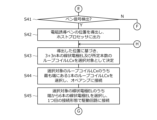
- FIGS. 7 to 9 are flow diagrams showing the overall flow of detecting the position of the electromagnetic induction pen P executed by the sensor controller 31 according to this embodiment.
- the sensor controller 31 selects the one loop coil LCx at the end and connects it to the operational amplifier 30e (step S1), and also selects three loop coils LCy from the end and connects them to the drive circuit 30c in the first connection form (for example, the connection form shown in FIG. 3) (step S2).
- the sensor controller 31 starts emitting an alternating magnetic field from the selected group of loop coils LCy (step S3). Specifically, it starts supplying an alternating current Tx to the drive circuit 30c. This generates an alternating current in either the left or right direction in each of the three loop coils LCy, and as a result, an alternating magnetic field according to the direction of the alternating current is emitted from each of the three loop coils LCy.
- the sensor controller 31 temporarily stores the level of the receiving signal Rx output from the operational amplifier 30e according to the alternating magnetic field emitted in step S3 (step S4).
- the sensor controller 31 determines whether or not the processes in steps S3 to S4 have been attempted for all of the connection configurations (step S5). Specifically, it determines whether or not the processes in steps S3 to S4 have been attempted for all of the three connection configurations shown in Figures 3 to 5. If the sensor controller 31 determines that no attempts have been made, it controls the switch 30a to connect the three selected loop coils LCy to the drive circuit 30c in the next connection configuration (for example, the connection configuration shown in Figure 4 after the connection configuration shown in Figure 3, and the connection configuration shown in Figure 5 after the connection configuration shown in Figure 4) (step S6), and returns to step S3.
- the sensor controller 31 derives the level of the pen signal for each loop coil LCy based on the levels of the multiple reception signals Rx temporarily stored by the multiple trials in step S4 (step S7). Specifically, the sensor controller 31 performs a calculation (restoration calculation) to multiply the above-mentioned vector d LC by the inverse matrix F ⁇ 1 of the matrix F.
- the sensor controller 31 judges whether or not the selection of all the loop coils LCy has been completed (step S8). If it is judged that the selection has not been completed, the sensor controller 31 selects three loop coils LCy adjacent to the three previously selected loop coils LCy (selected in step S2 or step S9), and connects them to the drive circuit 30c in the first connection form (for example, the connection form shown in FIG. 3) by controlling the switch 30a (step S9), and then returns to step S3. On the other hand, if it is judged that the selection has been completed in step S8, the sensor controller 31 judges whether or not the selection of all the loop coils LCx has been completed (step S10).
- the sensor controller 31 selects one loop coil LCx adjacent to the one previously selected loop coil LCx (selected in step S1 or step S11), and connects it to the operational amplifier 30e (step S11), and then returns to step S3.
- the sensor controller 31 which has determined that the process has ended in step S10, determines whether or not a pen signal has been detected based on the level of the pen signal for each combination of loop coil LCy and loop coil LCx obtained by repeating step S7 (step S12 in FIG. 8). In one example, the result of this determination is positive if a level exceeding a predetermined value exists, and negative otherwise.
- step S12 determines in step S12 that a pen signal has not been detected, it returns to step S1 in FIG. 7 and continues processing.
- the sensor controller 31 determines that a pen signal has been detected, it derives the position of the electromagnetic induction pen P based on the level of the pen signal for each combination of loop coil LCy and loop coil LCx derived in step S7 in FIG. 7, and outputs the position to the host processor 32 (step S13).
- the sensor controller 31 selects the loop coils LCx that are located at the end of the selection targets and connects them to the operational amplifier 30e (step S15). Then, the sensor controller 31 selects the three loop coils LCy that are located at the end of the selection targets and controls the switch 30a to connect the three selected loop coils LCy to the drive circuit 30c in the first connection form (for example, the connection form shown in FIG. 3) (step S16).
- step S4 the sensor controller 31 next performs the same processes as steps S3 to S12 in Fig. 7 and Fig. 8 (steps S17 to S26).
- step S18 a series of digital values (obtained by sampling) constituting the received signal Rx are also stored; in step S8, it is determined whether or not the selection of all loop coils LCy has been completed, whereas in step S22, it is determined whether or not the selection of all loop coils LCy determined as the selection targets in step S14 has been completed; in step S10, it is determined whether or not the selection of all loop coils LCx has been completed, whereas in step S24, it is determined whether or not the selection of all loop coils LCx determined as the selection targets in step S14 has been completed.
- the sensor controller 31 which has determined in step S26 that a pen signal has been detected, derives the position of the electromagnetic induction pen P, acquires the data transmitted by the electromagnetic induction pen P, and outputs the data to the host processor 32 (step S27). Specifically, the sensor controller 31 derives the position of the electromagnetic induction pen P based on the level of the pen signal for each combination of loop coil LCy and loop coil LCx derived in step S21. The sensor controller 31 also acquires the data transmitted by the electromagnetic induction pen P by demodulating the series of digital values stored in step S18 for the combination of loop coil LCy and loop coil LCx closest to the derived position. After step S27 is completed, the sensor controller 31 returns to step S14 to continue processing.
- the position detection method according to this embodiment makes it possible to improve the S/N ratio of the pen signal received by the sensor controller 31 without reducing the frequency of position detection and without increasing the circuit scale of the sensor controller 31. This effect will be explained in detail below, in comparison with a comparative example in which an alternating magnetic field is sent out in a different way to this embodiment.
- FIG. 10 is a diagram explaining the received signal Rx according to the first comparative example.
- the sensor controller 31 according to this comparative example emits an alternating magnetic field from only one loop coil LCy during each pen signal detection period. In this case, the level of the pen signal received in response to the alternating magnetic field emitted from one loop coil LCy during each pen signal detection period is obtained, so the sensor controller 31 can obtain the level of the pen signal received in response to the alternating magnetic field emitted from each loop coil LCy without performing the above-mentioned calculations.
- FIG. 11 is a diagram for explaining the reception signal Rx according to the second comparative example.
- the sensor controller 31 according to this comparative example simultaneously transmits alternating magnetic fields from three adjacent loop coils LCy during each pen signal detection period, as in the present embodiment.
- the sensor controller 31 according to this comparative example connects all loop coils LCy to the drive circuit 30c in the same direction (clockwise or counterclockwise).
- the above calculation cannot separate the level of the pen signal received in response to the alternating magnetic field transmitted from each loop coil LCy, but the sensor controller 31 can derive the position of the electromagnetic induction pen P by regarding the reception signal Rx obtained through the transmission of the alternating magnetic field from the three loop coils LCy as being obtained in response to the transmission of the alternating magnetic field from the loop coil LCy located at the center of the three loop coils LCy.
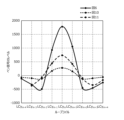
- FIG. 12 is a diagram showing the results of simulating the level of the pen signal received in response to the alternating magnetic field sent from each loop coil LCy m in the vicinity of the loop coil LCy m when the electromagnetic induction pen P is located above the loop coil LCy m (the level after separation in the case of separate acquisition).
- the figure shows the results of the present embodiment (FIG. 6), the first comparative example (FIG. 10), and the second comparative example (FIG. 11).
- the position detection method according to the present embodiment can achieve an effect that the reception level of the pen signal is significantly higher than that of the first and second comparative examples.
- the position detection method according to the present embodiment has a pen signal detection period that can be used to obtain the pen signal received in response to the alternating magnetic field sent from each loop coil LCy m that is three times longer than that of the first and second comparative examples.
- the position detection method according to the present embodiment can improve the S/N ratio of the pen signal received in the sensor controller 31.
- pen signals corresponding to multiple loop coils LCy are received simultaneously by one receiving circuit during each of multiple pen signal detection periods, and the received signal Rx can be separated into components for each loop coil LCy.
- the variance V TOTAL of a signal obtained by adding together N received signals X1 to XN acquired in the 1st to Nth pen signal detection periods (hereinafter simply referred to as the "added signal") is expressed as the sum of the variances of the received signal Rx in each pen signal detection period, as shown in the following equation (3).
- V TOTAL of the sum signal is further expressed as the following equation (4): where V and ⁇ are the variance and standard deviation in each pen signal detection period, respectively.
- the amount of noise appearing in the sum signal is represented by the standard deviation ⁇ TOTAL of the sum signal. From equation (4), this standard deviation ⁇ TOTAL can be expressed as the following equation (5), so it can be seen that when the pen signal detection period of the pen signal in the sensor controller 31 becomes N times, the noise level remains at N 1/2 times.
- the position detection system 1 makes it possible to improve the S/N ratio of the pen signal received by the sensor controller 31 without reducing the frequency of position detection and without increasing the circuit scale of the sensor controller 31.
- the matrix F shown in equation (1) is a matrix represented by a 3 ⁇ 3 Walsh code, but matrices represented by codes other than the Walsh code, such as the OVSF code, M-sequence code, and Baker code, can also be suitably used as the matrix F (i.e., the connection form of the loop coil LCy during each pen signal detection period can be set so that the matrix F is one of these codes).
- each element of such a matrix F does not necessarily have to be "-1" or "1".
- both matrices F shown in equations (7) and (8) below have a rank equal to 2, and can therefore be used to determine the connection form of the loop coil LCy in each pen signal detection period.
- the drive circuit 30c supplies, to the loop coil LCy corresponding to element "2", an AC current of the same direction but different level compared to the loop coil LCy corresponding to element "1" (specifically, an AC current of twice the level but of the same direction).
- the level of the received signal Rx corresponding to the case where all columns of the matrix F are 1 is derived using the matrix F for restoration and the levels of the received signal Rx during the pen signal detection periods T1 to T3, -E m,n +E m+1 ,n -E m+2,n , +E m,n -E m+1,n -E m +2,n , -E m,n -E m+1,n +E m+2,n .
- the vector d LC is expressed by the following equation (11): where vector e is a vector indicating the level of the pen signal corresponding to each of the four loop coils LCy.
- Equation (12) The inverse matrix F ⁇ 1 of the matrix F shown in equation (11) is expressed as in equation (12).
- FIG. 13 is a diagram showing the configuration of a position detection system 1 according to this embodiment.
- the position detection system 1 according to this embodiment differs from the first embodiment in that two loop coils LCy adjacent in the y direction are arranged overlapping each other.
- the position detection system 1 according to this embodiment is similar to the position detection system 1 according to the first embodiment, so the following explanation will focus on the differences with the position detection system 1 according to the first embodiment.
- Fig. 14 is a diagram showing the internal configuration of the switch unit 30 arranged in the position detection device 3 constituting the position detection system 1 according to the second embodiment of the present invention.
- the figure only five loop coils LCx and seven loop coils LCy (loop coils LCx n-2 to LCx n+2 , loop coils LCy m-2 to LCy m+4 ) are shown. This also applies to Figs. 15 to 17 shown later.
- the internal configuration of the switch unit 30 according to this embodiment is similar to that of the switch unit 30 according to the first embodiment, except that two loop coils LCy adjacent to each other in the y direction are arranged overlapping each other.
- the 15 to 17 are diagrams showing the state of the switch section 30 when the sensor controller 31 according to this embodiment detects the position of the electromagnetic induction pen P.
- the sensor controller 31 according to this embodiment like the sensor controller 31 according to the first embodiment, performs a process of controlling the switch 30a so that while any one of the loop coils LCx (loop coil LCx n in FIGS. 15 to 17) is connected to the operational amplifier 30e by controlling the switch 30b, each set of three adjacent loop coils LCy is selected in order, and each time, the three loop coils LCy constituting the selected set are connected to the drive circuit 30c in three different connection configurations with different connection polarities.
- connection forms are the same as those of the first embodiment, but in this embodiment, two loop coils LCy adjacent in the y direction are arranged overlapping each other, so that the current paths cross between the two adjacent loop coils LCy. However, even if such crossing occurs, it is possible to separately obtain the levels E m,n to E m+2,n by the same restoration calculation as in the first embodiment. Therefore, according to the position detection method of this embodiment, it can be said that, like the first embodiment, it is possible to improve the S/N ratio of the pen signal received by the sensor controller 31 without reducing the frequency of position detection and without increasing the circuit scale of the sensor controller 31.
- FIG. 18 is a diagram showing the configuration of a position detection system 1 according to the present embodiment.
- the position detection system 1 according to the present embodiment differs from the position detection system 1 according to the second embodiment in that the position detection device 3 is also capable of detecting the position of a finger F using a capacitive method, that the position detection device 3 has multiple linear electrodes EL instead of multiple loop coils LCy, and in the internal configuration of the switch unit 30.
- the position detection system 1 according to the present embodiment is similar to the position detection system 1 according to the second embodiment, so the following description will focus on the differences from the position detection system 1 according to the second embodiment.
- the multiple linear electrodes EL are each formed to extend in the x direction and are arranged in a row in the y direction. Both ends of each linear electrode EL are connected to the switch section 30.
- the switch unit 30 is a switch assembly made up of a number of switches for switching the connections between the multiple loop coils LCx and the multiple linear electrodes EL and the sensor controller 31.
- the switch unit 30 may be provided on a dedicated circuit board or in an integrated circuit, or may be provided in the same integrated circuit as the sensor controller 31. The switching state of the switch unit 30 is controlled by the sensor controller 31.
- FIG. 19 is a diagram showing the internal configuration of the switch section 30 according to this embodiment. For simplicity, only five loop coils LCx and six linear electrodes EL (loop coils LCx n-2 to LCx n+2 , linear electrodes EL m to EL m+5 ) are shown in the figure. This also applies to FIGS. 20 to 23 shown later.
- the switch section 30 according to this embodiment is configured to include switches 30f to 30j, a drive circuit 30k, and an operational amplifier 30m in addition to the switch 30b, wiring section 30d, and operational amplifier 30e also shown in FIG. 14.
- the switch 30a and drive circuit 30c shown in FIG. 2 are not included in the switch section 30 according to this embodiment.
- the switch 30f is configured to supply an alternating current Tx_EMR to a plurality of linear electrodes EL in order to generate an alternating magnetic field on the touch surface, and is configured with an output pin provided for each linear electrode EL and two input pins provided for each output pin. Each output pin is connected to one end of the corresponding linear electrode EL in the x-direction (longitudinal direction).
- the switch 30f plays a role in connecting each input pin to one of the output pins for each linear electrode EL according to the control of the sensor controller 31.
- the drive circuit 30k is a circuit that generates AC currents iA and iB described below in response to the AC current Tx_EMR supplied from the sensor controller 31 and supplies them to each linear electrode EL via the switch 30f.
- the drive circuit 30k is configured to supply the AC current iA to one of two input pins corresponding to each linear electrode EL and supply the AC current iB to the other.
- the AC current iA is a current generated by amplifying the AC current Tx_EMR using, for example, a buffer circuit.
- the AC current iB is a current generated so as to satisfy the relationship between the AC current iA and the time differentials of the AC current iB and the AC current iA, that is, their time differentials are in opposite phase to each other. This relationship is expressed mathematically as shown in the following formula (14).
- a typical AC current iB that satisfies the relationship of formula (14) is expressed by the following formula (15).
- A is an arbitrary constant.
- AC current iB becomes an inverted signal of AC current iA .
- AC current iA and AC current iB have different signs.
- A is larger than the maximum value of AC current iA
- AC current iA and AC current iB have the same sign and different levels.
- the inverted signal of AC current iA can be generated using, for example, an inverting buffer circuit.
- FIG. 19 shows an example of using this inverting buffer circuit.
- each linear electrode EL supplied with the AC currents iA and iB is preferably set to a midpoint potential between the potential at one end of the linear electrode EL supplied with the AC current iA and the potential at one end of the linear electrode EL supplied with the AC current iB .
- this potential is 0 (i.e., ground potential).
- the switch 30g is configured to supply a touch detection signal Tx_TP for detecting the position of a finger F to a plurality of linear electrodes EL, and is configured with a set of input and output pins provided for each linear electrode EL.
- the touch detection signal Tx_TP is supplied to each input pin from the sensor controller 31.
- Each output pin is connected to one end of the corresponding linear electrode EL in the x-direction (longitudinal direction).
- the switch 30g plays a role in connecting each input pin to the corresponding output pin according to the control of the sensor controller 31.
- the switch 30j is configured to switch the other end of the linear electrode EL in the x-direction (longitudinal direction) between a state in which it is connected to the potential of the midpoint described above and a floating state in which it is not connected anywhere.
- Figure 19 shows a case in which the potential of the midpoint described above is ground potential, and in this case, as shown in Figure 19, the switch 30j is configured with a set of input pins and ground pins provided for each linear electrode EL. The following explanation will be continued under the assumption that the potential of the midpoint described above is ground potential.
- Each input pin of the switch 30j is connected to the other end in the x direction (longitudinal direction) of the corresponding linear electrode EL.
- each ground pin of the switch 30j is connected to a ground end to which a ground potential is supplied.
- the switch 30j is provided because, when the sensor controller 31 detects the position of the electromagnetic induction pen P, it is preferable to set the other end in the x direction of each linear electrode EL to ground potential as described above, whereas, when the sensor controller 31 detects the position of the finger F, it is necessary to put the other end in the x direction of each linear electrode EL into a floating state.
- the switch 30j plays a role of switching the connection state between each input pin and the corresponding ground pin according to the control of the sensor controller 31.
- Switches 30b, 30h, 30i and wiring section 30d are configured to supply the pen signal (transmitted by the electromagnetic induction pen P in response to the alternating magnetic field) received by each loop coil LCx to operational amplifier 30e, and to supply the touch detection signal Tx_TP received by each loop coil LCx to operational amplifier 30m.
- the specific configuration of switch 30b and wiring section 30d is the same as in the first and second embodiments.
- Switch 30h is a switch that connects line L2 to the input terminal of operational amplifier 30e and line L1 to the ground terminal in response to the control of sensor controller 31.
- Switch 30i is a switch that connects line L2 to the input terminal of operational amplifier 30m in response to the control of sensor controller 31.
- the initial state of switches 30h and 30i is both off (disconnected state).
- the operational amplifier 30e is the same as the operational amplifier 30e described in the first embodiment. However, in this embodiment, the signal generated by the operational amplifier 30e is called the reception signal Rx_EMR.
- the operational amplifier 30m is a circuit that generates a capacitive reception signal Rx_TP by amplifying the voltage difference between the input terminal and the ground terminal, and constitutes a reception circuit for the touch detection signal Tx_TP together with the sensor controller 31.
- the input terminal of the operational amplifier 30m is connected to the wiring L2 of the wiring section 30d via the switch 30i, so that the reception signal Rx_TP is an amplified signal that appears on the wiring L2.
- the operational amplifier 30m is provided with a parallel capacitor for removing high-frequency noise.
- the reception signal Rx_EMR generated by the operational amplifier 30e and the reception signal Rx_TP generated by the operational amplifier 30m are both supplied to the sensor controller 31.
- the sensor controller 31 of this embodiment is configured to have the function of detecting the position of the finger F on the touch surface by a capacitance method, in addition to the function described in the first embodiment (the function of detecting the position of the electromagnetic induction pen P on the touch surface by an EMR method, and of acquiring the data transmitted by the electromagnetic induction pen P by demodulating the pen signal transmitted by the electromagnetic induction pen P).
- the detection of the position of the electromagnetic induction pen P and the acquisition of data from the electromagnetic induction pen P, and the detection of the position of the finger F are performed in a time-division manner.
- the sensor controller 31 is configured to sequentially supply the detected position and acquired data to the host processor 32. The processing performed by the host processor 32 upon receiving this supply is the same as in the first embodiment.
- FIG. 20 is a diagram showing the state of the switch section 30 when the sensor controller 31 according to this embodiment detects the position of a finger F.
- the sensor controller 31 in this case controls the switch 30g so that each input pin is connected to the corresponding output pin.
- a touch detection signal Tx_TP is supplied from the sensor controller 31 to one end in the x direction of each linear electrode EL.
- the sensor controller 31 also controls the switch 30j so that each input pin is disconnected from the corresponding ground pin, thereby putting the other end in the x direction of each linear electrode EL into a floating state.
- the specific contents of the touch detection signal Tx_TP generated by the sensor controller 31 can be represented by a matrix A shown in the following formula (16).
- the matrix A is a square matrix having a plurality of rows that correspond one-to-one to a plurality of linear electrodes EL, and the left side of the subscript attached to each element (such as A11 ) of the matrix A indicates the output order from the sensor controller 31, and the right side indicates the serial number of the linear electrode EL.
- M is the total number of linear electrodes EL.
- the specific value of each element is either "1" or "-1".
- the matrix A is preferably an orthogonal matrix, but may not be an orthogonal matrix.
- the sensor controller 31 generates a touch detection signal Tx_TP for each column of the matrix A and supplies it to each linear electrode EL.
- the touch detection signal Tx_TP is a binary pulse signal that is high when the corresponding element of the matrix A is 1 and low when the corresponding element is 1.
- the touch detection signal Tx_TP that corresponds to one column of the matrix A is referred to as a "partial touch detection signal Tx_TP.”
- the sensor controller 31 While supplying one partial touch detection signal Tx_TP to each linear electrode EL, the sensor controller 31 performs a process of connecting each loop coil LCx to the operational amplifier 30m in sequence while maintaining the switch 30i in a connected state. Specifically, the sensor controller 31 controls the switch 30b so that both ends of each loop coil LCx are connected to the wiring L2 in sequence. Note that FIG. 20 shows an example in which the loop coil LCx n is connected to the wiring L2.
- the electrostatic capacitance formed between the m-th linear electrode EL m and the n-th loop coil LCx n is denoted by C mn
- the reception signal Rx_TP supplied from the operational amplifier 30 m to the sensor controller 31 has a value shown in the following equation (17).
- the reception signal Rx_TP obtained for the n-th loop coil LCx n while the partial touch detection signal Tx_TP corresponding to each column of the matrix A is supplied is expressed as a whole by a vector b shown in the following equation (18).
- the sensor controller 31 performs the calculation shown on the left side of the following formula (19) on this vector b to separate and obtain the capacitance C mn of each linear electrode EL.
- the matrix A -1 shown in formula (19) is the inverse matrix of matrix A.
- multiplying matrix A by matrix A -1 results in unit matrix I. Therefore, by performing this calculation, the sensor controller 31 can separate and obtain the capacitance C mn of the intersection point with each linear electrode EL m for the nth loop coil LCx n , as shown on the right side of formula (19).
- the sensor controller 31 derives the capacitance C mn for each intersection of the linear electrode EL and the loop coil LCx by performing a calculation similar to that of equation (19) for each loop coil LCx.
- the sensor controller 31 then derives the position of the finger F based on the distribution of each derived capacitance C mn within the touch surface. Specifically, the position corresponding to the peak of the distribution may be derived as the position of the finger F, similar to the position detection of the electromagnetic induction pen P in the EMR method.
- 21 to 23 are diagrams showing the state of the switch section 30 when the sensor controller 31 according to this embodiment detects the position of the electromagnetic induction pen P.
- the sensor controller 31 controls the switches 30b, 30h, and 30i to connect the loop coil LCx n to the operational amplifier 30e, and performs a process of controlling the switch 30f to sequentially select six adjacent linear electrodes EL by shifting them by three, and each time, the six selected linear electrodes EL are connected to the drive circuit 30k in three connection configurations, so that an AC current iA is generated in half of the six linear electrodes EL and an AC current iB is generated in the remaining half.
- the sensor controller 31 also controls the switch 30j to connect each input pin to the corresponding ground pin, thereby grounding the other end of each linear electrode EL in the x direction.
- Fig. 21 to Fig. 23 show the supply of AC currents iA and iB in the above three connection configurations.
- AC current iA is supplied to linear electrodes EL m+1 , EL m+3 , and EL m+5
- AC current iB is supplied to linear electrodes EL m , EL m+2 , and EL m+4 .
- AC current iA is supplied to linear electrodes EL m+1 to EL m+3
- AC current iB is supplied to linear electrodes EL m , EL m+4 , and EL m+5 .
- AC current iA is supplied to linear electrodes EL m+2 to EL m+4
- AC current iB is supplied to linear electrodes EL m , EL m+1 , and EL m+5 .
- Fig. 24 (a) to (c) are diagrams each showing a schematic diagram of a method of supplying an AC current in each of Fig. 21 to Fig. 23.
- Fig. 24 (d) to (f) are diagrams showing an equivalent circuit when AC currents iA and iB are supplied to six linear electrodes EL m to EL m+ 5 by the method shown in Fig. 24 (a) to (c), respectively.
- this loop coil will be referred to as a "pseudo loop coil PLC" (sending coil conductor), and in particular the pseudo loop coil PLC formed by linear electrodes EL m+k , EL m+k+3 will be referred to as a “pseudo loop coil PLC m+k .
- connection polarity of the pseudo loop coil PLC m+k is reversed when AC current iA is supplied to linear electrode EL m+k and AC current iB is supplied to linear electrode EL m+ k +3 (indicated as "-" in the figure) and when AC current iB is supplied to linear electrode EL m+k and AC current iA is supplied to linear electrode EL m+k+3 (indicated as "+” in the figure).
- each pseudo loop coil PLC shown in FIG. 24(d) is exactly the same as the arrangement and connection polarity of each loop coil LCy shown in FIG. 15.
- the arrangement and connection polarity of each pseudo loop coil PLC shown in FIG. 24(e) is exactly the same as the arrangement and connection polarity of each loop coil LCy shown in FIG. 16
- the arrangement and connection polarity of each pseudo loop coil PLC shown in FIG. 24(f) is exactly the same as the arrangement and connection polarity of each loop coil LCy shown in FIG. 17. Therefore, according to the position detection system 1 of this embodiment, it is possible to detect the position of the electromagnetic induction pen P in the same way as the position detection system 1 of the second embodiment.
- the reception signal Rx_EMR (result value) supplied from the operational amplifier 30e to the sensor controller 31 when the AC current shown in Fig. 24(a) is supplied is expressed as -Em ,n + Em+1,n -Em+2,n .
- the AC current shown in Fig. 24(a) is expressed as -Em ,n + Em+1,n -Em+2,n .
- the sensor controller 31 in this embodiment can also obtain the levels E m ,n , E m +1 , n , and E m+2 ,n of the pen signal received when an alternating magnetic field is sent from each of the pseudo loop coils PLC m to PLC m+2 by multiplying the vector d EL by the inverse matrix F -1 of the matrix F.
- the length of the period during which an alternating magnetic field is sent from each of the pseudo loop coils PLC is three times longer than when an alternating magnetic field is sent from each of the three pseudo loop coils PLC alone, so that the level of the received pen signal is three times higher, while the level of the received noise remains at 3 1/2 times higher. Therefore, it can be said that the method of supplying alternating current in this embodiment can also improve the S/N ratio of the pen signal received by the sensor controller 31.
- FIGs 25 to 27 are flow diagrams showing the overall flow of position detection of the electromagnetic induction pen P executed by the sensor controller 31 according to this embodiment.
- the sensor controller 31 first selects one loop coil LCx at the end and connects the selected loop coil LCx to the operational amplifier 30e by controlling the switch 30b (step S30). This process also includes controlling the switch 30h to connect the operational amplifier 30e to the wiring L2 and ground the wiring L1, while controlling the switch 30i to disconnect the operational amplifier 30m from the wiring L2.
- the sensor controller 31 selects six linear electrodes EL from the end and controls the switch 30f to connect them to the drive circuit 30k in the first connection form (for example, the connection form shown in FIG. 23) (step S31).
- This process also includes controlling the switch 30j to ground the other end of each linear electrode EL in the x direction, and controlling the switch 30g to prevent the touch detection signal Tx_TP from being supplied to each linear electrode EL.
- the sensor controller 31 starts to emit an alternating magnetic field from the selected linear electrodes EL (step S32). Specifically, it starts to supply an alternating current Tx_EMR to the drive circuit 30k. As a result, either an alternating current iA or iB is generated in each of the six linear electrodes EL, and as a result, the above-mentioned pseudo loop coil PLC is formed and an alternating magnetic field is emitted. After that, the sensor controller 31 temporarily stores the level of the receiving signal Rx_EMR output from the operational amplifier 30e in response to the alternating magnetic field emitted in step S32 (step S33).
- the sensor controller 31 judges whether or not the processes of steps S32 to S33 have been attempted for all of the connection configurations (step S34). Specifically, it judges whether or not the processes of steps S32 to S33 have been attempted for all of the three connection configurations shown in Figures 21 to 23. If the sensor controller 31 judges that no attempt has been made, it controls the switch 30f to connect the six selected linear electrodes EL to the drive circuit 30k in the next connection configuration (for example, the connection configuration shown in Figure 21 is followed by the connection configuration shown in Figure 22, and the connection configuration shown in Figure 22 is followed by the connection configuration shown in Figure 23) (step S35), and returns to step S32.
- step S34 the sensor controller 31 derives the level of the pen signal for each pseudo loop coil PLC based on the levels of the multiple reception signals Rx_EMR temporarily stored by the multiple trials in step S33 (step S36). Specifically, the sensor controller 31 performs a calculation (restoration calculation) of multiplying the above-mentioned vector d EL by the inverse matrix F ⁇ 1 of the matrix F.
- the sensor controller 31 judges whether or not the selection of all the linear electrodes EL has been completed (step S37). If it is judged that the selection has not been completed, the sensor controller 31 selects six linear electrodes EL by shifting them by three, and connects them to the drive circuit 30k in the first connection form (for example, the connection form shown in FIG. 21) by controlling the switch 30f (step S38), and then returns to step S32. On the other hand, if it is judged that the selection has been completed in step S37, the sensor controller 31 judges whether or not the selection of all the loop coils LCx has been completed (step S39).
- the sensor controller 31 selects one loop coil LCx adjacent to the one loop coil LCx selected previously (the one selected in step S30 or step S40), and connects it to the operational amplifier 30e by controlling the switch 30b (step S40), and then returns to step S32.
- the sensor controller 31 which has determined that the process has ended in step S39, determines whether or not a pen signal has been detected based on the level of the pen signal for each combination of the pseudo loop coil PLC and the loop coil LCx obtained by repeating step S36 (step S41 in FIG. 26). In one example, the result of this determination is positive if a level exceeding a predetermined value exists, and negative otherwise.
- step S41 determines in step S41 that it has not detected a pen signal, it returns to step S30 in FIG. 25 and continues processing.
- the sensor controller 31 determines that it has detected a pen signal, it derives the position of the electromagnetic induction pen P based on the level of the pen signal for each combination of the pseudo loop coil PLC and the loop coil LCx derived in step S36 in FIG. 25, and outputs the position to the host processor 32 (step S42).
- the sensor controller 31 selects the endmost of the loop coils LCx to be selected, and connects it to the operational amplifier 30e by controlling the switch 30b (step S41).
- the sensor controller 31 also selects six end linear electrodes EL from the linear electrodes EL to be selected, and connects the six selected linear electrodes EL to the drive circuit 30k in a first connection form (for example, the connection form shown in FIG. 21) by controlling the switch 30f (step S45).
- step S33 the level of the received signal Rx_EMR is temporarily stored, whereas in step S47, a series of digital values (obtained by sampling) constituting the received signal Rx_EMR are also stored; in step S37, it is determined whether or not the selection of all linear electrodes EL has been completed, whereas in step S51, it is determined whether or not the selection of all linear electrodes EL determined as the selection target in step S43 has been completed; in step S39, it is determined whether or not the selection of all loop coils LCx has been completed, whereas in step S53, it is determined whether or not the selection of all loop coils LCx determined as the selection target in step S43 has been completed.
- the sensor controller 31 which has determined in step S55 that it has detected a pen signal, derives the position of the electromagnetic induction pen P, acquires the data transmitted by the electromagnetic induction pen P, and outputs it to the host processor 32 (step S56). Specifically, the sensor controller 31 derives the position of the electromagnetic induction pen P based on the level of the pen signal for each combination of the pseudo loop coil PLC and loop coil LCx derived in step S50. The sensor controller 31 also acquires the data transmitted by the electromagnetic induction pen P by demodulating the series of digital values stored in step S47 for the combination of the pseudo loop coil PLC and loop coil LCx closest to the derived position. After step S56 is completed, the sensor controller 31 returns to step S43 to continue processing.
- the position detection method according to this embodiment also makes it possible to improve the S/N ratio of the pen signal received by the sensor controller 31 without reducing the frequency of position detection and without increasing the circuit scale of the sensor controller 31. This effect will be explained in detail below with reference to the results of experiments.
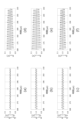
- FIGS. 28(a) to (c) are diagrams showing the reception signal Rx_EMR (-E m,n +E m+1 ,n -E m+2,n , E m,n -E m+1,n -E m +2,n , -E m,n -E m+1,n + E m+2,n ) input to the sensor controller 31 when the electromagnetic induction pen P is located above the pseudo loop coil PLC m+1 in the connection forms shown in Figs. 24(a) to (c).
- FIGS. 28(d) to (f) are diagrams showing the levels E m,n , E m+1,n , and E m +2,n of the pen signal obtained by the restoration calculation shown in equation (20) when the reception signal Rx_EMR shown in Figs. 28(a) to (c) is acquired.
- the level of the pen signal after the restoration calculation is significantly higher than the level of the received signal Rx_EMR.
- the pen signal detection period according to the position detection method of this embodiment is three times longer than usual.
- the position detection system 1 according to this embodiment can also improve the S/N ratio of the pen signal received in the sensor controller 31 without reducing the frequency of position detection and without increasing the circuit scale of the sensor controller 31.
- Figure 29 is a diagram explaining angles ⁇ and ⁇ , which indicate the inclination of the electromagnetic induction pen P.
- Figure 29(a) shows the angle ⁇ .
- the angle ⁇ is the angle between the z direction, which is the direction perpendicular to the touch surface, and the pen axis.
- the angle ⁇ is also called the "tilt angle.”
- Figure 29(b) shows the angle ⁇ .
- the angle ⁇ is the angle between the x direction, which is the extension direction of the loop coil LCy, and the pen axis.
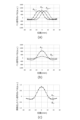
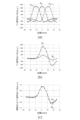
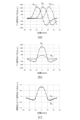
- the horizontal axis of each diagram indicates the position in the y direction in millimeters. -5 mm, 0 mm, and +5 mm on the horizontal axis of each diagram correspond to the positions of the pseudo loop coils PLC m-1 , PLC m , and PLC m+1 , respectively.
- the vertical axes of FIGS. 30 and 31 indicate the level of the pen signal (the level after the restoration calculation in the case where a restoration calculation is performed) in arbitrary units (a.u.), and the vertical axis of FIG. 32 indicates the value obtained by normalizing the level of the pen signal with the maximum value set to 1, in arbitrary units.
- Graphs A m-1 , A m , and A m+1 represent the levels of the pen signal at each position acquired by the sensor controller 31 according to this embodiment when the electromagnetic induction pen P is positioned at -5, 0, and +5 in the y direction, respectively.
- Graph B m represents, as a comparative example of this embodiment, the levels of the pen signal at each position acquired by the sensor controller 31 when an alternating magnetic field is emitted from only one pseudo loop coil PLC m (i.e., when AC current is supplied only to the linear electrodes EL m and EL m+3 ).
- the position detection method of this embodiment it is possible to improve the S/N ratio of the pen signal received by the sensor controller 31 without reducing the frequency of position detection and without increasing the circuit scale of the sensor controller 31, even when the electromagnetic induction pen P is tilted.
- the position detection system 1 according to this embodiment differs from the position detection system 1 according to the third embodiment in the method of selecting the linear electrodes EL that simultaneously generate an alternating current.
- the position detection system 1 according to this embodiment is similar to the position detection system 1 according to the third embodiment, so the following description will focus on the differences with the position detection system 1 according to the third embodiment.
- Fig. 34(a) is a diagram for explaining a method for selecting a linear electrode EL in the position detection system 1 according to the third embodiment
- Fig. 34(b) is a diagram for explaining a method for selecting a linear electrode EL in the position detection system 1 according to this embodiment.
- one square represents one linear electrode EL
- CDMn the method of simultaneously forming n pseudo loop coils PLC and detecting the received signal Rx_EMR will be referred to as "CDMn.”
- CDM is an abbreviation for "Code Division Multiplexing,” where n is the order of CDM.
- CDMn alternating magnetic fields are sent out from n pseudo loop coils PLC in n polarity patterns, and the resulting n received results are multiplied by an n x n matrix, thereby restoring the level for each pseudo loop coil PLC, as in the third embodiment.
- Fig. 34(a) shows an example of "CDM3”
- Fig. 34(b) shows an example of "CDM7.”
- P min 1
- the maximum number of pseudo loop coils PLC that can be formed simultaneously is three
- Fig. 34(a) shows a case where the order n is the maximum possible value.
- P min 2
- Fig. 35(a), (b), (c) respectively show the method of selecting the linear electrodes EL in CDM1, CDM3, and CDM7
- Fig. 35(d), (e), (f) respectively show the levels of the pen signals obtained by CDM1, CDM3, and CDM7 (levels after restoration calculation if restoration calculation is performed).
- the pitch of the linear electrodes EL is set to 5 mm
- Fig. 35(e) and (f) show the levels of the pen signals at each linear electrode EL when the electromagnetic induction pen P is positioned at the center of each pseudo loop coil PLC.
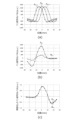
- Figures 36(a) and 36(b) are diagrams showing the levels of the pen signal obtained when using CDM1, CDM3, and CDM7, respectively.
- the vertical axis of Figure 36(a) shows the level of the pen signal (the level after restoration calculation if a restoration calculation is performed) in arbitrary units (a.u.), while the vertical axis of Figure 36(b) shows the value in arbitrary units obtained by normalizing the level of the pen signal with a maximum value of 1.
- Figure 36(c) is a diagram in which the measured values and theoretical values are plotted for the peak value of the level of the pen signal in each of CDM1, CDM3, and CDM7.
- each linear electrode EL when detecting the position of the electromagnetic induction pen P, the other end in the x direction of each linear electrode EL is grounded, and a current iA is supplied to one end of one of the two linear electrodes EL constituting the pseudo loop coil PLC, and a current iB is supplied to the other end, thereby transmitting an alternating magnetic field from the pseudo loop coil PLC.
- a current iA is supplied to one end of one of the two linear electrodes EL constituting the pseudo loop coil PLC
- a current iB is supplied to the other end, thereby transmitting an alternating magnetic field from the pseudo loop coil PLC.
- Fig. 41(c) shows a case where the other ends of the two linear electrodes EL constituting the pseudo loop coil PLC are connected to each other, and a current iA is supplied to one end of one of the two linear electrodes EL, and a current iB is supplied to the other end.
- the CDM order n is 1, 3, and 7 are described, but the CDM order n may be any number equal to or greater than 1.
- Position detection system 3 Position detection device 30 Switch section 30a, 30b, 30f to 30j Switch 30c, 30k Drive circuit 30d Wiring section 30e, 30m Operational amplifier 31 Sensor controller 32 Host processor EL Linear electrode F Finger L1, L2 Wiring LCx, LCy Loop coil P Electromagnetic induction pen PLC Pseudo loop coil Rx, Rx_EMR, Rx_TP Received signal T1 to T3 Pen signal detection period Tx, Tx_EMR AC current Tx_TP Touch detection signal Tx_TP Partial touch detection signal iA , iB AC current
Landscapes
- Engineering & Computer Science (AREA)
- General Engineering & Computer Science (AREA)
- Theoretical Computer Science (AREA)
- Physics & Mathematics (AREA)
- Human Computer Interaction (AREA)
- General Physics & Mathematics (AREA)
- Electromagnetism (AREA)
- Position Input By Displaying (AREA)
- Measurement Of Length, Angles, Or The Like Using Electric Or Magnetic Means (AREA)
Priority Applications (6)
| Application Number | Priority Date | Filing Date | Title |
|---|---|---|---|
| CN202480010711.9A CN120604202A (zh) | 2023-04-18 | 2024-04-10 | 位置检测方法、集成电路以及传感器装置 |
| JP2024558401A JP7678238B2 (ja) | 2023-04-18 | 2024-04-10 | 位置検出方法、集積回路、及びセンサ装置 |
| DE112024001221.3T DE112024001221T5 (de) | 2023-04-18 | 2024-04-10 | Positionserfassungsverfahren, integrierter schaltkreis und sensorvorrichtung |
| KR1020257026626A KR20250130410A (ko) | 2023-04-18 | 2024-04-10 | 위치 검출 방법, 집적 회로, 및 센서 장치 |
| JP2025076245A JP2025106136A (ja) | 2023-04-18 | 2025-05-01 | 位置検出方法、集積回路、及びセンサ装置 |
| US19/359,125 US20260099222A1 (en) | 2023-04-18 | 2025-10-15 | Position detection method, integrated circuit, and sensor device |
Applications Claiming Priority (2)
| Application Number | Priority Date | Filing Date | Title |
|---|---|---|---|
| JP2023068142 | 2023-04-18 | ||
| JP2023-068142 | 2023-04-18 |
Related Child Applications (1)
| Application Number | Title | Priority Date | Filing Date |
|---|---|---|---|
| US19/359,125 Continuation US20260099222A1 (en) | 2023-04-18 | 2025-10-15 | Position detection method, integrated circuit, and sensor device |
Publications (1)
| Publication Number | Publication Date |
|---|---|
| WO2024219308A1 true WO2024219308A1 (ja) | 2024-10-24 |
Family
ID=93152448
Family Applications (1)
| Application Number | Title | Priority Date | Filing Date |
|---|---|---|---|
| PCT/JP2024/014586 Ceased WO2024219308A1 (ja) | 2023-04-18 | 2024-04-10 | 位置検出方法、集積回路、及びセンサ装置 |
Country Status (7)
| Country | Link |
|---|---|
| US (1) | US20260099222A1 (https=) |
| JP (2) | JP7678238B2 (https=) |
| KR (1) | KR20250130410A (https=) |
| CN (1) | CN120604202A (https=) |
| DE (1) | DE112024001221T5 (https=) |
| TW (1) | TW202501226A (https=) |
| WO (1) | WO2024219308A1 (https=) |
Citations (5)
| Publication number | Priority date | Publication date | Assignee | Title |
|---|---|---|---|---|
| JP2010225001A (ja) * | 2009-03-25 | 2010-10-07 | Newcom Inc | 複数の指示体の検出が可能な電磁結合型デジタイザ |
| JP2016532228A (ja) * | 2013-09-27 | 2016-10-13 | センセル インコーポレイテッドSensel,Inc. | タッチセンサ検出システム及び方法 |
| JP2017220153A (ja) * | 2016-06-10 | 2017-12-14 | 株式会社ジャパンディスプレイ | 入力検出装置および電子装置 |
| JP2021103459A (ja) * | 2019-12-25 | 2021-07-15 | 株式会社ジャパンディスプレイ | 表示装置 |
| WO2023238517A1 (ja) * | 2022-06-06 | 2023-12-14 | 株式会社ワコム | センサ装置、集積回路、及び、指示体を検出する方法 |
Family Cites Families (1)
| Publication number | Priority date | Publication date | Assignee | Title |
|---|---|---|---|---|
| JP6698386B2 (ja) | 2016-03-10 | 2020-05-27 | 株式会社ジャパンディスプレイ | 表示装置およびタッチ検出装置 |
-
2024
- 2024-04-10 CN CN202480010711.9A patent/CN120604202A/zh active Pending
- 2024-04-10 KR KR1020257026626A patent/KR20250130410A/ko active Pending
- 2024-04-10 DE DE112024001221.3T patent/DE112024001221T5/de active Pending
- 2024-04-10 WO PCT/JP2024/014586 patent/WO2024219308A1/ja not_active Ceased
- 2024-04-10 JP JP2024558401A patent/JP7678238B2/ja active Active
- 2024-04-17 TW TW113114352A patent/TW202501226A/zh unknown
-
2025
- 2025-05-01 JP JP2025076245A patent/JP2025106136A/ja active Pending
- 2025-10-15 US US19/359,125 patent/US20260099222A1/en active Pending
Patent Citations (5)
| Publication number | Priority date | Publication date | Assignee | Title |
|---|---|---|---|---|
| JP2010225001A (ja) * | 2009-03-25 | 2010-10-07 | Newcom Inc | 複数の指示体の検出が可能な電磁結合型デジタイザ |
| JP2016532228A (ja) * | 2013-09-27 | 2016-10-13 | センセル インコーポレイテッドSensel,Inc. | タッチセンサ検出システム及び方法 |
| JP2017220153A (ja) * | 2016-06-10 | 2017-12-14 | 株式会社ジャパンディスプレイ | 入力検出装置および電子装置 |
| JP2021103459A (ja) * | 2019-12-25 | 2021-07-15 | 株式会社ジャパンディスプレイ | 表示装置 |
| WO2023238517A1 (ja) * | 2022-06-06 | 2023-12-14 | 株式会社ワコム | センサ装置、集積回路、及び、指示体を検出する方法 |
Also Published As
| Publication number | Publication date |
|---|---|
| US20260099222A1 (en) | 2026-04-09 |
| DE112024001221T5 (de) | 2026-01-29 |
| JPWO2024219308A1 (https=) | 2024-10-24 |
| JP2025106136A (ja) | 2025-07-11 |
| KR20250130410A (ko) | 2025-09-01 |
| JP7678238B2 (ja) | 2025-05-15 |
| TW202501226A (zh) | 2025-01-01 |
| CN120604202A (zh) | 2025-09-05 |
Similar Documents
| Publication | Publication Date | Title |
|---|---|---|
| JP7673329B2 (ja) | センサ装置、集積回路、及び、指示体を検出する方法 | |
| KR102324210B1 (ko) | 터치 표시 장치, 펜, 터치 시스템, 터치 회로 및 펜 인식 방법 | |
| CA2767660C (en) | Contrast sensitivity testing and/or training using circular contrast zones | |
| KR20120115271A (ko) | 오믹 심을 갖는 트랜스커패시티브 센서 디바이스 | |
| KR102884505B1 (ko) | 터치 디스플레이 장치 및 터치 구동 방법 | |
| JP7678238B2 (ja) | 位置検出方法、集積回路、及びセンサ装置 | |
| EP3980877B1 (en) | Touch-sensitive apparatus and method | |
| US11474638B2 (en) | Display device and driving device for driving a panel | |
| KR102843625B1 (ko) | 터치 디스플레이 장치, 및 터치 회로 | |
| WO2024247681A1 (ja) | ディスプレイ | |
| KR20220012664A (ko) | 터치 디스플레이 장치, 터치 회로 및 터치 구동 방법 | |
| US5952999A (en) | Employing gray codes for pen detection | |
| KR20260044785A (ko) | 센서, 위치 검출 장치, 및 센서 컨트롤러 | |
| EP4352598A1 (en) | Touch-sensitive apparatus and method | |
| WO2024084196A1 (en) | Touch-sensitive apparatus and method |
Legal Events
| Date | Code | Title | Description |
|---|---|---|---|
| WWE | Wipo information: entry into national phase |
Ref document number: 2024558401 Country of ref document: JP |
|
| 121 | Ep: the epo has been informed by wipo that ep was designated in this application |
Ref document number: 24792583 Country of ref document: EP Kind code of ref document: A1 |
|
| WWE | Wipo information: entry into national phase |
Ref document number: 202480010711.9 Country of ref document: CN |
|
| ENP | Entry into the national phase |
Ref document number: 1020257026626 Country of ref document: KR Free format text: ST27 STATUS EVENT CODE: A-0-1-A10-A15-NAP-PA0105 (AS PROVIDED BY THE NATIONAL OFFICE) |
|
| WWE | Wipo information: entry into national phase |
Ref document number: 1020257026626 Country of ref document: KR |
|
| WWP | Wipo information: published in national office |
Ref document number: 202480010711.9 Country of ref document: CN |
|
| WWE | Wipo information: entry into national phase |
Ref document number: 112024001221 Country of ref document: DE |
|
| WWP | Wipo information: published in national office |
Ref document number: 112024001221 Country of ref document: DE |
|
| 122 | Ep: pct application non-entry in european phase |
Ref document number: 24792583 Country of ref document: EP Kind code of ref document: A1 |