WO2024219076A1 - 基板処理システム - Google Patents
基板処理システム Download PDFInfo
- Publication number
- WO2024219076A1 WO2024219076A1 PCT/JP2024/005811 JP2024005811W WO2024219076A1 WO 2024219076 A1 WO2024219076 A1 WO 2024219076A1 JP 2024005811 W JP2024005811 W JP 2024005811W WO 2024219076 A1 WO2024219076 A1 WO 2024219076A1
- Authority
- WO
- WIPO (PCT)
- Prior art keywords
- optical sensor
- substrate processing
- inclined surface
- lens structure
- distance
- Prior art date
- Legal status (The legal status is an assumption and is not a legal conclusion. Google has not performed a legal analysis and makes no representation as to the accuracy of the status listed.)
- Ceased
Links
Images






Classifications
-
- H—ELECTRICITY
- H10—SEMICONDUCTOR DEVICES; ELECTRIC SOLID-STATE DEVICES NOT OTHERWISE PROVIDED FOR
- H10P—GENERIC PROCESSES OR APPARATUS FOR THE MANUFACTURE OR TREATMENT OF DEVICES COVERED BY CLASS H10
- H10P72/00—Handling or holding of wafers, substrates or devices during manufacture or treatment thereof
- H10P72/06—Apparatus for monitoring, sorting, marking, testing or measuring
- H10P72/0604—Process monitoring, e.g. flow or thickness monitoring
-
- H—ELECTRICITY
- H10—SEMICONDUCTOR DEVICES; ELECTRIC SOLID-STATE DEVICES NOT OTHERWISE PROVIDED FOR
- H10P—GENERIC PROCESSES OR APPARATUS FOR THE MANUFACTURE OR TREATMENT OF DEVICES COVERED BY CLASS H10
- H10P72/00—Handling or holding of wafers, substrates or devices during manufacture or treatment thereof
- H10P72/50—Handling or holding of wafers, substrates or devices during manufacture or treatment thereof for positioning, orientation or alignment
- H10P72/53—Handling or holding of wafers, substrates or devices during manufacture or treatment thereof for positioning, orientation or alignment using optical controlling means
-
- G—PHYSICS
- G01—MEASURING; TESTING
- G01B—MEASURING LENGTH, THICKNESS OR SIMILAR LINEAR DIMENSIONS; MEASURING ANGLES; MEASURING AREAS; MEASURING IRREGULARITIES OF SURFACES OR CONTOURS
- G01B11/00—Measuring arrangements characterised by the use of optical techniques
- G01B11/02—Measuring arrangements characterised by the use of optical techniques for measuring length, width or thickness
- G01B11/026—Measuring arrangements characterised by the use of optical techniques for measuring length, width or thickness by measuring distance between sensor and object
-
- H—ELECTRICITY
- H10—SEMICONDUCTOR DEVICES; ELECTRIC SOLID-STATE DEVICES NOT OTHERWISE PROVIDED FOR
- H10P—GENERIC PROCESSES OR APPARATUS FOR THE MANUFACTURE OR TREATMENT OF DEVICES COVERED BY CLASS H10
- H10P72/00—Handling or holding of wafers, substrates or devices during manufacture or treatment thereof
- H10P72/04—Apparatus for manufacture or treatment
- H10P72/0431—Apparatus for thermal treatment
-
- H—ELECTRICITY
- H10—SEMICONDUCTOR DEVICES; ELECTRIC SOLID-STATE DEVICES NOT OTHERWISE PROVIDED FOR
- H10P—GENERIC PROCESSES OR APPARATUS FOR THE MANUFACTURE OR TREATMENT OF DEVICES COVERED BY CLASS H10
- H10P72/00—Handling or holding of wafers, substrates or devices during manufacture or treatment thereof
- H10P72/04—Apparatus for manufacture or treatment
- H10P72/0451—Apparatus for manufacturing or treating in a plurality of work-stations
- H10P72/0452—Apparatus for manufacturing or treating in a plurality of work-stations characterised by the layout of the process chambers
- H10P72/0456—Apparatus for manufacturing or treating in a plurality of work-stations characterised by the layout of the process chambers in-line arrangement
-
- H—ELECTRICITY
- H10—SEMICONDUCTOR DEVICES; ELECTRIC SOLID-STATE DEVICES NOT OTHERWISE PROVIDED FOR
- H10P—GENERIC PROCESSES OR APPARATUS FOR THE MANUFACTURE OR TREATMENT OF DEVICES COVERED BY CLASS H10
- H10P72/00—Handling or holding of wafers, substrates or devices during manufacture or treatment thereof
- H10P72/06—Apparatus for monitoring, sorting, marking, testing or measuring
- H10P72/0606—Position monitoring, e.g. misposition detection or presence detection
-
- H—ELECTRICITY
- H10—SEMICONDUCTOR DEVICES; ELECTRIC SOLID-STATE DEVICES NOT OTHERWISE PROVIDED FOR
- H10P—GENERIC PROCESSES OR APPARATUS FOR THE MANUFACTURE OR TREATMENT OF DEVICES COVERED BY CLASS H10
- H10P72/00—Handling or holding of wafers, substrates or devices during manufacture or treatment thereof
- H10P72/30—Handling or holding of wafers, substrates or devices during manufacture or treatment thereof for conveying, e.g. between different workstations
-
- H—ELECTRICITY
- H10—SEMICONDUCTOR DEVICES; ELECTRIC SOLID-STATE DEVICES NOT OTHERWISE PROVIDED FOR
- H10P—GENERIC PROCESSES OR APPARATUS FOR THE MANUFACTURE OR TREATMENT OF DEVICES COVERED BY CLASS H10
- H10P72/00—Handling or holding of wafers, substrates or devices during manufacture or treatment thereof
- H10P72/30—Handling or holding of wafers, substrates or devices during manufacture or treatment thereof for conveying, e.g. between different workstations
- H10P72/33—Handling or holding of wafers, substrates or devices during manufacture or treatment thereof for conveying, e.g. between different workstations into and out of processing chamber
- H10P72/3302—Mechanical parts of transfer devices
-
- H—ELECTRICITY
- H10—SEMICONDUCTOR DEVICES; ELECTRIC SOLID-STATE DEVICES NOT OTHERWISE PROVIDED FOR
- H10P—GENERIC PROCESSES OR APPARATUS FOR THE MANUFACTURE OR TREATMENT OF DEVICES COVERED BY CLASS H10
- H10P72/00—Handling or holding of wafers, substrates or devices during manufacture or treatment thereof
- H10P72/30—Handling or holding of wafers, substrates or devices during manufacture or treatment thereof for conveying, e.g. between different workstations
- H10P72/34—Handling or holding of wafers, substrates or devices during manufacture or treatment thereof for conveying, e.g. between different workstations the wafers being stored in a carrier, involving loading and unloading
- H10P72/3402—Mechanical parts of transfer devices
-
- H—ELECTRICITY
- H10—SEMICONDUCTOR DEVICES; ELECTRIC SOLID-STATE DEVICES NOT OTHERWISE PROVIDED FOR
- H10P—GENERIC PROCESSES OR APPARATUS FOR THE MANUFACTURE OR TREATMENT OF DEVICES COVERED BY CLASS H10
- H10P72/00—Handling or holding of wafers, substrates or devices during manufacture or treatment thereof
- H10P72/70—Handling or holding of wafers, substrates or devices during manufacture or treatment thereof for supporting or gripping
- H10P72/72—Handling or holding of wafers, substrates or devices during manufacture or treatment thereof for supporting or gripping using electrostatic chucks
-
- H—ELECTRICITY
- H10—SEMICONDUCTOR DEVICES; ELECTRIC SOLID-STATE DEVICES NOT OTHERWISE PROVIDED FOR
- H10P—GENERIC PROCESSES OR APPARATUS FOR THE MANUFACTURE OR TREATMENT OF DEVICES COVERED BY CLASS H10
- H10P72/00—Handling or holding of wafers, substrates or devices during manufacture or treatment thereof
- H10P72/70—Handling or holding of wafers, substrates or devices during manufacture or treatment thereof for supporting or gripping
- H10P72/76—Handling or holding of wafers, substrates or devices during manufacture or treatment thereof for supporting or gripping using mechanical means, e.g. clamps or pinches
- H10P72/7602—Handling or holding of wafers, substrates or devices during manufacture or treatment thereof for supporting or gripping using mechanical means, e.g. clamps or pinches the wafers being placed on a robot blade or gripped by a gripper for conveyance
-
- H—ELECTRICITY
- H10—SEMICONDUCTOR DEVICES; ELECTRIC SOLID-STATE DEVICES NOT OTHERWISE PROVIDED FOR
- H10P—GENERIC PROCESSES OR APPARATUS FOR THE MANUFACTURE OR TREATMENT OF DEVICES COVERED BY CLASS H10
- H10P72/00—Handling or holding of wafers, substrates or devices during manufacture or treatment thereof
- H10P72/70—Handling or holding of wafers, substrates or devices during manufacture or treatment thereof for supporting or gripping
- H10P72/76—Handling or holding of wafers, substrates or devices during manufacture or treatment thereof for supporting or gripping using mechanical means, e.g. clamps or pinches
- H10P72/7604—Handling or holding of wafers, substrates or devices during manufacture or treatment thereof for supporting or gripping using mechanical means, e.g. clamps or pinches the wafers being placed on a susceptor, stage or support
- H10P72/7606—Handling or holding of wafers, substrates or devices during manufacture or treatment thereof for supporting or gripping using mechanical means, e.g. clamps or pinches the wafers being placed on a susceptor, stage or support characterised by edge clamping, e.g. clamping ring
-
- H—ELECTRICITY
- H10—SEMICONDUCTOR DEVICES; ELECTRIC SOLID-STATE DEVICES NOT OTHERWISE PROVIDED FOR
- H10P—GENERIC PROCESSES OR APPARATUS FOR THE MANUFACTURE OR TREATMENT OF DEVICES COVERED BY CLASS H10
- H10P72/00—Handling or holding of wafers, substrates or devices during manufacture or treatment thereof
- H10P72/70—Handling or holding of wafers, substrates or devices during manufacture or treatment thereof for supporting or gripping
- H10P72/76—Handling or holding of wafers, substrates or devices during manufacture or treatment thereof for supporting or gripping using mechanical means, e.g. clamps or pinches
- H10P72/7604—Handling or holding of wafers, substrates or devices during manufacture or treatment thereof for supporting or gripping using mechanical means, e.g. clamps or pinches the wafers being placed on a susceptor, stage or support
- H10P72/7611—Handling or holding of wafers, substrates or devices during manufacture or treatment thereof for supporting or gripping using mechanical means, e.g. clamps or pinches the wafers being placed on a susceptor, stage or support characterised by edge profile or support profile
-
- G—PHYSICS
- G01—MEASURING; TESTING
- G01B—MEASURING LENGTH, THICKNESS OR SIMILAR LINEAR DIMENSIONS; MEASURING ANGLES; MEASURING AREAS; MEASURING IRREGULARITIES OF SURFACES OR CONTOURS
- G01B2210/00—Aspects not specifically covered by any group under G01B, e.g. of wheel alignment, caliper-like sensors
- G01B2210/56—Measuring geometric parameters of semiconductor structures, e.g. profile, critical dimensions or trench depth
Definitions
- An exemplary embodiment of the present disclosure relates to a substrate processing system.
- Patent Document 1 discloses a method for determining the amount of wear of a consumable part using a sensor on a transport arm.
- Patent Document 2 discloses a method for detecting whether a substrate is present above the optical sensor using an optical sensor provided on the transport arm.
- This disclosure provides technology to improve the measurement accuracy of sensors installed on transport arms.
- a substrate processing system including a substrate processing apparatus, a transport apparatus, and a control unit
- the substrate processing apparatus including a substrate processing chamber, a substrate support disposed within the substrate processing chamber and having a substrate support surface and a ring support surface, and an edge ring disposed on the ring support to surround a substrate on the substrate support surface and having a first horizontal surface and a first inclined surface
- the transport apparatus including a transport chamber, a transport arm configured to transport a substrate between the transport chamber and the substrate processing chamber, an optical sensor attached to the transport arm, and a lens disposed below the optical sensor and having a second horizontal surface and a second inclined surface.
- a substrate processing system includes a structure, and an actuator attached to a transport arm and configured to move the lens structure horizontally between a first horizontal position and a second horizontal position, where the first horizontal position is a position where the second horizontal plane overlaps with the optical axis of the optical sensor, and the second horizontal position is a position where the second inclined plane overlaps with the optical axis of the optical sensor, and the control unit is configured to determine the amount of wear of the first horizontal plane based on the output of the optical sensor when the lens structure is in the first horizontal position, and to determine the amount of wear of the first inclined plane based on the output of the optical sensor when the lens structure is in the second horizontal position.
- a technology can be provided that improves the measurement accuracy of a sensor installed on a transport arm.
- FIG. 1 is a diagram for explaining a configuration example of a substrate processing system.
- FIG. 1 is a diagram for explaining a configuration example of a plasma processing system.
- FIG. 1 is a diagram for explaining a configuration example of a capacitively coupled plasma processing apparatus.
- FIG. 2 is a perspective view showing an example of a transport arm AR.
- FIG. 4B is an enlarged view of a portion indicated by P in FIG. 4A.
- 11A and 11B are diagrams illustrating an example of an angle adjustment mechanism.
- 11A and 11B are diagrams illustrating an example of an angle adjustment mechanism.
- FIG. 2 is a perspective view showing an example of a lens structure.
- FIG. 4 is a diagram for explaining a first horizontal position of the lens structure.
- FIG. 13 is a diagram for explaining a second horizontal position of the lens structure.
- FIG. 13 is a diagram for explaining an example of measurement using a transport arm AR.
- FIG. 13 is a diagram for explaining an example of measurement using a transport arm AR.
- 13A and 13B are diagrams illustrating another example of an angle adjustment mechanism.
- 13A and 13B are diagrams illustrating other examples of lens structures.
- a substrate processing system is provided with a substrate processing apparatus, a transport apparatus, and a control unit, the substrate processing apparatus including a substrate processing chamber, a substrate support disposed within the substrate processing chamber and having a substrate support surface and a ring support surface, and an edge ring disposed on the ring support to surround a substrate on the substrate support surface and having a first horizontal surface and a first inclined surface, and the transport apparatus includes a transport chamber, a transport arm configured to transport a substrate between the transport chamber and the substrate processing chamber, an optical sensor attached to the transport arm, and a lens structure disposed below the optical sensor and having a second horizontal surface and a second inclined surface.
- a substrate processing system includes a body and an actuator attached to a transport arm and configured to move the lens structure horizontally between a first horizontal position and a second horizontal position, the first horizontal position being a position where the second horizontal plane overlaps with the optical axis of the optical sensor, and the second horizontal position being a position where the second inclined plane overlaps with the optical axis of the optical sensor, and a control unit configured to determine the amount of wear of the first horizontal plane based on the output of the optical sensor when the lens structure is in the first horizontal position, and to determine the amount of wear of the first inclined plane based on the output of the optical sensor when the lens structure is in the second horizontal position.
- the optical sensor is configured to measure a first distance from the optical sensor to the first horizontal plane via the second horizontal plane when the lens structure is in the first horizontal position
- the control unit is configured to determine an amount of wear of the first horizontal plane based on the first distance
- the optical sensor is configured to measure a second distance from the optical sensor to the first inclined surface via the second inclined surface when the lens structure is in the second horizontal position, and the control unit is configured to determine an amount of wear of the first inclined surface based on the second distance.
- the optical sensor is configured to measure a distance from the optical sensor to the first inclined surface through the second inclined surface when the lens structure is in the second horizontal position, and the control unit is configured to determine an amount of wear of the first inclined surface based on the distance.
- the actuator is a piezoelectric actuator.
- a substrate processing system in one exemplary embodiment, includes a substrate processing device, a transport device, and a controller.
- the substrate processing device includes a substrate processing chamber, and a consumable part that forms part of the substrate processing chamber or is disposed within the substrate processing chamber and has a first horizontal surface and a first inclined surface.
- the transport device includes a transport chamber, a transport arm configured to transport a substrate between the transport chamber and the substrate processing chamber, an optical sensor attached to the transport arm, a lens structure disposed above or below the optical sensor and having a second horizontal surface and a second inclined surface, and an actuator attached to the transport arm and configured to move the lens structure horizontally between a first horizontal position and a second horizontal position, the first horizontal position being a position where the second horizontal surface overlaps with the optical axis of the optical sensor, and the second horizontal position being a position where the second inclined surface overlaps with the optical axis of the optical sensor.
- the controller is configured to determine the state of the consumable part based on the output of the optical sensor.
- the optical sensor is configured to measure a first distance from the optical sensor to the first horizontal plane via the second horizontal plane when the lens structure is in the first horizontal position
- the control unit is configured to determine an amount of wear of the first horizontal plane based on the first distance
- the optical sensor is configured to measure a second distance from the optical sensor to the first inclined surface via the second inclined surface when the lens structure is in the second horizontal position, and the control unit is configured to determine an amount of wear of the first inclined surface based on the second distance.
- the optical sensor is configured to measure a distance from the optical sensor to the first inclined surface through the second inclined surface when the lens structure is in the second horizontal position, and the control unit is configured to determine an amount of wear of the first inclined surface based on the distance.
- the optical sensor is configured to measure a first distance from the optical sensor to the first horizontal plane via a second horizontal plane when the lens structure is in the first horizontal position
- the control unit is configured to determine a position of the consumable part relative to a reference position based on the first distance
- the optical sensor is configured to measure a second distance from the optical sensor to the first inclined surface via the second inclined surface when the lens structure is in the second horizontal position
- the control unit is configured to determine a position of the consumable part relative to a reference position based on the first distance and the second distance.
- the optical sensor is configured to measure a distance from the optical sensor to the first inclined surface via the second inclined surface when the lens structure is in the second horizontal position
- the control unit is configured to determine a position of the consumable part relative to a reference position based on the distance.
- the actuator is a piezoelectric actuator.
- a substrate processing system includes a substrate processing apparatus, a transport apparatus, and a controller, the substrate processing apparatus including a substrate processing chamber and a consumable part that forms part of the substrate processing chamber or is disposed within the substrate processing chamber and has a first inclined surface, the transport apparatus including a transport arm configured to transport a substrate between the transport chamber and the substrate processing chamber, a sensor attached to the transport arm, and a lens structure having a second inclined surface disposed above or below the sensor, and the controller is configured to determine the status of the consumable part based on the output of the sensor.
- Fig. 1 is a diagram for explaining an example of the configuration of the substrate processing system PS.
- the substrate processing system PS includes vacuum transfer modules TM1 and TM2, process modules PM1 to PM12, load lock modules LL1 and LL2, atmospheric transfer module LM, aligner AN, storage SR, etc.
- the vacuum transfer modules TM1 and TM2 each have an approximately rectangular shape in a plan view.
- the vacuum transfer module TM1 has two opposing side surfaces to which the process modules PM1 to PM6 are connected. Of the other two opposing side surfaces of the vacuum transfer module TM1, the load lock modules LL1 and LL2 are connected to one side surface, and a path (not shown) for connecting to the vacuum transfer module TM2 is connected to the other side surface.
- the side surface of the vacuum transfer module TM1 to which the load lock modules LL1 and LL2 are connected is angled according to the two load lock modules LL1 and LL2.
- the vacuum transfer module TM2 has two opposing side surfaces to which the process modules PM7 to PM12 are connected.
- the vacuum transfer modules TM1 and TM2 each have a vacuum chamber with a vacuum atmosphere, and vacuum transfer robots TR1 and TR2 are disposed inside the vacuum transfer module TM1, respectively.
- the vacuum chambers of the vacuum transfer modules TM1 and TM2 are examples of transfer chambers.
- the vacuum transfer robots TR1 and TR2 are configured to be able to rotate, extend and retract, and move up and down freely.
- the vacuum transfer robots TR1 and TR2 transfer objects based on operational instructions output by the control unit CU, which will be described later.
- the vacuum transfer robot TR1 holds the object with forks FK11 and FK12 located at the tip, and transfers the object between the load lock modules LL1 and LL2, the process modules PM1 to PM6, and paths (not shown).
- the vacuum transfer robot TR2 holds the object with forks FK21 and FK22 located at the tip, and transfers the object between the process modules PM7 to PM12 and paths (not shown).
- the forks are also called picks or end effectors.
- the objects to be transported include substrates and consumable parts.
- Substrates are, for example, semiconductor wafers and sensor wafers.
- Consumable parts are parts that are replaceably attached inside the process modules PM1 to PM12 and are consumed when various processes such as plasma processing are performed inside the process modules PM1 to PM12.
- Consumable parts include, for example, the parts that make up the ring assembly 112 and shower head 13 described below.
- the process modules PM1 to PM12 each have a processing chamber and a stage (mounting table) disposed therein.
- the processing chambers of the process modules PM1 to PM12 are an example of a substrate processing chamber.
- At least one of the process modules PM to PM12 may be a plasma processing system (see FIG. 2) described below.
- at least one of the process modules PM1 to PM12 may reduce the pressure inside, introduce a processing gas, apply RF power to generate plasma, and perform plasma processing on the substrate using the plasma.
- the vacuum transfer modules TM1, TM2 and the process modules PM1 to PM12 are separated by a gate valve G1 that can be opened and closed freely.
- the load lock modules LL1 and LL2 are arranged between the vacuum transfer module TM1 and the atmospheric transfer module LM.
- the load lock modules LL1 and LL2 have an internal pressure variable chamber that can switch between vacuum and atmospheric pressure.
- the load lock modules LL1 and LL2 have a stage arranged inside. When the load lock modules LL1 and LL2 transfer a substrate from the atmospheric transfer module LM to the vacuum transfer module TM1, the load lock modules LL1 and LL2 maintain the interior at atmospheric pressure and receive the substrate from the atmospheric transfer module LM, reduce the interior pressure and transfer the substrate to the vacuum transfer module TM1.
- the load lock modules LL1 and LL2 When the load lock modules LL1 and LL2 transfer a substrate from the vacuum transfer module TM1 to the atmospheric transfer module LM, the load lock modules LL1 and LL2 maintain the interior at vacuum and receive the substrate from the vacuum transfer module TM1, increase the interior pressure to atmospheric pressure and transfer the substrate to the atmospheric transfer module LM.
- the load lock modules LL1 and LL2 and the vacuum transfer module TM1 are separated by a gate valve G2 that can be opened and closed.
- the load lock modules LL1 and LL2 and the atmospheric transfer module LM are separated by a gate valve G3 that can be opened and closed.
- the atmospheric transfer module LM is disposed opposite the vacuum transfer module TM1.
- the atmospheric transfer module LM may be, for example, an EFEM (Equipment Front End Module).
- the atmospheric transfer module LM is a rectangular parallelepiped atmospheric transfer chamber equipped with an FFU (Fan Filter Unit) and maintained at atmospheric pressure.
- Two load lock modules LL1 and LL2 are connected to one side along the longitudinal direction of the atmospheric transfer module LM.
- Load ports LP1 to LP4 are connected to the other side along the longitudinal direction of the atmospheric transfer module LM.
- a container C that contains multiple substrates (for example, 25 substrates) is placed on the load ports LP1 to LP4.
- the container C may be, for example, a FOUP (Front-Opening Unified Pod).
- An atmospheric transfer robot TR3 that transfers the objects to be transferred is disposed inside the atmospheric transfer module LM.
- the atmospheric transfer robot TR3 is configured to be movable along the longitudinal direction of the atmospheric transfer module LM, and is also configured to be able to rotate, extend, retract, and rise and fall freely.
- the atmospheric transfer robot TR3 transports the object to be transported based on operational instructions output by the control unit CU, which will be described later.
- the atmospheric transfer robot TR3 holds the object to be transported with the fork FK31 located at the tip, and transports the object between the load ports LP1 to LP4, the load lock modules LL1 and LL2, the aligner AN, and the storage SR.
- the aligner AN is connected to one side of the atmospheric transfer module LM along the short side. However, the aligner AN may also be connected to a side of the atmospheric transfer module LM along the long side. The aligner AN may also be provided inside the atmospheric transfer module LM.
- the aligner AN has a support base, an optical sensor (neither shown), etc.
- the aligner referred to here is a device that detects the position of the object to be transferred.
- the support table is a table that can rotate around an axis that extends vertically, and is configured to support a substrate thereon.
- the support table is rotated by a drive unit (not shown).
- the drive unit is controlled by a control unit CU, which will be described later.
- the support table rotates due to the power from the drive unit, the substrate placed on the support table also rotates.
- the optical sensor detects the edge of the substrate while it rotates. From the edge detection result, the optical sensor detects the amount of deviation of the angular position of the notch (or another marker) of the substrate relative to the reference angular position, and the amount of deviation of the center position of the substrate relative to the reference position. The optical sensor outputs the amount of deviation of the angular position of the notch and the amount of deviation of the center position of the substrate to the control unit CU described later. Based on the amount of deviation of the angular position of the notch, the control unit CU calculates the amount of rotation of the rotating support table to correct the angular position of the notch to the reference angular position. The control unit CU controls the drive unit (not shown) to rotate the rotating support table by this amount of rotation.
- control unit CU controls the position of the fork FK31 of the atmospheric transfer robot TR3 when receiving the substrate from the aligner AN based on the amount of deviation of the center position of the substrate so that the center position of the substrate coincides with a predetermined position on the fork FK31 of the atmospheric transfer robot TR3.
- the storage SR is connected to a side of the atmospheric transfer module LM along the longitudinal direction. However, the storage SR may also be connected to a side of the atmospheric transfer module LM along the lateral direction. The storage SR may also be provided inside the atmospheric transfer module LM. The storage SR stores the objects to be transferred.
- the substrate processing system PS is connected to the control unit CU via a communication interface.
- a part or all of the control unit CU may be included in the substrate processing system PS.
- the control unit CU may be, for example, a computer.
- the control unit CU includes a CPU (Central Processing Unit), a RAM (Random Access Memory), a ROM (Read Only Memory), an auxiliary storage device, etc.
- the CPU operates based on a program stored in the ROM or the auxiliary storage device, and controls each part of the substrate processing system PS.
- the control unit CU outputs operation instructions to the vacuum transfer robots TR1, TR2, the atmospheric transfer robot TR3, etc.
- the operation instructions include an instruction to align the forks FK11, FK12, FK21, FK22, FK31 that transport the transport object with the transport location of the transport object.
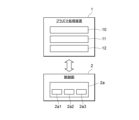
- Fig. 2 is a diagram for explaining an example of the configuration of the plasma processing system.
- the plasma processing system includes a plasma processing apparatus 1 and a controller 2.
- the plasma processing apparatus 1 includes a plasma processing chamber 10, a substrate support 11, and a plasma generation unit 12.
- the plasma processing chamber 10 has a plasma processing space.
- the plasma processing chamber 10 also has at least one gas supply port for supplying at least one processing gas to the plasma processing space, and at least one gas exhaust port for exhausting gas from the plasma processing space.
- the gas supply port is connected to a gas supply unit 20 described below, and the gas exhaust port is connected to an exhaust system 40 described below.
- the substrate support 11 is disposed in the plasma processing space, and has a substrate support surface for supporting a substrate.
- the plasma generating unit 12 is configured to generate plasma from at least one processing gas supplied into the plasma processing space.
- the plasma formed in the plasma processing space may be capacitively coupled plasma (CCP), inductively coupled plasma (ICP), ECR plasma (Electron-Cyclotron-resonance plasma), Helicon wave excited plasma (HWP: Helicon Wave Plasma), or surface wave plasma (SWP: Surface Wave Plasma), etc.
- various types of plasma generating units may be used, including AC (Alternating Current) plasma generating units and DC (Direct Current) plasma generating units.
- the AC signal (AC power) used in the AC plasma generating unit has a frequency in the range of 100 kHz to 10 GHz.
- AC signals include RF (Radio Frequency) signals and microwave signals.
- the RF signal has a frequency in the range of 100 kHz to 150 MHz.
- the control unit 2 processes computer-executable instructions that cause the plasma processing apparatus 1 to perform the various steps described in this disclosure.
- the control unit 2 may be configured to control each element of the plasma processing apparatus 1 to perform the various steps described herein. In one embodiment, a part or all of the control unit 2 may be included in the plasma processing apparatus 1.
- the control unit 2 may include a processing unit 2a1, a storage unit 2a2, and a communication interface 2a3.
- the control unit 2 is realized, for example, by a computer 2a.
- the processing unit 2a1 may be configured to perform various control operations by reading a program from the storage unit 2a2 and executing the read program. This program may be stored in the storage unit 2a2 in advance, or may be acquired via a medium when necessary.
- the acquired program is stored in the storage unit 2a2 and is read from the storage unit 2a2 by the processing unit 2a1 and executed.
- the medium may be various storage media readable by the computer 2a, or may be a communication line connected to the communication interface 2a3.
- the processing unit 2a1 may be a CPU (Central Processing Unit).
- the memory unit 2a2 may include a RAM (Random Access Memory), a ROM (Read Only Memory), a HDD (Hard Disk Drive), a SSD (Solid State Drive), or a combination of these.
- the communication interface 2a3 may communicate with the plasma processing device 1 via a communication line such as a LAN (Local Area Network).
- the control unit CU in FIG. 1 may also perform some or all of the functions of the control unit 2.
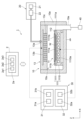
- FIG. 3 is a diagram for explaining an example of the configuration of a capacitively coupled plasma processing device.
- the capacitively coupled plasma processing apparatus 1 includes a plasma processing chamber 10, a gas supply unit 20, a power supply 30, and an exhaust system 40.
- the plasma processing apparatus 1 also includes a substrate support unit 11 and a gas inlet unit.
- the gas inlet unit is configured to introduce at least one processing gas into the plasma processing chamber 10.
- the gas inlet unit includes a shower head 13.
- the substrate support unit 11 is disposed in the plasma processing chamber 10.
- the shower head 13 is disposed above the substrate support unit 11. In one embodiment, the shower head 13 constitutes at least a part of the ceiling of the plasma processing chamber 10.
- the plasma processing chamber 10 has a plasma processing space 10s defined by the shower head 13, the sidewall 10a of the plasma processing chamber 10, and the substrate support unit 11.
- the plasma processing chamber 10 is grounded.
- the shower head 13 and the substrate support unit 11 are electrically insulated from the housing of the plasma processing chamber 10.
- the substrate support 11 includes a main body 111 and a ring assembly 112.
- the main body 111 has a central region 111a for supporting the substrate W and an annular region 111b for supporting the ring assembly 112.
- a wafer is an example of a substrate W.
- the annular region 111b of the main body 111 surrounds the central region 111a of the main body 111 in a plan view.
- the substrate W is disposed on the central region 111a of the main body 111
- the ring assembly 112 is disposed on the annular region 111b of the main body 111 so as to surround the substrate W on the central region 111a of the main body 111. Therefore, the central region 111a is also called a substrate support surface for supporting the substrate W, and the annular region 111b is also called a ring support surface for supporting the ring assembly 112.
- the main body 111 includes a base 1110 and an electrostatic chuck 1111.
- the base 1110 includes a conductive member.
- the conductive member of the base 1110 may function as a lower electrode.
- the electrostatic chuck 1111 is disposed on the base 1110.
- the electrostatic chuck 1111 includes a ceramic member 1111a and an electrostatic electrode 1111b disposed within the ceramic member 1111a.
- the ceramic member 1111a has a central region 111a. In one embodiment, the ceramic member 1111a also has an annular region 111b. Note that other members surrounding the electrostatic chuck 1111, such as an annular electrostatic chuck or an annular insulating member, may have the annular region 111b.
- the ring assembly 112 may be disposed on the annular electrostatic chuck or the annular insulating member, or may be disposed on both the electrostatic chuck 1111 and the annular insulating member.
- at least one RF/DC electrode coupled to an RF power source 31 and/or a DC power source 32 described later may be disposed in the ceramic member 1111a.
- the at least one RF/DC electrode functions as a lower electrode.
- the RF/DC electrode is also called a bias electrode.
- the conductive member of the base 1110 and the at least one RF/DC electrode may function as multiple lower electrodes.
- the electrostatic electrode 1111b may function as a lower electrode.
- the substrate support 11 includes at least one lower electrode.
- the ring assembly 112 includes one or more annular members.
- the one or more annular members include one or more edge rings and at least one cover ring.
- the edge rings are formed of a conductive or insulating material, and the cover rings are formed of an insulating material.
- the substrate support 11 may also include a temperature adjustment module configured to adjust at least one of the electrostatic chuck 1111, the ring assembly 112, and the substrate to a target temperature.
- the temperature adjustment module may include a heater, a heat transfer medium, a flow passage 1110a, or a combination thereof.
- a heat transfer fluid such as brine or a gas flows through the flow passage 1110a.
- the flow passage 1110a is formed in the base 1110, and one or more heaters are disposed in the ceramic member 1111a of the electrostatic chuck 1111.
- the substrate support 11 may also include a heat transfer gas supply configured to supply a heat transfer gas to a gap between the back surface of the substrate W and the central region 111a.
- the shower head 13 is configured to introduce at least one processing gas from the gas supply unit 20 into the plasma processing space 10s.
- the shower head 13 has at least one gas supply port 13a, at least one gas diffusion chamber 13b, and multiple gas inlets 13c.
- the processing gas supplied to the gas supply port 13a passes through the gas diffusion chamber 13b and is introduced into the plasma processing space 10s from the multiple gas inlets 13c.
- the shower head 13 also includes at least one upper electrode.
- the gas introduction unit may include, in addition to the shower head 13, one or more side gas injectors (SGI) attached to one or more openings formed in the sidewall 10a.
- SGI side gas injectors
- the gas supply unit 20 may include at least one gas source 21 and at least one flow controller 22.
- the gas supply unit 20 is configured to supply at least one process gas from a respective gas source 21 through a respective flow controller 22 to the showerhead 13.
- Each flow controller 22 may include, for example, a mass flow controller or a pressure-controlled flow controller.
- the gas supply unit 20 may include at least one flow modulation device that modulates or pulses the flow rate of the at least one process gas.
- the power supply 30 includes an RF power supply 31 coupled to the plasma processing chamber 10 via at least one impedance matching circuit.
- the RF power supply 31 is configured to supply at least one RF signal (RF power) to at least one lower electrode and/or at least one upper electrode. This causes a plasma to be formed from at least one processing gas supplied to the plasma processing space 10s.
- the RF power supply 31 can function as at least a part of the plasma generating unit 12.
- a bias RF signal to at least one lower electrode, a bias potential is generated on the substrate W, and ion components in the formed plasma can be attracted to the substrate W.
- the RF power supply 31 includes a first RF generating unit 31a and a second RF generating unit 31b.
- the first RF generating unit 31a is coupled to at least one lower electrode and/or at least one upper electrode via at least one impedance matching circuit and configured to generate a source RF signal (source RF power) for plasma generation.
- the source RF signal has a frequency in the range of 10 MHz to 150 MHz.
- the first RF generating unit 31a may be configured to generate multiple source RF signals having different frequencies. The generated one or more source RF signals are supplied to at least one lower electrode and/or at least one upper electrode.
- the second RF generator 31b is coupled to at least one lower electrode via at least one impedance matching circuit and configured to generate a bias RF signal (bias RF power).
- the frequency of the bias RF signal may be the same as or different from the frequency of the source RF signal.
- the bias RF signal has a lower frequency than the frequency of the source RF signal.
- the bias RF signal has a frequency in the range of 100 kHz to 60 MHz.
- the second RF generator 31b may be configured to generate multiple bias RF signals having different frequencies.
- the generated one or more bias RF signals are provided to at least one lower electrode. Also, in various embodiments, at least one of the source RF signal and the bias RF signal may be pulsed.
- the power supply 30 may also include a DC power supply 32 coupled to the plasma processing chamber 10.
- the DC power supply 32 includes a first DC generator 32a and a second DC generator 32b.
- the first DC generator 32a is connected to at least one lower electrode and configured to generate a first DC signal.
- the generated first DC signal is applied to the at least one lower electrode.
- the second DC generator 32b is connected to at least one upper electrode and configured to generate a second DC signal.
- the generated second DC signal is applied to the at least one upper electrode.
- the first and second DC signals may be pulsed.
- a sequence of voltage pulses is applied to at least one lower electrode and/or at least one upper electrode.
- the voltage pulses may have a rectangular, trapezoidal, triangular or combination thereof pulse waveform.
- a waveform generator for generating a sequence of voltage pulses from the DC signal is connected between the first DC generator 32a and at least one lower electrode.
- the first DC generator 32a and the waveform generator constitute a voltage pulse generator.
- the second DC generator 32b and the waveform generator constitute a voltage pulse generator
- the voltage pulse generator is connected to at least one upper electrode.
- the voltage pulses may have a positive polarity or a negative polarity.
- the sequence of voltage pulses may also include one or more positive polarity voltage pulses and one or more negative polarity voltage pulses within one period.
- the first and second DC generating units 32a and 32b may be provided in addition to the RF power source 31, or the first DC generating unit 32a may be provided in place of the second RF generating unit 31b.
- FIG. 4A is a perspective view showing an example of the transport arm AR.
- Fig. 4B is an enlarged view of a portion indicated by P in Fig. 4A.
- the transport arm AR is configured to transport objects such as substrates and consumable parts between a transport chamber and a substrate processing chamber.
- the transport arm AR is used as the forks FK11, FK12, FK21, FK22, or FK31 of the substrate processing system shown in FIG. 1.
- the transport arm AR transports objects between the vacuum chambers of the vacuum transport modules TM1 and TM2 shown in FIG. 1 and the processing chambers of the process modules PM1 to PM12 (including the plasma processing chamber 10 shown in FIGS. 2 and 3).
- the transport arm AR has a proximal end 50 and a distal end 52, as shown in FIG. 4A.
- the transport arm AR may be connected at the proximal end 50 to a drive mechanism of a transport device (e.g., the vacuum transport robots TR1 and TR2, or the atmospheric transport robot TR3 in FIG. 1).
- the transport arm AR can perform one or more of the following operations by the drive mechanism: translation (horizontal movement in the XY plane), elevation (vertical movement in the Z-axis direction), and rotation (rotation around the X, Y, and Z axes).
- the object to be transported is placed on the distal end 52 of the transport arm AR.
- the distal end 52 may be configured in a roughly U-shape and have two ends 52A, 52B spaced apart from each other.
- a plurality of pads PD are provided on the surface of the distal end 52. The plurality of pads PD contact the underside of the object to be transported (e.g., a substrate) and hold the object to be transported.
- the distal end 52 may be provided with one or more suction holes.
- the suction holes may be connected to an exhaust device such as a vacuum pump. In this case, the object to be transported is vacuum-adsorbed to the transport arm AR via the suction holes.
- the transport arm AR includes one or more optical sensors 54.
- the optical sensors 54 are provided along the side (XZ plane) of the distal end 52 (ends 52A, 52B) as shown in Figures 4A and 4B.
- the optical sensor 54 is a distance sensor.
- the optical sensor 54 may be configured to irradiate the object to be measured with light and measure the distance to the object to be measured.
- the optical sensor 54 is a confocal chromatic sensor. The confocal chromatic sensor measures the distance to the object to be measured based on the wavelength of light focused on and reflected from the object to be measured.
- the optical sensor 54 is a light intensity sensor.
- the optical sensor 54 may be configured to irradiate the object to be measured with light and measure the intensity of the light reflected from the object to be measured.
- the optical sensor 54 has the functions of both a distance sensor and a light intensity sensor.
- the light emitted from the optical sensor must be incident on the surface of the object to be measured within a given angle range (hereinafter, this range is also referred to as the "measurable range").
- the measurable range varies depending on the type and size of the optical sensor, but for small optical sensors that can be mounted on a transport arm, the measurable range tends to be narrow. Therefore, depending on the surface shape of the object to be measured and the installation location of the object to be measured, the measurable range of the optical sensor may be exceeded. As a result, the measurement accuracy of the optical sensor decreases or the measurement itself becomes difficult.
- adjusting the posture and position of the transport arm to match the surface shape and installation location of the object to be measured requires complex control and additional configuration, and it is also necessary to avoid collisions with other structures, which is not easy.
- the transport arm AR in one embodiment further includes a mechanism for adjusting the angle of the light emitted from the optical sensor 54 (hereinafter also referred to as the "angle adjustment mechanism"), as described below.
- the angle adjustment mechanism a mechanism for adjusting the angle of the light emitted from the optical sensor 54 (hereinafter also referred to as the "angle adjustment mechanism"), as described below.
- the measurable range of the optical sensor 54 may be 90° ⁇ 5°, 90° ⁇ 3°, 90° ⁇ 1.5°, or 90° ⁇ 1.0°.
- the measurable range may be, for example, 90° ⁇ 1.5°.
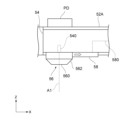
- Figs. 5A and 5B are diagrams for explaining an example of the angle adjustment mechanism.
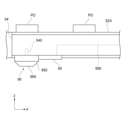
- Fig. 5A is a schematic diagram of the end 52A of the transport arm AR in Fig. 4B viewed from the Y1 direction.
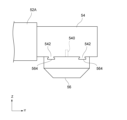
- Fig. 5B is a schematic diagram of the end 52A of the transport arm AR in Fig. 4B viewed from the X1 direction.
- Fig. 6 is a perspective view showing an example of a lens structure.
- Fig. 7A is a diagram for explaining a first horizontal position of the lens structure.
- Fig. 7B is a diagram for explaining a second horizontal position of the lens structure.
- An angle adjustment mechanism similar to that of the end 52A may be provided at the end 52B of the transport arm AR.
- the angle adjustment mechanism includes a lens structure 56 and an actuator 58.
- the lens structure 56 is disposed vertically (z-axis direction) below the optical sensor 54.
- the lens structure 56 is disposed at a position overlapping with the optical sensor 54 in a plan view.
- the optical sensor 54 may have an optical head 540 that emits measurement light downward, as shown in Figures 5A and 5B. In this case, the lens structure 56 may be disposed below the optical head 540.
- Lens structure 56 includes a horizontal surface 560 and an inclined surface 562 that is angled with respect to horizontal surface 560.
- Horizontal surface 560 and inclined surface 562 are examples of a second horizontal surface and a second inclined surface, respectively.
- Lens structure 56 may have various shapes in a planar view, such as a rectangular shape, a polygonal shape, a circular shape, an elliptical shape, etc.
- lens structure 56 is rectangular in a planar view.
- lens structure 56 may be made of a material having a given refractive index, such as optical glass or organic glass.
- the lens structure 56 is attached to the optical sensor 54 so as to be movable in parallel with the optical sensor 54.
- one or more rails 542 extending in the longitudinal direction (x-axis direction) may be provided on the underside of the optical sensor 54.
- one or more grooves 564 extending in the longitudinal direction (x-axis direction) may be provided on the upper surface of the lens structure 56 (see FIGS. 5B and 6). The grooves 564 of the lens structure 56 may be fitted into the rails 542 on the underside of the optical sensor 54, and the lens structure 56 may be attached so as to be movable in the longitudinal direction (x-axis direction) along the rails 542.
- the lens structure 56 may be attached to the optical sensor 54 in various ways.
- the grooves and rails described above may be provided in the short direction (y-axis direction) rather than the long direction (x-axis direction).
- the lens structure 56 is configured to be movable in the short direction (y-axis direction) along the rail 542.
- the grooves and rails described above may be provided in a cross shape along the long and short directions.
- the lens structure 56 is configured to be movable in the long and short directions along the cross-shaped rails of the optical sensor 54.
- a groove may be provided in the optical sensor 54 and a rail may be provided in the lens structure 56.
- the lens structure 56 may be attached to the optical sensor 54 via another member that can move parallel to the optical sensor 54.
- the actuator 58 is disposed below the optical sensor 54.
- the actuator 58 converts electrical energy supplied via wiring 580 into mechanical motion to provide the driving force required to move the lens structure 56.
- the actuator 58 is disposed so that its driving direction coincides with the movement direction of the lens structure 56 (e.g., the x-axis direction). If the lens structure 56 moves in multiple directions (e.g., the x-axis and y-axis directions), multiple actuators 58 may be provided.
- the actuator 58 may be a piezoelectric actuator.
- the actuator 58 is attached to the lens structure 56 such that the direction of expansion and contraction of the piezoelectric element matches the direction of movement of the lens structure 56 (e.g., the x-axis direction).
- the lens structure 56 can move below the optical sensor 54 between at least a first horizontal position and a second horizontal position.
- the first horizontal position is a position where the horizontal surface 560 of the lens structure 56 overlaps with the optical axis A1 of the optical sensor 54, as shown in FIG. 7A (note that in FIG. 7A, the optical axis A1 is the direction in which the light travels immediately after being emitted from the optical head 540 of the optical sensor 54).
- the second horizontal position is a position where the inclined surface 562 of the lens structure 56 overlaps with the optical axis A1 of the optical sensor 54, as shown in FIG. 7B.
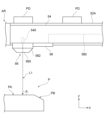
- Figures 8A and 8B are diagrams for explaining an example of measurement using the transport arm AR.
- the optical sensor 54 of the transport arm AR is used to measure a part P of the plasma processing apparatus 1 shown in Figure 3.
- the part P may be a consumable part such as the ring assembly 112.
- the measurement of the part P may be a measurement of the distance from the optical sensor 54 to the part P.
- the transport arm AR is introduced into a plasma processing chamber 10 (hereinafter also referred to as "chamber 10") of the plasma processing apparatus 1.
- the transport arm AR is then moved horizontally (in a direction parallel to the XY plane) within the chamber 10.
- the 8A is an example of measuring the horizontal plane PA of the part P.
- the horizontal plane PA is an example of a first horizontal plane.
- the lens structure 56 is placed in a first horizontal position by the actuator 58.
- the light L1 emitted from the optical head 540 of the optical sensor 54 passes through the horizontal plane 560 of the lens structure 56 and travels straight.
- the light L1 is incident on the horizontal plane PA of the part P at an angle ⁇ 1.
- the angle ⁇ 1 is about 90°, and in one example, is 90° ⁇ 5°, 90° ⁇ 3°, 90° ⁇ 1.5°, or 90° ⁇ 1.0°.
- the optical sensor 54 uses the light L1 to detect the distance from the optical sensor 54 to the horizontal plane PA (hereinafter also referred to as the "first distance") and outputs it to the control unit 2.
- FIG. 8B shows an example of measuring the inclined surface PB of the part P.
- the inclined surface PB is a surface that has an angle with respect to the horizontal plane PA.
- the inclined surface PB is an example of a first inclined surface.
- the lens structure 56 is placed in a second horizontal position by the actuator 58.
- the light L2 emitted from the optical head 540 of the optical sensor 54 is refracted by passing through the inclined surface 562 of the lens structure 560.
- the light L2 is incident on the inclined surface PB of the ring assembly at an angle ⁇ 2.
- the angle ⁇ 2 is about 90°, and in one example, is 90° ⁇ 5°, 90° ⁇ 3°, 90° ⁇ 1.5°, or 90° ⁇ 1.0°9.
- the optical sensor 54 uses the light L2 to detect the distance from the optical sensor 54 to the inclined surface PB (hereinafter also referred to as the "second distance") and outputs it to the control unit 2.
- control unit 2 may determine the state of the part P based on the output from the optical sensor 54.
- the state of the part P may be the amount of wear of the part P, or the position (positional deviation) of the part P relative to a reference position.
- control unit 2 may determine the amount of wear of the part P based on the output from the optical sensor 54.
- the first distance may be measured and stored when the part P is first placed in the chamber 10, and the amount of wear of the part P may be determined by comparing it with the first distance measured again after a given time has elapsed.
- the second distance may be measured and stored when the part P is placed in the chamber 10, and the amount of wear of the part P may be determined by comparing it with the second distance measured again after a given time has elapsed.
- control unit 2 may determine the position of the part P relative to the reference position (including the positional deviation from the reference position) based on the output from the optical sensor 54. For example, when the part P is placed in the chamber 10, the first distance and/or the second distance may be measured, and the position and positional deviation of the part P relative to the reference position may be determined based on the measurement result.
- the transport arm AR is provided with an angle adjustment mechanism, so that the light irradiated from the optical sensor 54 is incident on the inclined surface PB at an angle within the measurable range (e.g., approximately 90°) in the same manner as on the horizontal surface PA. This makes it possible to prevent a decrease in the measurement accuracy of the optical sensor 54 on the inclined surface PB.
- the transport arm AR is provided with an angle adjustment mechanism, so that the light irradiated from the optical sensor 54 can be refracted. This makes it possible to irradiate the light to a component P that is located farther away from the transport arm AR. In other words, the measurement area by the optical sensor 54 can be expanded.
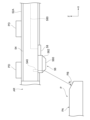
- FIG. 9 is a diagram showing another example of the angle adjustment mechanism.
- the angle adjustment mechanism may be disposed above the optical sensor.
- the optical sensor 54 includes an exposure head 540A that emits light vertically upward (z-axis direction).
- the lens structure 56 is disposed above the exposure head 540A.
- the actuator 58 is disposed above the optical sensor 54. This allows the optical sensor 54 to measure the part P located above the transport arm AR.
- An example of the part P is the shower head 13 of the plasma processing apparatus 1.
- the upper surface of the lens structure 56 (position in the z-axis direction) is located lower than the upper surface of the pad PD. This prevents the lens structure 56 from coming into contact with the object to be transported (e.g., substrate W) when it is placed on the pad PD.
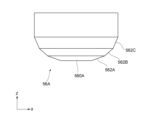
- FIG. 10 is a diagram showing another example of a lens structure.
- the lens structure may include inclined surfaces at multiple angles.
- the lens structure 56A includes a horizontal plane 560A and three inclined planes 562A to 562C each having a different angle relative to the horizontal plane 560A.
- the lens structure 56A may be arranged to be movable below (above) the optical sensor 54 (54A), similar to the examples shown in FIG. 5A and FIG. 9.
- the lens structure 56A may be configured to be movable below (above) the optical sensor 54 (54A) between at least a first horizontal position, a second horizontal position, a third horizontal position, and a fourth horizontal position.
- the first horizontal position is a position where the horizontal plane 560A of the lens structure 56A overlaps with the optical axis of the optical sensor 54 (54A).
- the second to fourth horizontal positions are positions where the inclined surfaces 562A to 562C of the lens structure 56A overlap the optical axis of the optical sensor 54 (54A), respectively.
- a substrate processing apparatus includes: a substrate processing chamber; a substrate support disposed within the substrate processing chamber, the substrate support having a substrate support surface and a ring support surface; an edge ring disposed on the ring support to surround the substrate on the substrate support surface, the edge ring having a first horizontal surface and a first inclined surface;
- the conveying device is a transfer chamber; a transfer arm configured to transfer substrates between the transfer chamber and the substrate processing chamber; an optical sensor attached to the transport arm; a lens structure disposed below the optical sensor, the lens structure having a second horizontal surface and a second inclined surface; an actuator attached to the transport arm and configured to move the lens structure horizontally between a first horizontal position and a second horizontal position, the first horizontal position being a position where the second horizontal plane overlaps with an optical axis of the optical sensor, and the second horizontal position being a position where the second inclined surface overlaps with the optical axis of the optical sensor; the control unit is configured to determine
- the optical sensor is configured to measure a first distance from the optical sensor to the first horizontal plane via the second horizontal plane when the lens structure is in the first horizontal position; 2.
- the controller is configured to determine an amount of wear of the first horizontal surface based on the first distance.
- the optical sensor is configured to measure a second distance from the optical sensor to the first inclined surface via the second inclined surface when the lens structure is in the second horizontal position; 3.
- the controller is configured to determine an amount of wear of the first inclined surface based on the second distance.
- the optical sensor is configured to measure a distance from the optical sensor to the first inclined surface via the second inclined surface when the lens structure is in the second horizontal position; 2.
- the controller is configured to determine an amount of wear of the first inclined surface based on the distance.
- a substrate processing apparatus includes: a substrate processing chamber; a consumable part that forms part of or is disposed within the substrate processing chamber, the consumable part having a first horizontal surface and a first inclined surface;
- the conveying device is a transfer chamber; a transfer arm configured to transfer substrates between the transfer chamber and the substrate processing chamber; an optical sensor attached to the transport arm; a lens structure disposed above or below the optical sensor, the lens structure having a second horizontal surface and a second inclined surface; an actuator attached to the transport arm and configured to move the lens structure horizontally between a first horizontal position and a second horizontal position, the first horizontal position being a position where the second horizontal plane overlaps with an optical axis of the optical sensor, and the second horizontal position being a position where the second inclined surface overlaps with the optical axis of the optical sensor; the controller is configured to determine a status of the consumable part based on an output of the optical sensor.
- Substrate processing system includes: a substrate processing chamber; a consumable part that forms part of or is disposed within the
- the optical sensor is configured to measure a first distance from the optical sensor to the first horizontal plane via the second horizontal plane when the lens structure is in the first horizontal position; 7.
- the controller is configured to determine an amount of wear of the first horizontal surface based on the first distance.
- the optical sensor is configured to measure a second distance from the optical sensor to the first inclined surface via the second inclined surface when the lens structure is in the second horizontal position; 8. The substrate processing system of claim 7, wherein the controller is configured to determine an amount of wear of the first inclined surface based on the second distance.
- the optical sensor is configured to measure a distance from the optical sensor to the first inclined surface via the second inclined surface when the lens structure is in the second horizontal position; 7.
- the controller is configured to determine an amount of wear of the first inclined surface based on the distance.
- the optical sensor is configured to measure a first distance from the optical sensor to the first horizontal plane via the second horizontal plane when the lens structure is in the first horizontal position; 7.
- the controller is configured to determine a position of the consumable part relative to a reference position based on the first distance.
- the optical sensor is configured to measure a second distance from the optical sensor to the first inclined surface via the second inclined surface when the lens structure is in the second horizontal position; 11.
- the controller is configured to determine a position of the consumable part relative to the reference position based on the first distance and the second distance.
- the optical sensor is configured to measure a distance from the optical sensor to the first inclined surface via the second inclined surface when the lens structure is in the second horizontal position; 7.
- the controller is configured to determine a position of the consumable part relative to a reference position based on the distance.
- a substrate processing apparatus includes: a substrate processing chamber; a consumable part forming part of or disposed within the substrate processing chamber, the consumable part having a first sloped surface;
- the conveying device is a transfer arm configured to transfer substrates between the transfer chamber and the substrate processing chamber;
- the controller is configured to determine a status of the consumable part based on an output of the sensor.
- Substrate processing system includes: a substrate processing chamber; a consumable part forming part of or disposed within the substrate processing chamber, the consumable part having a first sloped surface;
- the conveying device is a transfer arm configured to transfer substrates between the transfer chamber and the substrate processing chamber;
- the controller is configured to determine a status of the consumable part based on an output of the sensor.
- Substrate processing system includes:
- Plasma processing device 2: Control unit, 10: Plasma processing chamber, 11: Substrate support unit, 54: Optical sensor, 56: Lens structure, 58: Actuator, AR: Transport arm, CU: Control unit, P: Parts, PA: Horizontal surface, PB: Inclined surface, PS: Substrate processing system
Landscapes
- Physics & Mathematics (AREA)
- General Physics & Mathematics (AREA)
- Container, Conveyance, Adherence, Positioning, Of Wafer (AREA)
- Engineering & Computer Science (AREA)
- Robotics (AREA)
Priority Applications (4)
| Application Number | Priority Date | Filing Date | Title |
|---|---|---|---|
| JP2025515069A JPWO2024219076A1 (https=) | 2023-04-21 | 2024-02-19 | |
| KR1020257037980A KR20260002899A (ko) | 2023-04-21 | 2024-02-19 | 기판 처리 시스템 |
| CN202480024797.0A CN121079765A (zh) | 2023-04-21 | 2024-02-19 | 基片处理系统 |
| US19/357,173 US20260040872A1 (en) | 2023-04-21 | 2025-10-14 | Substrate processing system |
Applications Claiming Priority (2)
| Application Number | Priority Date | Filing Date | Title |
|---|---|---|---|
| JP2023070199 | 2023-04-21 | ||
| JP2023-070199 | 2023-04-21 |
Related Child Applications (1)
| Application Number | Title | Priority Date | Filing Date |
|---|---|---|---|
| US19/357,173 Continuation US20260040872A1 (en) | 2023-04-21 | 2025-10-14 | Substrate processing system |
Publications (1)
| Publication Number | Publication Date |
|---|---|
| WO2024219076A1 true WO2024219076A1 (ja) | 2024-10-24 |
Family
ID=93152630
Family Applications (1)
| Application Number | Title | Priority Date | Filing Date |
|---|---|---|---|
| PCT/JP2024/005811 Ceased WO2024219076A1 (ja) | 2023-04-21 | 2024-02-19 | 基板処理システム |
Country Status (6)
| Country | Link |
|---|---|
| US (1) | US20260040872A1 (https=) |
| JP (1) | JPWO2024219076A1 (https=) |
| KR (1) | KR20260002899A (https=) |
| CN (1) | CN121079765A (https=) |
| TW (1) | TW202447835A (https=) |
| WO (1) | WO2024219076A1 (https=) |
Citations (6)
| Publication number | Priority date | Publication date | Assignee | Title |
|---|---|---|---|---|
| JP2010226014A (ja) * | 2009-03-25 | 2010-10-07 | Panasonic Corp | 基板搬送装置 |
| JP2017050535A (ja) * | 2015-08-21 | 2017-03-09 | ラム リサーチ コーポレーションLam Research Corporation | 半導体製造機器内の消耗部品の摩耗検出 |
| JP2018026558A (ja) * | 2016-08-03 | 2018-02-15 | ラム リサーチ コーポレーションLam Research Corporation | プラズマ処理システムを監視するための方法およびシステム、ならびに高度なプロセスおよびツール制御 |
| US20210172728A1 (en) * | 2019-12-06 | 2021-06-10 | Applied Materials, Inc. | Methods and systems of optical inspection of electronic device manufacturing machines |
| JP2022042122A (ja) * | 2020-09-02 | 2022-03-14 | 東京エレクトロン株式会社 | 基板処理システム及び状態監視方法 |
| JP2022174626A (ja) * | 2021-05-11 | 2022-11-24 | 東京エレクトロン株式会社 | 基板処理システム及び環状部材の高さ推定方法 |
Family Cites Families (1)
| Publication number | Priority date | Publication date | Assignee | Title |
|---|---|---|---|---|
| JP7816869B2 (ja) | 2021-02-26 | 2026-02-18 | 東京エレクトロン株式会社 | 搬送システム、搬送装置及び搬送方法 |
-
2024
- 2024-02-19 JP JP2025515069A patent/JPWO2024219076A1/ja active Pending
- 2024-02-19 CN CN202480024797.0A patent/CN121079765A/zh active Pending
- 2024-02-19 KR KR1020257037980A patent/KR20260002899A/ko active Pending
- 2024-02-19 WO PCT/JP2024/005811 patent/WO2024219076A1/ja not_active Ceased
- 2024-04-15 TW TW113113940A patent/TW202447835A/zh unknown
-
2025
- 2025-10-14 US US19/357,173 patent/US20260040872A1/en active Pending
Patent Citations (6)
| Publication number | Priority date | Publication date | Assignee | Title |
|---|---|---|---|---|
| JP2010226014A (ja) * | 2009-03-25 | 2010-10-07 | Panasonic Corp | 基板搬送装置 |
| JP2017050535A (ja) * | 2015-08-21 | 2017-03-09 | ラム リサーチ コーポレーションLam Research Corporation | 半導体製造機器内の消耗部品の摩耗検出 |
| JP2018026558A (ja) * | 2016-08-03 | 2018-02-15 | ラム リサーチ コーポレーションLam Research Corporation | プラズマ処理システムを監視するための方法およびシステム、ならびに高度なプロセスおよびツール制御 |
| US20210172728A1 (en) * | 2019-12-06 | 2021-06-10 | Applied Materials, Inc. | Methods and systems of optical inspection of electronic device manufacturing machines |
| JP2022042122A (ja) * | 2020-09-02 | 2022-03-14 | 東京エレクトロン株式会社 | 基板処理システム及び状態監視方法 |
| JP2022174626A (ja) * | 2021-05-11 | 2022-11-24 | 東京エレクトロン株式会社 | 基板処理システム及び環状部材の高さ推定方法 |
Also Published As
| Publication number | Publication date |
|---|---|
| US20260040872A1 (en) | 2026-02-05 |
| TW202447835A (zh) | 2024-12-01 |
| KR20260002899A (ko) | 2026-01-06 |
| JPWO2024219076A1 (https=) | 2024-10-24 |
| CN121079765A (zh) | 2025-12-05 |
Similar Documents
| Publication | Publication Date | Title |
|---|---|---|
| US12315704B2 (en) | Plasma processing apparatus, and method and program for controlling elevation of focus ring | |
| US12094696B2 (en) | Focus ring replacement method and plasma processing system | |
| JP7055054B2 (ja) | プラズマ処理装置、プラズマ制御方法、及びプラズマ制御プログラム | |
| JP7816869B2 (ja) | 搬送システム、搬送装置及び搬送方法 | |
| US12131937B2 (en) | Transfer system, transfer device, and transfer method | |
| US20220230856A1 (en) | Plasma processing system and plasma processing method | |
| KR20200060137A (ko) | 포커스 링 높이 제어 장치 및 이를 구비하는 기판 식각 장치 | |
| JP2025087902A (ja) | 基板処理システム及びメンテナンス方法 | |
| WO2024219076A1 (ja) | 基板処理システム | |
| JP7658779B2 (ja) | プラズマ処理装置 | |
| WO2025177675A1 (ja) | 基板処理システム | |
| CN120642034A (zh) | 等离子体处理装置 | |
| WO2025177875A1 (ja) | 基板処理システム | |
| JP2025127868A (ja) | 基板処理システム | |
| US20250125173A1 (en) | Calibration Method and Substrate Processing System | |
| US12622219B2 (en) | Substrate processing apparatus | |
| KR102905631B1 (ko) | 실행 장치 및 실행 방법 | |
| WO2024203507A1 (ja) | クラスタツール | |
| US12518953B2 (en) | Plasma processing apparatus and method of manufacture | |
| JP2025182588A (ja) | 変位を測定するシステム及び方法 | |
| JP7624844B2 (ja) | 基板収容装置および処理システム | |
| US20230067873A1 (en) | Substrate treating apparatus and substrate treating method | |
| WO2025182721A1 (ja) | 基板処理システム及び搬送ロボットのティーチング方法 | |
| JP2024137691A (ja) | 温度を測定するシステム及び方法 | |
| WO2026034244A1 (ja) | プラズマ処理システム及び基板処理システム |
Legal Events
| Date | Code | Title | Description |
|---|---|---|---|
| 121 | Ep: the epo has been informed by wipo that ep was designated in this application |
Ref document number: 24792352 Country of ref document: EP Kind code of ref document: A1 |
|
| ENP | Entry into the national phase |
Ref document number: 2025515069 Country of ref document: JP Kind code of ref document: A |
|
| WWE | Wipo information: entry into national phase |
Ref document number: 2025515069 Country of ref document: JP |
|
| WWE | Wipo information: entry into national phase |
Ref document number: KR1020257037980 Country of ref document: KR |
|
| NENP | Non-entry into the national phase |
Ref country code: DE |
|
| 122 | Ep: pct application non-entry in european phase |
Ref document number: 24792352 Country of ref document: EP Kind code of ref document: A1 |