WO2024219017A1 - セキュリティタグ - Google Patents
セキュリティタグ Download PDFInfo
- Publication number
- WO2024219017A1 WO2024219017A1 PCT/JP2023/045925 JP2023045925W WO2024219017A1 WO 2024219017 A1 WO2024219017 A1 WO 2024219017A1 JP 2023045925 W JP2023045925 W JP 2023045925W WO 2024219017 A1 WO2024219017 A1 WO 2024219017A1
- Authority
- WO
- WIPO (PCT)
- Prior art keywords
- security tag
- resin layer
- dimensional crystal
- particles
- colloid particles
- Prior art date
- Legal status (The legal status is an assumption and is not a legal conclusion. Google has not performed a legal analysis and makes no representation as to the accuracy of the status listed.)
- Ceased
Links
Images



Classifications
-
- B—PERFORMING OPERATIONS; TRANSPORTING
- B42—BOOKBINDING; ALBUMS; FILES; SPECIAL PRINTED MATTER
- B42D—BOOKS; BOOK COVERS; LOOSE LEAVES; PRINTED MATTER CHARACTERISED BY IDENTIFICATION OR SECURITY FEATURES; PRINTED MATTER OF SPECIAL FORMAT OR STYLE NOT OTHERWISE PROVIDED FOR; DEVICES FOR USE THEREWITH AND NOT OTHERWISE PROVIDED FOR; MOVABLE-STRIP WRITING OR READING APPARATUS
- B42D25/00—Information-bearing cards or sheet-like structures characterised by identification or security features; Manufacture thereof
- B42D25/30—Identification or security features, e.g. for preventing forgery
- B42D25/328—Diffraction gratings; Holograms
-
- C—CHEMISTRY; METALLURGY
- C08—ORGANIC MACROMOLECULAR COMPOUNDS; THEIR PREPARATION OR CHEMICAL WORKING-UP; COMPOSITIONS BASED THEREON
- C08K—Use of inorganic or non-macromolecular organic substances as compounding ingredients
- C08K3/00—Use of inorganic substances as compounding ingredients
- C08K3/34—Silicon-containing compounds
- C08K3/36—Silica
-
- B—PERFORMING OPERATIONS; TRANSPORTING
- B32—LAYERED PRODUCTS
- B32B—LAYERED PRODUCTS, i.e. PRODUCTS BUILT-UP OF STRATA OF FLAT OR NON-FLAT, e.g. CELLULAR OR HONEYCOMB, FORM
- B32B27/00—Layered products comprising a layer of synthetic resin
- B32B27/18—Layered products comprising a layer of synthetic resin characterised by the use of special additives
- B32B27/20—Layered products comprising a layer of synthetic resin characterised by the use of special additives using fillers, pigments, thixotroping agents
-
- B—PERFORMING OPERATIONS; TRANSPORTING
- B32—LAYERED PRODUCTS
- B32B—LAYERED PRODUCTS, i.e. PRODUCTS BUILT-UP OF STRATA OF FLAT OR NON-FLAT, e.g. CELLULAR OR HONEYCOMB, FORM
- B32B27/00—Layered products comprising a layer of synthetic resin
- B32B27/30—Layered products comprising a layer of synthetic resin comprising vinyl (co)polymers; comprising acrylic (co)polymers
- B32B27/308—Layered products comprising a layer of synthetic resin comprising vinyl (co)polymers; comprising acrylic (co)polymers comprising acrylic (co)polymers
-
- B—PERFORMING OPERATIONS; TRANSPORTING
- B42—BOOKBINDING; ALBUMS; FILES; SPECIAL PRINTED MATTER
- B42D—BOOKS; BOOK COVERS; LOOSE LEAVES; PRINTED MATTER CHARACTERISED BY IDENTIFICATION OR SECURITY FEATURES; PRINTED MATTER OF SPECIAL FORMAT OR STYLE NOT OTHERWISE PROVIDED FOR; DEVICES FOR USE THEREWITH AND NOT OTHERWISE PROVIDED FOR; MOVABLE-STRIP WRITING OR READING APPARATUS
- B42D25/00—Information-bearing cards or sheet-like structures characterised by identification or security features; Manufacture thereof
- B42D25/30—Identification or security features, e.g. for preventing forgery
- B42D25/36—Identification or security features, e.g. for preventing forgery comprising special materials
- B42D25/373—Metallic materials
-
- G—PHYSICS
- G02—OPTICS
- G02B—OPTICAL ELEMENTS, SYSTEMS OR APPARATUS
- G02B1/00—Optical elements characterised by the material of which they are made; Optical coatings for optical elements
- G02B1/02—Optical elements characterised by the material of which they are made; Optical coatings for optical elements made of crystals, e.g. rock-salt, semi-conductors
-
- G—PHYSICS
- G02—OPTICS
- G02B—OPTICAL ELEMENTS, SYSTEMS OR APPARATUS
- G02B5/00—Optical elements other than lenses
-
- G—PHYSICS
- G11—INFORMATION STORAGE
- G11B—INFORMATION STORAGE BASED ON RELATIVE MOVEMENT BETWEEN RECORD CARRIER AND TRANSDUCER
- G11B7/00—Recording or reproducing by optical means, e.g. recording using a thermal beam of optical radiation by modifying optical properties or the physical structure, reproducing using an optical beam at lower power by sensing optical properties; Record carriers therefor
- G11B7/24—Record carriers characterised by shape, structure or physical properties, or by the selection of the material
- G11B7/24003—Shapes of record carriers other than disc shape
- G11B7/24012—Optical cards
-
- G—PHYSICS
- G11—INFORMATION STORAGE
- G11B—INFORMATION STORAGE BASED ON RELATIVE MOVEMENT BETWEEN RECORD CARRIER AND TRANSDUCER
- G11B7/00—Recording or reproducing by optical means, e.g. recording using a thermal beam of optical radiation by modifying optical properties or the physical structure, reproducing using an optical beam at lower power by sensing optical properties; Record carriers therefor
- G11B7/24—Record carriers characterised by shape, structure or physical properties, or by the selection of the material
- G11B7/2403—Layers; Shape, structure or physical properties thereof
- G11B7/24035—Recording layers
- G11B7/24044—Recording layers for storing optical interference patterns, e.g. holograms; for storing data in three dimensions [3D], e.g. volume storage
-
- B—PERFORMING OPERATIONS; TRANSPORTING
- B32—LAYERED PRODUCTS
- B32B—LAYERED PRODUCTS, i.e. PRODUCTS BUILT-UP OF STRATA OF FLAT OR NON-FLAT, e.g. CELLULAR OR HONEYCOMB, FORM
- B32B2260/00—Layered product comprising an impregnated, embedded, or bonded layer wherein the layer comprises an impregnation, embedding, or binder material
- B32B2260/02—Composition of the impregnated, bonded or embedded layer
- B32B2260/025—Particulate layer
-
- B—PERFORMING OPERATIONS; TRANSPORTING
- B32—LAYERED PRODUCTS
- B32B—LAYERED PRODUCTS, i.e. PRODUCTS BUILT-UP OF STRATA OF FLAT OR NON-FLAT, e.g. CELLULAR OR HONEYCOMB, FORM
- B32B2260/00—Layered product comprising an impregnated, embedded, or bonded layer wherein the layer comprises an impregnation, embedding, or binder material
- B32B2260/04—Impregnation, embedding, or binder material
- B32B2260/046—Synthetic resin
-
- B—PERFORMING OPERATIONS; TRANSPORTING
- B32—LAYERED PRODUCTS
- B32B—LAYERED PRODUCTS, i.e. PRODUCTS BUILT-UP OF STRATA OF FLAT OR NON-FLAT, e.g. CELLULAR OR HONEYCOMB, FORM
- B32B2264/00—Composition or properties of particles which form a particulate layer or are present as additives
- B32B2264/10—Inorganic particles
- B32B2264/101—Glass
-
- B—PERFORMING OPERATIONS; TRANSPORTING
- B32—LAYERED PRODUCTS
- B32B—LAYERED PRODUCTS, i.e. PRODUCTS BUILT-UP OF STRATA OF FLAT OR NON-FLAT, e.g. CELLULAR OR HONEYCOMB, FORM
- B32B2264/00—Composition or properties of particles which form a particulate layer or are present as additives
- B32B2264/20—Particles characterised by shape
- B32B2264/201—Flat or platelet-shaped particles, e.g. flakes
-
- B—PERFORMING OPERATIONS; TRANSPORTING
- B32—LAYERED PRODUCTS
- B32B—LAYERED PRODUCTS, i.e. PRODUCTS BUILT-UP OF STRATA OF FLAT OR NON-FLAT, e.g. CELLULAR OR HONEYCOMB, FORM
- B32B2264/00—Composition or properties of particles which form a particulate layer or are present as additives
- B32B2264/30—Particles characterised by physical dimension
- B32B2264/301—Average diameter smaller than 100 nm
-
- B—PERFORMING OPERATIONS; TRANSPORTING
- B32—LAYERED PRODUCTS
- B32B—LAYERED PRODUCTS, i.e. PRODUCTS BUILT-UP OF STRATA OF FLAT OR NON-FLAT, e.g. CELLULAR OR HONEYCOMB, FORM
- B32B2264/00—Composition or properties of particles which form a particulate layer or are present as additives
- B32B2264/30—Particles characterised by physical dimension
- B32B2264/302—Average diameter in the range from 100 nm to 1000 nm
-
- B—PERFORMING OPERATIONS; TRANSPORTING
- B32—LAYERED PRODUCTS
- B32B—LAYERED PRODUCTS, i.e. PRODUCTS BUILT-UP OF STRATA OF FLAT OR NON-FLAT, e.g. CELLULAR OR HONEYCOMB, FORM
- B32B2264/00—Composition or properties of particles which form a particulate layer or are present as additives
- B32B2264/30—Particles characterised by physical dimension
- B32B2264/303—Average diameter greater than 1µm
-
- B—PERFORMING OPERATIONS; TRANSPORTING
- B32—LAYERED PRODUCTS
- B32B—LAYERED PRODUCTS, i.e. PRODUCTS BUILT-UP OF STRATA OF FLAT OR NON-FLAT, e.g. CELLULAR OR HONEYCOMB, FORM
- B32B2264/00—Composition or properties of particles which form a particulate layer or are present as additives
- B32B2264/50—Particles characterised by their position or distribution in a layer
- B32B2264/503—Particles characterised by their position or distribution in a layer distributed in a predetermined pattern in a thickness direction
-
- B—PERFORMING OPERATIONS; TRANSPORTING
- B32—LAYERED PRODUCTS
- B32B—LAYERED PRODUCTS, i.e. PRODUCTS BUILT-UP OF STRATA OF FLAT OR NON-FLAT, e.g. CELLULAR OR HONEYCOMB, FORM
- B32B2307/00—Properties of the layers or laminate
- B32B2307/40—Properties of the layers or laminate having particular optical properties
- B32B2307/418—Refractive
-
- B—PERFORMING OPERATIONS; TRANSPORTING
- B32—LAYERED PRODUCTS
- B32B—LAYERED PRODUCTS, i.e. PRODUCTS BUILT-UP OF STRATA OF FLAT OR NON-FLAT, e.g. CELLULAR OR HONEYCOMB, FORM
- B32B2425/00—Cards, e.g. identity cards, credit cards
-
- C—CHEMISTRY; METALLURGY
- C08—ORGANIC MACROMOLECULAR COMPOUNDS; THEIR PREPARATION OR CHEMICAL WORKING-UP; COMPOSITIONS BASED THEREON
- C08K—Use of inorganic or non-macromolecular organic substances as compounding ingredients
- C08K2201/00—Specific properties of additives
- C08K2201/002—Physical properties
- C08K2201/005—Additives being defined by their particle size in general
-
- C—CHEMISTRY; METALLURGY
- C08—ORGANIC MACROMOLECULAR COMPOUNDS; THEIR PREPARATION OR CHEMICAL WORKING-UP; COMPOSITIONS BASED THEREON
- C08K—Use of inorganic or non-macromolecular organic substances as compounding ingredients
- C08K2201/00—Specific properties of additives
- C08K2201/011—Nanostructured additives
Definitions
- the present invention relates to a security tag.
- Patent Document 1 discloses an anti-counterfeiting structure that includes a particle fixing layer having spherical particles and a particle fixing resin for holding and fixing the spherical particles, the particle fixing resin containing one or more types of resin and arranged so that more than half of the height of the spherical particles is not buried, the spherical particles are arranged in a single plane with an area filling rate of 30% or more over the entire surface or in any shape, the average particle size is 2.5 ⁇ m or less, and 70% or more of the particle number is within the range of 0.8 to 1.2 times the average particle size.
- authenticity is determined by utilizing color changes that are observed by moving the position of the light source or observation point.
- the present invention has been made to solve the above problems, and aims to provide a security tag that can provide a high level of anti-counterfeiting effectiveness.
- the security tag of the present invention is characterized in that it comprises a plurality of colloid particles and a resin layer, the plurality of colloid particles are embedded in the resin layer and arranged at a distance from each other along a surface direction perpendicular to the thickness direction, and at least one type of two-dimensional crystal composed of the plurality of colloid particles is present.
- the present invention provides a security tag that can provide a high level of anti-counterfeiting effectiveness.
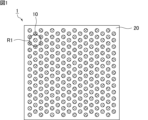
- FIG. 1 is a schematic plan view showing an example of a security tag according to a first embodiment of the present invention.
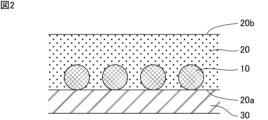
- FIG. 2 is a schematic cross-sectional view showing an example of a cross section along the thickness direction of the security tag shown in FIG.
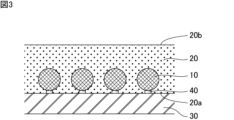
- FIG. 3 is a schematic cross-sectional view showing another example of a cross section along the thickness direction of the security tag shown in FIG.
- FIG. 4 is a schematic diagram showing an example of a diffraction pattern derived from the two-dimensional crystal shown in FIG.
- FIG. 5 is a schematic plan view showing an example of a security tag according to the second embodiment of the present invention.
- FIG. 6 is a schematic diagram showing an example of a diffraction pattern derived from the two-dimensional crystal shown in FIG.
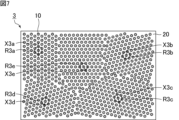
- FIG. 7 is a schematic plan view showing an example of a security tag according to a third embodiment of the present invention.
- the security tag of the present invention is described below. Note that the present invention is not limited to the configuration below, and may be modified as appropriate without departing from the gist of the present invention. In addition, a combination of multiple individual preferred configurations described below also constitutes the present invention.
- the security tag of the present invention is characterized in that it comprises a plurality of colloid particles and a resin layer, the plurality of colloid particles are embedded in the resin layer and arranged at a distance from each other along a surface direction perpendicular to the thickness direction, and at least one type of two-dimensional crystal composed of the plurality of colloid particles is present.
- the security tag of the present invention is used for security purposes such as determining the authenticity of an item. For example, if a manufacturer, distributor, etc. attaches the security tag of the present invention to a genuine item in advance, it is possible to determine whether the item in question is genuine or fake by checking whether the security tag of the present invention is attached to the item in question.
- the two-dimensional crystal has six-fold symmetry when viewed in the thickness direction.
- FIG. 1 is a schematic plan view showing an example of a security tag according to a first embodiment of the present invention.
- FIG. 2 is a schematic cross-sectional view showing an example of a cross-section along the thickness direction of the security tag shown in FIG. 1.
- the security tag 1 shown in Figures 1 and 2 has a plurality of colloidal particles 10 and a resin layer 20.
- the colloid particles 10 are embedded in the resin layer 20. This fixes the colloid particles 10 to the resin layer 20.
- the colloidal particles being embedded in the resin layer means that 90% or more of the height of the colloidal particles in the thickness direction (the direction perpendicular to the paper in Figure 1, and the vertical direction in Figure 2) is embedded in the resin layer.
- the colloid particles 10 are completely embedded in the resin layer 20. As a result, the colloid particles 10 are protected by the resin layer 20.
- the modes in which the colloid particles 10 are completely embedded in the resin layer 20 include a mode in which the colloid particles 10 are in contact with the surface of the resin layer 20 from the inside, and a mode in which the colloid particles 10 are located inside the surface of the resin layer 20.
- the colloid particles 10 are arranged apart from one another along a surface direction perpendicular to the thickness direction.
- the colloid particles 10 are not arranged so as to pile up in the thickness direction. In other words, the colloid particles 10 are arranged two-dimensionally, not three-dimensionally.
- the colloid particles 10 are arranged two-dimensionally while embedded in the resin layer 20, making the colloid particles 10 less visible in the visible light range than when the colloid particles 10 are arranged three-dimensionally. Furthermore, in the security tag 1, the resin layer 20 is often transparent, making the resin layer 20 less visible in the visible light range to begin with. Therefore, a security tag 1 having such a plurality of colloid particles 10 and resin layer 20 is less visible in the visible light range.
- the security tag 1 is expected to be attached to, for example, expensive items such as paintings, watches, etc.
- the security tag 1 is expected to be attached, for example, to the back of the painting, or the back of the frame that houses the painting.
- the security tag 1 is also expected to be attached, for example, to the back of the dial of a watch.
- a third party who wishes to counterfeit these expensive items will need to include the security tag 1 in the counterfeiting.
- the security tag 1 is difficult to see in the visible light range, a third party who wishes to manufacture a counterfeit product will find it difficult to notice the presence of the security tag 1. Therefore, a third party will be unlikely to think of manufacturing a counterfeit product that includes the security tag 1, and therefore a complete counterfeit product that includes the security tag 1 is difficult to manufacture.
- the security tag 1 which is difficult to see in the visible light range, can provide a high level of counterfeit prevention.
- the security tag 1 contains a two-dimensional crystal R1 composed of multiple colloidal particles 10.
- the two-dimensional crystal R1 When viewed from the thickness direction, the two-dimensional crystal R1 has six-fold symmetry.
- the security tag 1 is manufactured, for example, as follows.
- a colloidal dispersion is prepared in which multiple colloidal particles 10 are dispersed in a dispersion medium.
- dispersion media examples include inorganic solvents such as water, and organic solvents such as alcohol.
- the colloidal dispersion is then placed on the surface of a substrate, such as a glass plate.
- a substrate such as a glass plate.
- the colloidal particles 10 are arranged two-dimensionally on the surface of the substrate, spaced apart from one another by electrostatic repulsion.
- a resin layer 20 is formed on the surface of the substrate so that the multiple colloidal particles 10 remaining on the surface of the substrate are buried.
- the security tag 1 is thus manufactured.
- a plurality of colloid particles 10 are arranged two-dimensionally while being spaced apart from each other, thereby forming a two-dimensional crystal R1.
- the two-dimensional crystal R1 is formed by utilizing the electrostatic repulsion between the plurality of colloid particles 10, and is therefore a unique two-dimensional crystal that cannot be reproduced. Therefore, it is impossible to counterfeit another security tag that contains the exact same two-dimensional crystal as the two-dimensional crystal R1.
- the security tag 1 containing the two-dimensional crystal R1 can provide a high level of anti-counterfeiting effectiveness.
- security tag 1 which is difficult to see in the visible light range and contains two-dimensional crystals R1, can realize a security tag that can provide a high level of anti-counterfeiting effectiveness.
- the multiple colloid particles 10 are provided throughout the entire security tag 1.
- the colloid particles 10 When viewed in the thickness direction, the colloid particles 10 may be provided in a portion of the security tag 1. In other words, when viewed in the thickness direction, the colloid particles 10 may not be provided in a portion of the security tag 1.
- the multiple colloid particles 10 are preferably evenly spaced such that the distance (pitch) between the centers of adjacent colloid particles 10 in the surface direction is constant.
- the multiple colloid particles 10 may be evenly spaced over the entire security tag 1, or may be evenly spaced over only a portion of the security tag 1.
- the resin layer 20 has a first surface 20a and a second surface 20b that face each other in the thickness direction.
- the colloid particles 10 may be present on the first surface 20a of the first surface 20a and the second surface 20b of the resin layer 20.
- the distance between the colloid particle 10 and the first surface 20a of the resin layer 20 may be smaller than the distance between the colloid particle 10 and the second surface 20b of the resin layer 20.
- the colloid particles 10 may be present on the second surface 20b of the resin layer 20, out of the first surface 20a and the second surface 20b.
- the distance between the colloid particles 10 and the first surface 20a of the resin layer 20 may be greater than the distance between the colloid particles 10 and the second surface 20b of the resin layer 20.
- the colloid particles 10 may be present between the first surface 20a and the second surface 20b of the resin layer 20.
- the distance between the colloid particles 10 and the first surface 20a of the resin layer 20 may be the same as the distance between the colloid particles 10 and the second surface 20b of the resin layer 20.
- the average particle size of the multiple colloidal particles 10 is the same.
- the same average particle size means that the ratio of the average particle sizes is 0.97 or more and 1.03 or less.
- the average particle size of the multiple colloidal particles 10 may be different from each other, or may be partially different.
- different average particle sizes means that the ratio of average particle sizes is smaller than 0.97 or larger than 1.03.
- the average particle size of the colloidal particles 10 is preferably 1 nm or more and 50 ⁇ m or less.
- the average particle size of the colloidal particles is measured using a scanning electron microscope (SEM) for 100 to 200 colloidal particles out of all colloidal particles contained in the security tag.
- the colloid particles 10 may be inorganic particles or organic particles.
- the constituent materials include silica, titanium oxide, alumina, gold, silver, etc. Among these, silica and titanium oxide are preferred.
- the constituent materials include polymers such as polystyrene, polyacrylic acid ester, polymethacrylic acid ester, and polyacrylonitrile. Among these, polystyrene is preferred.
- the resin layer 20 is preferably made of an ultraviolet-curable resin.
- Constituent materials for the resin layer 20 include, for example, polymeric resins such as acrylic resins, epoxy resins, polyurethane resins, and polystyrene resins, silicone resins, and biopolymers. Among these resins, acrylic resins are preferred. Furthermore, among acrylic resins, polydialkylacrylamide is preferred. When the resin layer 20 is made of polydialkylacrylamide, if the colloid particles 10 are made of silica particles, the resin layer 20 is more likely to adsorb to the colloid particles 10, and therefore the colloid particles 10 are more likely to be fixed to the resin layer 20.
- polymeric resins such as acrylic resins, epoxy resins, polyurethane resins, and polystyrene resins, silicone resins, and biopolymers.
- acrylic resins are preferred.
- polydialkylacrylamide is preferred.
- the resin layer 20 is made of polydialkylacrylamide, if the colloid particles 10 are made of silica particles, the resin layer 20 is more likely to adsorb
- the refractive index of the colloidal particles 10 may be the same as the refractive index of the resin layer 20.
- the security tag 1 becomes completely invisible in the visible light region. This further enhances the counterfeit prevention effect of the security tag 1.
- security tag 1 becomes completely invisible in the visible light range, a third party attempting to produce a counterfeit product cannot notice the presence of security tag 1. Therefore, a third party will not think of producing a counterfeit product that includes security tag 1, and therefore a complete counterfeit product that includes security tag 1 will not be produced. Furthermore, when security tag 1 becomes completely invisible, it is possible to prevent security tag 1 from adversely affecting the appearance (design) of an item.
- the visible light region refers to the wavelength region of 360 nm or more and 830 nm or less.
- the refractive index being the same in the visible light range means that the ratio of the refractive indexes in the visible light range is 0.95 or more and 1.05 or less.
- the refractive index of the colloidal particles 10 may be different from the refractive index of the resin layer 20.
- different refractive indices in the visible light range means that the ratio of refractive indices in the visible light range is smaller than 0.95 or larger than 1.05.
- the refractive index of the colloidal particles 10 in the visible light region is preferably 1.3 or more and 2.3 or less.
- the refractive index of the resin layer 20 in the visible light region is preferably 1.3 or more and 2.3 or less.
- the refractive index of the colloidal particles and the resin layer in the visible light range is measured by the V-block method.
- the refractive index of the colloidal particles 10 may be different from the refractive index of the resin layer 20. In this case, the security tag 1 becomes detectable in the infrared light region.
- the infrared light region refers to the wavelength region of 830 nm or more and 1 mm or less.
- different refractive indices in the infrared region means that the ratio of refractive indices in the infrared region is smaller than 0.95 or larger than 1.05.
- the refractive index of the colloidal particles 10 may be the same as the refractive index of the resin layer 20.
- the refractive index being the same in the infrared light region means that the ratio of the refractive indexes in the infrared light region is 0.95 or more and 1.05 or less.
- the refractive index of the colloidal particles 10 in the infrared region is preferably 0.4 or more and 5.7 or less.
- the refractive index of the resin layer 20 in the infrared region is preferably 0.4 or more and 5.7 or less.
- the refractive index of the colloidal particles and the resin layer in the infrared region is measured using the V-block method.
- the refractive index of colloid particles 10 is the same as that of resin layer 20 in the visible light region, and the refractive index of colloid particles 10 is different from that of resin layer 20 in the infrared light region, so security tag 1 is invisible (undetectable) in the visible light region, but detectable in the infrared light region.
- a third party attempting to manufacture a counterfeit product will not only be unable to notice the presence of security tag 1, but even if they were to notice the presence of security tag 1, they would be unable to manufacture a counterfeit security tag 1 in which the unique and irreproducible two-dimensional crystal R1 is present and the refractive index of colloid particles 10 is different from that of resin layer 20 in the infrared light region.
- security tag 1 If security tag 1 is detectable in the infrared light region, it can be attached, for example, to the back of a painting or the back of the dial of a clock, so that security tag 1 is not visible from the front of the painting, clock, etc. Even in this case, security tag 1 can be detected in the infrared light region because infrared light (infrared rays) can pass through glass, plastic, etc.
- the refractive index of the colloid particles 10 may be the same as the refractive index of the resin layer 20 in the infrared light region, or may be different from the refractive index of the resin layer 20.
- the detectability of the security tag 1 may decrease, but the visibility of the security tag 1 is ensured.
- the refractive index of the colloid particles 10 may be the same as or different from the refractive index of the resin layer 20 in the infrared light region. This is because, when the security tag 1 is not detected in the infrared light region, the relationship between the refractive indices of the colloid particles 10 and the resin layer 20 in the infrared light region does not affect the detectability of the security tag 1.
- the security tag 1 may further include a substrate 30 in contact with the first surface 20a of the resin layer 20.
- the security tag 1 Since the security tag 1 has a substrate 30, the colloidal particles 10 are protected not only by the resin layer 20 but also by the substrate 30.
- the colloid particles 10 are present on the first surface 20a side of the first surface 20a and second surface 20b of the resin layer 20, and specifically, are in contact with the first surface 20a of the resin layer 20 from the inside. Furthermore, in the example shown in FIG. 2, the substrate 30 is in contact with the first surface 20a of the resin layer 20. Therefore, in the example shown in FIG. 2, the substrate 30 is in contact with the colloid particles 10.
- the configuration in which the substrate 30 is in contact with the colloid particles 10 as shown in FIG. 2 is realized, for example, by using the substrate 30 as a substrate on which a colloidal dispersion liquid containing the colloid particles 10 is placed when manufacturing the security tag 1 by the method described above.
- Examples of the substrate 30 include transparent plates such as glass plates and plastic plates.
- FIG. 3 is a schematic cross-sectional view showing another example of a cross section along the thickness direction of the security tag shown in FIG. 1.
- the security tag 1 may further include an intermediate layer 40 disposed between the colloidal particles 10 and the substrate 30.
- the colloid particles 10 are present on the first surface 20a side of the first surface 20a and the second surface 20b of the resin layer 20, and specifically, are located inside the first surface 20a of the resin layer 20. That is, in the example shown in FIG. 3, the colloid particles 10 are separated from the first surface 20a of the resin layer 20. Furthermore, in the example shown in FIG. 3, the substrate 30 is in contact with the first surface 20a of the resin layer 20. Therefore, in the example shown in FIG. 3, the colloid particles 10 and the substrate 30 are separated from each other. In the above configuration, an intermediate layer 40 is provided between the colloid particles 10 and the first surface 20a of the resin layer 20, i.e., between the colloid particles 10 and the substrate 30.
- the colloid particles 10 are fixed to the substrate 30 via the intermediate layer 40.
- the structure of the two-dimensional crystal R1 made up of the colloid particles 10 is more likely to be maintained even if an external force is applied to the security tag 1, for example.
- the configuration in which the intermediate layer 40 is provided between the colloid particles 10 and the substrate 30 as shown in FIG. 3 can be realized, for example, when manufacturing the security tag 1 by the above-mentioned method, by using a substrate 30 on which an intermediate layer 40 has been formed in advance as the substrate on which the colloidal dispersion liquid containing the colloidal particles 10 is placed.
- the colloidal dispersion liquid is placed on the surface of the substrate 30 on which the intermediate layer 40 has been formed in advance, the colloidal particles 10 are two-dimensionally aligned while being adsorbed to the intermediate layer 40.
- the thickness of the intermediate layer 40 is, for example, 1 nm or more and 100 nm or less.
- the distance between the colloid particle 10 and the first surface 20a of the resin layer 20 is, for example, 1 nm or more and 100 nm or less.
- the distance between the colloid particle 10 and the substrate 30 is, for example, 1 nm or more and 100 nm or less.
- Examples of materials for the intermediate layer 40 include silane coupling agents.
- the security tag 1 is used, for example, to determine the authenticity of an item in the following manner.
- FIG. 1 When light is irradiated onto the security tag 1, a diffraction pattern resulting from the two-dimensional crystal R1 appears.
- the two-dimensional crystal R1 has six-fold symmetry, and therefore a diffraction pattern with six-fold symmetry appears as shown in Figure 4.
- Figure 4 is a schematic diagram showing an example of a diffraction pattern resulting from the two-dimensional crystal shown in Figure 1.
- the diffraction pattern derived from the two-dimensional crystal R1 is also a unique diffraction pattern that cannot be reproduced. In this way, a unique diffraction pattern determined by the arrangement, particle size, etc. of the colloidal particles 10 that make up the two-dimensional crystal R1 is detected from the security tag 1 in which the two-dimensional crystal R1 exists.
- the authenticity of the target item can be determined, for example, by the following procedure.
- light may be irradiated onto the main surface of security tag 1 from a perpendicular direction (incident angle: 90°) or from another direction (incident angle: other than 90°).
- a diffraction pattern can be detected by the light reflected from security tag 1 when light is irradiated onto security tag 1.
- a diffraction pattern can be detected by the light that passes through security tag 1 when light is irradiated onto security tag 1.
- Patent Document 1 detects an anti-counterfeiting structure by checking for a color change by moving the positions of the light source or observation point. Therefore, the technology described in Patent Document 1 cannot detect an anti-counterfeiting structure without moving the positions of the light source and observation point, for example, by aligning the positions of the light source and observation point.
- the two-dimensional crystal has four-fold symmetry when viewed in the thickness direction.
- the security tag of embodiment 2 of the present invention is similar to the security tag of embodiment 1 of the present invention.
- FIG. 5 is a schematic plan view showing an example of a security tag according to embodiment 2 of the present invention.
- the security tag 2 shown in Figure 5 contains a two-dimensional crystal R2 composed of multiple colloidal particles 10.
- the two-dimensional crystal R2 When viewed from the thickness direction, the two-dimensional crystal R2 has four-fold symmetry.
- FIG. 6 is a schematic diagram showing an example of a diffraction pattern resulting from the two-dimensional crystal shown in FIG. 5.
- security tag 2 which includes two-dimensional crystal R2 with four-fold symmetry, can provide a higher level of counterfeit prevention effect than security tag 1, which includes two-dimensional crystal R1 with six-fold symmetry.
- Two-dimensional crystal R2 having four-fold symmetry is realized, for example, by adjusting the thickness of the colloidal dispersion placed on the surface of a substrate when security tag 2 is manufactured in the same manner as security tag 1.
- the thickness of the colloidal dispersion can be changed by placing a different substrate, such as a glass plate, on the surface of the colloidal dispersion after placing the colloidal dispersion on the surface of the substrate.
- the weight of this different substrate can be changed, and as a result, the thickness of the colloidal dispersion can be adjusted.
- two-dimensional crystal R2 having four-fold symmetry is realized.
- the two-dimensional crystals present in the security tag of the present invention have six-fold symmetry (embodiment 1) or four-fold symmetry (embodiment 2) when viewed in the thickness direction, but the two-dimensional crystals present in the security tag of the present invention may have symmetry other than six-fold and four-fold symmetry when viewed in the thickness direction.
- the multiple types of two-dimensional crystals have mutually different directions of symmetry axes along the surface direction.
- the security tag of embodiment 3 of the present invention is similar to the security tags of embodiments 1 and 2 of the present invention.
- FIG. 7 is a schematic plan view showing an example of a security tag according to embodiment 3 of the present invention.
- the security tag 3 shown in FIG. 7 includes two-dimensional crystals R3a, R3b, R3c, R3d, and R3e, each of which is made up of a plurality of colloidal particles 10.
- Two-dimensional crystal R3a, two-dimensional crystal R3b, two-dimensional crystal R3c, two-dimensional crystal R3d, and two-dimensional crystal R3e each have six-fold symmetry when viewed in the thickness direction.
- the two-dimensional crystal R3a, the two-dimensional crystal R3b, the two-dimensional crystal R3c, the two-dimensional crystal R3d, and the two-dimensional crystal R3e may each have a symmetry other than six-fold symmetry, for example, four-fold symmetry, when viewed in the thickness direction.
- Two-dimensional crystal R3a, two-dimensional crystal R3b, two-dimensional crystal R3c, two-dimensional crystal R3d, and two-dimensional crystal R3e each have a symmetry axis X3a, a symmetry axis X3b, a symmetry axis X3c, a symmetry axis X3d, and a symmetry axis X3e as symmetry axes along the surface direction.
- the axis of symmetry along the plane direction refers to the axis of symmetry along the plane direction when a two-dimensional crystal is linearly symmetric when viewed in the thickness direction.
- the directions of the symmetry axis X3a, the symmetry axis X3b, the symmetry axis X3c, the symmetry axis X3d, and the symmetry axis X3e are different from one another.
- two-dimensional crystals in security tag 3 are classified according to the direction of the axis of symmetry along the surface direction, there are five types of two-dimensional crystals, namely, two-dimensional crystal R3a, two-dimensional crystal R3b, two-dimensional crystal R3c, two-dimensional crystal R3d, and two-dimensional crystal R3e, which have different directions of the axis of symmetry along the surface direction.
- Two-dimensional crystal R3a, two-dimensional crystal R3b, two-dimensional crystal R3c, two-dimensional crystal R3d, and two-dimensional crystal R3e are each unique two-dimensional crystals that cannot be reproduced, and the combination of the directions of the symmetry axes along the plane directions of these crystals is also a unique combination that cannot be reproduced. Therefore, a security tag 3 that contains two-dimensional crystal R3a, two-dimensional crystal R3b, two-dimensional crystal R3c, two-dimensional crystal R3d, and two-dimensional crystal R3e can exhibit a higher anti-counterfeiting effect.
- the number of types of two-dimensional crystals present in the security tag 3 is not limited to five, and may be multiple types other than five.
- the types of two-dimensional crystals are classified according to the direction of the symmetry axis along the surface direction, but the types of two-dimensional crystals may also be classified according to their symmetry when viewed in the thickness direction, or according to other characteristics.
- the security tag of the present invention when the types of two-dimensional crystals are classified by their symmetry when viewed from the thickness direction, multiple types of two-dimensional crystals that differ from each other in symmetry when viewed from the thickness direction may be present.
- the security tag of the present invention may contain, for example, a mixture of two-dimensional crystals that have six-fold symmetry when viewed from the thickness direction (embodiment 1) and two-dimensional crystals that have four-fold symmetry when viewed from the thickness direction (embodiment 2). If the security tag of the present invention contains two-dimensional crystals that have four-fold symmetry when viewed from the thickness direction, the anti-counterfeiting effect is further enhanced.
- the security tag By encoding information about the diffraction pattern resulting from the two-dimensional crystals present in the security tag of the present invention, such as the shape, size, position, and direction of the symmetry axis along the surface direction, as well as information about what type of diffraction pattern appears when light is irradiated at what angle of incidence, the security tag can be identified using the encoded information, making it possible to determine the authenticity of the item.
- the form of the security tag of the present invention is not particularly limited, and may be, for example, a film, a card, a sticker, etc.
- a plurality of colloidal particles A resin layer, the colloid particles are embedded in the resin layer and arranged apart from one another along a plane direction perpendicular to a thickness direction of the resin layer;
- a security tag comprising at least one type of two-dimensional crystal formed from a plurality of said colloidal particles.
- ⁇ 2> The security tag according to ⁇ 1>, wherein the two-dimensional crystal has six-fold symmetry when viewed from the thickness direction.
- ⁇ 4> There are several types of two-dimensional crystals.
- the resin layer has a first surface and a second surface opposed to each other in the thickness direction,
- the security tag according to any one of ⁇ 1> to ⁇ 4>, wherein the colloid particles are present on the first surface side of the resin layer out of the first surface and the second surface.
- ⁇ 6> The security tag according to ⁇ 5>, further comprising a substrate in contact with the first surface of the resin layer.
Landscapes
- Physics & Mathematics (AREA)
- Chemical & Material Sciences (AREA)
- General Physics & Mathematics (AREA)
- Optics & Photonics (AREA)
- Health & Medical Sciences (AREA)
- Chemical Kinetics & Catalysis (AREA)
- Medicinal Chemistry (AREA)
- Polymers & Plastics (AREA)
- Organic Chemistry (AREA)
- Crystallography & Structural Chemistry (AREA)
- Credit Cards Or The Like (AREA)
Priority Applications (2)
| Application Number | Priority Date | Filing Date | Title |
|---|---|---|---|
| JP2025515045A JPWO2024219017A1 (https=) | 2023-04-19 | 2023-12-21 | |
| US19/348,152 US20260028465A1 (en) | 2023-04-19 | 2025-10-02 | Security tag |
Applications Claiming Priority (2)
| Application Number | Priority Date | Filing Date | Title |
|---|---|---|---|
| JP2023-068597 | 2023-04-19 | ||
| JP2023068597 | 2023-04-19 |
Related Child Applications (1)
| Application Number | Title | Priority Date | Filing Date |
|---|---|---|---|
| US19/348,152 Continuation US20260028465A1 (en) | 2023-04-19 | 2025-10-02 | Security tag |
Publications (1)
| Publication Number | Publication Date |
|---|---|
| WO2024219017A1 true WO2024219017A1 (ja) | 2024-10-24 |
Family
ID=93152324
Family Applications (1)
| Application Number | Title | Priority Date | Filing Date |
|---|---|---|---|
| PCT/JP2023/045925 Ceased WO2024219017A1 (ja) | 2023-04-19 | 2023-12-21 | セキュリティタグ |
Country Status (3)
| Country | Link |
|---|---|
| US (1) | US20260028465A1 (https=) |
| JP (1) | JPWO2024219017A1 (https=) |
| WO (1) | WO2024219017A1 (https=) |
Citations (4)
| Publication number | Priority date | Publication date | Assignee | Title |
|---|---|---|---|---|
| JP2014006272A (ja) * | 2012-06-21 | 2014-01-16 | Toppan Printing Co Ltd | 表示体及び表示体付き物品 |
| JP2017217903A (ja) * | 2016-05-17 | 2017-12-14 | 大日本印刷株式会社 | プラズモン共鳴積層体、バインダ部形成用組成物、プラズモン共鳴積層体の製造方法および情報記録媒体 |
| JP2018517176A (ja) * | 2015-05-26 | 2018-06-28 | ロリク アーゲーRolic Ag | マルチ隠し画像セキュリティ装置 |
| JP2022097477A (ja) * | 2016-12-01 | 2022-06-30 | デクセリアルズ株式会社 | フィラー含有フィルム |
Family Cites Families (1)
| Publication number | Priority date | Publication date | Assignee | Title |
|---|---|---|---|---|
| JP2018176450A (ja) * | 2017-04-04 | 2018-11-15 | 大日本印刷株式会社 | 積層体 |
-
2023
- 2023-12-21 WO PCT/JP2023/045925 patent/WO2024219017A1/ja not_active Ceased
- 2023-12-21 JP JP2025515045A patent/JPWO2024219017A1/ja active Pending
-
2025
- 2025-10-02 US US19/348,152 patent/US20260028465A1/en active Pending
Patent Citations (4)
| Publication number | Priority date | Publication date | Assignee | Title |
|---|---|---|---|---|
| JP2014006272A (ja) * | 2012-06-21 | 2014-01-16 | Toppan Printing Co Ltd | 表示体及び表示体付き物品 |
| JP2018517176A (ja) * | 2015-05-26 | 2018-06-28 | ロリク アーゲーRolic Ag | マルチ隠し画像セキュリティ装置 |
| JP2017217903A (ja) * | 2016-05-17 | 2017-12-14 | 大日本印刷株式会社 | プラズモン共鳴積層体、バインダ部形成用組成物、プラズモン共鳴積層体の製造方法および情報記録媒体 |
| JP2022097477A (ja) * | 2016-12-01 | 2022-06-30 | デクセリアルズ株式会社 | フィラー含有フィルム |
Also Published As
| Publication number | Publication date |
|---|---|
| US20260028465A1 (en) | 2026-01-29 |
| JPWO2024219017A1 (https=) | 2024-10-24 |
Similar Documents
| Publication | Publication Date | Title |
|---|---|---|
| JP5922580B2 (ja) | セキュリティ装置及びセキュリティ装置の製造方法 | |
| TWI780201B (zh) | 光學效果層及其使用方法、包括此光學效果層的安全性文件或裝飾構件、及用於產生此光學效果層的裝置及進程 | |
| US7288320B2 (en) | Microstructured taggant particles, applications and methods of making the same | |
| CN102869517B (zh) | 波纹放大装置 | |
| EP3244240B1 (en) | Display body and article | |
| BR122018011175B1 (pt) | representação e matéria impressa com informações | |
| US20080130018A1 (en) | Microstructured Taggant Particles, Applications and Methods of Making the Same | |
| US11590791B2 (en) | Machine-readable optical security device | |
| RU2010142168A (ru) | Микрооптическая система безопасности и воспроизведения изображения | |
| US20120243744A1 (en) | Security element comprising a substrate bearing an optical structure and a reference pattern, and associated method | |
| US8320046B2 (en) | Optical device | |
| US20120105928A1 (en) | Security element comprising basic reflective structures | |
| CN108239893B (zh) | 防伪元件及其制造方法和安全票证 | |
| US8622555B2 (en) | Security article having a switching feature | |
| AU2008301524A1 (en) | Optical device, laminate and labelled article | |
| TW201922475A (zh) | 提供雙色效應之光學結構 | |
| JP5163137B2 (ja) | 表示体及び表示体付き物品 | |
| WO2024219017A1 (ja) | セキュリティタグ | |
| JP5793852B2 (ja) | 表示体及び表示体付き物品 | |
| AU2015100575A4 (en) | Security Device with Non-diffractive Switching Image | |
| JP2025099899A (ja) | セキュリティタグ | |
| JP2026070633A (ja) | コロイド結晶構造体及びコロイド結晶構造体付き物品 | |
| JP2026070635A (ja) | コロイド結晶構造体付き物品 | |
| JP2026070634A (ja) | コロイド結晶構造体及びコロイド結晶構造体付き物品 | |
| JP3289475B2 (ja) | 積層体 |
Legal Events
| Date | Code | Title | Description |
|---|---|---|---|
| 121 | Ep: the epo has been informed by wipo that ep was designated in this application |
Ref document number: 23934157 Country of ref document: EP Kind code of ref document: A1 |
|
| ENP | Entry into the national phase |
Ref document number: 2025515045 Country of ref document: JP Kind code of ref document: A |
|
| WWE | Wipo information: entry into national phase |
Ref document number: 2025515045 Country of ref document: JP |
|
| NENP | Non-entry into the national phase |
Ref country code: DE |
|
| 122 | Ep: pct application non-entry in european phase |
Ref document number: 23934157 Country of ref document: EP Kind code of ref document: A1 |