WO2024218870A1 - コイル部品、及び、コイル部品の製造方法 - Google Patents
コイル部品、及び、コイル部品の製造方法 Download PDFInfo
- Publication number
- WO2024218870A1 WO2024218870A1 PCT/JP2023/015501 JP2023015501W WO2024218870A1 WO 2024218870 A1 WO2024218870 A1 WO 2024218870A1 JP 2023015501 W JP2023015501 W JP 2023015501W WO 2024218870 A1 WO2024218870 A1 WO 2024218870A1
- Authority
- WO
- WIPO (PCT)
- Prior art keywords
- terminal member
- protrusion
- pair
- fitting recess
- planar portions
- Prior art date
- Legal status (The legal status is an assumption and is not a legal conclusion. Google has not performed a legal analysis and makes no representation as to the accuracy of the status listed.)
- Ceased
Links
Images





Classifications
-
- H—ELECTRICITY
- H01—ELECTRIC ELEMENTS
- H01F—MAGNETS; INDUCTANCES; TRANSFORMERS; SELECTION OF MATERIALS FOR THEIR MAGNETIC PROPERTIES
- H01F27/00—Details of transformers or inductances, in general
- H01F27/28—Coils; Windings; Conductive connections
- H01F27/2823—Wires
- H01F27/2828—Construction of conductive connections, of leads
-
- H—ELECTRICITY
- H01—ELECTRIC ELEMENTS
- H01F—MAGNETS; INDUCTANCES; TRANSFORMERS; SELECTION OF MATERIALS FOR THEIR MAGNETIC PROPERTIES
- H01F27/00—Details of transformers or inductances, in general
- H01F27/06—Mounting, supporting or suspending transformers, reactors or choke coils not being of the signal type
-
- H—ELECTRICITY
- H01—ELECTRIC ELEMENTS
- H01F—MAGNETS; INDUCTANCES; TRANSFORMERS; SELECTION OF MATERIALS FOR THEIR MAGNETIC PROPERTIES
- H01F27/00—Details of transformers or inductances, in general
- H01F27/24—Magnetic cores
- H01F27/26—Fastening parts of the core together; Fastening or mounting the core on casing or support
- H01F27/263—Fastening parts of the core together
-
- H—ELECTRICITY
- H01—ELECTRIC ELEMENTS
- H01F—MAGNETS; INDUCTANCES; TRANSFORMERS; SELECTION OF MATERIALS FOR THEIR MAGNETIC PROPERTIES
- H01F37/00—Fixed inductances not covered by group H01F17/00
- H01F37/005—Fixed inductances not covered by group H01F17/00 without magnetic core
-
- H—ELECTRICITY
- H01—ELECTRIC ELEMENTS
- H01F—MAGNETS; INDUCTANCES; TRANSFORMERS; SELECTION OF MATERIALS FOR THEIR MAGNETIC PROPERTIES
- H01F41/00—Apparatus or processes specially adapted for manufacturing or assembling magnets, inductances or transformers; Apparatus or processes specially adapted for manufacturing materials characterised by their magnetic properties
- H01F41/02—Apparatus or processes specially adapted for manufacturing or assembling magnets, inductances or transformers; Apparatus or processes specially adapted for manufacturing materials characterised by their magnetic properties for manufacturing cores, coils, or magnets
- H01F41/04—Apparatus or processes specially adapted for manufacturing or assembling magnets, inductances or transformers; Apparatus or processes specially adapted for manufacturing materials characterised by their magnetic properties for manufacturing cores, coils, or magnets for manufacturing coils
- H01F41/10—Connecting leads to windings
Definitions
- the present invention relates to a coil component and a method for manufacturing a coil component.
- the coil component of Patent Document 1 comprises a magnetic core, a coil wound around the magnetic core, and a number of metal terminal members to which the coils are each electrically connected, with a recess formed in the magnetic core and the terminal members fixed directly to the recess with an adhesive.
- the present invention was made in consideration of the above problems, and provides a coil component with a structure that is easy to manufacture, and a method for manufacturing the coil component.
- a magnetic core and A coil wound around the magnetic core a body member having a base portion; a plurality of metal terminal members to which the coils are electrically connected; Equipped with The base portion has a fitting recess formed therein, the terminal member is a coil component that is fitted into the fitting recess by a fitting structure,
- the fitting recess includes a pair of first surface portions opposed to each other, At least a portion of the terminal member is disposed between the pair of first planar portions, the fitting structure is one or more protrusions formed in the fitting recess, the protrusion is formed on at least one of the pair of first planar portions, protrudes toward the terminal member, and is crushed between the terminal member and the one of the first planar portions,
- the terminal member is provided with a coil component that is fitted into the fitting recess in a state in which the terminal member is pressed by the projection toward at least the other of the pair of first planar portions.
- a method for manufacturing a coil component by fitting a plurality of terminal members to a base portion comprising the steps of: preparing a main body member including the base portion, a fitting recess formed in the base portion, and one or more protrusions formed in the fitting recess; and pressing the terminal member into the fitting recess while crushing the one or more protrusions with the terminal member.
- the present invention makes it possible to realize coil components with a structure that is easy to manufacture.
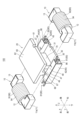
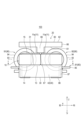
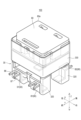
- FIG. 2 is a perspective view of a coil component according to an embodiment.
- FIG. 2 is an exploded perspective view of the coil component according to the embodiment.
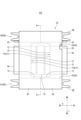
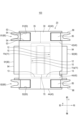
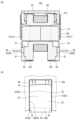
- FIG. 2 is a plan view of the coil component according to the embodiment.
- FIG. 2 is a bottom view of the coil component according to the embodiment.
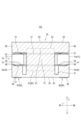
- FIG. 4 is a cross-sectional view taken along line AA shown in FIG. 3.
- FIG. 2 is a front view of the coil component according to the embodiment.
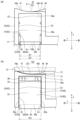
- FIG. 2 is a perspective view of a main body member in the embodiment.
- FIG. 4 is a side view of the main body member in the embodiment.
- 7 is a partially enlarged view showing a first core arrangement portion and its surrounding structure in the embodiment, and is a cross-sectional view taken along line AA shown in FIG. 6.
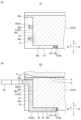
- FIG. 10A is a partially enlarged view of the first fitting recess
- FIG. 10B shows a state in which a terminal member is fitted into the fitting recess from the state shown in FIG. 10A
- 11(a) is a cross-sectional view taken along line AA in FIG. 10(a)
- FIG. 11(b) shows a state in which a terminal member has been fitted into the fitting recess from the state shown in FIG. 11(a).
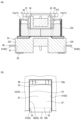
- 12(a) is a partial enlarged view of part A shown in FIG. 10(a)
- FIG. 12(b) is a partial enlarged view of part B shown in FIG. 11(a)
- FIG. 12(c) is a cross-sectional view taken along line A-A shown in FIG. 12(b).
- FIGS. 13(a) and 13(b) are diagrams for explaining a manufacturing method of a coil component according to an embodiment, in which Figure 13(a) shows a state in which the terminal member rides up onto the tip of the first protrusion, and Figure 13(b) shows a state in which the terminal member is fitted into the fitting recess from the state shown in Figure 13(a).
- FIG. 13 is a perspective view of a coil component according to a first modified example of the embodiment.
- 15(a) and 15(b) are diagrams showing a coil component according to a first modified example of the embodiment, in which FIG. 15(a) is a cross-sectional view and FIG. 15(b) is a partially enlarged view of a fitting recess.
- FIG. 15(a) is a cross-sectional view
- FIG. 15(b) is a partially enlarged view of a fitting recess.
- FIG. 11 is a perspective view of a coil component according to a second modified example of the embodiment.
- 17(a) and 17(b) are diagrams showing a coil component according to a second modified example of the embodiment, in which FIG. 17(a) is a cross-sectional view and FIG. 17(b) is a partially enlarged view of a fitting recess.
- a terminal member 80 is illustrated by a two-dot chain line.
- similar components are given the same symbols and descriptions are omitted as appropriate.
- the coil component 100 of this embodiment includes a magnetic core 10, a coil 90 wound around the magnetic core 10, a main body member 20 having a base portion 30, and a plurality of metal terminal members 80 to which the coil 90 is electrically connected.
- a fitting recess 50 is formed in the base portion 30, and the terminal member 80 is fitted into the fitting recess 50 by a fitting structure.
- the mating recess 50 includes a pair of first surface portions (in this embodiment, a pair of first side portions 53 described later) facing each other, and at least a portion of the terminal member 80 is disposed between the pair of first surface portions.
- the fitting structure is one or more protrusions 55 formed in the fitting recess 50.
- the protrusions 55 are formed on at least one of the pair of first planar portions, protrude toward the terminal member 80, and are crushed between the terminal member 80 and one of the first planar portions.
- the terminal member 80 is fitted into the fitting recess 50 in a state in which the terminal member 80 is pressed by the projection 55 toward at least the other of the pair of first planar portions.
- the first planar portion (and the second planar portion described later) is not limited to a flat planar portion, but may be, for example, a planar portion formed in a stepped or curved shape having a plurality of steps (described in detail later).
- the terminal member 80 is fitted into the fitting recess 50 by the fitting structure (one or more protrusions 55). More specifically, the terminal member 80 is sandwiched between the protrusion 55 and the first planar portion, and further, the protrusion 55 presses the terminal member 80 toward the first planar portion in a crushed state. This allows the terminal members 80 to be easily and stably fixed to the base portion 30 without using adhesive or the like, thereby achieving the coil component 100 having a structure that is easy to manufacture.
- the coil component 100 will be described in more detail below.
- the up-down direction is referred to as the Z direction.
- the bottom (lower side) is the side on which terminal members 80 (FIG. 1, etc.) described later are arranged, that is, the mounting surface side on which the coil component 100 is mounted.
- the positional relationships of the various parts (particularly the up-down positional relationships) during manufacture and use of the coil component 100 are not limited to the positional relationships described in this specification.
- the axial direction of the coil 90 extends in a direction perpendicular to the Z direction.
- the axial direction of the coil 90 is referred to as the Y direction, one side in the Y direction is referred to as the front (front), and the other side is referred to as the rear (rear).
- a direction perpendicular to both the Y direction and the Z direction is referred to as an X direction, one side of the X direction is referred to as the right (rightward), and the other side is referred to as the left (leftward).
- the side where the connection portion 70 is located is referred to as the inner side (inner side), and the side opposite the inner side is referred to as the outer side (outer side).
- a direction perpendicular to the Z direction is referred to as horizontal (horizontal direction), and a direction along the Z direction is referred to as vertical (vertical direction).
- the magnetic core 10 is formed in an annular shape and has a structure divided into a plurality of divided cores 11 in the circumferential direction. More specifically, as shown in Fig. 2, the magnetic core 10 includes a pair of left and right core members as the split core 11, i.e., a first magnetic core 11a arranged on the left side and a second magnetic core 11b arranged on the right side.
- the first magnetic core 11a and the second magnetic core 11b are arranged, for example, facing each other and combined with each other to form a rectangular ring shape in a plan view (see Figs. 3 and 4).
- the first magnetic core 11a and the second magnetic core 11b form a closed magnetic circuit.
- the first magnetic core 11a and the second magnetic core 11b are formed, for example, to have the same shape and dimensions as each other and are arranged symmetrically to each other. More specifically, in this embodiment, each of the first magnetic core 11a and the second magnetic core 11b is, for example, a so-called U-core, and has a U-shaped planar shape.
- the first magnetic core 11a has a base 12 extending in the front-rear direction, and a pair of outer legs 13 protruding rightward from both ends of the base 12.
- the base 12 is formed, for example, in a generally rectangular column shape that is long in the front-rear direction.
- each outer leg 13 is formed, for example, in a generally rectangular column shape that is long in the left-right direction.
- the second magnetic core 11b includes a base 12 and a pair of outer legs 13.
- the pair of outer legs 13 protrude leftward from both ends of the base 12.
- each of the lower surface and the upper surface of the magnetic core 10 has a rounded shape. According to this configuration, the winding 93 of the coil 90 can be wound around the magnetic core 10 in a shape closer to a cylinder (see FIG.
- the winding 93 of the coil 90 can be wound around the magnetic core 10 while suppressing the application of stress to the winding 93.
- the first convex curved surface 14 of the magnetic core 10 is formed by the lower surface of the base 12 and the lower surfaces of each of the outer legs 13.
- the second convex curved surface 15 of the magnetic core 10 is formed by the upper surface of the base 12 and the upper surfaces of each of the outer legs 13.
- the underside of the base 12 and the underside of each outer leg 13 are formed continuously with each other, and the entire assembly of the underside of the base 12 and the underside of each outer leg 13 forms a convex curved surface (first convex curved surface 14) that is smoothly convex downward.
- the upper surface of the base 12 and the upper surfaces of each outer leg 13 are formed continuously with each other, and the entire assembly of the upper surface of the base 12 and the upper surfaces of each outer leg 13 forms a convex curved surface (second convex curved surface 15) that is smoothly convex upward.
- the tip surface in the protruding direction of each of the outer legs 13 of the first magnetic core 11 a and the second magnetic core 11 b is formed flat and forms a vertical surface perpendicular to the axial direction of the coil 90 .
- the inner and outer surfaces of the base 12 are also formed flat and are vertical surfaces perpendicular to the axial direction of the coil 90.
- the inner surface of the base 12 of the first magnetic core 11a and the inner surface of the base 12 of the second magnetic core 11b face each other, and the outer surface of the base 12 of the first magnetic core 11a and the outer surface of the base 12 of the second magnetic core 11b face in opposite directions.
- the coil 90 is wound around the middle portion (middle portion in the extending direction) of the base portion 12 of each of the first magnetic core 11a and the second magnetic core 11b. Meanwhile, the front end portion of the base portion 12 protrudes forward from the coil 90, and the rear end portion of the base portion 12 protrudes rearward from the coil 90. Moreover, the coil 90 is not wound around each of the outer legs 13 of each of the first magnetic core 11a and the second magnetic core 11b.
- the entire lower surface of the magnetic core 10 is a first convex curved surface 14 that is convex downward, and the entire upper surface is a second convex curved surface 15 that is convex upward. Therefore, the portion of the magnetic core 10 that constitutes the first portion around which the coil 90 is wound is not limited to this example, and may be wound around the outer leg portion 13, for example.
- the coil 90 includes a first coil 91 wound around the first magnetic core 11a and a second coil 92 wound around the second magnetic core 11b.
- the first coil 91 and the second coil 92 are each formed of a winding 93.
- the winding 93 of each of the first coil 91 and the second coil 92 is wound around the base 12 of the corresponding split core 11 (the first magnetic core 11a and the second magnetic core 11b).
- the winding 93 wound around the base 12 forms a winding section 94 (see FIG. 2). Both ends of each winding 93 are electrically connected to the corresponding terminal member 80.
- both ends of each winding 93 are pulled out from the winding section 94 and fixed to the corresponding terminal member 80, thereby being electrically connected to the terminal member 80 (see FIG. 1). Note that in FIGS. 2 to 5, the portion of the winding 93 pulled out from the winding section 94 (pulled out wire 95) and the end of the winding 93 are not shown.
- the main body member 20 integrally includes, in addition to the base portion 30, a cover portion 60 that covers the magnetic core 10, and a connection portion 70 that interconnects the base portion 30 and the cover portion 60.
- the base portion 30 and the cover portion 60 have opposing surfaces 31, 61, respectively, that face each other.
- the connection portion 70 is interposed between the opposing surfaces 31, 61 of the base portion 30 and the cover portion 60, and connects these opposing surfaces 31, 61 to each other.
- the first magnetic core 11 a and the second magnetic core 11 b are disposed on an opposing surface 31 of the base portion 30 . With this configuration, the multiple split cores 11 (magnetic cores 10 ) can be stably held between the base portion 30 and the cover portion 60 .
- the opposing direction between the base part 30 and the cover part 60 is the up-down direction, and the base part 30 is disposed on the lower side and the cover part 60 is disposed on the upper side with respect to the magnetic core 10. Therefore, the opposing surface 31 of the base part 30 is the upper surface of the base part 30, and the opposing surface 61 of the cover part 60 is the lower surface of the cover part 60.
- the opposing direction between the base portion 30 and the cover portion 60 is not limited to the above example, and can be appropriately set depending on the structure of each component constituting the coil part 100 and the desired positional relationship between each component.
- the cover portion 60 has a main body portion 62 that is formed, for example, in a flat plate shape and is arranged horizontally.
- the main body portion 62 is formed with a positioning protrusion portion 66, which will be described later.
- an opposing surface 61 (the lower surface of the cover portion 60) that faces the opposing surface 31 of the base portion 30 is composed of the lower surface of the main body portion 62 and a lower surface 67 of the positioning protrusion portion 66.
- the opposing surface 61 is arranged horizontally.
- the planar shape of the main body 62 is, for example, substantially rectangular.
- a cutout portion 63 is formed in the rear right portion of the main body 62.
- the cutout portion 63 makes it easy to determine the orientation of the cover 60, and therefore the main body member 20.
- the cover portion 60 can be attracted by a mounter when mounting the coil component 100 on a substrate, facilitating the work of mounting the coil component 100 on a substrate.
- the cover portion 60 does not have to be formed flat, for example.
- the base portion 30 has, for example, a core arrangement portion 40 in which the magnetic core 10 is arranged. More specifically, the base portion 30 has, for example, a pair of front and rear core arrangement portions 40 as the core arrangement portion 40, i.e., a first core arrangement portion 42 arranged on the front side and a second core arrangement portion 44 arranged on the rear side. As shown in Fig. 1, etc., the first magnetic core 11a and the first magnetic core 11a are held in a state of being arranged in a rectangular annular shape in a plan view by the first core arrangement portion 42 and the second core arrangement portion 44.
- the base portion 30 further has a plate-like portion 35 that connects the first core arrangement portion 42 and the second core arrangement portion 44 to each other.
- the upper surface of the opposing surface 31 (base portion 30) facing the opposing surface 61 of the cover portion 60 is formed by the upper surfaces of the first core arrangement portion 42 and the second core arrangement portion 44 and the upper surface of the plate-shaped portion 35.
- the plate-like portion 35 is formed in a flat plate shape and is disposed horizontally.
- the planar shape of the plate-like portion 35 is, for example, substantially rectangular.
- a front edge of the plate-shaped portion 35 is connected to the first core arrangement portion 42, and a rear edge of the plate-shaped portion 35 is connected to the second core arrangement portion 44.
- the lower surface of the plate-shaped portion 35 is disposed flush with the lower surfaces of the first core arrangement portion 42 and the second core arrangement portion 44.
- the first core arrangement portion 42 and the second core arrangement portion 44 are formed, for example, to have substantially the same shape and dimensions as each other, and are arranged symmetrically with respect to the front and rear. More specifically, as shown in Figures 5, 7 and 8, each of the first core arrangement section 42 and the second core arrangement section 44 is formed, for example, in a generally rectangular column shape that is long in the left-right direction. However, in this embodiment, as shown in Figures 1 and 3, etc., protruding sections 45 that protrude outward are formed at both ends of the second core arrangement section 44. As shown in Figure 1, a lead wire 95 drawn from the coil 90 can be engaged with the protruding sections 45.
- Each of the first core arrangement portion 42 and the second core arrangement portion 44 is provided with a plurality of terminal members 80 (described in detail below).
- the front outer leg 13 of the first magnetic core 11a and the front outer leg 13 of the second magnetic core 11b are each arranged on the middle portion (the middle portion in the extension direction) of the first core arrangement portion 42.
- the rear outer leg 13 of the first magnetic core 11a and the rear outer leg 13 of the second magnetic core 11b are arranged on the intermediate portion (same as above) of the second core arrangement portion 44.
- the base portions 12 of the first magnetic core 11 a and the second magnetic core 11 b are disposed so as to straddle between the first core arrangement portion 42 and the second core arrangement portion 44 .
- the front end protruding forward from the coil 90 is positioned on the left end of the first core arrangement section 42, and the rear end protruding rearward from the coil 90 is positioned on the left end of the second core arrangement section 44.
- the front end protruding forward from the coil 90 is positioned on the right end of the first core arrangement section 42, and the rear end protruding rearward from the coil 90 is positioned on the right end of the second core arrangement section 44.
- connection portion 70 connects, for example, the center of the base portion 30 and the center of the cover portion 60 to each other. More specifically, in the present embodiment, the connection portion 70 is formed in a flat plate shape, and the plate surface is disposed facing the left-right direction. The upper end surface of the connection portion 70 is connected to the center of the lower surface of the main body portion 62 of the cover portion 60, and the lower end surface of the connection portion 70 is connected to the center of the upper surface of the plate-like portion 35 of the base portion 30. In this manner, the connection portion 70 connects the base portion 30 and the cover portion 60 to each other in a state in which the base portion 30 and the cover portion 60 face each other in the up-down direction. The upper surface of the plate-like portion 35 and the lower surface of the main body portion 62 of the cover portion 60 face each other in the up-down direction and are disposed in parallel.
- each of the first magnetic core 11a and the second magnetic core 11b is entirely formed integrally from a magnetic material.
- the main body member 20 (the base portion 30, the cover portion 60, and the connection portion 70) is, for example, entirely integrally molded from an insulating material such as resin.
- the tip surface of the front outer leg 13 of the first magnetic core 11a and the tip surface of the front outer leg 13 of the second magnetic core 11b are butted against each other and are in surface contact.
- the tip surface of the rear outer leg 13 of the first magnetic core 11a and the tip surface of the rear outer leg 13 of the second magnetic core 11b are butted against each other and are in surface contact.
- the tip surface of the front outer leg 13 of the first magnetic core 11a and the tip surface of the front outer leg 13 of the second magnetic core 11b are fixed to each other by, for example, an adhesive (not shown).
- the tip surface of the rear outer leg 13 of the first magnetic core 11a and the tip surface of the rear outer leg 13 of the second magnetic core 11b are fixed to each other by an adhesive (not shown).
- the first magnetic core 11a and the second magnetic core 11b are integrally connected to each other to form the magnetic core 10 having a ring shape in a plan view.
- the ring-shaped magnetic core 10 is held by the main body member 20 in a state where it is fitted onto the connecting portion 70.
- the entire magnetic core 10 when viewed in the opposing direction between the base portion 30 and the cover portion 60 , the entire magnetic core 10 is contained within the outline of the base portion 30 .
- the entire magnetic core 10 is contained inside the outline of the base portion 30 means that, in a planar view, the outline of the magnetic core 10 does not extend beyond the outline of the base portion 30, and the outline of the magnetic core 10 may, for example, overlap with the outline of the base portion 30.
- the entire magnetic core 10 is contained within the outline of the cover portion 60 .
- the entire magnetic core 10 is contained inside the outline of the cover portion 60 means that, in a planar view, the outline of the magnetic core 10 does not extend beyond the outline of the cover portion 60, and the outline of the magnetic core 10 may, for example, overlap with the outline of the cover portion 60.
- the base portion 30 can provide excellent support for each of the multiple split cores 11, i.e., the entire magnetic core 10.
- the cover portion 60 further has a positioning protrusion 66 for positioning the magnetic core 10.
- the positioning protrusion 66 extends from the opposing surface 61 of the cover portion 60 towards the magnetic core 10 and prevents the magnetic core 10 from approaching the cover portion 60 in the opposing direction between the base portion 30 and the cover portion 60 . This makes it possible to easily determine the height position of the magnetic core 10 relative to the body member 20 in the vertical direction. Also, rattling of the magnetic core 10 in the vertical direction can be effectively suppressed.
- a portion of the opposing surface 31 of the base portion 30 (in this embodiment, the upper surface of the core arrangement portion 40) has a recess 46 that is recessed toward the side opposite to the magnetic core 10, and the first convex curved surface 14 of the magnetic core 10 is arranged in the recess 46. This allows the magnetic core 10 to be well held by the base portion 30 while still having the first convex curved surface 14 .
- the recess 46 includes a concave curved surface 47 recessed toward the side opposite to the magnetic core 10 side, and the concave curved surface 47 is in surface contact with the first convex curved surface 14 of the magnetic core 10.
- the first convex curved surface 14 is engaged with the concave curved surface 47.
- the upper surface of the core arrangement section 40 (the first core arrangement section 42 and the second core arrangement section 44) is formed as a recess 46, and further as a concave curved surface 47. More specifically, as shown in Figures 7 and 8, in the core arrangement portion 40, the upper surfaces of the left and right ends are each concave curved surfaces corresponding to the first convex curved surface 14 of the base 12 of the magnetic core 10, and the upper surface of the intermediate portion (the portion between the left and right ends) is a concave curved surface corresponding to the first convex curved surface 14 of the outer leg portion 13.
- the outer portions 49a form part of the concave curved surface 47.
- the imaginary line 201 referred to here is a straight line that bisects the core arrangement section 40 in the extension direction (left-right direction) of the core arrangement section 40 in a plan view.
- the outer portion 49a when viewed in the extension direction (left-right direction) of the core arrangement section 40, has a concave curved surface that slopes downward from a position slightly offset inward from the outer edge of the outer portion 49a toward the middle position (position of the imaginary line 201) of the upper surface of the core arrangement section 40.
- the outer edge of the outer portion 49a is formed slightly flat.
- the inner portions 49b are formed substantially flat and are disposed horizontally with respect to the imaginary line 201.
- substantially the entire upper surface of the middle portion of the core arrangement section 40 constitutes a part of the concave curved surface 47 . More specifically, on the upper surface of the middle part of the core placement section 40, both the outer part 49a and the inner part 49b with respect to the virtual line 201 are concavely curved. More specifically, in the middle of the core placement section 40, the inner part with respect to the imaginary line 201 forms a raised portion 48 (see Figures 10(a) and 10(b)) that gradually rises inward and upward.
- the upper surface of the raised portion 48 is a concave curved surface that slopes upward inward from the middle position (position of the imaginary line 201) of the upper surface of the core placement section 40.
- the upper surface of the raised portion 48 (inner portion 49b) and the outer portion 49a of the upper surface of the core placement section 40 form a concave curved surface 47 that is recessed downward.
- the first convex curved surfaces 14 of the front outer legs 13 of each of the first magnetic core 11a and the second magnetic core 11b are in surface contact with the upper surface of the intermediate portion of the first core arrangement section 42.
- the first convex curved surfaces 14 of the rear outer legs 13 of each of the first magnetic core 11a and the second magnetic core 11b are in surface contact with the upper surface of the intermediate portion of the second core arrangement section 44.
- the magnetic core 10 can be arranged in the core arrangement portion 40 so that both the first convex curved surface 14 of the base 12 and the outer leg portion 13 and the first convex curved surface 14 are in face contact with the upper surface (concave curved surface 47) of the core arrangement portion 40.
- the cover portion 60 further has the positioning protrusions 66 that position the magnetic core 10.
- the cover portion 60 has a pair of front and rear positioning protrusions 66 as the positioning protrusions 66.
- the pair of front and rear positioning protrusions 66 are set to have, for example, the same shape and dimensions as each other, and are disposed symmetrically with respect to each other in the front-rear direction.
- the front positioning protrusion 66 extends downward, for example, from the underside of the front end portion of the main body 62 of the cover part 60.
- the rear positioning protrusion 66 extends downward, for example, from the underside of the rear end portion of the main body 62 of the cover part 60. 6, the front positioning protrusion 66 is disposed above the boundary between the front outer leg 13 of the first magnetic core 11a and the front outer leg 13 of the second magnetic core 11b. A small gap is formed between a lower surface 67 of the front positioning protrusion 66 and each of the upper surfaces of the front outer leg 13 of the first magnetic core 11a and the front outer leg 13 of the second magnetic core 11b. Similarly, the rear positioning protrusion 66 is disposed above the boundary between the rear outer leg 13 of the first magnetic core 11a and the rear outer leg 13 of the second magnetic core 11b.
- a small gap is formed between a lower surface 67 of the rear positioning protrusion 66 and each of the upper surfaces of the rear outer leg 13 of the first magnetic core 11a and the rear outer leg 13 of the second magnetic core 11b. According to this configuration, it is possible to easily position the first magnetic core 11a and the second magnetic core 11b relative to the main body member 20 in the vertical direction. In addition, rattling of both the first magnetic core 11a and the second magnetic core 11b in the vertical direction can be suppressed.
- the coil device 100 includes a plurality of (for example, four) terminal members 80 electrically connected to the coil 90 .
- the multiple terminal members 80 are formed to have the same shape and dimensions as one another. 6 and 11(b), each terminal member 80 is formed, for example, by bending a long, plate-like metal member into a substantially Z-shape. More specifically, the terminal member 80 (first terminal member 81 and second terminal member 82) has an L-shaped portion including an upright plate portion 87 that stands upright relative to the mounting surface to which the terminal member 80 is joined, and a horizontal plate portion that extends substantially horizontally from the upright plate portion 87.
- the terminal member 80 is bent in two stages in the longitudinal direction, for example, and one end and the other end of the terminal member 80 face each other in the up-down direction and are arranged horizontally, while the intermediate portion (the intermediate portion in the longitudinal direction) between the one end and the other end is arranged vertically to form the above-mentioned standing plate portion 87. Furthermore, in the terminal member 80, with respect to the standing plate portion 87, the one end protrudes inward and is arranged on the lower side, and the other end protrudes outward and is arranged on the upper side.
- the one end is an external terminal 85 that is connected to the outside when the coil component 100 is mounted and is also the above-mentioned horizontal plate portion, and the other end is an internal terminal 86 that is connected to the winding 93 of the coil 90.
- the external terminal 85 is formed in a generally rectangular shape elongated in the left-right direction in a plan view.
- the shape of the standing plate portion 87 when viewed in the left-right direction is formed in a generally rectangular shape elongated in the up-down direction.
- the plate surfaces of the standing plate portion 87 are arranged facing the left-right direction, and the plate surfaces of the horizontal plate portion are arranged facing the up-down direction. That is, the terminal member 80 includes two main surfaces (the standing plate portion 87 and the horizontal plate portion (the external terminal 85)) whose surface perpendicular directions are orthogonal to each other, and a pair of side end surfaces 80a that are orthogonal to the surface perpendicular directions of the two main surfaces.
- the pair of side end surfaces 80a are formed flat, and the plate surfaces are arranged parallel to each other in the front-rear direction.
- the internal terminal 86 is formed in a bifurcated shape that opens toward the tip side (outward).
- an end of a lead wire 95 (winding 93 of winding 93) drawn out from a winding portion 94 of the coil 90 is clamped by the bifurcated portion of the internal terminal 86 and fixed to the internal terminal 86 by resistance welding.
- the method of fixing the winding 93 to the internal terminal 86 is not limited to this example, and the winding 93 may be fixed by, for example, entangling or soldering.
- the base portion 30 is formed with the fitting recess 50.
- the fitting recess 50 includes a pair of first planar portions (a pair of front and rear first side portions 53) that face each other.
- One or more protrusions 55 are formed on at least one of the pair of first planar portions, and the terminal member 80 is fitted into the fitting recess 50 by the protrusions 55.
- the terminal member 80 can be easily and stably fixed to the base portion 30 without using adhesive or the like.
- the structural strength of the magnetic core 10 can be secured favorably compared to a case in which the terminal member 80 is directly fixed to the magnetic core 10.
- the pair of first planar portions (the pair of front and rear first side surface portions 53) are entirely formed flat.
- the plate surfaces of the pair of first planar portions face in the front-rear direction and are disposed opposite and parallel to each other.
- the one or more protrusions 55 protrude, for example, in the opposing direction of the pair of first planar portions, that is, in the front-rear direction.
- the protrusion 55 for example, abuts against one of the pair of front and rear side end faces 80a of the terminal member 80, and is crushed between the one side end face 80a and one of the first planar portions.
- the protrusion 55 presses one of the pair of side end faces 80a, not against the two main surfaces (the upright plate portion 87 and the horizontal plate portion (external terminal 85)) of the terminal member 80, against the other first planar portion, and therefore against the other side end face 80a.
- the protrusion 55 presses one side end face 80a inward (toward the terminal member 80), so that the load from the protrusion 55 is applied to the terminal member 80 in the in-plane direction of the main surface of the terminal member 80. This makes it possible to prevent the terminal member 80 from being deformed by the load from the protrusion 55.
- the terminal member 80 can be more firmly fitted into the fitting recess 50 compared to a case in which the protrusion 55 presses the main surface (the upright plate portion 87 or the horizontal plate portion) of the terminal member 80 in the direction perpendicular to the surface.
- the plate surfaces of the pair of side end faces 80a are disposed parallel to each other in the front-rear direction, and the protrusions 55 protrude in the front-rear direction, i.e., in the direction perpendicular to the surfaces of the side end faces 80a.
- the terminal member 80 can be pressed effectively by the protrusion 55 in the opposing direction (front-to-back direction) of the pair of side end faces 80a, thereby suppressing the generation of lateral force in a direction intersecting the opposing direction (e.g., up-down direction), and the terminal member 80 can be stably fixed to the mating recess 50.
- the protrusion 55 gradually tapers toward the protruding direction of the protrusion 55 before the terminal member 80 is fitted into the fitting recess 50. More specifically, the protrusion 55 is formed in a substantially triangular shape that gradually tapers toward the protruding direction in a cross section perpendicular to the extending direction of the protrusion 55 (see FIG.
- the tip of the protrusion 55 (the tip in the protruding direction) can be easily crushed, and the amount of crushing of the protrusion 55 can be made to plateau as the fitting force of the terminal member 80 into the fitting recess 50 increases.
- a desired amount of crushing of the protrusion 55 can be obtained according to the tightness of the fit of the terminal member 80 into the fitting recess 50.
- the pair of first planar portions (and the pair of second planar portions described later) are not limited to planar portions formed flat as described above, but may be planar portions formed, for example, in a stepped or curved shape having multiple steps.
- first planar portion may be formed in a stepped shape including a plurality of faces arranged facing in different directions.
- the pair of planar portions (second planar portions) includes, for example, at least one mutually opposing surface, and the protrusion 55 is formed on the opposing surface.
- first surface portion may be, for example, a curved surface that is convexly curved toward the terminal member 80 side, or a curved surface that is concavely curved on the opposite side to the terminal member 80 side, or may include both a curved surface that is convexly curved toward the terminal member 80 side and a curved surface that is concavely curved on the opposite side to the terminal member 80 side.
- the base portion 30 has, as the mating recesses 50, a pair of left and right first mating recesses 51 formed in the first core arrangement portion 42 and a pair of left and right second mating recesses 52 formed in the second core arrangement portion 44.
- the pair of left and right first fitting recesses 51 are formed to have the same shape and dimensions and are arranged symmetrically.
- the pair of left and right second fitting recesses 52 are formed to have the same shape and dimensions and are arranged symmetrically.
- the first fitting recesses 51 and the second fitting recesses 52 are formed to have the same shape and dimensions.
- first terminal members 81 two terminal members 80 are fitted into the first mating recesses 51, and the remaining two terminal members 80 (hereinafter, second terminal members 82) are fitted into the second mating recesses 52.
- the first terminal members 81 are arranged symmetrically to one another in the first core arrangement portion 42.
- the second terminal members 82 are arranged symmetrically to one another in the second core arrangement portion 44.
- the mating recess 50 (each of the first mating recesses 51 and each of the second mating recesses 52) is formed in a two-stage recessed shape in the depth direction of the mating recess 50.
- the mating recess 50 includes a pair of front and rear first side portions 53 that form part of the recess on the tip side of the mating recess 50 (the side opposite to the depth direction of the mating recess 50), and a pair of front and rear second side portions 54 that form part of the recess on the base end side of the mating recess 50 (the side in the depth direction of the mating recess 50).
- the pair of front and rear first side surface portions 53 constitute a pair of first planar portions on which the protrusions 55 (more specifically, first protrusions 56 described later) are formed
- the pair of front and rear second side surface portions 54 constitute a pair of second planar portions on which the second protrusions 57 described later are formed.
- the standing plate portion 87 of the terminal member 80 is disposed between the pair of first side surface portions 53, pressed against the first protrusions 56, and sandwiched by the pair of first side surface portions 53.
- the external terminal 85 of the terminal member 80 is disposed between the pair of second side surface portions 54, and sandwiched by the pair of second side surface portions 54.
- the pair of front and rear first side surface portions 53 face each other parallel to each other in the front-rear direction.
- the pair of front and rear second side surface portions 54 face each other parallel to each other in the front-rear direction. Therefore, in the present embodiment, the pair of first planar portions and the pair of second planar portions face each other in the front-rear direction, and the terminal member 80 is pressed by the protrusion 55 in the front-rear direction and is sandwiched between the pair of first planar portions and the pair of second planar portions.
- each of the pair of front and rear first side portions 53 (a pair of first planar portions) is formed flat as a whole, and the plate surface is arranged facing the front-rear direction.
- each of the pair of front and rear first side portions 53 is formed in a substantially rectangular shape that is elongated in the up-down direction.
- Each of the pair of front and rear second side portions 54 (a pair of second planar portions) is formed, for example, flat with its plate surface facing the front-rear direction.
- each of the pair of front and rear second side portions 54 is formed in a generally rectangular shape that is elongated in the left-right direction.
- the front first side surface portion 53 and the front second side surface portion 54 are disposed flush with each other.
- the rear first side surface portion 53 and the rear second side surface portion 54 are disposed flush with each other.
- the left first fitting recess 51 is recessed inward (rightward) in two stages from the left end face of the first core arrangement portion 42.
- the left first fitting recess 51 is open both leftward and downward.
- the first mating recess 51 on the left side has, in addition to a pair of first side portions 53 and a pair of second side portions 54, for example, a first top surface portion 59a and a second top surface portion 59b each arranged horizontally, and a first bottom surface portion 58a and a second bottom surface portion 58b each arranged vertically.
- the second top surface portion 59b is disposed inward (to the right) and below the first top surface portion 59a.
- the first bottom surface portion 58a is disposed between the first top surface portion 59a and the second top surface portion 59b in the up-down direction.
- the second bottom surface portion 58b extends downward from the inner end (right end) of the second top surface portion 59b.
- the first top surface portion 59a, the first bottom surface portion 58a, the second top surface portion 59b and the second bottom surface portion 58b are arranged in this order from the left side, forming a step portion having multiple steps.
- Each of the first top surface portion 59a and the second top surface portion 59b is formed flat, and the plate surface is disposed facing in the up-down direction.
- Each of the first bottom surface portion 58a and the second bottom surface portion 58b is formed flat, and the plate surface is disposed facing the left-right direction (the depth direction of the fitting recess 50).
- the pair of front and rear first side surface portions 53 face each other with the first top surface portion 59a and the first bottom surface portion 58a sandwiched therebetween.
- the pair of front and rear second side surface portions 54 face each other with the second top surface portion 59b and the second bottom surface portion 58b sandwiched therebetween.
- the assembly of the front first side portion 53 and the front second side portion 54 is, for example, approximately L-shaped corresponding to the terminal member 80.
- the lower end of the front first side surface portion 53 is connected to the left end of the front second side surface portion 54 .
- the assembly of the rear first side surface portion 53 and the rear second side surface portion 54 is, for example, substantially L-shaped corresponding to the terminal member 80 . More specifically, the lower end of the first rear side surface portion 53 is connected to the left end of the second rear side surface portion 54 .
- the first fitting recess 51 on the right side is formed symmetrically with the first fitting recess 51 on the left side. Therefore, the first fitting recess 51 on the right side is recessed inward (to the left) in two stages from the right end face of the first core arrangement portion 42. And, in addition to each of the pair of first side portions 53 and the pair of second side portions 54, the first fitting recess 51 on the right side also has, for example, a first top surface portion 59a and a second top surface portion 59b that are each arranged horizontally, and a first bottom surface portion 58a and a second bottom surface portion 58b that are each arranged vertically.
- the second fitting recess 52 on the left side is also recessed inward (to the right) in two stages from the left end face of the second core arrangement portion 44.
- the second fitting recess 52 on the left side has, in addition to each of a pair of first side surface portions 53 and a pair of second side surface portions 54, for example, a first top surface portion 59a and a second top surface portion 59b that are each horizontally disposed, and a first bottom surface portion 58a and a second bottom surface portion 58b that are each vertically disposed.
- the right second fitting recess 52 is formed symmetrically with the left second fitting recess 52.
- the right second fitting recess 52 is recessed inward (leftward) in two stages from the right end face of the second core arrangement portion 44.
- the right second fitting recess 52 also has, in addition to the pair of first side surface portions 53 and the pair of second side surface portions 54, a first top surface portion 59a and a second top surface portion 59b that are each horizontally disposed, and a first bottom surface portion 58a and a second bottom surface portion 58b that are each vertically disposed.
- the fitting recess 50 is formed with a plurality of protrusions 55 (six protrusions 55 in this embodiment).
- the terminal member 80 is fitted into the fitting recess 50, the terminal member 80 is pressed into the fitting recess 50 while crushing the multiple protrusions 55.
- Figures 7, 8, 10(a) and 11(a) show the main body member 20 in a state before the terminal member 80 is pressed into the fitting recess 50.
- the protrusions 55 include, for example, four first protrusions 56 formed on a pair of front and rear first side portions 53 and two second protrusions 57 formed on a pair of front and rear second side portions 54.
- the number of the first protrusions 56 and the number of the second protrusions 57 formed in the fitting recess 50 are not limited to this example.
- first protrusions 56 are formed on each of the pair of front and rear first side surface portions 53.
- the first protrusions 56 formed on the front first side surface portion 53 protrude toward the standing plate portion 87 (rear) of the terminal member 80 and are crushed between the standing plate portion 87 and the one first side surface portion 53.
- the first protrusions 56 formed on the rear first side surface portion 53 protrude toward the standing plate portion 87 (forward) of the terminal member 80 and are crushed between the standing plate portion 87 and the other first side surface portion 53.
- the standing plate portion 87 is pressed toward the rear first side surface portion 53 by the first protrusions 56 formed on the front first side surface portion 53 and is pressed toward the front first side surface portion 53 by the first protrusions 56 formed on the rear first side surface portion 53, and is fitted into the fitting recess 50 in this state.
- two second protrusions 57 are formed on each of the pair of front and rear second side surface portions 54.
- the second protrusions 57 formed on the front second side surface portion 54 protrude toward the external terminal 85 (rear) of the terminal member 80, and are crushed between the external terminal 85 and the front second side surface portion 54.
- the second protrusions 57 formed on the rear second side surface portion 54 protrude toward the external terminal 85 (forward) of the terminal member 80, and are crushed between the external terminal 85 and the rear second side surface portion 54.
- the external terminal 85 is pressed toward the rear second side surface portion 54 by the second protrusions 57 formed on the front second side surface portion 54, and is pressed toward the front second side surface portion 54 by the second protrusions 57 formed on the rear second side surface portion 54, and is fitted into the fitting recess 50 in this state.
- the external terminals 85 and the upright plate portions 87 of each terminal member 80 are contained within the fitting recess 50 and the outer contour of the base portion 30 in a plan view.
- each terminal member 80 protrude outward from the fitting recess 50 and the outer contour of the base portion 30 in a plan view. 6, 10(b), etc., in a side view or a front view, the lower surface of the external terminal 85 (second portion) of each terminal member 80 is located lower than the lower surface of the core arrangement portion 40.
- the lower surfaces of the external terminals 85 (second portions) of each terminal member 80 are flush with each other and constitute the lowermost surface of the coil device 100. In this manner, each terminal member 80 fits into the corresponding fitting recess 50 .
- the four first protrusions 56 formed on the pair of front and rear first side surface portions 53 are set to have the same shape and dimensions as one another.
- 10(a) and 11(a) two first protrusions 56, one above and one below, are formed on each of the pair of front and rear first side surface portions 53.
- the pair of front and rear first protrusions 56 are formed on the upper and lower sides, respectively.
- Each of the first protrusions 56 extends linearly from the first bottom surface portion 58a in the left-right direction, and a tip end 56a of each of the first protrusions 56 (an end portion opposite to the depth direction of the fitting recess 50) terminates in a middle portion of the first side surface portion 53 (a middle portion in the left-right direction).
- the height positions of the pair of front and rear first protrusions 56 arranged on the upper side are equal to each other.
- the height positions of the pair of front and rear first protrusions 56 arranged on the lower side are equal to each other.
- each of the two first protrusions 56 formed on the front first side portion 53 abuts against the front end face of the standing plate portion 87 and is crushed between the front end face and the front first side portion 53.
- each of the two first protrusions 56 formed on the rear first side portion 53 abuts against the rear end face of the standing plate portion 87 and is crushed between the side end face and the rear first side portion 53.
- the two second protrusions 57 formed on the pair of front and rear second side surface portions 54 are set to have, for example, the same shape and the same dimensions as each other.
- one second protrusion 57 is formed on each of the pair of front and rear first side surface portions 53.
- a pair of front and rear second protrusions 57 are formed on the pair of front and rear first side surface portions 53.
- Each second protrusion 57 extends linearly from the second bottom surface portion 58b in the left-right direction.
- a tip end 57a of each second protrusion 57 terminates at a rear end of the second side surface portion 54 (an end in the depth direction of the fitting recess 50). More specifically, in the depth direction of the fitting recess 50, the first protrusion 56 is located on the opposite side of the second protrusion 57 in the depth direction. In addition, in the up-down direction, the height position of the second protrusion 57 formed on the front second side surface portion 54 is equal to the height position of the second protrusion 57 formed on the rear second side surface portion 54 . As shown in FIG.
- the horizontal plate portion (external terminal 85 ) of the terminal member 80 is sandwiched between a pair of front and rear second protrusions 57 . More specifically, the second protrusion 57 formed on the front second side portion 54 abuts against the front end face of the external terminal 85 and is crushed between the front end face and the front second side portion 54. Similarly, the second protrusion 57 formed on the rear second side portion 54 abuts against the rear end face of the external terminal 85 and is crushed between the rear end face and the rear second side portion 54.
- the protrusions 55 are formed on each of a pair of first surface portions of the fitting recess 50 (in this embodiment, the pair of front and rear first side surface portions 53 described above).
- the protrusion 55 formed on one of the pair of first planar portions protrudes toward the terminal member 80 and is crushed between the terminal member 80 and the other first planar portion.
- the terminal member 80 is pressed toward the one first planar portion by the protrusion 55 formed on the other planar portion.
- the protrusion 55 formed on the other of the pair of first planar portions protrudes toward the terminal member 80 and is crushed between the terminal member 80 and the other first planar portion.
- the terminal member 80 is pressed towards one of the first planar portions by the protrusion 55 formed on the other planar portion. In this way, the terminal member 80 is sandwiched between a pair of first surface portions, by a protrusion 55 formed on one of the first surface portions and a protrusion 55 formed on the other first surface portion. With this configuration, it is possible to suppress misalignment of the terminal member 80 with respect to each of the pair of first planar portions.
- the fitting recess 50 further includes, for example, a pair of second surface portions facing each other (in this embodiment, the pair of front and rear second side portions 54 described above).
- the terminal member 80 includes a first portion (in this embodiment, the above-mentioned upright plate portion 87) that is arranged between a pair of first planar portions, and a second portion (in this embodiment, the above-mentioned external terminal 85) that is arranged between a pair of second planar portions and is formed from a single member together with the first portion.
- the protrusion 55 includes, for example, a first protrusion 56 formed on at least one of a pair of first planar portions, and a second protrusion 57 formed on at least one of a pair of second planar portions.
- the first projection 56 protrudes toward a first portion (upright plate portion 87) of the terminal member 80, and is crushed between the first portion and one of the first planar portions (first side surface portion 53).
- the first part (upright plate portion 87) of the terminal member 80 is fitted into the fitting recess 50 while being pressed by the first protrusion 56 against at least the other first surface portion of the pair of first surface portions (first side portions 53).
- the second projection 57 protrudes toward the second portion (external terminal 85) of the terminal member 80, and is crushed between the second portion and one of the second planar portions (second side surface portion 54).
- the second portion (external terminal 85) of the terminal member 80 is fitted into the fitting recess 50 while being pressed against at least the other of the pair of second planar portions (second side portions 54) by the second protrusion 57.
- different portions of the terminal member 80 are sandwiched between the first planar portion and the second planar portion, respectively. Therefore, different portions of the terminal member 80 can be stably fixed to the fitting recess 50, respectively.
- each of the pair of first planar portions and each of the pair of second planar portions extend, for example, in directions intersecting each other. This allows the terminal member 80 to be fixed to the base portion 30 more stably in two directions that intersect with each other. More specifically, as described above, each of the pair of first planar portions and each of the pair of second planar portions extend, for example, in directions perpendicular to each other (up-down direction and left-right direction). Therefore, it is possible to more reliably prevent the terminal member 80 from being misaligned with respect to the fitting recess 50 in two directions perpendicular to each other.
- the opposing direction of the pair of first planar portions and the opposing direction of the pair of second planar portions are the same direction (in this embodiment, the front-rear direction as described above).
- different portions of the terminal member 80 are sandwiched between the first and second planar portions in the same direction, so that the terminal member 80 can be fixed to the base portion 30 more stably.
- the terminal member 80 has an L-shaped portion including an upright plate portion 87 that stands up relative to the mounting surface to which the terminal member 80 is joined, and a horizontal plate portion (in this embodiment, the external terminal 85 as described above) that extends approximately horizontally from the upright plate portion 87.
- the first portion of the terminal member 80 is the standing plate portion 87
- the second portion of the terminal member 80 is the horizontal plate portion (external terminal 85). That is, the standing plate portion 87 of the terminal member 80 is disposed between a pair of first planar portions, and the horizontal plate portion (external terminal 85) is disposed between a pair of second planar portions.
- the mutually orthogonal portions (the upright plate portion 87 and the horizontal plate portion) of the terminal member 80 are sandwiched by the first planar portion and the second planar portion, respectively, so that the terminal member 80 can be more stably fixed to the base portion 30 in two mutually orthogonal directions (the vertical direction and the horizontal direction).
- the "mounting surface to which the terminal members 80 are joined" refers to a pattern forming surface on a circuit board on which the surface-mount coil component 100 according to this embodiment is mounted, and is the surface on which external terminals 85 (second portions) of each terminal member 80, which will be described later, are placed.
- the coil component 100 has a plane (terminal lower surface) to which the lower surfaces of the external terminals 85 of each terminal member 80 (the lowermost surface of the coil component 100) belong in common. When the coil component 100 is surface-mounted on the circuit board, this terminal lower surface is joined to the mounting surface.
- the first and second parts of the terminal member 80 are parts that are formed continuously with each other, but the present invention is not limited to this example, and for example, in the terminal member 80, other parts that do not fit into the fitting recess 50 may be arranged between the first and second parts.
- At least one of the one or more protrusions 55 is, for example, a ridge extending in the depth direction of the fitting recess 50 . This allows the terminal member 80 to be fixed more stably to the fitting recess 50 in the depth direction of the fitting recess 50 .
- each of the first protrusion 56 and the second protrusion 57 is, for example, a protrusion extending in the depth direction of the fitting recess 50 .
- the width dimension of the first projection 56 (W1 shown in FIG. 12A) is, for example, larger than the width dimension of the second projection 57 (W2 shown in FIG. 12A). This allows the upright plate portion 87 of the terminal member 80 to be more firmly fixed to the mating recess 50 by the first protrusion 56, and the second protrusion 57 prevents the horizontal plate portion (external terminal 85) of the terminal member 80 from shifting out of position relative to the terminal member 80.
- the width dimension of the first protrusion 56 and the second protrusion 57 referred to here is the dimension in a direction perpendicular to both the extending direction and the projecting direction of each of the first protrusion 56 and the second protrusion 57 .
- the coil component 100 is configured as described above.
- such a coil component 100 can be used as a common mode choke coil.
- the use of the coil component 100 is not limited to this example.
- the method for manufacturing the coil component 100 according to this embodiment (hereinafter, may be referred to as this method) will be described in more detail below.
- This method includes the steps of preparing the main body member 20, press-fitting the terminal member 80 into the fitting recess 50, winding the coil 90 around the magnetic core 10, arranging the magnetic core 10 on the main body member 20, and fixing the winding 93 of the coil 90 to the internal terminal 86 of the terminal member 80, in this order.
- the steps of preparing the main body member 20 and press-fitting the terminal member 80 into the fitting recess 50 may be performed after the step of winding the coil 90 around the magnetic core 10.
- the main body member 20 (the base portion 30, the cover portion 60, and the connection portion 70) is integrally molded from an insulating material such as resin.
- the terminal member 80 is press-fitted into the fitting recess 50 while crushing the multiple protrusions 55 with the terminal member 80 .
- the terminal member 80 while the one or more protrusions 55 are crushed by the terminal member 80, at least a portion of the terminal member 80 is press-fitted between the pair of first planar portions. This allows the terminal member 80 to be satisfactorily fixed to the fitting recess 50 without using adhesive or the like. Furthermore, even if there is variation in the dimensions of the terminal member 80 relative to the fitting recess 50, the protrusions 55 can be crushed by an amount corresponding to the dimensions of the terminal member 80, so that the variation in the dimensions of the terminal member 80 can be absorbed.
- the first protrusion 56 is located on the opposite side of the depth direction from the second protrusion 57. Then, as shown in Figures 13(a) and 13(b), while the first protrusion 56 is crushed by a first portion of the terminal member 80, the first portion is press-fitted between the pair of first planar portions, and thereafter, while the second protrusion 57 is crushed by a second portion of the terminal member 80, the second portion is press-fitted between the pair of second planar portions.
- the first protrusion 56 can effectively fix the first portion of the terminal member 80 to the pair of first surface portions, while the second protrusion 57 can prevent the second portion of the terminal member 80, and ultimately the entire terminal member 80, from shifting out of position relative to the mating recess 50.
- "after the first portion is press-fitted between the pair of first planar portions” means after the first portion starts to be press-fitted into the pair of first planar portions, and does not necessarily mean after the first portion has been completely press-fitted. Therefore, it is sufficient that at least a part of the first portion of the terminal member 80 is press-fitted before the second portion, and for example, the second portion may start to be press-fitted before the first portion is completely press-fitted.
- the first protrusion 56 is located on the opposite side of the depth direction from the second protrusion 57
- the tip 56a the end opposite the depth direction
- the tip 56a the end opposite the depth direction
- the tip 56a the end opposite the depth direction
- a part of the formation region of the first protrusion 56 and a part of the formation region of the second protrusion 57 may overlap each other.
- the protrusion amount of the first protrusion 56 (dimension H1 shown in FIG. 12(a)) is greater than the protrusion amount of the second protrusion 57 (dimension H2 shown in FIG. 12(a)).
- the "protrusion amount of the first protrusion 56" referred to here means the height dimension of the first protrusion 56 in the opposing direction of the pair of first planar portions.
- the "protrusion amount of the second protrusion 57” referred to here means the height dimension of the second protrusion 57 in the opposing direction of the pair of second planar portions.
- the separation distance D1 between the pair of front-to-rear first protrusions 56 and the separation distance D2 between the pair of front-to-rear second protrusions 57 are each set to a dimension smaller than the width dimension W3 of the terminal member 80 (the width dimension of the upright plate portion 87 and the width dimension of the horizontal plate portion). Therefore, the first protrusion 56 is crushed by the standing plate portion 87, while the standing plate portion 87 is press-fitted between the pair of first planar portions.
- a separation distance D1 between the pair of front-rear first protrusions 56 is set to a dimension smaller than a separation distance D2 between the pair of front-rear second protrusions 57 . This makes it possible to make the amount of crushing of the first protrusions 56 when the standing plate portions 87 are press-fitted between the pair of first planar portions greater than the amount of crushing of the second protrusions 57 when the horizontal plate portions are press-fitted between the pair of second planar portions.
- the force with which the first protrusions 56 press the terminal member 80 toward the first planar portion can be greater than the force with which the second protrusions 57 press the terminal member 80 toward the second planar portion.
- the first protrusions 56 can better fix the first portion of the terminal member 80 to the pair of first planar portions.
- the projection 55 is gradually tapered in the protruding direction of the projection 55, as shown in FIG. 12(a).
- the tip of the protrusion 55 (the tip in the protruding direction) can be easily crushed, and the amount of crushing of the protrusion 55 can be made to plateau as the fitting force of the terminal member 80 into the fitting recess 50 increases.
- a desired amount of crushing of the protrusion 55 can be obtained according to the tightness of the fit of the terminal member 80 into the fitting recess 50.
- each of the first protrusion 56 and the second protrusion 57 is formed into a generally triangular shape that gradually tapers toward the protruding direction.
- the cross-sectional shape of the protrusion 55 is not limited to this example, and may be, for example, a semicircular shape or a trapezoidal shape.
- the tip end of the protrusion 55 in the extension direction is formed into a chamfered shape in which the amount of protrusion decreases in the direction opposite to the depth direction.
- the terminal member 80 rides up against the protrusion (projection 55) along the tip of the protrusion, and is then guided in the depth direction of the mating recess 50 along the protrusion.
- the terminal member 80 when the terminal member 80 is press-fitted into the fitting recess 50 , the terminal member 80 can be smoothly press-fitted in the depth direction of the fitting recess 50 along the ridges (protrusions 55 ).
- the tip portion 56a of each first protrusion 56 is formed into a chamfered shape in which the amount of protrusion gradually decreases in the direction opposite to the depth direction.
- the protrusion amount H1 (maximum protrusion amount) of the first protrusion 56 is large as described above, the standing plate portion 87 can be smoothly pressed into the fitting recess 50 in the depth direction along the first protrusion 56.
- the protrusion amount H1 of each first protrusion 56 excluding the tip portion 56a is substantially constant regardless of the position in the extension direction of the first protrusion 56.
- the protrusion amount H2 of each second protrusion 57 is substantially constant regardless of the position in the extension direction of the second protrusion 57.
- each terminal member 80 is inserted into the corresponding fitting recess 50 from the side (in the case of this embodiment, the left-right direction).
- the terminal member 80 is inserted in the depth direction of the fitting recess 50 while aligning the upper surface of the horizontal plate portion of the terminal member 80 (the upper surface of the external terminal 85) with the second top surface portion 59b (while maintaining the surface contact state). This makes it easy to align the terminal member 80 with the fitting recess 50 in the vertical direction.
- the standing plate portion 87 of the terminal member 80 is pressed into between the pair of front and rear first side surface portions 53 while crushing each first protrusion 56.
- the external terminal 85 of the terminal member 80 is pressed into between the pair of front and rear second side surface portions 54 while crushing each second protrusion 57. Then, as shown in Figure 13 (b), by pushing the standing plate portion 87 along each first protrusion 56 until it abuts (makes surface contact with) the first bottom surface portion 58a, the pressing-in of the standing plate portion 87 into the pair of front and rear first side portions 53 is completed, and the pressing-in of the external terminal 85 into the pair of front and rear second side portions 54 is completed.
- the terminal member 80 fits into the fitting recess 50 in a state in which the upright plate portion 87 of the terminal member 80 is in surface contact with the first bottom surface portion 58a of the fitting recess 50 and the horizontal plate portion (external terminal 85) of the terminal member 80 is in surface contact with the second top surface portion 59b of the fitting recess 50.
- the terminal member 80 it is possible to more reliably suppress misalignment of the terminal member 80 with respect to the fitting recess 50 in both the up-down direction and the front-rear direction.
- each winding 93 of the coil 90 (first coil 91 and second coil 92) is wound around the base portion 12 of each of the first magnetic core 11a and the second magnetic core 11b.
- the first magnetic core 11a and the second magnetic core 11b are arranged on the core arrangement section 40. More specifically, the front outer leg 13 of the first magnetic core 11a is inserted from the left onto the upper surface of the left end of the first core arrangement section 42, and the rear outer leg 13 of the first magnetic core 11a is inserted from the left onto the upper surface of the left end of the second core arrangement section 44.
- the front outer leg 13 of the second magnetic core 11b is inserted from the right onto the upper surface of the right end of the first core arrangement section 42, and the rear outer leg 13 of the second magnetic core 11b is inserted from the right onto the upper surface of the right end of the second core arrangement section 44.
- the magnetic core 10 is arranged between the opposing surface 61 of the cover section 60 and the opposing surface 31 of the base section 30.
- the first convex curved surface 14 of the magnetic core 10 engages with the recess 46 (concave curved surface 47) of the core arrangement portion 40.
- the first magnetic core 11a and the second magnetic core 11b are fixed to each other by an adhesive (not shown). This forms the magnetic core 10 that is annular in plan view.
- each winding 93 of the coil 90 is fixed to a corresponding internal terminal 86 of the terminal member 80.
- the end of the winding 93 is fixed to the internal terminal 86 by resistance welding. In this manner, the coil component 100 is obtained.
- this method is a method for manufacturing a coil component 100 by fitting a plurality of terminal members 80 into a base portion 30, and includes the steps of preparing a main body member 20 having a base portion 30, a fitting recess 50 formed in the base portion 30, and one or more protrusions 55 formed in the fitting recess 50, and pressing the terminal member 80 into the fitting recess 50 while crushing the one or more protrusions 55 with the terminal member 80.
- the terminal member 80 can be easily and stably fixed to the base portion 30 without using adhesive or the like.
- the protrusion 55 can be crushed by an amount according to the size of the terminal member 80, so that the variation in the size of the terminal member 80 can be absorbed. In other words, the manufacture of the coil component 100 becomes easier.
- the base portion 30 and the cover portion 60 are each formed of separate members. Even in such a case, similarly to the above embodiment, the base portion 30 has a fitting recess 50 formed therein, and the terminal member 80 fits into the fitting recess 50 by a fitting structure (plurality of protrusions 55). Therefore, the terminal members 80 can be easily and stably fixed to the base portion 30 without using adhesive or the like.
- the base portion 30 has a bobbin portion 310 around which the windings 93 that constitute the coil 90 are wound, and a terminal holding portion 320 that holds a plurality of terminal members 80.
- the coil device 100 includes a cover portion 60 (cover member) that is a separate member from the base portion 30 and covers the periphery of the bobbin portion 310 .
- the coil component 100 further includes a fixing tape 330, and the fixing tape 330 fixes two or more members constituting the coil component 100 to each other.
- the base portion 30 has a pair of left and right terminal holding portions 320, and a first fitting recess 51 is formed in the left terminal holding portion 320, and a first terminal member 81 fits into the first fitting recess 51.
- a second fitting recess 52 is formed in the right terminal holding portion 320, and a second terminal member 82 fits into the second fitting recess 52.
- each of the pair of left and right terminal holders 320 is formed in a generally rectangular parallelepiped shape that is long in the front-rear direction.
- the left terminal holder 320 has a plurality of first fitting recesses 51 formed therein, and the plurality of first fitting recesses 51 are arranged in a row in the front-rear direction.
- each first fitting recess 51 is configured similarly to the first fitting recess 51 in the above embodiment.
- the shape of each first fitting recess 51 is configured similarly to the second fitting recess 52 in the above embodiment.
- each terminal member 80 is also formed similarly to the terminal member 80 in the above embodiment. Therefore, in the present modified example, the first protrusion 56 protrudes toward the first part (upright plate portion 87) of the terminal member 80 and is crushed between the first part and one of the first planar portions (first side portion 53).
- the first part (upright plate portion 87) of the terminal member 80 is fitted into the fitting recess 50 while being pressed by the first protrusion 56 against at least the other first surface portion of the pair of first surface portions (first side portions 53).
- the second projection 57 protrudes toward the second portion (external terminal 85) of the terminal member 80, and is crushed between the second portion and one of the second planar portions (second side surface portion 54).
- the second portion of the terminal member 80 (the external terminal 85) is fitted into the fitting recess 50 in a state in which the second portion is pressed by the second protrusion 57 toward at least the other second planar portion of the pair of second planar portions (second side surface portions 54).
- each of the first magnetic core 11a and the second magnetic core 11b is an E core.
- a portion of the first magnetic core 11a is inserted into the bobbin part 310 via the cover part 60 (see FIG. 15A).
- a portion of the second magnetic core 11b is inserted into the bobbin part 310 via the cover part 60.
- the base portion 30 has a pair of front and rear terminal holding portions 320, and a first fitting recess 51 is formed in the front terminal holding portion 320, and a first terminal member 81 is fitted into the first fitting recess 51.
- a second fitting recess 52 is formed in the rear terminal holding portion 320, and a second terminal member 82 is fitted into the second fitting recess 52.
- each of the pair of front and rear terminal holders 320 is formed in a generally rectangular parallelepiped shape that is elongated in the left-right direction.
- the front terminal holder 320 is formed with a pair of first fitting recesses 51, which are arranged side by side in the left-right direction.
- each first fitting recess 51 is configured similarly to that of the first fitting recess 51 in the above embodiment.
- the first fitting recess 51 is open toward the front and toward the bottom. Therefore, the pair of first planar portions face each other in the left-right direction, and when the terminal member 80 is press-fitted into the first fitting recess 51, it is inserted from the front.
- the shape of each of the first fitting recesses 51 is configured similarly to the second fitting recesses 52 of the above embodiment.
- the second fitting recesses 52 are open toward the rear and toward the bottom. Therefore, the pair of second planar portions face each other in the left-right direction, and when the terminal member 80 is press-fitted into the second fitting recesses 52, it is inserted from the rear.
- Each terminal member 80 is formed in the same manner as the terminal member 80 in the above embodiment. Therefore, in the present modified example, the first protrusion 56 protrudes toward the first part (upright plate portion 87) of the terminal member 80 and is crushed between the first part and one of the first planar portions (first side portion 53).
- the first part (upright plate portion 87) of the terminal member 80 is fitted into the fitting recess 50 while being pressed by the first protrusion 56 against at least the other first surface portion of the pair of first surface portions (first side portions 53).
- the second projection 57 protrudes toward the second portion (external terminal 85) of the terminal member 80, and is crushed between the second portion and one of the second planar portions (second side surface portion 54).
- the second portion of the terminal member 80 (the external terminal 85) is fitted into the fitting recess 50 in a state in which the second portion is pressed by the second protrusion 57 toward at least the other second planar portion of the pair of second planar portions (second side surface portions 54).
- the magnetic core 10 is configured with two U cores or two E cores as the split core 11, but the present invention is not limited to this example, and the magnetic core 10 may be configured with a U core and an I core as the split core 11, or an E core and an I core.
- the magnetic core 10 may also be divided into, for example, three or more split cores 11.
- each of the first protrusions 56 is set to the same shape and the same dimensions as each other, but the present invention is not limited to this example, and each of the first protrusions 56 may be formed in a different shape from each other, or may be set to different dimensions from each other.
- each second protrusion 57 is set to the same shape and the same dimensions as each other, but the present invention is not limited to this example, and each second protrusion 57 may be formed in a different shape from each other, or may be set to different dimensions from each other.
- the multiple protrusions 55 may include, for example, protrusions 55 formed in ridges and protrusions 55 formed in dots (hemispherical shapes).
- the opposing direction of each of the pair of first planar portions and the pair of second planar portions is the front-to-back direction or the left-to-right direction, but the present invention is not limited to this example, and the opposing direction of each of the pair of first planar portions and the pair of second planar portions may also be the up-down direction.
- the opposing directions of the pair of first planar portions and the pair of second planar portions are the same as each other, but the present invention is not limited to this example, and the opposing directions of the pair of first planar portions and the pair of second planar portions may be different from each other.
- the present invention is not limited to this example, and for example, the first protrusion 56 formed on one of the pair of first surface portions may be crushed, while the first protrusion 56 formed on the other first surface portion may be in a state in which it is substantially not crushed.
- the present invention is not limited to this example, and for example, the second protrusion 57 formed on one of the pair of second surface portions may be crushed, while the second protrusion 57 formed on the other second surface portion may be in a state in which it is substantially not crushed.
- the present embodiment encompasses the following technical ideas.
- the fitting recess includes a pair of first surface portions opposed to each other, At least a portion of the terminal member is disposed between the pair of first planar portions, the fitting structure is one or more protrusions formed in the fitting recess, the protrusion is formed on at least one of the pair of first planar portions, protrudes toward the terminal member, and is crushed between the terminal member and the one of the first planar portions,
- the terminal member is a coil component that is fitted into the fitting recess in a state in which the terminal member is pressed toward at least the other of the pair of first surface portions by the protrusion.
- the protrusion is formed on each of the pair of first planar portions, the protrusion formed on the other first planar portion of the pair of first planar portions protrudes toward the terminal member and is crushed between the terminal member and the other first planar portion, the terminal member is pressed toward the one first planar portion by the protrusion formed on the other first planar portion,
- the coil component described in (1) wherein the terminal member is sandwiched between the pair of first surface portions by the protrusion formed on one of the first surface portions and the protrusion formed on the other first surface portion.
- the fitting recess further includes a pair of second surface portions opposed to each other, the terminal member includes a first portion disposed between the pair of first planar portions, and a second portion disposed between the pair of second planar portions and formed of a single member together with the first portion, the protrusion includes a first protrusion formed on at least one first planar portion of the pair of first planar portions and a second protrusion formed on at least one second planar portion of the pair of second planar portions, the first projection projects toward the first portion of the terminal member and is crushed between the first portion and the one of the first planar portions, the first portion of the terminal member is fitted into the fitting recess in a state in which the first portion is pressed toward at least the other first planar portion of the pair of first planar portions by the first protrusion, the second projection projects toward the second portion of the terminal member and is crushed between the second portion and the one of the second planar portions, A coil component as described in (1) or (2), wherein the second portion of the terminal member is fitted into the fitting reces
- the coil component according to (3) in which each of the pair of first planar portions and each of the pair of second planar portions extend in directions intersecting each other.
- the terminal member is the terminal member is connected to a mounting surface of the mounting member; and the terminal member has an L-shaped portion including an upright plate portion that stands upright relative to the mounting surface of the mounting member and a horizontal plate portion that extends substantially horizontally from the upright plate portion.
- the first portion of the terminal member is the upright plate portion
- a method for manufacturing a coil component by fitting a plurality of terminal members to a base portion comprising the steps of: preparing a main body member including the base portion, a fitting recess formed in the base portion, and one or more protrusions formed in the fitting recess; and pressing the terminal member into the fitting recess while crushing the one or more protrusions with the terminal member.
- the fitting recess includes a pair of first surface portions opposed to each other, The protrusion is formed on at least one of the pair of first planar portions and protrudes toward the terminal member.
- the fitting recess further includes a pair of second surface portions opposed to each other, the terminal member includes a first portion disposed between the pair of first planar portions and a second portion disposed between the pair of second planar portions, The second portion extends from the first portion in a depth direction of the fitting recess, the protrusion includes a first protrusion formed on at least one first planar portion of the pair of first planar portions and a second protrusion formed on at least one second planar portion of the pair of second planar portions, In the depth direction of the fitting recess, the first protrusion is located on an opposite side to the depth direction of the second protrusion,
- the method for manufacturing a coil component described in (11) wherein in the process of pressing the terminal member into the mating recess, the first portion of the terminal member is pressed between the pair of first planar portions while crushing the first protrusion with the first portion, and then the second portion of the terminal member is pressed between the pair of second planar portions while crushing the second protrusion with the second portion
- At least one of the one or more protrusions is a protrusion extending in a depth direction of the fitting recess, Before the terminal member is press-fitted into the fitting recess, a tip end portion of the protrusion in an extension direction of the protrusion is formed into a chamfered shape in which the amount of protrusion decreases in a direction opposite to the depth direction, In the step of press-fitting the terminal member into the fitting recess, The method for manufacturing a coil component according to any one of (10) to (14), wherein the terminal member rides up against the protrusion along the tip portion of the protrusion and is then guided along the protrusion in the depth direction of the fitting recess.
Landscapes
- Engineering & Computer Science (AREA)
- Power Engineering (AREA)
- Manufacturing & Machinery (AREA)
- Coils Or Transformers For Communication (AREA)
Priority Applications (4)
| Application Number | Priority Date | Filing Date | Title |
|---|---|---|---|
| JP2025514934A JPWO2024218870A1 (https=) | 2023-04-18 | 2023-04-18 | |
| CN202380095897.8A CN120917534A (zh) | 2023-04-18 | 2023-04-18 | 线圈部件和线圈部件的制造方法 |
| DE112023005686.2T DE112023005686T5 (de) | 2023-04-18 | 2023-04-18 | Spulenkomponente und verfahren zur herstellung einer spulenkomponente |
| PCT/JP2023/015501 WO2024218870A1 (ja) | 2023-04-18 | 2023-04-18 | コイル部品、及び、コイル部品の製造方法 |
Applications Claiming Priority (1)
| Application Number | Priority Date | Filing Date | Title |
|---|---|---|---|
| PCT/JP2023/015501 WO2024218870A1 (ja) | 2023-04-18 | 2023-04-18 | コイル部品、及び、コイル部品の製造方法 |
Publications (1)
| Publication Number | Publication Date |
|---|---|
| WO2024218870A1 true WO2024218870A1 (ja) | 2024-10-24 |
Family
ID=93152410
Family Applications (1)
| Application Number | Title | Priority Date | Filing Date |
|---|---|---|---|
| PCT/JP2023/015501 Ceased WO2024218870A1 (ja) | 2023-04-18 | 2023-04-18 | コイル部品、及び、コイル部品の製造方法 |
Country Status (4)
| Country | Link |
|---|---|
| JP (1) | JPWO2024218870A1 (https=) |
| CN (1) | CN120917534A (https=) |
| DE (1) | DE112023005686T5 (https=) |
| WO (1) | WO2024218870A1 (https=) |
Citations (6)
| Publication number | Priority date | Publication date | Assignee | Title |
|---|---|---|---|---|
| JPS5075621U (https=) * | 1973-11-13 | 1975-07-02 | ||
| JPS62147309U (https=) * | 1986-03-12 | 1987-09-17 | ||
| JPH04107814U (ja) * | 1990-11-29 | 1992-09-17 | 日本電気株式会社 | コイル・トランス用ボビン |
| JPH0557815U (ja) * | 1991-12-27 | 1993-07-30 | 株式会社タムラ製作所 | 小型トランス |
| JP2006260958A (ja) * | 2005-03-17 | 2006-09-28 | Toyoda Iron Works Co Ltd | 電極取付構造 |
| WO2017170497A1 (ja) * | 2016-03-29 | 2017-10-05 | 日立金属株式会社 | 面実装型電子部品の端子構造、及びその端子構造を有する面実装型電子部品、並びに面実装型リアクトル |
-
2023
- 2023-04-18 JP JP2025514934A patent/JPWO2024218870A1/ja active Pending
- 2023-04-18 CN CN202380095897.8A patent/CN120917534A/zh active Pending
- 2023-04-18 WO PCT/JP2023/015501 patent/WO2024218870A1/ja not_active Ceased
- 2023-04-18 DE DE112023005686.2T patent/DE112023005686T5/de active Pending
Patent Citations (6)
| Publication number | Priority date | Publication date | Assignee | Title |
|---|---|---|---|---|
| JPS5075621U (https=) * | 1973-11-13 | 1975-07-02 | ||
| JPS62147309U (https=) * | 1986-03-12 | 1987-09-17 | ||
| JPH04107814U (ja) * | 1990-11-29 | 1992-09-17 | 日本電気株式会社 | コイル・トランス用ボビン |
| JPH0557815U (ja) * | 1991-12-27 | 1993-07-30 | 株式会社タムラ製作所 | 小型トランス |
| JP2006260958A (ja) * | 2005-03-17 | 2006-09-28 | Toyoda Iron Works Co Ltd | 電極取付構造 |
| WO2017170497A1 (ja) * | 2016-03-29 | 2017-10-05 | 日立金属株式会社 | 面実装型電子部品の端子構造、及びその端子構造を有する面実装型電子部品、並びに面実装型リアクトル |
Also Published As
| Publication number | Publication date |
|---|---|
| JPWO2024218870A1 (https=) | 2024-10-24 |
| CN120917534A (zh) | 2025-11-07 |
| DE112023005686T5 (de) | 2025-11-13 |
Similar Documents
| Publication | Publication Date | Title |
|---|---|---|
| US6774755B2 (en) | Choke coil | |
| US8203407B2 (en) | Surface mount magnetic device | |
| US11532419B2 (en) | Coil component | |
| KR101981467B1 (ko) | 초크 코일 | |
| CN107039769B (zh) | 一种天线装置以及该天线装置的制造方法 | |
| WO2020162334A1 (ja) | コイル部品 | |
| US12249451B2 (en) | Magnetic element and flat panel display device comprising same | |
| US12340935B2 (en) | Coil component | |
| WO2024218870A1 (ja) | コイル部品、及び、コイル部品の製造方法 | |
| JP4512420B2 (ja) | インダクタ | |
| JP2009302492A (ja) | 電磁誘導器 | |
| CN118522538A (zh) | 变压器以及变压器的制造方法 | |
| WO2024209691A1 (ja) | コイル部品 | |
| US11978582B2 (en) | Coil component | |
| JP4569533B2 (ja) | コイル部品 | |
| JP3360869B2 (ja) | インダクタ | |
| JP2005285901A (ja) | 電子部品および電子部品の製造方法 | |
| JP2002025827A (ja) | コイル装置 | |
| JP2012186237A (ja) | ソレノイド | |
| JP2008311394A (ja) | トランス | |
| JP3619812B2 (ja) | 低背型トランス | |
| JP2021132205A (ja) | コイル装置 | |
| JP7725840B2 (ja) | コイル部品 | |
| JP7838360B2 (ja) | インダクタ及びその製造方法 | |
| JP2528340B2 (ja) | 小形巻線部品 |
Legal Events
| Date | Code | Title | Description |
|---|---|---|---|
| 121 | Ep: the epo has been informed by wipo that ep was designated in this application |
Ref document number: 23934016 Country of ref document: EP Kind code of ref document: A1 |
|
| WWE | Wipo information: entry into national phase |
Ref document number: 202380095897.8 Country of ref document: CN |
|
| ENP | Entry into the national phase |
Ref document number: 2025514934 Country of ref document: JP Kind code of ref document: A |
|
| WWE | Wipo information: entry into national phase |
Ref document number: 2025514934 Country of ref document: JP |
|
| WWE | Wipo information: entry into national phase |
Ref document number: 112023005686 Country of ref document: DE |
|
| WWP | Wipo information: published in national office |
Ref document number: 202380095897.8 Country of ref document: CN |
|
| 122 | Ep: pct application non-entry in european phase |
Ref document number: 23934016 Country of ref document: EP Kind code of ref document: A1 |