WO2024214637A1 - 車両用およびセンサー用ガラス、曲げガラス、合わせガラス - Google Patents
車両用およびセンサー用ガラス、曲げガラス、合わせガラス Download PDFInfo
- Publication number
- WO2024214637A1 WO2024214637A1 PCT/JP2024/014003 JP2024014003W WO2024214637A1 WO 2024214637 A1 WO2024214637 A1 WO 2024214637A1 JP 2024014003 W JP2024014003 W JP 2024014003W WO 2024214637 A1 WO2024214637 A1 WO 2024214637A1
- Authority
- WO
- WIPO (PCT)
- Prior art keywords
- glass
- less
- vehicles
- content
- sensors
- Prior art date
- Legal status (The legal status is an assumption and is not a legal conclusion. Google has not performed a legal analysis and makes no representation as to the accuracy of the status listed.)
- Ceased
Links
Images




Classifications
-
- B—PERFORMING OPERATIONS; TRANSPORTING
- B32—LAYERED PRODUCTS
- B32B—LAYERED PRODUCTS, i.e. PRODUCTS BUILT-UP OF STRATA OF FLAT OR NON-FLAT, e.g. CELLULAR OR HONEYCOMB, FORM
- B32B17/00—Layered products essentially comprising sheet glass, or glass, slag, or like fibres
-
- B—PERFORMING OPERATIONS; TRANSPORTING
- B60—VEHICLES IN GENERAL
- B60J—WINDOWS, WINDSCREENS, NON-FIXED ROOFS, DOORS, OR SIMILAR DEVICES FOR VEHICLES; REMOVABLE EXTERNAL PROTECTIVE COVERINGS SPECIALLY ADAPTED FOR VEHICLES
- B60J1/00—Windows; Windscreens; Accessories therefor
-
- C—CHEMISTRY; METALLURGY
- C03—GLASS; MINERAL OR SLAG WOOL
- C03C—CHEMICAL COMPOSITION OF GLASSES, GLAZES OR VITREOUS ENAMELS; SURFACE TREATMENT OF GLASS; SURFACE TREATMENT OF FIBRES OR FILAMENTS MADE FROM GLASS, MINERALS OR SLAGS; JOINING GLASS TO GLASS OR OTHER MATERIALS
- C03C3/00—Glass compositions
- C03C3/04—Glass compositions containing silica
- C03C3/076—Glass compositions containing silica with 40% to 90% silica, by weight
- C03C3/089—Glass compositions containing silica with 40% to 90% silica, by weight containing boron
- C03C3/091—Glass compositions containing silica with 40% to 90% silica, by weight containing boron containing aluminium
Definitions
- the present invention relates to glass for vehicles and sensors, curved glass, and laminated glass.
- glass used in mobility such as vehicle glass and cover glass for sensors such as LiDAR (Light Detection and Ranging)
- LiDAR Light Detection and Ranging
- glass with a high Young's modulus and fracture toughness tends to become highly viscous. For this reason, such glass is not suitable for applications that require bending, such as vehicle window glass or cover glass for sensors such as LiDAR.
- the glass described in Patent Document 1 has a Young's modulus of 81 GPa or more and a high fracture toughness value of 0.9 MPa ⁇ m 1/2 or more, but a high glass transition point of 600° C. or more.
- the glass described in Patent Document 2 has a Young's modulus of 85 GPa or more and a high fracture toughness value of 0.86 MPa ⁇ m 1/2 or more, but a high annealing point of 800° C. or more.
- glass with a high Young's modulus generally tends to have a high density, i.e., a high weight. For this reason, using such glass for mobility applications such as vehicles and sensors is undesirable from the standpoint of fuel economy and electricity consumption. Thus, with conventional technology, it has been difficult to achieve glass with excellent fracture toughness, low viscosity, and low density.
- the present invention aims to provide glass, bent glass, and laminated glass for vehicles and sensors that have excellent fracture toughness, low viscosity, and low density.
- the present invention is as follows. [1] In terms of mole percent based on oxide, it does not substantially contain Li 2 O; SiO2 : 70-80% B2O3 : 10-17 % Al2O3 : 1.0-6.0 % MgO: 0.0-5.0% CaO: 0.0-5.0% SrO: 0.0-5.0% BaO: 0.0-5.0% Na 2 O: 0.0-19% K2O : 0.0-10% R' 2 O: 6.0-19% RO: 0.0 ⁇ 5.0% (wherein RO is at least one selected from MgO, CaO, SrO, and BaO, and R' 2 O is at least one selected from Na 2 O and K 2 O), Glass for vehicles and sensors in which ([R' 2 O]+1/2[RO]-[Al 2 O 3 ])-[B 2 O 3 ] ⁇ -6.5 (where [ ] means the content of each component in the brackets expressed in mol % on the oxide basis).
- the glass for vehicles and sensors according to [9] which has a critical impact fracture speed of 55 km/h or more when collided with a tungsten carbide alloy having a tip curvature radius of 200 ⁇ m, an apex angle of 120°, and a weight of 1.365 g.
- the glass for vehicles and sensors according to [11] having a thickness of 2.5 mm or more.
- a curved glass comprising the glass for vehicles and sensors according to [1] or [3].
- a glass window comprising a first glass plate, a second glass plate, and an interlayer film sandwiched between the first glass plate and the second glass plate, The first glass plate is the glass for vehicles and sensors according to [1] or [3].
- a glass window comprising a first glass plate, a second glass plate, and an interlayer film sandwiched between the first glass plate and the second glass plate,
- the first glass plate and the second glass plate are the glass for vehicles and sensors according to [1] or [3].
- the laminated glass according to [14], wherein the second glass sheet is soda-lime glass.
- the laminated glass according to [14], wherein the second glass sheet is an aluminosilicate glass.
- the laminated glass according to [14], wherein the second glass plate has been subjected to a chemical strengthening treatment.
- This disclosure makes it possible to provide glass for vehicles and sensors, curved glass, and laminated glass that have excellent fracture toughness, as well as low viscosity and density.
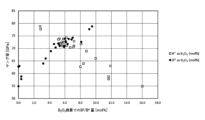
- FIG. 1 is a graph showing the relationship between the content of tricoordinated boron or tetracoordinated boron and the Young's modulus.
- FIG. 2 is a graph showing the relationship between the content of tricoordinated boron or tetracoordinated boron and the surface breakdown energy.
- FIG. 3 is a graph showing the relationship between [B 2 O 3 ]-([RO]+[R' 2 O]-[Al 2 O 3 ]) and the content of tricoordinate boron calculated as B 2 O 3 .
- FIG. 1 is a graph showing the relationship between the content of tricoordinated boron or tetracoordinated boron and the Young's modulus.
- FIG. 2 is a graph showing the relationship between the content of tricoordinated boron or tetracoordinated boron and the surface breakdown energy.
- FIG. 3 is a graph showing the relationship between [B 2 O 3 ]-([RO]+[
- FIG. 4 is a graph showing the relationship between [B 2 O 3 ]-([RO]+[R 2 O]-[Al 2 O 3 ]) and the content of tricoordinate boron calculated as B 2 O 3 .
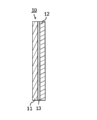
- FIG. 5 is a cross-sectional view of an example of a laminated glass according to an embodiment of the present invention.
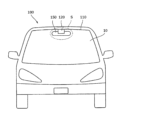
- FIG. 6 is a conceptual diagram showing a state in which the laminated glass according to one embodiment of the present invention is used as a window glass for a vehicle.
- FIG. 7 is an enlarged view of a portion S in FIG.
- FIG. 8 is a cross-sectional view taken along line YY in FIG.
- ⁇ Glass composition> in terms of mole percent on an oxide basis, Li 2 O is substantially not contained, SiO2 : 70-80% B2O3 : 10-17 % Al2O3 : 1.0-6.0 % MgO: 0.0-5.0% CaO: 0.0-5.0% SrO: 0.0-5.0% BaO: 0.0-5.0% Na 2 O: 0.0-19% K2O : 0.0-10% R' 2 O: 6.0-19% RO: 0.0 ⁇ 5.0% (wherein RO is at least one selected from MgO, CaO, SrO, and BaO, and R' 2 O is at least one selected from Na 2 O and K 2 O),
- the present invention provides a glass for vehicles and sensors (hereinafter referred to as "glass of a first embodiment"), in which ([R' 2 O]+1/2[RO]-[Al 2 O 3 ])-[B 2 O 3 ] ⁇ -6.5.
- the present invention provides a glass for vehicles and sensors (hereinafter referred to as "glass of a second embodiment"), in which ([R 2 O]+1/2[RO]-[Al 2 O 3 ])-[B 2 O 3 ] ⁇ -10.0.
- glass of this embodiment includes glass of the first embodiment and glass of the second embodiment.
- composition range of each component is expressed as mole percent based on the oxide unless otherwise specified below. Also, “substantially free” of each component means that it is not contained except as unavoidable impurities mixed in from raw materials, etc., in other words, it is not intentionally contained.
- the glass of the first embodiment and the glass of the second embodiment will be described as specific embodiments of the glass for vehicles and sensors (hereinafter, sometimes simply referred to as "glass") of this embodiment.
- the glass of the first embodiment does not substantially contain Li 2 O in terms of mole percent based on oxides, SiO2 : 70-80% B2O3 : 10-17 % Al2O3 : 1.0-6.0 % MgO: 0.0-5.0% CaO: 0.0-5.0% SrO: 0.0-5.0% BaO: 0.0-5.0% Na 2 O: 0.0-19% K2O : 0.0-10% R' 2 O: 6.0-19% RO: 0.0 ⁇ 5.0% (wherein RO is at least one selected from MgO, CaO, SrO, and BaO, and R' 2 O is at least one selected from Na 2 O and K 2 O),
- the glass for vehicles and sensors satisfies ([R' 2 O]+1/2[RO]-[Al 2 O 3 ])-[B 2 O 3 ] ⁇ -6.5.
- [ ] indicates the content of each component in the brackets expressed as mole percent on an oxide basis.
- SiO 2 is a component that constitutes the network structure of glass and is an essential component of the glass of this embodiment.
- the content of SiO 2 is 70 to 80%.
- the content of SiO 2 is 70% or more, so that the structure of the glass is strengthened and the Young's modulus is increased.
- the density of the glass is easily reduced, and further, moisture resistance and chemical durability can be ensured.
- the viscosity of the glass can be reduced.
- the average linear expansion coefficient is suppressed from increasing, and thermal cracking of the glass can be suppressed.
- the content of SiO 2 is more preferably 71% or more, more preferably 72% or more, even more preferably 73% or more, particularly preferably 74% or more, and most preferably 75% or more.
- the SiO 2 content is 80% or less, which suppresses an increase in viscosity during glass melting, facilitates glass production, and improves the formability of vehicle glass, particularly windshields, cover glass for sensors, etc.
- the SiO 2 content is preferably 79% or less, more preferably 78% or less, even more preferably 77% or less, and particularly preferably 76% or less.
- B 2 O 3 reduces the viscosity and density of the glass and contributes to improving the Young's modulus. It is also a component that controls optical properties.
- the glass of the first embodiment contains 10 to 17% of B 2 O 3. By containing 10% or more of B 2 O 3 in the glass of the first embodiment, the viscosity and density of the glass can be reduced. In addition, the Young's modulus can be increased by controlling the coordination number as described later.
- the content of B 2 O 3 is preferably 11% or more, more preferably 12% or more, and even more preferably 13% or more.
- the B 2 O 3 content is 17% or less, alkali elements are less likely to volatilize during melting and forming of the glass, and deterioration of the glass quality can be suppressed. Also, acid resistance and alkali resistance can be improved.
- the B 2 O 3 content is preferably 16% or less, more preferably 15% or less, and even more preferably 14% or less.
- the content of tricoordinated boron calculated as B 2 O 3 (B 3 as B 2 O 3 ) is preferably 10 mol % or less.
- the present inventors have found that by adjusting the ratio of tricoordinated boron and tetracoordinated boron contained in the glass, it is possible to obtain glass having a high Young's modulus and excellent fracture toughness value.
- boron can have an oxygen coordination number of three or four.
- Four-coordinated boron enters the glass framework and forms a tetrahedral structure. At this time, since the tetrahedral structure is negatively charged, the charge is compensated by alkali metal ions or alkaline earth metal ions. Therefore, four-coordinated boron forms a three-dimensional glass structure with almost no non-bridging oxygen.
- three-coordinated boron has non-bridging oxygen in glass and is known to form planar structures such as a ring structure (boroxol ring).
- Figure 1 shows the relationship between the content of tricoordinated boron or tetracoordinated boron and Young's modulus.
- Young's modulus decreases as the content of tricoordinated boron increases, and the Young's modulus increases as the content of tetracoordinated boron increases.
- the reason why Young's modulus improves with an increase in the content of tetracoordinated boron is thought to be that as the proportion of tricoordinated boron decreases and the proportion of tetracoordinated boron increases, non-bridging oxygen decreases and a dense structure is formed, which increases the ion packing rate and bond dissociation energy that contribute to Young's modulus.
- Figure 2 shows the relationship between the content of tricoordinated boron or tetracoordinated boron and the surface breakdown energy. As shown in Figure 2, the surface breakdown energy tends to increase as the content of tetracoordinated boron increases, and tends to decrease as the content of tricoordinated boron increases.
- the fracture toughness value KIC is an index of glass strength, and the larger the fracture toughness value KIC, the more the propagation of cracks occurring in the glass can be suppressed.
- the fracture toughness value KIC (MPa ⁇ m 1/2 ) can be calculated from the Young's modulus E (GPa), the surface fracture energy ⁇ (KPa ⁇ m), and the Poisson's ratio ⁇ (unitless) by the following formula (1).
- the fracture toughness value K IC increases as the Young's modulus E and the surface fracture energy ⁇ increase.
- the Young's modulus and surface fracture energy improve with an increase in the content of tetracoordinated boron, and therefore, in this embodiment, the more boron is present in the tetracoordinated state, the higher the fracture toughness of the glass obtained. Therefore, in the glass of the first embodiment, the content of tricoordinated boron calculated as B2O3 is more preferably 9.0 % or less, even more preferably 8.0% or less, even more preferably 7.0% or less, particularly preferably 6.0% or less, and most preferably 5.0% or less.
- the content of tricoordinated boron calculated as B 2 O 3 is preferably 1.5% or more, more preferably 2.0% or more, and particularly preferably 2.5% or more.
- the color tone of the glass can be adjusted by adjusting the ratio of tricoordinated boron and tetracoordinated boron. Specifically, the higher the ratio of tetracoordinated boron, the stronger the gray color of the glass becomes, and the glass with excellent design properties can be obtained. Since the glass has a gray color and is more suitable for use as a window glass for a vehicle, from this viewpoint, it is preferable that the content of tricoordinated boron in the glass of the first embodiment is within the above range.
- the ratio of tricoordinated boron to tetracoordinated boron can be adjusted by the composition of the glass, specifically by appropriately adjusting the contents of alkali metal oxide, alkaline earth metal oxide, and Al 2 O 3 .
- boron in glass when the charge of boron in glass is assisted by alkali metal ions or alkaline earth metal ions, it exists in the glass as a tetrahedral structure (four-coordinated boron).
- boron that is not coordinated with an alkali metal ion exists as three-coordinated boron. Therefore, the ratio of three-coordinated boron to four-coordinated boron can be adjusted by adjusting the content of alkali metal ions.
- Al 2 O 3 the content of Al 2 O 3 must also be taken into consideration. It is known that Al has a coordination number of 4 to 6 due to oxygen in glass, and tetrahedral Al forms a glass structure as a tetrahedral structure. Since tetrahedral Al has a negative charge like tetrahedral boron, the charge is compensated by alkali metal ions or alkaline earth metal ions. In this case, alkali metal ions tend to coordinate to Al preferentially over boron.
- Alkaline earth metal oxides like alkali metal oxides, also affect the coordination number of boron.
- ions with lower electronegativity tend to react with boron and increase the amount of tetrahedral boron, so the ratio of tetrahedral boron increases in the order of Ba, Sr, Ca, and Mg, which have the lowest electronegativity.
- the contents of tricoordinated boron and tetracoordinated boron can be adjusted by the contents of alkali metal oxide, alkaline earth metal oxide, and Al 2 O 3.
- the contents of tricoordinated boron and tetracoordinated boron can also be adjusted by adjusting the average cooling rate described below.
- the proportions of tricoordinated boron and tetracoordinated boron in glass can be measured by Nuclear Magnetic Resonance (NMR). For more details, they can be measured by the method described in the Examples below.
- Al 2 O 3 is a component that constitutes the network structure of glass and is an essential component of the glass of this embodiment.
- the glass of the first embodiment contains 1.0 to 6.0% Al 2 O 3.
- the content of Al 2 O 3 is 1.0% or more, so that the Young's modulus can be increased.
- the weather resistance, moisture resistance, and chemical durability are improved.
- the average linear expansion coefficient does not become too large, so that thermal cracking of the glass can be suppressed, and chemical strengthening treatment using ion exchange is possible.
- the content of Al 2 O 3 is preferably 1.5% or more, more preferably 1.8% or more, even more preferably 2.0% or more, particularly preferably 2.3% or more, and most preferably 2.5% or more.
- the content of Al 2 O 3 is 6.0% or less, which suppresses an increase in viscosity during glass melting, facilitates glass production, and improves the formability of vehicle glass, particularly windshields and cover glass for sensors. Furthermore, the content of alkali metal coordinated to boron increases, and the proportion of boron with three coordinates can be reduced.
- the content of Al 2 O 3 is preferably 5.5% or less, more preferably 5.0% or less, even more preferably 4.5% or less, particularly preferably 4.0% or less, and most preferably 3.5% or less.
- MgO is a component that reduces the viscosity of the glass and contributes to improving the Young's modulus. Furthermore, as described above, MgO is a component that increases the proportion of three-coordinated boron due to its high electronegativity.
- the glass of the first embodiment contains 0.0 to 5.0% MgO. By including MgO in the glass of the first embodiment, the viscosity of the glass can be reduced and the melting of the glass raw materials can be promoted. In addition, the Young's modulus and moisture resistance can be improved.
- the content is preferably 0.20% or more, more preferably 0.40% or more, even more preferably 0.60% or more, particularly preferably 0.80% or more, and most preferably 1.0% or more.
- the glass of the first embodiment if the MgO content is 5.0% or less, the glass is less susceptible to devitrification, and an excessive increase in viscosity during glass melting is suppressed, facilitating glass production and improving the formability of vehicle glass, particularly windshields and cover glass for sensors.
- the proportion of tricoordinated boron can be kept low.
- the MgO content is preferably 4.0% or less, more preferably 3.5% or less, even more preferably 3.0% or less, particularly preferably 2.5% or less, and most preferably 2.0% or less.
- CaO is a component that reduces the viscosity of the glass. In addition, as described above, it is a component that increases the proportion of three-coordinated boron due to its high electronegativity.
- the glass of the first embodiment contains 0.0 to 5.0% CaO.
- the solubility of the glass raw materials is improved, and the viscosity is further reduced, improving the formability of vehicle glass, particularly windshields and cover glass for sensors.
- the content is preferably 0.20% or more, more preferably 0.40% or more, even more preferably 0.60% or more, particularly preferably 0.80% or more, and most preferably 1.0% or more.
- the CaO content in the glass of the first embodiment is preferably 4.0% or less, more preferably 3.5% or less, even more preferably 3.0% or less, particularly preferably 2.5% or less, and most preferably 2.0% or less.
- SrO is a component that reduces the viscosity of the glass.
- Sr since Sr has a lower electronegativity than Mg and Ca, it can increase the proportion of 4-coordinated boron.
- the glass of the first embodiment contains 0.0 to 5.0% SrO.
- the SrO content is preferably 4.0% or less, more preferably 3.0% or less, even more preferably 2.0% or less, even more preferably 1.0% or less, particularly preferably 0.5% or less, and most preferably substantially free.
- substantially free of SrO means that the SrO content in the glass is 0.10 mol% or less.
- the content of SrO may be 0.20% or more, 0.40% or more, 0.60% or more, 0.80% or more, or 1.0% or more.
- BaO is a component that reduces the viscosity of the glass.
- Ba has a lower electronegativity than Mg and Ca, and therefore can increase the proportion of 4-coordinated boron.
- the glass of the first embodiment contains 0.0 to 5.0% BaO.
- the BaO content is preferably 4.0% or less, more preferably 3.0% or less, even more preferably 2.0% or less, even more preferably 1.0% or less, particularly preferably 0.5% or less, and most preferably substantially free.
- substantially free of BaO means that the BaO content in the glass is 0.10 mol% or less.
- the content of BaO may be 0.20% or more, 0.40% or more, 0.60% or more, 0.80% or more, or 1.0% or more.
- the viscosity of the glass is reduced, and further, the proportion of tetrahedral boron is increased.
- Na 2 O is a component that improves the solubility of glass and reduces the viscosity, and also makes it easier to increase the Young's modulus and contributes to the average linear expansion coefficient of glass.
- the strength of glass can be increased by performing a chemical strengthening treatment by ion exchange with K ions.
- the proportion of tetrahedral boron can be increased by coordinating Na ions to boron.
- the content of Na 2 O is 0.0 to 19%.
- the viscosity of the glass can be reduced, and further, the proportion of tetracoordinated boron can be increased.
- the Young's modulus and the average linear expansion coefficient can be increased.
- Na 2 O its content is preferably 2.0% or more, more preferably 3.0% or more, even more preferably 4.0% or more, even more preferably 5.0% or more, especially preferably 5.5% or more, particularly preferably 6.0% or more, and most preferably 6.5% or more.
- the Na 2 O content is preferably 17% or less, more preferably 15% or less, even more preferably 13% or less, even more preferably 12% or less, particularly preferably 11% or less, and most preferably 10% or less.
- K 2 O is a component that improves the melting property of glass, reduces the viscosity, and also makes it easier to increase the Young's modulus and contributes to the average linear expansion coefficient of glass.
- the content of K 2 O is 0.0 to 10%.
- the viscosity of the glass can be reduced.
- the Young's modulus and the average linear expansion coefficient can be increased.
- the proportion of tetrahedral boron can be increased by coordinating with boron.
- K 2 O is contained, it is preferably 0.10% or more, more preferably 0.20% or more, even more preferably 0.30% or more, particularly preferably 0.40% or more, and most preferably 0.50% or more.
- K 2 O has the effect of increasing the average linear expansion coefficient and density compared to Li 2 O and Na 2 O.
- the content of K 2 O is 10% or less, so that the thermal cracking of the glass caused by the average linear expansion coefficient becoming excessively large can be suppressed.
- the content of K 2 O is preferably 8.0% or less, more preferably 6.0% or less, even more preferably 5.0% or less, even more preferably 4.0% or less, particularly preferably 3.0% or less, and most preferably 2.0% or less.
- the total content of Na 2 O and K 2 O (hereinafter sometimes referred to as R' 2 O) is 6.0% or more and 19% or less.
- R' 2 O is 6.0% or more, the Young's modulus is increased and the viscosity of the glass is reduced, thereby improving the formability of vehicle glass, particularly windshields and cover glass for sensors.
- R' 2 O is preferably 6.5% or more, more preferably 7.0% or more, even more preferably 7.5% or more, particularly preferably 8.0% or more, and most preferably 8.5% or more.
- R'2O is 19% or less, an increase in density can be suppressed and the moisture resistance of the glass can be improved.
- R'2O is preferably 17% or less, more preferably 15% or less, even more preferably 14% or less, even more preferably 13% or less, particularly preferably 12% or less, and most preferably 11% or less.
- the total content of MgO, CaO, SrO and BaO (hereinafter sometimes referred to as RO) is 0.0% or more and 5.0% or less.
- RO MgO, CaO, SrO and BaO
- the Young's modulus can be improved.
- RO is preferably 0.20% or more, more preferably 0.40% or more, even more preferably 0.60% or more, particularly preferably 0.80% or more, and most preferably 1.0% or more.
- RO is 5.0% or less
- the increase in density of the glass can be suppressed and the crack resistance of the glass can be improved.
- RO is preferably 4.5% or less, more preferably 4.0% or less, even more preferably 3.5% or less, even more preferably 3.0% or less, particularly preferably 2.5% or less, and most preferably 2.0% or less.
- the glass of the first embodiment does not substantially contain Li 2 O.
- substantially not containing Li 2 O in the glass of the first embodiment it is possible to suppress the generation of a crystalline phase containing Li during the production of the glass and improve manufacturability.
- substantially not containing Li 2 O means that the content of Li 2 O in the glass is 0.10 mol % or less.
- the ratio of tricoordinated boron to tetracoordinated boron in glass can be adjusted by the contents of alkali metal oxide, alkaline earth metal oxide, and Al 2 O 3 . As shown in FIG. 3 , the content of tricoordinated boron tends to decrease as the value of ([R' 2 O]+1/2[RO]-[Al 2 O 3 ])-[B 2 O 3 ] increases.
- ([R' 2 O]+1/2[RO]-[Al 2 O 3 ])-[B 2 O 3 ] is preferably 0.0 or less, more preferably -1.0 or less, even more preferably -1.5 or less, even more preferably -2.0 or less, particularly preferably -2.5 or less, and most preferably -3.0 or less.
- the glass of the second embodiment has, in mole percent on an oxide basis, SiO2 : 70-80% B2O3 : 10-17 % Al2O3 : 1.0-6.0 % MgO: 0.0-5.0% CaO: 0.0-5.0% SrO: 0.0-5.0% BaO: 0.0-5.0% Li 2 O: more than 0 to 15% Na 2 O: 3.5-15% K2O : 0.0-10% R 2 O: 6.0-19% RO: 0.0 ⁇ 5.0% (wherein RO is at least one selected from MgO, CaO, SrO, and BaO, and R 2 O is at least one selected from Li 2 O, Na 2 O, and K 2 O), ([R 2 O]+1/2[RO]-[Al 2 O 3 ])-[B 2 O 3 ] ⁇ -10.0.
- the glass of the second embodiment is similar to the glass of the first embodiment in terms of SiO2 , B2O3 , Al2O3 , MgO, CaO, SrO, BaO, K2O and RO .
- Li 2 O is a component that improves the solubility of the glass and reduces the viscosity. In addition, it is a component that increases the Young's modulus and contributes to the average linear expansion coefficient of the glass. Furthermore, the strength of the glass can be increased by performing a chemical strengthening treatment by ion exchange with Na ions. In addition, the proportion of tetrahedral boron can be increased by coordinating Li ions to boron.
- the glass of the second embodiment contains more than 0 to 15% Li 2 O.
- the viscosity of the glass can be reduced and the Young's modulus can be increased as compared with Na 2 O or K 2 O. Furthermore, since the proportion of tetracoordinated boron can be increased, the Young's modulus and fracture toughness value can be increased as compared with Na 2 O or K 2 O.
- the content of Li 2 O is preferably 0.50% or more, more preferably 1.0% or more, even more preferably 1.5% or more, even more preferably 2.0% or more, particularly preferably 2.5% or more, and most preferably 3.0% or more.
- the Li 2 O content is 15% or less, so that the thermal cracking of the glass caused by the average linear expansion coefficient becoming excessively large can be suppressed. Furthermore, the production of a crystalline phase containing Li during the production of the glass is suppressed, and the manufacturability of the glass is improved.
- the Li 2 O content is preferably 12% or less, more preferably 10% or less, even more preferably 8.0% or less, particularly preferably 6.0% or less, and most preferably 5.0% or less.
- Na 2 O is contained in an amount of 3.5 to 15%.
- the content of Na 2 O is 3.5% or more, the viscosity of the glass is reduced, so that the content of Li 2 O can be reduced during the manufacture of the glass, and the generation of a crystalline phase containing Li during the manufacture of the glass can be suppressed.
- the viscosity of the glass is reduced, so that the formability of vehicle glass, particularly windshields and cover glass for sensors, is improved.
- the proportion of tetrahedral boron is increased, so that the Young's modulus and surface fracture energy are improved.
- the content of Na 2 O is preferably 4.0% or more, more preferably 4.5% or more, even more preferably 5.0% or more, even more preferably 5.5% or more, particularly preferably 6.0% or more, particularly preferably 6.5% or more, and most preferably 7.0% or more.
- the Na 2 O content is 15% or less, so that the average linear expansion coefficient can be reduced and thermal cracking of the glass can be suppressed.
- the moisture resistance of the glass is improved, making it suitable for glass that is exposed to the atmosphere for a long period of time, such as vehicle glass and sensor glass.
- the Na 2 O content is preferably 13% or less, more preferably 12% or less, even more preferably 11% or less, particularly preferably 10% or less, and most preferably 9.0% or less.
- the total content of Li 2 O, Na 2 O and K 2 O (hereinafter sometimes referred to as R 2 O) is 6.0 to 19%.
- R 2 O is 6.0% or more, the Young's modulus is increased and the viscosity of the glass is reduced, thereby improving the formability of vehicle glass, particularly windshields and sensor cover glass.
- R 2 O is preferably 6.5% or more, more preferably 7.0% or more, even more preferably 7.5% or more, even more preferably 8.0% or more, particularly preferably 8.5% or more, and most preferably 9.0% or more.
- R 2 O is 19% or less, preferably 17% or less, more preferably 15% or less, even more preferably 14% or less, even more preferably 13% or less, particularly preferably 12% or less, and most preferably 11% or less.
- ([R 2 O]+1/2[RO]-[Al 2 O 3 ])-[B 2 O 3 ] is -10.0 or more.
- [ ] is the content of each component in the parentheses expressed in mole percent based on the oxide.
- ([R 2 O]+1/2[RO]-[Al 2 O 3 ])-[B 2 O 3 ] being -10.0 or more, the proportion of three-coordinate boron in the glass is reduced, improving the Young's modulus and surface fracture energy, and as a result, the fracture toughness value can be improved.
- the ratio of tricoordinated boron to tetracoordinated boron in glass can be adjusted by the contents of alkali metal oxide, alkaline earth metal oxide, and Al 2 O 3 . As shown in FIG. 4 , the content of tricoordinated boron tends to decrease as the value of ([R 2 O]+1/2[RO]-[Al 2 O 3 ])-[B 2 O 3 ] increases.
- ([R 2 O]+1/2[RO]-[Al 2 O 3 ])-[B 2 O 3 ] is preferably -0.5 or less, more preferably -1.0 or less, even more preferably -1.5 or less, and most preferably -2.0 or less.
- the content of tricoordinated boron calculated as B 2 O 3 (B 3 as B 2 O 3 ) is preferably 10 mol % or less.
- the Young's modulus and surface fracture energy improve as the content of tetracoordinated boron increases, so that the more boron exists in the tetracoordinated state, the higher the fracture toughness value obtained. Therefore, in the glass of the second embodiment, the content of tricoordinated boron calculated as B 2 O 3 is more preferably 9.0% or less, even more preferably 8.0% or less, even more preferably 7.0% or less, particularly preferably 6.5% or less, and most preferably 6.0% or less.
- the content of tricoordinated boron calculated as B2O3 is preferably 1.0% or more, more preferably 1.5% or more, particularly preferably 2.0% or more, and most preferably 2.5% or more.
- Fe 2 O 3 is a component that improves the heat insulating properties of glass and also contributes to the color of glass, so it may be contained in the glass of this embodiment.
- the total iron content converted into Fe 2 O 3 is preferably 0.0025 to 1.2%.
- the total iron content converted into Fe 2 O 3 here refers to the total amount of iron including FeO, which is an oxide of divalent iron, and Fe 2 O 3 , which is an oxide of trivalent iron.
- the total iron content, calculated as Fe 2 O 3, in the glass of the present embodiment is preferably 0.0025% or more, more preferably 0.0040% or more, even more preferably 0.039% or more, still more preferably 0.097% or more, particularly preferably 0.11% or more, particularly preferably 0.15% or more, and most preferably 0.17% or more.
- the total iron content converted to Fe2O3 is preferably 1.0% or less, more preferably 0.80% or less, even more preferably 0.60% or less, particularly preferably 0.50% or less, and most preferably 0.40% or less.
- the total iron content converted to Fe2O3 is preferably 0.0030% or more, more preferably 0.0032% or more, even more preferably 0.0034% or more, even more preferably 0.0036% or more , especially preferably 0.0038% or more, particularly preferably 0.0040% or more, and most preferably 0.0042% or more.
- the total iron content converted to Fe2O3 is preferably 0.020% or less, more preferably 0.010% or less, even more preferably 0.0080% or less, particularly preferably 0.0070% or less, and most preferably 0.0060% or less.
- the mass ratio (%) of divalent iron calculated as Fe2O3 to the total iron calculated as Fe2O3 is preferably 15% or more.
- the value of Fe-Redox is the ratio of the Fe2 + content calculated as Fe2O3 to the total iron content calculated as Fe2O3 .
- the Fe-Redox is 15% or more, the content of Fe2 + having absorption in the near infrared region can be increased, so that heat is easily transferred to the glass melt during glass production, improving manufacturability.
- the transmittance in the near infrared region is reduced, improving the heat insulating property, making the glass suitable for applications requiring heat insulating property, such as glass for vehicles.
- Fe-Redox is more preferably 20% or more, further preferably 22% or more, and particularly preferably 24% or more.
- Fe-Redox is preferably 50% or less. By having Fe-Redox of 50% or less, deterioration of the melting equipment can be suppressed, and when SO 3 is used as a fining agent, amber coloring can be suppressed and a decrease in visible light transmittance can be suppressed.
- Fe-Redox is more preferably 45% or less, further preferably 40% or less, and particularly preferably 38% or less.
- Fe-Redox is more preferably 16% or more, even more preferably 17% or more, and particularly preferably 18% or more. Also, Fe-Redox is preferably 35% or less. By having Fe-Redox 35% or less, it is possible to suppress a decrease in transmittance in the near-infrared range. Fe-Redox is more preferably 32% or less, even more preferably 30% or less, and particularly preferably 28% or less.
- Fe-Redox can be adjusted by the raw material composition, melting temperature, and melting atmosphere.
- Fe-Redox can be adjusted by controlling the degree of oxidation-reduction of the glass melt by using reducing agents such as coke or ammonium chloride as raw materials.
- the glass of this embodiment may contain components other than those listed above (hereinafter also referred to as "other components").
- Examples of other components include TiO2 , ZrO2, Y2O3 , CeO2 , Nd2O5 , GaO2, GeO2 , MnO2, NiO , Cr2O3 , V2O5 , Au2O3 , Ag2O , CuO, CdO, MoO3 , SO3 , Cl , F, SnO2 , and Sb2O3 , and may be metal ions or oxides .
- Other components may be contained in a total of 3.0% or less for various purposes (e.g. , clarification and coloring , imparting chemical durability, etc.). If the total content of other components is 3.0% or less, the properties required for vehicle glass and cover glass for sensors such as LiDAR can be maintained.
- the total content of other components is preferably 2.5% or less, more preferably 2.0% or less, even more preferably 1.5% or less, even more preferably 1.0% or less, particularly preferably 0.80% or less, and most preferably 0.50% or less.
- the contents of As 2 O 3 and PbO are each preferably less than 0.0010%, and more preferably substantially none are contained.
- the glass of this embodiment may contain ZrO2 .
- ZrO2 is a component that improves chemical durability.
- the content is preferably 0.010% or more, more preferably 0.050% or more, even more preferably 0.10% or more, and particularly preferably 0.20% or more.
- the content of ZrO2 is preferably 2.0% or less, more preferably 1.5% or less, even more preferably 1.0% or less, and particularly preferably 0.50% or less.
- the glass of this embodiment may contain Y 2 O 3.
- Y 2 O 3 is a component that improves Young's modulus.
- its content is preferably 0.10% or more, more preferably 0.20% or more, even more preferably 0.30% or more, and particularly preferably 0.40% or more.
- the content of Y 2 O 3 is preferably 2.0% or less, more preferably 1.5% or less, even more preferably 1.0% or less, and particularly preferably 0.80% or less.
- the formation of NiS can cause glass breakage, so the NiO content is preferably 0.0080% or less.
- the NiO content in the glass of this embodiment is more preferably 0.0040% or less, even more preferably 0.0020% or less, and it is particularly preferable that the glass is substantially free of NiO.
- the glass of this embodiment may contain CeO 2. Since CeO 2 has absorption in the ultraviolet region, it reduces the ultraviolet transmittance Tuv and improves UV cut performance. It also acts as an oxidizing agent and can control Fe-Redox. When the glass of this embodiment contains CeO 2 , its content is preferably 0.010% or more, more preferably 0.020% or more, even more preferably 0.040% or more, and particularly preferably 0.070% or more. CeO 2 absorbs light in the ultraviolet region, which may cause solarization and reduce the transmittance in the visible region. Therefore, the content of CeO 2 is preferably 0.25% or less, more preferably 0.18% or less, even more preferably 0.14% or less, and particularly preferably 0.10% or less.
- the glass of the present embodiment may contain Cr 2 O 3.
- Cr 2 O 3 acts as an oxidizing agent and can control Fe-Redox.
- the content is preferably 0.0020% or more, more preferably 0.0040% or more. Since Cr 2 O 3 has coloring for light in the visible range, there is a risk of a decrease in visible light transmittance. In addition, there is a risk of a decrease in the amount of Fe 2+ , which decreases the heat insulating property. Therefore, when the glass of the present embodiment contains Cr 2 O 3 , it is preferably 0.020% or less, more preferably 0.016% or less, even more preferably 0.012% or less, and particularly preferably 0.0080% or less.
- the glass of this embodiment may contain SnO2 .
- SnO2 acts as a reducing agent and can control Fe-Redox.
- its content is preferably 0.010% or more, more preferably 0.040% or more, even more preferably 0.060% or more, and particularly preferably 0.080% or more.
- the content of SnO2 in the glass of this embodiment is preferably 0.40% or less, more preferably 0.30% or less, even more preferably 0.20% or less, and particularly preferably 0.15% or less.
- the glass of this embodiment may contain SO 3.
- SO 3 acts as a fining agent to improve the bubble quality of the glass.
- its content is preferably 0.0010% or more, more preferably 0.0040% or more, even more preferably 0.0070% or more, and particularly preferably 0.015% or more.
- SO 3 may cause amber coloring, causing the glass to turn brown, and the visible light transmittance may decrease.
- it is preferably 0.070% or less, more preferably 0.060% or less, even more preferably 0.050% or less, and particularly preferably 0.040% or less.
- the glass of the present embodiment may contain Cl.
- Cl acts as a fining agent to improve the bubble quality of the glass.
- the content is preferably 0.080% or more, more preferably 0.15% or more, even more preferably 0.20% or more, particularly preferably 0.25% or more, and most preferably 0.30% or more. If the Cl content is high, Cl2 gas volatilized from the glass melt may corrode the surrounding members.
- the content is preferably 1.0% or less, more preferably 0.80% or less, even more preferably 0.60% or less, and particularly preferably 0.50% or less.
- the glass of this embodiment preferably has a fracture toughness value K IC of 0.76 MPa ⁇ m 1/2 or more as measured by the SEPB method.
- the fracture toughness value K IC is an index of the strength of the glass, and the larger the fracture toughness value K IC, the less likely the cracks will progress, indicating a higher resistance to cracking. Therefore, when the fracture toughness value K IC is 0.76 MPa ⁇ m 1/2 or more, sufficient resistance to cracking is obtained, making the glass suitable for use as a cover glass for vehicles or sensors.
- the fracture toughness value K IC is more preferably 0.78 MPa ⁇ m 1/2 or more, even more preferably 0.80 MPa ⁇ m 1/2 or more, even more preferably 0.82 MPa ⁇ m 1/2 or more, particularly preferably 0.84 MPa ⁇ m 1/2 or more, particularly preferably 0.86 MPa ⁇ m 1/2 or more, particularly preferably 0.88 MPa ⁇ m 1/2 or more, and most preferably 0.90 MPa ⁇ m 1/2 or more.
- the fracture toughness value K IC is measured using a pre-crack introduction fracture test method (SEPB method: Single-Edge-Precracked-Beam method) based on JIS R1607:2015 "Fracture toughness test method for fine ceramics”.
- SEPB method Single-Edge-Precracked-Beam method
- the following methods can be used: increasing the content of SiO 2 , increasing the proportion of tetracoordinated boron, increasing the proportion of RO with a small atomic number of alkaline earth metal components, and increasing the proportion of R' 2 O or R 2 O with a small atomic number of alkali metal components.
- SiO 2 and B 2 O 3 are components that form a network structure, increasing the content strengthens the glass structure, thereby improving the fracture toughness value.
- the smaller the atomic number of the alkaline earth metal component of RO the higher the Young's modulus, and as a result, the higher the fracture toughness value.
- R' 2 O and R 2 O the smaller the atomic number of the alkali metal component, the more the tendency similar to that of RO is shown.
- the Young's modulus of the glass of this embodiment is preferably 65 GPa or more. With a Young's modulus of 65 GPa or more, the glass has high rigidity and improves fracture toughness, making it more suitable as a window glass for a vehicle or a cover glass for a sensor such as LiDAR.
- the Young's modulus of the glass of this embodiment is more preferably 68 GPa or more, more preferably 70 GPa or more, even more preferably 72 GPa or more, particularly preferably 73 GPa or more, and most preferably 74 GPa or more.
- the Young's modulus is preferably 85 GPa or less, more preferably 83 GPa or less, even more preferably 82 GPa or less, particularly preferably 81 GPa or less, and most preferably 80 GPa or less.
- the Young's modulus can be adjusted to fall within the above range by increasing the proportion of tetracoordinated boron or adjusting the types and amounts of RO, R' 2 O and R 2 O.
- the Young's modulus can be measured by an ultrasonic pulse method based on JIS R1602:1995 "Testing method for elastic modulus of fine ceramics.”
- the rigidity modulus of the glass of this embodiment is preferably 27 GPa or more. If the rigidity modulus is 27 GPa or more, the glass is less likely to deform when subjected to an external force.
- the rigidity modulus of the glass is more preferably 28 GPa or more, further preferably 29 GPa or more, particularly preferably 30 GPa or more, and most preferably 31 GPa or more.
- the rigidity modulus is preferably 38 GPa or less, more preferably 37 GPa or less, even more preferably 36 GPa or less, and particularly preferably 35 GPa or less.
- the rigidity modulus can be measured by the ultrasonic pulse method based on JIS R1602:1995 "Test method for elastic modulus of fine ceramics.”
- the Poisson's ratio of the glass of this embodiment is preferably 0.26 or less.
- the smaller the Poisson's ratio the smaller the stress generated when an external force is applied to the glass.
- the fracture toughness value is also improved.
- the Poisson's ratio is more preferably 0.25 or less, even more preferably 0.24 or less, particularly preferably 0.23 or less, particularly preferably 0.22 or less, particularly preferably 0.21 or less, and most preferably 0.20 or less.
- the Poisson's ratio can be measured by an ultrasonic pulse method based on JIS R1602:1995 "Testing method for elastic modulus of fine ceramics".
- the surface fracture energy of the glass of this embodiment is preferably 0.0045 KPa ⁇ m or more.
- the surface fracture energy is more preferably 0.0046 KPa ⁇ m or more, even more preferably 0.0048 KPa ⁇ m or more, particularly preferably 0.0049 KPa ⁇ m or more, and most preferably 0.0050 KPa ⁇ m or more.
- the surface fracture energy can be calculated from the relational expression (1) by measuring the fracture toughness value, Young's modulus, and Poisson's ratio.
- the temperature T2 at which the glass viscosity ⁇ , which is a criterion for the solubility of the glass, is 10 2 [dPa ⁇ s], is preferably not more than 1700° C.
- Examples of methods for setting T2 at 1700°C or lower include a method of increasing the contents of R'2O or R2O and RO in the glass components and reducing the content of Al2O3 , a method of incorporating Li2O among R2O , a method of reducing the content of SiO2 , and a method of adjusting the content of B2O3 .
- T2 is more preferably 1675° C. or less, even more preferably 1650° C. or less, even more preferably 1640° C. or less, particularly preferably 1630° C. or less, and most preferably 1620° C. or less.
- T2 is preferably 1450° C. or more, more preferably 1475° C. or more, even more preferably 1500° C. or more, particularly preferably 1525° C. or more, and most preferably 1550° C. or more.
- Examples of methods for setting T4 at 1200°C or less include a method of increasing the contents of R'2O , R2O , and RO in the glass components and reducing the content of Al2O3 , a method of incorporating Li2O among R2O , a method of reducing the content of SiO2 , and a method of adjusting the content of B2O3 .
- the temperature T11 at which the glass viscosity ⁇ , which is a criterion for bending workability, is 1011 [dPa ⁇ s] is preferably not more than 640° C.
- T11 is not more than 640° C., bending forming at a low temperature becomes possible.
- Examples of methods for setting T11 at 640° C. or less include a method of increasing the contents of R'2O , R2O , and RO in the glass components and decreasing the content of Al2O3 , a method of incorporating Li2O among R2O , a method of decreasing the content of SiO2 , and a method of adjusting the content of B2O3 and the coordination number of boron .
- T11 is more preferably 635°C or less, further preferably 630°C or less, even more preferably 625°C or less, particularly preferably 620°C or less, particularly preferably 615°C or less, and most preferably 610°C or less.
- T11 is preferably 570° C. or higher, more preferably 575° C. or higher, even more preferably 580° C. or higher, particularly preferably 585° C. or higher, and most preferably 590° C. or higher.
- the temperature T12 at which the glass viscosity ⁇ , which is a criterion for bending workability, is 1012 [dPa ⁇ s] is preferably not more than 610° C.
- T12 is not more than 610° C.
- Examples of methods for setting T12 at 610°C or less include a method of increasing the contents of R'2O , R2O , and RO in the glass components and decreasing the content of Al2O3 , a method of incorporating Li2O among R2O , a method of decreasing the content of SiO2 , and a method of adjusting the content of B2O3 and the coordination number of boron .
- T12 is more preferably 605° C. or less, even more preferably 600° C. or less, even more preferably 595° C. or less, especially preferably 590° C. or less, particularly preferably 585° C. or less, and most preferably 580° C. or less.
- T12 is preferably 540° C. or more, more preferably 545° C. or more, even more preferably 550° C. or more, particularly preferably 555° C. or more, and most preferably 560° C. or more.
- the density of the glass of this embodiment is preferably 2.50 g/cm3 or less .
- the density of the glass of this embodiment is preferably 2.50 g/cm3 or less .
- increases in fuel consumption and electricity consumption due to weight increase can be suppressed.
- glasses having high Young's modulus and fracture toughness value tend to have high density, but the glass of this embodiment can achieve high Young's modulus and fracture toughness value while reducing density by adjusting the composition and contents of R'2O , R2O , and RO, the content of B2O3 , and the coordination number of boron , which are glass components.
- the density of the glass of this embodiment is more preferably 2.46 g/cm3 or less , even more preferably 2.44 g/cm3 or less , even more preferably 2.42 g/cm3 or less , especially preferably 2.40 g/cm3 or less , particularly preferably 2.38 g/cm3 or less , and most preferably 2.36 g/cm3 or less .
- the density of the glass of the present embodiment is preferably 2.25 g/cm 3 or more, more preferably 2.27 g/cm 3 or more, particularly preferably 2.28 g/cm 3 or more, and most preferably 2.29 g/cm 3 or more.
- Tg The glass transition temperature (T g ) of the glass of this embodiment is preferably within the range of 460 to 590° C. If T g is within this predetermined temperature range, the glass can be bent within the range of normal manufacturing conditions. If the T g of the glass of this embodiment is 460° C. or higher, the alkali metal content or alkaline earth metal content does not become too large, and the average linear expansion coefficient of the glass can be prevented from increasing. In addition, moisture resistance and devitrification of the glass are suppressed, and formability is improved.
- T g is more preferably 480° C. or higher, further preferably 490° C. or higher, and particularly preferably 500° C. or higher.
- the Tg is preferably 590° C. or less, more preferably 585° C. or less, even more preferably 580° C. or less, particularly preferably 575° C. or less, and most preferably 570° C. or less.
- the glass of this embodiment preferably has an average coefficient of linear expansion (CTE) of 80 ⁇ 10 ⁇ 7 /° C. or less at 50 to 350° C.
- CTE average coefficient of linear expansion
- the glass of this embodiment is made into bent glass, the difference in thermal expansion caused by differences in thermal history within the surface can be suppressed, and bent glass with good dimensional and surface accuracy can be obtained.
- the average linear expansion coefficient of the glass of this embodiment at 50 to 350° C. is more preferably 75 ⁇ 10 ⁇ 7 /° C. or less, even more preferably 70 ⁇ 10 ⁇ 7 /° C. or less, even more preferably 68 ⁇ 10 ⁇ 7 /° C. or less, particularly preferably 66 ⁇ 10 ⁇ 7 /° C. or less, and most preferably 64 ⁇ 10 ⁇ 7 /° C. or less.
- the glass of this embodiment preferably has an average linear expansion coefficient of 40 ⁇ 10 -7 /°C or more.
- the difference in thermal expansion with the black ceramic is reduced, and cracking of the black ceramic can be suppressed.
- the average linear expansion coefficient is more preferably 42 ⁇ 10 -7 /°C or more, even more preferably 44 ⁇ 10 -7 /°C or more, particularly preferably 46 ⁇ 10 -7 /°C or more, particularly preferably 48 ⁇ 10 -7 /°C or more, particularly preferably 50 ⁇ 10 -7 /°C or more, and most preferably 52 ⁇ 10 -7 /°C or more.
- the content of SiO2 in the glass components can be increased, and the contents of R2O or R'2O , RO and Al2O3 , the content of B2O3 , and the coordination number of boron can be adjusted.
- the glass of the present embodiment When the glass of the present embodiment is used for vehicle glass, the glass of the present embodiment preferably has a solar radiation transmittance Te of 90% or less as specified in ISO-9050:2003 when converted to a thickness of 2.0 mm. If Te is 90% or less, excellent heat shielding properties can be obtained. Te is preferably 88% or less, more preferably 86% or less, even more preferably 84% or less, particularly preferably 82% or less, and most preferably 80% or less. The lower limit of Te is not particularly limited, but is usually 30% or more, preferably 32% or more, more preferably 34% or more, and particularly preferably 36% or more.
- the Te content can be adjusted to within the above range by adjusting the Fe 2 O 3 content to 0.030% or more.
- Tv visible light transmittance
- the visible light transmittance Tv calculated by measuring the transmittance is preferably 75% or more. Since the Tv is 75% or more, the glass has excellent transparency, and is therefore suitable for use as glass for vehicles, particularly windshields and doors. This is more suitable for glass. Tv is more preferably 78% or more, further preferably 80% or more, and even more preferably 82% or more. 84% or more is particularly preferred, and 86% or more is the most preferred.
- the upper limit of Tv is Although not limited thereto, for example, it is 92% or less.
- Tv can be set within the above range by adjusting the glass composition, in particular the contents of SiO2 and Fe2O3 , the content of B2O3 , and the coordination number of boron .
- the ultraviolet transmittance Tuv is preferably 70% or less. By having Tuv of 70% or less, deterioration of components such as interlayers and seats in the vehicle interior can be suppressed when the glass of the present embodiment is used in laminated glass. Tuv is more preferably 68% or less, even more preferably 66% or less, even more preferably 64% or less, particularly preferably 62% or less, and most preferably 60% or less.
- the lower limit of Tuv is, for example, 10% or more. It is.
- Tuv can be set within the above range by adjusting the glass composition, in particular SiO 2 , Fe 2 O 3 , TiO 2 , CeO 2 or Fe-Redox.
- the dominant wavelength Dw of the glass of the present embodiment measured using the standard C light source specified in JIS Z 8701:1999 is preferably 520 nm or more and 574 nm or less.
- Dw is more preferably 525 nm or more, even more preferably 530 nm or more, particularly preferably 535 nm or more, and most preferably 540 nm or more.
- Dw is more preferably 573 nm or less, even more preferably 570 nm or less, particularly preferably 567 nm or less, and most preferably 565 nm or less.
- the glass of this embodiment when used for vehicle glass, the glass of this embodiment preferably has an excitation purity Pe of 4.0% or less, measured using the standard C light source specified in JIS Z 8701:1999. Pe is more preferably 3.5% or less, even more preferably 3.0% or less, even more preferably 2.5% or less, particularly preferably 2.0% or less, and most preferably 1.5% or less.
- the lower limit of Pe is not particularly limited, but is generally 0.1% or more. When Dw and Pe are within the above ranges, the glass is gray and exhibits excellent design properties.
- Dw and Pe can be adjusted by incorporating Fe 2 O 3 into the glass of this embodiment and adjusting the ratio of tricoordinated boron to tetracoordinated boron.
- the shape of the glass of this embodiment is not particularly limited, but the area of the main surface is preferably 0.25 m 2 or more, more preferably 0.45 m 2 or more, and even more preferably 0.90 m 2 or more.
- the area of the glass is in the above range, it can be used for various vehicle models.
- the area of the main surface of the glass of this embodiment is preferably 10 m 2 or less, more preferably 7 m 2 or less, and even more preferably 5 m 2 or less.
- the glass of this embodiment When the glass of this embodiment is used as the cover glass for LiDAR, it is preferable that the glass of this embodiment has a high transmittance at wavelengths of 905 nm or 1550 nm, which are used in LiDAR. Therefore, the glass of this embodiment has a transmittance at wavelengths of 905 nm or 1550 nm, when converted to a thickness of 4.0 mm, of preferably 86% or more, more preferably 87% or more, even more preferably 88% or more, even more preferably 89% or more, particularly preferably 90% or more, and most preferably 91% or more.
- the shape of the glass of this embodiment is not particularly limited, but the area of the main surface is preferably 0.00010 m 2 or more, more preferably 0.010 m 2 or more, even more preferably 0.020 m 2 or more, particularly preferably 0.040 m 2 or more, and most preferably 0.090 m 2 or more.
- the area of the glass is within the above range, it can be used with various LiDAR cover glasses.
- the area of the main surface of the glass of this embodiment is preferably 1.0 m 2 or less, more preferably 0.90 m 2 or less, and even more preferably 0.80 m 2 or less.
- the glass of this embodiment preferably has a surface roughness Ra of 5.0 nm or less, a thickness of 2.5 mm, and a critical impact destruction speed of 35 km/h or more when it is struck by a tungsten carbide alloy having a tip curvature radius of 200 ⁇ m, an apex angle of 120°, and a weight of 1.365 g.
- a critical impact destruction speed of 35 km/h or more can improve resistance to flying stones.
- the critical impact destruction speed is more preferably 40 km/h or more, even more preferably 45 km/h or more, particularly preferably 50 km/h or more, and most preferably 55 km/h or more.
- the upper limit of the critical impact destruction speed is, for example, 120 km/h or less.
- the surface roughness Ra can be measured based on JIS B0601:2001.
- the glass of this embodiment preferably has a critical impact fracture speed of 55 km/h or more when a tungsten carbide alloy having a tip curvature radius of 200 ⁇ m, an apex angle of 120°, and a weight of 1.365 g is collided with the glass.
- a critical impact fracture speed of 55 km/h or more can further improve resistance to flying stones.
- the critical impact fracture speed is more preferably 57 km/h or more, even more preferably 60 km/h or more, even more preferably 62 km/h or more, particularly preferably 64 km/h or more, particularly preferably 66 km/h or more, particularly preferably 68 km/h or more, and most preferably 70 km/h or more.
- the upper limit of the critical impact fracture speed is, for example, 120 km/h or less.
- the critical impact fracture speed can be measured by the method described in the examples below.
- the glass of this embodiment preferably has a thickness of 2.5 mm or more.
- the thickness of the glass is preferably 2.5 mm or more.
- the thickness of the glass is more preferably 2.8 mm or more, even more preferably 2.9 mm or more, even more preferably 3.0 mm or more, especially preferably 3.1 mm or more, even more preferably 3.2 mm or more, even more preferably 3.3 mm or more, particularly preferably 3.4 mm or more, and most preferably 3.5 mm or more.
- the thickness of the glass of the present embodiment is preferably 5.0 mm or less, more preferably 4.8 mm or less, even more preferably 4.5 mm or less, particularly preferably 4.2 mm or less, and most preferably 4.0 mm or less.
- methods for adjusting the thickness of the glass include a method of adjusting the thickness of the glass using the float method or down-draw method described below, a method of polishing the glass in the thickness direction using a grindstone and then polishing it to a mirror finish using an abrasive such as cerium oxide, etc.
- the surface roughness Ra after molding or polishing is preferably 5.0 nm or less, more preferably 2.0 nm or less, even more preferably 1.5 nm or less, particularly preferably 1.0 nm or less, and most preferably 0.50 nm or less.
- the glass of this embodiment is obtained, for example, by melting glass raw materials, and forming and cooling the molten glass.
- the ratio of tricoordinated boron and tetracoordinated boron can be adjusted by adjusting the average cooling rate of the glass.
- the average cooling rate refers to the average cooling rate when the formed glass is slowly cooled. The slower the average cooling rate, the lower the content of tricoordinated boron, and therefore the improved fracture toughness.
- the cooling rate is preferably 400°C/min or less, more preferably 300°C/min or less, even more preferably 250°C/min or less, even more preferably 200°C/min or less, particularly preferably 150°C/min or less, and most preferably 100°C/min or less.
- the average cooling rate can be calculated as follows.
- the composition of the glass for which the average cooling rate is to be calculated is analyzed, and multiple glasses with the same composition are produced with different average cooling rates.
- the refractive indexes of the multiple glasses produced are measured, and a calibration curve of the average cooling rate and refractive index is created.
- the average cooling rate can be calculated from the calibration curve.
- the refractive index can be measured, for example, by the V-block method.
- the glass of this embodiment is preferably float glass formed by, for example, the well-known float method.
- molten glass base is floated on a molten metal such as tin, and strict temperature control allows the formation of glass with uniform thickness and width, as well as the production of large-area glass.
- the glass of this embodiment may be glass formed by the known roll-out method or down-draw method, or may be glass with a polished surface and uniform thickness.
- the down-draw method is broadly divided into the slot down-draw method and the overflow down-draw method (fusion method), but both are techniques in which molten glass is continuously allowed to flow down from a forming body to form a band-shaped glass ribbon.
- the glass of this embodiment may be glass that has been subjected to a strengthening treatment such as air-cooling or chemical strengthening. By carrying out the above treatment, the strength of the glass can be increased.
- air-cooled tempering is a process that forms a compressive stress layer on the surface of glass by thermal tempering. Specifically, uniformly heated glass is rapidly cooled from a temperature close to its softening point, and compressive stress is formed on the surface of the glass due to the temperature difference between the surface and the interior of the glass. Compressive stress is generated uniformly over the entire surface of the glass, and a compressive stress layer of uniform depth is formed over the entire surface of the glass. Thermal tempering is more suitable for strengthening thick glass than chemical tempering.
- Chemical strengthening is a process in which alkali metal ions with a small ionic radius (typically Li ions or Na ions) on the glass surface are replaced by alkali metal ions with a larger ionic radius (typically Na ions or K ions) through ion exchange at a temperature below the glass transition temperature, forming a compressive stress layer on the glass surface.
- Chemical strengthening can be performed by known methods, such as the ion exchange method.
- a glass plate is immersed in a treatment liquid (e.g., potassium nitrate molten salt) and ions with a small ionic radius (e.g., Na ions) contained in the glass are replaced by ions with a larger ionic radius (e.g., K ions), generating compressive stress on the glass surface.
- a treatment liquid e.g., potassium nitrate molten salt
- ions with a small ionic radius e.g., Na ions
- ions with a larger ionic radius e.g., K ions
- the magnitude of the compressive stress on the surface of the glass (hereinafter also referred to as surface compressive stress CS) and the depth DOL of the compressive stress layer formed on the surface of the glass can be adjusted by the glass composition, chemical strengthening treatment time, and chemical strengthening treatment temperature, respectively.
- the bent glass according to the present embodiment is made of the above glass. That is, the glass according to the present embodiment is bent and shaped.
- the bent glass according to the present embodiment may be bent glass obtained by forming the flat glass according to the present embodiment into a curved shape by gravity forming, press forming, or the like.
- the curved glass of this embodiment is glass that curves at a specified curvature, and may be single-curved glass that curves in only one direction, either up-down or left-right, or compound-curved glass that curves in both the up-down and left-right directions.
- the bent glass of this embodiment preferably has a minimum radius of curvature of 50 mm or more and 100,000 mm or less.
- the radius of curvature of the bent glass is calculated by simulating the shape of the sample using a laser displacement meter (Dyvoce manufactured by Kohzu Seiki Co., Ltd.) based on the amount of warping that the sample originally had, which was determined by self-weight deflection correction in the double-sided differential mode, and the radius of curvature is obtained from the shape obtained by the simulation.
- the glass is heated and bent to form the bent glass.
- An example of a method for forming curved glass is a method in which flat glass is heated and placed on a forming die, and then pressed from above by a press means to bend the glass.
- Another method is to place a flat glass on a mold having a bending surface corresponding to the desired curved surface, and then to carry the mold into a heating furnace in this state, where the glass is heated to a temperature close to the glass softening point.
- this forming method the glass is curved by its own weight along the bending surface of the mold as it softens, and thus a bent glass having the desired curved surface is produced.
- bending using the above-mentioned press means is preferred from the viewpoint of improving productivity and improving surface accuracy after forming.
- the bending method using the above-mentioned press means is not particularly limited, and for example, the method described in WO 2016/093031 or the like can be appropriately adopted. Below, an example of the bending method using the above-mentioned press means is described.
- the glass of this embodiment is transported to a press area by a transport conveyor or the like.
- the glass is heated to a temperature at which it can be bent and softened.
- the temperature at which it can be bent is, for example, a temperature T12 or higher at which the glass viscosity is 10 12 [dPa ⁇ s].
- the heating may be performed by a heater or the like in a heating furnace during the process of transporting the glass to the press area by a transport conveyor or the like.
- the bending time under the condition of maintaining the heating temperature ( ⁇ T 12 ) can be set to, for example, 1 second or more.
- a lower press mold (female mold) and an upper press mold (male mold) are arranged at predetermined positions in the press area, and the top surface shape of the female mold and the bottom surface shape of the male mold correspond to the curved shape of the glass to be bent in the conveying direction and/or the perpendicular direction.
- the female mold can be raised and lowered between a waiting position below the conveyor and a press position above it, and after the glass is transferred from the conveyor, the female mold rises from a predetermined raised position to a press position above the conveyor with the glass placed on it, thereby press-forming the glass.
- the pressed glass is then transported to the cooling area using a transport shuttle or similar device.
- the glass is cooled by blowing cold air onto it, for example.
- the laminated glass according to this embodiment includes a first glass plate, a second glass plate, and an interlayer film sandwiched between the first glass plate and the second glass plate, and the first glass plate is the glass according to this embodiment or the bent glass according to this embodiment.
- FIG. 5 is a diagram showing an example of laminated glass 10 according to this embodiment.
- the laminated glass 10 has a first glass plate 11, a second glass plate 12, and an intermediate film 13 sandwiched between the first glass plate 11 and the second glass plate 12.
- the laminated glass 10 according to this embodiment is not limited to the embodiment shown in FIG. 5, and can be modified within the scope of the present embodiment.
- the intermediate film 13 may be formed in one layer as shown in FIG. 5, or in two or more layers.
- the laminated glass 10 according to this embodiment may have three or more glass plates, and in that case, an organic resin or the like may be interposed between the adjacent glass plates.
- the laminated glass 10 according to this embodiment will be described as having only two glass plates, the first glass plate 11 and the second glass plate 12, and sandwiching the intermediate film 13.
- the second glass sheet 12 is the glass of this embodiment or the bent glass of this embodiment.
- the first glass sheet 11 and the second glass sheet 12 may be glass sheets of the same composition or glass sheets of different compositions.
- the type of glass plate is not particularly limited, and any conventionally known glass plate used for vehicle window glass, etc. can be used. Specific examples include alkali aluminosilicate glass, alkali aluminoborosilicate glass, and soda lime glass. These glass plates may or may not be colored to the extent that transparency is not impaired.
- the second glass plate 12 may be an alkali aluminosilicate glass containing 1.0% or more of Al 2 O 3 , or an alkali aluminoborosilicate glass containing 1.0% or more of Al 2 O 3 and 1.0% or more of B 2 O 3.
- the alkali aluminosilicate glass or alkali aluminoborosilicate glass as the second glass plate 12, chemical strengthening becomes possible as described later, and the strength can be increased.
- the above-mentioned alkali aluminosilicate glass and alkali aluminoborosilicate glass preferably have an Al2O3 content of 5.0% or more, more preferably 8.0% or more, and particularly preferably 10% or more.
- the Al2O3 content is preferably 18% or less, and more preferably 15 % or less.
- the alkali aluminosilicate glass and alkali aluminoborosilicate glass preferably have an R 2 O content of 10% or more, more preferably 12% or more, and even more preferably 13% or more.
- the R 2 O content is preferably 22% or less, more preferably 20% or less, and even more preferably 18% or less.
- the alkali aluminoborosilicate glass preferably has a B 2 O 3 content of 2.0% or more, more preferably 3.0% or more, and even more preferably 4.0% or more in order to increase the strength when the glass comes into contact with flying stones, vehicle keys, etc.
- the B 2 O 3 content is preferably 9.0% or less, more preferably 8.0% or less, and even more preferably 7.0% or less.
- alkali aluminosilicate glass examples include glasses having the following compositions, in which each component is expressed in mole percentage based on the oxide. 61% ⁇ SiO2 ⁇ 75% 1.0% ⁇ Al2O3 ⁇ 20% 0.0% ⁇ MgO ⁇ 15% 0.0% ⁇ CaO ⁇ 10% 0.0% ⁇ SrO ⁇ 1.0% 0.0% ⁇ BaO ⁇ 1.0% 0.0% ⁇ Li2O ⁇ 15% 2.0% ⁇ Na2O ⁇ 15% 0.0% ⁇ K2O ⁇ 6.0% 0.0% ⁇ ZrO2 ⁇ 4.0% 0.0% ⁇ TiO2 ⁇ 1.0% 0.0% ⁇ Y2O3 ⁇ 2.0 % 10% ⁇ R2O ⁇ 25% 0.0% ⁇ RO ⁇ 20% (R 2 O represents the total content of Li 2 O, Na 2 O and K 2 O, and RO represents the total content of MgO, CaO, SrO and BaO.)
- alkali aluminoborosilicate glass examples include glasses having the following compositions, in which each component is expressed in mole percentage on an oxide basis. 61% ⁇ SiO2 ⁇ 75% 1.0% ⁇ Al2O3 ⁇ 20% 1.0% ⁇ B2O3 ⁇ 10 % 0.0% ⁇ MgO ⁇ 15% 0.0% ⁇ CaO ⁇ 10% 0.0% ⁇ SrO ⁇ 1.0% 0.0% ⁇ BaO ⁇ 1.0% 0.0% ⁇ Li2O ⁇ 15% 2.0% ⁇ Na2O ⁇ 15% 0.0% ⁇ K2O ⁇ 6.0% 0.0% ⁇ ZrO2 ⁇ 4.0% 0.0% ⁇ TiO2 ⁇ 1.0% 0.0% ⁇ Y2O3 ⁇ 2.0 % 10% ⁇ R2O ⁇ 25% 0.0% ⁇ RO ⁇ 20% (R 2 O represents the total content of Li 2 O, Na 2 O and K 2 O, and RO represents the total content of MgO, CaO, SrO and BaO.)
- the second glass sheet 12 may be soda-lime glass.
- the soda-lime glass may contain 3.5% or less, preferably less than 1.0%, of Al2O3 .
- examples of the glass include glass having the following composition. Each component is expressed in mole percentage based on the oxide. 60% ⁇ SiO2 ⁇ 75% 0.0% ⁇ Al2O3 ⁇ 3.5% 2.0% ⁇ MgO ⁇ 11% 2.0% ⁇ CaO ⁇ 10% 0.0% ⁇ SrO ⁇ 3.0% 0.0% ⁇ BaO ⁇ 3.0% 10% ⁇ Na2O ⁇ 18% 0.0% ⁇ K2O ⁇ 8.0% 0.0% ⁇ ZrO2 ⁇ 4.0% 0.0010% ⁇ Fe2O3 ⁇ 5.0%
- the thickness of the first glass plate 11 is preferably 2.5 mm or more. By making the thickness of the first glass plate 11 2.5 mm or more, the critical impact fracture speed of glass having a high fracture toughness value can be improved.
- the thickness of the first glass plate 11 is more preferably 2.8 mm or more, even more preferably 2.9 mm or more, even more preferably 3.0 mm or more, especially preferably 3.1 mm or more, even more preferably 3.2 mm or more, even more preferably 3.3 mm or more, particularly preferably 3.4 mm or more, and most preferably 3.5 mm or more.
- the thickness of the first glass plate 11 is preferably 5.0 mm or less, more preferably 4.8 mm or less, even more preferably 4.5 mm or less, particularly preferably 4.2 mm or less, and most preferably 4.0 mm or less.
- the thickness of the second glass plate 12 is preferably 0.50 mm or more, more preferably 0.60 mm or more, even more preferably 0.70 mm or more, particularly preferably 0.80 mm or more, particularly preferably 0.90 mm or more, and most preferably 1.0 mm or more.
- a thickness of 0.50 mm or more for the second glass plate 12 is preferable from the standpoint of impact resistance.
- the thickness of the second glass sheet 12 is preferably 2.0 mm or less, more preferably 1.9 mm or less, even more preferably 1.8 mm or less, particularly preferably 1.7 mm or less, particularly preferably 1.6 mm or less, and most preferably 1.5 mm or less. If the thickness of the second glass sheet 12 is 2.0 mm or less, the weight of the laminated glass 10 will not be too large, which is preferable in terms of improving fuel efficiency when used in a vehicle.
- the first glass plate 11 and the second glass plate 12 may have the same thickness or different thicknesses, but it is preferable that the first glass plate 11 is thicker than the second glass plate 12.
- Methods for adjusting the thickness of the first glass plate 11 and the second glass plate 12 include a method of adjusting the thickness of the glass using a float method or a downdraw method, and a method of polishing the glass in the thickness direction using a grinding wheel and then making it into a mirror-like state using an abrasive such as cerium oxide.
- the surface roughness Ra after molding or polishing is preferably 5.0 nm or less, more preferably 2.0 nm or less, even more preferably 1.5 nm or less, particularly preferably 1.0 nm or less, and most preferably 0.50 nm or less.
- the thickness of the first glass sheet 11 and the second glass sheet 12 may be constant over the entire surface, or may vary from place to place as necessary, such as forming a wedge shape in which the thickness of one or both of the first glass sheet 11 and the second glass sheet 12 gradually decreases.
- At least one of the first glass plate 11 and the second glass plate 12 may be chemically strengthened glass that has been subjected to glass strengthening in order to improve its strength.
- the method of chemical strengthening is the same as the above-mentioned chemical strengthening treatment of glass.
- Examples of chemically strengthened glass include the above-mentioned alkali aluminosilicate glass and the above-mentioned alkali aluminoborosilicate glass that have been subjected to chemical strengthening treatment.
- the first glass sheet 11 and the second glass sheet 12 may have a flat shape or a curved shape having a curvature entirely or partially. If the first glass sheet 11 and the second glass sheet 12 are curved, they may have a single curved shape that is curved in only one of the vertical or horizontal directions, or a compound curved shape that is curved in both the vertical and horizontal directions. If the first glass sheet 11 and the second glass sheet 12 are curved, the radius of curvature in the vertical and horizontal directions may be the same or different. If the first glass sheet 11 and the second glass sheet 12 are curved, the radius of curvature in the vertical and/or horizontal directions is preferably 1000 mm or more. The shape of the main surface of the first glass sheet 11 and the second glass sheet 12 is made to fit the window opening of the vehicle in which they are installed.
- the intermediate film 13 is sandwiched between the first glass plate 11 and the second glass plate 12.
- the laminated glass 10 of this embodiment can firmly bond the first glass plate 11 and the second glass plate 12 together and can reduce the impact force when flying debris collides with the glass plates.
- organic resins that are generally used in laminated glass used for conventional vehicles can be used.
- organic resins include polyethylene (PE), ethylene vinyl acetate copolymer (EVA), polypropylene (PP), polystyrene (PS), methacrylic resin (PMA), polyvinyl chloride (PVC), polyethylene terephthalate (PET), polybutylene terephthalate (PBT), cellulose acetate (CA), diallyl phthalate resin (DAP), urea resin (UP), melamine resin (MF), unsaturated polyester (UP), polyvinyl butyral (PVB), polyvinyl hol (PVB), and polyvinyl methacrylate (PMA).
- PE polyethylene
- EVA ethylene vinyl acetate copolymer
- PP polypropylene
- PS polystyrene
- PMA methacrylic resin
- PVC polyvinyl chloride
- PET polyethylene terephthalate
- PBT polybutylene terephthal
- Marl Marl
- PVB polyvinyl alcohol
- PVB vinyl acetate resin
- IO ionomer
- TPX polymethylpentene
- PVDC vinylidene chloride
- PSF polysulfone
- PVDF polyvinylidene fluoride
- MS methacrylic-styrene copolymer resin
- PAR polyarene
- PASF polyarylsulfone
- BR polybutadiene
- PESF polyethersulfone
- PEEK polyetheretherketone
- EVA and PVB are preferred from the viewpoint of transparency and adhesion, and PVB is particularly preferred because it can provide sound insulation.
- the thickness of the intermediate film 13 is preferably 0.300 mm or more, more preferably 0.500 mm or more, and even more preferably 0.700 mm or more. From the viewpoint of suppressing a decrease in visible light transmittance, the thickness of the intermediate film 13 is preferably 1.00 mm or less, more preferably 0.900 mm or less, and even more preferably 0.800 mm or less. The thickness of the intermediate film 13 is preferably in the range of 0.300 mm to 1.00 mm, and more preferably in the range of 0.700 mm to 0.800 mm.
- the thickness of the intermediate film 13 may be constant across the entire surface, or may vary from place to place as necessary.
- the difference in linear expansion coefficient between the interlayer 13 and the first glass sheet 11 or the second glass sheet 12 is large, when the laminated glass 10 is produced through the heating process described below, the laminated glass 10 may crack or warp, resulting in poor appearance. Therefore, it is preferable that the difference in linear expansion coefficient between the interlayer 13 and the first glass sheet 11 or the second glass sheet 12 is as small as possible.
- the difference in linear expansion coefficient between the interlayer 13 and the first glass sheet 11 or the second glass sheet 12 may be expressed as the difference between the average linear expansion coefficients in a specified temperature range.
- a predetermined average linear expansion coefficient difference may be set in a temperature range below the glass transition temperature of the resin material.
- the difference in linear expansion coefficient between the first glass sheet 11 or the second glass sheet 12 and the resin material may be set at a predetermined temperature below the glass transition temperature of the resin material.
- the intermediate film 13 may be an adhesive layer containing an adhesive.
- the adhesive is not particularly limited, but for example, an acrylic adhesive or a silicone adhesive can be used.
- the interlayer 13 is an adhesive layer, there is no need to go through a heating step in the process of joining the first glass plate 11 and the second glass plate 12, and therefore there is little risk of the above-mentioned cracking or warping occurring.
- the laminated glass 10 of the present embodiment may include layers (hereinafter also referred to as "other layers") other than the first glass plate 11, the second glass plate 12, and the interlayer film 13, provided that the effects of the present embodiment are not impaired.
- the laminated glass 10 may include a coating layer that imparts a water-repellent function, a hydrophilic function, an anti-fogging function, or the like, an infrared reflective film, or the like.
- the other layers may be provided at any position without any particular limitations, and may be provided on the surface of the laminated glass 10, or may be provided so as to be sandwiched between the first glass sheet 11, the second glass sheet 12, or the intermediate film 13.
- the laminated glass 10 of this embodiment may also include a black ceramic layer or the like arranged in a strip shape on part or all of the periphery for the purpose of concealing the attachment portion to the frame or the wiring conductors.
- the first glass plate 11 has a surface roughness Ra of 5.0 nm or less and a thickness of 2.5 mm, and when a tungsten carbide alloy with a tip curvature radius of 200 ⁇ m, an apex angle of 120°, and a weight of 1.365 g is collided with the surface of the first glass plate 11, the critical impact destruction speed is preferably 35 km/h or more.
- a critical impact destruction speed of 35 km/h or more can improve resistance to flying stones.
- the critical impact destruction speed is more preferably 40 km/h or more, even more preferably 45 km/h or more, particularly preferably 50 km/h or more, and most preferably 60 km/h or more.
- the upper limit of the critical impact destruction speed is, for example, 120 km/h or less.
- the laminated glass of this embodiment preferably has a critical impact destruction speed of 55 km/h or more when a tungsten carbide alloy with a tip curvature radius of 200 ⁇ m, an apex angle of 120°, and a weight of 1.365 g is struck against the surface of the first glass plate 11.
- the critical impact destruction speed is more preferably 57 km/h or more, even more preferably 60 km/h or more, even more preferably 62 km/h or more, particularly preferably 64 km/h or more, particularly preferably 66 km/h or more, particularly preferably 68 km/h or more, and most preferably 70 km/h or more.
- the upper limit of the critical impact destruction speed is, for example, 120 km/h or less.
- the total thickness of the first glass plate 11, the second glass plate 12 and the intermediate film 13 is 4.5 mm or more.
- the total thickness of the first glass plate 11, the second glass plate 12 and the intermediate film 13 is 4.5 mm or more.
- the total thickness is more preferably 4.6 mm or more, even more preferably 4.7 mm or more, even more preferably 4.8 mm or more, particularly preferably 4.9 mm or more, and most preferably 5.0 mm or more.
- the total thickness is preferably 8.0 mm or less, more preferably 7.8 mm or less, even more preferably 7.6 mm or less, particularly preferably 7.4 mm or less, particularly preferably 7.2 mm or less, and most preferably 7.0 mm or less. If the total thickness of the first glass plate 11, the second glass plate 12, and the intermediate film 13 varies depending on the location, it is preferable that the total thickness be 4.5 mm or more at the thinnest location.
- the ratio ( t1 / t2 ) of the thickness t1 of the first glass plate to the thickness t2 of the second glass plate is preferably 1.5 or more.
- the ratio (t1/ t2 ) is more preferably 2.0 or more, even more preferably 2.5 or more, even more preferably 3.0 or more, particularly preferably 3.5 or more, and most preferably 4.0 or more.
- the ratio ( t1 / t2 ) is preferably 6.0 or less, more preferably 5.5 or less, and even more preferably 5.0 or less.
- the visible light transmittance Tv defined in ISO-9050:2003 using a D65 light source is preferably 70% or more.
- Tv is more preferably 71% or more, and even more preferably 72% or more.
- Tv is, for example, 90% or less.
- the laminated glass 10 of this embodiment preferably has a total solar transmittance Tts of 70% or less as defined in ISO-13837:2008 convention A and measured at a wind speed of 4 m/s.
- Tts is more preferably 68% or less, and even more preferably 66% or less.
- Tts is, for example, 55% or more.
- the laminated glass 10 of this embodiment can be manufactured by a method similar to that used for conventionally known laminated glass. For example, a first glass sheet 11, an intermediate film 13, and a second glass sheet 12 are laminated in this order, and a process of heating and pressurizing is performed to obtain a laminated glass 10 in which the first glass sheet 11 and the second glass sheet 12 are bonded together via the intermediate film 13.
- the manufacturing method of the laminated glass 10 of this embodiment may, for example, include a process of heating and shaping the first glass sheet 11 and the second glass sheet 12, followed by a process of inserting the intermediate film 13 between the first glass sheet 11 and the second glass sheet 12 and heating and pressurizing the sheet.
- the laminated glass 10 may be formed in which the first glass sheet 11 and the second glass sheet 12 are joined together via the intermediate film 13.
- the glass of the present embodiment can be suitably used for both vehicles and sensors, and more specifically, can be suitably used as a window glass in a vehicle or a cover glass for a sensor.
- the glass of the present embodiment has excellent fracture toughness, low viscosity, and low density, and is therefore suitable for components such as window glass in vehicles, specifically windshields, side glass, rear glass, roof glass, etc.
- the glass can be suitably used as a cover glass for sensors such as LiDAR, cameras, and millimeter wave radar mounted on vehicles and unmanned or manned eVTOLs (Electric Vertical Take-Off and Landing aircraft) such as drones.
- FIG. 6 is a conceptual diagram showing a state in which a laminated glass 10 including the glass of this embodiment is attached to an opening 110 formed in the front of an automobile 100 and used as an automobile window glass.
- the laminated glass 10 used as an automobile window glass may have a housing (case) 120 that houses an information device or the like attached to its surface on the inside of the vehicle to ensure the driving safety of the vehicle.
- the information devices stored in the housing are devices that use cameras, radars, etc. to prevent rear-end collisions with vehicles, pedestrians, obstacles, etc. ahead of the vehicle and to alert the driver to danger.
- they are information receiving devices and/or information transmitting devices, etc., and include millimeter wave radar, stereo cameras, infrared lasers, etc., and send and receive signals.
- the "signals" in question are electromagnetic waves including millimeter waves, visible light, infrared light, etc.
- FIG. 7 is an enlarged view of portion S in FIG. 6, and is a perspective view showing the portion of the laminated glass 10 of this embodiment where the housing 120 is attached.
- the housing 120 houses a millimeter wave radar 201 and a stereo camera 202 as information devices.
- the housing 120 that houses the information devices is usually attached on the outer side of the vehicle relative to the rearview mirror 150 and on the inner side of the vehicle relative to the laminated glass 10, but may be attached to other portions.
- FIG. 8 is a cross-sectional view taken along line Y-Y in FIG. 7 and perpendicular to the horizontal line. It is preferable that the first glass sheet 11 of the laminated glass 10 is disposed on the exterior side of the vehicle. With the above configuration, a lightweight windshield with excellent fracture toughness can be realized. In addition, the glass of this embodiment has low viscosity, making it easy to bend when manufacturing the windshield.
- the present specification discloses the following configurations. ⁇ 1> In terms of mole percent based on oxide, it does not substantially contain Li 2 O, SiO2 : 70-80% B2O3 : 10-17 % Al2O3 : 1.0-6.0 % MgO: 0.0-5.0% CaO: 0.0-5.0% SrO: 0.0-5.0% BaO: 0.0-5.0% Na 2 O: 0.0-19% K2O : 0.0-10% R' 2 O: 6.0-19% RO: 0.0 ⁇ 5.0% (wherein RO is at least one selected from MgO, CaO, SrO, and BaO, and R' 2 O is at least one selected from Na 2 O and K 2 O), Glass for vehicles and sensors in which ([R' 2 O]+1/2[RO]-[Al 2 O 3 ])-[B 2 O 3 ] ⁇ -6.5 (where [ ] means the content of each component in the brackets expressed in mol % on the oxide basis).
- ⁇ 4> The glass for vehicles and sensors according to ⁇ 3>, wherein the content of tricoordinated boron is 10 mol % or less calculated as B 2 O 3 .
- ⁇ 5> The glass for vehicles and sensors according to any one of ⁇ 1> to ⁇ 4>, having a Young's modulus of 65 GPa or more.
- ⁇ 6> The glass for vehicles and sensors according to any one of ⁇ 1> to ⁇ 5>, having a fracture toughness value K IC measured by a SEPB method of 0.76 MPa ⁇ m 1/2 or more.
- ⁇ 7> The glass for vehicles and sensors according to any one of ⁇ 1> to ⁇ 6>, wherein a temperature T 11 at which the glass viscosity becomes 10 11 dPa ⁇ s is 640° C. or lower.
- ⁇ 8> The glass for vehicles and sensors according to ⁇ 7>, having a Young's modulus of 70 GPa or more.
- ⁇ 9> The glass for vehicles and sensors according to ⁇ 8>, having a fracture toughness value K IC measured by a SEPB method of 0.80 MPa ⁇ m 1/2 or more.
- ⁇ 10> The glass for vehicles and sensors according to any one of ⁇ 1> to ⁇ 9>, wherein when the glass has a surface roughness Ra of 5.0 nm or less and a thickness of 2.5 mm, the glass has a critical impact fracture speed of 35 km/h or more when a tungsten carbide cemented carbide having a tip curvature radius of 200 ⁇ m, an apex angle of 120°, and a weight of 1.365 g is collided with the glass.
- ⁇ 11> The glass for vehicles and sensors according to any one of ⁇ 1> to ⁇ 9>, wherein the glass has a critical impact fracture speed of 55 km/h or more when a tungsten carbide cemented carbide having a tip curvature radius of 200 ⁇ m, an apex angle of 120°, and a weight of 1.365 g is collided with the glass.
- ⁇ 12> The glass for vehicles and sensors according to any one of ⁇ 1> to ⁇ 11>, having a thickness of 2.5 mm or more.
- ⁇ 13> A curved glass comprising the glass for vehicles and sensors according to any one of ⁇ 1> to ⁇ 12>.
- a glass window pane comprising a first glass plate, a second glass plate, and an intermediate film sandwiched between the first glass plate and the second glass plate,
- the first glass plate is the glass for vehicles and sensors according to any one of ⁇ 1> to ⁇ 12>.
- ⁇ 16> The laminated glass according to ⁇ 14>, wherein a critical impact fracture speed when a tungsten carbide cemented carbide having a tip curvature radius of 200 ⁇ m, an apex angle of 120°, and a weight of 1.365 g is collided with a surface of the first glass plate is 55 km/h or more.
- ⁇ 17> The laminated glass according to ⁇ 14> or ⁇ 16>, in which a total thickness of the first glass plate, the second glass plate, and the interlayer film is 4.5 mm or more.
- ⁇ 18> The laminated glass according to any one of ⁇ 14> to ⁇ 17>, in which a ratio (t 1 /t 2 ) of a thickness t 1 of the first glass plate to a thickness t 2 of the second glass plate is 1.5 or more.
- ⁇ 19> The laminated glass according to any one of ⁇ 14> to ⁇ 18>, wherein the second glass plate is the glass for vehicles and sensors according to any one of ⁇ 1> to ⁇ 12>.
- ⁇ 20> The laminated glass according to any one of ⁇ 14> to ⁇ 18>, in which the second glass plate is a soda-lime glass.
- the measurement results were phase-corrected and baseline-corrected using NMR software Delta manufactured by JEOL Ltd., and then fitting was performed using a Gaussian function to calculate the ratio of tri- and tetra-coordination, and the average coordination number was determined. Phase correction and baseline correction were appropriately performed by subtracting the spectrum of an empty cell that did not contain a sample. As for peak fitting, the peak top was set at 20 to 8 ppm for three-coordination and 5 to -5 ppm for four-coordination, and the peak width was appropriately set (so that the ratio between each coordination number was 1.5 times or less at most), and good fitting was obtained.
- Temperature T2 , temperature T4 The temperature T2 at which the glass viscosity ⁇ becomes 10 2 dPa ⁇ s, which is a criterion for the solubility of glass, and the temperature T4 at which the glass viscosity ⁇ becomes 10 4 dPa ⁇ s, are measured using a rotational viscometer. did.
- T g Glass transition temperature
- Temperature T 11 , temperature T 12 The temperature T12 at which the viscosity ⁇ , which is the standard for the bending workability of the glass, is 1011 dPa ⁇ s, and the temperature T12 at which the viscosity ⁇ , which is the standard for the bending workability, is 1012 dPa ⁇ s are The measurements were made using the beam bending method.
- CTE 50-350 Average coefficient of linear expansion from 50 to 350 ° C.
- Young's modulus Based on JIS R1602:1995 "Elastic modulus test method for fine ceramics", the measurement was performed at 25°C using an ultrasonic pulse method (Olympus, DL35).
- Example 22 which is a comparative example, had less than 70% SiO2 , no B2O3 , less than 1.0% Al2O3 , more than 5.0% MgO, more than 5.0% CaO, and more than 5.0% RO, and therefore had poor fracture toughness and high density.
- Example 23 although the Young's modulus was excellent, Tg and T12 were high because SiO2 was less than 70%, B2O3 was less than 10%, Al2O3 was more than 6.0 % , MgO was more than 5.0%, and RO was more than 5.0%.
- Example 24 since SiO2 was more than 80% and R'2O was less than 6.0%, the fracture toughness value and Young's modulus were small, and furthermore, the temperature T11 was high and the viscosity was high.
- Example 25 although the density was low, since ([ R'2O ]+1/2[ RO ])-[ Al2O3 ]-[ B2O3 ] was less than -6.5, the fracture toughness value and Young's modulus were smaller than those of the examples.
- Example 26 although the density was low, the Young's modulus was low because Al 2 O 3 was more than 6.0% and ([R' 2 O] + 1/2 [RO]) - [Al 2 O 3 ] - [B 2 O 3 ] was less than -6.5.
- Example 27 although the density was low, the Young's modulus was low because SiO 2 was less than 70%, Al 2 O 3 was more than 6.0%, and ([R' 2 O] + 1/2 [RO]) - [Al 2 O 3 ] - [B 2 O 3 ] was less than -6.5.
- Examples 28 and 29 had low density, the Young's modulus was low because ([R' 2 O] + 1/2 [RO]) - [Al 2 O 3 ] - [B 2 O 3 ] was less than -6.5.
- Example 30 had low density, the Young's modulus was low because B 2 O 3 was less than 10%, Al 2 O 3 was more than 6.0%, and ([R' 2 O] + 1/2 [RO]) - [Al 2 O 3 ] - [B 2 O 3 ] was less than -6.5.
- Test Examples 1 to 7 were produced according to the following procedure.
- Test Examples 1 to 4 are comparative examples, and Test Examples 5 to 7 are working examples.
- Test Example 1 As the first glass plate, a glass having a thickness of 2.0 mm, a surface roughness Ra of 2.0 nm or less, and a composition shown in Example 22 in Table 2 was used.
- As the intermediate film a polyvinyl butyral (PVB) having a thickness of 0.78 mm was used.
- the second glass plate a glass having a thickness of 2.0 mm and a composition shown in Example 22 in Table 2 was used.
- the first glass plate, the intermediate film, and the second glass plate were laminated in this order, and preliminary adhesion was performed at 120 ° C for 15 minutes, and then pressure bonding was performed under conditions of 130 ° C and 1 MPa.
- the laminated glass of Test Example 1 was then produced by returning to room temperature and atmospheric pressure over 90 minutes.
- the total thickness of the first glass plate, the second glass plate, and the intermediate film was 4.8 mm, and the ratio (t 1 /t 2 ) of the thickness t 1 of the first glass plate to the thickness t 2 of the second glass plate was 1.0.
- Test Example 2 A laminated glass was produced in the same manner as in Test Example 1, except that the thicknesses of the first glass plate and the second glass plate were changed to the values shown in Table 3.
- Test Example 3 Laminated glass was produced in the same manner as in Test Example 1, except that the thickness of the first glass plate was changed to the value shown in Table 3 and a 0.7 mm-thick soda-lime glass (manufactured by AGC, model number: AS2) was used as the second glass plate.
- Test Examples 4 to 7 Laminated glass was produced in the same manner as in Test Example 3, except that the type of the first glass plate was changed to one shown in Table 3 (all having a surface roughness Ra of 2.0 nm or less).
- the critical impact fracture speed Vcrt was measured by the following procedure.
- a tungsten carbide cemented carbide with a tip curvature radius of 200 ⁇ m, an apex angle of 120°, and a weight of 1.365 g was ejected at a speed of 20 km/h or more and was caused to collide with the surface of the first glass plate. During this collision, the progress of the crack caused by the collision of the tungsten carbide cemented carbide was observed from the cross section of the laminated glass using a high-speed camera.
- the test was carried out while changing the ejection speed, and when the crack caused on the surface of the first glass plate progressed and reached the surface of the first glass plate opposite to the surface where the tungsten carbide cemented carbide was collided, it was judged to be a crack, and the collision speed at that time was taken as the critical collision fracture speed Vcrt.
- test examples 5 to 7 which are working examples, had a higher critical impact fracture speed than the comparative example.
Landscapes
- Chemical & Material Sciences (AREA)
- Engineering & Computer Science (AREA)
- Life Sciences & Earth Sciences (AREA)
- Chemical Kinetics & Catalysis (AREA)
- General Chemical & Material Sciences (AREA)
- Geochemistry & Mineralogy (AREA)
- Materials Engineering (AREA)
- Organic Chemistry (AREA)
- Mechanical Engineering (AREA)
- Glass Compositions (AREA)
Abstract
優れた破壊靭性を有し、粘性が低く、かつ低密度な車両用およびセンサー用ガラスを提供する。酸化物基準のモル%表示で、Li2Oを実質的に含有せず、SiO2、B2O3、Al2O3、MgO、CaO、SrO、BaO、Na2O、K2O、R'2O及びROの各成分を特定範囲で含有する(ただし、ROはMgO、CaO、SrO、BaOから選ばれる少なくとも1種、R'2OはNa2O、K2Oから選ばれる少なくとも1種である)、車両用およびセンサー用ガラス。
Description
本発明は、車両用およびセンサー用ガラス、曲げガラス、合わせガラスに関する。
近年、車両用のガラスやLiDAR(Light Detection And Ranging)等のセンサー用のカバーガラスなどのモビリティに用いられるガラスは、カーボンニュートラルの観点からライフサイクルを延長するために、高強度化が求められている。
ガラスの強度を向上させるには、例えば、ガラスのヤング率や破壊靭性を高めることが有効である(例えば、特許文献1、2参照)。
しかしながら、高いヤング率や破壊靭性を持つガラスは、粘性が高くなりやすい。そのため、このようなガラスは、車両用の窓ガラスやLiDARなどのセンサー用のカバーガラスなどの曲げ成形が必要な用途に対しては適していない。
例えば、特許文献1に記載のガラスは、ヤング率が81GPa以上で破壊靭性値が0.9MPa・m1/2以上と高いものの、ガラス転移点が600℃以上と高い。また、特許文献2に記載のガラスは、ヤング率が85GPa以上で破壊靭性値が0.86MPa・m1/2以上と高いものの、徐冷点が800℃以上と高い。
また、高いヤング率を有するガラスは、一般的に密度が高くなりやすい、すなわち重量が大きくなりやすい。そのため、このようなガラスを車両やセンサーなどのモビリティ用途に用いることは、燃費・電費の観点から好ましくない。このように、従来の技術では、優れた破壊靭性値、低粘性および低密度なガラスを実現することは困難であった。
本発明は、上記課題を鑑みて、優れた破壊靭性を有し、粘性が低く、かつ低密度な車両用およびセンサー用ガラス、曲げガラス、合わせガラスを提供することを目的とする。
本発明者らは、特定の組成範囲を有するガラスとすることで上記の課題を解決できることを見出し、本発明を完成させた。
すなわち、本発明は以下の通りである。
[1]酸化物基準のモル%表示で、Li2Oを実質的に含有せず、
SiO2:70~80%
B2O3:10~17%
Al2O3:1.0~6.0%
MgO:0.0~5.0%
CaO:0.0~5.0%
SrO:0.0~5.0%
BaO:0.0~5.0%
Na2O:0.0~19%
K2O:0.0~10%
R’2O:6.0~19%
RO:0.0~5.0%
(ただし、ROはMgO、CaO、SrO、BaOから選ばれる少なくとも1種、R’2OはNa2O、K2Oから選ばれる少なくとも1種である)を含有し、
([R’2O]+1/2[RO]-[Al2O3])-[B2O3]≧-6.5である(ただし、[]は、該括弧内の各成分の酸化物基準のモル%表示の含有量を意味する)、車両用およびセンサー用ガラス。
[2]3配位ホウ素の含有量が、B2O3換算で10モル%以下である、[1]に記載の車両用およびセンサー用ガラス。
[3]酸化物基準のモル%表示で、
SiO2:70~80%
B2O3:10~17%
Al2O3:1.0~6.0%
MgO:0.0~5.0%
CaO:0.0~5.0%
SrO:0.0~5.0%
BaO:0.0~5.0%
Li2O:0超~15%
Na2O:3.5~15%
K2O:0.0~10%
R2O:6.0~19%
RO:0.0~5.0%
(ただし、ROはMgO、CaO、SrO、BaOから選ばれる少なくとも1種、R2OはLi2O、Na2O、K2Oから選ばれる少なくとも1種である)を含有し、
([R2O]+1/2[RO]-[Al2O3])-[B2O3]≧-10.0である(ただし、[]は、該括弧内の各成分の酸化物基準のモル%表示の含有量を意味する)、車両用およびセンサー用ガラス。
[4]3配位ホウ素の含有量が、B2O3換算で10モル%以下である、[3]に記載の車両用およびセンサー用ガラス。
[5]ヤング率が65GPa以上である、[1]または[3]に記載の車両用およびセンサー用ガラス。
[6]SEPB法で測定される破壊靭性値KICが0.76MPa・m1/2以上である、[5]に記載の車両用およびセンサー用ガラス。
[7]ガラス粘度が1011dPa・sとなる温度T11が640℃以下である、[6]に記載の車両用およびセンサー用ガラス。
[8]ヤング率が70GPa以上である、[7]に記載の車両用およびセンサー用ガラス。
[9]SEPB法で測定される破壊靭性値KICが0.80MPa・m1/2以上である、[8]に記載の車両用およびセンサー用ガラス。
[10]表面粗さRaを5.0nm以下、厚みを2.5mmとしたとき、先端曲率半径200μm、頂角120°、重さ1.365gのタングステンカーバイド超硬合金を衝突させたときの臨界衝突破壊速度が35km/h以上である、[9]に記載の車両用およびセンサー用ガラス。
[11]先端曲率半径200μm、頂角120°、重さ1.365gのタングステンカーバイド超硬合金を衝突させたときの臨界衝突破壊速度が55km/h以上である、[9]に記載の車両用およびセンサー用ガラス。
[12]厚みが2.5mm以上である、[11]に記載の車両用およびセンサー用ガラス。
[13][1]または[3]に記載の車両用およびセンサー用ガラスからなる、曲げガラス。
[14]第1ガラス板と、第2ガラス板と、前記第1ガラス板と前記第2ガラス板の間に挟持される中間膜とを有し、
前記第1ガラス板が、[1]または[3]に記載の車両用およびセンサー用ガラスである、合わせガラス。
[15]前記第1ガラス板の表面粗さRaを5.0nm以下、厚みを2.5mmとし、前記第1ガラス板の面に先端曲率半径200μm、頂角120°、重さ1.365gのタングステンカーバイド超硬合金を衝突させたときの臨界衝突破壊速度が35km/h以上である、[14]に記載の合わせガラス。
[16]前記第1ガラス板の面に先端曲率半径200μm、頂角120°、重さ1.365gのタングステンカーバイド超硬合金を衝突させたときの臨界衝突破壊速度が55km/h以上である、[14]に記載の合わせガラス。
[17]前記第1ガラス板、前記第2ガラス板、および前記中間膜の厚みの合計が4.5mm以上である、[16]に記載の合わせガラス。
[18]前記第1ガラス板の厚みt1と、前記第2ガラス板の厚みt2との比(t1/t2)が1.5以上である、[14]に記載の合わせガラス。
[19]第1ガラス板と、第2ガラス板と、前記第1ガラス板と前記第2ガラス板の間に挟持される中間膜とを有し、
前記第1ガラス板及び前記第2ガラス板が、[1]または[3]に記載の車両用およびセンサー用ガラスである、合わせガラス。
[20]前記第2ガラス板が、ソーダライムガラスである、[14]に記載の合わせガラス。
[21]前記第2ガラス板が、アルミノシリケートガラスである、[14]に記載の合わせガラス。
[22]前記第2ガラス板は、化学強化処理が施されている、[14]に記載の合わせガラス。
[1]酸化物基準のモル%表示で、Li2Oを実質的に含有せず、
SiO2:70~80%
B2O3:10~17%
Al2O3:1.0~6.0%
MgO:0.0~5.0%
CaO:0.0~5.0%
SrO:0.0~5.0%
BaO:0.0~5.0%
Na2O:0.0~19%
K2O:0.0~10%
R’2O:6.0~19%
RO:0.0~5.0%
(ただし、ROはMgO、CaO、SrO、BaOから選ばれる少なくとも1種、R’2OはNa2O、K2Oから選ばれる少なくとも1種である)を含有し、
([R’2O]+1/2[RO]-[Al2O3])-[B2O3]≧-6.5である(ただし、[]は、該括弧内の各成分の酸化物基準のモル%表示の含有量を意味する)、車両用およびセンサー用ガラス。
[2]3配位ホウ素の含有量が、B2O3換算で10モル%以下である、[1]に記載の車両用およびセンサー用ガラス。
[3]酸化物基準のモル%表示で、
SiO2:70~80%
B2O3:10~17%
Al2O3:1.0~6.0%
MgO:0.0~5.0%
CaO:0.0~5.0%
SrO:0.0~5.0%
BaO:0.0~5.0%
Li2O:0超~15%
Na2O:3.5~15%
K2O:0.0~10%
R2O:6.0~19%
RO:0.0~5.0%
(ただし、ROはMgO、CaO、SrO、BaOから選ばれる少なくとも1種、R2OはLi2O、Na2O、K2Oから選ばれる少なくとも1種である)を含有し、
([R2O]+1/2[RO]-[Al2O3])-[B2O3]≧-10.0である(ただし、[]は、該括弧内の各成分の酸化物基準のモル%表示の含有量を意味する)、車両用およびセンサー用ガラス。
[4]3配位ホウ素の含有量が、B2O3換算で10モル%以下である、[3]に記載の車両用およびセンサー用ガラス。
[5]ヤング率が65GPa以上である、[1]または[3]に記載の車両用およびセンサー用ガラス。
[6]SEPB法で測定される破壊靭性値KICが0.76MPa・m1/2以上である、[5]に記載の車両用およびセンサー用ガラス。
[7]ガラス粘度が1011dPa・sとなる温度T11が640℃以下である、[6]に記載の車両用およびセンサー用ガラス。
[8]ヤング率が70GPa以上である、[7]に記載の車両用およびセンサー用ガラス。
[9]SEPB法で測定される破壊靭性値KICが0.80MPa・m1/2以上である、[8]に記載の車両用およびセンサー用ガラス。
[10]表面粗さRaを5.0nm以下、厚みを2.5mmとしたとき、先端曲率半径200μm、頂角120°、重さ1.365gのタングステンカーバイド超硬合金を衝突させたときの臨界衝突破壊速度が35km/h以上である、[9]に記載の車両用およびセンサー用ガラス。
[11]先端曲率半径200μm、頂角120°、重さ1.365gのタングステンカーバイド超硬合金を衝突させたときの臨界衝突破壊速度が55km/h以上である、[9]に記載の車両用およびセンサー用ガラス。
[12]厚みが2.5mm以上である、[11]に記載の車両用およびセンサー用ガラス。
[13][1]または[3]に記載の車両用およびセンサー用ガラスからなる、曲げガラス。
[14]第1ガラス板と、第2ガラス板と、前記第1ガラス板と前記第2ガラス板の間に挟持される中間膜とを有し、
前記第1ガラス板が、[1]または[3]に記載の車両用およびセンサー用ガラスである、合わせガラス。
[15]前記第1ガラス板の表面粗さRaを5.0nm以下、厚みを2.5mmとし、前記第1ガラス板の面に先端曲率半径200μm、頂角120°、重さ1.365gのタングステンカーバイド超硬合金を衝突させたときの臨界衝突破壊速度が35km/h以上である、[14]に記載の合わせガラス。
[16]前記第1ガラス板の面に先端曲率半径200μm、頂角120°、重さ1.365gのタングステンカーバイド超硬合金を衝突させたときの臨界衝突破壊速度が55km/h以上である、[14]に記載の合わせガラス。
[17]前記第1ガラス板、前記第2ガラス板、および前記中間膜の厚みの合計が4.5mm以上である、[16]に記載の合わせガラス。
[18]前記第1ガラス板の厚みt1と、前記第2ガラス板の厚みt2との比(t1/t2)が1.5以上である、[14]に記載の合わせガラス。
[19]第1ガラス板と、第2ガラス板と、前記第1ガラス板と前記第2ガラス板の間に挟持される中間膜とを有し、
前記第1ガラス板及び前記第2ガラス板が、[1]または[3]に記載の車両用およびセンサー用ガラスである、合わせガラス。
[20]前記第2ガラス板が、ソーダライムガラスである、[14]に記載の合わせガラス。
[21]前記第2ガラス板が、アルミノシリケートガラスである、[14]に記載の合わせガラス。
[22]前記第2ガラス板は、化学強化処理が施されている、[14]に記載の合わせガラス。
本開示によれば、優れた破壊靭性を有し、かつ、低粘性及び低密度な車両用およびセンサー用ガラス、曲げガラス、合わせガラスを提供できる。
以下、本発明を実施形態に基づいて、詳細に説明するが、本発明は本実施形態に限定されない。
また、以下の図面において、同じ作用を奏する部材・部位には同じ符号を付して説明することがあり、重複する説明は省略または簡略化することがある。また、図面に記載の実施形態は、本発明を明瞭に説明するために模式化されており、実際の製品のサイズや縮尺を必ずしも正確に表したものではない。
また、本明細書において、「~」を用いて示された数値範囲は、「~」の前後に記載される数値をそれぞれ最小値および最大値として含む範囲を示す。
また、以下の図面において、同じ作用を奏する部材・部位には同じ符号を付して説明することがあり、重複する説明は省略または簡略化することがある。また、図面に記載の実施形態は、本発明を明瞭に説明するために模式化されており、実際の製品のサイズや縮尺を必ずしも正確に表したものではない。
また、本明細書において、「~」を用いて示された数値範囲は、「~」の前後に記載される数値をそれぞれ最小値および最大値として含む範囲を示す。
<ガラス組成>
本実施形態は、酸化物基準のモル%表示で、Li2Oを実質的に含有せず、
SiO2:70~80%
B2O3:10~17%
Al2O3:1.0~6.0%
MgO:0.0~5.0%
CaO:0.0~5.0%
SrO:0.0~5.0%
BaO:0.0~5.0%
Na2O:0.0~19%
K2O:0.0~10%
R’2O:6.0~19%
RO:0.0~5.0%
(ただし、ROはMgO、CaO、SrO、BaOから選ばれる少なくとも1種、R’2OはNa2O、K2Oから選ばれる少なくとも1種である)を含有し、
([R’2O]+1/2[RO]-[Al2O3])-[B2O3]≧-6.5である、車両用およびセンサー用ガラス(以下、「第1実施形態のガラス」という。)を提供する。
本実施形態は、酸化物基準のモル%表示で、Li2Oを実質的に含有せず、
SiO2:70~80%
B2O3:10~17%
Al2O3:1.0~6.0%
MgO:0.0~5.0%
CaO:0.0~5.0%
SrO:0.0~5.0%
BaO:0.0~5.0%
Na2O:0.0~19%
K2O:0.0~10%
R’2O:6.0~19%
RO:0.0~5.0%
(ただし、ROはMgO、CaO、SrO、BaOから選ばれる少なくとも1種、R’2OはNa2O、K2Oから選ばれる少なくとも1種である)を含有し、
([R’2O]+1/2[RO]-[Al2O3])-[B2O3]≧-6.5である、車両用およびセンサー用ガラス(以下、「第1実施形態のガラス」という。)を提供する。
また、本実施形態は、酸化物基準のモル%表示で、
SiO2:70~80%
B2O3:10~17%
Al2O3:1.0~6.0%
MgO:0.0~5.0%
CaO:0.0~5.0%
SrO:0.0~5.0%
BaO:0.0~5.0%
Li2O:0超~15%
Na2O:3.5~15%
K2O:0.0~10%
R2O:6.0~19%
RO:0.0~5.0%
(ただし、ROはMgO、CaO、SrO、BaOから選ばれる少なくとも1種、R2OはLi2O、Na2O、K2Oから選ばれる少なくとも1種である)を含有し、
([R2O]+1/2[RO]-[Al2O3])-[B2O3]≧-10.0である、車両用およびセンサー用ガラス(以下、「第2実施形態のガラス」という。)を提供する。
SiO2:70~80%
B2O3:10~17%
Al2O3:1.0~6.0%
MgO:0.0~5.0%
CaO:0.0~5.0%
SrO:0.0~5.0%
BaO:0.0~5.0%
Li2O:0超~15%
Na2O:3.5~15%
K2O:0.0~10%
R2O:6.0~19%
RO:0.0~5.0%
(ただし、ROはMgO、CaO、SrO、BaOから選ばれる少なくとも1種、R2OはLi2O、Na2O、K2Oから選ばれる少なくとも1種である)を含有し、
([R2O]+1/2[RO]-[Al2O3])-[B2O3]≧-10.0である、車両用およびセンサー用ガラス(以下、「第2実施形態のガラス」という。)を提供する。
本明細書において、「本実施形態のガラス」とは、第1実施形態のガラス、第2実施形態のガラスを含むものである。
なお、各成分の組成範囲は、以下、特にことわりがない場合、酸化物基準のモル%表示とする。また、各成分について「実質的に含有しない」とは、原料等から混入する不可避的不純物以外には含有しないこと、すなわち、意図的に含有させないことを意味する。
以下、本実施形態の車両用およびセンサー用ガラス(以下、単に「ガラス」と称することがある。)の具体的な実施形態として、第1実施形態のガラスおよび第2実施形態のガラスを説明する。
〔第1実施形態のガラス〕
第1実施形態のガラスは、酸化物基準のモル%表示で、Li2Oを実質的に含有せず、
SiO2:70~80%
B2O3:10~17%
Al2O3:1.0~6.0%
MgO:0.0~5.0%
CaO:0.0~5.0%
SrO:0.0~5.0%
BaO:0.0~5.0%
Na2O:0.0~19%
K2O:0.0~10%
R’2O:6.0~19%
RO:0.0~5.0%
(ただし、ROはMgO、CaO、SrO、BaOから選ばれる少なくとも1種、R’2OはNa2O、K2Oから選ばれる少なくとも1種である)を含有し、
([R’2O]+1/2[RO]-[Al2O3])-[B2O3]≧-6.5である、車両用およびセンサー用ガラスである。
ここで、[]は、該括弧内の各成分の酸化物基準のモル%表示の含有量である。
第1実施形態のガラスは、酸化物基準のモル%表示で、Li2Oを実質的に含有せず、
SiO2:70~80%
B2O3:10~17%
Al2O3:1.0~6.0%
MgO:0.0~5.0%
CaO:0.0~5.0%
SrO:0.0~5.0%
BaO:0.0~5.0%
Na2O:0.0~19%
K2O:0.0~10%
R’2O:6.0~19%
RO:0.0~5.0%
(ただし、ROはMgO、CaO、SrO、BaOから選ばれる少なくとも1種、R’2OはNa2O、K2Oから選ばれる少なくとも1種である)を含有し、
([R’2O]+1/2[RO]-[Al2O3])-[B2O3]≧-6.5である、車両用およびセンサー用ガラスである。
ここで、[]は、該括弧内の各成分の酸化物基準のモル%表示の含有量である。
SiO2は、ガラスの網目構造を構成する成分であり、本実施形態のガラスの必須成分である。第1実施形態のガラスにおいて、SiO2の含有量は70~80%である。第1実施形態のガラスにおいて、SiO2の含有量が70%以上であることにより、ガラスの構造が強固となり、ヤング率を高められる。加えて、ガラスの密度を低減しやすく、さらに、耐湿性や化学耐久性を確保できる。さらに、ガラスの粘性を低下できる。また、平均線膨張係数が大きくなることを抑制し、ガラスの熱割れを抑制できる。SiO2の含有量は、71%以上がより好ましく、72%以上がさらに好ましく、73%以上がよりさらに好ましく、74%以上が特に好ましく、75%以上が最も好ましい。
また、第1実施形態のガラスにおいて、SiO2の含有量が80%以下であることにより、ガラス溶融時の粘性の増加が抑制され、ガラス製造が容易となるほか、車両用ガラス、特にウィンドシールドや、センサー用のカバーガラス等の成形性が向上する。SiO2の含有量は、79%以下が好ましく、78%以下がより好ましく、77%以下がさらに好ましく、76%以下が特に好ましい。
本実施形態において、B2O3は、ガラスの粘性および密度を低下させ、ヤング率の向上にも寄与する。また、光学特性を制御する成分でもある。第1実施形態のガラスは、B2O3を10~17%含有する。第1実施形態のガラスにおいてB2O3を10%以上含有させることで、ガラスの粘性および密度を低下できる。また、後述のとおり配位数を制御することでヤング率を高められる。第1実施形態のガラスにおいて、B2O3の含有量は、11%以上が好ましく、12%以上がより好ましく、13%以上がさらに好ましい。
また、第1実施形態のガラスにおいて、B2O3の含有量が17%以下であれば、ガラスの溶解・成形中にアルカリ元素が揮散しづらく、ガラス品質が低下することを抑制できる。また、耐酸性や耐アルカリ性を向上できる。B2O3の含有量は、16%以下が好ましく、15%以下がより好ましく、14%以下がさらに好ましい。
また、第1実施形態のガラスにおいて、B2O3換算した3配位ホウ素の含有量(B3 as B2O3)が10モル%以下であることが好ましい。本発明者らは、ガラス中に含まれる3配位ホウ素と4配位ホウ素の割合を調整することにより、ヤング率が高く、優れた破壊靭性値を有するガラスが得られることを見出した。
ホウ素はガラス中において、3配位もしくは4配位の酸素配位数をとりうる。4配位のホウ素は、ガラス骨格に入り4面体構造をとる。この時、4面体構造は負に帯電するため、アルカリ金属イオンやアルカリ土類金属イオンによって電荷が補償される。したがって、4配位ホウ素は、非架橋酸素をほとんど生成することなく立体的なガラス構造を形成する。一方、3配位のホウ素はガラス中で非架橋酸素を有し、環状構造(Boroxol ring)などの平面構造をとることが知られている。
図1は、3配位ホウ素または4配位ホウ素の含有量とヤング率の関係を示す図である。図1に示すように、3配位ホウ素の含有量が増加するほどヤング率は低下し、4配位ホウ素の含有量が増加するほどヤング率が高くなる傾向がある。4配位ホウ素の含有量の増加に伴ってヤング率が向上する理由としては、3配位ホウ素の割合が減少し4配位ホウ素の割合が増加することで、非架橋酸素が減少して緻密な構造をとるため、ヤング率に寄与するイオン充填率や結合乖離エネルギーが増加するためと考えられる。
また、図2は、3配位ホウ素または4配位ホウ素の含有量と表面破壊エネルギーの関係を示す図である、図2に示すように、表面破壊エネルギーは4配位ホウ素の含有量が増加するほど高くなり、3配位ホウ素の含有量が増加するほど低くなる傾向がある。
次に、破壊靭性値KIC、ヤング率および表面破壊エネルギーの関係について説明する。破壊靭性値KICは、ガラスの強度の指標であり、破壊靭性値KICが大きいほどガラスに発生したクラックの進展を抑制できる。破壊靭性値KIC(MPa・m1/2)は、ヤング率E(GPa)、表面破壊エネルギーγ(KPa・m)およびポアソン比ν(無単位)から下記式(1)によって算出できる。

上記式(1)に示すように、破壊靭性値KICは、ヤング率Eおよび表面破壊エネルギーγが大きいほど、値が大きくなる。
図1および図2に示した通り、4配位ホウ素の含有量が増加するほどヤング率と表面破壊エネルギーが向上するため、本実施形態においては、ホウ素が4配位の状態で存在するほど高い破壊靭性値を有するガラスが得られる。したがって、第1実施形態のガラスにおいて、B2O3換算した3配位ホウ素の含有量は、9.0%以下がより好ましく、8.0%以下がさらに好ましく、7.0%以下がよりさらに好ましく、6.0%以下が特に好ましく、5.0%以下が最も好ましい。
また、4配位ホウ素によるガラスネットワーク形成の増加に伴う粘性の増加を抑制する観点から、B2O3換算した3配位ホウ素の含有量は1.5%以上が好ましく、2.0%以上がさらに好ましく、2.5%以上が特に好ましい。
なお、本実施形態のガラスがFe2O3を含有するとき、3配位ホウ素と4配位ホウ素の割合を調整することで、ガラスの色調を調整できる。具体的には、4配位ホウ素の割合が増加するほど、ガラスのグレー色が強くなり意匠性に優れるガラスが得られる。グレー色を有するガラスとなることで、車両用の窓ガラスなどにより好適となるため、このような観点からも、第1実施形態のガラスは3配位ホウ素の含有量が上記範囲内であることが好ましい。
3配位ホウ素と4配位ホウ素の割合は、ガラスの組成により調整できる。具体的には、アルカリ金属酸化物とアルカリ土類金属酸化物、Al2O3の含有量を適宜調整することによって、調整し得る。
上述したように、ガラス中のホウ素は、アルカリ金属イオンやアルカリ土類金属イオンによって電荷が補助されると4面体構造(4配位ホウ素)としてガラス中に存在する。一方で、アルカリ金属イオンに配位されなかったホウ素が、3配位ホウ素として存在する。そのため、アルカリ金属イオンの含有量によって、3配位ホウ素と4配位ホウ素の割合を調整できる。
また、この時、Al2O3の含有量も考慮する必要がある。Alはガラス中において、酸素によって4~6の配位数をとることが知られており、4配位Alは、4面体構造としてガラス構造を形成する。4配位Alは、4配位ホウ素と同様に負の電荷を有するため、アルカリ金属イオンやアルカリ土類金属イオンによって電荷が補償される。この時、アルカリ金属イオンは、ホウ素よりも優先的にAlに配位する傾向がある。
具体的には、Al2O3とアルカリ金属酸化物とB2O3の含有量比が1:1:1のガラスの場合、ほぼすべてのアルカリ金属酸化物が、Alの4配位化に消費される。そのため、上記の場合では、ガラス中のホウ素のほぼすべては3配位ホウ素として存在することになる。
またアルカリ金属酸化物と同様にアルカリ土類金属酸化物もホウ素の配位数に影響する。特に電気陰性度の小さなイオンほどホウ素と反応して4配位のホウ素を増やす傾向があるため、電気陰性度が小さなBa、Sr、Ca、Mgの順に4配位のホウ素の比率が増加する。
したがって、3配位ホウ素および4配位ホウ素の含有量は、アルカリ金属酸化物とアルカリ土類金属酸化物、Al2O3の含有量によって調整できる。また、後述する平均冷却速度を調整することによっても、3配位ホウ素および4配位ホウ素の含有量を調整できる。
なお、ガラス中の3配位ホウ素および4配位ホウ素の割合は、核磁気共鳴:Nuclear Magnetic Resonance(NMR)によって測定できる。詳しくは、後述の実施例に記載の方法によって測定できる。
Al2O3は、ガラスの網目構造を構成する成分であり、本実施形態のガラスの必須成分である。第1実施形態のガラスは、Al2O3を1.0~6.0%含有する。Al2O3の含有量が1.0%以上であることにより、ヤング率を高め得る。加えて、耐候性、耐湿性および化学耐久性が向上する。また、平均線膨張係数が大きくなりすぎずガラスの熱割れを抑制できるほか、イオン交換を用いた化学強化処理が可能となる。Al2O3の含有量は1.5%以上が好ましく、1.8%以上がより好ましく、2.0%以上がさらに好ましく、2.3%以上が特に好ましく、2.5%以上が最も好ましい。
また、第1実施形態のガラスにおいて、Al2O3の含有量が6.0%以下であることにより、ガラス溶融時の粘性が増加することを抑制し、ガラス製造を容易にさせるほか、車両用ガラス、特にウィンドシールドや、センサー用のカバーガラス等の成形性が向上する。さらに、ホウ素に配位するアルカリ金属の含有量が増加し、3配位のホウ素の割合を減少できる。Al2O3の含有量は、5.5%以下が好ましく、5.0%以下がより好ましく、4.5%以下がさらに好ましく、4.0%以下が特に好ましく、3.5%以下が最も好ましい。
本実施形態において、MgOは、ガラスの粘性を低下させ、さらに、ヤング率の向上に寄与する成分である。さらに上述のように電気陰性度が高いため3配位のホウ素の割合を高める成分である。第1実施形態のガラスは、MgOを、0.0~5.0%含有する。第1実施形態のガラスにおいてMgOを含有させることで、ガラスの粘性を低下させ、ガラス原料の溶解を促進できる。加えて、ヤング率および耐湿性を高め得る。第1実施形態のガラスにMgOを含有させる場合、その含有量は、0.20%以上が好ましく、0.40%以上がより好ましく、0.60%以上がさらに好ましく、0.80%以上が特に好ましく、1.0%以上が最も好ましい。
また、第1実施形態のガラスにおいて、MgOの含有量が5.0%以下であれば、ガラスが失透しにくくなるとともに、ガラス溶融時の粘性が過剰に増加することを抑制し、ガラス製造を容易にさせるほか、車両用ガラス、特にウィンドシールドや、センサー用のカバーガラス等の成形性が向上する。加えて、3配位ホウ素の割合を低く抑えられる。MgOの含有量は、4.0%以下が好ましく、3.5%以下がより好ましく、3.0%以下がさらに好ましく、2.5%以下が特に好ましく、2.0%以下が最も好ましい。
本実施形態において、CaOは、ガラスの粘性を低下させる成分である。加えて、上述のように電気陰性度が高いため3配位のホウ素の割合を高める成分である。第1実施形態のガラスは、CaOを、0.0~5.0%含有する。第1実施形態のガラスにCaOを含有させることで、ガラスの原料の溶解性を向上し、さらに粘性が低下するため車両用ガラス、特にウィンドシールドや、センサー用のカバーガラス等の成形性が向上する。第1実施形態のガラスにCaOを含有させる場合、その含有量は0.20%以上が好ましく、0.40%以上がより好ましく、0.60%以上がさらに好ましく、0.80%以上が特に好ましく、1.0%以上が最も好ましい。
また、第1実施形態のガラスにおいて、CaOの含有量を5.0%以下にすることで、ガラスの密度の増加を抑制できるほか、平均線膨張係数を小さくできガラスの熱割れを抑制できる。さらに、3配位のホウ素の割合を低く抑えられる。第1実施形態のガラスにおけるCaOの含有量は、4.0%以下が好ましく、3.5%以下がより好ましく、3.0%以下がさらに好ましく、2.5%以下が特に好ましく、2.0%以下が最も好ましい。
本実施形態において、SrOは、ガラスの粘性を低下させる成分である。また、SrはMgやCaよりも電気陰性度が低いため4配位のホウ素の割合を高め得る。第1実施形態のガラスは、SrOを0.0~5.0%含有する。第1実施形態のガラスにおいて、SrOの含有量を5.0%以下にすることで、ガラスの密度の増加を抑制できる。第1実施形態のガラスにおいて、SrOの含有量は4.0%以下が好ましく、3.0%以下がより好ましく、2.0%以下がさらに好ましく、1.0%以下がよりさらに好ましく、0.5%以下が特に好ましく、実質的に含まないことが最も好ましい。第1実施形態のガラスにおいてSrOを実質的に含有しないとは、ガラス中のSrOの含有量が0.10モル%以下であることを意味する。
第1実施形態のガラスにおいて、SrOを含有させる場合は、SrOの含有量は、0.20%以上であってもよく、0.40%以上であってもよく、0.60%以上であってもよく、0.80%以上であってもよく、1.0%以上であってもよい。SrOを含有させることにより、ガラスの粘性を低下させ、さらに、4配位のホウ素の割合を高められる。
本実施形態において、BaOは、ガラスの粘性を低下させる成分である。また、BaはMgやCaよりも電気陰性度が低いため4配位のホウ素の割合を高め得る。第1実施形態のガラスは、BaOを0.0~5.0%含有する。第1実施形態のガラスにおいて、BaOの含有量を5.0%以下にすることで、ガラスの密度の増加を抑制できる。第1実施形態のガラスにおいて、BaOの含有量は4.0%以下が好ましく、3.0%以下がより好ましく、2.0%以下がさらに好ましく、1.0%以下がよりさらに好ましく、0.5%以下が特に好ましく、実質的に含まないことが最も好ましい。第1実施形態のガラスにおいてBaOを実質的に含有しないとは、ガラス中のBaOの含有量が0.10モル%以下であることを意味する。
第1実施形態のガラスにおいて、BaOを含有させる場合は、BaOの含有量は、0.20%以上であってもよく、0.40%以上であってもよく、0.60%以上であってもよく、0.80%以上であってもよく、1.0%以上であってもよい。BaOを含有させることにより、ガラスの粘性を低下させ、さらに、4配位のホウ素の割合を高められる。
本実施形態において、Na2Oは、ガラスの溶解性を向上し、粘性を低下させる成分であり、また、ヤング率を大きくしやすくし、ガラスの平均線膨張係数にも寄与する成分である。さらに、Kイオンとのイオン交換による化学強化処理を行うことでガラスの強度を高め得る。加えて、Naイオンがホウ素に配位することで4配位ホウ素の割合を高めることもできる。
第1実施形態のガラスにおいて、Na2Oの含有量は、0.0~19%である。第1実施形態のガラスにおいて、Na2Oを含有することで、ガラスの粘性を低下でき、さらに、4配位ホウ素の割合を高められる。加えて、ヤング率および平均線膨張係数を高め得る。Na2Oを含有する場合、その含有量は、2.0%以上が好ましく、3.0%以上がより好ましく、4.0%以上がさらに好ましく、5.0%以上がよりさらに好ましく、5.5%以上がことさらに好ましく、6.0%以上が特に好ましく、6.5%以上が最も好ましい。
また、Na2Oの含有量が19%以下であることにより、平均線膨張係数が過剰に大きくなることによるガラスの熱割れを抑制できる。またガラスの耐湿性が向上するため車両用の窓ガラスなどの長期間大気にさらされるガラスとして好適となる。Na2Oの含有量は、17%以下が好ましく、15%以下がより好ましく、13%以下がさらに好ましく、12%以下がよりさらに好ましく、11%以下が特に好ましく、10%以下が最も好ましい。
K2Oは、ガラスの溶解性を向上し、粘性を低下させる成分であり、また、ヤング率を大きくしやすくし、ガラスの平均線膨張係数にも寄与する成分である。第1実施形態のガラスにおいて、K2Oの含有量は、0.0~10%である。
第1実施形態のガラスにおいて、K2Oを含有させることで、ガラスの粘性を低下できる。加えて、ヤング率および平均線膨張係数を高め得る。さらにホウ素に配位し4配位ホウ素の割合を高められる。K2Oを含有させる場合は、0.10%以上が好ましく、0.20%以上がより好ましく、0.30%以上がさらに好ましく、0.40%以上が特に好ましく、0.50%以上が最も好ましい。
一方で、K2OはLi2OやNa2Oに比べて、平均線膨張係数や密度を大きくする効果がある。K2Oの含有量は、10%以下であることで、平均線膨張係数が過剰に大きくなることによるガラスの熱割れを抑制できる。K2Oの含有量は8.0%以下が好ましく、6.0%以下がより好ましく、5.0%以下がさらに好ましく、4.0%以下がよりさらに好ましく、3.0%以下が特に好ましく、2.0%以下が最も好ましい。
第1実施形態のガラスにおいて、Na2OおよびK2Oの含有量の合計(以下、R’2Oと称することがある)は、6.0%以上、19%以下である。R’2Oが6.0%以上であることによりヤング率が高くなり、さらにガラスの粘性が低下するため、車両用ガラス、特にウィンドシールドや、センサー用のカバーガラスの成形性が向上する。R’2Oは、6.5%以上が好ましく、7.0%以上がより好ましく、7.5%以上がさらに好ましく、8.0%以上が特に好ましく、8.5%以上が最も好ましい。
また、R’2Oが19%以下であれば、密度の増加を抑え、ガラスの耐湿性を向上できる。R’2Oは、17%以下が好ましく、15%以下がより好ましく、14%以下がさらに好ましく、13%以下がよりさらに好ましく、12%以下が特に好ましく、11%以下が最も好ましい。
第1実施形態のガラスにおいて、MgO、CaO、SrOおよびBaOの含有量の合計(以下、ROと称することがある)は、0.0%以上、5.0%以下である。MgO、CaO、SrO、BaOから選ばれる少なくとも1種を含有することにより、ヤング率を向上できる。ROを含有する場合、ROは0.20%以上が好ましく、0.40%以上がより好ましく、0.60%以上がさらに好ましく、0.80%以上が特に好ましく、1.0%以上が最も好ましい。
また、ROが5.0%以下であれば、ガラスの密度の増加を抑えガラスのクラック耐性を向上できる。ROは4.5%以下が好ましく、4.0%以下がより好ましく、3.5%以下さらに好ましく、3.0%以下がよりさらに好ましく、2.5%以下が特に好ましく、2.0%以下が最も好ましい。
また、第1実施形態のガラスは、Li2Oを実質的に含有しない。第1実施形態のガラスにおいて、Li2Oを実質的に含有しないことで、ガラスの製造時にLiを含有する結晶相の生成を抑制し製造性を高めることができる。第1実施形態のガラスにおいてLi2Oを実質的に含有しないとは、ガラス中のLi2Oの含有量が0.10モル%以下であることを意味する。
第1実施形態のガラスにおいて、([R’2O]+1/2[RO]-[Al2O3])-[B2O3]が-6.5以上である。ここで、[]は、該括弧内の各成分の酸化物基準のモル%表示の含有量である。([R’2O]+1/2[RO]-[Al2O3])-[B2O3]が-6.5以上であることで、ガラス中の3配位ホウ素の割合を減少させ、ヤング率と表面破壊エネルギーが向上し、その結果、破壊靭性値を向上できる。
上述したように、ガラス中の3配位ホウ素と4配位ホウ素の割合は、アルカリ金属酸化物とアルカリ土類金属酸化物、Al2O3の含有量によって調整でき、図3に示すように、([R’2O]+1/2[RO]-[Al2O3])-[B2O3]の値が大きくなるほど、3配位ホウ素の含有量が減少する傾向がある。
第1実施形態のガラスでは、([R’2O]+1/2[RO]-[Al2O3])-[B2O3]が-6.5以上であれば3配位ホウ素の含有量を十分に低減でき、ガラスの破壊靭性値を高められる。([R’2O]+1/2[RO]-[Al2O3])-[B2O3]は、-6.2以上が好ましく、-6.0以上がより好ましく、-5.8以上がさらに好ましく、-5.6以上がよりさらに好ましく、-5.4以上が特に好ましく、-5.2以上が最も好ましい。
また、4配位ホウ素の割合が多くなりすぎてガラスの粘性が増加し曲げ成形性が悪化することを抑制する観点から、([R’2O]+1/2[RO]-[Al2O3])-[B2O3]は、0.0以下が好ましく、-1.0以下がより好ましく、-1.5以下がさらに好ましく、-2.0以下がよりさらに好ましく、-2.5以下が特に好ましく、-3.0以下が最も好ましい。
〔第2実施形態のガラス〕
第2実施形態のガラスは、酸化物基準のモル%表示で、
SiO2:70~80%
B2O3:10~17%
Al2O3:1.0~6.0%
MgO:0.0~5.0%
CaO:0.0~5.0%
SrO:0.0~5.0%
BaO:0.0~5.0%
Li2O:0超~15%
Na2O:3.5~15%
K2O:0.0~10%
R2O:6.0~19%
RO:0.0~5.0%
(ただし、ROはMgO、CaO、SrO、BaOから選ばれる少なくとも1種、R2OはLi2O、Na2O、K2Oから選ばれる少なくとも1種である)を含有し、
([R2O]+1/2[RO]-[Al2O3])-[B2O3]≧-10.0である。
第2実施形態のガラスは、酸化物基準のモル%表示で、
SiO2:70~80%
B2O3:10~17%
Al2O3:1.0~6.0%
MgO:0.0~5.0%
CaO:0.0~5.0%
SrO:0.0~5.0%
BaO:0.0~5.0%
Li2O:0超~15%
Na2O:3.5~15%
K2O:0.0~10%
R2O:6.0~19%
RO:0.0~5.0%
(ただし、ROはMgO、CaO、SrO、BaOから選ばれる少なくとも1種、R2OはLi2O、Na2O、K2Oから選ばれる少なくとも1種である)を含有し、
([R2O]+1/2[RO]-[Al2O3])-[B2O3]≧-10.0である。
第2実施形態のガラスにおいて、SiO2、B2O3、Al2O3、MgO、CaO、SrO、BaO、K2O及びROに関し、第1実施形態のガラスと同様である。
第2実施形態のガラスにおいて、Li2Oは、ガラスの溶解性を向上し、粘性を低下させる成分である。加えて、ヤング率を大きし、ガラスの平均線膨張係数にも寄与する成分である。さらに、Naイオンとのイオン交換による化学強化処理を行うことでガラスの強度を高めることができる。また、Liイオンがホウ素に配位することで4配位ホウ素の割合を高めることもできる。第2実施形態のガラスは、Li2Oを0超~15%含有する。
第2実施形態のガラスにおいて、Li2Oを含有することで、Na2OやK2Oと比較してガラスの粘性を低下でき、ヤング率も高め得る。さらに、4配位ホウ素の割合を高められるため、Na2OやK2Oと比較してよりヤング率や破壊靭性値を高め得る。Li2Oの含有量は、0.50%以上が好ましく、1.0%以上がより好ましく、1.5%以上がさらに好ましく、2.0%以上がよりさらに好ましく、2.5%以上が特に好ましく、3.0%以上が最も好ましい。
また、第2実施形態のガラスにおいて、Li2Oの含有量が15%以下であることで、平均線膨張係数が過剰に大きくなることによるガラスの熱割れを抑制できる。またガラスの製造時にLiを含有する結晶相の生成を抑制し、ガラスの製造性が向上する。第2実施形態のガラスにおいて、Li2Oの含有量は12%以下が好ましく、10%以下がより好ましく、8.0%以下がさらに好ましく、6.0%以下が特に好ましく、5.0%以下が最も好ましい。
第2実施形態のガラスにおいて、Na2Oを3.5~15%含有する。Na2Oの含有量が3.5%以上であることで、ガラスの粘性が低下するため、ガラスの製造時にLi2Oの含有量を少なくでき、ガラスの製造時にLiを含有する結晶相の生成を抑制できる。さらにガラスの粘性が低下することで車両用ガラス、特にウィンドシールドや、センサー用のカバーガラスの成形性が向上する。さらに、4配位ホウ素の割合を高められるためヤング率や表面破壊エネルギーが向上する。Na2Oの含有量は、4.0%以上が好ましく、4.5%以上がより好ましく、5.0%以上がさらに好ましく、5.5%以上がよりさらに好ましく、6.0%以上がことさらに好ましく、6.5%以上が特に好ましく、7.0%以上が最も好ましい。
また、第2実施形態のガラスにおいて、Na2Oの含有量が15%以下であることにより、平均線膨張係数を小さくできガラスの熱割れを抑制できる。またガラスの耐湿性が向上するため車両用ガラスやセンサー用ガラスのような長期間大気にさらされるガラスとして好適となる。Na2Oの含有量は、13%以下が好ましく、12%以下がより好ましく、11%以下がさらに好ましく、10%以下が特に好ましく、9.0%以下が最も好ましい。
第2実施形態のガラスにおいて、Li2O、Na2OおよびK2Oの含有量の合計(以下、R2Oと称することがある)は、6.0~19%である。R2Oが6.0%以上であることによりヤング率が高くなり、さらにガラスの粘性が低下するため、車両用ガラス、特にウィンドシールドや、センサー用カバーガラスの成形性が向上する。R2Oは、6.5%以上が好ましく、7.0%以上がより好ましく、7.5%以上がさらに好ましく、8.0%以上がよりさらに好ましく、8.5%以上が特に好ましく、9.0%以上が最も好ましい。
R2Oは、耐湿性を向上させる観点や密度の増加を抑制する観点から、19%以下であり、17%以下が好ましく、15%以下がより好ましく、14%以下がさらに好ましく、13%以下がよりさらに好ましく、12%以下が特に好ましく、11%以下が最も好ましい。
また、第2実施形態のガラスにおいて、([R2O]+1/2[RO]-[Al2O3])-[B2O3]が-10.0以上である。ここで、[]は、該括弧内の各成分の酸化物基準のモル%表示の含有量である。第2実施形態のガラスにおいて、([R2O]+1/2[RO]-[Al2O3])-[B2O3]が-10.0以上であることで、ガラス中の3配位ホウ素の割合を減少させ、ヤング率と表面破壊エネルギーが向上し、その結果、破壊靭性値を向上できる。
上述したように、ガラス中の3配位ホウ素と4配位ホウ素の割合は、アルカリ金属酸化物とアルカリ土類金属酸化物、Al2O3の含有量によって調整でき、図4に示すように、([R2O]+1/2[RO]-[Al2O3])-[B2O3]の値が大きくなるほど、3配位ホウ素の含有量が減少する傾向がある。
第2実施形態のガラスにおいては、([R2O]+1/2[RO]-[Al2O3])-[B2O3]が-10.0以上であれば3配位ホウ素の含有量を十分に低減し、ガラスの破壊靭性値を高められる。([R2O]+1/2[RO]-[Al2O3])-[B2O3]は、-9.0以上が好ましく、-8.0以上がより好ましく、-7.5以上がさらに好ましく、-7.0以上がよりさらに好ましく、-6.5以上が特に好ましく、-6.0以上が最も好ましい。
また、4配位ホウ素の割合が多くなりすぎてガラスの粘性が増加し曲げ成形性が悪化することを抑制するため、([R2O]+1/2[RO]-[Al2O3])-[B2O3]は、-0.5以下が好ましく、-1.0以下がより好ましく、-1.5以下がさらに好ましく、-2.0以下が最も好ましい。
第2実施形態のガラスにおいて、B2O3換算した3配位ホウ素の含有量(B3 as B2O3)が10モル%以下であることが好ましい。上述したように、本実施形態のガラスは、4配位ホウ素の含有量が増加するほどヤング率および表面破壊エネルギーが向上するため、ホウ素が4配位の状態で存在するほど高い破壊靭性値が得られる。したがって、第2実施形態のガラスにおいて、B2O3換算した3配位ホウ素の含有量は、9.0%以下がより好ましく、8.0%以下がさらに好ましく、7.0%以下がよりさらに好ましく、6.5%以下が特に好ましく、6.0%以下が最も好ましい。
また、第2実施形態のガラスにおいて、4配位ホウ素によるガラスネットワーク形成の増加に伴う粘性の増加を抑制する観点から、B2O3換算した3配位ホウ素の含有量は1.0%以上が好ましく、1.5%以上がさらに好ましく、2.0%以上が特に好ましく、2.5%以上が最も好ましい。
以下、第1、2実施形態を含む本実施形態のガラスにおける、その他成分及び特性について記載する。
〔その他成分〕
Fe2O3は、ガラスの遮熱性を向上させる成分であり、また、ガラスの色味にも寄与する成分であるため、本実施形態のガラスに含有させてもよい。本実施形態のガラスにおいて、Fe2O3に換算した全鉄の含有量は0.0025~1.2%が好ましい。なお、ここでいうFe2O3に換算した全鉄の含有量とは、二価鉄の酸化物であるFeOおよび三価鉄の酸化物であるFe2O3を含む全鉄量のことである。Fe2O3を含有することで、遮熱性が求められる用途に好適になる。さらに、ガラス溶融時に、溶融炉底面に熱輻射が到達することによる、溶融窯への負荷を抑制できる。
Fe2O3は、ガラスの遮熱性を向上させる成分であり、また、ガラスの色味にも寄与する成分であるため、本実施形態のガラスに含有させてもよい。本実施形態のガラスにおいて、Fe2O3に換算した全鉄の含有量は0.0025~1.2%が好ましい。なお、ここでいうFe2O3に換算した全鉄の含有量とは、二価鉄の酸化物であるFeOおよび三価鉄の酸化物であるFe2O3を含む全鉄量のことである。Fe2O3を含有することで、遮熱性が求められる用途に好適になる。さらに、ガラス溶融時に、溶融炉底面に熱輻射が到達することによる、溶融窯への負荷を抑制できる。
車両用ガラスに本実施形態のガラスを用いる場合、遮熱性向上や意匠性付与、ガラスの曲げ成形時にガラスに熱を伝わりやすくする観点から、本実施形態のガラスにおけるFe2O3に換算した全鉄の含有量は、0.0025%以上が好ましく、0.0040%以上がより好ましく、0.039%以上がさらに好ましく、0.097%以上がよりさらに好ましく、0.11%以上がことさらに好ましく、0.15%以上が特に好ましく、0.17%以上が最も好ましい。
また、可視域の光透過率の低下を抑制する観点から、Fe2O3に換算した全鉄の含有量は、1.0%以下が好ましく、0.80%以下がより好ましく、0.60%以下がさらに好ましく、0.50%以下が特に好ましく、0.40%以下が最も好ましい。
一方で、LiDARやカメラのカバーガラスに本実施形態のガラスを用いる場合は、ガラス製造時における原料の溶融を容易にする観点、および、高価な高純度原料の使用量を減らす観点から、Fe2O3に換算した全鉄の含有量は、0.0030%以上が好ましく、0.0032%以上がより好ましく、0.0034%以上がさらに好ましく、0.0036%以上がよりさらに好ましく、0.0038%以上がことさらに好ましく、0.0040%以上が特に好ましく、0.0042%以上が最も好ましい。
また、可視域や近赤外域の光透過率の低下を抑制する観点から、Fe2O3に換算した全鉄の含有量は、0.020%以下が好ましく、0.010%以下がより好ましく、0.0080%以下がさらに好ましく、0.0070%以下が特に好ましく、0.0060%以下が最も好ましい。
本実施形態のガラスは、Fe2O3に換算した全鉄中のFe2O3に換算した2価の鉄の質量割合(%)(以下、Fe-Redoxという)が15%以上であることが好ましい。Fe-Redoxの値は、Fe2O3換算の全鉄含有量に対するFe2O3換算のFe2+含有量の割合である。
本実施形態のガラスは、Fe-Redoxが15%以上であることにより近赤外域に吸収をもつFe2+の含有量を高めることができるため、ガラス製造時にガラスの融液に熱が伝わりやすくなり製造性が向上する。また、近赤外域の透過率が低下し遮熱性を向上できるため、車両用のガラスなどの遮熱性が求められる用途に好適になる。
車両用ガラスに本実施形態のガラスを用いる場合、Fe-Redoxは20%以上がより好ましく、22%以上がさらに好ましく、24%以上が特に好ましい。また、Fe-Redoxは、50%以下であることが好ましい。Fe-Redoxが50%以下であることにより、溶解設備の劣化が抑えられるほか、清澄剤にSO3を用いた場合にアンバー発色を抑制し可視光透過率の低下を抑えることができる。Fe-Redoxは、45%以下がより好ましく、40%以下がさらに好ましく、38%以下が特に好ましい。
一方で、LiDARのカバーガラスに本実施形態のガラスを用いる場合は、Fe-Redoxは16%以上がより好ましく、17%以上がさらに好ましく、18%以上が特に好ましい。また、Fe-Redoxは、35%以下であることが好ましい。Fe-Redoxが35%以下であることにより、近赤外域の透過率の低下を抑制できる。Fe-Redoxは、32%以下がより好ましく、30%以下がさらに好ましく、28%以下が特に好ましい。
Fe-Redoxは、原料構成や溶解温度、溶解雰囲気により調整できる。また、Fe-Redoxは、原料としてコークスや塩化アンモニウムなどの還元剤を用いることでガラスの融液の酸化還元度を制御することにより、調整できる。
本実施形態のガラスは、上記の成分以外の成分(以下、「その他の成分」ともいう)を含んでいてもよい。
その他の成分は、例えば、TiO2、ZrO2、Y2O3、CeO2、Nd2O5、GaO2、GeO2、MnO2、NiO、Cr2O3、V2O5、Au2O3、Ag2O、CuO、CdO、MoO3、SO3、Cl、F、SnO2、Sb2O3などが挙げられ、金属イオンでもよく、酸化物でもよい。その他の成分は諸目的(例えば清澄および着色、化学耐久性付与など)のために合計で3.0%以下含有し得る。その他の成分の含有量の合計が3.0%以下であれば、車両用ガラスやLiDARなどのセンサー用のカバーガラスとして必要な特性を維持できる。その他の成分の含有量の合計は、2.5%以下が好ましく、2.0%以下がより好ましく、1.5%以下がさらに好ましく、1.0%以下がよりさらに好ましく、0.80%以下が特に好ましく、0.50%以下が最も好ましい。
また、環境への影響を防ぐため、As2O3、PbOの含有量は、それぞれ0.0010%未満が好ましく、実質的に含有しないことがより好ましい。
本実施形態のガラスはZrO2を含んでもよい。ZrO2は、化学耐久性を向上させる成分である。本実施形態のガラスがZrO2を含有する場合、その含有量は0.010%以上が好ましく、0.050%以上がより好ましく、0.10%以上がさらに好ましく、0.20%以上が特に好ましい。また、ガラスの密度及び粘性の増加を抑制する観点から、ZrO2の含有量は2.0%以下が好ましく、1.5%以下がより好ましく、1.0%以下がさらに好ましく、0.50%以下が特に好ましい。
本実施形態のガラスはY2O3を含んでもよい。Y2O3は、ヤング率を向上させる成分である。本実施形態のガラスがY2O3を含有する場合、その含有量は0.10%以上が好ましく、0.20%以上がより好ましく、0.30%以上がさらに好ましく、0.40%以上が特に好ましい。また、ガラスの密度及び粘性の増加を抑制する観点から、Y2O3の含有量は2.0%以下が好ましく、1.5%以下がより好ましく、1.0%以下がさらに好ましく、0.80%以下が特に好ましい。
本実施形態のガラスは、NiOを含有させると、NiSの生成によりガラス破壊がもたらされ得るため、その含有量は0.0080%以下であることが好ましい。本実施形態のガラスにおけるNiOの含有量は、0.0040%以下がより好ましく、0.0020%以下がさらに好ましく、実質的に含有しないことが特に好ましい。
本実施形態のガラスはCeO2を含んでもよい。CeO2は紫外域に吸収をもつため紫外線透過率Tuvを低下させUVカット性能を向上させる。また、酸化剤として作用し、Fe-Redoxを制御できる。本実施形態のガラスがCeO2を含む場合、その含有量は0.010%以上が好ましく、0.020%以上がより好ましく、0.040%以上がさらに好ましく、0.070%以上が特に好ましい。CeO2は紫外域の光を吸収することでソーラリゼーションが生じ、可視域の透過率が低下するおそれがある。そのため、CeO2の含有量は0.25%以下が好ましく、0.18%以下がより好ましく、0.14%以下がさらに好ましく、0.10%以下が特に好ましい。
本実施形態のガラスはCr2O3を含んでもよい。Cr2O3は、酸化剤として作用して、Fe-Redoxを制御できる。本実施形態のガラスがCr2O3を含む場合、その含有量は0.0020%以上が好ましく、0.0040%以上がより好ましい。Cr2O3は可視域の光に対して着色をもつため、可視光透過率が低下するおそれがある。また、Fe2+量が減少し、遮熱性が低下するおそれがある。そのため本実施形態のガラスがCr2O3を含有する場合、0.020%以下が好ましく、0.016%以下がより好ましく、0.012%以下がさらに好ましく、0.0080%以下が特に好ましい。
本実施形態のガラスはSnO2を含んでもよい。SnO2は、還元剤として作用して、Fe-Redoxを制御できる。本実施形態のガラスがSnO2を含む場合、その含有量は0.010%以上が好ましく、0.040%以上がより好ましく、0.060%以上がさらに好ましく、0.080%以上が特に好ましい。一方、ガラス製造時にSnO2由来の欠点を抑制するために、本実施形態のガラスにおけるSnO2の含有量は、0.40%以下が好ましく、0.30%以下がより好ましく、0.20%以下がさらに好ましく、0.15%以下が特に好ましい。
本実施形態のガラスはSO3を含んでもよい。SO3は清澄剤として作用するためガラスの泡品質を向上させる。本実施形態のガラスがSO3を含む場合、その含有量は0.0010%以上が好ましく、0.0040%以上がより好ましく、0.0070%以上がさらに好ましく、0.015%以上が特に好ましい。SO3はFe-Redoxが高い場合、アンバー発色が生じガラスが褐色になり、可視光透過率が低下するおそれがある。本実施形態のガラスがSO3を含む場合、0.070%以下が好ましく、0.060%以下がより好ましく、0.050%以下がさらに好ましく、0.040%以下が特に好ましい。
本実施形態のガラスはClを含んでもよい。Clは清澄剤として作用するためガラスの泡品質を向上させる。本実施形態のガラスがClを含む場合、その含有量は0.080%以上が好ましく、0.15%以上がより好ましく、0.20%以上がさらに好ましく、0.25%以上が特に好ましく、0.30%以上が最も好ましい。Clは含有量が多いとガラスの融液から揮散したCl2ガスが周囲の部材を腐食するおそれがある。本実施形態のガラスがClを含む場合、1.0%以下が好ましく、0.80%以下がより好ましく、0.60%以下がさらに好ましく、0.50%以下が特に好ましい。
〔特性〕
(破壊靭性値KIC)
本実施形態のガラスは、SEPB法で測定される破壊靭性値KICが0.76MPa・m1/2以上であることが好ましい。破壊靭性値KICは、ガラスの強度の指標であり、破壊靭性値KICが大きいほどクラックが進行しづらく、割れに対する耐性が高いことを示す。そのため、破壊靭性値KICが0.76MPa・m1/2以上であると、割れに対する耐性が十分に得られ、車両用やセンサー用のカバーガラスに好適となる。破壊靭性値KICは、0.78MPa・m1/2以上がより好ましく、0.80MPa・m1/2以上がさらに好ましく、0.82MPa・m1/2以上がよりさらに好ましく、0.84MPa・m1/2以上がことさらに好ましく、0.86MPa・m1/2以上が特に好ましく、0.88MPa・m1/2以上が特に好ましく、0.90MPa・m1/2以上が最も好ましい。
(破壊靭性値KIC)
本実施形態のガラスは、SEPB法で測定される破壊靭性値KICが0.76MPa・m1/2以上であることが好ましい。破壊靭性値KICは、ガラスの強度の指標であり、破壊靭性値KICが大きいほどクラックが進行しづらく、割れに対する耐性が高いことを示す。そのため、破壊靭性値KICが0.76MPa・m1/2以上であると、割れに対する耐性が十分に得られ、車両用やセンサー用のカバーガラスに好適となる。破壊靭性値KICは、0.78MPa・m1/2以上がより好ましく、0.80MPa・m1/2以上がさらに好ましく、0.82MPa・m1/2以上がよりさらに好ましく、0.84MPa・m1/2以上がことさらに好ましく、0.86MPa・m1/2以上が特に好ましく、0.88MPa・m1/2以上が特に好ましく、0.90MPa・m1/2以上が最も好ましい。
破壊靭性値KICは、JIS R1607:2015「ファインセラミックスの破壊じん(靱)性試験方法」に基づき、予き裂導入破壊試験法(SEPB法:Single-Edge-Precracked-Beam method)を用いて測定する。
破壊靭性値を上記範囲とするには、SiO2の含有量を増やす、4配位ホウ素の割合を増やす、ROの中でもアルカリ土類金属成分の元素番号が小さいものの割合を増やす、R’2OまたはR2Oの中でもアルカリ金属成分の元素番号が小さいものの割合を増やす、といった方法が挙げられる。具体的には、SiO2やB2O3(特に4配位のホウ素)は網目構造を形成する成分であるため、含有量を増加させることによりガラスの構造が強固となるため、破壊靭性値を向上できる。また、ROは、アルカリ土類金属成分の元素番号が小さいものほど、ヤング率が向上し、その結果、破壊靭性値を向上できる。R’2O、R2Oについても、アルカリ金属成分の元素番号が小さいものほどROと同様の傾向を示す。
(ヤング率)
本実施形態のガラスのヤング率は、65GPa以上が好ましい。ヤング率が65GPa以上であることで、ガラスが高い剛性を有し、また破壊靭性値が向上するため、車両用の窓ガラスや、LiDARなどのセンサー用のカバーガラスとしてより好適となる。本実施形態のガラスのヤング率は、68GPa以上がより好ましく、70GPa以上がさらに好ましく、72GPa以上がよりさらに好ましく、73GPa以上が特に好ましく、74GPa以上が最も好ましい。
本実施形態のガラスのヤング率は、65GPa以上が好ましい。ヤング率が65GPa以上であることで、ガラスが高い剛性を有し、また破壊靭性値が向上するため、車両用の窓ガラスや、LiDARなどのセンサー用のカバーガラスとしてより好適となる。本実施形態のガラスのヤング率は、68GPa以上がより好ましく、70GPa以上がさらに好ましく、72GPa以上がよりさらに好ましく、73GPa以上が特に好ましく、74GPa以上が最も好ましい。
また、ガラスが外力を受けた際に変形が生じ、割れを抑制する観点から、ヤング率は85GPa以下が好ましく、83GPa以下がより好ましく、82GPa以下がさらに好ましく、81GPa以下が特に好ましく、80GPa以下が最も好ましい。
ヤング率を上記範囲とするには、4配位ホウ素の割合を増やす、RO、R’2OおよびR2Oの種類や量を調整する、といった方法が挙げられる。ヤング率は、JIS R1602:1995「ファインセラミックスの弾性率試験方法」に基づき超音波パルス法によって測定できる。
(剛性率)
本実施形態のガラスの剛性率は、27GPa以上が好ましい。剛性率が、27GPa以上であれば、ガラスが外力を受けた際に変形が生じにくい。ガラスの剛性率は、28GPa以上がより好ましく、29GPa以上がさらに好ましく、30GPa以上が特に好ましく、31GPa以上が最も好ましい。
本実施形態のガラスの剛性率は、27GPa以上が好ましい。剛性率が、27GPa以上であれば、ガラスが外力を受けた際に変形が生じにくい。ガラスの剛性率は、28GPa以上がより好ましく、29GPa以上がさらに好ましく、30GPa以上が特に好ましく、31GPa以上が最も好ましい。
また、ガラスが外力を受けた際に変形が生じてエネルギーを消費することで割れを抑制できるため、剛性率は、38GPa以下が好ましく、37GPa以下がより好ましく、36GPa以下がさらに好ましく、35GPa以下が特に好ましい。剛性率は、JIS R1602:1995「ファインセラミックスの弾性率試験方法」に基づき超音波パルス法によって測定できる。
(ポアソン比)
本実施形態のガラスのポアソン比は、0.26以下であることが好ましい。ポアソン比が小さいほど、ガラスに外力が加わったときに発生する応力が小さくなる。また破壊靭性値も向上する。ポアソン比は0.25以下がより好ましく、0.24以下がさらに好ましく、0.23以下が特に好ましく、0.22以下が特に好ましく、0.21以下が特に好ましく、0.20以下が最も好ましい。ポアソン比は、JIS R1602:1995「ファインセラミックスの弾性率試験方法」に基づき超音波パルス法によって測定できる。
本実施形態のガラスのポアソン比は、0.26以下であることが好ましい。ポアソン比が小さいほど、ガラスに外力が加わったときに発生する応力が小さくなる。また破壊靭性値も向上する。ポアソン比は0.25以下がより好ましく、0.24以下がさらに好ましく、0.23以下が特に好ましく、0.22以下が特に好ましく、0.21以下が特に好ましく、0.20以下が最も好ましい。ポアソン比は、JIS R1602:1995「ファインセラミックスの弾性率試験方法」に基づき超音波パルス法によって測定できる。
(表面破壊エネルギー)
本実施形態のガラスの表面破壊エネルギーは、0.0045KPa・m以上が好ましい。表面破壊エネルギーが大きいほど破壊靭性値が向上するので好ましい。表面破壊エネルギーは、0.0046KPa・m以上がより好ましく、0.0048KPa・m以上がさらに好ましく、0.0049KPa・m以上が特に好ましく、0.0050KPa・m以上が最も好ましい。表面破壊エネルギーは、上記の破壊靭性値とヤング率、ポアソン比を測定し、上記式(1)の関係式から計算して求めることができる。
本実施形態のガラスの表面破壊エネルギーは、0.0045KPa・m以上が好ましい。表面破壊エネルギーが大きいほど破壊靭性値が向上するので好ましい。表面破壊エネルギーは、0.0046KPa・m以上がより好ましく、0.0048KPa・m以上がさらに好ましく、0.0049KPa・m以上が特に好ましく、0.0050KPa・m以上が最も好ましい。表面破壊エネルギーは、上記の破壊靭性値とヤング率、ポアソン比を測定し、上記式(1)の関係式から計算して求めることができる。
(T2)
本実施形態のガラスにおいて、ガラスの溶解性の基準となる、ガラス粘度ηが102[dPa・s]となる温度T2が1700℃以下であることが好ましい。T2が1700℃以下であることにより、ガラスの原料溶解時に使用する燃料の消費が抑えられるほか、溶解窯に使用されているレンガ部材の寿命を延ばすことができる。
本実施形態のガラスにおいて、ガラスの溶解性の基準となる、ガラス粘度ηが102[dPa・s]となる温度T2が1700℃以下であることが好ましい。T2が1700℃以下であることにより、ガラスの原料溶解時に使用する燃料の消費が抑えられるほか、溶解窯に使用されているレンガ部材の寿命を延ばすことができる。
T2を1700℃以下にする方法としては、例えば、ガラス成分のR’2OまたはR2O、およびROの含有量を増やし、Al2O3の含有量を減らす方法、R2Oの中でもLi2Oを含有させる方法、SiO2の含有量を減らす方法、B2O3の含有量を調整する方法が挙げられる。
T2は1675℃以下がより好ましく、1650℃以下がさらに好ましく、1640℃以下がよりさらに好ましく、1630℃以下が特に好ましく、1620℃以下が最も好ましい。また、ガラスの破壊靭性を維持する観点やガラスの平均線膨張係数が大きくなりすぎることを抑制する観点から、T2は1450℃以上が好ましく、1475℃以上がより好ましく、1500℃以上がさらに好ましく、1525℃以上が特に好ましく、1550℃以上が最も好ましい。
T2は1675℃以下がより好ましく、1650℃以下がさらに好ましく、1640℃以下がよりさらに好ましく、1630℃以下が特に好ましく、1620℃以下が最も好ましい。また、ガラスの破壊靭性を維持する観点やガラスの平均線膨張係数が大きくなりすぎることを抑制する観点から、T2は1450℃以上が好ましく、1475℃以上がより好ましく、1500℃以上がさらに好ましく、1525℃以上が特に好ましく、1550℃以上が最も好ましい。
(T4)
本実施形態のガラスにおいて、フロート成形時の成形性の基準となる、ガラス粘度ηが104[dPa・s]となる温度T4が1200℃以下であることが好ましい。T4が1200℃以下であることにより、フロート法での板成形に好適である。
本実施形態のガラスにおいて、フロート成形時の成形性の基準となる、ガラス粘度ηが104[dPa・s]となる温度T4が1200℃以下であることが好ましい。T4が1200℃以下であることにより、フロート法での板成形に好適である。
T4を1200℃以下にする方法としては、例えば、ガラスの成分のR’2O、R2OおよびROの含有量を増やし、Al2O3の含有量を減らす方法、R2Oの中でもLi2Oを含有させる方法、SiO2の含有量を減らす方法、B2O3の含有量を調整する方法が挙げられる。
T4は1180℃以下がより好ましく、1170℃以下がさらに好ましく、1160℃以下がよりさらに好ましく、1150℃以下が特に好ましく、1140℃以下が最も好ましい。また、ガラスの破壊靭性を維持する観点やガラスの平均線膨張係数が大きくなりすぎることを抑制する観点から、T4は1000℃以上が好ましく、1025℃以上がより好ましく、1050℃以上がさらに好ましく、1070℃以上が特に好ましい。
(T11)
本実施形態のガラスにおいて、曲げ加工性の基準となる、ガラス粘度ηが1011[dPa・s]となる温度T11が640℃以下であることが好ましい。T11が640℃以下であることにより、低い温度での曲げ加工成形が可能となる。
本実施形態のガラスにおいて、曲げ加工性の基準となる、ガラス粘度ηが1011[dPa・s]となる温度T11が640℃以下であることが好ましい。T11が640℃以下であることにより、低い温度での曲げ加工成形が可能となる。
T11を640℃以下にする方法としては、例えば、ガラスの成分のR’2O、R2OおよびROの含有量を増やし、Al2O3の含有量を減らす方法、R2Oの中でもLi2Oを含有させる方法、SiO2の含有量を減らす方法、B2O3の含有量およびホウ素の配位数を調整するなどが挙げられる。
本実施形態のガラスにおいて、T11は635℃以下がより好ましく、630℃以下がさらに好ましく、625℃以下がよりさらに好ましく、620℃以下がことさらに好ましく、615℃以下が特に好ましく、610℃以下が最も好ましい。
また、ガラスの破壊靭性を維持する観点やガラスの平均線膨張係数が大きくなりすぎることを抑制する観点や、ウィンドシールドに印刷される黒セラミックの焼成温度の観点から、T11は570℃以上が好ましく、575℃以上がより好ましく、580℃以上がさらに好ましく、585℃以上が特に好ましく、590℃以上が最も好ましい。
(T12)
本実施形態のガラスにおいて、曲げ加工性の基準となる、ガラス粘度ηが1012[dPa・s]となる温度T12が610℃以下であることが好ましい。T12が610℃以下であることにより、低い温度での曲げ加工成形が可能となる。
本実施形態のガラスにおいて、曲げ加工性の基準となる、ガラス粘度ηが1012[dPa・s]となる温度T12が610℃以下であることが好ましい。T12が610℃以下であることにより、低い温度での曲げ加工成形が可能となる。
T12を610℃以下にする方法としては、例えば、ガラスの成分のR’2O、R2OおよびROの含有量を増やし、Al2O3の含有量を減らす方法、R2Oの中でもLi2Oを含有させる方法、SiO2の含有量を減らす方法、B2O3の含有量およびホウ素の配位数を調整する方法が挙げられる。
T12は605℃以下がより好ましく、600℃以下がさらに好ましく、595℃以下がよりさらに好ましく、590℃以下がことさらに好ましく、585℃以下が特に好ましく、580℃以下が最も好ましい。また、ガラスの破壊靭性を維持する観点やガラスの平均線膨張係数が大きくなりすぎることを抑制する観点や、ウィンドシールドに印刷される黒セラミックの焼成温度の観点から、T12は540℃以上が好ましく、545℃以上がより好ましく、550℃以上がさらに好ましく、555℃以上が特に好ましく、560℃以上が最も好ましい。
(密度)
本実施形態のガラスの密度は、2.50g/cm3以下であることが好ましい。密度が2.50g/cm3以下であることにより、重量増加にともなう燃費、電費の増加を抑制できる。一般的に、高いヤング率および破壊靭性値を有するガラスは密度が高くなりやすいが、本実施形態のガラスは、ガラスの成分のR’2O、R2OおよびROの構成及び含有量やB2O3の含有量およびホウ素の配位数を調整することによって、密度を低くしつつ、かつ高いヤング率と破壊靭性値を達成できる。
本実施形態のガラスの密度は、2.50g/cm3以下であることが好ましい。密度が2.50g/cm3以下であることにより、重量増加にともなう燃費、電費の増加を抑制できる。一般的に、高いヤング率および破壊靭性値を有するガラスは密度が高くなりやすいが、本実施形態のガラスは、ガラスの成分のR’2O、R2OおよびROの構成及び含有量やB2O3の含有量およびホウ素の配位数を調整することによって、密度を低くしつつ、かつ高いヤング率と破壊靭性値を達成できる。
本実施形態のガラスの密度は、2.46g/cm3以下がより好ましく、2.44g/cm3以下がさらに好ましく、2.42g/cm3以下がよりさらに好ましく、2.40g/cm3以下がことさらに好ましく、2.38g/cm3以下が特に好ましく、2.36g/cm3以下が最も好ましい。
また、本実施形態のガラスの密度は、遮音性向上の観点から、2.25g/cm3以上が好ましく、2.27g/cm3以上がより好ましく、2.28g/cm3以上が特に好ましく、2.29g/cm3以上が最も好ましい。
また、本実施形態のガラスの密度は、遮音性向上の観点から、2.25g/cm3以上が好ましく、2.27g/cm3以上がより好ましく、2.28g/cm3以上が特に好ましく、2.29g/cm3以上が最も好ましい。
(Tg)
本実施形態のガラスのガラス転移温度(Tg)は、460~590℃の範囲内であることが好ましい。Tgがこの所定温度範囲内であれば、通常の製造条件範囲内でガラスの曲げ加工ができる。本実施形態のガラスのTgが460℃以上であることで、アルカリ金属含有量、あるいはアルカリ土類金属含有量が大きくなりすぎず、ガラスの平均線膨張係数が大きくなることを抑制できる。また、耐湿性およびガラスの失透を抑制し、成形性を向上させる。Tgは、480℃以上がより好ましく、490℃以上がさらに好ましく、500℃以上が特に好ましい。
また、ガラスの曲げ加工温度が過大となることを抑制し、製造を容易にする観点から、Tgは、590℃以下が好ましく、585℃以下がより好ましく、580℃以下がさらに好ましく、575℃以下が特に好ましく、570℃以下が最も好ましい。
本実施形態のガラスのガラス転移温度(Tg)は、460~590℃の範囲内であることが好ましい。Tgがこの所定温度範囲内であれば、通常の製造条件範囲内でガラスの曲げ加工ができる。本実施形態のガラスのTgが460℃以上であることで、アルカリ金属含有量、あるいはアルカリ土類金属含有量が大きくなりすぎず、ガラスの平均線膨張係数が大きくなることを抑制できる。また、耐湿性およびガラスの失透を抑制し、成形性を向上させる。Tgは、480℃以上がより好ましく、490℃以上がさらに好ましく、500℃以上が特に好ましい。
また、ガラスの曲げ加工温度が過大となることを抑制し、製造を容易にする観点から、Tgは、590℃以下が好ましく、585℃以下がより好ましく、580℃以下がさらに好ましく、575℃以下が特に好ましく、570℃以下が最も好ましい。
(平均線膨張係数)
本実施形態のガラスの50~350℃における平均線膨張係数(CTE)は、80×10-7/℃以下であることが好ましい。平均線膨張係数は、80×10-7/℃以下であることで、車両用やセンサー用のガラスとして用いた場合にヒートショックによる割れを抑制できる。また、本実施形態のガラスを曲げガラスとしたときの面内の熱履歴の違いに伴う熱膨張差が抑えられ、寸法および面精度の良い曲げガラスにできる。
本実施形態のガラスの50~350℃における平均線膨張係数(CTE)は、80×10-7/℃以下であることが好ましい。平均線膨張係数は、80×10-7/℃以下であることで、車両用やセンサー用のガラスとして用いた場合にヒートショックによる割れを抑制できる。また、本実施形態のガラスを曲げガラスとしたときの面内の熱履歴の違いに伴う熱膨張差が抑えられ、寸法および面精度の良い曲げガラスにできる。
本実施形態のガラスの50~350℃における平均線膨張係数は、75×10-7/℃以下がより好ましく、70×10-7/℃以下がさらに好ましく、68×10-7/℃以下がよりさらに好ましく、66×10-7/℃以下が特に好ましく、64×10-7/℃以下が最も好ましい。
また、本実施形態のガラスは、ウィンドシールドに印刷される黒セラミックとの熱膨張差に伴う黒セラミックの割れ抑制の観点から、平均線膨張係数が40×10-7/℃以上であることが好ましい。平均線膨張係数が40×10-7/℃以上であることで、黒セラミックとの熱膨張差が小さくなり黒セラミックの割れを抑制できる。平均線膨張係数は、42×10-7/℃以上がより好ましく、44×10-7/℃以上がさらに好ましく、46×10-7/℃以上が特に好ましく、48×10-7/℃以上が特に好ましく、50×10-7/℃以上が特に好ましく、52×10-7/℃以上が最も好ましい。
平均線膨張係数を上記範囲とするには、ガラスの成分のSiO2の含有量を増やし、R2OまたはR’2O、ROおよびAl2O3の含有量、B2O3の含有量およびホウ素の配位数を調整する方法が挙げられる。
(日射透過率:Te)
車両用ガラスに本実施形態のガラスを用いる場合、本実施形態のガラスは、厚さを2.0mmに換算したときの、ISO-9050:2003規定の日射透過率Teが90%以下であることが好ましい。Teが90%以下であれば、優れた遮熱性が得られる。Teは、88%以下が好ましく、86%以下がより好ましく、84%以下がさらに好ましく、82%以下が特に好ましく、80%以下が最も好ましい。Teの下限は特に限定されないが、通常30%以上であり、好ましくは32%以上であり、より好ましくは34%以上であり、特に好ましくは36%以上である。
車両用ガラスに本実施形態のガラスを用いる場合、本実施形態のガラスは、厚さを2.0mmに換算したときの、ISO-9050:2003規定の日射透過率Teが90%以下であることが好ましい。Teが90%以下であれば、優れた遮熱性が得られる。Teは、88%以下が好ましく、86%以下がより好ましく、84%以下がさらに好ましく、82%以下が特に好ましく、80%以下が最も好ましい。Teの下限は特に限定されないが、通常30%以上であり、好ましくは32%以上であり、より好ましくは34%以上であり、特に好ましくは36%以上である。
Teを上記の範囲とするには、Fe2O3量を0.030%以上に調整することによって達成できる。
(可視光透過率:Tv)
車両用ガラスに本実施形態のガラスを用いる場合、本実施形態のガラスは、厚さを2.00mmに換算したときの、ISO-9050:2003の規定に従いD65光源を用いて分光光度計により透過率を測定して算出した可視光透過率Tvが75%以上であることが好ましい。Tvが75%以上であることによって、優れた透明性を有するため、車両用のガラス、特にウィンドシールドやドアガラスにより好適となる。Tvは、78%以上がより好ましく、80%以上がさらに好ましく、82%以上がよりさらに好ましく。84%以上が特に好ましく、86%以上が最も好ましい。Tvの上限は特に限定されないが、例えば92%以下である。
車両用ガラスに本実施形態のガラスを用いる場合、本実施形態のガラスは、厚さを2.00mmに換算したときの、ISO-9050:2003の規定に従いD65光源を用いて分光光度計により透過率を測定して算出した可視光透過率Tvが75%以上であることが好ましい。Tvが75%以上であることによって、優れた透明性を有するため、車両用のガラス、特にウィンドシールドやドアガラスにより好適となる。Tvは、78%以上がより好ましく、80%以上がさらに好ましく、82%以上がよりさらに好ましく。84%以上が特に好ましく、86%以上が最も好ましい。Tvの上限は特に限定されないが、例えば92%以下である。
Tvを上記の範囲とするには、ガラス組成、特にSiO2やFe2O3の含有量やB2O3の含有量およびホウ素の配位数を調整することによって達成できる。
(紫外線透過率:Tuv)
車両用ガラスに本実施形態のガラスを用いる場合、本実施形態のガラスは、紫外線の透過性は低いことが好ましく、厚さを2.00mmに換算したとき、ISO-9050:2003で定義される紫外線透過率Tuvは、70%以下が好ましい。Tuvが70%以下であることにより、本実施形態のガラスを合わせガラスに用いた時の中間膜や車室内のシートなどの部材の劣化を抑制できる。Tuvは68%以下がより好ましく、66%以下がさらに好ましく、64%以下がよりさらに好ましく、62%以下が特に好ましく、60%以下が最も好ましい。また、Tuvの下限は、例えば10%以上である。
車両用ガラスに本実施形態のガラスを用いる場合、本実施形態のガラスは、紫外線の透過性は低いことが好ましく、厚さを2.00mmに換算したとき、ISO-9050:2003で定義される紫外線透過率Tuvは、70%以下が好ましい。Tuvが70%以下であることにより、本実施形態のガラスを合わせガラスに用いた時の中間膜や車室内のシートなどの部材の劣化を抑制できる。Tuvは68%以下がより好ましく、66%以下がさらに好ましく、64%以下がよりさらに好ましく、62%以下が特に好ましく、60%以下が最も好ましい。また、Tuvの下限は、例えば10%以上である。
Tuvを上記の範囲とするには、ガラス組成、特にSiO2やFe2O3、TiO2やCeO2もしくはFe-Redoxを調整することによって達成できる。
(主波長:Dw)
車両用ガラスに本実施形態のガラスを用いる場合、本実施形態のガラスは、JIS Z 8701:1999規定の標準C光源を用いて測定される主波長Dwが520nm以上574nm以下であることが好ましい。Dwは525nm以上がより好ましく、530nm以上がさらに好ましく、535nm以上が特に好ましく、540nm以上が最も好ましい。また、Dwは573nm以下がより好ましく、570nm以下がさらに好ましく、567nm以下が特に好ましく、565nm以下が最も好ましい。
車両用ガラスに本実施形態のガラスを用いる場合、本実施形態のガラスは、JIS Z 8701:1999規定の標準C光源を用いて測定される主波長Dwが520nm以上574nm以下であることが好ましい。Dwは525nm以上がより好ましく、530nm以上がさらに好ましく、535nm以上が特に好ましく、540nm以上が最も好ましい。また、Dwは573nm以下がより好ましく、570nm以下がさらに好ましく、567nm以下が特に好ましく、565nm以下が最も好ましい。
(刺激純度:Pe)
車両用ガラスに本実施形態のガラスを用いる場合、本実施形態のガラスは、JIS Z 8701:1999規定の標準C光源を用いて測定される刺激純度Peが4.0%以下であることが好ましい。Peは、3.5%以下がより好ましく、3.0%以下がさらに好ましく、2.5%以下がよりさらに好ましく、2.0%以下が特に好ましく、1.5%以下が最も好ましい。また、Peの下限は特に限定されないが一般的に0.1%以上である。DwとPeが上記範囲内であることにより、ガラスがグレー色となり、優れた意匠性を示す。
車両用ガラスに本実施形態のガラスを用いる場合、本実施形態のガラスは、JIS Z 8701:1999規定の標準C光源を用いて測定される刺激純度Peが4.0%以下であることが好ましい。Peは、3.5%以下がより好ましく、3.0%以下がさらに好ましく、2.5%以下がよりさらに好ましく、2.0%以下が特に好ましく、1.5%以下が最も好ましい。また、Peの下限は特に限定されないが一般的に0.1%以上である。DwとPeが上記範囲内であることにより、ガラスがグレー色となり、優れた意匠性を示す。
DwとPeを調整するには、本実施形態のガラスにFe2O3を含有させつつ、3配位ホウ素と4配位ホウ素の割合を調整することによってできる。
車両用ガラスに本実施形態のガラスを用いる場合、本実施形態のガラスの形状は特に限定されないが、主面の面積は0.25m2以上が好ましく、0.45m2以上がより好ましく、0.90m2以上がさらに好ましい。ガラスの面積が上記範囲であると、様々な車種に対応できる。また、ガラスの面積が大きすぎると、取り扱いが困難になる、加熱時の温度分布が不均一になる、曲げ成形後の寸法精度が悪くなるなど、曲げ成形の難易度があがるため、本実施形態のガラスは、主面の面積が、10m2以下が好ましく、7m2以下がより好ましく、5m2以下がさらに好ましい。
LiDARのカバーガラスに本実施形態のガラスを用いる場合、本実施形態のガラスは、LiDARで使用する波長である905nmや1550nmの透過率が高いことが好ましい。したがって、本実施形態のガラスは、厚さを4.0mmに換算したときの波長905nmもしくは1550nmの透過率は86%以上が好ましく、87%以上がより好ましく、88%以上がさらに好ましく、89%以上がよりさらに好ましく、90%以上が特に好ましく、91%以上が最も好ましい。
本実施形態のガラスをセンサー用カバーガラスに用いる場合、本実施形態のガラスの形状は特に限定されないが、主面の面積は0.00010m2以上が好ましく、0.010m2以上がより好ましく、0.020m2以上がさらに好ましく、0.040m2以上が特に好ましく、0.090m2以上が最も好ましい。ガラスの面積が上記範囲であると、様々なLiDARのカバーガラスに対応できる。また、ガラスの面積が大きすぎると、加熱時の温度分布が不均一になる、曲げ成形後の寸法精度が悪くなるなど、曲げ成形の難易度があがるため、本実施形態のガラスは、主面の面積が、1.0m2以下が好ましく、0.90m2以下がより好ましく、0.80m2以下がさらに好ましい。
また、本実施形態のガラスは、表面粗さRaを5.0nm以下、厚みを2.5mmとし、先端曲率半径200μm、頂角120°、重さ1.365gのタングステンカーバイド超硬合金を衝突させたときの臨界衝突破壊速度が35km/h以上であることが好ましい。臨界衝突破壊速度が35km/h以上であることで、飛び石耐性を向上できる。臨界衝突破壊速度は40km/h以上がより好ましく、45km/h以上がさらに好ましく、50km/h以上が特に好ましく、55km/h以上が最も好ましい。臨界衝突破壊速度の上限は、例えば、120km/h以下である。なお、表面粗さRaは、 JIS B0601:2001に基づいて測定できる。
また、本実施形態のガラスは、先端曲率半径200μm、頂角120°、重さ1.365gのタングステンカーバイド超硬合金をガラスに衝突させたときの臨界衝突破壊速度が55km/h以上であることが好ましい。臨界衝突破壊速度が55km/h以上であることで、飛び石耐性をさらに向上できる。臨界衝突破壊速度は57km/h以上がより好ましく、60km/h以上がさらに好ましく、62km/h以上がよりさらに好ましく、64km/h以上が特に好ましく、66km/h以上が特に好ましく、68km/h以上が特に好ましく、70km/h以上が最も好ましい。臨界衝突破壊速度の上限は、例えば、120km/h以下である。臨界衝突破壊速度は、後述の実施例に記載の方法によって測定できる。
本実施形態のガラスは厚みが2.5mm以上であることが好ましい。特に、本実施形態のガラスが上記の特性を有するとき、ガラスの厚みは2.5mm以上であることが好ましい。ガラスの厚みが2.5mm以上であることにより、高い破壊靭性値をもつガラスの臨界衝突破壊速度を向上できる。ガラスの厚みは、2.8mm以上がより好ましく、2.9mm以上がさらに好ましく、3.0mm以上がよりさらに好ましく、3.1mm以上がことさらに好ましく、3.2mm以上がなおさらに好ましく、3.3mm以上が一層好ましく、3.4mm以上が特に好ましく、3.5mm以上が最も好ましい。
また、ガラスの重量増加にともなう燃費、電費の増加抑制の観点から、本実施形態のガラスの厚みは、5.0mm以下であることが好ましく、4.8mm以下であることがより好ましく、4.5mm以下であることがさらに好ましく、4.2mm以下であることが特に好ましく、4.0mm以下であることが最も好ましい。
なおガラスの厚みの調整方法としては後述するフロート法やダウンドロー法を用いてガラスの厚みを調整する方法や、砥石を用いてガラスを厚み方向に研磨した後に酸化セリウムなどの研磨材を用いて鏡面状態にする方法などが挙げられる。成形もしくは研磨後の表面粗さRaは5.0nm以下が好ましく、2.0nm以下がより好ましく、1.5nm以下がさらに好ましく、1.0nm以下が特に好ましく、0.50nm以下が最も好ましい。
なおガラスの厚みの調整方法としては後述するフロート法やダウンドロー法を用いてガラスの厚みを調整する方法や、砥石を用いてガラスを厚み方向に研磨した後に酸化セリウムなどの研磨材を用いて鏡面状態にする方法などが挙げられる。成形もしくは研磨後の表面粗さRaは5.0nm以下が好ましく、2.0nm以下がより好ましく、1.5nm以下がさらに好ましく、1.0nm以下が特に好ましく、0.50nm以下が最も好ましい。
本実施形態のガラスは、例えば、ガラス原料を溶融し、溶融ガラスを成形および冷却することで得られる。この時、ガラスの平均冷却速度を調整することで、3配位ホウ素と4配位ホウ素の割合を調整できる。ここで平均冷却速度とは、成形されたガラスを徐冷する時の平均的な冷却速度のことである。上記平均冷却速度が遅い方が3配位ホウ素の含有量が少なくなるため、破壊靭性が向上する。具体的には、冷却速度を400℃/分以下とすることが好ましく、300℃/分以下がより好ましく、250℃/分以下がさらに好ましく、200℃/分以下がよりさらに好ましく、150℃/分以下が特に好ましく、100℃/分以下が最も好ましい。
上記平均冷却速度は次のように算出できる。平均冷却速度を算出したいガラスの組成を分析し、その組成と同じガラスを異なる平均冷却速度により複数作製する。作製された複数のガラスの屈折率を測定し、平均冷却速度と屈折率との検量線を作成する。平均冷却速度を算出したいガラスの屈折率を求めることにより、上記検量線から平均冷却速度を算出できる。屈折率は、例えばVブロック法により測定できる。
また、本実施形態のガラスは、例えば、公知のフロート法で成形されたフロートガラスであることが好ましい。フロート法では、溶かしたガラス素地を錫等の溶融金属の上に浮かべ、厳密な温度操作で厚さ、板幅の均一なガラスを成形できるほか大面積のガラスを得られる。
また、本実施形態のガラスは、公知のロールアウト法やダウンドロー法で成形されたガラスでもよく、表面が研磨され、板厚の均一なガラスとしてもよい。ここでダウンドロー法は、スロットダウンドロー法とオーバーフローダウンドロー法(フュージョン法)とに大別されるが、いずれも、成形体から溶融ガラスを連続的に流れ落として、帯板状のガラスリボンを形成する手法である。
本実施形態のガラスは風冷強化や化学強化による強化処理が施されたガラスであってもよい。上記の処理を行うことでガラスの強度を高めることができる。
ここで、風冷強化とは、熱強化処理によってガラスの表面に圧縮応力層を形成する処理である。具体的には、均一に加熱したガラスを軟化点付近の温度から急冷し、ガラスの表面と内部との温度差によってガラスの表面に圧縮応力を形成する。圧縮応力はガラスの表面全体に均一に生じ、ガラスの表面全体に均一な深さの圧縮応力層が形成される。熱強化処理は、化学強化処理に比べて、板厚の厚いガラスの強化に適している。
また、化学強化とは、ガラス転移温度以下の温度で、イオン交換によりガラスの表面のイオン半径が小さなアルカリ金属イオン(典型的には、LiイオンまたはNaイオン)を、イオン半径のより大きなアルカリ金属イオン(典型的には、NaイオンまたはKイオン)に交換することで、ガラスの表面に圧縮応力層を形成する処理である。化学強化処理は公知の方法によって実施でき、例えばイオン交換法などがある。イオン交換法は、ガラス板を処理液(例えば硝酸カリウム溶融塩)に浸漬し、ガラスに含まれるイオン半径の小さなイオン(例えばNaイオン)をイオン半径の大きなイオン(例えばKイオン)に交換することで、ガラスの表面に圧縮応力を生じさせる。
ガラスの表面の圧縮応力(以下、表面圧縮応力CSともいう)の大きさ、ガラスの表面に形成される圧縮応力層の深さDOLは、それぞれ、ガラス組成、化学強化処理時間、および化学強化処理温度により調整できる。
[曲げガラス]
本実施形態に係る曲げガラスは、上記ガラスからなる。すなわち、本実施形態のガラスを曲げて成形される。本実施形態の曲げガラスは、平板形状の本実施形態のガラスを重力成形又はプレス成形などにより湾曲形状に成形した曲げガラスであってよい。
本実施形態に係る曲げガラスは、上記ガラスからなる。すなわち、本実施形態のガラスを曲げて成形される。本実施形態の曲げガラスは、平板形状の本実施形態のガラスを重力成形又はプレス成形などにより湾曲形状に成形した曲げガラスであってよい。
本実施形態の曲げガラスは、所定の曲率で湾曲するガラスであって、上下方向または左右方向のいずれか一方向にのみ湾曲する単曲ガラスでもよいし、上下方向または左右方向の両方向に湾曲する複曲ガラスでもよい。
本実施形態の曲げガラスは、曲率半径の最小値が50mm以上100000mm以下であることが好ましい。曲げガラスの曲率半径は、サンプルを、レーザー変位計(神津精機社製のDyvoce)を用いて、両面差分モードによる自重たわみ補正により求められたサンプル本来が持つ反り量を元に形状シミュレーションにより算出し、シミュレーションで得られた形状から曲率半径が求められる。
[曲げガラスの製造方法]
本実施形態に係る曲げガラスの製造方法においては、上記ガラスを加熱して曲げることで、曲げガラスを成形する。
曲げガラスの成形方法としては、平板形状のガラスを加熱し、成形型に載置した状態で上方よりプレス手段によって押圧して曲げ成形する方法が挙げられる。
また、所望の湾曲面に対応する曲げ成形面を有する成形型に、平板形状のガラスを載置し、この状態で成形型を加熱炉内に搬入し、加熱炉内でガラスをガラス軟化点温度付近まで加熱する方法も挙げられる。この成形方法によれば、ガラスは、軟化に伴い自重によって成形型の曲げ成形面に沿って湾曲するため、所望の湾曲面を有する曲げガラスに製造される。
本実施形態に係る曲げガラスの製造方法においては、上記ガラスを加熱して曲げることで、曲げガラスを成形する。
曲げガラスの成形方法としては、平板形状のガラスを加熱し、成形型に載置した状態で上方よりプレス手段によって押圧して曲げ成形する方法が挙げられる。
また、所望の湾曲面に対応する曲げ成形面を有する成形型に、平板形状のガラスを載置し、この状態で成形型を加熱炉内に搬入し、加熱炉内でガラスをガラス軟化点温度付近まで加熱する方法も挙げられる。この成形方法によれば、ガラスは、軟化に伴い自重によって成形型の曲げ成形面に沿って湾曲するため、所望の湾曲面を有する曲げガラスに製造される。
本実施形態においては、生産性向上および成形後の面精度向上の観点から、上記プレス手段による曲げ成形が好ましい。上記プレス手段による曲げ成形方法は特に制限されず、例えば、国際公開第2016/093031号等に記載の方法を適宜採用できる。以下、上記プレス手段による曲げ成形方法について、例示的に説明する。
まず、本実施形態のガラスを搬送コンベア等でプレスエリアまで搬送する。つづいて、プレスエリアにおいて、ガラスを曲げ成形可能な温度に加熱して軟化させる。ここで、曲げ成形可能な温度としては、例えば、ガラス粘度が1012[dPa・s]となる温度T12以上である。なお、当該加熱は、搬送コンベア等でプレスエリアまで搬送する過程で、加熱炉でヒータなどにより行ってもよい。また、加熱温度(≧T12)を維持した条件における曲げ成形時間としては、例えば、1秒以上に設定できる。
プレスエリアの所定位置には、プレス用下型(雌型)とプレス用上型(雄型)とが配設されており、雌型の上面形状および雄型の下面形状は、搬送方向や及び直交方向に曲げ成形されるガラスの湾曲形状に対応する。雌型は、搬送コンベアの下方の待機位置と上方のプレス位置との間で昇降可能であり、搬送コンベアからガラスが移載された後、ガラスを載置された状態で、所定の上昇位置から搬送コンベアの上方のプレス位置まで上昇することで、ガラスがプレス成形される。
つづいて、プレス成形されたガラスを搬送シャトル等で冷却エリアへ搬送する。冷却エリアでは、ガラスに冷却エアを吹き付ける等によりガラスを冷却する。
以上の工程により、曲げガラスが成形される。なお上記では、本実施形態のガラスの曲げ成形について説明したが、後述する合わせガラスの状態で上記曲げ成形を行ってもよい。
[合わせガラス]
本実施形態に係る合わせガラスは、第1ガラス板と、第2ガラス板と、第1ガラス板と第2ガラス板の間に挟持される中間膜と、を有し、第1ガラス板が、本実施形態のガラス、または本実施形態の曲げガラスである。
本実施形態に係る合わせガラスは、第1ガラス板と、第2ガラス板と、第1ガラス板と第2ガラス板の間に挟持される中間膜と、を有し、第1ガラス板が、本実施形態のガラス、または本実施形態の曲げガラスである。
図5は、本実施形態に係る合わせガラス10の一例を示す図である。合わせガラス10は、第1ガラス板11と、第2ガラス板12と、第1ガラス板11と第2ガラス板12の間に挟持される中間膜13と、を有する。なお、本実施形態に係る合わせガラス10は、図5の態様に限定されず、本実施形態の趣旨を逸脱しない範囲で変更が可能である。例えば、中間膜13は、図5に示すように1層で形成されてもよく、2層以上で形成されてもよい。また、本実施形態に係る合わせガラス10は、3枚以上のガラス板を有してもよく、その場合、隣り合うガラス板間に有機樹脂等を介してもよい。以下、本実施形態に係る合わせガラス10は、ガラス板が第1ガラス板11と第2ガラス板12の2枚のみを有し、中間膜13を挟持する構成として説明する。
本実施形態の合わせガラスにおいて、曲げ成形性の観点から、第2ガラス板12は、本実施形態のガラス、または本実施形態の曲げガラスであることが好ましい。第1ガラス板11と第2ガラス板12が本実施形態のガラス、または本実施形態の曲げガラスである場合、第1ガラス板11および第2ガラス板12は同一組成のガラス板を用いてもよいし、異なる組成のガラス板を用いてもよい。
第2ガラス板12が本実施形態のガラスではない場合、当該ガラス板の種類は特に制限されず、車両用窓ガラス等に用いられる従来公知のガラス板が使用可能である。具体的には、アルカリアルミノシリケートガラス、アルカリアルミノボロシリケートガラス及びソーダライムガラス等が挙げられる。これらのガラス板は透明性が損なわれない程度に着色されてもよいし、着色されていなくてもよい。
また、本実施形態において、第2ガラス板12は、Al2O3を1.0%以上含有するアルカリアルミノシリケートガラス、またはAl2O3を1.0%以上含有しB2O3を1.0%以上含有するアルカリアルミノボロシリケートガラスでもよい。第2ガラス板12を上記アルカリアルミノシリケートガラスまたはアルカリアルミノボロシリケートガラスとすることで、後述する通り化学強化が可能となり、高強度化できる。
上記アルカリアルミノシリケートガラスおよびアルカリアルミノボロシリケートガラスは、耐候性、耐湿性および化学強化特性向上の観点から、Al2O3の含有量は5.0%以上がより好ましく、8.0%以上がさらに好ましく、10%以上が特に好ましい。また、ガラスの粘性を下げて製造を容易にする観点から、Al2O3の含有量18%以下が好ましく、15%以下がより好ましい。
上記アルカリアルミノシリケートガラスおよびアルカリアルミノボロシリケートガラスは、化学強化の観点から、R2Oの含有量は10%以上が好ましく、12%以上がより好ましく、13%以上がさらに好ましい。また、耐湿性向上の観点から、R2Oの含有量は22%以下が好ましく、20%以下がより好ましく、18%以下がさらに好ましい。
上記アルカリアルミノボロシリケートガラスは、飛び石、車両のカギなどがガラスに接触した際の強度を高めるために、B2O3の含有量は2.0%以上が好ましく、3.0%以上がより好ましく、4.0%以上がさらに好ましい。また、アルカリアルミノボロシリケートガラスにおいて、化学耐久性や耐候性向上の観点から、B2O3の含有量は9.0%以下が好ましく、8.0%以下がより好ましく、7.0%以下がさらに好ましい。
上記アルカリアルミノシリケートガラスとしては、具体的には以下の組成のガラスが例示できる。各成分は酸化物基準のモル百分率表示で示される。
61%≦SiO2≦75%
1.0%≦Al2O3≦20%
0.0%≦MgO≦15%
0.0%≦CaO≦10%
0.0%≦SrO≦1.0%
0.0%≦BaO≦1.0%
0.0%≦Li2O≦15%
2.0%≦Na2O≦15%
0.0%≦K2O≦6.0%
0.0%≦ZrO2≦4.0%
0.0%≦TiO2≦1.0%
0.0%≦Y2O3≦2.0%
10%≦R2O≦25%
0.0%≦RO≦20%
(R2OはLi2O、Na2OおよびK2Oの含有量の合計、ROは、MgO、CaO、SrO、およびBaOの含有量の合計を表す。)
61%≦SiO2≦75%
1.0%≦Al2O3≦20%
0.0%≦MgO≦15%
0.0%≦CaO≦10%
0.0%≦SrO≦1.0%
0.0%≦BaO≦1.0%
0.0%≦Li2O≦15%
2.0%≦Na2O≦15%
0.0%≦K2O≦6.0%
0.0%≦ZrO2≦4.0%
0.0%≦TiO2≦1.0%
0.0%≦Y2O3≦2.0%
10%≦R2O≦25%
0.0%≦RO≦20%
(R2OはLi2O、Na2OおよびK2Oの含有量の合計、ROは、MgO、CaO、SrO、およびBaOの含有量の合計を表す。)
上記アルカリアルミノボロシリケートガラスとしては、具体的には以下の組成のガラスが例示できる。各成分は酸化物基準のモル百分率表示で示される。
61%≦SiO2≦75%
1.0%≦Al2O3≦20%
1.0%≦B2O3≦10%
0.0%≦MgO≦15%
0.0%≦CaO≦10%
0.0%≦SrO≦1.0%
0.0%≦BaO≦1.0%
0.0%≦Li2O≦15%
2.0%≦Na2O≦15%
0.0%≦K2O≦6.0%
0.0%≦ZrO2≦4.0%
0.0%≦TiO2≦1.0%
0.0%≦Y2O3≦2.0%
10%≦R2O≦25%
0.0%≦RO≦20%
(R2OはLi2O、Na2OおよびK2Oの含有量の合計、ROは、MgO、CaO、SrO、およびBaOの含有量の合計を表す。)
61%≦SiO2≦75%
1.0%≦Al2O3≦20%
1.0%≦B2O3≦10%
0.0%≦MgO≦15%
0.0%≦CaO≦10%
0.0%≦SrO≦1.0%
0.0%≦BaO≦1.0%
0.0%≦Li2O≦15%
2.0%≦Na2O≦15%
0.0%≦K2O≦6.0%
0.0%≦ZrO2≦4.0%
0.0%≦TiO2≦1.0%
0.0%≦Y2O3≦2.0%
10%≦R2O≦25%
0.0%≦RO≦20%
(R2OはLi2O、Na2OおよびK2Oの含有量の合計、ROは、MgO、CaO、SrO、およびBaOの含有量の合計を表す。)
また、本実施形態の合わせガラスにおいて、第2ガラス板12はソーダライムガラスでもよい。ソーダライムガラスとしては、Al2O3を3.5%以下、好ましくは1.0%未満含有するソーダライムガラスでもよい。具体的には以下の組成のガラスが例示できる。各成分は酸化物基準のモル百分率表示で示される。
60%≦SiO2≦75%
0.0%≦Al2O3≦3.5%
2.0%≦MgO≦11%
2.0%≦CaO≦10%
0.0%≦SrO≦3.0%
0.0%≦BaO≦3.0%
10%≦Na2O≦18%
0.0%≦K2O≦8.0%
0.0%≦ZrO2≦4.0%
0.0010%≦Fe2O3≦5.0%
60%≦SiO2≦75%
0.0%≦Al2O3≦3.5%
2.0%≦MgO≦11%
2.0%≦CaO≦10%
0.0%≦SrO≦3.0%
0.0%≦BaO≦3.0%
10%≦Na2O≦18%
0.0%≦K2O≦8.0%
0.0%≦ZrO2≦4.0%
0.0010%≦Fe2O3≦5.0%
第1ガラス板11の厚みは2.5mm以上であることが好ましい。第1ガラス板11の厚みが2.5mm以上であることにより、高い破壊靭性値をもつガラスの臨界衝突破壊速度を向上できる。第1ガラス板11の厚みは、2.8mm以上がより好ましく、2.9mm以上がさらに好ましく、3.0mm以上がよりさらに好ましく、3.1mm以上がことさらに好ましく、3.2mm以上がなおさらに好ましく、3.3mm以上が一層好ましく、3.4mm以上が特に好ましく、3.5mm以上が最も好ましい。
また、ガラスの重量増加にともなう燃費、電費の増加抑制の観点から、第1ガラス板11の厚みは、5.0mm以下であることが好ましく、4.8mm以下であることがより好ましく、4.5mm以下であることがさらに好ましく、4.2mm以下であることが特に好ましく、4.0mm以下であることが最も好ましい。
第2ガラス板12の厚さは、0.50mm以上が好ましく、0.60mm以上がより好ましく、0.70mm以上がさらに好ましく、0.80mm以上が特に好ましく、0.90mm以上が特に好ましく、1.0mm以上が最も好ましい。第2ガラス板12の厚さが0.50mm以上であると、耐衝撃性の観点で好ましい。
また、第2ガラス板12の厚さは、2.0mm以下が好ましく、1.9mm以下がより好ましく、1.8mm以下がさらに好ましく、1.7mm以下が特に好ましく、1.6mm以下が特に好ましく、1.5mm以下が最も好ましい。第2ガラス板12の厚さが2.0mm以下であると、合わせガラス10の重量が大きくなり過ぎず、車両に用いた場合の燃費向上の点で好ましい。
また、第1ガラス板11と第2ガラス板12の厚みは同じであってもよく、異なっていてもよいが、第1ガラス板11が第2ガラス板12よりも厚いことが好ましい。なお第1ガラス板11と第2ガラス板12の厚みの調整方法としてはフロート法やダウンドロー法を用いてガラスの厚みを調整する方法や、砥石を用いてガラスを厚み方向に研磨した後に酸化セリウムなどの研磨材を用いて鏡面状態にする方法などが挙げられる。成形もしくは研磨後の表面粗さRaは5.0nm以下が好ましく、2.0nm以下がより好ましく、1.5nm以下がさらに好ましく、1.0nm以下が特に好ましく、0.50nm以下が最も好ましい。
本実施形態の合わせガラス10は、第1ガラス板11と第2ガラス板12の厚さは全面にわたって一定でもよく、第1ガラス板11と第2ガラス板12の一方または両方の厚さが漸減する楔形を構成する等、必要に応じて場所毎に変わってもよい。
第1ガラス板11および第2ガラス板12の少なくとも一方は、強度を向上させるため、ガラス強化を行った化学強化ガラスでもよい。化学強化処理の方法は、上述したガラスの化学強化処理と同様である。化学強化ガラスは、例えば、上記アルカリアルミノシリケートガラスおよび上記アルカリアルミノボロシリケートガラスを化学強化処理したものが挙げられる。
第1ガラス板11および第2ガラス板12の形状は、平板形状でもよいし、全面または一部に曲率を有する湾曲形状でもよい。第1ガラス板11および第2ガラス板12が湾曲している場合は、上下方向または左右方向のいずれか一方向にのみ湾曲する単曲曲げ形状でもよいし、上下方向または左右方向の両方向に湾曲する複曲曲げ形状でもよい。第1ガラス板11および第2ガラス板12が複曲曲げ形状である場合は、上下方向と左右方向とで曲率半径が同じでもよいし、異なってもよい。第1ガラス板11および第2ガラス板12が湾曲している場合は、上下方向および/または左右方向の曲率半径は1000mm以上が好ましい。第1ガラス板11および第2ガラス板12の主面の形状は、搭載される車両の窓開口部に適合する形状とされる。
中間膜13は、上記第1ガラス板11と第2ガラス板12の間に挟持される。本実施形態の合わせガラス10は、中間膜13を備えることにより、第1ガラス板11と第2ガラス板12とを強固に接着させるとともに、飛散片がガラス板に衝突した際にその衝撃力を緩和できる。
中間膜13としては、従来車両用の合わせガラスとして用いられている合わせガラスに一般的に採用されている種々の有機樹脂を使用できる。有機樹脂としては、例えば、ポリエチレン(PE)、エチレン酢酸ビニル共重合体(EVA)、ポリプロピレン(PP)、ポリスチレン(PS)、メタクリル樹脂(PMA)、ポリ塩化ビニル(PVC)、ポリエチレンテレフタレート(PET)、ポリブチレンテレフタレート(PBT)、セルロースアセテート(CA)、ジアリルフタレート樹脂(DAP)、ユリア樹脂(UP)、メラミン樹脂(MF)、不飽和ポリエステル(UP)、ポリビニルブチラール(PVB)、ポリビニルホルマール(PVF)、ポリビニルアルコール(PVAL)、酢酸ビニル樹脂(PVAc)、アイオノマー(IO)、ポリメチルペンテン(TPX)、塩化ビニリデン(PVDC)、ポリスルフォン(PSF)、ポリフッ化ビニリデン(PVDF)、メタクリル-スチレン共重合樹脂(MS)、ポリアレート(PAR)、ポリアリルスルフォン(PASF)、ポリブタジエン(BR)、ポリエーテルスルフォン(PESF)、又はポリエーテルエーテルケトン(PEEK)等が使用可能である。その中でも、透明性と固着性の観点から、EVA、PVBが好適であり、特にPVBは遮音性を付与し得るためより好ましい。
中間膜13の厚さは、衝撃力緩和や遮音性の観点から、0.300mm以上が好ましく、0.500mm以上がより好ましく、0.700mm以上がさらに好ましい。また、中間膜13の厚さは、可視光透過率の低下抑制の観点から、1.00mm以下が好ましく、0.900mm以下がより好ましく、0.800mm以下がさらに好ましい。また、中間膜13の厚さは、0.300mm~1.00mmの範囲が好ましく、0.700mm~0.800mmの範囲がより好ましい。
中間膜13は、厚さが全面にわたって一定でもよいし、必要に応じて場所毎に変わってもよい。
なお、中間膜13と、第1ガラス板11または第2ガラス板12との線膨張係数の差が大きいと、後述する加熱の工程を経て合わせガラス10を作製する場合に、合わせガラス10に割れや反りが生じ、外観不良を引き起こすおそれがある。したがって、中間膜13と、第1ガラス板11または第2ガラス板12との線膨張係数との差は、できるだけ小さい方が好ましい。中間膜13と、第1ガラス板11または第2ガラス板12との線膨張係数との差は、各々、所定の温度範囲における平均線膨張係数同士の差で示してもよい。
特に、中間膜13を構成する樹脂は、ガラス転移温度が低いため、樹脂材料のガラス転移温度以下の温度範囲で、所定の平均線膨張係数差を設定してもよい。なお、第1ガラス板11または第2ガラス板12と樹脂材料との線膨張係数の差は、樹脂材料のガラス転移温度以下の、所定の温度により、設定してもよい。
また、中間膜13は、粘着剤を含む粘着剤層を用いてもよく、粘着剤としては特に限定されないが、例えばアクリル系粘着剤やシリコーン系粘着剤等を使用できる。
中間膜13が粘着剤層である場合、第1ガラス板11と、第2ガラス板12との接合のプロセスにおいて加熱工程を経る必要がないため、上記の割れや反りが生じるおそれが少ない。
中間膜13が粘着剤層である場合、第1ガラス板11と、第2ガラス板12との接合のプロセスにおいて加熱工程を経る必要がないため、上記の割れや反りが生じるおそれが少ない。
[その他の層]
本実施形態の合わせガラス10は、第1ガラス板11、第2ガラス板12、及び中間膜13以外の層(以下「その他の層」ともいう)を本実施形態の効果を損なわない範囲で備えてもよい。例えば、撥水機能、親水機能、防曇機能等を付与するコーティング層や、赤外線反射膜等を備えてもよい。
本実施形態の合わせガラス10は、第1ガラス板11、第2ガラス板12、及び中間膜13以外の層(以下「その他の層」ともいう)を本実施形態の効果を損なわない範囲で備えてもよい。例えば、撥水機能、親水機能、防曇機能等を付与するコーティング層や、赤外線反射膜等を備えてもよい。
その他の層が設けられる位置は特に限定されず、合わせガラス10の表面に設けられてもよく、第1ガラス板11、第2ガラス板12、または中間膜13に挟持されるように設けられてもよい。また、本実施形態の合わせガラス10は、枠体等への取り付け部分や配線導体等を隠蔽する目的で、周縁部の一部または全部に帯状に配設される黒色セラミックス層等を備えてもよい。
本実施形態の合わせガラス10は、第1ガラス板11を表面粗さRaが5.0nm以下、厚みを2.5mmとし、先端曲率半径200μm、頂角120°、重さ1.365gのタングステンカーバイド超硬合金を第1ガラス板11の面に衝突させたときの臨界衝突破壊速度が35km/h以上であることが好ましい。臨界衝突破壊速度が35km/h以上であることで、飛び石耐性が向上できる。臨界衝突破壊速度は40km/h以上がより好ましく、45km/h以上がさらに好ましく、50km/h以上が特に好ましく、60km/h以上が最も好ましい。臨界衝突破壊速度の上限は、例えば、120km/h以下である。
また、本実施形態の合わせガラスは、先端曲率半径200μm、頂角120°、重さ1.365gのタングステンカーバイド超硬合金を第1ガラス板11の面にぶつけたときの臨界衝突破壊速度が55km/h以上であることが好ましい。臨界衝突破壊速度が55km/h以上であることで、飛び石耐性をさらに向上できる。臨界衝突破壊速度は57km/h以上がより好ましく、60km/h以上がさらに好ましく、62km/h以上がよりさらに好ましく、64km/h以上が特に好ましく、66km/h以上が特に好ましく、68km/h以上が特に好ましく、70km/h以上が最も好ましい。臨界衝突破壊速度の上限は、例えば、120km/h以下である。
第1ガラス板11、第2ガラス板12および中間膜13の厚みの合計が4.5mm以上であることが好ましい。特に、本実施形態の合わせガラスが上記特性を有するとき、第1ガラス板11、第2ガラス板12および中間膜13の厚みの合計が4.5mm以上であることが好ましい。厚みの合計が4.5mm以上であることにより遮音性を向上できる。厚みの合計は、4.6mm以上がより好ましく、4.7mm以上がさらに好ましく、4.8mm以上がより一層好ましく、4.9mm以上が特に好ましく、5.0mm以上が最も好ましい。また、軽量化の観点から、厚みの合計は、8.0mm以下が好ましく、7.8mm以下がより好ましく、7.6mm以下がさらに好ましく、7.4mm以下が特に好ましく、7.2mm以下が特に好ましく、7.0mm以下が最も好ましい。なお、第1ガラス板11、第2ガラス板12および中間膜13の厚みの合計が、場所によって異なる場合は、最も厚みが薄い箇所において、厚みの合計が4.5mm以上であることが好ましい。
また、本実施形態の合わせガラスは、第1ガラス板の厚みt1と、第2ガラス板の厚みt2との比(t1/t2)が1.5以上であることが好ましい。比(t1/t2)が1.5以上であることにより高い臨界衝突破壊速度を達成できる。比(t1/t2)は、2.0以上がより好ましく、2.5以上がさらに好ましく、3.0以上がより一層好ましく、3.5以上が特に好ましく、4.0以上が最も好ましい。また、曲げ成形後のガラスを合わせガラスにする際の曲率を近づけるために、比(t1/t2)は、6.0以下が好ましく、5.5以下がより好ましく、5.0以下がさらに好ましい。
本実施形態の合わせガラス10は、車両用ガラス用途の場合、D65光源を用いてISO-9050:2003で定義される可視光透過率Tvは70%以上が好ましい。Tvは71%以上がより好ましく、72%以上がさらに好ましい。また、Tvは、例えば90%以下である。
本実施形態の合わせガラス10は、車両用ガラス用途の場合、ISO-13837:2008 convention Aで定義され、風速4m/sで測定される全日射透過率Ttsは70%以下が好ましい。本実施形態に係る合わせガラス10の全日射透過率Ttsが70%以下であることで、十分な遮熱性が得られる。Ttsは68%以下がより好ましく、66%以下がさらに好ましい。また、Ttsは、例えば55%以上である。
本実施形態の合わせガラス10の製造方法は、従来公知の合わせガラスと同様の方法で製造できる。例えば、第1ガラス板11、中間膜13、及び第2ガラス板12をこの順で積層し、加熱及び加圧する工程を経ることで、第1ガラス板11と第2ガラス板12とが中間膜13を介して接合された構成の合わせガラス10が得られる。
本実施形態の合わせガラス10の製造方法は、例えば、第1ガラス板11及び第2ガラス板12をそれぞれ加熱・成形する工程を経た後に、中間膜13を第1ガラス板11及び第2ガラス板12の間に挿入し、加熱及び加圧する工程を経てもよい。このような工程を経ることで、第1ガラス板11と第2ガラス板12とが中間膜13を介して接合された構成の合わせガラス10としてもよい。
[用途]
本実施形態のガラスは、車両およびセンサーの両方に好適に利用可能なものであり、より具体的には、車両における窓ガラスまたはセンサーのカバーガラスとして好適に利用可能なものである。
特に本実施形態のガラスは、破壊靭性に優れており、かつ、低粘性および低密度であるため、車両における窓ガラス、具体的にはウィンドシールド、サイドガラス、リアガラス、ルーフガラスなどの部材に好適である。また、同様の観点から、特に車両や、ドローンなどの無人もしくは有人のeVTOL(Electric Vertical Take-Off and Landing aircraft)に搭載されるLiDAR、カメラ、ミリ波レーダなどのセンサーのカバーガラスとして好適に利用できる。
本実施形態のガラスは、車両およびセンサーの両方に好適に利用可能なものであり、より具体的には、車両における窓ガラスまたはセンサーのカバーガラスとして好適に利用可能なものである。
特に本実施形態のガラスは、破壊靭性に優れており、かつ、低粘性および低密度であるため、車両における窓ガラス、具体的にはウィンドシールド、サイドガラス、リアガラス、ルーフガラスなどの部材に好適である。また、同様の観点から、特に車両や、ドローンなどの無人もしくは有人のeVTOL(Electric Vertical Take-Off and Landing aircraft)に搭載されるLiDAR、カメラ、ミリ波レーダなどのセンサーのカバーガラスとして好適に利用できる。
以下、具体的な用途として、本実施形態のガラスを車両用の窓ガラスとして用いる場合の一例について、図面を参照しながら説明する。
図6は、本実施形態のガラスを備える合わせガラス10が自動車100の前方に形成された開口部110に装着され、自動車の窓ガラスとして用いられた状態を表す概念図である。自動車の窓ガラスとして用いられる合わせガラス10には、車両の走行安全を確保するための、情報デバイス等が収納されたハウジング(ケース)120が、車両内部側の表面に取り付けられてもよい。
図6は、本実施形態のガラスを備える合わせガラス10が自動車100の前方に形成された開口部110に装着され、自動車の窓ガラスとして用いられた状態を表す概念図である。自動車の窓ガラスとして用いられる合わせガラス10には、車両の走行安全を確保するための、情報デバイス等が収納されたハウジング(ケース)120が、車両内部側の表面に取り付けられてもよい。
また、ハウジング内に収納される情報デバイスは、カメラやレーダ等を用いて車両の前方に存在する前方車、歩行者、障害物等への追突、衝突防止やドライバーに危険を知らせるためのデバイスである。例えば情報受信デバイスおよび/又は情報送信デバイス等であり、ミリ波レーダ、ステレオカメラ、赤外線レーザー等が含まれ、信号の送受信を行う。当該「信号」とは、ミリ波、可視光、赤外光等を含む電磁波のことである。
図7は、図6におけるS部分の拡大図であり、本実施形態の合わせガラス10にハウジング120が取り付けられている部分を示す斜視図である。ハウジング120には、情報デバイスとしてミリ波レーダ201およびステレオカメラ202が格納されている。情報デバイスを格納したハウジング120は、通常バックミラー150よりも車外側、合わせガラス10よりも車内側に取り付けられるが、他の部分に取り付けられてもよい。
図8は、図7のY-Y線を含み水平線と直交する方向における断面図である。合わせガラス10は、第1ガラス板11が車外側に配置されることが好ましい。上記構成とすることにより、軽量で破壊靭性に優れるウィンドシールドを実現できる。また、本実施形態のガラスは低粘性であるため、ウィンドシールドを製造する際の曲げ成形が容易である。
以上説明したように、本明細書には以下の構成が開示されている。
<1>酸化物基準のモル%表示で、Li2Oを実質的に含有せず、
SiO2:70~80%
B2O3:10~17%
Al2O3:1.0~6.0%
MgO:0.0~5.0%
CaO:0.0~5.0%
SrO:0.0~5.0%
BaO:0.0~5.0%
Na2O:0.0~19%
K2O:0.0~10%
R’2O:6.0~19%
RO:0.0~5.0%
(ただし、ROはMgO、CaO、SrO、BaOから選ばれる少なくとも1種、R’2OはNa2O、K2Oから選ばれる少なくとも1種である)を含有し、
([R’2O]+1/2[RO]-[Al2O3])-[B2O3]≧-6.5である(ただし、[]は、該括弧内の各成分の酸化物基準のモル%表示の含有量を意味する)、車両用およびセンサー用ガラス。
<2>3配位ホウ素の含有量が、B2O3換算で10モル%以下である、<1>に記載の車両用およびセンサー用ガラス。
<3>酸化物基準のモル%表示で、
SiO2:70~80%
B2O3:10~17%
Al2O3:1.0~6.0%
MgO:0.0~5.0%
CaO:0.0~5.0%
SrO:0.0~5.0%
BaO:0.0~5.0%
Li2O:0超~15%
Na2O:3.5~15%
K2O:0.0~10%
R2O:6.0~19%
RO:0.0~5.0%
(ただし、ROはMgO、CaO、SrO、BaOから選ばれる少なくとも1種、R2OはLi2O、Na2O、K2Oから選ばれる少なくとも1種である)を含有し、
([R2O]+1/2[RO]-[Al2O3])-[B2O3]≧-10.0である(ただし、[]は、該括弧内の各成分の酸化物基準のモル%表示の含有量を意味する)、車両用およびセンサー用ガラス。
<4>3配位ホウ素の含有量が、B2O3換算で10モル%以下である、<3>に記載の車両用およびセンサー用ガラス。
<5>ヤング率が65GPa以上である、<1>~<4>のいずれか1つに記載の車両用およびセンサー用ガラス。
<6>SEPB法で測定される破壊靭性値KICが0.76MPa・m1/2以上である、<1>~<5>のいずれか1つに記載の車両用およびセンサー用ガラス。
<7>ガラス粘度が1011dPa・sとなる温度T11が640℃以下である、<1>~<6>のいずれか1つに記載の車両用およびセンサー用ガラス。
<8>ヤング率が70GPa以上である、<7>に記載の車両用およびセンサー用ガラス。
<9>SEPB法で測定される破壊靭性値KICが0.80MPa・m1/2以上である、<8>に記載の車両用およびセンサー用ガラス。
<10>表面粗さRaを5.0nm以下、厚みを2.5mmとしたとき、先端曲率半径200μm、頂角120°、重さ1.365gのタングステンカーバイド超硬合金を衝突させたときの臨界衝突破壊速度が35km/h以上である、<1>~<9>のいずれか1つに記載の車両用およびセンサー用ガラス。
<11>先端曲率半径200μm、頂角120°、重さ1.365gのタングステンカーバイド超硬合金を衝突させたときの臨界衝突破壊速度が55km/h以上である、<1>~<9>のいずれか1つに記載の車両用およびセンサー用ガラス。
<12>厚みが2.5mm以上である、<1>~<11>のいずれか1つに記載の車両用およびセンサー用ガラス。
<13><1>~<12>のいずれか1つに記載の車両用およびセンサー用ガラスからなる、曲げガラス。
<14>第1ガラス板と、第2ガラス板と、前記第1ガラス板と前記第2ガラス板の間に挟持される中間膜とを有し、
前記第1ガラス板が、<1>~<12>のいずれか1つに記載の車両用およびセンサー用ガラスである、合わせガラス。
<15>前記第1ガラス板の表面粗さRaを5.0nm以下、厚みを2.5mmとし、前記第1ガラス板の面に先端曲率半径200μm、頂角120°、重さ1.365gのタングステンカーバイド超硬合金を、衝突させたときの臨界衝突破壊速度が35km/h以上である、<14>に記載の合わせガラス。
<16>前記第1ガラス板の面に先端曲率半径200μm、頂角120°、重さ1.365gのタングステンカーバイド超硬合金を衝突させたときの臨界衝突破壊速度が55km/h以上である、<14>に記載の合わせガラス。
<17>前記第1ガラス板、前記第2ガラス板、および前記中間膜の厚みの合計が4.5mm以上である、<14>または<16>記載の合わせガラス。
<18>前記第1ガラス板の厚みt1と、前記第2ガラス板の厚みt2との比(t1/t2)が1.5以上である、<14>~<17>のいずれか1つに記載の合わせガラス。
<19>前記第2ガラス板が、<1>~<12>のいずれか1つに記載の車両用およびセンサー用ガラスである、<14>~<18>のいずれか1つに記載の合わせガラス。
<20>前記第2ガラス板が、ソーダライムガラスである、<14>~<18>のいずれか1つに記載の合わせガラス。
<21>前記第2ガラス板が、アルミノシリケートガラスである、<14>~<18>のいずれか1つに記載の合わせガラス。
<22>前記第2ガラス板は、化学強化処理が施されている、<14>~<18>のいずれか1つに記載の合わせガラス。
<1>酸化物基準のモル%表示で、Li2Oを実質的に含有せず、
SiO2:70~80%
B2O3:10~17%
Al2O3:1.0~6.0%
MgO:0.0~5.0%
CaO:0.0~5.0%
SrO:0.0~5.0%
BaO:0.0~5.0%
Na2O:0.0~19%
K2O:0.0~10%
R’2O:6.0~19%
RO:0.0~5.0%
(ただし、ROはMgO、CaO、SrO、BaOから選ばれる少なくとも1種、R’2OはNa2O、K2Oから選ばれる少なくとも1種である)を含有し、
([R’2O]+1/2[RO]-[Al2O3])-[B2O3]≧-6.5である(ただし、[]は、該括弧内の各成分の酸化物基準のモル%表示の含有量を意味する)、車両用およびセンサー用ガラス。
<2>3配位ホウ素の含有量が、B2O3換算で10モル%以下である、<1>に記載の車両用およびセンサー用ガラス。
<3>酸化物基準のモル%表示で、
SiO2:70~80%
B2O3:10~17%
Al2O3:1.0~6.0%
MgO:0.0~5.0%
CaO:0.0~5.0%
SrO:0.0~5.0%
BaO:0.0~5.0%
Li2O:0超~15%
Na2O:3.5~15%
K2O:0.0~10%
R2O:6.0~19%
RO:0.0~5.0%
(ただし、ROはMgO、CaO、SrO、BaOから選ばれる少なくとも1種、R2OはLi2O、Na2O、K2Oから選ばれる少なくとも1種である)を含有し、
([R2O]+1/2[RO]-[Al2O3])-[B2O3]≧-10.0である(ただし、[]は、該括弧内の各成分の酸化物基準のモル%表示の含有量を意味する)、車両用およびセンサー用ガラス。
<4>3配位ホウ素の含有量が、B2O3換算で10モル%以下である、<3>に記載の車両用およびセンサー用ガラス。
<5>ヤング率が65GPa以上である、<1>~<4>のいずれか1つに記載の車両用およびセンサー用ガラス。
<6>SEPB法で測定される破壊靭性値KICが0.76MPa・m1/2以上である、<1>~<5>のいずれか1つに記載の車両用およびセンサー用ガラス。
<7>ガラス粘度が1011dPa・sとなる温度T11が640℃以下である、<1>~<6>のいずれか1つに記載の車両用およびセンサー用ガラス。
<8>ヤング率が70GPa以上である、<7>に記載の車両用およびセンサー用ガラス。
<9>SEPB法で測定される破壊靭性値KICが0.80MPa・m1/2以上である、<8>に記載の車両用およびセンサー用ガラス。
<10>表面粗さRaを5.0nm以下、厚みを2.5mmとしたとき、先端曲率半径200μm、頂角120°、重さ1.365gのタングステンカーバイド超硬合金を衝突させたときの臨界衝突破壊速度が35km/h以上である、<1>~<9>のいずれか1つに記載の車両用およびセンサー用ガラス。
<11>先端曲率半径200μm、頂角120°、重さ1.365gのタングステンカーバイド超硬合金を衝突させたときの臨界衝突破壊速度が55km/h以上である、<1>~<9>のいずれか1つに記載の車両用およびセンサー用ガラス。
<12>厚みが2.5mm以上である、<1>~<11>のいずれか1つに記載の車両用およびセンサー用ガラス。
<13><1>~<12>のいずれか1つに記載の車両用およびセンサー用ガラスからなる、曲げガラス。
<14>第1ガラス板と、第2ガラス板と、前記第1ガラス板と前記第2ガラス板の間に挟持される中間膜とを有し、
前記第1ガラス板が、<1>~<12>のいずれか1つに記載の車両用およびセンサー用ガラスである、合わせガラス。
<15>前記第1ガラス板の表面粗さRaを5.0nm以下、厚みを2.5mmとし、前記第1ガラス板の面に先端曲率半径200μm、頂角120°、重さ1.365gのタングステンカーバイド超硬合金を、衝突させたときの臨界衝突破壊速度が35km/h以上である、<14>に記載の合わせガラス。
<16>前記第1ガラス板の面に先端曲率半径200μm、頂角120°、重さ1.365gのタングステンカーバイド超硬合金を衝突させたときの臨界衝突破壊速度が55km/h以上である、<14>に記載の合わせガラス。
<17>前記第1ガラス板、前記第2ガラス板、および前記中間膜の厚みの合計が4.5mm以上である、<14>または<16>記載の合わせガラス。
<18>前記第1ガラス板の厚みt1と、前記第2ガラス板の厚みt2との比(t1/t2)が1.5以上である、<14>~<17>のいずれか1つに記載の合わせガラス。
<19>前記第2ガラス板が、<1>~<12>のいずれか1つに記載の車両用およびセンサー用ガラスである、<14>~<18>のいずれか1つに記載の合わせガラス。
<20>前記第2ガラス板が、ソーダライムガラスである、<14>~<18>のいずれか1つに記載の合わせガラス。
<21>前記第2ガラス板が、アルミノシリケートガラスである、<14>~<18>のいずれか1つに記載の合わせガラス。
<22>前記第2ガラス板は、化学強化処理が施されている、<14>~<18>のいずれか1つに記載の合わせガラス。
以下に、実施例を挙げて本発明を具体的に説明するが、本発明はこれに限定されない。
<例1~例30のガラス板の作製>
表1~表2に示すガラス組成(単位:mol%)となるように、白金坩堝に原料を投入して1600℃~1650℃の温度で3時間溶融し溶融ガラスとした。溶融ガラスをカーボン板上に流し出し、ガラス転移温度以上、T11以下の温度で3時間保持した後、平均冷却速度1℃/分の条件で徐冷した。得られた板状ガラスの両面を研磨し、厚さ2.0mmと4.0mmのガラス板を得た。例1~例21は実施例であり、例22~例30は比較例である。
表1~表2に示すガラス組成(単位:mol%)となるように、白金坩堝に原料を投入して1600℃~1650℃の温度で3時間溶融し溶融ガラスとした。溶融ガラスをカーボン板上に流し出し、ガラス転移温度以上、T11以下の温度で3時間保持した後、平均冷却速度1℃/分の条件で徐冷した。得られた板状ガラスの両面を研磨し、厚さ2.0mmと4.0mmのガラス板を得た。例1~例21は実施例であり、例22~例30は比較例である。
上記で得られたガラス板に対して、下記の評価を行い、結果を下記表1~表2に示した。なお、表中の空欄は未測定を示し、「-」はB2O3が非含有のため測定不可であることを示す。
(1)ホウ素の配位数:
ガラス中のホウ素原子の配位数の割合をNMRで解析した。NMR測定条件を以下に示す。測定装置:日本電子社製核磁気共鳴装置ECZ700共鳴周波数:156.38MHz回転数:15kHzプローブ:3.2mm固体用フリップ角:90°パルス繰り返しの待ち時間:16sec
Single pulse法での測定を行い、アダマンタンを外部標準(13C 28.46ppmと37.85ppm)として測定した。測定結果は、日本電子社製NMRソフトウェアDeltaを用いて位相補正、ベースライン補正を実施後、ガウス関数を用いてfittingを実施する方法で、3配位、4配位の割合を算出し、平均配位数を求めた。
位相補正、ベースライン補正については、試料を含まない空セルのスペクトルを差し引くことで適切に処理した。ピークフィッティングについては、3配位は20~8ppmにピークトップ、4配位は5~-5ppmにピークトップを設定し、ピーク幅を適切に設定(各配位数間で最大でも1.5倍以下の比率になるように)することで良好なfittingを得た。
また、上記で得られた3配位ホウ素および4配位ホウ素の割合から、B2O3換算した3配位ホウ素の含有量(B3 as B2O3[mol%])およびB2O3換算した4配位ホウ素の含有量(B4 as B2O3[mol%])を算出し、表1~表2に記載した。
ガラス中のホウ素原子の配位数の割合をNMRで解析した。NMR測定条件を以下に示す。測定装置:日本電子社製核磁気共鳴装置ECZ700共鳴周波数:156.38MHz回転数:15kHzプローブ:3.2mm固体用フリップ角:90°パルス繰り返しの待ち時間:16sec
Single pulse法での測定を行い、アダマンタンを外部標準(13C 28.46ppmと37.85ppm)として測定した。測定結果は、日本電子社製NMRソフトウェアDeltaを用いて位相補正、ベースライン補正を実施後、ガウス関数を用いてfittingを実施する方法で、3配位、4配位の割合を算出し、平均配位数を求めた。
位相補正、ベースライン補正については、試料を含まない空セルのスペクトルを差し引くことで適切に処理した。ピークフィッティングについては、3配位は20~8ppmにピークトップ、4配位は5~-5ppmにピークトップを設定し、ピーク幅を適切に設定(各配位数間で最大でも1.5倍以下の比率になるように)することで良好なfittingを得た。
また、上記で得られた3配位ホウ素および4配位ホウ素の割合から、B2O3換算した3配位ホウ素の含有量(B3 as B2O3[mol%])およびB2O3換算した4配位ホウ素の含有量(B4 as B2O3[mol%])を算出し、表1~表2に記載した。
(2)温度T2、温度T4:
ガラスの溶解性の基準となる、ガラス粘度ηが102dPa・sとなるときの温度T2と、ガラス粘度ηが104dPa・sとなる温度T4を、回転粘度計を用いて測定した。
ガラスの溶解性の基準となる、ガラス粘度ηが102dPa・sとなるときの温度T2と、ガラス粘度ηが104dPa・sとなる温度T4を、回転粘度計を用いて測定した。
(3)ガラス転移温度(Tg):
TMAを用いて測定した値であり、JIS R3103-3(2001年度)の規格により求めた。
TMAを用いて測定した値であり、JIS R3103-3(2001年度)の規格により求めた。
(4)温度T11、温度T12:
ガラスの曲げ加工性の基準となる粘度ηが1011dPa・sとなるときの温度T12と、曲げ加工性の基準となる粘度ηが1012dPa・sとなるときの温度T12とをビームベンディング法を用いて測定した。
ガラスの曲げ加工性の基準となる粘度ηが1011dPa・sとなるときの温度T12と、曲げ加工性の基準となる粘度ηが1012dPa・sとなるときの温度T12とをビームベンディング法を用いて測定した。
(5)50~350℃の平均線膨張係数(CTE50-350):
示差熱膨張計(TMA)を用いて測定し、JIS R3102(1995年度)の規格より求めた。
示差熱膨張計(TMA)を用いて測定し、JIS R3102(1995年度)の規格より求めた。
(6)密度:
ガラス板から切り出した、泡を含まない約20gのガラス塊をアルキメデス法によって測定した。
ガラス板から切り出した、泡を含まない約20gのガラス塊をアルキメデス法によって測定した。
(7)ヤング率:
JIS R1602:1995「ファインセラミックスの弾性率試験方法」に基づき、超音波パルス法(オリンパス、DL35)により25℃で測定した。
JIS R1602:1995「ファインセラミックスの弾性率試験方法」に基づき、超音波パルス法(オリンパス、DL35)により25℃で測定した。
(8)剛性率:
JIS R1602:1995「ファインセラミックスの弾性率試験方法」に基づき、超音波パルス法(オリンパス、DL35)により25℃で測定した。
JIS R1602:1995「ファインセラミックスの弾性率試験方法」に基づき、超音波パルス法(オリンパス、DL35)により25℃で測定した。
(9)ポアソン比:
JIS R1602:1995「ファインセラミックスの弾性率試験方法」に基づき、超音波パルス法(オリンパス、DL35)により25℃で測定した。
JIS R1602:1995「ファインセラミックスの弾性率試験方法」に基づき、超音波パルス法(オリンパス、DL35)により25℃で測定した。
(10)破壊靭性値@SEPB法
上記で得られたガラス板に対してJIS R1607:2015「ファインセラミックスの破壊じん(靱)性試験方法」に基づき、予き裂導入破壊試験法(SEPB法:Single-Edge-Precracked-Beam method)を用いて測定した。
上記で得られたガラス板に対してJIS R1607:2015「ファインセラミックスの破壊じん(靱)性試験方法」に基づき、予き裂導入破壊試験法(SEPB法:Single-Edge-Precracked-Beam method)を用いて測定した。
(11)表面破壊エネルギー
上記で得られたヤング率および破壊靭性値を用いて、上記式(1)により算出した。
上記で得られたヤング率および破壊靭性値を用いて、上記式(1)により算出した。

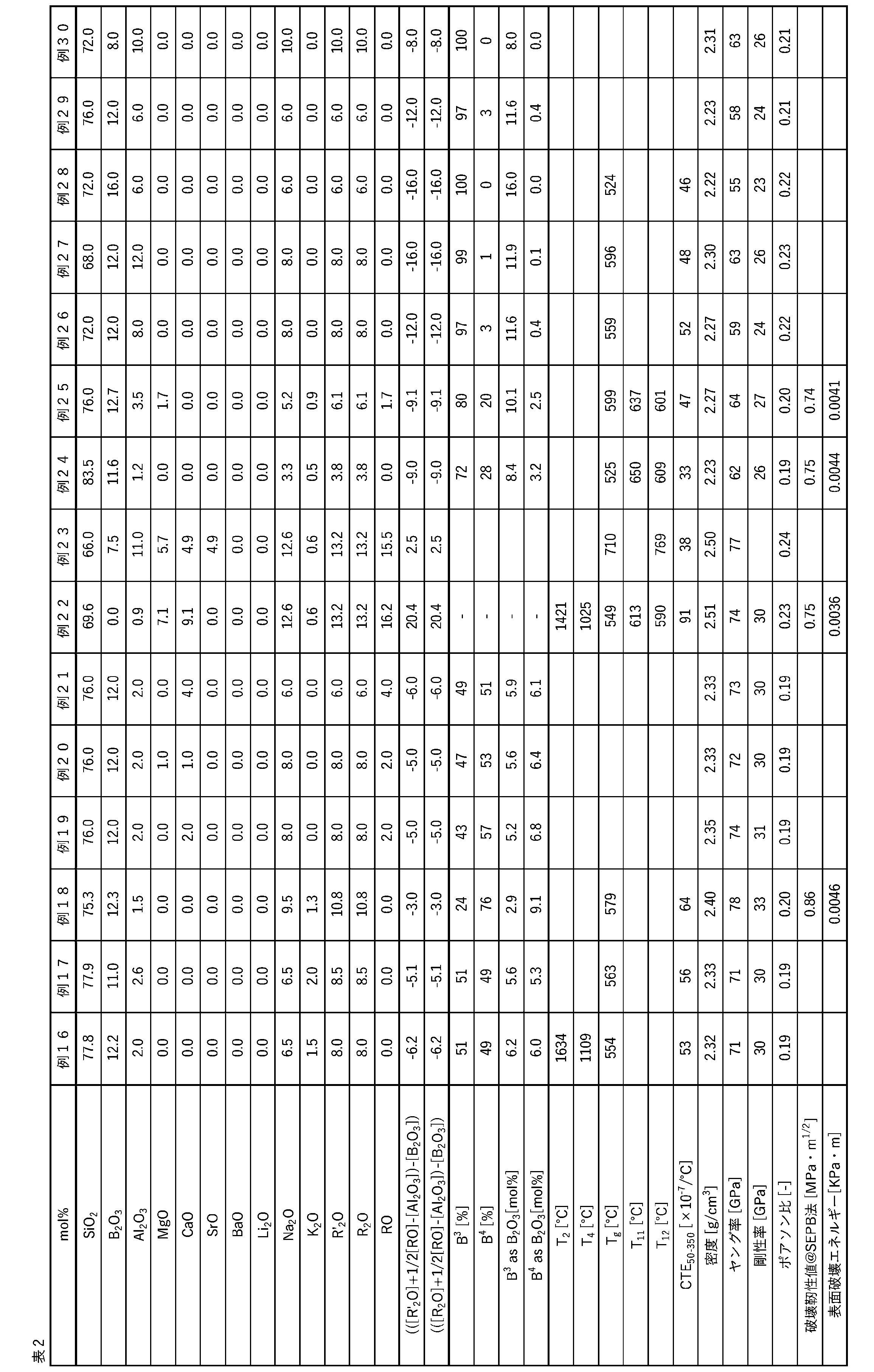
実施例である例1~21のガラスは、破壊靭性値またはヤング率が高く、密度が小さく、かつ、温度T11が低く粘度が低かった。
一方、比較例である例22は、SiO2が70%未満であり、B2O3を含有せず、Al2O3が1.0%未満であり、MgOが5.0%超であり、CaOが5.0%超であり、ROが5.0%超であるため、破壊靭性値に劣り、密度も大きかった。
一方、比較例である例22は、SiO2が70%未満であり、B2O3を含有せず、Al2O3が1.0%未満であり、MgOが5.0%超であり、CaOが5.0%超であり、ROが5.0%超であるため、破壊靭性値に劣り、密度も大きかった。
また、例23は、ヤング率に優れるものの、SiO2が70%未満であり、B2O3が10%未満であり、Al2O3が6.0%超であり、MgOが5.0%超であり、ROが5.0%超であるため、TgおよびT12が高かった。
また例24は、SiO2が80%超であり、R’2Oが6.0%未満であるため、破壊靭性値およびヤング率が小さく、さらに、温度T11が高く粘度が高かった。また、例25は、密度は低いものの、([R’2O]+1/2[RO])-[Al2O3]-[B2O3]が-6.5未満であるため、破壊靭性値、ヤング率が実施例と比して小かった。
また、例26は、密度は低いものの、Al2O3が6.0%超であり、([R’2O]+1/2[RO])-[Al2O3]-[B2O3]が-6.5未満であるため、ヤング率が低かった。また、例27は、密度は低いものの、SiO2が70%未満であり、Al2O3が6.0%超であり、([R’2O]+1/2[RO])-[Al2O3]-[B2O3]が-6.5未満であるため、ヤング率が低かった。
また、例28、29は、密度は低いものの、([R’2O]+1/2[RO])-[Al2O3]-[B2O3]が-6.5未満であるため、ヤング率が低かった。また、例30は、密度は低いものの、B2O3が10%未満であり、Al2O3が6.0%超であり、([R’2O]+1/2[RO])-[Al2O3]-[B2O3]が-6.5未満であるため、ヤング率が低かった。
<合わせガラスの作製>
以下の手順で試験例1~試験例7の合わせガラスを製造した。試験例1~試験例4が比較例であり、試験例5~試験例7が実施例である。
以下の手順で試験例1~試験例7の合わせガラスを製造した。試験例1~試験例4が比較例であり、試験例5~試験例7が実施例である。
(試験例1)
第1ガラス板として、厚さ2.0mm、表面粗さRaが2.0nm以下の、表2の例22に示す組成を有するガラスを使用した。中間膜として、厚さ0.78mmのポリビニルブチラール(PVB)を使用した。第2ガラス板として、厚さ2.0mmの表2の例22に示す組成を有するガラスを使用した。第1ガラス板、中間膜、第2ガラス板をこの順で積層し、120℃で15分間の予備接着を実施した後、130℃、1MPaの条件で圧着を実施した。その後90分間かけて室温、大気圧に戻すことで試験例1の合わせガラスを作製した。試験例1の合わせガラスは、第1ガラス板、第2ガラス板および中間膜の総厚は4.8mmであり、第1ガラス板の厚みt1と第2ガラス板の厚みt2との比(t1/t2)は1.0であった。
第1ガラス板として、厚さ2.0mm、表面粗さRaが2.0nm以下の、表2の例22に示す組成を有するガラスを使用した。中間膜として、厚さ0.78mmのポリビニルブチラール(PVB)を使用した。第2ガラス板として、厚さ2.0mmの表2の例22に示す組成を有するガラスを使用した。第1ガラス板、中間膜、第2ガラス板をこの順で積層し、120℃で15分間の予備接着を実施した後、130℃、1MPaの条件で圧着を実施した。その後90分間かけて室温、大気圧に戻すことで試験例1の合わせガラスを作製した。試験例1の合わせガラスは、第1ガラス板、第2ガラス板および中間膜の総厚は4.8mmであり、第1ガラス板の厚みt1と第2ガラス板の厚みt2との比(t1/t2)は1.0であった。
(試験例2)
第1ガラス板および第2ガラス板の厚みを表3に記載の値に変更した以外は、試験例1と同様にして合わせガラスを作製した。
第1ガラス板および第2ガラス板の厚みを表3に記載の値に変更した以外は、試験例1と同様にして合わせガラスを作製した。
(試験例3)
第1ガラス板の厚みを表3に記載の値に変更し、第2ガラス板として、厚さ0.7mmのソーダライムガラス(AGC社製、型番:AS2)を使用した以外は、試験例1と同様にして合わせガラスを作製した。
第1ガラス板の厚みを表3に記載の値に変更し、第2ガラス板として、厚さ0.7mmのソーダライムガラス(AGC社製、型番:AS2)を使用した以外は、試験例1と同様にして合わせガラスを作製した。
(試験例4~7)
第1ガラス板の種類を表3に記載のもの(いずれも表面粗さRaは2.0nm以下)に変更した以外は、試験例3と同様にして合わせガラスを作製した。
第1ガラス板の種類を表3に記載のもの(いずれも表面粗さRaは2.0nm以下)に変更した以外は、試験例3と同様にして合わせガラスを作製した。
上記で得られた合わせガラス板に対して、下記の手順によって臨界衝突破壊速度Vcrtを測定した。
<手順>
先端曲率半径200μm、頂角120°、重さ1.365gのタングステンカーバイド超硬合金を20km/h以上の速度で射出し、第1ガラス板の面に衝突させた。この衝突時に合わせガラスの断面から高速度カメラでタングステンカーバイド超硬合金の衝突で生じるき裂の進展過程を観察した。射出速度を変えながら当該試験を実施し、第1ガラス板の表面で生じたき裂が進展し、タングステンカーバイド超硬合金を衝突させた面とは反対の第1ガラス板の面まで到達したときを割れと判断して、その際の衝突速度を臨界衝突破壊速度Vcrtとした。
<手順>
先端曲率半径200μm、頂角120°、重さ1.365gのタングステンカーバイド超硬合金を20km/h以上の速度で射出し、第1ガラス板の面に衝突させた。この衝突時に合わせガラスの断面から高速度カメラでタングステンカーバイド超硬合金の衝突で生じるき裂の進展過程を観察した。射出速度を変えながら当該試験を実施し、第1ガラス板の表面で生じたき裂が進展し、タングステンカーバイド超硬合金を衝突させた面とは反対の第1ガラス板の面まで到達したときを割れと判断して、その際の衝突速度を臨界衝突破壊速度Vcrtとした。

実施例である試験例5~7の合わせガラスは、比較例と比して臨界衝突破壊速度が高かった。
なお、本出願は、2023年4月10日出願の日本特願2023-063642に基づくものであり、その内容は本出願の中に参照として援用される。
10 合わせガラス
11 第1ガラス板
12 第2ガラス板
13 中間膜
100 自動車
110 開口部
120 ハウジング
150 バックミラー
201 ミリ波レーダ
202 ステレオカメラ
300 電波
11 第1ガラス板
12 第2ガラス板
13 中間膜
100 自動車
110 開口部
120 ハウジング
150 バックミラー
201 ミリ波レーダ
202 ステレオカメラ
300 電波
Claims (22)
- 酸化物基準のモル%表示で、Li2Oを実質的に含有せず、
SiO2:70~80%
B2O3:10~17%
Al2O3:1.0~6.0%
MgO:0.0~5.0%
CaO:0.0~5.0%
SrO:0.0~5.0%
BaO:0.0~5.0%
Na2O:0.0~19%
K2O:0.0~10%
R’2O:6.0~19%
RO:0.0~5.0%
(ただし、ROはMgO、CaO、SrO、BaOから選ばれる少なくとも1種、R’2OはNa2O、K2Oから選ばれる少なくとも1種である)を含有し、
([R’2O]+1/2[RO]-[Al2O3])-[B2O3]≧-6.5である(ただし、[]は、該括弧内の各成分の酸化物基準のモル%表示の含有量を意味する)、車両用およびセンサー用ガラス。 - 3配位ホウ素の含有量が、B2O3換算で10モル%以下である、請求項1に記載の車両用およびセンサー用ガラス。
- 酸化物基準のモル%表示で、
SiO2:70~80%
B2O3:10~17%
Al2O3:1.0~6.0%
MgO:0.0~5.0%
CaO:0.0~5.0%
SrO:0.0~5.0%
BaO:0.0~5.0%
Li2O:0超~15%
Na2O:3.5~15%
K2O:0.0~10%
R2O:6.0~19%
RO:0.0~5.0%
(ただし、ROはMgO、CaO、SrO、BaOから選ばれる少なくとも1種、R2OはLi2O、Na2O、K2Oから選ばれる少なくとも1種である)を含有し、
([R2O]+1/2[RO]-[Al2O3])-[B2O3]≧-10.0である(ただし、[]は、該括弧内の各成分の酸化物基準のモル%表示の含有量を意味する)、車両用およびセンサー用ガラス。 - 3配位ホウ素の含有量が、B2O3換算で10モル%以下である、請求項3に記載の車両用およびセンサー用ガラス。
- ヤング率が65GPa以上である、請求項1または3に記載の車両用およびセンサー用ガラス。
- SEPB法で測定される破壊靭性値KICが0.76MPa・m1/2以上である、請求項5に記載の車両用およびセンサー用ガラス。
- ガラス粘度が1011dPa・sとなる温度T11が640℃以下である、請求項6に記載の車両用およびセンサー用ガラス。
- ヤング率が70GPa以上である、請求項7に記載の車両用およびセンサー用ガラス。
- SEPB法で測定される破壊靭性値KICが0.80MPa・m1/2以上である、請求項8に記載の車両用およびセンサー用ガラス。
- 表面粗さRaを5.0nm以下、厚みを2.5mmとしたとき、先端曲率半径200μm、頂角120°、重さ1.365gのタングステンカーバイド超硬合金を衝突させたときの臨界衝突破壊速度が35km/h以上である、請求項9に記載の車両用およびセンサー用ガラス。
- 先端曲率半径200μm、頂角120°、重さ1.365gのタングステンカーバイド超硬合金を衝突させたときの臨界衝突破壊速度が55km/h以上である、請求項9に記載の車両用およびセンサー用ガラス。
- 厚みが2.5mm以上である、請求項11に記載の車両用およびセンサー用ガラス。
- 請求項1または3に記載の車両用およびセンサー用ガラスからなる、曲げガラス。
- 第1ガラス板と、第2ガラス板と、前記第1ガラス板と前記第2ガラス板の間に挟持される中間膜とを有し、
前記第1ガラス板が、請求項1または3に記載の車両用およびセンサー用ガラスである、合わせガラス。 - 前記第1ガラス板の表面粗さRaを5.0nm以下、厚みを2.5mmとし、前記第1ガラス板の面に先端曲率半径200μm、頂角120°、重さ1.365gのタングステンカーバイド超硬合金を衝突させたときの臨界衝突破壊速度が35km/h以上である、請求項14に記載の合わせガラス。
- 前記第1ガラス板の面に先端曲率半径200μm、頂角120°、重さ1.365gのタングステンカーバイド超硬合金を衝突させたときの臨界衝突破壊速度が55km/h以上である、請求項14に記載の合わせガラス。
- 前記第1ガラス板、前記第2ガラス板、および前記中間膜の厚みの合計が4.5mm以上である、請求項16に記載の合わせガラス。
- 前記第1ガラス板の厚みt1と、前記第2ガラス板の厚みt2との比(t1/t2)が1.5以上である、請求項14に記載の合わせガラス。
- 第1ガラス板と、第2ガラス板と、前記第1ガラス板と前記第2ガラス板の間に挟持される中間膜とを有し、
前記第1ガラス板及び前記第2ガラス板が、請求項1または3に記載の車両用およびセンサー用ガラスである、合わせガラス。 - 前記第2ガラス板が、ソーダライムガラスである、請求項14に記載の合わせガラス。
- 前記第2ガラス板が、アルミノシリケートガラスである、請求項14に記載の合わせガラス。
- 前記第2ガラス板は、化学強化処理が施されている、請求項14に記載の合わせガラス。
Applications Claiming Priority (2)
| Application Number | Priority Date | Filing Date | Title |
|---|---|---|---|
| JP2023063642 | 2023-04-10 | ||
| JP2023-063642 | 2023-04-10 |
Publications (1)
| Publication Number | Publication Date |
|---|---|
| WO2024214637A1 true WO2024214637A1 (ja) | 2024-10-17 |
Family
ID=93059299
Family Applications (1)
| Application Number | Title | Priority Date | Filing Date |
|---|---|---|---|
| PCT/JP2024/014003 Ceased WO2024214637A1 (ja) | 2023-04-10 | 2024-04-04 | 車両用およびセンサー用ガラス、曲げガラス、合わせガラス |
Country Status (1)
| Country | Link |
|---|---|
| WO (1) | WO2024214637A1 (ja) |
Cited By (1)
| Publication number | Priority date | Publication date | Assignee | Title |
|---|---|---|---|---|
| WO2026075247A1 (ja) * | 2024-10-04 | 2026-04-09 | Agc株式会社 | ガラス板および合わせガラス |
Citations (3)
| Publication number | Priority date | Publication date | Assignee | Title |
|---|---|---|---|---|
| JPH06211538A (ja) * | 1992-12-29 | 1994-08-02 | Nippon Electric Glass Co Ltd | 固体撮像素子用カバーガラス |
| JP2002249340A (ja) * | 2001-11-30 | 2002-09-06 | Hoya Corp | 半導体パッケージ用カバーガラス |
| WO2022131274A1 (ja) * | 2020-12-18 | 2022-06-23 | Agc株式会社 | ボロシリケートガラス、合わせガラス、及び車両用窓ガラス |
-
2024
- 2024-04-04 WO PCT/JP2024/014003 patent/WO2024214637A1/ja not_active Ceased
Patent Citations (3)
| Publication number | Priority date | Publication date | Assignee | Title |
|---|---|---|---|---|
| JPH06211538A (ja) * | 1992-12-29 | 1994-08-02 | Nippon Electric Glass Co Ltd | 固体撮像素子用カバーガラス |
| JP2002249340A (ja) * | 2001-11-30 | 2002-09-06 | Hoya Corp | 半導体パッケージ用カバーガラス |
| WO2022131274A1 (ja) * | 2020-12-18 | 2022-06-23 | Agc株式会社 | ボロシリケートガラス、合わせガラス、及び車両用窓ガラス |
Cited By (1)
| Publication number | Priority date | Publication date | Assignee | Title |
|---|---|---|---|---|
| WO2026075247A1 (ja) * | 2024-10-04 | 2026-04-09 | Agc株式会社 | ガラス板および合わせガラス |
Similar Documents
| Publication | Publication Date | Title |
|---|---|---|
| JP7841537B2 (ja) | ガラス板、合わせガラス、車両用窓ガラス、及び建築用窓ガラス | |
| US20260042701A1 (en) | Glass, window glass for vehicles, glass for sensors, and laminated glass | |
| JP2017508693A (ja) | 積層ガラス | |
| US20230331622A1 (en) | Borosilicate glass, laminated glass, and window glass for vehicle | |
| JPWO2018030093A1 (ja) | 車両用合わせガラス | |
| JP7729334B2 (ja) | 車両用合わせガラス | |
| US20240293999A1 (en) | Borosilicate glass | |
| WO2018030095A1 (ja) | 車両用合わせガラス | |
| US20250115512A1 (en) | Alkali borosilicate glass, curved glass, laminated glass, architectural window glass and vehicle window glass | |
| WO2025142920A1 (ja) | 建築用、車両用又はセンサー用ガラス及び合わせガラス | |
| JPWO2018030094A1 (ja) | 車両用合わせガラス | |
| WO2026079291A1 (ja) | 車両用およびセンサー用ガラス、曲げガラス、合わせガラス | |
| WO2025142918A1 (ja) | 建築用、車両用又はセンサー用ガラス、曲げガラス、風冷強化ガラス及び合わせガラス | |
| WO2026053984A1 (ja) | 合わせガラス | |
| WO2025142914A1 (ja) | 合わせガラス | |
| JP2019151516A (ja) | ガラス板及びそれを用いたガラス樹脂複合体 | |
| JP2024069067A (ja) | ガラス板、曲げガラス、合わせガラス、車両用窓ガラス及び建築用窓ガラス | |
| WO2025142922A1 (ja) | ガラス、車両用窓ガラス、建築用窓ガラス及びセンサー用ガラス並びに合わせガラス | |
| WO2026053986A1 (ja) | 合わせガラス及び合わせガラスの製造方法 | |
| WO2026075247A1 (ja) | ガラス板および合わせガラス | |
| WO2026053988A1 (ja) | 合わせガラス及び合わせガラスの製造方法 | |
| US20230348315A1 (en) | Glass plate, laminated glass, window glass for building, and window glass for vehicle | |
| US20240278540A1 (en) | Glass plate, vehicular window glass, and laminated glass | |
| JP2019131430A (ja) | ガラス板 | |
| WO2018193721A1 (ja) | ガラス板 |
Legal Events
| Date | Code | Title | Description |
|---|---|---|---|
| 121 | Ep: the epo has been informed by wipo that ep was designated in this application |
Ref document number: 24788662 Country of ref document: EP Kind code of ref document: A1 |
|
| NENP | Non-entry into the national phase |
Ref country code: DE |
|
| 122 | Ep: pct application non-entry in european phase |
Ref document number: 24788662 Country of ref document: EP Kind code of ref document: A1 |