WO2024204366A1 - 放熱グリース - Google Patents
放熱グリース Download PDFInfo
- Publication number
- WO2024204366A1 WO2024204366A1 PCT/JP2024/012275 JP2024012275W WO2024204366A1 WO 2024204366 A1 WO2024204366 A1 WO 2024204366A1 JP 2024012275 W JP2024012275 W JP 2024012275W WO 2024204366 A1 WO2024204366 A1 WO 2024204366A1
- Authority
- WO
- WIPO (PCT)
- Prior art keywords
- boron nitride
- primary particles
- meth
- grease
- heat
- Prior art date
- Legal status (The legal status is an assumption and is not a legal conclusion. Google has not performed a legal analysis and makes no representation as to the accuracy of the status listed.)
- Ceased
Links
Images


Classifications
-
- C—CHEMISTRY; METALLURGY
- C09—DYES; PAINTS; POLISHES; NATURAL RESINS; ADHESIVES; COMPOSITIONS NOT OTHERWISE PROVIDED FOR; APPLICATIONS OF MATERIALS NOT OTHERWISE PROVIDED FOR
- C09K—MATERIALS FOR MISCELLANEOUS APPLICATIONS, NOT PROVIDED FOR ELSEWHERE
- C09K5/00—Heat-transfer, heat-exchange or heat-storage materials, e.g. refrigerants; Materials for the production of heat or cold by chemical reactions other than by combustion
- C09K5/08—Materials not undergoing a change of physical state when used
- C09K5/14—Solid materials, e.g. powdery or granular
Definitions
- the present invention relates to thermal grease.
- the basic method is to remove heat by bringing the heat-generating parts into contact with a cooling member inside the electronic device. In this case, if there is a gap between the heat-generating part and the cooling member, the heat removal efficiency decreases, so generally, heat is removed by indirectly bringing the heat-generating part into contact with the cooling member via a heat dissipation member.
- heat dissipating grease is made by kneading heat dissipating filler and liquid polymer into a paste. Heat dissipating grease has good wettability to the surface of the mounting component and good conformability to the microscopic irregularities on the surface of the mounting component, making it possible to reduce the interfacial thermal resistance. In addition, because heat dissipating grease is fluid, the grease layer can be made thinner by applying pressure to crush it, making it possible to reduce the internal thermal resistance of the grease layer. Therefore, heat dissipating grease has high thermal conductivity performance, even among heat dissipating materials.
- Heat dissipating grease that uses boron nitride particles as a heat dissipating filler is known as a conventional technology (see, for example, Patent Document 1). Since boron nitride particles have a high thermal conductivity, using boron nitride particles as a heat dissipating filler can further improve the thermal conductivity performance of the heat dissipating grease.
- the present invention aims to provide a thermal grease that can reduce interfacial thermal resistance.
- the present inventors have conducted extensive research to solve the above problems, and as a result have found that the above problems can be solved by controlling the aspect ratio of boron nitride primary particles in thermal dissipation grease, thereby completing the present invention. That is, the present invention is as follows. [1] A thermally conductive grease comprising primary particles of boron nitride, the primary particles of boron nitride having an aspect ratio of 0.3 to 9. [2] The thermal grease according to the above [1], wherein the major axis length of the boron nitride primary particles is 0.5 to 20 ⁇ m. [3] The thermal grease according to the above [1] or [2], further comprising a thermally conductive filler different from the boron nitride primary particles, the thermally conductive filler comprising a spherical filler.
- the present invention provides a thermal grease that can reduce interfacial thermal resistance.
- FIG. 1 shows the X-ray diffraction pattern of amorphous boron nitride.
- FIG. 2 is a scanning electron microscope (SEM) photograph of the boron nitride primary particles 1 used in the examples.
- the thermally conductive grease of the present invention contains primary particles of boron nitride, and the primary particles of boron nitride have an aspect ratio of 0.3 to 9.
- the aspect ratio (hereinafter simply referred to as the aspect ratio) defined as the maximum width of the crystal ab plane/maximum thickness in the crystal c-axis direction of the boron nitride primary particles used in the thermal grease of the present invention is preferably 0.3 to 9. If the aspect ratio of the boron nitride primary particles is less than 0.3 or greater than 9, the viscosity of the thermal grease increases. The wettability of the thermal grease to the surface of the mounting member decreases, and the thermal grease is less able to follow the microscopic unevenness of the surface of the mounting member, resulting in a high interfacial thermal resistance.
- the aspect ratio of the boron nitride primary particles used in the thermal grease of the present invention is preferably 0.3 to 9, more preferably 0.6 to 8, and even more preferably 0.9 to 7.
- the aspect ratio of the boron nitride primary particles can be measured by the method described in the Examples below.
- the major axis length of the boron nitride primary particles used in the thermal grease of the present invention is preferably 0.5 ⁇ m or more.
- the major axis length of the boron nitride primary particles is 0.5 ⁇ m or more, the interfacial thermal resistance of the thermal grease can be further reduced, and the thermal conductivity of the thermal grease can be increased even if the content of boron nitride primary particles in the thermal grease is low.
- the major axis length of the boron nitride primary particles used in the thermal grease of the present invention is more preferably 3.5 to 15 ⁇ m.
- the major axis length of the boron nitride primary particles can be measured by the method described in the Examples below.
- the boron nitride primary particles used in the thermal grease of the present invention can be manufactured, for example, by a manufacturing method using a flux method described below.
- the manufacturing method of the boron nitride primary particles used in the thermal grease of the present invention includes, for example, a step (A) of melting a mixture containing amorphous boron nitride obtained by firing boric acid and melamine and lithium borate to prepare a melt, a step (B) of cooling the melt, and a step (C) of dissolving the lithium borate with an acid to extract boron nitride particles from the lithium borate.
- Step (A) In the step (A), a mixture containing amorphous boron nitride obtained by firing boric acid and melamine, and lithium borate is melted to prepare a melt.
- amorphous boron nitride The amorphous boron nitride used in step (A) is obtained by calcining boric acid and melamine.
- the molar ratio of boron atoms to nitrogen atoms in the total of boric acid and melamine does not necessarily have to be fixed at 5:5, and can be appropriately changed within the range of 2:8 to 8:2, preferably 3:7 to 7:3, depending on reactivity and yield.
- the firing is preferably carried out in a non-oxidizing atmosphere, the firing temperature is preferably 400 to 1200°C, and the firing time is preferably 1 to 5 hours.
- the firing temperature is preferably 400 to 1200°C, and the firing time is preferably 1 to 5 hours.
- the firing temperature may be kept constant or may be changed continuously or discontinuously, and there are no particular restrictions on the firing time or the rate of heating and cooling.
- the container for storing the raw materials may be, for example, a container made of hexagonal boron nitride, and the heating device may be, for example, a firing furnace using an electric heater.
- Amorphous boron nitride does not need to be completely amorphous, and may be partially crystallized.
- the mixed powder of boric acid and melamine may be subjected to briquetting or tableting.
- amorphous boron nitride as the raw material for the boron nitride primary particles, it is possible to dissolve boron nitride more completely in lithium borate, and to dissolve boron nitride more uniformly in lithium borate. This promotes crystal growth in the thickness direction (c-axis direction) of the boron nitride primary particles, and reduces the aspect ratio (F/T) of the maximum length (long axis length) in the plane direction to the length (T) in the thickness direction of the boron nitride particles.
- undissolved boron nitride remains in the lithium borate, and these act as nuclei to promote crystal growth in the planar direction (a-axis direction or b-axis direction) of the primary boron nitride particles, which is thought to increase the aspect ratio (F/T) of the maximum planar length (long axis length) (F) to the thickness direction length (T) of the primary boron nitride particles.
- Lithium borate By using lithium borate as a flux in step (A), crystal growth in the thickness direction (c-axis direction) of the boron nitride primary particles is promoted, and the aspect ratio (F/T) of the maximum length (long axis length) in the plane direction (F) to the length in the thickness direction (T) of the boron nitride primary particles can be reduced.
- the lithium borate used in step (A) include lithium tetraborate (Li 2 B 4 O 7 ), trilithium borate (Li 3 BO 3 ), and lithium metaborate (LiBO 2 ). These lithium borates can be used alone or in combination of two or more. Among these lithium borates, trilithium borate (Li 3 BO 3 ) is preferred.
- the number of moles of amorphous boron nitride in the mixture containing amorphous boron nitride and lithium borate is preferably 10 to 0.5 moles per mole of lithium borate.
- the number of moles of amorphous boron nitride is 8 to 0.7 moles, the boron nitride primary particles used in the thermal grease of the present invention can be easily produced. From this viewpoint, the number of moles of amorphous boron nitride is more preferably 8 to 0.7 moles, and even more preferably 5 to 1 mole, per mole of lithium borate.
- step (A) the mixture is melted to prepare a melt.
- the crucible used when melting the mixture is preferably a carbon crucible or a boron nitride crucible.
- the melting temperature at which the mixture is melted is not particularly limited as long as the mixture is completely melted and the volatilization of lithium borate can be suppressed.
- the melting temperature at which the mixture is melted is, for example, 1000 to 1700°C, preferably 1100 to 1500°C.
- the melting time at which the mixture is melted is not particularly limited as long as the mixture is completely melted.
- the melting time at which the mixture is melted is, for example, 1 to 30 hours, preferably 5 to 20 hours.
- the atmosphere at which the mixture is melted is preferably a nitrogen atmosphere.
- step (B) the melt is cooled.
- the cooling method of the melt is not particularly limited, and the melt may be cooled slowly or may be allowed to cool naturally.
- the cooling rate when the melt is cooled slowly is, for example, 0.5 to 10° C./min.
- Step (C) the lithium borate is dissolved with an acid to extract boron nitride primary particles from the lithium borate.
- the crucible containing the lithium borate and the boron nitride particles may be charged into the acid, or the contents removed from the crucible may be charged into the acid.
- the acid used to dissolve the lithium borate is preferably dilute nitric acid.
- the content of the boron nitride primary particles in the thermal grease of the present invention is 1 to 20% by volume.
- the content of the boron nitride primary particles in the thermal grease is 1% by volume or more, the thermal conductivity of the thermal grease is high, and as a result, the interfacial heat resistance is low.
- the content of the boron nitride primary particles in the thermal grease is 20% by volume or less, the viscosity of the thermal grease can be prevented from increasing, and as a result, the wettability of the thermal grease to the surface of the mounting member is improved.
- the thermal grease is able to better conform to the microscopic unevenness of the surface of the mounting member, and therefore the interfacial heat resistance is further reduced.
- the content of the boron nitride primary particles in the thermal grease is preferably 2.5 to 15% by volume, and more preferably 5 to 10% by volume.
- the heat-dissipating grease of the present invention preferably contains a heat-dissipating filler other than the boron nitride primary particles (hereinafter simply referred to as heat-dissipating filler) in addition to the boron nitride primary particles.
- heat-dissipating filler include amorphous granular fillers, spherical fillers, needle-like fillers, fibrous fillers, and plate-like fillers. These heat-dissipating fillers can be used alone or in combination of two or more.
- spherical fillers are preferred from the viewpoint of being able to increase the content of the heat-dissipating filler while suppressing the increase in the viscosity of the heat-dissipating grease.
- the spherical fillers include alumina, silica, calcium carbonate, and zinc oxide. These spherical fillers can be used alone or in combination of two or more.
- alumina is preferred from the viewpoint of being able to further increase the thermal conductivity of the heat-dissipating grease.
- the content of the spherical fillers in the heat-dissipating filler is preferably 80 to 100% by volume, more preferably 90 to 100% by volume, and even more preferably 95 to 100% by volume.
- the total content of the heat-dissipating filler and the content of the boron nitride primary particles is preferably 45 to 90 volume %.
- the thermal conductivity of the heat-dissipating grease can be further increased while suppressing an increase in the viscosity of the heat-dissipating grease. From this perspective, the total content of the heat-dissipating filler and the content of the boron nitride primary particles is more preferably 55 to 88 volume %, and even more preferably 75 to 85 volume %.
- the volumetric average particle size of the heat dissipating filler is preferably 0.1 to 150 ⁇ m, more preferably 0.1 to 120 ⁇ m.
- the average particle size of each heat dissipating filler is taken into consideration, and large particle sizes to small particle sizes are mixed in an appropriate ratio so that the filling is dense, so that the fluidity and dispersibility of the heat dissipating filler can be improved even if the filling amount is high.
- the sphericity of the heat-dissipating filler is usually less than 1, and preferably 0.8 or more.
- the content of the heat-dissipating filler can be increased while suppressing the increase in the viscosity of the heat-dissipating grease, and as a result, the thermal conductivity of the heat-dissipating grease can be further increased.
- the sphericity of the heat-dissipating filler is more preferably 0.85 or more, and even more preferably 0.9 or more.
- the sphericity of the heat-dissipating filler can be measured by the method described in the examples below.
- the heat dissipating grease of the present invention preferably contains a liquid polymer in addition to the boron nitride primary particles.
- the liquid polymer used in the heat dissipating grease of the present invention is not particularly limited as long as it is a liquid polymer that is usually used in grease.
- liquid polymer used in the heat dissipating grease of the present invention examples include hydrocarbon oils such as polyolefins, alkyl aromatics, and alicyclic compounds, polyethers such as polyglycols and phenyl ethers, esters such as diesters and polyol esters, phosphorus compounds such as aromatic phosphate esters, silicon compounds such as silicone oils, halogen compounds such as fluorinated polyethers, mineral oils, fluorosilicones, acrylic resins, and urethane resins.
- silicone oils are preferred from the viewpoints of heat resistance, weather resistance, electrical insulation, and chemical stability.
- the content of the liquid polymer is preferably 5 to 55 volume %, more preferably 7 to 45 volume %, and even more preferably 10 to 25 volume %, when the total of the boron nitride, the thermally conductive filler, the liquid polymer, and the dispersant is taken as 100 volume %.
- the viscosity of the liquid polymer used in the thermal grease of the present invention when measured at a temperature of 25° C. and a shear rate of 1 s ⁇ 1 , is preferably 100 Pa ⁇ s or less. If the viscosity is 10 Pa ⁇ s or less when measured at a temperature of 25° C. and a shear rate of 1 s ⁇ 1 , the applicability of the thermal grease will be further improved. From this viewpoint, the viscosity of the liquid polymer used in the thermal grease of the present invention, when measured at a temperature of 25° C. and a shear rate of 1 s ⁇ 1 , is more preferably 1 Pa ⁇ s or less.
- the viscosity of the liquid polymer used in the thermal grease of the present invention when measured at a temperature of 25° C. and a shear rate of 1 s ⁇ 1 , is preferably 0.01 Pa ⁇ s or more, more preferably 0.1 Pa ⁇ s or more.
- the viscosity of the liquid polymer can be measured by the method described in the Examples below.
- the thermal grease of the present invention may contain a dispersant in addition to the boron nitride primary particles and the liquid polymer.
- a dispersant in addition to the boron nitride primary particles and the liquid polymer.
- the dispersant is used for the purpose of uniformly dispersing the boron nitride primary particles in the liquid polymer.
- the dispersant is not particularly limited as long as it can reduce the viscosity of the thermal grease containing the boron nitride primary particles, but a dispersant having an anionic group and a cationic group is preferable, and a dispersant containing a copolymer described later is more preferable.
- the dispersant may further contain a solvent or other optional additives as necessary.
- Dispersants can prevent aggregation and settling of the boron nitride primary particles and heat-dissipating filler in heat-dissipating grease, improving stability, as well as allowing the liquid polymer to be highly loaded with boron nitride primary particles and heat-dissipating filler and reducing the viscosity of the heat-dissipating grease. In addition, they can improve various other effects associated with improved dispersibility of the boron nitride primary particles and heat-dissipating filler.
- the dispersant disperses the boron nitride primary particles and the heat dissipating filler by electrostatic repulsion and can prevent the heat dissipating filler from re-agglomerating with each other. It is also preferable that the dispersant further has a dispersibility improving effect by steric hindrance repulsion.
- the copolymer used in the dispersant has (meth)acrylic monomer units A having an anionic group, (meth)acrylic monomer units B having a cationic group, and (meth)acrylic monomer units C other than the (meth)acrylic monomer units A and the (meth)acrylic monomer units B, and it is preferable that the weight average molecular weight of the (meth)acrylic monomer units C is 2,000 to 9,000.
- the copolymer can significantly reduce the viscosity of the thermal grease.
- “monomer” refers to a monomer having a polymerizable unsaturated bond before polymerization
- “monomer unit” refers to a repeating unit that constitutes part of a copolymer after polymerization and is derived from a specific monomer.
- (meth)acrylic monomer unit A” is also referred to simply as “unit A”
- (meth)acrylic monomer unit B” is also referred to simply as “unit B”
- “(meth)acrylic monomer unit C” is also referred to simply as "unit C”.
- the (meth)acrylic monomer unit A is a repeating unit having an anionic group.
- the anionic group is not particularly limited, but may be, for example, a carboxy group, a phosphoric acid group, a phenolic hydroxy group, or a sulfonic acid group. Among these, it is preferable that the anionic group is at least one selected from the group consisting of a carboxy group, a phosphoric acid group, and a phenolic hydroxy group, and it is more preferable that the anionic group is a carboxy group.
- the dispersibility of the boron nitride primary particles and the heat dissipating filler tends to be further improved.
- the viscosity of the heat dissipating grease of the present invention can be sufficiently reduced.
- the unit A further has an electron-withdrawing group bonded to the anionic group.
- an electron-withdrawing group is not particularly limited as long as it has the effect of stabilizing the anion of the anionic group.
- an acrylic monomer containing an electron-withdrawing substituent such as a halogen element on the carbon atom at the ⁇ -position of the carboxyl group may be used.
- the unit A preferably does not have an electron-donating group bonded to the anionic group or has a group with low electron-donating properties.
- Such an electron-donating group is not particularly limited as long as it has the effect of destabilizing the anion of the anionic group.
- an acrylic monomer that does not contain a substituent of an electron-donating group such as a methyl group on the carbon atom at the ⁇ -position of the carboxyl group may be used.
- the dispersibility of the heat-dissipating filler tends to be further improved.
- the copolymer can sufficiently reduce the viscosity of the heat-dissipating grease of the present invention.
- Such (meth)acrylic monomers are not particularly limited, but examples include acrylic acid, methacrylic acid, acid phosphooxypropyl methacrylate, acid phosphooxypolyoxyethylene glycol monomethacrylate, acid phosphooxypolyoxypropylene glycol monomethacrylate, phosphoric acid-modified epoxy acrylate, 2-acryloyloxyethyl acid phosphate, 2-methacryloyloxyethyl acid phosphate, 4-hydroxyphenyl acrylate, 4-hydroxyphenyl methacrylate, 2-methacryloyloxyethyl succinic acid, 2-acrylamido-2-methylpropanesulfonic acid, etc.
- acrylic acid 2-methacryloyloxyethyl phosphate, 4-hydroxyphenyl methacrylate, and 2-acrylamido-2-methylpropanesulfonic acid are preferred, and acrylic acid is more preferred.
- the affinity of the copolymer to the boron nitride primary particles and the heat-dissipating filler is improved, and the dispersibility of the boron nitride primary particles and the heat-dissipating filler tends to be improved.
- the copolymer can sufficiently reduce the viscosity of the heat-dissipating grease of the present invention.
- the unit A may be used alone or in combination of two or more types.
- the (meth)acrylic monomer unit B is a repeating unit having a cationic group.
- the cationic group is not particularly limited, but for example, the cationic group is preferably one or more selected from the group consisting of a primary amino group, a secondary amino group, a tertiary amino group, and a quaternary ammonium salt. Among these, a tertiary amino group is more preferable. By having such a group, the dispersibility of the heat dissipating filler tends to be further improved. As a result, the copolymer can sufficiently reduce the viscosity of the heat dissipating grease of the present invention.
- the unit B further has an electron-donating group bonded to the cationic group.
- an electron-donating group is not particularly limited as long as it has the effect of stabilizing the cation of the cationic group.
- an acrylic monomer containing an electron-donating substituent such as a methyl group on the carbon atom at the ⁇ -position of the amino group may be used.
- the dispersibility of the boron nitride primary particles and the heat dissipating filler tends to be further improved.
- the copolymer can sufficiently reduce the viscosity of the heat dissipating grease of the present invention.
- the unit B preferably does not have an electron-withdrawing group bonded to the cationic group or has a group with low electron-withdrawing properties.
- electron-withdrawing groups are not particularly limited as long as they have the effect of destabilizing the cations of the cationic group.
- an acrylic monomer that does not contain a substituent of an electron-withdrawing group such as a carboxyl group on the carbon atom at the ⁇ -position of the amino group may be used.
- This structure tends to further improve the dispersibility of the boron nitride primary particles and the heat-dissipating filler.
- the copolymer can sufficiently reduce the viscosity of the heat-dissipating grease of the present invention.
- Such (meth)acrylic monomers are not particularly limited, but examples include 1-aminoethyl acrylate, 1-aminopropyl acrylate, 1-aminoethyl methacrylate, 1-aminopropyl methacrylate, dimethylaminoethyl methacrylate, diethylaminoethyl methacrylate, t-butylaminoethyl (meth)acrylate, dimethylaminoethyl methacrylate quaternary salt, 1,2,2,6,6-pentamethyl-4-piperidyl methacrylate, 2,2,6,6-tetramethyl-4-piperidyl methacrylate, dimethylaminoethyl acrylate benzyl chloride quaternary salt, etc.
- 1,2,2,6,6-pentamethyl-4-piperidyl methacrylate and 2,2,6,6-tetramethyl-4-piperidyl methacrylate are preferred, and 1,2,2,6,6-pentamethyl-4-piperidyl methacrylate is more preferred.
- the affinity of the copolymer to the boron nitride primary particles and the heat-dissipating filler is improved, and the dispersibility of the boron nitride primary particles and the heat-dissipating filler tends to be improved.
- the copolymer can sufficiently reduce the viscosity of the heat-dissipating grease of the present invention.
- the unit B may be used alone or in combination of two or more types.
- the (meth)acrylic monomer unit C is a (meth)acrylic monomer unit other than the unit A and the unit B, and is a (meth)acrylic monomer that does not contain a cationic group or an anionic group in the molecule.
- the (meth)acrylic monomer C has a skeleton that has high affinity or compatibility with the liquid polymer used in the heat-dissipating grease.
- skeletons are not particularly limited, but examples include amphiphilic skeletons such as oxyalkylene skeletons, siloxane skeletons such as dimethylsiloxane, hydrophobic skeletons such as hydrocarbon skeletons of alkyl and aryl, and hydrophilic skeletons such as phosphate diester skeletons.
- oxyalkylene skeletons, siloxane skeletons, and hydrocarbon skeletons are preferred, siloxane skeletons and hydrocarbon skeletons are more preferred, and siloxane skeletons are even more preferred.
- the compatibility between the copolymer and the liquid polymer is further improved, and the dispersibility of the boron nitride primary particles and heat-dissipating filler in the heat-dissipating grease tends to be further improved.
- the copolymer can sufficiently reduce the viscosity of the heat-dissipating grease of the present invention.
- Such (meth)acrylic monomers are not particularly limited, but examples thereof include ethoxycarbonylmethyl (meth)acrylate, phenol ethylene oxide modified (meth)acrylate, phenol (ethylene oxide 2 mol modified) (meth)acrylate, phenol (ethylene oxide 4 mol modified) (meth)acrylate, paracumylphenol ethylene oxide modified (meth)acrylate, nonylphenol ethylene oxide modified (meth)acrylate, nonylphenol (ethylene oxide 4 mol modified) (meth)acrylate, nonylphenol (ethylene oxide 8 mol modified) (meth)acrylate, nonylphenol (propylene oxide 2.5 mol modified) acrylate, 2-ethylhexylcarbitol (meth)acrylate, ethylene oxide modified phthalic acid (meth)acrylate, ethylene (meth)acrylic monomers having an oxyalkylene skeleton, such as oxide-modified succinic acid (meth)acrylate and tetrahydrofurfuryl (meth)
- acrylic monomers such as 2-hydroxyethyl (meth)acrylate, 2-hydroxypropyl (meth)acrylate, 3-hydroxypropyl (meth)acrylate, 4-hydroxybutyl (meth)acrylate, 2-hydroxy-3-phenoxypropyl (meth)acrylate, and 3-chloro-2-hydroxypropyl (meth)acrylate;
- (meth)acrylic monomers having an amide bond such as N,N-dimethyl (meth)acrylamide, N,N-diethyl (meth)acrylamide, N-isopropyl (meth)acrylamide, diacetone (meth)acrylamide, and acryloylmorpholine;
- (meth)acrylic monomers having a siloxane skeleton such as ⁇ -butyl- ⁇ -(3-methacryloxypropyl)polydimethylsiloxane;
- the unit C may be used alone or in combination of two or more types.
- (meth)acrylic monomers having a siloxane skeleton such as ⁇ -butyl- ⁇ -(3-methacryloxypropyl)polydimethylsiloxane, are preferred.
- the weight average molecular weight of the (meth)acrylic monomer C is preferably 2,000 to 9,000.
- the affinity of the copolymer to the liquid polymer is good, and the dispersibility of the boron nitride primary particles and the heat dissipating filler is further improved.
- the viscosity of the heat dissipating grease of the present invention can be sufficiently reduced.
- the weight average molecular weight of the (meth)acrylic monomer C is 9,000 or less, the copolymer can be easily dissolved in the liquid polymer.
- the weight average molecular weight of the (meth)acrylic monomer C is more preferably 2500 to 7000, even more preferably 3000 to 6000, and even more preferably 3500 to 5500.
- the weight average molecular weight of the (meth)acrylic monomer C is the weight average molecular weight of the (meth)acrylic monomer unit C.
- the content of unit A is preferably 30 to 80 mol %, and more preferably 40 to 65 mol %, relative to 100 mol % in total of unit A, unit B, and unit C.
- the content of unit A is 30 mol % or more, the affinity of the copolymer to the liquid polymer is improved, and the dispersibility of the boron nitride primary particles and the heat dissipating filler tends to be improved.
- the copolymer can sufficiently reduce the viscosity of the heat dissipating grease of the present invention.
- the content of unit A is 80 mol % or less, the copolymer can contain a sufficient amount of unit B and unit C.
- the content of unit B is preferably 0.1 to 5 mol%, and more preferably 0.5 to 3 mol%, relative to 100 mol% of the total of unit A, unit B, and unit C.
- the content of unit B 0.1 mol% or more, the affinity of the copolymer with the heat dissipating filler is improved. Furthermore, by making it 5 mol% or less, a sufficient content of unit A and unit C can be contained in the copolymer.
- the total content of units A and units B is preferably 30.1 to 85 mol%, and more preferably 35 to 75 mol%, relative to 100 mol% of the total of units A, units B, and units C.
- the total content of units A and units B is 30.1 mol% or more, the affinity of the copolymer to the liquid polymer is improved, and the dispersibility of the boron nitride primary particles and the heat dissipating filler tends to be improved.
- the total content of units A and units B is 85 mol% or less, a sufficient amount of unit C can be contained in the copolymer.
- the molar ratio of units A to units B is preferably 6 to 800, and more preferably 20 to 400.
- the affinity of the copolymer to the liquid polymer is improved, and the dispersibility of the boron nitride primary particles and the heat dissipating filler tends to be improved.
- the content of unit C is preferably 20 to 70 mol%, and more preferably 30 to 55 mol%, relative to 100 mol% in total of unit A, unit B, and unit C.
- the content of unit C 20 mol% or more, the handling properties resulting from the viscosity of the copolymer become good. Also, by making it 70 mol% or less, it is possible to incorporate a sufficient amount of unit A and unit B into the copolymer.
- the weight average molecular weight of the copolymer is preferably 40,000 to 80,000, and more preferably 50,000 to 70,000.
- the weight average molecular weight of the copolymer is 40,000 or more, the boron nitride primary particles and the heat dissipating filler are less likely to aggregate due to the steric hindrance repulsion of the copolymer, and the dispersibility of the boron nitride primary particles and the heat dissipating filler in the heat dissipating grease is further improved.
- the weight average molecular weight of the copolymer is 80,000 or less, it becomes easier to dissolve the copolymer in the liquid polymer.
- the weight average molecular weight can be determined by GPC (gel permeation chromatography).
- the copolymer is preferably a copolymer represented by the following general formula (1).
- the copolymer represented by general formula (1) may be a random copolymer or a block copolymer.
- the unit A of the copolymer represented by the following general formula (1) is derived from acrylic acid, and the anionic group is a carboxy group.
- the unit B of the copolymer represented by the following general formula (1) is derived from 1,2,2,6,6-pentamethyl-4-piperidyl methacrylate, and the cationic group is a tertiary amino group.
- the unit C of the copolymer represented by the following general formula (1) is derived from ⁇ -butyl- ⁇ -(3-methacryloxypropyl)polydimethylsiloxane, and has a siloxane skeleton.
- s is an integer such that when the weight average molecular weight of the copolymer is 40,000 to 80,000, the content of unit A is 30 to 80 mol % relative to the total 100 mol % of unit A, unit B, and unit C
- t is an integer such that when the weight average molecular weight of the copolymer is 40,000 to 80,000, the content of unit C is 20 to 70 mol % relative to the total 100 mol % of unit A, unit B, and unit C
- u is an integer such that when the weight average molecular weight of the copolymer is 40,000 to 80,000, the content of unit B is 0.1 to 5.0 mol % relative to the total 100 mol % of unit A, unit B, and unit C
- v is an integer such that the weight average molecular weight of unit C is 2,000 to 9,000.
- the method for producing the copolymer is not particularly limited, and any known polymerization method for (meth)acrylic monomers can be used.
- the polymerization method include radical polymerization and anionic polymerization. Among these, radical polymerization is preferred.
- Thermal polymerization initiators used in radical polymerization are not particularly limited, but examples thereof include azo compounds such as azobisisobutyronitrile; and organic peroxides such as benzoyl peroxide, tert-butyl hydroperoxide, and di-tert-butyl peroxide.
- Photopolymerization initiators used in radical polymerization are not particularly limited, but examples thereof include benzoin derivatives.
- known polymerization initiators used in living radical polymerization such as ATRP and RAFT can also be used.
- the polymerization conditions are not particularly limited and can be adjusted as appropriate depending on the initiator and boiling point of the solvent used, as well as the type of monomer.
- the order of addition of the monomers is not particularly limited.
- the monomers may be mixed to start polymerization, and from the viewpoint of synthesizing a block copolymer, the monomers may be added sequentially to the polymerization system.
- the content of the dispersant in the heat-dissipating grease is preferably 0.1 to 5 volume %, more preferably 0.1 to 4.5 volume %, and even more preferably 0.1 to 4 volume %.
- the thermal grease of the present invention may contain components other than the boron nitride primary particles, the thermally conductive filler other than the boron nitride primary particles, the liquid polymer, and the dispersant (hereinafter referred to as other components) within a range that does not impair the effects of the present invention.
- other components include colorants, coupling agents, leveling agents, and the like.
- the thermal grease of the present invention may further contain additives such as reaction retarders, as necessary.
- the content of the colorant is preferably 0.001 to 0.2 parts by mass relative to 100 parts by mass of the thermal grease.
- the viscosity of the thermal grease of the present invention measured at a temperature of 25° C. and a shear rate of 1 s ⁇ 1 is preferably 4000 Pa ⁇ s or less. If the viscosity is 4000 Pa ⁇ s or less when measured at a temperature of 25° C. and a shear rate of 1 s ⁇ 1 , the applicability of the thermal grease is further improved. From this viewpoint, the viscosity of the thermal grease of the present invention measured at a temperature of 25° C. and a shear rate of 1 s ⁇ 1 is more preferably 2500 Pa ⁇ s or less, and even more preferably 2000 Pa ⁇ s or less.
- the viscosity of the thermal grease of the present invention measured at a temperature of 25° C. and a shear rate of 1 s ⁇ 1 is preferably 100 Pa ⁇ s or more, and more preferably 200 Pa ⁇ s or more.
- the viscosity of the thermal grease can be measured by the method described in the examples below.
- the thermal conductivity of the heat dissipating grease of the present invention is preferably 1.0 W/m ⁇ K or more.
- the thermal conductivity between the heat generating part and the cooling member can be further improved.
- the thermal conductivity of the heat dissipating grease of the present invention is more preferably 3.0 W/m ⁇ K or more, and even more preferably 5.0 W/m ⁇ K or more.
- the upper limit of the range of the thermal conductivity of the heat dissipating grease of the present invention is not particularly limited, but is usually 10 W/m ⁇ K or less.
- the thermal conductivity of the heat dissipating grease can be measured by the method described in the examples below.
- the interface thermal resistance of the thermal dissipative grease of the present invention is preferably 0.154 K/W or less.
- the interface thermal resistance of the thermal dissipative grease of the present invention is more preferably 0.154 K/W or less, and even more preferably 0.130 K/W or less.
- the lower limit of the range of the interface thermal resistance of the thermal dissipative grease of the present invention is not particularly limited, but is usually 0.05 K/W or more.
- the interface thermal resistance of the thermal dissipative grease can be measured by the method described in the Examples below.
- the thermally conductive grease of the present invention can be produced by kneading raw materials such as boron nitride primary particles with a planetary mixer, a universal mixer, a kneader, a hybrid mixer, or the like.
- KF-96-100CS dimethyl silicone oil, viscosity 0.1 Pa ⁇ s (heat dissipation filler)
- Alumina A DAW45S (product name, manufactured by Denka Co., Ltd.), spherical alumina, average particle size: 45 ⁇ m, circularity: 0.98
- B DAW05 (trade name, manufactured by Denka Co., Ltd.), spherical alumina, average particle size: 5 ⁇ m, circularity: 0.98
- C ASFP40 (product name, manufactured by Denka), ultrafine alumina, average particle size: 0.4 ⁇ m, circularity: 0.99
- the viscosity of the liquid polymer was measured using a method similar to that used to measure the viscosity of thermal grease, described below.
- the average particle size of the heat-dissipating filler was measured using a laser diffraction particle size distribution analyzer SALD-20 manufactured by Shimadzu Corporation.
- the evaluation sample was prepared by adding 50 ml of pure water and 5 g of the heat-dissipating filler to be measured to a glass beaker, stirring with a spatula, and then dispersing for 10 minutes in an ultrasonic cleaner.
- the dispersed heat-dissipating filler dispersion was added drop by drop to the sampler part of the device using a dropper, and measurements were taken once the absorbance had stabilized. D50 (median diameter) was used as the average particle size.
- the sphericity of the heat dissipating filler was measured using a wet flow type particle size and shape analyzer (product name "FPIA-3000", manufactured by Malvern Panalytical). After dispersing the sample in pure water, the liquid was flowed into a planar extensional flow cell, and 100 or more heat dissipating fillers moving in the cell were recorded as images using an objective lens, and the average circularity was calculated from the recorded image and the following formula (1).
- HD represents the circular equivalent diameter, which was obtained from the projected area of the target particle and the area ratio of the perfect circle.
- PM represents the projected perimeter of the target particle.
- the average value of 200 heat dissipating fillers calculated in this manner was taken as the average circularity.
- Preparation of boron nitride primary particles (Preparation of boron nitride primary particles 1) A mixed powder was prepared by mixing 100 g of boric acid (manufactured by Fuji Film Wako Pure Chemical Industries, Ltd.) and 100 g of melamine (manufactured by Fuji Film Wako Pure Chemical Industries, Ltd.). The prepared mixed powder was placed in a thermostatic chamber, humidified at 80°C and 95% relative humidity for 1 hour, and then dried for 1 hour to obtain melamine borate. The melamine borate was fired in a nitrogen atmosphere at a firing temperature of 1000°C for 2 hours to prepare amorphous boron nitride.
- the X-ray diffraction pattern of the prepared amorphous boron nitride is shown in FIG. 1.
- the X-ray diffraction pattern of hexagonal boron nitride powder (manufactured by Denka Co., Ltd., product name "SP-3") is also shown in FIG. 1. It was confirmed from the X-ray diffraction pattern that the obtained amorphous boron nitride was amorphous.
- the obtained amorphous boron nitride and trilithium borate (manufactured by Toshima Manufacturing Co., Ltd.) were put into a low-frequency resonant acoustic mixer (manufactured by Resodyn Acoustic Mixers, Inc., product name "LabRAM II") and mixed to prepare a mixture so that the molar ratio of amorphous boron nitride and trilithium borate in terms of boron nitride (BN) and trilithium borate (Li 3 BO 3 ) was 2:1.
- the obtained mixture was filled into a boron nitride container, and the boron nitride container filled with the mixture was placed in a tubular furnace.
- the mixture was melted for 20 hours at a melting temperature of 1300°C in a nitrogen atmosphere (nitrogen gas flow rate 1 L/min) to prepare a melt of the mixture. Thereafter, the melt was cooled to a temperature of 650°C at a cooling rate of 5°C/min, and at temperatures after 650°C, it was naturally cooled to precipitate and grow boron nitride particles. After the boron nitride container was cooled to room temperature, the contents of the boron nitride container were taken out.
- boron nitride primary particles were taken out from the contents of the beaker by suction filtration. The taken out boron nitride primary particles were dried at a drying temperature of 100° C. for 2 hours to obtain boron nitride primary particles 1.
- a scanning electron microscope photograph of the obtained boron nitride primary particles 1 is shown in FIG. 2.
- boron nitride primary particles 2 (Preparation of boron nitride primary particles 2) A mixture was prepared so that the molar ratio of amorphous boron nitride and trilithium borate (LiBO) was 2:1, calculated as boron nitride (BN) and trilithium borate, and the melting temperature was 1500°C. Except for this, primary boron nitride particles 2 were produced in the same manner as primary boron nitride particles 1.
- Boron nitride primary particles 3 were produced in the same manner as the production method of boron nitride primary particles 1, except that a mixture was prepared so that the molar ratio of amorphous boron nitride and trilithium borate (LiBO) was 1:1, and the mixture was melted for 1 hour.
- a mixture was prepared so that the molar ratio of amorphous boron nitride and trilithium borate (LiBO) was 1:1, and the mixture was melted for 1 hour.
- boron nitride primary particles 5 A mixture was prepared so that the molar ratio of amorphous boron nitride and trilithium borate (LiBO) was 1:1, and the mixture was melted at 1100°C for 20 hours. Except for this, boron nitride primary particles 5 were produced in the same manner as the method for producing boron nitride primary particles 1.
- the major axis length and aspect ratio of the obtained primary particles of boron nitride were measured as follows. A scanning electron microscope (manufactured by JEOL Ltd., product name "JSM-7001F") was used to measure the length in the thickness direction and the maximum length in the plane direction (long axis length) of 100 arbitrarily selected boron nitride primary particles. The average values of these were taken as the length in the thickness direction (T) and the maximum length in the plane direction (long axis length) (F). The aspect ratio (F/T) was calculated from the results.
- Dispersant ((Meth)acrylic monomer A having an anionic group) (A-1) Acrylic acid, manufactured by Toagosei Co., Ltd. ((meth)acrylic monomer B having a cationic group) (B-1) 1,2,2,6,6-pentamethyl-4-piperidyl methacrylate, "ADEKA STAB LA-82" manufactured by ADEKA Corporation ((Meth)acrylic monomer C) (C-1) ⁇ -butyl- ⁇ -(3-methacryloxypropyl)polydimethylsiloxane, "Silaplane FM-0721” manufactured by JNC Corporation, weight average molecular weight 5,000
- the dispersant was prepared in the following manner. First, 100 parts by mass of (meth)acrylic monomers consisting of 48.4 mol% acrylic acid, 1.6 mol% 1,2,2,6,6-pentamethyl-4-piperidyl methacrylate, and 50.0 mol% ⁇ -butyl- ⁇ -(3-methacryloxypropyl)polydimethylsiloxane (weight average molecular weight 5,000) were added to an autoclave equipped with a stirrer.
- (meth)acrylic monomers consisting of 48.4 mol% acrylic acid, 1.6 mol% 1,2,2,6,6-pentamethyl-4-piperidyl methacrylate, and 50.0 mol% ⁇ -butyl- ⁇ -(3-methacryloxypropyl)polydimethylsiloxane (weight average molecular weight 5,000) were added to an autoclave equipped with a stirrer.
- azobisisobutyronitrile manufactured by Tokyo Chemical Industry Co., Ltd.
- 1,000 parts by mass of a mixed solution of toluene (special reagent grade) and 2-propanol (special reagent grade) in a volume ratio of 7:3 was added as a solvent, and the inside of the autoclave was replaced with nitrogen.
- the autoclave was then heated in an oil bath at 65°C for 20 hours to carry out radical polymerization. After the polymerization was completed, the mixture was degassed under reduced pressure at 120°C for 1 hour to obtain a dispersant. Note that since the weight average molecular weight of ⁇ -butyl- ⁇ -(3-methacryloxypropyl)polydimethylsiloxane was 5,000, the weight average molecular weight of unit C was 5,000.
- the polymerization rate for 100% of the dispersant used was found to be over 98% when analyzed by gas chromatography. From this, it was estimated that the ratio of each monomer unit contained in the dispersant was approximately the same as the dispersant's feed ratio.
- the weight average molecular weight of the resulting dispersant was measured as a weight average molecular weight converted into standard polystyrene using a GPC (gel permeation chromatography) method under the following measurement conditions.
- High-speed GPC device Tosoh Corporation "HLC-8020" Column: One "TSK guard column MP (xL)" 6.0 mm ID x 4.0 cm manufactured by Tosoh Corporation, and two “TSK-GELMULTIPORE HXL-M” 7.8 mm ID x 30.0 cm (16,000 theoretical plates) manufactured by Tosoh Corporation, for a total of three (total of 32,000 theoretical plates)
- composition of the dispersant shown in Table 1 is expressed as a molar ratio (%), which was calculated from the amount of each monomer added and its molecular weight.
- the molar ratio of ⁇ -butyl- ⁇ -(3-methacryloxypropyl)polydimethylsiloxane was calculated based on the weight average molecular weight.
- composition and weight average molecular weight of the dispersant synthesized as above are shown in Table 1 below.
- Example 1 The boron nitride primary particles 1, the heat dissipating filler, the liquid polymer, and the dispersant were weighed and added to a universal mixer so that the ratio of the boron nitride primary particles 1 was 10 volume %, the ratio of the heat dissipating filler was 72 volume %, the ratio of the liquid polymer was 14 volume %, and the ratio of the dispersant was 4 volume %. The mixture was then vacuum mixed in the universal mixer to prepare the heat dissipating grease of Example 1. The evaluation of the obtained heat dissipating grease is shown in Table 2.
- Example 2 to 7 and Comparative Examples 1 to 3 The thermally conductive greases of Examples 2 to 7 and Comparative Examples 1 to 3 were prepared in the same manner as the thermally conductive grease of Example 1, except that the type and content of the boron nitride primary particles, the content of the thermally conductive filler, etc. were changed to those shown in Table 2. The evaluation results of the obtained thermally conductive greases are shown in Table 2.
- the thermal grease was evaluated by the following method. (viscosity) Using a rotational rheometer MARS III manufactured by Thermo Scientific, a 35 mm ⁇ parallel plate was used as the upper jig, and the thermal grease was placed on a 35 mm ⁇ lower plate whose temperature could be controlled by a Peltier element, compressed to a thickness of 0.5 mm by the upper jig, the protruding part was scraped off, and measurement was performed at 25°C. The viscosity was measured at shear rates of 0.1 to 100 s -1 , and the viscosity at a shear rate of 1 s -1 was used for evaluation. The viscosity of the liquid polymer was also measured in the same manner.
- the thermal resistance of the thermal grease was measured by changing the thickness of the thermal grease using a resin material thermal resistance measuring device (manufactured by Hitachi Technology and Services Co., Ltd.).
- the value of b was taken as the interface thermal resistance (K/W), and the value of ax (K/W) when the value of x was 1 mm was taken as the internal thermal resistance.
- the reciprocal of the internal resistance was taken as the thermal conductivity.
- the aspect ratio of the boron nitride primary particles was within the range of 0.3 to 9, and therefore the interface thermal resistance of the thermal greases was low.
- the aspect ratio of the boron nitride primary particles was smaller than 0.3, so the viscosity of the thermal sheet was high and it did not become a paste, making it impossible to measure the thermal conductivity, interface thermal resistance, and internal thermal resistance.
- the thermal dissipation grease of Comparative Example 2 did not contain boron nitride primary particles, and therefore had a low thermal conductivity, resulting in a high interfacial thermal resistance.
Landscapes
- Chemical & Material Sciences (AREA)
- Engineering & Computer Science (AREA)
- Physics & Mathematics (AREA)
- Chemical Kinetics & Catalysis (AREA)
- Combustion & Propulsion (AREA)
- Thermal Sciences (AREA)
- Materials Engineering (AREA)
- Organic Chemistry (AREA)
- Compositions Of Macromolecular Compounds (AREA)
- Lubricants (AREA)
Abstract
Description
すなわち、本発明は以下のとおりである。
[1]窒化ホウ素一次粒子を含み、前記窒化ホウ素一次粒子のアスペクト比が0.3~9である放熱グリース。
[2]前記窒化ホウ素一次粒子の長軸長さが0.5~20μmである上記[1]に記載の放熱グリース。
[3]前記窒化ホウ素一次粒子と異なる放熱フィラーをさらに含み、前記放熱フィラーは球状フィラーを含む上記[1]又は[2]に記載の放熱グリース。
本発明の放熱グリースは、窒化ホウ素一次粒子を含み、窒化ホウ素一次粒子のアスペクト比が0.3~9である。
<アスペクト比>
本発明の放熱グリースに使用する窒化ホウ素一次粒子における結晶ab面の最大幅/結晶c軸方向の最大厚さ、で定義されるアスペクト比(以下、単にアスペクト比と呼ぶ)は、好ましくは0.3~9である。窒化ホウ素一次粒子のアスペクト比が0.3未満であったり、9よりも大きかったりすると、放熱グリースの粘度が高くなる。そして、放熱グリースの実装部材の表面への濡れ性が悪くなり、放熱グリースにおける実装部材の表面のミクロな凹凸への追従性が悪くなるため、界面熱抵抗が高くなる。このような観点から、本発明の放熱グリースに使用する窒化ホウ素一次粒子のアスペクト比は、好ましくは0.3~9であり、より好ましくは0.6~8であり、さらに好ましくは0.9~7である。なお、窒化ホウ素一次粒子のアスペクト比は、後述の実施例に記載の方法により測定することができる。
本発明の放熱グリースに使用する窒化ホウ素一次粒子の長軸長さは、好ましくは0.5μm以上である。窒化ホウ素一次粒子の長軸長さが0.5μm以上であると、放熱グリースの界面熱抵抗をさらに低減できるとともに、放熱グリース中の窒化ホウ素一次粒子の含有量が低くなっても、放熱グリースの熱伝導率を高くすることができる。このような観点から、本発明の放熱グリースに使用する窒化ホウ素一次粒子の長軸長さは、より好ましくは3.5~15μmである。なお、窒化ホウ素一次粒子の長軸長さは、後述の実施例に記載の方法により測定することができる。
本発明の放熱グリースに使用する窒化ホウ素一次粒子は、例えば、以下に説明するフラックス法による製造方法により、製造することができる。本発明の放熱グリースに使用する窒化ホウ素一次粒子の製造方法は、例えば、ホウ酸及びメラミンを焼成して得られた非晶質窒化ホウ素と、ホウ酸リチウムとを含む混合物を溶融して融液を作製する工程(A)、上記融液を冷却する工程(B)、及びホウ酸リチウムを酸により溶解してホウ酸リチウムから窒化ホウ素粒子を取り出す工程(C)を含む。以下、本発明の放熱グリースに使用する窒化ホウ素一次粒子の製造方法の一例の各工程を詳細に説明する。
工程(A)では、ホウ酸及びメラミンを焼成して得られた非晶質窒化ホウ素と、ホウ酸リチウムとを含む混合物を溶融して融液を作製する。
<非晶質窒化ホウ素>
工程(A)で使用する非晶質窒化ホウ素はホウ酸及びメラミンを焼成して得られたものである。ホウ酸及びメラミンの全体におけるホウ素原子と窒素原子のモル比率は、必ずしも5:5に固定する必要はなく、反応性や収率に応じて、ホウ素原子と窒素原子のモル比率を、2:8~8:2の範囲で、好ましくは3:7~7:3の範囲で適宜変えることが可能である。
工程(A)でフラックスとしてホウ酸リチウムを使用することにより、窒化ホウ素一次粒子の厚さ方向(c軸方向)の結晶成長が促進し、窒化ホウ素一次粒子の厚さ方向の長さ(T)に対する面方向の最大長さ(長軸長さ)(F)のアスペクト比(F/T)を小さくすることができる。工程(A)で使用するホウ酸リチウムには、例えば、四ホウ酸リチウム(Li2B4O7)、ホウ酸三リチウム(Li3BO3)、メタホウ酸リチウム(LiBO2)等が挙げられる。これらのホウ酸リチウムは1種を単独で、又は2種以上を組み合わせて使用することができる。これらのホウ酸リチウムの中で、ホウ酸三リチウム(Li3BO3)が好ましい。
非晶質窒化ホウ素及びホウ酸リチウムを含む混合物における非晶質窒化ホウ素のモル数は、ホウ酸リチウム1モルに対して、好ましくは10~0.5モルである。非晶質窒化ホウ素のモル数が8~0.7モルであると、本発明の放熱グリースに使用する窒化ホウ素一次粒子を容易に作製できる。このような観点から、非晶質窒化ホウ素のモル数は、ホウ酸リチウム1モルに対して、より好ましくは8~0.7モルであり、さらに好ましくは5~1モルである。
工程(A)では、混合物を溶融して融液を作製する。混合物を溶融するときに使用するルツボはカーボンルツボ又は窒化ホウ素ルツボが好ましい。混合物を溶融する溶融温度は、混合物が完全に溶解するとともにホウ酸リチウムの揮発を抑制できる温度であれば特に限定されない。混合物を溶融するときの溶融温度は、例えば、1000~1700℃であり、好ましくは1100~1500℃である。混合物を溶融するときの溶融時間は、混合物が完全に溶解する時間であれば特に限定されない。混合物を溶融するときの溶融時間は、例えば、1~30時間であり、好ましくは5~20時間である。混合物を溶融するときの雰囲気は窒素雰囲気が好ましい。
工程(B)では、上記融液を冷却する。融液の冷却は、特に限定されず、融液を徐冷してもよいし、放冷してもよい。融液を徐冷するときの徐冷速度は、例えば、0.5~10℃/分である。
工程(C)では、ホウ酸リチウムを酸により溶解してホウ酸リチウムから窒化ホウ素一次粒子を取り出す。ホウ酸リチウム及び窒化ホウ素粒子の入ったルツボごとを酸に投入してもよいし、ルツボから取り出した内容物を酸に投入してもよい。ホウ酸リチウムを溶解し、窒化ホウ素一次粒子をあまり溶解しないという観点から、ホウ酸リチウムを溶解するために使用する酸は希硝酸が好ましい。
本発明の放熱グリース中の窒化ホウ素一次粒子の含有量は1~20体積%である。放熱グリース中の窒化ホウ素一次粒子の含有量が1体積%以上であると、放熱グリースの熱伝導率が高くなり、その結果、界面熱抵抗が低くなる。一方、放熱グリース中の窒化ホウ素一次粒子の含有量が20体積%以下であると、放熱グリースの粘度が高くなることを抑制でき、その結果、放熱グリースの実装部材の表面への濡れ性が良好になる。そして、放熱グリースにおける実装部材の表面のミクロな凹凸への追従性がよくなるため、界面熱抵抗がさらに低くなる。このような観点から、放熱グリース中の窒化ホウ素一次粒子の含有量は、好ましくは2.5~15体積%であり、より好ましくは5~10体積%である。
本発明の放熱グリースは、窒化ホウ素一次粒子に加えて、窒化ホウ素一次粒子以外の放熱フィラー(以下、単に放熱フィラーと呼ぶ)を含むことが好ましい。放熱フィラーには、例えば、無定形粒状フィラー、球状フィラー、針状フィラー、繊維状フィラー、板状フィラーなどが挙げられる。これらの放熱フィラーは1種を単独で、又は2種以上を組み合わせて使用することができる。放熱グリースの粘度の上昇を抑制しながら放熱フィラーの含有量を高めることができるという観点から、これらの放熱フィラーの中で、球状フィラーが好ましい。球状フィラーには、例えば、アルミナ、シリカ、炭酸カルシウム、酸化亜鉛などが挙げられる。これらの球状フィラーは1種を単独で、又は2種以上を組み合わせて使用することができる。放熱グリースの熱伝導率をさらに高めることができるという観点から、これらの球状フィラーの中で、アルミナが好ましい。
放熱フィラーが球状フィラーを含む場合、放熱フィラーにおける球状フィラーの含有量は、好ましくは80~100体積%であり、より好ましくは90~100体積%であり、さらに好ましくは95~100体積%である。
放熱フィラーの含有量と窒化ホウ素一次粒子の含有量との合計は、好ましくは45~90体積%である。放熱フィラーの含有量と窒化ホウ素一次粒子の含有量との合計が45~90体積%であると、放熱グリースの粘度の上昇を抑制しながら放熱グリースの熱伝導率をさらに高めることができる。このような観点から、放熱フィラーの含有量と窒化ホウ素一次粒子の含有量との合計は、より好ましくは55~88体積%であり、さらに好ましくは75~85体積%である。
放熱フィラーの体積基準の平均粒子径は、好ましくは0.1~150μmであり、より好ましくは0.1~120μmである。放熱フィラーの平均粒子径が上記範囲内であることにより、流動性及び放熱フィラーの分散性がより向上し、ボイドや割れの発生がより抑制される傾向にある。なお、放熱フィラーを複数種用いる場合には、それぞれの放熱フィラーの平均粒子径が、上記範囲を満たすことが好ましい。また、放熱フィラーを複数種用いる場合には、それぞれの放熱フィラーの平均粒子径を勘案し、充填が密になるように大きい粒子径~小さい粒子径を適切な比率で配合することで、充填量が高くても流動性及び放熱フィラーの分散性を高めることができる。
放熱フィラーの球形度は、通常、1より小さく、好ましくは0.8以上である。放熱フィラーの球形度が0.8以上であると、放熱グリースの粘度の上昇を抑制しながら、放熱フィラーの含有量を高めることができ、その結果、放熱グリースの熱伝導率をさらに高めることができる。このような観点から、放熱フィラーの球形度は、より好ましくは0.85以上であり、さらに好ましくは0.9以上である。放熱フィラーの球形度は、後述の実施例に記載の方法により測定することができる。
本発明の放熱グリースは、窒化ホウ素一次粒子に加えて液状ポリマーを含むことが好ましい。本発明の放熱グリースに使用する液状ポリマーとしては、グリースに通常使用される液状ポリマーであれば、特に制限されない。本発明の放熱グリースに使用する液状ポリマーには、例えば、ポリオレフィン、アルキル芳香族、脂環式化合物などの炭化水素油、ポリグリコール、フェニルエーテルなどのポリエーテル類、ジエステル、ポリオールエステルなどのエステル類、芳香族リン酸エステルなどのリン化合物、シリコーンオイルなどのケイ素化合物、フッ素化ポリエーテルなどのハロゲン化合物、鉱物油、フロロシリコーン、アクリル樹脂、ウレタン樹脂などが挙げられる。これらの液状ポリマーの中で、耐熱性、耐候性、電気絶縁性及び化学的安定性の観点からシリコーンオイルが好ましい。
放熱グリースの粘度及び熱伝導率の観点から、液状ポリマーの含有量は、窒化ホウ素、放熱フィラー、液状ポリマー及び分散剤の合計を100体積%としたときに、好ましくは5~55体積%であり、より好ましくは7~45体積%であり、さらに好ましくは10~25体積%である。
本発明の放熱グリースに使用する液状ポリマーにおける25℃の温度及び1s-1のせん断速度で測定したときの粘度は、好ましくは100Pa・s以下である。25℃の温度及び1s-1のせん断速度で測定したときの粘度は10Pa・s以下であると、放熱グリースの塗布性がさらに良好になる。このような観点から、本発明の放熱グリースに使用する液状ポリマーおける25℃の温度及び1s-1のせん断速度で測定したときの粘度は、より好ましくは1Pa・s以下である。放熱グリースのポンピングアウト現象を抑制する観点から、本発明の放熱グリースに使用する液状ポリマーおける25℃の温度及び1s-1のせん断速度で測定したときの粘度は、好ましくは0.01Pa・s以上であり、より好ましくは0.1Pa・s以上である。液状ポリマーの粘度は後述の実施例に記載の方法により測定することができる。
本発明の放熱グリースは、窒化ホウ素一次粒子及び液状ポリマーに加えて分散剤を含んでもよい。放熱グリースが分散剤を含むことにより、放熱グリースの粘度をより大きく低減することができる。なお、分散剤とは、液状ポリマー中に窒化ホウ素一次粒子を均一に分散させることを目的として用いるものである。分散剤は、窒化ホウ素一次粒子を含む放熱グリースの粘度を低減できるものであれば特に限定されないが、アニオン性基及びカチオン性基を有する分散剤が好ましく、後述の共重合体を含む分散剤がより好ましい。また、分散剤は、必要に応じて、溶剤やその他任意の添加剤をさらに含んでいてもよい。
分散剤に用いる共重合体は、アニオン性基を有する(メタ)アクリル系単量体単位Aと、カチオン性基を有する(メタ)アクリル系単量体単位Bと、上記(メタ)アクリル系単量体単位A及び上記(メタ)アクリル系単量体単位B以外の(メタ)アクリル系単量体単位Cとを有し、(メタ)アクリル系単量体単位Cの重量平均分子量が2,000~9,000であることが好ましい。共重合体は、上記構成を有することにより、放熱グリースの粘度を著しく低減することができる。
(メタ)アクリル系単量体単位Aは、アニオン性基を有する繰り返し単位である。アニオン性基としては、特に制限されないが、例えば、カルボキシ基、リン酸基、フェノール性ヒドロキシ基、スルホン酸基が挙げられる。このなかでも、カルボキシ基、リン酸基、及びフェノール性ヒドロキシ基からなる群より選ばれる一種以上であることが好ましく、カルボキシ基であることがより好ましい。このような基を有することにより、窒化ホウ素一次粒子及び放熱フィラーの分散性がより向上する傾向にある。その結果、本発明の放熱グリースの粘度を十分に低減することができる。
(メタ)アクリル系単量体単位Bは、カチオン性基を有する繰り返し単位である。カチオン性基としては、特に制限されないが、例えば、カチオン性基が、第一級アミノ基、第二級アミノ基、第三級アミノ基、及び第四級アンモニウム塩からなる群より選ばれる一種以上であることが好ましい。このなかでも、第三級アミノ基がより好ましい。このような基を有することにより、放熱フィラーの分散性がより向上する傾向にある。その結果、共重合体は、本発明の放熱グリースの粘度を十分に低減することができる。
(メタ)アクリル系単量体単位Cは、単位A及び単位B以外の(メタ)アクリル系単量体単位であり、分子中にカチオン性基およびアニオン性基を含まない(メタ)アクリル系単量体である。

式中、sは、共重合体の重量平均分子量が40,000~80,000である場合、単位Aの含有量が単位A、単位B、及び単位Cの合計100モル%に対して30~80モル%となるような整数であり、tは、共重合体の重量平均分子量が40,000~80,000である場合、単位Cの含有量が単位A、単位B、及び単位Cの合計100モル%に対して20~70モル%となるような整数であり、uは、共重合体の重量平均分子量が40,000~80,000である場合、単位Bの含有量が単位A、単位B、及び単位Cの合計100モル%に対して0.1~5.0モル%となるような整数である。また、vは、単位Cの重量平均分子量が2,000~9,000となるような整数である。
上記共重合体の製造方法は、特に制限されず、(メタ)アクリル系単量体の公知の重合方法を用いることができる。重合方法としては、ラジカル重合、アニオン重合などが挙げられる。この中でも、ラジカル重合が好ましい。
放熱グリースにおける分散剤の含有量は、放熱グリースの粘度の観点から、好ましくは0.1~5体積%であり、より好ましくは0.1~4.5体積%であり、さらに好ましくは0.1~4体積%である。
本発明の放熱グリースは、本発明の効果を阻害しない範囲で、窒化ホウ素一次粒子、窒化ホウ素一次粒子以外の放熱フィラー、液状ポリマー及び分散剤以外の成分(以下、その他の成分と呼ぶ)を含んでもよい。その他の成分には、例えば、着色剤、カップリング材、レベリング材等が挙げられる。また、本発明の放熱グリースは、上記その他の成分に加えて、必要に応じて、反応遅延剤等の添加剤をさらに含んでもよい。なお、放熱グリースが着色剤を含む場合、着色剤の含有量は、放熱グリース100質量部に対して、好ましくは0.001~0.2質量部である。
本発明の放熱グリースにおける25℃の温度及び1s-1のせん断速度で測定したときの粘度は、好ましくは4000Pa・s以下である。25℃の温度及び1s-1のせん断速度で測定したときの粘度は4000Pa・s以下であると、放熱グリースの塗布性がさらに良好になる。このような観点から、本発明の放熱グリースにおける25℃の温度及び1s-1のせん断速度で測定したときの粘度は、より好ましくは2500Pa・s以下であり、さらに好ましくは2000Pa・s以下である。放熱グリースのポンピングアウト現象を抑制する観点から、本発明の放熱グリースにおける25℃の温度及び1s-1のせん断速度で測定したときの粘度は、好ましくは100Pa・s以上であり、より好ましくは200Pa・s以上である。放熱グリースの粘度は後述の実施例に記載の方法により測定することができる。
本発明の放熱グリースの熱伝導率は、好ましくは1.0W/m・K以上である。放熱グリースの熱伝導率が1.0W/m・K以上であると、発熱部と冷却部材との間の熱伝導性をさらに改善することができる。このような観点から、本発明の放熱グリースの熱伝導率は、より好ましくは3.0W/m・K以上であり、さらに好ましくは5.0W/m・K以上である。本発明の放熱グリースの熱伝導率の範囲の上限値は、特に限定されないが、通常、10W/m・K以下である。放熱グリースの熱伝導率は、後述の実施例に記載の方法により測定することができる。
本発明の放熱グリースの界面熱抵抗は、好ましくは0.154K/W以下である。放熱グリースの界面熱抵抗が0.154K/W以下であると、発熱部と冷却部材との間の熱伝導性をさらに改善することができる。このような観点から、本発明の放熱グリースの界面熱抵抗は、より好ましくはK/W以下であり、さらに好ましくは0.130K/W以下である。本発明の放熱グリースの界面熱抵抗の範囲の下限値は、特に限定されないが、通常、0.05K/W以上である。放熱グリースの界面熱抵抗は、後述の実施例に記載の方法により測定することができる。
本発明の放熱グリースは、遊星攪拌機、万能混合攪拌機、ニーダー、ハイブリッドミキサー等で窒化ホウ素一次粒子等の原料を混練りすることによって製造することができる。
放熱グリースの調整用原料として以下のものを用意した。また、窒化ホウ素一次粒子及び分散剤については、以下に示す方法により作製した。
(液状ポリマー)
・シリコーンオイル:信越シリコーン社製「KF-96-100CS」、ジメチルシリコーンオイル、粘度0.1Pa・s
(放熱フィラー)
・アルミナA:DAW45S(デンカ社製、商品名)、球状アルミナ、平均粒径:45μm、円形度0.98
・アルミナB:DAW05(デンカ社製、商品名)、球状アルミナ、平均粒径:5μm、円形度0.98
・アルミナC:ASFP40(デンカ社製、商品名)、超微粉アルミナ、平均粒径:0.4μm、円形度0.99
式(1):平均円形度=π・HD/PM
この平均円形度から、式:平均球形度=(平均円形度)2により平均球形度求めた。
(窒化ホウ素一次粒子1の作製)
100gのホウ酸(富士フィルム和光純薬株式会社製)及び100gのメラミン(富士フィルム和光純薬株式会社製)を混合して混合粉末を作製した。作製した混合粉末を恒温恒湿機に入れ、80℃、相対湿度95%で1時間加湿し、その後1時間乾燥することでホウ酸メラミン塩を得た。ホウ酸メラミン塩を窒素雰囲気で、1000℃の焼成温度で2時間焼成して、非晶質窒化ホウ素を作製した。作製した非晶質窒化ホウ素のX回折パターンを図1に示す。また、比較のため、六方晶窒化ホウ素粉末(デンカ株式会社製、商品名「SP-3」)のX線回折パターンも図1に示す。X回折パターンから、得られた非晶質窒化ホウ素が非晶質であることを確認できた。
窒化ホウ素(BN)及びホウ酸三リチウム(Li3BO3)換算での非晶質窒化ホウ素及びホウ酸三リチウムのモル比が2:1となるように混合物を作製し、溶融温度を1500℃とした以外は窒化ホウ素一次粒子1の作製方法と同様の方法で、窒化ホウ素一次粒子2を作製した。
窒化ホウ素(BN)及びホウ酸三リチウム(Li3BO3)換算での非晶質窒化ホウ素及びホウ酸三リチウムのモル比が1:1となるように混合物を作製し、混合物を1時間溶融した以外は窒化ホウ素一次粒子1の作製方法と同様の方法で、窒化ホウ素一次粒子3を作製した。
窒化ホウ素(BN)及びホウ酸三リチウム(Li3BO3)換算での非晶質窒化ホウ素及びホウ酸三リチウムのモル比が10:1となるように混合物を作製、1500℃で溶融した以外は窒化ホウ素一次粒子1の作製方法と同様の方法で、窒化ホウ素一次粒子4を作製した。
窒化ホウ素(BN)及びホウ酸三リチウム(Li3BO3)換算での非晶質窒化ホウ素及びホウ酸三リチウムのモル比が1:1となるように混合物を作製し、1100℃で20時間溶融した以外は窒化ホウ素一次粒子1の作製方法と同様の方法で、窒化ホウ素一次粒子5を作製した。
窒化ホウ素一次粒子として鱗片状の窒化ホウ素一次粒子(デンカ株式会社製、商品名「SP3-7」)を使用した。
得られた窒化ホウ素一次粒子の長軸長さ及びアスペクト比は、以下のようにして測定した。
走査型電子顕微鏡(日本電子株式会社製、商品名「JSM-7001F」)を使用して、任意に選択した100個の窒化ホウ素一次粒子の厚さ方向の長さ及び面方向の最大長さ(長軸長さ)を測定した。そして、これらの平均値を厚さ方向の長さ(T)及び面方向の最大長さ(長軸長さ)(F)とした。その結果からアスペクト比(F/T)を算出した。
分散剤の調製には以下の原料を用いた。
(アニオン性基を有する(メタ)アクリル系単量体A)
(A-1)アクリル酸、東亞合成株式会社製
(カチオン性基を有する(メタ)アクリル系単量体B)
(B-1)1,2,2,6,6-ペンタメチル-4-ピペリジルメタクリレート、ADEKA株式会社製「アデカスタブLA-82」
((メタ)アクリル系単量体C)
(C-1)α-ブチル-ω-(3-メタクリロキシプロピル)ポリジメチルシロキサン、JNC株式会社製「サイラプレーンFM-0721」重量平均分子量5,000
高速GPC装置:東ソー株式会社製「HLC-8020」
カラム :東ソー株式会社製「TSK guardcolumn MP(×L)」6.0mmID×4.0cm1本、及び東ソー株式会社製「TSK-GELMULTIPOREHXL-M」7.8mmID×30.0cm(理論段数16,000段)2本、計3本(全体として理論段数32,000段)
展開溶媒 :テトラヒドロフラン
ディテクター :RI(示差屈折率計)
(実施例1)
窒化ホウ素一次粒子1の割合が10体積%、放熱フィラーの割合が72体積%、液状ポリマーの割合が14体積%及び分散剤の割合が4体積%となるように、窒化ホウ素一次粒子1、放熱フィラー、液状ポリマー及び分散剤を秤量し、これを万能混合機に添加した。次いで、万能混合機中で真空混練し、実施例1の放熱グリースを調製した。得られた放熱グリースの評価を表2に記す。
窒化ホウ素一次粒子の種類及び含有量、放熱フィラーの含有量等を表2に記載ものに変更した以外は、実施例1の放熱グリースと同様の方法により、実施例2~7及び比較例1~3の放熱グリースを調製した。得られた放熱グリースの評価結果を表2に記す。
(粘度)
Thermo Scientific社製回転式レオメータMARS IIIにて、上部治具として35mmΦのパラレルプレートを用い、ペルチェ素子にて温度制御が可能な35mmΦ下部プレートの上に、放熱グリースを載せ、上部治具で厚み0.5mmまで圧縮し、はみ出した部分はかきとり、25℃にて測定を行った。せん断速度0.1~100s-1の粘度を測定し、せん断速度1s-1の粘度を評価に用いた。なお、液状ポリマーの粘度も同様の方法で測定した。
樹脂材料熱抵抗測定装置(株式会社日立テクノロジーアンドサービス製)を使用して放熱グリースの厚さを変えて、放熱グリースの熱抵抗を測定した。そして、得られた放熱グリースの厚さ(x)(mm)及び熱抵抗(y)(K/W)のデータを最小自乗法により、y=ax+bの一次式に近似した。そして、bの値を界面熱抵抗(K/W)とし、xの値が1mmのときのaxの値(K/W)を内部熱抵抗とした。
上記内部抵抗の逆数を熱伝導率とした。

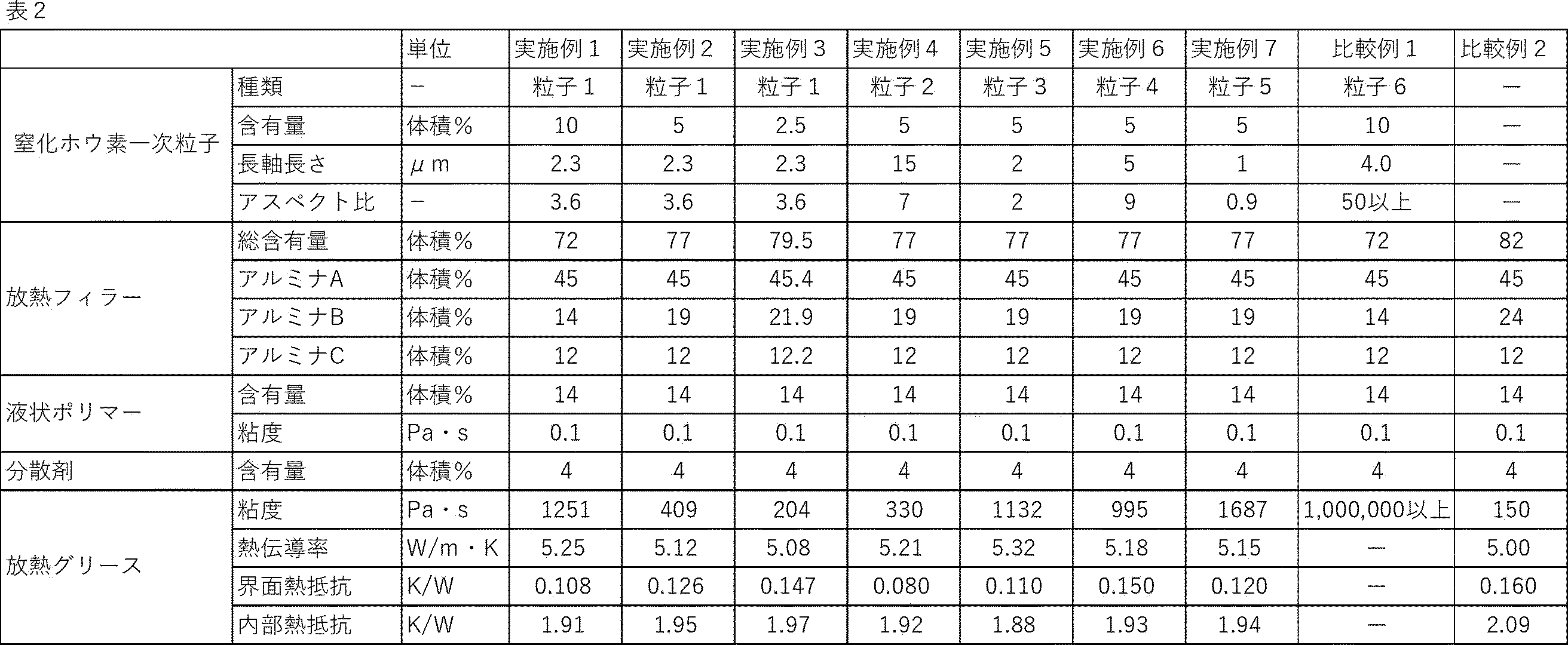
比較例1の放熱グリースでは、窒化ホウ素一次粒子のアスペクト比が0.3よりも小さかったので、放熱シートの粘度が高くなり、ペースト状にならなかった。このため、熱伝導率、界面熱抵抗及び内部熱抵抗の測定ができなかった。
比較例2の放熱グリースは、窒化ホウ素一次粒子を含まないので、熱伝導率が低くなり、その結果、界面熱抵抗が高くなった。
Claims (3)
- 窒化ホウ素一次粒子を含み、
前記窒化ホウ素一次粒子のアスペクト比が0.3~9である放熱グリース。 - 前記窒化ホウ素一次粒子の長軸長さが0.5~20μmである請求項1に記載の放熱グリース。
- 前記窒化ホウ素一次粒子と異なる放熱フィラーをさらに含み、
前記放熱フィラーは球状フィラーを含む請求項1又は2に記載の放熱グリース。
Priority Applications (1)
| Application Number | Priority Date | Filing Date | Title |
|---|---|---|---|
| JP2025511028A JPWO2024204366A1 (ja) | 2023-03-28 | 2024-03-27 |
Applications Claiming Priority (2)
| Application Number | Priority Date | Filing Date | Title |
|---|---|---|---|
| JP2023-051161 | 2023-03-28 | ||
| JP2023051161 | 2023-03-28 |
Publications (1)
| Publication Number | Publication Date |
|---|---|
| WO2024204366A1 true WO2024204366A1 (ja) | 2024-10-03 |
Family
ID=92905447
Family Applications (1)
| Application Number | Title | Priority Date | Filing Date |
|---|---|---|---|
| PCT/JP2024/012275 Ceased WO2024204366A1 (ja) | 2023-03-28 | 2024-03-27 | 放熱グリース |
Country Status (3)
| Country | Link |
|---|---|
| JP (1) | JPWO2024204366A1 (ja) |
| TW (1) | TW202446932A (ja) |
| WO (1) | WO2024204366A1 (ja) |
Citations (6)
| Publication number | Priority date | Publication date | Assignee | Title |
|---|---|---|---|---|
| JP2002201483A (ja) * | 2001-01-04 | 2002-07-19 | Hitachi Ltd | 高熱伝導グリース組成物及びそれを用いた冷却装置 |
| JP2006188638A (ja) * | 2005-01-07 | 2006-07-20 | Polymatech Co Ltd | 熱伝導性グリス |
| JP2007106809A (ja) * | 2005-10-11 | 2007-04-26 | Momentive Performance Materials Japan Kk | 熱伝導性グリース組成物 |
| CN103214848A (zh) * | 2013-04-28 | 2013-07-24 | 深圳市新亚新材料有限公司 | 一种用于cpu散热的相变导热硅脂组合物及其制备方法 |
| CN103709757A (zh) * | 2013-12-30 | 2014-04-09 | 无锡中石油润滑脂有限责任公司 | 一种绝缘导热硅脂及其制备方法 |
| WO2018124126A1 (ja) * | 2016-12-28 | 2018-07-05 | 昭和電工株式会社 | 六方晶窒化ホウ素粉末、その製造方法、樹脂組成物及び樹脂シート |
-
2024
- 2024-03-27 WO PCT/JP2024/012275 patent/WO2024204366A1/ja not_active Ceased
- 2024-03-27 JP JP2025511028A patent/JPWO2024204366A1/ja active Pending
- 2024-03-28 TW TW113111574A patent/TW202446932A/zh unknown
Patent Citations (6)
| Publication number | Priority date | Publication date | Assignee | Title |
|---|---|---|---|---|
| JP2002201483A (ja) * | 2001-01-04 | 2002-07-19 | Hitachi Ltd | 高熱伝導グリース組成物及びそれを用いた冷却装置 |
| JP2006188638A (ja) * | 2005-01-07 | 2006-07-20 | Polymatech Co Ltd | 熱伝導性グリス |
| JP2007106809A (ja) * | 2005-10-11 | 2007-04-26 | Momentive Performance Materials Japan Kk | 熱伝導性グリース組成物 |
| CN103214848A (zh) * | 2013-04-28 | 2013-07-24 | 深圳市新亚新材料有限公司 | 一种用于cpu散热的相变导热硅脂组合物及其制备方法 |
| CN103709757A (zh) * | 2013-12-30 | 2014-04-09 | 无锡中石油润滑脂有限责任公司 | 一种绝缘导热硅脂及其制备方法 |
| WO2018124126A1 (ja) * | 2016-12-28 | 2018-07-05 | 昭和電工株式会社 | 六方晶窒化ホウ素粉末、その製造方法、樹脂組成物及び樹脂シート |
Also Published As
| Publication number | Publication date |
|---|---|
| JPWO2024204366A1 (ja) | 2024-10-03 |
| TW202446932A (zh) | 2024-12-01 |
Similar Documents
| Publication | Publication Date | Title |
|---|---|---|
| TWI742609B (zh) | 共聚物、分散劑、及樹脂組合物 | |
| JP2019073730A (ja) | 熱伝導性ポリオルガノシロキサン組成物 | |
| JP7466062B2 (ja) | 共重合体、界面活性剤、樹脂組成物及び放熱シート | |
| WO2021200490A1 (ja) | アルミナ粉末、樹脂組成物、及び放熱部品 | |
| CN112105687B (zh) | 控制固化导热间隙填充材料 | |
| JP7481214B2 (ja) | 酸化マグネシウム粉末、フィラー組成物、樹脂組成物、及び放熱部品 | |
| CN116057092A (zh) | 导热性树脂组合物及电子设备 | |
| TW202222694A (zh) | 氧化鎂粉末、填料組成物、樹脂組成物、以及散熱零件 | |
| JP2010285610A (ja) | 親疎水異方性板状粒子及びその製造方法、並びにそれからなる乳化剤 | |
| WO2024204365A1 (ja) | 放熱グリース | |
| WO2024204398A1 (ja) | 放熱グリース | |
| JP7764581B2 (ja) | 二液硬化型組成物セット、硬化物及び電子機器 | |
| JP7262699B1 (ja) | 放熱グリース | |
| TW202446932A (zh) | 散熱膏 | |
| JP7478631B2 (ja) | 酸化マグネシウム粉末、フィラー組成物、樹脂組成物、及び放熱部品 | |
| CN116348513A (zh) | 导热性树脂组合物及电子设备 | |
| JP7392204B2 (ja) | 無機フィラー及び放熱部材 | |
| WO2024171646A1 (ja) | 二液硬化型組成物セット、硬化物及び電子機器 | |
| WO2023090240A1 (ja) | 放熱グリース | |
| JP4647993B2 (ja) | 熱伝導性アクリル系樹脂組成物及びそれを用いた熱伝導性シート状成形体 | |
| WO2022075214A1 (ja) | 二液硬化型組成物セット、熱伝導性硬化物及び電子機器 | |
| JP5255762B2 (ja) | アクリル系樹脂組成物及びそれを用いたシート状成形体 | |
| JP7766178B2 (ja) | 二液硬化型組成物セット、硬化物及び電子機器 | |
| JP2025146817A (ja) | 熱伝導性樹脂組成物 | |
| JP2023095001A (ja) | 組成物及び放熱シート |
Legal Events
| Date | Code | Title | Description |
|---|---|---|---|
| 121 | Ep: the epo has been informed by wipo that ep was designated in this application |
Ref document number: 24780468 Country of ref document: EP Kind code of ref document: A1 |
|
| ENP | Entry into the national phase |
Ref document number: 2025511028 Country of ref document: JP Kind code of ref document: A |
|
| WWE | Wipo information: entry into national phase |
Ref document number: 2025511028 Country of ref document: JP |
|
| NENP | Non-entry into the national phase |
Ref country code: DE |
|
| 122 | Ep: pct application non-entry in european phase |
Ref document number: 24780468 Country of ref document: EP Kind code of ref document: A1 |