WO2024203545A1 - 高強度溶融亜鉛めっき鋼板の製造方法 - Google Patents
高強度溶融亜鉛めっき鋼板の製造方法 Download PDFInfo
- Publication number
- WO2024203545A1 WO2024203545A1 PCT/JP2024/010576 JP2024010576W WO2024203545A1 WO 2024203545 A1 WO2024203545 A1 WO 2024203545A1 JP 2024010576 W JP2024010576 W JP 2024010576W WO 2024203545 A1 WO2024203545 A1 WO 2024203545A1
- Authority
- WO
- WIPO (PCT)
- Prior art keywords
- less
- steel sheet
- content
- hot
- dip galvanized
- Prior art date
- Legal status (The legal status is an assumption and is not a legal conclusion. Google has not performed a legal analysis and makes no representation as to the accuracy of the status listed.)
- Ceased
Links
Classifications
-
- C—CHEMISTRY; METALLURGY
- C21—METALLURGY OF IRON
- C21D—MODIFYING THE PHYSICAL STRUCTURE OF FERROUS METALS; GENERAL DEVICES FOR HEAT TREATMENT OF FERROUS OR NON-FERROUS METALS OR ALLOYS; MAKING METAL MALLEABLE, e.g. BY DECARBURISATION OR TEMPERING
- C21D9/00—Heat treatment, e.g. annealing, hardening, quenching or tempering, adapted for particular articles; Furnaces therefor
- C21D9/46—Heat treatment, e.g. annealing, hardening, quenching or tempering, adapted for particular articles; Furnaces therefor for sheet metals
-
- C—CHEMISTRY; METALLURGY
- C22—METALLURGY; FERROUS OR NON-FERROUS ALLOYS; TREATMENT OF ALLOYS OR NON-FERROUS METALS
- C22C—ALLOYS
- C22C38/00—Ferrous alloys, e.g. steel alloys
-
- C—CHEMISTRY; METALLURGY
- C22—METALLURGY; FERROUS OR NON-FERROUS ALLOYS; TREATMENT OF ALLOYS OR NON-FERROUS METALS
- C22C—ALLOYS
- C22C38/00—Ferrous alloys, e.g. steel alloys
- C22C38/60—Ferrous alloys, e.g. steel alloys containing lead, selenium, tellurium, or antimony, or more than 0.04% by weight of sulfur
-
- C—CHEMISTRY; METALLURGY
- C23—COATING METALLIC MATERIAL; COATING MATERIAL WITH METALLIC MATERIAL; CHEMICAL SURFACE TREATMENT; DIFFUSION TREATMENT OF METALLIC MATERIAL; COATING BY VACUUM EVAPORATION, BY SPUTTERING, BY ION IMPLANTATION OR BY CHEMICAL VAPOUR DEPOSITION, IN GENERAL; INHIBITING CORROSION OF METALLIC MATERIAL OR INCRUSTATION IN GENERAL
- C23C—COATING METALLIC MATERIAL; COATING MATERIAL WITH METALLIC MATERIAL; SURFACE TREATMENT OF METALLIC MATERIAL BY DIFFUSION INTO THE SURFACE, BY CHEMICAL CONVERSION OR SUBSTITUTION; COATING BY VACUUM EVAPORATION, BY SPUTTERING, BY ION IMPLANTATION OR BY CHEMICAL VAPOUR DEPOSITION, IN GENERAL
- C23C2/00—Hot-dipping or immersion processes for applying the coating material in the molten state without affecting the shape; Apparatus therefor
- C23C2/02—Pretreatment of the material to be coated, e.g. for coating on selected surface areas
-
- C—CHEMISTRY; METALLURGY
- C23—COATING METALLIC MATERIAL; COATING MATERIAL WITH METALLIC MATERIAL; CHEMICAL SURFACE TREATMENT; DIFFUSION TREATMENT OF METALLIC MATERIAL; COATING BY VACUUM EVAPORATION, BY SPUTTERING, BY ION IMPLANTATION OR BY CHEMICAL VAPOUR DEPOSITION, IN GENERAL; INHIBITING CORROSION OF METALLIC MATERIAL OR INCRUSTATION IN GENERAL
- C23C—COATING METALLIC MATERIAL; COATING MATERIAL WITH METALLIC MATERIAL; SURFACE TREATMENT OF METALLIC MATERIAL BY DIFFUSION INTO THE SURFACE, BY CHEMICAL CONVERSION OR SUBSTITUTION; COATING BY VACUUM EVAPORATION, BY SPUTTERING, BY ION IMPLANTATION OR BY CHEMICAL VAPOUR DEPOSITION, IN GENERAL
- C23C2/00—Hot-dipping or immersion processes for applying the coating material in the molten state without affecting the shape; Apparatus therefor
- C23C2/04—Hot-dipping or immersion processes for applying the coating material in the molten state without affecting the shape; Apparatus therefor characterised by the coating material
- C23C2/06—Zinc or cadmium or alloys based thereon
-
- C—CHEMISTRY; METALLURGY
- C23—COATING METALLIC MATERIAL; COATING MATERIAL WITH METALLIC MATERIAL; CHEMICAL SURFACE TREATMENT; DIFFUSION TREATMENT OF METALLIC MATERIAL; COATING BY VACUUM EVAPORATION, BY SPUTTERING, BY ION IMPLANTATION OR BY CHEMICAL VAPOUR DEPOSITION, IN GENERAL; INHIBITING CORROSION OF METALLIC MATERIAL OR INCRUSTATION IN GENERAL
- C23C—COATING METALLIC MATERIAL; COATING MATERIAL WITH METALLIC MATERIAL; SURFACE TREATMENT OF METALLIC MATERIAL BY DIFFUSION INTO THE SURFACE, BY CHEMICAL CONVERSION OR SUBSTITUTION; COATING BY VACUUM EVAPORATION, BY SPUTTERING, BY ION IMPLANTATION OR BY CHEMICAL VAPOUR DEPOSITION, IN GENERAL
- C23C2/00—Hot-dipping or immersion processes for applying the coating material in the molten state without affecting the shape; Apparatus therefor
- C23C2/26—After-treatment
- C23C2/28—Thermal after-treatment, e.g. treatment in oil bath
-
- C—CHEMISTRY; METALLURGY
- C22—METALLURGY; FERROUS OR NON-FERROUS ALLOYS; TREATMENT OF ALLOYS OR NON-FERROUS METALS
- C22C—ALLOYS
- C22C18/00—Alloys based on zinc
Definitions
- the present invention relates to a method for manufacturing high-strength hot-dip galvanized steel sheet with good surface appearance (plating appearance).
- B is widely used as an additive element for high-strength steel sheets because it has the advantage that a small amount of B can provide a high hardenability improvement effect and can increase the strength of steel at low cost, and it has the characteristic that it does not generate inclusions that cause deterioration of bendability and delayed fracture resistance.
- Patent Document 1 discloses a technology in which, when continuous annealing and hot-dip galvanizing are performed on a base steel sheet of a predetermined composition, the temperature range in an annealing furnace during continuous annealing: 750° C. or higher is set to a dew point in the atmosphere: ⁇ 40° C. or lower, thereby lowering the oxygen potential at the interface between the steel sheet and the atmosphere, suppressing surface concentration of Si, Mn, etc. without forming internal oxidation, and obtaining an excellent plating appearance.
- Patent Document 2 discloses a technique in which the ratio of the amount of concentrated Si to the amount of concentrated Mn in the surface layer of a base steel sheet is set to 0.7 or more and 1.3 or less, and the cold-rolled steel sheet is heated to the maximum temperature reached during annealing of the cold-rolled steel sheet, and the dew point of the atmosphere in that region is maintained at -40°C or less, thereby obtaining excellent galvanizability.
- the hot-dip galvanized steel sheet obtained in Patent Document 1 has minute surface defects other than the "surface defects caused by the generation of Si, Mn-based oxides resulting in a decrease in plating wettability" that is the subject of Patent Document 1, that is, defects in which Si, Mn-based oxides repel the plating and cause areas where the plating does not adhere, and that there is a new problem of suppressing the occurrence of these surface defects.
- the present invention was made to solve the above-mentioned newly discovered problems. That is, the objective is to provide a method for manufacturing a high-strength hot-dip galvanized steel sheet in which B is added to the base steel sheet, and which has a good surface appearance (plating appearance) with reduced occurrence of gray and black spot defects on the plating surface.
- a gray spot defect is a concave defect caused by a coating that adheres to the steel sheet once after immersion treatment without being repelled by the steel sheet surface, but peels off when it comes into contact with a transport roll and adheres to the roll due to weak adhesion between the coating and the steel sheet.
- a black spot defect is a convex defect caused by the coating that adheres to the roll peeling off from the roll and re-adhering to the steel sheet.
- B nitrides are thought to be formed mainly due to the following two factors, and measures corresponding to each factor can be considered.
- Nitrogen (N) generated from ammonia in the atmosphere is adsorbed to or penetrates into the steel sheet mainly during the heating process, and then reacts with B during the process of heating or soaking in an atmosphere with a low oxygen potential. Since the generation of ammonia is significantly promoted by the catalytic action of iron oxide or pure iron obtained by reducing iron oxide, it is possible to suppress the generation of nitrides of B by sufficiently suppressing the generation of iron oxide from the initial stage of temperature rise during annealing and reducing the ammonia concentration in the atmosphere.
- the present inventors have found that by controlling a series of annealing conditions in the annealing step before galvanizing as described below, the generation of nitrides of B can be effectively suppressed, and as a result, the occurrence of gray spot defects and black spot defects can be suppressed, and a hot-dip galvanized steel sheet having a good surface appearance (galvanized appearance) can be obtained.
- the present invention has been made based on the above findings, and has the following gist.
- a method for producing a high-strength hot-dip galvanized steel sheet comprising soaking the steel sheet at a temperature of 750°C or higher and 950°C or lower in an atmosphere containing 5% or more by volume of hydrogen and having a dew point of -55°C or higher and -40°C or lower for a holding time of 20 to 200 seconds.
- the present invention it is possible to manufacture a high-strength hot-dip galvanized steel sheet in which B is added to the base steel sheet, and which has a good surface appearance (plating appearance) with suppressed generation of gray and black spot defects on the plating surface.
- the high-strength hot-dip galvanized steel sheet manufactured by the present invention is suitable for structural members such as automobile parts, and by applying it to this application, it is possible to improve fuel efficiency by reducing the vehicle body weight.
- the present invention targets high-strength hot-dip galvanized steel sheets having a hot-dip galvanized layer on one or both sides of a steel sheet (base steel sheet), and includes alloyed hot-dip galvanized steel sheets that are subjected to alloying treatment after hot-dip galvanization.
- the composition of the hot-dip galvanized layer is not particularly limited, and may be a general one.
- the hot-dip galvanized layer may have a composition containing Fe: 20 mass% or less, Al: 0.001 mass% to 1.0 mass%, and further containing one or more selected from Pb, Sb, Si, Sn, Mg, Mn, Ni, Cr, Co, Ca, Cu, Li, Ti, Be, Bi, and REM in a total amount of 0 mass% to 3.5 mass%, with the remainder being Zn and unavoidable impurities.
- the Fe content in the plating layer is less than 7 mass%, and in the case of an alloyed hot-dip galvanized steel sheet (GA), the Fe content in the plating layer is 7 mass% or more and 15 mass% or less, preferably 8 mass% or more and 13 mass% or less.
- the composition of the steel sheet (base steel sheet) and the reasons for limiting it will be described below.
- "%" representing the content of the component elements of the steel sheet means “mass%” unless otherwise specified.
- Tensile strength is referred to as TS.
- C 0.050% or more and 0.300% or less C is an effective element for generating a desired amount of quenched martensite or tempered martensite, making TS 590 MPa or more, and obtaining excellent dimensional accuracy during forming. If the C content is less than 0.050%, the area ratio of quenched martensite decreases, and the area ratio of ferrite and bainite increases, making it difficult to make TS 590 MPa or more. On the other hand, if the C content exceeds 0.300%, the carbon concentration in quenched martensite or tempered martensite increases, and the hardness of quenched martensite or tempered martensite increases.
- the C content is set to 0.050% or more and 0.300% or less.
- the C content is preferably 0.060% or more to achieve a TS of 780 MPa or more, and more preferably 0.090% or more to achieve a TS of 980 MPa or more. Since a high C content deteriorates the weldability, the C content is preferably 0.250% or less, and more preferably 0.220% or less.
- Si 0.80% or less Si is an effective element for strengthening steel to obtain good material properties, and is also an effective element for improving ductility.
- Si content exceeds 0.80%, the amount of Si concentration on the steel sheet surface increases during annealing, and Si oxides that cause non-plating defects are formed on the steel sheet surface, making it difficult to achieve good plating properties.
- the Si content is set to 0.80% or less.
- the Si content is preferably set to 0.65% or less.
- the Si content may be 0%, but since reducing the Si content to less than 0.01% increases the refining cost, the Si content is preferably 0.01% or more.
- the Si content is preferably 0.05% or more, and more preferably 0.10% or more. From the viewpoint of obtaining particularly high ductility, the Si content is more preferably 0.15% or more.
- Mn 2.30% or more and 3.50% or less
- Mn is an element necessary for suppressing gray spot defects and black spot defects to obtain good surface quality.
- Mn is also an element effective for generating a desired amount of quenched martensite and tempered martensite to make TS 590 MPa or more.
- the Mn content is set to 2.30% or more and 3.50% or less.
- the Mn content is preferably set to 2.40% or more, more preferably 2.50% or more, and even more preferably 2.60% or more. From the above viewpoint, the Mn content is preferably set to 3.30% or less, and more preferably 3.00% or less.
- P 0.100% or less
- P is an element that has a solid solution strengthening effect and increases the strength of the steel sheet, but if the P content exceeds 0.100%, P segregates at the prior austenite grain boundaries and embrittles the grain boundaries, resulting in a decrease in punchability and stretch flangeability. Therefore, the P content is set to 0.100% or less. From the above-mentioned viewpoint, the P content is preferably set to 0.050% or less, more preferably 0.030% or less. There is no lower limit for the P content. That is, the P content may be 0%, but since controlling the P content to less than 0.001% increases the refining cost, the P content is preferably 0.001% or more.
- S 0.0100% or less S exists as sulfide in steel, and if the content exceeds 0.0100%, it reduces the ultimate deformability of the steel sheet, resulting in reduced punchability, stretch flangeability, and bendability. Therefore, the content of S is set to 0.0100% or less.
- the lower limit of the content of S is not particularly specified. That is, the content of S may be 0%, but since the refining cost increases in controlling it to less than 0.0001%, it is preferable that the content of S is 0.0001% or more.
- the content of S is preferably set to 0.0050% or less.
- Sol. Al 1.00% or less Al can be used as a deoxidizer.
- the amount of sol. Al in the steel is preferably 0.01% or more.
- the addition of Al fixes N in the steel as AlN, and the added B can be used as solid-solute B that is effective in increasing strength.
- Al also has the effect of suppressing the formation of carbides during annealing and increasing the volume fraction of retained austenite. The generated retained austenite has the effect of improving ductility.
- sol. Al at 0.02% or more.
- the amount of sol. Al exceeds 1.00%, non-plating occurs, so the amount of sol. Al is 1.00% or less.
- the content of sol. Al is preferably 0.10% or less, more preferably 0.08% or less.
- N 0.0200% or less N exists as a nitride in steel, and if the content exceeds 0.0200%, it reduces the ultimate deformability of the steel sheet, resulting in reduced punchability, stretch flangeability, and bendability. Therefore, the content of N is set to 0.0200% or less. Although there is no particular lower limit for the content of N, due to constraints on production technology, it is preferable that the content of N is 0.0005% or more. In addition, from the above-mentioned viewpoint, the content of N is preferably set to 0.0080% or less. There is no lower limit for the content of N.
- the content of N may be 0%, but since controlling the content of N to less than 0.0005% increases the refining cost, the content of N is preferably 0.0005% or more.
- B 0.0001% or more and 0.0050% or less B is an element that can improve hardenability by segregating at austenite grain boundaries. By adding B to steel, it is possible to suppress the generation and grain growth of ferrite during annealing and cooling. In order to obtain such effects, it is necessary to set the content of B to 0.0001% or more. On the other hand, if the content of B exceeds 0.0050%, a large amount of nitrides is formed on the steel sheet surface, the plating adhesion deteriorates, and poor appearance due to plating peeling occurs.
- the content of B is set to 0.0001% or more and 0.0050% or less.
- the content of B is preferably set to 0.0002% or more.
- the content of B is preferably set to 0.0030% or less.
- [%Mn]/[%Si] 3.0 or more the formation of oxides of simple Si is suppressed, and non-plating is suppressed, and in the annealing method of the present invention, Mn, B compound oxides are formed, and gray spot defects and black spot defects are suppressed. Therefore, [%Mn]/[%Si] is set to 3.0 or more.
- [%Mn]/[%Si] is preferably 4.2 or more, and more preferably 12.0 or more.
- the high-strength steel plate used in the present invention further contains, by mass%, Cr: 1.00% or less, Ti: 0.200% or less, Nb: 0.200% or less, V: 0.200% or less, Mo: 2.000% or less, Cu: 1.000% or less, Ni: 0.500% or less, Sn: 0.200% or less, Mg: 0.0100% or less, Ca: 0.0100% or less, and Zn: 0.100%.
- each of the above elements is an optional element that is added as necessary, and the effect of the present invention can be obtained even if it is 0%, so each of the above elements may be 0%.
- Cr is an element that increases hardenability, and is effective in generating the desired amount of quenched martensite or tempered martensite, making TS 590 MPa or more, and obtaining excellent dimensional accuracy during forming.
- the Cr content exceeds 1.00%, the plating appearance quality deteriorates, the area ratio of quenched martensite or tempered martensite increases, and the area ratio of ferrite and bainite decreases, resulting in reduced dimensional accuracy during forming. Therefore, when Cr is added, the content is preferably 1.00% or less. From the viewpoint of improving the plating appearance quality, it is more preferable that the Cr content be 0.75% or less. To obtain the effect of improving hardenability by Cr, the Cr content is preferably 0.02% or more.
- Ti increases TS by forming fine carbides, nitrides, or carbonitrides during hot rolling or annealing.
- the Ti content exceeds 0.200%, a large amount of coarse precipitates and inclusions are generated, and if the steel sheet contains diffusible hydrogen, the precipitates and inclusions become the starting points of cracks during bending tests, resulting in reduced bendability. Therefore, when Ti is added, the content is preferably 0.200% or less. From the above-mentioned viewpoint, it is more preferable that the Ti content be 0.100% or less. To obtain the above-mentioned effect, the Ti content is preferably 0.005% or more, and more preferably 0.010% or more.
- Nb also increases TS by forming fine carbides, nitrides, or carbonitrides during hot rolling or annealing.
- the Nb content exceeds 0.200%, a large amount of coarse precipitates and inclusions are generated, and if the steel sheet contains diffusible hydrogen, the precipitates and inclusions become the starting points of cracks during bending tests, resulting in reduced bendability. Therefore, when Nb is added, its content is preferably 0.200% or less. From the above-mentioned viewpoint, it is more preferable that the Nb content be 0.100% or less. To obtain the above-mentioned effect, the Nb content is preferably 0.005% or more, and more preferably 0.010% or more.
- V also increases TS by forming fine carbides, nitrides, or carbonitrides during hot rolling or annealing.
- V content exceeds 0.200%, a large amount of coarse precipitates and inclusions are generated, and if the steel sheet contains diffusible hydrogen, the precipitates and inclusions become the starting points of cracks during bending tests, resulting in reduced bendability. Therefore, when V is added, its content is preferably 0.200% or less. From the above-mentioned viewpoint, it is more preferable that the V content be 0.100% or less. To obtain the above-mentioned effect, the V content is preferably 0.005% or more, and more preferably 0.010% or more.
- Mo is an element that increases hardenability, and is an effective element for increasing TS and improving dimensional accuracy during forming by setting the area ratio of quenched martensite and tempered martensite within a more suitable range.
- Mo content exceeds 2.000%, the area ratio of quenched martensite and tempered martensite increases, making it difficult to achieve a TS of 590 MPa or more, and the dimensional accuracy during forming decreases.
- coarse precipitates and inclusions increase and the steel sheet contains diffusible hydrogen, the precipitates and inclusions become the starting points of cracks during bending tests, and the bendability decreases. Therefore, when Mo is added, its content is preferably 2.000% or less.
- the Mo content be 0.500% or less. In order to obtain the above-mentioned effect, it is preferable that the Mo content be 0.005% or more, and more preferably 0.020% or more.
- Cu is an element that increases hardenability, and is an effective element for increasing TS and improving dimensional accuracy during forming by setting the area ratio of quenched martensite and tempered martensite within a more suitable range.
- the area ratio of quenched martensite and tempered martensite increases, making it difficult to achieve a TS of 590 MPa or more and obtain excellent dimensional accuracy during forming.
- coarse precipitates and inclusions increase and the steel sheet contains diffusible hydrogen, the precipitates and inclusions become the starting points of cracks during bending tests, and bendability decreases. Therefore, when Cu is added, its content is preferably 1.000% or less.
- the Cu content is 0.200% or less. In order to obtain the above-mentioned effect, it is preferable that the Cu content is 0.005% or more, and more preferably 0.020% or more.
- Ni is an element that increases hardenability, and is an effective element for increasing TS and improving dimensional accuracy during forming by setting the area ratio of quenched martensite and tempered martensite within a more suitable range.
- the Ni content exceeds 0.500%, the area ratio of quenched martensite and tempered martensite increases, and TS and dimensional accuracy during forming decrease.
- the content is preferably 0.500% or less. From the above-mentioned viewpoint, the Ni content is more preferably 0.200% or less. In order to obtain the above-mentioned effect, the Ni content is preferably 0.005% or more, and more preferably 0.020% or more.
- Sn is an effective element for suppressing oxidation of the surface of the base steel sheet during annealing and obtaining better plating properties.
- the Sn content exceeds 0.200%, coarse precipitates and inclusions increase, and if the base steel sheet contains diffusible hydrogen, the precipitates and inclusions become the starting points of cracks during bending tests, resulting in reduced bendability. Therefore, when Sn is added, it is preferable that the Sn content be 0.200% or less. From the above-mentioned viewpoint, it is more preferable that the Sn content be 0.050% or less. To obtain the above-mentioned effects, it is preferable that the Sn content be 0.001% or more, and more preferably 0.005% or more.
- Mg is an effective element for spheroidizing the shape of inclusions such as sulfides and oxides, improving the ultimate deformability of the steel sheet, and improving the stretch flangeability.
- Mg content exceeds 0.0100%, a large amount of coarse precipitates and inclusions are generated, and if the steel sheet contains diffusible hydrogen, the precipitates and inclusions become the starting points of cracks during bending tests, resulting in a decrease in bendability. Therefore, when Mg is added, its content is preferably 0.0100% or less. From the above-mentioned viewpoint, the Mg content is more preferably 0.0050% or less.
- the Mg content is preferably 0.0001% or more, more preferably 0.0005% or more.
- Ca exists as inclusions in the base steel sheet. If the Ca content exceeds 0.0100%, when the base steel sheet contains diffusible hydrogen, the inclusions become the starting points of cracks during bending tests, and the bendability is reduced. Therefore, the Ca content is preferably 0.0100% or less.
- the lower limit of the Ca content may be 0.0000%, but due to constraints on production technology, the Ca content is preferably 0.0001% or more. From the above-mentioned viewpoint, the Ca content is more preferably 0.0020% or less.
- Zn is an effective element for improving stretch flangeability by spheroidizing the shape of inclusions and improving the ultimate deformability of the steel sheet.
- the Zn content exceeds 0.100%, a large amount of coarse precipitates and inclusions are generated, and if the steel sheet contains diffusible hydrogen, the precipitates and inclusions become the starting points of cracks during bending tests, resulting in reduced bendability. Therefore, when Zn is added, its content is preferably 0.100% or less.
- the Zn content is more preferably 0.020% or less, and even more preferably 0.010% or less.
- the Zn content is preferably 0.001% or more, and more preferably 0.002% or more.
- Co is also an effective element for improving stretch flangeability by spheroidizing the shape of inclusions and improving the ultimate deformability of the steel sheet.
- the content is preferably 0.200% or less. From the above-mentioned viewpoint, it is more preferable that the Co content be 0.010% or less. To obtain the above-mentioned effect, the Co content is preferably 0.001% or more, and more preferably 0.005% or more.
- Zr is also an effective element for improving stretch flangeability by spheroidizing the shape of inclusions and improving the ultimate deformability of the steel sheet.
- the Zr content exceeds 0.200%, a large amount of coarse precipitates and inclusions are generated, and if the steel sheet contains diffusible hydrogen, the precipitates and inclusions become the starting points of cracks during bending tests, resulting in reduced bendability. Therefore, when Zr is added, it is preferable that the content be 0.200% or less. From the above-mentioned viewpoint, it is more preferable that the Zr content be 0.010% or less. To obtain the above-mentioned effect, it is preferable that the Zr content be 0.001% or more, and more preferably 0.005% or more.
- REM is an element that is effective in improving stretch flangeability by making the shape of inclusions spherical and improving the ultimate deformability of the steel sheet.
- the total REM content exceeds 0.0100%, a large amount of coarse precipitates and inclusions are generated, and if the steel sheet contains diffusible hydrogen, the precipitates and inclusions become the starting points of cracks during bending tests, resulting in reduced bendability. Therefore, when REM is added, it is preferable that the total content is 0.0100% or less. From the above-mentioned viewpoint, it is more preferable that the total REM content is 0.0080% or less. To obtain the above-mentioned effect, it is preferable that the total REM content is 0.0001% or more, and more preferably 0.0005% or more.
- Ta is an effective element for increasing the strength of the base steel plate and can be included as necessary.
- the effect of improving strength can be obtained by including 0.005% or more of Ta, but from the viewpoint of preventing an increase in costs, if Ta is included, the Ta content is preferably 0.10% or less.
- the inclusion of 0.001% or more of Tellurium can control the morphology of sulfides and improve ductility and toughness, but from the viewpoint of preventing an increase in costs, if Tellurium is included, the Tellurium content is preferably 0.10% or less.
- the As content is preferably 0.10% or less.
- Hf 0.01% or more of Hf can control the morphology of sulfides and improve ductility and toughness, but from the viewpoint of preventing an increase in costs, if Hf is included, the Hf content is preferably 0.10% or less.
- Bi When Bi is present at 0.001% or more, it is possible to suppress grain boundary segregation and improve ductility and toughness. Bi also has the effect of improving machinability and smoothness of the cut end surface, and has the effect of improving the delayed fracture resistance of the cut surface.
- the Bi content is preferably 0.10% or less from the viewpoint of preventing an increase in costs.
- Pb By containing 0.001% or more of Pb, grain boundary segregation can be suppressed and ductility and toughness can be improved. Pb also has the effect of improving machinability and smoothness of the cut end surface, and has the effect of improving the delayed fracture resistance of the cut surface. When Pb is contained, the Pb content is preferably 0.10% or less from the viewpoint of preventing an increase in costs.
- Ge Even if Ge is contained at 0.001% or more, it does not have a significant effect on mechanical properties or surface quality. To prevent an increase in costs, if Ge is contained, the Ge content should be 0.10% or less.
- Sr Even if Sr is contained at 0.001% or more, it does not have a significant effect on mechanical properties or surface quality. To prevent an increase in costs, if Sr is contained, the Sr content should be 0.10% or less.
- the Cs content is 0.001% or more, it does not significantly affect the mechanical properties or surface quality. From the viewpoint of preventing an increase in costs, if Cs is contained, the Cs content is set to 0.10% or less.
- the balance other than the above-mentioned components is Fe and unavoidable impurities.
- a steel sheet (cold-rolled steel sheet or hot-rolled steel sheet) having the above-mentioned components is introduced into a continuous hot-dip galvanizing facility, and after continuous annealing in the facility, hot-dip galvanizing is performed, and further, if necessary, an alloying treatment is performed to obtain a hot-dip galvanized steel sheet.
- a continuous hot-dip galvanizing facility is composed of an annealing furnace and a hot-dip galvanizing device located downstream of the annealing furnace, and the hot-dip galvanizing device is equipped with a hot-dip galvanizing bath and a snout connected to the steel strip outlet side of the annealing furnace and having a tip immersed in the hot-dip galvanizing bath.
- a general continuous hot-dip galvanizing line (CGL) configured to continuously perform a series of processes including heating, cooling, hot-dip galvanizing, and alloying treatment of hot-dip galvanizing can be applied.
- the alloying treatment of hot-dip galvanizing is performed as necessary and may not be performed.
- the steel sheet introduced into the continuous hot-dip galvanizing equipment is annealed while passing through an annealing furnace having a heating zone, a soaking zone, and a cooling zone in this order.
- Specific annealing conditions are as follows.
- the number of annealing steps is not particularly limited, but in the present invention, since gray spot defects and black spot defects can be suppressed by one annealing step, one annealing step (single annealing method) is preferable.
- the occurrence of surface defects is a phenomenon specific to the case where B is added to the base steel sheet and the dew point during annealing before plating is low, and has not been recognized as a problem in the past, but is a problem newly discovered by the present inventors.
- the present inventors have conducted extensive research in order to produce a hot-dip galvanized steel sheet in which the occurrence of such surface defects is suppressed and which has a good surface appearance (plating appearance), and as a result, have obtained the following findings.
- Gray spot defects and black spot defects occur because B is added to a base steel sheet and the dew point during annealing is low, and therefore, by suppressing the formation of this B nitride, the occurrence of gray spot defects and black spot defects can be prevented.
- the nitrides of B are believed to be formed mainly due to two factors, namely, (i) nitrogen (N) generated from ammonia in the atmosphere penetrates or is adsorbed into the steel sheet and reacts with B under conditions of low oxygen potential; (ii) when B does not form an oxide under conditions of low oxygen potential, B diffuses in a solid solution state to the surface layer of the steel sheet and forms nitrides in the surface layer; Regarding the factor (i), ammonia is produced from N2 and H2 in the atmosphere as raw materials, and in the temperature range of 500°C to 750°C, the production of ammonia is significantly promoted by the catalytic action of iron oxide and pure iron reduced from iron oxide, and accordingly the penetration and adsorption of nitrogen into the steel sheet increases.
- the steel sheet is heated in an atmosphere containing 5% by volume or more of hydrogen, having a dew point of -20°C or less, and an oxygen concentration of 400 ppm by volume or less in a temperature range of 300°C or more and 500°C or less.
- the Fe reducing atmosphere is used to suppress the generation of iron oxide and the generation of ammonia, which is a cause of the formation of B nitrides (the generation of ammonia becomes remarkable in a temperature range of 500°C or more in particular).
- Hydrogen concentration in the atmosphere 5% by volume or more Hydrogen is a reducing gas, so it is possible to suppress oxidation of the steel sheet surface during annealing.
- the hydrogen concentration in the atmosphere is set to 5% by volume or more, and preferably 6% by volume or more.
- the hydrogen concentration is preferably set to 30% by volume or less from the viewpoint of suppressing cost increases.
- Atmosphere dew point -20°C or lower
- the dew point In the low temperature range of 300 to 500°C, if the dew point exceeds -20°C, oxidation of iron occurs on the steel sheet surface, promoting the generation of ammonia in the temperature range of 500°C or higher.
- the dew point is set to -20°C or lower, and in order to sufficiently obtain the effect of suppressing the generation of iron oxide, it is preferably set to -40°C or lower.
- Oxygen concentration in atmosphere 400 ppm by volume or less
- the oxygen concentration is set to 400 ppm by volume or less, and preferably 200 ppm by volume or less.
- the remainder (95% by volume or less) of the atmospheric gas other than hydrogen, H2O , and oxygen is preferably N2 gas and inevitable impurities, and further, a part of the N2 gas may be replaced with one or more of CO gas, CO2 gas, and Ar gas.
- the ratio of the replacement gas in the atmospheric gas is preferably 30% by volume or less.
- the ratio is 0.01% by volume or more.
- Average heating rate in the temperature range of 300°C to 500°C As mentioned above, the generation of ammonia, which is a nitriding source of B, is promoted by using iron oxide and pure iron reduced from the iron oxide as a catalyst. Therefore, from the viewpoint of suppressing the generation of gray spot defects and black spot defects, it is preferable to set the average heating rate to 10°C/s or less, ensure sufficient annealing time in an Fe reducing atmosphere, and reduce iron oxide on the steel sheet surface.
- the average heating rate is 1°C/s or more. Also, from the above viewpoint, a more preferable range of the average heating rate is 2°C/s to 7°C/s.
- the steel sheet is heated at an average heating rate of 1° C./s or more in an atmosphere containing 5% by volume or more of hydrogen and having a dew point of ⁇ 40° C. or less in the subsequent temperature range of 500° C. or more and 750° C. or less.
- This temperature range is where ammonia generation becomes significant and nitrogen begins to adsorb to and penetrate into the steel sheet, so the generation of ammonia and the penetration of nitrogen are suppressed, and the generation of nitrides of B in the subsequent soaking treatment step is suppressed.
- Hydrogen concentration in the atmosphere 5% by volume or more Hydrogen is a reducing gas, so it is possible to suppress the formation of oxides of Si and Mn during annealing and prevent non-plating defects caused by oxides.
- the hydrogen concentration in the atmosphere is set to 5% by volume or more, preferably 6% by volume or more.
- the hydrogen concentration in the atmosphere is set to 5% by volume or more, preferably 6% by volume or more.
- the hydrogen concentration is preferably set to 30% by volume or less from the viewpoint of suppressing cost increases.
- Atmosphere dew point -40°C or less If the dew point is higher than -40°C, a large amount of oxides of Si and Mn are formed on the steel sheet surface, resulting in oxide-induced non-plating defects. In addition, new oxidation of Fe occurs, which results in insufficient suppression of ammonia generation in the heating step at 500°C or higher and the soaking step at 750°C or higher, and therefore insufficient suppression of gray spot defects and black spot defects. For this reason, the dew point is set to -40°C or less. From the viewpoint of suppressing gray spot defects and black spot defects, it is more preferable that the dew point of the atmosphere is -42°C or less.
- the dew point is -60°C or more from the viewpoint of preventing an increase in costs due to a reduction in the dew point.
- the remainder (95% by volume or less) of the atmospheric gas other than hydrogen, H2O , and oxygen is preferably N2 gas and inevitable impurities, and further, a part of the N2 gas may be replaced with one or more of CO gas, CO2 gas, and Ar gas.
- the ratio of the replacement gas in the atmospheric gas is preferably 30% by volume or less.
- the ratio is 0.01% by volume or more.
- Average heating rate 1°C/s or more Nitriding reaction through the formation of ammonia is likely to occur in the temperature range of 500 to 750°C. Therefore, from the viewpoint of suppressing gray spot defects and black spot defects, it is necessary to heat this temperature range quickly.
- the average heating rate is 1°C/s or more, preferably 1.5°C/s or more, and more preferably 5°C/s or more. There is no particular upper limit, but it is preferably 20°C/s or less that can be realized in a general annealing furnace.
- the steel sheet is soaked at a temperature of 750°C to 950°C in an atmosphere containing 5% or more by volume of hydrogen and having a dew point of -55°C to -40°C for a holding time of 20 to 200 seconds.
- This soaking process suppresses the nitriding reaction of B caused by ammonia and nitrogen that has penetrated into the steel, and also suppresses the generation of nitrides due to the diffusion of B to the steel sheet surface during annealing by fixing a portion of B as an oxide on the steel sheet surface or inside the steel sheet. This suppresses the amount of nitrides of B that are generated.
- Atmosphere dew point -55°C or higher and -40°C or lower If the dew point is higher than -40°C, a large amount of oxides of Si and Mn are formed on the steel sheet surface, resulting in oxide-induced non-plating defects. On the other hand, if the dew point is lower than -55°C, a part of B is fixed as an oxide, and the effect of suppressing the generation of nitrides due to the diffusion of B to the steel sheet surface during annealing cannot be sufficiently obtained. In addition, the oxygen potential of the annealing atmosphere is low and the nitrogen potential is high, so that the formation of nitrides is stabilized, and the formation of nitrides of B on the steel sheet surface is promoted.
- the dew point is -55°C or higher, preferably -50°C or higher.
- the dew point is -40°C or lower, preferably -45°C or lower.
- Holding time 20 seconds or more and 200 seconds or less If the holding time is less than 20 seconds, the ratio of austenite generated during heating in the two-phase region of ferrite and austenite becomes insufficient, so that the area ratio of ferrite and bainite increases, making it difficult to achieve a TS of 590 MPa or more.
- the holding time is set to 20 seconds or more, preferably 30 seconds or more. Also, the holding time is set to 200 seconds or less, preferably 100 seconds or less. Note that this holding time refers to the time during which the steel sheet remains in (passes through) the above-mentioned atmosphere at a temperature of 750°C or more and 950°C or less.
- Ammonia concentration in the atmosphere in the present invention, it is preferable to reduce the ammonia concentration in the atmosphere in the soaking process to 0.010% by volume or less.
- causes of ammonia being contained in the atmosphere in the soaking zone include ammonia gas generated in the heating zone being brought into the soaking zone, and ammonia being mixed in by reusing exhaust gas containing ammonia in the soaking zone.
- ammonia concentration in the atmosphere 0.010% by volume or less.
- ammonia concentration in the atmosphere 0.010% by volume or less.
- the ammonia concentration in the atmosphere there is no particular lower limit, but from the viewpoint of preventing an increase in costs due to the removal of ammonia, it is preferable to set the ammonia concentration to 0.0001% by volume or more.
- the steel sheet that has been continuously annealed under the above conditions is cooled, and then immersed in a hot-dip galvanizing bath to perform hot-dip galvanizing.
- the temperature reached during the cooling is 200 to 520°C, and it is preferable to heat the steel sheet as necessary before immersing it in the hot-dip galvanizing bath.
- the bath temperature of the hot-dip galvanizing bath is generally about 440 to 500°C.
- the hot-dip galvanizing bath is not particularly limited, but may be, for example, one having an Al content of 0.10 mass% or more and 0.23 mass% or less, and further containing one or more selected from Pb, Sb, Si, Sn, Mg, Mn, Ni, Cr, Co, Ca, Cu, Li, Ti, Be, Bi, and REM in a total content of 0 mass% or more and 3.5 mass% or less, with the balance being Zn and unavoidable impurities.
- the temperature of the steel sheet before plating be equal to or higher than the plating bath temperature and equal to or lower than the plating bath temperature + 50°C.
- a further alloying treatment of galvanization may be performed to form an alloyed hot dip galvanized layer.
- the alloying treatment is preferably performed in a temperature range of 480°C to 570°C. If the alloying temperature is less than 480°C, the Zn-Fe alloying rate becomes excessively slow, making alloying extremely difficult. On the other hand, if the alloying temperature exceeds 570°C, untransformed austenite may transform into pearlite, resulting in a decrease in TS and El.
- the alloying treatment is more preferably performed in a temperature range of 490°C to 560°C, and even more preferably in a temperature range of 490°C to 530°C.
- the coating weight of the hot-dip galvanized steel sheet (GI) and the galvannealed steel sheet (GA) is preferably 20 to 80 g/ m2 per side.
- the coating weight can be adjusted by performing gas wiping or the like after hot-dip galvanization.
- the steel is cooled to room temperature or higher and 350 ° C or lower.
- the cooling rate when cooling to a temperature range of 150 ° C or higher and 350 ° C or lower is not particularly specified, but from the viewpoint of securing a high TS and improving ductility, it is preferable to set the cooling rate to 350 ° C.
- the cooling rate when cooling to room temperature is not particularly specified, but in order to further increase TS, it is preferable to set the average cooling rate to 50 ° C. to 5 ° C./s or higher after hot dip galvanizing or further alloying treatment.
- the average cooling rate to 50° C. is more preferably 7° C./s or more and 30° C./s or less.
- any method can be used to cool to a predetermined temperature.
- a cooling method for cooling after hot-dip galvanizing or alloying treatment gas jet cooling, mist cooling, water cooling, air cooling, etc. can be appropriately applied. Note that high-strength hot-dip galvanized steel sheets are usually traded after being cooled to room temperature.
- the hot-dip galvanized steel sheet cooled to 350°C or less after hot-dip galvanization or alloying may be rolled at a predetermined elongation rate.
- the elongation rate of this rolling is preferably 0.05% or more and 1.00% or less.
- cracks can be introduced into the galvanized layer.
- the amount of diffusible hydrogen in the steel sheet can be reduced, and as a result, the bendability and hole expandability can be improved.
- the elongation rate of rolling exceeds 1.00%, the YS increases and the dimensional accuracy during forming decreases.
- the elongation rate of this rolling is more preferably 0.70% or less and 0.10% or more.
- the rolling may be performed online in a device connected to the continuous hot-dip galvanizing facility, or may be performed offline from the continuous hot-dip galvanizing facility.
- the target elongation rate (e.g., 0.05% to 1.00%) may be achieved by a single rolling run, or the target elongation rate may be achieved by multiple rolling runs.
- temper rolling is carried out, but as long as it is possible to impart an elongation rate equivalent to that of temper rolling, rolling by a method such as processing with a leveller may also be used.
- the steel sheet After hot dip galvanizing or alloying, the steel sheet may be cooled to 350°C or less, and the rolling may be performed as necessary. The steel sheet may then be held at room temperature or kept at a temperature range above room temperature and below 450°C. By keeping the steel sheet at room temperature or keeping the temperature range above room temperature and below 450°C, the amount of diffusible hydrogen in the steel sheet can be reduced, and the bendability and hole expandability can be improved. In addition, from the viewpoint of improving ductility, when the steel sheet is cooled to a temperature range of 150°C to 350°C as described above, it is preferable to heat the steel sheet as necessary after cooling and keep the steel sheet at a temperature range of 300°C to 450°C.
- the holding time at room temperature is usually about 3 days to 10 months, and the heat-keeping time above room temperature is usually about 1 min to 14 days.
- the production conditions other than those mentioned above can be the same as those in the ordinary methods.
- the high-strength hot-dip galvanized steel sheet produced in the present invention can have a TS of 590 MPa or more. When the strength is further increased, the TS can be increased to 780 MPa or more, and even 980 MPa or more.
- the TS is measured in accordance with JIS Z2241 as follows. A JIS No. 5 test piece is taken from the hot-dip galvanized steel sheet so that the longitudinal direction is perpendicular to the rolling direction of the steel sheet.
- the thickness of the hot-dip galvanized steel sheet produced in the present invention is not particularly limited, but is usually about 0.3 mm or more and 2.8 mm or less.
- Example 1 A steel material having the composition shown in Table 1 (balance Fe and unavoidable impurities) was melted in a converter and continuously cast into a steel slab. This steel slab was heated to 1250°C and roughly rolled, then finish rolled at a finish rolling temperature of 900°C, and coiled at a coiling temperature of 400 to 600°C to obtain a hot-rolled steel sheet. This hot-rolled steel sheet was pickled and then cold-rolled to obtain a cold-rolled steel sheet having a thickness of 1.4 mm.
- Table 1 balance Fe and unavoidable impurities
- the cold-rolled steel sheets were annealed in a CGL under the conditions shown in Tables 2 to 4, then hot-dip galvanized under the conditions shown in Tables 2 to 4, and some of the steel sheets were further subjected to an alloying treatment after hot-dip galvanizing and cooled to 50° C. or less. Then, temper rolling was performed at an elongation rate of 0.1%, to obtain high-strength hot-dip galvanized steel sheets (GI) and high-strength alloyed hot-dip galvanized steel sheets (GA). Note that the columns for the alloying treatment in Tables 2 and 3 are marked with "-" for those that were not subjected to the alloying treatment.
- the hot-dip galvanizing bath used for producing GI was one containing 0.20 mass% Al with the balance being Zn and unavoidable impurities. Also, for producing GA, a hot-dip galvanizing bath containing 0.14 mass% Al with the balance being Zn and unavoidable impurities was used.
- the coating weight was about 45 to 72 g/m 2 per side (double-sided plating) for producing GI, and about 45 to 55 g/m 2 per side (double-sided plating) for producing GA.
- composition of the plating layer of GI contained 0.1-1.0 mass% Fe, 0.2-1.0 mass% Al, and the balance was Fe and unavoidable impurities
- composition of the plating layer of GA contained 7-15 mass% Fe, 0.1-1.0 mass% Al, and the balance was Fe and unavoidable impurities.
- the high-strength hot-dip galvanized steel sheets and high-strength galvannealed steel sheets obtained as described above were evaluated for tensile properties and coating appearance as described below. The results are shown in Tables 2 to 4 together with the production conditions.
- Tensile strength The tensile test was performed in accordance with JIS Z2241. A JIS No. 5 test piece was taken from the obtained steel plate so that the longitudinal direction was perpendicular to the rolling direction of the steel plate. Using this test piece, a tensile test was performed under the condition of a crosshead displacement speed Vc: 1.67 ⁇ 10 ⁇ 1 mm/s, and TS was measured.
- the hot-dip galvanized steel sheets of the invention examples all had good coating appearance. They also achieved high strength of TS: 590 MPa or more, providing hot-dip galvanized steel sheets that combine high strength with excellent coating quality. On the other hand, the hot-dip galvanized steel sheets of the comparative examples showed poor appearance due to gray and black spot defects.
- hot-dip galvanized steel sheets were produced under conditions in which the flow rate of high-purity gas in the soaking zone was increased.
- steel materials B, O, A, M, R, S, and T in Table 1 hot-dip galvanized steel sheets were produced under the production conditions (hot rolling, cold rolling, continuous annealing, hot-dip galvanizing, alloying treatment, and temper rolling) conforming to those in Example 1.
- the tensile properties and coating appearance of the obtained hot-dip galvanized steel sheets were evaluated in the same manner as in Example 1. The results are shown in Table 5 together with the production conditions.
- the concentration of ammonia gas was measured at the upper part of the furnace in the pass including the center part of the line length of the CGL homogenizing zone by ion chromatography. As shown in Table 5, it is understood that the surface quality (coating appearance) of the hot-dip galvanized steel sheet is further improved by reducing the ammonia concentration in the soaking treatment step (soaking zone) to 0.010 vol % or less.
Landscapes
- Chemical & Material Sciences (AREA)
- Engineering & Computer Science (AREA)
- Materials Engineering (AREA)
- Mechanical Engineering (AREA)
- Metallurgy (AREA)
- Organic Chemistry (AREA)
- Chemical Kinetics & Catalysis (AREA)
- Physics & Mathematics (AREA)
- Thermal Sciences (AREA)
- Crystallography & Structural Chemistry (AREA)
- Oil, Petroleum & Natural Gas (AREA)
- Heat Treatment Of Sheet Steel (AREA)
- Coating With Molten Metal (AREA)
Abstract
Description
鋼を高強度化する手法としては、C、Mn、B、Cr、Mo等の焼入れ元素を添加する方法が一般的に用いられている。なかでもBは微量で高い焼入れ性向上効果が得られ、低コストで鋼を高強度化できるという利点があり、介在物を生成して曲げ性や耐遅れ破壊特性を劣化させる弊害もほとんど認められない特徴があることから、高強度鋼板の添加元素として広く用いられる。
また、特許文献2には、母材鋼板の表層のMn濃化量に対するSi濃化量の比を0.7以上1.3以下とし、かつ、冷延鋼板の焼鈍の際に、最高到達温度まで加熱した冷延鋼板を、その領域の雰囲気の露点を-40℃以下として保持することにより、優れためっき性が得られるようにした技術が示されている。
(1)灰点欠陥は、めっきが浸漬処理後に鋼板表面で弾かれることなく一旦は鋼板に付着するものの、めっきと鋼板の密着力が弱いために、搬送ロールに接触した際に剥離してロールに付着することによる凹状の欠陥である。また、黒点欠陥は、ロールに付着した前記めっきがロールから剥離して鋼板に再付着することによる凸状の欠陥である。これらの表面欠陥は、母材鋼板にBが添加され、かつめっき前の焼鈍時の露点が低い場合に生じる特有の現象であることから、従来では課題認識がされていなかった。
(2)上記表面欠陥が母材鋼板にBが添加され、かつめっき前の焼鈍時の露点が低い場合に特有の現象である理由について調査・検討を行った結果、焼鈍時の露点が低い場合に限りBの窒化物が鋼板表面に形成されるためであることが判った。つまり、焼鈍時の露点が高い場合は、Si,Mn系の酸化物が優先して鋼板表面に生成するので、当該現象は殆ど生じない。また、Bが添加されていなければ、露点が低い場合はSi,Mn系の酸化物の生成が抑制されるので、めっき表面外観品質が向上する。しかしながら、Bが添加されていて露点が低い場合は、Si,Mn系の酸化物は抑制されるものの、窒化物は安定に存在し得るので、Bの窒化物の生成に起因して欠陥を生じる。
(i)雰囲気中のアンモニアから生成した窒素(N)が主に加熱工程で鋼板に吸着もしくは浸入し、その後、酸素ポテンシャルの低い雰囲気において加熱もしくは均熱される工程でBと反応する。アンモニアは酸化鉄もしくは酸化鉄が還元された純鉄の触媒作用により生成が著しく促進されるため、焼鈍時の昇温初期の段階から酸化鉄の生成を十分抑制し、雰囲気中のアンモニア濃度を低減すれば、Bの窒化物の生成を抑制することが可能である。
(ii)酸素ポテンシャルが低い条件でBが酸化物を形成しない場合には、Bが固溶した状態で鋼板表層まで拡散して表層で窒化物を形成する。酸素ポテンシャルが低い条件においてもBをめっき外観品質へ悪影響しにくい酸化物として鋼板表面もしくは鋼板内部において固定すれば、Bの窒化物の生成を抑制することが可能である。
(i)従来技術では制御をしていなかった300~500℃の温度域について、露点を低下させてFeの還元雰囲気とすることで酸化鉄の生成を十分に抑制し、これによりBの窒化物形成の要因となるアンモニアの生成量を抑制する;
(ii)さらに、アンモニアの生成が顕著になり鋼板への窒素の吸着もしくは侵入が始まる500℃以上750℃以下の温度域の加熱を速やかに行うことで、鋼板への窒素の吸着あるいは浸入を抑制する;
(iii)さらに、750℃以上の温度域での焼鈍時間を短くしかつ露点を最適化してBの一部を酸化物として固定することにより、焼鈍中のBの鋼板表面への拡散によるBの窒化物の生成を抑制する;
また、MnとSiの含有量の比であるMn/Siを所定範囲に制御することでMn,B複合酸化物が生成しやすくなり、上述したBを酸化物として固定する作用が得られ、灰点欠陥および黒点欠陥の発生抑制に寄与することが判った。
[1] 質量%で、
C:0.050%以上0.300%以下、
Si:0.80%以下、
Mn:2.30%以上3.50%以下、
P:0.100%以下、
S:0.0100%以下、
sol.Al:1.00%以下、
N:0.0200%以下、
B:0.0001%以上0.0050%以下
を含有するとともに、[%Mn]/[%Si]が3.0以上であり、
必要に応じて、さらに、
Cr:1.00%以下、
Ti:0.200%以下、
Nb:0.200%以下、
V:0.200%以下、
Mo:2.000%以下、
Cu:1.000%以下、
Ni:0.500%以下、
Sn:0.200%以下、
Mg:0.0100%以下、
Ca:0.0100%以下、
Zn:0.100%以下、
Co:0.200%以下、
Zr:0.200%以下、
REM:0.0100%以下、
Ta:0.10%以下、
Te:0.10%以下、
As:0.10%以下、
Hf:0.10%以下、
Bi:0.20%以下、
Pb:0.20%以下、
Ge:0.10%以下、
Sr:0.10%以下、
Cs:0.10%以下、
のなかから選ばれる1種以上を含有し、
残部がFeおよび不可避的不純物からなる成分組成を有する鋼板を連続焼鈍した後、溶融亜鉛めっき浴に浸漬して溶融亜鉛めっきし、その後、必要に応じて合金化処理を行う高強度溶融亜鉛めっき鋼板の製造方法であって、
前記連続焼鈍工程では、
300℃以上500℃以下の温度域を、水素:5体積%以上を含み、露点:-20℃以下、酸素:400体積ppm以下の雰囲気として鋼板を加熱し、
500℃以上750℃以下の温度域を、水素:5体積%以上を含み、露点:-40℃以下の雰囲気として平均加熱速度:1℃/s以上で鋼板を加熱し、
750℃以上950℃以下の温度で、水素:5体積%以上を含み、露点:-55℃以上-40℃以下の雰囲気として保持時間:20~200秒で鋼板を均熱処理する高強度溶融亜鉛めっき鋼板の製造方法。
[3]連続焼鈍において鋼板を750℃以上950℃以下の温度で均熱処理する工程では、アンモニア:0.010体積%以下の雰囲気とする上記[1]または[2]に記載の高強度溶融亜鉛めっき鋼板の製造方法。
ここで、溶融亜鉛めっき層の組成は特に限定されず、一般的なものであればよい。一例を挙げると、溶融亜鉛めっき層は、Fe:20質量%以下、Al:0.001質量%以上1.0質量%以下を含有し、さらに、Pb、Sb、Si、Sn、Mg、Mn、Ni、Cr、Co、Ca、Cu、Li、Ti、Be、Bi、およびREMのなかから選ばれる1種または2種以上を合計で0質量%以上3.5質量%以下含有し、残部がZnおよび不可避的不純物からなる組成を有することができる。
一般に、溶融亜鉛めっき鋼板(GI)の場合にはめっき層中のFe含有量は7質量%未満であり、合金化溶融亜鉛めっき鋼板(GA)の場合にはめっき層中のFe含有量は7質量%以上15質量%以下、好ましくは8質量%以上13質量%以下である。
以下、鋼板(母材鋼板)の成分組成およびその限定理由について説明する。なお、以下の説明において、鋼板の成分元素の含有量を表す「%」は、特に明記しない限り「質量%」を意味する。また、引張強度をTSという。
Cは、所望の量の焼入れマルテンサイトや焼戻しマルテンサイトを生成させて、TSを590MPa以上とし、かつ成形時に優れた寸法精度を得るために有効な元素である。Cの含有量が0.050%未満では、焼入れマルテンサイトの面積率が減少し、またフェライトやベイナイトの面積率が上昇して、TSを590MPa以上とすることが困難になる。一方、Cの含有量が0.300%を超えると、焼入れマルテンサイトや焼戻しマルテンサイト中の炭素濃度が増加し、焼入れマルテンサイトや焼戻しマルテンサイトの硬度が上昇する。その結果、軟質相であるフェライトやベイナイトと、硬質相である焼入れマルテンサイトや焼戻しマルテンサイトとの硬度差が大きくなることから、打抜き性、伸びフランジ性および曲げ性が低下する。したがって、Cの含有量は、0.050%以上0.300%以下とする。また、Cの含有量は、TSを780MPa以上とするために、好ましくは0.060%以上、TSを980MPa以上とするために、より好ましくは0.090%以上とする。また、Cの含有量が多くなると溶接性が劣化するので、Cの含有量は、好ましくは0.250%以下、より好ましくは0.220%以下とする。
Siは鋼を強化して良好な材質を得るのに有効な元素であり、また、延性を向上させるのに有効な元素でもある。一方で、Siの含有量が0.80%を超えると、焼鈍時に鋼板表面へのSi濃化量が増加し、鋼板表面に不めっき欠陥の原因となるSi酸化物が形成されることから、良好なめっき性を実現することが困難になる。Siの含有量を0.80%以下とすることで、Si,Mn系複合酸化物の生成を抑制して鋼板中のMnをMn,B複合酸化物として有効に利用することが可能になり、灰点欠陥および黒点欠陥の抑制が可能となる。したがって、Siの含有量は、0.80%以下とする。また、上述した観点から、Siの含有量は、好ましくは0.65%以下とする。
Siの含有量の下限は特に設けない。すなわちSiの含有量は0%であってよいが、0.01%未満に低減するには精錬コストが上昇するので、Siの含有量は0.01%以上とするのが好ましい。また、高強度化と延性向上を両立する観点からは、Siの含有量は0.05%以上とすることが好ましく、0.10%以上とすることがさらに好ましい。また、特に高い延性を得る観点からは、Siの含有量は0.15%以上とすることがさらに好ましい。
Mnは、灰点欠陥および黒点欠陥を抑制して良好な表面品質を得るのに必要な元素である。Mnを2.30%以上含有させることで、めっき外観品質への悪影響の小さいMn,B系複合酸化物を形成させ、B窒化物の形成を抑制することが可能になるため、灰点欠陥、黒点欠陥が抑制される。また、Mnは、所望の量の焼入れマルテンサイトや焼戻しマルテンサイトを生成させて、TSを590MPa以上とするのに有効な元素でもある。Mnの含有量が2.30%未満では、焼鈍時にMnと複合酸化物を形成するBが減少し、BNの形成量が増加するため、黒点欠陥および灰点欠陥を十分抑制することができない。一方、Mnの含有量が3.50%を超えると、焼戻しマルテンサイトの面積率が増加し、フェライトやベイナイトの面積率が減少して、成形時の寸法精度が低下する。さらに、焼鈍時に鋼板表面へのMn濃化量が増加し、鋼板表面に不めっき欠陥の原因となるMn酸化物が多量に形成されることから、良好なめっき性を実現することが困難になる。したがって、Mnの含有量は、2.30%以上3.50%以下とする。また、灰点欠陥、黒点欠陥の発生抑制の観点から、Mnの含有量は、好ましくは2.40%以上、より好ましくは2.50%以上、さらに好ましくは2.60%以上とする。また、上述した観点から、Mnの含有量は、好ましくは3.30%以下、より好ましくは3.00%以下とする。
Pは、固溶強化の作用を有し、鋼板の強度を上昇させるための元素であるが、Pの含有量が0.100%を超えると、旧オーステナイト粒界にPが偏析して粒界を脆化させるため、打抜き性および伸びフランジ性が低下する。したがって、Pの含有量は0.100%以下とする。また、上述した観点から、Pの含有量は、好ましくは0.050%以下、より好ましくは0.030%以下とする。
Pの含有量の下限は設けない。すなわちPの含有量は0%であってよいが、0.001%未満に制御するには精錬コストが上昇するので、Pの含有量は0.001%以上とすることが好ましい。
・S:0.0100%以下
Sは、鋼中で硫化物として存在し、含有量が0.0100%を超えると、鋼板の極限変形能を低下させることから、打抜き性、伸びフランジ性および曲げ性が低下する。そのため、Sの含有量は0.0100%以下とする。なお、Sの含有量の下限は特に規定しない。すなわちSの含有量は0%であってよいが、0.0001%未満に制御するには精錬コストが上昇するので、Sの含有量は0.0001%以上とすることが好ましい。また、上述した観点から、Sの含有量は、好ましくは0.0050%以下とする。
Alは脱酸材として用いることができる。この場合、鋼中のsol.Al量は0.01%以上とすることが好ましい。また、Bを添加した鋼板では、Alを添加することで鋼中のNをAlNとして固定して、添加したBを強度上昇に有効な固溶Bとして利用することが可能になる。また、Alは焼鈍中の炭化物生成を抑制し、残留オーステナイトの体積率を増加させる作用も有する。生成した残留オーステナイトは延性を向上させる効果がある。NをAlNとして固定する作用を得るためには、sol.Alは0.02%以上含有させることが好ましい。また、延性を向上させる効果を得る観点から、sol.Alは0.05%以上含有させるのがさらに好ましい。しかし、sol.Al量が1.00%を超えると不めっきが発生するので、sol.Al量は1.00%以下とする。また、上述した観点から、sol.Alの含有量は、好ましくは0.10%以下、より好ましくは0.08%以下とする。
Nは、鋼中で窒化物として存在し、含有量が0.0200%を超えると、鋼板の極限変形能を低下させることから、打抜き性、伸びフランジ性および曲げ性が低下する。そのため、Nの含有量は0.0200%以下とする。なお、Nの含有量の下限は特に規定しないが、生産技術上の制約から、Nの含有量は0.0005%以上とすることが好ましい。また、上述した観点から、Nの含有量は、好ましくは0.0080%以下とする。
Nの含有量の下限は設けない。すなわちNの含有量は0%であってよいが、0.0005%未満に制御するには精錬コストが上昇するので、Nの含有量は0.0005%以上とすることが好ましい。
・B:0.0001%以上0.0050%以下
Bは、オーステナイト粒界に偏析することで、焼入れ性を向上することができる元素である。Bを鋼中に添加することで、焼鈍冷却時のフェライトの生成および粒成長を抑制することが可能である。こうした効果を得るためには、Bの含有量を0.0001%以上とすることが必要である。一方、Bの含有量が0.0050%を超えると、鋼板表面に窒化物が多量に形成され、めっき密着性が悪化し、めっき剥離起因の外観不良が生じるようになる。したがって、Bの含有量は0.0001%以上0.0050%以下とする。また、上述した観点から、Bの含有量は、好ましくは0.0002%以上とする。同様に上述した観点から、Bの含有量は、好ましくは0.0030%以下とする。
[%Mn]はMnの含有量、[%Si]はSiの含有量である。[%Mn]/[%Si]を3.0以上とすることで、Si単体の酸化物の形成が抑制され、不めっきが抑制されるとともに、本発明の焼鈍方法ではMn,B複合酸化物が形成するようになり、灰点欠陥、黒点欠陥が抑制される。したがって、[%Mn]/[%Si]は3.0以上とする。また、灰点欠陥、黒点欠陥を抑制する観点から[%Mn]/[%Si]は、好ましくは4.2以上であり、さらに好ましくは12.0以上である。特に[%Mn]/[%Si]を12.0以上にすることで、Mn,B複合酸化物の形成が促進され、灰点欠陥および黒点欠陥の原因となるBの窒化物の形成をより効果的に抑制することができる。さらに、[%Mn]/[%Si]を14.0以上にすることで、Mn,B複合酸化物の形成が特に顕著に促進され、灰点欠陥および黒点欠陥の予兆となる微小なムラも抑制することができるので、[%Mn]/[%Si]を14.0以上とすることがさらに好ましい。上限は特に規定しないが、過剰なMn,B複合酸化物の形成を抑制するため、300.0以下が好ましい。
本発明で用いる高強度鋼板は、上記の成分組成に加えて、さらに、質量%で、Cr:1.00%以下、Ti:0.200%以下、Nb:0.200%以下、V:0.200%以下、Mo:2.000%以下、Cu:1.000%以下、Ni:0.500%以下、Sn:0.200%以下、Mg:0.0100%以下、Ca:0.0100%以下、Zn:0.100%以下、Co:0.200%以下、Zr:0.200%以下、REM:0.0100%以下、Ta:0.10%以下、Te:0.10%以下、As:0.10%以下、Hf:0.10%以下、Bi:0.20%以下、Pb:0.20%以下、Ge:0.10%以下、Sr:0.10%以下、Cs:0.10%以下、のなかから選ばれる1種以上を含有することができる。すなわち、上記各元素は、必要に応じて添加される任意添加元素であり、0%であっても本発明の効果は得られるので、上記各元素は0%であってもよい。
Caは、母材鋼板中に介在物として存在する。Caの含有量が0.0100%を超えると、母材鋼板中に拡散性水素を含有する場合、上記介在物が曲げ試験時に亀裂の起点となるため、曲げ性が低下する。したがって、Caの含有量は0.0100%以下とすることが好ましい。なお、Caの含有量の下限は0.0000%であってもよいが、生産技術上の制約から、Caの含有量は0.0001%以上とすることが好ましい。また、上述した観点から、Caの含有量は0.0020%以下とすることがより好ましい。
上述した成分以外の残部はFeおよび不可避的不純物である。
本発明の製造方法では、上記成分を有する鋼板(冷延鋼板または熱延鋼板)を連続溶融亜鉛めっき設備に導入し、同設備で連続焼鈍した後、溶融亜鉛めっきを行い、さらに必要に応じて合金化処理を行い、溶融亜鉛めっき鋼板を得る。
一般に連続溶融亜鉛めっき設備は、焼鈍炉と、この焼鈍炉の下流側に位置する溶融亜鉛めっき装置などで構成され、この溶融亜鉛めっき装置は、溶融亜鉛めっき浴と、焼鈍炉の鋼帯出側に連結し、先端部が溶融亜鉛めっき浴に浸漬されたスナウトを備える。このような連続溶融亜鉛めっき設備としては、加熱、冷却、溶融亜鉛めっき、および溶融亜鉛めっきの合金化処理を含む一連の処理を連続的に行えるよう構成された、一般的な連続溶融亜鉛めっきライン(CGL:Continuous Galvanizing Line)を適用することができる。なお、上記のうち、溶融亜鉛めっきの合金化処理は、必要に応じて実施するものであり、実施しなくても良い。
連続溶融亜鉛めっき設備に導入された鋼板は、加熱帯、均熱帯、冷却帯がこの順に設けられた焼鈍炉内を通板しつつ焼鈍される。具体的な焼鈍条件は以下の通りである。なお、焼鈍の回数は特に限定されないが、本発明では1回の焼鈍で灰点欠陥、黒点欠陥を抑制できるので、好ましくは一回(一回焼鈍法)である。
(1)灰点欠陥、黒点欠陥が生じるのは、母材鋼板にBが添加され、かつ焼鈍時の露点が低い場合にBの窒化物が鋼板表面に形成されるためであり、したがって、このBの窒化物の生成を抑制することにより、灰点欠陥、黒点欠陥の発生を防止できる。
(i)従来技術では制御をしていなかった300~500℃の温度域について、露点を低下させてFeの還元雰囲気とすることで酸化鉄の生成を十分に抑制し、これによりBの窒化物形成の要因となるアンモニアの生成を抑制する;
(ii)さらに、アンモニアの生成が顕著になり鋼板への窒素の侵入および吸着が始まる500℃以上750℃以下の温度域の加熱を速やかに行うことで鋼板の窒化を抑制し、750℃以上の温度域でのBの窒化物の生成を抑制する;
(iii)さらに、750℃以上の温度域(均熱帯)での焼鈍時間を短くしかつ露点を最適化してBの一部を酸化物として固定することにより、焼鈍中のBの鋼板表面への拡散による窒化物の生成を抑制す。
このため本発明では、上記(3)の作用が得られるように最適化された一連の条件で連続焼鈍を行うものであり、その最適化された一連の焼鈍条件が本発明において極めて重要な要件となる。
・雰囲気の水素濃度:5体積%以上
水素は還元性ガスであるため、焼鈍時の鋼板表面の酸化を抑制することが可能である。酸化抑制効果を十分に得るため、雰囲気の水素濃度は5体積%以上とし、好ましくは6体積%以上とする。水素濃度の上限は特に限定しないが、コスト上昇抑制の観点から30体積%以下とすることが好ましい。
300~500℃の低温域では、露点が-20℃を超えると鋼板表面で鉄の酸化が生じ、500℃以上の温度域でのアンモニアの生成を促進する。露点を-20℃以下とすることで、Feの還元雰囲気として、鋼板表面のFeの酸化を抑制することが可能である。このため露点は-20℃以下とし、また酸化鉄の生成抑制効果を十分に得るため、好ましくは-40℃以下とする。下限は特に規定しないが、露点を低減することによるコストアップを防ぐ観点から、-60℃以上が好ましい。
・雰囲気の酸素濃度:400体積ppm以下
焼鈍時のFeの酸化を抑制するため、酸素濃度を400体積ppm以下とし、好ましくは200体積ppm以下とする。
雰囲気ガスの水素、H2O、酸素以外の残部(95体積%以下)はN2ガスと不可避不純物とすることが好ましく、さらに、そのN2ガスの一部をCOガス、CO2ガス、Arガスのうちの1種以上で置換してもよい。この場合、その置換ガスの雰囲気ガス中での割合は30体積%以下とすることが好ましい。下限は特に規定しないが、不可避不純物を除去することによるコストアップを防ぐ観点から、0.01体積%以上が好ましい。
・300℃以上500℃以下の温度域での平均加熱速度
さきに述べたように、Bの窒化源となるアンモニアは酸化鉄および酸化鉄が還元された純鉄を触媒として、その生成が促進される。したがって、灰点欠陥、黒点欠陥の発生を抑制する観点からは、平均加熱速度を10℃/s以下とし、Feの還元雰囲気下での焼鈍時間を十分に確保し、鋼板表面の酸化鉄を低減させることが好ましい。これにより、その後の500℃以上の加熱温度域で極力早期にMn,B酸化物を鋼板表面に形成させて鋼板表面を被覆し、加熱および均熱保持中の鋼板表層での純鉄層の露出を抑制することができる。一方、生産性を考えると、平均加熱速度は1℃/s以上であることが好ましい。また、上述した観点から、平均加熱速度のより好ましい範囲は2℃/s以上7℃/s以下である。
・雰囲気の水素濃度:5体積%以上
水素は還元性ガスであるため、焼鈍時のSiやMnの酸化物の形成を抑制し、酸化物起因の不めっき欠陥を防止することが可能である。酸化物の形成抑制効果を十分に得るため、雰囲気の水素濃度は5体積%以上とし、好ましくは6体積%以上とする。水素濃度の上限は特に限定しないが、コスト上昇抑制の観点から30体積%以下とすることが好ましい。
露点が-40℃よりも高いと、鋼板表面にSiやMnの酸化物が多量に形成され、酸化物起因の不めっき欠陥が生じる。加えて、新たなFeの酸化が生じることにより、この500℃以上の加熱工程や750℃以上の均熱工程でのアンモニア生成の抑制が不十分となり、灰点欠陥、黒点欠陥の抑制が不十分になる。このため、露点は-40℃以下とする。また、灰点欠陥、黒点欠陥の抑制の観点からは、雰囲気の露点は-42℃以下であることがさらに好ましい。下限は特に規定しないが、露点を低減することによるコストアップを防ぐ観点から、-60℃以上が好ましい。
雰囲気ガスの水素、H2O、酸素以外の残部(95体積%以下)はN2ガスと不可避不純物とすることが好ましく、さらに、そのN2ガスの一部をCOガス、CO2ガス、Arガスのうちの1種以上で置換してもよい。この場合、その置換ガスの雰囲気ガス中での割合は30体積%以下とすることが好ましい。下限は特に規定しないが、不可避不純物を除去することによるコストアップを防ぐ観点から、0.01体積%以上が好ましい。
・平均加熱速度:1℃/s以上
アンモニアの形成を通じた窒化反応は500~750℃の温度範囲で生じやすい。したがって、灰点欠陥、黒点欠陥を抑制する観点からは、この温度域を速やかに加熱する必要がある。1℃/s未満の加熱速度では、所定の温度まで昇温するのに要する時間が増大して鋼板への窒素浸入量が増加し、後の均熱処理工程でBの窒化物が形成するため、灰点欠陥および黒点欠陥による外観不良が生じる。このため平均加熱速度は1℃/s以上とし、好ましくは1.5℃/s以上、さらに好ましくは5℃/s以上とする。上限は特に規定しないが、一般的な焼鈍炉で実現可能な20℃/s以下が好ましい。
・雰囲気の水素濃度:5体積%以上
水素は還元性ガスであるため、焼鈍時のSiやMnの酸化物の形成を抑制し、酸化物起因の不めっき欠陥を防止することが可能である。酸化物の形成抑制効果を十分に得るため、雰囲気の水素濃度は5体積%以上とし、好ましくは6体積%以上とする。水素濃度の上限は特に限定しないが、コスト上昇抑制の観点から30体積%以下とすることが好ましい。
露点が-40℃よりも高いと、鋼板表面にSiやMnの酸化物が多量に形成され、酸化物起因の不めっき欠陥が生じる。一方、露点が-55℃未満では、Bの一部を酸化物として固定し、焼鈍中のBの鋼板表面への拡散による窒化物の生成を抑制する作用が十分に得られなくなる。また、焼鈍雰囲気の酸素ポテンシャルが低くかつ窒素ポテンシャルが高くなることで窒化物の形成が安定となり、鋼板表面におけるBの窒化物形成が促進される。それらの結果、灰点欠陥、黒点欠陥の発生を適切に抑えることができない。このため露点は-55℃以上とし、好ましくは-50℃以上とする。また、露点は-40℃以下とし、好ましくは-45℃以下とする。
・保持時間:20秒以上200秒以下
保持時間が20秒未満では、フェライトとオーステナイトとの二相域での加熱中におけるオーステナイトの生成割合が不十分になるため、フェライトやベイナイトの面積率が増加して、TSを590MPa以上とすることが困難となる。一方、保持時間が200秒を超えると、Bの一部は酸化物として固定されるものの、Bの残部の一部が窒化物を生成するので、鋼板表面で形成されるBの窒化物の量が増加し、灰点欠陥、黒点欠陥の発生を適切に抑えることができない。したがって、保持時間は20秒以上とし、好ましくは30秒以上とする。また、保持時間は200秒以下とし、好ましくは100秒以下とする。なお、この保持時間とは、鋼板が750℃以上950℃以下の温度で上述した雰囲気内にとどまる(雰囲気内を通過する)時間を指す。
本発明では均熱処理工程における雰囲気中のアンモニア濃度を0.010体積%以下に低減することが好ましい。均熱帯の雰囲気中にアンモニアが含まれる原因としては、加熱帯で生じたアンモニアガスが均熱帯に持ち込まれる場合や、アンモニアの混入している排ガスを均熱帯で再利用してアンモニアが混入する場合などがある。このようなアンモニアの混入や生成の弊害を軽減するためには、加熱帯と均熱帯の間の隔壁のシール性を向上させることや、排ガスの再利用率を低減することや、鋼板進行方向後方から前方(均熱帯の出側から入側)への新しい高純度のガスの流量を増加させることが重要である。均熱帯内におけるアンモニア濃度を低減してBの窒化物形成をさらに抑制することで、灰点欠陥および黒点欠陥による外観不良をより一層抑制することが可能である。このため、雰囲気中のアンモニア濃度を0.010体積%以下とすることが好ましい。下限は特に規定しないが、アンモニアを除去することによるコストアップを防ぐ観点から、0.0001体積%以上が好ましい。
溶融亜鉛めっき鋼板(GI)および合金化溶融亜鉛めっき鋼板(GA)のめっき付着量は、片面あたり20~80g/m2が好ましい。めっきの付着量は、溶融亜鉛めっき後にガスワイピング等を行うことにより調節することが可能である。
溶融亜鉛めっき後もしくは合金化処理後の冷却の冷却方法としては、ガスジェット冷却、ミスト冷却、水冷、空冷などを適宜適用することができる。なお、通常、高強度溶融亜鉛めっき鋼板は室温まで冷却された後、取引対象となる。
上記圧延は、連続溶融亜鉛めっき設備と連続した装置においてオンラインで行ってもよいし、連続溶融亜鉛めっき設備のオフラインで行ってもよい。また、一回の圧延で目標の伸長率(例えば0.05%以上1.00%以下)としてもよいし、複数回の圧延を行って目標の伸長率としてもよい。
なお、上記圧延としては、一般には調質圧延が行われるが、調質圧延と同等の伸長率を付与できれば、レベラーによる加工等の方法による圧延であってもよい。
なお、上記した条件以外の製造条件は、常法によることができる。
本発明で製造される高強度溶融亜鉛めっき鋼板は、TSを590MPa以上とすることができる。また、より高強度化する場合には、TSを780MPa以上、さらに980MPa以上とすることもできる。なお、TSの測定は、JIS Z2241に準拠して以下の通り行う。溶融亜鉛めっき鋼板から、長手方向が鋼板の圧延方向に対して垂直となるようにJIS5号試験片を採取する。この試験片を用いて、クロスヘッド変位速度Vcが1.67×10⁻¹mm/sの条件で引張試験を行い、TSを測定する。
また、本発明で製造される溶融亜鉛めっき鋼板の板厚は特に限定されないが、通常、0.3mm以上2.8mm以下程度である。
表1に示す成分組成(残部Feおよび不可避的不純物)の鋼素材を転炉で溶製し、連続鋳造して鋼スラブとした。この鋼スラブを1250℃に加熱して粗圧延し、次いで、仕上げ圧延温度900℃で仕上圧延し、巻取温度400~600℃で巻き取り、熱延鋼板とした。この熱延鋼板を酸洗処理した後、冷間圧延して板厚1.4mmの冷延鋼板とした。
この冷延鋼板をCGLにおいて表2~表4に示す条件で焼鈍し、次いで、表2~表4に示す条件で溶融亜鉛めっきを施し、一部の鋼板については溶融亜鉛めっき後にさらに合金化処理を施し、50℃以下まで冷却した。その後、0.1%の伸長率で調質圧延を行い、高強度溶融亜鉛めっき鋼板(GI)および高強度合金化溶融亜鉛めっき鋼板(GA)を得た。なお、合金化処理を行わなかったものは、表2および表3の合金化処理の欄を“-”とした。
また、GIのめっき層の組成は、Fe:0.1~1.0質量%、Al:0.2~1.0質量%を含有し、残部がFeおよび不可避的不純物であった。また、GAのめっき層の組成は、Fe:7~15質量%、Al:0.1~1.0質量%を含有し、残部がFeおよび不可避的不純物であった。
・引張強度
引張試験は、JIS Z2241に準拠して行った。得られた鋼板から、長手方向が鋼板の圧延方向に対して垂直となるようにJIS5号試験片を採取した。この試験片を用いて、クロスヘッド変位速度Vc:1.67×10⁻¹mm/sの条件で引張試験を行い、TSを測定した。
めっき鋼板の外観を目視観察し、灰点欠陥と黒点欠陥の有無を検査した。観察はコイル幅方向1000mm×コイル長手方向1000mmの面積の鋼板のおもて面および裏面に対して行い、N=5枚について実施した。観察した領域において、いずれの欠陥も認められない場合を3点、0.2mm以下の微小な灰点欠陥もしくは黒点欠陥のみ認められた場合を2点、0.2mmより大きい灰点欠陥もしくは黒点欠陥が認められた場合を1点、従来の不めっきが認められた場合を0点とし、点数が高い鋼板ほどめっき外観が良好であり、2点以上を合格と判定した。また、灰点欠陥、黒点欠陥が認められない場合において、これらの欠陥の予兆となる微小なめっきムラも認められない特に美麗な表面性状の場合を3+点とした。

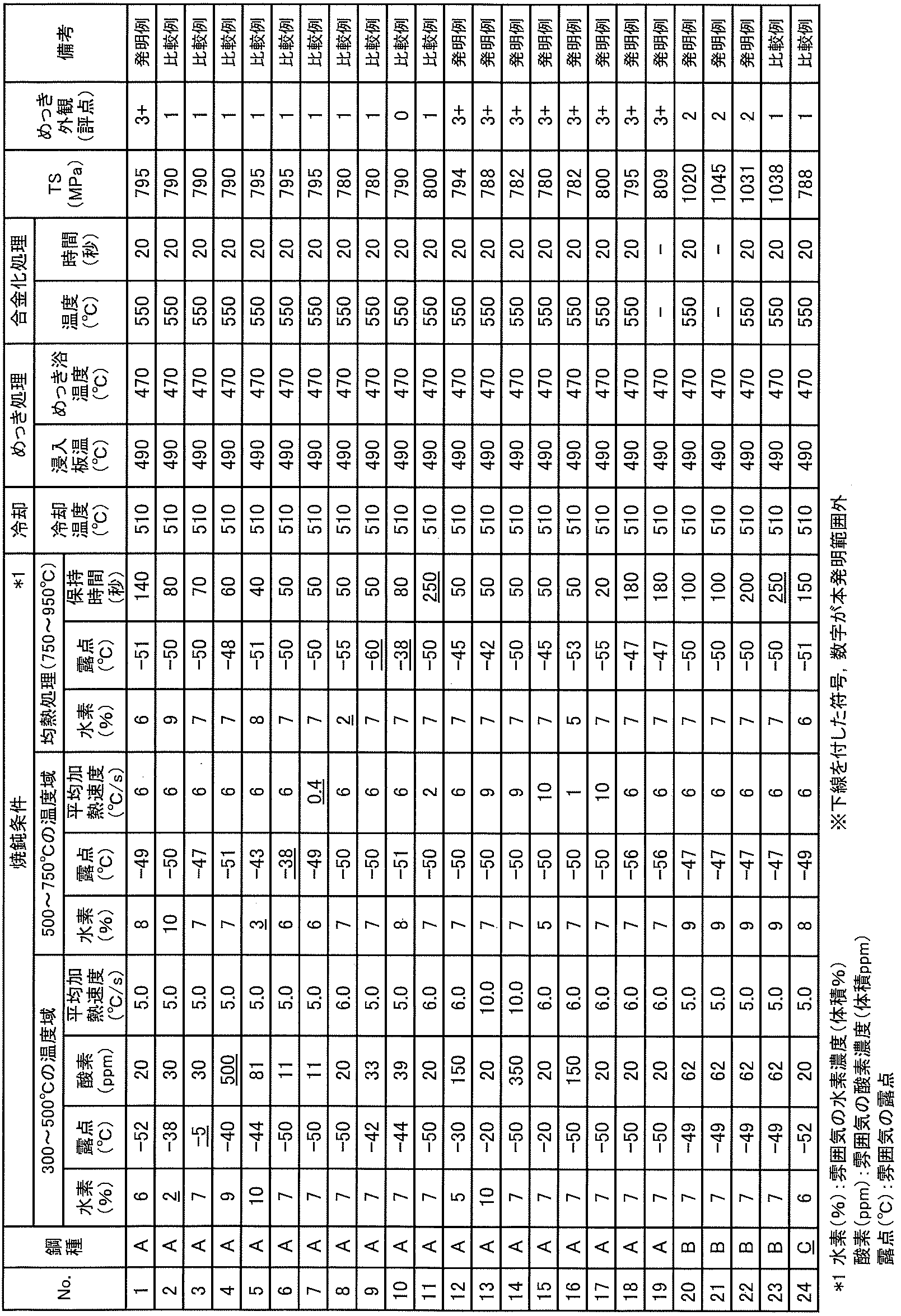

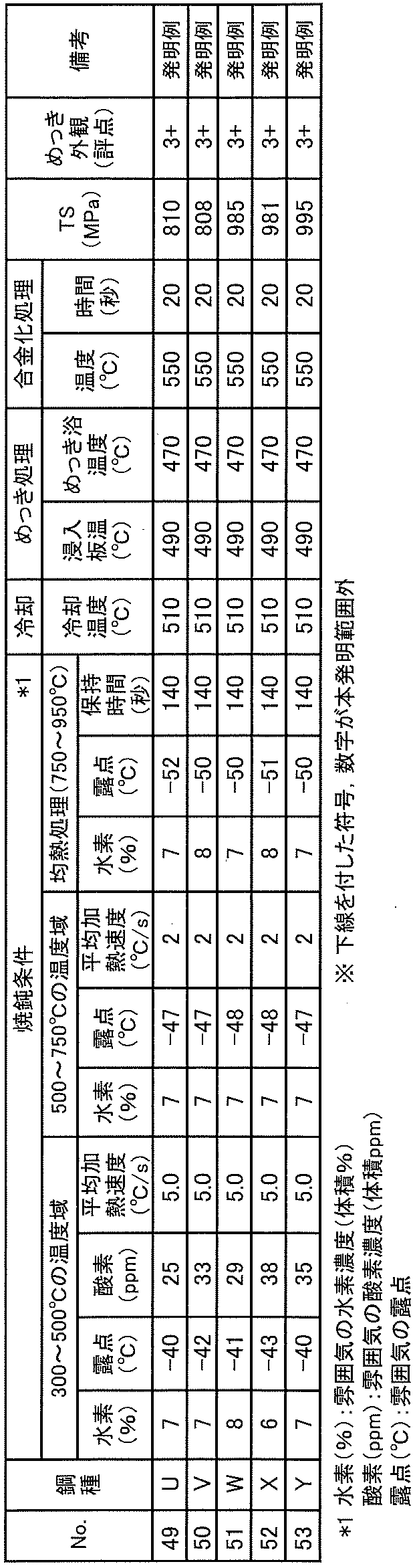
均熱処理工程(均熱帯)の雰囲気中のアンモニア濃度をより一層低減する観点から、均熱帯内の高純度ガスの流量を増加させた条件で溶融亜鉛めっき鋼板を製造した。表1の鋼B、O、A、М、R、S、Tの鋼素材を用い、実施例1に準じた製造条件(熱間圧延、冷間圧延、連続焼鈍、溶融亜鉛めっき、合金化処理、調質圧延)で溶融亜鉛めっき鋼板を製造した。得られた溶融亜鉛めっき鋼板の引張特性およびめっき外観を、実施例1と同様の手法で評価した。その結果を製造条件とともに表5に示す。
アンモニアガスの濃度は、CGL均熱帯のライン長手の中央部を含むパスの炉内上部にて測定した。測定方法には、イオンクロマトグラフ法を用いた。
表5に示すように、均熱処理工程(均熱帯)のアンモニア濃度を0.010体積%以下に低減することで、溶融亜鉛めっき鋼板の表面品質(めっき外観)はさらに向上することが判る。

Claims (3)
- 質量%で、
C:0.050%以上0.300%以下、
Si:0.80%以下、
Mn:2.30%以上3.50%以下、
P:0.100%以下、
S:0.0100%以下、
sol.Al:1.00%以下、
N:0.0200%以下、
B:0.0001%以上0.0050%以下
を含有するとともに、[%Mn]/[%Si]が3.0以上であり、
必要に応じて、さらに、
Cr:1.00%以下、
Ti:0.200%以下、
Nb:0.200%以下、
V:0.200%以下、
Mo:2.000%以下、
Cu:1.000%以下、
Ni:0.500%以下、
Sn:0.200%以下、
Mg:0.0100%以下、
Ca:0.0100%以下、
Zn:0.100%以下、
Co:0.200%以下、
Zr:0.200%以下、
REM:0.0100%以下、
Ta:0.10%以下、
Te:0.10%以下、
As:0.10%以下、
Hf:0.10%以下、
Bi:0.20%以下、
Pb:0.20%以下、
Ge:0.10%以下、
Sr:0.10%以下、
Cs:0.10%以下、
のなかから選ばれる1種以上を含有し、
残部がFeおよび不可避的不純物からなる成分組成を有する鋼板を連続焼鈍した後、溶融亜鉛めっき浴に浸漬して溶融亜鉛めっきし、その後、必要に応じて合金化処理を行う高強度溶融亜鉛めっき鋼板の製造方法であって、
前記連続焼鈍工程では、
300℃以上500℃以下の温度域を、水素:5体積%以上を含み、露点:-20℃以下、酸素:400体積ppm以下の雰囲気として鋼板を加熱し、
500℃以上750℃以下の温度域を、水素:5体積%以上を含み、露点:-40℃以下の雰囲気として平均加熱速度:1℃/s以上で鋼板を加熱し、
750℃以上950℃以下の温度で、水素:5体積%以上を含み、露点:-55℃以上-40℃以下の雰囲気として保持時間:20~200秒で鋼板を均熱処理する高強度溶融亜鉛めっき鋼板の製造方法。 - 鋼板の成分組成において、[%Mn]/[%Si]が12.0以上である請求項1に記載の高強度溶融亜鉛めっき鋼板の製造方法。
- 連続焼鈍において鋼板を750℃以上950℃以下の温度で均熱処理する工程では、アンモニア:0.010体積%以下の雰囲気とする請求項1または2に記載の高強度溶融亜鉛めっき鋼板の製造方法。
Priority Applications (3)
| Application Number | Priority Date | Filing Date | Title |
|---|---|---|---|
| JP2024558244A JP7694843B2 (ja) | 2023-03-28 | 2024-03-18 | 高強度溶融亜鉛めっき鋼板の製造方法 |
| CN202480020169.5A CN120898019A (zh) | 2023-03-28 | 2024-03-18 | 高强度熔融镀锌钢板的制造方法 |
| MX2025010991A MX2025010991A (es) | 2023-03-28 | 2025-09-17 | Metodo de fabricacion de lamina de acero galvanizado por inmersion en caliente de alta resistencia |
Applications Claiming Priority (2)
| Application Number | Priority Date | Filing Date | Title |
|---|---|---|---|
| JP2023-052442 | 2023-03-28 | ||
| JP2023052442 | 2023-03-28 |
Publications (1)
| Publication Number | Publication Date |
|---|---|
| WO2024203545A1 true WO2024203545A1 (ja) | 2024-10-03 |
Family
ID=92904867
Family Applications (1)
| Application Number | Title | Priority Date | Filing Date |
|---|---|---|---|
| PCT/JP2024/010576 Ceased WO2024203545A1 (ja) | 2023-03-28 | 2024-03-18 | 高強度溶融亜鉛めっき鋼板の製造方法 |
Country Status (4)
| Country | Link |
|---|---|
| JP (1) | JP7694843B2 (ja) |
| CN (1) | CN120898019A (ja) |
| MX (1) | MX2025010991A (ja) |
| WO (1) | WO2024203545A1 (ja) |
Citations (2)
| Publication number | Priority date | Publication date | Assignee | Title |
|---|---|---|---|---|
| JP2006517257A (ja) * | 2003-01-15 | 2006-07-20 | 新日本製鐵株式会社 | 高強度溶融亜鉛系めっき鋼板及びその製造方法 |
| JP2022131411A (ja) * | 2021-02-26 | 2022-09-07 | 日本製鉄株式会社 | ホットスタンプ用合金化溶融亜鉛めっき鋼板、ホットスタンプ成形体およびそれらの製造方法 |
-
2024
- 2024-03-18 JP JP2024558244A patent/JP7694843B2/ja active Active
- 2024-03-18 WO PCT/JP2024/010576 patent/WO2024203545A1/ja not_active Ceased
- 2024-03-18 CN CN202480020169.5A patent/CN120898019A/zh active Pending
-
2025
- 2025-09-17 MX MX2025010991A patent/MX2025010991A/es unknown
Patent Citations (2)
| Publication number | Priority date | Publication date | Assignee | Title |
|---|---|---|---|---|
| JP2006517257A (ja) * | 2003-01-15 | 2006-07-20 | 新日本製鐵株式会社 | 高強度溶融亜鉛系めっき鋼板及びその製造方法 |
| JP2022131411A (ja) * | 2021-02-26 | 2022-09-07 | 日本製鉄株式会社 | ホットスタンプ用合金化溶融亜鉛めっき鋼板、ホットスタンプ成形体およびそれらの製造方法 |
Also Published As
| Publication number | Publication date |
|---|---|
| CN120898019A (zh) | 2025-11-04 |
| JPWO2024203545A1 (ja) | 2024-10-03 |
| MX2025010991A (es) | 2025-10-01 |
| JP7694843B2 (ja) | 2025-06-18 |
Similar Documents
| Publication | Publication Date | Title |
|---|---|---|
| CN108291283B (zh) | 高强度热浸镀锌钢板及用于其的热轧钢板和冷轧钢板的制造方法、高强度热浸镀锌钢板 | |
| CN100374585C (zh) | 高抗拉强度热浸镀钢板及其制造方法 | |
| EP3647444B1 (en) | Hot-pressed member and method for manufacturing same, and cold-rolled steel sheet for hot pressing and method for manufacturing same | |
| CN113272466B (zh) | 热浸镀锌钢板的制造方法 | |
| CN103210105A (zh) | 均匀伸长率和镀覆性优良的高强度热镀锌钢板及其制造方法 | |
| JP7401857B2 (ja) | 溶融亜鉛系めっき鋼板の製造方法 | |
| JP5552859B2 (ja) | 高強度溶融亜鉛めっき鋼板およびその製造方法 | |
| JP7480928B2 (ja) | 合金化溶融亜鉛めっき鋼板の製造方法 | |
| KR102632877B1 (ko) | 우수한 표면 특성을 가지는 초고강도 용융아연도금 강재 및 그 제조방법 | |
| CN111601906B (zh) | 高强度合金化电镀锌钢板及其制造方法 | |
| KR101647225B1 (ko) | 표면품질 및 내파우더링성이 우수한 고강도 합금화용융아연도금강판 및 그 제조방법 | |
| CN116806274B (zh) | 高强度钢板及其制造方法 | |
| CN111315911A (zh) | 一种镀锌退火钢板 | |
| JP7694843B2 (ja) | 高強度溶融亜鉛めっき鋼板の製造方法 | |
| JP7694844B2 (ja) | 高強度溶融亜鉛めっき鋼板の製造方法 | |
| JP7768470B1 (ja) | 合金化溶融亜鉛めっき鋼板およびその製造方法 | |
| JP7768471B1 (ja) | 合金化溶融亜鉛めっき鋼板およびその製造方法 | |
| KR101736640B1 (ko) | 도금성 및 점용접성이 우수한 아연계 도금강판 및 그 제조방법 | |
| JP7722618B1 (ja) | 高強度溶融亜鉛めっき鋼板およびその製造方法 | |
| WO2021006131A1 (ja) | 溶融亜鉛めっき鋼板および合金化溶融亜鉛めっき鋼板の製造方法 | |
| JP7722617B1 (ja) | 高強度溶融亜鉛めっき鋼板およびその製造方法 | |
| WO2026069819A1 (ja) | 合金化溶融亜鉛めっき鋼板およびその製造方法 | |
| WO2026069820A1 (ja) | 合金化溶融亜鉛めっき鋼板およびその製造方法 | |
| CN116829752B (zh) | 高强度钢板及其制造方法 | |
| KR102547364B1 (ko) | 고강도강 용융아연도금강판 및 그 제조방법 |
Legal Events
| Date | Code | Title | Description |
|---|---|---|---|
| WWE | Wipo information: entry into national phase |
Ref document number: 2024558244 Country of ref document: JP |
|
| 121 | Ep: the epo has been informed by wipo that ep was designated in this application |
Ref document number: 24779670 Country of ref document: EP Kind code of ref document: A1 |
|
| WWE | Wipo information: entry into national phase |
Ref document number: 202517078639 Country of ref document: IN |
|
| WWE | Wipo information: entry into national phase |
Ref document number: 2501006221 Country of ref document: TH Ref document number: 202480020169.5 Country of ref document: CN |
|
| WWP | Wipo information: published in national office |
Ref document number: 202517078639 Country of ref document: IN |
|
| NENP | Non-entry into the national phase |
Ref country code: DE |
|
| WWP | Wipo information: published in national office |
Ref document number: 202480020169.5 Country of ref document: CN |
|
| 122 | Ep: pct application non-entry in european phase |
Ref document number: 24779670 Country of ref document: EP Kind code of ref document: A1 |