WO2024203331A1 - 超音波診断装置および超音波診断装置の制御方法 - Google Patents
超音波診断装置および超音波診断装置の制御方法 Download PDFInfo
- Publication number
- WO2024203331A1 WO2024203331A1 PCT/JP2024/009769 JP2024009769W WO2024203331A1 WO 2024203331 A1 WO2024203331 A1 WO 2024203331A1 JP 2024009769 W JP2024009769 W JP 2024009769W WO 2024203331 A1 WO2024203331 A1 WO 2024203331A1
- Authority
- WO
- WIPO (PCT)
- Prior art keywords
- region
- brightness
- low
- area
- frames
- Prior art date
- Legal status (The legal status is an assumption and is not a legal conclusion. Google has not performed a legal analysis and makes no representation as to the accuracy of the status listed.)
- Ceased
Links
Images




Classifications
-
- A—HUMAN NECESSITIES
- A61—MEDICAL OR VETERINARY SCIENCE; HYGIENE
- A61B—DIAGNOSIS; SURGERY; IDENTIFICATION
- A61B8/00—Diagnosis using ultrasonic, sonic or infrasonic waves
- A61B8/08—Clinical applications
- A61B8/0825—Clinical applications for diagnosis of the breast, e.g. mammography
-
- A—HUMAN NECESSITIES
- A61—MEDICAL OR VETERINARY SCIENCE; HYGIENE
- A61B—DIAGNOSIS; SURGERY; IDENTIFICATION
- A61B8/00—Diagnosis using ultrasonic, sonic or infrasonic waves
- A61B8/08—Clinical applications
-
- A—HUMAN NECESSITIES
- A61—MEDICAL OR VETERINARY SCIENCE; HYGIENE
- A61B—DIAGNOSIS; SURGERY; IDENTIFICATION
- A61B8/00—Diagnosis using ultrasonic, sonic or infrasonic waves
- A61B8/08—Clinical applications
- A61B8/0833—Clinical applications involving detecting or locating foreign bodies or organic structures
- A61B8/085—Clinical applications involving detecting or locating foreign bodies or organic structures for locating body or organic structures, e.g. tumours, calculi, blood vessels, nodules
-
- A—HUMAN NECESSITIES
- A61—MEDICAL OR VETERINARY SCIENCE; HYGIENE
- A61B—DIAGNOSIS; SURGERY; IDENTIFICATION
- A61B8/00—Diagnosis using ultrasonic, sonic or infrasonic waves
- A61B8/46—Ultrasonic, sonic or infrasonic diagnostic devices with special arrangements for interfacing with the operator or the patient
- A61B8/461—Displaying means of special interest
-
- A—HUMAN NECESSITIES
- A61—MEDICAL OR VETERINARY SCIENCE; HYGIENE
- A61B—DIAGNOSIS; SURGERY; IDENTIFICATION
- A61B8/00—Diagnosis using ultrasonic, sonic or infrasonic waves
- A61B8/46—Ultrasonic, sonic or infrasonic diagnostic devices with special arrangements for interfacing with the operator or the patient
- A61B8/467—Ultrasonic, sonic or infrasonic diagnostic devices with special arrangements for interfacing with the operator or the patient characterised by special input means
- A61B8/469—Ultrasonic, sonic or infrasonic diagnostic devices with special arrangements for interfacing with the operator or the patient characterised by special input means for selection of a region of interest
-
- A—HUMAN NECESSITIES
- A61—MEDICAL OR VETERINARY SCIENCE; HYGIENE
- A61B—DIAGNOSIS; SURGERY; IDENTIFICATION
- A61B8/00—Diagnosis using ultrasonic, sonic or infrasonic waves
- A61B8/52—Devices using data or image processing specially adapted for diagnosis using ultrasonic, sonic or infrasonic waves
- A61B8/5207—Devices using data or image processing specially adapted for diagnosis using ultrasonic, sonic or infrasonic waves involving processing of raw data to produce diagnostic data, e.g. for generating an image
-
- A—HUMAN NECESSITIES
- A61—MEDICAL OR VETERINARY SCIENCE; HYGIENE
- A61B—DIAGNOSIS; SURGERY; IDENTIFICATION
- A61B8/00—Diagnosis using ultrasonic, sonic or infrasonic waves
- A61B8/52—Devices using data or image processing specially adapted for diagnosis using ultrasonic, sonic or infrasonic waves
- A61B8/5215—Devices using data or image processing specially adapted for diagnosis using ultrasonic, sonic or infrasonic waves involving processing of medical diagnostic data
- A61B8/5223—Devices using data or image processing specially adapted for diagnosis using ultrasonic, sonic or infrasonic waves involving processing of medical diagnostic data for extracting a diagnostic or physiological parameter from medical diagnostic data
-
- A—HUMAN NECESSITIES
- A61—MEDICAL OR VETERINARY SCIENCE; HYGIENE
- A61B—DIAGNOSIS; SURGERY; IDENTIFICATION
- A61B8/00—Diagnosis using ultrasonic, sonic or infrasonic waves
- A61B8/54—Control of the diagnostic device
-
- G—PHYSICS
- G06—COMPUTING OR CALCULATING; COUNTING
- G06T—IMAGE DATA PROCESSING OR GENERATION, IN GENERAL
- G06T7/00—Image analysis
- G06T7/0002—Inspection of images, e.g. flaw detection
- G06T7/0012—Biomedical image inspection
- G06T7/0014—Biomedical image inspection using an image reference approach
- G06T7/0016—Biomedical image inspection using an image reference approach involving temporal comparison
-
- G—PHYSICS
- G06—COMPUTING OR CALCULATING; COUNTING
- G06T—IMAGE DATA PROCESSING OR GENERATION, IN GENERAL
- G06T7/00—Image analysis
- G06T7/70—Determining position or orientation of objects or cameras
- G06T7/73—Determining position or orientation of objects or cameras using feature-based methods
- G06T7/74—Determining position or orientation of objects or cameras using feature-based methods involving reference images or patches
-
- G—PHYSICS
- G06—COMPUTING OR CALCULATING; COUNTING
- G06V—IMAGE OR VIDEO RECOGNITION OR UNDERSTANDING
- G06V10/00—Arrangements for image or video recognition or understanding
- G06V10/20—Image preprocessing
- G06V10/25—Determination of region of interest [ROI] or a volume of interest [VOI]
-
- G—PHYSICS
- G16—INFORMATION AND COMMUNICATION TECHNOLOGY [ICT] SPECIALLY ADAPTED FOR SPECIFIC APPLICATION FIELDS
- G16H—HEALTHCARE INFORMATICS, i.e. INFORMATION AND COMMUNICATION TECHNOLOGY [ICT] SPECIALLY ADAPTED FOR THE HANDLING OR PROCESSING OF MEDICAL OR HEALTHCARE DATA
- G16H50/00—ICT specially adapted for medical diagnosis, medical simulation or medical data mining; ICT specially adapted for detecting, monitoring or modelling epidemics or pandemics
- G16H50/30—ICT specially adapted for medical diagnosis, medical simulation or medical data mining; ICT specially adapted for detecting, monitoring or modelling epidemics or pandemics for calculating health indices; for individual health risk assessment
-
- G—PHYSICS
- G06—COMPUTING OR CALCULATING; COUNTING
- G06T—IMAGE DATA PROCESSING OR GENERATION, IN GENERAL
- G06T2207/00—Indexing scheme for image analysis or image enhancement
- G06T2207/10—Image acquisition modality
- G06T2207/10132—Ultrasound image
-
- G—PHYSICS
- G06—COMPUTING OR CALCULATING; COUNTING
- G06T—IMAGE DATA PROCESSING OR GENERATION, IN GENERAL
- G06T2207/00—Indexing scheme for image analysis or image enhancement
- G06T2207/20—Special algorithmic details
- G06T2207/20048—Transform domain processing
- G06T2207/20056—Discrete and fast Fourier transform, [DFT, FFT]
-
- G—PHYSICS
- G06—COMPUTING OR CALCULATING; COUNTING
- G06T—IMAGE DATA PROCESSING OR GENERATION, IN GENERAL
- G06T2207/00—Indexing scheme for image analysis or image enhancement
- G06T2207/30—Subject of image; Context of image processing
- G06T2207/30004—Biomedical image processing
- G06T2207/30068—Mammography; Breast
-
- G—PHYSICS
- G06—COMPUTING OR CALCULATING; COUNTING
- G06T—IMAGE DATA PROCESSING OR GENERATION, IN GENERAL
- G06T2207/00—Indexing scheme for image analysis or image enhancement
- G06T2207/30—Subject of image; Context of image processing
- G06T2207/30004—Biomedical image processing
- G06T2207/30096—Tumor; Lesion
-
- G—PHYSICS
- G06—COMPUTING OR CALCULATING; COUNTING
- G06V—IMAGE OR VIDEO RECOGNITION OR UNDERSTANDING
- G06V2201/00—Indexing scheme relating to image or video recognition or understanding
- G06V2201/03—Recognition of patterns in medical or anatomical images
Definitions
- the present invention relates to an ultrasound diagnostic device used to examine the breasts of a subject, and a method for controlling the ultrasound diagnostic device.
- an ultrasound diagnostic device is equipped with an ultrasound probe that contains an array of transducers and a device main body that is connected to the ultrasound probe.
- An ultrasound beam is transmitted from the ultrasound probe to the subject, and the ultrasound echo from the subject is received by the ultrasound probe.
- An ultrasound image is generated by electrically processing the received signal.
- Non-Patent Document 1 reports that even if the mammary gland area is almost the same, breast cancer is more likely to occur when the proportion of GTC (Glandular Tissue Component) areas, which include the milk ducts, lobules, and surrounding stroma, in the mammary gland area is high.
- GTC Global Tissue Component
- the proportion of the GTC area in the mammary gland area can be a risk factor. This means that the risk is high in patients whose lobules do not degenerate.
- Patent Document 1 an apparatus is disclosed that extracts a region suspected of being a lesion within a mammary gland region from an ultrasound image.
- Patent Document 1 the ultrasound diagnostic device in Patent Document 1 is intended to detect areas suspected of having lesions in the mammary gland region, and is not interested in evaluating GTC regions. This poses the problem that it is not possible to consider in detail the risk of breast cancer in the mammary gland region.
- GTC regions and fatty regions are depicted as low-echoic, i.e., low-brightness regions, in ultrasound images, when attempting to manually evaluate the GTC region as disclosed in Non-Patent Document 1, a user such as a doctor must determine whether the GTC region or fatty region is present, making it difficult to accurately evaluate the GTC region and sometimes preventing the user from accurately assessing the risk of breast cancer in the mammary gland region.
- the present invention has been made to solve these conventional problems, and aims to provide an ultrasound diagnostic device that allows the user to accurately assess the risk of breast cancer in the subject's mammary gland area, even when fatty areas are present within the mammary gland area.
- An ultrasonic probe an image acquisition unit that scans an ultrasonic probe to continuously acquire a plurality of frames of ultrasonic images of a subject's breast; a mammary gland region extraction unit that extracts a mammary gland region from each of a plurality of frames of ultrasound images; a low-brightness region extraction unit that extracts a low-brightness region having a brightness equal to or lower than a predetermined brightness threshold from the mammary gland region extracted by the mammary gland region extraction unit and calculates an area of the low-brightness region for each frame; a region of interest extraction unit that extracts a region of interest whose area change rate is equal to or lower than a predetermined change rate threshold based on a time-series change in the area of a low brightness region in a plurality of frames; and an evaluation unit that evaluates a breast cancer risk based on a ratio of an area of the region of interest in the multiple frames extracted by the region of interest extraction unit to
- the ultrasound diagnostic device selects frames having a frequency equal to or below a predetermined frequency threshold by performing a Fourier transform on time-series data of a total area of low-brightness regions in each of a plurality of frames, and extracts the low-brightness regions in the selected frames as regions of interest.
- the region of interest extraction unit calculates a change in area for each low-brightness region in multiple frames over a predetermined number of frames, and extracts, as a region of interest, a low-brightness region in which the calculated change in area is equal to or less than a predetermined area change threshold.
- the ultrasound diagnostic device according to any one of [1] to [3], wherein the low brightness region extraction unit extracts pixels having a brightness equal to or lower than a predetermined brightness threshold from the mammary gland region extracted by the mammary gland region extraction unit, and calculates the area occupied by the extracted pixels as the area of the low brightness region for each frame.
- the low brightness region extraction unit extracts low brightness regions by binarizing the mammary gland region extracted by the mammary gland region extraction unit based on a determined brightness threshold value.
- a low-luminance region integrating unit that generates a continuous low-luminance region by integrating a plurality of low-luminance regions that are extracted by the low-luminance region extracting unit in adjacent frames among the plurality of frames and have overlapping portions,
- the ultrasound diagnostic device of claim 1 wherein the region of interest extraction unit calculates a variance of the area of the low-brightness region in each frame within the continuous low-brightness region for each continuous low-brightness region, and extracts, as a region of interest, a low-brightness region in each frame within the continuous low-brightness region where the calculated variance is equal to or less than a predetermined variance threshold.
- a frame interval adjustment unit is provided that calculates a position change amount of an imaging location of an ultrasound image in adjacent frames among a plurality of frames, and adjusts a time interval between the adjacent frames in accordance with the calculated position change amount,
- the ultrasound diagnostic device according to any one of claims 1 to 6, wherein the region of interest extraction unit extracts a region of interest from a time-series change in the area of a low-brightness region in multiple frames based on the time interval adjusted by the frame interval adjustment unit.
- a monitor for displaying an ultrasound image a frame identification unit that identifies frames having a frequency higher than a predetermined frequency threshold by performing an inverse Fourier transform on time-series data of the total area of low brightness regions in each of the plurality of frames that have been Fourier-transformed by the region of interest extraction unit;
- the ultrasound diagnostic device according to claim 2, wherein an ultrasound image of the frame identified by the frame identification unit is displayed on a monitor.
- an ultrasound diagnostic device includes an ultrasound probe, an image acquisition unit that scans the ultrasound probe to continuously acquire multiple frames of ultrasound images of the subject's breast, a mammary gland region extraction unit that extracts a mammary gland region from each of the multiple frames of ultrasound images, a low-brightness region extraction unit that extracts low-brightness regions having a brightness below a predetermined brightness threshold from the mammary gland region extracted by the mammary gland region extraction unit and calculates the area of the low-brightness region for each frame, a region of interest extraction unit that extracts a region of interest whose rate of change in area is below a predetermined change rate threshold from the time-series change in the area of the low-brightness region in the multiple frames, and an evaluation unit that evaluates breast cancer risk based on the ratio of the area of the region of interest in the multiple frames extracted by the region of interest extraction unit to the area of the mammary gland region in the multiple frames extracted by the mammary gland region extraction unit, so that even if a
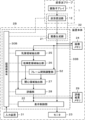
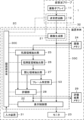
- FIG. 1 is a block diagram showing a configuration of an ultrasound diagnostic apparatus according to a first embodiment of the present invention
- 2 is a block diagram showing an internal configuration of a transmission/reception circuit according to the first embodiment
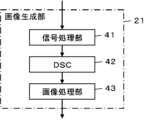
- 4 is a block diagram showing an internal configuration of an image generating unit in the first embodiment.
- FIG. 1 is a diagram showing an ultrasound image of a mammary gland region of a subject.
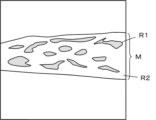
- FIG. 2 is a diagram showing an ultrasound image of a mammary gland region in which a GTC region is photographed.
- 1 is an example of a graph showing the relationship between the frame number of an ultrasound image and the area of a low brightness region.
- 13 is an example of a graph obtained by Fourier transforming the relationship between the frame number of an ultrasound image and the area of a low-brightness region.
- FIG. 11 is a block diagram showing the configuration of an ultrasound diagnostic apparatus according to a second embodiment of the present invention.
- FIG. 11 is a block diagram showing the configuration of an ultrasound diagnostic apparatus according to a third embodiment of the present invention.
- FIG. 11 is a block diagram showing the configuration of an ultrasound diagnostic apparatus according to a fourth embodiment of the present invention.
- the ultrasound probe 1 has a transducer array 11 and a transmission/reception circuit 12 connected to the transducer array 11.
- a main body control unit 30 is connected to the transmission/reception circuit 12, image generation unit 21, display control unit 22, image memory 24, mammary gland region extraction unit 25, low brightness region extraction unit 26, region of interest extraction unit 27, evaluation unit 28, and evaluation result memory 29.
- An input device 31 is connected to the main body control unit 30.
- the transmission/reception circuit 12 and the image generation unit 21 constitute an image acquisition unit 32.
- the image generation unit 21, display control unit 22, mammary gland region extraction unit 25, low brightness region extraction unit 26, region of interest extraction unit 27, evaluation unit 28, and main body control unit 30 constitute a processor 33 for the device main body 2.
- the transducer array 11 of the ultrasound probe 1 has multiple ultrasound transducers arranged one-dimensionally or two-dimensionally. Each of these transducers transmits ultrasound waves according to a drive signal supplied from the transmission/reception circuit 12, and also receives reflected waves from the subject and outputs an analog reception signal.
- Each transducer is constructed by forming electrodes on both ends of a piezoelectric body made of, for example, a piezoelectric ceramic such as PZT (Lead Zirconate Titanate), a polymer piezoelectric element such as PVDF (Poly Vinylidene Di Fluoride), or a piezoelectric single crystal such as PMN-PT (Lead Magnesium Niobate-Lead Titanate).
- the image acquisition unit 32 which is composed of the transmission/reception circuit 12 and the image generation unit 21, scans the ultrasound probe 1 to continuously acquire multiple frames of ultrasound images of the subject's breast.
- the transmission/reception circuit 12 transmits ultrasonic waves from the transducer array 11 and generates sound ray signals based on the reception signals acquired by the transducer array 11.
- the transmission/reception circuit 12 has a pulser 13 connected to the transducer array 11, an amplifier unit 14, an AD (Analog Digital) conversion unit 15, and a beamformer 16 connected in series to the transducer array 11.
- the pulsar 13 includes, for example, multiple pulse generators, and adjusts the delay amount of each drive signal and supplies it to the multiple transducers of the transducer array 11 based on a transmission delay pattern selected in response to a control signal from the main body control unit 30 so that the ultrasound transmitted from the multiple transducers forms an ultrasonic beam.
- a pulsed or continuous wave voltage is applied to the electrodes of the transducers of the transducer array 11, the piezoelectric body expands and contracts, and pulsed or continuous wave ultrasound is generated from each transducer, and an ultrasonic beam is formed from the composite wave of these ultrasound waves.
- the transmitted ultrasound beam is reflected by an object, such as a part of the subject, and an ultrasound echo propagates toward the transducer array 11 of the ultrasound probe 1.
- the ultrasound echo propagating toward the transducer array 11 in this manner is received by each of the transducers that make up the transducer array 11.
- each of the transducers that make up the transducer array 11 expands and contracts upon receiving the propagating ultrasound echo, generating a received signal that is an electrical signal, and outputting these received signals to the amplifier unit 14.
- the amplifier 14 amplifies the signals input from each transducer that constitutes the transducer array 11 and transmits the amplified signals to the AD converter 15.
- the AD converter 15 converts the signals transmitted from the amplifier 14 into digital reception data and transmits these reception data to the beamformer 16.
- the beamformer 16 performs so-called reception focusing processing by adding each reception data converted by the AD converter 15 with a respective delay according to the sound speed or sound speed distribution set based on the reception delay pattern selected in response to a control signal from the main body control unit 30. This reception focusing processing causes the reception data converted by the AD converter 15 to be phased and added, and a sound ray signal with a narrowed focus of the ultrasonic echo is obtained.
- the DSC 42 converts (raster converts) the ultrasonic image signal generated by the signal processor 41 into an image signal conforming to a scanning method for a normal television signal.
- the image processing unit 43 performs various necessary image processing such as gradation processing on the ultrasound image signal input from the DSC 42, and then outputs a signal representing the ultrasound image to the display control unit 22 and the image memory 24.
- the signal representing the ultrasound image generated by the image generation unit 21 in this manner will be simply called an ultrasound image.
- the image generation unit 21 can also output the ultrasound image signal before processing by the DSC 42 or the ultrasound image signal immediately after processing by the DSC 42 to the image memory 24. In this case, the image generation unit 21 can generate an ultrasound image by reading these signals from the image memory 24 and performing processing by the DSC 42 or the image processing unit 43.
- the image memory 24 is a memory that stores ultrasound images generated by the image generation unit 21 under the control of the main body control unit 30.
- the image memory 24 can hold multiple frames of ultrasound images generated by the image generation unit 21 in response to a diagnosis of the mammary gland region of the subject's breast.
- the image memory 24 may be, for example, a flash memory, HDD (Hard Disc Drive), SSD (Solid State Drive), FD (Flexible Disc), MO disk (Magneto-Optical disc), MT (Magnetic Tape), RAM (Random Access Memory), CD (Compact Disc), DVD (Digital Versatile Disc), SD card (Secure Digital card), USB memory (Universal Serial Bus memory), or other recording media.
- HDD Hard Disc Drive
- SSD Solid State Drive
- FD Fexible Disc
- MO disk Magnetic-Optical disc
- MT Magnetic Tape
- RAM Random Access Memory
- CD Compact Disc
- DVD Digital Versatile Disc
- SD card Secure Digital card
- USB memory Universal Serial Bus memory
- the mammary gland region extraction unit 25 detects the subject's breast region from the ultrasound image read from the image memory 24, and extracts the mammary gland region from the detected breast region.
- FIG 4 shows an example of an ultrasound image U of a subject's breast.
- This ultrasound image U is a cross-sectional image taken by contacting the tip of the ultrasound probe 1 with the subject's breast, with the subject's skin S appearing at the top of the ultrasound image U, which shows the shallowest part, and the pectoralis major muscle T appearing at the bottom of the ultrasound image U, which shows the deeper part.
- the mammary gland region extraction unit 25 can recognize the skin S and pectoralis major muscle T from the ultrasound image U, and detect the deep region between the skin S and pectoralis major muscle T as the breast region BR.
- the mammary gland region extraction unit 25 can perform image recognition using at least one of template matching, image analysis techniques using features such as AdaBoost (Adaptive Boosting), SVM (Support Vector Machine) or SIFT (Scale-Invariant Feature Transform), and a judgment model trained using machine learning techniques such as deep learning.
- the judgment model is a trained model that has learned the breast region BR and the mammary gland region M (segmentation) within the breast region BR in a training ultrasound image of a breast.
- the low-brightness region extraction unit 26 has a determined brightness threshold for the ultrasound image U, and as shown in FIG. 5, extracts a low-brightness region R1 having a brightness equal to or lower than the brightness threshold from the mammary gland region M extracted by the mammary gland region extraction unit 25, and calculates the area of the extracted low-brightness region R1 for each frame.
- the low-brightness region R1 includes a GTC (Glandular Tissue Component) region and a fat region.
- the GTC region is composed of ducts, lobules, and surrounding stroma within the mammary gland region M, with edematous stroma R2 filling in the spaces between the surrounding stroma. Because the edematous stroma R2 is rich in matrix and contains adipocytes, when the mammary gland region M is observed using an ultrasound image U, the edematous stroma R2 appears with a high echo level (hyperechoic) and high brightness.
- the ducts, lobules, and surrounding stroma that make up the GTC region have a relatively low echo level (hypoechoic), and are less bright than the edematous stroma R2.
- the fat region also has a low echo level and low brightness, just like the GTC region.
- the low-brightness region extraction unit 26 can also extract the low-brightness region R1 using an algorithm such as the so-called Watershed method after binarizing the mammary gland region M extracted by the mammary gland region extraction unit 25 based on a set brightness threshold.
- the low-brightness region extraction unit 26 can also extract the low-brightness region R1 using a judgment model trained using machine learning techniques such as deep learning.
- a judgment model for example, a trained model that has trained the low-brightness region R1 within the mammary gland region M in a training ultrasound image of a breast is used.
- the low brightness region extraction unit 26 may also perform edge detection on the low brightness region R1 in the ultrasound image U by image analysis, and automatically calculate a brightness threshold value based on the change in brightness value in the detected edge portion, i.e., the change in brightness value of a plurality of pixels from the inside to the outside of the low brightness region R1. In this way, a brightness threshold value suitable for the ultrasound image to be subjected to image analysis can be automatically set.
- the low-brightness region extraction unit 26 can also set a value input by the user via the input device 31 as the brightness threshold value used in binarizing the mammary gland region M.
- the low-brightness region extraction unit 26 can generate a binarized image of the mammary gland region M using the initial value of the brightness threshold value, and create a brightness histogram of the mammary gland region M in the ultrasound image U.
- the user can then input an updated value for the brightness threshold value while referring to, for example, the binarized image generated using the initial value, the brightness histogram, and the ultrasound image U.
- the low-brightness region extraction unit 26 can update the binarized image using the brightness threshold value input by the user.
- the region of interest extraction unit 27 When multiple frames of ultrasound images U are generated by the image generating unit 21 while a user such as a doctor is moving the ultrasound probe 1 over the subject's breast, the region of interest extraction unit 27 has a change rate threshold value determined for the time-series change in the area of the low-brightness region R1 in the multiple frames of ultrasound images U, and extracts a region of interest whose area change rate is equal to or less than the change rate threshold value from the time-series change in the area of the low-brightness region R1 in the multiple frames of ultrasound images U.
- the change rate of the area of the low-brightness region R1 is represented, for example, by the amount of change in the area of the low-brightness region R1 between frames.
- the region of interest extraction unit 27 creates time series data of the total area of the low brightness region R1 in each of the multiple frames of ultrasound images U by arranging the total area of the low brightness region R1 in each of the multiple frames of ultrasound images U in order of frame number, as shown in FIG. 6 for example. If a fatty region is present in the mammary gland region M, the fatty region will appear in several chronologically consecutive frames of the multiple frames of ultrasound images U acquired while the ultrasound probe 1 is moving, and the total area of the low brightness region R1 will increase in these several frames of ultrasound images U. This creates a portion A1 in the time series data where the total area of the low brightness region R1 is convex upward.
- the region of interest extraction unit 27 can obtain Fourier transform data that indicates the relationship between the total area of low brightness regions R1 in each of multiple frames of ultrasound images and frequency, as shown in FIG. 7.
- Fourier transform data that indicates the relationship between the total area of low brightness regions R1 in each of multiple frames of ultrasound images and frequency, as shown in FIG. 7.
- an upwardly convex portion A2 indicating the presence of a fatty region is generated in the Fourier transform data in a relatively high frequency band, corresponding to a portion A1 in the time series data where the total area of low brightness regions R1 is upwardly convex.
- a portion A3 indicating the presence of a GTC region is generated in a relatively low frequency band.
- the region of interest extraction unit 27 has a set frequency threshold as a speed change threshold for the area of the low-brightness region R1, and can exclude frames that contain fat regions by selecting frames with a frequency below the frequency threshold in the Fourier transform data, and extract the low-brightness region R1 in the selected frames as the region of interest.
- the region of interest extracted in this way is a region from which fat regions have been effectively excluded.
- the region of interest extraction unit 27 can also obtain a region of interest from which fat regions have been effectively excluded without using a Fourier transform.
- the region of interest extraction unit 27 has an area change threshold value determined for the change in area of the low-brightness region R1 in the time-series data, and can calculate the change in area over a determined number of frames for each low-brightness region R1 in a plurality of frames of ultrasound image U based on the time-series data, and extract the low-brightness region R1 whose calculated change in area is equal to or less than the area change threshold value as the region of interest.
- the evaluation unit 28 evaluates the risk of breast cancer based on the ratio of the area of the region of interest in the multiple frames of ultrasound images U extracted by the region of interest extraction unit 27 to the area of the mammary gland region M in the multiple frames of ultrasound images U extracted by the mammary gland region extraction unit 25.
- the region of interest is the low-brightness region R1 that includes the GTC region and the fat region, excluding the fat region, so the ratio of the area of the region of interest calculated in this manner means the ratio of the area of the GTC region to the area of the mammary gland region M.
- the ratio of the area of the region of interest to the area of the mammary gland region M represents the degree of progression of lobule involution and can be used as a criterion for determining breast cancer risk. Therefore, the evaluation unit 28 can use, for example, the average, median or sum of the ratio of the area of the region of interest to the area of the mammary gland region M in multiple frames as the evaluation result for breast cancer risk. A user such as a doctor can determine that the lower the ratio of the area of the region of interest to the area of the mammary gland region M, the higher the breast cancer risk.
- the evaluation unit 28 also stores a defined breast cancer risk function that calculates a higher breast cancer risk value, for example, the lower the ratio of the area of the region of interest to the area of the mammary gland region M, and can use the breast cancer risk value calculated based on the calculated ratio of the area of the region of interest and the breast cancer risk function as the evaluation result of breast cancer risk.
- the user can determine that the higher the breast cancer risk value, the higher the breast cancer risk.
- the evaluation unit 28 can also determine a category for the region of interest based on the ratio of the area of the region of interest to the area of the mammary gland region M, and use the category as an evaluation result for breast cancer risk.
- the evaluation unit 28 can output as an evaluation result one of a number of predefined categories as a category of the region of interest, for example, one of two categories, Low and High. Low indicates that the lobule degeneration is less advanced than High.
- the evaluation unit 28 can also output as a category of the region of interest one of four categories, for example, Minimal, Mild, Moderate, and Marked. Mild indicates that the lobule degeneration is less advanced than Minimal, Moderate indicates that the lobule degeneration is less advanced than Mild, and Marked indicates that the lobule degeneration is less advanced than Moderate.
- the region of interest extraction unit 27 extracts a region of interest excluding fatty regions from the low-brightness region R1 extracted by the low-brightness region extraction unit 26, and the evaluation unit 28 evaluates the risk of breast cancer using the region of interest, thereby making it possible to obtain highly accurate evaluation results.
- the evaluation result memory 29 stores the evaluation results of the breast cancer risk by the evaluation unit 28. For example, after the subject is examined, the user can read out the evaluation results via the input device 31 and consider the breast cancer risk in the subject's breast based on the evaluation results.
- a recording medium such as a flash memory, HDD, SSD, FD, MO disk, MT, RAM, CD, DVD, SD card, USB memory, etc. can be used.
- the display control unit 22 Under the control of the main body control unit 30, the display control unit 22 performs predetermined processing on the ultrasound image U sent from the image generation unit 21 and the breast cancer risk assessment results by the evaluation unit 28, and displays the ultrasound image U and the breast cancer risk assessment results, etc. on the monitor 23.
- the monitor 23 displays the ultrasound image U etc. under the control of the display control unit 22, and has a display device such as an LCD (Liquid Crystal Display) or an organic EL display (Organic Electroluminescence Display).
- a display device such as an LCD (Liquid Crystal Display) or an organic EL display (Organic Electroluminescence Display).
- the main body control unit 30 controls each part of the device main body 2 and the transmission/reception circuit 12 of the ultrasonic probe 1 based on a control program stored in advance.
- the input device 31 is used by the user to perform input operations, and is composed of devices such as a keyboard, a mouse, a trackball, a touch pad, and a touch sensor disposed over the monitor 23, for example.
- the processor 33 having the image generating unit 21, display control unit 22, mammary gland region extracting unit 25, low brightness region extracting unit 26, region of interest extracting unit 27, evaluation unit 28 and main body control unit 30 is composed of a CPU (Central Processing Unit) and a control program for causing the CPU to perform various processes, but may also be composed of an FPGA (Field Programmable Gate Array), a DSP (Digital Signal Processor), an ASIC (Application Specific Integrated Circuit), a GPU (Graphics Processing Unit) or other ICs (Integrated Circuits), or a combination of these.
- CPU Central Processing Unit
- FPGA Field Programmable Gate Array
- DSP Digital Signal Processor
- ASIC Application Specific Integrated Circuit
- GPU Graphics Processing Unit
- the image generating unit 21, the display control unit 22, the mammary gland region extraction unit 25, the low-brightness region extraction unit 26, the region of interest extraction unit 27, the evaluation unit 28, and the main body control unit 30 of the processor 33 can be partially or entirely integrated into a single CPU or the like.
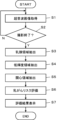
- step S1 the subject's breast is imaged using the ultrasonic probe 1 to obtain an ultrasonic image U.
- transmission and reception of ultrasonic waves is started from the multiple transducers of the transducer array 11 in accordance with a drive signal from the pulsar 13 of the transmission and reception circuit 12 of the ultrasonic probe 1
- ultrasonic echoes from within the subject's breast are received by the multiple transducers of the transducer array 11, and the received signals, which are analog signals, are output to the amplifier unit 14 and amplified, and then AD converted by the AD conversion unit 15 to obtain the received data.
- the beamformer 16 performs reception focusing processing on this received data, and the sound ray signals generated thereby are sent to the image generation unit 21 of the device main body 2, which generates an ultrasound image U representing tomographic image information of the subject's breast.
- the signal processing unit 41 of the image generation unit 21 performs attenuation correction and envelope detection processing on the sound ray signals according to the depth of the reflection position of the ultrasound
- the DSC 42 converts them into an image signal that follows the scanning method of a normal television signal
- the image processing unit 43 performs various necessary image processing such as gradation processing.
- the ultrasound image U obtained in this way is stored in the image memory 24.
- step S2 the main body control unit 30 determines whether or not to end the capture of the ultrasound image U.
- the main body control unit 30 can determine to end the capture of the ultrasound image U, for example, when an instruction to end the capture of the ultrasound image U is input by the user via the input device 31.
- the main body control unit 30 can also determine to continue the capture of the ultrasound image U, for example, when an instruction to end the capture of the ultrasound image U is not specifically input by the user via the input device 31.
- step S2 If it is determined in step S2 that capturing ultrasound images U should continue, the process returns to step S1, and a new ultrasound image U is acquired. In this way, as long as it is determined in step S2 that capturing ultrasound images U should continue, the processes of steps S1 and S2 are repeated to acquire multiple frames of ultrasound images U. At this time, the acquisition of multiple frames of ultrasound images U is performed while the user is moving the ultrasound probe 1 over the subject's breast.
- step S2 If it is determined in step S2 that capturing ultrasound image U is to be terminated, the process proceeds to step S3.
- the mammary gland region extraction unit 25 detects the subject's breast region BR from each of the multiple frames of ultrasound image U acquired by repeating steps S1 and S2, and extracts the mammary gland region M from the detected breast region BR.
- the mammary gland region extraction unit 25 can perform image recognition using at least one of template matching, an image analysis technique using feature values such as AdaBoost, SVM, or SIFT, and a judgment model trained using machine learning techniques such as deep learning.
- step S4 the low-brightness region extraction unit 26 extracts a low-brightness region R1 having a brightness equal to or lower than a predetermined brightness threshold from the mammary gland region M extracted in step S2, as shown in FIG. 5, and calculates the area of the low-brightness region R1 for each frame.
- the low-brightness region extraction unit 26 can, for example, extract pixels having a brightness below a predetermined brightness threshold from the mammary gland region M extracted by the mammary gland region extraction unit 25, and calculate the area occupied by the extracted pixels as the area of the low-brightness region R1 for each frame.
- the low-brightness region extraction unit 26 can also extract the low-brightness region R1 by binarizing the mammary gland region M extracted by the mammary gland region extraction unit 25 based on a predetermined brightness threshold.
- step S5 the region of interest extraction unit 27 extracts a region of interest whose area change rate is equal to or less than a predetermined change rate threshold from the time-series change in the area of the low-brightness region R1 in multiple frames extracted in step S4.
- the region of interest extraction unit 27 can, for example, perform a Fourier transform on the time series data of the total area of low brightness regions R1 in each of multiple frames as shown in FIG. 5 to obtain Fourier transformed data as shown in FIG. 6, select frames with a frequency below a set threshold in the Fourier transformed data, and extract the low brightness regions R1 in the selected frames as regions of interest.
- the regions of interest extracted in this way are regions from which fat regions have been effectively excluded.
- the region of interest extraction unit 27 can also calculate the change in area of each low-brightness region R1 over a set number of frames in multiple frames based on time-series data such as that shown in FIG. 5, and extract the low-brightness region R1 where the calculated change in area is equal to or less than a set area change threshold as the region of interest.
- the region of interest extracted in this way is also a region from which fat regions have been effectively excluded.
- step S6 the evaluation unit 28 evaluates the risk of breast cancer based on the ratio of the area of the region of interest in the multiple frames of ultrasound images U extracted by the region of interest extraction unit 27 to the area of the mammary gland region M in the multiple frames of ultrasound images U extracted in step S5.
- the evaluation unit 28 can use, for example, the average, median, or sum of the ratio of the area of the region of interest to the area of the mammary gland region M in multiple frames as the evaluation result for breast cancer risk.
- the user can determine that the lower the ratio of the area of the region of interest to the area of the mammary gland region M, the higher the risk of breast cancer.
- the evaluation unit 28 can also use, for example, a breast cancer risk value calculated based on the calculated area ratio of the region of interest and a defined breast cancer risk function that calculates a higher breast cancer risk value the lower the ratio of the area of the region of interest to the area of the mammary gland region M, as an evaluation result of breast cancer risk.
- the user can determine that the higher the breast cancer risk value, the higher the breast cancer risk.
- the evaluation unit 28 can also determine a category of the region of interest based on the ratio of the area of the region of interest to the area of the mammary gland region M, and use the category as an evaluation result of breast cancer risk.
- the evaluation unit 28 can output one of a number of predefined categories as the category of the region of interest, for example, one of the two categories, Low and High, as the evaluation result.
- the evaluation unit 28 can also output one of the four categories, for example, Minimal, Mild, Moderate, and Marked, as the category of the region of interest.
- both GTC and fatty regions are depicted as low-brightness regions R1 in the ultrasound image U, but in step S6, the breast cancer risk is evaluated using a region of interest in which fatty regions are excluded from the low-brightness regions R1 in the mammary gland region M, making it possible to obtain highly accurate evaluation results.
- step S7 the display control unit 22 displays the breast cancer risk assessment results obtained in step S7 on the monitor 23.
- the user can refer to the breast cancer risk assessment results displayed on the monitor 23 to accurately consider the breast cancer risk in the subject's breast.
- step S7 When the processing of step S7 is completed in this manner, the operation of the ultrasound diagnostic device according to the flowchart in Figure 8 is completed.
- the mammary gland region extraction unit 25 extracts the mammary gland region M from each of the multiple frames of the ultrasound image U
- the low brightness region extraction unit 26 extracts the low brightness region R1 having a brightness below a predetermined brightness threshold from the mammary gland region M and calculates the area of the low brightness region R1 for each frame
- the region of interest extraction unit 27 extracts a region of interest whose rate of change in area is below a predetermined change rate threshold from the time-series change in the area of the low brightness region R1 in the multiple frames
- the evaluation unit 28 evaluates the breast cancer risk based on the ratio of the area of the region of interest in the multiple frames to the area of the mammary gland region M in the multiple frames. Therefore, even if a fatty region is present in the mammary gland region M, the user can accurately consider the breast cancer risk in the mammary gland region M of the subject.
- the transmitting/receiving circuit 12 is described as being provided in the ultrasonic probe 1 , the transmitting/receiving circuit 12 may be provided in the device main body 2 . Further, although the image generating unit 21 is described as being provided in the device main body 2, the image generating unit 21 may be provided in the ultrasound probe 1.
- the device main body 2 may be a so-called stationary type, a portable type that is easy to carry, or a so-called handheld type that is configured, for example, by a smartphone or tablet computer. In this way, the type of device that configures the device main body 2 is not particularly limited.
- the ultrasonic probe 1 and the device body 2 are connected to each other by wire, the ultrasonic probe 1 and the device body 2 may be connected to each other wirelessly.
- step S3 the process of extracting the mammary gland region M in step S3 and the process of extracting the low brightness region R1 in step S4 are performed, but it is also possible to perform the processes of steps S3 and S4 each time an ultrasound image U is acquired in step S1, and then perform the determination process of step S2.
- the mammary gland region M extracted in step S3 and the low brightness region R1 extracted in step S4 can be linked to the ultrasound image U acquired in step S1 and stored in the image memory 24. Also, if it is determined in step S2 that capturing ultrasound image U should continue, the process returns to step S1, and then the processes of steps S2 and S3 are performed in sequence.
- step S2 it has been described that the main body control unit 30 determines whether or not to end the capture of the ultrasound image U based on a user instruction via the input device 31, but the method of determining whether or not to end the capture of the ultrasound image U is not particularly limited to this.
- the main body control unit 30 can, for example, determine to end the capture of the ultrasound image U when a predetermined number of frames of the ultrasound image U have been acquired, and can also determine to continue capturing the ultrasound image U when the number of frames of the acquired ultrasound image U is less than the predetermined number of frames.
- the main body control unit 30 can also, for example, determine to end the capture of the ultrasound image U when a predetermined time has elapsed since the start of capturing the ultrasound image U, and can also determine to continue capturing the ultrasound image U when the time elapsed since the start of capturing the ultrasound image U is less than the predetermined time. In this way, the main body control unit 30 automatically determines to end the capture of the ultrasound image U, thereby eliminating the need for the user to input instructions via the input device 31, and allowing the examination to be performed smoothly.
- the mammary gland region extraction unit 25 can also determine whether the shape of the mammary gland region M extracted from multiple frames of ultrasound images U changes continuously in the multiple frames of ultrasound images U. In this case, the mammary gland region extraction unit 25, for example, calculates the similarity between the mammary gland regions M in the ultrasound images U of frames adjacent in time series, and can determine that the shape of the mammary gland region M is changing continuously if the calculated similarity is equal to or less than a predetermined similarity threshold, and can determine that the shape of the mammary gland region M is not changing continuously if the calculated similarity is greater than the predetermined similarity threshold.
- the main body control unit 30 can end subsequent processing or, for example, display a message on the monitor 23 to guide the user to re-acquire multiple frames of ultrasound images U. This makes it possible to reliably acquire multiple frames of ultrasound images U in which the shape of the mammary gland region M changes continuously, improving the accuracy of extraction of the region of interest by the region of interest extraction unit 27 and evaluation of breast cancer risk by the evaluation unit 28.
- FIG. 9 shows the configuration of an ultrasound diagnostic device according to the second embodiment.
- the ultrasound diagnostic device according to the second embodiment includes a device body 2A instead of the device body 2 in the ultrasound diagnostic device according to the first embodiment shown in FIG. 1.
- the device body 2A further includes a low-brightness region integration unit 51 in the device body 2 in the first embodiment, and includes a body control unit 30A instead of the body control unit 30.
- the low brightness region extraction unit 26 is connected to the low brightness region extraction unit 26, and the low brightness region integration unit 51 is connected to the region of interest extraction unit 27.
- the low brightness region integration unit 51 is connected to the main body control unit 30A.
- the image generation unit 21, the display control unit 22, the mammary gland region extraction unit 25, the low brightness region extraction unit 26, the region of interest extraction unit 27, the evaluation unit 28, the main body control unit 30A, and the low brightness region integration unit 51 form a processor 33A for the device main body 2A.
- the low-brightness region integration unit 51 generates a continuous low-brightness region by integrating (associating) a plurality of low-brightness regions R1 that are extracted by the low-brightness region extraction unit 26 in the ultrasound images U of the multiple frames of ultrasound images U that are adjacent to each other in time series and have overlapping positions in the ultrasound images U.
- the continuous low-brightness regions generated in this manner correspond to the multiple low-brightness regions R1. Therefore, it is possible to determine whether each of the multiple low-brightness regions R1 contains a fat region other than a GTC region by a method using the variance of the area of the low-brightness regions R1, which will be described later.
- the region of interest extraction unit 27 has a variance threshold value determined for the variance of the area of low-brightness regions R1 in continuous low-brightness regions, and for each continuous low-brightness region, calculates the variance of the area of low-brightness regions R1 in the ultrasound image U of each frame within the continuous low-brightness region, and extracts, as a region of interest, low-brightness regions R1 in each frame within the continuous low-brightness region where the calculated variance is equal to or less than the variance threshold value.
- the evaluation unit 28 evaluates the breast cancer risk using the region of interest extracted in this manner by the region of interest extraction unit 27.
- the low-brightness region integration unit 51 generates continuous low-brightness regions by integrating multiple low-brightness regions R1 that are extracted in adjacent frames in time series and have overlapping portions among the multiple frames of ultrasound image U generated by the image generation unit 21, and the region of interest extraction unit 27 calculates the variance of the area of the low-brightness region R1 in each frame within the continuous low-brightness region for each continuous low-brightness region, and extracts the low-brightness region R1 in each frame within the continuous low-brightness region where the calculated variance is equal to or less than the variance threshold as a region of interest. Therefore, a region of interest whose shape changes continuously across multiple frames and from which fatty regions are effectively excluded can be obtained, improving the accuracy of breast cancer risk assessment.
- the frame intervals of multiple chronologically consecutive frames of ultrasound images U may not be constant because the user moves the ultrasound probe 1. Therefore, the ultrasound diagnostic device can adjust the frame intervals of the multiple frames of ultrasound images U.
- FIG. 10 shows the configuration of an ultrasound diagnostic device according to the third embodiment.
- the ultrasound diagnostic device according to the third embodiment includes a device body 2B instead of the device body 2 in the ultrasound diagnostic device according to the first embodiment shown in FIG. 1.
- the device body 2B further includes a frame interval adjustment unit 52 in the device body 2 in the first embodiment, and includes a body control unit 30B instead of the body control unit 30.
- a frame interval adjustment unit 52 is connected to the image memory 24.
- the frame interval adjustment unit 52 is connected to the region of interest extraction unit 27 and the main body control unit 30B.
- the image generation unit 21, the display control unit 22, the mammary gland region extraction unit 25, the low-brightness region extraction unit 26, the region of interest extraction unit 27, the evaluation unit 28, the main body control unit 30B, and the frame interval adjustment unit 52 form a processor 33B for the device main body 2B.
- the frame interval adjustment unit 52 calculates the amount of position change of the shooting location of the ultrasound image U in frames adjacent to each other in a time series among the multiple frames of ultrasound image U generated by the image generation unit 21, and adjusts the time interval of the adjacent frames according to the calculated amount of position change.
- the frame interval adjustment unit 52 calculates the image difference between the ultrasound images U of chronologically adjacent frames as the amount of change in position of the shooting location of the ultrasound image U, and can adjust the time interval between adjacent frames depending on the magnitude of the image difference. For example, the frame interval adjustment unit 52 can determine that the larger the image difference is, the longer the distance between the shooting locations of the ultrasound images U of adjacent frames is, and can widen the time interval between adjacent frames, and can determine that the smaller the image difference is, the shorter the distance between the shooting locations of the ultrasound images U of adjacent frames is, and can shorten the time interval between adjacent frames.
- the frame interval adjustment unit 52 adjusts the frame interval of chronologically adjacent frames of ultrasound images U so as to correspond to the distance between the imaging locations of adjacent ultrasound images U.
- the region of interest extraction unit 27 extracts a region of interest from the time series change in the area of the low brightness region R1 in multiple frames of ultrasound image U based on the time interval adjusted by the frame interval adjustment unit 52. At this time, the region of interest extraction unit 27 can create corrected time series data by correcting the time series data of the area of the low brightness region R1 as shown in FIG. 5, for example, based on the time interval adjusted by the frame interval adjustment unit 52.
- the region of interest extraction unit 27 can extract a region of interest excluding fat regions by a method of Fourier transforming the corrected time series data, a method of calculating the change in the area of the low brightness region R1 based on the corrected time series data, etc.
- the evaluation unit 28 evaluates the breast cancer risk using the region of interest extracted in this manner by the region of interest extraction unit 27.
- the frame interval adjustment unit 52 calculates the amount of position change of the shooting location of the ultrasound image U in frames adjacent to each other in a chronological order, and adjusts the time interval between the chronologically adjacent frames in accordance with the calculated amount of position change, and the region of interest extraction unit 27 extracts a region of interest from the time-series change in the area of the low-brightness region R1 in multiple frames based on the adjusted time interval. Therefore, even if the moving speed of the ultrasound probe 1 by the user is not constant, time-series data representing the correct time-series change in the area of the low-brightness region R1 in multiple frames can be created, and a region of interest that reliably excludes fatty regions can be extracted. This improves the accuracy of the breast cancer risk assessment by the evaluation unit 28.
- the frame interval adjustment unit 52 can calculate the amount of position change of the shooting location of the ultrasound image U based on the position of the ultrasound probe 1 detected by the position sensor, and adjust the time interval between adjacent frames in a chronological order based on the calculated amount of position change.
- a position sensor a magnetic sensor, an acceleration sensor, a gyro sensor, a distance measuring device such as a so-called LiDAR (Light Detection And Ranging), or a GPS (Global Positioning System) sensor, etc. can be used.
- the frame interval adjustment unit 52 can calculate the amount of position change of the imaging location of the ultrasound image U by analyzing the optical image of the ultrasound probe 1 captured by the optical camera, and adjust the time interval between chronologically adjacent frames based on the calculated amount of position change.
- the ultrasound diagnostic device of embodiment 3 is configured by providing the device body 2 with a frame interval adjustment unit 52 in the ultrasound diagnostic device of embodiment 1, but may also be configured by providing the device body 2A with a frame interval adjustment unit 52 in the ultrasound diagnostic device of embodiment 2.
- the region of interest extraction unit 27 extracts the region of interest using the Fourier transform method, it can also identify frames having frequencies greater than a predetermined frequency threshold based on the Fourier transform data, and display an ultrasound image U of this frame on the monitor 23.
- FIG. 11 shows the configuration of an ultrasound diagnostic device according to embodiment 4.
- the ultrasound diagnostic device according to embodiment 4 includes a device body 2C instead of the device body 2 in the ultrasound diagnostic device according to embodiment 1 shown in FIG. 1.
- the device body 2C further includes a frame identification unit 53 in the device body 2 in embodiment 1, and includes a body control unit 30C instead of the body control unit 30.
- the frame identification unit 53 is connected to the region of interest extraction unit 27.
- the frame identification unit 53 is connected to the display control unit 22 and the main body control unit 30C.
- the image generation unit 21, the display control unit 22, the mammary gland region extraction unit 25, the low-brightness region extraction unit 26, the region of interest extraction unit 27, the evaluation unit 28, the main body control unit 30C, and the frame identification unit 53 form a processor 33C for the device main body 2C.
- the frame identification unit 53 performs an inverse Fourier transform on the time series data of the total area of the low brightness regions R1 in each of the multiple frames of ultrasound image U Fourier transformed by the region of interest extraction unit 27, thereby identifying frames with frequencies greater than the set frequency threshold, i.e., frames from which a region of interest has not been extracted by the region of interest extraction unit 27.
- the frame identification unit 53 performs an inverse Fourier transform on a portion of the frequency band greater than the frequency threshold including the portion A2 indicative of the presence of a fatty region in the Fourier transform data shown in FIG. 7, for example, to identify frames with frequencies greater than the set frequency threshold.
- the display control unit 22 displays on the monitor 23 the ultrasound images U of multiple frames identified by the frame identification unit 53 and from which a region of interest has not been extracted by the region of interest extraction unit 27.
- the user can determine which of the multiple frames of ultrasound images U displayed on the monitor 23 from which the region of interest has not been extracted by the region of interest extraction unit 27 is unsuitable for assessing breast cancer risk because the mammary gland region M contains fatty areas, and select the ultrasound image U of that frame.
- the region of interest extraction unit 27 includes, in the region of interest, low-brightness regions R1 in the ultrasound images U of the frames not selected by the user among the multiple frames of ultrasound images U displayed on the monitor 23.
- the low-brightness regions R1 newly included in the region of interest are low-brightness regions R1 that the user has determined can be used to evaluate breast cancer risk because fat regions have been effectively excluded.
- the evaluation unit 28 evaluates the breast cancer risk using the region of interest thus output by the region of interest extraction unit 27.
- the frame identification unit 53 performs an inverse Fourier transform on the time series data of the total area of the low brightness region R1 in each of the multiple frames Fourier transformed by the region of interest extraction unit 27 to identify frames with frequencies greater than a specified frequency threshold
- the display control unit 22 displays the multiple frames of ultrasound image U identified by the frame identification unit 53 on the monitor 23, and the region of interest extraction unit 27 includes the low brightness region R1 in the frames not selected by the user among the multiple frames of ultrasound image U displayed on the monitor 23 in the region of interest, thereby improving the accuracy of the region of interest and improving the accuracy of the breast cancer risk assessment by the evaluation unit 28.
- the ultrasound diagnostic device of embodiment 4 is configured by equipping the device body 2 with a frame identification unit 53 in the ultrasound diagnostic device of embodiment 1, but may also be configured by equipping the device body 2A with a frame identification unit 53 in the ultrasound diagnostic device of embodiment 2, or may be configured by equipping the device body 2B with a frame identification unit 53 in the ultrasound diagnostic device of embodiment 3.
- Main body control unit 31 input device, 32 image acquisition unit, 33, 33A, 33C processor, 41 signal processing unit, 42 DSC, 43 image processing unit, 51 low-brightness area integration unit, 52 frame interval adjustment unit, 53 frame identification unit, A1, A2, A3 parts, BR breast area, L1 anterior border, L2 posterior border, M mammary gland area, R1 low-brightness area, R2 edematous stroma, S skin, T pectoralis major muscle, U ultrasound image.
Landscapes
- Health & Medical Sciences (AREA)
- Life Sciences & Earth Sciences (AREA)
- Engineering & Computer Science (AREA)
- Medical Informatics (AREA)
- Physics & Mathematics (AREA)
- General Health & Medical Sciences (AREA)
- Public Health (AREA)
- Nuclear Medicine, Radiotherapy & Molecular Imaging (AREA)
- Radiology & Medical Imaging (AREA)
- Pathology (AREA)
- Biomedical Technology (AREA)
- Veterinary Medicine (AREA)
- Animal Behavior & Ethology (AREA)
- Surgery (AREA)
- Biophysics (AREA)
- Heart & Thoracic Surgery (AREA)
- Molecular Biology (AREA)
- Computer Vision & Pattern Recognition (AREA)
- Theoretical Computer Science (AREA)
- General Physics & Mathematics (AREA)
- Physiology (AREA)
- Quality & Reliability (AREA)
- Multimedia (AREA)
- Data Mining & Analysis (AREA)
- Databases & Information Systems (AREA)
- Epidemiology (AREA)
- Primary Health Care (AREA)
- Vascular Medicine (AREA)
- Ultra Sonic Daignosis Equipment (AREA)
Priority Applications (3)
| Application Number | Priority Date | Filing Date | Title |
|---|---|---|---|
| JP2025510434A JPWO2024203331A1 (https=) | 2023-03-27 | 2024-03-13 | |
| EP24779460.5A EP4691373A1 (en) | 2023-03-27 | 2024-03-13 | Ultrasonic diagnostic device and control method for ultrasonic diagnostic device |
| US19/310,903 US20250387097A1 (en) | 2023-03-27 | 2025-08-26 | Ultrasound diagnostic apparatus and method of controlling ultrasound diagnostic apparatus |
Applications Claiming Priority (2)
| Application Number | Priority Date | Filing Date | Title |
|---|---|---|---|
| JP2023-049517 | 2023-03-27 | ||
| JP2023049517 | 2023-03-27 |
Related Child Applications (1)
| Application Number | Title | Priority Date | Filing Date |
|---|---|---|---|
| US19/310,903 Continuation US20250387097A1 (en) | 2023-03-27 | 2025-08-26 | Ultrasound diagnostic apparatus and method of controlling ultrasound diagnostic apparatus |
Publications (1)
| Publication Number | Publication Date |
|---|---|
| WO2024203331A1 true WO2024203331A1 (ja) | 2024-10-03 |
Family
ID=92905828
Family Applications (1)
| Application Number | Title | Priority Date | Filing Date |
|---|---|---|---|
| PCT/JP2024/009769 Ceased WO2024203331A1 (ja) | 2023-03-27 | 2024-03-13 | 超音波診断装置および超音波診断装置の制御方法 |
Country Status (4)
| Country | Link |
|---|---|
| US (1) | US20250387097A1 (https=) |
| EP (1) | EP4691373A1 (https=) |
| JP (1) | JPWO2024203331A1 (https=) |
| WO (1) | WO2024203331A1 (https=) |
Citations (3)
| Publication number | Priority date | Publication date | Assignee | Title |
|---|---|---|---|---|
| JP2014138761A (ja) * | 2012-12-18 | 2014-07-31 | Toshiba Corp | 超音波診断装置、画像処理装置及び画像処理方法 |
| WO2020184144A1 (ja) * | 2019-03-08 | 2020-09-17 | 富士フイルム株式会社 | 超音波診断装置および超音波診断装置の制御方法 |
| JP2021185970A (ja) | 2020-05-25 | 2021-12-13 | 株式会社日立製作所 | 医用画像処理装置、および、医用撮像装置 |
-
2024
- 2024-03-13 JP JP2025510434A patent/JPWO2024203331A1/ja active Pending
- 2024-03-13 EP EP24779460.5A patent/EP4691373A1/en active Pending
- 2024-03-13 WO PCT/JP2024/009769 patent/WO2024203331A1/ja not_active Ceased
-
2025
- 2025-08-26 US US19/310,903 patent/US20250387097A1/en active Pending
Patent Citations (3)
| Publication number | Priority date | Publication date | Assignee | Title |
|---|---|---|---|---|
| JP2014138761A (ja) * | 2012-12-18 | 2014-07-31 | Toshiba Corp | 超音波診断装置、画像処理装置及び画像処理方法 |
| WO2020184144A1 (ja) * | 2019-03-08 | 2020-09-17 | 富士フイルム株式会社 | 超音波診断装置および超音波診断装置の制御方法 |
| JP2021185970A (ja) | 2020-05-25 | 2021-12-13 | 株式会社日立製作所 | 医用画像処理装置、および、医用撮像装置 |
Non-Patent Citations (2)
| Title |
|---|
| LEE SU HYUN, MOON WOO KYUNG: "Glandular Tissue Component on Breast Ultrasound in Dense Breasts: A New Imaging Biomarker for Breast Cancer Risk", KOREAN JOURNAL OF RADIOLOGY, vol. 23, no. 6, 1 January 2022 (2022-01-01), pages 574 - 580, XP093181359, ISSN: 1229-6929, DOI: 10.3348/kjr.2022.0099 * |
| SU HYUN LEE ET AL.: "Glandular Tissue Component and Breast Cancer Risk in Mammographically Dense Breasts at Screening Breast US", RADIOLOGY, vol. 301, 1 October 2021 (2021-10-01) |
Also Published As
| Publication number | Publication date |
|---|---|
| JPWO2024203331A1 (https=) | 2024-10-03 |
| EP4691373A1 (en) | 2026-02-11 |
| US20250387097A1 (en) | 2025-12-25 |
Similar Documents
| Publication | Publication Date | Title |
|---|---|---|
| JP6608232B2 (ja) | 医用画像診断装置、医用画像処理装置および医用情報の表示制御方法 | |
| US20230157662A1 (en) | Ultrasound image analysis apparatus, ultrasound diagnostic apparatus, and control method for ultrasound image analysis apparatus | |
| US20260000381A1 (en) | Ultrasound diagnostic apparatus and method of controlling ultrasound diagnostic apparatus | |
| CN118402815A (zh) | 一种超声成像设备和子宫内膜蠕动的检测方法 | |
| US20250352169A1 (en) | Ultrasonic diagnostic apparatus and method of controlling ultrasonic diagnostic apparatus | |
| US20250268561A1 (en) | Ultrasonic diagnostic apparatus and method of controlling ultrasonic diagnostic apparatus | |
| JP7828242B2 (ja) | 超音波診断装置および超音波診断装置の制御方法 | |
| JP7712189B2 (ja) | 超音波画像分析装置、超音波診断装置および超音波画像分析装置の制御方法 | |
| US12508004B2 (en) | Ultrasound diagnostic apparatus and control method of ultrasound diagnostic apparatus | |
| JP7811149B2 (ja) | 画像表示装置および画像表示装置の制御方法 | |
| US20250387097A1 (en) | Ultrasound diagnostic apparatus and method of controlling ultrasound diagnostic apparatus | |
| US20260000382A1 (en) | Ultrasonic diagnostic apparatus and method of controlling ultrasonic diagnostic apparatus | |
| US20250378958A1 (en) | Ultrasonic diagnostic apparatus and method of controlling ultrasonic diagnostic apparatus | |
| JP5205152B2 (ja) | 超音波画像処理装置及びプログラム | |
| EP4527314B1 (en) | Ultrasound diagnostic apparatus and control method of ultrasound diagnostic apparatus | |
| JP7744227B2 (ja) | 超音波診断装置および超音波診断装置の制御方法 |
Legal Events
| Date | Code | Title | Description |
|---|---|---|---|
| 121 | Ep: the epo has been informed by wipo that ep was designated in this application |
Ref document number: 24779460 Country of ref document: EP Kind code of ref document: A1 |
|
| ENP | Entry into the national phase |
Ref document number: 2025510434 Country of ref document: JP Kind code of ref document: A |
|
| WWE | Wipo information: entry into national phase |
Ref document number: 2025510434 Country of ref document: JP |
|
| WWE | Wipo information: entry into national phase |
Ref document number: 2024779460 Country of ref document: EP |
|
| NENP | Non-entry into the national phase |
Ref country code: DE |
|
| ENP | Entry into the national phase |
Ref document number: 2024779460 Country of ref document: EP Effective date: 20251027 |
|
| ENP | Entry into the national phase |
Ref document number: 2024779460 Country of ref document: EP Effective date: 20251027 |
|
| ENP | Entry into the national phase |
Ref document number: 2024779460 Country of ref document: EP Effective date: 20251027 |
|
| ENP | Entry into the national phase |
Ref document number: 2024779460 Country of ref document: EP Effective date: 20251027 |
|
| ENP | Entry into the national phase |
Ref document number: 2024779460 Country of ref document: EP Effective date: 20251027 |
|
| ENP | Entry into the national phase |
Ref document number: 2024779460 Country of ref document: EP Effective date: 20251027 |
|
| ENP | Entry into the national phase |
Ref document number: 2024779460 Country of ref document: EP Effective date: 20251027 |
|
| ENP | Entry into the national phase |
Ref document number: 2024779460 Country of ref document: EP Effective date: 20251027 |
|
| WWP | Wipo information: published in national office |
Ref document number: 2024779460 Country of ref document: EP |